Yeast Homologous Recombination: A Comprehensive Guide to DNA Assembly for Biomedical Research
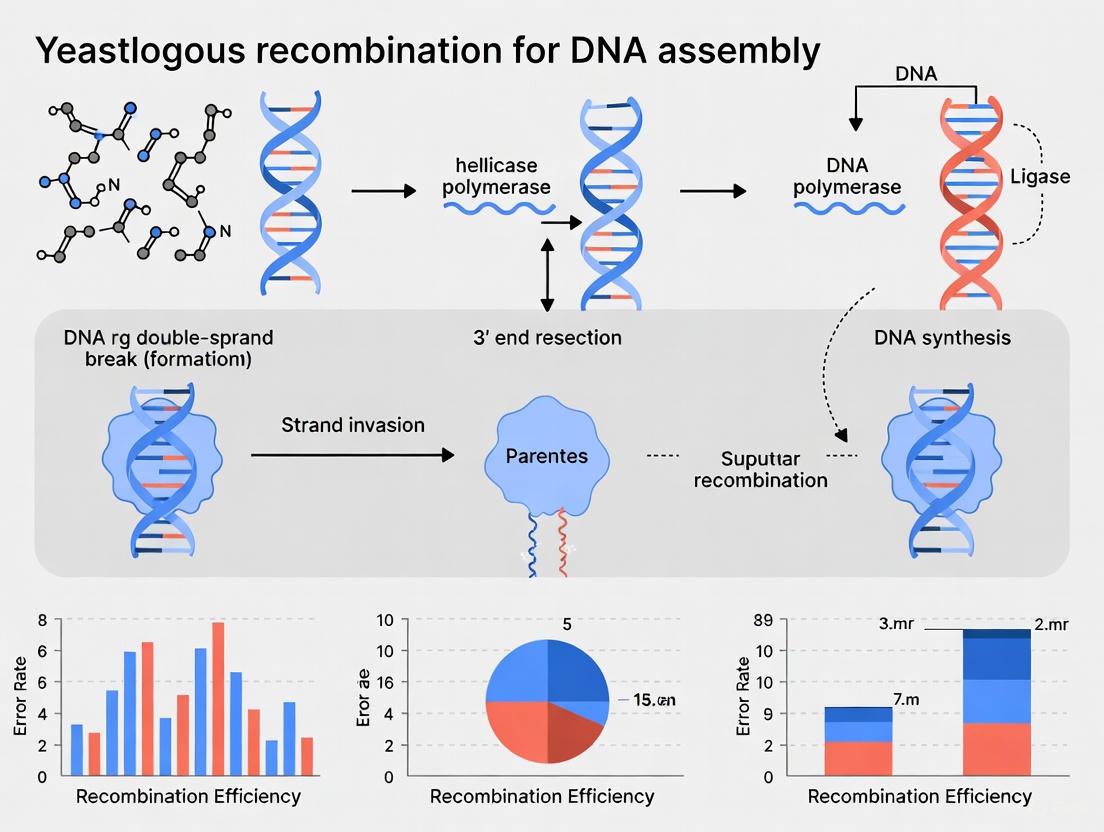
This article provides researchers, scientists, and drug development professionals with a thorough examination of yeast homologous recombination (YHR) for DNA assembly.
Yeast Homologous Recombination: A Comprehensive Guide to DNA Assembly for Biomedical Research
Abstract
This article provides researchers, scientists, and drug development professionals with a thorough examination of yeast homologous recombination (YHR) for DNA assembly. It covers the foundational biological mechanisms of YHR in Saccharomyces cerevisiae, detailing its innate DNA repair processes that enable precise genetic engineering. The content explores high-throughput methodological protocols and diverse applications, from synthetic biology and reverse genetics to recombinant protein production. It also delivers critical troubleshooting and optimization strategies based on recent studies, including parameters for homologous arm length and fragment-to-vector ratios. Finally, the article addresses validation techniques and comparative analyses with other host systems, establishing YHR's pivotal role in advancing biomedical research and therapeutic development.
The Biological Engine: Unraveling the Core Mechanisms of Yeast Homologous Recombination
Saccharomyces cerevisiae possesses an exceptionally efficient native homologous recombination (HR) system, making it a premier organism for DNA assembly and synthetic biology. This innate DNA repair machinery allows for the precise assembly of multiple DNA fragments into plasmids or directly into the genome in a single step. The reliability and high efficiency of yeast homologous recombination facilitate the construction of complex genetic circuits, entire metabolic pathways, and even large viral genomes, supporting advanced applications in basic research and drug development.
Homologous recombination (HR) is a fundamental genetic repair mechanism in the yeast Saccharomyces cerevisiae that has been harnessed for precise genetic engineering. This natural process allows the yeast cell to integrate foreign DNA with high fidelity when homologous sequences are present. The efficiency of this system in yeast is remarkably high compared to other organisms, enabling the assembly of multiple DNA fragments simultaneously through the simple use of short homologous overlaps [1]. This capability has transformed yeast into a powerful biofoundry for DNA construction, from basic plasmids to entire synthetic genomes.
The molecular mechanism involves the alignment of homologous sequences between DNA molecules, followed by strand invasion, branch migration, and resolution of the recombinant structures. For biotechnological applications, this means that researchers can design DNA parts with short homologous ends (homology arms) which the yeast's repair machinery will seamlessly assemble into a coherent molecule. This process is so efficient that it can assemble up to 12 unique DNA parts simultaneously, making it invaluable for high-throughput synthetic biology workflows [1] [2].
The Molecular Basis of Yeast Homologous Recombination
The exceptional homologous recombination capability of S. cerevisiae stems from its highly proficient DNA repair machinery, which is essential for maintaining genomic integrity. This system allows for the precise repair of double-strand breaks using homologous DNA sequences as templates. When applied to genetic engineering, this natural process enables the integration of exogenous DNA fragments with flanking homology regions into vectors or genomic loci.
The key advantage of yeast homologous recombination lies in its ability to assemble multiple DNA fragments in a single transformation event. Using homology regions as short as 24 base pairs, the system can efficiently assemble constructs of up to 12 unique parts into diverse vectors [1]. This efficiency far surpasses traditional restriction enzyme-based cloning methods and has been successfully employed for assembling large DNA constructs, including coronavirus genome fragments exceeding 30 kilobases [3].
The following diagram illustrates the core experimental workflow for DNA assembly using yeast homologous recombination:
Quantitative Optimization of Homologous Recombination Efficiency
Homologous Arm Length Optimization
The length of homologous sequences significantly impacts recombination efficiency. Systematic studies have demonstrated that optimal arm length balances high efficiency with practical primer design constraints.
Table 1: Effect of Homologous Arm Length on Recombination Efficiency
| Homologous Arm Length | Transformation Efficiency | Optimal Vector:Fragment Ratio | Key Applications |
|---|---|---|---|
| 24 bp | Moderate | 1:1 | Standard plasmid assembly |
| 40 bp | 58.3% (at optimal ratio) | 1:2:2:2:2:2 | Basic genetic constructs |
| 60 bp | Up to 97.9% | 1:2:2:2:2:2 | Large fragment assembly (>5 kb) |
| 80 bp | Up to 97.9% (requires higher fragment ratio) | 1:3:3:3:3:3 | Complex genomic integration |
Vector-to-Fragment Ratio Optimization
The relative ratio of linearized vector to insert fragments critically influences assembly success, particularly for multi-part assemblies. Empirical testing has identified optimal stoichiometries for different experimental setups.
Table 2: Optimization of Vector-to-Fragment Ratios for Multi-Part Assembly
| Assembly Complexity | Recommended Ratio (Vector:Fragment) | Efficiency Range | Notes |
|---|---|---|---|
| 2-part assembly (simple plasmid) | 1:1 | >90% | Standard cloning applications |
| 6-part assembly (5 kb fragments) | 1:2:2:2:2:2 | Up to 97.9% | Optimal for 60 bp homology arms |
| 6-part assembly (large constructs) | 1:3:3:3:3:3 | Up to 97.9% | Required for 80 bp homology arms |
| High-throughput workflows | 1:1:1:1:1:1 | ~50-85% | Balance of efficiency and cost |
Recent research on splicing large coronavirus genome fragments demonstrated that optimization of both homologous arm length and vector-to-fragment ratios can achieve recombination efficiencies up to 97.9% [3]. The study identified 60 bp as the optimal homologous sequence size with a vector fragment ratio of 1:2:2:2:2:2 for yeast homologous recombination of large DNA fragments of approximately 5 kb each [3].
Comparative Analysis with Alternative Genome Engineering Methods
Homologous Recombination vs. CRISPR-Cas9
While homologous recombination represents the traditional gold standard for genetic engineering in yeast, CRISPR-Cas9 systems offer complementary capabilities for certain applications.
Table 3: Comparison of DNA Assembly Methods in S. cerevisiae
| Parameter | Yeast Homologous Recombination | CRISPR-Cas9 in Yeast |
|---|---|---|
| Mechanism | Endogenous repair machinery | Programmable nuclease with repair templates |
| Required DNA elements | Homology arms (24-80 bp) | gRNA target sequence + PAM site + repair template |
| Multi-part assembly capacity | Up to 12 parts simultaneously | Typically up to 6 edits simultaneously |
| Marker requirement | Can be marker-free | Typically uses selective markers |
| Efficiency | Up to 97.9% for optimized parameters | Variable depending on gRNA design and target locus |
| Optimal applications | Pathway assembly, large construct building | Precise edits, gene knockouts, transcriptional control |
| Throughput | High-throughput compatible | Moderate to high throughput |
The CRISPR-Cas system introduces double-strand breaks that must be repaired by the cell's endogenous repair machinery, either through non-homologous end joining (NHEJ) or homologous recombination (HR) [4]. While CRISPR enables more precise targeting, traditional homologous recombination remains superior for assembling multiple DNA fragments simultaneously without the need for specialized nucleases.
Experimental Protocol for High-Throughput DNA Assembly
Detailed Step-by-Step Methodology
The following protocol outlines the optimized procedure for assembling DNA fragments using yeast homologous recombination, incorporating quantitative parameters for maximum efficiency:
DNA Part Preparation
- Amplify all DNA fragments via PCR with primers designed to include appropriate homology arms (24-80 bp)
- Purify PCR products using standard gel extraction or column purification methods
- Quantify DNA concentration using spectrophotometry and normalize concentrations
Vector Preparation
- Linearize destination vector by PCR or restriction enzyme digestion
- Dephosphorylate vector ends to prevent self-ligation
- Verify complete linearization by agarose gel electrophoresis
Transformation Mixture Assembly
- Combine linearized vector and insert fragments at optimal ratios (typically 1:2:2:2:2:2 for 6-part assembly)
- Use approximately 100 ng of vector DNA total
- Include carrier DNA (salmon sperm DNA) to improve transformation efficiency
Yeast Transformation
- Use lithium acetate method for competent cell preparation
- Incubate transformation mixture at 45°C for 30 minutes (heat shock)
- Plate on appropriate selective media and incubate at 30°C for 2-3 days
Screening and Validation
- Pick individual colonies and culture in selective media
- Extract plasmids using yeast miniprep protocol
- Transform extracted plasmids into E. coli for amplification and storage
- Verify constructs by colony PCR, restriction digest, or sequencing
This high-throughput protocol can generate DNA parts through PCR, assemble them into a vector via yeast transformation, and "shuttle" the resulting plasmid constructs into E. coli for storage and propagation [1]. Though this protocol is intended for high-throughput workflows, it can be easily adapted for bench-scale DNA assembly.
The Scientist's Toolkit: Essential Research Reagents
Successful implementation of yeast homologous recombination requires specific reagents and genetic tools. The following table details key resources for establishing this technology in research laboratories.
Table 4: Essential Research Reagents for Yeast Homologous Recombination
| Reagent/Tool | Function | Examples/Specifications |
|---|---|---|
| S. cerevisiae strains | Host organism for DNA assembly | S288c (reference strain), CEN.PK, BY4741 |
| YAC vectors | Carrying large DNA fragments | Yeast Artificial Chromosomes with selection markers |
| Homology arm sequences | Guide precise DNA assembly | 24-80 bp overlaps, designed with Tm 73-76°C |
| Selectable markers | Identify successful recombinants | URA3, LEU2, HIS3, TRP1, KanMX |
| Transformation reagents | Introduce DNA into yeast | Lithium acetate, PEG, single-stranded carrier DNA |
| Yeast deletion collection | Functional genomics resource | ~4800 non-essential gene deletion mutants |
| Bioinformatics tools | Design homology arms and assemblies | CRISPy, CRISPRdirect, CHOPCHOP |
| Plasmid libraries | Source of genetic parts | Yeast GFP collection, overexpression libraries |
The yeast deletion collection deserves special mention as it represents a powerful resource for functional genomics. This collection consists of a nearly complete set of viable deletion mutants where each non-essential open reading frame is replaced with a drug resistance marker flanked by two distinct 20 basepair DNA barcodes (UPTAG and DOWNTAG) [2]. The high efficiency of homologous recombination in yeast was exploited to construct this comprehensive resource.
Applications in Pharmaceutical Research and Drug Development
The robust DNA assembly capabilities of S. cerevisiae have enabled numerous applications with direct relevance to drug development and pharmaceutical research:
Viral Reverse Genetics Systems: Yeast homologous recombination has been successfully employed to construct full-length cDNA clones of viruses, including SARS-CoV-2. This reverse genetics approach enables rapid generation of recombinant viruses for vaccine development and antiviral screening [3]. The ability to splice large viral genome fragments (up to 30 kb) with high efficiency provides a powerful platform for responding to emerging viral threats.
Humanized Protein Production: S. cerevisiae can express complex human proteins with proper post-translational modifications. The homologous recombination system facilitates rapid engineering of yeast strains to optimize protein production for therapeutic applications [5]. This includes the production of recombinant vaccines, hormones, and enzymes.
Functional Characterization of Disease Genes: Approximately 30% of known genes involved in human disease have yeast homologs [2]. The efficient genetic manipulation possible with homologous recombination allows researchers to introduce human disease alleles into yeast models for functional characterization and drug screening.
Metabolic Engineering for Drug Precursors: Yeast can be engineered to produce valuable compounds through reconstruction of biosynthetic pathways. Homologous recombination enables simultaneous integration of multiple pathway enzymes, creating microbial factories for drug precursors such as artemisinin and opioids.
The following diagram illustrates the key applications and their relationships in pharmaceutical research:
Future Perspectives and Advanced Applications
As synthetic biology continues to advance, yeast homologous recombination is being integrated with automated platforms to increase throughput and reproducibility. The US Department of Energy Agile Biofoundry has developed web-based DNA assembly design software (j5) that can generate assembly diagrams and processes based on user input or recommended methods [3]. These automated systems can complete over 2000 DNA assembly reactions per week, representing a 20-fold increase over manual operations [3].
Emerging applications include the construction of entire microbial genomes, with researchers successfully assembling a circular mycoplasma genome of nearly 600 kb in a single step using 25 DNA fragments in brewing yeast [3]. This demonstrates the unprecedented capacity of yeast homologous recombination for synthetic genomics projects.
Future developments will likely focus on enhancing the precision and scale of DNA assembly while reducing off-target effects. Combining the efficiency of homologous recombination with the targeting specificity of CRISPR systems may yield next-generation tools for genome engineering. As these technologies mature, S. cerevisiae will remain at the forefront of synthetic biology applications with direct relevance to pharmaceutical development and therapeutic discovery.
Homologous recombination (HR) is a universally conserved biological process that enables the repair of complex DNA damage and provides critical support for DNA replication. In the budding yeast Saccharomyces cerevisiae, this elegantly orchestrated pathway serves dual purposes: maintaining genomic integrity through error-free repair of DNA double-strand breaks (DSBs) and collapsed replication forks, and enabling precise genetic engineering through DNA assembly [6] [7]. The fundamental reaction in HR involves the exchange of DNA strands between a single-stranded DNA and a homologous double-stranded DNA, catalyzed by the RecA/Rad51 family of ATPases [8]. This versatile molecular machinery allows yeast to access and copy intact DNA sequence information in trans, particularly to repair DNA damage affecting both strands of the double helix [9].
Yeast homologous recombination has emerged as a pivotal biotechnology tool, leveraging the cell's innate ability to repair DNA double-strand breaks through homologous recombination to manipulate and design yeast genomes with unprecedented precision [10]. The technology has found widespread applications in biopharmaceuticals, gene therapy, agricultural production, and synthetic biology, making it an indispensable resource for researchers and drug development professionals [10] [11]. This technical guide explores the core mechanisms of homologous recombination in yeast, detailing how this natural repair process has been harnessed for precise DNA assembly in research settings, with particular emphasis on experimental parameters, methodologies, and practical applications that enhance its utility in biotechnology and therapeutic development.
Core Mechanism: The Molecular Steps of Homologous Recombination
Initial Processing of DNA Double-Strand Breaks
The homologous recombination pathway initiates when a chromosome suffers a double-strand break. In yeast, the predominant mechanism for repairing these lesions is homologous recombination rather than non-homologous end joining [7]. The repair process commences with 5' to 3' resection of the DSB ends, producing protruding 3'-OH single-stranded DNA (ssDNA) tails [7] [9]. This resection process is surprisingly complex and flexible, involving multiple nucleases working in coordination [9]. The Mre11-Rad50-Xrs2 complex, along with its cofactor Sae2, initiates resection by delivering an endonucleolytic incision to release a terminal 5'-ending oligonucleotide. Bulk resection is then accomplished by two pathways: the 5'-3' exonuclease Exo1, and the Sgs1-Top3-Rmi1 complex working in conjunction with the Dna2 nuclease [9].
The resected DNA ends must then find, synapse with, and invade a homologous donor locus to prime repair DNA synthesis. In somatic cells, DSB repair by HR strongly favors the sister chromatid over the homologous chromosome as a template donor, and primarily resolves interchromosomal joint molecules through the synthesis-dependent strand annealing (SDSA) pathway [9]. Both preferences serve to limit potential loss of heterozygosity through somatic crossover, maintaining genomic stability [9]. The SDSA pathway ensures that DNA synthesis creates homology to the other broken DNA end, so when the extended D-loop is unwound, the two ends can anneal and achieve repair without reciprocal exchange [9].
The Central Strand Exchange Reaction
The heart of homologous recombination lies in the strand exchange reaction mediated by the Rad51 protein, which forms a right-handed helical filament on ssDNA that acts as a nucleoprotein scaffold to direct recombination activities [9] [8]. Nucleation of the Rad51 filament is challenged by competition with the ssDNA-binding protein RPA [9]. Once nucleated, cooperative interactions between Rad51 protomers dominate, and filament growth ensues. The Rad51 filament exists in dynamic equilibrium, with ATP-bound states favoring filament nucleation and growth, while ADP-bound states have lower DNA affinity [9].
Recent cryo-EM analysis has revealed detailed insights into this process [8]. The synaptic filament mediates the search for homology through a sophisticated mechanism: on binding to the filament, the dsDNA strands are separated, with one strand sequestered while the other is freed to sample pairing with the ssDNA through Watson-Crick base pairing. Homology, through heteroduplex formation, promotes further dsDNA opening, while lack of homology suppresses it, keeping local synapses short. This presumably limits futile strand separation in the absence of homology, allowing for multiple synapses to sample homology elsewhere along the dsDNA [8]. On ATP hydrolysis, which releases the DNA, a new heteroduplex is produced if strand exchange has occurred [8].
Key Regulatory Proteins and Complexes
The core strand exchange activity of Rad51 is facilitated and regulated by numerous accessory factors that define the RAD52 epistasis group in yeast:
Rad52 protein plays a central role, being necessary for all Rad51 filament formation in vivo [9]. Rad52 binds ssDNA as a ring-shaped multimer and accelerates the annealing of complementary DNA strands [7]. It mediates the replacement of RPA with Rad51 by wrapping ssDNA around itself, destabilizing the RPA-ssDNA interaction while promoting Rad51 binding through physical interaction [9].
Rad55 and Rad57 form a heterodimer that stimulates the strand exchange activity of Rad51 [7]. This complex stabilizes Rad51 filaments on ssDNA and opposes the antirecombinase activity of the Srs2 helicase [9].
Rad54 protein, a member of the Swi2/Snf2 family of chromatin-remodeling proteins, possesses chromatin remodeling activity and is required for invasion reactions using chromatin substrates [7]. Rad54 may act to extend heteroduplex DNA or alter DNA conformation at later stages of the strand exchange reaction [7].
Srs2 helicase functions as an antirecombinase that disassembles Rad51 filaments, preventing hyper-recombination [7] [9]. The Rad55-Rad57 complex acts as a roadblock on ssDNA in the path of the Srs2 helicase, creating a balance between recombination promotion and suppression [9].
Diagram Title: Homologous Recombination Pathway in Yeast
Yeast Homologous Recombination Technology: Principles and Applications
Why Saccharomyces cerevisiae is Ideal for Recombination Studies
Saccharomyces cerevisiae offers several distinctive advantages that make it an exceptional model organism for homologous recombination research and applications. As one of the first eukaryotic organisms to have its genome sequenced and one of the earliest food-grade microorganisms applied in brewing and food production, it combines genetic tractability with practical relevance [10]. The yeast genome is relatively simple and well-characterized, making it easier for researchers to identify, manipulate, and study genetic elements. Under optimal conditions, yeast exhibits a fast growth rate, allowing researchers to conduct experiments more efficiently than with many other eukaryotic systems [10].
As a eukaryotic organism, S. cerevisiae is remarkably robust and can tolerate a wide range of environmental conditions, facilitating laboratory manipulation [10]. Perhaps most importantly, a comprehensive array of well-established genetic tools and techniques have been developed for this yeast, including methods for gene deletion, integration, and expression, as well as specialized tools for monitoring and analyzing recombination events [10]. From a practical research perspective, yeast has the advantage that its relatively small genome experiences fewer spontaneous DNA lesions per cell, making it easier to discern the signal from a single specific lesion from the background of spontaneous random lesions [12].
Harnessing Natural Repair for DNA Assembly
The application of yeast homologous recombination for DNA assembly represents a sophisticated form of reverse genetics that leverages the cell's innate DNA repair machinery. This process, often called "gap repair" or "yeast recombination cloning," allows assembly of multiple DNA fragments in a single step with remarkably high efficiency [11]. The method is extremely efficient, requiring only 29 nucleotides of overlapping sequences that can be added to synthesized oligonucleotides [11]. This capability has been further enhanced through the development of the any-gene-any-plasmid (AGAP) cloning system, which incorporates a yeast-cloning cassette (YCC) containing the 2-micron origin of replication and a selectable marker (e.g., URA3 gene) to make yeast cloning applicable to any DNA cloning experiment [11].
This technology has proven particularly valuable for manipulating large DNA constructs that are challenging to maintain in bacterial systems. For instance, researchers have successfully split and spliced a 30 kb viral genome fragment using yeast homologous recombination [13]. Similarly, the technology has been used to create plasmids for recombinant protein production in Escherichia coli, epitope tagging and site-directed mutagenesis in pathogens like Staphylococcus aureus, and constructs to express fluorescent fusion proteins in vertebrate models such as zebrafish [11]. The system's versatility extends to synthetic biology applications, where it has been used to assemble complex synthetic biological systems and entire microbial genomes [11] [13].
Experimental Optimization: Quantitative Parameters for Efficient DNA Assembly
Critical Factors Influencing Recombination Efficiency
The efficiency of yeast homologous recombination as a DNA assembly method depends significantly on several technical parameters that require careful optimization. Two factors emerge as particularly critical: the length of homologous arms between DNA fragments and the vector-to-fragment ratio used in the transformation [13]. Systematic investigation of these parameters has revealed clear optimal ranges that maximize recombination efficiency while maintaining flexibility for different experimental needs.
Recent research splicing large coronavirus genome fragments provides quantitative insights into these parameters [13]. When assembling six approximately 5 kb fragments, homologous arm lengths of 40 bp, 60 bp, and 80 bp were tested in combination with different vector-to-fragment ratios. The results demonstrated that 60 bp homologous sequences consistently yielded recombination efficiencies exceeding 85% across various ratios, peaking at 97.9% efficiency [13]. While 80 bp arms could achieve similar peak efficiency (97.9%), this required a higher fragment ratio and showed greater variability, while 40 bp arms reached only 58.3% maximum efficiency [13].
Parameter Optimization for Different Assembly Scenarios
Table 1: Optimization of Homologous Recombination Parameters for DNA Assembly
| Parameter | Tested Conditions | Efficiency Range | Optimal Value | Application Context |
|---|---|---|---|---|
| Homologous arm length | 40 bp, 60 bp, 80 bp | 58.3% - 97.9% | 60 bp | Standard assembly of ~5 kb fragments |
| Vector:Fragment ratio | 1:1:1:1:1:1, 1:2:2:2:2:2, 1:3:3:3:3:3 | 41.7% - 97.9% | 1:2:2:2:2:2 (for 60 bp arms) | Assembly of six ~5 kb fragments |
| Fragment size | ~5 kb per fragment | Up to 97.9% efficiency | ~5 kb | Viral genome assembly (30 kb total) |
| Selection system | URA3 with 2-micron origin | High efficiency | YCC (Yeast Cloning Cassette) | AGAP (any-gene-any-plasmid) cloning |
The data reveal that parameter optimization should be context-dependent. For standard assemblies involving fragments of approximately 5 kb, 60 bp homologous arms with a vector-to-fragment ratio of 1:2:2:2:2:2 provides consistently high efficiency [13]. The AGAP cloning system demonstrates that inclusion of a yeast-cloning cassette containing the 2-micron origin of replication and URA3 selection marker enables this optimization to be applied to virtually any vector system [11]. This versatility significantly enhances the utility of yeast homologous recombination for diverse molecular cloning needs across different research domains.
Research Reagent Solutions: Essential Tools for Yeast HR Studies
Table 2: Key Research Reagents for Yeast Homologous Recombination Studies
| Reagent/Chemical | Function/Application | Specific Examples | Technical Notes |
|---|---|---|---|
| Yeast Strains | Host for recombination studies | ML193-3B, ML494-15C (derivatives of W303-1A) [12]; FY2 for transformation [11] | Strains with fluorescently tagged HR proteins enable live cell imaging |
| Fluorescent Tags | Live cell imaging of HR proteins | CFP, YFP, RFP tags for RAD51, RAD55 [12] | Endogenous tagging via PCR-based method with K. lactis URA3 marker |
| DNA Damage Agents | Induction of controlled DSBs | Bleomycin, Zeocin, Camptothecin, Methyl methanesulfonate [12] | Used at specified concentrations to induce synchronous recombination |
| Culture Media | Cell growth and selection | YPD, SC-Ura, 5-FOA medium [12] | SC-Ura for selection; 5-FOA for counter-selection and marker popout |
| Plasmids | Expression vectors and cloning | pWJ1350, pWJ1351 for mRFP tagging [12]; pRS426 for YCC [11] | Vectors with yeast origins and selection markers |
| Enzymes | Molecular biology manipulations | Pfu polymerase for fusion PCR [12]; Restriction enzymes for vector linearization [11] | High-fidelity polymerases crucial for fusion PCR fragments |
| Microscopy Hardware | Visualization of recombination foci | High-sensitivity cooled CCD/EM-CCD camera, 100x objective (NA ≥1.4) [12] | Essential for detecting low-copy number HR proteins |
This collection of research reagents enables the full spectrum of homologous recombination studies, from basic mechanistic investigation to applied DNA assembly technologies. The availability of well-characterized yeast strains with fluorescently tagged HR proteins has been particularly valuable for live cell imaging of single-lesion recombination events [12]. Similarly, the development of specialized plasmids and cloning cassettes has dramatically improved the versatility of yeast gap-repair cloning, making it compatible with virtually any DNA vector system [11].
Protocol: Fluorescence Tagging of Endogenous HR Proteins
PCR-Based Tagging Strategy
The following protocol describes a method for fluorescence tagging of endogenously expressed homologous recombination proteins with cyan, yellow, or red fluorescent protein (CFP, YFP, and RFP, respectively) using a PCR-based approach [12]. This method enables live cell imaging of recombination events and has been optimized for high efficiency and specificity:
Template Preparation: Isolate genomic DNA from the target strain using standard protocols [12].
Marker Amplification: Amplify the mRFP-5'-K.l.URA3 fragment from plasmid pWJ1350 using primers Kli3' and mRFPstart-F with a high-fidelity polymerase such as Pfu. Similarly, amplify the 3'-K.l.URA3-mRFP fragment from pWJ1351 using primers Kli5' and mRFPend-R [12]. Use the following PCR conditions: 95°C for 2 min, 30 cycles of 95°C for 30 s, 52°C for 30 s, and 72°C for 4 min, followed by 72°C for 1 min and cooling to 4°C [12]. Purify all PCR fragments by agarose gel extraction.
Homology Region Amplification: Amplify approximately 300 bp immediately upstream of the genomic integration site from the genomic DNA using primers UFx and URxr1. Similarly, amplify approximately 300 bp immediately downstream of the integration site using primers DFxr2 and DRx [12]. Purify these gene-specific fragments by agarose gel extraction.
Fusion PCR: Fuse approximately 200 ng of the mRFP-5'-K.l.URA3 fragment with an equimolar amount of the gene-specific upstream fragment using primers Kli3' and UFx. Similarly, fuse 200 ng of the 3'-K.l.URA3-mRFP fragment with an equimolar amount of the gene-specific downstream fragment using primers Kli5' and DRx [12]. Use the following PCR conditions: 95°C for 2 min, 30 cycles of 95°C for 30 s, 52°C for 30 s, and 72°C for 4.5 min, followed by 72°C for 2 min and cooling to 4°C [12].
Transformation and Selection
Yeast Transformation: Co-transform 0.3-1 μg of each fusion fragment into the target strain using the LiAc method [12] [11]. Select transformants on synthetic complete medium lacking uracil (SC-Ura). Note that targeting efficiency varies with the genomic locus by at least a factor of 10 [12].
Marker Recycling: The integration generates a direct repeat of the mRFP sequence flanking the K.l.URA3 marker. To pop out the URA3 marker, grow cells overnight in 2 ml of YPD medium before plating 200 μl of the culture on plates containing 5-fluoroorotic acid (5-FOA) [12]. This counterselection yields cells that have excised the marker through homologous recombination between the direct repeats.
Validation: Confirm correct integration and tagging by PCR analysis, fluorescence microscopy, and functional assays to ensure the tagged protein maintains normal activity.
Diagram Title: Fluorescent Protein Tagging Workflow
Advanced Applications: From Basic Research to Therapeutic Development
Reverse Genetics and Viral Research
Yeast homologous recombination has emerged as a powerful platform for reverse genetics synthesis, enabling the rapid synthesis or modification of viruses without being restricted by their source [13]. This method has greatly advanced virus detection and treatment by allowing the addition of tags or fluorescence to viral genomes [13]. The synthesis and assembly of DNA fragments are key components of reverse genetics, and yeast systems excel particularly in assembling large DNA constructs that are challenging to maintain in bacterial systems [13].
In 2021, researchers successfully synthesized the cDNA of SARS-CoV-2 using yeast homologous recombination technology, providing crucial support for understanding SARS-CoV-2 pathogenesis and developing prevention and control strategies [13]. This breakthrough demonstrated the capacity of yeast systems to handle viral genomes of approximately 30 kb, establishing a rapid and stable reverse genetics platform for RNA viruses [13]. The advancement of virus genome synthesis technology through yeast homologous recombination also holds promise for applications in biopharmaceutical design, gene therapy, and oligonucleotide drug development [13].
Cancer Research and Therapeutic Targeting
The fundamental role of homologous recombination in maintaining genomic integrity has profound implications for cancer biology and therapy. Mutations in HR pathway genes cause predisposition to various cancers; for example, mutations in the BRCA2 recombination gene cause predisposition to breast and ovarian cancer as well as Fanconi anemia [6]. The inability to properly repair complex DNA damage and resolve DNA replication stress leads to genomic instability that contributes to cancer etiology [6].
This understanding has led to the development of targeted cancer therapies that exploit HR deficiencies in tumors. Poly (ADP-ribose) polymerase inhibitors (PARPi) have emerged as a major advance in cancer treatment, particularly for epithelial ovarian cancer (EOC) [14]. HR-deficient tumors show variable responses to PARPi depending on the underlying mechanism of deficiency, with BRCA1/2 LOH tumors showing the best efficacy, followed by BRCA1 methylation groups, and those with unknown HRD etiology having the worst efficacy [14]. The assessment of homologous recombination deficiency (HRD) status through genomic scar analysis has become an important biomarker for predicting response to DNA-damaging agents and targeted therapies [14] [15].
Yeast homologous recombination represents a remarkable example of how fundamental biological mechanisms can be harnessed for diverse research and therapeutic applications. From its essential role in DNA repair and genomic maintenance to its transformation into a versatile genetic engineering tool, this process continues to provide invaluable insights and capabilities to the scientific community. The optimized parameters and standardized protocols outlined in this technical guide provide researchers with a foundation for exploiting this powerful technology across multiple domains.
Future advancements in yeast homologous recombination will likely focus on increasing automation, standardization, and throughput. Automated synthetic biotechnology, with its automation, standardization, high-throughput capabilities, and advancements in information technology and artificial intelligence, is poised to revolutionize traditional biological research methods that rely on manual experimentation [13]. These developments will provide crucial technical and platform support for the rapid design and construction of microbial cell factories and complex genetic circuits [13]. As our understanding of the fundamental mechanisms deepens and our technical capabilities expand, yeast homologous recombination will continue to be an indispensable tool for basic research, therapeutic development, and synthetic biology applications.
Homologous recombination (HR) is a fundamental genetic process in yeast, enabling precise DNA repair and meiotic recombination. In genetic engineering, this innate cellular mechanism is co-opted for accurate DNA assembly. When multiple DNA fragments with homologous ends are introduced into yeast cells, they recombine with high fidelity, assembling into larger, more complex DNA constructs. This process, known as transformation-associated recombination (TAR), has become a cornerstone technique in synthetic biology for constructing plasmids, pathways, and even entire genomes [16]. The exceptional efficiency of yeast HR allows for simultaneous assembly of numerous DNA fragments in a single reaction, bypassing many limitations of traditional restriction enzyme-based cloning methods. This technical guide explores the core advantages that make Saccharomyces cerevisiae an unparalleled platform for DNA assembly, providing researchers with detailed methodologies and quantitative data to leverage this powerful technology.
Core Advantages for DNA Assembly Research
Exceptional Genetic Tractability
The genetic tractability of S. cerevisiae stems primarily from its highly efficient and precise homologous recombination system. Unlike many other organisms, yeast preferentially uses homologous recombination over non-homologous end joining (NHEJ) for DNA repair, enabling targeted and accurate DNA assembly.
High-Efficiency Multi-Fragment Assembly: Yeast HR can simultaneously assemble numerous DNA fragments with remarkable efficiency. Research demonstrates successful one-step assembly of up to 12 unique DNA parts into vectors using homology regions as short as 24 base pairs [1]. This capability extends to extremely large constructs, with studies reporting assembly of a 21 kb plasmid from nine overlapping fragments with 95% correct assembly yield [16], and even assembly of a nearly 600 kb mycoplasma genome from 25 DNA fragments in a single step [13].
Flexible Homology Requirements: The system operates efficiently with short homologous sequences, typically 40-80 base pairs, which can be easily added to DNA fragments via PCR primers. This flexibility simplifies vector design and standardizes assembly workflows. Optimization studies have shown that 60 bp homologous sequences consistently yield recombination efficiencies exceeding 85%, peaking at 97.9% under optimal conditions [13].
Versatile Vector Compatibility: A significant advantage is the ability to make yeast HR compatible with any DNA vector system through yeast-cloning cassettes (YCC) containing yeast origins of replication and selection markers. This "universal cloning method" dramatically improves versatility, enabling construction of plasmids for diverse applications including recombinant protein production, epitope tagging, and fluorescent fusion protein expression [17].
System Robustness and Reliability
Yeast HR systems demonstrate remarkable robustness, maintaining high efficiency and accuracy even with complex and lengthy DNA constructs that challenge other assembly methods.
Handling Large DNA Constructs: Yeast artificial chromosomes (YACs) enable stable maintenance and manipulation of very large DNA inserts (100-1000 kb), far exceeding the capacity of bacterial systems. This capability is crucial for assembling viral genomes, metabolic pathways, and synthetic chromosomes. Recent applications include splicing 30 kb coronavirus genome fragments with optimized efficiency [13].
Reduced False Positives: Systematic engineering of assembly systems has significantly improved reliability. By separating essential vector elements (episome and selection marker) onto different fragments and implementing standardized 60 bp synthetic homologous recombination sequences non-homologous to the yeast genome, researchers achieved a 100-fold decrease in false positive transformants compared to methods using single linearized backbones [16].
Error Correction Mechanisms: Yeast's efficient DNA repair machinery contributes to assembly accuracy by rejecting mismatched fragments and correcting errors during recombination. This inherent quality control ensures high fidelity in the assembled constructs without additional in vitro processing.
Well-Established Tool Ecosystem
Decades of yeast research have produced an extensive collection of well-characterized genetic tools and resources that streamline DNA assembly workflows.
Standardized Genetic Parts: The field has developed comprehensive part libraries including promoters, terminators, selection markers, and reporter genes with documented performance characteristics. These standardized parts enable modular design and predictable assembly outcomes.
Advanced Selection Systems: Multiple auxotrophic markers (URA3, LEU2, HIS3, TRP1) and dominant antibiotic resistance genes allow for flexible selection strategies. Counter-selection markers enable plasmid curing and marker recycling for sequential genetic modifications.
Automation-Compatible Protocols: The robustness of yeast HR makes it particularly amenable to high-throughput operations and laboratory automation. High-throughput protocols have been developed to generate DNA parts via PCR, assemble them via yeast transformation, and shuttle resulting plasmids into E. coli for storage and propagation [1]. Automated systems can perform thousands of DNA assembly reactions weekly, dramatically increasing throughput [13].
Table 1: Optimization Parameters for Yeast Homologous Recombination
| Parameter | Tested Ranges | Optimal Value | Impact on Efficiency |
|---|---|---|---|
| Homologous arm length | 40 bp, 60 bp, 80 bp | 60 bp | 60 bp consistently yielded >85% efficiency, peaking at 97.9% [13] |
| Fragment-to-vector ratio | 1:1:1:1:1:1, 1:2:2:2:2:2, 1:3:3:3:3:3 | 1:2:2:2:2:2 (for 60 bp arms) | Higher fragment ratios generally increase efficiency up to optimal point [13] |
| Number of fragments | 2-12+ in single reaction | Up to 12+ demonstrated | Efficiency decreases gradually with fragment number but remains practical [1] [16] |
| Fragment size | 5 kb to >100 kb | No practical upper limit | Yeast efficiently handles very large fragments via YAC system [13] |
Quantitative Experimental Data
Optimization of Critical Parameters
Systematic optimization studies have quantified the impact of key parameters on yeast HR efficiency, enabling researchers to design highly efficient assembly reactions.
Homologous Arm Length Optimization: Comparative studies testing 40 bp, 60 bp, and 80 bp homologous sequences revealed that 60 bp arms provide the optimal balance between efficiency and practicality. With 60 bp arms and optimized fragment ratios, recombination efficiency reached 97.9%. While 80 bp arms can achieve similar efficiency (97.9%), this required higher fragment ratios (1:3:3:3:3:3) [13]. The 40 bp arms showed significantly lower efficiency, peaking at 58.3% even with optimized ratios [13].
Fragment Stoichiometry Effects: The molar ratio of vector to insert fragments significantly impacts assembly efficiency. Research demonstrates that increasing fragment concentrations improves efficiency up to an optimal point. For 60 bp homologous arms, increasing the vector-to-fragment ratio from 1:1:1:1:1:1 to 1:2:2:2:2:2 consistently improved efficiency above 85% [13]. However, excessive fragment concentrations may inhibit efficiency in some cases, as observed with 80 bp arms where increasing from 1:1:1:1:1:1 to 1:2:2:2:2:2 actually decreased efficiency [13].
Table 2: Impact of Homology Length and Fragment Ratio on Assembly Efficiency
| Homology Length | Vector:Fragment Ratio | Recombination Efficiency | Observation |
|---|---|---|---|
| 40 bp | 1:1:1:1:1:1 | <58.3% | Efficiency increases with fragment ratio but remains moderate [13] |
| 40 bp | 1:2:2:2:2:2 | 58.3% | Peak efficiency for 40 bp arms [13] |
| 60 bp | 1:1:1:1:1:1 | >85% | Consistently high efficiency across ratios [13] |
| 60 bp | 1:2:2:2:2:2 | 97.9% | Optimal combination of efficiency and practicality [13] |
| 80 bp | 1:3:3:3:3:3 | 97.9% | High efficiency but requires more DNA [13] |
Assembly Complexity and Efficiency
Recent studies have pushed the boundaries of assembly complexity, demonstrating yeast HR's capability for increasingly ambitious projects.
Multi-Fragment Assembly Efficiency: The relationship between fragment number and assembly efficiency follows a predictable pattern where efficiency gradually decreases but remains practical for most applications. Research shows successful assembly of 9-fragment 21 kb plasmids with 95% correct assembly yield [16], demonstrating that well-designed assemblies maintain high efficiency even with significant complexity.
Large Construct Stability: Assembled constructs show exceptional stability in yeast, enabling maintenance of complex pathways and large DNA molecules. The successful assembly and maintenance of viral genome fragments exceeding 30 kb [13] highlights this stability, which is crucial for pathway engineering and genome-scale projects.
Detailed Experimental Protocols
Standardized Yeast HR Assembly Protocol
The following optimized protocol enables reliable assembly of multi-fragment constructs in S. cerevisiae:
Fragment Preparation:
- Design all DNA fragments with 60 bp homologous overlaps to adjacent fragments
- Generate fragments via PCR amplification with primers containing 60 bp homology extensions
- Purify fragments using standard agarose gel electrophoresis and extraction methods
- Quantify DNA concentration precisely for accurate stoichiometry
Yeast Transformation:
- Use fresh S. cerevisiae strain (e.g., CEN.PK113-5D) grown to mid-log phase (OD600 ≈ 0.8-1.0)
- Prepare transformation mix containing:
- 100 ng vector DNA
- 200 ng of each insert fragment (for 1:2:2:2:2:2 ratio)
- 100 μL yeast competent cells
- 10 μL carrier DNA (10 mg/mL)
- 600 μL transformation mix (40% PEG-3350, 0.1M LiOAc, 10mM Tris-HCl, 0.5mM EDTA)
- Incubate at 45°C for 30 minutes with gentle mixing every 10 minutes
- Plate on appropriate selective media and incubate at 30°C for 2-3 days
Screening and Validation:
- Screen 6-12 transformants by colony PCR using junction-spanning primers
- Isolate plasmid DNA from positive clones for sequence verification
- Transfer validated plasmids to E. coli for amplification and storage [1] [16]
High-Throughput Automation Protocol
For large-scale assembly projects, the following automation-adapted protocol can be implemented:
DNA Part Generation:
- Design all parts with standardized 60 bp synthetic homologous recombination sequences non-homologous to the yeast genome [16]
- Perform high-throughput PCR in 96- or 384-well formats
- Use automated purification systems for fragment cleanup
Robotic Assembly:
- Program liquid handling systems to dispense precise DNA ratios (optimal 1:2:2:2:2 vector-to-fragment ratio)
- Automate yeast transformation in multi-well plates
- Implement robotic plating on selective media
Validation Pipeline:
- Use colony picking robots to transfer transformants to fresh media
- Implement high-throughput colony PCR screening
- Sequence validated constructs using next-generation sequencing for comprehensive verification [1]
Signaling Pathways and Workflows
DNA Repair and Recombination Pathway
The molecular machinery underlying yeast homologous recombination represents a sophisticated DNA repair pathway that can be harnessed for DNA assembly. The following diagram illustrates key proteins and their interactions in this process:
Diagram 1: Homologous Recombination Machinery. This pathway illustrates key steps in yeast homologous recombination, from initial double-strand break (DSB) to final repair. Proteins highlighted in the diagram represent essential components that can be optimized for DNA assembly applications. The critical role of Rad54 in preventing Rad51 aggregate formation [18] underscores the importance of balanced protein expression for efficient recombination.
Multi-Fragment Assembly Workflow
The systematic workflow for yeast-based DNA assembly integrates multiple steps from design to validation:
Diagram 2: DNA Assembly Workflow. This workflow illustrates the optimized process for multi-fragment DNA assembly in yeast, highlighting steps that leverage yeast's unique biological capabilities. The cyclic nature of the process enables iterative optimization and high-throughput implementation.
Research Reagent Solutions
Table 3: Essential Research Reagents for Yeast Homologous Recombination
| Reagent Category | Specific Examples | Function and Application |
|---|---|---|
| Yeast Strains | CEN.PK113-5D, BY4741 derivatives | High-efficiency transformation recipients with well-characterized genetics [16] [19] |
| Selection Markers | K.l.URA3, LEU2, HIS3, TRP1 | Auxotrophic selection for plasmid maintenance and assembly selection [16] |
| Vector Systems | YAC vectors, CEN/ARS plasmids, 2μ plasmids | Stable maintenance of assembled constructs of various sizes [16] [13] |
| Homology Sequences | Standardized 60 bp SHR sequences | Synthetic homologous recombination sequences for standardized assembly [16] |
| Enzymes | High-fidelity DNA polymerases, restriction enzymes | Fragment generation and analysis [1] [16] |
| Transformation Reagents | LiOAc/PEG transformation mix, carrier DNA | Efficient DNA delivery into yeast cells [16] |
Yeast homologous recombination continues to be an indispensable technology for DNA assembly research, offering unparalleled genetic tractability, system robustness, and a well-established tool ecosystem. The quantitative data and optimized protocols presented in this technical guide provide researchers with actionable methodologies to leverage this powerful platform. Recent advances in parameter optimization, particularly the establishment of 60 bp homologous arms and defined fragment ratios achieving up to 97.9% efficiency [13], represent significant refinements to this technology. As synthetic biology progresses toward increasingly ambitious projects including genome-scale synthesis and complex pathway engineering, yeast HR stands ready to meet these challenges through its proven capacity for assembling large, complex DNA constructs with high fidelity and efficiency.
The scalability of genetic engineering is a fundamental determinant of research and development throughput in synthetic biology and drug development. Yeast homologous recombination (YHR) has emerged as a cornerstone technology for DNA assembly, enabling researchers to efficiently combine multiple DNA fragments into complex constructs through highly efficient natural cellular mechanisms. This biological process leverages the innate ability of Saccharomyces cerevisiae to recombine DNA sequences with homologous ends, typically ranging from 24 to 70 base pairs, facilitating the precise assembly of genetic material without the need for restrictive enzyme-based cloning methods [20] [1] [17]. The integration of YHR into automated platforms represents a paradigm shift, allowing for the systematic construction of genetic variants, metabolic pathways, and even entire synthetic genomes with unprecedented throughput and reproducibility.
The versatility of YHR stems from its compatibility with diverse genetic parts and vectors. By incorporating a yeast-cloning cassette (YCC) containing the 2-micron origin of replication and a selectable marker (e.g., ura3 gene), researchers can adapt virtually any plasmid backbone for assembly in yeast, dramatically expanding the method's applicability across different biological systems [17]. This compatibility with specialized plasmids used throughout microbiology and biomedical research makes YHR an ideal foundation for automated genetic workflows, enabling the seamless transition between different experimental systems and applications.
Core Principles of Yeast Homologous Recombination
Molecular Mechanisms
Yeast homologous recombination operates through a sophisticated cellular machinery that recognizes and joins DNA sequences with homologous ends. The process begins when double-strand breaks are introduced either experimentally or through cellular processes, exposing single-stranded DNA regions. These regions are then resected to create 3' overhangs that serve as substrates for the Rad51 recombinase, which facilitates the invasion of homologous DNA templates. The homology regions, which can be as short as 24 base pairs, serve as guides for precise assembly, with efficiency increasing with longer homologous overlaps [1]. This fundamental mechanism allows for the simultaneous assembly of up to 12 unique DNA parts in a single reaction, making it significantly more versatile than traditional restriction enzyme-based methods.
The efficiency of YHR is influenced by several factors, including the length and quality of homology arms, the size and complexity of DNA fragments, and the physiological state of the yeast cells. Optimal results are typically achieved with homology arms between 30-50 base pairs, which provide sufficient sequence for recognition and recombination while remaining cost-effective to synthesize [1]. The process is remarkably tolerant of sequence variations and can accommodate fragments ranging from simple gene assemblies to megabase-sized chromosomal regions, enabling applications from basic molecular biology to whole-genome engineering.
Visualizing the Core Yeast Homologous Recombination Mechanism
The following diagram illustrates the fundamental process of DNA assembly via yeast homologous recombination:
Advanced High-Throughput YHR Methodologies
Yeast Life Cycle Assembly (YLC-Assembly)
The YLC-assembly method represents a significant advancement in large DNA assembly technology by leveraging the complete yeast life cycle to facilitate iterative assembly processes. This innovative approach nests DNA assembly within the natural cycle of yeast mating and sporulation, enabling in vivo iterative assembly of large DNA constructs without requiring physical extraction and manipulation between rounds [20]. The process begins with the mating of two haploid yeast strains containing different DNA fragments, bringing them together in a diploid cell where homologous recombination occurs. The resulting diploid, now containing the assembled DNA, then undergoes meiosis to produce spores that can be used in the next round of assembly.
A key feature of YLC-assembly is the integration of an orthogonal-cut CRISPR/Cas9 system that enables specific linearization of DNA fragments in vivo, facilitating the alternate use of designed iterative assembly parts [20]. This system has demonstrated remarkable efficiency, yielding over 10^4 positive colonies per 10^7 cells per assembly round, with accuracy ranging from 67% to 100% [20]. The method has been successfully applied to assemble both endogenous yeast DNA at the hundred-kilobase level and exogenous DNA at the megabase scale, including a 1.26 Mb human IGH locus responsible for antibody heavy-chain biosynthesis [20]. This capacity for massive DNA assembly within a completely in vivo system significantly reduces technical challenges associated with megabase-sized DNA construction.
CRI-SPA for Systematic Genetic Screening
CRI-SPA (CRISPR-Cas9-induced gene conversion with Selective Ploidy Ablation) represents a high-throughput platform for transferring genetic features across arrayed yeast libraries. This method combines the precision of CRISPR-Cas9 with efficient mating and haploidization techniques to enable massively parallel genetic screening [21]. Unlike traditional methods that rely on meiosis, CRI-SPA utilizes Cas9-induced gene conversion to transfer genetic elements from donor strains to library strains, followed by selective ploidy ablation to return to haploid states.
The power of CRI-SPA lies in its compatibility with automation and arrayed library formats, allowing complete screens to be executed within one week with minimal hands-on time [21]. In a demonstration of its capabilities, researchers used CRI-SPA to transfer four betaxanthin biosynthesis genes into each strain of the yeast knockout collection (approximately 4,800 strains), revealing genome-wide genetic interactions affecting betaxanthin production [21]. The method's efficiency and reproducibility, combined with its ability to transfer marker-free genetic features, make it particularly valuable for systematic functional genomics and pathway optimization in drug development pipelines.
Genetic Code Expansion SCRaMbLE (GCE-SCRaMbLE)
For synthetic yeast strains developed in the Sc2.0 project, GCE-SCRaMbLE (Genetic Code Expansion-Synthetic Chromosome Rearrangement and Modification by loxP-mediated Evolution) provides precise control over genome rearrangement processes [22]. This system incorporates a non-standard amino acid, O-methyl-L-tyrosine (OMeY), at specific positions in the Cre recombinase enzyme, rendering its activity dependent on exogenous OMeY supplementation. This approach enables tight, dose-dependent regulation of recombination frequency, addressing the leaky activity that limited previous SCRaMbLE systems [22].
The GCE-SCRaMbLE system has been instrumental in systematically analyzing factors governing recombination outcomes in synthetic genomes. Through the characterization of 1,380 derived strains and six yeast pools subjected to GCE-SCRaMbLE under controlled conditions, researchers identified that Cre enzyme abundance, genome ploidy, and chromosome conformation are key determinants of recombination frequencies and outcomes [22]. This level of control enables precise tuning of genome rearrangement intensity, facilitating the generation of diverse strain libraries for trait optimization and functional genomics studies.
Quantitative Comparison of High-Throughput YHR Methods
Table 1: Performance Metrics of Advanced Yeast Homologous Recombination Methods
| Method | Maximum Assembly Scale | Efficiency | Key Applications | Automation Compatibility |
|---|---|---|---|---|
| Standard YHR [1] | Up to 12 parts | High efficiency with 24+ bp homology | Routine DNA assembly, pathway construction | High - amenable to liquid handling robotics |
| YLC-Assembly [20] | Megabase (1.26 Mb demonstrated) | >10^4 colonies per 10^7 cells, 67-100% accuracy | Large DNA assembly, genome engineering, synthetic genomics | Medium - requires mating/sporulation cycles |
| CRI-SPA [21] | Multiple gene transfers | Highly efficient and reproducible | Genome-wide screening, functional genomics, pathway optimization | High - compatible with pinning robots |
| GCE-SCRaMbLE [22] | Whole genome rearrangement | Dose-dependent on OMeY concentration | Genome minimization, trait optimization, combinatorial screening | Medium - requires controlled induction |
Table 2: Key Factors Affecting Recombination Outcomes in Synthetic Genomes
| Factor | Impact on Recombination | Experimental Evidence |
|---|---|---|
| Cre Enzyme Abundance [22] | Positive correlation with recombination frequency | GCE-SCRaMbLE showed dose-dependent increase with OMeY concentration |
| Genome Ploidy [22] | Haploid strains more permissive to rearrangements | Higher recombination frequency in haploids vs. diploids |
| Chromosome Conformation [22] | Circular synthetic chromosomes rearrange more efficiently | ring_synII showed different patterns vs. linear synII |
| Homology Arm Length [1] | Longer arms increase efficiency (24 bp minimum) | 30-50 bp optimal for standard YHR |
| Spatial Proximity [22] | Affects loxPsym site recombination probability | Chromosome conformation capture data influence outcomes |
Essential Research Reagents and Solutions
Table 3: Key Research Reagent Solutions for High-Throughput Yeast Genetic Workflows
| Reagent/Component | Function | Example Application |
|---|---|---|
| Yeast-Cloning Cassette (YCC) [17] | Enables YHR in any vector; contains 2μ origin and selection marker | Universal plasmid adaptation for YHR |
| Orthogonal-cut CRISPR/Cas9 [20] | Enables specific linearization of DNA fragments in vivo | YLC-assembly for iterative DNA construction |
| Genetic Code Expansion System [22] | Controls protein function via non-standard amino acids | GCE-SCRaMbLE for precise recombination control |
| Selective Ploidy Ablation System [21] | Enfficient haploidization after mating | CRI-SPA for high-throughput genetic screening |
| loxPsym Sites [22] | Symmetrical loxP sites for Cre recombinase-mediated rearrangement | SCRaMbLE system for genome rearrangement |
| High-Fidelity DNA Polymerases [20] | PCR amplification of fragments with homology arms | Phanta Max, KOD-one for fragment preparation |
Detailed Experimental Protocols
High-Throughput DNA Assembly via Standard YHR
The standard YHR protocol for high-throughput applications involves several key steps that can be automated using liquid handling robotics [1]:
DNA Part Preparation: Amplify all DNA fragments using PCR with primers designed to add 30-50 bp homology arms corresponding to adjacent fragments and the linearized vector backbone. Use high-fidelity DNA polymerases such as Phanta Max Super-Fidelity DNA polymerase to minimize mutations [20].
Vector Linearization: Prepare the recipient vector by enzymatic digestion or PCR amplification to create linear ends with appropriate homology regions.
Yeast Transformation: Co-transform approximately 100-200 ng of each DNA fragment and 50-100 ng of linearized vector into competent yeast cells using the lithium acetate method [20] [1]. For high-throughput applications, this process can be scaled to 96- or 384-well formats using automated liquid handling systems.
Selection and Verification: Plate transformation mixtures onto appropriate selective media and incubate at 30°C for 2-3 days. Screen resulting colonies by colony PCR or direct sequencing.
Plasmid Shuttling: Isolate assembled plasmids from yeast and transform into E. coli for storage and propagation using standard protocols [1].
This protocol typically yields correct assemblies for 70-95% of screened colonies when appropriate homology arms are used, with the potential to process hundreds to thousands of assemblies in parallel when automated [1].
YLC-Assembly for Large DNA Construction
The YLC-assembly protocol enables iterative assembly of very large DNA constructs through the yeast life cycle [20]:
Starting Strain Construction: Generate haploid strains (MATa and MATα) containing starting DNA fragments as yeast artificial chromosomes (YACs) using spheroplast transformation with 200 kb-level DNA fragments and functional vectors containing assembly iterative parts.
Mating-Mediated Assembly: Combine approximately equal amounts (200 μL of OD600 4-5 culture) of haploid strains with opposite mating types in fresh YPD medium and co-culture to allow mating and assembly in diploid cells [20].
Sporulation and Spore Collection: Transfer diploid cells to sporulation medium (10 g/L potassium acetate, 0.05 g/L zinc acetate dihydrate, 0.1% yeast extract, 0.05% glucose) and incubate for 3-5 days to induce sporulation. Harvest resulting spores.
Iterative Rounds: Use haploid spores containing assembled DNA for subsequent rounds of assembly, repeating the mating and sporulation process until the final construct is complete.
CRISPR/Cas9-Mediated Linearization: For each round, utilize the orthogonal-cut CRISPR/Cas9 system to linearize specific DNA fragments in vivo prior to mating, employing guide RNAs targeting specific sequences (g1-g4 sites) [20].
This method achieves exceptional efficiency, with each round typically yielding over 10,000 positive colonies per 10 million cells, enabling construction of DNA molecules exceeding 1 megabase in size [20].
Workflow Visualization for Advanced Methods
YLC-Assembly Workflow
The following diagram illustrates the iterative YLC-assembly process for large DNA construction:
Yeast homologous recombination technologies have evolved from basic molecular tools to sophisticated platforms enabling high-throughput genetic workflows. The integration of YHR with advanced methodologies like YLC-assembly, CRI-SPA, and GCE-SCRaMbLE has created a powerful toolkit for automated genetic engineering, significantly accelerating the pace of biological research and therapeutic development. These technologies provide the foundation for systematic exploration of genetic variation, large-scale DNA assembly, and genome-wide functional screening, making them indispensable for modern synthetic biology and drug development pipelines. As these methods continue to mature and integrate with increasingly sophisticated automation platforms, they promise to further democratize and accelerate the engineering of biological systems for diverse applications across the life sciences.
From Theory to Bench: Protocols and Cutting-Edge Applications in Synthetic Biology
The expansion of genomics and metagenomics has created a pressing need for efficient methods to clone and express large repertoires of protein targets [23]. While Escherichia coli remains the workhorse for recombinant protein expression, its utility for assembling complex DNA constructs is limited. Yeast homologous recombination (YHR) has emerged as a powerful solution to this bottleneck, enabling researchers to splice large DNA fragments that would be unstable or inefficient to assemble in bacterial systems [13]. This technical guide outlines a standardized high-throughput workflow that leverages the strengths of both yeast and E. coli, creating an integrated pipeline from initial PCR to final E. coli shuttling for protein expression.
The fundamental advantage of yeast homologous recombination lies in its highly efficient machinery for assembling multiple DNA fragments with only short homologous overlaps. This capability is particularly valuable for synthetic biology projects requiring the construction of large genetic pathways or the refactoring of complex genomic regions [24]. Recent research has demonstrated that YHR can successfully assemble DNA fragments of up to 1.14 megabases with high repetitive sequence content—a task that would be exceptionally challenging in E. coli [24]. Furthermore, optimized YHR parameters now enable splicing efficiencies exceeding 97% for smaller fragments (~5 kb), making it a reliable foundation for high-throughput workflows [13].
This guide provides detailed methodologies for implementing a standardized high-throughput workflow that bridges yeast assembly with E. coli expression systems. By framing these protocols within the context of a broader thesis on DNA assembly research, we aim to equip researchers with the tools necessary to accelerate structural and functional genomics projects, particularly those requiring large-scale screening of soluble protein production [23].
Core Principles: Yeast Homologous Recombination for DNA Assembly
Mechanism and Molecular Basis
Yeast homologous recombination is a natural DNA repair process that can be harnessed for precise genetic engineering. Unlike E. coli, Saccharomyces cerevisiae exhibits exceptionally high homologous recombination efficiency, enabling the simultaneous assembly of multiple DNA fragments through short homologous regions (typically 50-80 bp) designed into fragment ends [25] [13]. This in vivo assembly system eliminates the need for multiple cloning steps and restriction enzymes, significantly streamlining the construction of complex genetic circuits and pathways.
The process begins with the introduction of linear DNA fragments and a linearized vector into yeast cells. The 5' to 3' exonuclease activity of the yeast recombination machinery creates single-stranded overhangs at the fragment ends. These exposed regions then align with complementary sequences on other fragments through homologous pairing. The RAD51/RAD52 protein complex plays a central role in this strand invasion and exchange process, ultimately resulting in the precise assembly of all fragments into a complete circular plasmid [25]. For non-S. cerevisiae yeast species like Yarrowia lipolytica, engineering approaches such as heterologous expression of S. cerevisiae RAD52 or fusion of Cas9 with hBrex27 domains have been shown to enhance homologous recombination efficiency [25].
Critical Parameters for Optimization
Several parameters significantly influence the efficiency of yeast homologous recombination. Understanding and optimizing these factors is essential for successful high-throughput implementation:
Homology Arm Length: Research indicates that homologous arm lengths as short as 50 bp can achieve assembly efficiencies exceeding 50% in Y. lipolytica, with efficiency increasing to 64% with 400 bp arms [25]. For S. cerevisiae, studies with coronavirus genome fragments demonstrated that 60 bp homology arms provided optimal recombination efficiency (97.9%) when combined with appropriate fragment ratios [13].
Fragment-to-Vector Ratio: Balanced molar ratios between vector and insert fragments are critical. Research has shown that a vector-to-fragment ratio of 1:2:2:2:2:2 for six fragments with 60 bp homology arms yielded near-perfect (97.9%) recombination efficiency in S. cerevisiae [13]. Imbalanced ratios can dramatically reduce successful assembly rates.
Fragment Number and Size: While yeast can simultaneously assemble numerous fragments, efficiency generally decreases as fragment count increases. The successful assembly of megabase-scale DNA [24] demonstrates yeast's capacity for extremely large constructs, though such projects typically employ hierarchical assembly strategies to maintain efficiency.
Table 1: Optimal Parameters for Yeast Homologous Recombination
| Parameter | Optimal Value for S. cerevisiae | Optimal Value for Y. lipolytica | Impact on Efficiency |
|---|---|---|---|
| Homology arm length | 60 bp [13] | 50-400 bp [25] | Longer arms increase efficiency but require more extensive primer design |
| Fragment-to-vector ratio | 1:2:2:2:2:2 (for 6 fragments) [13] | Not specified | Critical for multi-fragment assembly; imbalances reduce yield |
| Maximum fragment number | >20 fragments demonstrated [13] | 7 fragments demonstrated [25] | Efficiency decreases with increasing fragment count |
| Maximum construct size | ~1.14 Mb demonstrated [24] | Not specified | Yeast artificial chromosomes can maintain megabase-scale DNA |
Integrated High-Throughput Workflow
The following section details a standardized workflow that integrates yeast homologous recombination for DNA assembly with downstream E. coli protein expression, optimized for high-throughput implementation in 96-well formats.
The complete high-throughput pipeline encompasses six major stages: (1) computational target optimization, (2) DNA fragment preparation, (3) yeast homologous recombination assembly, (4) plasmid amplification in E. coli, (5) high-throughput transformation and expression screening, and (6) solubility assessment and protein purification [23]. This integrated approach enables researchers to process up to 96 proteins in parallel within approximately one week following receipt of commercially sourced plasmid clones [23].
A key design consideration is the compatibility between yeast assembly vectors and E. coli expression systems. Vectors must contain appropriate origins of replication and selection markers for both organisms, along with inducible promoters optimized for E. coli expression. The pMCSG53 vector with cleavable N-terminal hexa-histidine tags has proven particularly effective for this purpose [23].
Stage 1: Computational Target Optimization
The initial stage involves bioinformatic analysis to select and optimize protein targets for subsequent cloning and expression. This computational approach significantly increases the likelihood of obtaining soluble, well-behaved proteins for structural and functional studies [23].
Protocol 1.1: pBLAST Analysis with PDB Database
- Navigate to NCBI BLAST and select "Protein BLAST"
- Input protein sequence in FASTA format in the "Enter Query Sequence" field
- Under "Choose Search Set," select "Protein Data Bank proteins (pdb)" from the dropdown menu
- In "Program Selection," check "PSI-BLAST" (Position-Specific Iterated BLAST)
- Run BLAST with default parameters
- Identify structures with E-values <0.01, ≥40% sequence identity, and 75-80% query coverage
- Use alignments to inform the design of protein constructs for cloning [23]
Protocol 1.2: AlphaFold2 Modeling for Targets Without PDB Homologs
- Access the ColabFold: AlphaFold2 server
- Input target protein sequence in the "query_sequence" widget
- Select "Runtime" from the upper menu bar, then choose "Run all" with default parameters
- Analyze the five generated models, with particular attention to pLDDT scores that indicate confidence in local structure prediction [23]
Protocol 1.3: Codon Optimization for E. coli Expression
- Utilize commercial codon optimization services (e.g., Twist Biosciences) to enhance expression in E. coli
- Select appropriate expression vectors (e.g., pMCSG53 for structural genomics) with compatible antibiotic resistance [23]
Stage 2: DNA Fragment Preparation and Yeast Assembly
This stage involves preparing DNA fragments with appropriate homology arms and performing yeast homologous recombination assembly.
Protocol 2.1: PCR Amplification with Homology Arms
- Design primers to amplify DNA fragments with 50-60 bp homology arms corresponding to adjacent fragments and vector ends
- Perform high-fidelity PCR amplification using proofreading polymerases (e.g., Q5 Hot Start High-Fidelity DNA Polymerase)
- Purify PCR products using solid-phase reversible immobilization (SPRI) beads in 96-well format
- Quantify DNA concentration using fluorescence-based methods (e.g., PicoGreen) [13]
Protocol 2.2: Yeast Homologous Recombination Assembly
- Prepare transformation mixture containing:
- 100 ng linearized yeast-E. coli shuttle vector
- DNA fragments in optimized molar ratios (typically 1:2-1:3 vector:insert ratio)
- Carrier DNA (e.g., salmon sperm DNA)
- Yeast transformation mix (PEG/lithium acetate)
- Transform into competent S. cerevisiae strain (e.g., BY4741) using heat shock at 42°C for 40 minutes
- Plate on appropriate selective media and incubate at 30°C for 2-3 days [24] [13]
- For non-S. cerevisiae yeasts like Y. lipolytica, consider engineering approaches to enhance HR efficiency (e.g., Δku70 background, Cas9-hBrex27 fusions) [25]
Stage 3: Plasmid Shuttling from Yeast to E. coli
Protocol 3.1: Plasmid Recovery from Yeast
- Select 4-8 yeast colonies and inoculate into 5 mL selective media
- Culture for 36-48 hours at 30°C with shaking
- Prepare yeast spheroplasts using zymolyase or lyticase enzymes
- Extract plasmids using alkaline lysis miniprep method adapted for yeast
- Concentrate DNA by ethanol precipitation [24]
Protocol 3.2: E. coli Transformation and Plasmid Amplification
- Transform purified plasmids into high-efficiency E. coli cloning strains (e.g., NEB 5-alpha, NEB 10-beta) using heat shock or electroporation
- Plate on LB agar with appropriate antibiotics
- Pick 2-4 colonies per construct for inoculation into 2-5 mL LB media
- Culture for 16-18 hours at 37°C with shaking
- Iside plasmids using high-throughput miniprep systems (e.g., 96-well format) [23] [26]
- Verify constructs by restriction digest or PCR screening before large-scale preparation
Stage 4: High-Throughput Expression Screening
Protocol 4.1: High-Throughput Transformation of Expression Strains
- Transform verified plasmids into E. coli expression strains (e.g., BL21(DE3)) in 96-well format
- Use commercial competent cells compatible with 96-well formats (e.g., NEB 5-alpha F'Iq) [26]
- Plate on selective media and incubate overnight at 37°C [23]
Protocol 4.2: Microscale Expression and Solubility Screening
- Inoculate 500 μL of LB media in 96-deepwell plates with individual colonies
- Grow at 37°C with shaking to OD600 ≈ 0.6-0.8
- Induce expression with 200 μM IPTG
- Incubate overnight at 25°C with shaking
- Harvest cells by centrifugation
- Lyse cells using chemical lysis (lysozyme) or physical methods (sonication)
- Separate soluble and insoluble fractions by centrifugation
- Analyze by SDS-PAGE or Western blot to assess expression and solubility [23]
Essential Research Reagents and Tools
Successful implementation of this integrated workflow requires carefully selected reagents and tools optimized for high-throughput applications.
Table 2: Essential Research Reagent Solutions for High-Throughput DNA Assembly and Expression
| Reagent/Tool | Function | Example Products/Sources |
|---|---|---|
| Homologous Reassembly Master Mix | Enables in vitro DNA assembly without restriction enzymes | NEBuilder HiFi DNA Assembly [26] |
| Golden Gate Assembly System | Assembly of complex constructs with high GC or repetitive regions | NEBridge Golden Gate Assembly [26] |
| Yeast-E. coli Shuttle Vectors | Maintain and transfer constructs between yeast and E. coli | pMCSG53 (available from dnasu.org) [23] |
| High-Efficiency Competent E. coli | Plasmid amplification and protein expression | NEB 5-alpha, NEB 10-beta [26] |
| Automated Liquid Handling | Enables high-throughput processing in 96-well format | Gilson Pipetmax, Opentrons OT-2 [23] [27] |
| Cell-Free Protein Synthesis | Rapid protein expression without cell culture | NEBExpress Cell-free E. coli System, PURExpress Kit [26] |
| High-Throughput Plasmid Purification | Automated plasmid preparation from bacterial cultures | Automated Miniprep Plasmid Station (AMPS) [28] |
| Ni-NTA Magnetic Beads | High-throughput purification of His-tagged proteins | NEBExpress Ni-NTA Magnetic Beads [26] |
Troubleshooting and Optimization Strategies
Even with optimized protocols, researchers may encounter challenges in implementing high-throughput yeast-to-E. coli workflows. This section addresses common issues and provides evidence-based solutions.
Low Yeast Recombination Efficiency
Problem: Few recombinant yeast colonies obtained after transformation.
Solutions:
- Optimize homology arm length: For S. cerevisiae, 60 bp arms typically provide optimal efficiency [13]. For Y. lipolytica, 50 bp may be sufficient, but longer arms (up to 400 bp) can improve efficiency [25].
- Adjust fragment ratios: Implement a vector-to-fragment ratio of 1:2:2:2:2:2 for six-fragment assemblies [13].
- Enhance HR efficiency in challenging yeasts: For Y. lipolytica, employ Cas9-hBrex27 fusion systems to improve integration efficiency, particularly for multi-fragment assemblies [25].
- Use high-quality DNA: Ensure PCR fragments are purified and quantified accurately to maintain optimal stoichiometry.
Poor E. coli Transformation After Yeast Assembly
Problem: Successful yeast assembly but failure to transform E. coli.
Solutions:
- Implement plasmid amplification: Passage yeast plasmids through E. coli cloning strains (e.g., NEB 5-alpha) before transforming expression strains [23].
- Use specialized E. coli strains: Employ strains with enhanced transformation efficiency and compatibility with 96-well formats [26].
- Increase plasmid concentration: Concentrate yeast plasmids by ethanol precipitation before E. coli transformation.
- Verify plasmid integrity: Sequence key regions to ensure no rearrangements occurred during yeast assembly.
Low Protein Expression or Solubility in E. coli
Problem: Successful cloning but poor protein expression or aggregation.
Solutions:
- Optimize expression conditions: Screen different media, temperatures (16-30°C), and induction parameters (IPTG concentration) [23].
- Utilize fusion partners: Incorporate solubility-enhancing tags (e.g., maltose-binding protein, N-terminal His-tags) [23].
- Employ engineered E. coli strains: Use strains with enhanced periplasmic space (e.g., Braun's lipoprotein knockout) for difficult-to-express proteins [29].
- Implement cell-free expression: Use systems like PURExpress for rapid screening of expression potential, especially for toxic proteins [26].
Table 3: Quantitative Optimization Parameters for High-Throughput Workflows
| Parameter | Optimal Value | Experimental Range | Impact on Outcome |
|---|---|---|---|
| Homology arm length | 60 bp (S. cerevisiae) [13] | 40-80 bp | 60 bp achieves >97% efficiency; shorter arms reduce efficiency |
| Vector:Fragment ratio | 1:2:2:2:2:2 (6 fragments) [13] | 1:1-1:3 per fragment | Critical for multi-fragment assembly |
| Yeast transformation efficiency | >50 colonies/μg | Variable | Enables screening of multiple correct clones |
| E. coli transformation efficiency | >1×10⁸ cfu/μg | >1×10⁷ cfu/μg | Ensures adequate colony number in 96-well format |
| Expression temperature | 25°C overnight [23] | 16-30°C | Balance between protein solubility and yield |
| Induction OD600 | 0.6-0.8 | 0.4-1.0 | Optimal cell density for protein production |
| IPTG concentration | 200 μM [23] | 100-1000 μM | Sufficient induction without metabolic burden |
The standardized high-throughput workflow described in this technical guide represents a powerful integration of yeast homologous recombination with E. coli expression systems. By leveraging the unique strengths of each platform—yeast for sophisticated DNA assembly and E. coli for efficient protein production—researchers can dramatically accelerate the pace of genetic engineering and protein characterization projects.
The quantitative parameters and detailed protocols provided here offer a robust foundation for implementing this workflow in research settings ranging from academic labs to industrial-scale drug discovery programs. As synthetic biology continues to advance, we anticipate further refinements in automation [13], computational design tools [23], and engineered host strains [29] [25] that will enhance the efficiency and scope of this integrated approach.
The ability to rapidly move from genetic design to functional protein characterization is increasingly crucial for addressing complex biological questions and developing novel biotherapeutics. The yeast-to-E. coli shuttle workflow presented here provides a standardized, scalable framework to meet this challenge, enabling researchers to harness the power of high-throughput biology for fundamental discovery and applied innovation.
Yeast Homologous Recombination (YHR) is a powerful, natural cellular process harnessed by scientists for the precise assembly of DNA molecules. This technique leverages the high efficiency of homologous recombination in Saccharomyces cerevisiae to combine multiple DNA fragments into a single, large construct in vivo. Within the broader context of DNA assembly research, YHR stands out for its ability to assemble vast, megabase-scale sequences, including those with high repeat content, which often challenge traditional in vitro methods. This guide provides a detailed, step-by-step protocol for YHR-based DNA assembly, underpinned by the core mechanistic principles of homologous recombination, to empower researchers in synthetic biology and drug development.
The Core Mechanism: How Yeast Homologous Recombination Powers DNA Assembly
Homologous recombination (HR) is a fundamental, conserved pathway for the accurate repair of DNA double-strand breaks (DSBs). In the context of DNA assembly, researchers introduce linear DNA fragments into yeast cells. These fragments are designed with terminal homologous regions (typically 30-500 base pairs) that serve as guides for the yeast's repair machinery.
The process initiates when a DSB is present or when ends with homologous regions are recognized. The key recombinase enzyme, Rad51, forms a nucleoprotein filament on single-stranded DNA (ssDNA) ends. This filament then invades a homologous DNA template, aligning the sequences with high fidelity [18]. The success of YHR for assembly heavily relies on several auxiliary factors. The Rad52 gene product is a critical mediator, facilitating the replacement of replication protein A (RPA) with Rad51 on ssDNA [18]. Furthermore, the Swi5-Sfr1 complex and the Rad55-Rad57 heterodimer act as additional mediators that promote Rad51 filament formation and stability [18].
A crucial player in this process is Rad54, a Swi2/Snf2-family DNA translocase. Rad54 performs multiple essential functions: it stimulates Rad51-mediated strand exchange, removes Rad51 from the heteroduplex DNA once formed, and remodels chromatin to make the DNA accessible [18]. The absence of Rad54 can lead to the accumulation of aberrant Rad51 structures, underscoring its importance in ensuring the recombination process proceeds to completion [18]. For DNA assembly, this robust, coordinated system means that multiple linear fragments—from a few to over 200—can be simultaneously reassembled inside yeast cells into a single, large circular or linear molecule based on the provided homologous ends.
A Step-by-Step YHR DNA Assembly Protocol
The following section outlines a detailed combinatorial assembly strategy for a megabase-scale DNA construct, synthesizing the most effective practices from current research [24].
Stage 1: Project Design and Fragment Preparation
- Design the Final Construct: Define the complete sequence of the desired DNA assembly. A successful assembly of a 1.14-Mb human DNA locus has been demonstrated, proving the method's capability for megabase-scale projects [24].
- Fragment the Design In Silico: Split the final sequence into smaller, manageable fragments for synthesis. The design can use a combinatorial strategy to manage highly repetitive sequences.
- Initial Fragments: Break the sequence into 233 fragments of 5.5-kb each for commercial chemical synthesis [24].
- Homologous Arms: Design each fragment to have 500-bp homologous overlaps with its neighbors. These long arms are critical for enhancing the efficiency and accuracy of recombination, especially for complex or repetitive sequences [24].
- Acquire DNA Fragments: The 5.5-kb fragments can be ordered from commercial synthetic biology companies.
Stage 2: A Three-Step Hierarchical Assembly Workflow
To avoid the low success rates associated with simultaneously assembling many highly repetitive fragments, a hierarchical strategy is employed.
Table 1: Overview of Hierarchical Assembly Steps
| Step | Input Fragments | Output Construct(s) | Transformation Method | Key Outcome |
|---|---|---|---|---|
| Step 1: Primary Assembly | 233 x 5.5-kb fragments | 23 x 40-71 kb segments | Chemical transformation | ~10-fold reduction in fragment number [24] |
| Step 2: Secondary Assembly | 23 x ~55-kb segments | 4 x 268-331 kb constructs (SynA, SynG, SynB, SynC) | Protoplast transformation | Assembly into multi-copy yeast vectors [24] |
| Step 3: Final Megabase Assembly | 4 x ~300-kb constructs | 1 x 1.14-Mb hAZFa locus | Yeast Mating & CRISPR-Cleavage | Creation of intact, megabase-scale DNA [24] |
Step 1: Primary Assembly (5.5-kb → ~55-kb)
- Procedure: Co-transform yeast (e.g., strain BY4741) with pools of the 5.5-kb fragments. The fragments are designed to assemble into 23 larger segments ranging from 40 kb to 71 kb [24].
- Validation: Confirm successful assembly of each ~55-kb segment by colony PCR and analytical restriction digest. For problematic fragments, a sub-assembly into 25-kb and 30-kb pieces before the final 55-kb assembly may be necessary [24].
Step 2: Secondary Assembly (~55-kb → ~300-kb)
- Procedure: Use protoplast transformation to introduce six of the ~55-kb segments into yeast strains with opposite mating types (e.g., VL6-48α and VL6-48a). These segments are assembled into four larger constructs (e.g., SynA, SynG, SynB, SynC) [24].
- Validation: Analyze constructs by pulsed-field gel electrophoresis (PFGE) to verify size [24].
Step 3: Final Megabase Assembly (~300-kb → 1.14-Mb)
- Procedure: This step utilizes yeast mating and CRISPR-Cas9 to fuse the large constructs.
- Strain Preparation: Mate MATα yeast containing SynA and a Cas9 plasmid with MATa yeast containing SynG and a sgRNA plasmid designed to linearize SynG. The co-localization of SynA and the linearized SynG in the diploid cell allows homologous recombination to fuse them into SynAG. Repeat this process for SynB and SynC to create SynBC [24].
- Sporulation and Final Mating: Sporulate the strains to recover haploid cells, then perform a final round of mating and CRISPR-mediated fusion between SynAG and SynBC to assemble the full 1.14-Mb construct [24].
- Validation: Confirm the final, intact assembly using PFGE and deep sequencing [24].
Diagram 1: YHR assembly workflow.
Key Considerations for a Successful Assembly
- Yeast Strain Selection: Different strains have varying recombination efficiencies. Common lab strains like BY4741 are suitable for initial steps, while VL6-48 is often used for housing large constructs [24].
- Transformation Method Choice: Use chemical transformation for smaller fragments and protoplast transformation for larger DNA molecules to improve efficiency [24].
- Handling Large DNA: DNA molecules over 500 kb are highly susceptible to physical breakage. Using yeast as a living assembly factory and transfer shuttle, as in the NICE method, can circumvent the need for in vitro purification of megabase DNA [24].
The Scientist's Toolkit: Essential Reagents and Materials
Table 2: Key Research Reagent Solutions for YHR DNA Assembly
| Reagent/Material | Function/Description | Example/Specification |
|---|---|---|
| Yeast Strains | Host organisms for recombination; different strains offer varied advantages. | BY4741 (for primary assembly), VL6-48α & VL6-48a (for large constructs, mating) [24]. |
| Vectors/Backbone | Provides essential elements for replication and selection in yeast. | Yeast Artificial Chromosome (YAC) vectors containing centromeres (CEN), autonomously replicating sequences (ARS), and selectable markers [24]. |
| Homologous Arms | Short terminal sequences that guide the recombination machinery; length is critical. | 500-bp overlaps recommended for complex, repetitive assemblies [24]. |
| CRISPR-Cas9 System | Creates targeted double-strand breaks to linearize recipient DNA for fusion. | Plasmid-expressed Cas9 and sgRNA, used in the final assembly stages [24]. |
| Transformation Kits | Introduce DNA fragments into yeast cells. | Chemical transformation kits (for smaller fragments); protoplast/PEG transformation (for larger constructs) [24]. |
Quantitative Data and Technical Parameters
Successful planning of a YHR assembly project requires an understanding of its capabilities and limitations. The data below summarizes key performance metrics.
Table 3: Performance Metrics for a 1.14-Mb YHR DNA Assembly Project
| Parameter | Value / Metric | Context |
|---|---|---|
| Maximum Assembly Size Demonstrated | 1.14 Megabases (Mb) | Human AZFa locus [24] |
| Number of Initial Fragments | 233 | Chemically synthesized 5.5-kb fragments [24] |
| Homology Arm Length | 500 base pairs (bp) | Used for assembly of highly repetitive sequences [24] |
| Assembly Success Rate (Step 3) | 90-92% | Efficiency for final fusion of ~300-kb constructs [24] |
| Repetitive Sequence Content | 69.38% | Successfully assembled in the 1.14-Mb hAZFa locus [24] |
| Impact on Yeast Host | Minimal | No significant growth defect or global transcriptome change in host yeast [24] |
Advanced Applications and Future Perspectives
YHR has moved beyond assembling standard genes to enabling groundbreaking synthetic biology projects.
- Synthetic Genome Construction: YHR is the cornerstone of genome-writing projects. Yeast has been used to assemble entire synthetic bacterial genomes and to radically engineer its own karyotype, such as creating viable yeast strains with all 16 native chromosomes fused into one [30]. These studies reveal an astonishing plasticity of genomes and provide platforms for studying chromosome biology.
- Delivery to Higher Eukaryotes: Assembled DNA in yeast can be transferred to mammalian cells. The SynNICE method, for instance, involves isolating nuclei from yeast containing the assembled megabase DNA and microinjecting them into mouse embryos to study de novo epigenetic regulation [24]. This opens avenues for functional genomics and gene therapy.
- Studying Genetic Interactions: YHR-assembled constructs can be used to create allele-replacement strains for dissecting complex genetic interactions, such as how specific SNPs combine to modulate metabolic pathways and traits like sporulation efficiency [31].
Diagram 2: Advanced YHR applications.
Yeast Homologous Recombination assembly is a versatile and robust method that leverages the cell's own sophisticated DNA repair machinery to build complex genetic constructs. From its foundational mechanism involving Rad51, Rad52, and Rad54 to its application in assembling megabase-scale DNA, YHR remains an indispensable tool in the molecular biologist's arsenal. By following the detailed step-by-step protocol and leveraging the essential toolkit outlined in this guide, researchers can harness the full potential of YHR to drive innovation in synthetic biology, drug development, and basic genetic research.
The construction of complex DNA molecules is a cornerstone of synthetic biology and metabolic engineering. Among the various techniques available, yeast homologous recombination (YHR) stands out as a remarkably powerful and efficient in vivo method for assembling multiple DNA fragments into large constructs. This natural DNA repair mechanism in Saccharomyces cerevisiae allows for the precise assembly of up to 12 unique DNA parts in a single reaction, facilitating the creation of intricate genetic pathways and entire synthetic genomes [1] [32]. The robustness and high fidelity of this system have cemented its role as an indispensable tool for researchers tackling increasingly ambitious genetic engineering projects, from optimizing metabolic pathways to synthesizing viral genomes for vaccine development.
The unique capability of yeast to recombine overlapping DNA fragments with homologies as short as 24 base pairs has transformed how scientists approach complex DNA construction [1]. Unlike traditional restriction enzyme-based methods that become cumbersome with increasing construct complexity, YHR thrives on the number of parts, making it ideally suited for the modular construction required in modern synthetic biology. This technical guide explores the mechanistic foundations, optimized protocols, and cutting-edge applications of yeast homologous recombination, providing researchers with a comprehensive framework for harnessing this technology in their own work.
The Biological Mechanism of Yeast Homologous Recombination
Molecular Foundations of Homologous Recombination
Homologous recombination in Saccharomyces cerevisiae is a sophisticated cellular process primarily responsible for the error-free repair of DNA double-strand breaks (DSBs), which can arise from ionizing radiation, mechanical stress on chromosomes, or as intermediates during DNA replication [33]. The process is catalyzed by an ensemble of proteins known as the RAD52 epistasis group, which includes RAD50-59, XRS2, MRE11, and RFA1-3, among others [12]. These proteins assemble into dynamic, giga-Dalton complexes at the site of DNA lesions, forming cytological foci visible through fluorescence microscopy [12].
The prevailing model for mitotic homologous recombination is the synthesis-dependent strand annealing (SDSA) pathway [33]. When a double-strand break occurs, the DNA ends undergo resection by nucleases that generate protruding 3'-single-stranded DNA (ssDNA) tails. These ssDNA ends then become coated with recombination proteins that facilitate a genomic search for homologous sequences. Once a homologous donor template is identified, the ssDNA invades the duplex DNA, displacing a loop of single-stranded DNA (D-loop) and forming a region of heteroduplex DNA. The invading 3' end then serves as a primer for DNA synthesis, copying genetic information from the donor template. After limited synthesis, the newly extended strand is displaced and can anneal to the complementary single-stranded region on the other side of the break, completing the repair process with minimal crossover events [33].
Visualizing the Yeast Homologous Recombination Process
The following diagram illustrates the key molecular stages of the homologous recombination mechanism in yeast:
This streamlined SDSA pathway enables precise genetic information transfer from donor to recipient molecules—a property that researchers exploit for DNA assembly by providing overlapping homologous sequences between DNA parts that guide the recombination process.
Technical Implementation: Optimized Protocols for DNA Assembly
Core Workflow for Multi-Fragment Assembly
The implementation of yeast homologous recombination for DNA assembly follows a systematic workflow that can be divided into distinct stages, as illustrated below:
Fragment Design and Preparation: DNA parts are designed with terminal homologous overlaps between adjacent fragments. These homologous regions typically range from 30-80 bp and can be added via PCR amplification. Research has demonstrated that optimal assembly efficiency is achieved with 60 bp synthetic homologous recombination sequences (SHR-sequences) that are non-homologous to the yeast genome, minimizing incorrect recombination events [16]. Each DNA part should be purified to remove contaminants that might inhibit transformation.
Yeast Transformation and Assembly: Equimolar amounts of the DNA fragments are mixed and transformed into competent S. cerevisiae cells using standard lithium acetate (LiAc) methods [12]. During this process, the yeast's endogenous recombination machinery recognizes the homologous ends and assembles the fragments into a complete circular plasmid. Critical to this step is the co-transformation of all necessary genetic elements for plasmid maintenance and selection, typically achieved by separating the episomal elements (CEN/ARS) from the selection markers to prevent backbone self-closure and reduce false positives [16].
Screening and Validation: Following transformation, cells are plated on selective media and grown for 3-5 days. Successful transformants are screened by colony PCR or restriction digest to verify correct assembly. The assembled plasmid can then be shuttled to E. coli for higher-yield propagation and storage [1]. For large constructs (>100 kb), specialized techniques such as pulse-field gel electrophoresis may be required for validation [3].
Advanced Implementation: YLC-Assembly for Megabase Constructs
Recent advancements have pushed the boundaries of YHR assembly through innovative approaches like the Yeast Life Cycle (YLC)-assembly method, which enables iterative assembly of megabase-sized DNA fragments [20]. This technique leverages the yeast's natural mating and sporulation cycle to recursively combine large DNA fragments without the need for frequent in vitro manipulation.
In YLC-assembly, haploids containing different DNA fragments are mated to form diploids carrying both fragments, which then recombine. The resulting diploids undergo sporulation, producing spores that can be used for subsequent rounds of assembly. This approach has successfully assembled a 1.26 Mb human IGH locus with high accuracy (67-100% per round) and significant efficiency (>10⁴ positive colonies per 10⁷ cells) [20]. The method incorporates an orthogonal CRISPR/Cas9 system to linearize DNA fragments in vivo between assembly rounds, facilitating the alternate use of designed iterative assembly parts.
Optimization Parameters for Enhanced Assembly Efficiency
Critical Factors Influencing Recombination Success
Extensive research has identified two primary parameters that significantly impact the efficiency of yeast homologous recombination: homologous arm length and vector-to-fragment ratio. Systematic optimization of these factors can dramatically improve assembly success rates, particularly for complex multi-part assemblies.
Table 1: Impact of Homologous Arm Length on Assembly Efficiency
| Homologous Arm Length | Transformation Efficiency | Correct Assembly Rate | Ideal Use Cases |
|---|---|---|---|
| 40 bp | Moderate | ~58% | Simple constructs (<5 parts) |
| 60 bp | High | 85-97.9% | Complex multi-part assemblies |
| 80 bp | Variable | Up to 97.9%* | Specialized applications |
Note: 80 bp arms require optimized vector-to-fragment ratios (1:3:3:3:3:3) to achieve high efficiency [3].
The 60 bp homologous arm length has emerged as particularly advantageous, providing an optimal balance between recombination efficiency and specificity. This length is sufficient for robust homology search and strand invasion while minimizing off-target recombination events [16]. Synthetic 60 bp sequences designed to be non-homologous with the yeast genome further enhance specificity by preventing spurious recombination with genomic DNA.
Table 2: Optimal Vector-to-Fragment Ratios for YHR
| Vector:Fragment Ratio | Assembly Efficiency with 60 bp Arms | Advantages | Limitations |
|---|---|---|---|
| 1:1:1:1:1:1 | >85% | Balanced DNA usage | Moderate efficiency |
| 1:2:2:2:2:2 | 97.9% | Maximum efficiency | Higher DNA requirement |
| 1:3:3:3:3:3 | 97.9% | Reliable for difficult assemblies | Significantly more DNA needed |
Research indicates that increasing the amount of insert fragments relative to the vector backbone significantly enhances assembly efficiency, with the 1:2:2:2:2:2 molar ratio achieving near-perfect (97.9%) assembly rates for six-fragment assemblies when using 60 bp homologous arms [3]. This optimized ratio likely ensures that all recombination partners are present in sufficient concentrations to drive the assembly reaction to completion.
Strategic Considerations for Complex Assemblies
For assemblies approaching the 12-part maximum capacity [1], several additional strategies can improve success rates. These include dividing highly complex assemblies into smaller sub-assemblies that are subsequently combined, using high-efficiency yeast strains with enhanced recombination capabilities, and employing counter-selection markers to reduce background from empty vectors. The separation of essential plasmid elements (origin of replication and selection markers) onto different fragments has been shown to reduce false positives by 100-fold compared to using single linearized backbone vectors [16].
Research Reagent Solutions for YHR Experiments
Successful implementation of yeast homologous recombination requires specific genetic tools and reagents. The following table outlines essential components for establishing YHR in a research setting:
Table 3: Essential Research Reagents for Yeast Homologous Recombination
| Reagent/Component | Function | Examples/Specifications |
|---|---|---|
| Yeast Strains | Recombination host | S. cerevisiae BY4741/BY4742 derivatives; High-efficiency recombination strains |
| Homologous Arms | Guide recombination | 60 bp synthetic sequences (SHR); Non-homologous to yeast genome |
| Selection Markers | Transformant selection | K. lactis URA3, TRP1, HIS3, LEU2; Auxotrophic complements |
| Episomal Elements | Plasmid maintenance | CEN6/ARS4 (centromeric); 2μ (high-copy) origins |
| Vector Backbones | Assembly scaffold | Yeast Artificial Chromosomes (YACs); Bacterial Artificial Chromosomes (BACs) |
| Transformation Kit | DNA delivery | LiAc-based transformation systems; Spheroplast transformation for large DNA |
| Screening Tools | Validation | Colony PCR primers; Restriction enzymes for diagnostic digests |
The use of orthogonal CRISPR/Cas9 systems has further enhanced the YHR toolbox by enabling precise linearization of DNA fragments in vivo, particularly valuable for iterative assembly methods like YLC-assembly [20]. Additionally, specialized vectors such as Yeast Artificial Chromosomes (YACs) provide the capacity to maintain megabase-sized DNA fragments, essential for genome-scale engineering projects.
Comparative Analysis with Alternative DNA Assembly Technologies
While yeast homologous recombination excels at assembling complex multi-part constructs and very large DNA fragments, it is one of several available DNA assembly technologies. The table below compares YHR with other commonly used methods:
Table 4: Comparison of DNA Assembly Technologies
| Assembly Method | Maximum Parts | Optimal Fragment Size | Efficiency | Key Advantages |
|---|---|---|---|---|
| Yeast Homologous Recombination | 12 parts | 100 kb - Mb range | 85-97.9% | Handles large fragments; High fidelity |
| Gibson Assembly | 5-6 parts | < 100 kb | High for smaller constructs | In vitro; Rapid |
| Golden Gate | 10+ parts | < 20 kb | High | Modular; Standardized parts |
| SLIC/SLiCE | 4-5 parts | < 50 kb | Moderate | Sequence-independent |
| BioBrick | Iterative assembly | < 10 kb | Moderate | Standardized registry |
YHR's distinctive capability to assemble both numerous parts and extremely large DNA fragments simultaneously makes it uniquely suited for ambitious synthetic biology projects, such as metabolic pathway engineering, viral genome assembly, and synthetic chromosome construction. The technology's main limitations include longer turnaround times compared to in vitro methods and the requirement for yeast handling expertise.
Applications and Future Directions in Synthetic Biology
The robustness of yeast homologous recombination has enabled groundbreaking applications across multiple domains of biotechnology and synthetic biology. In reverse genetics and virology, YHR has been instrumental in constructing complete cDNA copies of viral genomes, including SARS-CoV-2, enabling rapid development of vaccine platforms and therapeutic interventions [3]. The technology provides a stable reverse genetics platform for RNA viruses that were previously difficult to manipulate using traditional molecular cloning techniques.
In metabolic engineering, YHR facilitates the construction of complex multi-gene pathways for natural product synthesis and biofuel production. The ability to assemble up to 12 DNA parts in a single reaction allows researchers to rapidly prototype different combinations of promoters, genes, and regulatory elements to optimize pathway performance [16]. This high-throughput capability is further enhanced by automation-compatible protocols that enable the assembly of thousands of constructs per week [1].
Looking forward, the integration of YHR with automated synthetic biology platforms and biofoundry operations promises to accelerate the design-build-test-learn cycle for biological engineering [3]. Emerging methods like YLC-assembly that leverage the yeast life cycle eliminate inefficient in vitro steps and enable entirely in vivo iterative assembly of megabase DNA [20]. These advances, combined with continuous improvements in homologous arm design and transformation efficiency, will further solidify yeast homologous recombination as a cornerstone technology for assembling biological complexity.
Reverse genetics systems are indispensable tools in modern virology, allowing researchers to engineer viruses from complementary DNA (cDNA) to study viral pathogenesis, develop therapeutics, and design vaccines. For severe acute respiratory syndrome coronavirus 2 (SARS-CoV-2), the causative agent of COVID-19, these systems have been particularly crucial for rapid response during the global pandemic. The development of reverse genetics platforms for coronaviruses presents unique technical challenges due to their large ~30,000 nucleotide RNA genomes and the presence of toxic genomic elements in bacterial systems [34].
Yeast homologous recombination has emerged as a powerful enabling technology for assembling these large viral genomes. The naturally efficient homologous recombination system of Saccharomyces cerevisiae allows for in vivo assembly of multiple DNA fragments into complete viral genomes through methods such as Transformation-Associated Recombination (TAR) cloning and the more recent Yeast Life Cycle (YLC)-assembly method [20]. This homologous recombination capability is primarily catalyzed by proteins encoded by the RAD52 epistasis group, including RAD50-59, XRS2, MRE11, and RFA1-3, which assemble into dynamic giga-Dalton complexes at DNA lesion sites [12]. The conservation of these DNA repair mechanisms from yeast to humans makes yeast an ideal platform for assembling viral genomes that can be applied to study viral behavior in higher eukaryotes [12].
Molecular Mechanisms of Yeast Homologous Recombination
The RAD52 Epistasis Group and Recombination Machinery
In Saccharomyces cerevisiae, homologous recombination is catalyzed by a coordinated ensemble of proteins known as the RAD52 epistasis group. These proteins include RAD50-59, XRS2, MRE11, and RFA1-3, which form dynamic, giga-Dalton complexes at sites of DNA lesions [12]. These assemblies create repair factories with high local concentrations of HR and other DNA damage response proteins, appearing as cytological foci that are highly conserved from yeast to humans [12]. The RAD51 protein plays a central role in homology search and strand exchange during recombinational DNA break repair, with recent research illuminating how homology search expands during DNA break repair in yeast [35].
Specialized Recombination Techniques for DNA Assembly
Transformation-Associated Recombination (TAR) Cloning: This method exploits yeast's natural homologous recombination by co-transforming linearized vector and DNA fragments with homologous ends into yeast cells. The yeast machinery efficiently assembles these into complete molecules, enabling cloning of large DNA fragments up to hundreds of kilobases [20].
Yeast Life Cycle (YLC)-Assembly: This innovative method enables iterative assembly of large DNA by nesting DNA transfer within the yeast mating and sporulation cycle [20]. The process involves: mating of haploids containing different DNA fragments to form diploids with assembled DNA; meiosis to produce spores with assembled DNA; and repeated cycles for multi-round assembly. This approach has successfully assembled hundred-kilobase endogenous yeast DNA and megabase-sized exogenous DNA, including a 1.26 Mb human IGH locus [20].
Reverse Genetics Systems for SARS-CoV-2
System Architectures and Implementation Platforms
Multiple reverse genetics platforms have been developed for SARS-CoV-2, each with distinct advantages for different research applications:
Table 1: Comparison of SARS-CoV-2 Reverse Genetics Systems
| System | Vector | Promoter | Number of Fragments | Key Features | Applications |
|---|---|---|---|---|---|
| BAC (Bacterial Artificial Chromosome) | pBeloBAC11, pSMART-BAC, pCC1-4K | CMV or T7 | 5-8 | Stable maintenance in bacteria; can accommodate full-length genome or replicons | Full-length virus production; replicon systems for antiviral screening [36] |
| In Vitro Ligation | None required | T7 | 4-11 | Direct assembly of cDNA fragments; no bacterial propagation | Engineering of wild-type and mutant viruses; reporter virus construction [34] |
| Yeast-Based TAR Cloning | pVC604, pCC1BAC-His | T7 | 12-19 | Utilizes yeast homologous recombination for assembly | Full-length genome assembly; manipulation of toxic sequences [36] |
Quantitative Analysis of Reverse Genetics Platforms
Table 2: Performance Metrics of SARS-CoV-2 Assembly Methods
| Method | Max Genome Size Demonstrated | Assembly Efficiency | Error Rate | BSL Requirement | Typical Timeline |
|---|---|---|---|---|---|
| BAC-Based | ~30 kb (full SARS-CoV-2) | Medium (requires bacterial propagation) | Low with sequencing verification | BSL3 for infectious virus | 2-3 weeks [36] |
| In Vitro Ligation | ~30 kb (full SARS-CoV-2) | High for correct assembly | Very low (no in vivo propagation) | BSL3 for infectious virus | 1-2 weeks [34] |
| Yeast TAR Cloning | >1 Mb (demonstrated with other systems) | High (104 positive colonies/107 cells) | 67-100% accuracy | BSL2 for replicons | 2-4 weeks [20] |
| YLC-Assembly | 1.26 Mb (human IGH locus) | Very high (iterative in vivo assembly) | 67-100% accuracy | Depends on application | 1-2 weeks per round [20] |
Research Reagent Solutions for Reverse Genetics
Table 3: Essential Research Reagents for SARS-CoV-2 Reverse Genetics
| Reagent/Category | Specific Examples | Function/Application |
|---|---|---|
| Host Systems | S. cerevisiae (BY4741/BY4742), Vero E6, BHK-21, HEK 293T | DNA assembly (yeast); virus recovery (mammalian) [20] [34] |
| Assembly Components | Type IIS restriction enzymes (BsaI, Esp3I), T4 DNA ligase, PCR systems | Fragment preparation and in vitro ligation [34] |
| Selection Markers | K. lactis URA3, S. cerevisiae auxotrophic markers (HIS3, LEU2, TRP1) | Selection of correct recombinants in yeast systems [12] [20] |
| Reporter Genes | mNeonGreen, Nanoluciferase (NLuc), GFP, RFP | Viral tracking, high-throughput screening [36] [34] |
| Critical Reagents | 5-Fluoroorotic acid (5-FOA), Galactose/Raffinose, Antibiotics | Counter-selection, induction of gene expression, selection [12] |
Experimental Protocols for SARS-CoV-2 Engineering
Seven-Plasmid In Vitro Litation System
This protocol describes the engineering of recombinant SARS-CoV-2 using an in vitro ligation approach [34]:
Stage 1: Preparation of Seven SARS-CoV-2 cDNA Plasmids
- Step 1: Design and clone seven cDNA fragments (F1-F7) spanning the entire SARS-CoV-2 genome into plasmid vectors with type IIS restriction sites (BsaI/Esp3I)
- Step 2: Validate plasmids by restriction enzyme digestion and Sanger sequencing to exclude undesired mutations
- Step 3: Prepare high-quality plasmid DNA using Maxiprep protocols
Stage 2: Fragment Preparation and Assembly
- Step 4: Digest the seven plasmids with appropriate restriction enzymes to generate fragments with compatible cohesive ends
- Step 5: Assemble the seven DNA fragments into full-length SARS-CoV-2 cDNA using T4 DNA ligase in a two-step process to avoid nonspecific ligation
- Step 6: Purify the full-length ligation product by phenol-chloroform extraction and isopropanol precipitation
Stage 3: In Vitro Transcription and Recovery
- Step 7: Perform in vitro transcription of the full-length cDNA to generate genomic RNA
- Step 8: Electroporate the genomic RNA into permissive cells (Vero E6 or BHK-21) to recover recombinant virus
- Step 9: Characterize rescued viruses by plaque assay, replication kinetics, and whole-genome sequencing
Yeast-Based Genome Assembly Protocol
This protocol utilizes yeast homologous recombination for assembling large viral DNA fragments [20]:
Stage 1: Strain and Vector Preparation
- Step 1: Engineer yeast strains (e.g., yHB191 and yHB192) with Cas9 integrated at the can locus and TRP1 deleted for iterative assembly
- Step 2: Design and construct iterative assembly parts with orthogonal gRNA-Cas9 target sites (g1-g4) and selection markers (URA3, TRP1, HIS3, LEU2)
- Step 3: Prepare DNA fragments with 60-70 bp homologous arms for transformation
Stage 2: Transformation and Assembly
- Step 4: Co-transform DNA fragments and assembly iterative parts into yeast strains using lithium acetate transformation
- Step 5: Select transformants on appropriate synthetic complete (SC) dropout media
- Step 6: For multi-round assembly, mate haploids containing assembled fragments in YPD medium to form diploids
Stage 3: Iterative Assembly via Yeast Life Cycle
- Step 7: Induce sporulation in diploid cells using sporulation medium (potassium acetate-based)
- Step 8: Isolate haploid spores containing recombined DNA for subsequent rounds of assembly
- Step 9: Screen colonies by PCR and restriction analysis to verify correct assembly
Implementation Considerations and Technical Challenges
Biosafety and Containment Requirements
Working with infectious SARS-CoV-2 requires strict adherence to biosafety protocols. Stages involving virus recovery and amplification must be conducted in Biosafety Level 3 (BSL-3) facilities [34]. However, replicon systems that lack structural genes required for producing infectious particles can be handled at BSL-2, significantly improving accessibility for researchers without BSL-3 access [36]. The yeast assembly components of reverse genetics systems can be performed in standard laboratory settings.
Troubleshooting Common Technical Issues
Electroporation Efficiency: Viral RNA electroporation typically achieves less than 1% efficiency in Vero E6 cells based on reporter expression. The alternative BHK-21 cell electroporation method followed by coculture with Vero E6 cells can improve initial viral yields [34].
Genetic Instability: SARS-CoV-2 cDNA fragments, particularly those containing toxic elements, may develop mutations or deletions during bacterial propagation. Regular sequence verification and minimization of propagation cycles are essential [34].
Assembly Efficiency: For yeast-based systems, YLC-assembly typically yields >10^4 positive colonies per 10^7 cells with accuracy ranging from 67% to 100% [20]. Efficiency can be optimized by ensuring sufficient length of homologous arms (400-1000 bp for large fragments) and using high-quality DNA preparations.
Reverse genetics systems powered by yeast homologous recombination have dramatically accelerated SARS-CoV-2 research, enabling rapid development of vaccines and antiviral therapeutics. The continuous refinement of these platforms—particularly the development of entirely in vivo systems like YLC-assembly that eliminate inefficient in vitro steps—promises to further enhance our capacity to respond to emerging viral threats [20]. As these technologies mature, they will undoubtedly expand beyond SARS-CoV-2 to create flexible platforms for addressing future pandemic threats, ultimately strengthening our global capacity for rapid response to emerging infectious diseases.
Homologous recombination (HR) is a fundamental DNA repair pathway in yeast that has been repurposed as a powerful tool for synthetic biology. In the industrial production of recombinant therapeutic proteins, yeast homologous recombination (YHR) enables precise genetic engineering of yeast strains to function as efficient cellular factories [12] [33]. This natural cellular process allows for the precise integration of heterologous DNA into the yeast genome through the use of homologous sequences, typically 30-50 base pairs in length, that flank the DNA fragment to be inserted [1]. The yeast Saccharomyces cerevisiae possesses an exceptionally efficient homologous recombination system, making it a preferred host for advanced DNA assembly and metabolic engineering projects [37]. The reliability and precision of YHR have established it as a cornerstone technology for the development of yeast-based production platforms for a wide range of biopharmaceuticals, including vaccines, monoclonal antibodies, and therapeutic hormones [38] [39].
The dominance of YHR in industrial biotechnology stems from its ability to facilitate both the initial strain construction and subsequent optimization of protein expression pathways. Unlike restriction enzyme-based cloning methods, YHR does not require specific cleavage sites and can assemble multiple DNA fragments simultaneously in a single reaction [1]. This capability is particularly valuable for constructing the complex expression cassettes needed for high-yield production of therapeutic proteins, which often involve multiple gene integrations, pathway engineering, and regulatory element optimization. Furthermore, YHR's high fidelity ensures genetic stability in production strains—a critical requirement for industrial-scale manufacturing where consistency and reproducibility are paramount for regulatory compliance and product quality [37].
Molecular Mechanisms of Yeast Homologous Recombination
Core Mechanism and Key Protein Complexes
The molecular machinery of yeast homologous recombination is orchestrated primarily by proteins encoded by the RAD52 epistasis group, which includes RAD50, RAD51, RAD52, RAD54, RAD55, RAD57, XRS2, and MRE11 [12] [33]. These proteins form dynamic, multi-component complexes that coordinate the detection, processing, and repair of DNA double-strand breaks (DSBs) through homologous recombination. When a DSB occurs, the Mre11-Rad50-Xrs2 (MRX) complex initiates repair by recognizing the break and resecting the DNA ends to generate 3' single-stranded DNA (ssDNA) overhangs [33]. This resection step is critical for exposing the homologous sequences that will guide the repair process.
The central recombinase protein, Rad51, then forms a nucleoprotein filament on the ssDNA overhangs, with loading and stabilization facilitated by Rad52, Rad55, and Rad57 [33]. This Rad51-ssDNA filament performs the essential function of scanning the genome for homologous sequences and catalyzing strand invasion into a homologous DNA template, typically the sister chromatid or homologous chromosome. The invading 3' end then serves as a primer for DNA synthesis, using the homologous template to copy the missing genetic information. Finally, the resulting recombination intermediates are resolved through various pathways, with the synthesis-dependent strand annealing (SDSA) model being particularly relevant for mitotic cells as it primarily generates non-crossover products that maintain genomic stability [33].
DNA Assembly via YHR
For DNA assembly applications, researchers exploit this natural repair pathway by introducing linear DNA fragments containing homologous termini along with a linearized vector. The cellular recombination machinery recognizes the homologous ends and assembles them into circular plasmids through homologous recombination [1]. This process is remarkably efficient, requiring only short homology regions (24-50 base pairs) to assemble constructs with up to 12 unique parts in a single transformation [1]. The efficiency and simplicity of this mechanism have made YHR the foundation for numerous DNA assembly methods, including transformation-associated recombination (TAR) and yeast assembly, which are widely used in metabolic engineering for therapeutic protein production.
The following diagram illustrates the core mechanism of yeast homologous recombination for DNA assembly:
Yeast Platform Comparison for Therapeutic Protein Production
Selection of Yeast Host Systems
While Saccharomyces cerevisiae has been the historical workhorse for recombinant protein production, several non-conventional yeasts have emerged as advantageous platforms for specific therapeutic protein applications. The selection of an appropriate yeast host is critical for achieving high yields of properly folded, functional therapeutic proteins. Each yeast system offers distinct advantages and limitations based on its cellular physiology, post-translational modification capabilities, and regulatory acceptance [37].
Saccharomyces cerevisiae benefits from GRAS (Generally Recognized as Safe) status, extensive characterization, and well-established genetic tools [39]. However, it tends to hyperglycosylate proteins with high-mannose N-glycans, which can accelerate clearance from the bloodstream and increase immunogenicity in humans [37]. In contrast, Komagataella phaffii (formerly Pichia pastoris) can achieve higher cell densities in cost-effective culture conditions and typically adds shorter glycosylation patterns, making it preferable for many therapeutic applications [37] [39]. Kluyveromyces lactis is another respiratory Crabtree-negative yeast that efficiently secretes recombinant proteins, while Yarrowia lipolytica has shown exceptional capacity for secreting high levels of native and heterologous proteins, with some wild-type strains naturally producing 1-2 g/L of extracellular proteases [37].
Performance Metrics and Applications
The table below summarizes key characteristics of major yeast platforms used in industrial production of therapeutic proteins:
Table 1: Comparison of Yeast Host Systems for Recombinant Therapeutic Protein Production
| Yeast Host | Typical Protein Titer | Key Advantages | Glycosylation Pattern | Example Therapeutics |
|---|---|---|---|---|
| Saccharomyces cerevisiae | Variable (strain-dependent) | GRAS status, well-established tools, fast growth | High-mannose (50-150 mannose residues) | Glucagon-like peptide 2, IFNα2b [39] |
| Komagataella phaffii (Pichia) | High (g/L scale achievable) | High cell density, cost-effective culture, lower glycosylation | Shorter high-mannose (~20 mannose residues) | Hepatitis B vaccine, human serum albumin, insulin [37] [39] |
| Kluyveromyces lactis | Moderate to High | Crabtree-negative, efficient secretion | Mannose patterns different from S. cerevisiae | Bovine chymosin [37] |
| Yarrowia lipolytica | High (1-2 g/L for native proteins) | Exceptional secretion capacity, hydrocarbon utilization | Similar to other non-conventional yeasts | Lipases, therapeutic enzymes [37] |
The selection of an appropriate promoter system is equally critical for optimizing therapeutic protein production. Strong constitutive promoters like TEF1 and GPD provide consistent expression levels, while inducible systems such as the AOX1 methanol-inducible promoter in K. phaffii allow separation of growth and production phases, which is particularly advantageous for proteins that may be toxic to the host cells during the growth phase [37].
High-Throughput YHR Methods for Industrial Strain Development
Automated DNA Assembly Workflows
The inherent efficiency of YHR has been leveraged to develop high-throughput DNA assembly pipelines that significantly accelerate strain construction for therapeutic protein production. These automated workflows typically begin with the generation of DNA parts through PCR, followed by simultaneous assembly of multiple fragments into a vector via yeast transformation [1]. The robustness of YHR allows for standardization and miniaturization of these processes, making them amenable to automation using liquid handling systems. A key advantage of high-throughput YHR is the ability to rapidly prototype and test multiple expression constructs, promoter combinations, and gene integration sites in parallel, dramatically reducing the development timeline for production strains [1].
A critical innovation in this area is the development of modular cloning systems such as GoldenPiCS for K. phaffii, which enables assembly of up to eight expression units on a single plasmid [37]. These systems leverage YHR in combination with in vitro assembly methods to create complex metabolic pathways or multi-subunit protein complexes. After assembly in yeast, the resulting plasmid constructs are typically "shuttled" into E. coli for storage and propagation, combining the assembly power of yeast with the convenience of bacterial plasmid amplification [1]. This integrated approach has proven particularly valuable for pharmaceutical companies developing multiple therapeutic protein candidates simultaneously, as it allows for systematic optimization of expression constructs while maintaining consistency and reproducibility.
Experimental Protocol: High-Throughput DNA Assembly via YHR
The following detailed protocol outlines the standard workflow for high-throughput DNA assembly using yeast homologous recombination:
Part Preparation: Amplify DNA fragments (e.g., gene coding sequences, promoters, terminators) via PCR with 30-50 bp homology arms designed to flanking regions. Purify fragments using standard agarose gel electrophoresis and extraction kits [1].
Vector Linearization: Linearize the acceptor vector by restriction enzyme digestion or PCR. Verify complete linearization by analytical gel electrophoresis.
Yeast Transformation: Co-transform 0.3-1 μg of each DNA fragment and linearized vector into competent S. cerevisiae cells using the lithium acetate (LiAc) method [12] [1]. For high-throughput workflows, this process can be automated using 96-well plates and liquid handling systems.
Selection and Screening: Plate transformation mixtures onto appropriate selection media (e.g., SC-Ura for uracil prototrophy) and incubate at 30°C for 2-3 days until colonies appear [12]. Screen colonies for correct assembly by colony PCR or other high-throughput methods.
Plasmid Shuttling: Isolate yeast plasmids using a specialized yeast plasmid miniprep protocol. Transform isolated plasmids into E. coli for amplification and storage [1].
Sequence Verification: Verify assembled constructs by restriction digest analysis and Sanger sequencing of key junctions and coding regions.
This protocol can be adapted for bench-scale experiments or scaled for industrial high-throughput operations targeting dozens to hundreds of simultaneous assemblies [1]. The entire workflow, from part preparation to sequence-verified clones, can typically be completed within 7-10 days.
Engineering Yeast Strains for Enhanced Therapeutic Protein Production
Glycoengineering for Humanized Glycosylation
A significant limitation of native yeast systems for therapeutic protein production is the difference in glycosylation patterns between yeast and humans. While yeasts perform N-linked glycosylation, they add high-mannose oligosaccharides rather than the complex terminally sialylated glycans found in humans [37] [39]. This discrepancy can reduce serum half-life and increase immunogenicity of yeast-produced therapeutics. To address this limitation, extensive glycoengineering efforts have created yeast strains with humanized glycosylation pathways.
In K. phaffii, successful humanization has been achieved by eliminating yeast-specific glycosylation enzymes (e.g., α-1,6-mannosyltransferases) and introducing mammalian glycosylation enzymes (e.g., β-1,4-galactosyltransferase, α-2,6-sialyltransferase) [37]. Similar approaches have been implemented in S. cerevisiae, with additional knockout of the OCH1 gene to prevent hypermannosylation [39]. These engineered strains produce proteins with more human-like glycan structures, improving the pharmacokinetics and safety profiles of the resulting therapeutics. For example, deletion of the PNO1 gene in P. pastoris helped reduce the extent of glycosylation of human antithrombin, resulting in a product with reduced immunogenicity [39].
Optimization of Secretion Pathways
Efficient secretion of therapeutic proteins into the culture medium significantly simplifies downstream purification and reduces production costs. Yeast secretion pathways can be optimized through several engineering strategies:
- Signal peptide engineering: Modification of secretion signals such as the alpha-mating factor pre-pro leader sequence can dramatically enhance secretion efficiency [39].
- Chaperone co-expression: Overexpression of protein folding chaperones (e.g., BiP, PDI) and endoplasmic reticulum (ER) trafficking components helps prevent aggregation and improves folding of complex therapeutic proteins [37].
- Protease knockout: Deletion of genes encoding extracellular proteases minimizes degradation of secreted recombinant proteins, thereby increasing final yields [37].
These engineering strategies have enabled remarkable achievements in therapeutic protein production. For instance, engineered Y. lipolytica strains have been developed for the production of enzyme replacement therapies (ERTs), while K. phaffii strains have been optimized for industrial-scale production of human serum albumin and various vaccine antigens [37] [39].
Table 2: Key Research Reagent Solutions for YHR-based Strain Engineering
| Reagent/Resource | Function | Application Examples |
|---|---|---|
| Yeast Strains | Host organisms for recombination and protein production | S. cerevisiae W303-1A derivatives [12], K. phaffii GS115, Y. lipolytica PO1f [37] |
| Fluorescent Protein Tags | Visualization of protein localization and expression | CFP, YFP, RFP/mRFP for tagging HR proteins [12] |
| Selection Markers | Selection of successful transformants | Kluyveromyces lactis URA3 [12], antibiotic resistance genes |
| Specialized Vectors | DNA assembly and expression | K. phaffii: GoldenPiCS vectors [37]; S. cerevisiae: pWJ series [12] |
| Homology-Directed Repair Templates | Precise genome editing | PCR fragments with 30-50 bp homology arms [12] [1] |
| Culture Media | Selective growth and induction | SC (Synthetic Complete) dropout media, YPD, 5-FOA counter-selection medium [12] |
Process Optimization and Scale-Up Strategies
High-Density Fermentation
Industrial production of therapeutic proteins requires translation from laboratory scales to manufacturing-scale bioreactors. High-density fermentation is critical for achieving economically viable yields, with optimization focusing on both medium composition and culture conditions. For Saccharomycopsis fibuligera, response surface methodology has been used to determine optimal concentrations of carbon sources (e.g., glucose at 360.61 g/L), nitrogen sources (peptone at 50 g/L, yeast extract at 14.65 g/L), and inorganic salts (KH₂PO₄ at 5.49 g/L, MgSO₄ at 0.40 g/L, CuSO₄ at 0.01 g/L) [40]. These optimized conditions increased the total colony count to 5.50 × 10⁹ CFU/mL, nearly 31 times higher than in the initial culture medium [40].
Key fermentation parameters that require optimization include initial pH (typically 6.0), inoculum size (1.10%), liquid volume (12.5 mL/250 mL), agitation speed (120 rpm), fermentation temperature (21°C), and fermentation time (53.50 h) [40]. The specific optimal conditions vary significantly between yeast species and even between strains, necessitating individualized optimization for each production system. Advanced monitoring and control strategies, including dissolved oxygen tension regulation and feeding strategies for carbon sources, are essential for maintaining optimal metabolic activity throughout the fermentation process.
Cell Disruption and Protein Recovery
For intracellular therapeutic proteins, efficient disruption of yeast cell walls is a critical downstream processing step. High-pressure homogenization (HPH) has emerged as an effective mechanical disruption method, with parameters such as pressure, number of cycles, temperature, and biomass-to-buffer ratio requiring optimization for each application [41]. Statistical approaches like Box-Behnken Design (BBD) and Response Surface Methodology (RSM) have been successfully employed to identify optimal disruption conditions that maximize protein release while minimizing degradation and maintaining protein functionality [41].
The following diagram illustrates the complete workflow from strain development to protein production:
Yeast homologous recombination has evolved from a fundamental biological process to a cornerstone technology for industrial production of recombinant therapeutic proteins. The precision, efficiency, and versatility of YHR-enabled DNA assembly have accelerated the development of optimized yeast strains capable of producing complex biopharmaceuticals at commercial scales. Continued advances in yeast synthetic biology, including CRISPR-based genome editing, systems biology approaches, and automated screening platforms, will further enhance our ability to engineer yeast strains with enhanced capabilities for therapeutic protein production. As these technologies mature, yeast-based production systems will play an increasingly important role in the biopharmaceutical industry, offering cost-effective, scalable, and flexible platforms for meeting the growing demand for complex therapeutic proteins.
Maximizing Efficiency: A Data-Driven Guide to Optimizing YHR Parameters
In the field of synthetic biology, the assembly of large DNA constructs is a foundational technology for advancing research in reverse genetics, vaccine development, and metabolic engineering. Yeast homologous recombination (YHR) stands out as a particularly powerful in vivo method for splicing large DNA fragments, a capability driven by the highly efficient native DNA repair machinery of Saccharomyces cerevisiae [13] [42]. This technical guide focuses on a critical parameter governing the success of YHR: the length of the homologous arms. These short, identical sequences flank the DNA fragments to be assembled and are essential for directing the recombination process. Selecting the optimal arm length is not trivial; it directly influences the efficiency and fidelity of assembly, parameters that are paramount when working with valuable materials such as large viral genomes. This document provides an in-depth analysis of homologous arm length within the broader context of how YHR functions for DNA assembly, presenting recent quantitative data, detailed protocols, and underlying molecular mechanisms to guide researchers in optimizing their experiments.
Experimental Data on Homologous Arm Length and Ratio Optimization
A systematic study investigating the splicing of a 30-kb coronavirus genome cDNA provides clear, quantitative evidence for determining optimal assembly parameters. The research segmented the viral genome into six ~5 kb fragments and tested the recombination efficiency using homologous arms of 40 bp, 60 bp, and 80 bp under varying vector-to-fragment mass ratios [13] [43].
The table below summarizes the key experimental findings from this study, illustrating the interaction between homologous arm length and fragment ratio on recombination efficiency.
Table 1: Optimization of Yeast Homologous Recombination for Large DNA Fragments [13]
| Homologous Arm Length | Vector:Fragment Mass Ratio | Observed Recombination Efficiency |
|---|---|---|
| 40 bp | 1:1:1:1:1:1 | Less than 58.3% |
| 40 bp | 1:2:2:2:2:2 | 58.3% |
| 60 bp | 1:1:1:1:1:1 | Exceeded 85% |
| 60 bp | 1:2:2:2:2:2 | 97.9% (Peak Efficiency) |
| 80 bp | 1:2:2:2:2:2 | Less than 48% (Low Number of Clones) |
| 80 bp | 1:3:3:3:3:3 | 97.9% |
The data leads to two critical conclusions. First, a 60 bp homologous arm consistently delivered high efficiency across different ratios and was identified as the optimal length for fragments of this size. Second, the optimal mass ratio of vector to fragments was found to be 1:2:2:2:2:2. This indicates that for a fixed mass of vector, a double mass of each fragment is ideal. It is noteworthy that while 80 bp arms could achieve high efficiency, this required a higher fragment input (1:3 ratio), suggesting that longer arms may have different kinetic or steric requirements [13].
Workflow for Determining Optimal Homologous Arm Length
The process of optimizing and executing a YHR experiment involves a sequence of critical steps, from initial template preparation to final validation. The workflow below outlines this comprehensive procedure.
Workflow Description: The optimization process begins with a template plasmid containing the target sequence, such as the 30 kb viral genome cDNA used in the cited study [13]. The first critical step is Fragment Design, where the large DNA is split into smaller, manageable fragments (e.g., ~5 kb). During this stage, homologous arms of varying lengths (40, 60, and 80 bp) are designed to flank each fragment. These arms must be identical to the sequence at the target insertion site on the vector or the adjacent fragment.
Next, primers containing these homologous extensions are synthesized and used to PCR Amplify the individual DNA fragments. The purified PCR products (fragments) and the linearized vector are then mixed at the predetermined optimal mass ratios and Co-transformed into competent Saccharomyces cerevisiae cells. Inside the yeast cell, the endogenous homologous recombination machinery recognizes the homologous arms and assembles the fragments into a complete Yeast Artificial Chromosome (YAC). Successful transformants are selected and screened, after which Efficiency Analysis is performed by calculating the percentage of correct assemblies out of the total colonies screened, leading to the identification of the optimal parameters [13].
Molecular Mechanism of Yeast Homologous Recombination
The high efficiency of DNA assembly in yeast is driven by a conserved cellular machinery for repairing double-strand breaks (DSBs) via homologous recombination. The following diagram illustrates the key proteins and steps in this pathway, highlighting the stage where engineered homologous arms are utilized.
Mechanism Description: The process initiates when a linear DNA fragment with engineered homologous arms is introduced into the yeast cell, representing a double-strand break. The MRX complex (Mre11-Rad50-Xrs2), stimulated by the Sae2 protein and cell cycle kinases like Mec1, performs 5' to 3' end resection to generate single-stranded DNA (ssDNA) overhangs with 3' ends [12] [7] [42].
The ssDNA is first bound by the ssDNA-binding protein RPA. The central recombinase, Rad51, then forms a helical nucleoprotein filament on this ssDNA, a step critical for strand invasion. The Rad52 protein plays an essential role in facilitating the displacement of RPA by Rad51, a process supported by the mediator complex Rad55-Rad57 [7]. This presynaptic filament then searches for and invades a homologous DNA template (e.g., another fragment or the vector), a step stabilized by the Rad54 protein, which also remodels chromatin to aid access [7].
The invading 3' end then serves as a primer for DNA synthesis by DNA polymerase, using the homologous template to copy the genetic information. Finally, the resulting recombination intermediates, such as Holliday junctions, are resolved to produce a seamlessly assembled, intact DNA molecule [7] [42]. The homologous arms engineered into the DNA fragments are the sequences that guide the Rad51-mediated strand invasion and synapsis steps, making their length and specificity fundamental to the success of the entire process.
Essential Research Reagents and Materials
A successful YHR experiment requires a specific set of reagents and materials. The following table details the key components, their functions, and relevant examples from the literature.
Table 2: Research Reagent Solutions for Yeast Homologous Recombination
| Reagent/Material | Function in the Experiment | Specific Examples & Notes |
|---|---|---|
| Template DNA | Source of the DNA to be assembled. | pUC-SARS-CoV-2 plasmid (30 kb cDNA) [13]. |
| Oligonucleotide Primers | Amplify fragments and add homologous arms. | Designed with 40, 60, or 80 bp homologous extensions; Tm ~73-76°C [13]. |
| High-Fidelity DNA Polymerase | Amplify DNA fragments with minimal errors. | Pfu polymerase [12]. |
| Linearized Vector Backbone | Provides replication origin and selection marker in yeast. | Yeast Artificial Chromosome (YAC) vectors [13]. |
| S. cerevisiae Strains | Host organism providing the homologous recombination machinery. | Derivatives of W303-1A strain [12]. |
| Transformation Reagents | Facilitate DNA uptake into yeast cells. | Lithium acetate (LiAc) method [12]. |
| Selection Media | Select for yeast cells containing the successfully recombined plasmid. | Synthetic Complete (SC) medium lacking specific nutrients (e.g., SC-Ura) [12]. |
The empirical data demonstrates that a 60 bp homologous arm combined with a 1:2 vector-to-fragment mass ratio is the optimal parameter set for efficiently assembling ~5 kb fragments into a 30 kb construct [13]. This finding can be rationalized by the molecular mechanism: arms shorter than 60 bp may form less stable recombination intermediates with the Rad51 nucleoprotein filament, leading to lower efficiency, while longer arms (80 bp) might require more precise stoichiometric conditions or could potentially form secondary structures that hinder the recombination process [7].
In conclusion, yeast homologous recombination is an indispensable tool for splicing large DNA fragments. The systematic optimization of parameters, with homologous arm length being a critical factor, transforms YHR from an art into a robust and predictable engineering platform. The protocols, data, and mechanistic insights provided in this guide offer researchers a solid foundation for applying this technique to advanced applications in synthetic biology, including rapid vaccine development and the construction of complex metabolic pathways. Future work in this field will likely focus on further standardizing and automating these processes to increase throughput and reproducibility [13].
Optimizing the ratio of vector to DNA fragments is a critical step in achieving high efficiency in yeast homologous recombination. This parameter directly influences the success rate of assembling multiple DNA fragments into a desired construct, a process central to modern synthetic biology research and development.
Core Principles of Ratio Optimization
In yeast homologous recombination, the cellular machinery stitches together multiple DNA fragments and a vector backbone by repairing overlaps in homologous sequences. The vector-to-fragment ratio is crucial because an imbalance can lead to two primary failure modes: an excess of vector molecules results in empty vector background colonies, while an excess of fragment molecules leads to incomplete assemblies that fail to circularize into a functional plasmid. The goal of optimization is to provide a stoichiometric balance that maximizes the probability of the yeast cell simultaneously taking up one vector molecule and one of each fragment molecule, facilitating a complete and correct assembly.
This balance becomes increasingly critical as the number of fragments in the assembly grows. Furthermore, the optimal ratio is not isolated; it interacts with other parameters, most notably the length of the homologous overlaps between fragments. Longer homologous arms can increase the efficiency of the recombination event itself, sometimes allowing for more flexibility in molar ratios, but the fundamental requirement for proper stoichiometry remains.
Quantitative Data and Experimental Evidence
Recent research provides concrete data on how vector-to-fragment ratios impact assembly efficiency. A key study investigating the assembly of a 30-kb viral genome from six ~5 kb fragments systematically tested different ratios and homologous arm lengths. The findings are summarized in the table below.
Table 1: Effect of Vector-to-Fragment Ratio and Homologous Arm Length on Recombination Efficiency
| Homologous Arm Length | Vector:Fragment Ratio | Recombination Efficiency | Key Observation |
|---|---|---|---|
| 40 bp | 1:1:1:1:1:1 | Not Reported | Efficiency increased with higher fragment ratio. [13] |
| 40 bp | 1:2:2:2:2:2 | 58.3% | Highest efficiency achieved for 40 bp arms. [13] |
| 60 bp | 1:1:1:1:1:1 | >85% | Consistently high efficiency across ratios. [13] |
| 60 bp | 1:2:2:2:2:2 | 97.9% | Peak efficiency identified as optimal. [13] |
| 80 bp | 1:2:2:2:2:2 | <48% | Efficiency decreased significantly. [13] |
| 80 bp | 1:3:3:3:3:3 | 97.9% | High efficiency restored with excess fragments. [13] |
This data highlights that a 1:2:2:2:2:2 ratio (vector to each of the six fragments) with 60 bp homologous arms is the optimal combination for assembling six fragments, achieving a remarkable 97.9% efficiency. [13] The interaction with arm length is clear: while 60 bp arms performed robustly across different ratios, 80 bp arms required a higher fragment excess (1:3:3:3:3:3) to achieve the same high efficiency, suggesting the recombination mechanism may be more sensitive to stoichiometry with longer homologies. [13]
Other studies reinforce the principle of using unbalanced ratios. For instance, assemblies in Yarrowia lipolytica using CRISPR-Cas9 have been successful with short 50 bp homology arms, though the specific molar ratios used were not detailed. [25] Furthermore, for highly complex assemblies, such as the de novo construction of a 1.14-Mb human DNA segment, a combinatorial strategy using long (500 bp) homologous arms was employed to achieve high efficiency in a multi-step process. [24]
Table 2: Summary of Optimal Parameters for Different Assembly Scenarios
| Assembly Scenario | Recommended Homology | Recommended Ratio (Vector:Fragments) | Expected Efficiency |
|---|---|---|---|
| Standard Multi-Fragment (e.g., 6-fragment) [13] | 60 bp | 1:2 (per fragment) | Very High (Up to 97.9%) |
| Standard Multi-Fragment with Long Homology [13] | 80 bp | 1:3 (per fragment) | Very High (Up to 97.9%) |
| Short Homology Assembly (e.g., in Y. lipolytica) [25] | 50 bp | Unbalanced ratios typically used | Moderate to High (Reported 53%) |
| Complex Megabase Assembly [24] | 500 bp | Customized multi-step strategy | High (For complex assembly) |
Detailed Experimental Protocol
The following protocol is adapted from methodologies used to generate the quantitative data above, focusing on the assembly of a six-fragment construct analogous to the 30-kb viral genome assembly study. [13]
Reagent Preparation
- Vector DNA: Prepare a yeast-integrative or centromeric vector. Digest with appropriate restriction enzymes to create linearized, ends. Gel-purify the linearized vector. Determine the concentration and purity via spectrophotometry.
- Insert Fragments: Generate the six ~5 kb fragments via PCR from a template plasmid (e.g., pUC-SARS-CoV-2) using high-fidelity DNA polymerase. The PCR primers must be designed to add the desired length of homologous sequence (e.g., 60 bp) to the ends of each fragment, with each fragment overlapping its neighbors.
- Purification: Gel-purify all six PCR fragments to remove non-specific amplification products and primers.
- Yeast Strain: Use a recombination-proficient Saccharomyces cerevisiae strain (e.g., BY4741). Other strains like VL6-48α and VL6-48a can be used for more complex mating-assisted assemblies. [24]
Transformation and Assembly
- Calculate Transformation Amounts: Based on the data, use a mass ratio of 100 ng of vector to a 2:2:2:2:2:2 molar ratio of the six fragments. For a standard 100 ng vector, this typically translates to ~50-100 ng of each fragment, but the exact mass should be calculated based on the molecular weight of each fragment.
- Combine DNA: Mix the purified linear vector and the six fragments in a sterile microcentrifuge tube. The total DNA volume should not exceed 10 µL.
- Yeast Transformation: Transform the DNA mixture into competent yeast cells using a high-efficiency method. The lithium acetate/PEG method is standard, but electroporation can yield higher efficiencies. [44]
- Incubate the yeast cells with the DNA and carrier DNA (e.g., denatured salmon sperm DNA) in transformation buffer.
- Apply a heat shock (typically 42°C for 20-45 minutes).
- Pellet the cells and resuspend in a recovery medium. [45]
- Plating and Selection: Plate the transformed cells onto solid synthetic dropout (SD) media lacking the appropriate nutrient to select for the vector's marker (e.g., URA3, LEU2). Incubate plates at 30°C for 2-3 days until colonies appear. [45]
Efficiency Analysis
- Count Colonies: Count the number of colonies on the selection plate.
- Screen for Correct Assemblies: The recombination efficiency is calculated as the percentage of correct assemblies among the total transformants.
- Colony PCR: Pick a representative number of colonies (e.g., 20-50) and use PCR with primers flanking the insertion sites to check for the presence and correct size of all inserts.
- Restriction Digest: Isolate the plasmid from yeast (often requiring a yeast plasmid miniprep followed by transformation into E. coli for amplification). Subsequently, perform a diagnostic restriction enzyme digest and analyze the fragment pattern on an agarose gel.
- Functional Assay: If applicable, use a functional test such as fluorescence (e.g., mNeonGreen) or pigment production (e.g., betaxanthin) to quickly identify correct clones. [25]
- Calculate Efficiency: Divide the number of colonies with correct assemblies by the total number of colonies screened, then multiply by 100 to get the percentage efficiency.
Experimental Workflow Visualization
The following diagram illustrates the logical flow and key decision points in the optimization process for yeast homologous recombination.
Research Reagent Solutions
The following table lists essential materials and reagents required for conducting yeast homologous recombination optimization experiments.
Table 3: Essential Reagents and Tools for Yeast Homologous Recombination
| Reagent/Tool | Function | Specific Example(s) |
|---|---|---|
| Yeast Strain | Host organism for DNA assembly. Must be recombination-proficient. | S. cerevisiae BY4741; VL6-48α/VL6-48a for mating. [13] [24] |
| Vector Backbone | Plasmid that replicates in yeast, provides selection marker for identifying successful transformants. | Yeast Integrating (YIp) or Centromeric (YCp) vectors like pAG series (pAG304, pAG305, pAG416). [45] |
| High-Fidelity Polymerase | Amplifies DNA fragments with minimal errors, ensuring accurate sequence in the final assembly. | Phusion or Q5 High-Fidelity DNA Polymerase. |
| Homology Arm Primers | PCR primers designed to amplify fragments and add homologous overlaps for recombination. | Custom oligonucleotides with 40-80 bp homology extensions. [13] |
| Transformation Kit/Reagents | Chemicals and buffers to make yeast cells permeable to DNA. | Lithium acetate, Polyethylene Glycol (PEG), single-stranded carrier DNA. [44] [45] |
| Selection Media | Agar plates lacking a specific nutrient to select only for yeast cells that have taken up the vector. | Synthetic Defined (SD) media lacking uracil, leucine, or tryptophan. [45] |
| Analysis Enzymes | For verifying correct assembly of the final construct. | Restriction endonucleases for diagnostic digest (e.g., SacI, MluI). [45] |
Reverse genetics is a crucial technology for studying viruses and developing vaccines, enabling researchers to synthesize or modify viruses without being restricted by their source [3]. For coronaviruses, which possess large RNA genomes of approximately 30 kb, constructing and manipulating the genome in conventional systems like Escherichia coli has been time-consuming and challenging due to size limitations and instability issues [3] [46]. Yeast homologous recombination (Saccharomyces cerevisiae) has emerged as a powerful alternative, leveraging the organism's natural ability to recombine overlapping DNA fragments with high efficiency [3] [46]. This homologous recombination mechanism is essential not only for DNA repair and gene recombination in yeast but has also been harnessed for sophisticated genetic engineering applications [3].
The establishment of a rapid and stable reverse genetics platform for RNA viruses using yeast-based synthetic biology represents a significant advancement in the field [3]. This case study details the systematic optimization of yeast homologous recombination parameters to achieve an exceptional 97.9% splicing efficiency for a 30 kb coronavirus genome fragment, providing researchers with a standardized reference for splicing large DNA fragments of approximately 5 kb [3].
Theoretical Framework: Yeast Homologous Recombination Mechanism
Fundamental Principles
Homologous recombination in Saccharomyces cerevisiae is a precise genetic repair mechanism that the yeast efficiently performs when presented with double-stranded DNA breaks or overlapping DNA fragments [47]. This natural cellular process has been repurposed for genetic engineering through transformation-associated recombination (TAR) cloning, enabling the assembly of multiple DNA fragments into a single molecule maintained as a yeast artificial chromosome (YAC) [46].
The efficiency of this system stems from yeast's highly active homology-directed repair (HDR) pathway, which utilizes short homologous sequences (homology arms) at the ends of DNA fragments to accurately splice them together [47]. When multiple fragments share overlapping homology regions, yeast can reassemble them in one step into a complete circular or linear DNA molecule [46]. This capability has made yeast particularly valuable for assembling complex viral genomes, including those of coronaviruses, flaviviruses, and pneumoviruses [46].
Key Experimental Workflow
The general workflow for reconstructing viral genomes using the yeast synthetic genomics platform involves several key stages, as visualized below:
Figure 1: Generalized workflow for viral genome reconstruction using yeast homologous recombination. The process begins with template preparation and proceeds through fragment assembly in yeast to final virus rescue.
Materials and Methods
Research Reagent Solutions
The following table details the essential materials and reagents required for implementing the optimized yeast homologous recombination protocol:
Table 1: Essential Research Reagents for Yeast Homologous Recombination
| Reagent/Component | Function/Application | Specifications/Alternatives |
|---|---|---|
| Template DNA | Provides source material for amplification | 30 kb viral genome cDNA plasmid (e.g., pUC-SARS-CoV-2) [3] |
| Primers with Homology Arms | Amplify fragments with overlapping ends | Designed with 40bp, 60bp, or 80bp homologous sequences [3] |
| TAR Vector (pVC604) | Yeast artificial chromosome backbone | Contains yeast origin, selection marker, and elements for recombination [46] |
| S. cerevisiae VL6-48N | Host for recombination and assembly | High recombination efficiency strain [46] |
| Transformation Reagents | Introduce DNA fragments into yeast | Lithium acetate-based protocol [48] |
| Selection Media | Select for successful YAC transformants | Appropriate antibiotic selection based on TAR vector marker [46] |
DNA Fragment Preparation and Experimental Design
The 30 kb viral genome cDNA plasmid pUC-SARS-CoV-2 was used as a template to generate six DNA fragments of approximately 5 kb each using specifically designed primers [3]. The experimental design systematically tested two critical parameters known to influence homologous recombination efficiency:
- Homologous arm length: Three different homology lengths (40 bp, 60 bp, and 80 bp) were designed with overlapping sequences between adjacent fragments [3]. The Tm values for these homologous arm sequences ranged from 73.3°C to 75.5°C [3].
- Vector-to-fragment ratio: The mass ratio between the vector (constant at 100 ng) and the six fragments was tested at three different configurations: 1:1:1:1:1:1, 1:2:2:2:2:2, and 1:3:3:3:3:3 [3].
The homologous recombination experiments were performed by co-transforming the vector and fragments into Saccharomyces cerevisiae, after which the resulting clones were screened for correct assembly [3]. Positive clones were identified using PCR and restriction enzyme digestion methods, with agarose gel electrophoresis optimized to reduce identification time compared to pulsed-field electrophoresis [3].
Results and Analysis
Optimization of Homologous Arm Length and Vector-to-Fragment Ratio
The systematic optimization of parameters revealed significant impacts on splicing efficiency. The following table summarizes the key experimental results:
Table 2: Optimization Parameters for Yeast Homologous Recombination Efficiency
| Homology Arm Length | Vector:Fragment Ratio | Recombination Efficiency | Key Observations |
|---|---|---|---|
| 40 bp | 1:1:1:1:1:1 | Not specified | Efficiency increased with higher fragment ratios |
| 1:2:2:2:2:2 | 58.3% | Highest efficiency for 40 bp arms [3] | |
| 1:3:3:3:3:3 | Not specified | ||
| 60 bp | 1:1:1:1:1:1 | >85% | Consistently high efficiency across ratios |
| 1:2:2:2:2:2 | 97.9% | Optimal combination [3] | |
| 1:3:3:3:3:3 | >85% | Maintained high efficiency | |
| 80 bp | 1:1:1:1:1:1 | Not specified | Significant ratio impact observed |
| 1:2:2:2:2:2 | <48 clones | Decreased efficiency and clone number [3] | |
| 1:3:3:3:3:3 | 97.9% | High efficiency but required more fragment |
The data demonstrates that the 60 bp homologous sequence consistently yielded recombination efficiencies exceeding 85% across all tested ratios, peaking at 97.9% with a vector-to-fragment ratio of 1:2:2:2:2:2 [3]. This combination was identified as the optimal parameter set for splicing DNA fragments of approximately 5 kb [3].
Parameter Optimization Relationships
The relationship between homology arm length, vector-to-fragment ratio, and recombination efficiency can be visualized as follows:
Figure 2: Parameter optimization relationships showing how homology arm length and vector-to-fragment ratio collectively influence recombination efficiency. The 60bp arms with 1:2:2:2:2:2 ratio yielded optimal results.
Discussion
Technical Implications and Mechanism Analysis
The achievement of 97.9% splicing efficiency through parameter optimization represents a significant advancement in yeast-based synthetic genomics. The superior performance of 60 bp homology arms compared to both shorter (40 bp) and longer (80 bp) sequences suggests an optimal balance between recombination efficiency and cellular processing requirements [3]. Shorter arms may provide insufficient homology for efficient recognition and alignment, while longer arms might form secondary structures or impose excessive metabolic burden during recombination.
The vector-to-fragment ratio of 1:2:2:2:2:2 likely provides an ideal stoichiometry for the yeast recombination machinery to simultaneously process all fragments without overwhelming the cellular machinery or creating imbalanced intermediate products [3]. The poor performance of 80 bp arms at the 1:2:2:2:2:2 ratio, which dramatically improved at the 1:3:3:3:3:3 ratio, indicates that longer homology arms may require different fragment stoichiometries for optimal assembly [3].
Applications in Reverse Genetics and Viral Research
This optimized system has profound implications for reverse genetics and coronavirus research. The ability to efficiently splice large coronavirus genome fragments enables rapid reconstruction of viral genomes for functional studies [3] [46]. This technical advance facilitates research into viral pathogenesis, vaccine development, and antiviral drug screening by providing a robust platform for generating recombinant viruses [3].
The yeast synthetic genomics platform has proven versatile enough to reconstruct various RNA viruses beyond coronaviruses, including members of the Flaviviridae and Pneumoviridae families [46]. The stability of cloned genomes in yeast artificial chromosomes through multiple passages (15-17 generations demonstrated with MHV-GFP and MERS-CoV) further enhances its utility for long-term research projects [46].
Integration with Automated Synthetic Biology
The establishment of standardized parameters for DNA fragment splicing aligns with broader trends toward automation and standardization in synthetic biology [3]. Automated synthetic biotechnology platforms, with their capabilities for high-throughput, standardized operations, could leverage these optimized parameters to significantly increase assembly throughput [3]. The documented efficiency of over 2000 DNA assembly reactions per week by facilities like the University of Edinburgh's EGF highlights the potential for scaling this technology [3].
Web-based DNA assembly design software, such as the j5 system developed by the US Department of Energy Agile Biofoundry, could incorporate these optimal parameters to generate more efficient assembly strategies for researchers worldwide [3]. This integration of optimized wet-bench protocols with computational design tools represents the future of streamlined synthetic biology workflows.
This case study demonstrates that precise optimization of homologous arm length (60 bp) and vector-to-fragment ratio (1:2:2:2:2:2) enables exceptionally high splicing efficiency (97.9%) for large coronavirus genome fragments using yeast homologous recombination. The establishment of these standardized parameters provides researchers with a reliable reference for splicing DNA fragments of approximately 5 kb, with potential applications in automated splicing programs for similarly sized fragments [3].
The technical advances described here contribute substantially to the field of reverse genetics by addressing previous challenges in cloning and maintaining large viral genomes in bacterial systems [3] [46]. As synthetic biology continues to evolve toward automation and standardization, these optimized protocols will facilitate more rapid responses to emerging viral threats by enabling real-time generation and functional characterization of evolving RNA virus variants during outbreaks [46]. This capability is invaluable for both basic virology research and the development of countermeasures against current and future viral pandemics.
Yeast homologous recombination (YR) is a powerful tool in synthetic biology, enabling the assembly of multiple DNA fragments into functional genetic constructs. Its ability to simultaneously recombine numerous fragments with short homologous sequences makes it indispensable for constructing metabolic pathways, viral genomes, and entire synthetic chromosomes. However, researchers consistently face two significant challenges: low efficiency, resulting in insufficient correct clones, and incorrect assemblies, where fragments assemble in the wrong order or orientation. These issues become particularly pronounced when assembling complex, repetitive, or large (>10 kb) DNA sequences. This technical guide examines the root causes of these challenges and presents evidence-based strategies to overcome them, enabling more reliable and efficient DNA assembly for advanced research and drug development applications.
Understanding the Mechanisms: Why Efficiency Fails
The natural DNA repair machinery of Saccharomyces cerevisiae facilitates the precise assembly of exogenous DNA fragments through homology-directed repair. This process requires homologous sequences (typically 30-500 bp) at fragment termini, which guide the recombination machinery to join fragments in the correct order. However, several biological factors can impair this process:
- Competing Repair Pathways: Non-homologous end joining (NHEJ) can bypass homologous recombination, particularly in wild-type strains, leading to random fragment integration and incorrect assemblies.
- Sequence Repetitivity: Highly repetitive sequences increase homologous recombination errors through mispairing between similar regions, causing internal deletions, inversions, or scrambling.
- Host Strain Limitations: Standard laboratory strains may lack optimal expression levels of key recombination enzymes (Rad51, Rad52, Rad59) for efficient multifragment assembly.
- Homology Arm Design: Insufficient homology length or incorrect melting temperature (Tm) reduces recombination efficiency, while excessive length can promote unwanted intramolecular recombination.
Understanding these mechanistic limitations informs the systematic optimization approaches described in the following sections.
Optimization Strategies: Proven Approaches to Enhance Efficiency
Homology Arm Optimization
Homology arm length significantly impacts recombination efficiency. Recent systematic investigations reveal clear optimal ranges for different assembly complexities.
Table 1: Effect of Homology Arm Length on Recombination Efficiency
| Homology Length (bp) | Assembly Efficiency (%) | Optimal Application | Key Findings |
|---|---|---|---|
| 40 bp | 58.3% | Simple constructs (2-3 fragments) | Efficiency increases with fragment ratio but plateaus below 60% |
| 50 bp | 53-64%* | Standard multifragment assembly | Shorter arms (50 bp) sufficient for efficient assembly; longer arms provide modest gains |
| 60 bp | 97.9% | Complex assemblies (5+ fragments) | Peak efficiency with optimized vector:Fragment ratio |
| 80 bp | 97.9% | Repetitive or difficult sequences | Requires higher fragment concentrations (1:3 ratio) for maximum efficiency |
Data from [25] showing range from 50bp (53%) to 400bp (64%) for 3-fragment assembly
The relationship between arm length and efficiency is not linear. While 60 bp represents a practical optimum for most applications, extremely long arms (>80 bp) may require adjusted fragment ratios to maintain efficiency [13].
Fragment-to-Vector Ratio Optimization
The molar ratio of DNA fragments significantly influences assembly success. Systematic testing reveals that asymmetric ratios outperform equimolar approaches:
Table 2: Optimal Fragment-to-Vector Ratios for Different Homology Lengths
| Homology Length | Vector:Fragment Ratio | Recombination Efficiency | Colony Count |
|---|---|---|---|
| 40 bp | 1:1:1:1:1:1 | <50% | Low |
| 40 bp | 1:2:2:2:2:2 | 58.3% | Moderate |
| 60 bp | 1:1:1:1:1:1 | >85% | High |
| 60 bp | 1:2:2:2:2:2 | 97.9% | High |
| 80 bp | 1:1:1:1:1:1 | ~80% | Moderate |
| 80 bp | 1:3:3:3:3:3 | 97.9% | High |
Data adapted from [13]
These findings demonstrate that optimal ratios are homology-length dependent. For standard assemblies (60 bp homology), a 1:2:2:2:2:2 ratio provides near-maximal efficiency, while longer homologies require increased fragment concentrations (1:3:3:3:3:3) [13].
Genetic Engineering of Host Strains
Engineering host strains to enhance native recombination machinery provides substantial efficiency improvements:
Ku70 Deletion: Disruption of KU70 inhibits non-homologous end joining, reducing incorrect assemblies and favoring homologous recombination. A Δku70 strain background increased correct integration efficiency to 59% compared to wild-type [25].
Heterologous RAD52 Expression: Introducing S. cerevisiae RAD52 (ScRAD52) enhances strand exchange activity. However, this approach impaired growth in Yarrowia lipolytica, with colonies remaining small after one week, and dramatically reduced integration efficiency to 13% despite increasing homologous recombination activity [25].
Cas9-hBrex27 Fusion: Creating a fusion between Cas9 and the exon 27 domain of human BRCA2 (hBrex27) enhances recruitment of endogenous recombination machinery to double-strand breaks. This approach increased colony numbers and showed particular benefit for multifragment pathway assemblies, though overall efficiency (37%) was lower than control strains in some systems [25].
Host Strain Engineering Pathways
Advanced Assembly Strategies for Complex Constructs
Combinatorial Assembly for Repetitive Sequences
Highly repetitive sequences present particular challenges for standard homologous recombination. A combinatorial assembly strategy successfully addressed this for a 1.14-Mb human DNA sequence containing 69.38% repetitive elements [24]:
Stage 1: 233 synthetic fragments (5.5 kb) were assembled into 23 larger segments (40-71 kb) using long homologous arms (500 bp) in S. cerevisiae BY4741. Success rates varied from 0.9% to 68.8%, with three 55-kb fragments requiring additional optimization.
Stage 2: The 23 fragments were assembled into four large constructs (268-331 kb) using protoplast transformation in S. cerevisiae VL6-48α and VL6-48a. Efficiency was inversely correlated with fragment length due to repetitivity.
Stage 3: CRISPR-Cas9 facilitated final assembly via yeast mating, achieving 90-92% efficiency for the complete 1.14-Mb construct [24].
This hierarchical approach minimizes simultaneous handling of highly repetitive fragments, reducing incorrect assemblies.
Handling Repetitive Sequences
Repetitive sequences cause homologous recombination errors through mispairing between similar regions. Effective strategies include:
- Bioinformatic Analysis: Identify repeats >20 bp with >90% similarity during design phase.
- Unique Flanking Sequences: Ensure at least 50 bp of unique sequence at all fragment ends.
- Increased Selection Stringency: Use dual selectable markers for large constructs.
- Assembly Validation: Implement multiplex PCR and restriction fingerprinting across repeat junctions.
Decision Framework for Assembly Strategy Selection
Experimental Protocols: Detailed Methodologies
Optimized Yeast Transformation Protocol for High-Efficiency Assembly
Reagents Required:
- S. cerevisiae strain (Δku70 or other recombination-proficient strain)
- DNA fragments with optimized homology arms
- Lithium acetate/TE buffer (100 mM lithium acetate, 10 mM Tris-HCl, 1 mM EDTA, pH 7.5)
- PEG solution (40% PEG-4000, 100 mM lithium acetate, 10 mM Tris-HCl, 1 mM EDTA, pH 7.5)
- Salmon sperm carrier DNA (denatured)
- Selection media appropriate for marker
Procedure:
- Fragment Preparation: Mix DNA fragments at optimal ratios (1:2:2:2:2 for 60 bp homology) with a total of 100 ng vector backbone.
- Yeast Culture: Grow yeast overnight to mid-log phase (OD600 = 0.8-1.2).
- Competent Cells: Harvest 1.5 mL culture, wash with TE buffer, and resuspend in 100 μL lithium acetate/TE buffer.
- Transformation Mix: Add 5 μL denatured carrier DNA and DNA fragment mixture to competent cells.
- PEG Addition: Add 700 μL PEG solution, mix thoroughly by inversion.
- Heat Shock: Incubate at 30°C for 30 minutes, then 42°C for 25 minutes.
- Plating: Pellet cells, resuspend in 100 μL TE buffer, plate on selection media.
- Incubation: Incubate at 30°C for 2-4 days until colonies appear [25] [13].
Assembly Verification Protocol
PCR Screening:
- Design verification primers flanking each assembly junction
- Perform multiplex PCR with 2-3 primer pairs per reaction
- Use high-fidelity DNA polymerase to minimize errors
- Expected efficiency: >95% correct assemblies with optimized parameters
Restriction Fingerprinting:
- Digest 5-10 correct clones with appropriate restriction enzymes
- Analyze fragment patterns by agarose gel electrophoresis
- Compare to expected fragment sizes from in silico digestion
Sequencing Validation:
- Sequence across all assembly junctions for verified clones
- Use next-generation sequencing for large constructs >10 kb
The Scientist's Toolkit: Essential Research Reagents
Table 3: Key Research Reagents for Optimized Yeast Homologous Recombination
| Reagent/Category | Specific Examples | Function & Application | Optimization Notes |
|---|---|---|---|
| Yeast Strains | S. cerevisiae BY4741, VL6-48α, VL6-48a, Y. lipolytica ST6512 (Δku70::cas9) | Host organisms with enhanced recombination efficiency; mating-compatible for combinatorial assembly | Δku70 background essential for reducing NHEJ; strain choice affects maximum fragment size |
| Recombination Enzymes | ScRAD52, Cas9-hBrex27 fusion | Enhances strand exchange and recruitment of endogenous repair machinery to DSBs | ScRAD52 expression can impair growth; Cas9-fusions show promise for complex assemblies |
| Selection Markers | auxotrophic markers (URA3, LEU2, HIS3), antibiotic resistance (Geneticin/G418) | Selective pressure for successful transformants | Dual selection reduces false positives; antibiotic resistance preferred for large constructs |
| Vectors/Backbones | YAC vectors with centromeric sequences, bacterial-yeast shuttle vectors | Maintain large inserts, provide replication origins in yeast | Centromeric sequences improve stability; size affects transformation efficiency |
| Transformation Aids | Lithium acetate/PEG method, protoplast transformation, carrier DNA | Facilitates DNA uptake through cell wall/membrane alteration | Protoplast transformation enables larger DNA transfer but requires additional handling |
| Homology Arm Design | 50-80 bp optimized sequences, 500 bp for difficult assemblies | Guides precise fragment alignment and recombination | Longer arms (500 bp) improve repetitive sequence assembly; 60 bp optimal for standard applications |
Overcoming low efficiency and incorrect assemblies in yeast homologous recombination requires a multifaceted approach addressing both biological and technical factors. The strategies presented here—optimizing homology arm length (60 bp ideal), implementing asymmetric fragment ratios (1:2:2:2:2), engineering host strains (Δku70 with Cas9-fusions), and employing combinatorial assembly for complex constructs—provide a comprehensive framework for reliable DNA assembly. By systematically applying these principles, researchers can significantly enhance the success of their synthetic biology projects, from metabolic pathway engineering to chromosome-scale constructions, accelerating progress in drug development and fundamental genetic research.
In the field of DNA assembly research, yeast homologous recombination (YHR) serves as a powerful, natural biological mechanism for combining multiple DNA fragments into larger, more complex constructs. This process, harnessed from Saccharomyces cerevisiae's own DNA repair machinery, allows for the precise assembly of genetic parts through homologous end joining [12]. The integration of automation and specialized software represents a paradigm shift, transforming this biological process from a manual, low-throughput art into a standardized, high-throughput engineering discipline. For researchers and drug development professionals, this synergy is crucial for accelerating the pace of synthetic biology, enabling the construction of sophisticated genetic circuits, metabolic pathways, and even entire synthetic genomes with unprecedented speed and reliability [49] [24].
The foundational principle of YHR-based assembly lies in the cell's ability to recombine DNA fragments with homologous ends (typically 30-500 base pairs), a process governed by the RAD52 epistasis group of genes [12]. While this innate cellular machinery provides the foundation, the application of automation and computational tools is what enables its scaling. This technical guide explores the core technologies, software platforms, and standardized metrics that are streamlining assembly design and execution, framing them within the practical context of modern DNA assembly research.
Software and Digital Tools for Assembly Design
The initial design phase is critical for successful DNA assembly. Specialized software tools now exist to manage the complexities of multipart assembly, ensuring optimal design and minimizing experimental failure.
- NEBuilder Assembly Tool: This web-based application is instrumental for designing polymerase chain reaction (PCR) primers for methods like NEBuilder HiFi DNA Assembly and Gibson Assembly. The tool automatically adds necessary overlap sequences to primer ends, which are essential for guiding the ordered assembly of fragments. Furthermore, it allows researchers to check the final assembled sequence in silico before any wet-lab work begins, preventing costly design errors [50].
- j5 DNA Assembly Design Software: For more complex, multipart DNA assemblies, j5 provides a robust in silico environment. It automates the design of assembly strategies, optimizing parameters such as the order of fragments and the design of homology arms, thereby reducing the time and potential for human error in the planning stages [49].
- Puppeteer and Workflow Management: The transition from a digital design to physical execution requires precise liquid-handling instructions. Software like "Puppeteer" formalizes this process by generating instructions that are executable by both human technicians and liquid-handling robots. This creates a seamless and reproducible bridge between the digital design and the physical construction of DNA molecules [49].
Table: Key Software Tools for DNA Assembly Design and Execution
| Tool Name | Primary Function | Key Feature | Applicable Assembly Method |
|---|---|---|---|
| NEBuilder Assembly Tool | Primer Design | Adds overlap sequences & in-silico sequence validation | NEBuilder HiFi, Gibson Assembly |
| j5 DNA Assembly Design Software | Assembly Strategy Automation | Optimizes multi-fragment assembly order and homology arms | Various standardized methods (e.g., MoClo) |
| Puppeteer | Workflow Automation | Generates human- and machine-readable liquid-handling instructions | Modular Cloning (MoClo) and others |
The following diagram illustrates the integrated experimental workflow, from in silico design to functional analysis, highlighting how software and automation interface with yeast-based homologous recombination.
Automated Execution and Standardized Protocols
Automation in DNA assembly extends beyond design into the physical execution of protocols, enhancing reproducibility, throughput, and efficiency.
Liquid-Handing Robots and Workflow Standardization
Liquid-handling robots, such as the Tecan Freedom EVO 150, are central to automated assembly. Their utility, however, depends on the use of standardized, optimized protocols. Research has demonstrated that automated preparation of complex assemblies, such as 5-part Modular Cloning (MoClo) reactions, can achieve a 100% success rate in sequence-verified correct assemblies, a benchmark that rivals or exceeds careful manual manipulation [49]. Standardization involves fixing critical parameters:
- DNA Concentration: A final concentration of 2 nM for each DNA part in a MoClo reaction is a typical optimized value.
- Enzyme Master Mix: Consistent formulation of restriction enzyme and ligase mixes is vital.
- Transformation and Plating: Automated plating of a defined percentage (e.g., 5% or 50%) of the transformation recovery culture ensures consistency in colony screening [49].
Quantitative Metrics for Evaluating Assembly and Automation
To objectively evaluate the success of both assembly methods and automation platforms, the field has adopted quantitative metrics.
- Assembly Efficiency Metric: This is commonly assessed via blue/white colony screening after transformation. The key data points are the total number of white colonies (correct assemblies) and the percentage of white colonies relative to the total. These figures provide a direct measure of the assembly reaction's success rate [49].
- Automation Q-Metrics: These metrics compare automated methods to manual bench work based on the researcher's most critical resources: cost and time.
- Qcost = (Cost to Automate Assembly) / (Manual Assembly Cost)
- Qtime = (Time to Automate Assembly) / (Manual Assembly Time) A Q-value of less than 1 indicates that automation is more efficient for that parameter. These metrics are hardware-specific and help researchers make data-driven decisions about when and how to integrate automation into their workflows [49].
Table: Impact of Assembly Parameters on Efficiency
| Parameter | Tested Condition | Impact on Assembly Outcome | Automation Advantage |
|---|---|---|---|
| Number of DNA Parts | 2, 5, and 8 parts | Increasing part number can reduce efficiency without optimized protocols [49] | Enables parallel testing of parameters to define optimal conditions [49] |
| Part Concentration | 1 nM, 2 nM, 4 nM | Must be optimized for a given protocol (e.g., 2 nM is often used) [49] | Provides superior precision and reproducibility in dispensing [49] |
| Overlap Length | 15-80 nt | 15-25 nt for 2-3 fragments; 20-80 nt for 4-6 fragments (Gibson) [50] | Software ensures correct, consistent overlap design across many fragments [50] |
Advanced Experimental Protocols
This section provides detailed methodologies for key experiments that leverage automated YHR, from megabase-scale assembly to genotoxicity screening.
Protocol: De Novo Assembly of Megabase-Scale DNA
The de novo synthesis and assembly of a 1.14-Mb human AZFa (hAZFa) locus in yeast exemplifies the power of combining YHR with automated design and combinatorial strategies [24].
- Design and Synthesis: The 1.14-Mb target sequence is designed, including watermark sequences, and split into 233 fragments of ~5.5 kb for commercial chemical synthesis.
- Combinatorial Assembly Strategy:
- Step 1: Primary Assembly. Use yeast homologous recombination via chemical transformation to assemble the 233 fragments into 23 larger segments (40-71 kb). This reduces fragment complexity.
- Step 2: Secondary Assembly. Using protoplast transformation in yeast strains with opposite mating types (e.g., VL6-48α and VL6-48a), assemble the 23 fragments into four large constructs (268-331 kb).
- Step 3: Final Megabase Assembly. Employ yeast mating combined with CRISPR/Cas9. Mate yeast containing different large constructs and use Cas9/sgRNA to linearize the acceptor construct, promoting recombination with the donor fragment. A final round of mating yields the full 1.14-Mb assembly.
- Validation: Verify the intact assembly using pulsed-field gel electrophoresis (PFGE) and deep sequencing [24].
The workflow for this hierarchical assembly strategy is depicted below.
Protocol: Yeast-Based Genotoxicity Reporter Assay
Automated YHR is also used to create sophisticated biosensors. A genotoxicity assay using a RNR3 promoter-driven luciferase reporter demonstrates how to assess DNA damage response [51].
- Reporter Strain Construction:
- Chemical Exposure and Assay:
- Culture the reporter strains in a 96-well format.
- Using a liquid handler, expose the cells to serial dilutions of the test chemical (e.g., methyl methanesulfonate, camptothecin).
- Incubate the plates to allow for a DNA damage response.
- Lyse the cells and add the luciferin substrate. Automatically measure the luminescence output with a plate reader.
- Data Analysis:
- Calculate the fold induction for each strain and condition (Luminescence with Chemical / Basal Luminescence).
- Significantly enhanced fold induction in a DNA repair mutant (e.g., mms2Δ/rad10Δ treated with mitomycin C) indicates that the chemical causes lesions repaired by that specific pathway [51].
The Scientist's Toolkit: Research Reagent Solutions
Successful execution of automated YHR experiments relies on a suite of reliable reagents and tools.
Table: Essential Research Reagents for Yeast Homologous Recombination
| Item | Function | Example Use Case |
|---|---|---|
| High-Fidelity Polymerase (e.g., Pfu) | Amplifies DNA fragments with minimal errors for assembly. | Generating homology arms for fluorescent protein tagging [12]. |
| NEBuilder HiFi DNA Assembly Master Mix | Enzyme mix for in vitro assembly of multiple DNA fragments. | Assembling a linearized vector with multiple inserts in a single, isothermal reaction [50]. |
| High-Efficiency Competent E. coli (e.g., NEB 5-alpha) | Essential for plasmid propagation and amplification after assembly. | Transforming assembled plasmids from yeast for bulk DNA preparation [50] [49]. |
| CRISPR/Cas9 Plasmid System for Yeast | Enables precise gene knockouts or genomic edits. | Generating DNA repair-deficient host strains (e.g., rad59Δ) for genotoxicity assays [51]. |
| Yeast Strain VL6-48 (MATα/MATa) | Specific strains with high recombination efficiency for large DNA. | Assembling megabase-scale synthetic DNA constructs [24]. |
| Fluorescent Protein Tagging Cassettes (CFP, YFP, RFP) | For C-terminal tagging of endogenous proteins to create visual reporters. | Live-cell imaging of DNA repair protein foci formation [12]. |
The integration of automation and software with yeast homologous recombination has fundamentally transformed DNA assembly from a bespoke craft into a scalable, quantitative engineering discipline. The development of standardized protocols, performance metrics, and specialized digital tools allows researchers to tackle projects of unprecedented complexity, from constructing entire synthetic human genomic loci to developing high-throughput biosensor platforms for drug discovery [49] [24]. As the field of synthetic biology advances, these tools will become increasingly vital. The future will likely see even tighter integration between design software and automated execution platforms, creating closed-loop systems where assembly outcomes inform and optimize subsequent in silico designs, further accelerating the cycle of design, build, test, and learn in biological engineering.
Ensuring Fidelity: Validation Methods and Comparative Analysis with Alternative Systems
Within the framework of synthetic biology and advanced genetic engineering, the assembly of complex DNA constructs is a fundamental activity. Yeast homologous recombination (YHR) has emerged as a powerful and reliable method for assembling multiple DNA fragments into larger segments, a technique highlighted in contemporary research for its high-throughput potential and ability to assemble up to 12 unique parts using homology regions as short as 24 base pairs [1]. This in vivo method has been successfully used to assemble DNA pieces as large as 40-kb chromosomes in Saccharomyces cerevisiae [52]. However, the fidelity of any assembly process is not guaranteed; incorrect assemblies, mutations, or rearrangements can occur. Therefore, rigorous post-assembly validation is a critical step that underpins all subsequent research and development, especially in fields like drug development where precision is paramount. This guide details the core strategies—PCR, restriction digestion, and sequencing—used to confirm the structure and sequence of DNA assemblies, ensuring their reliability for downstream scientific applications.
The Scientist's Toolkit: Essential Reagents for Post-Assembly Analysis
The following table catalogues the essential reagents and materials required for the validation experiments described in this guide.
Table 1: Key Research Reagent Solutions for Post-Assembly Validation
| Reagent/Material | Function/Explanation |
|---|---|
| Restriction Endonucleases | Enzymes that recognize and cleave DNA at specific sequences, used in diagnostic digests to verify plasmid size and structure [53]. |
| 10X Restriction Digest Buffer | Provides optimal conditions (specific pH, salt concentration) for restriction enzyme activity [54]. |
| DNA Polymerase | Enzyme for PCR amplification, used in colony PCR and junction sequencing to check for the presence and correct assembly of DNA parts. |
| dNTPs | Deoxyribonucleotide triphosphates (A, T, C, G); the building blocks for DNA synthesis during PCR. |
| Oligonucleotide Primers | Short, single-stranded DNA sequences designed to bind to specific target regions, guiding DNA amplification in PCR and sequencing. |
| Agarose Gel Electrophoresis System | A matrix used to separate DNA fragments by size for visualization and analysis after PCR or restriction digest. |
| Cycle Sequencing Kit | Reagents for Sanger sequencing, enabling accurate determination of DNA sequence for final verification. |
| Liquid DNA Aliquot of Plasmid | The purified plasmid DNA construct to be validated, prepared from yeast or E. coli [53]. |
Validation Method 1: Restriction Digestion Analysis
Restriction digestion is a fundamental and rapid technique for initial verification of DNA assemblies. It leverages the specific cleavage activity of restriction enzymes to generate a unique fragmentation pattern, or "fingerprint," of a DNA construct [53].
Detailed Protocol: Diagnostic Restriction Digest
Reaction Setup: In a sterile microcentrifuge tube, combine the following components:
- DNA: 1 µg of your purified plasmid DNA [54].
- 10X Restriction Buffer: 5 µl (to achieve a 1X final concentration) [54].
- Restriction Enzyme(s): 10 units per µg of DNA (typically 1 µl) [54].
- Nuclease-free Water: to a final volume of 50 µl.
- Note: The enzyme should be the last component added and the mixture should be gently pipetted or flicked to mix, followed by a brief centrifugation. Vortexing should be avoided [54].
Incubation: Incubate the reaction mixture at the temperature specified for the enzyme (usually 37°C) for 1 hour. For time efficiency, Time-Saver Qualified enzymes can reduce incubation to 5-15 minutes [54].
Reaction Termination: The reaction can be stopped by adding a stop solution (e.g., containing EDTA) or by heat inactivation, depending on the enzyme and subsequent steps [54].
Analysis via Gel Electrophoresis:
- Combine the digest reaction with a DNA loading dye.
- Load the mixture into an agarose gel alongside an appropriate DNA molecular weight ladder.
- Run the gel at a constant voltage until bands are sufficiently separated.
- Visualize the DNA fragments under UV light and document the image.
Data Interpretation for Restriction Digestion
The goal is to compare the observed fragment sizes with the expected pattern from in silico analysis of the correct plasmid sequence. The table below summarizes common digest strategies.
Table 2: Strategies for Diagnostic Restriction Digest Analysis
| Strategy | Objective | Enzyme Selection | Expected Outcome |
|---|---|---|---|
| Total Size Verification | Confirm the overall size of the plasmid. | A single enzyme that cuts the plasmid once (linearizes it) [53]. | A single band on the gel corresponding to the total plasmid size (e.g., 6200 bp) [53]. |
| Insert/Backbone Separation | Verify the presence and approximate size of the insert. | Two enzymes that excise the insert from the backbone [53]. | Two bands: one for the insert (e.g., 1200 bp) and one for the backbone (e.g., 5000 bp) [53]. |
| Plasmid Fingerprinting | Uniquely identify a plasmid and distinguish it from other similar constructs. | One or two enzymes that cut the plasmid into multiple (3-8) well-resolved fragments [53]. | A unique pattern of bands that acts as a "fingerprint" for the correct plasmid. |
| Insert Orientation Check | Determine the direction of a cloned insert. | One enzyme that cuts asymmetrically within the insert and once in the backbone [53]. | Different fragment sizes on the gel depending on the orientation of the insert. |
Diagram 1: A logical workflow for post-assembly DNA validation, showing the typical progression from rapid, initial checks (PCR) to final, definitive verification (sequencing).
Validation Method 2: PCR-Based Strategies
PCR provides a sensitive and specific method to screen for the presence of correct assembly junctions without the need for extensive plasmid purification, making it ideal for high-throughput workflows.
Detailed Protocol: Colony PCR for Junction Verification
Template Preparation: Using a sterile pipette tip, pick a small portion of a yeast or bacterial colony and resuspend it in 10-20 µl of sterile water or lysis buffer. If using lysis buffer, heat the sample at 95°C for 10 minutes to release the DNA, then centrifuge briefly. The supernatant can be used as the PCR template.
PCR Reaction Setup: In a PCR tube, combine:
- PCR Master Mix: Contains DNA polymerase, dNTPs, Mg²⁺, and reaction buffer.
- Forward and Reverse Primers: Designed to bind to sequences on either side of an assembly junction. Each primer should be sequence-specific for a different assembled part.
- Template: 1 µl of the prepared colony lysate.
PCR Amplification: Run the PCR in a thermal cycler using a standard protocol:
- Initial Denaturation: 95°C for 2-5 minutes.
- Amplification (25-35 cycles):
- Denature: 95°C for 30 seconds.
- Anneal: 55-65°C (primer-specific) for 30 seconds.
- Extend: 72°C for 1 minute per kb of the expected product.
- Final Extension: 72°C for 5-10 minutes.
Analysis: Analyze the PCR products using agarose gel electrophoresis. The presence of a single band of the expected size indicates the correct junction is present.
Data Interpretation for PCR-Based Validation
Table 3: PCR Strategies for Post-Assembly Validation
| PCR Strategy | Primer Design | Information Gained |
|---|---|---|
| Junction PCR | One primer annealing to the end of one assembled part, and a second primer annealing to the beginning of the adjacent part. | Confirms that two specific parts are connected correctly in the assembly. |
| Colony PCR | Primers as in junction PCR, but using whole cells from a colony as the template. | Allows for rapid screening of numerous yeast or bacterial colonies to identify correct constructs before culture expansion. |
Validation Method 3: DNA Sequencing
DNA sequencing is the gold standard for validation, providing definitive confirmation of the DNA sequence across assembly junctions and throughout the entire construct.
Detailed Protocol: Sanger Sequencing for Final Verification
Template Preparation: Purify high-quality plasmid DNA from the host organism (e.g., E. coli after "shuttling" the assembled plasmid from yeast [1]). The DNA should be free of contaminants like salts, ethanol, or proteins, which can inhibit the sequencing reaction.
Primer Design: Design oligonucleotide primers that will bind to unique sites within the construct. For complete validation of a multi-part assembly, primers should be designed to "walk" across the entire sequence, ensuring every junction and internal region is covered.
Cycle Sequencing Reaction:
- The reaction typically includes:
- Plasmid DNA template (100-500 ng).
- Sequencing primer (3-10 pmol).
- Terminator-ready reaction mix (containing polymerase, dNTPs, and fluorescently labeled ddNTPs).
- The reaction is run in a thermal cycler for 25-35 cycles to amplify the DNA fragments that terminate at each base.
- The reaction typically includes:
Capillary Electrophoresis: The products are purified and then injected into a capillary array for separation by size. A laser detects the fluorescent label on each terminated fragment, generating a chromatogram.
Data Analysis: The sequence data (chromatogram) is compared to the expected reference sequence using alignment software (e.g., BLAST, Geneious). The entire sequence should be examined for single-nucleotide polymorphisms (SNPs), insertions, deletions, or mutations introduced during the assembly process.
Integrated Workflow and Comparative Analysis
A robust validation pipeline integrates all three methods, leveraging their respective strengths. The initial high-throughput screening with colony PCR and restriction digest is cost-effective and rapid, while sequencing provides the definitive confirmation.
Table 4: Comprehensive Comparison of Post-Assembly Validation Methods
| Method | Key Advantage | Key Limitation | Throughput | Cost | Information Provided |
|---|---|---|---|---|---|
| Restriction Digest | Rapid, low-cost, provides information on plasmid size and structure [53]. | Does not confirm sequence integrity; only verifies the presence of expected restriction sites. | High | Low | Indirect, based on fragment sizing. |
| Colony/Junction PCR | Very fast and sensitive; requires minimal template preparation. | Does not provide sequence data; can yield false positives from non-specific amplification. | Very High | Low | Presence or absence of a specific DNA region/junction. |
| Sanger Sequencing | Provides definitive, base-pair resolution of the DNA sequence. | More expensive and slower than other methods; typically limited to ~800-1000 bp per reaction. | Low | High | Direct sequence data for definitive verification. |
The assembly of complex DNA constructs via yeast homologous recombination is a cornerstone of modern synthetic biology, enabling ambitious projects from pathway engineering to synthetic genome construction [1] [52]. The reliability of these assemblies, however, is entirely dependent on rigorous post-assembly validation. This guide has outlined a tiered strategy, moving from the rapid, structural insights offered by PCR and restriction digestion to the definitive confirmation provided by DNA sequencing. For researchers and drug development professionals, employing a comprehensive validation workflow is not merely a best practice—it is an essential insurance policy that ensures the integrity of their genetic constructs, thereby safeguarding the validity and success of all subsequent scientific endeavors.
The functional characterization of genes is a cornerstone of modern molecular biology and precision medicine. For disease-associated genes like BRCA1, accurately determining the pathogenic impact of genetic variants is critical for diagnosis and treatment strategies, yet it remains a significant challenge. Yeast homologous recombination (YHR) has emerged as a powerful, reliable, and low-cost biological tool for DNA assembly, enabling the functional validation of such genes. This process leverages the innate efficiency of Saccharomyces cerevisiae in incorporating exogenous DNA into its genome via homologous recombination [1].
This technical guide frames yeast homologous recombination within the broader thesis of its pivotal role in DNA assembly research, particularly for building complex genetic constructs. The method utilizes homology regions, which can be as short as 24 base pairs, to seamlessly assemble up to 12 unique DNA parts into a diverse array of vectors [1]. Its simplicity and robustness make it amenable to laboratory automation and high-throughput operations, thereby accelerating the pace of synthetic biology and functional genomics research [1]. A key application of this assembly power is the creation of reagents for characterizing variants of uncertain significance (VUS) in genes like BRCA1, providing crucial evidence for their reclassification as either pathogenic or benign [55] [56].
The Scientific Workflow: From DNA Parts to Functional Analysis
The overall process of using yeast-based assays for functional validation involves a sequence of key steps, from the initial assembly of DNA constructs to the final functional readout. The workflow below illustrates this integrated pipeline, highlighting how YHR serves as the foundational engine for constructing the necessary tools for characterizing gene function.
Core Principles of Yeast Homologous Recombination for DNA Assembly
Mechanism and Key Advantages
Yeast homologous recombination is a precise cellular process that facilitates the exchange of genetic information between DNA sequences sharing extensive homology. In the context of DNA assembly, this natural repair mechanism is co-opted to stitch together multiple, overlapping DNA fragments in a single, in vivo reaction. The process involves the transformation of a mixture of these fragments—along with a linearized vector—into yeast cells. The yeast's cellular machinery then aligns the fragments via their homologous ends and seamlessly assembs them into a single, circular plasmid [1] [52].
The key advantages of this system include:
- High Efficiency with Short Homologies: Homology regions as short as 24 base pairs are sufficient for successful assembly, simplifying oligonucleotide design [1].
- Capacity for Large and Complex Assemblies: The technique is capable of assembling very large DNA segments; for instance, it has been used to assemble a 40-kb chromosome piece from smaller 3-kb fragments in Saccharomyces cerevisiae [52].
- Flexibility and Throughput: The method is highly flexible, allowing for the assembly of up to 12 unique parts, and is robust enough to be adapted for high-throughput, automated workflows [1].
Quantitative Parameters for Assembly
The table below summarizes critical quantitative parameters for planning a YHR-based DNA assembly project, derived from the research literature.
Table 1: Key Quantitative Parameters for YHR DNA Assembly
| Parameter | Typical Value | Application Context | Citation |
|---|---|---|---|
| Homology Length | ≥ 24 bp | Sufficient for fragment recombination | [1] |
| Number of Parts | Up to 12 | High-throughput assembly of unique fragments | [1] |
| Part Size | ~0.75 kb (building blocks) | Assembly of 3-kb segments via USER fusion | [52] |
| Large Assembly | ~40 kb | Assembly of chromosome-sized fragments from 3-kb pieces | [52] |
| Overlap Length | ~750 bp | Used for assembling 3-kb fragments into a 40-kb piece | [52] |
Experimental Protocol: A High-Throughput Workflow
The following protocol describes a high-throughput method for DNA assembly using yeast homologous recombination, adapted for functional validation studies [1].
Generation of DNA Parts via PCR
- Amplify DNA Parts: Generate the individual DNA fragments to be assembled using high-fidelity PCR. Each part should be designed with terminal homology regions (e.g., 24 bp) to the adjacent fragment and the vector.
- Purify Fragments: Purify all PCR products to remove enzymes, primers, and salts that could inhibit the subsequent transformation.
Yeast Transformation and Assembly
- Prepare Yeast Cells: Use a standard lithium acetate (LiOAc) protocol to make competent Saccharomyces cerevisiae cells [52].
- Co-transform Fragments: Combine the purified DNA fragments and the linearized vector in an equimolar ratio. A typical reaction might use 100-200 ng of total DNA.
- Incubate and Plate: Incubate the transformation mixture according to the LiOAc protocol and plate onto appropriate selective medium. The selection will ensure that only yeast cells containing the successfully assembled plasmid will grow.
Plasmid Shuttling toE. coli
- Recover Plasmid from Yeast: After 2-3 days of growth, pick yeast colonies and prepare yeast plasmid DNA.
- Transform E. coli: Use the recovered yeast DNA to transform electrocompetent E. coli cells. This "shuttling" step is critical as E. coli allows for higher-yield plasmid propagation and easier DNA purification for downstream analyses [1].
- Verify Construct: Isolate plasmid DNA from E. coli colonies and verify the correct assembly of all parts through analytical restriction digest and Sanger sequencing.
Application: Functional Characterization of BRCA1 Variants
A prime application of YHR-assembled constructs is the functional characterization of BRCA1 variants of uncertain significance (VUS). Pathogenic germline variants in BRCA1 significantly increase the lifetime risk of breast and ovarian cancer, but many identified variants are of unknown clinical significance, complicating genetic counseling [55] [56].
Minigene Splicing Assay Workflow
A critical functional assay involves testing if a VUS disrupts normal RNA splicing. When patient RNA is unavailable, a minigene assay is the gold standard. YHR is ideal for constructing these minigene vectors. The workflow diagram below details the steps involved in this functional validation.
Detailed Minigene Splicing Assay Protocol
This protocol, validated against patient RNA with 100% concordance, allows for the functional assessment of BRCA1 variants [56].
- Vector Construction: A wild-type genomic DNA fragment encompassing the exon of interest (e.g., BRCA1 exon 18) and at least 200 bp of its flanking intronic sequences is PCR-amplified and cloned into an exon-trapping vector like pSPL3 using YHR or traditional cloning [55] [56].
- Introduce Variant: The VUS (e.g., BRCA1 c.5193+2dupT) is introduced into the wild-type construct using site-directed mutagenesis [55].
- Cell Transfection: Both wild-type and mutant plasmid constructs are transfected into mammalian cells such as COS-7 or 293T [56]. Cells are harvested after 48 hours.
- RNA Analysis: Total RNA is extracted, reverse-transcribed into cDNA, and amplified via PCR using vector-specific primers [55] [56].
- Product Characterization: The RT-PCR products are separated by agarose gel electrophoresis. Aberrant splicing, such as exon skipping, is visible as a band of unexpected size. The specific product is then gel-purified and sequenced to confirm the exact nature of the splicing defect [55]. For example, the BRCA1 c.5193+2dupT variant was conclusively shown to cause skipping of exon 18, leading to a truncated protein [55].
Interpretation and Variant Reclassification
The data from functional assays are integrated with other evidence to reclassify VUS according to ACMG/AMP guidelines.
- Pathogenic Evidence: A positive minigene assay provides PS3 (functional evidence) support for pathogenicity. In the cited case, the BRCA1 variant also met criteria PM2 (absent in controls) and PP3 (computational support), leading to its reclassification from VUS to "Likely Pathogenic" [55].
- Concordance with Prediction: This functional validation confirmed in silico predictions from tools like SpliceAI, which had predicted a high probability (score 0.96) that the variant would disrupt the donor splice site [55].
The Scientist's Toolkit: Essential Research Reagents
Successful execution of these experiments relies on a core set of reagents and materials. The following table lists essential components for YHR-based DNA assembly and subsequent functional assays.
Table 2: Essential Research Reagents for YHR Assembly and Functional Validation
| Reagent / Material | Function / Application | Specific Examples / Notes |
|---|---|---|
| Saccharomyces cerevisiae | Host organism for in vivo DNA assembly via homologous recombination. | Standard lab strains (e.g., W303-1B). Grown in YPD medium [57]. |
| Linearized Vector | Backbone for receiving and maintaining assembled DNA fragments. | Vectors with yeast and bacterial origins for shuttling (e.g., pSPL3 for minigenes) [56]. |
| DNA Parts with Homology | The building blocks to be assembled; can be PCR products or synthetic fragments. | Homology arms of 24+ bp; parts can be up to ~0.75 kb for complex assemblies [1] [52]. |
| Lithium Acetate (LiOAc) | Key reagent in the chemical transformation protocol for yeast. | Standard high-efficiency LiOAc transformation method [52]. |
| Electrocompetent E. coli | For high-efficiency recovery and propagation of the assembled plasmid after YHR. | Essential for "shuttling" the plasmid out of yeast for analysis [1]. |
| Mammalian Cell Line | Host for functional assays of assembled constructs (e.g., minigene splicing). | COS-7 or 293T cells are commonly used [55] [56]. |
| pSPL3 Vector | Exon-trapping vector for constructing minigene splicing assays. | Contains donor/acceptor splice sites to analyze the splicing of cloned genomic fragments [56]. |
The assembly and cloning of large, complex, or unstable DNA constructs present a significant challenge in advanced genetic engineering and synthetic biology. Two primary systems are employed for this task: Yeast Homologous Recombination (YHR) and Escherichia coli (E. coli)-based cloning. While E. coli has been the workhorse of molecular biology for decades, its utility is limited when handling DNA sequences exceeding a certain size or complexity. YHR, leveraging the highly efficient native recombination machinery of Saccharomyces cerevisiae, has emerged as a powerful alternative for assembling megabase-sized DNA fragments. This whitepaper provides an in-depth technical comparison of these two systems, framing the discussion within the context of DNA assembly research and providing a structured guide for selecting the appropriate technology for your project.
Understanding the Core Mechanisms
The Yeast Homologous Recombination (YHR) System
Homologous recombination is a universal, DNA repair mechanism that plays an important role in generating genetic diversity and in ensuring accurate chromosome segregation during meiosis [58]. In mitotic cells, its primary function is to repair double-strand breaks (DSBs), which are the most detrimental form of DNA damage [58]. Yeast, particularly Saccharomyces cerevisiae, possesses an exceptionally efficient and well-characterized HR system, which researchers have co-opted for genetic engineering.
The core mechanism can be summarized as follows [58]:
- Double-Strand Break Formation and Resection: The process initiates with a double-strand break. The broken ends are then resected, a step that involves the creation of single-stranded DNA (ssDNA) with 3'-OH overhangs.
- Strand Invasion and Heteroduplex Formation: The ssDNA overhangs associate with an intact, homologous donor template. This is a critical step catalyzed by the recombinase Rad51, which forms a nucleoprotein filament on the ssDNA. With the help of mediator proteins like Rad52, this filament invades the homologous donor DNA, displacing a strand and forming a region of heteroduplex DNA (hDNA) [58] [59].
- DNA Synthesis and Resolution: The invading 3' end serves as a primer for DNA synthesis, copying information from the donor template. The resulting intermediate, known as a joint molecule (often containing Holliday junctions), is then resolved to produce a stable, recombinant DNA molecule.
For cloning applications, this natural repair pathway is harnessed by co-transforming linearized vector and DNA fragments with homologous ends (homology arms) into yeast cells. The cellular machinery seamlessly assembles these parts into a circular plasmid or even an artificial chromosome [13].
E. coli-Based Cloning and Its Limitations
E. coli has been the traditional host for cloning due to its relative simplicity, fast growth, and well-understood genetics [60] [61]. Conventional cloning often relies on restriction digestion and ligation. More advanced, recombination-based methods also exist in E. coli, including:
- In vivo cloning in recombination-deficient strains: Common lab strains like DH5α (which have reduced recA activity) nevertheless retain sufficient recombinase activity to assemble multiple DNA fragments with homologous ends in vivo [62]. This method can accurately assemble up to 5 fragments into plasmids up to 16 kb with high efficiency and zero background from parental templates [62].
- Advanced systems like CALBIA: Newer methods, such as the Conjugation-associated Linear-BAC Iterative Assembling (CALBIA), use a single crossover event and linear bacterial artificial chromosomes (BACs) to assemble megabase-sized human DNA fragments. This system is particularly suited for repetitive sequences as it avoids the need for Cas9 or Lambda-Red systems, which can cause erroneous recombination [63].
Despite these advancements, E. coli faces inherent limitations with large or complex DNA [60]:
- Instability of Large Plasmids: As plasmid size increases, especially beyond 100-300 kb, they become unstable in E. coli, with a metabolic burden leading to plasmid loss or rearrangement [60] [63].
- Limited Transformation Efficiency: Larger DNA molecules are more susceptible to shear damage and are less efficiently transformed into bacterial cells.
- Incompatibility with Repetitive DNA: E. coli's recombination systems can cause rearrangements in DNA with long repetitive sequences, complicating the cloning of such regions [63].
Quantitative Comparison: YHR vs. E. coli-Based Cloning
The following tables summarize key performance metrics and optimal parameters for both systems, drawing from recent experimental data.
Table 1: Direct Comparison of YHR and E. coli-Based Cloning for Large DNA Constructs
| Feature | Yeast Homologous Recombination (YHR) | E. coli-Based Cloning |
|---|---|---|
| Typical Maximum Assembly Size | Megabases (Mb); e.g., 1.26 Mb Ig cluster [63] | Kilobases (kb) to ~300 kb for standard systems; up to 2.1 Mb with advanced linear chromosomes [63] |
| Optimal Homology Arm Length | 60 bp (achieved 97.9% efficiency) [13] | 25 nt (for in vivo cloning in DH5α) [62] |
| Typical Efficiency | High (e.g., ~98% with optimized arms) [13] | Varies; CALBIA showed 61.5% for a 2.1 Mb assembly [63] |
| Handling of Repetitive DNA | Excellent (high-fidelity assembly of repetitive clusters) [63] | Poor (prone to rearrangements) [63] |
| Genetic Stability | High for large constructs in artificial chromosomes [13] | Low for extrachromosomal Mb-sized plasmids; high when integrated into a linear E. coli chromosome [63] |
| Key Advantage | Seamless assembly of multiple large fragments, high efficiency | Rapid assembly, established protocols, high transformation efficiency for small plasmids |
| Primary Limitation | Lower transformation efficiency than E. coli, more complex culturing | Instability of large plasmids, restriction systems, difficulty with repetitive DNA |
Table 2: Optimized Experimental Parameters for YHR [13]
| Parameter | Tested Range | Optimal Value | Impact on Efficiency |
|---|---|---|---|
| Homology Arm Length | 40 bp, 60 bp, 80 bp | 60 bp | Efficiency peaked at 97.9% with a 1:2:2:2:2:2 ratio. 40 bp was less efficient (<58.3%); 80 bp required a higher fragment ratio [13]. |
| Vector:Fragment Molar Ratio | 1:1:1:1:1:1, 1:2:2:2:2:2, 1:3:3:3:3:3 | 1:2:2:2:2:2 (for 60 bp arms) | Efficiency increased with the fragment ratio, plateauing at 1:2:2:2:2:2 for 60 bp arms [13]. |
| Number of Fragments | N/A | 6 fragments (simultaneously) | The study successfully spliced a 30 kb viral genome into six ~5 kb fragments in a single reaction [13]. |
Experimental Protocols and Workflows
Detailed Protocol: Optimizing YHR for Splicing Large DNA Fragments
The following workflow, adapted from a study that spliced a 30 kb viral genome, outlines the key steps for a successful YHR assembly [13].
Step 1: Fragment Preparation
- Template: Use a plasmid containing the DNA of interest (e.g., pUC-SARS-CoV-2 for a viral genome).
- Primer Design: Design primers to amplify the target DNA into multiple fragments of roughly equal size (e.g., ~5 kb each). The primers must include 5' extensions with the desired homology arms (optimally 60 bp) to the ends of adjacent fragments.
- PCR Amplification: Amplify the fragments using a high-fidelity DNA polymerase.
Step 2: Co-transformation into Yeast
- Vector Preparation: Linearize the yeast artificial chromosome (YAC) or shuttle vector.
- Transformation Mix: Combine the linearized vector (e.g., 100 ng) with the purified DNA fragments in the optimal molar ratio of 1:2:2:2:2:2.
- Yeast Transformation: Co-transform the DNA mixture into competent S. cerevisiae cells (e.g., strain FY834) using a standard lithium acetate/PEG method. The yeast's endogenous HR machinery will assemble the fragments into a single, circular plasmid.
Step 3: Analysis and Validation
- Clone Screening: Select transformants and screen for correct assemblies using colony PCR.
- Plasmid Identification: Isolate the YAC plasmid and confirm the assembly via analytical digestion and pulse-field gel electrophoresis (PFGE) for large constructs [13].
Workflow: CALBIA Method for Mb-Scale Assembly in E. coli
For assembling megabase DNA in E. coli, the CALBIA method provides a robust protocol [63].
Step 1: Iterative Assembly on a Linear BAC
- Vector System: Use a linear BAC plasmid vector equipped with a prokaryotic telomere system (TelN-tos) for stability.
- Assembly Process: Perform iterative rounds of assembly. A donor BAC plasmid (B) is recombined via a single crossover event into a recipient BAC plasmid (A) through conjugation. This process is repeated to add subsequent fragments.
Step 2: Integration into a Linear E. coli Chromosome
- Host Strain: Use an engineered E. coli strain (e.g., EMT21) with a linear chromosome containing the TelN-tos system and BAC replication elements.
- Conjugation and Integration: Conjugate the assembled, large BAC plasmid into the EMT21 strain. The BAC integrates into the linear chromosome via homologous recombination in a single step, which significantly enhances the genetic stability of the Mb-sized human DNA [63].
Step 3: Validation and Stability Testing
- Pulsed-Field Gel Electrophoresis (PFGE): Verify the size of the assembled DNA by PFGE.
- Sequencing: Perform whole-genome sequencing to confirm the integrity of the assembly and check for large deletions or rearrangements.
- Stability Assay: Passage the strain for several generations (e.g., 3 days/~83 generations) without antibiotic selection and check for retention of the assembled DNA via PFGE [63].
Visualization of Key Concepts
Mechanism of Yeast Homologous Recombination
The following diagram illustrates the core molecular mechanism of YHR, which is harnessed for DNA assembly.
Diagram 1: The YHR Mechanism. This pathway shows the key steps of homologous recombination in yeast, from initial DNA break to the formation of a recombinant molecule.
CALBIA Workflow for E. coli
The diagram below outlines the CALBIA method for assembling megabase DNA in E. coli.
Diagram 2: The CALBIA Workflow. This flowchart summarizes the steps of the CALBIA method, from iterative plasmid assembly to final chromosomal integration for stability.
The Scientist's Toolkit: Essential Reagents and Solutions
Table 3: Key Research Reagents for YHR and Advanced E. coli Cloning
| Reagent / Tool | Function / Description | Example Use Case |
|---|---|---|
| S. cerevisiae FY834 | A standard laboratory strain of budding yeast with high recombination efficiency. | Host for YHR assembly of multiple DNA fragments [13]. |
| Yeast Artificial Chromosome (YAC) | A vector that acts as an artificial chromosome in yeast, capable of carrying large DNA inserts. | Stable propagation of assembled DNA constructs >100 kb [13]. |
| Linear BAC Vector (with TelN-tos) | A bacterial artificial chromosome vector stabilized in a linear form by the TelN-tos prokaryotic telomere system. | Serves as a stable carrier for iterative assembly of large DNA fragments in the CALBIA method [63]. |
| E. coli EMT21 | An engineered E. coli strain with a linear chromosome containing the TelN-tos system and BAC elements. | Host for the stable integration and propagation of assembled megabase DNA [63]. |
| Rad52 Protein | A key mediator protein in yeast that promotes Rad51 binding to RPA-coated ssDNA to initiate homologous recombination [59]. | Essential for the strand invasion step in YHR; studied to understand the fundamental mechanism [58] [59]. |
| High-Fidelity DNA Polymerase (e.g., Q5) | A PCR enzyme with high accuracy and processivity, used to generate DNA fragments for assembly. | Preparation of high-quality, error-free DNA fragments with homology arms for in vivo cloning in both yeast and E. coli [62]. |
The choice between YHR and E. coli-based cloning is not a matter of which is universally better, but which is more appropriate for the specific experimental goal.
Choose Yeast Homologous Recombination (YHR) if:
- Your primary goal is the assembly of very large DNA constructs (>100 kb), such as synthetic chromosomes or entire viral genomes.
- You are working with DNA containing repetitive sequences that are prone to rearrangement in E. coli.
- You need to simultaneously assemble multiple DNA fragments with high efficiency and seamless junctions.
- The requirement for absolute genetic stability in the host is paramount.
Choose E. coli-Based Cloning if:
- Your construct is small to medium-sized (up to ~16 kb for standard in vivo methods).
- Speed and simplicity are critical; many E. coli protocols are faster and less labor-intensive.
- You are using advanced systems like CALBIA to assemble megabase DNA and require the well-established, rapid growth characteristics of E. coli for subsequent experiments.
- You can leverage chromosomal integration in a linear E. coli chromosome to overcome the inherent instability of large plasmids in bacteria.
In conclusion, YHR remains the gold standard for the most challenging assembly projects due to its powerful innate cellular machinery. However, continuous innovation in E. coli engineering, as demonstrated by the CALBIA method, is steadily expanding the frontiers of what is possible in this versatile prokaryotic host. The decision framework above, along with the quantitative data and protocols provided, will enable researchers to select the most efficient and effective path for their DNA assembly projects.
The assembly of DNA fragments is a foundational technology in molecular biology, synthetic biology, and pharmaceutical development. While in vitro methods like Gibson Assembly and Sequence and Ligation-Independent Cloning (SLIC) have become standard bench techniques for their convenience and speed, in vivo assembly via Yeast Homologous Recombination (YHR) leverages the innate DNA repair machinery of Saccharomyces cerevisiae to efficiently assemble large and complex DNA constructs. This technical guide provides an in-depth comparison of these distinct approaches, framing them within the broader thesis that YHR represents a powerful, often complementary technology to in vitro methods, particularly for ambitious synthetic genomics projects and reverse genetics applications. Understanding the mechanisms, capabilities, and optimal use cases for each method empowers researchers and drug development professionals to select the most efficient strategy for their specific genetic engineering goals.
Core Mechanisms and Technologies
Yeast Homologous Recombination (YHR)
Yeast Homologous Recombination is a natural, efficient DNA repair process in Saccharomyces cerevisiae that has been co-opted for genetic engineering. The core mechanism involves the cell using a double-stranded DNA template to repair a double-strand break (DSB), a process that can be harnessed to assemble multiple DNA fragments into a functional plasmid or artificial chromosome [64] [10].
The molecular mechanism proceeds through several key steps [65]:
- Double-Strand Break Formation and End Resection: The process initiates with a DSB. The ends of the break are then processed, or "resected," by nucleases to generate 3' single-stranded DNA (ssDNA) overhangs.
- Homologous Pairing and Strand Invasion: The Rad51 protein, assisted by other Rad proteins, forms a nucleoprotein filament on the ssDNA overhangs. This filament then searches for and invades a homologous double-stranded DNA sequence, serving as the repair template.
- DNA Synthesis and Holliday Junction Resolution: Using the homologous template, DNA polymerase extends the invading 3' end, synthesizing new DNA to fill in the missing sequence. This process forms a Holliday junction, a four-way DNA structure that is subsequently resolved by specific enzymes.
- Repair Synthesis and Ligation: The final step involves repair synthesis to complete any remaining gaps, followed by DNA ligation to seal the sugar-phosphate backbone, resulting in a accurately repaired or recombined DNA molecule.
YHR is particularly valued for its ability to assemble multiple DNA fragments simultaneously into a vector backbone. A key to this technology is the design of the DNA fragments with homologous ends—terminal sequences that are identical to the sequences flanking the target site in the vector or to the ends of adjacent fragments. The yeast cell's own machinery seamlessly joins these overlaps [10].
Figure 1: The Stepwise Mechanism of Yeast Homologous Recombination. The process begins with co-transformation of linearized vector and DNA fragments with homologous ends into yeast cells, initiating the cellular DNA repair pathway that results in a fully assembled plasmid.
In Vitro DNA Assembly Methods
In contrast to YHR, in vitro methods assemble DNA in a test tube using purified enzyme mixes, offering speed and high throughput.
2.2.1 Gibson Assembly Gibson Assembly is a one-pot, isothermal reaction that seamlessly joins multiple overlapping DNA fragments. It utilizes a master mix containing three enzymatic activities [66]:
- A 5'→3' Exonuclease: Chews back the 5' ends of DNA fragments to create long complementary single-stranded 3' overhangs. These overhangs allow the fragments to anneal to each other.
- A DNA Polymerase: Fills the gaps that arise after the fragments have annealed to each other.
- A DNA Ligase: Seals the nicks in the assembled DNA backbone, creating a covalently closed molecule. The reaction typically occurs at 50°C for 15-60 minutes, after which the product can be directly transformed into bacterial cells [66] [67].
2.2.2 Sequence and Ligation-Independent Cloning (SLIC) SLIC relies on the generation of complementary single-stranded overhangs on DNA fragments to drive their annealing. The most common method uses T4 DNA polymerase [68] [67]. In the presence of dATP, T4 DNA polymerase has both polymerase and 3'→5' exonuclease activity. However, by withholding three of the four dNTPs, the polymerase activity is inhibited, and the enzyme's exonuclease activity dominates, chewing back the DNA fragments from the 3' end to create 5' overhangs. When the complementary sequence is exposed, the reaction is stopped by adding a nucleotide such as dCTP. The fragments with complementary overhangs are then mixed and annealed. The resulting molecules contain nicks and gaps, which are repaired after transformation into E. coli cells [68].
2.2.3 Advanced SLIC Variant: DAPE Cloning Recent advancements have addressed a key limitation of traditional SLIC and Gibson Assembly: the inefficient cloning of very short DNA fragments (e.g., under 50 bp for gRNA or epitope tags) due to overzealous exonuclease activity. The DAPE (DNA Assembly with Phosphorothioate and T5 Exonuclease) method uses primers containing phosphorothioate (PT) internucleotide linkages [68]. These PT linkages are resistant to nuclease digestion. By strategically placing them in primers, researchers can use T5 exonuclease to generate precisely defined 3' overhangs, preventing excessive digestion and enabling highly efficient assembly of small DNA fragments with high precision [68].
Figure 2: A Comparative Workflow of Gibson Assembly and SLIC/DAPE Cloning. Both methods generate single-stranded overhangs for annealing, but Gibson is a single-pot reaction with full in vitro repair, while SLIC/DAPE relies on in vivo repair after annealing.
Comparative Analysis: YHR vs. In Vitro Methods
A direct comparison of YHR, Gibson Assembly, and SLIC reveals a clear trade-off between assembly capability, ease of use, and cost.
Table 1: A Direct Comparison of Key Technical Specifications
| Feature | Yeast Homologous Recombination (YHR) | Gibson Assembly | SLIC / DAPE |
|---|---|---|---|
| Mechanism | In vivo cellular repair pathway [10] | In vitro one-pot enzymatic reaction [66] | In vitro exonuclease digestion & annealing [68] |
| Typical Homology Length | 25–80 bp (60 bp often optimal) [13] | ~20–40 bp [66] | ~15–20 bp [68] |
| Multi-fragment Assembly Capacity | Very High (e.g., 25+ fragments in one step) [13] | High (typically 5-10 fragments) [67] | High (typically 5-10 fragments) [67] |
| Maximum Construct Size | Extremely High (100 kb – 1 Mb with YACs) [65] | High (up to hundreds of kb, e.g., genomes) [66] | Limited by in vitro reaction efficiency |
| Hands-on Time | Longer (requires yeast transformation & culture) [10] | Short (single-step reaction) [69] | Short (single-step reaction) [69] |
| Cost per Reaction | Low (uses cellular machinery) [10] | High (commercial enzyme mixes) [70] [69] | Low to Moderate [67] |
| Ease of Automation | Moderate | High [66] | High |
| Best Suited For | Large constructs, genome assembly, unstable sequences, reverse genetics [65] [13] | Rapid, seamless assembly of smaller multi-fragment constructs [67] | Cost-effective assembly, including very short fragments (DAPE) [68] |
Table 2: Qualitative Summary of Advantages and Limitations
| Method | Primary Advantages | Primary Limitations |
|---|---|---|
| YHR | Extremely high capacity for number and size of fragments [65] [13].High accuracy and stability of large DNA constructs (e.g., YACs) [65].Low reagent cost, as it relies on cellular enzymes [10].Ideal for assembling complex viral genomes and for reverse genetics [65] [13]. | Slow turnaround time (days for yeast culture) [10].Requires expertise in yeast genetics and transformation.Potential for chimerism or clone instability [65]. |
| Gibson Assembly | Rapid and one-pot reaction (as little as 15-60 minutes) [66].Highly efficient and seamless for most standard cloning tasks [67].Excellent for high-throughput and automated workflows [66]. | High cost of commercial enzyme mixes [70] [69].Can be inefficient with short DNA fragments or sequences with high GC-content [67].Overzealous exonuclease can be problematic [68]. |
| SLIC / DAPE | Cost-effective, often using a single enzyme (T4 or T5 polymerase) [68] [67].Flexible and sequence-independent [69].DAPE variant excels at cloning very short fragments (<50 bp) [68]. | Two-step protocol for traditional SLIC (digestion then annealing) [69].Efficiency can be variable and may require optimization of homology length [67].Relies on in vivo repair in bacteria, which can reduce efficiency [68]. |
Optimized Experimental Protocols
High-Efficiency YHR Protocol for Large DNA Fragments
This protocol is adapted from recent work optimizing the splicing of ~30 kb viral genome fragments, achieving up to 97.9% recombination efficiency [13].
Vector and Fragment Preparation:
- Linearize your yeast shuttle vector (e.g., a YAC vector) using restriction enzyme digestion.
- Generate the DNA fragments to be assembled via PCR. To the ends of each fragment, add homologous overlaps corresponding to the terminal sequence of the adjacent fragment or the linearized vector. The optimal length for these homologous arms is 60 bp [13].
Transformation Mix:
- Combine the linearized vector and DNA fragments at a precise molar ratio. The optimal ratio identified is 1 (vector) : 2 (fragment 1) : 2 (fragment 2) : 2 (fragment 3)... and so on [13].
- Use a standard yeast transformation protocol (e.g., lithium acetate/PEG method) to introduce the DNA mix into competent S. cerevisiae cells.
Screening and Verification:
- Plate the transformation mixture onto appropriate synthetic dropout media to select for cells containing the assembled plasmid.
- Screen yeast colonies by colony PCR using primers that anneal to junction sites between the assembled fragments.
- Isolate the YAC plasmid from yeast and verify the correct assembly by restriction enzyme digestion and/or sequencing.
Standardized SLIC/DAPE Protocol
This protocol outlines the core steps for SLIC, incorporating the modern DAPE enhancement for precision [68].
PCR Amplification with Homologous Ends:
- Amplify the DNA insert(s) and linearize the vector backbone via PCR.
- For standard SLIC, design primers to add 15-20 bp of homology to the ends of the fragments.
- For DAPE cloning: Design primers where the 5' homologous region contains five consecutive phosphorothioate (PT) linkages. This modification protects the DNA from excessive digestion in the next step [68].
Exonuclease Treatment to Generate Overhangs:
- SLIC: Treat ~100 ng of each purified DNA fragment with 0.6 U of T4 DNA polymerase (in the absence of dNTPs) for 1 minute at room temperature. Immediately place on ice [68].
- DAPE: Treat the PCR products with 0.1 U of T5 exonuclease in the provided buffer for 30 minutes at 30°C. Place on ice for 8 minutes to stop the reaction [68]. The PT linkages ensure the creation of defined, non-degraded overhangs.
Annealing and Transformation:
- Mix the treated vector and insert fragments in an equimolar ratio and incubate at 37°C for 30 minutes for annealing.
- Transform the annealed product into competent E. coli cells. The cellular machinery will repair the remaining nicks and gaps in the assembled plasmid.
Essential Research Reagents and Solutions
Table 3: Key Reagent Solutions for DNA Assembly Methods
| Reagent / Solution | Function | Specific Examples / Notes |
|---|---|---|
| YAC Vector | Shuttle vector for maintaining large DNA inserts in yeast; contains yeast and bacterial origins of replication and markers [65]. | Contains CEN/ARS (centromere/autonomous replication sequence), yeast selectable marker (e.g., HIS3, URA3), and bacterial selection ampicillin marker. |
| Linearized Vector | The acceptor backbone for DNA fragment assembly. | Prepared by restriction enzyme digestion or high-fidelity PCR amplification of the target vector. |
| DNA Fragments with Homologous Arms | The building blocks to be assembled; homologous ends guide correct assembly order. | Typically generated by PCR. Optimal homology arm length for YHR is 60 bp [13]. |
| Competent S. cerevisiae Cells | Host organism for in vivo assembly via YHR. | High-efficiency strains (e.g., BY4741) are preferred. Prepared using lithium acetate method. |
| T5 Exonuclease | Enzyme used in Gibson Assembly and DAPE to chew back 5' ends and create single-stranded overhangs for annealing [66] [68]. | Used in Gibson master mix. In DAPE, it is used with PT-modified DNA to create precise overhangs [68]. |
| DNA Polymerase & Ligase | Enzymes in Gibson mix that fill gaps and seal nicks, respectively, creating a covalently closed molecule in vitro [66]. | High-fidelity polymerase is often used for fragment amplification. |
| T4 DNA Polymerase | The core enzyme in traditional SLIC; its exonuclease activity creates complementary overhangs for annealing [68]. | Reaction is controlled by dNTP concentration to create overhangs of desired length. |
| Phosphorothioate (PT)-modified Primers | Primers with nuclease-resistant backbone linkages; used in DAPE to create defined overhangs and clone small fragments [68]. | Custom synthesized; typically, five consecutive PT linkages are incorporated at the 5' end of the homology region. |
The choice between Yeast Homologous Recombination and in vitro methods like Gibson Assembly and SLIC is not a matter of identifying a universally superior technique, but of selecting the right tool for the specific research objective. YHR stands out as the powerhouse for assembling very large and complex DNA constructs, such as entire viral genomes for vaccine development or synthetic chromosomes, where its high capacity and accuracy in vivo are unparalleled [65] [13]. In contrast, Gibson Assembly and SLIC (including DAPE) offer unparalleled speed and convenience for the vast majority of routine molecular cloning tasks, from plasmid construction to library generation, making them indispensable for high-throughput drug discovery pipelines [66] [68] [67]. As synthetic biology continues to push the boundaries of what is possible—from engineered cell therapies to novel biologics production—a deep understanding of the complementary strengths of these DNA assembly technologies will be crucial for researchers and drug developers aiming to engineer biology with precision and efficiency.
Homologous recombination (HR) is a fundamental molecular mechanism for DNA repair and the precise integration of foreign DNA into a host genome. In the context of synthetic biology and metabolic engineering, harnessing this cellular process is paramount for constructing efficient microbial cell factories. While Saccharomyces cerevisiae has been the traditional model organism for eukaryotic recombinant DNA research, its homologous recombination system is exceptionally efficient, a characteristic not universally shared across the yeast kingdom. This review focuses on the mechanics, efficiency, and application of yeast homologous recombination (YHR) in key non-conventional yeasts, highlighting the distinct challenges and innovative solutions that have enabled their development as premier bioproduction platforms.
The growing interest in non-conventional yeasts is driven by their innate physiological and metabolic advantages, which include the ability to utilize diverse, low-cost carbon sources, tolerate harsh industrial conditions, and naturally achieve high cell densities [71]. However, many of these yeasts exhibit a preference for the non-homologous end joining (NHEJ) DNA repair pathway over HR, making targeted genetic modifications more challenging [72]. Understanding and engineering the balance between HR and NHEJ is therefore a critical step in unlocking the full potential of these organisms for the production of fuels, chemicals, and therapeutic proteins [73].
YHR Mechanisms and Key Differences from S. cerevisiae
Homologous recombination is a high-fidelity DNA repair pathway that is initiated by a double-strand break (DSB) in the DNA. The repair process involves the resection of the DNA ends to generate 3' single-stranded overhangs, which are then coated by recombinase proteins to form nucleoprotein filaments. These filaments invade a homologous DNA sequence, which serves as a template for accurate repair [72].
In S. cerevisiae, HR is the dominant DNA repair pathway, which has made it an exceptionally tractable organism for genetic engineering. This strong preference for HR allows for high-efficiency, marker-free genetic modifications using CRISPR/Cas9 systems, as the cell preferentially repairs the Cas9-induced DSB using a provided donor DNA template [72].
Most non-conventional yeasts, however, present a significant engineering hurdle because NHEJ is their predominant DSB repair mechanism. Unlike HR, NHEJ directly ligates the broken DNA ends together without the need for a homologous template. This often results in small insertions or deletions (indels) and leads to low efficiency of targeted gene integration [72] [73]. The strong NHEJ activity means that without further engineering, the majority of transformants will have random, untargeted integrations or indel mutations rather than the desired, precise modification.
Strategies to Enhance HR Efficiency
To overcome the low native HR efficiency, several reliable strategies have been developed:
- Deletion of NHEJ Pathway Genes: A common and effective method is to disrupt key genes in the NHEJ machinery, such as KU70 or KU80. This cripples the NHEJ pathway and shifts the cell's repair preference toward HR. This approach has been successfully applied in Yarrowia lipolytica and other non-conventional yeasts to significantly improve the rate of homologous integration [72].
- CRISPR/Cas9-Induced Double-Strand Breaks: The targeted DSB generated by the CRISPR/Cas9 system creates a strong selective pressure for repair. When co-transformed with a donor DNA template containing homology arms, the cell is much more likely to use the donor for repair via HR, even in NHEJ-proficient strains. This has become a cornerstone of modern yeast metabolic engineering [72].
Table 1: Core Mechanisms of DNA Repair in Yeasts
| Feature | Homologous Recombination (HR) | Non-Homologous End Joining (NHEJ) |
|---|---|---|
| Template Required | Yes, a homologous DNA sequence | No |
| Fidelity | High, error-free | Low, prone to indels |
| Primary Role | Accurate repair, genetic exchange | Rapid repair of breaks |
| Key Proteins | Rad51, Rad52 | Ku70, Ku80, DNA Ligase IV |
| Prevalence in S. cerevisiae | Dominant pathway | Less active |
| Prevalence in many Non-conventional Yeasts | Often less active; efficiency must be enhanced | Often the dominant pathway |
Comparative Analysis of YHR in Key Non-Conventional Yeasts
The application of YHR varies significantly across different non-conventional hosts, shaped by their native recombination efficiency and the development of specialized toolkits.
Yarrowia lipolytica
As an oleaginous yeast, Y. lipolytica is a valuable platform for lipid-derived chemicals and proteins. Its native HR efficiency is low, but it has become one of the most genetically tractable non-conventional yeasts due to extensive tool development. A common practice is to use strains with a disrupted KU70 gene to enhance HR [72]. The creation of the YaliCraft toolkit exemplifies the advanced state of its engineering. This comprehensive system comprises 147 plasmids and 7 modules that enable complex metabolic engineering through Golden Gate assembly and CRISPR/Cas9 [72]. The toolkit simplifies marker-free integration, allows for easy redirection of donor DNA to new genomic loci by swapping homology arms, and provides a rapid method for assembling guide RNA sequences.
Komagataella phaffii (Pichia pastoris)
K. phaffii is renowned for its high-density fermentation and strong, methanol-inducible promoter (AOX1), making it a premier host for recombinant protein production [71] [37]. Its genetic toolbox has been expanded with systems like GoldenPiCS, a Golden Gate-derived cloning system that allows for the assembly of up to eight expression units on a single plasmid for targeted integration [37]. While its HR efficiency is not as high as in S. cerevisiae, CRISPR/Cas9 systems have been successfully implemented to facilitate precise, marker-free genome editing, further solidifying its status as a biotechnological workhorse [71].
Kluyveromyces marxianus
This yeast is noted for its thermotolerance, rapid growth, and broad substrate utilization range [71] [73]. A major challenge in engineering K. marxianus has been achieving high-efficiency targeted integration, a difficulty directly linked to its strong NHEJ activity [73]. Research efforts have therefore focused on applying CRISPR/Cas9 technology to improve the reliability of genetic modifications in this promising host.
Hansenula polymorpha (Ogataea polymorpha)
H. polymorpha is another thermotolerant methylotrophic yeast used for producing vaccines and pharmaceuticals, such as the Hepatitis B vaccine and insulin [74]. Its genetic engineering often relies on vectors from the pHIP series, which are designed for integration into the genome using its native HR machinery [74]. The promoters used (e.g., MOX and FMD) are strongly induced by methanol, providing a powerful system for controlling gene expression.
Table 2: Comparison of YHR and Genetic Tools in Non-Conventional Yeasts
| Yeast Species | Native HR Efficiency | Key Genetic Toolkits | Common Engineering Strategies | Primary Biotechnological Applications |
|---|---|---|---|---|
| Yarrowia lipolytica | Low | YaliCraft [72] | KU70 deletion, CRISPR/Cas9, Golden Gate assembly [75] [72] | Lipids, oleochemicals, carotenoids, heterologous proteins [71] [75] |
| Komagataella phaffii | Moderate | GoldenPiCS [37] | CRISPR/Cas9, AOX1 promoter-driven expression, marker-based integration [71] [37] | High-level production of industrial enzymes and pharmaceutical proteins [71] [37] |
| Kluyveromyces marxianus | Low | Limited dedicated toolkits [73] | CRISPR/Cas9 development to overcome strong NHEJ [73] | Thermotolerant production of flavors, enzymes, and metabolites [71] |
| Hansenula polymorpha | Moderate | pHIP plasmid series [74] | Methanol-inducible promoters (MOX, FMD) for chromosomal integration [74] | Vaccine antigens (Hepatitis B), pharmaceutical proteins (insulin, hirudin) [74] |
Experimental Workflow for HR-Mediated DNA Assembly
The following diagram and protocol outline a standard methodology for conducting HR-mediated gene integration in non-conventional yeasts, utilizing CRISPR/Cas9 to enhance efficiency.
Diagram 1: Workflow for HR-Mediated DNA Assembly. This experimental pathway outlines the key steps for precise genome integration in non-conventional yeasts, highlighting critical optimization points to overcome low native HR efficiency.
Detailed Protocol: CRISPR/Cas9-Assisted HR in Y. lipolytica
This protocol is adapted from the YaliCraft toolkit methodology [72] and can be modified for other yeasts.
Materials:
- Y. lipolytica strain (e.g., PO1f, often with KU70 deletion)
- Donor DNA plasmid with homology arms (500-1000 bp)
- Cas9/gRNA helper plasmid
- Lithium acetate transformation reagents
- Appropriate selective media (e.g., YNB without uracil or leucine)
Method:
- Donor DNA Construction: Using Golden Gate assembly, clone your gene of interest into a donor vector containing homology arms (500-1000 bp) that target the desired genomic locus. The cassette should be flanked by these arms and may include a selectable marker.
- gRNA Cloning: Design a gRNA spacer sequence targeting a 20-nucleotide site adjacent to an NGG PAM sequence in the genomic locus you wish to modify. Use a rapid in-vivo recombineering method in E. coli or a Golden Gate reaction to clone this spacer into the gRNA expression cassette on the Cas9 helper plasmid [72].
- Yeast Transformation: Co-transform 1-2 µg of the linearized donor DNA fragment and 1 µg of the Cas9/gRNA plasmid into competent Y. lipolytica cells using a high-efficiency lithium acetate method.
- Selection and Growth: Plate the transformation mixture on appropriate selective media and incubate at 28-30°C for 2-3 days until colonies appear.
- Colony PCR Screening: Pick individual colonies and screen for correct integration at the target locus using PCR primers that bind outside the homology arms and within the integrated cassette.
- Marker Excision (Optional): If a recyclable marker was used, induce the expression of Cre recombinase to excise the marker, leaving a clean, marker-free modification.
- Sequential Engineering: The verified strain can be used for subsequent rounds of engineering. The Cas9/gRNA plasmid can be cured by growing the strain on non-selective media, allowing for the same selectable marker to be reused.
The Scientist's Toolkit: Essential Reagents and Solutions
Successfully engineering non-conventional yeasts requires a suite of reliable genetic parts and reagents.
Table 3: Key Research Reagent Solutions for YHR Experiments
| Reagent / Tool | Function | Examples & Notes |
|---|---|---|
| CRISPR/Cas9 System | Induces targeted DSBs to stimulate HR at specific genomic loci. | Consists of a Cas9 endonuclease and a guide RNA (gRNA); can be on a single plasmid [72]. |
| NHEJ-Deficient Strains | Host strains engineered to favor HR over random integration. | Y. lipolytica Δku70 strain is widely used to significantly boost HR efficiency [72]. |
| Modular Cloning Toolkits | Standardizes and accelerates the assembly of genetic constructs. | YaliCraft for Y. lipolytica [72]; GoldenPiCS for K. phaffii [37]. Use Golden Gate assembly [75]. |
| Species-Specific Promoters | Drives expression of Cas9, gRNA, and heterologous genes. | Constitutive: pTEF1, pGPD [37] [74]. Inducible: pAOX1 (K. phaffii), pMOX (H. polymorpha) [74]. |
| Homology Arm Donors | DNA template for precise repair of Cas9-induced DSB via HR. | Linear DNA fragments or plasmids with 500-2000 bp homology arms; can include excisable markers [72]. |
The landscape of genetic engineering in non-conventional yeasts has been fundamentally transformed by a deepened understanding of yeast homologous recombination and the development of tools to manipulate it. While these hosts often present a natural preference for NHEJ, strategies such as the use of NHEJ-deficient strains and, most importantly, CRISPR/Cas9 technology have effectively unlocked their genetic potential. The creation of sophisticated, modular toolkits like YaliCraft for Yarrowia lipolytica has streamlined the metabolic engineering process, enabling complex, multi-step genetic modifications with unprecedented efficiency. As these tools continue to evolve and become standardized, non-conventional yeasts are poised to move beyond being niche alternatives and become the predominant hosts for specific, high-value applications in sustainable biomanufacturing and drug development. The future of YHR research will likely focus on further increasing recombination efficiency, developing advanced in vivo assembly techniques, and creating intelligent, automated design platforms to accelerate the construction of next-generation yeast cell factories.
Conclusion
Yeast homologous recombination stands as a powerful, versatile, and highly efficient methodology for DNA assembly, underpinning major advancements in synthetic biology and biomedical research. Its unique ability to seamlessly assemble multiple large DNA fragments—even complete viral genomes—with high precision, combined with its inherent compatibility with laboratory automation, makes it indispensable for high-throughput workflows. The optimization of critical parameters such as homologous arm length and fragment ratios, as demonstrated by recent studies, can push recombination efficiency to near 100%. As a validated tool for functional genomics, drug target validation, and recombinant therapeutic production, YHR's role is set to expand. Future directions will likely see its deeper integration with CRISPR-based editing tools, increased application in automated synthetic biology platforms, and broader use in developing novel gene therapies and biopharmaceuticals, solidifying its foundation for the next generation of biomedical innovations.
References
- 1. High-Throughput DNA Assembly Using Yeast Homologous Recombination - PubMed [https://pubmed.ncbi.nlm.nih.gov/32809194/]
- 2. Saccharomyces cerevisiae as a Model System for Eukaryotic ... [https://pmc.ncbi.nlm.nih.gov/articles/PMC9570374/]
- 3. Optimizing Yeast Homologous Recombination for Splicing Large Coronavirus Genome Fragments - PMC [https://pmc.ncbi.nlm.nih.gov/articles/PMC11677428/]
- 4. CRISPR/Cas system for yeast genome engineering - PMC - NIH [https://pmc.ncbi.nlm.nih.gov/articles/PMC5812514/]
- 5. Saccharomyces cerevisiae as a Model Organism [https://www.bosterbio.com/blog/post/s-cerevisiae-yeast-as-a-model-organism?srsltid=AfmBOoqUbFgTkQCl3M6SV0g_yQIWyoaNypuzqTXA7nTsTxsEtGYny76r]
- 6. Homologous recombination in DNA repair and ... [https://www.nature.com/articles/cr20081]
- 7. Review New insights into the mechanism of homologous ... [https://www.sciencedirect.com/science/article/pii/S1383574203001145]
- 8. Homologous Recombination and DNA repair [https://www.mskcc.org/research/ski/labs/nikola-pavletich/homologous-recombination-and-dna-repair]
- 9. Homologous recombination and the repair of DNA double ... [https://pmc.ncbi.nlm.nih.gov/articles/PMC6036207/]
- 10. In-Depth Analysis of Yeast Homologous Recombination ... [https://synbio-tech.com/yeast-homologous-recombination-technology]
- 11. A universal cloning method based on yeast homologous ... [https://pmc.ncbi.nlm.nih.gov/articles/PMC4521215/]
- 12. Cell Biology of Homologous Recombination in Yeast - PMC [https://pmc.ncbi.nlm.nih.gov/articles/PMC3968689/]
- 13. Optimizing Yeast Homologous Recombination for Splicing ... [https://www.mdpi.com/1422-0067/25/24/13742]
- 14. Comprehensive assessment of homologous recombination ... [https://pmc.ncbi.nlm.nih.gov/articles/PMC12512315/]
- 15. Integrating homologous recombination deficiency ... [https://www.nature.com/articles/s41416-025-03179-y]
- 16. A versatile, efficient strategy for assembly of multi-fragment ... [https://microbialcellfactories.biomedcentral.com/articles/10.1186/1475-2859-12-47]
- 17. A universal cloning method based on yeast homologous ... [https://www.sciencedirect.com/science/article/pii/S0167701213003643]
- 18. Fission yeast Rad54 prevents intergenerational buildup of ... [https://pmc.ncbi.nlm.nih.gov/articles/PMC12360466/]
- 19. High-throughput DNA repair monitoring in Saccharomyces ... [https://www.nature.com/articles/s41598-025-17538-5]
- 20. large DNA assembly via yeast life cycle - PMC [https://pmc.ncbi.nlm.nih.gov/articles/PMC10450165/]
- 21. CRI-SPA: a high-throughput method for systematic genetic ... [https://pmc.ncbi.nlm.nih.gov/articles/PMC10516668/]
- 22. Systematic dissection of key factors governing ... [https://www.nature.com/articles/s41467-022-33606-0]
- 23. High‐Throughput Pipeline for Protein Expression and ... [https://pmc.ncbi.nlm.nih.gov/articles/PMC12306927/]
- 24. De novo assembly and delivery of synthetic megabase ... [https://www.nature.com/articles/s41592-025-02746-8]
- 25. In Vivo DNA Assembly in Yarrowia lipolytica - PMC [https://pmc.ncbi.nlm.nih.gov/articles/PMC12538579/]
- 26. High-throughput cloning and automation solutions [https://www.neb.com/en-us/applications/cloning-and-synthetic-biology/high-throughput-cloning-and-automation-solutions?srsltid=AfmBOorUkASyFxbU85tNUTzTdJcG42wyBU0k4JcfhtRF6D2juhWFz_us]
- 27. High-throughput workflow for the genotypic ... [https://www.protocols.io/view/high-throughput-workflow-for-the-genotypic-charact-kqdg394jzg25/v1]
- 28. A fully automated high-throughput plasmid purification ... [https://www.sciencedirect.com/science/article/pii/S247263032200005X]
- 29. Engineering Success | Cornell - iGEM 2025 [https://2025.igem.wiki/cornell/engineering]
- 30. Artificial chromosome reorganization reveals high plasticity of ... [https://pmc.ncbi.nlm.nih.gov/articles/PMC12309097/]
- 31. Interaction of genetic variants activates latent metabolic ... [https://www.nature.com/articles/s41467-025-63306-4]
- 32. Efficient Assembly of DNA Using Yeast Homologous ... [https://pubmed.ncbi.nlm.nih.gov/27671941/]
- 33. DSB repair: the yeast paradigm [https://www.sciencedirect.com/science/article/abs/pii/S1568786404001442]
- 34. Engineering SARS-CoV-2 using a reverse genetic system [https://www.nature.com/articles/s41596-021-00491-8]
- 35. Mechanism of homology search expansion during ... [https://www.sciencedirect.com/science/article/pii/S1097276524006579]
- 36. Reverse genetics systems for SARS‐CoV‐2 - PubMed Central [https://pmc.ncbi.nlm.nih.gov/articles/PMC9088479/]
- 37. Comparison of Yeasts as Hosts for Recombinant Protein ... [https://pmc.ncbi.nlm.nih.gov/articles/PMC6027275/]
- 38. Recombinant protein production in yeasts [https://pubmed.ncbi.nlm.nih.gov/22160907/]
- 39. Why is Yeast Important for Recombinant Protein Expression [https://www.genscript.com/protein-news/why-is-yeast-important-for-recombinant-protein-expression.html]
- 40. Optimization of High-Density Fermentation Conditions for ... [https://pmc.ncbi.nlm.nih.gov/articles/PMC11121647/]
- 41. Improving and optimizing protein concentration yield from ... [https://www.sciencedirect.com/science/article/abs/pii/S036031991531466X]
- 42. Homologous recombination [https://en.wikipedia.org/wiki/Homologous_recombination]
- 43. Optimizing Yeast Homologous Recombination for Splicing ... [https://pubmed.ncbi.nlm.nih.gov/39769503/]
- 44. Yeast Transformation Introduction [https://www.sigmaaldrich.com/US/en/technical-documents/technical-article/genomics/cloning-and-expression/introduction-to-yeast-transformation?srsltid=AfmBOorzhxgIa_7nVJ_-pHRNPqbaD_mpIe6azUgmpNn2lfqC763CMYfX]
- 45. Experiments | TU-Dresden - iGEM 2025 [https://2025.igem.wiki/tu-dresden/experiments]
- 46. Rapid reconstruction of SARS-CoV-2 using a synthetic ... [https://www.nature.com/articles/s41586-020-2294-9]
- 47. Multiplex Genome Editing in Yeast by CRISPR/Cas9 [https://www.frontiersin.org/journals/plant-science/articles/10.3389/fpls.2021.719148/full]
- 48. The MyLO CRISPR-Cas9 toolkit: a markerless yeast ... [https://pmc.ncbi.nlm.nih.gov/articles/PMC9339301/]
- 49. Standardizing Automated DNA Assembly: Best Practices ... [https://pmc.ncbi.nlm.nih.gov/articles/PMC6819997/]
- 50. Optimization Tips for NEBuilder® HiFi DNA Assembly and ... [https://www.neb.com/en-us/tools-and-resources/usage-guidelines/optimization-tips-for-nebuilder-hifi-dna-assembly-and-neb-gibson-assembly?srsltid=AfmBOoqVY1DfNBoIivMB8cgua_tmurEC76hE2XGGb8yapxEM1EV3l0xe]
- 51. Sensing chemical-induced DNA damage using CRISPR/Cas9 ... [https://pmc.ncbi.nlm.nih.gov/articles/PMC10834598/]
- 52. Assembling large DNA segments in yeast [https://pure.johnshopkins.edu/en/publications/assembling-large-dna-segments-in-yeast-3/]
- 53. Protocol - How to Perform a Diagnostic Digest [https://www.addgene.org/protocols/diagnostic-digest/]
- 54. Optimizing Restriction Endonuclease Reactions [https://www.neb.com/en-us/tools-and-resources/usage-guidelines/optimizing-restriction-endonuclease-reactions?srsltid=AfmBOoofhKPuXCjqX_4nzKOWc1q-DkHvsmhNM5Hp0i-P33ubx9nZMCNg]
- 55. Case Report: Functional validation of a rare variant BRCA1 ... [https://pmc.ncbi.nlm.nih.gov/articles/PMC12518100/]
- 56. Functional characterization of BRCA1 gene variants by ... [https://www.nature.com/articles/ejhg201440]
- 57. A Matlab-based application for quantification of yeast cell ... [https://pmc.ncbi.nlm.nih.gov/articles/PMC10950458/]
- 58. New insights into the mechanism of homologous ... [https://www.sciencedirect.com/science/article/abs/pii/S1383574203001145]
- 59. Mechanism of Rad51 filament formation by Rad52 and ... [https://pmc.ncbi.nlm.nih.gov/articles/PMC12280074/]
- 60. Critical Factors Affecting the Success of Cloning, Expression, and Mass Production of Enzymes by Recombinant E. coli - PMC [https://pmc.ncbi.nlm.nih.gov/articles/PMC4403561/]
- 61. E. coli as a Model Organism: Advantages & Limitations | Boster Bio [https://www.bosterbio.com/blog/post/e-coli-as-a-model-organism]
- 62. In vivo cloning of up to 16 kb plasmids in E. coli is as simple as PCR | PLOS One [https://journals.plos.org/plosone/article?id=10.1371/journal.pone.0183974]
- 63. The conjugation-associated linear-BAC iterative ... [https://www.nature.com/articles/s41422-024-01063-7]
- 64. The biological principles and advanced applications of ... [https://www.sciencedirect.com/science/article/pii/S2405805X2300073X]
- 65. Development of viral infectious clones and their ... [https://pmc.ncbi.nlm.nih.gov/articles/PMC12037452/]
- 66. Smart DNA Fabrication Using Sound Waves [https://pmc.ncbi.nlm.nih.gov/articles/PMC4814025/]
- 67. What Are DNA Assembly Methods? Choosing Between ... [https://synapse.patsnap.com/article/what-are-dna-assembly-methods-choosing-between-golden-gate-gibson-and-slic]
- 68. DAPE cloning with modified primers for producing ... [https://pmc.ncbi.nlm.nih.gov/articles/PMC11825038/]
- 69. CPEC– a Quick and Inexpensive Cloning Strategy [https://bitesizebio.com/44113/cpec-a-quick-and-inexpensive-cloning-strategy/]
- 70. A comparative review of DNA assembly strategies [https://www.sciencedirect.com/science/article/pii/S2452014425002493]
- 71. Transforming non-conventional yeasts into key players in ... [https://www.frontiersin.org/journals/microbiology/articles/10.3389/fmicb.2025.1600187/full]
- 72. A DNA assembly toolkit to unlock the CRISPR/Cas9 ... [https://www.nature.com/articles/s42003-023-05202-5]
- 73. Genome and metabolic engineering in non-conventional ... [https://www.sciencedirect.com/science/article/pii/S2405805X17300613]
- 74. Customized yeast cell factories for biopharmaceuticals: from cell... [https://microbialcellfactories.biomedcentral.com/articles/10.1186/s12934-021-01617-z]
- 75. Synthetic biology tools for engineering Yarrowia lipolytica [https://pmc.ncbi.nlm.nih.gov/articles/PMC6261845/]