The Scaffold Revolution: Rebuilding Teeth from the Inside Out
The future of root canal treatment isn't about filling empty spaces—it's about bringing them back to life.
Introduction
Imagine a world where a damaged tooth isn't just patched up but actually regenerates its own living tissue. This isn't science fiction; it's the groundbreaking reality of scaffold-based regenerative endodontics, a field that's revolutionizing dental care. For decades, traditional root canal treatment has focused on removing infected tissue and filling the empty space with synthetic materials. While often effective, this approach leaves the tooth non-vital and brittle, particularly problematic for young patients whose teeth are still developing.
Traditional Approach
Removes infected tissue and fills the space with synthetic materials, leaving the tooth non-vital and brittle.
Regenerative Approach
Regrows functional dental pulp using scaffolds that guide stem cells to rebuild living tissue.
Now, leveraging principles of tissue engineering, scientists are pioneering methods to regrow functional dental pulp—the living core of blood vessels, nerves, and connective tissue that keeps teeth vital. At the heart of this biological revolution lies a seemingly simple concept: the scaffold. These three-dimensional frameworks, crafted from innovative biomaterials, provide the structural blueprint that guides stem cells to rebuild the complex pulp-dentin complex exactly where it's needed 1 9 .
The Dental Challenge
The dilemma begins with immature permanent teeth—those that have recently erupted but haven't completed their root development. When dental caries or traumatic injuries cause the pulp inside these teeth to die, root development grinds to a halt. The result is a fragile tooth with thin, weak dentinal walls and an open root tip, leaving it highly susceptible to fracture 2 9 .
Traditional Treatment Limitations
Apexification, the conventional approach, involves using materials like calcium hydroxide or mineral trioxide aggregate to create an artificial barrier at the root tip. While this containment allows the canal to be filled, it does nothing to promote further root development or restore biological function 5 9 . The tooth remains structurally weak and non-vital, essentially a hollow shell destined for potential failure.
Regenerative Endodontic Therapy (RET) Goals
Tooth Development Comparison
Tissue Engineering Triad
Successful pulp regeneration relies on the careful integration of three essential components, often called the tissue engineering triad:
Stem Cells
The construction workers of regeneration. In immature teeth, Stem Cells from the Apical Papilla (SCAP) are particularly crucial. These remarkable cells reside near the root tip and possess exceptional ability to differentiate into odontoblast-like cells—the very cells that produce dentin 9 .
Growth Factors
The architectural plans that direct the construction. These biological signaling molecules—including TGF-β1, BMPs, and VEGF—guide stem cells to multiply, migrate, and transform into specialized cell types needed for functional tissue 3 .
What makes SCAP especially valuable is their resilience; they can survive even when the pulp above them becomes necrotic, thanks to their independent blood supply 9 . Growth factors essentially tell undifferentiated stem cells whether to become dentin-producing cells, blood vessel-forming cells, or nerve cells. An ideal scaffold must be biocompatible, biodegradable, and possess the right mechanical properties to withstand the pressures of the root canal environment while guiding the formation of new tissue.
Scaffold Varieties
Researchers have explored various biomaterials for scaffolding, each with distinct advantages and limitations. The table below compares the major categories:
| Scaffold Category | Specific Examples | Key Advantages | Limitations/Challenges |
|---|---|---|---|
| Natural Polymers | Collagen, Gelatin, Chitosan, Hyaluronic Acid | Biocompatible, biomimetic, promote cell attachment | Rapid degradation, weak mechanical strength, potential shrinkage 2 3 |
| Host-Derived | Platelet-Rich Fibrin (PRF), Decellularized Extracellular Matrix (dECM) | Excellent host compatibility, contain native growth factors | Inconsistency in preparation, special equipment needed for some 2 4 |
| Synthetic Polymers | Custom-designed polyesters, GelMA hydrogels | Controllable properties, consistent manufacturing, tunable degradation | Lack natural biochemical cues, potential inflammatory byproducts 2 5 |
| Blood Clot | Patient's own blood | Simple, low cost, autologous (no immune rejection) | Instability, unpredictable regeneration patterns 2 4 |
Decellularized Extracellular Matrix (dECM) Scaffolds
Recent research has particularly highlighted the promise of decellularized extracellular matrix (dECM) scaffolds. These are created by taking natural dental pulp tissue and removing all cellular components that could trigger immune rejection, leaving behind the intricate structural and biochemical blueprint of the original tissue 4 . When repopulated with stem cells, these "ghost matrices" have demonstrated remarkable ability to guide the regeneration of organized pulp-like tissue complete with blood vessels and dentin-producing cells 1 4 .
Scaffold Effectiveness
Orthotopic Models
To truly evaluate regenerative strategies, scientists need experimental models that closely mimic the clinical scenario. This is where orthotopic models prove invaluable. Unlike simpler ectopic models (where regeneration is tested under the skin of laboratory animals), orthotopic models involve placing scaffolds directly into the root canals of teeth in living animals 1 .
Animal Models in Research
Small Rodents
Large Animals
Clinical Relevance of Large Animal Models
- Similar tooth size to humans
- Comparable root structure
- Presence of apical papilla with stem cells
- Assessment of tissue integration
- Evaluation under functional conditions
The choice of animal models is crucial. While small rodents like mice and rats are commonly used in preliminary research, larger animals such as dogs, ferrets, and miniature swine provide more clinically relevant testing grounds. Their teeth share important anatomical similarities with human teeth, including size, root structure, and the presence of an apical papilla rich with stem cells 1 . These models allow researchers to assess not just whether tissue forms, but whether it integrates properly with the surrounding tooth structure and supports continued root development under normal functional conditions.
Key Experiment
To understand how scaffold-based regeneration works in practice, let's examine a representative orthotopic study that illustrates the process and outcomes.
Methodology: Step-by-Step Regeneration
1. Tooth Selection and Preparation
Researchers selected immature teeth with open apices from a large animal model (e.g., dogs or miniature swine). The dental pulp was carefully removed to simulate pulpal necrosis while preserving the apical papilla tissue at the root tip 1 .
2. Scaffold Preparation and Seeding
A decellularized dental pulp matrix (dECM) scaffold was prepared using specialized protocols to remove cellular material while preserving the natural extracellular matrix structure. In some experimental groups, these scaffolds were seeded with stem cells from the apical papilla (SCAP) before implantation 1 4 .
3. Scaffold Implantation
The prepared scaffolds were carefully inserted into the empty root canal spaces using specialized delivery techniques to ensure complete filling of the complex canal anatomy.
4. Coronal Sealing
The access opening was sealed with a biocompatible material like mineral trioxide aggregate (MTA) followed by a bonded restoration to prevent bacterial leakage into the canal space 1 .
5. Postoperative Monitoring
Animals were monitored for periods ranging from 6 weeks to 6 months, with radiographic and histological assessments performed at predetermined intervals to evaluate tissue regeneration 1 .
Results and Analysis: Measuring Success
The outcomes were assessed using multiple parameters that reflect the goals of regenerative endodontics:
| Assessment Method | Blood Clot (Control) | Natural Polymer Scaffold | dECM Scaffold + SCAP |
|---|---|---|---|
| Tissue Organization | Disorganized connective tissue, minimal structure | Mixed tissue patterns, some mineralized deposits | Organized pulp-like tissue with vascularization |
| Dentin Formation | Irregular cementum-like tissue on dentinal walls | Predominantly mineralized tissue, some osteodentin | New dentin-like tissue with odontoblast alignment |
| Root Development | Limited apical closure, minimal wall thickening | Moderate apical closure, variable wall thickening | Significant apical closure and dentinal wall thickening |
| Inflammatory Response | Variable, often moderate | Generally mild to moderate | Typically minimal when well-integrated |
The dECM scaffolds demonstrated superior performance in promoting the regeneration of organized, vascularized pulp-like tissue with aligned odontoblast-like cells along the dentinal walls 1 4 . These cells actively produced new dentin matrix, contributing to the thickening of the root walls—a crucial outcome for strengthening structurally compromised teeth.
Regeneration Success Rate
Radiographic evidence further confirmed these histological findings, showing significantly greater continued root development and apical closure in teeth treated with cell-seeded dECM scaffolds compared to controls 1 . This represents a monumental achievement—not merely sealing the root tip but actually encouraging its continued natural development despite the initial pulp necrosis.
Research Tools
Bringing scaffold-based regeneration from concept to clinical reality requires a sophisticated arsenal of biological and material tools. The table below highlights key reagents and their functions in regenerative endodontics research:
| Reagent Category | Specific Examples | Primary Research Functions |
|---|---|---|
| Stem Cell Markers | STRO-1, CD105, CD73 | Identification, isolation, and characterization of dental stem cell populations 9 |
| Growth Factors | TGF-β1, BMP-2, VEGF, FGF | Directing stem cell differentiation toward odontogenic, vasculogenic, and neurogenic lineages 3 9 |
| Decellularization Agents | Sodium dodecyl sulfate (SDS), Triton X-100 | Removing cellular material from native tissues while preserving extracellular matrix structure 4 |
| Hydrogel Polymers | Gelatin methacryloyl (GelMA), chitosan, hyaluronic acid | Creating injectable, biodegradable scaffold systems with tunable physical properties 5 |
| Histological Stains | Hematoxylin & Eosin (H&E), Masson's Trichrome, Alizarin Red | Visualizing tissue architecture, collagen deposition, and mineralized tissue formation 1 4 |
| Immunohistochemical Markers | DSPP, DMP-1, Nestin, Von Willebrand Factor | Identifying specific cell types (odontoblasts, neural cells, endothelial cells) in regenerated tissues 4 |

Laboratory Research
Advanced tools enable precise analysis of regenerative outcomes.

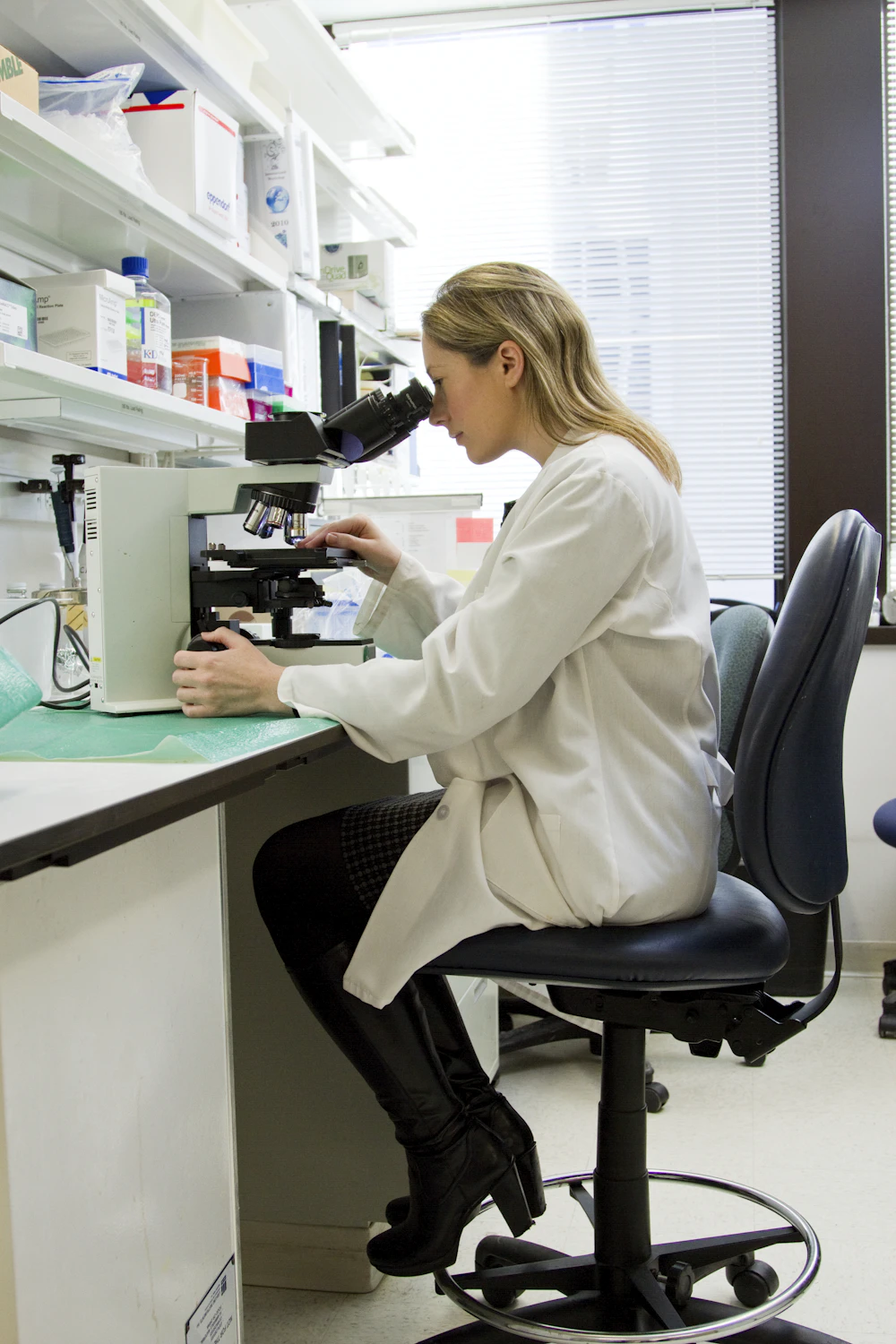
Microscopy Analysis
High-resolution imaging reveals tissue organization at cellular level.
Cell Culture
Stem cells are expanded and characterized before implantation.
Research Tool Applications
Cell Characterization
Scaffold Analysis
Tissue Assessment
Functional Tests
Future Directions
As we look ahead, several emerging technologies promise to enhance the predictability and effectiveness of scaffold-based regeneration:
Injectable and Bioprinted Scaffolds
The complex, narrow anatomy of root canals presents significant challenges for scaffold placement. Injectable hydrogels that can be delivered through syringes and then solidify in situ offer a practical solution 5 . Looking further ahead, 3D bioprinting technologies are being developed to create patient-specific scaffolds that perfectly match the intricate geometry of individual root canal systems, potentially incorporating different cell types and growth factors in precise spatial arrangements .
Antimicrobial Integration
Since residual infection can sabotage regeneration efforts, next-generation scaffolds are being designed with built-in antimicrobial properties. These "smart" scaffolds might incorporate controlled-release antibiotics, silver nanoparticles, or natural antimicrobial compounds like aloe vera that combat infection while supporting regeneration 5 .
Clinical Translation and Challenges
Despite promising preclinical results, significant challenges remain in translating scaffold-based RET to routine clinical practice. Standardizing scaffold fabrication processes, ensuring consistent cell sourcing and viability, managing costs, and navigating regulatory pathways represent substantial hurdles that the research community continues to address 1 4 .
Implementation Timeline
Current (2020-2025)
Preclinical optimization, standardization of protocols, small-scale clinical trials
Near Future (2025-2030)
Larger clinical trials, regulatory approvals, specialized dental training programs
Long-term (2030+)
Widespread clinical adoption, personalized scaffold fabrication, integration with digital dentistry
Adoption Challenges
Conclusion: A New Era in Dental Care
Scaffold-based regenerative endodontics represents more than just a technical advancement—it embodies a fundamental shift in dental philosophy. Instead of viewing damaged teeth as structures to be repaired with synthetic materials, this approach recognizes their innate biological potential to heal and regenerate. The scaffold serves as both physical support and biological guide, creating the permissive microenvironment where the body's own cells can accomplish remarkable feats of tissue engineering.
While challenges remain, the progress in this field has been staggering. From the early days of simple blood clot scaffolds to today's sophisticated decellularized matrices and designer hydrogels, each advancement brings us closer to a future where root canal treatment truly means restoring life to damaged teeth rather than merely preventing their loss. As research continues to refine these techniques, the dream of predictable, biologically-based tooth regeneration moves increasingly from the laboratory toward the dental clinic, promising to transform how we preserve natural dentition for generations to come.
References
References will be listed here in the final version of the article.