The Evolution of CAR-T Cell Therapy: From First-Generation Constructs to Fifth-Generation Designs
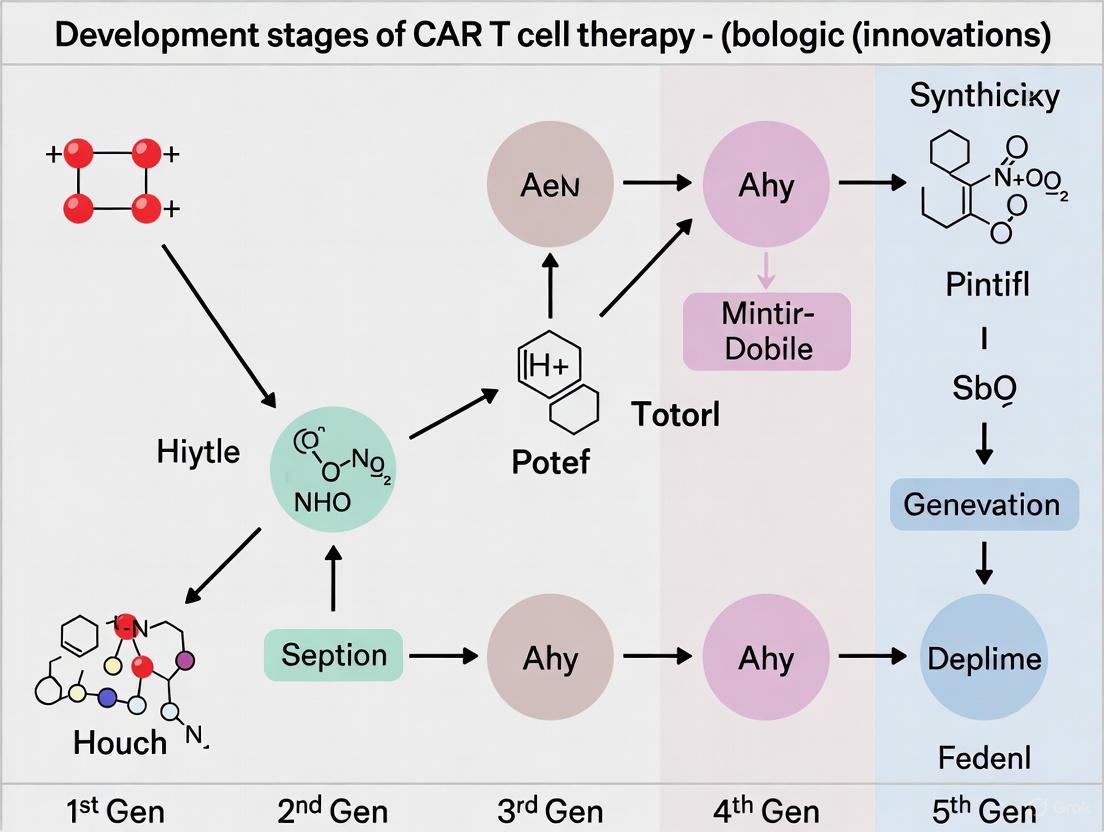
This article provides a comprehensive review of the groundbreaking evolution of Chimeric Antigen Receptor T-cell (CAR-T) therapy, tracing its development from foundational first-generation constructs to sophisticated fifth-generation designs.
The Evolution of CAR-T Cell Therapy: From First-Generation Constructs to Fifth-Generation Designs
Abstract
This article provides a comprehensive review of the groundbreaking evolution of Chimeric Antigen Receptor T-cell (CAR-T) therapy, tracing its development from foundational first-generation constructs to sophisticated fifth-generation designs. Tailored for researchers, scientists, and drug development professionals, it synthesizes decades of immunological research, structural engineering breakthroughs, and clinical translation efforts. The scope encompasses the foundational science that enabled T-cell reprogramming, the methodological leaps in CAR design that enhanced potency and persistence, the ongoing troubleshooting of challenges like the immunosuppressive tumor microenvironment and toxicity, and a comparative validation of clinical outcomes across hematologic and solid tumors. By integrating the most current clinical trial insights and emerging technological trends, this article serves as a critical resource for understanding the past, present, and future trajectory of this transformative immunotherapy.
Laying the Groundwork: The Conceptual and Historical Origins of CAR-T Technology
The development of chimeric antigen receptor (CAR) T-cell therapy represents a paradigm shift in oncology, yet this breakthrough stands on the shoulders of pioneering work in cancer immunotherapy spanning more than a century. The conceptual journey from William Coley's provocative observations to the sophisticated engineering of tumor-infiltrating lymphocytes (TILs) established the fundamental principles that enabled modern cellular therapeutics. This evolution reflects a growing understanding of immune surveillance, tumor microenvironment interactions, and the mechanisms of immune cell activation—knowledge essential for developing the first through fifth generations of CAR T-cell therapies. Within the broader thesis of CAR T-cell development, these precursor approaches provided the critical proof-of-concept that engineered immune cells could achieve clinically meaningful tumor regression, establishing the technical and conceptual infrastructure for the field [1] [2].
The historical progression demonstrates how empirical observations gradually gave way to mechanism-based therapeutics. Early practitioners noted the correlation between immune activation and tumor regression without understanding the underlying biological processes, while contemporary researchers leverage detailed knowledge of T-cell signaling, antigen recognition, and genetic engineering to create precision therapeutics. This transition from serendipitous observation to rational design encapsulates the development of modern cancer immunotherapy and establishes the context for understanding CAR T-cell engineering [3].
Historical Progression: From Empirical Observation to Mechanism-Based Therapeutics
The Era of Infection-Induced Tumor Regression
The earliest documented precursors to modern cellular therapies emerged from clinical observations rather than theoretical frameworks. In the 1860s, German physicians Wilhelm Busch and Friedrich Fehleisen independently observed tumor regression in patients experiencing erysipelas (a streptococcal skin infection) [1] [2]. These case reports suggested that activated immune responses could influence malignant growth, though the mechanisms remained obscure.
Building on these observations, American bone surgeon William B. Coley systematically developed "Coley's Toxins"—a mixture of heat-killed Streptococcus pyogenes and Serratia marcescens—which he injected into patients with inoperable malignant tumors [3]. Beginning in 1891, Coley documented numerous cases of tumor regression, particularly in sarcoma patients, achieving complete regression in many of approximately one thousand treated patients [1]. Despite these clinical successes, Coley's approach lacked mechanistic understanding and faced declining adoption due to concerns about infectious agents, inconsistent responses, and the emergence of radiation therapy and chemotherapy [1] [2]. Nevertheless, Coley's work established the fundamental principle that the immune system could be harnessed to fight cancer, earning him the posthumous title "Father of Cancer Immunotherapy" [3].
The Dawn of Immunological Theory
The transition from empirical observation to theoretical framework began in the 1950s with the cancer immunosurveillance hypothesis proposed by Frank Macfarlane Burnet and Lewis Thomas [2] [3]. This theory posited that the immune system continuously scans for and eliminates transformed cells, preventing cancer development in immunocompetent individuals. While initially controversial, this concept gained substantial experimental support decades later through work by Schreiber, Dunn, Old, and their teams, who demonstrated T cells' crucial role in anti-tumor surveillance and responses [2].
Parallel developments in fundamental immunology revealed the cellular actors involved in immune responses. The discovery of T-cell origin and function, particularly the pioneering work of Eva and George Klein demonstrating that immune cells could eradicate cancer, provided crucial insights [4]. Additionally, the identification of cytokines—soluble immune mediators—opened new therapeutic avenues, with interferon-alpha (IFNα) becoming the first FDA-approved cancer immunotherapy in 1986 for hairy-cell leukemia, and interleukin-2 (IL-2) receiving approval in 1992 for metastatic renal cell carcinoma and in 1998 for metastatic melanoma [1].
Table 1: Key Historical Milestones in Early Cancer Immunotherapy
| Year Period | Key Development | Principal Investigators | Clinical Impact |
|---|---|---|---|
| 1860s-1890s | Observation of infection-induced tumor regression | Busch, Fehleisen | Empirical basis for immune-mediated tumor control |
| 1891-1910 | Development of Coley's Toxins | William Coley | Documented tumor regressions in sarcomas; established immunotherapeutic principle |
| 1950s | Cancer immunosurveillance hypothesis | Burnet, Thomas | Theoretical framework for immune-cancer interactions |
| 1976-1990 | BCG approval for bladder cancer | - | First approved immunotherapy for solid tumors |
| 1986-1998 | Cytokine therapies (IFNα, IL-2) | Rosenberg et al. | FDA-approved immunotherapies demonstrating systemic immune activation can yield clinical responses |
Tumor-Infiltrating Lymphocytes (TILs): The Immediate Cellular Precursor
Conceptual Foundation and Biological Rationale
Tumor-infiltrating lymphocytes (TILs) represent the most direct cellular precursor to engineered CAR T cells, bridging the gap between native immune responses and adoptive cell transfer. TILs are naturally occurring T cells that have migrated into tumor tissue and represent the host's endogenous immune response against cancer [5]. The fundamental insight underlying TIL therapy is that these lymphocytes are already pre-selected for tumor recognition, having demonstrated the ability to traffic to tumor sites and recognize tumor-associated antigens [5] [6].
The conceptual foundation for TIL therapy emerged from several key observations. First, the presence of lymphocytes within tumors suggested ongoing immune recognition. Second, studies demonstrated that these infiltrating lymphocytes could be isolated and expanded ex vivo. Third, when reinfused in sufficient quantities, these expanded TIL populations could mediate tumor regression in certain patients, particularly those with metastatic melanoma [2] [6]. Unlike later CAR T-cell approaches, TILs utilize the native T-cell receptor repertoire without genetic modification, relying instead on selection and expansion of naturally occurring tumor-reactive clones [5].
Technical Development and Methodology
The development of TIL therapy is credited primarily to Dr. Steven Rosenberg and colleagues at the National Cancer Institute (NCI), who conducted the first clinical trials in the late 1980s [1] [6]. Their approach leveraged several technical advances in cell culture and immunology to overcome the limitations of native TIL populations, which, while tumor-specific, were typically insufficient in number and often functionally impaired within the immunosuppressive tumor microenvironment [2].
The standard TIL manufacturing protocol involves multiple precise steps as shown in the workflow below:
Diagram 1: TIL Therapy Workflow
Detailed TIL Protocol Methodology:
Tumor Resection and Processing: Fresh tumor tissue (typically 1-5 cm³) is obtained through surgical resection and mechanically dissociated into fragments of 1-3 mm³ using sterile techniques [5] [6].
TIL Isolation and Initial Culture: Tumor fragments are placed in culture media containing high-dose IL-2 (6000 IU/mL) to selectively expand T lymphocytes while inhibiting tumor cell growth. After 2-3 weeks, outgrown TILs are harvested and assessed for quantity and viability [6].
Rapid Expansion Protocol (REP): TILs undergo massive expansion using anti-CD3 antibody (OKT3), allogeneic feeder cells (typically irradiated peripheral blood mononuclear cells), and high-dose IL-2. This 1-2 week process can expand TIL numbers 500- to 5000-fold, generating the billions of cells required for therapeutic infusion [6].
Patient Lymphodepletion: Prior to TIL infusion, patients receive lymphodepleting chemotherapy (typically cyclophosphamide 60 mg/kg/day for 2 days and fludarabine 25 mg/m²/day for 5 days) to eliminate endogenous immunosuppressive cells and create space for the transferred TILs [6].
TIL Infusion and IL-2 Support: Expanded TILs are administered intravenously, followed by high-dose IL-2 (600,000 IU/kg every 8-12 hours for up to 6 doses) to support T-cell persistence and function in vivo [6].
Table 2: Key Research Reagents for TIL Therapy
| Reagent/Category | Specific Examples | Function in Protocol |
|---|---|---|
| Cytokines | IL-2 (aldesleukin) | Drives T-cell expansion and maintains viability; selects for tumor-reactive T cells during initial culture |
| Activation Stimuli | Anti-CD3 antibody (OKT3) | Provides TCR stimulation during rapid expansion protocol |
| Feeder Cells | Irradiated allogeneic PBMCs | Provides necessary co-stimulation for optimal T-cell expansion during REP |
| Culture Media | RPMI-1640 with human serum | Supports T-cell growth while maintaining functionality |
| Lymphodepleting Agents | Cyclophosphamide, Fludarabine | Creates immunodepleted environment to enhance engraftment of transferred TILs |
| Selection Markers | CD3, CD8 | Identifies and enumerates T-cell populations during manufacturing |
Clinical Validation and Limitations
After decades of clinical investigation, TIL therapy received its first FDA approval in February 2024 with lifileucel (Amtagvi) for advanced melanoma, marking a milestone as the first cellular therapy approved for a solid tumor [6]. The approval was based on clinical trial data demonstrating a response rate of approximately 31% in patients who had progressed on immune checkpoint inhibitors, with durable responses lasting years in some cases [6]. The success of TIL therapy in melanoma provided critical proof-of-concept that ex vivo expanded, tumor-specific T cells could mediate regression of established solid tumors.
However, TIL therapy faces several significant limitations that restricted its broader application. The manufacturing process is complex, expensive, and requires specialized facilities [2]. Tumor biopsies are not feasible for all cancer types, and some tumors contain insufficient TILs for expansion [5]. The associated lymphodepleting chemotherapy and high-dose IL-2 administration produce significant toxicity, limiting treatment to medically fit patients [6]. Perhaps most importantly, TIL therapy remains largely restricted to immunogenic "hot" tumors like melanoma, with limited efficacy in less immunogenic malignancies [2].
TILs as a Conceptual Bridge to CAR T-Cell Therapy
Parallels and Divergences in Therapeutic Approach
TIL therapy established several fundamental principles that directly informed CAR T-cell development. Both approaches utilize autologous T cells expanded ex vivo and reinfused following lymphodepletion [5] [6]. Both demonstrate that sufficiently large numbers of tumor-specific T cells can mediate regression of established tumors. However, crucial differences highlight the evolutionary steps toward more engineered solutions.
While TILs rely on naturally occurring T-cell receptors with undefined specificities, CAR T cells are engineered with synthetic receptors providing defined antigen specificity [4] [6]. This fundamental distinction represents the transition from utilizing natural immunity to creating synthetic immunity. Additionally, TIL products contain a heterogeneous mixture of T cells with multiple specificities, while CAR T cells represent a monoclonal or oligoclonal population targeting a single antigen [2]. The genetic engineering aspect of CAR T cells also enables incorporation of enhanced functionality not present in native T cells.
Technical and Conceptual Contributions to CAR T-Cell Development
The TIL field provided several essential technical and conceptual advances that enabled CAR T-cell therapy:
Ex Vivo T-Cell Expansion Protocols: The rapid expansion protocol developed for TILs demonstrated that T cells could be expanded to clinically relevant numbers (10⁹-10¹¹ cells) while maintaining effector function [6].
Lymphodepletion Strategies: Studies with TILs established the critical importance of host preconditioning with lymphodepleting chemotherapy to enhance persistence and efficacy of adoptively transferred T cells [6].
Tumor Microenvironment Understanding: Research on why native TILs failed to control tumor growth revealed key immunosuppressive mechanisms within tumors that later informed strategies to engineer resistance into CAR T cells [4] [7].
Clinical Infrastructure and Regulatory Precedent: The decades of clinical experience with TILs established treatment protocols, toxicity management strategies, and regulatory pathways that accelerated CAR T-cell development [6].
The signaling pathways utilized by TILs through their native T-cell receptors provided the blueprint for designing the intracellular domains of CAR constructs:
Diagram 2: Native T-Cell Receptor Signaling
The Direct Evolution to CAR T-Cell Generations
The limitations of TIL therapy directly motivated the development of increasingly sophisticated CAR designs. The first-generation CARs, conceptualized in 1987 by Kurosawa and colleagues and independently by Eshhar in 1989, addressed the MHC restriction of native TCRs by creating single-chain antibody fragments fused to T-cell signaling domains [1] [4]. This innovation allowed T cells to recognize surface antigens independent of MHC presentation—a crucial advantage for targeting tumors with downregulated MHC expression.
The progression through CAR generations reflects efforts to overcome limitations observed in both TIL therapy and earlier CAR approaches. Second-generation CARs incorporated costimulatory domains (CD28 or 4-1BB) to enhance persistence and functionality [4] [8]. Third-generation constructs combined multiple costimulatory signals to further enhance potency [8]. Fourth-generation "TRUCKs" were engineered to express cytokines that modify the tumor microenvironment [4] [7], while fifth-generation designs incorporate complete cytokine receptor signaling pathways [4] [7].
Table 3: Evolution from TIL Therapy to CAR T-Cell Generations
| Therapeutic Approach | Key Innovation | Addressing TIL Limitations | Clinical Impact |
|---|---|---|---|
| TIL Therapy | Use of naturally occurring tumor-specific T cells | Foundation for adoptive cell transfer | Proof-of-concept for cellular therapy; efficacy in melanoma |
| 1st Generation CAR | MHC-independent antigen recognition via scFv | Overcoming MHC downregulation; defined specificity | Limited persistence; minimal clinical efficacy |
| 2nd Generation CAR | Single costimulatory domain (CD28 or 4-1BB) | Enhanced persistence and expansion | Dramatic efficacy in B-cell malignancies; multiple FDA approvals |
| 3rd Generation CAR | Multiple costimulatory domains | Further enhanced potency and persistence | Mixed results; limited advantage over 2nd generation |
| 4th Generation CAR (TRUCK) | Inducible cytokine expression | Modifying immunosuppressive microenvironment | In clinical trials; potential for solid tumors |
| 5th Generation CAR | Integrated cytokine receptor signaling | Enhanced proliferation and resistance to exhaustion | Preclinical development; potential for broader applications |
This evolutionary progression demonstrates how the limitations of each approach motivated the innovations of the next, with TIL therapy serving as the foundational platform upon which increasingly sophisticated engineered solutions were built.
The journey from Coley's Toxins to tumor-infiltrating lymphocytes represents more than a historical prelude to modern CAR T-cell therapy—it constitutes the essential conceptual and technical foundation upon which cellular engineering approaches were built. The empirical observations of infection-induced tumor regression established the fundamental principle that immune activation could impact cancer, while the development of TIL therapy demonstrated that ex vivo selected and expanded T cells could mediate clinically meaningful responses in established tumors.
The limitations of TIL therapy—particularly its restriction to immunogenic tumors, complex manufacturing, and dependence on pre-existing tumor immunity—directly motivated the development of engineered CAR T cells that could overcome these constraints. The progressive refinement from first- to fifth-generation CAR designs represents a logical evolution from utilizing natural immunity to creating increasingly sophisticated synthetic immune responses. Within the broader thesis of CAR T-cell development, these precursor approaches provided not only the technical platform for cell processing and expansion but, more importantly, the conceptual framework for understanding how immune cells can be harnessed and enhanced to combat cancer—a principle that continues to drive innovation in cellular engineering today.
The development of chimeric antigen receptor (CAR) T-cell therapy represents one of the most transformative advancements in modern immunotherapy, yet its conceptual roots extend back more than a century to Paul Ehrlich's visionary Side-Chain Theory. This evolutionary journey from theoretical immunology to clinical application demonstrates how foundational biological concepts, when combined with innovative genetic engineering technologies, can yield breakthrough therapeutic modalities. Ehrlich's late-19th century proposition that cells possess specific "side chains" or receptors that can recognize and bind toxins fundamentally established the conceptual framework for understanding antibody-antigen interactions [9]. This theory, which initially explained how antibodies were produced and functioned, has now materialized into sophisticated cellular therapies wherein T lymphocytes are genetically engineered to express synthetic receptors capable of precisely targeting malignant cells [10].
The historical continuum from first to fifth-generation CAR T-cells reflects iterative improvements in receptor design, signaling optimization, and functional enhancement, all building upon Ehrlich's core principle of specific molecular recognition. Contemporary synthetic biology approaches have accelerated this evolution through CRISPR-based genome editing, combinatorial screening platforms, and sophisticated molecular engineering [11]. This technical guide examines the key immunological discoveries and genetic technologies that have facilitated this remarkable transition, providing researchers and drug development professionals with a comprehensive resource on the theoretical foundations, technical methodologies, and future directions of CAR T-cell immunotherapy.
Historical Foundations: From Theoretical Immunology to Cellular Engineering
Paul Ehrlich's Side-Chain Theory
In 1897, Paul Ehrlich published the first iteration of his seminal Side-Chain Theory, presenting a comprehensive framework to explain immune response specificity [9] [12]. Ehrlich postulated that white blood cells normally produced antibodies that acted as "side chains" or receptors on cell membranes, with each possessing specific binding affinity for particular antigens [9]. He proposed that when toxins or infectious agents entered the body, they would selectively bind to complementary side chains, stimulating the cell to overproduce and shed these receptors into circulation as circulating antibodies [9] [13]. This "lock and key" conceptualization of molecular recognition, borrowed from Emil Fischer's enzyme-substrate model, represented the first mechanistic explanation for antibody specificity and production [9].
Ehrlich's theory contained several revolutionary elements that would later prove foundational to CAR T-cell development. The concept of pre-formed receptor specificity anticipated the clonal selection theory and modern understanding of immune receptor diversity [9]. His proposal that binding specificity resided in chemical structure provided the theoretical basis for engineered recognition domains. Most notably, Ehrlich's description of these side chains as "magic bullets" precisely predicted the targeted therapeutic approach that CAR T-cells embody [9]. The Side-Chain Theory thus established the fundamental principle that cellular immune responses could be directed through specific receptor-antigen interactions, a concept that would lie dormant for decades before reemerging in cellular engineering approaches.
Key Historical Developments in Immunotherapy
Table 1: Historical Foundations of Cellular Immunotherapy
| Year | Scientist/Event | Contribution | Significance to CAR T-Cell Development |
|---|---|---|---|
| 1718 | Lady Mary Wortley Montagu | Introduced smallpox inoculation to England | Established principle of induced immunity [13] |
| 1860s-1890s | Busch, Fehleisen, Coley | Observed tumor regression following infections | First evidence of immune system's anti-cancer potential [1] [2] |
| 1897 | Paul Ehrlich | Proposed Side-Chain Theory | Conceptual foundation for specific receptor-antigen interactions [9] [13] |
| 1957 | Thomas and Burnet | Cancer immunosurveillance theory | Established T cells' role in anti-tumor immunity [2] |
| 1980s | Steven Rosenberg | Developed tumor-infiltrating lymphocyte (TIL) therapy | Proof-of-concept for adoptive cell transfer [1] [2] |
| 1987 | Yoshikazu Kurosawa | First chimeric T-cell receptor | Demonstrated concept of engineered receptor signaling [1] |
The conceptual journey from Ehrlich's theory to cellular engineering required numerous intermediate discoveries that expanded understanding of immune function and manipulation. Critical among these was Macfarlane Burnet's clonal selection theory (1957), which provided a modernized framework for how specific immune responses emerge from individual lymphocyte clones [13]. The work of Steven Rosenberg on tumor-infiltrating lymphocytes (TILs) in the 1980s demonstrated that naturally occurring T-cells with anti-tumor activity could be expanded ex vivo and reinfused to mediate cancer regression, establishing adoptive cell transfer as a viable therapeutic approach [1] [2]. However, TIL therapy faced significant limitations, including the difficulty of isolating sufficient tumor-reactive T cells from patients and their restricted specificity [2]. These challenges motivated the development of synthetic approaches to generate T cells with defined specificities.
The Evolution of CAR T-Cell Technology
Fundamental CAR T-Cell Design and Mechanism
Chimeric antigen receptor T-cell therapy represents the clinical realization of synthetic immunology, combining the targeting specificity of antibodies with the cytotoxic potency and memory capacity of T lymphocytes [10]. CAR T-cells are generated through leukapheresis of patient T cells, followed by ex vivo genetic modification to express a synthetic receptor that redirects them to surface antigens on target cells [10] [2]. The fundamental CAR structure consists of an extracellular antigen-recognition domain (typically a single-chain variable fragment derived from an antibody), a hinge region, a transmembrane domain, and intracellular signaling modules that initiate T-cell activation upon antigen engagement [2].
The manufacturing process for CAR T-cells requires approximately 3-5 weeks from blood collection to infusion of the final product [10]. During this period, T cells are activated, genetically modified using viral vectors (typically lentivirus or retrovirus), and expanded to hundreds of millions of cells [10]. Following quality control testing, the CAR T-cell product is cryopreserved and shipped back to the treatment center for infusion into the lymphodepleted patient [10]. This lymphodepletion, typically achieved through chemotherapy, creates a favorable cytokine environment for CAR T-cell expansion and persistence by eliminating endogenous immune cells that compete for homeostatic cytokines [2].
Diagram 1: Basic structure of a chimeric antigen receptor (CAR). The modular design includes an antigen-recognition domain, structural components, and intracellular signaling modules.
Generational Evolution of CAR Design
Table 2: Evolution of CAR T-Cell Generations
| Generation | Signaling Components | Key Features | Clinical Applications |
|---|---|---|---|
| First | CD3ζ only | Single signaling domain; limited persistence and expansion | Primarily preclinical [2] |
| Second | CD3ζ + one costimulatory domain (CD28 or 4-1BB) | Enhanced persistence, expansion, and cytotoxicity | FDA-approved products (Kymriah, Yescarta) [10] [2] |
| Third | CD3ζ + multiple costimulatory domains (e.g., CD28+4-1BB) | Multiple costimulatory signals; further enhanced functionality | Clinical trials for hematologic malignancies [2] |
| Fourth | Incorporation of cytokine secretion or constitutive signaling | Enhanced tumor microenvironment modulation; "armored" CARs | Clinical trials for solid tumors [2] |
| Fifth | Integrated cytokine receptors or inducible pathways | Proliferation independent of exogenous cytokines; precision control | Preclinical and early clinical development [2] |
The evolutionary trajectory of CAR T-cell designs reflects iterative improvements in intracellular signaling optimization. First-generation CARs incorporating only the CD3ζ signaling domain demonstrated limited expansion and persistence in clinical applications due to the absence of costimulatory signals [2]. This limitation was addressed in second-generation CARs through the incorporation of either CD28 or 4-1BB costimulatory domains, which significantly enhanced T-cell proliferation, persistence, and cytotoxic function [10] [2]. The CD28-based costimulatory domains typically produce more potent effector responses, while 4-1BB domains favor enhanced persistence and memory formation [2].
Third-generation CARs combine multiple costimulatory signals (e.g., CD28 + 4-1BB) to further augment potency, though with increased concern about potential exhaustion from excessive signaling [2]. Fourth-generation "armored" CARs represent a more sophisticated approach, incorporating transgenic cytokine expression (e.g., IL-12) or resistance mechanisms to immunosuppressive factors in the tumor microenvironment [2]. The emerging fifth-generation CARs utilize truncated cytokine receptors (e.g., IL-2Rβ) that activate multiple signaling pathways (JAK/STAT) while maintaining antigen specificity, creating autonomous proliferation capacity without exogenous cytokine support [2].
Synthetic Biology and Advanced Engineering Approaches
CRISPR-Based CAR T-Cell Enhancement
Recent advances in synthetic biology, particularly CRISPR-Cas9 genome editing, have enabled systematic discovery and optimization of CAR T-cell functions. The CELLFIE platform represents a state-of-the-art approach for high-content CRISPR screening in human primary CAR T-cells, enabling genome-wide identification of gene knockouts that enhance therapeutic efficacy [11]. This platform addresses key experimental challenges through efficient co-delivery of CAR constructs, guide RNA libraries, and CRISPR editors via optimized mRNA electroporation and lentiviral transduction [11].
In a landmark 2025 study, genome-wide CRISPR screens using the CELLFIE platform identified several unexpected gene knockouts that significantly enhance CAR T-cell function, including RHOG, PRDM1, and FAS [11]. RHOG knockout was particularly notable as RHOG deficiency causes immunodeficiency in humans, highlighting the different biological requirements of natural T-cells versus therapeutic CAR T-cells [11]. The synergistic combination of RHOG and FAS knockouts demonstrated potent enhancement of anti-tumor activity across multiple in vivo models, CAR designs, and donor samples [11]. These discoveries exemplify how synthetic biology approaches can identify counterintuitive engineering strategies that would be difficult to predict through conventional biological reasoning.
Diagram 2: Integrated workflow for CRISPR-enhanced CAR T-cell manufacturing. The process combines conventional CAR transduction with CRISPR genome editing for enhanced functionality.
Research Reagent Solutions for CAR T-Cell Development
Table 3: Essential Research Reagents for CAR T-Cell Development
| Reagent Category | Specific Examples | Function | Application Notes |
|---|---|---|---|
| CAR Vectors | Lentiviral CROP-seq-CAR vector | Co-delivery of CAR and gRNA sequences | Enables single-vector delivery for screening [11] |
| CRISPR Editors | Cas9 mRNA, ABEmax, AncBE4max | Genome editing; knockout and base editing | mRNA enables versatile editor delivery [11] |
| Screen Libraries | Brunello gRNA library | Genome-wide knockout screening | Validated library for human primary T cells [11] |
| Activation Reagents | Anti-CD3/CD28 beads | T-cell activation and expansion | Mimics physiological activation [11] |
| Cytokines | IL-2, IL-7, IL-15 | T-cell expansion and persistence | Concentration affects differentiation [1] [2] |
| Selection Markers | Blasticidin resistance | Selection of successfully transduced cells | Antibiotic selection for screen robustness [11] |
The advanced engineering of CAR T-cells requires specialized reagents optimized for primary human T-cell manipulation. The CROP-seq-CAR vector system enables simultaneous expression of the CAR construct and guide RNA from a single lentiviral backbone, simplifying complex genetic modifications [11]. For CRISPR-mediated editing, mRNA-based delivery of CRISPR editors (Cas9, base editors) provides greater versatility and efficiency compared to protein or plasmid DNA approaches, with editing efficiencies typically exceeding 80% in primary T cells [11].
Functional screening depends on properly designed guide RNA libraries such as the Brunello genome-wide library, which provides comprehensive coverage with minimal off-target effects [11]. T-cell activation reagents including anti-CD3/CD28 beads are essential for initiating the expansion and genetic modification processes, with stimulation conditions significantly influencing subsequent CAR T-cell function and differentiation state [11]. Careful selection of ex vivo culture cytokines (IL-2, IL-7, IL-15) is critical as these factors profoundly affect the resulting T-cell phenotype, with lower IL-2 concentrations generally favoring less differentiated memory populations [2].
Clinical Applications and Current Challenges
Approved CAR T-Cell Therapies and Efficacy
Since the first FDA approval of tisagenlecleucel (Kymriah) in 2017 for pediatric acute lymphoblastic leukemia, CAR T-cell therapies have demonstrated remarkable efficacy in treating hematologic malignancies [1] [10]. As of April 2023, six CAR T-cell products have received FDA approval for various B-cell malignancies, with unprecedented response rates in patients with otherwise untreatable diseases [1]. Clinical trials have shown that these therapies can achieve complete remission in 70-90% of children and young adults with relapsed/refractory B-cell ALL, with many patients maintaining long-term disease-free survival [10]. Similarly, in adults with advanced lymphomas, CAR T-cell therapy has produced complete response rates of 40-50% in patients who had exhausted all conventional treatment options [10].
Table 4: FDA-Approved CAR T-Cell Therapies (as of 2023)
| Therapy Name | Target | Approved Indications | Notable Efficacy Findings |
|---|---|---|---|
| Kymriah (tisa-cel) | CD19 | B-cell ALL (pediatric/young adult); DLBCL; Follicular lymphoma | 81% remission rate in pediatric ALL at 3 months [10] |
| Yescarta (axi-cel) | CD19 | Large B-cell lymphoma; Follicular lymphoma | 79% complete response in follicular lymphoma trial [10] |
| Tecartus (brexu-cel) | CD19 | B-cell ALL (adult); Mantle cell lymphoma | 61% complete response in mantle cell lymphoma [10] |
| Breyanzi (liso-cel) | CD19 | Follicular lymphoma; Large B-cell lymphoma; CLL; Mantle cell lymphoma | 73% overall response rate in DLBCL [10] |
| Abecma (ide-cel) | BCMA | Multiple myeloma | 72% overall response rate in multiple myeloma [10] |
| Carvykti (cilta-cel) | BCMA | Multiple myeloma | 98% overall response rate in multiple myeloma [10] |
Adverse Events and Management Strategies
The potent immune activation mediated by CAR T-cells produces characteristic toxicities that require specialized management. Cytokine release syndrome (CRS) represents the most common adverse event, characterized by fever, hypotension, and potential organ dysfunction resulting from massive cytokine release following CAR T-cell activation [1] [10]. The severity of CRS correlates with pretreatment tumor burden, with higher burden predicting more severe manifestations [1]. Current management employs the IL-6 receptor antagonist tocilizumab (Actemra), often with corticosteroids for refractory cases [10].
Immune effector cell-associated neurotoxicity syndrome (ICANS) encompasses neurological complications including confusion, aphasia, impaired motor skills, and potentially cerebral edema [10]. The pathophysiology of ICANS involves endothelial activation and blood-brain barrier disruption, with elevated inflammatory cytokines in the cerebrospinal fluid [10]. Management typically involves corticosteroids, with the IL-1 receptor antagonist anakinra (Kineret) showing promise for severe or refractory cases [10]. Additional complications include B-cell aplasia and hypogammaglobulinemia resulting from on-target destruction of normal B cells, requiring immunoglobulin replacement [10], and infections due to associated cytopenias and immunosuppressive treatments [1].
Solid Tumor Challenges and Innovative Solutions
Despite remarkable success in hematologic malignancies, CAR T-cell therapy for solid tumors faces substantial obstacles. The immunosuppressive tumor microenvironment presents multiple barriers, including regulatory T cells, myeloid-derived suppressor cells, and inhibitory cytokines that impair CAR T-cell function and persistence [10] [2]. Tumor heterogeneity with variable antigen expression enables immune escape through antigen-loss variants [10]. Additional challenges include limited tumor infiltration due to physical and chemical barriers, and on-target/off-tumor toxicity when target antigens are expressed on healthy tissues [2].
Innovative approaches to overcome these limitations include:
- Armored CARs expressing cytokines (IL-12, IL-18) or dominant-negative receptors for TGF-β to resist immunosuppression [2]
- Multi-targeting strategies using tandem CARs or co-infusion of CARs targeting different antigens to prevent immune escape [2]
- Local delivery to overcome trafficking barriers, demonstrated in trials for glioblastoma and pleural malignancies [2]
- Safety switches (e.g., inducible caspase-9) to mitigate toxicity by enabling elimination of CAR T-cells if adverse events occur [2]
Promising clinical results have emerged for specific solid tumors, particularly diffuse midline glioma in children and young adults, where CAR T-cell therapy has demonstrated encouraging activity in early-phase trials [10]. Ovarian and colorectal cancers have also shown responses in early clinical investigations, though durability remains limited [10].
Future Directions and Concluding Perspectives
The field of CAR T-cell therapy continues to evolve rapidly, with several emerging trends likely to shape future development. Allogeneic "off-the-shelf" CAR T-cells derived from healthy donors aim to overcome the logistical and manufacturing limitations of autologous approaches, though they require additional engineering to prevent graft-versus-host disease and host rejection [10]. Combination therapies integrating CAR T-cells with immune checkpoint inhibitors, small molecule targeted therapies, or conventional chemotherapy seek to enhance efficacy and prevent resistance [2]. Novel engineering approaches including inducible expression systems, logic-gated receptors, and precision control mechanisms using small molecule regulators are advancing toward clinical testing [2].
The ongoing integration of synthetic biology and immunology exemplifies how Ehrlich's concept of specific cellular targeting has matured into a sophisticated therapeutic platform. The systematic discovery approaches enabled by technologies like the CELLFIE CRISPR screening platform promise to accelerate the identification of optimal genetic modifications for specific clinical contexts [11]. As the field addresses current limitations in solid tumors, toxicity management, and manufacturing accessibility, CAR T-cell therapy is poised to expand beyond its current hematologic focus to become a modular platform applicable to autoimmune diseases, chronic infections, and eventually non-malignant conditions [1] [2].
The journey from Ehrlich's Side-Chain Theory to modern CAR T-cell therapy demonstrates how foundational immunological concepts, when combined with transformative technologies, can yield paradigm-shifting therapeutic modalities. This progression from theoretical understanding to clinical implementation represents a landmark achievement in translational medicine, offering a template for how other fundamental biological insights might be similarly developed into powerful therapeutic tools. As the field continues to evolve, the integration of increasingly sophisticated engineering approaches with deep immunological understanding promises to further expand the potential of cellular immunotherapy to address diverse human diseases.
Chimeric Antigen Receptor (CAR)-T cell therapy represents a paradigm shift in cancer treatment, demonstrating remarkable success in treating hematological malignancies. This groundbreaking approach involves genetically engineering a patient's own T cells to express synthetic receptors that redirect them to selectively target and eliminate tumor cells. The clinical success of CAR-T cells is intrinsically linked to the sophisticated design of the CAR molecule itself. Since its initial conceptualization in the late 1980s, the core structure of the CAR has evolved through multiple generations, each refining its components to enhance efficacy, persistence, and safety [1] [4] [2]. All CARs share a fundamental modular architecture, comprising four essential domains: the single-chain variable fragment (scFv) for antigen recognition, the hinge for flexibility and spacing, the transmembrane domain for anchor stability, and the intracellular signaling domain for T-cell activation [14]. This whitepaper provides an in-depth technical deconstruction of these core structural domains, examining their individual functions, the impact of their design choices on CAR-T cell performance, and their evolution within the broader historical context of CAR-T cell therapy development.
Historical Context: The Generational Evolution of CAR Design
The evolution of CAR-T cells is categorized into generations based primarily on the complexity of their intracellular signaling domains, which directly influence T-cell activation potency and persistence.
Table 1: Generations of Chimeric Antigen Receptors
| Generation | Intracellular Signaling Domains | Key Features & Functional Consequences |
|---|---|---|
| First | CD3ζ only [15] | Limited efficacy; insufficient IL-2 production; low proliferation and short in vivo persistence [15]. |
| Second | CD3ζ + one co-stimulatory domain (e.g., CD28 or 4-1BB) [4] [15] | Enhanced T-cell proliferation, cytotoxicity, cytokine production, and persistence [4] [15]. CD28 domains promote rapid tumor elimination, while 4-1BB domains favor long-term persistence [15]. |
| Third | CD3ζ + multiple co-stimulatory domains (e.g., CD28-4-1BB) [4] | Designed to further amplify signaling; however, they have not consistently demonstrated superior efficacy compared to second-generation CARs in clinical settings [15]. |
| Fourth (TRUCK) | CD3ζ + one co-stimulatory domain + inducible transgene (e.g., IL-12) [4] [15] | Engineered to deliver transgenic proteins (e.g., cytokines) to the tumor microenvironment, modulating the local immune response and enhancing anti-tumor efficacy [15]. |
| Fifth | CD3ζ + one co-stimulatory domain + additional membrane receptor (e.g., IL-2R β-chain) [4] | Incorporates truncated cytokine receptors (e.g., from IL-2) to activate the JAK/STAT pathway in an antigen-dependent manner, further promoting CAR-T cell growth and memory formation [4] [15]. |
The following diagram illustrates the structural evolution across these generations, highlighting the key differences in their intracellular domains.
Domain-by-Domain Deconstruction of the Core CAR Structure
Antigen Recognition Domain: The scFv
The single-chain variable fragment (scFv) is the antigen-binding domain located at the outermost end of the CAR. It is derived from the variable regions of the heavy (VH) and light (VL) chains of a monoclonal antibody, connected by a short, flexible peptide linker [4]. This design confers the critical advantage of MHC-independent antigen recognition, allowing CAR-T cells to target tumors that downregulate MHC molecules to evade native T-cell immunity [4]. The specificity of the scFv determines the target antigen and is, therefore, the primary determinant of both the efficacy and the safety profile of the CAR-T cell product, particularly with respect to "on-target, off-tumor" toxicity [4].
Hinge/Spacer Domain: The Structural Regulator
The hinge, or spacer, is a flexible extracellular region that connects the scFv to the transmembrane domain. It serves multiple critical functions:
- Accessibility: It provides steric flexibility, allowing the scFv to access membrane-proximal target antigens that might otherwise be inaccessible [16] [4].
- Signaling Threshold: The length and composition of the hinge directly influence the signaling threshold of the CAR. For instance, studies have shown that CARs with a CD8α-derived hinge domain can exhibit significant functional differences compared to those with a CD28-derived hinge, even when surface expression levels are equal [16].
- Structural Dynamics: Recent biophysical studies reveal that hinge domains, such as those from CD28 and CD8α, are intrinsically disordered regions (IDRs) that exhibit local structural elements and conformational exchange (e.g., proline isomerization) amidst global disorder [17]. This structural plasticity is crucial for its function, contributing to an extended geometry that may regulate domain spacing and interaction with other surface molecules [17].
Transmembrane Domain: The Anchor and Stability Mediator
The transmembrane (TM) domain is an alpha-helical region that anchors the CAR to the T-cell membrane. It is derived from native immune proteins such as CD3ζ, CD4, CD8α, or CD28 [16]. The choice of TM domain has a profound impact on CAR function, primarily by regulating its surface expression level and stability. Research indicates that the transmembrane domain, more than the hinge, greatly affects the CAR expression level and stability on the T cell [16]. Furthermore, the TM domain can influence CAR function by mediating homodimerization (e.g., CD3ζ) or heterodimerization with endogenous signaling proteins, which can affect the tonic signaling and overall persistence of the CAR-T cells [16].
Intracellular Signaling Domains: The Activation Engine
The intracellular domain is the functional endpoint of the CAR, responsible for initiating T-cell activation upon antigen binding. Its composition defines the generation of the CAR.
- CD3ζ Chain: This is the primary signaling component, derived from the T-cell receptor (TCR) complex. It contains immunoreceptor tyrosine-based activation motifs (ITAMs) that, when phosphorylated, initiate the canonical T-cell activation cascade leading to cytokine production, proliferation, and cytotoxic granule release [4] [15].
- Co-stimulatory Domains: The incorporation of one or more co-stimulatory domains (e.g., CD28, 4-1BB, OX40) is the hallmark of second and later-generation CARs. These domains provide a secondary signal that is crucial for full T-cell activation:
Table 2: Quantitative Impact of Hinge and Transmembrane Domain Variations on CAR-T Cell Function (Experimental Data)
| CAR Variant (Hinge/TM) | CAR Expression Level | Stability on T Cell | Antigen-Specific Function | Key Experimental Finding |
|---|---|---|---|---|
| CD3ζ / CD3ζ (Basic CAR) | Baseline | Baseline | Baseline | Used as a reference for comparison [16]. |
| CD8α / CD3ζ | Similar to other variants | Not significantly affected | Significantly different despite equal expression | Hinge domain independently affects signaling intensity [16]. |
| CD28 / CD3ζ | Similar to other variants | Not significantly affected | Significantly different despite equal expression | Hinge domain regulates the CAR signaling threshold [16]. |
| Various / Non-CD3ζ (e.g., CD4, CD8α, CD28) | Greatly affected | Greatly affected | Correlated with expression levels | Transmembrane domain regulates CAR expression level, thereby controlling the amount of CAR signaling [16]. |
Detailed Experimental Protocol: Analyzing Hinge and Transmembrane Domain Function
The following methodology outlines a systematic approach to evaluate the role of hinge and transmembrane domains, as referenced in the scientific literature [16].
Generation of CAR Structural Variants
- Vector Backbone: Utilize a retroviral vector (e.g., pMXs-Puro) for stable gene expression.
- CAR Construct Design: Clone a basic CAR construct containing an Igκ-chain leader sequence, an epitope tag (e.g., HA-tag), an scFv specific for a target antigen (e.g., mVEGFR2), and murine CD3ζ-derived hinge, transmembrane, and signaling domains (denoted as mV/3z/3z/3z).
- Domain Modification: Generate variant CARs using polymerase chain reaction (PCR) amplification and Gibson assembly to create combinations where the hinge or hinge/transmembrane domains are replaced with sequences derived from other immune molecules such as CD4, CD8α, and CD28.
- Sequence Verification: Confirm the sequence integrity of all plasmid constructs by DNA sequencing.
Production of CAR-T Cells
- Virus Production: Generate retrovirus by transducing packaging cell lines (e.g., Plat-E cells) with the constructed CAR vectors.
- T Cell Activation: Isolate and activate primary human or murine T cells using anti-CD3ε and anti-CD28 monoclonal antibodies.
- Transduction: Transduce activated T cells with the retroviral supernatant on Retronectin-coated plates under stimulation.
- Selection and Expansion: Culture transduced T cells in medium containing interleukin-2 (IL-2) and a selection antibiotic (e.g., puromycin) to generate a stable CAR-T cell population.
Functional and Phenotypic Analysis
- Surface Expression Analysis:
- Staining: Stain CAR-T cells with a fluorescently labeled antibody against the epitope tag (e.g., anti-HA-APC) and a viability dye.
- Quantification: Analyze CAR surface expression levels using flow cytometry. Report as Mean Fluorescence Intensity (MFI).
- Antigen-Binding Capacity:
- Incubation: Incubate CAR-T cells with a recombinant target antigen fused to an Fc region (e.g., mVEGFR2-Fc).
- Detection: Detect binding using a fluorescently labeled anti-Fc antibody and analyze via flow cytometry.
- Functional Assays:
- Cytotoxicity: Co-culture CAR-T cells with antigen-positive target cells and measure specific lysis using real-time cell analysis (e.g., xCelligence) or lactate dehydrogenase (LDH) release assays.
- Cytokine Production: Measure antigen-specific cytokine release (e.g., IFN-γ, IL-2) in co-culture supernatants using enzyme-linked immunosorbent assay (ELISA).
- Proliferation: Assess CAR-T cell expansion following antigen stimulation by tracking dye dilution (e.g., CFSE) or by simply counting cells over time.
The experimental workflow for characterizing CAR-T cells is summarized below.
The Scientist's Toolkit: Key Research Reagent Solutions
The following table details essential materials and reagents required for the experimental analysis of CAR structure and function as described in this guide.
Table 3: Essential Research Reagents for CAR-T Cell Development and Analysis
| Reagent / Tool | Function / Application | Specific Examples |
|---|---|---|
| Expression Vectors | Delivery of CAR transgene into T cells. | pMXs-Puro (retroviral), pcDNA3.1-Zeo (mRNA transcription) [16]. |
| Packaging Cell Lines | Production of viral vectors for transduction. | Plat-E cells for retrovirus packaging [16]. |
| T Cell Activation Reagents | Ex vivo activation of T cells prior to genetic modification. | Anti-CD3ε mAb (e.g., clone 145-2C11), Anti-CD28 mAb (e.g., clone 37.51) [16]. |
| Gene Editing Tools | Knockout of endogenous genes (e.g., TCR, HLA) in allogeneic UCAR-T; precise CAR integration. | CRISPR/Cas9, Zinc-Finger Nucleases (ZFNs), Base Editors [18]. |
| Flow Cytometry Antibodies | Detection of CAR expression, immunophenotyping, and analysis of T cell subsets. | Anti-HA Tag mAb (for CAR detection), Anti-CD8α mAb, Viability dyes (e.g., Zombie Aqua) [16]. |
| Recombinant Antigen Proteins | Validation of CAR antigen-binding specificity and affinity. | Recombinant VEGFR2-Fc Chimera protein [16]. |
| Cytokine Assays | Quantification of T cell activation and functional potency. | ELISA kits for IFN-γ, IL-2 [16]. |
The blueprint of a chimeric antigen receptor is a masterpiece of synthetic biology, where each domain—scFv, hinge, transmembrane, and signaling modules—can be precisely engineered to tailor the function, efficacy, and safety of the resulting cellular therapeutic. The historical journey from first to fifth-generation CARs underscores a focused effort to amplify and sustain T-cell activation while overcoming the formidable barriers posed by the tumor microenvironment and on-target/off-tumor toxicity. Future directions in CAR design are increasingly sophisticated, moving beyond the standard architecture to include universal "off-the-shelf" CAR-T cells (UCAR-T) that require gene editing to ablate the endogenous TCR and HLA to prevent graft-versus-host disease and host rejection [18]. Furthermore, the incorporation of safety switches, cytokine "arms," and logic-gated systems represents the next frontier in making CAR-T cell therapy safer, more effective, and applicable to a broader range of diseases, including solid tumors and autoimmune conditions [15] [10]. A deep and mechanistic understanding of the core CAR structure remains the essential foundation upon which these next-generation innovations are built.
The conceptualization of Chimeric Antigen Receptor (CAR) T-cell therapy represents a paradigm shift in cancer treatment, marking the transition from pharmacologic agents to living cellular therapeutics. The pioneering first-generation CARs, though limited in clinical efficacy, established the foundational architecture upon which all subsequent CAR designs have been built. These early constructs provided critical proof-of-concept that T-cells could be genetically reprogrammed to recognize surface antigens independently of major histocompatibility complex (MHC) restriction, thereby overcoming a fundamental limitation of native T-cell immunity [4]. The development of these initial CARs emerged from decades of foundational immunology research, including the observations of graft-versus-tumor effects in allogeneic hematopoietic cell transplantation and the pioneering work of Steven Rosenberg with tumor-infiltrating lymphocytes [1]. This review examines the structural basis, clinical implementation, and invaluable lessons from early-generation CAR trials that ultimately paved the way for modern cell therapies.
Structural Blueprint of First-Generation CARs
The fundamental architecture of first-generation CARs established the modular template that remains recognizable in contemporary designs. These pioneering receptors consisted of three core components: an extracellular antigen-recognition domain, a transmembrane domain, and an intracellular signaling domain [4].
The extracellular domain featured a single-chain variable fragment (scFv) derived from monoclonal antibodies, which provided specific binding to target antigens. This scFv was created by joining the variable regions of immunoglobulin heavy and light chains (VH and VL) via a short, flexible peptide linker [4]. This design enabled MHC-independent antigen recognition, a crucial advantage over native T-cell receptors.
The transmembrane domain, typically derived from CD4, CD8, or CD28, anchored the receptor to the T-cell membrane and facilitated stable expression. The intracellular component consisted solely of the CD3ζ chain from the T-cell receptor complex, which contained immunoreceptor tyrosine-based activation motifs (ITAMs) necessary for initiating T-cell activation upon antigen engagement [4].
This structural configuration, while elegantly simple, proved insufficient for generating robust, persistent antitumor responses in clinical settings. The absence of co-stimulatory signaling resulted in limited T-cell proliferation, rapid exhaustion, and inadequate persistence of the engineered cells [4].
Table: Structural Components of First-Generation CARs
| Component | Description | Common Sources | Function |
|---|---|---|---|
| Extracellular Domain | Single-chain variable fragment (scFv) | Monoclonal antibody variable regions | Antigen recognition independent of MHC |
| Hinge/Spacer | Immunoglobulin-like domains | CD8, CD28, IgG | Separates binding units from cell membrane |
| Transmembrane Domain | Hydrophobic alpha-helix | CD4, CD8, CD28 | Anchors CAR to T-cell membrane |
| Intracellular Domain | CD3ζ chain | T-cell receptor complex | Initiates activation signaling via ITAMs |
Historical Foundation and Key Pioneers
The conceptual groundwork for CAR-T therapy emerged from transformative research in the late 1980s. In 1987, Japanese immunologist Yoshikazu Kurosawa and his team published the first report of a chimeric T-cell receptor, demonstrating that engineered receptors could activate T-cells in response to specific antigens [1]. This landmark study expressed anti-phosphorylcholine chimeric receptors in murine T-cell lymphoma cells and observed calcium influx upon antigen challenge, providing the first evidence that chimeric receptors could initiate T-cell signaling [1].
Two years later, in 1989, Israeli immunologist Zelig Eshhar and colleagues at the Weizmann Institute of Science described a similar approach, creating "T-bodies" by fusing antibody-derived binding domains with T-cell signaling components [4] [1]. Eshhar's work was particularly influential in establishing the basic CAR architecture that would guide future developments.
These pioneering studies established the core principle that T-cells could be redirected to recognize predefined cell surface antigens through genetic engineering, bypassing the MHC restriction that limited native T-cell responses. This fundamental insight would eventually catalyze the entire field of CAR-T therapy, though clinical application would require more than two decades of further refinement.
Clinical Translation and Pioneering Trials
The transition of first-generation CARs from laboratory concept to clinical application revealed significant limitations in their therapeutic potential. Early clinical trials targeting ovarian cancer and neuroblastoma demonstrated the safety and feasibility of the approach but revealed inadequate antitumor efficacy and poor persistence of the engineered T-cells [4].
One particularly instructive trial investigated anti-CD19 CARs for B-cell malignancies, where researchers observed limited expansion and transient persistence of the infused cells [4]. Similarly, trials targeting carbonic anhydrase IX (CAIX) in renal cell carcinoma and Lewis Y in ovarian cancer confirmed that first-generation CARs could traffic to tumor sites and initiate target cell killing but failed to generate sustained responses [4].
These clinical experiences collectively highlighted a critical limitation: the CD3ζ signaling domain alone provided insufficient activation signals to generate robust, long-lasting T-cell responses against established tumors. The engineered T-cells exhibited limited proliferative capacity and underwent premature exhaustion or apoptosis, ultimately failing to establish durable immunological memory against malignant cells.
Table: Select Early Clinical Trials of First-Generation CARs
| Target Antigen | Malignancy | Key Findings | Limitations Identified |
|---|---|---|---|
| CD19 | B-cell Leukemia/Lymphoma | Specific target cell elimination | Limited T-cell persistence and expansion |
| CAIX | Renal Cell Carcinoma | Trafficking to tumor sites | On-target off-tumor toxicity against bile duct |
| Lewis Y | Ovarian Cancer | Acceptable safety profile | Limited clinical efficacy |
| GD2 | Neuroblastoma | Feasibility of approach | Inadequate long-term persistence |
Critical Limitations and Fundamental Challenges
The clinical investigation of first-generation CARs revealed several fundamental challenges that would require structural redesign to overcome. Three primary limitations emerged as consistent themes across multiple trials:
Inadequate T-cell Activation and Persistence
The absence of co-stimulatory signaling proved to be the most significant limitation of first-generation CARs. Native T-cell activation requires both T-cell receptor engagement (signal 1) and co-stimulatory signals (signal 2) through receptors such as CD28 or 4-1BB [4]. First-generation CARs provided only the primary activation signal through CD3ζ, resulting in suboptimal T-cell proliferation, diminished cytokine production, and failure to establish long-term persistence of the engineered cells [4].
Restricted Antitumor Efficacy
The limited activation capacity of first-generation CARs translated directly to restricted antitumor efficacy in clinical settings. Without sustained expansion and persistence, the engineered T-cells could not overcome established tumors, particularly in scenarios of high tumor burden [4]. This was especially problematic for solid tumors, which present additional barriers including immunosuppressive microenvironments and physical barriers to T-cell infiltration [19].
On-Target, Off-Tumor Toxicity
Early trials revealed the critical importance of target antigen selection. The CAIX-directed CAR trial in renal cell carcinoma demonstrated that target expression on normal tissues could lead to on-target, off-tumor toxicity, with patients experiencing cholangitis due to low-level CAIX expression on bile duct epithelium [4]. This highlighted the necessity for tumor-restricted antigens, a particular challenge for solid tumors that often share surface antigens with healthy tissues [4].
The Scientist's Toolkit: Essential Research Reagents
The development and evaluation of first-generation CARs relied on a specialized set of research tools and methodologies that established standards for the field.
Table: Key Research Reagent Solutions for Early CAR Development
| Reagent/Technique | Function | Application in Early CAR Development |
|---|---|---|
| Retroviral Vectors | Gene delivery system | Semi-random integration of CAR transgene into T-cell genome |
| Single-Chain Variable Fragment (scFv) | Antigen recognition domain | Derived from monoclonal antibodies for MHC-independent targeting |
| CD3ζ Signaling Domain | Primary T-cell activation | Provided ITAM motifs for initial activation signaling |
| Phospholipase C Gamma Assays | Calcium flux measurement | Verification of CAR signaling functionality |
| Cytokine Release Assays | T-cell activation assessment | Quantification of IFN-γ, IL-2 production after antigen engagement |
| Chromium-51 Release Assays | Cytotoxicity measurement | In vitro assessment of CAR-mediated target cell killing |
Visualizing CAR-T Cell Workflows and Signaling
The experimental workflows for evaluating first-generation CARs established standardized approaches for T-cell engineering and functional validation. The following diagrams illustrate these processes using the specified color palette.
First-Generation CAR Structure
Early CAR-T Experimental Workflow
The investigation of first-generation CARs, while demonstrating limited clinical success, provided the essential foundation for the revolutionary cellular immunotherapies that would follow. These pioneering studies established the fundamental architecture of synthetic antigen receptors, validated the core concept of MHC-independent T-cell targeting, and identified the critical limitation of absent co-stimulation that would drive the development of second-generation constructs. The clinical experiences with these early CARs highlighted the importance of target antigen selection, the necessity for robust T-cell persistence, and the challenges of balancing efficacy with toxicity. These lessons directly informed the design of subsequent CAR generations that would eventually achieve remarkable clinical responses in hematologic malignancies. The first clinical concept of CAR-T therapy, despite its limitations, thus represents a crucial milestone in the evolution of cellular immunotherapy, establishing both the possibilities and parameters that would guide future innovation in the field.
Engineering the Revolution: Methodological Leaps from Second- to Fifth-Generation CARs
The development of second-generation chimeric antigen receptor (CAR) T-cell therapy marks a pivotal advancement in cancer immunotherapy, primarily through the incorporation of costimulatory domains. The choice between the two predominant costimulatory molecules, CD28 and 4-1BB, represents a critical design decision that profoundly influences the phenotype, functionality, and clinical performance of CAR-T products. This technical review provides an in-depth comparison of CD28- and 4-1BB-based CARs, examining their distinct signaling pathways, metabolic profiles, kinetic behaviors, and clinical outcome correlates. Framed within the broader evolution of CAR-T technology from first to fifth-generation constructs, we synthesize preclinical evidence and clinical data to guide researchers and drug development professionals in optimizing CAR architectures for specific therapeutic applications.
The evolution of CAR-T cell therapy from concept to clinical reality has been characterized by successive innovations in receptor design, with the integration of costimulatory signaling representing the most transformative advancement. First-generation CARs, which contained only the CD3ζ signaling domain without costimulatory components, demonstrated limited efficacy due to insufficient T-cell activation, poor persistence, and inadequate cytokine production [15] [20]. This fundamental limitation reflected the biological reality that effective T-cell activation requires both a primary signal (through the TCR/CD3 complex) and a secondary costimulatory signal [21].
The advent of second-generation CARs addressed this critical limitation by incorporating a single costimulatory domain in tandem with the CD3ζ chain [15] [4]. The two costimulatory domains that have demonstrated the most clinical success are CD28 and 4-1BB (CD137), both of which are now represented in FDA-approved products [21] [22]. While these designs have produced remarkable clinical outcomes in B-cell malignancies, they impart fundamentally different functional properties on engineered T cells [22]. Understanding these distinctions is essential for optimizing CAR-T products for specific clinical contexts and patient populations.
Historical Context: The Generational Evolution of CAR-T Therapy
CAR-T technology has evolved through distinct generations, each defined by the complexity of its intracellular signaling domains.
Table 1: Generational Evolution of CAR-T Cell Therapy
| Generation | Signaling Components | Key Features | Clinical Status |
|---|---|---|---|
| First | CD3ζ only | Limited persistence and efficacy; required exogenous IL-2 [15] | Largely superseded |
| Second | CD3ζ + one costimulatory domain (CD28 or 4-1BB) | Enhanced proliferation, persistence, and cytotoxicity [15] [20] | Six approved products [4] |
| Third | CD3ζ + multiple costimulatory domains | Combined signaling (e.g., CD28+4-1BB); mixed efficacy improvement [15] [20] | Preclinical/clinical investigation |
| Fourth (TRUCKs) | Second-generation base + inducible transgenes | Local cytokine delivery (e.g., IL-12); modified tumor microenvironment [15] [4] | Preclinical/clinical investigation |
| Fifth | Second-generation base + additional membrane receptors | Integrated IL-2R for JAK/STAT activation; enhanced persistence [15] [4] | Preclinical development |
The progression from first to fifth-generation CARs represents an ongoing effort to recapitulate optimal physiological T-cell signaling while overcoming the challenges of the tumor microenvironment. Second-generation CARs remain the most clinically established platform, with all six currently approved CAR-T cell constructs utilizing this design [4].
Structural and Functional Divergence Between CD28 and 4-1BB
Fundamental Signaling Differences
CD28 and 4-1BB originate from different receptor superfamilies and engage distinct signaling pathways despite converging on some common functional outcomes:
- CD28: A member of the immunoglobulin superfamily, CD28 costimulation provides potent amplification of initial T-cell receptor signals primarily through PI3K-AKT pathway recruitment, leading to robust IL-2 production, enhanced metabolic switching to glycolysis, and effector T-cell differentiation [22].
- 4-1BB: A member of the tumor necrosis factor receptor superfamily, 4-1BB signaling occurs through TNF-receptor-associated factor (TRAF) protein recruitment, activating NF-κB and promoting mitochondrial biogenesis, oxidative metabolism, and cell survival programs that favor memory formation [22].
These differential signaling patterns establish distinct functional priorities: CD28 prioritizes immediate effector potency, while 4-1BB favors long-term persistence.
Metabolic Programming
Recent research has revealed that CD28 and 4-1BB costimulatory domains impose fundamentally different metabolic profiles on CAR-T cells:
- CD28-CAR-T cells display preferentially glycolytic metabolism, supporting an effector phenotype and increased expansion capacity [23].
- 4-1BB-CAR-T cells show increased reliance on mitochondrial metabolism, preserving mitochondrial fitness and resulting in memory-like differentiation [23].
Despite these differences, T cells in patients responding successfully to therapy were metabolically similar, irrespective of co-stimulator. In non-responders, however, CD28- and 4-1BB-co-stimulated CAR-T cells remained metabolically distinct from each other [23].
Clinical Outcome Correlates: Efficacy and Safety Profiles
Comparative Clinical Performance
Direct comparisons of CD28 versus 4-1BB costimulated CAR-T cells in clinical settings reveal distinct patterns of efficacy and toxicity:
Table 2: Clinical Comparison of CD28 vs. 4-1BB in CD19-Targeted CAR-T Therapy
| Parameter | CD28-based CAR-T | 4-1BB-based CAR-T |
|---|---|---|
| Kinetics of Response | Rapid tumor eradication [22] | Slower, more progressive response [22] |
| Persistence | Short-term to medium-term persistence [22] | Long-term persistence (months to years) [22] |
| Metabolic Phenotype | Effector memory T cells; aerobic glycolysis [20] [23] | Central memory T cells; oxidative metabolism [20] [23] |
| Toxicity Profile | Higher incidence of severe CRS and ICANS [24] | Generally more favorable safety profile [24] |
| Representative Products | Axicabtagene ciloleucel (Yescarta), Brexucabtagene autoleucel (Tecartus) [21] [4] | Tisagenlecleucel (Kymriah), Lisocabtagene maraleucel (Breyanzi) [21] [4] |
A 2019 clinical study directly comparing CD28 versus 4-1BB co-stimulated CD19-targeted CAR-T cells in B-cell non-Hodgkin's lymphoma found that while both constructs demonstrated similar antitumor efficacy (complete response rate of 67% within 3 months), their safety profiles differed significantly. The CD28-based CAR-T cohort experienced severe cytokine release syndrome (CRS) and immune effector cell-associated neurotoxicity syndrome (ICANS), leading to termination of further evaluation of that particular CD28 construct. In contrast, the 4-1BB-based CAR-T cells were well tolerated, even at escalated doses [24].
Architectural Considerations Beyond Costimulation
While much attention has focused on costimulatory domains, other structural elements significantly influence CAR function:
- Hinge/Spacer Region: The hinge region provides flexibility and access to target epitopes. CD28-derived hinges may mediate stronger cytotoxicity compared to CD8α-derived hinges [21].
- Transmembrane Domain: This domain anchors the CAR and can influence expression stability and signaling. CD3ζ transmembrane may enhance activation but reduce stability, while CD28 or CD8α transmembrane domains enhance stability [20].
- ScFv Affinity: The affinity of the single-chain variable fragment affects both efficacy and potential for on-target/off-tumor toxicity, requiring careful optimization [20].
These architectural elements interact with costimulatory domains in complex ways, making direct comparison of CD28 versus 4-1BB challenging when other structural components differ between products [21].
Experimental Methodologies for Comparing Co-Stimulatory Domains
In Vitro Functional Assays
Standardized experimental protocols are essential for directly comparing CD28 and 4-1BB costimulated CAR-T cells:
CAR-T Cell Manufacturing Protocol:
- T-Cell Isolation: Isolate peripheral blood mononuclear cells (PBMCs) from leukapheresis product using Ficoll density gradient centrifugation [24].
- T-Cell Activation: Activate T cells using anti-CD3/CD28 magnetic beads or soluble antibodies [24] [20].
- Genetic Modification: Transduce activated T cells with lentiviral or retroviral vectors encoding the CAR construct at an appropriate multiplicity of infection (MOI) [24].
- Expansion Culture: Expand CAR-T cells in culture media supplemented with IL-2 (typically 100-200 IU/mL) for 7-10 days [24].
- Quality Control: Assess CAR expression by flow cytometry, transduction efficiency, and cell viability before cryopreservation or infusion [24].
In Vitro Functional Assessments:
- Cytotoxic Activity: Co-culture CAR-T cells with target cells expressing the antigen of interest at various effector:target ratios (e.g., 1:1 to 20:1). Measure specific lysis using ⁵¹Cr release assays or real-time cell death analysis [20].
- Proliferation Capacity: Label CAR-T cells with CFSE or similar dyes and track dilution upon antigen exposure. 4-1BB CAR-T typically demonstrate superior long-term proliferative capacity [22].
- Cytokine Production: Measure cytokine secretion (IFN-γ, IL-2, TNF-α) in supernatant by ELISA or multiplex assays following antigen stimulation. CD28 CAR-T typically produce more robust early cytokine responses [20] [22].
- Metabolic Profiling: Assess metabolic phenotype by measuring extracellular acidification rate (glycolysis) and oxygen consumption rate (mitochondrial respiration) using Seahorse Analyzer [23].
In Vivo Modeling
Mouse models provide critical preclinical assessment of CAR-T cell function:
- Tumor Engraftment Models: Establish systemic or subcutaneous tumor models in immunodeficient mice (e.g., NSG mice) [22].
- CAR-T Cell Administration: Inject CAR-T cells intravenously at varying doses and track tumor burden by bioluminescent imaging or caliper measurements [22].
- Persistence Monitoring: Periodically collect blood and tissue samples to quantify CAR-T cell persistence by flow cytometry or qPCR [22].
- Tumor Rechallenge: In persistence studies, rechallenge mice with tumor cells after initial clearance to assess functional memory [22].
Visualization of Signaling Pathways
The Scientist's Toolkit: Essential Research Reagents
Table 3: Essential Research Reagents for CAR-T Development
| Reagent Category | Specific Examples | Research Application |
|---|---|---|
| Vector Systems | Lentiviral vectors, Retroviral vectors, Transposon systems | Stable CAR gene delivery to T cells [24] [20] |
| T-Cell Activation | Anti-CD3/CD28 magnetic beads, OKT3 antibody, IL-2 | T-cell activation and expansion during manufacturing [24] |
| Cell Culture Media | X-VIVO 15, TexMACS, RPMI-1640 with human serum | Optimized ex vivo T-cell culture [24] |
| Flow Cytometry Reagents | Anti-murine F(ab')2 fragments, Protein L, target antigen protein | Detection of CAR expression and transduction efficiency [20] |
| Target Cells | CD19+ tumor cell lines (NALM-6, Raji), Artificial APC lines | In vitro functional assays and potency measurements [20] |
| Cytokine Detection | ELISA kits, Luminex multiplex assays, ELISpot | Quantification of CAR-T cell cytokine secretion [20] |
| Metabolic Assays | Seahorse XF Analyzer kits, Mitochondrial dyes | Assessment of metabolic phenotype [23] |
Future Directions and Clinical Translation
The evolution of costimulatory domain optimization continues with several emerging strategies:
- Fine-Tuning Signaling Strength: Novel CAR designs aim to calibrate activation strength to pre-empt T-cell exhaustion while maintaining efficacy [22].
- Alternative Costimulatory Domains: Investigation of ICOS, OX40, CD27, and other domains may provide differentiated functional profiles [20].
- Conditional Activation Systems: Strategies incorporating molecular switches or logic gates to enhance specificity and safety [15] [4].
- Armored CARs: Engineering CAR-T cells to secrete cytokines or express additional receptors to overcome immunosuppressive environments [4] [20].
The choice between CD28 and 4-1BB costimulatory domains ultimately depends on the clinical context, target antigen, and desired balance between immediate potency and long-term persistence. As the field advances toward more sophisticated CAR designs, the foundational principles established through the comparison of these two costimulatory domains will continue to inform next-generation engineering strategies.
The incorporation of costimulatory domains into second-generation CARs represents a breakthrough that enabled the remarkable clinical success of CAR-T therapy. The distinct biological properties imparted by CD28 versus 4-1BB costimulation create complementary therapeutic profiles: CD28 endows CAR-T cells with potent effector function and rapid tumor clearance capacity, while 4-1BB promotes persistent memory-like cells capable of long-term disease control. The optimal choice between these domains depends on specific clinical contexts, disease kinetics, and safety considerations. As CAR-T technology advances through subsequent generations, the foundational understanding of costimulatory signaling continues to inform the design of more sophisticated, effective, and safer cellular therapies for cancer treatment.
The evolution of Chimeric Antigen Receptor (CAR) T-cell therapy represents a paradigm shift in cancer immunotherapy, driven by successive innovations in synthetic receptor design. First-generation CARs, limited by transient persistence, provided the foundational proof-of-concept for redirecting T-cell specificity. The advent of second-generation CARs, incorporating a single costimulatory domain, markedly enhanced antitumor efficacy and T-cell persistence, leading to groundbreaking clinical successes in hematologic malignancies. However, functional limitations in certain challenging tumor microenvironments prompted the development of third-generation CARs, which integrate multiple cytoplasmic signaling domains (e.g., CD28 plus 4-1BB) within a single construct. This review provides an in-depth technical analysis of the rationale, design, and functional outcomes of third-generation CARs, framing their development within the broader historical trajectory of CAR T-cell engineering. We synthesize quantitative data on their enhanced signaling, detail critical experimental methodologies for their evaluation, and visualize their complex signaling networks, offering a comprehensive resource for researchers and drug development professionals aiming to overcome the current barriers in cellular therapy.
The conceptual foundation for CAR therapy was laid in the late 1980s by pioneering work which demonstrated that chimeric receptors combining antibody-derived variable regions with T-cell receptor constant regions could activate T cells upon antigen encounter [1]. This established the revolutionary principle that T-cells could be genetically reprogrammed to recognize surface antigens independent of major histocompatibility complex (MHC) restriction.
The subsequent chronological development of CARs is categorized into "generations" based on their intracellular signaling domain composition, each aimed at augmenting the strength, quality, and durability of the activation signal delivered to the T cell.
First-Generation CARs: These initial constructs consisted of an extracellular antigen-binding single-chain variable fragment (scFv) linked to a transmembrane domain and an intracellular CD3ζ chain signaling domain alone [4]. The CD3ζ chain contains three Immunoreceptor Tyrosine-Based Activation Motifs (ITAMs), which are sufficient to initiate Signal 1 (activation) upon phosphorylation [25]. However, in the absence of costimulation (Signal 2), these first-generation CARs exhibited limited efficacy in vivo, including poor expansion, transient persistence, and an inability to generate robust long-term memory responses [4]. This highlighted the critical need for costimulatory signaling, mirroring the requirements for native T-cell activation.
Second-Generation CARs: A major leap forward came with the incorporation of a single costimulatory domain, such as CD28 or 4-1BB (CD137), membrane-proximal to the CD3ζ domain [25] [4]. This design provides both Signal 1 (via CD3ζ) and Signal 2 (via the costimulatory domain) within a single receptor, leading to dramatically improved T-cell proliferation, cytokine production, cytotoxicity, and in vivo persistence. The choice of costimulatory domain imparts distinct functional phenotypes; CD28 domains promote potent effector function and a glycolytic metabolic profile, whereas 4-1BB domains enhance T-cell persistence and oxidative metabolism, favoring a central memory phenotype [25]. All six of the initially FDA-approved CAR-T cell products are second-generation constructs [4].
Third-Generation CARs: To further augment signaling strength and overcome the limitations of single costimulation, particularly in immunosuppressive solid tumor microenvironments, third-generation CARs were engineered. These constructs incorporate two distinct costimulatory domains (e.g., CD28 + 4-1BB or CD28 + OX40) in tandem within the same CAR molecule, culminating in the CD3ζ signaling domain [4]. The rationale is that synergistic signaling from multiple costimulatory pathways would lead to superior T-cell activation, resistance to exhaustion, and enhanced persistence.
This whitepaper delves into the technical rationale behind third-generation CARs, providing a detailed comparison of their signaling capabilities, experimental protocols for their study, and an analysis of their position within the continuous innovation cycle that has now progressed to fourth- and fifth-generation "armored" and logic-gated CARs.
Quantitative Comparison of CAR Generations
The functional impact of adding multiple signaling domains is evident in quantitative assessments of T-cell activity. The table below synthesizes key performance metrics across CAR generations, drawing from in vitro and preclinical in vivo studies.
Table 1: Quantitative Functional Comparison of CAR T-Cell Generations
| CAR Generation | Signaling Domains | Proliferation (Fold Expansion) | Cytokine Production (e.g., IL-2 pg/mL) | In Vivo Persistence (Days Post-Infusion) | Cytolytic Efficiency (% Target Lysis) |
|---|---|---|---|---|---|
| First-Generation | CD3ζ | 10-50 [4] | Low (e.g., < 100) [4] | Short (< 14) [4] | Moderate (40-60%) [4] |
| Second-Generation | CD28 or 4-1BB + CD3ζ | 100-1,000 [4] | High (e.g., 500-2,000) [25] | CD28: Medium (30-60); 4-1BB: Long (>90) [25] | High (70-90%) [25] |
| Third-Generation | CD28 + 4-1BB + CD3ζ | 1,500-3,000+ [4] | Very High (e.g., 2,000-5,000) [4] | Long to Very Long (60-180+) [4] | Very High (80-95%) [4] |
The data illustrates the progressive enhancement of T-cell effector functions with the addition of signaling domains. Third-generation CARs, in particular, demonstrate a synergistic effect, often resulting in supra-physiological levels of cytokine production and enhanced proliferative capacity in vitro. However, it is critical to note that this augmented signaling strength must be balanced against the potential for increased activation-induced cell death and T-cell exhaustion if not properly regulated.
Detailed Signaling Pathways: From First to Third Generation
Chimeric Antigen Receptor signaling is a tightly orchestrated process that, while inspired by the native T-Cell Receptor (TCR), exhibits unique properties, especially in second- and third-generation constructs [25].
Core Signaling Machinery
The activation cascade begins with CAR clustering upon antigen binding. The key initial event is the phosphorylation of the ITAMs within the CD3ζ domain by Src family tyrosine kinases like LCK [25]. Phosphorylated ITAMs then recruit and activate the kinase ZAP-70, which in turn phosphorylates adapter proteins like LAT and SLP-76. This nucleates the formation of a large signaling complex that ultimately leads to the activation of critical downstream pathways, including the PLC-γ pathway, which cleaves PIP2 to generate IP3 (mediating calcium flux) and DAG (activating PKCθ and NF-κB) [25].
The Role of Costimulatory Domains
Costimulatory domains are not merely "on" switches; they recruit distinct signaling complexes that shape the T-cell's functional outcome and metabolic state.
- CD28 Costimulatory Domain: When incorporated into a CAR, the CD28 cytoplasmic domain recruits and activates PI3K, leading to the generation of PIP3 and activation of the AKT signaling pathway [25]. This pathway promotes T-cell survival, proliferation, and a shift to glycolytic metabolism, supporting rapid effector function. The CD28 domain is also known to enhance the phosphorylation of CD3ζ ITAMs, potentially by recruiting LCK [25].
- 4-1BB Costimulatory Domain: The 4-1BB (CD137) domain signals primarily through the recruitment of TRAF adaptor proteins, which lead to the activation of the NF-κB pathway via a distinct, non-canonical cascade [25]. This signaling axis promotes T-cell survival, enhances mitochondrial biogenesis, and favors the development of long-lived memory T cells.
Third-Generation Synergy
Third-generation CARs are designed to simultaneously engage both the CD28 and 4-1BB (or OX40) signaling pathways. The rationale is that the combined, simultaneous signaling through PI3K-AKT and NF-κB pathways will lead to a more robust and durable activation profile than either pathway alone. This synergy is hypothesized to result in T cells that are both powerfully cytotoxic (a CD28-effect) and highly persistent (a 4-1BB-effect), making them better equipped to handle the immunosuppressive pressures of the tumor microenvironment.
The following diagram visualizes the integrated signaling network of a third-generation CAR, highlighting the convergence of multiple pathways.
Diagram 1: Integrated signaling in a third-generation CAR.
Experimental Protocols for Evaluating Third-Generation CARs
Rigorous in vitro and in vivo assays are essential to validate the hypothesized superior functionality of third-generation CARs. Below is a detailed methodology for a key quantitative assay.
Protocol: In Vitro Cytolytic Efficiency and Kinetic Assay
This protocol is designed to quantitatively compare the tumor-killing capacity and kinetics of different CAR generations against target cells [26].
Objective: To determine the specific lysing efficiency and the rate of target cell elimination by first-, second-, and third-generation CAR-T cells.
Materials:
- Research Reagent Solutions:
Table 2: Key Reagents for Cytotoxicity Assays
Reagent/Material Function/Description CAR-T Cells Effector cells; transduced with 1st, 2nd, or 3rd-gen CAR constructs. Must be purified (e.g., by FACS) for consistent effector:target (E:T) ratios. Target Tumor Cells e.g., RAJI-19 (CD19+ B-cell lymphoma line) or other antigen-positive cells [26]. Flow Cytometry Viability Stain e.g., Propidium Iodide (PI) or Annexin V-FITC to distinguish live/dead target cells. Cell Culture Plates 96-well U-bottom or flat-bottom plates for co-culture. Flow Cytometer Instrument for quantifying the proportion of live/dead target cells.
Methodology:
- CAR-T Cell Preparation: Expand and restimulate CAR-T cells for each generation. Purify CAR-positive cells using FACS or magnetic selection to ensure a pure population for accurate E:T ratios.
- Target Cell Labeling: Harvest and count target tumor cells (e.g., RAJI-19). Optionally, label target cells with a fluorescent cell tracker dye (e.g., CFSE) to distinguish them from effector cells during flow cytometry analysis.
- Co-culture Setup: Seed a constant number of target cells (e.g., 50,000 cells/well) in a 96-well plate. Add CAR-T cells at various E:T ratios (e.g., 1:1, 5:1, 10:1, 20:1) to the wells. Include critical control wells: target cells alone (spontaneous death) and target cells with lysis buffer (maximum death).
- Incubation and Sampling: Incubate the co-culture plates at 37°C, 5% CO2 for a defined period (e.g., 24-48 hours). For kinetic assays, sample triplicate wells at multiple time points (e.g., 4, 12, 24, 48 hours).
- Viability Assessment: At each time point, harvest cells from the wells and stain with a viability dye (e.g., PI). Acquire data on a flow cytometer. Gate on the target cell population (based on size, granularity, and/or tracker dye) and analyze the percentage of PI-positive (dead) cells.
- Data Analysis: Calculate specific cytolysis at each time point and E:T ratio using the formula:
% Specific Lysis = [(% Death in Test Well - % Spontaneous Death) / (100 - % Spontaneous Death)] * 100Plot kinetic curves of % specific lysis over time for each CAR generation. The area under the curve (AUC) can be used as a summary metric for overall killing efficiency.
Expected Outcome: Third-generation CAR-T cells are anticipated to demonstrate a faster rate of target cell elimination and achieve a higher final level of specific lysis at lower E:T ratios compared to their second- and first-generation counterparts, providing quantitative evidence of augmented signal strength.
The Scientist's Toolkit: Essential Research Reagents
Advancing CAR-T cell therapy requires a standardized set of high-quality research tools. The following table details essential reagents for the development and functional validation of third-generation CARs.
Table 3: Essential Research Reagent Solutions for CAR-T Cell Development
| Reagent Category | Specific Examples | Critical Function in R&D |
|---|---|---|
| CAR Construct Vectors | Lentiviral, Retroviral, Transposon (e.g., Sleeping Beauty) systems. | Stable and efficient genomic integration of the CAR transgene into primary human T-cells. |
| Signaling Domain Components | CD3ζ (with 3 ITAMs), CD28, 4-1BB, OX40, ICOS cytoplasmic domains. | Modular building blocks for constructing and testing different CAR generations and combinations. |
| Antigen-Binding Domains | scFvs targeting CD19, BCMA, Claudin18.2, GPC3, etc. [27] [4]. | Determines target specificity and affinity; the choice of target is paramount for safety and efficacy. |
| T-Cell Activation & Culture Reagents | Anti-CD3/CD28 beads, IL-2, IL-7, IL-15. | Activates and expands T-cells ex vivo prior to and following transduction, promoting growth and memory phenotype. |
| In Vivo Model Systems | Immunodeficient mice (e.g., NSG) with patient-derived xenografts (PDXs). | Preclinical assessment of CAR-T cell efficacy, persistence, biodistribution, and safety in a living organism. |
| Multiscale QSP Models | In silico pharmacokinetic-pharmacodynamic (PK/PD) models [27]. | Computational frameworks to integrate multiscale data, predict clinical outcomes, and optimize dosing strategies. |
The development of third-generation CARs with multi-signaling domains represents a logical and critical step in the iterative engineering of more potent cellular immunotherapies. Driven by the rationale that synergistic costimulation could overcome the limitations of earlier generations, these constructs have demonstrated superior in vitro signaling strength and effector functions. The integrated signaling pathways, combining the rapid, potent activation of CD28 with the persistence-promoting properties of 4-1BB, create a T-cell product theoretically better suited for challenging clinical settings.
However, the translation of this theoretical advantage into consistent clinical superiority has been complex. The risk of "over-stimulation" leading to exhaustion and the potential for increased on-target/off-tumor toxicities require careful consideration. The future of CAR development, including fourth-generation TRUCKs and fifth-generation cytokine-armored constructs, is now moving beyond simply stacking signaling domains. It is focusing on incorporating smarter regulatory elements—such as logic gates, safety switches, and fine-tuned transcriptional control—to harness this augmented signal strength safely and effectively. The lessons learned from the development of third-generation CARs continue to inform these next-generation strategies, ensuring that the historical trajectory of CAR-T cell therapy remains one of relentless innovation aimed at benefiting a broader range of cancer patients.
The development of Chimeric Antigen Receptor T (CAR-T) cell therapy represents a paradigm shift in cancer immunotherapy, culminating from decades of research in immunology and genetic engineering. The foundational concept of CARs originated in the late 1980s from groundbreaking studies that engineered T cells with receptors combining antibody-derived variable regions with T cell receptor constant regions, creating MHC-independent recognition systems [4] [1]. Modern CAR-T therapy has evolved through distinct generations, each addressing critical limitations in persistence, efficacy, and safety. First-generation CARs contained only CD3ζ signaling domains but demonstrated limited persistence and clinical effectiveness due to insufficient T cell activation [4] [15]. Second-generation CARs incorporated a single costimulatory domain (CD28 or 4-1BB), markedly improving expansion, persistence, and antitumor efficacy [28] [15]. This design forms the basis for all six currently approved CAR-T cell products [4]. Third-generation constructs combined multiple costimulatory domains (e.g., CD28-4-1BB) to further amplify signaling, though with variable improvements over second-generation designs [28] [15].
The progression to fourth-generation CARs, commonly termed "TRUCKs" (T cells Redirected for Universal Cytokine-Mediated Killing) or "armored CARs", represents a sophisticated approach to overcome the formidable barriers posed by the tumor microenvironment (TME) [4] [15]. Unlike previous generations that focused primarily on enhancing intrinsic T cell signaling, fourth-generation designs are engineered to actively modify the external TME through inducible cytokine expression or other immunomodulatory payloads, creating a more favorable milieu for antitumor immunity [28] [15]. This review comprehensively examines the molecular design, functional mechanisms, experimental methodologies, and clinical translation of these advanced cellular therapeutics.
The Tumor Microenvironment: A Formidable Barrier to Immunotherapy
Immunosuppressive Cellular and Metabolic Networks
The solid TME creates multiple overlapping barriers that limit CAR-T cell efficacy through physical exclusion, metabolic suppression, and active immunosuppression [29] [28] [30]. Key cellular components include:
- Myeloid-derived suppressor cells (MDSCs) that inhibit CAR-T proliferation and cytotoxicity through arginase, ROS, and nitric oxide production [30]. Low MDSC levels correlate with positive responses to CD19 CAR-T therapy in lymphoma and leukemia patients [29] [30].
- * Tumor-associated macrophages (TAMs)*, particularly M2-polarized subsets, which suppress T-cell function through PD-L1 expression, metabolic competition (arginase, IDO), and Treg recruitment [29] [30].
- Regulatory T cells (Tregs) that inhibit effector T cells via IL-2 consumption, immunosuppressive cytokine secretion (IL-10, TGF-β), and CTLA-4-mediated APC suppression [29] [30].
- Cancer-associated fibroblasts (CAFs) that create physical barriers through extracellular matrix deposition and directly suppress T cell function via TGF-β signaling and contact-mediated mechanisms [29] [28].
The TME also presents profound metabolic challenges through nutrient depletion (glucose, amino acids) and accumulation of immunosuppressive metabolites (lactate, adenosine) [29] [28] [30]. Tumor cells exhibit glycolytic metabolism even in oxygen-rich conditions (Warburg effect), creating an acidic, nutrient-poor environment that directly inhibits T cell effector functions and promotes exhaustion [29] [28]. Efficient nutrient uptake via Solute Carrier (SLC) transporters becomes crucial for T cell survival and function in this hostile milieu [31].
Physical and Vascular Barriers
Solid tumors develop abnormal vasculature that limits T cell extravasation while promoting hypoxia [29] [28]. Dysregulated blood vessels downregulate adhesion molecules (VCAM1, ICAM1) necessary for T cell infiltration and upregulate immune checkpoint molecules on suppressive cells [29] [28]. Additionally, dense fibrogenic stroma formed by CAFs under TGF-β activation creates physical barriers that limit T cell motility and trafficking into tumor nests [29] [28].
Table 1: Major Barriers to CAR-T Cell Efficacy in Solid Tumors
| Barrier Category | Specific Mechanisms | Impact on CAR-T Cells |
|---|---|---|
| Immunosuppressive Cells | MDSCs: arginase, ROS, NO, TGF-βTAMs: PD-L1, arginase 1, IDO, IL-10Tregs: IL-2 consumption, CTLA-4, Granzyme B | Suppressed proliferationReduced cytotoxicityPromoted exhaustion and apoptosis |
| Metabolic Challenges | Glucose depletionAcidosis (lactate accumulation)Adenosine signaling via A2ARTryptophan depletion (IDO) | Impaired energy productionInhibited cytokine productionReduced cytotoxic activityMetabolic starvation |
| Physical Barriers | Abnormal vasculatureDense extracellular matrixHypoxic conditions | Limited tumor infiltrationReduced motility and traffickingImpaired extravasation |
Fourth-Generation CAR Design Principles and Engineering Strategies
Core TRUCK Architecture and Inducible Expression Systems
Fourth-generation CARs are built upon second-generation platforms (typically incorporating CD28 or 4-1BB costimulatory domains) with the critical addition of transgenic payloads under control of inducible promoter systems [15]. The most common approach utilizes nuclear factor of activated T cells (NFAT)-responsive promoters that drive transgene expression only upon CAR engagement with its target antigen [15]. This antigen-dependent induction localizes immunomodulatory activity specifically to the tumor site, minimizing systemic toxicity.
The engineering of TRUCK cells requires transfer of two transgenic cassettes: one encoding the CAR structure itself, and another containing the inducible cytokine or other immunomodulatory transgene [15]. Common viral transduction methods include lentiviral vectors and gamma-retroviral vectors, with increasing interest in non-viral approaches such as transposon systems (Sleeping Beauty, PiggyBac) for clinical applications [28].
Armored CAR Signaling Pathways and Payload Delivery
Diagram Title: Fourth-Generation CAR-T Cell (TRUCK) Activation and Transgene Expression Pathway
Strategic Payload Selection for TME Reprogramming
The selection of transgenic payloads is strategically tailored to counteract specific TME suppression mechanisms:
Pro-inflammatory Cytokines:
- IL-12: Promotes T helper 1 differentiation, enhances cytotoxic activity, reverses TAM immunosuppression, and promotes vascular normalization [29] [28]. Clinical trials include IL-12-secreting MUC16ecto-CAR T cells for ovarian cancer (NCT02498912) and EGFR-CAR T cells for colorectal cancer (NCT03542799) [29].
- IL-18: Enhances IFN-γ production, promotes NK cell activation, and reduces Treg suppression.
- IL-7 + CCL19: Promotes T cell survival and recruitment to tumor sites. A clinical trial is investigating IL-7/CCL19-secreting CD19-CAR T cells for lymphoma (NCT04833504) [29].
Immunomodulatory Receptors and Ligands:
- Dominant-negative TGF-β receptor (dnTGFβRII): Acts as a decoy receptor sequestering immunosuppressive TGF-β in the TME. EGFR/IL13Rα2-targeting CAR-T cells with dnTGFβRII show superior proliferation and antitumor activity [28].
- Switch receptors: Convert immunosuppressive signals (e.g., TGF-β) into activating signals (e.g., 4-1BB) [28].
- Secreted bispecific T cell engagers (BiTEs): Engage endogenous T cells against additional tumor antigens to overcome heterogeneity [4] [28].
Metabolic Modulators:
- Engineered enzymes: Mutant phosphoenolpyruvate carboxykinase 1 (PCK1) enhances mitochondrial metabolism in low-glucose conditions [28].
- Adenosine pathway modifiers: A2AR knockout or adenosine-degrading enzymes (ADA) counteract adenosine-mediated suppression [28].
Table 2: Selected Armored CAR-T Cell Clinical Trials
| Target/Indication | Armoring Strategy | Clinical Trial Identifier | Key Payload Functions |
|---|---|---|---|
| Non-small cell lung cancer | CXCR5-expressing EGFR-CAR T cells | NCT04153799 | Enhanced tumor infiltration via chemokine receptor |
| Prostate cancer | TGF-β DNR PSMA-CAR T cells | NCT04227275, NCT03089203 | Resistance to TGF-β immunosuppression |
| Malignant mesothelioma | PD1 DNR MSLN-CAR T cells | NCT04577326 | Conversion of inhibitory PD-1 signal |
| Ovarian cancer | IL-12-secreting MUC16ecto-CAR T cells | NCT02498912 | Pro-inflammatory TME reprogramming |
| Lymphoma | IL-7/CCL19-secreting CD19-CAR T cells | NCT04833504 | Enhanced T cell survival and recruitment |
Experimental Platforms for Evaluating Armored CAR Efficacy
Advanced Imaging and Immune Synapse Analysis
Cutting-edge imaging technologies enable detailed analysis of CAR-T cell interactions with tumor cells. High-throughput Bessel oblique plane microscopy (HBOPM) allows 3D live imaging of immune synapses with isotropic subcellular resolution (320 nm), large-scale scouting (>400 cell pairs), and long-term observation (up to 5 hours) [32]. This platform uses specialized microfluidic chips with 2000 cylindrical chambers to pair CAR-T cells with tumor cells, enabling quantitative analysis of critical parameters including actin retrograde flow speed, microtubule polarization, and contact area [32].
Recent HBOPM studies have revealed that effective CAR-T cells typically establish immune synapses on the microtubule-organizing center (MTOC) side, followed by actin polarity reversal and sustained synapse formation [32]. Treatment with dasatinib (a tyrosine kinase inhibitor) blocks this actin polarity reversal, suppressing effective immune synapse formation and cytotoxicity [32].
Computational Modeling of CAR-T Cell Kinetics
Computational approaches provide valuable insights into the complex cellular dynamics of armored CAR-T therapies. Models can be categorized by their biological scope:
- Pharmacokinetic (PK) models focus on CAR-T cell expansion, persistence, and distribution using non-compartmental analysis or composite approaches with exponential growth phases followed by biphasic decline [33].
- Pharmacokinetic/pharmacodynamic (PK/PD) models incorporate interactions between CAR-T cells and tumor cells, including cytokine release, tumor killing kinetics, and immunosuppressive effects of the TME [33].
These models help quantify relationships between product characteristics, patient physiology, and clinical outcomes, supporting rational design of fourth-generation CAR-T therapies [33].
The Scientist's Toolkit: Essential Research Reagents and Methodologies
Table 3: Key Research Reagents and Experimental Systems for Armored CAR Development
| Reagent/System Category | Specific Examples | Research Application |
|---|---|---|
| Gene Delivery Systems | Lentiviral vectorsGamma-retroviral vectorsTransposon systems (Sleeping Beauty) | Stable integration of CAR and inducible transgenes |
| Inducible Expression Systems | NFAT-responsive promotersTet-On/Off systemsDrug-inducible switches | Controlled transgene expression upon target engagement |
| Cytokine/Armoring Payloads | IL-12, IL-15, IL-18CCL19, CXCL10dnTGFβRII, PD1 DNRSecreted BiTEs | TME reprogramming and enhanced antitumor immunity |
| Advanced Imaging Platforms | High-throughput Bessel oblique plane microscopyLight-sheet fluorescence microscopyMicrofluidic cell-pairing chips | 3D immune synapse analysisLong-term cytotoxicity assessment |
| Metabolic Modulators | Constitutively active PCK1A2AR inhibitors/knockoutSLC transporter overexpression | Enhanced metabolic fitness in nutrient-poor TME |
| Animal Models | Immunodeficient mice with human tumor xenograftsHumanized mouse modelsSyngeneic tumor models | Preclinical efficacy and safety evaluation |
Clinical Translation and Future Directions
Current Clinical Landscape
The global clinical trial landscape reflects growing interest in armored CAR-T therapies. As of April 2024, ClinicalTrials.gov contained 1,580 registered CAR-T trials, with 24.6% targeting solid tumors where fourth-generation approaches are particularly relevant [34]. While most current trials remain in early phases, the rapid expansion demonstrates significant investment in overcoming TME-based resistance mechanisms [34].
Regional distribution shows China leading in trial numbers, followed by the United States, with substantial growth in CAR-T studies for autoimmune diseases beginning in 2021 [34]. Funding sources are predominantly non-profit organizations and academic institutions (approximately 50%), with industry participation gradually increasing [34].
Emerging Strategies and Fifth-Generation Convergence
Fourth-generation CARs are increasingly converging with fifth-generation technologies that incorporate additional membrane receptors (e.g., IL-2R β-chain domain) to activate JAK/STAT signaling in an antigen-dependent manner [4] [15]. Additional innovations include:
- Logic-gated CAR systems with AND/OR gates for enhanced tumor specificity [28]
- Switchable CAR platforms with drug-dependent ON/OFF controls for improved safety [15]
- Epigenetic reprogramming to prevent T cell exhaustion and enhance memory formation [30]
- Metabolic engineering targeting SLC transporters to improve nutrient uptake in the TME [31]
These advanced approaches represent the cutting edge of CAR-T development, potentially enabling durable responses in solid tumors where previous immunotherapies have shown limited efficacy.
Fourth-generation armored CARs and TRUCKs represent a sophisticated evolution in cancer immunotherapy, moving beyond simple target recognition to active modification of the tumor microenvironment. By integrating inducible cytokine expression, dominant-negative receptors, and other immunomodulatory payloads, these designs create self-amplifying anti-tumor responses capable of overcoming key resistance mechanisms. While clinical translation remains ongoing, the strategic engineering approaches and experimental platforms described herein provide a roadmap for developing more effective cellular therapies. As the field progresses toward fifth-generation systems and beyond, the principles of TME reprogramming established by fourth-generation CARs will undoubtedly remain central to achieving durable antitumor immunity, particularly for solid malignancies.
The evolution of Chimeric Antigen Receptor T-cell (CAR-T) therapy represents a paradigm shift in cancer treatment, transitioning from a promising concept to a clinical reality for hematological malignancies. This journey has progressed through multiple generations of CARs, each overcoming specific limitations of its predecessor. The current frontier is defined by fifth-generation CARs, which integrate Janus kinase/Signal Transducer and Activator of Transcription (JAK/STAT) signaling pathways to enhance T-cell persistence and functionality, combined with precision gene editing techniques such as targeted integration into the T-cell receptor alpha chain (TRAC) locus. These advanced approaches address critical challenges in CAR-T therapy, including T-cell exhaustion, limited persistence, and inadequate tumor control—particularly in solid tumors. This technical guide explores the molecular architecture, experimental methodologies, and therapeutic potential of these cutting-edge technologies, providing researchers and drug development professionals with comprehensive insights into the future of engineered cell therapies.
Historical Context: The Generational Evolution of CAR-T Therapy
The development of CAR-T therapy spans several decades, with each generation introducing critical innovations that have collectively shaped today's most advanced constructs.
Table 1: Generational Evolution of CAR-T Cell Therapies
| Generation | Key Components | Signaling Domains | Advantages | Limitations |
|---|---|---|---|---|
| First | scFv + CD3ζ | CD3ζ only | MHC-independent recognition | Limited persistence and efficacy [4] [15] |
| Second | scFv + CD3ζ + 1 costimulatory domain | CD3ζ + CD28 or 4-1BB | Enhanced proliferation, persistence, and cytotoxicity | Potential for exhaustion or constitutive activation [4] [15] |
| Third | scFv + CD3ζ + multiple costimulatory domains | CD3ζ + CD28 + 4-1BB or others | Potent activation signals | No clear efficacy advantage over second-generation [4] [15] |
| Fourth (TRUCK) | Second-generation base + inducible transgene | CD3ζ + costimulatory domain + cytokine cassette | Modulates tumor microenvironment; reduces systemic toxicity | Requires complex engineering with two transgenes [4] [15] |
| Fifth | scFv + CD3ζ + costimulatory + cytokine receptor | CD3ζ + costimulatory + JAK/STAT domain | Enhanced persistence, activity via JAK/STAT; reduced exhaustion | Increased complexity of signaling regulation [4] [35] |
The foundational concept of chimeric T-cell receptors emerged from pioneering work in the late 1980s by Kurosawa and Eshhar, who first described combining antibody-derived variable regions with T-cell receptor constant regions to redirect T-cell specificity [1] [4]. First-generation CARs provided proof-of-concept but demonstrated insufficient persistence and cytokine production for sustained clinical efficacy. The critical breakthrough came with second-generation constructs incorporating costimulatory domains (CD28 or 4-1BB), which dramatically enhanced T-cell expansion, persistence, and antitumor activity [15]. All currently FDA-approved CAR-T products utilize second-generation architectures [4].
Third-generation CARs combining multiple costimulatory signals failed to demonstrate clear superiority over second-generation constructs, leading to the development of fourth-generation "TRUCK" (T cells Redirected for Universal Cytokine-Mediated Killing) cells. These are engineered to deliver immunomodulatory cytokines (e.g., IL-12) to the tumor microenvironment, activating endogenous immunity and modifying immunosuppressive contexts [4] [15]. The latest evolution to fifth-generation CARs integrates complete cytokine receptor signaling pathways, notably through JAK/STAT activation, creating a more sophisticated and sustained T-cell activation platform [35].
Architectural Foundations of Fifth-Generation CARs
Fifth-generation CARs represent a significant structural and functional advancement by incorporating truncated cytokine receptors (e.g., IL-2 receptor β chain) that link antigen recognition to endogenous cytokine signaling pathways [4] [35]. This architecture enables three critical signaling events upon antigen engagement:
- Primary Signal: CD3ζ-initiated TCR-like activation
- Costimulatory Signal: Traditional costimulation (CD28/4-1BB)
- Cytokine Signal: JAK/STAT pathway activation via incorporated receptor domains
The JAK/STAT integration is particularly significant as it promotes T-cell survival, proliferation, and memory formation while potentially reducing exhaustion phenotypes observed in earlier CAR generations [35]. This signaling triad enables fifth-generation CAR-T cells to maintain potent effector functions even in challenging immunosuppressive environments, such as those found in solid tumors.
Diagram 1: Fifth-generation CAR signaling architecture (25.2KB)
Precision Gene Editing: TRAC Locus Integration
Targeted integration of CAR transgenes into specific genomic loci represents a critical advancement in CAR-T cell manufacturing. The T Cell Receptor Alpha Constant (TRAC) locus has emerged as a particularly favorable site for CAR integration due to its ability to provide physiological regulation of CAR expression while simultaneously eliminating endogenous TCR expression [36] [4].
Molecular Mechanism and Workflow
TRAC integration utilizes CRISPR-Cas9 or other site-specific nucleases (e.g., homing endonucleases) to create a double-strand break in the TRAC locus, followed by homology-directed repair (HDR) using an exogenous donor template containing the CAR expression cassette [36]. This approach offers several advantages over conventional viral transduction:
- Uniform CAR expression: Physiological regulation via endogenous TCR promoter
- Prevention of graft-versus-host disease (GvHD): Elimination of endogenous TCR expression
- Reduced exhaustion phenotypes: More natural expression dynamics
- Enhanced efficacy: Improved antitumor activity in preclinical models
Diagram 2: TRAC integration workflow (24.8KB)
Experimental Protocol for TRAC-Targeted CAR Integration
Materials: Primary human T-cells, TRAC-specific nuclease (CRISPR-Cas9 ribonucleoprotein or mRNA), AAV6 donor vector containing CAR expression cassette with TRAC homology arms, electroporation equipment, T-cell culture media with IL-2 and IL-15.
Methodology:
- T-cell Activation: Isolate PBMCs and activate T-cells using anti-CD3/CD28 beads for 48 hours.
- Electroporation: Deliver TRAC-specific nuclease (e.g., TRC1-2 homing endonuclease mRNA) via electroporation [36].
- Viral Transduction: Transduce cells with AAV6 donor vector (∼10⁴ vector genomes/cell) containing CAR cassette flanked by TRAC homology arms (300-500 bp).
- Expansion: Culture cells in presence of cytokines (IL-2 100 IU/mL, IL-15 10 ng/mL) for 10-14 days.
- Validation:
- Assess TRAC knockout efficiency via flow cytometry for CD3 expression
- Quantify CAR integration via PCR and expression via flow cytometry
- Evaluate allo-reactivity in mixed lymphocyte reactions [36]
This approach typically achieves >60% TCR knockout efficiency and >40% CAR integration, resulting in homogeneous CAR-T cell products with potent antitumor activity and minimal allo-reactivity [36].
Advanced Armoring: Tumor-Restricted Cytokine Delivery
A groundbreaking application of precision gene editing involves engineering CAR-T cells to secrete immunomodulatory cytokines in a tumor-restricted manner, addressing the significant toxicity challenges associated with systemic cytokine expression.
Endogenous Promoter Screening and Validation
Recent innovative approaches have focused on identifying endogenous gene promoters that are naturally upregulated in tumor-infiltrating T-cells compared to peripheral T-cells. A 2025 Nature study by [37] performed RNA sequencing on CD8+ CAR T-cells isolated from tumor versus splenic compartments in murine models, identifying several promising candidates:
Table 2: Endogenous Promoters for Tumor-Restricted Transgene Expression
| Gene Locus | Tumor vs. Spleen Expression Fold Change | Key Characteristics | Suitable Payloads |
|---|---|---|---|
| NR4A2 | High | Stringent tumor restriction (<10% expression in spleen) | IL-12, other potent cytokines |
| RGS16 | High | Strong tumor-specific upregulation | IL-2, immunomodulators |
| PDCD1 | Moderate | Well-characterized but less restricted | Factors requiring moderate control |
| RGS2 | High | Stringent tumor restriction | Cytokines with narrow therapeutic window |
The screening methodology involved:
- RNA-seq Analysis: Compare transcriptional profiles of tumor-infiltrating vs. splenic CAR-T cells from both syngeneic murine anti-hHer2 and xenogeneic human anti-Lewis Y CAR-T models.
- Candidate Selection: Identify genes with significant tumor-upregulated expression (27 genes selected based on differential expression).
- Functional Knockout Screening: Evaluate impact of gene disruption on CAR-T function (cytokine production, cytotoxicity, proliferation).
- HDR Efficiency Testing: Assess GFP knock-in efficiency for shortlisted genes (NR4A2, RGS16, RGS2, CLU demonstrated best induction).
- In Vivo Validation: Measure tumor-restricted GFP expression in OVCAR-3 tumor-bearing mice [37].
Experimental Protocol for NR4A2-IL-12 Armored CAR-T Cells
Materials: CRISPR-Cas9 system, HDR template vector with IL-12 cassette flanked by NR4A2 homology arms, primary human T-cells, tumor cell lines for stimulation.
Methodology:
- Design HDR Template: Construct donor vector with IL-12 coding sequence preceded by 2A peptide, flanked by NR4A2 homology arms (∼800 bp), under control of endogenous NR4A2 regulatory elements.
- CRISPR Editing: Electroporate activated T-cells with Cas9 ribonucleoprotein complex targeting NR4A2 start codon and HDR template.
- Clonal Expansion: Isolate single cells and expand clones to validate precise integration.
- Functional Characterization:
- Stimulate with tumor cells and measure IL-12 secretion (ELISA)
- Assess cytotoxic activity against antigen-positive and negative tumor cells
- Evaluate bystander killing of antigen-negative tumor cells
- Safety Profiling:
- Measure systemic IL-12 levels in tumor-bearing mice
- Monitor for weight loss and other toxicity signs
- Compare to constitutive IL-12 expression systems [37]
This approach demonstrated robust tumor control without the severe toxicity observed with NFAT-IL-12 constructs, which previously led to clinical trial termination (NCT01236573) [37].
Enhancing CAR-T Cell Function Through CUL5 Modulation
Recent genetic screens have identified novel targets for enhancing CAR-T cell efficacy. A 2024 genome-wide CRISPR knockout screen identified Cullin-5 (CUL5) as a critical regulator of CAR-T cell expansion and function [38].
CUL5 Knockout Experimental Protocol
Materials: Primary human T-cells, genome-wide CRISPR library (GeCKOv2), CD19 CAR lentiviral vector, repetitive antigen stimulation system.
Methodology:
- CRISPR Screening: Transduce activated T-cells with GeCKOv2 library and CD19 CAR using optimized protocols achieving ∼70% KO efficiency.
- Selection Pressure: Apply repetitive antigen stimulation using CD19+ Raji cells over 40 days to select for enhanced proliferation phenotypes.
- Hit Identification: Sequence gRNAs from surviving populations, identifying CUL5 as a top candidate with GFOLD >2 across multiple donors.
- Validation: Create CUL5 KO CAR-T cells using specific sgRNAs, confirming:
- Enhanced expansion potential upon repetitive stimulation
- Increased STAT3 and STAT5 phosphorylation
- Delayed JAK1 and JAK3 degradation
- Enhanced cytokine secretion and CD25 expression
- Improved in vivo tumor control [38]
CUL5 deficiency enhances CAR-T cell effector functions potentially through modulation of the JAK/STAT signaling pathway, providing sustained STAT activation and prolonged cytokine signaling [38].
The Scientist's Toolkit: Essential Research Reagents
Table 3: Key Reagents for Fifth-Generation CAR-T Cell Research
| Reagent Category | Specific Examples | Research Application | Technical Considerations |
|---|---|---|---|
| Gene Editing Systems | CRISPR-Cas9 (RNP), TRC1-2 homing endonuclease, AAV6 donor vectors | TRAC locus integration, endogenous gene targeting | AAV6 provides high HDR efficiency; optimize nuclease:donor ratio |
| Viral Vectors | Lentivirus (LV), Adeno-associated virus (AAV) | CAR transduction, HDR template delivery | LV capacity ~8kb; immunogenicity concerns with AAV pre-existing antibodies |
| CAR Construct Components | scFv libraries, CD3ζ domains, costimulatory domains (CD28, 4-1BB), cytokine receptor domains (IL-2Rβ) | Fifth-generation CAR assembly | JAK/STAT incorporation requires truncated cytokine receptors |
| Cell Culture Reagents | Anti-CD3/CD28 beads, IL-2, IL-7, IL-15, serum-free media | T-cell activation and expansion | Cytokine combination affects final product differentiation state |
| Analytical Tools | Flow cytometry panels (memory, exhaustion markers), cytokine multiplex assays, scRNA-seq, ATAC-seq | Comprehensive product characterization | Critical for identifying exhaustion and persistence signatures |
The convergence of fifth-generation CAR architectures with precision gene editing technologies represents a transformative advancement in cellular engineering. The integration of JAK/STAT signaling pathways addresses fundamental limitations in CAR-T cell persistence and functionality, while TRAC locus targeting and endogenous promoter-driven cytokine expression enhance both safety and efficacy profiles. These technologies enable previously unattainable precision in temporal and spatial control of CAR-T cell activity, particularly crucial for solid tumor applications and potent cytokine payloads with narrow therapeutic windows.
Future development will likely focus on combining these approaches—creating fifth-generation CARs with JAK/STAT signaling integrated into the TRAC locus and further armored with tumor-restricted cytokine expression. Additionally, emerging delivery technologies such as lipid nanoparticles (LNPs) for in vivo CAR-T cell generation promise to further revolutionize the field by simplifying manufacturing and reducing costs [35]. As these technologies mature, they will expand the therapeutic potential of CAR-T cells beyond hematological malignancies to solid tumors, autoimmune diseases, and chronic infections, ultimately fulfilling the promise of personalized cellular medicine for a broader patient population.
Navigating Roadblocks: Troubleshooting Toxicity, Persistence, and Solid Tumor Challenges
The development of Chimeric Antigen Receptor T-cell (CAR-T) therapy, from its first conceptualization to the current fifth-generation constructs, represents a monumental achievement in immunotherapy. A critical challenge that has emerged in parallel with its clinical success is the management of specific adverse events, primarily Cytokine Release Syndrome (CRS) and Immune Effector Cell-Associated Neurotoxicity Syndrome (ICANS). These toxicities are intrinsically linked to the engineered potency and persistence of CAR-T cells. First-generation CARs, which contained only a CD3ζ signaling domain, demonstrated limited clinical efficacy and consequently lower incidence of severe toxicities [4]. The incorporation of co-stimulatory domains (e.g., CD28, 4-1BB) in second-generation CARs, which form the basis of all currently approved therapies, dramatically enhanced T-cell activation, proliferation, and anti-tumor activity, but also unleashed the potent inflammatory responses that characterize CRS and ICANS [4] [39]. As research advanced into third, fourth, and fifth generations—incorporating multiple co-stimulatory domains, cytokine secretion capabilities, and more complex signaling—the need to preemptively manage these associated toxicities has become a cornerstone of therapeutic development [4] [2]. This guide details the data-driven strategies for mitigating CRS and ICANS, essential for safely harnessing the power of evolving CAR-T cell technologies.
Clinical Presentation and Pathophysiology
Defining CRS and ICANS
CRS and ICANS are the most common significant toxicities associated with CAR T-cell therapy. Their clinical presentation can range from mild, reversible symptoms to life-threatening organ dysfunction [40] [39].
- Cytokine Release Syndrome (CRS) is a systemic inflammatory response driven by widespread T-cell activation and subsequent recruitment of innate immune cells, particularly monocytes and macrophages. The hallmark is fever, which may be accompanied by rigors, tachycardia, hypotension, tachypnea, and hypoxia. In severe cases, it can progress to refractory shock and multi-organ failure, mimicking features of hemophagocytic lymphohistiocytosis (HLH) [40].
- Immune Effector Cell-Associated Neurotoxicity Syndrome (ICANS) encompasses a spectrum of neurological symptoms. These can include headache, confusion, aphasia, tremors, and seizures. In its most severe form, it can manifest as cerebral edema [40] [39].
The pathophysiology of these events is complex. CRS is initiated upon CAR engagement with its target antigen, leading to massive T-cell activation and proliferation. This triggers a cascade of pro-inflammatory cytokines (e.g., IL-6, IFN-γ, IL-10) and the subsequent activation of monocytes and macrophages, which are now recognized as paramount contributors to the cytokine storm [40]. ICANS is thought to result from endothelial activation and increased blood-brain barrier permeability, allowing cytokines and possibly immune cells to enter the central nervous system, though its precise mechanisms are still under investigation [39].
Incidence and Severity Across Clinical Trials
The incidence and severity of CRS and ICANS vary significantly depending on the disease, product design, and patient factors. The following tables summarize key data from pivotal clinical trials in Acute Lymphoblastic Leukemia (ALL), where these toxicities are particularly prominent.
Table 1: Incidence of CRS and ICANS in Adult ALL Clinical Trials
| Trial / Product | Co-stimulatory Domain | Any Grade CRS | Grade ≥3 CRS | Any Grade ICANS | Grade ≥3 ICANS | Fatal Events Linked to Toxicity |
|---|---|---|---|---|---|---|
| ZUMA-3 (KTE-X19) [40] | CD28 | 93% | 29% | 67% | 38% | 2 (4%); CRS with MOF, Cerebral infarction |
| JCAR014 [40] | 4-1BB | 75% | 10% | Not Reported | Not Reported | 2 (4%); Cerebral edema, CRS with MOF |
| JCAR015 [40] | CD28 | ~100% | 26% | ~60% | 25% | 5 (16%); Cerebral edema |
| CTL019 [40] | 4-1BB | 56% | 3% | Not Reported | Not Reported | 3 (8%); Refractory hypotension, IC hemorrhage |
Table 2: Correlation between CAR-T Generation and Toxicity Profile
| CAR-T Generation | Key Signaling Components | Primary Efficacy Mechanism | Associated Toxicity Risk |
|---|---|---|---|
| First Generation [4] [39] | CD3ζ only | Limited, short-lived activation | Low (limited efficacy) |
| Second Generation [4] [40] [39] | CD3ζ + one co-stimulatory (CD28 or 4-1BB) | Enhanced proliferation, persistence, and cytotoxicity | High; foundational for CRS/ICANS seen with approved products |
| Third Generation [4] | CD3ζ + multiple co-stimulatory (e.g., CD28+4-1BB) | Synergistic signaling for enhanced potency | Theoretically higher, requires careful monitoring |
| Fourth Generation (TRUCK) [4] [39] | Second-gen base + inducible cytokine (e.g., IL-12) | Recruitment of innate immune system to tumor site | Potentially different/modified cytokine profile |
| Fifth Generation [4] | Second-gen base + cytokine receptor (e.g., IL-2R) | JAK/STAT signaling for enhanced memory and survival | Potentially enhanced persistence requiring long-term monitoring |
Predictive Biomarkers and Prophylactic Strategies
Predictive Biomarkers and Risk Stratification
Identifying patients at high risk for severe CRS and ICANS prior to CAR-T cell infusion is a critical component of proactive management. Several predictive models and biomarkers have been investigated.
Table 3: Predictive Scores and Biomarkers for CRS and ICANS
| Predictive Model / Biomarker | Components | Predictive Value for Toxicity | Limitations |
|---|---|---|---|
| Tumor Burden [1] [40] [39] | Bone marrow blast percentage, radiographic tumor volume | Higher burden correlates with more severe CRS/ICANS | Not a standalone predictor; complex interaction with other factors |
| CAR-HEMATOTOX Score [39] | Thrombocytopenia, anemia, neutropenia, CRP, ferritin | Predicts risk of prolonged severe cytopenias post-infusion | Does not fully capture dynamic immune response |
| Inflammation-Based Prognostic Score (IBPS) [39] | Systemic immune inflammation, prognostic nutritional index | Correlates with outcomes; utility in toxicity prediction under investigation | Requires further validation in CAR-T cohorts |
| EASIX Score [39] | LDH, creatinine, platelets (CRP, ferritin) | Marker of endothelial activation; predicts ICANS and severe CRS | Uses surrogate blood markers not specific to endothelial damage |
| CIRS (Severe4) [39] | Comorbidities in respiratory, upper GI, hepatic, renal systems | Overall score ≥7 predicts worse overall survival | Only useful for a small subgroup of critically ill patients |
| Cytokine Levels (e.g., IL-6, IL-15, IFN-γ) [39] | Serum cytokine concentrations pre- and post-infusion | Post-infusion rises are diagnostic for CRS; pre-infusion levels show some correlation | More useful for diagnosis and monitoring than pre-emptive prediction |
A key strategic insight is that initiating CAR-T cell therapy at a lower tumor burden may reduce the severity of adverse events [1]. Furthermore, the choice of co-stimulatory domain influences the toxicity profile; CD28-based constructs are associated with more rapid T-cell expansion and potentially earlier, higher-grade toxicities, whereas 4-1BB-based constructs may lead to a later onset but longer persistence [40].
Pre-Infusion and Prophylactic Protocols
Lymphodepletion Conditioning: Lymphodepleting chemotherapy (e.g., cyclophosphamide and fludarabine) is a standard pre-treatment administered before CAR-T cell infusion. It enhances the efficacy and persistence of CAR-T cells by depleting endogenous lymphocytes that compete for homeostatic cytokines. The intensity and timing of this regimen can influence the subsequent expansion and toxicity profile of the infused product [40] [41].
Prophylactic Pharmacologic Measures: The use of prophylactic tocilizumab or corticosteroids is generally not recommended, as it may potentially blunt the anti-tumor efficacy of CAR-T cells. Management is primarily reactive, initiated upon the onset of symptoms and guided by grading criteria [40].
Therapeutic Management and Experimental Protocols
Tiered Management of CRS
The management of CRS is based on early recognition and graded intervention according to consensus guidelines (e.g., ASTCT criteria).
- Grade 1 (Fever only): Supportive care with antipyretics and fluid management. No specific immunosuppression required.
- Grade 2 (Hypotension responsive to fluids or low-dose vasopressors, hypoxia requiring <40% O₂): Administer the IL-6 receptor antagonist Tocilizumab (8 mg/kg for adults, 12 mg/kg for patients <30 kg; max 800 mg). Dose may be repeated every 8 hours if no clinical improvement. Corticosteroids (e.g., dexamethasone 10 mg IV) should be considered if no rapid improvement after tocilizumab.
- Grade 3 or 4 (Hypotension requiring high-dose vasopressors, hypoxia requiring ≥40% O₂): Administer tocilizumab and initiate high-dose corticosteroids (e.g., methylprednisolone 1000 mg/day for 3 days). Supportive care in an intensive care unit is mandatory for management of shock and respiratory failure [40].
Tiered Management of ICANS
Management of ICANS focuses on ruling out other causes of neurological decline and suppressing neuroinflammation.
- Grade 1: Supportive care and frequent neurological monitoring.
- Grade 2: Initiate corticosteroids (e.g., dexamethasone 10 mg IV). For patients with concurrent CRS, tocilizumab should also be administered.
- Grade 3 or 4: Administer high-dose corticosteroids (e.g., methylprednisolone 1000 mg/day). Anticonvulsants may be used for seizure prophylaxis. In the ZUMA-3 trial, a protocol revision requiring corticosteroids for ≥ grade 2 ICANS and restricting tocilizumab to cases with concurrent CRS was associated with a reduction in median ICANS duration from 20.5 to 11 days [40].
The Scientist's Toolkit: Key Research Reagent Solutions
The study and management of CRS and ICANS rely on a suite of specialized research reagents and tools.
Table 4: Essential Research Reagents for Investigating CRS and ICANS
| Research Reagent / Tool | Function / Application | Specific Example / Target |
|---|---|---|
| Cytokine Panel Assays | Quantification of cytokine levels in serum/plasma to diagnose and monitor CRS severity | IL-6, IFN-γ, IL-10, IL-2Rα |
| Anti-IL-6R Antibody | The gold-standard therapeutic for blocking IL-6 signaling in CRS; critical for in vivo models | Tocilizumab |
| Corticosteroids | Broad anti-inflammatory agents used to manage severe or refractory CRS and ICANS | Dexamethasone, Methylprednisolone |
| Mouse Anti-Human CTLA-4 Antibody | Research tool to dissect the complex role of CTLA-4 in T-cell activation and Treg function | Ipilimumab (humanized) |
| Anti-CD3/CD28 Dynabeads | Ex vivo T-cell activation and expansion during CAR-T manufacturing; influences final product phenotype | Used in CAR-T cell manufacturing [41] |
| CRISPR/Cas9 System | Gene-editing tool for creating next-generation CAR-T cells (e.g., knock-in of CAR into TRAC or PDCD1 locus) to enhance efficacy and potentially modulate toxicity [4] | Creating fifth-generation CAR-Ts |
| Flow Cytometry Antibodies | Phenotypic analysis of CAR-T cells and immune cell subsets (e.g., monocyte activation) in toxicity | CD3, CD14, CD16/56, activation markers |
| Endothelial Cell Activation Markers | Investigation of endothelial involvement in ICANS pathogenesis | sVCAM-1, Angiopoietin-2 |
Signaling Pathways and Experimental Workflows
The core signaling within second-generation CAR-T cells, which underlies both their efficacy and toxicity, involves a defined sequence of events. The following diagram illustrates this primary activation pathway.
Diagram: Core CAR-T Cell Signaling and CRS Initiation Pathway. Engagement of the CAR scFv with its target antigen initiates primary (CD3ζ) and co-stimulatory (CD28/4-1BB) signaling, leading to T-cell activation and initial cytokine release. This recruits and activates monocytes/macrophages, creating an amplification loop that drives the cytokine storm characteristic of CRS [4] [40].
The clinical management of a patient receiving CAR-T cell therapy follows a structured workflow from pre-infusion preparation through toxicity monitoring and intervention, as detailed below.
Diagram: Clinical Management Workflow for CAR-T Toxicity. This flowchart outlines the standardized patient management pathway from pre-conditioning through the monitoring and intervention for CRS and ICANS, emphasizing the tiered response based on toxicity grading [40].
The management of CRS and ICANS is a dynamic and integral part of CAR-T cell therapy. As the technology evolves from second- to fifth-generation constructs, with enhanced potency and new mechanisms of action, the strategies for toxicity mitigation must also advance. The future lies in the development of more sophisticated predictive biomarkers that integrate mitochondrial dynamics, endothelial activation, and immune profiling to create robust, personalized risk scores [39]. Furthermore, the engineering of "smarter" CAR-T cells with built-in safety switches, tunable activation, and targeted cytokine modulation holds the promise of decoupling profound anti-tumor efficacy from debilitating toxicities [4] [41]. For researchers and clinicians, a deep understanding of the pathophysiological mechanisms and a rigorous, proactive approach to management are paramount to safely unlocking the full potential of this revolutionary cancer immunotherapy.
Chimeric Antigen Receptor T-cell (CAR-T) therapy has revolutionized the treatment of relapsed/refractory B-cell malignancies and multiple myeloma, showcasing remarkable efficacy by redirecting a patient's own T cells to recognize and eliminate cancer cells. [4] [42] This groundbreaking immunotherapy combines adoptive cell transfer with sophisticated engineering, leveraging the ability to harvest T cells and introduce synthetic constructs that function independently of major histocompatibility complex (MHC) restriction. [2] Despite unprecedented success in hematological cancers, CAR-T therapy faces a formidable barrier: tumor relapse driven by antigen escape. This phenomenon occurs when tumor cells evade immune detection by downregulating or losing the specific antigens that CAR-T cells are engineered to recognize, allowing cancer cells to survive and proliferate despite sustained CAR-T mediated cytotoxicity. [43]
Antigen escape has emerged as a major mechanism of resistance, observed with multiple targets including CD19, B-cell maturation antigen (BCMA), CD22, EGFRvIII, and IL-13Rα2. [43] The incidence varies by cancer type and target antigen, with CD19-negative relapses occurring in 41-94% of B-ALL patients treated with tisagenlecleucel, while in large B-cell lymphoma, approximately 63% of progressive disease cases showed conversion from CD19+ pre-therapy to CD19-/low at relapse. [43] The mechanisms underlying antigen escape are multifactorial, including selection of pre-existing antigen-negative clones, spontaneous antigen loss due to immune pressure, acquired mutations, splicing site variations, trogocytosis-mediated CAR dysfunction, and failure of surface antigen presentation. [44] [43] This review explores the evolution of CAR-T cell design and the innovative engineering strategies—specifically dual-targeting, logic-gated, and adaptive CAR systems—being developed to overcome antigen escape and tumor heterogeneity, framing these advances within the historical context of CAR-T therapy from first to fifth-generation developments.
Historical Evolution of CAR-T Cell Generations
The conceptual foundation for CAR therapy originated in the late 1980s with pioneering work by Kurosawa and Eshhar, who first engineered modified cells expressing T-cell receptors with their variable regions replaced by antibody antigen-binding sites. [4] [45] This revolutionary concept of "T-bodies" created receptors that functioned independently of MHC interaction, addressing a significant limitation of conventional T-cell therapy. [4] Over subsequent decades, CAR-T cell design has evolved through five distinct generations, each marked by incremental improvements in signaling, persistence, and functionality.
Table 1: Evolution of CAR-T Cell Generations
| Generation | Key Components | Signaling Domains | Advantages | Limitations |
|---|---|---|---|---|
| First | scFv + CD3ζ | CD3ζ only | MHC-independent recognition | Poor persistence, limited expansion, no costimulation |
| Second | scFv + CD3ζ + 1 costimulatory domain | CD3ζ + CD28 or 4-1BB | Enhanced persistence, improved expansion | Single antigen targeting, tonic signaling risk |
| Third | scFv + CD3ζ + 2+ costimulatory domains | CD3ζ + CD28 + 4-1BB etc. | Potent activation, enhanced cytokine production | Increased exhaustion, complex signaling |
| Fourth (TRUCK) | Second-gen + cytokine secretion | CD3ζ + costimulatory + inducible transgene | Modulates TME, recruits endogenous immunity | Potential uncontrolled cytokine release |
| Fifth | Second-gen + cytokine receptor | CD3ζ + costimulatory + IL-2Rβ with JAK/STAT | Enhanced proliferation, memory formation | Increased complexity of engineering |
The first-generation CARs, developed in the 1990s, consisted of a single-chain variable fragment (scFv) derived from an antibody, fused directly to the intracellular T-cell receptor CD3ζ chain signaling domain. [45] These early constructs demonstrated promising in vitro results but exhibited poor in vivo persistence and limited clinical efficacy due to the absence of co-stimulatory signals essential for full T-cell activation. [4] [45] This critical limitation prompted the development of second-generation CARs, which incorporated one additional co-stimulatory domain (such as CD28 or 4-1BB) alongside the CD3ζ chain. [4] [45] This pivotal advancement addressed the persistence issue and marked the breakthrough that enabled clinical success, with all six currently approved CAR-T cell constructs utilizing second-generation designs. [4]
Third-generation CARs further expanded signaling capacity by incorporating multiple co-stimulatory domains (e.g., CD28, 4-1BB, ICOS, and/or OX40) within a single receptor to enhance potency. [4] Fourth-generation CARs, termed "T cells redirected for universal cytokine-mediated killing" (TRUCKs), were engineered to release cytokines into the tumor microenvironment (TME) and may also express additional proteins including chemokine receptors, switch receptors, or bispecific T-cell engagers. [4] The most advanced fifth-generation CARs integrate an additional membrane receptor, typically incorporating IL-2 receptor signaling to enable antigen-dependent JAK/STAT pathway activation, which sustains CAR-T cell activity and promotes memory T-cell formation while reactivating the broader immune system. [4] Some fifth-generation strategies employ specific site-integrations using CRISPR-mediated editing, such as inserting the CAR into the TRAC locus (T-cell receptor alpha constant) to suppress endogenous TCR expression and enhance stability. [4]
Diagram 1: Evolution of CAR-T cell generations showing progressive complexity in signaling domains
Quantifying the Antigen Escape Challenge
Antigen escape represents a fundamental barrier to durable responses in CAR-T therapy. The phenomenon encompasses both complete antigen loss and antigen downregulation below the critical threshold required for CAR-T cell activation. [43] The clinical incidence of antigen escape varies substantially across different malignancies and target antigens, reflecting the complex interplay between tumor biology, immune selection pressure, and the specific characteristics of the targeted epitope.
Table 2: Incidence of Antigen Escape Across Hematological Malignancies
| Malignancy | Target Antigen | Incidence of Antigen Escape | Primary Mechanisms | Clinical Impact |
|---|---|---|---|---|
| B-ALL | CD19 | 41-94% of relapses [43] | Alternative splicing, frameshift mutations, pre-existing clones [43] | High relapse rate despite initial response |
| Large B-cell Lymphoma | CD19 | ~63% of progressive disease [43] | Complete loss or diminished CD19 expression [43] | Limited long-term remission |
| Multiple Myeloma | BCMA | 5-10% (complete loss) [42] | Reduced expression, homozygous gene deletion [43] | Late relapses, reduced response durability |
| B-cell Malignancies | CD22 | 30%+ (estimated) [43] | Antigen modulation, trogocytosis [44] | Limited efficacy of single-target approaches |
The mechanisms driving antigen escape are diverse and reflect the adaptive capacity of tumor cells under immune pressure. Single-cell RNA sequencing has confirmed that antigen-negative tumor clones can exist before CAR-T cell therapy and become enriched through selection to dominate the tumor population following treatment. [43] In B-ALL patients with CD19-negative escape, specific molecular alterations have been identified, including CD19 alternative splicing that eliminates exons recognized by the CAR, frameshift mutations leading to truncation of the CD19 transmembrane region, and trogocytosis-mediated transfer of CD19 from tumor cells to T cells, which paradoxically impairs CAR-T function while rendering tumor cells antigen-negative. [43] In multiple myeloma, while complete BCMA loss is less common, decreased BCMA expression levels and reduced antigen-binding capacity are frequently observed in relapsed patients, with some cases showing homozygous BCMA gene deletion as a resistance mechanism. [43]
The density of target antigen expression represents a critical factor determining CAR-T cell efficacy, as a minimum threshold of antigen expression is required for preserved T-cell activity. [43] CARs are highly dependent on target antigen density, and their functionality diminishes when antigen expression drops below a critical threshold that varies based on the target and CAR binding properties. [43] This relationship has profound implications for solid tumors, where target antigens are typically heterogeneously expressed, creating ideal conditions for antigen escape under therapeutic pressure.
Advanced Engineering Strategies to Overcome Antigen Escape
Dual-Targeting CAR Systems
Dual-targeting CAR approaches represent a promising strategy to prevent antigen escape by expanding the recognition profile of engineered T cells. These systems are designed to target multiple tumor-associated antigens simultaneously, reducing the probability that tumor cells will evade immune recognition through loss of a single antigen. Several architectural configurations have been developed to implement dual targeting, each with distinct advantages and limitations.
The most straightforward approach involves co-administering separate CAR-T cell products targeting different antigens, such as combining CD19 and CD22-directed CAR-T cells for B-ALL. [42] While logistically simpler, this method lacks synergistic engineering and may exhibit unbalanced persistence between the two products. More sophisticated approaches include tandem CARs, which incorporate two separate scFvs within a single CAR construct, enabling simultaneous recognition of different antigens. [42] Alternatively, dual-chain CARs utilize separate signaling and costimulatory domains activated by different antigens, providing logical control over T-cell activation. Recent clinical advances demonstrate the promise of these approaches, with GD2/B7-H3 dual-targeted CAR-T therapy in diffuse midline gliomas extending median survival to 19.8 months, while Claudin18.2-targeted CAR-T cells significantly improved progression-free and overall survival in clinical trials. [42]
Table 3: Dual-Targeting CAR System Architectures
| System Type | Structure | Mechanism of Action | Advantages | Clinical Status |
|---|---|---|---|---|
| Co-administered CARs | Separate CAR-T products | Independent targeting of different antigens | Simpler manufacturing, flexible dosing | Clinical trials for B-ALL (CD19+CD22) |
| Tandem CARs | Two scFvs in single CAR | Single receptor binding multiple antigens | Balanced signaling, reduced manufacturing complexity | Preclinical and early clinical development |
| Dual-Chain CARs | Separate chains for different antigens | Split signaling requiring multiple antigens | Enhanced specificity, logic-gating capability | Experimental models |
| CAR Pooling | Mixed CAR-T populations | Collective antigen coverage | Broader antigen recognition, flexible persistence | Early clinical evaluation |
Logic-Gated CAR Circuits
Logic-gated CAR systems represent a more sophisticated approach to enhancing tumor specificity and overcoming heterogeneity by incorporating Boolean computing principles into T-cell recognition. These advanced circuits are designed to distinguish malignant from healthy cells based on complex antigen expression patterns rather than single antigen presence, thereby improving safety while maintaining efficacy against heterogeneous tumors.
The most established logic-gated systems include AND-gate CARs, which require recognition of two different tumor antigens for full T-cell activation. [45] In these systems, the signaling and costimulatory domains are separated into different receptors, and only when both antigens are present does complete T-cell activation occur. NOT-gate CARs provide an additional safety mechanism by generating inhibitory signals when recognizing antigens expressed specifically on healthy tissues, protecting these cells from unintended damage. [45] More complex OR-gate CARs trigger activation upon recognition of either target antigen, providing broad coverage against heterogeneous tumors while still requiring at least one tumor-associated antigen for activation.
Diagram 2: Logic-gated CAR systems implementing Boolean computing principles for enhanced specificity
Adaptive and Modular CAR Platforms
Adaptive CAR systems represent a paradigm shift from fixed-specificity receptors to modular platforms that enable dynamic retargeting without requiring re-engineering of the T-cell product. These innovative approaches separate the antigen recognition element from the T-cell signaling machinery, creating flexible systems that can be adapted to evolving tumor antigen profiles.
The GA1CAR platform developed by researchers at the University of Chicago exemplifies this approach, utilizing an engineered protein G variant (GA1) fused to T-cell receptor signaling machinery, while the antigen recognition component is delivered separately as short-lived antibody fragments (Fabs). [46] These Fab fragments specifically target the GA1 component on CAR-T cells, creating a strong yet reversible connection with a circulation lifespan of approximately two days. [46] Without the Fab, GA1CAR-T cells remain inactive—unable to recognize or attack targets—providing an inherent safety switch. This "plug-and-play" design allows clinicians to redirect the same CAR-T cells to different cancer targets by simply switching the administered Fab fragment, enabling rapid adaptation to antigen escape without generating new CAR-T cells for each target. [46]
In animal models of breast and ovarian cancer, GA1CAR-T cells successfully targeted tumors using different antibody fragments against cancer markers such as HER2 and EGFR, performing equivalently or superiorly to conventional CAR-T cells while offering greater activation control. [46] The system maintained functionality over extended periods and could be reactivated weeks later with fresh Fab doses, enabling adjustable, repeatable therapy without manufacturing new T cells for each treatment cycle. [46]
Experimental Protocols and Methodologies
Preclinical Evaluation of Dual-Targeting CAR Systems
Robust preclinical assessment is essential for validating novel CAR constructs against antigen escape. The following protocol outlines a comprehensive evaluation pipeline for dual-targeting CAR systems:
Step 1: In Vitro Cytotoxicity Assays
- Establish tumor cell lines with defined antigen expression profiles (antigen A+/B+, A+/B-, A-/B+, A-/B-) using CRISPR/Cas9-mediated gene editing or siRNA knockdown
- Conduct real-time cytotoxicity assays using impedance-based systems (xCELLigence) or flow cytometry-based killing assays over 72 hours
- Measure cytokine secretion (IFN-γ, IL-2, TNF-α) via ELISA or multiplex Luminex assays following co-culture with target cells
- Evaluate antigen density thresholds required for activation using cell lines with titrated antigen expression
Step 2: Antigen Escape Modeling
- Generate mixed populations of antigen-positive and antigen-negative tumor cells at varying ratios (100:0, 75:25, 50:50, 25:75, 0:100)
- Perform long-term co-culture experiments with CAR-T cells over multiple weeks, monitoring population dynamics via flow cytometry
- Sequence emerging escape variants to identify mechanisms of resistance
- Compare escape rates between single-target and dual-target CAR systems
Step 3: In Vivo Validation
- Utilize immunodeficient NSG mice engrafted with human tumor cells
- Establish heterogeneous tumors with defined antigen expression patterns
- Administer CAR-T cells intravenously and monitor tumor growth via bioluminescent imaging
- Assess T-cell persistence and exhaustion markers in peripheral blood and tumor tissue over time
- Perform immunohistochemistry on harvested tumors to evaluate tumor infiltration and antigen expression patterns
Fabrication and Testing of the GA1CAR Modular System
The development of modular CAR systems like GA1CAR requires specialized protein engineering and validation approaches:
Protein Engineering Phase:
- Engineer GA1 domain using phage display technology to optimize binding affinity for Fab fragments while minimizing immunogenicity
- Develop Fab fragments against target antigens (HER2, EGFR, etc.) with modified Fc regions for enhanced GA1 binding
- Determine optimal linker sequences between GA1 and intracellular signaling domains using molecular dynamics simulations
- Validate complex formation between GA1CAR and Fab fragments using surface plasmon resonance (SPR) and analytical ultracentrifugation
Functional Validation Phase:
- Transduce primary human T cells with GA1CAR construct using lentiviral vectors
- Confirm surface expression via flow cytometry using anti-GA1 antibodies
- Titrate Fab concentrations (0.1-100 nM) to determine optimal activation thresholds
- Assess reversibility by washing out Fab and measuring residual activity over 72 hours
- Evaluate cross-reactivity between different Fabs to ensure target specificity
In Vivo Application Protocol:
- Administer GA1CAR-T cells intravenously to tumor-bearing mice
- Initiate Fab administration 3-7 days post T-cell infusion to allow proper engraftment
- Test various Fab dosing schedules (continuous infusion, bolus injections every 48-72 hours based on Fab half-life)
- Evaluate the ability to switch targeting by administering sequential different Fabs
- Assess safety by monitoring for off-tumor toxicity during Fab administration periods
The Scientist's Toolkit: Essential Research Reagents and Solutions
Table 4: Key Research Reagents for Advanced CAR Development
| Reagent/Category | Specific Examples | Research Application | Key Function |
|---|---|---|---|
| Gene Editing Tools | CRISPR-Cas9, TALENs, Base Editors | TRAC locus insertion, gene knockout | Precision genome editing to enhance persistence, reduce alloreactivity |
| Vector Systems | Lentiviral, Retroviral, Transposon (Sleeping Beauty) | CAR gene delivery | Stable genomic integration of CAR constructs |
| Signaling Domain Constructs | CD3ζ, CD28, 4-1BB, OX40, ICOS, CD27 | CAR architecture assembly | Tailoring activation, persistence, and functional profiles |
| Cytokine Assays | Luminex multiplex arrays, ELISA kits | Functional characterization | Quantifying T-cell activation and inflammatory responses |
| Animal Models | NSG, NOG mice with human immune system components | In vivo efficacy and safety testing | Preclinical assessment of antitumor activity and toxicity |
| Flow Cytometry Panels | Anti-human CD3, CD4, CD8, CD45, LAG-3, TIM-3, PD-1 | Phenotypic characterization | Monitoring T-cell differentiation, exhaustion, and persistence |
| Antigen Escape Models | CRISPR-generated antigen-negative variants, mixed population co-cultures | Resistance mechanism studies | Evaluating efficacy against heterogeneous tumors |
| Protein Engineering Tools | Phage display libraries, SPR instrumentation | Modular CAR component development | Creating optimized binding domains and interfaces |
The evolution of CAR-T therapy from first-generation constructs to sophisticated systems capable of overcoming antigen escape represents a remarkable convergence of immunology, synthetic biology, and protein engineering. Dual-targeting approaches, logic-gated circuits, and adaptive platforms each offer distinct strategies to address the fundamental challenge of tumor heterogeneity and immune evasion. As these technologies mature, several emerging trends promise to further advance the field.
Future developments will likely focus on increasing the complexity and intelligence of CAR systems, incorporating feedback-controlled expression, metabolic adaptation to the tumor microenvironment, and real-time sensing of tumor dynamics. The integration of CAR-T therapy with other treatment modalities—such as radiation to enhance antigen presentation, small molecule inhibitors to modulate the immunosuppressive microenvironment, and epigenetic modulators to increase target antigen expression—represents a promising combinatorial approach. [43] Additionally, the emergence of allogeneic "off-the-shelf" CAR products from healthy donors or induced pluripotent stem cells (iPSCs) could dramatically improve accessibility and reduce costs while incorporating multiple engineered features to enhance efficacy and safety. [47]
As CAR technology continues its rapid evolution, the ultimate solution to antigen escape may lie in developing integrated systems that combine broad antigen coverage through multi-targeting approaches with dynamic adaptability to tumor evolution. Such systems would function not as isolated therapeutic agents but as central components within a comprehensive anti-tumor ecosystem, capable of orchestrating multi-faceted immune responses against cancer. [44] Through continued innovation in CAR design and combination strategies, the field moves closer to overcoming the challenge of antigen escape and expanding the durable efficacy of CAR-T therapy to broader patient populations, including those with solid tumors that have thus far remained largely refractory to this revolutionary treatment approach.
Chimeric Antigen Receptor (CAR)-T cell therapy has revolutionized the treatment of hematological malignancies, demonstrating remarkable efficacy where conventional therapies had failed. This groundbreaking approach involves harvesting a patient's T cells, genetically engineering them to express synthetic receptors that target specific tumor antigens, and reinfusing these activated cells back into the patient [2]. The success of this therapy in blood cancers culminated in the first U.S. Food and Drug Administration (FDA) approval in 2017 and six subsequent approvals for hematologic malignancies [42] [48]. However, this transformative success has not extended to solid tumors, which account for the majority of cancer cases worldwide. The central obstacle preventing comparable breakthroughs is the immunosuppressive solid tumor microenvironment (TME)—a complex, fortified ecosystem that actively disables immune cell function [42].
The TME represents a major divergence from the environment of hematologic malignancies. Solid tumors create a hostile landscape characterized by physical barriers, metabolic competition, and a multitude of immunosuppressive cells and cytokines [49]. This environment not only prevents CAR-T cells from infiltrating the tumor mass but also actively inactivates those that successfully enter, leading to T-cell exhaustion and functional suppression [50]. Understanding and overcoming this "fortress" is considered the next frontier in cellular immunotherapy, requiring sophisticated engineering strategies that build upon the historical evolution of CAR-T technology [4].
This review delineates the multidimensional challenges of the solid TME within the context of CAR-T cell generational development. It further explores the current armoring strategies designed to conquer these barriers, providing both a technical guide and a vision for the future of solid tumor immunotherapy.
The Evolution of CAR-T Cell Technology: From First Generation to Fifth
The journey to conquer the TME is built upon decades of iterative advancements in CAR design. Each generation has introduced new functional capabilities to enhance T cell potency, persistence, and safety, progressively equipping them for the challenges of solid tumors. The structural evolution of CARs is summarized in Table 1.
Table 1: Generational Evolution of CAR-T Cell Designs
| Generation | Key Intracellular Components | Primary Advantages | Major Limitations | Clinical Status |
|---|---|---|---|---|
| First | CD3ζ signaling domain only [4] | MHC-independent target recognition [51] | Limited persistence & expansion; low cytokine production [4] | Superseded by later generations |
| Second | CD3ζ + one co-stimulatory domain (CD28 or 4-1BB) [4] [52] | Enhanced proliferation, cytotoxicity, and persistence [2] [52] | Susceptible to TME suppression; single-target focus | All seven currently FDA-approved constructs [4] |
| Third | CD3ζ + two co-stimulatory domains (e.g., CD28+4-1BB) [4] [48] | Further enhanced effector functions and sustained activity [48] | Increased complexity; potential for excessive activation | In clinical trials |
| Fourth (TRUCK/ARMORED) | Second-generation base + inducible transgene (e.g., cytokines) [4] [52] | Modulates local TME; recruits endogenous immunity [4] | Risk of cytokine-related toxicity; complex manufacturing | In clinical trials |
| Fifth | Second-generation base + truncated IL-2Rβ domain with STAT3/5 binding site [4] [48] | Antigen-dependent JAK-STAT activation enhancing persistence and memory [4] | Most advanced and complex design | Preclinical and early clinical development |
The conceptual foundation for CARs was laid in the late 1980s, with the first engineered receptors demonstrating that T cells could be redirected against specific targets independent of Major Histocompatibility Complex (MHC) presentation [4]. First-generation CARs provided proof-of-concept but generated insufficient activation signals, leading to poor persistence and limited clinical utility [4] [51].
The critical leap came with second-generation CARs, which incorporated a co-stimulatory signaling domain (CD28 or 4-1BB) alongside the CD3ζ activation domain. This design provides the necessary secondary signal for full T-cell activation, dramatically improving expansion, cytotoxicity, and in vivo persistence [2] [52]. All currently FDA-approved CAR-T therapies are second-generation, underscoring their transformative impact [4].
Third-generation CARs further amplify signaling by incorporating multiple co-stimulatory domains (e.g., CD28 together with 4-1BB) [4] [48]. While promising in preclinical models, their incremental benefit over second-generation designs in clinical settings is still under investigation [48].
The recognition of the TME as a major barrier spurred the development of more sophisticated fourth-generation CARs, also known as T cells Redirected for Universal Cytokine-Mediated Killing (TRUCKs) or "armored" CARs [4] [52]. These cells are engineered with a second inducible transgene, such as a cytokine (e.g., IL-12, IL-18), which is expressed upon antigen recognition. This allows them to alter the local immune milieu, recruit bystander immune cells, and resist local suppression [4].
The most advanced fifth-generation CARs build upon the second-generation platform by incorporating a truncated cytoplasmic IL-2 receptor β-chain (IL-2Rβ) domain. This domain recruits transcription factors like STAT3/5 upon antigen binding, activating the JAK-STAT pathway synergistically with the TCR and co-stimulatory signals. This mimics the signaling of native T cells during a physiological immune response, potentially enhancing longevity, promoting memory formation, and reducing exhaustion [4] [48].
Deconstructing the Fortress: Components of the Solid TME and Their Challenges
The solid TME is a highly organized but hostile ecosystem that poses a multi-layered defense against immune attack. Its components interact to form a potent immunosuppressive network, creating distinct challenges that each require specific engineering solutions. A visual summary of these components and their interactions is provided in Figure 1.
Physical and Mechanical Barriers
Hypoxia and Acidity: Solid tumors often develop regions of severe hypoxia (oxygen partial pressure < 10 mmHg) due to their rapid growth and dysfunctional vasculature [49]. Hypoxia activates Hypoxia-Inducible Factors (HIFs), which drive the transcription of genes that promote tumor progression and immune evasion [49]. Coupled with hypoxia is extracellular acidosis, a result of the "Warburg effect" where tumor cells preferentially metabolize glucose to lactate even in the presence of oxygen [49]. This acidic environment directly impairs T-cell receptor signaling and cytolytic function, leading to CAR-T cell anergy and apoptosis [49].
Dense Extracellular Matrix (ECM) and Dysfunctional Vasculature: The tumor stroma is characterized by a dense, cross-linked ECM, largely produced by Cancer-Associated Fibroblasts (CAFs) [53]. This fibrotic network creates a physical barrier that impedes CAR-T cell infiltration into the tumor core [50] [42]. Furthermore, the tumor vasculature is abnormal and chaotic, making it difficult for circulating CAR-T cells to extravasate into the tumor site [49].
Immunosuppressive Cellular Populations
- Cancer-Associated Fibroblasts (CAFs): As key architects of the TME, CAFs remodel the ECM and secrete a plethora of immunosuppressive cytokines like TGF-β, which directly inhibits T-cell proliferation and function [53].
- Myeloid-Lineage Cells: This group includes Tumor-Associated Macrophages (TAMs), which often adopt an M2-polarized, pro-tumor phenotype that suppresses T cells and promotes angiogenesis, and Myeloid-Derived Suppressor Cells (MDSCs), which potently inhibit T-cell activation through various mechanisms including nutrient depletion and production of reactive oxygen species [53].
- Regulatory T Cells (Tregs): These specialized T cells are recruited to the TME and function to maintain immune tolerance. They directly suppress CAR-T cell activity through cell-cell contact and the secretion of inhibitory cytokines like IL-10 and TGF-β [53].
Soluble and Metabolic Factors
The TME is rich with soluble factors that create a potent immunosuppressive milieu. Metabolically, tumor cells outcompete T cells for essential nutrients like glucose and amino acids, leading to CAR-T cell dysfunction and energy crisis [50]. Additionally, waste products like lactate and adenosine accumulate in the TME and directly inhibit T-cell metabolism, proliferation, and cytokine production [49].
Armoring the Infantry: Engineering Strategies to Overcome the TME
To conquer the fortress of the solid TME, researchers are developing "armored" CAR-T cells with enhanced capabilities. These strategies are designed to directly counteract the specific barriers outlined above. The key approaches and their molecular targets are summarized in Table 2.
Table 2: Armoring Strategies for CAR-T Cells Against the Solid TME
| Strategy Category | Specific Engineering Approach | Key Mechanism of Action | Targeted TME Challenge |
|---|---|---|---|
| Enhancing Trafficking & Infiltration | Chemokine Receptor Knock-in (e.g., CXCR2, CCR4) [50] | Matches CAR-T cell chemokine receptor to tumor-secreted chemokines, improving homing | Poor trafficking and infiltration [50] |
| Countering Suppression | Dominant-Negative Receptors (e.g., dnTGF-βR) [50] | Blocks inhibitory signal from TGF-β, rendering CAR-T cells resistant | Immunosuppressive cytokines (TGF-β) [50] |
| Rewiring the Local Milieu | Constitutive or Inducible Cytokine Expression (e.g., IL-12, IL-18) [50] [52] | Reprograms TME to pro-inflammatory state; recruits endogenous immune cells | Immunosuppressive cellular & soluble factors [50] |
| Multi-Antigen Targeting | Tandem CARs (TanCARs) [48] | Single CAR with two binding domains; reduces antigen escape & improves targeting | Tumor heterogeneity & antigen escape [48] |
| Metabolic Fitness | Expression of Metabolic Enzymes (e.g., ATPase) [50] | Enhances CAR-T cell function in nutrient-depleted, hypoxic, and acidic conditions | Metabolic competition & acidity [50] |
| Safety & Precision | Synthetic Notch (synNotch) Receptors [50] | Enables logic-gating (IF A THEN B) and localized delivery of therapeutic payloads | On-target/off-tumor toxicity [50] |
Experimental Workflow for Evaluating Armored CAR-T Cells
The development and validation of these armored CAR-T cells follow a rigorous multi-stage process. The standard preclinical workflow, from genetic design to in vivo assessment, is outlined below.
Step 1: CAR Construct Design and Vector Production. The process begins with the molecular cloning of the armored CAR gene cassette into a delivery vector, most commonly a lentiviral or gamma-retroviral vector [2] [51].
Step 2: T-Cell Isolation and Activation. Peripheral blood mononuclear cells (PBMCs) are isolated from a donor (autologous or allogeneic) via leukapheresis, and T cells are purified using magnetic or fluorescence-activated cell sorting (MACS/FACS). These T cells are then activated using anti-CD3/CD28 antibodies [51].
Step 3: Genetic Modification. The activated T cells are transduced with the viral vector carrying the CAR construct. Non-viral methods like electroporation of mRNA or CRISPR-Cas9 systems are also used, especially for more complex gene edits [4] [51].
Step 4: Ex Vivo Expansion and Quality Control. The transduced T cells are expanded in culture flasks or bioreactors with supportive cytokines (e.g., IL-2) for 10-14 days. The final product is tested for transduction efficiency, cell composition, sterility, and potency [51].
Step 5: In Vitro Functional Assays.
- Cytotoxicity Assay: Co-culture of CAR-T cells with antigen-positive tumor cell lines. Tumor cell killing is measured in real-time (e.g., using xCelligence systems) or at endpoint (e.g., lactate dehydrogenase (LDH) release assays) [50].
- Cytokine Release: Multiplex ELISA or Luminex assays are used to quantify the secretion of cytokines (e.g., IFN-γ, IL-2) in the co-culture supernatant, indicating T-cell activation [50].
- Proliferation and Persistence: CAR-T cells are labeled with cell tracking dyes (e.g., CFSE) to monitor division cycles via flow cytometry. Long-term cultures are maintained to assess persistence [50].
- TME Challenge Assays: CAR-T cells are tested in conditions mimicking the TME, such as low oxygen (hypoxic chambers), low pH (acidic media), or in the presence of suppressive factors like recombinant TGF-β or MDSC co-cultures [50].
Step 6: In Vivo Animal Models.
- Tumor Growth Measurement: Immunodeficient mice (e.g., NSG) are implanted with human tumor cell lines or patient-derived xenografts (PDXs). CAR-T cells are administered, and tumor volume is tracked over time using calipers or in vivo imaging (e.g., bioluminescence) [42].
- CAR-T Cell Trafficking and Infiltration: CAR-T cells are labeled with luciferase or other reporters to non-invasively track their migration to tumor sites. At endpoint, tumors are harvested, and immune cell infiltration is quantified by flow cytometry or immunohistochemistry [50].
- Persistence and Toxicity: Serial blood collections from mice are analyzed for the presence of human CAR-T cells. Blood serum is also screened for elevated levels of inflammatory cytokines to model Cytokine Release Syndrome (CRS) [42].
The Scientist's Toolkit: Key Reagents for TME-Focused CAR-T Research
Table 3: Essential Research Reagents for Developing TME-Resistant CAR-T Cells
| Reagent / Tool Category | Specific Examples | Primary Function in Research |
|---|---|---|
| Vector Systems | Lentiviral, Retroviral Vectors [51] | Stable integration and long-term expression of CAR transgene. |
| Gene Editing Tools | CRISPR-Cas9 Systems [4] | Precise gene knock-in (e.g., into TRAC locus) or knockout (e.g., PD-1). |
| TME-Mimicking Assays | Hypoxic Chambers, Acidic Media [50] | Create in vitro conditions that mimic the physical TME for challenge tests. |
| Suppressive Factor Reagents | Recombinant TGF-β, IL-10 [53] | Used to test CAR-T cell resistance to key immunosuppressive cytokines. |
| Cell Isolation Kits | CD3+ T Cell Isolation Kits (MACS) [51] | Isolation of pure T cell populations from PBMCs for engineering. |
| Cytotoxicity Assay Kits | LDH Release Assay, Real-time Cell Analysis [50] | Quantify the tumor-killing capacity of CAR-T cells. |
| Cytokine Detection | Multiplex ELISA (e.g., Luminex) [50] | Simultaneously measure multiple cytokines in culture supernatant. |
| Animal Models | NSG (NOD-scid gamma) Mice [42] | In vivo model for evaluating CAR-T cell efficacy, persistence, and toxicity. |
The conquest of the immunosuppressive solid tumor microenvironment represents the next great challenge for cell-based immunotherapies. While first and second-generation CAR-T cells proved the power of engineered immunity, they were ill-equipped to survive the hostile fortress of solid tumors. The ongoing development of third-, fourth-, and fifth-generation CARs reflects a paradigm shift from simply activating T cells to comprehensively armoring them.
The strategies outlined—from cytokine secretion and dominant-negative receptors to metabolic reprogramming and logic-gated targeting—demonstrate a new era of sophisticated synthetic biology applied to medicine. These armored CAR-T cells are no longer passive victims of the TME but active remodelers of it. The future of this field lies in the intelligent combination of these strategies to create multi-functional cells capable of overcoming redundant immunosuppressive mechanisms. Furthermore, the integration of CAR-T therapy with other modalities like radiotherapy, chemotherapy, and targeted agents will be crucial to disrupt the TME's integrity and enhance immune cell function.
The journey from the first conceptual CAR to T cells capable of rewriting the rules of engagement within a solid tumor has been remarkable. As these advanced armored CAR-T cells move from preclinical models into clinical trials, they carry the significant promise of finally extending the curative potential of cellular immunotherapy to the vast majority of cancer patients with solid tumors.
Chimeric Antigen Receptor T-cell therapy has emerged as a groundbreaking form of cancer immunotherapy, demonstrating remarkable clinical success particularly in hematologic malignancies. Since the first FDA approval in 2017, six CAR-T cell therapies have been approved for treating B-cell malignancies and multiple myeloma [1]. The fundamental architecture of CAR molecules has evolved significantly through multiple generations, from first-generation constructs with limited persistence to contemporary designs incorporating co-stimulatory domains, cytokine signaling, and safety switches [54]. This progression has been driven by the need to overcome significant limitations inherent in autologous CAR-T approaches, which utilize the patient's own T cells.
Traditional autologous CAR-T therapy faces substantial challenges including complex manufacturing processes, extended production timelines (typically 3-4 weeks), high costs (approximately $450,000-$500,000 per course), and limited accessibility [55] [56]. Additionally, patients who are heavily pretreated or immunocompromised often cannot provide T cells of sufficient quantity and quality, resulting in manufacturing failure rates of 2-10% [55]. These limitations have prompted the development of innovative approaches aimed at streamlining manufacturing and improving access, primarily through allogeneic "off-the-shelf" CAR-T cells and the emerging paradigm of in vivo CAR-T generation.
Historical Development: From Autologous to Next-Generation Platforms
The conceptual foundation for chimeric T cell receptors was first established in 1987 when Japanese immunologist Dr. Yoshikazu Kurosawa and his team demonstrated that engineered T cells could activate in response to specific antigens [1]. This was followed two years later by Dr. Zelig Eshhar's work describing a similar approach to redirect T cell specificity [1]. The evolution of CAR design has progressed through several distinct generations, each addressing specific limitations of its predecessors.
Table: Evolution of CAR-T Cell Generations
| Generation | Key Components | Advantages | Limitations |
|---|---|---|---|
| First Generation | scFv + CD3ζ signaling domain | Demonstrated target specificity; foundational concept | Poor persistence; limited expansion; insufficient activation |
| Second Generation | scFv + CD3ζ + one co-stimulatory domain (CD28 or 4-1BB) | Enhanced persistence and expansion; improved clinical efficacy | T cell exhaustion; limited against solid tumors |
| Third Generation | scFv + CD3ζ + two co-stimulatory domains | Further enhanced potency and persistence | Increased risk of cytokine release syndrome |
| Fourth Generation (TRUCK) | 2G/3G CAR + cytokine secretion (e.g., IL-12) | Modifies tumor microenvironment; enhances recruitment | Increased complexity; potential for uncontrolled inflammation |
| Fifth Generation | 2G CAR + truncated IL-2 receptor β chain | Drug-dependent control; JAK/STAT signaling integration | Precision control requirements; potential for off-target effects |
The critical breakthrough came with second-generation CARs incorporating co-stimulatory domains (CD28 or 4-1BB), which significantly enhanced T-cell activity, persistence, and antitumor efficacy [54]. This design led to the first FDA approvals of CAR-T therapies (Kymriah and Yescarta) in 2017 and established the autologous approach as the initial commercial model [54].
Allogeneic "Off-the-Shelf" CAR-T Platforms
Fundamental Concepts and Advantages
Allogeneic CAR-T cells are derived from healthy donors rather than patients themselves, creating the potential for "off-the-shelf" therapeutics [55]. This approach offers several significant advantages over autologous systems:
- Immediate availability: Cryopreserved batches are readily available for treatment, eliminating the 3-4 week manufacturing delay associated with autologous products [55]
- Standardized quality: Cells from healthy donors are in optimal condition, unaffected by prior patient treatments, leading to more consistent product quality [55]
- Scalable manufacturing: A single manufacturing run can produce doses for multiple patients, significantly reducing costs (estimated 30-50% reduction per dose) [55] [57]
- Enhanced engineering: Healthy donor T cells can undergo more extensive genetic modifications, including multiple CAR constructs targeting different antigens [55]
Technical Challenges and Engineering Solutions
The development of allogeneic CAR-T platforms faces two primary biological challenges: Graft-versus-Host Disease (GvHD) and Host-versus-Graft Reaction (HvGR) [57]. GvHD occurs when donor T cells recognize the recipient's healthy tissues as foreign and attack them, while HvGR involves the patient's immune system rejecting the donor-derived CAR-T cells [55]. Several gene-editing strategies have been employed to overcome these challenges:
Diagram: Strategies for Overcoming Allogeneic CAR-T Challenges
Gene Editing Technologies
Multiple genome editing platforms are being utilized to mitigate allogeneic CAR-T risks:
- TCR disruption: CRISPR/Cas9-mediated knockout of T-cell receptor alpha constant (TRAC) locus prevents TCR expression, significantly reducing GvHD risk [57]
- HLA ablation: Elimination of Human Leukocyte Antigen class I expression minimizes recognition by host T cells, extending persistence [55]
- Additional modifications: Overexpression of NK cell inhibitory ligands (e.g., HLA-E) to evade host natural killer cell-mediated rejection [55]
Table: Comparison of Gene Editing Technologies for Allogeneic CAR-T
| Technology | Mechanism | Advantages | Limitations |
|---|---|---|---|
| CRISPR/Cas9 | RNA-guided DNA endonuclease creates double-strand breaks | High efficiency; multiplexed editing; relatively easy design | Off-target effects; potential genotoxicity |
| TALENs | FokI nuclease fused to customizable DNA-binding domains | High specificity; lower off-target risk than CRISPR | More complex design and construction |
| ZFNs | Zinc finger DNA-binding domains fused to FokI nuclease | First successful clinical applications; well-characterized | Difficult to design; limited targeting range |
| Base Editing | Chemical modification of DNA bases without double-strand breaks | Reduced genotoxicity; higher precision | Limited to specific base conversions; smaller editing window |
| Prime Editing | Reverse transcriptase fused to Cas9 nickase; uses pegRNA as template | Versatile; precise edits without double-strand breaks | Lower efficiency; complex delivery |
Beyond peripheral blood T cells from healthy donors, several alternative cell sources are being explored for allogeneic CAR platforms:
- Umbilical Cord Blood (UCB) Cells: UCB T cells are "antigen-naïve" with reduced alloreactivity and lower exhaustion markers (PD-1, TIM-3, LAG-3), enabling greater HLA flexibility and enhanced long-term persistence [55]
- Induced Pluripotent Stem Cells (iPSCs): iPSCs can proliferate indefinitely and be differentiated into CAR-T cells with superior proliferation capacity, longer telomeres, and reduced immunogenicity through genetic engineering [55]
- CAR-NK Cells: Natural Killer cells intrinsically lack alloreactive potential, naturally circumventing GvHD while maintaining potent antitumor activity, with clinical studies demonstrating 73% overall response rate in non-Hodgkin lymphoma [57]
Clinical Progress and Representative Programs
The allogeneic CAR-T field has advanced significantly with multiple programs in clinical development. Allogene Therapeutics' cema-cel (cemacabtagene ansegedleucel) represents a prominent example, having received Regenerative Medicine Advanced Therapy designation from the FDA in June 2022 for relapsed/refractory Large B-cell Lymphoma (LBCL) [58]. The ongoing pivotal Phase 2 ALPHA3 trial is evaluating cema-cel as a first-line consolidation therapy in LBCL patients who remain minimal residual disease positive after initial chemoimmunotherapy, with a futility analysis expected in the first half of 2026 [58].
This trial exemplifies the trend toward earlier intervention with allogeneic CAR-T therapy. By positioning cema-cel as a potential "7th cycle" of frontline treatment available immediately upon MRD detection, the approach could transform the current "watch and wait" paradigm for LBCL patients [58]. Other notable allogeneic programs in development include P-BCMA-ALLO1 (Poseida Therapeutics/Roche) and AUTO4 (Autolus), highlighting the growing industry commitment to this platform [59].
In Vivo CAR-T Cell Therapy
Paradigm Shift in CAR-T Delivery
In vivo CAR-T therapy represents a more radical departure from conventional approaches by directly administering CAR gene delivery vectors to patients, enabling the generation of CAR-T cells inside the body without ex vivo manipulation [56]. This approach potentially addresses fundamental limitations of both autologous and allogeneic ex vivo platforms by eliminating complex manufacturing infrastructure and further reducing costs.
The in vivo CAR-T concept has progressed from proof-of-concept to clinical validation, with the first human trials initiated in 2025 following substantial investment exceeding $2 billion globally [60]. The number of in vivo CAR-related assets has grown more than ten-fold from 2020 to 2024, with projections indicating over 100 disclosed programs by the end of 2025 [60].
Key Delivery Technologies
Two primary vector strategies have emerged for in vivo CAR-T generation:
Diagram: In Vivo CAR-T Delivery Technology Platforms
Viral Vector Systems
Lentiviral vectors and Adeno-Associated Viruses represent the primary viral delivery platforms. EsoBiotec's BCMA-targeted in vivo CAR-T product ESO-BCMAT01 utilizes lentiviral vectors and has entered Investigator-Initiated Trial clinical development in China, with initial data expected in late 2025 [56]. Early results from four patients showed promising efficacy with two complete responses and two partial responses [56]. Viral vectors typically provide stable genomic integration and persistent CAR expression but carry potential risks of insertional mutagenesis and immunogenicity [56].
Non-Viral Delivery Systems
Lipid Nanoparticles represent the leading non-viral alternative, particularly for mRNA delivery. LNP-based platforms offer transient CAR expression with a favorable safety profile and the potential for repeated administration to modulate persistence [56]. Notable programs include INT2104 (Interius BioTherapeutics), which selectively targets CD7-positive T and NK cells to generate effector CAR-T and CAR-NK cells in vivo for B-cell malignancies [59]. This approach requires no lymphodepletion, specialized equipment, or training, representing a significant accessibility advancement [59].
Preclinical studies have demonstrated the versatility of LNP-mRNA platforms beyond oncology, including CD5-targeted FAP-CAR delivery for myocardial fibrosis treatment, highlighting the potential expansion into non-oncological indications [56].
Current Limitations and Technical Hurdles
Despite its transformative potential, in vivo CAR-T therapy faces several significant challenges:
- Targeting specificity: Achieving selective CAR gene delivery to intended T-cell populations while avoiding nonspecific transduction of other cell types remains challenging [56]
- Expression control: Regulating the duration and level of CAR expression following in vivo delivery is difficult, particularly with integrating vectors [56]
- Immunogenicity: Immune responses against delivery vectors or the CAR construct itself may limit efficacy, especially with repeated administration [56]
- Safety management: The inability to remove or quality-control CAR-T cells after administration necessitates robust safety switches and control mechanisms [56]
Potential solutions being explored include tissue-specific promoters, drug-dependent control systems (e.g., dasatinib-based OFF-switches), and optimized vector engineering to reduce immunogenicity [56].
Comparative Analysis and Future Directions
Manufacturing and Clinical Implementation Comparison
Table: Comparative Analysis of CAR-T Platform Technologies
| Parameter | Autologous CAR-T | Allogeneic CAR-T | In Vivo CAR-T |
|---|---|---|---|
| Manufacturing Time | 3-4 weeks | 2-3 weeks (including banking) | Direct administration |
| Cost per Dose | $450,000-$500,000 | 30-50% reduction projected | 70-80% reduction projected |
| Scalability | Patient-specific, limited | Moderate to high | Potentially unlimited |
| Complexity | High (patient-specific) | Moderate (donor screening, editing) | Low (pharmaceutical) |
| GvHD Risk | None | Moderate (mitigated by editing) | Low to moderate |
| Persistence | Generally good | Variable (host rejection risk) | Transient to persistent |
| Clinical Stage | Multiple approved products | Phase 2-3 trials | Phase 1-2 trials |
| Regulatory Path | Established | Evolving | Novel pathway |
The Scientist's Toolkit: Essential Research Reagents
Table: Key Research Reagents for Next-Generation CAR-T Development
| Reagent Category | Specific Examples | Research Application |
|---|---|---|
| Gene Editing Tools | CRISPR/Cas9 systems, TALENs, ZFNs | TCR ablation, HLA editing, CAR insertion |
| Delivery Vectors | Lentivirus, AAV, LNPs | CAR gene delivery (ex vivo and in vivo) |
| Cell Selection Kits | CD3/CD28 beads, MHC-based depletion | T cell isolation and alloreactive cell removal |
| Animal Models | Immunodeficient mice (NSG/NOG), humanized mice | Preclinical efficacy and safety testing |
| Cytokine Assays | Multiplex cytokine panels, ELISA kits | CRS monitoring and immunophenotyping |
| Cell Tracking Reagents | Luciferase/GFP reporters, DNA barcodes | In vivo persistence and distribution studies |
| Safety Switches | Inducible caspase systems, drug-dependent domains | Controlled ablation of CAR-T cells if needed |
Emerging Applications and Future Outlook
The application landscape for next-generation CAR-T platforms is expanding beyond hematologic malignancies. Autoimmune diseases represent a promising new frontier, with clinical programs such as Descartes-08 (Cartesian Therapeutics) in Phase 2 trials for generalized myasthenia gravis and systemic lupus erythematosus [59]. Similarly, Novartis' rapcabtagene autoleucel is being evaluated for multiple autoimmune indications including rheumatoid arthritis, multiple sclerosis, and lupus nephritis [59].
The market outlook for advanced CAR-T therapies appears robust, with projections indicating significant growth through 2034 driven by extensive R&D activities and increasing investments [59]. Key factors shaping future development include:
- Earlier line treatment: Movement into first-line settings, as exemplified by the ALPHA3 trial, potentially expanding eligible patient populations [58]
- Disease expansion: Applications in autoimmune disorders, infectious diseases, and fibrotic conditions beyond the current oncology focus [56] [59]
- Technical convergence: Integration of allogeneic approaches with in vivo delivery for optimal accessibility and control [57]
- Manufacturing innovation: Implementation of closed automated systems and standardized processes to reduce costs and improve consistency [61]
According to Professor Ai-Bin Liang of Tongji University, "The greatest feature of universal CAR-T lies in its 'off-the-shelf' nature, available immediately without waiting" [61]. As technology platforms mature and clinical validation accumulates, next-generation CAR-T approaches are poised to transform cell therapy from a highly specialized, resource-intensive intervention to a broadly accessible therapeutic modality.
The evolution from patient-specific autologous CAR-T cells to allogeneic "off-the-shelf" products and in vivo generated CAR-T cells represents a paradigm shift in cellular immunotherapy. These innovative approaches address fundamental limitations of first-generation products by streamlining manufacturing processes, reducing costs, and improving patient access. While technical challenges remain—particularly regarding GvHD mitigation, persistence optimization, and safety control—rapid advances in gene editing, vector engineering, and manufacturing science are accelerating clinical translation.
The ongoing progression of next-generation CAR-T platforms reflects the broader maturation of the cell therapy field from bespoke medicine toward standardized, scalable therapeutic products. As these technologies converge and evolve, they hold the potential to fulfill the original promise of CAR therapy: effective, safe, and accessible treatment for a broad spectrum of diseases beyond the limited indications served by current approaches.
Clinical Validation and Comparative Analysis: From Hematologic Triumphs to Solid Tumor Trials
Landmark Approvals and Clinical Trial Outcomes in B-cell Malignancies and Multiple Myeloma
Chimeric Antigen Receptor T-cell (CAR-T) therapy represents a paradigm shift in cancer immunotherapy, harnessing the power of the adaptive immune system to selectively eradicate malignant cells. This transformative approach involves genetically engineering a patient's own T-cells to express synthetic receptors that redirect their specificity toward tumor-associated antigens in a non-MHC restricted manner. The journey of CAR-T therapy from conceptual framework to clinical reality has been marked by sequential innovations in receptor design, culminating in remarkable success against B-cell malignancies and multiple myeloma. The field has evolved through distinct generations of CAR constructs, each overcoming limitations of its predecessor to enhance T-cell activation, persistence, and antitumor efficacy. First-generation CARs provided proof-of-concept but demonstrated limited clinical utility due to insufficient T-cell activation and persistence. The incorporation of co-stimulatory domains in second-generation constructs revolutionized the field, leading to the first regulatory approvals and establishing CAR-T as a cornerstone of cancer immunotherapy. Subsequent generations have further refined this platform through multi-modal signaling, cytokine support, and precision control mechanisms. This whitepaper comprehensively reviews the landmark approvals and clinical trial outcomes that have defined the CAR-T landscape, with particular focus on CD19-directed therapies for B-cell malignancies and BCMA-targeted approaches for multiple myeloma, while contextualizing these advances within the broader historical development of CAR-T technology.
Historical Development of CAR-T Cell Generations
Structural Evolution from First to Fifth Generation
The structural sophistication of CAR constructs has progressively evolved through five generations, each incorporating enhanced signaling capabilities to overcome therapeutic limitations. First-generation CARs, pioneered in the 1990s, consisted of an extracellular antigen-binding single-chain variable fragment (scFv) derived from antibodies, connected via a hinge and transmembrane domain to an intracellular CD3ζ signaling domain. These early constructs demonstrated the feasibility of redirecting T-cell specificity but provided insufficient activation, resulting in poor persistence and limited clinical efficacy. The critical breakthrough came with second-generation CARs, which incorporated a single co-stimulatory domain (such as CD28 or 4-1BB) alongside the CD3ζ chain, dramatically enhancing T-cell expansion, cytotoxicity, and persistence. All currently approved CAR-T products utilize this second-generation architecture. Third-generation CARs combined multiple co-stimulatory domains (e.g., CD28-41BB or CD28-OX40) to further amplify signaling, though with variable improvements in clinical efficacy. Fourth-generation CARs, termed TRUCKs (T cells Redirected for Universal Cytokine-mediated Killing), were engineered to constitutively or inducibly express transgenic proteins such as cytokines to modulate the tumor microenvironment. The most advanced fifth-generation CARs integrate membrane receptors that enable antigen-dependent activation of cytokine signaling pathways, particularly the JAK/STAT pathway, creating a broader therapeutic window and enhanced safety profile.
Table 1: Evolution of CAR-T Cell Generations
| Generation | Key Components | Signaling Domains | Advantages | Limitations |
|---|---|---|---|---|
| First | scFv + CD3ζ | CD3ζ only | Proof-of-concept, MHC-independent recognition | Limited persistence, poor expansion, insufficient cytokine production |
| Second | scFv + CD3ζ + one co-stimulatory domain | CD3ζ + CD28 or 4-1BB | Enhanced expansion, persistence, and clinical efficacy | Potential for toxicity, exhaustion over time |
| Third | scFv + CD3ζ + multiple co-stimulatory domains | CD3ζ + CD28 + 41BB/OX40 | Potentiated signaling intensity | Complex signaling balance, variable clinical improvement |
| Fourth (TRUCK) | Second/third-gen base + inducible transgene | Customizable (e.g., IL-12, IL-15) | Modulates tumor microenvironment, recruits endogenous immunity | Increased complexity, potential for off-target effects |
| Fifth | scFv + CD3ζ + co-stimulatory + cytokine receptor | CD3ζ + CD28 + cytokine receptor (e.g., IL-2R) | Antigen-dependent JAK/STAT activation, enhanced persistence | Early development stage, long-term safety unknown |
Diagram: Structural Evolution of CAR-T Cell Generations
Current FDA-Approved CAR-T Cell Therapies
CD19-Directed Therapies for B-Cell Malignancies
The US CAR-T cell therapy market has experienced exponential growth, reaching US$3.42 billion in 2024 and projected to expand to US$9.85 billion by 2033, with CD19-targeted products dominating 61.87% of market share. This commercial success is underpinned by robust clinical efficacy across multiple B-cell malignancies. Tisagenlecleucel (Kymriah) earned the distinction of being the first FDA-approved CAR-T therapy in August 2017 for pediatric and young adult patients with relapsed/refractory B-cell acute lymphoblastic leukemia (ALL). This landmark approval was rapidly followed by authorization of axicabtagene ciloleucel (Yescarta) in October 2017 for relapsed/refractory large B-cell lymphoma. Subsequent approvals have expanded the CD19 CAR-T arsenal to include brexucabtagene autoleucel (Tecartus) for mantle cell lymphoma and lisocabtagene maraleucel (Breyanzi) for large B-cell lymphoma. Most recently, the FDA approved obecabtagene autoleucel (Aucatzyl) in December 2024 for relapsed/refractory acute lymphocytic leukemia, further broadening treatment options. These products share a common target but differ in their co-stimulatory domains and manufacturing processes, contributing to distinct efficacy and safety profiles. CD28-based constructs (Yescarta, Tecartus) typically demonstrate rapid expansion and potent initial efficacy, while 4-1BB-containing products (Kymriah, Breyanzi) may offer superior persistence with differentiated toxicity profiles.
Table 2: FDA-Approved CD19-Directed CAR-T Cell Therapies for B-Cell Malignancies
| Product (Generic Name) | Brand Name | Manufacturer | Co-stimulatory Domain | Approved Indications | Pivotal Trial Results (ORR/CR) |
|---|---|---|---|---|---|
| Tisagenlecleucel | Kymriah | Novartis | 4-1BB | r/r B-cell ALL (pediatric/young adult), r/r LBCL | ELIANA: 81% ORR, 60% CR [62] |
| Axicabtagene ciloleucel | Yescarta | Gilead/Kite | CD28 | r/r LBCL, FL, MCL | ZUMA-1: 83% ORR, 58% CR [62] |
| Brexucabtagene autoleucel | Tecartus | Gilead/Kite | CD28 | r/r MCL, r/r ALL | ZUMA-2: 93% ORR, 67% CR [62] |
| Lisocabtagene maraleucel | Breyanzi | Bristol Myers Squibb | 4-1BB | r/r LBCL, r/r CLL/SLL | TRANSCEND NHL 001: 73% ORR, 53% CR [62] |
| Obecabtagene autoleucel | Aucatzyl | Autolus | CD28 | r/r B-cell ALL | Pivotal trial: 77% remission rate [63] |
BCMA-Directed Therapies for Multiple Myeloma
The therapeutic landscape for relapsed/refractory multiple myeloma has been transformed by the advent of B-cell maturation antigen (BCMA)-directed CAR-T therapies. BCMA represents an ideal therapeutic target due to its restricted expression on plasma cells and importance for myeloma cell survival and proliferation. Currently, two BCMA-targeted CAR-T products hold FDA approval: idecabtagene vicleucel (Abecma) and ciltacabtagene autoleucel (Carvykti). Ide-cel received first approval in March 2021 based on the KarMMa trial, which demonstrated an overall response rate of 73% and complete response rate of 33% in heavily pretreated patients. Cilta-cel gained approval shortly thereafter in February 2022, with the CARTITUDE-1 trial reporting unprecedented 98% overall response rate and 80% stringent complete response rate. Both products utilize a second-generation architecture with 4-1BB co-stimulatory domains but differ in their scFv origin and binding epitopes on BCMA. These therapies have demonstrated remarkable efficacy in triple-class refractory patients who have exhausted conventional therapies, substantially improving outcomes in a population previously associated with median overall survival of less than 12 months. Recent updates to approval indications now permit their use in earlier lines of therapy, reflecting their transformative impact on disease management.
Table 3: FDA-Approved BCMA-Directed CAR-T Cell Therapies for Multiple Myeloma
| Product (Generic Name) | Brand Name | Manufacturer | Co-stimulatory Domain | Approved Indications | Pivotal Trial Results |
|---|---|---|---|---|---|
| Idecabtagene vicleucel | Abecma | Bristol Myers Squibb | 4-1BB | r/r MM after ≥4 prior lines | KarMMa: ORR 73%, CR 33%, mPFS 12.1 mo [64] |
| Ciltacabtagene autoleucel | Carvykti | Johnson & Johnson | 4-1BB | r/r MM after ≥4 prior lines | CARTITUDE-1: ORR 98%, sCR 80%, mPFS not reached [64] |
Clinical Trial Outcomes and Efficacy Data
Response Rates and Survival Outcomes in B-Cell Malignancies
CD19-directed CAR-T therapies have demonstrated remarkable efficacy across B-cell malignancies, producing durable responses in patients with limited therapeutic options. In pediatric and young adult B-cell ALL, tisagenlecleucel achieved 81% overall response rate in the ELIANA trial, with 60% of patients attaining complete remission. With median follow-up exceeding 4 years, relapse-free survival was reported at 52% among responding patients, underscoring the potential for long-term disease control. Similarly, in aggressive large B-cell lymphomas, axicabtagene ciloleucel produced 83% overall response and 58% complete response rates in the ZUMA-1 trial, with a landmark 5-year overall survival of 42.6% in a population with median survival expectations of approximately 6 months with conventional therapies. Recent data with newer constructs such as lisocabtagene maraleucel demonstrate comparable efficacy with potentially improved safety profiles, while brexucabtagene autoleucel has shown exceptional activity in mantle cell lymphoma with 93% overall response rate. The recently approved obecabtagene autoleucel distinguishes itself with reduced toxicity, reporting 77% remission rates with fewer severe side effects, potentially expanding the eligible patient population.
Depth and Durability of Response in Multiple Myeloma
BCMA-targeted CAR-T therapies have redefined expectations for response depth and durability in advanced multiple myeloma. In the CARTITUDE-1 trial, ciltacabtagene autoleucel produced unprecedented 98% overall response rate, with 80% of patients achieving stringent complete remission. At 24-month follow-up, progression-free and overall survival rates were 60% and 74% respectively, remarkable outcomes in a triple-class refractory population. Similarly, idecabtagene vicleucel demonstrated 73% overall response rate in the KarMMa trial, with median progression-free survival of 12.1 months and overall survival of 24.8 months. Real-world evidence has corroborated these clinical trial findings, with a multicenter retrospective study of 223 patients showing comparable efficacy across racial groups, with minority patients achieving 84% overall response rate at 6 months compared to 71% in White patients. Mount Sinai researchers have identified immune correlates of long-term remission, demonstrating that patients maintaining remission beyond 5 years exhibit early focused expansion of CAR-T cells coupled with preservation of diverse helper T-cell populations, while early relapse associates with immunosuppressive myeloid cell expansion.
Experimental Protocols and Methodologies
CAR-T Cell Manufacturing Workflow
The production of CAR-T cell therapies follows a standardized multi-step process requiring specialized facilities and stringent quality control. While specific protocols vary between products, the fundamental workflow remains consistent across platforms. Initially, patients undergo leukapheresis to collect peripheral blood mononuclear cells, from which T-cells are isolated and activated. The critical genetic modification step involves transducing activated T-cells with viral vectors (typically lentiviral or gamma-retroviral) encoding the CAR construct. Following transduction, cells undergo ex vivo expansion to achieve therapeutic doses, typically ranging from 10^8 to 10^9 CAR-positive T-cells. Throughout this process, culture conditions are carefully controlled, often including supplementation with cytokines such as IL-2 to support T-cell viability and expansion. The final formulation undergoes rigorous testing for potency, sterility, and identity before cryopreservation and release. Patients receive lymphodepleting chemotherapy (typically fludarabine and cyclophosphamide) prior to infusion to mitigate rejection and enhance CAR-T cell expansion. The entire manufacturing process typically requires 3-5 weeks, presenting logistical challenges that have spurred development of novel approaches such as allogeneic and in vivo CAR-T platforms.
Diagram: CAR-T Cell Manufacturing and Therapeutic Workflow
The Scientist's Toolkit: Essential Research Reagents and Materials
CAR-T cell development and manufacturing rely on specialized reagents and platform technologies that enable precise genetic engineering and functional characterization. Key reagent categories include viral vector systems for efficient gene delivery, cell separation technologies for T-cell isolation and subpopulation selection, cell culture media and cytokines for ex vivo expansion, and analytical tools for assessing product quality and potency. Lentiviral vectors represent the predominant gene delivery modality in clinical products due to their ability to transduce non-dividing cells and stable genomic integration. Critical quality control assays include flow cytometry for CAR expression quantification, cytokine release assays for functional assessment, and molecular methods for vector copy number determination. Emerging technologies such as CRISPR-Cas9 systems enable precise genomic editing for next-generation constructs, while automated closed-system bioreactors facilitate scalable manufacturing.
Table 4: Essential Research Reagents and Platforms for CAR-T Cell Development
| Reagent Category | Specific Examples | Function | Application Notes |
|---|---|---|---|
| Gene Delivery Systems | Lentiviral vectors, Retroviral vectors, Transposon systems | Stable integration of CAR construct | Lentiviral preferred for clinical applications; optimize MOI for balance of transduction efficiency and copy number |
| Cell Separation Technologies | Magnetic-activated cell sorting (MACS), Fluorescence-activated cell sorting (FACS) | T-cell isolation and subpopulation selection | CD4/CD8 subset selection can modulate product phenotype and potency |
| Cell Culture Media & Supplements | X-VIVO, TexMACS, Human AB serum, IL-2, IL-7, IL-15 | T-cell activation and expansion | Cytokine combination influences final product differentiation state and persistence |
| Activation Reagents | Anti-CD3/CD28 beads, Soluble antibodies, Expamer technologies | T-cell receptor stimulation | Critical for transduction efficiency; bead-based methods most common in clinical manufacturing |
| Analytical Tools | Flow cytometry, ELISA/MSD, Incucyte, qPCR/ddPCR | Product characterization and potency assessment | Multicolor flow essential for immunophenotyping; functional assays correlate with clinical efficacy |
Next-Generation Platforms and Future Directions
Innovations in CAR-T Cell Engineering
The CAR-T field continues to evolve through multiple innovative engineering approaches designed to enhance efficacy, improve safety, and expand applicability. Fifth-generation CARs incorporating cytokine receptor signaling domains demonstrate enhanced persistence and reduced exhaustion in preclinical models. Allogeneic "off-the-shelf" CAR-T products derived from healthy donors aim to overcome manufacturing delays and variability, though require additional gene editing to prevent graft-versus-host disease and host rejection. Particularly promising is the emergence of in vivo CAR-T approaches that eliminate ex vivo manufacturing entirely. Kelonia Therapeutics' KLN-1010 represents a groundbreaking advance in this space, utilizing lentiviral vectors with envelope modifications to generate functional anti-BCMA CAR-T cells directly within patients. Early results from the Phase 1 inMMyCAR study demonstrate robust CAR-T cell expansion without lymphodepleting chemotherapy, with all patients achieving MRD-negative responses and persistence of memory phenotype CAR-T cells. This platform potentially revolutionates CAR-T accessibility by eliminating apheresis, ex vivo manufacturing, and associated costs and delays. Additional innovations include logic-gated CAR systems that require multiple antigen recognition for activation, safety switches permitting ablation of CAR-T cells if toxicity occurs, and armored CARs engineered to resist immunosuppressive tumor microenvironments.
Addressing Current Limitations and Challenges
Despite remarkable successes, CAR-T therapy faces several significant challenges that represent active areas of investigation. Toxicities including cytokine release syndrome (CRS) and immune effector cell-associated neurotoxicity syndrome (ICANS) remain concerning, occurring in up to 80% and 30% of patients respectively, though most cases are mild to moderate and manageable with supportive care. Tumor resistance mechanisms include antigen escape, wherein tumor cells downregulate or lose target antigen expression, necessitating development of dual-targeting approaches. The immunosuppressive tumor microenvironment presents a particular challenge in solid tumors, prompting engineering strategies to enhance CAR-T cell trafficking and function within hostile milieus. Access and manufacturing limitations restrict patient eligibility, with complex logistics and high costs (exceeding $450,000 per treatment) creating economic barriers. Next-generation platforms aim to address these limitations through improved safety profiles, reduced manufacturing complexity, and enhanced efficacy against heterogeneous malignancies.
CAR-T cell therapy has fundamentally transformed the therapeutic landscape for B-cell malignancies and multiple myeloma, delivering unprecedented response rates and durable remissions in heavily pretreated patients. The sequential evolution of CAR design from first to fifth generation has progressively enhanced T-cell function, persistence, and safety, while current investigations focus on improving accessibility, managing resistance, and expanding to solid tumors. Landmark approvals of CD19 and BCMA-directed constructs have established CAR-T as a cornerstone of cancer immunotherapy, with real-world evidence confirming durable benefits across diverse patient populations. Ongoing innovations in receptor engineering, manufacturing platforms, and combinatorial approaches promise to further enhance the therapeutic potential of this revolutionary modality. As the field advances, strategic integration of CAR-T therapy into earlier treatment lines and rational combination with complementary immunotherapeutic approaches will likely expand its clinical impact, ultimately improving outcomes for patients with refractory hematologic malignancies.
Comparative Efficacy and Safety Profiles of Approved CD19- and BCMA-Targeted Therapies
Chimeric Antigen Receptor (CAR) T-cell therapy represents a paradigm shift in cancer immunotherapy, harnessing the power of the adaptive immune system to treat hematological malignancies. This groundbreaking approach involves genetically engineering a patient's own T cells to express synthetic receptors that recognize specific tumor-associated antigens, thereby redirecting the immune system to target and eliminate cancer cells. The development of CAR-T cell therapy spans multiple generations of scientific innovation, beginning with first-generation constructs in the 1990s and evolving toward increasingly sophisticated fifth-generation platforms that incorporate multiple co-stimulatory domains and cytokine signaling capabilities [54] [4].
Among the most significant successes in the field have been CAR-T therapies targeting CD19, a surface antigen expressed on B cells, and B-cell maturation antigen (BCMA), which is prominently expressed on plasma cells. CD19-targeted CAR-T cells have demonstrated remarkable efficacy in treating relapsed/refractory B-cell acute lymphoblastic leukemia (B-ALL) and non-Hodgkin lymphomas (NHL), while BCMA-targeted approaches have transformed the treatment landscape for multiple myeloma (MM) [1] [65]. As of 2025, six CAR-T cell therapies have received FDA approval, the majority targeting either CD19 or BCMA [1] [4].
This review provides a comprehensive comparative analysis of the efficacy and safety profiles of approved CD19- and BCMA-targeted CAR-T cell therapies, framed within the historical context of CAR-T cell development. We examine clinical trial data, real-world evidence, and methodological protocols to elucidate the relative strengths, limitations, and appropriate clinical applications of these revolutionary immunotherapies.
Historical Evolution of CAR-T Cell Technology
The conceptual foundation for CAR-T cell therapy was established in the late 1980s through pioneering work by Dr. Yoshikazu Kurosawa and Dr. Zelig Eshhar, who first described the creation of chimeric T cell receptors by fusing antibody-derived variable regions with T cell receptor constant domains [1] [4]. This innovative approach enabled T cells to recognize antigens in a non-MHC restricted manner, bypassing a major limitation of conventional T-cell recognition.
Generational Advancements in CAR Design
The evolution of CAR-T cells is categorized into generations based on their intracellular signaling domains:
First-generation CARs consisted of a single-chain variable fragment (scFv) derived from an antibody, fused to a transmembrane domain and an intracellular CD3ζ signaling domain. While these constructs demonstrated proof-of-concept, they exhibited limited persistence and efficacy in clinical settings due to the absence of co-stimulatory signals [54] [4].
Second-generation CARs incorporated one co-stimulatory domain (CD28 or 4-1BB) alongside the CD3ζ chain, significantly enhancing T-cell activation, persistence, and antitumor activity. This design breakthrough paved the way for clinical success and constitutes the architecture of all currently approved CAR-T products [54] [4].
Third-generation CARs combined multiple co-stimulatory domains (e.g., CD28 plus 4-1BB) to further amplify signaling and enhance T-cell functionality [4].
Fourth-generation CARs (TRUCKs) are engineered to secrete transgenic cytokines or express additional immunomodulatory proteins to modify the tumor microenvironment [4].
Fifth-generation CARs incorporate additional membrane receptors, such as cytokine receptors, to activate antigen-dependent JAK/STAT signaling pathways, promoting memory T-cell formation and broader immune system activation [4].
The approved CD19- and BCMA-targeted therapies reviewed herein are predominantly second-generation CARs, utilizing either CD28 or 4-1BB co-stimulatory domains [4].
Approved CD19-Targeted CAR-T Cell Therapies
CD19 is a B-cell surface protein expressed throughout B-cell development, making it an ideal target for B-cell malignancies. As of 2025, four CD19-directed CAR-T cell products have received FDA approval for relapsed/refractory B-cell malignancies [66].
Clinical Efficacy
CD19-targeted CAR-T cells have demonstrated remarkable efficacy in treating relapsed/refractory B-cell malignancies. In a 2023 clinical trial of a humanized CD19 CAR-T (hCART19) for B-NHL, 80.8% of patients achieved an objective response, with 69.2% achieving complete remission (CR). With a median follow-up of 20.3 months, 77.8% of CR patients remained in remission [66]. These results are consistent with earlier trials leading to the initial FDA approvals of tisagenlecleucel for pediatric ALL and axicabtagene ciloleucel for large B-cell lymphoma [1].
Table 1: Efficacy of Approved CD19-Targeted CAR-T Therapies
| Product Name | Target | Co-stimulatory Domain | Approved Indications | ORR (%) | CR Rate (%) | Duration of Response |
|---|---|---|---|---|---|---|
| Tisagenlecleucel (Kymriah) | CD19 | 4-1BB | r/r B-ALL, r/r LBCL | 81 (B-ALL) | 60 (B-ALL) | Median OS: 19.1 months (LBCL) |
| Axicabtagene ciloleucel (Yescarta) | CD19 | CD28 | r/r LBCL, FL | 83 | 58 | Median PFS: 8.3 months |
| Brexucabtagene autoleucel (Tecartus) | CD19 | CD28 | r/r MCL, r/r B-ALL | 87 (MCL) | 62 (MCL) | 12-month PFS: 61% (MCL) |
| Lisocabtagene maraleucel (Breyanzi) | CD19 | 4-1BB | r/r LBCL | 73 | 53 | Median DOR: 17.4 months |
ORR: Overall Response Rate; CR: Complete Remission; r/r: relapsed/refractory; B-ALL: B-cell Acute Lymphoblastic Leukemia; LBCL: Large B-cell Lymphoma; MCL: Mantle Cell Lymphoma; FL: Follicular Lymphoma; OS: Overall Survival; PFS: Progression-Free Survival; DOR: Duration of Response [1] [66] [4]
Safety Profile
The primary toxicities associated with CD19-targeted CAR-T cells include cytokine release syndrome (CRS) and immune effector cell-associated neurotoxicity syndrome (ICANS). CRS severity correlates with pretreatment tumor burden, where higher tumor burden results in more severe consequences [1]. In the hCART19 trial for B-NHL, 80.8% of patients experienced grade 1-2 CRS, with only one patient (3.8%) developing grade 3 CRS. Notably, no ICANS was observed in any patient in this study [66]. CD19 CAR-T therapy also induces B-cell aplasia, a predictable on-target, off-tumor effect that requires immunoglobulin replacement therapy [66].
Approved BCMA-Targeted CAR-T Cell Therapies
BCMA (B-cell maturation antigen) is a tumor necrosis factor receptor predominantly expressed on plasma cells, making it an ideal target for multiple myeloma. As of 2025, two BCMA-directed CAR-T cell products are FDA-approved for relapsed/refractory multiple myeloma (RRMM) [65].
Clinical Efficacy
BCMA-targeted CAR-T cells have demonstrated exceptional efficacy in heavily pretreated multiple myeloma patients. The KarMMa-1 trial of idecabtagene vicleucel (ide-cel) reported a 73% overall response rate, while the CARTITUDE-1 trial of ciltacabtagene autoleucel (cilta-cel) demonstrated a remarkable 98% overall response rate [65]. Real-world evidence has confirmed the effectiveness of both products in more diverse patient populations, including those who would have been ineligible for clinical trials [65].
Table 2: Efficacy of Approved BCMA-Targeted CAR-T Therapies
| Product Name | Target | Co-stimulatory Domain | Approved Indications | ORR (%) | ≥CR Rate (%) | Duration of Response |
|---|---|---|---|---|---|---|
| Idecabtagene vicleucel (Abecma) | BCMA | 4-1BB | r/r Multiple Myeloma | 73 | 33 | Median PFS: 8.8 months |
| Ciltacabtagene autoleucel (Carvykti) | BCMA | 4-1BB | r/r Multiple Myeloma | 98 | 83 | 24-month PFS: 74% |
ORR: Overall Response Rate; CR: Complete Remission; r/r: relapsed/refractory; PFS: Progression-Free Survival [65]
Safety Profile
BCMA-targeted CAR-T therapies share similar toxicity profiles with CD19-directed products, primarily CRS and neurotoxicity. However, emerging concerns include delayed neurotoxicities, second primary malignancies, and IEC-enterocolitis [65]. The management of these adverse events has become increasingly standardized with cytokine antagonists (e.g., tocilizumab for CRS) and prophylactic measures.
Comparative Analysis of CD19 vs. BCMA CAR-T Therapies
Efficacy Considerations
While both CD19- and BCMA-targeted CAR-T cells demonstrate impressive response rates in their respective indications, direct efficacy comparisons are challenging due to different disease contexts. CD19 CAR-T therapies achieve complete remission rates of 53-69% in B-NHL [66], while BCMA-directed approaches show complete response rates of 33-83% in multiple myeloma [65]. The choice between CD28 versus 4-1BB co-stimulatory domains influences pharmacokinetics and persistence, with 4-1BB domains typically associated with longer persistence and potentially more sustained responses [4].
Safety Considerations
Both CD19 and BCMA CAR-T therapies share class-effect toxicities including CRS and ICANS, though incidence and severity vary between products. CD19-targeted therapies frequently cause B-cell aplasia, requiring immunoglobulin replacement [66], while BCMA-targeted products have associated risks of delayed neurotoxicity and other unique adverse events [65]. The humanized scFv used in newer CD19 CAR-T constructs may reduce immunogenicity and improve safety profiles [66].
Table 3: Comparative Safety Profiles of CD19 vs. BCMA CAR-T Therapies
| Toxicity Type | CD19-Targeted Therapies | BCMA-Targeted Therapies |
|---|---|---|
| CRS | Most cases grade 1-2; 3.8% grade 3 in recent trial [66] | Similar profile; majority low grade |
| ICANS | 0% in recent hCART19 trial [66] | Present; emerging concerns about delayed neurotoxicity [65] |
| Unique Toxicities | B-cell aplasia (universal) [66] | IEC-enterocolitis, second primary malignancies [65] |
| On-target/Off-tumor | B-cell depletion | Plasma cell depletion |
Experimental Protocols and Methodologies
CAR-T Cell Manufacturing Process
The manufacturing of autologous CAR-T cells follows a standardized work flow:
Leukapheresis: Peripheral blood mononuclear cells (PBMCs) are collected from the patient via apheresis [66].
T-cell Activation: Isolated T cells are stimulated with anti-CD3/CD28 antibody-coated magnetic beads [66].
Genetic Modification: Activated T cells are transduced with a lentiviral or retroviral vector encoding the CAR construct. In the hCART19 trial, median transduction efficiency was 56.8% [66].
Ex Vivo Expansion: Transduced cells are cultured in serum-free medium supplemented with interleukin-2 (300 IU/mL) for 5-8 days to expand the CAR-T cell population [66].
Lymphodepletion Chemotherapy: Patients receive conditioning chemotherapy (typically fludarabine 30 mg/m²/day and cyclophosphamide 500 mg/m²/day for 3 days) to create a favorable cytokine environment for CAR-T cell expansion [66].
CAR-T Cell Infusion: Patients receive a single infusion of CAR-T cells at a median dose of 2.13 × 10⁶ CAR-T cells/kg [66].
Assessment Methods
- CAR-T Cell Expansion and Persistence: Measured using flow cytometry to quantify CD3⁺CAR⁺ T cells in peripheral blood [66].
- Efficacy Assessment: Based on standardized criteria (Lugano classification for lymphoma, IMWG criteria for myeloma) [66] [65].
- Cytokine Profiling: Serum concentrations of IL-2, IL-4, IL-6, IL-10, IL-17A, IFN-γ, and TNF-α measured by ELISA to monitor CRS [66].
Diagram Title: CAR-T Cell Manufacturing and Therapeutic Workflow
The Scientist's Toolkit: Essential Research Reagents
Table 4: Key Research Reagents for CAR-T Cell Development
| Reagent/Category | Function | Examples/Applications |
|---|---|---|
| Viral Vectors | Delivery of CAR transgene | Lentiviral, retroviral vectors for stable genomic integration [66] |
| Cell Culture Media | Ex vivo T-cell expansion | X-VIVO 15 serum-free medium [66] |
| Cytokines | T-cell activation and expansion | IL-2 (300 IU/mL) for propagation during manufacturing [66] |
| Transduction Enhancers | Improve gene transfer efficiency | Polybrene, Retronectin [66] |
| Flow Cytometry Reagents | Quality control and pharmacokinetics | Anti-CAR detection antibodies, CD3/CD4/CD8 antibodies [66] |
| Lymphodepletion Drugs | Host preconditioning | Fludarabine, cyclophosphamide [66] |
CD19- and BCMA-targeted CAR-T cell therapies have fundamentally transformed the treatment paradigms for relapsed/refractory B-cell malignancies and multiple myeloma, respectively. While both classes demonstrate remarkable efficacy in their indicated populations, they exhibit distinct efficacy and safety profiles rooted in their target biology, CAR design, and disease contexts. CD19-targeted therapies show particular strength in achieving durable remissions in B-cell lymphomas and leukemias, while BCMA-directed approaches have unprecedented response rates in multiple myeloma.
Ongoing research focuses on optimizing CAR constructs, improving safety profiles through humanized scFvs and safety switches, and expanding applications to autoimmune diseases [67]. The evolution from first- to fifth-generation CAR designs continues to address challenges such as T-cell exhaustion, limited persistence, and hostile tumor microenvironments. As the field advances, the integration of novel technologies—including in vivo CAR generation, logic-gated systems, and gene editing approaches—promises to further enhance the therapeutic potential of both CD19 and BCMA CAR-T therapies, potentially expanding their applications to solid tumors and non-oncologic conditions [54].
Chimeric antigen receptor (CAR)-T cell therapy represents a paradigm shift in cancer immunotherapy, demonstrating remarkable success in hematological malignancies. This therapeutic approach involves harvesting a patient’s T cells, genetically engineering them ex vivo to express synthetic receptors that target specific tumor antigens, and reinfusing them into the patient [2]. These engineered CAR-T cells function independently of major histocompatibility complex (MHC) antigen presentation, enabling selective identification and elimination of target cells [2]. The canonical CAR architecture consists of three fundamental components: an extracellular antigen-binding domain (typically a single-chain variable fragment, scFv), a transmembrane domain, and an intracellular signaling domain that incorporates both activation (CD3ζ) and co-stimulatory (e.g., CD28, 4-1BB) motifs [34] [51].
Despite unprecedented efficacy in B-cell malignancies, the translation of CAR-T therapy to solid tumors has proven challenging. Solid tumors present amplified obstacles including the immunosuppressive tumor microenvironment (TME), antigen heterogeneity, limited T cell trafficking, and on-target/off-tumor toxicities [34]. This analysis examines emerging clinical data, experimental methodologies, and innovative strategies aimed at overcoming these barriers, framed within the evolutionary context of CAR-T cell development from first to fifth generation constructs.
Historical Evolution of CAR-T Cell Generations
The conceptual foundation for CAR-T therapy was established in the late 1980s, with the first chimeric T cell receptor described in 1987 by Yoshikazu Kurosawa's team in Japan and independently by Zelig Eshhar in 1989 [1] [51]. This pioneering work combined antibody-derived variable regions with T cell receptor constant regions, creating a novel receptor capable of redirecting T cell specificity [1]. The subsequent three decades witnessed rapid iterative advancements in CAR design, culminating in five distinct generations, each engineered to enhance potency, persistence, and safety.
Progression from First to Fifth Generation CARs
First-generation CARs featured a simple architecture consisting of an extracellular scFv linked to an intracellular CD3ζ signaling domain. While these constructs demonstrated proof-of-concept, they exhibited limited expansion and persistence in vivo, ultimately resulting in suboptimal antitumor efficacy [51] [68].
Second-generation CARs incorporated a single co-stimulatory domain (CD28 or 4-1BB) in tandem with the CD3ζ signal, dramatically enhancing T cell activation, proliferation, cytokine production, and long-term persistence [51] [2]. This design forms the basis for most currently FDA-approved CAR-T products and remains the most prevalent platform in clinical trials for solid tumors.
Third-generation CARs combine multiple co-stimulatory domains (e.g., CD28-4-1BB or CD28-OX40) with CD3ζ, aiming to further amplify signaling intensity and durability. While preclinical models suggested superior functionality, clinical translation has revealed complexities in managing activation-induced toxicity [51].
Fourth-generation or "TRUCK" (T cells redirected for universal cytokine-mediated killing) CARs are engineered to secrete transgenic factors (e.g., cytokines, engagers) upon antigen recognition, designed to modify the local microenvironment and augment a broader antitumor immune response [51].
Fifth-generation CARs incorporate truncated cytokine receptors (e.g., IL-2Rβ) that activate JAK/STAT signaling pathways in addition to CD3ζ and co-stimulatory domains, creating a complete T cell activation signal that mimics endogenous cytokine signaling [51].
Table 1: Evolution of CAR-T Cell Generations
| Generation | Key Components | Signaling Pathways | Advantages | Limitations |
|---|---|---|---|---|
| First | scFv + CD3ζ | TCR-like activation only | Proof-of-concept | Limited expansion & persistence |
| Second | scFv + CD3ζ + 1 co-stimulatory domain (CD28/4-1BB) | Activation + co-stimulation | Enhanced persistence & efficacy | Baseline toxicity concerns |
| Third | scFv + CD3ζ + 2+ co-stimulatory domains | Amplified activation signals | Potentially greater potency | Increased risk of exhaustion/toxicity |
| Fourth (TRUCK) | Second-gen base + inducible transgene | Activation + local cytokine/engager secretion | Modifies TME; recruits endogenous immunity | Complex manufacturing & safety |
| Fifth | Second-gen base + cytokine receptor | Activation + co-stimulation + JAK/STAT | Complete T cell activation | Early development stage |
Diagram 1: CAR-T generations structural evolution
Global Clinical Trial Landscape for Solid Tumors
Systematic analysis of ClinicalTrials.gov records reveals a rapidly expanding landscape for CAR-T cell therapy in solid tumors. As of April 2024, among 1,580 registered CAR-T clinical trials, 1,457 (92.2%) focused on disease treatment, with solid tumors constituting 24.6% of these investigations [34]. This represents a remarkable 170% growth in solid tumor CAR-T studies since 2020, far surpassing the 55% growth observed in hematological malignancies [34].
Geographical Distribution and Anatomical Focus
The geographical distribution of CAR-T clinical development demonstrates distinct patterns. China has maintained a leading position in the number of CAR-T studies, though registered quantities decreased from 2022 to 2023 [34]. The United States contributes the second-largest volume of trials with a steady upward trend [34]. The majority of registered CAR-T trials (891 of 1,580) remain in Phase 1 or early Phase 1 stages, highlighting the nascent state of the field, particularly for solid tumor applications [34].
Trials in solid tumors concentrate on specific anatomical systems: hepatobiliary-pancreatic (14.8%), gastrointestinal (12.8%), and genitourinary malignancies [34]. This distribution reflects both clinical unmet needs and the biological challenges particular to different tumor microenvironments.
Table 2: Global CAR-T Clinical Trial Landscape in Solid Tumors
| Parameter | Distribution | Clinical Implications |
|---|---|---|
| Overall Proportion | 24.6% of 1,457 disease-treatment trials | Significant investment despite challenges |
| Growth Trend | 170% increase since 2020 | Rapidly accelerating research interest |
| Geographical Distribution | China (leading), United States (steady growth) | Global research competition & collaboration |
| Trial Phase | Majority in Phase 1/Early Phase 1 (891 trials) | Field remains in early development |
| Anatomical Focus | Hepatobiliary-pancreatic (14.8%), Gastrointestinal (12.8%), Genitourinary | Targeting accessible antigens & microenvironments |
Emerging Target Antigens in Solid Tumors
Target antigen selection represents a critical determinant of CAR-T therapeutic efficacy and safety in solid tumors. Ideal targets exhibit high, uniform expression on tumor cells with minimal presence on healthy tissues. Emerging clinical data reveal a diverse array of target antigens under investigation, each with distinct expression patterns and safety considerations.
Prominent Target Classes and Clinical Validation
The most extensively investigated targets include tumor-associated antigens, cancer-testis antigens, and variant epitopes of normal proteins. Clinical trials increasingly incorporate multiplexed targeting strategies to address antigenic heterogeneity and mitigate escape mechanisms.
Table 3: Emerging CAR-T Targets in Solid Tumors
| Target Antigen | Tumor Types | Clinical Stage | Key Challenges | Novel Approaches |
|---|---|---|---|---|
| Mesothelin | Mesothelioma, Pancreatic, Ovarian | Phase I/II | On-target/off-tumor toxicity (pleura, pericardium, peritoneum) | Tuned affinity CARs, Safety switches |
| EGFRvIII | Glioblastoma | Phase I/II | Antigen heterogeneity, Immunosuppressive TME | Combination with checkpoint inhibitors |
| GPC2/GPC3 | Hepatocellular carcinoma, Neuroblastoma | Preclinical/Phase I | Limited tumor infiltration | Co-expression of chemokine receptors |
| B7-H3 | Various pediatric solid tumors, Glioblastoma | Phase I | Broad expression in normal tissues | Fractionated dosing, Regional delivery |
| MUC1 | Lung, Pancreatic, Breast | Phase I/II | Glycosylation variants, TME suppression | TCR-based CARs, Armored constructs |
| PSMA | Prostate cancer | Phase I/II | Shed antigen, Immunosuppressive factors | Biphasic targeting, IL-12 secretion |
Intracellular Signaling Pathways and TME Modulation
CAR-T cell functionality in solid tumors depends critically on intracellular signaling dynamics and the ability to resist immunosuppression within the tumor microenvironment. The TME presents multiple barriers to CAR-T efficacy, including physical obstacles (dense stroma, abnormal vasculature), metabolic competition (hypoxia, nutrient depletion), and immunosuppressive factors (checkpoint molecules, cytokines, regulatory cells) [34].
Signaling Architecture and Exhaustion Pathways
Second-generation CARs incorporating 4-1BB costimulation demonstrate enhanced persistence compared to CD28-based constructs, potentially due to preferential activation of NF-κB signaling and metabolic adaptations [51]. Conversely, CD28 domains elicit more potent initial activation and cytotoxicity, informing selection based on tumor kinetics. Fifth-generation CARs engineered with cytokine receptor domains (e.g., IL-2Rβ) activate JAK/STAT pathways in addition to canonical CAR signaling, potentially countering TME-suppressive signals [51].
T cell exhaustion represents a fundamental barrier in solid tumors, characterized by progressive loss of effector function and upregulation of inhibitory receptors (PD-1, TIM-3, LAG-3). Chronic antigen stimulation in the TME drives epigenetic remodeling that stabilizes exhausted states, necessitating integrated approaches targeting both CAR design and transcriptional regulation.
Diagram 2: CAR-T signaling and TME barriers
Delivery Strategies and Route Optimization
Conventional intravenous delivery of CAR-T cells presents significant challenges for solid tumors, including inefficient trafficking, sequestration in non-target tissues, and failure to penetrate physical barriers. Emerging clinical data increasingly support locoregional delivery approaches that enhance tumor exposure while mitigating systemic toxicity.
Locoregional Delivery Methodologies
Intracavitary administration (intraperitoneal, intrapleural) facilitates direct exposure to mesothelial tumors (ovarian, mesothelioma) with demonstrated improved tumor infiltration and reduced systemic cytokine release compared to IV delivery [34]. Technical protocols typically involve catheter placement under radiographic guidance with controlled infusion rates to prevent compartment pressure complications.
Intratumoral injection enables direct T cell delivery while bypassing trafficking requirements, particularly valuable in accessible tumors or with image-guided techniques. Methodologies include single or multi-site injections with cell suspensions in carrier solutions optimized for viability and retention.
Convection-enhanced delivery (CED) utilizes pressure gradients to augment distribution through interstitial spaces, particularly relevant for central nervous system malignancies. Experimental protocols specify flow rates (0.5-5.0 μL/min), catheter design, and real-time monitoring to optimize volume of distribution while minimizing reflux.
Intrathecal delivery represents a specialized approach for leptomeningeal disease, with technical considerations including cell formulation (reduced volume, preservative-free), injection rate, and cerebrospinal fluid circulation dynamics.
Combination Strategies with Established Modalities
Overcoming the immunosuppressive solid TME necessitates rational combination strategies that leverage synergistic mechanisms of action. Emerging clinical data support several combinatorial approaches that enhance CAR-T efficacy while managing overlapping toxicities.
Immune Checkpoint Inhibition
PD-1/PD-L1 axis blockade represents the most extensively investigated combination, addressing a primary exhaustion pathway upregulated in CAR-T cells within the TME [34]. Preclinical models demonstrate restored CAR-T functionality with sequential administration (CAR-T followed by checkpoint inhibition), while concurrent administration risks exacerbating cytokine-mediated toxicities. Clinical protocols typically initiate checkpoint inhibitors after CAR-T expansion (day 7-14) with close monitoring for synergistic immune-related adverse events.
Targeted Molecular Therapies
Tyrosine kinase inhibitors (e.g., axitinib, sunitinib) modulate multiple TME components including vascular normalization, regulatory cell populations, and metabolite availability. Dosing schedules typically initiate TKI therapy prior to CAR-T infusion (lead-in period of 7-14 days) with temporary holds around the time of infusion to mitigate additive toxicity.
Radiation Therapy
Focal radiation provides dual benefits of direct cytoreduction and immunogenic cell death, enhancing antigen presentation and pro-inflammatory conditioning of the TME. Technical considerations include dose fractionation (typically 8Gy x 3 fractions), timing (1-3 days pre-infusion), and field design to preserve adequate disease burden for CAR-T expansion.
Experimental Protocols and Methodologies
Standardized CAR-T Manufacturing Workflow
Clinical-scale CAR-T manufacturing follows standardized good manufacturing practice (GMP) protocols with defined critical process parameters. The typical workflow encompasses leukapheresis, T cell activation, genetic modification, expansion, formulation, and cryopreservation.
Diagram 3: CAR-T manufacturing workflow
In Vitro Potency and Specificity Assays
Rigorous preclinical assessment incorporates standardized methodologies to evaluate CAR-T functionality:
Cytotoxicity assays employ real-time impedance monitoring (xCELLigence) or flow cytometric quantification of specific lysis against target cell panels expressing varying antigen densities. Protocols typically utilize effector-to-target ratios (E:T) ranging from 1:1 to 20:1 with measurements at 24-96 hour intervals.
Cytokine profiling quantifies secreted factors (IFN-γ, IL-2, TNF-α) via multiplex ELISA or Luminex platforms following co-culture with antigen-positive targets. Supernatant collection at standardized timepoints (typically 24 hours) enables assessment of activation magnitude and potential for cytokine release syndrome.
Exhaustion modeling utilizes chronic antigen stimulation systems (artificial antigen-presenting cells, immobilized ligand) with assessment of inhibitory receptor expression (PD-1, TIM-3, LAG-3) and transcriptional profiling (RNAseq, ATACseq) at multiple timepoints.
In Vivo Solid Tumor Modeling
Patient-derived xenograft (PDX) models in immunodeficient mice (NSG, NOG) enable evaluation of CAR-T activity against human tumors with intact microenvironmental architecture. Technical protocols include subcutaneous or orthotopic implantation, CAR-T administration routes (IV, intratumoral), and serial bioluminescent imaging for longitudinal assessment.
Syngeneic immunocompetent models permit investigation of endogenous immune interactions but require species-matched CAR constructs against murine targets. Dosing regimens typically incorporate lymphodepletion (cyclophosphamide, fludarabine) prior to CAR-T administration.
Humanized mouse models (peripheral blood mononuclear cell or CD34+ hematopoietic stem cell-engrafted) offer intermediate complexity, supporting both human tumor and immune components with defined experimental windows prior to graft-versus-host disease development.
The Scientist's Toolkit: Research Reagent Solutions
Table 4: Essential Research Reagents for Solid Tumor CAR-T Development
| Reagent Category | Specific Examples | Research Application | Technical Considerations |
|---|---|---|---|
| Viral Vectors | Lentivirus, Gamma-retrovirus | Stable CAR gene delivery | Biosafety level, Transduction efficiency, Insertional mutagenesis risk |
| Gene Editing Tools | CRISPR/Cas9, Transposon Systems | Non-viral integration, Knockout of endogenous genes | Off-target analysis, Delivery efficiency, Regulatory compliance |
| Soluble Antigens | Recombinant proteins, Fc-fusion constructs | Specificity validation, Affinity measurements | Glycosylation status, Multimerization, Storage conditions |
| Target Cell Lines | Engineered antigen-positive, Patient-derived organoids | Potency assays, Exhaustion modeling | Authentication, Mycoplasma testing, Phenotypic stability |
| Cytokine Kits | Multiplex arrays, ELISA kits | Functional assessment, Safety profiling | Dynamic range, Cross-reactivity, Sample requirements |
| Flow Cytometry Panels | Extracellular/intracellular markers, Viability dyes | Phenotype characterization, Exhaustion status | Panel design, Compensation controls, Fixation protocols |
| Animal Models | Immunodeficient, Humanized, Syngeneic | In vivo efficacy, Toxicology assessment | Engraftment validation, Monitoring schedules, Statistical power |
The translation of CAR-T cell therapy to solid tumors remains a formidable challenge, yet emerging clinical data reveal a field in rapid evolution. Strategic advances in target selection, delivery optimization, and rational combination approaches are progressively addressing the unique biological barriers presented by solid malignancies. The continued refinement of CAR architecture—from first to fifth generation designs—provides an expanding toolkit for tuning T cell functionality, persistence, and resilience within suppressive microenvironments. As the field progresses, key priorities will include managing adaptive resistance, scaling manufacturing innovations, and validating predictive biomarkers to identify patient populations most likely to benefit from these sophisticated cellular therapeutics.
Chimeric antigen receptor (CAR)-T cell therapy represents a paradigm shift in cancer immunotherapy, demonstrating remarkable success in treating hematological malignancies and showing expanding potential in solid tumors and autoimmune diseases. This in-depth technical guide analyzes the global clinical trial landscape for CAR-T cell therapies, synthesizing data from recent clinical registries and scientific literature to present a comprehensive overview of current trends, success rates, and future directions. The development of CAR-T therapy has evolved through multiple generations of scientific innovation, from first-generation constructs with limited persistence to sophisticated fifth-generation cells incorporating cytokine signaling and precise genomic integration. Understanding this progression provides critical context for evaluating the current state of clinical research and its trajectory. For researchers, scientists, and drug development professionals, this review offers a detailed analysis of the experimental methodologies, quantitative trial metrics, and emerging engineering strategies that are shaping the next wave of cellular therapeutics.
The Evolution of CAR-T Cell Therapy: From First to Fifth Generation
The conceptual and technical evolution of CAR-T cells has been marked by sequential innovations in receptor design and T-cell engineering, each addressing fundamental limitations of previous generations.
Generational Development of CAR Constructs
CARs are synthetic receptors that reprogram T cells to recognize and eliminate cells expressing specific target antigens. The canonical CAR architecture consists of three essential components: an extracellular antigen-binding single-chain variable fragment (scFv) derived from antibodies, a transmembrane domain, and intracellular signaling domains [4] [69]. Figure 1 illustrates the structural evolution of CAR-T cells across five generations, highlighting key signaling components.
First-generation CARs, pioneered in the late 1980s and early 1990s, featured a single intracellular signaling domain from CD3ζ. While these constructs demonstrated proof-of-concept for MHC-independent T-cell activation, they exhibited insufficient persistence and limited clinical efficacy due to the absence of co-stimulatory signals [4] [2].
Second-generation CARs incorporated one co-stimulatory domain (CD28 or 4-1BB) alongside CD3ζ, dramatically enhancing T-cell expansion, cytotoxicity, and persistence. This design breakthrough enabled the remarkable clinical responses that led to the first FDA approvals and constitutes the architecture of all currently approved commercial products [4].
Third-generation CARs combine multiple co-stimulatory domains (e.g., CD28 together with 4-1BB or OX40) to further amplify signaling and potentially overcome T-cell exhaustion in immunosuppressive tumor microenvironments [4].
Fourth-generation CARs, termed "TRUCKs" (T cells redirected for universal cytokine-mediated killing), are engineered to secrete transgenic cytokines (e.g., IL-12, IL-18) upon antigen recognition. These cytokines modify the tumor microenvironment, recruit and activate endogenous immune cells, and enhance overall anti-tumor activity [4] [70].
Fifth-generation CARs represent the cutting edge of CAR technology, incorporating additional signaling pathways such as the IL-2 receptor β-chain domain to activate the JAK/STAT pathway alongside CAR signaling. This creates a more complete T-cell activation signal and promotes memory formation. Next-generation strategies also utilize CRISPR/Cas9 for precise CAR integration into specific genomic loci (e.g., TRAC or PDCD1), enhancing uniformity and potentially reducing exhaustion [4].
Figure 1. Structural Evolution of CAR-T Cells Across Five Generations. This diagram illustrates the key signaling components added at each stage of CAR development, from basic activation domains to integrated cytokine signaling.
Key Historical Milestones
The development of CAR-T therapy builds upon foundational discoveries in immunology and genetic engineering. Key milestones include early observations of cancer regression following infections in the 19th century, the first demonstrated transfer of immunity by Billingham, Brent, and Medawar in 1954, and the pioneering work of Steven Rosenberg on tumor-infiltrating lymphocytes (TILs) in the late 1980s [2]. The first clinical trial of CAR-T cell therapy was registered in 2003, but activity surged dramatically after 2017, coinciding with the first FDA approvals (tisagenlecleucel for ALL in 2017) [69]. This regulatory validation triggered exponential growth in clinical investigation, with the field now expanding into autoimmune diseases, infectious diseases, and solid tumors.
Global Clinical Trial Landscape: Quantitative Analysis
Systematic analysis of clinical trial registries provides crucial insights into the scope, direction, and success rates of CAR-T cell therapy development. The following analysis is based on 1,580 CAR-T clinical trials registered on ClinicalTrials.gov as of April 2024 [69].
Growth Trends and Geographical Distribution
CAR-T clinical trial activity has experienced exponential growth since the first registered study in 2003, with a particularly dramatic acceleration occurring from 2017 onward [69]. This surge aligns with the first FDA approvals and reflects increasing confidence in the therapeutic platform. Table 1 summarizes the global distribution and focus of these trials.
Table 1. Global CAR-T Clinical Trial Landscape (2003-2024)
| Region/Country | Number of Trials | Primary Focus Areas | Notable Characteristics |
|---|---|---|---|
| China | Leading in quantity (specific number not extracted) | Hematologic malignancies, Solid tumors | Large number of academic/institution-sponsored trials; Recent decrease in new registrations (2022-2023) |
| United States | Second largest portfolio (steady growth) | Hematologic malignancies, Solid tumors, Autoimmune diseases | Strong mix of industry and academic sponsorship; Includes NIH-funded trials |
| Other Regions | Collective contributions from EU, Japan, others | Hematologic malignancies | Growing clinical trial infrastructure and participation |
Geographical analysis reveals that China has been the dominant contributor in terms of the number of registered trials, though its volume decreased from 2022 to 2023. The United States maintains a steady upward trend in trial registrations. The overall growth is driven by activity in both hematological diseases and solid tumors, with trials for autoimmune diseases beginning a notable increase around 2021 [69]. Despite the significant number of trials, the majority remain in early phases, with 891 trials categorized as Phase 1 or early Phase 1, and only 170 in Phase 2, Phase 3, or Phase 4 [69].
Therapeutic Indications and Target Antigens
The application of CAR-T therapy continues to be dominated by hematologic malignancies, which constitute 71.6% of the clinical trial landscape. Solid tumors represent 24.6% of trials, while autoimmune applications are a smaller but rapidly emerging segment at 2.75% [69]. An additional 3.2% of trials focus specifically on mitigating adverse events like cytokine release syndrome (CRS) and immune effector cell-associated neurotoxicity syndrome (ICANS) [69].
Table 2. Dominant Target Antigens in CAR-T Clinical Trials
| Target Antigen | Primary Indications | Clinical Trial & Market Presence | Representative Therapies |
|---|---|---|---|
| CD19 | B-cell ALL, DLBCL, other B-cell lymphomas | >50% of investigational/commercialized cell therapies [69]; Market leader (62.57% share in 2024) [71] | Tisagenlecleucel, Axicabtagene ciloleucel |
| BCMA | Multiple Myeloma | Fastest-growing segment (CAGR 24.17%) [71] | Ciltacabtagene autoleucel, Idecabtagene vicleucel |
| CD20 | B-cell Non-Hodgkin Lymphoma | Common target for combination/multi-target approaches | Ongoing trials, often combined with CD19 targeting |
| CD22 | B-cell ALL | Investigated for relapsed disease post CD19-targeted therapy | - |
| GPC3, HER2, Mesothelin | Solid Tumors (Hepatocellular, Breast, Ovarian, etc.) | Active investigation but limited clinical success to date | Multiple investigational candidates |
The target antigen landscape is dominated by CD19 for B-cell malignancies and BCMA for multiple myeloma. The CD19 segment led the market in 2024 with a 62.57% share, while BCMA is experiencing the fastest growth [71]. A key trend is the development of CAR-T cells targeting multiple antigens (e.g., CD19/CD20/CD22) to address antigen escape, a common resistance mechanism where cancer cells stop expressing the targeted antigen [70].
Clinical Trial Success Rates and Attrition
The translational pathway for CAR-T therapies faces significant challenges. Analysis indicates that only about 35% of initiated CAR-T trials progress beyond Phase 2 [69]. This attrition rate reflects the substantial scientific and manufacturing hurdles inherent in cell therapy development. Furthermore, the transparency of trial outcomes requires improvement; a validation effort matching ClinicalTrials.gov entries with publications in PubMed/Google Scholar revealed incomplete result disclosure [69]. A survey of investigators identified key barriers to advancement, including manufacturing complexity, toxicity management, and insufficient persistence in certain applications.
Analysis of Key Research Directions and Methodologies
Addressing Major Clinical Challenges
Current CAR-T research is strategically focused on overcoming the primary limitations that restrict broader application and efficacy.
- Managing Toxicities: Cytokine release syndrome (CRS) and immune effector cell-associated neurotoxicity syndrome (ICANS) remain the most critical acute toxicities. These are mechanistically intertwined with CAR-T cell activation kinetics and tumor burden [69]. Dedicated clinical trials (51 identified) now focus on toxicity management protocols, including optimized use of tocilizumab (IL-6R antagonist) and corticosteroids [69].
- Overcoming Antigen Escape: Tumor relapse due to antigen loss or downregulation occurs in 30-50% of B-ALL cases after CD19-directed CAR-T therapy [69]. Strategies to counter this include the development of tandem or dual CARs that target multiple antigens simultaneously. For example, a phase 1 trial (NCT06879340) is evaluating "DuoCAR20.19.22-D95," a construct targeting CD19, CD20, and CD22 for B-cell malignancies [70].
- Conquering the Solid Tumor Microenvironment (TME): Solid tumors present amplified challenges, including physical barriers, metabolic competition, immune checkpoint overexpression, and a profoundly immunosuppressive TME that collectively suppress T-cell infiltration, survival, and function [69]. Strategies to overcome this include engineering "armored" CAR-T cells that secrete cytokines (e.g., IL-18) to modify the TME [70], and incorporating chemokine receptors to improve tumor homing.
The Rise of Universal "Off-the-Shelf" CAR-T Cells
A transformative direction in the field is the development of allogeneic UCAR-T cells, derived from healthy donors, to overcome the logistical and economic constraints of autologous products. The complex, patient-specific manufacturing of autologous CAR-T cells leads to treatment delays, with one analysis noting that 90% of multiple myeloma patients experience disease progression and 25% may die before their infusion [18]. The UCAR-T approach aims to provide an "off-the-shelf," readily available product.
The core methodological challenge for UCAR-T is overcoming bidirectional alloreactivity:
- Preventing Graft-versus-Host Disease (GvHD): This is primarily achieved by ablating the endogenous T-cell receptor (TCR). CRISPR/Cas9 or other nuclease-mediated knockout of the TRAC (T cell receptor alpha constant) locus is a standard methodology. This can be combined with targeted integration of the CAR transgene into the TRAC locus, ensuring uniform CAR expression while simultaneously knocking out TCR [18].
- Evading Host-versus-Graft Rejection (HvGR): Host T cells can reject UCAR-T cells by recognizing donor HLA class I molecules. A common strategy is knocking out the B2M (beta-2-microglobulin) gene. However, this makes UCAR-T cells susceptible to host natural killer (NK) cell-mediated "missing-self" lysis. Advanced methodologies to counter this include engineering UCAR-T cells to express non-classical HLA molecules (e.g., HLA-E, HLA-G) or overexpressing "don't eat me" signals like CD47 [18].
Table 3. Essential Research Reagent Solutions for CAR-T Development
| Reagent/Category | Function in CAR-T Development | Examples & Technical Notes |
|---|---|---|
| Viral Vectors | Stable delivery of CAR transgene into T cells. | Lentiviral vectors (common for autologous); Gamma-retroviral vectors; rAAV6 for precise gene integration in allogeneic. |
| Gene-Editing Tools | Knockout of endogenous genes (e.g., TRAC, B2M); Targeted transgene integration. | CRISPR/Cas9 systems; Zinc-Finger Nucleases (ZFNs); TALENs; Base Editors. |
| Cell Culture Cytokines | Ex vivo T-cell expansion and maintenance of favorable phenotypes (e.g., memory subsets). | IL-2, IL-7, IL-15. Used during manufacturing process. |
| Magnetic Cell Separation Beads | Isolation of specific T-cell subsets; Depletion of TCR+ cells in allogeneic products. | CD3/CD28 beads for activation; MACS-based depletion for UCAR-T purification. |
| Safety Switches | Controllable ablation of CAR-T cells in vivo in case of severe toxicity. | Inducible Caspase 9 (iCasp9); EGFRt (targetable by cetuximab). |
| Cryopreservation Media | Long-term storage of final allogeneic ("off-the-shelf") products. | Critical for UCAR-T product logistics and distribution. |
Experimental Workflow for CAR-T Clinical Trials
The journey from concept to clinical trial involves a standardized sequence of technical stages. Figure 2 outlines the core experimental and clinical workflow for both autologous and allogeneic CAR-T cell therapy development.
Figure 2. CAR-T Cell Therapy Development and Clinical Workflow. This diagram illustrates the key stages from cell collection to patient monitoring. The dashed boxes highlight the additional engineering and manufacturing steps specific to creating universal, allogeneic (off-the-shelf) CAR-T products.
Emerging Trends and Strategic Outlook
The CAR-T clinical trial landscape is dynamically evolving, with several key trends shaping its future:
- Next-Generation Engineering: Research is focused on enhancing CAR-T cell fitness and durability. This includes engineering resistance to exhaustion, improving metabolic fitness, and developing synthetic gene circuits that allow logic-gated antigen recognition (e.g., AND-gate CARs) to improve specificity for solid tumors [4] [18].
- Expansion into Non-Oncologic Indications: CAR-T therapy is being actively explored for autoimmune diseases (e.g., systemic lupus erythematosus, myasthenia gravis), with several candidates like Descartes-08 and rapcabtagene autoleucel in Phase II trials [59]. This represents a paradigm shift in the application of cellular immunotherapy.
- In Vivo CAR-T Generation: A groundbreaking approach to simplify manufacturing involves direct in vivo generation of CAR-T cells. Candidates like INT2104 (Interius BioTherapeutics) and UB-VV111 (Umoja Biopharma) use viral vectors or lipid nanoparticles to deliver CAR genes directly to a patient's T cells in vivo, potentially eliminating complex ex vivo manufacturing [59].
- Integration of Artificial Intelligence: AI is being leveraged to optimize CAR-T cell manufacturing processes, enhance quality control, and potentially aid in the design of novel CAR constructs with improved predicted function and stability [71].
The global clinical trial landscape for CAR-T cell therapy reveals a field in a state of rapid and ambitious expansion. While hematologic malignancies remain the foundation, research is aggressively pushing into the more challenging realms of solid tumors and autoimmune diseases. The transition from patient-specific autologous products to scalable, "off-the-shelf" allogeneic therapies represents the next great leap forward, promising to improve accessibility and reduce costs. However, significant hurdles persist, including managing toxicities, ensuring durable responses, and overcoming the immunosuppressive solid tumor microenvironment. The high attrition rate in clinical development underscores the complexity of these challenges. Success in this next phase will depend on the continued integration of sophisticated cellular engineering, intelligent clinical trial designs, and strategic collaborations across academia and industry. The data from ongoing and future clinical trials will be critical in guiding these innovations, ultimately determining how broadly this powerful therapeutic modality can be applied to human disease.
Conclusion
The journey of CAR-T cell therapy from a conceptual 'T-body' to a fifth-generation sophisticated cellular drug represents one of the most significant achievements in modern medicine. This evolution, driven by iterative engineering to enhance co-stimulation, persistence, and control, has firmly established its curative potential in hematologic malignancies. However, the path forward requires overcoming persistent hurdles in solid tumors, managing toxicity, and democratizing access. Future directions will be shaped by several key trends: the clinical maturation of allogeneic 'off-the-shelf' products and in vivo CAR-T generation to improve logistics and reduce costs; the integration of advanced gene-editing tools like CRISPR for more precise genomic integration; and the development of smart, logic-gated CAR systems capable of navigating complex tumor ecologies. For researchers and drug developers, the focus must now be on multi-dimensional optimization—combining advanced CAR designs with tumor microenvironment modulators and innovative delivery platforms. This synergistic approach promises to finally unlock the full potential of CAR-T therapy for solid tumors and non-oncologic indications, ultimately reshaping the standard of care for a multitude of diseases.
References
- 1. From bench to bedside: the history and progress of CAR T cell ... [https://pmc.ncbi.nlm.nih.gov/articles/PMC10225594/]
- 2. From concept to cure: The evolution of CAR-T cell therapy [https://www.sciencedirect.com/science/article/pii/S1525001625001790]
- 3. Coley's Toxin to First Approved Therapeutic Vaccine—A ... [https://www.mdpi.com/2227-9059/12/12/2746]
- 4. CAR-T cell therapy for cancer: current challenges ... - Nature [https://www.nature.com/articles/s41392-025-02269-w]
- 5. What is tumor-infiltrating lymphocyte (TIL) therapy? [https://www.mdanderson.org/cancerwise/what-is-tumor-infiltrating-lymphocyte-til-therapy--6-things-to-know.h00-159460056.html]
- 6. Lifileucel First Cellular Therapy Approved for Cancer - NCI [https://www.cancer.gov/news-events/cancer-currents-blog/2024/fda-amtagvi-til-therapy-melanoma]
- 7. Advancements and challenges in CAR-T cell therapy for solid ... [https://pmc.ncbi.nlm.nih.gov/articles/PMC12374352/]
- 8. Next generations of CAR-T cells - PubMed Central - NIH [https://pmc.ncbi.nlm.nih.gov/articles/PMC9650233/]
- 9. Side-chain theory [https://en.wikipedia.org/wiki/Side-chain_theory]
- 10. CAR T Cells: Engineering Immune Cells to Treat Cancer [https://www.cancer.gov/about-cancer/treatment/research/car-t-cells]
- 11. Systematic discovery of CRISPR-boosted CAR T cell ... [https://www.nature.com/articles/s41586-025-09507-9]
- 12. Side-Chain Theory, circa 1900 | The Scientist [https://www.the-scientist.com/side-chain-theory-circa-1900-39091]
- 13. A Brief Chronicle of Antibody Research and Technological ... [https://pmc.ncbi.nlm.nih.gov/articles/PMC11587137/]
- 14. Chimeric antigen receptor T cell structure, its ... [https://www.sciencedirect.com/science/article/pii/S2667394022000090]
- 15. From the first to the fifth generation of CAR-T cells [https://www.proteogenix.science/scientific-corner/car-t/car-t-generations/]
- 16. Hinge and Transmembrane Domains of Chimeric Antigen ... [https://pmc.ncbi.nlm.nih.gov/articles/PMC7291079/]
- 17. CD28 hinge used in chimeric antigen receptor (CAR) T ... [https://www.nature.com/articles/s42003-024-06770-w]
- 18. Recent advances in universal chimeric antigen receptor T cell ... [https://jhoonline.biomedcentral.com/articles/10.1186/s13045-025-01737-8]
- 19. Mapping CAR T-Cell Design Space Using Agent-Based ... [https://pmc.ncbi.nlm.nih.gov/articles/PMC9315201/]
- 20. CAR-T cell therapy: current limitations and potential ... [https://www.nature.com/articles/s41408-021-00459-7]
- 21. Complexities in comparing the impact of costimulatory ... [https://translational-medicine.biomedcentral.com/articles/10.1186/s12967-023-04372-4]
- 22. Function and evolution of the prototypic CD28ζ and 4-1BBζ ... [https://pmc.ncbi.nlm.nih.gov/articles/PMC9216534/]
- 23. CAR-T cells containing CD28 versus 4-1BB co-stimulatory ... [https://www.sciencedirect.com/science/article/pii/S2211124725007442]
- 24. Parallel Comparison of 4-1BB or CD28 Co-stimulated CD19 ... [https://pmc.ncbi.nlm.nih.gov/articles/PMC6804784/]
- 25. Chimeric antigen receptor signaling - PubMed Central - NIH [https://pmc.ncbi.nlm.nih.gov/articles/PMC7314561/]
- 26. Quantitative Insights into CAR-T Cell Therapy [https://www.medrxiv.org/content/10.1101/2025.09.02.25334722v1]
- 27. Mechanistic data-informed multiscale quantitative systems ... [https://pubmed.ncbi.nlm.nih.gov/41067881/]
- 28. Advancing CAR-T Therapy for Solid Tumors: From Barriers to ... [https://pmc.ncbi.nlm.nih.gov/articles/PMC12564482/]
- 29. CAR T cell therapy and the tumor microenvironment [https://pmc.ncbi.nlm.nih.gov/articles/PMC8980704/]
- 30. Reshaping the tumor immune microenvironment to improve ... [https://molecular-cancer.biomedcentral.com/articles/10.1186/s12943-024-02079-8]
- 31. Reprogramming CAR-T cells: Targeting SLC transporters ... [https://www.sciencedirect.com/science/article/pii/S1043661825003536]
- 32. 3D live imaging and phenotyping of CAR-T cell mediated ... [https://www.nature.com/articles/s41467-024-51039-9]
- 33. Computational modelling of CAR T-cell therapy: from cellular ... [https://pmc.ncbi.nlm.nih.gov/articles/PMC11914757/]
- 34. CAR-T cell therapy clinical trials: global progress ... [https://www.frontiersin.org/journals/immunology/articles/10.3389/fimmu.2025.1583116/full]
- 35. Revolution in Cell Therapy: In Vivo Chimeric-Antigen ... [https://pmc.ncbi.nlm.nih.gov/articles/PMC12509061/]
- 36. Integration of a CD19 CAR into the TCR Alpha Chain Locus ... [https://pmc.ncbi.nlm.nih.gov/articles/PMC5383629/]
- 37. Rewiring endogenous genes in CAR T cells for tumour ... [https://www.nature.com/articles/s41586-025-09212-7]
- 38. Cullin-5 deficiency promotes chimeric antigen receptor T ... [https://www.nature.com/articles/s41467-024-54794-x]
- 39. Biomarkers for prediction of CAR T therapy outcomes [https://www.frontiersin.org/journals/immunology/articles/10.3389/fimmu.2024.1378944/full]
- 40. Taming the Beast: CRS and ICANS after CAR T-cell therapy ... [https://pmc.ncbi.nlm.nih.gov/articles/PMC8592274/]
- 41. Advancing CAR T-Cell Therapy in Solid Tumors [https://www.mdpi.com/2072-6694/17/17/2898]
- 42. Challenges and limitations of chimeric antigen receptor T-cell ... [https://pmc.ncbi.nlm.nih.gov/articles/PMC12557894/]
- 43. Strategies to overcome tumour relapse caused by antigen ... [https://molecular-cancer.biomedcentral.com/articles/10.1186/s12943-025-02334-6]
- 44. Antigen escape in CAR-T therapy: A tumor ... [https://pubmed.ncbi.nlm.nih.gov/40879449/]
- 45. Tracing the development of CAR-T cell design - PubMed Central [https://pmc.ncbi.nlm.nih.gov/articles/PMC12326545/]
- 46. Revolutionary plug-and-play CAR-T cell therapy could ... [https://www.uchicagomedicine.org/forefront/immunotherapy-articles/2025/august/plug-and-play-car-t]
- 47. Emerging trends in clinical allogeneic CAR cell therapy [https://www.sciencedirect.com/science/article/pii/S2666634025001047]
- 48. Tandem CAR-T cell therapy: recent advances and current ... [https://www.frontiersin.org/journals/immunology/articles/10.3389/fimmu.2025.1546172/full]
- 49. The solid tumor microenvironment and related targeting ... [https://www.frontiersin.org/journals/immunology/articles/10.3389/fimmu.2025.1563858/full]
- 50. Current strategies for armoring chimeric antigen receptor T ... [https://pubmed.ncbi.nlm.nih.gov/41019052/]
- 51. Current updates on generations, approvals, and clinical trials ... [https://pmc.ncbi.nlm.nih.gov/articles/PMC9746433/]
- 52. Current challenges and emerging opportunities of chimeric ... [https://ehoonline.biomedcentral.com/articles/10.1186/s40164-025-00683-y]
- 53. Recent advances in tumour microenvironment impact ... [https://www.sciencedirect.com/science/article/abs/pii/S1040842825002252]
- 54. Tracing the development of CAR-T cell design [https://www.frontiersin.org/journals/immunology/articles/10.3389/fimmu.2025.1615212/full]
- 55. Allogeneic CART progress: platforms, current ... [https://pmc.ncbi.nlm.nih.gov/articles/PMC12198129/]
- 56. In vivo CAR-T风暴来袭:巨头押注,百亿资本涌入 [https://biocytogen.com.cn/blogs/in-vivo-car-t-development-and-modets]
- 57. Genome-edited allogeneic CAR-T cells: the next generation of ... [https://jhoonline.biomedcentral.com/articles/10.1186/s13045-025-01745-8]
- 58. Allogene Therapeutics Announces ALPHA3 Trial-in- ... [https://ir.allogene.com/news-releases/news-release-details/allogene-therapeutics-announces-alpha3-trial-progress-poster]
- 59. CAR T-cell Therapy Market Forecasts Indicate Strong ... [https://www.prnewswire.com/news-releases/car-t-cell-therapy-market-forecasts-indicate-strong-growth-trajectory-in-the-7mm-during-the-forecast-period-20252034--delveinsight-302596178.html]
- 60. 体内CAR细胞疗法:下载2025年全球报告 [https://novotech-cro.com/cn/whitepapers/2025-global-report-vivo-car-cell-therapy]
- 61. 通用型CAR-T治疗进展丨2025细胞治疗及生物医学前沿学术会议 [http://www.ihemato.com/Detail?id=916]
- 62. US CAR-T Cell Therapy Market Size 2025–2033 [https://www.datamintelligence.com/research-report/us-car-t-cell-therapy-market]
- 63. Next generation CAR T-cell therapy offers new hope for ... [https://bloodcancer.org.uk/news/next-generation-car-t-cell-therapy-offers-new-hope-for-people-with-aggressive-blood-cancer/]
- 64. CAR-T cell therapy for multiple myeloma [https://www.sciencedirect.com/science/article/abs/pii/S1521692625000659]
- 65. From Trials to Practice: A 2025 Review of Idecabtagene ... [https://pubmed.ncbi.nlm.nih.gov/40928436/]
- 66. Safety and efficacy of autologous humanized CD19 CAR-T ... [https://www.nature.com/articles/s41409-025-02691-2]
- 67. Corporate news details [https://news.bms.com/news/corporate-financial/2025/Bristol-Myers-Squibb-Presents-Encouraging-Data-from-Phase-1-Breakfree-1-Study-of-CD19-NEX-T-CAR-T-Cell-Therapy-in-Three-Chronic-Autoimmune-Diseases-at-ACR-Convergence-2025/default.aspx]
- 68. CAR-T: learn the history and evolution of this treatment [https://celluris.com/en/car-t/car-t-learn-about-the-history-and-evolution/]
- 69. CAR-T cell therapy clinical trials: global progress, challenges ... [https://pmc.ncbi.nlm.nih.gov/articles/PMC12129935/]
- 70. Next-Generation CAR T-Cell Therapies Explored in R/R B- ... [https://www.targetedonc.com/view/next-generation-car-t-cell-therapies-are-being-explored-in-r-r-b-cell-malignancies]
- 71. CAR T-Cell Therapy Market Size to Hit USD ... [https://www.precedenceresearch.com/car-t-cell-therapy-market]