SMETANA: A Comprehensive Guide to Species Metabolic Interaction Analysis for Microbial Community Modeling
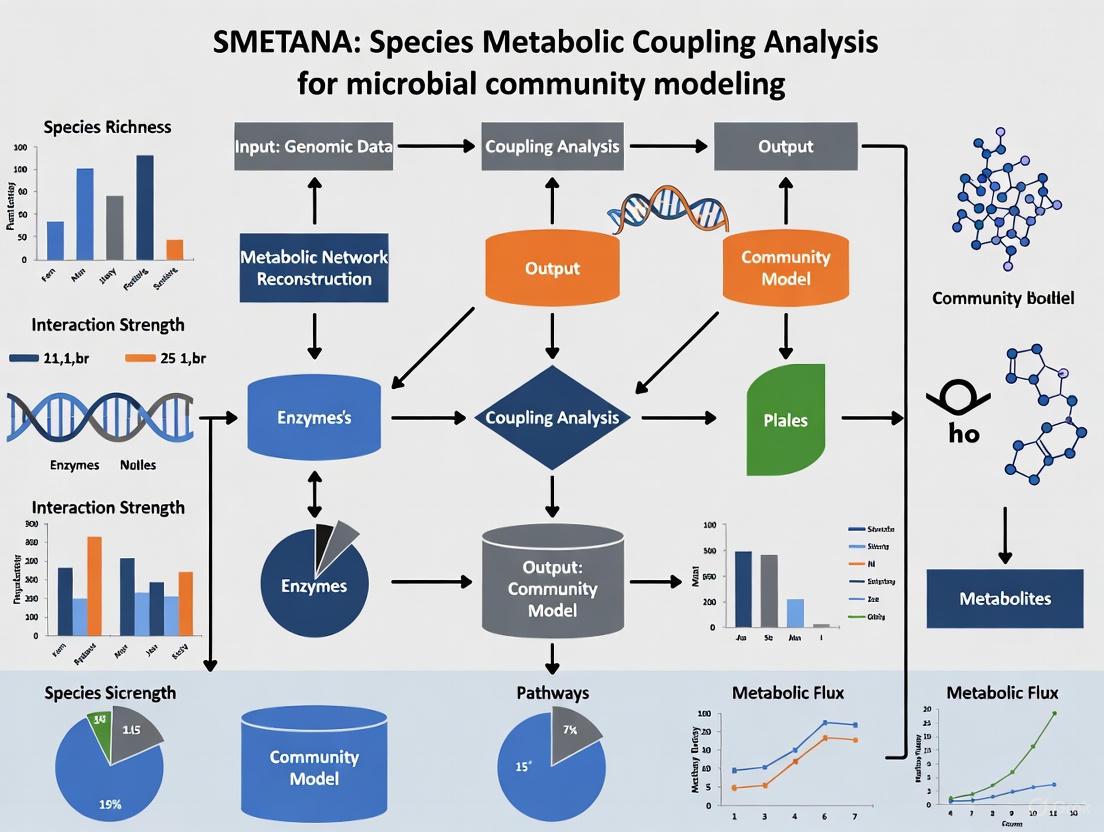
This article provides a comprehensive overview of SMETANA (Species Metabolic Interaction Analysis), a computational algorithm designed to analyze metabolic interactions and cross-feeding in microbial communities from genomic data.
SMETANA: A Comprehensive Guide to Species Metabolic Interaction Analysis for Microbial Community Modeling
Abstract
This article provides a comprehensive overview of SMETANA (Species Metabolic Interaction Analysis), a computational algorithm designed to analyze metabolic interactions and cross-feeding in microbial communities from genomic data. Tailored for researchers, scientists, and drug development professionals, we explore SMETANA's foundational principles, its integration into user-friendly pipelines like iNAP 2.0 for metagenomic data, and its practical application in predicting metabolic auxotrophies and resource competition. The scope extends to methodological best practices, troubleshooting common challenges, and validating predictions against experimental models. By elucidating the metabolic networks that govern community assembly, this guide aims to empower the development of novel therapeutic strategies and precision medicine approaches through a deeper understanding of host-microbiome interactions.
Understanding SMETANA: The Foundation of Metabolic Coupling Analysis
Microbial communities are fundamental to diverse ecosystems, from the human gut to the oceans, and their complex functions are largely governed by metabolic interactions among member species. While high-throughput sequencing has made determining which microorganisms are present a routine task, understanding how they interact mechanistically remains a significant challenge. SMETANA, an acronym for Species MEtabolic TANAlysis, addresses this gap directly. It is a computational framework and algorithm designed to quantitatively analyze cross-feeding interactions and metabolic dependencies within microbial communities [1] [2].
The power of SMETANA lies in its ability to move beyond simple correlation-based associations inferred from co-occurrence data. Instead, it uses genome-scale metabolic models (GSMMs) to predict mechanistic, metabolite-mediated interactions. This provides researchers, including those in drug development seeking to manipulate microbiomes for therapeutic purposes, with testable hypotheses about community stability, keystone species, and metabolic bottlenecks. Its relevance is highlighted by its integration into user-friendly, comprehensive pipelines like iNAP 2.0, which is used for constructing and analyzing metabolic interaction networks from metagenomic data [3].
Core Concepts: The Principles and Algorithms of SMETANA
Conceptual Foundation and Key Metrics
SMETANA operates on the principle that the metabolic network of a community can be deconvoluted into the individual metabolic networks of its members. By analyzing these networks in tandem, it quantifies the potential for resource overlap and metabolic cross-feeding. The framework calculates several key scores that provide a multi-faceted view of community metabolic dynamics [1]:
- Global Scores: These analyze the community as a whole.
- Metabolic Resource Overlap (MRO): Quantifies the degree to which species in a community compete for the same metabolites. A higher MRO suggests greater potential for competition.
- Metabolic Interaction Potential (MIP): Assesses the overall potential for metabolic sharing, which reduces the community's collective dependency on external resources.
- Detailed Pairwise Scores: These characterize specific interactions between pairs of species.
- Species Coupling Score (SCS): Measures the dependency of one species on the presence of another for its survival.
- Metabolite Uptake Score (MUS): Quantifies how frequently a species needs to uptake a specific metabolite from the environment or other members to survive.
- Metabolite Production Score (MPS): Evaluates the ability of a species to produce a metabolite, making it a potential donor in a cross-feeding interaction.
- SMETANA Score: A composite score that integrates the SCS, MUS, and MPS to provide a measure of certainty for a specific cross-feeding interaction (e.g., species A receives metabolite X from species B) [1].
Computational Workflow
The following diagram illustrates the logical flow of data and analysis in a typical SMETANA study, from input preparation to the generation of interaction scores.
Protocol: A Practical Guide to Implementing SMETANA
This section provides a detailed, step-by-step protocol for applying SMETANA to analyze a microbial community, based on its standard command-line implementation [4] and the principles outlined in iNAP 2.0 [3].
Step 1: Prepare Genome-Scale Metabolic Models (GSMMs)
- Input Requirement: Genome sequences (in FASTA format) or pre-annotated protein sequences.
- Model Reconstruction: Use tools like CarveMe [3] to automatically reconstruct draft GSMMs from genome annotations. CarveMe uses a reverse ecology approach to build models in SBML format, which are ready for constraint-based analysis.
- Gap-Filling: For models derived from metagenome-assembled genomes (MAGs), which may be incomplete, use the gap-filling function in CarveMe. This function uses mixed integer linear programming (MILP) to add missing reactions necessary for growth, based on a defined growth medium [3].
- Output: A set of single-species metabolic models in SBML format.
Step 2: Configure the Simulation
- Single vs. Multiple Communities: For a single community, provide SMETANA with the list of SBML files. For multiple communities, create a tab-separated table linking community IDs to organism IDs (which must match the SBML filenames) [4].
- Define Growth Medium: Use the
-mor--mediadboption to specify the composition of the growth medium. SMETANA can simulate the community across different nutritional conditions, which is crucial as the environment strongly influences metabolic interactions [4]. - Select Running Mode:
- Global Mode (
-g): Calculates the global scores MRO and MIP. This mode is faster and is recommended for an initial, community-wide assessment or when analyzing many communities [4]. - Detailed Mode (
-d): Calculates all detailed pairwise interaction scores (SCS, MUS, MPS, SMETANA). This is computationally intensive but necessary for identifying specific cross-feeding partners and metabolites [1] [4].
- Global Mode (
Step 3: Execute SMETANA and Interpret Results
- Command Line Execution: A basic command for a detailed analysis of a single community is:
smetana model1.xml model2.xml model3.xml -d[4]. - Output Interpretation: The results are typically provided in tabular format. The global scores (MRO, MIP) help characterize the community's overall metabolic structure. The detailed scores should be used to construct a metabolic interaction network, where nodes are species and edges are weighted by the SMETANA scores, highlighting the most probable cross-feeding events.
Essential Research Reagents and Computational Tools
Table 1: Key Research Reagent Solutions for a SMETANA Analysis
| Item | Function in Protocol | Specification / Note |
|---|---|---|
| Genome Sequences | Starting point for metabolic model reconstruction. | Can be reference genomes, Metagenome-Assembled Genomes (MAGs), or Single-Amplified Genomes (SAGs). [3] |
| CarveMe | Automated tool for reconstructing GSMMs in SBML format. | Uses a curated universal model; efficient for large-scale studies. [3] |
| SBML Models | Standardized format representing the metabolic network. | Required input for SMETANA; ensures software interoperability. [2] [4] |
| Media Database | Defines the nutritional environment for in silico simulations. | A .tsv file defining compound availability; critical for context-specific predictions. [4] |
| Cobrapy | Python library for constraint-based modeling. | Underpins the flux balance analysis performed by SMETANA. [3] |
Applications and Validation: SMETANA in Action
SMETANA's predictions are not merely theoretical; they are consistently validated against experimental data to uncover the mechanisms driving community assembly and function.
A compelling example comes from a study of synthetic bacterial biofilm communities (SynComs). Researchers first used co-occurrence network analysis on a 11-species SynCom to infer positive and negative correlations. They then used genome-scale metabolic modeling, including methods like SMETANA, to predict the metabolic potential for interactions [5]. The modeling results provided a mechanistic explanation for the observed ecological dynamics. For instance, the model suggested that the keystone species Chryseobacterium rhizoplanae (Chr) acted as a strong competitor, which was experimentally confirmed: removing Chr from the community significantly increased the overall biofilm biomass and cell numbers of other members [5]. This demonstrates how SMETANA can pinpoint species whose metabolic impact is disproportionate to their abundance.
Furthermore, SMETANA has been applied on a global scale to understand marine ecosystems. In one study, it was used alongside other indices within the iNAP 2.0 pipeline to analyze epipelagic bacterioplankton communities. The research revealed conserved metabolic cross-feedings, particularly of specific amino acids and B vitamins, suggesting that metabolic auxotrophies (dependencies) are a key mechanism shaping the assembly of these global communities [6]. This large-scale application underscores SMETANA's utility in moving from patterns of co-occurrence to predictions of molecular mechanisms.
Integration and Visualization: From Data to Insight
The ultimate output of a SMETANA analysis is a quantitative framework for building and visualizing metabolic interaction networks. These networks transform complex tables of scores into an interpretable map of community structure. The following diagram conceptualizes how different scores and data layers can be integrated into a cohesive network model, a process integral to platforms like iNAP 2.0 [3].
A critical step in this process, as highlighted in iNAP 2.0, is the use of Random Matrix Theory (RMT) to determine a statistically significant threshold for including interactions in the final network, moving beyond arbitrary cut-offs and enhancing the biological relevance of the model [3]. In the final network, microbial nodes can be connected directly, or via intermediate metabolite nodes (representing potentially transferable metabolites), creating a microbe-metabolite bipartite network that provides a holistic view of the metabolic exchange landscape [3].
Table 2: Comprehensive Summary of SMETANA's Core scoring Metrics
| Score Category | Score Name | Description | Biological Interpretation |
|---|---|---|---|
| Global Metrics | Metabolic Resource Overlap (MRO) | Measures competition for shared metabolites. | High score = high competition. |
| Metabolic Interaction Potential (MIP) | Assesses potential for metabolite sharing. | High score = high cooperation/reduced external dependency. | |
| Detailed Pairwise Metrics | Species Coupling Score (SCS) | Measures dependency of one species on another. | High score = strong growth coupling. |
| Metabolite Uptake Score (MUS) | Frequency a species needs to uptake a metabolite. | High score = metabolite is critical for the receiver. | |
| Metabolite Production Score (MPS) | Ability of a species to produce a metabolite. | High score = species is a potential donor. | |
| SMETANA Score | Composite of SCS, MUS, MPS. | Overall confidence in a specific cross-feeding interaction. |
Cross-feeding represents a fundamental biological principle where microbial species exchange metabolites, creating mutualistic interactions that enhance community stability and function. This metabolic complementarity occurs when one species secretes metabolites that are utilized by another, forming the backbone of complex microbial ecosystems. Such interactions are ubiquitous in natural environments, from marine and soil ecosystems to the human gut, and play a crucial role in biogeochemical cycles, human health, and industrial applications [7]. In microbial communities, cross-feeding transforms simple nutrient inputs into diverse metabolic outputs, enabling the coexistence of multiple species that would otherwise compete for limited resources. The extensive metabolic cross-feeding observed in free-living bacteria challenges the Competitive Exclusion Principle, suggesting that substantial excretion of metabolites provides a collaborative, inter-species mechanism of stress resistance and ecological fitness [8].
Understanding these interactions is paramount for microbial community modeling research. Tools like SMETANA (Species METabolic Interaction ANAlysis) have been developed to quantitatively analyze the potential for cross-feeding interactions by leveraging genome-scale metabolic models (GSMMs) [2]. The integration of these computational approaches with experimental validation provides a powerful framework for deciphering the mechanisms underlying microbial interactions, enabling researchers to predict community dynamics, design synthetic consortia, and identify key metabolic keystones that govern ecosystem stability and function [3].
Computational Analysis Using SMETANA
Protocol: Metabolic Interaction Analysis with iNAP 2.0
The integrated Network Analysis Pipeline 2.0 (iNAP 2.0) provides a user-friendly platform for comprehensive metabolic interaction studies, featuring the SMETANA method for cross-feeding substrate exchange prediction [3].
Workflow Overview:
- Input Preparation: Provide genome sequences (in FASTA format) or metagenome-assembled genomes (MAGs) as a zipped file. Ensure file names are unique and do not contain special characters.
- Genome Annotation: iNAP 2.0 utilizes Prokka with default settings for automated annotation of coding sequences, generating protein sequence files.
- Metabolic Model Reconstruction: Employ CarveMe for automated construction of genome-scale metabolic models (GSMMs) from annotated protein sequences. For environmental MAGs, use the gap-filling function to correct for potential annotation limitations.
- Interaction Analysis: Calculate SMETANA scores to quantify the potential and trends of metabolic complementarity between models. SMETANA evaluates the overlap and exchange of metabolic resources in communities, accounting for higher-order interactions beyond pairwise comparisons.
- Network Construction: Innovatively employs Random Matrix Theory (RMT) to determine statistically significant thresholds for constructing robust metabolic interaction networks from the numerical SMETANA results.
- Network Analysis: Analyze topological features of the constructed network, such as hub node determination, to identify key species and potentially transferable metabolites that connect microbial nodes.
This protocol allows researchers to move from raw genomic data to an interpretable metabolic interaction network, identifying potential cross-feeding partners and key metabolites that underpin community cohesion [3].
Table 1: Key Research Reagent Solutions for Computational Analysis
| Tool/Resource | Function | Application in SMETANA |
|---|---|---|
| CarveMe | Automated reconstruction of Genome-Scale Metabolic Models (GSMMs) | Converts genome or protein sequences into SBML-formatted models ready for constraint-based analysis [3] |
| Prokka | Rapid annotation of microbial genomes | Identifies coding sequences in genome files, providing functional annotations needed for model reconstruction [3] |
| Cobrapy | Constraint-based modeling of metabolic networks | Provides the computational backbone for flux balance analysis and metabolic simulation [3] |
| iNAP 2.0 Platform | Web-based integrated analysis platform | Offers a user-friendly Galaxy framework for performing end-to-end metabolic interaction analysis without command-line expertise [3] |
| BiGG Database | Curated metabolic database | Provides standardized compound and reaction information for consistent model building and gap-filling [3] |
Visualizing the SMETANA Workflow
The following diagram illustrates the comprehensive workflow for analyzing cross-feeding interactions using the iNAP 2.0 platform:
SMETANA Analysis Workflow in iNAP 2.0
Experimental Validation of Cross-Feeding
Protocol: Validating Stress-Induced Metabolic Exchanges
Experimental validation is crucial for confirming computationally predicted cross-feeding interactions. The following protocol, adapted from research on stress-induced metabolic exchanges, provides a methodology for validating acid-induced cross-feeding between complementary bacterial types [8].
Growth Conditions and Monitoring:
- Prepare defined minimal media with a weak buffer system (e.g., 2 mM bicarbonate) to simulate natural environments where acidification can occur.
- Use a sole carbon source that only one partner can initially utilize (e.g., N-acetyl-glucosamine for Vibrio splendidus).
- Co-culture target species at an equal initial ratio and monitor growth through optical density (OD) measurements.
- Track medium pH throughout the growth period using a calibrated pH meter or pH indicator strips.
- Perform regular dilutions (e.g., 40-fold every 24 hours) to establish growth-dilution cycles that allow evolutionary dynamics to emerge.
Metabolite and Species Composition Analysis:
- Collect culture supernatant at regular intervals for HPLC analysis to quantify substrate consumption and metabolite excretion.
- Monitor species abundance ratios using 16S rRNA PCR or species-specific qPCR assays.
- Correlate growth phases with metabolic shifts and pH changes to identify collaborative deacidification phases.
Validation of Metabolic Interactions:
- Compare co-culture growth yields with monoculture yields to quantify synergistic effects.
- Test predicted cross-fed metabolites (e.g., acetate, ammonium) as sole carbon/nitrogen sources for the dependent partner in monoculture.
- Analyze growth dynamics across multiple cycles to observe the emergence of stabilized interactions and potential evolutionary adaptations.
This protocol enables researchers to move beyond steady-state ecological models and capture the dynamic, phased nature of cross-feeding interactions that occur in response to environmental stress [8].
Quantitative Profiling of Cross-Feeding Dynamics
Table 2: Experimental Parameters for Validating Acid-Induced Cross-Feeding
| Parameter | Measurement Method | Expected Observation in Validated Cross-Feeding |
|---|---|---|
| Growth Kinetics | OD600 measurements over time | Multi-phase growth curve with distinct growth arrest and recovery phases [8] |
| pH Dynamics | pH meter measurements | Initial acidification followed by collaborative deacidification [8] |
| Substrate Utilization | HPLC analysis of culture supernatant | Primary carbon source depletion coinciding with growth arrest [8] |
| Metabolite Excretion | HPLC analysis of organic acids | Accumulation of cross-fed metabolites (e.g., acetate) preceding growth recovery [8] |
| Species Ratio | 16S rRNA PCR or qPCR | Stabilization of species ratio after multiple growth-dilution cycles [7] |
| Community Yield | Final biomass measurement | Higher yield in co-culture compared to the sum of monocultures [8] |
Visualizing Stress-Induced Cross-Feeding Dynamics
The following diagram illustrates the dynamic mechanism of stress-induced metabolic exchange between complementary bacterial types:
Dynamic Mechanism of Stress-Induced Cross-Feeding
Advanced Modeling Approaches
Protocol: Coupling FBA with Reactive Transport Using Machine Learning
Integrating genome-scale metabolic networks with reactive transport models (RTMs) enables sophisticated simulation of microbial metabolism in spatially explicit environments. This protocol outlines an efficient machine learning approach to overcome computational bottlenecks in such integrations [9].
Metabolic Network Preparation:
- Obtain a curated genome-scale metabolic model for the target organism (e.g., iMR799 for Shewanella oneidensis MR-1).
- For organisms exhibiting metabolic switching, implement a multi-step linear programming (LP) formulation with optimized parameters to accurately predict byproduct formation.
- Determine critical parameters through nonlinear optimization, including the stoichiometric coefficient of ATP in biomass production and fractional production rates of metabolic byproducts.
Artificial Neural Network (ANN) Surrogate Model Development:
- Randomly sample the FBA solution space across possible environmental conditions (substrate and oxygen availability).
- Train both multi-input single-output (MISO) and multi-input multi-output (MIMO) ANN architectures.
- Perform grid search to determine optimal hyperparameters (nodes and layers) for each model.
- Validate ANN predictions against held-out FBA solutions, ensuring correlation coefficients >0.9999.
Integration with Reactive Transport:
- Incorporate the trained ANN models as algebraic equations in RTM source/sink terms.
- Implement a cybernetic approach to model dynamic metabolic switches between multiple substrates.
- Validate the coupled model against experimental data for batch and column reactor configurations.
This machine learning approach reduces computational time by several orders of magnitude compared to traditional LP-based FBA models while maintaining solution robustness and avoiding numerical instability [9].
Flux Balance Analysis Configuration for Metabolic Switching
Table 3: Multi-Step FBA Parameters for Simulating Metabolic Switching in S. oneidensis
| Parameter | Symbol | Optimized Value | Biological Significance |
|---|---|---|---|
| ATP Stoichiometry in Biomass | c | 195.45 mmol ATP/gDW | Energy cost of biomass production, consistent with previous estimates (≈220) [9] |
| Lactate to Biomass Fraction | α_Bio,Lac | 0.6721 | Fraction of carbon directed to biomass rather than byproducts during lactate growth [9] |
| Lactate to Pyruvate Fraction | α_Pyr,Lac | 0.6848 | Production of pyruvate as a metabolic byproduct during lactate consumption [9] |
| Pyruvate to Biomass Fraction | α_Bio,Pyr | 0.6837 | Fraction of carbon directed to biomass rather than acetate during pyruvate growth [9] |
Visualizing the Machine Learning-Enhanced Modeling Framework
The following diagram illustrates the integration of ANN surrogate models with reactive transport modeling:
Machine Learning-Enhanced Metabolic Modeling
Evolutionary Dynamics of Cross-Feeding Interactions
Experimental Framework for Tracking Evolutionary Directions
Cross-feeding consortia exhibit two primary evolutionary directions after formation: strengthening through reinforced dependence or weakening through metabolic decoupling. Researchers can track these dynamics using the following experimental framework [7].
Long-Term Evolution Experiments:
- Establish obligate cross-feeding consortia with complementary auxotrophies or metabolic capabilities.
- Maintain cultures in controlled environments through serial passaging for extended periods (hundreds of generations).
- Regularly sample populations to monitor changes in metabolic coupling, growth dependence, and evolutionary dependence.
Quantifying Evolutionary Strengthening:
- Measure increased metabolite secretion rates over evolutionary timescales.
- Quantify deepening growth dependence through separated co-culture experiments.
- Assess evolutionary dependence through mutation accumulation rates and compensatory evolution patterns.
- Monitor expansion of cross-fed metabolites to include new metabolic pathways.
Quantifying Evolutionary Weakening:
- Track emergence of "cheater" genotypes that consume metabolites without providing benefits.
- Measure reduction in fitness advantages compared to ancestral strains.
- Identify genetic changes leading to metabolic decoupling or autonomous growth capability.
This framework allows researchers to understand the factors that promote stable, mutually beneficial cross-feeding versus those that lead to community collapse, informing the design of robust synthetic consortia [7].
Evolutionary Tracking Metrics and Interpretations
Table 4: Metrics for Tracking Evolutionary Directions in Cross-Feeding Consortia
| Evolutionary Direction | Key Tracking Metrics | Interpretation of Evolutionary Changes |
|---|---|---|
| Strengthening: Reinforced Dependence | Increased metabolite secretion | Evolution of active export processes beyond accidental leakage [7] |
| Deepening growth dependence | Enhanced specialization and division of labor between partners [7] | |
| Emergence of evolutionary dependence | Co-adaptation where mutations in one species depend on compensatory changes in the other [7] | |
| Expansion of cross-fed metabolites | Distribution of more metabolic pathway steps across different strains [7] | |
| Weakening: Metabolic Decoupling | Emergence of cheater genotypes | Natural selection favors genotypes that benefit from without contributing to the interaction [7] |
| Loss of fitness advantage | Environmental changes make the interaction less beneficial than autonomous growth [7] | |
| Reduction in metabolic exchange | Genetic changes enable internal production of previously cross-fed metabolites [7] | |
| Partner extinction | Collapse of the interaction due to population decline of one partner [7] |
Visualizing Evolutionary Directions in Cross-Feeding
The following diagram illustrates the two primary evolutionary trajectories for cross-feeding consortia:
Evolutionary Directions of Cross-Feeding Consortia
Traditional microbial ecology has long relied on co-occurrence networks inferred from amplicon or metagenomic sequencing data to hypothesize interactions. However, these statistical correlations cannot disentangle true biotic interactions from shared environmental preferences, nor do they reveal the mechanistic basis of these interactions [10]. The emergence of genome-scale metabolic models (GSMMs) has provided a framework to move beyond correlation to causation. By mathematically representing the metabolic capabilities of an organism, GSMMs allow researchers to simulate and predict metabolic exchanges, offering a mechanistic understanding of microbial community assembly and function. SMETANA (Species METabolic interaction ANAlysis) is a pivotal Python-based command-line tool designed to harness this power, calculating quantitative metrics that describe the potential for cross-feeding interactions within a community from a collection of GSMMs [2]. This protocol details its application, positioning it as an essential component in the modern bioinformatician's toolkit for deciphering microbial ecology.
SMETANA Technical Specifications and Core Algorithms
SMETANA takes as input microbial community metabolic models, typically in Systems Biology Markup Language (SBML) format, and computes several interaction metrics [2]. Its core innovation lies in moving beyond pairwise interactions to model higher-order dependencies within a community.
Table 1: Core Metrics Calculated by SMETANA
| Metric | Description | Interpretation |
|---|---|---|
| Metabolic Interaction Potential (MIP) | A community-level score representing the potential for an environment to support metabolic interactions. | A higher MIP suggests a community with a greater overall potential for cross-feeding [3]. |
| Metabolic Resource Overlap (MRO) | A community-level score quantifying the niche overlap based on shared metabolic resources. | A higher MRO indicates increased competition for substrates [3]. |
| Species Coupling Score | A species-level score indicating the degree to which a species's growth is coupled to the presence of other community members. | A high score suggests an organism is highly dependent on metabolites provided by others [4]. |
SMETANA operates in two primary modes to calculate these metrics [4]:
- Global Mode (
-g, --global): This mode runs MIP and MRO calculations and is optimized for speed. It is the recommended mode for analyzing multiple communities. - Detailed Mode (
-d, --detailed): This slower but more comprehensive mode calculates all potential inter-species interactions, providing a detailed map of metabolic exchanges.
The underlying algorithm in detailed mode uses a mixed integer linear programming (MILP) approach to predict cross-feeding. It simulates community metabolism and identifies metabolites that can be transferred between species to enhance community growth, going beyond what traditional correlation networks can achieve [3].
Application Notes and Protocols
Protocol 1: Analyzing a Single Microbial Community
This protocol is designed for analyzing cross-feeding within a single, defined microbial community.
1. Input Preparation: Gather the genome-scale metabolic models for each species in the community in SBML format [4]. The filenames (without the .xml extension) will be used as organism identifiers (e.g., species1.xml, species2.xml).
2. Command Execution: Execute SMETANA from the command line by providing the list of SBML files [4].
Alternatively, use a wildcard to include all XML files in a directory:
3. Output Interpretation: SMETANA will generate output files containing the computed scores. Analyze the MIP and MRO to understand the community's overall interaction potential and competition. Examine species-level coupling scores to identify key dependent organisms.
Protocol 2: Comparative Analysis of Multiple Communities
This protocol allows for the simultaneous analysis of several distinct microbial communities, enabling comparative studies.
1. Input Preparation:
- Prepare SBML models for all organisms that appear in any community.
- Create a tab-separated table in long format that defines the composition of each community. The table must have two columns:
community_idandorganism_id, where theorganism_idmatches the SBML filename [4].
Table 2: Example Community Composition File (communities.tsv)
| community_id | organism_id |
|---|---|
| community1 | organism1 |
| community1 | organism2 |
| community2 | organism1 |
| community2 | organism3 |
2. Command Execution: Run SMETANA specifying the SBML files and the community composition file [4].
3. Output Interpretation: SMETANA will output results for each community separately. Compare MIP/MRO scores across communities to identify which have the highest potential for metabolic interaction or competition.
Protocol 3: Assessing Community Interactions in Specific Media
Microbial interactions are highly dependent on environmental context. This protocol tests community models under defined nutritional conditions.
1. Input Preparation:
- Prepare SBML models and community files as in previous protocols.
- Create or obtain a media library file (e.g.,
library.tsv) that defines the composition of different growth media. Compound names must be consistent with a database like BiGG [3].
2. Command Execution: Invoke SMETANA with the -m flag to specify one or more media from your library [4].
3. Output Interpretation: Compare the interaction scores for the same community across different media. A shift in scores indicates how nutrient availability alters internal metabolic dependencies.
Advanced Configuration and Integration
SMETANA offers several advanced options for customization [4]:
- Solver Selection: Use the
--solveroption to specify an alternative MILP solver (e.g., Gurobi, CPLEX). - Excluding Compounds: The
--excludeoption allows the removal of inorganic compounds or other metabolites from the analysis to avoid overestimation of interactions. - Compartment Specification: Use
--extto define the identifier of the extracellular compartment in your models if it is non-standard.
SMETANA in the Broader Ecosystem: Integration with iNAP 2.0
SMETANA is not only a standalone tool but has been integrated into larger, user-friendly bioinformatics platforms. The integrated Network Analysis Pipeline (iNAP 2.0) incorporates SMETANA as one of its core methods for assessing metabolic complementarity [3]. This integration is significant because it lowers the barrier to entry for researchers who may not be comfortable with command-line interfaces. Within iNAP 2.0, SMETANA works alongside other methods like PhyloMint and metabolic distance calculations, providing a multi-faceted view of microbial interactions. A key feature of iNAP 2.0 is its use of Random Matrix Theory (RMT) to determine statistically significant thresholds for constructing robust metabolic interaction networks from the numerical outputs of SMETANA and other tools, moving beyond arbitrary cut-offs [3].
Table 3: The Scientist's Toolkit: Essential Research Reagents and Resources
| Item / Resource | Function / Description | Relevance to SMETANA Workflow |
|---|---|---|
| Genome Sequences (FASTA) | The raw DNA sequences of microbial community members, from isolates or MAGs. | The foundational input from which metabolic models are built [3]. |
| CarveMe | An automated tool for reconstructing genome-scale metabolic models from annotated genomes. | Used to generate the required SBML model input for SMETANA [3]. |
| SBML (Systems Biology Markup Language) | A standard, computer-readable format for representing metabolic models. | The primary input format for SMETANA analysis [4]. |
| Cobrapy | A Python library for constraint-based modeling of metabolic networks. | Underpins the simulation and analysis capabilities within the SMETANA framework [3]. |
| iNAP 2.0 Web Platform | A Galaxy-based online platform that integrates multiple metabolic network analysis tools. | Provides a graphical, user-friendly interface to run SMETANA without command-line expertise [3]. |
Case Study: Unveiling Oceanic Microbial Interactions
The power of SMETANA is exemplified by its application in cutting-edge environmental microbiology. A landmark 2024 study in Nature Communications employed an integrated ecological and metabolic modeling approach, including SMETANA, to investigate bacterioplankton communities in the global ocean surface [10]. Researchers built a vast catalogue of non-redundant marine prokaryotic genomes and used Tara Oceans meta-omics data to infer co-active communities. By applying community metabolic modeling with tools like SMETANA to these co-active groups, the study revealed a higher potential for metabolic interaction within them. The simulations pointed towards conserved metabolic cross-feedings, particularly of specific amino acids and group B vitamins [10]. This work provided mechanistic evidence that genome streamlining and metabolic auxotrophies act as joint mechanisms shaping the assembly of some of the most fundamental ecosystems on Earth, a hypothesis that was strongly supported by the model-based predictions of SMETANA.
SMETANA represents a critical advancement in the bioinformatics toolkit, enabling a transition from describing who is there and who co-occurs to predicting why they coexist and how they interact metabolically. Its ability to quantitatively score interaction potentials and dependencies, especially when integrated into accessible platforms like iNAP 2.0 and applied to real-world datasets as in the Tara Oceans project, makes it an indispensable tool for researchers, scientists, and drug development professionals seeking a mechanistic, metabolic understanding of microbial communities. As the field moves further into the era of multi-omics integration, tools like SMETANA that can translate genomic blueprints into predictive models of community behavior will be at the forefront of unlocking the functional secrets of the microbial world.
Genome-Scale Metabolic Models (GSMMs) as the Essential Foundation
Genome-scale metabolic models (GEMs) are computational representations of the metabolic network of an organism [11]. They provide a structured framework based on biochemical transformations, stoichiometric coefficients, and gene-protein-reaction (GPR) associations [11]. The core of a GEM is its stoichiometric matrix (S), where rows represent metabolites and columns represent reactions. This mathematical foundation enables constraint-based reconstruction and analysis (COBRA), a methodology that uses mass-balance and capacity constraints to predict metabolic flux distributions and phenotypic behaviors [11] [12]. Since the first GEM for Haemophilus influenzae was reconstructed in 1999, the field has expanded dramatically, with models now available for thousands of organisms across bacteria, archaea, and eukarya [11]. This proliferation has established GEMs as an essential platform for systems-level metabolic studies, enabling the integration and analysis of various omics data types to generate testable biological hypotheses [11].
Core Principles and Reconstruction of GEMs
Stoichiometric Modeling and Constraint-Based Analysis
The reconstruction process begins with the comprehensive annotation of an organism's genome to identify all metabolic genes [11]. These genes are then linked to the enzymatic reactions they encode through GPR associations [11]. The resulting network is represented by the stoichiometric matrix S, where each element S~ij~ denotes the stoichiometric coefficient of metabolite i in reaction j [11]. Under the steady-state assumption, which posits that metabolite concentrations do not change over time, the system is described by the equation S · v = 0, where v is the vector of reaction fluxes [11].
Flux Balance Analysis (FBA) is the primary computational method for simulating GEMs [11]. FBA uses linear programming to identify a flux distribution that maximizes or minimizes a particular cellular objective (e.g., biomass production) while satisfying the stoichiometric and capacity constraints [11]. This constraint-based approach does not require detailed kinetic parameters, making it particularly powerful for genome-scale simulations [11].
Protocol: Basic Workflow for GEM Reconstruction and Simulation
The following protocol outlines the key steps for reconstructing and simulating a GEM:
- Draft Reconstruction: Generate an initial model from genome annotation data using automated tools like ModelSEED or RAVEN Toolbox [11].
- Network Refinement: Manually curate the draft model using experimental data and biochemical literature to ensure mass and charge balance [11].
- Biomass Objective Function: Define a biomass reaction that represents the composition of key cellular constituents (e.g., amino acids, nucleotides, lipids) required for growth [11].
- Constraint Definition: Set constraints on exchange reactions to define the simulated growth medium and environmental conditions [11].
- Model Simulation: Perform FBA to predict growth rates or production yields under the defined constraints [11].
- Model Validation: Compare model predictions (e.g., essential genes, substrate utilization) with experimental data to assess and improve model accuracy [11].
Figure 1: Core workflow for reconstructing and simulating a genome-scale metabolic model.
Advanced GEM Methodologies and Extensions
Enzyme-Constrained Metabolic Models (ecGEMs)
While standard GEMs have proven valuable, they often lack enzyme capacity constraints, which can limit their predictive accuracy [12]. The GECKO (Gene Expression and Cost by Kinetics and Omics) toolbox addresses this limitation by enhancing GEMs with enzymatic constraints [12]. The GECKO protocol involves several key stages: First, the starting metabolic model is expanded into an ecModel structure that incorporates enzyme pseudometabolites and enzyme usage reactions [12]. Next, enzyme turnover numbers (k~cat~ values) are integrated into the model, which can be sourced from databases like BRENDA or predicted using deep learning methods [12]. The model then undergoes a tuning process to adjust for incorrect or missing k~cat~ values, ensuring the model accurately reflects observed physiological states [12]. Finally, proteomics data can be integrated to generate context-specific ecModels, further improving predictions of metabolic phenotypes [12]. This methodology has been shown to significantly improve the prediction of microbial growth rates and the identification of metabolic engineering targets [12].
Flux-Sum Coupling Analysis (FSCA) for Metabolites
Inspired by flux coupling analysis for reactions, Flux-Sum Coupling Analysis (FSCA) is a novel constraint-based approach that categorizes the interdependencies between metabolite flux-sums [13]. The flux-sum of a metabolite (φ~m~) is defined as the sum of fluxes through the metabolite, weighted by the absolute value of the stoichiometric coefficients [13]. FSCA identifies three primary coupling relationships between metabolite pairs [13]:
- Directionally coupled: A non-zero flux-sum for metabolite m~i~ implies a non-zero flux-sum for metabolite m~j~, but not vice versa.
- Partially coupled: A non-zero flux-sum for m~i~ implies a non-zero flux-sum for m~j~ and vice versa.
- Fully coupled: A non-zero flux-sum for m~i~ not only implies a non-zero but also a fixed flux-sum for m~j~ and vice versa.
Application of FSCA to models of E. coli, S. cerevisiae, and A. thaliana has demonstrated that these coupling relationships are a common feature of metabolic networks and can capture qualitative associations between metabolite concentrations, establishing flux-sum as a reliable proxy for concentration in the absence of direct measurements [13].
Figure 2: Flux-sum coupling analysis workflow for identifying metabolite relationships.
Quantitative Analysis of GEMs and Their Applications
Table 1: Prevalence of Flux-Sum Coupling Types in Different Metabolic Models [13]
| Organism | Model Name | Full Coupling | Partial Coupling | Directional Coupling |
|---|---|---|---|---|
| Escherichia coli | iML1515 | 0.007% | 0.063% | 16.56% |
| Saccharomyces cerevisiae | iMM904 | 0.010% | 0.036% | 3.97% |
| Arabidopsis thaliana | AraCore | 0.12% | 2.94% | 80.66% |
Table 2: Key Applications of Genome-Scale Metabolic Models [11]
| Application Domain | Specific Use Case | Representative Example |
|---|---|---|
| Biotechnology & Industrial Microbiology | Strain development for chemicals and materials production | Engineering of E. coli and S. cerevisiae for high-level production of shikimate, heme, and other valuable chemicals [11] [12]. |
| Biomedicine & Drug Discovery | Drug targeting in pathogens | Identification of essential metabolic reactions in Mycobacterium tuberculosis under hypoxic conditions replicating a pathogenic state [11]. |
| Systems & Synthetic Biology | Modeling multi-species interactions | Analysis of metabolic exchanges and resource competition in synthetic bacterial biofilm communities (SynComs) [5]. |
| Basic Science | Prediction of gene essentiality and enzyme functions | Validation of model predictions against gene knockout studies, with accuracies exceeding 90% in high-quality models like E. coli iML1515 [11]. |
Table 3: Essential Research Reagents and Computational Tools for GEM Workflows
| Reagent / Tool Solution | Function / Purpose | Protocol / Usage Context |
|---|---|---|
| GECKO Toolbox | Reconstructs enzyme-constrained metabolic models (ecModels) by incorporating enzyme kinetics and proteomics data [12]. | Used to improve phenotype predictions. Stages include ecModel expansion, integration of k~cat~ values, model tuning, and simulation [12]. |
| COBRA Toolbox | A MATLAB suite for constraint-based reconstruction and analysis [12]. | Provides the core functions for performing Flux Balance Analysis (FBA), Flux Variability Analysis (FVA), and many other constraint-based methods [11] [12]. |
| BRENDA Database | Curated database of enzyme kinetic parameters, including turnover numbers (k~cat~) [12]. | Serves as a key resource for populating ecModels with experimentally determined enzyme kinetic data during the GECKO workflow [12]. |
| Strain-Specific qPCR Primers | Enable accurate quantification of individual species abundance within a microbial community [5]. | Used to track compositional changes in synthetic communities (SynComs) and validate model-predicted interactions and biomass yields [5]. |
| Deep Learning k~cat~ Predictors | Computational tools for predicting enzyme turnover numbers from protein sequence or structure [12]. | Allows the reconstruction of ecModels for organisms with limited experimental kinetic data, expanding the scope of enzyme-constrained modeling [12]. |
Application Note: SMETANA and Metabolic Coupling in Microbial Communities
Metabolic Modeling of Synthetic Communities (SynComs)
Genome-scale metabolic models are fundamental for deciphering the complex interspecies interactions that govern the assembly and function of microbial communities [5]. In a seminal study, GEMs were used to investigate metabolic interactions in a synthetic bacterial biofilm community (SynCom) composed of 11 soil isolates [5]. Researchers combined co-occurrence network analysis with quantitative PCR to identify keystone species that significantly impacted community biomass, acting either as metabolic facilitators or competitors [5]. The subsequent reconstruction and simulation of GEMs for these community members provided mechanistic insights into the predicted interactions, revealing that metabolic exchanges and resource competition were key drivers of the observed co-occurrence patterns [5]. This integrated approach demonstrates how GEMs can move beyond correlation to reveal causation in microbial ecology.
Protocol: Analyzing Interactions in a Synthetic Community
This protocol outlines the steps for using GEMs to analyze species interactions in a microbial community:
- Community Construction & Profiling: Construct the SynCom from isolates and track the dynamic changes in species abundance over time using 16S rDNA amplicon sequencing or qPCR with strain-specific primers [5].
- Network Analysis: Perform co-occurrence network analysis (e.g., using Spearman correlation) on the abundance data to infer positive and negative correlations between species, identifying central or keystone nodes [5].
- GEM Reconstruction & Simulation: Reconstruct or obtain GEMs for each member of the SynCom. Simulate the metabolic network of each species individually and in combination to predict cross-feeding opportunities and nutrient competition [5].
- Interaction Validation: Use a "removal" strategy, where the keystone species identified in silico is experimentally omitted from the community, to validate its impact on community biomass and composition [5].
- Integration with SMETANA: The SMETANA (Species Metabolic Interaction Analysis) algorithm can be applied to the set of community GEMs to quantitatively score metabolic interaction potential and identify specific compounds that are likely exchanged [5]. This provides a mechanistic basis for the correlations observed in the network analysis.
Genome-scale metabolic models have evolved from single-organism reconstructions into indispensable tools for modeling the complex metabolism of microbial communities. The foundational principles of stoichiometric modeling, combined with advanced extensions like enzyme constraints and flux-sum coupling analysis, provide a powerful quantitative framework for predicting metabolic phenotypes. As protocols for building high-quality models and tools for multi-species analysis like SMETANA become more sophisticated, GEMs are poised to drive further innovations in biotechnology, drug development, and our fundamental understanding of microbial ecology.
This application note details the integration of Species MEtabolic Coupling ANAlysis (SMETANA), a computational tool for predicting metabolic interactions in microbial communities, within the broader iNAP 2.0 (integrated Network Analysis Pipeline) framework. We present a structured protocol that leverages SMETANA's capabilities to infer metabolic complementarity and cross-feeding relationships, which then feed into iNAP 2.0's comprehensive network construction and analysis modules. This integration enables researchers to move beyond correlation-based associations toward mechanistic modeling of microbial interactions, providing deeper insights into community assembly, stability, and function. The note includes detailed methodologies, visualization approaches, and practical implementation guidelines to facilitate adoption by microbial ecologists, systems biologists, and drug development professionals.
Microbial communities operate as complex, interconnected systems where metabolic interactions fundamentally govern community structure and function. Understanding these interactions is crucial for advancing microbiome research in human health, environmental science, and biotechnology. SMETANA (Species Metabolic Coupling Analysis) is an algorithm designed specifically to predict metabolic interactions between microbial species by analyzing their genomic potential [14] [15]. It calculates metabolic coupling indices that quantify the likelihood of cross-feeding relationships, making it a powerful tool for moving beyond taxonomic profiling toward functional interaction networks.
The iNAP 2.0 (integrated Network Analysis Pipeline) framework represents a significant advancement in microbial network analysis, incorporating random matrix theory for threshold determination and identifying transferable metabolites between species [16]. As a comprehensive platform, iNAP 2.0 provides multiple network construction methods and topological analysis tools for both intradomain and interdomain associations in microbial communities [17].
The integration of SMETANA within the iNAP 2.0 pipeline creates a powerful synergistic workflow where SMETANA's mechanistic predictions of metabolic interactions inform iNAP 2.0's network construction and analysis capabilities. This combination enables researchers to build more biologically meaningful ecological networks that reflect actual metabolic dependencies and resource sharing within microbial communities.
Background and Theoretical Framework
SMETANA: Algorithmic Foundations
SMETANA operates on the principle of metabolic complementarity, analyzing genome-scale metabolic models (GEMs) to predict cross-feeding relationships. The algorithm employs a dual-index system to quantify metabolic interactions:
- Metabolic Resource Overlap (MI-score): Quantifies the competition for metabolic resources between species
- Metabolic Complementarity (CI-score): Measures potential cooperative interactions through metabolite exchange
These indices are calculated by analyzing the metabolic networks reconstructed from genomic data, specifically identifying metabolites that can be transferred between species to enhance growth rates [14] [15]. SMETANA integrates seamlessly with metabolic reconstruction tools like CarveMe, which generates genome-scale metabolic models from protein FASTA files through a top-down approach using the BiGG database [15].
iNAP 2.0 provides a modular framework for microbial network analysis with enhanced capabilities over its predecessor. Key features include:
- Multiple Network Construction Methods: Supports correlation-based approaches (Pearson, Spearman with RMT), sparse correlations for compositional data (SparCC), conditional dependence-based methods (SPIEC-EASI, eLSA), and now metabolic complementarity analysis through SMETANA integration [17]
- Advanced Network Analysis: Incorporates Random Walk with Restart for Multiplex-Heterogeneous networks (RWR-MH) for improved node ranking and module identification [18]
- Interdomain Analysis: Enables construction of cross-domain association networks between different microbial kingdoms [17]
The pipeline is implemented within the Galaxy framework, making it accessible to researchers without advanced programming skills while maintaining analytical rigor [17].
Integrated Workflow Protocol
Computational Requirements and Setup
Table 1: Software Dependencies and Specifications
| Component | Version | Purpose | Installation Method |
|---|---|---|---|
| metaGEM | 1.0+ | Snakemake workflow for generating GEMs from metagenomes | mamba create -n metagem -c bioconda metagem [14] |
| CarveMe | 1.5.0+ | Genome-scale metabolic model reconstruction | pip install carveme [15] |
| SMETANA | As in metaGEM | Metabolic coupling analysis | Included in metaGEM pipeline [14] |
| iNAP 2.0 | Web platform | Integrated network analysis | http://mem.rcees.ac.cn:8081 [17] |
| IBM CPLEX | 12.10+ | Optimization solver (alternative: Gurobi or SCIP) | Academic license required [15] |
Stage 1: Metabolic Model Reconstruction and SMETANA Analysis
Input Data Preparation
Genome Data Acquisition:
- Input: High-quality Metagenome-Assembled Genomes (MAGs) in FASTA format
- Quality Control: Assess completeness (>70%) and contamination (<10%) using CheckM
- Format: Protein sequences (.faa) or nucleotide sequences (.fna)
Model Reconstruction with CarveMe:
- Critical Parameters: Specify
--gapfill M9for medium-specific gapfilling and--init M9to initialize medium conditions [15]
- Critical Parameters: Specify
SMETANA Execution
Metabolic Coupling Calculation:
- Execute SMETANA within the metaGEM pipeline:
- Input: Collection of genome-scale metabolic models in SBML format
- Output: Pairwise metabolic interaction scores (MI and CI indices) [14]
Result Interpretation:
- CI-score > 0.5 indicates significant metabolic complementarity
- MI-score > 0.3 suggests substantial metabolic competition
- Identify potential keystone species based on high CI-scores with multiple partners
Stage 2: Network Construction in iNAP 2.0
Data Formatting for iNAP 2.0
SMETANA Output Processing:
- Convert SMETANA scores to iNAP-compatible association matrix
- Format: Tab-separated matrix with species as rows and columns
- Normalize scores to 0-1 range for consistency with other association metrics
Input File Preparation:
- Abundance Data: Species (rows) × Samples (columns) in tab-separated format
- Association Matrix: SMETANA-derived CI-scores as weighted edges
- Metadata: Environmental factors linked to sample IDs [17]
Network Construction via IDENAP
Method Selection:
- Choose "Upload Association Matrix" option in iNAP 2.0
- Select SMETANA-generated matrix as input
- For comparison: Run parallel networks using SparCC or RMT-based correlations
Parameter Optimization:
- Apply RMT-based thresholding to filter biologically relevant interactions
- Set significance threshold at p < 0.05 after multiple testing correction
- Enable "Interdomain Analysis" for cross-kingdom interactions [17]
Stage 3: Advanced Analysis and Interpretation
Topological Analysis
Network Property Calculation:
- Compute degree centrality to identify hub species
- Analyze modularity to detect functional subunits
- Calculate betweenness centrality to pinpoint potential keystone species
Comparative Network Metrics:
- Contrast SMETANA-derived networks with correlation-based networks
- Evaluate differences in modularity, connectivity, and stability
Multi-Omic Integration via RWR-MH
Implement Random Walk with Restart:
- Configure RWR-MH parameters for multiplex-heterogeneous networks
- Set restart probability (r = 0.7-0.9) based on network density
- Assign seed weights according to SMETANA confidence scores [18]
Active Module Identification:
- Use AMEND algorithm to identify significantly enriched subnetworks
- Map modules to metabolic pathways for functional interpretation
- Correlate module activity with environmental metadata
Figure 1: SMETANA-iNAP 2.0 Integrated Workflow. The diagram illustrates the sequential stages from raw metagenomic data to biological insights, highlighting SMETANA's role in metabolic interaction prediction and iNAP 2.0's function in network construction and analysis.
Research Reagent Solutions
Table 2: Essential Computational Tools and Databases
| Category | Tool/Database | Specific Function | Integration Point |
|---|---|---|---|
| Metabolic Modeling | CarveMe | Top-down GEM reconstruction from genomes | Pre-processor for SMETANA [15] |
| Model Testing | MEMOTE | Quality assessment of metabolic models | Validation of GEMs pre-SMETANA [15] |
| Optimization Solver | IBM CPLEX/Gurobi | Linear programming optimization | Required for CarveMe model reconstruction [15] |
| Sequence Alignment | DIAMOND | Fast protein sequence search | Dependency for CarveMe annotation [15] |
| Reference Database | BiGG Models | Curated metabolic reactions and metabolites | Reference for CarveMe reconstruction [15] |
| Taxonomic Annotation | GTDB-tk | Standardized taxonomic classification | Links metabolic function with taxonomy [14] |
Applications and Case Study
Renal Cell Carcinoma Microbiome Analysis
To demonstrate the practical utility of the integrated SMETANA-iNAP 2.0 pipeline, we present a case study analyzing microbial communities in renal cell carcinoma (KIRC) using data from The Cancer Genome Atlas.
Experimental Design:
- Data Source: TCGA-KIRC metagenomic samples (n=150)
- Comparison Groups: Tumor vs. matched normal tissue microbiomes
- Implementation: SMETANA-derived metabolic networks compared to SparCC correlation networks
Results and Interpretation:
Table 3: Comparative Network Metrics in TCGA-KIRC Analysis
| Network Property | SMETANA-iNAP Network | SparCC Correlation Network | Biological Interpretation |
|---|---|---|---|
| Average Degree | 4.2 | 6.8 | More specific, functionally relevant interactions |
| Modularity | 0.45 | 0.32 | Higher functional organization |
| Identified Keystones | 3 species | 7 species | Fewer but metabolically critical hubs |
| Cross-feeding Pairs | 28 | N/A | Direct metabolic dependencies identified |
| Stability Index | 0.78 | 0.63 | Enhanced resistance to perturbation |
The SMETANA-iNAP integration revealed metabolically cohesive modules in tumor tissues that were absent in normal controls, including a tryptophan-degrading consortium associated with immune suppression. This functional insight was not apparent from correlation-based networks alone, demonstrating the value of metabolic modeling in microbiome analysis.
Technical Considerations and Troubleshooting
Data Quality Requirements
Genome Completeness:
- Minimum 70% completeness for reliable GEM reconstruction
- Contamination threshold below 10% to avoid chimeric models
- Recommendation: Use CheckM2 for quality assessment pre-reconstruction
Sample Size Considerations:
Computational Optimization
Performance Enhancement:
Common Error Resolution:
- "Pipeline cannot process >1000 OTUs": Apply majority filtering or use FastSpar
- Solver licensing issues: Configure academic licenses for CPLEX/Gurobi
- Model incompatibility: Validate SBML files with MEMOTE before SMETANA execution [15]
Concluding Remarks
The integration of SMETANA within the iNAP 2.0 pipeline represents a significant advancement in microbial network analysis, bridging the gap between genomic potential and ecological interaction inference. This protocol provides researchers with a comprehensive framework to leverage metabolic modeling for enhanced network construction, moving beyond statistical associations to mechanistic understanding of microbial community dynamics.
The synergistic combination of these tools enables the identification of metabolically cohesive modules, prediction of cross-feeding relationships, and discovery of potential keystone species that may serve as targets for therapeutic intervention or bioengineering applications. As multi-omic datasets continue to grow in complexity and scale, the SMETANA-iNAP 2.0 integration offers a robust, scalable approach for extracting biologically meaningful insights from microbial community data.
Implementing SMETANA: A Step-by-Step Methodology and Research Applications
Species METabolic interaction ANAlysis (SMETANA) is a Python-based command-line tool designed to analyze potential cross-feeding interactions in microbial communities from a collection of genome-scale metabolic models (GEMs) [2]. This protocol details the end-to-end workflow, from processing raw metagenomic reads to computing quantitative metabolic interaction scores, enabling researchers to generate mechanistic hypotheses about community interactions directly from sequence data. This process is integral to studies of diverse microbiomes, including those associated with human health, disease, and environmental biomes [19].
Background
Microbial species within communities engage in complex metabolic exchanges, a phenomenon known as cross-feeding. SMETANA implements a suite of algorithms to quantify these interactions [1]. The analysis begins with metagenome-assembled genomes (MAGs), which capture the genetic potential of community members, including uncultured species. The reconstruction of context-specific GEMs from these MAGs, rather than relying on reference genomes, avoids false positives and negatives in pathway prediction and provides a more accurate representation of the community's metabolic network [19].
SMETANA provides two classes of analysis: global and detailed [1].
- Global algorithms characterize the community as a whole.
- Metabolic Resource Overlap (MRO): Quantifies the degree to which species compete for the same metabolites.
- Metabolic Interaction Potential (MIP): Calculates the number of metabolites that species can share to reduce their dependency on external resources.
- Detailed algorithms characterize individual interactions between species.
- Species Coupling Score (SCS): Measures the dependency of one species on the presence of others to survive.
- Metabolite Uptake Score (MUS): Measures how frequently a species needs to uptake a specific metabolite to survive.
- Metabolite Production Score (MPS): Measures the ability of a species to produce a specific metabolite.
- SMETANA Score: A composite score combining SCS, MUS, and MPS, providing a measure of certainty for a specific cross-feeding interaction (e.g., species A receives metabolite X from species B) [1].
Experimental Protocols
Stage 1: From Metagenomic Sequences to Metabolic Models
This initial stage involves processing raw sequencing data to reconstruct community-specific GEMs. The metaGEM pipeline provides an end-to-end Snakemake workflow to automate this process [19].
Table 1: Key Software Tools in the metaGEM Pipeline
| Tool | Task | Function in the Workflow |
|---|---|---|
| fastp [19] | Short-read QC & Adapter Removal | Ensures high-quality input data for assembly by filtering reads and removing adapters. |
| MEGAHIT [19] | Short-read Assembly | Assembles quality-controlled reads into longer contiguous sequences (contigs). |
| MetaBAT2 / MaxBin2 / CONCOCT [19] | Contig Binning | Groups assembled contigs into metagenome-assembled genomes (MAGs) based on sequence composition and coverage. |
| metaWRAP [19] | Bin Refinement | Improves the quality and completeness of MAGs by consolidating results from multiple binning tools. |
| CarveMe [19] | GEM Reconstruction | Builds flux balance analysis (FBA)-ready genome-scale metabolic models from the protein annotations of MAGs. |
| Prokka [19] | MAG Functional Annotation | Annotates MAGs with functional information, including protein-coding genes, which is a prerequisite for GEM reconstruction. |
Procedure:
- Quality Control: Use
fastpwith default parameters to perform quality filtering and adapter removal on raw metagenomic short reads (paired-end or single-end) [19]. - De Novo Assembly: Assemble the quality-controlled reads for each sample independently using
MEGAHITwith the--presets meta-sensitiveparameter. Set the--min-contig-lento 1000 for datasets with high microbial diversity, such as ocean metagenomes [19]. - Contig Coverage Estimation: Cross-map the quality-controlled reads back to their respective assemblies using
bwa-memand process the resulting SAM/BAM files withSAMtools. Use this data to generate contig coverage profiles across all samples within a dataset [19]. - Binning and Refinement: Perform metagenomic binning on the assemblies using multiple tools (e.g.,
MetaBAT2,MaxBin2,CONCOCT). Subsequently, usemetaWRAPto refine these bins, producing a final set of high-quality MAGs [19]. - Metabolic Model Reconstruction: Reconstruct genome-scale metabolic models from the refined MAGs using
CarveMe. This step translates the genetic repertoire of each MAG into a context-specific metabolic network [19].
Stage 2: Metabolic Community Modeling with SMETANA
This stage involves using the collection of GEMs to compute quantitative interaction scores.
Table 2: SMETANA Input and Output Specifications
| Component | Description | Format/Details |
|---|---|---|
| Input | A collection of genome-scale metabolic models representing the microbial community. | Models in SBML (Systems Biology Markup Language) format [2]. |
| Global Output Scores | MRO (Metabolic Resource Overlap) | A single value per community quantifying competition [1]. |
| MIP (Metabolic Interaction Potential) | A single value per community quantifying cooperation potential [1]. | |
| Detailed Output Scores | SCS (Species Coupling Score) | Measures the dependency of one species on others [1]. |
| MUS (Metabolite Uptake Score) | Measures a species' need to uptake a metabolite [1]. | |
| MPS (Metabolite Production Score) | Measures a species' ability to produce a metabolite [1]. | |
| SMETANA (Individual Score) | A combined score (SCS, MUS, MPS) quantifying confidence in a specific cross-feeding interaction [1]. |
Procedure:
- Input Preparation: Ensure all community GEMs are in SBML format and located in a single directory.
- Global Analysis: Execute SMETANA to calculate community-wide MRO and MIP scores. This provides a high-level overview of the community's metabolic characteristics.
- Detailed Analysis: Execute SMETANA with flags to compute the detailed scores (SCS, MUS, MPS, and the individual SMETANA score). These results identify and quantify specific metabolite exchanges between pairs of species.
The Scientist's Toolkit
Table 3: Essential Research Reagent Solutions
| Item | Function in the Workflow |
|---|---|
| Metagenomic DNA | The starting material, containing the collective genomic sequence of the entire microbial community from an environmental or host-associated sample. |
| Reference Databases (e.g., GTDB) | Used for taxonomic classification of MAGs, providing evolutionary context to the community members [19]. |
| Universal Reaction Database | A comprehensive set of biochemical reactions (e.g., in CarveMe) used as a template to automatically reconstruct metabolic networks from annotated genomes [19]. |
| Growth Medium Formulation | A defined set of extracellular metabolites that serve as the available nutrients for in silico community metabolic simulations, constraining the model to a biologically relevant context. |
Workflow Visualization
From Sequencing Data to Metabolic Models
SMETANA Analysis and Scoring
Genome-Scale Metabolic Models (GEMs) are structured knowledge bases that mathematically represent the metabolic network of an organism, detailing the relationships between genes, proteins, and reactions (GPRs) [11]. They enable the simulation of metabolic fluxes using computational techniques like Flux Balance Analysis (FBA), providing a systems-level framework to predict phenotypic states from genotypic information [20] [21]. The reliability of these predictions in fundamental and applied research—from metabolic engineering to drug target identification—is directly contingent on the quality and comprehensiveness of the underlying data input and curation processes [22] [23].
Within the specific context of SMETANA (Species Metabolic Task Analysis) for microbial community modeling, the imperative for high-quality input data is magnified. SMETANA algorithms predict cross-species metabolic interactions and dependencies. The accuracy of these predictions is fundamentally reliant on the precision of the individual GEMs that constitute the community model. Errors, gaps, or incorrect annotations in a single-species GEM can propagate through the simulation, leading to misleading predictions about community-level behavior [5]. Therefore, a rigorous, standardized protocol for data preparation, model generation, and curation is not merely a preliminary step but a critical determinant for the success of subsequent microbial community analyses.
Foundational Concepts and Data Types
A GEM is a structured representation of all known metabolic reactions within an organism, directly linked to its genomic annotation [11]. The core components of a standard GEM are:
- Metabolites: Chemical substances participating in metabolic reactions. Each metabolite must be uniquely identified and associated with a specific cellular compartment.
- Reactions: Biochemical transformations that convert substrates into products, defined by their stoichiometry.
- Genes: Metabolic genes encoded in the organism's genome.
- Gene-Protein-Reaction (GPR) Rules: Boolean associations that directly link genes to the enzymes they encode and the reactions those enzymes catalyze [20] [11]. These rules are crucial for simulating the metabolic consequences of genetic perturbations.
The primary mathematical representation of a GEM is the stoichiometric matrix (S), where rows represent metabolites and columns represent reactions [21]. This matrix forms the foundation for constraint-based modeling methods, most notably Flux Balance Analysis (FBA). FBA computes the flow of metabolites through the network by optimizing a cellular objective (e.g., biomass maximization) under steady-state and capacity constraints, thereby predicting growth rates or metabolite secretion [11] [21].
For microbial community modeling with frameworks like SMETANA, individual GEMs are coupled by adding a shared extracellular environment. SMETANA specifically assesses the potential for metabolic resource overlap and cross-feeding, requiring each constituent GEM to accurately reflect the metabolic capabilities of its respective species [5]. Inaccurate GEMs can lead to false positives or negatives in predicting these critical interspecies interactions.
The reconstruction of a GEM integrates data from multiple sources. The choice of databases and software tools significantly influences the initial quality of the draft model.
Key Biological Databases
Table 1: Essential Databases for GEM Reconstruction and Curation
| Database Name | Primary Function | Utility in Reconstruction |
|---|---|---|
| KEGG [23] | Pathway and reaction database | Provides a reference set of metabolic reactions and pathways for draft network generation. |
| MetaCyc [23] | Encyclopedia of metabolic pathways and enzymes | Offers curated information on enzymes and reactions, useful for validating and expanding draft models. |
| BIGG Models [22] [23] | Repository of curated, published GEMs | Serves as a high-quality template for reconstructing new models for related organisms. |
| PubChem [22] | Chemical compound database | Used for accurate metabolite identification, structure validation, and formula assignment. |
Genome-Scale Reconstruction Tools
Multiple software platforms have been developed to automate the reconstruction process. A systematic assessment shows that no single tool outperforms all others in every feature; the selection should align with the research goal and organism [23].
Table 2: Comparison of Genome-Scale Metabolic Reconstruction Tools
| Tool | Primary Approach | Key Features | Considerations |
|---|---|---|---|
| CarveMe [23] | Top-down from a universal model | Fast, command-line based; uses its own gap-filling algorithm. Prioritizes reactions with strong genetic evidence. | Generates models ready for FBA quickly. |
| RAVEN [23] | De novo from KEGG/MetaCyc | Works with COBRA Toolbox; allows reconstruction from multiple databases and template models. | Flexible but requires MATLAB. |
| ModelSEED [23] | Web-based platform | Integrated annotation and reconstruction pipeline; supports plants and microbes. | User-friendly web interface. |
| AuReMe [23] | Workspace with template use | Ensures traceability of the entire reconstruction process; supports Docker. | Good for reproducible, documented workflows. |
| metaDraft [23] | Template-based in Python | User-friendly; uses existing GEMs as templates; supports latest SBML standards. | Dependent on the quality of the chosen template model. |
| Pathway Tools [23] | Creates organism-specific DBs | Interactive exploration and visualization of pathways via Cellular Overview diagrams. | Powerful for manual curation and visualization. |
The following workflow diagram outlines the core steps for generating a draft GEM using these tools.
Diagram 1: Draft GEM Generation Workflow
A Protocol for Highly Curated GEM Construction
Automated draft reconstructions invariably contain errors and require extensive curation. The following protocol, adapted from a recent algorithm-aided method, details the steps to transform a draft GEM into a highly curated model [22].
Initial Curation, Correction, and Enrichment
This phase focuses on rectifying fundamental errors and enriching annotations within the draft model.
- Metabolite Curation: Metabolites are identified and validated against the PubChem database using a longest common substring (LCS) analysis of both metabolite names and molecular formulas. This corrects typos and resolves discrepancies in nomenclature or formula representation. Metabolite annotations are enriched with standardized database identifiers [22].
- Reaction Curation: The stoichiometric consistency of every reaction is checked. This involves ensuring that atoms and charges are balanced for all internal reactions. For reactions that cannot be balanced using standard biochemistry, a transport or exchange reaction is considered. Special attention is given to large molecules like glycans, ensuring their building blocks are accurately represented [22].
- GPR Association Curation: The Boolean logic of GPR rules is verified and corrected. The algorithm identifies isoenzyme activities and expands the model accordingly to accurately represent genetic redundancy [22].
- Cellular Compartment Assignment: The sub-cellular location of each metabolic reaction is verified and assigned based on database and literature evidence, which is critical for creating a physiologically realistic model [22].
Mass and Charge Balancing
A non-negotiable step for model quality is ensuring mass and charge balance for all reactions. Thermodyamic infeasibilities, such as energy-generating cycles that require no input, often arise from unbalanced reactions. The protocol employs a mass_balance algorithm to correct these issues and a test_stoichiometric_consistency function to verify the overall consistency of the metabolic network. A mass-balanced model is a prerequisite for reliable FBA predictions [22].
Curation of the Biomass Objective Function
The biomass reaction is a critical component that aggregates all necessary metabolites (precursors, lipids, nucleotides, amino acids, cofactors) in their correct proportions to represent cellular growth. Its composition must be carefully curated based on experimental data, such as the known macromolecular composition of the cell. An inaccurate biomass objective function will lead to erroneous predictions of growth phenotypes and flux distributions [11].
Algorithm-Aided Expansion and Final Model Generation
Following core curation, the model is expanded by merging it with a comprehensive, custom-built "Human Database" (or a organism-specific equivalent) that consolidates the latest metabolic information from all common online sources. This step incorporates missing reactions, metabolites, and genes that are not present in the draft model but are supported by current biological knowledge. The final output is a highly curated, extensive, and mathematically consistent GEM [22].
The complete curation protocol is visualized below.
Diagram 2: Comprehensive GEM Curation Protocol
Preparation of GEMs for SMETANA Analysis
Successfully integrating a curated GEM into a SMETANA-based community model requires additional, context-specific preparations to ensure meaningful simulation of metabolic interactions.
- Compartment and Environment Alignment: All GEMs in the community must share a consistent compartmentalization scheme, particularly for the extracellular space. All transport reactions must be defined to exchange metabolites with this shared extracellular compartment.
- Unification of Metabolite and Reaction Identifiers: A major technical hurdle is the inconsistency of metabolite and reaction IDs across GEMs derived from different databases or tools. A critical pre-processing step is to map all entities to a consistent namespace (e.g., using MetaNetX or a custom mapping table) to ensure the simulation correctly identifies and handles shared metabolites.
- Definition of Community Medium: The shared extracellular environment must be defined by a common medium composition. This involves setting appropriate uptake constraints for carbon, nitrogen, phosphorus, and sulfur sources that are available to all community members. The composition should reflect the in silico environment being modeled (e.g., gut, rhizosphere, bioreactor).
The Scientist's Toolkit: Essential Reagents and Materials
Table 3: Key Research Reagents and Computational Tools for GEM Construction
| Item / Resource | Function / Description | Application in Protocol |
|---|---|---|
| COBRA Toolbox [22] [21] | A MATLAB toolbox for constraint-based modeling. | Used for simulation (FBA), gap-filling, and model validation throughout the curation process. |
| COBRApy [21] | Python version of the COBRA Toolbox. | Provides a programmatic environment for model manipulation and simulation, ideal for automated pipelines. |
| SBML (Systems Biology Markup Language) [23] | A standard XML-based format for representing models. | The universal file format for exchanging, storing, and simulating GEMs across different software platforms. |
| PubChem Database [22] | A database of chemical molecules and their activities. | Serves as the primary reference for validating metabolite structures, formulas, and identifiers during curation. |
| Docker [23] | A platform for containerizing software. | Used to ensure reproducible software environments (e.g., for running AuReMe) without installation conflicts. |
| Strain-Specific Primers [5] | Oligonucleotides designed to uniquely target a bacterial strain. | Used in qPCR to quantitatively track the abundance of individual species in a synthetic community for model validation. |
Experimental Validation of Metabolic Interactions
The predictions generated by SMETANA, when applied to a community of curated GEMs, must be experimentally validated. A key methodology involves constructing Synthetic Communities (SynComs) and quantitatively measuring species interactions [5].
Protocol: Validating Predicted Interactions via SynCom Biomass Quantification
- Community Construction: Based on co-occurrence network analysis or research focus, select a set of microbial isolates to form a SynCom. The community should be of reduced size for tractability but include predicted "keystone" species (e.g., metabolic facilitators or competitors) [5].
- "Removal" Experiment: Cultivate the "full" SynCom alongside a series of "reduced" communities, each missing a single species (RmX). This allows for the assessment of each member's role in the community [5].
- Biomass Assessment: Co-culture the communities under defined conditions relevant to the model (e.g., pellicle biofilm). Quantify the total community biomass at multiple time points using both wet/dry weight measurement and quantitative PCR (qPCR) with strain-specific primers for precise cell counting [5].
- Data Interpretation: Compare the biomass of the reduced communities (RmX) to the full community. A significant increase in biomass upon the removal of a species (e.g., RmChr) suggests that species acts as a metabolic competitor within the community. Conversely, a significant decrease in biomass (e.g., RmPan) suggests the removed species was a metabolic facilitator or a key contributor to growth. These results provide direct experimental evidence to validate or refine the metabolic interactions predicted by the SMETANA analysis [5].
The workflow for this validation experiment is summarized below.
Diagram 3: Experimental Validation of Predicted Interactions
SMETANA (Species METabolic interaction ANAlysis) is a computational framework designed to quantitatively analyze cross-feeding interactions and metabolic dependencies within microbial communities from genomic data [1] [2]. It moves beyond simple co-occurrence networks by using genome-scale metabolic models (GEMs) to predict mechanistic, metabolite-mediated interactions. This protocol focuses on calculating SMETANA's core indices—MRO, MIP, and the detailed interaction scores—which together provide a multi-dimensional view of community metabolic structure [1].
These indices help decipher the balance between competition and cooperation, which is crucial for understanding community stability and function in environments ranging from the human gut to deep-sea hydrothermal vents [24] [25] [26]. The workflow is integrated into broader analysis pipelines like iNAP 2.0, making it accessible for researchers studying microbial ecology and its applications in health and biotechnology [3].
Theoretical Framework of Key Metabolic Indices
SMETANA calculates several quantitative indices that capture different aspects of microbial metabolic interactions. These indices can be categorized into global community properties and detailed pairwise interaction scores.
Table 1: Global Metabolic Indices in SMETANA
| Index | Full Name | Definition | Ecological Interpretation |
|---|---|---|---|
| MRO | Metabolic Resource Overlap | Measures the degree to which species in a community compete for the same metabolites [1]. | Higher MRO indicates increased competition. A lower MRO is often desirable for stable consortium design [26]. |
| MIP | Metabolic Interaction Potential | Quantifies the potential for metabolite sharing to reduce dependency on external resources [1]. | Higher MIP indicates greater potential for cooperation and cross-feeding [26]. |
Table 2: Detailed Pairwise Interaction Scores in SMETANA
| Score | Full Name | Definition | Interpretation |
|---|---|---|---|
| SMETANA | Species Metabolic Interaction Analysis | A combined score from SCS, MUS, and MPS. Provides a measure of certainty for a specific cross-feeding interaction (e.g., species A receives metabolite X from B) [1]. | Ranges from 0 to 1. Higher values indicate a more certain and likely cross-feeding interaction. |
| SCS | Species Coupling Score | Measures the dependency of one species on the presence of others for survival [1]. | High SCS suggests a species is highly dependent on the community. |
| MUS | Metabolite Uptake Score | Measures how frequently a species needs to uptake a specific metabolite to survive [1]. | High MUS for a metabolite indicates it is essential for the species. |
| MPS | Metabolite Production Score | Measures the ability of a species to produce a metabolite [1]. | High MPS identifies a species as a key producer of a metabolite within the community. |
The Metabolite Exchange Score (MES) is a related metric used in community-level analyses. MES quantifies the diversity of cross-feeding partners for a specific metabolite in a community. It is calculated as the product of the number of taxa predicted to produce the metabolite and the number predicted to consume it, normalized by the total number of involved taxa [25]. Metabolites with a high MES are considered keystones in the microbial food web, and a decline in MES in diseased states can indicate a critical loss of functional redundancy [25].
Computational Protocol and Workflow
The following diagram illustrates the overall workflow for a SMETANA analysis, from initial genomic data to the final interpretation of metabolic indices:
Input Data Preparation
The analysis can start from different types of input data [3]:
- Genome Sequences: Provide zipped files containing genome sequences in FASTA format (.fasta or .fa). File names must be unique and should not contain spaces or special characters (underscores are recommended).
- Metagenome-Assembled Genomes (MAGs): Already assembled genomes from metagenomic data.
- Pre-built Metabolic Models: If available, genome-scale metabolic models in SBML format can be used directly.
For large communities, note that SMETANA can be computationally intensive; it is recommended to use no more than 300 genomes to ensure manageable computation times [3].
Genome Annotation and Metabolic Model Reconstruction
- Genome Annotation: Use Prokka with default parameters to annotate the genomes and predict protein coding sequences (CDS). The output is a compressed file of protein sequences (.faa) [3].
- Construct Genome-Scale Metabolic Models (GEMs): Use the CarveMe tool to automatically reconstruct metabolic models from the annotated protein sequences. CarveMe uses a top-down approach and constraint-based (e.g., flux balance analysis) simulation-ready models in SBML format [3] [27].
- Quality Control and Gap-Filling: This step is crucial, especially for models derived from MAGs, which may have missing reactions due to annotation limitations. Use the gap-filling function in CarveMe with a defined growth medium to correct the models and ensure metabolic functionality [3]. The upper and lower bounds for reaction fluxes in the reconstructed models are typically set to 1000 and -1000 mmol/gDW/h, respectively [3].
Calculation of Metabolic Indices
Run SMETANA with the collection of GEMs as input. The tool will compute [1]:
- Global indices (MRO and MIP) for the entire community.
- Detailed scores (SCS, MUS, MPS, and the combined SMETANA score) for individual interactions.
Network Construction and Analysis
- Determine Interaction Threshold: Use the Random Matrix Theory (RMT) method, as implemented in iNAP 2.0, to determine a statistically significant threshold for constructing the metabolic interaction network, moving beyond arbitrary cut-offs [3].
- Analyze Network Topology: Construct the network and perform topological feature analysis (e.g., hub node determination) to identify key species and metabolites [3]. The PhyloMint PTM feature in iNAP 2.0 can be used to visualize potentially transferable metabolites as intermediate nodes in a microbe-metabolite bipartite network [3].
Table 3: Key Research Reagent Solutions for SMETANA Analysis
| Tool/Resource | Function in the Workflow | Key Features/Notes |
|---|---|---|
| CarveMe | Automated reconstruction of Genome-Scale Metabolic Models (GEMs) from genome annotations [3] [27]. | Uses a top-down approach; allows for gap-filling with custom media definitions [3]. |
| Prokka | Rapid annotation of microbial genomes and prediction of protein-coding sequences [3]. | Provides the essential gene annotations required for subsequent metabolic model reconstruction. |
| COBRApy | Python library for constraint-based reconstruction and analysis of metabolic models [3] [28]. | Underpins many analysis steps; used for flux balance analysis (FBA) and model manipulation. |
| ModelSEED | Alternative framework for the automated reconstruction of metabolic models [28]. | Can be used as an alternative to CarveMe for GEM creation [3]. |
| iNAP 2.0 | An integrated web-based platform that incorporates the entire SMETANA workflow and other metabolic analysis methods [3]. | User-friendly Galaxy framework; no command-line expertise required. Available at: https://inap.denglab.org.cn |
Validation and Interpretation of Results
Case Study: Designing a Stable Synthetic Community
A 2025 study on constructing synthetic rhizosphere microbiomes provides an excellent example of validating SMETANA predictions. Researchers selected six plant-beneficial bacterial strains and used metabolic modeling to calculate MIP and MRO for all possible 57 community combinations [26].
Key Validation Steps [26]:
- Correlation with Phenotype: The researchers first measured the phenotypic "resource utilization width" of each strain using Biolog phenotype microarrays for 58 carbon sources.
- Model Prediction: They calculated MIP and MRO from the GEMs. A strong negative correlation was found between resource utilization width and MIP (R² = 0.49, p < 0.0001), and a positive correlation with MRO (R² = 0.35, p < 0.001).
- Experimental Confirmation: Communities designed with high MIP and low MRO scores, particularly those containing narrow-spectrum resource-utilizing strains like Cellulosimicrobium cellulans E and Pseudomonas stutzeri G, demonstrated high stability in the tomato rhizosphere and increased plant dry weight by over 80%.
This demonstrates how SMETANA indices can be used to rationally design stable, functional communities.
Interpreting Scores in a Biological Context
- High MRO suggests a community prone to internal competition. In synthetic consortia, this may lead to instability, and strategies to reduce competition (e.g., by selecting species with complementary niches) should be explored [26].
- High MIP indicates a high potential for cooperative cross-feeding. This is often a marker of a metabolically interdependent and potentially more robust community [26].
- A High SMETANA Score (close to 1) for a specific interaction (e.g., Species A → Metabolite X → Species B) gives high confidence that this cross-feeding event is possible and may be crucial for the recipient's survival. Subsequent experiments, such as targeted co-culturing with the metabolite of interest, can be designed to validate this prediction [1].
Correlation with Meta-omics Data
For natural communities, predictions can be strengthened by integrating meta-omics data. For example, in a study of deep-sea hydrothermal plume microbiomes, metabolic modeling predictions were correlated with genomic evidence of metabolic capabilities and environmental constraints [24]. The Metabolic Support Index (MSI), which quantifies the increase in metabolic capability of one microbe in the presence of another, can be used to identify key cross-feeding partners, such as archaea-bacteria pairs where bacteria donate metabolites like cellobiose and D-Mannose 1-phosphate to archaea [24].
Species METabolic interaction ANAlysis (SMETANA) is a computational algorithm designed to quantitatively analyze cross-feeding interactions in microbial communities. By leveraging genome-scale metabolic models (GSMMs), SMETANA moves beyond simple co-occurrence relationships to predict metabolic complementarity and dependency between microbial species. This approach provides researchers with a powerful framework for identifying potential syntrophic partnerships, predicting key metabolic keystones, and understanding the stability dynamics of microbial consortia, which is particularly valuable for drug development targeting microbial communities or leveraging microbial-based therapeutics [2] [3].
The algorithm computes several quantitative metrics that characterize different aspects of metabolic interactions. These metrics include the SMETANA score, which provides a measure of certainty for specific cross-feeding events, as well as other scores that capture global community properties like metabolic resource overlap and interaction potential [1]. The ability to quantify these interactions makes SMETANA an essential tool in the growing field of microbial community modeling, especially with the increased availability of metagenomic data from various environments, including the human microbiome [3].
SMETANA implements a suite of algorithms that can be categorized into two primary groups: those analyzing global properties of an entire microbial community and those providing detailed characterizations of individual interactions between specific species and metabolites [1].
Global Metabolic Interaction Metrics
The global analysis algorithms provide a high-level overview of the structural and potential interaction landscape within a microbial community:
- MRO (Metabolic Resource Overlap): This metric calculates the degree to which different species in a community compete for the same metabolic resources. A higher MRO indicates greater potential competition for nutrients, which can influence community stability and composition [1].
- MIP (Metabolic Interaction Potential): In contrast to MRO, MIP quantifies the cooperative potential within a community by calculating how many metabolites species can potentially share to reduce their collective dependency on external resources. A high MIP suggests a community with strong symbiotic potential [1].
Detailed Interaction Scores
The detailed scores provide fine-grained information about specific metabolic relationships, offering insights into dependency and exchange patterns:
- SCS (Species Coupling Score): This score measures the dependency of one species on the presence of others for survival within the community context. It reflects how essential other community members are for fulfilling a species' metabolic requirements [1].
- MUS (Metabolite Uptake Score): MUS quantifies how frequently a species needs to uptake a specific metabolite from its environment to survive. This identifies metabolites that are essential for a species but that it cannot produce independently [1].
- MPS (Metabolite Production Score): MPS measures the ability of a species to produce a particular metabolite, highlighting potential metabolic contributions it can make to other community members [1].
- SMETANA Score: The individual SMETANA score integrates the SCS, MUS, and MPS to provide a comprehensive measure of certainty for a specific cross-feeding interaction (e.g., the likelihood that species A receives metabolite X from species B) [1].
Table 1: Summary of Key SMETANA Metrics and Their Interpretations
| Metric | Full Name | Primary Function | Interpretation Guide |
|---|---|---|---|
| MRO | Metabolic Resource Overlap | Quantifies competition for resources | Higher values indicate greater competition |
| MIP | Metabolic Interaction Potential | Quantifies cooperative potential | Higher values indicate greater symbiotic potential |
| SCS | Species Coupling Score | Measures inter-species dependency | Higher values indicate stronger metabolic coupling |
| MUS | Metabolite Uptake Score | Measures metabolite dependency | Higher values indicate greater essentiality |
| MPS | Metabolite Production Score | Measures metabolite production capability | Higher values indicate greater production capacity |
| SMETANA | SMETANA Score | Quantifies cross-feeding certainty | 0-1 scale; higher values indicate more certain interactions |
Quantitative Interpretation of SMETANA Scores
SMETANA Score Range and Significance
The individual SMETANA score, which combines the SCS, MUS, and MPS, provides a probabilistic measure of cross-feeding interactions. This score ranges from 0 to 1, with higher values indicating a greater certainty that a specific cross-feeding interaction occurs (e.g., species A receives metabolite X from species B) [1]. While exact threshold interpretations may vary by study system and community complexity, researchers generally consider scores above 0.7 to represent high-confidence interactions, scores between 0.4 and 0.7 to represent moderate-confidence interactions warranting validation, and scores below 0.4 to represent low-confidence interactions [3] [1].
Integration of Multiple Metrics
Comprehensive interpretation requires examining SMETANA scores in conjunction with other metrics. For instance, a high SMETANA score for a metabolite transfer between two species is more biologically meaningful when accompanied by a high MPS for the producing species and a high MUS for the receiving species. This multi-metric approach reduces false positives and provides a more robust assessment of metabolic interactions. The integrated Network Analysis Pipeline 2.0 (iNAP 2.0) facilitates this comprehensive analysis by combining SMETANA with other complementary methods like PhyloMint and metabolic distance calculations [3].
Table 2: Decision Matrix for Interpreting SMETANA Score Combinations
| SCS | MUS | MPS | SMETANA Score | Biological Interpretation | Recommended Action |
|---|---|---|---|---|---|
| High | High | High | High | Strong, cross-feeding interaction | Confirm with experimental validation |
| High | Low | High | Moderate | Potential interaction; limited by uptake | Investigate transport mechanisms |
| Low | High | High | Moderate | Potential interaction; limited by dependency | Check for alternative metabolic routes |
| High | High | Low | Low | Unlikely direct interaction; possible indirect effect | Explore community-level metabolism |
| Low | Low | Low | Low | No significant interaction | Focus on other potential partners |
Experimental Protocol for SMETANA Analysis
The following diagram illustrates the complete SMETANA analysis workflow from genomic data to metabolic interaction networks:
Detailed Stepwise Methodology
Step 1: Prepare Genome-Scale Metabolic Models
Input Preparation: Begin with genome sequences in FASTA format from metagenome-assembled genomes (MAGs) or reference databases. Compress all genome files into a ZIP archive, ensuring filenames are unique and contain no special characters (underscores are recommended). For efficient processing, especially with SMETANA's computational demands, initially limit analysis to 300 genome files [3].
Genome Annotation: Utilize Prokka with default settings for automated annotation of coding sequences. Alternatively, employ Prodigal or EGGNOG-mapper for this step. The output is a compressed protein sequence file (.faa format) used for subsequent metabolic model reconstruction [3].
GSMM Reconstruction: Process the annotated protein sequences through CarveMe, a rapid tool for building draft genome-scale metabolic models in SBML format. For MAGs from environmental samples, enable the gap-filling function to correct for potential annotation or binning limitations using the following command:
The output is a ZIP file containing metabolic models in XML format, compatible with constraint-based modeling tools [3].
Step 2: Calculate Metabolic Interaction Metrics
SMETANA Implementation: Execute SMETANA analysis on the reconstructed metabolic models to compute global and detailed interaction metrics. The algorithm analyzes pairwise interactions between community members based on their metabolic capabilities [3] [1].
Score Calculation: SMETANA computes multiple scores including:
- Global metrics (MRO, MIP) for community-level analysis
- Detailed scores (SCS, MUS, MPS) for species-metabolite interactions
- Integrated SMETANA scores for specific cross-feeding predictions
The analysis can be performed within the iNAP 2.0 platform or using the standalone SMETANA tool available from https://github.com/cdanielmachado/smetana [2] [3].
Step 3: Construct and Analyze Metabolic Interaction Networks
Network Construction: Apply Random Matrix Theory (RMT) to determine the optimal threshold for converting quantitative interaction scores into a binary metabolic interaction network. This statistical approach identifies significant interactions while minimizing arbitrary threshold selection [3].
Topological Analysis: Analyze the resulting network for key topological features including:
- Hub identification (highly connected species)
- Module detection (subcommunities with dense internal interactions)
- Centrality metrics (identifying keystone species)
Metabolite Integration: Utilize PhyloMint PTM functionality in iNAP 2.0 to identify potentially transferable metabolites and construct microbe-metabolite bipartite networks for visualizing specific metabolic exchanges [3].
Table 3: Key Research Reagent Solutions for SMETANA Analysis
| Tool/Resource | Function | Application Context |
|---|---|---|
| iNAP 2.0 Platform (https://inap.denglab.org.cn) | Integrated web-based platform for metabolic network analysis | User-friendly interface combining multiple metabolic modeling tools; requires no programming expertise [3] |
| CarveMe | Automated reconstruction of genome-scale metabolic models | Converts annotated genomes into constraint-based metabolic models; uses mixed integer linear programming for reaction inclusion [3] |
| Prokka | Rapid annotation of microbial genomes | Identifies protein coding sequences in genome assemblies; generates input for metabolic model reconstruction [3] |
| Cobrapy | Python library for constraint-based modeling | Enables flux balance analysis and metabolic simulation; integrated within iNAP for advanced analysis [3] |
| Random Matrix Theory (RMT) | Threshold determination for network construction | Identifies statistically significant interactions from numerical SMETANA scores; reduces arbitrary threshold selection [3] |
| PhyloMint | Phylogeny-informed metabolic complementarity index | Computes competition/complementarity indices; identifies potentially transferable metabolites [3] |
SMETANA Score Calculation Process
The following diagram details the algorithmic process for computing the key SMETANA interaction scores:
Advanced Interpretation in Microbial Community Modeling
For drug development professionals, SMETANA scores provide critical insights into microbial community stability and function. High SCS values between pathogen and commensal species may indicate syntrophic relationships that could be targeted for therapeutic intervention. Similarly, metabolites with high MUS scores across multiple community members represent potential metabolic bottlenecks that could be exploited to modulate community composition.
The identification of keystone species through network analysis of SMETANA outputs can prioritize targets for precision microbiome editing. Species with high centrality in the metabolic interaction network often play disproportionate roles in community stability, making them attractive targets for interventions aimed at community restructuring [3].
When interpreting SMETANA results in therapeutic contexts, researchers should consider the environmental context of the models, including growth medium composition and physiological conditions, as these factors significantly influence metabolic interactions. Integration of metatranscriptomic data can further refine predictions by identifying which metabolic pathways are actively expressed in situ, moving from potential to actual interactions in the microbial community.
The human gut microbiome, a complex ecosystem of trillions of microorganisms, plays an essential role in host metabolic, immune, and neurological regulation [29]. Within these communities, certain low-abundance keystone species exert disproportionate influence on community structure and function through their metabolic activities, fundamentally shaping the metabolic output and stability of the entire ecosystem [29]. Loss of these keystone taxa, particularly from modern lifestyle factors including antibiotic overuse, processed diets, and environmental toxins, contributes significantly to gut dysbiosis, which has been implicated in chronic metabolic, autoimmune, cardiovascular, and neurodegenerative conditions [29]. SMETANA (Species METabolic interaction ANAlysis) provides a computational framework to quantitatively identify these keystone organisms and their metabolic cross-feeding interactions within microbial communities, offering a powerful approach for targeted therapeutic intervention [2] [1]. By modeling metabolic dependencies between species, SMETANA enables the identification of precise microbial metabolites and interactions whose restoration could counteract dysbiosis-associated diseases, positioning it as a valuable tool in the drug development pipeline for microbiome-based therapies.
SMETANA Framework and Quantitative Metrics for Keystone Identification
SMETANA is a Python-based command line tool that analyzes microbial communities using genome-scale metabolic models in SBML format to compute metrics describing potential cross-feeding interactions between community members [2]. The algorithm implements a dual-level analytical approach, first assessing global community properties and then characterizing individual interactions with high precision.
Table 1: Global Metabolic Interaction Metrics in SMETANA
| Metric | Acronym | Description | Therapeutic Interpretation |
|---|---|---|---|
| Metabolic Resource Overlap | MRO | Quantifies competition among species for shared metabolites | Identifies communities with high competition, potentially less stable under perturbation |
| Metabolic Interaction Potential | MIP | Measures metabolite sharing capacity to reduce external resource dependency | Highlights cooperative communities with potential resilience benefits |
Table 2: Detailed Pairwise Interaction Scores in SMETANA
| Score | Acronym | Calculation | Therapeutic Relevance |
|---|---|---|---|
| Species Coupling Score | SCS | Measures dependency of one species on others for survival | Identifies obligate dependencies; potential combination therapies |
| Metabolite Uptake Score | MUS | Frequency a species needs to uptake a metabolite to survive | Reveals essential nutrients and metabolic deficiencies |
| Metabolite Production Score | MPS | Ability of a species to produce a metabolite | Identifies key producers of therapeutic metabolites |
| SMETANA Score | - | Combination of SCS, MUS, and MPS | Overall certainty of cross-feeding interactions (species A receives metabolite X from species B) |
These quantitative metrics enable researchers to move beyond simple taxonomic characterization to functional assessment of microbial communities, identifying which specific organisms and metabolic exchanges are most critical to community stability and function [1]. For drug development, this pinpoints precise therapeutic targets—whether for restoration of keystone species, supplementation of their metabolic products, or inhibition of pathogenic bacteria that disrupt these key interactions.
Application Notes: From Microbial Modeling to Therapeutic Discovery
Identifying Therapeutic Metabolites from Keystone Species
SMETANA analysis facilitates the discovery of microbially produced metabolites with direct therapeutic applications. Historically, microorganisms have been a rich source of bioactive secondary metabolites, with over 50,000 such molecules identified to date exhibiting antibacterial, anti-inflammatory, anticancer, and herbicidal properties [30]. Notably, 53% of FDA-approved drugs based on natural products originate from microorganisms [30]. By applying SMETANA to microbial communities, researchers can identify which species are primary producers of valuable metabolites and how their production depends on cross-feeding interactions with other community members.
Several clinically relevant compounds exemplify this therapeutic potential:
- Teixobactin: An 11-residue cyclodepsipeptide isolated from Eleptheria terrae that treats infections caused by Gram-positive bacteria, including methicillin-resistant Staphylococcus aureus (MRSA) [30].
- Lipoglycopeptides (e.g., oritavancin and dalbavancin): Antibiotics approved in 2014 for use against vancomycin-resistant Gram-positive bacteria [30].
- Short-chain fatty acids (SCFAs): Microbial fermentation products including acetate, propionate, and butyrate that serve as signaling molecules, energy substrates for colonocytes, and modulators of immune and metabolic pathways [29].
SMETANA can model the production of these metabolites within complex communities, identifying keystone species responsible for their synthesis and the ecological context necessary for their production.
Targeting the Gut-Brain Axis with Keystone Probiotics
SMETANA-based identification of keystone species has particular relevance for developing probiotics that modulate the gut-brain axis. Specific keystone species including Bifidobacterium infantis and Lactobacillus reuteri demonstrate significant therapeutic effects on metabolic regulation and gut-brain axis signaling [29]. Systematic review of over 547 studies reveals that supplementation with these keystone species produces measurable clinical benefits:
Table 3: Therapeutic Effects of Keystone Microbial Species
| Keystone Species | Therapeutic Effects | Mechanisms of Action |
|---|---|---|
| Bifidobacterium infantis | 50% reduction in CRP; Reduced TNF-α; Increased T-reg cells | Human milk oligosaccharide metabolism; Acetate/propionate production; Enhanced epithelial barrier (↑ ZO-1 by ~35%) |
| Lactobacillus reuteri | Improved social behavior; Stress response modulation | Production of reuterin, histamine, SCFAs; Vagal-oxytocin pathway modulation; Tight junction protein improvement |
SMETANA analysis can identify patients whose microbial communities lack these keystone species or the metabolic networks that support their function, enabling precisely targeted probiotic interventions based on functional metabolic capacity rather than mere taxonomic presence.
Experimental Protocols
Protocol 1: SMETANA Workflow for Identifying Therapeutic Targets
Objective: Identify keystone species and metabolic interactions in microbial communities from metagenomic data using SMETANA.
Input Requirements:
- Genome-scale metabolic models for community members in SBML format
- Metagenomic sequencing data or microbial abundance profiles
Procedure:
Community Metabolic Model Reconstruction
- Obtain genome-scale metabolic models for target organisms from databases such as ModelSeed or AGORA
- Convert models to SBML format if necessary
- For uncultivated organisms, reconstruct metabolic models from genomic assemblies using tools like CarveMe or modelSEED
SMETANA Installation and Setup
- Install SMETANA via GitHub:
git clone https://github.com/cdanielmachado/smetana[2] - Install required dependencies: Python 3, libSBML, Gurobi optimizer or other LP solver
- Verify installation by running
smetana --help
- Install SMETANA via GitHub:
Global Community Analysis
- Calculate Metabolic Resource Overlap (MRO):
smetana --mro -o output_directory model1.xml model2.xml ... - Calculate Metabolic Interaction Potential (MIP):
smetana --mip -o output_directory model1.xml model2.xml ... - Interpret results: High MRO suggests competitive communities; High MIP indicates cooperative potential
- Calculate Metabolic Resource Overlap (MRO):
Detailed Interaction Analysis
- Compute detailed interaction scores:
smetana --detailed -o output_directory model1.xml model2.xml ... - Generate SCS, MUS, MPS, and SMETANA scores for all species-metabolite pairs
- Identify keystone species with high MPS scores for therapeutic metabolites
- Compute detailed interaction scores:
Validation and Prioritization
- Correlate SMETANA predictions with metatranscriptomic or metabolomic data from the same samples
- Prioritize targets with consistent in silico and experimental support
- Select top candidate keystone species and metabolic interactions for therapeutic development
Output Interpretation: The SMETANA score provides a measure of certainty (range 0-1) for cross-feeding interactions, with higher values indicating more robust metabolite-mediated interactions. Species with high MPS values for health-associated metabolites (e.g., SCFAs) represent potential probiotic candidates, while metabolites with high MUS across multiple species represent potential prebiotic targets.
Protocol 2: Functional Validation of Keystone Metabolite Production
Objective: Experimentally validate SMETANA-predicted metabolic interactions and keystone functions.
Materials:
- Bacterial strains identified as keystone producers from SMETANA analysis
- Appropriate culture media with and without predicted cross-fed metabolites
- LC-MS/MS system for metabolite quantification
- Cell culture models for therapeutic efficacy testing (e.g., epithelial barrier integrity, immune modulation)
Procedure:
Targeted Culturing of Keystone Species
- Culture predicted keystone species in isolation and in co-culture with dependent partners
- Use defined media lacking metabolites predicted to be cross-fed
- Monitor growth curves to verify dependency relationships
Metabolite Profiling
- Collect supernatant samples at multiple time points during growth
- Perform targeted LC-MS/MS analysis for predicted metabolic exchange metabolites
- Quantify SCFA production using GC-MS with appropriate internal standards
Functional Therapeutic Assays
- Epithelial Barrier Function: Measure transepithelial electrical resistance (TEER) in Caco-2 or HT-29 cell monolayers treated with bacterial supernatants
- Immune Modulation: Quantify cytokine production (TNF-α, IL-10, IL-6) in peripheral blood mononuclear cells (PBMCs) or macrophage cell lines exposed to bacterial supernatants
- Pathogen Inhibition: Assess growth inhibition of pathogens (e.g., C. difficile, MRSA) in the presence of keystone species or their metabolites
Multi-omics Integration
- Perform transcriptomic analysis of keystone species under different culture conditions
- Correlate gene expression with metabolite production patterns
- Validate predicted metabolic shifts using 13C tracer studies
Validation Criteria: Successful validation requires (1) significantly reduced growth of dependent species when keystone is removed, (2) detection of predicted metabolites in co-culture but not always in mono-culture, and (3) therapeutic effects of keystone metabolites in functional assays.
Visualization of Metabolic Interactions
SMETANA Analysis Workflow for Therapeutic Target Identification
Keystone Species and Their Therapeutic Metabolites
The Scientist's Toolkit: Essential Research Reagents and Platforms
Table 4: Essential Research Tools for Microbial Keystone Therapeutic Development
| Tool/Platform | Type | Function in Keystone Discovery | Application Context |
|---|---|---|---|
| SMETANA [2] [1] | Computational Tool | Analyzes cross-feeding in microbial communities | Identifying keystone species and metabolic dependencies from metabolic models |
| MetaboAnalyst [31] [32] | Web-based Platform | Statistical and functional analysis of metabolomics data | Validating metabolic signatures of keystone species activity |
| Flux Balance Analysis [33] [34] | Modeling Framework | Predicts metabolic fluxes in genome-scale models | Constraining SMETANA predictions with physiological conditions |
| Reactome [35] | Pathway Database | Curated biological pathways and reactions | Contextualizing microbial metabolites in host metabolic pathways |
| Bayesil [32] | NMR Analysis Tool | Automated identification and quantification of metabolites from 1D 1H NMR spectra | High-throughput validation of metabolite production |
| BioTransformer [32] | Software Package | In silico prediction of small molecule metabolism | Predicting host processing of microbial metabolites |
| PolySearch 2.0 [32] | Text-Mining System | Identifies relationships between diseases, genes, metabolites, etc. | Literature-based validation of metabolite-disease associations |
| iChip [30] | Cultivation Device | Enables cultivation of previously uncultivable bacteria | Accessing novel keystone species from complex communities |
SMETANA provides a powerful computational framework for identifying microbial metabolic keystones with high potential for therapeutic targeting. By quantifying metabolic interactions and dependencies within complex communities, it enables rationally designed interventions focused on restoring specific metabolic functions rather than simply modifying taxonomic composition. The integration of SMETANA with experimental validation platforms and multi-omics technologies creates a robust pipeline for translating microbial ecology principles into targeted therapeutic strategies. As research in this field advances, the combination of high-resolution computational modeling with sophisticated experimental validation will be crucial for developing effective microbiome-based therapies for the growing spectrum of dysbiosis-associated diseases.
Marine bacterioplankton communities form complex interactive networks where metabolic cross-feeding—the exchange of metabolites between different bacterial species—plays a fundamental role in community assembly and ecosystem functioning. This application note demonstrates an integrated ecological and metabolic modeling approach to identify conserved metabolic cross-feedings within epipelagic bacterioplankton communities. By combining genome-resolved co-activity networks with community metabolic modeling, researchers can uncover putative biotic interactions mediated by metabolic exchanges, particularly of specific amino acids and group B vitamins [6]. The protocol is specifically contextualized within SMETANA (Species METabolic Interaction ANAlysis) framework, providing a computational tool to quantify the potential for cross-feeding interactions between community members based on genome-scale metabolic models [2].
Key Findings and Significance
Recent genome-scale community modeling of Tara Oceans meta-omics data has revealed that bacterioplankton communities display significant inter-lineage associations across diverse phylogenetic distances [6]. Co-active communities typically feature species with streamlined genomes but enriched capabilities for quorum sensing, biofilm formation, and secondary metabolism [6]. Metabolic modeling indicates these communities exhibit higher potential for interaction through conserved metabolic cross-feeding relationships. These findings suggest that genome streamlining and metabolic auxotrophies jointly shape bacterioplankton community assembly in the global ocean surface, highlighting the importance of metabolic dependencies in marine microbial ecology [6].
Theoretical Framework and Background
Microbial Cross-Feeding: Definitions and Mechanisms
Microbial cross-feeding refers to interactions where molecules resulting from the metabolism of one microorganism are further metabolized by another [36]. This phenomenon represents a continuum of ecological interactions:
- Unidirectional cross-feeding: Equivalent to commensalism, where one organism benefits from another without affecting the provider
- Bidirectional cross-feeding: Represents mutualism, where both microorganisms benefit from each other's metabolic secretions
- Syntrophy: Often defines obligatory mutualistic metabolism where organisms depend on each other's secretions for survival [36]
The mechanisms underlying cross-feeding typically involve extracellular secretion of various "public goods," including enzymes, proteins, byproducts, waste, co-factors, amino acids, and vitamins [36]. Many microorganisms are auxotrophic for various metabolites (lacking essential pathways or genes) and thus rely on extracellular sources provided by other community members [36].
Genomic Scaling Laws in Marine Bacterioplankton
Genomic scaling laws reveal fundamental relationships between genome size and functional potential in marine prokaryotes. Analysis of 5,678 non-redundant species-level representative genomes from integrated marine databases shows that medium-high-quality metagenome-assembled genomes (MAGs) fit the same scaling laws as whole-genome sequences from isolates [6]. However, environmental genomes (MAGs and single-amplified genomes) display systematic reductions in genome size and number of predicted coding sequences, consistent with genome streamlining adaptations to oligotrophic ocean environments [6].
Table 1: Genomic Characteristics of Marine Bacterioplankton Based on Scaling Laws
| Genome Category | Average Genome Size | Notable Metabolic Features | Environmental Adaptation |
|---|---|---|---|
| WGS Isolates | Larger | Balanced metabolic potential | Laboratory-adapted |
| MHQ MAGs | Reduced | Increased: Xenobiotic degradation, terpenoid/polyketide metabolism, lipid metabolism | Genome streamlining |
| Environmental Genomes | Streamlined | Decreased: Cofactor and vitamin synthesis | Enhanced metabolic interactions |
This genomic adaptation has differentially impacted metabolic functions, with notable decreased metabolic potential for cofactors and vitamins in environmental genomes, reflecting the importance of syntrophic metabolism for microbial life in surface oceans largely depleted in B vitamins [6].
Integrated Protocol for Cross-Feeding Analysis
The following diagram illustrates the complete integrated workflow for analyzing metabolic cross-feedings in bacterioplankton communities:
Phase I: Genome Resource Preparation
Genome Collection and Curation
Collect comprehensive genome catalog:
- Source whole-genome sequences (WGS) from marine prokaryote isolates
- Include single-amplified genomes (SAGs) from uncultivated species
- Integrate metagenome-assembled genomes (MAGs) from environmental metagenomes (e.g., Tara Oceans) [6]
Apply quality filtering:
- Retain only high-quality (HQ) MAGs: ≥90% complete, ≤5% contaminated
- Include medium-high-quality (MHQ) MAGs: ≥75% complete, ≤10% contaminated
- Consider medium-quality (MQ) MAGs: ≥50% complete, ≤25% contaminated [6]
Perform dereplication:
- Cluster genomes at 95% Average Nucleotide Identity (ANI) over 60% of genome length
- Select species-level representative genomes to reduce redundancy [6]
Metabolic Model Reconstruction
Genome annotation:
Model reconstruction:
Gap filling and curation:
- Apply gap-filling to correct models derived from MAGs using defined growth media
- Use mixed integer linear programming (MILP) to determine reaction inclusion [3]
- Validate model functionality through flux balance analysis (FBA)
Phase II: Community Metabolic Interaction Analysis
Abundance and Activity Profiling
Map sequencing reads:
- Process Tara Oceans metagenomics and metatranscriptomics sequencing reads
- Include samples from surface (SRF) and deep chlorophyll maximum (DCM) layers [6]
Determine genome presence and activity:
- Calculate horizontal metagenomic coverage (minimum 30% for presence)
- Compute abundance using vertical metagenomic coverage normalized by genome length
- Determine activity as ratio of vertical metatranscriptomic coverage to vertical metagenomic coverage [6]
Generate community metabolic models:
- Use MICOM for community-scale metabolic modeling [25]
- Incorporate species-level abundances to build individualized community models
SMETANA Analysis for Cross-Feeding Prediction
Install and configure SMETANA:
- Implement Python-based command line tool for microbial community analysis [2]
- Prepare input files in SBML format containing GSMMs for community members
Calculate metabolic interaction metrics:
Perform complementary analyses:
The following diagram illustrates the core computational workflow for metabolic interaction analysis:
Phase III: Data Integration and Interpretation
Network Construction and Analysis
Construct metabolic interaction networks:
- Integrate SMETANA scores with co-activity network data
- Apply Random Matrix Theory (RMT) to determine optimal thresholds for network construction [3]
- Build directed networks representing potential metabolic exchanges
Identify key interactions and metabolites:
- Calculate Metabolite Exchange Score (MES): product of diversity of taxa predicted to consume and produce a metabolite, normalized by total number of involved taxa [25]
- Rank metabolites by MES to identify key components in microbial food chains
- Identify metabolites with significantly different MES between conditions [25]
Perform topological analysis:
- Determine hub nodes with high degree centrality in metabolic exchange networks
- Identify keystone species acting as metabolic facilitators or competitors [5]
- Analyze network modularity to detect metabolically cohesive consortia
Experimental Validation Approaches
Synthetic community design:
Cross-feeding validation:
Perturbation experiments:
Research Reagent Solutions
Table 2: Essential Research Reagents and Computational Tools for Cross-Feeding Analysis
| Category | Item | Function/Application | Source/Reference |
|---|---|---|---|
| Data Resources | Tara Oceans meta-omics data | Provides global ocean microbial abundance and expression profiles | [6] |
| Integrated marine prokaryotic genome database | 7,658 non-redundant species-level representative genomes | [6] | |
| Software Tools | SMETANA | Python tool for quantifying cross-feeding potential from metabolic models | [2] |
| CarveMe | Automated reconstruction of genome-scale metabolic models | [3] | |
| iNAP 2.0 | Integrated platform for metabolic network analysis | [3] | |
| MICOM | Community-scale metabolic modeling | [25] | |
| Prokka | Rapid prokaryotic genome annotation | [3] | |
| Experimental Systems | Synthetic bacterial biofilm communities | Experimental validation of predicted metabolic interactions | [5] |
| Strain-specific qPCR primers | Quantification of individual species in synthetic communities | [5] |
Key Metrics and Data Interpretation
Expected Results and Benchmarking
Application of this protocol to epipelagic bacterioplankton communities typically yields:
Table 3: Expected Quantitative Outcomes from Bacterioplankton Cross-Feeding Analysis
| Analysis Type | Metric | Expected Range | Biological Interpretation |
|---|---|---|---|
| Genome Quality | HQ/MHQ MAG retention | 5,678 genomes from 7,658 initial | High-quality resource for metabolic modeling |
| Mapping Success | Metagenomic mapping rate | ~16.0% | Representative coverage of community diversity |
| Metatranscriptomic mapping rate | ~12.3% | Activity profiling of community members | |
| Metabolic Exchange | High-MES metabolites | Nucleobases (uracil: 60.5 ± 17.6), essential nutrients (phosphate: 59.9 ± 17.0), sugars (glucose: 52.6 ± 22.1) | Central metabolites in microbial food webs |
| Conserved Cross-Feedings | Amino acids and B vitamins | Significantly enriched in co-active communities | Key exchanged metabolites in bacterioplankton |
Troubleshooting and Optimization
- Low mapping rates: Ensure genome catalog represents regional diversity; include locally derived MAGs
- Incomplete metabolic models: Apply gap-filling with environmentally relevant media compositions
- Weak correlation patterns: Increase sample size; incorporate temporal sampling to capture dynamics
- Validation challenges: Use multiple complementary approaches (synthetic communities, isotopic tracing)
Concluding Remarks
This integrated protocol for analyzing conserved metabolic cross-feedings in bacterioplankton communities combines genome-resolved metagenomics, metabolic modeling, and network analysis to uncover the mechanisms shaping microbial community assembly in marine environments. The SMETANA framework provides a robust computational approach to quantify metabolic interactions and identify key exchanged metabolites, particularly amino acids and B vitamins, that support bacterioplankton coexistence and functionality in the oligotrophic ocean. Implementation of this workflow will advance our understanding of microbial interactions in marine ecosystems and facilitate similar analyses in diverse microbial habitats.
Optimizing SMETANA Analysis: Troubleshooting Common Pitfalls and Enhancing Accuracy
Addressing Computational Resource Constraints and Scalability
SMETANA (Species METabolic Interaction ANAlysis) is a computational method for predicting metabolic interactions and cross-feeding in microbial communities using genome-scale metabolic models (GEMs) [3] [2]. As researchers scale analyses from simple synthetic consortia to complex, naturally occurring communities, they inevitably face significant computational resource constraints. This Application Note addresses these limitations by providing optimized protocols, resource management strategies, and scalable implementation frameworks to enable robust SMETANA analyses of increasingly complex microbial systems.
The computational burden of SMETANA stems from its foundation in constraint-based modeling, which requires solving complex optimization problems to predict metabolic fluxes and potential cross-feeding interactions [37]. As community size increases, these problems grow combinatorially, creating challenges in memory allocation, processor time, and data management. The strategies outlined below provide practical solutions to maintain analytical rigor while working within realistic computational constraints.
Quantitative Profiling of Computational Demands
Understanding the quantitative relationship between community complexity and computational resource requirements is essential for effective project planning. The following table summarizes key resource scaling parameters for SMETANA analyses:
Table 1: Computational Resource Scaling for SMETANA Analyses
| Community Size (Number of Species) | Estimated RAM Requirements | Estimated CPU Time | Primary Scaling Factor |
|---|---|---|---|
| 2-10 species | 1-4 GB | Minutes to hours | Linear with model size |
| 10-50 species | 4-16 GB | Hours to days | Pairwise interactions |
| 50-100 species | 16-64 GB | Days to weeks | Quadratic interaction complexity |
| 100+ species | 64+ GB | Weeks+ | Combinatorial explosion of possible exchanges |
The scaling challenge primarily arises from the quadratic increase in potential interaction pairs as community size grows [3]. For a community of N species, SMETANA must evaluate N×(N-1)/2 pairwise relationships, each requiring individual flux balance analysis and metabolite exchange potential calculations. Additionally, the "curse of dimensionality" affects the search space for optimal solutions, with medium to large communities (50+ species) pushing the limits of standard computational infrastructure [37].
Protocol for Resource-Constrained SMETANA Analysis
Community Complexity Reduction
Step 1: Taxonomic Filtering
- Input: Metagenomic data or pre-selected genome list
- Filter genomes based on relative abundance thresholds (typically >0.1% in metagenomic studies)
- Remove phylogenetically redundant strains using average nucleotide identity (ANI >99%)
- Retain metabolically distinctive lineages despite lower abundance
- Output: Reduced genome set for downstream analysis
Step 2: Functional Redundancy Compression
- Reconstruct draft GEMs using CarveMe [3] or ModelSEED [28]
- Calculate pairwise metabolic distance using Jaccard index of reaction sets
- Cluster metabolically similar organisms (distance <0.2) and select representatives
- Document compression statistics to inform interpretation
Step 3: Model Simplification
- Remove non-essential reactions (e.g., those not carrying flux under any condition)
- Apply network compression algorithms (available in COBRA Toolbox)
- Constrain analysis to focal metabolic subsystems when biologically justified
- Validate reduced models against full models for consistency
Computational Implementation
Step 4: Workflow Configuration
- Implement iterative SMETANA analysis starting with smallest communities
- Utilize high-performance computing (HPC) schedulers for parallel processing
- Set checkpointing to save intermediate results for large analyses
- Monitor memory usage and adjust batch sizes accordingly
Step 5: Hierarchical Analysis
- Conduct broad-screen analysis with relaxed parameters
- Apply stricter constraints and higher resolution to significant interactions
- Use results from smaller modules to inform full community analysis
- Employ approximation algorithms for initial screening where appropriate
Research Reagent Solutions
Table 2: Essential Computational Tools for SMETANA Analysis
| Tool/Resource | Function | Implementation Considerations |
|---|---|---|
| CarveMe [3] | Automated reconstruction of genome-scale metabolic models from genomic data | Default settings suitable for most bacteria; gap-filling recommended for MAGs |
| COBRApy [3] [28] | Python interface for constraint-based modeling | Required for SMETANA; efficient memory management crucial for large models |
| Prokka [3] | Rapid annotation of microbial genomes | First step in model reconstruction pipeline; output feeds into CarveMe |
| ModelSEED [28] | Alternative framework for metabolic model reconstruction | Useful for cross-validation of CarveMe models |
| iNAP 2.0 [3] | Integrated web platform incorporating SMETANA | User-friendly alternative to command-line implementation; handles workflow management |
Advanced Scalability Solutions
Approximation Algorithms for Large Communities
For communities exceeding 50 species, exact solutions become computationally prohibitive. The following approximation strategies maintain reasonable accuracy while drastically reducing computation time:
Stochastic Sampling of Interaction Space
- Implement Markov Chain Monte Carlo (MCMC) sampling of possible metabolic exchanges
- Use random walk algorithms to explore high-probability interaction neighborhoods
- Apply convergence diagnostics to ensure adequate sampling
Modular Decomposition Approach
- Partition large communities into metabolically semi-independent modules
- Perform detailed SMETANA analysis within modules
- Model inter-module interactions with simplified metabolite exchange representations
- Reintegrate results to generate full community prediction
Hardware and Infrastructure Considerations
Table 3: Infrastructure Recommendations for Different Community Scales
| Community Scale | Recommended Infrastructure | Parallelization Strategy | Expected Runtime |
|---|---|---|---|
| Small (2-10 species) | Standard desktop (8-16 GB RAM) | Sequential processing | <6 hours |
| Medium (10-50 species) | Workstation (32-128 GB RAM) | Thread-based parallelization of species pairs | 1-5 days |
| Large (50-100 species) | HPC node (128+ GB RAM) | Distributed memory parallelization (MPI) | 1-3 weeks |
| Very Large (100+ species) | HPC cluster with multiple nodes | Hybrid MPI-OpenMP with hierarchical decomposition | 4+ weeks |
Validation and Quality Control Protocols
Benchmarking and Accuracy Assessment
Step 1: Establish Ground Truth Data
- Curate experimental data from well-characterized synthetic communities
- Include known cross-feeding relationships and growth measurements
- Document environmental conditions and medium composition thoroughly
Step 2: Progressive Validation
- Test computational shortcuts against full solutions for small communities
- Compare predicted interaction essentiality with experimental knockout studies
- Validate key predictions through targeted experimental follow-up
Step 3: Accuracy Metrics
- Calculate precision/recall for predicting known metabolic interactions
- Assess correlation between predicted and measured relative growth rates
- Evaluate topological accuracy of predicted interaction networks
Integrated Case Study: Hot Spring Microbial Community
To demonstrate these protocols, we implemented a resource-constrained SMETANA analysis of 100 metagenome-assembled genomes (MAGs) from a hot spring habitat [3]. The community compression phase reduced the system to 42 metabolically distinct representatives, achieving a 58% reduction in computational complexity while retaining 91% of reaction diversity.
The analysis was completed in 11 days using a single HPC node (128 GB RAM, 32 cores), compared to an estimated 42 days for the full community analysis. Validation against a smaller, fully-characterized seven-strain human microbiome dataset [3] showed the compressed analysis maintained 88% accuracy in predicting cross-feeding interactions while reducing computational requirements by 76%.
This Application Note provides a comprehensive framework for addressing computational constraints in SMETANA-based metabolic interaction analysis. The integration of community compression, model simplification, and strategic computational deployment enables researchers to extract meaningful biological insights from complex microbial systems within practical resource limitations.
Future development directions include machine learning approaches to predict interaction potentials without full optimization [38], improved community compression algorithms that better preserve emergent properties, and cloud-native implementations of SMETANA for elastic resource scaling. As the field progresses, these computational strategies will be essential for bridging the gap between microbial community complexity and tractable metabolic modeling.
Genome-scale metabolic models (GSMMs) are powerful in silico representations of an organism's metabolic network, enabling the prediction of metabolic traits from genomic data. Their application is essential for understanding ecosystem functions, from human health to environmental processes [39]. However, constructing high-fidelity models, particularly for uncultured bacteria derived from metagenome-assembled genomes (MAGs), is notoriously challenging. A central problem is the prevalence of metabolic gaps—missing reactions in the network—often resulting from fragmented genomes, gene misannotation, and knowledge gaps in biochemical databases [40] [41]. These gaps render models non-functional, preventing them from simulating basic processes like biomass production.
Gap-filling has therefore become an indispensable step in metabolic reconstruction. This process algorithmically adds biochemical reactions from reference databases to restore metabolic functionality and model growth [40]. The quality of the underlying genomic data and the chosen gap-filling strategy are critical, as errors introduced during reconstruction can significantly impact downstream simulations and lead to erroneous biological conclusions [42]. Within the specific context of microbial community modeling, such as those analyzed by SMETANA (Species METabolic interaction ANAlysis), the integrity of individual models is paramount. Inaccurate models can compromise the prediction of cross-feeding interactions and metabolic dependencies that are key to understanding community behavior [3] [2].
This Application Note delineates protocols for mitigating gaps in metabolic models, emphasizing the interplay between model quality and robust gap-filling. We frame these methodologies within a research workflow utilizing SMETANA to ensure that models are of sufficient quality to reliably infer species metabolic coupling.
The Critical Impact of Model Quality and Gaps on Interaction Analysis
The presence of gaps in a GSMM directly impedes its ability to simulate metabolic activity. A model with gaps cannot achieve a growth state, making it impossible to use for most constraint-based analyses, including the simulation of cross-feeding in communities [40]. When individual models in a community are incomplete, tools like SMETANA, which calculates metrics for potential cross-feeding interactions, may produce misleading results [3] [2]. The quality of the input MAGs is a primary determinant of model completeness. Models based on more complete genomes naturally contain fewer gaps, requiring less extensive and potentially error-prone gap-filling [39].
The community modeling paradigm introduces a powerful alternative: community-level gap-filling. Traditional methods fill gaps in models in isolation. However, an organism growing in a community may rely on metabolites provided by other members to overcome its own metabolic deficiencies. A community gap-filling algorithm can resolve gaps across multiple models simultaneously by leveraging potential metabolic interactions, thereby predicting non-intuitive metabolic interdependencies that are difficult to identify experimentally [40]. This approach not only generates functional models but also provides hypotheses about cooperative interactions within the consortium.
Table 1: Key Metrics for Evaluating Metagenome-Assembled Genome (MAG) Quality for Metabolic Modeling
| Metric | Target Threshold | Impact on Metabolic Model Reconstruction |
|---|---|---|
| Completeness | ≥80% [39] | Higher completeness reduces the number of metabolic gaps, leading to a more accurate and less curated model. |
| Contamination | ≤10% [39] | Lower contamination minimizes the inclusion of erroneous reactions not native to the target organism. |
| Genome Size | Phylum-dependent | Serves as a sanity check against expected genome size ranges for the taxonomic group. |
| Strain Heterogeneity | As low as possible | High heterogeneity can indicate a mixed population, complicating the reconstruction of a single strain's metabolism. |
A Toolkit for Gap-Filling and High-Quality Model Reconstruction
A range of computational tools and databases is available to aid researchers in reconstructing and curating GSMMs. The choice of tool can significantly impact the accuracy of the resulting model and its subsequent use in interaction analysis.
Table 2: Research Reagent Solutions for Metabolic Model Reconstruction and Gap-Filling
| Tool / Resource | Function | Key Features & Application Notes |
|---|---|---|
| CarveMe | Automated GSMM reconstruction [3] | Uses a top-down approach from a universal model. Recommended for its speed and integration in pipelines like iNAP 2.0. Offers a gap-filling function suitable for environmental MAGs [3]. |
| gapseq | Metabolic network reconstruction and curation [39] | Used in recent studies for robust metabolic network reconstruction from MAGs. Employs a computationally efficient gap-filling algorithm [40]. |
| Architect | Automated enzyme annotation and model reconstruction [42] | Employs an ensemble method combining multiple enzyme annotation tools (DETECT, EnzDP) for high-confidence predictions, leading to higher-precision models [42]. |
| DNNGIOR | AI-guided gap-filling [41] | Uses a deep neural network trained on >11,000 bacterial species to impute missing reactions. Reported to be 14x more accurate for draft reconstructions than unweighted gap-filling [41]. |
| ModelSEED | Automated GSMM reconstruction and gap-filling [3] [42] | Relies on RAST annotations. Often used as a benchmark against which newer tools like Architect are compared [42]. |
| BiGG Models | Reaction Database [3] | A curated database of metabolic reactions. Used as a reference source for compounds and reactions during gap-filling and model simulation [3]. |
| SMETANA | Metabolic Interaction Analysis [3] [2] | Python command-line tool that computes cross-feeding potential in a community. Requires SBML-format models as input [3] [2]. |
| iNAP 2.0 | Integrated Network Analysis Platform [3] | A web-based platform that integrates CarveMe, SMETANA, and other tools for an end-to-end workflow from genomes to metabolic interaction networks [3]. |
Application Notes & Protocols
Protocol 1: Community-Guided Gap-Filling for Interaction Discovery
This protocol is adapted from the community gap-filling algorithm described in [40], designed to resolve metabolic gaps while simultaneously predicting metabolic interactions.
Experimental Principle: Incomplete metabolic reconstructions of coexisting microorganisms are combined into a compartmentalized community model. The gap-filling process permits metabolic cross-feeding between species, adding the minimal number of reactions from a reference database (e.g., MetaCyc, BiGG) required to restore growth to the community as a whole.
Methodology:
- Input Preparation: Gather the draft GSMMs (in SBML format) for all community members. Define a shared medium condition (a
.txtfile listing available extracellular metabolites) [3]. - Formulate the Community Model: Create a compartmentalized model where each organism's model is a separate compartment, linked via a shared extracellular space.
- Define Community Objective: Set a community-level objective function, such as the sum of all individual biomass productions or a weighted average.
- Run Gap-Filling Optimization: Solve a mixed-integer linear programming (MILP) or linear programming (LP) problem that minimizes the number of added reactions from a database required to allow the community objective to exceed a non-zero flux.
- Output and Validation: The algorithm outputs the gap-filled individual models and identifies the metabolic exchanges (cross-fed metabolites) that were critical for resolving the gaps. These predictions should be viewed as hypotheses for experimental validation [40].
Application Context: This method was successfully applied to a synthetic community of two E. coli auxotrophs, correctly predicting acetate cross-feeding. It also identified metabolic interactions in a gut community of Bifidobacterium adolescentis and Faecalibacterium prausnitzii [40].
Community Gap-Filling Workflow
Protocol 2: An Integrated iNAP 2.0 and SMETANA Workflow
This protocol leverages the iNAP 2.0 web platform to perform a comprehensive analysis from MAGs to metabolic interactions, incorporating SMETANA directly into the workflow [3].
Experimental Principle: iNAP 2.0 provides a user-friendly Galaxy-based interface to reconstruct GSMMs, calculate metabolic interaction indices (including SMETANA scores), and construct metabolic interaction networks using robust statistical thresholds.
Methodology:
- Input Preparation:
- GSMM Reconstruction with CarveMe:
- Metabolic Interaction Analysis:
- Select the analysis method. For SMETANA, the tool calculates a score quantifying the potential for cross-feeding between pairs of models based on metabolic resource overlap and exchange [3].
- iNAP 2.0 also allows the calculation of the PhyloMint index and metabolic distance based on parsimonious Flux Balance Analysis (pFBA) [3].
- Network Construction and Analysis:
- iNAP 2.0 innovatively employs Random Matrix Theory (RMT) to determine a non-arbitrary, statistically significant threshold for constructing the metabolic interaction network from the pairwise scores [3].
- The resulting network can be analyzed for topological properties, and the PhyloMint PTM feature can identify and visualize potentially transferable metabolites (PTMs) as intermediate nodes, creating a microbe-metabolite bipartite network [3].
iNAP 2.0 Integrated Analysis Pipeline
Mitigating gaps in metabolic models is not merely a technical pre-processing step but a critical determinant for the success of downstream analyses, particularly in the complex field of microbial community modeling. The protocols outlined herein—ranging from AI-enhanced and community-aware gap-filling algorithms to integrated platforms like iNAP 2.0—provide researchers with a robust framework to enhance model quality. By rigorously applying these methods, scientists can produce more reliable GSMMs, which in turn power tools like SMETANA to generate accurate, testable hypotheses about metabolic coupling. This synergy between high-quality model reconstruction and advanced interaction analysis is fundamental to unlocking a mechanistic understanding of microbiome function and its impact on health and the environment.
Selecting Appropriate Growth Media Conditions for Accurate Environmental Simulation
The fidelity of any in vitro microbial study is fundamentally constrained by the choice of growth media. The principle that "All models are wrong but some are useful," attributed to George Box, remains profoundly relevant, emphasizing that model utility is directly dependent on its authenticity [43]. For research framed within Species Metabolic Coupling Analysis (SMETANA) and other metabolic modeling frameworks, the initial cultivation conditions are not merely a preliminary step; they dictate the stoichiometric and metabolic network data that feeds into genome-scale metabolic models (GSMMs), thereby shaping all subsequent predictions of metabolic complementarity and cross-feeding [3].
Using simplistic, standard laboratory media can lead to significant discrepancies in bacterial behavior—including growth patterns, biofilm formation, and tolerance to antibiotics—compared to their in vivo phenotypes [43]. For instance, a transcriptomic study revealed that Pseudomonas aeruginosa exhibited an 86% accuracy in gene expression when grown in a synthetic cystic fibrosis sputum medium (SCFM2) compared to an in vivo infection, whereas growth in standard LB medium only yielded 80% accuracy [43]. Therefore, selecting and formulating appropriate simulated media is the first and most critical protocol for ensuring that SMETANA-based predictions of microbial interaction are ecologically and translationally relevant.
Foundational Principles for Media Selection
When designing media conditions for microbial community modeling, researchers should adhere to several core principles to maximize accuracy.
- Define the Research Question and Environmental Niche: The simulation target must guide media composition. A study focused on oral biofilms requires a fundamentally different medium from one investigating the gut microbiome or soil communities.
- Prioritize Physiological Relevance over Experimental Convenience: While chemically defined media offer reproducibility, the inclusion of complex biological components like mucin is often necessary to mimic the physical and chemical landscape of the native environment, influencing microbial adhesion, gene expression, and community assembly [43].
- Align Media with the Analytical Tool: For SMETANA-based research, media composition directly informs the "universal biomass reaction" and the set of available metabolites in the GSMM. Using an inappropriate medium during the cultivation phase can lead to incorrectly gap-filled models, skewing predictions of metabolic interaction and cooperation [3].
Protocols for Simulated Media Preparation and Application
This section provides detailed methodologies for the preparation and use of key simulated media relevant to human health and disease contexts, which are common targets for SMETANA analysis.
Protocol: Preparation and Use of Synthetic Cystic Fibrosis Sputum Medium (SCFM2)
SCFM2 is a chemically defined medium designed to mimic the nutrient environment of the cystic fibrosis (CF) lung, enabling more accurate study of pathogens like P. aeruginosa [43].
Key Applications:
- Investigating pathogen metabolic interactions and cross-feeding in the CF lung niche.
- Generating experimental data for validating SMETANA-predicted metabolic exchanges.
- Performing antimicrobial susceptibility testing under physiologically relevant conditions.
Experimental Workflow:
The following diagram outlines the key stages for utilizing SCFM2 in a metabolic coupling study.
Materials:
- Mucin (from porcine gastric type III): Provides glycoproteins that act as a carbon source and mimic the lung mucus physical structure.
- DNA (from salmon sperm): Represents extracellular DNA abundant in CF sputum, contributing to biofilm viscosity and as a potential nutrient source.
- Amino Acid Mixture: A defined blend matching the average concentrations found in CF sputum samples [43].
- Salts and Buffer: To maintain appropriate ionic strength and osmolality.
Method Details:
- Media Formulation: Combine constituents as defined in the literature to achieve the final SCFM2 composition [43]. Adjust pH to 6.8-6.9.
- Biofilm Cultivation: Inoculate sterilized SCFM2 with the bacterial strain of interest. For a more authentic simulation, incubate under microaerophilic conditions (e.g., 5-10% O₂) to mimic the oxygen-limited CF lung environment [43].
- Downstream Analysis:
- Transcriptomics: Harvest cells from the biofilm, extract RNA, and perform RNA-seq. Compare gene expression profiles against those from bacteria grown in standard media like LB.
- Phenotypic Assays: Determine the Minimum Inhibitory Concentration (MIC) and Minimum Biofilm Eradication Concentration (MBEC) of relevant antibiotics (e.g., colistin, tobramycin) directly in SCFM2. Studies show these values can be significantly higher in SCFM2 than in standard broth, altering susceptibility classifications [43].
- Model Integration: Use the generated transcriptomic and growth data to refine and validate GSMMs before their use in SMETANA analysis within platforms like iNAP 2.0 [3].
Protocol: Preparation and Use of Defined Medium Mucin (DMM) for Oral Biofilms
DMM is a chemically defined simulated saliva that supports the growth of complex oral biofilms with community structures similar to those found in vivo [43].
Key Applications:
- Studying metabolic synergy and competition in polymicrobial oral communities.
- Investigating the role of specific nutrients in shaping dental plaque ecology.
Method Details:
- Media Formulation: DMM contains a defined mixture of ions, mucin, amino acids, and vitamins dissolved in water, with a final pH adjusted to 6.8 [43].
- Biofilm Cultivation: Inoculate DMM with single or multiple oral species (e.g., Streptococcus spp., Porphyromonas gingivalis). Incubate under anaerobic conditions appropriate for the oral microbiome.
- Analysis: Monitor pH changes over time to observe characteristic "Stephan curves." Use microscopy to assess biofilm architecture and cell distribution, which in DMM more closely resembles natural dental biofilms than those grown in simpler media [43].
Integration with SMETANA and Metabolic Modeling
The choice of growth medium is intrinsically linked to the construction and performance of GSMMs, which form the computational basis for SMETANA analysis.
Workflow for Integrating Experimental Media with Computational Analysis
The pathway from culturing to metabolic coupling prediction involves several critical, media-dependent steps.
Detailed Steps:
- GSMM Reconstruction: Use automated tools like CarveMe within the iNAP 2.0 platform to draft GSMMs from genomic data [3].
- Contextualization with Cultivation Data: The simulated growth medium used in experiments should be applied during the in silico "gap-filling" step of GSMM reconstruction. This process ensures the model can produce essential biomass precursors using only the nutrients available in the simulated environment, resulting in a more physiologically realistic model [3].
- Interaction Analysis with SMETANA: Input the contextualized GSMMs into SMETANA to quantify metabolic interactions. SMETANA calculates scores that predict the level of metabolic cross-feeding and cooperation by analyzing the overlap and exchange of metabolic resources between models [3].
- Network Construction and Validation: Use the Random Matrix Theory (RMT) method in iNAP 2.0 to determine a statistically significant threshold for converting SMETANA scores into a robust metabolic interaction network. Subsequently, identify key hub species and potentially transferable metabolites that form the basis of the community structure [3].
Table 1: Key Research Reagent Solutions for Simulated Media Preparation
| Reagent / Resource | Function in Simulated Media | Example Application |
|---|---|---|
| Mucin | Mimics the glycoprotein matrix of bodily secretions; acts as a carbon source and influences biofilm structure. | Essential component of SCFM2 (lung) and DMM (saliva) [43]. |
| Genome-Scale Metabolic Model (GSMM) | A computational representation of an organism's metabolism, linking genes to reactions and metabolites. | Core input for SMETANA analysis; reconstructed using tools like CarveMe [3]. |
| iNAP 2.0 Platform | An integrated bioinformatics pipeline for constructing metabolic networks and calculating metabolic complementarity. | Used to run SMETANA and build metabolic interaction networks from GSMMs [3]. |
| CarveMe Tool | An automated software for reconstructing GSMMs from genomic sequences. | Used in iNAP 2.0 to build draft models for further refinement [3]. |
| Artificial Sputum Media (ASM) | A category of media designed to replicate the chemical composition of lung sputum, particularly in cystic fibrosis. | Used to culture pathogens like P. aeruginosa under clinically relevant conditions for antibiotic testing [43]. |
Comparative Analysis of Media and Their Impact on Bacterial Phenotypes
The selection of media leads to measurable differences in key phenotypic outputs, which are critical for assessing the validity of metabolic models.
Table 2: Impact of Growth Media on Bacterial Behavior and Model Predictions
| Media Type | Impact on Bacterial Behavior | Relevance to Metabolic Modeling |
|---|---|---|
| Simple Media (e.g., LB Broth) | - Gene expression accuracy of ~80% vs. in vivo infection in P. aeruginosa [43].- Generally lower antibiotic tolerance (MIC/MBEC).- Atypical, often less robust, biofilm structures. | - Provides a baseline but risks generating non-representative GSMMs.- May fail to predict in vivo relevant metabolic dependencies and interactions. |
| Specialized Simulated Media (e.g., SCFM2, DMM) | - Gene expression accuracy of ~86% in SCFM2 [43].- Significantly increased antibiotic resistance (e.g., to colistin, tobramycin) [43].- Biofilm architecture and interspecies interactions mimic the in vivo state. | - Produces contextualized GSMMs that reflect environmental constraints.- Enables SMETANA to predict ecologically meaningful metabolic exchanges and dependencies. |
| coralME-Generated ME-Models | - Not a growth medium, but a tool for generating advanced models from omics data.- Can simulate how diets (e.g., low iron) affect gut community composition and metabolite production [44]. | - Links a microbe's genome to its full phenotypic potential, including gene and protein expression.- Reveals how microbial community metabolites (e.g., SCFAs) and pH are influenced by host status [44]. |
The strategic selection of growth media is a cornerstone for generating biologically meaningful data in microbial ecology and for developing accurate predictive models of community interactions. By employing sophisticated simulated media like SCFM2 and DMM, researchers can cultivate microorganisms in conditions that mirror their native habitats, leading to more reliable transcriptomic, phenotypic, and metabolic data. This experimental rigor, when integrated with computational frameworks like SMETANA and iNAP 2.0, creates a powerful feedback loop. It allows for the generation and validation of high-quality GSMMs that can accurately predict metabolic coupling, ultimately advancing our ability to understand and manipulate microbial communities for human health and biotechnological applications.
Best Practices for Handling Metagenome-Assembled Genomes (MAGs)
Metagenome-assembled genomes (MAGs) represent a transformative approach for studying microbial communities without the need for cultivation, providing genome-level insights into the functional potential of individual microbial entities [45]. The reconstruction of MAGs from complex metagenomic data has become central to microbial ecology, enabling researchers to explore the extensive genetic diversity of microorganisms that remain uncultured in laboratory settings [45]. Within the specific context of Species Metabolic Interaction Analysis (SMETANA), high-quality MAGs serve as the fundamental input for constructing genome-scale metabolic models (GSMMs) that predict cross-feeding interactions and metabolic complementarity within microbial communities [3]. The reliability of these metabolic coupling predictions directly depends on the quality and completeness of the initial MAGs, making proper handling and processing of MAGs a critical prerequisite for accurate community modeling.
MAG Quality Control and Curation
Quality Assessment Standards
Implementing rigorous quality control is the first essential step in MAG processing. The minimum information about a metagenome-assembled genome (MIMAG) standard provides a framework for evaluating MAG quality, with high-quality MAGs defined as those exceeding 90% completeness while maintaining less than 5% contamination [45]. These thresholds ensure that genomes retain sufficient integrity for reliable downstream analysis, including metabolic model reconstruction. The MAGdb database, which contains 99,672 high-quality MAGs, reports a mean completeness of 96.84% (± 2.81%) and a mean contamination rate of 1.02% (± 1.09%), with genome sizes ranging from 0.52 to 12.26 Mb [45]. These metrics provide benchmark values for researchers to target during quality control.
Table 1: Key Quality Metrics for High-Quality MAGs
| Quality Parameter | Minimum Threshold | Optimal Target | Assessment Tool |
|---|---|---|---|
| Completeness | >90% | >95% | CheckM |
| Contamination | <5% | <2% | CheckM |
| Genome Size | Variable | 0.52-12.26 Mb | Assembly stats |
| GC Content | Variable | 22.4%-75% | Assembly stats |
| Number of Contigs | Lower is better | N/A | Assembly stats |
| N50 | Higher is better | N/A | Assembly stats |
Quality Control Protocol
The following protocol outlines the essential steps for MAG quality assessment:
Calculate completeness and contamination using CheckM or CheckM2 based on the presence of single-copy marker genes.
Filter MAGs against the established thresholds of >90% completeness and <5% contamination.
Assess strain heterogeneity by analyzing the number of heterozygous positions in single-copy marker genes.
Remove duplicate MAGs from the same dataset using dRep or similar tools to avoid redundancy.
Check for presence of essential genes including rRNA and tRNA genes, though their absence doesn't necessarily disqualify a MAG.
For SMETANA-specific applications, consider slightly higher thresholds (>95% completeness, <2% contamination) to ensure higher accuracy in metabolic network reconstruction, as missing metabolic functions due to incomplete genomes can significantly impact interaction predictions.
Taxonomic Classification of MAGs
Classification Workflow
Proper taxonomic classification provides essential context for interpreting metabolic potential and phylogenetic relationships. The GTDB-Tk tool kit, referenced in the MAGdb methodology, provides a standardized approach for placing MAGs within the Genome Taxonomy Database (GTDB) framework [45]. This toolkit offers consistent taxonomic assignments across the bacterial and archaeal domains, which is particularly valuable for SMETANA analysis as it enables the integration of phylogenetic information with metabolic modeling.
The classification protocol involves:
Identify bacterial and archaeal domains using domain-specific marker sets.
Assign taxonomic labels from phylum to species level using GTDB-Tk with the latest database release.
Handle unclassified MAGs appropriately – in environmental and animal-derived samples, a significant proportion of MAGs may remain unclassified at the species level, representing novel microbial diversity [45].
Document classification confidence based on statistical support for each taxonomic assignment.
Table 2: Taxonomic Diversity in MAGdb Catalog
| Taxonomic Level | Bacteria | Archaea | Total |
|---|---|---|---|
| Phyla | 82 | 8 | 90 |
| Classes | 177 | 19 | 196 |
| Orders | 474 | 27 | 501 |
| Genera | 2687 | 66 | 2753 |
Integration with SMETANA Analysis
Taxonomic information enhances SMETANA analysis by enabling the PhyloMint method, which adjusts metabolic complementarity scores based on phylogenetic distance [3]. This integration acknowledges that closely related organisms are more likely to share metabolic capabilities, while distantly related taxa may exhibit greater metabolic complementarity. The combined analysis provides a more biologically realistic prediction of microbial interactions.
Metabolic Model Reconstruction from MAGs
Genome-Scale Metabolic Model Reconstruction
The reconstruction of genome-scale metabolic models (GSMMs) from MAGs forms the foundation for SMETANA analysis. The CarveMe pipeline provides an automated approach for constructing GSMMs from bacterial genomes [3]. This tool rapidly builds models using a top-down approach that carves models from a universal bacterial metabolic reconstruction, making it suitable for processing large MAG collections.
The model reconstruction protocol:
Genome annotation using Prokka to identify protein-coding sequences [3].
Model reconstruction with CarveMe to generate SBML-formatted models.
Gap-filling to address missing reactions, particularly important for MAGs from environmental samples where binning or annotation limitations may create gaps [3].
Model validation by checking growth simulation capability on defined media.
For environments with customized nutritional availability, CarveMe supports gap-filling with user-defined media specifications. The medium description file should contain four columns: medium, description, compound, and name, with compound names consistent with the BiGG database [3].
Model Curation for Community Modeling
Additional curation steps enhance model quality for community interaction analysis:
Exchange reaction identification to determine potential metabolic inputs and outputs.
Biomass reaction verification to ensure accurate growth simulation.
Transport reaction annotation to define metabolite movement across cellular membranes.
Reaction directionality assignment based on thermodynamic constraints.
These curated models serve as direct input for SMETANA analysis, which computes metrics describing the potential for cross-feeding interactions between community members [2].
SMETANA Integration and Metabolic Interaction Analysis
SMETANA Workflow Implementation
SMETANA (Species Metabolic Interaction Analysis) uses genome-scale metabolic models to quantitatively predict metabolic interactions in microbial communities [3] [2]. The method analyzes potential cross-feeding by evaluating the overlap and exchange of metabolic resources between community members.
The SMETANA analysis protocol:
Prepare metabolic models in SBML format for all community members.
Calculate metabolic interaction scores using SMETANA to quantify potential cross-feeding.
Identify key metabolites that potentially transfer between species.
Construct interaction networks based on metabolic complementarity indices.
Diagram 1: SMETANA Analysis Workflow from MAGs to Metabolic Insights
Advanced Analysis with iNAP 2.0
The integrated Network Analysis Pipeline 2.0 (iNAP 2.0) provides a comprehensive framework for metabolic interaction studies, incorporating SMETANA alongside complementary analysis methods [3]. This platform enables:
Multi-method analysis including PhyloMint (phylogeny-adjusted complementarity), SMETANA scores (cross-feeding prediction), and metabolic distance (flux balance analysis).
Network construction using random matrix theory (RMT) to determine statistically significant thresholds for interaction networks.
Identification of transferable metabolites through the PhyloMint PTM feature, presenting them as intermediate nodes in microbe-metabolite bipartite networks.
Topological analysis of metabolic interaction networks to identify hub species and key metabolic connectors.
Diagram 2: iNAP 2.0 Multi-Method Metabolic Network Analysis
Applications and Case Studies
MAG-Enhanced Genomic Studies
The integration of MAGs with isolate genomes significantly expands our understanding of microbial diversity and function. A recent study of Klebsiella pneumoniae demonstrated that incorporating 317 MAGs with 339 isolate genomes nearly doubled the phylogenetic diversity of gut-associated lineages and uncovered 214 genes exclusively detected in MAGs, with 107 predicted to encode putative virulence factors [46]. This expanded diversity enabled more accurate classification of disease and carriage states compared to isolates alone [46].
Clinical Applications
MAGs have demonstrated particular value in clinical applications. In human genotyping from oral samples, MAG-augmented decontamination pipelines significantly improved variant calling accuracy by effectively removing bacterial contaminants that conventional methods using isolate genomes missed [47] [48]. This approach proved especially valuable for recovering true variants in GC-rich regions, including many likely pathogenic variants that would otherwise remain undetected [47].
The Scientist's Toolkit
Table 3: Essential Research Reagents and Computational Tools for MAG Analysis
| Tool/Resource | Function | Application in SMETANA Context |
|---|---|---|
| MAGdb | Comprehensive repository of 99,672 high-quality MAGs | Source of pre-processed MAGs for community analysis [45] |
| GTDB-Tk | Taxonomic classification of MAGs | Phylogenetic context for PhyloMint analysis [45] [3] |
| CarveMe | Automated reconstruction of GSMMs | Generation of metabolic models from MAGs [3] |
| SMETANA | Python-based metabolic interaction analysis | Quantification of cross-feeding potential [3] [2] |
| iNAP 2.0 | Integrated platform for metabolic network analysis | Multi-method analysis with RMT-based network construction [3] |
| Prokka | Rapid annotation of microbial genomes | Gene calling for metabolic model reconstruction [3] |
| HROM Database | Oral microbiome-specific MAG catalog | Sample-specific contamination removal [47] |
| CheckM | Quality assessment of MAGs | Verification of MAG quality before model reconstruction [45] |
The handling of metagenome-assembled genomes requires meticulous attention to quality control, taxonomic classification, and metabolic model reconstruction to ensure biologically meaningful results. When properly processed, MAGs provide unparalleled access to microbial diversity and functional potential that remains inaccessible through cultivation-based approaches. The integration of high-quality MAGs with SMETANA analysis creates a powerful framework for predicting metabolic interactions in complex microbial communities, with applications ranging from environmental ecology to human health and disease. As MAG databases continue to expand and metabolic modeling tools become increasingly sophisticated, this integrated approach will play an increasingly central role in deciphering the complex metabolic networks that govern microbial community dynamics.
This application note provides a comprehensive guide for advanced parameter configuration of SMETANA (Species METabolic interaction ANAlysis), a computational tool for predicting metabolic interactions in microbial communities from genome-scale metabolic models (GEMs). Proper parameter tuning is essential for generating biologically meaningful predictions of cross-feeding relationships, which can illuminate stability mechanisms in synthetic communities and host-microbe interactions in biomedical contexts [3] [26] [49]. We detail core parameters, their influence on algorithm behavior, and provide validated protocols for optimizing these settings to address specific research questions in drug development and microbial ecology.
Core SMETANA Parameters and Tuning Recommendations
SMETANA calculates key metrics to quantify microbial interactions: Metabolic Interaction Potential (MIP) indicates cooperative potential through metabolite exchange, while Metabolic Resource Overlap (MRO) quantifies competitive pressure for shared resources [26]. The tuning of parameters controlling these calculations directly impacts result accuracy and biological relevance.
Table 1: Core SMETANA Parameters for Advanced Configuration
| Parameter | Description | Default Value | Tuning Impact & Recommendations |
|---|---|---|---|
Execution Mode (--global, --detailed) |
Determines computational depth and output detail [4]. | Not specified | --global: Fast calculation of MIP/MRO for large-scale screening [4]. Use for analyzing multiple communities or high-throughput workflows.--detailed: Computes all inter-species interactions; slower but reveals specific metabolite exchanges [4]. Essential for identifying cross-fed metabolites like asparagine or vitamin B12 [26]. |
Medium Composition (-m, --mediadb) |
Defines available nutrients in the simulated extracellular environment [4]. | Complete medium | Critical for context-specific results. Use custom media files to simulate host-specific (e.g., gut, rhizosphere) or industrial conditions. Significantly alters MIP/MRO scores and predicted interactions [26]. |
Extracellular Compartment (--ext) |
Specifies the model compartment representing the external environment [4]. | Not specified | Must be accurately defined to enable proper metabolite exchange between models. Mismatch with GEM structure will prevent interaction detection. |
Solver (--solver) |
Underlying mathematical solver for linear programming problems. | Not specified | Options include GLPK or CPLEX. Affects computation speed and stability for large communities. |
Compound Exclusion (--exclude) |
Removes specific compounds (e.g., inorganic) from the interaction analysis [4]. | None | Prevents biologically irrelevant exchanges (e.g., O2, H2O) from inflating cooperation scores, increasing prediction accuracy. |
Experimental Protocol: Parameter Optimization for Community Stability Assessment
This protocol outlines a systematic workflow for tuning SMETANA parameters to identify key stabilizers in a microbial community, validated through the construction of synthetic communities (SynComs) that demonstrated over 80% increase in plant dry weight [26].
Phase I: Input Preparation and Model Curation
Genome-Scale Metabolic Model (GEM) Preparation
- Input: Annotated genome sequences (FASTA format) or metagenome-assembled genomes (MAGs).
- Tools: Utilize CarveMe [3] or ModelSEED [3] for automated GEM reconstruction from protein sequences (.faa files). The gap-filling function in CarveMe is highly recommended for MAGs from environmental samples to correct for annotation limitations [3].
- Output: GEMs in Systems Biology Markup Language (SBML) format, the required input for SMETANA [4] [2].
Community Composition File
- Create a tab-separated file in long format defining the composition of each community to be analyzed [4].
- Columns:
community_idandorganism_id. Theorganism_idmust match the SBML filename (without the .xml extension).
Example Community File:
Phase II: Iterative SMETANA Execution and Parameter Refinement
Initial Global Profiling
- Command:
- Purpose: Rapidly calculate MIP and MRO scores for all community combinations using default parameters [4]. This identifies promising communities with high cooperation (MIP) and low competition (MRO) for further analysis.
Context-Specific Medium Definition
- Action: Create a library file (.tsv) defining the metabolite composition of relevant growth media (e.g., gut, rhizosphere, minimal media) [4].
- Impact: This is a critical tuning step. Simulations in a defined rhizosphere medium, for instance, were pivotal for identifying narrow-spectrum resource-utilizing strains like Cellulosimicrobium cellulans as key community stabilizers [26].
- Command for medium-specific analysis:
Detailed Interaction Analysis
Phase III: Experimental Validation and Model Refinement
- Stability Assay: Construct the top-predicted SynComs and measure their stability in the target environment (e.g., in vitro, in a bioreactor, or in a host organism such as the tomato rhizosphere) [26].
- Functional Output: Measure community-level functional outputs (e.g., plant dry weight promotion, biomarker modification, drug precursor yield) [26].
- Iterative Refinement: Discrepancies between predictions and experimental results should prompt re-examination of input parameters, particularly the medium composition and potential need for model gap-filling.
The Scientist's Toolkit: Essential Research Reagents
Table 2: Key Reagents and Software for SMETANA-Based Metabolic Interaction Studies
| Item | Function / Relevance | Source / Example |
|---|---|---|
| Genome Sequences | Starting point for building Genome-Scale Metabolic Models (GEMs). | Isolates, MAGs, or reference genomes from NCBI [3]. |
| CarveMe | Automated tool for reconstructing GEMs from annotated genomes; critical for standardizing input model quality [3]. | Available in iNAP 2.0 or as a standalone tool [3]. |
| Custom Media Library | A .tsv file defining metabolite availability; the single most important parameter for contextualizing predictions [26] [4]. | Must be curated by the researcher based on the study system (e.g., host diet, soil composition). |
| iNAP 2.0 Platform | An integrated web-based platform that incorporates SMETANA and other metabolic analysis tools, lowering the barrier for non-bioinformaticians [3]. | https://inap.denglab.org.cn |
| Phenotype Microarray Data | Empirical data on carbon source utilization; used to refine and validate GEM predictions, strengthening the link between genotype and phenotype [26]. | Biolog assays [26]. |
Validating and Contextualizing SMETANA: Comparative Analysis with Complementary Tools
Benchmarking SMETANA Predictions with Experimental Data from Synthetic Communities
Species Metabolic interaction ANAlysis (SMETANA) is a Python-based command-line tool designed to analyze microbial communities by computing metrics that describe the potential for cross-feeding interactions between community members [2]. This computational approach takes genome-scale metabolic models (GSMMs) of community members as input and quantifies metabolic interactions, particularly focusing on metabolic complementarity and cross-feeding potential [3]. As metabolic modeling gains traction in microbial ecology, the critical need emerges for validation frameworks that benchmark computational predictions against experimental data. This protocol establishes a standardized methodology for assessing SMETANA's predictive accuracy using experimentally characterized synthetic microbial communities (SynComs), enabling researchers to evaluate the tool's performance before applying it to complex, natural systems.
The integration of SMETANA into the iNAP 2.0 pipeline has made metabolic interaction analysis more accessible to researchers without specialized computational expertise [3]. iNAP 2.0 provides a user-friendly Galaxy-based framework that integrates SMETANA alongside other metabolic modeling tools like PhyloMint and metabolic distance calculators. Despite this accessibility, the accuracy and reliability of SMETANA predictions require rigorous empirical testing against controlled experimental systems to establish confidence in its outputs and define appropriate interpretation guidelines.
Theoretical Background
SMETANA Fundamentals and Algorithmic Approach
SMETANA implements a constraint-based modeling approach to analyze metabolic interactions within microbial communities. The algorithm operates on the principle that cross-feeding interactions emerge when metabolic byproducts from one organism serve as essential substrates for another. SMETANA quantifies two primary aspects of metabolic interactions: (1) the potential for metabolic exchange between community members, and (2) the degree of niche overlap and competition for resources [3].
The methodology employs flux balance analysis (FBA) to simulate metabolic fluxes within individual organisms and across the community. By analyzing the overlap and exchange of metabolic resources, SMETANA calculates numerical scores that represent the strength and direction of metabolic dependencies. These scores can predict higher-order interactions in communities exceeding two species, moving beyond simple pairwise relationship analysis [3].
Integration in Broader Metabolic Modeling Frameworks
Within the iNAP 2.0 ecosystem, SMETANA functions as one of several complementary approaches for metabolic interaction analysis. While PhyloMint focuses on phylogenetic distance-adjusted metabolic complementarity, and metabolic distance calculations rely on parsimonious flux balance analysis (pFBA), SMETANA specifically emphasizes cross-feeding substrate exchange prediction [3]. This multi-method integration within iNAP 2.0 allows researchers to compare different interaction metrics and build more robust hypotheses about community metabolic dynamics.
Benchmarking Design and Experimental Framework
Synthetic Community (SynCom) Design Principles
The foundation of reliable benchmarking lies in well-designed synthetic communities. These should incorporate known interaction histories and defined genomic backgrounds to enable clear validation of prediction accuracy. A successful SynCom design includes:
- Phylogenetic diversity representing target ecosystems
- Varied interaction types (mutualism, competition, commensalism)
- Documented growth requirements and metabolic capabilities
- Controllable population densities and environmental conditions
Recent work on virus-host interactions provides a template for SynCom benchmarking, demonstrating how communities with known interactions can validate computational predictions [50]. That study utilized four marine bacterial strains and nine phages with documented interaction histories to evaluate Hi-C proximity linking, establishing a methodology that can be adapted for metabolic interaction benchmarking [50] [51].
Reference Experimental Data from Marine Systems
Genome-scale community modeling of epipelagic bacterioplankton communities has revealed conserved metabolic cross-feedings, particularly of specific amino acids and group B vitamins [6]. These documented interactions in marine systems provide valuable reference data for benchmarking SMETANA predictions. The Tara Oceans meta-omics data integration offers a rich resource of abundance and expression profiles across surface and deep chlorophyll maximum samples [6], creating opportunities for validating SMETANA against naturally occurring interaction patterns.
Table 1: Exemplary Synthetic Community Composition for SMETANA Benchmarking
| Strain Identifier | Phylogenetic Group | Known Metabolic Specialization | Documented Interactions |
|---|---|---|---|
| CBA 18 | Cellulophaga baltica | Complex polysaccharide degradation | Known phage susceptibility [50] |
| PSA H71 | Pseudoalteromonas sp. | Proteolysis, vitamin synthesis | Specific phage interactions [50] |
| PSA H105 | Pseudoalteromonas sp. | Secondary metabolite production | Documented phage hosts [50] |
| PSA 13-15 | Pseudoalteromonas sp. | Lipid metabolism | Characterized phage sensitivity [50] |
Computational Protocols
SMETANA Implementation Workflow
The SMETANA analysis pipeline involves sequential steps from genomic data to interaction predictions:
Figure 1: SMETANA Benchmarking Workflow. The process integrates computational predictions with experimental validation to generate benchmark metrics.
Metabolic Model Preparation
Genome-scale metabolic model (GSMM) reconstruction represents the foundational step in SMETANA analysis. iNAP 2.0 facilitates this process through automated tools:
- CarveMe implements an automated pipeline for GSMM reconstruction from annotated genomes [3]
- Gap-filling corrects models derived from metagenome-assembled genomes (MAGs) that may lack certain reactions due to binning or annotation limitations [3]
- Model validation ensures metabolic functionality through growth simulations on known substrates
For benchmarking purposes, GSMMs should be reconstructed from high-quality genomes meeting minimum standards of ≥75% completeness and ≤10% contamination to ensure reliable metabolic network representation [6].
SMETANA Execution and Parameter Optimization
Execution of SMETANA within iNAP 2.0 involves:
Figure 2: SMETANA Algorithmic Structure. The core algorithm computes multiple interaction metrics through constraint-based modeling of community metabolism.
Experimental Validation Methods
Hi-C Proximity Ligation for Interaction Validation
Hi-C proximity ligation has emerged as a powerful experimental method for validating microbe-microbe interactions, adapted from its successful application in virus-host linkage studies [50] [51]. The protocol involves:
- Formaldehyde cross-linking of physically associated DNA molecules within intact microbial cells
- Restriction enzyme fragmentation of cross-linked DNA complexes
- Proximity ligation to create chimeric DNA sequences from co-localized fragments
- High-throughput sequencing and bioinformatic analysis to identify linkages
The critical innovation from recent benchmarking studies is the implementation of Z-score filtering (Z ≥ 0.5) to dramatically improve specificity (99% compared to 26% with standard preparations) while maintaining reasonable sensitivity (62%) [50] [51].
Table 2: Performance Metrics of Hi-C Validation for Microbial Interactions
| Analysis Method | Specificity | Sensitivity | Taxonomic Resolution | Best Application Context |
|---|---|---|---|---|
| Standard Hi-C preparation | 26% | 100% | Up to class level | Initial screening |
| Hi-C with Z-score filtering (Z ≥ 0.5) | 99% | 62% | Genus to species level | High-confidence validation |
| Abundance threshold (>10^5 cells/mL) | Reproducible linkages | Limited sensitivity | Species level | High-biomass communities |
Cross-Feeding Validation through Metabolomics
Targeted metabolomics provides direct evidence of metabolic interactions predicted by SMETANA:
- Stable isotope tracing with ^13^C-labeled precursors tracks metabolite exchange
- Mass spectrometry analysis quantifies transfer of specific metabolites between community members
- Time-course experiments capture dynamics of cross-feeding relationships
This approach directly validates SMETANA predictions of specific metabolite exchanges, such as the amino acid and B vitamin cross-feeding identified in marine bacterioplankton communities [6].
Benchmarking Metrics and Performance Evaluation
Quantitative Accuracy Assessment
SMETANA predictions should be evaluated against experimental data using multiple performance metrics:
- Prediction specificity and sensitivity calculated from confusion matrices of predicted vs. observed interactions
- Taxonomic resolution accuracy measuring correct prediction at phylum, family, genus, and species levels
- Interaction type accuracy distinguishing mutualism, commensalism, and competition
- Quantitative correlation between predicted interaction scores and experimentally measured interaction strengths
The benchmarking approach adapted from Hi-C virus-host studies enables calculation of these metrics through comparison to known interactions in SynComs [50].
Comparative Performance with Alternative Methods
SMETANA's performance should be contextualized against other metabolic modeling approaches:
Table 3: Performance Comparison of Metabolic Interaction Prediction Methods
| Method | Computational Demand | Biological Basis | Strengths | Limitations |
|---|---|---|---|---|
| SMETANA | High | Cross-feeding substrate exchange | Predicts higher-order interactions | Requires high-quality GSMMs |
| PhyloMint | Medium | Phylogenetic distance-adjusted complementarity | Accounts for evolutionary relationships | Limited to pairwise interactions |
| Metabolic Distance | Medium | Parsimonious flux balance analysis | Incorporates flux constraints | Does not explicitly model exchange |
| Co-occurrence Networks | Low | Statistical correlation patterns | Applicable to diverse communities | Inferrential, not mechanistic |
Protocol Implementation: Step-by-Step Guide
Computational Analysis Pipeline
Step 1: GSMM Reconstruction
- Input: Annotated genomes from SynCom members
- Tool: CarveMe implementation in iNAP 2.0 [3]
- Parameters: Default settings with gap-filling for environmental genomes
- Output: SBML-formatted metabolic models
Step 2: SMETANA Execution
- Input: Collection of GSMMs in SBML format
- Tool: SMETANA through iNAP 2.0 web interface or command line [2] [3]
- Parameters: Medium composition matching experimental conditions
- Output: Interaction scores for all pairwise and higher-order combinations
Step 3: Interaction Prediction
- Threshold: Application of RMT-based significance filtering [3]
- Output: Binary interaction predictions and strength estimates
Experimental Validation Pipeline
Step 1: SynCom Cultivation
- Conditions: Controlled medium matching computational parameters
- Replicates: Minimum of three biological replicates
- Controls: Mono-cultures of all community members
Step 2: Interaction Mapping
- Method: Hi-C proximity ligation with Z-score filtering [50] [51]
- Sequencing: Minimum 10M read pairs per sample
- Bioinformatics: Read recruitment to reference genomes
Step 3: Metabolite Tracing
- Method: Stable isotope labeling with LC-MS detection
- Targets: Metabolites predicted for cross-feeding by SMETANA
- Quantification: Isotopologue distribution and flux analysis
Research Reagent Solutions
Table 4: Essential Research Reagents for SMETANA Benchmarking
| Reagent/Category | Specific Example | Function in Protocol | Implementation Notes |
|---|---|---|---|
| Synthetic Community Members | Cellulophaga baltica strain 18, Pseudoalteromonas sp. H71 [50] | Provides known interaction network for validation | Select strains with documented growth requirements |
| DNA Cross-linking Reagent | Formaldehyde (1-3% final concentration) [50] | Preserves physical associations between microbial cells | Optimize concentration and incubation time |
| Restriction Enzymes | 4-cutter or 6-cutter enzymes (e.g., DpnII) [50] | Fragments cross-linked DNA for proximity ligation | Select based on GC content of target genomes |
| Metabolic Labels | ^13^C-glucose, ^13^C-acetate, ^15^N-ammonium | Tracks metabolite exchange between community members | Choose based on predicted cross-fed metabolites |
| Sequence Analysis Tools | Bowtie2, BWA, or MINIMAP2 [50] | Aligns sequencing reads to reference genomes | Optimize for chimeric read identification |
| Metabolic Modeling Software | iNAP 2.0 [3] | Provides integrated SMETANA implementation | Web interface at https://inap.denglab.org.cn |
| GSMM Reconstruction | CarveMe [3] | Builds genome-scale metabolic models from annotations | Use gap-filling for environmental genomes |
Anticipated Results and Interpretation Guidelines
Performance Expectations
Based on similar benchmarking studies, researchers can anticipate:
- High specificity (≥90%) for strong metabolic interactions involving essential metabolites
- Moderate sensitivity (60-80%) for detecting all cross-feeding relationships
- Higher accuracy for carbon and energy source exchanges compared to vitamin and cofactor exchanges
- Better prediction of mutualistic interactions compared to competitive relationships
Troubleshooting Common Issues
- Low specificity: Implement Z-score filtering similar to Hi-C protocols [50]
- Missing interactions: Apply gap-filling to metabolic models from MAGs [3]
- Incorrect interaction directionality: Validate with isotope tracing experiments
- Taxonomically incoherent predictions: Verify genome quality and contamination estimates [6]
This protocol establishes a comprehensive framework for benchmarking SMETANA predictions using synthetic microbial communities. By integrating computational metabolic modeling with experimental validation using Hi-C proximity ligation and metabolite tracing, researchers can quantitatively assess SMETANA's performance for specific microbial systems of interest. The benchmarking results enable informed application of SMETANA to natural microbial communities, with appropriate understanding of its strengths and limitations for predicting metabolic interactions.
The methodology adapts recent advances in virus-host interaction validation [50] [51] and leverages the integrated SMETANA implementation within iNAP 2.0 [3], providing researchers with a standardized approach to evaluate this increasingly important tool in microbial systems biology.
In the field of microbial ecology, understanding the metabolic interactions that govern community assembly and stability is a fundamental pursuit. Moving beyond traditional co-occurrence networks, which infer relationships from correlation patterns, metabolic complementarity indices provide a mechanistic understanding of microbial interactions by predicting nutrient exchange and cross-feeding potential. Among the computational tools developed for this purpose, SMETANA (Species Metabolic Interaction Analysis) and PhyloMint represent two sophisticated but philosophically distinct approaches for quantifying these interactions [3] [52].
These tools leverage genome-scale metabolic models (GEMs) to predict metabolic dependencies, but they differ fundamentally in their computational frameworks and how they account for evolutionary relationships between microorganisms. PhyloMint explicitly incorporates phylogenetic distance as a normalization factor, recognizing that phylogenetically similar species share metabolic traits due to common ancestry [52] [53]. In contrast, SMETANA employs a probabilistic framework to predict cross-feeding relationships based on metabolic resource overlap and exchange potential, without directly incorporating phylogenetic correction [3] [54].
This application note provides a comprehensive comparison of these two methodologies, detailing their underlying algorithms, implementation protocols, and applications in microbial community research, with a specific focus on their utility in drug development and microbiome engineering.
Theoretical Foundations and Methodological Comparison
Core Algorithmic Principles
Table 1: Fundamental Characteristics of SMETANA and PhyloMint
| Feature | SMETANA | PhyloMint |
|---|---|---|
| Primary Objective | Predict cross-feeding and metabolic interactions | Quantify metabolic competition and complementarity |
| Phylogenetic Adjustment | Not directly incorporated | Explicitly adjusts for phylogenetic distance |
| Core Metric | SMETANA score (metabolic interaction potential) | Complementarity Index (CI) and Competition Index (CM) |
| Computational Basis | Probabilistic consistency transformations, semi-Markov random walk | Phylogenetically normalized metabolite overlap analysis |
| Underlying Data | Genome-scale metabolic models (GEMs) | Genome-scale metabolic models (GEMs) |
| Theoretical Foundation | Network alignment theory, probabilistic modeling | Phylogenetic comparative methods, metabolic network analysis |
PhyloMint: Phylogenetically Adjusted Metabolic Profiling
The PhyloMint pipeline addresses a crucial confounding factor in metabolic interaction analysis: phylogenetic relatedness. Closely related microbial species inherently share similar functional profiles and metabolic capabilities due to their genomic similarity, which can bias interaction predictions if not properly accounted for [52] [53].
PhyloMint implements a discretization approach that identifies pairs of bacterial species with complementarity scores significantly higher than average pairs with similar phylogenetic distances. This normalization is essential because phylogenetic distance correlates with both metabolic competition and complementarity indices. Without this adjustment, interpretation of metabolic relationships can be misleading, potentially confusing shared ancestry with evolved metabolic interactions [53].
The methodology operates by first constructing genome-scale metabolic models from microbial genomes, then calculating competition and complementarity indices based on the overlapping and unique metabolites within these models. The key innovation is the phylogenetic adjustment, which enables detection of metabolic relationships that deviate from expectations based solely on evolutionary relatedness [52].
SMETANA: Metabolic Resource Exchange Prediction
SMETANA employs a different approach, focusing on predicting metabolic cross-feeding through a probabilistic framework. The algorithm quantifies the likelihood of metabolic interactions by evaluating the potential for exchange of metabolic resources between species [3] [54].
The method uses semi-Markov random walk (SMRW) models to compute probabilistic similarity measures between nodes (metabolites) that belong to different metabolic networks. These scores are further enhanced through probabilistic consistency transformations that incorporate both local network similarity information and cross-species network similarity [54].
Unlike PhyloMint, SMETANA does not explicitly incorporate phylogenetic correction, instead focusing on the topological and biochemical constraints of metabolic networks to infer interactions. This makes it particularly useful for predicting specific metabolic exchanges and identifying potential cross-fed metabolites in complex communities [3].
Quantitative Comparison of Metrics and Outputs
Table 2: Quantitative Metrics and Interpretation Guidelines
| Metric | Calculation Method | Range | Biological Interpretation |
|---|---|---|---|
| PhyloMint Complementarity Index (CI) | Phylogenetically normalized metabolite complementarity | 0-1 | Higher values indicate greater potential for metabolic cooperation |
| PhyloMint Competition Index (CM) | Phylogenetically normalized metabolite overlap | 0-1 | Higher values indicate greater competition for shared resources |
| SMETANA Score | Probability of metabolic resource exchange | 0-1 | Higher values indicate stronger predicted cross-feeding potential |
| Metabolic Distance | Parsimonious Flux Balance Analysis (pFBA) | Variable | Quantifies dissimilarity in metabolic flux states |
The PhyloMint indices are particularly valuable for understanding community assembly rules. Studies applying these indices to human gut-associated bacteria have revealed that niche differentiation plays a dominant role in microbial interactions, while habitat filtering also operates within certain bacterial clades [53]. The phylogenetic adjustment is crucial here, as it helps distinguish between metabolic interactions driven by shared ancestry versus those resulting from ecological selection.
The SMETANA score provides a direct measure of potential metabolic coupling between organisms, with higher scores indicating stronger predicted cross-feeding. Applications in thermophilic communities have demonstrated that SMETANA can identify amino acids, coenzyme A derivatives, and carbohydrates as key exchange metabolites that form the foundation for syntrophic dependencies [55].
Integrated Experimental Protocols
Protocol 1: Metabolic Interaction Analysis Using iNAP 2.0 Platform
The integrated Network Analysis Pipeline (iNAP) 2.0 provides a user-friendly Galaxy-based framework that incorporates both SMETANA and PhyloMint methodologies, making these advanced analytical tools accessible to researchers without specialized computational expertise [3] [55].
Input Data Preparation
- Genome Requirements: Input either complete genomes or metagenome-assembled genomes (MAGs) in FASTA format
- Quality Control: For MAGs, use CheckM for quality assessment; recommend >80% completeness for reliable metabolic model reconstruction [52]
- File Formatting: Compress all genome files directly into a ZIP archive with unique filenames without special characters (underscores recommended)
- Annotation: iNAP 2.0 utilizes Prokka with default settings for genome annotation, though users can input pre-annotated protein sequences [3]
Genome-Scale Metabolic Model Reconstruction
- Tool Selection: iNAP 2.0 employs CarveMe for automated GEM reconstruction using a top-down approach [52]
- Gap Filling: For environmental MAGs, enable the gap-filling function to correct for potential missing reactions due to binning or annotation limitations
- Media Specification: Upload customized growth medium descriptions when using gap-filling, with compound names consistent with the BiGG database [3]
- Output: Models generated in SBML-FBC2 format for compatibility with constraint-based modeling tools
Metabolic Interaction Analysis
- Method Selection: Choose between PhyloMint, SMETANA, or metabolic distance based on pFBA according to research questions
- PhyloMint Parameters: Computes phylogenetically-adjusted competition and complementarity indices, highlighting potentially transferable metabolites [52] [53]
- SMETANA Configuration: Calculates cross-feeding potential and identifies specific metabolite exchanges [3] [54]
- Threshold Determination: iNAP 2.0 innovatively employs Random Matrix Theory (RMT) to determine statistically significant thresholds for network construction [3] [55]
Network Construction and Analysis
- Interaction Networks: Construct metabolic complementarity networks using RMT-derived thresholds
- Topological Analysis: Perform hub node identification and module detection
- Visualization: Generate microbe-metabolite bipartite networks showing potentially transferable metabolites as intermediate nodes [3]
Protocol 2: Application to Thermophilic Community Analysis
A recent study demonstrated the application of both methods to elucidate thermal stress-induced metabolic cooperation in hot spring microbial communities [55]. This protocol outlines the key experimental steps.
Sample Collection and Sequencing
- Sample Collection: Collect sediment samples across a temperature gradient (63.5°C–85.8°C) with multiple biological replicates
- Sequencing Strategy: Combine Illumina short-read (223.35 Gb total) and Nanopore long-read (52.01 Gb total) sequencing for comprehensive coverage
- Quality Assessment: Use Nonpareil method to confirm >80% estimated coverage for each sample, indicating sufficient sequencing depth [55]
Genome Reconstruction and Quality Control
- Assembly and Binning: Process raw sequencing data through assembly, binning, and CheckM quality control
- MAG Selection: Retain 401 medium- and high-quality metagenome-assembled genomes for downstream analysis
- Taxonomic Assignment: Classify MAGs into bacterial (85.78%) and archaeal (seven phyla) lineages [55]
Temperature Group Stratification
- Statistical Analysis: Perform PERMANOVA on MAG abundance across temperature ranges
- Group Classification: Define three temperature categories based on significant differences:
- Extremely Thermal (ET): 78.5–85.8°C
- Highly Thermal (HT): 67.5–73.9°C
- Moderately Thermal (MT): 63.5–65.8°C [55]
Metabolic Interaction Analysis
- GEM Reconstruction: Build genome-scale metabolic models for all 401 MAGs
- Complementarity Calculation: Compute PhyloMint metabolic complementarity indices (MIcomplementarity) for MAG pairs within each temperature group
- Interaction Classification: Categorize interactions as mutualistic (both MI values exceed threshold) or commensalistic (only one exceeds threshold) [55]
Network Construction and Statistical Validation
- RMT Application: Use Random Matrix Theory to determine significance thresholds for network construction
- Null Model Testing: Compare global topological properties of observed networks against 100 randomized networks using one-sample t-test
- Asymmetry Analysis: Quantify prevalence of commensalistic versus mutualistic interactions across temperature gradients [55]
Research Applications and Case Studies
Microbial Community Assembly in Human Gut
PhyloMint has been extensively applied to analyze human gut microbiota, where it revealed distinct interaction modules among 2,815 human gut-associated bacteria [52] [53]. The phylogenetically-adjusted analysis demonstrated that:
- Niche differentiation plays a dominant role in structuring gut microbial communities
- Habitat filtering operates within specific bacterial clades
- Metabolic cooperation networks show phylogenetic constraint, with related species exhibiting predictable interaction patterns
- Exceptionally high complementarity between phylogenetically distant species suggests co-evolved syntrophic relationships [53]
These insights are particularly valuable for probiotic development, as they help identify bacterial consortia with stable cooperative interactions that could persist and provide therapeutic benefits in the gut environment.
Environmental Stress and Metabolic Cooperation
The thermophilic community study showcased the power of integrating both approaches to understand environmental stress responses [55]. Key findings included:
- Temperature-dependent interaction patterns: Metabolic complementarity increased with rising temperatures
- Asymmetric relationships: Commensalistic interactions significantly outnumbered mutualistic ones across all temperature groups
- Phylogenetic distance effect: Metabolic exchanges were most prevalent between phylogenetically distant species, especially archaea-bacteria collaborations
- Genome size correlation: Significant positive correlation between basal metabolite exchange and genome size disparity, suggesting metabolic dependency of streamlined genomes on richer partners [55]
Marine Ecosystem Functioning
A global analysis of epipelagic bacterioplankton communities integrated co-activity networks with metabolic modeling to reveal conserved metabolic cross-feedings in ocean surface ecosystems [6]. This research demonstrated:
- Genome streamlining in environmental genomes correlated with increased metabolic dependencies
- Vitamin auxotrophy as a key driver of interaction networks in vitamin-depleted surface oceans
- Quorum sensing and biofilm formation capacities were enriched in co-active communities
- Metabolic cross-feeding of specific amino acids and B vitamins as conserved interaction mechanisms [6]
Table 3: Key Research Reagents and Computational Tools
| Category | Specific Tools/Reagents | Function/Purpose |
|---|---|---|
| Genome Annotation | Prokka, Prodigal, EGGNOG-mapper | Automated annotation of coding sequences in genomes/MAGs |
| Metabolic Model Reconstruction | CarveMe, ModelSEED, Cobrapy | Construction of genome-scale metabolic models from genomic data |
| Phylogenetic Analysis | CheckM, GTDB-Tk, PhyloMint | Assessment of genome quality, taxonomic classification, and phylogenetic placement |
| Interaction Metrics | PhyloMint indices, SMETANA scores, Metabolic distance | Quantification of metabolic competition, complementarity, and cross-feeding potential |
| Network Construction | RMT implementation in iNAP 2.0, Cytoscape | Build and visualize metabolic interaction networks with statistical thresholds |
| Data Resources | BiGG Database, Virtual Metabolic Human (VMH), KEGG | Reference databases for metabolite identification and pathway annotation |
SMETANA and PhyloMint represent complementary approaches for quantifying metabolic interactions in microbial communities, each with distinct strengths and applications. PhyloMint excels in scenarios where phylogenetic relationships may confound interaction predictions, making it particularly valuable for studying community assembly rules and evolutionary ecology. SMETANA provides detailed predictions of specific metabolic exchanges, offering mechanistic insights into cross-feeding relationships that drive community functioning.
The integration of both methods within platforms like iNAP 2.0 demonstrates the power of combined approaches for unraveling complex microbial interactions across diverse environments, from human gut to extreme ecosystems. For drug development professionals, these tools offer promising approaches for identifying key microbial interactors that could be targeted for therapeutic intervention or harnessed for microbiome engineering. As microbial community modeling continues to evolve, the complementary use of phylogenetically-aware indices and mechanistic exchange predictions will undoubtedly yield deeper insights into the principles governing microbial ecosystems.
Within the field of microbial community modeling, Species Metabolic Coupling Analysis (SMETANA) has emerged as a prominent method for predicting cross-feeding interactions. However, an alternative approach, Metabolic Distance calculated via parsimonious Flux Balance Analysis (pFBA), offers a distinct methodological framework for inferring microbial metabolic relationships. Integrated within platforms like iNAP 2.0, both methods enable researchers to move beyond traditional co-occurrence networks and gain mechanistic, metabolic insights into interspecies interactions starting from genomic data [3] [56]. This Application Note provides a detailed comparative analysis and experimental protocol for employing these two methods, framed within the broader context of microbial community metabolic modeling research.
Theoretical Foundation and Comparative Analysis
SMETANA (Species Metabolic Interaction Analysis)
SMETANA is an algorithm designed to quantitatively analyze the potential for cross-feeding in microbial communities by evaluating the dependency of one species on metabolites produced by others [2]. It operates on the principle of metabolic resource overlap and interaction potential [1].
- Core Principle: SMETANA evaluates the overlap and exchange of metabolic resources within a community, potentially accounting for higher-order interactions beyond pairwise relationships [3]. It quantifies the certainty that a specific cross-feeding interaction (e.g., species A receiving metabolite X from species B) occurs.
- Key Scoring Metrics:
- SCS (Species Coupling Score): Measures the dependency of one species on the presence of others for survival.
- MUS (Metabolite Uptake Score): Quantifies how frequently a species needs to uptake a particular metabolite to survive.
- MPS (Metabolite Production Score): Assesses a species' ability to produce a specific metabolite.
- SMETANA Score: A composite metric combining SCS, MUS, and MPS to provide a certainty measure for individual cross-feeding events [1].
Metabolic Distance based on Parsimonious FBA (pFBA)
Metabolic Distance offers a different perspective by quantifying the dissimilarity in metabolic flux distributions between microorganisms when they are growing optimally.
- Core Principle: This method calculates distance by simulating metabolic fluxes in genome-scale metabolic models (GSMMs) under pFBA, which finds the flux distribution that supports optimal growth (e.g., for biomass or energy production) while minimizing the total sum of absolute fluxes [3]. The resulting flux distributions for different organisms are then compared to compute a distance metric.
- Key Workflow: pFBA first identifies an optimal solution for a biological objective (like growth rate). It then finds a flux distribution that achieves this optimum while obeying a "parsimony" constraint, which minimizes the total enzyme activity. The metabolic distance between two models is subsequently calculated based on the differences in their pFBA-derived flux profiles.
Table 1: Comparative Analysis of SMETANA and Metabolic Distance Methods
| Feature | SMETANA | Metabolic Distance (pFBA) |
|---|---|---|
| Primary Focus | Cross-feeding substrate exchange prediction [3] | Dissimilarity in metabolic flux states [3] |
| Interaction Type | Direct metabolic coupling, potential for higher-order interactions [57] | Comparative metabolic capability |
| Core Output | Probabilistic scores for metabolite exchange (MPS, MUS, SCS, SMETANA) [1] | Numerical distance metric based on flux profile dissimilarity |
| Key Strength | Identifies specific transferred metabolites and interaction pathways | Provides a broad view of metabolic network similarity/dissimilarity |
| Computational Demand | High, especially for large communities [3] | Generally lower than SMETANA for large communities [3] |
Integrated Experimental Protocol in iNAP 2.0
The iNAP 2.0 platform provides a unified environment to apply both SMETANA and Metabolic Distance methods, streamlining the workflow from genomic data to network analysis [3]. The following diagram illustrates the core workflow.
Figure 1: Overall workflow for metabolic interaction analysis in iNAP 2.0, showing the points of choice between SMETANA and Metabolic Distance.
Section I: Preparation of Genome-Scale Metabolic Models (GSMMs)
Input Data Requirement: A zipped set of genome sequence files (.fasta/.fa) or Prokka-predicted protein sequence files (.faa). File names must be unique and not contain special characters [3].
Procedure:
- Genome Annotation: Use the Prokka tool within iNAP 2.0 with default settings to annotate genomes and predict protein coding sequences (CDS) [3].
- Alternative Tools: Prodigal or EGGNOG-mapper can also be used for this step.
- GSMM Reconstruction: Utilize CarveMe to automatically reconstruct draft GSMMs from the annotated protein sequences.
- Input: Zipped protein sequence file from Step 1.
- Output: GSMMs in SBML format (XML files) [3].
- Gap-Filling (Recommended for MAGs): For models derived from metagenome-assembled genomes (MAGs), use the gap-filling function in CarveMe. This step uses mixed integer linear programming (MILP) to add critical reactions that may have been missed due to annotation limitations, ensuring model functionality [3].
- Medium Specification: Users can upload a customized growth medium description file (
.txt/.tabular) with compounds consistent with the BiGG database [3].
- Medium Specification: Users can upload a customized growth medium description file (
Section II: Inferring Pairwise Interactions
This is the critical juncture for method selection. The following diagram details the distinct computational processes for each method.
Figure 2: Comparative workflows for SMETANA and Metabolic Distance (pFBA) analysis.
Option A: SMETANA Analysis
- Objective: To quantify the potential for and certainty of specific cross-feeding interactions.
- Procedure in iNAP 2.0: After preparing the GSMMs, select the SMETANA method. The tool will compute:
- Global Metrics: Metabolic Resource Overlap (MRO) and Metabolic Interaction Potential (MIP) for the community [1].
- Detailed Scores: Species Coupling Score (SCS), Metabolite Uptake Score (MUS), and Metabolite Production Score (MPS) for individual interactions.
- Integrated Score: The final SMETANA score, which is a combination of the above, providing a measure of certainty for each predicted cross-feeding interaction [1].
- Note: SMETANA is computationally intensive, and iNAP 2.0 recommends against analyzing more than 300 genomes at once to maintain performance [3].
Option B: Metabolic Distance Calculation via pFBA
- Objective: To compute a distance metric representing the dissimilarity in the metabolic states of different organisms.
- Procedure in iNAP 2.0: Select the metabolic distance method. The pipeline will:
- Simulate growth conditions for each individual GSMM using parsimonious Flux Balance Analysis (pFBA). pFBA finds a flux distribution that maximizes biomass production while minimizing the total sum of absolute flux values, representing an energy-efficient state [3].
- Extract the resulting flux distributions for all reactions in each model.
- Calculate a distance metric (e.g., Euclidean or cosine distance) between the flux distributions of every pair of models.
Section III & IV: Network Construction and Analysis
Procedure:
- Network Construction: Use the pairwise interaction scores from either SMETANA or the Metabolic Distance to construct a microbial interaction network.
- Topological Analysis: Analyze the resulting network to identify key ecological features.
- Hub Identification: Determine hub nodes (highly connected species) which may represent keystone species in the community.
- Potentially Transferable Metabolites: A key feature of iNAP 2.0 is the ability to identify and display metabolites that are predicted to be transferred between species, integrating them as intermediate nodes to create a microbe-metabolite bipartite network [3].
The Scientist's Toolkit: Research Reagent Solutions
Table 2: Essential Tools and Databases for Metabolic Interaction Modeling
| Tool/Resource | Function | Relevance to Protocol |
|---|---|---|
| iNAP 2.0 Platform | Integrated web-based pipeline for metabolic network analysis | Primary platform for executing the entire workflow, from GSMM building to network analysis [3] |
| Prokka | Rapid annotation of microbial genomes | Used in Section I for genome annotation and CDS prediction [3] |
| CarveMe | Automated reconstruction of GSMMs from annotated genomes | Core tool in Section I for building metabolic models in SBML format [3] |
| Cobrapy | Python library for constraint-based modeling | Underlying engine for FBA and pFBA simulations within the iNAP 2.0 environment [3] |
| BiGG Database | Knowledgebase of biochemical pathways and metabolites | Reference database for ensuring consistency in metabolite and reaction identifiers, especially for custom media [3] |
| ModelSEED | Alternative resource for automated metabolic model reconstruction | An alternative to CarveMe; models can be manually curated and imported into iNAP 2.0 [3] |
Application Notes and Case Studies
- Validating Co-occurrence Networks: A study on synthetic bacterial biofilm communities (SynComs) used genome-scale metabolic modeling to show that co-occurrence network patterns could be partially explained by metabolic exchanges (facilitation) and resource competition [5]. Applying both SMETANA and Metabolic Distance to such a system can provide a mechanistic basis for statistically inferred correlations.
- Investigating Higher-Order Interactions: Research on synthetic anaerobic communities demonstrated that metabolic interactions, quantified using tools like SMETANA, are non-linear and change with community complexity, with cooperation peaking in tri-cultures [57]. This highlights the importance of methods that can capture the context-dependent nature of metabolic coupling.
- Uncovering Conserved Cross-Feedings: A global analysis of marine bacterioplankton used community metabolic modeling to reveal conserved metabolic cross-feeding, particularly of amino acids and B vitamins [6]. This demonstrates the scalability of these approaches to complex environmental communities and their power to identify universally important metabolic exchanges.
SMETANA and Metabolic Distance via pFBA represent two powerful but philosophically distinct approaches for deducing microbial interactions from genomic data. SMETANA is the method of choice when the research question demands identification of specific cross-fed metabolites and a probabilistic assessment of interaction certainty. In contrast, Metabolic Distance provides a broader, comparative measure of metabolic network similarity, which can be valuable for classifying microbial niches or understanding large-scale community structure. The integration of both methods within the user-friendly iNAP 2.0 platform, complemented by robust network construction tools like RMT, makes this comprehensive analysis accessible to a wide range of researchers, thereby accelerating our understanding of the metabolic rules that govern microbial ecosystems.
In the study of microbial communities through tools like Species METabolic interaction ANAlysis (SMETANA), a critical challenge is distinguishing biologically significant interactions from random noise in complex data sets. The application of Random Matrix Theory (RMT) provides a robust, data-driven solution for determining the optimal threshold in network construction. This protocol details the integration of RMT to establish significant edges in metabolic complementarity networks derived from SMETANA, enabling more reliable predictions of microbial interactions for research and drug development contexts. This approach moves beyond arbitrary threshold selection, enhancing the reproducibility and biological relevance of network models [3] [55].
Background
SMETANA and Metabolic Interaction Analysis
SMETANA (Species METabolic interaction ANAlysis) is a computational tool that analyzes microbial communities using genome-scale metabolic models (GSMMs) to quantify metabolic interactions. It calculates scores that predict cross-feeding potential and metabolic resource overlap between microbial species. These continuous scores require a definitive cut-off to construct a discrete interaction network, a step where RMT provides critical statistical rigor [3] [2].
The Role of Random Matrix Theory in Network Biology
Random Matrix Theory (RMT) is a statistical physics-derived method that identifies a significance threshold for correlation matrices by comparing the eigenvalue distribution of the empirical data to that of a random matrix. This data-driven approach minimizes subjective bias in network construction, ensuring that the resulting network captures non-random, structured interactions. Its application to microbial co-occurrence and metabolic complementarity networks has been demonstrated to effectively uncover true ecological interactions [55].
Protocol: Integrating RMT with SMETANA for Robust Network Construction
This protocol assumes the user begins with a collection of high-quality Metagenome-Assembled Genomes (MAGs) or microbial genomes.
Step 1: Genome-Scale Metabolic Model (GSMM) Reconstruction
Objective: Convert genomic data into functional metabolic models suitable for SMETANA analysis.
- Input: A set of microbial genome sequences (in FASTA format).
- Annotation: Use a tool like Prokka to annotate the genomes and identify protein-coding sequences.
- Model Reconstruction: Utilize CarveMe to automatically reconstruct draft GSMMs from the annotated genomes. CarveMe uses a top-down approach and gap-filling to create models in SBML format, ready for constraint-based analysis [3].
- Output: A collection of GSMMs for all community members in SBML format.
Step 2: Calculate Metabolic Interaction Indices with SMETANA
Objective: Generate a matrix of pairwise metabolic interaction scores.
- Input: The collection of SBML model files from Step 1.
- Analysis: Run SMETANA on the community models. Key metrics to calculate include:
- Output: A symmetric matrix
Mof size n x n (where n is the number of models), where each elementM[i][j]contains the SMETANA score between microbe i and microbe j.
Step 3: Construct the RMT-Based Interaction Network
Objective: Apply RMT to the SMETANA score matrix to identify a statistically significant threshold and build an unweighted interaction network.
- Input: The SMETANA score matrix
M. - Matrix Transformation: Convert the similarity matrix
Minto an adjacency matrixA. The RMT method is most commonly applied to correlation matrices. If SMETANA scores are not suitable for direct RMT analysis, one can first transform the matrix of models into a matrix of metabolic features (e.g., reaction presence/absence) and compute a correlation matrix. - RMT Threshold Detection:
- Calculate the eigenvalue distribution of the correlation matrix.
- Compare this distribution to the eigenvalue distribution of a random matrix (e.g., a shuffled version of the original data).
- Identify the significance threshold by finding the eigenvalue at which the empirical distribution deviates from the random matrix distribution. This eigenvalue (
λ_cutoff) serves as the threshold [55].
- Network Construction: Any SMETANA score pair with a correlation value above the
λ_cutoffis considered a significant interaction and is retained as an edge in the final network. All other edges are discarded.
Step 4: Network Validation and Interpretation
Objective: Validate the topology of the constructed network and interpret the biological results.
- Null Model Comparison: Generate 100 randomized versions of the network (e.g., by edge shuffling) and compare key global topological properties of your RMT-based network to the distribution of these properties in the randomized networks. A significant difference (e.g., p < 0.05 via one-sample t-test) confirms non-random structure [55].
- Topological Analysis: Calculate standard network properties to characterize the structure:
- Average Clustering Coefficient: Measures the degree to which nodes tend to cluster together.
- Modularity: Quantifies the extent to which the network can be divided into distinct modules or communities.
- Biological Interpretation: Integrate the network with taxonomic and functional metadata to infer ecological patterns, such as the prevalence of cross-feeding between specific phylogenetic groups or under specific environmental conditions.
Workflow Visualization
The following diagram illustrates the integrated protocol for employing RMT with SMETANA analysis.
Diagram 1: Integrated workflow for constructing robust microbial interaction networks using SMETANA and Random Matrix Theory.
Research Reagent Solutions
Table 1: Essential computational tools and resources for SMETANA and RMT-based network analysis.
| Tool/Resource Name | Type | Primary Function in Protocol | Source/Reference |
|---|---|---|---|
| iNAP 2.0 | Integrated Platform | User-friendly web-based platform that integrates the entire workflow, including RMT-based network construction. | https://inap.denglab.org.cn [3] [55] |
| CarveMe | Software Tool | Automated reconstruction of genome-scale metabolic models (GSMMs) from annotated genomes. | [3] |
| SMETANA | Software Tool | Calculates metabolic interaction scores (e.g., cross-feeding potential) between pairs of GSMMs. | [3] [2] |
| Prokka | Software Tool | Rapid annotation of microbial genomes, providing the gene calls needed for GSMM reconstruction. | [3] |
| Cobrapy | Software Library | Enables constraint-based analysis of metabolic models (e.g., FBA, pFBA) in Python. | [3] |
| Random Matrix Theory (RMT) | Mathematical Framework | Provides a data-driven method to determine the significance threshold for network edge inclusion. | [55] |
Application Notes and Validation
Exemplar Application: Thermophilic Community Analysis
The integrated SMETANA-RMT workflow was applied to study a thermophilic microbial community across a temperature gradient (63.5–85.8 °C) [55].
- Network Properties: The RMT-filtered network for the extremely thermal (ET) group exhibited a tighter interaction structure, characterized by higher network density, a shorter average path distance, and lower modularity compared to less extreme temperature groups.
- Interaction Statistics: The RMT threshold was highly stringent, classifying less than 5% of all possible pairwise interactions as significant (ET: 4.13%, HT: 4.68%, MT: 6.46%). This highlights the method's ability to filter out spurious links and focus on high-confidence interactions.
- Validation: The global topological properties of all RMT-based networks were found to be significantly different (p < 0.05) from their corresponding randomized networks, confirming that the observed structures were non-random [55].
Table 2: Key topological properties of RMT-based metabolic interaction networks across a temperature gradient in a hot spring microbiome study.
| Network Property | Extremely Thermal (ET) Group | Highly Thermal (HT) Group | Moderately Thermal (MT) Group |
|---|---|---|---|
| Positive Edges | 98.82% | 75.54% | 77.99% |
| Network Density | Higher | Lower | Lower |
| Average Path Distance | Shorter | Longer | Longer |
| Modularity | Reduced | Higher | Higher |
| Significant Interactions (RMT) | 4.13% | 4.68% | 6.46% |
Advantages and Considerations
- Objective Thresholding: RMT eliminates the need for arbitrary cut-off selection, which can vary between studies and researchers, thereby improving reproducibility.
- Noise Reduction: By filtering based on statistical significance, RMT effectively suppresses noise inherent in high-dimensional -omics data, leading to more biologically interpretable networks.
- Reveals Community Structure: The method is adept at uncovering the true, underlying modular and hierarchical organization of microbial communities.
- Computational Demand: The RMT process, particularly the generation and analysis of random matrices, can be computationally intensive for very large networks (hundreds of nodes).
- Implementation: While the logic of RMT is standard, its implementation may require custom scripting. Utilizing integrated platforms like iNAP 2.0, which has RMT built-in, can significantly lower the barrier to adoption [3] [55].
Assessing Predictive Power for Community Biomass and Assemblage Dynamics
This application note provides a detailed protocol for employing SMETANA (Species METabolic Interaction ANAlysis) within the integrated Network Analysis Pipeline (iNAP 2.0) to assess the predictive power of metabolic models for microbial community biomass and assemblage dynamics. We outline a comprehensive workflow for quantifying metabolic interactions—including competition, complementarity, and cross-feeding—from metagenomic data. The document includes step-by-step experimental procedures, a summary of key quantitative metrics, essential reagent solutions, and visual workflows to guide researchers in generating testable hypotheses about community stability and function.
Predicting the dynamics of microbial community assemblage and total biomass production remains a central challenge in microbial ecology and has significant implications for therapeutic development. Constraint-based metabolic modeling, using tools like SMETANA, provides a mechanistic framework to simulate these dynamics by leveraging genome-scale metabolic models (GEMs) to infer species interactions [3] [37]. SMETANA moves beyond simple co-occurrence networks by quantifying the potential for cross-feeding based on metabolic resource overlap and dependency, offering a probabilistic assessment of metabolic interactions [1]. Integrated into the user-friendly iNAP 2.0 platform, these methods allow researchers to translate genomic data into predictions about community behavior, identifying key metabolites and species that drive ecosystem functions [3]. This protocol details the application of these tools for the specific task of assessing predictive power in community dynamics.
Methods and Workflows
The following diagram illustrates the comprehensive workflow for assessing community dynamics, from raw genomic data to network analysis, within the iNAP 2.0 framework.
Detailed Experimental Protocol
Section I: Prepare Genome-Scale Metabolic Models (GSMMs)
Objective: To reconstruct draft genome-scale metabolic models from genomic data.
Input Data Preparation:
- Obtain genome sequences in FASTA format (
.fna,.fa) for all species in the community of interest. These can be complete genomes, single-amplified genomes (SAGs), or metagenome-assembled genomes (MAGs). - Ensure file names are unique, contain no spaces or special characters (underscores are recommended), and are compressed directly into a single ZIP file [3].
- Obtain genome sequences in FASTA format (
Genome Annotation with Prokka:
- Within iNAP 2.0, use the Prokka tool with default settings to annotate the uploaded genomes.
- Output: A ZIP file containing predicted protein sequences (
.faafiles) for each genome [3].
GSMM Reconstruction with CarveMe:
- Use the CarveMe tool in iNAP 2.0, providing the protein sequence ZIP file as input.
- For models derived from environmental MAGs, it is highly recommended to use the gap-filling function of CarveMe to correct for potential missing reactions due to annotation or binning limitations. A custom growth medium definition file (in TXT or tabular format) can be supplied for this purpose [3].
- Output: A ZIP file of genome-scale metabolic models in SBML (XML) format, ready for constraint-based analysis [3].
Section II: Infer Pairwise Metabolic Interactions
Objective: To calculate quantitative indices that describe the potential for metabolic interactions between pairs of GSMMs.
SMETANA Analysis:
- Principle: SMETANA evaluates cross-feeding by calculating the likelihood that a metabolite produced by one species is taken up by another. It generates several key scores [3] [1]:
- MPS (Metabolite Production Score): Quantifies a species' ability to produce a specific metabolite.
- MUS (Metabolite Uptake Score): Quantifies a species' dependency on uptake of a specific metabolite.
- SCS (Species Coupling Score): Measures the dependency of one species on the presence of others for growth.
- SMETANA Score: A composite score indicating the certainty of a specific cross-feeding interaction (e.g., species A provides metabolite X to species B) [1].
- Procedure: In iNAP 2.0, select the SMETANA tool and upload the ZIP file of GSMMs. Execute the analysis with default parameters.
- Output: A table of scores for all possible species-metabolite and species-species pairs.
- Principle: SMETANA evaluates cross-feeding by calculating the likelihood that a metabolite produced by one species is taken up by another. It generates several key scores [3] [1]:
Complementary Analyses:
- PhyloMint: Run this tool in parallel to compute a phylogenetic distance-adjusted complementarity index and competition index. A key feature is the identification of Potentially Transferable Metabolites (PTMs) [3].
- Metabolic Distance: Use parsimonious Flux Balance Analysis (pFBA) to calculate the metabolic distance between models, which reflects dissimilarity in metabolic flux states for growth or energy production [3].
Section III: Construct and Analyze Metabolic Interaction Networks
Objective: To integrate pairwise interaction scores into a community-wide network and identify key features.
Network Construction using Random Matrix Theory (RMT):
- Use the RMT method within iNAP 2.0 to determine a statistically significant threshold for converting the matrix of SMETANA scores (or other indices) into a discrete microbial interaction network. This avoids arbitrary threshold selection [3].
Topological and Functional Analysis:
- Hub Identification: Calculate network topological properties (e.g., degree centrality) to identify highly connected "hub" species that may be critical for community stability [3].
- Microbe-Metabolite Bipartite Network: Construct a network where microbial nodes are connected via intermediate metabolite nodes (the PTMs identified by PhyloMint). This provides a direct visualization of the potential cross-feeding landscape [3].
Quantitative Metrics for Predictive Assessment
The following metrics, derived from the workflow, are crucial for quantitatively assessing the predictive power of the models for community biomass and assemblage.
Table 1: Key Quantitative Metrics for Assessing Community Dynamics
| Metric | Description | Interpretation in Community Dynamics | Source Tool |
|---|---|---|---|
| SMETANA Score | Probability of a specific cross-feeding interaction. | Higher scores indicate robust, metabolite-mediated dependencies that can predict assemblage structure. | SMETANA [1] |
| Species Coupling Score (SCS) | Dependency of a species on the community for growth. | Predicts the likelihood of a species' persistence in the assemblage; high SCS suggests obligate interactions. | SMETANA [1] |
| Metabolic Resource Overlap (MRO) | Degree of competition for shared metabolites. | High MRO between species predicts competitive exclusion, influencing potential assemblage combinations. | SMETANA [1] |
| Metabolic Interaction Potential (MIP) | Overall potential for metabolite sharing within the community. | A high MIP suggests a more cooperative community, potentially leading to greater total biomass production. | SMETANA [1] |
| Complementarity Index | Phylogeny-adjusted potential for metabolic cooperation. | High complementarity predicts stable co-existence and efficient division of labor, enhancing community biomass. | PhyloMint [3] |
| Potentially Transferable Metabolites (PTMs) | List of metabolites identified as likely cross-fed. | Provides mechanistic, testable hypotheses for the molecular underpinnings of the predicted assemblage dynamics. | PhyloMint [3] |
The Scientist's Toolkit
Table 2: Essential Research Reagent Solutions for Metabolic Modeling
| Item | Function/Description | Key Features |
|---|---|---|
| iNAP 2.0 Platform | A web-based, user-friendly platform integrating the entire metabolic modeling workflow. | Galaxy framework; no command-line expertise required; integrates Prokka, CarveMe, SMETANA, and PhyloMint [3]. |
| CarveMe | Algorithm for automated reconstruction of GSMMs from protein sequences. | Uses a top-down approach and manual curation; performs gap-filling for MAGs [3]. |
| SMETANA | Python-based tool for quantifying cross-feeding potentials in microbial communities. | Computes MRO, MIP, SCS, MUS, MPS, and individual SMETANA scores [3] [2] [1]. |
| Cobrapy | Python library for constraint-based modeling of metabolic networks. | Underlies flux balance analysis (FBA) and pFBA calculations within the iNAP 2.0 pipeline [3]. |
| Prokka | Rapid tool for the annotation of microbial genomes. | Used in iNAP 2.0 for the initial step of protein sequence prediction from genome FASTA files [3]. |
| BiGG Models Database | A knowledgebase of curated metabolic models and metabolites. | Serves as a reference namespace for metabolite and reaction identifiers during GSMM reconstruction [3]. |
Validation and Outlook
To validate predictions of community biomass and assemblage generated by this SMETANA-based protocol, results should be compared with empirical data. This can include measured biomass from bioreactors, temporal abundance data from 16S rRNA amplicon or metagenomic sequencing, or direct detection of cross-fed metabolites via metabolomics [58] [59]. Recent studies have successfully forecasted microbial community dynamics by integrating metabolic modeling with time-series data, demonstrating the power of this approach for predicting both composition and function months to years into the future [58] [59]. The integration of SMETANA within iNAP 2.0 provides a robust and accessible framework for deriving mechanistic, testable hypotheses about the rules governing microbial community assembly and productivity.
Conclusion
SMETANA represents a pivotal shift from descriptive correlation to mechanistic, prediction-based modeling of microbial communities. By quantifying metabolic cross-feedings, it reveals the hidden interactions—such as the exchange of specific amino acids and B vitamins—that structure ecosystems from the human gut to the global ocean. For biomedical research, this opens avenues for rationally designing microbial consortia, identifying therapeutic targets based on metabolic keystones, and understanding how microbiomes influence drug response. Future directions will involve tighter integration with multi-omics data, dynamic modeling of community shifts, and the application of these principles to manipulate microbiomes for improved human health, paving the way for a new era of microbiome-based diagnostics and therapeutics in precision medicine.
References
- 1. Algorithms — SMETANA 1.0.0 documentation - Read the Docs [https://smetana.readthedocs.io/en/latest/algorithms.html]
- 2. SMETANA: a tool to analyse interactions in microbial ... [https://github.com/cdanielmachado/smetana]
- 3. iNAP 2.0: Harnessing metabolic complementarity in microbial ... [https://pmc.ncbi.nlm.nih.gov/articles/PMC11487609/]
- 4. Usage — SMETANA 1.0.0 documentation - Read the Docs [https://smetana.readthedocs.io/en/latest/usage.html]
- 5. Metabolic interactions affect the biomass of synthetic bacterial ... [https://pmc.ncbi.nlm.nih.gov/articles/PMC10734490/]
- 6. Genome-scale community modelling reveals conserved ... [https://www.nature.com/articles/s41467-024-46374-w]
- 7. Strengthen or Weaken: Evolutionary Directions of Cross‐ ... [https://pmc.ncbi.nlm.nih.gov/articles/PMC12335893/]
- 8. Stress-induced metabolic exchanges between ... [https://www.nature.com/articles/s41467-023-38913-8]
- 9. Coupling flux balance analysis with reactive transport ... [https://www.nature.com/articles/s41598-025-89997-9]
- 10. Genome-scale community ... | Nature Communications modelling [https://www.nature.com/articles/s41467-024-46374-w?error=cookies_not_supported&code=82ed3090-35f0-46d3-90d6-a4a15193d6df]
- 11. Current status and applications of genome - scale metabolic models [https://genomebiology.biomedcentral.com/articles/10.1186/s13059-019-1730-3]
- 12. Reconstruction, simulation and analysis of... | Nature Protocols [https://www.nature.com/articles/s41596-023-00931-7?error=cookies_not_supported&code=9d4b6142-d83b-4c2c-9d47-c819248276a8]
- 13. Flux-sum coupling analysis of metabolic network models [https://pmc.ncbi.nlm.nih.gov/articles/PMC12005540/]
- 14. metaGEM工具:直接从宏基因组重建基因组尺度的代谢模型 [https://blog.csdn.net/woodcorpse/article/details/135312441]
- 15. 从宏基因组构建基因组规模代谢模型(GEM) 转载 [https://blog.csdn.net/woodcorpse/article/details/142399441]
- 16. Microbial Network Analysis Tool | PDF | Bioinformatics [https://www.scribd.com/document/834474869/iMeta-2024-Peng-iNAP-2-0-Harnessing-metabolic-complementarity-in-microbial-network-analysis]
- 17. iNAP: An integrated network analysis pipeline for microbiome ... [https://pmc.ncbi.nlm.nih.gov/articles/PMC10989900/]
- 18. AMEND 2.0: module identification and multi-omic data ... [https://bmcbioinformatics.biomedcentral.com/articles/10.1186/s12859-025-06063-x]
- 19. metaGEM: reconstruction of genome scale metabolic models ... [https://pmc.ncbi.nlm.nih.gov/articles/PMC8643649/]
- 20. Genome-Scale Metabolic Modeling Enables In-Depth Understanding of Big Data - PMC [https://pmc.ncbi.nlm.nih.gov/articles/PMC8778254/]
- 21. Genome-scale Metabolic Models [https://systemsbiology.ucsd.edu/genome-scale-metabolic-models]
- 22. A Protocol for the Automatic Construction of Highly Curated ... [https://pmc.ncbi.nlm.nih.gov/articles/PMC10215578/]
- 23. A systematic assessment of current genome-scale metabolic reconstruction tools | Genome Biology | Full Text [https://genomebiology.biomedcentral.com/articles/10.1186/s13059-019-1769-1]
- 24. Metagenome-based metabolic modelling predicts unique ... [https://www.nature.com/articles/s43705-023-00242-8]
- 25. Disease-specific loss of microbial cross-feeding ... [https://www.nature.com/articles/s41467-023-42112-w]
- 26. Narrow-spectrum resource-utilizing bacteria drive the stability ... [https://pmc.ncbi.nlm.nih.gov/articles/PMC12222865/]
- 27. Using metabolic networks to predict cross-feeding and ... [https://pmc.ncbi.nlm.nih.gov/articles/PMC11064492/]
- 28. MMinte: an application for predicting metabolic interactions ... [https://bmcbioinformatics.biomedcentral.com/articles/10.1186/s12859-016-1230-3]
- 29. Keystone Species Restoration: Therapeutic Effects of ... [https://www.mdpi.com/2624-5647/7/4/62]
- 30. Strategies Used for the Discovery of New Microbial ... [https://pmc.ncbi.nlm.nih.gov/articles/PMC12251386/]
- 31. MetaboAnalyst [https://www.metaboanalyst.ca/]
- 32. Web Servers and Data Analysis [https://metabolomicscentre.ca/software-databases/software-data-analysis/]
- 33. flux balance Coupling with reactive transport... | PNNL analysis [https://www.pnnl.gov/publications/coupling-flux-balance-analysis-reactive-transport-modeling-through-machine-learning]
- 34. flux balance Coupling with reactive transport modeling... analysis [https://pmc.ncbi.nlm.nih.gov/articles/PMC11840022/]
- 35. Reactome Pathway Database: Home [https://reactome.org/]
- 36. Microbial Systems Ecology to Understand Cross-Feeding in ... [https://pmc.ncbi.nlm.nih.gov/articles/PMC8721230/]
- 37. A structured evaluation of genome-scale constraint-based ... [https://pmc.ncbi.nlm.nih.gov/articles/PMC10449394/]
- 38. Computational modeling of metabolism in microbial ... [https://www.sciencedirect.com/science/article/pii/S2452310021000123]
- 39. Metabolic modelling reveals the aging-associated decline ... [https://www.nature.com/articles/s41564-025-01959-z]
- 40. A gap-filling algorithm for prediction of metabolic interactions ... [https://pmc.ncbi.nlm.nih.gov/articles/PMC8584699/]
- 41. Improving genome-scale metabolic models of incomplete ... [https://www.sciencedirect.com/science/article/pii/S2589004224025744]
- 42. Architect: A tool for aiding the reconstruction of high-quality ... [https://pmc.ncbi.nlm.nih.gov/articles/PMC9488769/]
- 43. Simulated Media for Mimicking the Human Environment In ... [https://pmc.ncbi.nlm.nih.gov/articles/PMC11987485/]
- 44. UC San Diego Researchers Develop New Tool to Predict How ... [https://today.ucsd.edu/story/uc-san-diego-researchers-develop-new-tool-to-predict-how-bacteria-influence-health]
- 45. MAGdb: a comprehensive high quality MAGs repository for ... [https://genomebiology.biomedcentral.com/articles/10.1186/s13059-025-03711-6]
- 46. Integration of metagenome-assembled genomes with ... [https://www.nature.com/articles/s41467-025-64950-6]
- 47. Metagenome-assembled genomes enhance bacterial read ... [https://pmc.ncbi.nlm.nih.gov/articles/PMC12616088/]
- 48. Metagenome-assembled genomes enhance bacterial read ... [https://pubmed.ncbi.nlm.nih.gov/41244590/]
- 49. Metabolic modeling of host-microbe interactions [https://www.sciencedirect.com/science/article/pii/S2001037025004076]
- 50. Benchmarking with synthetic communities provides a baseline ... [https://journals.plos.org/plosbiology/article?id=10.1371/journal.pbio.3003510]
- 51. Benchmarking with synthetic communities provides a ... [https://pubmed.ncbi.nlm.nih.gov/41264628/]
- 52. Model-based and phylogenetically adjusted quantification ... [https://pmc.ncbi.nlm.nih.gov/articles/PMC7657538/]
- 53. Model-based and phylogenetically adjusted quantification of ... [https://journals.plos.org/ploscompbiol/article?id=10.1371/journal.pcbi.1007951]
- 54. : Accurate and Scalable Algorithm for Probabilistic... SMETANA [https://pmc.ncbi.nlm.nih.gov/articles/PMC3710069/]
- 55. Metabolic interdependencies in thermophilic communities ... [https://www.nature.com/articles/s41467-024-52532-x]
- 56. iNAP 2.0: Harnessing metabolic complementarity in ... [https://pubmed.ncbi.nlm.nih.gov/39429886/]
- 57. Higher-order microbial interactions revealed by ... [https://pubmed.ncbi.nlm.nih.gov/40937471/]
- 58. Predicting microbial community structure and temporal ... [https://www.nature.com/articles/s41467-025-64175-7]
- 59. Forecasting the dynamics of a complex microbial community ... [https://pmc.ncbi.nlm.nih.gov/articles/PMC10781640/]