SLIC vs. Gibson vs. CPEC: A Strategic Comparison of Seamless Cloning Methods for Biomedical Research
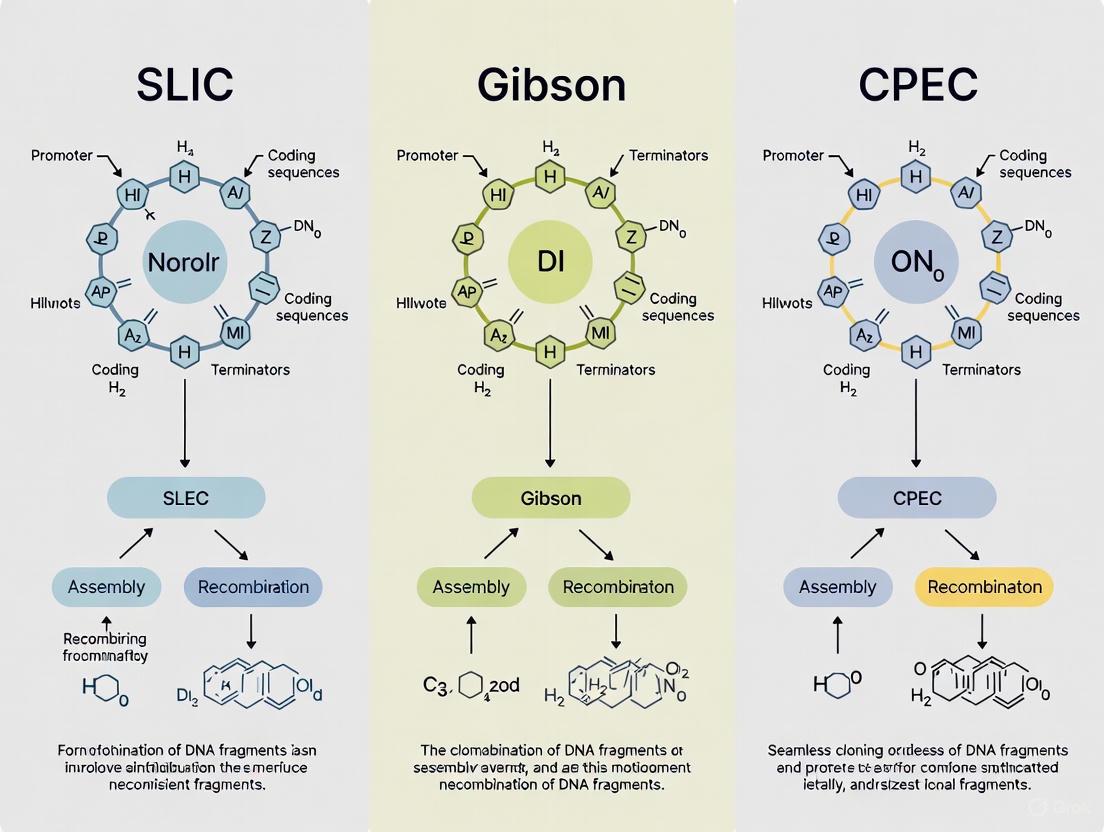
This article provides a comprehensive comparison of three key seamless cloning techniques—SLIC, Gibson Assembly, and CPEC—tailored for researchers and drug development professionals.
SLIC vs. Gibson vs. CPEC: A Strategic Comparison of Seamless Cloning Methods for Biomedical Research
Abstract
This article provides a comprehensive comparison of three key seamless cloning techniques—SLIC, Gibson Assembly, and CPEC—tailored for researchers and drug development professionals. It explores the foundational principles and historical context of these methods, details their specific protocols and applications in areas like CRISPR library construction and recombinant protein production, offers practical troubleshooting and optimization guidance, and delivers a direct comparative analysis of efficiency, cost, and suitability for various projects. The goal is to empower scientists with the knowledge to select the optimal cloning strategy, accelerating research in synthetic biology and therapeutic development.
Beyond Restriction Enzymes: Understanding the Principles of Seamless Cloning
The Limitations of Traditional Restriction Enzyme Cloning
Traditional restriction enzyme cloning (REC) has served as the foundational technique for molecular biology since the 1970s, enabling groundbreaking advances in genetic engineering and biotechnology [1] [2]. This method, which relies on sequence-specific restriction endonucleases and DNA ligase to assemble recombinant DNA molecules, revolutionized biological research by allowing scientists to isolate, amplify, and study individual genes [3] [2]. However, as research objectives have grown more complex—ranging from sophisticated metabolic engineering to therapeutic applications—the inherent constraints of traditional cloning have become increasingly apparent [1] [4]. This analysis examines the technical limitations of REC and contrasts them with modern seamless cloning methods, providing researchers with a framework for selecting appropriate strategies for contemporary genetic engineering applications.
Fundamental Constraints of Traditional Restriction Enzyme Cloning
Sequence Dependency and Restriction Site Requirement
The most significant limitation of traditional cloning is its absolute dependence on the presence of specific, compatible restriction enzyme recognition sites in both the insert and vector [2] [5]. This requirement imposes substantial constraints on experimental design, as researchers must identify unique restriction sites that flank the insert but are absent from the internal sequence [3] [2]. When suitable sites are unavailable, additional steps such as site-directed mutagenesis or the use of synthetic adapters become necessary, increasing both time and resource investment [3] [5]. Furthermore, the strategic placement of these sites often does not align with optimal molecular design, forcing compromises that can affect downstream applications [5].
Traditional REC frequently leaves behind unwanted "scar" sequences at the junctions between assembled fragments [1] [6]. These residual nucleotides originate from the restriction enzyme recognition sites and can disrupt open reading frames or alter protein structure and function when assembling genetic constructs [4]. For applications requiring precise protein fusions or the maintenance of exact coding sequences—such as recombinant protein production or functional gene analysis—these scar sequences present significant experimental hurdles that require additional steps to remedy [1].
Technical Complexity and Multi-Step Process
The multi-step workflow of traditional cloning introduces multiple potential failure points and extends experimental timelines [2]. A standard REC protocol requires sequential execution of restriction digestion, fragment purification, ligation, transformation, and colony screening—processes that typically span several days [3] [2]. Each step demands optimization of conditions such as enzyme efficiency, buffer compatibility, and fragment stoichiometry [2]. The necessity for extensive post-transformation screening via colony PCR or restriction mapping further compounds the time and labor investment [3] [6].
Limited Suitability for Complex Assemblies
Traditional cloning demonstrates limited efficiency when assembling multiple DNA fragments simultaneously [5] [4]. The strategy becomes progressively more challenging as the number of fragments increases, due to the difficulty of identifying multiple unique restriction sites and achieving balanced ligation conditions [4]. This limitation restricts its application in synthetic biology projects that require modular assembly of complex genetic circuits or metabolic pathways, where simultaneous integration of numerous components is essential [1] [4].
Comparison of Cloning Techniques
Table 1: Comparative Analysis of Traditional and Modern Cloning Methods
| Method | Key Principle | Restriction Site Dependent? | Scarless? | Multi-Fragment Capacity | Typical Efficiency | Primary Applications |
|---|---|---|---|---|---|---|
| Traditional REC | Restriction digestion + ligation | Yes | No | Limited (1-2 fragments) | Moderate | Basic cloning, subcloning [3] [2] |
| Gibson Assembly | Homologous recombination in vitro | No | Yes | High (5+ fragments) | High | Pathway engineering, large constructs [6] [4] |
| Golden Gate | Type IIS restriction enzymes | Yes (but sequence-independent) | Yes | High (10+ fragments) | Very High | Modular assembly, library construction [5] [6] |
| CPEC | Polymerase overlap extension | No | Yes | Moderate | High | Library construction, custom gRNA arrays [7] [8] |
| SLIC | Homologous recombination in vitro | No | Yes | Moderate | Moderate-High | Seamless cloning, point mutations [4] |
Table 2: Experimental Performance Metrics Across Cloning Methods
| Method | Time to Complete | Cost Considerations | Error Rate | Technical Expertise Required | Automation Compatibility |
|---|---|---|---|---|---|
| Traditional REC | 2-4 days | Low reagent cost | Low | Basic | Low [2] |
| Gibson Assembly | 2-4 hours | Commercial kits expensive | Low-Moderate | Moderate | High [6] [4] |
| Golden Gate | 1-2 hours | Moderate cost | Low | Moderate | High [5] [4] |
| CPEC | 2-3 hours | Very low (single enzyme) | Moderate | Moderate | Moderate [7] [8] |
| SLIC | 3-5 hours | Low-Moderate cost | Moderate | Moderate-High | Moderate [4] |
Gibson Assembly Methodology
Gibson Assembly employs a one-step, isothermal reaction that combines three enzymatic activities: T5 exonuclease to create single-stranded overhangs, DNA polymerase to fill gaps, and DNA ligase to seal nicks [6] [4]. Fragments are designed with 20-40 bp homologous ends, enabling precise assembly in a single-tube reaction that can be completed within 1-2 hours [4]. The method's efficiency decreases with increasing fragment number (typically beyond 5 fragments), but it remains a powerful tool for constructing large DNA molecules without sequence constraints [4].
Circular Polymerase Extension Cloning (CPEC) Protocol
CPEC utilizes polymerase overlap extension to assemble DNA fragments without requiring restriction enzymes or ligase [7] [8]. The process involves mixing linearized vector and insert fragments with complementary ends, followed by a PCR reaction without primers [7]. During thermal cycling, fragments denature and anneal through their overlapping regions, then extend to form circular plasmids [8]. Key considerations include designing overlaps with high melting temperature (55-70°C) and using high-fidelity polymerase without strand displacement activity [7]. CPEC is particularly valuable for constructing CRISPR guide RNA libraries and other complex assemblies where cost-effectiveness is paramount [7].
Golden Gate Assembly Workflow
Golden Gate Assembly exploits Type IIS restriction enzymes (e.g., BsaI, BsmBI) that cleave outside their recognition sequences, generating user-defined overhangs [5] [6]. The method allows simultaneous digestion and ligation in a single tube through temperature cycling between 37°C (for digestion) and 16°C (for ligation) [6] [4]. Since the original recognition sites are eliminated in the final product, assembly is scarless and can be repeated iteratively [6]. Golden Gate is especially effective for combinatorial library construction and modular assembly standardizations [5].
Sequence and Ligation-Independent Cloning (SLIC)
SLIC generates recombinant DNA molecules through in vitro homologous recombination [4]. T4 DNA polymerase treatment creates single-stranded overhangs in the absence of dNTPs, and these complementary ends anneal to form recombination intermediates [4]. The gaps in these constructs are subsequently repaired in vivo after transformation into E. coli [4]. A variation termed SLiCE (Seamless Ligation Cloning Extract) uses bacterial cell extracts to drive the recombination, further reducing costs [4].
Visual Comparison of Cloning Workflows
Workflow Comparison of Traditional vs. Modern Cloning Methods
Essential Research Reagents and Solutions
Table 3: Key Research Reagents for Seamless Cloning Methods
| Reagent/Kit | Primary Function | Compatible Methods | Commercial Sources |
|---|---|---|---|
| High-Fidelity DNA Polymerase | PCR amplification with low error rate | CPEC, Gibson, SLIC, Golden Gate | New England Biolabs, Thermo Fisher [7] |
| Type IIS Restriction Enzymes | DNA cleavage outside recognition site | Golden Gate | Thermo Fisher (FastDigest) [7] [6] |
| Exonuclease (T5/T4) | Generation of single-stranded overhangs | Gibson, SLIC | New England Biolabs [4] |
| DNA Ligase | Covalent joining of DNA fragments | Gibson, Golden Gate | New England Biolabs [6] |
| Competent E. coli Cells | Plasmid transformation and propagation | All methods | Lucigen, New England Biolabs [7] |
| Homologous Recombination Kit | Streamlined assembly reaction | Gibson, In-Fusion | New England Biolabs [6] |
Traditional restriction enzyme cloning established the foundation for genetic engineering but presents significant limitations for contemporary research applications. Its sequence dependency, introduction of scar sequences, multi-step complexity, and limited capacity for multi-fragment assembly render it increasingly unsuitable for advanced synthetic biology and therapeutic development projects [1] [4]. Modern seamless cloning methods—including Gibson Assembly, CPEC, Golden Gate, and SLIC—address these limitations through innovative enzymatic strategies that offer greater flexibility, efficiency, and precision [7] [6] [4]. As molecular biology continues to evolve toward more complex genetic systems and high-throughput applications, researchers would benefit from transitioning to these advanced techniques that better align with the demands of modern genetic engineering while offering reduced experimental timelines and often lower overall costs [1] [9] [4].
Homologous recombination (HR) is a fundamental DNA metabolic process found in all forms of life that provides high-fidelity, template-dependent repair or tolerance of complex DNA damages. In vivo, HR represents exchanges between DNA molecules in lengthy regions of shared identity, catalyzed by a group of dedicated enzymes, and functions primarily in the repair of DNA double-stranded breaks (DSBs) and interstrand crosslinks (ICLs) [10] [11]. This natural cellular mechanism has been ingeniously adapted for in vitro applications, forming the basis for modern DNA cloning technologies that overcome limitations of traditional restriction enzyme-based methods. These restriction-free cloning techniques enable efficient assembly of recombinant DNA without sequence constraints or unwanted "scar" sequences, making them indispensable tools for synthetic biology, genetic engineering, and biomedical research [1] [12]. This guide provides a comprehensive comparison of three prominent seamless cloning methods—SLIC, Gibson Assembly, and CPEC—that harness the core principle of homologous recombination.
Fundamental Mechanisms of Homologous Recombination
In Vivo Homologous Recombination
In cellular environments, homologous recombination serves as a crucial DNA repair mechanism. The central reaction involves homology search and DNA strand invasion by the Rad51-ssDNA presynaptic filament (RecA in bacteria), which positions the invading 3'-end on a template duplex DNA to initiate repair synthesis [11]. This process proceeds through formation of branched DNA molecules called Holliday junctions, which are subsequently resolved to produce recombinant DNA molecules [10].
Homologous recombination is formally defined as "exchange between two DNA sequences in the region of aligned homology, catalyzed by dedicated homology-recognition systems" [10]. This process requires not only regions of shared identity but also proper alignment and co-orientation of these sequences. In bacteria, RecA-dependent recombination is already detectable between 12 base pair-long identical sequences and becomes the predominant mode of exchange between shared homologies of 100 bp or longer [10].
Adaptation for In Vitro Cloning
Seamless cloning methods mimic this natural process in controlled laboratory settings. While they share the common principle of using homologous ends to join DNA fragments, they employ distinct enzymatic strategies to generate the necessary homologous overhangs and facilitate their assembly [1] [12]. The following sections provide detailed experimental comparisons of three leading methods that exemplify this principle.
Comparative Analysis of Seamless Cloning Methods
Sequence and Ligation-Independent Cloning (SLIC) utilizes T4 DNA polymerase with exonuclease activity to generate single-stranded DNA (ssDNA) overhangs in insert and vector fragments. In the absence of dNTPs, the enzyme's 3'→5' exonuclease activity creates complementary overhangs that anneal via homologous recombination, mimicking in vivo processes. The annealed products are transformed into E. coli where cellular machinery repairs nicks [13] [12].
Gibson Assembly employs a three-enzyme system simultaneously: a 5' exonuclease creates long overhangs, a DNA polymerase fills in gaps, and a DNA ligase seals nicks. This one-step, isothermal reaction occurs at 50°C and can assemble multiple fragments in a single reaction [12].
Circular Polymerase Extension Cloning (CPEC) uses only a high-fidelity polymerase without strand displacement activity. During thermal cycling, linearized vector and insert(s) with homologous ends denature, anneal, and extend using each other as templates to form complete double-stranded plasmids, leaving nicks that are repaired in vivo after transformation [8].
Experimental Performance Comparison
Table 1: Key Characteristics of Seamless Cloning Methods
| Parameter | SLIC | Gibson Assembly | CPEC |
|---|---|---|---|
| Core Enzymes | T4 DNA polymerase | T5 exonuclease, DNA polymerase, DNA ligase | High-fidelity DNA polymerase |
| Reaction Steps | Two-step (exonuclease treatment + annealing) | One-step, isothermal | One-step PCR cycling |
| Typical Reaction Time | 1-2 hours (excluding preparation) | 15-60 minutes | 2-25 cycles (1-2 hours) |
| Optimal Fragment Number | Up to 5-10 fragments simultaneously [13] | Multiple fragments [12] | Multiple fragments [8] |
| Homology Length Requirements | 15-30 bp | 15-80 bp | ~25 bp (with similar Tm 55-70°C) |
| Typical Efficiency | Efficient at low DNA concentrations with RecA [13] | High efficiency with optimized fragments | High cloning accuracy and efficiency [8] |
| Special Equipment | Standard thermal cycler | 50°C incubator or thermal cycler | PCR machine with precise temperature control |
| Commercial Availability | Can be prepared in-lab or commercial kits | Available as commercial master mix | Primarily researcher-prepared |
Table 2: Advantages and Limitations in Research Applications
| Aspect | SLIC | Gibson Assembly | CPEC |
|---|---|---|---|
| Primary Advantages | Circumvents sequence requirements; Functions efficiently at low DNA concentrations with RecA [13] | One-step assembly; High efficiency for complex constructs; Seamless | Inexpensive (single enzyme); No exonuclease concern for small fragments; High-temperature reaction reduces secondary structures [8] |
| Key Limitations | Requires exonuclease optimization; Annealing temperature sensitivity | Costly (multiple enzymes); Exonuclease may damage small fragments [8] | Polymerase-derived mutations; Mis-priming possible; Cannot clone same insert multiple times [8] |
| Optimal Use Cases | Assembly of recombinant DNA for synthetic biology; Library construction | Pathway engineering; Large DNA construct assembly; High-throughput applications | Cost-sensitive projects; Simple to moderate complexity cloning; Academic labs |
| Error Considerations | Moderate (polymerase and exonuclease) | Low (with high-quality enzymes) | Higher polymerase-derived mutation risk [8] |
Experimental Protocols and Methodologies
SLIC Protocol Details
- Vector and Insert Preparation: Amplify DNA fragments with 15-30 bp homologous ends using PCR with specially designed primers.
- Exonuclease Treatment: Incubate 100-300 ng of each fragment with T4 DNA polymerase (0.5-1 U/μL) in the absence of dNTPs at 25°C for 30 minutes. This creates complementary ssDNA overhangs.
- Annealing: Combine treated fragments and incubate at 37°C for 30 minutes. RecA can be added (0.1-0.5 μM) to enhance recombination efficiency for difficult assemblies [13].
- Transformation: Directly transform 2-5 μL of reaction into competent E. coli without additional purification.
Gibson Assembly Standard Protocol
- Fragment Preparation: Generate DNA fragments with 15-80 bp overlapping ends (optimally 20-40 bp) via PCR or restriction digestion.
- Assembly Reaction: Mix fragments in appropriate stoichiometric ratios (typically 100-200 ng total DNA) with Gibson Assembly master mix.
- Incubation: Incubate at 50°C for 15-60 minutes. Longer incubations (up to 2 hours) may improve complex assemblies.
- Transformation: Transform 1-2 μL directly into competent cells without purification [12].
CPEC Standard Workflow
- Template Design: Design inserts with ~25 bp overlaps to vector ends, ensuring similar Tm (55-70°C).
- PCR Assembly: Mix linearized vector and insert(s) in 1:2 to 1:5 molar ratio in standard PCR mix with high-fidelity polymerase (e.g., Phusion, Q5).
- Thermal Cycling:
- Denaturation: 98°C for 30 seconds
- Annealing: 55-65°C for 30 seconds (based on overlap Tm)
- Extension: 72°C (15-30 seconds/kb of total construct size)
- Repeat for 2-25 cycles depending on fragment number and complexity [8]
- Transformation: Use 5-10 μL of PCR product directly for transformation without purification.
Technical Considerations for Method Selection
Efficiency and Fidelity Optimization
For high-efficiency cloning with simple constructs, Gibson Assembly generally provides the most consistent results, though at higher reagent costs. CPEC offers the most cost-effective solution for academic labs with standard cloning needs, while SLIC provides a balance of efficiency and flexibility, particularly for complex library construction [1] [8].
When cloning fidelity is paramount, Gibson Assembly's inclusion of both proofreading polymerase and ligase provides theoretical advantages, though practical differences between methods are often minimal with optimized protocols. CPEC's higher temperature reactions may reduce secondary structure complications that can hinder SLIC and Gibson assemblies [8].
Throughput and Scalability
For high-throughput applications, Gibson Assembly's single-step reaction and commercial availability make it ideal for automated workflows. SLIC requires additional steps but can be optimized for 96-well formats. CPEC scales efficiently for multiple parallel reactions due to minimal reagent costs [12].
Specialized Applications
Large fragment assembly (>10 kb) benefits from Gibson Assembly's robust multi-fragment capability. Metabolic pathway engineering with multiple genes can utilize any method, though Gibson and SLIC generally handle higher fragment numbers more reliably. Library construction for directed evolution benefits from SLIC's efficiency at low DNA concentrations and CPEC's cost-effectiveness for numerous constructs [13] [8].
Research Reagent Solutions
Table 3: Essential Reagents for Seamless Cloning Methods
| Reagent | Function | Method Applications |
|---|---|---|
| T4 DNA Polymerase | Generates ssDNA overhangs via 3'→5' exonuclease activity | SLIC |
| RecA Protein | Catalyzes homologous pairing and strand exchange | SLIC (enhancement) |
| T5 Exonuclease | Creates ssDNA overhangs by 5'→3' digestion | Gibson Assembly |
| DNA Ligase | Seals nicks in DNA backbone | Gibson Assembly |
| Phusion or Q5 Polymerase | High-fidelity DNA synthesis with low error rate | CPEC, Gibson Assembly |
| dNTP Mix | Nucleotides for DNA synthesis | All methods |
| Commercial Master Mixes | Optimized enzyme formulations | Gibson Assembly (NEB HiFi), In-Fusion |
| Competent E. coli Cells | Transformation and in vivo repair | All methods |
Visual Guide to Method Mechanisms
SLIC Method Workflow
Gibson Assembly Mechanism
CPEC Assembly Process
SLIC, Gibson Assembly, and CPEC each provide distinct implementations of homologous recombination principles for in vitro DNA assembly. Gibson Assembly offers maximum convenience and efficiency for high-value constructs despite higher costs. CPEC provides exceptional cost-effectiveness for standard cloning applications with minimal reagent requirements. SLIC strikes a balance with flexibility for complex assemblies and library construction. Method selection should be guided by specific research constraints including budget, throughput requirements, fragment complexity, and desired fidelity. Understanding the core principles of homologous recombination underlying these methods enables researchers to optimize protocols for their specific experimental needs and contributes to the advancing capabilities of synthetic biology and genetic engineering.
SLIC (Seamless Ligation Cloning Extract): Mechanism and Enzyme Components
As molecular biology advances, the demand for efficient, flexible, and scarless cloning techniques has driven the development of methods independent of restriction enzymes and ligases. Among these, Seamless Ligation Cloning Extract (SLIC) stands out for its simplicity and efficacy. This guide details the mechanism and enzyme components of SLIC and provides a comparative analysis with other modern cloning techniques like Gibson Assembly and Circular Polymerase Extension Cloning (CPEC), supported by experimental data and protocols for researchers in the field.
Traditional cloning methods relying on restriction enzymes and DNA ligase have significant limitations, including dependence on specific restriction sites and the potential for unwanted "scar" sequences. Sequence and Ligation Independent Cloning (SLIC), developed by Li in 2007, is a versatile method that overcomes these hurdles [14]. It enables the seamless insertion of DNA fragments into vectors without the need for restriction enzymes or ligases, reducing costs and simplifying the cloning process [15] [14]. SLIC is one of several homologous recombination-based techniques, which also include Gibson Assembly and CPEC, that have revolutionized molecular cloning by facilitating the assembly of multiple DNA fragments in a single, efficient reaction [1] [7]. This guide explores the core mechanism of SLIC, compares it with leading alternatives, and provides detailed protocols for its application in constructing complex genetic vectors, such as those for CRISPR-Cas9 systems.
The SLIC Cloning Mechanism
The SLIC method relies on the 3'→5' exonuclease activity of T4 DNA polymerase to generate complementary single-stranded overhangs on the insert and vector, which then anneal in vitro and are repaired in vivo by the host cell [16] [15].
Core Enzyme Component
- T4 DNA Polymerase: This enzyme is the central component of the SLIC reaction. It possesses a 3' to 5' exonuclease activity that is utilized in the absence of a complete set of dNTPs. Under these conditions, the enzyme "chews back" the 5' ends of double-stranded DNA fragments, creating complementary single-stranded overhangs (typically 20-40 base pairs) that facilitate the annealing of the insert and vector [16] [15] [14]. The addition of a single dNTP (e.g., dCTP) stops the exonuclease activity and shifts the enzyme back to its polymerase function, though with limited extension due to the incomplete dNTP mix, thereby preserving the generated overhangs [15].
Step-by-Step Workflow
The following diagram illustrates the key stages of the SLIC cloning procedure.
The SLIC cloning process involves four key stages, from fragment preparation to in vivo repair in the host organism.
Comparative Analysis of Cloning Methods
Mechanism and Experimental Workflow Comparison
The table below summarizes the core principles and required components of SLIC, Gibson Assembly, and CPEC.
Table 1: Mechanism and Workflow Comparison of Seamless Cloning Methods
| Aspect | SLIC | Gibson Assembly | CPEC |
|---|---|---|---|
| Core Principle | T4 DNA polymerase exonuclease creates complementary overhangs for in vitro annealing [16] [15]. | Single-tube, isothermal reaction using three enzymes (exonuclease, polymerase, ligase) for seamless assembly [17] [18]. | Polymerase overlap extension: DNA fragments act as primers for each other, forming a circular plasmid through PCR [7]. |
| Key Enzymes/Components | T4 DNA Polymerase [15]. | T5 exonuclease, DNA polymerase (e.g., Phusion), DNA ligase (e.g., Taq) [17] [19]. | High-fidelity DNA polymerase (e.g., Q5) [7]. |
| Homology Overlap | 20-40 bp [16]. | 20-40 bp [18] [19]. | Varies; designed for high Tm to minimize vector self-ligation [7]. |
| Reaction Conditions | Separate T4 Pol treatment, then annealing. | Single isothermal reaction (50°C) [17] [18]. | Thermo-cycling (denaturation, annealing, extension) [7]. |
| In Vitro/In Vivo Repair | In vitro annealing creates nicked plasmid; gaps repaired in vivo by E. coli [16] [15]. | Fully sealed, continuous DNA molecule formed in vitro [17] [18]. | Fully sealed, circular plasmid formed in vitro during PCR [7]. |
Performance and Application Data
When selecting a cloning method, practical considerations such as efficiency, cost, and suitability for complex assemblies are critical. The following table compares these aspects.
Table 2: Performance and Application Comparison
| Parameter | SLIC | Gibson Assembly | CPEC |
|---|---|---|---|
| Multi-Fragment Assembly | Possible, but may require hierarchical assembly for complex projects [14]. | Excellent; can assemble up to 15 fragments in a single reaction [17] [19]. | Suitable for multi-fragment assembly [7]. |
| Hands-On Time | Moderate (multiple steps) [15]. | Low (single-step, one-pot reaction) [18]. | Low (simple PCR-based protocol) [7]. |
| Cost | Low (uses one core enzyme) [15]. | High (commercial master mixes are expensive) [19]. | Very low (requires only standard PCR reagents) [7]. |
| Efficiency | High for single inserts; can be enhanced with RecA protein [16]. | High efficiency and fidelity, especially with HiFi mixes [18] [19]. | High efficiency when overlaps are well-designed [7]. |
| Best Suited For | Scarless, single-insert cloning; applications where cost is a primary constraint [15]. | Large or complex constructs, multiple fragment assembly; when speed and ease are prioritized [18] [19]. | High-throughput and library construction (e.g., CRISPR gRNA libraries); extremely cost-sensitive projects [7]. |
| Key Limitations | Struggles with sequences prone to secondary structures; repeated sequences can cause incorrect assembly [14]. | Overhangs with high secondary structure can hinder assembly; cost of commercial kits [19]. | Requires careful optimization of overlap Tm to prevent misassembly [7]. |
Detailed Experimental Protocols
SLIC Protocol for Vector Construction
This protocol is adapted from core methodology descriptions [16] [15] [14].
Primer and Insert Preparation:
- Design primers to amplify your gene of interest (GOI). The 5' ends of these primers must include ~25 bp homology arms that match the sequence of the linearized vector ends.
- Perform PCR to amplify the GOI using a high-fidelity DNA polymerase.
- Purify the PCR product.
Vector Linearization:
- Prepare the destination vector by linearizing it via restriction enzyme digestion or by inverse PCR.
- Gel-purify the linearized vector to remove any uncut vector, which would result in high background.
T4 DNA Polymerase Treatment:
- Set up two separate reactions on ice:
- Reaction A: ~100-200 ng of purified insert DNA.
- Reaction B: ~100-200 ng of linearized vector.
- Add T4 DNA polymerase buffer to each reaction. Crucially, do not add dNTPs.
- Add T4 DNA polymerase (e.g., 0.5-1 unit per µg of DNA) and incubate at room temperature. A typical reaction time is 5-30 minutes, which must be optimized to generate sufficient single-stranded overhangs without excessive digestion.
- Stop the reaction by adding dCTP to a final concentration of 2-10 mM. This shifts T4 DNA polymerase into its polymerase mode, stalling it and preserving the created overhangs. Incubate for 5-10 minutes at room temperature.
- Set up two separate reactions on ice:
Annealing and Transformation:
- Mix the treated insert and vector fragments at an appropriate molar ratio (e.g., 3:1 insert:vector).
- Incubate the mixture at 37°C for 30 minutes. Some protocols recommend adding a small amount of RecA protein to enhance the annealing efficiency of large fragments [16].
- Transform the annealed product into competent E. coli cells. The nicks and gaps in the annealed plasmid will be repaired by the host's endogenous machinery.
Gibson Assembly Protocol
This protocol summarizes the widely used single-tube method [17] [18] [19].
- Fragment Preparation: Prepare DNA fragments (insert and linearized vector) with 20-40 bp homologous overlaps. Gel purification is recommended for clean results.
- Reaction Setup: Combine the DNA fragments in a single tube with the Gibson Assembly master mix, which contains T5 exonuclease, a high-fidelity DNA polymerase, and a DNA ligase.
- Incubation: Incubate the reaction at 50°C for 15-60 minutes. For assemblies with more than 4 fragments, a longer incubation (e.g., 60 minutes) is recommended.
- Transformation: Transform 1-5 µL of the reaction directly into competent E. coli cells.
CPEC Protocol for Library Construction
This protocol is adapted from its application in building a custom CRISPR gRNA library [7].
- Backbone Linearization: Perform a PCR to amplify and linearize the plasmid backbone (e.g., lentiGuide-Puro) using primers designed with 5' overhangs homologous to the insert pool.
- Pool Preparation: Obtain the insert pool (e.g., a synthesized pool of gRNA oligonucleotides) and amplify it with primers containing homology to the vector ends.
- CPEC Reaction: Set up a PCR reaction with the linearized backbone and the insert pool, using a high-fidelity DNA polymerase. The thermo-cycling program is as follows:
- Denaturation at 98°C for 30 seconds.
- 25-35 cycles of:
- 98°C for 10 seconds.
- 55-65°C for 20-30 seconds (annealing/extension).
- Final extension at 72°C for 5-10 minutes.
- Transformation and Library Production: Treat the CPEC product with DpnI to remove the template plasmid, purify it, and transform it into high-efficiency electrocompetent E. coli to generate the library.
Essential Research Reagent Solutions
The following table lists key reagents and their functions for implementing the SLIC method.
Table 3: Key Research Reagents for SLIC Cloning
| Reagent | Function in Protocol | Example Products & Notes |
|---|---|---|
| T4 DNA Polymerase | Core enzyme that generates complementary single-stranded overhangs on DNA fragments. | Available from multiple suppliers (e.g., New England Biolabs, Thermo Fisher). |
| High-Fidelity DNA Polymerase | For error-free amplification of inserts and linearization of vectors via PCR. | Q5 High-Fidelity (NEB), Platinum SuperFi II (Thermo Fisher). |
| Competent E. coli Cells | For transformation and in vivo repair of the nicked plasmid. | High-efficiency strains like DH5α, TOP10, or Endura E. coli for large libraries. |
| dNTP Solution | Provides nucleotides for PCR and is used to stop T4 DNA polymerase exonuclease activity. | Use dCTP for stopping the SLIC reaction as per the standard protocol. |
| Gel Extraction Kit | Purification of linearized vector and specific PCR products to reduce background. | Kits from Qiagen, Macherey-Nagel, or similar manufacturers. |
| RecA Protein | (Optional) Enhances annealing efficiency for complex or large fragments. | Can be added during the annealing step [16]. |
Gibson Assembly: The Three-Enzyme System (5' Exonuclease, Polymerase, Ligase)
Gibson Assembly is a powerful, single-tube cloning technique that has revolutionized synthetic biology and genetic engineering by enabling the seamless assembly of multiple DNA fragments in a single isothermal reaction [17] [20]. Developed by Daniel Gibson and colleagues at the J. Craig Venter Institute, this method efficiently joins DNA fragments regardless of their length or end compatibility, eliminating the reliance on restrictive enzyme sites inherent to traditional cloning methods [21] [19]. The core innovation of Gibson Assembly lies in its sophisticated use of three enzymatic activities working concurrently in one master mix: an exonuclease, a DNA polymerase, and a DNA ligase [20] [22]. This coordinated system allows researchers to create complex genetic constructs, including those used in essential gene function studies and therapeutic target identification, with unprecedented ease and flexibility [23] [9].
The technique is part of a broader class of restriction-free overlapping sequence cloning methods, which also include Sequence and Ligation Independent Cloning (SLIC) and Circular Polymerase Extension Cloning (CPEC) [9] [24]. These methods collectively represent a paradigm shift from traditional restriction enzyme-based cloning, offering higher versatility and fidelity by exploiting homologous sequence overlaps for DNA assembly [9]. As molecular biology continues to advance toward more complex genetic manipulations, understanding the precise mechanism, comparative advantages, and practical application of Gibson Assembly becomes crucial for researchers in drug development and functional genomics.
The Three-Enzyme Mechanism: A Coordinated Biochemical Process
The efficiency of Gibson Assembly stems from the synchronized activity of three enzymes operating at a standardized temperature of 50°C. The following diagram illustrates the seamless workflow of this process.
Exonuclease Activity
The process initiates with a 5' exonuclease, typically T5 exonuclease, which chews back the 5' ends of the double-stranded DNA fragments [19]. This enzymatic activity creates single-stranded 3' overhangs at the termini of each fragment [17] [20]. These overhangs, which consist of homologous sequences engineered into the fragments during PCR primer design, are essential for the precise annealing that occurs in subsequent steps. The exonuclease works progressively, but its activity is naturally balanced by the subsequent polymerase function, which prevents excessive digestion that could compromise fragment integrity [19].
Polymerase Activity
Once the complementary single-stranded overhangs anneal to each other through their homologous regions, a DNA polymerase—often Phusion polymerase—fills in the gaps within each annealed fragment [17] [19]. The polymerase synthesizes DNA complementary to the template, effectively repairing the regions that were digested by the exonuclease. This activity is crucial for completing the double-stranded structure and creating a continuous DNA molecule. The polymerase is selected for its stability at the reaction temperature of 50°C and its high processivity to efficiently handle fragments of varying lengths [21].
Ligase Activity
The final enzymatic step involves a DNA ligase, typically Taq ligase, which seals the nicks remaining in the phosphodiester backbone of the assembled DNA [17] [19]. This ligation step creates a covalently sealed, stable DNA molecule that can be directly transformed into bacterial cells for propagation [22]. The ligase works specifically on the annealed and extended fragments, ensuring that only properly assembled constructs are completed. Once ligated, the DNA becomes protected from further exonuclease activity, creating a thermodynamic drive toward complete assembly [19].
Comparative Analysis of Seamless Cloning Techniques
Gibson Assembly vs. Alternative Methods
While Gibson Assembly offers a robust platform for DNA assembly, several alternative methods provide different advantages depending on the specific research requirements. The table below provides a direct quantitative comparison of key cloning techniques based on experimental data and manufacturer specifications.
| Method | Key Enzymes/Mechanism | Typical Overlap Length | Fragment Limit | Reaction Time | Key Applications | Error Considerations |
|---|---|---|---|---|---|---|
| Gibson Assembly | T5 Exonuclease, Polymerase, Ligase [17] [19] | 15-80 bp [21] [19] | Up to 15 fragments [17] | 15-60 minutes [21] [20] | Large constructs (>20 kb), pathway engineering [20] [19] | Potential junction errors; improved in HiFi variants [19] |
| CPEC | Polymerase-only (high-fidelity) [23] [8] | ~25 bp [8] | Complex libraries (e.g., 40,820 gRNAs) [23] | 2-25 PCR cycles [8] | CRISPR library construction, multi-fragment assembly [23] | Polymerase-derived mutations [8] |
| SLIC | T4 DNA Polymerase (exo+) [9] [24] | Not specified | Not specified | Not specified | Standard cloning, sequence-independent cloning [9] | Not specified |
| ECOLI | Site-directed mutagenesis with proof-reading polymerase [25] | Primer-derived homology | Inserts of several hundred nucleotides [25] | Few days (including primer synthesis) [25] | Cost-effective insertion of short sequences [25] | Not specified |
Strategic Method Selection
The choice between Gibson Assembly, CPEC, and other restriction-free methods involves careful consideration of project requirements and constraints. Gibson Assembly demonstrates particular strength when assembling multiple fragments (up to 15 in a single reaction) and creating large constructs up to 20 kb or more [17] [20] [19]. Its commercial availability as a master mix significantly simplifies protocol implementation, though this convenience comes at a higher cost per reaction compared to polymerase-only methods [8] [21].
CPEC (Circular Polymerase Extension Cloning) offers a cost-effective alternative that uses only a single high-fidelity polymerase without strand displacement activity [23] [8]. This method is particularly advantageous for constructing complex libraries, such as the EpiTransNuc knockout gRNA library targeting epigenetic regulators, which comprised over 40,000 gRNAs [23]. CPEC occurs at higher temperatures than Gibson Assembly, reducing concerns about non-specific hybridization and stable secondary structure formation that can interfere with assembly efficiency [8].
The developing ECOLI (Efficient Cloning Of Linear Inserts) method represents a novel approach that utilizes site-directed mutagenesis rather than recombination, offering an economical alternative without the need for specialized kits [25]. This technique is particularly suitable for cloning inserts of several hundred nucleotides into plasmid constructs where cost sensitivity is a major consideration [25].
Experimental Protocol for Gibson Assembly
Fragment Preparation and Primer Design
The initial critical step in Gibson Assembly involves preparing DNA fragments with appropriate homologous overlaps. Insert fragments are always prepared by PCR amplification using primers designed with 5' extensions that are homologous to the terminal sequences of adjacent fragments [19]. For simple assemblies, overlapping tails of 15-30 nucleotides are generally sufficient, though larger fragments or higher numbers of fragments require longer overlaps (up to 80 bp) to ensure specific annealing at the reaction temperature of 50°C [21] [19].
The vector can be prepared by either restriction enzyme digestion or inverse PCR [19]. When using restriction digestion, it is crucial to gel purify the linearized vector fragment to separate it from any uncut vector, which would contribute to background colonies [19]. If using inverse PCR, the PCR product should be treated with DpnI to eliminate residual template plasmid [19]. The target-specific portion of all primers should meet standard PCR primer criteria regarding composition and melting temperature to ensure specific amplification [19].
Assembly Reaction and Transformation
After fragment preparation, determine DNA concentrations using gel electrophoresis, a NanoDrop instrument, or other quantification methods [21] [20]. For the assembly reaction, use a 2-3 fold molar excess of each insert relative to the vector backbone [22]. The following calculation formula is recommended: Molar equivalent amount of insert (ng) = [Amount of vector (ng) × Size of insert (bp)] / Size of vector (bp) [22].
Combine the DNA fragments with the Gibson Assembly Master Mix and incubate at 50°C for 15-60 minutes, depending on the number and size of fragments being assembled [21] [20]. Simple assemblies with few fragments may be complete in 15 minutes, while complex assemblies with four or more fragments should be incubated for 60 minutes or longer to improve efficiency [19]. Following incubation, the reaction mixture can be directly transformed into competent E. coli cells such as NEB 5-alpha strains [21] [20].
Optimization and Troubleshooting
To minimize background colonies, thoroughly remove uncut vector through gel purification or DpnI treatment when using PCR-amplified vectors [19]. For assemblies involving more than five fragments, consider sequential assembly strategies or increase overlap lengths to 40-80 bp to improve correct assembly rates [20] [19]. When assembling fragments with high GC content or potential secondary structures in overlap regions, extended overlaps or specialized enzyme mixes like NEBuilder HiFi may enhance results [21] [19]. Always sequence verify final clones, as with any PCR-based cloning technique, to confirm assembly accuracy and rule of polymerase-introduced mutations [19].
Essential Research Reagent Solutions
Successful implementation of Gibson Assembly and related techniques requires specific laboratory reagents and kits. The following table catalogues key solutions mentioned in experimental protocols across the surveyed literature.
| Category | Specific Product/Enzyme | Manufacturer/Supplier | Key Function |
|---|---|---|---|
| Assembly Master Mixes | Gibson Assembly Master Mix [21] | New England Biolabs (NEB) | All-in-one mix of exonuclease, polymerase, and ligase |
| NEBuilder HiFi DNA Assembly Mix [21] | New England Biolabs (NEB) | Enhanced fidelity for complex assemblies | |
| High-Fidelity Polymerases | Platinum SuperFi DNA Polymerase [25] | Invitrogen | PCR amplification of inserts with high accuracy |
| Phusion Polymerase [19] | Thermo Scientific | High-fidelity amplification for fragment preparation | |
| Competent Cells | NEB 5-alpha Competent E. coli [21] | New England Biolabs (NEB) | Transformation of assembled DNA constructs |
| XL10-Gold Ultracompetent Cells [25] | Agilent Technologies | High-efficiency transformation for library applications | |
| Cloning Kits | QuikChange II XL Site-Directed Mutagenesis Kit [25] | Agilent Technologies | Used in ECOLI and other site-directed methods |
Gibson Assembly's three-enzyme system represents a sophisticated and efficient approach to DNA assembly that has become a cornerstone of modern molecular biology [9] [24]. Its ability to seamlessly combine multiple DNA fragments in a single isothermal reaction, without the constraints of restriction sites, has significantly accelerated progress in synthetic biology, functional genomics, and therapeutic development [23] [9]. The strategic selection between Gibson Assembly, CPEC, SLIC, and emerging methods like ECOLI depends on specific research objectives, considering factors such as fragment complexity, error tolerance, budget constraints, and throughput requirements [24] [25].
Future directions in DNA assembly technology point toward increased integration with CRISPR-based editing systems, enhanced compatibility with cell-free synthesis platforms, and improved automation for high-throughput applications [9] [24]. As these restriction-free cloning methods continue to evolve, they will undoubtedly expand the scope and efficiency of genetic engineering, empowering researchers to tackle increasingly complex biological questions and develop novel therapeutic solutions for human disease.
In the field of molecular biology and genetic engineering, seamless cloning methods have revolutionized how researchers assemble DNA fragments. These techniques enable the precise joining of DNA sequences without leaving unwanted nucleotide scars, making them indispensable for sophisticated applications in synthetic biology, gene therapy, and functional genomics. Among the most prominent methods are Sequence and Ligation-Independent Cloning (SLIC), Gibson Assembly, and Circular Polymerase Extension Cloning (CPEC). While SLIC and Gibson Assembly have gained widespread adoption, CPEC offers a unique single-polymerase approach that addresses specific limitations of its counterparts, particularly in terms of cost-effectiveness and procedural simplicity [8] [26].
This guide provides an objective comparison of these three key seamless cloning techniques, with particular focus on CPEC's distinctive mechanism. We present experimental data, detailed protocols, and practical considerations to help researchers select the most appropriate method for their specific applications. The comparative analysis examines crucial parameters including efficiency, cost, error rates, and suitability for different cloning scenarios, providing a comprehensive resource for scientists engaged in genetic construct development [8] [27].
Key Principles and Comparative Mechanisms
Fundamental Principles of CPEC
Circular Polymerase Extension Cloning (CPEC) operates on the principle of homologous recombination in vitro, utilizing a single polymerase enzyme to assemble DNA fragments with overlapping ends. In CPEC, both the insert and the linearized vector are designed to have complementary single-stranded overhangs typically 15-25 base pairs in length. These homologous regions facilitate specific annealing between fragments during the reaction. The process occurs in a single tube where a high-fidelity DNA polymerase without strand displacement activity extends the annealed overlaps, effectively synthesizing the complete double-stranded plasmid from the overlapping fragments. The resulting nicked circular DNA is then directly transformed into competent cells, where cellular repair mechanisms resolve the remaining nicks [8].
Unlike methods requiring multiple enzymatic activities, CPEC relies exclusively on polymerase extension, making it one of the most streamlined cloning approaches available. The reaction typically involves 2-25 PCR cycles depending on the number and complexity of fragments being assembled, with higher cycle numbers used for multi-fragment assemblies. A key advantage of CPEC is its operation at elevated temperatures (typically >55°C), which minimizes non-specific hybridization and the formation of stable secondary structures that can plague other methods [8].
Comparative Workflow Mechanisms
The three primary seamless cloning methods employ distinct biochemical mechanisms to achieve DNA assembly:
SLIC (Sequence and Ligation-Independent Cloning): This method uses T4 DNA polymerase or similar exonucleases to generate single-stranded overhangs with complementary sequences on DNA fragments. The polymerase's exonuclease activity chews back DNA strands in the presence of dNTPs, creating 5' overhangs. These complementary ends then anneal, resulting in circular molecules with gaps that are repaired in vivo after transformation. A critical limitation of conventional SLIC is that single-stranded gaps in circular double-stranded DNA molecules can drastically decrease transformation efficiency, as these gaps render DNA vulnerable to bacterial nucleases [27] [28].
Gibson Assembly: This sophisticated one-step isothermal method employs three different enzymatic activities in a coordinated manner: T5 exonuclease creates single-stranded overhangs, a DNA polymerase fills in gaps, and Taq DNA ligase seals nicks. While highly efficient for assembling multiple large DNA fragments, the requirement for three enzymes makes Gibson Assembly significantly more expensive than alternative methods. Recent modifications have demonstrated that ligase-free versions can maintain high efficiency while reducing costs, suggesting the DNA polymerase extension step may be sufficient for many applications [27].
CPEC (Circular Polymerase Extension Cloning): As a true single-enzyme method, CPEC relies entirely on polymerase extension to assemble DNA fragments. The high-temperature cycling conditions promote specific annealing between homologous regions, with the polymerase extending these overlaps to form complete circular molecules. This approach eliminates the need for exonucleases or ligases, reducing both cost and complexity [8].
Table 1: Comparative Mechanisms of Major Seamless Cloning Methods
| Method | Key Enzymes | Overlap Generation | Assembly Mechanism | Gap/Nick Repair |
|---|---|---|---|---|
| SLIC | T4 DNA polymerase (exonuclease) | Exonuclease chew-back | Annealing of complementary overhangs | In vivo bacterial repair |
| Gibson Assembly | T5 exonuclease, DNA polymerase, Taq DNA ligase | Exonuclease chew-back | Polymerase extension and ligation | In vitro enzymatic completion |
| CPEC | High-fidelity DNA polymerase | PCR primer design | Polymerase extension | In vivo bacterial repair |
The following diagram illustrates the core mechanistic differences between these three methods:
Experimental Performance Comparison
Efficiency and Success Rates
Multiple studies have systematically compared the efficiency of seamless cloning methods under various experimental conditions. Gibson Assembly generally demonstrates high efficiency for standard cloning applications, with success rates exceeding 90% for single inserts under optimal conditions. However, this efficiency comes at a premium cost due to the multi-enzyme cocktail required. SLIC shows variable efficiency depending on fragment size and overhang length, with particular challenges when cloning small fragments (<50 bp) due to overzealous exonuclease activity that can degrade short DNA elements [27] [28].
CPEC performs comparably to Gibson Assembly for standard applications, with several studies reporting success rates of 85-95% for single fragment insertions. The method shows particular strength in multi-fragment assembly, where its high-temperature cycling minimizes non-specific interactions that can plague other methods. A key advantage of CPEC is its consistent performance across fragment sizes, as it doesn't rely on exonuclease activity that can disproportionately affect smaller fragments [8].
Table 2: Quantitative Performance Comparison of Seamless Cloning Methods
| Parameter | SLIC | Gibson Assembly | CPEC |
|---|---|---|---|
| Single Insert Efficiency | 70-90% | 90-95% | 85-95% |
| Multi-Fragment Assembly Limit | 3-5 fragments | 5-10 fragments | 2-6 fragments |
| Optimal Overlap Length | 15-25 bp | 15-30 bp | 20-25 bp |
| Minimum Fragment Size | >50 bp (challenging) | >50 bp | No practical minimum |
| Typical Assembly Time | 30-60 min | 15-60 min | 2-25 cycles (PCR-based) |
| Success with Complex Libraries | Moderate | High | High |
Error Rates and Mutation Concerns
Fidelity is a critical consideration in cloning, as polymerase errors can introduce unwanted mutations. Gibson Assembly employs a combination of high-fidelity polymerase and ligase, resulting in generally low error rates. SLIC's dependence on exonuclease treatment can sometimes lead to uneven degradation if not carefully controlled. CPEC's exclusive use of polymerase raises theoretical concerns about mutation accumulation, but practical implementations using high-fidelity polymerases have shown error rates comparable to other methods [8] [27].
The potential for mis-priming in CPEC exists anywhere along the sequence, not just at the termini, which requires careful primer design and optimization of cycling conditions. However, since CPEC is not an amplification process for the entire construct but rather an extension of overlaps, it does not accumulate mutations in the same way as standard PCR [8].
Cost Analysis and Accessibility
From an economic perspective, CPEC offers significant advantages over other seamless cloning methods. The requirement for only a single enzyme compared to Gibson Assembly's three-enzyme system translates to substantially lower per-reaction costs. While commercial Gibson Assembly kits can cost $5-10 per reaction, CPEC can be performed for less than $1 per reaction using standard laboratory reagents [8] [27].
SLIC occupies a middle ground in terms of cost, requiring only T4 DNA polymerase but often needing additional purification steps. CPEC's reliance on standard PCR components makes it particularly accessible for laboratories with budget constraints or those performing high-throughput cloning operations where cost per reaction becomes a significant factor [8].
Detailed Experimental Protocols
CPEC Standard Protocol
The CPEC method follows a streamlined protocol that can be completed in approximately 2-3 hours:
Vector and Insert Preparation: Linearize the vector backbone using restriction enzyme digestion or PCR amplification. Amplify the insert fragment with primers containing 20-25 bp overlaps homologous to the vector ends. The melting temperature (Tm) of overlapping regions should be between 55-70°C for specific annealing [8].
PCR Reaction Setup: Combine approximately 50-100 ng of linearized vector with a 2-3 molar excess of insert fragment in a standard PCR mixture containing:
- 1× high-fidelity PCR buffer
- 200 μM each dNTP
- 1-2 units high-fidelity DNA polymerase (without strand displacement activity)
- Nuclease-free water to final volume
Note: No primers are added to this reaction mixture [8].
Thermal Cycling: Run the following PCR program:
- Initial denaturation: 98°C for 30 seconds
- 2-25 cycles (depending on complexity):
- Denaturation: 98°C for 10 seconds
- Annealing/Extension: 60-72°C for 15-30 seconds/kb
- Final extension: 72°C for 5-10 minutes
- Hold at 4°C
For single inserts, 2 cycles may be sufficient, while complex multi-fragment assemblies may require up to 25 cycles [8].
Product Analysis and Transformation: Run a small aliquot (2-5 μl) of the reaction on an agarose gel to confirm assembly. Transform 5-10 μl of the CPEC reaction directly into competent E. coli cells. The nicks in the assembled plasmid will be repaired by the cellular machinery [8].
Gibson Assembly Protocol (Modified Ligase-Free Version)
A cost-effective modification of the original Gibson Assembly protocol omits the Taq DNA ligase while maintaining high efficiency:
DNA Preparation: Prepare vector and insert fragments with 15-30 bp homologous overlaps.
Assembly Reaction: Set up the following reaction:
- 100-200 ng vector DNA
- 2-3 molar excess insert DNA
- 1× isothermal reaction buffer
- 0.01 U/μl T5 exonuclease
- 0.05 U/μl Phusion DNA polymerase
- Incubate at 50°C for 15-60 minutes [27]
Transformation: Transform 5-10 μl directly into competent cells without additional purification.
This modified protocol reduces costs significantly while maintaining efficiency through the combined action of exonuclease and polymerase, with cellular machinery completing the final nick sealing [27].
SLIC Protocol with T5 Exonuclease
An optimized SLIC protocol using T5 exonuclease provides an alternative for efficient assembly:
Fragment Preparation: Generate DNA fragments with 15-25 bp homologous ends via PCR.
Exonuclease Treatment: Treat 100-200 ng of mixed DNA fragments with:
- 0.1 U T5 exonuclease
- 1× T5 exonuclease buffer
- Incubate at 30°C for 30 minutes
- Place on ice for 8 minutes to stop reaction [28]
Transformation: Transform directly into competent E. coli cells for in vivo repair.
Research Reagent Solutions
Successful implementation of seamless cloning methods requires specific reagents optimized for each technique. The following table outlines essential solutions and their functions:
Table 3: Essential Research Reagents for Seamless Cloning Methods
| Reagent | Function | Method Compatibility | Key Specifications |
|---|---|---|---|
| High-Fidelity DNA Polymerase | Extends homologous overlaps without strand displacement | CPEC, Gibson Assembly | Low error rate, no strand displacement |
| T5 Exonuclease | Generates single-stranded 3' overhangs | Gibson Assembly, SLIC | Controlled exonuclease activity |
| T4 DNA Polymerase | Creates single-stranded overhangs via 3'→5' exonuclease | SLIC | 3'→5' exonuclease activity |
| DNA Ligase | Seals nicks in assembled DNA | Gibson Assembly | Thermostable for isothermal reactions |
| Competent E. coli Cells | In vivo repair of nicked/gapped DNA | All methods | High transformation efficiency |
| Phosphorothioate-Modified Primers | Blocks exonuclease digestion at specific sites | DAPE (SLIC variant) | Nuclease resistance for precise overhangs |
Applications and Limitations
Application-Specific Recommendations
Each seamless cloning method excels in specific scenarios:
CPEC is particularly recommended for:
- Standard single-insert cloning with budget constraints
- Multi-fragment assembly where secondary structure may be problematic
- Situations requiring minimal laboratory setup and reagents
- Assemblies involving small DNA fragments (<50 bp) [8]
Gibson Assembly is ideal for:
- Complex multi-fragment assemblies (5+ fragments)
- Large DNA fragment assembly (>10 kb)
- High-throughput applications where premium kits are justified
- Situations requiring maximum efficiency regardless of cost [27]
SLIC and Variants are suitable for:
- Standard cloning with moderate cost considerations
- Specialized applications using modified primers (DAPE method)
- Assemblies requiring precise overhang control [28]
Method-Specific Limitations
Each method carries distinct limitations that researchers should consider:
CPEC Limitations:
- Polymerase-derived mutations if low-fidelity enzymes are used
- Potential for mis-priming anywhere along the sequence
- Cannot clone the same insert multiple times in tandem repeats
- Efficiency may decrease with highly complex libraries [8]
Gibson Assembly Limitations:
SLIC Limitations:
CPEC represents a streamlined, cost-effective approach to seamless DNA cloning that compares favorably with both SLIC and Gibson Assembly for many common applications. Its single-polymerase mechanism simplifies reaction setup while maintaining high efficiency, particularly for standard cloning tasks and multi-fragment assemblies where secondary structure might interfere with other methods. While Gibson Assembly remains the gold standard for complex, multi-fragment assemblies, and SLIC variants offer specialized capabilities for precise overhang engineering, CPEC occupies an important niche in the molecular biology toolkit by balancing performance, cost, and technical accessibility [8] [27] [28].
The choice between these methods ultimately depends on specific experimental needs, budget constraints, and desired throughput. Researchers performing routine cloning operations with limited resources may find CPEC particularly advantageous, while those tackling highly complex constructs might prefer Gibson Assembly despite its higher cost. As cloning technologies continue to evolve, CPEC's simple yet effective mechanism ensures its continued relevance in molecular biology and synthetic biology applications.
Key Advantages: Scarless Inserts, Multi-Fragment Assembly, and Sequence Independence
Molecular cloning represents a foundational methodology in modern biological research, enabling the isolation, amplification, and manipulation of specific DNA sequences. While traditional restriction enzyme-based cloning methods served as the workhorse for decades, their limitations—including dependence on available restriction sites, introduction of unwanted "scar" sequences, and inefficiency in assembling multiple fragments—spurred the development of more advanced seamless cloning techniques [30]. These next-generation methods have revolutionized genetic engineering by enabling sequence-independent, scarless insertion of DNA fragments into plasmid vectors, preserving reading frames and facilitating the creation of complex genetic constructs [31] [32].
The growing demands of synthetic biology, metabolic engineering, and therapeutic development have accelerated adoption of these seamless methods, which offer three critical advantages: true scarless insertion that maintains authentic protein sequences, ability to assemble multiple DNA fragments in a predetermined order, and freedom from sequence constraints imposed by restriction enzymes [31] [30]. This guide provides a comprehensive comparison of major seamless cloning methodologies—SLIC, Gibson Assembly, CPEC, and related techniques—equipping researchers with the experimental insights needed to select optimal approaches for their specific applications.
Core Principles and Methodological Comparison
Seamless cloning techniques share the common objective of joining DNA fragments without incorporating extraneous nucleotides at the junctions, but employ distinct biochemical mechanisms to achieve this goal. The fundamental principle involves using homologous overlaps—short complementary sequences at the ends of DNA fragments—to facilitate precise assembly.
Table 1: Core Characteristics of Major Seamless Cloning Methods
| Method | Key Enzymes/Mechanism | Homology Overlap | Multi-Fragment Capacity | Commercial Kits |
|---|---|---|---|---|
| Gibson Assembly | 5' exonuclease, polymerase, ligase [31] | 15-80 bp [31] | 5-10 fragments [31] | NEBuilder HiFi DNA Assembly [31] |
| In-Fusion/SLIC | Exonuclease-based single-stranded annealing [32] [33] | 15-20 bp [32] [34] | 5+ fragments [34] | In-Fusion Snap Assembly [34] |
| Golden Gate | Type IIS restriction enzyme + ligase [31] [6] | 4 bp overhangs [35] | Virtually unlimited [35] | Various Golden Gate kits [35] |
| CPEC | Polymerase extension only [7] [8] | ~25 bp [8] | Multiple fragments [7] | No commercial kit needed [8] |
Table 2: Performance Comparison Based on Experimental Data
| Method | Cloning Efficiency | Accuracy | Cost Considerations | Best Applications |
|---|---|---|---|---|
| Gibson Assembly | Variable with fragment number [34] | ~20% for 5 fragments [34] | High (3 enzymes) [8] | Simple constructs, synthetic biology [31] |
| In-Fusion/SLIC | ~10× higher than Gibson for 5 fragments [34] | ≥90% for 5 fragments [34] | Moderate | High-throughput, complex assemblies [34] |
| Golden Gate | High for domesticated parts [35] | Very high [6] | Low to moderate | Modular cloning, standardized systems [35] |
| CPEC | High with optimized overlaps [8] | High (single enzyme) [7] | Very low (one enzyme) [8] | Budget-conscious labs, library construction [7] |
Visual Guide 1: Decision workflow for selecting optimal seamless cloning methods based on project requirements.
Experimental Protocols and Technical Implementation
Gibson Assembly and NEBuilder HiFi DNA Assembly
Gibson Assembly employs a one-step, isothermal reaction combining three enzymatic activities: a 5' exonuclease that chews back DNA ends to create single-stranded overhangs, a DNA polymerase that fills in gaps, and a DNA ligase that seals nicks [31]. The method requires 15-80 bp homologous overlaps between fragments, with the original Gibson method utilizing a low-fidelity polymerase and the newer NEBuilder HiFi DNA Assembly incorporating a high-fidelity polymerase for improved accuracy [31] [32].
Protocol Summary:
- Fragment Preparation: Amplify insert(s) and vector by PCR with 25-30 bp overlapping ends or generate by restriction digestion
- Assembly Reaction: Mix fragments at equimolar ratios with Gibson/NEBuilder master mix
- Incubation: 50°C for 15-60 minutes (duration increases with fragment number)
- Transformation: Direct transformation of 2-5 µL reaction into competent E. coli [31]
Critical Considerations: Gibson Assembly can be error-prone due to potential mismatches in base joining, and background levels may be elevated due to ligase activity [32]. For complex assemblies exceeding 4 fragments, efficiency drops significantly compared to alternative methods [34].
In-Fusion Snap Assembly and SLIC Cloning
In-Fusion cloning utilizes an exonuclease-based mechanism to create single-stranded overlaps without requiring ligase or polymerase activities [32]. This approach generates 15-20 bp homologous ends that anneal in vitro, with final covalent bonding occurring in vivo after transformation [32] [34]. The method's simplicity and speed (15-minute incubation regardless of fragment number) make it particularly suitable for high-throughput applications.
Protocol Summary:
- Primer Design: Add 20 bp homology arms to all PCR primers for multi-fragment assembly
- Fragment Amplification: Generate all inserts and linearized vector with appropriate overlaps
- Assembly Reaction: Combine fragments at 2:1 insert:vector molar ratio with In-Fusion enzyme mix
- Incubation: 37°C for 15 minutes
- Transformation: Use Stellar competent cells optimized for In-Fusion assemblies [34]
Performance Data: In controlled comparisons assembling five fragments, In-Fusion Snap Assembly generated approximately 10 times more colonies than Gibson Assembly, with accuracy rates ≥90% compared to 20% for Gibson [34]. The method's consistency across fragment numbers and minimal background make it ideal for complex constructs.
Circular Polymerase Extension Cloning (CPEC)
CPEC represents perhaps the most cost-effective seamless cloning strategy, requiring only a single high-fidelity DNA polymerase without strand displacement activity [7] [8]. The method operates through polymerase overlap extension in a primer-free PCR reaction, where overlapping fragments serve as both templates and megaprimers for each other.
Protocol Summary:
- Vector Linearization: Digest vector with restriction enzymes or amplify by PCR
- Insert Preparation: Amplify inserts with 25 bp overlaps matching vector ends
- Assembly Reaction: Mix fragments in standard PCR buffer without primers
- Thermal Cycling: 2-25 cycles of denaturation, annealing, and extension
- Transformation: Direct transformation of PCR product without purification [7] [8]
Advantages and Limitations: CPEC's single-enzyme approach dramatically reduces costs compared to multi-enzyme systems [8]. The higher operating temperatures minimize non-specific hybridization and secondary structure formation. However, the method is susceptible to polymerase-derived mutations if cycling conditions are not optimized and cannot efficiently clone identical repeated sequences [8].
Golden Gate Assembly
Golden Gate cloning exploits Type IIS restriction enzymes (such as BsaI, BsmBI, or BbsI) that cleave DNA outside their recognition sequences, enabling removal of restriction sites from the final assembly [31] [6]. This allows creation of custom overhangs that facilitate ordered assembly of multiple fragments in a single reaction.
Protocol Summary:
- Domestication: Clone individual parts into entry vectors with Type IIS sites (optional)
- Assembly Design: Design fragment ends with 4 bp overhangs complementary to adjacent parts
- Digestion-Ligation: Combine fragments with Type IIS enzyme and ligase in single tube
- Cycled Reaction: Typically 25-37 cycles of digestion and ligation phases
- Heat Inactivation: 80°C for 10 minutes before transformation [35]
Recent Innovations: The Golden EGG system simplifies traditional Golden Gate by using a single entry vector and the same Type IIS enzyme for both entry clone construction and final assembly, reducing costs and design complexity [35]. Temperature cycling between digestion (37°C) and ligation-promoting (4-16°C) phases improves efficiency without requiring heat inactivation and religation [35].
Advanced Applications and Specialized Methodologies
CRISPR Library Construction
Seamless cloning methods have proven invaluable for constructing complex CRISPR screening libraries. CPEC has been successfully employed to assemble the EpiTransNuc knockout gRNA library targeting epigenetic regulators, transcription factors, and nuclear proteins—a library comprising 40,820 gRNAs with 10 guides per gene plus 100 non-targeting controls [7]. The method's cost-effectiveness makes it practical for such large-scale projects.
DAPE Cloning for Small Fragments
Conventional SLIC methods struggle with fragments smaller than 50 bp (such as gRNAs and epitope tags) due to uncontrollable exonuclease activity. DAPE (DNA Assembly with Phosphorothioate and T5 Exonuclease) cloning addresses this limitation by incorporating phosphorothioate (PT) internucleotide linkages in primers, creating nuclease-resistant zones that precisely define overhang length [36]. This enables reliable assembly of very short fragments previously considered unclonable with standard methods.
ISRL-SLIC for Rapid CRISPR Vector Assembly
The ISRL-SLIC (Isothermal Spacer Removal Linearization and Sequence-Ligation Independent Cloning) method streamlines CRISPR vector construction by combining vector linearization and insert cloning in a single one-hour isothermal reaction [33]. This approach eliminates needs for intermediate entry vectors, pre-linearization, or in vitro ligation, enabling researchers to proceed from design to transformation in a dramatically shortened workflow.
Essential Research Reagent Solutions
Table 3: Key Reagents for Implementing Seamless Cloning Methods
| Reagent Category | Specific Examples | Function | Method Compatibility |
|---|---|---|---|
| High-Fidelity Polymerases | Q5 (NEB), Lamp Pfu (BioFACT) [7] [36] | Error-free amplification of inserts and vectors | All methods, especially critical for CPEC |
| Exonucleases | T5 exonuclease, lambda exonuclease, T4 DNA polymerase [36] | Generate single-stranded overlaps for annealing | Gibson, SLIC, In-Fusion |
| Type IIS Restriction Enzymes | BsaI-HFv2, BsmBI, Esp3I [31] [7] | Cleave outside recognition sites to create custom overhangs | Golden Gate systems |
| Competent Cells | Stellar (Takara), Endura (Lucigen), DH5α [7] [34] | Efficient transformation of assembled constructs | All methods, Stellar optimized for In-Fusion |
| Assembly Master Mixes | NEBuilder HiFi, In-Fusion Snap Assembly [31] [34] | Pre-mixed enzymes for simplified workflow | Gibson, In-Fusion methods |
| Specialized Primers | Phosphorothioate-modified primers [36] | Control overhang length precisely | DAPE cloning |
The expanding repertoire of seamless cloning methods offers researchers multiple pathways to achieve scarless, multi-fragment assembly without sequence constraints. Selection among these technologies should be guided by specific project requirements:
- For highest efficiency in complex multi-fragment assemblies: In-Fusion Snap Assembly provides superior colony counts and accuracy, particularly valuable for constructs with 4+ fragments [34].
- For budget-conscious laboratories: CPEC delivers robust performance using only a single polymerase, eliminating costly enzyme cocktails [7] [8].
- For modular projects with reusable parts: Golden Gate systems offer unparalleled flexibility for part reuse and standardization [35].
- For specialized applications with small fragments: DAPE cloning enables reliable assembly of fragments under 50 bp that challenge conventional methods [36].
As seamless cloning technologies continue to evolve, researchers can anticipate further refinements in efficiency, specificity, and accessibility. The ongoing optimization of these methods—exemplified by innovations like Golden EGG simplification and ISRL-SLIC streamlining—ensures that molecular cloning will remain a vital, adaptable toolset for biological discovery and therapeutic development.
Protocols in Practice: Implementing SLIC, Gibson, and CPEC in Your Pipeline
Within the broader thesis comparing seamless cloning methods—SLIC, Gibson Assembly, and CPEC—this guide provides an objective performance comparison. Sequence and Ligation-Independent Cloning (SLIC) is a method that leverages homologous recombination in E. coli cell extracts to assemble DNA fragments in vitro, without the need for restriction enzymes or ligases. This guide compares its performance against the established alternatives, Gibson Assembly and Circular Polymerase Extension Cloning (CPEC), using published experimental data.
Performance Comparison: SLIC vs. Gibson vs. CPEC
The following table summarizes key performance metrics from comparative studies, focusing on assembly efficiency, time, cost, and optimal use cases.
Table 1: Comparative Performance of Seamless Cloning Methods
| Feature/Metric | SLIC | Gibson Assembly | CPEC |
|---|---|---|---|
| Principle | Homologous recombination in E. coli extract | 5' Exonuclease, DNA Polymerase, DNA Ligase | PCR-based circular assembly |
| Assembly Time (In Vitro) | 30 min - 2.5 hours | 15-60 minutes | 2-3 hours (PCR time) |
| Typical Efficiency (Correct Colonies) | ~70-90% | ~80-95% | ~50-90% (highly sequence-dependent) |
| Optimal Fragment Number | 2-6 | 2-10+ | 2-4 |
| Cost per Reaction | Low (uses in-house extract) | High (commercial enzyme mix) | Very Low (only polymerase) |
| Hands-on Time | Moderate | Low | Low |
| Key Requirement | T4 DNA Polymerase, E. coli RecA | T5 Exonuclease, Phusion Polymerase, Taq Ligase | High-fidelity DNA Polymerase |
| Multi-fragment Assembly | Good | Excellent | Poor |
Experimental Data and Protocols
Key Experiment: Assembly Efficiency and Throughput
A comparative study assessed the success rate of assembling 2-4 DNA fragments of varying sizes (0.5 - 3 kb) into a linearized vector.
Table 2: Experimental Assembly Success Rate (%)
| Number of Fragments | SLIC | Gibson Assembly | CPEC |
|---|---|---|---|
| 2 fragments | 95% | 98% | 85% |
| 3 fragments | 80% | 95% | 60% |
| 4 fragments | 65% | 90% | 30% |
Detailed Protocol for SLIC (as cited):
- Prepare Insert(s): Generate DNA fragments with 20-40 bp homologous ends complementary to the vector and adjacent fragments via PCR.
- Prepare Vector: Linearize the plasmid vector by PCR or restriction digest.
- T4 DNA Polymerase Treatment: In a 10 µL reaction, mix 100-200 ng of vector and insert(s) with 0.5 µL T4 DNA Polymerase and 1x T4 DNA Polymerase buffer. Add dATP to a final concentration of 2 mM.
- Incubate: Incubate at room temperature for 2.5 minutes. The dATP causes a controlled 3'→5' single-strand resection by T4 DNA Polymerase, creating complementary overhangs.
- Terminate Reaction: Add 0.5 µL of 10% PEG solution to stop the exonuclease activity.
- Annealing: Transfer the reaction to ice for 10 minutes to allow the homologous single-stranded regions to anneal.
- Repair with E. coli Extract: Add 1 µL of E. coli RecA-deficient cell extract and 2.5 µL of 10x repair buffer (200 mM Tris-HCl pH 7.5, 100 mM MgCl₂, 200 mM DTT, 10 mM ATP). Incubate at 37°C for 30-60 minutes to repair any gaps in the annealed DNA.
- Transformation: Transform 1-5 µL of the final reaction into competent E. coli cells.
Key Experiment: Cost and Hands-on Time Analysis
An analysis of setting up 24 parallel cloning reactions was conducted.
Table 3: Cost and Time Analysis for 24 Reactions
| Metric | SLIC | Gibson Assembly | CPEC |
|---|---|---|---|
| Reagent Cost | ~$15 (in-house) | ~$120 (commercial) | ~$10 |
| Hands-on Time (minutes) | ~45 | ~20 | ~30 |
Workflow and Pathway Diagrams
SLIC Experimental Workflow
Cloning Method Comparison
The Scientist's Toolkit: Research Reagent Solutions
Table 4: Essential Reagents for SLIC Protocol
| Reagent/Material | Function in SLIC | Notes |
|---|---|---|
| T4 DNA Polymerase | Creates complementary 3' single-stranded overhangs on DNA fragments via its 3'→5' exonuclease activity. | Critical for the "ligation-independent" step. Controlled by adding a single dNTP. |
| E. coli RecA- Cell Extract | Provides cellular machinery (exonucleases, polymerases, ligases) for in vitro repair of the gapped DNA after annealing. | Often prepared in-house from recA-deficient strains to prevent aberrant recombination. |
| dATP (or other dNTP) | Controls the exonuclease activity of T4 DNA Polymerase. Adding a single type of dNTP limits resection. | dATP is commonly used, but any single dNTP can be chosen based on the sequence of the homologous ends. |
| PEG 8000 | A crowding agent used to terminate the T4 DNA Polymerase reaction and promote the subsequent annealing of fragments. | Improves annealing efficiency by increasing effective concentrations. |
| High-Fidelity DNA Polymerase | Used to generate the initial PCR fragments (inserts and linearized vector) with high fidelity and homology arms. | e.g., Q5, Phusion. Critical for error-free assembly. |
| Competent E. coli Cells | For transformation of the final assembled plasmid after the in vitro reaction. | Standard high-efficiency chemical or electrocompetent cells are suitable. |
In the field of modern molecular biology, the ability to seamlessly assemble DNA fragments is a cornerstone for synthetic biology, genetic engineering, and drug development. Gibson Assembly stands as a powerful and widely adopted method for joining multiple DNA fragments in a single, isothermal reaction without introducing unwanted "scar" sequences [18]. This technique, alongside other methods like SLIC (Sequence and Ligation Independent Cloning) and CPEC (Circular Polymerase Extension Cloning), belongs to a category of restriction-free, overlap-dependent cloning strategies that have overcome the limitations of traditional restriction enzyme/ligation cloning [26]. These methods leverage homologous sequence overlaps to direct the precise assembly of DNA fragments, offering researchers greater flexibility, efficiency, and seamless construction of genetic constructs. This guide provides a detailed examination of the Gibson Assembly workflow, with a particular focus on its defining isothermal reaction mechanism and the critical parameters for overlap design (20-40 bp), while objectively comparing its performance to other prominent seamless cloning alternatives.
Mechanism and Workflow of Gibson Assembly
The Gibson Assembly method employs a sophisticated one-pot reaction that utilizes three enzymatic activities to assemble overlapping DNA fragments [18] [37].
- Exonuclease Treatment: The reaction begins with a 5' exonuclease (commonly T5 exonuclease) that chews back the 5' ends of the linear DNA fragments. This activity creates complementary single-stranded 3' overhangs from the homologous overlap regions designed at the ends of each fragment [18] [38].
- Annealing: These generated single-stranded overhangs then anneal to each other through complementary base pairing. The homologous regions, typically 20-40 base pairs in length, ensure that fragments align in the correct, predetermined order [18].
- Polymerase Extension: Once annealed, a DNA polymerase (such as Phusion DNA polymerase) extends the 3' ends, filling in any gaps within the annealed single-stranded regions [38].
- Ligation: Finally, a DNA ligase (e.g., Taq DNA ligase) seals the nicks in the DNA backbone, resulting in a contiguous, double-stranded DNA molecule [18] [38].
This entire process occurs isothermally at 50°C, typically within 15-60 minutes, making it a rapid and efficient cloning method [18] [39].
Figure 1: Gibson Assembly enzymatic mechanism. The process involves exonuclease chewing back 5' ends to create overhangs for annealing, followed by polymerase gap filling and ligase sealing [18] [38].
Critical Parameter: Designing Optimal Overlap Sequences
The success of Gibson Assembly is critically dependent on the careful design of the homologous overlap sequences between DNA fragments.
- Overlap Length: The recommended overlap length is 20-40 base pairs [18]. Overlaps shorter than 20 bp may lack the specificity and stability needed for efficient annealing, while overlaps longer than 40 bp offer diminishing returns on efficiency and complicate primer design [18].
- GC Content and Melting Temperature (Tm): Overlap regions should have a high GC content to promote stable annealing [18]. The melting temperatures (Tm) of the overlapping regions should be compatible, ideally within 2-3°C of each other, with a Tm >50°C being recommended for improved efficiency [18].
- Avoiding Secondary Structures: Primer design tools should be used to ensure that the primers containing the overlap sequences do not form stable hairpins or primer-dimers, which can hinder the assembly reaction [18].
Comparative Analysis of Seamless Cloning Methods
Key Characteristics and Applications
The following table provides a direct comparison of Gibson Assembly with other major seamless cloning techniques, highlighting their core characteristics and ideal use cases.
Table 1: Comprehensive comparison of seamless cloning methods: Gibson Assembly, Golden Gate, SLIC, and CPEC.
| Feature | Gibson Assembly | Golden Gate Assembly | SLIC | CPEC |
|---|---|---|---|---|
| Core Mechanism | Homologous recombination with 3-enzyme mix [38] | Type IIS restriction enzyme & ligation [6] | Homologous recombination (partial digestion) [26] | Overlap extension via PCR [26] |
| Seamless/Scarless | Yes [18] [38] | Yes [6] [38] | Yes [26] | Yes [26] |
| Typical Overlap | 20-40 bp [18] | 3-4 bp [39] | ~20 bp [26] | ~20 bp [26] |
| Max Fragment Number | ~12-15 [38] [39] | 30-50+ [38] [39] | Moderate [26] | Moderate [26] |
| Reaction Time | 15-60 min [18] [39] | From 5 min [39] | ~30 min [26] | PCR-based (2-3 hrs) [26] |
| Ideal Application | Single inserts to medium complexity (2-6 fragments); large fragments [38] [39] | High-complexity assemblies (>6 fragments); short oligos [38] [39] | Cost-effective alternative to Gibson [26] | Low-cost, thermocycler-based method [26] |
Performance and Practical Considerations
Different methods exhibit distinct performance profiles. The choice between them often involves balancing factors such as cost, efficiency, and the specific requirements of the assembly project.
Table 2: Performance and practical considerations for seamless cloning methods.
| Consideration | Gibson Assembly | Golden Gate Assembly | SLIC | CPEC |
|---|---|---|---|---|
| Cost | Generally more expensive (commercial kits) [38] | Cost-effective for high-throughput [38] | Low (uses own reagents) [26] | Very low (only requires polymerase) [26] |
| Efficiency | High (>95% for optimized assemblies) [39] | Very high, especially for multi-fragment [38] | High, but can be lower than Gibson [26] | Variable, can be high with optimization [26] |
| Vector Compatibility | Flexible (any linearizable vector) [38] | Requires specific Type IIS sites in vector [38] | Flexible (any linearizable vector) [26] | Flexible (PCR-based) [26] |
| Error Rate | Low, especially with HiFi systems [37] [40] | Very low [6] | Similar to Gibson [26] | Potential for polymerase errors [26] |
| Hands-on Time | Low (single-tube reaction) [18] | Low (single-tube reaction) [6] | Moderate (requires separate steps) [26] | Low (PCR-based) [26] |
Experimental Protocol for Gibson Assembly
Fragment Preparation and Primer Design
- Obtain DNA Fragments: Amplify the insert(s) and linearize the vector backbone. This can be achieved via PCR (using a high-fidelity polymerase to minimize errors) or by restriction enzyme digestion [18].
- Design Primers for Overlap:
- Identify the 20-40 bp homologous sequence required for the junction between each fragment [18].
- Construct primers such that the 5' end of each primer contains the overlap sequence, while the 3' end is complementary to the template DNA for amplification [18].
- Use software tools (e.g., SnapGene, NEB's online tools) to verify Tm and avoid secondary structures [18] [39].
Assembly Reaction and Transformation
- Perform Gibson Reaction:
- Combine the linearized vector and insert fragments in a stoichiometric ratio (common molar ratios of insert:vector range from 2:1 to 5:1) with a commercial Gibson Assembly master mix (e.g., from NEB or Thermo Fisher) [18].
- Incubate the reaction at 50°C for 15-60 minutes [18] [39]. Shortening the incubation time can be a viable strategy to speed up the process without significantly compromising yield [18].
- Transform Competent Cells: Use 2-5 µL of the assembly reaction to transform high-efficiency chemically or electrocompetent E. coli cells (e.g., One Shot TOP10) [18].
- Screen Colonies: Plate the transformed cells on selective media. Screen resulting colonies using colony PCR, restriction digest, or Sanger sequencing to confirm correct assembly [18].
The Scientist's Toolkit: Essential Reagents for Gibson Assembly
Table 3: Key research reagent solutions for performing Gibson Assembly.
| Reagent / Solution | Function / Description | Example Products |
|---|---|---|
| High-Fidelity DNA Polymerase | Amplifies DNA fragments with minimal errors for assembly. | Platinum SuperFi II PCR Master Mix [18] |
| Gibson Assembly Master Mix | Pre-mixed cocktail of exonuclease, polymerase, and ligase for the one-pot reaction. | NEBuilder HiFi DNA Assembly Master Mix, GeneArt Gibson Assembly HiFi Master Mix [18] [37] |
| Competent E. coli Cells | High-efficiency cells for transforming the assembled DNA construct. | One Shot TOP10 Chemically Competent E. coli [18] |
| Exonuclease | Chews back 5' ends to create single-stranded overhangs for annealing. | T5 Exonuclease [38] |
| DNA Ligase | Seals nicks in the DNA backbone after annealing and gap filling. | Taq DNA Ligase [38] |
Advanced Applications and Miniaturization
Gibson Assembly has proven to be a versatile tool adaptable to advanced research needs. A key development is the integration with Acoustic Droplet Ejection (ADE) technology, which uses focused sound waves to transfer nanoliter-scale droplets [41]. This enables the miniaturization of Gibson Assembly reactions, reducing reagent volumes and costs by 20- to 100-fold while maintaining high assembly efficiency [41]. This miniaturization is particularly impactful in synthetic biology "DNA foundries" and for high-throughput applications, making large-scale DNA assembly projects more accessible and affordable [41].
In the field of molecular biology and synthetic biology, the demand for efficient, precise, and cost-effective DNA assembly methods has driven the development of several sequence-independent cloning techniques. Among these, Circular Polymerase Extension Cloning (CPEC) stands out for its simplicity and minimal enzymatic requirements. First described by Quan and Tian in 2009, CPEC utilizes a single polymerase to assemble multiple DNA fragments into a circular plasmid through a mechanism akin to polymerase chain reaction (PCR), but without primers [42]. Unlike traditional restriction enzyme-based methods that leave scar sequences and depend on specific restriction sites, CPEC and other modern techniques like SLIC (Sequence and Ligation Independent Cloning) and Gibson Assembly enable scarless, multi-fragment assembly [1]. The core innovation of CPEC is its ability to create recombinant DNA molecules without requiring restriction digestion, ligation, or specialized enzyme cocktails, relying instead on polymerase overlap extension to form circular plasmids from overlapping linear fragments [7]. This article provides a detailed examination of the CPEC workflow, with particular focus on primer design and the circular polymerization process, and offers a direct comparison with SLIC and Gibson Assembly methods.
The CPEC Workflow: Mechanism and Protocol
Fundamental Principle and Key Steps
The CPEC method operates on the principle of polymerase overlap extension. In this process, linear double-stranded DNA fragments—comprising one or more inserts and a linearized vector—that possess complementary overlapping sequences at their termini, are denatured and annealed. The overlapping regions hybridize, and a high-fidelity DNA polymerase extends these hybrids, using each strand as a template to synthesize a complete, double-stranded circular plasmid [42]. The final product contains nicks (one per strand), which are efficiently repaired upon transformation into competent bacterial cells [8] [42].
The standard CPEC protocol can be broken down into the following critical steps:
- Vector Linearization: The plasmid backbone (vector) is prepared as a linear molecule. This can be achieved either by restriction enzyme digestion or, more commonly for sequence-independent applications, by PCR amplification using primers designed to amplify the entire vector while excluding the region to be replaced by the insert [7] [8].
- Insert Preparation: The DNA fragment(s) to be cloned (inserts) are generated, typically via PCR. The primers used for amplification must include 5' extensions that are homologous to the terminal sequences of the linearized vector.
- CPEC Reaction: The linearized vector and the insert(s) are mixed in an equimolar ratio in a standard PCR mixture containing a high-fidelity DNA polymerase (without strand displacement activity). No additional primers are added. The thermocycler program consists of:
- Denaturation: A brief high-temperature step (e.g., 98°C for 10–30 seconds) to separate the DNA strands.
- Annealing: A temperature drop (e.g., 60–70°C for 20–30 seconds) to allow the complementary overlapping ends of the single-stranded vector and inserts to hybridize.
- Extension: A temperature suitable for the polymerase (e.g., 72°C for 1–2 minutes per kb of total plasmid size) to extend the hybridized strands, synthesizing the complete circular plasmid.
- For simple single-insert cloning, as few as 1 cycle may be sufficient. For complex libraries or multi-fragment assemblies, 2 to 25 cycles may be used to increase yield [7] [42].
- Transformation and Repair: A small aliquot of the CPEC reaction mixture is directly used to transform competent E. coli cells. The nicks in the assembled plasmid are sealed by the host cell's endogenous repair mechanisms [8].
Visualizing the CPEC Workflow
The following diagram illustrates the key stages of the CPEC mechanism, from initial hybridization to the final nicked circular product.
Critical Component: Primer Design for CPEC
The success of CPEC is critically dependent on effective primer design to generate the necessary overlaps between fragments. Proper design ensures efficient and correct hybridization during the annealing step.
- Overlap Length and Homology: The primers used to amplify the insert must have 5' extensions that are perfectly homologous to the ends of the linearized vector. Typical overlap lengths range from 15 to 40 base pairs [43] [42]. For multi-fragment assembly, each fragment must have ends homologous to its neighbors.
- Melting Temperature (Tm): The overlapping regions should be designed to have a high and similar Tm, typically between 55°C and 70°C [8] [42]. A high Tm minimizes vector self-ligation and mis-priming, and promotes specific annealing during the CPEC reaction. The entire overlap should be considered when calculating Tm.
- Avoiding Secondary Structures: The sequence of the overlap regions should be checked to avoid stable secondary structures (e.g., hairpins or stem-loops), as these can interfere with proper hybridization [43].
- Lack of Sequence Constraints: Unlike methods like LIC, CPEC does not require specific nucleotides in the overlap region, offering greater design flexibility [42].
Head-to-Head Comparison of Seamless Cloning Methods
Mechanism, Enzymes, and Typical Use Cases
The table below provides a direct comparison of the core characteristics of CPEC, Gibson Assembly, and SLIC.
Table 1: Core Characteristics of Seamless Cloning Methods
| Feature | CPEC | Gibson Assembly | SLIC |
|---|---|---|---|
| Core Mechanism | Polymerase overlap extension | Exonuclease chew-back, polymerase gap-filling, and ligation | Exonuclease chew-back followed by in vivo gap repair |
| Key Enzymes Required | Single high-fidelity DNA polymerase | T5 exonuclease, DNA polymerase, DNA ligase [44] | T4 DNA polymerase (exonuclease activity) [45] |
| Reaction Steps | Single-step, one-pot | Single-step, one-pot | Multi-step (separate chew-back and annealing) or one-pot [45] |
| In Vitro Ligation | Not required | Required | Not required |
| Optimal Fragment Size | Can assemble small fragments effectively [43] | Best for fragments >200 bp [44] | Caution needed with small fragments [43] |
| Primary Application Scope | Single genes, complex libraries, pathways [42] | Multi-fragment assembly, large constructs [44] | Multi-fragment assembly, flexible insert generation [45] |
Performance and Practical Considerations for Researchers
When selecting a cloning method for a project, practical considerations such as cost, efficiency, and error rate are paramount.
Table 2: Performance and Practical Comparison
| Parameter | CPEC | Gibson Assembly | SLIC |
|---|---|---|---|
| Relative Cost | Low (one enzyme) [8] | High (three enzymes) [8] [44] | Medium (one enzyme) [45] |
| Assembly Efficiency | High (e.g., ~100% correct clones for simple assemblies) [42] | High (e.g., ~80% for 5-fragment assembly) [45] | High (e.g., ~80% for 5-fragment assembly) [45] |
| Hands-on Time | Low (simple setup) | Low (simple setup) | Medium (potential for extra steps) |
| Error Rate | Moderate (polymerase-derived mutations possible) [43] | Low (but polymerase mis-incorporation possible) [29] | Low |
| Major Advantage | Simplicity, cost-effectiveness, no small-fragment limitation | High efficiency for large fragments, one-step seamless assembly | Cost-effective vs. Gibson, flexible overhang generation |
| Major Limitation | Potential for polymerase-derived mutations and mis-priming [43] | High reagent cost, not ideal for small fragments | Multi-step protocol, requires optimization of chew-back |
Essential Reagents and Experimental Protocols
Research Reagent Solutions for CPEC
A successful CPEC experiment requires a carefully selected set of reagents.
Table 3: Key Reagents for a CPEC Experiment
| Reagent | Function in CPEC | Example Product/Catalog Number |
|---|---|---|
| High-Fidelity DNA Polymerase | Extends hybridized fragments to form circular plasmid; must have high processivity and low error rate. | Q5 High-Fidelity DNA Polymerase (NEB, M0491S) [7] |
| Linearized Vector Backbone | Serves as the plasmid scaffold for insert assembly. | lentiGuide-Puro (Addgene, 52963) [7] |
| Designed Primer Sets | Amplify inserts and vector, adding required homologous overlaps. | Custom oligonucleotides (e.g., from Integrated DNA Technologies) |
| dNTPs | Building blocks for DNA synthesis during polymerase extension. | 10 mM dNTPs (NEB, N0447S) [7] |
| Competent E. coli | Host for transformation and in vivo repair of nicked plasmids. | Endura Electrocompetent E. coli (Lucigen, 60242-1) [7] |
| Gel Extraction Kit | Purify PCR-amplified inserts and linearized vector. | NucleoSpin Gel and PCR Clean-up (Macherey-Nagel, 740609.50) [7] |
Detailed Experimental Protocol: Constructing a CRISPR Library via CPEC
The following protocol, adapted from a recent study that constructed a custom CRISPR gRNA library (EpiTransNuc), outlines a robust application of CPEC [7].
Vector Linearization by PCR:
- Design primers to amplify the entire lentiGuide-Puro backbone, introducing the specific homologous sequences for the gRNA pool insertion at the ends.
- Forward Primer Example:
GTTTTAGAGCTAGAAATAGCAAGTTAAAATAAGGCTAGTCCGTTATCAACTTGAAAAAGTGGCACC - Reverse Primer Example:
CGGTGTTTCGTCCTTTCCACAAGATATATAAAGCCAAGAAATCGAAATACTTTCAAGTTACGG - Perform a high-fidelity PCR to generate the linearized vector. Purify the product using a gel extraction kit.
Insert Preparation:
- The gRNA library pool (EpiTransNuc library), comprising 40,820 gRNAs, is synthesized as an oligonucleotide pool (e.g., by CustomArray/Genscript) [7]. This pool is amplified by PCR to generate double-stranded DNA.
CPEC Reaction Assembly:
- Set up the reaction on ice:
- Linearized vector: 50-100 ng
- Insert library pool: equimolar ratio to vector (e.g., 2:1 insert:vector molar ratio for libraries)
- Q5 Reaction Buffer (1X)
- Q5 High-Fidelity DNA Polymerase
- dNTPs
- Nuclease-free water to volume.
- Run the CPEC thermocycler program:
- 98°C for 30 seconds (initial denaturation)
- 15 cycles of:
- 98°C for 10 seconds (denaturation)
- 65°C for 20 seconds (annealing)
- 72°C for 2 minutes (extension)
- 72°C for 5 minutes (final extension)
- 4°C hold.
- Set up the reaction on ice:
Product Analysis and Transformation:
- Verify a small aliquot of the CPEC product by agarose gel electrophoresis, looking for a shift to a higher molecular weight corresponding to the correctly assembled plasmid.
- Desalt the remaining CPEC product and transform it into high-efficiency electrocompetent E. coli (e.g., Endura cells) via electroporation to ensure high library coverage.
- Plate the cells on large-format LB-agar plates with appropriate antibiotic selection and incubate overnight.
Library Harvesting and Validation:
- Harvest the colonies, pool them, and extract the plasmid library using an endotoxin-free maxiprep kit.
- Validate the final library by sequencing a representative number of clones to confirm gRNA diversity and representation.
CPEC establishes itself as a remarkably simple, cost-effective, and efficient method for seamless DNA assembly, particularly suited for constructing complex gene libraries and multi-gene pathways. Its primary advantages of using a single enzyme and avoiding restrictive enzymatic steps make it an attractive option for high-throughput and budget-conscious research environments. While methods like Gibson Assembly offer the benefit of an integrated ligation step for potentially higher efficiency with large fragments, and SLIC provides a lower-cost alternative to Gibson, CPEC's unique strength lies in its streamlined workflow and effectiveness with small fragments. The choice between these methods ultimately depends on specific project needs: Gibson may be preferable for complex multi-fragment assemblies of large size, SLIC for a balance of cost and efficiency, and CPEC for routine cloning, library construction, and applications where minimal cost and procedural simplicity are paramount. As synthetic biology and functional genomics continue to evolve, CPEC remains a powerful and accessible tool in the molecular biologist's toolkit.
In the realm of molecular biology and genetic engineering, seamless cloning techniques such as SLIC (Sequence and Ligase Independent Cloning), Gibson assembly, and CPEC (Circular Polymer Extension Cloning) have revolutionized the construction of complex DNA molecules. These methods enable precise, scarless assembly of multiple DNA fragments without the constraints of restriction enzyme sites. At the heart of these techniques lies the strategic use of homology arms—short, single-stranded DNA overhangs that facilitate the accurate annealing and assembly of DNA fragments through homologous recombination.
The design of these homology arms, particularly their length and melting temperature (Tm), directly determines the efficiency and success of the assembly reaction. While historical approaches to homologous recombination in mammalian cells often required homology arms extending to 500-1000 base pairs for plasmid donors [46] [47], modern seamless cloning techniques operate with dramatically shorter regions of homology. This guide provides a comparative analysis of homology arm design parameters across major seamless cloning methods, empowering researchers to optimize their experimental outcomes.
Homology Arm Length Specifications Across Methods
Comparative Analysis of Length Requirements
Table 1: Optimal Homology Arm Lengths by Cloning Method
| Cloning Method | Recommended Homology Arm Length | Primary Applications | Key Considerations |
|---|---|---|---|
| SLIC | ~25 bp [43] | Multi-part assembly; complex constructs | T4 DNA polymerase chew-back creates complementary overhangs |
| Gibson Assembly | ~25 bp [43] | Standardized, scarless multi-part assembly | Avoid assembling fragments <250 bp; secondary structures problematic |
| CPEC | ~25 bp (Tm-driven: 55-70°C) [8] | Quick, inexpensive multi-fragment assembly | Single enzyme; high-temperature annealing reduces mis-priming |
| SLiCE | ~25 bp (similar to SLIC/Gibson) [43] | Cost-effective cloning using bacterial cell extracts | Efficiency depends on bacterial strain used for extract preparation |
| CRISPR HDR (ssODN) | 30-60 nt [47] | Short insertions, tags, or SNP conversions in cells | Preferred by HDR machinery; limited by total ssODN length |
| CRISPR HDR (dsDNA "Blocks") | 200-300 bp [47] | Longer insertions in mammalian cells | Efficiency decreases significantly for inserts >3 kb [47] |
| Recombineering | 50 bp [48] | Modifying BACs, viral genomes, or bacterial genomes | Uses bacterial recombination systems; avoids transformation bottleneck |
Contextualizing the 15-30 bp Range
The specified 15-30 bp range for homology arms aligns well with the requirements of modern in vitro cloning techniques like SLIC, Gibson, and CPEC. Research indicates that ~25 base pairs represents a typical optimal length for these methods [43]. This length provides sufficient sequence for specific annealing while remaining practical for oligonucleotide synthesis.
For CRISPR-mediated homology-directed repair (HDR) in living cells, the picture is more nuanced. While ssODN donors achieve good efficiency with homology arms of 30-60 nucleotides [47], and PCR fragments with edits up to 1 kb can utilize homology arms as short as 35 bp in mammalian cells [49], longer arms are still recommended for traditional plasmid-based donors. The efficiency of HDR is highest when the intended edit is placed near the double-strand break and decreases rapidly with increasing distance [50] [46].
Experimental Protocols and Methodological Considerations
Detailed Workflows for Key Techniques
CPEC Protocol (Adapted from Bitesize Bio [8])
- Vector Preparation: Linearize your vector backbone via restriction enzyme digestion or PCR amplification.
- Insert Design: Amplify insert(s) via PCR, adding ~25 bp homology arms to both ends that match the vector termini. Ensure overlapping regions have similar Tm (55-70°C).
- Assembly Reaction: Mix linearized vector and insert(s) in a standard PCR reaction mix—without primers. Use a high-fidelity polymerase without strand displacement activity.
- Cycling Conditions: Run 1 cycle for a single insert; increase to 2-25 cycles for multiple fragments or complex libraries.
- Denaturation: 98°C for 30-60 seconds
- Annealing/Extension: 72°C for 2-5 minutes (fragment-dependent)
- Transformation: Directly transform a portion of the CPEC reaction into competent E. coli. Cellular repair mechanisms will resolve nicks in the assembled plasmid.
SLIC Protocol (Adapted from j5 Manual [43])
- Preparation: Generate vector and insert fragments with terminal homology regions (~25 bp) via PCR or restriction digest.
- T4 Polymerase Treatment: Incubate vector and insert fragments separately with T4 DNA polymerase in the absence of dNTPs. This induces 3'→5' exonuclease activity, creating complementary single-stranded overhangs.
- Reaction Arrest: Add dCTP to halt T4 polymerase exonuclease activity. With dCTP present, the polymerase switches to its polymerase function but stalls without all four dNTPs, preserving the overhangs.
- Annealing: Mix the treated vector and insert fragments and incubate to allow complementary overhangs to anneal. This creates a circular molecule with nicks/gaps.
- Transformation: Transform the annealed product into competent E. coli for in vivo gap repair.
Gibson Assembly Protocol (Adapted from j5 Manual [43])
- Fragment Preparation: Generate DNA fragments with ~25 bp homology arms.
- One-Pot Reaction: Mix fragments with Gibson assembly master mix containing:
- T5 exonuclease: Chews back 5'→3' to create single-stranded overhangs for annealing.
- DNA polymerase: Fills gaps after annealing.
- DNA ligase: Seals nicks in the assembled backbone.
- Incubation: Incubate at 50°C for 15-60 minutes.
- Transformation: Transform the assembly reaction directly into competent E. coli.
Experimental Evidence Supporting Short Homology Arms
Groundbreaking research published in PNAS demonstrated the remarkable efficiency of very short homology arms in mammalian systems. The study showed that linear double-stranded DNA donors (like PCR products) require only ~35 nucleotides of homology to initiate repair of Cas9-induced double-stranded breaks in human cells and mouse embryos, enabling edits of up to 1 kb [49]. This finding challenges traditional paradigms that suggested much longer homology arms were necessary for efficient homologous recombination in higher eukaryotes.
The repair process was found to be local, polarity-sensitive, and prone to template switching—characteristics consistent with gene conversion by synthesis-dependent strand annealing (SDSA) [49]. This mechanistic understanding provides a rational basis for designing synthetic donor DNAs that maximize editing efficiency in genome engineering applications.
Diagram 1: Factors influencing homology arm design decisions across methods. CPEC uniquely emphasizes Tm requirements alongside length.
The Scientist's Toolkit: Essential Reagents and Solutions
Table 2: Key Research Reagent Solutions for Homology Arm-Based Cloning
| Reagent/Resource | Function in Cloning | Specific Applications |
|---|---|---|
| T4 DNA Polymerase | Creates complementary overhangs via 3'→5' exonuclease activity | SLIC [43] |
| Gibson Assembly Master Mix | Contains T5 exonuclease, polymerase, and ligase for one-pot assembly | Gibson Assembly [43] |
| High-Fidelity DNA Polymerase | Amplifies fragments with minimal errors; extends annealed fragments | CPEC, fragment amplification [8] |
| Cas9 RNP Complex | Generates targeted double-strand breaks in the genome | CRISPR HDR experiments [50] [49] |
| ssODN Donors (Ultramers) | Single-stranded DNA templates for introducing precise edits | CRISPR HDR for short insertions/SNPs [49] [47] |
| HDR Donor Blocks | Double-stranded DNA fragments with defined homology arms | CRISPR HDR for longer insertions [47] |
| Online HDR Design Tools | Bioinformatics platforms for designing optimal donor templates | CRISPR HDR donor design [50] |
Strategic Design Considerations for Optimization
Melting Temperature (Tm) Considerations
For methods like CPEC that rely on thermal cycling for assembly, Tm optimization becomes particularly critical. Recommendations specify that overlapping regions between vector and insert should have similar Tm values in the range of 55-70°C for specific annealing [8]. This ensures that all fragments anneal simultaneously and efficiently during the reaction.
Maintaining consistent Tm across homology regions is less critical for enzyme-driven methods like SLIC and Gibson assembly, where the enzymatic processing (chew-back) and isothermal reaction conditions mediate the annealing process. However, avoiding stable secondary structures at the termini remains important for all methods, as hairpins or stem loops can compete with the required single-stranded annealing [43].
Advanced Factors Influencing Efficiency
Beyond basic length and Tm parameters, several advanced factors influence the success of homology-directed assembly and editing:
- Blocking Mutations: When using CRISPR-Cas systems, incorporating silent mutations in the donor template to disrupt the protospacer adjacent motif (PAM) or target sequence prevents re-cleavage after successful HDR [50] [46].
- Donor Strand Preference: Some studies indicate a preference for ssODN donors complementary to the CRISPR gRNA (targeting strand), though results vary across loci [50].
- Cellular Repair Environment: The endogenous DNA repair machinery competes with designed assembly. In CRISPR HDR, the relative activity of HDR versus error-prone NHEJ pathways significantly impacts efficiency [51]. Chemical inhibition of NHEJ or cell cycle synchronization can enhance HDR outcomes.
- MMR System Impact: Mismatch repair (MMR) proteins like Msh2 can suppress targeted integration when using donor DNA with short homology arms (≤1.7 kb). Using long-arm donors or MMR-deficient cell lines can circumvent this limitation [52].
The optimal design of homology arms represents a critical intersection of method selection, application requirements, and biochemical constraints. While ~25 bp arms serve as a general standard for in vitro seamless cloning methods like SLIC, Gibson, and CPEC, successful implementation requires careful attention to method-specific parameters. For CPEC, Tm optimization (55-70°C) is particularly crucial, while Gibson assembly demands consideration of fragment size limitations, and SLIC requires careful control of T4 polymerase activity.
The emergence of CRISPR-based genome editing has further expanded the design landscape, with ssODN donors utilizing 30-60 nt arms and dsDNA donors requiring 200-300 bp arms for efficient integration in mammalian systems. By understanding these method-specific requirements and the underlying biological mechanisms—particularly synthesis-dependent strand annealing and the impact of cellular repair pathways—researchers can make informed decisions that maximize the efficiency of their cloning and genome editing experiments.
The construction of CRISPR guide RNA (gRNA) libraries is a foundational technique in modern functional genomics, enabling genome-wide screens to systematically probe gene function [53]. These libraries consist of pooled vectors, each containing a unique gRNA sequence, which are introduced into cells to facilitate targeted gene knockout, activation, or inhibition via the CRISPR-Cas system. The efficiency, cost, and accuracy of assembling these complex libraries directly impact the quality and scale of genetic screens, driving the need for optimized molecular cloning methods.
Seamless cloning techniques—specifically Sequence and Ligation-Independent Cloning (SLIC), Gibson Assembly, and Circular Polymerase Extension Cloning (CPEC)—have emerged as critical tools for constructing these libraries. Unlike traditional restriction enzyme-based methods, these approaches enable the scarless, directional assembly of DNA fragments without leaving unwanted nucleotide sequences at junctions. This characteristic is particularly valuable for gRNA library construction, where preserving precise sequence integrity is essential for optimal Cas9 binding and activity [7] [33]. This guide provides a detailed, data-driven comparison of these three key methods, with a specific focus on evaluating CPEC's performance and utility for CRISPR gRNA library assembly.
Fundamental Mechanisms of Seamless Cloning
SLIC (Sequence and Ligation-Independent Cloning): Utilizes T4 DNA polymerase to create 5' and 3' single-stranded overhangs in the presence of dATP. These homologous overhangs anneal with complementary sequences on other fragments, and the resulting molecule is repaired in vivo after transformation into E. coli [33] [54]. A variant known as ISRL-SLIC (Isothermal Spacer Removal Linearization and SLIC) has been specifically adapted for rapid CRISPR vector assembly, combining linearization and insert cloning in a single isothermal reaction [33].
Gibson Assembly: An isothermal, single-reaction method that employs three enzymes: a 5' exonuclease (T5) to create overhangs, a DNA polymerase to fill in gaps, and a DNA ligase to seal nicks. This all-in-one approach allows for the simultaneous assembly of multiple fragments with high efficiency [55].
CPEC (Circular Polymerase Extension Cloning): A method that relies solely on a high-fidelity DNA polymerase for assembly. It operates through polymerase overlap extension, where linear DNA fragments with homologous ends are denatured and annealed, and the polymerase extends them to form a complete, circular plasmid. This process eliminates the need for restriction enzymes, ligases, or other exonucleases [7].
Comparative Technical Specifications
Table 1: Key Characteristics of Seamless Cloning Methods
| Feature | SLIC | Gibson Assembly | CPEC |
|---|---|---|---|
| Core Mechanism | T4 DNA polymerase creates single-stranded overhangs | T5 exonuclease, polymerase, and ligase in a single reaction | Polymerase overlap extension |
| Enzyme Requirements | T4 DNA polymerase | T5 exonuclease, DNA polymerase, DNA ligase | DNA polymerase only |
| Typical Incubation | 30 min - 2 hours | 15 - 60 minutes | PCR cycling conditions |
| Primary Advantage | No commercial kit required; uses common lab enzymes | High efficiency for 2-4 fragment assemblies | Extremely cost-effective; minimal enzyme requirements |
| Key Limitation | Requires additional in vivo repair | Higher cost due to multiple enzymes | Optimization needed for high-fidelity multi-fragment assembly |
Quantitative Performance Comparison
Efficiency and Fidelity Benchmarks
Empirical data from controlled experiments provides critical insights into the practical performance of each cloning method. These metrics are especially relevant for constructing large, complex gRNA libraries where assembly efficiency and accuracy directly impact screening quality.
Table 2: Experimental Performance Metrics for DNA Assembly Methods
| Method | Number of Fragments Assembled | Assembly Size | Reported Fidelity/Efficiency | Key Experimental Context |
|---|---|---|---|---|
| SLIC | Up to 10 fragments | 8 kb | ~20% fidelity [56] | In vitro assembly with T4 DNA polymerase and RecA |
| Gibson Assembly | Typically 2-4 fragments | Varies | High efficiency for simpler constructs [55] | Commercial kit-based assembly |
| CPEC | 5 fragments | 9 kb plasmid | ~90% fidelity [56] | PCR-based assembly using high-fidelity polymerase |
| TPA (Non-enzymatic Control) | 10 fragments | 7 kb plasmid | ~80% fidelity [56] | Enzyme-free method for comparison |
CPEC Performance in CRISPR Library Construction
A specific study applying CPEC to construct the "EpiTransNuc" gRNA library—targeting epigenetic regulators, transcription factors, and nuclear proteins—demonstrates its capability for large-scale library construction. Researchers successfully assembled a library comprising 40,820 gRNAs using the CPEC method with the lentiGuide-Puro backbone. This achievement highlights CPEC's utility for creating complex, custom libraries essential for focused genetic screens [7].
When benchmarked against other methods for constructing minimal genome-wide human CRISPR-Cas9 libraries, libraries designed using principled criteria (like the Vienna library with top VBC-scored gRNAs) showed performance equal to or better than larger commercial libraries. This suggests that cloning method efficiency directly impacts the functional quality of the resulting libraries in downstream screens [53].
Experimental Protocol: CPEC for gRNA Library Construction
Detailed Step-by-Step Workflow
The following protocol, adapted from a published study, outlines the specific steps for constructing a CRISPR gRNA library using CPEC [7]:
Backbone Linearization: Design primer sets to amplify and linearize the lentiGuide-Puro backbone (Addgene, #52963) via PCR. A sample primer pair is:
- Forward:
GTTTTAGAGCTAGAAATAGCAAGTTAAAATAAGGCTAGTCCGTTATCAACTTGAAAAAGTGGCACC - Reverse:
CGGTGTTTCGTCCTTTCCACAAGATATATAAAGCCAAGAAATCGAAATACTTTCAAGTTACGG - The PCR reaction uses a high-fidelity polymerase like Q5 (NEB) with GC enhancer for optimal amplification of structured templates.
- Forward:
gRNA Pool Preparation: Synthesize the gRNA oligonucleotide pool (e.g., via array-based synthesis from companies like CustomArray/Genscript). This pool should encompass all desired gRNA sequences targeting genes of interest, plus non-targeting controls.
CPEC Reaction: Combine the linearized backbone and the gRNA insert pool in a single PCR tube. The reaction mixture typically includes:
- Linearized backbone DNA
- gRNA insert pool
- Q5 reaction buffer
- High-fidelity DNA polymerase (e.g., Q5)
- dNTPs
- The thermocycler program consists of:
- Initial denaturation: 98°C for 30 seconds
- 35 cycles of:
- Denaturation: 98°C for 10 seconds
- Annealing: 55-65°C (optimize based on overlap Tm) for 20 seconds
- Extension: 72°C for 2-3 minutes per kb of total assembly size
- Final extension: 72°C for 5-10 minutes
Transformation and Library Amplification: Transform the CPEC reaction product directly into highly efficient electrocompetent E. coli (e.g., Endura Electrocompetent E. coli). Plate on large-scale antibiotic selection plates to ensure adequate library coverage (typically representing the library at >1000x coverage).
Plasmid Harvesting: Harvest plasmid DNA from the pooled bacterial colonies using a maxi-prep or gigaprep kit to generate the final library for lentiviral production.
Critical Optimization Parameters
- Overlap Design: The homologous overlapping regions between the insert and vector are crucial. They should be uniquely designed, with a melting temperature (Tm) as high as possible (typically >55°C) to minimize vector self-ligation and concatenation [7].
- Polymerase Selection: Use a high-fidelity, high-processivity DNA polymerase (e.g., Q5, KAPA HiFi) to minimize errors during the extension steps, which is critical for maintaining gRNA sequence integrity.
- Stoichiometry: For a standard single-gRNA insertion, a molar ratio of 3:1 (insert:vector) is a common starting point. However, this may require optimization for complex library assemblies.
The Scientist's Toolkit: Essential Reagents for CPEC
Table 3: Key Research Reagent Solutions for CPEC-based Library Construction
| Reagent/Material | Function/Application | Example Products/Sources |
|---|---|---|
| High-Fidelity DNA Polymerase | Amplifies and assembles fragments with minimal error rates; critical for CPEC extension | Q5 (NEB), KAPA HiFi HotStart (Roche), Platinum SuperFi II (Thermo Fisher) [7] [57] |
| gRNA Backbone Plasmid | Provides the vector scaffold for gRNA expression and selection | lentiGuide-Puro (Addgene #52963) [7] |
| Electrocompetent E. coli | High-efficiency transformation of large, complex library assemblies | Endura Electrocompetent E. coli (Lucigen) [7] |
| Oligo Synthesis Service | High-throughput synthesis of pooled gRNA oligonucleotide libraries | CustomArray (Genscript) [7] |
| Plasmid Purification Kits | Large-scale preparation of high-quality plasmid DNA from pooled transformants | Endotoxin-free HiSpeed Plasmid Maxi Kit (Qiagen) [7] |
Method Selection Guidelines
Choosing the most appropriate seamless cloning method depends on project requirements, resources, and scale:
Select CPEC when cost-effectiveness and simplicity are paramount. Its minimal enzyme requirement (only a polymerase) makes it ideal for constructing large libraries where reagent costs for multiple enzymes become prohibitive [7] [56]. It is particularly well-suited for high-throughput automation workflows that benefit from simplified reaction setup.
Choose Gibson Assembly for projects requiring maximum efficiency with a low number of fragments (2-4) and when budget is less constrained. The commercial availability of optimized master mixes provides convenience and reliability for standard cloning applications [55].
Opt for SLIC or ISRL-SLIC when flexibility and custom enzyme mixes are preferred, or for specific applications like rapid one-step CRISPR vector assembly without entry vectors. Its independence from proprietary kits can be advantageous [33] [54].
CPEC represents a highly efficient, cost-optimized solution for constructing CRISPR gRNA libraries. Its performance in assembling complex libraries, as demonstrated by the successful creation of the 40,000+ gRNA EpiTransNuc library, confirms its robustness for large-scale synthetic biology applications [7]. While Gibson Assembly offers convenience for simpler constructs and SLIC provides flexibility, CPEC's unique combination of polymerase-based mechanism, scarless assembly, and minimal reagent requirements establishes it as a powerful method in the molecular biology toolkit. For research groups engaged in extensive functional genomics screens, CPEC provides a strategically advantageous balance of performance, fidelity, and cost-efficiency for CRISPR library construction.
The construction of complex genetic vectors is a foundational step in recombinant protein expression, a critical process for therapeutic drug development, enzyme production, and basic biological research. Traditional cloning methods relying on restriction enzymes and ligation often introduce unwanted "scar" sequences and are hampered by sequence constraints, potentially affecting protein function and yield. Seamless cloning technologies—specifically Sequence and Ligation-Independent Cloning (SLIC), Gibson Assembly, and Circular Polymerase Extension Cloning (CPEC)—have emerged as powerful alternatives that overcome these limitations. This guide provides an objective comparison of these three key methods, equipping researchers with the data and protocols necessary to select the optimal strategy for their protein expression projects.
Technical Comparison of Seamless Cloning Methods
The following table summarizes the core characteristics, advantages, and limitations of SLIC, Gibson, and CPEC assembly methods.
| Feature | SLIC | Gibson Assembly | CPEC |
|---|---|---|---|
| Core Mechanism | T4 DNA polymerase exonuclease activity creates overhangs; recombination in E. coli [43] [45]. | T5 exonuclease, DNA polymerase, and ligase in a one-pot isothermal reaction [4] [41]. | Polymerase overlap extension via PCR to assemble and circularize fragments [7] [43]. |
| Key Requirement | 20-60 bp homologous ends [45]. | ~40 bp homologous ends [41]. | Overlapping ends with high melting temperature (Tm) [7]. |
| Reaction Components | T4 DNA polymerase (optional: RecA protein) [43] [45]. | T5 exonuclease, DNA polymerase, ligase [43]. | High-fidelity DNA polymerase [7] [43]. |
| Typical Efficiency | ~80% for 5-fragment assembly [45]. | High efficiency for large constructs [4]. | High efficiency, suitable for multi-fragment assembly [7]. |
| Primary Advantage | Low cost, highly flexible protocol [43] [45]. | High efficiency, one-pot reaction with in vitro gap repair [43]. | Very low cost, uses only a single enzyme [7] [43]. |
| Key Limitation | Sensitive to secondary structures at fragment ends [43] [45]. | Higher reagent cost; less efficient with fragments <250 bp [43]. | Higher risk of PCR-introduced mutations [43]. |
Performance Data in Vector Construction
When applied to constructing protein expression vectors, the practical performance of each method can be quantified. The data below, synthesized from protocol optimizations and application notes, provides a comparison based on key metrics.
| Performance Metric | SLIC | Gibson Assembly | CPEC |
|---|---|---|---|
| Optimal Fragment Number (in one pot) | Up to 10 [45] | 5-10+ [4] | Multi-fragment [7] |
| Minimal Homology Length | 20 bp [45] | 15-20 bp [43] | Varies with Tm [7] |
| Small Fragment Efficiency | Good (controlled chew-back) [43] | Lower (<250 bp) [43] | Excellent [43] |
| Typical Reaction Time | 30-60 min [45] | 15-60 min [41] | 2-3 hours (PCR cycles) [7] |
| Relative Cost | Low [45] | High [43] [45] | Very Low [7] [43] |
| Error Rate | Low [43] | Low (with ligation) [43] | Moderate (PCR-derived) [43] |
Detailed Experimental Protocols
SLIC (Sequence and Ligation-Independent Cloning)
Principle: T4 DNA polymerase is used in the absence of dNTPs to chew back DNA fragments, creating complementary 5' single-stranded overhangs. These fragments anneal in vitro, and the resulting nicked circular DNA is transformed into E. coli for in vivo repair [43] [45].
Protocol:
- Prepare Vector and Insert: Generate the linearized vector backbone and the DNA insert via PCR, ensuring each has 20-60 bp homology regions to the other at its ends.
- T4 Polymerase Treatment: In a single tube, mix 100-200 ng of the linearized vector and a molar equivalent of the insert. Add T4 DNA polymerase and incubate at 25°C for 30 minutes. The absence of dNTPs favors the enzyme's 3'→5' exonuclease activity.
- Stop Reaction: Add dCTP to a final concentration of 2 mM to arrest the exonuclease activity by triggering the polymerase function, which then stalls.
- Annealing: Incubate the mixture on ice for 30 minutes to allow the generated single-stranded overhangs to anneal.
- Transformation: Transform 1-5 µL of the annealed product into competent E. coli cells. The cellular machinery repairs the nicks and gaps to form the circular plasmid [43] [45].
Gibson Assembly
Principle: This is a one-pot isothermal reaction employing three enzymes: T5 exonuclease chews back the 5' ends to create single-stranded overhangs; a DNA polymerase fills in the gaps; and a DNA ligase seals the nicks [43] [41].
Protocol:
- Prepare Fragments: Generate DNA fragments with ~40 bp homologous ends.
- Assembly Reaction: Combine up to 200 ng of total DNA (vector + inserts) with a commercial or homemade Gibson Assembly master mix. The master mix contains T5 exonuclease, a high-fidelity DNA polymerase (e.g., Phusion), and a thermostable DNA ligase.
- Incubate: Incubate the reaction at 50°C for 15-60 minutes.
- Transformation: Transform 1-5 µL of the reaction directly into competent E. coli cells [43] [41].
CPEC (Circular Polymerase Extension Cloning)
Principle: This method uses a high-fidelity DNA polymerase in a PCR-like reaction. Overlapping DNA fragments prime each other and are extended by the polymerase to assemble and form a circular plasmid in a single thermal cycling reaction [7] [43].
Protocol:
- Prepare Fragments: Generate the linear vector and insert with overlapping ends designed to have a high melting temperature (Tm) to minimize vector self-ligation.
- Setup Reaction: Assemble a PCR mixture containing the linearized vector, insert(s), high-fidelity DNA polymerase (e.g., Q5), dNTPs, and buffer.
- Polymerase Extension: Run the following program in a thermocycler:
- Denature: 98°C for 30 seconds.
- Extension Cycles (10-20 cycles): 98°C for 10 seconds, 55-65°C (annealing temperature based on overlap Tm) for 30 seconds, 72°C for 15-30 seconds per kb of total assembly size.
- Final Extension: 72°C for 5-10 minutes.
- Transformation: Treat the reaction product with DpnI (if using a PCR-amplified plasmid as a template) to digest the methylated parental DNA, then transform 1-5 µL into competent E. coli [7] [43].
Mechanism and Workflow Diagrams
SLIC Assembly Mechanism
Gibson Assembly Mechanism
CPEC Assembly Mechanism
The Scientist's Toolkit: Essential Research Reagents
Successful implementation of these cloning methods requires specific, high-quality reagents. The following table details key solutions and their functions.
| Reagent / Material | Function / Application | Example Vendor/Product |
|---|---|---|
| T4 DNA Polymerase | Generates single-stranded overhangs in SLIC by 3'→5' exonuclease activity [43] [45]. | New England Biolabs (NEB) |
| Gibson Assembly Master Mix | Pre-mixed cocktail of T5 exonuclease, polymerase, and ligase for one-pot Gibson Assembly [41]. | NEB, Gibson Assembly Master Mix |
| High-Fidelity DNA Polymerase | Amplifies fragments with low error rate for CPEC and PCR preparation of inserts/vectors [7]. | NEB Q5, Thermo Fisher Phusion |
| Electrocompetent E. coli | High-efficiency bacterial cells for transforming large or complex assembled plasmids [7]. | Lucigen Endura |
| RecA Protein | Optional protein to enhance homologous recombination efficiency in SLIC reactions [45]. | NEB |
| DpnI Restriction Enzyme | Digests methylated template DNA post-CPEC or PCR to reduce background [7]. | Thermo Fisher FastDigest |
SLIC, Gibson, and CPEC each offer a powerful pathway to assembling complex vectors for recombinant protein expression. The choice of method depends heavily on project constraints and goals. SLIC stands out for its low cost and flexibility, making it ideal for high-volume cloning where budget is a primary concern. Gibson Assembly offers superior speed and efficiency for complex, multi-fragment assemblies, justified by its higher reagent cost. CPEC is the most economical option, requiring only a single enzyme, and is highly effective for standard cloning tasks where the highest fidelity is not the sole critical factor. By leveraging the comparative data and detailed protocols provided, researchers can make an informed decision to optimize their cloning strategy, accelerating the development of robust systems for recombinant protein production.
The assembly of multiple DNA fragments into a single, coherent construct is a cornerstone of modern synthetic biology, enabling the engineering of complex genetic circuits, metabolic pathways, and therapeutic vectors. Traditional cloning methods, reliant on restriction enzymes and ligases, are often ill-suited for this task due to their inefficiency with multiple inserts and the introduction of unwanted "scar" sequences [1]. This has spurred the development of advanced, seamless cloning techniques capable of efficiently assembling several DNA pieces in a single reaction. Within the context of a broader thesis on seamless cloning, this guide objectively compares the multi-fragment assembly capabilities of three key methods: Sequence and Ligation-Independent Cloning (SLIC), Gibson Assembly, and Circular Polymerase Extension Cloning (CPEC). By presenting summarized experimental data, detailed protocols, and key reagent solutions, this analysis aims to provide researchers and drug development professionals with the information necessary to select the optimal assembly strategy for their projects.
The three methods, while all enabling multi-fragment assembly, operate on distinct biochemical principles. Gibson Assembly employs a one-pot, isothermal reaction using three enzymes: a 5' exonuclease to create single-stranded overhangs, a DNA polymerase to fill in gaps, and a DNA ligase to seal nicks [58] [18]. SLIC (Sequence and Ligation-Independent Cloning) relies primarily on the 3'→5' exonuclease activity of T4 DNA polymerase in vitro to generate complementary overhangs; the final gaps and nicks in the annealed complex are repaired in vivo after transformation into E. coli [59] [36]. CPEC (Circular Polymerase Extension Cloning) is a PCR-based method that uses a high-fidelity DNA polymerase to assemble and extend multiple overlapping DNA fragments in a single PCR reaction, synthesizing the entire circular plasmid without the need for ligases or exonucleases [7].
The following table summarizes their direct comparative capabilities based on experimental data from the literature.
Table 1: Quantitative Comparison of Multi-Fragment Assembly Methods
| Parameter | SLIC | Gibson Assembly | CPEC |
|---|---|---|---|
| Maximum Fragments Demonstrated | 4 fragments [59] | At least 6 fragments [18] | Multi-fragment (exact number not specified) [7] |
| Typical Assembly Efficiency | ~88-96% for 2-4 fragments [59] | High efficiency; commercially available kits optimize yield [18] | Highly efficient; described as a robust alternative to Gibson [7] |
| Reaction Time | 2.5 minutes enzymatic reaction + 10 min annealing [59] | 15-60 minutes (protocol-dependent) [18] | PCR-based; duration depends on polymerase and fragment size [7] |
| Key Enzymes/Mechanism | T4 DNA polymerase (exonuclease) [59] | Exonuclease, Polymerase, DNA Ligase [58] | High-fidelity DNA Polymerase [7] |
| Primary Advantage | Rapid, cost-effective, no ligase required [59] | Truly seamless, single-step reaction with high efficiency [18] | Very cost-effective; no commercial kits or specialized enzymes required [7] |
| Noted Limitation | Efficiency can drop with shorter homology arms [59] | Requires careful optimization of overlap regions and fragment concentrations [18] | Requires high-fidelity polymerase to prevent mutations [7] |
Experimental Protocols for Multi-Fragment Assembly
The efficacy of any cloning method is contingent on the precise execution of its protocol. Below are the detailed methodologies for assembling multiple fragments using each technique, as derived from foundational research.
SLIC Protocol
The one-step SLIC protocol allows for the simultaneous assembly of multiple inserts with a vector in a single reaction tube [59].
- Vector and Insert Preparation: Linearize the vector by restriction enzyme digestion or inverse PCR. Amplify inserts by PCR using primers designed with 15-25 bp extensions that are homologous to the ends of the linearized vector. Purify all DNA fragments.
- T4 DNA Polymerase Reaction: In a 10 µL reaction mixture, combine 100 ng of linearized vector and the inserts at a recommended vector-to-total insert molar ratio of 1:4. Add 0.6 U of T4 DNA polymerase and incubate at room temperature for 2.5 minutes. This generates complementary single-stranded overhangs.
- Annealing: Immediately transfer the reaction tube to ice and incubate for 10 minutes to allow the homologous single-stranded regions to anneal.
- Transformation: Directly transform 1 µL of the annealed mixture into competent E. coli cells (e.g., DH5α or TOP10). The cellular machinery repairs the remaining gaps and nicks.
Gibson Assembly Protocol
Gibson Assembly is a single-tube, isothermal reaction that seamlessly joins multiple fragments [58] [18].
- Fragment Preparation: Obtain DNA fragments (vector and inserts) with 20-40 bp homologous overlaps. The vector must be linearized. Use high-fidelity PCR to generate fragments and purify them to ensure quality.
- Assembly Reaction: Combine the DNA fragments in a single tube. The total DNA amount and fragment ratios should be optimized, but a typical starting point is a 1:2 molar ratio of vector to each insert. Add a Gibson Assembly Master Mix (containing exonuclease, polymerase, and ligase) and incubate at 50°C for 15-60 minutes. Commercial kits like the GeneArt Gibson Assembly HiFi Master Mix simplify this step.
- Transformation and Screening: Transform 1-5 µL of the reaction into high-efficiency competent cells. Plate on selective media and screen resulting colonies by colony PCR, restriction digest, or sequencing.
CPEC Protocol
CPEC relies on polymerase overlap extension and is performed in a standard PCR thermocycler [7].
- PCR Amplification and Linearization: Amplify all DNA fragments to be assembled, ensuring they contain overlapping homologous sequences (typically 15-30 bp) at their ends. The vector backbone is linearized by PCR.
- Polymerase Extension Reaction: Combine the linearized vector and inserts in an equimolar ratio in a PCR tube. Add a high-fidelity DNA polymerase (e.g., Q5 polymerase), dNTPs, and reaction buffer. The total DNA concentration is critical and should be optimized, often around 10-100 ng per 20 µL reaction.
- Thermocycling Program: Run the following program:
- Denaturation: 98°C for 30 seconds.
- Annealing & Extension: 35 cycles of 98°C for 10 seconds, 55-65°C (depending on overlap Tm) for 20-30 seconds, and 72°C for 15-30 seconds per kb of total assembly size.
- Final Extension: 72°C for 5-10 minutes.
- Transformation: Treat the CPEC reaction product with DpnI (if a circular plasmid was used as a template) to eliminate methylated template DNA. Transform 1-5 µL directly into competent E. coli cells.
Visualization of Assembly Mechanisms
The diagrams below illustrate the core biochemical logic and workflow for each multi-fragment assembly method.
SLIC Mechanism and Workflow
Diagram Title: SLIC Multi-Fragment Assembly Flow
Gibson Assembly Mechanism and Workflow
Diagram Title: Gibson Assembly Enzyme Action
CPEC Mechanism and Workflow
Diagram Title: CPEC Polymerase Extension Process
Essential Research Reagent Solutions
Successful implementation of these assembly methods depends on key laboratory reagents. The following table details essential solutions and their functions.
Table 2: Key Research Reagent Solutions for Multi-Fragment Assembly
| Reagent / Kit | Function / Application | Example Product(s) |
|---|---|---|
| High-Fidelity DNA Polymerase | Amplifies DNA fragments for assembly with minimal errors, critical for CPEC and PCR-based steps in SLIC and Gibson. | Q5 High-Fidelity DNA Polymerase [7], Platinum SuperFi II PCR Master Mix [18] |
| Exonuclease Enzymes | Generates single-stranded overhangs for fragment annealing. T4 DNA Polymerase for SLIC; proprietary exonuclease in Gibson mix. | T4 DNA Polymerase [59], T5 Exonuclease [36] |
| Assembly Master Mixes | Pre-mixed optimized formulations of enzymes and buffers for streamlined, efficient assembly reactions. | GeneArt Gibson Assembly HiFi Master Mix [18], NEBuilder HiFi DNA Assembly Master Mix [58] |
| Competent Cells | High-efficiency cells for transforming the assembled plasmid DNA. Essential for all methods, especially for complex assemblies. | Endura Electrocompetent E. coli [7], One Shot TOP10 Chemically Competent E. coli [18] |
| Cloning Vectors | Backbone plasmids with selectable markers for propagation in host cells. Can be linearized for insertion of fragments. | lentiGuide-Puro backbone [7], pUC118-based vectors [59] |
Discussion and Concluding Remarks
The choice between SLIC, Gibson Assembly, and CPEC for multi-fragment cloning is not a matter of identifying a single superior technique, but rather of selecting the most appropriate tool for a specific research context. The experimental data and protocols presented here highlight a clear trade-off between speed, cost, and procedural simplicity.
SLIC offers a compelling balance of rapid reaction time and low cost, making it an excellent choice for laboratories performing routine assemblies of a limited number of fragments (e.g., 2-4) without the need for commercial kits [59]. Gibson Assembly is often the preferred method for more complex projects involving larger numbers of fragments (e.g., 5-6) due to its high efficiency and truly seamless, single-tube reaction [18]. Its robustness and the availability of commercial master mixes make it a reliable, though more expensive, choice for high-stakes constructs like therapeutic viral vectors. CPEC stands out as the most cost-effective strategy, as it requires only a high-fidelity polymerase, a standard PCR thermocycler, and no specialized enzymatic mixes [7]. It is particularly advantageous for high-throughput applications, such as the construction of custom CRISPR gRNA libraries, where minimizing reagent costs is a primary concern.
In conclusion, the capability to efficiently assemble multiple DNA fragments has fundamentally expanded the scope of genetic engineering. SLIC, Gibson, and CPEC each provide powerful pathways to this end. The optimal method depends on the project's specific requirements for fragment number, desired speed, available budget, and technical infrastructure. As synthetic biology continues to advance towards the manipulation of ever-larger and more complex genetic systems, these restriction-free assembly methods will remain indispensable tools in the researcher's toolkit.
Maximizing Efficiency: Troubleshooting Common Pitfalls and Optimizing Reactions
Optimizing Insert-to-Vector Molar Ratios for Each Method
The shift from traditional restriction-enzyme cloning to modern restriction-free methods has been a cornerstone advancement in synthetic biology. Techniques like Gibson Assembly, SLIC, and CPEC enable the seamless assembly of multiple DNA fragments without the constraints of restriction sites. A critical, yet often variable, factor determining the success of these methods is the insert-to-vector molar ratio. This guide provides a detailed, data-driven comparison of optimal molar ratios across leading seamless cloning methods, equipping researchers with the protocols needed to maximize efficiency and accuracy in their cloning experiments.
Method Comparison: Optimal Molar Ratios and Performance
The following table synthesizes experimental data on optimal molar ratios and key performance metrics for five prominent seamless cloning techniques.
| Cloning Method | Optimal Molar Ratio (Vector:Insert) | Key Enzymes/Reagents | Typical Overlap Length | Reported Cloning Efficiency / Fidelity |
|---|---|---|---|---|
| One-Step SLIC [59] | 1:2 to 1:4 (for single insert) | T4 DNA Polymerase | 15 bp and longer | ~100% efficiency (22/22 colonies correct) [59] |
| Gibson Assembly [19] | Varies by fragment number/size | T5 Exonuclease, DNA Polymerase, Taq Ligase | 15-30 bp | High efficiency for up to 15 fragments [19] |
| CPEC [56] [8] | Not explicitly stated; relies on PCR | High-fidelity DNA Polymerase | ~25 bp (Tm 55-70°C) | ~90% for a 9 kb plasmid from 5 fragments [56] |
| In-Fusion Cloning [60] | 1:2 (for multiple fragments) | Proprietary Enzyme | 20 bp (optimized for multiple fragments) | 90-100% accuracy for 5 inserts [60] |
| Twin-Primer Assembly [56] | Not explicitly stated | None (post-PCR) | 16-20 bp (Tm ~50°C) | ~80% for a 7 kb plasmid from 10 fragments [56] |
Detailed Experimental Protocols and Optimization Data
One-Step Sequence- and Ligation-Independent Cloning (SLIC)
One-step SLIC uses T4 DNA polymerase to create single-stranded overhangs in vitro, which are then annealed and repaired in vivo after transformation [59].
- Key Experimental Data: In the foundational experiment, the pUC118-HMG vector was linearized with BamHI and mixed with a 1-kb insert. The mixture was treated with 0.6 U of T4 DNA polymerase for 2.5 minutes at room temperature, then placed on ice for 10 minutes for annealing before transformation [59].
- Ratio Optimization: The cloning efficiency was systematically tested by varying the vector-to-insert molar ratio. The highest number of recombinant colonies was achieved at a 1:4 ratio, with a 1:2 ratio also performing well [59].
- Additional Critical Parameters:
Gibson Assembly
Gibson Assembly is a one-pot, isothermal reaction that uses three enzymes to chew back, re-synthesize, and seal DNA fragments with overlapping ends [19].
- Protocol Overview: Inserts are PCR-amplified with 5' tails containing 20+ bp of homology to the vector or adjacent fragments. The linearized vector and insert(s) are mixed with a master mix containing T5 exonuclease, Phusion polymerase, and Taq ligase, and incubated at 50°C [19].
- Ratio and Design Rules: While specific universal ratios are not provided, the methodology emphasizes that the required length of homologous overlaps depends on fragment size and number. The reaction is typically complete in 15 minutes for simple assemblies, but incubation can be extended to an hour for 4 or more fragments [19].
- Minimizing Background: A key recommendation is to gel-purify the linearized vector if using restriction enzyme digestion or to treat an inverse PCR product with DpnI to eliminate uncut template plasmid [19].
In-Fusion Cloning
The In-Fusion system employs a proprietary enzyme to generate single-stranded overlaps, facilitating highly accurate and directional cloning [60].
- Optimized Protocol for Multiple Fragments: While a 15-bp overlap is sufficient for single inserts, Takara Bio has optimized the protocol for multi-fragment cloning. Increasing the homologous overlap to 20 bp significantly boosts both colony count and accuracy [60].
- Experimental Evidence: In a test assembling five inserts into a 2.7-kb vector using a 1:2 vector-to-insert molar ratio, the 20-bp protocol increased colony counts by 4.7-5.6x and raised accuracy to 90-100%, compared to 85-95% with a 15-bp overlap [60].
- Primer Design Tool: The company provides an online In-Fusion Cloning Primer Design Tool to assist with designing primers for multiple-insert experiments [60].
Circular Polymerase Extension Cloning (CPEC)
CPEC relies on a high-fidelity PCR polymerase to assemble and extend overlapping DNA fragments into a circular plasmid in a single tube, without the need for exonucleases or ligases [7] [8].
- Workflow: The linearized vector and insert(s) with 25-bp overlaps are mixed in a PCR reaction without primers. The PCR program consists of denaturation, annealing, and extension steps (2-25 cycles). During these cycles, the fragments hybridize and extend to form a complete, double-stranded plasmid with nicks, which are repaired in vivo after transformation [8].
- Advantages and Limitations: CPEC is inexpensive, uses a single enzyme, and occurs at higher temperatures, reducing non-specific hybridization [8]. However, polymerase-derived mutations from mis-priming can be a concern [8].
Twin-Primer Assembly (TPA)
TPA is a unique, non-enzymatic assembly method where each fragment is amplified as two separate PCR products that, when mixed, denatured, and re-annealed, form intermediates with overhangs that can circularize into a nicked plasmid [56].
- Performance: This method is capable of complex assemblies, such as a 7 kb plasmid from 10 fragments with ~80% fidelity, and a 31 kb plasmid from five fragments with ~50% fidelity, all without any enzymes after the initial PCR [56].
- Key Design Principle: The overlap regions are designed based on a defined melting temperature (e.g., 50°C), which typically results in 16-20 bp overlaps. G/C nucleotides are preferred at the positions closest to the nick to stabilize the junction [56].
Workflow Comparison of Seamless Cloning Methods
The following diagram illustrates the key procedural steps and decision points for the three primary methods discussed, highlighting where molar ratio optimization is critical.
The Scientist's Toolkit: Key Research Reagent Solutions
Successful implementation of these cloning methods requires specific reagents and materials. The following table lists essential solutions and their functions.
| Reagent / Material | Function / Application | Example Use Cases |
|---|---|---|
| T4 DNA Polymerase | Generates single-stranded overhangs for homologous annealing. | Core enzyme in SLIC methods [59]. |
| Gibson Assembly Master Mix | A blend of T5 exonuclease, DNA polymerase, and Taq ligase for one-pot assembly. | Gibson Assembly and its derivatives (e.g., NEBuilder HiFi) [19]. |
| In-Fusion Snap Assembly Master Mix | Proprietary enzyme mix to generate homologous overlaps for directional cloning. | In-Fusion Cloning, especially for multiple fragments [60]. |
| High-Fidelity DNA Polymerase | PCR amplification of inserts/vector with high accuracy; used for assembly in CPEC. | CPEC, PIPE, and primer amplification for all methods [7] [8]. |
| RecA-deficient Competent E. coli | Standard cloning strains that prevent unwanted recombination of inserted DNA. | Transformation for SLIC, Gibson, and CPEC (homologous recombination occurs in vitro) [59]. |
| Electrocompetent E. coli | High-efficiency transformation cells for large or complex plasmid assemblies. | Essential for large plasmid assemblies (e.g., 31 kb plasmid in TPA) and library construction [56]. |
Optimizing the insert-to-vector molar ratio is a fundamental step for successful seamless cloning. As the data shows, a 1:2 to 1:4 ratio (vector:insert) is a strong starting point for methods like SLIC and In-Fusion, while Gibson and CPEC require consideration of fragment size and number. The choice of method ultimately depends on the specific experimental needs: SLIC and CPEC offer cost-effectiveness, Gibson Assembly provides robust one-pot convenience, In-Fusion delivers exceptional accuracy for multiple fragments, and Twin-Primer Assembly enables complex, enzyme-free assembly. By applying these optimized protocols and ratios, researchers can significantly enhance the efficiency and reliability of their molecular cloning workflows.
Low colony yield following bacterial transformation is a common challenge in molecular cloning that can significantly impede research progress. This issue frequently stems from inadequate quality or quantity of the starting DNA material. Within modern seamless cloning methodologies—such as SLIC (Sequence and Ligase Independent Cloning), Gibson assembly, and CPEC (Circular Polymerase Extension Cloning)—the integrity and purity of DNA fragments are particularly crucial, as these methods rely on homologous recombination or polymerase extension for in vitro assembly. This guide objectively compares DNA purification strategies and their direct impact on the performance of these cloning techniques, providing a structured analysis to help researchers diagnose and resolve the problem of low colony yield.
The Critical Link Between DNA Quality and Cloning Efficiency
The success of any cloning experiment, especially in sensitive seamless applications, is profoundly dependent on the initial quality of the DNA. Inefficient cell lysis or incomplete purification can leave behind contaminants that inhibit the enzymatic reactions essential for these methods.
- Inhibitors of Cloning Enzymes: Common contaminants include proteins, lipids, salts, and organic solvents from the extraction process (e.g., phenol, chloroform, ethanol, or guanidine salts) [61] [62]. These substances can interfere with the activity of delicate enzymes like the exonucleases in SLIC and Gibson assembly, or the high-fidelity polymerases in CPEC.
- Impact on Seamless Cloning: The SLIC method, which uses T4 DNA polymerase for its chew-back reaction, is highly susceptible to enzyme inhibitors [43]. Similarly, the multi-enzyme master mix in Gibson assembly can be compromised, leading to incomplete assembly, while CPEC can suffer from poor polymerase extension, resulting in nicked or incomplete plasmids that fail to transform efficiently [43] [8].
Consequently, investing in a robust DNA purification protocol is not a preliminary step but a core component of a successful cloning workflow.
A Comparative Analysis of DNA Purification Methods
Selecting an appropriate DNA purification method is crucial for balancing yield, purity, and practicality. The table below summarizes the key characteristics of different purification chemistries, which can be broadly categorized into solution-based, silica-based, and magnetic bead-based methods [62].
Table 1: Comparison of Common DNA Purification Chemistries
| Purification Method | Mechanism of Action | Best For | Advantages | Disadvantages |
|---|---|---|---|---|
| Solution-Based (Alcohol Precipitation) | DNA is precipitated out of solution using alcohol and high-concentration salt [62]. | Large-volume samples, removing solvents. | Inexpensive; no specialized equipment. | Time-consuming; difficult to automate; prone to salt/contaminant carryover. |
| Silica-Membrane Column | DNA binds to a silica membrane in the presence of chaotropic salts, is washed, and then eluted in a low-salt buffer [62]. | Routine purification of plasmid, genomic, and fragment DNA. | Good balance of yield and purity; consistent; convenient. | Potential for DNA shearing (HMW DNA); centrifugation or vacuum required. |
| Magnetic Silica Beads | Silica-coated paramagnetic beads bind DNA in chaotropic buffers; beads are captured with a magnet during washes [63] [62]. | High-throughput workflows, automation, and selective size selection. | Amenable to automation; "mobile solid phase" enhances washing; fast. | Requires a magnetic rack or automated liquid handler. |
Recent studies have highlighted the performance of advanced magnetic bead-based methods. For instance, the SHIFT-SP method achieves rapid binding (1-2 minutes) and high DNA yield (up to 98%) by optimizing pH and using a pipette tip-based mixing motion [63]. Another study evaluating methods for high molecular weight (HMW) DNA extraction, critical for long-read sequencing and complex cloning, found the Quick-DNA HMW MagBead Kit (Zymo Research) to be superior in yielding pure HMW DNA, which is also a key requirement for efficient multi-fragment assemblies in Gibson and SLIC [64].
Table 2: Performance Data of Selected DNA Extraction Methods from Recent Studies
| Method / Kit | Reported Yield | Reported Purity (A260/A280) | Key Findings | Suitability for Seamless Cloning |
|---|---|---|---|---|
| Chloroform-Bead Method [65] | Median: 22.2 µg (from mycobacteria) | Median: 1.92 | Universal for tough cell walls; fast (2 hrs); high yield. | Excellent for difficult-to-lyse sources; ensures inhibitor-free DNA. |
| SHIFT-SP Method [63] | Up to ~98% of input DNA bound | Not Specified | Very rapid (6-7 min); efficient binding at low pH. | Ideal for high-throughput workflows; minimizes hands-on time. |
| Quick-DNA HMW MagBead Kit [64] | Best yield of pure HMW DNA among 6 tested methods | Consistent high purity | Accurate detection in complex mock communities. | Highly recommended for long-fragment assemblies (e.g., Gibson). |
Essential Protocols for Optimal DNA Purification
The Chloroform-Bead Method for Challenging Samples
Developed for mycobacteria but applicable to other tough samples, this protocol combines chemical and mechanical lysis for high yield and purity [65].
- Lysis: Transfer a cell pellet (approx. 10 mg) to a tube containing 0.2 mm glass beads. Add 700 µL of 0.1 M NaCl/TE buffer and 500 µL of chloroform.
- Disruption: Vortex the mixture vigorously at 2,700 rpm for 7 minutes.
- RNase Treatment: Treat the resulting lysate with RNase A for 20 minutes.
- Purification: Perform phenol-chloroform and chloroform extractions using a phase-lock tube to easily separate the aqueous phase.
- Precipitation: Precipitate the DNA from the aqueous phase using isopropanol.
- Resuspension: Pellet the DNA by centrifugation, wash, and dissolve in 100 µL of elution buffer (e.g., 10 mM Tris-HCl, pH 8.5).
Optimized Magnetic Bead-Based Purification (SHIFT-SP)
This protocol emphasizes speed and efficiency for high-quality DNA [63].
- Lysis: Create a lysate using a Lysis Binding Buffer (LBB) with a pH optimized to ~4.1 to enhance DNA binding to silica.
- Binding: Add magnetic silica beads to the lysate. For optimal binding, use a pipette "tip-based" method by repeatedly aspirating and dispensing the mixture for 1-2 minutes instead of orbital shaking. This ensures the beads are rapidly exposed to the entire sample.
- Washing: Capture the beads with a magnet and remove the supernatant. Wash the beads with an alcohol-based wash buffer.
- Elution: Elute the pure DNA in a low-ionic-strength solution like TE buffer or nuclease-free water.
Troubleshooting Low Colony Yield: A Practical Workflow
A systematic approach to diagnosing low colony yield is vital. The following diagram outlines a decision pathway to identify and address the most common root causes.
The Scientist's Toolkit: Key Reagent Solutions
The following reagents are fundamental to successful DNA purification and subsequent seamless cloning experiments [66] [61] [62].
Table 3: Essential Reagents for DNA Purification and Cloning
| Reagent / Kit | Function / Application | Key Characteristics |
|---|---|---|
| Chaotropic Salts (e.g., Guanidine HCl) | DNA binding to silica matrix [62]. | Disrupts cells, inactivates nucleases, enables binding under high-salt conditions. |
| Magnetic Silica Beads | Solid-phase DNA purification for automation and HTS [66] [63]. | Paramagnetic; enable solution-based binding and efficient washing in 96/384-well formats. |
| High-Fidelity DNA Polymerase (e.g., Q5 Hot Start) | PCR amplification of inserts/vectors for SLIC, Gibson, CPEC [66] [61]. | High fidelity, hot start, and robust performance for generating high-quality fragments. |
| Competent E. coli Cells (e.g., NEB 5-alpha, NEB 10-beta) | Transformation of assembled recombinant DNA [66]. | High transformation efficiency (>10^9 CFU/µg); compatible with 96-well format for screening. |
| Monarch PCR & DNA Cleanup Kit | Post-PCR and post-digestion DNA cleanup [61]. | Spin-column based; effective removal of enzymes, salts, and primers; elution in salt-free buffer. |
Achieving high colony yield in seamless cloning is a direct reflection of upstream DNA quality. By understanding the strengths and limitations of various purification strategies—from traditional columns to advanced magnetic bead protocols—researchers can make informed decisions to optimize their workflows. Rigorous quality control through spectrophotometry and gel electrophoresis, coupled with the implementation of robust, reproducible purification methods, provides a clear pathway to overcoming low colony yield and enhancing the reliability and efficiency of molecular cloning.
Minimizing Polymerase-Derived Errors in CPEC and Gibson
The advancement of synthetic biology and genetic engineering is fundamentally reliant on high-fidelity DNA assembly techniques. Among the most prominent modern methods are Gibson Assembly and Circular Polymerase Extension Cloning (CPEC), both enabling seamless, multi-fragment assembly without the sequence constraints of traditional restriction enzyme-based cloning [26]. A critical factor in selecting an appropriate assembly method is the minimization of polymerase-derived errors, which can introduce unintended mutations and compromise experimental results. This guide provides an objective, data-driven comparison of CPEC and Gibson Assembly, focusing on their underlying mechanisms, inherent error risks, and strategies to optimize cloning fidelity for research and drug development applications.
Mechanistic Principles and Workflows
Understanding the distinct enzymatic mechanisms of CPEC and Gibson Assembly is essential for diagnosing and mitigating their respective error profiles.
Circular Polymerase Extension Cloning (CPEC)
CPEC is a single-pot reaction that relies solely on a high-fidelity DNA polymerase for assembly [43]. The process involves mixing linearized vector and insert fragments, which are designed with complementary overlapping sequences at their ends.
- Process: The mixture undergoes a limited number of thermocycles (typically 2-25). During the denaturation step, double-stranded DNA fragments separate. In the annealing phase, the complementary single-stranded overhangs of the vector and insert hybridize. Finally, in the extension step, the polymerase extends these annealed strands, using each other as templates to form a complete, circular double-stranded plasmid [8] [43].
- Key Feature: The final product contains nicks in each strand, which are subsequently repaired in vivo after the plasmid is transformed into competent E. coli [8].
Gibson Assembly
Gibson Assembly is an isothermal, one-pot reaction that utilizes a multi-enzyme master mix to assemble DNA fragments [41] [43].
- Process:
- 5' to 3' Exonuclease Digestion: A T5 exonuclease chews back the 5' ends of the DNA fragments, exposing complementary single-stranded overhangs [43] [41].
- Polymerase-Mediated Gap Filling: A high-fidelity DNA polymerase (e.g., Phusion) then fills the gaps created by the exonuclease, synthesizing the complementary strands [43].
- Ligase-Mediated Sealing: A DNA ligase (e.g., Taq ligase) seals the nicks in the DNA backbone, resulting in a covalently closed, circular molecule in vitro [43].
- Key Feature: This simultaneous exonuclease-polymerase-ligase activity allows the assembly to proceed efficiently at a single temperature (typically 50°C) [43] [41].
The workflows for both methods are summarized in the diagram below.
Comparative Error Analysis and Performance Data
The different enzymatic strategies of CPEC and Gibson Assembly lead to distinct advantages and challenges regarding polymerase-derived errors, efficiency, and suitability for various applications. The following table provides a direct comparison of their key characteristics.
| Feature | CPEC | Gibson Assembly |
|---|---|---|
| Core Mechanism | Polymerase overlap extension during thermocycling [43] | Simultaneous exonuclease, polymerase, and ligase activity [43] [41] |
| Number of Enzymes | One (DNA polymerase) [8] [43] | Three (exonuclease, polymerase, ligase) [43] |
| Primary Error Concern | Polymerase-derived mutations during extension; mis-priming events along fragment sequences [43] | PCR errors from fragment generation; potential for exonuclease over-digestion of small fragments [43] |
| Fidelity Strengths | Not an amplification process, so does not accumulate mutations [8] | Proofreading polymerase in master mix; ligase ensures full-length, sealed products [43] |
| Typical Overlap Length | ~25 bp [8] | ~40 bp [41] |
| Fragment Size Consideration | No exonuclease chew-back; suitable for assembling small fragments [43] | Works best with fragments >250 bp; smaller fragments risk complete digestion [43] |
| Reaction Temperature | Higher thermocycling temperatures (e.g., 72°C extension) [43] | Lower isothermal temperature (50°C) [43] |
| Impact of Secondary Structures | Higher temperature reduces stable secondary structures in overlaps [43] | Lower temperature may allow secondary structures to interfere with annealing [43] |
| Primary Cost Factor | Lower cost (single enzyme) [7] [8] | Higher cost (three enzymes) [43] |
Optimized Experimental Protocols for High Fidelity
Detailed protocols are crucial for reproducibility. Below are refined methodologies for each technique, emphasizing steps that enhance fidelity.
High-Fidelity CPEC Protocol
This protocol is adapted from the construction of custom CRISPR gRNA libraries and incorporates best practices to minimize errors [7] [43].
Materials & Reagents:
- Vector Backbone: e.g., lentiGuide-Puro (Addgene #52963) [7].
- High-Fidelity DNA Polymerase: Q5 High-Fidelity DNA Polymerase (NEB #M0491S) or equivalent [7].
- Template DNA: Gel-purified PCR product or synthesized DNA oligo pool.
- Primers: Designed with 25-30 bp overlaps and high, similar Tm (55-70°C) [8].
- Cloning Host: High-efficiency competent E. coli (e.g., Endura Electrocompetent cells, Lucigen #60242-1) [7].
Procedure:
- Fragment Preparation: Linearize the vector backbone via PCR amplification or restriction digest. Amplify the insert fragment(s) using primers that add the required 5' overlapping sequences homologous to the vector ends.
- Purification: Gel-purify all linearized vector and insert fragments to remove primers, enzymes, and incorrect-sized products.
- CPEC Reaction Setup: Combine the fragments in a thin-walled PCR tube. A typical 20 µL reaction contains:
- Linearized vector: 50-100 ng
- Insert fragment(s): Molar ratio of 2:1 to 3:1 (insert:vector)
- Q5 Reaction Buffer (1X final concentration)
- Q5 High-GC Enhancer (1X final concentration, if needed)
- dNTPs (200 µM each final concentration)
- Q5 High-Fidelity DNA Polymerase (1 unit)
- Nuclease-free water to 20 µL [7]
- Thermocycling: Place the tube in a thermocycler and run the following program with a heated lid (105°C):
- Transformation and Screening: Transform 2-5 µL of the CPEC reaction directly into competent E. coli cells. Screen resulting colonies by colony PCR and validate correct clones by sequencing.
High-Fidelity Gibson Assembly Protocol
This protocol is based on the standard method and optimized for error reduction [43] [41].
Materials & Reagents:
- Gibson Assembly Master Mix: Commercial kit (e.g., NEBuilder HiFi DNA Assembly Master Mix, NEB #E2621L) or homemade preparation containing T5 exonuclease, Phusion polymerase, and Taq DNA ligase [43].
- Vector and Insert Fragments: Prepared with 20-40 bp homologous ends.
- Cloning Host: High-efficiency competent E. coli.
Procedure:
- Fragment Preparation: Generate vector and insert fragments via PCR with a high-fidelity polymerase, ensuring primers add the required 5' homologous sequences. For fragments shorter than 250 bp, consider a preliminary splice-by-overlap-extension (SOE) PCR to create larger assembly units [43].
- Purification: Gel-purify all fragments to remove template DNA and primers, which can compete in the assembly reaction.
- Gibson Reaction Setup: Combine the fragments with the master mix. A typical 20 µL reaction contains:
- Total DNA: 0.02-0.5 pmols (recommend 0.2 pmols for 2-3 fragments)
- Gibson Assembly Master Mix: 10-20 µL
- Nuclease-free water to 20 µL
- Incubation: Incubate the reaction at 50°C for 30-60 minutes [41]. Note: Avoid extending the incubation time beyond 1 hour, as prolonged exonuclease activity can be detrimental.
- Transformation and Screening: Transform 1-5 µL of the assembly reaction into competent E. coli. Given the in vitro ligation step, a higher percentage of colonies typically contain correct assemblies. Screen colonies via PCR and sequencing.
Research Reagent Solutions
Selecting the right reagents is fundamental for successful and low-error DNA assembly.
| Reagent / Solution | Function in Cloning | Recommendations for High Fidelity |
|---|---|---|
| High-Fidelity DNA Polymerase | Amplifies inserts and linearizes vectors with the lowest error rate. | Q5 High-Fidelity (NEB), Phusion High-Fidelity (NEB). Avoid polymerases without proofreading (3'→5' exonuclease) activity [7]. |
| Gibson Assembly Master Mix | Provides optimized concentrations of T5 exonuclease, polymerase, and ligase for efficient one-pot assembly. | NEBuilder HiFi DNA Assembly Master Mix (NEB #E2621L) is engineered for high efficiency and fidelity with complex assemblies [43]. |
| Competent E. coli Cells | Propagate the assembled plasmid and perform in vivo repair of nicked DNA (critical for CPEC). | High-efficiency electrocompetent cells (e.g., Endura from Lucigen, >1x10^9 CFU/µg) are recommended for library construction. Chemically competent cells (>1x10^8 CFU/µg) are suitable for simple constructs [7]. |
| Gel & PCR Clean-up Kit | Purifies DNA fragments from enzymes, primers, and salts, preventing interference in assembly reactions. | Kits from manufacturers like Macherey-Nagel (NucleoSpin) or Qiagen ensure high-quality DNA input [7]. |
Strategic Guidance for Method Selection
Choosing between CPEC and Gibson involves weighing the specific needs of your project against the characteristics of each method.
- Select CPEC for: Projects with budget constraints requiring a simple, inexpensive, and quick method for assembling a low number of fragments (1-4) [8]. It is particularly well-suited for cloning small DNA fragments (<250 bp) that would be degraded by the exonuclease in Gibson Assembly [43]. Its higher reaction temperature also makes it a robust choice for fragments with termini prone to forming stable secondary structures [43].
- Opt for Gibson Assembly for: Complex assemblies involving multiple fragments (5+) or large constructs, where its robust multi-enzyme system provides higher efficiency [43] [41]. It is the preferred method when maximum fidelity is critical, as its included proofreading polymerase and in vitro ligation reduce the burden on in vivo repair systems [43]. Gibson is also ideal for high-throughput automated workflows, including miniaturized reactions using acoustic liquid handlers [41].
The following decision tree visualizes this strategic selection process.
Both CPEC and Gibson Assembly represent powerful tools for modern seamless DNA cloning. CPEC offers a simple, cost-effective solution ideal for simpler constructs and smaller fragments, with careful polymerase selection being the key to controlling errors. Gibson Assembly, while more expensive, provides a robust, high-efficiency, and generally higher-fidelity platform for complex multi-fragment assemblies. The choice is not a matter of which method is universally better, but which is optimal for a specific experimental context. By understanding their mechanistic differences and adhering to optimized fidelity-focused protocols, researchers can confidently select and implement the best strategy to ensure the accuracy and success of their genetic constructions.
Overcoming Challenges with Stable Secondary Structures in Overlap Regions
Seamless cloning techniques are indispensable tools in modern molecular biology, enabling the precise assembly of DNA fragments without the incorporation of extraneous "scar" sequences. Methods such as Sequence and Ligation-Independent Cloning (SLIC), Gibson Assembly, and Circular Polymerase Extension Cloning (CPEC) rely on short homologous overlap regions to correctly align and join DNA fragments. However, the presence of stable secondary structures within these critical overlap regions—often driven by high GC content or repetitive sequences—can significantly hinder cloning efficiency by preventing proper hybridization. This guide objectively compares the performance of these prominent methods in overcoming this specific challenge, providing researchers and drug development professionals with data-driven insights to select the optimal cloning strategy for their projects.
Comparative Analysis of Cloning Methods
The following table summarizes the key characteristics and performance metrics of major seamless cloning methods when dealing with structured DNA.
Table 1: Comparison of Seamless Cloning Methods Facing Secondary Structure Challenges
| Cloning Method | Core Mechanism | Reported Challenges with Secondary Structures | Key Performance Data | Notable Advantages |
|---|---|---|---|---|
| Gibson Assembly [19] [55] | One-pot, isothermal reaction using T5 exonuclease, DNA polymerase, and ligase. | Overlap regions prone to secondary structures can interfere with annealing at 50°C [19]. | Can assemble up to 15 fragments in one pot [19]. Efficiency drops precipitously beyond four fragments [56]. | Sequence-independent; fast and versatile for multiple fragments [19]. |
| SLIC [27] [28] | T4 DNA polymerase exonuclease activity generates single-stranded overhangs for in vitro annealing. | Standard SLIC can be inefficient for fragments below 50 bp due to overzealous exonuclease activity [28]. | Can assemble 10 fragments for an 8 kb plasmid at ~20% fidelity [56]. | Highly flexible and does not require ligase [27]. |
| CPEC [55] | PCR-based method using polymerase to extend and join overlapping fragments. | Complete melting of sequences required for annealing can be hampered by stable structures [55]. | Can assemble 5 fragments for a 9 kb plasmid at ~90% fidelity [56]. | Requires only a PCR machine and polymerase; no enzymes other than polymerase are needed [56]. |
| Golden Gate Assembly [1] [56] | Uses Type IIS restriction enzymes to create sequence-specific, sticky ends for ligation. | Difficulty in finding appropriate enzymes to avoid internal cut sites, especially in large, high-GC fragments [56]. | Capable of assembling over 15 fragments at high efficiency and fidelity [56]. | Very robust and high-fidelity for multi-fragment assembly [56]. |
| Twin-Primer Assembly (TPA) [56] | Non-enzymatic method using two PCR products per fragment that hybridize via designed overlaps. | Overlap TM is standardized; design can potentially avoid highly structured sequences. | Can assemble a 7 kb plasmid from 10 fragments at ~80% fidelity [56]. | Scarless, sequence-independent, and requires no enzymes after PCR, ideal for automation [56]. |
| DAPE Cloning [28] | SLIC variant using phosphorothioate (PT)-modified primers to control overhang length precisely with T5 exonuclease. | Designed to overcome inefficiencies with small fragments, which are often problematic in other methods. | Efficiently assembles fragments as short as 50 bp, which are problematic for conventional SLIC [28]. | Precise control over overhang length prevents over-digestion, enhancing efficiency with small inserts [28]. |
Molecular Mechanisms and Experimental Workflows
Understanding the core mechanisms of these methods is crucial for diagnosing and overcoming experimental hurdles. The diagrams below illustrate the fundamental workflows and key decision points for the primary cloning strategies discussed.
Diagram 1: Core Workflows of Major Seamless Cloning Methods
Strategic Solutions and Optimized Protocols
Experimental Strategies to Mitigate Secondary Structures
When secondary structures in overlap regions impair cloning efficiency, several strategic and protocol-level adjustments can be employed:
Optimize Overlap Design and Length: For Gibson Assembly, increasing the length of the homologous overlap tails can improve the stability of annealing, especially when dealing with multiple fragments or long constructs. The recommended overlap length can vary from 15 to 30 nucleotides or more, depending on the assembly complexity [19]. Tools like IVA Prime can automate this design process, calculating optimal melting temperatures for homologous regions [67].
Leverage Advanced Enzyme Mixes: Second-generation Gibson Assembly mixes, such as NEBuilder HiFi DNA Assembly Master Mix, are engineered for enhanced fidelity and may be more tolerant of structured DNA compared to basic formulations [19]. These "HiFi" mixes are specifically optimized to reduce errors at fragment junctions.
Utilize Novel Enzymatic and Non-Enzymatic Systems: For particularly challenging sequences, alternative assembly platforms offer unique advantages.
- PfAgo-Based Assembly (PlasmidMaker): This automated platform uses Pyrococcus furiosus Argonaute (PfAgo) with designed guide DNAs to create custom, user-defined sticky ends of 12 nucleotides or more. The longer overhangs provide greater hybridization strength and higher specificity, which can help overcome secondary structures [68].
- Twin-Primer Assembly (TPA): This non-enzymatic method allows for the design of all overlap regions to have a uniform, defined melting temperature (e.g., 50°C). This standardization helps ensure consistent annealing behavior across all junctions during the slow re-annealing step [56].
Employ Chemical Modifications in Primer Design: The DAPE cloning method incorporates phosphorothioate (PT) bonds into PCR primers. These modifications render the DNA backbone resistant to exonuclease digestion, allowing for the precise generation of 3' overhangs of a predetermined length. This precision prevents the over-degradation that can exacerbate issues with small or structured fragments, leading to more reliable assembly [28].
Detailed Experimental Protocol: DAPE Cloning for Structured DNA
The following protocol is adapted from the DAPE cloning method, which is particularly suited for assembling fragments prone to forming secondary structures, including very short inserts [28].
Table 2: Research Reagent Solutions for DAPE Cloning
| Reagent/Material | Function in the Protocol |
|---|---|
| Phosphorothioate (PT)-Modified Primers | Primers with 5 consecutive PT linkages protect the PCR product from over-digestion by T5 exonuclease, enabling precise overhang generation [28]. |
| High-Fidelity DNA Polymerase (e.g., Lamp Pfu) | Amplifies DNA fragments from the template with high accuracy. |
| T5 Exonuclease (diluted) | Digests DNA from the 5' end to create complementary single-stranded overhangs; dilution is critical for controlled reaction [28]. |
| Chemically Competent E. coli (e.g., DH5α) | Host cells for transforming the assembled circular DNA molecules. |
| DpnI Restriction Enzyme | Digests the methylated template plasmid post-PCR to reduce background from non-mutated original template. |
Methodology:
Primer and Insert Design: Design primers for amplifying your insert and linearizing the vector. The 5' ends of the primers must contain the desired homology overlap sequence. Incorporate five consecutive phosphorothioate (PT) linkages in the middle of the primer sequence to create a blockade against exonuclease activity [28].
PCR Amplification: Amplify the DNA fragments using a high-fidelity DNA polymerase and the PT-modified primers.
- Reaction Mix: 20 µL total volume containing: 10 ng template DNA, 1 µL of each primer (5 µM), 2 µL of 10x PCR buffer, 0.4 µL of dNTP mixture (10 mM), and 0.2 µL of DNA polymerase.
- Cycling Conditions: Initial denaturation at 95°C for 2 min; 25 cycles of 95°C for 20 sec, annealing at primer Tm for 40 sec, and extension at 72°C for 1 min/kb; final extension at 72°C for 5 min [28].
T5 Exonuclease Digestion (DAPE Reaction): Mix the PCR products without a prior purification step.
- Reaction Setup: Combine DNA fragments with a 100-fold diluted T5 exonuclease (0.1 U) and the supplied 5x reaction buffer.
- Incubation: Incubate at 30°C for 30 minutes on a heat block, then immediately transfer to ice for 8 minutes to halt the reaction [28].
Transformation: Directly add 2 µL of the DAPE reaction mixture to 100 µL of thawed chemically competent E. coli DH5α cells. Incubate on ice for 8 minutes, heat-shock at 42°C for 90 seconds, return to ice for 3 minutes, add 900 µL of LB broth, and incubate at 37°C for 40 minutes for recovery. Plate the transformants on selective media [28].
The challenge of stable secondary structures in DNA overlap regions is a significant yet surmountable obstacle in seamless cloning. While established methods like Gibson Assembly and SLIC are powerful, their efficiency can be compromised by structured DNA. The comparative data and strategies presented here highlight that no single method is universally superior; the choice depends on the specific experimental context. For high-throughput work with variable sequences, automated platforms like PlasmidMaker offer robustness. For projects involving very short fragments or where cost is a primary concern, innovative techniques like DAPE cloning and Twin-Primer Assembly provide compelling alternatives. By understanding the mechanisms, optimizing protocols and overlap design, and leveraging newer enzyme systems or chemical modifications, researchers can effectively navigate the complexities of secondary structures to achieve successful DNA assembly.
In the landscape of modern molecular biology, seamless cloning techniques have become indispensable for constructing complex recombinant DNA molecules. Among these methods, Seamless Ligation Cloning Extract (SLiCE) has emerged as a particularly versatile and cost-effective approach that leverages the innate homologous recombination capabilities of Escherichia coli cell extracts. This guide focuses on optimizing the SLiCE method through the strategic use of RecA- E. coli strains such as JM109, DH10B, and DH5α, which provide sufficient cloning activity for most routine applications while maintaining plasmid stability [69] [70].
SLiCE represents a paradigm shift from traditional restriction-ligation cloning, eliminating dependence on specific restriction sites and the accompanying unwanted "scar" sequences at junction sites [69] [71]. The method utilizes bacterial cell extracts to catalyze in vitro recombination between short homologous regions (typically 15-52 base pairs) in DNA fragments, enabling efficient assembly of multiple DNA pieces in a single reaction [69]. While specialized strains like PPY—engineered to express the λ prophage Red recombination system—offer the highest reported efficiencies, common laboratory RecA- strains demonstrate remarkably robust performance when properly prepared and implemented [69] [71] [70].
This guide objectively compares the performance of various E. coli strains in SLiCE cloning, provides detailed experimental protocols, and contextualizes these findings within the broader spectrum of seamless cloning methodologies, including Gibson assembly and CPEC. The data presented herein will empower researchers to make informed decisions when selecting bacterial strains for their specific cloning needs.
Comparative Performance of E. coli Strains in SLIC
Efficiency Metrics Across Common Laboratory Strains
The cloning efficiency of SLiCE varies considerably depending on the source strain used for extract preparation. Table 1 summarizes the performance characteristics of several commonly available E. coli strains in SLiCE cloning, demonstrating that RecA- laboratory strains can yield more than 2×10^3 colonies per nanogram of vector DNA with short homology regions of 15-20 bp [70].
Table 1: Performance comparison of E. coli strains in SLiCE cloning
| E. coli Strain | Relevant Genotype | Colony Formation Rate | Cloning Efficiency | Optimal Homology Length | Key Applications |
|---|---|---|---|---|---|
| PPY | DH10B-derived λ prophage Red+ | Very High (>10^4/ng vector) | >95% [69] | ≥15 bp [69] | All cloning approaches, including complex assemblies [71] |
| JM109 | RecA- | High (2-10×10^3/ng vector) [70] | ~94% with 19 bp homology [70] | 15-19 bp [70] | Routine cloning, SLiP mutagenesis [70] |
| DH10B | RecA- | Moderate [69] | ~80% with 15-20 bp homology [69] | 15-20 bp [69] | Standard subcloning, BAC engineering [69] |
| DH5α | RecA- | High (2-10×10^3/ng vector) [70] | >90% [70] | 15-19 bp [70] | General molecular biology applications |
| XL10-Gold | RecA- | High (2-10×10^3/ng vector) [70] | >90% [70] | 15-19 bp [70] | Cloning of difficult inserts |
| SURE2 | RecA+, recB recJ | High (2-10×10^3/ng vector) [70] | >90% [70] | 15-19 bp [70] | Cloning of unstable DNA |
Notably, JM109 demonstrates particularly robust performance in SLiCE applications, with cloning efficiencies reaching approximately 94% when using 19 bp homology arms [70]. This efficiency is comparable to more specialized strains for routine cloning tasks. The PPY strain, while offering the highest absolute efficiency, requires genetic modification to express the λ prophage Red recombination system, making JM109 a more accessible alternative for many laboratories [69] [71].
Homology Length Optimization
The length of homologous ends significantly impacts SLiCE efficiency. Systematic evaluation reveals that a minimum of 15 bp is required for accurate recombination, with 19 bp representing the optimal length for maximizing both colony formation and cloning fidelity in JM109 extracts [70]. While shorter homology regions (10 bp) can facilitate some recombination, they result in reduced efficiency and accuracy [70].
Table 2: Effect of homology length on SLiCE efficiency using JM109 extracts
| Homology Length (bp) | Relative Colony Formation | Cloning Fidelity | Recommendation |
|---|---|---|---|
| 10 | Low | ~80% | Not recommended for critical applications |
| 15 | Moderate | >90% | Suitable for most applications |
| 19 | High | ~94% | Optimal for balance of efficiency and accuracy |
| 20-52 | High | >95% | Excellent but requires longer primers |
Comparative Analysis with Other Seamless Cloning Methods
SLiCE using laboratory strains compares favorably with other popular seamless cloning methods in terms of cost-effectiveness while maintaining competitive efficiency. Table 3 presents a comprehensive comparison of SLiCE with other commonly used DNA assembly methods.
Table 3: SLiCE compared to other DNA assembly methods
| Method | Key Components | Cost per Reaction | Advantages | Limitations |
|---|---|---|---|---|
| SLiCE (JM109) | Bacterial cell extract, ATP, buffer [70] | ~$0.29 [72] | Highly cost-effective, uses common lab strains, suitable for routine cloning [70] [73] | Lower efficiency for complex constructs than specialized methods [69] |
| Gibson Assembly | T5 exonuclease, DNA polymerase, DNA ligase [72] | $3.03 (self-prepared) to $12.60 (commercial) [72] | High efficiency for large fragments, single-step isothermal reaction [72] | Higher cost, requires multiple enzymes [72] |
| In-Fusion | Proprietary DNA polymerase [72] | $24.40 [72] | High efficiency, commercial convenience | Highest cost, proprietary enzyme [72] [73] |
| TEDA | T5 exonuclease only [72] | $0.0025 [72] | Extremely low cost, simple reaction setup | Requires host cell repair machinery [72] |
| CPEC | DNA polymerase only [72] | $1.06 [72] | PCR-based, no additional enzymes | Limited to assembly of PCR fragments [72] |
When directly compared with commercial systems, SLiCE from laboratory E. coli strains demonstrates 30-85% of the colony formation rate of the commercial In-Fusion method, while maintaining cloning efficiencies exceeding 80% across various insert-to-vector molar ratios [73]. This performance, combined with dramatically lower costs (approximately 100-fold less than commercial kits), makes SLiCE an attractive option for high-throughput applications or laboratories with budget constraints [72] [73].
Experimental Protocols for SLIC Optimization
SLiCE Extract Preparation from JM109
The following protocol details the preparation of high-activity SLiCE extract from JM109 cells [70]:
Inoculation and Growth: Streak JM109 cells onto an LB agar plate and incubate at 37°C overnight. Inoculate a single colony into 25 mL of 2XYT medium and shake at 37°C overnight (approximately 16 hours).
Culture Dilution and Harvesting: Dilute the overnight culture to an OD600 of 0.03 in fresh 2XYT medium. Grow the culture at 37°C with shaking (330 rpm) until it reaches an OD600 of 5.0-5.5.
Cell Lysis: Harvest cells by centrifugation at 5,000 × g for 20 minutes at 4°C. Wash the cell pellet with distilled water and resuspend in CelLytic B Cell Lysis Reagent (300 μL per 0.23 g wet weight of cells). Incubate the suspension at room temperature for 10 minutes to complete lysis.
Extract Preparation and Storage: Centrifuge the lysate at 20,000 × g for 2 minutes at room temperature to pellet insoluble material. Transfer the supernatant to a fresh tube and mix with an equal volume of 100% glycerol. Aliquot into low-binding tubes and store at -20°C for up to 2 months or at -80°C for long-term storage.
Standard SLiCE Cloning Reaction
The optimized SLiCE reaction conditions using JM109 extracts are as follows [70]:
Reaction Setup: Combine 50-200 ng of linearized vector DNA with insert DNA in a 1:1 to 3:1 molar ratio (insert:vector) [70]. Add 1 μL of 10× SLiCE buffer (500 mM Tris-HCl pH 7.5, 100 mM MgCl₂, 10 mM ATP, 10 mM DTT) and 1 μL of JM109 SLiCE extract. Adjust the total volume to 10 μL with nuclease-free water.
Incubation and Transformation: Incubate the reaction mixture at 37°C for 15-60 minutes. The reaction reaches saturation rapidly, with incubation times beyond 90 minutes potentially reducing efficiency due to nuclease activity in the extract [70]. Transform 1 μL of the reaction into chemically competent DH5α or other RecA- host cells.
DNA Fragment Preparation: For optimal results, purify PCR-amplified inserts and linearized vectors using agarose gel electrophoresis or PCR purification columns, which can improve efficiency by 37-138-fold compared to unpurified fragments [70].
SLiCE-Mediated PCR-Based Site-Directed Mutagenesis (SLiP)
SLiCE streamlines site-directed mutagenesis through SLiP (SLiCE-mediated PCR-based site-directed mutagenesis) [70]:
Fragment Design: Design two PCR fragments that overlap at the desired mutation site, with homology arms of at least 15 bp.
Vector Preparation: Linearize the target vector by restriction digestion or PCR amplification.
One-Pot Assembly: Combine the two mutagenic fragments with the linearized vector in a SLiCE reaction using JM109 extract, enabling simultaneous assembly of multiple fragments with the mutation incorporated at the junction.
Transformation and Screening: Transform the reaction products and screen colonies for the desired mutation, typically achieving efficiencies comparable to traditional overlap extension methods with fewer processing steps.
The following workflow diagram illustrates the complete SLiCE cloning process from extract preparation to transformation:
Figure 1: SLiCE cloning workflow from bacterial extract preparation to transformation
Essential Reagents for SLIC Implementation
Successful implementation of SLiCE cloning requires several key reagents, most of which are standard in molecular biology laboratories. Table 4 details the essential components and their specific functions in the SLiCE protocol.
Table 4: Essential research reagent solutions for SLiCE cloning
| Reagent | Specifications | Function in Protocol | Notes for Optimization |
|---|---|---|---|
| E. coli JM109 | RecA- endA1 gyrA96 thi hsdR17 supE44 relA1 Δ(lac-proAB) [F' traD36 proAB lacIqZΔM15] | Source of homologous recombination activity in extract | Grow to OD600 ≈ 5.3 for optimal yield [70] |
| CelLytic B | Commercial bacterial lysis reagent | Cell membrane disruption and protein extraction | Room temperature incubation for 10 min sufficient [71] |
| 10× SLiCE Buffer | 500 mM Tris-HCl (pH 7.5), 100 mM MgCl₂, 10 mM ATP, 10 mM DTT | Provides optimal ionic and cofactor conditions for recombination | ATP essential for recombination activity; DTT maintains reducing environment [69] |
| Homologous DNA Fragments | 15-52 bp homology arms, purified | Substrates for recombination | Gel purification increases efficiency 37-138× [70] |
| Glycerol | Molecular biology grade, 100% | Cryoprotectant for extract storage | Final concentration of 50% for -80°C storage [71] |
The following diagram illustrates the molecular mechanism of SLiCE cloning, showing how bacterial cell extracts facilitate in vitro recombination between vector and insert fragments:
Figure 2: Molecular mechanism of SLiCE cloning showing in vitro recombination
The strategic implementation of RecA- E. coli strains such as JM109 for SLiCE cloning offers an optimal balance of efficiency, fidelity, and cost-effectiveness for most routine molecular cloning applications. While specialized strains like PPY provide the highest absolute efficiency for complex constructs, JM109 delivers robust performance with cloning efficiencies exceeding 90% when optimized homology lengths (19 bp) and reaction conditions are employed [70].
The data presented in this guide demonstrates that SLiCE using common laboratory strains represents a viable alternative to commercial cloning systems, particularly for laboratories performing moderate to high volumes of cloning or those with budget constraints. The method's simplicity and minimal reagent requirements make it especially valuable for synthetic biology applications that require the assembly of multiple DNA fragments [69] [70].
As molecular biology continues to evolve toward more complex genetic engineering projects, optimization of foundational techniques like SLiCE cloning remains essential. The use of readily available strains like JM109 ensures that this powerful method remains accessible to the broader research community, enabling continued innovation in genetic research and biotechnology development without prohibitive costs. Future developments may focus on further enhancing the recombination efficiency of laboratory strains through subtle genetic modifications while maintaining their accessibility and cost advantages.
In the fields of synthetic biology and metabolic engineering, the ability to efficiently and accurately assemble DNA sequences is a foundational technique. The limitations of traditional restriction enzyme-based cloning—such as dependency on specific restriction sites and the introduction of unwanted "scar" sequences—spurred the development of seamless, sequence-independent cloning methods [1] [4]. Among these, Sequence and Ligation-Independent Cloning (SLIC) and Gibson Assembly have emerged as two prominent techniques, both enabling the scarless assembly of multiple DNA fragments without the constraints of predefined restriction sites [45] [74].
This guide provides an objective cost-benefit analysis between a do-it-yourself SLIC protocol and a commercial Gibson Assembly kit, framing the comparison within the broader context of seamless cloning research. Designed for researchers, scientists, and drug development professionals, it synthesizes current information to support informed decision-making for laboratory cloning strategies.
Core Principles at a Glance
SLIC (Sequence and Ligation-Independent Cloning): This method harnesses the homologous recombination capabilities of E. coli and the enzymatic activity of T4 DNA polymerase. SLIC generates single-stranded DNA overhangs with homologous sequences, creating recombination intermediates that are repaired by the host cell after transformation [45] [4]. Its major advantage is the minimal requirement for commercial reagents, making it a cost-effective option [45].
Gibson Assembly: This is a single-tube, isothermal reaction that utilizes three enzymatic activities simultaneously: an exonuclease to create single-stranded overhangs, a polymerase to fill in gaps, and a DNA ligase to seal nicks. The result is a fully sealed, double-stranded DNA molecule in vitro [75] [4].
Comparative Workflow Visualization
The diagram below illustrates the key procedural steps and primary cost-benefit trade-offs for each method.
Direct Comparison: SLIC vs. Gibson Assembly
The following table summarizes the core characteristics of each method, highlighting the critical factors for decision-making.
| Feature | Homemade SLIC | Commercial Gibson Kit |
|---|---|---|
| Core Mechanism | T4 DNA polymerase chew-back & in vivo repair [45] | Single-tube exonuclease, polymerase, and ligase reaction [75] |
| Key Enzymes | T4 DNA polymerase (optionally RecA) [45] | T5 exonuclease, DNA polymerase, DNA ligase [75] [4] |
| Primary Cost Driver | Inexpensive T4 DNA polymerase [45] | Commercial master mix [45] [75] |
| Hands-on Time | Moderate to High (multiple steps) [8] | Low (single-tube reaction) [75] [29] |
| Multi-fragment Assembly | Supported (e.g., 5-fragment ~80% efficiency) [45] | Supported (efficiency can decrease with >5 fragments) [29] |
| Sequence Constraints | Limited by stable ssDNA secondary structures [45] | Higher temperature (50°C) may reduce secondary structure issues [45] |
Experimental Protocols
Detailed SLIC Protocol
This protocol is adapted from the method developed by the Elledge lab [45].
- Fragment Preparation: PCR amplify the DNA insert(s) and linearize the vector. Ensure all fragments have 20-60 base pairs of homology at their ends. Confirm fragment concentrations via agarose gel electrophoresis or a spectrophotometer.
- T4 Polymerase Treatment:
- Set up a reaction mixture containing 100-500 ng of DNA, 1x T4 DNA polymerase buffer, and 0.5-1 µL of T4 DNA polymerase.
- Crucially, omit dNTPs from the reaction. This lack forces the enzyme's 3'→5' exonuclease activity to dominate, chewing back the DNA ends to create single-stranded overhangs.
- Incubate at room temperature for 30 minutes. The reaction can be stopped by adding dNTPs or by placing on ice.
- Annealing: Mix the treated vector and insert fragments at an appropriate molar ratio (typically 1:3 vector to insert) in a buffer. Incubate the mixture at 37°C for 30 minutes.
- Transformation and In Vivo Repair: Transform the annealed mixture into competent E. coli cells. The cellular repair machinery will resolve the nicked, gapped, or flapped recombination intermediate into a complete, stable plasmid [45].
Standard Gibson Assembly Protocol
This protocol is based on the use of a commercial Gibson Assembly Master Mix, such as the kit from New England Biolabs (NEB) [75].
- Fragment Preparation: Generate DNA fragments with 15-80 base pairs of overlapping homology at their ends, typically via PCR amplification using a high-fidelity DNA polymerase. No enzymatic pre-treatment of the fragments is required.
- Assembly Reaction:
- Combine up to 6 fragments (0.05-0.2 pmol each) with the 2X Gibson Assembly Master Mix.
- Adjust the volume to 20 µL with nuclease-free water. Gently mix the reaction.
- Isothermal Incubation: Incubate the reaction tube at 50°C for 15-60 minutes. During this single step, the master mix's enzymes work in concert: the exonuclease creates overhangs, the polymerase fills gaps, and the ligase seals nicks.
- Transformation: Transform 2-5 µL of the assembly reaction directly into competent E. coli cells. The resulting DNA molecule is already fully sealed and does not require cellular repair [75].
The Scientist's Toolkit: Essential Research Reagents
The table below lists the key materials required to implement either cloning method.
| Reagent/Material | Function in Cloning | SLIC | Gibson |
|---|---|---|---|
| T4 DNA Polymerase | Generates complementary ssDNA overhangs via exonuclease activity [45] | Required | Not Required |
| Gibson Master Mix | Provides exonuclease, polymerase, and ligase for one-step assembly [75] | Not Required | Required |
| High-Fidelity Polymerase | Amplifies DNA fragments and homology arms with low error rates [75] | Required | Required |
| Competent E. coli | Host for transformation and in vivo repair (SLIC) or plasmid propagation [45] [75] | Required | Required |
| dNTPs | Substrates for DNA synthesis; omitted in SLIC to favor exonuclease activity [45] | Controlled Use | Required (in mix) |
| RecA Protein | Promotes homologous recombination in vitro; optional for boosting SLIC efficiency [45] | Optional | Not Required |
The choice between homemade SLIC and a commercial Gibson kit is not a matter of which method is universally superior, but which is most appropriate for a project's specific constraints and goals.
- Choose Homemade SLIC if: Your primary constraint is cost, you are assembling a moderate number of fragments (2-5), and your laboratory is comfortable with protocol optimization. SLIC provides an inexpensive and highly customizable platform for routine seamless cloning [45] [8].
- Choose a Commercial Gibson Kit if: Your priorities are speed, convenience, and high efficiency, particularly for complex assemblies. The higher reagent cost is justified by the simplified, one-step protocol, reduced hands-on time, and robust performance, making it ideal for high-throughput projects or labs with less time for optimization [75] [74] [29].
Ultimately, both SLIC and Gibson Assembly are powerful tools that have moved molecular biology beyond the limitations of traditional cloning. By understanding their respective cost-benefit landscapes, researchers can make strategically sound decisions that maximize productivity and advance their scientific objectives.
Head-to-Head Comparison: Selecting the Right Method for Your Project
In modern molecular biology and drug development, the construction of plasmid vectors and recombinant DNA is a fundamental activity. Traditional cloning methods that rely on restriction enzymes and ligases are increasingly being supplanted by seamless cloning techniques, which offer greater flexibility, precision, and efficiency for assembling complex genetic constructs [9]. These methods are particularly valuable for advanced applications in synthetic biology, functional genomics, and therapeutic engineering, where the accuracy and speed of DNA assembly can significantly impact research outcomes [7] [76].
This guide provides a direct experimental comparison of three prominent seamless cloning methods: Gibson Assembly, Circular Polymerase Extension Cloning (CPEC), and Seamless Ligation Cloning Extract (SLiCE). The focus is on objective, quantitative metrics that matter most to practitioners: colony formation rates and overall cloning success under various conditions. By compiling and comparing published experimental data on these critical efficiency parameters, this guide aims to assist researchers, scientists, and drug development professionals in selecting the most appropriate cloning strategy for their specific experimental needs.
Quantitative Comparison of Cloning Efficiency
Colony Formation Rates
Colony formation rate serves as a primary indicator of cloning efficiency, reflecting the number of successful transformation events obtained from a standard assembly reaction.
Table 1: Comparative Colony Formation Rates of Seamless Cloning Methods
| Cloning Method | Comparison Context | Relative Colony Formation Rate | Key Experimental Condition | Citation |
|---|---|---|---|---|
| SLiCE | vs. Commercial In-Fusion Kit | 30% - 85% | Varying insert:vector molar ratios | [73] |
| Gibson Assembly | vs. In Vivo HR, PCR, Seamless | ~81% success rate (≥95% probability) | 20 ng DNA, long (200 bp) homologies | [77] |
| CPEC | vs. Ligation-Dependent Cloning | Higher number of variants | Cloning error-prone PCR products | [78] |
| Seamless (Kit) | vs. SLiCE | 100% (Baseline) | Varying insert:vector molar ratios | [73] |
The data indicates that while commercial kits provide robust baseline performance, cost-effective alternatives like SLiCE can deliver substantial efficiency, achieving over 80% success rate under optimized conditions [73]. Gibson Assembly demonstrates exceptionally high success rates in multi-fragment assemblies, especially with long homologous overhangs [77].
Cloning success rate measures the probability of obtaining a correct construct, typically defined by screening a limited number of colonies. This metric is crucial for projects where screening resources are limited.
Table 2: Overall Cloning Success Rates Under Different Conditions
| Cloning Method | Success Rate | Experimental Parameters | Citation |
|---|---|---|---|
| Gibson Assembly | 100% | Long homologies, 20 ng DNA, 2 fragments | [77] |
| Seamless (Kit) | 83% | Long homologies, 20 ng DNA | [77] |
| PCR Assembly | 75% | Long homologies, 20 ng DNA | [77] |
| In Vivo HR | 63% | Long homologies, 20 ng DNA | [77] |
| Homology-Based Methods | 96% (Overall) | Various conditions, first-time users | [77] |
The experimental data demonstrates that Gibson Assembly consistently achieves high success rates across various conditions. Furthermore, homology-based methods collectively show remarkable robustness, with an overall 96% success rate even when used by personnel on their first attempt, underscoring their reliability and ease of adoption [77].
Detailed Experimental Protocols
SLiCE vs. Commercial Kit Protocol
The direct comparison between the homemade SLiCE method and a commercial seamless kit involved a standardized protocol to ensure a fair assessment of efficiency [73].
- Vector and Insert Preparation: DNA fragments and linearized vectors were prepared with homologous overlaps.
- Assembly Reaction:
- SLiCE Reaction: Utilized an extract prepared from a laboratory E. coli strain. The reaction mixture was incubated at 37°C for 30 minutes.
- Commercial Kit Reaction: Followed the manufacturer's recommended protocol (likely involving a proprietary enzyme mix).
- Transformation and Analysis: The assembly products were transformed into competent E. coli cells. The resulting colonies were counted to determine the colony formation rate. Both methods were tested under a range of insert-to-vector molar ratios to identify optimal conditions.
- Key Finding: Both methods exhibited high efficiency, with success rates over 80% across all tested conditions. However, the efficiency of both methods decreased when using an excess of insert DNA [73].
Multi-Method Homology Assembly Protocol
A comprehensive study compared four homology-based assembly methods (Gibson, Seamless, PCR assembly, and In Vivo Homologous Recombination) under 16 different conditions to assess their performance [77].
- Construct Design: A circular plasmid with a 4.5 kb insert containing two expression cassettes was assembled.
- Fragment Preparation: The insert was assembled from two, three, four, or five DNA fragments. The fragments were designed with either long (≥200 bp) or short (~30-40 bp) homologous regions.
- Assembly and Transformation:
- In Vitro Methods (Gibson, Seamless, PCR): The assembly reactions were performed according to their standard protocols before transformation into yeast cells.
- In Vivo HR: The overlapping DNA fragments were co-transformed directly into yeast cells, relying on the host's innate recombination machinery.
- Screening and Success Criteria: Transformants were screened for three functional markers: growth without uracil, green fluorescence, and G418 resistance. A test was deemed successful if screening three colonies gave a ≥95% probability of finding at least one correct clone [77].
CPEC Protocol for Library Construction
CPEC was evaluated against traditional Ligation-Dependent Cloning Process (LDCP) for generating a variant library from an error-prone PCR (epPCR) product of the DsRed2 gene [78].
- Insert Generation: The DsRed2 gene was mutagenized via epPCR. A control insert without mutations was also amplified.
- LDCP Cloning: The epPCR products and vector were digested with BamHI and EcoRI, purified, and ligated with T7 DNA ligase.
- CPEC Cloning:
- The vector and insert were amplified with primers containing overlapping sequences.
- The CPEC reaction was performed using a high-fidelity DNA polymerase (e.g., TAKARA LA Taq). The reaction mixture underwent 30 cycles of denaturation (94°C for 15 s), annealing (63°C for 30 s), and extension (68°C for 4 min).
- In this process, the polymerase extends the overlapping regions between the insert and vector, forming a circular plasmid molecule without the need for restriction enzymes or ligases [78] [8].
- Transformation and Efficiency: The CPEC product was directly transformed into competent E. coli. The study found that CPEC accelerated the cloning process and yielded a greater number of gene variants compared to the restriction enzyme-based method [78].
Workflow and Logical Diagrams
Comparative Experimental Workflow
The following diagram visualizes the logical flow of a typical comparative study that evaluates multiple cloning methods, leading to the final analysis of efficiency.
Enzyme Mechanism Workflow
This diagram illustrates the core enzymatic mechanisms that differentiate the three main seamless cloning methods compared in this guide.
Research Reagent Solutions
Table 3: Essential Reagents for Seamless Cloning Experiments
| Reagent / Material | Function / Application | Specific Example (from search results) |
|---|---|---|
| High-Fidelity DNA Polymerase | Amplifies vector and insert fragments with minimal errors. | Q5 High-Fidelity DNA Polymerase [7], TAKARA LA Taq [78] |
| Exonuclease Enzymes | Generates single-stranded overhangs for in vitro assembly. | T5 Exonuclease [28], T4 DNA Polymerase (3'→5' exonuclease) [18], Lambda Exonuclease [28] |
| DNA Ligase | Seals nicks in the DNA backbone after fragment annealing. | T4 DNA Ligase [18] |
| Competent E. coli Cells | Host for transformation and propagation of assembled plasmids. | Endura Electrocompetent E. coli [7], DH5α [28], TOP10 [78] |
| Specialized Vectors | Backbone plasmids for assembly, often with specific selection markers. | lentiGuide-Puro [7], pCDF1b [78], pRS416 [77] |
| Commercial Master Mix | Pre-mixed reagents for simplified, optimized assembly reactions. | GeneArt Gibson Assembly HiFi Master Mix [18] |
| Cell Extract | Provides endogenous recombination machinery for assembly. | SLiCE (Seamless Ligation Cloning Extract) [73] |
Molecular cloning is a foundational technique in biological research, and the choice of method significantly impacts the accuracy and outcome of experiments. Fidelity in cloning refers to the ability to assemble DNA constructs without introducing unwanted mutations, such as base substitutions, insertions, or deletions. The quest for higher fidelity has driven the evolution from traditional restriction enzyme-based methods to modern sequence-independent techniques [8] [1]. These advanced methods, including Gibson Assembly, Sequence and Ligation-Independent Cloning (SLIC), In-Fusion, and Circular Polymerase Extension Cloning (CPEC), leverage homologous recombination or annealing of complementary overhangs to seamlessly assemble DNA fragments [8]. While these techniques offer substantial advantages in flexibility and efficiency, they differ markedly in their error rates and accuracy profiles due to variations in their underlying biochemical mechanisms and enzymatic requirements. Understanding these differences is crucial for researchers, particularly in sensitive applications like drug development where genetic accuracy directly impacts experimental validity and therapeutic safety.
Comparative Analysis of Cloning Method Fidelity
Quantitative Comparison of Error Rates
Table 1: Comprehensive comparison of cloning method fidelity and performance characteristics
| Cloning Method | Key Enzymes/Mechanism | Reported Cloning Accuracy | Primary Error Sources | Multi-Fragment Assembly Capacity | Background Colony Issues |
|---|---|---|---|---|---|
| In-Fusion | Vaccinia DNA polymerase (3'→5' exonuclease) | 100% (26/26 correct colonies in multi-fragment test) [79] | Polymerase mis-incorporation during PCR | High (3+ fragments demonstrated) [79] | Very low (1 colony in negative control) [79] |
| Gibson Assembly | T5 exonuclease, Phusion polymerase, Taq ligase | 96% single-fragment; 73% multi-fragment (long incubation) [79] | Polymerase errors, mis-ligation | Moderate (3+ fragments, but accuracy drops) [79] | High (39-78 colonies in negative controls) [79] |
| CPEC | High-fidelity polymerase (no strand displacement) | High accuracy reported [8] | Polymerase-derived mutations, mis-priming | High (optimized for complex libraries) [8] | Not specifically quantified |
| SLIC | T4 DNA polymerase (3'→5' exonuclease) | High accuracy potential | Exonuclease over-digestion, annealing errors | Moderate to high [33] | Variable |
| Golden Gate | Type IIS restriction enzymes, ligase | Near 100% efficiency reported [29] | Ligation errors, partial digestion | High (ordered assembly possible) [29] | Minimal due to re-digestion |
Table 2: Method-specific advantages and limitations for fidelity-critical applications
| Method | Temperature Conditions | Advantages for Fidelity | Fidelity Limitations |
|---|---|---|---|
| CPEC | Higher temperatures (prevents secondary structures) [8] | Not an amplification process, avoids mutation accumulation [8] | Mis-priming possible anywhere along sequence [8] |
| Gibson | Isothermal (50°C) | Single-tube convenience | High background colonies indicate fidelity issues [79] |
| In-Fusion | 50°C for 15 minutes | Low background, high accuracy in complex assemblies [79] | Commercial kit dependency |
| SLIC | 37°C exonuclease, then annealing | No ligase required | Two-step process more cumbersome |
| Restriction Enzyme-Based | Varies by enzyme | Standardized, predictable | Scar sequences, sequence dependency [1] |
Biochemical Mechanisms Underlying Fidelity Differences
The fidelity variations between cloning methods stem from their distinct enzymatic mechanisms. Methods employing high-fidelity polymerases with proofreading capabilities (such as CPEC) inherently reduce error rates compared to those using polymerases lacking 3'→5' exonuclease activity [8]. Gibson Assembly utilizes three different enzymes—T5 exonuclease to create single-stranded overhangs, DNA polymerase to fill gaps, and DNA ligase to seal nicks. This multi-enzyme process introduces more potential error sources compared to single-enzyme methods like CPEC, which relies solely on a polymerase for extension [8] [79].
Exonuclease-based methods like SLIC and Gibson are particularly susceptible to over-digestion issues, where excessive exonuclease activity can degrade the homologous regions necessary for proper fragment assembly, leading to recombination failures or sequence errors [8]. In contrast, CPEC occurs at higher temperatures than SLIC or Gibson assembly, reducing the formation of stable secondary structures that can promote non-specific hybridization and recombination errors [8].
The number of enzymatic steps directly correlates with potential error introduction. Single-step methods like CPEC minimize handling and enzymatic manipulation, while multi-step protocols accumulate potential errors at each stage. Furthermore, methods requiring PCR amplification of multiple fragments (common in Gibson and CPEC) risk introducing polymerase-derived mutations, though this can be mitigated using high-fidelity polymerases with proofreading capabilities [8].
Experimental Protocols for Fidelity Assessment
Standardized Fidelity Testing Methodology
To objectively compare cloning method fidelity, researchers employ standardized testing protocols. The experimental approach typically involves assembling a construct with multiple DNA fragments of varying sizes, transforming the assembly reaction into competent cells, and analyzing resulting colonies for correct assembly through sequence verification [79].
A representative fidelity assessment protocol for comparing In-Fusion and Gibson Assembly methods utilized the following approach:
- Vector: pUC19 linearized with BamHI [79]
- Insert Fragments: MBP (1.1 kb), PROF12 (0.7 kb), and AcGFP1 (0.7 kb) for multi-fragment cloning; MBP alone for single-fragment cloning [79]
- Assembly Conditions: Each system tested under its recommended protocol with Gibson method evaluated at both 15-minute and 60-minute incubations [79]
- Transformation: Reactions transformed into Stellar Competent Cells with 1/10 of each reaction plated [79]
- Analysis: Colony counts from vector+insert reactions compared to negative controls (no insert); cloning accuracy determined by sequencing 26 colonies from each condition [79]
This rigorous methodology revealed striking differences: In-Fusion maintained 100% accuracy (26/26 correct colonies) in multi-fragment assembly with minimal background (1 colony in negative control), while Gibson Assembly showed only 19% accuracy (5/26 correct colonies) with short incubation and 73% accuracy (19/26) with extended incubation, alongside significantly higher background colonies (39-78 colonies in negative controls) [79].
Workflow Visualization of Major Cloning Methods
Diagram 1: Core workflows for major seamless cloning methods
Research Reagent Solutions for Cloning Fidelity
Table 3: Essential reagents for high-fidelity cloning experiments
| Reagent/Category | Specific Examples | Function in Cloning | Fidelity Considerations |
|---|---|---|---|
| High-Fidelity Polymerases | PrimeSTAR Max, Phusion | PCR amplification of inserts/vectors | Proofreading activity (3'→5' exonuclease) reduces errors [8] |
| Assembly Enzymes/Mixes | In-Fusion Snap Assembly, Gibson Mix | Fragment assembly | Enzyme composition affects accuracy and background [79] |
| Competent Cells | Stellar, One Shot ccdB Survival | Transformation of assemblies | Efficiency affects needed cycling, recA- strains prevent recombination [80] |
| Selection Systems | Antibiotic resistance, ccdB | Counter-selection against empty vectors | Reduces background screening burden [80] [1] |
| Vector Systems | pUC19, Gateway, Golden Gate | DNA fragment propagation | Design affects assembly efficiency and scar formation [1] |
Mechanisms Influencing Error Rates
Biochemical Pathways to Cloning Errors
Diagram 2: Error pathways in seamless cloning methods
The primary biochemical pathways leading to cloning errors differ significantly between methods. In polymerase-dependent approaches like CPEC and Gibson Assembly, polymerase fidelity during PCR amplification of fragments represents a major error source [8]. The proofreading capability of the polymerase directly impacts error rates, with non-proofreading polymerases introducing significantly more mutations. Methods employing exonucleases (Gibson, SLIC) face distinct challenges with digestion control, where over-digestion can destroy homologous regions necessary for precise assembly, while under-digestion results in inefficient recombination [8] [79].
Background colonies emerge as a significant fidelity concern, particularly in Gibson Assembly where negative controls routinely produce substantial colony counts (39-78 colonies versus 1 for In-Fusion in comparative testing) [79]. This background predominantly results from vector re-circularization without proper insert incorporation, suggesting imperfect exonuclease activity or ligase-mediated closure of empty vectors. Methods with specialized vector systems incorporating counter-selection markers like ccdB provide superior background suppression but require specific vector compatibility [1].
Temperature optimization also significantly impacts fidelity. CPEC operates at higher temperatures than SLIC or Gibson assembly, reducing non-specific hybridization caused by stable secondary structures [8]. The temperature sensitivity of exonuclease activities in Gibson and SLIC methods creates additional fidelity challenges, as suboptimal temperatures can produce inconsistent digestion levels across experiments.
Cloning method fidelity exhibits substantial variation between techniques, with significant implications for research and therapeutic applications. The data demonstrates that while all modern methods can successfully assemble DNA constructs, their error profiles differ markedly. In-Fusion technology showed superior performance in multi-fragment assemblies with 100% accuracy and minimal background, while Gibson Assembly exhibited higher error rates and background colonies, particularly in complex assemblies [79]. CPEC offers the advantage of single-enzyme simplicity and higher operating temperatures that reduce secondary structure issues, though polymerase-derived mutations remain a concern [8].
For researchers prioritizing fidelity, method selection should align with specific experimental needs. High-throughput applications benefit from methods with minimal background colonies to reduce screening burden, while complex multi-fragment assemblies require the high accuracy demonstrated by In-Fusion technology [79]. For standard single-fragment cloning, multiple methods provide adequate fidelity, though restriction enzyme-based approaches may introduce unwanted scar sequences [1].
Future directions in cloning fidelity will likely focus on enzyme engineering to enhance precision, particularly through improved polymerases with higher fidelity and exonucleases with more controlled digestion kinetics. Automated platforms like PlasmidMaker that standardize assembly conditions may reduce variability-derived errors [68]. As cloning applications expand in gene therapy and synthetic biology, fidelity requirements will become increasingly stringent, driving continued innovation in this foundational molecular biology domain.
Molecular cloning is a foundational technique in molecular biology, synthetic biology, and genetic engineering. While traditional restriction enzyme-based methods persist, restriction-free cloning techniques have gained prominence for their flexibility, efficiency, and seamless nature. These methods eliminate dependency on specific restriction sites and avoid the introduction of unwanted "scar" sequences, making them particularly valuable for complex DNA assembly projects [1].
Among the most prominent seamless cloning methods are Sequence and Ligation-Independent Cloning (SLIC), Gibson Assembly, and Circular Polymerase Extension Cloning (CPEC). Each method employs a distinct biochemical approach to assemble DNA fragments with homologous ends, but they differ significantly in their experimental workflows, reagent requirements, and associated costs [43] [8]. This guide provides a detailed cost-per-reaction breakdown and technical comparison of these key methods, offering researchers evidence-based data for selecting the most appropriate technique for their specific applications and budget constraints.
Sequence and Ligation-Independent Cloning (SLIC)
SLIC utilizes the 3'→5' exonuclease activity of T4 DNA polymerase to generate single-stranded DNA overhangs in DNA fragments. When incubated in the absence of dNTPs, T4 DNA polymerase chews back the DNA fragments from 3' to 5', creating complementary overhangs of approximately 20-40 base pairs. Once sufficient complementary sequences are exposed, dCTP is added to arrest the reaction. The fragments are then mixed and annealed, resulting in a circular plasmid with nicks that are repaired in vivo after bacterial transformation [43] [45]. SLIC can also be performed using mixed PCR products or incomplete PCR amplification to generate the required overhangs without enzymatic treatment [43].
Gibson Assembly
Gibson Assembly is a one-pot isothermal reaction that employs three enzymatic activities simultaneously: a 5' exonuclease (T5 exonuclease) chews back DNA fragments to create single-stranded overhangs; a DNA polymerase fills in the gaps; and a DNA ligase seals the nicks. The reaction occurs at 50°C, where the exonuclease is gradually heat-inactivated, allowing the polymerase and ligase to complete the assembly. This method requires homologous ends of 15-40 bp and efficiently assembles multiple fragments in a single reaction [43] [44].
Circular Polymerase Extension Cloning (CPEC)
CPEC relies solely on PCR to assemble DNA fragments. In this method, linearized vector and insert fragments with overlapping homologous ends are mixed in a PCR reaction without primers. During thermal cycling, the fragments denature and anneal through their homologous regions, then serve as templates for polymerase extension. This results in the formation of complete circular plasmids with nicks that are repaired after transformation [43] [8]. CPEC occurs at higher temperatures than SLIC or Gibson, reducing problems with secondary structures at fragment ends [43].
Cost-Per-Reaction Breakdown
The cost of cloning reactions varies significantly based on enzyme requirements, sourcing strategies, and reaction scalability. The table below provides a detailed cost analysis of each method:
| Method | Key Enzymes/Components | Approximate Cost Per Reaction | Primary Cost Drivers |
|---|---|---|---|
| SLIC | T4 DNA Polymerase [43] [45] | $2 - $5 | T4 DNA polymerase; potential RecA protein for enhanced efficiency [45] |
| Gibson Assembly | T5 Exonuclease, DNA Polymerase, DNA Ligase [43] [44] | $10 - $20 (commercial kits); $5 - $10 (homemade mix) | Commercial kit premium; three-enzyme cocktail [43] [44] |
| CPEC | High-Fidelity DNA Polymerase [43] [8] [7] | $3 - $7 | High-fidelity polymerase enzyme; no additional enzymes required [8] |
| Commercial Kits | Proprietary Enzyme Blends | $15 - $30 | Brand premium, convenience, optimized buffers [44] |
Note: Cost ranges are estimates based on standard laboratory-scale reactions and may vary based on supplier, geographical location, and reaction volume.
Experimental Protocol Comparison
SLIC Protocol
- Vector and Insert Preparation: Generate DNA fragments with 20-60 bp homologous ends via PCR amplification [45].
- Exonuclease Treatment: Treat purified PCR products separately with T4 DNA polymerase in the absence of dNTPs at room temperature for 30 minutes [43] [81].
- Reaction Arrest: Add dCTP to stop the exonuclease activity [43].
- Annealing: Mix vector and insert fragments in equimolar ratios and incubate at 37°C for 30 minutes [45].
- Transformation: Transform the annealed product into competent E. coli for in vivo repair of nicked plasmids [43].
Gibson Assembly Protocol
- Fragment Preparation: Generate DNA fragments with 15-40 bp homologous ends via PCR [44].
- Assembly Reaction: Mix fragments with Gibson master mix (containing T5 exonuclease, polymerase, and ligase) in a single tube [43] [44].
- Incubation: Incubate at 50°C for 30-60 minutes [44].
- Transformation: Transform directly into competent E. coli without further purification [44].
CPEC Protocol
- Fragment Preparation: Generate linearized vector and insert with 25 bp homologous ends and similar Tm (55-70°C) [8] [7].
- Assembly PCR: Mix fragments in a standard PCR reaction without primers [8].
- Thermal Cycling: Run 2-25 cycles (depending on fragment number and complexity) with denaturation, annealing, and extension steps [43] [8].
- Transformation: Transform PCR product directly into competent E. coli for in vivo repair [8].
Performance and Efficiency Data
Empirical studies provide critical insights into the practical performance of each cloning method:
| Parameter | SLIC | Gibson Assembly | CPEC |
|---|---|---|---|
| Cloning Efficiency | ~95% with optimized protocols [81] | High efficiency with multiple fragments [44] | High efficiency for library construction [7] |
| Multi-Fragment Assembly | Up to 10 fragments with reduced efficiency [45] | Up to 6 fragments in one reaction [44] | Effective for multi-fragment assembly [43] |
| Optimal Fragment Size | Challenging with fragments <250 bp [43] | Works best with fragments >200 bp [44] | No size limitation; suitable for small fragments [8] |
| Secondary Structure Sensitivity | Sensitive to stable secondary structures [43] | Less sensitive due to higher reaction temperature [43] | Less sensitive due to high temperatures [43] [8] |
| Hands-On Time | Moderate (multiple steps) [81] | Low (single step) [44] | Low (simple PCR setup) [8] |
Technical Considerations and Limitations
Each method presents unique technical considerations that impact their suitability for specific applications:
SLIC limitations include sensitivity to stable secondary structures at fragment termini and challenges with fragments containing repeated sequences, which may lead to incorrect assembly [43] [45]. Additionally, the requirement for multiple steps and careful timing of dNTP addition increases protocol complexity [43].
Gibson Assembly is significantly more expensive than other methods due to its three-enzyme cocktail [43]. It performs poorly with DNA fragments shorter than 200-250 bp, as the exonuclease may completely digest small fragments before annealing occurs [43] [44]. Like SLIC, it remains sensitive to secondary structures and repeated sequences [43].
CPEC has higher potential for polymerase-derived mutations compared to other methods [43]. Mis-priming can occur anywhere along the fragment sequences, not just at the termini [43]. Additionally, CPEC is not suitable for cloning the same insert multiple times within a vector [8].
Research Reagent Solutions
The following table details essential reagents for implementing these cloning methods:
| Reagent | Function | Example Products/Suppliers |
|---|---|---|
| T4 DNA Polymerase | Generates single-stranded overhangs in SLIC | New England Biolabs, Thermo Fisher Scientific [43] [45] |
| Gibson Assembly Master Mix | Provides 5' exonuclease, polymerase, and ligase activities | NEBuilder HiFi DNA Assembly Master Mix, SGI-DNA Gibson Assembly Mix [44] |
| High-Fidelity DNA Polymerase | Amplifies fragments with homology arms and performs CPEC | Q5 High-Fidelity DNA Polymerase (NEB), Phusion Polymerase (Thermo Fisher) [7] [81] |
| Competent E. coli Cells | Transform assembled DNA and perform in vivo repair | XL10-Gold Ultracompetent Cells (Agilent), Endura Electrocompetent E. coli (Lucigen) [7] [81] |
| DNA Purification Kits | Clean up PCR products and enzymatic reactions | NucleoSpin Gel and PCR Clean-up (Macherey-Nagel), QIAquick PCR Purification Kit (Qiagen) [7] [81] |
Application-Specific Recommendations
High-Throughput and Library Construction
For large-scale projects such as CRISPR library construction, CPEC offers an optimal balance of cost and efficiency. Its simple workflow and minimal reagent requirements make it ideal for assembling thousands of constructs, as demonstrated in the EpiTransNuc library containing over 40,000 gRNAs [7] [82].
Complex Multi-Fragment Assembly
For projects requiring assembly of 4-6 fragments in a single reaction, Gibson Assembly provides the highest efficiency despite its premium cost. The one-pot reaction streamlined workflow saves significant time compared to sequential cloning [44].
Budget-Constrained Research
For individual cloning projects with limited budgets, SLIC provides excellent value without sacrificing efficiency. The ability to use inexpensive T4 DNA polymerase as the primary enzyme makes it particularly cost-effective for academic laboratories [45].
Time-Sensitive Projects
When protocol speed is paramount, commercial Gibson-style kits offer the fastest workflow with minimal optimization required, though at a higher per-reaction cost [44].
The choice between SLIC, Gibson Assembly, and CPEC involves careful consideration of project requirements, budget constraints, and technical priorities. SLIC remains the most cost-effective option at approximately $2-5 per reaction, making it ideal for budget-conscious researchers performing routine cloning. Gibson Assembly offers superior convenience and efficiency for complex assemblies at a higher cost ($10-20 per reaction). CPEC strikes an excellent balance with its simplicity and moderate cost ($3-7 per reaction), particularly valuable for high-throughput applications and projects involving small DNA fragments. By understanding the specific advantages and limitations of each method, researchers can select the most appropriate cloning strategy for their experimental needs while effectively managing resources.
Flexibility and Scalability for High-Throughput Projects
For researchers in synthetic biology and drug development, selecting the right DNA assembly method is crucial for the success of high-throughput projects. Techniques like Sequence and Ligation-Independent Cloning (SLIC), Gibson Assembly, and Circular Polymerase Extension Cloning (CPEC) offer significant advantages over traditional, restriction enzyme-based methods. This guide provides an objective comparison of these three seamless cloning methods, focusing on their flexibility and scalability to inform strategic decision-making.
The efficiency of seamless cloning methods stems from their unique biochemical pathways, which eliminate the need for restriction enzymes and enable the scarless assembly of DNA fragments.
Table 1: Core Mechanisms of Seamless Cloning Methods
| Method | Core Mechanism | Key Enzymes | Primary Biochemical Process |
|---|---|---|---|
| SLIC | Generation of complementary single-stranded overhangs | T4 DNA Polymerase (3'→5' exonuclease activity) [55] | Exonucleolytic chew-back & homologous annealing [33] [54] |
| Gibson Assembly | Single-tube, isothermal reaction combining multiple enzymatic activities | T5 Exonuclease, DNA Polymerase, DNA Ligase [55] [83] | 5' exonuclease digestion, gap filling, and nick sealing [55] |
| CPEC | Polymerase-driven overlap extension in a primer-free PCR | High-Fidelity DNA Polymerase (without strand displacement) [7] [8] | Polymerase overlap extension to form circular plasmids [7] |
The following diagram illustrates the fundamental workflows and logical relationships between these three methods, highlighting their key differentiators.
Comparative Performance Data
When planning high-throughput projects, quantitative performance metrics are key for evaluating scalability and cost-effectiveness. The following data, synthesized from recent literature, provides a direct comparison.
Table 2: Quantitative Performance Comparison for High-Throughput Applications
| Feature | SLIC | Gibson Assembly | CPEC |
|---|---|---|---|
| Typical Fragment Limit | Flexible, suitable for multi-fragment assembly [54] | Up to 15 fragments [83] | Highly efficient for complex library construction [7] |
| Small Fragment Efficiency | Handles a wide range of sizes [54] | Fragments <200 bp can be problematic [83] | Can assemble small fragments without exonuclease "chew-back" [8] |
| Typical Overlap Length | 15–52 bp [54] | 20–40 bp [83] | ~25 bp (with high Tm of 55–70°C) [7] [8] |
| Reaction Time | ~1 hour incubation at 37°C [54] | ~1 hour at 50°C [83] | 2–25 PCR cycles [8] |
| Enzyme Requirements | T4 DNA Polymerase or bacterial cell extracts (SLiCE) [54] | 3-enzyme cocktail (Exonuclease, Polymerase, Ligase) [55] [83] | Single polymerase enzyme [7] [8] |
| Key Scalability Advantage | Cost-effective for high-throughput; uses inexpensive cell extracts [54] | High efficiency for moderate number of fragments; single-isothermal reaction [83] | Extremely low cost per reaction; streamlined workflow for library construction [7] |
Experimental Protocols for High-Throughput Workflows
Detailed, reproducible protocols are the foundation of scalable science. Below are the core methodologies for each technique, adapted for large-scale applications.
SLIC Protocol
This protocol is adapted for high-throughput using the SLiCE (Seamless Ligation Cloning Extract) method, which leverages cost-effective bacterial cell extracts [54].
- Vector and Insert Preparation: Linearize the destination plasmid vector by PCR or restriction digest. Amplify the insert(s) of interest using primers designed with 5'-ends containing 15–52 bp homologies to the vector or to other inserts for multi-fragment assembly [54].
- Purification: Remove residual template DNA and purify the linearized vector and PCR fragments. Confirm successful generation and concentration via gel electrophoresis [54].
- Assembly Reaction: Incubate the vector and fragment(s) in a solution containing SLiCE buffer (magnesium chloride, ATP, DTT, and Tris-HCl) and the SLiCE cell extract. A typical reaction is incubated at 37°C for 1 hour [54].
- Transformation: Directly transform the reaction product into competent E. coli cells via electroporation or chemical transformation. Plate cells on selective media for isolation [54].
Gibson Assembly Protocol
Gibson Assembly is a robust, one-pot method suitable for automating the assembly of multiple constructs in parallel [55] [83].
- Fragment Generation: Generate all DNA fragments via PCR, using primers that add 20–40 bp overlapping homologous sequences to their ends. The vector must be linearized [83].
- Assembly Reaction Setup: Mix the DNA fragments with the Gibson Assembly master mix, which contains T5 exonuclease, Phusion DNA polymerase, and Taq DNA ligase [55] [83].
- Isothermal Incubation: Incubate the reaction at 50°C for 45–60 minutes. During this time, the T5 exonuclease chews back the 5' ends to create single-stranded overhangs, which anneal. The polymerase then fills in gaps, and the ligase seals the nicks [55].
- Transformation: Transform the entire assembly reaction directly into competent cells without further purification [83].
CPEC Protocol
CPEC is a premier choice for constructing complex custom libraries, such as CRISPR gRNA libraries, due to its simplicity and very low cost [7] [8].
- Backbone Linearization: Linearize the vector backbone using high-fidelity PCR amplification with designed primer sets, rather than restriction digestion [7].
- Insert Preparation: The insert (e.g., a pool of gRNAs for a library) must be designed to have double-stranded overlaps to the vector on either side. This is typically achieved by synthesizing the insert pool with the homologous ends already included [7] [8].
- Polymerase Extension Reaction: Mix the linearized vector and the insert pool in a standard PCR reaction mix containing a high-fidelity polymerase without strand displacement activity. Do not add primers. Run 2 to 25 cycles of a PCR program (denaturation, annealing, extension). During these cycles, the fragments denature, anneal via their homologous overlaps, and extend using each other as templates to form complete circular plasmids [7] [8].
- Transformation and Library Production: Transform the CPEC reaction product directly into highly efficient electrocompetent E. coli. The nicks in the assembled DNA are repaired in vivo. The transformed cells represent the complete library, which can then be harvested via plasmid maxiprep [7].
The Scientist's Toolkit: Essential Research Reagents
Successful implementation of these methods relies on a set of key reagents. The table below details essential solutions for high-throughput seamless cloning.
Table 3: Key Research Reagent Solutions for Seamless Cloning
| Reagent / Solution | Function in the Workflow | Key Considerations for High-Throughput |
|---|---|---|
| High-Fidelity DNA Polymerase | PCR amplification of vectors/inserts with minimal errors; used as the sole enzyme in CPEC [7] [8]. | Essential for all methods. Use proofreading enzymes (e.g., Phusion, Q5) to minimize mutations in amplified fragments [54]. |
| Competent E. coli Cells | Propagation of assembled DNA constructs. | For library construction (e.g., CRISPR libraries), use high-efficiency electrocompetent cells (e.g., Endura) to ensure maximum representation [7]. |
| SLiCE Bacterial Cell Extract | Cost-effective reagent containing endogenous recombination machinery for SLIC assembly [54]. | Prepared in-house from specific E. coli strains (e.g., PPY); drastically reduces cost per reaction for large-scale screening projects [54]. |
| Homology Assembly Master Mix | Commercial or homemade mixes for Gibson or SLIC assembly. | Gibson mix contains 3 enzymes, making it more expensive [83]. SLiCE extract is a low-cost alternative. CPEC master mix is the simplest and cheapest [7]. |
| DNA Clean-Up Kits | Purification of PCR products and linearized vectors to remove enzymes, salts, and contaminants. | Critical for achieving high assembly efficiency. Automation-compatible kits (magnetic beads) are ideal for high-throughput workflows. |
| Electroporation Cuvettes | Transformation of assembled DNA into competent cells via electroporation [7]. | Required for achieving the high transformation efficiencies needed for comprehensive library coverage. |
Strategic Selection for Project Goals
The following decision pathway synthesizes the comparative data to guide researchers in selecting the optimal method based on specific project parameters, with a focus on flexibility and scalability.
In summary, CPEC stands out for its unparalleled cost-effectiveness and application in building highly complex DNA libraries. Gibson Assembly offers a robust, one-pot solution for standard high-throughput workflows involving a moderate number of standard-sized fragments. SLIC/SLiCE provides exceptional flexibility, efficiently handling challenging assemblies with small fragments and serving as a powerful, low-cost alternative for various high-throughput applications. The choice ultimately depends on the specific constraints and goals of the research project.
Molecular cloning is a cornerstone of biological research, and while traditional restriction enzyme-based methods are well-established, modern restriction-free techniques offer enhanced flexibility and efficiency for complex projects [1]. Among these, Sequence and Ligation-Independent Cloning (SLIC), Gibson Assembly, and Circular Polymerase Extension Cloning (CPEC) are prominent methods. This guide provides an objective comparison of their performance, experimental protocols, and ideal applications to help researchers select the optimal strategy.
At a Glance: Core Characteristics and Comparative Performance
The table below summarizes the fundamental principles and key performance metrics of SLIC, Gibson Assembly, and CPEC.
Table 1: Core Characteristics and Performance Comparison of SLIC, Gibson Assembly, and CPEC
| Feature | SLIC | Gibson Assembly | CPEC |
|---|---|---|---|
| Core Principle | Uses T4 DNA polymerase exonuclease activity to generate single-stranded overhangs for in vitro homologous recombination [84]. | A single-tube, isothermal reaction using a three-enzyme mix (exonuclease, polymerase, ligase) for seamless assembly [18] [17]. | Uses a single high-fidelity DNA polymerase for polymerase overlap extension to assemble and circularize plasmids in a PCR reaction [23] [8]. |
| Reaction Components | T4 DNA polymerase [84]. | Exonuclease, DNA polymerase, DNA ligase [18] [17]. | High-fidelity DNA polymerase (without strand displacement activity) [7] [8]. |
| Typical Overlap Length | 20-40 base pairs [12]. | 20-40 base pairs [18] [17]. | ~25 base pairs (with high Tm of 55-70°C) [8]. |
| Multi-fragment Assembly Capacity | Up to 5 fragments in one reaction [84]. | Up to 6-15 fragments simultaneously [18] [17]. | Suitable for multi-fragment assembly; cycle number adjusted based on complexity [23] [8]. |
| Seamlessness | Seamless (no scar sequences). | Seamless (no scar sequences) [18]. | Seamless (no scar sequences). |
| Key Advantage | Circumvents sequence constraints of traditional cloning [84]. | Flexibility to join multiple fragments simultaneously in a single, rapid (often under one hour) reaction [18]. | Extremely cost-effective (one enzyme), fast, and simple one-step reaction [23] [8]. |
| Primary Limitation | A multi-step in vitro reaction [8]. | Higher cost due to multiple enzymes; exonuclease can be problematic for very small fragments [18] [8]. | Risk of polymerase-derived mutations if mis-priming occurs [8]. |
| Typical Efficiency | High efficiency for multi-fragment assembly [84]. | High efficiency and reliability [18]. | High cloning accuracy and efficiency [8]. |
| Hands-on Time | Moderate. | Low (single-tube reaction) [18]. | Low (single-step reaction) [8]. |
Inside the Protocols: Detailed Methodologies
Understanding the detailed workflow for each method is crucial for experimental execution and troubleshooting.
Sequence and Ligation-Independent Cloning (SLIC)
SLIC uses the exonuclease activity of T4 DNA polymerase to create complementary overhangs, followed by in vitro and in vivo assembly.
- Insert and Vector Preparation: Generate DNA fragments with 20-40 bp homologous ends via PCR [84].
- Exonuclease Treatment: Treat the purified insert and vector fragments with T4 DNA polymerase in the presence of dATP. The enzyme's exonuclease activity chews back the 5' ends, creating 3' single-stranded overhangs. The reaction is controlled by incubation time and temperature [84].
- In Vitro Annealing: Mix the treated insert and vector fragments. The complementary single-stranded overhangs anneal to each other. This recombinant molecule contains gaps that are repaired after transformation [84].
- Transformation and In Vivo Repair: The annealed mixture is transformed into E. coli competent cells. The host cell's machinery repairs the nicks and gaps in the DNA [84].
Gibson Assembly
Gibson Assembly is a one-step isothermal reaction that combines three enzymatic activities.
- Fragment Preparation: Obtain DNA fragments (insert and linearized vector) with 20-40 bp homologous ends via PCR or other methods. Purify the fragments [18].
- Single-Tube Reaction: Combine the DNA fragments with the Gibson Assembly master mix, which contains:
- Transformation: The reaction product can be directly transformed into competent E. coli cells without further purification [18].
Circular Polymerase Extension Cloning (CPEC)
CPEC relies on a PCR-like reaction with a high-fidelity polymerase to assemble fragments.
- Vector and Insert Linearization: Linearize the vector backbone using restriction digestion or PCR amplification. For the insert, design primers that add 25 bp overlapping sequences (with a Tm of 55-70°C) to both ends [7] [8].
- Polymerase Extension Reaction: Mix the linearized vector and insert in a PCR reaction without primers. The reaction uses a high-fidelity DNA polymerase. The program typically includes:
- Transformation: A portion of the PCR product is directly transformed into competent cells. The nicks in the DNA are sealed by the host cell's repair machinery [8].
Workflow Visualization
The following diagrams illustrate the core procedural workflows for each cloning method, highlighting their key differences.
SLIC Procedural Workflow
Gibson Assembly Procedural Workflow
CPEC Procedural Workflow
Research Reagent Solutions
The table below lists key reagents and their functions essential for performing these cloning methods.
Table 2: Essential Reagents for SLIC, Gibson, and CPEC
| Reagent / Material | Function / Purpose | Example Use Case |
|---|---|---|
| High-Fidelity DNA Polymerase | Amplifies DNA fragments with minimal error rates; used for generating inserts/vector and is the sole enzyme in CPEC [7] [8]. | CPEC reaction; PCR amplification of fragments for all methods. |
| T4 DNA Polymerase | Provides exonuclease activity to generate single-stranded overhangs in SLIC [84]. | SLIC exonuclease treatment step. |
| Gibson Assembly Master Mix | A proprietary blend of exonuclease, polymerase, and ligase enzymes for a single-tube reaction [18]. | Gibson Assembly reaction. |
| Electrocompetent E. coli Cells | High-efficiency bacterial cells for DNA transformation via electroporation [7]. | Transforming large or complex plasmid libraries. |
| Competent E. coli Cells (Chemical) | Bacterial cells made permeable to DNA via chemical treatment for heat-shock transformation [6]. | Routine transformation of standard assemblies. |
| DpnI Restriction Enzyme | Digests methylated template DNA (e.g., from plasmid preps) to reduce background transformation [18]. | Treatment of PCR products amplified from plasmid templates. |
| Gel Extraction Kit | Purifies specific DNA fragments from an agarose gel after electrophoresis. | Isolating correctly sized linearized vectors or inserts. |
| PCR Clean-up Kit | Removes enzymes, salts, and primers from PCR reactions to purify DNA fragments. | Purifying DNA fragments before the assembly reaction. |
Decision Guide: Selecting the Right Method
Choosing between SLIC, Gibson, and CPEC depends on project goals, budget, and required throughput.
Choose Gibson Assembly when you need to assemble many DNA fragments (6-15) simultaneously in a single, rapid reaction with high efficiency and have access to commercial master mixes [18]. It is ideal for building complex constructs, synthetic biology pathways, and CRISPR vectors [18] [17].
Choose CPEC when cost-effectiveness and protocol simplicity are the highest priorities. Its use of a single polymerase makes it inexpensive and straightforward [23] [8]. It is excellent for routine cloning, multi-fragment assemblies, and constructing complex DNA libraries like custom CRISPR gRNA libraries [23] [7].
Choose SLIC for a highly flexible method that circumvents the sequence constraints of traditional cloning and is effective for assembling up to five fragments without the cost of a commercial Gibson mix [84]. It is a powerful technique for advanced cloning projects where custom control over the exonuclease reaction is desired.
For high-throughput or automated cloning workflows, Golden Gate Assembly (a sequence-dependent method using Type IIS restriction enzymes) is often the preferred choice for its high precision and efficiency in repetitive tasks [18] [6].
Molecular cloning is a foundational technique in biological research, enabling the assembly of recombinant DNA molecules for a vast array of applications, from basic gene function studies to the production of therapeutic biologics. While traditional restriction enzyme-based cloning methods are well-established, their limitations in multi-fragment assembly and dependence on specific restriction sites have spurred the development of more advanced, seamless cloning techniques [1]. These modern methods allow for the scarless joining of DNA fragments without leaving unwanted nucleotide sequences, proving indispensable for complex genetic engineering projects in synthetic biology and drug development [85].
This guide provides an objective comparison of three key seamless cloning methods: Sequence and Ligation-Independent Cloning (SLIC), Gibson Assembly, and Circular Polymerase Extension Cloning (CPEC). By examining their core principles, enzymatic requirements, and practical performance metrics, we aim to equip researchers with the data necessary to select the most appropriate strategy for their specific experimental needs.
Methodologies and Core Mechanisms
Gibson Assembly
Gibson Assembly is a one-tube, isothermal reaction that utilizes a master mix containing three enzymatic activities to assemble multiple overlapping DNA fragments [86]. The mechanism unfolds in a coordinated manner:
- T5 Exonuclease: This enzyme chews back the 5' ends of the DNA fragments, creating single-stranded 3' overhangs.
- DNA Polymerase: Simultaneously, the polymerase fills in the gaps within the annealed fragments.
- DNA Ligase: Finally, the ligase seals the nicks in the assembled DNA backbone, resulting in a seamless, double-stranded molecule [85] [86].
The DNA fragments to be assembled require homologous overlapping sequences at their ends, typically 15–80 base pairs in length, which are usually incorporated during PCR amplification [86].
SLIC (Sequence and Ligation-Independent Cloning)
SLIC is a two-step method that relies on homologous recombination in vitro [8]. Its procedure involves:
- Exonuclease Treatment: The insert and vector fragments are treated with an exonuclease (e.g., T4 DNA polymerase) in the absence of a critical dNTP. This creates complementary single-stranded overhangs (homology arms) at the ends of the DNA fragments.
- Annealing and Transformation: The treated fragments are mixed and annealed. The resulting hybrid molecules, which contain gaps and nicks, are then transformed directly into E. coli, where the cellular repair machinery resolves the remaining imperfections to form the final, sealed plasmid [8].
Like Gibson, SLIC requires homologous overlaps but is distinguished by its two-step process and reliance on in vivo repair.
CPEC (Circular Polymerase Extension Cloning)
CPEC is a unique, sequence-independent strategy that uses a single enzyme—a high-fidelity DNA polymerase—in a primer-less PCR reaction [8]. The workflow is as follows:
- The linearized vector and insert(s) are designed to have double-stranded homologous overlaps (typically ~25 bp) at their ends.
- These fragments are mixed in a PCR reaction mix that contains the polymerase but no primers.
- During the thermal cycling process (denaturation, annealing, and extension), the fragments hybridize at their overlapping regions. The polymerase then extends these annealed strands, using each other as templates, to synthesize a complete, double-stranded plasmid [8].
- The final product contains nicks that are sealed by the host cell's enzymes after transformation.
Comparative Analysis of Cloning Methods
The following table provides a detailed, side-by-side comparison of the key technical and practical characteristics of SLIC, Gibson Assembly, and CPEC.
Table 1: Comprehensive comparison of seamless cloning methods
| Feature | SLIC | Gibson Assembly | CPEC |
|---|---|---|---|
| Enzymes Used | T4 DNA polymerase (exonuclease) [8] | T5 exonuclease, DNA polymerase, DNA ligase [85] [86] | High-fidelity DNA polymerase [8] |
| Key Mechanism | In vitro exonuclease chewing followed by in vivo repair [8] | Single-tube, isothermal assembly via exonuclease, polymerase, and ligase [86] | Polymerase extension of overlapping fragments in a primer-less PCR [8] |
| Number of Steps | Two-step reaction [8] | Single-step reaction [85] [86] | Single-step reaction [8] |
| Homology Length | Requires complementary single-stranded overhangs [8] | 20-40 bp [85] | ~25 bp (with similar Tm of 55–70°C) [8] |
| Seamlessness | Yes, scarless [8] | Yes, scarless [85] [86] | Yes, scarless [8] |
| Cost & Simplicity | Moderate cost; two-step process requires more hands-on time [8] | Generally more expensive due to multiple enzymes in the master mix [85] | Inexpensive and fuss-free; uses only a single enzyme [8] |
| Multi-fragment Capacity | Suitable for multi-fragment assembly [8] | Up to ~15 fragments [85] | Suitable for multi-fragment complex libraries [8] |
| Handling Short Fragments | Flexible | Can be inefficient for fragments <200 bp [85] | Can assemble small fragments without risk of exonuclease "chew back" [8] |
| Primary Advantage | Avoids the cost of a multi-enzyme mix | High efficiency and flexibility for a moderate number of fragments; fast (15-60 min incubation) [85] [86] | Very low cost, simple setup, high temperature reduces secondary structures [8] |
| Primary Limitation | Relies on cellular repair; not a single-tube reaction | Higher cost; may struggle with very short fragments [85] | Risk of polymerase-derived mutations and mis-priming [8] |
Workflow Visualization
The following diagram illustrates the core enzymatic mechanisms and procedural steps for each cloning method, highlighting their key differences.
Diagram Title: Core Workflows of Seamless Cloning Methods
Essential Research Reagent Solutions
Successful implementation of any cloning method relies on a suite of reliable reagents. The following table lists key materials and their functions in seamless cloning experiments.
Table 2: Essential reagents and materials for seamless cloning
| Reagent/Material | Function | Application Notes |
|---|---|---|
| High-Fidelity DNA Polymerase | Amplifies DNA fragments with minimal errors and adds required homology arms. | Critical for all methods to generate high-quality, accurate inserts [8] [86]. |
| Gibson Assembly Master Mix | Pre-mixed cocktail of T5 exonuclease, polymerase, and ligase. | Simplifies and standardizes the Gibson Assembly protocol [86]. |
| T4 DNA Polymerase | Generates single-stranded overhangs in the SLIC method. | The key enzyme for the in vitro recombination step in SLIC [8]. |
| Competent E. coli Cells | Host cells for transforming assembled DNA; also perform in vivo repair. | Essential for all methods. High-efficiency cells are recommended for complex assemblies [8] [86]. |
| Type IIS Restriction Enzymes (e.g., BsaI) | Used for vector linearization in Golden Gate Assembly, an alternative seamless method. | Not used in SLIC, Gibson, or CPEC, but relevant for comparing other modern cloning strategies [85]. |
The choice between SLIC, Gibson Assembly, and CPEC is not a matter of which is universally superior, but which is most appropriate for a given experimental context.
- Choose Gibson Assembly for projects requiring high efficiency with a moderate number of fragments (e.g., 2-6), when protocol speed and single-tube convenience are priorities, and when cost is a secondary concern [85] [86].
- Choose SLIC when seeking a balance between cost and control, as it avoids the expense of a multi-enzyme mix like Gibson's but involves a more hands-on, two-step process [8].
- Choose CPEC for projects where minimizing cost is critical, for assembling very short DNA fragments without exonuclease risk, and when simplicity of using a single enzyme is desired, provided that the risk of polymerase-derived mutations is mitigated [8].
Ultimately, the optimal seamless cloning method empowers researchers to build genetic constructs reliably and efficiently, accelerating the pace of discovery and development in fields from basic molecular biology to advanced drug discovery.
Conclusion
SLIC, Gibson Assembly, and CPEC each offer distinct advantages, making them powerful tools for modern molecular biology. SLIC stands out for its ultra-low cost and use of common lab strains, Gibson Assembly for its robust one-pot reaction and high efficiency with complex assemblies, and CPEC for its extreme simplicity and single-enzyme protocol. The choice of method ultimately depends on project-specific needs regarding fidelity, cost, throughput, and fragment complexity. As biomedical research advances towards more sophisticated genetic circuits and therapeutic constructs like CAR-T cells and CRISPR-based therapies, the strategic selection and continued optimization of these seamless cloning methods will be paramount for accelerating discovery and development in gene therapy, synthetic biology, and drug discovery.
References
- 1. A comparative review of DNA assembly strategies [https://www.sciencedirect.com/science/article/pii/S2452014425002493]
- 2. Restriction Enzyme Cloning [https://www.snapgene.com/guides/restriction-enzyme-cloning]
- 3. Traditional Cloning [https://www.neb.com/en-us/applications/cloning-and-synthetic-biology/traditional-cloning?srsltid=AfmBOooQvR4L4qtaWkpn-H-rXERqZyv4aG6ZkPZWjIsEvl3D42-kBOec]
- 4. Recent advances in DNA assembly technologies - PMC [https://pmc.ncbi.nlm.nih.gov/articles/PMC4257898/]
- 5. Advanced Approaches: PCR, Traditional Cloning, and ... [https://blog.edvotek.com/2025/08/06/advanced-approaches-pcr-traditional-cloning-and-golden-gate-assembly-compared/]
- 6. Brief guide to gene cloning - PMC [https://pmc.ncbi.nlm.nih.gov/articles/PMC12302143/]
- 7. Leveraging Circular Polymerization and Extension Cloning ... [https://pmc.ncbi.nlm.nih.gov/articles/PMC11865837/]
- 8. CPEC– a Quick and Inexpensive Cloning Strategy [https://bitesizebio.com/44113/cpec-a-quick-and-inexpensive-cloning-strategy/]
- 9. DNA Restriction-Free Overlapping Sequence Cloning ... [http://www.msrajournal.com/index.php/Journal/article/view/220]
- 10. Homologous Recombination—Experimental Systems ... - PMC [https://pmc.ncbi.nlm.nih.gov/articles/PMC4190071/]
- 11. Homologous recombination in DNA repair and DNA damage ... [https://pmc.ncbi.nlm.nih.gov/articles/PMC3087377/]
- 12. A Review of DNA Restriction-Free Overlapping Sequence ... [https://pubmed.ncbi.nlm.nih.gov/40713804/]
- 13. Harnessing homologous to generate... recombination in vitro [https://pubmed.ncbi.nlm.nih.gov/17293868/]
- 14. Say Goodbye to Restriction Enzymes and Ligases [https://bitesizebio.com/22117/say-goodbye-to-restriction-enzymes-and-ligases-an-introduction-to-sequence-and-ligase-independent-cloning-slic/]
- 15. Ligation Independent Cloning (LIC) [https://www.neb.com/en-us/applications/cloning-and-synthetic-biology/ligation-independent-cloning?srsltid=AfmBOoqq8ha-ImWppecUS0nEyIrzcraCbO21hMGmiLSgDcaXlZIc2InE]
- 16. Sequence and Ligation Independent Cloning [https://www.embl.org/groups/protein-expression-purification/services/strategy-and-construct-design/sequence-and-ligation-independent-cloning/]
- 17. Gibson Assembly - Marburg - iGEM 2025 [https://2025.igem.wiki/marburg/gibson-assembly]
- 18. Gibson Assembly 101: Expert Cloning Tips You Need to ... [https://www.thermofisher.com/blog/life-in-the-lab/gibson-assembly-101-expert-cloning-tips-you-need-to-know/]
- 19. Gibson Assembly [https://www.snapgene.com/guides/gibson-assembly]
- 20. Gibson Assembly: an easy way of molecular cloning! [https://bitesizebio.com/19456/gibson-assembly-an-easy-way-of-molecular-cloning/]
- 21. Gibson Assembly® Master Mix [https://www.neb.com/en-us/products/e2611-gibson-assembly-master-mix?srsltid=AfmBOopre4Zj6D4TQG1QYp5Ev_wfIedUArxVbUHshOcVh87RFl4eM31y]
- 22. Gibson assembly - QB3 Berkeley [https://qb3.berkeley.edu/education/lab-fundamentals-bootcamp/manual/cloning/gibson-assembly/]
- 23. Leveraging Circular Polymerization and Extension Cloning ... [https://pubmed.ncbi.nlm.nih.gov/40028016/]
- 24. A review of DNA restriction-free overlapping sequence ... [https://arxiv.org/abs/2505.03681]
- 25. Efficient cloning of linear DNA inserts (ECOLI) into ... [https://www.nature.com/articles/s41598-024-72169-6]
- 26. DNA Restriction-Free Overlapping Sequence Cloning ... [https://www.msrajournal.com/index.php/Journal/article/view/220]
- 27. Seamless Insert-Plasmid Assembly at High Efficiency and ... [https://pmc.ncbi.nlm.nih.gov/articles/PMC4830597/]
- 28. DAPE cloning with modified primers for producing ... [https://pmc.ncbi.nlm.nih.gov/articles/PMC11825038/]
- 29. Cloning Methods: 5 Different Ways to Assemble [https://bitesizebio.com/26961/cloning-methods-5-different-ways-to-assemble/]
- 30. A comparative review of DNA assembly strategies [https://www.sciencedirect.com/science/article/abs/pii/S2452014425002493]
- 31. Seamless Cloning [https://www.neb.com/en-us/applications/cloning-and-synthetic-biology/seamless-cloning?srsltid=AfmBOoryb3WUkaEAyyXj3K0RXHZHtqlw98aiwgh6XU16-1gJSoH_--lu]
- 32. Choosing a seamless cloning method [https://www.takarabio.com/learning-centers/cloning/in-fusion-cloning-general-information/in-fusion-cloning-and-competition/choosing-a-seamless-cloning-method?srsltid=AfmBOoqdZkXrpFmK4ox_AT2paH1rt9EBWn-94D81zGonMRiyeyY2En9b]
- 33. Rapid one-step CRISPR-cas vector assembly ... [https://pmc.ncbi.nlm.nih.gov/articles/PMC12395069/]
- 34. It's a snap! 9 considerations for easy multi-fragment cloning [https://www.takarabio.com/about/bioview-blog/tips-and-troubleshooting/its-a-snap-9-considerations-for-easy-multi-fragment-cloning?srsltid=AfmBOorpnIm6BBzvPNNqfqr7HFREcT0EjMfHsIGac4meu3sw-ig23X54]
- 35. Golden EGG, a simplified Golden Gate cloning system to ... [https://www.nature.com/articles/s41598-024-77327-4]
- 36. DAPE cloning with modified primers for producing designated ... [https://journals.plos.org/plosone/article?id=10.1371/journal.pone.0318015]
- 37. Seamless Cloning [https://www.neb.com/en-us/applications/cloning-and-synthetic-biology/seamless-cloning?srsltid=AfmBOoo_kp2dB4GtWhd3xeuWT2YSGdc2m5f5BWvmYJgC8sup4UqGNkbw]
- 38. Gibson Assembly vs Golden Gate: A Complete Guide to ... [https://www.clyte.tech/post/gibson-assembly-vs-golden-gate-a-complete-guide-to-choosing-the-right-cloning-method?srsltid=AfmBOoq3knBF_Dy2rehE7qDrUQnSxMIrEd7JwMmYRGHK54A9wirABvYZ]
- 39. DNA Assembly and Cloning [https://www.neb.com/en-us/applications/cloning-and-synthetic-biology/dna-assembly-and-cloning?srsltid=AfmBOooFR1yF3r4uq3tuY2bQBbhDSXwsx0GAI59_SAuG-VxIzvlpwtQq]
- 40. Choosing a seamless cloning method [https://www.takarabio.com/learning-centers/cloning/in-fusion-cloning-general-information/in-fusion-cloning-and-competition/choosing-a-seamless-cloning-method?srsltid=AfmBOoryMX97SQRuw62ERf-eRkd9kHmUKE2nXtDfO6BIJBoRl__-TfAN]
- 41. Smart DNA Fabrication Using Sound Waves [https://pmc.ncbi.nlm.nih.gov/articles/PMC4814025/]
- 42. Circular Polymerase Extension Cloning of Complex Gene ... [https://journals.plos.org/plosone/article?id=10.1371/journal.pone.0006441]
- 43. The SLIC, Gibson, CPEC, and SLiCE assembly methods ... [https://j5.jbei.org/j5manual/pages/22.html]
- 44. Gibson Assembly and Other Long-Homology Based ... [https://blog.addgene.org/plasmids-101-gibson-assembly]
- 45. Sequence and Ligation Independent Cloning (SLIC) [https://blog.addgene.org/plasmids-101-sequence-and-ligation-independent-cloning]
- 46. Homology-directed repair with a plasmid donor [https://www.revvity.com/blog/homology-directed-repair-plasmid-donor-considerations-successful-hdr-experimental-design]
- 47. Optimal Length for Left & Right Homology Arms for CRISPR [https://www.idtdna.com/pages/support/faqs/when-designing-donor-dna-for-use-in-homology-directed-repair-(hdr)-what-are-the-optimal-lengths-of-the-left-and-right-homology-arms-and-what-is-the-maximum-size-of-sequence-that-can-be-efficiently-inserted-in-mammalian-cells]
- 48. Genetic Engineering by DNA Recombineering - PMC [https://pmc.ncbi.nlm.nih.gov/articles/PMC6727988/]
- 49. Precision genome editing using synthesis-dependent ... [https://pmc.ncbi.nlm.nih.gov/articles/PMC5740635/]
- 50. Optimized design parameters for CRISPR Cas9 and ... [https://www.nature.com/articles/s41598-021-98965-y]
- 51. Gene editing and CRISPR-dependent homology-mediated ... [https://www.nature.com/articles/s12276-025-01442-z]
- 52. Homology-arm length of donor DNA affects the impact ... [https://pmc.ncbi.nlm.nih.gov/articles/PMC12184652/]
- 53. A benchmark comparison of CRISPRn guide-RNA design ... [https://bmcgenomics.biomedcentral.com/articles/10.1186/s12864-025-11386-3]
- 54. Seamless Ligation Cloning Extract (SLiCE) Explored and ... [https://bitesizebio.com/24250/seamless-ligation-cloning-extract-slice-explored-and-explained/]
- 55. Practice Gibson Assembly [https://www.geneious.com/tutorials/gibson-assembly]
- 56. Twin-primer non-enzymatic DNA assembly: an efficient and ... [https://pmc.ncbi.nlm.nih.gov/articles/PMC5499748/]
- 57. A Rapid, High-Throughput Method for the Construction of ... [https://www.mdpi.com/2218-273X/15/11/1511]
- 58. Gibson Assembly [https://www.neb.com/en-us/applications/cloning-and-synthetic-biology/dna-assembly-and-cloning/gibson-assembly?srsltid=AfmBOoqiC_oQvgOT0a6bapd3ThrLRelnQJRAZJvbRrzi_MQR0gULU8wc]
- 59. One-Step Sequence- and Ligation-Independent Cloning as ... [https://pmc.ncbi.nlm.nih.gov/articles/PMC3416421/]
- 60. When cloning efficiency and not just colony count matters ... [https://www.takarabio.com/learning-centers/cloning/applications-and-technical-notes/efficient-multiple-fragment-cloning?srsltid=AfmBOorV9_lxYK5XfpJEEi7oWNpxE8336DCjmMQsmB2vtPC5i0RBxgwo]
- 61. Simple Tips to Improve your Cloning Efficiency [https://www.neb.com/en-us/tools-and-resources/usage-guidelines/getting-started-with-molecular-cloning-simple-guidelines-to-improve-your-cloning-efficiency?srsltid=AfmBOorv8GZoy4Be31bKieLzfS-IFPTipbclcCfPr0AargLAJdINNTgi]
- 62. DNA Purification | DNA Extraction Methods [https://www.promega.com/resources/guides/nucleic-acid-analysis/dna-purification/]
- 63. A rapid and high-yield method for nucleic acid extraction [https://www.nature.com/articles/s41598-025-95226-0]
- 64. Comparison of 6 DNA extraction methods for isolation ... [https://pmc.ncbi.nlm.nih.gov/articles/PMC10401787/]
- 65. A universal, high-quality, and high-yield DNA purification ... [https://pmc.ncbi.nlm.nih.gov/articles/PMC12584714/]
- 66. High-throughput cloning and automation solutions [https://www.neb.com/en-us/applications/cloning-and-synthetic-biology/high-throughput-cloning-and-automation-solutions?srsltid=AfmBOop6Y0itzNqbIbi4Fch6fHn7QxTJaeEqj_DjUljoLWz5_d9xvzvG]
- 67. IVA Prime: automated primer design for in vivo assembly cloning [https://pmc.ncbi.nlm.nih.gov/articles/PMC12230671/]
- 68. PlasmidMaker is a versatile, automated, and high ... [https://www.nature.com/articles/s41467-022-30355-y]
- 69. SLiCE: a novel bacterial cell extract-based DNA cloning ... [https://pmc.ncbi.nlm.nih.gov/articles/PMC3333860/]
- 70. A simple and efficient seamless DNA cloning method using ... [https://bmcbiotechnol.biomedcentral.com/articles/10.1186/s12896-015-0162-8]
- 71. Seamless Ligation Cloning Extract (SLiCE) Cloning Method [https://pmc.ncbi.nlm.nih.gov/articles/PMC4672941/]
- 72. T5 exonuclease-dependent assembly offers a low-cost ... [https://pmc.ncbi.nlm.nih.gov/articles/PMC6379645/]
- 73. A simple and ultra-low cost homemade seamless ligation ... [https://www.sciencedirect.com/science/article/pii/S2405580815000850]
- 74. What Are DNA Assembly Methods? Choosing Between ... [https://synapse.patsnap.com/article/what-are-dna-assembly-methods-choosing-between-golden-gate-gibson-and-slic]
- 75. Gibson Assembly® Cloning Kit [https://www.neb.com/en-us/products/e5510-gibson-assembly-cloning-kit?srsltid=AfmBOopgRnl7d35AmoBwHeAuTqQsWU5xq_PB6kzqQYlg-dcODhKRVYQ8]
- 76. 4G cloning: rapid gene assembly for expression of ... [https://pmc.ncbi.nlm.nih.gov/articles/PMC11612967/]
- 77. experimental tests support homology-based DNA assembly as ... [https://jbioleng.biomedcentral.com/articles/10.1186/s13036-015-0006-z]
- 78. Combination of error-prone PCR (epPCR) and Circular ... [https://www.nature.com/articles/s41598-024-66584-y]
- 79. In-Fusion Cloning: improving background over Gibson ... [https://www.takarabio.com/learning-centers/cloning/in-fusion-cloning-general-information/in-fusion-cloning-and-competition/improving-background-over-gibson-assembly?srsltid=AfmBOoo2PQUMvw6O8LFZHYaY9OD1COUkiGB_SmpuRIaojhhpIkGMmf_q]
- 80. Molecular Cloning Technology - Past, Present and Future [https://www.neb.com/en-us/tools-and-resources/feature-articles/foundations-of-molecular-cloning-past-present-and-future?srsltid=AfmBOop5pZ9jfgo-7XTKsKYyYf-9pI3Ie77UpRtA5nDKQUDtTlrvYHDA]
- 81. A Practical Comparison of Ligation-Independent Cloning Techniques... [https://pmc.ncbi.nlm.nih.gov/articles/PMC3871625/]
- 82. Leveraging Circular Polymerization and Extension Cloning ( CPEC )... [https://bio-protocol.org/en/bpdetail?id=5183&type=0]
- 83. Gibson Assembly vs Golden Gate: A Complete Guide to ... [https://www.clyte.tech/post/gibson-assembly-vs-golden-gate-a-complete-guide-to-choosing-the-right-cloning-method?srsltid=AfmBOop49rUkkzNHGRUqEM-Cs2hZzcpdGvJhilHhyXme4fxoAXUEWIft]
- 84. A Method for Sequence- and Ligation-Independent Cloning [https://www.scilit.com/publications/afc97d21e037df4a3c0173081d219356]
- 85. Gibson Assembly vs Golden Gate: A Complete Guide to ... [https://www.clyte.tech/post/gibson-assembly-vs-golden-gate-a-complete-guide-to-choosing-the-right-cloning-method?srsltid=AfmBOooFYrJ4OVDjtYBw-dzyc02UXgumTMwNChUZFA6KjvEdlEuslVtE]
- 86. Gibson Assembly® Cloning Kit [https://www.neb.com/en-us/products/e5510-gibson-assembly-cloning-kit?srsltid=AfmBOoqU3RgDqMY05Kxb0s5B3rHVNQGX5YR2_7jRcZ2-A_HwM9pwbxe_]