Separate Hydrolysis and Fermentation vs. Consolidated Bioprocessing: A Comparative Efficiency Analysis for Advanced Biofuel and Biochemical Production
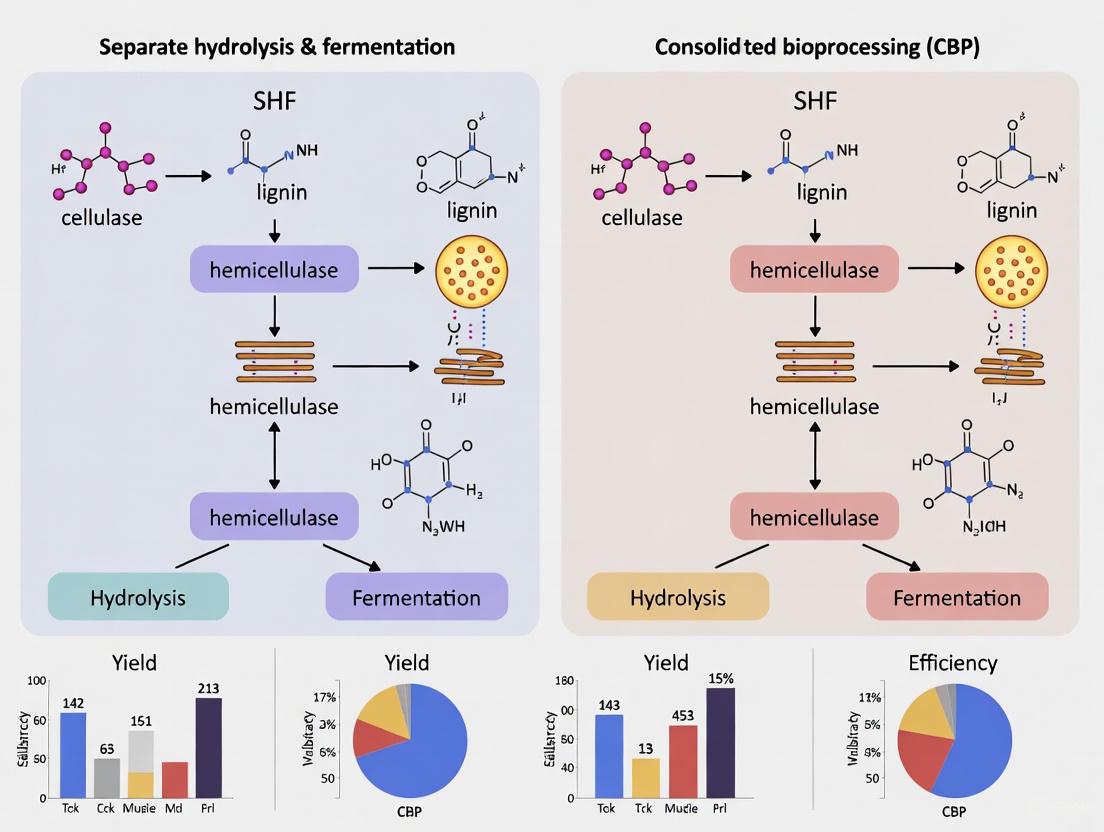
This article provides a comprehensive comparative analysis of Separate Hydrolysis and Fermentation (SHF) and Consolidated Bioprocessing (CBP) for the conversion of lignocellulosic biomass into biofuels and chemicals.
Separate Hydrolysis and Fermentation vs. Consolidated Bioprocessing: A Comparative Efficiency Analysis for Advanced Biofuel and Biochemical Production
Abstract
This article provides a comprehensive comparative analysis of Separate Hydrolysis and Fermentation (SHF) and Consolidated Bioprocessing (CBP) for the conversion of lignocellulosic biomass into biofuels and chemicals. Targeting researchers, scientists, and bioprocess development professionals, it explores the foundational principles, methodological applications, and key challenges of each bioprocess configuration. The analysis synthesizes current research on process optimization, microbial engineering strategies, and comparative economic viability, offering insights into troubleshooting, validation methodologies, and future directions for industrial implementation in biomedical and bioprocessing sectors.
Understanding Lignocellulosic Bioconversion: Core Principles and Economic Drivers of SHF and CBP
Lignocellulosic biomass (LB), the most abundant renewable resource on Earth, represents a promising alternative to fossil resources for producing second-generation biofuels and bio-based chemicals without compromising global food security [1] [2] [3]. This plant-derived material is primarily composed of cellulose (40-60%), hemicelluloses (20-35%), and lignin (15-40%), which form a complex, heterogeneous structure known as the plant cell wall [1] [4]. Despite its abundance, a major limitation to LB valorization is its natural recalcitrance—a resistance to enzymatic hydrolysis and microbial degradation caused by the robust, multi-scale architecture of plant cell walls where cellulose microfibrils are embedded in a matrix of hemicelluloses and lignin [1] [3].
This recalcitrance necessitates energy-intensive pretreatment steps to disrupt the biomass structure before efficient conversion to fermentable sugars can occur [1] [4]. The factors contributing to recalcitrance are interconnected and can be categorized as structural factors (cellulose specific surface area, crystallinity, degree of polymerization, pore size and volume) and chemical factors (composition and content of lignin, hemicelluloses, and acetyl groups) [1]. Understanding and overcoming this recalcitrance is fundamental to developing cost-effective biorefinery processes for the production of cellulosic biofuels and bioproducts.
Compositional and Structural Factors Governing Recalcitrance
The Role of Cellulose and Hemicelluloses
Cellulose, the primary structural component of LB, consists of linear chains of ß-D-glucopyranose units linked by ß-(1,4)-glycosidic bonds, with chain lengths ranging from 500 to 14,000 glucose units [1] [4]. These chains assemble into highly ordered, crystalline microfibrils that provide structural strength but resist enzymatic attack. The degree of polymerization (DP) and crystallinity of cellulose significantly influence hydrolysis rates, with longer chains and higher crystallinity generally increasing recalcitrance [1].
Hemicelluloses are heterogeneous, branched polysaccharides with lower molecular weight (DP of 100-200 units) that include xylans, mannans, glucomannans, and xyloglucans [1] [4]. Unlike cellulose, hemicelluloses are amorphous and more easily hydrolyzed, but they act as physical barriers that limit enzyme accessibility to cellulose fibers [1] [3]. Acetyl groups attached to hemicellulose backbones further contribute to recalcitrance by sterically hindering enzyme recognition and productive binding to cellulose [1] [3]. Studies on corn stover have demonstrated that reducing acetyl content improves enzyme effectiveness, though the impact varies with lignin content and biomass crystallinity [1].
The Lignin Barrier
Lignin, a complex amorphous heteropolymer of phenylpropanoid units (p-coumaryl, coniferyl, and sinapyl alcohols), creates a hydrophobic barrier that confers structural rigidity and protects polysaccharides from degradation [1] [3]. Lignin contributes to recalcitrance through multiple mechanisms: it acts as a physical barrier blocking enzyme access to cellulose, irreversibly adsorbs cellulases via hydrophobic interactions and hydrogen bonding, and releases phenolic compounds that inhibit enzymatic activity during pretreatment [1]. The content, composition, and structure of lignin all influence its recalcitrance effect, with the syringyl-to-guaiacyl (S/G) ratio particularly impacting digestibility in many biomass species [1] [3].
Table 1: Key Factors Contributing to Lignocellulosic Biomass Recalcitrance
| Factor Category | Specific Factor | Impact on Recalcitrance | Experimental Measurement Methods |
|---|---|---|---|
| Structural Factors | Cellulose Crystallinity | Increases recalcitrance by reducing enzyme accessibility | X-ray diffraction (XRD) [5] |
| Cellulose Degree of Polymerization (DP) | Longer chains increase recalcitrance | Size exclusion chromatography [1] | |
| Pore Size and Volume | Limited pore space reduces enzyme penetration | Porosimetry techniques [1] | |
| Specific Surface Area | Smaller surface area limits enzyme binding | BET adsorption method [1] | |
| Chemical Factors | Lignin Content | Higher content increases recalcitrance | Van Soest method, NMR spectroscopy [5] [3] |
| Lignin S/G Ratio | Varies by species; affects lignin depolymerization | 2D-HSQC-NMR [3] | |
| Hemicellulose Content | Acts as physical barrier; removal improves hydrolysis | Compositional analysis [1] [5] | |
| Acetyl Group Content | Steric hindrance of enzymes | Compositional analysis, FTIR [1] |
Pretreatment Strategies to Overcome Recalcitrance
Acid and Alkaline Chemical Pretreatments
Chemical pretreatments represent widely studied approaches for deconstructing lignocellulosic biomass. Dilute acid pretreatment (AP) primarily targets hemicellulose removal, while alkaline pretreatment (ALP) is particularly effective for delignification [5]. A comparative study on diverse herbaceous and woody wastes demonstrated that ALP with 1.5% NaOH on soybean straw achieved remarkable delignification and structural modification, resulting in a high sugar yield of 787 mg/g substrate [5]. In contrast, both AP and ALP of more recalcitrant woody biomass (bamboo and poplar) showed much lower enzymatic sugar yields, highlighting how pretreatment efficiency varies significantly with biomass type [5].
The mechanisms of these pretreatments involve cleaving ester and ether bonds within the lignocellulosic matrix, increasing porosity, and enhancing enzyme accessibility to cellulose [5] [4]. However, each method has drawbacks: AP can produce inhibitory by-products like furan derivatives and weak acids, while ALP may generate phenolic derivatives that hinder subsequent fermentation [5]. The choice between AP and ALP must therefore consider biomass composition and the specific recalcitrance factors targeted for disruption.
Emerging Solvent-Based Pretreatments
Deep Eutectic Solvents (DES) have emerged as promising, sustainable alternatives to conventional pretreatments due to their low volatility, high solubility, tunable properties, biocompatibility, and economic viability [6]. Particularly, choline chloride (ChCl)-based DES have demonstrated exceptional effectiveness in biomass fractionation. A comprehensive study evaluating nineteen ChCl-based DESs classified into amide-based, polyol-based, acid-based, and ternary systems revealed that acid-based DESs generally outperformed basic and neutral DESs in delignification and hemicellulose removal, leading to superior enzymatic hydrolysis of pretreated biomass [6].
The pretreatment efficiency of DESs correlates strongly with their physicochemical properties, particularly Kamlet-Taft parameters (α, β, and π*), which measure hydrogen bond acidity, hydrogen bond basicity, and dipolarity/polarizability, respectively [6]. Research shows that removal of lignin and xylan positively correlates with the α and α-β parameters of DESs, highlighting the importance of hydrogen bonding interactions in effective biomass deconstruction [6]. Specifically, acidic DESs like ChCl:formic acid and ChCl:oxalic acid achieved high delignification rates of 65.8% and 65.9%, respectively, significantly enhancing enzymatic digestibility [6].
Table 2: Comparison of Pretreatment Methods for Lignocellulosic Biomass
| Pretreatment Method | Primary Mechanism | Key Advantages | Limitations | Typical Sugar Yields |
|---|---|---|---|---|
| Dilute Acid (AP) [5] | Hemicellulose hydrolysis | High hemicellulose removal, simple process | Equipment corrosion, inhibitor formation | Varies by biomass: 71-787 mg/g [5] |
| Alkaline (ALP) [5] | Lignin solubilization | Effective delignification, less sugar degradation | Slow reaction rate, chemical recovery needed | Highest for soybean straw: 787 mg/g [5] |
| Deep Eutectic Solvents (DES) [6] | Selective component dissolution | Tunable properties, biocompatible, recyclable | High viscosity, cost of some components | >85% glucose yield for optimized systems [6] |
| OrganoCat [3] | Acidic fractionation in biphasic system | Minimal sugar degradation, high-quality lignin | Complex process setup | 26-53% glucose yield from pulp [3] |
Comparative Bioprocessing Frameworks: SHF versus CBP
Separate Hydrolysis and Fermentation (SHF)
Separate Hydrolysis and Fermentation (SHF) represents the conventional bioprocessing configuration where enzymatic hydrolysis and fermentation are conducted as separate sequential stages, each optimized for their specific temperature requirements [7]. This approach allows hydrolytic enzymes (primarily cellulases and hemicellulases) to operate at their optimum temperatures (typically 50°C), maximizing saccharification efficiency [7]. However, SHF suffers from significant drawbacks, particularly end-product inhibition of enzymes by accumulating sugars, which reduces overall hydrolysis rates and yields [7]. Additionally, SHF requires separate reactors for each process stage, increasing capital costs and process complexity [7].
Consolidated Bioprocessing (CBP)
Consolidated Bioprocessing (CBP) has emerged as an innovative strategy that integrates enzyme production, biomass saccharification, and fermentation into a single unit operation using one or more microorganisms [7] [8] [9]. This integrated approach eliminates the need for externally produced enzymes, potentially significantly reducing processing costs [7]. CBP leverages microorganisms that possess both hydrolytic capabilities and fuel-producing metabolism, enabling direct conversion of pretreated biomass to biofuels like ethanol [7] [8].
Several native and engineered microorganisms have shown promise for CBP applications. The white-rot fungus Trametes hirsuta Bm-2 demonstrated direct ethanol production from raw ramon seed flour at a concentration of 13 g/L, with a production yield of 123.4 mL/kg flour, while producing necessary hydrolytic enzymes like α-amylase (193.85 U/mL) [8]. Other native CBP candidates include fungi from genera Fusarium, Neurospora, and Monilia, as well as bacteria such as Clostridium thermocellum [7] [8]. Engineering strategies focus on developing ideal CBP-enabling microorganisms through metabolic engineering, synthetic biology, and consortium-based approaches to achieve high hydrolytic enzyme production, rapid saccharification, and efficient conversion of multiple sugars to desired products [7].
Bioprocess Configuration Comparison
Experimental Methodologies for Evaluating Pretreatment Efficiency
Standardized Pretreatment and Hydrolysis Protocols
Robust experimental protocols are essential for comparative evaluation of pretreatment efficiency. A typical methodology involves subjecting biomass substrates (40-80 mesh) to chemical pretreatments such as 1.0-4.0% H₂SO₄ (AP) or 0.3-1.5% NaOH (ALP) solutions at a solid loading ratio of 1:10 in an autoclave (121°C, 30 minutes) [5]. Following pretreatment, residues are collected by centrifugation, washed to neutral pH, and dried at 105°C until constant weight [5].
Enzymatic hydrolysis of pretreated biomass is typically conducted with an enzyme system containing 15 FPU/g of substrates, 2.5% solid loading, and 50 mM buffer (pH 5) at 50°C for 72 hours with agitation at 150 rpm [5]. Reducing sugar yields are quantified using established analytical methods like the DNS assay, and conversion ratios are calculated to account for cellulose and hemicellulose content in the original substrate [5].
Advanced Analytical Techniques for Structural Characterization
Comprehensive characterization of biomass before and after pretreatment employs multiple analytical techniques:
- Fourier Transform Infrared Spectroscopy (FTIR) identifies changes in chemical functional groups and bonds within the lignocellulosic matrix [5].
- X-ray Diffraction (XRD) measures changes in cellulose crystallinity using the Segal peak height method to calculate the Crystallinity Index (CrI) [5].
- Scanning Electron Microscopy (SEM) visualizes microstructural changes and surface morphology alterations at high magnification (e.g., 1000×) [5].
- Nuclear Magnetic Resonance (NMR) Spectroscopy, particularly 2D-HSQC-NMR, provides detailed information about lignin structure and composition, including S/G ratios and interunit linkages [3].
Table 3: Research Reagent Solutions for Lignocellulosic Biomass Analysis
| Reagent/Chemical | Function/Application | Experimental Purpose |
|---|---|---|
| Choline Chloride-based DES [6] | Hydrogen bond acceptor in deep eutectic solvents | Green solvent pretreatment for selective component dissolution |
| Oxalic Acid & FDCA [3] | Acid catalysts in OrganoCat pretreatment | Mild hydrolysis of amorphous polysaccharides during fractionation |
| Cellulase Enzymes (15 FPU/g) [5] | Hydrolytic enzyme cocktail | Saccharification of cellulose to fermentable sugars in enzymatic hydrolysis |
| DNS Reagent [8] [5] | Colorimetric assay for reducing sugars | Quantification of sugar release during hydrolysis and fermentation |
| ABTS (2,2'-azino-bis(3-ethylbenzthiazoline-6-sulfonic acid)) [8] | Chromogenic substrate | Detection and measurement of laccase activity in fungal cultures |
| Sodium Hydroxide (NaOH) [5] | Alkaline catalyst | Delignification during alkaline pretreatment |
| Sulfuric Acid (H₂SO₄) [5] | Acid catalyst | Hemicellulose hydrolysis during acid pretreatment |
The challenge of lignocellulosic biomass recalcitrance remains a central focus in developing sustainable biofuel production processes. The complex interplay between structural and chemical factors—including cellulose crystallinity, lignin content and composition, hemicellulose branching, and acetyl group substitution—creates a robust barrier to efficient deconstruction [1] [3]. While various pretreatment strategies have demonstrated effectiveness in overcoming this recalcitrance, their efficiency varies significantly with biomass type and composition, necessitating tailored approaches for different feedstocks [5] [3].
The comparative analysis between conventional SHF and integrated CBP configurations reveals significant trade-offs. SHF offers operational simplicity and optimized conditions for individual process steps but suffers from end-product inhibition and higher costs associated with separate enzyme production [7]. In contrast, CBP represents a promising integrated approach with potentially lower processing costs but requires development of robust microbial platforms capable of simultaneous enzyme production, saccharification, and fermentation [7] [8] [9]. Future research directions should focus on advancing pretreatment technologies with improved selectivity and sustainability, engineering superior CBP microorganisms through synthetic biology and metabolic engineering, and developing integrated biorefinery concepts that maximize value from all biomass components [7] [2] [4].
The bioconversion of lignocellulosic biomass into fuels and chemicals represents a cornerstone of sustainable industrial development, aiming to reduce reliance on fossil fuels and decrease greenhouse gas emissions [10]. Lignocellulose, the most abundant renewable resource on Earth with an annual global production exceeding 13 billion tonnes, is primarily composed of cellulose (40-45%), hemicellulose (25-35%), and lignin (20-30%) [10]. However, its complex structure, where cellulose forms a tough skeletal framework intertwined with hemicellulose and lignin, creates natural recalcitrance that hinders efficient utilization [10]. To overcome this challenge, several bioprocess configurations have been developed, among which Separate Hydrolysis and Fermentation (SHF) has emerged as a fundamental approach with distinct advantages and limitations for industrial applications.
Within the context of a broader thesis on the comparative efficiency of bioprocessing strategies, SHF occupies a critical position as a established benchmark against which newer technologies like Consolidated Bioprocessing (CBP) are measured. SHF represents a sequential approach where biomass degradation and product fermentation occur as discrete unit operations, contrasting with simultaneous processes that integrate these steps [11]. This article provides a comprehensive examination of SHF, detailing its process stages, historical context, industrial adoption, and comparative efficiency against alternative bioprocessing strategies, with particular focus on its role in the evolving landscape of lignocellulosic biorefining.
Process Stages of SHF
Pretreatment
Prior to hydrolysis, lignocellulosic biomass must undergo pretreatment to disrupt its recalcitrant structure. This essential first step breaks down the lignin seal and disrupts the crystalline structure of cellulose, making it more accessible to enzymatic attack [10]. Various pretreatment methods are employed, including physical (e.g., milling, grinding), chemical (e.g., acid, alkali, organosolv), and biological (e.g., fungal) approaches, each with specific effects on the biomass components [10]. The effectiveness of pretreatment directly influences downstream hydrolysis efficiency and overall process economics.
Hydrolysis Stage
Following pretreatment, the SHF process begins with the enzymatic hydrolysis of structural polysaccharides into fermentable sugars. This stage employs a complex cocktail of hydrolytic enzymes that work synergistically to degrade cellulose and hemicellulose [10]. Cellulose hydrolysis requires the coordinated action of endoglucanase (which randomly cleaves amorphous regions of cellulose chains), exoglucanase (which acts on the chain ends to release glucose or cellobiose), and β-glucosidase (which hydrolyzes cellobiose into two glucose molecules) [10]. Recently, lytic polysaccharide monooxygenases (LPMOs) have been identified as significant enhancers of cellulose degradation through oxidative cleavage of glycosidic bonds [10].
Hemicellulose degradation necessitates a more diverse enzyme suite due to its heterogeneous structure, typically including xylanase, xylosidase, arabinofuranosidase, galactosidase, and acetyl esterase [11]. The hydrolysis is conducted at the optimal temperature for these enzymes, typically between 45-60°C, which is higher than the tolerance of most fermentative microorganisms [12]. A key advantage of SHF is the ability to optimize this stage independently from fermentation, potentially allowing for higher hydrolysis rates and sugar yields [11].
Fermentation Stage
Upon completion of hydrolysis, the resulting sugar-rich hydrolysate is transferred to a separate reactor for fermentation. In this stage, fermentative microorganisms such as yeast (e.g., Saccharomyces cerevisiae) or bacteria (e.g., Zymomonas mobilis) convert the monosaccharides into target products like ethanol, organic acids, or other biofuels and chemicals [11] [13]. The fermentation typically occurs at milder temperatures (30-40°C) suitable for microbial growth and metabolism [12]. The separation of hydrolysis and fermentation vessels allows for the use of well-established, robust industrial yeast strains with high product tolerance and resistance to inhibitors potentially present in the hydrolysate [11]. Furthermore, in SHF configuration, it is possible to recover and recycle the yeast, potentially reducing operational costs [13].
Table 1: Optimal Conditions for SHF Process Stages
| Process Parameter | Hydrolysis Stage | Fermentation Stage |
|---|---|---|
| Temperature | 45-60°C [12] | 30-40°C [12] |
| Primary Agents | Cellulases (endoglucanase, exoglucanase), β-glucosidase, hemicellulases [10] | Yeast (e.g., Saccharomyces cerevisiae), bacteria [11] |
| Key Input | Pretreated lignocellulosic biomass | Sugar-rich hydrolysate |
| Key Output | Monomeric sugars (glucose, xylose, etc.) | Target products (ethanol, organic acids, etc.) |
| Duration | Varies (e.g., 3 days or longer [12]) | Typically 2-3 days for batch fermentation [12] |
Historical Context and Industrial Adoption
The development of SHF emerged from early efforts to convert lignocellulosic biomass into renewable fuels and chemicals. While the exact origins of the SHF terminology are not precisely dated in the search results, the process represents a logical, sequential approach to biomass conversion that aligned with established industrial practices of separating complex processes into discrete, optimized unit operations. SHF has been described as "the most employed" method in its category, offering flexibility in process selection [12].
Industrial adoption of SHF has been driven by its operational advantages, particularly the ability to optimize conditions for each stage independently [11]. This characteristic makes it particularly suitable for integration with existing industrial infrastructure, especially in established bioethanol facilities where robust fermentative microorganisms like Saccharomyces cerevisiae are already employed [11]. The separation of stages also allows for intermediate processing steps, such as hydrolysate concentration, detoxification to remove microbial inhibitors, or sterilization to prevent contamination [12] [11].
Despite its advantages, industrial implementation of SHF faces significant challenges. The requirement for separate reactors for hydrolysis and fermentation increases capital costs compared to integrated processes [12]. Additionally, the sequential nature of the process extends total processing time, potentially increasing operational expenses and requiring holding tanks for intermediate products [11]. Perhaps most significantly, the accumulation of hydrolysis products (cellobiose and glucose) during the enzymatic saccharification causes end-product inhibition of cellulase enzymes, particularly inhibiting β-glucosidase, leading to reduced hydrolysis rates and potentially incomplete cellulose conversion [12] [14]. This limitation has motivated the development of alternative strategies like Simultaneous Saccharification and Fermentation (SSF) and Consolidated Bioprocessing (CBP) to overcome these inhibitory effects.
Comparative Analysis of Bioprocess Configurations
SHF vs. Simultaneous Saccharification and Fermentation (SSF)
SSF combines hydrolysis and fermentation in a single reactor where enzymatic saccharification and microbial fermentation occur concurrently. This integration provides a fundamental advantage: as sugars are released by enzymes, they are immediately consumed by fermenting microorganisms, minimizing end-product inhibition and potentially increasing overall reaction rates [14]. SSF also offers reduced capital costs due to fewer reactors and lower contamination risk because of the presence of ethanol and the shorter process time [14] [13].
However, SSF requires a compromise in operating conditions, particularly temperature, as a single temperature must accommodate both enzymatic hydrolysis (optimal at 45-50°C) and fermentation (optimal at 30-40°C) [12] [13]. This typically means operating at suboptimal temperatures for one or both processes, often around 37°C, which may reduce hydrolysis efficiency [13]. Additionally, SSF does not allow for yeast recycling because the microorganisms cannot be easily separated from the residual lignin [13].
Experimental studies directly comparing SHF and SSF demonstrate the trade-offs between these approaches. Research using wet-exploded corn stover and loblolly pine found that SSF generally produced higher ethanol concentrations compared to SHF under identical conditions [14]. For instance, at 5% solids loading with in-house enzymes, SSF yielded 15.6 g/L ethanol from corn stover compared to lower concentrations in SHF [14].
Table 2: Experimental Comparison of SHF and SSF Using Corn Stover and Loblolly Pine [14]
| Parameter | SHF Process | SSF Process |
|---|---|---|
| Feedstock | Wet exploded corn stover (WECS) & loblolly pine (WELP) | Wet exploded corn stover (WECS) & loblolly pine (WELP) |
| Enzymes | In-house (T. reesei + A. saccharolyticus) & Commercial (Celluclast + Novozym 188) | In-house (T. reesei + A. saccharolyticus) & Commercial (Celluclast + Novozym 188) |
| Solid Loading | 5% and 10% (w/w) | 5% and 10% (w/w) |
| Enzyme Loading | 5 and 15 FPU/g glucan | 5 and 15 FPU/g glucan |
| Fermenting Microbe | Saccharomyces cerevisiae | Saccharomyces cerevisiae |
| Max Ethanol (WECS) | Lower than SSF (exact values not specified) | 15.6 g/L (in-house), 17.3 g/L (commercial) |
| Max Ethanol (WELP) | Lower than SSF (exact values not specified) | 13.4 g/L (in-house), 15.4 g/L (commercial) |
| Key Finding | Ethanol concentrations in all cases were higher for SSF compared to SHF under same conditions | SSF outperformed SHF due to reduced end-product inhibition |
SHF vs. Consolidated Bioprocessing (CBP)
Consolidated Bioprocessing represents the most integrated approach, combining enzyme production, saccharification, and fermentation in a single step within one reactor [11]. CBP offers the potential for significant cost reduction by eliminating separate enzyme production and simplifying process operations [11]. However, CBP remains primarily at the research and development stage due to the challenge of finding or engineering a single microorganism or consortium that can efficiently both degrade lignocellulose and produce valuable products at high yields [11].
In contrast to CBP, SHF represents a more technologically mature approach that allows for the use of specialized, optimized enzymes and fermentative microorganisms [11]. The established nature of SHF technology provides more immediate industrial applicability, though with potentially higher operating costs due to enzyme requirements [11].
Table 3: Comprehensive Comparison of Lignocellulosic Bioprocess Configurations
| Characteristic | Separate Hydrolysis and Fermentation (SHF) | Simultaneous Saccharification and Fermentation (SSF) | Consolidated Bioprocessing (CBP) |
|---|---|---|---|
| Process Integration | Separate hydrolysis and fermentation reactors | Combined hydrolysis and fermentation in one reactor | Combined enzyme production, hydrolysis, and fermentation in one reactor |
| Optimal Conditions | Independent optimization of temperature and pH for each stage [11] | Compromised conditions (e.g., ~37°C); suboptimal for either step [13] | Single set of conditions must suit all biological functions |
| End-Product Inhibition | Significant issue (cellobiose/glucose inhibit cellulases) [12] | Minimal (sugars consumed immediately) [14] | Minimal (sugars consumed immediately) |
| Capital Cost | Higher (multiple reactors) [12] | Lower (single reactor) [14] | Lowest (single reactor, no separate enzyme production) [11] |
| Operational Cost | Higher (enzyme purchase, longer processing) [11] | Moderate | Potentially lowest (enzymes produced in situ) [11] |
| Microorganism Flexibility | Can use established, robust specialist strains [11] | Requires compatible microbes that tolerate process conditions | Requires single organism for all functions; most challenging |
| Technology Readiness | Commercially deployed [11] | Commercially viable | R&D stage [11] |
| Contamination Risk | Higher (longer process, multiple stages) [11] | Lower (ethanol present, shorter process) [14] | Variable |
| Sugar Degradation | Possible during extended hydrolysis [11] | Minimal | Minimal |
Experimental Protocols and Methodologies
Representative SHF Experimental Design
A typical experimental approach for SHF involves several standardized stages. First, lignocellulosic biomass (e.g., corn stover or loblolly pine) is milled to a particle size of approximately 2mm and subjected to pretreatment [14]. In comparative studies, wet explosion pretreatment has been employed using conditions of 170°C for 20 minutes with oxygen at 79.8 psi for corn stover, and 175°C for 24 minutes with similar oxygen pressure for loblolly pine [14].
Following pretreatment, enzymatic hydrolysis is conducted using enzyme cocktails such as in-house produced enzymes from Trichoderma reesei RUT-C30 and Aspergillus saccharolyticus or commercial preparations like Celluclast 1.5L with Novozym 188 supplementation [14]. Typical enzyme loadings range from 5 to 15 FPU/g glucan, with hydrolysis performed at the optimal temperature for the enzymes (usually 45-50°C) for a specified period, often 72 hours or more [14].
The fermentation stage then utilizes the hydrolysate, often with pH adjustment and nutrient supplementation, inoculated with fermentative microorganisms such as Saccharomyces cerevisiae at concentrations of approximately 1-3 g/L [14]. Fermentation occurs at the microorganism's optimal temperature (30-35°C) with monitoring of sugar consumption and product formation over 48-96 hours [14].
Key Research Reagent Solutions
Table 4: Essential Research Reagents for SHF Experiments
| Reagent / Material | Function in SHF | Examples / Specifications |
|---|---|---|
| Lignocellulosic Feedstock | Primary substrate for conversion | Corn stover, loblolly pine, agricultural residues [14] |
| Pretreatment Reagents | Disrupt biomass structure | Dilute acid (H₂SO₄), alkali (NaOH), oxidative agents [14] |
| Cellulase Enzymes | Hydrolyze cellulose to glucose | T. reesei cellulases, commercial Celluclast 1.5L [14] |
| β-Glucosidase | Convert cellobiose to glucose | A. saccharolyticus enzymes, Novozym 188 [14] |
| Hemicellulases | Hydrolyze hemicellulose to pentoses | Xylanase, xylosidase, accessory enzymes [10] |
| Fermentative Microorganism | Convert sugars to target products | Saccharomyces cerevisiae, Zymomonas mobilis [14] [13] |
| Nutrient Media | Support microbial growth | Yeast extract, peptone, mineral solutions [14] |
| Analytical Standards | Quantify sugars, inhibitors, products | HPLC standards for glucose, xylose, ethanol, etc. [14] |
Visualization of Processes and Relationships
SHF Process Workflow
SHF Bioprocess Flow
Bioprocess Configuration Comparison
Bioprocess Integration Spectrum
Separate Hydrolysis and Fermentation remains a fundamentally important bioprocess configuration in the lignocellulosic biorefining landscape, serving as both a commercially implemented technology and a benchmark for evaluating emerging integrated approaches like CBP. Its key advantages of operational flexibility, independent process optimization, and compatibility with established industrial microorganisms continue to make it relevant despite challenges related to end-product inhibition, capital costs, and process duration [11].
Within the broader thesis of comparative bioprocessing efficiency, SHF represents a critical point on the spectrum of integration strategies. While CBP offers the theoretical potential for maximal cost reduction through ultimate process integration, SHF provides a technologically mature alternative with lower biological implementation barriers [11]. The choice between these approaches involves nuanced trade-offs between operational flexibility, capital investment, and biological complexity that must be evaluated based on specific feedstock characteristics, target products, and local economic conditions.
Future developments in enzyme technology that reduce end-product inhibition, along with engineering innovations that lower the cost of multi-reactor systems, could enhance the competitiveness of SHF relative to more integrated configurations. Simultaneously, advances in metabolic engineering and synthetic biology that enable the development of more efficient CBP microorganisms may shift the balance toward consolidated approaches. Regardless of these evolving dynamics, SHF will continue to provide valuable insights as a reference point for evaluating the efficiency of lignocellulosic bioconversion processes in the ongoing transition toward sustainable biorefining systems.
Consolidated bioprocessing (CBP) represents a paradigm shift in the biological conversion of lignocellulosic biomass, integrating enzyme production, biomass saccharification, and product fermentation into a single bioreactor using a single microorganism or defined microbial consortium. This integrated approach stands in stark contrast to the classical multi-step biorefinery model that requires separate reactors and processes for each stage of conversion [15] [16]. The fundamental premise of CBP is to consolidate multiple biological transformations into a unified process, thereby significantly reducing operational complexity and capital costs associated with conventional biomanufacturing platforms [17]. By harnessing microorganisms that inherently possess both lignocellulose-degrading capabilities and product synthesis pathways, CBP eliminates the need for expensive externally produced enzymes, which constitute a major portion of operational expenses in traditional biorefining [18] [16].
The drive toward CBP development stems from the pressing need to utilize abundant, renewable lignocellulosic biomass as a sustainable feedstock for producing biofuels and biochemicals. With approximately 200 billion tonnes of lignocellulosic waste generated annually from agricultural and industrial activities [18], CBP offers a promising technological pathway to convert these low-cost feedstocks into value-added products through environmentally benign processes. The technology aligns perfectly with the emerging bioeconomy paradigm, which aims to replace petroleum-based syntheses with biological routes that have lower carbon footprints and reduced environmental impact [18] [19]. As research advances in synthetic biology and metabolic engineering, CBP continues to gain traction as a potentially disruptive technology that could fundamentally reshape industrial biomanufacturing economics.
Comparative Framework: CBP Versus Conventional Bioprocessing
To properly contextualize CBP's potential, it is essential to compare it against established biorefinery approaches, particularly separate hydrolysis and fermentation (SHF) and simultaneous saccharification and fermentation (SSF). Each strategy employs distinct configurations for processing lignocellulosic biomass, with significant implications for process economics, efficiency, and scalability.
Table 1: Comparison of Major Lignocellulosic Biomass Processing Configurations
| Feature | Separate Hydrolysis & Fermentation (SHF) | Simultaneous Saccharification & Fermentation (SSF) | Consolidated Bioprocessing (CBP) |
|---|---|---|---|
| Process Configuration | Sequential enzymatic hydrolysis followed by fermentation in separate reactors [11] | Combined enzymatic hydrolysis and fermentation in a single reactor [17] | Integrated enzyme production, saccharification, and fermentation in a single reactor [15] [16] |
| Enzyme Source | Commercial enzyme cocktails added externally [11] | Commercial enzyme cocktails added externally [17] | Enzymes produced in situ by the fermentation microorganism(s) [17] |
| Optimal Conditions | Independent optimization of temperature and pH for hydrolysis vs. fermentation [11] | Compromise conditions between hydrolysis and fermentation requirements [17] | Single set of conditions for all stages, potentially suboptimal for individual steps [17] |
| Sugar Accumulation | Significant sugar accumulation, causing product inhibition of enzymes [11] | Minimal sugar accumulation due to simultaneous consumption [20] | Minimal sugar accumulation due to simultaneous production and consumption [17] |
| Capital Cost | High (multiple reactors, holding tanks) [11] | Moderate (single reactor, but separate enzyme production needed) [17] | Low (single reactor, no external enzymes) [17] |
| Operational Cost | High (enzyme purchase represents major cost) [17] | High (enzyme purchase represents major cost) [17] | Potentially low (no external enzymes required) [17] |
| Technical Challenges | Sugar degradation during holding periods, contamination risk [11] | Incompatible temperature optima for hydrolysis and fermentation [17] | Developing efficient CBP-capable microorganisms [15] [17] |
The following workflow diagram illustrates the fundamental differences between these bioprocessing strategies:
Comparative Bioprocessing Workflows
As illustrated in the diagram and table, CBP offers the most streamlined approach by eliminating multiple process steps and external enzyme requirements. This consolidation presents both significant economic advantages and substantial technical challenges that must be addressed through continued research and development.
Experimental Performance Data: Quantitative Comparisons
Robust experimental data from peer-reviewed studies provides critical insights into the comparative performance of CBP against conventional bioprocessing approaches. The tables below summarize quantitative findings from key investigations evaluating these different configurations for biofuel production.
Table 2: Experimental Performance of CBP for Bioethanol Production from Various Feedstocks
| CBP Microorganism | Feedstock | Pretreatment | Ethanol Concentration (g/L) | Theoretical Yield (%) | Fermentation Time (h) | Reference |
|---|---|---|---|---|---|---|
| Clostridium thermocellum DSM 1237 | Sugarcane bagasse | Alkali | 0.86 | 83.3 | 48 | [21] |
| Bacillus subtilis NS:Z | Potatoes | None | 21.5 | Not specified | 96 | [22] |
| Bacillus subtilis NZS | Potatoes | None | 16.3 | Not specified | 96 | [22] |
| Engineered B. subtilis (Romero et al.) | Glucose | None | 8.9 | Not specified | 216 | [22] |
Table 3: Comparative Performance of SHF vs. SSF for Butanol Production from Rice Straw
| Process Parameter | Separate Hydrolysis & Fermentation (SHF) | Simultaneous Saccharification & Fermentation (SSF) | Reference |
|---|---|---|---|
| Butanol Concentration (g/L) | 4.90 | 6.31 | [20] |
| Butanol Productivity (g/L/h) | 0.10 | 0.13 | [20] |
| Total ABE Concentration (g/L) | 8.31 | 10.21 | [20] |
| Total Sugar Consumption (%) | ~95% | ~95% | [20] |
| Fermentation Time (h) | 48 | 48 | [20] |
The experimental data reveals several important trends. First, CBP demonstrates feasibility for bioethanol production from diverse feedstocks without external enzyme addition, although titers and productivities require further improvement for commercial viability [22] [21]. Second, integrated processes like SSF generally outperform SHF in terms of product concentration and productivity, primarily due to reduced enzyme inhibition and shorter processing times [20]. This performance advantage of integrated processes provides strong rationale for continued CBP development, as CBP represents the ultimate integration of bioprocessing steps.
Notably, the Clostridium thermocellum study achieved 83.3% of theoretical ethanol yield from pretreated sugarcane bagasse, demonstrating the remarkable efficiency of native cellulolytic microorganisms in direct biomass conversion [21]. The Bacillus subtilis study further highlights the potential of engineering non-native ethanologenic strains for CBP applications, with significant improvement achieved through metabolic engineering strategies [22].
CBP Experimental Protocols: Key Methodologies
To facilitate replication and further development of CBP technology, this section details representative experimental protocols from seminal studies, highlighting both microbial cultivation and process evaluation methods.
CBP Bioethanol Production Using Clostridium thermocellum
Microorganism and Cultivation Conditions: Clostridium thermocellum DSM 1237 is revived from frozen stock and maintained in modified nutrient medium containing (per liter): 2.60 g MgCl₂·6H₂O, 1.30 g (NH₄)₂SO₄, 1.43 g KH₂PO₄, 5.50 g K₂HPO₄, 0.13 g CaCl₂·2H₂O, 6.00 g Na₂-β-glycerol phosphate·4H₂O, 1.10 mL FeSO₄·7H₂O solution (0.1% w/v), 0.25 g L-Glutathione reduced, 4.50 g yeast extract, 0.5 mL Na-resazurin solution (0.1% w/v), and 5.0 g cellobiose [21].
Fermentation Protocol:
- Prepare anaerobic bottles with CM3 medium containing pretreated lignocellulosic biomass (e.g., alkali-pretreated sugarcane bagasse) as sole carbon source.
- Inoculate with 5% (v/v) actively growing seed culture of C. thermocellum in an anaerobic chamber.
- Incubate at 60°C for 48-96 hours without agitation.
- Monitor cell growth via optical density and product formation via HPLC or GC analysis.
- For scale-up, transfer optimized conditions to a 3-L fermenter with pH control and continuous nitrogen sparging to maintain anaerobic conditions [21].
Analytical Methods: Ethanol concentration is quantified using gas chromatography. Cell growth is monitored spectrophotometrically at 600 nm. Residual sugars and byproducts are analyzed via HPLC with refractive index detection [21].
Engineered Bacillus subtilis CBP System
Strain Development:
- Create lactate-deficient (Δldh) B. subtilis host strain to eliminate major competing pathway.
- Construct ethanologenic operons containing Z. mobilis pyruvate decarboxylase gene (pdcZ) and S. cerevisiae alcohol dehydrogenase gene (adhS) in pHY300PLK vector.
- Test various genetic configurations including tandem operons and gene fusions to optimize expression.
- Transform recombinant plasmids into B. subtilis host strain using natural transformation [22].
CBP Evaluation:
- Grow recombinant strains in minimal medium with untreated agricultural waste (e.g., potato waste) as sole carbon source.
- Incubate at 37°C with mild agitation for 96 hours.
- Monitor ethanol production and substrate utilization over time.
- Compare performance of different genetic constructs to identify optimal configuration [22].
CBP Microbial Chassis: Native and Engineered Platforms
The successful implementation of CBP relies on developing robust microbial platforms that combine efficient lignocellulose degradation with high product yield and tolerance. Research has followed two complementary strategies: engineering product formation into native lignocellulose degraders, and introducing lignocellulolytic capability into established industrial producers [15] [18].
Table 4: Promising Microbial Chassis for Consolidated Bioprocessing
| Microorganism | Native Capabilities | Engineering Targets | Key Advantages | Reported Products |
|---|---|---|---|---|
| Clostridium thermocellum | Cellulose degradation via cellulosomes, thermophilic | Enhanced ethanol yield, reduced byproducts | High cellulose degradation rate, thermostable enzymes | Ethanol, organic acids [21] |
| Bacillus subtilis | Broad substrate utilization, enzyme secretion | Ethanologenic pathway, improved tolerance | GRAS status, efficient protein secretion | Ethanol [22] |
| Clostridium acetobutylicum | Cellulose degradation, solvent production | Enhanced selectivity, substrate range | Native solvent production, cellulolytic capability | Butanol, ethanol, acetone [20] |
| Saccharomyces cerevisiae | High ethanol yield and tolerance | Cellulase expression, pentose utilization | Industrial robustness, high productivity | Ethanol [18] |
The following diagram illustrates the two fundamental strategic approaches to developing CBP microorganisms:
CBP Microbial Development Strategies
The strategic approaches highlight the fundamental trade-offs in CBP development. Native degraders excel at biomass breakdown but often require extensive engineering to improve product yields and specificity, while industrial producers offer excellent product formation characteristics but need cellulolytic capabilities introduced through genetic engineering [15] [18] [22].
The Scientist's Toolkit: Essential Research Reagents and Materials
Successful CBP research requires specialized biological materials, reagents, and analytical tools. The following table catalogues essential resources referenced in seminal CBP studies.
Table 5: Key Research Reagents and Materials for CBP Investigation
| Reagent/Material | Function/Application | Specific Examples | Reference |
|---|---|---|---|
| Lignocellulosic Feedstocks | Carbon source for microbial growth and product formation | Sugarcane bagasse, rice straw, corn stover, potato waste | [22] [20] [21] |
| CBP Microorganisms | Biological catalysts for consolidated processing | Clostridium thermocellum, engineered Bacillus subtilis, Clostridium acetobutylicum | [22] [20] [21] |
| Anaerobic Culture Media | Support growth of obligate anaerobic CBP microbes | Modified CM3 medium, Johnson's medium | [21] |
| Genetic Engineering Tools | Modification of microbial metabolism | pHY300PLK vector, ethanologenic operons (pdcZ-adhS), gene deletion constructs | [22] |
| Analytical Standards | Quantification of products and substrates | Ethanol, butanol, organic acids, monomeric sugars | [22] [20] [21] |
| Cellulase Assay Kits | Evaluation of enzymatic activity | Carboxymethyl cellulose (CMC) hydrolysis assay, cellobiose conversion | [15] |
These foundational materials represent the core toolkit for initiating CBP investigations. Researchers should select specific feedstocks based on regional availability and composition, while microbial chassis should be chosen based on target products and processing constraints. Genetic tools require customization for each microbial host, with Gram-positive bacteria often needing specialized vectors and transformation protocols.
Technical Challenges and Research Frontiers
Despite its considerable promise, CBP faces significant technical hurdles that must be overcome to achieve commercial viability. One major challenge is the incompatibility of optimal conditions for different process stages—while hydrolytic enzymes typically function best at elevated temperatures (50-60°C) and acidic pH, most industrial fermentation strains perform optimally at milder temperatures (30-37°C) and near-neutral pH [17]. This fundamental mismatch often forces operation at compromise conditions that are suboptimal for both hydrolysis and fermentation, reducing overall process efficiency.
Additional challenges include the metabolic burden imposed by heterologous enzyme production, which can divert carbon and energy resources away from product formation [17]. Even in native cellulolytic microorganisms, the synthesis of extensive cellulase systems represents a substantial metabolic investment that can limit product yields. Furthermore, lignin resistance remains a persistent obstacle, as most CBP microbes lack efficient lignin-degrading capabilities, necessitating some form of pretreatment to achieve reasonable conversion efficiencies [15] [17].
Emerging research frontiers aim to address these limitations through several promising approaches:
- Synthetic microbial consortia: Designing defined multi-species communities that distribute metabolic tasks among specialized members [15] [16]
- Advanced metabolic engineering: Applying systems biology and synthetic biology tools to rewire microbial metabolism for improved carbon efficiency [18]
- Biofoundry approaches: Utilizing high-throughput automated strain engineering to rapidly iterate through design-build-test-learn cycles [18]
- Novel enzyme discovery: Mining diverse microbial genomes for more efficient lignocellulose-degrading enzymes with improved activity and stability [15]
These innovative approaches, combined with continued investigation of both native and engineered CBP systems, hold promise for overcoming current limitations and unlocking the full potential of consolidated bioprocessing for sustainable biomanufacturing.
Consolidated bioprocessing represents the most integrated configuration for lignocellulosic biomass conversion, offering potentially significant advantages in operational simplicity and cost structure compared to conventional multi-step approaches. While SHF and SSF currently offer more predictable performance using established technologies, CBP holds greater long-term potential for transforming low-value lignocellulosic feedstocks into biofuels and biochemicals through fundamentally streamlined processes.
The experimental data presented in this review demonstrates that CBP is transitioning from conceptual promise to practical reality, with several microbial systems showing encouraging performance in direct biomass conversion. However, substantial research and development remains necessary to improve product titers, rates, and yields to economically competitive levels. Future advances will likely emerge from interdisciplinary efforts combining synthetic biology, metabolic engineering, and bioprocess optimization to overcome existing technical barriers.
As the bioeconomy continues to evolve toward greater sustainability and circularity, CBP is positioned to play an increasingly important role in biomanufacturing. By offering a potentially low-cost route for valorizing abundant lignocellulosic resources, CBP could fundamentally reshape production paradigms for a wide range of bio-based products, ultimately contributing to more sustainable and economically viable biorefining industries.
The selection of a bioprocess configuration is a critical determinant of economic viability in industrial biotechnology. For the conversion of lignocellulosic biomass into fuels, chemicals, or pharmaceutical intermediates, two primary strategies dominate: Separate Hydrolysis and Fermentation (SHF) and Consolidated Bioprocessing (CBP). SHF maintains hydrolysis and fermentation as spatially and temporally distinct operations, enabling each step to occur at its respective optimal conditions [7]. In contrast, CBP integrates enzyme production, biomass saccharification, and fermentation into a single reactor using a single microbial community, thereby potentially eliminating the significant costs associated with exogenous enzyme production [7] [23] [9]. The "holy grail" of low-cost biomanufacturing, CBP promises substantial cost reductions but faces significant technical hurdles in organism development [23]. This guide provides an objective comparison of these competing strategies, analyzing their cost structures, operational efficiencies, and implementation challenges to inform selection for research and commercial development.
Comparative Analysis of SHF and CBP
Table 1: Direct comparison of Separate Hydrolysis and Fermentation (SHF) versus Consolidated Bioprocessing (CBP).
| Feature | Separate Hydrolysis and Fermentation (SHF) | Consolidated Bioprocessing (CBP) |
|---|---|---|
| Process Overview | Sequential steps: enzymatic hydrolysis followed by fermentation in separate vessels [7]. | Integrated process: enzyme production, saccharification, and fermentation occur concurrently in a single vessel [7] [9]. |
| Key Operational Advantage | Allows each step (hydrolysis, fermentation) to run at its own optimal temperature (e.g., 50°C for enzymes, ~30°C for microbes) [7]. | Eliminates need for and cost of externally produced hydrolytic enzyme cocktails [7] [23]. |
| Key Operational Challenge | Saccharification can be inhibited by accumulation of hydrolysis products (e.g., glucose) [7]. | Requires a single microbe or consortium that is both highly cellulolytic and a high-yield product producer; a significant engineering challenge [7] [23]. |
| Enzyme Cost | High; constitutes a major portion of production costs (e.g., cited as ~44% of 2G biofuel production cost) [9]. | Potentially minimal; enzymes are produced in situ by the microorganism(s) [23]. |
| Capital Cost | Higher; requires multiple dedicated vessels for hydrolysis and fermentation [7]. | Potentially lower; requires only a single reactor vessel, simplifying infrastructure [9]. |
| Process Complexity | Well-established, simpler unit operations with readily available technology [7]. | High complexity in microbial strain development and process control; less commercially proven for lignocellulosic feedstocks [23]. |
| Technology Readiness | Commercially deployed [7]. | Primarily at research and development stage for cellulosic applications; considered a promising future strategy [7] [23]. |
Experimental Protocols for Bioprocess Evaluation
Protocol for Separate Hydrolysis and Fermentation (SHF)
The following protocol for enzymatic hydrolysis is adapted from a study on valorizing residual almond hull solids, a representative lignocellulosic material [24].
- Feedstock Preparation: Lignocellulosic biomass (e.g., almond hulls, corn stover) must first be dried and milled to a particle size between 2.36–3.38 mm to increase surface area for enzymatic attack. A pretreatment step (e.g., hot water extraction at 80°C for 90 minutes with a liquid-to-solid ratio of 14) is often necessary to remove free sugars and break down the recalcitrant structure of the plant cell wall. The resulting solid fraction is used as the substrate [24].
- Enzymatic Hydrolysis: The pretreated residual solids are subjected to hydrolysis in a bioreactor or falcon tube (e.g., 50 mL) using a cocktail of commercial enzymes. An optimal mixture was found to be 200 µL/g of solid substrate of Cellic CTec2 (a cellulase complex) and 60 µL/g of solid substrate of Viscozyme L (a multi-carbohydrase with pectinase and hemicellulase activity) [24]. The hydrolysis is performed with controlled agitation and temperature, typically at 50°C, which is the optimum for most commercial hydrolytic enzymes [7].
- Fermentation: The hydrolysate, rich in released sugars, is separated from the solid residues. The pH and temperature are then adjusted to optimal conditions for the fermenting microorganism (e.g., Saccharomyces cerevisiae for ethanol at ~30°C). This step is performed in a separate vessel to prevent sub-optimal temperatures for either enzymes or yeast [7].
- Analysis: Key performance metrics include total sugar yield (%), total fiber conversion (%), and liquefaction efficiency (%) during hydrolysis, and final product titer (g/L), yield (g product/g sugar), and productivity (g/L/h) from fermentation [24].
Protocol for Consolidated Bioprocessing (CBP)
CBP experiments focus on evaluating engineered microbial strains for their ability to directly convert pretreated biomass into the target product.
- Strain Preparation: The CBP-enabling microorganism is used. This can be a natural cellulolytic organism (e.g., Clostridium thermocellum, some fungi) or, more commonly, an engineered strain. For the yeast S. cerevisiae, this involves genetic modification to express a core set of cellulases—endoglucanases (EGs), cellobiohydrolases (CBHs), and β-glucosidases (BGLs)—via strategies like secretion, cell-surface display, or mini-cellulosomes [23].
- Inoculum and Cultivation: A seed culture of the CBP strain is grown to mid-log phase. This is used to inoculate a bioreactor containing the pretreated lignocellulosic substrate suspended in a nutrient medium. The process runs in a single vessel, with conditions (e.g., temperature, pH) set as a compromise between ideal hydrolysis and fermentation [7] [23].
- Monitoring and Analysis: The process is monitored over time for substrate consumption (e.g., decrease in cellulose content) and product formation. The critical metrics are the final product titer (g/L) and the product yield (g product/g substrate consumed). Successful CBP is demonstrated by direct conversion of a cellulosic substrate like Avicel or pretreated agricultural residue into a product like ethanol without external enzyme addition [23].
Workflow and Economic Decision Pathways
The fundamental difference between SHF and CBP lies in the integration of unit operations. The schematic below illustrates the sequential steps of SHF versus the unified nature of CBP.
The economic decision to pursue SHF or CBP is multi-faceted, involving a trade-off between established operational costs and potential capital savings. The following diagram outlines the key economic factors influencing this strategic choice.
The Scientist's Toolkit: Key Research Reagents and Solutions
Table 2: Essential research reagents and materials for conducting experiments in lignocellulosic bioconversion.
| Reagent/Material | Function in Research | Example Usage |
|---|---|---|
| Cellic CTec2 | A commercial enzyme cocktail containing cellulases and β-glucanases, used for breaking down cellulose into fermentable sugars [24]. | Used at 200 µL/g substrate for optimal hydrolysis of residual almond hull solids [24]. |
| Viscozyme L | A multi-enzyme complex with pectinase, hemicellulase, and xylanase activity, used to degrade the pectin and hemicellulose components of biomass [24]. | Used in combination with CTec2 (60 µL/g substrate) to enhance total fiber conversion and liquefaction [24]. |
| Saccharomyces cerevisiae | A robust, widely used yeast for ethanol fermentation. It is the primary host for engineering CBP-enabling traits due to its well-mapped genome and industrial familiarity [23]. | Engineered to express a core set of cellulases (EG, CBH, BGL) to enable direct fermentation of cellulose to ethanol [23]. |
| Pichia pastoris | A yeast expression system known for high protein yields, used for producing recombinant hydrolytic enzymes [25]. | An alternative microbial system for producing aglycosylated proteins or enzymes used in SHF processes [25]. |
| Gaussian Process (GP) Model | A machine learning surrogate model used in Bayesian Optimization to approximate complex bioprocess systems and guide experimental design with minimal runs [26]. | Applied to optimize fermentation media or process parameters by balancing exploration of new conditions and exploitation of known high-yield regions [26]. |
| Mini-cellulosome | A synthetic, multi-enzyme complex engineered on the microbial cell surface to mimic natural systems for efficient cellulose degradation [23]. | Displayed on yeast surface to synergistically hydrolyze crystalline cellulose, enhancing sugar release for fermentation in a CBP setup [23]. |
The concept of the biorefinery is evolving beyond the production of simple biofuels towards integrated systems capable of producing a spectrum of high-value products. This expansion is driven by economic imperatives and technological advances that enhance the viability of biomass conversion processes. Within this context, the comparative efficiency of different bioprocessing approaches—specifically Separate Hydrolysis and Fermentation (SHF) versus Consolidated Bioprocessing (CBP)—becomes a critical area of investigation for the production of not only fuels but also biochemicals and pharmaceutical precursors [11] [27]. This guide objectively compares the performance of these two foundational strategies, providing experimental data and methodologies relevant to researchers and drug development professionals seeking to leverage biomass for higher-value applications.
Core Bioprocessing Strategies: SHF vs. CBP
The selection of a bioprocessing strategy is fundamental to the design of a biorefinery. The two predominant approaches, SHF and CBP, offer distinct advantages and challenges, particularly when the output goals expand beyond biofuels to include sensitive biochemicals and pharmaceutical compounds.
Separate Hydrolysis and Fermentation (SHF) is a classical, well-established bioprocess. It is characterized by a sequential two-stage operation where the enzymatic hydrolysis of structural polysaccharides (cellulose and hemicellulose) into monomeric sugars is physically and temporally separated from the subsequent fermentation of these sugars into the target products [11]. This separation allows for the independent optimization of each stage. The hydrolysis step can be conducted at a higher temperature, optimal for enzyme activity, while the fermentation can proceed at a temperature and pH ideal for the microbial catalyst, often using robust, well-established industrial strains like Saccharomyces cerevisiae [11]. However, a significant disadvantage of SHF is product inhibition during hydrolysis; the accumulation of sugars (e.g., cellobiose and glucose) can inhibit the enzymes, leading to incomplete conversion of the biomass [11]. Furthermore, the longer total process time increases the risk of microbial contamination and potential sugar degradation [11].
Consolidated Bioprocessing (CBP), in contrast, represents an integrated approach. It combines enzyme production, substrate hydrolysis, and fermentation into a single reactor using a single microorganism or a defined consortium [16]. The primary advantage of CBP is a significant reduction in process complexity and cost, as it eliminates the need for external enzyme production [16] [11]. This strategy also alleviates the problem of sugar inhibition, as monosaccharides are consumed by the fermenting microbe immediately upon release [16]. The major challenge for CBP lies in the scarcity of natural microorganisms that are both highly efficient at lignocellulose degradation and proficient producers of the desired target compounds. Consequently, a significant research focus is on engineering superior CBP strains or developing stable, synergistic microbial consortia where labor is divided [16] [28].
Table 1: Core Characteristics of SHF and CBP Strategies.
| Feature | Separate Hydrolysis and Fermentation (SHF) | Consolidated Bioprocessing (CBP) |
|---|---|---|
| Process Description | Sequential stages: hydrolysis and fermentation occur in separate reactors. | Integrated process: enzyme production, hydrolysis, and fermentation occur in a single reactor. |
| Key Advantage | Independent optimization of conditions for hydrolysis and fermentation; use of robust industrial microbes. | Lower operational costs, reduced reactor volume, and avoidance of external enzyme costs. |
| Key Disadvantage | Longer processing times; risk of sugar inhibition during hydrolysis; higher capital costs. | Technologically challenging; requires specialized microbial catalysts that are often less robust. |
| Enzyme Source | Commercially produced or on-site manufactured enzymes added to the reactor. | Enzymes are produced in situ by the microorganism(s) within the bioreactor. |
| Technology Readiness | Commercially deployed at scale [11]. | Primarily at the Research & Development stage [16] [11]. |
| Suitability for Pharmaceutical Co-production | High flexibility for fermenting high-value compounds using engineered yeasts/bacteria. | Potential for streamlined production, but requires sophisticated pathway engineering in robust chassis. |
Experimental Comparisons and Performance Data
Hydrolysis Efficiency Across Diverse Biomass Feedstocks
The initial conversion of biomass into fermentable sugars is a critical determinant of overall process efficiency. The choice of pretreatment method interacts strongly with the subsequent bioprocessing strategy. Recent comparative studies on diverse feedstocks highlight the variability that researchers must account for.
A 2025 study systematically investigated the effects of dilute acid (AP) and alkaline (ALP) pretreatments on the enzymatic hydrolysis of herbaceous and woody wastes [29]. The results demonstrated that biomass type and pretreatment method significantly impact sugar yield, a key input for any fermentation process. The data below provides a benchmark for expected sugar recovery from various feedstocks, which is a critical first step in both SHF and CBP.
Table 2: Sugar Yields from Diverse Biomass Wastes Following Different Pretreatments [29].
| Biomass Type | Pretreatment Method | Condition | Soluble Sugar Recovery at Pretreatment (mg/g RS) | Enzymatic Hydrolysis Sugar Yield (mg/g Substrate) |
|---|---|---|---|---|
| Soybean Straw | Acid (AP) | 1-4% H₂SO₄, 121°C, 30min | 270 | Data Not Specified |
| Soybean Straw | Alkaline (ALP) | 1.5% NaOH, 121°C, 30min | Data Not Specified | 787 |
| Cotton Straw | Acid (AP) | 1-4% H₂SO₄, 121°C, 30min | 212 | Data Not Specified |
| Bamboo | Acid (AP) | 1-4% H₂SO₄, 121°C, 30min | 71 | Data Not Specified |
| Poplar | Alkaline (ALP) | 1.5% NaOH, 121°C, 30min | Data Not Specified | Lower than Soybean Straw |
Experimental Protocol: Biomass Pretreatment and Hydrolysis [29]
- Materials Preparation: Biomass substrates (e.g., soybean straw, bamboo) are dried at 105°C until constant weight and milled to pass through a 40-mesh screen.
- Pretreatment Process: Biomass is treated with reagent solutions (e.g., 1.0%-4.0% H₂SO₄ for AP or 0.3%-1.5% NaOH for ALP) at a solid-to-liquid ratio of 1:10. The mixture is autoclaved at 121°C for 30 minutes. After centrifugation, the solid residue is collected and washed to neutral pH.
- Enzymatic Hydrolysis: Pretreated solids are subjected to hydrolysis with a commercial cellulase system (15 FPU/g substrate) at 2.5% solid loading in a 50 mM buffer (pH 5.0) at 50°C for 72 hours with shaking at 150 rpm.
- Analysis: The resulting reducing sugars are quantified using the Miller method. Compositional analysis of raw and pretreated biomass is performed using standardized methods (e.g., Van Soest method for lignocellulosic components).
Biofuel and Biochemical Production Performance
Direct comparisons of SHF and CBP for the production of target molecules reveal tangible trade-offs between yield, titer, and process complexity. The following data summarizes documented performance metrics for various products.
Table 3: Comparison of SHF and CBP Performance for Target Molecule Production.
| Target Product | Bioprocessing Strategy | Microorganism(s) Used | Titer / Yield | Key Experimental Finding |
|---|---|---|---|---|
| Bioethanol | SHF | Saccharomyces cerevisiae WXY12 | 46.87 g/L from corn stover hydrolysate [16] | Achieved a 27.4% theoretical conversion rate following enzymatic hydrolysis. |
| Bioethanol | CBP (Co-culture) | C. thermocellum & T. saccharolyticum | 38 g/L from 92 g/L Avicel (~80% theoretical yield) [28] | Demonstrated highly efficient conversion of pure cellulose via labor division in a consortium. |
| Bioethanol | CBP (Co-culture) | C. phytofermentans & S. cerevisiae | 22 g/L from 100 g/L cellulose [28] | Engineered S. cerevisiae with a cellodextrin transporter and intracellular glucosidase. |
| Biobutanol | Native CBP | Various Clostridium strains | 20 g/L [30] | Highlights the native capability of some microbes, but challenges remain in heterologous hosts. |
Expanding into Pharmaceutical and High-Value Chemical Co-Production
The economic viability of biorefineries is significantly enhanced through the co-production of high-value pharmaceuticals alongside biofuels. This integrated model leverages shared feedstocks and infrastructure to improve overall resource utilization [27]. Synthetic biology provides the tools to engineer these sophisticated production systems.
Notable Examples of Co-Production Systems [27]:
- Microbial Metabolites: The microalga Haematococcus pluvialis accumulates the potent antioxidant astaxanthin (up to 5% dry weight), with the residual biomass rich in lipids for biodiesel production.
- Oleaginous Yeasts: Rhodotorula spp. can simultaneously produce lipids for biodiesel and valuable carotenoids (β-carotene, torulene) which act as antioxidants and provitamin A sources.
- Bacterial Systems: Clostridium acetobutylicum, known for acetone-butanol-ethanol fermentation, produces butyric acid, an intermediate with investigated potential for anticancer prodrugs.
- Engineered Platforms: The oleaginous yeast Yarrowia lipolytica has been engineered for high lipid accumulation and the production of diverse compounds like omega-3 fatty acids and flavonoids.
The choice between SHF and CBP for such co-production depends on the microbial system. SHF offers flexibility to use optimized, engineered producers in the fermentation stage. CBP, while more challenging to implement, could offer a more direct and potentially lower-cost route from biomass to complex products once robust microbial chassis are developed.
The Scientist's Toolkit: Essential Research Reagents and Materials
Successful research in this field relies on a suite of standard reagents, enzymes, and microbial strains.
Table 4: Key Research Reagent Solutions for Bioprocessing Research.
| Reagent / Material | Typical Function in Research | Specific Examples & Notes |
|---|---|---|
| Cellulase Enzyme Cocktails | Hydrolyzes cellulose to glucose and oligosaccharides in SHF. | Commercial blends containing cellobiohydrolases (CBHs), endoglucanases (EGs), and β-glucosidases (BGLs) for synergistic action [16]. |
| Hemicellulases | Hydrolyzes hemicellulose (e.g., xylan, mannan) into pentose sugars. | Xylanases, mannanases, and arabinosidases are crucial for full biomass utilization [16]. |
| Model Lignocellulosic Substrates | Standardized substrate for method development and comparison. | Avicel (microcrystalline cellulose), Whatman filter paper, and pretreated standard biomass (e.g., NIST reference materials) [28]. |
| Industrial Microbial Chassis | Workhorse strains for fermentation and genetic engineering. | Saccharomyces cerevisiae (ethanol, engineered pathways), Escherichia coli (engineered chemicals), Yarrowia lipolytica (lipids, oleochemicals) [30] [27]. |
| Cellulosic Microbes | Chassis for CBP or source of cellulolytic enzymes. | Clostridium thermocellum (anaerobic, highly cellulolytic), Trichoderma reesei (fungal, high cellulase secretor) [16] [28]. |
| Pretreatment Chemicals | Disrupts lignocellulosic structure to enhance enzymatic digestibility. | Dilute sulfuric acid (AP), sodium hydroxide (ALP), and emerging green solvents like deep eutectic solvents (DES) [29]. |
| Analytical Standards | Quantification of products and inhibitors. | Standards for sugars (glucose, xylose), organic acids (lactic, succinic), fermentation products (ethanol, butanol), and degradation products (furfural, HMF) [29]. |
The expansion of biorefining beyond biofuels into biochemical and pharmaceutical production represents a paradigm shift towards a more sustainable and economically viable bioeconomy. The choice between SHF and CBP is not absolute; it depends on the target products, feedstock, and technological maturity. SHF currently offers reliability and flexibility for producing a wide array of compounds using engineered microbes. In contrast, CBP holds the long-term promise of significant cost reduction for bulk products and potentially for complex microbial metabolites. Future progress will be driven by advances in synthetic biology to engineer superior CBP organisms, the development of robust microbial consortia, and innovative process integration strategies that maximize the value derived from renewable biomass.
Implementation Strategies: Technical Approaches and Microbial Systems for SHF and CBP
Separate Hydrolysis and Fermentation (SHF) is a biphasic bioprocessing strategy where the enzymatic saccharification of lignocellulosic biomass and the subsequent fermentation of resulting sugars are performed as discrete, sequential unit operations [11]. This methodology stands in contrast to integrated configurations such as Simultaneous Saccharification and Fermentation (SSF) or Consolidated Bioprocessing (CBP). The structural segregation inherent to SHF provides a fundamental advantage: the independent optimization of critical process parameters for each stage [11] [13]. Hydrolysis enzymes, such as cellulases and hemicellulases, typically operate at their temperature and pH optima (often 45–55°C), which are frequently supra-optimal or otherwise inhibitory to fermenting microorganisms [11]. By decoupling these stages, SHF allows each process to proceed at its own ideal conditions, thereby maximizing the conversion efficiency of structural polysaccharides to fermentable monomers and subsequently achieving high product yields from fermentation [13].
Experimental Protocols for SHF
Developing a robust SHF process requires a systematic, multi-stage experimental approach. The following protocol outlines the key stages from feedstock analysis to the optimization of the discrete hydrolysis and fermentation unit operations.
Feedstock Selection and Pretreatment
The process begins with a detailed compositional analysis of the lignocellulosic feedstock to determine the ratios of cellulose, hemicellulose, and lignin [11]. This analysis is critical for selecting an appropriate pretreatment method. Pretreatment is essential for virgin biomass to disrupt the recalcitrant lignocellulosic matrix, making cellulose more accessible to enzymatic attack [11]. Common methods include hydrothermal pretreatment, which operates at high temperature and pressure (e.g., 160-195°C) to cleave glycosidic bonds and solubilize a portion of the hemicellulose and lignin [11] [31]. Optimization of parameters like temperature, residence time, and catalyst loading (e.g., SO₂) is frequently conducted using statistically designed experiments (DoE) to maximize enzymatic digestibility while minimizing the formation of fermentation inhibitors like furfurals [11] [31].
Optimizing the Hydrolysis Stage
The optimized, pretreated biomass—now a suitable substrate for enzymatic hydrolysis—undergoes a separate saccharification process. This stage is optimized through a DoE evaluating the effects of solid-loading (substrate concentration), enzyme-loading (type and dosage of cellulase/hemicellulase cocktails), temperature (typically 45-55°C), pH, reaction time, and mixing intensity [11]. The use of modern enzyme cocktails containing Lytic Polysaccharide Monooxygenases (LPMOs) can significantly boost sugar yields through oxidative cleavage of cellulose chains. However, LPMO activity requires a co-substrate, such as molecular oxygen, which may necessitate mild aeration during this stage [32]. The success of this stage is measured by the high yield of reducing sugars, primarily glucose from cellulose and xylose from hemicellulose.
Optimizing the Fermentation Stage
The generated hydrolysate, rich in monomeric sugars, is then transferred to a separate bioreactor for fermentation. This physical separation allows the process conditions to be shifted to those optimal for the fermenting microorganism (e.g., Saccharomyces cerevisiae), typically around 30-35°C and a pH suitable for the yeast [11] [13]. The fermentation stage is also optimized via a DoE, focusing on parameters such as microbial strain selection, nutrient supplementation, dissolved oxygen (for initial growth phases), inoculum size, and fermentation time [11] [31]. For hydrolysates containing both hexose and pentose sugars, specialized strains or mixed cultures (e.g., Saccharomyces cerevisiae with Candida shehatae) can be employed to maximize ethanol yield [31]. The separate fermentation vessel also enables the possibility of yeast recycling, which is not feasible in simultaneous processes [13].
Comparative Performance Data: SHF vs. Alternative Bioprocesses
The performance of SHF is best understood when compared to other process configurations like SSF and CBP. The tables below summarize comparative advantages and disadvantages, as well as experimental performance data from recent studies.
Table 1: Qualitative comparison of SHF against SSF and CBP
| Feature | Separate Hydrolysis and Fermentation (SHF) | Simultaneous Saccharification and Fermentation (SSF) | Consolidated Bioprocessing (CBP) |
|---|---|---|---|
| Process Flexibility | High flexibility; different reactors and conditions can be used for each stage [11] | Low flexibility; single reactor and compromised conditions for both processes [11] | Low flexibility; all processes occur in a single reactor [11] |
| Optimal Conditions | Allows independent optimization of temperature and pH for hydrolysis and fermentation [11] [13] | Requires a single compromise temperature (~35°C), suboptimal for enzymes [32] | Requires a single compromise temperature for all enzymatic and microbial activities [11] |
| Sugar Inhibition | Susceptible to end-product inhibition of cellulases by accumulating sugars [11] [13] | Minimal sugar inhibition; sugars are consumed immediately by the microbe [11] [32] | Minimal sugar inhibition; sugars are consumed immediately [11] |
| Microorganism | Can use well-established, robust industrial yeast strains [11] | Often requires less robust, specialized microbes [11] | Requires a single microorganism or consortium that produces enzymes and ferments sugars [11] |
| Process Time | Longer total process time due to separate stages [11] | Shorter process time due to simultaneous operations [11] | Potentially the shortest process [11] |
| Technology Readiness | Commercially deployed [11] | Commercially deployed [32] | Largely in R&D phase [11] |
Table 2: Quantitative performance data from comparative studies
| Study Focus / Feedstock | Process Configuration | Key Performance Metric | Result | Citation |
|---|---|---|---|---|
| d-Glucaric Acid from Avicel | SHF | d-Glucaric Acid Titer | 0.54 ± 0.12 g/L | [33] |
| SSF | d-Glucaric Acid Titer | Data not specified | ||
| CBP (Microbial Consortium) | d-Glucaric Acid Titer | ~0.54 g/L | [33] | |
| d-Glucaric Acid from Corn Stover | SHF | d-Glucaric Acid Titer | 0.45 ± 0.06 g/L | [33] |
| SSF | d-Glucaric Acid Titer | Data not specified | ||
| CBP (Microbial Consortium) | d-Glucaric Acid Titer | ~0.45 g/L | [33] | |
| Ethanol from Softwood | HHF (with LPMO aeration) | Glucan Conversion | Better than SSF | [32] |
| Ethanol Productivity & Yield | Poorer than SSF | [32] | ||
| SSF (no aeration) | Glucan Conversion | Poorer than HHF | [32] | |
| Ethanol Productivity & Yield | Better than HHF | [32] | ||
| Ethanol from Waste Tissue Paper | SHF (Mixed Yeast Culture) | Ethanol Yield in 72h | 28.11 g/L | [31] |
| SHF (S. cerevisiae only) | Ethanol Yield in 72h | 35.15 g/L | [31] |
Advantages and Limitations of SHF
Core Advantages
The primary strengths of SHF stem from its modularity. The ability to independently optimize temperature and pH for hydrolysis and fermentation is a significant advantage, often leading to higher reaction rates and yields in each discrete stage [11] [13]. Furthermore, SHF enables the use of traditional, robust industrial microorganisms like Saccharomyces cerevisiae, which have high product tolerance and well-understood fermentation kinetics [11]. This configuration also allows for the recycling of yeast cells between batches, a process that is challenging in SSF where the yeast is mixed with lignin-rich solids [13]. The physical separation of stages also permits different reactor technologies to be used; for instance, a high-shear reactor for hydrolysis to enhance enzyme-substrate interaction and a standard stirred-tank fermenter for the biological step [11].
Inherent Limitations and Mitigation Strategies
Despite its advantages, SHF has distinct drawbacks. A major challenge is end-product inhibition during hydrolysis, where the accumulation of sugars (e.g., cellobiose and glucose) inhibits the activity of cellulolytic enzymes, potentially leading to incomplete cellulose conversion [11] [13]. This is a problem that SSF inherently avoids. SHF also typically entails longer total process times and requires more reactor units, which can increase both capital and operational costs [11] [13]. There is also a potential for microbial contamination in the sugar-rich hydrolysate during storage or transfer between stages, and a risk of sugar degradation under the conditions used for hydrolysis if not managed properly [11]. Mitigation strategies include operating hydrolysis at high solid loadings to reduce water volume and inhibitor concentration, using fed-batch hydrolysis to control sugar levels, and implementing robust process control and aseptic transfer protocols [11].
The Scientist's Toolkit: Key Reagents and Materials
Table 3: Essential research reagents and materials for SHF experiments
| Reagent/Material | Function in SHF | Key Considerations |
|---|---|---|
| Cellulase/Hemicellulase Cocktails | Enzymatic hydrolysis of cellulose and hemicellulose into fermentable sugars (e.g., glucose, xylose) [11] [31] | Modern cocktails often include LPMOs for enhanced efficiency; optimal activity at 45-55°C and specific pH [32]. |
| Lytic Polysaccharide Monooxygenase (LPMO) | Auxiliary enzyme that oxidatively cleaves crystalline cellulose, boosting the efficiency of canonical cellulases [32] | Requires molecular oxygen (O₂) and an electron donor (e.g., ascorbic acid, lignin) for activity [32]. |
| Saccharomyces cerevisiae | Robust industrial yeast for the fermentation of hexose sugars (e.g., glucose, mannose) to ethanol [11] [31] | Ethanol and inhibitor tolerant; cannot natively ferment pentose sugars like xylose [11]. |
| Xylose-Fermenting Microbes (e.g., Candida shehatae, engineered S. cerevisiae) | Fermentation of pentose sugars from hemicellulose to increase overall product yield [31] | Often less robust than traditional S. cerevisiae; can be used in co-cultures [31]. |
| Pretreatment Chemicals (e.g., SO₂, dilute H₂SO₄) | Catalyst to enhance the effectiveness of thermal pretreatment in disrupting biomass structure [32] [34] | Can lead to formation of microbial inhibitors (furfurals, HMF); may require detoxification steps [31]. |
| Nutrient Media (e.g., Yeast Extract, Peptone) | Provides essential nitrogen, vitamins, and minerals to support microbial growth and productivity during fermentation [33] |
Process Workflow and Comparative Pathway Diagrams
The following diagram illustrates the sequential stages of the SHF process and highlights its key differentiators when compared to SSF and CBP.
Diagram 1: A comparative workflow of SHF against SSF and CBP, highlighting the discrete unit operations that enable independent optimization.
Within the comparative framework of lignocellulosic bioprocessing, SHF establishes a compelling methodology based on operational segregation and independent optimization. Its capacity to provide a controlled, high-efficiency environment for both enzymatic hydrolysis and microbial fermentation makes it a dependable, well-understood technology, particularly suitable for processes utilizing robust industrial microbes or requiring high sugar conversions for non-ethanol products [11] [33]. However, the choice between SHF, SSF, or future CBP platforms is context-dependent, hinging on the specific feedstock, desired product, and economic constraints. While emerging integrated configurations like SSF with LPMO-containing enzymes present challenges to the dominance of SHF by potentially offering higher volumetric productivity [32], SHF's flexibility and high degree of control ensure it will remain a critical benchmark and a viable commercial option in the evolving landscape of biorefinery technologies.
In the pursuit of sustainable bioprocesses for producing biofuels and chemicals, Separate Hydrolysis and Fermentation (SHF) remains a prominent strategy for converting lignocellulosic biomass. This two-step process, which involves first hydrolyzing structural polysaccharides into fermentable sugars and then fermenting them into the target product, relies heavily on the performance of its microbial catalysts [11]. Among these, conventional yeasts, particularly Saccharomyces cerevisiae, are established workhorses, prized for their industrial robustness [35] [11]. This guide objectively compares the performance of conventional yeasts in SHF against other bioprocessing strategies like Simultaneous Saccharification and Fermentation (SSF) and Consolidated Bioprocessing (CBP), framing the analysis within a broader thesis on comparative bioprocessing efficiency. We present supporting experimental data and detailed methodologies to provide researchers and scientists with a clear, evidence-based evaluation.
SHF and the Central Role of Conventional Yeasts
Separate Hydrolysis and Fermentation (SHF) is a bioprocess where the enzymatic hydrolysis of pretreated lignocellulosic biomass and the microbial fermentation of the resulting sugars are performed in two separate, sequential stages [11]. This separation allows for the independent optimization of each stage. Hydrolysis can be conducted at a higher temperature (e.g., 45-50°C), which is optimal for commercial cellulase enzymes like Cellic CTec2, while fermentation can occur at a lower temperature (e.g., 30-35°C) that is ideal for the fermenting microorganism [36] [11].
The fermentation stage in SHF is where conventional yeasts, especially Saccharomyces cerevisiae, demonstrate their significant value. Their advantages in this context are substantial:
- Proven Industrial Robustness: SHF allows for the use of traditional, well-established yeast strains known for their high ethanol tolerance and resilience to inhibitors present in lignocellulosic hydrolysates, leading to more reliable and high-yield fermentation [11].
- Process Flexibility: The decoupled nature of SHF enables the use of different specialized reactors for hydrolysis and fermentation, offering greater flexibility in process design and operation [11].
However, the SHF process is not without its drawbacks. A key challenge is product inhibition during hydrolysis; the sugars (e.g., glucose and xylose) released during hydrolysis can accumulate and inhibit the cellulase enzymes, potentially leading to incomplete hydrolysis of the biomass [11]. Furthermore, the total process time for SHF tends to be longer than for integrated processes, which can increase operational costs and the risk of microbial contamination [11].
Comparative Performance: SHF vs. SSF vs. CBP
The efficiency of conventional yeasts in SHF is best understood when compared to other leading bioprocess configurations. The table below summarizes a direct comparison of SHF against Simultaneous Saccharification and Fermentation (SSF) and Consolidated Bioprocessing (CBP) based on key performance metrics.
Table 1: Comparative Analysis of Lignocellulosic Bioprocess Configurations
| Feature | Separate Hydrolysis & Fermentation (SHF) | Simultaneous Saccharification & Fermentation (SSF) | Consolidated Bioprocessing (CBP) |
|---|---|---|---|
| Process Description | Hydrolysis and fermentation occur in separate reactors sequentially [11]. | Hydrolysis and fermentation occur simultaneously in a single reactor [36]. | Enzyme production, hydrolysis, and fermentation are combined in a single step and microorganism or consortium [11]. |
| Optimal Temperature | Independent optimization (e.g., 50°C for hydrolysis, 30°C for fermentation) [11]. | A single, compromised temperature (e.g., ~35°C) must be chosen for both enzymes and yeast [11]. | Must be suitable for the single microorganism's growth, enzyme production, and fermentation [11]. |
| Typical Microorganism | Well-established, robust industrial yeasts (e.g., S. cerevisiae) [11]. | Often requires less robust, sometimes engineered microorganisms [11]. | Requires a single microorganism or consortium that can both hydrolyze biomass and ferment sugars [11]. |
| Sugar Inhibition | Yes, accumulating sugars can inhibit hydrolytic enzymes, reducing yield [11]. | No, sugars are fermented as they are produced, minimizing inhibition [36] [11]. | Minimized, as sugars are consumed concurrently with their release. |
| Process Time | Longer due to separate stages [11]. | Shorter, integrated process [11]. | Potentially the shortest and most simplified process [11]. |
| Ethanol Production (Example) | 4.74% from EFB in 72 hours [36]. | 6.05% from EFB in 24 hours [36]. | 0.45-0.54 g/L D-glucaric acid from cellulose in 7 days [33]. |
| Technology Readiness | Commercially deployed [11]. | Commercially deployed. | Primarily at the R&D stage [11]. |
The experimental data from empty fruit bunch (EFB) conversion clearly demonstrates a key trade-off. While SHF allows for optimized conditions, the SSF process achieved a higher ethanol concentration in a significantly shorter time (6.05% in 24 hours vs. 4.74% in 72 hours) [36]. This performance advantage in SSF is largely attributed to the reduction of sugar inhibition, as glucose is immediately consumed by the yeast, thereby driving the hydrolysis reaction forward [36] [11].
Experimental Protocols for Evaluating Yeast in SHF
To generate the comparative data presented in this guide, standardized experimental protocols are essential. The following methodology outlines a typical workflow for assessing the performance of a conventional yeast strain in an SHF process for bioethanol production.
Diagram 1: SHF Experimental Workflow
Detailed Methodology
1. Biomass Pretreatment:
- Objective: To break down the recalcitrant lignin structure and make cellulose more accessible to enzymes.
- Protocol: Lignocellulosic biomass (e.g., empty fruit bunch, corn stover) is milled and then treated with a chemical agent such as 10% sodium hydroxide (NaOH) in a reactor at 150°C for 30 minutes [36]. Other common pretreatments include dilute acid or steam explosion.
2. Enzymatic Hydrolysis (Hydrolysis Stage):
- Objective: To convert the cellulose content of the pretreated biomass into glucose.
- Protocol: The pretreated biomass is loaded into a bioreactor at a typical solid loading of 15% (w/v) in a suitable buffer. The pH is adjusted to 4.8 (optimal for most cellulases). Commercial enzyme cocktails like Cellic CTec2 are added at varying concentrations (e.g., 10, 20, 30, 40 FPU per gram of biomass) to determine the optimal dosage. Cellic HTec2 (a hemicellulase) is often added at 20% of the CTec2 loading. The reaction is carried out with mixing at 50°C for 48-72 hours. Samples are taken periodically to monitor glucose and xylose concentration [36] [11].
3. Fermentation (Fermentation Stage):
- Objective: To convert the sugar-rich hydrolysate into the target product (e.g., ethanol) using yeast.
- Protocol: The hydrolysate is clarified, and the pH may be adjusted to be suitable for fermentation (e.g., pH ~5.0 for S. cerevisiae). It is then transferred to a fermentation reactor. An inoculum of the conventional yeast strain (e.g., Saccharomyces cerevisiae) is prepared in a rich medium like YPD and added to the hydrolysate at a standard inoculation density (e.g., 1-5% v/v). Fermentation is conducted under anaerobic conditions at 30-35°C with mixing for 24-72 hours. Samples are taken every 24 hours to measure ethanol concentration and residual sugars [36].
The Scientist's Toolkit: Key Research Reagent Solutions
Successful SHF research relies on a suite of specialized reagents and materials. The table below details essential items for experiments focused on conventional yeasts.
Table 2: Essential Research Reagents for SHF Experiments
| Reagent/Material | Function in SHF Research | Example & Specification |
|---|---|---|
| Lignocellulosic Biomass | The renewable feedstock/substrate for sugar release. | Empty Fruit Bunch (EFB), corn stover, or Avicel (microcrystalline cellulose) [36] [33]. |
| Pretreatment Chemicals | To disrupt biomass structure and enhance enzyme accessibility. | 10% Sodium Hydroxide (NaOH) for alkaline pretreatment [36]. |
| Cellulase Enzyme Cocktails | To catalyze the hydrolysis of cellulose to glucose. | Cellic CTec2 & HTec2 (Novozymes); dosage measured in FPU/gram biomass [36]. |
| Industrial Yeast Strains | To ferment released sugars into target products (e.g., ethanol). | Robust Saccharomyces cerevisiae strains (e.g., Ethanol Red) with high inhibitor tolerance [37] [11]. |
| Fermentation Nutrients | To support robust yeast growth and metabolic activity. | Yeast Extract, Peptone, and other components of standard media like YPD [33]. |
| Analytical Standards | For accurate quantification of process inputs and outputs. | Pure D-Glucose, D-Xylose, Ethanol, and other organic acids for HPLC calibration. |
Physiological Robustness of Industrial Yeasts
A key advantage of using conventional yeasts like Saccharomyces cerevisiae in SHF is their inherent robustness, a critical trait for surviving the variable conditions of an industrial bioreactor. Recent research using dynamic microfluidic single-cell cultivation (dMSCC) has quantitatively investigated this trait.
This methodology exposes yeast cells to rapid oscillations in substrate (glucose) and pH, mimicking the gradient-induced fluctuations they experience in large-scale fermenters [37]. By coupling this with fluorescent biosensors for intracellular parameters like ATP, glycolytic flux, and oxidative stress, researchers can quantify physiological responses and functional robustness [37].
Table 3: Physiological Response of S. cerevisiae Strains to Dynamic Conditions [37]
| Strain | Origin/Type | Key Observed Robustness characteristic |
|---|---|---|
| CEN.PK113-7D | Laboratory Strain | Showed higher oxidative stress response under dynamics. |
| PE2 | Industrial Bioethanol Strain | Displayed higher relative glycolytic flux. |
| Ethanol Red | Industrial Bioethanol Strain | Exhibited the least heterogeneous populations and the highest robustness for multiple functions (e.g., ATP stability) during substrate oscillations. |
These studies reveal that industrial strains are not uniform. For instance, the Ethanol Red strain demonstrated superior stability in maintaining ATP levels over time under substrate oscillations, a likely result of a positive trade-off in its metabolic network [37]. This type of analysis is crucial for selecting or engineering the most robust strains for industrial SHF applications where such dynamics are unavoidable.
Conventional yeasts, particularly robust industrial strains of Saccharomyces cerevisiae, remain a cornerstone of the SHF bioprocess due to their proven tolerance, high product yields, and overall operational reliability [11]. The experimental data confirms that while SHF enables the independent optimization of hydrolysis and fermentation, it can be susceptible to sugar inhibition and longer processing times compared to SSF [36] [11]. The choice of bioprocess is therefore a strategic one. SHF, with its flexibility and compatibility with robust conventional yeasts, presents a lower-risk, commercially viable pathway. In contrast, emerging strategies like CBP offer a visionary but not yet fully realized path to greater simplification and cost reduction [11] [33]. For researchers, the decision hinges on the specific feedstock, product, and economic constraints, with the physiological robustness of the microbial workhorse being a paramount consideration for successful scale-up.
Consolidated Bioprocessing (CBP) represents a transformative approach for the conversion of lignocellulosic biomass into biofuels and biochemicals. Unlike traditional multi-step biorefinery processes that require separate stages for enzyme production, enzymatic saccharification, and fermentation, CBP consolidates these into a single bioreactor using a single microorganism or defined microbial consortium [15] [16]. This integration offers significant potential for reducing the high costs associated with cellulase enzyme production, which remains a major hurdle for the economic viability of cellulosic biorefineries [15] [17]. The fundamental challenge in developing effective CBP systems lies in engineering microbial hosts that can simultaneously degrade recalcitrant cellulose and ferment the resulting sugars to valuable products with high efficiency [38] [39]. This guide provides a comprehensive comparison of the two primary engineering strategies for developing CBP-enabling microorganisms: the secretion of free cellulases and cell surface display of enzyme systems, with a focus on their comparative efficiencies within the broader context of lignocellulosic biomass conversion.
Cellulase System Fundamentals for Biomass Deconstruction
The enzymatic degradation of cellulose requires the synergistic action of multiple enzyme classes. The core cellulolytic system consists of endoglucanases (EGs) that randomly hydrolyze internal β-1,4-glycosidic bonds in cellulose chains, creating new chain ends; cellobiohydrolases (CBHs) that processively cleave cellobiose units from either reducing or non-reducing ends of cellulose chains; and β-glucosidases (BGLs) that hydrolyze cellobiose into glucose units, thereby relieving product inhibition on CBHs and EGs [16] [40]. Recently discovered lytic polysaccharide monooxygenases (LPMOs) further enhance this system by introducing oxidative cleavage of crystalline cellulose [16]. The composition and optimization of this enzyme cocktail significantly impacts the overall efficiency of cellulose degradation in CBP systems, with the minimal functional combination typically requiring at least one enzyme from each class [40].
Strategic Approaches to Engineering CBP Microorganisms
Secretion-Based Strategies
The secretion strategy aims to recreate the "free enzyme system" similar to the native cellulase system of filamentous fungi like Trichoderma reesei [41] [40]. In this approach, engineered microorganisms produce and secrete cellulases into the extracellular medium, where they hydrolyze cellulose into fermentable sugars. This method offers the advantage that secreted enzymes can penetrate the complex microstructure of lignocellulosic biomass, potentially accessing regions that may be physically inaccessible to whole cells [41]. The quantity of secreted enzymes is limited primarily by the production capacity of the host cells rather than physical constraints of the cell surface [41]. However, a significant drawback is the inability to recycle the enzymes for multiple batches, potentially increasing long-term operational costs [40].
Surface Display Strategies
Surface display technology immobilizes cellulases directly on the microbial cell surface through genetic fusion to anchor proteins, effectively creating whole-cell biocatalysts [42] [40]. This approach typically utilizes glycosylphosphatidylinositol (GPI) anchors or other cell wall anchoring domains to covalently attach enzymes to the cell wall matrix [42] [43]. Surface display offers several distinct advantages: (1) increased local enzyme concentration near the cell surface; (2) enhanced enzyme stability through immobilization; (3) immediate uptake of released sugars, minimizing product inhibition and contamination risks; and (4) enables cell and enzyme recycling in multi-batch fermentations [42] [41] [40]. The physical proximity of co-displayed enzymes may also promote synergistic interactions, potentially enhancing overall hydrolytic efficiency [40].
Combined and Emerging Strategies
Recent research has explored hybrid approaches that combine elements of both secretion and surface display systems. The rationale for these combined systems is that different cellulase enzymes may function more effectively in different locations based on their catalytic mechanisms and substrate specificities [41]. For instance, non-processive enzymes like EGs might be more effective when displayed on the cell surface, while processive enzymes like CBHs might benefit from the mobility afforded by secretion [41]. Additionally, advanced engineering strategies focusing on modifying cell wall biosynthesis pathways and optimizing protein secretion pathways have shown promise in enhancing both secretion efficiency and surface display performance [44] [43].
Comparative Performance Analysis
Direct Experimental Comparisons
Recent studies have directly compared the performance of secretion versus surface display strategies in engineered Saccharomyces cerevisiae strains. The table below summarizes key findings from these comparative investigations:
Table 1: Comparative Performance of Secretion vs. Surface Display Strategies in Engineered Yeast
| Strain Configuration | EG Production | CBH Production | Ethanol from PASC (10 g/L) | Cell-Recycle Performance | Key Observations |
|---|---|---|---|---|---|
| EG-D-CBHI-D | Surface Display | Surface Display | 2.9 g/L | 60% retention after 3 cycles | Superior multi-batch performance; immediate fermentation initiation |
| EG-S-CBHI-S | Secretion | Secretion | 2.6 g/L | Significant activity loss | Lag phase before fermentation; unable to penetrate cellulose |
| EG-D-CBHI-S | Surface Display | Secretion | <2.9 g/L | Intermediate | Reduced synergy from spatial separation |
| EG-S-CBHI-D | Secretion | Surface Display | <2.9 g/L | Intermediate | Reduced synergy from spatial separation |
| EG-D-CBH1-D-CBH2-D | Surface Display (4 enzymes) | Surface Display (4 enzymes) | 6.7 g/L (66% theoretical) | N/A | Cellulose-adherent phenotype; "tearing" degradation pattern |
The data demonstrates that strategies keeping synergistic enzymes in the same compartment (both displayed or both secreted) generally outperform mixed strategies. The spatial colocalization of enzymes appears to enhance synergistic effects, particularly for the EG-CBH partnership which is crucial for efficient cellulose degradation [41].
Quantitative Comparison of Strategic Advantages
Table 2: Strategic Advantages of Secretion vs. Surface Display Systems
| Performance Metric | Secretion Strategy | Surface Display Strategy |
|---|---|---|
| Enzyme Accessibility | Penetrates biomass microstructure [41] | Limited to surface accessibility [40] |
| Enzyme Recycling | Not reusable [40] | Maintained 60% activity after 3 batches [41] |
| Sugar Uptake | Extracellular accumulation causes product inhibition [17] | Immediate uptake; minimized inhibition [41] |
| Enzyme Stability | Subject to proteolysis and denaturation [42] | Enhanced stability via immobilization [42] [43] |
| Contamination Risk | Higher due to extracellular sugars [17] | Reduced due to immediate sugar consumption [17] |
| Processivity Requirements | Better for processive enzymes (CBHI) [41] | Potentially suboptimal for processive enzymes [41] |
| Fermentation Initiation | Lag phase observed [41] | Immediate initiation [41] |
| Enzyme Production Cost | Integrated but not reusable [17] | Integrated and reusable [17] |
Experimental Protocols for Strategy Evaluation
Strain Construction and Engineering
Host Strain Selection: The foundational step involves selecting an appropriate microbial host. Saccharomyces cerevisiae is frequently used due to its excellent fermentation characteristics, GRAS status, and well-characterized genetics [41] [43]. Alternative hosts include natural cellulolytic microorganisms such as Clostridium thermocellum or other engineered strains [38] [39].
Genetic Cassette Design: For surface display systems, design expression cassettes containing: (1) a strong promoter (e.g., SED1 for stationary phase expression); (2) secretion signal (e.g., from Rhizopus oryzae glucoamylase); (3) passenger enzyme (EG, CBH, or BGL); and (4) anchor protein domain (e.g., Sed1p or Aga1p for GPI anchoring) [41] [40] [43]. For secretion systems, omit the anchor domain while retaining the secretion signal [41].
Genomic Integration: Integrate expression cassettes into specific genomic loci (e.g., intergenic regions or knocked-out genes) using appropriate selection markers. Verify integration by PCR and measure transcription levels via RT-qPCR to ensure comparable expression across constructs [41] [40].
Functional Characterization Assays
Enzyme Activity Measurements:
- For endoglucanase activity: Use carboxymethyl cellulose (CMC) hydrolysis followed by reducing sugar quantification [40].
- For cellobiohydrolase activity: Measure hydrolysis of crystalline substrates like Avicel [40].
- For β-glucosidase activity: Assess using p-nitrophenyl-β-D-glucopyranoside (pNPG) hydrolysis [44].
Fermentation Performance: Evaluate CBP capability using various cellulosic substrates:
- Phosphoric acid swollen cellulose (PASC) as an amorphous cellulose model [41] [40].
- Avicel as a crystalline cellulose model [40].
- Pretreated lignocellulosic biomass (e.g., rice straw) for real-world relevance [40].
Conduct fermentations under oxygen-limited conditions at elevated temperatures (37°C) to simulate industrial conditions. Monitor ethanol production, substrate consumption, and cell growth over 72-96 hours [41] [40].
Cellulose Adhesion Assessment: For surface display strains, examine cell-to-cellulose adhesion using scanning electron microscopy (SEM). This visualization provides insights into the mechanism of cellulose degradation and confirms functional display [40].
Pathway Engineering and Optimization Strategies
Secretory Pathway Engineering
The efficiency of both secretion and surface display strategies depends heavily on the host cell's secretory capacity. Engineering approaches to enhance this pathway include:
- Transcriptional Regulation: Overexpression of the unfolded protein response (UPR) regulator Hac1p to alleviate ER stress and enhance protein folding capacity [44].
- Protein Folding Machinery: Engineering chaperone systems (e.g., Kar2p, PDI) to improve correct folding of heterologous cellulases [44].
- Vesicle Trafficking: Modulating components of the vesicle-mediated transport system to enhance protein transit from ER to Golgi and onward to the cell surface [44].
- Glycosylation Optimization: Engineering glycosylation pathways to ensure proper post-translational modification of heterologous enzymes, which can significantly impact activity and stability [44].
Cell Wall Biosynthesis Engineering
For surface display systems specifically, engineering the cell wall biosynthesis pathway can significantly enhance display efficiency:
- Gene Knockouts: Targeted deletion of genes such as DFG5, YPK1, FYV5, CCW12, and KRE1 has been shown to improve both secretion and surface display of recombinant enzymes [44].
- Combinatorial Modifications: Double deletions (e.g., Δfyv5 Δccw12) can produce synergistic improvements, with reported enhancements of 4.41-fold for secretion and 5.13-fold for surface display of BGL1 [44].
- Stress Response Activation: Cell wall modifications can trigger stress responses that indirectly enhance protein production through systematic regulation of the secretory pathway [44].
The Scientist's Toolkit: Essential Research Reagents
Table 3: Key Research Reagents for CBP Strain Development
| Reagent Category | Specific Examples | Function & Application |
|---|---|---|
| Host Strains | Saccharomyces cerevisiae BY4741 [41] [40], Clostridium thermocellum [38] | Model organisms for CBP engineering |
| Anchor Systems | Sed1p [41] [40], Aga1-Aga2 [43], Pir proteins [42] | Cell surface immobilization of enzymes |
| Promoters | SED1 [41] [40], GAL1/GAL10 [43] | Transcriptional control of heterologous genes |
| Signal Peptides | Native enzyme signals, R. oryzae glucoamylase signal [41] | Protein targeting to secretion pathway |
| Cellulase Genes | T. reesei EG2 [40], T. emersonii CBH1 [40], A. aculeatus BGL1 [41] | Heterologous enzyme expression |
| Substrates | PASC [41] [40], Avicel [40], Barley β-glucan [41] | Performance evaluation of engineered strains |
| Analytical Tools | SEM for adhesion studies [40], HPLC for product quantification [41] | Functional characterization of strains |
The comparative analysis of secretion and surface display strategies for engineering CBP-enabling microorganisms reveals a complex trade-off between enzymatic accessibility, process stability, and synergistic efficiency. Surface display systems demonstrate clear advantages in terms of cell-to-substrate interaction, enzyme stability, and recyclability, making them particularly suitable for multi-batch operations and potentially more cost-effective in the long term [41] [40]. Secretion systems, while less efficient in direct comparisons, may offer advantages for specific enzyme types and biomass substrates where penetration into the biomass structure is critical [41].
The emerging approach of combining both strategies in a single strain, along with advanced pathway engineering to enhance protein production and display, represents the most promising direction for future CBP development [41] [44]. The optimal strategy is likely to be application-specific, depending on the target biomass, production scale, and desired products. As engineering tools continue to advance, particularly in synthetic biology and systems-level optimization, the performance gap between CBP and traditional biorefinery configurations is expected to narrow, potentially enabling the economic viability of cellulosic biofuels and biochemicals.
Single Strain vs. Synthetic Consortia Approaches for CBP Implementation
Consolidated Bioprocessing (CBP) represents an advanced approach in biotechnology that integrates multiple biological steps—enzyme production, biomass saccharification, and fermentation—into a single process. This integrated system is particularly promising for converting lignocellulosic biomass into valuable products like biofuels and chemicals, offering potential simplifications over traditional multi-step methods [17] [45]. The core challenge in CBP development lies in selecting or engineering the appropriate microbial catalyst, which leads to two fundamental strategies: using a single engineered strain or designing synthetic microbial consortia comprising multiple specialized strains [7]. This guide provides an objective comparison of these approaches, supported by experimental data and detailed methodologies, to inform researchers and development professionals in their bioprocess design decisions.
The choice between single-strain and consortium-based approaches involves critical trade-offs between process simplicity and functional complexity. Single strains offer more straightforward process control but may lack the comprehensive enzymatic capabilities required for efficient lignocellulose degradation. Conversely, synthetic consortia can distribute metabolic tasks among specialists but introduce challenges in maintaining population stability [18] [46]. As we examine these approaches, we will evaluate their comparative efficiency in the context of broader research on biomass processing strategies.
Fundamental Concepts and Definitions
Single-Strain Approach
The single-strain approach utilizes one microbial strain engineered to perform all necessary functions for direct biomass conversion. This strategy typically involves extensive genetic modification to enable both biomass degradation and product synthesis capabilities within a single organism [45]. Ideal single-strain candidates must produce sufficient hydrolytic enzymes to break down lignocellulose while simultaneously converting the released sugars into target products at high yields [7]. Researchers have explored both native lignocellulose degraders with enhanced product formation and established industrial producers with introduced cellulolytic capabilities [18].
Synthetic Consortia Approach
Synthetic consortia are composed of multiple, specialized microbial strains that work cooperatively to degrade biomass and produce desired products. This approach mimics natural microbial communities where different species perform complementary metabolic functions [47] [46]. By dividing the complex tasks of lignocellulose bioconversion among specialist strains, consortia can achieve higher overall functionality than typically possible with single strains [48]. However, this approach requires careful engineering of stable, cooperative interactions between consortium members to prevent competitive exclusion and maintain desired population ratios over time [49] [47].
Table 1: Key Characteristics of CBP Approaches
| Characteristic | Single-Strain Approach | Synthetic Consortia Approach |
|---|---|---|
| Functional Basis | All capabilities engineered into one strain | Metabolic division of labor between specialist strains |
| Genetic Complexity | High engineering burden on single organism | Distributed engineering across multiple organisms |
| Process Control | Simplified monitoring and control | Complex population dynamics require stabilization strategies |
| Metabolic Burden | High on single strain | Distributed among consortium members |
| Robustness | Vulnerable to single point failures | Potentially more resilient through functional redundancy |
| Implementation Examples | Engine S. cerevisiae, C. thermocellum | T. reesei + S. cerevisiae, C. thermocellum + C. saccharoperbutylacetonicum |
Comparative Performance Analysis
Efficiency Metrics for Biofuel Production
Experimental studies have demonstrated varying performance outcomes for single-strain versus consortium-based CBP systems. Product titers, yields, and process productivity serve as key metrics for comparing these approaches. In bioethanol production, single-strain systems using engineered Saccharomyces cerevisiae have achieved ethanol titers up to 47.5 g/L from pretreated biomass, while consortium-based approaches have demonstrated comparable performance with the potential for broader substrate utilization [45]. For more complex chemicals like d-glucaric acid, engineered S. cerevisiae in consortium with Trichoderma reesei has produced 0.45-0.54 g/L directly from lignocellulosic substrates [33].
A global meta-analysis of inoculation strategies revealed that microbial consortia consistently outperformed single-strain inoculants across various applications. In biofertilization and bioremediation contexts, consortium inoculation increased plant growth by 48% and pollution remediation by 80%, compared to 29% and 48% improvements with single-strain inoculants, respectively [50]. This performance advantage was particularly pronounced under challenging environmental conditions, suggesting consortia may offer greater robustness in industrial settings with variable parameters.
Process Economics and Operational Considerations
The economic viability of CBP depends heavily on reducing capital and operating expenses compared to multi-process configurations. Single-strain systems typically offer lower operational complexity with all processes occurring in a single reactor, potentially reducing equipment costs and contamination risks [17]. However, the extensive genetic engineering required to develop performant single strains represents a significant upfront investment [45].
Consortium-based systems can reduce metabolic burden on individual strains by distributing functions, potentially leading to higher overall efficiency [46]. One comparative analysis suggested CBP could reduce overall production costs by approximately 25% compared to conventional bioethanol processes [45]. However, maintaining population stability in consortia may require sophisticated control strategies, adding to operational complexity. The optimal approach depends on specific application requirements, with single strains potentially preferable for simpler processes and consortia offering advantages for complex substrate conversions.
Table 2: Experimental Performance Comparison of CBP Systems
| CBP System | Product | Substrate | Performance | Reference/Strain Type |
|---|---|---|---|---|
| Single-Strain Systems | ||||
| Engineered S. cerevisiae | Ethanol | Pretreated biomass | 47.5 g/L | [45] |
| Clostridium thermocellum | Ethanol | Cellulosic biomass | 23.1 g/L | [45] |
| Fusarium oxysporum | Ethanol | Cellulose | 3.82 g/L | [7] |
| Consortium Systems | ||||
| T. reesei + S. cerevisiae | d-Glucaric acid | Steam-exploded corn stover | 0.45 g/L | [33] |
| T. reesei + S. cerevisiae | d-Glucaric acid | Avicel (cellulose) | 0.54 g/L | [33] |
| C. thermocellum + C. saccharoperbutylacetonicum | Butanol | Alkali-pretreated rice straw | 7.9 g/L | [7] |
| C. thermocellum + T. saccharolyticum | Ethanol | Cellulosic biomass | 38.1 g/L | [45] |
Experimental Protocols and Methodologies
Population Control in Synthetic Consortia
Maintaining stable population ratios represents a fundamental challenge in consortium-based CBP systems. Two primary experimental approaches have demonstrated efficacy in controlling consortium composition: bacteriocin-mediated amensalism and mutualistic auxotrophy.
The bacteriocin approach utilizes toxin-producing strains to regulate competitor populations. In one documented protocol, researchers engineered an E. coli strain to secrete microcin-V bacteriocin in response to competition [49]. The experimental workflow involved:
- Engineering a slower-growing bacteriocin-producing strain and a faster-growing competitor strain
- Co-culturing strains in minimal medium with fluorescent markers for population tracking
- Monitoring population dynamics via plate reader measurements
- Controlling bacteriocin expression using N-3-oxohexanoyl-homoserine lactone (3OC6-HSL) as an inducer
- Quantifying inhibitory effects through agar spot inhibition assays with serial inducer dilutions
This system created tunable, stable two-strain consortia while only requiring engineering of a single strain, demonstrating how competitive exclusion can be leveraged for population control [49].
The mutualistic auxotrophy approach establishes cross-feeding dependencies between strains. A representative protocol used E. coli ΔargC (arginine auxotroph) and ΔmetA (methionine auxotroph) strains [47]:
- Culturing auxotrophic strains in minimal media supplemented with their required metabolites
- Establishing continuous co-culture in a turbidostat system maintaining constant OD600
- Monitoring population ratios through selective plating on supplemented media
- Tuning population ratios by adding specific amino acids (arginine or methionine) to the media
- Validating steady-state ratios over multiple days to ensure stability
This method achieved precise ratio control from 10% to 90% of either strain by modulating cross-fed metabolite availability [47].
Evaluation of Hydrolytic Capability
Standardized assays for evaluating lignocellulose degradation efficiency are essential for comparing CBP approaches. A comprehensive protocol includes:
Substrate Preparation:
- Lignocellulosic biomass (e.g., corn stover, wheat straw) milled to 1-2 mm particle size
- Pretreatment using steam explosion, dilute acid, or alkaline methods
- Compositional analysis to determine cellulose, hemicellulose, and lignin content
Cultivation Conditions:
- Mineral media with lignocellulose as sole carbon source
- Temperature optimized for the specific strains (mesophilic: 30-37°C, thermophilic: 50-60°C)
- pH control based on strain requirements (typically pH 5-7)
- Anaerobic conditions for biofuel production
Analytical Methods:
- Sugar release quantification via HPLC
- Product concentration measurements (ethanol, butanol, organic acids)
- Enzymatic activity assays (cellulase, xylanase)
- Microbial population tracking through selective plating or qPCR
This protocol enables direct comparison of hydrolysis rates and product yields between different CBP systems [7] [45] [33].
Stability and Robustness Assessment
Long-Term Performance Maintenance
Functional stability over extended operational periods represents a critical factor in CBP implementation. Single-strain systems face challenges from metabolic burden and genetic instability, where the cumulative effect of maintaining multiple heterologous pathways can reduce growth rates and promote loss-of-function mutations [49] [18]. Experimental data indicates that engineered single strains may require periodic reversion to functional populations through selection pressures or population displacement strategies [49].
Consortium-based systems exhibit different stability challenges, primarily related to population dynamics. Without stabilizing interactions, competitive exclusion inevitably leads to the removal of less fit community members over time [49]. However, properly engineered consortia can demonstrate remarkable stability, as shown in continuous co-culture experiments where mutually auxotrophic strains maintained stable ratios for over 200 hours [47]. Environmental conditions significantly impact stability, with consortia demonstrating superior performance under challenging conditions like high pH, temperature fluctuations, or substrate variability [48].
Approaches to Enhance Stability
Several engineering strategies have successfully improved CBP system stability:
For single-strain systems:
- Minimizing metabolic burden through genome reduction or pathway optimization
- Implementing toxin-antitoxin systems to select against loss-of-function mutants
- Periodic displacement with freshly engineered strains
For consortium systems:
- Establishing cross-feeding dependencies through auxotrophies [47]
- Implementing quorum-sensing regulated killing mechanisms [49]
- Spatial segregation using biofilm membrane reactors [46]
Experimental evidence from tomato cultivation systems demonstrated that microbial consortia maintained better performance under challenging field conditions including high pH (7.9) and low phosphate availability, with selective changes to rhizosphere bacterial communities that enhanced stress tolerance [48].
Applications and Case Studies
Biofuel Production from Lignocellulosic Biomass
CBP approaches have been extensively applied to biofuel production, with both single-strain and consortium systems demonstrating potential. Single-strain CBP systems using native cellulolytic microorganisms like Clostridium thermocellum have achieved ethanol titers of 23.1 g/L from cellulosic biomass, while engineered strains have reached 47.5 g/L [45]. These systems benefit from simplified reactor operation but may lack complete substrate utilization capabilities.
Consortium-based CBP systems have shown remarkable efficiency in butanol production, with a co-culture of Clostridium thermocellum and Clostridium saccharoperbutylacetonicum producing 7.9 g/L butanol from alkali-pretreated rice straw [7]. Another effective consortium combining C. thermocellum with Thermoanaerobacterium saccharolyticum achieved 38.1 g/L ethanol, demonstrating the potential of thermophilic consortia for high-yield biofuel production [45]. These systems leverage the specialized capabilities of multiple strains to achieve comprehensive biomass degradation and efficient product formation.
High-Value Chemical Production
Beyond biofuels, CBP systems have been successfully applied to produce value-added chemicals from lignocellulosic biomass. A notable example is d-glucaric acid production, where a consortium of Trichoderma reesei Rut-C30 and engineered Saccharomyces cerevisiae LGA-1 produced 0.54 g/L d-glucaric acid from Avicel (microcrystalline cellulose) and 0.45 g/L from steam-exploded corn stover [33]. This consortium benefited from the complementary capabilities of both strains: T. reesei provided potent cellulolytic activity while S. cerevisiae performed the specialized bioconversion to d-glucaric acid.
Comparative analysis of different bioprocess configurations for d-glucaric acid production revealed that while higher titers (9.53-11.21 g/L) could be achieved in fed-batch fermentation with pure substrates, the CBP approach using microbial consortia offered significant advantages in direct biomass conversion without requiring separate enzyme production steps [33].
Essential Research Reagents and Tools
Table 3: Key Research Reagent Solutions for CBP Development
| Reagent/Resource | Function in CBP Research | Application Examples |
|---|---|---|
| Microbial Strains | ||
| Saccharomyces cerevisiae | Ethanol producer, genetic engineering host | Engineered for cellulase expression or pathway integration [45] [33] |
| Clostridium thermocellum | Native cellulolytic bacterium | Single-strain CBP or consortium member for hydrolysis [7] [45] |
| Trichoderma reesei | Filamentous fungus, high cellulase production | Consortium member for biomass degradation [33] |
| Genetic Tools | ||
| Plasmid Systems | Heterologous gene expression | cellulase genes in non-cellulolytic hosts [18] |
| CRISPR-Cas Systems | Genome editing | Creating auxotrophic mutants or pathway engineering [47] |
| Analytical Methods | ||
| HPLC | Sugar and product quantification | Monitoring hydrolysis and fermentation efficiency [33] |
| Selective Plating | Population dynamics tracking | Quantifying strain ratios in consortia [49] [47] |
| Process Materials | ||
| Lignocellulosic Biomass | Substrate for CBP | Agricultural residues, dedicated energy crops [45] |
| Turbidostat Systems | Continuous culture maintenance | Long-term stability studies of consortia [47] |
The comparative analysis of single-strain versus synthetic consortia approaches for CBP implementation reveals a complex trade-off between process simplicity and functional capability. Single-strain systems offer more straightforward process control and reduced population management challenges but often face limitations in comprehensive substrate utilization and metabolic burden [18] [45]. Conversely, synthetic consortia can achieve more efficient lignocellulose degradation through division of labor but require sophisticated population control strategies to maintain stability [49] [47].
The choice between these approaches depends heavily on the specific application requirements. For targeted conversion of specific biomass components or when using pretreated feedstocks, single-strain systems may provide sufficient capability with simpler operation. For complex, untreated lignocellulosic biomass or when producing sophisticated biochemicals requiring multiple metabolic steps, consortium-based approaches often demonstrate superior performance [48] [33]. Future research directions include developing more robust population control mechanisms, reducing metabolic burden through modular pathway design, and engineering strains specifically for consortium compatibility. As genetic engineering tools advance and our understanding of microbial community interactions deepens, the boundaries between these approaches may blur, potentially leading to hybrid systems that maximize the advantages of both strategies.
The efficient conversion of lignocellulosic biomass into valuable fuels and chemicals represents a critical pathway for sustainable biomanufacturing. However, the inherent recalcitrance of plant cell walls—owing to the complex interwoven matrix of cellulose, hemicellulose, and lignin—poses a significant scientific and engineering challenge [10]. This complex structure, stabilized by hydrogen bonding and van der Waals forces, confers remarkable biological, chemical, and mechanical resistance, making efficient degradation a primary bottleneck in biorefining [10]. Overcoming this bottleneck requires sophisticated process integration strategies that seamlessly connect laboratory-scale discoveries to commercially viable bioreactor operations. The choice of bioprocessing configuration, particularly between traditional separate hydrolysis and fermentation (SHF) and emerging consolidated bioprocessing (CBP), profoundly impacts the technical and economic feasibility of lignocellulosic biorefineries [10] [15]. This guide provides a comparative analysis of these approaches, focusing on their scale-up considerations and integration pathways within modern bioprocessing frameworks.
Comparative Analysis of Bioprocessing Configurations
Separate Hydrolysis and Fermentation (SHF)
Separate Hydrolysis and Fermentation (SHF) is a classical multi-step biorefinery approach. It involves a distinct pretreatment phase followed by sequential enzymatic hydrolysis and fermentation processes conducted in separate vessels [10]. This configuration allows for independent optimization of each unit operation—enzymatic saccharification and microbial fermentation—under their respective ideal conditions (e.g., different temperatures, pH) [10]. A significant operational advantage is the ability to employ specialized microbial strains that may not be tolerant to the hydrolytic enzymes or pretreatment byproducts. However, SHF faces a major drawback: enzyme inhibition by end-products (primarily cellobiose and glucose), which reduces the overall hydrolysis rate and yield, potentially leading to longer processing times and higher enzyme loadings [10]. The capital cost associated with multiple, specialized reactors for each stage also contributes to higher costs at scale.
Consolidated Bioprocessing (CBP)
Consolidated Bioprocessing (CBP) represents an integrated alternative that combines enzyme production, saccharification, and fermentation into a single bioreactor using a single microorganism or a defined microbial consortium [10] [15]. This integration significantly simplifies the process flow, reduces reactor volume and footprint, and has the potential to dramatically lower capital and operational costs by eliminating the need for separate enzyme production or purchase [15]. The primary technical challenge lies in developing and engineering robust microbial chassis capable of both efficient lignocellulose degradation and high-yield product synthesis [15]. No naturally occurring microorganism optimally possesses both traits, so current research focuses on engineering either natural lignocellulose-degraders to enhance product formation or high-yield biosynthetic strains with heterologous cellulolytic capabilities [15].
Table 1: Comparison of Key Characteristics Between SHF and CBP
| Feature | Separate Hydrolysis & Fermentation (SHF) | Consolidated Bioprocessing (CBP) |
|---|---|---|
| Process Steps | Pretreatment, Enzyme Production, Hydrolysis, Fermentation in separate units [10] | Single-unit operation combining enzyme production, saccharification, and fermentation [15] |
| Operational Flexibility | High; allows independent optimization of each step [10] | Low; requires compromise on conditions optimal for all steps |
| Technical Challenges | End-product inhibition of enzymes, high enzyme cost, longer process times [10] | Developing efficient microbial chassis, potential carbon catabolite repression, process control complexity [15] |
| Capital Cost | Higher (multiple reactors) | Potentially lower (single reactor, simpler infrastructure) [15] |
| Enzyme Cost | High (external production/purchase) | Potentially very low (on-site production) [15] |
| Technology Readiness | High; established, commercially deployed | Low to Medium; primarily in research and development phase [15] |
Quantitative Performance Comparison
The theoretical economic advantages of CBP are compelling, with the potential for significant reductions in production costs primarily driven by the elimination of external enzyme requirements [15]. However, at the current stage of development, SHF often demonstrates superior product titers and volumetric productivities due to its mature state of optimization. The following table summarizes experimental data from research settings, illustrating the performance gap and potential of both approaches.
Table 2: Experimental Performance Data for SHF and CBP from Literature
| Processing Strategy | Feedstock | Microorganism(s) | Key Product | Final Titer (g/L) | Volumetric Productivity (g/L/h) | Citation Context |
|---|---|---|---|---|---|---|
| SHF | Alkali-pretreated corn stover | Saccharomyces cerevisiae | Bioethanol | ~45 | ~0.6 | [10] |
| SHF | Dilute-acid pretreated switchgrass | Engineered E. coli | Succinic Acid | ~55 | ~1.1 | [10] |
| CBP (Microbial Co-culture) | Phosphoric acid swollen cellulose (PASC) | Clostridium thermocellum & Thermoanaerobacterium saccharolyticum | Lactic Acid | ~35 | ~0.7 | [15] |
| CBP (Engineered Chassis) | Microcrystalline Cellulose (MCC) | Engine Corynebacterium glutamicum | L-Lactate | ~28 | ~0.6 | [15] |
Essential Workflows and Methodologies
Experimental Protocol for Separate Hydrolysis and Fermentation (SHF)
- Feedstock Pretreatment: Mill or grind lignocellulosic biomass (e.g., corn stover, switchgrass) to a particle size of 1-2 mm. Subject the biomass to a chemical pretreatment, such as dilute acid (1-2% H₂SO₄ at 160-180°C for 30-60 minutes) or alkaline (0.5-2% NaOH at 120°C for 60-90 minutes) treatment, to disrupt the lignin structure and reduce cellulose crystallinity [10].
- Neutralization and Detoxification: Cool the hydrolysate and adjust the pH to 4.8-5.0 using NaOH or Ca(OH)₂. Optionally, use activated charcoal or overliming to remove fermentation inhibitors like furfural and hydroxymethylfurfural (HMF) generated during pretreatment.
- Enzymatic Hydrolysis: Transfer the pretreated and neutralized slurry to a bioreactor. Supplement with a commercial cellulase cocktail (e.g., 15-20 FPU/g dry biomass) and β-glucosidase (e.g., 10-15 CBU/g dry biomass) to hydrolyze cellulose to glucose. Maintain conditions at 50°C and pH 5.0 with constant agitation at 150-200 rpm for 48-96 hours [10].
- Fermentation: Cool the hydrolysate to the fermentation temperature (e.g., 30-37°C, depending on the microbe). Inoculate with the production microorganism (e.g., S. cerevisiae for ethanol). Maintain anaerobic conditions if required. Monitor glucose consumption and product formation over 48-72 hours [10].
Experimental Protocol for Consolidated Bioprocessing (CBP)
- Inoculum Preparation: Cultivate the CBP-enabling microorganism (e.g., a co-culture of C. thermocellum and T. saccharolyticum) in a rich medium to mid-exponential phase [15].
- Bioreactor Inoculation and Operation: Transfer a defined amount of pretreated but unhydrolyzed lignocellulosic biomass (e.g., AFEX-treated corn cobs) into the CBP bioreactor containing the production medium. Inoculate with the actively growing culture at 5-10% (v/v) [15].
- Single-Step Saccharification & Fermentation: Incubate the bioreactor under optimal conditions for the chosen microbe(s) (e.g., 55-60°C for thermophiles, pH 6.0-6.5, anaerobic). Agitate at 100-150 rpm to maintain suspension and mass transfer. The microorganism(s) will simultaneously produce (or secrete) hydrolytic enzymes, break down the solid substrate, and ferment the resulting sugars into the target product [15].
- Process Monitoring: Sample periodically to measure substrate consumption, enzyme activity (if possible), and product formation over a typical batch time of 120-168 hours [15].
Bioreactor Scale-Up Considerations and Integrated Processing
Transitioning laboratory-scale bioprocesses to commercial manufacturing introduces significant scale-up challenges that affect both SHF and CBP, albeit in different ways. The core challenge is that transport phenomena (mass, heat, and momentum transfer) become limiting at large scales, shifting processes from being kinetically controlled to transport-controlled [51].
Key Scale-Up Principles and Challenges
Scale-up requires balancing scale-dependent and scale-independent parameters. While pH, temperature, and dissolved oxygen concentration are scale-independent, parameters like mixing time, power input per unit volume (P/V), and oxygen mass transfer coefficient (kLa) are highly scale-dependent [51]. A critical consequence of scale-up is the nonlinear reduction in the surface-area-to-volume (SA/V) ratio, which complicates heat removal and gas transfer (O₂, CO₂) [51]. This often leads to the development of environmental heterogeneities—gradients in substrates, pH, and dissolved gases—within large-scale bioreactors [51] [52]. Cells circulating through these gradients experience a fluctuating environment, which can alter metabolism, reduce productivity, and impact product quality [51].
The Integrated and Continuous Bioprocessing (ICB) Framework
A modern approach to address scale-up challenges for recombinant protein production is the move towards Integrated and Continuous Bioprocessing (ICB) [53]. While initially applied to mammalian cell culture, its principles are relevant to advanced microbial systems. ICB links a continuous perfusion bioreactor to a continuous downstream purification train [53]. The "common framework" for monoclonal antibody production often involves a perfusion bioreactor connected to a capture step using multi-column chromatography, followed by continuous virus inactivation and polishing steps [53]. This framework supports high productivity, smaller equipment footprints, and more consistent product quality, offering a potential operational model for future continuous biofuel and biochemical production [53].
The Scientist's Toolkit: Essential Research Reagents and Materials
Successful process integration and scale-up depend on a suite of specialized reagents and equipment. The following table details key solutions used in the development and optimization of lignocellulosic bioprocesses.
Table 3: Essential Reagents and Technologies for Bioprocess R&D
| Reagent / Technology | Function in Research and Development |
|---|---|
| Cellulase Enzyme Cocktails | Complex mixtures of endoglucanases, exoglucanases, and β-glucosidases for hydrolyzing cellulose in SHF; performance is measured by Filter Paper Units (FPU) [10]. |
| Lytic Polysaccharide Monooxygenases (LPMOs) | Copper-dependent oxidative enzymes that disrupt crystalline cellulose, significantly enhancing the efficiency of classical hydrolytic enzymes [10]. |
| Specialized Microbial Chassis | Engineered microorganisms (e.g., C. thermocellum, S. cerevisiae, C. glutamicum) designed for CBP, possessing both cellulolytic capability and high product yield [15]. |
| Single-Use Bioreactor Systems | Disposable bioreactor bags and components that reduce cross-contamination risk, eliminate cleaning validation, and offer flexibility during process development and scale-up [52] [54]. |
| Process Analytical Technology (PAT) | A suite of tools (e.g., in-line spectrophotometers, metabolite analyzers) for real-time monitoring of critical process parameters (CPPs) to ensure process control and quality [54]. |
| Laboratory Information Management System (LIMS) | Software for managing laboratory data, integrating with process systems (e.g., SCADA, MES) to ensure data reliability and traceability from the lab to the production floor [55]. |
The journey from laboratory discovery to commercial-scale production of lignocellulose-derived biofuels and chemicals is complex. The choice between SHF and CBP involves a fundamental trade-off between the mature, flexible but potentially costlier SHF and the innovative, integrated, but technically challenging CBP. While SHF currently offers higher technology readiness, CBP holds the greater promise for a radical reduction in production costs [10] [15]. Successful scale-up of either process demands a deep understanding of both biological kinetics and engineering transport phenomena. The adoption of advanced operational frameworks like Integrated and Continuous Bioprocessing (ICB) and enabling technologies such as single-use systems and advanced process control, provides a pathway to mitigate scale-up risks, improve economic viability, and accelerate the industrial adoption of lignocellulosic biorefineries [53] [54].
Overcoming Technical Hurdles: Optimization Strategies for Enhanced Bioprocess Efficiency
In the pursuit of sustainable biofuel and biochemical production, the efficient conversion of lignocellulosic biomass remains a critical technological challenge. Several bioprocess configurations have been developed to optimize this conversion, each with distinct advantages and limitations. Separate Hydrolysis and Fermentation (SHF) represents a conventional approach where biomass saccharification and sugar fermentation occur in separate, sequential stages [11] [12]. This method allows for independent optimization of enzymatic hydrolysis (typically at 45-60°C) and microbial fermentation (typically at 30-40°C) [7] [12]. However, SHF faces significant operational constraints including product inhibition, sugar degradation, and contamination risks that impact overall process efficiency [11] [12].
Comparative effectiveness research (CER) provides a framework for direct comparison of healthcare interventions to determine which work best for specific circumstances [56]. Similarly, in bioprocess engineering, comparative efficiency research enables systematic evaluation of bioconversion strategies to identify optimal configurations for given feedstocks, target products, and operational constraints. This review employs this rigorous comparative approach to analyze SHF limitations relative to emerging alternatives, particularly Consolidated Bioprocessing (CBP), which integrates enzyme production, biomass saccharification, and fermentation into a single unit operation [7].
SHF Limitations: Mechanisms and Experimental Evidence
Product Inhibition in Enzymatic Hydrolysis
Product inhibition represents the most significant technical challenge in SHF processes. During enzymatic hydrolysis of cellulose, the accumulation of hydrolysis products—particularly cellobiose and glucose—severely inhibits cellulase enzymes, reducing reaction rates and final sugar yields [12].
Inhibition Mechanisms:
- Cellobiose accumulation directly inhibits cellobiohydrolase (CBH) activity, the primary enzyme responsible for cellulose degradation [57]
- Glucose feedback inhibition affects β-glucosidase (BG), the enzyme that converts cellobiose to glucose [57]
- Transglycosylation reactions occur at high substrate concentrations, where glucosyl-enzyme intermediates react with substrate rather than water, reducing hydrolysis efficiency [57]
Experimental studies with β-glucosidases from Acremonium thermophilum (AtBG3) and Thermoascus aurantiacus (TaBG3) demonstrate significant variation in glucose tolerance among enzyme variants [57]. The specificity constant for cellobiose hydrolysis and the inhibition constant for glucose are the most critical kinetic parameters in selecting β-glucosidases to support cellulases in cellulose hydrolysis [57].
Table 1: Experimental Data on β-Glucosidase Kinetics and Inhibition
| Enzyme Source | kcat(h) (s⁻¹) | KM(h) (mM) | kcat(h)/KM(h) (mM⁻¹s⁻¹) | Glucose Inhibition Profile |
|---|---|---|---|---|
| T. aurantiacus (TaBG3) | 194 ± 8 | 1.7 ± 0.2 | 115 ± 15 | Moderate tolerance |
| A. thermophilum (AtBG3) | 81 ± 6 | 1.0 ± 0.2 | 84 ± 19 | High sensitivity |
| Aspergillus sp. (N188BG) | 105 ± 3 | 1.7 ± 0.1 | 63 ± 5 | Highest tolerance |
Sugar Degradation During Process Delays
The temporal separation between hydrolysis and fermentation in SHF creates a window where released sugars are vulnerable to degradation, particularly under the acidic or elevated temperature conditions optimal for hydrolysis [11]. This degradation results in reduced product yields and potential formation of inhibitory byproducts that can impair subsequent fermentation.
Experimental comparison of SHF and SSF for lactic acid production from sugar beet pulp demonstrated significantly higher lactic acid yields in SSF (approximately 30 g/L), which was 80-90% higher than SHF yields [58]. This substantial difference was attributed to continuous sugar consumption in SSF, minimizing residence time in the reactor and associated degradation losses [58].
Contamination Risks in Extended Processes
The longer total processing time of SHF, coupled with multiple vessel transfers and holding stages, significantly increases microbial contamination risk [11]. Contamination compromises product yields by:
- Diverting carbon source to unwanted microbial growth
- Generating metabolites that inhibit production strains
- Requiring additional sterilization steps that increase operational complexity
The requirement for separate reactors for hydrolysis and fermentation also increases capital costs and opportunities for contamination during transfer between units [12]. In contrast, integrated processes like SSF and CBP utilize single-reactor configurations that reduce these contamination points [7].
Comparative Performance: SHF vs. Alternative Bioprocesses
Table 2: Comparative Analysis of Bioprocess Configurations for Lignocellulosic Biomass Conversion
| Process Parameter | SHF | SSF | CBP |
|---|---|---|---|
| Product Inhibition | Severe due to sugar accumulation | Minimal due to simultaneous consumption | Minimal due to simultaneous consumption |
| Sugar Degradation | Significant risk during delay | Low risk due to immediate use | Lowest risk due to integration |
| Contamination Risk | High (multiple stages, longer time) | Moderate (single stage, shorter time) | Low (single stage, simplified process) |
| Optimal Temperature | Separate optimization possible (50°C hydrolysis, 30-40°C fermentation) | Compromise required (~37°C) | Compromise required (varies by organism) |
| Enzyme Requirements | High (externally added) | High (externally added) | Low (produced in situ) |
| Process Duration | Longer (sequential steps) | Shorter (simultaneous steps) | Shortest (highly integrated) |
| Capital Cost | High (multiple reactors) | Moderate (single reactor) | Potentially lowest (single reactor) |
| Experimental LA Yield | ~16 g/L [58] | ~30 g/L [58] | Developing (strain-dependent) |
SHF vs. SSF: Experimental Performance Gap
Research on lactic acid production from sugar beet pulp demonstrates the tangible impact of SHF limitations on final product yields. SSF processes achieved approximately 30 g/L lactic acid, representing an 80-90% increase over SHF yields from the same substrate [58]. This significant performance gap is primarily attributed to reduced product inhibition in SSF, where sugars released by enzymes are immediately consumed by microorganisms, maintaining low concentrations that don't inhibit hydrolytic enzymes [58].
The optimal enzyme loading for SSF processes is also generally lower than SHF, as the continuous removal of hydrolysis products increases enzymatic efficiency [58]. For sugar beet pulp hydrolysis, a mixture of Viscozyme and Ultraflo Max (1:1 ratio) achieved the highest yields of reducing sugars and lowest quantities of insoluble residues [58].
SHF vs. CBP: The Future of Biomass Conversion
Consolidated Bioprocessing represents the most integrated approach, combining enzyme production, biomass saccharification, and fermentation in a single step [7]. While SHF allows use of established industrial yeast strains like Saccharomyces cerevisiae [11], CBP requires development of specialized microorganisms that possess both efficient hydrolytic enzyme production and high product yields [7].
CBP offers potentially dramatic cost reductions by eliminating operating and capital expenses associated with enzyme production [7]. However, this approach faces significant biological challenges, as natural lignocellulose degraders typically don't produce biofuels at satisfactory levels, and engineered strains must balance enzyme production with product formation [7].
Methodological Approaches for Investigating SHF Limitations
Experimental Protocols for Inhibition Studies
Kinetic Characterization of β-Glucosidase Inhibition:
- Enzyme Preparation: Purify or obtain commercial β-glucosidase preparations (e.g., Novozyme188) [57]
- Substrate Hydrolysis: Monitor initial rates of glucose formation from cellobiose at varying concentrations (0.1-10 mM) [57]
- Inhibition Assay: Measure enzyme activity with increasing glucose concentrations (0-100 mM) [57]
- Data Analysis: Fit results to modified Michaelis-Menten equations accounting for competitive inhibition: Where [I] is inhibitor concentration and Ki is inhibition constant [57]
- Temperature Optimization: Conduct assays at various temperatures (40-60°C) to assess thermal effects on inhibition [57]
Comparative SHF/SSF Experimental Protocol:
- Feedstock Preparation: Use standardized lignocellulosic substrate (e.g., sugar beet pulp, 10% dry mass basis) [58]
- Enzymatic Treatment: Apply enzyme cocktails (e.g., Viscozyme/Ultraflo Max mixture) at varying loads (5-20 FPU/g substrate) [58]
- SHF Configuration: Conduct hydrolysis at 50°C for 24h, followed by fermentation at 37°C for 48h [58]
- SSF Configuration: Combine enzymes and microorganisms in single reactor at 37°C for 48-72h [58]
- Product Analysis: Quantify sugar consumption (HPLC) and product formation at 4-8h intervals [58]
The Scientist's Toolkit: Essential Research Reagents
Table 3: Key Reagents for Investigating SHF Limitations
| Reagent Category | Specific Examples | Research Application |
|---|---|---|
| Enzyme Preparations | Viscozyme, Ultraflo Max, Cellulosoft Ultra L, Novozyme188 | Hydrolysis of cellulose/hemicellulose components; β-glucosidase supplementation |
| Microbial Strains | Saccharomyces cerevisiae (ethanol), Lactobacillus spp. (lactic acid), Clostridium thermocellum (CBP) | Fermentation performance comparison; CBP capability assessment |
| Analytical Tools | HPLC/RID for sugars and products, DNS assay for reducing sugars, API ZYM enzyme profiles | Process monitoring; kinetic parameter determination |
| Model Substrates | Carboxymethylcellulose, birchwood xylan, citrus pectin, para-nitrophenyl-β-glucoside | Enzyme characterization; inhibition studies |
| Lignocellulosic Feedstocks | Sugar beet pulp, corn stover, hemp hurds, Arundo donax | Process validation; biomass-specific performance |
Visualization of Process Configurations and Inhibition Mechanisms
Comparative Bioprocess Workflows
Enzymatic Inhibition Mechanisms in SHF
While SHF faces significant challenges with product inhibition, sugar degradation, and contamination, ongoing research offers promising avenues for improvement. Enzyme engineering to develop glucose-tolerant β-glucosidases with high specificity constants represents one key strategy [57]. Process modifications, including fed-batch operations and membrane reactors for continuous product removal, can mitigate inhibition effects [59] [12]. Strain development to enhance thermotolerance in fermentative organisms could narrow the temperature gap between hydrolysis and fermentation optima [7].
From a comparative efficiency perspective, the optimal bioprocess configuration depends heavily on specific operational contexts. SHF remains advantageous for its flexibility and compatibility with established industrial microorganisms [11]. However, for applications where product inhibition severely limits yields, SSF demonstrates clear experimental superiority [58]. CBP represents the long-term future for low-cost biomass conversion, though significant biological engineering challenges remain before widespread commercial implementation [7].
The framework of comparative effectiveness research provides valuable methodology for systematic evaluation of these bioprocess options, moving beyond simple cost-benefit analysis to consider which approach works best for specific feedstocks, target products, and operational environments [56]. This rigorous comparative approach will accelerate development of efficient, economically viable bioprocesses for renewable fuel and chemical production.
Consolidated Bioprocessing (CBP) is regarded as a potentially revolutionary strategy for converting lignocellulosic biomass directly into valuable products like biofuels and chemicals within a single vessel [45]. This integrated approach, which combines enzyme production, biomass saccharification, and product fermentation into a single step, promises significant reductions in infrastructure and chemical inputs, potentially enabling greater economic feasibility for biorefineries [45] [17]. However, the commercialization of CBP has been limited, primarily due to fundamental engineering challenges centered on the microbial host [45]. The core obstacle lies in developing a single microorganism or consortium that can simultaneously achieve high-efficiency lignocellulose degradation and robust production of target compounds [45] [23]. This guide objectively examines the central technical hurdles—managing metabolic burden, achieving sufficient enzyme titers, and ensuring strain robustness—and compares CBP's performance against the conventional Separate Hydrolysis and Fermentation (SHF) strategy.
Core Engineering Challenges in CBP Development
Metabolic Burden
In CBP, the engineered microbial cell factory is tasked with multiple, metabolically expensive functions: producing a suite of cellulolytic enzymes, hydrolyzing the biomass, and converting the resulting sugars into a target product [45]. This massive metabolic engineering endeavor places a significant metabolic burden on the host, often leading to reduced growth rates, genetic instability, and suboptimal product yields [60].
- Competition for Resources: The cell's resources, including precursors, energy (ATP), and cofactors, are diverted from growth and product synthesis to the production of multiple, often heterologous, enzymes [60]. This is particularly challenging when expressing complex cellulase systems, such as the core set of cellobiohydrolases (CBHs), endoglucanases (EGs), and β-glucosidases (BGLs) required for efficient cellulose breakdown [23].
- Strategies for Mitigation: Advanced metabolic engineering strategies are being employed to balance this burden.
- Dynamic Pathway Regulation: This approach uses biosensors to autonomously control metabolic fluxes. For instance, to avoid the accumulation of toxic intermediates, a dynamic regulation system for farnesyl pyrophosphate (FPP) led to a 2-fold increase in amorphadiene production [60].
- Decoupling Growth and Production: By using nutrient sensors or quorum-sensing systems, production pathways can be activated only after a robust cell density is achieved, preventing competition between growth and production [60].
Enzyme Titers and Secretion
A critical determinant of CBP efficiency is the host's ability to produce and secrete a core set of cellulases at sufficient titers and optimal ratios to effectively hydrolyze lignocellulosic biomass [23]. Many ideal production hosts, such as Saccharomyces cerevisiae, lack native cellulolytic capabilities, necessitating extensive genetic engineering [23].
- Expression Strategies: Three primary strategies exist for engineering cellulase systems into yeast:
- Secreted Enzymes: The simplest method, involving the secretion of free cellulases. While this allows for high production and good substrate penetration, the enzymes are not recyclable and can diffuse away from the cell [23].
- Cell-Surface Display: Enzymes are tethered to the cell wall, keeping them in proximity to the cell and allowing for cell and enzyme recycle. However, this method is metabolically expensive and limited by the available cell surface area [23].
- Mini-Cellulosomes: This involves displaying a synthetic multi-enzyme complex on the cell surface. While promising for synergistic hydrolysis, constructing functional cellulosomes is highly complex. The highest ethanol titer from a cellulosome-producing yeast (8.16 g/L from phosphoric acid swollen cellulose) was reported in a Kluyveromyces marxianus strain [23].
- The Productivity Gap: Despite these efforts, the enzyme titers and hydrolysis rates achieved by CBP-enabling microbes are typically lower than those achieved by adding commercial enzyme cocktails in SHF. This often results in slower sugar release and, consequently, lower process productivity [17].
Strain Robustness
CBP organisms must maintain high productivity under complicated and often harsh industrial conditions. Engineered strains are frequently more sensitive to stress than their wild-type counterparts due to metabolic imbalances and genetic instability [60].
- Tolerance Engineering: Strains must withstand inhibitors generated during biomass pretreatment, tolerate high product concentrations (e.g., ethanol), and function efficiently at sub-optimal pH and temperatures that represent a compromise between hydrolysis and fermentation [60] [17].
- Genetic and Phenotype Stability: Ensuring that engineered traits are maintained over many generations without antibiotics is crucial for industrial scale-up. Strategies to improve stability include:
- Toxin/Antitoxin (TA) Systems: A toxin gene is integrated into the genome, and the antitoxin is expressed on a plasmid, ensuring that only plasmid-containing cells survive [60].
- Auxotrophy Complementation: Essential genes for growth are removed from the chromosome and placed on the plasmid, creating a synthetic dependency where only plasmid-carrying cells can grow in a minimal medium [60].
Comparative Analysis: CBP vs. Separate Hydrolysis and Fermentation (SHF)
The following tables provide a structured comparison of CBP and SHF across key performance and operational metrics.
Table 1: Performance and Economic Comparison of CBP vs. SHF
| Metric | Consolidated Bioprocessing (CBP) | Separate Hydrolysis & Fermentation (SHF) |
|---|---|---|
| Process Steps | Single reactor integrating enzyme production, saccharification, and fermentation [17]. | Multiple, separate reactors for enzyme production, hydrolysis, and fermentation [17]. |
| Enzyme Source | In-situ production by the CBP microbe, eliminating cost of external enzymes [45] [17]. | Requires expensive, externally produced enzyme cocktails [45] [9]. |
| Reported Enzyme Cost | Cost is integrated and not separate. | Constitutes 34-36% of total bioethanol production cost [45] [9]. |
| Inhibitor Effects | Reduced sugar accumulation; sugars are consumed immediately upon release, minimizing product inhibition [17]. | Sugars accumulate during hydrolysis, leading to product inhibition that can reduce enzymatic efficiency [17]. |
| Infrastructure & Energy | Lower capital expenditure (CAPEX) and operating expenditure (OPEX) due to simplified single-vessel process [45]. | Higher CAPEX and OPEX from multiple reactors, higher energy costs, and greater water/chemical inputs [17]. |
| Maximum Ethanol Titer (from cellulose) | K. marxianus with cellulosome: 8.16 g/L [23]. | Uses commercial enzymes and specialized fermenters; titers are typically significantly higher than current CBP demonstrations. |
| Process Control | Limited ability to independently optimize conditions for each step (hydrolysis vs. fermentation) [17]. | High degree of control; each step (enzyme production, hydrolysis, fermentation) can be optimized independently [17]. |
Table 2: Analysis of Key Challenges: CBP vs. SHF
| Challenge | Impact on CBP | Impact on SHF |
|---|---|---|
| Metabolic Burden | High burden on a single organism to perform all functions, often leading to trade-offs and reduced performance [60] [23]. | Low burden; specialized microbes are used for enzyme production and fermentation, with each optimized for its specific task. |
| Enzyme Titer & Activity | Lower hydrolysis rates; dependent on in-situ enzyme production by the fermenting organism [17]. | Higher hydrolysis rates; achieved by adding large amounts of purified, optimized enzymes at the process start [17]. |
| Condition Incompatibility | Significant challenge; finding a single temperature and pH that is a sub-optimal compromise for both hydrolysis and fermentation [17]. | Minimal challenge; hydrolysis (e.g., ~50°C) and fermentation (e.g., ~30°C) can be performed at their respective optimal conditions [17]. |
| Strain Robustness | Critical; the single strain must be robust against process inhibitors, high product titer, and sub-optimal conditions [60]. | Managed by selecting robust specialists; the fermentation organism can be chosen solely for its high product yield and tolerance. |
Experimental Protocols for Key CBP Investigations
Protocol: Evaluating Metabolic Burden via Plasmid Stability
This assay assesses the genetic stability of an engineered CBP strain, a key indicator of metabolic burden, without using antibiotics [60].
- Strain Construction: Engineer a CBP strain with essential cellulase genes expressed from a plasmid. Delete a chromosomal copy of an essential gene (e.g., infA) and provide a functional copy on the same plasmid, creating a synthetic auxotrophy [60].
- Long-Term Cultivation: Inoculate the strain into a minimal medium without antibiotics. Perform serial passaging for multiple generations (e.g., 50-100), diluting the culture into fresh medium at a consistent interval.
- Sampling and Plating: At each passage, sample the culture, perform serial dilutions, and plate on both permissive (rich) and selective (minimal) agar plates.
- Data Analysis: Incubate plates and count colonies. The percentage of plasmid-containing cells is calculated as (CFU on selective media / CFU on permissive media) × 100. A rapid decline in this percentage indicates high plasmid instability due to metabolic burden [60].
Protocol: Assessing Cellulase Activity and Sugar Utilization
This experiment quantitatively measures the cellulolytic capability and fermentation performance of a CBP strain.
- Inoculum Preparation: Grow the engineered CBP strain in a rich seed culture to mid-exponential phase.
- CBP Cultivation: Inoculate the strain into a production medium containing a model cellulosic substrate (e.g., Phosphoric Acid Swollen Cellulose (PASC) or Avicel) as the sole carbon source.
- Time-Course Sampling: Periodically sample the culture over 72-120 hours.
- Analytical Measurements:
- Cell Growth: Monitor optical density (OD600).
- Substrate Utilization: Centrifuge samples and analyze the supernatant for reducing sugar concentration (using DNS assay) and HPLC for specific sugars (e.g., glucose, cellobiose).
- Product Formation: Use HPLC to quantify the target product (e.g., ethanol) in the supernatant.
- Enzyme Activity: Centrifuge culture samples. Assay the supernatant for extracellular enzyme activity (e.g., endoglucanase using carboxymethylcellulose as a substrate) and the cell pellet for cell-surface associated activity [23].
Visualizing CBP Engineering Strategies and Challenges
The following diagrams, generated using Dot language, illustrate the core concepts and strategies discussed in this guide.
CBP vs. SHF Workflow Comparison
Strategies to Enhance CBP Robustness
The Scientist's Toolkit: Key Research Reagent Solutions
Table 3: Essential Reagents and Strains for CBP Research
| Reagent/Strain | Function in CBP Research | Key Characteristics & Examples |
|---|---|---|
| Model CBP Hosts | Engineered platform for integrating cellulase systems and production pathways. | Saccharomyces cerevisiae: Well-characterized, highly robust, GRAS status. Clostridium thermocellum: Native cellulolytic ability, high hydrolysis rate [45]. |
| Heterologous Cellulase Genes | Confer the ability to hydrolyze cellulose. | Core set includes genes for cellobiohydrolases (CBH1/CBH2), endoglucanases (EG), and β-glucosidases (BGL). Often sourced from Trichoderma reesei or thermophilic fungi [23]. |
| Genetic Engineering Tools | For stable integration and expression of heterologous pathways. | CRISPR-Cas9 systems for precise genome editing. Auxotrophic markers (e.g., ura3, leu2) and antibiotic resistance genes for selection [23]. |
| Model Cellulosic Substrates | Standardized substrates to evaluate cellulolytic activity. | Avicel (PH-101): Microcrystalline cellulose. PASC: Phosphoric Acid Swollen Cellulose, less crystalline, more accessible [23]. |
| Metabolic Burden Reporters | Quantify the physiological cost of heterologous expression. | Plasmid stability assays using toxin-antitoxin or auxotrophy systems. Growth rate analysis in defined media with cellulose as sole carbon source [60]. |
| Biosensors | Enable dynamic control of pathways to reduce burden. | Metabolite-responsive promoters (e.g., responsive to sugars or pathway intermediates) used to autonomously regulate gene expression [60]. |
In the pursuit of sustainable biomanufacturing, the comparative efficiency of different bioprocessing strategies is a central research focus. The conversion of lignocellulosic biomass into valuable products like biofuels represents a critical technological challenge, with separate hydrolysis and fermentation (SHF) and consolidated bioprocessing (CBP) representing two fundamentally different approaches [16] [11] [9]. SHF maintains hydrolysis and fermentation as physically separate stages, allowing for independent optimization of each process, while CBP combines enzyme production, saccharification, and fermentation into a single step using specialized microorganisms [16] [9]. The optimization of these complex biological systems now relies heavily on three advanced technological domains: metagenomics for novel enzyme discovery, synthetic biology for pathway engineering, and high-throughput screening for rapid functional characterization. These tools are revolutionizing our ability to dissect, understand, and improve bioprocessing efficiency, potentially determining which strategy—SHF or CBP—will ultimately prevail for industrial-scale applications.
Core Technology Platforms
Metagenomics for Novel Catalyst Discovery
Metagenomics provides access to the vast functional diversity of uncultured microorganisms, serving as a powerful discovery engine for novel biocatalysts. This approach is particularly valuable for identifying enzymes capable of functioning under industrial conditions where conventional enzymes fail. Open-format technologies like high-throughput sequencing enable discovery of new genes without prior sequence knowledge, while closed-format approaches like functional gene arrays allow targeted profiling of specific genetic capabilities [61].
Table 1: Metagenomic Technology Comparison for Enzyme Discovery
| Technology Type | Key Features | Advantages | Limitations | Best Applications |
|---|---|---|---|---|
| Open Format (e.g., Shotgun Sequencing) | Does not require prior sequence knowledge | Enables discovery of novel genes and pathways | Susceptible to dominance by abundant species | Exploratory studies of diverse microbial communities |
| Closed Format (e.g., Functional Gene Arrays) | Based on known sequence information | High quantification accuracy; easy sample comparison | Cannot detect novel sequences beyond probe design | Tracking specific functional genes across samples |
A landmark application of synthetic metagenomics successfully addressed a major bottleneck in biofuel production: the lack of enzymes stable under industrial pretreatment conditions. Researchers targeted glycosyl hydrolase family 1 (GH1) enzymes capable of functioning at 70°C, pH 4.5, and in the presence of ionic liquids used in biomass pretreatment. Through phylogenetic analysis, they selected 200 genes capturing maximum functional diversity, synthesized 180 of them, and cloned them into expression vectors using an automated high-throughput workflow [62]. This approach yielded five novel enzyme candidates exhibiting activity under these challenging industrial conditions, demonstrating metagenomics' power to convert digital sequence information into functional biocatalysts [62].
Synthetic Biology for Pathway Engineering and Consortium Design
Synthetic biology provides the engineering framework to reprogram biological systems for enhanced bioprocessing efficiency. For CBP applications, this involves designing microbial systems that integrate biomass degradation and product formation. Synthetic Microbial Communities (SynComs) represent an advanced approach where multiple microorganisms are engineered to function cooperatively through division of labor [63]. Rational SynCom design incorporates several key principles: (1) engineering dynamic equilibria between cooperative and competitive relationships, (2) hierarchical species orchestration using keystone species, (3) evolution-guided artificial selection to overcome stability trade-offs, and (4) modular metabolic stratification for efficient resource partitioning [63].
Advanced computational models now guide SynCom design, including genome-scale metabolic networks enhanced with kinetic and thermodynamic constraints, complemented by machine learning algorithms that optimize parameter prediction [63]. This computational power synergizes with experimental validation through automated high-throughput screening, creating a robust design-build-test-learn (DBTL) cycle for continuous improvement of engineered systems [63].
High-Throughput Screening for Functional Characterization
High-throughput screening (HTS) systems accelerate the evaluation of thousands of biological variants, serving as a critical bridge between genetic potential and functional application. Modern HTS platforms for synthetic biology and biofoundries employ various advanced systems, including microwell-based, droplet-based, and single cell-based approaches [64]. These systems enable rapid phenotypic characterization essential for evaluating enzyme libraries, engineered strains, and microbial consortia.
For example, in the synthetic metagenomics pipeline for enzyme discovery, the QPix 460 System enables high-throughput plating, streaking, and colony picking, processing thousands of colonies per week with full data tracking [62]. This automation dramatically shortens workflow timelines and increases efficiency by replacing labor-intensive manual processes. For functional screening, nanostructure-initiator mass spectrometry (NIMS) provides ultra-high-throughput capability, enabling evaluation of approximately 15,000 enzyme reactions to identify top performers based on substrate-to-product conversion ratios [62].
Experimental Applications and Protocols
Optimizing Enzymatic Hydrolysis in SHF
The enzymatic hydrolysis stage in SHF has been systematically optimized using various approaches. In optimizing hydrolysis of Lentinus edodes biomass, researchers employed response surface methodology to identify ideal parameters [65]. Through single-factor experiments, they determined that flavor protease produced the best hydrolysis results, increasing amino acid nitrogen content by an average of 176.8% compared to controls, significantly outperforming alkaline and acidic proteases [65].
Table 2: Optimal Enzymatic Hydrolysis Parameters for Fungal Biomass
| Parameter | Optimal Condition | Impact on Hydrolysis Efficiency | Experimental Validation |
|---|---|---|---|
| Temperature | 50.27°C | Highest enzymatic activity; denaturation above this point | 268.9% amino acid nitrogen increase predicted, 267.6±0.7% validated |
| Material Ratio | 5.23% (1:20) | Balanced enzyme-substrate contact; higher ratios reduce efficiency | Significant improvement (p<0.05) over other ratios tested |
| Protease Dosage | 223.64 kU/100g | Maximum hydrolysis yield; higher doses provide diminishing returns | Validated through dose-response experiments |
| Hydrolysis Time | 2.5 hours | Near-complete substrate utilization; extended times uneconomical | Reaction approached completion with >95% efficiency |
Similarly, optimization of Microchloropsis salina biomass hydrolysis identified that protease pretreatment to weaken cell walls combined with Cellic CTec3 enzyme dosing had the greatest effect on efficiency [66]. This approach achieved sugar yields of 63% for nutrient-replete and nearly 100% for lipid-rich biomass, demonstrating the critical importance of enzyme selection and pretreatment conditioning [66].
Engineering Consolidated Bioprocessing Systems
CBP engineering employs fundamentally different strategies, focusing on developing single organisms or defined consortia that integrate all required bioconversion steps. Three primary CBP approaches have emerged: (1) using natural lignocellulose-degrading microorganisms as chassis, (2) engineering biosynthetic microorganisms with heterologous cellulolytic systems, and (3) designing microbial co-culturing systems that distribute metabolic functions [16].
For example, a three-member Pseudomonas-Rhizobium-Acidovorax SynCom successfully suppressed pathogens through metabolite exchange, while engineered cross-feeding yeast consortia have demonstrated increased 3-hydroxypropionic acid production through evolved mutualism [63]. A particular challenge in CBP design is managing microbial interactions, as competitive and antagonistic relationships can undermine consortium stability. Genomic screening for biosynthetic gene clusters helps minimize antagonistic pairs, while spatial organization strategies enhance cooperative interactions [63].
Comparative Performance Analysis
Efficiency Metrics for SHF vs. CBP
Direct comparison of SHF and CBP reveals distinct advantages and limitations for each approach. SHF benefits from independent optimization of hydrolysis and fermentation stages, allowing each process to operate at its ideal temperature, pH, and enzyme concentration [11]. This enables use of well-established industrial yeast strains like Saccharomyces cerevisiae with high product tolerance and proven robustness at scale [11]. However, SHF suffers from longer processing times, increased contamination risk, and product inhibition during hydrolysis where accumulating sugars suppress enzyme activity [11].
In contrast, CBP offers significant process simplification by combining enzyme production, saccharification, and fermentation in a single reactor [16] [9]. This integration reduces capital costs and eliminates the substantial expense of exogenous enzymes, which can account for 30-70% of biofuel production costs in SHF systems [11] [9]. The primary challenge for CBP lies in developing microorganisms or consortia that simultaneously achieve high efficiency in both biomass degradation and product formation—a demanding engineering challenge that remains an active research frontier [16] [9].
Table 3: Strategic Comparison of SHF and CBP Approaches
| Parameter | Separate Hydrolysis and Fermentation (SHF) | Consolidated Bioprocessing (CBP) |
|---|---|---|
| Process Complexity | Multiple stages requiring separate reactors and conditions | Single reactor with integrated processing |
| Optimization Flexibility | High - independent optimization of hydrolysis and fermentation | Limited - requires compromise conditions |
| Enzyme Costs | High (30-70% of production cost) - requires exogenous enzymes | Low - enzymes produced in situ by microorganisms |
| Processing Time | Longer (separate stages with intermediate products) | Shorter (integrated process) |
| Microbial Requirements | Standard industrial strains (e.g., S. cerevisiae) | Specialized single strains or consortia |
| Technology Readiness | Commercially deployed | Research and development phase |
| Inhibition Issues | Sugar accumulation inhibits enzymes | Reduced sugar inhibition due to simultaneous consumption |
Integration of Advanced Tools for Bioprocess Optimization
The most significant advances in both SHF and CBP optimization emerge from integrating all three technological platforms. The synthetic metagenomics pipeline exemplifies this integration: computational analysis of sequence databases guides targeted gene selection, synthetic biology enables gene synthesis and cloning, and high-throughput screening identifies top performers under industrially relevant conditions [62]. This powerful combination can be applied to both SHF enzyme cocktail development and CBP microbial engineering.
For CBP specifically, the integration of advanced tools enables more predictive design of synthetic microbial communities. Machine learning algorithms analyze complex interaction networks to optimize strain combinations, while high-throughput culturomics platforms facilitate rapid testing of community assemblies [63]. Automated screening systems then validate predicted functions and stability under realistic bioreactor conditions, creating a continuous improvement cycle for consortium performance [64] [63].
Essential Research Reagent Solutions
The experimental workflows described rely on specialized reagents and platforms that form the foundation of modern bioprocessing optimization research.
Table 4: Essential Research Reagents and Platforms for Bioprocess Optimization
| Reagent/Platform Category | Specific Examples | Primary Function | Application Context |
|---|---|---|---|
| Hydrolase Enzyme Formulations | Cellic CTec3, flavor protease, acidic/alkaline proteases | Biomass degradation and saccharification | SHF optimization; CBP chassis engineering |
| High-Throughput Screening Systems | QPix 460 System, NIMS, microplate readers | Automated colony picking and functional characterization | Enzyme discovery, mutant screening |
| Specialized Microorganisms | Cutaneotrichosporon oleaginosus, Saccharomyces cerevisiae, synthetic consortia | Bioconversion and fermentation | Lipid production, ethanologenic CBP systems |
| Metagenomic Analysis Tools | Functional gene arrays (GeoChip), phylogenetic arrays (PhyloChip) | Community profiling and functional gene detection | Enzyme discovery, consortium analysis |
| Synthetic Biology Toolkits | CRISPR-Cas systems, expression vectors, genome editing tools | Genetic modification and pathway engineering | CBP strain development, SynCom construction |
The comparative efficiency of separate hydrolysis and fermentation versus consolidated bioprocessing remains an actively evolving research frontier, with each approach exhibiting distinct advantages. SHF offers immediate advantages in optimization flexibility and established technological readiness, while CBP presents compelling long-term potential for cost reduction and process simplification. The advanced tools of metagenomics, synthetic biology, and high-throughput screening are progressively transforming both strategies, enabling increasingly sophisticated biological engineering solutions. As these technologies continue to mature and integrate, they will ultimately determine which bioprocessing strategy best meets the demanding requirements of industrial-scale sustainable biomanufacturing. The optimal path forward may well incorporate hybrid approaches that leverage the distinct advantages of both SHF and CBP for different applications and production contexts.
The biopharmaceutical industry is undergoing a fundamental transformation from traditional batch manufacturing toward integrated continuous processes driven by economic pressures and technological advancements. This shift is characterized by the convergence of three complementary technologies: single-use systems, continuous processing, and advanced automation. The average cost of developing a biotechnology drug has reached approximately USD 1.9 billion, creating compelling drivers for technological innovation that can reduce capital and operational expenses while maintaining product quality [67]. Process intensification represents a strategic response to these challenges, offering substantial benefits including reduced equipment footprint (up to 70%), increased volumetric productivity (3- to 5-fold), and facility cost reductions of 30-50% compared to traditional batch processes [67].
The regulatory framework has evolved to support this transition, with the International Council for Harmonization (ICH) Q13 guidance providing a comprehensive, globally harmonized framework for implementing continuous manufacturing [67]. This guidance, adopted by major regulatory agencies including the FDA (March 2023), EMA (July 2023), and others, establishes clear definitional frameworks and quality requirements for continuous manufacturing approaches [67]. Industry adoption is accelerating, with a record 38.8% of bioprocessing facilities reporting plans to evaluate novel continuous upstream bioprocess technologies in the coming year according to recent surveys [68].
Comparative Analysis of Process Intensification Technologies
Technology Implementation Frameworks
The implementation of process intensification strategies follows several distinct paradigms, each with specific characteristics and applications. Single-use systems provide the foundational infrastructure for flexible biomanufacturing, while continuous processing enables sustained production with reduced footprint, and automation ensures the precise control necessary for stable operation. These technologies are not mutually exclusive; rather, they function synergistically to create integrated intensification platforms [69] [70].
Single-use technologies have matured from simple bags and filters to sophisticated systems encompassing bioreactors, mixing systems, and purification assemblies. The global single-use bioprocessing market is projected to grow from USD 39.01 billion in 2025 to USD 151.48 billion by 2034, representing a healthy CAGR of 16.27% [71]. This growth is fueled by the compelling advantages of single-use systems, including reduced contamination risk, lower capital investment, and increased operational flexibility compared to traditional stainless steel equipment [71] [72].
Continuous processing encompasses various implementations, from hybrid systems with some batch operations to fully integrated end-to-end continuous processes. In upstream processing, perfusion bioreactors maintain cells in a high-productivity state for extended periods through continuous nutrient supply and waste removal. Downstream, continuous chromatography and single-pass tangential flow filtration enable uninterrupted processing of harvest streams [67] [73]. The control strategy for continuous processes represents a fundamental departure from traditional batch manufacturing, requiring real-time monitoring and control capabilities rather than relying primarily on end-product testing [67].
Quantitative Performance Comparison
Table 1: Comparative Performance Metrics of Process Intensification Technologies
| Technology | Capital Cost Reduction | Operational Efficiency | Productivity Impact | Implementation Timeline |
|---|---|---|---|---|
| Single-Use Systems | 30-50% facility cost reduction [67] | 70% equipment footprint reduction [67] | Rapid changeover between products [72] | Immediate deployment; modular implementation |
| Continuous Processing | 3-5x volumetric productivity [67] | Reduced cycle time; higher facility utilization [70] | Sustained high productivity [68] | 12-24 months for full integration |
| Automation | High initial investment offset by labor reduction [68] | 24/7 operation with minimal intervention [68] | Improved consistency and reduced deviations [70] | Phased implementation (controls → full integration) |
Table 2: Adoption Rates by Organization Type (2025 Survey Data)
| Organization Type | Evaluating Continuous Processing | Implementing Automation | Using Single-Use Systems |
|---|---|---|---|
| CMOs | 50.0% [68] | 38.8% [68] | >70% (estimated) [72] |
| In-house Biomanufacturers | 36.6% [68] | 33.5% [68] | 50-60% (estimated) [71] |
| Academic & Clinical Research | 25-30% (estimated) | 20-25% (estimated) | >80% [71] |
Experimental Framework for Technology Comparison
Methodology for Comparative Performance Assessment
Experimental Design Principles Rigorous comparison of process intensification technologies requires carefully controlled studies measuring key performance indicators across multiple operational cycles. The experimental framework should implement Quality by Design (QbD) principles throughout, with defined Critical Process Parameters (CPPs) and Critical Quality Attributes (CQAs) monitored in real-time [67] [70]. Studies should encompass both upstream and downstream unit operations to identify integration challenges and synergistic effects. The design must account for dynamic process behavior, transient conditions during startup and shutdown, and propagation of process disturbances throughout integrated systems [67].
Baseline Establishment Establish baseline performance using conventional fed-batch bioreactors (2000L stainless steel) followed by batch purification as the control arm. The experimental arms should include: (1) Hybrid intensification - single-use bioreactors (2000L) with perfusion upstream and batch purification; (2) Full intensification - integrated continuous processing from single-use perfusion bioreactors (500-1000L) through continuous downstream unit operations [67] [73]. The comparison should run for multiple consecutive batches (minimum of 3 for hybrid, 5 for full continuous) to assess consistency and reliability.
Key Performance Metrics and Analytical Methods
Table 3: Analytical Methods for Technology Comparison
| Performance Category | Specific Metrics | Analytical Methods |
|---|---|---|
| Productivity | Volumetric productivity (g/L/day), Specific productivity (pg/cell/day) | HPLC for titer, Cell counting for VCD, Metabolite analysis [67] |
| Product Quality | Aggregate levels, Charge variants, Glycosylation patterns | SE-HPLC, CE-SDS, icIEF, LC-MS for glycan analysis [67] [70] |
| Process Economics | Cost of goods (COGs), Capital investment, Facility footprint | Activity-based costing, Equipment utilization rates [67] [71] |
| Operational Efficiency | Process mass intensity (PMI), Cycle time, Downtime between batches | PAT integration, Automated data collection [70] [73] |
Implementation Protocols
Upstream Process Intensification Protocol
- Seed Train Intensification: Implement N-1 perfusion in single-use bioreactors (SUBs) to achieve high cell density inoculum (≥ 50 × 10^6 cells/mL)
- Production Bioreactor Operation:
- Fed-batch control: Standard feeding strategy in 2000L SUB
- Perfusion operation: Continuous media exchange (1-3 vessel volumes per day) with cell retention using acoustic separators or alternating tangential flow (ATF) systems
- Process Monitoring: Implement advanced PAT including online Raman spectroscopy, dielectric spectroscopy, and automated metabolite analysis
- Harvest: Continuously transfer harvest to surge tank for downstream processing [73] [72]
Downstream Process Intensification Protocol
- Continuous Capture: Implement multi-column chromatography (MCC) for Protein A capture with staggered cycling
- Viral Inactivation: Utilize continuous flow-through reactor with controlled residence time
- Polishing Steps: Employ connected column chromatography with flow-through mode where possible
- Continuous Formulation: Implement single-pass tangential flow filtration (SPTFF) for concentration and buffer exchange [73]
Automation and Control Framework
- Distributed Control System (DCS): Implement robust control system for all unit operations
- PAT Integration: Incorporate real-time monitoring with automated feedback controls
- Data Management: Utilize manufacturing execution system (MES) for data collection and analysis
- Advanced Process Control: Implement model predictive control (MPC) where appropriate [70] [68]
Strategic Implementation Pathways
Diagram: Process Intensification Implementation Roadmap. The strategic pathway from initial assessment to fully intensified platform, showing both sequential and parallel implementation options for single-use systems, continuous processing, and automation technologies.
Essential Research Reagent Solutions and Materials
Table 4: Key Research Reagents and Materials for Process Intensification Studies
| Category | Specific Products | Function in Process Intensification |
|---|---|---|
| Single-Use Bioreactors | Sartorius Biostat STR, Thermo Fisher HyPerforma DynaDrive, ABEC CSR Series | Flexible cell culture platforms enabling rapid process development and production scaling [72] |
| Cell Retention Devices | Repligen XCell ATF, Percoll separation systems | Enable perfusion cultures by retaining cells while removing product-containing harvest [73] [72] |
| Continuous Chromatography | Cytiva ReadyToProcess, Merck Millipore ChromaSorb | Multi-column chromatography systems for continuous capture and polishing steps [67] [73] |
| PAT Sensors | Raman probes, Dielectric spectroscopy sensors, Bioanalyzer systems | Real-time monitoring of critical process parameters and quality attributes [67] [70] |
| Specialized Media | High-density perfusion media, Feed concentrates | Support extended culture viability and productivity in intensified processes [73] [72] |
Comparative Efficiency Analysis: Integrated vs. Modular Approaches
The efficiency gains from process intensification strategies vary significantly based on implementation approach and integration level. Full integration of single-use systems with continuous processing and automation delivers the highest theoretical efficiency, but modular implementation of individual technologies can provide substantial benefits with lower complexity and implementation risk.
Integrated Continuous Bioprocessing represents the pinnacle of process intensification, with demonstrated productivity improvements of 3- to 5-fold over traditional batch processes and equipment footprint reductions up to 70% [67]. This approach enables "just-in-time" manufacturing capacity with significantly reduced capital and operational expenses. However, this level of integration requires sophisticated process understanding and control strategies, with regulatory documentation emphasizing enhanced process characterization beyond traditional batch approaches [67].
Hybrid Implementation strategies, combining single-use equipment with some continuous unit operations, deliver intermediate benefits with lower implementation complexity. For example, using single-use bioreactors in perfusion mode with batch purification can increase volumetric productivity 2- to 3-fold while maintaining familiar downstream operations [68]. This approach is particularly valuable for manufacturers seeking incremental improvement while building organizational capability for fuller integration.
The convergence of single-use systems with continuous processing creates particularly powerful synergies. Single-use technology provides the flexibility and modularity needed for continuous processing implementation, while continuous processing maximizes the utilization and efficiency of single-use equipment [69] [70]. This combination is reshaping facility design paradigms, enabling smaller, more flexible manufacturing plants that can rapidly switch between products and scales.
Process intensification through single-use systems, continuous processing, and automation represents a fundamental shift in biopharmaceutical manufacturing that offers substantial competitive advantages. The convergence of these technologies enables unprecedented levels of productivity, flexibility, and efficiency while maintaining or enhancing product quality. Implementation requires careful strategic planning, with organizations typically progressing through stages of technology adoption from single-use foundation to fully integrated continuous processing.
The business case for intensification continues to strengthen, driven by compelling economic data and regulatory support through ICH Q13 guidance. Current adoption trends indicate that 38.8% of bioprocessing facilities are actively evaluating continuous processing technologies, with CMOs leading implementation at 50% adoption rates [68]. As these technologies mature and demonstrate success at commercial scale, they are transitioning from competitive advantages to industry standards for new manufacturing facilities.
Future developments will likely focus on enhancing sustainability through improved material science and recycling programs, advancing automation through AI and machine learning applications, and further integration of unit operations to create seamless continuous platforms. Organizations that strategically invest in building capability across single-use, continuous, and automation technologies will be optimally positioned to succeed in the evolving biopharmaceutical landscape.
The economic viability of lignocellulosic biorefineries is critically dependent on robust microbial strains that can maintain high productivity under industrial stress conditions. Microbial tolerance engineering has emerged as a pivotal discipline for enhancing microbial resistance to inhibitors generated during biomass pretreatment and fermentation products. These stressors include furan derivatives, phenolic compounds, weak acids, and biofuel molecules themselves, which can inhibit microbial growth and metabolism, ultimately reducing product yields and titers [74] [75]. The development of tolerant strains is particularly crucial within the context of comparing two fundamental bioprocessing paradigms: separate hydrolysis and fermentation (SHF) and consolidated bioprocessing (CBP). While SHF separates enzymatic hydrolysis and fermentation into discrete steps, CBP combines enzyme production, biomass saccharification, and fermentation in a single bioreactor, offering potential for significant cost reduction but presenting distinct microbial engineering challenges [10] [15] [76].
This guide provides a comparative analysis of microbial tolerance engineering strategies, evaluating their applications across different bioprocessing configurations. We present systematically organized experimental data and methodologies to enable researchers to select appropriate engineering approaches for developing robust industrial microbial strains capable of withstanding multiple stress conditions simultaneously.
Tolerance Engineering Strategies: Rational versus Irrational Approaches
Microbial tolerance engineering strategies can be broadly classified into two categories: rational engineering (based on comprehensive understanding of microbial physiology and stress response mechanisms) and irrational engineering (utilizing random mutagenesis and screening without requiring prior mechanistic knowledge) [77]. The comparative effectiveness of these approaches varies depending on the target stressor, host organism, and desired production metrics.
Table 1: Comparison of Tolerance Engineering Approaches
| Engineering Approach | Key Techniques | Target Stressors | Typical Improvement | Advantages | Limitations |
|---|---|---|---|---|---|
| Rational Engineering | Metabolic engineering, pathway modification, transporter engineering | Furfural, HMF, organic acids, ionic liquids, biofuels | Varies by target; 20-200% production improvement [78] | Targeted approach, predictable outcomes, mechanistic insight | Requires extensive prior knowledge, time-consuming |
| Irrational Engineering | ARTP mutagenesis, adaptive laboratory evolution (ALE), genome shuffling | Complex hydrolysates, ethanol, butanol, organic solvents | 25-385% growth or production improvement [77] | No prior mechanistic knowledge needed, can discover novel mechanisms | Extensive screening required, potential unwanted mutations |
| In Situ Detoxification | Heterologous expression of oxidoreductases, aldehyde dehydrogenases | Furfural, HMF, phenolic aldehydes | 20-30% ethanol yield improvement [78] | Continuous inhibitor removal, self-detoxifying systems | Metabolic burden, cofactor imbalance possible |
| Efflux Pumps | Expression of MFS, SMR, ABC, RND HAE, and MATE transporters | Ionic liquids, alkanes, biofuels [78] | Enables growth in previously inhibitory conditions [78] | Active removal of inhibitors, broad specificity | Energy demanding, potential membrane disruption |
| Membrane Engineering | Modification of phospholipid composition, saturation engineering | Organic solvents, biofuels, alcohols | 200% n-butanol production increase in E. coli [78] | Enhanced membrane integrity, reduced permeability | Can affect membrane protein function |
| Stress Responses | Expression of heat shock proteins, trehalose synthesis pathways | Ethanol, butanol, temperature, osmotic stress | 8.7-40% biofuel production improvement [78] | Activates global protection mechanisms, multi-stress resistance | Complex regulatory networks, metabolic burden |
Experimental Protocols for Key Tolerance Engineering Methods
Adaptive Laboratory Evolution (ALE) Protocol
ALE is a powerful irrational engineering approach for enhancing microbial tolerance to complex inhibitor cocktails present in lignocellulosic hydrolysates [77].
- Culture Conditions: Inoculate the target microorganism (e.g., E. coli, S. cerevisiae) in serial batch or chemostat cultures containing progressively increasing concentrations of lignocellulosic hydrolysate or specific inhibitors.
- Evolution Parameters: Maintain cultures in exponential growth phase through regular sub-culturing (typically every 24-48 hours) into fresh medium with increased stressor concentration.
- Monitoring: Regularly assess growth metrics (OD600), substrate consumption, and potential product formation.
- Duration: Continue evolution for 50-200 generations, depending on adaptation rate.
- Isolation: Plate evolved cultures on solid medium and select individual colonies for further characterization.
- Genomic Analysis: Sequence genomes of evolved strains to identify mutations responsible for tolerant phenotypes [77].
For example, this approach has been successfully applied to evolve E. coli strains with improved tolerance to ionic liquids and S. cerevisiae strains with enhanced fermentation performance in hydrolysates containing furfural, HMF, and acetic acid [77].
Atmospheric and Room Temperature Plasma (ARTP) Mutagenesis Protocol
ARTP is a physical mutagenesis method that generates diverse mutant libraries through plasma-induced DNA damage [75] [77].
- Sample Preparation: Harvest microbial cells at mid-exponential phase and suspend in sterile saline solution to approximately 10^8 cells/mL.
- Plasma Treatment: Apply 5-150W plasma power to the cell suspension for 10-300 seconds, with distance between plasma source and sample maintained at 1-5 mm.
- Post-treatment Processing: Spread appropriate dilutions of treated cells onto solid medium and incubate until colony formation.
- Screening: Transfer colonies to multi-well plates containing inhibitory hydrolysate or target stressor and screen for improved growth or production.
- Validation: Re-test promising mutants in shake-flask fermentation with inhibitory media.
This method has generated Bacillus coagulans mutants with significantly improved lactic acid production from undetoxified corn stover hydrolysate, with one mutant showing 1.9-fold increase in lactic acid titer compared to the parental strain [75] [77].
Metabolic Engineering for In Situ Detoxification Protocol
Rational engineering for in situ detoxification focuses on enhancing microbial capacity to convert inhibitors to less toxic derivatives [78] [79].
- Gene Identification: Identify oxidoreductase genes (e.g., ADH1, ALD6, FucO, YqhD) with activity against target inhibitors like furfural or HMF.
- Vector Construction: Clone selected genes into appropriate expression vectors with suitable promoters and selection markers.
- Transformation: Introduce constructed vectors into host strains via transformation or electroporation.
- Screening: Screen transformants for improved inhibitor conversion capacity in microtiter plates containing inhibitory compounds.
- Fermentation Validation: Evaluate performance of best engineering strains in bioreactors with lignocellulosic hydrolysates.
For instance, expression of aldehyde dehydrogenase 6 (ALD6) in S. cerevisiae reduced inhibition from furan aldehydes and improved ethanol production by 20-30% [78].
Comparative Performance in Bioprocessing Configurations
The choice of tolerance engineering strategy is influenced by the selected bioprocessing configuration, as SHF and CBP present distinct challenges and requirements for microbial strains.
Table 2: Performance of Engineered Strains in Different Bioprocessing Configurations
| Microorganism | Engineering Strategy | Target Inhibitors/Products | Bioprocessing Configuration | Performance Metrics | Key Findings |
|---|---|---|---|---|---|
| S. cerevisiae ER | Natural strain selection | Steam explosion-derived inhibitors (phenolics, furans, weak acids) | SHF | 5-15% lower ethanol yield compared to tolerant natural strain [76] | Highlighted innate tolerance differences among industrial strains |
| S. cerevisiae Fm17 | Natural tolerance | Steam explosion-derived inhibitors | SHF | 5-15% higher ethanol yield than ER strain in cardoon/common reed hydrolysates [76] | Demonstrated value of prospecting for naturally tolerant strains |
| Bacillus coagulans GKN316 | ARTP mutagenesis + evolution | Furan derivatives, phenolic compounds | Simultaneous Saccharification and Co-fermentation (SSCF) | 45.39 g/L LA from undetoxified corn stover hydrolysate, 1.9x increase vs parent [75] | Effectively degraded toxic inhibitors to less toxic alcohols |
| E. coli | Expression of transhydrogenase (pntAB) + cysteine supplementation | Furfural, HMF | SHF | Enhanced tolerance; enabled growth in inhibitory media [79] | Addressed NADPH depletion and sulfate assimilation inhibition |
| Clostridium beijerinckii BT14 | ARTP mutagenesis | Butanol | Batch fermentation | 25% higher butanol production, 33% higher ABE solvents [77] | Enhanced NADH synthesis and butanol dehydrogenase activity |
| Yarrowia lipolytica | Snf1 inactivation + lipid biosynthesis gene overexpression | Metabolic burden from heterologous cellulase expression | CBP | Improved growth rate, lipid accumulation, and cellulase activity [76] | Addressed metabolic burden in recombinant cellulolytic strategy |
SHF versus CBP: Tolerance Engineering Implications
The comparative efficiency of SHF and CBP configurations presents distinct challenges for microbial tolerance engineering. In SHF, enzymatic hydrolysis and fermentation occur separately, potentially allowing for detoxification steps between processes and reducing inhibitor exposure for production strains [10]. However, this approach requires additional equipment and processing time. In contrast, CBP combines enzyme production, saccharification, and fermentation in a single reactor, potentially reducing costs by 40-77% but exposing production strains to continuously generated inhibitors throughout the process [15] [76].
Tolerance engineering for CBP requires particular attention to the metabolic burden imposed by heterologous cellulase expression while maintaining high product yields. For example, engineering of Yarrowia lipolytica for CBP involved inactivation of Snf1 protein kinase to reduce energy-demanding processes, resulting in improved growth, lipid accumulation, and cellulase activity [76]. Similarly, engineering efflux pumps regulated by inhibitor concentration has shown promise for maintaining viability in CBP configurations where continuous inhibitor generation occurs [78].
The Scientist's Toolkit: Essential Research Reagents
Table 3: Key Research Reagent Solutions for Tolerance Engineering
| Reagent/Category | Specific Examples | Function/Application | Experimental Context |
|---|---|---|---|
| Mutagenesis Tools | ARTP system | Physical mutagenesis for generating diverse mutant libraries | Creation of mutant libraries for screening tolerant strains [77] |
| Selection Agents | Lignocellulosic hydrolysates, furfural, HMF, ionic liquids | Selective pressure for evolved or engineered strains | ALE experiments; selection of tolerant mutants [74] [77] |
| Expression Vectors | Plasmid systems with inducible/constituitive promoters | Heterologous gene expression for detoxification pathways | Expression of oxidoreductases, efflux pumps, protective proteins [78] [79] |
| Genome Editing Tools | CRISPR/Cas9, MAGE | Targeted genetic modifications | Precise gene knockouts, promoter engineering, pathway optimization [79] |
| Analytical Standards | Furfural, HMF, phenolic compounds, organic acids | Quantification of inhibitor compounds in hydrolysates | HPLC/UPLC analysis of hydrolysate composition [74] [75] |
| Omics Analysis Kits | RNA sequencing, whole genome sequencing | Understanding tolerance mechanisms | Identification of key mutations, transcriptomic changes [78] [77] |
| Membrane Modulators | Fatty acid supplements, sterols | Alteration of membrane composition | Engineering membrane fluidity and integrity [78] |
Visualizing Tolerance Engineering Workflows
The following diagrams illustrate key experimental workflows and metabolic engineering strategies for enhancing microbial tolerance to inhibitors and fermentation products.
Tolerance Engineering Workflow
Microbial Inhibitor Defense Mechanisms
Microbial tolerance engineering provides essential strategies for developing robust industrial strains capable of efficient bioprocessing in inhibitory environments. The comparative analysis presented in this guide demonstrates that both rational and irrational engineering approaches can significantly enhance microbial resistance to lignocellulose-derived inhibitors and fermentation products. The selection of appropriate engineering strategies must consider the specific bioprocessing configuration, with CBP presenting unique challenges related to continuous inhibitor generation and metabolic burden from heterologous enzyme expression. As biorefinery technologies advance, integrated approaches combining multiple engineering strategies will be essential for achieving economically viable production of biofuels and biochemicals from lignocellulosic biomass.
Comparative Performance Metrics: Validating Efficiency Across Process Configurations
In the pursuit of sustainable and economically viable bioprocesses for producing biofuels and biochemicals, the evaluation of different technological strategies is paramount. Research into the comparative efficiency of Separate Hydrolysis and Fermentation (SHF) versus Consolidated Bioprocessing (CBP) relies on a clear understanding of key performance indicators. For researchers, scientists, and drug development professionals, these metrics—yield, titer, and productivity—coupled with economic thresholds, provide a rigorous framework for assessing the potential of a bioprocess for industrial scaling. This guide objectively defines these core metrics, presents comparative experimental data for SHF and CBP, and details the essential methodologies and reagents that form the foundation of this research.
Core Bioprocessing Metrics and Economic Drivers
A clear grasp of the defining metrics is essential for any comparative analysis in bioprocessing.
Yield refers to the efficiency of converting the starting substrate (e.g., lignocellulosic sugars) into the desired end product (e.g., bioethanol). It is typically expressed as a percentage of the theoretical maximum or as mass of product per mass of substrate (g/g). A high yield indicates efficient substrate utilization and minimal loss to byproducts [16] [9].
Titer is the concentration of the product accumulated in the fermentation broth, usually given in grams per liter (g/L). A high titer is critical for downstream processing, as it reduces the volume that needs to be handled, thereby lowering purification costs and influencing the overall economic viability of the process [80] [16].
Productivity measures the rate of product formation, calculated as the titer divided by the total process time, and expressed in grams per liter per hour (g/L/h). This metric is crucial for determining the output of a production facility over time; higher productivity means more product can be manufactured with the same equipment, directly impacting capital and operational expenditures [80].
The drive to optimize these metrics is underscored by significant market and economic pressures. The global bioprocessing market is projected to grow substantially, reaching USD 248.12 billion by 2034, fueled by demand for biologics, cell and gene therapies, and sustainable biofuels [81]. However, the industry faces a productivity challenge, with R&D success rates for new drugs falling and costs rising, making efficient, cost-effective bioprocessing more critical than ever [82]. For second-generation biofuels to be competitive, they must overcome specific economic hurdles. A key target is achieving a fuel production cost of \$0.79 per liter, as set by the Bioenergy Technologies Office (BETO). A major cost component in classical biorefineries is enzymes, which can account for over 40% of the total biofuel production cost [9]. This high cost is a primary economic driver for exploring integrated strategies like CBP, which aims to eliminate or reduce the need for externally supplied enzymes.
Comparative Analysis of SHF vs. CBP
The choice between SHF and CBP represents a fundamental strategic decision in lignocellulosic biorefining, with direct consequences for yield, titer, productivity, and cost.
Separate Hydrolysis and Fermentation (SHF) is a classical, multi-stage approach where the enzymatic breakdown (saccharification) of pretreated biomass and the fermentation of the resulting sugars are performed in separate, sequential reactors [11] [16]. Consolidated Bioprocessing (CBP) is an integrated strategy that combines enzyme production, biomass saccharification, and product fermentation into a single bioreactor using a single microorganism or a defined microbial consortium [16] [9].
The diagram below illustrates the distinct workflows of these two bioprocesses.
Performance and Economic Comparison
The structural differences between SHF and CBP lead to distinct performance and economic profiles, summarized in the table below.
Table 1: Comparative Metrics and Characteristics of SHF and CBP
| Aspect | Separate Hydrolysis and Fermentation (SHF) | Consolidated Bioprocessing (CBP) |
|---|---|---|
| Process Description | Sequential stages in separate reactors [11] [16]. | Integrated process in a single reactor [16] [9]. |
| Key Advantage | Independent optimization of hydrolysis and fermentation conditions [11]. Use of robust, established industrial yeast strains [11]. | Lower operational cost by combining steps and eliminating external enzymes [16] [9]. Simplified process setup and operation [9]. |
| Key Disadvantage | Longer total process time [11]. High enzyme cost, a major economic barrier [9]. Risk of sugar inhibition during hydrolysis [11]. | Technologically challenging; requires sophisticated microbial chassis [16]. Lower product titer and productivity with current technology [16]. |
| Enzyme Cost Impact | High; enzymes can account for >40% of production costs [9]. | Low; enzymes are produced in situ by the microorganism(s) [16]. |
| Typical Ethanol Yield | Can be high due to optimized separate stages (e.g., ~27% theoretical conversion reported) [16]. | Varies; potential for high yield but depends on microbial performance [9]. |
| Technology Readiness | Commercially deployed and well-established [11]. | Primarily in research and development phase [16]. |
Experimental Protocols for Comparative Studies
To generate the comparative data for an analysis, researchers must follow rigorous and standardized experimental protocols. Below is a detailed methodology for a comparative study of SHF and CBP for bioethanol production from a model lignocellulosic feedstock like corn stover or wheat straw.
Feedstock Preparation and Pretreatment
- Milling and Sieving: Begin by milling the dried biomass to a particle size of 0.5-2.0 mm to increase the surface area for subsequent processing.
- Compositional Analysis: Determine the baseline composition of the raw biomass (percentages of cellulose, hemicellulose, and lignin) using standard methods like NREL's Laboratory Analytical Procedures (LAP). This is critical for later yield calculations.
- Dilute-Acid Pretreatment: Subject the biomass to a pretreatment process to disrupt the lignocellulosic matrix. A common method is dilute-acid pretreatment:
- Reagent: Prepare a 1-2% (w/w) sulfuric acid (H₂SO₄) solution.
- Conditions: Load the biomass at a 10% solid loading in the acid solution. Treat in a pressurized reactor at 160-180°C for 30-60 minutes [16].
- Separation: After pretreatment, separate the solid fraction (primarily cellulose and lignin) from the liquid fraction (containing hemicellulosic sugars and inhibitors) via filtration. Wash the solid fraction (now termed "pretreated solids") neutral with deionized water. The liquid fraction can be analyzed or detoxified for use in co-fermentation strategies.
Separate Hydrolysis and Fermentation (SHF) Protocol
Enzymatic Hydrolysis:
- Reaction Setup: Transfer the washed pretreated solids to a bioreactor or shake flask. Adjust the pH to 4.8-5.0 using citrate or acetate buffer.
- Enzyme Loading: Add a commercial cellulase cocktail (e.g., from Trichoderma reesei) at a typical loading of 15-20 filter paper units (FPU) per gram of cellulose. Supplement with β-glucosidase to prevent cellobiose accumulation.
- Incubation: Incubate at 50°C with constant agitation (150-200 rpm) for 48-72 hours [11]. This temperature is optimal for enzyme activity but is lethal to most fermenting microbes.
- Sampling: Collect samples periodically to measure glucose concentration via HPLC. This allows for the calculation of hydrolysis yield and sugar production rate.
Fermentation:
- Inoculum Preparation: Grow a robust fermenting microorganism, such as Saccharomyces cerevisiae, in a rich medium (e.g., YPD) to mid-log phase.
- Process Setup: After hydrolysis, cool the hydrolysate to 30-32°C and adjust the pH to 5.5. Inoculate with the prepared yeast culture at a standard cell density (e.g., OD600 ~1.0).
- Anaerobic Fermentation: Allow fermentation to proceed anaerobically for 24-48 hours.
- Analysis: Sample the broth to measure ethanol concentration by HPLC and residual sugars. Calculate the ethanol yield from sugars and the volumetric productivity.
Consolidated Bioprocessing (CBP) Protocol
Microbial Inoculum Preparation:
- For a natural CBP organism (e.g., Clostridium thermocellum), grow the culture in a suitable medium containing microcrystalline cellulose to induce the expression of cellulolytic enzymes.
- For an engineered CBP strain, grow the organism on a simple sugar like glucose to a high cell density.
CBP Reaction:
- Reaction Setup: Transfer the pretreated biomass (solid fraction) to a bioreactor. Use a medium with essential nutrients but no added sugars or cellulase enzymes.
- Inoculation: Inoculate with the pre-grown CBP culture.
- Simultaneous Processing: Incubate the bioreactor at the optimal temperature for the chosen microorganism (e.g., 55-60°C for C. thermocellum) with agitation for 5-7 days. During this time, the organism will simultaneously produce enzymes, hydrolyze the cellulose, and ferment the resulting sugars into ethanol.
- Analysis: Monitor glucose and ethanol concentrations over time. At the end of the run, calculate the final ethanol titer, yield from biomass, and overall volumetric productivity.
The Scientist's Toolkit: Essential Research Reagents and Materials
The following table details key reagents, materials, and equipment essential for conducting the comparative experiments between SHF and CBP.
Table 2: Key Research Reagent Solutions and Materials
| Item | Function / Explanation | Example / Specification |
|---|---|---|
| Lignocellulosic Biomass | The renewable, non-food feedstock for second-generation biofuels. Provides cellulose and hemicellulose as fermentable substrates. | Corn stover, wheat straw, sugarcane bagasse [9]. |
| Cellulase Enzyme Cocktail | A mixture of hydrolytic enzymes (endoglucanases, exoglucanases, β-glucosidases) that break down cellulose into glucose. Critical for the SHF process. | Commercial preparation from Trichoderma reesei (e.g., Cellic CTec2), dosage in Filter Paper Units (FPU) [16]. |
| CBP Microorganism | A microbe that possesses both cellulolytic and ethanologenic capabilities, enabling the single-step conversion of biomass to product. | Native: Clostridium thermocellum. Engineered: Recombinant Saccharomyces cerevisiae with heterologous cellulase genes [16] [9]. |
| Bioreactor / Fermenter | A controlled vessel that provides optimal conditions (temperature, pH, agitation, aeration) for microbial growth and bioprocessing. | Benchtop bioreactors (e.g., from Sartorius, Eppendorf) with temperature, pH, and dissolved oxygen control [81] [83]. |
| HPLC System | High-Performance Liquid Chromatography is used for quantitative analysis of substrates (sugars), products (ethanol), and potential inhibitors. | Equipped with a refractive index (RI) or UV detector and a suitable column (e.g., Bio-Rad Aminex HPX-87H) [80]. |
| Pretreatment Chemicals | Chemicals used to disrupt the recalcitrant structure of lignocellulose to make cellulose more accessible to enzymes. | Dilute sulfuric acid (H₂SO₄), sodium hydroxide (NaOH), or ammonia for chemical pretreatment [16]. |
| Defined Media Components | Provides essential nutrients (nitrogen, vitamins, minerals) for robust microbial growth during fermentation or CBP. | Yeast Extract, Peptone, and specific salt mixtures (e.g., BalanCD Growth A) [80]. |
The rigorous comparison between Separate Hydrolysis and Fermentation (SHF) and Consolidated Bioprocessing (CBP) hinges on a clear and consistent application of the metrics yield, titer, and productivity. Currently, a trade-off exists: SHF offers the advantage of independent process optimization and the use of robust microbes, leading to potentially high titers and yields, but it is burdened by high enzyme costs and longer process times. In contrast, CBP presents a path to significantly lower costs and a simpler operational workflow by integrating all steps into a single reactor, but it faces challenges in achieving high productivity and titer with current microbial strains. The choice of strategy is thus guided by the specific economic thresholds of the target product, whether it is a bulk chemical like bioethanol or a high-value therapeutic. Future research focused on developing more efficient CBP chassis organisms through metabolic engineering and synthetic biology holds the key to unlocking the full economic potential of integrated bioprocessing for a sustainable bioeconomy.
The transition from fossil-based fuels to sustainable alternatives has positioned lignocellulosic biomass as a crucial renewable feedstock for biofuel and biochemical production [84]. The efficient conversion of this complex, recalcitrant material into fermentable sugars remains a central technological challenge. Two primary bioprocessing strategies have emerged: the established Separate Hydrolysis and Fermentation (SHF) and the integrated Consolidated Bioprocessing (CBP) [45] [16]. This guide provides a direct performance comparison of these strategies, offering experimental data and protocols to inform research and development decisions. The analysis is framed within a broader thesis on comparative efficiency, evaluating each method's technological maturity, economic viability, and potential for sustainable biorefining.
Separate Hydrolysis and Fermentation (SHF)
SHF is a multi-step process where biomass pretreatment and enzymatic saccharification occur in separate vessels prior to fermentation [11]. This compartmentalized approach allows for independent optimization of each stage. Enzymatic hydrolysis is typically performed at higher temperatures (45-50°C) optimal for cellulase and hemicellulase activity, while fermentation occurs at lower temperatures (30-35°C) suitable for most industrial yeast strains like Saccharomyces cerevisiae [11].
Consolidated Bioprocessing (CBP)
CBP represents an integrated approach where enzyme production, biomass saccharification, and product fermentation occur simultaneously in a single bioreactor using a single microorganism or defined consortium [45] [16]. This strategy eliminates the need for external enzyme production, potentially reducing operational and capital costs by up to 25% compared to conventional processes [45]. CBP requires microorganisms that are both proficient lignocellulose degraders and efficient product synthesizers.
Visual Workflow Comparison
The diagram below illustrates the key differences in process configuration between SHF and CBP strategies.
Visual Workflow Comparison of SHF and CBP. The diagram illustrates the fundamental configuration differences between the multi-step Separate Hydrolysis and Fermentation (SHF) process and the integrated Consolidated Bioprocessing (CBP) approach. SHF requires distinct reactors and process conditions for each stage, while CBP combines saccharification and fermentation in a single vessel.
Direct Performance Comparison: Experimental Data and Case Studies
Comparative Technical Performance Metrics
The table below summarizes key performance indicators for SHF and CBP based on published experimental results and commercial-scale data.
| Performance Metric | Separate Hydrolysis and Fermentation (SHF) | Consolidated Bioprocessing (CBP) |
|---|---|---|
| Process Configuration | Multi-step, separate reactors [11] | Single-step, one reactor [45] [16] |
| Enzyme Source | External commercial enzymes | In situ production by process microbe(s) [45] |
| Optimal Temperature | Hydrolysis: 45-50°C; Fermentation: 30-35°C [11] | Single compromise temperature (~37°C) [45] |
| Total Process Time | 96-144 hours (longer due to sequential steps) [11] | 48-72 hours (shorter, simultaneous steps) [45] |
| Ethanol Yield (from straw) | 46.87 g/L (theoretical conversion rate ~27.4%) [16] | 0.14-0.24 g/g biomass (yield highly strain-dependent) [45] |
| Enzyme Cost Contribution | 34.63-36.38% of total bioethanol cost [45] | Potentially eliminated (produced in situ) [45] [16] |
| Technology Readiness Level | Commercial scale (e.g., Abengoa plants) [45] [85] | Pilot scale/R&D (strain development ongoing) [45] [16] |
| Key Challenge | Enzyme cost; product inhibition in hydrolysis [11] | Finding/engineering ideal CBP microbe [45] [16] |
In-Depth Case Study Analysis
Case Study 1: SHF for Corn Stover Bioethanol
A comprehensive study demonstrated SHF application for corn stover conversion [16].
- Experimental Protocol:
- Pretreatment: Corn stover was treated with a combination of Na₂CO₃ and H₂O₂.
- Enzymatic Saccharification: The pretreated biomass was hydrolyzed using a commercial enzyme cocktail containing cellobiohydrolases (CBHs), endoglucanases (EGs), β-glucosidases (BGLs), and xylanases.
- Fermentation: The resulting hydrolysate was fermented using Saccharomyces cerevisiae strain WXY12.
- Performance Outcome: This process yielded 46.87 g/L of bioethanol, representing a 27.4% theoretical conversion rate from the starting biomass [16]. This highlights a key limitation of SHF: despite optimized individual steps, the multi-stage process inherently incurs yield losses.
Case Study 2: CBP with Engine Microbial Consortia
CBP strategies often employ natural or engineered consortia where different microbes specialize in various tasks.
- Experimental Protocol:
- Microorganism: Use of a co-culture system. For example, a lignocellulose-degrading bacterium (e.g., Clostridium thermocellum) is paired with a robust ethanol-producing microbe (e.g., Saccharomyces cerevisiae or Zymomonas mobilis) [45] [16].
- Process: Pretreated lignocellulosic biomass (e.g., wheat straw or switchgrass) is added to a single bioreactor inoculated with the consortium.
- Conditions: The reactor is maintained at a compromise temperature (e.g., 37°C) and anaerobic conditions for a defined period.
- Performance Outcome: While yields are highly variable and often lower than in SHF, successful CBP configurations have reported ethanol yields in the range of 0.14 to 0.24 grams per gram of dry biomass [45]. The primary advantage is the significant simplification of the process flow and the potential elimination of external enzyme costs.
Essential Research Reagents and Experimental Toolkit
Successful execution of comparative studies between SHF and CBP requires a specific set of reagents and materials. The table below details key components and their functions in the experimental workflow.
| Reagent/Material | Function in Bioprocessing | Application in SHF vs. CBP |
|---|---|---|
| Lignocellulosic Biomass (e.g., corn stover, wheat straw) | Renewable feedstock containing cellulose, hemicellulose, and lignin [86]. | Required as substrate for both processes. Must be pretreated (e.g., steam explosion, dilute acid) to reduce recalcitrance [16]. |
| Commercial Cellulase Enzymes | Hydrolyze cellulose into fermentable glucose sugars [11]. | Essential external input for SHF hydrolysis step [11]. Not required in "true" CBP, where enzymes are produced in situ [45]. |
| Saccharomyces cerevisiae | Robust ethanologenic yeast; high ethanol tolerance [11]. | Standard fermenting microbe in SHF [11]. In CBP, requires engineering to express cellulases or is used in a consortium [45]. |
| Clostridium thermocellum | Thermophilic, anaerobic bacterium with a native cellulosome for efficient cellulose degradation [45]. | Not typically used in SHF. A leading candidate as a CBP chassis organism due to its superior hydrolytic capability [45] [16]. |
| Anaerobic Chamber | Provides oxygen-free environment for strict anaerobic microorganisms. | Critical for cultivating and running CBP with anaerobic bacteria like C. thermocellum [45]. Less critical for SHF with aerobic yeast. |
| Synthetic Media Components | Provides essential nutrients (N, P, trace metals) for microbial growth and product formation. | Required in the fermentation stage of SHF and throughout the CBP process to sustain the culture [45] [11]. |
Critical Analysis and Future Research Directions
The performance data and case studies reveal a clear trade-off between technological maturity and long-term economic potential. SHF's primary advantage lies in its independent process optimization, allowing for high hydrolysis yields using thermostable enzymes and robust fermentation with established industrial yeast strains [11]. However, this advantage is counterbalanced by high enzyme costs, significant processing times, and the risk of sugar degradation and product inhibition during hydrolysis [11].
Conversely, CBP's most significant advantage is process integration and potential cost reduction by eliminating external enzyme production. CBP can reduce capital expenditure (CAPEX) and operating expenditure (OPEX) by consolidating unit operations [45]. The main hurdle is biological: no naturally occurring microorganism possesses both highly efficient lignocellulolytic systems and high-yield production of desired chemicals like ethanol [45] [16]. Current research focuses on two strategies: engineering bio-synthetic microbes (e.g., S. cerevisiae) to produce cellulases, or engineering lignocellulose-degrading microbes (e.g., C. thermocellum) for enhanced product yield and tolerance [45] [16]. The development of microbial co-cultures, where different members specialize in hydrolysis and fermentation, presents a promising third path [16].
Future advancements will likely be driven by metabolic engineering and synthetic biology to create ideal CBP hosts, alongside improvements in pretreatment technologies to generate more accessible biomass. The choice between SHF and CBP ultimately depends on the specific context: SHF offers a proven, deployable solution, while CBP represents the innovative path toward a more sustainable and cost-effective bioeconomy.
The transition from fossil-based resources to sustainable biorefineries hinges on the development of cost-effective bioconversion processes for lignocellulosic biomass. Second-generation biofuels and chemicals, derived from non-food resources like agricultural residues, address the sustainability concerns associated with first-generation alternatives [9]. However, the recalcitrant structure of lignocellulose, comprising cellulose, hemicellulose, and lignin, necessitates efficient pretreatment and conversion strategies [10]. Among the various process configurations, Separate Hydrolysis and Fermentation (SHF) and Consolidated Bioprocessing (CBP) represent two distinct approaches with significant implications for capital and operational expenditures.
SHF is a multi-stage process where enzymatic hydrolysis and fermentation are conducted in separate reactors, each optimized for its respective biological activity [7]. In contrast, CBP integrates enzyme production, biomass saccharification, and fermentation into a single unit operation using a single microorganism or consortium, thereby potentially lowering costs and simplifying the process [87] [7]. This guide provides a comparative techno-economic analysis of these two strategies, offering researchers a objective evaluation of their performance, supported by experimental data and modeling insights.
Structural Composition of Lignocellulose and Degradation
Lignocellulosic biomass is primarily composed of cellulose (40-45%), hemicellulose (25-35%), and lignin (20-30%) [10]. The degradation of this complex structure requires a suite of enzymes:
- Cellulose degradation requires the synergistic action of endoglucanase, exoglucanase, and β-glucosidase [10].
- Hemicellulose, a branched heteropolymer, requires a cocktail of enzymes including xylanase, xylosidase, arabinofuranosidase, and galactosidase for complete hydrolysis [10].
- Lignin, an amorphous aromatic heteropolymer, contributes significantly to biomass recalcitrance [10].
Fundamental Process Configurations
The conversion of lignocellulosic polysaccharides into biofuels like ethanol can be achieved through four major bioprocess configurations, with SHF and CBP representing two ends of the integration spectrum [10] [7].
Diagram: Workflow comparison between SHF and CBP processes. SHF involves discrete, separate stages, while CBP integrates key steps into a single unit.
Comparative Techno-Economic Analysis of SHF and CBP
A rigorous Techno-Economic Analysis (TEA) is crucial for evaluating the commercial viability of bioprocesses. TEA involves technical modeling, engineering design, and the estimation of Capital Expenditures (CAPEX) and Operating Expenditures (OPEX) to determine key economic indicators like Internal Rate of Return (IRR) and Net Present Value (NPV) [88]. The following tables summarize the comparative technical and economic profiles of SHF and CBP.
Table 1: Comparative Analysis of SHF and CBP Process Characteristics
| Process Feature | Separate Hydrolysis and Fermentation (SHF) | Consolidated Bioprocessing (CBP) |
|---|---|---|
| Process Integration | Low; hydrolysis and fermentation are separate unit operations [7]. | High; enzyme production, hydrolysis, and fermentation are integrated into a single unit [87] [7]. |
| Enzyme Sourcing | Requires externally produced, often commercial, enzymes [7]. | Enzymes are produced in situ by the CBP microorganism [7]. |
| Optimum Conditions | Allows separate optimization of temperature for hydrolysis (~50°C) and fermentation (~30°C) [7]. | Compromise on a single temperature, which may be suboptimal for either hydrolysis or fermentation [7]. |
| Technical Bottlenecks | End-product inhibition of cellulases by sugars (e.g., glucose, cellobiose) [7]. | Requires a microorganism with high hydrolytic activity and robust product formation [7]. |
| Process Complexity | Higher complexity due to multiple reactors and a separate enzyme production line [7]. | Lower hardware complexity with a single main reactor, but greater microbial engineering challenges [87] [7]. |
Table 2: Techno-Economic Comparison of CAPEX and OPEX for SHF and CBP
| Economic Factor | Separate Hydrolysis and Fermentation (SHF) | Consolidated Bioprocessing (CBP) |
|---|---|---|
| Capital Expenditure (CAPEX) | ||
| Reactor Units | Higher CAPEX; requires dedicated reactors for hydrolysis and fermentation, plus enzyme production facility [7]. | Lower potential CAPEX; single reactor reduces equipment costs [7]. |
| Operational Expenditure (OPEX) | ||
| Enzyme Cost | Major cost contributor; enzymes can account for up to 44% of biofuel production costs [9]. | Potentially eliminated; cost of externally produced enzymes is saved [7]. |
| Energy & Utilities | Higher utility demand; separate sterilization and temperature control for multiple vessels [88]. | Lower utility demand; simplified process with fewer units reduces energy and water consumption [88] [7]. |
| Process Operation | Higher labor and maintenance costs associated with operating multiple unit operations [88]. | Simplified operation reduces labor and maintenance requirements [7]. |
| Commercial Status | Established, commercially deployed technology [7]. | Not yet widely commercialized; active R&D phase, primarily for cellulosic biofuels [7]. |
Experimental Protocols and Data for Comparative Analysis
Methodology for TEA and Process Modeling
Techno-economic modeling provides a framework for quantitatively comparing processes like SHF and CBP before major financial commitments are made [88].
- Process Simulation and Mass/Energy Balance: Developed detailed conceptual process flow diagrams for both SHF and CBP scenarios. Using modeling software, rigorous simulations are performed to establish mass and energy balances for the entire system, from pretreatment to product recovery [88].
- Equipment Sizing and Capital Cost (CAPEX) Estimation: Based on the mass and energy balances, all major equipment (reactors, tanks, distillation columns, etc.) are sized and specified. Reliable costing models are then applied to estimate the total capital investment for each process configuration [88].
- Operating Cost (OPEX) Estimation: All operational costs are estimated, including raw materials (biomass, nutrients, and crucially, external enzymes for SHF), utilities (steam, electricity, cooling water), labor, and maintenance [88] [9].
- Economic Performance Indicators: The CAPEX and OPEX data are used to calculate key economic indicators such as Net Present Value (NPV), Internal Rate of Return (IRR), and payback period. A sensitivity analysis is conducted to identify the main parameters influencing economic viability, such as enzyme cost, product yield, and biomass feedstock cost [88].
Supporting Experimental Data from Literature
Case studies and experimental data highlight the practical trade-offs between SHF and CBP:
- Enzyme Cost as a Major Driver: A key economic analysis cited in the literature identifies that enzymes can account for 44% of the total cost of second-generation (2G) biofuel production in conventional processes like SHF. This underscores the massive potential of CBP, which aims to eliminate this cost center entirely by using microbes that produce their own hydrolytic enzymes [9].
- Process Integration for Cost Reduction: A specific TEA case study involved the fermentation of cellulose-containing industrial side-streams. After initial lab-scale development using SHF, a techno-economic analysis was performed that modeled a switch to a Simultaneous Saccharification and Fermentation (SSF) strategy. The TEA revealed that this integration offered significant commercial and environmental sustainability benefits, informing a follow-on development project. This demonstrates the economic incentive behind integrating process steps, a principle that CBP takes to its logical extreme [88].
- CBP Microorganism Development: Research has demonstrated the feasibility of using native CBP organisms. For instance, the white-rot fungus Phlebia sp. MG-60 has been shown to directly ferment ethanol from cellulosic materials, achieving production under hypersaline-tolerant conditions [7]. Other fungi like Fusarium oxysporum and Neurospora crassa have also been studied for their ability to directly convert cellulose to ethanol [7]. These experimental findings provide a foundation for the biological systems required to make CBP economically viable.
The Scientist's Toolkit: Key Research Reagents and Materials
The development and comparison of SHF and CBP rely on a specific set of biological and chemical reagents.
Table 3: Essential Reagents and Materials for Lignocellulosic Bioprocess Research
| Reagent/Material | Function in SHF/CBP Research |
|---|---|
| Lignocellulosic Feedstock (e.g., corn stover, sugarcane bagasse, wheat straw) | The primary substrate. Its composition and pretreatment are critical for hydrolysis efficiency in both SHF and CBP [9]. |
| Commercial Cellulase/Xylanase Cocktails | Essential for SHF as externally added hydrolytic enzymes. Used as a benchmark for evaluating the performance of CBP organisms' native enzyme systems [10] [9]. |
| CBP-Enabling Microorganism (e.g., engineered S. cerevisiae, C. thermocellum, F. oxysporum) | The core of CBP. A single organism or consortium that possesses both hydrolytic and fermentative capabilities [7]. |
| Synthetic Media Components (e.g., nitrogen sources, vitamins, minerals) | Supports the growth and metabolic activity of hydrolytic microbes and fermenting organisms in both processes [7]. |
| Analytical Standards (e.g., glucose, xylose, ethanol, organic acids) | Used for calibration in HPLC, GC, etc., to quantify sugar consumption and product formation, enabling yield and productivity calculations [88]. |
The techno-economic analysis of SHF and CBP reveals a clear trade-off between technological maturity and economic potential. SHF is a well-understood, commercially deployed process but suffers from high costs associated with its complexity and, most significantly, the purchase of external enzymes. CBP, while not yet commercially mature for lignocellulosic feedstocks, offers a path to radical cost reduction by integrating multiple process steps and eliminating external enzyme costs. The choice between these strategies depends on the specific context of a biorefinery project. For near-term deployment, SHF presents a lower technical risk. For long-term, disruptive cost reduction, investment in the development of robust CBP-enabling microorganisms and processes is essential. Advances in metabolic engineering, microbial consortia design, and process modeling will be key to unlocking the full economic potential of CBP [87] [7].
The transition from laboratory-scale research to industrial-scale bioprocessing remains a significant challenge in biotechnology. A critical comparative framework exists between two primary approaches: Separate Hydrolysis and Fermentation (SHF) and Consolidated Bioprocessing (CBP). SHF maintains distinct stages for enzymatic hydrolysis and microbial fermentation, allowing for optimized conditions at each step [15]. In contrast, CBP integrates enzyme production, biomass hydrolysis, and product fermentation into a single bioreactor using specialized microorganisms, potentially simplifying processes and reducing costs [15] [89]. This guide objectively evaluates the performance of these competing approaches through experimental data and methodological comparisons, providing researchers with a structured validation framework for industrial projection.
Quantitative Performance Comparison
Table 1: Comparative Performance of Separate Hydrolysis Methods Across Different Biomass Feedstocks
| Biomass Type | Pretreatment Method | Hydrolysis Enzymes | Sugar Yield (%) | Key Performance Metrics | Reference |
|---|---|---|---|---|---|
| Soybean Straw | Alkaline (1.5% NaOH) | Cellulase system (15 FPU/g) | 78.7% (787 mg/g) | Highest conversion ratio; significant delignification | [29] |
| Almond Hull Solids | None | Cellic CTec2 + Viscozyme L | 47.2% | 86.0% total fiber conversion; 72.5% liquefaction efficiency | [24] |
| Rice Mill Wastewater | Acid + Enzymatic | Combined hydrolysis | 97.5% | Maximum hydrogen production (2109 mL/L) | [90] |
| Soybean Straw | Acid (1-4% H₂SO₄) | Cellulase system (15 FPU/g) | 27.0% (270 mg/g RS) | Effective hemicellulose removal; lower yield than alkaline | [29] |
| Pork/Chicken Byproducts | Endogenous + Alcalase | Protease | ~90% protein recovery | Efficient nitrogen source for fermentation | [91] |
Table 2: Consolidated Bioprocessing Performance Assessment
| CBP Strategy | Microbial Chassis | Feedstock | Key Advantages | Technical Challenges | Reference |
|---|---|---|---|---|---|
| Natural degraders | Native lignocellulose-degrading microbes | Lignocellulosic biomass | Single-reactor operation; no enzyme costs | Often limited product yield and tolerance | [15] [89] |
| Engineered biosynthetic strains | Recombinant microbial hosts | Lignocellulosic biomass | High product yield; designed pathways | Genetic stability; metabolic burden | [15] [89] |
| Microbial co-cultures | Specialized microbial consortia | Lignocellulosic biomass | Division of labor; synergistic activity | Population balance control | [15] [89] |
Experimental Protocols and Methodologies
Separate Hydrolysis and Fermentation Protocols
Alkaline Pretreatment for Herbaceous Biomass: Soybean straw is milled to 40 mesh and treated with 1.5% NaOH (w/v) solution at a 1:10 solid-to-liquid ratio [29]. The mixture is autoclaved at 121°C for 30 minutes, then cooled and centrifuged. The solid residue is washed to neutral pH and dried at 105°C until constant weight. Compositional analysis includes determination of neutral detergent fiber (NDF), acid detergent fiber (ADF), and lignin content using standardized methods [29].
Enzymatic Hydrolysis Optimization: The pretreated biomass undergoes enzymatic saccharification with a cellulase system at 15 FPU/g substrate loading [29]. Reactions contain 2.5% solid loading in 50 mM buffer (pH 5.0) with 40 μL tetracycline hydrochloride to prevent microbial contamination. Incubation proceeds at 50°C for 72 hours with continuous shaking at 150 rpm. Reducing sugar yield is quantified using the Miller method and conversion ratio is calculated as: CR (%) = 100 × YRS/(1.111 × HC + 1.136 × HHC), where YRS is reducing sugar yield, HC is cellulose content, and HHC is hemicellulose content [29].
Multi-Enzyme Hydrolysis for Complex Feedstocks: For residual almond hull solids, optimal performance is achieved using 200 μL/g of Cellic CTec2 combined with 60 μL/g of Viscozyme L [24]. Cellic CTec2 provides cellulase and endo-1,4-β-glucanase activity (120 FPU/mL), while Viscozyme L contributes pectinase, β-glucanase, hemicellulase, and xylanase activities. Hydrolysis is conducted in 250 mL glass bottles with continuous monitoring of total sugar yield, fiber conversion, and liquefaction efficiency.
Consolidated Bioprocessing Methodologies
Microbial Screening and Cultivation: CBP utilizes natural lignocellulose-degrading microorganisms such as filamentous fungi (Aspergillus awamori, Aspergillus oryzae) or engineered microbial consortia [15] [24] [89]. Fungi are cultivated in hydrolysate media for five days, with biomass yield quantified as total suspended solids (TSS) per gram of sugar consumed [24]. Pellet formation uniformity is monitored as an indicator of fungal health.
Process Integration and Optimization: CBP combines enzyme production, saccharification, and fermentation in a single bioreactor [15] [89]. Key parameters include enzyme production titer, saccharification efficiency, and final product concentration. For co-culture systems, population dynamics are monitored to maintain metabolic balance. Process efficiency is evaluated based on product yield per gram of raw biomass and total process time.
Visualization of Bioprocessing Workflows
Bioprocessing Pathway Comparison
Scale-Up Validation Parameters
Research Reagent Solutions
Table 3: Essential Research Reagents for Bioprocessing Optimization
| Reagent/Enzyme | Primary Function | Application Context | Performance Notes | |
|---|---|---|---|---|
| Cellic CTec2 | Cellulase complex with endo-1,4-β-glucanase | Hydrolysis of cellulose materials | 120 FPU/mL activity; optimal at 200 μL/g biomass | [24] |
| Viscozyme L | Multi-carbohydrase (pectinase, β-glucanase, hemicellulase, xylanase) | Plant cell wall breakdown | Synergistic with cellulases; optimal at 60 μL/g biomass | [24] |
| Alcalase | Protease enzyme | Protein hydrolysis from byproducts | Enhances protein recovery to ~90% | [91] |
| Sodium hydroxide (NaOH) | Alkaline pretreatment agent | Lignin removal from biomass | 1.5% concentration optimal for soybean straw | [29] |
| Sulfuric acid (H₂SO₄) | Acid pretreatment agent | Hemicellulose hydrolysis | 1-4% concentration range; causes corrosion concerns | [29] |
| Aspergillus awamori | Filamentous fungus (GRAS) | Consolidated bioprocessing | Biomass yield: 0.89 g TSS/g sugar; utilizes diverse sugars | [24] |
| Aspergillus oryzae | Filamentous fungus (GRAS) | Consolidated bioprocessing | Biomass yield: 0.43 g TSS/g sugar; higher protein content | [24] |
Industrial Projection and Scale-Up Considerations
The transition from laboratory data to industrial projections requires meticulous attention to scale-dependent variables. Oxygen transfer rates present a critical challenge as surface-to-volume ratios decrease with increasing bioreactor size [92]. Engineers must implement sophisticated aeration systems and impeller designs to maintain dissolved oxygen at optimal levels without generating excessive shear stress that damages microbial cells [92]. Mixing efficiency similarly becomes more complex at industrial scales, with potential heterogeneity leading to zones of nutrient depletion or product inhibition. Computational fluid dynamics simulations enable prediction and optimization of mixing dynamics before committing to capital expenditure [93].
Heat transfer management grows increasingly crucial with scale, as metabolic heat generation rises disproportionately to cooling capacity [92]. Industrial bioreactors require elaborate cooling jackets or internal heat exchangers to maintain temperature homeostasis. Process analytical technology (PAT) and quality by design (QbD) principles provide frameworks for identifying critical process parameters that ensure consistent product quality during scale-up [93] [94]. Advanced digital solutions, including cloud-based data management and real-time monitoring systems, enable researchers to maintain data integrity while facilitating cross-functional collaboration between research, development, and manufacturing teams [93].
The comparative analysis of SHF and CBP reveals context-dependent advantages. SHF demonstrates superior performance in contexts requiring high sugar recovery, such as rice mill wastewater treatment achieving 97.5% reducing sugar yield [90]. The approach offers operational flexibility with independently optimized reaction conditions. Conversely, CBP provides significant cost reduction potential by eliminating separate enzyme production and simplifying process configuration [15] [89]. For operations prioritizing capital efficiency and process intensification, CBP represents a promising alternative, particularly when utilizing robust microbial chassis like GRAS filamentous fungi.
Strategic selection between these approaches should consider feedstock characteristics, product value, available infrastructure, and sustainability requirements. Hybrid approaches that combine elements of both paradigms may offer optimal solutions for specific applications. Future advancements in enzyme engineering, microbial strain development, and process integration will further enhance the economic viability of both strategies, ultimately strengthening the research validation framework from laboratory discovery to industrial implementation.
The transition from first-generation biofuels to advanced bioprocessing of diverse product streams represents a pivotal shift in industrial biotechnology. This comparison guide examines the relative efficiencies of two central bioprocessing strategies—Separate Hydrolysis and Fermentation (SHF) and Consolidated Bioprocessing (CBP)—for producing specialty chemicals and biohydrogen from lignocellulosic biomass. While SHF currently dominates commercial operations with its proven robustness and independent process optimization, CBP emerges as the more efficient long-term solution with potential for significantly reduced operational complexity and cost. Experimental data and techno-economic analyses reveal that CBP can lower production costs by eliminating separate enzyme production steps, though it faces challenges in microbial strain development. The choice between these platforms depends heavily on target products: CBP shows particular promise for bulk commodities like biohydrogen, whereas SHF maintains advantages for high-value specialty chemicals where process control is paramount. This analysis provides researchers with critical efficiency metrics, experimental protocols, and technological frameworks to guide platform selection for specific product streams.
Industrial biotechnology is evolving beyond ethanol production to utilize lignocellulosic biomass for diverse products including biohydrogen, specialty chemicals, and advanced biofuels. The efficiency of converting recalcitrant lignocellulosic biomass into these products depends significantly on the chosen bioprocessing configuration. The two primary strategies examined here are:
- Separate Hydrolysis and Fermentation (SHF): A multi-stage process where biomass pretreatment, enzymatic hydrolysis, and fermentation occur in separate, optimized reactors [11].
- Consolidated Bioprocessing (CBP): An integrated approach where enzyme production, biomass saccharification, and fermentation occur simultaneously in a single bioreactor using a single microbial community or specially engineered strain [7] [16].
The comparative efficiency of these platforms varies significantly across different product streams, influenced by factors including feedstock composition, product value, and technological maturity. This review provides a structured comparison to guide researchers in selecting appropriate bioprocessing strategies for hydrogen and specialty chemical production.
Comparative Efficiency Analysis
Technical and Economic Efficiency Metrics
Table 1: Comparative Efficiency of SHF vs. CBP for Different Product Streams
| Product Category | Bioprocess Configuration | Key Efficiency Metrics | Technology Readiness Level (TRL) | Economic Considerations |
|---|---|---|---|---|
| Biohydrogen | Dark Fermentation (SHF) | Yield: ~2-3 mol H₂/mol hexose [95] | TRL 4-6 (Pilot) | Lower yield but higher operational stability |
| Photofermentation (SHF) | Yield: Up to 6 mol H₂/mol substrate [95] | TRL 3-4 (Lab) | High energy input for illumination | |
| Integrated Dark-Photo (CBP) | Yield: 4-6.8 mol H₂/mol substrate [96] | TRL 3-4 (Lab) | 57-73% lower GHG vs SMR [96] | |
| Specialty Chemicals | SHF (e.g., Amino Acids) | 4.7% CAGR forecast 2026-2036 [97] | TRL 8-9 (Commercial) | High CAPEX but proven scalability |
| CBP (e.g., Biopolymers) | 444→701 ktpa capacity growth [97] | TRL 4-5 (Pilot) | Lower OPEX via integrated enzyme production | |
| Enzymes | SHF (External production) | High purity, defined cocktails | TRL 9 (Commercial) | Enzyme cost = 20-40% of OPEX [16] |
| CBP (In situ production) | Lower purity, complex optimization | TRL 3-4 (Lab) | Eliminates enzyme purchase (80-90% cost reduction) |
Process-Specific Advantages and Limitations
Table 2: Strategic Advantages and Limitations by Bioprocess Configuration
| Configuration | Key Advantages | Primary Limitations | Ideal Application Scope |
|---|---|---|---|
| Separate Hydrolysis and Fermentation (SHF) | Independent optimization of hydrolysis & fermentation [11] | Longer processing times [11] | High-value specialty chemicals |
| Use of established industrial microbes [11] | Product inhibition during hydrolysis [11] | Products requiring strict process control | |
| Higher product consistency and purity [97] | Higher capital costs (multiple reactors) [11] | Low-volume, high-margin molecules | |
| Flexible process design [11] | Sugar degradation during processing [11] | ||
| Consolidated Bioprocessing (CBP) | Single-reactor operation [7] [16] | Challenging microbial engineering [7] | Bulk commodities (e.g., biofuels) |
| Lower enzyme costs (in situ production) [16] | Lower product yields in early development [7] | Integrated biorefinery models | |
| Reduced capital expenditure [16] | Limited suitable chassis organisms [16] | Waste-to-energy applications | |
| Potential for continuous processing [16] | Scale-up challenges for novel systems [7] |
Experimental Protocols and Methodologies
SHF for Specialty Chemical Production
Protocol for Separate Hydrolysis and Fermentation of Lignocellulosic Biomass to Specialty Chemicals [11]:
Feedstock Preparation and Analysis:
- Commence with detailed compositional analysis (e.g., Celignis P19 method) to determine cellulose, hemicellulose, and lignin percentages.
- Reduce particle size to 1-2mm using mechanical milling to increase surface area for subsequent processing.
Pretreatment Optimization:
- Apply Design of Experiments (DoE) approach to optimize pretreatment conditions.
- For alkaline pretreatment: Use 0.5-2.0% NaOH at 80-121°C for 30-90 minutes with solid loading of 5-15%.
- Separate liquid and solid fractions post-pretreatment; analyze for inhibitory compounds (furfurals, HMF, phenolics).
Enzymatic Hydrolysis:
- Conduct hydrolysis at 50°C, pH 4.8-5.0 (citrate buffer) with 5-20% solid loading.
- Employ enzyme cocktails: Cellic CTec3 or similar, containing cellulases, β-glucosidases, and hemicellulases.
- Optimize enzyme loading (5-30 mg protein/g biomass) and hydrolysis time (24-72 hours) using DoE.
Fermentation:
- Separate hydrolysate from solid residues; adjust pH to microorganism-specific optimum.
- Inoculate with specialized strains: Saccharomyces cerevisiae for ethanol, engineered E. coli for organic acids, or Yarrowia lipolytica for lipids.
- Monitor sugar consumption and product formation over 24-96 hours.
CBP for Biohydrogen Production
Protocol for Consolidated Bioprocessing of Lignocellulosic Biomass to Biohydrogen [7] [16]:
Strain Selection and Development:
- Select natural lignocellulose degraders with hydrogen production capability: Clostridium thermocellum, Thermoanaerobacterium saccharolyticum, or Caldicellulosiruptor bescii.
- Alternatively, engineer synthetic consortia: combine cellulolytic species (Trichoderma reesei) with hydrogen producers (Clostridium butyricum).
Media Formulation:
- Prepare mineral medium with essential nutrients: NH₄Cl, K₂HPO₄, MgCl₂, CaCl₂, and trace elements.
- Maintain strict anaerobic conditions through sparging with nitrogen/argon gas and adding reducing agents (cysteine-HCl).
CBP Bioreactor Operation:
- Use pretreated lignocellulosic biomass (5-10% w/v) as sole carbon source.
- Operate at thermophilic conditions (55-60°C for C. thermocellum) with mild agitation (100-150 rpm).
- Monitor hydrogen production via gas collection systems with real-time composition analysis (GC-TCD).
Process Monitoring and Optimization:
- Track substrate consumption, metabolic intermediates, and hydrogen yield.
- Implement perturbation experiments to analyze metabolic flux and identify bottlenecks.
Workflow Visualization
The Scientist's Toolkit: Research Reagent Solutions
Table 3: Essential Research Reagents for Bioprocessing Optimization
| Reagent Category | Specific Examples | Function & Application | Supplier Examples |
|---|---|---|---|
| Hydrolytic Enzymes | Cellic CTec3, HTec3 | Cellulose/hemicellulose degradation in SHF | Novozymes, Dupont |
| Specialized Media | ATCC Medium 2715 (Thermophilic) | Support growth of CBP microorganisms | ATCC, Sigma-Aldrich |
| Process Monitoring | Raman/NIR spectroscopy probes | Real-time metabolite analysis | Thermo Fisher, Sartorius |
| Microbial Strains | Clostridium thermocellum DSM 1313 | Native CBP organism for biohydrogen | DSMZ, ATCC |
| Engineered S. cerevisiae | SHF ethanol production with high tolerance | Academic labs | |
| Analytical Standards | Furfural, HMF, organic acids | Quantification of inhibitory compounds | Sigma-Aldrich, Restek |
| Single-Use Bioreactors | Ambr 250, BIOSTAT STR | Scale-down model for process optimization | Sartorius, GE Healthcare |
The comparative analysis of SHF and CBP configurations reveals a nuanced efficiency landscape that varies significantly across product streams. For specialty chemicals production, where product purity, consistency, and regulatory compliance are paramount, SHF currently maintains advantages due to its independent process optimization capabilities and technological maturity [97] [11]. Conversely, for biohydrogen and other bulk commodity production, CBP demonstrates superior long-term potential through reduced operational complexity and significantly lower enzyme costs [7] [16].
The integration of advanced bioprocessing technologies—including automation, digital twins, and AI-driven optimization—is progressively blurring the distinctions between these platforms [98]. Emerging approaches such as quantum synthetic data generation for bioprocess monitoring further enhance both SHF and CBP efficiency by reducing dependency on costly experimental data [99]. Future development should focus on overcoming CBP's microbial engineering challenges while incorporating SHF's robust process control principles, potentially leading to hybrid systems that maximize the advantages of both approaches across diverse product streams.
Conclusion
The comparative analysis reveals that while SHF offers immediate advantages through process optimization and established microbial platforms, CBP represents the frontier for transformative cost reductions in lignocellulosic bioconversion. The future landscape will likely involve hybrid approaches, leveraging the strengths of both configurations. Critical directions for biomedical and bioprocessing research include advancing synthetic biology tools for strain development, implementing continuous bioprocessing technologies, and developing robust microbial consortia for specialized applications. Bridging the gap between laboratory demonstration and commercial implementation remains the paramount challenge, requiring interdisciplinary collaboration across microbiology, engineering, and data science to realize the full potential of both SHF and CBP in sustainable biomanufacturing.
References
- 1. Lignocellulosic Biomass: Understanding Recalcitrance and ... [https://www.frontiersin.org/journals/chemistry/articles/10.3389/fchem.2019.00874/full]
- 2. Advances in lignocellulosic feedstocks for bioenergy and ... [https://www.nature.com/articles/s41467-025-56472-y]
- 3. Multiscale analysis of lignocellulose recalcitrance towards ... [https://pmc.ncbi.nlm.nih.gov/articles/PMC7487623/]
- 4. Review of Lignocellulosic Biomass Pretreatment Using ... [https://www.mdpi.com/2071-1050/17/1/287]
- 5. A comparative study on enhanced enzymatic hydrolysis of ... [https://pmc.ncbi.nlm.nih.gov/articles/PMC12006598/]
- 6. Comparative insight into biomass pretreatment by choline ... [https://www.sciencedirect.com/science/article/abs/pii/S2213343725029525]
- 7. Consolidated Bioprocessing Systems for Cellulosic Biofuel ... [https://www.sciencedirect.com/science/article/abs/pii/S2468012517300020]
- 8. Consolidated Bioprocess for Bioethanol Production from ... [https://pmc.ncbi.nlm.nih.gov/articles/PMC6920830/]
- 9. Consolidated Bioprocessing, an Innovative Strategy ... [https://www.mdpi.com/2073-4395/10/11/1834]
- 10. Recent progress on the bioconversion of lignocellulose to ... [https://link.springer.com/article/10.1007/s13205-025-04591-0]
- 11. Separate Hydrolysis and Fermentation (SHF) Bioprocess ... [https://www.celignis.com/bioprocess-shf.php]
- 12. Separate Hydrolysis and Fermentation - an overview [https://www.sciencedirect.com/topics/engineering/separate-hydrolysis-and-fermentation]
- 13. Separate Hydrolysis and Fermentation Process - an overview [https://www.sciencedirect.com/topics/engineering/separate-hydrolysis-and-fermentation-process]
- 14. Comparison of SHF and SSF of wet exploded corn stover and ... [https://pmc.ncbi.nlm.nih.gov/articles/PMC4176844/]
- 15. Research advances on the consolidated bioprocessing of ... [https://www.sciencedirect.com/science/article/pii/S266737032400002X]
- 16. Research advances on the consolidated bioprocessing of ... [https://pmc.ncbi.nlm.nih.gov/articles/PMC11611046/]
- 17. Consolidated Bioprocessing (CBP) of Biomass [https://www.celignis.com/bioprocess-cbp.php]
- 18. Consolidated Bioprocessing: Synthetic Biology Routes to ... [https://pmc.ncbi.nlm.nih.gov/articles/PMC8157379/]
- 19. Biotransformation of Lignocellulosic Biomass to Value- ... [https://link.springer.com/article/10.1007/s11244-024-01941-9]
- 20. Comparison of simultaneous saccharification and ... [https://www.sciencedirect.com/science/article/abs/pii/S0016236120318275]
- 21. Consolidated bioprocess for bioethanol production from ... [https://bioresources.cnr.ncsu.edu/resources/consolidated-bioprocess-for-bioethanol-production-from-lignocellulosic-biomass-using-clostridium-thermocellum-dsm-1237/]
- 22. Consolidated bioprocessing for bioethanol production by ... [https://www.nature.com/articles/s41598-021-92627-9]
- 23. Advancing cellulose utilization and engineering ... [https://pmc.ncbi.nlm.nih.gov/articles/PMC11821801/]
- 24. Enzymatic hydrolysis of almond hulls for cultivation of edible ... [https://bioresourcesbioprocessing.springeropen.com/articles/10.1186/s40643-025-00940-2]
- 25. Modeling Bioprocess Cost [https://www.bioprocessintl.com/expression-platforms/modeling-bioprocess-cost]
- 26. Bayesian Optimization in Bioprocess Engineering—Where Do ... [https://pmc.ncbi.nlm.nih.gov/articles/PMC12067035/]
- 27. Biofuel–Pharmaceutical Co-Production in Integrated ... [https://www.mdpi.com/2311-5637/11/6/312]
- 28. Recent advances of biofuels and biochemicals production ... [https://biotechnologyforbiofuels.biomedcentral.com/articles/10.1186/s13068-019-1495-7]
- 29. A comparative study on enhanced enzymatic hydrolysis of ... [https://bioresourcesbioprocessing.springeropen.com/articles/10.1186/s40643-025-00873-w]
- 30. Synthetic Biology Guides Biofuel Production - PubMed Central [https://pmc.ncbi.nlm.nih.gov/articles/PMC2935196/]
- 31. Optimisation of the Ethanol Fermentation Process Using ... [https://pmc.ncbi.nlm.nih.gov/articles/PMC11596119/]
- 32. Comparison of simultaneous saccharification and ... [https://pmc.ncbi.nlm.nih.gov/articles/PMC11269131/]
- 33. Consolidated bioprocessing of lignocellulose for ... [https://pmc.ncbi.nlm.nih.gov/articles/PMC8086319/]
- 34. Statistical optimization for comparative hydrolysis and ... [https://itjfs.com/index.php/ijfs/article/view/2526]
- 35. Comparison of Yeasts as Hosts for Recombinant Protein ... [https://pmc.ncbi.nlm.nih.gov/articles/PMC6027275/]
- 36. Comparison of SHF and SSF Processes Using Enzyme ... [https://www.sciencedirect.com/science/article/pii/S1876610215005445]
- 37. Physiology and Robustness of Yeasts Exposed to Dynamic ... [https://pmc.ncbi.nlm.nih.gov/articles/PMC12152528/]
- 38. Consolidated bioprocessing of cellulosic biomass: an update [https://www.sciencedirect.com/science/article/abs/pii/S0958166905001369]
- 39. Advancing cellulose utilization and engineering ... [https://pubmed.ncbi.nlm.nih.gov/39939397/]
- 40. Engineering of a novel cellulose-adherent cellulolytic ... [https://www.nature.com/articles/srep24550]
- 41. Combined cell-surface display- and secretion-based ... [https://biotechnologyforbiofuels.biomedcentral.com/articles/10.1186/s13068-015-0344-6]
- 42. Surface Display Technologies for Whole-Cell Biocatalysts [https://pmc.ncbi.nlm.nih.gov/articles/PMC12111073/]
- 43. Yeast Surface Display System: Strategies for Improvement ... [https://www.frontiersin.org/journals/bioengineering-and-biotechnology/articles/10.3389/fbioe.2021.794742/full]
- 44. Systematic genetic modifications of cell wall biosynthesis ... [https://www.sciencedirect.com/science/article/abs/pii/S1096717623000617]
- 45. Consolidated bioprocessing of lignocellulosic biomass [https://www.sciencedirect.com/science/article/abs/pii/S0960852422004825]
- 46. Designing Synthetic Microbial Consortia for Biofuel ... [https://www.sciencedirect.com/science/article/abs/pii/S0167779920300287]
- 47. Long-term homeostasis in microbial consortia via ... [https://pmc.ncbi.nlm.nih.gov/articles/PMC12480931/]
- 48. Microbial Consortia versus Single-Strain Inoculants [https://www.mdpi.com/2073-4395/9/2/105]
- 49. Single strain control of microbial consortia - PMC [https://pmc.ncbi.nlm.nih.gov/articles/PMC8010080/]
- 50. Inoculated microbial consortia perform better than single ... [https://www.sciencedirect.com/science/article/pii/S0929139323002093]
- 51. Exploring Principles of Bioreactor Scale-Up [https://www.bioprocessintl.com/bioreactors/lessons-in-bioreactor-scale-up-part-1-mdash-exploring-introductory-principles]
- 52. Cell Culture Process Scale-Up Challenges for Commercial ... [https://pmc.ncbi.nlm.nih.gov/articles/PMC8945133/]
- 53. A common framework for integrated and continuous ... [https://pmc.ncbi.nlm.nih.gov/articles/PMC8248397/]
- 54. Scale-Up and Automation in Pharmaceutical Bioprocessing [https://www.openaccessjournals.com/articles/scaleup-and-automation-in-pharmaceutical-bioprocessing-advancing-efficiency-and-innovation-17894.html]
- 55. IT in the Lab: A strategic view of laboratory and process ... [https://www.bioprocessonline.com/doc/it-in-the-lab-a-strategic-view-of-laboratory-0001]
- 56. Comparative effectiveness research [https://en.wikipedia.org/wiki/Comparative_effectiveness_research]
- 57. Selecting β-glucosidases to support cellulases in cellulose ... [https://pmc.ncbi.nlm.nih.gov/articles/PMC3726394/]
- 58. Enzymatic Conversion of Sugar Beet Pulp [https://pmc.ncbi.nlm.nih.gov/articles/PMC6117997/]
- 59. Membrane reactors for the investigation of product ... [https://www.sciencedirect.com/science/article/abs/pii/S0376738800851364]
- 60. Recent advances in improving metabolic robustness of ... [https://pmc.ncbi.nlm.nih.gov/articles/PMC7744323/]
- 61. High-Throughput Metagenomic Technologies for Complex ... [https://pmc.ncbi.nlm.nih.gov/articles/PMC4324309/]
- 62. Synthetic metagenomics: converting digital information ... [https://www.moleculardevices.com/en/assets/app-note/bpd/synthetic-metagenomics-converting-digital-information-back-to-biology]
- 63. Ecological design of high-performance synthetic microbial ... [https://pmc.ncbi.nlm.nih.gov/articles/PMC12373479/]
- 64. Advancing high-throughput screening systems for synthetic ... [https://www.sciencedirect.com/science/article/pii/S2452310023000446]
- 65. Response surface methodology optimization of enzymatic ... [https://www.frontiersin.org/journals/sustainable-food-systems/articles/10.3389/fsufs.2025.1617816/full]
- 66. Optimizing the Enzymatic Hydrolysis of Microchloropsis ... [https://www.mdpi.com/2673-8783/5/3/56]
- 67. Continuous Manufacturing of Recombinant Drugs [https://pmc.ncbi.nlm.nih.gov/articles/PMC12388894/]
- 68. Report Nearly 40% Of Biomanufacturers Eyeing ... [https://www.bioprocessonline.com/doc/report-nearly-of-biomanufacturers-eyeing-continuous-processing-0001]
- 69. Impact of single-use technology on continuous bioprocessing [https://pmc.ncbi.nlm.nih.gov/articles/PMC3980352/]
- 70. Supporting Continuous Processing with Advanced Single- ... [https://www.bioprocessintl.com/monoclonal-antibodies/supporting-continuous-processing-with-advanced-single-use-technologies]
- 71. Single-use Bioprocessing Market Size to Surpass USD ... [https://www.biospace.com/press-releases/single-use-bioprocessing-market-size-to-surpass-usd-151-48-bn-by-2034]
- 72. Single-Use Systems Are Rewiring Biopharma Manufacturing [https://biopharmaapac.com/report/113/6885/single-use-systems-are-rewiring-biopharma-manufacturing.html]
- 73. Intensified and Continuous Bioprocessing - 2025 Archive [https://www.bioprocessingsummit.com/25/continuous-processing]
- 74. Strategies for enhancing microbial tolerance to inhibitors ... [https://www.sciencedirect.com/science/article/abs/pii/S0960852418304127]
- 75. Microbial tolerance engineering for boosting lactic acid ... [https://biotechnologyforbiofuels.biomedcentral.com/articles/10.1186/s13068-023-02334-y]
- 76. Editorial: Microorganisms for Consolidated 2nd Generation ... [https://pmc.ncbi.nlm.nih.gov/articles/PMC9248810/]
- 77. Advance of tolerance engineering on microbes for industrial ... [https://pmc.ncbi.nlm.nih.gov/articles/PMC10656194/]
- 78. Inhibitor Tolerance - an overview [https://www.sciencedirect.com/topics/engineering/inhibitor-tolerance]
- 79. Enhancing Biofuel Production Through Escherichia coli ... [https://www.mdpi.com/2227-9717/13/7/2115]
- 80. Exploring the limits of conventional small-scale CHO fed- ... [https://pmc.ncbi.nlm.nih.gov/articles/PMC8807460/]
- 81. Large And Small-scale Bioprocessing Market Size ... [https://www.biospace.com/press-releases/large-and-small-scale-bioprocessing-market-size-expected-to-hit-usd-248-12-billion-by-2034]
- 82. Biopharma RD Faces Productivity And Attrition Challenges ... [https://www.clinicalleader.com/doc/biopharma-r-d-faces-productivity-and-attrition-challenges-in-2025-0001]
- 83. Upstream Bioprocessing Market Size & Outlook, 2025-2033 [https://straitsresearch.com/report/upstream-bioprocessing-market]
- 84. Biofuels Production: A Review on Sustainable Alternatives ... [https://www.mdpi.com/2673-3994/5/2/10]
- 85. Top 14 Biofuels Companies in Global 2025 [https://www.sphericalinsights.com/blogs/top-14-biofuels-companies-in-global-2025-statistics-view-by-spherical-insights-and-consulting]
- 86. Biofuel and biochemical production through biomass ... [https://www.sciencedirect.com/science/article/abs/pii/S0016236124013528]
- 87. Modeling of Consolidated Bioprocessing for Bioproduction—A ... [https://sciety-labs.elifesciences.org/articles/by?article_doi=10.20944/preprints202511.0920.v1]
- 88. Technoeconomic Analysis (TEA) of Bioprocesses [https://www.celignis.com/bioprocess-technoeconomic.php]
- 89. Research advances on the consolidated bioprocessing of ... [https://pubmed.ncbi.nlm.nih.gov/39629327/]
- 90. Comparative study on the performance of various ... [https://www.sciencedirect.com/science/article/abs/pii/S0360319915011714]
- 91. Comparative Assessment of Enzymatic Hydrolysis for ... [https://pubmed.ncbi.nlm.nih.gov/30142267/]
- 92. Scaling Up in Bioprocessing - Bridging the Gap from Lab ... [https://www.scientificbio.com/blog/scaling-up-in-bioprocessing]
- 93. 5 Methods for Scaling Up Bioprocessing in Research Labs [https://genemod.net/blog/5-methods-for-scaling-up-bioprocessing-in-research-labs]
- 94. Upstream Production Issue 2025 - June [https://www.bioprocessintl.com/publications/bioprocess-international/june-2025]
- 95. Towards industrial biological hydrogen production: a review [https://pmc.ncbi.nlm.nih.gov/articles/PMC10700294/]
- 96. Comparison of biohydrogen production processes [https://hero.epa.gov/hero/index.cfm/reference/details/reference_id/6106491]
- 97. Biomanufacturing Specialty Chemicals 2026-2036 [https://www.idtechex.com/tw/research-report/biomanufacturing-specialty-chemicals/1123]
- 98. Bioprocessing & Bioproduction In-Depth Focus 2025 [https://www.pharmafocusamerica.com/articles/bioprocessing-bioproduction-in-depth-focus-2025]
- 99. Quantum Synthetic Data Generation Captures Bioprocess ... [https://quantumzeitgeist.com/quantum-synthetic-data-generation-captures-bioprocess-dynamics-reducing-dependence/]