HDR vs NHEJ: Mastering DNA Repair Pathway Efficiency for Advanced CRISPR Genome Editing
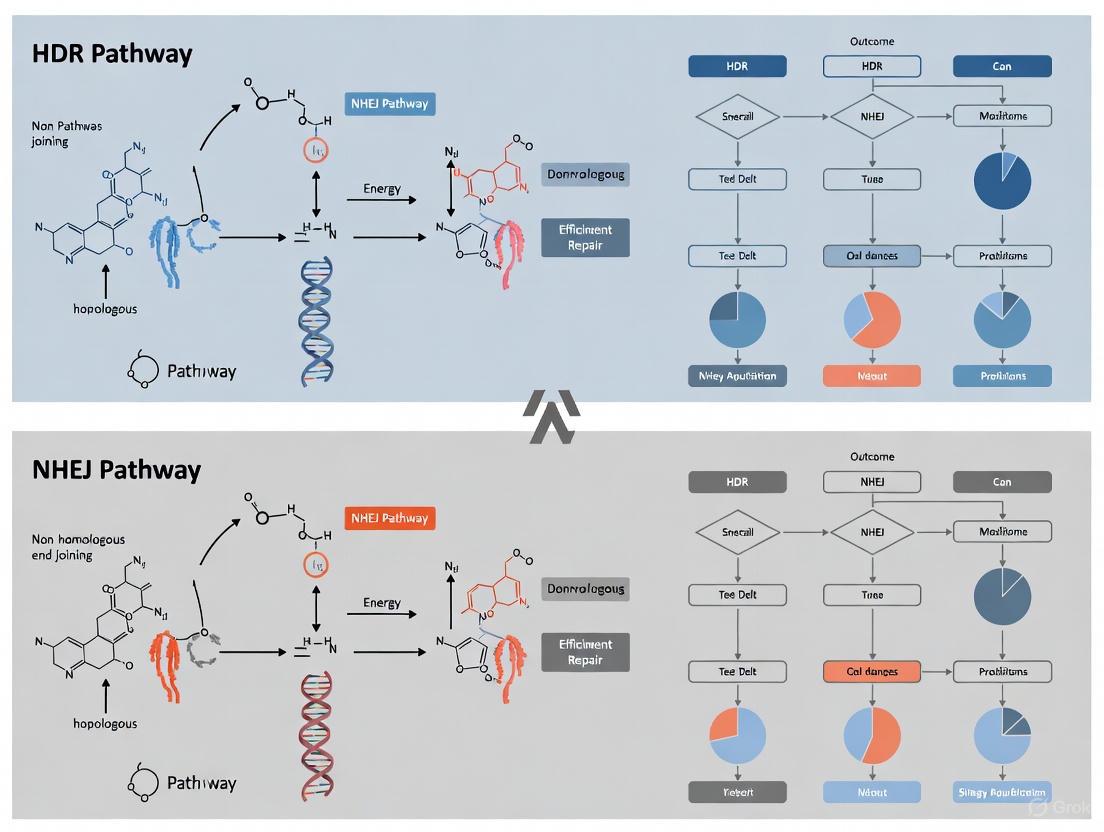
This comprehensive analysis explores the critical competition between Homology-Directed Repair (HDR) and Non-Homologous End Joining (NHEJ) in CRISPR-based genome editing.
HDR vs NHEJ: Mastering DNA Repair Pathway Efficiency for Advanced CRISPR Genome Editing
Abstract
This comprehensive analysis explores the critical competition between Homology-Directed Repair (HDR) and Non-Homologous End Joining (NHEJ) in CRISPR-based genome editing. Tailored for researchers, scientists, and drug development professionals, we dissect the fundamental mechanisms governing these DNA repair pathways, examine methodological applications across research and therapeutic contexts, detail cutting-edge optimization strategies to enhance HDR efficiency while mitigating NHEJ dominance, and provide validation frameworks for comparative analysis of editing outcomes. The article synthesizes recent breakthroughs including small molecule inhibitors, novel enhancer proteins, and combinatorial approaches that are reshaping precision genome engineering for both basic research and clinical translation.
Cellular First Responders: Understanding HDR and NHEJ Fundamental Mechanisms
The CRISPR-Cas9 system has revolutionized genetic research by providing unprecedented precision in genome editing, yet the technology itself represents only half the story. The ultimate success and safety of any CRISPR-based intervention depend critically on the cellular context—specifically, the DNA Damage Response (DDR) pathways that are activated when the Cas9 nuclease creates a double-strand break (DSB) in the DNA [1] [2]. When DNA damage occurs, a series of DDR pathways are activated to sense and fix the disrupted sequences, which are essential for maintaining genomic integrity across all organisms [1]. These endogenous repair mechanisms, not the CRISPR machinery itself, perform the actual genetic modification while joining the two cut ends, leading to either a knockout, precise point mutation, or knock-in [1] [2].
In mammalian cells, two dominant pathways compete to repair DSBs: the error-prone non-homologous end joining (NHEJ) and the precise homology-directed repair (HDR) [3]. The balance between these pathways—and the complex interplay with alternative repair mechanisms—determines both the efficiency and safety of genome editing outcomes. This comparison guide examines the cellular context of CRISPR editing through the lens of DNA damage response, providing researchers with experimental data and methodologies to navigate the complex decision-making process between HDR and NHEJ pathways for their specific applications.
DNA Repair Pathways: Mechanisms and Key Players
The choice between competing DNA repair pathways represents a critical juncture in CRISPR editing that directly influences experimental and therapeutic outcomes. The major pathways include:
Non-Homologous End Joining (NHEJ): An error-prone DNA repair pathway that rejoins broken DNA ends without requiring a homologous template [2]. This mechanism often leads to small insertions or deletions (indels), making it ideal for gene knockout studies [1] [2]. NHEJ is active throughout the cell cycle and is considered the default DSB repair pathway in mammalian cells due to its rapid activation [3].
Homology-Directed Repair (HDR): A precise DNA repair mechanism that utilizes homologous sequences to accurately repair DSBs [2]. Unlike NHEJ, HDR uses homologous regions from a sister chromatid or an exogenously supplied donor template as a blueprint for error-free repair [1]. HDR is restricted to the S and G2 phases of the cell cycle when homologous DNA is naturally available [3].
Alternative Pathways: Microhomology-mediated end joining (MMEJ) and single-strand annealing (SSA) represent additional error-prone repair pathways that contribute to complex editing outcomes [4]. MMEJ relies on the annealing of two microhomologous sequences (2–20 nt) flanking the broken junction, frequently resulting in deletions [4]. SSA utilizes Rad52-dependent annealing of longer homologous sequences for DSB repair and can result in deletions of intervening sequences between homologous regions [4].
Molecular Mechanisms of Pathway Choice
The decision between repair pathways initiates within seconds of DSB formation through a highly coordinated signaling cascade. Three PI3K-like kinases (PIKKs)—ATM, ATR, and DNA-PK—are activated first and phosphorylate H2AX to create γH2AX, which spreads throughout the area surrounding the breakage site [3]. Subsequent recruitment of E3 ubiquitin-protein ligases RNF8 and RNF168 creates recruitment platforms for key repair factors including 53BP1 and BRCA1, which facilitate NHEJ and HDR, respectively [3].
The critical step committing a DSB to HDR is 5'-to-3' resection of the DNA end to form a 3' single-stranded DNA overhang [3]. This process is initiated by the MRN (MRE11-RAD50-NBS1) complex, which recruits CtIP to begin resection [3]. The exonuclease Exo1 and Dna2/BLM complex then perform long-range DNA resection, resulting in a 3' ssDNA tail that is rapidly bound by replication protein A (RPA) [3]. With the assistance of recombination mediators including BRCA1, BRCA2, and PALB2, RPA is replaced by RAD51, which forms nucleoprotein filaments on the ssDNA that mediate homology search and strand invasion [3].
In contrast, NHEJ is initiated by the binding of Ku70-Ku80 heterodimer to blunt or near-blunt DNA ends, protecting them from resection and recruiting DNA-PKcs to form an active DNA-PK complex [5] [3]. This complex phosphorylates various substrates including Artemis, XRCC4, DNA ligase IV, and XLF, which promote end synapsis and facilitate recruitment of end-processing and ligation enzymes [3].
Diagram Title: DNA Repair Pathway Competition After CRISPR-Induced DSBs
Comparative Analysis of HDR and NHEJ Efficiency
Quantitative Assessment of Editing Outcomes
The relative efficiency of HDR versus NHEJ has been quantitatively assessed across multiple experimental systems. Recent studies investigating pathway manipulation through chemical inhibition provide robust comparative data.
Table 1: Comparative Efficiency of DNA Repair Pathways in CRISPR Editing
| Repair Pathway | Typical Efficiency Range | Key Determinants | Primary Outcomes | Optimal Cell Cycle Phase |
|---|---|---|---|---|
| NHEJ | 20-60% in human cells [3] | Ku70-Ku80 complex, DNA-PKcs activity | Indels (1-10 bp), gene knockouts | All phases [3] |
| HDR | 1-20% in human cells [3] | RAD51, MRN complex, donor template | Precise knock-ins, point mutations | S/G2 phases [3] |
| HDR with NHEJ inhibition | Up to 90.03% (median 74.81%) [6] | RAD51-enhanced donors, NHEJ inhibitors | Precise integration | S/G2 phases |
| MMEJ | Variable (increases with NHEJ inhibition) [4] | POLQ activity, microhomology regions | Large deletions, complex indels | Not well characterized |
| SSA | Variable (increases with NHEJ inhibition) [4] | Rad52 activity, homologous regions | Imprecise donor integration | Not well characterized |
Impact of Pathway Manipulation on Editing Outcomes
Strategic inhibition of specific repair pathways significantly alters the distribution of editing outcomes. A 2025 study comprehensively analyzed the effects of inhibiting three non-HDR pathways (NHEJ, MMEJ, and SSA) on knock-in efficiency in human non-transformed diploid RPE1 cells [4]. The findings demonstrate that NHEJ inhibition using Alt-R HDR Enhancer V2 increased knock-in efficiency by approximately 3-fold for both Cpf1-mediated knock-in at the HNRNPA1 locus (from 5.2% to 16.8%) and Cas9-mediated knock-in at the RAB11A locus (from 6.9% to 22.1%) [4]. However, even with effective NHEJ inhibition, perfect HDR events remained below 100% among all integration events, with imprecise integration accounting for nearly half of all integration events across all tested loci [4].
Inhibition of alternative pathways produced distinct effects: MMEJ suppression using the POLQ inhibitor ART558 significantly increased perfect HDR frequency while reducing large deletions (≥50 nt) and complex indels [4]. SSA inhibition via the Rad52 inhibitor D-I03 showed effects dependent on the nature of DNA cleavage ends and specifically reduced asymmetric HDR, where only one side of donor DNA is precisely integrated [4].
Advanced Strategies for Pathway Manipulation
HDR Enhancement Methodologies
Recent advances in HDR enhancement have focused on both small molecule interventions and engineered donor templates:
Small Molecule Inhibitors: Compounds such as DNA-PKcs inhibitors (e.g., M3814) and Alt-R HDR Enhancer V2 effectively suppress NHEJ, shifting the balance toward HDR [4] [6]. However, concerns have emerged about potential side effects, as DNA-PKcs inhibition (e.g., with AZD7648) has been associated with exacerbated genomic aberrations including kilobase- and megabase-scale deletions and increased off-target chromosomal translocations [7].
RAD51-Preferred ssDNA Donors: Engineering single-stranded DNA donors with RAD51-preferred binding sequences (e.g., SSO9 and SSO14 motifs) augments donor affinity for RAD51, enhancing HDR efficiency across various genomic loci and cell types [6]. When combined with NHEJ inhibition, this approach achieves remarkable HDR efficiencies ranging from 66.62% to 90.03% (median 74.81%) at endogenous sites [6].
Cell Cycle Synchronization: Since HDR is restricted to S and G2 phases, synchronization strategies that enrich for cells in these phases can improve HDR efficiency [3].
Combined Pathway Inhibition: Simultaneous suppression of multiple non-HDR pathways (NHEJ, MMEJ, and SSA) demonstrates additive effects in reducing imprecise integration and improving perfect HDR frequency [4].
Safety Considerations in Pathway Manipulation
The push for greater precision in genome editing must be balanced against emerging safety concerns. Beyond well-documented concerns of off-target mutagenesis, recent studies reveal a more pressing challenge: large structural variations (SVs), including chromosomal translocations and megabase-scale deletions [7]. These undervalued genomic alterations raise substantial safety concerns for clinical translation.
Notably, strategies aimed at optimizing gene editing outcomes may inadvertently introduce new risks. The use of DNA-PKcs inhibitors, while effective for promoting HDR, has been associated with increased frequencies of kilobase- and megabase-scale deletions as well as chromosomal arm losses across multiple human cell types and loci [7]. Furthermore, off-target profiles are markedly aggravated, with surveys of off-target-mediated chromosomal translocations revealing not only a qualitative rise in the number of translocation sites but also an alarming thousand-fold increase in the frequency of such SVs [7].
Whole genomic analyses using linked-read sequencing and optical genome mapping have identified unexpected large chromosomal deletions (91.2 and 136 Kb) at atypical non-homologous off-target sites without sequence similarity to the sgRNA in edited cell lines [8]. These findings highlight the necessity of comprehensive genomic integrity assessment after editing, particularly for clinical applications.
Experimental Protocols for Pathway Analysis
Comprehensive Assessment of Editing Outcomes
Protocol 1: Long-Range Amplicon Sequencing for Repair Pattern Analysis
Cell Editing and Sample Preparation: Electroporate cells with Cas9-RNP complexes and donor DNA, followed by treatment with specific pathway inhibitors (e.g., 24-hour treatment with NHEJi, ART558, or D-I03) [4].
PCR Amplification: Four days post-electroporation, extract genomic DNA and perform long-range PCR amplification of the target loci using high-fidelity DNA polymerases [4].
Library Preparation and Sequencing: Prepare sequencing libraries using the SMRTbell Express Template Prep Kit 2.0 and sequence on the PacBio Sequel II system to obtain HiFi reads [4].
Computational Genotyping: Analyze sequencing data using the knock-knock computational framework to categorize each read into specific repair outcomes: WT, indels, perfect HDR, or subtypes of imprecise integration [4].
Protocol 2: Whole Genomic Analysis for Structural Variant Detection
High Molecular Weight DNA Extraction: Prepare DNA consisting of long fragments (90-95% >20 Kb in length) from edited and control cell lines [8].
Linked-Read Sequencing: Perform 10x Genomics Linked-Reads sequencing with average mean depth of 50x, mapping reads to the reference genome (GRCh38) using Long Ranger software [8].
Structural Variant Detection: Use Long Ranger for SV detection and Loupe for visualization, comparing edited lines to parental controls to identify novel large SVs [8].
Optical Genome Mapping Validation: Perform independent validation using the Bionano Genomics Saphyr System to image long DNA molecules (up to 2.5 Mb) and confirm large SVs [8].
PCR Validation: Design primers flanking predicted breakpoints and perform PCR to confirm the existence of large SVs identified by sequencing and mapping [8].
The Scientist's Toolkit: Essential Research Reagents
Table 2: Key Research Reagents for DNA Repair Pathway Manipulation and Analysis
| Reagent Category | Specific Examples | Function/Application | Key Considerations |
|---|---|---|---|
| NHEJ Inhibitors | Alt-R HDR Enhancer V2, M3814 | Shifts repair balance toward HDR by suppressing dominant NHEJ pathway | May increase large structural variations [7] |
| MMEJ Inhibitors | ART558 (POLQ inhibitor) | Suppresses microhomology-mediated end joining | Reduces large deletions (≥50 nt) and complex indels [4] |
| SSA Inhibitors | D-I03 (Rad52 inhibitor) | Suppresses single-strand annealing pathway | Reduces asymmetric HDR and imprecise donor integration [4] |
| Enhanced Donor Templates | RAD51-preferred ssDNA donors (SSO9/SSO14 modules) | Increases donor recruitment to DSB sites via RAD51 binding | Chemical modification-free strategy; works with multiple editors [6] |
| Analysis Software | CRISPR-A, ICE, TIDE, knock-knock | Quantifies editing efficiency and characterizes repair patterns | CRISPR-A provides simulations and UMI-based error correction [9] |
| Long-Range Sequencing | PacBio HiFi reads, 10x Linked-Reads | Comprehensive detection of complex editing outcomes | Identifies large structural variations missed by short-read NGS [8] |
| Optical Mapping | Bionano Saphyr System | Validates large structural variants without sequencing | Detects variants up to 2.5 Mb; complements sequencing data [8] |
Diagram Title: Experimental Workflow for Comprehensive Editing Assessment
The cellular context of DNA damage response presents both challenges and opportunities for CRISPR-based genome editing. While HDR offers precision for therapeutic applications, its natural inefficiency compared to NHEJ requires sophisticated intervention strategies. The emerging toolkit for pathway manipulation—including small molecule inhibitors, engineered donor templates, and combined pathway suppression—enables unprecedented control over editing outcomes.
However, recent findings regarding unexpected large structural variants induced by CRISPR editing, particularly when using certain enhancement strategies, underscore the critical importance of comprehensive genomic assessment [7] [8]. The research community must balance the pursuit of editing efficiency with rigorous safety validation, employing whole-genome analysis methods like linked-read sequencing and optical mapping to detect potentially pathogenic structural variations that would be missed by conventional analysis methods.
For researchers navigating the complex decision between HDR and NHEJ strategies, the optimal approach depends on the specific application: NHEJ remains ideal for straightforward gene knockout studies where indels achieve the desired outcome, while HDR-based approaches are essential for precise gene correction or knock-in. When employing HDR enhancement strategies, particularly those involving pathway inhibition, comprehensive genomic integrity assessment using long-range analytical methods is strongly recommended to ensure the safety of the resulting edited cells, especially for clinical applications.
As the field advances, continued refinement of pathway-specific modulators and more sophisticated donor design strategies promise to further enhance the precision and safety of CRISPR genome editing, ultimately fulfilling its potential for both basic research and therapeutic applications.
In the landscape of CRISPR-Cas9 genome editing, the fate of a targeted double-strand break (DSB) is determined by the competition between two principal cellular repair pathways: the precise but inefficient homology-directed repair (HDR) and the rapid, error-prone non-homologous end joining (NHEJ). While HDR requires a template and is active primarily in the S/G2 phases of the cell cycle, NHEJ operates throughout the cell cycle, directly ligating broken DNA ends. This efficiency, however, comes at the cost of frequently introducing small insertions or deletions (indels) at the junction. For researchers aiming to disrupt gene function, NHEJ is the preferred mechanism, as these indels can effectively knockout a gene by disrupting its open reading frame. This guide provides a detailed, data-driven comparison of NHEJ's performance, its interplay with other pathways, and the experimental tools used to harness it.
The DNA Repair Landscape: Pathway Competition and Outcomes
When a CRISPR-Cas9 system induces a DSB, multiple repair pathways are activated. The outcome hinges on whether the DNA ends are resected (a process that favors homology-based repair) or protected (favoring NHEJ) [10]. Proteins such as 53BP1 and the Shieldin complex stabilize DNA ends against resection, promoting NHEJ. In contrast, BRCA1 and CtIP promote resection, facilitating HDR and other alternative pathways [10].
The following diagram illustrates the critical decision points after a DSB is generated and the subsequent repair pathways that can be engaged.
Beyond NHEJ and HDR, two other resection-dependent pathways contribute to DSB repair: microhomology-mediated end joining (MMEJ), which relies on short homologous sequences (2-20 nt) and is mediated by DNA polymerase theta (Pol θ), and single-strand annealing (SSA), which requires longer homologous sequences (>20 nt) and is mediated by RAD52 [4] [10]. Both MMEJ and SSA typically result in deletions and are considered error-prone. Even when NHEJ is inhibited, these alternative pathways can still lead to substantial imprecise repair, accounting for nearly half of all integration events in some knock-in experiments [4].
Quantitative Performance: NHEJ Efficiency and Accuracy
NHEJ is the dominant DSB repair pathway in mammalian cells. Its efficiency and the nature of its errors are critical for successful gene disruption experiments.
NHEJ Editing Efficiency
Studies have quantified the efficiency of NHEJ-mediated gene knockout and identified small molecules that can enhance it. The table below summarizes the performance of several such compounds in porcine PK15 cells.
Table 1: Enhancement of CRISPR NHEJ Editing Efficiency by Small Molecules
| Small Molecule | Primary Target | Delivery System | Fold Increase in NHEJ Efficiency |
|---|---|---|---|
| Repsox | TGF-β Pathway | RNP | 3.16-fold |
| Repsox | TGF-β Pathway | Plasmid | 1.47-fold |
| Zidovudine (AZT) | Thymidine Analog | RNP | 1.17-fold |
| GSK-J4 | Histone Demethylase | RNP | 1.16-fold |
| IOX1 | Histone Demethylase | RNP | 1.12-fold |
| YU238259 | Homologous Recombination | RNP | No benefit |
| GW843682X | PLK1 | RNP | No benefit |
Data derived from [11]. RNP: Ribonucleoprotein delivery system.
Repsox, a TGF-β signaling inhibitor, demonstrated the most significant enhancement. Its mechanism of action involves reducing the expression levels of SMAD2, SMAD3, and SMAD4 in the TGF-β pathway, thereby increasing NHEJ-mediated gene editing efficiency [11]. Furthermore, Repsox was shown to improve the efficiency of multi-gene editing using a CRISPR sgRNA-tRNA array.
NHEJ Repair Accuracy
While "error-prone" is a defining characteristic of NHEJ, the degree of accuracy is not uniform. Research analyzing the repair of endogenous genes in human cells has found that NHEJ accuracy is sequence-dependent and asymmetric.
One study introduced exogenous double-stranded oligodeoxynucleotides (dsODNs) into DSB sites to mark cleaved DNA and prevent re-cleavage by Cas9, allowing for accurate measurement. The analysis of 29 target sites revealed [12]:
- The average NHEJ accuracy was approximately 75% at its maximum in HEK 293T cells.
- Accuracy was significantly higher at the DSB end distal to the Protospacer Adjacent Motif (PAM) compared to the end proximal to the PAM.
- This accuracy was governed by the target sequences themselves, not by the gene type or genomic location of the DSB [12].
This asymmetric fidelity is likely influenced by the asymmetric nature of Cas9 cutting, where one DNA strand is cleaved before the other [10].
Beyond Indels: The Hidden Risks of Large-Scale Structural Variations
A critical advancement in the field has been the recognition that CRISPR-Cas9 editing, including NHEJ-based strategies, can induce genetic damage far beyond small indels. These structural variations (SVs), which include kilobase- to megabase-scale deletions, chromosomal arm losses, and translocations, have traditionally been underestimated because they are invisible to standard short-read amplicon sequencing [7] [13].
Worryingly, strategies designed to enhance HDR by inhibiting key NHEJ factors can severely aggravate these risks. The DNA-PKcs inhibitor AZD7648, for example, while effective at increasing HDR rates, has been shown to cause frequent large-scale genomic alterations [13].
Table 2: Impact of DNA-PKcs Inhibitor AZD7648 on Large-Scale Genomic Alterations
| Cell Type | Editing Locus | Large Deletion Frequency with AZD7648 | Other Large-Scale Alterations |
|---|---|---|---|
| RPE-1 p53-null | GAPDH | 43.3% of reads | Kilobyte-scale deletions increased 2.0 to 35.7-fold depending on locus |
| Human CD34+ HSPCs (Donors) | Three target loci | 1.2-fold to 4.3-fold increase | - |
| K-562 (clonal) | -1.3 Mb from eGFP site | - | Up to 33% of cells lost eGFP; evidence of chromosome arm loss |
| Upper Airway Organoids | GAPDH 3' UTR | - | 47.8% of cells showed gene expression loss consistent with chromosome arm loss |
| Human HSPCs | GAPDH 3' UTR | - | 22.5% of cells showed gene expression loss consistent with chromosome arm loss |
Data compiled from [13].
These findings underscore a critical trade-off: suppressing NHEJ to favor HDR can shift the spectrum of errors from small indels to large, potentially hazardous SVs. This has profound implications for the safety of therapeutic genome editing, as large deletions could eliminate tumor suppressor genes or disrupt essential regulatory elements [7].
The Scientist's Toolkit: Essential Reagents and Protocols
Research Reagent Solutions
The following table lists key reagents and their functions as identified in recent research for modulating and studying NHEJ.
Table 3: Key Reagents for NHEJ and DNA Repair Pathway Research
| Reagent / Molecule | Function / Target | Key Finding or Use Case |
|---|---|---|
| Repsox | TGF-β signaling inhibitor | Enhanced NHEJ-mediated editing 3.16-fold in porcine cells; most effective of tested compounds [11] |
| Alt-R HDR Enhancer V2 | NHEJ pathway inhibitor | Potent NHEJi; increased knock-in efficiency ~3-fold in RPE1 cells [4] |
| ART558 | POLQ (MMEJ pathway) inhibitor | Reduced large deletions and complex indels; increased perfect HDR frequency [4] |
| D-I03 | Rad52 (SSA pathway) inhibitor | Reduced asymmetric HDR and other imprecise donor integration events [4] |
| AZD7648 | DNA-PKcs inhibitor | Significantly boosts HDR but causes frequent kilobase/megabase deletions and chromosomal translocations [13] |
| Exogenous dsODN | NHEJ accuracy reporter | Integrated into DSB to prevent re-cleavage; enables precise measurement of NHEJ repair fidelity [12] |
| Alt-R HDR Enhancer Protein | Protein-based HDR enhancer | IDT's proprietary protein; reported 2-fold HDR increase in iPSCs/HSPCs without increased off-target edits [14] |
Experimental Protocol: Quantifying NHEJ Accuracy
For researchers seeking to directly measure NHEJ accuracy at an endogenous genomic locus, the following protocol, adapted from [12], provides a robust methodology.
Objective: To quantify the fidelity of NHEJ-mediated repair at a specific Cas9-induced DSB in human cells.
Key Materials:
- Plasmids: Encoding Cas9 nuclease and your target-specific sgRNA.
- Exogenous dsODN: 34 bp in length, with phosphorothioate modifications at both 3' and 5' ends to resist nuclease degradation.
- Cells: Relevant human cell line (e.g., HEK 293T, HeLa).
- Sequencing Platform: For high-throughput amplicon sequencing.
Procedure:
- Co-transfection: Co-deliver the Cas9/sgRNA plasmids and the exogenous dsODN into your cells via electroporation.
- Genomic DNA Extraction: Harvest cells 48-72 hours post-transfection and extract genomic DNA.
- Target Amplification: Perform PCR to amplify the genomic region surrounding the target site.
- High-Throughput Sequencing: Sequence the resulting amplicons.
- Data Analysis:
- Allele Selection: Bioinformatically isolate sequencing reads that contain the inserted dsODN sequence.
- Accuracy Assessment: For each dsODN-containing read, examine the junctions between the genomic DNA and the inserted dsODN at both the PAM-distal and PAM-proximal ends.
- Calculation: Classify a repair as 'accurate' if there are no indels at either junction. Calculate NHEJ accuracy for each end using the formula:
('accurate' repair frequency) / (total dsODN-integrated repair frequency).
- Allele Selection: Bioinformatically isolate sequencing reads that contain the inserted dsODN sequence.
Workflow Visualization:
NHEJ remains the cornerstone for efficient gene disruption in CRISPR-based applications. Its dominance in the cell cycle and the ability to enhance its efficiency with molecules like Repsox make it a powerful tool. However, a comprehensive understanding of its error-prone nature is no longer limited to small indels. The discovery of pervasive, large-scale structural variations, exacerbated by certain pathway-modulating chemicals, demands a reassessment of editing outcomes. For the field to advance, especially toward therapeutic applications, robust and standardized assays—including long-read sequencing and translocation-specific screens—are non-negotiable for quantifying the full spectrum of NHEJ's consequences. Balancing the raw efficiency of NHEJ with the newly appreciated scale of its risks is the critical challenge facing researchers and drug developers today.
The maintenance of genomic integrity is a fundamental cellular process, with DNA double-strand breaks (DSBs) representing one of the most cytotoxic DNA lesions. Cells employ several distinct pathways to repair these breaks, chief among them being non-homologous end joining (NHEJ) and homology-directed repair (HDR). While NHEJ functions as a rapid, first-line response that ligates broken ends together with minimal regard for sequence fidelity, HDR operates as a precision template-driven mechanism that restores DNA sequences with high fidelity. This mechanistic distinction places HDR at the center of advanced genome editing applications where accuracy is paramount.
HDR's unique capability stems from its requirement for a homologous DNA template to guide the repair process. This template can be supplied endogenously from a sister chromatid or exogenously by researchers introducing a donor DNA molecule containing desired modifications flanked by homologous regions. The pathway is most active during the S and G2 phases of the cell cycle when homologous templates are naturally available, contrasting with NHEJ which operates throughout all cell cycle phases [10] [15]. This cell cycle dependency, while contributing to HDR's lower efficiency relative to NHEJ in many contexts, ensures its unparalleled precision in genetic restoration.
The critical importance of HDR extends beyond laboratory applications to fundamental biology. As a cancer suppression mechanism, HDR maintains genomic stability by accurately repairing broken DNA strands, preventing the accumulation of mutations that could lead to oncogenic transformation [16]. When DSBs are repaired by error-prone pathways like NHEJ without a validating template, novel DNA sequences may form with potential loss of genetic information, potentially disrupting normal cellular function and regulation [16].
Comparative Analysis of DSB Repair Pathways
Mechanism and Key Players
The functional specialization of DNA double-strand break repair pathways arises from their distinct molecular mechanisms and protein components. Understanding these differences is essential for selecting the appropriate pathway for specific genome editing applications.
Table 1: Core Characteristics of Major DSB Repair Pathways
| Feature | HDR (Homology-Directed Repair) | NHEJ (Non-Homologous End Joining) | MMEJ (Microhomology-Mediated End Joining) | SSA (Single-Strand Annealing) |
|---|---|---|---|---|
| Template Requirement | Requires homologous template (endogenous or exogenous) | No template required | Uses microhomology regions (2-20 nt) flanking the break | Requires long homologous repeats (>20 nt) flanking the break |
| Key Protein Factors | RAD51, BRCA2, MRN complex, RPA | Ku70/80, DNA-PKcs, XRCC4, Ligase IV | POLθ (Pol theta), PARP1 | RAD52, EXO1, DNA2 |
| Fidelity | High fidelity, precise repair | Error-prone, often creates indels | Mutagenic, creates deletions | Mutagenic, deletes intervening sequence |
| Cell Cycle Phase | S and G2 phases | Active throughout cell cycle | Not well characterized | Not well characterized |
| Repair Outcome | Precise gene correction, insertions | Small insertions/deletions (indels) | Moderate-to-large deletions | Large deletions |
| Primary Applications | Precise gene editing, knock-ins | Gene knockouts, random mutagenesis | - | - |
HDR employs a sophisticated multi-step mechanism that begins with 5'→3' end resection by the MRN complex (MRE11-RAD50-NBS1) in cooperation with CtIP, generating short 3' single-stranded overhangs [10]. Long-range resection by Exo1 and the Dna2/BLM helicase complex then extends these 3' ssDNA tails, which are promptly protected by replication protein A (RPA) to prevent secondary structure formation [10]. The central recombinase RAD51, facilitated by BRCA2, then displaces RPA and forms nucleoprotein filaments that perform a homology search, ultimately leading to strand invasion and formation of a displacement loop (D-loop) that uses the homologous template to guide precise repair [10] [16].
In contrast, NHEJ initiates when the Ku70/80 heterodimer rapidly recognizes and binds to broken DNA ends, forming a recruitment hub for downstream factors including DNA-PKcs [17]. This complex aligns the damaged ends, with various processing enzymes (nucleases, polymerases) modifying the ends as needed before the XRCC4-DNA ligase IV complex performs final ligation [10] [17]. The flexibility of NHEJ in joining diverse end configurations comes at the cost of frequent small insertions or deletions (indels) at the repair junction [17].
Alternative pathways like MMEJ and SSA operate as auxiliary repair mechanisms. MMEJ relies on microhomology regions (2-20 nucleotides) flanking the DSB, with DNA polymerase theta (Pol θ) mediating the annealing of these microhomologous sequences, typically resulting in deletions of the intervening sequence [4] [10]. SSA requires more extensive resection to expose longer homologous sequences (>20 nucleotides) that are annealed by RAD52, invariably deleting the sequence between the repeats [4] [10] [18].
Quantitative Efficiency and Outcome Analysis
The practical application of genome editing technologies requires understanding the relative efficiencies and outcomes of different repair pathways. Recent studies have quantified these parameters under various experimental conditions.
Table 2: Quantitative Efficiency Comparison of DSB Repair Pathways in CRISPR-Mediated Editing
| Experimental Condition | HDR Efficiency | NHEJ Efficiency | Alternative Repair Outcomes | Study Model |
|---|---|---|---|---|
| Standard Conditions | 5-20% | 40-60% | MMEJ: 10-15%\nSSA: 5-10%\nOther: 5-10% | Human RPE1 cells [4] |
| With NHEJ Inhibition | 16.8-22.1% | Significantly reduced | MMEJ and SSA become more prominent | hTERT-immortalized RPE1 [4] |
| With NHEJ+SSA Inhibition | Increased perfect HDR | Reduced | Reduced asymmetric HDR and imprecise integration | Human non-transformed diploid cells [4] |
| In Filamentous Fungi (A. niger) | 91.4% integration rate | - | Mixed-type repair (NHEJ+HDR): 20.3% | Aspergillus niger [19] |
| With ssDNA Donors + HDR Enhancement | Up to 30% | Corresponding decrease | - | Human iPSCs [20] |
The data reveal that under standard conditions, NHEJ dominates DSB repair outcomes, with HDR typically accounting for a minority of repair events. However, strategic inhibition of competing pathways can significantly shift this balance. For instance, suppression of the NHEJ pathway using inhibitors such as Alt-R HDR Enhancer V2 increased HDR efficiency approximately 3-fold in human cell lines, from 5.2% to 16.8% for Cpf1-mediated knock-in and from 6.9% to 22.1% for Cas9-mediated knock-in [4]. Importantly, even with NHEJ inhibition, perfect HDR events may still account for less than half of all integration events, as alternative pathways like MMEJ and SSA become more prominent [4].
Recent research has revealed more complex repair outcomes, including mixed-type repair (MTR) events where a single DSB is simultaneously repaired by different pathways on each side of the break. In Aspergillus niger, while HDR-based gene integration achieved a remarkable 91.4% success rate, 20.3% of transformants exhibited MTR with donor DNA integrated by NHEJ at the 3' end and HDR at the 5' end of the DSB [19]. This finding demonstrates the dynamic competition between repair pathways and challenges the traditional view of mutually exclusive pathway engagement.
The choice between HDR and NHEJ has profound implications for therapeutic applications. While NHEJ is highly efficient and often exploited for gene disruption strategies, its error-prone nature limits utility for applications requiring precision [10]. HDR, though less efficient under many conditions, remains indispensable for precise genetic corrections, particularly for larger or more complex alterations [10] [20].
Experimental Approaches and Methodologies
Standardized Protocols for HDR Evaluation
Robust experimental methodologies are essential for accurately assessing HDR efficiency and comparing outcomes across different systems. The following protocol represents a standardized approach for quantifying HDR in mammalian cell systems, derived from recent high-impact studies.
Cell Culture and Preparation:
- Utilize human non-transformed diploid cell lines (e.g., hTERT-immortalized RPE1) maintained under standard conditions [4].
- For HDR-based editing, synchronize cells in S/G2 phase to maximize HDR efficiency, as HDR is restricted to these cell cycle phases while NHEJ operates throughout the cycle [10].
CRISPR-Cas9 RNP Complex Formation:
- Prepare recombinant Cas nucleases (Cas9 or Cpf1) and in vitro transcribed guide RNAs.
- Form ribonucleoprotein (RNP) complexes by mixing Cas nuclease with guide RNA at optimal molar ratios [4].
Donor DNA Template Design:
- For knock-in experiments, design donor DNA containing the desired insertion flanked by homology arms (90 base pairs each in referenced studies) [4].
- Consider single-stranded DNA (ssDNA) donors approximately 120 nucleotides in length with homology arms of at least 40 bases for optimal HDR efficiency [20].
- Alternatively, use "double-cut" donors flanked by sgRNA-PAM sequences to synchronize the availability of DSBs at both the genomic target and donor templates, increasing HDR efficiency up to 10-fold [20] [15].
Cell Transfection and Pathway Modulation:
- Electroporate RNP complexes along with donor DNA into cells [4].
- Immediately after electroporation, treat cells with specific pathway inhibitors for 24 hours: NHEJ inhibitors (e.g., Alt-R HDR Enhancer V2), MMEJ inhibitors (e.g., ART558 targeting POLQ), or SSA inhibitors (e.g., D-I03 targeting Rad52) [4].
Analysis and Validation:
- Four days post-transfection, analyze knock-in efficiency using flow cytometry for fluorescent protein tags [4].
- For comprehensive repair pattern analysis, perform long-read amplicon sequencing (PacBio) of target loci followed by genotyping using computational frameworks like knock-knock [4].
- Categorize sequencing reads into specific repair outcomes: WT, indels, perfect HDR, or subtypes of imprecise integration [4].
Research Reagent Solutions
The following essential reagents represent key tools for studying HDR mechanisms and optimizing precise genome editing applications.
Table 3: Essential Research Reagents for HDR Studies
| Reagent Category | Specific Examples | Function/Application | Experimental Notes |
|---|---|---|---|
| NHEJ Inhibitors | Alt-R HDR Enhancer V2 | Suppresses dominant NHEJ pathway to enhance HDR efficiency | Increases HDR efficiency ~3-fold; treatment duration typically 24h [4] |
| MMEJ Inhibitors | ART558 | Inhibits POLQ, key effector of MMEJ pathway | Reduces large deletions (≥50 nt) and complex indels [4] |
| SSA Inhibitors | D-I03 | Targets Rad52, essential for SSA pathway | Reduces asymmetric HDR and imprecise donor integration [4] |
| HDR Enhancers | RS-1 (RAD51 stimulator) | Enhances RAD51 nucleoprotein filament formation | Improves strand invasion efficiency [20] |
| ssDNA Donors | 120nt single-stranded oligodeoxynucleotides | Template for precise HDR-mediated editing | Optimal length ~120nt; homology arms ≥40bp; phosphorothioate modifications improve stability [20] |
| Cell Synchronization Agents | Nocodazole, Aphidicolin | Arrest cells in HDR-permissive phases (S/G2) | Critical for maximizing HDR in primary cells [10] |
| DNA-PKcs Inhibitors | M3814 | Suppresses NHEJ by inhibiting DNA-PKcs activity | Enhances HDR in primary cells using hybrid ssDNA templates [20] |
Recent Advances and Strategic Applications
Emerging Insights into Pathway Interplay
Traditional models of DSB repair portrayed competing pathways operating in isolation, but recent evidence reveals unexpected complexity in their interactions. A 2024 study demonstrated that mixed-type repair mechanisms can simultaneously engage different pathways at a single DSB, challenging conventional understanding of pathway exclusivity [19]. This finding has profound implications for designing editing strategies, as it suggests that combined pathway inhibition may be necessary to achieve optimal HDR outcomes.
The competition between repair pathways begins immediately after DSB formation, with the balance influenced by multiple factors including the cell cycle phase, chromatin context, and DNA end configuration [10] [17]. The initial decision between resection (favoring HDR) versus protection from resection (favoring NHEJ) represents a critical control point mediated by opposing factors such as the anti-resection NHEJ factor Ku versus the resection initiator MRN complex [17]. Beyond 53BP1 and BRCA1, recent research has identified additional regulatory complexes like Shieldin that protect DNA ends from resection, thereby influencing pathway choice [17].
Novel reporter systems have enabled more precise characterization of specific imprecise integration patterns, particularly asymmetric HDR where only one side of donor DNA integrates precisely while the other does not [4]. These tools reveal that SSA suppression significantly reduces asymmetric HDR events, providing strategic approaches for improving perfect HDR efficiency [4].
Strategic Applications in Research and Therapeutics
The precision of HDR makes it indispensable for both basic research and therapeutic applications. In disease modeling, HDR enables creation of specific point mutations found in human genetic disorders, facilitating study of pathogenetic mechanisms [20] [15]. For example, researchers have successfully introduced single-nucleotide substitutions associated with amyotrophic lateral sclerosis (ALS) in zebrafish models using ssODN donors via HDR [15].
HDR-mediated gene cassette insertion allows introduction of reporter genes (e.g., fluorescent tags) for protein localization studies and functional analysis in native contexts [4] [1]. This application is particularly valuable for endogenous protein tagging, where CRISPR/Cas-mediated knock-in introduces sequences encoding peptides or protein tags into genes of interest [4].
Therapeutic genome editing represents the most promising application of HDR technology. Unlike NHEJ-based approaches primarily suited for gene disruption, HDR enables precise correction of pathogenic mutations underlying genetic diseases [20] [15]. Recent advances have demonstrated the feasibility of HDR in challenging therapeutic contexts, including postmitotic cardiomyocytes and terminally differentiated skeletal myofibers, suggesting that HDR may not strictly require cell replication as traditionally believed [15].
For large therapeutic transgenes, double-cut HDR donors flanked by sgRNA target sequences have shown significantly improved integration efficiency [20] [15]. In human induced pluripotent stem cells (iPSCs), this approach achieves 20-30% HDR-mediated knock-in efficiency with 300-600bp homology arms, while in K562 cells, efficiencies exceeding 50% have been reported [15].
HDR represents the gold standard for precision in DNA repair mechanisms, offering template-driven restoration of genetic information with unparalleled fidelity. While its natural efficiency is limited by cell cycle constraints and competition with faster, error-prone pathways like NHEJ, strategic modulation through pathway inhibition and donor optimization can significantly enhance HDR outcomes. The emerging understanding of complex pathway interactions, including mixed-type repair mechanisms, provides new opportunities for improving precise genome editing. As research continues to unravel the sophisticated regulation of DNA repair pathways, HDR-based approaches will remain essential for both basic research and therapeutic applications requiring nucleotide-level precision.
In CRISPR/Cas9-mediated genome editing, the introduction of a double-strand break (DSB) is only the initial step. The ultimate editing outcome is predominantly determined by the cellular DNA repair machinery, which orchestrates a complex decision-making process to resolve the DNA lesion [21] [22]. Mammalian cells possess several conserved DSB repair pathways, primarily categorized into the error-prone non-homologous end joining (NHEJ) and the high-fidelity homology-directed repair (HDR) [23] [1]. The competition between these pathways—where NHEJ is typically the "road more traveled" and HDR the "road less traveled"—fundamentally influences the efficiency and precision of genome editing outcomes [23]. Understanding the molecular determinants that govern this pathway choice is crucial for advancing both basic research and therapeutic applications, enabling researchers to strategically bias repair toward their desired outcome.
DNA Repair Pathways at a Glance
The following table summarizes the core characteristics of the major DNA double-strand break repair pathways.
Table 1: Comparison of Major DNA Double-Strand Break Repair Pathways
| Feature | Non-Homologous End Joining (NHEJ) | Homology-Directed Repair (HDR) | Microhomology-Mediated End Joining (MMEJ) |
|---|---|---|---|
| Template Required | None | Homologous donor template (e.g., sister chromatid, exogenous DNA) | No homologous donor; uses microhomology regions |
| Primary Key Players | Ku70/Ku80, DNA-PKcs, XRCC4, DNA Ligase IV | MRN Complex, CtIP, RPA, RAD51, BRCA1/BRCA2 | PARP1, Pol θ (POLQ), MRN Complex |
| Cell Cycle Activity | Active throughout all phases (G1, S, G2) [22] | Primarily restricted to S and G2 phases [23] [22] | Favored in S and G2 phases [23] |
| Fidelity | Error-prone, often results in small insertions or deletions (indels) [21] [1] | High-fidelity, enables precise edits [21] [1] | Error-prone, typically results in deletions [21] [4] |
| Primary Application in Gene Editing | Ideal for gene knockouts [1] | Essential for precise knockins, point mutations, and gene corrections [1] [20] | Can influence knock-in efficiency; its inhibition can improve HDR precision [4] [24] |
| Speed | Fast [22] | Slow [22] | - |
Molecular Mechanisms of Pathway Competition
The cellular decision to repair a DSB via NHEJ or HDR is not arbitrary but is governed by a controlled balance of opposing molecular forces. The pivotal event in this pathway choice is the initiation of 5'-to-3' end resection, a process that commits the break to the HDR pathway and simultaneously inhibits NHEJ [21] [22].
The NHEJ-Promoting Axis
NHEJ is the default and dominant pathway in most mammalian cells. Within seconds of a DSB, the Ku70-Ku80 heterodimer recognizes and binds to the broken DNA ends, forming a protective cap [21] [23]. This binding recruits DNA-PKcs, which phosphorylates downstream targets and facilitates the alignment of the broken ends [21] [22]. The complex then recruits proteins like Artemis for end-processing and finally, the XRCC4-DNA Ligase IV complex to ligate the ends together [21] [23]. This pathway is actively suppressed by proteins such as 53BP1 and the Shieldin complex, which protect the DNA ends from resection, thereby safeguarding the break for NHEJ and effectively inhibiting the HDR pathway [21].
The HDR-Promoting Axis
The commitment to HDR begins when the MRN complex (MRE11-RAD50-NBS1), along with CtIP, initiates limited end resection at the break [21] [22]. This process is then extended by nucleases like Exo1 and the Dna2/BLM helicase complex to generate long 3' single-stranded DNA (ssDNA) overhangs [21] [22]. The ssDNA is rapidly coated by Replication Protein A (RPA). With the assistance of mediators like BRCA1 and PALB2, RPA is replaced by RAD51, which forms a nucleoprotein filament that performs the critical steps of homology search and strand invasion into a homologous template (e.g., a sister chromatid or an exogenous donor) [21] [23]. The BRCA1 protein plays a key role in promoting this resection step, directly opposing the action of 53BP1 [21] [22].
The following diagram illustrates the critical early competition between the NHEJ and HDR pathways at a Cas9-induced double-strand break.
Quantitative Data on Pathway Manipulation
Experimental strategies to bias repair toward HDR have yielded significant quantitative improvements. The data below summarize the efficacy of different pharmacological and molecular interventions.
Table 2: Experimental Strategies and Efficiencies in Enhancing HDR
| Strategy Category | Specific Intervention/Target | Experimental Model | Reported Effect on HDR Efficiency | Key Findings |
|---|---|---|---|---|
| NHEJ Inhibition | Alt-R HDR Enhancer V2 (NHEJi) [4] | Human RPE1 cells | ~3-fold increase (e.g., 5.2% to 16.8% at a specific locus) [4] | Significantly increases perfect HDR frequency and reduces small indels [4]. |
| NHEJ Inhibition | AZD7648 (DNA-PKcs inhibitor) [24] | Mouse embryos | Part of a strategy achieving up to 90% knock-in efficiency [24] | Shifts DSB repair from NHEJ toward MMEJ; works synergistically with Polq knockdown [24]. |
| MMEJ/SSA Inhibition | ART558 (POLQ inhibitor) [4] | Human RPE1 cells | Significant increase in perfect HDR frequency [4] | Reduces large deletions and complex indels, enhancing precision [4]. |
| MMEJ/SSA Inhibition | D-I03 (Rad52 inhibitor) [4] | Human RPE1 cells | Reduced imprecise donor integration (e.g., asymmetric HDR) [4] | Suppressing SSA pathway improves the accuracy of integration [4]. |
| Donor Engineering | HDR-boosting modular ssDNA donor (RAD51-preferred sequences) [6] | HEK 293T cells | Up to 90.03% (median 74.81%) when combined with NHEJ inhibition [6] | Augments donor affinity for RAD51; a chemical modification-free strategy [6]. |
| Combined Inhibition | ChemiCATI (AZD7648 + Polq knockdown) [24] | Mouse embryos | Up to 90% knock-in efficiency across >10 loci [24] | Universal strategy effective for both NHEJ-biased and MMEJ-biased sgRNAs [24]. |
Detailed Experimental Protocols
To provide practical guidance, this section outlines key methodologies cited in the research for manipulating repair pathways and assessing outcomes.
Protocol: Enhancing HDR via Combined Pathway Inhibition
This protocol, adapted from studies achieving high knock-in efficiency in mouse embryos, uses pharmacological inhibition to shift the repair balance [24].
- sgRNA and Donor Design: Design sgRNAs and homologous donor DNA as per standard protocols. Note that sgRNAs with inherent MMEJ-biased repair patterns may show higher baseline HDR efficiency.
- Preparation of Editing Components: Formulate ribonucleoprotein (RNP) complexes by pre-complexing Cas9 protein with sgRNA.
- Co-delivery and Inhibition: Co-deliver the RNP complexes and donor DNA into the target cells (e.g., via electroporation or microinjection). Immediately after delivery, treat the cells with a combination of inhibitors:
- AZD7648: A potent DNA-PKcs inhibitor to suppress NHEJ.
- Polq Knockdown: Use siRNA or shRNA to deplete DNA polymerase theta (POLQ) and suppress the MMEJ pathway.
- Inhibitor Duration: Maintain the inhibitor treatment for a defined period, typically 24 hours, based on the timeframe during which HDR primarily occurs post-DSB induction [4].
- Analysis: After a suitable recovery period (e.g., 4 days), analyze editing outcomes using flow cytometry for knock-in efficiency and long-read amplicon sequencing (e.g., PacBio) for precise genotyping of repair patterns.
Protocol: Assessing Repair Outcomes with Long-Read Amplicon Sequencing
This methodology is critical for quantitatively evaluating the complex mixture of repair products resulting from CRISPR/Cas9 editing [4].
- Genomic DNA Extraction: Harvest edited cells and extract high-quality genomic DNA.
- Target Amplification: Design primers flanking the target site and perform PCR to generate amplicons covering the edited locus.
- Library Preparation and Sequencing: Prepare a sequencing library from the purified amplicons and subject it to long-read sequencing on a platform such as PacBio, which provides high-fidelity (Hi-Fi) reads.
- Computational Genotyping: Process the sequencing reads using a specialized computational framework like "knock-knock" [4]. This pipeline classifies each read into specific outcome categories:
- Wild-type sequence
- Indels (NHEJ/MMEJ)
- Perfect HDR
- Imprecise integration events (e.g., partial donor integration, asymmetric HDR)
- Data Interpretation: Quantify the frequency of each repair outcome to determine the effectiveness of different experimental conditions in biasing the pathway choice.
The following workflow visualizes the key steps in this detailed analytical protocol.
The Scientist's Toolkit: Key Research Reagents
Successfully manipulating DNA repair pathways requires a suite of specific reagents. The table below catalogues essential tools used in the featured research.
Table 3: Key Reagents for DNA Repair Pathway Research
| Reagent Name | Category | Molecular Target/Function | Key Application in Research |
|---|---|---|---|
| Alt-R HDR Enhancer V2 [4] | Small Molecule Inhibitor | NHEJ Pathway | Used to suppress the dominant NHEJ pathway, thereby increasing the relative frequency of HDR-mediated editing in human cells [4]. |
| AZD7648 [24] | Small Molecule Inhibitor | DNA-PKcs (NHEJ) | A potent and selective DNA-PKcs inhibitor used to shift DSB repair from NHEJ toward MMEJ/HDR, particularly in mouse embryo models [24]. |
| M3814 (Peposertib) [6] [24] | Small Molecule Inhibitor | DNA-PKcs (NHEJ) | Another well-characterized DNA-PKcs inhibitor used in combination with donor engineering to achieve very high HDR efficiencies (>90%) [6]. |
| ART558 [4] | Small Molecule Inhibitor | DNA Polymerase Theta (POLQ) | Inhibits the key enzyme of the MMEJ pathway. Its use reduces large deletions and complex indels, enhancing the proportion of precise HDR events [4]. |
| D-I03 [4] | Small Molecule Inhibitor | Rad52 (SSA Pathway) | Suppresses the single-strand annealing (SSA) pathway. Its application reduces imprecise donor integration events, improving the accuracy of knock-in [4]. |
| HDR-Boosting Modular ssDNA Donor [6] | Engineered Donor | RAD51 | ssDNA donors engineered with RAD51-preferred binding sequences (e.g., containing "TCCCC" motifs). These modules enhance donor recruitment to DSBs, boosting HDR without chemical modifications [6]. |
| Cas9 Nickase (nCas9) [20] | Engineered Nuclease | DNA (single-strand break) | A Cas9 variant that cuts only one DNA strand. Used in base editing and can be part of strategies to reduce indels and favor HDR-compatible repair [20]. |
The competition between NHEJ and HDR is a decisive factor in genome editing. The prevailing pathway is determined by a molecular tug-of-war centered on the initiation of DNA end resection, governed by the antagonistic actions of proteins like 53BP1 and BRCA1 [21] [22]. While NHEJ is the default and dominant pathway, strategic interventions can effectively tilt the balance toward HDR. As evidenced by the quantitative data, combining multiple approaches—such as simultaneously inhibiting NHEJ and MMEJ/SSA pathways or engineering donor templates to enhance their engagement with the HDR machinery—delivers synergistic effects and achieves remarkably high rates of precise editing [4] [6] [24]. A deep understanding of these molecular determinants empowers researchers to make informed decisions, selecting the optimal combination of reagents and protocols to predictably control the outcome of their gene editing experiments, thereby advancing both functional genomics and the development of genetic therapeutics.
Homology-directed repair (HDR) and non-homologous end joining (NHEJ) represent two competing pathways for repairing double-strand breaks (DSBs) in DNA. While NHEJ operates throughout the cell cycle, HDR is restricted primarily to the S and G2 phases. This comparative analysis examines the molecular mechanisms underlying this cell cycle dependency, evaluates experimental data quantifying HDR efficiency across cell cycle phases, and discusses strategic approaches to enhance HDR for research and therapeutic applications. Understanding these temporal restrictions is crucial for optimizing precision genome engineering outcomes in both basic research and clinical contexts.
When CRISPR-Cas9 induces a double-strand break (DSB), cells activate competing repair pathways to restore genomic integrity [10] [5]. The predominant non-homologous end joining (NHEJ) pathway functions as a rapid, "first responder" system that ligates broken DNA ends with minimal processing, often resulting in small insertions or deletions (indels) [10]. In contrast, homology-directed repair (HDR) provides a high-fidelity alternative that utilizes homologous donor templates to achieve precise genetic modifications, including targeted insertions, deletions, and base substitutions [5] [25].
A critical distinction between these pathways lies in their cell cycle regulation. NHEJ remains active throughout all cell cycle phases, while HDR is restricted primarily to the S and G2 phases [10] [26] [27]. This temporal restriction represents a fundamental biological constraint on precise genome engineering efficiency, particularly in non-dividing or postmitotic cells [10] [5]. This guide provides a comprehensive comparison of these pathways with specific focus on the mechanistic basis for HDR's cell cycle dependency and experimental strategies to modulate this balance for enhanced precision editing.
Molecular Mechanisms of HDR Restriction to S/G2 Phases
The restriction of HDR to S and G2 phases is not arbitrary but stems from specific molecular requirements that are only met during these cell cycle stages.
Template Availability and Sister Chromatid Access
The fundamental requirement driving HDR's cell cycle restriction is the necessity for a homologous repair template. During S and G2 phases, DNA replication has been completed, resulting in the presence of sister chromatids that serve as ideal homologous templates for error-free repair [10] [27]. In G1 phase, no sister chromatid exists, forcing the cell to rely on NHEJ for DSB repair [28].
Cell Cycle-Regulated Resection Control
The initiation of HDR requires DNA end resection to generate 3' single-stranded DNA (ssDNA) overhangs, a process tightly controlled by cell cycle-dependent phosphorylation:
- CDK1 Activation of CtIP: Cyclin-dependent kinase 1 (CDK1) phosphorylates CtIP (Sae2 in yeast) in S and G2 phases, enabling it to collaborate with the MRN complex (MRE11-RAD50-NBS1) to initiate DNA end resection [29].
- Resection Elongation: EXO1 and DNA2/BLM helicase complex then extend the resection, generating extensive 3' ssDNA tails that are protected by replication protein A (RPA) [10] [29].
- RAD51 Filament Formation: RAD51 displaces RPA to form nucleoprotein filaments that perform the homology search and strand invasion steps essential for HDR [10] [27].
Suppressive Mechanisms in G1 Phase
In G1 phase, multiple mechanisms actively suppress HDR. The Ku70-Ku80 heterodimer binds DSB ends and protects them from resection, channeling repair toward NHEJ [10] [29]. Additionally, p53-binding protein 1 (53BP1) reinforces end protection and inhibits BRCA1, a key HDR factor [10]. CDK1 remains inactive in G1, preventing CtIP phosphorylation and subsequent resection initiation [29].
The following diagram illustrates how these mechanisms regulate DSB repair pathway choice throughout the cell cycle:
Quantitative Comparison of HDR Efficiency Across Cell Cycle
Experimental data consistently demonstrates significantly enhanced HDR efficiency when CRISPR-Cas9 activity is synchronized with S/G2 phases. The following table summarizes key findings from controlled studies:
Table 1: HDR Efficiency Enhancement Through Cell Cycle Synchronization
| Cell Type | Synchronization Method | Target Locus | HDR in Unsynchronized | HDR in Synchronized | Fold Increase | Citation |
|---|---|---|---|---|---|---|
| HEK293T | Nocodazole (M-phase release) | EMX1 | ~9% | ~20% | 2.2x | [26] |
| HEK293T | Nocodazole (M-phase release) | DYRK1 | <5% | ~27% | >5x | [26] |
| HEK293T | Nocodazole (M-phase release) | CXCR4 | ~5% | ~27% | 5.4x | [26] |
| HEK293T | Aphidicolin (S-phase block) | EMX1 | ~9% | ~14% | 1.6x | [26] |
| HEK293-Cas9-TLR | CRISPRa/i (CDK1 activation + KU80 repression) | TLR Reporter | 2.4% | 15.4% | 6.4x | [30] |
The data reveals that synchronization strategies can enhance HDR efficiency by approximately 2-6 fold compared to unsynchronized cells, with the most dramatic improvements observed at lower Cas9 concentrations [26]. The combination of cell cycle synchronization with pathway-specific manipulation (e.g., CDK1 activation plus KU80 repression) appears particularly effective, boosting HDR rates by more than six-fold in some systems [30].
Experimental Protocols for HDR Enhancement
Cell Cycle Synchronization via Chemical Inhibition
Principle: Temporally arrest cells at specific cell cycle phases using reversible chemical inhibitors, then release and deliver CRISPR-Cas9 components during the window of maximum HDR competence [26].
Protocol:
- Seed HEK293T cells at 60-70% confluence in appropriate growth medium
- Treat with 100 ng/mL nocodazole for 12-16 hours to arrest cells in M-phase
- Gently wash cells with fresh medium to remove nocodazole and release cell cycle progression
- Immediately prepare nucleofection reactions containing:
- 2 × 10^5 synchronized cells
- 30 ρmol preassembled Cas9 ribonucleoprotein (RNP) complexes
- 50-200 ρmol single-stranded oligonucleotide DNA (ssODNA) HDR template
- Perform nucleofection using appropriate program and reagents
- Return cells to culture and analyze editing outcomes after 48-72 hours
Critical Parameters:
- RNP delivery timing: Maximum HDR occurs when Cas9 RNPs are delivered immediately after nocodazole release as cells synchronously enter G1 and progress to S/G2 [26]
- Cas9 concentration: Lower RNP concentrations (10-30 ρmol) show the most dramatic synchronization-enhanced HDR improvement [26]
- Template design: ssODN templates with 90-nt homology arms show optimal efficiency; template orientation relative to target strand may influence HDR rates [26]
DNA Repair Pathway Reprogramming with CRISPRa/i
Principle: Utilize catalytically dead guide RNAs (dgRNAs) with a single active Cas9 to simultaneously perform genome editing and modulate expression of key DNA repair factors [30].
Protocol:
- Design dgRNAs targeting promoters of HDR-promoting (CDK1, CtIP) and NHEJ (KU70, KU80, LIG4) factors
- Clone dgRNAs into appropriate CRISPR activation/interference scaffolds:
- For activation: dgRNA-MS2 scaffold recruiting MCP-P65-HSF1 (MPH) activation domains
- For repression: dgRNA-Com scaffold recruiting COM-KRAB (CK) repression domains
- Co-transfect cells with:
- Active Cas9 nuclease with target-specific sgRNA
- HDR donor template
- dgRNA-MS2:MPH and/or dgRNA-Com:CK constructs
- Analyze HDR outcomes via flow cytometry or sequencing after 72-96 hours
Optimal Identified Combination: Simultaneous activation of CDK1 and repression of KU80 demonstrated the strongest HDR enhancement (15.4% vs. 2.4% in controls) in traffic light reporter assays [30].
Strategic Pathway Manipulation: Research Reagent Solutions
The following table catalogs key experimental reagents for manipulating the HDR/NHEJ balance, as validated in the cited studies:
Table 2: Essential Research Reagents for HDR Enhancement Studies
| Reagent Category | Specific Examples | Function/Mechanism | Experimental Applications |
|---|---|---|---|
| Cell Cycle Inhibitors | Nocodazole, Aphidicolin | Reversible cell cycle synchronization | Timed delivery of CRISPR components to S/G2 phases [26] |
| CRISPRa/i Systems | dgRNA-MS2:MPH, dgRNA-Com:CK | Transcriptional activation/repression of repair factors | Simultaneous editing and pathway reprogramming [30] |
| Reporter Systems | Traffic Light Reporter (TLR) | Simultaneous quantification of HDR and NHEJ | Rapid screening of HDR enhancement strategies [30] |
| Cas9 Delivery Formats | Ribonucleoprotein (RNP) complexes | Direct nuclease delivery, minimal persistence | Reduced off-target effects, compatible with synchronization [26] |
| HDR Templates | Single-stranded oligonucleotides (ssODNs) | Homology-directed repair templates | Precise edits with 30-250 nt homology arms [26] |
The restriction of HDR to S and G2 phases represents a fundamental biological constraint on precision genome editing, rooted in the requirement for sister chromatid templates and CDK-mediated activation of the resection machinery. Comparative analysis demonstrates that strategic intervention in cell cycle progression and DNA repair pathway balance can enhance HDR efficiency by up to six-fold, with particularly dramatic effects at lower nuclease concentrations. The experimental protocols and reagent solutions detailed herein provide researchers with validated approaches to overcome the inherent inefficiency of HDR in mammalian cells. As therapeutic genome editing advances, mastering these temporal and mechanistic aspects of DNA repair will be essential for achieving predictable, high-fidelity outcomes in both dividing and non-dividing cell types.
In mammalian cells, the repair of DNA double-strand breaks (DSBs) is governed by two major competing pathways: the error-prone Non-Homologous End Joining (NHEJ) and the high-fidelity Homology-Directed Repair (HDR) [2] [10]. The choice between these pathways is not merely a biochemical curiosity but has profound implications for genomic stability, cancer prevention, and the efficacy of CRISPR-based gene editing technologies [4] [10]. This competition is orchestrated by key protein complexes that sense, signal, and repair DSBs. The Ku70/80 heterodimer initiates NHEJ by rapidly binding to broken DNA ends throughout the cell cycle, while the BRCA1-BRCA2-RAD51 axis promotes HDR, which is restricted to the S and G2 phases when a sister chromatid template is available [31] [32] [10]. Understanding the dynamics, regulation, and functional interplay of these complexes is essential for advancing fundamental cancer biology and developing more precise genome-editing tools.
Comparative Analysis of Key Protein Complexes
The following table summarizes the core functions, regulatory interactions, and key experimental findings for the primary protein complexes discussed in this guide.
Table 1: Key Protein Complexes in DSB Repair Pathway Choice
| Protein Complex | Core Function | Pathway | Key Regulatory Interactions | Experimental Findings |
|---|---|---|---|---|
| KU70/80 Heterodimer | Initial DSB sensor; binds DNA ends and recruits NHEJ machinery [33] [10]. | NHEJ (Canonical) | - Stabilized by BRCA1 in G1 [34].- Ubiquitinated and extracted by VCP/p97; stabilized by DUBs OTUD5/UCHL3 [33]. | Recruits to damage sites within minutes; significantly earlier than RAD51 [31]. |
| BRCA1-BARD1 Complex | Promotes DNA end resection; licenses HDR pathway [35] [33]. | HDR Promotion | - Antagonizes 53BP1/RIF1/shieldin complex [35] [36].- Expression regulated by CRL4WDR70 [35]. | Loss causes HR deficiency; rescued by co-deletion of 53BP1 but not Ku80 [32]. |
| RAD51 Nucleoprotein Filament | Catalyzes strand invasion during homologous recombination [35] [10]. | HDR | - Loaded onto ssDNA by BRCA2 [35].- Filament formation requires BRCA1 activity [32] [35]. | Recruitment to damage sites is delayed compared to KU; peaks in S/G2 phase [31]. |
| 53BP1-RIF1-REV7-Shieldin | Protects DNA ends from resection; promotes NHEJ [36]. | NHEJ (Regulatory) | - Antagonized by BRCA1-dependent ubiquitination [33].- Loss rescues HR in BRCA1-deficient cells [32] [35]. | Forms a complex with FAM35A/C20ORF196 to protect broken DNA ends [36]. |
Experimental Data and Methodologies
Temporal Recruitment Kinetics
The differential recruitment of NHEJ and HDR factors is a critical determinant of pathway choice. A definitive study utilizing the MIRCOM microbeam facility to deliver localized α-particle irradiation with submicron accuracy quantitatively analyzed this process in mouse NIH-3T3 cells [31].
Table 2: Key Experimental Models and Reagents for Studying Repair Complexes
| Experimental Model/Reagent | Function/Application | Key Findings Enabled |
|---|---|---|
| MIRCOM Microbeam [31] | Deliveres α-particles with submicron accuracy to specific nuclear areas. | Enabled precise spatiotemporal analysis of protein recruitment to defined DSBs. |
| Auxin-Inducible Degron (AID) in RPE1 cells [35] | Allows rapid, acute degradation of target proteins (e.g., WDR70). | Revealed that CRL4WDR70 complex regulates transcript levels of BRCA1, RAD51, and other HDR factors. |
| HDR-Boosting Modular ssDNA Donors [6] | ssDNA donors engineered with RAD51-preferred binding sequences (e.g., "TCCCC" motif). | Demonstrated that enhancing RAD51-donor interaction increases HDR efficiency in CRISPR editing. |
| POLQ (ART558) & Rad52 (D-I03) Inhibitors [4] | Selective chemical inhibition of MMEJ and SSA pathways, respectively. | Showed that suppressing alternative pathways reduces imprecise repair and can enhance accurate knock-in. |
Experimental Protocol: Microbeam Irradiation and Immunofluorescence Analysis [31]
- Cell Culture and Preparation: Mouse NIH-3T3 cells are seeded on specific polypropylene foil dishes and stained with Hoechst dye to visualize nuclei.
- Microbeam Irradiation: Cells are irradiated using the MIRCOM microbeam, which focuses α-particles (He2+ ions) through a magnetic quadruplet configuration and extracts them in air through a 150 nm Si3N4 window. The beam is electrostatically scanned to target precise subnuclear regions with a controlled number of ions.
- Fixation and Staining: At defined time points post-irradiation (e.g., 5, 30, 60, 120 minutes), cells are fixed and subjected to immunofluorescence staining using antibodies against key proteins: γH2AX (a general DSB marker), KU70/80, and RAD51.
- Quantitative Imaging and Analysis: Recruitment kinetics are quantified by measuring the fluorescence intensity of the proteins at the irradiated sites over time. This protocol revealed that the KU heterodimer is recruited to DSBs much earlier than RAD51 [31].
Functional Genetics and Pathway Interplay
Genetic studies in mouse models and human cells have been instrumental in unraveling the complex functional relationships between these complexes.
Key Experimental Workflow: Genetic Rescue in BRCA1-Deficient Cells [32]
- Model Generation: Create Brca1-deficient mouse embryonic fibroblasts (MEFs) and mice. These models display genomic instability, HR deficiency, hypersensitivity to PARP inhibitors (PARPi), and, in the case of mice, embryonic lethality.
- Genetic Manipulation: Cross Brca1-deficient mice with strains lacking key NHEJ/regulatory factors, such as 53BP1 or Ku80.
- Phenotypic Analysis:
- Viability: Assess whether embryonic lethality is rescued.
- HR Proficiency: Measure sensitivity to PARPi and cisplatin (a cross-linking agent), and directly assess HR repair capacity.
- Genomic Instability: Quantify chromosome aberrations (breaks, radial chromosomes).
- Key Findings: Deletion of 53BP1 rescues the embryonic lethality, HR deficiency, and PARPi sensitivity of Brca1-null mice. In contrast, deletion of Ku80 does not rescue viability, indicating that the toxic repair in BRCA1-deficient cells is specifically dependent on 53BP1 and its downstream effectors, not on the core NHEJ machinery per se [32].
Visualization of Pathway Dynamics and Complex Interplay
The following diagram synthesizes the core competition between the NHEJ and HDR pathways, highlighting the key complexes and their antagonistic relationships.
Diagram 1: The Competitive Landscape of DSB Repair Pathways. The diagram illustrates how DSBs are channeled into either the error-prone NHEJ pathway or the precise HDR pathway. The 53BP1 regulatory axis and the BRCA1 complex play opposing roles in this critical decision, primarily by controlling the initiation of DNA end resection, the committed step for HDR.
Strategic Implementation: Matching Repair Pathways to Research and Therapeutic Goals
In the realm of functional genomics, precise gene knockout techniques are indispensable for elucidating gene function. The CRISPR-Cas9 system has emerged as a powerful tool for this purpose, primarily by harnessing the cell's endogenous non-homologous end joining (NHEJ) repair pathway [37] [1]. When Cas9 induces a double-strand break (DSB) in DNA, the cell's repair mechanisms are activated. While homology-directed repair (HDR) offers precision, it requires a template and is restricted to specific cell cycle phases [1] [38]. In contrast, NHEJ operates throughout the cell cycle as a rapid, error-prone repair mechanism that often results in insertions or deletions (indels) at the break site [37] [5]. These indels frequently disrupt the coding sequence, leading to frameshifts and premature stop codons that effectively knock out the target gene [1]. This article provides a comparative analysis of how NHEJ efficiency drives successful gene knockout strategies, supported by experimental data and methodologies relevant to researchers and drug development professionals.
Biological Mechanisms: DNA Repair Pathways in Gene Editing
The Competitive Dynamics of NHEJ and HDR
The success of CRISPR-mediated gene knockout hinges on the fundamental competition between two primary DNA repair pathways: NHEJ and HDR [1]. NHEJ is characterized as a faster, more efficient process that ligates broken DNA ends without a homologous template, often introducing semi-random indels at the lesion site [1] [5]. This error-prone nature makes it ideal for generating gene knockouts, as these indels can disrupt gene function by causing frameshift mutations or premature stop codons [1]. HDR, in contrast, is a precise repair mechanism that uses a homologous DNA template—such as an exogenously supplied donor DNA—to accurately repair the break [4] [1]. While HDR is essential for precise gene knock-ins or corrections, its efficiency is inherently lower than NHEJ as it is restricted to the S and G2 phases of the cell cycle [1] [39].
The following diagram illustrates the competitive relationship between these pathways in repairing Cas9-induced double-strand breaks:
Beyond NHEJ and HDR, alternative repair pathways significantly impact editing outcomes. Recent research reveals that microhomology-mediated end joining (MMEJ) and single-strand annealing (SSA) contribute to distinct imprecise repair patterns, particularly when NHEJ is inhibited [4]. MMEJ relies on 2-20 nucleotide microhomologous sequences flanking the break and often results in deletions, while SSA uses longer homologous sequences (mediated by Rad52) and can lead to various donor mis-integration events [4]. Understanding these pathways is crucial for optimizing knockout efficiency.
Molecular Mechanism of NHEJ
The NHEJ pathway initiates when the Ku70/Ku80 heterodimer recognizes and binds to broken DNA ends, forming a ring that encircles the DNA [5]. This complex then recruits DNA-dependent protein kinase catalytic subunit (DNA-PKcs), which activates and facilitates the alignment of DNA ends [5]. Depending on the end structure, different processing steps occur: the Artemis:DNA-PKcs complex removes overhangs, while polymerases Pol μ and Pol λ fill in gaps [5]. Finally, the XRCC4-DNA Ligase IV complex catalyzes the ligation step, resealing the DNA backbone [5]. This efficient, multi-step process explains why NHEJ predominates in most cell types and organisms.
Quantitative Comparison: NHEJ vs. HDR Efficiency Across Experimental Conditions
Systematic quantification of genome-editing outcomes reveals that efficiency varies significantly depending on experimental conditions. The table below summarizes key comparative data from multiple studies:
Table 1: Comparative Efficiency of NHEJ and HDR in Genome Editing
| Experimental Condition | NHEJ Efficiency | HDR Efficiency | HDR:NHEJ Ratio | Cell Type | Citation |
|---|---|---|---|---|---|
| Cas9 (RBM20 locus) | 7.7% | 12.7% | 1.65 | HEK293T | [38] |
| Cas9 (GRN locus) | 13.7% | 8.8% | 0.64 | HEK293T | [38] |
| Cas9 (ATP7B locus) | 2.8% | 1.8% | 0.64 | HEK293T | [38] |
| Cas9 Nickase (RBM20) | 2.7% | 4.4% | 1.63 | HEK293T | [38] |
| TALEN (RBM20) | 5.7% | 7.9% | 1.39 | HEK293T | [38] |
| Cas9 (mCherry locus) | ~80% (48h) | N/A | N/A | HAP1 (WT) | [40] |
| Cas9 + NHEJ Inhibitor | Decreased | 3 to 19-fold increase | Significantly increased | Various Mammalian Cells | [39] |
Contrary to the widespread assumption that NHEJ generally occurs more frequently than HDR, research using digital PCR assays demonstrates that HDR can surpass NHEJ under specific conditions, with HDR:NHEJ ratios highly dependent on gene locus, nuclease platform, and cell type [38]. For instance, at the RBM20 locus, Cas9 generates 12.7% HDR versus 7.7% NHEJ, while the pattern reverses at the GRN locus (8.8% HDR vs. 13.7% NHEJ) [38]. This locus-specific variation underscores the importance of empirical verification for editing efficiency.
NHEJ inhibition presents a strategic approach to enhance HDR for precise editing. Studies using the Ligase IV inhibitor Scr7 report 3 to 19-fold increases in HDR efficiency in mammalian cell lines [39]. However, complete NHEJ suppression remains challenging, as alternative pathways like MMEJ can compensate [4] [40]. In LIG4-deficient cells, POLQ-dependent alternative end joining becomes the dominant repair mechanism, generating distinct mutational signatures characterized by larger deletions [40].
Experimental Protocols for Quantifying Editing Outcomes
Droplet Digital PCR (ddPCR) for Simultaneous HDR and NHEJ Detection
The ddPCR method enables highly sensitive and quantitative measurement of HDR and NHEJ events at endogenous gene loci, providing a robust alternative to gel-based assays or artificial reporter systems [41] [38]. The workflow involves several critical steps:
Table 2: Key Research Reagent Solutions for ddPCR-Based Editing Assessment
| Reagent/Equipment | Function/Description | Example/Specification |
|---|---|---|
| ddPCR Supermix | Reaction mix for droplet generation | Bio-Rad ddPCR Supermix for Probes (No dUTP) |
| Hydrolysis Probes | Allele-specific detection | FAM-labeled reference & HDR probes; HEX-labeled NHEJ probe |
| Primer Sets | Target amplification | Flank cut site with 75-125 bp on each side |
| NHEJ Inhibitor | Enhance HDR efficiency | Alt-R HDR Enhancer V2, Scr7 |
| Droplet Generator | Partition reactions | QX200 Droplet Generator (Bio-Rad) |
| Dark Probe | Block cross-reactivity | 3'-phosphorylated non-fluorescent oligonucleotide |
The experimental procedure begins with assay design, where primers are designed to amplify a 150-250 bp region surrounding the nuclease cut site, ensuring at least one primer binds outside the donor sequence to detect integrated edits [41] [38]. A critical component is the four-probe system: (1) a FAM-labeled reference probe that binds distant from the cut site to quantify total genome copies; (2) a HEX-labeled NHEJ probe that binds at the cut site, with signal loss indicating indels; (3) a FAM-labeled HDR probe that binds only to precise edits, increasing FAM signal; and (4) a dark probe with a 3' phosphate that blocks HDR probe binding to wild-type sequences [41] [38].
Following PCR amplification in partitioned droplets, the system counts fluorescent droplets to absolutely quantify HDR, NHEJ, and wild-type alleles. This method can detect one HDR or NHEJ event among 1,000 genome copies, providing exceptional sensitivity for evaluating editing conditions [38]. The entire workflow from genomic DNA extraction to quantitative results can be completed within two days, offering researchers a rapid assessment tool for optimizing gene knockout experiments.
Long-Read Amplicon Sequencing for Comprehensive Repair Pattern Analysis
For a more detailed characterization of editing outcomes, long-read amplicon sequencing (e.g., PacBio) coupled with computational frameworks like knock-knock enables comprehensive genotyping of Cas9-induced repair patterns [4]. This approach classifies sequencing reads into specific categories: wild-type, perfect HDR, various imprecise integration subtypes (e.g., asymmetric HDR, partial donor integration), and different indel patterns [4]. This method reveals that even with NHEJ inhibition, imprecise repair persists due to alternative pathways like MMEJ and SSA, highlighting the complexity of DNA repair in CRISPR-mediated editing [4].
Strategic Applications and Research Implications
The high efficiency of NHEJ makes it particularly valuable for large-scale functional genomics screens. Genome-scale CRISPR knockout screens efficiently identify essential genes even in NHEJ-deficient cells, demonstrating the robustness of this approach [40]. In HAP1 cells, Cas9-mediated editing achieved 70-98% efficiency across various genomic regions regardless of NHEJ status, with alternative end-joining pathways compensating in NHEJ-deficient backgrounds [40].
In cancer research and drug target validation, NHEJ-mediated knockout provides a powerful tool for identifying synthetic lethal interactions and vulnerable targets. The ability to systematically knock out genes in cell models enables rapid prioritization of therapeutic targets [37]. Furthermore, combining NHEJ with emerging technologies like CRISPR-based transcriptional control enables multifaceted functional genomics approaches that extend beyond simple gene disruption [37].
For therapeutic applications, NHEJ's dominance presents both challenges and opportunities. While it facilitates gene disruption strategies (e.g., disrupting PD-1 in CAR-T cells) [37], it complicates precise HDR-based corrections. Successful therapeutic editing therefore requires strategic inhibition of competing pathways or the use of emerging technologies like base editing or prime editing that bypass DSB repair competition altogether [42].
In the realm of genetic engineering, precision editing through Homology-Directed Repair (HDR) represents a cornerstone technology for advanced disease modeling and therapeutic development. Unlike error-prone repair pathways like Non-Homologous End Joining (NHEJ), which often result in insertions or deletions (indels), HDR enables researchers to execute precise genetic modifications by using a donor DNA template to repair double-strand breaks (DSBs) [4]. This capability is particularly valuable for creating accurate disease models that recapitulate human genetic disorders, from single-nucleotide variants to more complex chromosomal rearrangements. The fundamental challenge, however, lies in the inherent competition between HDR and various non-HDR pathways within cells, a dynamic that significantly impacts editing efficiency and accuracy [4] [7].
The CRISPR/Cas system has revolutionized biological research by enabling targeted DSBs at specific genomic loci, but the genotoxic potential of these breaks extends beyond well-documented off-target effects to include large structural variations such as chromosomal translocations and megabase-scale deletions [7]. These undervalued genomic alterations raise substantial safety concerns for clinical translation, emphasizing the need for strategies that enhance HDR precision while minimizing unintended consequences. As the field progresses toward therapeutic applications, understanding the complex interplay between DNA repair pathways and developing methods to favor precise HDR outcomes has become increasingly critical for both basic research and clinical translation [4] [7].
This guide objectively compares current HDR enhancement strategies, providing experimental data and methodologies to help researchers select appropriate approaches for their disease modeling applications. By examining pathway interactions, optimization techniques, and practical considerations, we aim to equip scientists with the knowledge needed to navigate the evolving landscape of precision genome editing.
HDR Pathway Dynamics and Challenges
The Complex Interplay of DNA Repair Pathways
When CRISPR-induced DSBs occur, cells activate multiple competing repair mechanisms beyond the traditional HDR versus NHEJ dichotomy. Recent research has revealed that microhomology-mediated end joining (MMEJ) and single-strand annealing (SSA) pathways significantly contribute to imprecise repair outcomes, even when NHEJ is suppressed [4]. These alternative pathways employ distinct molecular mechanisms: MMEJ relies on the annealing of microhomologous sequences (2-20 nt) flanking the broken junction, frequently resulting in deletions, while SSA utilizes Rad52-dependent annealing of longer homologous sequences, often leading to sequence losses between repeats [4].
The competition between these pathways creates a complex landscape for precision editing. Long-read amplicon sequencing analyses have demonstrated various patterns of imprecise repair in CRISPR-mediated knock-in, including partial integration of donor sequences, homology arms duplication, and "asymmetric HDR" where only one side of donor DNA integrates precisely while the other does not [4]. These faulty repair patterns persist even with NHEJ inhibition, revealing the limitations of targeting a single pathway and highlighting the need for multi-pathway modulation strategies to achieve optimal HDR efficiency.
Visualizing DNA Repair Pathway Competition
The following diagram illustrates the complex competitive landscape between different DNA repair pathways following CRISPR-Cas induced double-strand breaks, and how these pathways influence editing outcomes:
Comparative Analysis of HDR Enhancement Strategies
Strategic Approaches to Improve HDR Efficiency
Various strategies have emerged to enhance HDR efficiency for disease modeling applications, each with distinct mechanisms, advantages, and limitations. The table below provides a comprehensive comparison of major HDR enhancement approaches, synthesizing data from recent studies:
Table 1: Performance Comparison of HDR Enhancement Strategies
| Strategy | Mechanism of Action | Reported HDR Improvement | Key Advantages | Limitations & Risks |
|---|---|---|---|---|
| NHEJ Inhibition (Alt-R HDR Enhancer) [4] [14] | Suppresses dominant NHEJ pathway | ~3-fold increase (5.2% to 16.8% at HNRNPA1 locus) [4] | Well-characterized, compatible with standard workflows | Increased large deletions/translocations with DNA-PKcs inhibitors [7] |
| MMEJ Inhibition (POLQ inhibitors, ART558) [4] | Suppresses microhomology-mediated end joining | Significant increase in perfect HDR; reduces large deletions (≥50 nt) [4] | Reduces complex indels and large deletions | Limited effect on donor mis-integration patterns [4] |
| SSA Inhibition (Rad52 inhibitors, D-I03) [4] | Suppresses single-strand annealing pathway | Reduces asymmetric HDR and imprecise donor integration [4] | Specifically reduces asymmetric HDR patterns | Minimal impact on overall knock-in efficiency [4] |
| RAD52 Supplementation [43] | Enhances single-strand DNA integration | ~4-fold increase in ssDNA integration [43] | Significant boost in precise integration | Increases template multiplication (30% vs 17% control) [43] |
| 5′-End Modifications (C3 spacer, biotin) [43] | Prevents donor multimerization, enhances recruitment | 5′-C3: up to 20-fold increase; 5′-biotin: up to 8-fold increase [43] | Dramatically improves single-copy integration | Effects vary by modification type and strandness |
| Donor Denaturation (ssDNA templates) [43] | Provides single-stranded DNA templates | ~4-fold increase in correctly targeted animals (8% vs 2% dsDNA) [43] | Reduces template concatemerization | Increased aberrant integration in some contexts |
Experimental Protocols for HDR Enhancement
Combined Pathway Inhibition Protocol
Based on research demonstrating the interplay of multiple DSB repair pathways, the following protocol was developed to maximize HDR efficiency in human cell lines:
- Cell Line: hTERT-immortalized RPE1 human non-transformed diploid cells [4]
- CRISPR System: Cpf1 (Cas12a)-mediated C-terminal tagging of HNRNPA1 or Cas9-mediated N-terminal tagging of RAB11A with mNeonGreen [4]
- Donor Design: PCR-amplified donor DNA with 90-base homology arms [4]
- Delivery Method: Electroporation of RNP complexes with donor DNA [4]
- Pathway Modulation:
- Analysis Method: Long-read amplicon sequencing (PacBio) with knock-knock computational framework for genotype classification [4]
This approach demonstrated that combined inhibition of alternative pathways significantly improves perfect HDR frequency, with NHEJ inhibition alone proving insufficient for complete suppression of non-HDR repairs [4].
RAD52 and Donor Engineering Protocol
For mouse model generation, the following protocol significantly enhanced HDR efficiency:
- Target: Nup93 locus for conditional knockout model generation [43]
- CRISPR Components: Cas9 protein with crRNAs targeting antisense and sense strands flanking exon 9 [43]
- Donor Design: ~600 bp template containing LoxP sites with 60/58 nt homology arms [43]
- Key Modifications:
- Delivery: Microinjection into mouse zygotes [43]
- Assessment: Southern blot analysis for single-copy integration detection [43]
This systematic approach revealed critical factors for improving HDR in animal models, with 5′-C3 spacer modification producing up to 20-fold increases in correctly edited mice [43].
Advanced Precision Editing Technologies
Beyond HDR: Prime Editing and Base Editing
While HDR-based approaches remain valuable for many disease modeling applications, newer technologies offer alternative pathways to precision editing without relying on DSB formation. Prime editing represents a particularly significant advancement, enabling precise genetic modifications without inducing DSBs or requiring donor DNA templates [44]. The system utilizes a prime editing guide RNA (pegRNA) and a fusion protein consisting of a Cas9 nickase (nCas9) and engineered reverse transcriptase (RT) to directly copy genetic information from the pegRNA to the target genomic locus [44].
Base editing represents another DSB-free approach that enables direct, irreversible conversion of one base to another through deaminase enzymes. CRISPR base editors facilitate precise C→T or A→G conversions without inducing DSBs, making them particularly valuable for correcting pathogenic single-nucleotide variants in disease models [45]. Studies in mouse disease models have demonstrated significant functional gains using base editing, including extended survival in severe models such as FAH-deficient tyrosinemia type I and Hutchinson-Gilford progeria, restored dystrophin in Duchenne muscular dystrophy, and cognitive improvement in neurodegenerative models [45].
The following diagram illustrates the molecular mechanism of prime editing, which represents a next-generation approach to precision genome editing:
The Scientist's Toolkit: Essential Reagents for HDR Research
Table 2: Key Research Reagents for HDR Enhancement Studies
| Reagent / Tool | Primary Function | Example Applications | Considerations |
|---|---|---|---|
| Alt-R HDR Enhancer [4] [14] | NHEJ pathway inhibition | Increases HDR efficiency in challenging cells (iPSCs, HSPCs); reported 2-fold HDR improvement [14] | Available in research and CGMP grades; compatible with various delivery methods |
| POLQ Inhibitors (ART558) [4] | MMEJ pathway suppression | Reduces large deletions (≥50 nt) and complex indels; improves perfect HDR frequency [4] | Shows protective effect against kilobase-scale deletions when combined with DNA-PKcs inhibition [7] |
| Rad52 Inhibitors (D-I03) [4] | SSA pathway inhibition | Specifically reduces asymmetric HDR patterns and imprecise donor integration [4] | Minimal effect on overall knock-in efficiency; useful for improving precision |
| RAD52 Protein [43] | Enhanced ssDNA integration | Increases precise integration of single-stranded DNA templates (4-fold improvement) [43] | Can increase template multiplication; requires optimization for specific applications |
| 5′-Modified Donors (C3 spacer, biotin) [43] | Prevent donor multimerization | Improve single-copy HDR integration (up to 20-fold with 5′-C3 modification) [43] | Effectiveness varies by modification type and experimental system |
| Structured pegRNAs (epegRNAs) [44] | Enhance prime editing efficiency | Improve pegRNA stability and editing efficiency (3-4-fold improvement) [44] | Reduce degradation of pegRNA 3′ extensions; applicable to prime editing workflows |
| High-Fidelity Cas Variants [7] | Reduce off-target effects | Improve editing specificity while maintaining on-target activity [7] | May still introduce substantial on-target aberrations; balance needed between specificity and integrity |
The landscape of precision editing for disease modeling continues to evolve, with current research emphasizing multi-faceted approaches to enhance HDR efficiency while maintaining genomic integrity. The experimental data presented in this comparison guide demonstrates that no single strategy universally optimizes HDR outcomes; rather, successful disease modeling requires careful selection and combination of approaches tailored to specific experimental systems and research objectives.
For researchers designing disease modeling studies, the evidence suggests that combining pathway modulation with donor engineering represents the most promising direction. Inhibition of competing repair pathways (NHEJ, MMEJ, SSA) addresses the cellular preference for error-prone repair, while optimized donor design (5′-modifications, denaturation strategies) enhances the availability and integration fidelity of repair templates [4] [43]. Additionally, emerging technologies like prime editing and base editing offer complementary approaches for specific applications where DSB formation poses unacceptable risks [44] [45].
As the field advances, the integration of advanced detection methods for structural variations, along with continued refinement of HDR enhancement strategies, will be crucial for developing more accurate disease models and translating these approaches to therapeutic applications. By understanding the comparative performance of available HDR optimization techniques, researchers can make informed decisions to advance their precision editing goals while maintaining rigorous standards for genomic integrity.
The advent of CRISPR-Cas9 genome editing has unlocked unprecedented potential for treating genetic disorders. This technology operates by creating targeted double-strand breaks (DSBs) in DNA, leveraging cellular repair mechanisms to alter genetic sequences. The choice between the two primary repair pathways—homology-directed repair (HDR) and non-homologous end joining (NHEJ)—critically determines the editing outcome. While error-prone NHEJ is ideal for gene disruption, HDR enables precise, therapeutic gene correction using an exogenous donor template [10] [1] [2]. However, HDR's inherent inefficiency, particularly in postmitotic cells, presents a major therapeutic challenge [10] [46]. This guide compares contemporary HDR enhancement strategies, providing performance data and methodologies to inform preclinical therapeutic development.
DNA Repair Pathways: HDR and NHEJ
When a CRISPR-Cas9-induced DSB occurs, the cell initiates a complex repair process. The competition between various pathways dictates the final editing result, as illustrated below.
Non-Homologous End Joining (NHEJ) is the cell's rapid, first-line response to DSBs, active throughout the cell cycle. It repairs breaks by directly ligating DNA ends, often introducing small insertions or deletions (indels). This pathway is highly efficient and favored for creating gene knockouts. Canonical NHEJ involves proteins like the Ku70-Ku80 heterodimer, DNA-PKcs, and DNA Ligase IV [10] [1].
Homology-Directed Repair (HDR) is a precise, high-fidelity mechanism that utilizes a homologous DNA template—such as a sister chromatid or an exogenously supplied donor—to repair the break. This pathway is restricted to the S and G2 phases of the cell cycle and involves a more complex process of end resection, homology search, and strand invasion mediated by factors like the MRN complex, BRCA1, and RAD51 [10] [20]. Its precision makes it the preferred pathway for therapeutic gene correction, though its natural low efficiency is a significant hurdle.
Comparative Analysis of HDR Enhancement Strategies
Researchers have developed diverse strategies to shift the repair balance from NHEJ toward HDR. The table below summarizes the mechanisms, key reagents, and performance data of the most prominent approaches.
| Strategy | Mechanism of Action | Key Reagents/Proteins | Reported HDR Efficiency Gain | Noted Advantages & Risks |
|---|---|---|---|---|
| NHEJ/MMEJ Inhibition (HDRobust) [47] | Combined inhibition of key NHEJ (DNA-PKcs) and MMEJ (Polθ) factors. | DNA-PKcs inhibitor (e.g., M3814), Polθ inhibitor. | Up to 93% (median 60%) of chromosomes in cell populations. | Advantage: Dramatically reduces indels and off-target editing. Risk: Potential for increased cell death if no donor is present. |
| 5' Donor Modifications [43] | 5'-end modifications (C3 spacer, biotin) to protect the donor and improve recruitment to the break site. | 5'-biotinylated ssDNA/dsDNA, 5'-C3 spacer-modified donors. | Up to 20-fold increase in correctly edited mice (5'-C3 spacer). | Advantage: Reduces donor concatemerization. Risk: Requires custom synthesis of modified donors. |
| HDR Enhancer Protein [14] | Proprietary protein that shifts repair pathway balance toward HDR. | Alt-R HDR Enhancer Protein (IDT). | Up to 2-fold increase in challenging cells (iPSCs, HSPCs). | Advantage: Maintains cell viability and genomic integrity; no increase in off-target edits. |
| RAD52 Supplementation [43] | Ectopic expression of RAD52 to promote single-strand annealing and single-stranded template repair. | Recombinant human RAD52 protein. | Nearly 4-fold increase in HDR for ssDNA integration. | Advantage: Effective for ssDNA templates. Risk: Can increase unwanted donor template multiplication. |
| Donor Denaturation [43] | Using heat-denatured single-stranded DNA (ssDNA) templates instead of double-stranded DNA (dsDNA). | Denatured long 5′-monophosphorylated dsDNA templates. | Nearly 4-fold increase in precise editing vs. dsDNA. | Advantage: Reduces template concatemer formation. |
Safety Considerations for Therapeutic Development
While enhancing HDR efficiency is crucial, recent studies highlight associated genomic risks that must be considered for clinical translation. Strategies that inhibit core NHEJ factors, particularly DNA-PKcs inhibitors, can lead to unforeseen genomic consequences. Research shows that using DNA-PKcs inhibitors like AZD7648 can significantly increase the frequency of kilobase- to megabase-scale deletions and chromosomal translocations [7]. These large structural variations (SVs) are often missed by standard short-read sequencing, leading to an overestimation of HDR success. Co-inhibition of Polθ alongside DNA-PKcs may offer some protection against kilobase-scale deletions, though not megabase-scale events [47] [7]. Therefore, a comprehensive genotoxicity assessment using SV detection methods is imperative for any HDR-enhancing therapeutic protocol.
Experimental Protocols for Key HDR Strategies
This protocol uses small molecule inhibitors to transiently suppress competing repair pathways, creating a cellular environment that strongly favors HDR.
- Workflow Overview:
- Cell Preparation: Culture H9 human embryonic stem cells (hESCs) or other relevant cell types. The cells can contain an inducible Cas9 system (e.g., iCRISPR).
- Inhibitor Pre-treatment: Treat cells with a combination of a DNA-PKcs inhibitor (e.g., M3814) and a Polθ inhibitor before transfection.
- CRISPR Delivery: Co-transfect the cells with:
- Plasmids or RNPs: sgRNA targeting the gene of interest and a single-stranded DNA (ssDNA) donor template containing the desired edit and a blocking mutation to prevent re-cleavage.
- Post-transfection Incubation: Maintain cells in the inhibitor-containing medium for 24-72 hours to sustain the suppression of NHEJ and MMEJ during the critical repair window.
- Analysis: Harvest genomic DNA and amplify the target region by PCR. Analyze HDR efficiency and outcome purity via next-generation sequencing (NGS). Assess potential structural variations and genomic integrity using methods like CAST-Seq or LAM-HTGTS.
This method focuses on optimizing the donor DNA molecule itself to improve its stability and integration efficiency.
- Workflow Overview:
- Donor Design and Synthesis:
- Design a ~120 nucleotide single-stranded oligodeoxynucleotide (ssODN) donor.
- Incorporate homology arms of at least 40 bases on each side of the desired edit.
- Order the ssODN with a 5′-modification, such as a C3 spacer (5′-propyl) or 5′-biotin.
- Zygote Microinjection (for Mouse Model Generation):
- Prepare the injection mix containing:
- Cas9 protein: Complexed with crRNAs.
- Donor Template: The 5'-modified ssDNA or denatured dsDNA template.
- (Optional) RAD52 protein: To further enhance ssDNA integration.
- Microinject the mixture into the pronucleus of single-cell mouse zygotes.
- Prepare the injection mix containing:
- Embryo Transfer and Screening:
- Transfer injected zygotes into pseudo-pregnant female mice.
- Genotype the resulting founder animals (F0) by Southern blot or long-range PCR to identify those with precise, single-copy HDR events and screen for unwanted template multiplications.
- Donor Design and Synthesis:
The Scientist's Toolkit: Key Research Reagents
The following table details essential reagents and their functions for implementing the HDR strategies discussed.
| Reagent / Material | Function in HDR Workflow |
|---|---|
| Alt-R HDR Enhancer Protein [14] | A proprietary recombinant protein used to boost HDR efficiency in challenging primary cells like iPSCs and HSPCs without compromising genomic integrity. |
| Recombinant RAD52 Protein [43] | A protein supplement that enhances the integration efficiency of single-stranded DNA (ssDNA) donor templates by promoting annealing and single-strand template repair. |
| 5'-Biotin or 5'-C3 Modified ssODN [43] | Chemically modified single-stranded DNA donors. The 5' modifications protect the donor, prevent concatemerization, and can enhance recruitment to the Cas9 cleavage site. |
| DNA-PKcs Inhibitor (e.g., M3814) [47] | A small molecule inhibitor that transiently blocks the key NHEJ factor DNA-PKcs, thereby suppressing the dominant error-prone repair pathway and favoring HDR. |
| Polθ Inhibitor [47] | A small molecule inhibitor that targets Polymerase Theta to suppress the microhomology-mediated end-joining (MMEJ) backup repair pathway. |
| Single-Stranded DNA (ssDNA) Donor [20] | A synthetic oligonucleotide donor template with homology arms, used for introducing point mutations or small inserts via HDR. Offers lower cytotoxicity than dsDNA donors. |
| High-Fidelity Cas9 (e.g., Cas9-HiFi) [47] | An engineered variant of the Cas9 nuclease with reduced off-target activity, crucial for maintaining specificity in therapeutic editing applications. |
The path to effective therapeutic gene correction hinges on achieving high-precision HDR. As this guide illustrates, no single strategy is universally superior. The choice depends on the specific application, cell type, and acceptable risk profile. Inhibiting competing pathways (HDRobust) offers remarkable efficiency and purity for dividing cells, while optimizing donor design through denaturation or 5'-modifications provides a powerful and potentially safer alternative. For translational work in primary cells, novel enhancer proteins present a viable, off-the-shelf option. Ultimately, successful clinical translation will require a balanced approach that prioritizes not only efficiency but also comprehensive genomic safety profiling to mitigate the risks of large, unintended structural variations.
In the realm of modern drug discovery, CRISPR-Cas functional genetic screens have emerged as a powerful tool for systematically identifying and validating novel therapeutic targets. These screens rely on introducing double-strand breaks (DSBs) at specific genomic locations to disrupt gene function, triggering the cell's innate DNA repair mechanisms. The two primary pathways responsible for repairing these breaks are Homology-Directed Repair (HDR) and Non-Homologous End Joining (NHEJ) [2]. The interplay between HDR and NHEJ is not merely a biological footnote; it is a critical factor that directly influences the efficiency, precision, and safety of CRISPR-based screens used in target identification and validation. While HDR allows for precise, template-driven edits ideal for creating specific disease models, the more error-prone NHEJ is highly efficient and often utilized in large-scale knockout screens to identify essential genes and drug-gene interactions [25] [2]. Understanding and controlling the balance between these pathways is therefore fundamental to optimizing screening outcomes and ensuring the reliability of discovered targets.
Pathway Interplay and Experimental Evidence
The Complex Interplay of Multiple DSB Repair Pathways
Recent research reveals that the DNA repair landscape is more complex than a simple HDR-versus-NHEJ dichotomy. Alongside these two major pathways, microhomology-mediated end joining (MMEJ) and single-strand annealing (SSA) also significantly contribute to DSB repair outcomes in CRISPR-mediated editing [4]. A pivotal 2025 study demonstrated that inhibiting NHEJ alone is insufficient to eliminate imprecise repair, with imprecise integration still accounting for nearly half of all integration events despite NHEJ suppression [4]. This finding has profound implications for functional screens, as it suggests that a substantial proportion of edited cells may harbor unpredicted genetic alterations that could confound phenotypic results.
Further investigation revealed that these alternative pathways contribute to distinct patterns of imprecise editing. Inhibiting POLQ, the key effector of MMEJ, was shown to reduce large deletions (≥50 nt) and complex indels, while suppression of Rad52, central to the SSA pathway, specifically reduced asymmetric HDR—a pattern where only one side of the donor DNA is precisely integrated [4]. This nuanced understanding enables more sophisticated screening strategies where pathway modulation can be tailored to the desired editing outcome.
Quantitative Comparison of Pathway Modulation Strategies
Table 1: Impact of DNA Repair Pathway Inhibition on CRISPR Knock-In Efficiency and Outcomes
| Pathway Targeted | Key Inhibitor | Effect on Knock-In Efficiency | Impact on Editing Precision | Common Applications in Screening |
|---|---|---|---|---|
| NHEJ | Alt-R HDR Enhancer V2 | ↑ ~3-fold (5.2% to 16.8%) [4] | Reduces small indels but leaves substantial imprecise integration [4] | Gene knockout libraries, loss-of-function screens |
| MMEJ | ART558 (POLQ inhibitor) | No significant effect [4] | Reduces large deletions (≥50 nt) and complex indels [4] | Improving accuracy in model generation for validation |
| SSA | D-I03 (Rad52 inhibitor) | No significant effect [4] | Reduces asymmetric HDR and imprecise donor integration [4] | Precision editing for disease modeling |
| Combined Approach | NHEJi + SSAi | Not quantified in study | Superior reduction of multiple imprecise integration patterns [4] | High-fidelity editing for critical target validation |
The Hidden Risks: Structural Variations and Genomic Instability
Beyond small indels, CRISPR editing can induce large-scale structural variations (SVs) including chromosomal translocations and megabase-scale deletions [7]. These undervalued genomic alterations raise substantial safety concerns but also impact screening data quality, as cells with significant genomic damage may exhibit phenotypes unrelated to the targeted gene disruption. Alarmingly, strategies aimed at enhancing HDR by suppressing NHEJ may inadvertently exacerbate these risks. The use of DNA-PKcs inhibitors like AZD7648, while promoting HDR, has been shown to significantly increase the frequencies of kilobase- and megabase-scale deletions as well as chromosomal arm losses [7].
These large-scale alterations pose a particular challenge for conventional screening analysis. Traditional short-read amplicon sequencing often fails to detect extensive deletions that remove primer-binding sites, leading to overestimation of HDR rates and underestimation of indels [7]. This analytical blind spot could result in false positive hits during target identification screens, where apparently successfully edited cells are actually carrying significant undetected genomic damage that contributes to the observed phenotype.
Experimental Protocols for Pathway Analysis
Protocol for Assessing Repair Pathway Outcomes in CRISPR Screens
Long-read amplicon sequencing has become the gold standard for comprehensively characterizing editing outcomes across different DNA repair pathways. The following protocol, adapted from recent studies, allows for quantitative assessment of pathway-specific editing patterns [4]:
- Cell Preparation and Editing: Electroporate hTERT-immortalized RPE1 cells (or other relevant cell models) with pre-formed Cas nuclease RNP complexes and donor DNA templates.
- Pathway Inhibition: Immediately post-electroporation, treat cells with specific pathway inhibitors for 24 hours:
- NHEJ inhibition: Alt-R HDR Enhancer V2
- MMEJ inhibition: ART558 (POLQ inhibitor)
- SSA inhibition: D-I03 (Rad52 inhibitor)
- Genomic DNA Extraction: Harvest cells 4 days post-electroporation and extract genomic DNA using standard protocols.
- Target Amplification: Design PCR primers flanking the target site and amplify the region of interest. The amplicon size should be optimized for the sequencing platform.
- Library Preparation and Sequencing: Prepare sequencing libraries and run on a long-read platform (e.g., PacBio Sequel II system) to generate Hi-Fi reads that can span complex structural variations.
- Computational Analysis: Process sequencing data using the knock-knock computational framework to classify each read into specific repair outcomes: wild-type, perfect HDR, indels, asymmetric HDR, partial integration, or homology arm duplications [4].
High-Throughput Screening Protocol for HDR Enhancers
For systematic identification of chemicals that enhance HDR efficiency, a robust high-throughput screening protocol has been developed [48]:
- Assay Design: Implement a reporter system that can distinguish HDR from NHEJ events, typically using fluorescent or selectable markers that are functional only upon successful HDR.
- Plate Formatting: Design 96-well plates with positive and negative controls in designated columns/rows to normalize across plates.
- Chemical Library Screening: Transfer compounds from library plates to assay plates using automated liquid handling systems.
- CRISPR Delivery and Incubation: Deliver CRISPR-Cas9 components and donor templates to cells in each well, then incubate for the appropriate duration (typically 72-96 hours).
- Outcome Measurement: Quantify HDR efficiency using flow cytometry for fluorescent reporters or plate-based absorbance/fluorescence readers for other markers.
- Hit Confirmation: Prioritize compounds that significantly enhance HDR efficiency without excessive cytotoxicity and confirm hits in secondary assays using endogenous loci.
Visualization of Pathway Relationships and Experimental Workflows
The following diagram illustrates the complex interplay between DNA repair pathways in CRISPR-Cas screens and how experimental modulation affects editing outcomes:
Diagram Title: DNA Repair Pathway Interplay in CRISPR Screens
Research Reagent Solutions for Pathway-Specific Screening
Table 2: Essential Research Reagents for DNA Repair Pathway Analysis in CRISPR Screens
| Reagent / Tool | Primary Function | Application in Screening | Key Characteristics |
|---|---|---|---|
| Alt-R HDR Enhancer V2 | NHEJ pathway inhibitor | Increases HDR efficiency by ~3-fold; reduces small indels [4] | Potent chemical inhibitor; typically applied for 24h post-editing |
| ART558 | POLQ inhibitor (MMEJ suppression) | Reduces large deletions and complex indels; increases perfect HDR frequency [4] | Specifically targets polymerase theta; minimal impact on overall knock-in efficiency |
| D-I03 | Rad52 inhibitor (SSA suppression) | Reduces asymmetric HDR and imprecise donor integration [4] | Small molecule inhibitor; effect depends on nature of DNA cleavage ends |
| Knock-knock Framework | Computational genotyping of editing outcomes | Classifies long-read sequencing data into specific repair patterns [4] | Handles complex outcomes like asymmetric HDR and partial integration |
| PacBio Hi-Fi Reads | Long-read amplicon sequencing | Detects large structural variations and complex rearrangements [4] [7] | Provides full-length sequencing of amplicons; identifies variations missed by short-read tech |
| DNA-PKcs Inhibitors | NHEJ suppression | Enhances HDR but may increase structural variations [7] | Requires careful safety assessment; can exacerbate genomic aberrations |
Discussion and Research Implications
Strategic Selection of Pathway Modulation in Drug Target Screening
The choice of DNA repair pathway modulation strategy in CRISPR screens should be guided by the specific goals of the target identification or validation campaign. For genome-wide knockout screens aimed at identifying essential genes or synthetic lethal interactions, NHEJ-dominated editing is sufficient and highly efficient [49]. However, for functional validation studies requiring precise allele replacement or tag insertion, combined pathway suppression (e.g., NHEJ + SSA inhibition) may yield the highest proportion of correctly modified cells [4].
The emerging evidence of pathway-specific genomic risks necessitates careful consideration of how edited cells are validated in screening workflows. This is particularly crucial for therapeutic target discovery, where off-target effects and genomic instability could lead to misleading conclusions about target viability. Incorporating structural variation screening into hit validation pipelines, using techniques like CAST-Seq or LAM-HTGTS, provides an additional safety check for identifying concerning genomic alterations [7].
Future Directions in Pathway-Optimized Screening
The field is rapidly moving beyond simple HDR enhancement toward more nuanced control of DNA repair outcomes. Promising approaches include cell cycle synchronization to favor HDR without chemical inhibition, and the development of Cas9 fusion proteins that locally recruit HDR-promoting factors [7]. Additionally, the discovery that co-inhibition of DNA-PKcs and POLQ showed a protective effect against kilobase-scale deletions (though not megabase-scale) points toward multi-pathway modulation strategies that balance efficiency with safety [7].
For drug discovery professionals, these advances translate to more reliable screening data and higher-quality therapeutic targets. As the CRISPR screening landscape matures, standardized reporting of editing outcomes—including structural variations and pathway modulation strategies—will enable better cross-study comparisons and more robust target prioritization.
The generation of isogenic cell lines—genetically identical cells differing only at a defined locus—represents a cornerstone of modern biomedical research for creating accurate human disease models. These lines enable the precise study of disease-causing mutations in a controlled genetic background, eliminating patient-to-patient variability. At the heart of isogenic cell line generation lies a fundamental competition between two DNA double-strand break (DSB) repair pathways: error-prone non-homologous end joining (NHEJ) and high-fidelity homology-directed repair (HDR) [1] [21]. While CRISPR-Cas9 technology has made targeted DSB induction routine, controlling the repair outcome remains challenging due to the innate cellular preference for NHEJ over HDR [27]. This biological constraint creates a significant bottleneck in efficiently generating precise disease models, necessitating strategies to manipulate DNA repair pathways to favor HDR-mediated precise editing over NHEJ-induced indels. Understanding and manipulating this balance is not merely technical but fundamental to advancing precision disease modeling and therapeutic development.
DNA Repair Pathways in CRISPR Genome Editing
The Cellular Repair Machinery
When CRISPR-Cas9 induces a double-strand break, cellular repair machinery is immediately activated. The choice of repair pathway has profound implications for editing outcomes [1] [21]:
- Non-Homologous End Joining (NHEJ): The dominant, error-prone pathway that functions throughout the cell cycle by directly ligating broken DNA ends, often resulting in small insertions or deletions (indels) perfect for gene knockouts but problematic for precise editing [1] [21].
- Homology-Directed Repair (HDR): The high-fidelity pathway that uses homologous donor templates for precise repair, but is restricted to S/G2 cell cycle phases and occurs at significantly lower frequencies than NHEJ [21] [27].
- Alternative Pathways (MMEJ/SSA): Microhomology-mediated end joining and single-strand annealing represent additional error-prone pathways that can generate larger deletions and contribute to imprecise editing outcomes, particularly when NHEJ is inhibited [4].
Pathway Competition and Dynamics
The competition between these pathways is influenced by multiple factors including cell cycle stage, chromatin accessibility, and the relative expression of key repair proteins [21]. A recent 2025 study revealed that even with NHEJ inhibition, imprecise repair persists through alternative pathways like MMEJ and SSA, highlighting the complexity of achieving perfect HDR [4]. Understanding these dynamics is crucial for developing effective strategies to enhance precise editing for isogenic cell line generation.
The following diagram illustrates the competitive interplay between these critical DNA repair pathways following a CRISPR-induced double-strand break:
Diagram: Competition between DNA repair pathways following CRISPR-Cas9 induced double-strand breaks. The balance between error-prone (red) and precise (green) pathways determines editing outcomes for isogenic cell line generation.
Quantitative Analysis of HDR vs. NHEJ Efficiency
Systematic Efficiency Comparisons Across Experimental Conditions
Droplet digital PCR (ddPCR) has enabled precise quantification of HDR and NHEJ events at endogenous loci, revealing that pathway efficiency depends critically on experimental conditions [38] [41]. The HDR/NHEJ ratio varies significantly based on gene locus, nuclease platform, and cell type, contradicting the simplistic view that NHEJ always dominates [38].
Table 1: HDR and NHEJ Efficiency Across Cell Types and Editing Conditions
| Cell Type | Locus | Nuclease | HDR Efficiency | NHEJ Efficiency | HDR/NHEJ Ratio | Reference |
|---|---|---|---|---|---|---|
| RPE1 (hTERT) | HNRNPA1 | Cpf1 (Cas12a) | 5.2% (Control) → 16.8% (NHEJi) | ~40% (Control) | ~0.13 (Control) → ~0.42 (NHEJi) | [4] |
| RPE1 (hTERT) | RAB11A | Cas9 | 6.9% (Control) → 22.1% (NHEJi) | ~35% (Control) | ~0.20 (Control) → ~0.63 (NHEJi) | [4] |
| HEK293T | Multiple | Cas9 D10A | Variable by locus | Variable by locus | >1 (Multiple conditions) | [38] |
| Primed hPSC | GRN | HiFi Cas9 RNP | ~5% (Plateau at 24h) | ~30% (Plateau at 48h) | ~0.17 | [50] |
| Naïve hPSC | GRN/RBM20 | HiFi Cas9 RNP | ~40% lower than primed | Similar to primed | Significantly lower | [50] |
Kinetic Analysis of Repair Pathways
Time-course studies reveal distinct kinetics between repair pathways. In human pluripotent stem cells (hPSCs), HDR events plateau within 24 hours post-electroporation, while NHEJ continues accumulating until 48 hours [50]. This temporal separation suggests a critical window for HDR enhancement strategies. Interestingly, naïve hPSCs demonstrate approximately 40% lower HDR efficiency compared to conventional primed hPSCs, correlating with a higher proportion of cells in G1 phase [50].
Table 2: Strategic Comparison of HDR Enhancement Approaches
| Strategy | Mechanism | Efficiency Gain | Key Reagents | Limitations/Risks |
|---|---|---|---|---|
| NHEJ Inhibition | Suppresses Ku70/80, DNA-PKcs, Ligase IV | 3-fold HDR increase [4] | Alt-R HDR Enhancer V2, DNA-PKcs inhibitors | Increased structural variations [7] |
| SSA Inhibition | Reduces asymmetric HDR and imprecise integration | Improved HDR accuracy [4] | D-I03 (RAD52 inhibitor) | Limited effect on efficiency alone |
| MMEJ Inhibition | Reduces large deletions at cut site | Increased perfect HDR frequency [4] | ART558 (POLQ inhibitor) | Does not reduce imprecise donor integration |
| Cell Cycle Synchronization | Enriches S/G2 populations | Variable (cell type dependent) | Nocodazole, thymidine | Cytotoxicity, transient effect |
| Combined Pathway Inhibition | Co-inhibition of NHEJ and MMEJ | Enhanced precise editing | DNA-PKcsi + POLQi | Does not prevent megabase-scale deletions [7] |
Experimental Workflow for Assessing Editing Outcomes
Droplet Digital PCR for Precise Quantification
The ddPCR-based method enables simultaneous absolute quantification of HDR and NHEJ events at endogenous loci with single-molecule sensitivity [38] [41]. This approach partitions a reaction into ~20,000 nanoliter droplets, with each droplet containing zero to a few template molecules that are amplified and detected using allele-specific hydrolysis probes.
Table 3: Essential Research Reagents for Editing Outcome Analysis
| Reagent/Category | Specific Examples | Function/Application | Experimental Notes |
|---|---|---|---|
| Nuclease Systems | HiFi Cas9 RNP, Cpf1 (Cas12a) RNP | Induce controlled DSBs with minimal off-target effects | RNP delivery shows higher specificity than plasmid transfection [50] |
| Pathway Inhibitors | Alt-R HDR Enhancer V2 (NHEJi), ART558 (POLQi), D-I03 (RAD52i) | Modulate repair pathway choice | 24-hour treatment post-electroporation optimal [4] |
| Donor Templates | ssODNs, dsDNA with homology arms | Provide repair template for HDR | 90-base homology arms effective for endogenous tagging [4] |
| Detection Assays | ddPCR assays, long-read amplicon sequencing | Quantify editing outcomes | ddPCR provides absolute quantification; long-read reveals complex patterns [4] [41] |
| Cell Culture Reagents | Cell type-specific media, cell cycle synchronization agents | Maintain and manipulate target cells | Nocodazole for G2/M arrest; thymidine for S-phase sync |
Protocol: ddPCR for HDR/NHEJ Quantification [41]
Design Principles: Position predicted nuclease cut sites mid-amplicon with 75-125 bp flanking regions. Include four probe types: reference (FAM, non-overlapping with cut site), NHEJ (HEX, binds at cut site), HDR (FAM, binds only to edited allele), and dark probe (non-fluorescent, blocks HDR probe cross-reactivity with WT).
Reaction Setup: Prepare 20 μL reactions containing 1× ddPCR Supermix, genomic DNA (100-150 ng), restriction enzyme (2-4 U, e.g., HindIII-HF), and primer/probe mixtures (forward/reverse primers at 18 μM each, probes at 5 μM each).
Droplet Generation & PCR: Generate droplets using DG8 Cartridges and Droplet Generation Oil. Thermal cycling: 95°C for 10 min; 40 cycles of 94°C for 30s and 55-60°C for 60s; 98°C for 10 min.
Data Analysis: Quantify droplets using QX200 Droplet Reader. HDR events appear as FAM++/HEX+, NHEJ as FAM+/HEX-, and WT as FAM+/HEX+.
Comprehensive Outcome Analysis Using Long-Read Sequencing
For complex editing patterns, long-read amplicon sequencing (PacBio) coupled with computational frameworks like knock-knock enables detailed characterization of perfect HDR, imprecise integration, and various indel patterns [4]. This approach is particularly valuable for detecting asymmetric HDR where only one side of the donor DNA integrates precisely.
The following workflow outlines an integrated experimental approach for generating and validating isogenic cell lines:
Diagram: Integrated workflow for isogenic cell line generation and validation, highlighting critical decision points that impact editing precision and efficiency.
Emerging Challenges and Safety Considerations
Recent studies have revealed concerning limitations in current HDR enhancement strategies, particularly regarding genomic integrity. The use of DNA-PKcs inhibitors to suppress NHEJ, while effective for increasing HDR rates, was found to dramatically increase kilobase- to megabase-scale deletions and chromosomal translocations [7]. Some analyses showed these inhibitors could cause a thousand-fold increase in structural variation frequencies, raising substantial safety concerns for therapeutic applications [7].
Traditional short-read amplicon sequencing often fails to detect these large deletions when primer binding sites are eliminated, leading to overestimation of HDR efficiency and underestimation of genotoxic risks [7]. These findings highlight the critical need for comprehensive structural variation analysis alongside standard efficiency metrics when developing isogenic cell lines for disease modeling and therapeutic development.
Co-inhibition of multiple pathways (e.g., NHEJ and MMEJ) may offer some protection against kilobase-scale deletions but does not prevent megabase-scale aberrations [7]. The field is increasingly recognizing that HDR enhancement strategies must be balanced against potential genomic instability, necessitating careful risk-benefit analysis for each experimental system and application.
The generation of high-quality isogenic cell lines requires sophisticated manipulation of the cellular DNA repair machinery to favor precise HDR over error-prone pathways. While significant progress has been made in understanding pathway competition and developing enhancement strategies, emerging evidence of structural variations underscores the need for comprehensive genotoxicity assessment alongside efficiency optimization. The successful creation of precision disease models depends on integrating multiple approaches—including pathway inhibition, cell cycle control, and advanced detection methods—while maintaining genomic integrity. As the field advances, balanced strategies that maximize precise editing while minimizing genomic risk will be essential for generating biologically relevant disease models and advancing therapeutic development.
The competition between homology-directed repair (HDR) and the dominant error-prone non-homologous end joining (NHEJ) pathway is a central challenge in precise genome editing. The choice between single-stranded DNA (ssDNA) and double-stranded DNA (dsDNA) donor templates is critical, as it directly influences the balance between editing efficiency, precision, and cellular toxicity. This guide objectively compares the performance of ssDNA and dsDNA templates based on recent experimental findings.
ssDNA vs dsDNA: A Comparative Performance Analysis
Recent studies present a complex picture of donor template performance, where the superiority of ssDNA or dsDNA is not absolute but depends on the experimental context, including cell type, target locus, and the length of the sequence to be inserted.
The table below summarizes key performance metrics from recent research:
| Performance Metric | ssDNA Donor Performance | dsDNA Donor Performance | Supporting Experimental Context |
|---|---|---|---|
| HDR Efficiency | Variable; can be lower[Citation 1], higher[Citation 5], or comparable[Citation 7] to dsDNA. | Variable; often higher for long transgenes in human cells[Citation 1]. | • Human RPE1/HCT116 cells: dsDNA showed 3-5% efficiency for fluorescent tagging, outperforming ssDNA[Citation 1].• Potato protoplasts: ssDNA in "target" orientation achieved 1.12% HDR, outperforming dsDNA[Citation 5]. |
| Precision & Accurate Integration | Lower ratio of perfect, precise insertion compared to dsDNA in some studies[Citation 1]. | Higher proportion of precise HDR events in human cell studies[Citation 1]. | Long-read sequencing in RPE1 cells revealed a lower rate of precise insertion with ssDNA donors[Citation 1]. |
| Off-target/Non-homologous Integration | Generally lower; significantly reduced random integration[Citation 7][Citation 9]. | Generally higher; more prone to non-homologous integration[Citation 1][Citation 7]. | In primary T-cells, off-target integration of dsDNA was significant, while ssDNA was reduced to the limit of detection[Citation 7]. |
| Cellular Toxicity | Lower cytotoxicity[Citation 7][Citation 9]. | Higher cytotoxicity observed[Citation 7]. | Cell viability measured after electroporation was higher for cells treated with ssDNA donors[Citation 7]. |
| Optimal Homology Arm (HA) Length | Effective with shorter arms (e.g., 30-100 nt)[Citation 4][Citation 5][Citation 9]. | Requires longer arms for optimal efficiency (e.g., hundreds of base pairs)[Citation 9]. | In potato, ssDNA with HAs as short as 30 nt achieved high targeted insertion rates, though often via imprecise pathways like MMEJ[Citation 4]. |
Detailed Experimental Protocols from Key Studies
A Direct Comparison in Human Cell Lines
Objective: To comprehensively compare long ssDNA and dsDNA donors for endogenous gene tagging with fluorescent proteins in human diploid RPE1 and HCT116 cells[Citation 1].
Methodology:
- Donor Design: Both dsDNA and ssDNA donors were designed with 90-base pair homology arms for C-terminal or N-terminal tagging of genes like
HNRNPA1andTOMM20withmNeonGreen(mNG). - ssDNA Production: ssDNA was produced via an optimized T7 exonuclease-based method. dsDNA was amplified by PCR, and one primer contained phosphorothioate (PS) bonds to block exonuclease digestion, yielding strand-specific ssDNA[Citation 1].
- Delivery: Recombinant Cas12a or Cas9 was complexed with guide RNA (crRNA/sgRNA) to form ribonucleoprotein (RNP) complexes. RNPs and donor DNA were co-electroporated into cells.
- Analysis:
- Efficiency: Measured by flow cytometry to quantify mNG-positive cells.
- Accuracy: Knock-in outcomes were analyzed using long-read amplicon sequencing (PacBio) and classified with the "knock-knock" computational framework to determine the percentage of perfect HDR versus imprecise integration events[Citation 1].
Enhancing ssDNA Performance with HDR-Boosting Modules
Objective: To improve the inherently low efficiency of ssDNA donors by engineering modules that recruit endogenous repair proteins[Citation 2].
Methodology:
- Module Screening: ODIP-Seq (Oligo Deoxynucleotide Immunoprecipitation Sequencing) was used to identify ssDNA binding preference sequences for DNA repair proteins like RAD51 and Ku80.
- Donor Engineering: Identified RAD51-preferred sequences (e.g., from SSO9 and SSO14) were incorporated into the 5' end of ssDNA donors, creating "HDR-boosting modules."
- Validation: A BFP-to-GFP reporter system in HEK 293T cells was used to quantify HDR efficiency. The modular donors were tested with Cas9, nCas9, and Cas12a nucleases, both alone and in combination with NHEJ inhibitors (e.g., M3814)[Citation 2].
Visualizing the Decision Pathway and Repair Mechanisms
The following diagram illustrates the critical decision points and competing DNA repair pathways involved in CRISPR-mediated knock-in, highlighting where donor template design exerts its influence.
The Scientist's Toolkit: Essential Reagents and Materials
Successful HDR experiments require a suite of carefully selected reagents. The table below lists key solutions used in the featured studies.
| Research Reagent / Tool | Function / Explanation |
|---|---|
| Cas9/Cas12a (Cpf1) RNP Complexes | Pre-assembled ribonucleoprotein complexes for precise and efficient DNA cleavage, reducing off-target effects and enabling cloning-free workflows[Citation 1] [4]. |
| T7 Exonuclease / Enzymatic ssDNA Production | Method for generating high-purity, long ssDNA donors from PCR-amplified dsDNA, making long ssDNA sustainable for routine lab use[Citation 1]. |
| HDR-Boosting Modules (e.g., RAD51 sequences) | Short sequences (e.g., from SSO9, SSO14) incorporated into the 5' end of ssDNA donors to augment affinity for RAD51 and enhance HDR efficiency[Citation 2]. |
| Alt-R HDR Enhancer V2 | A small molecule inhibitor of NHEJ. Used to shift the DNA repair balance toward HDR, significantly increasing the proportion of precise editing events[Citation 3]. |
| ART558 | A specific inhibitor of POLQ (DNA Polymerase Theta), a key effector of the MMEJ pathway. Its suppression can reduce large deletions and increase perfect HDR[Citation 3]. |
| D-I03 | A specific inhibitor of Rad52, the central protein in the SSA pathway. Suppressing SSA can reduce asymmetric HDR and other imprecise donor integrations[Citation 3]. |
| Long-Read Amplicon Sequencing (PacBio) | Technology for comprehensive genotyping of knock-in outcomes. It enables detection of complex repair patterns like perfect HDR, indels, and imprecise integrations[Citation 1] [4]. |
| "Knock-Knock" Classification Framework | A computational bioinformatics tool for categorizing sequencing reads from edited populations into specific DSB repair outcomes[Citation 1] [4]. |
In conclusion, the choice between ssDNA and dsDNA donors involves a direct trade-off between specificity and efficiency. While ssDNA offers lower toxicity and reduced off-target integration, dsDNA can provide higher efficiency and precision for inserting long sequences in certain biological contexts. The emerging strategy of engineering ssDNA with protein-recruiting modules presents a promising path to enhance HDR efficiency without compromising the inherent advantages of single-stranded templates.
Tipping the Balance: Advanced Strategies to Enhance HDR and Suppress NHEJ
In CRISPR/Cas9-mediated genome editing, the precise integration of a desired DNA sequence via Homology-Directed Repair (HDR) must compete with faster, error-prone repair pathways, chiefly Non-Homologous End Joining (NHEJ) [25] [2] [51]. This competition significantly limits the efficiency of precise genome editing, a critical hurdle for both research and therapeutic applications [52] [53]. To overcome this barrier, a prominent strategy involves using small molecule inhibitors to modulate the activity of key proteins in these competing pathways. This guide provides a comparative analysis of inhibitors targeting DNA-PKcs (a core NHEJ factor), Polθ (Polϴ) (the key effector of the alternative end-joining pathway MMEJ), and general NHEJ factors, evaluating their performance in enhancing HDR efficiency and precision.
The following diagram illustrates the core DNA double-strand break (DSB) repair pathways and the points of inhibition for the small molecules discussed in this guide.
Comparative Performance Analysis of Small Molecule Inhibitors
Extensive research has quantified the effects of various small molecule inhibitors on gene editing outcomes. The table below summarizes key experimental data for the most prominent compounds, highlighting their impact on HDR efficiency and the spectrum of unintended editing events.
Table 1: Performance Comparison of Key Small Molecule Inhibitors in CRISPR-mediated HDR Editing
| Inhibitor (Target) | Reported HDR Efficiency | Impact on Indels & Deletions | Key Unintended Effects & Risks | Experimental Cell Models |
|---|---|---|---|---|
| AZD7648(DNA-PKcs) | • Up to ~93% apparent HDR by short-read sequencing [13]• ~22% HDR by phenotypic reporter assay [13] | • Reduces small NHEJ-associated indels [52] [13]• Increases frequency of kilobase-scale deletions (e.g., 2 to 35-fold increase, up to 43% of reads) [13] | • Frequent kilobase- and megabase-scale deletions and chromosome arm loss [7] [13]• Elevated chromosomal translocations [7]• Can cause allelic dropout in short-read sequencing, overestimating true HDR [13] | RPE-1 (p53+/+ and p53-), K-562, primary human CD34+ HSPCs, upper airway organoids [13] |
| ART558(Polθ) | • Significantly increases perfect HDR frequency when combined with NHEJi [4] [52] | • Reduces large deletions (≥50 nt) and complex indels [4] | • Minimal standalone risk reported; used to mitigate AZD7648-associated large deletions in 2iHDR [52] [13] | RPE-1, HEK293-TLR [4] [52] |
| Combination: "2iHDR"(AZD7648 + ART558) | • Boosts templated insertions to ~80% efficiency with high precision [52] [53] | • Simultaneously reduces NHEJ-associated indels and MMEJ-associated large deletions [52] | • Mitigates kilobase-scale (but not megabase-scale) deletions caused by DNA-PKcs inhibition alone [7] [13] | Transformed and non-transformed cells [52] [53] |
| D-I03(Rad52/SSA) | • No significant standalone effect on overall knock-in efficiency [4] | • Reduces nucleotide deletions around cut site and asymmetric HDR (a type of imprecise integration) [4] | • Inhibition reduces specific faulty repair patterns without major documented genomic instability risks to date [4] | RPE-1 [4] |
Detailed Experimental Protocols for Key Studies
High-Throughput Screening for HDR Enhancers
A large-scale screen identified DNA-PK inhibitors as the most effective compounds for enhancing HDR precision [52] [53].
- Objective: To identify small molecules that increase HDR while decreasing end-joining repair in a dose-dependent manner.
- Workflow:
- Cell Model: A clonal HEK293 cell line with a single copy of a traffic light reporter (TLR) stably integrated into the AAVS1 safe harbor locus was used. This reporter expresses fluorescent proteins (eGFP for HDR, DsRed for end-joining) upon successful repair of a CRISPR-induced DSB [52].
- Screening Library: A diverse set of 20,548 small molecules with annotated targets was used [52].
- Primary Screen: All compounds were tested at a 2 µM concentration. Fluorescence was measured to quantify HDR and end-joining events [52] [53].
- Hit Confirmation: 380 selected compounds from the primary screen were advanced to a dose-response confirmation screen to validate activity [52] [53].
- Data Analysis: Compounds were categorized based on their ability to enhance HDR, decrease end-joining, or both. DNA-PK was identified as the primary target for 13 compounds that improved HDR while decreasing end-joining repair [52] [53].
Protocol for Validating HDR Enhancement Using a LacZ Assay
A detailed protocol for screening chemicals using a colorimetric assay provides a accessible method for validating HDR enhancers [54].
- Objective: To detect successful HDR-mediated integration of a LacZ sequence into the LMNA locus via β-galactosidase activity.
- Key Steps:
- Plate Preparation: Coat 96-well plates with poly-D-lysine (PDL) to enhance cell adhesion.
- Cell Culture: Seed HEK293T cells into the coated plates.
- Transfection: Co-transfect cells with CRISPR-Cas9 components (targeting the LMNA locus) and a donor DNA template containing the LacZ gene flanked by ~500 bp homology arms.
- Chemical Treatment: Treat cells with the candidate small molecules immediately after transfection.
- Cell Lysis and Assay: Lyse cells 3-4 days post-transfection and incubate with the substrate o-nitrophenyl-β-D-galactopyranoside (ONPG).
- Quantification: Measure β-galactosidase activity using a standard plate reader, which hydrolyzes ONPG to produce a yellow color measurable at 420 nm, serving as a direct readout for HDR efficiency [54].
Comprehensive Genotypic Analysis via Long-Read Sequencing
Given the limitations of short-read sequencing in detecting large structural variations, long-read sequencing is critical for a complete safety profile [7] [13].
- Objective: To comprehensively profile all editing outcomes, including large deletions and rearrangements undetectable by short-read sequencing.
- Workflow:
- Editing and Sampling: Perform CRISPR editing in the presence or absence of the inhibitor (e.g., AZD7648). Extract genomic DNA from edited cells.
- Long-Range PCR: Amplify large regions (3.5 kb to 5.9 kb) around the target site using primers placed far from the cut site.
- Library Preparation and Sequencing: Prepare sequencing libraries from the amplicons and sequence using a long-read technology (e.g., PacBio or Oxford Nanopore Technologies).
- Genotyping and Classification: Use computational frameworks (e.g., knock-knock) to classify each sequencing read into categories: wild-type, perfect HDR, small indels, kilobase-scale deletions, and other complex rearrangements [4] [13].
Table 2: Key Research Reagents for Investigating DNA Repair Pathway Inhibition
| Reagent / Resource | Function / Description | Example Use Case |
|---|---|---|
| AZD7648 | A potent and selective DNA-dependent protein kinase (DNA-PK) inhibitor. | Used to suppress the canonical NHEJ pathway, thereby increasing the proportion of DSBs repaired via HDR [52] [13]. |
| ART558 | A small molecule inhibitor of DNA polymerase theta (Polθ). | Used to suppress the MMEJ/alt-EJ pathway, reducing microhomology-associated large deletions [4] [52]. |
| D-I03 | A specific inhibitor targeting Rad52, which mediates the single-strand annealing (SSA) pathway. | Used to study and reduce imprecise donor integration events, such as asymmetric HDR [4]. |
| Traffic Light Reporter (TLR) | A genetically encoded fluorescent reporter system that distinguishes between HDR (eGFP+) and end-joining (DsRed+) outcomes. | Enables rapid, high-throughput screening and validation of compounds that modulate DNA repair pathway choice [52]. |
| HDR-Boosting Modular ssDNA Donor | A single-stranded DNA donor engineered with RAD51-preferred binding sequences. | Enhances HDR efficiency by promoting the recruitment of the donor template to the DSB site, working synergistically with small molecule inhibitors [6]. |
| Knock-Knock & KI-Seq | Computational frameworks for classifying sequencing reads from edited alleles into specific repair outcome categories. | Essential for the precise genotyping and quantification of precise HDR, indels, and imprecise integration events from amplicon sequencing data [4] [52]. |
The strategic inhibition of DNA repair pathways with small molecules like AZD7648 and ART558 offers a powerful means to enhance the efficiency of precise CRISPR genome editing. The combined "2iHDR" approach represents a state-of-the-art strategy for achieving high rates of precise integration while minimizing a spectrum of erroneous repair outcomes.
However, recent findings on the potential for DNA-PKcs inhibitors to induce large-scale genomic alterations underscore a critical trade-off between efficiency and safety [7] [13]. These findings highlight that apparent HDR rates from standard short-read sequencing can be significantly inflated and must be validated with methods capable of detecting large structural variations. The future of therapeutic genome editing will depend not only on maximizing efficiency but also on developing comprehensive safety profiles for these modulating compounds, potentially through the adoption of combined inhibition strategies and advanced analytical techniques.
In CRISPR-Cas9-mediated genome editing, the fundamental challenge for precise gene modification lies in the innate competition between DNA repair pathways within the cell. When a CRISPR-induced double-strand break (DSB) occurs, cells preferentially utilize the rapid but error-prone non-homologous end joining (NHEJ) pathway, which often results in insertions or deletions (indels) [55] [25]. The alternative pathway, homology-directed repair (HDR), enables precise editing using an exogenous DNA template but occurs at significantly lower frequencies, particularly in therapeutically relevant primary and difficult-to-edit cells [55] [56]. This pathway imbalance has motivated the development of novel enhancer proteins that strategically modulate key regulatory points in the DNA repair decision-making process to favor HDR outcomes. These commercial booster proteins represent a critical advancement for both basic research and therapeutic applications where precision editing is paramount.
Molecular Mechanisms of HDR Enhancement
Key Regulatory Nodes in the DSB Repair Pathway
The cellular decision to repair a double-strand break via NHEJ or HDR is governed by a complex network of protein interactions and post-translational modifications. Understanding this process is essential for comprehending how enhancer proteins function. The diagram below illustrates the critical decision points and where various enhancers intervene.
Diagram 1: CRISPR-Cas9 DNA Repair Pathways and Enhancer Mechanisms. This diagram illustrates the cellular decision process after a double-strand break, highlighting key regulatory proteins and the points where commercial HDR enhancers intervene to shift the balance toward precise homology-directed repair.
The pathway decision hinges on early events at the break site. The KU70/KU80 complex rapidly binds DSB ends and recruits DNA-PKcs, initiating the NHEJ pathway [56]. A critical regulatory point involves 53BP1 (p53-binding protein 1), which stabilizes broken DNA ends and suppresses end resection—the 5' to 3' nucleolytic processing essential for initiating both HDR and alternative end-joining pathways [55] [4]. When resection proceeds, it requires the coordinated action of CtIP and the MRN complex (MRE11-RAD50-NBS1), creating single-stranded DNA overhangs that enable RAD51 loading and filament formation, essential steps for HDR [57]. Commercial enhancer proteins target these specific regulatory nodes to overcome the natural cellular preference for error-prone repair.
Mechanism of Alt-R HDR Enhancer Protein
The Alt-R HDR Enhancer Protein (HEP) employs a sophisticated protein-based approach to modulate pathway choice. HEP is engineered from ubiquitin variants selected through a two-hybrid screen for enhanced binding affinity to the Tudor domain of 53BP1 [55]. This engineered protein exhibits approximately 50-fold higher affinity for 53BP1 compared to previously described inhibitors like i53 [55]. By binding 53BP1 with high specificity, HEP prevents its recruitment to damage sites, thereby reducing its anti-resection activity and removing a significant barrier to HDR initiation. This mechanism directly promotes end resection while minimizing collateral damage to other repair pathways, as evidenced by studies showing HEP treatment results in minimal impacts on NHEJ, off-target editing, and translocation frequency [55].
Comparative Performance Analysis of HDR Enhancement Strategies
Commercial HDR Enhancers: Efficacy and Safety Profiles
Researchers have multiple options for enhancing HDR efficiency, each with distinct mechanisms and performance characteristics. The table below provides a systematic comparison of major enhancer strategies based on recent experimental data.
Table 1: Comparative Performance of HDR Enhancement Strategies
| Enhancer Strategy | Molecular Target | Reported HDR Increase | Key Advantages | Key Limitations/Safety Concerns |
|---|---|---|---|---|
| Alt-R HDR Enhancer Protein (HEP) [55] | 53BP1 (High-affinity inhibition) | ~2-fold median increase across multiple loci | Minimal impact on translocation frequency; No change to off-target profiles; Excellent cell viability | Protein delivery can be challenging in some systems |
| Alt-R HDR Enhancer V2 [4] [58] | DNA-PKcs (NHEJ inhibition) | 3-fold increase (e.g., 6.9% to 22.1% at RAB11A locus) [4] | Compatible with electroporation and lipofection; Works with Cas9 and Cas12a | Increases off-target indels; Can elevate translocation frequency [55] |
| RAD51-Preferred Sequence Modules [57] | RAD51 recruitment to ssDNA donors | Up to 90.03% HDR (median 74.81%) when combined with NHEJ inhibition | Chemical modification-free; Compatible with viral delivery systems; Enhances Cas9, nCas9, and Cas12a editing | Requires donor redesign; Sequence optimization needed |
| HDRobust Strategy [47] | Combined NHEJ & MMEJ inhibition | Up to 93% HDR (median 60%) in patient-derived cells | Dramatically reduces indels and large deletions; High outcome purity (>91%) | Complex implementation; Potential cell toxicity |
| AZD7648 [13] | DNA-PKcs inhibition | Significant increase in apparent HDR by short-read sequencing | Potent HDR enhancement in transformed and primary cells | Causes kilobase-scale deletions, chromosome arm loss, and translocations |
The comparative data reveals a critical trade-off between efficacy and genomic safety. While DNA-PKcs inhibitors like Alt-R HDR Enhancer V2 and AZD7648 demonstrate strong HDR enhancement, they carry significant risks of genomic instability [55] [13]. In contrast, the Alt-R HDR Enhancer Protein provides more modest but consistent improvements with a superior safety profile, showing minimal effects on off-target editing and translocation frequency [55]. The HDRobust approach, which combines inhibition of both NHEJ and MMEJ pathways, achieves remarkable efficiency and precision but requires more complex implementation [47].
Synergistic Combinations and Multi-Factor Enhancement
Emerging evidence suggests that combining enhancers with complementary mechanisms can yield synergistic improvements in HDR efficiency. For instance, combining Alt-R HDR Enhancer Protein (53BP1 inhibition) with Alt-R HDR Enhancer V2 (DNA-PKcs inhibition) further increased HDR rates beyond what either compound achieved individually, indicating their mechanisms work through distinct pathways to promote precision editing [55]. Similarly, research has demonstrated that RAD51-preferred sequence modules engineered into ssDNA donors achieved their highest efficiency (66.62% to 90.03%) when combined with NHEJ inhibitors or the HDRobust strategy [57]. These findings highlight the potential of multi-factor approaches that simultaneously target different regulatory points in the repair pathway network.
Experimental Protocols for HDR Enhancement Evaluation
Standard Workflow for Assessing HDR Enhancer Efficacy
Robust evaluation of HDR enhancers requires carefully controlled experimental designs and multiple validation methods. The diagram below outlines a comprehensive workflow for testing enhancer efficacy, incorporating key steps from several established protocols.
Diagram 2: Experimental Workflow for Evaluating HDR Enhancers. This protocol outlines key steps from cell preparation through multi-modal analysis, emphasizing the importance of both efficiency measurements and comprehensive safety profiling.
Essential methodological details include using ribonucleoprotein (RNP) complexes for CRISPR delivery, which offers higher efficiency and reduced off-target effects compared to plasmid-based methods [55] [4]. Donor templates should be designed with 200-300 bp homology arms for optimal HDR efficiency when using double-stranded DNA donors [58]. For quantitative assessment, researchers should employ long-read amplicon sequencing (PacBio or Nanopore) in addition to standard short-read sequencing, as this enables detection of large-scale deletions and complex rearrangements that may be missed by conventional methods [4] [13].
Specialized Assays for Detecting Genomic Aberrations
Comprehensive safety profiling of HDR enhancers requires specialized assays to detect potentially dangerous genomic alterations:
- Primer Anchored Statistical Translocation Analysis (PASTA): This method quantifies translocation frequency between known cut sites, having revealed that DNA-PKcs inhibition increases translocation events while 53BP1 inhibition does not [55].
- UNCOVER-seq: An unbiased genome-wide off-target analysis that uses unique molecular identifiers (UMIs) to classify off-target sites based on read correlation and biological impact, demonstrating that the Alt-R HDR Enhancer Protein does not alter Cas9's off-target profile [55].
- Droplet Digital PCR (ddPCR) for Copy Number Variation: This sensitive method can detect megabase-scale deletions and chromosome arm loss, which have been observed with DNA-PKcs inhibitors like AZD7648 [13].
- Single-Cell RNA Sequencing (scRNA-seq): This approach can identify large-scale chromosomal alterations through loss of coherent blocks of RNA expression around Cas9 target sites, revealing that AZD7648 treatment caused gene expression loss consistent with chromosome arm loss in up to 47.8% of cells in some models [13].
The Scientist's Toolkit: Essential Reagents for HDR Research
Table 2: Essential Research Reagents for HDR Enhancement Studies
| Reagent Category | Specific Examples | Research Application | Key Considerations |
|---|---|---|---|
| CRISPR Nucleases | Alt-R S.p. Cas9, A.s. Cas12a (Cpf1), Eureca-V [55] [58] | DSB induction at target loci | Choice affects cleavage pattern (blunt vs. staggered ends) and PAM requirements |
| HDR Enhancer Proteins | Alt-R HDR Enhancer Protein [55] | 53BP1 inhibition to promote HDR | Compatible with multiple CRISPR systems; favorable safety profile |
| Small Molecule Inhibitors | Alt-R HDR Enhancer V2, AZD7648, ART558 (POLQi), D-I03 (Rad52i) [4] [13] | Pathway-specific inhibition | Variable toxicity and genotoxicity risks; require concentration optimization |
| Donor Templates | Alt-R HDR Donor Blocks (modified dsDNA), Megamer ssDNA [57] [58] | Homology-directed repair template | Chemical modifications can reduce non-homologous integration; ssDNA vs. dsDNA affects efficiency |
| Pathway Reporters | FIRE (Fluorescent Insertional Repair) reporter, BFP-to-GFP conversion systems [57] [13] | Rapid assessment of repair outcomes | Enable flow cytometry-based quantification but may not capture all sequence-level outcomes |
| Cell Lines | HEK293, K562, RPE1, human iPSCs, CD34+ HSPCs [55] [4] [13] | Model systems for editing efficiency | Primary cells and iPSCs are more therapeutically relevant but harder to edit |
This toolkit enables researchers to implement the complete workflow from targeted DSB creation through precise HDR-mediated integration and comprehensive outcome analysis. The selection of specific reagents should be guided by the experimental goals, with therapeutic applications warranting greater emphasis on safety-profiled enhancers like the Alt-R HDR Enhancer Protein, while basic research may explore more aggressive combination approaches.
The development of novel enhancer proteins represents a significant advancement in precision genome editing, moving beyond simple pathway inhibition to targeted modulation of key regulatory nodes. The Alt-R HDR Enhancer Protein exemplifies this approach with its high-affinity 53BP1 targeting mechanism, offering researchers a favorable balance between efficacy and genomic safety. As the field progresses, the integration of protein-based enhancers with optimized donor designs [57] [58] and potentially mild cell cycle synchronization approaches [59] presents a promising direction for achieving therapeutic-level HDR efficiency without compromising genomic integrity. Future developments will likely focus on cell-type-specific optimization, improved delivery methods for protein reagents, and potentially multi-functional enhancers that simultaneously coordinate multiple aspects of the repair process. For translational researchers advancing CRISPR-based therapeutics, these commercial HDR booster proteins provide powerful tools to overcome the persistent challenge of pathway competition, bringing precise genome editing closer to its full potential in both basic research and clinical applications.
In the context of HDR vs NHEJ pathway efficiency analysis, a central challenge persists: the innate cellular preference for the error-prone Non-Homologous End Joining (NHEJ) repair pathway over the precise Homology-Directed Repair (HDR) pathway. NHEJ is active throughout the entire cell cycle, whereas HDR is restricted primarily to the S and G2/M phases, concurrent with the availability of sister chromatids to serve as homologous templates [60] [51]. This biological constraint fundamentally limits HDR efficiency in CRISPR-Cas9 genome editing. Consequently, strategies to synchronize the cell cycle into HDR-permissive phases have emerged as a critical method to bias DNA repair outcomes toward precision editing. This guide objectively compares the performance of various cell cycle synchronization protocols, providing supporting experimental data to inform researchers and drug development professionals.
The Scientist's Toolkit: Key Reagent Solutions
The following table details essential reagents used in featured cell cycle synchronization experiments.
Table 1: Key Research Reagents for Cell Cycle Synchronization and HDR Enhancement
| Reagent Name | Type | Primary Function / Target | Key Experimental Context |
|---|---|---|---|
| Nocodazole (NOC) | Small Molecule Inhibitor | Microtubule inhibitor; arrests cells at G2/M phase [61]. | Increased KI frequency in pig embryos threefold [61]. |
| Docetaxel (DOC) | Small Molecule Inhibitor | Microtubule stabilizer; arrests cells at G2/M phase [61]. | Promoted CRISPR/Cas9-mediated KI in various animal cells [61]. |
| Irinotecan (IRI) | Small Molecule Inhibitor | Topoisomerase I inhibitor (DNA-damaging agent); arrests cells at G2/M phase [61]. | More active in increasing HDR in 293T cells than DOC or NOC [61]. |
| Mitomycin C (MITO) | Small Molecule Inhibitor | Alkylating agent (DNA-damaging agent); arrests cells at G2/M phase [61]. | Enhanced KI in primary cultured pig fetal fibroblasts (PFFs) [61]. |
| XL413 | Small Molecule Inhibitor | CDC7 inhibitor; arrests karyotypically normal cells in G1/S phase [60]. | Increased HDR frequency 1.7-fold and HDR/MutEJ ratio 2.2-fold in iPS cells [60]. |
| Cold Shock | Environmental Manipulation | Slows cell metabolism and causes cell-cycle accumulation in G2/M phase [60]. | Improved HDR frequency 1.4-fold and HDR/MutEJ ratio 1.6-fold in iPS cells [60]. |
| Alt-R HDR Enhancer V2 | Small Molecule Inhibitor | Potent inhibitor of the NHEJ repair pathway [62]. | Increased knock-in efficiency approximately 3-fold in RPE1 cells [62]. |
Experimental Protocols & Data Comparison
Comparative Analysis of Synchronization Methods
Researchers have employed diverse strategies to synchronize the cell cycle, each with distinct mechanisms and outcomes. The following table summarizes quantitative data from key studies.
Table 2: Performance Comparison of Cell Cycle Synchronization Methods in Enhancing HDR
| Synchronization Method | Reported HDR Increase (Fold-Change) | Tested Cell Types | Key Advantages | Key Limitations / Toxicity |
|---|---|---|---|---|
| Cold Shock (32°C) | 1.4-fold [60] | Human iPS cells [60] | Non-chemical, easy to implement. | Reduced DNA synthesis rate [60]. |
| CDC7 Inhibition (XL413) | 1.7-fold [60] | Human iPS cells [60] | Arrests cells in G1/S; can be combined with other methods. | Pretreatment before editing was ineffective [60]. |
| Microtubule Inhibition (NOC) | Significant increase [61] | 293T, BHK-21, PFFs, pig embryos [61] | Well-established and effective G2/M arrest. | Severely reduced blastocyst rate in pig embryos at 0.5 µM [61]. |
| Microtubule Stabilization (DOC) | Significant increase [61] | 293T, BHK-21, PFFs [61] | Effective G2/M arrest. | Cell type-specific effect; more toxic to embryos [61]. |
| DNA-Damaging Agent (IRI) | Significant increase [61] | 293T, BHK-21, PFFs, pig embryos [61] | Can be more active in certain cell types (e.g., 293T). | DNA damage may introduce unintended genomic stress. |
| Combinatorial (Cold Shock + XL413) | 2.0-fold [60] | Human iPS cells [60] | Synergistic effect, significantly boosts HDR/MutEJ ratio. | Requires optimization of multiple parameters. |
Detailed Experimental Workflow
A representative protocol from the search results for achieving synergistic gene editing in human iPS cells involves the following steps [60]:
- Cell Culture: Maintain human iPS cells under defined conditions.
- CRISPR Delivery: Electroporate (EP) cells with CRISPR-Cas9 components (e.g., Cas9 ribonucleoprotein (RNP) complexes) along with a single-stranded oligodeoxynucleotide (ssODN) repair template.
- Post-Editing Treatment: Immediately after EP, treat cells with a combination of interventions:
- Chemical Inhibition: Add the CDC7 inhibitor XL413 to the culture medium for 24 hours.
- Environmental Manipulation: Subject the cells to a cold shock at 32°C for 48 hours.
- Analysis: After a total of 4 days, harvest cells and analyze editing outcomes using flow cytometry (for fluorescent reporters) or next-generation sequencing (for endogenous loci).
Pathway and Workflow Visualization
The molecular interplay between cell cycle manipulation and DNA repair pathway choice can be visualized as follows:
Diagram 1: Signaling Pathways in Cell Cycle Synchronization for HDR. This diagram illustrates how different chemical and environmental manipulations funnel through cell cycle arrest to bias the DNA repair pathway choice toward HDR.
The typical experimental journey from cell preparation to outcome validation is outlined below:
Diagram 2: Experimental Workflow for HDR Enhancement. This workflow summarizes the key steps in a typical experiment designed to enhance HDR efficiency through cell cycle synchronization.
Discussion and Performance Outlook
The experimental data consistently demonstrates that modulating the cell cycle is a powerful strategy to improve the efficiency of precise genome editing. The choice of synchronization method, however, is highly context-dependent. Cell type-specific effects are a major consideration; for instance, Irinotecan and Mitomycin C were more effective in 293T cells, whereas Docetaxel and Nocodazole showed greater activity in BHK-21 and primary pig fetal fibroblasts (PFFs) [61]. The synergistic combination of strategies—such as cold shock with XL413 inhibition—represents the most promising approach, pushing HDR rates to near parity with MutEJ outcomes in iPS cells [60].
A critical consideration for researchers is the balance between efficiency and toxicity. While combinatorial small molecule treatments can further enhance HDR, they often come with increased toxicity, as observed in pig embryos [61]. Therefore, protocol optimization for each new cell type or organism is essential. Furthermore, it is important to note that even with NHEJ inhibition, imprecise integration from other repair pathways like MMEJ and SSA can still account for nearly half of all editing events [62]. Future protocols may achieve the highest precision by integrating cell cycle synchronization with the inhibition of multiple non-HDR pathways [62] [63].
In the broader context of optimizing homology-directed repair (HDR) efficiency versus non-homologous end joining (NHEJ) in CRISPR-based genome editing, donor template engineering represents a critical frontier. HDR enables precise genetic modifications but typically occurs at low frequencies compared to the error-prone NHEJ pathway [2] [10]. Among the various parameters influencing HDR success, the design of homology arms (HAs)—the regions flanking the desired edit that facilitate homologous recombination—has emerged as a pivotal factor. This guide objectively compares the performance of different HA optimization strategies and modifications, providing researchers with experimental data to inform their genome editing workflows.
Homology Arm Design Fundamentals
Homology arms are DNA sequences in donor templates that flank the intended edit and facilitate homologous recombination with the target genomic locus. The structure and composition of these arms significantly influence the efficiency and fidelity of HDR-mediated knock-in [20]. Key considerations in HA design include length, strandedness (single-stranded versus double-stranded DNA), chemical modifications, and the addition of functional modules to enhance recombination efficiency.
Table 1: Comparison of Donor Template Types and Their Properties
| Donor Template Type | Optimal HA Length | Relative HDR Efficiency | Key Advantages | Key Limitations |
|---|---|---|---|---|
| ssDNA | 30-100 nt [64] | High for short inserts [64] [20] | Lower cytotoxicity, higher specificity [20] [6] | Limited to shorter inserts, potential secondary structures [20] |
| dsDNA (Unmodified) | 200-300+ nt [58] | Moderate [58] | Accommodates large inserts (>120 bp) [58] | Higher blunt integration events [58] |
| Chemically Modified dsDNA | 200-300 nt [58] | High [58] | Reduced non-homologous integration [58] | Requires specialized synthesis |
Homology Arm Length Optimization
The optimal length of homology arms varies significantly depending on the type of donor template used, with single-stranded DNA (ssDNA) donors achieving high efficiency with much shorter arms than double-stranded DNA (dsDNA) donors.
ssDNA Donors and Short Homology Arms
Recent studies in plant systems demonstrate that ssDNA donors can achieve substantial targeted insertion rates with remarkably short homology arms. In potato protoplasts, ssDNA donors with homology arms as short as 30 nucleotides led to targeted insertions in up to 24.89% of sequencing reads on average [64]. This efficiency was achieved using a ribonucleoprotein (RNP) complex delivery system, with the target orientation (coinciding with the strand recognized by the sgRNA) outperforming other configurations [64].
Interestingly, HDR efficiency with ssDNA donors appeared independent of homology arm length within the tested range of 30-97 nucleotides, suggesting that for many applications, extending arms beyond 30 nt may not provide additional benefits [64]. However, it is important to note that a significant portion of these insertions occurred via alternative repair pathways like microhomology-mediated end joining (MMEJ) rather than precise HDR [64].
dsDNA Donors and Longer Homology Arms
For dsDNA donors, systematic optimization experiments reveal different length requirements. Data from IDT's Alt-R HDR Donor Blocks indicate that homology arm lengths of 200-300 base pairs result in the highest HDR efficiency when inserting sequences ranging from 120 to 2000 bp [58]. This aligns with earlier studies in animal systems showing that HDR efficiency increases sharply as homology arms extend from 200 bp to 2000 bp for dsDNA donors [64].
Table 2: Homology Arm Length Performance Across Experimental Systems
| Experimental System | Donor Type | Insert Size | Optimal HA Length | Resulting HDR Efficiency |
|---|---|---|---|---|
| Potato Protoplasts [64] | ssDNA | Short fragments | 30 nt | Up to 24.89% targeted insertion (including MMEJ) |
| Human Cells (IDT) [58] | dsDNA | 120-2000 bp | 200-300 bp | Highest efficiency across multiple loci |
| Animal Systems [64] | dsDNA | Varied | 200-2000 bp | Increasing efficiency with longer arms |
Advanced Modification Strategies
Beyond length optimization, several innovative modification strategies have been developed to enhance HDR efficiency by improving donor template functionality and nuclear availability.
HDR-Boosting Modules
Novel approaches involve incorporating specific sequence modules into donor templates that enhance their interaction with DNA repair machinery. Research has identified RAD51-preferred binding sequences that, when engineered into ssDNA donors as "HDR-boosting modules," significantly enhance HDR efficiency [6].
These modules work by augmenting the affinity of ssDNA donors for RAD51, a key protein in the HDR pathway [6]. When combined with NHEJ inhibitors or the HDRobust strategy, these modular ssDNA donors achieved HDR efficiencies ranging from 66.62% to 90.03% (median 74.81%) across various genomic loci and cell types [6]. The 5' end of ssDNA donors has been identified as the optimal interface for installing these functional sequence modules without compromising the donor's effectiveness as a repair template [6].
Donor Tethering Strategies
Enhancing the local concentration of donor templates at DSB sites represents another powerful strategy for improving HDR efficiency. The "enGager" system fuses Cas9 with single-stranded DNA binding motifs, creating a tripartite complex with sgRNA and circular ssDNA (cssDNA) donors [65]. This tethering approach increased targeted integration efficiency by 1.5- to 6-fold compared to unfused Cas9, particularly for large transgenes in primary cells [65].
Similarly, fusing Cas9 with homologous recombination proteins like RecA or Rad51 improved cssDNA-mediated knock-in efficiency, with fold enhancements ranging from 1.40 to 1.60 above standard Cas9 [65]. Compact versions containing just 20 amino acid ssDNA-binding motifs from RecA achieved similar enhancement, validating the DNA-binding properties as the mechanism for improved efficiency [65].
Chemical Modifications
Commercial donor templates now incorporate chemical modifications to enhance performance. IDT's Alt-R HDR Donor Blocks feature chemical modifications within universal, non-integrating terminal sequences that help reduce unwanted blunt integration events while increasing successful HDR [58]. When combined with Alt-R HDR Enhancer V2 (an NHEJ inhibitor), these modified dsDNA templates demonstrated improved large knock-in rates compared to long ssDNA templates across multiple genomic loci in HEK-293 and K562 cells [58].
Experimental Protocols for HDR Optimization
Assessing HDR Efficiency in Plant Protoplasts
The protocol from [64] provides a robust method for evaluating HDR efficiency:
- Protoplast Transfection: Transfect potato protoplasts with pre-assembled RNP complexes targeting the gene of interest (e.g., soluble starch synthase 1 gene).
- Donor Co-delivery: Co-deliver various donor templates differing in HA length, strandedness, and orientation.
- Genomic DNA Extraction: Isolate genomic DNA 48 hours post-transfection.
- NGS Library Preparation: Amplify target regions by PCR and prepare next-generation sequencing libraries.
- Sequencing and Analysis: Sequence amplicons and quantify editing outcomes using tools like knock-knock for precise genotyping [4].
This approach enabled the finding that ssDNA donors in the target orientation achieved 1.12% HDR efficiency in the pool of protoplasts, outperforming other configurations [64].
Evaluating HDR-Boosting Modules in Human Cells
The experimental workflow for testing RAD51-preferred sequences as HDR-boosting modules [6]:
- Reporter Cell Line: Utilize a single-copy, genomically integrated BFP-to-GFP conversion reporter system.
- Module Incorporation: Incorporate RAD51-preferred sequences (SSO9, SSO14) into the 5' ends of GFP ssDNA donors.
- CRISPR Delivery: Co-deliver modular donors with CRISPR components via electroporation.
- Flow Cytometry Analysis: Measure HDR efficiency by quantifying GFP-positive cells 3-7 days post-editing.
- Validation: Confirm binding enhancement through biotin-pulldown and ODIP assays.
This methodology established that the 5' end is more tolerant of additional sequences than the 3' end, making it preferable for module installation [6].
Pathway Diagrams
Diagram 1: Overview of DNA repair pathways and HDR optimization strategies. The diagram illustrates how donor template engineering strategies (blue) enhance key steps in the HDR pathway (green) to compete more effectively with the dominant NHEJ pathway (red).
Diagram 2: Homology arm design decision tree. This flowchart guides researchers through evidence-based decisions for optimizing homology arms based on donor type, application requirements, and desired HDR efficiency.
The Scientist's Toolkit: Research Reagent Solutions
Table 3: Essential Reagents for HDR Optimization Experiments
| Reagent / Tool | Function | Example Application | Key Features |
|---|---|---|---|
| Alt-R HDR Donor Blocks [58] | Chemically modified dsDNA templates | Large knock-in experiments (>120 bp) | Sequence-verified, reduced blunt integration |
| Alt-R HDR Enhancer V2 [58] | NHEJ pathway inhibitor | Boosting HDR efficiency across cell types | Compatible with Cas9 and Cas12a systems |
| HDR-Boosting Modules [6] | RAD51-recruiting sequences | Enhancing ssDNA donor efficiency | Chemical modification-free approach |
| enGager System [65] | Cas9-ssDNA binding fusions | Improved large transgene integration | Tripartite complex with cssDNA donors |
| Long ssDNA Donors [64] | Single-stranded templates | Short insertions with high specificity | Effective with short homology arms (30+ nt) |
Homology arm optimization represents a critical parameter in the broader effort to enhance HDR efficiency for precise genome editing. The evidence indicates that optimal HA design is highly dependent on donor template type, with ssDNA donors achieving high efficiency with short arms (30-100 nt) while dsDNA donors perform best with longer arms (200-300+ nt). Beyond length considerations, strategic modifications including HDR-boosting modules, donor tethering approaches, and chemical modifications significantly enhance HDR outcomes. By systematically applying these design principles and utilizing available reagent systems, researchers can substantially improve precise editing efficiency, advancing both basic research and therapeutic genome editing applications.
Within the broader context of Homology-Directed Repair (HDR) versus Non-Homologous End Joining (NHEJ) pathway efficiency analysis, a significant challenge persists: achieving high-efficiency precise knock-in remains difficult due to the dominance of error-prone repair pathways. While inhibiting the predominant NHEJ pathway has been a primary strategy to enhance HDR efficiency, recent research reveals that this approach is insufficient to completely suppress imprecise repair, as alternative pathways like Microhomology-Mediated End Joining (MMEJ) continue to contribute to faulty integration events [4] [21]. This guide objectively compares the performance of a sophisticated strategy—dual inhibition of NHEJ and MMEJ—against conventional single-pathway suppression, providing experimental data and protocols to inform research and therapeutic development.
DNA Repair Pathway Interplay in CRISPR Editing
CRISPR-Cas9-mediated double-strand breaks (DSBs) are repaired by multiple competing cellular pathways. The choice between these pathways fundamentally determines the outcome of a gene-editing experiment.
- Non-Homologous End Joining (NHEJ) is an error-prone, dominant pathway that operates throughout the cell cycle, often resulting in insertions or deletions (indels) that disrupt the target site [21]. It is characterized by the rapid recognition of DSBs by the Ku70-Ku80 heterodimer.
- Homology-Directed Repair (HDR) is a high-fidelity pathway that uses a donor template to achieve precise genetic modifications. However, it is inherently less efficient than NHEJ and is restricted to the S and G2 phases of the cell cycle [21].
- Microhomology-Mediated End Joining (MMEJ) is an alternative error-prone pathway that relies on 2-20 nucleotide microhomologous sequences flanking the break. It is mediated by DNA polymerase theta (Polθ) and typically results in deletions [4] [21]. MMEJ becomes particularly relevant when NHEJ is suppressed.
The diagram below illustrates the competitive interplay between these pathways following a CRISPR-induced DSB.
{: style="color: #5F6368; font-size: 14px;"} Figure 1: DNA Repair Pathways Competing for CRISPR-Cas9 DSB Repair. The figure illustrates how a single double-strand break (DSB) can be channeled into three distinct repair pathways, leading to different genetic outcomes. The pathway choice is influenced by the cellular state, the availability of a donor template, and the DNA sequence context around the break.
Experimental Strategies for Pathway Suppression
Pharmacological and Molecular Tools
Researchers manipulate DNA repair pathways using specific inhibitors and molecular tools. The table below catalogs key reagents used in dual-inhibition strategies.
Table 1: Research Reagent Solutions for Pathway Suppression
| Target Pathway | Reagent Name | Type | Key Experimental Function |
|---|---|---|---|
| NHEJ | Alt-R HDR Enhancer V2 [4] / AZD7648 [66] | Chemical Inhibitor | Potently inhibits key NHEJ factors (e.g., DNA-PKcs) to shift repair toward HDR and MMEJ. |
| MMEJ | ART558 [4] | Chemical Inhibitor | Inhibits POLQ (Polθ), the central effector of the MMEJ pathway. |
| MMEJ | Polq Knockdown (shRNA/siRNA) [66] | Molecular Tool | Genetical suppression of Polθ expression to block MMEJ. |
| SSA | D-I03 [4] | Chemical Inhibitor | Inhibits RAD52, a key protein in the Single-Strand Annealing pathway. |
| HDR Enhancer | RAD52 Protein [43] | Recombinant Protein | Supplementation to enhance single-stranded DNA integration via HDR. |
| Donor Design | 5'-Biotin or 5'-C3 Spacer [43] | Donor Modification | Chemical modifications to donor DNA ends to reduce multimerization and improve single-copy HDR integration. |
Representative Experimental Protocols
The efficacy of combined suppression is demonstrated through standardized protocols in different models.
Protocol 1: Dual Inhibition in Human Cell Lines (RPE1) [4]
- Cell Preparation: Use hTERT-immortalized RPE1 (a human non-transformed diploid cell line).
- RNP Complex Formation: Form ribonucleoprotein (RNP) complexes by mixing recombinant Cpf1 (or Cas9) with in vitro transcribed guide RNAs.
- Electroporation: Co-electroporate RNP complexes and a PCR-amplified donor DNA containing homology arms into cells.
- Pathway Inhibition: Immediately after electroporation, treat cells with inhibitors for 24 hours.
- NHEJ Inhibition: Alt-R HDR Enhancer V2.
- MMEJ Inhibition: ART558 (POLQ inhibitor).
- Dual Inhibition: A combination of both.
- Analysis: At 4 days post-editing, analyze knock-in efficiency via flow cytometry. Perform long-read amplicon sequencing (PacBio) of the target locus and genotype using the "knock-knock" computational framework to classify repair outcomes (e.g., WT, indels, perfect HDR, imprecise integration).
Protocol 2: ChemiCATI in Mouse Embryos [66]
- Embryo Preparation: Collect mouse zygotes.
- Microinjection Mixture: Prepare a mixture containing:
- Cas9 protein and sgRNA.
- Donor DNA (dsDNA or ssDNA).
- AZD7648 (DNA-PKcs inhibitor to shift repair from NHEJ to MMEJ).
- Polq-targeting reagents (e.g., CasRx system for Polq mRNA knockdown).
- Microinjection: Inject the mixture into the pronucleus of zygotes.
- Embryo Culture: Culture injected embryos and assess knock-in efficiency by measuring reporter (e.g., mCherry) signal in subsequent embryos.
Comparative Performance Analysis
Quantitative Outcomes of Pathway Suppression
The tables below summarize key quantitative findings from recent studies, directly comparing the effects of single versus combined pathway suppression.
Table 2: Efficiency Metrics in Human RPE1 Cells [4]
| Experimental Condition | Perfect HDR Frequency | Large Deletions (≥50 nt) & Complex Indels | Key Observation |
|---|---|---|---|
| Control (No Inhibition) | Baseline | Baseline | NHEJ is the dominant competing pathway. |
| NHEJ Inhibition Only | ≈3-fold increase | Significant reduction | Imprecise integration persists, accounting for nearly half of all events. |
| MMEJ Inhibition Only | Significant increase | Significant reduction | Reduces large deletions but does not address other imprecise integrations. |
| Dual NHEJ+MMEJ Inhib. | Highest increase among conditions | Lowest level | Most effective at reducing imprecise repair and elevating perfect HDR. |
Table 3: Knock-in Efficiency in Mouse Embryos [66]
| Experimental Strategy | Therapeutic/Research Context | Reported Knock-in Efficiency | Key Finding |
|---|---|---|---|
| NHEJ Inhibition Only | Variable effects depending on sgRNA bias | Variable, low for NHEJ-biased sgRNAs | Not a universal solution; effect is sgRNA-dependent. |
| MMEJ Inhibition (CATI) | Improvement for MMEJ-biased sgRNAs | Improved for target sites | Selective improvement, ineffective for NHEJ-biased sgRNAs. |
| Dual Inhibition (ChemiCATI) | Universal strategy across >10 genomic loci | Up to 90% | AZD7648 shifts repair to MMEJ, which is then blocked by Polq knockdown, universally enhancing HDR. |
Advanced Synergistic Manipulation
Beyond simple dual inhibition, more sophisticated strategies are emerging. For instance, one study in mouse embryos used AZD7648 not to inhibit NHEJ for HDR promotion directly, but to shift DSB repair toward MMEJ. Subsequently, Polq knockdown was applied to block this MMEJ pathway, thereby funneling repair events into HDR [66]. This sequential pathway steering represents a more nuanced approach to manipulating the cellular repair landscape.
Furthermore, research highlights the role of other pathways like Single-Strand Annealing (SSA). Suppressing SSA via RAD52 inhibition (e.g., with D-I03) was shown to reduce specific imprecise integration patterns, such as "asymmetric HDR," without significantly affecting overall knock-in efficiency [4]. This suggests that triple-pathway manipulation (NHEJ, MMEJ, and SSA) may yield the highest precision for knock-in, although the effect of SSA suppression is dependent on the nature of the DNA cleavage ends [4].
Discussion and Research Implications
The experimental data consistently demonstrate that combined suppression of NHEJ and MMEJ outperforms single-pathway inhibition by more effectively shutting down competing error-prone repair routes, thereby increasing the proportion of precise HDR events. The "ChemiCATI" strategy, achieving up to 90% knock-in efficiency in mouse embryos, underscores the potential of this approach to serve as a universal and highly efficient knock-in method [66].
For researchers aiming to implement these strategies, the choice of specific reagents and protocols should be guided by the experimental model. In cell lines, small-molecule inhibitors offer a convenient and transient method for pathway suppression [4]. In contrast, embryo editing or therapeutic applications may benefit from the combined use of small molecules and genetic knockdowns for a more robust and sustained effect [66]. It is also critical to consider donor design, as modifications like 5'-biotin or 5'-C3 spacers can independently boost HDR efficiency and reduce unwanted donor concatemerization [43].
Future directions will likely focus on refining the timing and dosage of inhibitor application to minimize cytotoxicity and further improve specificity. The exploration of triple-pathway suppression (adding SSA inhibition to NHEJ/MMEJ blockade) presents a promising frontier for achieving the ultimate goal of near-perfect precision in CRISPR-mediated genome editing.
The advent of CRISPR-Cas technology has revolutionized biological research and therapeutic development by enabling precise genome modifications. However, a significant challenge has emerged in the form of large-scale genomic deletions, structural variations that extend far beyond the intended edit site and pose substantial risks to genomic integrity [7]. While much attention has focused on improving the efficiency of homology-directed repair (HDR) over non-homologous end joining (NHEJ), recent findings reveal that even successful HDR editing can coincide with these concerning structural variants [7]. Understanding the mechanisms underlying these deletions and developing strategies to mitigate them is crucial for advancing safe clinical applications of genome editing technologies.
The propensity of different genome-editing platforms to induce large deletions varies significantly. Traditional CRISPR-Cas9 nucleases, which create double-strand breaks (DSBs), frequently trigger extensive deletions, while newer editing systems like base editors and prime editors demonstrate markedly reduced rates of these hazardous outcomes [67]. This comparison guide objectively analyzes the performance of major editing platforms, provides detailed experimental methodologies for assessing deletion profiles, and offers practical strategies for the research and drug development community to navigate these challenges.
Quantitative Comparison of Large-Scale Deletions Across Editing Platforms
Deletion Frequencies by Editor Type
Comprehensive analysis across multiple human cell lines reveals striking differences in how various CRISPR systems generate large deletions. The data below summarizes findings from a 2025 study that optimized long-range amplicon sequencing to simultaneously detect both small indels and large deletions (>100 bp) at editing sites [67].
Table 1: Frequency of Large Deletions Induced by Different Genome Editors
| Editor Type | Editing Mechanism | Large Deletion Frequency | Key Characteristics |
|---|---|---|---|
| CRISPR-Cas9 Nuclease | Double-strand break | 4.4-37.5% (varies by cell line and target site) [67] | Highest rate of large deletions; generates megabase-scale aberrations [7] |
| Base Editors (BE) | Base conversion without DSB | ~20-fold lower than Cas9 [67] | Large deletions occur through base excision repair pathway [67] |
| Prime Editors (PE) | Reverse transcription without DSB | ~20-fold lower than Cas9 [67] | Additional nicking gRNAs can increase deletion frequency [67] |
Cell-Type Specific Variation in Deletion Profiles
The frequency of large deletions varies not only by editor type but also across cell types, reflecting differences in DNA repair pathway activity. Research conducted in 2025 demonstrated this variation through systematic analysis of multiple human cell lines [67].
Table 2: Cell-Type Specific Frequency of CRISPR-Cas9 Induced Deletions
| Cell Line | Cell Type | Small Indel Frequency | Large Deletion Frequency (>100 bp) |
|---|---|---|---|
| HeLa | Cervical cancer | 37.5 ± 13.2% | 6.4 ± 4.4% [67] |
| HEK293T | Embryonic kidney | 26.4 ± 11.7% | 4.4 ± 3.6% [67] |
| H9 | Human embryonic stem cells | Detected, specific frequencies not provided [67] | Detected, specific frequencies not provided [67] |
| Primary T cells | Human primary cells | Detected, specific frequencies not provided [67] | Detected, specific frequencies not provided [67] |
Experimental Approaches for Detecting and Quantifying Large Deletions
Optimized Long-Range Amplicon Sequencing
Accurate detection of large deletions requires specialized methods that overcome the limitations of standard sequencing approaches. Researchers have developed an optimized long-range amplicon sequencing protocol that provides high accuracy in quantifying both small indels and large deletions simultaneously [67].
Protocol Overview:
- gDNA Extraction: Isolate genomic DNA from CRISPR-treated and control cells [67]
- Long-Range PCR: Amplify ~10-15 kb regions encompassing the CRISPR target sites using bias-resistant polymerase (KOD Multi & Epi) [67]
- Library Preparation: Fragment amplified products to ~300 bp, followed by end repair, dA-tailing, adaptor ligation, and PCR enrichment [67]
- Sequencing & Analysis: Sequence on Illumina platform and analyze with ExCas-Analyzer using k-mer alignment algorithm [67]
Critical Optimization Steps:
- Polymerase Selection: KOD (Multi & Epi) DNA polymerase demonstrates minimal length bias compared to alternatives (Phusion HF, Q5, Accuprime pfx, SUN-PCR blend) [67]
- Analysis Algorithm: The specialized ExCas-Analyzer tool provides higher analysis speed and lower memory usage than BWA-mem or CRISPResso2 while maintaining accuracy [67]
- Validation: The method accurately detects both 10-bp and 1,075-bp deletions in mixed samples with known ratios [67]
DNA Repair Pathway Analysis Methodologies
Understanding the mechanistic basis of large deletions requires experimental approaches that delineate contributions from specific DNA repair pathways. Recent research employs sophisticated inhibitor studies and sequencing techniques to map these relationships [62].
Pathway Inhibition Studies:
- NHEJ Inhibition: Alt-R HDR Enhancer V2 (potent NHEJ inhibitor) [62]
- MMEJ Inhibition: ART558 (specific inhibitor of POLQ, key MMEJ effector) [62]
- SSA Inhibition: D-I03 (specific inhibitor targeting Rad52) [62]
Experimental Workflow:
- Cell Culture: hTERT-immortalized RPE1 cells (human non-transformed diploid) [62]
- Editing Procedure: Electroporation of Cas nuclease RNP complexes with donor DNA [62]
- Pathway Modulation: 24-hour treatment with specific pathway inhibitors immediately post-electroporation [62]
- Outcome Analysis: Long-read amplicon sequencing (PacBio) and genotyping with knock-knock computational framework [62]
Figure 1: DNA Repair Pathways in CRISPR Editing and Their Inhibition Strategies. DSBs from CRISPR are repaired by multiple competing pathways. Specific inhibitors target key pathway components to shift repair outcomes.
DNA Repair Pathways Contributing to Large Deletion Formation
Pathway Mechanisms and Outcomes
The formation of large-scale deletions results from the complex interplay of multiple DNA repair pathways, each with distinct mechanisms and outcomes. Understanding these pathways is essential for developing strategies to minimize their detrimental effects.
Non-Homologous End Joining (NHEJ):
- Mechanism: Direct ligation of broken DNA ends without a template [68]
- Outcomes: Small insertions/deletions (indels) at the lesion locus [62]
- Suppression: Inhibition using Alt-R HDR Enhancer V2 increases perfect HDR frequency [62]
Microhomology-Mediated End Joining (MMEJ):
- Mechanism: Annealing of microhomologous sequences (2-20 nt) flanking the broken junction [62]
- Outcomes: Large deletions (≥50 nt) and complex indels [62]
- Key Effector: POLQ (DNA polymerase theta) [62] [67]
- Suppression: ART558 (POLQ inhibitor) reduces large deletions and increases HDR [62]
Single-Strand Annealing (SSA):
- Mechanism: Rad52-dependent annealing of longer homologous sequences [62]
- Outcomes: Asymmetric HDR, imprecise donor integration, deletion of intervening sequences [62]
- Suppression: D-I03 (Rad52 inhibitor) reduces asymmetric HDR and imprecise integration [62]
Interplay Between Repair Pathways
Recent research reveals that these repair pathways do not operate in isolation but engage in complex interplay that ultimately determines editing outcomes. Even with NHEJ inhibition, imprecise repair persists due to alternative pathways like MMEJ and SSA [62]. The relative contribution of each pathway varies based on multiple factors:
Contextual Factors Influencing Pathway Dominance:
- Cell Type: Repair pathway efficiency varies significantly between cell types [69] [67]
- Cell Cycle Stage: HDR is restricted to late S and G2 phases, while NHEJ operates throughout the cell cycle [68]
- DNA End Configuration: Cas9 versus Cpf1 (Cas12a) create different end structures, influencing repair pathway choice [62]
- Inhibitor Applications: Specific pathway inhibitors can shift the balance between repair mechanisms [62]
The Researcher's Toolkit: Essential Reagents and Methodologies
Table 3: Key Research Reagents for Analyzing DNA Repair Pathways and Large Deletions
| Reagent/Method | Function/Application | Key Features | Experimental Notes |
|---|---|---|---|
| Alt-R HDR Enhancer V2 | NHEJ pathway inhibition | Increases perfect HDR frequency; reduces small indels [62] | 24-hour treatment post-electroporation [62] |
| ART558 | POLQ inhibitor for MMEJ suppression | Reduces large deletions (≥50 nt) and complex indels [62] | Target of POLQ, key MMEJ effector [62] [67] |
| D-I03 | Rad52 inhibitor for SSA suppression | Reduces asymmetric HDR and imprecise donor integration [62] | Specifically targets single-strand annealing pathway [62] |
| Long-read amplicon sequencing (PacBio) | Comprehensive repair outcome analysis | Reveals various patterns of imprecise repair [62] | Combined with knock-knock computational framework [62] |
| Optimized long-range amplicon sequencing (Illumina) | Simultaneous detection of small indels and large deletions | Highest sequencing accuracy (>99.2%); detects >100 bp deletions [67] | Uses KOD (Multi & Epi) polymerase; analyzed with ExCas-Analyzer [67] |
| ExCas-Analyzer | k-mer alignment algorithm for deletion analysis | Higher speed, lower memory usage vs. BWA-mem/CRISPResso2 [67] | Specifically designed for CRISPR deletion analysis [67] |
Strategic Approaches for Minimizing Large Deletions
Editor Selection and Pathway Modulation
The choice of genome editing platform represents the most significant factor in determining the frequency of large deletions. Evidence indicates that base editors and prime editors generate large deletions at approximately 20-fold lower frequency than Cas9 nucleases [67]. When DSB-based editing is necessary, combined inhibition of specific repair pathways can substantially reduce detrimental outcomes:
Combined Pathway Suppression:
- NHEJ + MMEJ Inhibition: Simultaneous suppression reduces kilobase-scale deletions but not megabase-scale events [7]
- SSA Inhibition: Particularly effective for reducing asymmetric HDR and imprecise donor integration [62]
- Avoidance of DNA-PKcs Inhibitors: Compounds like AZD7648 can exacerbate genomic aberrations, including megabase-scale deletions and chromosomal translocations [7]
Experimental Design and Analysis Considerations
Appropriate experimental design and analysis methods are crucial for accurately assessing editing outcomes and avoiding misleading conclusions:
Critical Methodological Considerations:
- Amplicon Length: Ensure PCR amplicons extend sufficiently to capture potential large deletions
- Multiple Detection Methods: Combine short-range and long-range sequencing approaches
- Analysis Pipeline Validation: Verify that bioinformatics tools can properly identify large structural variations
- Timepoint Selection: Analyze outcomes at multiple timepoints as deletion profiles may evolve
Figure 2: Strategic Workflow for Minimizing and Detecting Large Deletions. A comprehensive approach spanning editor selection, pathway modulation, and appropriate analysis methods is essential for accurate risk assessment.
The challenge of large-scale deletions represents a critical frontier in genome editing safety and efficacy. While CRISPR-Cas9 nucleases offer powerful editing capabilities, their propensity to generate extensive structural variations necessitates careful consideration in research and therapeutic applications. The emerging generation of editors, particularly base editors and prime editors, demonstrates significant improvements in this regard, with approximately 20-fold reduction in large deletion frequencies [67].
For researchers and drug development professionals, adopting comprehensive assessment strategies that include long-range amplicon sequencing and specialized analysis tools is essential for accurately quantifying these hazards. Simultaneously, strategic modulation of DNA repair pathways through targeted inhibitors can further minimize detrimental outcomes while preserving desired editing efficiency. As the field advances toward increasingly sophisticated clinical applications, prioritizing genomic integrity through rigorous evaluation of large-scale deletions will be paramount for realizing the full potential of precision genome editing.
Benchmarking Success: Quantitative Analysis and Safety Profiling of Editing Outcomes
In CRISPR/Cas9-based genome editing, the creation of a double-strand break (DSB) initiates a race between cellular repair pathways. Researchers aiming to insert precise genetic modifications rely on the homology-directed repair (HDR) pathway, which uses an exogenous donor template to accurately incorporate desired sequences such as gene tags, point mutations, or reporter genes. However, this pathway competes directly with faster, error-prone mechanisms, primarily non-homologous end joining (NHEJ), which often results in insertions or deletions (indels) that disrupt gene function. The central challenge in precise genome editing lies in this efficiency gap; HDR-mediated knock-in efficiency is typically substantially lower than NHEJ-mediated knockout efficiency, limiting applications in research and therapeutic development [2] [70] [25].
Quantifying the efficiency of these pathways is therefore fundamental to evaluating and improving genome editing techniques. This guide provides a structured comparison of HDR and NHEJ efficiency metrics, supported by experimental data and methodologies, to equip researchers with the tools for critical analysis of editing outcomes in the context of broader research on DNA repair pathway efficiency.
Pathway Interplay and the Efficiency Landscape
The fate of a CRISPR-induced DSB is determined by the complex interplay of several repair pathways. Beyond HDR and the classical NHEJ pathway, alternative repair mechanisms like microhomology-mediated end joining (MMEJ) and single-strand annealing (SSA) also contribute to editing outcomes, often generating imprecise repair products [4] [47]. The following diagram illustrates the relationships between these key pathways and their typical outcomes.
The diagram shows how a single DSB can be processed by multiple pathways. The HDR pathway is template-dependent and active primarily in the S and G2 phases of the cell cycle, making it the preferred route for precise knock-in. In contrast, NHEJ is active throughout the cell cycle and does not require a template, often making it the dominant pathway and the preferred mechanism for generating gene knockouts [2]. The MMEJ and SSA pathways utilize microhomologies or longer homologous sequences, respectively, and frequently produce characteristic deletion patterns, contributing to the pool of imprecise editing events [4]. Quantifying the products of these competing pathways is the first step in understanding the efficiency of any given editing experiment.
Quantitative Comparison of HDR and NHEJ Efficiencies
Reported efficiencies for HDR and NHEJ vary significantly based on the experimental system, target locus, and strategies employed to bias repair toward one pathway or another. The following table summarizes key quantitative findings from recent studies, providing a baseline for expected efficiency metrics.
Table 1: Comparative Efficiency Metrics of DNA Repair Pathways in CRISPR Editing
| Study & Experimental Context | HDR Efficiency (Precise Knock-in) | NHEJ Efficiency (Indels/Knockout) | Key Experimental Manipulation |
|---|---|---|---|
| Mouse model targeting 26 genes with ssODN donors [70] | Median: 19.9% (Range not specified) | Median: 60.6% (Range not specified) | Traditional target selection; no pathway modulation. |
| H9 hESCs & K562 cells with mutant repair genes [47] | Up to 93% (Median: 60%) at target sites | Reduced to ~1.7% | Combined inhibition of NHEJ (DNA-PKcs K3753R) and MMEJ (POLQ V896*). |
| HEK293T cells with double-cut HDR donor [59] | Up to 30% (from a baseline of ~10%) | Not explicitly quantified | Use of a double-cut donor plasmid with 600 bp homology arms. |
| RPE1 cells with NHEJ inhibition [4] | ~3-fold increase (e.g., 5.2% to 16.8%) | Significantly reduced | Treatment with Alt-R HDR Enhancer V2 (NHEJ inhibitor). |
| HEK293 cells with multi-factor optimization [71] | Up to 39% (from undetectable levels) | Not explicitly quantified | Dual sgRNAs, asymmetric ssODN design, and nocodazole treatment. |
The data consistently shows that NHEJ is inherently more efficient than HDR under standard conditions, with a typical 3-fold or greater difference in efficiency, as seen in the mouse model where NHEJ median efficiency was 60.6% versus HDR at 19.9% [70]. However, strategic interventions can dramatically shift this balance. For instance, the HDRobust strategy, which involves the combined inhibition of NHEJ and MMEJ, can invert the natural ratio, pushing HDR efficiency to a median of 60% and as high as 93% while suppressing indels to just 1.7% [47]. Other approaches, such as optimized donor design [59] and the combination of multiple chemical and genetic strategies [71], can also lead to substantial improvements in HDR rates.
Methodologies for Quantifying Editing Outcomes
Accurately measuring the efficiency metrics described above requires robust experimental and analytical methods. The following workflow outlines a standard process for performing gene editing and quantifying the results.
Key Experimental Protocols
The efficacy of the workflow depends on the precise implementation of its key steps. The following details are critical for generating reproducible and quantifiable data.
Pathway Inhibition: To dissect the contribution of individual pathways, specific inhibitors are used.
- NHEJ Inhibition: Commercially available enhancers like Alt-R HDR Enhancer V2 or small molecules like M3814 can be added to the culture medium shortly after editing to suppress the NHEJ pathway [4] [57] [47].
- MMEJ Inhibition: The MMEJ pathway can be suppressed using inhibitors of its key effector, polymerase theta (POLQ), such as the small molecule ART558 [4].
- SSA Inhibition: The SSA pathway can be targeted using D-I03, a specific inhibitor of Rad52 [4].
Donor Design for HDR Enhancement:
- Double-Cut Donors: For plasmid-based knock-in of larger fragments, designing donors flanked by sgRNA target sequences (double-cut donors) can significantly enhance HDR efficiency compared to circular plasmids. Homology arms of 300-600 bp are often effective [59].
- ssODN Design for Point Mutations: When using single-stranded oligodeoxynucleotides (ssODNs) to introduce point mutations, an asymmetric design is superior. A common effective strategy uses a shorter homology arm (e.g., 36 bp) on the PAM-distal side and a longer arm (e.g., 91 bp) on the PAM-proximal side, complementary to the non-target strand [71]. Furthermore, engineering RAD51-preferred binding sequences (e.g., containing a "TCCCC" motif) into the 5' end of the ssODN can augment RAD51 binding and boost HDR efficiency [57].
Quantification of Outcomes:
- Long-Read Amplicon Sequencing: The gold standard for comprehensive genotyping is long-read amplicon sequencing (e.g., PacBio). This method allows for the full-length sequencing of edited alleles, enabling the detection of complex outcomes. The resulting reads are typically classified using bioinformatic frameworks like knock-knock, which categorizes each sequence as wild-type, perfect HDR, imprecise integration (e.g., asymmetric HDR), or various indels [4].
- Flow Cytometry: When editing introduces a fluorescent reporter (e.g., mNeonGreen), flow cytometry provides a rapid and high-throughput method to quantify the percentage of successfully edited cells. However, it may not distinguish perfect HDR from imprecise integrations that still produce a fluorescent signal [4] [59].
- T7 Endonuclease I Assay: This method detects the presence of indels by identifying mismatches in heteroduplex DNA formed by wild-type and mutated sequences. It is a useful, low-cost method for initial assessment of total editing (mostly NHEJ) efficiency but does not quantify HDR [71].
Essential Research Reagent Solutions
Successful execution of these experiments relies on a toolkit of specialized reagents. The table below catalogs key solutions for modulating and quantifying pathway efficiency.
Table 2: Key Reagents for HDR and NHEJ Efficiency Research
| Reagent Category | Specific Examples | Primary Function in Experiments |
|---|---|---|
| Pathway Inhibitors | Alt-R HDR Enhancer V2, M3814 [4] [57] | Chemically inhibits key proteins in the NHEJ pathway to reduce indel formation and favor HDR. |
| Pathway Inhibitors | ART558 (POLQ inhibitor) [4] | Inhibits the central effector of the MMEJ pathway, reducing large deletions and complex indels. |
| Pathway Inhibitors | D-I03 (Rad52 inhibitor) [4] | Suppresses the SSA pathway, reducing asymmetric HDR and other imprecise donor integrations. |
| Engineered Donors | Double-cut HDR donor plasmids [59] | Donor vectors flanked by sgRNA targets; in vivo linearization increases HDR efficiency. |
| Engineered Donors | Asymmetric ssODNs with RAD51-binding modules [57] [71] | ssODNs designed with a longer PAM-proximal arm and RAD51-recruitment sequences to enhance HDR efficiency. |
| Analysis Tools | knock-knock computational framework [4] | Classifies long-read sequencing data into specific repair outcomes (HDR, indels, imprecise integration). |
| Cell Synchronizers | Nocodazole, CCND1 (Cyclin D1) [59] | Enriches for cell cycle phases (G2/M) where HDR is more active, thereby improving HDR efficiency. |
The quantitative comparison clearly demonstrates that while NHEJ consistently outperforms HDR in unmodified conditions, strategic interventions can dramatically shift this balance. The development of sophisticated pathway inhibition strategies, such as the combined suppression of NHEJ and MMEJ, has enabled HDR efficiencies exceeding 90% in some experimental settings [47]. The choice of quantification method is equally critical; long-read amplicon sequencing provides the resolution needed to discern perfect HDR from complex imprecise repair events that simpler methods might miss [4]. For researchers, the path to high-efficiency precision editing involves the integrated application of optimized donor design, strategic pathway modulation, and rigorous, high-resolution genotyping to accurately quantify and validate the desired genomic outcomes.
In the realm of CRISPR-based genome editing, outcome purity serves as a critical metric for evaluating the success of precise genetic modifications. This parameter quantifies the ratio of intended, precise homology-directed repair (HDR) events to all other editing outcomes, including non-homologous end joining (NHEJ)-induced insertions/deletions (indels) and other aberrant repair events [47]. The fundamental challenge stems from the cellular competition between various DNA repair pathways; in most eukaryotic cells, the error-prone NHEJ pathway dominates over the precise HDR pathway, which requires a homologous DNA template and is primarily active in late S and G2 phases of the cell cycle [68]. As researchers and therapeutic developers strive to correct genetic mutations with increasingly higher precision, improving outcome purity has become a paramount objective, driving innovation in both experimental methodologies and reagent design.
This guide objectively compares contemporary strategies for enhancing outcome purity, examining their performance characteristics, experimental requirements, and applicability across different research contexts. By providing structured comparisons of quantitative data and detailed protocols, we aim to equip researchers with the necessary information to select appropriate methodologies for their specific precision editing applications.
DNA Repair Pathway Fundamentals: The Biological Basis for Editing Outcomes
The cellular response to CRISPR-induced double-strand breaks (DSBs) determines the spectrum of editing outcomes. Two principal pathways compete to repair these lesions: the error-prone non-homologous end joining (NHEJ) pathway and the precise homology-directed repair (HDR) pathway [68]. The HDR pathway can be further leveraged for precision editing when an exogenous DNA donor template is supplied, enabling the precise introduction of desired genetic changes [47].
The following diagram illustrates the critical decision points in DNA repair pathway choice after a CRISPR-induced double-strand break, highlighting how different experimental interventions can shift the balance toward precise HDR outcomes.
Beyond these primary pathways, recent research has identified additional cellular factors that significantly impact HDR efficiency. The TREX1 exonuclease has been identified as a biomarker for HDR efficiency; high TREX1 expression in cell types like U2OS, Jurkat, MDA-MB-231, primary T cells, and hematopoietic stem and progenitor cells predicts poor HDR outcomes [72]. TREX1 degrades single-stranded and linearized double-stranded DNA repair templates before they can reach the nucleus, substantially reducing HDR efficiency. Knockout of TREX1 or using chemically protected DNA templates can rescue HDR efficiency with improvements ranging from two-fold to eight-fold across different cell types [72].
Comparative Analysis of HDR Enhancement Strategies
Quantitative Comparison of Outcome Purity Across Methods
The table below summarizes the performance characteristics of three major approaches for enhancing HDR outcome purity, as demonstrated in recent studies.
| Method | Reported HDR Efficiency | Outcome Purity | Key Advantages | Limitations/Considerations |
|---|---|---|---|---|
| HDRobust [47] | Up to 93% (median 60%) | >91% for multiple targets | Simultaneously inhibits NHEJ & MMEJ; Validated across 58 target sites | Potential for large structural variations with DNA-PKcs inhibitors alone [73] |
| RAD51-Boosting Modules [57] | Up to 90.03% (median 74.81%) | Significant improvement over standard donors | Chemical modification-free; Compatible with Cas9, nCas9, and Cas12a | Requires sequence optimization; Cell-type variability may persist |
| IDT HDR Enhancer Protein [14] | Up to 2-fold increase in challenging cells | Maintained genomic integrity | Compatible with different Cas systems; No increase in off-target edits | Commercial solution with associated costs; Research use only format currently |
Safety Considerations in HDR Enhancement
While strategies to enhance HDR efficiency are valuable for improving outcome purity, recent evidence highlights important safety considerations. Approaches that rely solely on DNA-PKcs inhibition to suppress NHEJ can lead to exacerbated genomic aberrations, including kilobase- and megabase-scale deletions as well as chromosomal arm losses [73]. These structural variations (SVs) raise substantial safety concerns for clinical translation, as they can delete critical cis-regulatory elements or cause chromosomal translocations with potentially oncogenic consequences [73].
Notably, the HDRobust approach addresses this concern by co-inhibiting both DNA-PKcs (NHEJ) and POLQ (MMEJ), which has been shown to have a protective effect against kilobase-scale deletions compared to DNA-PKcs inhibition alone [47] [73]. This highlights the importance of comprehensive DNA repair pathway management rather than single-pathway inhibition when striving for both high efficiency and high safety standards in therapeutic genome editing.
Experimental Protocols for Assessing Outcome Purity
HDRobust Methodology for High-Purity Editing
The HDRobust protocol represents a significant advancement in achieving high outcome purity through combined inhibition of competing repair pathways [47].
Key Reagents and Experimental Workflow:
- CRISPR Components: Cas9D10A nickase or high-fidelity Cas9 variants complexed with target-specific gRNA as ribonucleoprotein (RNP)
- Repair Template: Single-stranded DNA donors containing desired edits and blocking mutations to prevent recleavage
- Pathway Inhibitors: Combined suppression of NHEJ (via DNA-PKcs K3753R mutation or small molecule inhibitors) and MMEJ (via POLQ V896* mutation or small molecule inhibitors)
Procedure:
- Cell Line Preparation: Utilize H9 human embryonic stem cells (hESCs) with inducible iCRISPR-Cas9D10A or relevant cell models
- RNP Complex Formation: Complex Cas9 protein with target-specific gRNA at molar ratio 1:2.5, incubate 10-15 minutes at room temperature
- Donor Design: Design ssDNA donors with ~100 nt homology arms, incorporating intended mutations and blocking mutations in the PAM or seed sequence
- Co-delivery: Electroporation of RNP complexes and ssDNA donors into cells using optimized parameters
- Pathway Inhibition: Application of small molecule inhibitors targeting DNA-PKcs and Polθ throughout critical repair window (24-72 hours post-editing)
- Outcome Assessment: Amplicon sequencing of target regions with analysis of HDR frequency, indels, and large structural variations
Validation Metrics:
- Sequence amplicons to quantify HDR percentage, NHEJ/MMEJ indels, and imperfect HDR events
- Calculate outcome purity as: HDR reads / (HDR + NHEJ + MMEJ + imperfect HDR) × 100%
- Assess potential large deletions via long-range PCR or CAST-Seq for comprehensive structural variation detection
RAD51-Preferred Sequence Module Implementation
This chemical modification-free approach enhances HDR by engineering RAD51-binding sequences into ssDNA donors [57].
Key Reagents and Experimental Workflow:
- Module Design: Incorporate RAD51-preferred binding sequences (e.g., "TCCCC" motif from SSO9/SSO14) at the 5' end of ssDNA donors
- CRISPR Tools: Compatible with Cas9, nCas9, and Cas12a nucleases
- Optional Enhancement: Combine with M3814 (NHEJ inhibitor) or HDRobust strategy for synergistic effect
Procedure:
- Donor Construction: Synthesize ssDNA donors with RAD51-preferred sequences at 5' end, preserving 3' end integrity for repair template function
- Complex Formation: Pre-complex Cas RNP with gRNA following standard protocols
- Cell Delivery: Co-electroporate RNP complexes and modular ssDNA donors using cell-type specific parameters
- Validation: Assess HDR efficiency via flow cytometry (for fluorescent reporters) or NGS for endogenous loci
Optimization Parameters:
- Test multiple RAD51-binding modules to identify optimal sequences for specific cell types
- Titrate donor concentration while maintaining constant RNP amounts
- Assess cell viability to ensure RAD51 modules do not increase toxicity
The following workflow diagram illustrates the key experimental steps for implementing the RAD51-preferred sequence module approach to enhance HDR efficiency.
Research Reagent Solutions for HDR Enhancement
The table below catalogues essential reagents and their functions for implementing high-purity HDR editing protocols.
| Reagent Category | Specific Examples | Function | Compatibility Considerations |
|---|---|---|---|
| CRISPR Nucleases | Cas9, Cas9-HiFi, Cas9D10A, Cas12a | Induce targeted DSBs or nicks | Cas9D10A reduces off-targets; Cas12a offers different PAM requirements |
| HDR Enhancer Proteins | Alt-R HDR Enhancer Protein (IDT) | Increases HDR efficiency in challenging cells | Compatible with different Cas systems and delivery methods [14] |
| Pathway Inhibitors | DNA-PKcs inhibitors (AZD7648), Polθ inhibitors | Shift repair balance toward HDR by suppressing NHEJ/MMEJ | Co-inhibition recommended to reduce structural variations [47] [73] |
| Engineered Donors | RAD51-modular ssDNA, chemically protected templates | Enhance donor stability and recruitment to DSB sites | RAD51 modules require 5' placement; chemical protection counteracts TREX1 [57] [72] |
| Cell Line Engineering | DNA-PKcs K3753R, Polθ V896* mutations | Genetically enforce HDR preference by disabling competing pathways | Best for research models; not applicable for therapeutic use |
| Reporter Systems | BFP-to-GFP conversion assays | Enable rapid assessment of HDR efficiency | Useful for optimization but may not reflect endogenous locus behavior |
The pursuit of high outcome purity in genome editing requires careful consideration of both efficiency and safety parameters. While the HDRobust method achieves remarkable purity levels (>91%) through coordinated inhibition of NHEJ and MMEJ pathways, the RAD51-boosting modular approach offers a chemical-free alternative with comparable efficiency gains (median 74.81%) [57] [47]. Commercial solutions like the IDT HDR Enhancer Protein provide accessible options for researchers working with challenging cell types, offering up to two-fold improvements while maintaining genomic integrity [14].
Selection of the appropriate methodology should be guided by specific research requirements: therapeutic applications may prioritize the comprehensive pathway management of HDRobust despite its complexity, while basic research might benefit from the straightforward implementation of RAD51 modules or commercial enhancers. Critically, all HDR enhancement strategies should be validated using detection methods capable of identifying large structural variations, as traditional short-read sequencing often underestimates these significant adverse events [73]. As the field progresses toward clinical translation, maintaining this balanced perspective on both efficiency and safety will be essential for realizing the full potential of precision genome editing.
The precise analysis of DNA repair mechanisms, particularly the efficiency of Homology-Directed Repair (HDR) versus Non-Homologous End Joining (NHEJ), is a cornerstone of advanced genetic and therapeutic research. The choice of sequencing technology for validating these editing outcomes critically influences the reliability and depth of the results. While short-read sequencing (e.g., Illumina) has been the traditional workhorse for genomic analysis due to its high throughput and accuracy, long-read sequencing (e.g., PacBio and Oxford Nanopore Technologies) is increasingly recognized for its ability to resolve complex genomic regions and provide phase information [74] [75]. This guide provides an objective, data-driven comparison of these platforms, framing their performance within the context of DNA repair pathway analysis. We summarize key metrics from recent studies, detail experimental protocols for cross-platform validation, and visualize the logical framework for technology selection, offering researchers a definitive resource for their genome engineering workflows.
Sequencing platforms are broadly classified by read length, which directly impacts their ability to resolve specific genetic features.
Short-Read Sequencing: Technologies like Illumina, Element Biosciences AVITI, and Ion Torrent generate reads typically between 50 to 300 base pairs (bp). They achieve this via sequencing by synthesis (SBS) or ligation, offering high aggregate accuracy (exceeding 99.99%) and cost-effectiveness for variant calling at scale [76] [74] [75]. Their primary limitation is the difficulty in mapping short fragments to complex genomic regions, such as repetitive elements or structural variants (SVs).
Long-Read Sequencing: Technologies from Pacific Biosciences (PacBio) and Oxford Nanopore Technologies (ONT) sequence DNA fragments that are thousands to millions of base pairs in length in a single pass. PacBio's HiFi sequencing mode delivers reads with accuracy exceeding Q30 (99.9%), while ONT provides unparalleled read length but has historically had lower raw read accuracy, though it has improved significantly [74] [77]. A key advantage of true long-read technologies is that they sequence native DNA, avoiding amplification biases and enabling direct detection of base modifications like methylation [75] [77].
The table below summarizes the core characteristics of these platforms.
Table 1: Core Sequencing Technology Comparison
| Feature | Short-Read (e.g., Illumina) | Long-Read (PacBio HiFi) | Long-Read (ONT) |
|---|---|---|---|
| Typical Read Length | 50-300 bp | 500 - 20,000 bp | 20 bp - >4 Mb |
| Raw Read Accuracy | > Q30 (99.9%) | ~ Q33 (99.95%) | ~ Q20 (99%) [77] |
| Typical Workflow | PCR-amplified, fragmentation | PCR-free possible | PCR-free possible |
| DNA Modification Detection | Indirect (via bisulfite treatment) | Direct (5mC, 6mA) | Direct (5mC, 5hmC, 6mA) |
| Strength | SNV/indel calling, high throughput | SV calling, phased haplotypes, high accuracy | Ultra-long reads, direct RNA sequencing, portability |
Performance Comparison in Genomic Analysis
Recent comparative studies provide quantitative data on the performance of short- and long-read technologies across various genomic applications.
Variant Calling and Coverage
A 2025 methodological comparison on colorectal cancer samples revealed distinct performance profiles. The study evaluated general metrics and variant calling on clinically relevant genes (e.g., KRAS, BRAF, TP53).
Table 2: Performance Metrics from Colorectal Cancer Study [76]
| Metric | Illumina Whole-Exome | Nanopore Whole-Genome | Nanopore Exome (Filtered) |
|---|---|---|---|
| Mean Coverage Depth | 105.88X ± 30.34X | 21.20X ± 6.60X (CRC samples) | Not Specified |
| Median Mapping Quality (Phred) | 33.67 (99.96% accuracy) | 29.8 (99.89% accuracy) | Not Specified |
| Key Variant Calling Insight | High sensitivity for SNVs/small indels | Enhanced SV resolution; high precision across SV types | Enabled direct panel comparison |
The study confirmed that Illumina provides superior coverage depth for targeted regions, which is beneficial for detecting low-frequency variants. Conversely, Nanopore demonstrated enhanced ability to resolve large and complex structural rearrangements, a known challenge for short reads [76].
Clinical Diagnostic Validation
A validation study for a comprehensive long-read sequencing platform demonstrated its power as a single diagnostic test. The pipeline, utilizing Oxford Nanopore sequencing and a combination of variant callers, was tested on a benchmarked sample (NA12878) and 72 clinical samples with 167 known clinically relevant variants.
Table 3: Clinical Validation Metrics for a Long-Read Diagnostic Pipeline [78]
| Validation Metric | Performance |
|---|---|
| Analytical Sensitivity (on NA12878) | 98.87% |
| Analytical Specificity (on NA12878) | > 99.99% |
| Overall Detection Concordance (on 167 clinical variants) | 99.4% (95% CI: 99.7%–99.9%) |
| Variant Types Successfully Detected | SNVs, Indels, SVs, Repeat Expansions, variants in genes with homologous pseudogenes |
This study concluded that long-read sequencing could successfully identify diverse genomic alterations and function as a single, unified diagnostic test, overcoming key limitations of short-read NGS [78].
Application in HDR vs. NHEJ Pathway Analysis
The analysis of CRISPR-Cas9 editing outcomes, specifically the balance between precise HDR and error-prone NHEJ, requires sequencing methods that can accurately characterize a diverse set of repair products.
A 2025 study exemplifies the critical role of long-read sequencing in this field. Researchers used PacBio long-read amplicon sequencing to comprehensively analyze repair patterns following CRISPR-mediated knock-in in human cells. The study investigated the effects of inhibiting various DNA repair pathways (NHEJ, MMEJ, SSA) on the fidelity of gene tagging [4].
- Experimental Approach: After introducing DSBs with Cpf1 or Cas9 RNPs and a donor template, researchers amplified the target locus from genomic DNA and sequenced the amplicons with PacBio. The resulting HiFi reads were categorized using the
knock-knockcomputational framework into specific outcomes: wild-type, indels, perfect HDR, and various subtypes of imprecise integration [4]. - Key Finding: The study revealed that inhibiting the primary NHEJ pathway was insufficient to eliminate imprecise repair. Long-read sequencing was crucial for identifying that alternative pathways like MMEJ and Single-Strand Annealing (SSA) contributed significantly to imprecise integration events, including "asymmetric HDR," where only one side of the donor DNA integrates correctly [4]. This nuanced insight would be challenging to obtain comprehensively with short-read technology alone.
The following diagram illustrates the logical decision process for selecting a sequencing method in the context of DNA repair analysis.
Decision Guide: Sequencing Method Selection
Experimental Protocols for Cross-Platform Validation
For researchers aiming to benchmark editing outcomes or validate a new platform, the following protocols from cited studies provide a robust framework.
This protocol is designed for the detailed characterization of repair patterns at a specific genomic locus after CRISPR editing.
- Cell Culture & Transfection: Culture cells (e.g., hTERT-RPE1) and transfect with Cas9 or Cpf1 ribonucleoprotein (RNP) complexes and a donor DNA template via electroporation.
- Pathway Inhibition (Optional): Treat cells with specific DNA repair pathway inhibitors (e.g., NHEJi, ART558 for MMEJ, D-I03 for SSA) for 24 hours post-transfection.
- Genomic DNA Extraction: Harvest cells and extract high-quality, high-molecular-weight genomic DNA 2-4 days post-transfection.
- Target Amplification by PCR: Design primers flanking the target site and perform PCR to generate amplicons encompassing the edited locus.
- Library Preparation & Sequencing: Prepare the PCR amplicons for long-read sequencing. The cited study used the "PacBio HiFi" platform for its high accuracy.
- Bioinformatic Analysis: Process the raw sequencing data and genotype the edits using a specialized computational framework like
knock-knockto categorize each read into specific outcome classes (WT, perfect HDR, indels, imprecise integration).
This protocol outlines a direct comparison of short- and long-read whole-genome/-exome sequencing on the same sample.
- Sample Preparation: Use matched DNA from the same source (e.g., colorectal cancer and normal tissue).
- Parallel Library Preparation:
- Illumina Whole-Exome: Fragment DNA, prepare libraries using an exome capture panel (e.g., Twist Bioscience's GRCh38 ILMN Exome 2.0 Plus Panel), and sequence on an Illumina platform.
- Nanopore Whole-Genome: Shear DNA to desired fragment size (e.g., using Covaris g-TUBEs). Prepare libraries using a ligation sequencing kit (e.g., ONT Ligation Sequencing kit V14) without amplification if possible. Sequence on a PromethION flow cell.
- Data Processing for Comparison:
- Generate a standard variant call set (SNVs, Indels) from the Illumina data.
- For Nanopore data, perform basecalling, alignment, and variant calling. To enable a direct exome-level comparison, filter the whole-genome alignment file using the BED file of the exome panel's coordinates.
- Validation: Perform ground-truth validation of key mutations (e.g., somatic KRAS and BRAF mutations in CRC) using an orthogonal method.
The Scientist's Toolkit: Key Reagents and Solutions
The table below lists essential reagents and tools used in the featured experiments for sequencing validation and DNA repair pathway modulation.
Table 4: Essential Research Reagents for Sequencing and Pathway Analysis
| Reagent / Tool Name | Function / Description | Example Use Case |
|---|---|---|
| Alt-R HDR Enhancer V2 [4] | A potent small molecule inhibitor of the NHEJ DNA repair pathway. | Shifts repair balance towards HDR in CRISPR knock-in experiments, reducing indel formation. |
| ART558 [4] | A specific inhibitor of POLQ (DNA Polymerase Theta), a key effector of the MMEJ pathway. | Suppresses MMEJ-mediated repair, reducing large deletions and increasing perfect HDR frequency. |
| D-I03 [4] | A specific inhibitor of Rad52, the central protein mediating the SSA repair pathway. | Suppresses SSA-mediated repair, reducing asymmetric HDR and other imprecise donor integrations. |
| Oxford Nanopore Ligation Sequencing Kits [76] [78] | Library preparation kits for generating sequencing-ready libraries from native DNA. | Used in whole-genome sequencing for structural variant detection and epigenetic profiling. |
| knock-knock Computational Framework [4] | A bioinformatic tool for genotyping and categorizing diverse outcomes from CRISPR genome editing. | Classifies long-read amplicon sequencing data into precise outcome categories (e.g., perfect HDR, asymmetric HDR). |
| nf-core/nanoseq Pipeline [79] | A community-curated, standardized bioinformatics pipeline for processing long-read RNA sequencing data. | Streamlines quality control, alignment, transcript quantification, and differential expression analysis. |
The advancement of CRISPR-based genome editing has revolutionized biological research and therapeutic development, yet its precision is fundamentally constrained by the cellular DNA repair machinery. Within the broader thesis of Homology-Directed Repair (HDR) versus Non-Homologous End Joining (NHEJ) pathway efficiency analysis, comprehensive off-target assessment emerges as a critical determinant of editing safety and efficacy [4] [38]. While HDR enables precise, template-driven edits, its low efficiency relative to the error-prone NHEJ pathway creates a complex landscape where both on-target imprecision and off-target activity represent significant concerns [73] [1]. The recent approval of the first CRISPR-based therapies has further heightened regulatory scrutiny, with the FDA now recommending multiple methods, including genome-wide analysis, to measure off-target editing events [80] [81].
Emerging evidence reveals that strategies to enhance HDR efficiency, such as inhibiting the NHEJ pathway, may inadvertently introduce new risks, including exacerbated genomic aberrations like kilobase- to megabase-scale deletions and chromosomal translocations [73]. This paradoxical relationship underscores the necessity for sophisticated off-target analysis that extends beyond simple indel detection to encompass structural variations and complex rearrangements. As the field progresses toward clinical applications, researchers must navigate the delicate balance between editing efficiency and genomic integrity, requiring methodologies capable of detecting the full spectrum of unintended consequences across multiple DNA repair contexts [4] [73].
DNA Repair Pathways and Their Impact on Editing Outcomes
The foundation of understanding off-target effects lies in comprehending the cellular repair mechanisms activated by CRISPR-induced double-strand breaks (DSBs). The competition between HDR and NHEJ pathways significantly influences both on-target precision and off-target risk profiles, creating a complex interplay that varies by cell type, locus, and nuclease platform [38].
Pathway Interplay and Off-Target Consequences
The NHEJ pathway operates throughout the cell cycle and functions as the dominant DSB repair mechanism in most mammalian cells. Its error-prone nature often results in small insertions or deletions (indels) at cleavage sites, which researchers exploit for gene knockout studies [1]. However, this efficiency comes at a cost: NHEJ can readily repair DSBs at off-target sites with minimal sequence homology, creating mutations at loci beyond the intended target. In contrast, HDR requires a template and is restricted primarily to the S and G2 phases of the cell cycle, making it inherently less efficient but more precise [1]. This precision advantage is counterbalanced by the potential for asymmetric HDR and other imprecise integration events, particularly when alternative repair pathways remain active [4].
Recent investigations have revealed that even with NHEJ inhibition, imperfect repair persists through alternative pathways such as microhomology-mediated end joining (MMEJ) and single-strand annealing (SSA) [4]. These pathways contribute distinct mutational signatures: MMEJ typically produces deletions flanked by microhomology regions, while SSA can generate larger deletions and complex rearrangements, especially at loci with extended homologous sequences [4]. The inhibition of POLQ (a key MMEJ factor) and Rad52 (central to SSA) has been shown to reduce specific patterns of imprecise repair, offering new strategies to enhance editing precision [4].
Table 1: DNA Repair Pathways and Their Characteristics in CRISPR Editing
| Pathway | Template Requirement | Efficiency | Fidelity | Primary Applications | Off-Target Risks |
|---|---|---|---|---|---|
| NHEJ | None | High | Low | Gene knockouts, gene disruption | Indels at off-target sites with minimal homology |
| HDR | Homologous donor DNA | Low | High | Precise edits, knockins, point mutations | Asymmetric HDR, partial donor integration |
| MMEJ | Microhomology (2-20 nt) | Moderate | Very low | - | Deletions with microhomology signatures |
| SSA | Extended homology | Moderate | Very low | - | Large deletions, complex rearrangements |
Visualizing DNA Repair Pathway Relationships in CRISPR Editing
The following diagram illustrates the complex interplay between different DNA repair pathways following CRISPR-Cas9 induced double-strand breaks and their relationship to on-target and off-target editing outcomes:
Comprehensive Comparison of Off-Target Analysis Methods
The evolving understanding of DNA repair pathways has driven the development of diverse methodological approaches for detecting off-target effects. These methods vary significantly in their underlying principles, detection capabilities, and applicability to different research contexts, necessitating careful selection based on experimental goals and clinical stage.
Method Categories and Their Applications
Off-target analysis methodologies can be broadly categorized into four approaches, each with distinct strengths and limitations [80]. In silico prediction tools utilize computational algorithms to identify potential off-target sites based on sequence similarity to the guide RNA, providing an essential first pass during guide design but lacking biological context. Biochemical methods employ purified genomic DNA and Cas nucleases under controlled conditions to map cleavage sites in vitro, offering high sensitivity but potentially overestimating editing activity compared to cellular environments. Cellular methods assess nuclease activity directly in living or fixed cells, capturing the influence of chromatin structure, DNA repair pathways, and cellular context on editing outcomes. In situ techniques preserve genome architecture while capturing breaks in their native nuclear location, providing spatial information but with technical complexity and variable sensitivity [80].
The choice between these approaches depends on the specific research phase, with in silico and biochemical methods often employed during early guide selection and optimization, while cellular and in situ approaches become critical for preclinical validation, particularly for therapeutic applications. Regulatory agencies increasingly expect comprehensive off-target assessment using multiple complementary methods, as evidenced by the FDA's scrutiny of off-target analysis during the review of exa-cel (Casgevy) [80] [81].
Table 2: Comprehensive Comparison of Off-Target Analysis Methods
| Method | Approach Category | Detection Principle | Sensitivity | Genome-Wide | Detects Structural Variations | Workflow Complexity |
|---|---|---|---|---|---|---|
| GUIDE-seq [80] | Cellular | Oligonucleotide tag integration at DSBs followed by sequencing | High | Yes | No | Moderate |
| DISCOVER-seq [80] | Cellular | MRE11 recruitment to DSBs via ChIP-seq | High | Yes | No | High |
| CIRCLE-seq [80] | Biochemical | Circularization of genomic DNA + exonuclease enrichment | Very High | Yes | Limited | Moderate |
| CHANGE-seq [80] | Biochemical | Circularization + tagmentation for reduced bias | Very High | Yes | Limited | Moderate |
| UDiTaS [82] | Cellular | Amplicon sequencing for indels and translocations | High for targeted loci | No | Yes (translocations) | Moderate |
| CAST-Seq [73] | Cellular | Detection of chromosomal rearrangements and translocations | Moderate | Yes | Yes (focused on rearrangements) | High |
| Whole Genome Sequencing [81] | Cellular | Comprehensive sequencing of entire genome | Ultimate | Yes | Yes | Very High |
Experimental Protocols for Key Off-Target Detection Methods
GUIDE-seq (Genome-wide, Unbiased Identification of DSBs Enabled by Sequencing)
GUIDE-seq represents a highly sensitive cellular method for genome-wide profiling of off-target sites [80]. The protocol begins with co-delivery of Cas9-gRNA RNP complexes along with a double-stranded oligodeoxynucleotide (dsODN) tag into living cells. After allowing 48-72 hours for editing and tag integration, genomic DNA is extracted and fragmented. An adapter is ligated to the dsODN-integrated fragments, which are then enriched through PCR amplification using tag-specific primers. Following library preparation and next-generation sequencing, the resulting reads are aligned to the reference genome to identify off-target sites based on tag integration patterns [80]. This method provides comprehensive genome-wide coverage with high sensitivity, capable of detecting off-target sites with frequencies as low as 0.1%, but requires efficient delivery of both RNP and dsODN into target cells.
CIRCLE-seq (Circularization for In vitro Reporting of Cleavage Effects by Sequencing)
CIRCLE-seq offers an ultra-sensitive biochemical approach for off-target discovery [80]. The protocol initiates with extraction of high-molecular-weight genomic DNA from relevant cell types. This DNA is then circularized using ssDNA circligase, with intentional fragmentation avoided to preserve genomic context. The circularized DNA is treated with Cas9-gRNA RNP complexes in vitro, followed by exonuclease digestion to eliminate non-cleaved linear DNA while enriching for cleaved fragments. The resulting fragments, which originate only from nuclease-cleaved sites, are then processed into sequencing libraries and analyzed by NGS [80]. CIRCLE-seq achieves exceptional sensitivity by combining circularization with exonuclease enrichment, enabling detection of rare off-target sites that might be missed by cellular methods, though it may overestimate biologically relevant off-target activity due to lack of cellular context.
CAST-Seq (Chromosomal Translocation Sequencing)
CAST-Seq specializes in detecting structural variations, particularly chromosomal rearrangements and translocations resulting from CRISPR editing [73]. The method begins with editing cells followed by genomic DNA extraction and fragmentation. Specific primers are designed to target regions of interest, including on-target sites and predicted off-target loci. Through a series of amplification steps, CAST-Seq enriches for fusion fragments containing junctions between different genomic regions. NGS library preparation and sequencing follows, with bioinformatic analysis specifically designed to identify and quantify translocation events between targeted loci and other genomic regions [73]. This method is particularly valuable for assessing the risk of large-scale genomic rearrangements that may have profound safety implications but are undetectable by conventional off-target screening methods.
Advanced Detection Technologies and Analytical Frameworks
The evolving complexity of CRISPR editing outcomes has driven the development of increasingly sophisticated detection technologies and analytical frameworks capable of capturing the full spectrum of unintended edits, from single-nucleotide changes to chromosomal-scale rearrangements.
Biochemical versus Cellular Methodologies
Biochemical methods like CIRCLE-seq and CHANGE-seq offer unparalleled sensitivity for off-target discovery by eliminating cellular constraints that might limit detection. These approaches excel during early guide RNA screening phases, where comprehensive identification of potential risk sites is paramount [80]. However, their dissociation from biological context represents both a strength and limitation; while enabling detection of rare cleavage events that might be missed in cellular assays, they may overestimate clinically relevant off-target activity by ignoring cellular factors like chromatin accessibility and nuclear organization.
In contrast, cellular methods including GUIDE-seq and DISCOVER-seq operate within biologically relevant contexts, capturing the influence of chromatin structure, DNA repair pathways, and nuclear architecture on editing outcomes [80]. DISCOVER-seq uniquely exploits the recruitment of endogenous MRE11, a key DNA repair protein, to DSB sites through chromatin immunoprecipitation followed by sequencing [80]. This biological integration makes cellular methods particularly valuable for preclinical validation, as they more accurately reflect editing outcomes in therapeutic contexts. However, they may miss off-target sites occurring in rare cell populations or with very low frequencies due to limitations in sequencing depth and delivery efficiency.
Analysis of Editing Outcomes and Computational Tools
The analytical phase of off-target assessment has evolved significantly beyond simple variant calling, with specialized computational frameworks now capable of characterizing complex editing outcomes. Tools like the knock-knock computational framework enable comprehensive genotyping of knock-in alleles, categorizing sequencing reads into distinct repair outcomes including perfect HDR, imprecise integration, indels, and asymmetric HDR events [4]. This granular analysis is essential for understanding how DNA repair pathway manipulations influence both on-target and off-target editing precision.
For researchers without access to NGS capabilities, alternative analysis tools like ICE (Inference of CRISPR Edits) provide a accessible platform for assessing editing efficiency and outcomes using Sanger sequencing data [82]. ICE analyzes sequence chromatograms from edited and control samples to determine the relative abundance and spectrum of indels, producing results highly correlated with NGS (R² = 0.96) while requiring significantly less computational resources [82]. Meanwhile, deep learning models for off-target prediction continue to advance, with CRISPR-Net, R-CRISPR, and Crispr-SGRU demonstrating strong performance across multiple benchmarking datasets [83]. These computational approaches are increasingly incorporating validated off-target datasets to improve prediction accuracy, particularly for handling the high class imbalance inherent in off-target prediction.
Visualizing Off-Target Analysis Method Selection
The following decision framework illustrates the strategic selection process for off-target analysis methods based on research phase and application context:
Research Reagent Solutions for Off-Target Analysis
Implementing robust off-target analysis requires specialized reagents and tools designed to address the technical challenges of detecting rare editing events within complex genomic backgrounds. The following table details essential research reagents and their applications in comprehensive genomic integrity assessment.
Table 3: Essential Research Reagents for Off-Target Analysis
| Reagent/Tool | Category | Primary Function | Application Context |
|---|---|---|---|
| High-Fidelity Cas9 Variants [81] | Nuclease | Reduced off-target cleavage while maintaining on-target activity | All editing applications requiring enhanced specificity |
| Chemically Modified gRNAs [81] | Guide RNA | 2'-O-methyl and phosphorothioate modifications reduce off-target editing | Therapeutic development and sensitive applications |
| Alt-R HDR Enhancer V2 [4] | Small Molecule Inhibitor | NHEJ pathway inhibition to enhance HDR efficiency | HDR-based editing protocols |
| ART558 [4] | Small Molecule Inhibitor | POLQ inhibition to suppress MMEJ pathway | Reducing microhomology-mediated deletions |
| D-I03 [4] | Small Molecule Inhibitor | Rad52 inhibition to suppress SSA pathway | Reducing asymmetric HDR and large deletions |
| Cas9 Nickase (nCas9) [81] | Nuclease Platform | Paired nicking system for reduced off-target activity | Applications requiring maximal specificity |
| PCR-free Library Prep Kits | NGS Reagents | Minimize amplification bias in WGS-based off-target detection | Whole genome sequencing for structural variation analysis |
| ICE Analysis Tool [82] | Computational Resource | Sanger sequencing-based editing efficiency and indel characterization | Accessible off-target assessment without NGS requirements |
| CRISPOR [81] | Bioinformatics Tool | Guide design with off-target prediction | Early-stage guide RNA selection and optimization |
| Validated Control gRNAs [83] | Reference Standards | Positive controls for off-target detection assays | Protocol validation and assay calibration |
The comprehensive assessment of genomic integrity following CRISPR editing necessitates a sophisticated understanding of the complex interplay between DNA repair pathways and their influence on both on-target and off-target editing outcomes. As this comparison guide demonstrates, the field has moved beyond simple indel detection toward multi-faceted approaches capable of capturing the full spectrum of unintended consequences, from single-nucleotide changes to chromosomal-scale rearrangements. The integration of biochemical, cellular, and computational methods provides complementary layers of evidence essential for rigorous safety assessment, particularly in therapeutic contexts where regulatory expectations continue to evolve.
Within the broader thesis of HDR versus NHEJ pathway efficiency analysis, off-target assessment emerges as a critical parameter that extends beyond conventional specificity metrics to encompass the fundamental relationship between repair pathway manipulation and genomic stability. Strategies to enhance HDR efficiency through NHEJ inhibition must be balanced against the emerging risk of exacerbated structural variations, highlighting the need for analytical methods capable of detecting these complex outcomes [73]. As the field advances, the integration of advanced detection technologies with improved DNA repair modulation will be essential for realizing the full potential of precision genome editing while minimizing unintended consequences, ultimately enabling safer clinical applications of these transformative technologies.
The clinical translation of CRISPR-based gene therapies hinges on the precise manipulation of cellular DNA repair pathways. When CRISPR-Cas systems induce double-strand breaks (DSBs), cells activate competing repair mechanisms—primarily non-homologous end joining (NHEJ) and homology-directed repair (HDR)—each with distinct therapeutic implications [10]. NHEJ operates throughout the cell cycle and functions in both dividing and non-dividing cells, making it suitable for in vivo applications in post-mitotic tissues, but its error-prone nature often introduces insertions/deletions (indels) that disrupt gene function [84] [2]. In contrast, HDR utilizes homologous donor templates for precise genetic modifications but remains restricted to cycling cells in S/G2 phases, creating a significant efficiency barrier for therapeutic applications [10] [25].
The strategic balance between these pathways represents a critical frontier in advancing gene therapies. While HDR enables precise gene correction, its low efficiency in clinically relevant cell types often necessitates complementary approaches. Emerging data reveals that even with NHEJ inhibition, imperfect repair through alternative pathways like microhomology-mediated end joining (MMEJ) and single-strand annealing (SSA) continues to challenge editing precision [4]. This comparison guide objectively analyzes the clinical translation feasibility of HDR versus NHEJ-based therapeutic strategies across key parameters, providing researchers with evidence-based framework for therapeutic development.
DNA Repair Pathways in Therapeutic Genome Editing
Pathway Mechanisms and Molecular Determinants
Therapeutic editing outcomes are fundamentally shaped by the complex interplay of competing DNA repair mechanisms [4] [10]. The canonical NHEJ pathway initiates when Ku70-Ku80 heterodimers recognize and bind broken DNA ends, recruiting DNA-PKcs, Artemis nuclease, and finally XRCC4-DNA ligase IV for ligation [10]. This pathway predominates in mammalian cells and proceeds with minimal end resection, but often results in small indels that therapeutic strategies can leverage for gene disruption [2]. Alternatively, HDR requires extensive 5' to 3' end resection by the MRN complex (MRE11-RAD50-NBS1) and CtIP, generating 3' single-stranded overhangs that replication protein A (RPA) protects before RAD51-mediated strand invasion using homologous donor templates [10]. The cell cycle dependence of HDR creates a major constraint for therapeutic applications in non-dividing cells [84].
Beyond these primary pathways, alternative repair mechanisms significantly impact editing outcomes. MMEJ (also called polymerase theta-mediated end-joining) utilizes 2-20 nucleotide microhomologies for end annealing, typically generating larger deletions [4] [10]. SSA employs even longer homologous sequences (>20 nt) through RAD52-dependent annealing, frequently causing substantial sequence deletions between homologous regions [4]. Emerging evidence indicates that suppressing NHEJ alone is insufficient for achieving perfect HDR, as MMEJ and SSA pathways contribute to various imprecise integration patterns, including asymmetric HDR where only one side of the donor integrates correctly [4].
The following diagram illustrates the key decision points and molecular interactions in DNA repair pathway choice:
Quantitative Comparison of Repair Pathways
Table 1: Characteristic comparison of major DNA repair pathways in CRISPR genome editing
| Parameter | NHEJ | HDR | MMEJ | SSA |
|---|---|---|---|---|
| Template Requirement | None | Homologous donor template | Microhomology (2-20 nt) | Long homology (>20 nt) |
| Cell Cycle Activity | All phases | S/G2 phases | S/G2 phases | S/G2 phases |
| Repair Fidelity | Error-prone (indels) | High fidelity | Error-prone (deletions) | Error-prone (large deletions) |
| Key Effectors | Ku70/80, DNA-PKcs, Ligase IV | RAD51, BRCA1/2, MRN complex | POLθ, PARP1 | RAD52 |
| Therapeutic Applications | Gene disruption, HITI | Precise correction, knock-ins | - | - |
| Efficiency in Post-mitotic Cells | High | Very low | Moderate | Moderate |
Experimental Approaches for Pathway Analysis
Advanced Quantification Methods
Accurately quantifying editing outcomes requires sophisticated methods that overcome limitations of conventional approaches. CLEAR-time dPCR (Cleavage and Lesion Evaluation via Absolute Real-time dPCR) provides a comprehensive ensemble of multiplexed dPCR assays that quantify genome integrity at targeted sites in absolute terms [85]. This method enables researchers to track active DSBs, small indels, large deletions, and other aberrations simultaneously in clinically relevant primary cells, including hematopoietic stem and progenitor cells (HSPCs), induced pluripotent stem cells (iPSCs), and T-cells [85]. The technique employs multiple assay types: Edge assays quantify wild-type sequences, indels, and total non-indel aberrations; Flanking and linkage assays detect DSBs, large deletions, and structural mutations; Aneuploidy assays identify chromosomal gains/losses; and Target-integrated assays distinguish integrated versus episomal donor templates [85].
Traditional short-read amplicon sequencing frequently underestimates large structural variations because primer binding sites are often deleted in these events, leading to amplification failure and consequently overestimating HDR rates while underestimating indels [7]. CLEAR-time dPCR overcomes this by normalizing against reference assays on non-targeted chromosomes, enabling unbiased quantification of mutations [85]. Long-read amplicon sequencing platforms like PacBio can also detect various patterns of imprecise repair when combined with computational frameworks like knock-knock for comprehensive genotyping [4].
The experimental workflow for comprehensive editing analysis typically involves:
- Delivery of editing components (RNP complexes with donor templates) via electroporation or viral transduction
- Pathway modulation using small molecule inhibitors (e.g., NHEJi, ART558 for MMEJ, D-I03 for SSA)
- Genomic DNA extraction 2-7 days post-editing
- Multi-platform analysis combining CLEAR-time dPCR, long-read sequencing, and flow cytometry
- Computational classification of repair patterns using specialized frameworks
The Scientist's Toolkit: Essential Research Reagents
Table 2: Key research reagents for modulating and analyzing DNA repair pathways
| Reagent Category | Specific Examples | Function/Application | Experimental Context |
|---|---|---|---|
| NHEJ Inhibitors | Alt-R HDR Enhancer V2, AZD7648 | Suppress NHEJ to enhance HDR efficiency | Increases HDR by ~3-fold in RPE1 cells [4] |
| MMEJ Inhibitors | ART558 (POLQ inhibitor) | Suppresses MMEJ pathway | Reduces large deletions (≥50 nt) and complex indels [4] |
| SSA Inhibitors | D-I03 (Rad52 inhibitor) | Suppresses SSA pathway | Reduces asymmetric HDR and imprecise donor integration [4] |
| HDR Enhancers | Alt-R HDR Enhancer Protein | Promotes HDR pathway | 2-fold HDR increase in iPSCs and HSPCs [14] |
| Detection Systems | CLEAR-time dPCR assays | Quantifies genome integrity and editing outcomes | Detects DSBs, indels, large deletions in primary cells [85] |
| Nuclease Systems | Cas9 RNP, Cpf1 (Cas12a) RNP | Induces targeted double-strand breaks | Differential cutting patterns influence repair outcomes [4] |
Therapeutic Applications and Clinical Evidence
Pathway-Specific Therapeutic Strategies
The choice between HDR and NHEJ-based approaches depends fundamentally on the therapeutic goal, target cell type, and disease context. HDR-based strategies excel when precise gene correction is required, such as fixing point mutations in monogenic disorders or inserting therapeutic transgenes under endogenous regulatory control [25]. The recent approval of CASGEVY (exa-cel) exemplifies successful ex vivo HDR-based therapy, utilizing autologous stem cells edited to reactivate fetal hemoglobin for sickle cell disease and β-thalassemia treatment [7] [84]. However, HDR efficiency remains challenging in post-mitotic cells, including neurons, cardiomyocytes, and most adult somatic cells, limiting direct in vivo applications [84].
NHEJ-based approaches offer advantages for gene disruption strategies, such as knocking out disease-causing genes or disrupting regulatory elements. The HITI (homology-independent targeted integration) method leverages NHEJ to insert therapeutic sequences, demonstrating efficacy in post-mitotic cells both in vitro and in vivo [84]. For cystic fibrosis gene therapy, HITI enables CFTR expression restoration in airway epithelial cells, which are largely post-mitotic and therefore refractory to HDR-based approaches [84]. Emerging NHEJ-excision (NHEJ-ex) strategies also show promise for removing pathogenic sequences or skipping defective exons, as demonstrated in Duchenne muscular dystrophy models [84].
Quantitative Outcomes in Preclinical and Clinical Studies
Table 3: Experimentally measured editing outcomes across therapeutic contexts
| Study Context | Intervention | HDR Efficiency | NHEJ/Indel Outcomes | Key Findings |
|---|---|---|---|---|
| RPE1 cells (HNRNPA1 locus) [4] | Cpf1-RNP + NHEJi | 16.8% (from 5.2% baseline) | Significant reduction in small deletions | 3-fold HDR increase with NHEJ inhibition |
| RPE1 cells (RAB11A locus) [4] | Cas9-RNP + NHEJi | 22.1% (from 6.9% baseline) | Significant reduction in small deletions | Consistent HDR enhancement across loci |
| iPSCs/HSPCs [14] | Cas9 + Alt-R HDR Enhancer Protein | 2-fold increase | Not specified | Enhanced HDR in challenging primary cells |
| Airway epithelial cells [84] | HITI (NHEJ-based) | N/A | Successful targeted integration | Effective editing in post-mitotic cells |
| Multiple cell types [4] | NHEJi + MMEJ inhibition | Further HDR improvement | Reduced large deletions (≥50 nt) | Additive benefit of dual pathway suppression |
| Multiple cell types [4] | NHEJi + SSA inhibition | Improved HDR accuracy | Reduced asymmetric HDR | Enhanced precise integration |
Safety Considerations and Technical Challenges
Genomic Instability and Unintended Consequences
The therapeutic manipulation of DNA repair pathways introduces significant safety considerations that must be addressed for clinical translation. Recent studies reveal that DNA-PKcs inhibitors used to enhance HDR efficiency, such as AZD7648, can dramatically increase structural variations including kilobase- to megabase-scale deletions and chromosomal translocations [7]. These large-scale aberrations often evade detection by conventional short-read sequencing methods, creating a dangerous underestimation of genotoxic risk [7]. Simultaneous inhibition of DNA-PKcs and POLQ shows a protective effect against kilobase-scale (but not megabase-scale) deletions, suggesting combination approaches may partially mitigate risks [7].
The p53 tumor suppressor pathway presents another critical consideration in therapeutic editing. DSB-induced p53 activation can trigger apoptosis, cell cycle arrest, or delayed proliferation across various cell types [7]. While transient p53 suppression with compounds like pifithrin-α reportedly reduces chromosomal aberration frequency, TP53-knockout increases genome instability [7]. These findings highlight the delicate balance between enhancing editing efficiency and maintaining genomic integrity, particularly concerning oncogenic risk given p53's crucial tumor suppressor function.
Technical Limitations and Methodological Considerations
Accurately quantifying editing outcomes remains technically challenging. Conventional short-read amplicon sequencing systematically fails to detect large deletions that eliminate primer binding sites, leading to overestimated HDR efficiency and underestimated indel rates [7]. This methodological bias has profound implications for therapeutic development, as cells with severely damaged chromosomes may escape detection during quality assessment. Long-read sequencing platforms improve detection of larger structural variations but come with higher costs, specialized protocol requirements, and bioinformatics challenges [85].
The cell type specificity of editing efficiency presents another major hurdle. HDR remains notoriously inefficient in post-mitotic cells and even in difficult-to-transfect primary cells like HSPCs and iPSCs, despite recent improvements with novel enhancers [84] [14]. The delivery efficiency of editing components also varies dramatically across therapeutically relevant cell types, with electroporation working well for ex vivo applications but requiring sophisticated nanoparticle or viral vector systems for in vivo delivery [86].
Emerging Strategies and Future Directions
Pathway Modulation and Combination Approaches
Future therapeutic editing strategies will likely employ sophisticated combination approaches that simultaneously modulate multiple repair pathways. Recent evidence indicates that inhibiting both NHEJ and alternative pathways like MMEJ or SSA further enhances precise editing outcomes [4]. For instance, suppressing the SSA pathway reduces asymmetric HDR—a specific imprecise integration pattern where only one side of the donor DNA integrates correctly [4]. The developing toolkit of pathway-specific inhibitors, including ART558 for MMEJ and D-I03 for SSA, enables more precise control over the repair landscape [4].
Novel HDR enhancer proteins represent another promising direction, with recently developed reagents like Alt-R HDR Enhancer Protein demonstrating two-fold HDR efficiency improvements in challenging primary cells including iPSCs and HSPCs without increasing off-target effects or translocations [14]. These protein-based solutions offer advantages over small molecule inhibitors by potentially providing more specific modulation of the repair process while maintaining cell viability and genomic integrity [14].
Alternative Editing Platforms and Delivery Innovations
Beyond traditional CRISPR-Cas9 systems, new editing platforms continue to expand the therapeutic toolbox. Base editing and prime editing enable precise nucleotide changes without inducing DSBs, thereby bypassing the competition between NHEJ and HDR entirely [84]. These nicking-based systems demonstrate reduced structural variations compared to DSB-inducing approaches, though they still introduce genetic alterations and currently suit smaller-scale modifications rather than large insertions [7].
Delivery technologies continue to evolve alongside editing systems. Lipid nanoparticles (LNPs) have proven pivotal for delivering mRNA editors to hepatocytes in liver-targeted metabolic diseases, while viral vectors enable ex vivo modification of T cells and hematopoietic stem cells for autoimmune and infectious disease applications [86]. The development of tissue-specific delivery systems will be crucial for expanding therapeutic editing to new disease contexts, particularly for in vivo applications where precision targeting remains challenging.
The CRISPR/Cas9 system has revolutionized genetic research by enabling precise genome editing through targeted double-strand breaks (DSBs). However, the CRISPR machinery only performs the cut at a specific genomic location—the subsequent genetic editing occurs through the cell's endogenous DNA repair mechanisms, primarily Homology-Directed Repair (HDR) and Non-Homologous End Joining (NHEJ) [2] [1]. Understanding the comparative efficiency, applications, and limitations of these two fundamental pathways across different biological contexts is crucial for advancing both basic research and therapeutic development. This analysis examines how HDR and NHEJ function across diverse cell types and organisms, providing a framework for selecting appropriate editing strategies based on experimental goals.
Fundamental Mechanisms of HDR and NHEJ
Non-Homologous End Joining (NHEJ): The Rapid Response Pathway
NHEJ is an error-prone DNA repair pathway that directly ligates broken DNA ends without requiring a homologous template [2] [87]. This mechanism often leads to small insertions or deletions (INDELs) at the repair site, making it ideal for gene knockout studies where disrupting gene function is the primary objective [2] [1]. The process initiates when the Ku70/Ku80 heterodimer recognizes and binds to broken DNA ends, forming a protective cap to prevent further degradation [87]. Ku then recruits DNA-dependent protein kinase catalytic subunit, which facilitates DNA end bridging [87]. While efficient for repairing diverse DSBs, NHEJ frequently introduces INDELs at repair sites [87].
Key Advantages of NHEJ:
- Operates throughout the cell cycle (G1, S, and G2 phases) [37]
- Does not require a repair template
- Higher efficiency compared to HDR
- Ideal for generating gene knockouts
Homology-Directed Repair (HDR): The Precision Pathway
HDR is a precise DNA repair mechanism that utilizes homologous sequences from a sister chromatid, donor homology plasmid, or single-stranded oligodeoxynucleotide (ODN) to accurately repair DSBs [2]. Unlike NHEJ, HDR uses homologous regions as templates for error-free repair, enabling researchers to introduce specific genetic modifications like gene knockins or precise edits [2] [1]. To achieve this objective, researchers design a donor template where the DNA sequence for insertion is flanked by arms homologous to the 5' and 3' sites of the DSB [2]. This method is particularly useful for complex gene editing, including generation of point mutations or tagged versions of genes of interest [2].
Key Advantages of HDR:
- Enables precise nucleotide changes
- Allows insertion of large DNA fragments
- Supports sophisticated genetic engineering
- Essential for therapeutic applications requiring accuracy
Table 1: Fundamental Characteristics of HDR and NHEJ Pathways
| Characteristic | HDR | NHEJ |
|---|---|---|
| Template Requirement | Requires homologous template | No template required |
| Primary Applications | Gene knock-in, precise edits, point mutations | Gene knockout studies |
| Efficiency | Lower efficiency, challenging in primary cells | High efficiency across most cell types |
| Cell Cycle Phase | S and G2 phases [37] | All phases (G1, S, G2) [37] |
| Accuracy | High-fidelity repair | Error-prone, creates INDELs |
| Key Proteins | Rad51, Rad52, BRCA2 | Ku70/Ku80, DNA-PKcs, XLF |
Comparative Efficiency Across Cell Types
Challenges in Hard-to-Edit Cells
HDR efficiency remains particularly challenging in primary and difficult-to-edit cells, including induced pluripotent stem cells (iPSCs) and hematopoietic stem and progenitor cells (HSPCs) [14]. While CRISPR-Cas systems are highly efficient at generating knockouts through NHEJ, knock-in via HDR faces significant barriers in these cell types [14]. Recent innovations address this limitation through novel enhancer proteins that can facilitate up to a two-fold increase in HDR efficiency in challenging cells [14].
Organism-Specific Variations
The balance between HDR and NHEJ pathways varies significantly across organisms, influencing editing strategy selection. Research in the yeast Yarrowia lipolytica demonstrates that the NHEJ pathway has a limited role in spontaneous genomic alterations, with translesion synthesis (TLS) being a major contributor to spontaneous mutagenesis instead [87]. This contrasts with mammalian cells where NHEJ dominates DSB repair.
Table 2: Pathway Efficiency Across Model Organisms and Cell Types
| Organism/Cell Type | HDR Efficiency | NHEJ Efficiency | Key Findings |
|---|---|---|---|
| Porcine PK15 cells | Not reported | 3.16-fold enhancement with Repsox [88] | TGF-β pathway inhibition enhances NHEJ |
| Mouse zygotes | 42% with 5'-C3 modification [43] | Not highlighted | 5' end modifications dramatically improve HDR |
| Human RPE1 cells | 16.8% with NHEJ inhibition (Cpf1-mediated) [89] | Dominant repair pathway without inhibition [89] | NHEJ inhibition boosts HDR but imprecise integration persists |
| Yarrowia lipolytica | Not primary focus | Limited role in spontaneous mutations [87] | TLS, not NHEJ, major contributor to spontaneous mutagenesis |
| Human iPSCs/HSPCs | Low baseline, 2-fold enhancement with HDR Enhancer Protein [14] | Naturally dominant | Novel proteins can shift balance toward HDR |
Advanced Methodologies for Pathway Modulation
Experimental Workflow for Pathway Analysis
The following diagram illustrates a comprehensive experimental workflow for comparing HDR and NHEJ efficiency across cell types, incorporating key modulation strategies:
HDR Enhancement Strategies
Small Molecule Inhibitors
DNA-PKcs inhibitors have been employed to shift the balance toward HDR by suppressing NHEJ [7]. However, recent findings reveal that certain inhibitors, particularly AZD7648, can lead to exacerbated genomic aberrations including kilobase- and megabase-scale deletions as well as chromosomal arm losses across multiple human cell types and loci [7]. Alternative approaches include transient inhibition of 53BP1, which did not affect translocation frequencies [7].
Protein-Based Enhancers
The Alt-R HDR Enhancer Protein represents a novel approach, demonstrating up to two-fold increase in HDR efficiency in challenging cells like iPSCs and HSPCs while maintaining cell viability and genomic integrity without increasing off-target edits or translocations [14].
Donor Template Engineering
Research in mouse models demonstrates that 5' modifications to donor DNA significantly enhance HDR efficiency. Specifically, 5'-biotin modification increased single-copy integration up to 8-fold, while 5'-C3 spacer modification produced up to a 20-fold rise in correctly edited mice [43]. Denaturation of long 5'-monophosphorylated double-stranded DNA templates also enhanced precise editing and reduced unwanted template multiplications [43].
NHEJ Enhancement Approaches
Small molecule screens have identified several compounds that enhance NHEJ efficiency in porcine cells. Repsox, a TGF-β signaling inhibitor, increased NHEJ-mediated editing efficiency 3.16-fold in PK15 cells by reducing expression levels of SMAD2, SMAD3, and SMAD4 in the TGF-β pathway [88]. Other effective compounds include Zidovudine (1.17-fold increase), GSK-J4 (1.16-fold increase), and IOX1 (1.12-fold increase) [88].
DNA Repair Pathway Interplay
The following diagram illustrates the complex interplay between multiple DNA repair pathways following CRISPR-Cas mediated double-strand breaks:
Recent research reveals that inhibiting NHEJ is not sufficient to completely suppress non-HDR repairs in Cpf1- and Cas9-mediated endogenous tagging [89]. Even with NHEJ inhibition, imprecise integration still accounts for nearly half of all integration events, suggesting that other non-HDR DSB repair pathways contribute to imprecise integration when NHEJ is suppressed [89]. These alternative pathways include microhomology-mediated end joining (MMEJ) and single-strand annealing (SSA), which play significant roles in determining editing outcomes [89].
Research Reagent Solutions
Table 3: Essential Research Reagents for HDR and NHEJ Studies
| Reagent Category | Specific Examples | Function/Application | Experimental Evidence |
|---|---|---|---|
| HDR Enhancers | Alt-R HDR Enhancer Protein [14] | Increases HDR efficiency in challenging cells | 2-fold increase in iPSCs and HSPCs [14] |
| NHEJ Inhibitors | Alt-R HDR Enhancer V2 [89] | Suppresses NHEJ to favor HDR | 3-fold HDR increase in RPE1 cells [89] |
| NHEJ Enhancers | Repsox [88] | TGF-β inhibitor promoting NHEJ | 3.16-fold NHEJ increase in porcine cells [88] |
| MMEJ Inhibitors | ART558 [89] | POLQ inhibitor suppressing MMEJ | Reduces large deletions and complex indels [89] |
| SSA Inhibitors | D-I03 [89] | Rad52 inhibitor suppressing SSA | Reduces asymmetric HDR events [89] |
| Donor Modifications | 5'-biotin, 5'-C3 spacer [43] | Enhances HDR integration efficiency | 8-20 fold improvement in mouse models [43] |
| Pathway Proteins | RAD52 [43] | Promotes single-stranded DNA integration | 4-fold increase in HDR (with concatemer risk) [43] |
Safety Considerations and Clinical Implications
Beyond well-documented concerns of off-target mutagenesis, recent studies reveal a more pressing challenge: large structural variations (SVs), including chromosomal translocations and megabase-scale deletions [7]. These undervalued genomic alterations raise substantial safety concerns for clinical translation, particularly in cells treated with DNA-PKcs inhibitors [7]. Traditional sequencing techniques based on short-read amplicon sequencing fail to detect extensive deletions or genomic rearrangements that delete primer-binding sites, rendering them 'invisible' to analysis and potentially leading to overestimation of HDR rates [7].
For the first approved CRISPR therapy, exa-cel, it is well documented that targeting the GATA1 motif in intron 2 of BCL11A suppresses gene expression in an erythroid-specific manner, inducing fetal hemoglobin [7]. However, the frequent occurrence of large kilobase-scale deletions upon BCL11A editing in hematopoietic stem cells (HSCs) warrants closer scrutiny, as aberrant BCL11A expression has been associated with impaired lymphoid development, reduced engraftment potential, and cellular senescence [7].
The comparative analysis of HDR and NHEJ across cell types and organisms reveals a complex landscape where multiple factors influence pathway choice and efficiency. While NHEJ offers higher efficiency and simpler implementation for gene knockout applications, HDR provides precision essential for therapeutic applications and sophisticated genetic engineering. The development of pathway-specific modulators, including small molecules and engineered proteins, enables researchers to shift the balance toward their desired outcome. However, emerging evidence of significant structural variations and complex pathway interactions highlights the need for comprehensive genotyping and safety assessment in both basic research and clinical applications. As the field advances, continued refinement of editing strategies that account for cell-type and organism-specific differences will be crucial for realizing the full potential of CRISPR-based technologies.
Conclusion
The strategic manipulation of HDR and NHEJ pathways represents the frontier of precision genome editing, with recent advances enabling unprecedented control over DNA repair outcomes. While NHEJ remains invaluable for gene disruption studies, the development of sophisticated HDR enhancement strategies—from small molecule inhibitors like AZD7648 to novel enhancer proteins and combinatorial pathway suppression—is rapidly closing the efficiency gap for precise edits. However, emerging evidence of large-scale genomic alterations with certain enhancers underscores the critical need for comprehensive validation using long-read sequencing and other advanced methodologies. Future directions will focus on developing safer, more efficient editing platforms that minimize genomic instability while maximizing therapeutic potential, particularly for clinical applications in genetic disorders and cancer. The continued refinement of these approaches promises to accelerate both fundamental biological discovery and the development of transformative genetic medicines.
References
- 1. HDR vs NHEJ: DNA Repair Pathway Comparison [https://invivobiosystems.com/crispr/hdr-vs-nhej/]
- 2. HDR vs. NHEJ: CRISPR Gene Editing Techniques [https://www.zeclinics.com/blog/hdr-vs-nhej-in-crispr-gene]
- 3. Methods Favoring Homology-Directed Repair Choice in ... [https://pmc.ncbi.nlm.nih.gov/articles/PMC7555059/]
- 4. Comparative analysis of multiple DNA double-strand break ... [https://pmc.ncbi.nlm.nih.gov/articles/PMC12075812/]
- 5. CRISPR-Cas9-mediated homology-directed repair for ... [https://pmc.ncbi.nlm.nih.gov/articles/PMC11531618/]
- 6. Enhancing homology-directed repair efficiency with HDR ... [https://www.nature.com/articles/s41467-024-50788-x]
- 7. The hidden risks of CRISPR/Cas: structural variations and ... [https://www.nature.com/articles/s41467-025-62606-z]
- 8. Whole genomic analysis reveals atypical non-homologous ... [https://www.nature.com/articles/s41467-023-40901-x]
- 9. CRISPR-Analytics (CRISPR-A): A platform for precise ... [https://pmc.ncbi.nlm.nih.gov/articles/PMC10256225/]
- 10. Fine-Tuning Homology-Directed Repair (HDR) for ... [https://pmc.ncbi.nlm.nih.gov/articles/PMC12071731/]
- 11. Improving the Efficiency of CRISPR/Cas9-Mediated Non ... [https://pmc.ncbi.nlm.nih.gov/articles/PMC12384319/]
- 12. Analysis of NHEJ-Based DNA Repair after CRISPR- ... [https://www.mdpi.com/1422-0067/22/12/6397]
- 13. Genome editing with the HDR-enhancing DNA-PKcs ... [https://www.nature.com/articles/s41587-024-02488-6]
- 14. Boost HDR Efficiency with new HDR Enhancer Protein | IDT [https://www.idtdna.com/pages/about/news/2025/09/25/integrated-dna-technologies-launches-new-enhancer-protein-to-accelerate-crispr-based-therapies-from-translational-research-to-clinical-breakthrough]
- 15. Homology Directed Repair - an overview [https://www.sciencedirect.com/topics/medicine-and-dentistry/homology-directed-repair]
- 16. Homology directed repair [https://en.wikipedia.org/wiki/Homology_directed_repair]
- 17. Repair of DNA Double-Strand Breaks by the Non-homologous ... [https://pmc.ncbi.nlm.nih.gov/articles/PMC8899865/]
- 18. Non-homologous DNA end joining and alternative ... [https://www.nature.com/articles/nrm.2017.48]
- 19. NHEJ and HDR can occur simultaneously during gene ... [https://pmc.ncbi.nlm.nih.gov/articles/PMC11301975/]
- 20. Review Optimizing homology-directed repair for gene editing [https://www.sciencedirect.com/science/article/abs/pii/S0168952525001064]
- 21. Fine-Tuning Homology-Directed Repair (HDR) for Precision Genome Editing: Current Strategies and Future Directions [https://www.mdpi.com/1422-0067/26/9/4067]
- 22. Methods Favoring Homology-Directed Repair Choice in Response to CRISPR/Cas9 Induced-Double Strand Breaks [https://www.mdpi.com/1422-0067/21/18/6461]
- 23. The road less traveled: strategies to enhance the frequency of homology-directed repair (HDR) for increased efficiency of CRISPR/Cas-mediated transgenesis - PMC [https://pmc.ncbi.nlm.nih.gov/articles/PMC6177507/]
- 24. Refined DNA repair manipulation enables a universal ... [https://pmc.ncbi.nlm.nih.gov/articles/PMC12264159/]
- 25. CRISPR-Cas9-mediated homology-directed repair for ... [https://www.sciencedirect.com/science/article/pii/S2162253124002312]
- 26. Enhanced homology-directed human genome engineering ... [https://elifesciences.org/articles/04766]
- 27. strategies to enhance the frequency of homology-directed ... [https://www.bmbreports.org/journal/view.html?uid=1289]
- 28. The Mechanism of Double-Strand DNA Break Repair ... [https://pmc.ncbi.nlm.nih.gov/articles/PMC3079308/]
- 29. Regulation of DNA Double Strand Breaks Processing [https://www.frontiersin.org/journals/molecular-biosciences/articles/10.3389/fmolb.2019.00055/full]
- 30. Programmable DNA repair with CRISPRa/i enhanced ... [https://www.nature.com/articles/s41421-018-0049-7]
- 31. Differential Recruitment of DNA Repair Proteins KU70/80 ... [https://pmc.ncbi.nlm.nih.gov/articles/PMC9687314/]
- 32. BRCA1 functions independently of homologous ... [https://pmc.ncbi.nlm.nih.gov/articles/PMC3340543/]
- 33. PMC - PubMed Central [https://pmc.ncbi.nlm.nih.gov/articles/PMC6925521/]
- 34. BRCA1-Ku80 Protein Interaction Enhances End-joining ... [https://pmc.ncbi.nlm.nih.gov/articles/PMC3610969/]
- 35. Expression of BRCA1, BRCA2, RAD51, and other DSB ... [https://www.sciencedirect.com/science/article/abs/pii/S1568786422000490]
- 36. An OB-fold complex controls the repair pathways for DNA ... [https://www.nature.com/articles/s41467-018-06407-7]
- 37. CRISPR/Cas9 technology in tumor research and drug ... [https://www.frontiersin.org/journals/pharmacology/articles/10.3389/fphar.2025.1552741/full]
- 38. Systematic quantification of HDR and NHEJ reveals effects ... [https://www.nature.com/articles/srep23549]
- 39. Inhibition of non-homologous end joining increases the ... [https://pmc.ncbi.nlm.nih.gov/articles/PMC4618510/]
- 40. Genome-scale CRISPR screens are efficient in non- ... [https://www.nature.com/articles/s41598-019-52078-9]
- 41. Detection and Quantification of HDR and NHEJ Induced by ... [https://pmc.ncbi.nlm.nih.gov/articles/PMC6372302/]
- 42. Recent advances in therapeutic gene-editing technologies [https://www.sciencedirect.com/science/article/pii/S152500162500200X]
- 43. CRISPR-Cas9 HDR optimization: RAD52, denatured, and 5 [https://pmc.ncbi.nlm.nih.gov/articles/PMC12616026/]
- 44. Emerging trends in prime editing for precision genome ... [https://www.nature.com/articles/s12276-025-01463-8]
- 45. In vivo precision base editing to rescue mouse models of ... [https://www.sciencedirect.com/science/article/pii/S2162253125001763]
- 46. Characterizing and controlling CRISPR repair outcomes in ... [https://www.nature.com/articles/s41467-025-66058-3]
- 47. Efficient high-precision homology-directed repair ... [https://www.nature.com/articles/s41592-023-01949-1]
- 48. Protocol to screen chemicals to enhance homology ... [https://pubmed.ncbi.nlm.nih.gov/40517388/]
- 49. State of CRISPR Gene Editing in the Drug Discovery Sector [https://www.synthego.com/blog/survey-report-crispr-therapeutics/]
- 50. Rates of homology directed repair of CRISPR-Cas9 ... [https://pmc.ncbi.nlm.nih.gov/articles/PMC7347009/]
- 51. NHEJ vs HDR: Difference when Repairing CRISPR DSB [https://www.idtdna.com/pages/support/faqs/which-repair-pathway-is-most-commonly-used-to-repair-crispr-mediated-double-stranded-breaks-nhej-or-hdr]
- 52. Simultaneous inhibition of DNA-PK and Polϴ improves ... [https://www.nature.com/articles/s41467-023-40344-4]
- 53. Simultaneous inhibition of DNA-PK and Polϴ improves ... [https://pmc.ncbi.nlm.nih.gov/articles/PMC10425386/]
- 54. Protocol to screen chemicals to enhance homology ... [https://pmc.ncbi.nlm.nih.gov/articles/PMC12491152/]
- 55. Boost HDR precision with Alt-R™ HDR Enhancer Protein [https://www.idtdna.com/page/support-and-education/decoded-plus/alt-r-hdr-enhancer-protein-improving-homology-directed-repair-from-bench-to-bedside/]
- 56. Small-molecule enhancers of CRISPR-induced homology ... [https://www.sciencedirect.com/science/article/abs/pii/S1359644622002768]
- 57. Enhancing homology-directed repair efficiency with HDR- ... [https://pmc.ncbi.nlm.nih.gov/articles/PMC11315919/]
- 58. Alt-R HDR Donor Blocks for CRISPR Knock-In Experiments [https://www.idtdna.com/pages/products/crispr-genome-editing/alt-r-hdr-donor-blocks]
- 59. Efficient precise knockin with a double cut HDR donor after ... [https://genomebiology.biomedcentral.com/articles/10.1186/s13059-017-1164-8]
- 60. Synergistic gene editing in human iPS cells via cell cycle and ... [https://pmc.ncbi.nlm.nih.gov/articles/PMC7280248/]
- 61. Modulation of cell cycle increases CRISPR-mediated ... [https://cellandbioscience.biomedcentral.com/articles/10.1186/s13578-023-01159-4]
- 62. analysis of multiple DNA double-strand break repair... Comparative [https://www.nature.com/articles/s42003-025-08187-5?error=cookies_not_supported&code=89db5eec-1789-475b-a136-06ded1fb848c]
- 63. analysis of multiple DNA double-strand break repair... Comparative [https://pubmed.ncbi.nlm.nih.gov/40360740/]
- 64. Single-stranded DNA (ssDNA) donor repair templates and ... [https://pmc.ncbi.nlm.nih.gov/articles/PMC12491282/]
- 65. Engineering tripartite gene editing machinery for highly ... [https://www.nature.com/articles/s41467-025-59790-3]
- 66. Refined DNA repair manipulation enables a universal ... [https://www.nature.com/articles/s41467-025-61696-z]
- 67. Large DNA deletions occur during DNA repair at 20-fold ... [https://www.nature.com/articles/s41551-024-01277-5]
- 68. vs NHEJ : Difference when Repairing CRISPR DSB | IDT HDR [https://sg.idtdna.com/pages/support/faqs/which-repair-pathway-is-most-commonly-used-to-repair-crispr-mediated-double-stranded-breaks-nhej-or-hdr]
- 69. Advancing CRISPR genome editing into gene therapy clinical ... [https://pmc.ncbi.nlm.nih.gov/articles/PMC12094669/]
- 70. Unlocking HDR-mediated nucleotide editing by identifying ... [https://www.nature.com/articles/s41598-019-39142-0]
- 71. Systematic analysis of factors that improve homologous direct ... [https://journals.plos.org/plosone/article?id=10.1371/journal.pone.0247603]
- 72. Removal of TREX1 activity enhances CRISPR–Cas9- ... [https://pmc.ncbi.nlm.nih.gov/articles/PMC12263433/]
- 73. The hidden risks of CRISPR/Cas: structural variations and ... [https://pmc.ncbi.nlm.nih.gov/articles/PMC12325979/]
- 74. Long-read sequencing vs short-read sequencing [https://frontlinegenomics.com/long-read-sequencing-vs-short-read-sequencing/]
- 75. Short read vs long read sequencing - INTEGRA Biosciences [https://www.integra-biosciences.com/united-states/en/blog/article/short-read-vs-long-read-sequencing]
- 76. Methodological Comparison of Short-Read and Long ... [https://www.mdpi.com/1422-0067/26/18/9254]
- 77. Comparing long-read sequencing technologies [https://www.pacb.com/blog/sequencing-101-comparing-long-read-sequencing-technologies/]
- 78. Validation of a comprehensive long-read sequencing ... [https://www.frontiersin.org/journals/genetics/articles/10.3389/fgene.2025.1499456/full]
- 79. A systematic benchmark of Nanopore long-read RNA ... [https://www.nature.com/articles/s41592-025-02623-4]
- 80. BLOG: Selecting the Right Gene Editing Off-Target Assay [https://seqwell.com/guide-to-selecting-right-gene-editing-off-target-assay/]
- 81. CRISPR Off-Target Editing: Prediction, Analysis, and More [https://www.synthego.com/blog/crispr-off-target-editing/]
- 82. How to Pick the Best CRISPR Data Analysis Method for ... [https://www.synthego.com/guide/how-to-use-crispr/analysis-methods/]
- 83. Deep Learning Based Models for CRISPR/Cas Off-Target ... [https://pubmed.ncbi.nlm.nih.gov/40468633/]
- 84. and NHEJ-Based Genome Editing in Airway Epithelial Cell ... [https://pmc.ncbi.nlm.nih.gov/articles/PMC12197413/]
- 85. Unveiling the cut-and-repair cycle of designer nucleases in ... [https://www.nature.com/articles/s41467-025-65182-4]
- 86. Advancing gene editing therapeutics: Clinical trials and ... [https://www.sciencedirect.com/science/article/pii/S2162253125002203]
- 87. The roles of NHEJ and TLS pathways in genomic alterations ... [https://pmc.ncbi.nlm.nih.gov/articles/PMC12354579/]
- 88. Improving the Efficiency of CRISPR/Cas9-Mediated Non- ... [https://www.mdpi.com/2218-273X/15/8/1132]
- 89. Comparative analysis of multiple DNA double-strand break ... [https://www.nature.com/articles/s42003-025-08187-5]