dCas9 in Gene Regulation: From CRISPRa and CRISPRi Mechanisms to Therapeutic Applications
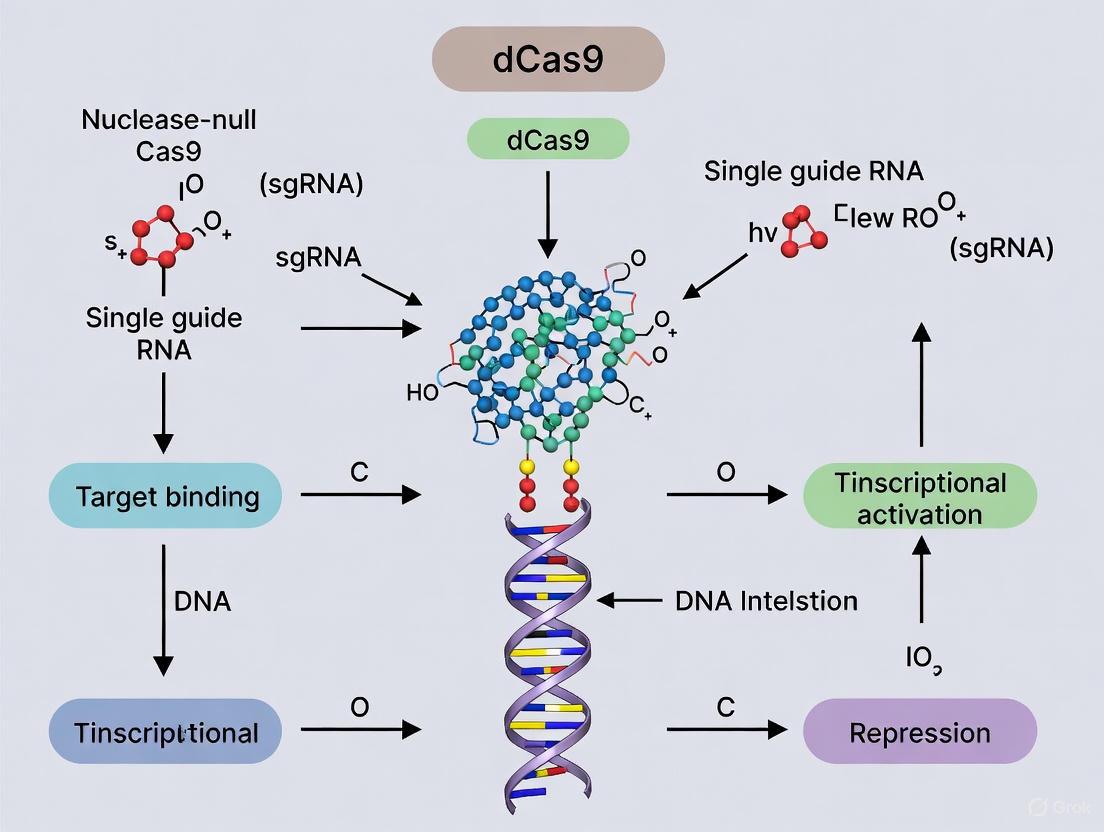
This article provides a comprehensive overview of the mechanisms and applications of catalytically dead Cas9 (dCas9) in programmable gene regulation.
dCas9 in Gene Regulation: From CRISPRa and CRISPRi Mechanisms to Therapeutic Applications
Abstract
This article provides a comprehensive overview of the mechanisms and applications of catalytically dead Cas9 (dCas9) in programmable gene regulation. Tailored for researchers and drug development professionals, it explores the foundational principles of CRISPR activation (CRISPRa) and interference (CRISPRi), detailing how dCas9, when fused to effector domains, enables precise transcriptional control without altering DNA sequence. The content covers cutting-edge methodologies, high-throughput screening applications, and optimization strategies informed by recent research on transcriptional condensates and novel repressor domains. It further validates these tools through comparative analysis with other technologies and discusses their transformative potential in functional genomics, cell therapy, and the treatment of genetic disorders, offering a roadmap for their clinical translation.
The dCas9 Engine: Principles of Programmable Transcription Control
The repurposing of the CRISPR-Cas9 system from a programmable DNA-cleaving enzyme to a precise gene regulation platform represents a pivotal advancement in molecular biology. By inactivating the nuclease activity of Cas9 to create catalytically dead Cas9 (dCas9), researchers unlocked a versatile technology for targeted transcriptional modulation without altering the underlying DNA sequence. This whitepaper examines the mechanistic foundations of dCas9, detailing its development as the core component of CRISPR interference (CRISPRi) and activation (CRISPRa) systems. We explore its evolving applications in functional genomics and therapeutic development, analyze quantitative performance data across implementations, and provide detailed experimental frameworks for employing dCas9 technologies in research settings. Within the broader context of gene regulation research, dCas9 has emerged as an indispensable tool for reversible, specific, and multifunctional control of transcriptional programs.
The discovery that CRISPR-Cas9 could be programmed to target specific DNA sequences revolutionized genome engineering. The native CRISPR-Cas9 system consists of two key components: the Cas9 nuclease, which creates double-stranded breaks in DNA, and a guide RNA (gRNA), which directs Cas9 to specific genomic loci complementary to its 20-nucleotide spacer sequence [1]. Recognition of a protospacer adjacent motif (PAM) sequence adjacent to the target site is essential for Cas9 activity [2].
In 2013, researchers made the critical conceptual leap that by eliminating Cas9's nuclease activity while preserving its DNA-binding capability, they could transform this system from a DNA-cutting tool to a programmable DNA-binding platform [3]. This was achieved through point mutations in the two nuclease domains of Streptococcus pyogenes Cas9 (SpCas9)—the RuvC1 (D10A) and HNH (H841A) domains—resulting in catalytically dead Cas9 (dCas9) [3] [4]. Unlike wild-type Cas9, dCas9 bound to DNA does not create double-stranded breaks but instead serves as a targeting platform for functional effectors, enabling precise manipulation of gene expression and chromatin states without permanent genetic alterations [1] [3].
The dCas9 Mechanism: Principles of Programmable DNA Binding
Structural Basis of Catalytic Inactivation
dCas9 retains the fundamental architecture of wild-type Cas9, including the recognition and nuclease lobes, but contains alanine substitutions at two critical catalytic residues. The D10A mutation inactivates the RuvC domain, while the H841A mutation disables the HNH domain [3] [4]. These mutations abolish DNA cleavage activity while preserving the protein's ability to: (1) complex with single-guide RNA (sgRNA), (2) recognize target DNA sequences through sgRNA:DNA complementarity, and (3) bind DNA adjacent to appropriate PAM sequences [3].
Once bound to DNA, the dCas9:sgRNA complex creates a steric blockade that physically impedes cellular machinery. The mechanism of transcriptional repression depends on the target site relative to the gene's transcription start site. When dCas9 binds within a promoter region, it can prevent transcription initiation by blocking RNA polymerase binding or transcription factor assembly [3]. When dCas9 binds within the coding region, it can hinder transcriptional elongation by physically blocking the progression of RNA polymerase [1] [3]. Early experiments demonstrated that targeting dCas9 to the template or non-template DNA strands yields different repression efficiencies, with non-template strand targeting typically proving more effective [3].
Development of CRISPRi and CRISPRa Platforms
The foundational dCas9 system has been enhanced through fusion with protein domains that actively modulate transcription. CRISPR interference (CRISPRi) employs dCas9 fused to transcriptional repressor domains, such as the Krüppel-associated box (KRAB) domain, which recruits endogenous silencing complexes that promote heterochromatin formation [5]. CRISPR activation (CRISPRa) utilizes dCas9 fused to transcriptional activators like VP64, p65, or Rta, which recruit co-activators that open chromatin and enhance transcription [1] [6].
Recent engineering efforts have focused on optimizing these systems through combinatorial approaches. A 2025 study screened over 100 bipartite and tripartite repressor fusions, identifying dCas9-ZIM3(KRAB)-MeCP2(t) as a particularly potent CRISPRi platform that shows improved repression across multiple cell lines with reduced performance variability [5]. These enhanced systems address limitations of earlier platforms, including incomplete knockdown and guide-dependent efficiency fluctuations.
Table 1: Key dCas9-Derived Technologies and Their Applications
| Technology | Core Components | Mechanism of Action | Primary Applications |
|---|---|---|---|
| CRISPRi | dCas9 + repressor domains (e.g., KRAB) | Recruits chromatin modifiers that promote gene silencing; steric hindrance | Gene knockdown, functional genomics, genetic screens [3] [5] |
| CRISPRa | dCas9 + activator domains (e.g., VP64) | Recruits transcriptional co-activators to enhance gene expression | Gene activation, differentiation studies, gene therapy [1] [6] |
| Base Editing | dCas9 or nickase Cas9 + deaminase | Chemical conversion of nucleotide bases without double-strand breaks | Single-nucleotide corrections, disease modeling [6] |
| Epigenetic Editing | dCas9 + chromatin modifiers | Targeted deposition or removal of epigenetic marks | Chromatin research, disease modeling [6] |
| Genomic Imaging | dCas9 + fluorescent proteins | Sequence-specific DNA labeling with fluorescent reporters | Live-cell chromatin dynamics, nuclear organization [7] [8] |
Experimental Applications and Workflows
Quantitative Assessment of CRISPRi Efficiency
Early characterization of CRISPRi in E. coli demonstrated its potent repression capabilities. Targeting dCas9 to the coding sequence of a reporter gene achieved 10- to 300-fold repression when directed to the non-template strand, while promoter targeting yielded up to 1000-fold repression when positioned at the -35 box [3]. The system showed rapid kinetics, with repression initiation within 10 minutes of inducer addition and complete reversibility upon inducer removal [3].
In mammalian systems, CRISPRi efficiency varies based on target site, cell type, and repressor architecture. Recent optimized systems show significant improvements over earlier platforms:
Table 2: Performance Comparison of CRISPRi Repressor Architectures in Mammalian Cells
| Repressor Architecture | Relative Repression Efficiency* | Key Advantages | Identified In |
|---|---|---|---|
| dCas9 alone (steric block) | 10-300 fold (varies by target) | Simple architecture, minimal size | [3] |
| dCas9-KOX1(KRAB) | Baseline | First characterized repressor fusion | [5] |
| dCas9-ZIM3(KRAB) | ~20% improvement over KOX1(KRAB) | Stronger KRAB domain | [5] |
| dCas9-ZIM3(KRAB)-MeCP2(t) | ~20-30% improvement over ZIM3(KRAB) | Reduced guide-dependence, consistent across cell lines | [5] |
*Relative to appropriate controls; exact values depend on target gene and cellular context.
Protocol: Implementing CRISPRi for Gene Knockdown in Mammalian Cells
The following protocol outlines a standard workflow for deploying CRISPRi for targeted gene repression in mammalian cell lines, incorporating recent advancements in repressor design.
Materials and Reagent Setup
- Plasmids:
- Expression vector for dCas9-repressor fusion (e.g., dCas9-ZIM3(KRAB)-MeCP2(t) [5])
- sgRNA expression vector with U6 promoter
- Cell lines: Adherent mammalian cells (HEK293T, K562, etc.)
- Transfection reagent: Suitable for your cell type (e.g., lipofection, electroporation reagents)
- Validation tools:
- qPCR primers for target transcript quantification
- Antibodies for target protein detection (if available)
- Flow cytometry antibodies if using reporter systems
Step-by-Step Procedure
sgRNA Design and Cloning:
- Design 3-5 sgRNAs targeting the transcription start site (TSS) of your gene of interest, preferably between -50 and +300 bp relative to the TSS
- Clone sgRNA sequences into your sgRNA expression vector using BsmBI restriction sites or Golden Gate assembly
- Validate clones by Sanger sequencing
Cell Transfection:
- Plate cells at appropriate density (e.g., 2×10^5 HEK293T cells per well in 12-well plate) 24 hours before transfection
- Transfect with a 1:3 mass ratio of dCas9-repressor plasmid to sgRNA plasmid(s)
- Include controls: non-targeting sgRNA and dCas9-only transfection
Harvest and Analysis (48-72 hours post-transfection):
- Transcript-level analysis: Extract total RNA, perform reverse transcription, and quantify target mRNA levels by qPCR using ΔΔCt method normalized to housekeeping genes
- Protein-level analysis: Perform western blotting or flow cytometry to assess protein knockdown
- Phenotypic assessment: Conduct functional assays relevant to your gene of interest (e.g., proliferation, differentiation, migration)
Troubleshooting Notes
- Inefficient knockdown may require testing additional sgRNAs or optimizing dCas9-repressor expression levels
- Cell type-specific variations may necessitate testing multiple repressor architectures [5]
- For stable repression, consider generating cell lines with integrated dCas9-repressor and sgRNA expression constructs
Protocol: Genomic Loci Imaging with Fluorogenic CRISPR (fCRISPR)
Imaging genomic loci with dCas9-based systems enables visualization of nuclear organization and chromatin dynamics in living cells. Recent advances in fluorogenic CRISPR (fCRISPR) address background fluorescence issues in conventional dCas9-fluorescent protein fusions [7].
Principle
The fCRISPR system uses three components: (1) dCas9 without fluorescent tags, (2) sgRNA engineered with Pepper RNA aptamers in the tetraloop and stem-loop 2, and (3) a fluorogenic protein (e.g., tdTomato-tDeg) that becomes stabilized and fluorescent only when bound to Pepper RNA [7]. This approach significantly reduces background fluorescence because unbound fluorogenic proteins are rapidly degraded, and sgRNAs without dCas9 are unstable [7].
Workflow
Component Preparation:
- Engineer sgRNA with Pepper aptamer inserts in tetraloop and stem-loop 2
- Prepare expression plasmids for Pepper-sgRNA, dCas9, and tdTomato-tDeg
Cell Transfection and Imaging:
- Co-transfect all three components into target cells (e.g., U2OS, HEK293T)
- Image after 24-48 hours using fluorescence microscopy
- The system achieves signal-to-noise ratios up to 116, approximately 26-fold higher than dCas9-GFP fusions [7]
Advanced Applications and Recent Innovations
TurboCas for Proteomic Mapping at Genomic Loci
A 2025 development called TurboCas combines dCas9 with a proximity labeling enzyme (miniTurbo) to enable efficient, rapid labeling of chromatin-binding proteins at specific genomic sites [9]. This technology addresses the longstanding challenge of mapping complete protein complexes at single genomic loci with high temporal resolution.
Key features:
- Uses only a single sgRNA, reducing potential interference with transcriptional machinery
- Enables proximity labeling in 30 minutes (compared to overnight for previous methods)
- Allows dynamic profiling of protein interactions at specific loci under different cellular conditions [9]
Application workflow:
- Target dCas9-miniTurbo to genomic region of interest with sgRNA
- Induce proximity labeling with biotin for 30 minutes
- Isclude biotinylated proteins and identify by mass spectrometry
- Compare protein interactors across different conditions (e.g., with/without stress stimuli)
Attenuation of DNA End Resection
Recent research has revealed that dCas9 can function as a programmable roadblock to cellular machinery beyond transcription. A 2025 study demonstrated that dCas9 can attenuate DNA end resection—the nucleolytic processing of DNA ends after double-strand breaks—by physically blocking the progression of resection machinery [10]. This application enables "controlled kataegis," confining hypermutation to limited genomic regions during repair processes, with potential applications in genome engineering and evolutionary studies [10].
The Scientist's Toolkit: Essential Research Reagents
Table 3: Key Reagents for dCas9 Experimental Applications
| Reagent | Function | Examples/Specifications | Application Notes |
|---|---|---|---|
| dCas9 Expression System | Core DNA-binding platform | dCas9 with nuclear localization signals; codon-optimized for expression system | Choice of vector (plasmid, lentiviral) depends on delivery method and duration of expression needed |
| Repressor Domains | Transcriptional repression | KRAB domains (KOX1, ZIM3), MeCP2(t) | Combinatorial repressors (e.g., dCas9-ZIM3(KRAB)-MeCP2(t)) show enhanced efficiency [5] |
| Activator Domains | Transcriptional activation | VP64, p65, Rta | Multimerized domains often used for stronger activation |
| sgRNA Expression Vector | Target specification | U6 promoter-driven expression; modified scaffolds for effector recruitment | Design 3-5 sgRNAs per target to account for variability in efficiency |
| Delivery Tools | Introduction into cells | Lipofection reagents, electroporation systems, viral vectors (lentivirus, AAV) | AAV vectors require smaller dCas9 variants (e.g., SaCas9) due to packaging constraints |
| Fluorogenic Modules | Genomic imaging | Pepper-tagged sgRNA + tdTomato-tDeg | fCRISPR system provides superior signal-to-noise ratio for live imaging [7] |
| Proximity Labeling Systems | Proteomic mapping | dCas9-miniTurbo fusions | TurboCas enables rapid (30 min) labeling of chromatin-associated proteins [9] |
The invention of catalytically dead Cas9 represents a fundamental transformation of CRISPR technology from a DNA-cleaving tool to a multifunctional platform for precise gene regulation. By retaining programmable DNA-binding capability while eliminating nuclease activity, dCas9 has enabled diverse applications including tunable transcriptional modulation, high-resolution genomic imaging, epigenetic editing, and proteomic mapping at specific chromosomal loci. Continued refinement of dCas9 systems—through optimized repressor architectures, enhanced specificity, and novel functional attachments—promises to further expand its utility in basic research and therapeutic development. As a cornerstone of modern genetic research, dCas9 provides an unparalleled platform for interrogating and manipulating gene regulatory networks without permanent genomic alterations.
The CRISPR/dCas9 system represents a groundbreaking advancement in genetic engineering, enabling precise transcriptional modulation and genomic imaging without introducing DNA double-strand breaks. This technical guide examines the fundamental mechanisms by which catalytically dead Cas9 (dCas9) complexed with single-guide RNA (sgRNA) achieves targeted DNA binding. We explore the structural basis of RNA-guided DNA recognition, the critical role of protospacer adjacent motif (PAM) sequences, and the kinetic parameters governing target binding and dissociation. Additionally, we present quantitative binding data, detailed experimental methodologies for studying these interactions, and visualization of key mechanisms. Within the broader context of gene regulation research, dCas9 serves as a programmable platform for recruiting effector domains to specific genomic loci, facilitating sophisticated transcriptional control and epigenetic modification for both basic research and therapeutic development.
The discovery of clustered regularly interspaced short palindromic repeats (CRISPR) and CRISPR-associated (Cas) proteins has revolutionized molecular biology, providing unprecedented capabilities for genome manipulation [1] [11]. Derived from bacterial adaptive immune systems, these mechanisms protect prokaryotes from viral infections by acquiring and storing fragments of foreign DNA in CRISPR arrays, which are transcribed and processed to guide Cas nucleases toward complementary invading sequences for cleavage [12] [11]. The most widely utilized system, CRISPR/Cas9 from Streptococcus pyogenes, consists of the Cas9 nuclease and a single-guide RNA (sgRNA) that directs DNA cleavage at specific sites adjacent to a protospacer adjacent motif (PAM) [1] [13].
Catalytically dead Cas9 (dCas9) is a engineered variant generated through point mutations (D10A and H840A) that inactivate the RuvC and HNH nuclease domains while preserving DNA-binding capability [1] [14]. This transformation converts Cas9 from a DNA-cleaving enzyme into a programmable DNA-binding protein that can be targeted to specific genomic loci without introducing double-strand breaks [12]. The dCas9-sgRNA complex has become foundational to gene regulation research, serving as a versatile platform for transcriptional modulation, epigenome editing, and genomic imaging when fused to appropriate effector domains [6] [12]. Unlike earlier technologies such as zinc finger nucleases (ZFNs) and transcription activator-like effector nucleases (TALENs), which require complex protein engineering for each new target, dCas9 can be redirected to different DNA sequences simply by modifying the sgRNA sequence, significantly simplifying experimental design and implementation [1].
Structural Mechanism of DNA Target Recognition
Components of the dCas9-sgRNA Complex
The dCas9-sgRNA complex consists of two primary components: the catalytically inactive Cas9 protein and a single-guide RNA. The sgRNA is a chimeric RNA molecule that combines the functions of the naturally occurring crRNA and tracrRNA into a single transcript [12] [11]. The sgRNA contains a 20-nucleotide spacer sequence at its 5' end that determines DNA target specificity through complementary base pairing, while the remaining portion forms a scaffold structure that facilitates binding to the dCas9 protein [1] [13].
The dCas9 protein maintains the multi-domain structure of wild-type Cas9 but lacks endonuclease activity. Key domains include:
- REC lobes (REC-I, REC-II, REC-III): Rich in arginine residues and responsible for sgRNA binding and DNA hybridization monitoring
- HNH domain: Positioned to contact the target DNA strand but catalytically inactive in dCas9
- RuvC domain: Typically cleaves the non-target DNA strand but inactive in dCas9
- PI domain: Critical for PAM recognition and binding [13] [15]
DNA Recognition and Binding Process
The process of DNA target recognition and binding by the dCas9-sgRNA complex follows a sophisticated multi-step mechanism:
PAM Recognition: The initial interaction involves scanning of double-stranded DNA by dCas9 to identify appropriate PAM sequences (5'-NGG-3' for S. pyogenes dCas9) [13] [14]. This recognition occurs primarily through π-stacking and hydrogen-bonding interactions between the PI domain and the nitrogenous bases in the PAM sequence [13].
DNA Melting: Following PAM recognition, dCas9 induces local DNA melting, unwinding approximately 10-12 base pairs adjacent to the PAM site. This creates a "seed region" where initial complementarity between the sgRNA spacer and target DNA is established [15].
R-loop Formation: If sufficient complementarity exists in the seed region, the R-loop expands as the target DNA strand continues to hybridize with the sgRNA spacer sequence, displacing the non-target strand. This process proceeds directionally from the PAM-proximal to PAM-distal end [15].
Conformational Activation: Successful R-loop formation triggers conformational changes in dCas9, particularly in the REC lobes, which stabilize the DNA-RNA heteroduplex and lock the complex into a tight-binding state [15].
The requirement for both PAM recognition and complementarity between the sgRNA spacer and target DNA sequence provides two layers of specificity, ensuring highly precise targeting of the dCas9-sgRNA complex [13] [14].
Figure 1: dCas9-sgRNA DNA Binding Mechanism. The diagram illustrates the sequential process of DNA target recognition, beginning with complex assembly and proceeding through PAM recognition, DNA unwinding, R-loop formation, and stable binding.
Quantitative Analysis of Binding Parameters
Binding Affinities and Specificity Metrics
The binding affinity between dCas9-sgRNA complexes and their DNA targets varies significantly depending on the specific Cas9 ortholog and PAM sequence. Recent studies have quantified these interactions using advanced biophysical techniques, revealing important insights into the specificity and efficiency of DNA targeting.
Table 1: Binding Affinities of Cas9 Orthologs for Canonical PAM Sequences
| Cas9 Ortholog | Source Organism | Canonical PAM | Relative Binding Affinity | Applications |
|---|---|---|---|---|
| SpCas9 | Streptococcus pyogenes | 5'-NGG-3' | 1.0 (reference) | General purpose, transcriptional regulation |
| SaCas9 | Staphylococcus aureus | 5'-NNGRRT-3' | ~3.5× higher than SpCas9 | Viral vector delivery, compact size |
| FnCas9 | Francisella novicida | 5'-NGG-3' | ~0.3× SpCas9 | High specificity applications |
| Cas9-VQR | Engineered SpCas9 variant | 5'-NGAN-3' | Varies by specific PAM | Expanded targeting range |
| xCas9 | Engineered SpCas9 variant | 5'-NG-3' | ~0.5× SpCas9 | Broad PAM compatibility |
The binding strength between dCas9-sgRNA and DNA targets directly influences the efficiency of gene regulation. Studies demonstrate that higher affinity for cognate PAM sequences correlates with increased genome-editing efficiency, suggesting that strong PAM binding promotes more effective target location [13]. Single-molecule studies have revealed that SpCas9 exhibits extremely slow dissociation rates (k₃ = 0.00085 min⁻¹) with full-length sgRNAs, contributing to prolonged residence times on DNA [15].
The Protospacer Adjacent Motif (PAM) requirement represents a critical specificity determinant for dCas9 DNA binding. While canonical PAM sequences show strongest binding, dCas9 can also recognize suboptimal PAMs with reduced affinity, which must be considered when assessing potential off-target effects.
Table 2: SpCas9 Binding Affinities for Different PAM Sequences
| PAM Sequence | Relative Binding Affinity | Cleavage Efficiency in Wild-type Cas9 | Application in dCas9 Targeting |
|---|---|---|---|
| 5'-NGG-3' | 1.0 | High | Standard targeting applications |
| 5'-NAG-3' | ~0.2 | Moderate | Secondary target sites |
| 5'-NGA-3' | ~0.1 | Low | Potential off-target sites |
| 5'-NGC-3' | ~0.15 | Low | Potential off-target sites |
| 5'-NTG-3' | ~0.25 | Moderate | Expanded targeting options |
The molecular basis for PAM discrimination lies in the interaction between the PI domain of dCas9 and the nitrogenous bases in the PAM sequence. Structural studies have revealed that Cas9 employs a major-groove PAM recognition mechanism involving direct and water-mediated hydrogen-bonding interactions with cognate canonical PAMs [13]. Single-point mutations within the PAM sequence can severely disrupt dCas9 binding, a property that has been exploited for ultrasensitive mutation detection [14].
Experimental Methods for Studying dCas9-DNA Interactions
Single-Molecule Detection via TIRF Microscopy
Total internal reflection fluorescence (TIRF) microscopy enables real-time visualization of individual dCas9-gRNA complexes binding to DNA targets, providing unprecedented insights into binding kinetics and specificity at the single-molecule level.
Protocol: Single-Molecule dCas9-DNA Binding Assay
Sample Preparation
- Prepare target DNA containing wild-type or mutant sequences (e.g., EGFR gene with 2573T>G mutation)
- Design crRNA targeting region near mutation site where mutant DNA contains canonical PAM (5'-CGG-3') while wild-type has non-canonical PAM (5'-CTG-3')
- Express and purify dCas9 protein (D10A and H840A mutations)
- Form dCas9-gRNA complexes by incubating at 25°C for 15 minutes [14]
Surface Functionalization
- Create streptavidin-coated flow chambers on microscope slides
- Immobilize biotinylated DNA constructs (∼20-bp length) on surface
- Use public18 biotinylated capture probe for efficient surface tethering [14]
Imaging Conditions
- Perform TIRF microscopy with appropriate laser excitation (e.g., 532 nm for Cy3-labeled dCas9)
- Image at 10 frames per second to capture binding and dissociation events
- Maintain constant temperature (25°C) throughout imaging
- Use oxygen scavenging system to prolong fluorophore lifetime [14]
Data Analysis
- Identify binding events from fluorescence time traces
- Calculate binding kinetics (association and dissociation rates)
- Determine binding specificity by comparing mutant vs. wild-type PAM sequences
- Perform statistical analysis across multiple molecules (>100) [14]
This approach has demonstrated capability to detect mutant fractions as low as 0.5% without target DNA amplification, highlighting its exceptional sensitivity for studying dCas9 binding specificity [14].
Figure 2: Single-Molecule dCas9 Binding Analysis Workflow. The experimental process for studying dCas9-DNA interactions using TIRF microscopy, from sample preparation through data analysis.
Competitive Binding Assays Using Cas9 Beacons
The Cas9 beacon assay provides a sensitive method for comparing relative affinities of dCas9 for different PAM sequences through competitive binding measurements.
Protocol: Competitive Cas9 Beacon Assay
Beacon Design and Preparation
- Design fluorescently labeled target DNA derivatives ("Cas9 beacons")
- Create beacon with fully complementary oligonucleotides or three oligonucleotides with discontinuity in nontarget strand
- Verify beacon structure produces fluorescence increase upon dCas9 binding [13]
Competitor Probe Design
- Design ∼20-bp DNA probes containing single PAM sequence
- Include short upstream segment noncomplementary or complementary to gRNA spacer
- Avoid hairpin structures in competitor sequences [13]
Binding Reaction Setup
- Preincubate dCas9-gRNA complexes with competitor probes for 15 minutes
- Add Cas9 beacon to initiate binding reaction
- Monitor fluorescence intensity increase over time (minutes to hours)
- Use appropriate controls without competitor [13]
Data Interpretation
- Calculate rate of beacon binding in presence vs. absence of competitor
- Determine relative affinities based on competitive inhibition
- Calculate dissociation constants when nearly complete beacon binding achieved [13]
This competitive assay enables sensitive detection of low-affinity binding to suboptimal PAM sequences and provides insights into the molecular basis of single-point mutation discrimination through PAM recognition [13].
The Scientist's Toolkit: Essential Research Reagents
Table 3: Key Reagents for dCas9-DNA Binding Studies
| Reagent/Category | Specific Examples | Function/Application | Considerations |
|---|---|---|---|
| dCas9 Proteins | SpdCas9, SadCas9, FndCas9 | Programmable DNA binding platform | Orthologs differ in size, PAM specificity, binding affinity |
| Guide RNA Scaffolds | sgRNA, truncated sgRNAs, mismatched guides | Target specificity determination | Modifications affect kinetics, specificity, and turnover |
| Detection Systems | TIRF microscopy, Cas9 beacons, competitive assays | Quantifying binding events and kinetics | Varying sensitivity, throughput, and equipment requirements |
| Target DNA Constructs | Plasmid substrates, short DNA probes, genomic loci | Binding substrates for specificity studies | Length, topology, and sequence context affect binding |
| Engineering Variants | High-fidelity dCas9, PAM-relaxed variants | Specialized applications | Balance between specificity and targeting range |
Implications for Gene Regulation Research
The precise DNA targeting mechanism of dCas9-sgRNA complexes has enabled revolutionary applications in gene regulation research. By serving as a programmable DNA-binding platform, dCas9 can be fused to various effector domains to achieve transcriptional control, epigenetic modification, and genomic imaging without altering the underlying DNA sequence [1] [6].
In CRISPR interference (CRISPRi), dCas9 alone can block transcription by sterically hindering RNA polymerase binding or elongation when targeted to promoter regions [1]. For enhanced repression, dCas9 can be fused to transcriptional repressor domains such as KRAB, creating a potent silencer that can reduce gene expression by up to 100-fold [6]. Conversely, in CRISPR activation (CRISPRa), dCas9 fused to transcriptional activators like VP64, p65, or SunTag systems can increase gene expression by recruiting transcriptional machinery to promoter regions [6] [16].
The field continues to evolve with emerging technologies including Opto-CRISPR systems that enable light-controlled dCas9 activity for spatiotemporal precision in gene regulation [17], and artificial intelligence-guided engineering of improved dCas9 variants with enhanced specificity and expanded targeting capabilities [18]. These advances underscore how understanding the fundamental mechanisms of dCas9-DNA targeting continues to drive innovation in genetic research and therapeutic development.
The exceptional specificity of dCas9 binding, particularly its sensitivity to PAM sequence variations, has also been harnessed for diagnostic applications. Researchers have developed ultrasensitive mutation detection platforms that can identify single-nucleotide variants by exploiting the differential binding of dCas9 to wild-type versus mutant PAM sequences [14]. This application highlights how basic research into fundamental binding mechanisms can translate into valuable tools for precision medicine and clinical diagnostics.
The advent of CRISPR-Cas9-based genome editing has revolutionized genetic engineering, offering a precise alternative to complex techniques like zinc-finger nucleases [19]. Beyond making permanent changes to DNA sequences, CRISPR technology can be repurposed for precise transcriptional control without altering the underlying genetic code. This is achieved through nuclease-dead Cas9 (dCas9), a key innovation that retains DNA-binding capability but lacks cleavage activity [19] [20].
When fused with transcriptional effector domains, dCas9 becomes a powerful platform for regulating gene expression, giving rise to two complementary technologies: CRISPR activation (CRISPRa) for gene upregulation and CRISPR interference (CRISPRi) for gene downregulation [19]. These systems function as a "genetic dimmer switch," allowing researchers to fine-tune gene expression levels with precision that mirrors natural regulatory mechanisms and pharmacological effects more closely than complete gene knockouts [19] [21]. This review examines the molecular mechanisms, experimental implementations, and research applications of CRISPRa and CRISPRi systems, with emphasis on their utility in functional genomics and drug discovery.
Core Mechanisms of dCas9 in Gene Regulation
The dCas9 Foundation: From DNA Cleavage to Gene Regulation
The transformation of Cas9 from a DNA-cleaving enzyme to a gene regulation tool begins with strategic mutations in its two nuclease domains. The HNH domain (H840A mutation) and RuvC domain (D10A mutation) are both inactivated to create catalytically dead Cas9 (dCas9) that maintains guide RNA-directed DNA binding but cannot introduce double-strand breaks [20]. This fundamental modification preserves the programmable DNA-targeting capability of CRISPR systems while eliminating permanent genetic alterations.
The dCas9 protein complex, guided by a single guide RNA (sgRNA), localizes to specific genomic loci through Watson-Crick base pairing between the sgRNA's ~20 nucleotide spacer sequence and complementary DNA target sites [20]. Successful binding requires a protospacer adjacent motif (PAM) sequence immediately downstream of the target site, which for the commonly used Streptococcus pyogenes Cas9 is 5'-NGG-3' [20]. Once bound to DNA, dCas9 serves as a programmable platform for recruiting transcriptional regulators to precise genomic locations.
CRISPRi: Mechanisms of Gene Repression
CRISPR interference (CRISPRi) employs dCas9 fused to repressor domains to decrease gene expression through multiple mechanisms. The most established approach involves fusing dCas9 to the Krüppel-associated box (KRAB) domain, a potent repressor that recruits heterochromatin-forming complexes to promote transcriptional silencing [19] [21]. The KRAB domain recruits proteins including SETDB1 (a histone methyltransferase) and HP1, leading to H3K9 trimethylation and the establishment of facultative heterochromatin that persists through cell divisions [21].
Beyond epigenetic silencing, CRISPRi can achieve repression through steric hindrance of transcriptional machinery. When dCas9 (with or without repressor domains) binds within approximately -50 to +300 base pairs relative to the transcription start site (TSS), it physically blocks RNA polymerase binding or progression [20]. Research has identified optimal targeting regions for repression, with peak efficiency occurring at approximately +50 to +100 bp downstream of the TSS [20].
Enhanced repression systems have been developed, including dCas9-KRAB-MeCP2, which combines KRAB with the methyl-CpG-binding protein MeCP2 for stronger silencing [20]. The optimal sgRNA binding region for CRISPRi spans from -50 to +300 bp relative to the TSS [20].
CRISPRa: Mechanisms of Gene Activation
CRISPR activation (CRISPRa) functions through dCas9 fused to transcriptional activation domains that recruit RNA polymerase and co-activators to target genes. First-generation CRISPRa systems used simple fusions such as dCas9-VP64, where VP64 (a tetramer of the herpes simplex viral protein VP16) provides transactivation capability [20]. However, these simple fusions often yield modest activation, prompting development of more robust multi-component systems.
Three principal strategies have emerged for enhancing CRISPRa efficiency:
Direct effector fusions: dCas9 is directly fused to multiple strong activation domains, exemplified by the VPR system (VP64-p65-Rta) that combines VP64 with the activation domains from human NF-κB p65 and Epstein-Barr virus Rta [20].
Protein scaffolding systems: The SunTag system utilizes dCas9 fused to a peptide array (typically 10-24 copies of the GCN4 peptide), which recruits multiple copies of antibody-activator fusion proteins (e.g., scFv-VP64) for synergistic activation [19] [20].
RNA scaffolding systems: The Synergistic Activation Mediator (SAM) combines dCas9-VP64 with engineered sgRNAs containing MS2 RNA aptamers that recruit MS2-p65-HSF1 fusion proteins, creating a multi-component activation complex [19] [20].
The optimal sgRNA binding region for CRISPRa is typically within -400 to -50 bp upstream of the TSS, with some variation depending on the specific system and target gene [20].
Table 1: Comparison of Major CRISPRa/i Systems
| System | Type | Key Components | Mechanism of Action | Reported Efficiency |
|---|---|---|---|---|
| dCas9-KRAB [21] [20] | CRISPRi | dCas9 + KRAB domain | Recruits heterochromatin machinery; steric hindrance | 60-80% repression (dCas9 alone); enhanced with KRAB |
| dCas9-VP64 [20] | CRISPRa | dCas9 + VP64 activator | Minimal activation domain recruitment | Modest activation; often insufficient for screening |
| VPR System [20] | CRISPRa | dCas9 + VP64-p65-Rta | Tripartite activator fusion | Stronger activation than VP64 alone |
| SAM System [19] [20] | CRISPRa | dCas9-VP64 + MS2-p65-HSF1 + modified sgRNA | RNA scaffold recruits multiple activators | Among strongest activators in multiple cell types |
| SunTag System [19] [20] | CRISPRa | dCas9-GCN4 array + scFv-VP64 | Protein scaffold recruits multiple antibody-activator fusions | High activation; versatile for different effectors |
Diagram 1: CRISPRa and CRISPRi Molecular Mechanisms. CRISPRi (top) uses dCas9-KRAB to bind near the transcription start site, blocking RNA polymerase. CRISPRa (bottom) uses multi-component systems like SAM with dCas9-VP64 and MS2-p65-HSF1 to recruit transcriptional machinery.
Experimental Implementation and Workflows
Essential Research Reagents and Tools
Successful implementation of CRISPRa/i experiments requires carefully selected molecular tools and delivery systems. The table below outlines key components for establishing these platforms:
Table 2: Research Reagent Solutions for CRISPRa/i Experiments
| Reagent Category | Specific Examples | Function/Purpose | Considerations |
|---|---|---|---|
| dCas9 Effector Systems [19] [20] | dCas9-KRAB (CRISPRi), dCas9-VPR, dCas9-SAM, SunTag (CRISPRa) | Core transcriptional regulator | Choice depends on required activation/repression strength; SAM and SunTag generally strongest for activation |
| sgRNA Design [19] [16] | Promoter-targeting sgRNAs (~20 nt guide sequence) | Targets dCas9-effector to specific genomic loci | Optimal regions: -400 to -50 bp upstream of TSS for CRISPRa; -50 to +300 bp for CRISPRi |
| Delivery Methods [16] [21] | Lentiviral vectors, plasmid transfection, synthetic sgRNA + dCas9 | Introduces CRISPR components into cells | Lentiviral enables stable integration; synthetic guides reduce off-target effects |
| Library Resources [16] [21] | Genome-wide sgRNA libraries (e.g., 5056 sgRNAs targeting 1264 TFs) | Enables high-throughput functional screens | Must maintain high coverage (typically 500-1000x) throughout screen |
| Validation Tools [16] | RT-qPCR, fluorescent reporters (EGFP), high-throughput sequencing | Confirms gene expression changes | Essential for verifying screening hits and system functionality |
High-Throughput Screening Methodologies
Pooled CRISPR screens represent a powerful application of CRISPRa/i technology for functional genomics. The general workflow involves several key stages [16] [21]:
Library Design and Construction: Genome-scale sgRNA libraries are designed to target promoters of protein-coding genes, non-coding RNAs, or specific transcription factor families. For example, one study designed a library containing 5,056 sgRNAs targeting promoter regions of 1,264 transcription factors in pigs [16].
Library Delivery and Cell Selection: Lentiviral vectors are used to deliver the sgRNA library to cells expressing dCas9-effector fusions, using low multiplicity of infection (MOI ~0.3) to ensure most cells receive a single sgRNA. Selection markers (e.g., puromycin resistance) enable enrichment of successfully transduced cells.
Phenotypic Selection and Screening: Transduced cells are subjected to selective pressures or analyzed based on phenotypic readouts:
- Fitness/proliferation screens: Compare sgRNA abundance between initial population and after extended culture [21]
- Drug/toxin sensitivity: Compare sgRNA abundance between treated and untreated populations [21]
- Fluorescence-activated cell sorting (FACS): Isolate cells based on reporter expression (e.g., OCT4-EGFP) [16]
Next-Generation Sequencing and Hit Identification: Genomic DNA is extracted from selected populations, sgRNAs are amplified by PCR, and their abundance is quantified by next-generation sequencing. Enriched or depleted sgRNAs indicate genes affecting the screened phenotype.
Diagram 2: CRISPRa/i Screening Workflow. High-throughput screening process from library design to hit identification, enabling systematic discovery of genes involved in biological processes.
Detailed Experimental Protocol: CRISPRa Screening Case Study
A representative CRISPRa screening methodology from recent literature illustrates key technical considerations [16]:
Objective: Identify transcription factors regulating OCT4 expression in pig PK15 cells.
Step 1: Reporter Cell Line Establishment
- Engineered a PK15 cell line with a single-copy OCT4 promoter-driven EGFP reporter inserted at the ROSA26 locus via CRISPR-mediated knock-in
- Used electroporation with Cas9 protein, sgRNA, and donor plasmid (200V, 1ms pulse duration, 5 pulses)
- Selected positive clones with G418 antibiotic treatment
- Verified knock-in efficiency by PCR amplification and agarose gel electrophoresis
Step 2: dCas9-SAM System Implementation
- Established stable cell lines expressing the dCas9-SAM activation system
- Utilized a modified sgRNA with two MS2 RNA aptamers to recruit MS2-p65-HSF1 activators
- Combined with dCas9-VP64 for synergistic activation
Step 3: CRISPRa Screening Execution
- Transduced reporter cells with the lentiviral sgRNA library (5,056 sgRNAs)
- Performed fluorescence-activated cell sorting (FACS) to isolate high-EGFP and low-EGFP populations
- Extracted genomic DNA from sorted populations using RIPA buffer and Proteinase K treatment
- Amplified sgRNA regions by PCR and performed high-throughput sequencing
Step 4: Data Analysis and Validation
- Identified enriched sgRNAs in high-EGFP population versus control
- Discovered MYC, SOX2, and PRDM14 as OCT4 activators; OTX2 and CDX2 as repressors
- Validated hits through individual overexpression and RT-qPCR analysis
- Confirmed GATA4 and SALL4 synergistic activation of OCT4 through co-expression experiments
Applications in Biological Research and Drug Discovery
Functional Genomics and Genetic Screening
CRISPRa/i technologies have become indispensable tools for systematic interrogation of gene function. Their applications span diverse biological contexts:
Essential gene identification: CRISPRi screens reveal cell-type-specific essential genes, including housekeeping genes and cancer-specific vulnerabilities [21]. CRISPRa identifies genes whose overexpression impairs growth, frequently enriched for tumor suppressors and developmental transcription factors [21].
Non-coding RNA functional characterization: CRISPRa/i enables functional assessment of long non-coding RNAs (lncRNAs), with screens identifying cell-type-specific essential lncRNAs that modulate cancer cell growth [19] [21].
Gene network mapping: Combinatorial screens targeting gene pairs enable construction of genetic interaction maps, revealing pathway relationships and protein complex membership [21].
Disease Modeling and Therapeutic Discovery
The reversible, tunable nature of CRISPRa/i modulation makes these platforms particularly valuable for disease modeling and drug discovery:
Chemotherapy resistance mechanisms: CRISPRa screening of 14,701 lncRNA genes identified novel mediators of cytarabine resistance in acute myeloid leukemia, revealing genes involved in cell-cycle, survival/apoptosis, and cancer signaling pathways [19].
Oncogene and tumor suppressor validation: CRISPRa in vivo screening identified protein-coding genes driving hepatocyte proliferation and tumorigenesis in mouse models of liver injury, with significant enrichment of proto-oncogenes and development of hepatocellular carcinoma [19].
Drug target identification and validation: CRISPRi/a screens identify genetic modifiers of drug sensitivity, revealing both direct drug targets and resistance mechanisms. For example, screens have identified 19S proteasomal subunit levels as biomarkers predictive of patient response to proteasome inhibitors [21].
Therapeutic development: Both CRISPRa and CRISPRi show promise as therapeutic modalities themselves, with preclinical studies demonstrating their potential for treating genetic disorders by modulating disease-relevant gene expression [22].
Specialized Research Applications
Beyond conventional cell line models, CRISPRa/i applications continue to expand into new biological contexts:
Stem cell and neuronal research: CRISPRi screens in human induced pluripotent stem cell (iPSC)-derived neurons identified genes essential for neuronal function but dispensable in iPSCs or cancer cells [19].
Non-traditional organism genetics: CRISPRi has been adapted for gene function probing in challenging species such as the malaria parasite Plasmodium yoelii, enabling genetic studies in organisms previously intractable to manipulation [19].
Cardiovascular research: CRISPRa/i applications are emerging for studying inherited cardiac disorders, offering alternatives to traditional transgenic approaches for modulating gene expression in adult animals [20].
Technical Considerations and Optimization Strategies
Experimental Design and Optimization
Successful implementation of CRISPRa/i requires attention to several technical factors:
sgRNA design considerations: Beyond targeting the optimal promoter regions (-400 to -50 bp for CRISPRa; -50 to +300 bp for CRISPRi), sgRNA efficacy depends on local chromatin accessibility and absence of protein obstacles. sgRNA design can be optimized through systematic screening and algorithm development [19].
Delivery method selection: Plasmid-based sgRNA expression remains common but is time-consuming and prone to off-target effects. Synthetic sgRNA production offers faster, more accurate alternative with higher editing efficiencies [19].
Control experiments: Essential controls include non-targeting sgRNAs, targeting non-essential genomic regions, and validation of expression changes by orthogonal methods (RT-qPCR, Western blot).
dCas9 engineering: Reducing dCas9 toxicity and non-specific binding through protein engineering improves signal-to-noise ratio in screens [19].
Comparison with Alternative Technologies
CRISPRa/i technologies offer distinct advantages and limitations compared to other functional genomic approaches:
vs. RNA interference (RNAi): CRISPRi demonstrates higher specificity with fewer sequence-specific off-target effects and can target both coding and non-coding genes [19].
vs. CRISPR nuclease (CRISPRn): Unlike permanent knockouts, CRISPRa/i enables reversible, tunable modulation better suited for studying essential genes and mimicking partial inhibition as achieved by many drugs [19] [21].
vs. ORF overexpression: CRISPRa drives endogenous gene expression in native context, unlike ORF-based methods that typically drive exogenous expression and may not properly regulate splicing or isoform expression [19].
CRISPRa and CRISPRi technologies represent sophisticated additions to the molecular biology toolkit, enabling precise transcriptional control without permanent genome modification. Through dCas9 fusion with diverse effector domains, these systems can reversibly modulate gene expression over several orders of magnitude, facilitating functional genomics studies that bridge the gap between complete gene knockout and subtle pharmacological inhibition.
The applications of CRISPRa/i continue to expand, from basic biological discovery to therapeutic development. As delivery methods improve and effector domains become more potent and specific, these technologies will likely play increasingly important roles in both fundamental research and clinical applications. The ability to conduct genome-scale screens with CRISPRa/i has already accelerated the functional annotation of coding and non-coding genomic elements, revealing novel biological insights across diverse cellular contexts and disease states.
Future directions include the development of more compact systems for in vivo delivery, enhanced specificity through engineered effectors, and integration with emerging technologies such as optogenetics for spatiotemporal control [17] and artificial intelligence for improved sgRNA design and outcome prediction [18]. As these advances mature, CRISPRa/i systems will continue to illuminate genetic networks and accelerate the development of novel therapeutic strategies.
The development of nuclease-deactivated Cas9 (dCas9) has transformed genetic research by providing a highly specific, programmable platform for regulating gene expression without altering the underlying DNA sequence. This technology originates from the CRISPR/Cas9 system, a prokaryotic adaptive immune mechanism that was repurposed for genome editing in eukaryotic cells [23]. The critical innovation occurred when point mutations (D10A in the RuvC domain and H840A in the HNH domain) were introduced to abolish the endonuclease activity of the native Cas9 enzyme, creating dCas9 that retains its DNA-binding capability but cannot cleave target sequences [24] [23]. This fundamental advancement enabled researchers to fuse dCas9 with various effector domains to create synthetic transcription factors that can precisely target and modulate the expression of specific genes.
The core functionality of dCas9-based systems depends on the synergy between the programmable DNA-targeting complex and tethered effector domains. The dCas9 protein is guided to specific genomic loci by a short guide RNA (sgRNA) that complementary base-pairs with target DNA sequences adjacent to a protospacer adjacent motif (PAM) [23]. Once bound to DNA, the dCas9 protein serves as a platform for recruiting fused effector domains to exact genomic locations, enabling targeted transcriptional regulation [24] [23]. This modular architecture has established dCas9 as the foundation for diverse gene regulation technologies, including CRISPR activation (CRISPRa) for gene upregulation and CRISPR interference (CRISPRi) for gene repression, which are revolutionizing functional genomics, disease modeling, and therapeutic development.
The Core Effector Domains for Transcriptional Control
Transcriptional Activation Domains
VP64 represents the foundational synthetic activation domain in CRISPRa systems, derived from the Herpes Simplex viral protein VP16 [24]. It functions as a tetrameric peptide module (unit sequence: PADALDDFDLDML) that recruits endogenous transcriptional machinery to initiate gene transcription [24]. While effective, first-generation VP64 systems demonstrated limited activation potency, prompting development of enhanced synthetic activators.
VP192 is a significantly more potent synthetic activator that shows substantially higher activation efficiency compared to VP64-based systems. In direct comparative studies, dCas9-VP192 generated 22-fold upregulation of the POU5F1 gene at the mRNA level, compared to only 6-fold upregulation with VP64-dCas9-VP64 [24] [25]. Similarly, for the SOX2 gene, dCas9-VP192 produced 4-fold upregulation versus 2-fold with VP64-dCas9-VP64 [24]. This enhanced performance extends to the protein level, with dCas9-VP192 achieving 3.7-fold and 2.4-fold increases for POU5F1 and SOX2 proteins, respectively, compared to 2.2-fold and 2-fold increases with the VP64-based activator [24].
Advanced multi-domain activation systems have been developed to further enhance transcriptional activation. The VPR system incorporates a tripartite activation structure, fusing VP64, p65, and Rta activation domains to dCas9 for synergistic activation [26]. Other sophisticated recruitment platforms include the SunTag system, which uses peptide epitope arrays to recruit multiple copies of activator domains, and the SAM (Synergistic Activation Mediator) system, which employs modified sgRNAs with RNA aptamers to recruit additional activation components [26].
Transcriptional Repression Domains
The Krüppel-associated box (KRAB) domain is one of the most potent transcriptional repressors in the human genome, found naturally in approximately 400 human zinc finger protein-based transcription factors [27]. When fused to dCas9, the KRAB domain functions as a powerful epigenetic silencer that recruits heterochromatin-forming machinery to target loci [23]. The repression mechanism involves KRAB binding to its corepressor TRIM28 (also known as KAP1 or TIF1-beta), which subsequently recruits additional repressive complexes including the histone methyltransferase SETDB1 [28] [27] [23]. This cascade leads to histone H3 lysine 9 trimethylation (H3K9me3), chromatin condensation, and stable gene silencing [23].
The KRAB domain is evolutionarily confined to tetrapod vertebrates and is characterized by a 75-amino acid structure that forms two amphipathic helices capable of protein-protein interactions [28] [27]. The KRAB domain effectively represses transcription from RNA polymerase I, II, and III promoters, making dCas9-KRAB a versatile tool for targeted gene silencing across diverse genomic contexts [28]. Experimental applications demonstrate that dCas9-KRAB can target both promoter regions and distal enhancer elements, with targeting of HS2 enhancers shown to increase H3K9me3 modifications, reduce chromatin accessibility, and silence expression of multiple globin genes [23].
Intrinsically Disordered Regions (IDRs) and Modular Domains (MDs)
Intrinsically Disordered Regions (IDRs) represent an emerging class of regulatory elements that enhance dCas9 efficacy through multivalent interactions rather than direct transcriptional activation or repression. Recent research has identified that specific IDRs from proteins including FUS, EWS, TAF15, YTHDF1-3, and yeast NUP49 can significantly boost dCas9-VP64 activation potency when fused to the complex [26]. Importantly, screening studies reveal that not all phase-separation capable IDRs enhance activation, with IDRs from CCNT1, TDP43, Tau, hnRNPA2, and rat Erc2 showing minimal or even inhibitory effects on dCas9-VP64 activity [26].
The mechanism of IDR-enhanced activation depends on multivalent interactions rather than phase separation capacity alone. Experimental evidence demonstrates that mutation of all 27 tyrosine residues to serine in the FUS IDR (creating FUS27YS) abolishes both multivalent interaction capability and transcriptional enhancement without affecting intrinsic disorder [26]. This indicates that optimized multivalent scaffolding, rather than maximal phase separation, drives enhanced transcriptional activation, with excessive phase separation potentially inhibiting transcription [26].
Modular Domains (MDs) represent another class of multivalent molecules that further enhance dCas9 activity. While MDs alone do not enhance dCas9-VP64 activity, their fusion with dCas9-VP64-IDR constructs produces substantial additional enhancement of transcriptional activation [26]. This synergistic effect enables more robust gene activation, particularly at challenging genomic loci.
Quantitative Comparison of Effector Domain Performance
Table 1: Performance Comparison of Major dCas9 Effector Systems in Human Cells
| Effector System | Target Gene | mRNA Fold-Change | Protein Fold-Change | Key Characteristics |
|---|---|---|---|---|
| dCas9-VP192 | POU5F1 | 22.0 | 3.7 | Most potent single activator |
| VP64-dCas9-VP64 | POU5F1 | 6.0 | 2.2 | Dual-position VP64 configuration |
| dCas9-VP192 | SOX2 | 4.0 | 2.4 | Consistent enhancement across targets |
| VP64-dCas9-VP64 | SOX2 | 2.0 | 2.0 | Moderate activation capability |
| dCas9-VP64-FUS | GFP Reporter | ~500.0* | N/A | IDR-enhanced activation [26] |
| dCas9-VP64-FUS27YS | GFP Reporter | No enhancement | N/A | Loss of function with multivalency disruption [26] |
| dCas9-KRAB | Various | Significant repression | N/A | Potent transcriptional silencing [23] |
*Reported as fold-increase in GFP expression in reporter assays.
Table 2: Functional Characteristics and Applications of Major Effector Domains
| Effector Domain | Type | Primary Mechanism | Optimal Applications | Considerations |
|---|---|---|---|---|
| VP64 | Activation | Recruits transcriptional machinery | Baseline activation, multiplexed systems | Moderate potency alone |
| VP192 | Activation | Enhanced recruitment of transcriptional machinery | High-level activation of silenced genes | Most potent single-domain activator |
| KRAB | Repression | Recruits repressive complexes (SETDB1) and H3K9me3 | Stable gene silencing, enhancer inactivation | Potent repression, potential epigenetic memory |
| FUS IDR | Enhancer | Facilitates multivalent interactions | Boosting activation of refractory genes | Requires fused activator domain |
| VPR | Activation | Synergistic VP64-p65-Rta combination | Maximal activation across diverse loci | Large fusion size may impact delivery |
Experimental Protocols for dCas9-Effector Systems
Protocol: Comparative Analysis of CRISPR Activators
This protocol outlines the methodology for direct functional comparison of CRISPR activators, as demonstrated in studies comparing VP64-dCas9-VP64 and dCas9-VP192 [24].
Reagent Preparation:
- Design and clone gRNAs targeting approximately 400 bp upstream of the transcription start site (TSS) of target genes using established tools (e.g., Zhang Lab's web tool at crispr.mit.edu)
- For multiplexed targeting, clone individual gRNAs into separate array plasmids, then assemble into a single multiplex plasmid
- Verify plasmid constructs by colony PCR and Sanger sequencing
- Prepare activator plasmids (VP64-dCas9-VP64, dCas9-VP192, etc.)
Cell Transfection and Analysis:
- Culture HEK293T cells in appropriate conditions (DMEM + 10% FBS at 37°C with 5% CO₂)
- Co-transfect cells with multiplex gRNA plasmid and activator plasmid in 1:1 molar ratio using preferred transfection method (e.g., lipofection)
- After 24 hours, verify transfection efficiency via fluorescence microscopy (GFP signal from activator plasmid)
- After 72 hours, harvest cells for analysis
- Isolate total RNA, reverse transcribe to cDNA, and perform RT-qPCR to quantify mRNA expression of target genes
- For protein-level analysis, perform Western blotting or immunostaining on parallel samples
Critical Experimental Considerations:
- Include controls transfected with gRNA plasmid alone to establish baseline expression
- Normalize expression data to appropriate housekeeping genes
- Conduct biological and technical replicates to ensure statistical significance
- For novel target genes, optimize gRNA binding sites through preliminary testing
Protocol: Enhanced Activation with IDR Fusion Systems
This protocol describes the implementation of IDR-enhanced CRISPRa systems for superior transcriptional activation [26].
System Design and Validation:
- Select appropriate IDR sequences (FUS, EWS, TAF15, YTHDF1-3, or NUP49 show confirmed activity)
- Generate dCas9-VP64-IDR fusion constructs by molecular cloning
- For mechanistic studies, generate multivalency-deficient controls (e.g., FUS27YS with tyrosine-to-serine mutations)
- Validate fusion protein expression by Western blotting or immunostaining against tags (e.g., Flag tag)
Application to Endogenous Genes:
- Design gRNAs targeting promoters of endogenous genes of interest
- Co-transfect HEK293T cells with dCas9-VP64-IDR constructs and gene-specific gRNAs
- Include controls with dCas9-VP64 alone and dCas9-VP64-inactive IDR
- After 72 hours, harvest cells and isolate RNA for RT-qPCR analysis
- For transcriptome-wide specificity assessment, perform RNA sequencing comparing cells expressing target gRNAs versus scrambled gRNA controls
Advanced Implementation:
- For maximal activation, combine IDR fusions with modular domains (MDs)
- Implement simultaneous promoter-enhancer targeting for synergistic effects
- Assess potential phase separation phenomena through microscopy, but note that visible condensates are not required for enhanced activation
Table 3: Essential Research Reagents for dCas9-Effector Systems
| Reagent Category | Specific Examples | Function and Application | Key Considerations |
|---|---|---|---|
| dCas9-Effector Plasmids | VP64-dCas9-VP64, dCas9-VP192, dCas9-KRAB, dCas9-VP64-FUS | Core effector platforms for transcriptional regulation | Select based on required potency; VP192 strongest activator, KRAB strongest repressor |
| gRNA Cloning Systems | Multiplex gRNA vectors (e.g., pFUSBgRNA10) | Enable simultaneous targeting of multiple genomic loci | Critical for synergistic activation of difficult-to-activate genes |
| Reporter Cell Lines | HEK293R with 7xTetO-GFP cassette | Rapid quantification of activator potency | Useful for initial screening and optimization |
| Validation Assays | RT-qPCR primers, RNA-seq libraries, Western blot antibodies | Confirm transcriptional and translational effects | Essential for validating endogenous gene modulation |
| Delivery Tools | Lentiviral packaging systems, lipofection reagents | Enable efficient introduction of constructs into cells | Choice affects efficiency, especially for primary cells |
Signaling Pathways and Workflow Diagrams
Diagram 1: dCas9-Effector Systems and Transcriptional Outcomes. This workflow illustrates how different effector domains fused to dCas9 produce either transcriptional activation or repression through distinct molecular mechanisms.
Diagram 2: Experimental Workflow for dCas9-Effector System Validation. This methodology outlines the standardized approach for comparing different effector systems, from initial gRNA design through data interpretation and system optimization.
The dCas9-effector toolkit continues to evolve with emerging technologies that promise to enhance precision and efficacy. Artificial intelligence and machine learning are now being deployed to optimize effector domain combinations and predict their performance across diverse genomic contexts [18]. Additionally, the development of ligand-conjugated dCas9 systems such as ATENA (Approach to Target Exact Nucleic Acid alternative structures) enables precise targeting of specific DNA secondary structures like G-quadruplexes and i-motifs, expanding the applications of dCas9-effector platforms beyond linear DNA sequences [29].
The integration of multi-effector systems represents another frontier, with research demonstrating that combining different classes of effectors (e.g., IDRs with modular domains) can produce synergistic effects greater than individual components alone [26]. Furthermore, the refinement of cell-specific delivery systems including advanced viral vectors and lipid nanoparticles will be crucial for translating dCas9-effector technologies into therapeutic applications [30].
In conclusion, the dCas9-effector toolkit, centered around core domains like VP64, VP192, and KRAB, has established a powerful paradigm for precise transcriptional regulation. The quantitative performance data, standardized experimental protocols, and emerging enhancement strategies outlined in this technical guide provide researchers with a comprehensive foundation for implementing these technologies across diverse basic research and therapeutic applications. As the toolkit continues to expand with more potent, specific, and specialized effectors, dCas9-based transcriptional regulation will undoubtedly remain an indispensable technology for genetic research and the development of next-generation genetic medicines.
The catalytically inactive Cas9 (dCas9) is a cornerstone of modern genetic research, enabling targeted gene regulation without altering the underlying DNA sequence. Derived from the CRISPR-Cas9 system, dCas9 contains point mutations in its RuvC and HNH nuclease domains, rendering it incapable of creating double-strand breaks (DSBs) while preserving its programmable DNA-binding ability [31] [32]. This fundamental innovation has facilitated the development of powerful research tools, primarily CRISPR interference (CRISPRi) for gene repression and CRISPR activation (CRISPRa) for gene induction [1] [32]. This whitepaper examines how dCas9-based systems provide significant advantages over traditional nuclease-active CRISPR-Cas9 through their reversible nature and the elimination of DNA damage, offering researchers precise control for functional genomics and therapeutic development.
Mechanisms of dCas9-Mediated Gene Regulation
dCas9 serves as a programmable platform that can be directed to specific genomic loci via guide RNAs (sgRNAs). Once bound to DNA, it can influence gene expression through multiple mechanisms without cleaving the DNA backbone.
Transcriptional Interference by Steric Hindrance
The dCas9 protein alone, when targeted to a gene's promoter or transcription start site, can physically block the binding or progression of RNA polymerase, thereby inhibiting transcription. This steric hindrance provides a simple method for gene knockdown that is reversible and does not introduce DNA lesions [31].
Epigenetic Modulation via Effector Domain Fusion
dCas9 can be fused to various epigenetic modifier domains to create reversible changes to the chromatin landscape, enabling more potent and persistent transcriptional control:
- CRISPRi Repression Systems: Fusion of dCas9 to repressor domains like the Krüppel-associated box (KRAB) recruits chromatin-modifying complexes that introduce repressive histone marks such as H3K9me3, leading to stable gene silencing [32] [33]. Advanced systems combine multiple repressors; for instance, dCas9-ZIM3(KRAB)-MeCP2 shows significantly improved repression across diverse cell lines [33].
- CRISPRa Activation Systems: Fusion of dCas9 to transcriptional activators like VP64, p65, or VPR recruits histone acetyltransferases (e.g., p300) that deposit activating marks such as H3K27ac, promoting open chromatin and gene expression [34] [32]. The synergistic VPR system (VP64-p65-Rta) demonstrates substantially higher activation than single-domain fusions [31].
Advantage 1: Reversible and Tunable Gene Regulation
Unlike traditional gene editing that creates permanent DNA sequence changes, dCas9-mediated regulation offers reversible control, enabling researchers to study gene function with temporal precision.
Mechanisms Enabling Reversibility
The reversibility of dCas9 systems stems from their epigenetic nature and the ability to control dCas9 expression. Since dCas9 does not mutate the DNA, its effects are maintained only while the dCas9-effector complex is present and bound to the target. Upon cessation of dCas9 expression, epigenetic marks can gradually revert to their original state, and gene expression returns to baseline levels [31] [33]. This is particularly valuable for studying essential genes or dynamic biological processes.
Experimental Implementation of Reversible Control
Conditional Destabilization Domains: Researchers have engineered doxycycline-inducible dCas9 systems where dCas9 expression can be precisely turned on or off. This allows for controlled duration of gene perturbation [35]. For instance, in mouse embryonic stem cells, doxycycline-induced dCas9 expression enabled reversible disruption of an Oct4 binding site, with effects on Nanog expression being reversible upon dCas9 withdrawal [35].
Multiple Dosing Capabilities: The use of lipid nanoparticles (LNP) for dCas9 delivery enables transient expression and allows for multiple administrations. In clinical trials for genetic diseases, patients have safely received repeated doses of CRISPR-based therapies without triggering significant immune reactions, highlighting the redosing potential absent with viral vector-delivered nuclease-active Cas9 [36].
Table 1: Comparison of dCas9 Systems Enabling Reversible Control
| System Type | Control Mechanism | Experimental Application | Reversal Kinetics |
|---|---|---|---|
| Inducible dCas9 | Doxycycline or other small-molecule inducers | Reversible disruption of TF binding sites [35] | Hours to days after inducer withdrawal |
| CRISPRi/dCas9-KRAB | Epigenetic repression via H3K9me3 | Tunable gene knockdown without DNA mutation [32] [33] | Gradual reversal over days as epigenetic marks turn over |
| LNP-delivered dCas9 | Transient expression from mRNA | Redosable in vivo gene regulation [36] | Regulation lasts days to weeks, depending on LNP kinetics |
Advantage 2: Avoiding DNA Damage and Genomic Instability
Traditional CRISPR-Cas9 introduces double-strand breaks (DSBs) that trigger DNA damage response pathways and can lead to unwanted genomic alterations. dCas9 completely avoids these issues by forgoing DNA cleavage.
Risks Associated with Nuclease-Active CRISPR-Cas9
Nuclease-active Cas9 induces double-strand breaks (DSBs) that are primarily repaired by non-homologous end joining (NHEJ), an error-prone process that often results in insertions or deletions (indels) [31]. These indels can cause:
- Frameshift mutations and premature stop codons in coding regions
- Large deletions and complex genomic rearrangements [31]
- Activation of p53-mediated DNA damage response pathways, potentially confounding research results, especially in cancer studies [31]
- Chromothripsis (chromosomal shattering) in some cases [31]
How dCas9 Eliminates DNA Damage Concerns
Since dCas9 lacks nuclease activity, it does not generate DSBs and therefore avoids activating DNA damage response pathways. This is particularly important for:
- Long-term functional studies where genomic instability would accumulate
- Screens in primary cells that are sensitive to DNA damage
- Therapeutic applications where minimizing cancer risk is crucial [33]
Research has demonstrated that dCas9 binding does induce R-loop formation, where the DNA duplex is unwound and the non-target strand is displaced. While this can potentially make the displaced strand vulnerable to base damage, studies show that dCas9 actually inhibits base excision repair (BER) initiation at uracil lesions within the R-loop, suggesting its binding provides some protection against certain types of DNA repair-associated mutagenesis [37].
Table 2: Quantitative Comparison of DNA Damage Impacts Between Cas9 and dCas9 Systems
| Parameter | Nuclease-Active Cas9 | dCas9 Systems | Experimental Evidence |
|---|---|---|---|
| Double-Strand Break Formation | High (intentional) | None detected | DSBs trigger NHEJ/HDR in Cas9; absent in dCas9 [31] |
| Indel Formation | Frequent (50-90% efficiency) | Extremely rare | dCas9 maintains DNA sequence integrity [32] |
| p53 Pathway Activation | Common cellular response | Minimal to none | dCas9 avoids DNA damage signaling [31] |
| Large Genomic Rearrangements | Reported in multiple studies | Not observed | dCas9 binding doesn't induce chromothripsis [31] |
| Impact on Cell Viability | Can induce apoptosis/senescence | Well-tolerated long-term | dCas9 suitable for prolonged studies [33] |
Experimental Design: Implementing dCas9 Systems
Choosing the Appropriate dCas9 System
Selecting the right dCas9 tool depends on the research goal:
- For gene knockdown: Utilize CRISPRi with dCas9-KRAB fusion. The recently developed dCas9-ZIM3(KRAB)-MeCP2(t) shows significantly improved repression efficiency and consistency across cell lines [33].
- For gene activation: Employ CRISPRa with dCas9-VPR, which provides stronger activation than single effector systems [31].
- For reversible control: Implement tetracycline-inducible dCas9 systems for precise temporal regulation [35].
- For in vivo applications: Consider LNP formulation for delivery, enabling redosing and transient expression [36].
Protocol: Reversible Gene Perturbation Using Inducible dCas9
This protocol outlines the methodology for reversible disruption of transcription factor binding sites based on established CRISPRd approaches [35].
Step 1: Cell Line Preparation
- Utilize cells expressing doxycycline-inducible dCas9 (e.g., mouse embryonic stem cells with dCas9-mCherry)
- Ensure single-cell cloning for homogeneous expression
Step 2: sgRNA Design and Delivery
- Design sgRNAs targeting the specific TF binding site with 8-10 bp flanking sequences on each side for specificity
- Clone sgRNAs into lentiviral vectors with appropriate selection markers
- Transduce cells with low MOI to ensure single-copy integration
Step 3: Induction and Validation
- Add doxycycline (1 μg/mL) to induce dCas9 expression for 48-72 hours
- Validate dCas9 binding and TF displacement via chromatin immunoprecipitation (ChIP)
- Measure gene expression changes by qRT-PCR and/or flow cytometry for fluorescent reporters
Step 4: Reversibility Assessment
- Remove doxycycline from culture media
- Monitor dCas9-mCherry fluorescence decline over 96 hours
- Measure recovery of TF binding and gene expression at 24-hour intervals
The Scientist's Toolkit: Essential Research Reagents
Table 3: Key Reagents for dCas9 Experimental Implementation
| Reagent/Category | Specific Examples | Function & Application | Considerations |
|---|---|---|---|
| dCas9 Effectors | dCas9-KRAB, dCas9-ZIM3(KRAB)-MeCP2, dCas9-VPR | Transcriptional repression/activation; choice depends on efficiency needs | Newer repressors show reduced sgRNA-dependent variability [33] |
| Inducible Systems | Doxycycline-inducible dCas9, Destabilization domains | Enable temporal control; essential for reversible perturbation studies | Allows precise timing of intervention [35] |
| Delivery Vehicles | Lentiviral vectors, Lipid Nanoparticles (LNPs) | Introduce dCas9 components into cells; LNPs enable redosing | Lentivirus for stable integration; LNPs for transient expression [36] |
| Validation Tools | ChIP-qPCR, RNA-seq, Flow cytometry reporters | Confirm target engagement and measure functional outcomes | Critical for establishing on-target efficacy and off-target effects |
| Control Guides | Non-targeting sgRNAs, sgRNAs targeting neutral sites | Essential for distinguishing specific from non-specific effects | Should match characteristics of targeting sgRNAs [35] |
dCas9-based technologies represent a significant advancement over traditional gene editing by providing reversible, tunable gene regulation without inducing DNA damage. The ability to precisely control gene expression temporally while maintaining genomic integrity makes these systems invaluable for both basic research and therapeutic development. As the field progresses, innovations in effector domains, delivery methods, and control systems will further enhance the precision and applicability of dCas9 tools across biological research and medicine.
From Bench to Bedside: Methodologies and Real-World Applications
The advent of CRISPR/dCas9 technology has revolutionized functional genomics by enabling precise transcriptional control without altering the underlying DNA sequence. This whitepaper provides an in-depth technical examination of how dCas9-based libraries are empowering high-throughput genetic screens to systematically uncover novel gene functions. We detail the molecular mechanisms, present comprehensive experimental methodologies, and analyze the quantitative performance of various dCas9 systems. Within the broader context of gene regulation research, these tools provide an unprecedented platform for mapping gene regulatory networks and identifying therapeutic targets, offering distinct advantages over traditional gene editing approaches that permanently disrupt genomic integrity [23].
The catalytically dead Cas9 (dCas9) protein represents a groundbreaking engineering achievement derived from the native CRISPR-Cas9 system. Through targeted point mutations (D10A in the RuvC domain and H840A in the HNH domain), researchers have inactivated the endonuclease function of Cas9 while preserving its programmable DNA-binding capability [23]. This fundamental modification transformed CRISPR technology from a DNA-cleaving tool into a versatile platform for precise genomic targeting without inducing double-strand breaks.
dCas9 systems function as targetable molecular scaffolds that can be fused with various effector domains to manipulate gene expression and epigenetic states. When complexed with a single guide RNA (sgRNA), dCas9 localizes to specific genomic loci complementary to the sgRNA sequence, typically within promoter or enhancer regions. This targeting enables researchers to recruit transcriptional machinery or epigenetic modifiers to endogenous genes, facilitating either activation (CRISPRa) or repression (CRISPRi) of transcription [1] [23]. The resulting technology platform has become indispensable for functional genomics, allowing for high-throughput interrogation of gene function at the transcriptional level while maintaining genomic integrity—a significant advantage over traditional knockout approaches that permanently alter DNA sequence [23].
Molecular Architecture of dCas9 Systems
Core dCas9 Components and Mechanisms
The foundational dCas9 system comprises three essential elements: the catalytically dead Cas9 protein, a customizable single guide RNA (sgRNA), and a transcriptional effector domain. The dCas9 protein retains its ability to bind DNA in a sequence-specific manner guided by the sgRNA, which complementary base-pairs with target DNA sequences upstream of a protospacer adjacent motif (PAM) [1]. For the most commonly used Streptococcus pyogenes dCas9, the PAM requirement is 5'-NGG-3', which occurs frequently throughout most genomes [38].
The transcriptional effector domains determine the functional outcome of dCas9 binding. When dCas9 binds within a gene's promoter region, it can create a steric blockade that prevents transcription initiation or elongation by RNA polymerase, effectively suppressing gene expression in a mechanism known as CRISPR interference (CRISPRi) [1]. This approach suppresses gene expression at the DNA level by preventing transcription, whereas RNAi uses a posttranscriptional mechanism by cleaving transcribed mRNAs [1].
Advanced dCas9 Systems for Transcriptional Modulation
To enhance the efficacy of transcriptional modulation, researchers have developed sophisticated dCas9 systems that recruit multiple effector molecules:
dCas9-KRAB: The fusion of dCas9 with the Krüppel-associated box (KRAB) domain creates a potent repressive complex. KRAB recruits methyltransferase SETDB1, which catalyzes histone H3 lysine 9 trimethylation (H3K9me3), leading to heterochromatin formation and stable gene silencing [23]. This system can achieve robust gene repression exceeding 80% for targeted genes [23].
Synergistic Activation Mediator (SAM): This advanced CRISPRa system incorporates multiple activation domains to enhance transcriptional activation. The core dCas9-VP64 fusion protein combines with modified sgRNA scaffolds containing MS2 RNA aptamers that recruit MS2-p65-HSF1 activation complexes. This three-component system—VP64, p65, and HSF1—synergistically activates transcription, often achieving 10-20 fold induction of endogenous genes [39].
dCas9-VPR: This compact yet highly potent activator fuses VP64, p65, and Rta transactivation domains directly to dCas9, eliminating the need for modified sgRNAs. VPR has demonstrated strong activation across diverse gene targets, making it particularly valuable for high-throughput applications where consistent performance is essential [39].
Table 1: Comparison of Major dCas9 Transcriptional Modulation Systems
| System | Key Components | Mechanism of Action | Typical Efficiency | Primary Applications |
|---|---|---|---|---|
| CRISPRi (dCas9 only) | dCas9 + sgRNA | Steric hindrance of RNA polymerase | 50-80% repression | Essential gene knockdown, Functional screening |
| dCas9-KRAB | dCas9-KRAB fusion + sgRNA | Recruitment of SETDB1, H3K9me3 deposition | 70-90% repression | Stable gene silencing, Epigenetic studies |
| dCas9-VP64 | dCas9-VP64 fusion + sgRNA | Recruitment of transcriptional activators | 5-20 fold activation | Gene activation, Functional compensation |
| SAM | dCas9-VP64 + MS2-p65-HSF1 + modified sgRNA | Synergistic recruitment of multiple activators | 10-50 fold activation | High-throughput activation screens |
| dCas9-VPR | dCas9-VP64-p65-Rta fusion + sgRNA | Combined transactivation domain activity | 20-100 fold activation | Strong gene activation, Difficult-to-activate genes |
Designing dCas9 Libraries for High-Throughput Screening
Library Design Principles and sgRNA Selection
The design of high-quality dCas9 libraries is paramount for successful genetic screens. Effective libraries incorporate multiple sgRNAs per gene target to mitigate off-target effects and ensure consistent modulation. Current best practices recommend 5-10 sgRNAs per gene to account for variations in individual sgRNA efficacy [39] [38]. sgRNAs should be designed to target regions within 200 base pairs upstream of the transcription start site for optimal transcriptional modulation, with consideration given to local chromatin accessibility and epigenetic marks that might influence dCas9 binding [39].
sgRNA design must account for several molecular parameters to maximize on-target activity while minimizing off-target effects:
- GC Content: Optimal sgRNAs typically exhibit 40-60% GC content, with higher GC content proximal to the PAM sequence associated with improved editing efficiency [1].
- Specificity Scoring: Computational tools such as Cas-OFFinder and FlashFry identify potential off-target sites by allowing up to 3-4 mismatches in the sgRNA sequence, helping to select guides with minimal off-target potential [40].
- Epigenetic Considerations: The inclusion of chromatin state information—such as DNase I hypersensitivity sites and histone modification patterns—can significantly improve sgRNA performance predictions [40].
Quantitative Assessment of dCas9 Library Efficacy
Table 2: Key Performance Metrics for dCas9 Library Screening
| Parameter | Optimal Range | Measurement Method | Impact on Screen Quality |
|---|---|---|---|
| Library Coverage | 500-1000 sgRNAs per gene | Sequencing library representation | Determines screen comprehensiveness |
| Transduction Efficiency | >80% infected cells | Flow cytometry for selection markers | Ensures adequate library representation |
| Editing Efficiency | 70-95% repression (CRISPRi) 10-50x activation (CRISPRa) | RT-qPCR of target genes | Determines phenotypic effect size |
| Off-Target Rate | <5% of total effects | Control sgRNAs, orthogonal validation | Affects false discovery rate |
| Screen Signal-to-Noise | >3:1 ratio | Positive/negative control performance | Determines confidence in hit identification |
Experimental Workflow for dCas9 Library Screens
Library Delivery and Cell Line Engineering
The implementation of a dCas9 library screen begins with the establishment of a stable cell line expressing the dCas9 effector. For CRISPRa screens using the SAM system, this requires sequential introduction of three components: dCas9-VP64, MS2-p65-HSF1, and the sgRNA library [39]. Lentiviral transduction remains the most efficient delivery method for achieving uniform expression across large cell populations, with careful optimization of multiplicity of infection (MOI) to ensure most cells receive a single sgRNA.
Critical steps in cell line preparation include:
- Stable Cell Line Generation: Using lentiviral vectors with appropriate selection markers (e.g., blasticidin for dCas9 effectors, puromycin for MS2-p65-HSF1) to create master cell banks expressing all necessary dCas9 components except the sgRNA library [39].
- MOI Optimization: Conducting pilot transductions with a small subset of sgRNAs to determine the virus dilution that yields 30-50% infection efficiency, minimizing the number of cells with multiple sgRNAs [38].
- Library Transduction Scale-Up: Scaling transduction reactions to maintain 200-1000x library coverage throughout the process, ensuring even representation of all sgRNAs in the population [39].
Screening Execution and Phenotypic Selection
Once the dCas9 library is introduced into the engineered cell line, the screen progresses through phenotypic selection and sgRNA enrichment analysis:
The screening workflow encompasses several critical phases:
Library Transduction and Selection: Cells are transduced with the sgRNA library and selected with appropriate antibiotics (e.g., puromycin) for 5-7 days to eliminate untransduced cells [39].
Phenotypic Application: The selected cell population is divided and subjected to experimental conditions—such as drug treatment, nutrient stress, or infectious challenge—alongside control conditions. Alternatively, fluorescence-activated cell sorting (FACS) can isolate cells based on marker expression, as demonstrated in OCT4 screening studies where EGFP reporter expression facilitated isolation of cells with activated pluripotency networks [39].
Sample Collection and Sequencing: Genomic DNA is harvested from both initial and final cell populations, followed by PCR amplification of sgRNA sequences and next-generation sequencing to quantify sgRNA abundance changes [39].
sgRNA Quantification and Hit Identification
The analysis of dCas9 screens involves specialized bioinformatic pipelines to identify significantly enriched or depleted sgRNAs:
- Sequencing Library Preparation: Amplify sgRNA regions using primers containing Illumina adapters and barcodes to multiplex multiple samples [39].
- Read Alignment and Quantification: Map sequencing reads to the reference sgRNA library using tools like MAGeCK or PinAPL-Py to calculate counts for each sgRNA across conditions [39].
- Statistical Analysis: Employ robust ranking algorithms (RRA) within MAGeCK or similar tools to identify genes with significant sgRNA enrichment/depletion, correcting for multiple hypotheses testing to control false discovery rates [39].
Table 3: Critical Reagents for dCas9 Library Screens
| Reagent Category | Specific Examples | Function | Technical Considerations |
|---|---|---|---|
| dCas9 Effector Plasmids | pLV-dCas9-VP64, pLX-MS2-p65-HSF1 (for SAM) | Provide transcriptional activation/repression machinery | Requires sequential delivery with selection markers |
| sgRNA Library Vectors | lentiGuide-Puro, lenti-sgRNA(MS2)_Zeo | sgRNA expression with viral packaging | Modified sgRNA scaffolds needed for SAM system |
| Viral Packaging Systems | psPAX2, pMD2.G (2nd generation) | Lentivirus production for library delivery | Essential for consistent library representation |
| Detection Reagents | EGFP reporter constructs, selection antibiotics | Phenotypic tracking and selection | Fluorescent reporters enable FACS-based screening |
| Validation Tools | qPCR primers, Western blot antibodies | Hit confirmation orthogonal to screening | Essential for validating primary screen hits |
Technical Validation and Optimization
Assessing Screen Quality and Specificity
Rigorous validation ensures the biological relevance of screening hits through multiple orthogonal approaches:
- Secondary Assay Validation: Candidate hits should be validated using individual sgRNAs in functional assays relevant to the screened phenotype [39].
- Orthogonal Measurement: Confirming changes in target gene expression using RT-qPCR or Western blotting to verify that phenotypic effects correlate with expected transcriptional changes [39].
- Control sgRNAs: Including non-targeting sgRNAs and targeting essential genes as positive and negative controls throughout the screening process [38].
Advanced specificity controls include:
- Multiplexed Validation: Using systems like qEva-CRISPR to simultaneously quantify editing efficiency at both on-target and predicted off-target sites [41].
- CRISPRi Rescue Experiments: Expressing cDNA constructs resistant to sgRNA-mediated repression to confirm phenotype specificity [23].
Addressing Technical Challenges and Limitations
Despite their power, dCas9 screens present several technical challenges that require careful consideration:
- Off-Target Effects: dCas9 can bind to genomic sites with imperfect complementarity, potentially causing spurious transcriptional changes. Computational prediction tools like Cas-OFFinder and experimental methods like GUIDE-seq help identify and mitigate these effects [40].
- Variable Efficacy: Individual sgRNAs exhibit substantial differences in efficacy due to local chromatin environment, DNA accessibility, and sequence features. Including multiple sgRNAs per gene helps compensate for this variability [38].
- Delivery Optimization: Achieving uniform library representation requires careful titration of viral transduction parameters and maintenance of sufficient library coverage throughout the screen [38].
- PAM Limitations: The requirement for an NGG PAM sequence adjacent to target sites can restrict targeting density, particularly in GC-rich genomic regions [1].
Future Perspectives and Concluding Remarks
dCas9 library screens represent a transformative approach in functional genomics, enabling systematic interrogation of gene function at an unprecedented scale. The continuing evolution of CRISPR technology—including the development of novel Cas proteins with altered PAM specificities, reduced off-target profiles, and orthogonal targeting capabilities—promises to further enhance the precision and scope of these powerful screening platforms [40] [42].
As these technologies mature, integration with single-cell readouts, spatial transcriptomics, and multi-omics approaches will provide increasingly sophisticated insights into gene regulatory networks. For the research and drug development communities, dCas9 libraries offer a robust, scalable platform for identifying novel therapeutic targets, understanding disease mechanisms, and characterizing gene function across diverse biological contexts.
The precise regulation of OCT4, a core transcription factor governing pluripotency and early embryonic development, exhibits marked species-specific characteristics. In pigs, a key agricultural and biomedical model, this regulation differs significantly from rodent models. This case study details how a CRISPR/dCas9 activation (CRISPRa) system was employed to systematically identify transcription factors that regulate OCT4 expression in pig cells. The research uncovered novel activators and repressors and revealed critical synergies, such as between GATA4 and SALL4. Framed within the broader context of dCas9-based gene regulation tools, this work provides a powerful methodological framework for dissecting complex transcriptional networks in livestock species and underscores the potential of epigenetic editing in advancing genetic breeding and biomedical research.
The discovery that the nuclease activity of Streptococcus pyogenes Cas9 can be neutralized through point mutations (creating catalytically "dead" Cas9 or dCas9) revolutionized genetic engineering [12]. This dCas9 protein, guided by a single-guide RNA (sgRNA), retains its ability to bind specific DNA sequences but does not cleave the target. This foundational capability has been harnessed to create a versatile suite of programmable transcriptional and epigenetic regulators.
The core mechanism involves fusing dCas9 to various effector domains. When targeted to gene promoter regions, these fusion proteins can directly influence gene expression [12]. The dCas9-SAM (Synergistic Activation Mediator) system used in this case study represents a second-generation CRISPRa tool. It employs a more complex, multi-component approach to recruit a powerful transcriptional activation complex to the target locus, significantly enhancing gene expression compared to first-generation systems like dCas9-VP64 [16] [43].
Experimental Approach: A CRISPRa Screen for OCT4 Regulators
Establishing the Screening Platform
The study established a robust gain-of-function screening platform in pig PK15 kidney cells to identify transcription factors (TFs) regulating the OCT4 promoter [16].
Key Experimental Components:
- Reporter Cell Line: A single-copy OCT4 promoter-driven EGFP reporter was knocked into the ROSA26 locus of PK15 cells via electroporation. This provided a direct fluorescent readout of OCT4 promoter activity.
- dCas9-SAM System: The cells were engineered to stably express the dCas9-SAM transcriptional activation system.
- sgRNA Library: A custom lentiviral sgRNA library was constructed, containing 5,056 sgRNAs designed to target the promoter regions of 1,264 transcription factors in the pig genome.
Screening Workflow and Validation
The screening workflow was designed to identify both independent and synergistic regulators of OCT4.
- Library Transduction: The sgRNA library was transduced into the reporter cell line with and without concurrent GATA4 overexpression.
- Cell Sorting and Sequencing: Cells exhibiting high and low EGFP fluorescence were isolated using flow cytometry. The sgRNAs enriched in these populations were identified via high-throughput sequencing.
- Functional Validation: Candidate TFs identified from the screen were validated by individually expressing them in the reporter cell line and quantifying the effect on OCT4 expression.
Table 1: Key Research Reagent Solutions for dCas9-Based Transcriptional Screening
| Research Reagent | Function in the Experiment |
|---|---|
| dCas9-SAM System | Core platform for targeted gene activation; uses dCas9 to recruit multiple transcriptional activators. |
| sgRNA Library | Guides the dCas9 complex to the promoter of target transcription factors for CRISPRa. |
| OCT4-EGFP Reporter | Knocked-in fluorescent reporter providing a visual and quantifiable readout of OCT4 promoter activity. |
| Lentiviral Vectors | Enables efficient and stable delivery of the sgRNA library into the target pig cells. |
| Flow Cytometry | Critical for sorting and isolating cell populations based on OCT4-EGFP reporter expression levels. |
Figure 1: Workflow for CRISPRa Screen to Identify OCT4 Regulators. The process begins with library design and culminates in the functional validation of candidate transcription factors (TFs).
Key Findings: Unraveling OCT4 Regulation in Pigs
The CRISPRa screen yielded a detailed map of transcription factors that regulate OCT4 in pig cells, highlighting both individual effects and cooperative interactions.
- Primary Activators and Repressors: The screen identified MYC, SOX2, and PRDM14 as potent activators of the OCT4 promoter. Conversely, OTX2 and CDX2 were identified as transcriptional repressors [16].
- Synergistic Regulation: In the presence of GATA4, a known OCT4 regulator in non-rodent species, other transcription factors exhibited cooperative behavior. SALL4 and STAT3 showed a synergistic effect with GATA4 in activating OCT4 expression [16].
- Validation of Novel Regulators: Follow-up experiments confirmed the functional role of newly identified TFs. For instance, HOXD13 was validated as an upregulator of OCT4, while OTX2 was confirmed to inhibit its expression. Furthermore, the synergistic activation of OCT4 by GATA4 and SALL4 was experimentally demonstrated [16].
Table 2: Transcription Factors Regulating OCT4 Expression in Pig Cells Identified by CRISPRa Screen
| Transcription Factor | Effect on OCT4 | Notes |
|---|---|---|
| MYC | Activation | A core pluripotency factor identified as a direct activator. |
| SOX2 | Activation | Forms classic heterodimers with OCT4; a key pluripotency factor. |
| PRDM14 | Activation | Plays a role in epigenetic reprogramming and pluripotency. |
| OTX2 | Repression | Validated as an inhibitor of OCT4 expression. |
| CDX2 | Repression | Known to inhibit OCT4 activity through competitive binding. |
| HOXD13 | Activation | A novel regulator confirmed to upregulate OCT4. |
| SALL4 | Synergistic Activation | Shows cooperative activation with GATA4. |
| STAT3 | Synergistic Activation | Shows cooperative activation with GATA4. |
Technical Insights into dCas9 System Enhancement
The effectiveness of this case study relied on advanced dCas9 architectures that overcome the limitations of simpler systems.
- Superiority of Multi-component Systems: The dCas9-SAM and the even more advanced dCas9-SunTag system achieve significantly stronger transcriptional activation than basic dCas9-VP64 or dCas9-VPR fusions. The SunTag system, for example, uses a dCas9 fused to a peptide array (GCN4) that recruits multiple copies of an antibody-activator fusion (scFv-VP64), creating a powerful transcriptional hub at the target promoter [43]. One study reported that the dCas9-SunTag system outperformed dCas9-VPR by 20-fold in activation efficiency in a fungal system [43].
- Application in Epigenetic Editing: Beyond transcription, dCas9 can be fused to epigenetic modifiers for precise manipulation of the epigenome. For instance, the dCas9-TET1 system, which catalyzes the demethylation of DNA, has been successfully used to reactivate epigenetically silenced tumor suppressor genes, such as miR-200c in breast cancer cells [44]. This demonstrates the broad utility of the dCas9 platform in regulating gene expression at multiple levels.
Figure 2: Core Mechanism of a dCas9-Effector Fusion. The sgRNA guides the dCas9-effector fusion protein to a specific DNA sequence, where the effector domain (e.g., a transcriptional activator or epigenetic modifier) performs its function.
This case study exemplifies the power of dCas9-based screening technologies in functional genomics. By moving beyond genetic knockout to targeted gene activation, the research successfully mapped the complex transcriptional network controlling a critical developmental gene, OCT4, in a therapeutically and agriculturally relevant species.
The findings have significant implications. They provide novel insights into species-specific embryology, potentially improving the efficiency of generating genetically engineered pig models for biomedical research. In agriculture, this knowledge can accelerate genetic breeding programs aimed at enhancing reproductive efficiency and livestock health.
The broader field of dCas9 technology continues to evolve rapidly. Emerging areas include the use of AI to design novel CRISPR-associated proteins with enhanced properties [45] and the development of more precise editing techniques, such as ribonucleoprotein (RNP) delivery which improves HDR efficiency for precise base changes [46]. As these tools become more sophisticated and accessible, their application in dissecting fundamental biological processes and developing advanced therapeutics will undoubtedly expand.
The advent of CRISPR interference (CRISPRi) technology represents a paradigm shift in cellular engineering, offering unprecedented precision in gene regulation. This technical guide explores the application of CRISPRi for developing universal allogeneic CAR-T cells, a promising approach to overcome limitations of autologous therapies. By leveraging catalytically dead Cas9 (dCas9) to repress endogenous T-cell genes without double-stranded DNA breaks, researchers can create "off-the-shelf" CAR-T products that evade host immune rejection while maintaining potent antitumor activity. We provide comprehensive experimental frameworks, quantitative data analyses, and visualization tools to facilitate implementation of these advanced engineering strategies for both basic research and clinical translation.
The catalytically dead Cas9 (dCas9) protein serves as the foundational component of CRISPRi technology, enabling targeted gene regulation without permanent genomic alterations. dCas9 is generated through point mutations (D10A and H840A) in the RuvC and HNH nuclease domains of native Cas9, abolishing its DNA cleavage activity while preserving DNA-binding capability [47] [48]. This modified protein maintains its programmable guidance system through association with single-guide RNA (sgRNA), allowing precise targeting to specific genomic loci complementary to the sgRNA sequence [49].
When deployed for transcriptional regulation, the dCas9-sgRNA complex functions as a steric blockade that impedes RNA polymerase progression along the DNA template [47]. The mechanism of repression efficiency varies based on target location: binding to promoter regions prevents transcription initiation, while binding within coding sequences disrupts transcription elongation [50]. For enhanced regulatory control, dCas9 can be fused with effector domains such as KRAB (Krüppel-associated box) for potent repression or transcriptional activators like VP64 for gene induction [47] [48]. This modularity enables multifaceted genetic programming without introducing DNA double-strand breaks, minimizing risks associated with conventional CRISPR editing such as unintended indels and translocations [51].
CRISPRi Technical Framework: From Mechanism to Application
Core Components and Design Considerations
The minimal CRISPRi system requires two fundamental components: dCas9 and sgRNA. The sgRNA architecture consists of a 20-nucleotide base-pairing sequence that determines target specificity, a 42-nucleotide dCas9-binding hairpin, and a 40-nucleotide terminator [47]. Successful implementation depends on several design parameters: sgRNA specificity must be verified through BLAST analysis to minimize off-target effects, target sites should be located near transcription start sites for optimal efficacy, and the PAM (protospacer adjacent motif) sequence (NGG for S. pyogenes Cas9) must be present adjacent to the target site [47].
Advanced CRISPRi systems incorporate multiple regulatory layers for enhanced performance. The synergistic activation mediator (SAM) system recruits additional transcriptional activators to dCas9, significantly amplifying gene activation potential [16]. Similarly, SunTag systems employ repeating peptide arrays to recruit multiple effector molecules to a single dCas9 complex [16]. For mammalian cell applications, nuclear localization signals must be included to ensure dCas9 accumulation in the nucleus, while optimized promoters (e.g., EF1α for T-cells) ensure sustained expression throughout cell expansion and differentiation [51].
Experimental Workflow for CRISPRi Implementation
Diagram Title: CRISPRi Experimental Workflow
Engineering Universal CAR-T Cells: Methodologies and Protocols
Key Genetic Modifications for Allogeneic CAR-T Cells
Creating universal allogeneic CAR-T products requires precise genetic modifications to prevent host-mediated rejection while maintaining antitumor efficacy. Three primary gene targets must be addressed: (1) T-cell receptor (TCR) components to prevent graft-versus-host disease, (2) HLA class I and II molecules to evade host T-cell recognition, and (3) immune checkpoint regulators to enhance persistence in immunosuppressive tumor microenvironments [51] [52]. Simultaneously, the CAR construct must be integrated into a defined genomic locus to ensure consistent expression.
Table 1: Essential Gene Targets for Universal CAR-T Cell Engineering
| Target Gene | Function | Editing Approach | Expected Outcome |
|---|---|---|---|
| TRAC (T-cell receptor α constant) | TCR surface expression | CRISPRi-mediated repression | Prevention of GVHD |
| B2M (β-2-microglobulin) | HLA class I assembly | dCas9-KRAB fusion | Evasion of host CD8+ T-cells |
| CIITA (Class II transactivator) | HLA class II expression | dCas9-KRAB fusion | Evasion of host CD4+ T-cells |
| PDCD1 (Programmed cell death 1) | Immune checkpoint expression | dCas9-KRAB fusion | Enhanced antitumor activity |
| CTLA-4 (Cytotoxic T-lymphocyte-associated protein 4) | Immune checkpoint expression | dCas9-KRAB fusion | Enhanced T-cell activation |
Recent studies demonstrate that multiplexed repression of TRAC, B2M, and PDCD1 generates allogeneic CAR-T cells with reduced alloreactivity and enhanced antitumor potency [51]. A 2021 breakthrough study used a stepwise multigene knockout approach to eliminate three different genes responsible for allogeneic cell recognition, resulting in CAR-T cells that evaded host immune response while retaining tumor-killing capacity and long-term survival [52].
Detailed Protocol for CRISPRi-Mediated CAR-T Cell Engineering
Materials and Reagents:
- Primary human T-cells from healthy donors
- dCas9-KRAB expression plasmid (e.g., lenti-dCas9-KRAB-blast)
- sgRNA expression vectors (lentiviral transfer plasmids)
- Lentiviral packaging plasmids (psPAX2, pMD2.G)
- T-cell activation beads (anti-CD3/CD28)
- T-cell culture medium with IL-2 and IL-15
- Flow cytometry antibodies for validation
Step 1: sgRNA Design and Vector Construction
- Design sgRNAs targeting TRAC, B2M, and other selected genes using established tools (e.g., CRISPOR)
- Clone sgRNA sequences into lentiviral transfer plasmids under U6 promoter
- Verify constructs by Sanger sequencing and restriction digestion
Step 2: Lentivirus Production and T-cell Transduction
- Co-transfect HEK293T cells with transfer, packaging, and envelope plasmids using PEI transfection reagent
- Harvest viral supernatant at 48h and 72h post-transfection, concentrate by ultracentrifugation
- Activate primary T-cells with anti-CD3/CD28 beads for 24h
- Transduce activated T-cells with lentiviral particles in retronectin-coated plates via spinfection
- Include appropriate controls (non-targeting sgRNA)
Step 3: CAR Integration and Cell Expansion
- Transduce T-cells with CAR-encoding lentivirus 48h after CRISPRi lentivirus transduction
- Expand cells in complete medium with cytokines for 10-14 days
- Monitor editing efficiency and cell viability throughout expansion
Step 4: Validation of Gene Repression and Function
- Assess editing efficiency by flow cytometry for surface markers (TCR, HLA)
- Evaluate CAR expression using protein-specific antibodies or target cells
- Measure cytokine production upon exposure to antigen-positive tumor cells
- Perform cytotoxicity assays against tumor cell lines
Table 2: Troubleshooting Common Issues in CAR-T Cell Engineering
| Problem | Potential Cause | Solution |
|---|---|---|
| Low editing efficiency | Suboptimal sgRNA design | Test multiple sgRNAs; validate with GFP reporter |
| Poor cell viability | Excessive viral transduction | Optimize MOI; use RNP delivery as alternative |
| Inconsistent CAR expression | Random integration issues | Target CAR to defined safe harbor (e.g., ROSA26) |
| T-cell exhaustion | Prolonged in vitro culture | Limit culture time; include different cytokine cocktails |
| Off-target effects | sgRNA cross-reactivity | Improve bioinformatic screening; use high-fidelity dCas9 |
Research Reagent Solutions for CRISPRi CAR-T Engineering
Table 3: Essential Research Reagents for CRISPRi CAR-T Cell Development
| Reagent Category | Specific Examples | Function | Considerations |
|---|---|---|---|
| dCas9 Effectors | dCas9-KRAB, dCas9-VP64, dCas9-p300 | Transcriptional repression/activation | VP64/p300 for activation; KRAB for repression |
| Delivery Systems | Lentiviral vectors, Electroporation, Lipid nanoparticles (LNPs) | Introduction of editing components | Lentivirus for stability; RNP for reduced off-targets |
| T-cell Media | X-VIVO 15, TexMACS, RPMI-1640 with IL-2/IL-7/IL-15 | Cell culture and expansion | Cytokine combination affects differentiation |
| Activation Reagents | Anti-CD3/CD28 beads, Soluble antibodies, PMA/Ionomycin | T-cell activation pre-transduction | Beads provide consistent signal strength |
| Detection Reagents | Flow cytometry antibodies, qPCR primers, Western blot antibodies | Validation of editing efficiency | Multiplex panels save cell material |
| Selection Markers | Puromycin, Blasticidin, GFP/RFP reporters | Enrichment for transfected cells | Antibiotic concentration must be titrated |
Quantitative Assessment of Engineered CAR-T Cell Performance
Table 4: Performance Metrics of CRISPRi-Engineered Universal CAR-T Cells
| Parameter | Conventional CAR-T | CRISPRi Universal CAR-T | Measurement Method | Significance |
|---|---|---|---|---|
| Production Timeline | 3-4 weeks | 2-3 weeks | Days from apheresis to infusion | Enables urgent treatment |
| Alloreactivity (GVHD) | Not applicable (autologous) | <5% incidence | Xenogeneic mouse models | Enables allogeneic approach |
| Host Rejection | Not applicable | >80% persistence at 4 weeks | Bioluminescent imaging | Critical for efficacy |
| Tumor Killing | Variable | Equivalent or superior | Cytotoxicity assays | Maintains therapeutic function |
| Cytokine Release | Potentially high | Modulated | Luminex multiplex assay | Safety consideration |
| Editing Efficiency | N/A | >90% for target genes | Flow cytometry, NGS | Ensures product uniformity |
CRISPRi technology represents a transformative approach for engineering universal CAR-T cells, addressing critical limitations of conventional autologous products. The precise transcriptional control enabled by dCas9 systems allows for multiplexed gene repression without genotoxic stress, creating allogeneic T-cells that evade host immunity while retaining antitumor potency. As delivery methods improve with LNPs enabling in vivo deployment and clinical trials demonstrating promising early results, CRISPRi-engineered CAR-T cells are poised to revolutionize cancer treatment accessibility and efficacy. Future developments will likely focus on enhancing specificity through improved sgRNA design algorithms, expanding the repertoire of regulatory domains for fine-tuned gene control, and establishing standardized manufacturing processes for clinical-grade products.
Precision epigenetic editing represents a transformative approach in functional genomics, enabling the direct investigation of causal relationships between epigenetic marks and gene regulation. This whitepaper examines the deployment of catalytically dead Cas9 (dCas9) systems for targeted manipulation and analysis of DNA methylation, with a specific focus on the novel SelectID technology. SelectID addresses a critical methodological gap by enabling the identification of proteins associated with identical DNA sequences that exhibit different DNA methylation states. The development of these tools provides researchers with unprecedented capability to dissect epigenetic mechanisms at specific genomic loci, advancing both basic science and therapeutic discovery.
The CRISPR/Cas9 system, derived from an adaptive immune mechanism in prokaryotes, was revolutionized for biotechnological application by the engineering of a catalytically dead Cas9 (dCas9) variant. Through the introduction of point mutations (D10A and H840A in the Streptococcus pyogenes Cas9) that inactivate its DNA cleavage activity, dCas9 retains its programmable DNA-binding capability but no longer cuts DNA [1]. This fundamental innovation transformed dCas9 into a versatile targeting platform that can be fused to various effector domains for epigenetic modulation without altering the underlying DNA sequence [53].
dCas9-based systems have emerged as indispensable tools for epigenetic research because they overcome significant limitations of previous technologies. Unlike pharmacological or genetic approaches that cause genome-wide epigenetic changes, dCas9 enables locus-specific targeting through simple guide RNA (gRNA) redesign [54]. This programmability provides exceptional flexibility compared to earlier technologies requiring protein engineering (e.g., zinc fingers or TALEs), making large-scale epigenetic screens feasible [55]. The core architecture of all dCas9 epigenetic editors consists of the dCas9 protein, a sgRNA complementary to the target genomic region, and a functional effector domain that executes the epigenetic modification.
The dCas9 Epigenetic Editing Platform
Core Mechanism and System Architecture
The dCas9 epigenetic editing platform functions through a modular mechanism: the sgRNA directs the dCas9-effector fusion to a specific genomic locus via Watson-Crick base pairing, while the fused enzymatic domain catalyzes the deposition or removal of epigenetic marks at the target site [53]. The binding specificity is determined by the 20-nucleotide guide sequence within the sgRNA, which must be complementary to a DNA sequence adjacent to a protospacer adjacent motif (PAM, typically NGG for S. pyogenes Cas9) [1].
Table 1: Common Effector Domains Fused to dCas9 for Epigenetic Editing
| Effector Domain | Biological Function | Editing Outcome | Primary Application |
|---|---|---|---|
| TET1 Catalytic Domain | Oxidizes 5-methylcytosine to 5-hydroxymethylcytosine | DNA demethylation | Gene activation [56] |
| DNMT3A Catalytic Domain | De novo DNA methylation | DNA methylation | Gene repression [57] |
| M.SssI fragments | Bacterial CpG methyltransferase | Targeted CpG methylation | Focal methylation studies [58] |
| KRAB (Krüppel-associated box) | Recruits endogenous silencing machinery | Histone modifications & heterochromatin | Stable gene repression [1] |
| VP64/p65/Rta | Synthetic transcriptional activator | Recruitment of transcriptional machinery | Gene activation [53] |
The dCas9 system's binding to DNA creates a steric barrier that can influence local molecular interactions. This property has been creatively exploited in "enzyme-free" epigenetic editing approaches, where dCas9 binding alone can block DNA methyltransferases from accessing CpG sites, leading to passive demethylation during DNA replication [54]. This mechanism provides a valuable control when investigating the specific effects of DNA demethylation independent of enzymatic byproducts.
Advantages Over Previous Technologies
dCas9-based epigenetic editors offer several distinct advantages that have accelerated epigenetic research. First, their programmability allows rapid retargeting to new genomic loci simply by designing new sgRNAs, bypassing the complex protein engineering required for zinc finger or TALE-based systems [55]. Second, the system enables multiplexing by expressing multiple sgRNAs simultaneously, allowing coordinated epigenetic manipulation of several loci in a single experiment [58]. Third, dCas9 tools facilitate high-throughput screening approaches to systematically identify functional epigenetic regulators across the genome [53].
However, important limitations must be considered. Off-target effects can occur through dCas9 binding at sites with imperfect sgRNA complementarity, which may lead to unintended epigenetic modifications [57]. The chromatin environment can influence dCas9 accessibility to target sites, with heterochromatic regions being more challenging to target [1]. Additionally, the PAM requirement restricts targeting to genomic sites with appropriate adjacent sequences, though this constraint is being addressed through the development of Cas9 variants with altered PAM specificities.
SelectID: A Next-Generation Tool for Methylated Genomic Sites
SelectID (selective profiling of epigenetic control at genome targets identified by dCas9) represents a significant methodological advance that addresses a fundamental challenge in epigenetics: how to identify proteins specifically associated with defined genomic sequences that have particular epigenetic modifications [59]. While conventional dCas9-based proximity labeling systems (such as dCas9-TurboID) can profile proteins at specific DNA sequences, they cannot distinguish between identical sequences with different epigenetic states [59].
This limitation is particularly relevant for studying repetitive genomic elements like LINE-1 (long interspersed nuclear elements), which constitute nearly 20% of the human genome and whose activity is predominantly regulated by DNA methylation in their 5' untranslated regions [59]. SelectID enables researchers to overcome this challenge by incorporating methylation-sensing capability into the proximity labeling system.
Molecular Design and Mechanism
The SelectID system employs a split-TurboID approach combined with a methylation recognition domain. The system consists of two primary components:
- dCas9-GFP-NTurb: dCas9 fused to GFP and the N-terminal fragment of TurboID (NTurb)
- MBD-BFP-CTurb: The methyl-CpG binding domain (MBD) of MBD1 fused to BFP and the C-terminal fragment of TurboID (CTurb) [59]
The system is engineered using the L73/G74 split site in TurboID, which demonstrates higher reconstitution efficiency and sharper signal generation compared to alternative split sites [59]. When both components are co-localized at a methylated genomic site - with dCas9 guided by sgRNA to the specific DNA sequence and MBD binding to adjacent 5-methylcytosine (5mC) modifications - the TurboID fragments reconstitute and become catalytically active. This activated enzyme then biotinylates proximal proteins, enabling their purification and identification through mass spectrometry.
Diagram 1: SelectID system mechanism (Max 760px width)
Experimental Validation and Performance
SelectID was validated at the chromosome 9 satellite region, a genomic site with known high 5mC enrichment [59]. Using a previously characterized sgRNA (sgChr9S), researchers demonstrated that SelectID could successfully identify known pericentromeric proteins, including CBX3 and BAZ1B, which were confirmed through immunofluorescence to co-localize with the target region [59].
Table 2: SelectID Performance Metrics at Validation Sites
| Genomic Target | Methylation Status | Identified Proteins | Validation Method | Key Findings |
|---|---|---|---|---|
| Chromosome 9 satellite | High 5mC | CBX3, BAZ1B | Immunofluorescence, Biotin-IP | System successfully recruited to methylated repeats [59] |
| LINE-1 5'UTR (young elements) | Differential 5mC | CHD4 | Functional validation | CHD4 identified as potential repressor of methylated LINE-1 [59] |
| α-satellite region | High 5mC | CENP-A nucleosome assembly proteins | Label-free mass spectrometry | Confirmed known centromeric proteins [59] |
The application of SelectID to methylated LINE-1 elements led to the identification of CHD4 as a potential repressor that binds specifically to the methylated 5'UTR of young LINE-1 elements [59]. This finding provides mechanistic insight into how DNA methylation suppresses transposable element activity and maintains genomic stability.
Comparative Analysis of dCas9-Based Epigenetic Tools
The landscape of dCas9-based epigenetic editors has expanded rapidly, with different systems offering distinct advantages for specific research applications. Understanding the performance characteristics of these tools is essential for appropriate experimental design.
Table 3: Performance Comparison of dCas9 Epigenetic Editing Systems
| Editor System | Editing Efficiency | Specificity | Off-Target Effects | Key Applications |
|---|---|---|---|---|
| SelectID | N/A (identification tool) | High for methylated sites | Minimal detected | Proteomic profiling at methylated loci [59] |
| dCas9-TET1 | 18-55% demethylation at target CpGs | Moderate with long-range effects | Significant non-targeted demethylation | Gene reactivation [56] [54] |
| dCas9-DNMT3A/3B | Up to ~70% methylation at target sites | Variable with off-target hypermethylation | 1000+ off-target DMRs in WGBS | Gene silencing [58] [57] |
| dCas9-sMTase | ~34% methylation in E. coli | High (58-130x over background) | Minimal off-target methylation | Focal CpG methylation [58] |
| dCas9 steric blocker | Efficient demethylation | High | No detectable off-target effects | Causality studies [54] |
The dCas9-TET1 system, while effective for targeted demethylation, exhibits significant limitations for causal inference. Studies have demonstrated that catalytically inactive dCas9-deadTET can produce transcriptional activation similar to the active enzyme, suggesting methylation-independent effects [54]. Additionally, dCas9-TET1 causes demethylation at non-targeted CpGs hundreds of base pairs away from the binding site, complicating the interpretation of phenotype-genotype relationships [54].
Similarly, dCas9-DNMT3A/3B fusions show substantial off-target activity. Whole-genome bisulfite sequencing revealed more than 1000 differentially methylated regions (DMRs) in cells expressing dCas9-DNMT3A/3B, with off-target hypermethylation predominantly enriched in promoter regions, 5'UTRs, CpG islands, and DNase I hypersensitivity sites [57]. These findings emphasize the importance of proper controls and comprehensive specificity assessment when employing these tools.
Detailed Experimental Protocols
SelectID Implementation for Methylated Genomic Sites
Cell Line Preparation:
- Generate stable HeLa cell line expressing the doxycycline-inducible SelectID system
- Culture cells in DMEM with 10% FBS, 1% penicillin-streptomycin, and 1X GlutaMAX at 37°C with 5% CO₂ [59] [57]
System Transfection and Induction:
- Transfect cells with dCas9-GFP-NTurb and MBD-BFP-CTurm plasmids using appropriate transfection reagent
- Induce expression with 0.5 μg/mL doxycycline for 12 hours [59]
- Sort double-positive (GFP and mCherry) cells using FACS 48 hours post-transfection [59]
Proximity Labeling and Protein Capture:
- Treat cells with 50 μM biotin for 30 minutes to initiate proximity labeling [59]
- Harvest cells and lyse in appropriate buffer
- Capture biotinylated proteins using streptavidin beads
- Process captured proteins for label-free mass spectrometry analysis [59]
Validation Steps:
- Confirm target engagement through immunofluorescence
- Verify identified proteins through co-localization studies
- Perform functional validation of candidate proteins through knockdown or knockout approaches [59]
Targeted DNA Demethylation Using dCas9-TET1
Plasmid Construction:
- Fuse catalytic domain of TET1 (TET1CD) to N-terminus of dCas9-EGFP
- Include flexible linker sequences (e.g., (GGGGS)₃) between domains to enhance functionality
- Clone sgRNAs targeting specific CpG sites in BRCA1 promoter into appropriate expression vector [56]
Cell Transfection and Expression Analysis:
- Co-transfect TDE (TET1CD-dCas9-EGFP) plasmids with sgRNAs into HeLa or MCF7 cells
- Assess transfection efficiency (typically 50-85%) via EGFP fluorescence [56]
- Harvest cells 72-96 hours post-transfection for downstream analysis
Methylation Assessment:
- Extract genomic DNA using DNeasy Blood & Tissue kit
- Treat 200ng DNA with bisulfite using EpiTect Bisulfite kit
- Perform bisulfite PCR amplification of target regions
- Analyze methylation levels through pyrosequencing with PyroMark Q24 system [56] [57]
Functional Validation:
- Measure gene expression changes via RT-qPCR
- Assess 5-hydroxymethylation content at target sites
- Evaluate functional outcomes (e.g., apoptosis induction in cancer cells) [56]
The Scientist's Toolkit: Research Reagent Solutions
Table 4: Essential Reagents for dCas9 Epigenetic Editing Studies
| Reagent/Category | Specific Examples | Function/Application | Considerations |
|---|---|---|---|
| dCas9 Effector Plasmids | dCas9-TET1CD, dCas9-DNMT3A, dCas9-p300 | Catalyzes specific epigenetic modifications | Linker length affects efficiency; nuclear localization signals required |
| Control Constructs | dCas9-deadTET (mutated), dCas9-only, catalytically dead DNMT3A (E752A) | Distinguish enzymatic vs. targeting effects | Essential for causality studies [54] [57] |
| sgRNA Design Tools | dCas9 methyltransferase gRNA finder | Optimizes guide RNA selection | Consider GC content (40-60%), avoid off-target sites [1] [57] |
| Delivery Systems | Lentiviral vectors, X-tremeGENE 9 transfection reagent | Introduces constructs into cells | Viral systems provide more stable expression |
| Validation Reagents | Bisulfite conversion kits, Methylation-sensitive restriction enzymes, 5hmC-specific antibodies | Confirms epigenetic modifications | Pyrosequencing provides quantitative methylation data [56] [57] |
| Analysis Platforms | Whole-genome bisulfite sequencing, ChIP-seq, RNA-seq | Comprehensive assessment of editing outcomes | Critical for evaluating off-target effects [57] |
Precision epigenetic editing tools, particularly dCas9-based systems like SelectID, have fundamentally transformed our approach to investigating gene regulation mechanisms. These technologies enable causal relationships between specific epigenetic marks and transcriptional outcomes to be established with unprecedented precision. The SelectID system represents a particular advance by allowing researchers to move beyond sequence-based targeting to modification-specific proteomic profiling, opening new avenues for understanding how DNA methylation recruits regulatory complexes to specific genomic loci.
As these technologies continue to evolve, several challenges remain to be addressed. Improving the specificity of epigenetic editors to minimize off-target effects, enhancing delivery efficiency for therapeutic applications, and developing more sophisticated multi-modal editing approaches will be critical future directions. The integration of these tools with single-cell technologies and spatial omics approaches will further refine our understanding of epigenetic heterogeneity in complex biological systems. Through continued refinement and application, precision epigenetic editing promises to unlock new insights into gene regulatory mechanisms and pave the way for novel epigenetic therapeutics.
The emergence of CRISPR activation (CRISPRa) technology represents a transformative approach for enhancing disease resistance in crops. Unlike traditional CRISPR-Cas9 systems that introduce double-stranded breaks to disrupt gene function, CRISPRa employs a catalytically inactive Cas9 (dCas9) fused to transcriptional activators to precisely upregulate endogenous genes without altering DNA sequences. This gain-of-function strategy enables targeted enhancement of plant immune pathways and provides a powerful tool for deciphering gene function and developing durable disease resistance. This technical guide explores the mechanistic basis of dCas9-mediated gene regulation and provides detailed methodologies for implementing CRISPRa in plant systems, highlighting its potential to address global food security challenges.
The foundational component of CRISPRa systems is deactivated Cas9 (dCas9), a modified version of the Streptococcus pyogenes Cas9 protein rendered catalytically inactive through point mutations (D10A in the RuvC domain and H840A in the HNH domain) that abolish its nuclease activity while preserving DNA-binding capability [60]. When complexed with a sequence-specific guide RNA (sgRNA), dCas9 retains the ability to bind target DNA sequences but does not introduce double-stranded breaks, making it an ideal programmable platform for transcriptional regulation [34].
dCas9 functions as a programmable transcriptional activator when fused to effector domains that recruit the cellular transcription machinery. By targeting promoter or enhancer regions, these dCas9-effector fusion proteins can precisely control the expression of endogenous genes in their native genomic context, avoiding the positional effects and random integration associated with traditional transgene overexpression [34]. This targeted activation approach is particularly valuable for studying polygenic traits like disease resistance, where multiple genes often function in redundant or interconnected pathways.
CRISPRa Systems for Gene Activation
System Architectures and Components
Several CRISPRa architectures have been developed with varying activation efficiencies and complexities. The core mechanism involves recruiting transcriptional activators to specific genomic loci through the programmable DNA-binding capability of dCas9.
Table 1: Major CRISPRa Systems for Plant Applications
| System | Key Components | Activation Mechanism | Reported Efficiency |
|---|---|---|---|
| dCas9-VP64 | dCas9 fused to VP64 (tetramer of VP16 domains) | Direct fusion of minimal activation domain | Moderate (2-5 fold) [60] |
| dCas9-VPR | dCas9 fused to VP64-p65-Rta | Tripartite activation domain | High (up to 50-fold) [60] |
| SunTag | dCas9 fused to GCN4 peptide array + scFv-VP64 | Recruits multiple VP64 domains via antibody-peptide interaction | High (up to 100-fold) [60] |
| SAM | MS2 stem loops in sgRNA + MCP-VP64 fusion | Recruits activators via modified sgRNA scaffold | High (varies by target) [16] |
| dCas9-TV | dCas9 fused to VP128 and 6×TALE activation domains | Combined viral and synthetic activation domains | Very high (e.g., 6.97-fold for Pv-lectin) [34] |
Direct Fusion vs. Scaffold Recruitment Systems
CRISPRa systems primarily operate through two mechanistic paradigms:
Direct Fusion Systems: Transcriptional activation domains are directly fused to dCas9, creating a single polypeptide that simultaneously provides DNA binding and activation function. Examples include dCas9-VP64 and dCas9-VPR, where the activation domains are permanently attached to dCas9 [60].
Scaffold Recruitment Systems: The sgRNA is engineered with RNA aptamers (e.g., MS2, PP7) that recruit activator-fusion proteins, enabling multiplexed recruitment of various effector domains. The Synergistic Activation Mediator (SAM) system exemplifies this approach, where modified sgRNAs containing MS2 aptamers recruit MCP-VP64 fusion proteins to enhance activation [16] [60].
dCas9 Mechanism in Gene Regulation
The dCas9 mechanism begins with sgRNA design complementary to the target promoter region, typically within -200 to +50 bp relative to the transcription start site (TSS) for optimal activation [16]. The dCas9-sgRNA complex binds to the target DNA sequence adjacent to a protospacer adjacent motif (PAM), with SpCas9 requiring a 5'-NGG-3' PAM.
Upon binding, the dCas9-effector fusion protein recruits transcriptional co-activators, histone acetyltransferases, and other components of the transcription pre-initiation complex to the promoter region. This recruitment facilitates chromatin remodeling to a more open configuration and enhances the recruitment of RNA polymerase II, ultimately increasing transcription initiation and gene expression [34].
Recent advancements have identified that the effectiveness of dCas9-mediated activation depends on several factors, including the positioning of sgRNA targets relative to the TSS, the chromatin accessibility of the target region, and the strength of the effector domains employed. Systems like dCas9-VPR and SunTag have demonstrated particularly robust activation across diverse plant species, making them preferred choices for disease resistance applications [60].
CRISPRa Workflow for Plant Disease Resistance
Implementing CRISPRa for enhancing disease resistance involves a systematic workflow from target identification to validation of edited lines. The following diagram and subsequent sections detail this process.
Target Gene Identification and sgRNA Design
The initial critical step involves identifying candidate genes whose overexpression confers enhanced disease resistance. Effective targets include:
- Pattern Recognition Receptors (PRRs): Upregulation can enhance pathogen-associated molecular pattern (PAMP)-triggered immunity.
- Transcription Factors regulating defense pathways, such as WRKY, ERF, and MYB families.
- Pathogenesis-Related (PR) genes encoding antimicrobial proteins, such as chitinases and glucanases.
- Biosynthetic genes for defense compounds like phytoalexins, lignin, and salicylic acid.
sgRNA Design Protocol:
- Identify promoter regions (~500 bp upstream of transcription start sites) of target genes.
- Design 3-5 sgRNAs per target gene using tools like CRISPOR or CRISPR-P 2.0, focusing on regions with minimal off-target potential.
- Select target sites within -200 to +50 bp relative to the TSS for optimal activation efficiency.
- Include MS2 RNA aptamers in sgRNA scaffold when using SAM system to enable recruiter protein binding [16].
- Validate sgRNA specificity by BLAST against the host genome to minimize off-target effects.
Vector Construction and Plant Transformation
Molecular Cloning Protocol:
Assembly of dCas9-effector construct:
- Amplify dCas9-VPR or other activator fusion cassette using high-fidelity DNA polymerase.
- Clone into plant binary vector (e.g., pCAMBIA1300) under control of constitutive promoter (e.g., CaMV 35S or UBQ10).
- Include plant codon-optimized sequences for enhanced expression [60].
sgRNA expression cassette assembly:
- Synthesize sgRNA expression units under U6 or U3 pol III promoters.
- For multiplexed targeting, clone tandem tRNA-sgRNA arrays allowing processing of multiple guides from a single transcript [16].
Plant transformation:
- For solanaceous plants (tomato, potato): Use Agrobacterium tumefaciens strain GV3101 with floral dip or leaf disc transformation.
- For monocots: Employ particle bombardment or Agrobacterium-mediated transformation of embryogenic callus.
- Select transformants using appropriate antibiotics (hygromycin, kanamycin) or visual markers (GFP, RFP).
Table 2: Essential Research Reagent Solutions for CRISPRa in Plants
| Reagent Category | Specific Examples | Function & Application |
|---|---|---|
| dCas9-Activator Systems | dCas9-VPR, dCas9-SunTag, dCas9-TV | Core transcriptional activation machinery |
| sgRNA Cloning Vectors | pCAMBIA-U6-sgRNA, pRGEB32-X | sgRNA expression with plant-specific promoters |
| Binary Vectors | pCAMBIA1300, pGreenII, pEarlyGate | T-DNA vectors for plant transformation |
| Plant Codon-Optimized dCas9 | tcodCas9 (tomato-optimized) [60] | Enhanced expression in specific plant hosts |
| Transformation Tools | Agrobacterium strains (GV3101, EHA105), Particle gun | Delivery of CRISPRa constructs to plant cells |
| Selection Markers | Hygromycin phosphotransferase (hptII), Kanamycin resistance (nptII) | Selection of successfully transformed plant lines |
| Reporter Genes | GFP, RFP, β-glucuronidase (GUS) | Visual tracking of transformation efficiency and gene expression |
Molecular Screening and Validation
Validation Protocol:
Genomic PCR confirmation:
- Isolate genomic DNA from putative transformants using CTAB method.
- Perform PCR with gene-specific primers for dCas9 and sgRNA cassistes.
- Verify amplification products by agarose gel electrophoresis.
Expression analysis:
- Extract total RNA from transgenic lines using TRIzol reagent.
- Perform reverse transcription using oligo(dT) primers.
- Conduct quantitative RT-PCR with SYBR Green chemistry to measure target gene expression levels.
- Calculate fold-change using the 2^(-ΔΔCt) method relative to non-transformed controls.
Functional validation:
- Inoculate transgenic lines with target pathogens under controlled conditions.
- Assess disease symptoms using standardized scoring scales.
- Measure pathogen biomass through quantitative PCR of pathogen-specific genes.
- Evaluate defense marker gene expression and biochemical defenses (e.g., reactive oxygen species, callose deposition, phytoalexin production).
Applications in Plant Disease Resistance
CRISPRa has demonstrated significant success in enhancing resistance to various pathogens in staple crops:
Fungal Disease Resistance
In tomato, CRISPRa-mediated upregulation of SlWRKY29 established a transcriptionally permissive chromatin state that enhanced somatic embryo induction and maturation, contributing to improved defense responses [34]. Similarly, targeting SlPR-1 (PATHOGENESIS-RELATED GENE 1) provided enhanced defense against Clavibacter michiganensis infection [34]. Epigenetic reprogramming of SlPAL2 through CRISPRa enhanced lignin accumulation and strengthened physical barriers against pathogen invasion [34].
In Phaseolus vulgaris hairy roots, a CRISPR-dCas9-6×TAL-2×VP64 (TV) system achieved significant upregulation of defense genes encoding antimicrobial peptides PvD1, Pv-thionin, and Pv-lectin, with a 6.97-fold increase for Pv-lectin expression [34].
Inducible Systems for Conditional Resistance
To address potential fitness costs associated with constitutive defense activation, stress-inducible dCas9 systems have been developed for solanaceous plants. These systems exploit the transmembrane domain of membrane-bound transcription factors (e.g., SlNACMTF3) to tether dCas9 to cellular membranes under normal conditions, with rapid release and nuclear translocation upon pathogen perception or stress signaling [60]. This approach enables precise temporal control over defense gene activation, potentially minimizing yield penalties while maintaining effective resistance.
Technical Challenges and Optimization Strategies
Despite its promise, CRISPRa implementation faces several challenges that require optimization:
Variable Activation Efficiency: Optimization of sgRNA targeting positions and chromatin context through systematic testing of multiple guide RNAs per target.
Delivery Efficiency: Development of nanoparticle-based delivery systems or viral vectors (e.g., bean yellow dwarf virus) for non-integrative CRISPRa component delivery.
Multiplexing Capacity: Implementation of polycistronic tRNA-gRNA arrays (PTG) enabling simultaneous activation of multiple defense genes [16].
Spurious Immune Activation: Careful selection of target genes to avoid autoimmunity phenotypes through transcriptome profiling before and after activation.
CRISPRa technology represents a paradigm shift in how plant biologists approach disease resistance breeding. By leveraging dCas9-based transcriptional activation to precisely enhance endogenous defense genes, researchers can develop crop varieties with durable, broad-spectrum resistance without introducing foreign DNA. The modular nature of CRISPRa systems allows for continuous improvement through engineering of enhanced activator domains, optimized delivery strategies, and sophisticated regulatory circuits. As these tools mature and regulatory frameworks evolve, CRISPRa stands poised to make significant contributions to sustainable agriculture and global food security by providing a precise, powerful platform for enhancing plant innate immunity.
Enhancing Efficiency: Overcoming Challenges in dCas9 Systems
Clustered Regularly Interspaced Short Palindromic Repeats interference (CRISPRi) represents a sophisticated gene regulation technology derived from the CRISPR-Cas9 system. The foundational component of CRISPRi is a catalytically dead Cas9 (dCas9), which contains point mutations (D10A and H840A for Streptococcus pyogenes Cas9) that inactivate its DNA cleavage function while preserving its ability to bind DNA in an RNA-guided manner [53]. This dCas9 protein serves as a programmable DNA-binding scaffold that can be fused to various effector domains to regulate transcription without permanently altering the DNA sequence [1]. The CRISPRi system functions through two primary mechanisms: steric hindrance that physically blocks RNA polymerase binding or elongation, and epigenetic modification mediated by fused repressor domains that recruit chromatin-modifying complexes to induce a transcriptionally silent state [53] [61]. Unlike nuclease-active CRISPR-Cas9 that creates double-stranded DNA breaks and activates DNA repair pathways, CRISPRi offers reversible, titratable, and specific gene silencing, making it particularly valuable for studying essential genes, non-coding RNAs, and for therapeutic applications where permanent genome modifications are undesirable [33] [62].
Core Principles of Effector Domain Engineering
The efficacy of CRISPRi repressors is fundamentally determined by the choice and arrangement of effector domains fused to dCas9. These domains function by recruiting endogenous cellular machinery that establishes repressive chromatin environments. The most widely used repressor domain is the Krüppel-associated box (KRAB) derived from the human KOX1 protein, which recruits heterochromatin-forming complexes through interaction with TRIM28/KAP1, leading to histone deacetylation, H3K9 trimethylation, and subsequent transcriptional silencing [53] [33]. Recent engineering efforts have focused on developing enhanced repressors through several strategic approaches: (1) Domain combination, where multiple repressor domains with complementary mechanisms are fused in tandem to dCas9 to create synergistic repressive effects; (2) Domain screening, which involves systematically testing novel repressor domains from human proteins to identify more potent silencers; and (3) Optimized architectures, refining the structural configuration of multi-domain fusions to maximize functionality and minimize steric hindrance [33]. These engineering strategies have yielded repressors with significantly improved knockdown efficiency, reduced variability across cell types and gene targets, and enhanced consistency independent of guide RNA sequence [33] [62].
Quantitative Comparison of CRISPRi Effector Domains
Table 1: Performance Comparison of Engineered CRISPRi Repressor Domains
| Repressor Domain | Architecture | Knockdown Efficiency | Key Features | Applications |
|---|---|---|---|---|
| dCas9-KOX1(KRAB) | Single domain | Baseline | First characterized CRISPRi repressor | General gene silencing |
| dCas9-ZIM3(KRAB) | Single domain | ~20-30% improvement over KOX1(KRAB) [33] | Potent KRAB variant from human ZIM3 | Essential gene targeting |
| dCas9-KOX1(KRAB)-MeCP2 | Bipartite fusion | Significant improvement over single domain [33] | Combines KRAB with chromatin modifier | High-throughput screens |
| dCas9-ZIM3(KRAB)-MeCP2(t) | Bipartite fusion | Superior repression across cell lines [33] | Truncated MeCP2 (80aa), reduced size | Genome-wide screens, sensitive phenotypes |
| dCas9-SALL1-SDS3 | Bipartite fusion | Enhanced repression vs. KRAB [63] | Proprietary chromatin remodelers | Drug discovery, multiplexed knockdown |
Table 2: Performance Metrics for Novel Repressor Combinations
| Repressor Combination | Relative Improvement | Specific Advantages | Validation Status |
|---|---|---|---|
| dCas9-ZIM3(KRAB)-MeCP2(t) | Highest performing variant [33] | Lower variability across guides and cell lines | Multiple cell lines, endogenous targets |
| dCas9-KRBOX1(KRAB)-MAX | ~20-30% better than dCas9-ZIM3(KRAB) [33] | Novel KRAB-nonKRAB combination | Validated in reporter assay |
| dCas9-ZIM3(KRAB)-MAX | ~20-30% better than dCas9-ZIM3(KRAB) [33] | Effective bipartite architecture | Validated in reporter assay |
| dCas9-SCMH1 | Improved vs. MeCP2 alone [33] | Non-KRAB domain | Initial screening |
Experimental Framework for Evaluating Novel Repressors
High-Throughput Screening Protocol for CRISPRi Effectors
The identification of novel repressor domains requires a systematic screening approach to evaluate candidate performance. The following protocol outlines a robust methodology for screening CRISPRi effector libraries:
Library Construction: Select putative repressor domains from human transcriptional regulatory proteins (e.g., KRBOX1, SCMH1, CTCF, RCOR1) based on prior tiling library data or known repressive function [33]. Clone these domains as C-terminal fusions to dCas9 in lentiviral expression vectors.
Reporter Cell Line Preparation: Engineer HEK293T cells to contain a stably integrated reporter construct consisting of an SV40 promoter driving enhanced green fluorescent protein (eGFP) expression. Alternatively, use endogenous genes with easily detectable transcripts or proteins.
Dual-targeting sgRNA Design: Design and clone sgRNAs targeting the promoter region of the reporter gene. For comprehensive tiling, design multiple sgRNAs covering regions from -300 to +1 bp relative to the transcription start site (TSS) [64].
Transduction and Selection: Co-transfect the dCas9-effector library plasmids with sgRNA vectors into reporter cells at low MOI to ensure single integration events. Apply antibiotic selection (e.g., puromycin) 24 hours post-transfection and maintain for 48-72 hours.
Flow Cytometry Analysis: Harvest cells 96-120 hours post-transfection and analyze eGFP expression using flow cytometry. Compare mean fluorescence intensity to non-targeting sgRNA controls and dCas9-only controls.
Data Analysis: Calculate knockdown efficiency as percentage reduction in fluorescence relative to control:
(1 - (MFIsample/MFIcontrol)) × 100. Perform statistical analysis across multiple biological replicates to identify top-performing effectors [33].
Validation Workflow for Lead Candidates
Following initial identification, promising candidates must undergo rigorous validation:
Multiplexed Repression Assessment: Test top-performing effectors against a panel of endogenous genes with varying expression levels and chromatin contexts. Quantify repression using RT-qPCR and Western blotting at both transcript and protein levels [63].
Kinetic Profiling: Perform time-course experiments measuring repression at 24, 48, 72, and 96 hours post-transfection to determine the durability of silencing effects [63].
Growth Phenotype Assessment: Apply lead effectors to essential genes and monitor cell proliferation over 5-10 passages. Effective repressors should induce stronger growth defects compared to standard CRISPRi tools [33] [62].
Specificity Evaluation: Conduct RNA-seq on cells expressing top effectors with non-targeting sgRNAs to assess transcriptome-wide off-target effects and differential expression of non-target genes [62].
Advanced Engineering Strategies and Applications
Next-Generation Architectures and Systems
Beyond single effector domains, several advanced engineering strategies have emerged to enhance CRISPRi performance:
Dual-sgRNA Systems: Implementing tandem sgRNA cassettes targeting the same gene significantly improves knockdown efficacy. Recent studies demonstrate that dual-sgRNA libraries produce stronger growth phenotypes (mean 29% decrease in growth rate for essential genes) compared to single-sgRNA approaches, enabling more compact and efficient screening libraries [62].
Scaffold Recruitment Systems: Instead of direct fusion to dCas9, repressor domains can be recruited indirectly via engineered RNA aptamers incorporated into the sgRNA scaffold. This modular approach allows simultaneous recruitment of multiple effector domains with different functions and enables titratable control using chemical inducers [64].
Inducible Systems: Tetracycline-inducible dCas9-effector expression enables temporal control over gene silencing, allowing investigation of timing effects in biological processes and essential gene function analysis without selecting for compensatory mutations [64].
Cell-Type Specific Optimization: Recent work has established that effector performance varies across cell lineages due to differences in endogenous transcriptional machinery. Engineering cell lines with stable, optimized effector expression (e.g., Zim3-dCas9 in K562, RPE1, Jurkat lines) ensures consistent performance for specific applications [62].
Therapeutic Applications in Disease Models
The improved specificity and efficacy of next-generation CRISPRi repressors has enabled their application in disease modeling and therapeutic development:
Autoimmune and Inflammatory Diseases: CRISPRi-mediated silencing of pro-inflammatory genes (IL-6, CD40, IFN-γ) in human immune cells demonstrates durable repression exceeding conventional siRNA approaches, with suppression lasting throughout 72-hour time courses and significant reductions in inflammatory protein secretion [61].
Functional Genomics Screening: Compact dual-sgRNA libraries coupled with optimized effectors enable genome-wide loss-of-function screens in diverse cell models, including primary cells that are sensitive to DNA damage from nuclease-active Cas9 [62] [65].
Gene Network Modulation: Multiplexed CRISPRi using pooled sgRNAs enables simultaneous repression of multiple genes, facilitating study of synthetic lethal interactions and pathway analyses without combinatorial library complexity [63].
The Scientist's Toolkit: Essential Research Reagents
Table 3: Key Research Reagents for CRISPRi Effector Engineering
| Reagent / Tool | Function | Example/Format | Application Notes |
|---|---|---|---|
| dCas9-Effector Plasmids | Core repressor expression | Lentiviral, episomal | Codon-optimized for target cell type |
| sgRNA Expression Vectors | Target specification | U6-promoter driven | Design for -300 to +1 from TSS |
| Reporter Cell Lines | Rapid effector screening | Stable eGFP integration | Enable FACS-based quantification |
| Dual-sgRNA Vectors | Enhanced knockdown | Tandem sgRNA cassettes | Improved efficacy for essential genes |
| Inducible Systems | Temporal control | Tet-On/Off components | Study timing effects in pathways |
| Modular Scaffold Systems | Flexible effector recruitment | MS2, PP7, com aptamers | Multi-effector recruitment |
| Validation Primers | Knockdown quantification | RT-qPCR assays | Multiple reference genes recommended |
| Antibody Panels | Protein-level validation | Flow cytometry, Western | Essential for translational studies |
The engineering of next-generation CRISPRi repressors through systematic optimization of effector domains has dramatically expanded the capabilities of programmable transcriptional regulation. The development of bipartite and tripartite repressor systems, particularly combinations like dCas9-ZIM3(KRAB)-MeCP2(t), represents a significant advancement in knockdown efficiency, consistency, and applicability across diverse cell models. These enhanced tools enable more sensitive genetic screens, better modeling of complex diseases, and refined dissection of gene regulatory networks. As CRISPRi technology continues to evolve, future directions will likely focus on further improving specificity through engineered Cas variants with minimal off-target binding, developing orthogonal systems for simultaneous manipulation of multiple targets, and creating sophisticated feedback-controlled circuits for dynamic gene regulation. The integration of these optimized CRISPRi tools with single-cell readouts and spatial transcriptomics will provide unprecedented resolution in understanding gene function and regulatory networks in development and disease.
The repurposing of the CRISPR-Cas9 system from a DNA-cleaving enzyme to a programmable transcriptional regulator represents one of the most significant advancements in genetic engineering. This is achieved through the use of catalytically dead Cas9 (dCas9), a variant engineered with point mutations that abolish its nuclease activity while retaining its ability to bind DNA targets with guidance from a single guide RNA (sgRNA) [33]. Unlike nuclease-active CRISPR-Cas9 systems that create permanent DNA double-strand breaks, dCas9 serves as a targeting platform that can be fused to various effector domains to modulate gene expression without altering the underlying DNA sequence [33] [62]. This fundamental capability has opened new avenues for precise genetic manipulation, functional genomics, and therapeutic development.
CRISPR interference (CRISPRi) specifically refers to the application of dCas9 for targeted gene repression. The first dCas9-based repressors simply used the dCas9 protein alone, which could sterically block transcription by binding to promoter regions or transcription start sites, thereby preventing RNA polymerase binding or progression [33]. However, the field rapidly advanced with the fusion of transcriptional repressor domains to dCas9, creating chimeric proteins that actively silence gene expression through epigenetic modifications. The most widely adopted repressor domain has been the Krüppel-associated box (KRAB) domain from the human KOX1 protein (ZNF10), which recruits endogenous co-repressor complexes that establish heterochromatin and promote stable gene silencing [33] [66]. This fusion of dCas9 with repressor domains creates a powerful system for reversible, titratable, and highly specific gene knockdown that avoids the DNA damage response and potential confounding factors associated with nuclease-active approaches [33] [62].
The Evolution of CRISPRi Repressors: Toward dCas9-ZIM3(KRAB)-MeCP2(t)
Limitations of Early CRISPRi Systems
Initial CRISPRi platforms utilizing dCas9-KOX1(KRAB) demonstrated promising gene repression capabilities but suffered from several technical limitations that restricted their broader utility. These systems often exhibited incomplete gene knockdown, significant performance variability across different cell lines and gene targets, and inconsistent efficacy depending on the specific sgRNA sequence employed [33] [67]. This variability could lead to false negatives in genetic screens and reduced reliability in both research and potential therapeutic applications. The field recognized that improving repression efficiency and consistency was crucial for advancing CRISPRi technology.
Key Developments in Repressor Domain Engineering
The pursuit of more effective CRISPRi repressors has followed multiple engineering pathways, with two complementary approaches yielding significant improvements:
KRAB Domain Optimization: Systematic screening of naturally occurring KRAB domains identified several with superior repression capabilities compared to the historically used KOX1 domain. Research from the Taipale lab demonstrated that the ZIM3 KRAB domain consistently outperformed KOX1 and other KRAB domains when fused to dCas9 [66]. Mechanistically, KRAB domains function by recruiting the co-repressor TRIM28/KAP1, which initiates chromatin remodeling and heterochromatin formation. The enhanced repression efficiency of ZIM3 is hypothesized to stem from its potentially higher affinity for TRIM28/KAP1 or more effective recruitment of downstream repressive complexes [66].
Combinatorial Domain Fusion: Pioneering work by Yeo et al. demonstrated that fusing dCas9-KOX1(KRAB) with an additional repressor domain—a 283-amino acid truncation of methyl-CpG binding protein 2 (MeCP2)—could substantially enhance gene knockdown efficiency [33]. MeCP2 mediates transcriptional repression by interacting with the SIN3A/histone deacetylase complex, providing an additional, synergistic repression mechanism [33]. This established the paradigm of creating multi-domain repressors for enhanced CRISPRi efficacy.
The Emergence of dCas9-ZIM3(KRAB)-MeCP2(t)
The dCas9-ZIM3(KRAB)-MeCP2(t) system represents the convergence of these engineering approaches. Recent research has further optimized the MeCP2 component, discovering that an ultra-compact 80-amino acid MeCP2 truncation (MeCP2(t)), containing the NCoR/SMRT interaction domain (NID), performs equivalently or better than the original 283-amino acid version while being more amenable to viral packaging and delivery [33] [68]. This compact bipartite repressor combines the potent TRIM28/KAP1 recruitment of ZIM3 with the SIN3A/HDAC recruitment of MeCP2(t), creating a multi-mechanistic repression system that demonstrates improved performance across diverse genetic contexts and cell types [33].
Table 1: Key Components of the dCas9-ZIM3(KRAB)-MeCP2(t) System
| Component | Type | Function in CRISPRi System |
|---|---|---|
| dCas9 | Protein Scaffold | RNA-guided DNA binding protein that provides target specificity without DNA cleavage. |
| ZIM3(KRAB) | Repressor Domain | Recruits TRIM28/KAP1 complex to initiate heterochromatin formation and epigenetic silencing. |
| MeCP2(t) | Repressor Domain | Recruits SIN3A/histone deacetylase (HDAC) complex, providing additional transcriptional repression through chromatin modification. |
| sgRNA | RNA Guide | Determines genomic target specificity through complementary base pairing with DNA. |
Diagram 1: Mechanism of dCas9-ZIM3(KRAB)-MeCP2(t)-Mediated Gene Repression. The fusion protein is guided to specific DNA sequences by sgRNA. ZIM3(KRAB) recruits TRIM28/KAP1, while MeCP2(t) recruits the SIN3A/HDAC complex. These co-repressors work synergistically to modify chromatin into a closed, transcriptionally silent state, leading to potent gene repression.
Quantitative Performance Analysis of dCas9-ZIM3(KRAB)-MeCP2(t)
Comparative Repression Efficiency
The performance of dCas9-ZIM3(KRAB)-MeCP2(t) has been rigorously evaluated against previous gold-standard CRISPRi repressors through multiple experimental paradigms. In initial screening using an eGFP reporter assay in HEK293T cells, the system demonstrated significantly enhanced gene knockdown compared to established repressors. When targeted to an SV40 promoter-driven eGFP construct, dCas9-ZIM3(KRAB)-MeCP2(t) and other novel bipartite repressors achieved approximately 20-30% better repression efficiency (p < 0.05) than the previously top-performing dCas9-ZIM3(KRAB) system [33]. This improvement was consistently observed across multiple experimental replicates and with different sgRNA targets, suggesting robust enhancement of repression capability.
Further validation in endogenous gene targeting and functional phenotypic assays reinforced these findings. When deployed to knock down essential genes required for cell proliferation, dCas9-ZIM3(KRAB)-MeCP2(t) produced more potent growth inhibition compared to earlier CRISPRi platforms, indicating more complete depletion of the essential gene products [33]. The system also demonstrated reduced variability in performance across different sgRNA sequences targeting the same gene, addressing a significant limitation of earlier CRISPRi systems that were highly sensitive to guide RNA positioning and sequence context [33] [67].
Performance Across Cell Lines and Genomic Contexts
A critical challenge for CRISPRi technologies has been inconsistent performance across different cellular environments. The dCas9-ZIM3(KRAB)-MeCP2(t) system has demonstrated more consistent repression efficiency across multiple cell lines, including HEK293T, K562, and other commonly used mammalian cell models [33]. This broad compatibility enhances its utility for genetic screening applications where consistent performance across different cellular contexts is essential for reliable results. The improved consistency likely stems from the multi-mechanistic repression approach, which may make the system less dependent on cell-type-specific expression of particular co-repressor complexes or chromatin states.
Table 2: Performance Comparison of CRISPRi Repressor Systems
| Repressor System | Relative Repression Efficiency | Consistency Across sgRNAs | Key Features and Mechanisms |
|---|---|---|---|
| dCas9 alone | Low | Low | Steric hindrance only; no repressor domains. |
| dCas9-KOX1(KRAB) | Medium | Medium | First-generation repressor; KRAB recruits TRIM28/KAP1. |
| dCas9-KOX1(KRAB)-MeCP2 | Medium-High | Medium | First major bipartite repressor; adds SIN3A/HDAC recruitment. |
| dCas9-ZIM3(KRAB) | High | Medium-High | Optimized KRAB domain with enhanced TRIM28/KAP1 recruitment. |
| dCas9-ZIM3(KRAB)-MeCP2(t) | Very High | High | Combines optimized ZIM3 KRAB with compact MeCP2(t) truncation. |
Experimental Implementation and Workflow
Screening and Validation Methodology
The development and validation of dCas9-ZIM3(KRAB)-MeCP2(t) followed a systematic protein engineering approach that can serve as a template for future CRISPR tool development. The key experimental steps included:
Domain Selection and Truncation: Candidate repressor domains were selected from previous tiling libraries that identified human protein domains with repressive activity comparable to MeCP2 [33]. Truncation analysis of MeCP2 determined that an 80-amino acid region (MeCP2(t)) containing the NCoR/SMRT interaction domain provided maximal repression efficiency in a compact form [33] [68].
Combinatorial Library Construction: Researchers assembled libraries of bipartite repressors combining three different KRAB domains (KRBOX1(KRAB), KOX1(KRAB), and ZIM3(KRAB)) with various non-KRAB repressor domains, creating >100 unique fusion combinations [33]. This library was screened at high coverage (192 single replicates for 99% coverage of 42 theoretical variants) to identify the most effective combinations.
Reporter Assay Screening: The library was initially screened using a fluorescence-based reporter system in HEK293T cells. Constructs included an SV40 promoter-driven eGFP reporter and dual-targeting sgRNAs, with repression efficiency quantified via flow cytometry to measure eGFP fluorescence reduction [33]. This high-throughput approach enabled rapid identification of top-performing candidates.
Validation of Hits: Putative top performers from the initial screen were sequenced to identify their domain compositions, then re-tested with multiple biological replicates (typically 6 replicates) to confirm statistically significant improvements in repression efficiency [33].
Endogenous Target Validation: Validated hits were further tested against endogenous genomic targets across multiple cell lines, measuring both transcript reduction (via RT-qPCR) and protein level knockdown (via Western blot or flow cytometry for surface proteins) [33].
Functional Validation in Genetic Screens: The most promising repressor systems were deployed in genome-wide dropout screens to assess their performance in a functional genetic context, evaluating their ability to identify essential genes and produce clean, interpretable results [33] [62].
Diagram 2: Experimental Workflow for Developing and Validating Novel CRISPRi Repressors. The process begins with domain selection and proceeds through iterative stages of library construction, screening, and validation to identify optimal repressor combinations like dCas9-ZIM3(KRAB)-MeCP2(t).
Optimized sgRNA Library Design
Complementary advances in sgRNA library design have further enhanced the performance of CRISPRi systems. Research has demonstrated that dual-sgRNA libraries, where each gene is targeted by a single library element encoding a cassette expressing two distinct sgRNAs, provide significantly stronger phenotypic effects in genetic screens compared to traditional single-sgRNA approaches [62]. In genome-wide growth screens, dual-sgRNA libraries produced ~29% stronger growth phenotypes (mean γ = -0.26) for essential genes compared to single-sgRNA libraries (mean γ = -0.20; p = 6×10⁻¹⁵) while maintaining excellent essential gene recall (AUC > 0.98) [62]. This compact, highly active library design is particularly well-suited for use with potent repressors like dCas9-ZIM3(KRAB)-MeCP2(t), enabling more efficient and effective genetic screens, especially in contexts where cell numbers or sequencing costs are limiting factors.
Research Reagent Solutions Toolkit
Implementation of the dCas9-ZIM3(KRAB)-MeCP2(t) system requires specific molecular tools and reagents that have been developed and validated through recent research. The following table summarizes key reagents and their applications for researchers seeking to adopt this advanced CRISPRi platform.
Table 3: Essential Research Reagents for dCas9-ZIM3(KRAB)-MeCP2(t) Implementation
| Reagent / Tool | Type | Function and Application | Key Features |
|---|---|---|---|
| dCas9-ZIM3-MeCP2(t) Expression Construct | Plasmid DNA | Provides optimized coding sequence for the repressor fusion protein. | Codon-optimized for mammalian cells; includes appropriate nuclear localization signals (NLS). |
| Dual-sgRNA Library | Lentiviral Library | Targets each gene with two high-activity sgRNAs for enhanced knockdown. | Ultra-compact design (1-3 elements per gene); high coverage of essential genes. |
| Stable Cell Lines | Engineered Cell Lines | Cell lines with integrated, stable expression of dCas9-ZIM3-MeCP2(t). | Available for K562, RPE1, Jurkat, and other common screening cell lines. |
| Fluorescence Reporter System | Assay System | Validated eGFP reporter with targetable promoter for repression efficiency quantification. | Enables rapid assessment of repression efficiency via flow cytometry. |
| Validated Control sgRNAs | sgRNA Sequences | Positive and negative control guides for system validation. | Includes essential gene targets (positive controls) and non-targeting guides (negative controls). |
The development of dCas9-ZIM3(KRAB)-MeCP2(t) represents a significant milestone in CRISPRi technology, demonstrating how systematic protein engineering can overcome limitations of earlier systems. Its enhanced repression efficiency, reduced sgRNA-dependent variability, and consistent performance across cell lines make it particularly valuable for sensitive applications such as genome-wide genetic screens, functional genomics studies, and therapeutic target validation [33] [62]. The multi-mechanistic repression approach, combining TRIM28/KAP1 recruitment via ZIM3 with SIN3A/HDAC recruitment via MeCP2(t), provides a robust framework for future repressor engineering.
Looking forward, several emerging technologies promise to further advance CRISPRi capabilities. Artificial intelligence tools like CRISPR-GPT are now being developed to assist researchers in designing optimal CRISPR experiments, predicting potential off-target effects, and troubleshooting experimental designs [69] [18]. These AI systems, trained on extensive datasets of published CRISPR experiments, can function as "gene-editing copilots" that accelerate the design process and improve experimental success rates, particularly for researchers new to CRISPR technology [69]. Additionally, ongoing engineering of novel delivery systems, including optimized lipid nanoparticles (LNPs) and viral vectors, will be crucial for extending the applications of advanced CRISPRi systems like dCas9-ZIM3(KRAB)-MeCP2(t) to more challenging primary cell types and potential therapeutic applications [36].
In conclusion, dCas9-ZIM3(KRAB)-MeCP2(t) establishes a new gold standard for CRISPRi-mediated gene repression by combining insights from comprehensive domain screening with rational protein engineering. Its development exemplifies how understanding the mechanistic basis of dCas9 function in gene regulation—from fundamental DNA binding to sophisticated epigenetic modulation—enables the creation of increasingly precise and powerful tools for biological research and therapeutic development. As the field continues to evolve, the integration of such optimized molecular tools with advanced computational design and delivery technologies will further expand the frontiers of programmable gene regulation.
The repurposing of the CRISPR-Cas9 system from a precise gene-editing tool into a programmable transcriptional regulator represents a pivotal advancement in gene regulation research. This transformation is achieved through the use of catalytically dead Cas9 (dCas9), which retains its ability to bind specific DNA sequences guided by a single-guide RNA (sgRNA) but lacks endonuclease activity. Consequently, dCas9 serves as a versatile platform that can be fused with various effector domains to manipulate gene expression without altering the underlying DNA sequence [70]. CRISPR activation (CRISPRa) systems leverage this technology by fusing dCas9 to transcriptional activation domains (ADs) that recruit the cellular machinery necessary to initiate and enhance transcription [71].
Recent research has revealed that the efficiency of CRISPRa is intimately connected to the formation and properties of transcriptional condensates—membrane-less organelles within the nucleus that concentrate transcription factors and co-activators through a process known as liquid-liquid phase separation (LLPS) [71] [70]. These biomolecular condensates exhibit dynamic liquid-like properties that appear crucial for optimal gene activation. This technical guide explores how the dynamic properties of transcriptional condensates modulate CRISPRa-mediated gene activation, providing researchers with a framework for optimizing these systems for both basic research and therapeutic applications.
Transcriptional Condensates: Mechanisms and Relevance to CRISPRa
Transcriptional condensates are nuclear compartments enriched with transcription factors, co-activators, RNA polymerase II, and mediator complexes that form through multivalent, weak interactions between proteins containing intrinsically disordered regions (IDRs) [70]. Key IDR-rich proteins implicated in this process include members of the FET protein family (FUS, EWS, TAF15) and nucleoporins (NUP98, NUP50). These compartments are thought to enhance transcription by concentrating the necessary components and facilitating their interactions [70].
The connection between phase separation and CRISPRa efficiency emerges from the observation that increasing the local concentration of activation domains at target sites promotes the formation of these transcriptional condensates. When dCas9, guided by sgRNA, targets promoter regions while fused to multiple ADs, it can initiate the formation of phase-separated condensates that further concentrate transcriptional machinery [71]. However, the relationship between condensate properties and transcriptional output is not straightforward—the dynamicity and liquidity of these assemblies prove critical for their effectiveness [71].
Table 1: Key Proteins with Intrinsically Disordered Regions (IDRs) Used in Phase-Separation Enhanced CRISPRa
| Protein | Origin | Domain Used | Effect on CRISPRa |
|---|---|---|---|
| NUP98 | Human | aa 1-515 (IDR) | Significantly enhanced activation when fused to dCas9-VPR [70] |
| FUS | Human | aa 1-212 (IDR) | Created dCas9-VPR-FUS (VPRF) with robust activation efficiency [70] |
| MeCP2(t) | Human | 80aa truncation | Improved repression in CRISPRi systems [5] |
| ARID3B | Mouse | aa 1-567 | Tested for phase-separation enhanced activation [70] |
Quantitative Analysis of Condensate Dynamics and Transcriptional Output
Recent research utilizing live-cell imaging to monitor real-time transcriptional bursts has provided quantitative insights into how different CRISPRa systems modulate transcriptional kinetics. These studies reveal that CRISPRa systems primarily enhance transcription by extending burst duration and increasing burst amplitude, rather than by initiating more frequent transcriptional events [71].
A comparative analysis of various CRISPR-SunTag systems demonstrated that systems forming condensates with optimal dynamicity and liquidity, such as SunTag3xVPR, achieve the highest transcriptional output. Interestingly, systems with excessive scaffold valency (10xVPR) formed more solid-like condensates that sequestered co-activators like p300 and MED1, resulting in reduced transcriptional efficiency despite their prominent physical appearance [71].
Table 2: Performance Comparison of CRISPRa Systems with Different Condensate Properties
| CRISPRa System | Burst Duration (min) | Burst Amplitude | Activation Ratio (%) | Condensate Properties |
|---|---|---|---|---|
| dCas9-VP64 | 14 | Low | 13.2 | Minimal phase separation |
| SAM | ~25 | Moderate | 35.8 | Moderate liquidity |
| SunTag10xPH | ~70 | High | 34.3 | Liquid-like condensates |
| SunTag3xVPR | ~95 | High | 48.6 | High dynamicity, optimal liquidity |
| SunTag5xVPR | ~37 | Moderate | 23.6 | Reduced dynamicity |
| SunTag10xVPR | ~50 | Moderate | 5.1 | Solid-like, low dynamicity |
The data clearly indicates a non-linear relationship between the number of activation domains and transcriptional efficiency. The SunTag3xVPR system, which forms highly dynamic liquid-like condensates, outperforms all other systems in both burst duration and activation ratio. In contrast, systems with higher valency (SunTag10xVPR) form less dynamic condensates that impair gene activation despite their theoretical potential to recruit more activators [71].
Experimental Approaches and Methodologies
Real-Time Visualization of Transcriptional Dynamics
To investigate the relationship between condensate dynamics and transcriptional output, researchers have developed sophisticated imaging approaches:
The TriTag System: This method enables simultaneous imaging of nascent RNA production and protein expression levels in live cells. The system utilizes a reporter gene (mTagBFP) fused to an array of PP7 bacteriophage coat protein binding sites. Co-expression of stdMCP-tdTomato allows visualization of newly transcribed RNAs as distinct fluorescent foci [71].
Single-Cell Transcriptional Burst Analysis: By tracking the appearance and disappearance of fluorescent transcriptional foci over time, researchers can quantify burst kinetics parameters, including burst duration, pause duration, and burst amplitude [71].
CRISPRa System Validation: Stable cell lines with single genomic integrations of reporter constructs enable accurate quantification of transcriptional activity without complications from copy number variation [71].
Engineering Phase-Separation Enhanced CRISPRa Systems
The strategic fusion of phase-separation proteins to CRISPRa components has emerged as a powerful method to enhance activation efficiency:
Screening IDR-Rich Domains: Researchers have systematically fused various intrinsically disordered regions to dCas9-VPR, identifying NUP98 and FUS IDRs as particularly effective enhancers of transcriptional activation [70].
Vector Construction: The dCas9-VPR-FUS (VPRF) construct was created by fusing the FUS IDR (amino acids 1-212) to dCas9-VPR. This system demonstrated improved activation efficiency without increasing off-target effects [70].
Condensate Property Manipulation: By varying the number of SunTag scaffolds fused to activation domains (3xVPR vs. 10xVPR), researchers can control the material properties of resulting condensates and study their impact on transcription [71].
Diagram 1: Mechanism of Phase-Separation Enhanced CRISPRa Activation. The dCas9 system fused with multiple activation domains (ADs) and intrinsically disordered regions (IDRs) targets specific promoter sequences, facilitating the formation of liquid-like transcriptional condensates that concentrate RNA Polymerase II and co-activators to enhance gene expression.
The Scientist's Toolkit: Essential Research Reagents
Table 3: Key Research Reagent Solutions for Studying Condensate-CRISPRa Interactions
| Reagent / Tool | Function | Example Applications |
|---|---|---|
| dCas9-VPRF | Phase-separation enhanced activator | Robust gene activation with FUS IDR fusion [70] |
| SunTag3xVPR system | Optimized scaffold-activator system | Achieves prolonged transcriptional bursts [71] |
| TriTag reporter system | Live-cell imaging of transcription | Real-time monitoring of transcriptional bursts [71] |
| MS2/MCP RNA labeling | Nascent RNA visualization | Tagging and tracking newly transcribed RNA [71] |
| ERT2-inducible systems | Drug-controlled nuclear localization | 4OHT-regulated CRISPRa/i with reduced leakage [72] |
| Opto-CRISPR tools | Light-controlled gene regulation | Spatiotemporal precision in gene activation [17] |
Diagram 2: Experimental Workflow for Analyzing Transcriptional Condensate Dynamics. The process begins with establishing a stable reporter cell line, introducing the CRISPRa system, performing live-cell imaging of transcriptional activity, and concluding with quantitative analysis of burst kinetics parameters.
Practical Considerations and Challenges
Cytotoxicity of CRISPRa Components
An important consideration in CRISPRa implementation is the potential cytotoxicity associated with strong transcriptional activators. Recent studies have demonstrated that commonly used CRISPRa systems, particularly those incorporating potent activation domains like p65 and HSF1 (components of the SAM system), can exhibit significant toxicity in various cell types [73]. This toxicity manifests as low lentiviral titers during production and cell death in transduced populations, potentially confounding genetic screens and therapeutic applications [73].
Strategies to mitigate cytotoxicity include:
- Using inducible systems (e.g., ERT2- or doxycycline-regulated) to control the timing and duration of activator expression [72]
- Employing weaker promoters to reduce expression levels of cytotoxic activators
- Screening for modified activation domains with improved efficiency-toxicity profiles
Optimization Guidelines for Researchers
Based on current evidence, researchers can optimize CRISPRa efficiency by considering the following principles:
Balance Valency and Dynamicity: While increasing activator valency enhances transcriptional output initially, excessive valency (beyond 3xVPR in SunTag systems) promotes formation of less dynamic condensates with reduced efficacy [71].
Select Appropriate IDRs: Fusion of specific intrinsically disordered regions (e.g., FUS IDR) to CRISPRa systems can enhance activation without increasing system complexity [70].
Implement Inducible Control: Drug-responsive systems like iCRISPRa/i (based on mutated estrogen receptor domains) enable precise temporal control with lower baseline leakage [72].
Monitor Cellular Toxicity: Regularly assess cell viability and proliferation rates when establishing new CRISPRa systems, particularly those using strong viral activation domains [73].
The dynamic properties of transcriptional condensates play a fundamental role in determining the efficiency of CRISPRa systems. The liquid-like character of these biomolecular assemblies, rather than their mere presence, appears critical for effective gene activation. The optimized SunTag3xVPR system, which forms highly dynamic condensates enabling prolonged transcriptional bursts, currently represents the gold standard for efficient activation [71].
Future developments in this field will likely focus on engineering next-generation CRISPRa systems with improved phase-separation properties while minimizing cellular toxicity. The integration of optogenetic controls [17] and enhanced drug-regulatable systems [72] will provide researchers with more precise tools for manipulating gene expression dynamics. Furthermore, a deeper understanding of how different epigenetic environments influence condensate formation and stability will be essential for applying these technologies to diverse genomic contexts and therapeutic applications.
As the field advances, the balancing act between condensate stability and dynamicity will remain a central consideration in the design of CRISPRa systems for both basic research and clinical applications.
The repurposing of the microbial clustered regularly interspaced short palindromic repeats (CRISPR) system into a programmable gene regulation tool represents a pivotal advancement in functional genomics. While the catalytically dead Cas9 (dCas9) serves as the targeting engine, losing its endonuclease activity but retaining DNA-binding capability, the single guide RNA (sgRNA) functions as the navigation system that dictates specificity and efficacy [53] [1]. This technical guide examines state-of-the-art strategies for sgRNA design and delivery, focusing on their critical role in modulating gene expression within dCas9-based epigenetic editing, transcriptional activation (CRISPRa), and interference (CRISPRi) systems. Optimizing these components is fundamental for researchers aiming to precisely interrogate gene function, map regulatory networks, and develop novel therapeutic interventions.
Foundational Principles of dCas9-sgRNA Mechanisms
dCas9, generated through point mutations in the RuvC and HNH nuclease domains of Cas9, becomes a programmable DNA-binding protein incapable of creating double-strand breaks [53]. When complexed with an sgRNA, it can be directed to any genomic locus preceded by a protospacer adjacent motif (PAM), typically NGG for Streptococcus pyogenes Cas9. This targeting capability forms the basis for diverse gene regulation applications:
- CRISPR Interference (CRISPRi): dCas9 is fused to transcriptional repressor domains such as KRAB. Upon binding to a gene promoter, the complex recruits chromatin-modifying proteins that establish a transcriptionally silent state, effectively knocking down gene expression [1] [62].
- CRISPR Activation (CRISPRa): dCas9 is fused to transcriptional activator domains like VP64, p65, or Rta (VPR). Targeted to promoter or enhancer regions, these complexes recruit RNA polymerase and co-activators to initiate or enhance transcription [74].
- Epigenetic Editing: dCas9 is fused to epigenetic modifier enzymes such as p300 (for histone acetylation) [74] or peptidyl arginine deiminase (for histone citrullination) [75]. This allows for precise rewriting of the epigenetic landscape at specific loci, enabling stable changes in gene expression without altering the underlying DNA sequence.
The sgRNA's role in all these systems is to ensure the dCas9-effector fusion is delivered with high precision to the intended genomic target, making its design and delivery paramount to experimental success.
Computational sgRNA Design for Enhanced Specificity and Efficacy
AI-Driven Design and Specificity Analysis
Traditional sgRNA design relied on simple rules, but artificial intelligence (AI) now enables sophisticated prediction of sgRNA behavior. Deep learning models ingest sequence features, epigenetic context, and cellular environment data to forecast both on-target efficacy and off-target propensity [76].
Table 1: Advanced AI Models for sgRNA Design
| Model/ Tool | Key Features | Application | Key Insight |
|---|---|---|---|
| CRISPRon [76] | Integrates gRNA sequence with epigenomic data (e.g., chromatin accessibility) | Predicts Cas9 on-target knockout efficiency | Accuracy is enhanced by multi-modal data integration beyond simple sequence rules. |
| GuideScan2 [77] | Memory-efficient genome indexing; enumerates all potential off-targets | Design of high-specificity gRNAs for coding and non-coding regions | gRNAs with low specificity confound screens by producing toxic effects or reduced inhibition. |
| Multitask Models [76] | Jointly learns on-target and off-target activity | Holistic guide scoring | Reveals sequence motifs that balance high on-target activity with low off-target risk. |
| Croton [76] | Variant-aware deep learning | Predicts spectrum of indels from CRISPR-Cas9 cutting | Enables personalized gRNA design that accounts for patient-specific genetic variants. |
Key strategies emerging from these AI approaches include:
- Sequence Composition: Selecting sgRNAs with GC content between 40-60%, and ensuring higher GC content proximal to the PAM site [1].
- Specificity-First Design: Using tools like GuideScan2 to filter out sgRNAs with numerous off-target sites, even if predicted on-target activity is high [77].
- Context Awareness: Incorporating cell-type-specific epigenetic data, such as chromatin accessibility, to predict which targets are actually accessible to dCas9 binding [76].
Empirical Validation and Dual-sgRNA Strategies
Computational prediction must be coupled with experimental validation. Large-scale empirical data has revealed that targeting genes with dual-sgRNA constructs can substantially improve the potency and consistency of CRISPRi-mediated knockdown [62]. A genome-wide screen comparing single- and dual-sgRNA libraries demonstrated that the dual-sgRNA approach produced significantly stronger growth phenotypes for essential genes (29% mean decrease in growth rate for dual-sgRNA vs. 20% for single-sgRNA) while maintaining an ultra-compact library size [62]. This strategy enhances efficacy by simultaneously targeting multiple sites within a promoter, leading to more robust transcriptional repression.
Delivery Strategies for dCas9-sgRNA Systems
The choice of delivery method is critical, as it influences the kinetics, specificity, and persistence of dCas9-sgRNA activity. The cargo can be delivered as DNA, mRNA, or preassembled ribonucleoprotein (RNP), each with distinct advantages and challenges [78].
Delivery Cargo Formats
Table 2: Comparison of dCas9-sgRNA Delivery Cargo Formats
| Cargo Format | Mechanism | Advantages | Disadvantages | Best For |
|---|---|---|---|---|
| DNA Plasmid [78] | Plasmid encoding dCas9 and sgRNA is delivered and transcribed in the cell. | Simple production, sustained expression. | High off-target risk, prolonged activity, cytotoxicity, immunogenicity. | In vitro studies where long-term expression is needed. |
| mRNA + sgRNA [79] | mRNA for dCas9 translation and separate sgRNA are delivered. | Reduced off-targets and immunogenicity vs. DNA, no genome integration. | Shorter half-life, requires efficient delivery system, can trigger immune response. | In vivo therapeutic applications where safety is a priority. |
| RNP Complex [78] | Preassembled dCas9 protein-sgRNA complex is delivered. | Immediate activity, lowest off-target effects, rapid degradation. | Difficult and expensive production, challenging in vivo delivery. | High-precision editing in vitro; applications requiring minimal off-target effects. |
Delivery Vehicles
The vehicle protects the cargo and facilitates its entry into the target cell.
Viral Vectors:
- Adeno-Associated Viruses (AAVs): Popular for in vivo delivery due to low immunogenicity and tissue tropism. However, their limited packaging capacity (~4.7 kb) is a major constraint for delivering large dCas9-effector fusions. Strategies to overcome this include using smaller Cas9 orthologs or split-intron systems [78] [79].
- Lentiviral Vectors (LVs): Can accommodate larger payloads and infect both dividing and non-dividing cells. The primary safety concern is the potential for integration into the host genome, leading to prolonged and uncontrolled expression [78].
Non-Viral Vectors:
- Lipid Nanoparticles (LNPs): Synthetic particles that encapsulate nucleic acids (mRNA, sgRNA) or proteins. They are highly customizable, exhibit low immunogenicity, and have been clinically validated for mRNA vaccine delivery. A key challenge is enabling endosomal escape to release the cargo into the cytoplasm [78] [79].
- Virus-Like Particles (VLPs): Engineered particles containing an empty viral capsid without the viral genome. They offer the efficient delivery mechanics of viruses without the associated risks of genomic integration, making them promising for transient RNP delivery [78].
The following diagram illustrates the decision-making workflow for selecting the appropriate delivery method based on experimental goals and constraints:
Experimental Protocol: A Workflow for Specific sgRNA Design and Validation
This protocol outlines the key steps for designing, delivering, and validating high-specificity sgRNAs for dCas9 applications.
Step 1: Target Site Selection and In Silico Design
- Identify Target Region: For CRISPRi, target sgRNAs to the transcriptional start site (TSS) or promoter region (typically -50 to +300 bp relative to the TSS). For epigenetic editing of enhancers, target the core enhancer sequence identified by DNase hypersensitivity or specific histone marks [74].
- Generate Candidate sgRNAs: Use a tool like GuideScan2 [77] to generate all possible sgRNAs in your target region that are adjacent to a valid PAM sequence.
- Filter for Specificity: Input the candidate list into GuideScan2 for genome-wide off-target analysis. Filter out any sgRNA with off-target sites, particularly those with perfect PAM matches and fewer than 3 mismatches in the seed sequence.
- Rank for Efficacy: Score the remaining sgRNAs using an AI-based on-target predictor (e.g., CRISPRon [76]). Select the top 2-3 highest-ranking sgRNAs for experimental validation. For critical applications, consider designing a dual-sgRNA expression cassette targeting the two best sites [62].
Step 2: Delivery and Cell Model Generation
- Choose Cargo and Vehicle:
- For stable, long-term expression (e.g., creating a knockdown cell line), use lentiviral delivery of DNA plasmids encoding both the dCas9-effector (e.g., Zim3-dCas9 or dCas9-KRAB) and the sgRNA(s) [62].
- For transient, high-specificity modulation (e.g., primary cells or therapeutic contexts), use LNP-mediated delivery of mRNA for the dCas9-effector and synthetic sgRNA, or VLP-mediated delivery of preassembled RNP complexes [78] [79].
- Generate Stable Cell Lines (if applicable): Transduce cells with lentivirus carrying the dCas9-effector construct and select with antibiotics to generate a polyclonal pool. Subsequently, transduce these cells with lentivirus carrying the sgRNA library and select again [62].
Step 3: Validation of On-Target Efficacy and Specificity
- Measure Knockdown/Activation Efficiency: 72-96 hours post-delivery (or after selection), harvest cells and quantify gene expression changes using RT-qPCR or RNA-seq. For the dual-sgRNA strategy, expect significantly stronger repression (e.g., ~29% greater growth phenotype for essential genes) compared to single sgRNAs [62].
- Assess Epigenetic Changes (for epigenetic editors): Perform chromatin immunoprecipitation followed by qPCR (ChIP-qPCR) at the target locus to confirm the expected changes in histone modifications (e.g., increase in H3K27ac for p300-based activators [74] or citrullination for PAD-based editors [75]).
- Evaluate Off-Target Effects:
- Transcriptomic Analysis: Perform RNA-seq on cells expressing non-targeting control sgRNAs versus your specific sgRNAs. Analyze the differential gene expression to identify any unexpected transcriptome-wide changes [62].
- Targeted Analysis: If a specific off-target site is predicted in silico, amplify and sequence that genomic region to check for unintended epigenetic modifications or binding.
Table 3: Key Research Reagent Solutions for dCas9-sgRNA Experiments
| Reagent / Resource | Function | Example / Note |
|---|---|---|
| CRISPRi/a Effectors | Engineered dCas9 fusion proteins for repression or activation. | Zim3-dCas9: Provides excellent balance of strong on-target knockdown and minimal non-specific effects on cell growth/transcriptome [62]. |
| Dual-sgRNA Library | Ultra-compact, highly active library for genetic screens. | Library where each gene is targeted by a single lentiviral construct expressing the two most active sgRNAs. Increases knockdown potency and reduces library size [62]. |
| High-Specificity gRNA Library | Pre-designed library of gRNAs with minimized off-targets. | GuideScan2-designed library for human/mouse protein-coding genes. Six high-specificity gRNAs per gene, reduces confounding effects in screens [77]. |
| Stable Cell Lines | Ready-to-use cell models for CRISPRi/a screening. | K562, RPE1, Jurkat, and other lines stably expressing Zim3-dCas9, available from repositories linked in Replogle et al., 2025 [62]. |
| Design Software (GuideScan2) | Web and command-line tool for gRNA design and specificity analysis. | https://guidescan.com; enables memory-efficient design and analysis of gRNAs for custom genomes [77]. |
| Protocols for Dual-sgRNA Libraries | Detailed methods for library construction and sequencing. | Available at https://www.jostlab.org/resources/ and https://weissman.wi.mit.edu/resources/ [62]. |
The precision of dCas9-mediated gene regulation is inextricably linked to the quality of sgRNA design and the efficiency of its delivery. The convergence of AI-powered computational tools, empirical validation, and advanced delivery technologies has created a powerful toolkit for researchers. By adopting a holistic strategy that integrates specificity-focused sgRNA selection, optimized effector domains, and cell-appropriate delivery methods, scientists can more reliably dissect complex gene regulatory networks and accelerate the development of sophisticated genetic therapies. The ongoing development of even more specific Cas orthologs through AI-driven discovery [80] promises to further expand the boundaries of programmable gene regulation.
Addressing Off-Target Effects and Toxicity in Therapeutic Contexts
The catalytically dead Cas9 (dCas9) system, derived from the CRISPR/Cas9 genome editing platform, has emerged as a powerful tool for precise gene regulation without permanently altering the DNA sequence. By introducing mutations (D10A and H840A) in the RuvC and HNH nuclease domains of the native Cas9 protein, researchers have created dCas9 which retains its DNA-binding capability but lacks endonuclease activity [1] [23]. This fundamental modification has enabled the repurposing of dCas9 as a targeted DNA-binding platform that can be fused with various effector domains to regulate gene expression epigenetically.
When deployed in therapeutic contexts, dCas9-based systems offer significant advantages over nuclease-active CRISPR systems by avoiding double-strand DNA breaks (DSBs) and the associated repair-related genotoxicity [23]. However, they are not without limitations. Off-target effects and cellular toxicity remain significant challenges that must be addressed for successful clinical translation. This technical guide examines the mechanisms underlying these challenges and presents current methodologies for their detection and mitigation, providing researchers and drug development professionals with a comprehensive framework for developing safer dCas9-based therapeutics.
Mechanisms of dCas9-Mediated Toxicity and Off-Target Effects
Understanding dCas9-Specific Toxicity Profiles
Despite the absence of nuclease activity, dCas9 systems can induce cellular toxicity through several mechanisms:
Transcriptional activator cytotoxicity: Recent studies have demonstrated that commonly used CRISPR activation (CRISPRa) systems can exhibit pronounced cytotoxicity independent of off-target binding [73]. The expression of potent transcriptional activation domains (ADs), particularly components of the synergistic activation mediator (SAM) system such as p65 and HSF1, can lead to significant cell death. This toxicity manifests as low lentiviral titers during vector production and reduced viability in transduced target cells, creating selective pressures that may confound experimental results and therapeutic applications [73].
DNA binding-related toxicity: High concentrations of dCas9 can be toxic in many bacteria, primarily due to non-specific binding to genomic PAM (protospacer adjacent motif) sequences [81]. The dCas9 protein actively interrogates the genome searching for PAM motifs, potentially disrupting normal cellular processes. In E. coli, unbound dCas9 can bind to the numerous NGG PAM sites (approximately 5.4×10^5 sites per genome), contributing to cellular toxicity [81].
Immunogenic responses: The bacterial origin of Cas9 proteins can trigger immune responses in mammalian systems, though this concern applies to both nuclease-active and dCas9 systems.
Off-Target Effects in dCas9 Systems
Unlike nuclease-active CRISPR systems that cause off-target effects primarily through erroneous DNA cleavage, dCas9 systems exhibit different off-target profiles:
Epigenetic editing at off-target sites: When fused to epigenetic modifiers, dCas9 can mediate unintended chromatin modifications at off-target genomic locations with sequence similarity to the target site [82]. This is particularly concerning for therapeutic applications, as aberrant epigenetic changes could lead to persistent dysregulation of gene networks.
Transcriptional interference: dCas9 alone can function as a repressor (CRISPRi) by sterically blocking RNA polymerase binding or transcription elongation [1]. When bound to off-target sites, this can result in unintended gene silencing.
Seed sequence mismatches: The PAM-proximal 10-12 nucleotide "seed" region of the sgRNA is crucial for specific target recognition [83]. However, dCas9 can still bind to DNA sequences with mismatches in the distal region, leading to off-target binding even with up to six base mismatches [83].
The following diagram illustrates the key mechanisms of dCas9 off-target effects and associated toxicity:
Detection and Analysis Methods for dCas9 Off-Target Effects
Computational Prediction Tools
Computational methods leverage algorithmic models to identify potential off-target sites by comparing the sgRNA sequence against reference genomes while considering factors such as sequence similarity, thermodynamic stability, and chromatin accessibility [83]. Recent advances incorporate machine learning frameworks, including RNN-GRU and multi-layer neural networks, to improve prediction accuracy [84]. These tools are essential for initial sgRNA selection and risk assessment.
Table 1: Computational Methods for Off-Target Prediction
| Method | Principle | Applications | Considerations |
|---|---|---|---|
| CRISPOR | sgRNA design with off-target scoring | Guide selection, mismatch tolerance prediction | Uses reference genomes; provides specificity scores [82] |
| COSMID | Web-based off-target identification | CRISPR/Cas off-target site validation | Considers sequence similarity and PAM variants [83] |
| Similarity-based Pre-evaluation | Transfer learning with distance metrics (cosine, Euclidean) | Optimal dataset selection for prediction | Cosine distance most effective; improves model accuracy [84] |
Experimental Detection Methods
While many detection methods were developed for nuclease-active systems, several have been adapted for dCas9 applications:
ChIP-seq (Chromatin Immunoprecipitation followed by sequencing): This method identifies genome-wide binding sites of dCas9 and its fusion proteins, providing a direct assessment of both on-target and off-target binding [82].
BLESS (Breaks Labeling in Situ and Streptavidin Enrichment): Originally developed for detecting nuclease-induced DSBs, adaptations can potentially track dCas9 binding events, though with limitations for non-cleaving systems [83].
GUIDE-seq (Genome-wide Unbiased Identification of DSBs Enabled by Sequencing): While designed for nuclease-active systems, the principles of tag integration could inform adapted methods for mapping dCas9 binding accessibility [83].
For dCas9 systems involving epigenetic modifiers, additional specific methods are required:
CUT&RUN and CUT&Tag: These techniques map the genomic locations of histone modifications and transcription factors, valuable for assessing off-target epigenetic changes induced by dCas9-epigenetic editor fusions.
ATAC-seq (Assay for Transposase-Accessible Chromatin with sequencing): Identifies changes in chromatin accessibility resulting from off-target dCas9 binding.
The experimental workflow for comprehensive off-target assessment integrates multiple approaches as shown below:
Mitigation Strategies for Off-Target Effects and Toxicity
Engineering Enhanced Specificity dCas9 Systems
Several protein engineering approaches have successfully reduced dCas9 off-target effects:
High-fidelity dCas9 variants: While high-fidelity mutations (such as those in eSpCas9 and SpCas9-HF1) were originally developed for nuclease-active Cas9, similar principles can be applied to dCas9 to enhance DNA binding specificity [83] [82]. These mutations reduce tolerance for sgRNA-DNA mismatches.
PAM specificity engineering: The naturally broad PAM recognition of SpCas9 contributes to off-target binding. Engineering dCas9 with altered PAM specificities can reduce the number of potential off-target sites [81]. For example, the R1335K mutation impairs recognition of the NGG PAM, substantially reducing non-specific genomic binding [81].
Dual-targeting systems: Approaches that require two adjacent sgRNAs for activity significantly enhance specificity. While more commonly used with nickase systems, similar logic could be applied to dCas9-based transcriptional regulation.
Reduced toxicity dCas9 variants: The dCas9*_PhlF system, incorporating the R1335K mutation and fusion to the PhlF repressor, demonstrates substantially reduced cellular toxicity. This variant allows up to 9,600 molecules per cell without impacting growth, compared to approximately 530 molecules for standard dCas9 [81].
Optimizing Guide RNA Design and Delivery
Careful design of sgRNA components is crucial for minimizing off-target effects:
GC content optimization: sgRNAs with GC content between 40-60% show improved on-target specificity, with higher GC content proximal to the PAM site further enhancing specificity [1].
Truncated sgRNAs: Shortening the sgRNA complementarity region to 17-18 nucleotides can reduce off-target binding while maintaining on-target activity [83].
Chemical modifications: Incorporating 2'-O-methyl analogs (2'-O-Me) and 3' phosphorothioate bonds (PS) in synthetic sgRNAs reduces off-target binding and improves stability [82].
Modified delivery systems: The duration of dCas9 expression directly correlates with off-target risk. Self-inactivating vectors and ribonucleoprotein (RNP) delivery rather than plasmid DNA can limit exposure time [82].
Advanced Control Systems for Enhanced Safety
Novel regulatory systems provide temporal control over dCas9 activity:
Anti-CRISPR proteins: Recently developed cell-permeable anti-CRISPR protein systems (such as LFN-Acr/PA) can rapidly shut down dCas9 activity after the desired therapeutic effect is achieved [85]. This system uses a component derived from anthrax toxin to deliver anti-CRISPR proteins into cells within minutes, providing a rapid off-switch for dCas9 systems.
Inducible systems: Drug-regulated dCas9 systems enable precise temporal control, allowing researchers to activate the system only when needed and limit the duration of exposure.
Table 2: Strategies for Mitigating Off-Target Effects and Toxicity
| Strategy Category | Specific Approach | Mechanism of Action | Therapeutic Applicability |
|---|---|---|---|
| Protein Engineering | dCas9*_PhlF | Reduces PAM binding; requires both PhlF operator and sgRNA for repression | High - reduces toxicity, allows higher expression [81] |
| Protein Engineering | High-fidelity mutations | Reduces tolerance for sgRNA-DNA mismatches | Moderate - may reduce on-target efficiency |
| Guide Optimization | Truncated sgRNAs (tru-gRNAs) | Shorter complementarity region increases specificity | High - maintains on-target with reduced off-target [83] |
| Guide Optimization | Chemical modifications (2'-O-Me, PS) | Enhances stability and specificity | High - particularly for therapeutic applications [82] |
| Delivery Control | RNP delivery | Limits duration of activity; reduces immunogenicity | High for ex vivo; challenging for in vivo |
| External Control | Anti-CRISPR proteins (LFN-Acr/PA) | Rapid inhibition of dCas9 activity after therapeutic effect | Promising - enables precise temporal control [85] |
Experimental Protocols for Assessment
Comprehensive Off-Target Profiling Workflow
A robust off-target assessment protocol should include both computational and experimental components:
Step 1: Computational Prediction
- Input target sequence and identify all potential sgRNAs using CRISPOR or similar tools
- Select top 3-5 sgRNAs based on off-target scores and specificity indices
- Generate list of potential off-target sites for each sgRNA
Step 2: In vitro Validation
- For epigenetic editors: Perform ChIP-seq against the dCas9 fusion protein in cell lines
- Assess genome-wide binding patterns compared to predicted sites
- Validate top potential off-target sites using targeted sequencing
Step 3: Functional Assessment
- For CRISPRa/i: Perform RNA-seq to identify transcriptome-wide changes
- Corregate differentially expressed genes with off-target binding sites
- Assess phenotypic consequences of potential off-target effects
Step 4: Risk Evaluation
- Categorize off-target sites based on functional genomic elements (promoters, enhancers, coding regions)
- Prioritize off-target events in clinically relevant genomic contexts
- Determine if observed off-target effects necessitate sgRNA redesign
Toxicity Assessment Protocol
Cell Health Monitoring:
- Measure cell viability and proliferation rates post-transduction
- Assess apoptosis markers (Annexin V, caspase activation)
- Monitor cellular morphology and senescence markers
Vector Toxicity Assessment:
- Compare lentiviral titers between dCas9 constructs and control vectors
- Evaluate transduction efficiency and selection survival rates
- Measure transgene expression levels in surviving populations
Research Reagent Solutions
Table 3: Essential Research Reagents for dCas9 Studies
| Reagent Category | Specific Examples | Function/Application | Notes |
|---|---|---|---|
| dCas9 Variants | dCas9-KRAB (CRISPRi), dCas9-VP64 (CRISPRa), dCas9-p300 Core (epigenetic editing) | Transcriptional repression/activation; epigenetic modification | KRAB recruits SETDB1 for repression; VP64 for activation [23] |
| Detection Kits | ChIP-seq kits, ATAC-seq kits, RNA-seq library prep | Genome-wide binding and expression profiling | Essential for comprehensive off-target assessment |
| Control Systems | LFN-Acr/PA, Inducible dCas9 systems (tet-on), Self-inactivating vectors | Temporal control over dCas9 activity | Anti-CRISPR systems provide rapid off-switch [85] |
| Delivery Tools | Lentiviral vectors, AAV vectors, Lipid nanoparticles, RNP complexes | In vivo and ex vivo delivery of dCas9 components | RNP delivery reduces duration and potential immunogenicity [82] |
| Cell Health Assays | MTT/CCK-8 viability assays, Annexin V apoptosis kits, Cell cycle analysis kits | Assessment of dCas9-mediated toxicity | Crucial for evaluating therapeutic safety margins |
The therapeutic application of dCas9 systems requires careful consideration of both off-target effects and inherent toxicity profiles. While dCas9 eliminates concerns related to DNA cleavage and associated genotoxicity, it introduces unique challenges including persistent off-target epigenetic modifications and cytotoxicity from transcriptional activator domains. A comprehensive approach combining computational prediction, rigorous experimental validation, and strategic mitigation through engineered systems and delivery optimization is essential for developing safe therapeutic applications. As the field advances, the integration of novel control mechanisms such as anti-CRISPR proteins and continued refinement of dCas9 specificity will further enhance the therapeutic potential of these powerful gene regulation tools.
dCas9 in Context: Validation, Comparisons, and Future Directions
The repurposing of the CRISPR-Cas9 system from a DNA-cleaving mechanism into a precise gene regulation platform represents a paradigm shift in functional genomics. While nuclease-active CRISPR-Cas9 creates permanent double-strand breaks to knockout genes, catalytically dead Cas9 (dCas9) serves as a programmable DNA-binding vehicle that can be directed to specific genomic loci without altering the DNA sequence itself [19]. This foundational innovation enables researchers to move beyond all-or-nothing gene knockouts toward sophisticated transcriptional control, making dCas9-based systems particularly valuable for studying essential genes, modeling pharmaceutical effects, and understanding complex gene regulatory networks [86] [19]. By fusing dCas9 to various effector domains, scientists have developed two primary modalities for gene regulation: CRISPR interference (CRISPRi) for gene repression and CRISPR activation (CRISPRa) for gene enhancement [19].
This technical guide provides a comprehensive comparison between dCas9 systems and established gene regulation technologies—RNA interference (RNAi), transcription activator-like effectors (TALEs), and base editing—equipping researchers with the analytical framework to select optimal methodologies for their specific experimental contexts.
Technology Mechanisms and Methodologies
dCas9 Systems: Programmable Gene Regulation
The dCas9 protein is engineered through point mutations (D10A and H840A in SpCas9) that inactivate the RuvC and HNH nuclease domains while preserving DNA-binding capability [48]. When complexed with a single-guide RNA (sgRNA), dCas9 can be targeted to specific DNA sequences, where it serves as a platform for recruiting transcriptional regulatory proteins without introducing DNA breaks [19].
CRISPRi (CRISPR interference) typically leverages dCas9 fusions to repressor domains like the Krüppel-associated box (KRAB), which recruits chromatin-modifying complexes to silence gene expression [5] [19]. The mechanism involves both steric hindrance of RNA polymerase and epigenetic silencing through histone deacetylation and methylation [5]. Recent advances have yielded significantly enhanced CRISPRi platforms, such as dCas9-ZIM3(KRAB)-MeCP2(t), which demonstrates improved gene repression across multiple cell lines and reduced performance variability compared to earlier systems [5].
CRISPRa (CRISPR activation) systems fuse dCas9 to transcriptional activators like VP64, p65, or HSF1, which recruit co-activators to enhance gene expression [19]. More advanced systems, such as SunTag and VPR, employ protein scaffolding to multiplex activation domains, substantially increasing transcriptional output [19].
Table 1: Core Components of dCas9 Gene Regulation Systems
| Component | Function | Common Variants |
|---|---|---|
| dCas9 | Programmable DNA-binding scaffold | dCas9 (SpCas9), dCas9 (SaCas9) |
| Guide RNA | Targets complex to specific DNA sequence | sgRNA, crRNA:tracrRNA duplex |
| Effector Domains | Executes regulatory function | KRAB (repression), VP64 (activation) |
| Delivery Vector | Introduces components into cells | Lentivirus, AAV, lipid nanoparticles |
RNA Interference (RNAi): Post-Transcriptional Silencing
RNAi mediates gene silencing at the post-transcriptional level by utilizing small RNA molecules (siRNAs or shRNAs) that are incorporated into the RNA-induced silencing complex (RISC) [86]. This complex identifies and cleaves complementary messenger RNA (mRNA) molecules, preventing their translation into protein [1] [86]. The RNAi pathway functions as a natural cellular mechanism for regulating gene expression and defending against viral pathogens [86].
Transcription Activator-Like Effectors (TALEs): Protein-Based DNA Targeting
TALEs are bacterial-derived proteins that recognize specific DNA sequences through modular repeat-variable diresidue (RVD) domains [87]. Each RVD recognizes a single nucleotide, with the code NG for T, NI for A, HD for C, and NN for G [87]. For gene regulation applications, the TALE DNA-binding domain is typically fused to the FokI nuclease domain to create TALENs for editing, or to regulatory domains (activators or repressors) for transcriptional control [87].
Base Editing: Precise Chemical Conversion
Base editors represent a distinct approach that combines aspects of CRISPR systems with chemical conversion enzymes to directly alter DNA bases without creating double-strand breaks [87]. These systems typically use a partially disabled Cas protein (nCas9) that nicks one DNA strand and is fused to a deaminase enzyme (e.g., cytidine or adenosine deaminase) that catalyzes precise base changes [48]. While not a direct regulatory technology like dCas9, base editing enables precise single-nucleotide modifications that can alter gene function.
Quantitative Technology Comparison
Table 2: Performance Comparison of Gene Regulation/Editing Technologies
| Parameter | dCas9 Systems | RNAi | TALEs | Base Editing |
|---|---|---|---|---|
| Mechanism of Action | Transcriptional regulation | Post-transcriptional mRNA degradation | Transcriptional regulation | Direct DNA base conversion |
| Editing Outcome | Reversible knockdown/activation | Reversible knockdown | Permanent edit or reversible regulation | Permanent point mutation |
| Specificity | High (with optimized sgRNA) | Moderate to low (high off-target) [86] | High | High (with optimized sgRNA) |
| Efficiency | High (up to 80-99% repression with advanced systems) [5] | Variable (incomplete knockdown) | Moderate (generally <30% editing efficiency) [88] | High for specific conversions |
| Multiplexing Capacity | High (multiple sgRNAs) | Moderate | Low | Moderate |
| Targeting Constraints | PAM sequence requirement | Seed region accessibility | 5' T requirement | PAM and editing window constraints |
| Delivery Complexity | Moderate (single protein + guide) | Simple (RNA only) | High (large, repetitive proteins) | Moderate (fusion protein + guide) |
| Typical Applications | Gene screens, functional studies, synthetic circuits | Functional screening, transient knockdown | Specific locus editing, when CRISPR is unsuitable | Disease modeling, therapeutic correction |
Diagram 1: Mechanisms of gene regulation and editing technologies. Each technology operates through distinct molecular mechanisms at different levels of gene expression.
Experimental Protocols and Workflows
dCas9 CRISPRi/a Implementation Protocol
Stage 1: Target Selection and sgRNA Design
- Identify transcriptional start sites or promoter regions using genome annotation databases
- Design sgRNAs complementary to target regions, prioritizing accessible chromatin regions
- For CRISPRa, target sgRNAs to upstream promoter regions; for CRISPRi, target near transcriptional start sites
- Validate sgRNA specificity using algorithms to minimize off-target effects [19]
Stage 2: Assembly of dCas9-Effector Constructs
- Select appropriate dCas9 backbone (e.g., dCas9-KRAB for repression, dCas9-VP64 for activation)
- For enhanced systems, utilize advanced effectors (e.g., dCas9-ZIM3(KRAB)-MeCP2(t) for improved repression) [5]
- Clone sgRNA expression cassettes into appropriate vectors
- For inducible systems, incorporate regulatory elements (e.g., tetracycline-responsive promoters)
Stage 3: Delivery and Expression
- Choose delivery method based on cell type: lentiviral transduction for hard-to-transfect cells, lipid nanoparticles for primary cells, or plasmid transfection for standard cell lines [86]
- For synthetic sgRNA delivery, complex purified dCas9 protein with sgRNA to form ribonucleoproteins (RNPs) for immediate activity [86]
- Monitor expression using fluorescent markers (e.g., GFP) included in the vector system
Stage 4: Validation and Analysis
- Quantify knockdown/activation efficiency using qRT-PCR for transcript levels
- Validate protein-level changes via immunoblotting or flow cytometry
- Assess phenotypic consequences through relevant functional assays
- Verify specificity through RNA-seq or targeted sequencing of potential off-target sites
RNAi Experimental Workflow
- siRNA Design: Design 21-23 nt siRNAs targeting coding regions of mRNA, avoiding seed regions with high potential for off-target effects [86]
- Delivery: Introduce synthetic siRNAs or shRNA-encoding plasmids into cells via transfection or viral transduction [86]
- Incubation: Allow 48-72 hours for target mRNA degradation and protein turnover
- Validation: Measure transcript reduction by qRT-PCR and protein knockdown by immunoblotting [86]
TALE Assembly and Application
- DNA Target Identification: Select target site beginning with 5' T and length of 14-20 bp per TALE monomer [87]
- TALE Assembly: Construct repeat arrays using modular assembly methods (Golden Gate, FLASH) [87]
- Vector Construction: Fuse TALE array to effector domain (transcriptional regulator or nuclease) [87]
- Delivery: Introduce TALE constructs via plasmid transfection or viral delivery
- Validation: Assess binding efficiency (ChIP-qPCR) and functional outcomes (reporter assays)
The Scientist's Toolkit: Essential Research Reagents
Table 3: Key Reagents for dCas9 Gene Regulation Research
| Reagent Category | Specific Examples | Function & Applications |
|---|---|---|
| dCas9 Effector Plasmids | dCas9-KRAB, dCas9-VP64, dCas9-p300, dCas9-ZIM3(KRAB)-MeCP2(t) [5] | Core transcriptional regulators for CRISPRi/a applications |
| Guide RNA Systems | sgRNA expression vectors, synthetic sgRNAs, pooled library formats | Target dCas9-effector complexes to specific genomic loci |
| Delivery Tools | Lentiviral packaging systems (psPAX2, pMD2.G), lipid nanoparticles, electroporation systems | Introduce CRISPR components into target cells |
| Validation Assays | qRT-PCR primers, antibody panels for target proteins, flow cytometry assays | Quantify gene regulation efficiency at transcript and protein levels |
| Cell Lines | HEK293T, K562, iPSCs, primary T cells, specialized reporter lines | Model systems for testing and applying dCas9 systems |
| Modular Effector Domains | KRAB, VP64, p65, HSF1, SunTag, VPR, MeCP2(t) [5] [48] | Customize dCas9 function for specific regulatory outcomes |
Application Case Studies
Advanced CRISPRi for Essential Gene Analysis
A 2025 study demonstrated the power of novel CRISPRi repressors for probing essential gene function [5]. Researchers engineered dCas9-ZIM3(KRAB)-MeCP2(t), a tripartite repressor that showed significantly improved gene repression across multiple cell lines. When applied to essential genes, this system produced more consistent and potent growth phenotypes compared to standard dCas9-KRAB, enabling more robust genetic screening outcomes with reduced guideRNA-dependent variability [5].
Spatiotemporally Controllable CRISPRa for Gene Therapy
A 2025 report described an innovative miRNA-responsive CRISPR-dCas9 transcriptional activation (mCTA) system that enables precise spatial and temporal control of gene expression [89]. This platform responds to specific endogenous miRNAs, allowing for cell-type-specific activation of therapeutic genes. The system successfully demonstrated blood glucose reduction in diabetic mouse models through controlled activation of the PDX-1 gene, highlighting the potential of regulated dCas9 systems for therapeutic applications [89].
Functional Genomic Screening Applications
dCas9 systems have revolutionized functional genomics by enabling genome-wide transcriptional modulation screens [19]. CRISPRi screens in induced pluripotent stem cell (iPSC)-derived neurons have identified genes essential for neuronal function but dispensable in progenitor cells [19]. Similarly, CRISPRa screens have uncovered non-coding RNAs that mediate chemotherapy resistance in acute myeloid leukemia, demonstrating the power of dCas9 systems for probing diverse biological contexts and identifying novel therapeutic targets [19].
dCas9 systems have established themselves as versatile tools for precise gene regulation, offering distinct advantages in specificity, programmability, and functional outcomes compared to RNAi and TALE-based technologies. The rapid advancement of dCas9 platforms—including enhanced repressors like dCas9-ZIM3(KRAB)-MeCP2(t) and spatiotemporally controllable systems—continues to expand their utility across basic research and therapeutic development [5] [89].
Looking forward, several trends are shaping the dCas9 landscape: the development of more compact dCas9 variants for improved deliverability, the engineering of enhanced effector domains with greater potency, and the creation of regulated systems that respond to specific cellular cues or external stimuli [89]. Additionally, the integration of artificial intelligence in CRISPR tool design, as demonstrated by the development of AI-generated editors like OpenCRISPR-1, promises to further expand the functional capabilities of these systems [80].
For researchers selecting gene regulation technologies, dCas9 systems offer the most flexible platform for transcriptional manipulation, particularly when reversible, tunable, and specific regulation is required. As these technologies continue to evolve, they will undoubtedly yield deeper insights into gene regulatory networks and accelerate the development of novel therapeutic strategies.
The discovery of the Clustered Regularly Interspaced Short Palindromic Repeats (CRISPR) system and its development into a programmable gene-editing tool has revolutionized genetic research. Central to this toolkit is the catalytically dead Cas9 (dCas9), a modified version of the Cas9 enzyme that lacks nuclease activity but retains its DNA-binding capability. By itself, dCas9 can bind to specific DNA sequences guided by a single-guide RNA (sgRNA) and act as a steric blockade to transcription. This system has been further engineered for sophisticated gene regulation by fusing dCas9 to various effector domains, creating powerful platforms for CRISPR interference (CRISPRi) for gene repression and CRISPR activation (CRISPRa) for gene activation [1] [5] [12]. These technologies allow for precise perturbation of gene expression without altering the underlying DNA sequence, making dCas9 an indispensable tool for functional genomics and target validation [12].
In the context of drug discovery and basic research, validating a gene's function and its role in disease requires a multi-faceted approach. This guide details how dCas9-based systems integrate transcriptomic readouts—quantitative measurements of gene expression changes—with phenotypic readouts—observable changes in cell behavior or morphology—to create a robust framework for confirming the biological and therapeutic relevance of potential targets.
dCas9 Systems: Mechanisms and Applications in Functional Genomics
The Fundamental Mechanism of dCas9
The dCas9 system functions as a programmable DNA-binding complex. Its core components are a dCas9 protein and a single-guide RNA (sgRNA). The sgRNA, through its 5' end, directs the dCas9 protein to a specific genomic locus via Watson-Crick base pairing. This binding is contingent on the presence of a short Protospacer Adjacent Motif (PAM), typically 5'-NGG-3' for the most commonly used Streptococcus pyogenes Cas9, immediately downstream of the target sequence [1] [12]. Structural studies (e.g., PDB ID: 6K3Z) reveal how dCas9, sgRNA, and target DNA form a stable complex, enabling precise targeting without cleaving the DNA [90].
Diagram: The core dCas9 binding mechanism.
From Binding to Function: CRISPRi and CRISPRa
The true power of dCas9 lies in its fusion to transcriptional effector domains, converting it from a simple blocker into a potent regulator.
- CRISPR Interference (CRISPRi): For gene repression, dCas9 is fused to transcriptional repressor domains. The most common is the Krüppel-associated box (KRAB) domain, which recruits repressive complexes that promote histone methylation and deacetylation, leading to heterochromatin formation and gene silencing [1] [5]. Recent engineering efforts have created more potent repressors, such as dCas9-ZIM3(KRAB)-MeCP2(t), which combines a strong KRAB domain with a truncated MeCP2 repressor for enhanced, consistent knockdown across various cell lines [5].
- CRISPR Activation (CRISPRa): For gene activation, dCas9 is fused to transcriptional activators like VP64. More robust systems, such as the Synergistic Activation Mediator (SAM), use an engineered sgRNA scaffold that recruits additional activator proteins, leading to strong recruitment of the cellular transcription machinery and significant upregulation of target genes [16] [1].
Table 1: Key dCas9 Systems for Transcriptional Regulation.
| System | Core Components | Mechanism of Action | Primary Application |
|---|---|---|---|
| CRISPRi | dCas9 + Repressor Domain (e.g., KRAB, MeCP2) | Recruits chromatin-remodeling complexes that silence gene expression [5]. | Gene knockdown, loss-of-function studies [1]. |
| CRISPRa | dCas9 + Activator Domain (e.g., VP64, p65) | Recruits transcriptional co-activators to initiate gene transcription [16]. | Gene overexpression, gain-of-function studies [16]. |
| SAM | dCas9-VP64 + engineered sgRNA + MS2-P65-HSF1 | Synergistic recruitment of multiple activators for potent gene activation [16]. | Activating lowly expressed genes, large-scale screens [16]. |
Functional Assay Workflow: From Transcriptomics to Phenotype
A comprehensive target validation pipeline employs dCas9 perturbations and leverages multiple data layers to establish causality. The workflow below integrates these components into a logical, iterative process.
Diagram: Integrated workflow for target validation.
Transcriptomic Readouts: Quantifying the Immediate Molecular Response
Transcriptomics measures the immediate downstream effects of a genetic perturbation, providing a direct readout of dCas9's efficacy and uncovering secondary effects in the gene regulatory network.
- High-Throughput Technologies: Bulk RNA-Seq remains the gold standard for depth and discovery. For large-scale screens, targeted technologies like DRUG-Seq and TempO-Seq offer a cost-effective and automatable alternative, enabling transcriptomic profiling of thousands of samples by focusing on a predefined set of genes [91].
- Application Example: A study aiming to identify regulators of the OCT4 gene in pigs used a CRISPRa sgRNA library targeting 1,264 transcription factors. After transduction and screening, cells were sorted based on an OCT4-EGFP reporter, and the sgRNAs enriched in high- and low-expresser populations were identified via high-throughput sequencing. This led to the discovery of novel activators (e.g., MYC, SOX2) and repressors (e.g., OTX2) of OCT4 [16].
Table 2: Key Reagents for Transcriptomic Profiling.
| Reagent / Technology | Function in the Workflow |
|---|---|
| dCas9-SAM System | Provides strong, programmable transcriptional activation for gain-of-function screens [16]. |
| Lentiviral sgRNA Library | Enables efficient delivery and stable genomic integration of guide RNAs for large-scale screens in cell populations [16]. |
| DRUG-Seq / TempO-Seq | Targeted RNA-Seq methods that allow for high-throughput, low-cost transcriptomic profiling from many samples [91]. |
| Reporter Cell Line (e.g., ROSA26-OCT4-EGFP) | A genetically engineered line with a fluorescent reporter knocked into a safe-harbor locus, allowing FACS-based enrichment of cells with desired expression changes [16]. |
Phenotypic Readouts: Linking Molecular Changes to Cellular Function
While transcriptomics reveals the "how," phenotypic readouts demonstrate the "so what," connecting gene regulation to tangible biological outcomes.
- Cell Painting: This is a high-content, image-based assay that uses fluorescent dyes to label multiple cellular components (e.g., nucleus, endoplasmic reticulum, cytoskeleton). Changes in gene expression induced by dCas9 produce unique morphological "profiles" that can be used to infer mechanism of action and predict drug effects or toxicity [91].
- Proliferation and Viability Assays: A direct and critical phenotypic readout. When dCas9-i is used to knock down an essential gene, a strong anti-proliferative phenotype is expected. Next-generation CRISPRi repressors like dCas9-ZIM3(KRAB)-MeCP2(t) demonstrate superior performance in such assays, inducing a more pronounced slow-growth phenotype upon knockdown of essential genes compared to older systems, thereby reducing false negatives in screens [5].
Data Integration and Gene Regulatory Networks (GRNs)
To move beyond correlations and establish predictive causality, data from transcriptomic and phenotypic assays must be integrated.
- GRN Inference: Computational methods, particularly those using time-series transcriptomics data, can reverse-engineer the causal relationships between genes. Model-based methods (e.g., using Ordinary Differential Equations) or model-free methods (e.g., using Random Forest) can infer GRNs, depicting TFs and their target genes as a directed network [92].
- Causal Frameworks: Advanced frameworks can use longitudinal expression data from perturbations to predict future expression of a target gene based on the prior state of a putative regulator. This helps move from association ("these two genes are co-expressed") to a more causal statement ("this TF regulates that target gene") [93].
Experimental Protocols for Key Functional Assays
Protocol: CRISPRa/i Screening with Transcriptomic Readout
This protocol outlines the key steps for conducting a pooled screen to identify regulators of a biological process of interest.
sgRNA Library Design and Cloning:
- Design sgRNAs targeting the promoter regions (typically -50 to -500 bp upstream of the transcription start site) of your genes of interest (e.g., a library of all transcription factors). Include multiple sgRNAs per gene and non-targeting control sgRNAs.
- Clone the sgRNA library into a lentiviral vector suitable for your dCas9-effector system (e.g., dCas9-SAM for activation) [16].
Lentiviral Production and Cell Line Engineering:
- Generate lentivirus by co-transfecting the sgRNA library plasmid with packaging plasmids into a producer cell line (e.g., HEK293T).
- Infect your target cell line, which stably expresses the dCas9-effector (e.g., dCas9-SAM), with the lentiviral sgRNA library at a low MOI (e.g., ~0.3) to ensure most cells receive only one sgRNA. Select transduced cells with antibiotics [16].
Screen Execution and Cell Sorting:
- Apply a selective pressure relevant to your phenotype (e.g., drug treatment, nutrient stress) or simply allow the cells to grow for a set duration. For reporter-based screens, use FACS to isolate the top and bottom percentiles of reporter expression (e.g., EGFP-high and EGFP-low cells) [16].
Next-Generation Sequencing (NGS) and Data Analysis:
- Extract genomic DNA from the sorted populations and the initial library pool. Amplify the sgRNA regions by PCR and subject them to NGS.
- Quantify the abundance of each sgRNA in the different populations. sgRNAs that are significantly enriched or depleted in the phenotype-positive population compared to the control pool identify hit genes that confer the selected phenotype [16].
Protocol: Validating Hits with Endpoint Phenotypic Assays
After identifying candidate genes from a screen, individual hits must be validated.
Clone Validation sgRNAs:
- Clone individual sgRNAs targeting your candidate genes and control genes into lentiviral vectors.
Infect and Differentiate:
- Infect your dCas9-effector cell line with viruses for each individual sgRNA.
Measure Phenotype:
- Cell Painting: Seed cells in multi-well plates. After a set time, fix and stain with the Cell Painting dye set. Acquire high-content images using an automated microscope and extract hundreds of morphological features for analysis [91].
- Proliferation Assay: Seed cells at a low density and monitor cell confluency or count over several days using an live-cell imager. Alternatively, use metabolic assays (e.g., ATP quantification) at endpoint as a proxy for cell viability [5].
Correlate with Transcriptomics:
- In parallel, harvest cells for RNA extraction and perform RT-qPCR or bulk RNA-seq to confirm the expected changes in expression of the target gene and relevant pathway markers. This directly links the phenotypic change to the specific transcriptional perturbation.
Table 3: Key Research Reagent Solutions for dCas9-Based Functional Assays.
| Category | Specific Item / Tool | Function & Utility |
|---|---|---|
| Core dCas9 Systems | dCas9-KRAB (CRISPRi) [5]; dCas9-SAM (CRISPRa) [16] | Foundational effector platforms for transcriptional repression or activation. |
| Advanced Effectors | dCas9-ZIM3(KRAB)-MeCP2(t) [5] | Next-generation CRISPRi repressor for more potent and consistent gene knockdown. |
| sgRNA Design | CRISPOR [16] | Bioinformatics tool for designing specific sgRNAs and predicting potential off-target sites. |
| Library Delivery | Lentiviral sgRNA Libraries [16] | Enables scalable, pooled genetic screens in a wide range of mammalian cell types. |
| Transcriptomics | DRUG-Seq, TempO-Seq [91] | High-throughput, targeted RNA-seq methods for cost-effective profiling of many samples. |
| Phenotypic Screening | Cell Painting Assay [91] | High-content imaging assay for quantifying multivariate morphological changes in cells. |
| Bioinformatics | MAGeCK [94]; CIGER [91]; GRN Inference Algorithms [92] | Computational tools for analyzing screen data, drug repurposing, and inferring gene regulatory networks. |
The integration of dCas9-mediated transcriptional control with multi-layered functional readouts represents a powerful paradigm for target validation. By systematically perturbing genes and simultaneously measuring their transcriptomic consequences and phenotypic outcomes, researchers can build high-confidence, causal models of gene function. This integrated approach, powered by continuously improving CRISPR tools and high-throughput assays, is essential for de-risking drug targets and elucidating the complex circuitry underlying human health and disease.
The advent of Clustered Regularly Interspaced Short Palindromic Repeats (CRISPR) technology has revolutionized genetic research and therapeutic development. While the native CRISPR/Cas9 system functions as a "molecular scissor" to cut DNA, a pivotal innovation was the creation of a catalytically dead Cas9 (dCas9). dCas9 is generated by introducing point mutations into the two nuclease domains of the Cas9 protein (RuvC and HNH), rendering it incapable of cleaving DNA but retaining its ability to bind specific genomic sequences guided by a single-guide RNA (sgRNA) [1] [23]. This transformation converts Cas9 from a DNA-cutting enzyme into a programmable DNA-binding platform [1]. When fused with various effector domains, dCas9 can be recruited to target genes to actively manipulate their transcriptional status without altering the underlying DNA sequence, a core principle of epigenetic regulation [23]. This in-depth technical guide explores how dCas9-based epigenetic tools are being applied to silence the PCSK9 gene, a promising therapeutic strategy for long-term cholesterol management.
dCas9 Mechanisms of Transcriptional Control
The dCas9 system serves as a versatile foundation for engineering precise gene regulation tools. The primary components are a dCas9 protein fused to a transcriptional effector and a sgRNA complementary to the target gene's promoter or enhancer region [1]. The binding of the dCas9-effector complex to DNA can physically obstruct the binding of RNA polymerase or transcription factors, a mechanism known as CRISPR interference (CRISPRi) [1]. Beyond simple steric hindrance, dCas9 can be fused to a wide array of epigenetic effector domains to enact more potent and durable changes to the chromatin state [23].
Key mechanistic principles include:
- Transcriptional Repression (CRISPRi): Fusion of repressive domains, such as the Krüppel-associated box (KRAB), to dCas9 recruits chromatin-modifying complexes that install repressive histone marks (e.g., H3K9me3), leading to gene silencing [1] [23].
- Targeted Epigenetic Editing: For sustained silencing, dCas9 can be fused to a combination of repressive effectors. A potent combination includes KRAB, the catalytic domain of DNMT3A (cdDNMT3A), and DNMT3L [95]. This trio synergistically introduces repressive histone marks and catalyzes the addition of DNA methylation to CpG islands, a more stable epigenetic mark that can be maintained through cell divisions even after the initial editor is gone [95].
- Chromatin Looping: Technologies like CLOuD9 demonstrate that dCas9 can also manipulate higher-order nuclear architecture. By fusing dCas9 orthologs to chemically inducible dimerization domains, two distant genomic loci (e.g., an enhancer and a promoter) can be forcibly looped together to directly activate or repress gene expression in a reversible manner [96].
The following diagram illustrates the core mechanism of how dCas9-based tools are targeted to DNA for gene regulation.
(caption: Core mechanism of dCas9-based transcriptional regulation. The sgRNA guides the dCas9-effector fusion protein to a specific DNA sequence, enabling targeted epigenetic modulation.)
Application: Epigenetic Silencing of PCSK9
PCSK9 as a Therapeutic Target
Proprotein Convertase Subtilisin/Kexin Type 9 (PCSK9) is a gene expressed primarily in hepatocytes and plays a critical role in cholesterol homeostasis. The PCSK9 protein binds to the low-density lipoprotein (LDL) receptor on the surface of liver cells, promoting its degradation in lysosomes [95] [97]. This reduces the liver's capacity to clear LDL cholesterol from the bloodstream, leading to higher plasma LDL levels. Gain-of-function mutations in PCSK9 are a cause of Familial Hypercholesterolemia (FH), a condition characterized by extremely high LDL cholesterol and premature cardiovascular disease [98]. Conversely, individuals with natural loss-of-function mutations exhibit very low LDL levels and are protected from atherosclerosis without other apparent ill effects, making PCSK9 an ideal therapeutic target [98]. Conventional PCSK9 inhibitors are monoclonal antibodies that sequester the circulating PCSK9 protein, typically reducing LDL cholesterol by approximately 50-60% [97]. However, these require frequent (e.g., bi-weekly or monthly) injections. Epigenetic silencing aims to achieve a durable, potentially one-time treatment that suppresses PCSK9 production at its source.
In Vivo Evidence for Durable PCSK9 Silencing
Recent landmark studies have demonstrated the remarkable potential of epigenetic editors for long-term PCSK9 silencing in vivo. The tables below summarize the quantitative outcomes and key experimental parameters from two pivotal studies.
Table 1: Quantitative Outcomes of Epigenetic PCSK9 Silencing In Vivo
| Study Model | Editor System | Delivery Method | PCSK9/Cholesterol Reduction | Duration of Effect |
|---|---|---|---|---|
| Mouse [95] | ZFP-based ETR (KRAB, cdDNMT3A, DNMT3L) | Single LNP mRNA injection | ~50% reduction in plasma PCSK9 | Nearly 1 year (~50% of mouse lifespan) |
| Mouse [95] | Evolved ETR (EvoETR) | Single LNP mRNA injection | Comparable to conventional gene editing | Sustained, measured at 1 year |
| Non-Human Primate [99] | TALE-based EpiReg (EpiReg-T) | Single LNP injection | >90% PCSK9 silencing; significant LDL-C lowering | 343 days (and ongoing) |
Table 2: Key Experimental Parameters from Featured Studies
| Parameter | Hit-and-Run Epigenome Editing [95] | EpiReg in Non-Human Primates [99] |
|---|---|---|
| Target Gene | Mouse Pcsk9 | Macaque PCSK9 |
| DNA-Binding Domain | Zinc-Finger Protein (ZFP) | Transcription Activator-Like Effector (TALE) |
| Effector Domains | KRAB, cdDNMT3A, DNMT3L | Optimized combination of epigenetic modifiers |
| Delivery Vector | Lipid Nanoparticles (LNPs) | Lipid Nanoparticles (LNPs) |
| Payload | mRNA encoding the editor | Not specified (likely mRNA or protein) |
| Durability Proof | Silencing persisted after forced liver regeneration | Monitored for 11+ months with sustained effect |
| Specificity Assessment | RNA-seq & whole-genome methylation sequencing | Integrative multi-omics analyses (minimal off-targets) |
A critical feature of these advanced epigenetic editors is their "hit-and-run" mode of action. Transient delivery of the editor mRNA via LNPs is sufficient to install permanent epigenetic marks (DNA methylation and repressive histone modifications). Once these marks are established, the continuous presence of the editor is not required for the silencing effect to be maintained through subsequent cell divisions, as the repressive state is propagated by endogenous cellular machinery [95]. This was convincingly demonstrated by the persistence of PCSK9 silencing in mice even after the liver was forced to regenerate, a process involving extensive cell division [95].
Detailed Experimental Protocol forIn VivoEpigenetic Silencing
The following workflow details the key methodological steps for achieving in vivo epigenetic silencing of PCSK9, based on the cited studies [95] [99].
Step 1: Editor Design and Optimization In Vitro
- Select DNA-Binding Platform: Choose a programmable DNA-binding domain (e.g., dCas9, TALE, or ZFP) targeting the CpG island within the promoter region of the PCSK9 gene.
- Fuse Effector Domains: Generate fusion proteins by linking the DNA-binding domain to a combination of repressive effector domains (e.g., KRAB, cdDNMT3A, and DNMT3L).
- In Vitro Screening: Transfert editor mRNAs into a relevant reporter cell line (e.g., a hepatoma cell line engineered with a fluorescent reporter under the control of the PCSK9 promoter) [95].
- Dose-Response and Selection: Measure PCSK9 repression (via fluorescence or qPCR) to determine the most potent editor architecture and sgRNA (if using dCas9) or binding site (if using TALE/ZFP). ZFP-based editors have shown superior potency in some direct comparisons [95].
Step 2: In Vivo Delivery and Efficacy Assessment
- Formulate Editors for Delivery: Encapsulate the selected editor mRNA into non-viral delivery vehicles, preferably lipid nanoparticles (LNPs) that preferentially target hepatocytes in vivo.
- Administer a Single Dose: Perform a single intravenous injection of the LNP formulation into animal models (e.g., mice or non-human primates).
- Monitor Long-Term Efficacy: Collect periodic blood samples to quantify:
- Plasma PCSK9 levels (e.g., by ELISA).
- Plasma LDL cholesterol levels.
- Assess Durability: To confirm true epigenetic inheritance, subject the treated animals to a physiological stressor such as partial hepatectomy to induce liver regeneration, and monitor if silencing persists after this proliferative event [95].
Step 3: Molecular Validation and Specificity Profiling
- Analyze Epigenetic Marks: At experimental endpoint, isolate hepatocytes and perform:
- Chromatin Immunoprecipitation (ChIP): To confirm enrichment of repressive histone marks (e.g., H3K9me3) at the PCSK9 promoter.
- Bisulfite Sequencing: To assess the level of DNA methylation at the targeted CpG island.
- Evaluate Off-Target Effects: Conduct genome-wide analyses to ensure specificity:
- RNA Sequencing (RNA-Seq): To identify any unintended transcriptional changes across the genome.
- Whole-Genome Methylation Sequencing (WGMS): To detect any aberrant DNA methylation patterns at off-target sites [95].
The Scientist's Toolkit: Essential Research Reagents
Table 3: Key Reagent Solutions for Epigenetic Silencing Research
| Reagent / Tool | Function / Description | Example Use in PCSK9 Studies |
|---|---|---|
| Programmable DNA-Binding Domains | Binds to a specific DNA sequence to target the effector. | dCas9 (with sgRNA), TALE, or ZFP platforms targeting the PCSK9 promoter [95] [99]. |
| Effector Domains (EDs) | Executes epigenetic modification to silence the gene. | KRAB (recruits histone methyltransferases), cdDNMT3A (adds DNA methylation), DNMT3L (enhances DNMT3A activity) [95] [23]. |
| Delivery Vehicle (LNPs) | In vivo delivery of editor payload (mRNA/ribonucleoprotein) to target cells. | Hepatocyte-tropic LNPs for single intravenous injection in mice and non-human primates [95] [99]. |
| Reporter Cell Line | Enables rapid in vitro screening of editor efficiency. | Engineered Hepa 1-6 (mouse hepatoma) cells with tdTomato fluorescent protein expressed under the Pcsk9 promoter [95]. |
| Analytical Kits & Reagents | Quantification of silencing efficacy and safety. | ELISA kits for PCSK9 protein; LDL-C assay kits; ChIP kits for H3K9me3; bisulfite conversion kits for DNA methylation [95]. |
Epigenetic silencing of PCSK9 using dCas9-derived technologies represents a paradigm shift in therapeutic gene regulation. By moving beyond transient protein inhibition and permanent DNA-breaking gene editing, this approach offers a potent and durable "one-time" treatment strategy that mimics natural, stable gene repression, as evidenced by effects lasting nearly a year in mice and over 11 months in non-human primates [95] [99]. The successful translation of this approach from mouse models to non-human primates underscores its significant therapeutic potential [99].
The future of this field will focus on several key areas:
- Enhanced Specificity and Safety: Continued refinement of editors and delivery systems to achieve maximal on-target activity with minimal off-target effects, supported by comprehensive multi-omic analyses [95] [99].
- Delivery Optimization: Improving the efficiency and tropism of in vivo delivery vectors, particularly for human applications.
- Expanding the Therapeutic Landscape: The modular nature of dCas9-based epigenetic tools means that the successful silencing of PCSK9 serves as a blueprint for targeting other genes involved in a wide range of diseases, from metabolic disorders to neurological conditions and cancer [23]. The "hit-and-run" capability of these editors provides a significant safety advantage, minimizing long-term immunogenic risks and potential off-target activity associated with persistent editor expression [95]. As these technologies mature, they hold the promise of launching a new class of epigenetic medicines for durable disease management.
The advent of Clustered Regularly Interspaced Short Palindromic Repeats (CRISPR) technology has ushered in a new era in genetic engineering and therapeutic development. While the native CRISPR-Cas9 system introduces double-strand breaks in DNA to permanently alter genetic sequences, a revolutionary derivative—catalytically inactive Cas9 (dCas9)—has emerged as a powerful tool for precise, reversible gene regulation without modifying the underlying DNA sequence. By fusing dCas9 to various effector domains, researchers can engineer programmable transcription factors and epigenetic modifiers that target specific genomic loci to activate or repress gene expression, or rewrite epigenetic marks [34]. This capacity for transient, precise modulation of gene activity positions dCas9-based technologies as uniquely suited to address two fundamental challenges in therapeutic development: long-term safety and dose-titratable, reversible effects.
This technical guide explores the mechanistic foundations of dCas9 systems, presents quantitative data supporting their safety and reversibility profiles, details experimental methodologies for their implementation, and discusses their growing impact on the development of a new class of genetic medicines.
Mechanistic Foundations of dCas9 Systems
Core Architecture: From DNA Cleavage to Gene Regulation
The dCas9 protein is generated through point mutations (D10A and H840A for SpCas9) in the RuvC and HNH nuclease domains of the native Cas9 enzyme. These mutations abolish endonuclease activity while preserving the protein's ability to bind DNA in a guide RNA-directed manner [34]. This fundamental modification transforms Cas9 from a DNA-cutting instrument into a programmable DNA-binding platform that can be targeted to specific genomic sequences without introducing double-strand breaks (DSBs) [100].
The therapeutic potential of dCas9 lies in its modular architecture, which allows for the fusion or recruitment of various effector domains to create multi-functional gene regulation tools:
- Transcriptional Activators (CRISPRa): dCas9 fused to transcriptional activation domains (e.g., VP64, p65, Rta) enables targeted gene upregulation. Enhanced systems like the Synergistic Activation Mediator (SAM) incorporate multiple activation components for stronger effects [16].
- Transcriptional Repressors (CRISPRi): dCas9 fused to repressive domains (e.g., KRAB, SID4x) enables targeted gene silencing by blocking transcription initiation or elongation [101].
- Epigenetic Editors: dCas9 fused to epigenetic modifier domains (e.g., TET1 for DNA demethylation, DNMT3A for DNA methylation, p300 for histone acetylation) enables rewriting of epigenetic marks to create heritable but reversible changes in gene expression [84] [44].
Key Safety Advantages Over Conventional CRISPR-Cas9
The dCas9 system addresses several critical safety concerns associated with conventional CRISPR-Cas9 therapeutics:
Table 1: Safety Comparison of Conventional CRISPR-Cas9 vs. dCas9-Based Systems
| Safety Parameter | Conventional CRISPR-Cas9 | dCas9-Based Systems |
|---|---|---|
| DNA Integrity | Introduces double-strand breaks | No DNA cleavage |
| Genotoxic Risk | Potential for chromosomal rearrangements, p53 activation | Minimal genotoxic concern |
| Off-Target Effects | Permanent mutations at off-target sites | Transient effects at off-target sites |
| Therapeutic Reversibility | Generally irreversible | Epigenetic effects are potentially reversible |
| Dose Titration | Limited by delivery efficiency | Amenable to redosing strategies |
The absence of double-strand breaks eliminates the primary genotoxicity concerns associated with conventional gene editing, including chromosomal translocations, large deletions, and p53-mediated cellular responses to DNA damage [100]. Furthermore, while off-target binding remains a consideration, the consequences are fundamentally different—transient transcriptional or epigenetic changes versus permanent genetic alterations.
Figure 1: dCas9 Modular Architecture and Safety Features. The core nuclease-deficient dCas9 protein can be fused to various effector domains to create different gene regulation tools with inherent safety advantages.
Quantitative Assessment of Safety and Reversibility
Evidence from Preclinical and Clinical Studies
Recent advances in dCas9-based therapeutics have generated compelling quantitative data supporting their favorable safety and reversibility profiles:
Table 2: Quantitative Evidence for Safety and Reversibility of dCas9 Systems
| Application/System | Model | Key Safety/Reversibility Findings | Reference |
|---|---|---|---|
| dCas9-Epigenetic Editing | Mouse memory model | Bidirectional control of fear memory; effects reversible using anti-CRISPR proteins | [84] |
| CRISPRgenee (Dual KO+i) | Human iPSC neurons | Combined knockout & interference; reduced sgRNA variance & improved depletion efficiency | [101] |
| dCas9-TET1 Demethylation | Breast cancer cells | Specific reactivation of miR-200c without off-target methylation changes | [44] |
| LNP-delivered Epigenetic Editors | Mouse liver | Durable (6-month) silencing of Pcsk9 with minimal off-target effects | [84] |
| CRISPRa Screening | Pig pluripotency | Identification of OCT4 regulators with high specificity; reversible activation | [16] |
A landmark study demonstrating the reversibility of dCas9-based interventions utilized CRISPR-dCas9-based epigenetic editing to bidirectionally control the Arc gene in memory-encoding neurons. Researchers showed that targeted chromatin modifications could both enhance and suppress fear memory formation, with effects that were evident during initial learning phases and persisted for fully consolidated memories. Most significantly, these epigenetic modifications were completely reversible within individual animals using anti-CRISPR proteins, providing the first direct causal evidence that site-specific chromatin changes serve as molecular switches for behavioral memory storage and retrieval [84].
In cancer therapeutic applications, CRISPR/dCas9-TET1–mediated epigenetic editing successfully reactivated the tumor-suppressor miR-200c in breast cancer cells through targeted promoter demethylation. This approach restored miR-200c expression, which subsequently downregulated key EMT-related transcription factors ZEB1 and ZEB2, and impaired tumor cell aggressiveness—all without the permanent genetic alterations associated with conventional gene editing approaches [44].
Delivery Systems and Their Impact on Safety Profiles
The safety and reversibility of dCas9-based therapeutics are intrinsically linked to their delivery mechanisms. Current delivery platforms offer distinct advantages for different applications:
Table 3: Delivery Systems for dCas9-Based Therapeutics
| Delivery System | Therapeutic Advantages | Safety & Reversibility Considerations |
|---|---|---|
| Lipid Nanoparticles (LNPs) | Liver tropism, suitable for redosing, transient expression | No genome integration, transient effect, lower immunogenicity than viral vectors |
| Adeno-Associated Virus (AAV) | Long-lasting expression, broad tissue tropism | Potential for immune reactions, limited redosing due to antibody development |
| Lentiviral Vectors | Stable integration, suitable for ex vivo applications | Permanent integration, insertional mutagenesis risk |
| Electroporation | High efficiency for ex vivo delivery | Cellular stress, applicable mainly to cells in culture |
The development of lipid nanoparticle (LNP) delivery systems has been particularly transformative for dCas9-based therapeutics. LNPs enable transient delivery of mRNA-encoded editors, creating a self-limiting system that naturally reverses over time. Recent clinical advances have demonstrated that LNP-delivered epigenetic editors can achieve durable but not permanent effects—for example, silencing Pcsk9 in mice for approximately six months—while maintaining the possibility of redosing if needed [84] [36].
Clinical evidence supporting the redosing potential of LNP-delivered CRISPR systems emerged from Intellia Therapeutics' trials, where multiple participants received a second infusion of therapy without adverse immune reactions—a feat generally considered too dangerous with viral vectors due to immune responses [36]. This establishes LNP delivery as a key enabler of dose-titratable, reversible therapeutic interventions.
Experimental Framework for dCas9 Therapeutic Development
Protocol for Targeted Epigenetic Editing
The following detailed protocol outlines a standard methodology for implementing dCas9-based epigenetic editing, based on established approaches from recent literature [44]:
gRNA Design and Vector Construction
- Target Selection: Identify specific promoter regions or epigenetic regulatory elements associated with your target gene. For DNA demethylation, focus on CpG-rich regions in gene promoters.
- gRNA Design: Design 2-3 gRNAs flanking the target epigenetic region using bioinformatic tools (e.g., CHOPCHOP). Optimal gRNAs should:
- Target sequences adjacent to NGG PAM sites
- Demonstrate minimal off-target potential via in silico prediction
- Cover 200-400bp regions when used in combination
- Vector Assembly:
- Clone gRNA sequences into a U6-promoter driven expression vector
- Utilize a dCas9-effector fusion construct (e.g., dCas9-TET1 for demethylation)
- Include selection markers (e.g., antibiotic resistance) for stable cell lines
Cell Transfection and Selection
- Cell Culture: Maintain appropriate cell lines under standard conditions relevant to the disease model.
- Transfection: Co-transfect dCas9-effector and gRNA constructs using preferred method (lipofection, electroporation, etc.).
- Selection and Expansion: Apply appropriate selection pressure 48 hours post-transfection. Expand resistant colonies for 2-3 weeks.
- Single-Cell Cloning: Isolate single-cell clones to establish homogeneous populations.
Validation and Functional Assessment
- Epigenetic Modification Analysis:
- Perform bisulfite sequencing for DNA methylation analysis
- Conduct ChIP-qPCR for histone modification assessment
- Transcriptional Output Measurement:
- Quantify mRNA expression changes via RT-qPCR
- Assess protein level changes via Western blot or immunofluorescence
- Functional Phenotyping:
- Conduct relevant cell viability assays (MTT, CellTiter-Glo)
- Perform apoptosis assays (Annexin V/PI staining)
- Implement disease-specific functional assays
Table 4: Essential Research Reagents for dCas9-Based Therapeutic Development
| Reagent Category | Specific Examples | Function & Application |
|---|---|---|
| dCas9 Effector Plasmids | dCas9-KRAB, dCas9-VP64, dCas9-TET1, dCas9-p300 | Core fusion proteins for transcriptional repression, activation, or epigenetic modification |
| gRNA Cloning Vectors | pLenti-sgRNA, U6-gRNA constructs | gRNA expression backbones with appropriate promoters |
| Delivery Tools | Lipofectamine, Lentiviral packaging systems, LNPs | Facilitate cellular delivery of editing components |
| Validation Assays | Bisulfite sequencing kits, ChIP kits, RNA extraction kits | Confirm epigenetic changes and transcriptional outcomes |
| Cell Culture Resources | Appropriate cell lines, selection antibiotics, serum | Maintain relevant biological models for testing |
| Analysis Tools | CRISPR-GPT, CHOPCHOP, Cas-OFFinder | Bioinformatics resources for design and off-target assessment |
Recent advances in artificial intelligence have produced tools like CRISPR-GPT, an AI agent that assists with experimental design, gRNA selection, and prediction of off-target effects, significantly accelerating the therapeutic development process while enhancing safety [69].
Figure 2: Therapeutic Development Workflow for dCas9-Based Therapeutics. This workflow highlights key stages in developing dCas9-based therapies, emphasizing safety and reversibility assessment throughout the process.
Clinical Translation and Future Directions
Emerging Clinical Applications
The favorable safety profile of dCas9 systems has accelerated their translation toward clinical applications across diverse therapeutic areas:
- Oncology: Epigenetic reactivation of tumor suppressor genes (e.g., miR-200c in breast cancer) without permanent genome alteration [44].
- Neurological Disorders: Reversible epigenetic editing for memory-related conditions, demonstrating both efficacy and the capacity for intervention reversal [84].
- Metabolic Diseases: LNP-delivered epigenetic editors for durable but titratable silencing of disease-driving genes like PCSK9 for cholesterol management [84].
- Rare Genetic Disorders: CRISPRa approaches for targeted upregulation of compensatory genes without introducing permanent mutations.
Technical Challenges and Future Innovations
Despite considerable progress, several challenges remain in optimizing dCas9-based therapeutics:
- Delivery Efficiency: Achieving sufficient editing efficiency in target tissues while minimizing off-target distribution.
- Durability Control: Fine-tuning the persistence of epigenetic effects to match therapeutic requirements.
- Immunogenicity: Understanding and mitigating immune responses to bacterial-derived Cas9 proteins.
- Predictability: Improving forecasting of epigenetic intervention outcomes across diverse genomic contexts.
Future innovations will likely focus on next-generation effectors with enhanced specificity, improved delivery systems with tissue-specific targeting, and regulatory frameworks adapted for epigenetic therapeutics. The integration of AI-assisted design tools like CRISPR-GPT will further streamline development while enhancing safety profiles [69].
dCas9-based technologies represent a paradigm shift in therapeutic development, offering unprecedented opportunities for interventions that balance efficacy with enhanced safety and reversibility. By enabling precise transcriptional and epigenetic modulation without permanent genetic alteration, these systems address fundamental limitations of conventional gene editing approaches. The capacity for dose titration, intervention reversal, and reduced genotoxic risk positions dCas9 platforms as uniquely suited for chronic conditions requiring long-term management and for disorders where therapeutic precision is paramount. As delivery technologies advance and our understanding of epigenetic programming deepens, dCas9-based therapeutics are poised to become foundational modalities in the next generation of genetic medicines.
The advent of Clustered Regularly Interspaced Short Palindromic Repeats (CRISPR) technology has revolutionized genetic engineering. A pivotal innovation within this field is the development of the catalytically dead Cas9 (dCas9), which forms the core of powerful, non-destructive gene regulation tools. Derived from the native Streptococcus pyogenes Cas9, dCas9 is generated by introducing point mutations (D10A and H840A) that inactivate the RuvC and HNH nuclease domains [23]. This renders the protein incapable of cleaving DNA, while preserving its ability to bind specific genomic loci guided by a single guide RNA (sgRNA) [1] [102]. This fundamental characteristic—programmable DNA binding without altering the underlying sequence—has positioned dCas9 as an indispensable tool for functional genomics and therapeutic development.
By serving as a programmable DNA-binding scaffold, dCas9 can be fused to a variety of effector domains to manipulate the epigenome. This has given rise to two primary classes of tools: CRISPR interference (CRISPRi), for gene repression, and CRISPR activation (CRISPRa), for gene upregulation [1] [23]. These systems enable researchers to probe gene function at the transcriptional level with unprecedented precision and scale, providing critical insights within the broader context of gene regulation research. This guide explores the next frontier of this technology: its convergence with artificial intelligence (AI) and the expanding universe of novel Cas proteins, which together are poised to redefine the possibilities of genetic medicine.
The dCas9 Toolkit: Mechanisms and Applications in Gene Regulation
The utility of dCas9 in research hinges on its modularity. When targeted to a gene's promoter or enhancer region, the dCas9-effector fusion protein can precisely modulate transcriptional activity.
Key dCas9 Systems for Transcriptional Control
The following table summarizes the primary dCas9 systems used for gene regulation.
Table 1: Primary dCas9 Systems for Transcriptional Regulation
| System Name | Core Components | Mechanism of Action | Primary Application |
|---|---|---|---|
| CRISPRi (dCas9-KRAB) [23] | dCas9 fused to the Kruppel-associated box (KRAB) repressor domain. | Recruits methyltransferases like SETDB1, catalyzing repressive histone marks (H3K9me3) that compact chromatin and block transcription. | Stable gene repression. |
| CRISPRa (dCas9-VP64) [1] [16] | dCas9 fused to the VP64 transcriptional activator. | Recruits minimal transcriptional machinery to weakly activate target gene expression. | Moderate gene activation. |
| Synergistic Activation Mediator (SAM) [16] | dCas9-VP64 combined with modified sgRNA scaffolds that recruit additional activator proteins (e.g., p65, HSF1). | Creates a synergistic effect by recruiting multiple distinct transcriptional activators simultaneously. | Robust gene activation; genome-wide screens. |
| SunTag System [43] | dCas9 fused to a GCN4 peptide array (SunTag), which recruits multiple copies of an antibody-fused activator (e.g., scFv-VP64). | Enables highly efficient, multivalent recruitment of activators, significantly amplifying transcriptional output. | Strong and sustained gene activation; challenging cell types. |
Experimental Workflow for a dCas9-Based Gene Activation Screen
A typical large-scale screening experiment using the dCas9-SAM system involves a multi-stage process to identify key transcriptional regulators, as exemplified by a study investigating the OCT4 gene in pigs [16].
Diagram 1: Workflow for a CRISPRa Screen.
The Scientist's Toolkit: Essential Reagents for dCas9 Research
Table 2: Key Research Reagents for dCas9 Experiments
| Reagent / Tool | Function | Example Use-Case |
|---|---|---|
| dCas9 Effector Plasmids [16] [43] | Express the core dCas9 protein fused to activator (e.g., VPR) or repressor (e.g., KRAB) domains. | Stable cell line generation for transcriptional modulation. |
| sgRNA Expression Vectors [16] | Deliver the guide RNA sequence that targets the dCas9 complex to a specific genomic locus. | Single-gene studies or pooled libraries for genome-wide screens. |
| Lentiviral Packaging System [16] | Enables efficient delivery of dCas9 and sgRNA constructs into a wide range of cell types, including primary cells. | Creating stable cell lines for large-scale genetic screens. |
| Fluorescent Reporters [16] | A gene (e.g., EGFP) under the control of a target promoter; used to measure transcriptional activity via flow cytometry. | Quantifying the success of CRISPRa/i and isolating responding cell populations. |
| Validated Cell Lines [16] [43] | Engineered lines (e.g., PK15, A. nidulans) that stably express dCas9-effector systems, providing a consistent background for assays. | Screening and validating transcriptional regulators in a relevant model system. |
The Expanding Universe of Novel Cas Proteins
The CRISPR toolbox is no longer limited to the standard SpCas9. Genomic and metagenomic mining has revealed a vast diversity of CRISPR-Cas systems, which are classified into 2 classes, 7 types, and 46 subtypes [103]. These novel systems offer unique functionalities, alternative PAM requirements, and smaller sizes that are critical for therapeutic delivery.
Classification and Features of Emerging Cas Systems
Table 3: Novel Cas Proteins and Their Potential Applications
| Cas Protein / System | Type / Class | Key Features and Mechanisms | Potential Research Application |
|---|---|---|---|
| Cas14 Effectors [103] | Type VII / Class 1 | β-CASP nucleases; target RNA in a crRNA-dependent manner. Compact system found in archaea. | RNA targeting and manipulation; diagnostics. |
| Type III-G/H/I Subtypes [103] | Type III / Class 1 | Exhibit reductive evolution; some lack cOA signaling pathway or have unique effector complexes (e.g., Cas7-11i). | Studying ancient immune systems; unique RNA/DNA targeting. |
| Cas12a (Cpf1) | Type V / Class 2 | Uses T-rich PAM; creates staggered DNA cuts. Naturally capable of processing its own crRNA arrays. | Simplified multiplexing; targeting AT-rich genomic regions. |
| Type IV Variants [103] | Type IV / Class 1 | Some variants cleave target DNA without requiring a CRISPR array, suggesting alternative adaptive mechanisms. | Novel editing and binding paradigms. |
Diagram 2: Classification of CRISPR-Cas Systems.
The Integration of Artificial Intelligence in CRISPR Technology
The complexity of CRISPR experimental design, particularly predicting gRNA efficacy and minimizing off-target effects, presents a major challenge. AI and machine learning (ML) are now revolutionizing the field by turning this design process from an art into a predictable science.
AI-Driven Optimization of Guide RNA Design
A primary application of AI is in the accurate prediction of gRNA on-target activity. This is achieved by training deep learning models on large-scale datasets generated from high-throughput screens [104].
Diagram 3: AI Workflow for gRNA Design.
AI as an Experimental Collaborator
Beyond static models, generative AI and large language models (LLMs) are emerging as collaborative tools. CRISPR-GPT, developed at Stanford Medicine, is a prime example [69]. This AI agent acts as a gene-editing "copilot," assisting researchers in generating experimental designs, analyzing data, and troubleshooting flaws by drawing on over a decade of published scientific literature and expert discussions [69]. It can operate in beginner, expert, or Q&A modes, making sophisticated CRISPR experimental design accessible to a broader range of scientists and accelerating the path from concept to execution [69].
Translational Applications and Future Directions
The synergy of dCas9, novel Cas proteins, and AI is rapidly translating from basic research into clinical and industrial applications, while simultaneously pushing the boundaries of what is technically possible.
Clinical and Industrial Applications
- Therapeutic Development: The first FDA-approved CRISPR therapy, Casgevy for sickle cell disease and beta-thalassemia, marks a pivotal milestone [36]. dCas9-based therapies are progressing rapidly, with ongoing clinical trials for conditions like hereditary transthyretin amyloidosis (hATTR) and hereditary angioedema (HAE) using in vivo CRISPR-Cas9 therapies delivered via lipid nanoparticles (LNPs) [36].
- Metabolic Engineering: The optimized dCas9-SunTag system was used in Aspergillus nidulans to precisely activate key genes in the emodin biosynthetic pathway. This approach minimized byproduct formation and increased emodin production to 101 mg/L, a 71% improvement over previous methods [43]. This demonstrates the power of precise transcriptional control in industrial biotechnology.
Emerging Trends and Future Outlook
- Delivery Breakthroughs: The successful use of lipid nanoparticles (LNPs) for in vivo delivery, as demonstrated in the historic case of a personalized CRISPR treatment for an infant with CPS1 deficiency, is a major advance [36]. Unlike viral vectors, LNPs allow for re-dosing, opening new therapeutic possibilities [36].
- AI-Powered Discovery: The future will see AI move beyond gRNA design to predict the effects of novel Cas protein variants and even design new proteins with tailored properties, accelerating the expansion of the CRISPR toolbox [104].
- Personalized Medicine: The convergence of these technologies is paving the way for "bespoke" therapies for rare genetic diseases, developed and delivered on dramatically shortened timelines, as evidenced by the six-month development of a personalized treatment for CPS1 deficiency [36].
Conclusion
dCas9-based technologies have matured into a versatile and powerful platform for precision gene regulation, moving beyond simple gene editing to offer reversible, sequence-specific transcriptional control. The foundational principles of CRISPRa and CRISPRi enable a wide range of applications, from functional genomics screens in basic research to the development of next-generation therapeutics like universal CAR-T cells and epigenetic drugs. Recent advances in optimizing effector domains and understanding the biophysics of transcriptional condensates are steadily overcoming initial challenges of efficiency and specificity. When compared to other modalities, dCas9 systems offer a unique combination of programmability and safety by avoiding double-strand DNA breaks. For biomedical and clinical research, the future lies in refining delivery systems, expanding the toolbox of epigenetic editors, and integrating artificial intelligence to predict optimal targets and outcomes, ultimately paving the way for transformative treatments for genetic diseases, cancer, and beyond.
References
- 1. CRISPR/dCas9-Based Systems: Mechanisms and ... [https://pmc.ncbi.nlm.nih.gov/articles/PMC8540305/]
- 2. How to Choose the Right Cas Variant for Every CRISPR ... [https://www.synthego.com/guide/how-to-use-crispr/cas-nuclease-variants/]
- 3. Repurposing CRISPR as an RNA-Guided Platform for ... [https://pmc.ncbi.nlm.nih.gov/articles/PMC3664290/]
- 4. dCas9 is Catalytically Dead... Long Live Cas9! [https://www.synthego.com/blog/dcas9-is-catalytically-dead-long-live-cas9/]
- 5. Engineering novel CRISPRi repressors for highly efficient ... [https://genomebiology.biomedcentral.com/articles/10.1186/s13059-025-03640-4]
- 6. Beyond the Double-Stranded Cut: Evolution of CRISPR ... [https://www.synthego.com/blog/beyond-crispr-methods/]
- 7. Fluorogenic CRISPR for genomic DNA imaging [https://www.nature.com/articles/s41467-024-45163-9]
- 8. Visualization of Genomic Loci in Living Cells with a ... [https://pubmed.ncbi.nlm.nih.gov/27147056/]
- 9. Novel Technique May Accelerate Study of Gene Regulation [https://news.feinberg.northwestern.edu/2025/01/02/novel-technique-may-accelerate-study-of-gene-regulation/]
- 10. Catalytically inactive Cas9 attenuates DNA end resection - PMC [https://pmc.ncbi.nlm.nih.gov/articles/PMC12164011/]
- 11. CRISPR/Cas9 therapeutics: progress and prospects [https://www.nature.com/articles/s41392-023-01309-7]
- 12. CRISPR Associated Protein - an overview [https://www.sciencedirect.com/topics/neuroscience/crispr-associated-protein]
- 13. Quantification of the affinities of CRISPR–Cas9 nucleases ... [https://pmc.ncbi.nlm.nih.gov/articles/PMC7212624/]
- 14. Ultrasensitive single-point mutation detection via digital ... [https://www.sciencedirect.com/science/article/abs/pii/S0925400525012420]
- 15. Visualization of a multi-turnover Cas9 after product release [https://www.nature.com/articles/s41467-025-60668-7]
- 16. Establishment of a CRISPR/dCas9 Activation Library for ... [https://pmc.ncbi.nlm.nih.gov/articles/PMC12427770/]
- 17. Opto-CRISPR: new prospects for gene editing and regulation [https://www.sciencedirect.com/science/article/abs/pii/S0167779925002574]
- 18. Harnessing artificial intelligence to advance CRISPR ... [https://www.nature.com/articles/s41576-025-00907-1]
- 19. CRISPRa and CRISPRi [https://www.synthego.com/guide/crispr-methods/crispri-crispra/]
- 20. CRISPR activation and interference as investigative tools ... [https://pmc.ncbi.nlm.nih.gov/articles/PMC10265131/]
- 21. CRISPRi and CRISPRa screens in mammalian cells for ... [https://pmc.ncbi.nlm.nih.gov/articles/PMC5886776/]
- 22. The therapeutic promises of CRISPRa and CRISPRi [https://www.sciencedirect.com/science/article/pii/S1525001623001454]
- 23. CRISPR/dCas9 Tools: Epigenetic Mechanism and ... [https://www.mdpi.com/1422-0067/24/19/14865]
- 24. Functional Comparison between VP64-dCas9-VP64 and ... [https://pmc.ncbi.nlm.nih.gov/articles/PMC7795359/]
- 25. Functional Comparison between VP64-dCas9 ... [https://pubmed.ncbi.nlm.nih.gov/33401508/]
- 26. Specific multivalent molecules boost CRISPR-mediated ... [https://www.nature.com/articles/s41467-024-51694-y]
- 27. Krüppel associated box [https://en.wikipedia.org/wiki/Kr%C3%BCppel_associated_box]
- 28. KRAB-containing zinc-finger repressor proteins - PMC [https://pmc.ncbi.nlm.nih.gov/articles/PMC328446/]
- 29. Chemically modified CRISPR-Cas9 enables targeting of ... [https://pmc.ncbi.nlm.nih.gov/articles/PMC12330486/]
- 30. Advancements in CRISPR/Cas systems for disease treatment [https://www.sciencedirect.com/science/article/pii/S2211383525003132]
- 31. Spatiotemporal control of CRISPR/Cas9 gene editing [https://www.nature.com/articles/s41392-021-00645-w]
- 32. CRISPR/dCas9 Tools: Epigenetic Mechanism and ... [https://pmc.ncbi.nlm.nih.gov/articles/PMC10573330/]
- 33. Engineering novel CRISPRi repressors for highly efficient mammalian... [https://pmc.ncbi.nlm.nih.gov/articles/PMC12164210/]
- 34. Frontiers | CRISPR activation: identifying and using novel genes for... [https://www.frontiersin.org/journals/genome-editing/articles/10.3389/fgeed.2025.1596600/full]
- 35. Reversible Disruption of Specific Transcription Factor-DNA ... [https://pmc.ncbi.nlm.nih.gov/articles/PMC6599634/]
- 36. CRISPR Clinical Trials: A 2025 Update [https://innovativegenomics.org/news/crispr-clinical-trials-2025/]
- 37. dCas9 binding inhibits the initiation of base excision repair ... [https://www.sciencedirect.com/science/article/abs/pii/S1568786421002135]
- 38. Resources for the design of CRISPR gene editing experiments [https://genomebiology.biomedcentral.com/articles/10.1186/s13059-015-0823-x]
- 39. Establishment of a CRISPR/dCas9 Activation Library for ... [https://www.mdpi.com/2073-4409/14/17/1330]
- 40. Off-target effects in CRISPR/Cas9 gene editing - PMC [https://pmc.ncbi.nlm.nih.gov/articles/PMC10034092/]
- 41. qEva-CRISPR: a method for quantitative evaluation of ... [https://pmc.ncbi.nlm.nih.gov/articles/PMC6158505/]
- 42. Classification and Nomenclature of CRISPR-Cas Systems [https://pmc.ncbi.nlm.nih.gov/articles/PMC6636873/]
- 43. Establishment of an efficient CRISPR-dCas9-SunTag ... [https://www.sciencedirect.com/science/article/abs/pii/S1385894725086796]
- 44. CRISPR/dCas9-TET1–mediated epigenetic editing ... [https://www.nature.com/articles/s41598-025-16911-8]
- 45. AI expands the repertoire of CRISPR-associated proteins ... [https://www.nature.com/articles/d41586-025-02135-3]
- 46. CRISPR Ribonucleoprotein-Mediated Precise Editing of ... [https://www.mdpi.com/2076-2615/14/4/650]
- 47. CRISPR interference [https://en.wikipedia.org/wiki/CRISPR_interference]
- 48. dCAS9 (Dead CAS system): Concept, Functions and ... [https://geneticeducation.co.in/dcas9-dead-cas-system-concept-functions-and-applications/]
- 49. Structure and specificity of the RNA-guided endonuclease ... [https://pmc.ncbi.nlm.nih.gov/articles/PMC4605321/]
- 50. CRISPR interference and its applications [https://pubmed.ncbi.nlm.nih.gov/33934834/]
- 51. Engineering the next-generation of CAR T-cells with ... [https://molecular-cancer.biomedcentral.com/articles/10.1186/s12943-022-01559-z]
- 52. CRISPR CAR-T cells: Edited T Cells Are Revolutionizing ... [https://www.synthego.com/blog/car-t-crispr-cancer/]
- 53. CRISPR/dCas9 Tools: Epigenetic Mechanism and ... [https://pubmed.ncbi.nlm.nih.gov/37834313/]
- 54. Unraveling the functional role of DNA demethylation at ... [https://www.nature.com/articles/s41467-021-25991-9]
- 55. Epigenetic Editing: targeted rewriting of epigenetic marks ... [https://pmc.ncbi.nlm.nih.gov/articles/PMC3510492/]
- 56. CRISPR-dCas9 mediated TET1 targeting for selective DNA ... [https://pmc.ncbi.nlm.nih.gov/articles/PMC5216816/]
- 57. Genome-wide determination of on-target and off ... [https://pmc.ncbi.nlm.nih.gov/articles/PMC5888497/]
- 58. Targeted DNA methylation in human cells using ... [https://www.nature.com/articles/s41598-017-06757-0]
- 59. Selective identification of epigenetic regulators at ... [https://www.nature.com/articles/s41467-025-59002-y]
- 60. A novel stress-inducible dCas9 system for solanaceous ... [https://www.sciencedirect.com/science/article/abs/pii/S0141813025030144]
- 61. CRISPR interference-mediated silencing of pro ... [https://www.sciencedirect.com/science/article/abs/pii/S1567576925012470]
- 62. Maximizing CRISPRi efficacy and accessibility with dual- ... [https://elifesciences.org/articles/81856]
- 63. CRISPR interference [https://horizondiscovery.com/en/applications/crisprmod/crispri]
- 64. Guide design rules for CRISPR interference in ... [https://benchling.com/pub/crispri-yeast]
- 65. The rise and future of CRISPR-based approaches for high- ... [https://pmc.ncbi.nlm.nih.gov/articles/PMC11409895/]
- 66. Which Protein Domain is Best for CRISPRi? A New Study ... [https://crisprmedicinenews.com/news/which-protein-domain-is-best-for-crispri-a-new-study-has-the-answer/]
- 67. Engineering novel CRISPRi repressors for highly efficient ... [https://pubmed.ncbi.nlm.nih.gov/40506744/]
- 68. A Next-Generation Platform for Highly Optimized CRISPR- ... [https://www.sciencedirect.com/science/article/abs/pii/S0168165625002391]
- 69. AI-powered CRISPR could lead to faster gene therapies ... [https://med.stanford.edu/news/all-news/2025/09/ai-crispr-gene-therapy.html]
- 70. CRISPR-assisted transcription activation by phase- ... [https://pmc.ncbi.nlm.nih.gov/articles/PMC10691850/]
- 71. Dynamic properties of transcriptional condensates ... [https://www.nature.com/articles/s41467-025-56735-8]
- 72. Novel drug-inducible CRISPRa/i systems for rapid and ... [https://pmc.ncbi.nlm.nih.gov/articles/PMC12185803/]
- 73. Cytotoxicity of activator expression in CRISPR-based ... [https://www.nature.com/articles/s41467-025-63570-4]
- 74. Interrogation of enhancer function by enhancer-targeting ... [https://www.nature.com/articles/s41467-020-14362-5]
- 75. A programmable CRISPR/dCas9-based epigenetic editing ... [https://www.sciencedirect.com/science/article/pii/S1673852724001231]
- 76. Artificial Intelligence for CRISPR Guide RNA Design [https://arxiv.org/html/2508.20130v1]
- 77. Genome-wide CRISPR guide RNA design and specificity ... [https://genomebiology.biomedcentral.com/articles/10.1186/s13059-025-03488-8]
- 78. CRISPR Delivery Methods: Cargo, Vehicles, and Challenges [https://www.synthego.com/blog/delivery-crispr-cas9/]
- 79. Unlocking mRNA-driven CRISPR-Cas9 gene therapy via ... [https://pmc.ncbi.nlm.nih.gov/articles/PMC12594903/]
- 80. Design of highly functional genome editors by modelling ... [https://www.nature.com/articles/s41586-025-09298-z]
- 81. Engineered dCas9 with reduced toxicity in bacteria [https://pmc.ncbi.nlm.nih.gov/articles/PMC6237744/]
- 82. CRISPR Off-Target Editing: Prediction, Analysis, and More [https://www.synthego.com/blog/crispr-off-target-editing/]
- 83. Methods for detecting off-target effects of CRISPR/Cas9 [https://www.sciencedirect.com/science/article/abs/pii/S0734975025002368]
- 84. CMN Weekly (31 October 2025) [https://crisprmedicinenews.com/news/cmn-weekly-31-october-2025-your-weekly-crispr-medicine-news/]
- 85. A boost for the precision of genome editing [https://news.mit.edu/2025/boost-precision-genome-editing-0820]
- 86. RNAi vs. CRISPR: Guide to Selecting the Best Gene ... [https://www.synthego.com/blog/rnai-vs-crispr-guide/]
- 87. Precision gene editing: The power of CRISPR-Cas in ... [https://pmc.ncbi.nlm.nih.gov/articles/PMC12590234/]
- 88. CRISPR/Cas9 technology in tumor research and drug ... [https://www.frontiersin.org/journals/pharmacology/articles/10.3389/fphar.2025.1552741/full]
- 89. Toehold-Based CRISPR-dCas9 Transcriptional Activation ... [https://pubmed.ncbi.nlm.nih.gov/40123515/]
- 90. 6K3Z: Crystal structure of dCas9 in complex with sgRNA ... [https://www.rcsb.org/structure/6k3z]
- 91. Using Transcriptomics and Cell Morphology Data in Drug ... [https://pmc.ncbi.nlm.nih.gov/articles/PMC10107910/]
- 92. From time-series transcriptomics to gene regulatory networks [https://pmc.ncbi.nlm.nih.gov/articles/PMC10414591/]
- 93. Mapping dynamic regulation of gene expression using ... [https://www.sciencedirect.com/science/article/pii/S2666247724001374]
- 94. CRISPR-Cas9 and Its Bioinformatics Tools: A Systematic ... [https://pmc.ncbi.nlm.nih.gov/articles/PMC12109910/]
- 95. Durable and efficient gene silencing in vivo by hit-and-run ... [https://www.nature.com/articles/s41586-024-07087-8]
- 96. Manipulation of nuclear architecture through CRISPR ... [https://www.nature.com/articles/ncomms15993]
- 97. Qualitative and Quantitative Effects of PCSK9 Inhibitors in ... [https://pubmed.ncbi.nlm.nih.gov/36529229/]
- 98. Qualitative and Quantitative Effects of PCSK9 Inhibitors in ... [https://www.sciencedirect.com/science/article/abs/pii/S0146280622004479]
- 99. Design of optimized epigenetic regulators for durable gene ... [https://pubmed.ncbi.nlm.nih.gov/41034497/]
- 100. Advancing CRISPR genome editing into gene therapy clinical ... [https://pmc.ncbi.nlm.nih.gov/articles/PMC12094669/]
- 101. CRISPR GENome and epigenome engineering improves loss ... [https://pmc.ncbi.nlm.nih.gov/articles/PMC12272254/]
- 102. CRISPR Guide [https://www.addgene.org/guides/crispr/]
- 103. An updated evolutionary classification of CRISPR–Cas ... [https://www.nature.com/articles/s41564-025-02180-8]
- 104. Revolutionizing CRISPR technology with artificial intelligence [https://www.nature.com/articles/s12276-025-01462-9]