CRISPRi vs. Tn-seq: A Functional Genomics Guide for Bacterial Geneticists and Drug Developers
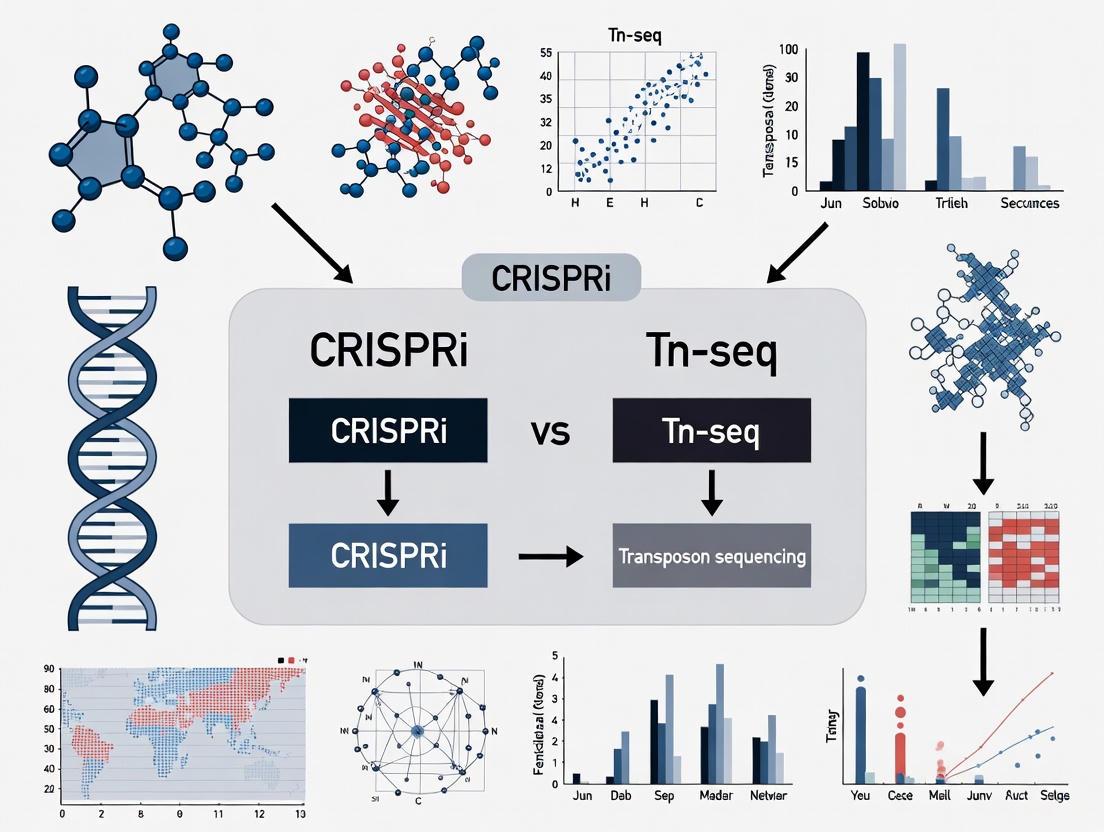
This article provides a comprehensive comparison of two cornerstone technologies in bacterial functional genomics: CRISPR interference (CRISPRi) and transposon sequencing (Tn-seq).
CRISPRi vs. Tn-seq: A Functional Genomics Guide for Bacterial Geneticists and Drug Developers
Abstract
This article provides a comprehensive comparison of two cornerstone technologies in bacterial functional genomics: CRISPR interference (CRISPRi) and transposon sequencing (Tn-seq). Aimed at researchers, scientists, and drug development professionals, we explore the foundational principles, methodological strengths, and specific limitations of each approach. Drawing on recent studies in pathogens like *Mycobacterium tuberculosis*, *Streptococcus pneumoniae*, and *Clostridioides difficile*, we detail their application in essential gene identification, genetic interaction mapping, and drug target discovery. A dedicated troubleshooting section offers practical guidance for experimental optimization, while a final comparative analysis synthesizes evidence to help researchers select the optimal tool—or their powerful combination—for high-throughput genetic screening and the identification of novel antibacterial targets.
Core Principles: How CRISPRi and Tn-seq Decode Bacterial Gene Function
Functional genomics represents the cornerstone of modern bacterial genetics, enabling the systematic association of genes with their biological functions. By moving beyond the study of single genes, this field allows for a holistic view of how genetic elements collectively contribute to cellular processes, stress responses, and pathogenesis. The development of high-throughput screening technologies has revolutionized our ability to map genotype to phenotype at a genome-wide scale. Among the most powerful approaches in the bacterial geneticist's toolkit are CRISPR interference (CRISPRi) and transposon insertion sequencing (Tn-seq), which represent distinct methodological philosophies for probing gene function [1]. CRISPRi utilizes a programmed, guide RNA-directed system for targeted gene knockdown, while Tn-seq relies on random transposon insertion and deep sequencing to assess gene essentiality [2] [3]. This guide provides an objective comparison of these two pivotal technologies, presenting experimental data and methodologies to inform researchers selecting the optimal approach for their specific functional genomics applications in bacteriology.
Core Technologies: Mechanisms and Methodologies
CRISPR Interference (CRISPRi)
The CRISPRi system employs a catalytically inactive Cas9 protein (dCas9) that retains its ability to bind DNA based on guide RNA specificity but does not cleave the target DNA. Upon binding, dCas9 creates a physical barrier that blocks either the binding or elongation of RNA polymerase, thereby repressing transcription of the target gene [1]. This technology offers several advantages, including the ability to titrate knockdown levels using inducible promoters or modified sgRNAs, target essential genes without causing lethality, and facilitate multiplexing with multiple sgRNAs [1]. A significant consideration in prokaryotic applications is the potential for polar effects on downstream genes in operons, though the system's programmability enables strategic guide RNA design to minimize such effects [2].
Transposon Insertion Sequencing (Tn-seq)
Tn-seq utilizes random transposon mutagenesis to create a library of bacterial mutants with insertions throughout the genome. The abundance of each insertion mutant in a pooled culture is quantified before and after selection using next-generation sequencing, enabling genome-wide assessment of gene fitness [3]. Genes with few or no transposon insertions after selection are classified as essential under the tested condition. Recent advancements like InducTn-seq have improved this approach by incorporating temporal control over transposition through an inducible transposase, enabling bypass of population bottlenecks and generating exceptionally diverse mutant libraries with over one million unique insertions from a single colony [3]. However, Tn-seq shows inherent bias against shorter genes due to statistical limitations of sparse insertion coverage [2].
Performance Comparison: CRISPRi vs. Tn-seq
Quantitative Performance Metrics
The following table summarizes key performance characteristics based on direct comparative studies and methodological evaluations:
Table 1: Performance comparison between CRISPRi and Tn-seq
| Performance Metric | CRISPRi | Tn-seq |
|---|---|---|
| Essential Gene Detection Sensitivity | Superior for short genes [2] | Limited for short genes due to insertion bias [2] |
| Non-coding RNA Targeting | Effective (demonstrated for tRNAs) [2] | Not applicable [2] |
| Positional Effect | Strong activity within first 5% of ORF [2] | Random insertion throughout genes [3] |
| Mutant Library Diversity | Designed library (~60,000 sgRNAs in E. coli) [2] | Ultra-diverse (>1 million unique insertions with InducTn-seq) [3] |
| Polar Effects | Can affect downstream genes in operons [1] | Can cause overexpression of downstream genes [1] |
| Organism Applicability | Broad (any prokaryote with functional CRISPRi) [2] | Universal [3] |
Application Scope and Limitations
Table 2: Applications and limitations of CRISPRi and Tn-seq
| Aspect | CRISPRi | Tn-seq |
|---|---|---|
| Primary Applications | Essential gene characterization, genetic interaction mapping, titratable knockdowns [1] | Essential gene discovery, conditionally essential genes, synthetic lethality [1] |
| Key Advantages | Targeted design, titratable knockdown, applicable to essential genes and ncRNAs [2] [1] | Universal application, does not require species-specific engineering [3] |
| Methodological Limitations | Potential toxicity of components, "bad seed" effects with certain sgRNAs [1] | Bias against short genes, non-random insertion bias with some transposons [2] [1] |
| Experimental Constraints | Requires optimized sgRNA design and delivery [2] | Limited by population bottlenecks in selective conditions [3] |
Integrated Approaches: CRISPRi-TnSeq for Genetic Interaction Mapping
A powerful integration of both technologies, CRISPRi-TnSeq, enables systematic mapping of genetic interactions between essential and non-essential genes. This method combines CRISPRi-mediated knockdown of essential genes with TnSeq-mediated knockout of non-essential genes in a single experiment [4]. In a landmark Streptococcus pneumoniae study, this approach screened approximately 24,000 gene pairs, identifying 1,334 significant genetic interactions (754 negative and 580 positive interactions) [4] [5]. The methodology revealed pleiotropic non-essential genes that interact with multiple essential genes, providing insights into cellular robustness mechanisms and potential drug-sensitizing targets [4].
Experimental Protocols and Reagent Solutions
Key Experimental Protocols
CRISPRi Pooled Screening Protocol (as implemented in E. coli):
- Guide RNA Library Design: Design sgRNAs targeting the non-template strand, preferentially within the first 5% of the open reading frame proximal to the start codon. Include approximately 10 sgRNAs per gene for reliable hit calling [2].
- Library Construction: Synthesize the sgRNA library (~60,000 members for E. coli genome-scale) via microarray oligonucleotide synthesis and clone into an optimized sgRNA expression vector [2].
- Transformation and Screening: Transform the sgRNA library into strains expressing dCas9. Conduct parallel growth under selective and control conditions for approximately ten cell doublings [2].
- Fitness Profiling: Extract genomic DNA from output pools, amplify sgRNA regions, and sequence via next-generation sequencing. Calculate sgRNA fitness based on abundance changes and determine statistical significance compared to negative controls [2].
InducTn-seq Protocol (for High-Density Mutagenesis):
- Strain Engineering: Introduce a mobilizable plasmid containing an arabinose-inducible Tn5 transposase system integrated at the attTn7 site [3].
- Inducible Mutagenesis: Culture attTn7 integrants with arabinose to induce random mini-Tn5 transposition, generating a highly diverse mutant population [3].
- Selection and Sequencing: Harvest genomic DNA from populations before and after selection. Prepare sequencing libraries using MmeI digestion or random priming to capture transposon-chromosome junctions [3].
- Fitness Calculation: Map sequencing reads to the genome and calculate gene fitness scores based on insertion abundance changes between conditions [3].
Essential Research Reagent Solutions
Table 3: Key research reagents for CRISPRi and Tn-seq functional genomics
| Reagent/Resource | Function | Implementation Examples |
|---|---|---|
| dCas9 Expression System | Catalytically inactive Cas9 for transcriptional repression | Expressed from optimized promoters (J23111 in E. coli) [2] |
| sgRNA Library | Programmable targeting of genomic loci | Microarray-synthesized oligonucleotide libraries cloned into expression vectors [2] |
| Inducible Transposase System | Temporally controlled transposition | Arabinose-inducible PBAD promoter controlling Tn5 transposase [3] |
| Hyperactive Transposon | Efficient genomic insertion | Mini-Tn5 transposon with kanamycin resistance and mosaic ends [3] |
| Cre-Lox Reporter System | Monitoring transposition frequency | lox-flanked indicator measuring population-level mutagenesis [3] |
The choice between CRISPRi and Tn-seq for bacterial functional genomics depends heavily on the specific research objectives, organism, and desired throughput. CRISPRi offers superior precision for probing essential genes, non-coding elements, and enables titratable knockdowns, making it ideal for hypothesis-driven research [2] [1]. In contrast, Tn-seq provides unparalleled breadth for discovery-based approaches, identifying conditionally essential genes across diverse genetic backgrounds with minimal upfront design [3]. The integration of both technologies in CRISPRi-TnSeq represents a powerful frontier for mapping genetic interactions and understanding bacterial systems biology [4] [5]. As both methodologies continue to evolve, their combined application will undoubtedly accelerate functional gene annotation and antibacterial discovery in the coming years.
Transposon insertion sequencing (Tn-seq) is a powerful high-throughput functional genomics technique that combines random transposon mutagenesis with massively parallel sequencing to probe gene functions on a genome-wide scale [6]. In the broader context of comparing CRISPRi and Tn-seq methodologies, Tn-seq stands out for its unique ability to directly assess gene essentiality through insertional mutagenesis, providing a binary, disruption-based readout of gene function [1]. The fundamental principle underpinning Tn-seq is that genes essential for survival under specific conditions cannot tolerate transposon insertions, resulting in their depletion from mutant libraries after selection [7] [8]. This approach has revolutionized our understanding of microbial biology by enabling the systematic identification of both essential and conditionally essential genes across diverse bacterial species and yeast [7].
Unlike CRISPRi, which employs targeted gene knockdowns and can investigate essential gene functions through partial repression, Tn-seq utilizes saturation mutagenesis to create comprehensive libraries of mutants, each containing a single transposon insertion [1] [6]. When pooled together, these mutants collectively represent insertions in all non-essential genomic regions, providing a direct physical representation of genetic dispensability [7]. The resulting insertion patterns after deep sequencing reveal not only which genes are essential for viability but also those that provide fitness advantages under specific environmental conditions, from rich laboratory media to host infection environments [7] [9].
Fundamental Principles of Saturation Mutagenesis and Essentiality Assessment
Core Mechanism of Insertion Depletion
The analytical power of Tn-seq rests on a straightforward biological principle: transposon insertions within genomic regions essential for growth or survival under given conditions will be depleted from the mutant population after selection [8]. During library construction, transposons randomly insert throughout the genome, creating a complex pool of mutants. When this pool undergoes selective pressure (such as growth in a specific medium or during infection), mutants with insertions in essential genes display impaired growth and consequently diminish in relative abundance [6] [9]. By quantifying changes in insertion frequency before and after selection through high-throughput sequencing, researchers can systematically identify conditionally essential genetic elements [10].
Different transposons exhibit distinct insertion sequence preferences that significantly impact library design and saturation requirements. The Himar1 Mariner transposon, one of the most widely used elements for Tn-seq, inserts specifically at TA dinucleotide sites [8]. In contrast, Tn5 transposons display a broader insertion capability with only a slight preference for GC-rich sequences [7]. These preferences directly influence the theoretical saturation achievable in a given organism; genomes with abundant TA sites naturally accommodate higher-density Himar1 mutagenesis [8]. For essentiality calls to be statistically robust, genes must contain sufficient potential insertion sites (typically >3-5 TA sites for Himar1) to distinguish true essentiality from stochastic insertion gaps [8].
Diagram 1: Tn-seq experimental workflow for essential gene identification.
Comparative Analysis: Tn-seq vs. CRISPRi in Functional Genomics
Technical and Methodological Comparisons
The choice between Tn-seq and CRISPRi depends heavily on research objectives, organismal systems, and specific biological questions. Each methodology offers distinct advantages and limitations that make them suitable for different applications in functional genomics [1].
Table 1: Technical comparison of Tn-seq and CRISPRi methodologies
| Parameter | Tn-seq | CRISPRi |
|---|---|---|
| Gene Targeting | Random insertion mutagenesis | Programmable, sequence-specific targeting |
| Essential Gene Analysis | Identifies via insertion depletion | Enables knockdown studies of essentials |
| Perturbation Type | Complete gene disruption | Tunable transcriptional repression |
| Throughput | Genome-wide in single experiment | Requires sgRNA library design & synthesis |
| Multiplexing Capacity | Limited to single mutations per cell | Capable of multiplexed gene targeting [11] |
| Temporal Control | Limited (constitutive disruption) | Inducible and reversible [11] |
| Polarity Effects | Can affect downstream genes in operons | Can cause both forward and reverse polarity [1] |
| Applicable Species | Broad (bacteria, yeast) | Limited by CRISPR component functionality [1] |
Applications and Synergies in Bacterial Genetics
Tn-seq has proven exceptionally valuable for defining core essential genomes across microorganisms. Comparative analysis of 14 bacterial species revealed 133 conserved essential genes involved in fundamental processes including cell division (ftsA, ftsZ), DNA replication (dnaA, dnaE), ribosomal function, cell wall synthesis (murB, murC), and amino acid synthesis (alaS, argS) [7]. Beyond these conserved essentials, Tn-seq identifies species-specific essential genes that represent potential targets for narrow-spectrum antimicrobials.
In contrast, CRISPRi excels at probing the function of individual essential genes through titratable knockdowns, allowing researchers to study dosage-sensitive genes and essential processes that would be impossible to investigate via knockout approaches [1]. The complementary strengths of both techniques are highlighted by the development of CRISPRi-TnSeq, an integrated approach that maps genome-wide interactions between essential and non-essential genes by combining CRISPRi-mediated knockdown of essential genes with Tn-seq-mediated knockout of non-essential genes [4].
Experimental Protocols and Methodological Considerations
Tn-seq Library Construction and Validation
The foundation of a successful Tn-seq experiment lies in the creation of a high-quality, saturated transposon mutant library. The process typically begins with the delivery of a Himar1 Mariner or Tn5 transposon into the target organism via conjugation, electroporation, or transduction using a suicide plasmid or temperature-sensitive delivery vector [7] [6]. For the Himar1 system, which inserts specifically at TA dinucleotides, library saturation is critical—the ideal library should contain multiple independent insertions at every non-essential TA site in the genome [8].
Following mutant pool generation, genomic DNA is extracted, fragmented, and processed to amplify transposon-genome junctions. The original Tn-seq protocol uses MmeI digestion to capture 16-20 bp of genomic flanking sequence, which is sufficient for unique mapping in most microbial genomes [6]. More recent variations like randomly barcoded Tn-seq (RB-TnSeq) incorporate unique molecular barcodes within the transposon to streamline sequencing and reduce PCR amplification biases [10]. Library quality assessment should verify sufficient mutant diversity (typically hundreds of thousands to millions of unique insertions), even distribution across the genome, and coverage of >90% of non-essential TA sites.
Selection Conditions and Experimental Design
Robust Tn-seq experiments incorporate careful consideration of selection conditions and control comparisons. Conditionally essential genes are identified by comparing insertion abundances between reference and test conditions [10]. Best practices include:
- Baseline Condition Selection: Using minimal medium rather than rich medium (e.g., LB) for reference cultures reduces metabolite carryover that can mask auxotrophies [10]
- Biological Replication: Incorporating 2-3 biological replicates increases statistical power and controls for stochastic library composition differences [10]
- Parallel Passaging: Maintaining the mutant library in a permissive reference condition in parallel with selective conditions helps distinguish condition-specific effects from general fitness defects [10]
- Sequencing Depth: Ensuring sufficient sequencing coverage (typically 1,000-10,000 reads per insertion site depending on library complexity) to accurately quantify insertion frequencies
Diagram 2: Gene classification by insertion patterns in Tn-seq.
Analytical Approaches for Essential Gene Identification
Statistical Frameworks and Bioinformatics Tools
The statistical analysis of Tn-seq data presents unique challenges due to the inherent noisiness of insertion counts and the need to distinguish true essentiality from stochastic insertion gaps. Several specialized computational tools have been developed to address these challenges:
Table 2: Bioinformatics tools for Tn-seq data analysis
| Tool | Primary Function | Statistical Approach | Key Features |
|---|---|---|---|
| TRANSIT [8] | Essential & conditionally essential gene identification | Multiple algorithms (Gumbel, HMM, ZINB) | Comprehensive toolset, permutation-based testing |
| ESSENTIALS [8] | Gene essentiality calling | Bayesian framework | Normalization for copy-number effects |
| TnSeq Explorer [7] | Data visualization and analysis | Interactive analysis platform | User-friendly interface for data exploration |
| ARTIST [8] | Essential gene identification | Hidden Markov Model (HMM) | Pathway-level analysis capabilities |
| Bayesian Genetic Interaction [9] | Genetic interaction mapping | Hierarchical Bayesian model | Four-way comparison for interaction networks |
Genetic Interaction Mapping
Advanced Tn-seq applications extend beyond single-gene essentiality to map genetic interactions across the genome. The Bayesian method for genetic interaction analysis involves a four-way comparison of insertion counts across datasets (wild-type vs. mutant backgrounds, before and after selection) to identify significant changes in enrichment patterns [9]. This approach can detect several interaction types: aggravating (synthetic sick/lethal) interactions where double mutants show enhanced fitness defects; alleviating (epistatic) interactions where the double mutant is less severe than expected; and suppressing interactions where one mutation reverses the fitness defect of another [9].
Table 3: Essential research reagents for Tn-seq experiments
| Reagent/Resource | Function | Examples & Considerations |
|---|---|---|
| Transposon Systems | Random mutagenesis | Himar1 (TA-specific), Tn5 (broader insertion) |
| Delivery Vectors | Transposon introduction | Suicide plasmids, temperature-sensitive plasmids |
| Sequenceing Platforms | Insertion site quantification | Illumina, NovaSeq (high-depth requirements) |
| Bioinformatics Software | Data analysis | TRANSIT, ESSENTIALS, TraDIS-Toolkit |
| Reference Genomes | Insertion mapping | Annotated genomes with TA site coordinates |
| Selection Media | Conditional essentiality | Minimal media, antibiotic stresses, host-mimicking conditions |
Tn-seq remains an indispensable methodology in the functional genomics toolkit, providing direct, quantitative assessment of gene essentiality through saturation mutagenesis and insertion depletion. While CRISPRi offers complementary strengths in essential gene characterization and tunable perturbation, Tn-seq excels in comprehensive essential gene discovery and genetic interaction mapping. The continuing evolution of Tn-seq methodologies—including barcoded approaches, enhanced statistical frameworks, and integration with complementary technologies like CRISPRi—ensures its ongoing relevance in probing gene function in diverse microorganisms. As functional genomics advances, the synergistic application of both Tn-seq and CRISPRi will continue to illuminate the genetic foundations of microbial life and provide targets for therapeutic intervention.
CRISPR interference (CRISPRi) is a powerful gene knockdown technology derived from the CRISPR-Cas9 system. It enables precise, programmable repression of gene expression without altering the underlying DNA sequence. This technique has become an indispensable tool in functional genomics, particularly for studying essential genes in bacteria where traditional knockout methods are not feasible. CRISPRi functions through a catalytically inactive Cas9 (dCas9) protein, which retains its ability to bind DNA targets specified by a guide RNA (sgRNA) but lacks nuclease activity. When directed to a gene's promoter or coding region, the dCas9-sgRNA complex creates a physical barrier that blocks transcription, effectively knocking down gene expression [12] [13].
The application of CRISPRi is especially valuable in the broader context of bacterial functional genomics, where it provides complementary capabilities to transposon sequencing (Tn-seq). While Tn-seq identifies essential genes by analyzing survival of random transposon mutants at a genome-wide scale, it cannot directly probe genes that are indispensable for viability. CRISPRi addresses this limitation by enabling targeted, tunable knockdown of essential genes, allowing researchers to study their functions and identify potential antibiotic targets in problematic pathogens like Clostridioides difficile and Streptococcus pneumoniae [14] [4].
Core Mechanism and Components
Molecular Architecture
The CRISPRi system consists of two fundamental components:
dCas9 (catalytically inactive Cas9): This engineered protein contains mutations (typically D10A and H840A for SpCas9) that inactivate its nuclease domains while preserving DNA-binding capability. dCas9 serves as a programmable DNA-binding scaffold that can be directed to specific genomic loci [12].
sgRNA (single guide RNA): A chimeric RNA molecule combining two natural elements:
- crRNA (CRISPR RNA): A 17-20 nucleotide customizable sequence that determines target specificity through complementary base pairing with DNA.
- tracrRNA (trans-activating crRNA): A structural scaffold that facilitates dCas9 binding and complex formation [15].
The sgRNA structure is organized into distinct domains: the target-specific crRNA region (green), linker loop (purple), and scaffold tracrRNA region (blue), which together form a functional unit that directs dCas9 to specific DNA sequences [15].
Mechanism of Transcriptional Repression
The CRISPRi mechanism begins when the sgRNA directs the dCas9 protein to a specific genomic target. Successful binding requires the presence of a Protospacer Adjacent Motif (PAM) sequence adjacent to the target site—typically 5'-NGG-3' for the commonly used SpCas9 from Streptococcus pyogenes [15] [12]. Once the dCas9-sgRNA complex binds to its target, it employs multiple mechanisms to repress transcription, with the primary mechanism being steric hindrance:
- Promoter Blocking: When dCas9 binds within a promoter region, it physically prevents RNA polymerase from initiating transcription.
- Elongation Blocking: When dCas9 binds within the coding sequence, it creates a physical barrier that blocks the progression of RNA polymerase during transcription elongation.
The guide RNA's target recognition depends heavily on seed sequence complementarity—the 8-10 nucleotides at the 3' end of the gRNA targeting region—where mismatches most significantly disrupt binding. This precise targeting mechanism enables researchers to specifically repress genes of interest while minimizing off-target effects on the rest of the transcriptome [12] [16].
CRISPRi Experimental Workflow
Implementing CRISPRi requires a systematic approach from design to validation. The workflow below outlines the critical steps for successful gene knockdown experiments.
Critical Design Parameters
sgRNA Design Considerations: Successful CRISPRi experiments depend heavily on optimal sgRNA design. Several critical parameters must be addressed:
- PAM Requirement: The target site must be immediately adjacent to a protospacer adjacent motif (PAM). For SpCas9, this is 5'-NGG-3' located on the non-target DNA strand [15] [12].
- Target Sequence Length: Typically 17-23 nucleotides for SpCas9, balancing specificity and efficiency [15].
- GC Content: Optimal between 40-80% for sgRNA stability and binding efficiency [15].
- Off-Target Potential: Minimized by ensuring minimal homology to non-target genomic regions, especially in the seed sequence [15] [12].
- Genomic Accessibility: Consider chromatin accessibility in eukaryotic systems, though less critical in bacterial applications.
sgRNA Synthesis Methods: Researchers can produce sgRNAs through multiple approaches, each with distinct advantages:
Table: Comparison of sgRNA Synthesis Methods
| Method | Production Time | Key Advantages | Limitations | Best Applications |
|---|---|---|---|---|
| Plasmid-expressed | 1-2 weeks | Sustainable in vivo production; cost-effective for long-term studies | Potential for genomic integration; variable expression levels; extended expression may increase off-target effects | Long-term knockdown studies; genetic screens |
| In Vitro Transcription (IVT) | 1-3 days | No cloning required; flexible design modifications | Labor-intensive; requires purification; potential RNA degradation | Medium-throughput applications; rapid testing of multiple guides |
| Synthetic sgRNA | 1-2 days (commercial) | High purity and consistency; precisely defined chemical composition; reduced off-target effects | Higher cost per sample; scale limitations | High-precision experiments; therapeutic development; standardized assays |
Delivery and Validation
Delivery Systems: Effective CRISPRi requires co-delivery of both dCas9 and sgRNA components. Common approaches include:
- Plasmid Vectors: Express both dCas9 and sgRNA from the same or separate plasmids, often with inducible promoters for temporal control.
- Integrated Systems: Stable chromosomal integration of dCas9 with plasmid-based or synthetic sgRNA delivery.
- Ribonucleoprotein Complexes: Pre-formed dCas9-sgRNA complexes delivered directly for immediate but transient activity.
Validation Methods: Rigorous validation ensures successful knockdown:
- qRT-PCR: Quantifies reduction in target mRNA levels.
- Western Blotting: Measures decreased protein expression.
- Phenotypic Assays: Functional tests for expected morphological or growth defects.
- RNA-seq: Genome-wide assessment of specificity and off-target effects.
Comparative Analysis: CRISPRi vs. Tn-seq
CRISPRi and Tn-seq represent complementary approaches in functional genomics, each with distinct strengths and limitations. The table below provides a systematic comparison based on experimental data from recent studies.
Table: Performance Comparison of CRISPRi and Tn-seq Technologies
| Parameter | CRISPRi | Tn-seq | Experimental Basis |
|---|---|---|---|
| Essential Gene Detection | 90-100% confirmation rate for previously identified essential genes [14] | Identified 346 essential genes in C. difficile R20291 [14] | Comparative analysis in C. difficile strain R20291 [14] |
| False Positive Rate | Lower false positives due to direct targeting | Higher, minimized by combining datasets (283 common essential genes in intersection) [14] | Analysis of 404 previously identified vs. 346 newly identified essential genes [14] |
| Essential Gene Study Capability | Direct knockdown of essential genes possible | Cannot directly interrogate essential genes (lethal to cell) | Fundamental methodological difference [4] |
| Genetic Interaction Mapping | CRISPRi-TnSeq identifies 1,334 interactions (754 negative, 580 positive) [4] | Traditional Tn-seq limited to non-essential genes | Combined CRISPRi-TnSeq in S. pneumoniae [4] |
| Tunability/Knockdown Level | Graded knockdown possible with inducible systems | Binary (gene either functional or not) | CRISPRi enables partial knockdown studies [4] [12] |
| Temporal Control | High (with inducible promoters) | None (random insertion) | Inducible CRISPRi systems enable time-course studies [4] |
| Throughput | High (pooled screens with multiple sgRNAs) | Very high (genome-wide coverage in single experiment) | Both suitable for genome-wide applications [14] [4] |
| Technical Implementation | Requires specialized vector design and optimization | Established protocols across bacterial species | TRANSIT software available for Tn-seq analysis [17] |
Integrated Approaches: CRISPRi-TnSeq
The integration of CRISPRi with Tn-seq creates a powerful hybrid approach for comprehensive genetic interaction mapping. This method, termed CRISPRi-TnSeq, enables systematic interrogation of relationships between essential and non-essential genes [4] [5]. The experimental framework involves:
- CRISPRi Strain Development: Engineering strains with inducible dCas9 and sgRNAs targeting essential genes.
- Transposon Library Construction: Generating comprehensive Tn mutant libraries in each CRISPRi strain background.
- Dual Perturbation Screening: Growing libraries with and without CRISPRi induction to assess genetic interactions.
- Interaction Identification: Detecting significant fitness deviations from expected multiplicative effects.
In a landmark study, CRISPRi-TnSeq screened approximately 24,000 gene pairs in Streptococcus pneumoniae, identifying 1,334 significant genetic interactions (754 negative, 580 positive). This approach revealed pleiotropic genes where single non-essential genes interacted with more than half of the tested essential genes, highlighting key modulators of cellular stress responses [4].
Research Reagent Solutions
Successful implementation of CRISPRi experiments requires specific reagents and tools. The following table outlines essential components and their functions.
Table: Essential Research Reagents for CRISPRi Experiments
| Reagent/Tool | Function | Key Features | Examples/Sources |
|---|---|---|---|
| dCas9 Expression Vectors | Provides catalytically inactive Cas9 protein | Mutations (D10A, H840A) to eliminate nuclease activity while maintaining DNA binding | Addgene: Multiple dCas9 plasmids with various promoters and tags [12] |
| sgRNA Cloning Vectors | Template for guide RNA expression | U6 or T7 promoters; multiple cloning sites for sgRNA insertion | Addgene: sgRNA expression plasmids compatible with different systems [12] |
| sgRNA Design Tools | Computational design of optimal guide RNAs | Off-target prediction; efficiency scoring; PAM identification | CHOPCHOP, Synthego Design Tool, Cas-Offinder [15] |
| Tn-seq Analysis Software | Analysis of transposon insertion sequencing data | Essential gene calling; conditionally essential gene identification; genetic interactions | TRANSIT (Python-based) [17] |
| Synthetic sgRNA | High-purity guide RNA for direct delivery | Chemical synthesis; minimal batch variation; high editing efficiency | Commercial suppliers (e.g., Synthego) [15] |
| Increased Specificity Cas9 Variants | Enhanced specificity mutants for reduced off-target effects | Engineered to minimize off-target binding while maintaining on-target activity | eSpCas9(1.1), SpCas9-HF1, HypaCas9 [12] |
Applications in Bacterial Functional Genomics
CRISPRi has enabled significant advances in understanding bacterial genetics, particularly in these key areas:
Essential Gene Characterization
CRISPRi provides unprecedented access to study essential genes—those required for viability that cannot be disrupted by traditional knockout methods. In Clostridioides difficile, a problematic pathogen with limited treatment options, CRISPRi confirmed essentiality for >90% of 181 targeted genes previously identified by Tn-seq and revealed morphological defects for >80% of them during vegetative growth [14]. This high confirmation rate demonstrates CRISPRi's reliability for essential gene validation while providing new phenotypic insights through partial knockdowns that permit observation of morphological changes preceding cell death.
Genetic Network Mapping
The integration of CRISPRi with Tn-seq (CRISPRi-TnSeq) enables systematic mapping of genetic interactions between essential and non-essential genes. This approach identified 17 pleiotropic non-essential genes in Streptococcus pneumoniae that interact with more than half of the essential genes tested. Validation experiments confirmed that a 7-gene subset provides protection against various perturbations, revealing hidden redundancies that compensate for essential gene loss and illustrating relationships between cell wall synthesis, integrity, and cell division [4] [5].
Antibiotic Target Discovery
CRISPRi's tunable knockdown capability makes it ideal for studying potential antibiotic targets. By gradually reducing essential gene expression, researchers can mimic antibiotic action and identify the minimal inhibition threshold for bacterial growth. This approach helps prioritize targets where even partial inhibition proves lethal to the pathogen—a valuable characteristic for antibiotic development. Additionally, CRISPRi enables studies of essential gene function in bacterial cell division, with recent work in C. difficile identifying 18 putative new cell division proteins through fluorescent protein fusions [14].
Technical Considerations and Optimization
sgRNA Design and Validation
Effective sgRNA design requires balancing multiple parameters:
- Target Position: For maximal transcriptional repression, target sgRNAs to the non-template strand within the promoter or early coding regions.
- Specificity Verification: Use tools like BLAST to ensure minimal off-target potential, especially in repetitive genomes.
- Efficiency Optimization: Design 3-5 sgRNAs per target to account for variable efficiency, then empirically validate the most effective guides.
- Control Designers: Include non-targeting sgRNAs as negative controls and essential gene-targeting sgRNAs as positive controls.
System Optimization
Successful CRISPRi implementation requires careful optimization:
- Expression Level Tuning: Balance dCas9 and sgRNA expression to maximize on-target effects while minimizing off-target binding.
- Induction Timing: Optimize induction parameters (concentration, duration) for the specific biological question.
- Delivery Efficiency: Ensure high transformation efficiency for consistent coverage across the population.
- Kill Curve Analysis: Establish the relationship between knockdown level and phenotypic effect for essential genes.
CRISPRi represents a transformative technology in bacterial functional genomics, providing programmable gene knockdown capabilities that complement and extend traditional Tn-seq approaches. Its ability to directly target essential genes, tunable knockdown capacity, and compatibility with high-throughput screening make it particularly valuable for investigating gene function, mapping genetic networks, and identifying novel antibiotic targets in pathogenic bacteria. While Tn-seq excels at genome-wide identification of non-essential genes and conditionally important functions, CRISPRi enables direct interrogation of essential processes that cannot be studied with knockout approaches. The integration of both methods in CRISPRi-TnSeq creates a powerful framework for comprehensive genetic analysis, revealing functional connections across the entire genome. As CRISPRi tools continue to evolve with improved specificity, expanded PAM compatibility, and enhanced delivery systems, they will undoubtedly yield deeper insights into bacterial physiology and accelerate the development of novel antimicrobial strategies.
In the field of functional genomics, researchers rely on powerful technologies to systematically determine gene function. Tn-seq (Transposon sequencing) and CRISPRi (CRISPR interference) represent two foundational approaches for genome-wide perturbation studies. While both methods aim to connect genes to phenotypes, they operate on fundamentally different principles: Tn-seq achieves complete, permanent knockout of genes, whereas CRISPRi enables precise, tunable knockdown of gene expression. Understanding their distinct mechanisms, applications, and limitations is crucial for selecting the appropriate tool for specific research questions in microbiology and drug development. This guide provides a detailed comparison of these technologies, supported by recent experimental data and methodological protocols.
Core Mechanisms and Definitions
Tn-seq: Complete Knockout via Random Mutagenesis
Tn-seq combines random transposon mutagenesis with next-generation sequencing to identify essential genes on a genome-wide scale [18]. The methodology involves creating a library of mutants where each cell contains a single transposon insertion in its genome. When a transposon inserts into an essential gene, it disrupts gene function and prevents mutant viability, causing that mutant to be absent from the final pool. Sequencing the pooled library identifies genomic regions that cannot tolerate transposon insertions, thereby defining the set of essential genes required for survival under tested conditions [18].
CRISPRi: Tunable Knockdown via Targeted Repression
CRISPRi utilizes a catalytically dead Cas9 (dCas9) protein that binds to DNA without introducing double-strand breaks. When guided to specific genomic locations by a single-guide RNA (sgRNA), dCas9 sterically hinders transcriptional machinery, resulting in repressed gene expression [19]. In prokaryotes, targeting dCas9 to the promoter region alone can achieve repression, while in mammalian cells, dCas9 is typically fused to repressor domains like the Krüppel-associated box (KRAB) for effective silencing [20]. Unlike permanent knockouts, CRISPRi provides reversible, tunable control over gene expression levels, allowing for partial to near-complete knockdowns [21].
Comparative Workflow Diagrams
The following diagrams illustrate the fundamental operational workflows for Tn-seq and CRISPRi, highlighting their distinct approaches to gene perturbation.
Critical Technological Distinctions
The table below summarizes the fundamental differences between Tn-seq and CRISPRi across key technical parameters.
Table 1: Core Technological Distinctions Between Tn-seq and CRISPRi
| Parameter | Tn-seq | CRISPRi |
|---|---|---|
| Mechanism of Action | Complete gene disruption via transposon insertion [18] | Steric hindrance of transcription via dCas9 binding [19] |
| Perturbation Type | Permanent knockout | Reversible, tunable knockdown |
| Genomic Coverage | Genome-wide, random insertion | Targeted, programmable sites |
| Essential Gene Study | Identifies essential genes as those without insertions [18] | Enables partial knockdown of essential genes [21] |
| Tunability | Binary (gene functional vs. non-functional) | Graded repression (can be titrated) [20] |
| Temporal Control | None (constitutive knockout) | Inducible systems available [4] |
| Applicability | Bacteria, yeast; limited in mammalian cells | Bacteria to mammalian cells [21] [20] |
Experimental Data and Performance Comparison
Case Study: Clostridioides difficile Essential Gene Discovery
A direct comparison in Clostridioides difficile highlights how these complementary approaches validate and refine essential gene sets:
- Tn-seq identified 346 genes as essential for vegetative growth in strain R20291 [14].
- CRISPRi targeting of 181 genes from a previous essential gene set confirmed essentiality for >90% of targeted genes, while also revealing morphological defects for >80% of them [14].
- The intersection of both methods yielded 283 high-confidence essential genes that minimize false positives, demonstrating how orthogonal validation strengthens essential gene identification [14].
Performance Metrics in Functional Genomic Screens
Table 2: Experimental Performance Characteristics in Genomic Screens
| Performance Metric | Tn-seq | CRISPRi |
|---|---|---|
| False Positive Rate | Higher due to polar effects on downstream genes [22] | Lower, especially with RNA-targeting approaches that avoid polar effects [22] |
| Essential Gene Mapping | Comprehensive but binary | Enables study of essential gene function without lethality [4] |
| Conditional Essentiality | Identifies conditionally essential genes [23] [18] | Excellent for studying essential genes under various conditions [21] |
| Genetic Interactions | Limited to non-essential genes | Enables mapping of essential-non-essential gene interactions [4] |
| Multiplexing Capacity | Limited to single perturbations per cell | Potential for multiplexed gene targeting [22] |
Detailed Methodological Protocols
Tn-seq Experimental Protocol
Library Construction: Generate a high-density transposon mutant library using suicide plasmids or temperature-sensitive vectors delivering transposases (e.g., Tn5, Mariner) [18]. Aim for >60,000 unique insertion mutants to achieve genome saturation [23].
Pooled Growth: Culture the mutant library under experimental conditions of interest alongside control conditions. For conditionally essential genes, apply specific stressors (e.g., low temperature, antibiotics) [23].
DNA Extraction and Sequencing: Harvest genomic DNA from pooled libraries. Fragment DNA, enrich for transposon-genome junctions, and prepare sequencing libraries [18].
Bioinformatic Analysis: Map sequencing reads to the reference genome, quantifying insertion frequency per gene. Use specialized software (ESSENTIALS, TRANSIT, TSAS) to identify statistically significant essential genes based on absence of insertions [18].
CRISPRi Experimental Protocol
sgRNA Design and Library Construction: Design sgRNAs targeting promoter regions or transcriptional start sites of genes of interest. For genome-wide screens, create pooled sgRNA libraries cloned into appropriate expression vectors [21] [20].
Strain Engineering: Introduce dCas9 repressor fusion (e.g., dCas9-KRAB) into the target organism. For inducible systems, place dCas9 under control of regulated promoters (e.g., IPTG-inducible) [4].
Library Transformation and Induction: Deliver the sgRNA library to the dCas9-expressing strain. For essential gene screens, induce dCas9 expression with titrated amounts of inducer to achieve varying knockdown levels [4].
Phenotypic Screening and Sequencing: Culture the induced and uninduced pools in parallel. Extract genomic DNA, amplify sgRNA regions, and sequence to quantify sgRNA abundance changes, which reflect fitness effects of gene knockdown [20].
Advanced Applications and Integration
Combined Approaches for Genetic Interaction Mapping
The integration of both technologies enables sophisticated analysis of genetic interactions:
CRISPRi-TnSeq methodology simultaneously knocks down essential genes (via CRISPRi) while knocking out non-essential genes (via Tn-seq) in Streptococcus pneumoniae [4] [5]. This approach mapped ~24,000 gene pairs, identifying 1,334 genetic interactions including 754 negative and 580 positive interactions [4].
This hybrid approach reveals hidden redundancies that compensate for essential gene loss and relationships between cellular pathways, providing a more comprehensive functional network [4].
Application-Specific Considerations
Table 3: Technology Selection Guide by Research Application
| Research Goal | Recommended Technology | Rationale |
|---|---|---|
| Essential Gene Discovery | Tn-seq | Provides comprehensive, binary assessment of gene essentiality [18] |
| Study of Essential Gene Function | CRISPRi | Enables partial knockdown without lethality [21] [4] |
| Conditional Essentiality | Both | Tn-seq identifies; CRISPRi probes mechanisms [23] [18] |
| Genetic Interaction Mapping | Combined CRISPRi-TnSeq | Enables systematic interaction studies [4] |
| Drug Target Validation | CRISPRi | Better mimics partial inhibition by drugs [20] |
| High-Throughput Phenotyping | Both | Each enables pooled screening formats |
Research Reagent Solutions
Table 4: Essential Research Reagents and Their Applications
| Reagent / Tool | Function | Examples & Notes |
|---|---|---|
| Transposon Systems | Random insertion mutagenesis | Tn5, Mariner/Himar1 (TA dinucleotide preference) [18] |
| dCas9 Variants | Targeted DNA binding without cleavage | dCas9-KRAB (enhanced repression in eukaryotes) [20] |
| sgRNA Libraries | Programmable targeting | Genome-wide libraries for specific organisms [21] |
| Inducible Systems | Temporal control of perturbation | IPTG-inducible promoters for dCas9 expression [4] |
| Bioinformatic Tools | Data analysis | ESSENTIALS, TRANSIT (Tn-seq); MAGeCK (CRISPRi) [18] |
Tn-seq and CRISPRi represent complementary pillars of modern functional genomics, each with distinct advantages and limitations. Tn-seq excels at comprehensive essential gene discovery through permanent knockout, while CRISPRi enables nuanced functional studies of essential genes through tunable knockdown. The choice between them depends on specific research goals: Tn-seq for definitive essential gene mapping, CRISPRi for mechanistic studies and drug target validation. Emerging integrated approaches like CRISPRi-TnSeq demonstrate the powerful synergies achieved by combining both technologies, offering unprecedented resolution for genetic interaction mapping and functional genomics in diverse microorganisms. As both technologies continue to evolve, they will further expand our ability to systematically decipher gene function and identify novel therapeutic targets.
Functional genomics has revolutionized our understanding of biological systems by enabling genome-wide investigations of gene function. In bacterial research, two powerful technologies have emerged as cornerstones for these investigations: transposon insertion sequencing (Tn-seq) and CRISPR interference (CRISPRi). Tn-seq, a well-established method, utilizes random transposon mutagenesis coupled with high-throughput sequencing to identify essential genes on a genome-wide scale. Meanwhile, CRISPRi employs a catalytically inactive Cas9 protein (dCas9) and programmable single-guide RNAs (sgRNAs) to achieve targeted gene repression. This guide provides an objective comparison of these platforms, examining their performance characteristics, experimental outputs, and applications in bacterial functional genomics and drug discovery research.
Transposon Insertion Sequencing (Tn-seq)
Tn-seq identifies genes essential for viability under specific conditions based on the absence of transposon insertions following saturation mutagenesis. In this approach, a library of random transposon mutants is grown under selective conditions, after which sequencing of transposon insertion sites reveals genes that are indispensable for growth—those with no or few insertions. While powerful for identifying essential genes, Tn-seq cannot directly sample essential genes that are inviable when disrupted and provides limited functional information about the phenotypic consequences of gene loss beyond fitness defects [4] [24].
CRISPR Interference (CRISPRi)
CRISPRi enables targeted, titratable repression of gene expression using a dCas9 protein that binds DNA without cleaving it. When guided to specific genomic loci by sgRNAs, dCas9 blocks transcription, effectively knocking down target genes. This system is particularly valuable for studying essential genes, as it allows transient repression that can reveal phenotypes preceding cell death. CRISPRi can be implemented in either arrayed format (individual mutants processed separately) or pooled libraries (multiple knockdown strains grown together), with the latter enabling genome-wide fitness profiling through CRISPRi-seq [25] [26] [27].
Performance Comparison and Experimental Data
Quantitative Performance Metrics
Direct comparisons between Tn-seq and CRISPRi reveal distinct performance characteristics across several metrics as shown in the table below.
| Performance Metric | Tn-seq | CRISPRi | Experimental Context |
|---|---|---|---|
| Essential Gene Identification | Identifies 346 essential genes in C. difficile [24] | Confirms >90% of Tn-seq essential genes in C. difficile [24] | Comparative analysis in Clostridioides difficile R20291 |
| Screening Sensitivity | 63.3-87.7% hit recovery in M. tuberculosis [28] | Identifies 1,373 sensitizing and 775 resistance genes in M. tuberculosis [28] | Chemical-genetic screens in Mycobacterium tuberculosis |
| Gene Length Bias | Biased against short genes [26] | Uniform coverage regardless of gene length [26] | Genome-wide essentiality screens in E. coli |
| Non-Coding RNA Analysis | Limited capability [26] | Effective for mapping tRNA fitness [26] | Functional genomics in E. coli |
| Chemical-Getic Interactions | Restricted to non-essential genes [28] | Enriched for essential genes [28] | Drug susceptibility profiling in M. tuberculosis |
Methodological Advantages and Limitations
Tn-seq Strengths and Limitations
Tn-seq provides a direct assessment of gene essentiality through physical absence of mutants, making it excellent for defining core essential genomes. However, it suffers from gene length bias, with poor statistical robustness for short genes, and cannot probe hypomorphic phenotypes [26]. Additionally, Tn-seq may misclassify genes as essential due to polar effects on downstream genes in operons or because slow-growing mutants are lost during library outgrowth [24].
CRISPRi Advantages and Limitations
CRISPRi enables titratable gene repression, allowing study of essential genes and quantitative assessment of gene vulnerability—how不同程度抑制 affects fitness [29]. It demonstrates minimal gene length bias and can target non-coding RNAs effectively [26]. However, CRISPRi also exhibits polar effects when targeting operons and requires careful optimization of sgRNA design and delivery systems for each bacterial species [25] [26].
Experimental Protocols and Workflows
Tn-seq Methodology
Library Construction: Generate saturated transposon mutant libraries through random transposon mutagenesis. Selection and Outgrowth: Pool mutants and grow under selective conditions of interest. DNA Extraction and Adapter Ligation: Isolate genomic DNA and ligate adapters to transposon ends. Sequencing Library Preparation: Amplify transposon-genome junctions and prepare for high-throughput sequencing. Data Analysis: Map insertion sites to reference genome and identify genomic regions with significant depletion of insertions [24] [30].
CRISPRi-Seq Workflow
The following diagram illustrates the complete CRISPRi-seq workflow for pooled fitness screens:
Key Methodological Considerations
CRISPRi Experimental Optimization
sgRNA Design: For prokaryotic genomes, the most effective sgRNAs target the first 5% of the coding region proximal to the start codon [26]. Library Size: Approximately 10 sgRNAs per gene provides sufficient coverage for reliable hit calling in competitive growth assays over 10 doublings [26]. Induction System: Tightly regulated, inducible promoters (e.g., anhydrotetracycline (aTc)-inducible Ptet) prevent constitutive gene repression and enable titratable knockdown [25] [27].
Tn-seq Experimental Considerations
Transposon Saturation: Achieving sufficient insertion density is critical, typically aiming for 1 insertion every 100-500 base pairs. Control Conditions: Include permissive growth conditions to distinguish generally essential genes from conditionally essential ones. Statistical Analysis: Account for local variation in insertion density and gene length biases in essentiality calls [24].
Advanced Applications and Integrated Approaches
Chemical-Genetic Profiling
CRISPRi enables systematic titration of gene expression combined with drug treatment to identify genetic determinants of drug potency. In Mycobacterium tuberculosis, this approach identified 1,373 genes whose knockdown sensitized bacteria to drugs and 775 genes whose knockdown conferred resistance [28]. This chemical-genetic mapping reveals intrinsic resistance mechanisms and potential targets for synergistic drug combinations.
Genetic Interaction Mapping
CRISPRi-TnSeq, a hybrid approach, maps genome-wide genetic interactions between essential and non-essential genes by combining CRISPRi-mediated knockdown of essential genes with TnSeq-mediated knockout of non-essential genes. In Streptococcus pneumoniae, this method screened approximately 24,000 gene pairs and identified 1,334 significant genetic interactions (754 negative, 580 positive), revealing functional connections between pathways and hidden genetic redundancies [4].
Gene Vulnerability Assessment
Unlike binary essentiality calls, CRISPRi enables quantification of gene vulnerability—a continuous trait relating the magnitude of gene inhibition to fitness impact. This approach identified highly vulnerable essential genes as premium targets for drug development, while revealing that not all essential genes are equally vulnerable to partial inhibition, potentially explaining failed drug discovery campaigns [29].
Research Reagent Solutions
The table below outlines key reagents and resources required for implementing Tn-seq and CRISPRi functional genomics platforms.
| Reagent/Resource | Function | Implementation Example |
|---|---|---|
| dCas9 Expression System | Catalytically inactive Cas9 for gene repression | Integrated into chromosome under aTc-inducible promoter in H. influenzae [25] |
| sgRNA Expression Vector | Programs target specificity for CRISPRi | Constitutive P3 promoter driving sgRNA expression in S. pneumoniae [4] |
| Genome-wide sgRNA Library | Pooled reagents for fitness screens | ~60,000 sgRNA library for E. coli covering most coding genes [26] |
| Transposon Mutagenesis System | Random insertion mutagenesis | Mariner-based transposon for saturation mutagenesis in C. difficile [24] |
| Bioinformatics Platforms | Data analysis and visualization | HaemoBrowse for H. influenzae genome annotation and sgRNA design [27] |
| Inducible Expression System | Titratable control of dCas9/sgRNA | Xylose-inducible dCas9 in C. difficile; aTc-inducible in H. influenzae [25] [24] |
Tn-seq and CRISPRi represent complementary pillars of modern bacterial functional genomics. Tn-seq excels at defining core essential genomes through direct physical selection, while CRISPRi provides superior resolution for studying essential gene function, genetic interactions, and chemical-genetic relationships. The emerging trend toward integrated approaches like CRISPRi-TnSeq demonstrates how these technologies can be combined to extract more comprehensive biological insights. For drug discovery professionals, CRISPRi's ability to identify gene vulnerability and synergistic drug targets offers particularly valuable opportunities for therapeutic development. As these toolkits continue to expand and evolve, they will undoubtedly yield deeper understanding of bacterial pathophysiology and accelerate the development of novel antimicrobial strategies.
Practical Applications: From Essential Gene Discovery to Genetic Interaction Mapping
Profiling Essential Genes for Bacterial Growth and Viability
Understanding which genes are essential for bacterial growth and viability is a cornerstone of microbiology, with profound implications for antibiotic discovery and fundamental biological research. For decades, transposon sequencing (Tn-seq) has served as the benchmark method for genome-wide essentiality mapping in bacteria [26] [1]. However, the recent advent of CRISPR interference (CRISPRi) has introduced a powerful alternative that addresses several key limitations of transposon-based approaches [11] [1]. This guide provides an objective comparison of these two foundational functional genomics technologies, presenting experimental data and methodologies to help researchers select the optimal approach for their specific investigations into bacterial gene function. While Tn-seq excels in profiling non-essential genes across diverse organisms, CRISPRi offers superior precision for studying essential genes, enables titratable knockdowns, and facilitates the investigation of genetic interactions [26] [4] [29].
Transposon Sequencing (Tn-seq)
Tn-seq relies on the random insertion of transposons throughout the bacterial genome to create a pool of mutants [1]. These mutants are then subjected to competitive growth under selective conditions, after which next-generation sequencing quantifies the relative abundance of each insertion [26] [1]. Genes that show a statistically significant depletion of transposon insertions are classified as essential for the condition tested. This approach has been successfully applied to identify essential genes, conditionally essential genes, and genes important for virulence and antibiotic resistance across dozens of bacterial species [1].
CRISPR Interference (CRISPRi)
CRISPRi utilizes a catalytically deactivated Cas9 protein (dCas9) complexed with a programmable single-guide RNA (sgRNA) to bind specific DNA sequences and block transcription without cleaving the DNA [11] [1]. When targeted to the promoter or coding sequence of a gene, the dCas9-sgRNA complex acts as a physical barrier to RNA polymerase, leading to transcriptional repression [11]. This technology enables programmable, sequence-specific knockdown of gene expression and can be tuned to achieve partial or complete repression [11] [1]. CRISPRi is particularly valuable for probing the function of essential genes, whose complete knockout would be lethal [1].
Table 1: Core Technology Comparison
| Feature | Tn-seq | CRISPRi |
|---|---|---|
| Type of Perturbation | Random insertion mutagenesis | Programmable transcriptional repression |
| Essential Gene Profiling | Identifies via insertion depletion | Direct, titratable knockdown |
| Coverage Bias | Biased against short genes [26] | Uniform across gene lengths [26] |
| Titratable Knockdown | Not feasible | Possible via inducer titration or sgRNA engineering [11] [1] |
| Multiplexing Capacity | Limited to pre-existing library | High (multiple sgRNAs per gene, multiple genes) [11] |
| Polar Effects | Can cause downstream gene overexpression [1] | Knocks down entire operons (polarity) [1] |
Performance and Capability Comparison
Direct comparative studies reveal distinct performance characteristics for Tn-seq and CRISPRi in essential gene profiling. A foundational study in E. coli demonstrated that CRISPRi outperforms Tn-seq when similar library sizes are used, particularly for short genes where Tn-seq suffers from statistical limitations due to fewer potential insertion sites [26]. CRISPRi achieved higher sensitivity and specificity in identifying known auxotrophic genes in competitive growth assays over ten doublings [26].
Table 2: Experimental Performance Metrics from E. coli Studies
| Performance Metric | Tn-seq | CRISPRi | Experimental Context |
|---|---|---|---|
| Sensitivity | Moderate | High (21/31 known auxotrophic genes recovered) [26] | Identification of auxotrophic genes in MOPS minimal medium [26] |
| Specificity | High | High (1 false positive) [26] | Same screen for auxotrophic genes [26] |
| Short Gene Resolution | Limited (statistical power decreases with gene length) [26] | Excellent (uniform design regardless of length) [26] | Genome-wide essential gene identification [26] |
| Non-Coding RNA Profiling | Challenging | Effective (comprehensive tRNA-fitness maps) [26] | Fitness profiling of non-protein-coding genes [26] |
| Genetic Interaction Mapping | Possible for non-essential genes | Enables essential-non-essential interaction mapping [4] | CRISPRi-TnSeq in S. pneumoniae [4] |
Notably, CRISPRi enables the systematic assessment of gene vulnerability—a quantitative measure of how bacterial fitness responds to varying degrees of gene inhibition [29]. This continuous trait reveals that not all essential genes are equally vulnerable to partial inhibition, potentially explaining why some essential gene targets have proven unsuccessful in antibiotic discovery campaigns [29].
Experimental Protocols and Workflows
Tn-seq Protocol for Essential Gene Identification
- Library Construction: Generate a saturating transposon mutant library using mariner-based or other transposon systems. A high insertion density (every 50-100 bp on average) is ideal for comprehensive coverage [1].
- Competitive Growth: Pool mutants and grow under selective conditions for approximately 10-20 generations to allow fitness differences to manifest [26] [1].
- Library Preparation: Isolate genomic DNA and fragment it. Use specific adapter ligation or PCR to selectively amplify fragments containing transposon-chromosome junctions [1].
- Sequencing and Analysis: Sequence amplified fragments using high-throughput platforms. Map reads to the reference genome and count insertions per gene. Apply statistical models (e.g., TRANSIT, Tn-seq Explorer) to identify essential genes based on significant insertion depletion [1].
CRISPRi Pooled Screening Protocol
- sgRNA Library Design: Design 10-20 sgRNAs per gene targeting the non-template strand, with preferential positioning within the first 5% of the coding sequence proximal to the start codon for maximal efficacy [26].
- Library Construction: Synthesize oligonucleotide pools encoding sgRNA spacers via microarray oligonucleotide synthesis and clone into an optimized sgRNA expression vector [26].
- Screening: Transform the sgRNA library into bacteria expressing dCas9. Conduct parallel growth assays under selective and control conditions for approximately 10 doublings [26].
- Fitness Profiling: Harvest genomic DNA, amplify sgRNA regions, and sequence. Calculate sgRNA fitness based on abundance changes between conditions. Compute gene fitness as the median fitness of all targeting sgRNAs [26].
The following diagram illustrates the core workflow for a CRISPRi pooled screen:
CRISPRi Pooled Screening Workflow
Advanced Applications and Integrated Approaches
Genetic Interaction Mapping with CRISPRi-TnSeq
A powerful hybrid approach called CRISPRi-TnSeq enables systematic mapping of genetic interactions between essential and non-essential genes [4] [31]. This method combines CRISPRi-mediated knockdown of an essential gene with Tn-seq knockout of non-essential genes in a single experiment [4]. Applied to Streptococcus pneumoniae, this technology identified 1,334 genetic interactions (754 negative and 580 positive) between 13 essential genes and approximately 24,000 non-essential gene pairs [4]. The workflow involves:
- Constructing Tn-mutant libraries in multiple CRISPRi strains targeting different essential genes [4]
- Growing libraries with and without inducer (e.g., IPTG) to trigger essential gene knockdown [4]
- Comparing mutant fitness with and without knockdown to identify significant deviations from expected fitness [4]
- Validating interactions through follow-up experiments [4]
Chemical Genetics and Vulnerability Profiling
CRISPRi enables chemical-genetic interaction mapping to identify genes that influence drug potency [28]. A comprehensive study in Mycobacterium tuberculosis performed 90 CRISPRi screens across nine drugs, identifying 1,373 genes whose knockdown caused sensitization and 775 genes whose knockdown conferred resistance [28]. This approach revealed:
- Essential genes are enriched for chemical-genetic interactions compared to non-essential genes [28]
- The mycolic acid-arabinogalactan-peptidoglycan (mAGP) complex serves as a selective permeability barrier for some drugs but not others [28]
- Previously unknown mechanisms of intrinsic and acquired drug resistance [28]
Morphological Profiling with Arrayed CRISPRi Libraries
Arrayed CRISPRi libraries coupled with quantitative imaging enable high-content morphological profiling of essential gene knockdowns [32]. This approach in M. smegmatis revealed that:
- Functionally related genes cluster by morphotypic similarity [32]
- Automated imaging can characterize subtle morphological consequences of gene silencing beyond growth fitness [32]
- This method provides insights into gene function and potential antibiotic mechanisms of action [32]
The following diagram illustrates the integrated CRISPRi-TnSeq approach for genetic interaction mapping:
CRISPRi-TnSeq Genetic Interaction Mapping
The Scientist's Toolkit: Essential Research Reagents
Table 3: Key Research Reagents for CRISPRi and Tn-seq Studies
| Reagent / Tool | Function | Application Notes |
|---|---|---|
| dCas9 Expression System | Catalytically dead Cas9 for transcriptional repression | Often integrated into a neutral genomic site or expressed from a plasmid [11] [1] |
| sgRNA Library | Programmable guide RNAs targeting genes of interest | Designed with 10-20 sgRNAs/gene; positioned near 5' end of coding sequence [26] |
| Transposon System | Engineered transposase and donor transposon | Mariner-based systems often preferred for minimal insertion bias [1] |
| Inducible Promoter | Controls dCas9 or sgRNA expression | anhydrotetracycline (aTc)- or IPTG-inducible systems enable tunable knockdown [11] [1] |
| Next-Generation Sequencing Platform | Quantifies sgRNA abundance or transposon insertion sites | Illumina platforms most common; require specialized adapter designs [26] [1] |
| Bioinformatics Pipelines | Analyzes sequencing data to identify essential genes | MAGeCK for CRISPRi; TRANSIT, Tn-seq Explorer for Tn-seq [28] [1] |
Both Tn-seq and CRISPRi offer powerful, complementary approaches for profiling essential bacterial genes. Tn-seq remains valuable for its established methodology, applicability to diverse bacterial species, and ability to profile genome-wide fitness in a single experiment [1]. CRISPRi provides superior resolution for short genes, enables titratable knockdown of essential genes, and facilitates advanced applications such as genetic interaction mapping and chemical genetics [26] [4] [28]. The emerging trend of combining these technologies—as exemplified by CRISPRi-TnSeq—represents a particularly promising direction for comprehensively understanding genetic networks in bacteria [4] [31]. Researchers should select based on their specific organism, available resources, and particular biological questions, with the understanding that these methodologies will continue to evolve and integrate in the future of bacterial functional genomics.
Functional genomics has revolutionized our ability to map gene networks and identify potential drug targets in bacterial pathogens. Among the various technologies developed, CRISPRi-TnSeq represents an advanced hybrid approach that combines the strengths of CRISPR interference and transposon sequencing to systematically reveal genetic interactions on a genome-wide scale. This method enables researchers to identify both synthetic lethal and suppressor interactions between essential and non-essential genes, providing unprecedented insights into bacterial genetic networks. This guide objectively compares CRISPRi-TnSeq with standalone CRISPRi and Tn-seq methodologies, examining their performance characteristics, applications, and limitations based on recent experimental data. For researchers in drug discovery and bacterial pathogenesis, understanding these technological nuances is crucial for selecting appropriate functional genomics strategies for specific research goals.
Functional genomics aims to bridge the gap between genetic information and biological function by systematically investigating gene functions and interactions. In bacterial systems, this has primarily been achieved through two complementary approaches: transposon sequencing (Tn-seq) and CRISPR interference (CRISPRi). Tn-seq utilizes saturating transposon mutagenesis to create libraries of knockout mutants, whose fitness under selective conditions is assessed via high-throughput sequencing [33]. While powerful for identifying non-essential genes, Tn-seq cannot directly interrogate essential genes, as their knockout is lethal [34]. Additionally, Tn-seq exhibits bias toward longer genes and provides limited statistical power for short genes and non-coding RNAs [2].
CRISPRi technology addresses these limitations by using a catalytically dead Cas9 (dCas9) protein to repress transcription of target genes without permanently altering the DNA sequence [25] [27]. This enables functional studies of essential genes through titratable knockdown rather than complete knockout [35] [29]. CRISPRi can be implemented in either arrayed format (individual mutants processed separately) or pooled libraries (multiple mutants grown together) [32]. While arrayed screens enable direct observation of diverse phenotypes including morphological changes, pooled screens are more convenient for large-scale fitness assessments [25].
CRISPRi-TnSeq represents an integrated approach that leverages the complementary strengths of both technologies, enabling systematic mapping of genetic interactions between essential and non-essential genes on a genome-wide scale [34].
Performance Comparison of Functional Genomics Methods
Table 1: Comprehensive comparison of functional genomics methodologies
| Feature | CRISPRi-TnSeq | Standalone CRISPRi | Tn-seq |
|---|---|---|---|
| Essential Gene Interrogation | Directly via CRISPRi knockdown | Directly via titratable knockdown | Limited to non-essential genes |
| Genetic Interaction Mapping | Genome-wide for essential-non-essential pairs | Limited to targeted approaches | Possible but restricted to non-essential genes |
| Quantitative Fitness Data | Yes for both knockdown and knockout effects | Yes for knockdown effects | Yes for knockout effects |
| Screening Throughput | High (enables ~24,000 gene pairs in one study) | High (pooled) to Medium (arrayed) | High |
| Gene Length Bias | Minimal with proper sgRNA design | Minimal with proper sgRNA design | Strong bias toward longer genes |
| Non-coding RNA Study | Feasible | Excellent capability | Limited |
| Experimental Complexity | High (requires both CRISPRi and Tn-seq libraries) | Medium | Medium |
| Validation Status | Demonstrated in S. pneumoniae [34] | Multiple bacteria including M. tuberculosis, H. influenzae, V. cholerae [25] [35] [36] | Widespread across bacterial species |
Table 2: Quantitative performance metrics from published studies
| Method | Organism | Genes Screened | Essential Genes Identified | Genetic Interactions | Reference |
|---|---|---|---|---|---|
| CRISPRi-TnSeq | S. pneumoniae | ~24,000 gene pairs | 13 targeted essentials | 1,334 (754 negative, 580 positive) | [34] |
| CRISPRi-seq | H. influenzae | 99.27% of genetic features | Refined previous essentialome | Medium-specific fitness costs | [25] [27] |
| CRISPRi Chemical Genetics | M. tuberculosis | Genome-wide | 1,373 sensitizing genes, 775 resistance genes | Chemical-genetic interactions for 9 drugs | [35] |
| Pooled CRISPRi | E. coli | ~60,000 sgRNAs | Superior to Tn-seq for short genes | tRNA fitness map | [2] |
| Tn-seq | M. intracellulare (9 strains) | Core 3,153 genes | 131 shared essential/growth-defect genes | Strain-specific requirements | [33] |
| CRISPRi Vulnerability | M. tuberculosis | Gene vulnerability mapping | Highly vulnerable genes identified | Differential vulnerability between strains | [29] |
| CRISPRi Screening | V. cholerae | 3,674 (98.9%) genes | 369 essential genes (82% validation) | Condition-specific essentiality | [36] |
CRISPRi-TnSeq Methodology and Workflow
Core Experimental Protocol
The CRISPRi-TnSeq methodology follows a systematic five-step process that enables genome-wide mapping of genetic interactions between essential and non-essential genes [34]:
CRISPRi Strain Development: Construction of engineered bacterial strains with inducible dCas9 expression and sgRNAs targeting specific essential genes. In Streptococcus pneumoniae, this involved 13 CRISPRi strains targeting 12 essential and 1 conditionally essential gene (clpP) involved in diverse biological processes.
Transposon Library Construction: Generation of saturating transposon insertion libraries in each CRISPRi strain background, creating mutants for most non-essential genes.
Dual Perturbation Screening: Competitive growth of Tn-mutant libraries with and without induction of essential gene knockdown (using IPTG for S. pneumoniae system). This enables quantification of combined fitness effects.
Fitness Profiling: Deep sequencing to quantify mutant abundance and calculate fitness scores for each gene under both knockdown and non-knockdown conditions.
Genetic Interaction Identification: Statistical analysis to identify significant deviations from expected multiplicative fitness effects, classifying interactions as negative (synthetic sickness/lethality) or positive (suppressor).
Diagram 1: CRISPRi-TnSeq experimental workflow for genetic interaction mapping
Key Research Reagents and Solutions
Table 3: Essential research reagents for CRISPRi-TnSeq implementation
| Reagent/Solution | Function | Implementation Examples |
|---|---|---|
| Inducible dCas9 System | Targeted gene repression | S. pneumoniae: LacI/TetR-regulated dCas9 [34]; H. influenzae: aTc-inducible Ptet-dcas9 [25] |
| sgRNA Library | Guides dCas9 to specific genomic loci | E. coli: ~60,000 sgRNA library [2]; V. cholerae: 11,125 sgRNAs targeting 98.9% of genes [36] |
| Transposon Mutagenesis System | Creates random insertion mutants | M. intracellulare: Himar1 mariner transposon [33] |
| Selection Antibiotics | Maintains CRISPRi and transposon elements | V. cholerae: Chloramphenicol for plasmid selection [36] |
| Inducing Agents | Controls dCas9 or sgRNA expression | IPTG for LacI-regulated systems; anhydrotetracycline (aTc) for TetR systems [34] [25] |
| Next-Generation Sequencing Platform | Quantifies mutant abundance | Illumina sequencing of sgRNA and transposon insertion sites |
Comparative Analysis of Method Performance
Essential Gene Identification
CRISPRi-TnSeq uniquely enables direct functional investigation of essential genes while simultaneously assessing their genetic interactions with non-essential genes. In S. pneumoniae, this approach identified 1,334 significant genetic interactions (754 negative and 580 positive) from screening approximately 24,000 gene pairs [34]. Standalone CRISPRi has demonstrated remarkable effectiveness in essential gene identification across diverse bacterial pathogens. In V. cholerae, CRISPRi screening identified 369 essential genes during exponential growth in rich medium, with 82% validation against previously known essential genes in Vibrio species [36]. Similarly, CRISPRi in H. influenzae refined previous Tn-seq-based essentialome studies and revealed growth medium-dependent fitness costs for specific genes [25].
Tn-seq alone remains limited for essential gene characterization, as insertion mutants in essential genes are counter-selected by definition [25]. However, comparative Tn-seq across multiple strains can identify shared essential genes. In M. intracellulare, analysis of nine strains revealed 131 shared essential or growth-defect-associated genes, providing a valuable resource for antibiotic targeting [33].
Genetic Interaction Mapping Capabilities
The unique advantage of CRISPRi-TnSeq lies in its systematic approach to genetic interaction mapping. By simultaneously perturbing essential genes (via CRISPRi knockdown) and non-essential genes (via transposon insertion), this method can identify both synthetic lethal relationships and suppressor interactions that would remain hidden with either method alone [34]. The network analysis of CRISPRi-TnSeq data in S. pneumoniae revealed that 17 non-essential genes pleiotropically interact with more than half of the tested essential genes, identifying key modulators of cellular stress responses [34].
Standalone CRISPRi enables chemical-genetic interaction mapping, as demonstrated in M. tuberculosis, where CRISPRi screens across nine drugs identified 1,373 genes whose knockdown led to sensitization and 775 genes whose knockdown led to resistance [35]. This approach revealed shared mechanisms of intrinsic resistance, including the role of the mycolic acid-arabinogalactan-peptidoglycan (mAGP) complex as a selective permeability barrier [35].
Technical Performance and Limitations
In direct performance comparisons, CRISPRi demonstrates superior statistical power over Tn-seq, particularly for short genes and non-coding RNAs. A comprehensive study in E. coli established that CRISPRi outperforms Tn-seq when similar library sizes are used, especially for shorter genes where Tn-seq suffers from limited insertion sites and consequently poor statistical robustness [2]. CRISPRi also enables specific investigation of tRNA genes, generating comprehensive fitness maps that would be challenging with Tn-seq [2].
Tn-seq limitations include transposon insertion bias, where certain genomic regions are preferentially targeted, potentially skewing results [36]. Additionally, Tn-seq requires extensive sequencing depth to adequately cover the entire genome, limiting sample multiplexing capabilities [36].
However, CRISPRi methodologies have their own challenges, including potential polar effects on downstream genes in operons and the need for careful optimization of knockdown efficiency to avoid complete lethality when targeting essential genes [32]. CRISPRi-TnSeq inherits the technical complexities of both parent methods, requiring significant optimization and validation [34].
Diagram 2: Method capabilities for gene access and interaction detection
Research Applications and Biological Insights
Drug Target Identification and Validation
CRISPRi-TnSeq provides a powerful approach for identifying high-value drug targets by revealing genetic vulnerabilities. The method can identify non-essential genes that become essential when essential gene function is compromised, pointing to potential combination therapy targets [34]. In S. pneumoniae, CRISPRi-TnSeq revealed hidden redundancies that compensate for essential gene loss and identified relationships between cell wall synthesis, integrity, and cell division [34].
Standalone CRISPRi enables systematic assessment of gene "vulnerability" - a quantitative measure of how partial inhibition affects bacterial fitness [29]. This approach identified highly vulnerable genes in M. tuberculosis that represent promising drug targets, while also revealing invulnerable essential genes that may explain failed drug discovery campaigns [29]. Differential vulnerability between reference and clinical strains can predict differential antibacterial susceptibility, informing personalized treatment approaches [29].
Strain-Specific Genetic Requirements
Comparative functional genomics across multiple strains reveals both conserved and strain-specific genetic requirements, with important implications for broad-spectrum versus narrow-spectrum therapeutic development. Tn-seq analysis of eight clinical M. intracellulare isolates and one type strain identified 131 shared essential or growth-defect-associated genes, representing a core set of potential drug targets [33]. However, the study also revealed strain-specific genetic requirements, particularly for genes involved in gluconeogenesis and the type VII secretion system [33].
CRISPRi chemical genetics in M. tuberculosis demonstrated that comparative genomics combined with functional validation can identify previously unknown mechanisms of acquired drug resistance, including one associated with a multidrug-resistant tuberculosis outbreak in South America [35]. The study also discovered "acquired drug sensitivities" where loss-of-function mutations in intrinsic resistance genes rendered certain M. tuberculosis sublineages hypersusceptible to clarithromycin, suggesting potential drug repurposing opportunities [35].
High-Content Phenotypic Screening
Arrayed CRISPRi libraries enable high-content phenotypic screening beyond simple fitness measurements, providing richer functional data. In M. smegmatis, an arrayed CRISPRi library targeting 263 essential genes was combined with automated quantitative imaging to generate detailed morphotypic profiles for each gene knockdown [32]. This approach demonstrated that functionally related genes cluster by morphotypic similarity, enabling functional predictions for uncharacterized genes [32]. The morphological landscape generated through this approach can also inform drug mechanism-of-action studies by comparing compound-induced phenotypes with genetic knockdown profiles [32].
CRISPRi-TnSeq represents a significant advancement in bacterial functional genomics, uniquely enabling systematic mapping of genetic interactions between essential and non-essential genes. While the method requires sophisticated implementation, it provides unparalleled insights into genetic networks and drug target opportunities. Standalone CRISPRi offers robust essential gene characterization and chemical-genetic interaction mapping with superior performance for short genes and non-coding RNAs compared to Tn-seq. Tn-seq remains valuable for comparative genomics across multiple strains and conditions, particularly when clinical isolates with diverse genetic backgrounds are investigated.
The choice of functional genomics methodology depends on specific research goals: CRISPRi-TnSeq for comprehensive genetic interaction mapping, CRISPRi for essential gene characterization and chemical genetics, and Tn-seq for multi-strain comparative genomics. As these technologies continue to evolve, their integration with comparative genomics, structural biology, and drug discovery pipelines will accelerate the identification and validation of novel antibacterial targets.
Functional genomics has revolutionized our ability to connect genes to phenotypes, enabling the systematic identification of drug targets and resistance mechanisms. Two powerful methodologies—CRISPR interference (CRISPRi) and transposon sequencing (Tn-seq)—have emerged as cornerstone technologies in bacterial chemical genetics. This guide provides an objective comparison of these platforms, examining their experimental performance, methodological considerations, and applications in antimicrobial discovery. Within the broader thesis of functional genomics comparison research, we evaluate how each method contributes to mapping genetic networks and identifying novel therapeutic targets.
Methodology Comparison: CRISPRi versus Tn-seq
Fundamental Mechanisms and Experimental Workflows
Tn-seq relies on random transposon mutagenesis to create knockout libraries. After exposing these libraries to selective conditions (e.g., antibiotic treatment), changes in mutant abundance are quantified via next-generation sequencing to determine gene fitness contributions [37] [34]. A key limitation is its inability to directly probe essential genes, as their knockout is lethal [34] [14].
CRISPRi utilizes a programmable, guide RNA (sgRNA)-directed system featuring a catalytically inactive Cas9 (dCas9) to repress transcription of target genes without altering DNA sequence [37] [27]. This enables titratable knockdown of both essential and non-essential genes, allowing study of gene function in a conditional manner [28] [27].
The diagrams below illustrate the core mechanisms and pooled screening workflows for each technology.
Key Technical Specifications and Design Considerations
Table 1: Methodological Comparison of CRISPRi and Tn-seq
| Parameter | CRISPRi | Tn-seq |
|---|---|---|
| Genetic Perturbation | Targeted transcriptional repression | Random insertion mutagenesis |
| Essential Gene Interrogation | Yes (via titratable knockdown) [28] [27] | No (lethal by definition) [34] [14] |
| Library Design | Programmable sgRNA design (~10 sgRNAs/gene recommended) [37] | Random insertion (saturation required) |
| Gene Size Bias | Minimal bias [37] | Bias against short genes [37] |
| Polar Effects | Possible in operons [37] [38] | Possible in operons [14] |
| Non-Coding RNA Targeting | Effective [37] [28] | Limited |
| Organism Applicability | Broad (requires dCas9 expression) [37] | Broad (requires transposition system) |
Performance and Application Data
Experimental Performance in Essential Gene Identification
CRISPRi demonstrates superior performance in essential gene identification, particularly for shorter genes where Tn-seq suffers from statistical limitations. In direct comparative assessment, CRISPRi showed enhanced detection capability when similar library sizes were used [37]. Furthermore, CRISPRi enables morphological characterization following gene knockdown, providing functional insights beyond binary viability assessment [38].
Table 2: Experimental Performance Metrics Across Bacterial Species
| Organism | Method | Library Size | Essential Genes Identified | Key Findings |
|---|---|---|---|---|
| E. coli [37] | CRISPRi | ~60,000 sgRNAs | 21/31 known auxotrophic genes recovered | Superior to Tn-seq with similar library size |
| E. coli [37] | Tn-seq | N/A | Limited short gene detection | Bias against short genes |
| S. pneumoniae [34] [5] | CRISPRi-TnSeq | ~24,000 gene pairs | 1,334 genetic interactions mapped | Integrated approach for interaction mapping |
| C. difficile [14] [38] | CRISPRi | 362 sgRNAs (181 genes) | >90% essential gene confirmation | Validated Tn-seq predictions |
| C. difficile [14] [38] | Tn-seq | Saturation mutagenesis | 346 essential genes identified | 283 common with previous study |
| M. tuberculosis [28] | CRISPRi | Genome-scale | 1,373 sensitizing genes identified | Enabled essential gene chemical genetics |
| H. influenzae [27] | CRISPRi-seq | Genome-wide coverage | Medium-specific fitness determinants | Refined Tn-seq essentialome |
Applications in Drug Target Identification and Resistance Mechanism Elucidation
CRISPRi Chemical Genetics in Mycobacterium tuberculosis identified 1,373 sensitizing genes and 775 resistance genes across nine antibiotics, revealing intrinsic resistance mechanisms including the role of the mycolic acid-arabinogalactan-peptidoglycan (mAGP) complex as a selective permeability barrier [28]. This study demonstrated that essential genes are enriched for chemical-genetic interactions, providing increased information content for drug discovery [28].
CRISPRi-TnSeq, a hybrid approach, enables genetic interaction mapping between essential and non-essential genes by combining CRISPRi knockdown of essential genes with Tn-seq knockout of non-essential genes [34] [5]. In Streptococcus pneumoniae, this identified 1,334 genetic interactions (754 negative, 580 positive), revealing functional connections between pathways and identifying pleiotropic genes that modulate stress responses [34].
The following diagram illustrates how CRISPRi-TnSeq integrates both technologies to map genetic interactions.
Experimental Protocols
CRISPRi Pooled Screening Methodology
sgRNA Library Design: Design ~10 sgRNAs per gene targeting the non-template strand within the first 5% of the coding region proximal to the start codon for maximal repression efficiency [37]. Include negative control sgRNAs with no genomic targets.
Library Construction: Synthesize oligonucleotide pools via microarray oligonucleotide synthesis, then clone into sgRNA expression vectors [37] [27].
Transformation and Selection: Introduce the sgRNA library into bacterial strains expressing dCas9. For essential gene screening, use titratable promoters (e.g., xylose-inducible [38] or anhydrotetracycline-inducible [27]) to control dCas9 or sgRNA expression.
Pooled Screening: Grow the pooled library under selective conditions (e.g., antibiotic treatment) alongside control conditions. Maintain adequate library coverage (typically >1000x) throughout the experiment [37] [28].
Sequencing and Analysis: Extract genomic DNA, amplify sgRNA regions, and sequence. Calculate sgRNA fitness based on abundance changes, then determine gene-level fitness and statistical significance compared to negative controls [37].
Tn-seq Experimental Protocol
Transposon Mutagenesis: Generate saturating transposon insertion libraries using appropriate delivery systems (e.g., mariner transposon) [34] [14].
Library Selection and Outgrowth: Pool mutants and culture under experimental conditions with appropriate controls. Harvest samples at multiple time points to monitor population dynamics [34].
Library Preparation and Sequencing: Fragment genomic DNA, enrich transposon-chromosome junctions, and sequence [34] [14].
Data Analysis: Map insertion sites, calculate insertion indices and fitness scores based on insertion abundance changes. Identify essential genomic regions lacking insertions [34] [14].
The Scientist's Toolkit: Research Reagent Solutions
Table 3: Essential Research Reagents for Functional Genomics Studies
| Reagent/Resource | Function | Examples/Specifications |
|---|---|---|
| dCas9 Expression System | CRISPRi transcriptional repression | Xylose-inducible [38] or anhydrotetracycline-inducible [27] promoters |
| sgRNA Library | Targets dCas9 to specific genomic loci | ~60,000 sgRNAs for E. coli genome coverage [37]; designed with position-specific activity rules |
| Transposon System | Random mutagenesis for Tn-seq | mariner-based transposons with appropriate selection markers [34] [14] |
| NGS Platform | High-throughput sequencing | Illumina for sgRNA or transposon junction sequencing [37] [34] |
| Bioinformatics Tools | Data analysis and hit identification | MAGeCK for CRISPRi screens [28]; custom pipelines for Tn-seq analysis |
| Online Resources | Genome annotation and sgRNA design | HaemoBrowse for H. influenzae [27]; BioCyc for operon predictions [38] |
CRISPRi and Tn-seq offer complementary approaches for chemical-genetic interaction mapping in bacteria. CRISPRi provides superior resolution for essential gene interrogation, minimal gene size bias, and enables titratable knockdown for phenotypic studies. Tn-seq remains valuable for genome-wide saturation mutagenesis in non-essential gene sets. The emerging CRISPRi-TnSeq hybrid approach leverages the strengths of both methods, enabling comprehensive genetic interaction mapping between essential and non-essential genes. For drug discovery applications, CRISPRi chemical genetics offers unprecedented capability to identify resistance mechanisms and validate potential targets, particularly when combined with comparative genomics of clinical isolates. The choice between platforms depends on research goals, organism-specific considerations, and desired resolution for connecting genetic perturbations to drug susceptibility phenotypes.
In the field of functional genomics, CRISPR interference (CRISPRi) has emerged as a powerful, programmable method for gene repression, offering distinct advantages over traditional approaches like transposon-insertion sequencing (Tn-Seq). While Tn-Seq has been a benchmark method for genome-wide gene-phenotype mapping in bacteria, it suffers from significant limitations when targeting shorter genetic elements and non-coding RNAs (ncRNAs) due to its reliance on random insertions and bias toward longer coding regions [2]. CRISPRi, utilizing a nuclease-dead Cas9 (dCas9) to block transcription without DNA cleavage, provides a solution to these limitations. This guide objectively compares the performance of CRISPRi and Tn-Seq, focusing specifically on their efficacy in targeting non-coding RNAs and short genes, supported by experimental data and detailed protocols.
Performance Comparison: CRISPRi vs. Tn-Seq
Direct, quantitative comparisons reveal that CRISPRi offers superior performance in several key metrics, particularly for short genes and ncRNAs.
Table 1: Direct Performance Comparison of CRISPRi and Tn-Seq
| Performance Metric | CRISPRi | Tn-Seq | Experimental Context |
|---|---|---|---|
| Essential Gene Identification (Short Genes) | Superior performance | Poorer statistical robustness [2] | E. coli genome-scale screening [2] |
| Targeting of Non-Coding RNAs | Effective and precise [39] [2] [40] | Limited applicability [2] | E. coli tRNA-fitness mapping [2] |
| Library Design | Uniform design, minimal gene length bias [2] | Bias towards genes with long coding regions [2] | Prokaryotic sgRNA library design rules [2] |
| Polar Effects in Operons | Can be designed to avoid polar effects [2] | Disrupts entire operons [2] | Tiling screening of polycistronic operons [2] |
The data demonstrates that for foundational functional genomics tasks like essential gene identification, CRISPRi outperforms Tn-seq when similar library sizes are used, especially when the gene length is short [2]. Furthermore, CRISPRi's programmability makes it uniquely suited for probing the function of ncRNAs, a class of genes that is largely inaccessible to Tn-Seq [2].
Targeting Non-Coding RNAs with CRISPRi
Non-coding RNAs, including long non-coding RNAs (lncRNAs) and short RNAs, play critical regulatory roles but are difficult to study with conventional gene knockout methods. CRISPRi provides a versatile toolkit for their investigation.
CRISPRi and CRISPRa for Transcriptional Modulation
CRISPRi uses dCas9 to block transcription, while CRISPR activation (CRISPRa) recruits activators to enhance transcription. These methods are ideal for lncRNAs as they temporarily modulate expression without permanently altering the DNA, allowing researchers to study the effect of lncRNA dosage on the regulation of nearby genes and chromatin structures [40].
Alternative CRISPR Systems for RNA Targeting
For direct RNA targeting, the CRISPR/Cas13 system can be employed. Unlike Cas9, Cas13 targets and degrades RNA molecules, providing a powerful method to knock down lncRNAs with fewer off-target effects on the genome [39] [40]. Other variants like Cas12a also show utility for cleaving single-stranded RNA [40].
Experimental Protocols for High-Throughput Screening
The following protocols detail how to implement genome-scale CRISPRi screens, highlighting design considerations critical for targeting short genes and ncRNAs.
Genome-Scale CRISPRi Pooled Screening in Bacteria
This protocol, adapted from a study that established CRISPRi's superiority over Tn-Seq in E. coli, enables genome-wide fitness profiling [2].
- sgRNA Library Design: Design sgRNAs to target the non-template strand of open reading frames (ORFs). For maximum efficacy, prioritize sgRNAs located within the first 5% of the ORF proximal to the start codon. A minimum of 10 sgRNAs per gene is sufficient for reliable hit-gene calling in competitive growth assays over 10 doublings [2].
- Library Construction: Synthesize the designed sgRNA library (~60,000 members for an E. coli genome) via microarray oligonucleotide synthesis (MOS) and clone them into an optimized sgRNA expression vector [2].
- Transformation and Screening: Electroporate the library into a bacterial strain expressing dCas9. Culture the pooled population under selective (e.g., minimal medium) and control (e.g., rich medium) conditions for approximately ten cell doublings [2].
- Fitness Profiling: Harvest cells and extract genomic DNA. Prepare amplicon libraries for next-generation sequencing (NGS) to profile the relative abundance of each sgRNA. Calculate gene fitness based on the median fitness of its targeting sgRNAs and determine statistical significance by comparing to negative control sgRNAs [2].
Combinatorial Screening with CRISPRi-TnSeq
For mapping genetic interactions between essential and non-essential genes, a combinatorial method like CRISPRi-TnSeq is used [4] [5].
- Strain and Library Preparation: Construct transposon-mutant (Tn) libraries in bacterial strains engineered with CRISPRi systems targeting essential genes [4].
- Dual-Gene Perturbation Screening: Grow the Tn-mutant libraries with and without an inducer (e.g., IPTG). The absence of IPTG measures fitness from non-essential gene knockouts alone, while its presence combines the effect of non-essential knockout and essential gene knockdown [4].
- Interaction Identification: Sequence the libraries to determine mutant fitness. A negative genetic interaction is identified when the combined fitness is significantly lower than the expected multiplicative effect. A positive genetic interaction occurs when it is higher [4].
- Validation: Validate identified interactions by constructing individual gene knockouts and testing their sensitivity to the knockdown of the essential gene partner [4].
The Scientist's Toolkit: Essential Research Reagents
Successful implementation of CRISPRi screens relies on a core set of reagents and tools.
Table 2: Key Reagent Solutions for CRISPRi Research
| Reagent / Tool | Function and Importance | Example/Reference |
|---|---|---|
| dCas9 (Nuclease-dead Cas9) | Core effector protein; binds DNA without cutting, enabling reversible transcriptional repression [39] [41]. | S. thermophilus dCas9 (Sth1dCas9) used in M. tuberculosis [42]. |
| sgRNA Expression Vector | Plasmid backbone for expressing single guide RNAs (sgRNAs) from a constitutive promoter [2]. | Optimized sgRNA vector for sustainable repression in E. coli [2]. |
| Genome-Scale sgRNA Library | A pooled collection of thousands of sgRNAs targeting every gene in a genome. | E. coli genome-scale library with ~60,000 members [2]. |
| CRISPRi Bacterial Strain | Engineered strain chromosomally expressing dCas9, ready for sgRNA library transformation [2]. | E. coli strain MCm with pdCas9 [2]. |
| Inducer Compound | Regulates dCas9 or sgRNA expression for tunable knockdown, minimizing fitness costs during library expansion. | Anhydrotetracycline (ATc) for M. tuberculosis [42]; IPTG for S. pneumoniae [4]. |
The experimental data and comparative analysis presented in this guide firmly establish CRISPRi as a superior methodology for functional genomics studies targeting non-coding RNAs and short genes. Its programmable nature allows for precise, uniform targeting that overcomes the inherent biases of Tn-Seq. The detailed protocols and reagent toolkit provide a foundation for researchers to deploy this powerful technology, driving forward the characterization of the non-coding genome and the discovery of novel genetic functions in health and disease.
Functional genomics has become indispensable for understanding bacterial physiology and identifying novel therapeutic targets, especially for antibiotic-resistant pathogens. This guide compares two dominant technologies—CRISPR interference (CRISPRi) and transposon sequencing (Tn-seq)—for functional genomics studies in ESKAPE pathogens and industrial microorganisms, providing an objective analysis of their performance based on recent experimental data.
Experimental Protocols and Workflows
CRISPRi Functional Genomics Workflow
CRISPRi utilizes a catalytically inactive Cas9 (dCas9) and single-guide RNA (sgRNA) to repress transcription without altering DNA sequences [1]. The standard protocol involves:
System Engineering: Integrating a titratable dCas9 expression system (e.g., tetracycline-or xylose-inducible promoters) into the bacterial chromosome [43] [24]. For Pseudomonas aeruginosa, a tetracycline-inducible system demonstrated a 108-fold dynamic range in induction without growth impact [43].
sgRNA Library Design: Designing sgRNAs targeting the 5' region of coding sequences to maximize repression efficiency. For essential genes, multiple sgRNAs with varying mismatch levels enable partial knockdowns to avoid lethality [1] [2].
Pooled Screening: Transforming the pooled sgRNA library and conducting competitive growth assays under selective conditions (e.g., antibiotic stress, nutrient limitation) [2].
Fitness Profiling: Using next-generation sequencing to quantify sgRNA abundance changes, with median sgRNA fitness calculating genotype-phenotype associations [2].
Tn-seq Functional Genomics Workflow
Tn-seq identifies essential genes through saturation transposon mutagenesis:
Library Construction: Generating random transposon insertion mutants via electroporation or conjugation. Complex libraries require ~100,000+ mutants for full genome coverage [1] [24].
Pooled Growth: Culturing the mutant pool under experimental conditions for multiple generations.
Sequence Analysis: Mapping transposon insertion sites by sequencing and calculating fitness based on insertion frequency changes. Genes with significant depletion are classified as essential [1] [24].
Advanced Integrated Workflows
CRISPRi-TnSeq combines both technologies to map genetic interactions between essential and non-essential genes [4]:
FIGURE 1. CRISPRi-TnSeq workflow for genetic interaction mapping. Simultaneous essential gene knockdown (CRISPRi) and non-essential gene knockout (Tn-seq) identifies synthetic and suppressor relationships [4].
Dual CRISPRi-seq enables genome-wide genetic interaction studies by expressing two sgRNAs simultaneously to target different essential genes, revealing functional connections in pathways like cell division [44].
Performance Comparison: CRISPRi versus Tn-seq
Technical Capabilities and Limitations
TABLE 1. Direct comparison of CRISPRi and Tn-seq functional genomics approaches
| Feature | CRISPRi | Tn-seq |
|---|---|---|
| Essential gene identification | Yes (via knockdown) | Yes (via insertion absence) |
| Conditional essentiality | Excellent (titratable repression) | Good (conditional assays) |
| Non-essential gene phenotyping | Yes | Yes |
| Gene length bias | Minimal (effective for short genes) | Strong bias against short genes |
| Polarity effects | Yes (knockdown of entire operons) | Yes (insertion can affect downstream genes) |
| Essential gene characterization | Enables hypomorphic studies | Limited to identification only |
| Multiplexing capacity | High (multiple sgRNAs/arrays) | Limited |
| Toxicity concerns | dCas9/sgRNA toxicity possible [1] | Minimal |
| Library size requirements | ~10 sgRNAs/gene sufficient [2] | Large libraries for full coverage |
| Non-coding RNA analysis | Effective [2] | Challenging |
Quantitative Performance Metrics
TABLE 2. Experimental performance data from bacterial functional genomics studies
| Organism | Method | Essential Genes Identified | Validation Rate | Key Findings |
|---|---|---|---|---|
| Clostridioides difficile R20291 | Tn-seq | 346 genes | 92% (vs CRISPRi) [24] | 283 core essential genes |
| Clostridioides difficile R20291 | CRISPRi | 167/181 genes confirmed | >90% essentiality confirmation [24] | Morphological defects for >80% of genes |
| Streptococcus pneumoniae | CRISPRi-TnSeq | 1,334 genetic interactions | High (extensive validation) [4] | 754 negative, 580 positive interactions |
| Escherichia coli | CRISPRi pooled screening | Superior for short genes | ~80% recovery of known auxotrophs [2] | Outperformed Tn-seq with similar library sizes |
Signaling Pathways in Functional Genomics
The FprB-gallium synergistic relationship identified through CRISPRi screening reveals a critical oxidative stress response pathway in Pseudomonas aeruginosa:
FIGURE 2. FprB modulates gallium-induced oxidative stress. CRISPRi screening revealed FprB (ferredoxin-NADP+ reductase) as a key protector against gallium stress in Pseudomonas aeruginosa. FprB deletion shifted gallium from bacteriostatic to bactericidal and reduced MIC 32-fold [43].
Research Reagent Solutions
TABLE 3. Essential reagents and resources for bacterial functional genomics studies
| Reagent/Resource | Function | Examples/Specifications |
|---|---|---|
| dCas9 variants | CRISPRi transcriptional repression | S. pyogenes dCas9 (codon-optimized) [1] [43] |
| Inducible promoters | Titratable control of dCas9/sgRNA | Tetracycline-, xylose-, or IPTG-inducible systems [43] [24] |
| sgRNA cloning systems | Efficient library construction | ccdB-based counter-selection (P. aeruginosa) [43] |
| Transposon systems | Random mutagenesis | Mariner, Himar1 derivatives with selectable markers [1] [24] |
| Delivery vectors | CRISPRi/transposon introduction | Tn7 integrative vectors, conjugative plasmids [43] [24] |
| Barcoded libraries | Multiplexed screening | Genome-wide sgRNA collections (e.g., ~60,000 for E. coli) [2] |
| Bioinformatics tools | Fitness analysis | sgRNA abundance calculation, insertion site mapping [4] [2] |
Application Case Studies
ESKAPE Pathogen Studies
In Pseudomonas aeruginosa (ESKAPE pathogen), genome-wide CRISPRi-seq identified essential genes classified by vulnerability and responsiveness, revealing FprB as a synergistic target with gallium [43]. This approach demonstrated how non-antibiotic therapies can be enhanced through functional genomics.
For Streptococcus pneumoniae, CRISPRi-TnSeq mapped 1,334 genetic interactions between essential and non-essential genes, identifying 17 pleiotropic non-essential genes that interact with over half of the tested essential genes [4]. These pleiotropic genes introduce robustness and represent potential drug-sensitizing targets.
Industrial Microbe Applications
CRISPRi has been successfully implemented in industrial microbes like Zymomonas mobilis for biofuel production [1]. The ability to titrate essential gene expression enables optimization of metabolic pathways without complete gene disruption, balancing growth and production phenotypes.
CRISPRi and Tn-seq offer complementary strengths for functional genomics in ESKAPE pathogens and industrial microbes. CRISPRi provides superior resolution for essential gene characterization, hypomorphic studies, and short gene analysis, while Tn-seq remains valuable for comprehensive essential gene identification in diverse organisms. The integration of both methods in CRISPRi-TnSeq represents a powerful approach for mapping genetic interaction networks, revealing new targets for antibacterial development and strain optimization.
Optimizing Performance: Addressing Limitations and Experimental Design
Functional genomics is fundamental to understanding gene function on a genome-wide scale. For years, Transposon sequencing (Tn-seq) has been a cornerstone method in microbial functional genomics, enabling the high-throughput identification of genes essential for fitness under various conditions [45] [26]. However, inherent methodological limitations can obscure a complete and accurate view of the genome. This guide objectively compares Tn-seq with the emerging alternative, CRISPR interference (CRISPRi), focusing on their performance in overcoming critical challenges like insertion bias, polar effects, and poor coverage of small genes.
Direct Performance Comparison: CRISPRi vs. Tn-seq
Extensive experimental comparisons, particularly in model organisms like E. coli and Mycobacterium tuberculosis, have quantified the performance differences between CRISPRi and Tn-seq. The data below summarize key findings from head-to-head assessments.
Table 1: Quantitative Comparison of CRISPRi and Tn-seq Performance
| Performance Metric | CRISPRi | Tn-seq | Experimental Support & Context |
|---|---|---|---|
| Coverage of Small Genes | Superior; effectively targets short coding sequences [26]. | Limited; poor statistical robustness for short genes [26]. | In E. coli, CRISPRi identified essential genes effectively regardless of length, while Tn-seq's performance is biased toward longer genes [26]. |
| Resolution within Operons | Can have polar effects; repression of an upstream gene can downregulate entire operon [46]. | Variable; insertions can disrupt single genes, but can also have polar effects if they disrupt promoters [46]. | In M. tuberculosis, CRISPRi knockdown of a non-essential upstream gene (e.g., tlyA) was misclassified as essential due to polar effects on a downstream essential gene [46]. |
| Insertion/Amplification Bias | Low bias; targeted design avoids random insertion and PCR amplification issues [26]. | PCR bias noted; detection of insertions in some essential genes is sensitive to PCR cycle number [45]. | A Staphylococcus aureus study found PCR amplification in Tn-seq did not significantly bias most genes, but a small subset of essential genes was sensitive to PCR cycle number [45]. |
| Identification of Essential Genes | High accuracy; AUC up to 0.940 after optimized sgRNA selection [46]. | Benchmark method; but limited to non-essential genes in standard implementation [28]. | In M. tuberculosis, a combined CRISPR-KO/CRISPRi screen identified 594-704 essential genes, with performance matching or exceeding Tn-seq [46]. |
| Mapping Genetic Interactions | Highly effective; enables systematic mapping of essential/non-essential gene interactions via CRISPRi-TnSeq [4] [5]. | Limited; cannot directly sample essential genes for interaction studies [4]. | In Streptococcus pneumoniae, CRISPRi-TnSeq mapped ~24,000 gene pairs, identifying 1,334 genetic interactions [4]. |
Experimental Insights and Validation
The comparative data in Table 1 is supported by concrete experimental evidence and validation studies.
Tiling Screening for Optimal sgRNA Design
A foundational study in E. coli established definitive rules for CRISPRi sgRNA design in prokaryotes through a tiling screening approach [26].
- Methodology: Researchers constructed a library of 2,281 sgRNAs targeting 44 genes with known auxotrophic phenotypes. They quantitatively measured the fitness effect of each sgRNA during competitive growth in minimal medium.
- Key Findings:
Chemical Genetics and Pathway Discovery
CRISPRi excels in chemical-genetic screens to identify bacterial genes that influence drug potency.
- Methodology: A genome-scale CRISPRi library in M. tuberculosis was grown under sub-inhibitory concentrations of various antibiotics [28]. Genes whose knockdown sensitized (or made resistant) the bacterium to a drug were identified via sequencing of sgRNA abundance.
- Key Findings: This approach uncovered hundreds of intrinsic resistance genes, including those involved in cell envelope integrity (e.g., mtrAB) [28]. It also enabled the discovery of synergistic drug combinations, such as the synergy between a KasA inhibitor (GSK'724A) and rifampicin, vancomycin, or bedaquiline [28].
Mapping Genetic Interaction Networks
The fusion of CRISPRi and Tn-seq, termed CRISPRi-TnSeq, overcomes the fundamental Tn-seq limitation of being unable to probe essential genes.
- Methodology:
- A CRISPRi system targeting an essential gene is integrated into the bacterial chromosome.
- A saturated transposon mutant library is constructed within this CRISPRi strain.
- The library is grown with (essential gene knockdown) and without (control) an inducer.
- Tn-seq identifies non-essential genes whose knockout modifies the fitness cost of the essential gene knockdown, revealing genetic interactions [4] [5].
- Key Findings: In S. pneumoniae, this method screened ~24,000 gene pairs, identifying 1,334 interactions and revealing pleiotropic non-essential genes that interact with over half of the targeted essential genes [4].
The Scientist's Toolkit: Essential Research Reagents
Successful implementation of these functional genomics techniques requires specific molecular tools. The table below lists key reagents.
Table 2: Key Research Reagents for Functional Genomics Studies
| Reagent / Solution | Function in Experiment | Example Application |
|---|---|---|
| dCas9 (Nuclease-deficient Cas9) | Binds DNA without cutting, acting as a programmable transcription block. | Core component of the CRISPRi system for targeted gene repression [26] [28]. |
| Programmable sgRNA Library | Guides dCas9 to specific genomic target sites. | Genome-scale libraries (~60,000 sgRNAs) enable high-throughput screening [26] [46]. |
| Tn-seq Library | A pooled collection of random transposon mutants. | Provides a genome-wide resource for assessing gene fitness through insertion knockout [4] [45]. |
| CRISPRi-TnSeq Strain Collection | Engineered strains with integrated CRISPRi targeting essential genes, ready for transposon mutagenesis. | Enables mapping of genetic interactions between essential and non-essential genes [4] [5]. |
| Anhydrotetracycline (ATc) | Inducer for TetR-regulated promoters in inducible CRISPRi systems. | Allows tight, tunable control over dCas9/sgRNA expression for temporal gene knockdown [46]. |
Conceptual Workflow: From Gene Perturbation to Functional Insight
The following diagram illustrates the core mechanisms of Tn-seq and CRISPRi, highlighting the conceptual basis for their differing limitations and strengths.
Research Implications and Future Directions
The evidence demonstrates that CRISPRi provides a powerful, targeted alternative to Tn-seq, effectively mitigating issues of insertion bias and poor coverage of small genes. While polar effects remain a consideration in operon-dense genomes, the high precision and design flexibility of CRISPRi have enabled new research avenues. These include high-resolution chemical-genetic profiling and the systematic mapping of genetic interaction networks between essential and non-essential genes via CRISPRi-TnSeq [4] [28]. For researchers investigating bacterial physiology and drug discovery, leveraging CRISPRi either alone or in combination with Tn-seq offers a more comprehensive and accurate toolkit for functional genomics.
In the field of functional genomics, two powerful techniques for probing gene function are CRISPR interference (CRISPRi) and transposon insertion sequencing (Tn-seq). While Tn-seq uses saturation mutagenesis with transposons to identify essential genes on a genome-wide scale by detecting regions devoid of insertions, CRISPRi offers a complementary approach that uses a catalytically dead Cas9 (dCas9) fused to repressor domains to silence gene expression with precision and reversibility [24]. A key advantage of CRISPRi is that it does not induce DNA damage or activate endogenous DNA repair pathways, which can confound large-scale screens, and it allows for reversible gene expression control and the interrogation of non-coding regions [47]. This guide provides a detailed comparison of optimized CRISPRi protocols against Tn-seq alternatives, focusing on guide RNA (gRNA) design, achieving titratable repression, and managing cellular toxicity, to inform researchers and drug development professionals.
Optimizing Guide RNA Design for Enhanced Specificity and Efficiency
The foundation of a successful CRISPRi experiment lies in the careful design of the guide RNA, which directly impacts both on-target efficiency and off-target effects. The design parameters are influenced by the experimental goal, whether it's gene knockout, knock-in, or transcriptional modulation [48].
For CRISPRi, which often aims to repress transcription by targeting promoter regions, the optimal target location is quite narrow. Designs must balance sequence complementarity with this specific optimized location [48]. Key considerations include:
- On-target and Off-target Scoring: Tools like the Synthego CRISPR Design Tool and Benchling's CRISPR Guide RNA design tool use established scoring rules (e.g., the "Doench rules") to predict gRNA activity and minimize off-target effects [48] [49]. These tools can batch-design hundreds of guides with automated annotations, significantly accelerating the workflow.
- Multiplexed gRNA Design: For complex genetic modifications, multiplexed gRNA arrays allow concurrent editing of multiple sites. The MultiCRISPR-EGA tool employs an Elitist Genetic Algorithm to optimize the design of single-promoter-driven multiplexed gRNA arrays, prioritizing guides with lower minimum free energy (MFE) for prolonged activity and higher efficacy [50].
- Functional Confirmation: Unlike Tn-seq, which infers essentiality from a lack of transposon insertions, CRISPRi can directly reveal phenotypic consequences of gene repression. A well-designed gRNA library can confirm essentiality for over 90% of targeted genes and uncover associated morphological defects [24].
Table 1: Key Considerations for CRISPRi Guide RNA Design
| Design Factor | Description | Impact on Experiment |
|---|---|---|
| Target Location | Narrow window within promoter regions for effective transcriptional repression [48]. | Determines the efficiency of gene knockdown. |
| On-target Score | Predicts the likelihood of high activity at the intended genomic site [48] [49]. | Increases confidence in achieving the desired phenotypic effect. |
| Off-target Score | Predicts the likelihood of binding and cleaving non-intended targets [48] [49]. | Reduces false positives and confounding results; improves experimental safety. |
| Multiplexing Optimization | Use of algorithms (e.g., MultiCRISPR-EGA) to stabilize gRNA arrays for multi-gene targeting [50]. | Enables efficient and cost-effective complex genome engineering. |
Engineering Titratable Repression and Novel Repressor Systems
A significant advantage of CRISPRi over irreversible gene knockouts is the potential for tunable repression. Recent advances have focused on developing inducible dCas9 expression systems and engineering novel, more potent repressor domains.
Inducible and Titratable CRISPRi Systems
Titratable repression allows researchers to fine-tune the level of gene knockdown, which is crucial for studying essential genes or subtle phenotypic effects. This is typically achieved by placing the dCas9 gene under the control of an inducible promoter. A study in Pseudomonas alloputida compared three inducible systems—XylS/Pm (induced by 3-methylbenzoate), LacI/Plac (induced by IPTG), and AraC/PBAD (induced by arabinose)—and found that the native XylS/Pm system often outperformed the others, offering low baseline leakiness and high levels of tunability with relatively low inducer concentrations (in the µM range) [51]. This is particularly important for microbe-microbe interaction studies in the rhizosphere, where high sugar inducer concentrations could alter the native microbiome [51].
Next-Generation Repressor Domains
The potency of CRISPRi is largely determined by the repressor domain fused to dCas9. While the Krüppel-associated box (KRAB) domain from the KOX1 protein has been a gold standard, recent combinatorial protein engineering has identified superior alternatives. A 2025 screen of over 100 bipartite and tripartite repressor fusions led to the development of dCas9-ZIM3(KRAB)-MeCP2(t), a novel repressor that demonstrates:
- Enhanced Repression: ~20–30% better gene knockdown compared to the potent dCas9-ZIM3(KRAB) standard [47].
- Reduced Variability: More consistent performance across different cell lines and gene targets, lowering dependence on the specific gRNA sequence used [47].
- Improved Phenotypic Penetrance: More effective slowing of cell growth when knocking down essential genes, providing clearer readouts in genetic screens [47].
Table 2: Comparison of CRISPRi Repressor Systems
| Repressor System | Key Components | Performance Characteristics |
|---|---|---|
| Gold Standard [47] | dCas9-KOX1(KRAB) or dCas9-ZIM3(KRAB) | Foundational effective repressors; performance can vary across cell lines and gRNA sequences. |
| Gold Standard Enhanced [47] | dCas9-KOX1(KRAB)-MeCP2 | Improved knockdown efficiency by combining KRAB with an additional repressor domain. |
| Next-Generation [47] | dCas9-ZIM3(KRAB)-MeCP2(t) | 20-30% better repression; lower variability; highly effective in genome-wide screens. |
| Other Promising Bipartite Repressors [47] | dCas9-KRBOX1(KRAB)-MAX, dCas9-ZIM3(KRAB)-MAX, dCas9-KOX1(KRAB)-MeCP2(t) | Significantly improved gene knockdown (~20–30% better) compared to dCas9-ZIM3(KRAB) in HEK293T cells. |
Figure 1: Mechanism of a Titratable CRISPRi System. An inducer molecule controls the expression of the dCas9-repressor fusion. This fusion protein then complexes with a sgRNA and is directed to the target promoter to enact repression.
Managing Toxicity in CRISPRi Experiments
Cellular toxicity is a critical concern in CRISPRi experiments, arising from two main sources: high levels of dCas9 expression and the inherent properties of the transcriptional activators or repressors used.
dCas9-Induced Toxicity: High levels of dCas9 can cause fitness defects in cells, likely due to non-specific binding to "NGG" PAM sites throughout the genome, which can block gene expression [51]. Mitigation strategies include:
- Using tightly regulated, inducible promoters (like XylS/Pm) to minimize leaky dCas9 expression in the absence of an inducer [51].
- Integrating a single copy of the dCas9 expression system into a neutral chromosomal site (e.g., using a mini-Tn7 transposon) to avoid copy-number variation and associated stress from plasmid-borne systems [51].
Repressor Domain Toxicity: In CRISPR activation (CRISPRa), but also relevant for repression, a 2025 study screening over 15,000 multi-domain CRISPR activators found that many chimeric proteins produce substantial cellular toxicity that is often unrelated to their capacity to regulate gene expression [52]. This highlights the importance of screening for toxicity during tool development. The study identified two potent activators, MHV and MMH, which showed enhanced activity with reduced toxicity across diverse cell types [52].
Direct Comparison: CRISPRi vs. Tn-seq Experimental Workflows
While both CRISPRi and Tn-seq are used for functional genomics, their workflows, data outputs, and limitations differ significantly. The choice between them depends on the specific research question.
Table 3: CRISPRi vs. Tn-seq Experimental Comparison
| Aspect | CRISPRi | Tn-seq |
|---|---|---|
| Mechanism | Programmable transcriptional repression via dCas9-repressor fusions [47]. | Random insertional mutagenesis via transposons [24]. |
| Genetic Change | Reversible; does not alter DNA sequence [47]. | Irreversible; disrupts DNA sequence at insertion site [24]. |
| Essential Gene Analysis | Can probe essential genes by inducing knockdown and observing terminal phenotypes [24]. | Identifies essential genes as genomic regions lacking transposon insertions [24]. |
| Key Limitations | Potential for toxicity from dCas9/repressor overproduction; polarity in operons [24] [51]. | Struggles with population bottlenecks; cannot probe essential gene function directly [53]. |
| Functional Output | Provides direct phenotypic information (e.g., morphology defects) during knockdown [24]. | Infers function from fitness cost of a gene disruption after outgrowth [24]. |
Figure 2: Comparative Experimental Workflows for CRISPRi and Tn-seq.
Detailed Methodologies
CRISPRi Library Screen for Essential Genes in C. difficile [24]:
- Library Construction: Select putative essential genes based on prior Tn-seq data. Design two sgRNAs per gene and clone them into a CRISPRi plasmid containing a constitutively expressed sgRNA and a xylose-inducible dCas9.
- Conjugation: Move individual plasmids from E. coli into C. difficile via conjugation.
- Viability Screening: Conduct spot titer assays on plates with and without xylose. Score viability defects (strong, moderate, weak, or none) based on growth at different dilutions.
- Phenotypic Analysis: Scrape cells from the last growing dilution and examine by phase-contrast microscopy. Use membrane (FM4-64) and DNA (Hoechst 33342) stains to identify morphological defects like filamentation or aberrant nucleoids.
Next-Generation Tn-seq (InducTn-seq) in Bacteria [53]:
- System Design: Engineer a mobilizable plasmid containing an arabinose-inducible Tn5 transposase and a mini-Tn5 transposon, nested within a mini-Tn7 transposon for site-specific integration.
- Mutant Library Generation: Co-introduce the mutagenesis plasmid and a Tn7 helper plasmid into the recipient bacterium via conjugation, integrating the Tn5 system at the attTn7 site.
- Inducible Mutagenesis: Culture the integrants with arabinose to induce random, genome-wide mini-Tn5 transposition, generating a highly diverse mutant library (>10^5 unique insertions).
- Selection and Sequencing: Grow the induced population under non-inducing conditions to allow selection against insertions in essential genes. Harvest genomic DNA and sequence to map insertion sites and quantify their frequency before and after selection.
The Scientist's Toolkit: Key Research Reagent Solutions
Table 4: Essential Reagents and Tools for Optimized CRISPRi and Tn-seq
| Reagent / Tool | Function | Example / Note |
|---|---|---|
| dCas9 Repressor Plasmids | Core protein for targeted gene repression. | dCas9-ZIM3(KRAB)-MeCP2(t) for high-efficacy repression [47]. |
| Inducible Expression Systems | Controls timing and level of dCas9 expression to minimize toxicity. | XylS/Pm (3-MBZ inducible), AraC/PBAD (arabinose inducible) [51]. |
| sgRNA Cloning Vectors | High-throughput delivery of guide RNAs. | pSEVA-derived vectors with synthetic promoters of varying strength [51]. |
| Chromosomal Integration Systems | Stable, single-copy insertion of genetic tools. | Mini-Tn7 transposon system for integration into a neutral site [51]. |
| gRNA Design Software | In silico prediction of gRNA efficiency and specificity. | Benchling [48] [49], Synthego CRISPR Design Tool [48], MultiCRISPR-EGA [50]. |
| InducTn-seq System | Generates highly diverse transposon mutant libraries in situ. | Plasmid with arabinose-inducible Tn5 transposase for sensitive fitness detection [53]. |
The ongoing optimization of CRISPRi has positioned it as a versatile and powerful tool for functional genomics, often complementing and in some aspects surpassing Tn-seq. Key advancements in gRNA design algorithms, the development of titratable repression systems with low toxicity, and the engineering of novel, high-potency repressor domains like dCas9-ZIM3(KRAB)-MeCP2(t) have significantly improved the reproducibility, efficiency, and applicability of CRISPRi across diverse cell types and organisms [47] [51] [50]. For researchers embarking on functional genomics studies, the choice between CRISPRi and Tn-seq should be guided by the biological question. CRISPRi excels in reversible, titratable knockdown and direct phenotypic assessment, while next-generation Tn-seq methods like InducTn-seq offer unparalleled sensitivity for genome-wide essentiality mapping under stringent conditions, such as during in vivo infection [53]. By leveraging the protocols and comparisons outlined in this guide, scientists can design more robust experiments, leading to clearer insights into gene function and accelerating drug discovery.
In the field of bacterial functional genomics, CRISPR interference (CRISPRi) and transposon insertion sequencing (Tn-seq) have emerged as powerful techniques for genome-wide essentiality studies. Both methods enable researchers to identify genes critical for bacterial survival, providing valuable insights for antibiotic development. However, a significant technical challenge common to both approaches is the occurrence of "polar effects" in operons—where the disruption of one gene inadvertently affects the expression of downstream genes in the same transcriptional unit. This phenomenon can lead to misinterpretation of essentiality data and false-positive identification of essential genes. This guide objectively compares how polar effects manifest in and impact both methodologies, drawing on experimental data and providing practical solutions for researchers in drug development.
Understanding Polar Effects: Mechanisms and Impact
Polar effects present a fundamental challenge in bacterial genetics because multiple genes are often transcribed as a single polycistronic message. The table below compares how these effects manifest in Tn-seq and CRISPRi:
Table 1: Comparison of Polar Effects in Tn-seq and CRISPRi
| Feature | Tn-seq | CRISPRi |
|---|---|---|
| Mechanism | Premature transcription termination caused by transposon insertion [24] | Transcriptional roadblocks formed by dCas9-sgRNA complexes [24] |
| Primary Cause | Disruption of transcriptional elongation or translational coupling | Physical obstruction of RNA polymerase progression [24] |
| Impact on Essentiality Calls | Non-essential genes may be misclassified as essential due to polar effects on downstream essential genes [24] | Silencing of non-essential genes may appear lethal due to polar effects on downstream essential genes [24] |
| Experimental Evidence | Found 110 targeted genes in operons with other essential genes, complicating interpretation [24] | Noted polarity has to be considered when interpreting phenotypes from knockdown experiments [24] |
| Reported False Positive Rate | Not explicitly quantified, but acknowledged as a significant limitation [24] | Confirmed essentiality for >90% of genes identified as essential by Tn-seq, suggesting some Tn-seq essentials may be polar effect false positives [24] |
Experimental Evidence and Case Studies
Evidence from Clostridioides difficile Research
A comprehensive study in Clostridioides difficile highlighted the polar effect challenge in both methods. Researchers noted that when using Tn-seq, "polarity onto bona fide essential genes" could lead to erroneous classification of non-essential genes as essential. Similarly, for CRISPRi, they acknowledged that "polarity has to be taken into consideration when interpreting phenotypes" [24].
This study implemented a specific experimental design to minimize polar effects, selecting "only one gene per transcription unit as annotated in BioCyc" for their CRISPRi knockdown library. This strategic approach helped isolate gene-specific effects from operon-level polarity, demonstrating a practical methodological adjustment to address this challenge [24].
CRISPRi-TnSeq Integration in Streptococcus pneumoniae
Research in Streptococcus pneumoniae developed a combined approach (CRISPRi-TnSeq) to map genetic interactions, which indirectly helps address polarity concerns. By performing CRISPRi-mediated knockdown of essential genes alongside Tn-seq knockout of non-essential genes, this method enabled genome-wide interaction mapping. The study screened approximately 24,000 gene pairs and identified 1,334 genetic interactions, providing a framework for distinguishing direct from polar effects [4].
Diagram 1: Polar effects mechanism in bacterial operons. Both Tn-seq insertions and CRISPRi roadblocks can disrupt transcription of downstream essential genes.
Methodological Approaches for Mitigation
Bioinformatics-Driven Experimental Design
The most effective strategy for mitigating polar effects involves careful bioinformatics analysis during experimental design. The C. difficile study exemplifies this approach by using operon predictions from BioCyc database to inform sgRNA design and target selection [24]. This allows researchers to:
- Select the most 3' gene in an operon for targeting to minimize effects on other genes
- Avoid targeting genes that are upstream of known essential genes
- Design controls that account for operon architecture
Experimental Validation Techniques
Both methods benefit from complementary validation approaches to confirm true essentiality:
Table 2: Mitigation Strategies for Polar Effects
| Strategy | Application in Tn-seq | Application in CRISPRi |
|---|---|---|
| Operon Mapping | Use existing operon databases to interpret insertion data [24] | Design sgRNAs to target one gene per transcription unit [24] |
| Essentiality Confirmation | Follow-up with targeted gene knockouts | Use multiple sgRNAs per gene to confirm phenotypes [24] |
| Comparative Analysis | Compare results across multiple studies/species | Validate with orthogonal methods (e.g., complementation) [24] |
| Phenotypic Characterization | Limited to viability assessment | Enables morphological analysis before cell death [24] |
Multi-method Integration
The strongest evidence for true gene essentiality comes from concordance between multiple methods. The C. difficile study found that 283 genes were essential in both their new Tn-seq analysis and the previous Tn-seq study, proposing this set as a "provisional essential gene set that minimizes false positives" [24]. Furthermore, they used CRISPRi to confirm essentiality for >90% of genes previously identified as essential by Tn-seq, helping to filter out potential polar effect false positives [24].
Research Reagent Solutions
Table 3: Essential Research Reagents for Polar Effect Mitigation
| Reagent/Resource | Function | Application Examples |
|---|---|---|
| BioCyc Database | Operon predictions and genome annotations | Identifying transcription units for targeted gene selection [24] |
| dCas9 Variants | Catalytically dead Cas9 for transcriptional repression | CRISPRi gene silencing without DNA cleavage [24] [25] |
| Inducible Promoters | Tightly regulated expression control | Titratable knockdowns (xylose- or aTc-inducible) [24] [25] |
| sgRNA Design Tools | Computational selection of guide RNAs | Minimizing off-target effects and optimizing efficiency [25] |
| HaemoBrowse | Genome browser for H. influenzae | Visualizing genome annotations and sgRNA design [25] |
Polar effects in operons represent a fundamental challenge for both CRISPRi and Tn-seq methods, potentially compromising the accuracy of essential gene identification in bacterial systems. While both techniques are susceptible to this phenomenon, they manifest through different mechanisms—transcriptional termination in Tn-seq versus transcriptional roadblocks in CRISPRi. Current mitigation strategies primarily rely on careful experimental design informed by operon mapping, the use of inducible systems for titratable knockdowns, and orthogonal validation through method integration. For researchers in drug development, recognizing this limitation is crucial when interpreting essentiality data for target identification, and implementing the described mitigation strategies can significantly enhance the reliability of results for antibiotic development pipelines.
In the field of bacterial functional genomics, CRISPR interference (CRISPRi) and Transposon Sequencing (Tn-seq) represent two powerful technologies for genome-wide phenotypic screening. These approaches enable researchers to systematically identify genes essential for growth or involved in specific pathways, providing crucial insights for drug discovery and basic microbiology research. While both methods aim to establish genotype-phenotype relationships, they differ significantly in their technical parameters, experimental outputs, and optimal applications. This guide provides an objective comparison of CRISPRi and Tn-seq methodologies, focusing on the critical technical considerations of library size, screening depth, and reproducibility that directly impact experimental design and data interpretation. By examining recent advances and direct experimental comparisons, we aim to equip researchers with the necessary framework to select and optimize the appropriate functional genomics approach for their specific biological questions.
CRISPRi (CRISPR Interference)
CRISPRi utilizes a catalytically dead Cas9 (dCas9) protein that binds to DNA without cleaving it, thereby blocking transcription when targeted to gene promoters. This technology enables titratable knockdown of gene expression, allowing researchers to study essential genes that would be lethal if completely inactivated [28]. CRISPRi is particularly valuable for investigating hypomorphic phenotypes (partial loss-of-function) and conducting chemical-genetic interactions screens to identify genes that influence drug potency [28]. The technology requires prior knowledge of the target organism's genetic sequence for guide RNA design and implementation of the CRISPRi system in the strain of interest.
Tn-seq (Transposon Sequencing)
Tn-seq employs random transposon mutagenesis to create libraries of mutants with individual genes disrupted, followed by high-throughput sequencing to identify insertion locations [4]. This approach is particularly effective for mapping non-essential genes under various selective conditions. A key limitation is its inability to directly sample essential genes, as their disruption would be lethal to the organism [4]. Tn-seq excels in identifying gene fitness contributions under specific environmental conditions, stress responses, and genetic requirements for virulence or antibiotic resistance.
Emerging Hybrid Approach: CRISPRi-TnSeq
A recently developed hybrid methodology, CRISPRi-TnSeq, combines the strengths of both technologies by enabling simultaneous knockdown of essential genes (via CRISPRi) and knockout of non-essential genes (via Tn-seq) in a single experiment [4] [5]. This approach maps genetic interactions between essential and non-essential genes on a genome-wide scale, identifying both synthetic lethal relationships and suppressor interactions. The method has been successfully implemented in Streptococcus pneumoniae to screen approximately 24,000 gene pairs, revealing 1,334 significant genetic interactions (754 negative and 580 positive) [4].
Table 1: Core Technology Comparison
| Parameter | CRISPRi | Tn-seq | CRISPRi-TnSeq |
|---|---|---|---|
| Gene Coverage | Essential and non-essential genes | Primarily non-essential genes | Both essential and non-essential simultaneously |
| Type of Perturbation | Titratable knockdown | Complete knockout | Combined knockdown and knockout |
| Key Application | Chemical genetics, essential gene study | Fitness profiling under selection | Genetic interaction mapping |
| Genetic Resolution | Targeted (requires guide design) | Random insertion | Combined targeted and random |
| Information Output | Gene expression impact | Gene essentiality | Gene-gene interactions |
Technical Parameter Comparison: Library Size and Screening Depth
Library Size Considerations
Library size represents a fundamental differentiator between CRISPRi and Tn-seq approaches, directly influencing experimental scale, resource requirements, and potential biological insights.
CRISPRi Libraries typically employ defined, sequence-specific guide RNA collections. For comprehensive coverage in genome-wide screens, libraries target each gene with multiple independent sgRNAs to account for variation in knockdown efficiency. The improved CRISPRi V2 library contains 103,074 elements (approximately 5 sgRNAs per gene) [54]. Library uniformity has been significantly enhanced through cloning optimizations including oligo synthesis in both orientations, reduced PCR cycles, and lower temperature insert elution, resulting in 90/10 skew ratios under 2 (compared to higher ratios in legacy libraries) [54].
Tn-seq Libraries leverage random transposon mutagenesis, creating complex mutant pools where library size is determined by the number of unique insertion mutants. In practice, a Tn-seq library should contain sufficient mutants to ensure coverage of most non-essential genomic regions, with typical libraries ranging from 10,000 to 100,000+ unique insertion mutants depending on genome size and desired resolution [4].
CRISPRi-TnSeq Libraries represent a more complex experimental design, as demonstrated in S. pneumoniae where transposon-mutant libraries were constructed in 13 different CRISPRi strains, enabling screening of approximately 24,000 gene pairs in a single study [4] [5].
Screening Depth Requirements
Screening depth must be calibrated to library complexity and experimental goals, with different considerations for each methodology.
CRISPRi Screening Depth requirements vary by screen type. For positive selection screens (identifying genes whose knockout confers resistance), a typical recommended NGS read depth is approximately 1×10^7 reads [55]. Negative selection screens (identifying essential genes) are more challenging and may require read depths up to 1×10^8 reads to detect subtle changes in sgRNA representation [55]. Recent improvements in library uniformity have enabled effective genome-wide CRISPRi screens with as few as 5 million cells per sample for a 100,000-guide library [54].
Tn-seq Screening Depth requires sufficient sequencing coverage to detect fitness defects across the mutant library. Standard practice typically sequences at a depth that provides 100-1000x coverage per unique transposon insertion, ensuring statistical power to identify even small fitness differences [4].
Cell Coverage Calculations for pooled screens must ensure maintenance of library complexity. A general guideline suggests screening with approximately 76 million cells for a library transduced at 40% efficiency when using a genome-wide sgRNA collection [55]. Maintaining 500-1000x cell coverage per sgRNA in the library is critical to accurately quantify gene hits and average out phenotype-independent variability [54].
Table 2: Screening Depth and Library Size Requirements
| Parameter | CRISPRi | Tn-seq | CRISPRi-TnSeq |
|---|---|---|---|
| Typical Library Complexity | 100,000+ sgRNAs (defined) | 10,000-100,000+ mutants (random) | Multiple Tn libraries in CRISPRi strains |
| NGS Depth (Positive Selection) | ~1×10^7 reads | Varies by insertion density | Combined requirements of both methods |
| NGS Depth (Negative Selection) | Up to ~1×10^8 reads | Varies by insertion density | Combined requirements of both methods |
| Recommended Cell Coverage | 500-1000x per sgRNA | 100-1000x per insertion | Higher due to combined complexity |
| Minimum Cell Number | ~5 million (improved libraries) | Dependent on genome size and insertion density | Substantially higher than individual methods |
Reproducibility and Validation Frameworks
Assessing Technical Reproducibility
Reproducibility is a critical metric for evaluating functional genomics technologies, particularly when translating findings toward therapeutic applications.
CRISPRi Reproducibility is enhanced by using multiple sgRNAs per gene (typically 3-5), which controls for guide-specific efficacy differences and off-target effects [55] [56]. The CRISPRi chemical genetics platform in M. tuberculosis demonstrated strong reproducibility, with validation experiments confirming 2- to 43-fold reductions in IC50 for hits identified in primary screens [28]. Benchmarking against published Tn-seq data showed 63.3-87.7% recovery of previously identified hits, validating the approach while also revealing new interactions, particularly with essential genes [28].
Tn-seq Reproducibility relies on biological replicates and statistical frameworks to distinguish true fitness effects from stochastic variation. The technology has been widely validated across bacterial species, with reproducibility demonstrated through independent experiments under identical conditions [4].
CRISPRi-TnSeq Reproducibility was systematically evaluated through replicate screens at different inducer concentrations. The method demonstrated approximately 65% overlap in genetic interactions identified across two sub-inhibitory IPTG concentrations, with more interactions detected at higher induction levels [4]. This concentration-dependent response profile provides an internal validation mechanism, as genuine genetic interactions should strengthen with increasing perturbation intensity.
Experimental Validation Approaches
Rigorous validation is essential to confirm screening hits and eliminate false positives.
Secondary Assay Validation for both technologies typically involves constructing individual mutant strains and quantifying their fitness under selective conditions. In the S. pneumoniae CRISPRi-TnSeq study, 32 genetic interactions were validated by constructing non-essential gene knockouts in CRISPRi strains and measuring growth defects, confirming the high-confidence nature of identified interactions [4].
Chemical Genetics Integration, as demonstrated in M. tuberculosis, provides orthogonal validation. The KasA inhibitor GSK'724A was shown to synergize with rifampicin, vancomycin, and bedaquiline—mirroring the synergies observed with CRISPRi knockdown of mAGP-biosynthetic genes [28]. This chemical validation strengthens confidence in screening results.
Comparative Genomics overlays screening data with genomic analysis of clinical isolates. In M. tuberculosis, combining CRISPRi chemical genetics with comparative genomics revealed previously unknown mechanisms of acquired drug resistance, including a multidrug-resistant outbreak strain [28].
Experimental Protocols and Workflows
CRISPRi-TnSeq Workflow Protocol
The CRISPRi-TnSeq methodology enables systematic mapping of genetic interactions between essential and non-essential genes through a multi-step process [4]:
CRISPRi Strain Construction: Develop CRISPRi strains targeting essential genes involved in diverse biological processes (e.g., metabolism, DNA replication, transcription, cell division).
Transposon Library Generation: Construct comprehensive transposon-mutant libraries in each CRISPRi strain background, ensuring coverage of non-essential genes.
Dual Perturbation Screening: Grow Tn-mutant libraries with and without CRISPRi induction (e.g., IPTG). Fitness without induction represents non-essential gene disruption alone, while fitness with induction combines both perturbations.
Interaction Identification: Calculate genetic interactions by comparing observed fitness under dual perturbation (W₍IPTG₎) to expected multiplicative fitness (W₍noIPTG₎). Significant deviations indicate negative (synthetic sickness/lethality) or positive (suppressor) interactions.
Network Analysis: Construct genetic interaction networks and identify pleiotropic genes that interact with multiple essential genes.
Experimental Validation: Confirm high-confidence interactions through individual mutant construction, phenotypic characterization, and orthogonal assays.
Standard CRISPRi Screening Protocol
For genome-wide CRISPRi screens in bacterial systems [55] [28]:
Library Design: Select sgRNA library (genome-wide or targeted) with multiple guides per gene and include non-targeting control guides.
Strain Engineering: Implement dCas9 expression system in target bacterial strain with inducible control.
Library Delivery: Transform sgRNA library into strain at low multiplicity of infection (MOI) to ensure single guide incorporation per cell.
Selection Pressure: Apply phenotypic selection (e.g., antibiotic treatment, nutrient limitation) to identify genes whose knockdown affects fitness under test condition.
Sample Processing: Harvest genomic DNA from selected populations and control populations.
Sequencing and Analysis: Amplify and sequence sgRNA regions, then quantify guide abundance changes between conditions using specialized analysis pipelines.
Research Reagent Solutions
Table 3: Essential Research Reagents and Resources
| Reagent Type | Specific Examples | Function and Application | Technical Considerations |
|---|---|---|---|
| CRISPRi Libraries | Genome-wide CRISPRi V2 library (103,074 sgRNAs) [54] | Knockdown of all genes in genome | Improved uniformity with 90/10 skew ratio <2 enables lower cell coverage |
| Tn-seq Vectors | Mariner-based transposon systems [4] | Random mutagenesis for fitness profiling | Optimization required for different bacterial species |
| Dual System Vectors | CRISPRi-TnSeq compatible plasmids [4] | Simultaneous essential gene knockdown and non-essential gene knockout | Requires established CRISPRi and Tn-seq protocols in target species |
| Sequencing Kits | Guide-it CRISPR Genome-Wide sgRNA Library NGS Analysis Kit [55] | sgRNA quantification from genomic DNA | Critical for maintaining library representation during amplification |
| Validation Tools | Individual sgRNA constructs, fluorescent reporters [28] | Confirmation of screening hits | Essential for controlling for off-target effects |
CRISPRi and Tn-seq offer complementary approaches for bacterial functional genomics, with the emerging CRISPRi-TnSeq hybrid methodology providing unique capabilities for genetic interaction mapping. Library size requirements, screening depth, and reproducibility frameworks differ substantially between these technologies, influencing their appropriate application. CRISPRi excels in essential gene study and chemical genetics, while Tn-seq provides comprehensive fitness profiling across non-essential genes. The integrated CRISPRi-TnSeq approach enables systematic mapping of genetic interactions but requires greater experimental scale and computational resources. Recent advances in library design and cloning protocols have significantly improved screening efficiency, enabling more researchers to implement these powerful functional genomics tools in diverse bacterial systems. As these methodologies continue to evolve, they promise to deepen our understanding of bacterial genetics and accelerate the identification of novel antibiotic targets.
Best Practices for Robust Hit Calling and Data Analysis
Functional genomics has revolutionized our understanding of gene function in bacteria, with CRISPR interference (CRISPRi) and Transposon sequencing (Tn-seq) emerging as two powerful technologies for genome-wide screening. While both approaches identify genes essential for bacterial growth and survival, they differ significantly in their mechanisms, applications, and analytical requirements. For researchers investigating bacterial physiology and developing novel antibiotics, particularly against challenging pathogens like Clostridioides difficile and Streptococcus pneumoniae, understanding the comparative strengths and limitations of these methods is crucial for robust experimental design and data interpretation [24] [4]. This guide provides a systematic comparison of CRISPRi and Tn-seq methodologies, focusing on best practices for hit calling and data analysis to maximize reliability and biological insight.
CRISPRi (CRISPR Interference)
CRISPRi utilizes a catalytically inactive Cas9 protein (dCas9) and a single-guide RNA (sgRNA) to repress transcription of target genes. The dCas9-sgRNA complex binds to complementary DNA sequences and physically blocks RNA polymerase, preventing transcription initiation or elongation [1]. This technology enables programmable gene knockdown without permanent DNA modification, allowing researchers to study essential genes that would be lethal if completely disrupted [24] [1]. CRISPRi knockdown levels can be titrated using inducible promoters or modified sgRNAs, facilitating the study of hypomorphic phenotypes that provide insight into gene function [1].
Tn-seq (Transposon Sequencing)
Tn-seq identifies essential genes through saturation transposon mutagenesis. This approach involves generating a large library of random transposon insertions across the bacterial genome. After selection under specific conditions, regions lacking insertions (or with significantly reduced insertion frequencies) indicate genes essential for growth or survival [24] [57]. The method provides a genome-wide view of gene essentiality but is generally limited to non-essential genes, as insertions in essential genes are typically lethal and thus absent from the final library [1].
Performance Comparison: Quantitative Assessment
The table below summarizes key performance metrics for CRISPRi and Tn-seq based on recent comparative studies:
| Parameter | CRISPRi | Tn-seq |
|---|---|---|
| Essential Gene Detection Rate | 92% confirmation rate of previously identified essential genes [24] | 346 essential genes identified in new analysis [24] |
| False Positive Rate | Lower for short genes (<80 amino acids) [24] | Higher for short genes due to insertion bias [24] [1] |
| False Negative Rate | Limited by sgRNA design and efficiency [1] | Limited by transposon insertion saturation [57] |
| Polarity Effects | High (knockdown of entire operons) [24] [1] | Variable (depends on transposon design) [1] |
| Morphological Phenotyping | Enabled for >80% of essential genes [24] | Not directly available [24] [1] |
| Gene Interaction Mapping | CRISPRi-TnSeq identifies synthetic lethal/suppressor interactions [4] [5] | Limited to non-essential gene interactions [4] |
| Strain Transferability | 91% sgRNAs perfect matches across C. difficile strains [24] | Highly variable between strains [57] |
A direct comparison in Clostridioides difficile demonstrated that CRISPRi confirmed 92% of essential genes (167 of 181) previously identified by Tn-seq, while a new Tn-seq analysis identified 346 essential genes, with 283 (~80%) overlapping with the previous study [24]. This high but incomplete concordance highlights the complementarity of these approaches and the value of orthogonal validation.
Experimental Protocols and Methodologies
CRISPRi Workflow and Hit Calling
Library Design:
- Select target genes based on prior evidence (e.g., previous Tn-seq data)
- Design two sgRNAs per gene to control for off-target effects
- Include non-targeting scrambled sgRNAs as negative controls
- Account for operon structure to minimize redundant targeting [24]
Essentiality Validation:
- Conduct spot titer assays on inducing versus non-inducing media
- Score viability defects as strong, moderate, weak, or none based on growth at different dilutions
- Apply a 10-fold viability defect or small colony phenotype as a conservative cutoff for essentiality [24]
Phenotypic Characterization:
- Examine cell morphology by phase-contrast microscopy
- Use membrane dyes (FM4-64) and DNA stains (Hoechst 33342) to visualize subcellular defects
- Categorize terminal phenotypes (filamentation, aberrant nucleoid morphology) to inform gene function [24]
Hit Calling Criteria:
- Essential genes must show significant growth defect with at least one sgRNA
- Similar results should be obtained with both sgRNAs for the same gene
- No growth defects should occur with non-targeting control sgRNAs [24]
Tn-seq Workflow and Hit Calling
Library Construction:
- Generate saturated transposon mutant libraries with >100,000 unique insertions
- Ensure adequate coverage (typically 1 insertion per 10-50 bp) for comprehensive gene coverage
- Use outgrowth conditions that minimize bottleneck effects [24] [57]
Sequencing and Mapping:
- Extract genomic DNA from mutant pools
- Fragment DNA and amplify transposon-chromosome junctions
- Sequence amplified products using high-throughput platforms
- Map sequence reads to reference genome to identify insertion sites [4]
Essentiality Analysis:
- Identify genes with significantly reduced insertion frequencies
- Use statistical models (e.g., TRANSIT, ESSENTIALS) to distinguish essential from non-essential genes
- Account for insertion biases (AT-rich regions, hairpin structures) [57]
Validation and Follow-up:
- Confirm essentiality with orthogonal methods (e.g., CRISPRi) for high-priority targets
- Consider gene length when interpreting results (shorter genes more prone to false positives) [24]
Integrated Approaches: CRISPRi-TnSeq
A recently developed hybrid approach, CRISPRi-TnSeq, combines both technologies to map genetic interactions between essential and non-essential genes [4] [5]. This method involves:
- Constructing Tn-mutant libraries in CRISPRi strains targeting essential genes
- Growing libraries with and without CRISPRi induction
- Comparing fitness with induction (WIPTG) to fitness without induction (WnoIPTG)
- Identifying significant deviations from expected multiplicative fitness as genetic interactions [4]
In Streptococcus pneumoniae, this approach screened approximately 24,000 gene pairs, identifying 1,334 genetic interactions (754 negative, 580 positive) and revealing 17 pleiotropic non-essential genes that interact with more than half of the tested essential genes [4]. This integrated method powerfully identifies synthetic lethal and suppressor relationships, uncovering functional connections between pathways.
The Scientist's Toolkit: Essential Research Reagents
| Reagent/Tool | Function | Application Notes |
|---|---|---|
| dCas9 Vector | Catalytically inactive Cas9 for transcriptional repression | Use with inducible promoters (e.g., Pxyl) for titratable knockdown [24] |
| sgRNA Library | Guides dCas9 to specific genomic targets | Design two sgRNAs per gene; include non-targeting controls [24] |
| Transposon Donor | Delivers transposon to target genome | Mariner-based transposons often used for relatively random insertion [57] |
| Selection Markers | Enriches for successful transformants/mutants | Use appropriate antibiotics for bacterial species (e.g., thiamphenicol for C. difficile) [24] |
| Inducing Agents | Activates inducible promoters | Xylose for Pxyl; IPTG for lac-based systems [24] [4] |
| Staining Dyes | Visualizes cellular structures | FM4-64 for membranes; Hoechst 33342 for DNA [24] |
Data Analysis Framework: Ensuring Robust Hit Calling
Addressing Technical Artifacts
Both CRISPRi and Tn-seq are susceptible to technical artifacts that can compromise hit calling if not properly addressed:
CRISPRi-Specific Considerations:
- Polarity Effects: Knocking down upstream genes in operons can affect downstream genes, potentially leading to false essentiality calls [24] [1]. Design sgRNAs to target the first gene in operons when possible.
- "Bad Seed" Effect: Some sgRNAs can be toxic independent of their target, potentially causing false positives [1]. Include multiple sgRNAs per gene and non-targeting controls.
- Knockdown Efficiency: Incomplete repression can lead to false negatives for hypomorphic phenotypes [1]. Titrate inducer concentration and validate knockdown.
Tn-seq-Specific Considerations:
- Insertion Bias: Non-random transposon insertion can create false essential regions [1]. Use normalization methods that account for insertion bias.
- Stochastic Effects: Small genes may have no insertions by chance rather than essentiality [24]. Apply statistical models that consider gene length and insertion density.
- Conditional Essentiality: Genes may appear essential only under specific growth conditions [57]. Conduct experiments under multiple relevant conditions.
Statistical Frameworks for Hit Calling
For Tn-seq Analysis:
- Use tools like TRANSIT, Tn-seq Explorer, or ESSENTIALS with appropriate statistical cutoffs (e.g., p < 0.05 with multiple testing correction)
- Consider both insertion count and read coverage in essentiality calls
- Apply quantitative fitness thresholds rather than binary essential/non-essential classifications [57]
For CRISPRi Analysis:
- Establish quantitative growth defect thresholds (e.g., 10-fold viability reduction)
- Require consistency between multiple sgRNAs targeting the same gene
- Correlate growth defects with morphological phenotypes for functional insights [24]
CRISPRi and Tn-seq offer complementary approaches for functional genomics in bacteria, with optimal experimental design often incorporating elements of both technologies. CRISPRi excels in providing functional validation and phenotypic characterization of essential genes, while Tn-seq offers a comprehensive, genome-wide view of gene importance under specific conditions. The emerging integration of these methods through CRISPRi-TnSeq enables systematic mapping of genetic interactions, revealing functional relationships between pathways and identifying potential drug targets. For researchers investigating bacterial pathogenesis and developing novel antibiotics, applying the best practices outlined in this guide will enhance the reliability of hit calling and maximize the biological insights gained from functional genomics screens.
Head-to-Head Comparison: Validating Results and Choosing the Right Tool
Table of Contents
- Introduction to Functional Genomics Technologies
- Performance Metrics: A Quantitative Summary
- Experimental Protocols in Practice
- Technology Workflows and Signaling Pathways
- The Scientist's Toolkit: Essential Research Reagents
- Discussion and Concluding Analysis
In the field of bacterial functional genomics, two powerful methods have emerged for identifying genes essential for viability: Transposon-sequencing (Tn-seq) and CRISPR interference (CRISPRi). Tn-seq relies on saturation transposon mutagenesis; the absence of insertions in a gene after outgrowth in a specific condition indicates it is essential for survival under that condition [38]. In contrast, CRISPRi uses a catalytically inactive Cas9 (dCas9) and a single-guide RNA (sgRNA) to bind DNA and repress transcription of a target gene, allowing for inducible, tunable knockdown of gene expression [25] [27]. While both aim to define the essential gene set, or "essentialome," their underlying mechanisms lead to critical differences in sensitivity, specificity, and reliability, which are crucial for researchers in drug target discovery and fundamental microbiology.
Direct comparative studies provide empirical data on the performance of Tn-seq and CRISPRi. A seminal study in Clostridioides difficile offers a head-to-head comparison, applying both methods to the same bacterial strain to identify essential genes for vegetative growth [38]. The findings highlight key differences in the output and reliability of each technique.
Table 1: Direct Performance Comparison of Tn-seq and CRISPRi in C. difficile [38]
| Performance Metric | Tn-seq | CRISPRi |
|---|---|---|
| Total Essential Genes Identified | 404 (Previous study) / 346 (New analysis) | 167 out of 181 targeted genes |
| Confirmation Rate | Benchmark for essentiality | 92% (167/181) of Tn-seq essential genes confirmed |
| Common Essential Gene Set | 283 genes shared between two Tn-seq studies | 283 genes shared between two Tn-seq studies |
| Key Strengths | Genome-wide, untargeted discovery | Provides functional phenotype data (e.g., cell morphology); tunable knockdown |
| Key Limitations | Can misclassify slow-growing mutants as essential; insertion bias | Operon polarity can complicate interpretation; not fully genome-wide in practice |
Table 2: General Characteristics and Applications of Tn-seq and CRISPRi
| Characteristic | Tn-seq | CRISPRi |
|---|---|---|
| Fundamental Approach | Disruption via random insertion | Targeted transcriptional repression |
| Theoretical Coverage | Genome-wide | Genome-wide (requires PAM site) |
| Essentiality Call | Indirect (absence of insertions) | Direct (knockdown causes growth defect) |
| Phenotypic Insights | Limited to fitness score | Rich; enables microscopy and morphology studies [38] |
| Genetic Interaction Mapping | Limited to non-essential genes | Powerful for essential-non-essential interactions via CRISPRi–TnSeq [4] |
| Strain Transferability | Can be laborious | Library can be transferred via conjugation [36] |
Experimental Protocols in Practice
Tn-seq Experimental Workflow
The standard Tn-seq protocol involves creating a pooled library of random transposon mutants and sequencing the insertion sites to determine fitness under a given condition.
- Library Construction: A mariner-based transposon is typically used for random mutagenesis to create a saturated library of mutants in the target bacterium. For C. difficile, this is often achieved through conjugation from an E. coli donor strain [38].
- Outgrowth: The mutant pool is grown for several generations in the condition of interest (e.g., rich medium like BHI or TY). Mutants with insertions in non-essential genes will proliferate, while those in essential genes will be lost from the population.
- DNA Extraction and Sequencing: Genomic DNA is harvested from the pool before and after outgrowth. DNA adjacent to the transposon is amplified and prepared for next-generation sequencing.
- Data Analysis: Sequencing reads are mapped to the reference genome. Genes with a statistically significant lack of transposon insertions after outgrowth are classified as essential. Tools like TRANSIT are commonly used for this analysis [58].
CRISPRi Experimental Workflow
CRISPRi experiments can be conducted in either arrayed or pooled formats. The arrayed format allows for direct phenotypic observation, while the pooled format is suited for high-throughput fitness screens [25] [27].
- System Engineering: An inducible dCas9 system is integrated into the host chromosome or maintained on a plasmid. For example, in Haemophilus influenzae, dCas9 is placed under a Ptet promoter, allowing induction with anhydrotetracycline (aTc) [25] [27]. In Vibrio cholerae, a system using a thermosensitive dCas9 and an arabinose-inducible promoter provides a "double-lock" for tight control [36].
- sgRNA Library Design and Cloning: sgRNAs are designed to target the non-template strand of genes, typically near the 5' end, and require an adjacent NGG Protospacer Adjacent Motif (PAM). A library of sgRNAs is cloned into a plasmid under a constitutive promoter. In pooled screens, the library is complex, with thousands of unique sgRNAs [36].
- Knockdown and Phenotyping: The sgRNA library is introduced into the dCas9-expressing strain. For fitness assays, the pool is grown with and without induction of dCas9. sgRNA abundance is quantified by sequencing before and after outgrowth; depletion of an sgRNA indicates its target gene is essential [25] [36]. In arrayed screens, individual knockdown strains are analyzed separately, allowing for detailed microscopy to observe morphological defects like filamentation upon knockdown of cell division genes [38].
- Data Analysis: For pooled screens, the fold-change of each sgRNA is calculated. Genes targeted by significantly depleted sgRNAs are classified as essential.
Technology Workflows and Signaling Pathways
The following diagrams illustrate the core workflows and fundamental mechanisms of Tn-seq and CRISPRi.
Tn-seq Workflow: From Mutagenesis to Essential Gene Identification
CRISPRi Mechanism: Targeted Gene Repression
The Scientist's Toolkit: Essential Research Reagents
Successful implementation of Tn-seq and CRISPRi relies on a suite of specialized molecular tools and reagents.
Table 3: Key Research Reagent Solutions for Functional Genomics
| Reagent / Solution | Function | Example Implementation |
|---|---|---|
| dCas9 Expression System | Catalytically dead Cas9 for targeted DNA binding without cleavage. | Integrated into chromosome (e.g., at xylB-rfaD locus in H. influenzae [25]) or on a plasmid with inducible (Ptet, PBAD) [36] or constitutive promoters. |
| sgRNA Backbone Plasmid | Vector for expressing single-guide RNAs. | Contains a constitutive promoter (e.g., Pgdh, P3), a scaffold for dCas9 binding, and a terminator. Often designed for Golden Gate assembly of spacer sequences [38] [36]. |
| Mariner Transposon | Tool for random, genome-wide insertion mutagenesis. | Used for library construction in Tn-seq; exhibits minimal insertion bias compared to other transposons [38]. |
| Inducer Molecules | Control the timing and level of dCas9 or sgRNA expression. | Anhydrotetracycline (aTc) for Ptet [25], L-arabinose for PBAD [36], and xylose for Pxyl [38]. |
| Conjugation System | Method for transferring DNA from E. coli to target bacteria. | Essential for introducing libraries into non-transformable strains (e.g., C. difficile [38]). Uses donor E. coli strains with mobilizable plasmids. |
Discussion and Concluding Analysis
The direct comparison between Tn-seq and CRISPRi reveals that the choice of technology is not a matter of which is universally superior, but which is most appropriate for the specific research goal. Tn-seq excels as a discovery tool for defining the core essential genome in an untargeted manner. However, its susceptibility to false positives from slow-growing mutants and technical artifacts like insertion bias necessitates careful interpretation [38].
CRISPRi, while potentially more targeted in its initial setup, offers superior specificity and functional insights. Its ability to provide tunable knockdown and reveal terminal phenotypes through microscopy makes it an invaluable tool for validating Tn-seq hits and understanding gene function [38]. Furthermore, the power of CRISPRi extends beyond simple essentiality screening. The development of CRISPRi–TnSeq demonstrates its unique capability to map genetic interactions between essential and non-essential genes on a genome-wide scale, uncovering functional connections and redundancies in bacterial systems [4].
For researchers in drug development, this comparative analysis suggests a powerful synergistic approach. Tn-seq can be used for the initial, broad identification of potential essential gene targets across diverse clinical strains [58]. Subsequently, CRISPRi can be deployed to validate these targets with high confidence, characterize the phenotypic consequences of their inhibition (informing on mechanism of action), and probe their network of genetic interactions to anticipate resistance mechanisms or identify drug-sensitizing targets [4]. Together, these technologies provide a robust and reliable pipeline for advancing our understanding of bacterial physiology and for identifying high-value targets for novel antibiotics.
Functional genomics aims to systematically identify gene functions and their roles in cellular processes. In bacterial studies, two powerful methods have emerged as cornerstones for genome-wide investigations: transposon sequencing (Tn-seq) and CRISPR interference (CRISPRi). While each method has its distinct advantages and limitations, their combined application provides unprecedented insights into gene essentiality, genetic interactions, and bacterial physiology. This comparative guide examines how Tn-seq and CRISPRi results validate and complement each other, creating a more comprehensive understanding of bacterial genomics for researchers and drug development professionals.
Methodological Foundations: A Technical Comparison
Core Principles and Applications
Tn-seq relies on random transposon insertions to disrupt genes, followed by deep sequencing to quantify mutant abundance under selective conditions. It identifies essential genes as those lacking viable insertions and conditionally important genes based on fitness defects [1].
CRISPRi utilizes a catalytically inactive Cas9 (dCas9) protein and single-guide RNAs (sgRNAs) to repress transcription of target genes. This enables titratable knockdown without permanent DNA alteration, making it suitable for studying essential genes [1].
Table 1: Fundamental Methodological Differences Between Tn-seq and CRISPRi
| Feature | Tn-seq | CRISPRi |
|---|---|---|
| Genetic Perturbation | Permanent knockout via transposon insertion | Reversible knockdown via transcriptional repression |
| Essential Gene Study | Identifies essential genes (lack of insertions) but cannot phenotype them | Enables functional study of essential genes through titratable knockdown |
| Perturbation Scalability | Genome-wide in single experiment | Can target specific gene subsets or entire genome |
| Resolution | Gene-level (insertions disrupt entire gene) | Can target specific regions within genes |
| Applicability | Limited to non-essential genes for phenotypic analysis | Both essential and non-essential genes |
Experimental Design Considerations
CRISPRi experimental design requires careful consideration of several factors. Guide RNA design is critical, with studies showing that sgRNAs positioned within the first 5% of the coding region proximal to the start codon demonstrate enhanced repression activity [2]. Approximately 10 sgRNAs per gene provide sufficient coverage for reliable hit calling in pooled screens [2]. The choice of Cas protein also influences experimental outcomes, with different variants offering varying advantages in terms of size and protospacer adjacent motif (PAM) requirements [59].
Tn-seq libraries must achieve sufficient insertion density for robust statistical analysis, though this approach suffers from inherent biases. Smaller genes may be inadequately covered, potentially leading to false positives in essentiality calls [1] [2]. Additionally, some transposons exhibit non-random insertion biases that complicate uniform genome coverage [1].
Performance Comparison and Validation
Direct Performance Metrics
A direct performance comparison in E. coli revealed that CRISPRi outperforms Tn-seq in essential gene identification, particularly for shorter genes or when using similar library sizes [2]. CRISPRi demonstrated superior statistical robustness for assigning functions to small genes and non-coding RNAs, which are challenging targets for Tn-seq due to sparse insertion coverage in short genomic regions [2].
Table 2: Experimental Performance Comparison of Tn-seq and CRISPRi
| Performance Metric | Tn-seq | CRISPRi | Experimental Evidence |
|---|---|---|---|
| Essential Gene Identification | Limited to inference from lack of insertions | Direct phenotyping through knockdown | CRISPRi enabled functional study of 181 essential genes in C. difficile [14] |
| Sensitivity for Short Genes | Lower due to fewer potential insertion sites | Higher with targeted sgRNA design | CRISPRi showed superior performance for short genes in E. coli [2] |
| Non-Coding RNA Analysis | Challenging due to insertion bias | Effective with specific sgRNAs | Comprehensive tRNA fitness map generated in E. coli [2] |
| Chemical-Genetic Interactions | Limited to non-essential genes | Both essential and non-essential genes | CRISPRi identified 1,373 sensitizing and 775 resistance genes in M. tuberculosis [28] |
| Positional Effects | Random insertion sites | Strategic sgRNA placement optimal near start codon | 5' proximal sgRNAs showed enhanced activity [2] |
Case Studies in Pathogenic Bacteria
Streptococcus pneumoniae
CRISPRi-TnSeq, an integrated approach that combines both methodologies, mapped genome-wide genetic interactions between essential and non-essential genes. This hybrid method identified 1,334 significant genetic interactions (754 negative and 580 positive) by screening approximately 24,000 gene pairs across 13 CRISPRi strains targeting different essential genes [34] [5]. The study revealed that 17 non-essential genes exhibited pleiotropic interactions with more than half of the tested essential genes, highlighting key modulators of cellular stress responses [34].
Mycobacterium tuberculosis
CRISPRi chemical genetics enabled genome-wide drug-gene interaction mapping in M. tuberculosis, identifying both essential and non-essential genes that influence drug potency. The approach discovered 1,373 genes whose knockdown sensitized bacteria to drugs and 775 genes whose knockdown conferred resistance [28]. Essential genes were significantly enriched for chemical-genetic interactions compared to non-essential genes, demonstrating the value of CRISPRi for uncovering new drug targets and resistance mechanisms [28].
Haemophilus influenzae
CRISPRi-seq in H. influenzae provided genome-wide fitness analysis across different culture media, revealing medium-specific growth determinants that refined previous Tn-seq essentialome studies [27]. The platform demonstrated how CRISPRi could overcome Tn-seq limitations in studying essential genes under various environmental conditions.
Clostridioides difficile
A comparative analysis of essential genes using both CRISPRi and Tn-seq identified 346 essential genes, with 283 common to both methods, suggesting a high-confidence essential gene set that minimizes false positives [14]. CRISPRi confirmed essentiality for over 90% of targeted genes previously identified by Tn-seq, validating Tn-seq predictions while enabling functional characterization [14].
Integrated Workflows: CRISPRi-TnSeq
The integration of both methods into a unified workflow represents a powerful approach for comprehensive genetic interaction mapping. CRISPRi-TnSeq combines CRISPRi-mediated knockdown of essential genes with TnSeq-mediated knockout of non-essential genes in a single experimental setup [34].
Implementation and Validation
The CRISPRi-TnSeq workflow follows a systematic process: First, CRISPRi strains targeting essential genes are created, followed by transposon mutant library construction in each strain. These libraries are then grown with and without inducer (e.g., IPTG) to simultaneously trigger essential gene knockdown and non-essential gene knockout. Finally, sequencing and fitness analysis identify genetic interactions where combined perturbations produce unexpected fitness consequences [34].
This integrated approach identified hidden redundancies that compensate for essential gene loss and revealed functional relationships between cell wall synthesis, integrity, and cell division in S. pneumoniae [34]. The method successfully captured both synthetic (negative interactions) and suppressor-type (positive interactions) relationships between functionally linked and disparate genes [34].
Research Reagent Solutions
Table 3: Essential Research Reagents and Their Applications
| Reagent/Resource | Function | Application Examples |
|---|---|---|
| dCas9 Variants | Catalytically inactive Cas9 for transcriptional repression | S. pyogenes dCas9 for CRISPRi in various bacterial species [1] |
| Inducible Promoter Systems | Tight regulation of dCas9/sgRNA expression | TetR-regulated promoters for titratable knockdown in H. influenzae [27] |
| Genome-wide sgRNA Libraries | Pooled reagents for high-throughput screening | E. coli genome-scale library (~60,000 sgRNAs) for fitness studies [2] |
| Transposon Mutagenesis Systems | Random insertion mutagenesis | High-density mariner-based transposon libraries for Tn-seq [34] |
| Bioinformatics Platforms | Data analysis and visualization | HaemoBrowse for H. influenzae genome annotation and sgRNA design [27] |
Tn-seq and CRISPRi represent complementary rather than competing approaches in bacterial functional genomics. Tn-seq provides a robust, genome-wide method for identifying essential genes and conditionally important functions, while CRISPRi enables precise, titratable perturbation of both essential and non-essential genes. Their integration in methods like CRISPRi-TnSeq creates a powerful framework for mapping genetic interactions and understanding bacterial physiology. For researchers pursuing drug discovery, the combined application of these technologies offers a more comprehensive path to target identification and validation, leveraging the respective strengths of each method while mitigating their individual limitations.
In the field of functional genomics, accurately defining a gene's essentiality is crucial for understanding cellular processes and identifying potential therapeutic targets. While transposon-insertion sequencing (Tn-seq) has been a foundational technology for genome-wide fitness profiling, it possesses a fundamental limitation: its inability to interrogate genes that are essential for survival. This guide objectively compares the performance of CRISPR interference (CRISPRi) with Tn-seq, demonstrating through experimental data how CRISPRi's unique capacity for titratable gene knockdown enables a more nuanced and comprehensive quantification of gene vulnerability, especially for essential genes.
Gene essentiality is not always a binary property; it exists on a spectrum of vulnerability, influenced by genetic context and environmental conditions. Traditional gene-knockout methods, including Tn-seq, are powerful for identifying non-essential genes but fall short for essential genes, as their complete disruption is lethal. This creates a critical blind spot in functional genomics maps. Tn-seq works by randomly inserting transposons into a bacterial genome, followed by deep sequencing to identify genomic regions where insertions are tolerated after growth under selective conditions. Genes lacking transposon insertions are inferred to be essential. However, this method cannot probe the function of these essential genes beyond their classification as indispensable. CRISPRi, a technology for programmable gene repression, overcomes this hurdle. By using a catalytically inactive Cas9 (dCas9) to block transcription, CRISPRi enables tunable "knockdown" rather than permanent "knockout," allowing researchers to study the phenotypic consequences of repressing essential genes and to quantify their relative vulnerability to depletion.
Methodological Comparison: CRISPRi vs. Tn-seq
The core operational principles of Tn-seq and CRISPRi lead to distinct experimental workflows and capabilities. The table below summarizes their key technical differences.
Table 1: Fundamental Methodological Differences Between Tn-seq and CRISPRi
| Feature | Tn-Seq | CRISPRi |
|---|---|---|
| Core Mechanism | Random transposon insertion mutagenesis and sequencing. | Programmable, targeted transcriptional repression using dCas9-sgRNA complexes. |
| Genetic Alteration | Permanent gene knockout. | Reversible gene knockdown. |
| Essential Gene Study | Cannot generate viable mutants; identifies essential genes indirectly via absence of insertions. | Enables direct study through titratable repression, quantifying fitness defects without lethality. |
| Tunability | Not tunable; a gene is either disrupted or not. | Highly tunable; repression level can be controlled via inducer concentration [60]. |
| Key Limitation | Blind to essential gene functions and genetic interactions. | Can have polar effects on downstream genes in operons [4]. |
Experimental Data: CRISPRi's Unique Capabilities in Action
Direct comparisons and specific applications highlight CRISPRi's advantages where Tn-seq is limited.
Probing Essential Gene Functions
CRISPRi allows for the functional characterization of essential genes of unknown function. A seminal study in Streptococcus pneumoniae used a CRISPRi library targeting 348 potentially essential genes and found a growth phenotype for 254 (73%) of them [60]. Furthermore, the repression was highly tunable, with the level of knockdown adjustable by varying the concentration of the inducer IPTG [60]. This capability to generate a spectrum of phenotypic severity is impossible with Tn-seq.
Mapping Genetic Interactions for Essential Genes
A powerful hybrid method, CRISPRi-TnSeq, was developed to map genetic interactions genome-wide. This approach couples CRISPRi-mediated knockdown of an essential gene with TnSeq-mediated knockout of non-essential genes in Streptococcus pneumoniae [4]. The methodology involves:
- Strain Construction: Engineering CRISPRi strains targeting individual essential genes.
- Library Generation: Building transposon-mutant libraries within each CRISPRi strain.
- Dual Perturbation Screening: Growing the libraries with and without an inducer (IPTG) to simultaneously knock down the essential gene and knock out non-essential genes.
- Fitness Calculation & Interaction Mapping: Comparing mutant fitness with and without knockdown to identify gene pairs that show synthetic sickness/lethality (negative interactions) or suppression (positive interactions) [4].
This technique enabled the screening of ~24,000 gene pairs, identifying 1,334 significant genetic interactions and revealing hidden redundancies and functional connections that protect against essential gene perturbations [4]. Tn-seq alone cannot perform this type of analysis because it cannot modulate essential gene expression.
Identifying Context-Dependent Essentiality
Gene essentiality can vary with growth conditions. A CRISPRi-seq (pooled CRISPRi library screening) study in Haemophilus influenzae constructed a genome-wide library targeting 99.27% of genetic features and screened it in two different culture media [27]. This approach successfully identified genes with medium-specific fitness costs, refining the essential gene list previously suggested by Tn-seq studies and demonstrating how CRISPRi can map gene vulnerability across environments [27].
Visualizing the CRISPRi-TnSeq Workflow for Genetic Interaction Mapping
The following diagram illustrates the integrated experimental pipeline of the CRISPRi-TnSeq method, which synergizes the strengths of both technologies to map genetic interactions.
The Scientist's Toolkit: Key Reagents for CRISPRi Experiments
Implementing a robust CRISPRi system requires several core components. The table below lists the essential reagents and their functions.
Table 2: Essential Research Reagents for CRISPRi Implementation
| Reagent | Function | Key Consideration |
|---|---|---|
| dCas9 Protein | Catalytically dead Cas9; binds DNA without cutting, acting as a transcriptional roadblock. | Can be from S. pyogenes (dCas9) or other systems like dCas12a [61]. |
| Repressor Domain Fusions | Protein domains (e.g., KRAB, MeCP2) fused to dCas9 to enhance repression via chromatin modification. | New engineered fusions (e.g., dCas9-ZIM3(KRAB)-MeCP2(t)) show higher efficacy [47]. |
| Inducible Promoter | Controls expression of dCas9 and/or sgRNA to prevent constitutive repression and allow tunability. | Common systems are IPTG- or anhydrotetracycline (aTc)-inducible [60] [27]. |
| sgRNA Expression Cassette | Expresses the single-guide RNA (sgRNA) that directs dCas9 to the specific DNA target sequence. | Design is critical for efficiency and specificity; spacer sequence must be adjacent to a PAM site [27]. |
| Genome-wide sgRNA Library | A pooled collection of strains/sgRNAs targeting all non-essential and essential genes in a genome. | Enables high-throughput fitness screens (CRISPRi-seq) under various conditions [27]. |
The data and comparisons presented unequivocally demonstrate that CRISPRi provides a unique and powerful advantage over Tn-seq in quantifying gene essentiality. While Tn-seq remains a valuable tool for cataloging non-essential genes, CRISPRi transcends its limitation by enabling the direct, tunable, and functional interrogation of essential genes. Its ability to map genetic interactions, identify context-dependent vulnerabilities, and characterize genes of unknown function makes it an indispensable technology for modern functional genomics. For researchers and drug development professionals, leveraging CRISPRi is key to uncovering a more complete and actionable map of gene vulnerability, thereby accelerating the discovery of novel antibiotic targets.
Functional genomics is the cornerstone of modern microbiology, enabling researchers to systematically connect genes to phenotypes under conditions of interest [1]. For years, scientists have relied primarily on two powerful but distinct approaches: transposon sequencing (Tn-seq) and CRISPR interference (CRISPRi). Tn-seq identifies essential genes on a genome-wide scale through saturation transposon mutagenesis, where genes lacking insertions after outgrowth are classified as essential [38]. Conversely, CRISPRi uses a catalytically inactive Cas9 protein (dCas9) and single-guide RNA (sgRNA) to repress transcription of target genes, enabling controlled knockdowns without permanent DNA modification [1]. While Tn-seq excels at cataloguing essential genes, it struggles with short genes, exhibits insertion biases, and cannot characterize phenotypes of essential genes beyond their essentiality [1] [2]. CRISPRi overcomes these limitations by enabling titratable knockdown of essential genes and revealing morphological defects through microscopy, but it can be technically challenging to implement and suffers from polarity effects on downstream genes in operons [38] [1].
This guide demonstrates how the strategic integration of both methods creates a synergistic experimental framework that surpasses the capabilities of either method alone. By combining Tn-seq's comprehensive essentiality mapping with CRISPRi's functional characterization, researchers can achieve unprecedented insights into bacterial physiology, genetic networks, and potential antibiotic targets.
Methodological Foundations: Core Technologies and Workflows
Transposon Sequencing (Tn-seq) Workflow
Figure 1: Tn-seq workflow for identifying essential genes through transposon mutagenesis.
Experimental Protocol - Tn-seq:
- Mutagenesis Library Construction: Generate comprehensive transposon insertion libraries using mariner-based or other transposon systems. For C. difficile, libraries typically contain ~100,000+ independent mutants to approach saturation coverage [38].
- Competitive Outgrowth: Pool mutants and grow for 15-20 generations in biological replicates to allow selective depletion of mutants with fitness defects.
- DNA Preparation and Sequencing: Harvest genomic DNA, fragment, and prepare sequencing libraries using ligation or PCR-based methods to amplify transposon-chromosome junctions.
- Bioinformatic Analysis: Map sequencing reads to the reference genome, count insertions per gene, and identify essential genes using statistical frameworks (e.g., TRANSIT, hidden Markov models) that detect significant depletion of insertions [38].
CRISPR Interference (CRISPRi) Workflow
Figure 2: CRISPRi workflow for targeted gene knockdown and phenotypic characterization.
Experimental Protocol - CRISPRi:
- sgRNA Library Design: Design 2-3 sgRNAs per target gene, prioritizing the 5' coding region proximal to the start codon (first 5% of ORF) for maximal knockdown efficiency [2]. Include non-targeting scrambled sgRNAs as negative controls.
- Vector Construction: Clone sgRNAs into a CRISPRi plasmid expressing dCas9 from an inducible promoter (e.g., Pxyl-xylose-inducible) and sgRNA from a constitutive promoter (e.g., Pgdh) [38].
- Library Delivery: Transfer CRISPRi plasmids into target bacteria via conjugation or electroporation. For C. difficile, conjugation from E. coli is standard, though efficiencies can be low, creating a bottleneck [38].
- Knockdown and Phenotyping: Induce dCas9 expression with appropriate inducer concentrations. For essential gene characterization, conduct spot titer assays and examine morphological defects using phase-contrast microscopy combined with membrane (FM4-64) and DNA stains (Hoechst 33342) [38].
Performance Comparison: Quantitative Assessment of Screening Methods
Table 1: Performance comparison of Tn-seq, CRISPRi, and combined screening approaches
| Performance Metric | Tn-seq Alone | CRISPRi Alone | Combined Approach |
|---|---|---|---|
| Essential Gene Identification | 404 genes in C. difficile R20291 [38] | 167/181 genes confirmed in C. difficile [38] | 346 genes with minimized false positives [38] |
| False Positive Rate | Higher (short genes, polarity) [1] | Lower (>90% confirmation rate) [38] | Minimized (283-gene consensus) [38] |
| Short Gene Coverage | Poor (statistical limitations) [2] | Excellent (uniform design) [2] | Comprehensive |
| Morphological Characterization | Limited | Extensive (>80% genes showed defects) [38] | Comprehensive with terminal phenotypes |
| Genetic Interaction Mapping | Limited to synthetic lethality [1] | Possible with multiplexing [1] | Genome-wide (CRISPRi-TnSeq) [34] |
| Operon Polarity Issues | Yes (can disrupt downstream genes) [1] | Yes (knockdown affects downstream genes) [38] | Can be resolved through comparative analysis |
| Technical Implementation | Established in diverse bacteria | Requires species-specific optimization [1] | More complex but more informative |
Table 2: Genetic interaction mapping performance of combined CRISPRi-TnSeq in Streptococcus pneumoniae
| Interaction Mapping Parameter | Performance |
|---|---|
| Total Gene Pairs Screened | ~24,000 [34] |
| Significant Interactions Identified | 1,334 [34] |
| Negative Genetic Interactions | 754 [34] |
| Positive Genetic Interactions | 580 [34] |
| Pleiotropic Non-essential Genes | 17 interacted with >50% of essential genes tested [34] |
| Reproducibility Between Conditions | 65% overlap in genetic interactions [34] |
Advanced Applications: Integrated Screening in Action
CRISPRi-TnSeq for Genetic Interaction Mapping
The most powerful integration of these technologies is CRISPRi-TnSeq, which maps genome-wide interactions between essential and non-essential genes [34]. This method involves:
- Creating Tn-mutant libraries in CRISPRi strains targeting essential genes
- Growing libraries with and without CRISPRi induction (e.g., IPTG)
- Comparing fitness with (WIPTG) and without (WnoIPTG) induction to identify genetic interactions
- Applying statistical frameworks to identify significant deviations from expected multiplicative fitness
In Streptococcus pneumoniae, this approach screened ~24,000 gene pairs, identifying 1,334 significant genetic interactions [34]. The method revealed pleiotropic non-essential genes that interact with multiple essential genes, potentially serving as global modulators of cellular stress responses [34].
Chemical Genetics and Drug Target Identification
CRISPRi enables chemical-genetic interaction mapping where gene knockdown is combined with drug treatment to identify pathways influencing drug potency [28]. In Mycobacterium tuberculosis, this approach identified:
- 1,373 genes whose knockdown sensitized bacteria to drugs
- 775 genes whose knockdown conferred resistance [28]
- Essential genes were enriched for chemical-genetic interactions compared to non-essential genes [28]
This chemical-genetic mapping revealed intrinsic resistance mechanisms, including the role of the mycolic acid-arabinogalactan-peptidoglycan (mAGP) complex as a selective permeability barrier, and identified the MtrAB two-component system as a key regulator of envelope integrity and drug susceptibility [28].
Gene Vulnerability Profiling
Beyond binary essential/non-essential classification, CRISPRi enables gene vulnerability profiling - a continuous measure of how bacterial fitness responds to graded gene expression [29]. This approach:
- Quantifies the magnitude of fitness cost per level of gene inhibition
- Identifies highly vulnerable targets where partial inhibition causes significant fitness defects
- Reveals invulnerable essential genes that may explain failed drug discovery campaigns [29]
Essential Research Reagents and Solutions
Table 3: Key research reagents for combined functional genomics screening
| Reagent/Solution | Function | Examples & Specifications |
|---|---|---|
| CRISPRi Plasmid System | Expresses dCas9 and sgRNA | dCas9 under xylose-inducible promoter (Pxyl), sgRNA under constitutive promoter (Pgdh) [38] |
| sgRNA Library | Targets genes for knockdown | 2 sgRNAs per gene, designed for 5' coding region [38]; ~60,000 sgRNAs for genome-scale coverage [2] |
| Transposon System | Random insertion mutagenesis | Mariner-based transposons with selection markers [38] |
| Sequencing Platforms | Library analysis | Illumina for high-throughput sequencing of transposon junctions or sgRNA abundance [38] [2] |
| Induction Agents | Control CRISPRi activity | Xylose for Pxyl induction [38]; IPTG for lac-based systems [34] |
| Staining Reagents | Morphological analysis | FM4-64 (membrane stain), Hoechst 33342 (DNA stain) [38] |
| Bioinformatic Tools | Data analysis | MAGeCK for CRISPR screen analysis [28]; TRANSIT or custom pipelines for Tn-seq [38] |
The combined power of Tn-seq and CRISPRi represents a paradigm shift in bacterial functional genomics. Tn-seq provides an unbiased survey of gene essentiality at genome scale, while CRISPRi enables precise functional dissection of essential genes and their roles in cellular processes. Their integration creates a synergistic framework that minimizes the limitations of each method alone.
For researchers designing functional genomics studies, the following strategic approaches are recommended:
- Use Tn-seq for initial genome-wide essentiality mapping under your physiological conditions of interest
- Apply CRISPRi for targeted validation of essential genes, particularly those with potential as drug targets
- Implement CRISPRi-TnSeq for comprehensive genetic interaction mapping when studying genetic networks and functional connections
- Employ chemical-genetic CRISPRi screens when investigating drug mechanisms of action and resistance pathways
- Utilize graded CRISPRi knockdown to assess gene vulnerability as a continuous metric for target prioritization
This combined screening approach provides a more complete functional genomic landscape, accelerating both basic microbiology research and antibacterial drug discovery.
Functional genomics has revolutionized our ability to decipher gene function in bacteria, with CRISPR interference (CRISPRi) and transposon sequencing (Tn-seq) emerging as two pivotal technologies. While Tn-seq has served as the backbone of bacterial functional genomics for over a decade, CRISPRi has more recently provided unprecedented control over gene expression, including for essential genes. This guide provides an objective comparison of these approaches and introduces integrated methods that combine their strengths, supported by experimental data and practical implementation frameworks to help researchers select the optimal strategy for their specific research goals.
Technical Comparison: CRISPRi vs. Tn-seq
Core Methodologies and Mechanisms
CRISPRi utilizes a catalytically inactive Cas9 (dCas9) protein and a single-guide RNA (sgRNA) to form a complex that binds to DNA and blocks RNA polymerase, thereby repressing transcription of target genes without permanent DNA modification [1]. The system can be titrated using inducible promoters or modified sgRNAs to achieve partial knockdowns, which is crucial for studying essential genes [1].
Tn-seq employs random transposon insertions for genome-wide mutagenesis, with essential genes identified through regions lacking insertions after selection [1]. Modern implementations use high-density transposon libraries and next-generation sequencing to quantitatively assess gene fitness contributions under various conditions.
Table 1: Core Technical Specifications and Applications
| Parameter | CRISPRi | Tn-seq |
|---|---|---|
| Gene Targeting | Programmable via sgRNA design | Random insertion |
| Essential Gene Study | Yes (via knockdown) | Limited (identifies but cannot characterize) |
| Perturbation Type | Transcriptional knockdown | Gene disruption |
| Titratable Knockdown | Yes [1] | No |
| Multiplexing Capacity | High (up to 10 knockdowns reported) [1] | Limited by library complexity |
| Polar Effects | Can affect downstream genes in operons [1] | Can cause overexpression of downstream genes [1] |
| Primary Applications | Essential gene function, genetic interactions, chemical genetics [28] | Essential gene identification, conditional essentiality [1] |
Performance and Limitations
CRISPRi strengths include its ability to study essential genes through hypomorphic silencing, precise titratable control over gene expression, and minimal off-target effects when properly designed [1]. Notable limitations include potential polarity effects on downstream genes in operons and possible toxicity from high dCas9 expression or certain sgRNAs [1].
Tn-seq advantages encompass comprehensive genome coverage without prior gene function knowledge and established protocols for numerous bacterial species [1]. Key constraints include inability to characterize essential gene phenotypes, potential insertion biases with some transposases, and challenges with small genes that may have sparse insertion coverage [1].
Integrated Approaches: Maximizing Insights
CRISPRi-TnSeq: A Powerful Combination
The integration of CRISPRi and Tn-seq technologies enables systematic mapping of genetic interactions between essential and non-essential genes. This approach, termed CRISPRi-TnSeq, identifies both synthetic lethal (negative) and suppressor (positive) interactions on a genome-wide scale [4].
In practice, CRISPRi-TnSeq involves five main steps: (1) constructing CRISPRi strains targeting essential genes, (2) generating Tn-mutant libraries in these CRISPRi backgrounds, (3) inducing essential gene knockdown with an inducer like IPTG, (4) monitoring mutant abundance via sequencing, and (5) identifying genetic interactions through fitness deviations from expected values [4].
A landmark study in Streptococcus pneumoniae applying this methodology screened approximately 24,000 gene pairs and identified 1,334 significant genetic interactions (754 negative, 580 positive), revealing hidden redundancies that compensate for essential gene loss and functional relationships between cell wall synthesis, integrity, and cell division pathways [4].
Dual CRISPRi-seq for Genetic Interaction Mapping
For studying interactions between essential genes, dual CRISPRi-seq implements two sgRNAs simultaneously to target different essential genes, enabling systematic genetic interaction mapping between essential gene pairs [44]. This approach has proven valuable for identifying key genes involved in fundamental cellular processes like the pneumococcal cell cycle [44].
Decision Framework: Selecting Your Approach
Strategic Guidance for Method Selection
Choose Tn-seq when: Your research requires genome-wide mutant coverage without prior gene knowledge, you're working with non-model organisms where established CRISPRi systems may not exist, your primary goal is identification of essential genes rather than characterization of their functions, or you need to conduct surveys across multiple conditions or genetic backgrounds [1].
Opt for CRISPRi when: Your research focuses on essential gene function, requires titratable gene knockdown to study dose-dependent phenotypes, involves genetic interaction studies between essential genes, or necessitates chemical genetic approaches to identify drug targets [1] [28].
Select integrated approaches when: You need comprehensive genetic interaction maps between essential and non-essential genes, your research aims to identify functional redundancies and backup systems, or you're studying complex cellular processes that involve cross-pathway interactions [4] [44].
Table 2: Experimental Design Considerations by Research Goal
| Research Goal | Recommended Approach | Key Experimental Parameters | Expected Outcomes |
|---|---|---|---|
| Essential Gene Identification | Tn-seq | High-density transposon library (>100,000 mutants); multiple replicates | Genome-wide essential gene map |
| Essential Gene Characterization | CRISPRi | Inducible dCas9; titrated induction; multiple sgRNAs per gene | Gene function annotation; hypomorphic phenotypes |
| Chemical-Genetic Interactions | CRISPRi | Genome-scale library; drug concentration series; MAGeCK analysis [28] | Drug targets; resistance mechanisms; synergistic combinations |
| Genetic Interactions (Essential-Nonessential) | CRISPRi-TnSeq | Multiple CRISPRi strains; Tn libraries in each background; fitness quantification | Synthetic lethal/suppressor interactions; functional networks |
| Genetic Interactions (Essential-Essential) | Dual CRISPRi-seq | Dual sgRNA vectors; paired knockdowns; interaction scoring | Genetic interaction networks; functional relationships |
Experimental Protocols and Implementation
CRISPRi-seq Workflow Implementation
A standardized CRISPRi-seq protocol includes: (1) designing a genome-wide sgRNA library with high coverage (typically 10-20 sgRNAs per gene), (2) cloning the library into an appropriate expression vector, (3) introducing the library into a dCas9-expressing strain, (4) culturing the pooled library under experimental conditions with appropriate controls, (5) harvesting genomic DNA at multiple time points, (6) amplifying sgRNA regions for sequencing, and (7) analyzing sgRNA abundance changes to determine gene fitness [25] [27].
For individual gene knockdown validation, the process involves: (1) designing gene-specific sgRNAs, (2) cloning into sgRNA expression vectors, (3) introducing into dCas9-expressing strains, (4) verifying knockdown efficiency via qPCR, and (5) phenotyping with and without CRISPRi induction [25].
Tn-seq Library Construction and Analysis
Standard Tn-seq methodology comprises: (1) generating high-complexity transposon mutant libraries (typically >100,000 unique insertions), (2) sequencing to map insertion sites, (3) growing libraries under experimental conditions, (4) harvesting genomic DNA and preparing sequencing libraries using specific protocols like MmeI digestion or random priming, (5) sequencing and mapping insertions to the reference genome, and (6) calculating gene fitness scores based on insertion abundance changes [1].
Research Reagent Solutions
Table 3: Essential Research Reagents and Their Applications
| Reagent/Solution | Function | Implementation Examples |
|---|---|---|
| dCas9 Variants | Catalytically inactive Cas9 for gene repression | Streptococcus pyogenes dCas9 most common; integrated under inducible promoters [25] |
| sgRNA Libraries | Target dCas9 to specific genomic loci | Genome-wide libraries with 10-20 sgRNAs/gene; arrayed or pooled formats [28] |
| Inducible Promoters | Control dCas9/sgRNA expression | TetR/aTc, LacI/IPTG systems enable titratable knockdown [25] |
| Transposons | Random insertion mutagenesis | Mariner, Himar1 derivatives with selectable markers [1] |
| Sequencing Adaptors | Library preparation for NGS | Illumina-compatible adaptors with barcodes for multiplexing [4] |
| Analysis Pipelines | Process sequencing data | MAGeCK for CRISPRi screens; TRANSIT, Bio-Tradis for Tn-seq [1] [28] |
Visualization of Experimental Workflows
CRISPRi and Tn-seq Experimental Workflows
The selection between CRISPRi, Tn-seq, or integrated approaches depends fundamentally on research objectives, organism constraints, and desired outcomes. Tn-seq remains invaluable for essential gene identification and large-scale phenotypic screening, while CRISPRi enables unprecedented functional analysis of essential genes through titratable knockdown. Integrated methods like CRISPRi-TnSeq and dual CRISPRi-seq provide the most comprehensive insights into genetic interactions and functional networks. As these technologies continue to evolve, their strategic application will accelerate drug target discovery, antibiotic development, and fundamental understanding of bacterial physiology.
Conclusion
CRISPRi and Tn-seq are not mutually exclusive but rather complementary pillars of modern bacterial functional genomics. Tn-seq excels in providing a broad, genome-wide map of non-essential gene fitness, while CRISPRi offers unparalleled precision in probing essential gene function, quantifying vulnerability, and mapping genetic interactions. The integration of both methods, as demonstrated by CRISPRi–TnSeq, provides a powerful synergistic approach to construct comprehensive genetic networks and validate high-confidence targets. For drug discovery, this combined framework is transformative, enabling the systematic prioritization of vulnerable essential genes as high-value targets for novel antibiotics. Future directions will involve refining these tools for in vivo applications, expanding into non-model organisms, and further integrating functional genomics data with structural biology and medicinal chemistry to accelerate the development of new antimicrobial strategies.
References
- 1. CRISPRi functional genomics in bacteria and its ... [https://pmc.ncbi.nlm.nih.gov/articles/PMC11332340/]
- 2. Pooled CRISPR interference screening enables genome ... [https://www.nature.com/articles/s41467-018-04899-x]
- 3. Inducible transposon mutagenesis identifies bacterial ... [https://pmc.ncbi.nlm.nih.gov/articles/PMC12055562/]
- 4. CRISPRi–TnSeq maps genome-wide interactions between ... [https://www.nature.com/articles/s41564-024-01759-x]
- 5. CRISPRi-TnSeq maps genome-wide interactions between ... [https://pubmed.ncbi.nlm.nih.gov/39030344/]
- 6. Transposon sequencing - Wikipedia [https://en.wikipedia.org/wiki/Transposon_sequencing]
- 7. Essential Genes Discovery in Microorganisms by Transposon-Directed Sequencing (Tn-Seq): Experimental Approaches, Major Goals, and Future Perspectives | MDPI [https://www.mdpi.com/1422-0067/25/20/11298]
- 8. Analysis of Gene Essentiality from TnSeq Data Using Transit - PMC [https://pmc.ncbi.nlm.nih.gov/articles/PMC8941984/]
- 9. Statistical analysis of genetic interactions in Tn-Seq data - PMC [https://pmc.ncbi.nlm.nih.gov/articles/PMC5499643/]
- 10. Experimental and Analytical Approaches for Improving the ... [https://pmc.ncbi.nlm.nih.gov/articles/PMC9208016/]
- 11. Gene Silencing Through CRISPR Interference in Bacteria [https://www.frontiersin.org/journals/microbiology/articles/10.3389/fmicb.2021.635227/full]
- 12. CRISPR Guide [https://www.addgene.org/guides/crispr/]
- 13. Mechanism and Applications of CRISPR/Cas-9-Mediated ... [https://pmc.ncbi.nlm.nih.gov/articles/PMC8388126/]
- 14. Analysis of Essential Genes in Clostridioides difficile by ... [https://pubmed.ncbi.nlm.nih.gov/40502013/]
- 15. The Complete Guide to Understanding CRISPR sgRNA [https://www.synthego.com/guide/how-to-use-crispr/sgrna/]
- 16. Structural roles of guide RNAs in the nuclease activity ... [https://www.nature.com/articles/ncomms13350]
- 17. Welcome to TRANSIT's documentation! — TRANSIT v3.3.2 ... [https://transit.readthedocs.io/en/v3.3.2/]
- 18. Essential Genes Discovery in Microorganisms by Transposon ... [https://pmc.ncbi.nlm.nih.gov/articles/PMC11508858/]
- 19. CRISPRa and CRISPRi [https://www.synthego.com/guide/crispr-methods/crispri-crispra/]
- 20. CRISPRi and CRISPRa screens in mammalian cells for ... [https://pmc.ncbi.nlm.nih.gov/articles/PMC5886776/]
- 21. CRISPRi functional genomics in bacteria and its application to ... [https://pubmed.ncbi.nlm.nih.gov/38809084/]
- 22. CRISPRi-ART enables functional genomics of diverse ... [https://www.nature.com/articles/s41564-025-01935-7]
- 23. Functional Genomics Identified Novel Genes Involved in ... [https://pmc.ncbi.nlm.nih.gov/articles/PMC9431668/]
- 24. Analysis of essential genes in Clostridioides difficile by ... [https://pmc.ncbi.nlm.nih.gov/articles/PMC12548448/]
- 25. CRISPRi-seq in Haemophilus influenzae reveals genome- ... [https://pmc.ncbi.nlm.nih.gov/articles/PMC12591398/]
- 26. Pooled CRISPR interference screening enables genome ... [https://pmc.ncbi.nlm.nih.gov/articles/PMC6018678/]
- 27. CRISPRi-seq in Haemophilus influenzae reveals genome ... [https://journals.plos.org/plospathogens/article?id=10.1371/journal.ppat.1013650]
- 28. CRISPRi chemical genetics and comparative genomics ... [https://www.nature.com/articles/s41564-022-01130-y]
- 29. Genome-wide gene expression tuning reveals diverse ... [https://www.sciencedirect.com/science/article/pii/S0092867421008242]
- 30. hgfghjkl colors palette #4285f4, #ea4335, #fbbc05, #34a853 [https://colorswall.com/palette/103231]
- 31. CRISPRi-TnSeq: A genome-wide high-throughput tool for ... [https://pmc.ncbi.nlm.nih.gov/articles/PMC10312587/]
- 32. Arrayed CRISPRi and quantitative imaging describe the ... [https://elifesciences.org/articles/60083]
- 33. Functional genomics reveals strain-specific genetic ... [https://elifesciences.org/reviewed-preprints/99426v2]
- 34. CRISPRi–TnSeq maps genome-wide interactions between ... [https://pmc.ncbi.nlm.nih.gov/articles/PMC11371651/]
- 35. CRISPRi chemical genetics and comparative genomics ... [https://pmc.ncbi.nlm.nih.gov/articles/PMC9159947/]
- 36. Fine-tuning of a CRISPRi screen in the seventh pandemic ... [https://bmcgenomics.biomedcentral.com/articles/10.1186/s12864-024-10891-1]
- 37. Pooled CRISPR interference screening... | Nature Communications [https://www.nature.com/articles/s41467-018-04899-x?error=cookies_not_supported&code=7a02645f-13de-4926-8c3a-e70022c9c2b8]
- 38. Analysis of Essential Genes in Clostridioides difficile by CRISPRi and... [https://pmc.ncbi.nlm.nih.gov/articles/PMC12157513/]
- 39. CRISPR-Based Approaches for the High-Throughput ... [https://pmc.ncbi.nlm.nih.gov/articles/PMC8704461/]
- 40. CRISPR 101: Targeting Non-Coding RNAs with ... [https://blog.addgene.org/crispr-101-targeting-non-coding-rnas-with-crispr/cas9]
- 41. Questions and Answers about CRISPR [https://www.broadinstitute.org/what-broad/areas-focus/project-spotlight/questions-and-answers-about-crispr]
- 42. Whole genome CRISPRi screening identifies druggable ... [https://www.nature.com/articles/s41467-024-54072-w]
- 43. CRISPRi screen identifies FprB as a synergistic target for ... [https://pmc.ncbi.nlm.nih.gov/articles/PMC12216716/]
- 44. Dual CRISPRi-seq for genome-wide genetic interaction ... [https://www.sciencedirect.com/science/article/pii/S2405471225002418]
- 45. Is amplification bias consequential in transposon sequencing ... [https://pubmed.ncbi.nlm.nih.gov/34596508/]
- 46. Application of combined CRISPR screening for genetic and ... [https://pmc.ncbi.nlm.nih.gov/articles/PMC9683719/]
- 47. Engineering novel CRISPRi repressors for highly efficient ... [https://genomebiology.biomedcentral.com/articles/10.1186/s13059-025-03640-4]
- 48. How to Design CRISPR Guide RNAs For Highest Editing Efficiencies [https://www.synthego.com/guide/how-to-use-crispr/design-grna-crispr]
- 49. CRISPR Guide Tool | Benchling RNA Design [https://www.benchling.com/crispr]
- 50. MultiCRISPR-EGA: Optimizing Array Guide for... RNA Design [https://pubmed.ncbi.nlm.nih.gov/39976310/]
- 51. Optimized CRISPR Interference System for Investigating ... [https://pmc.ncbi.nlm.nih.gov/articles/PMC11421427/]
- 52. Combinatorial protein engineering identifies potent ... [https://www.nature.com/articles/s41467-025-65986-4]
- 53. Inducible transposon mutagenesis identifies bacterial ... [https://www.nature.com/articles/s41564-025-01975-z]
- 54. Compact CRISPR genetic screens enabled by improved ... [https://genomebiology.biomedcentral.com/articles/10.1186/s13059-023-03132-3]
- 55. Everything you need to know about CRISPR library ... [https://www.takarabio.com/learning-centers/gene-function/gene-editing/genome-wide-screening/crispr-library-screening?srsltid=AfmBOooym8VI4l--nBJL4Pc-Ti_xkbTJ16V30RQUuCdcKSTzXFlncGS6]
- 56. Research Techniques Made Simple: CRISPR Genetic ... [https://pmc.ncbi.nlm.nih.gov/articles/PMC8525197/]
- 57. Functional genomics reveals strain-specific genetic ... [https://elifesciences.org/reviewed-preprints/99426/reviews]
- 58. Functional genomics reveals strain-specific genetic ... [https://elifesciences.org/reviewed-preprints/99426]
- 59. How to Choose the Right Cas Variant for Every CRISPR ... [https://www.synthego.com/guide/how-to-use-crispr/cas-nuclease-variants/]
- 60. High‐throughput CRISPRi phenotyping identifies new ... [https://pmc.ncbi.nlm.nih.gov/articles/PMC5448163/]
- 61. Systematic and scalable genome-wide essentiality mapping to ... [https://journals.plos.org/plosbiology/article?id=10.1371/journal.pbio.3002416]