CRISPRi vs. Gene Knockout: A Strategic Guide for Metabolic Engineering in Drug Development
This article provides a comprehensive comparison between CRISPR interference (CRISPRi) and complete gene knockout for metabolic engineering applications.
CRISPRi vs. Gene Knockout: A Strategic Guide for Metabolic Engineering in Drug Development
Abstract
This article provides a comprehensive comparison between CRISPR interference (CRISPRi) and complete gene knockout for metabolic engineering applications. Tailored for researchers, scientists, and drug development professionals, we explore the foundational principles of each technology, detail methodological workflows for implementation, and present real-world case studies from recent research. The content addresses critical troubleshooting and optimization challenges, such as managing off-target effects and fine-tuning repression, and offers a direct validation and comparative analysis to guide strategic decision-making. By synthesizing the latest advancements, this guide empowers scientists to select the optimal gene perturbation strategy to enhance yields of biofuels, pharmaceuticals, and high-value compounds in microbial and mammalian cell factories.
Understanding the Core Mechanisms: From Complete Knockout to Tunable Interference
The engineering of microbial cell factories for the production of fuels, chemicals, and pharmaceuticals necessitates precise rewiring of cellular metabolism [1]. This often requires not only enhancing beneficial pathways but also disrupting competing ones. Two powerful CRISPR-derived technologies have emerged as cornerstones of this effort: CRISPR knockout (CRISPRko) for permanent gene disruption and CRISPR interference (CRISPRi) for targeted, reversible transcriptional repression [2].
The fundamental distinction lies in their mechanism and permanence. CRISPRko utilizes a catalytically active nuclease (e.g., Cas9) to create a double-strand break (DSB) in the DNA, leading to permanent gene disruption via the cell's error-prone non-homologous end joining (NHEJ) repair pathway [3] [2]. In contrast, CRISPRi employs a catalytically deactivated Cas9 (dCas9) that binds to target DNA without cutting it, acting as a programmable roadblock to RNA polymerase and thus repressing transcription [4] [2]. The choice between these tools is critical and depends on the experimental goal: complete and permanent gene inactivation versus tunable, reversible knockdown, particularly useful for essential genes or dynamic metabolic control [1] [5].
This technical guide provides an in-depth comparison of CRISPRko and CRISPRi, detailing their mechanisms, applications, and experimental protocols, with a specific focus on their utility in metabolic engineering research.
Core Mechanisms and Functional Components
CRISPR Knockout (CRISPRko): Permanent Gene Disruption
The CRISPRko system functions as molecular scissors. The core component is the Cas9 nuclease, which is guided by a single-guide RNA (sgRNA) to a specific genomic locus. Upon forming a complex with the sgRNA, Cas9 induces a DSB within the target gene's coding sequence [2]. The cell primarily repairs this break via NHEJ, an error-prone process that often results in small insertions or deletions (indels). If these indels shift the reading frame, they lead to the introduction of a premature stop codon and the production of a truncated, non-functional protein, effectively knocking out the gene [3].
A key advantage of CRISPRko is its permanence; once a gene is disrupted, the change is heritable and requires no ongoing intervention. However, this also poses a risk, as DSBs can trigger DNA damage response pathways and, in some cases, lead to large genomic rearrangements or cytotoxicity [3].
CRISPR Interference (CRISPRi): Reversible Transcriptional Repression
CRISPRi functions as a programmable roadblock. Its core component is the catalytically dead Cas9 (dCas9), generated by introducing point mutations (e.g., D10A and H840A in SpCas9) that abolish its nuclease activity while preserving its DNA-binding capability [2]. The dCas9 protein is typically fused to a potent transcriptional repressor domain, such as the Krüppel-associated box (KRAB) domain, which recruits chromatin-modifying factors that promote a transcriptionally silent state [5] [4].
The dCas9-repressor fusion is directed by an sgRNA to bind the promoter region or the transcription start site (TSS) of a target gene. This binding physically obstructs the progression of RNA polymerase, leading to transcriptional repression without altering the underlying DNA sequence [4] [2]. The repression is reversible; upon removal of the dCas9-repressor system, gene expression can be restored. This tunability allows for fine-tuning gene expression levels, making it ideal for probing gene function and for modulating metabolic flux in engineered pathways [1].
Table 1: Core Functional Components of CRISPRko and CRISPRi
| Component | CRISPRko | CRISPRi |
|---|---|---|
| Cas Protein | Catalytically active Cas9 (or other nucleases like Cas12a) | Nuclease-deactivated dCas9 (or dCas12) |
| Key Effector | Endonuclease activity creating DSBs | Fused repressor domain (e.g., KRAB, MeCP2) |
| gRNA Target | Coding sequence (to disrupt the reading frame) | Promoter or Transcription Start Site (TSS) |
| Primary Outcome | Permanent gene disruption via indels | Reversible transcriptional repression |
| Genetic Change | Alters DNA sequence | Leaves DNA sequence intact; alters chromatin state |
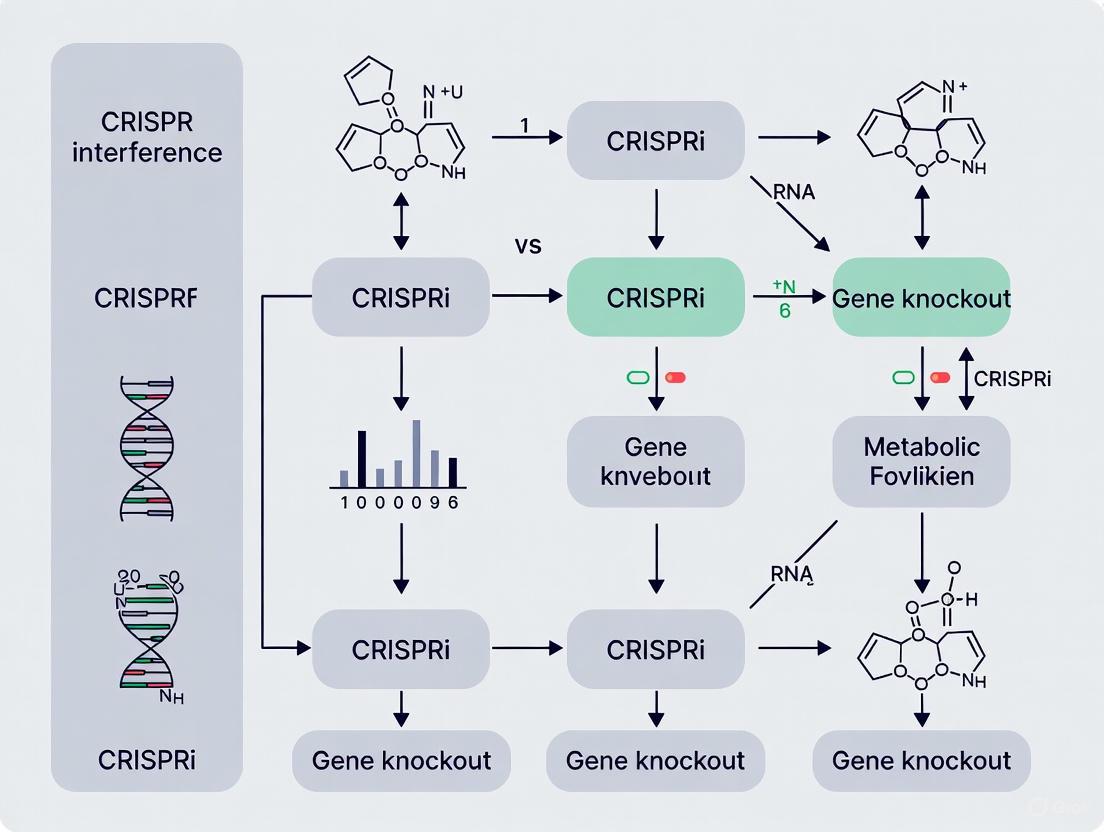
The following diagram illustrates the fundamental mechanistic differences between these two systems.
Quantitative Performance Comparison
The practical application of CRISPRko and CRISPRi requires an understanding of their performance metrics. The following table summarizes key quantitative data from published studies across various organisms.
Table 2: Performance Metrics of CRISPRko and CRISPRi
| Organism/System | Tool | Efficiency/Outcome | Key Metric | Citation |
|---|---|---|---|---|
| S. cerevisiae | CRISPRko (SpCas9) | ADE2 gene deletion | ~98% deletion efficiency | [1] |
| S. cerevisiae | CRISPRi (dSpCas9-MXI1) | mVenus reporter interference | ~10-fold interference | [1] |
| Mammalian Cells | CRISPRi (dCas9-ZIM3-KRAB) | Endogenous gene repression | ~20-30% improved knockdown vs. standard | [5] |
| Human PBMCs | CRISPRi (dCas9-KRAB) | IL-6, CD40, IFN-γ silencing | >70% mRNA reduction, sustained for 72h | [4] |
| Bifidobacteria | CRISPRi (dSt1Cas9) | Targeted gene repression | Functional repression across species | [6] |
| B. subtilis | CRISPRko | Gene deletion & point mutation | Successful editing demonstrated | [2] |
| C. glutamicum | CRISPRi | Target gene repression | 98% repression efficiency | [2] |
Experimental Protocols for Implementation
General Workflow for CRISPRko and CRISPRi Experiments
The initial steps for implementing CRISPRko and CRISPRi are largely similar, diverging primarily in the choice of the Cas protein and the target site. The general workflow is outlined below.
Detailed Methodologies
1. Target Selection and gRNA Design
- CRISPRko: Design sgRNAs targeting the early exons of the protein-coding sequence to maximize the probability of a frameshift mutation. Use established algorithms (e.g., CRISPRon/off, CHOPCHOP) to select gRNAs with high on-target efficiency and minimal predicted off-target effects [7].
- CRISPRi: Design sgRNAs to bind the non-template strand within a region -50 to +300 bp relative to the transcription start site (TSS). Targeting this window has been shown to enable effective steric hindrance of RNA polymerase [5] [4].
2. Component Cloning and Delivery
- Construct Assembly: For CRISPRko, clone the selected sgRNA sequence into a plasmid expressing both the sgRNA and the active Cas9 nuclease. For CRISPRi, use a plasmid expressing the sgRNA and the dCas9-repressor fusion (e.g., dCas9-KRAB, dCas9-ZIM3(KRAB)-MeCP2) [1] [5].
- Delivery Method: The choice of delivery is critical and depends on the cell type. Common methods include:
- Lipofection: Cost-effective for immortalized cell lines (e.g., HEK293, HeLa) but less efficient for sensitive cells [8].
- Electroporation/Nucleofection: Highly efficient for a wide range of cells, including difficult-to-transfect primary cells and stem cells. Nucleofection is optimized for nuclear delivery, which is advantageous for DNA-based delivery formats [8].
- Viral Transduction: (Lentivirus, AAV) enables high-efficiency delivery and stable genomic integration, suitable for creating stable cell lines, but is more time-consuming and has stricter safety requirements [3] [8].
- Delivery Format: CRISPR components can be delivered as DNA (plasmid), RNA (mRNA for Cas9/dCas9 and gRNA), or as pre-complexed ribonucleoprotein (RNP). RNP delivery offers the fastest action and reduces off-target effects due to its short lifetime, and is particularly effective when using electroporation/nucleofection [8].
3. Validation and Analysis
- CRISPRko Validation:
- Genomic DNA Analysis: Extract genomic DNA from transfected cells. Amplify the target region by PCR and analyze using either the T7 Endonuclease I (T7E1) assay or Tracking of Indels by Decomposition (TIDE) to detect and quantify the spectrum of indels.
- Functional Assay: Confirm loss of protein expression via western blotting or flow cytometry (if applicable).
- CRISPRi Validation:
- Transcript-Level Analysis: Perform RT-qPCR on total RNA extracted from cells 48-72 hours post-transfection to quantify the reduction in target mRNA levels.
- Protein-Level Analysis: Use ELISA, western blot, or flow cytometry to assess the reduction in the corresponding protein, as performed for IL-6, CD40, and IFN-γ in immune cells [4].
The Scientist's Toolkit: Essential Research Reagents
Successful implementation of CRISPRko and CRISPRi relies on a core set of reagents and tools. The following table lists essential items for researchers.
Table 3: Essential Research Reagent Solutions
| Reagent/Tool Category | Specific Examples & Functions | Key Considerations |
|---|---|---|
| Cas Expression Plasmids | - pX330 (for CRISPRko: expresses SpCas9 and sgRNA)- pHR-dCas9-KRAB (for CRISPRi: lentiviral dCas9-KRAB)- Custom dCas9-repressor fusions (e.g., ZIM3-KRAB-MeCP2) | Select a backbone with the correct resistance marker and promoter compatibility for your host system (bacterial, yeast, mammalian). |
| gRNA Cloning Vectors | - pU6-sgRNA (addgene #52694): Mammalian U6 promoter- Bifidobacterial CRISPRi single-plasmid system [6] | The vector must contain a promoter suitable for your cell type (e.g., U6 for mammalian cells). |
| Delivery Reagents | - Lipofectamine 3000 (lipofection)- Amaxa Nucleofector Kits (e.g., Kit V for HEK293)- Lentiviral packaging plasmids (psPAX2, pMD2.G) | Optimize reagent:DNA ratio and cell number for maximum efficiency and viability. |
| Validation Kits & Assays | - T7 Endonuclease I (for indel detection)- RNeasy Kit (RNA extraction for RT-qPCR)- ELISA kits for target proteins (e.g., IL-6, IFN-γ) [4] | Include appropriate controls (non-targeting sgRNA, mock transfected) for accurate interpretation. |
| Cell Culture | - HEK293T (easy transfection, tool generation)- THP-1, Jurkat (immune cell models) [4]- Primary cells (e.g., PBMCs, HSCs) [4] | Primary cells require optimized protocols and have limited expansion capacity. |
Application in Metabolic Engineering: A Comparative Case Study
The power of these tools is exemplified in metabolic engineering, where they can be deployed individually or in combination to optimize microbial cell factories.
- CRISPRko for Eliminating Competing Pathways: To overproduce a desired compound, it is often necessary to disrupt genes in competing metabolic pathways. CRISPRko can permanently delete these genes. For instance, in Corynebacterium glutamicum, CRISPRko has been used to achieve highly efficient (up to 100%) gene deletions to enhance the production of compounds like gamma-aminobutyric acid (GABA) [2].
- CRISPRi for Tunable Control and Essential Genes: CRISPRi is ideal for fine-tuning the expression of genes where complete knockout is lethal or counterproductive. For example, in E. coli and yeast, CRISPRi has been used to dynamically repress key genes, redirecting metabolic flux toward target products like biofuels or carotenoids without killing the cell [1] [2]. A study in S. cerevisiae used a tri-functional CRISPR system (CRISPR-AID) that combined activation, interference, and deletion to combinatorially optimize metabolic engineering targets, resulting in a 3-fold increase in β-carotene production [1].
- Synergistic Use: The most advanced strategies employ both tools simultaneously. CRISPRko can remove major flux bottlenecks, while CRISPRi can be used for the fine-tuning of multiple genes in a combinatorial fashion to explore synergistic effects and identify optimal genetic configurations for high-yield production [1].
CRISPRko and CRISPRi are complementary but distinct tools in the molecular biologist's arsenal. The choice between them hinges on the specific research question. CRISPRko is the definitive method for complete, permanent gene inactivation and is ideal for studying gene function, validating drug targets, and eliminating metabolic pathways. CRISPRi offers a reversible, tunable means of gene knockdown, excelling in the study of essential genes, dynamic metabolic engineering, and functional genomic screens where transient modulation is desired.
For metabolic engineers, the future lies in the intelligent and combinatorial application of these technologies. As exemplified by the CRISPR-AID system, integrating knockout, interference, and even activation allows for the systematic and parallel perturbation of metabolic networks, ultimately accelerating the development of robust microbial cell factories for sustainable biomanufacturing [1].
CRISPR interference (CRISPRi) has emerged as a powerful alternative to permanent gene knockout technologies, particularly in metabolic engineering where fine-tuning gene expression is paramount. This technical guide delves into the molecular machinery of the core CRISPRi system based on the fusion of catalytically dead Cas9 (dCas9) with the Krüppel-associated box (KRAB) repressor domain. We explore the mechanism of targeted transcriptional repression, detail advanced engineered repressor variants, and provide validated experimental protocols. Framed within the context of metabolic engineering, this review highlights how CRISPRi enables reversible and tunable gene attenuation without altering DNA sequences, offering a superior approach for optimizing complex metabolic networks compared to conventional knockout strategies.
In metabolic engineering, the goal is to precisely rewire cellular metabolism to enhance the production of target compounds. Traditional gene knockout, often achieved via nuclease-active CRISPR/Cas9 which creates double-strand breaks (DSBs), permanently eliminates gene function [9] [10]. While effective for complete loss-of-function studies, this approach lacks nuance and can be detrimental to cell viability if the target gene is essential. Furthermore, DSBs can lead to unintended genomic instability and unpredictable on-target edits, confounding phenotypic analysis [5] [11].
CRISPRi presents a refined methodology for gene attenuation rather than elimination. By leveraging a catalytically dead Cas9 (dCas9) fused to repressor domains like KRAB, CRISPRi silences gene expression at the transcriptional level without cleaving the DNA [12] [9]. This capability is crucial for metabolic pathway optimization, where balancing flux, rather than completely blocking competing pathways, is often necessary to maximize yield while maintaining cell health [13]. Gene attenuation via CRISPRi allows for precise control of enzyme levels, enabling the redirection of metabolic precursors without creating toxic bottlenecks or imposing excessive metabolic burden, a common challenge with gene overexpression [13].
Core Molecular Components of the CRISPRi System
The fundamental CRISPRi system consists of two core components: a guide RNA for target specificity and a dCas9-effector fusion protein for transcriptional repression.
The dCas9 Protein: A Programmable DNA-Binding Scaffold
The dCas9 protein is engineered from the native Streptococcus pyogenes Cas9 nuclease by introducing point mutations (D10A and H840A) that inactivate the RuvC and HNH nuclease domains, respectively [9] [10]. This renders dCas9 incapable of cleaving DNA while preserving its ability to bind DNA in an RNA-programmed manner. The dCas9 protein, when complexed with a single-guide RNA (sgRNA), can be directed to any genomic locus preceded by a protospacer adjacent motif (PAM, typically 5'-NGG-3'), where it serves as a programmable platform for recruiting transcriptional repressors [12] [9].
The KRAB Repressor Domain: An Epigenetic Silencer
The Krüppel-associated box (KRAB) is a potent transcriptional repression domain found in approximately 350 human zinc-finger proteins [10]. When the KRAB domain from the KOX1 protein is fused to the C-terminus of dCas9, it functions as a molecular "recruitment hub." Upon binding to DNA, the dCas9-KRAB fusion recruits a cascade of co-repressors. This includes the recruitment of the methyltransferase SETDB1, which catalyzes the addition of repressive histone marks, primarily histone H3 lysine 9 trimethylation (H3K9me3) [9] [10]. This chromatin modification creates a transcriptionally repressive environment, leading to durable gene silencing [14].
Table 1: Core Components of the Basic CRISPRi System
| Component | Type | Function | Key Features |
|---|---|---|---|
| dCas9 | Protein | Programmable DNA-binding scaffold | Catalytically inactive; binds DNA via sgRNA guidance; requires PAM sequence |
| sgRNA | RNA | Targeting molecule | 20-nt sequence complementary to target DNA; determines system specificity |
| KRAB Domain | Protein Domain | Transcriptional repressor | Recruits endogenous repressor complexes (e.g., SETDB1); induces H3K9me3 |
Mechanism of Targeted Transcriptional Repression
The dCas9-KRAB complex mediates gene silencing through a multi-faceted mechanism. When guided to a promoter region or transcription start site (TSS), the system employs two primary modes of action:
- Steric Hindrance: The bound dCas9 protein itself physically obstructs the binding or progression of RNA polymerase, thereby blocking transcription initiation [12].
- Epigenetic Silencing: The recruited KRAB domain initiates heterochromatin formation by promoting the deposition of H3K9me3 marks. This leads to chromatin condensation, reducing DNA accessibility for transcriptional activators and machinery, resulting in long-term stable repression [9] [14] [10].
The following diagram illustrates the coordinated molecular mechanism of CRISPRi-mediated gene silencing.
Advanced CRISPRi Repressors: Engineering Enhanced Efficiency
While dCas9-KRAB is a foundational tool, it can suffer from incomplete knockdown and performance variability across cell lines and gene targets [5]. Recent research has focused on engineering superior repressors by fusing additional repressive domains to dCas9.
Bipartite and Tripartite Repressor Fusion Proteins
A highly effective strategy involves creating fusion proteins that combine multiple, synergistic repressor domains. A landmark study screened over 100 bipartite and tripartite repressor fusions, identifying several with significantly improved performance [5]. The most potent repressors often combine a KRAB domain with a second repressor module, such as a truncated fragment of the Methyl-CpG-binding protein 2 (MeCP2(t)) [5] [14]. MeCP2 enhances repression by recruiting the SIN3A-histone deacetylase (HDAC) corepressor complex, leading to chromatin deacetylation and further compaction [14].
Key Discoveries and Next-Generation Repressors
Screening efforts revealed that not all KRAB domains are equal; the KRAB domain from the ZIM3 protein (dCas9-ZIM3(KRAB)) outperforms the historically used KOX1(KRAB) [5]. Furthermore, a truncated 80-amino acid MeCP2 domain (MeCP2(t)) was as effective as the full-length version, simplifying vector construction [5]. The top-performing repressor from recent work, dCas9-ZIM3(KRAB)-MeCP2(t), demonstrated enhanced gene repression across multiple cell lines and in genome-wide screens, with reduced performance variability between different sgRNAs [5]. This repressor can induce long-term epigenetic silencing that persists for over a month in cell culture and through differentiation, surprisingly even in cells lacking the DNA methyltransferases DNMT3A/3B, indicating a DNA methylation-independent mechanism [14].
Table 2: Comparison of Advanced CRISPRi Repressor Fusion Proteins
| Repressor Fusion Protein | Key Domains | Reported Mechanism of Action | Key Features & Performance |
|---|---|---|---|
| dCas9-KOX1(KRAB) | KRAB from KOX1 | Recruits SETDB1, induces H3K9me3 [10] | The original CRISPRi repressor; can have incomplete knockdown [5] |
| dCas9-ZIM3(KRAB) | KRAB from ZIM3 | Recruits endogenous repressor complexes | Superior silencing compared to dCas9-KOX1(KRAB) [5] |
| dCas9-KOX1(KRAB)-MeCP2 | KRAB + MeCP2 | KRAB induces H3K9me3; MeCP2 recruits SIN3A/HDAC complex [14] | Bipartite repressor; synergistic effect improves knockdown [5] [14] |
| dCas9-ZIM3(KRAB)-MeCP2(t) | ZIM3 KRAB + truncated MeCP2 | Combines mechanisms of ZIM3(KRAB) and MeCP2(t) | Next-generation repressor; highly efficient, consistent performance across targets and cell lines [5] |
The experimental workflow for screening and validating these advanced repressors is summarized below.
Experimental Protocols for Implementing CRISPRi
This section provides a detailed methodology for setting up and validating a CRISPRi experiment, based on protocols cited in the literature.
Protocol: Testing CRISPRi Repressor Efficiency with a Fluorescent Reporter
This protocol is adapted from a 2025 screen for novel CRISPRi repressors [5].
Vector Construction:
- Clone the gene for your dCas9-repressor fusion (e.g., dCas9-ZIM3(KRAB)-MeCP2(t)) into a mammalian expression vector with a selectable marker (e.g., puromycin resistance).
- Clone a dual-targeting sgRNA sequence, designed to bind the promoter of a constitutively expressed enhanced Green Fluorescent Protein (eGFP) reporter gene, into a separate sgRNA expression vector.
Cell Transfection and Selection:
- Co-transfect HEK293T cells (or your cell line of interest) with the dCas9-repressor plasmid and the sgRNA plasmid targeting the eGFP promoter. Include controls (e.g., dCas9-only, non-targeting sgRNA).
- 48 hours post-transfection, begin selection with the appropriate antibiotic (e.g., 1-2 µg/mL puromycin) to generate a stable polyclonal cell population.
Flow Cytometry Analysis:
- Harvest cells 5-7 days after the start of selection.
- Analyze the cells using a flow cytometer to measure mean fluorescence intensity (MFI) of eGFP.
- Data Analysis: Calculate the percentage of eGFP knockdown normalized to the dCas9-only control using the formula:
% Knockdown = [1 - (MFI_sample / MFI_control)] * 100.
Protocol: Endogenous Gene Repression and Phenotypic Validation
This protocol outlines steps for repressing an endogenous gene and assessing the functional outcome [5] [13].
sgRNA Design and Transduction:
- Design 3-5 sgRNAs targeting the transcription start site (TSS) of your endogenous target gene. Optimal binding is typically within -50 to +300 bp relative to the TSS [14].
- Transduce your cell line (already expressing the dCas9-repressor) with lentivirus delivering the gene-specific sgRNAs. Use a non-targeting sgRNA as a control.
Efficiency Validation:
- qRT-PCR: 5-7 days post-transduction, extract total RNA and perform quantitative reverse transcription PCR (qRT-PCR) to measure transcript levels of the target gene. Calculate repression efficiency relative to the control.
- Western Blot: If a suitable antibody is available, perform Western blot analysis to confirm the reduction of the target protein.
Phenotypic Assessment:
- Proliferation Assays: If targeting an essential gene, measure cell growth over time using assays like cell counting or metabolic activity dyes (e.g., MTT, Resazurin). Effective knockdown of essential genes should significantly slow cell growth [5].
- Metabolic Flux Analysis: For metabolic engineering applications, use targeted metabolomics or flux balance analysis to measure changes in metabolite levels and pathway usage resulting from gene repression [13].
The Scientist's Toolkit: Essential Research Reagents
Table 3: Key Research Reagent Solutions for CRISPRi Experiments
| Reagent / Tool | Function / Description | Example Use Case |
|---|---|---|
| dCas9-KRAB Plasmid | Basic repressor vector; expresses dCas9 fused to a KRAB domain. | Foundational tool for initial CRISPRi experiments and controls. |
| dCas9-ZIM3(KRAB)-MeCP2(t) | Next-generation, high-efficiency repressor plasmid. | For demanding applications requiring maximal, consistent knockdown [5]. |
| Genome-Wide sgRNA Library | A pooled library of sgRNAs targeting every gene in the genome. | For high-throughput genetic screens to identify genes essential for specific phenotypes [5] [15]. |
| Lentiviral Packaging System | System to produce lentiviral particles for delivery of CRISPRi components. | Enables efficient, stable integration of dCas9-repressor and sgRNAs into hard-to-transfect cells [5]. |
| Flow Cytometry with GFP Reporter | Assay system to quantitatively measure transcriptional repression efficiency. | For rapid screening and optimization of novel repressors or sgRNAs [5]. |
The CRISPRi technology, centered on the dCas9-KRAB fusion, provides a precise and reversible method for gene silencing that is indispensable for modern metabolic engineering and functional genomics. The core mechanism, which combines steric hindrance with epigenetic reprogramming, allows for fine-tuned gene attenuation without the pitfalls of DNA cleavage. The recent development of enhanced repressors like dCas9-ZIM3(KRAB)-MeCP2(t) marks a significant leap forward, offering more robust and reliable repression across diverse genetic contexts. By leveraging the protocols and reagents outlined in this guide, researchers can effectively harness CRISPRi to dissect complex genetic networks, optimize metabolic pathways, and advance therapeutic discovery, moving beyond the limitations of traditional gene knockout.
Clustered Regularly Interspaced Short Palindromic Repeats (CRISPR)-Cas9 has revolutionized genetic engineering by providing a programmable means to generate double-strand breaks (DSBs) in DNA. The molecular mechanism of gene knockout primarily relies on the cell's endogenous non-homologous end joining (NHEJ) repair pathway to resolve these breaks. This technical guide details the core mechanisms of Cas9-induced DSB formation and subsequent NHEJ-mediated repair, framing this knowledge within the context of metabolic engineering research. We compare the permanence of gene knockouts with the reversible nature of CRISPR interference (CRISPRi), providing researchers with a foundation for selecting appropriate perturbation strategies. The review includes quantitative data on editing efficiencies, detailed experimental protocols, and essential reagent solutions to support practical implementation in research settings.
The CRISPR-Cas9 system, derived from a bacterial adaptive immune mechanism, has become the preeminent tool for targeted genome editing. The system's fundamental components include the Cas9 nuclease and a single-guide RNA (sgRNA) that programs the nuclease to specific genomic loci [16] [17]. Gene knockout utilizing this system capitalizes on a straightforward molecular principle: when the Cas9 nuclease induces a DSB at a targeted gene, the cell's attempt to repair this break via the error-prone NHEJ pathway often results in insertion or deletion (indel) mutations that disrupt the coding sequence of the gene [16] [17].
For metabolic engineering, creating precise genetic perturbations is essential for redirecting metabolic fluxes toward desired compounds. Gene knockout provides a permanent solution for eliminating competing pathways or regulatory checkpoints. However, the decision to use knockout versus alternative approaches like CRISPRi depends on multiple factors, including the essentiality of the target gene, the desired permanence of the perturbation, and the potential for unintended consequences from DNA damage [11] [5]. This guide explores the molecular underpinnings of the knockout approach to inform these critical experimental choices.
Molecular Mechanisms of Cas9-Induced DNA Cleavage
Cas9-sgRNA Complex Assembly and PAM Recognition
The journey to a targeted DSB begins with the formation of the Cas9-sgRNA ribonucleoprotein (RNP) complex. The sgRNA, typically about 100 nucleotides in length, contains a 20-nucleotide spacer sequence at its 5' end that determines targeting specificity through Watson-Crick base pairing with the complementary DNA strand [16] [17]. The Cas9 protein, a multi-domain enzyme, undergoes conformational changes upon sgRNA binding that activate its DNA surveillance capability.
Target recognition is initiated when the Cas9-sgRNA complex scans the genome for short protospacer adjacent motif (PAM) sequences. For the most commonly used Streptococcus pyogenes Cas9 (SpCas9), the PAM sequence is 5'-NGG-3', where "N" is any nucleotide [16] [18]. PAM recognition by the Cas9 PAM-interacting (PI) domain triggers local DNA melting, allowing the sgRNA's spacer sequence to interrogate the adjacent DNA for complementarity [16]. This initial interaction focuses on a "seed" region near the PAM site, which is particularly critical for target binding.
DNA Strand Separation and R-Loop Formation
If the seed region matches the target DNA, the Cas9 complex continues to unwind the DNA duplex, displacing the non-complementary strand and forming an expanding RNA-DNA hybrid with the target strand. This structure, known as an R-loop, extends as complementarity between the sgRNA and target DNA is verified [16]. The formation of a stable R-loop induces additional conformational changes in the Cas9 protein, transitioning it from a DNA surveillance state to a catalytically active nuclease.
Cas9 Nuclease Domains and DNA Cleavage
The catalytically active Cas9 protein contains two distinct nuclease domains: the HNH domain and the RuvC-like domain. Upon stable R-loop formation, the HNH domain cleaves the DNA strand that is complementary to the sgRNA (the target strand), while the RuvC domain cleaves the opposing, non-complementary strand (the non-target strand) [16] [17]. The HNH domain cuts precisely 3 base pairs upstream of the PAM sequence, while the RuvC domain cuts 3-5 base pairs upstream on the opposite strand, typically resulting in a blunt-ended DSB [16] [17].
Table 1: Key Cas9 Variants and Their PAM Requirements
| Cas9 Variant | Source Organism | PAM Sequence | Size (amino acids) | Cleavage End Type |
|---|---|---|---|---|
| SpCas9 | Streptococcus pyogenes | 5'-NGG-3' | ~1,368 | Blunt |
| SaCas9 | Staphylococcus aureus | 5'-NNGRRT-3' | ~1,053 | Blunt |
| NmeCas9 | Neisseria meningitidis | 5'-NNNNGATT-3' | ~1,082 | Blunt |
| FnCas12a | Francisella novicida | 5'-TTTV-3' | ~1,300 | Staggered |
The following diagram illustrates the complete process of Cas9-induced DNA cleavage:
Figure 1: Cas9-sgRNA Complex Formation and DNA Cleavage Mechanism
DNA Repair Pathway Choices and NHEJ Mechanism
The Cellular Repair Landscape for DSBs
DNA double-strand breaks represent one of the most genotoxic lesions in cells, potentially leading to genomic instability, chromosomal rearrangements, and cell death if left unrepaired [16]. Eukaryotic cells have evolved multiple pathways to repair DSBs, with the choice between these pathways being influenced by factors such as cell cycle stage, cell type, and the nature of the break itself [16] [19]. The two primary DSB repair pathways are homologous recombination (HR) and non-homologous end joining (NHEJ), with additional alternative pathways including microhomology-mediated end joining (MMEJ) and single-strand annealing (SSA) [16].
The NHEJ pathway operates throughout the cell cycle but dominates in G1 phase, while HR is preferred in S and G2 phases when sister chromatids are available as repair templates [17]. For CRISPR-Cas9-mediated gene knockout, NHEJ is the desired pathway, as its error-prone nature introduces the frameshift mutations necessary for gene disruption.
The Core NHEJ Repair Machinery
The NHEJ pathway initiates with the rapid recognition and binding of DSB ends by the Ku70-Ku80 heterodimeric complex (Ku complex) [17]. This ring-shaped protein complex encircles the DNA ends, protecting them from resection and serving as a platform to recruit additional NHEJ factors.
Following Ku binding, the specific sub-pathway of NHEJ activation depends on the nature of the DNA ends:
- Blunt-end ligation-dependent sub-pathway: For clean breaks like those typically generated by Cas9, the Ku complex promotes the binding of XRCC4 and DNA ligase IV, which directly catalyze the re-ligation of the broken ends [17].
- Nuclease-dependent sub-pathway: For damaged ends requiring processing, the Ku complex recruits DNA-dependent protein kinases (DNA-PKcs), which activate the endonuclease Artemis to trim damaged nucleotides or overhangs before ligation [17].
- Polymerase-dependent sub-pathway: When fill-in synthesis is needed, polymerases Pol μ and Pol λ are recruited to add nucleotides to the ends, often utilizing microhomologies to guide repair [17].
Table 2: Core NHEJ Pathway Components and Functions
| Protein Complex | Components | Function in NHEJ |
|---|---|---|
| Ku Heterodimer | Ku70, Ku80 | Initial DSB recognition and end protection |
| DNA-PK Holoenzyme | DNA-PKcs, Ku complex | Kinase activation and end processing |
| End Processing Complex | Artemis, DNA-PKcs | Nucleolytic cleavage of damaged ends |
| Polymerase Complex | Pol μ, Pol λ | Gap filling and nucleotide addition |
| Ligation Complex | XRCC4, XLF, DNA Ligase IV | Final sealing of DNA ends |
The following diagram illustrates the major NHEJ sub-pathways:
Figure 2: Major NHEJ Sub-pathways for DSB Repair
Mutational Outcomes from NHEJ Repair
The error-prone nature of NHEJ repair stems from the enzymatic processing that occurs before ligation. Artemis-mediated end resection, polymerase nucleotide additions, and the utilization of microhomologies all contribute to the introduction of small insertions or deletions at the break site [17] [20]. When these indels occur within protein-coding exons, they frequently cause frameshifts that introduce premature termination codons, leading to nonsense-mediated mRNA decay or the production of truncated, non-functional proteins [17].
The efficiency of NHEJ-mediated gene knockout varies considerably across cell types and species, with reported rates ranging from <10% to >80% in mammalian cells [17]. This variability reflects differences in endogenous NHEJ activity, chromatin accessibility, and Cas9-sgRNA delivery efficiency.
Quantitative Analysis of NHEJ Repair Outcomes
The mutational profile resulting from NHEJ repair of Cas9-induced breaks has been quantitatively characterized through deep sequencing approaches. Understanding these patterns is essential for predicting knockout efficiency and designing effective sgRNAs.
Table 3: Quantitative Profile of NHEJ-Mediated Repair Outcomes
| Mutation Type | Frequency Range | Typical Length (bp) | FrameShift Probability | Key Influencing Factors |
|---|---|---|---|---|
| Small Deletions | 40-70% | 1-50 bp | High (≥66%) | Microhomology regions, sgRNA design |
| Small Insertions | 10-30% | 1-20 bp | Moderate (≥33%) | Template-free synthesis, sequence context |
| Complex Indels | 5-15% | Variable | Very High (>90%) | Multiple processing events |
| Perfect Repair | 1-10% | N/A | None | NHEJ fidelity, break location |
| Large Deletions | 1-5% | >50 bp | Very High (>90%) | Chromatin structure, repeated elements |
The distribution of indel sizes follows a predictable pattern, with a strong bias toward short deletions. Analysis of repair outcomes across multiple genomic loci reveals that approximately 60-80% of all NHEJ events result in indels that cause frameshifts when targeting standard protein-coding exons [17] [20]. The presence of microhomology regions (2-5 bp homologous sequences) flanking the break site significantly increases the probability of deletion events that utilize these microhomologies for alignment before ligation [20].
Experimental measurements in bacterial systems using CRISPR-Cas9 assisted NHEJ (CA-NHEJ) have demonstrated mutation efficiencies reaching 64.5-74.5% for specific targets, with deletion sizes ranging from 10 to over 250 base pairs [20]. In eukaryotic systems, the efficiency is generally lower due to more complex chromatin organization and additional regulatory constraints on repair processes.
Experimental Protocols for NHEJ-Mediated Knockout
sgRNA Design and Validation
Effective gene knockout begins with optimized sgRNA design. Target sites should be selected within the 5' proximal regions of coding exons to maximize the probability of generating frameshifts that affect the entire protein. The following protocol outlines a systematic approach:
- Target Identification: Identify all possible 20-nucleotide sequences adjacent to PAM sites (5'-NGG-3' for SpCas9) in the target region.
- Specificity Screening: Use BLAST or specialized tools to ensure minimal off-target potential by searching for similar sequences elsewhere in the genome, allowing up to 3 mismatches, particularly in the PAM-distal region.
- Efficiency Prediction: Utilize algorithms (e.g., CRISPRscan, Doench rules) to predict cutting efficiency based on sequence features, including GC content (30-70% optimal) and absence of homopolymer runs.
- Synthesis and Cloning: Clone selected sgRNA sequences into appropriate expression vectors under U6 or other RNA polymerase III promoters.
- Validation: Test sgRNA efficiency in relevant cell lines using mismatch detection assays (T7E1 or Surveyor) or tracking indels by decomposition (TIDE) before proceeding to full experiments.
Delivery Methods for CRISPR-Cas9 Components
Efficient delivery of CRISPR-Cas9 components is critical for successful gene knockout. The choice of delivery method depends on the target cell type and application requirements:
- Plasmid DNA Transfection: Most accessible approach; involves transfection of Cas9 and sgRNA expression plasmids. Suitable for easily transfectable cell lines with high efficiency (typically 30-70% in HEK293 cells).
- RNP Electroporation: Delivery of preassembled Cas9-sgRNA ribonucleoprotein complexes via electroporation. Offers rapid action, reduced off-target effects, and applicability to primary cells and stem cells. Efficiency can reach 70-90% in immune cells and stem cells.
- Viral Delivery: Lentiviral or adenoviral vectors for stable expression in hard-to-transfect cells. Lentiviral systems allow long-term expression but raise safety concerns; adenoviral systems offer transient expression with high efficiency in dividing and non-dividing cells.
Analysis and Validation of Knockout Efficiency
Comprehensive characterization of knockout efficiency is essential for interpreting experimental outcomes:
- Genomic DNA Extraction: Harvest cells 48-72 hours post-transfection for transient delivery or after selection for stable expression.
- PCR Amplification: Amplify target region (300-500 bp) with primers flanking the cut site.
- Mutation Detection:
- Next-generation sequencing: Most comprehensive approach; enables quantitative analysis of indel spectrum and frequency.
- T7 Endonuclease I (T7E1) assay: Detects heteroduplex formation between wild-type and mutant sequences; provides semi-quantitative efficiency measurement.
- Restriction fragment length polymorphism (RFLP): If cut site disrupts a restriction enzyme recognition sequence.
- Functional Validation:
- Western blotting to confirm protein loss (optimal for antibodies with good specificity).
- Quantitative RT-PCR to assess potential nonsense-mediated decay of the target transcript.
- Functional assays specific to the target gene's pathway or activity.
The Scientist's Toolkit: Essential Research Reagents
Table 4: Key Research Reagent Solutions for NHEJ-Mediated Knockout
| Reagent Category | Specific Examples | Function & Application Notes |
|---|---|---|
| Cas9 Expression Systems | SpCas9 plasmid, HiFi Cas9, eSpCas9 | Catalytic core of editing system; high-fidelity variants reduce off-target effects |
| sgRNA Cloning Vectors | pX330, pX458 (GFP marker), LentiGuide | sgRNA expression with U6 promoter; fluorescent markers enable enrichment |
| Delivery Reagents | Lipofectamine 3000, Polyethylenimine (PEI), Neon Electroporation System | Chemical transfection or physical delivery methods |
| NHEJ Inhibitors | KU-0060648, SCR7 | Small molecule inhibitors to study NHEJ mechanism or bias repair toward HDR |
| Detection Assays | T7E1 enzyme, Surveyor nuclease, Track-R Indel Detection Kit | Mutation detection and quantification |
| Cell Culture Media | Appropriate complete media with selection antibiotics (puromycin, blasticidin) | Maintenance and selection of transfected cells |
| Validation Antibodies | Anti-Cas9 antibodies, target-specific antibodies | Confirmation of Cas9 expression and target protein knockout |
CRISPRi vs. Gene Knockout for Metabolic Engineering
The choice between permanent gene knockout and reversible CRISPRi (CRISPR interference) represents a critical strategic decision in metabolic engineering. Both approaches have distinct advantages and limitations that must be considered within the specific experimental context.
CRISPRi utilizes a catalytically dead Cas9 (dCas9) fused to transcriptional repressor domains like the Krüppel-associated box (KRAB) to achieve targeted gene silencing without altering the DNA sequence [18] [5]. When directed to promoter or transcription start site regions, the dCas9-repressor fusion creates a steric block to RNA polymerase and recruits chromatin-modifying enzymes that establish a repressive state [18] [5]. Recent advances have developed enhanced repressor domains such as dCas9-ZIM3(KRAB)-MeCP2, which show improved repression efficiency and reduced variability across cell lines and gene targets [5].
For metabolic engineering applications, gene knockout via NHEJ offers permanent elimination of gene function, making it suitable for:
- Inactivating competing metabolic pathways
- Eliminating regulatory proteins that inhibit product formation
- Creating stable production strains for industrial fermentation
- Targeting non-essential genes where complete elimination is tolerable
Conversely, CRISPRi provides reversible, tunable repression that is advantageous for:
- Targeting essential genes where complete knockout would be lethal
- Fine-tuning expression levels in metabolic pathways
- Creating dynamic control systems for balanced metabolism
- Temporary suppression of genes during specific process phases
- Applications where genetic permanence is undesirable
Studies in microbial and mammalian systems have demonstrated that CRISPRi can achieve 70-95% repression of target genes, sufficient to redirect metabolic fluxes without completely eliminating essential functions [11] [5]. The reversible nature of CRISPRi also allows for adaptive evolution and optimization of production strains over time.
The molecular mechanism of CRISPR-Cas9-mediated gene knockout represents a powerful approach for targeted genetic disruption in metabolic engineering and therapeutic development. The process, initiated by Cas9-induced DSBs and completed by error-prone NHEJ repair, reliably generates gene-inactivating mutations through frameshift indels. While this permanent approach offers advantages for complete gene elimination, alternative strategies like CRISPRi provide complementary capabilities for reversible, tunable repression. The selection between these approaches should be guided by the specific experimental requirements, target gene essentiality, and desired permanence of the perturbation. As CRISPR technology continues to evolve with improved specificity and efficiency, both knockout and knockdown approaches will remain essential tools in the molecular engineering toolkit.
In metabolic engineering and functional genomics, precisely controlling gene expression is fundamental to elucidating gene function and optimizing cellular pathways. Two powerful but philosophically distinct approaches have emerged: irreversible gene knockout and reversible, tunable attenuation using technologies like CRISPR interference (CRISPRi). Gene knockout aims to completely and permanently abolish gene function, typically through the creation of disruptive mutations in the DNA sequence. In contrast, CRISPRi seeks to transiently and reversibly repress gene expression at the transcriptional level without altering the underlying genetic code [21] [22]. The decision between these strategies is critical and hinges on the biological question, the essentiality of the target gene, the need for temporal control, and the desired phenotypic outcome. This guide provides an in-depth technical comparison of these approaches, framing them within the context of modern metabolic engineering research.
Core Mechanisms and Molecular Foundations
Irreversible Loss-of-Function via Gene Knockout
Traditional gene knockout is achieved by introducing double-strand breaks (DSBs) in the target gene using a nuclease-active Cas9 protein. The cell's repair mechanism, non-homologous end joining (NHEJ), is error-prone and often results in small insertions or deletions (indels) at the cut site. If these indels cause a frameshift mutation, they can lead to a premature stop codon and a complete loss of functional protein production [23] [24]. This alteration is permanent and is inherited by all subsequent generations of the cell, making it a definitive tool for establishing gene function.
Reversible & Tunable Attenuation via CRISPRi
CRISPRi (CRISPR interference) fundamentally differs from knockout by employing a catalytically deactivated Cas9 (dCas9). This mutant protein retains its ability to bind DNA based on guide RNA (gRNA) specificity but cannot cut the DNA strand. When fused to a transcriptional repressor domain like the Krüppel-associated box (KRAB), the dCas9-KRAB complex is guided to the promoter region of a target gene. This complex recruits additional proteins that lead to the formation of heterochromatin, effectively blocking the binding or progression of RNA polymerase and silencing transcription without mutating the gene itself [21] [25] [22]. Because the DNA remains intact, repression is reversible; upon removal of the dCas9-KRAB complex, gene expression can resume.
Quantitative Comparison of Key Parameters
The following tables summarize the core technical and practical differences between the two approaches, providing a clear framework for selection.
Table 1: Core Technical Characteristics and Applications
| Parameter | Irreversible Gene Knockout | Reversible CRISPRi Knockdown |
|---|---|---|
| Molecular Target | DNA sequence | Transcription (DNA accessibility) |
| Primary Mechanism | NHEJ-mediated indels from DSBs | dCas9-repressor blocking transcription |
| Genetic Alteration | Permanent mutation | No sequence change |
| Reversibility | No | Yes [22] |
| Tunability | Limited (all-or-nothing) | Yes, via gRNA/dCas9 expression [22] |
| Efficiency | Can be heterogeneous due to mixed indels [25] | Highly efficient and homogeneous repression [25] |
| Ideal for Essential Genes | No (lethal) | Yes (partial knockdown possible) [26] |
| Multiplexing | Can cause complex genomic rearrangements | Easier and safer for multiple genes [27] |
Table 2: Experimental and Practical Considerations for Metabolic Engineering
| Consideration | Irreversible Gene Knockout | Reversible CRISPRi Knockdown |
|---|---|---|
| Phenotype Readout | Permanent loss-of-function | Conditional, temporal responses |
| Screening Readiness | Excellent for positive selection | Excellent for both positive/negative selection |
| Toxicity & Fitness | DNA damage response; confounds fitness assays | Minimal cytotoxicity [26] |
| Therapeutic Translation | Permanent cure for some monogenic disorders | Potential for regulated therapeutic delivery |
| Key Limitation | Lethality for essential genes; irreversible | Repression can be incomplete; requires sustained effector expression |
Advanced Toolkit for the Practicing Researcher
Optimized Reagents and Protocols for CRISPRi
Implementing a robust CRISPRi system requires careful selection of genetic components. Recent research has established best practices for achieving high-quality, reproducible results [26].
Table 3: CRISPRi Research Reagent Toolkit
| Reagent / Method | Function / Description | Key Examples & Notes |
|---|---|---|
| Effector Protein | Engineered dCas9 fused to repressor domains for gene silencing. | dCas9-KRAB: Early, widely used effector. Zim3-dCas9: Next-generation effector; superior balance of high on-target knockdown and minimal non-specific effects [26]. |
| sgRNA Library Design | A collection of guide RNAs targeting genes of interest; design impacts efficiency and library size. | Dual-sgRNA Cassettes: Two highly active sgRNAs per gene in a single construct; increases knockdown efficacy and enables ultra-compact library design (1-3 elements per gene) [26]. |
| Stable Cell Line Generation | Creating cell models that consistently express the dCas9 effector for uniform screening. | Engineered K562, RPE1, Jurkat, and other lines with stable Zim3-dCas9 expression are available as best-practice models [26]. |
| Delivery System | Method for introducing CRISPR components into cells. | Lentiviral Vectors: Common for stable integration and library delivery. Lipid Nanoparticles (LNPs): Emerging method for in vivo delivery, with ongoing patent activity for novel cationic lipids [28]. |
Protocol: Genome-Scale CRISPRi Knockdown Screen
The following workflow is adapted from next-generation protocols for performing high-quality genetic screens [26].
- Cell Line Selection & Validation: Begin with a cell line that stably expresses a high-fidelity CRISPRi effector (e.g., Zim3-dCas9). Validate the expression and function of the effector via immunofluorescence or Western blotting before proceeding.
- sgRNA Library Transduction: Transduce the stable cell line with a lentiviral library (e.g., a compact dual-sgRNA library) at a low Multiplicity of Infection (MOI ~0.3) to ensure most cells receive only one sgRNA construct. Include a puromycin resistance marker for selection.
- Selection and Expansion: Treat cells with puromycin for 5-7 days to select for successfully transduced cells. After selection, harvest a baseline sample (T0) for genomic DNA extraction.
- Phenotypic Induction & Screening: Culture the remaining cells under the selective pressure of your metabolic engineering interest (e.g., media with a toxic precursor, nutrient limitation) for several population doublings (e.g., 14-20 days). Harvest the final population (Tfinal).
- Genomic DNA Extraction & NGS Library Prep: Isolate genomic DNA from both T0 and Tfinal samples. Amplify the integrated sgRNA cassettes from the genomic DNA using a high-fidelity PCR protocol optimized for dual-sgRNA templates. Prepare the amplicons for next-generation sequencing (NGS).
- Data Analysis: Sequence the NGS libraries and count the abundance of each dual-sgRNA element in the T0 and Tfinal samples. Calculate phenotype scores (e.g., fold-depletion or enrichment) for each targeted gene to identify hits that confer sensitivity or resistance to the screened condition.
Strategic Decision Framework for Metabolic Engineering
Choosing between knockout and knockdown is not a matter of which is universally better, but which is more appropriate for the specific research goal.
Use Irreversible Gene Knockout when: Your target gene is non-essential and you need to completely and permanently eliminate its function to study the resulting phenotype or to create a stable production host. It is also ideal for validating that a phenotype from a knockdown is genuine, by confirming it with a knockout clone.
Use Reversible, Tunable CRISPRi when: You are studying essential genes [27] [26], as it allows for partial repression without causing lethality. It is the preferred method when you need temporal control to study the function of a gene at a specific stage of development or a particular phase in a bioprocess [25]. It is also superior for multiplexing efforts to knock down several genes simultaneously with fewer safety concerns about genomic rearrangements [27], and for high-throughput screens where homogeneous repression and minimal DNA damage toxicity are critical for clean results [25] [26].
In conclusion, the landscape of genetic perturbation is richly served by both irreversible knockout and reversible CRISPRi technologies. By understanding their distinct advantages and integrating the advanced toolkits and protocols now available, metabolic engineering researchers can design more precise, informative, and impactful experiments to dissect complex biological networks and engineer robust microbial cell factories.
For metabolic engineers embarking on a new project, the choice between CRISPR-mediated gene knockout and CRISPR interference (CRISPRi) represents a critical first step in experimental design. This technical guide provides a structured framework for this decision based on project-specific goals, highlighting key considerations including desired perturbation permanence, dynamic control requirements, and practical implementation constraints. Knockout technologies create permanent gene disruption through double-strand breaks and error-prone repair, making them ideal for validating essential gene functions and creating stable production strains. CRISPRi enables reversible, tunable transcriptional repression without altering DNA sequence, offering advantages for studying essential genes, dynamic pathway optimization, and high-throughput functional genomics. The table below summarizes the core characteristics of each system to guide your initial selection.
| Feature | CRISPR Knockout | CRISPR Interference (CRISPRi) |
|---|---|---|
| Core Mechanism | Nuclease-active Cas9 induces DSBs; repair via NHEJ introduces frameshift indels [29] | Catalytically dead Cas9 (dCas9) blocks transcription or recruits repressors [30] [5] |
| Genetic Outcome | Permanent gene disruption/deletion [29] | Reversible transcriptional repression (knockdown) [5] |
| Perturbation Type | Irreversible | Tunable and reversible [5] |
| Best for Target Type | Non-essential genes; gene function validation [29] | Essential genes; non-coding RNAs; genome-wide screens [30] [31] |
| Primary DNA Repair | Error-prone Non-Homologous End Joining (NHEJ) [29] | Not applicable (no DSBs) [5] |
| Key Applications | Generating stable knockout strains; disease models [29] | Functional genomics; metabolic flux tuning; essential gene study [30] |
| Throughput | Lower (screening at protein level) | High (pooled library screening) [30] |
| Technical Bottlenecks | Low HDR efficiency for precise edits; off-target effects [11] | Guide efficiency variability; delivery and expression of large dCas9-effector fusions [31] [5] |
System Mechanisms and Workflows
CRISPR Knockout Workflow
The foundational mechanism of CRISPR knockout relies on the introduction of a targeted double-strand break (DSB) in the genomic DNA by the nuclease-active Cas9 protein. The cellular repair of this break through the non-homologous end joining (NHEJ) pathway is inherently error-prone, often resulting in small insertions or deletions (indels). If these indels occur within a gene's coding sequence and their length is not a multiple of three, they cause a frameshift mutation, leading to a premature stop codon and the production of a truncated, non-functional protein [29]. This process effectively "knocks out" the gene's function.
CRISPR Interference (CRISPRi) Workflow
CRISPRi functions through a mechanistically distinct approach. It employs a catalytically "dead" Cas9 (dCas9) that lacks nuclease activity but retains its ability to bind DNA based on gRNA guidance. When targeted to a region overlapping a gene's promoter or the beginning of its coding sequence, the dCas9 protein acts as a physical barrier, blocking the progression of the RNA polymerase and thus transcription initiation or elongation [30]. For enhanced repression, dCas9 is typically fused to potent transcriptional repressor domains, such as the Krüppel-associated box (KRAB), which actively silences gene expression by recruiting chromatin-modifying complexes to the target locus [5]. This results in a reversible knockdown without any alteration to the underlying DNA sequence.
Experimental Protocols for Metabolic Engineering
Protocol for Gene Knockout via CRISPR-Cas9
This protocol outlines the steps to create a stable gene knockout in a microbial host for metabolic engineering, such as E. coli.
gRNA Design and Vector Construction:
- Design: Select a 20-nucleotide spacer sequence specific to the 5' end of the target gene's coding sequence to maximize the chance of a frameshift. Verify specificity to minimize off-target effects. The PAM sequence (5'-NGG-3' for SpCas9) must be adjacent to the target site [11].
- Clone: Synthesize and clone the gRNA sequence into an appropriate expression plasmid under a U6 or other suitable promoter.
- Combine: The gRNA plasmid must be co-delivered with a plasmid expressing a codon-optimized Cas9 nuclease, often with nuclear localization signals (NLS) for eukaryotic systems [11].
Delivery and Transformation:
- Microbial Transformation: Introduce the CRISPR plasmid(s) into the microbial cells (E. coli, yeast, etc.) using a high-efficiency method such as electroporation [11].
- Screening: Plate cells on selective media and incubate to obtain transformants.
Screening and Validation:
- Culturing: Grow individual transformant colonies and induce Cas9/gRNA expression if using an inducible system.
- Genotypic Validation: Isolve genomic DNA and perform PCR amplification of the target locus. Sequence the PCR product using Sanger sequencing to confirm the presence of indels.
- Phenotypic Validation: Confirm the loss of gene function through functional assays (e.g., loss of fluorescence, auxotrophy, or changes in metabolic profiles) [29].
Protocol for CRISPRi-Based Gene Repression
This protocol describes the implementation of a CRISPRi system for tunable gene knockdown, suitable for probing essential genes or modulating metabolic flux.
CRISPRi System Selection and gRNA Design:
- System Selection: Choose a dCas9-repressor fusion. For bacteria, dCas9 alone may be sufficient for blocking transcription [30]. For mammalian cells or stronger repression, use engineered fusions like dCas9-ZIM3(KRAB)-MeCP2(t) [5].
- gRNA Design for Bacteria: Design gRNAs to target the non-template (coding) strand within the first 5% of the gene's coding sequence, relative to the start codon, for maximal repression efficiency [30]. For genome-wide libraries, enzymatic mRNA-to-sgRNA conversion methods can generate strand-specific, design-free libraries [32].
Library Delivery and Screening:
- Pooled Screening: For functional genomics, transform the entire pooled sgRNA library into the host cell population expressing the dCas9 repressor. Use a high-efficiency delivery method to ensure each cell receives one or a few guides [30].
- Selection: Subject the transformed pool to the selective condition of interest (e.g., minimal media, chemical stress). Culture the population for multiple generations (e.g., 10 doublings) to allow for significant depletion of guides targeting essential genes [30].
Next-Generation Sequencing (NGS) and Analysis:
- Sample Preparation: Extract genomic DNA from the population before and after selection. Amplify the integrated sgRNA cassettes via PCR and prepare libraries for NGS [30].
- Data Analysis: Map the sequenced reads to the original sgRNA library. Calculate the enrichment or depletion (log2 fold-change) of each sgRNA. Identify significantly depleted gRNAs and their target genes as essential hits under the tested condition [30] [31].
The Scientist's Toolkit: Research Reagent Solutions
| Reagent / Solution | Function / Description | Application Context |
|---|---|---|
| Nuclease-active Cas9 | Wild-type Cas9 protein; creates DSBs at genomic target sites [29]. | Gene knockout via NHEJ; prerequisite for creating permanent gene disruptions. |
| dCas9 (catalytically dead Cas9) | Core scaffold for CRISPRi; binds DNA without cutting [30] [5]. | Foundational component for all CRISPRi applications, from simple blocking to advanced repression. |
| dCas9-KRAB Repressor | dCas9 fused to Krüppel-associated box (KRAB) domain; recruits repressive complexes [5]. | Standard CRISPRi repression in mammalian cells; strong, general-purpose transcriptional silencing. |
| dCas9-ZIM3(KRAB)-MeCP2(t) | Next-generation, tripartite repressor fusion; demonstrates superior knockdown [5]. | High-efficiency gene repression in mammalian cells; reduces variability across cell lines and gene targets. |
| sgRNA Expression Vector | Plasmid or viral vector for expressing the single guide RNA [11]. | Required for all CRISPR applications to program the targeting of Cas9/dCas9. |
| Pooled sgRNA Library | A complex mixture of thousands of unique sgRNAs, often genome-wide [30]. | High-throughput functional genomics screens to identify genes affecting a phenotype in a pooled format. |
| Homology-Directed Repair (HDR) Donor Template | DNA template containing desired sequence flanked by homology arms [29]. | Used with Cas9 for precise gene knock-in (e.g., point mutations, insertions) rather than knockout. |
The strategic choice between CRISPR knockout and CRISPRi is a cornerstone of successful metabolic engineering project design. This guide provides a clear, actionable framework for researchers to align their first tool selection with overarching project goals. For projects demanding permanent gene disruption and stable inheritance, such as generating base strains for production, knockouts are the definitive choice. Conversely, for dynamic studies, tuning metabolic fluxes, interrogating essential genes, or conducting high-throughput functional genomics, CRISPRi offers a superior and versatile platform. By leveraging the comparative data, standardized protocols, and reagent toolkit provided, scientists can make an informed initial selection, thereby accelerating the experimental pipeline from design to discovery.
Practical Implementation and Metabolic Engineering Case Studies
In metabolic engineering, precisely manipulating cellular machinery is fundamental for optimizing the production of high-value compounds. Two primary CRISPR-based technologies for these loss-of-function studies are CRISPR knockout (CRISPR-KO) and CRISPR interference (CRISPRi) [27] [24]. CRISPR-KO permanently disrupts a gene's DNA sequence, leading to a complete and irreversible knockout, making it ideal for validating non-essential gene functions. In contrast, CRISPRi reversibly represses gene transcription without altering the DNA sequence, enabling the study of essential genes where complete knockout would be lethal and allowing for tunable, partial knockdown of expression [27] [33]. This guide provides an in-depth technical workflow for both approaches, from initial gRNA design to final clonal validation, specifically framed for metabolic engineering applications.
Core Components and Key Considerations for Metabolic Engineering
The choice between CRISPR-KO and CRISPRi hinges on the metabolic engineering goal. The following table outlines the core components and strategic considerations for each system.
Table 1: Core Components of CRISPR-KO and CRISPRi Systems
| Component | CRISPR-KO (Complete Knockout) | CRISPRi (Reversible Interference) |
|---|---|---|
| Cas Protein | Active Cas9 (or other nucleases like Cas12a) that creates Double-Strand Breaks (DSBs) [34]. | Catalytically "dead" Cas9 (dCas9) that binds DNA but does not cut it [27] [33]. |
| Mechanism | DSBs are repaired by error-prone Non-Homologous End Joining (NHEJ), introducing insertions/deletions (indels) that disrupt the coding sequence [24] [34]. | dCas9, guided by sgRNA, binds to the promoter or coding sequence, physically blocking RNA polymerase and aborting transcription [33]. |
| Genetic Outcome | Permanent gene disruption via frameshift mutations or early stop codons [35]. | Reversible, tunable reduction in gene expression (knockdown) without DNA alteration [27] [33]. |
| Ideal for Metabolic Engineering of: | - Non-essential genes in a pathway- Competing or bypass pathways- Creating stable, industrial production cell lines [11] | - Essential genes for viability- Fine-tuning flux through rate-limiting steps- Dynamic control of pathway expression [11] [33] |
Experimental Workflow: A Step-by-Step Guide
The generalized workflow for both CRISPR-KO and CRISPRi is similar, with key differences in the components used and the validation steps. The schematic below illustrates the core pathways.
Step 1: sgRNA Design and Synthesis
The foundation of a successful CRISPR experiment is the design of a highly specific and efficient single-guide RNA (sgRNA).
- Target Site Selection: For CRISPR-KO, sgRNAs should target early exons encoding critical functional domains to maximize the likelihood of generating null alleles through frameshift mutations [36]. For CRISPRi, sgRNAs are typically designed to bind the promoter region or the 5' end of the coding sequence (just downstream of the transcription start site) to effectively block RNA polymerase [33].
- Bioinformatics Tools: Utilize specialized algorithms to evaluate sgRNA efficiency and minimize off-target effects. Tools like Benchling, CRISPOR, and CCTop are widely used for this purpose [37] [36] [38]. These tools provide on-target efficiency scores and predict potential off-target sites across the genome.
- Synthesis: sgRNAs can be produced via in vitro transcription (IVT) or, for higher stability and efficiency, obtained as chemically synthesized and modified (CSM) sgRNAs. CSM-sgRNAs with 2'-O-methyl-3'-thiophosphonoacetate modifications at their ends demonstrate enhanced stability within cells [37].
Step 2: Delivery System Preparation and Transfection
Efficient intracellular delivery of CRISPR components is critical, especially in industrially relevant but often difficult-to-transfect systems like microalgae [11].
- Vector Construction: The sgRNA sequence is cloned into an appropriate expression vector. For CRISPR-KO, this vector contains the active Cas9 nuclease, while for CRISPRi, it employs the catalytically inactive dCas9, often fused to repressor domains like KRAB for enhanced silencing [27] [34]. All-in-one vectors containing both Cas9/dCas9 and the sgRNA scaffold are common, but dual-plasmid systems can also be used [33].
- Delivery Methods: The choice of method depends on the host cell type. Common strategies include:
- Electroporation: A widely used physical method for introducing nucleic acids into cells [11] [37].
- Chemical Transfection: Using reagents like polyethyleneimine (PEI) or lipid-based nanoparticles [11] [36].
- Viral Delivery: Lentiviral vectors are particularly useful for achieving stable, long-term expression of CRISPR components, as noted in CRISPRi applications [27].
- Format: Delivery of pre-assembled Cas9/dCas9-sgRNA Ribonucleoprotein (RNP) complexes is increasingly the preferred method, as it minimizes off-target effects and enables rapid editing with high efficiency [24] [37].
Step 3: Cell Pool Screening and Genotyping
After transfection, the first assessment of editing efficiency is performed on the heterogeneous population of transfected cells (the "cell pool").
- Genomic DNA Extraction: Collect cells 48-72 hours post-transfection and extract genomic DNA.
- Mutation Analysis: Amplify the target region by PCR. Editing efficiency is typically quantified by the frequency of insertions or deletions (INDELs) using methods such as:
- T7 Endonuclease I (T7EI) Assay: A mismatch cleavage assay that detects heteroduplex DNA formed by wild-type and edited sequences [37].
- Sanger Sequencing + Analysis Software: PCR products are sequenced, and the resulting chromatograms are analyzed by algorithms like ICE (Inference of CRISPR Edits) or TIDE (Tracking of Indels by Decomposition) to deconvolute the mixture of sequences and calculate INDEL percentages [24] [37].
- Protein-Level Assessment (Critical for CRISPRi and KO validation): For both techniques, especially when a complete knockout is desired, it is crucial to confirm loss of protein expression via Western blotting. Research has shown that sgRNAs can sometimes induce high INDEL rates (e.g., 80%) at the DNA level yet fail to eliminate the target protein, defining them as "ineffective sgRNAs" [37].
Step 4: Single-Cell Clonal Isolation and Expansion
To obtain a genetically uniform population for rigorous phenotypic analysis, single-cell clones must be derived from the successfully edited cell pool.
- Isolation Methods: The two primary techniques are:
- Limiting Dilution: Cells are serially diluted and plated into 96-well plates at a statistical density of ≤1 cell per well. This is a low-tech but often inefficient method [36].
- Fluorescence-Activated Cell Sorting (FACS): This is the most efficient and reliable method. If the delivery vector contains a fluorescent marker (e.g., GFP), successfully transfected cells can be directly sorted into 96- or 384-well plates at one cell per well [36].
- Expansion: Isolated single cells are allowed to proliferate for several weeks to form monoclonal colonies, which are then gradually expanded to larger culture vessels.
Step 5: Clone Validation and Quality Control
Establishing a stable knockout or knockdown cell line requires comprehensive validation to ensure the intended genetic modification and to confirm phenotypic stability.
- Genotypic Validation: Genomic DNA from expanded clones is analyzed to determine the exact mutation. This is typically done by Sanger sequencing of the PCR-amplified target locus. This confirms whether the clone is wild-type, heterozygous, or homozygous (bi-allelic) for the knockout mutation [36].
- Phenotypic and Functional Validation:
- For CRISPR-KO: The definitive validation is the absence of the target protein, confirmed by Western blotting [37] [36]. For metabolic engineering, this should be followed by relevant functional assays (e.g., measuring lipid accumulation in engineered microalgae or stress resistance) [11].
- For CRISPRi: Validation involves measuring transcript levels using quantitative RT-PCR to confirm mRNA knockdown. Protein-level reduction should also be confirmed if possible. The inducible and reversible nature of CRISPRi can be confirmed by tracking gene expression recovery after the inducer is removed [33].
- Quality Control (QC): Before use in critical experiments, validated clones should undergo standard QC procedures, including mycoplasma testing and STR profiling to authenticate cell line identity [36].
Quantitative Data and Reagent Solutions
Optimization and Efficiency Metrics
Systematic optimization of CRISPR parameters can lead to highly efficient editing. The following table summarizes key quantitative findings from recent studies.
Table 2: Optimized CRISPR-KO Efficiency Metrics in Human Pluripotent Stem Cells (hPSCs) [37]
| Optimized Parameter | Experimental Condition | Resulting INDEL Efficiency | Application / Note |
|---|---|---|---|
| Cell-to-sgRNA Ratio | 8 x 10⁵ cells + 5 µg sgRNA | 82-93% | Single-gene knockout |
| Multiplexing | Two sgRNAs at same weight ratio | > 80% | Double-gene knockout |
| Large Deletion | Two sgRNAs targeting same gene | Up to 37.5% homozygous KO | Deleting large DNA fragment |
| sgRNA Format | Chemically Synthesized & Modified (CSM) sgRNA | Enhanced stability & efficiency | Compared to In Vitro Transcribed (IVT) sgRNA |
The Scientist's Toolkit: Essential Research Reagents
A successful CRISPR workflow relies on a suite of specialized reagents and tools.
Table 3: Key Research Reagent Solutions for CRISPR Workflows
| Reagent / Tool | Function | Examples & Notes |
|---|---|---|
| sgRNA Design Algorithms | Predicts on-target efficiency and off-target risk for sgRNA sequences. | Benchling [37], CRISPOR [36], CCTop [37]; Benchling was found to provide the most accurate predictions in one study [37]. |
| Cas9/dCas9 Expression Systems | Provides the effector protein for DNA cutting (Cas9) or binding (dCas9). | High-fidelity SpCas9 (eSpCas9, SpCas9-HF1) [34]; Inducible iCas9 systems [37]; dCas9-KRAB fusions for CRISPRi [27]. |
| Delivery Vectors | Plasmid-based systems for delivering CRISPR machinery into cells. | All-in-one lentiviral constructs (Cas9/dCas9 + sgRNA + GFP) [27]; Dual-plasmid systems [33]. |
| Analysis Software | Analyzes Sanger sequencing data from edited cell pools to quantify INDEL efficiency. | ICE (Inference of CRISPR Edits) [24] [37], TIDE (Tracking of Indels by Decomposition) [37]. |
| Cloning & Isolation Tools | Facilitates the isolation and expansion of single-cell clones. | Fluorescence-Activated Cell Sorting (FACS) [36]; Limiting dilution. |
A rigorous and well-optimized workflow from gRNA design to clonal validation is paramount for generating reliable, reproducible data in metabolic engineering research. The strategic decision to use CRISPR-KO for permanent, complete gene disruption or CRISPRi for reversible, tunable gene knockdown depends entirely on the biological question and the essentiality of the target gene. By leveraging the detailed protocols, quantitative benchmarks, and reagent toolkit outlined in this guide, researchers can systematically engineer robust microbial or algal cell factories, accelerating the development of sustainable biomanufacturing platforms and the discovery of new therapeutic targets [11].
CRISPR interference (CRISPRi) has emerged as a powerful tool for dynamic metabolic engineering, enabling precise, reversible control of gene expression without altering the DNA sequence. This case study explores the application of CRISPRi in Bacillus subtilis to optimize metabolic flux for enhanced vitamin production. We provide a detailed technical guide, including experimental protocols and reagent specifications, framed within a broader comparison of CRISPRi versus permanent gene knockout strategies. The data and methodologies presented herein are designed to equip researchers and scientists with the practical knowledge to implement dynamic regulation systems in microbial metabolic engineering.
Traditional metabolic engineering often relies on static strategies, such as gene knockouts (KO), which permanently inactivate target genes. While effective in some contexts, KO approaches are irreversible and can lead to metabolic imbalances, impaired growth, and accumulation of undesirable intermediates [29] [39]. Knockouts function by introducing double-strand breaks (DSBs) in the DNA, which are repaired by the error-prone non-homologous end joining (NHEJ) pathway, often resulting in frameshift mutations and gene inactivation [29].
In contrast, CRISPRi (CRISPR interference) offers a dynamic and reversible method for gene repression. This system utilizes a catalytically dead Cas9 (dCas9) protein, which binds to target DNA sequences under the guidance of a single-guide RNA (sgRNA) but does not cleave the DNA. By sterically blocking RNA polymerase, dCas9 effectively represses transcription elongation [40] [41]. This allows for fine-tuned, temporal control over gene expression, facilitating the balancing of growth and production phases in fermentation processes.
The versatility of dCas9 allows it to be fused with various effector domains (e.g., activators, repressors) for multi-level genetic control, forming a versatile synthetic biology "Swiss Army Knife" that surpasses the capabilities of simple gene disruption [11].
Technical Implementation inBacillus subtilis
Strain Selection and Genetic Background
Choosing an appropriate B. subtilis host strain is critical. While the laboratory strain 168 is a common starting point, wild-type strains like ATCC 6051 can exhibit superior growth and protein productivity [42]. Key considerations include:
- Protease Deficiency: Strains like WB800N, engineered for reduced extracellular protease activity, minimize degradation of recombinant dCas9 and other heterologous proteins [42].
- Genetic Stability: Select strains with high transformation efficiency and stable plasmid maintenance. The endogenous comP mutation in some strains can enhance transformation competency [42].
CRISPRi System Components and Delivery
A functional CRISPRi system requires stable integration or expression of two core components in the B. subtilis chassis.
Table 1: Essential CRISPRi Components for B. subtilis
| Component | Function | Recommended Form/Sequence |
|---|---|---|
| dCas9 Protein | Binds DNA without cleavage, blocking transcription. | Codon-optimized S. pyogenes dCas9, often fused to a repression domain like KRAB [40] [43]. |
| sgRNA | Guides dCas9 to the specific DNA target sequence. | Expressed from a strong, constitutive promoter (e.g., Pgrac). The spacer sequence is 20-nt long and complementary to the non-template strand of the target gene's promoter or coding sequence [41]. |
| Induction System | Controls the timing of dCas9 expression. | Anhydrotetracycline (aTc)-inducible promoter (Ptet) allows for precise, dose-dependent control of repression [40]. |
| Delivery Vector | Harbors the genetic constructs. | Integrative plasmids or shuttle vectors designed for B. subtilis. Chromosomal integration into a "safe harbor" locus like amyE is recommended for stable expression [42]. |
Efficient intracellular delivery of CRISPR components remains a primary bottleneck. For B. subtilis, electroporation is a widely used and effective method for introducing plasmid DNA [42].
Dynamic Regulation Circuit Design for Vitamin Pathways
Informed by successful applications in Streptomyces [39], a dynamic regulation strategy for vitamin production in B. subtilis can be designed using an endogenous quorum-sensing (QS) system. This approach links gene repression to cell density, autonomously redirecting metabolic flux during the production phase.
The core logic involves using a native QS promoter (e.g., from the com or rap systems in Bacillus) to drive the expression of dCas9. At low cell density, the promoter is inactive, allowing unhindered cell growth and expression of essential metabolic genes. As the culture reaches a high density, the QS promoter is activated, expressing dCas9 and a pre-programmed sgRNA to repress a target gene that competes with the vitamin biosynthesis pathway.
This strategy was successfully employed to increase rapamycin production in Streptomyces rapamycinicus by ~660% using an endogenous QS-integrated CRISPRi system [39].
Experimental Protocol: Implementing a CRISPRi System
This protocol outlines the steps to construct and validate a CRISPRi system for dynamic flux control in B. subtilis.
sgRNA Design and Plasmid Construction
- Target Identification: Identify key nodes in the metabolic network whose downregulation is predicted to enhance flux toward the target vitamin (e.g., riboflavin). Ideal targets are enzymes in competing pathways or negative regulators of the biosynthetic pathway.
- sgRNA Design: Design a 20-nt sgRNA spacer sequence complementary to the non-template strand within the promoter or the 5' coding sequence of the target gene. Ensure the target site is immediately followed by a Protospacer Adjacent Motif (PAM), 5'-NGG-3' for S. pyogenes dCas9 [43].
- Plasmid Assembly:
- Clone the codon-optimized dCas9 gene under the control of an inducible promoter (e.g., Ptet) into a B. subtilis expression vector.
- Clone the sgRNA expression cassette (sgRNA under a constitutive promoter) into the same vector or a compatible one.
- For multiplex repression, construct a plasmid expressing multiple sgRNAs, each targeting a different gene, using tandem promoters and terminators [41].
Strain Transformation and Validation
- Transformation: Introduce the assembled CRISPRi plasmid into a protease-deficient B. subtilis strain (e.g., WB800N) via electroporation [42].
- Genotypic Validation: Confirm successful plasmid integration or presence via colony PCR and DNA sequencing of the dCas9 and sgRNA regions.
- Phenotypic Validation:
- Induce the CRISPRi system (e.g., with aTc) during mid-log phase.
- Use RT-qPCR to quantify the mRNA levels of the target gene(s) relative to a non-targeting control sgRNA. Effective repression should show >80% reduction in mRNA [40].
- Perform immunoblot analysis to confirm reduced levels of the target protein, if antibodies are available.
Fermentation and Metabolite Analysis
- Batch Fermentation: Cultivate the engineered strain in a bioreactor with appropriate medium. Induce dCas9 expression at a specific cell density (OD600) based on pre-determined growth curves.
- Process Monitoring: Regularly sample the culture to monitor cell density, substrate consumption, and potential accumulation of intermediate metabolites.
- Product Quantification:
- For riboflavin (Vitamin B2), measure titer in the fermentation broth using High-Performance Liquid Chromatography (HPLC) with fluorescence detection (excitation 440 nm, emission 525 nm) [42].
- Compare the final titer and yield against a control strain harboring a non-targeting sgRNA.
Data Presentation and Analysis
Table 2: Quantitative Comparison of Metabolic Engineering Strategies in B. subtilis
| Engineering Strategy | Key Feature | Theoretical Max. Repression | Reversibility | Toxicity/Cytotoxicity | Reported Yield Increase (Example Product) |
|---|---|---|---|---|---|
| Gene Knockout (KO) | Permanent gene disruption via NHEJ [29]. | 100% | No | Can be high if gene is essential; DSBs can trigger stress responses [44]. | Riboflavin production established in B. subtilis [42]. |
| CRISPRi | Reversible repression via transcriptional interference [40]. | >80% (tunable) [40] | Yes | Lower; no DSBs, but dCas9 overexpression can be burdensome [44]. | Riboflavin production increased using QS-based dynamic regulation in Bacillus [39]. |
Pathway and Workflow Visualization
The following diagrams illustrate the core logical and pathway relationships involved in implementing CRISPRi for dynamic metabolic control.
Diagram 1: CRISPRi dynamic control logic.
Diagram 2: Key experimental workflow.
The Scientist's Toolkit: Research Reagent Solutions
Table 3: Essential Reagents for CRISPRi in B. subtilis
| Reagent / Material | Function / Application | Key Considerations |
|---|---|---|
| dCas9 Expression Plasmid | Provides the catalytically dead Cas9 protein for targeted binding. | Ensure codon-optimization for B. subtilis and use an inducible promoter for controlled expression [42] [43]. |
| sgRNA Expression Cassette | Provides the guide RNA for target specificity. | Can be cloned on the same plasmid as dCas9. Use a strong, constitutive promoter [41]. |
| Protease-Deficient\nB. subtilis Host | Chassis organism for metabolic engineering. | Strains like WB800N minimize degradation of heterologous proteins like dCas9 [42]. |
| Electroporator | Instrument for delivering plasmid DNA into B. subtilis cells. | Critical for achieving high transformation efficiency. Optimization of voltage and resistance parameters is required [42]. |
| Inducer Molecule\n(e.g., aTc) | Small molecule to trigger dCas9 expression from an inducible promoter. | Allows for temporal control over the CRISPRi system. Dose-response should be characterized [40]. |
| HPLC System with\nFluorescence Detector | Analytical instrument for quantifying vitamin titers (e.g., riboflavin). | Essential for accurate measurement of final product yield and process performance [42]. |
This technical guide demonstrates that CRISPRi is a superior strategy for complex metabolic engineering goals like vitamin production in B. subtilis, where dynamic and tunable control is required. While gene knockouts remain useful for completely eliminating gene function, CRISPRi offers the flexibility to fine-tune metabolic pathways, balance cell growth with product synthesis, and achieve significant yield improvements without permanent genetic damage. The integration of CRISPRi with endogenous regulatory circuits, such as quorum-sensing systems, represents the cutting edge of designing autonomous, high-performance microbial cell factories.
The development of biopharmaceuticals relies heavily on Chinese Hamster Ovary (CHO) cells as the predominant host system for producing recombinant therapeutic proteins. The advent of Clustered Regularly Interspaced Short Palindromic Repeats (CRISPR) technology has revolutionized genetic engineering in these cells, enabling precise gene knockout (KO) strategies that enhance both biologics production and functional genomics research. This case study examines the application of CRISPR-mediated gene knockout in CHO cells, contrasting it with alternative approaches like CRISPR interference (CRISPRi) within metabolic engineering. Through analysis of specific experimental data, protocol details, and practical workflows, this technical guide provides a framework for implementing these technologies to address critical challenges in biomanufacturing, including improving productivity, optimizing metabolic pathways, and enhancing product quality.
Technology Comparison: CRISPR Knockout vs. Alternative Methods
CRISPR Knockout vs. RNAi Knockdown
CRISPR knockout and RNA interference (RNAi) represent two fundamental approaches for gene silencing, each with distinct mechanisms and outcomes.
Table 1: Comparison of CRISPR Knockout and RNAi Knockdown Technologies
| Feature | CRISPR Knockout | RNAi Knockdown |
|---|---|---|
| Target Level | DNA | mRNA |
| Mechanism | Double-strand breaks via Cas9 nuclease followed by NHEJ repair | mRNA degradation or translational inhibition via RISC complex |
| Permanence | Permanent, heritable modification | Transient, reversible silencing |
| Protein Effect | Complete elimination of protein expression | Partial reduction of protein levels |
| Off-Target Effects | Lower sequence-specific off-targets with optimized gRNAs | Higher rates of sequence-dependent and independent off-target effects [24] |
| Experimental Workflow | gRNA design, delivery with Cas9, validation of edits | siRNA/shRNA design, delivery, measurement of transcript reduction |
| Ideal Applications | Essential gene identification, permanent trait engineering, functional genomics | Studies of essential genes, reversible modulation, transient assays |
The choice between these technologies depends heavily on experimental goals. CRISPR knockout provides complete and permanent gene disruption, making it ideal for investigating gene essentiality and creating stable cell lines with engineered traits. In contrast, RNAi enables transient and partial gene silencing (knockdown), which can be advantageous for studying essential genes whose complete knockout would be lethal, or when reversible modulation is desired [24].
CRISPR Knockout vs. CRISPRi
CRISPRi (CRISPR interference) represents an intermediate approach that uses a catalytically dead Cas9 (dCas9) protein fused to repressive domains to block transcription without cleaving DNA. This technology reduces gene expression without permanently altering the DNA sequence, resulting in a knockdown effect rather than a complete knockout. For metabolic engineering research, CRISPRi is particularly valuable when titratable repression of gene expression is needed to optimize flux through biosynthetic pathways without completely disrupting essential metabolic functions [45].
Quantitative Data from CHO Cell Knockout Studies
Recent studies have generated substantial quantitative data demonstrating the efficacy of CRISPR knockout in enhancing CHO cell performance for biologics production.
Table 2: Summary of Quantitative Outcomes from CHO Cell Knockout Studies
| Study Focus | Genes Targeted | KO Efficiency/Outcome | Impact on Biologics Production |
|---|---|---|---|
| Polysorbate Degradation Reduction [46] | 9 hydrolases + Bax, Bak1 | Viable host cell line generated | Drastically reduced polysorbate degradation and hydrolytic activity |
| Glutamine Synthetase Knockout [47] | GS5 and GS1 (both copies) | Robust glutamine-dependent growth | Enhanced selection efficiency of high-producing clones |
| Metabolic Engineering for Glutamine-Free Growth [48] | Abhd11 | Substantial growth improvement in glutamine-free media | Altered TCA cycle regulation, reduced ammonia toxicity |
| Productivity Enhancement via CRISPRa [45] | 13,812 silenced genes targeted (8 gRNAs/gene) | Library coverage: 110,979 gRNAs | Identified novel gene targets for enhancing bispecific antibody production |
| Stable KO Pool Screening [49] | Up to 7 genes multiplexed | Genetic stability >6 weeks | 2.5x increased screening throughput; timeline reduction from 9 to 5 weeks |
The data demonstrate that multiplexed knockout strategies can simultaneously target multiple genes without compromising cell viability, enabling complex engineering goals. The Abhd11 knockout study is particularly noteworthy as it identified a previously poorly characterized gene that significantly modulates central carbon metabolism when disrupted [48].
Detailed Experimental Protocols
Genome-Scale CRISPR Knockout Screening
Comprehensive genome-scale knockout screening enables identification of genes essential for cell fitness and therapeutic protein production.
Workflow Diagram 1: Genome-Scale CRISPR Knockout Screening in CHO Cells
The screening approach utilizes a virus-free, recombinase-mediated cassette exchange (RMCE) platform, which offers advantages over lentiviral delivery by eliminating biosafety concerns and preventing multiple gRNA integrations [50]. Library design encompasses the entire CHO genome, with the example library containing 111,651 unique gRNAs targeting 21,585 genes to ensure comprehensive coverage [50]. Following library introduction into master cell lines, transient Cas9 expression generates diverse knockout populations. Subsequent phenotypic selection under relevant bioproduction conditions (e.g., hyperosmotic stress, histone deacetylase inhibitor treatment, or productivity screening) enriches for cells with beneficial genotypes, identified through gRNA amplicon sequencing [45].
Glutamine Synthetase Double Knockout Using CRISPR/Cpf1
Efficient selection of high-producing clones represents a critical step in cell line development.
Workflow Diagram 2: GS-KO CHO Cell Line Generation
This protocol addresses the challenge of multiple GS gene copies in CHO cells (GS5 on chromosome 5 and GS1 on chromosome 1). The use of CRISPR/Cpf1 rather than Cas9 offers advantages for this application, including a TTTN PAM sequence that facilitates targeting of AT-rich regions and the ability to process pre-crRNA pairs for multiplexed editing [47]. The sequential knockout approach ensures complete elimination of GS activity, creating robust glutamine-dependent cells that enable stringent selection with methionine sulfoximine (MSX). Host cells with double GS knockouts demonstrate enhanced selection efficiency, particularly in CHO-K1 cells where single GS5 knockout resulted in compensatory upregulation of GS1 [47].
Multiplexed Hydrolase Knockout for Polysorbate Stabilization
Polysorbate degradation in biologic formulations represents a significant product quality challenge that can be addressed through host cell engineering.
Key Steps:
- Identify hydrolytic host cell proteins responsible for polysorbate degradation
- Design sgRNAs targeting early exons of nine identified hydrolase genes
- Sequential knockout of target genes using CRISPR/Cas9 ribonucleoprotein (RNP) complexes
- Additional engineering to knockout proapoptotic genes Bax and Bak1 to enhance viability
- Characterization of resulting cell lines for transfection efficiency, metabolic performance, and product quality attributes
- Assessment of polysorbate degradation reduction in relevant formulations
This approach demonstrates the feasibility of multiple gene knockouts - including the removal of two entire gene clusters - to address complex product quality issues. The resulting CHO host cell line shows drastically reduced hydrolytic activity while maintaining robust growth and productivity characteristics, providing a path toward polysorbate degradation-free biologics manufacturing [46].
Signaling Pathways and Metabolic Networks
mTORC1 Signaling Network in CHO Cell Engineering
The mTORC1 pathway represents a key regulatory node connecting environmental conditions to cellular growth and protein synthesis.
Pathway Diagram 3: mTORC1 Signaling Pathway in CHO Cells
Temperature shift to 30°C upregulates key mTORC1 inhibitor genes, including TSC1, AMPK, MAPKAPK5, and MARK4, which collectively suppress mTORC1 activity and downstream protein synthesis [51]. Strategic knockdown of these inhibitor genes using shRNA technology - particularly when driven by the cold-inducible HSP90 promoter - enhances mTORC1 signaling under hypothermic conditions, resulting in a three-fold increase in granulocyte-macrophage colony-stimulating factor (GM-CSF) production after three days [51]. This approach demonstrates how pathway engineering can reverse the growth limitation typically associated with low-temperature cultivation while maintaining the productivity benefits of hypothermic conditions.
Glutamine Response Network Identified by CRISPR Screening
CRISPR knockout screening under nutrient stress conditions reveals complex metabolic networks that regulate CHO cell adaptation.
Pathway Diagram 4: Glutamine Response Metabolic Network
Network analysis of genes affecting growth under glutamine-free conditions revealed five functional clusters representing different metabolic processes [48]. The identification of ABHD11 - a poorly characterized lipase not previously connected to glutamine metabolism - demonstrates the power of unbiased screening approaches. ABHD11 knockout produces a conditionally beneficial phenotype, improving growth in glutamine-free media while depressing growth in glutamine-containing conditions [48]. Subsequent mechanistic studies suggested that ABHD11 associates with the α-ketoglutarate dehydrogenase complex and prevents its delipoylation, thus modulating TCA cycle flux in response to glutamine availability.
The Scientist's Toolkit: Research Reagent Solutions
Table 3: Essential Research Reagents for CHO Cell Gene Knockout Studies
| Reagent Category | Specific Examples | Function & Application Notes |
|---|---|---|
| CRISPR Nucleases | SpCas9, AsCpf1 | Create double-strand breaks at target genomic loci; Cpf1 offers TTTN PAM for AT-rich targets [47] |
| gRNA Library Systems | CHO genome-wide library (111,651 gRNAs), Metabolic gene library (15,654 gRNAs) | Enable large-scale functional genomics screens; should provide >500x coverage [50] [48] |
| Delivery Systems | Lentiviral vectors, RMCE-based plasmid systems, RNP complexes | Introduce CRISPR components; RMCE offers virus-free alternative with single-copy integration [50] [49] |
| Selection Systems | GS/MSX system, DHFR/MTX system, Antibiotic resistance | Enrich for successfully engineered cells; GS knockout enables stringent selection in glutamine-free media [47] |
| Cell Line Engineering Tools | Landing pad constructs, Bxb1 recombinase, Master cell lines | Enable precise genomic integration and stable cell line development [50] [45] |
| Analytical Tools | NGS for gRNA sequencing, ICE analysis, RT-qPCR, ELISA | Validate editing efficiency and phenotypic outcomes; NGS essential for pooled screening analysis [50] [47] |
The implementation of ribonucleoprotein (RNP) complexes - combining purified Cas9 protein with synthetic guide RNAs - has emerged as the preferred delivery method due to high editing efficiency and reduced off-target effects [49] [24]. For large-scale screening applications, the RMCE-based delivery system provides significant advantages over lentiviral approaches by eliminating viral safety concerns and ensuring single-copy gRNA integration [50].
CRISPR-mediated gene knockout has fundamentally transformed CHO cell engineering for biologics production, enabling unprecedented precision in modulating cellular functions. The case studies presented demonstrate how knockout strategies can address diverse challenges - from enhancing protein production and optimizing metabolic pathways to improving product quality attributes. When framed within the broader context of metabolic engineering research, CRISPR knockout provides a definitive approach for determining gene essentiality and creating stable cell lines with permanently enhanced characteristics. As the field advances, the integration of knockout screening with other multi-omics technologies and the development of more sophisticated delivery and analytical systems will further accelerate the development of next-generation CHO cell factories capable of producing increasingly complex biotherapeutic molecules.
In metabolic engineering, the modification of essential genes presents a fundamental challenge: these genes underpin core cellular processes required for viability, yet their functions can also constrain the efficient synthesis of desired products. Traditional gene knockout technologies are inherently unsuitable for studying these genes, as complete disruption is lethal to the cell [52]. CRISPR interference (CRISPRi) has emerged as a powerful alternative by enabling tunable, reversible gene knockdown rather than permanent mutation. This technical guide explores the application of CRISPRi for modulating essential gene function, with a specific focus on balancing the dual imperatives of maintaining cell growth and optimizing product synthesis.
Framed within a broader thesis comparing genetic manipulation strategies, CRISPRi offers distinct advantages over knockout for metabolic engineering research. While knockout strategies create binary, all-or-nothing effects, CRISPRi facilitates titratable control of gene expression, allowing researchers to fine-tune metabolic fluxes with a precision that is impossible with destructive edits [52] [11]. This is particularly critical for essential genes involved in central metabolism, where moderate downregulation—rather than complete inactivation—can redirect resources toward product synthesis without triggering catastrophic failure of cell growth [53] [11].
Core Principles and Comparative Advantages of CRISPRi
Operational Mechanism
CRISPRi functions through a nuclease-deactivated Cas9 (dCas9) protein, which acts as a programmable DNA-binding module. When guided to a specific genomic locus by a single-guide RNA (sgRNA), the dCas9-sgRNA complex sterically blocks transcription by RNA polymerase without cleaving the DNA [52]. The efficiency of repression is influenced by sgRNA positioning, with targeting near the transcriptional start site (TSS) typically proving most effective [52]. In bacterial systems like Bacillus subtilis, this system has demonstrated repression efficiencies of up to 150-fold when fully induced [52]. A key consideration for experimental design is the polar effect observed in operon structures, where knockdown of an upstream gene can lead to reduced expression of downstream genes in the same operon [52] [54].
CRISPRi vs. Gene Knockout: A Strategic Comparison
Table 1: Comparative analysis of CRISPRi and gene knockout for metabolic engineering.
| Feature | CRISPRi | Gene Knockout |
|---|---|---|
| Genetic Outcome | Reversible, titratable knockdown | Permanent, complete disruption |
| Applicability | Suitable for essential and non-essential genes | Lethal for essential genes |
| Tunability | High; repression level can be modulated via inducer concentration [52] | None; binary (on/off) outcome |
| Temporal Control | High; inducible systems allow precise timing of knockdown [52] [53] | Limited; typically constitutive |
| Polar Effects | Can affect downstream genes in operons [52] [54] | Depends on the location of the disruption |
| Primary Use Cases | Fine-tuning metabolic fluxes, studying essential genes, dynamic regulation [53] [11] | Complete gene inactivation, validation of non-essential gene function |
Experimental Design and Workflow
A robust CRISPRi experiment requires careful planning and execution. The following workflow outlines the key stages, from system design to phenotypic analysis.
Figure 1: A generalized experimental workflow for implementing CRISPRi to study essential genes, highlighting key technical considerations at each stage.
Detailed Methodologies for Key Experiments
Construction of a CRISPRi Knockdown Library
The creation of an arrayed CRISPRi library enables systematic functional analysis of essential genes, as demonstrated in B. subtilis and mycobacteria [52] [54].
- sgRNA Design and Cloning: Design sgRNAs to target the 5' end of essential genes, optimizing for minimal off-target potential. In a B. subtilis study, this approach achieved a 94% success rate, with nearly all sgRNAs targeting bona fide essential genes resulting in a measurable decrease in colony size [52]. For mycobacteria, cloning involved electroporating CRISPRi constructs into a reporter strain, yielding a library of 276 validated mutants targeting essential genes [54].
- Strain Validation: Validate each mutant through Sanger sequencing of the inserted sgRNA and spot assays to confirm inducible growth defects. This step is critical for ensuring the identity and functionality of each library strain [54].
Chemical Genomics for Target Discovery
Chemical-genomic profiling uses a library of sensitized knockdown strains to identify gene-drug interactions and discover modes of action for uncharacterized compounds [52].
- Sensitized Screening: Culture the CRISPRi library under mild, basal repression conditions (e.g., ~3-fold repression without full induction) to sensitize strains to chemical perturbations [52].
- Phenotypic Scoring: Challenge the library with a panel of compounds (e.g., 35 unique chemicals). Measure colony size as a proxy for fitness and convert these measurements into chemical-gene interaction scores. Significant phenotypes (e.g., hypersensitization) can identify a drug's cellular target, as was successfully shown for the antibiotic MAC-0170636, which targets undecaprenyl pyrophosphate synthetase (UppS) [52].
- Network Analysis: Establish a functional network by correlating the phenotypic signatures of gene knockdowns across multiple chemical conditions. This can reveal functional connections between genes and pathways, validated against known interaction databases like STRING [52].
Quantitative Morphological Phenotyping
High-throughput imaging can reveal subtle, whole-cell consequences of essential gene knockdown that are not captured by growth fitness alone [54].
- Automated Imaging and Analysis: Perform high-throughput, quantitative microscopy on the CRISPRi library following gene knockdown. Develop an automated image analysis pipeline to extract quantitative data on cell morphology, size, and sub-cellular structures for hundreds of thousands of individual cells [54].
- Morphotypic Clustering: Use statistical learning to cluster mutants based on morphotypic similarity. This "phenoprint" analysis groups genes with related functions and can suggest functions for uncharacterized genes based on morphological similarity to known genes [54].
Quantitative Data and Functional Analysis
Performance Metrics and Phenotypic Outcomes
Table 2: Quantitative phenotypic data from essential gene knockdown studies across different microorganisms.
| Organism / Study | Knockdown Efficiency | Key Phenotypic Observations | Impact on Product Synthesis |
|---|---|---|---|
| Bacillus subtilis [52] | Up to 150-fold repression (full induction); ~3-fold (basal) | Mild knockdown reduced stationary phase survival without affecting maximal growth rate; severe depletion profoundly affected cell morphology. | Enabled identification of antibiotic targets (e.g., UppS), facilitating drug discovery. |
| Synechocystis sp. (CRISPRa) [53] | Up to 4-fold activation of target genes | Activation of key genes (e.g., pyk1) in biofuel pathway increased isobutanol/3-methyl-1-butanol production. | Multiplexed activation synergistically enhanced biofuel compound formation. |
| Mycobacterium smegmatis [54] | Penetrant phenotypes at 18h post-induction | Morphotypic clustering revealed functional relationships; identified filamentation as a specific response to histidine starvation. | Serves as a platform for understanding bacterial physiology and antibiotic mechanism-of-action. |
| Fusarium venenatum [55] | Successful knockout via CRISPR/Cas9 | Engineered strain (FCPD) showed 32.9% increase in essential amino acid index and 88.4% improved production rate. | Reduced substrate consumption by 44.3% and lowered environmental impact (GWP reduced by 4-61.3%). |
The Scientist's Toolkit: Essential Research Reagents
Table 3: Key reagents and resources for implementing CRISPRi in bacterial systems.
| Reagent / Resource | Function and Description | Application Notes |
|---|---|---|
| dCas9 Expression System | Catalytically deactivated Cas9 under a titratable promoter (e.g., xylose- or tetracycline-inducible) [52]. | Enables precise control over knockdown strength; Pxyl-based systems show minimal basal repression without inducer [52]. |
| sgRNA Library | Arrayed or pooled single-guide RNAs targeting the 5' end of essential genes. | A single, well-designed sgRNA per gene is often sufficient for effective knockdown in bacteria [52]. |
| Reporter Strains | Strains with fluorescent or morphological markers for tracking knockdown efficacy and cellular features. | M. smegmatis ParB-mCherry reporter allows visualization of chromosome location and copy number [54]. |
| Chemical-Genomic Profiling Kit | A panel of known and uncharacterized compounds for challenging the knockdown library. | Identifies gene-drug interactions and modes of action; can reveal new antibiotic targets [52]. |
| Image Analysis Pipeline | Software for automated, high-throughput analysis of cell morphology from microscopy data. | Enables extraction of quantitative data (e.g., cell length, width, shape) from thousands of cells [54]. |
Advanced Applications and Integrated Analysis
The true power of CRISPRi is realized when it is used not just for single-gene knockdown, but for systems-level analysis. Two advanced applications are particularly relevant for balancing growth and production.
Functional Gene Network Mapping
By correlating the quantitative phenotypic signatures of essential gene knockdowns across dozens of chemical conditions, researchers can construct a functional network. This network, established in B. subtilis, shows extensive interconnections among distantly related biological processes [52]. Genes involved in the same pathway or protein complex, such as those for peptidoglycan biosynthesis or DNA replication, cluster together with high connectivity [52]. This network analysis is invaluable for predicting the broader systemic consequences of tuning a particular essential gene, allowing researchers to anticipate and mitigate potential bottlenecks or compensatory mechanisms that could impact product synthesis.
CiBER-Seq for Molecular Phenotyping
CRISPRi with barcoded expression reporter sequencing (CiBER-Seq) is a powerful method for connecting genetic perturbations to specific molecular phenotypes at a genome-wide scale [56]. This method links each guide RNA to a barcoded reporter transcript. By sequencing the abundance of each barcode, researchers can quantitatively measure the effect of each knockdown on the activity of a specific promoter or pathway. This approach is exceptionally sensitive for dissecting genetic networks, such as the integrated stress response in yeast, and can identify both known and novel regulators [56]. For metabolic engineers, this allows for high-throughput screening of knockdowns that optimally re-route flux toward a desired product without compromising viability.
Figure 2: An integrated analysis framework for CRISPRi screens, combining multiple phenotyping methods to generate actionable insights for metabolic engineering.
CRISPRi technology provides an indispensable toolset for the metabolic engineer confronting the fundamental challenge of modifying essential genes. Its capacity for titratable, reversible gene knockdown enables a fine-grained control over cellular metabolism that is unattainable with traditional knockout strategies. By allowing researchers to precisely dial down—but not eliminate—the activity of essential enzymes, CRISPRi creates a unique opportunity to rebalance the metabolic network, redirecting substrates and energy from biomass accumulation toward the synthesis of high-value products while maintaining cell viability.
The integrated workflows and analytical frameworks outlined in this guide—from chemical genomics and functional network mapping to quantitative imaging and CiBER-Seq—empower a systems-level understanding. This allows for the rational design of microbial cell factories where the tension between growth and production is not a barrier, but a variable that can be systematically optimized. As the CRISPR toolkit continues to evolve beyond cutting to include ever more precise modulators of gene expression [11], its role in unlocking the full potential of industrial biotechnology is set to expand dramatically.
The quest for optimal microbial cell factories in industrial biotechnology is increasingly focused on achieving dynamic and autonomous regulation of metabolic pathways. Traditional metabolic engineering approaches often rely on static genetic modifications, such as gene knockouts, or on the addition of chemical inducers, which are costly, inefficient at scale, and provide limited temporal control. In this context, the integration of Quorum Sensing (QS) systems with CRISPR interference (CRISPRi) has emerged as a powerful synthetic biology paradigm. This fusion creates autonomous genetic circuits that enable microbial populations to self-regulate their metabolic flux in direct response to their own cell density, bridging a critical gap between environmental sensing and precise transcriptional control [57] [58]. This technical guide elaborates on the core principles, methodologies, and applications of QS-controlled CRISPRi, framing its advantages within the broader thesis of CRISPRi versus permanent gene knockout for advanced metabolic engineering.
Core Principles: QS and CRISPRi as Modular Components
CRISPRi for Reversible Metabolic Engineering
CRISPRi utilizes a catalytically deactivated Cas9 (dCas9) protein, which binds to target DNA sequences specified by a guide RNA (sgRNA) without cleaving the DNA. When targeted to promoter or coding regions, dCas9 acts as a transcriptional roadblock, physically impeding RNA polymerase and downregulating gene expression [59] [60]. Unlike permanent gene knockouts, which are irreversible and can be lethal for essential genes, CRISPRi offers a tunable and reversible means of controlling metabolic flux. This allows for the transient repression of competing pathways, enabling dynamic resource reallocation without permanently disabling cellular functions [59] [1].
Quorum Sensing for Population-Driven Control
Quorum Sensing is a native bacterial communication mechanism where cells produce, secrete, and detect small signaling molecules called autoinducers. As the cell density increases, the extracellular concentration of these autoinducers reaches a threshold, triggering a coordinated population-wide response by activating specific transcriptional regulators [61] [62]. In synthetic biology, QS systems are repurposed to link internal metabolic states (i.e., population density) to the control of synthetic gene circuits.
The Synergistic Integration: QS-CRISPRi
The QS-CRISPRi integration involves using a QS-regulated promoter to control the expression of key CRISPRi components, most commonly the dCas9 protein or its sgRNAs. This creates a closed-loop system where, at a predetermined cell density, the QS system automatically triggers the CRISPRi machinery to repress target metabolic genes. This enables autonomous and inducer-free dynamic regulation, optimizing the timing of metabolic shifts between the growth phase and the production phase [57] [58].
The following diagram illustrates the logical workflow and core components of a generic QS-CRISPRi system for metabolic regulation:
QS-CRISPRi vs. Gene Knockout: A Comparative Analysis
The choice between dynamic CRISPRi-based regulation and static gene knockout is fundamental to metabolic engineering strategy. The table below provides a systematic comparison of the two approaches based on key operational and performance metrics.
Table 1: Comparative Analysis: CRISPRi versus Gene Knockout for Metabolic Engineering
| Feature | QS-Controlled CRISPRi | Traditional Gene Knockout |
|---|---|---|
| Regulation Dynamics | Tunable, reversible repression [59] [60] | Permanent, irreversible deletion |
| Temporal Control | Autonomous, cell-density-dependent induction; precise timing [57] | Constitutive; no temporal control |
| Applicability to Essential Genes | Suitable for repressing essential genes without cell death [59] | Lethal if gene is essential for growth |
| Inducer Requirement | Inducer-free, self-regulated via QS [57] [58] | Often requires external inducers (e.g., IPTG) for controlled expression |
| Combinatorial Multiplexing | High (multiple sgRNAs can target several genes simultaneously) [1] | Low; sequential modifications are laborious |
| Typical Experimental Workflow | Circuit design, donor construction, transformation, screening in fermenters [57] [58] | Sequential gene deletion via homologous recombination, lengthy mutant segregation |
| Key Performance Metrics | Fold-change in product titer/yield; repression efficiency (%) [57] | Product titer/yield; growth rate |
Detailed Experimental Protocol: Implementing a QS-CRISPRi System
This section provides a step-by-step methodology for constructing and testing a QS-CRISPRi system for dynamic metabolic regulation, as exemplified by recent studies in Bacillus subtilis and E. coli [57] [58].
Protocol Part A: System Construction and Genomic Integration
- Selection of QS Components: Choose a compatible QS system for the host organism. For B. subtilis, the PhrQ/RapQ peptide-phosphatase system is effective [57]. For E. coli, the luxI/luxR system from Vibrio fischeri can be employed [58].
- CRISPRi Component Assembly: Clone a nuclease-deficient Cas9 (dCas9) gene, ideally codon-optimized for the host, under the control of a QS-responsive promoter (e.g., PrapQ in B. subtilis).
- sgRNA Cassette Construction: Design and synthesize sgRNA expression cassettes targeting the metabolic gene(s) of interest (e.g., citZ in B. subtilis). These can be expressed from a constitutive promoter.
- Vector Assembly and Transformation: Assemble the QS-regulated dCas9 and sgRNA expression cassettes on a plasmid or integrate them into the host genome using CRISPR/Cas9-mediated homology-directed repair [58].
- Strain Validation: Verify genomic integration by colony PCR and Sanger sequencing. Confirm the absence of off-target integrations.
Protocol Part B: Fermentation and Metabolite Analysis
- Seed Culture Preparation: Inoculate a single colony of the engineered strain into a rich medium (e.g., LB) and incubate overnight at the optimal growth temperature (e.g., 37°C for E. coli, 30°C for B. subtilis).
- Fed-Batch Fermentation: Transfer the seed culture to a bioreactor (e.g., 5 L working volume) containing a defined production medium. Key parameters to control and monitor include:
- Temperature: Maintain at optimal growth temperature.
- pH: Control automatically, typically at pH 6.8-7.0.
- Dissolved Oxygen (DO): Maintain at >30% saturation through cascading agitation and aeration.
- Feeding Strategy: Implement a glucose feeding strategy to maintain a residual concentration and avoid carbon catabolite repression.
- Sampling and Metabolite Quantification:
- Collect samples at regular intervals (e.g., every 2-4 hours) to monitor cell density (OD600), and metabolite concentrations.
- Quantify the target product (e.g., D-pantothenic acid, β-arbutin) using High-Performance Liquid Chromatography (HPLC). Compare titers and yields against control strains.
- System Validation Assays:
- qRT-PCR: Measure mRNA levels of the target gene (e.g., citZ) at different growth phases to confirm QS-triggered repression.
- Flow Cytometry: If using a fluorescent reporter, quantify repression efficiency at the single-cell level.
The following diagram visualizes this multi-stage experimental workflow:
Performance Data and Case Studies
The efficacy of QS-CRISPRi systems is demonstrated by significant production enhancements in recent studies. The table below summarizes quantitative performance data from key implementations.
Table 2: Performance Metrics of QS-CRISPRi in Microbial Bioproduction
| Host Organism | Target Gene/Pathway | Product | Key Intervention | Performance Outcome | Citation |
|---|---|---|---|---|---|
| Bacillus subtilis | citZ (Citrate Synthase) | D-pantothenic acid (DPA) | Dynamic QICi repression of citZ + pathway engineering | 14.97 g/L in 5-L fermenter | [57] |
| Bacillus subtilis | Key metabolic nodes | Riboflavin (RF) | QICi-mediated metabolic rewiring | 2.49-fold increase in production | [57] |
| Escherichia coli | Shikimic acid & acetate pathways | β-arbutin | LuxR-based QS regulation + enzyme engineering | 81.9 g/L, yield of 0.29 g/g glucose | [58] |
The Scientist's Toolkit: Essential Research Reagents
Implementing a QS-CRISPRi system requires a suite of molecular biology tools and reagents. The following table details the essential components and their functions.
Table 3: Essential Reagent Toolkit for QS-CRISPRi Implementation
| Reagent / Tool Category | Specific Examples | Function & Application Notes |
|---|---|---|
| CRISPRi Plasmids | dCas9 expression vectors (e.g., pJ-series with p15A origin); sgRNA cloning vectors [58] | Provides a scaffold for assembling QS-promoter driven dCas9 and sgRNA expression cassettes. |
| QS System Parts | phrQ/rapQ genes (for B. subtilis); luxI/luxR genes (for E. coli) [57] [58] | Genetic parts to construct the cell-density sensor and signal transduction module. |
| Molecular Cloning Kits | Gibson Assembly Master Mix; Golden Gate Assembly kits | For seamless and efficient assembly of multiple DNA fragments. |
| Gene Editing Tools | CRISPR/Cas9 system for the host (e.g., SpCas9, SaCas9) [58] | For precise genomic integration of the QS-CRISPRi circuit. |
| Analytical Standards | High-purity DPA, Riboflavin, β-arbutin standards | Essential for calibrating HPLC or LC-MS for accurate product quantification. |
| Fermentation Equipment | 5 L Bioreactor with pH & DO control; Fed-batch software | Essential for scaling up and validating performance under controlled conditions. |
The integration of Quorum Sensing with CRISPRi represents a significant leap forward in metabolic engineering, enabling the creation of "smart" microbial cell factories that autonomously optimize their metabolic performance in response to population dynamics. This approach offers a superior alternative to static gene knockouts by providing temporal precision, reversibility, and tunability, which are critical for balancing cell growth with product synthesis, especially when dealing with essential genes or complex, branched pathways [59] [57] [1]. As the field progresses, future efforts will focus on expanding the library of orthogonal QS-CRISPRi systems for multiplexed regulation, integrating these circuits with AI-driven models for predictive control, and adapting them to non-model industrial hosts. This will further solidify the role of autonomous regulation as a cornerstone of next-generation biomanufacturing.
Navigating Challenges: Off-Target Effects, Efficiency, and Cell-Type Specificity
In metabolic engineering, the choice between complete gene knockout and precise transcriptional modulation (CRISPRi/a) is fundamental. While permanent knockouts are invaluable for validating gene essentiality, their irreversible nature can hinder the fine-tuning required for optimizing complex metabolic pathways. CRISPR interference (CRISPRi) and CRISPR activation (CRISPRa) offer reversible, tunable control, making them particularly suited for dynamically regulating metabolic flux without genetically altering the chassis [11]. However, the efficacy of all these approaches is critically dependent on their precision. Off-target effects—unintended editing or modulation at non-target genomic sites—can mislead functional genomics studies, introduce confounding phenotypic changes, and compromise the industrial viability of engineered strains. This whitepaper synthesizes current strategies to mitigate this risk, focusing on two pillars: the development of high-fidelity Cas variants and the strategic design of guide RNAs (gRNAs), with a specific emphasis on applications in metabolic engineering.
High-Fidelity Cas Variants: Engineered Precision
The native CRISPR-Cas system, while revolutionary, can tolerate mismatches between the gRNA and target DNA, leading to off-target activity. Protein engineering has produced high-fidelity variants that significantly enhance specificity.
Table 1: Commercially and Scientifically Available High-Fidelity Cas Variants
| Cas Variant | Parent Protein | Key Mutations | Reported Reduction in Off-Targets | Considerations for Metabolic Engineering |
|---|---|---|---|---|
| HiFiCas9 [63] | SpCas9 | R691A | Maintains robust on-target activity while reducing off-target cleavage. | Ideal for targeting essential genes with high sequence homology, e.g., mutant vs. wild-type alleles in biosynthetic pathways. |
| SpCas9-HF1 [11] | SpCas9 | N497A, R661A, Q695A, Q926A | >85% reduction in off-target effects. | High specificity is crucial for multiplexed genome-scale regulation without confounding effects. |
| eSpCas9(1.1) [11] | SpCas9 | K848A, K1003A, R1060A | Similar significant reduction in off-target effects. | Useful in organisms with inefficient DNA repair pathways where off-target indels are poorly tolerated. |
| HypaCas9 [11] | SpCas9 | N692A, M694A, Q695A, H698A | Enhanced proofreading mechanism for improved specificity. | Beneficial for long-term, stable metabolic engineering in industrial fermentations. |
| OpenCRISPR-1 [64] | AI-generated | ~400 mutations from SpCas9 | Comparable or improved activity and specificity relative to SpCas9. | Represents a new generation of effectors not constrained by natural evolution; potential for bespoke editors for specific hosts. |
The practical application of these variants is exemplified by HiFiCas9 in a recent oncogene targeting study. Researchers successfully designed gRNAs to discriminate between mutant (G12C, G12D) and wild-type KRAS alleles in non-small cell lung cancer, a single-nucleotide difference [63]. The R691A mutation in HiFiCas9 was critical for this discrimination, enabling selective cutting of the mutant DNA with editing frequencies below 2.1% on the wild-type allele while maintaining high on-target efficiency (64.7-78.2%) [63]. This level of precision is a prerequisite for targeting specific isoforms or regulatory nodes within a metabolic network without disrupting parallel essential pathways.
Strategic gRNA Design for Enhanced Fidelity
The guide RNA is not merely a targeting component; its sequence is a powerful lever for controlling specificity. Strategic design can exploit the biochemical properties of the Cas-gRNA complex to achieve single-nucleotide discrimination.
Mismatch Sensitivity and Seed Region Localization
The position of a mismatch between the gRNA and target DNA significantly impacts Cas9 binding. The "seed region" (approximately 10-12 nucleotides proximal to the Protospacer Adjacent Motif, or PAM) is particularly sensitive to mismatches [65]. Designing gRNAs such that the target single-nucleotide variant (SNV) falls within this region maximizes discriminatory power. For instance, in the HiFiCas9-KRAS study, the mutated nucleotide was strategically positioned within the seed region of the sgRNA [63].
Exploiting and Engineering PAM Requirements
The PAM requirement is a fundamental constraint that can be harnessed for specificity. Strategies include:
- PAM Disruption: An SNV that disrupts a required PAM sequence prevents Cas binding, allowing selective targeting of only the unmutated allele [65].
- PAM Generation: An SNV that creates a novel PAM enables selective targeting of only the mutated allele.
- PAM-Flexible Cas Variants: For CRISPRi/a applications, using engineered Cas proteins like dxCas9 with relaxed PAM requirements provides greater flexibility in gRNA design, allowing the spacer sequence to be optimized for specificity without being constrained by a rigid PAM location [66].
The Use of Synthetic Mismatches
Introducing an additional, intentional mismatch within the gRNA spacer sequence, particularly in the seed region, can destabilize binding to the off-target site more than the on-target site. This "double-check" system was successfully employed in SHERLOCK diagnostic assays to achieve single-nucleotide fidelity and has been adapted for nuclease-based applications [65]. The effectiveness of this strategy is highly context-dependent and requires empirical optimization.
Diagram: Strategic gRNA Design for Single-Nucleotide Discrimination
Experimental Protocol: Validating Specificity for Metabolic Engineering
After designing and applying a CRISPR system, rigorous validation of its on- and off-target activity is essential. The following protocol outlines a standard workflow for specificity assessment.
Diagram: Experimental Workflow for Specificity Validation
Step-by-Step Protocol:
In silico Off-Target Prediction: Before any experiment, use bioinformatic tools (e.g., CRISPOR [67]) to predict potential off-target sites across the genome. This informs which regions require empirical validation.
Delivery of CRISPR Components: For highest specificity, use ribonucleoprotein (RNP) complexes of purified Cas protein and synthetic gRNA [24]. This minimizes the duration of exposure and reduces off-target effects associated with plasmid-based delivery.
On-Target Efficiency Analysis:
- For Knockouts/Knock-ins: Use next-generation sequencing (NGS) of the target locus amplified by PCR to quantify the percentage of indels. Tools like the Inference of CRISPR Edits (ICE) can analyze Sanger sequencing traces for a rapid assessment [24].
- For CRISPRi/a: Use quantitative RT-PCR to measure changes in mRNA transcript levels and/or Western blot to confirm changes in the target protein [67].
Genome-Wide Off-Target Profiling:
- Bulk RNA-seq: For CRISPRi/a screens, transcriptome-wide sequencing can reveal unintended gene expression changes, indicating potential off-target transcriptional effects [11].
- Cell-based Reporter Assays: For novel systems, use dual-fluorescent reporters to validate the ability to concurrently regulate multiple genes without crosstalk [66].
Functional Validation in Metabolic Context: The ultimate test is a clean phenotypic outcome. For example, after employing a CRISPRa/i system for genome-scale metabolic rewiring in E. coli to increase violacein production, the engineered strain should show the predicted flux changes without apparent growth defects or unexpected byproduct formation, corroborating the specificity of the intervention [66].
The Scientist's Toolkit: Essential Reagents for High-Fidelity CRISPR
Table 2: Key Research Reagents and Their Applications
| Reagent / Tool | Function / Description | Utility in Metabolic Engineering |
|---|---|---|
| HiFiCas9 Nuclease [63] | High-fidelity SpCas9 variant with R691A mutation. | Targeting highly homologous gene families or specific mutant alleles in metabolic pathways. |
| dxCas9 (e.g., Cas9-NG) [66] | Engineered Cas9 with relaxed PAM requirement (e.g., NG). | Expands the targetable genomic space for CRISPRi/a, allowing optimal gRNA design for promoter/regulatory regions. |
| Synthetic sgRNA [24] | Chemically synthesized, high-purity guide RNA. | Used in RNP delivery for higher editing efficiency and reduced off-target effects compared to plasmid-based expression. |
| CRISPOR Tool [67] | Bioinformatics tool for gRNA design and off-target prediction. | Critical first step for designing specific gRNAs and identifying loci for post-experiment validation. |
| Dual-Fluorescent Reporter Systems [66] | Plasmid-based systems to measure CRISPRa/i activity and crosstalk. | Validates the specificity and efficiency of transcriptional modulation systems before genome-wide application. |
| iCRISPRa/i System [67] | Drug-inducible (4OHT) CRISPRa/i system using ERT2-fused dCas9. | Enables temporal control over gene expression, allowing precise induction of metabolic shifts and reducing long-term off-target burden. |
The parallel development of high-fidelity Cas variants and sophisticated gRNA design strategies provides metabolic engineers with an unprecedentedly precise toolkit. By moving beyond simple knockouts to embrace tunable CRISPRi/a systems, and by rigorously applying these specificity-enhancing methods, researchers can rewire metabolic networks with confidence. This precision is the key to unlocking the full potential of CRISPR in constructing robust, high-productivity microbial cell factories for sustainable biomanufacturing, ensuring that observed phenotypic improvements are a direct result of targeted genetic interventions.
The choice between CRISPR interference (CRISPRi) and permanent gene knockout is a fundamental consideration in metabolic engineering and functional genomics research. This decision is critically dependent on the efficient delivery of editing components into target cells. While permanent knockouts are ideal for completely abolishing gene function, CRISPRi offers reversible, tunable repression without altering the DNA sequence, which is invaluable for studying essential genes or dynamic metabolic pathways [5] [24]. However, the transformative potential of both approaches is often bottlenecked by the significant challenges in delivering these molecular tools into the most biologically relevant yet hard-to-transfect cells, including induced pluripotent stem cells (iPSCs) and primary cells like immune cells and neurons.
These sensitive cell types present unique barriers: iPSCs are prone to differentiation upon manipulation and exhibit notably low efficiency of homology-directed repair (HDR), while primary cells are often scarce, sensitive to ex vivo manipulation, and resistant to conventional transfection methods [68] [69]. Overcoming these barriers requires a strategic, optimized approach to delivery. This guide provides a detailed framework for selecting and optimizing delivery strategies to enable robust functional genomics in these critical cell systems, with a specific focus on applications in metabolic engineering research.
Core Delivery Technologies: A Comparative Analysis
Successful editing requires that the CRISPR machinery—whether for knockout or CRISPRi—efficiently enters the cell nucleus. The delivery method must be carefully matched to the cell type, considering its unique biology, fragility, and the desired editing outcome. The table below summarizes the primary delivery technologies, their mechanisms, and their suitability for different experimental contexts.
Table 1: Comparison of Core CRISPR Delivery Methods for Hard-to-Transfect Cells
| Delivery Method | Mechanism | Best Suited For | Key Advantages | Key Limitations |
|---|---|---|---|---|
| Electroporation | Electrical pulses create temporary pores in the cell membrane [70]. | iPSCs [71], Primary T cells, HSCs [70]. | High efficiency for many hard-to-transfect cells; direct delivery of RNPs [70]. | Can cause significant cell stress and mortality; requires extensive voltage/pulse optimization [70] [68]. |
| Lipid Nanoparticles (LNPs) | Lipid vesicles encapsulate and fuse with the cell membrane to release cargo [70]. | Primary immune cells, in vivo delivery [70]. | Scalable production; low immunogenicity; effective for mRNA/protein [70]. | Requires formulation optimization; editing efficiency can vary across cell types [70]. |
| Lentiviral Vectors | Engineered viruses provide stable genomic integration of CRISPR constructs [70]. | iPSCs, non-dividing cells, long-term or inducible expression [70] [72]. | High transduction efficiency; stable expression; suitable for genome-wide screens [70] [72]. | Limited packaging capacity (~8kb); risk of insertional mutagenesis; not suitable for transient expression [70]. |
| Adeno-Associated Virus (AAV) | Non-integrating virus provides high-efficiency transduction [70]. | In vivo editing, neurons [70]. | Favorable safety profile; high transduction efficiency in vivo [70]. | Very limited packaging capacity (~4.7kb); can trigger immune responses [70]. |
Strategic Optimization for iPSCs and Primary Cells
Induced Pluripotent Stem Cells (iPSCs)
iPSCs are a cornerstone for disease modeling and regenerative medicine, but their finicky nature demands a tailored editing workflow. Key challenges include their low HDR efficiency, vulnerability to dissociation-induced cell death, and tendency to spontaneously differentiate in culture [68] [69]. The following protocol outlines a systematic approach to overcome these hurdles.
Table 2: Key Optimization Parameters for CRISPR Editing in iPSCs
| Parameter | Optimal Condition/Strategy | Rationale |
|---|---|---|
| CRISPR Format | Ribonucleoprotein (RNP) complexes [70]. | Minimizes cytotoxicity, reduces off-target effects, and enables rapid editing without the need for vector design. |
| Delivery Method | Electroporation (e.g., using Lonza 4D-Nucleofector with program CA-137) [71]. | Proven high efficiency in multiple hiPSC lines; customizable programs for specific cell types. |
| Cell Health & State | Maintain log-phase growth; daily imaging to remove differentiated areas [68]. | Ensures a highly pluripotent, robust cell population primed for editing and survival. |
| HDR Enhancement | Use of single-stranded oligodeoxynucleotides (ssODNs) with chemical modifications [71] [69]. | Enhances template stability and HDR efficiency; a PAM-blocking silent mutation prevents re-cutting [69]. |
| Nucleofection Frequency | A repeated nucleofection 3 days after the first transfection [71]. | Increases the proportion of edited cells, as demonstrated in an optimized iCas9 system. |
Detailed Experimental Protocol for iPSC Gene Editing:
- Cell Preparation: Culture iPSCs in feeder-free conditions using mTeSR1 medium on Matrigel-coated plates. Maintain cells in a humidified incubator at 37°C with 5% CO₂ and passage them during the log phase of growth (typically at ~80% confluency) using EDTA or a gentle dissociation reagent to preserve viability [69].
- CRISPR Complex Formation: For a knockout, use a pre-complexed RNP. For a precise knock-in, combine the RNP with a single-stranded oligodeoxynucleotide (ssODN) HDR template containing ~100-nucleotide homology arms [71] [69].
- Nucleofection: Dissociate cells into a single-cell suspension and count them. For each nucleofection, combine 8 × 10⁵ cells with the RNP (e.g., 5 μg of sgRNA complexed with Cas9 protein) and HDR template in the appropriate nucleofection buffer. Electroporate using the CA-137 program on a Lonza 4D-Nucleofector [71].
- Post-Transfection Recovery: Immediately transfer the electroporated cells to pre-warmed, antibiotic-free culture medium supplemented with a Rho-associated kinase (ROCK) inhibitor to enhance cell survival.
- Optional Repeated Nucleofection: To boost editing efficiency, perform a second nucleofection 3 days after the first, following the same procedure [71].
- Analysis and Validation: Allow cells to recover for 3-7 days before assaying editing efficiency. Use genomic DNA extraction followed by PCR and Sanger sequencing, analyzed with tools like ICE or TIDE [71]. For knock-ins, confirm via junction PCR and Sanger sequencing of the targeted locus [69].
Primary Cells (T Cells, Neurons, Stem Cells)
Primary cells present a different set of challenges, as they are highly sensitive to ex vivo manipulation and cannot be easily expanded post-editing. Key strategies include:
- T Cells for CAR-T Therapy: Electroporation of RNP complexes is the preferred non-viral method, yielding high editing efficiencies with reduced cytotoxicity and quicker recovery compared to viral methods, which is crucial for clinical manufacturing [70] [68]. For CRISPRi applications in neurons, lentiviral vectors are highly effective due to their ability to transduce non-dividing cells and provide sustained dCas9 expression for long-term gene repression studies [72].
- Systematic Parameter Sweep: Companies like Synthego employ a "200-point optimization" approach for challenging cell lines like THP-1, systematically testing a wide range of electroporation parameters (voltage, pulse width, cell density) to identify conditions that maximize editing efficiency while minimizing cell death [73]. This highlights that standard protocols can be significantly improved through rigorous, data-driven optimization.
- Advanced HDR Template Design: For precise knock-ins in hematopoietic stem and progenitor cells (HSPCs), recent advances show that using kilobase-long circular single-stranded DNA (cssDNA) as an HDR template can achieve high gene insertion frequencies. Cells edited with cssDNA demonstrate superior engraftment and edit persistence in vivo compared to those edited with traditional AAV-delivered templates [74].
Table 3: Research Reagent Solutions for CRISPR Delivery Optimization
| Reagent / Resource | Function | Example Use Case |
|---|---|---|
| 4D-Nucleofector System (Lonza) | Electroporation device with pre-optimized programs for over 300 cell lines [73] [71]. | Transfection of iPSCs using program CA-137 for high-efficiency editing [71]. |
| Chemically Modified sgRNA | sgRNA with 2'-O-methyl-3'-thiophosphonoacetate modifications at both ends to enhance stability [71]. | Increases editing efficiency by reducing RNA degradation within cells post-transfection. |
| Rho-associated kinase (ROCK) inhibitor | Small molecule that inhibits ROCK, reducing apoptosis in dissociated stem cells [68]. | Added to culture medium post-transfection to improve survival of iPSCs and other sensitive primary cells. |
| Positive Control Kits | Validated guides and reagents for a known, easy-to-edit locus [73]. | Serves as a benchmark during optimization to distinguish between delivery failure and guide RNA inefficiency. |
| Engineered iCas9 Cell Lines | iPSC lines with a doxycycline-inducible SpCas9 stably integrated into a safe-harbor locus (e.g., AAVS1) [71]. | Streamlines workflow by eliminating the need for Cas9 delivery; allows for tunable nuclease expression. |
Decision Framework and Workflow Visualization
The following diagram synthesizes the key decision points and recommended strategies for building an optimized delivery workflow for hard-to-transfect cells.
Diagram 1: CRISPR Delivery Strategy Workflow. This diagram outlines the key decision points for selecting and optimizing a delivery strategy based on experimental goal and cell type. RNP: ribonucleoprotein; HSCs: hematopoietic stem cells.
The successful application of CRISPR technologies in hard-to-transfect cells is not a matter of chance but of strategic optimization. As the field advances, the integration of synthetic biology tools like novel CRISPRi repressors [5] and advanced delivery platforms such as cssDNA and LNPs [74] is pushing the boundaries of what is possible. The decision between CRISPRi and knockout for metabolic engineering should be guided by the biological question, but its execution hinges on a meticulously planned and optimized delivery strategy. By leveraging the frameworks, protocols, and resources detailed in this guide, researchers can systematically overcome delivery barriers, thereby unlocking the full potential of iPSCs and primary cells for transformative research in functional genomics and therapeutic development.
The advent of Clustered Regularly Interspaced Short Palindromic Repeats (CRISPR) technology has revolutionized genetic engineering, providing researchers with an unprecedented ability to modify biological systems. Within this toolkit, CRISPR interference (CRISPRi) has emerged as a powerful alternative to permanent gene knockout for metabolic engineering research. CRISPRi employs a catalytically deactivated Cas protein (dCas9) fused to transcriptional repressor domains, enabling programmable, sequence-specific gene repression without altering the DNA sequence itself [5]. This technical guide details the two most critical determinants of CRISPRi efficiency: single-guide RNA (sgRNA) positioning and effector protein optimization. For metabolic engineers, the reversible, tunable, and multiplexable nature of CRISPRi offers distinct advantages for probing complex genetic networks, balancing metabolic fluxes, and optimizing microbial cell factories without the permanent genomic scars or compensatory mutations that can arise from traditional knockout strategies [11] [43].
CRISPRi vs. Gene Knockout: A Strategic Comparison for Metabolic Engineering
Table 1: Strategic Comparison: CRISPRi versus Gene Knockout for Metabolic Engineering
| Feature | CRISPRi | Gene Knockout (CRISPR-Cas9 Nuclease) |
|---|---|---|
| Mechanism | Programmable transcriptional repression via dCas9-repressor fusions [5] | Permanent gene disruption via DNA double-strand breaks and repair [75] |
| Reversibility | Reversible; repression is lifted upon effector removal [5] | Irreversible; mutation is permanent |
| Genetic Alteration | Epigenetic/transcriptional; no DNA sequence change [5] | Permanent DNA sequence change (indels) [75] |
| Phenotypic Consequences | Tunable knockdown (partial to strong repression) [5] | Complete loss-of-function (null allele) |
| DNA Damage Response | Does not activate DNA damage or repair pathways [5] | Activates NHEJ/HDR repair, can trigger apoptosis or cell cycle arrest [5] |
| Metabolic Engineering Utility | Ideal for fine-tuning pathway fluxes, essential gene study, and reversible metabolic rewiring [11] [43] | Best for eliminating competing pathways and validating essential genes via lethality [43] |
| Multiplexing Complexity | Simplified multiplex repression networks [5] | Increased risk of catastrophic genomic rearrangements from multiple DSBs |
| Off-Target Concerns | Primarily transcriptional mis-regulation at off-target sites | Permanent mutations at off-target genomic sites [75] |
Optimizing gRNA Positioning for Maximal Repression Efficiency
The guide RNA serves as the navigation system for the dCas9-effector complex. Its binding position relative to the transcription start site (TSS) is a primary determinant of repression efficiency, as it dictates the steric and functional interference with the transcriptional machinery.
Mechanistic Insights and Positional Guidance
The binding of the dCas9-repressor complex to DNA creates a steric barrier that blocks the progression of RNA polymerase. The optimal positioning maximizes this interference while facilitating effective recruitment of repressive chromatin machinery. Empirical data from mammalian cell systems demonstrates that sgRNAs targeting sites from -50 to +10 relative to the TSS typically achieve the most potent repression, with the most effective site often located immediately at or just downstream of the TSS itself [5].
Table 2: gRNA Positioning Guidelines for Effective CRISPRi
| Target Region Relative to TSS | Expected Efficiency | Mechanistic Rationale | Considerations |
|---|---|---|---|
| -50 to +10 (Optimal Window) | High (Strong repression) | Directly blocks RNA polymerase binding or progression [5] | The +1 to +10 region (within the transcribed region) is often most effective. |
| -100 to -50 (Upstream) | Moderate | May interfere with transcription factor binding or pre-initiation complex assembly. | Efficiency can be variable and gene-specific. |
| +11 to +100 (Downstream) | Low to Moderate | Polymerase may have already initiated escape; less effective steric blocking. | Efficiency drops significantly with increasing distance from the TSS. |
| >+100 (Far Downstream) | Very Low / Ineffective | Minimal impact on transcription initiation. | Not recommended for targeted repression. |
| Within Gene Body | Ineffective | Does not significantly impede ongoing transcription elongation. | Unsuitable for CRISPRi-mediated repression. |
Experimental Protocol: Empirical Determination of Optimal gRNA Sites
Given the potential for sequence-specific and chromatin context variability, empirical testing is recommended to identify the most effective sgRNA for a given gene of interest.
- In Silico Design: Identify 3-5 candidate target sequences within the -50 to +10 window of the target gene's TSS using genome annotation databases (e.g., Ensembl, NCBI).
- sgRNA Cloning: Clone oligonucleotides encoding each candidate sgRNA into a suitable expression vector (e.g., a plasmid containing a U6 promoter for sgRNA expression).
- Co-transfection: Co-transfect the sgRNA plasmids alongside a plasmid expressing your chosen dCas9-repressor fusion (e.g., dCas9-ZIM3(KRAB)-MeCP2(t)) into the target cell line.
- Efficiency Quantification: 72 hours post-transfection, harvest cells and quantify repression efficiency.
- Primary Method (qRT-PCR): Isolate total RNA, synthesize cDNA, and perform quantitative PCR (qRT-PCR) using primers for the target gene transcript. Normalize to housekeeping genes (e.g., GAPDH, ACTB). Calculate percentage repression relative to cells transfected with a non-targeting control sgRNA.
- Secondary Method (Flow Cytometry): If targeting a gene encoding a surface protein (e.g., CD4), measure protein levels via antibody staining and flow cytometry.
- Validation: Select the sgRNA yielding the highest repression for downstream metabolic engineering applications.
Figure 1: A workflow for empirically determining the optimal gRNA binding site for maximal CRISPRi repression.
Engineering Next-Generation Effector Proteins
While gRNA positioning provides targeting specificity, the repression potency is governed by the repressor domain(s) fused to dCas9. Recent combinatorial screens have identified novel effector fusions that significantly outperform earlier generations.
Performance Analysis of Repressor Domains
Table 3: Performance of Engineered dCas9-Repressor Fusions in CRISPRi
| dCas9-Repressor Fusion | Key Components | Reported Knockdown Improvement vs. dCas9-ZIM3(KRAB) | Characteristics and Applications |
|---|---|---|---|
| dCas9-ZIM3(KRAB)-MeCP2(t) | ZIM3(KRAB) + truncated MeCP2 (80aa) [5] | ~20-30% better transcript knockdown [5] | Bipartite repressor; reduced gRNA-sequence dependence; highly effective in genome-wide screens [5]. |
| dCas9-KOX1(KRAB)-MeCP2 | KOX1(KRAB) + full-length MeCP2 (283aa) [5] | Benchmark ("gold standard") | A previously established high-performance bipartite repressor [5]. |
| dCas9-ZIM3(KRAB) | ZIM3 KRAB domain only [5] | Baseline for comparison | A potent single-domain repressor, superior to original dCas9-KOX1(KRAB) [5]. |
| dCas9-KRBOX1(KRAB)-MAX | KRBOX1(KRAB) + MAX domain [5] | ~20-30% better transcript knockdown [5] | Novel bipartite repressor from combinatorial screen [5]. |
| dCas9-SCMH1 | SCMH1 repressor domain only [5] | Outperformed dCas9-MeCP2 in primary screen [5] | A potent non-KRAB repressor domain identified in initial screens [5]. |
Experimental Protocol: Assembling and Testing a Novel dCas9-Repressor
The construction of a potent, multi-domain repressor fusion like dCas9-ZIM3(KRAB)-MeCP2(t) involves a modular cloning strategy.
- Vector and Insert Preparation: Use a mammalian expression vector containing a codon-optimized dCas9 sequence (lacking nuclease activity, D10A and H840A mutations for SpCas9) under a strong promoter (e.g., EF1α, CAG). Amplify repressor domain sequences (e.g., ZIM3(KRAB), MeCP2(t)) from template plasmids or synthetic DNA with appropriate linkers (e.g., (GGS)n, (EAAAK)n) for flexible fusion.
- Modular Cloning: Employ a seamless cloning technique (e.g., Gibson Assembly, Golden Gate Assembly) to sequentially or simultaneously insert the repressor domain fragments into the vector, fused to the C-terminus of dCas9. The structure of the final construct is: Promoter-[dCas9]-Linker-[ZIM3(KRAB)]-Linker-[MeCP2(t)]-Terminator.
- Validation and Transformation: Sequence the final plasmid construct to confirm the correct assembly and reading frame. Transform into a high-efficiency E. coli strain for plasmid amplification and purification.
- Functional Testing in Reporter Assay:
- Cell Line: Use HEK293T or a relevant metabolic engineering cell line (e.g., CHO, yeast).
- Reporter System: Co-transfect with a plasmid containing a fluorescent reporter (e.g., eGFP) under a constitutive promoter (e.g., SV40, CMV) and a second plasmid expressing a sgRNA targeting the reporter's promoter.
- Flow Cytometry: Analyze cells 72-96 hours post-transfection by flow cytometry. Measure the reduction in mean fluorescence intensity (MFI) compared to controls (e.g., non-targeting sgRNA or dCas9-only). The repression efficiency is calculated as:
% Repression = (1 - (MFI_sample / MFI_control)) * 100.
Figure 2: The modular architecture of the highly effective dCas9-ZIM3(KRAB)-MeCP2(t) CRISPRi repressor, showing the fusion of distinct functional domains.
Integrated Workflow for Implementing Optimized CRISPRi
To achieve robust and reliable gene repression in metabolic engineering projects, a systematic workflow integrating both gRNA and effector optimization is essential.
- Define the Target: Identify the metabolic gene(s) for repression. For multiplexed repression, design individual sgRNAs for each target.
- Select the Effector: Choose a high-performance repressor fusion, such as dCas9-ZIM3(KRAB)-MeCP2(t), for the strongest and most consistent knockdown.
- Design and Clone gRNAs: Design sgRNAs targeting the -50 to +10 region of each gene's TSS. Clone them into your CRISPRi expression system.
- Deliver and Express: Co-deliver the dCas9-repressor and sgRNA expression constructs into your host organism using an efficient method (e.g., electroporation for microbes, lipid nanoparticles (LNPs) or AAVs for mammalian cells [28] [76]).
- Validate and Apply: Quantify repression at the transcript (qRT-PCR) and/or protein level. Once validated, apply the engineered strain to metabolic flux analysis or bioproduction studies.
The Scientist's Toolkit: Essential Research Reagents
Table 4: Key Research Reagents for Advanced CRISPRi Studies
| Reagent / Resource | Function and Description | Example Source / Reference |
|---|---|---|
| dCas9-ZIM3(KRAB)-MeCP2(t) Plasmid | All-in-one expression vector for the next-generation bipartite repressor. Enables high-potency gene knockdown. | Available from academic labs via Addgene (e.g., plasmid #s from [5]). |
| Modular Cloning System (e.g., Golden Gate) | Enables rapid, seamless assembly of multiple repressor domains with dCas9 for custom effector engineering. | Commercial kits (e.g., MoClo, NEBridge) or Gibson Assembly kits. |
| sgRNA Expression Vector (U6 promoter) | Backbone for cloning and expressing custom guide RNA sequences. | Widely available from multiple vendors (Addgene, commercial suppliers). |
| Reporter Plasmid (e.g., SV40-eGFP) | Fluorescent reporter system for rapid, quantitative assessment of CRISPRi efficiency in live cells. | Commercially available or constructed in-house from standard parts. |
| Lipid Nanoparticles (LNPs) | Advanced non-viral delivery system for in vivo or hard-to-transfect cell delivery of CRISPRi mRNA/sgRNA. | [28] [76] |
| AI/ML gRNA Design Tools | Machine learning models (e.g., CRISPRon, DeepSpCas9) to predict optimal gRNA sequences for high on-target activity and low off-target effects. | [75] [77] |
The strategic application of CRISPRi in metabolic engineering hinges on overcoming inefficient repression through systematic optimization of its core components. As detailed in this guide, this requires a dual-focused approach: the precise empirical determination of gRNA binding positions within the -50 to +10 window of the TSS and the adoption of next-generation, multi-domain effector proteins like dCas9-ZIM3(KRAB)-MeCP2(t). By integrating these optimized parameters into a standardized workflow and leveraging the growing toolkit of reagents and computational design tools, researchers can achieve the specific, potent, and reliable gene repression necessary to rewire complex metabolic networks. This precision control is fundamental for advancing microbial and mammalian cell factory engineering, enabling the dynamic fine-tuning of metabolic pathways that is often impossible with permanent knockout strategies.
In metabolic engineering, precisely controlling gene expression is fundamental for redirecting cellular resources toward producing high-value compounds. CRISPR-based technologies provide two powerful approaches for this purpose: gene knockout (KO) and CRISPR interference (CRISPRi). Gene knockout uses the CRISPR-Cas9 system to create double-strand breaks in DNA, leading to permanent gene disruption via the cell's error-prone non-homologous end joining (NHEJ) repair pathway [29]. In contrast, CRISPRi employs a catalytically "dead" Cas9 (dCas9) that binds to target DNA without cutting it, thereby blocking transcription and creating a reversible gene knockdown [59] [27].
The choice between these methods significantly impacts cellular workload, experimental timelines, and resource allocation. While knockouts offer permanent solutions, they impose greater DNA repair burdens and risks of structural variations [78]. CRISPRi, being less invasive, enables tunable control and multiplexing but may require ongoing maintenance of repression. This guide examines the technical and resource considerations for implementing each method within metabolic engineering workflows.
Fundamental Mechanisms and Cellular Consequences
Molecular Mechanisms
Gene Knockout via CRISPR-Cas9 creates permanent genetic changes. The Cas9 nuclease complexed with guide RNA induces double-strand breaks at specific genomic locations [29]. Cellular repair primarily occurs through NHEJ, often resulting in insertions or deletions (indels) that disrupt the reading frame and generate premature stop codons [29]. Successful knockout eliminates functional protein production, which is ideal for completely disabling metabolic pathways or removing competing reactions.
CRISPRi (CRISPR interference) provides temporary gene suppression without altering DNA sequence. The deactivated Cas9 (dCas9) retains DNA-binding capability but lacks nuclease activity [59]. When targeted to promoter or coding regions, dCas9 physically obstructs RNA polymerase progression [59]. Enhanced repression occurs when dCas9 fuses with transcriptional repressor domains like KRAB, which recruits proteins that modify chromatin into closed conformations [59] [27]. This reversibility benefits essential gene studies and dynamic metabolic control.
Genomic Integrity and Cellular Stress
Cellular workload extends beyond intended edits to include managing collateral damage. Gene knockout imposes significant stress through DNA damage response activation. Recent studies reveal concerning large-scale structural variations accompanying knockouts, including kilobase- to megabase-scale deletions and chromosomal translocations [78]. These undesired alterations are particularly pronounced when using DNA-PKcs inhibitors to enhance homology-directed repair, with translocation frequencies increasing up to a thousand-fold [78]. Such genomic instability risks transforming edited cells, especially when tumor suppressor genes are affected.
CRISPRi significantly reduces genomic integrity concerns by eliminating double-strand breaks [27]. Without activating DNA damage repair pathways, cells avoid associated stress responses and potential apoptotic signaling. However, prolonged dCas9 binding might cause unintended transcriptional effects, and delivery vectors still present integration risks. For metabolic engineering where long-term culture stability is crucial, CRISPRi's preservation of genomic integrity often justifies its use despite not creating permanent solutions.
The diagram below illustrates the fundamental mechanistic differences between CRISPR knockout and CRISPRi, highlighting how each method affects genomic integrity and cellular workload:
Experimental Workflows and Time Investment
Knockout Workflow
Creating stable knockouts requires sequential, time-intensive steps. The process begins with guide RNA design targeting early exons for frameshift maximization, taking approximately 3-5 days including validation. Delivery systems vary in timing: lentiviral transduction (* 4-6 days* ), electroporation of ribonucleoprotein complexes (* 2-3 days* ), or plasmid transfection (3-5 days). Following delivery, antibiotic selection enriches modified cells over 5-7 days. The most time-consuming phase is clonal isolation and expansion, requiring 2-4 weeks of limited dilution subculturing. Finally, validation through Sanger sequencing, Western blot, and functional assays adds another 1-2 weeks. Total timeline typically spans 6-10 weeks for confirmed knockout lines [27] [24].
CRISPRi Workflow
CRISPRi implementation offers faster readouts with less cellular manipulation. Initial gRNA design targets transcription start sites, taking 3-5 days. Cell preparation may require generating stable dCas9-expressing lines (2-3 weeks), though this can be bypassed with co-delivery systems. Knockdown induction occurs rapidly within 24-72 hours of gRNA delivery. Validation focuses on mRNA reduction (qPCR) and phenotypic assessment within 1 week. For multiplexed repression, simultaneous gRNA delivery enables parallel target assessment without additional time. Total timeline ranges from 1-4 weeks depending on pre-established dCas9 lines [27].
The experimental workflows for each method differ significantly in complexity and duration, as shown below:
Resource Requirements and Technical Considerations
Comparative Resource Analysis
The methodological differences between CRISPRi and knockout approaches translate into distinct resource requirements, experimental risks, and technical challenges that directly impact research planning and budgeting.
Table 1: Resource and Technical Considerations for CRISPR Methods
| Parameter | CRISPR Knockout | CRISPRi |
|---|---|---|
| Personnel Time | High (6-10 weeks) | Moderate (1-4 weeks) |
| Specialized Equipment | Cell sorter for cloning, sequencing | Standard cell culture |
| Reagent Costs | Higher (selection antibiotics, cloning reagents) | Lower (primarily gRNA) |
| Validation Methods | Sequencing, Western blot, functional assays | qPCR, phenotypic assays |
| Multiplexing Capacity | Limited by toxicity from multiple DSBs | High (multiple gRNAs possible) |
| Primary Technical Risk | Off-target effects, structural variations | Incomplete knockdown |
| Cellular Toxicity | Higher (DNA damage response) | Lower (no DNA cleavage) |
| Regulatory Compliance | More stringent (permanent genomic change) | Less complex (reversible) |
Key Research Reagent Solutions
Successful implementation requires specific, high-quality reagents optimized for each approach:
Table 2: Essential Research Reagents for CRISPR Metabolic Engineering
| Reagent Category | Specific Examples | Function & Importance |
|---|---|---|
| CRISPR Libraries | Human CRISPR Metabolic Gene Knockout Library (Addgene #110066) [79] | Pooled gRNAs targeting 2,981 metabolic genes for high-throughput screening |
| Editing Enzymes | High-fidelity Cas9 variants, Cas12 nucleases [80] | Reduce off-target effects while maintaining on-target efficiency |
| Delivery Systems | Lentiviral vectors, lipid nanoparticles, electroporation systems [81] | Enable efficient component entry into difficult-to-transfect cells |
| GMP-Grade Components | GMP sgRNA, GMP SpCas9 nuclease [81] | Ensure regulatory compliance for therapeutic development |
| Selection Markers | Antibiotic resistance genes, fluorescent reporters [27] | Enrich successfully modified cells from wild-type population |
| Validation Tools | ICE analysis software, next-gen sequencing assays [24] | Quantify editing efficiency and detect off-target effects |
Applications in Metabolic Engineering
Pathway Optimization and Strain Development
Metabolic engineering frequently requires balancing pathway fluxes to maximize product yield while maintaining cell viability. CRISPRi excels in dynamic control applications where temporary suppression of competing pathways boosts target metabolite production. In E. coli and Corynebacterium glutamicum, CRISPRi has successfully modulated central carbon metabolism to increase yields of biochemicals, biofuels, and pharmaceutical precursors [59]. The ability to titrate repression levels by adjusting gRNA expression allows fine-tuning of metabolic fluxes that isn't possible with all-or-nothing knockouts.
Gene knockouts remain essential for eliminating redundant metabolic pathways or removing genes that divert intermediates toward undesirable byproducts. In Clostridium species, knockouts have improved butanol production by disrupting acid formation pathways [59]. The permanent nature of knockouts provides genetic stability for industrial bioprocesses where long-term cultivation is required without selective pressure. For essential genes that cannot be completely knocked out, CRISPRi offers a superior solution by allowing partial suppression that maintains viability while optimizing flux [27].
High-Throughput Metabolic Gene Screening
Large-scale functional genomics screens identify gene targets for metabolic engineering. The Human CRISPR Metabolic Gene Knockout Library enables systematic interrogation of 2,981 metabolic genes with 29,790 guide RNAs [79]. Such screens reveal non-obvious gene targets whose manipulation improves production phenotypes. While knockout screens identify essential genes and pathway bottlenecks, CRISPRi screens enable partial suppression analysis that better mimics the moderate expression changes needed for metabolic balancing.
Multiplexed approaches combine both technologies—using knockouts for non-essential gene disruption and CRISPRi for tuning essential genes. This hybrid approach was demonstrated in Bacillus subtilis where CRISPRi libraries enabled chemical genomics studies that identified metabolic sensitivities [59]. The faster readout of CRISPRi screens (1-2 weeks versus 4-6 weeks for knockout screens) accelerates target identification, though follow-up validation remains necessary regardless of screening method [27] [24].
The choice between CRISPRi and gene knockout for metabolic engineering depends on project goals, timeline constraints, and resource availability. Gene knockout provides permanent, complete gene elimination suitable for non-essential genes and industrial strain development, but requires significant time investment (* 6-10 weeks* ) and carries greater genomic instability risks [78]. CRISPRi enables rapid (* 1-4 weeks*), tunable, and reversible suppression ideal for essential genes, dynamic pathway control, and high-throughput screening, though it may require ongoing maintenance of repression [27].
For metabolic engineering applications, these technologies complement rather than compete. Strategic implementation should consider these evidence-based recommendations:
Use CRISPR knockout when permanent genetic changes are needed for industrial bioprocessing, when competing pathways must be completely eliminated, or when working with non-essential genes where complete inactivation is non-lethal [59].
Choose CRISPRi for essential gene manipulation, dynamic metabolic balancing, multiplexed pathway engineering, rapid prototyping of metabolic interventions, or when genomic integrity is a primary concern [27].
Employ both technologies sequentially—using CRISPRi for initial target identification and validation, followed by knockout implementation for final strain development in industrial applications.
As CRISPR technologies evolve, base editing and prime editing offer intermediate solutions that combine precision with reduced cellular workload [82]. The optimal metabolic engineering strategy will continue to leverage multiple editing modalities tailored to specific metabolic challenges and production goals.
Selecting the appropriate genetic perturbation tool is a critical first step in metabolic engineering. The choice between CRISPR interference (CRISPRi) and complete gene knockout (CRISPRko) hinges on the biological context and desired engineering outcome [83].
CRISPR knockout utilizes a catalytically active Cas9 enzyme to create double-strand breaks in the DNA, which are repaired by error-prone non-homologous end joining (NHEJ), often resulting in frameshift mutations and complete, permanent loss of gene function [29] [83]. This is ideal for completely eliminating a gene's activity.
CRISPR interference employs a catalytically deactivated Cas9 (dCas9) fused to repressor domains (e.g., KRAB). This complex binds to target DNA without cutting it, blocking transcription and leading to reversible, tunable gene knockdown [32] [83]. This partial repression is essential for probing essential genes or finely modulating metabolic flux.
The table below summarizes the core distinctions to guide your initial choice.
Table 1: Core Comparison Between CRISPR Knockout and CRISPR Interference
| Feature | CRISPR Knockout (CRISPRko) | CRISPR Interference (CRISPRi) |
|---|---|---|
| Mechanism | Cas9-induced double-strand break; repair via NHEJ [29] | dCas9 binds DNA without cutting; blocks transcription [32] |
| Genetic Outcome | Permanent gene disruption via indels | Reversible, tunable transcriptional repression |
| Effect on Gene | Complete loss-of-function (knockout) | Partial to strong knockdown (knockdown) |
| Ideal Use Cases | Non-essential genes; pathway branches to eliminate | Essential genes; fine-tuning flux in central metabolism [32] |
| Key Advantage | Permanent, definitive effect | Enables study of essential genes; avoids compensatory mutations [83] |
| Primary Risk | Potential for off-target cutting; cell death from multiple DSBs | Variable knockdown efficiency; potential for incomplete silencing |
Common Pitfalls and Technical Challenges
Even with a well-chosen system, experimental success is not guaranteed. Below are common pitfalls organized by the experimental workflow.
Table 2: Common Pitfalls and Proposed Solutions in CRISPR Experiments
| Stage | Pitfall | Impact | Solution / Mitigation |
|---|---|---|---|
| Tool Design & Selection | Inefficient sgRNAs | Low editing or repression efficiency | Use validated algorithms for sgRNA design; prioritize on-target scores. |
| Incorrect strand targeting (CRISPRi) | Poor repression efficiency | For CRISPRi targeting coding sequences, ensure sgRNAs are designed for the non-template strand to effectively block transcriptional elongation [32]. | |
| Delivery & Expression | Low delivery efficiency | Poor mutant/reporter recovery | Optimize delivery method (e.g., electroporation, viral vectors) for specific host [11]. Use species-specific codon optimization and promoters for Cas9/dCas9 [11]. |
| Toxic effects or cell death | Failure to obtain edited cells | Use inducible Cas9/dCas9 systems; for CRISPRko, verify guide does not target essential regions. | |
| Data Generation & Analysis | Copy number (CN) bias (CRISPRko) | False positive essential genes in amplified regions | Correct data using computational methods like CRISPRcleanR or AC-Chronos [84]. |
| Proximity bias (CRISPRko) | Correlated fitness effects in adjacent genes | Apply bias-correction algorithms (e.g., AC-Chronos, Geometric) that account for genomic location [84]. | |
| High clonal variation | Misinterpretation of phenotype | Ensure high coverage (≥500x); analyze multiple clonal isolates; use pooled screens with robust statistical power [83]. |
Data Interpretation and Bias Correction
A significant challenge in analyzing CRISPR knockout screens, especially in cancer cell lines or industrial strains with genomic instability, is accounting for confounding biases.
- Copy Number (CN) Bias: In CRISPRko, targeting genomically amplified regions can lead to multiple double-strand breaks, causing cell death regardless of the gene's function. This leads to false positives for gene essentiality [84].
- Proximity Bias: Genes located close to each other on a chromosome can show artificially correlated fitness phenotypes after CRISPRko, potentially due to large-scale chromosomal truncations from multiple DSBs. This can confound the identification of the true causal gene [84].
Table 3: Benchmarking of Computational Bias-Correction Methods
| Method | Best For | Corrects CN Bias? | Corrects Proximity Bias? | Key Requirement |
|---|---|---|---|---|
| AC-Chronos | Joint analysis of multiple screens | Yes (Top Performer) | Yes (Top Performer) | Copy number information [84] |
| CRISPRcleanR | Individual screens | Yes | Yes | None (unsupervised) [84] |
| Chronos | Joint analysis of multiple screens | Yes | Moderate | Copy number information [84] |
| Geometric | Individual screens | No | Yes | Basal expression, genomic coordinates [84] |
| MAGeCK | General purpose | Yes | Moderate | Copy number information [84] [83] |
The following diagram illustrates the workflow for designing and analyzing a CRISPRi screen, incorporating checks for these key factors.
Detailed Experimental Protocols
Protocol: Enzymatic Generation of a CRISPRi sgRNA Library
This protocol, adapted from Lee et al. (2025), outlines the generation of a "design-free" genome-scale sgRNA library using total RNA as input, ensuring strand-specific targeting for efficient CRISPRi repression in prokaryotes [32].
Principle: Leverages mRNA as a single-stranded template to generate sgRNAs that exclusively target the non-template strand, a requirement for efficient transcriptional repression by dCas9 in coding sequences [32].
Materials:
- Source Organism: Target bacterial strain (e.g., E. coli K-12 MG1655).
- RNA Extraction Kit: For high-quality total RNA extraction.
- rRNA Depletion Kit: To enrich for mRNA (e.g., MICROBExpress).
- Enzymes: T4 Polynucleotide Kinase (PNK), T4 RNA Ligase 2, Restriction enzymes (e.g., AcuI), Reverse Transcriptase, DNA Polymerase.
- Adapter Oligos: Design adapter sequences compatible with your sgRNA expression scaffold and containing necessary restriction sites.
- PCR Purification Kit.
- Cloning Vector: A plasmid containing the dCas9 and sgRNA scaffold for your host organism.
Procedure:
- Total RNA Extraction & mRNA Enrichment: Extract total RNA from the target strain. Deplete rRNA to actively enrich for mRNA, which represents the non-template strand.
- Adapter Ligation (5' and 3'):
- Phosphorylation: Treat enriched RNA with T4 PNK to phosphorylate the 5' ends.
- 3' Adapter Ligation: Ligate a pre-adenylated 3' adapter to the RNA using T4 RNA Ligase 2.
- 5' Adapter Ligation: Ligate the 5' adapter using T4 RNA Ligase.
- Reverse Transcription (RT): Perform RT-PCR using a primer complementary to the 3' adapter to generate cDNA.
- sgRNA Spacer Amplification: Use PCR with primers that bind to the adapter sequences and introduce the necessary restriction sites (e.g., for AcuI) and homology arms for cloning.
- Restriction Digestion & Cloning: Digest the PCR product and the destination vector with the appropriate restriction enzyme(s). Ligate the pooled sgRNA spacer fragments into the vector backbone.
- Library Transformation & Validation: Transform the ligation product into a high-efficiency cloning strain. Isemble the plasmid library and validate by sequencing to assess diversity and coverage.
Protocol: A Workflow for Troubleshooting Low Editing/Repression Efficiency
The following diagram outlines a systematic approach to diagnose and resolve the common issue of low efficiency in CRISPR experiments.
Table 4: Key Research Reagent Solutions for CRISPR Metabolic Engineering
| Reagent / Resource | Function | Application Notes |
|---|---|---|
| dCas9 Repressor Fusion (dCas9-KRAB) | Core effector for CRISPRi; silences transcription [83] | Optimal for eukaryotic systems; ensure nuclear localization. |
| High-Efficiency sgRNA Library | Targets dCas9 to specific genomic loci | For CRISPRi, ensure design targets non-template strand in CDS [32]. |
| Codon-Optimized Cas9/dCas9 | Enhances protein expression in heterologous hosts | Critical for non-model organisms and microalgae [11]. |
| Species-Specific Promoters | Drives expression of Cas9/dCas9 and sgRNA | Viral or endogenous strong promoters often required for robust activity in challenging hosts like microalgae [11]. |
| Bias-Correction Software (e.g., CRISPRcleanR) | Corrects CN and proximity biases in CRISPRko screen data | An unsupervised method, ideal for individual screens without prior CN data [84]. |
| Enzymatic sgRNA Library Generation Kit | Creates design-free, ultra-dense sgRNA libraries | Bypasses need for expensive oligo synthesis; ideal for non-model organisms [32]. |
Strategic Decision-Making: A Direct Comparison for Metabolic Engineering
Within metabolic engineering, the precise control of gene expression is paramount for optimizing the production of high-value compounds, from biofuels to pharmaceuticals. The choice of genetic perturbation method can significantly influence the success and efficiency of these endeavors. This technical guide provides a head-to-head comparison between two powerful CRISPR-derived approaches: CRISPR-mediated gene knockout (KO) and CRISPR interference (CRISPRi). Framed within the broader thesis of optimizing metabolic engineering research, this document details the core mechanisms, performance metrics, and practical applications of each technology, providing researchers with the data necessary to select the optimal strategy for their specific engineering goals. The evolution from simple "cutting" tools to a versatile synthetic biology "Swiss Army Knife" has unlocked unprecedented capabilities for multiplexed, tunable, and context-aware control of cellular machinery [11].
Core Mechanisms and Definitions
CRISPR Knockout (KO)
CRISPR knockout technology fundamentally aims to disrupt gene function by introducing double-strand breaks (DSBs) in the genomic DNA. This is achieved using the catalytic Cas9 nuclease, which is guided by a single-guide RNA (sgRNA) to a specific genomic locus. The cellular repair of these breaks primarily occurs via the error-prone non-homologous end joining (NHEJ) pathway, which often results in small insertions or deletions (indels). When these indels cause a frameshift in the coding sequence, they can lead to premature termination codons (PTCs) and effectively knock out the gene [85] [86]. However, it is critical to note that alternative splicing or alternative translation initiation can sometimes bypass these disruptions, leading to the production of functional "zombie" proteins and incomplete knockout, a significant limitation for critical applications [86]. For more assured complete knockout, strategies like CRISPR-del have been developed, which utilize two sgRNAs to excise and delete a large genomic segment, thereby fully removing the gene [86].
CRISPR Interference (CRISPRi)
CRISPRi offers a distinct approach by repressing gene transcription without altering the underlying DNA sequence. This method employs a catalytically dead Cas9 (dCas9) that lacks nuclease activity but retains its ability to bind DNA based on sgRNA guidance. When fused to a transcriptional repressor domain, most commonly the KRAB domain, the dCas9 complex binds to the promoter or transcription start site (TSS) of a target gene, physically blocking the RNA polymerase and recruiting chromatin-modifying factors that silence gene expression [87] [88]. Advanced systems like dCas9-KRAB-MeCP2 have demonstrated enhanced silencing potency in human induced pluripotent stem cells (iPSCs), with an effective window extending up to ~1.4 kb from the TSS [88]. Because it causes reversible, tunable knockdown rather than permanent mutation, CRISPRi is particularly advantageous for studying essential genes and for metabolic engineering applications where fine-tuning pathway flux is required [11] [87].
The following diagram illustrates the fundamental mechanistic differences between these two approaches.
Head-to-Head Technical Comparison
The following table provides a detailed, quantitative comparison of CRISPR Knockout and CRISPR Interference across key parameters relevant to metabolic engineering.
| Feature | CRISPR Knockout (KO) | CRISPR Interference (CRISPRi) |
|---|---|---|
| Mechanism of Action | Catalytic Cas9 induces DSBs, repaired by NHEJ to generate frameshift indels [85] [86]. | dCas9-KRAB binds DNA without cutting, blocking transcription and recruiting repressive complexes [87] [88]. |
| Genetic Outcome | Permanent mutation or deletion of the genomic DNA sequence [86]. | Reversible, transcription-level knockdown without altering the DNA sequence [87]. |
| Efficacy & Completeness | Can be complete but susceptible to bypass via alternative splicing/translation, producing "zombie" proteins [86]. CRISPR-del ensures complete deletion [86]. | Highly effective knockdown; efficiency depends on sgRNA placement (optimal within 200 bp window around TSS) [88]. dCas9-KRAB-MeCP2 shows superior potency [88]. |
| Tunability | Binary, all-or-nothing effect; not tunable. | Highly tunable; repression level can be modulated by sgRNA design, effector complex potency, and expression levels [11] [88]. |
| Reversibility | Irreversible; genomic changes are permanent and heritable. | Fully reversible; upon removal of the dCas9-sgRNA complex, gene expression can resume [87]. |
| Multiplexing Capacity | High; capable of simultaneous multi-gene knockout, but delivery of multiple large Cas9 constructs can be challenging [89]. | High; simpler to multiplex as only the sgRNA needs to be changed, and a single dCas9 can target multiple loci [11]. |
| Impact on Cellular Health | DSBs can trigger DNA damage response, cell cycle arrest, and apoptosis (p53 activation), particularly toxic in stem and primary cells [87] [88]. | Generally well-tolerated; no DNA damage, making it suitable for sensitive cells like iPSCs and neurons [87] [88]. |
| Off-Target Effects | Primarily DNA-level off-target cleavage at sites with sequence homology to the sgRNA [85]. High-fidelity Cas9 variants can mitigate this [11]. | RNA-level off-target binding is possible, but generally exhibits fewer and less severe phenotypic consequences than DNA cleavage [87]. |
| Ideal Use Cases in Metabolic Engineering | - Disrupting competing or non-essential pathways.- Completely and permanently inactivating genes.- Creating stable production cell lines. | - Fine-tuning expression of essential genes.- Balancing flux in complex, branched metabolic pathways.- Dynamic control systems and functional genomics screens. |
Experimental Protocols for Metabolic Engineering
Protocol for CRISPR Knockout via CRISPR-del
This protocol ensures complete gene knockout by deleting a large genomic region, avoiding issues with incomplete disruption from indels [86].
- sgRNA Design and Synthesis: Design two sgRNAs flanking the genomic region to be deleted. For a human gene, this can be tens of kilobases. Synthesize sgRNAs via in vitro transcription from PCR-assembled DNA templates to save time [86].
- Ribonucleoprotein (RNP) Complex Formation: Complex commercially available recombinant Cas9 protein with the two sgRNAs to form RNP complexes.
- Delivery via Electroporation: Deliver the RNP complexes into target cells (e.g., human RPE1 or HCT116 cells) using optimized electroporation. This method offers high editing efficiency and minimizes off-target effects compared to lipofection [86].
- Single-Cell Cloning and Expansion: After recovery, isolate single cells into 96-well plates using an automated single-cell dispensing system. Expand clones for approximately 3 weeks.
- High-Throughput Genotyping: Perform genomic PCR on extracted DNA using primers that flank the deletion site and primers internal to the deleted region. Identify bi-allelic knockout clones by the presence of a deletion band and the absence of a wild-type band using microtip electrophoresis [86].
- Validation: Confirm knockout via Western blotting and functional assays to ensure the absence of the target protein and its downstream biological activity.
The workflow for this protocol is summarized below.
Protocol for CRISPRi-Based Genetic Screens
This protocol enables genome-wide screening for genes affecting specific metabolic traits in differentiated cell types like neurons, which are sensitive to DNA damage [87].
- Engineer Cell Line: Generate a stable cell line (e.g., iPSC) expressing dCas9-KRAB (or dCas9-KRAB-MeCP2) from a safe-harbor locus (e.g., CLYBL) to ensure robust and uniform expression [87] [88].
- Library Transduction: Transduce the engineered cells with a lentiviral sgRNA library (e.g., the H1 library targeting the "druggable genome") at a low multiplicity of infection (MOI ~0.3-0.5) to ensure one sgRNA per cell. Maintain >200x coverage throughout the screen [87] [90].
- Differentiation and Screening: Differentiate the transduced iPSCs into the desired cell type (e.g., neurons). Apply the relevant selective pressure (e.g., track neuronal survival, morphology, or a metabolic output) over a defined period (e.g., 14-28 days) [87].
- Sample Collection and Sequencing: Collect cells at the start (Day 0) and end of the screening period. For phenotype-specific screens, FACS-sort cell populations based on markers (e.g., CD49d downregulation for erythroid differentiation) before sequencing [90].
- Next-Generation Sequencing and Analysis: Extract genomic DNA and amplify the sgRNA locus for next-generation sequencing. Use bioinformatics pipelines like MAGeCK-iNC to compare sgRNA abundance between start and end points, identifying genes for which knockdown confers a selective advantage or disadvantage [87].
The Scientist's Toolkit: Essential Research Reagents
Successful implementation of CRISPR KO and CRISPRi experiments relies on a suite of key reagents and tools.
| Research Reagent | Function and Importance |
|---|---|
| Recombinant Cas9 / dCas9 Protein | High-purity protein for RNP formation and delivery, reducing off-target effects and toxicity compared to plasmid-based expression [86]. |
| dCas9-KRAB-MeCP2 Fusion | An enhanced CRISPRi repressor fusion protein demonstrated to have superior silencing potency in hiPSCs, with a broad effective window [88]. |
| Lentiviral sgRNA Libraries | Pooled libraries (e.g., GeCKOv2, H1) for large-scale genetic screens, enabling simultaneous targeting of thousands of genes with high coverage [87] [90]. |
| Validated sgRNA Designs | Pre-validated sgRNA sequences from reputable sources or algorithms (e.g., Benchling) are critical for ensuring high on-target efficiency. Inefficient designs can lead to high INDEL rates without protein loss [74]. |
| CLYBL Safe Harbor Targeting Vector | A plasmid for integrating dCas9 expression cassettes into the CLYBL locus, which provides robust and consistent transgene expression throughout neuronal differentiation [87]. |
| HUDEP-2 Cell Line | A human erythroid progenitor cell line used for genome-scale CRISPR knockout screens to identify genes essential for terminal erythroid differentiation [90]. |
The choice between CRISPR knockout and CRISPR interference is not a matter of which technology is superior, but which is optimal for the specific metabolic engineering challenge. CRISPR knockout is the definitive tool for permanently eliminating gene function, making it ideal for disrupting non-essential pathways and creating stable production strains. In contrast, CRISPRi excels in applications requiring nuance and control—fine-tuning metabolic flux, studying essential genes, and conducting complex genetic screens in sensitive cell types. As the field advances towards more sophisticated and predictive engineering of biological systems, the strategic combination of both approaches, leveraging their complementary strengths, will be key to unlocking the full potential of metabolic engineering for sustainable biomanufacturing and therapeutic development.
In the strategic planning of metabolic engineering, a central decision researchers face is the choice between CRISPR interference (CRISPRi) and permanent gene knockout for modulating metabolic pathways. CRISPRi utilizes a deactivated Cas protein (dCas9 or dCas12a) fused to transcriptional repressors to downregulate gene expression without altering the DNA sequence itself [91]. In contrast, CRISPR-mediated knockout creates permanent gene disruptions via error-prone non-homologous end joining (NHEJ) repair, leading to frameshift mutations and premature stop codons [29]. The selection between these approaches has profound implications for both the engineering strategy and the metrics used to quantify success—namely, metabolic flux and product titer.
This guide provides a technical framework for quantitatively evaluating the impact of these genetic interventions. It details advanced measurement technologies, computational modeling approaches, and practical experimental protocols essential for determining the superior strategy for a given metabolic engineering application, whether the goal is to maximize the production of a sustainable aviation fuel precursor or a therapeutic protein.
Core Quantification Metrics: Defining Success
Metabolic Flux: The Dynamic Dimension
Metabolic flux represents the dynamic, time-dependent rate of metabolite conversion through a biochemical pathway. It describes the functional activity of a metabolic network under specific genetic and environmental conditions [92] [93]. Quantifying flux is crucial because it reveals how genetic modifications truly reroute metabolic resources, moving beyond static pathway maps to a functional understanding.
- Key Insight: Flux represents the integrated outcome of gene expression, enzyme kinetics, and regulatory networks [94] [95]. It is the most direct metric for assessing the functional consequence of a CRISPRi or knockout intervention.
Product Titer: The Economic Benchmark
Product titer is the concentration of the desired compound accumulated in the fermentation broth at a given time, typically expressed in grams per liter (g/L) [93]. It is a primary determinant of economic viability in biomanufacturing, as it directly impacts downstream purification costs and the volumetric productivity of a bioreactor.
- Strategic Trade-off: A critical challenge in metabolic engineering is the inherent trade-off between titer, yield, and productivity [93] [95]. Permanent knockouts may maximize yield but often at the cost of reduced growth rates and productivity. CRISPRi offers the potential for dynamic control to balance these competing objectives [95].
Table 1: Core Metrics for Quantifying Metabolic Engineering Success
| Metric | Definition | Units | Significance | Primary Measurement Methods |
|---|---|---|---|---|
| Metabolic Flux | Time-dependent rate of metabolite conversion through a pathway | mmol/gDCW/h | Reveals in vivo enzyme activity and pathway dynamics; identifies flux bottlenecks | |
| Product Titer | Concentration of the target compound in the culture medium | g/L | Key economic metric; dictates bioreactor volume and downstream processing costs |
|
| Productivity | Rate of product formation per unit volume and time | g/L/h | Integrates titer and process time; crucial for commercial feasibility | Calculated from titer and fermentation time |
| Yield | Mass of product formed per mass of substrate consumed | g-product/g-substrate | Measures carbon conversion efficiency and pathway specificity | Calculated from substrate depletion and product accumulation |
Quantitative Measurement Technologies
Accurately measuring the metrics defined above requires specialized technologies, particularly for resolving dynamic metabolic fluxes.
Real-Time Flux Analysis with Hyperpolarized Micro-NMR
Conventional NMR lacks the sensitivity for mass-limited samples. The Hyperpolarized Micromagnetic Resonance Spectrometer (HMRS) platform overcomes this by using dynamic nuclear polarization (DNP) to achieve a >10,000-fold signal enhancement, enabling real-time flux analysis on as few as 10,000 cells [92].
- Core Principle: The system tracks the conversion of a hyperpolarized substrate (e.g., [1-13C]pyruvate) into its products (e.g., [1-13C]lactate) within a microcoil, quantifying the conversion rate constant (kPL) as a direct metric of glycolytic flux [92].
- Application to CRISPRi/KO: This technology can directly compare the immediate functional impact of transcriptional repression (CRISPRi) versus gene deletion (KO) on central carbon metabolism in live cells, without the need for cell lysis.
Diagram 1: HMRS real-time flux analysis workflow.
Computational Flux Estimation with Dynamic Metabolic Flux Analysis (DMFA)
For systems where hyperpolarized NMR is not feasible, Dynamic Metabolic Flux Analysis (DMFA) provides a computational framework to estimate time-resolved intracellular fluxes by integrating extracellular metabolite measurements and constraints [94].
- B-DMFA Methodology: An advanced approach uses B-spline fitting (B-DMFA) to generate smooth, mass-balanced flux profiles over the entire culture period. A heuristic algorithm for knot placement dramatically reduces computation time while accurately capturing fast dynamic changes [94].
- Strategic Application: DMFA models can predict the theoretical maximum productivity for a given strain and process, providing a benchmark against which to evaluate the performance of CRISPRi and knockout strains [93].
Experimental Protocols for Direct Comparison
To rigorously compare CRISPRi and knockout strategies, the following structured experimental protocol are recommended.
Protocol: Competitive Growth and Production Assay
This assay evaluates long-term stability and metabolic burden.
- Strain Engineering: Construct two isogenic strains for the same target gene: one with CRISPRi repression (using dCas9 fused to a repressor domain) and one with a complete CRISPR knockout (via NHEJ-mediated frameshift) [91] [29].
- Culture & Passaging: Co-culture both strains in a single bioreactor to ensure identical environmental conditions. Conduct serial passaging for 50-100 generations, diluting into fresh medium during mid-exponential phase.
- Quantitative Measurement:
- Titer & Productivity: Sample at defined intervals (e.g., every 12-24 hours) to measure product titer (e.g., via HPLC) and calculate volumetric productivity [93] [96].
- Population Dynamics: Track the proportion of each strain in the co-culture over time using flow cytometry (if strains are fluorescently tagged) or qPCR for strain-specific genetic markers.
- Flux Analysis: At designated time points (e.g., early and late fermentation), use 13C-tracer analysis or HMRS to quantify metabolic flux distributions in each strain [92] [94].
Protocol: Dynamic Two-Stage Fermentation Control
This protocol tests the advantage of inducible CRISPRi for implementing optimal dynamic control strategies predicted by computational models [93] [95].
- Strain Design: Engineer a strain with a metabolic pathway gene under inducible CRISPRi control. The inducer (e.g., aTc) should tightly regulate repression.
- Computational Optimization: Use a dynamic optimization framework (e.g., collocation on finite elements) on a genome-scale model to calculate the optimal timing for gene repression that maximizes productivity [93].
- Bioreactor Operation: Run a batch fermentation. At the time point specified by the model, add the inducer to activate CRISPRi and repress the target gene.
- Comparison: Compare the final titer and productivity of this dynamically controlled culture against two static controls: a wild-type strain and a constitutive knockout strain.
Table 2: Expected Quantitative Outcomes from Comparative Experiments
| Experimental Metric | CRISPR Knockout (Static) | CRISPRi (Dynamic) | Theoretical Rationale & Implication |
|---|---|---|---|
| Maximum Theoretical Yield | High (Carbon efficiently redirected) | Potentially Lower (Possible basal expression) | Knockouts eliminate enzyme activity completely, minimizing substrate diversion. |
| Maximum Theoretical Productivity | Low to Moderate (Impaired growth) | High (Dynamic strategy optimizes trade-off) [93] [95] | Dynamic control allows a growth phase followed by a production phase, maximizing overall output rates. |
| Genetic Stability | High (Permanent modification) | Variable (Plasmid loss, mutational escape) | Knockouts are genetically stable, while CRISPRi requires maintained selection and functional protein expression. |
| Metabolic Burden | Low (One-time event) | Higher (Continuous dCas/gRNA expression) [91] | Continuous expression of the CRISPRi machinery consumes cellular resources that could otherwise be used for growth/product formation. |
| Implementation Flexibility | Low (Permanent, irreversible) | High (Tunable, inducible, reversible) | CRISPRi enables conditional studies, essential gene targeting, and fine-tuning of pathway fluxes. |
The Scientist's Toolkit: Essential Research Reagents
Successful execution of these experiments relies on a core set of validated reagents and tools.
Table 3: Essential Research Reagent Solutions for CRISPR Metabolic Engineering
| Reagent / Tool Category | Specific Examples | Function & Importance in Quantification |
|---|---|---|
| CRISPR Effectors | SpdCas9, FndCas12a, AsdCas12a, High-fidelity Cas9 [11] [91] | Catalytic core of CRISPRi; choice affects PAM availability, specificity, and potential toxicity. dCas12a offers easier multiplexing. |
| Transcriptional Modulators | KRAB, Mxi1 (repression domains) [11] [91] | Fused to dCas to recruit machinery that silences transcription at the target locus. |
| Delivery Systems | Electroporation, LNPs [11] [28], Engineered AAVs | Critical for introducing CRISPR machinery; efficiency varies greatly by host organism (e.g., microalgae vs. bacteria). |
| Metabolic Tracers | [1-13C]Pyruvate, [U-13C]Glucose [92] | NMR-active substrates for hyperpolarized NMR or conventional 13C-MFA to quantify absolute metabolic fluxes. |
| Analytical Chemistry | HPLC, GC-MS | Gold-standard instruments for accurate quantification of extracellular product titer and substrate consumption. |
| Computational Models | Genome-scale metabolic models (GEMs), B-DMFA software [93] [94] | In silico platforms for predicting theoretical maximums, optimizing genetic designs, and interpreting flux data. |
Choosing between CRISPRi and gene knockout is not a matter of identifying a universally superior technology, but of strategically matching the tool to the metabolic and process objective. The quantitative framework outlined here provides the metrics, methods, and protocols to make this decision based on rigorous data.
CRISPR knockout is often the tool of choice when the goal is maximum yield and genetic stability, and when the target gene is non-essential. Conversely, CRISPRi shines when the objective is maximum productivity, requiring dynamic control to manage the growth-production trade-off, or when targeting essential genes or fine-tuning pathway expression [91] [95].
The future of metabolic engineering lies in combining these approaches. Multiplexed CRISPR strategies can simultaneously knock out competing pathways while using CRISPRi for the fine, dynamic control of key biosynthetic genes. The integration of these advanced quantification methods with AI-driven design will further accelerate the development of robust, high-performance microbial cell factories [11] [97].
In the field of metabolic engineering, the ability to precisely control cellular metabolism is paramount for developing efficient microbial cell factories. While traditional CRISPR-Cas9 knockout technology is highly effective for completely eliminating gene function, it presents significant limitations for engineering central metabolism and essential genes—where fine-tuning expression levels, rather than complete disruption, is required. CRISPR interference (CRISPRi) has emerged as a powerful alternative that addresses these limitations by enabling programmable, reversible gene knockdown without permanently altering the DNA sequence [91]. This technical guide examines the specific scenarios where CRISPRi is the superior choice over gene knockout, with a focus on applications in fine-tuning central carbon metabolism and engineering essential genes for advanced metabolic engineering research.
The core distinction lies in the mechanism of action: CRISPRi utilizes a catalytically dead Cas9 (dCas9) protein fused to transcriptional repressor domains. This complex, guided by a single guide RNA (sgRNA), binds to specific DNA sequences and sterically blocks transcription by RNA polymerase, resulting in predictable and titratable reduction of gene expression [91] [5]. Unlike knockout approaches that rely on error-prone DNA repair and create permanent mutations, CRISPRi operates at the transcriptional level, allowing for reversible suppression and precise control over gene expression levels [5] [24]. This capability is particularly valuable when targeting essential genes that would be lethal if completely knocked out, or when optimizing flux through metabolic pathways requires subtle adjustments to enzyme concentrations rather than all-or-nothing approaches.
Fundamental Mechanisms: How CRISPRi Enables Precise Gene Regulation
Core Architecture and Repressor Domains
The CRISPRi system consists of two primary components: (1) a dCas9-repressor fusion protein and (2) a single guide RNA (sgRNA) that directs the complex to specific DNA targets [5]. The dCas9 protein lacks nuclease activity but retains its DNA-binding capability, serving as a programmable targeting module. The repressor domains fused to dCas9 recruit chromatin-modifying enzymes or directly interfere with transcriptional machinery to suppress gene expression. Early CRISPRi systems primarily utilized the Krüppel-associated box (KRAB) domain from the human KOX1 protein, but recent advances have identified more potent repressor combinations [5].
Significantly, engineering efforts have yielded enhanced CRISPRi platforms with improved repression efficiency. For instance, the dCas9-ZIM3(KRAB)-MeCP2(t) repressor, which combines a potent KRAB domain with a truncated MeCP2 repressor, demonstrates ~20-30% better gene knockdown compared to previous gold-standard repressors [5]. This bipartite repressor architecture shows reduced dependence on guide RNA sequences and more consistent performance across different cell lines and gene targets, addressing previous challenges with variability in CRISPRi efficiency [5]. The mechanistic action occurs through multiple parallel channels: physical steric hindrance that blocks RNA polymerase binding or progression, and epigenetic silencing through recruitment of repressive chromatin modifiers that create a transcriptionally unfavorable environment at the target locus [91] [5].
Comparison to Knockout Mechanisms
Table 1: Fundamental Mechanisms of CRISPRi vs. CRISPR Knockout
| Feature | CRISPRi | CRISPR Knockout |
|---|---|---|
| Cas Protein | dCas9 (catalytically dead) | Cas9 (nuclease-active) |
| Mechanism | Transcriptional repression | DNA cleavage |
| DNA Repair Pathway | Not involved | Non-homologous end joining (NHEJ) |
| Genetic Outcome | Reversible, no DNA alteration | Permanent indels |
| Expression Control | Tunable knockdown | Complete knockout |
| Application Scope | Essential genes, fine-tuning | Non-essential genes, complete loss-of-function |
The fundamental distinction between these technologies lies in their permanence and completeness. CRISPR knockout via nuclease-active Cas9 creates double-strand breaks that are repaired by error-prone non-homologous end joining (NHEJ), resulting in insertions or deletions (indels) that disrupt the coding sequence and typically lead to complete loss of protein function [29] [24]. This approach is ideal for situations where complete gene inactivation is desired, but is unsuitable for essential genes or when partial gene function must be maintained. In contrast, CRISPRi provides a reversible and titratable means to reduce gene expression without altering the underlying DNA sequence, making it particularly valuable for functional studies of essential genes and for optimizing metabolic pathways where intermediate expression levels are desirable [5] [24].
Application Domains: Where CRISPRi Outperforms Traditional Knockouts
Fine-Tuning Central Carbon Metabolism
Central carbon metabolism represents a prime application for CRISPRi technology, as it involves complex, interconnected pathways where flux balance and enzyme stoichiometry must be precisely controlled to optimize product yields without compromising cellular viability. Traditional knockouts are too blunt for this application, as they completely eliminate enzymatic activities that often serve multiple metabolic functions. CRISPRi enables multiplexed, graded repression of multiple genes simultaneously, allowing researchers to systematically tune metabolic flux distributions [98].
A compelling example comes from yeast metabolic engineering, where researchers applied model-assisted CRISPRi/a library screening to identify targets in central carbon metabolism for enhanced recombinant protein production [98]. Using a proteome-constrained genome-scale model (pcSecYeast), they predicted and validated gene targets for downregulation to improve α-amylase production. The study demonstrated that simultaneously fine-tuning the expression of three genes in central carbon metabolism (LPD1, MDH1, and ACS1) increased carbon flux in the fermentative pathway and boosted α-amylase production [98]. This approach successfully identified that 50% of predicted downregulation targets and 34.6% of predicted upregulation targets improved protein production—showcasing how CRISPRi enables systematic optimization of metabolic networks that would be impossible with all-or-nothing knockout approaches.
Engineering Essential Genes
Essential genes represent a particular challenge for metabolic engineers, as their complete disruption is lethal to the cell, making traditional knockout approaches impossible. CRISPRi provides an ideal solution by allowing partial knockdown of essential genes, enabling researchers to study their functions and engineer beneficial modifications without causing cell death [99] [91]. This capability is particularly valuable for investigating genes involved in fundamental cellular processes such as DNA replication, cell wall synthesis, and core metabolic functions.
In Shewanella oneidensis MR-1, a genome-wide CRISPRi library was successfully employed to identify condition-specific essential genes under both aerobic and anaerobic conditions [99]. This approach enabled researchers to probe gene essentiality in a manner not possible with knockout libraries, as it allowed temporary suppression of essential functions without permanent genetic damage. The library design targeted nearly the entire genome, with over 95% of coding genes targeted by seven sgRNAs each, creating a comprehensive resource for functional genomics in this electroactive microbe [99]. The ability to titrate the expression of essential genes opens new avenues for understanding their roles in complex phenotypes and engineering strains with optimized essential functions for industrial applications.
Table 2: Application-Based Selection Guide: CRISPRi vs. Knockout
| Application Scenario | Recommended Approach | Rationale |
|---|---|---|
| Essential Gene Manipulation | CRISPRi | Enables partial knockdown without lethality |
| Metabolic Flux Optimization | CRISPRi | Allows fine-tuning of enzyme expression levels |
| Complete Gene Inactivation | Knockout | Creates permanent, complete loss-of-function |
| Functional Genomics Screening | Both (context-dependent) | CRISPRi for essential genes; knockout for non-essentials |
| Reversible Gene Suppression | CRISPRi | Enables temporal control without DNA damage |
| Multiplexed Pathway Engineering | CRISPRi | Facilitates simultaneous tuning of multiple genes |
Experimental Design: Implementing CRISPRi for Metabolic Engineering
Library Design and Construction
The power of CRISPRi for metabolic engineering is fully realized through well-designed perturbation libraries that enable high-throughput screening of gene targets. A robust CRISPRi library should provide comprehensive coverage of the target genome or pathway while minimizing off-target effects. Key design considerations include spacer length, GC content, sequence avoidance, and strategic target locations within genes [99]. For protein-coding genes, targeting the template DNA strand within approximately 50 base pairs downstream of the transcription start site typically provides the strongest repression, as this placement most effectively blocks transcription initiation or elongation [91].
In practice, library construction involves designing multiple sgRNAs per gene to ensure reliable hit-gene calling. For the Shewanella oneidensis genome-wide CRISPRi library, researchers designed up to seven sgRNAs for each coding gene and up to ten sgRNAs for each noncoding gene, resulting in a comprehensive library of 30,804 sgRNAs [99]. The library included 350 non-targeting sgRNAs as internal negative controls to estimate background variation and establish statistical significance thresholds. For metabolic engineering applications focused on specific pathways, more targeted libraries can be constructed, such as the base-editing library that targeted 57 genes involved in carbohydrate metabolism pathways in Shewanella oneidensis to expand its substrate spectrum [99]. This approach successfully identified targets that improved the bacterium's ability to metabolize chitin for bioelectricity generation, demonstrating the practical utility of focused CRISPRi libraries for metabolic engineering.
Screening Methodologies and Validation
Effective screening methodologies are critical for successful CRISPRi applications in metabolic engineering. While growth-based selections are commonly used, they may not adequately capture complex phenotypes such as extracellular electron transfer or metabolite production [99]. Advanced screening approaches include droplet microfluidics for high-throughput analysis of individual clones and fluorescence-activated cell sorting (FACS) for enrichment of desired phenotypes [98]. For metabolic engineering applications specifically, coupling CRISPRi screening with metabolite profiling or secretion assays provides direct readouts of pathway performance.
Validation of screening hits should employ orthogonal methods to confirm phenotype-genotype relationships. This typically involves reconstructing individual CRISPRi strains for the top candidate genes and quantitatively measuring their impact on target metabolic phenotypes using instruments such as LC-MS for metabolite quantification, ELISA for protein secretion, or bioreactor systems for pathway flux analysis [98]. For central metabolism targets, metabolic flux analysis using 13C-labeling can provide direct evidence of redirected carbon flow resulting from CRISPRi-mediated repression. Additionally, measuring mRNA levels via qRT-PCR and protein levels via western blotting confirms the knockdown efficiency and helps establish correlation between repression strength and phenotypic effect [5].
Research Reagent Solutions: Essential Tools for CRISPRi Experiments
Table 3: Key Research Reagents for CRISPRi Metabolic Engineering
| Reagent Category | Specific Examples | Function and Application Notes |
|---|---|---|
| dCas9 Repressor Fusions | dCas9-ZIM3(KRAB)-MeCP2(t), dCas9-KOX1(KRAB) | Engineered repressors with enhanced knockdown efficiency; selection depends on host system and required repression strength [5] |
| Guide RNA Backbones | sgRNA scaffolds with modified stem loops | Improved stability and binding efficiency; can include RNA aptamers for scaffold-based repressor recruitment [5] |
| Library Cloning Vectors | Lentiviral, plasmid, or integrative vectors | Delivery method affects copy number and persistence; must be compatible with host system [99] |
| Selection Markers | Kanamycin, ampicillin, or host-specific antibiotics | Maintain plasmid stability during library expansion and screening [99] |
| Transformation Reagents | Electroporation equipment, conjugation strains (E. coli WM3064) | Critical for library delivery, especially in non-model bacteria with transformation challenges [99] |
| Screening Tools | Droplet microfluidics devices, FACS systems | Enable high-throughput phenotyping and sorting based on metabolic output [98] |
| Validation Reagents | qPCR primers, antibodies for western blot, metabolic assays | Confirm knockdown efficiency and quantify metabolic changes in engineered strains [98] |
Technical Considerations and Limitations
While CRISPRi offers significant advantages for metabolic engineering applications, researchers must consider several technical aspects to ensure successful implementation. Delivery efficiency remains a challenge, particularly in non-model bacteria where transformation protocols may be suboptimal [99] [91]. In such cases, conjugative transfer from intermediate strains like E. coli may be necessary, but this approach requires careful maintenance of library coverage throughout the transfer process [99]. Additionally, variable knockdown efficiency across different target genes and cell lines can complicate interpretation of results, though this is being addressed through improved repressor domains and sgRNA design rules [5].
The potential for dCas9 toxicity in some host organisms must also be considered, as prolonged expression of CRISPRi components can burden cellular resources and induce stress responses [91]. Where toxicity is problematic, inducible expression systems or alternative CRISPR effectors such as dCas12a may provide solutions [91]. Furthermore, researchers should be aware that CRISPRi-mediated repression is typically incomplete, with residual gene expression remaining even with highly efficient systems. This characteristic is actually beneficial for engineering essential genes but may require combinatorial targeting for pathways where near-complete silencing is desired. Finally, off-target effects though generally lower than RNAi approaches, can still occur, emphasizing the importance of including appropriate controls and validation experiments [24].
CRISPRi technology represents a transformative approach for metabolic engineering applications that require fine-tuning rather than complete gene disruption. Its ability to provide titratable, reversible control of gene expression makes it uniquely suited for optimizing central carbon metabolism and engineering essential genes—scenarios where traditional knockout approaches fall short. As CRISPRi tools continue to evolve with enhanced repressor domains and improved design principles, their application in metabolic engineering will expand, enabling more precise control over cellular metabolism for bioproduction, bioremediation, and fundamental biological research. The integration of CRISPRi with computational modeling, high-throughput screening, and systems biology approaches promises to accelerate the development of superior microbial cell factories for sustainable industrial applications.
In metabolic engineering, directing cellular resources toward the production of target compounds requires precise manipulation of metabolic pathways. Two powerful CRISPR-based technologies—complete gene knockout and CRISPR interference (CRISPRi)—enable this control through distinct mechanisms. Gene knockout permanently eliminates a gene's function by creating disruptive mutations in the DNA sequence, while CRISPRi reversibly suppresses gene expression at the transcriptional level without altering the genetic code [59]. Choosing between these approaches represents a critical strategic decision that significantly impacts experimental outcomes, particularly when eliminating competing pathways or validating gene function. This technical guide examines the application criteria, methodologies, and experimental scenarios for gene knockout implementation within metabolic engineering workflows, providing researchers with a structured framework for technology selection.
Application Scenarios: Strategic Implementation of Gene Knockout
Eliminating Competing Metabolic Pathways
Gene knockout is the preferred method when permanent elimination of competing metabolic pathways is required to redirect flux toward desired products. This approach provides irreversible, stable engineering that prevents revertants and ensures consistent production phenotypes across generations.
In ectoine production using Halomonas campaniensis, researchers employed CRISPR/Cas9 to sequentially knockout the hom gene (involved in betaine biosynthesis) and doeA (responsible for ectoine degradation) [100]. This dual knockout strategy simultaneously blocked a competing pathway and prevented product degradation, resulting in a 33.3% increase in intracellular ectoine yield compared to the wild-type strain [100]. The permanent elimination of these competing reactions ensured stable production without requiring continuous induction of repression systems.
For n-butanol production in E. coli, traditional metabolic engineering has utilized knockout strains targeting genes (pta, frdA, ldhA, adhE) involved in byproduct formation (acetate, succinate, lactate, and ethanol) [101]. These knockouts prevent carbon diversion and conserve NADH cofactors essential for n-butanol synthesis, demonstrating how multiple knockout interventions can synergistically enhance target product formation.
Table 1: Metabolic Engineering Applications of Gene Knockouts for Pathway Elimination
| Target Product | Organism | Knocked Out Genes | Competing Pathways Eliminated | Product Yield Improvement |
|---|---|---|---|---|
| Ectoine | Halomonas campaniensis | hom, doeA | Betaine biosynthesis, ectoine degradation | 33.3% increase [100] |
| n-Butanol | Escherichia coli | pta, frdA, ldhA, adhE | Acetate, succinate, lactate, ethanol formation | 5.4-fold increase in yield [101] |
| 3-Hydroxyvalerate | Halomonas bluephagenesis | prpC | Propionate metabolism | 16-fold increase in content [100] |
| Butanol | Clostridium saccharoperbutylacetonicum | pta | Acetate formation | Enhanced butanol production [59] |
Validating Non-Essential Gene Function
Gene knockout serves as a powerful tool for functional validation of non-essential genes, particularly in genetic interaction studies and essentiality profiling. The CelFi (Cellular Fitness) assay exemplifies this application by monitoring how knockout-induced gene disruptions affect cellular fitness over time [102].
In this validation workflow, cells are transfected with CRISPR/Cas9 ribonucleoproteins (RNPs) targeting the gene of interest. The resulting indel profiles are tracked at days 3, 7, 14, and 21 post-transfection. A growth disadvantage manifests as a decreasing proportion of out-of-frame (OoF) indels over time, as cells with functional knockouts are selected against [102]. The assay generates a fitness ratio (OoF indels at day 21 ÷ OoF indels at day 3), where ratios <1 indicate essential gene characteristics [102].
This approach successfully validated core essential genes (NUP54, RAN) and established differential essentiality across cell lines, demonstrating knockout's utility in functional genomics and target validation [102]. Unlike CRISPRi, knockout creates permanent disruptions that enable long-term studies of gene loss without maintenance of repression systems.
Methodological Guide: Gene Knockout Experimental Workflow
CRISPR Knockout Mechanism and Reagent Requirements
The CRISPR/Cas9 knockout mechanism leverages the cell's endogenous DNA repair pathways to generate disruptive mutations [29]. Following Cas9-induced double-strand breaks, the dominant non-homologous end joining (NHEJ) pathway repairs DNA without a template, often resulting in small insertions or deletions (indels) [103]. When these indels are not multiples of three nucleotides, they cause frameshift mutations that introduce premature stop codons and effectively knockout gene function [29].
Table 2: Essential Reagents for CRISPR Knockout Experiments
| Reagent | Function | Specifications |
|---|---|---|
| Cas9 Nuclease | Creates double-strand breaks at target DNA | Wild-type S. pyogenes Cas9 is most common [29] |
| Single-Guide RNA (sgRNA) | Targets Cas9 to specific genomic loci | 20-nt spacer sequence complementary to target [59] |
| Delivery Vector | Introduces CRISPR components into cells | Plasmid, viral (lentiviral), or RNP formats [102] |
| Selection Markers | Enriches successfully transfected cells | Antibiotic resistance, fluorescence reporters [104] |
| Donor Template (optional) | Introduces specific sequences via HDR | Contains desired insert flanked by homology arms [29] |
Experimental Protocol and Workflow
A robust knockout workflow encompasses target identification, component delivery, clonal isolation, and validation:
Target Selection and sgRNA Design: Identify 20-nt target sequences adjacent to PAM (NGG) motifs near the 5' end of protein-coding regions to maximize disruption probability. Bioinformatic tools should assess potential off-target sites [104].
Component Delivery: Transfer CRISPR reagents into cells via appropriate methods. Ribonucleoprotein (RNP) complexes offer rapid activity with reduced off-target effects [102]. For difficult-to-transfect cells, lentiviral delivery provides high efficiency but requires biosafety considerations [105].
Clonal Isolation and Expansion: Isolate single cells and expand into clonal populations. This critical step typically requires 3 repeated isolation cycles (median) to obtain pure knockout lines [105].
Genotypic Validation: Sequence target loci to confirm disruptive mutations. Tools like Inference of CRISPR Edits (ICE) analyze Sanger sequencing data to quantify editing efficiency [105].
Phenotypic Validation: Confirm functional loss through Western blotting (protein detection), enzymatic assays, or cellular phenotyping [29].
The complete workflow typically spans approximately 3 months for knockout generation, with extended timelines (6+ months) for complex knockins or difficult cell models [105].
Diagram 1: CRISPR knockout experimental workflow with timeline.
Knockout vs. CRISPRi: Decision Framework for Metabolic Engineering
Comparative Analysis and Selection Criteria
The choice between knockout and CRISPRi depends on multiple factors relating to the gene target, desired metabolic outcome, and experimental constraints.
Table 3: Decision Matrix: Gene Knockout vs. CRISPRi Applications
| Parameter | Gene Knockout | CRISPRi |
|---|---|---|
| Genetic Outcome | Permanent gene disruption via indels [29] | Reversible repression without DNA alteration [59] |
| Mechanism | NHEJ repair → frameshift mutations [29] | dCas9 blocks transcription [59] |
| Essential Gene Targeting | Not suitable for essential genes [106] | Suitable with tunable repression [101] |
| Metabolic Application | Eliminating competing pathways [100] | Fine-tuning pathway expression [101] |
| Development Timeline | ~3 months [105] | Typically faster (~1-2 months) |
| Stability | Permanent, stable across generations [104] | Requires maintained repression signal [59] |
When to Prioritize Knockout Approach
Select gene knockout under these specific metabolic engineering scenarios:
- Eliminating bypass pathways in industrial production strains where permanent, stable modifications are required for consistent bioprocessing [100]
- Validating non-essential gene targets in functional genomics screens where complete loss-of-function is needed to assess phenotypic impact [102]
- Creating microbial chassis with fundamentally redesigned metabolism through multiple gene disruptions [101]
- Engineering models for human disease caused by loss-of-function mutations [29]
Technical Considerations and Limitations
Addressing Practical Challenges
Despite its advantages, knockout implementation faces several technical hurdles:
- Mosaicism in founder lines: CRISPR editing in embryos can generate mixed populations, requiring extensive screening [104]
- Unintended mutations: Off-target effects occur at frequencies ≥50% in some reports, necessitating comprehensive genomic validation [103]
- Complex allele validation: Targeted alleles may carry partial integrations, deletions, or duplications requiring sophisticated validation [104]
- Cell-type dependent efficiency: Primary cells show significantly reduced editing efficiency compared to immortalized lines (16.2% vs. 60% success rates) [105]
Mitigation Strategies
- Bioinformatic sgRNA design: Improved tools reduce off-target potential while maintaining on-target efficiency [104]
- RNP delivery: Using preassembled Cas9-gRNA complexes reduces off-target effects and improves editing efficiency [102]
- Advanced validation: NGS-based characterization of clonal lines identifies unintended modifications [104]
- Alternative model systems: Employing zebrafish or other tractable organisms can bypass limitations in mammalian cell editing [29]
Gene knockout remains an indispensable tool in the metabolic engineering arsenal, particularly for eliminating competing pathways and validating non-essential gene targets. Its permanent, complete disruption of gene function provides stable metabolic phenotypes essential for industrial bioprocessing and functional genomics. While CRISPRi offers advantages for essential gene modulation and fine-tuning metabolic flux, knockout technology provides the definitive approach for irreversible pathway elimination. As CRISPR delivery and validation methodologies continue advancing, knockout implementation will become increasingly efficient, enabling more complex metabolic engineering designs with reduced experimental timelines. Researchers should select knockout for scenarios demanding complete, stable gene disruption while reserving CRISPRi for essential genes and applications requiring tunable, reversible control.
The evolving landscape of metabolic engineering demands precision tools that move beyond conventional CRISPR knockouts and RNA interference (RNAi). While CRISPRi (CRISPR interference) generates reversible knockdowns and traditional nuclease-based CRISPR creates permanent knockouts, base editing and prime editing represent a new class of precision genome editing technologies. These advanced tools enable single-nucleotide changes without inducing double-strand breaks (DSBs), offering unprecedented accuracy for modifying metabolic pathways. This whitepaper details the mechanisms, advantages, and experimental protocols for base editing and prime editing, providing researchers and drug development professionals with a strategic framework for their application in metabolic engineering. By integrating these precision tools into your research strategy, you can address the limitations of earlier technologies and unlock new possibilities for engineering robust microbial cell factories and developing novel therapeutics.
Metabolic engineering research has long relied on gene knockout strategies to understand gene function. CRISPR-Cas9 knockout technology utilizes a guide RNA and Cas nuclease to create double-strand breaks (DSBs) in DNA, which are then repaired via error-prone non-homologous end joining (NHEJ). This often results in insertions or deletions (indels) that disrupt the gene's function [29] [24]. While effective for complete gene inactivation, this approach is limited by its binary nature and the potential for off-target effects [104].
An alternative gene silencing method, RNA interference (RNAi), functions at the mRNA level to create knockdowns. RNAi uses double-stranded RNA to guide the degradation of complementary mRNA, reducing but not eliminating gene expression. This method is reversible and transient but suffers from significant off-target effects due to partial sequence complementarity [24].
CRISPRi (CRISPR interference) represents a middle ground, using a catalytically dead Cas9 (dCas9) to block transcription without cleaving DNA, resulting in a reversible knockdown [11] [24]. However, for precise metabolic engineering requiring specific nucleotide changes rather than gene disruption, a more nuanced approach is needed.
Base editing and prime editing have emerged as transformative technologies that address these limitations, enabling precision genome editing without DSBs. This technical guide explores their role in future-proofing metabolic engineering strategies, providing detailed methodologies and comparative analysis to inform their application in research and therapeutic development.
Technical Foundations: Beyond Double-Strand Breaks
Base Editing
Base editing was developed in 2016 by David Liu's team to enable direct conversion of one DNA base into another without DSBs. This technology utilizes a catalytically impaired Cas protein (nCas9) fused to a deaminase enzyme. The system targets a specific DNA sequence and chemically modifies a single nucleotide, achieving highly precise edits with reduced risk of indels and chromosomal rearrangements [107] [108].
- Mechanism of Action: Base editors function by decoupling the DNA unwinding and modification steps from DNA cleavage. The nCas9 portion targets the editor to the desired genomic locus, where it unwinds the DNA duplex. The deaminase enzyme then acts on a specific nucleotide within a narrow editing window (typically 4-5 nucleotides) to convert cytosine to thymine (C•G to T•A) or adenine to guanine (A•T to G•C) [107] [108].
- Key Components:
- Catalytically impaired Cas9 (nCas9): Contains a H840A mutation that nicks only one DNA strand.
- Deaminase enzyme: Cytidine deaminase for CBEs or adenosine deaminase for ABEs.
- Guide RNA (gRNA): Standard CRISPR gRNA for targeting.
- Inhibitor of base excision repair: Often included to enhance editing efficiency [107].
Prime Editing
Prime editing, developed in 2019, represents a further advancement as a "search-and-replace" genome editing technology. It can introduce all 12 possible base-to-base conversions, small insertions, deletions, and combinations thereof without requiring DSBs or donor DNA templates [107] [108] [109].
- Mechanism of Action: A prime editor consists of a Cas9 nickase (H840A) fused to an engineered reverse transcriptase (RT), programmed with a specialized prime editing guide RNA (pegRNA). The pegRNA both directs the complex to the target DNA site and contains a template for the new genetic sequence [107] [108].
- Key Components:
- Cas9 nickase (nCas9): Contains a H840A mutation that cleaves only one DNA strand.
- Engineered reverse transcriptase (RT): Synthesizes DNA using the pegRNA template.
- Prime editing guide RNA (pegRNA): A complex guide RNA containing both the spacer sequence for target recognition and the reverse transcription template encoding the desired edit [107].
Figure 1: Prime Editing Workflow. The prime editor (PE) complex, directed by the pegRNA, binds to target DNA, nicks one strand, and reverse transcribes the new sequence from the pegRNA template into the genome [107] [108].
Comparative Analysis: Precision Editing Tools
Quantitative Comparison of Genome Editing Technologies
The table below provides a systematic comparison of key technical parameters across base editing, prime editing, and related technologies, highlighting their relative advantages for metabolic engineering applications.
Table 1: Technical Comparison of Genome Editing Technologies
| Feature | Base Editing | Prime Editing | CRISPR Knockout | CRISPRi |
|---|---|---|---|---|
| Editing Type | Point mutations | Point mutations, insertions, deletions | Gene disruption | Gene knockdown |
| DSB Formation | No | No | Yes | No |
| Max Editing Efficiency | High (varies by system) | 20-50% (PE3 system) [108] | High | Variable |
| Editing Window | 4-5 nucleotides | Flexible, template-defined | N/A | Target region |
| Key Components | nCas9-deaminase fusion + gRNA | nCas9-RT fusion + pegRNA | Cas9 nuclease + gRNA | dCas9 + gRNA |
| Primary Repair Mechanism | Base excision repair | Flap resolution, mismatch repair | NHEJ/HDR | N/A |
| PAM Constraints | Yes (varies by Cas variant) | Yes (varies by Cas variant) | Yes (NGG for SpCas9) | Yes (NGG for SpCas9) |
| Indel Formation | Minimal | Low (PE3: ~1.4%) [108] | High | None |
| Therapeutic Applications | Yes (clinical case: CPS1 deficiency) [110] | Preclinical development | Limited by safety concerns | Research focus |
Strategic Advantages for Metabolic Engineering
- Precision Control of Metabolic Flux: Base editing enables fine-tuning of enzyme kinetics through specific amino acid changes, allowing optimal redistribution of metabolic flux without pathway disruption [11].
- Multiplexed Pathway Engineering: Prime editing's ability to make diverse edits simultaneously facilitates coordinated rewiring of complex metabolic networks, as demonstrated in microalgae for biofuel production [11].
- Reduced Cellular Stress: By avoiding DSBs, both technologies prevent activation of p53-mediated stress responses and chromosomal rearrangements, maintaining cell viability during engineering of industrial strains [108] [109].
- Enhanced Safety Profile: Lower indel rates and reduced off-target effects make these technologies particularly valuable for therapeutic applications, as evidenced by the successful treatment of CPS1 deficiency [110] [108].
Experimental Protocols and Workflows
Implementing Base Editing: A Step-by-Step Protocol
gRNA Design and Validation:
- Design gRNAs with target bases positioned within the editing window (typically positions 4-8 of the protospacer).
- Utilize bioinformatics tools to minimize off-target editing.
- Validate gRNA efficiency using predictive algorithms or preliminary screening [107].
Editor Selection:
- Choose appropriate base editor: Cytosine Base Editor (CBE) for C•G to T•A conversions or Adenine Base Editor (ABE) for A•T to G•C conversions.
- Consider Cas variant based on PAM requirements and delivery constraints [107].
Delivery Method Optimization:
- For microbial systems: Use plasmid transformation with species-specific promoters.
- For mammalian cells: Employ ribonucleoprotein (RNP) complexes for highest editing efficiency and reduced off-target effects [24].
- For in vivo applications: Utilize lipid nanoparticles (LNPs) or engineered viral vectors [110].
Editing Validation:
- Perform Sanger sequencing or next-generation sequencing of target loci.
- Assess editing efficiency and purity using decomposition tools.
- Screen for potential off-target edits at predicted sites [107].
Implementing Prime Editing: A Step-by-Step Protocol
pegRNA Design:
- Design pegRNA with:
- Spacer sequence (20 nt): Targets the editor to genomic locus.
- Reverse Transcription Template (RTT) (25-40 nt): Encodes desired edit with flanking homology.
- Primer Binding Site (PBS) (10-15 nt): Complementary to nicked DNA for RT initiation [107].
- Consider engineered pegRNAs (epegRNAs) with 3' RNA motifs to enhance stability and editing efficiency [108] [109].
- Design pegRNA with:
Prime Editor Selection:
- Select appropriate PE system based on application:
- PE2: nCas9-RT fusion + pegRNA (foundational system).
- PE3: PE2 + additional nicking sgRNA to enhance efficiency.
- PE5/6: Incorporate mismatch repair inhibitors for improved efficiency [108].
- Select appropriate PE system based on application:
Delivery Optimization:
Validation and Screening:
- Sequence target loci to confirm intended edits.
- Assess editing efficiency relative to indel formation.
- Evaluate potential off-target effects through whole-genome sequencing [108].
Figure 2: Precision Editing Experimental Workflow. Key steps for implementing base editing or prime editing experiments, from initial design to final validation [107] [108].
The Scientist's Toolkit: Essential Research Reagents
Successful implementation of precision editing requires careful selection of reagents and delivery systems. The following table outlines key components for designing and executing base editing and prime editing experiments.
Table 2: Essential Research Reagents for Precision Editing
| Reagent Category | Specific Examples | Function & Application Notes |
|---|---|---|
| Editor Plasmids | PE2, PE3, PE5 systems [108]; BE4max, ABE8e | Engineered editor constructs with optimized expression and nuclear localization. |
| Guide RNA Systems | pegRNA, epegRNA [108] [109]; standard sgRNA | Targeting components; epegRNAs enhance stability with 3' structural motifs. |
| Delivery Vehicles | Lipid nanoparticles (LNPs) [110]; AAV vectors; Electroporation | In vivo delivery (LNPs); size-constrained delivery (dual AAV); ex vivo applications (electroporation). |
| Validation Tools | ICE Analysis; NGS platforms; Sanger sequencing | Assess editing efficiency; detect off-target effects; confirm intended edits. |
| Cell Culture Systems | HEK293T [108]; Primary fibroblasts; iPSCs | Standard validation cell lines; therapeutically relevant primary cells; disease modeling. |
| Cas Variants | nCas9 (H840A) [108]; Cas12a editors [11] | Nicking enzymes for precision editing; alternative PAM specificities. |
Future Perspectives and Strategic Recommendations
Emerging Trends and Innovations
The field of precision editing is rapidly evolving, with several key trends shaping its future application in metabolic engineering and therapeutic development:
- Enhanced Specificity Systems: Newer prime editors (PE4/5/6) incorporate mismatch repair inhibitors (e.g., MLH1dn) to boost efficiency from 20-40% (PE2) to 50-80% (PE5) by preventing repair machinery from reverting edits [108].
- Expanded Targeting Scope: Engineering of Cas variants with relaxed PAM requirements (e.g., Cas12a-based prime editors) enables access to previously inaccessible genomic regions [11] [108].
- Delivery Innovations: Split prime editing (sPE) systems address size limitations for viral delivery, enabling therapeutic applications through dual-vector approaches [109].
- Automated Design Platforms: Integration of AI and machine learning for pegRNA and gRNA design is improving editing efficiency and reducing off-target effects [11].
Strategic Implementation Framework
To effectively future-proof metabolic engineering strategies, research teams should consider the following recommendations:
Technology Selection Guidelines:
- Use base editing for straightforward point mutations (C>T, A>G) with high efficiency requirements.
- Employ prime editing for diverse edits including transversions, insertions, deletions, or combinations.
- Reserve CRISPRi for temporary knockdowns and essential gene studies where complete knockout would be lethal [24].
Platform Development Strategy:
- Establish modular cloning systems (Golden Gate, MoClo) for rapid pegRNA/gRNA assembly.
- Develop standardized bioinformatics pipelines for guide design and outcome analysis.
- Create validated screening protocols for efficient editor validation.
Therapeutic Translation Pathway:
- Implement comprehensive off-target profiling early in development.
- Address immunogenicity concerns through protein engineering or modified delivery systems.
- Engage regulatory agencies early regarding manufacturing and safety assessment.
The strategic integration of base editing and prime editing into metabolic engineering workflows represents a paradigm shift from gene disruption to gene precision. By leveraging these technologies' unique capabilities to make targeted, DSB-free modifications, researchers can overcome historical bottlenecks in pathway optimization and therapeutic development. As the field advances, organizations that establish expertise in these precision editing platforms will be uniquely positioned to lead innovation in both industrial biotechnology and precision medicine.
Conclusion
The choice between CRISPRi and gene knockout is not a matter of superiority but of strategic alignment with specific metabolic engineering goals. CRISPRi excels in applications requiring fine-tuning, dynamic control, and manipulation of essential genes where complete knockout would be lethal, as demonstrated in successful rewiring of central carbon metabolism. In contrast, traditional knockout remains a powerful, definitive tool for eliminating gene function in non-essential pathways. The future of metabolic engineering lies in the sophisticated combination of these tools, integrated with emerging technologies like AI-driven gRNA design and autonomous genetic circuits. This synergistic approach will enable the creation of next-generation cell factories with unprecedented control over metabolic fluxes, accelerating the development of sustainable bioprocesses and novel therapeutics.
References
- 1. Combinatorial metabolic engineering using an orthogonal tri-functional CRISPR system | Nature Communications [https://www.nature.com/articles/s41467-017-01695-x]
- 2. Applications of CRISPR/Cas System to Bacterial Metabolic Engineering - PMC [https://www.ncbi.nlm.nih.gov/pmc/articles/PMC5979482/]
- 3. Advancing gene editing therapeutics: Clinical trials and ... [https://pmc.ncbi.nlm.nih.gov/articles/PMC12395446/]
- 4. CRISPR interference-mediated silencing of pro ... [https://www.sciencedirect.com/science/article/abs/pii/S1567576925012470]
- 5. Engineering novel CRISPRi repressors for highly efficient ... [https://genomebiology.biomedcentral.com/articles/10.1186/s13059-025-03640-4]
- 6. A CRISPRi Gene Regulation System for Bifidobacteria - PMC [https://pmc.ncbi.nlm.nih.gov/articles/PMC12592239/]
- 7. Application of CRISPR-Cas9 in microbial cell factories [https://pubmed.ncbi.nlm.nih.gov/40259107/]
- 8. CRISPR Transfection Protocols Guide: How To Select The ... [https://www.synthego.com/guide/how-to-use-crispr/transfection-protocols/]
- 9. CRISPR/dCas9 Tools: Epigenetic Mechanism and ... [https://pmc.ncbi.nlm.nih.gov/articles/PMC10573330/]
- 10. CRISPR/dCas9 Tools: Epigenetic Mechanism and ... [https://www.mdpi.com/1422-0067/24/19/14865]
- 11. Beyond Cutting: CRISPR-Driven Synthetic Biology Toolkit for ... [https://pmc.ncbi.nlm.nih.gov/articles/PMC12347677/]
- 12. CRISPR/dCas9-Based Systems: Mechanisms and ... [https://pmc.ncbi.nlm.nih.gov/articles/PMC8540305/]
- 13. The Strategy and Application of Gene Attenuation in ... [https://www.mdpi.com/2076-2607/13/4/927]
- 14. DNA methylation–independent long-term epigenetic ... [https://www.life-science-alliance.org/content/5/6/e202101321]
- 15. High-Throughput Silencing Using the CRISPR-Cas9 System [https://www.sciencedirect.com/science/article/pii/S2472555222072707]
- 16. DNA repair pathway choices in CRISPR-Cas9 mediated ... [https://pmc.ncbi.nlm.nih.gov/articles/PMC8187289/]
- 17. CRISPR-Cas9-mediated homology-directed repair for ... [https://pmc.ncbi.nlm.nih.gov/articles/PMC11531618/]
- 18. CRISPR-Cas-mediated transcriptional modulation [https://pmc.ncbi.nlm.nih.gov/articles/PMC10362391/]
- 19. Mapping the genetic landscape of DNA double-strand ... [https://www.sciencedirect.com/science/article/pii/S0092867421011764]
- 20. A CRISPR-Cas9 Assisted Non-Homologous End-Joining ... [https://www.nature.com/articles/srep37895]
- 21. CRISPRi and CRISPRa: Beyond Gene Knockout - Cellecta [https://cellecta.com/pages/crispri-and-crispra-beyond-gene-knockout]
- 22. Gene Silencing Through CRISPR Interference in Bacteria [https://www.frontiersin.org/journals/microbiology/articles/10.3389/fmicb.2021.635227/full]
- 23. Gene Knockout - an overview [https://www.sciencedirect.com/topics/neuroscience/gene-knockout]
- 24. RNAi vs. CRISPR: Guide to Selecting the Best Gene ... [https://www.synthego.com/blog/rnai-vs-crispr-guide/]
- 25. CRISPR Interference Efficiently Induces Specific and ... [https://pmc.ncbi.nlm.nih.gov/articles/PMC4830697/]
- 26. Maximizing CRISPRi efficacy and accessibility with dual- ... [https://elifesciences.org/articles/81856]
- 27. CRISPRi Versus CRISPR-Cut [https://oxfordglobal.com/nextgen-biomed/resources/when-to-cut-and-when-to-inhibit-a-low-throughput-hands-on-investigation-of-crispr-cut-and-crispri-efficiencies-in-ipsc-and-neural-cells]
- 28. The CRISPR therapeutics landscape in 2025 [https://www.kilburnstrode.com/knowledge/european-ip/the-crispr-therapeutics-landscape-in-2025]
- 29. CRISPR Knockouts vs. Knockins: Key Differences [https://www.zeclinics.com/blog/what-are-knockouts-and-knockins]
- 30. Pooled CRISPR interference screening enables genome ... [https://www.nature.com/articles/s41467-018-04899-x]
- 31. Improved prediction of bacterial CRISPRi guide efficiency from ... [https://genomebiology.biomedcentral.com/articles/10.1186/s13059-023-03153-y]
- 32. Direct mRNA-to-sgRNA conversion generates design-free ... [https://www.sciencedirect.com/science/article/abs/pii/S1096717625000266]
- 33. Gene Silencing Through CRISPR Interference in Bacteria [https://pmc.ncbi.nlm.nih.gov/articles/PMC8044314/]
- 34. CRISPR Guide [https://www.addgene.org/guides/crispr/]
- 35. Gene Knockdown vs. Knockout: RNAi vs. CRISPR ... [https://synapse.patsnap.com/article/gene-knockdown-vs-knockout-rnai-vs-crispr-approaches]
- 36. CRISPR Knockout Protocol: Build Stable KO Cell Lines [https://www.ubigene.us/application/crispr-ko-workflow.html]
- 37. Optimization of gene knockout approaches and sgRNA ... [https://www.nature.com/articles/s41598-025-24184-4]
- 38. CRISPR-Cas9 and Its Bioinformatics Tools: A Systematic ... [https://pmc.ncbi.nlm.nih.gov/articles/PMC12109910/]
- 39. Development of an endogenous quorum-sensing based ... [https://www.sciencedirect.com/science/article/abs/pii/S0960852425008648]
- 40. Comparative CRISPRi screens reveal a human stem cell ... [https://www.nature.com/articles/s41594-025-01616-3]
- 41. Programming CRISPRi to control the lifecycle of ... [https://www.frontiersin.org/journals/microbiology/articles/10.3389/fmicb.2025.1497650/full]
- 42. Engineering Bacillus subtilis for high-value bioproduction [https://pmc.ncbi.nlm.nih.gov/articles/PMC12341298/]
- 43. Microbial Genome Editing with CRISPR–Cas9 [https://www.mdpi.com/2311-5637/11/7/410]
- 44. CRISPR-derived genome editing technologies for ... [https://pubmed.ncbi.nlm.nih.gov/33307189/]
- 45. Unraveling productivity-enhancing genes in Chinese ... [https://www.sciencedirect.com/science/article/abs/pii/S1096717624001514]
- 46. Without a trace: multiple knockout of CHO host cell ... [https://www.sciencedirect.com/science/article/pii/S0167779925001611]
- 47. Glutamine synthetase (GS) knockout (KO) using CRISPR ... [https://www.nature.com/articles/s41598-023-37288-6]
- 48. A metabolic CRISPR-Cas9 screen in Chinese hamster ... [https://pmc.ncbi.nlm.nih.gov/articles/PMC8193919/]
- 49. Utilizing Stable Gene‐Edited Knockout Pools for Genetic ... [https://pmc.ncbi.nlm.nih.gov/articles/PMC12082383/]
- 50. Comprehensive genome-scale CRISPR knockout ... [https://www.nature.com/articles/s41597-025-04438-6]
- 51. Enhancing productivity of Chinese hamster ovary (CHO) cells [https://pmc.ncbi.nlm.nih.gov/articles/PMC10699326/]
- 52. A Comprehensive, CRISPR-based Functional Analysis of ... [https://pmc.ncbi.nlm.nih.gov/articles/PMC4894308/]
- 53. Development of a CRISPR activation system for targeted ... [https://www.nature.com/articles/s42003-025-08164-y]
- 54. Arrayed CRISPRi and quantitative imaging describe the ... [https://elifesciences.org/articles/60083]
- 55. Dual enhancement of mycoprotein nutrition and ... [https://pubmed.ncbi.nlm.nih.gov/41266199/]
- 56. CiBER-Seq dissects genetic networks by quantitative ... [https://pmc.ncbi.nlm.nih.gov/articles/PMC7819735/]
- 57. A quorum sensing-controlled type I CRISPRi toolkit for ... [https://pubmed.ncbi.nlm.nih.gov/40682826/]
- 58. Combination of enzyme engineering and quorum sensing ... [https://pmc.ncbi.nlm.nih.gov/articles/PMC12492656/]
- 59. Applications of CRISPR/Cas System to Bacterial Metabolic ... [https://pmc.ncbi.nlm.nih.gov/articles/PMC5979482/]
- 60. CRISPR–Cas systems as emerging tools for precision ... [https://www.sciencedirect.com/science/article/abs/pii/S0963996925021416]
- 61. Quorum Sensing Inhibits Type III‐A CRISPR‐Cas System ... [https://pmc.ncbi.nlm.nih.gov/articles/PMC12462963/]
- 62. The effect of Quorum sensing inhibitors on the evolution of ... [https://www.nature.com/articles/s41396-021-00946-6]
- 63. Highlight: HiFiCas9 Selectively Disables Mutant KRAS in ... [https://crisprmedicinenews.com/news/highlight-hificas9-selectively-disables-mutant-kras-in-lung-tumours/]
- 64. Design of highly functional genome editors by modelling ... [https://www.nature.com/articles/s41586-025-09298-z]
- 65. Recent advances in CRISPR-based single-nucleotide fidelity ... [https://pmc.ncbi.nlm.nih.gov/articles/PMC12219407/]
- 66. Dual-mode CRISPRa/i for genome-scale metabolic ... [https://pubmed.ncbi.nlm.nih.gov/40842235/]
- 67. Novel drug-inducible CRISPRa/i systems for rapid and ... [https://pmc.ncbi.nlm.nih.gov/articles/PMC12185803/]
- 68. Overcoming Barriers of CRISPR Gene Editing in iPS Cells [https://www.synthego.com/blog/ipsc-crispr-editing/]
- 69. A protocol for karyotyping and genetic editing of induced ... [https://pmc.ncbi.nlm.nih.gov/articles/PMC11930342/]
- 70. Optimizing CRISPR delivery for drug discovery [https://www.drugdiscoverynews.com/optimizing-crispr-delivery-for-drug-discovery-16487]
- 71. Optimization of gene knockout approaches and sgRNA ... - PMC [https://pmc.ncbi.nlm.nih.gov/articles/PMC12627716/]
- 72. -wide Genome /a screens in human... | Nature Neuroscience CRISPRi [https://www.nature.com/articles/s41593-021-00862-0?error=cookies_not_supported&code=c9b70765-ea26-416e-b28b-f3143f366387]
- 73. Optimize Your CRISPR Experiments Like a Pro [https://www.synthego.com/blog/crispr-optimization]
- 74. CMN Weekly (21 November 2025) [https://crisprmedicinenews.com/news/cmn-weekly-21-november-2025-your-weekly-crispr-medicine-news/]
- 75. Revolutionizing CRISPR technology with artificial intelligence [https://www.nature.com/articles/s12276-025-01462-9]
- 76. Unlocking mRNA-driven CRISPR-Cas9 gene therapy via ... [https://pmc.ncbi.nlm.nih.gov/articles/PMC12594903/]
- 77. Review Advancing CRISPR with deep learning [https://www.sciencedirect.com/science/article/pii/S2162253125002458]
- 78. The hidden risks of CRISPR/Cas: structural variations and ... [https://www.nature.com/articles/s41467-025-62606-z]
- 79. Human CRISPR Metabolic Gene Knockout Library [https://www.addgene.org/pooled-library/sabatini-human-crispr-metabolic-knockout/]
- 80. Global CRISPR Gene Editing Market Size, Share 2025 [https://www.custommarketinsights.com/report/crispr-gene-editing-market/]
- 81. CRISPR Cell and Gene Therapies: Key Challenges in ... [https://www.synthego.com/blog/crispr-cell-gene-therapy-obstacles/]
- 82. Ten CRISPR companies to watch in 2025 [https://www.labiotech.eu/best-biotech/crispr-companies/]
- 83. A benchmark of algorithms for the analysis of pooled CRISPR ... [https://genomebiology.biomedcentral.com/articles/10.1186/s13059-020-01972-x]
- 84. A benchmark of computational methods for correcting biases ... [https://pmc.ncbi.nlm.nih.gov/articles/PMC11264729/]
- 85. Precision gene editing: The power of CRISPR-Cas in ... [https://pmc.ncbi.nlm.nih.gov/articles/PMC12590234/]
- 86. A CRISPR-del-based pipeline for complete gene knockout ... [https://pmc.ncbi.nlm.nih.gov/articles/PMC10038147/]
- 87. CRISPR interference-based platform for multimodal genetic ... [https://pmc.ncbi.nlm.nih.gov/articles/PMC6813890/]
- 88. Optimized whole-genome CRISPR interference screens ... [https://pmc.ncbi.nlm.nih.gov/articles/PMC10202655/]
- 89. Comparing Gene Editing Platforms: CRISPR vs. Traditional ... [https://blog.crownbio.com/comparing-gene-editing-platforms-crispr-vs-traditional-methods]
- 90. A genome-wide screen identifies genes required for erythroid ... [https://pmc.ncbi.nlm.nih.gov/articles/PMC11993733/]
- 91. CRISPR-Based Approaches for Gene Regulation in Non- ... [https://pmc.ncbi.nlm.nih.gov/articles/PMC9260158/]
- 92. Real-time quantitative analysis of metabolic flux in live cells ... [https://pmc.ncbi.nlm.nih.gov/articles/PMC5473678/]
- 93. Efficient estimation of the maximum metabolic productivity of ... [https://biotechnologyforbiofuels.biomedcentral.com/articles/10.1186/s13068-017-0709-0]
- 94. Dynamic metabolic flux analysis using B-splines to study ... [https://www.sciencedirect.com/science/article/pii/S221403011530002X]
- 95. Dynamic metabolic engineering for increasing bioprocess ... [https://www.sciencedirect.com/science/article/abs/pii/S1096717608000347]
- 96. Predictive CRISPR-mediated gene downregulation for ... [https://www.sciencedirect.com/science/article/pii/S1096717625001740]
- 97. CRISPR and Gene Editing: Next-Gen Manufacturing Impacts [https://www.worldpharmatoday.com/biopharma/crispr-and-gene-editing-next-gen-manufacturing-impacts/]
- 98. Model-assisted CRISPRi/a library screening reveals ... [https://pubmed.ncbi.nlm.nih.gov/39615667/]
- 99. Genome-scale CRISPRi and base-editing libraries for ... [https://www.sciencedirect.com/science/article/abs/pii/S0167779925004123]
- 100. CRISPR/Cas9-Based Gene Deletion and Targeted ... [https://www.sciencedirect.com/science/article/abs/pii/S0168165625002615]
- 101. CRISPR interference-guided multiplex repression of ... [https://pmc.ncbi.nlm.nih.gov/articles/PMC5670510/]
- 102. Rapid and robust validation of pooled CRISPR knockout ... [https://www.nature.com/articles/s41598-025-96095-3]
- 103. CRISPR Gene Therapy: Applications, Limitations, and ... [https://pmc.ncbi.nlm.nih.gov/articles/PMC7427626/]
- 104. CRISPR Genome Engineering: Advantages and Limitations [https://www.taconic.com/resources/crispr-genome-engineering-advantages-limitations]
- 105. State of CRISPR Gene Editing in the Drug Discovery Sector [https://www.synthego.com/blog/survey-report-crispr-therapeutics/]
- 106. CRISPRi–TnSeq maps genome-wide interactions between ... [https://pmc.ncbi.nlm.nih.gov/articles/PMC11371651/]
- 107. Prime Editing as a Precision Gene Editing Tool [https://www.synthego.com/guide/crispr-methods/prime-editing/]
- 108. Emerging trends in prime editing for precision genome ... [https://pmc.ncbi.nlm.nih.gov/articles/PMC12322275/]
- 109. Emerging trends in prime editing for precision genome ... [https://www.nature.com/articles/s12276-025-01463-8]
- 110. ASGCT 2025: World's First Patient Treated with ... [https://www.genengnews.com/topics/genome-editing/asgct-2025-worlds-first-patient-treated-with-personalized-crispr-therapy/]