CRISPR-Cas-Assisted Large DNA Integration in Mammalian Cells: Methods, Applications, and Future Directions
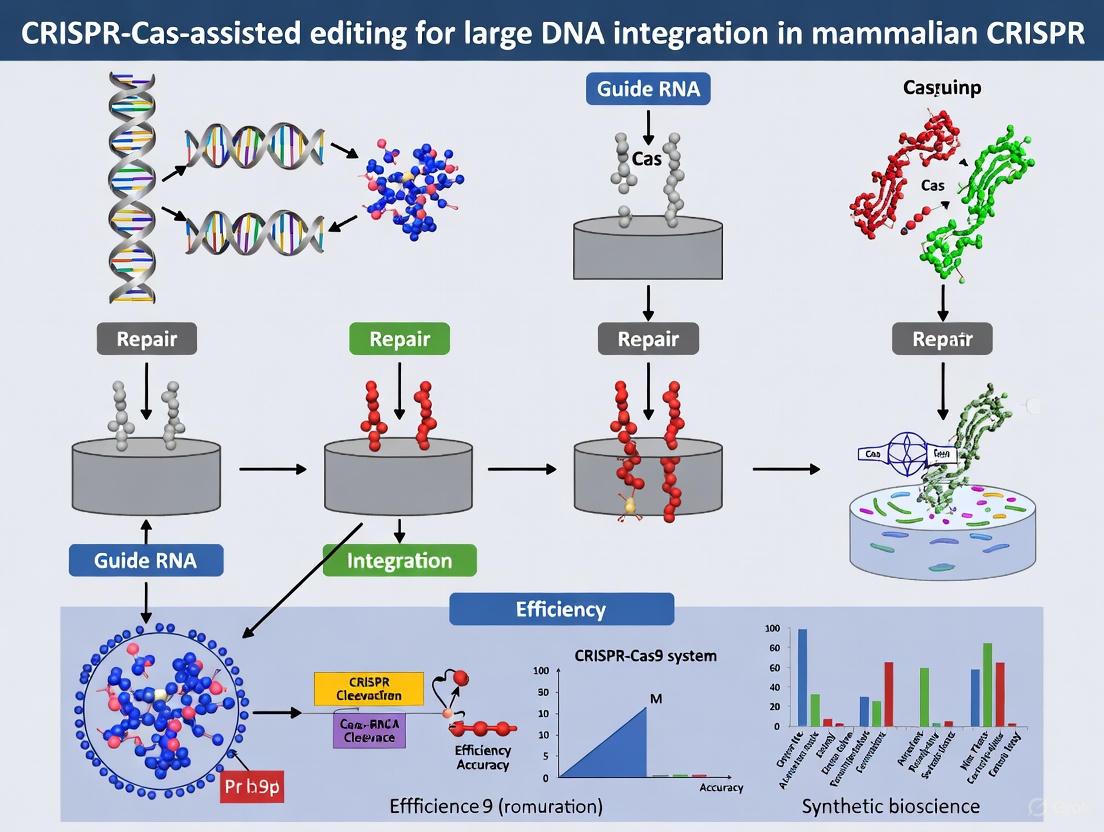
The precise integration of large DNA sequences into mammalian genomes is a cornerstone of advanced genetic engineering, with profound implications for disease modeling, functional genomics, and therapeutic development. This article comprehensively reviews the rapidly evolving landscape of CRISPR-Cas-assisted strategies for large DNA integration, moving beyond traditional homology-directed repair. We explore foundational mechanisms of CRISPR-associated transposase (CAST) systems and prime-editing-assisted site-specific integrase gene editing (PASSIGE), detail methodological advances including evolved recombinases and novel delivery platforms like baculovirus vectors, and provide critical troubleshooting guidance on optimizing efficiency while mitigating structural variations and imprecise integration. By comparing the performance, limitations, and ideal use cases of leading technologies, this resource equips researchers and drug development professionals with the knowledge to select and implement the most effective integration strategies for their specific applications, from basic research to preclinical therapy development.
CRISPR-Cas-Assisted Large DNA Integration in Mammalian Cells: Methods, Applications, and Future Directions
Abstract
The precise integration of large DNA sequences into mammalian genomes is a cornerstone of advanced genetic engineering, with profound implications for disease modeling, functional genomics, and therapeutic development. This article comprehensively reviews the rapidly evolving landscape of CRISPR-Cas-assisted strategies for large DNA integration, moving beyond traditional homology-directed repair. We explore foundational mechanisms of CRISPR-associated transposase (CAST) systems and prime-editing-assisted site-specific integrase gene editing (PASSIGE), detail methodological advances including evolved recombinases and novel delivery platforms like baculovirus vectors, and provide critical troubleshooting guidance on optimizing efficiency while mitigating structural variations and imprecise integration. By comparing the performance, limitations, and ideal use cases of leading technologies, this resource equips researchers and drug development professionals with the knowledge to select and implement the most effective integration strategies for their specific applications, from basic research to preclinical therapy development.
The Need for Scale: Foundations of Large DNA Integration
The manipulation of mammalian genomes represents a cornerstone of modern biological research and therapeutic development. While early genome editing technologies excelled at introducing single-nucleotide changes or small indels, many genetic diseases and functional studies require integration of large DNA sequences exceeding several kilobases [1] [2]. The ability to insert full-length genes, multigene circuits, or complex regulatory elements would enable revolutionary applications across synthetic biology, disease modeling, and gene therapy [1] [3].
Traditional approaches to large DNA integration have relied heavily on technologies such as recombinases (Cre, Flp), integrases (Bxb1, phiC31), and transposases (Sleeping Beauty, piggyBac) [1] [2]. While these systems offer precise DNA rearrangement capabilities, they suffer from critical limitations including dependence on pre-installed "landing pad" sequences, limited programmability, and insufficient efficiency in mammalian cells [1] [3]. The emergence of CRISPR-based systems has transformed genome engineering by providing unprecedented programmability through guide RNAs, but conventional CRISPR-Cas9 approaches create double-strand breaks (DSBs) that lead to undesirable byproducts such as indels, chromosomal translocations, and complex rearrangements [4] [2].
This Application Note examines the current landscape of large-scale DNA engineering technologies, focusing specifically on CRISPR-Cas-assisted methods for targeted integration of large DNA cargoes in mammalian cells. We provide detailed protocols, quantitative comparisons, and strategic guidance for researchers navigating this rapidly evolving field.
Technology Landscape: Quantitative Comparison of Integration Platforms
The table below summarizes the key performance characteristics of major large-DNA integration technologies as reported in recent literature:
Table 1: Performance Comparison of Large-DNA Integration Technologies
| Technology | Mechanism | Max Cargo Size | Efficiency in Mammalian Cells | Key Advantages | Key Limitations |
|---|---|---|---|---|---|
| PASSIGE/evoPASSIGE [3] [5] | Prime editing + evolved serine recombinases | >10 kb | 20-60% | High efficiency, programmable, minimal byproducts | Requires specialized evolved recombinases |
| PASTE [3] | Prime editor-recombinase fusions | >10 kb | ~25% | Single-component system | Lower efficiency than PASSIGE variants |
| CAST (Type I-F) [4] | CRISPR-associated transposase | ~15 kb | Initially ~1%, enhanced with engineering | DSB-free, programmable | Complex multi-component system |
| CAST (Type V-K) [1] | CRISPR-associated transposase | Up to 30 kb | ≤~1% in mammalian cells | Very large cargo capacity | Very low efficiency in eukaryotes |
| HDR-based CRISPR [1] [2] | DSB + homology-directed repair | Several kb | Typically <10% | Well-established protocol | Indel formation, cell-cycle dependent |
| HITI [1] [2] | DSB + NHEJ pathway | Several kb | Variable | Works in non-dividing cells | High indel rates |
Table 2: Evolved Recombinase Performance Across Genomic Loci
| Genomic Locus | Wild-type Bxb1 Efficiency | evoBxb1 Efficiency | eeBxb1 Efficiency | Fold Improvement (eeBxb1) |
|---|---|---|---|---|
| Safe harbor 1 | 5.5% | 15.1% | 23.2% | 4.2× |
| Therapeutic locus A | 6.8% | 18.9% | 28.7% | 4.2× |
| Therapeutic locus B | 4.1% | 11.2% | 17.3% | 4.2× |
| Primary fibroblasts | ~2% | Not reported | Up to 30% | ~14× |
Advanced Integration Technologies: Mechanisms and Workflows
PASSIGE with Evolved Recombinases
Technology Overview Prime-editing-assisted site-specific integrase gene editing (PASSIGE) represents a hybrid approach that couples the programmability of prime editing with the large DNA integration capability of serine recombinases [3] [5]. The system addresses a critical bottleneck in mammalian cell engineering by enabling targeted integration of multi-kilobase DNA cargoes without requiring pre-engineered landing pads in the genome.
Key Innovation: Phage-Assisted Continuous Evolution The efficiency of PASSIGE is substantially enhanced through phage-assisted continuous evolution (PACE) of the Bxb1 recombinase [3] [5]. This directed evolution approach generated variants (evoBxb1 and eeBxb1) with dramatically improved activity in mammalian cells:
- evoBxb1: 2.7-fold average improvement over wild-type Bxb1
- eeBxb1 (engineered-evolved Bxb1): 4.2-fold average improvement over wild-type Bxb1, achieving up to 60% integration efficiency at pre-installed landing pads and 23% average efficiency at endogenous loci [3] [5]
CRISPR-Associated Transposases (CASTs)
Technology Overview CRISPR-associated transposases represent a distinct approach that combines RNA-guided DNA targeting with transposase-mediated integration [1] [4]. Unlike conventional CRISPR systems that create double-strand breaks, CAST systems enable insertion of large DNA payloads without DSBs, thereby minimizing undesirable byproducts.
System Architecture and Optimization The Type I-F CAST system from Vibrio cholerae (VchCAST) exemplifies this technology with its multi-component architecture:
- QCascade complex: Performs RNA-guided DNA targeting through crRNA base pairing
- TnsA-TnsB heteromeric transposase: Catalyzes DNA excision and integration
- AAA+ ATPase TnsC: Links DNA targeting to transposition activity [4]
Recent engineering efforts have significantly enhanced CAST performance in mammalian cells through:
- Optimization of nuclear localization signals and protein tagging
- Discovery of accessory factors (bacterial ClpX) that boost integration by multiple orders of magnitude
- Identification of homologs from Pseudoalteromonas with improved activity [4]
Experimental Protocols
Protocol 1: evoPASSIGE for Targeted Gene Integration in Mammalian Cells
Principle This protocol utilizes evolved Bxb1 recombinases (evoBxb1 or eeBxb1) in combination with prime editing to achieve highly efficient integration of large DNA cargoes (>10 kb) at endogenous genomic loci without pre-installed landing pads [3] [5].
Materials and Reagents
Table 3: Key Research Reagent Solutions for evoPASSIGE
| Reagent | Function | Specifications | Source/Reference |
|---|---|---|---|
| eeBxb1 expression plasmid | Catalyzes recombination | CMV promoter, nuclear localization signals | [3] |
| Prime editor components | Installs recombinase landing site | PE2 system with engineered reverse transcriptase | [3] |
| pegRNA for attB installation | Guides landing pad installation | 30-nt homology arm, 10-nt primer binding site | [3] |
| Donor plasmid with attP | Carries DNA cargo for integration | attP sites flanking gene of interest | [3] |
| HEK293T cells | Mammalian expression system | High transfection efficiency | [3] |
| Lipid-based transfection reagent | Delivery method | Suitable for plasmid co-transfection | Standard protocols |
Step-by-Step Procedure
pegRNA Design and Preparation
- Design pegRNA to install a 40-bp attB site at the target genomic locus
- Include a 13-nt PBS sequence and 30-nt homology arm in the pegRNA
- Clone pegRNA into a U6 expression vector with appropriate scaffold
Donor Plasmid Construction
- Clone the gene of interest (up to 10+ kb) between attP sites in the donor plasmid
- Include necessary regulatory elements (promoter, polyA signals)
- Verify sequence integrity through restriction digest and sequencing
Cell Transfection and Editing
- Seed HEK293T cells in 24-well plates at 1.5×10^5 cells/well
- Co-transfect with the following plasmid mixture:
- 500 ng eeBxb1 expression plasmid
- 250 ng prime editor plasmid
- 150 ng pegRNA plasmid
- 250 ng donor plasmid
- Use lipid-based transfection reagent according to manufacturer's protocol
- Incubate cells for 72 hours at 37°C with 5% CO₂
Analysis and Validation
- Harvest cells 5-7 days post-transfection
- Extract genomic DNA using standard protocols
- Perform PCR screening with junction-specific primers
- Quantify integration efficiency via droplet digital PCR
- Validate correct orientation and integrity through long-read sequencing
Technical Notes
- Optimal integration efficiencies (20-46%) are achieved with the eeBxb1 variant in a single transfection [3]
- For primary cells, consider using AAV-based delivery for enhanced efficiency
- Include controls with wild-type Bxb1 to benchmark improvement
- For therapeutic applications, screen multiple clones to ensure monoclonality
Protocol 2: CAST-Mediated Integration in Human Cells
Principle This protocol implements CRISPR-associated transposase systems for DSB-free integration of large DNA payloads in human cells, leveraging the RNA-guided targeting of Cascade complexes coupled with TnsAB transposase activity [4].
Materials and Reagents
Table 4: Essential CAST System Components
| Component | Role in System | Engineering Considerations | Source |
|---|---|---|---|
| VchCascade subunits | RNA-guided DNA targeting | Codon optimization for human cells | [4] |
| TniQ | Bridges Cascade to transposition | Fusion protein strategies | [4] |
| TnsA, TnsB, TnsC | Transposase complex | TnsAB fusion for improved activity | [4] |
| ClpX protease | Enhances integration efficiency | Bacterial ortholog with human compatibility | [4] |
| crRNA expression vector | Targets specific genomic loci | U6 promoter, minimal repeat structure | [4] |
| Donor template with Tns sites | Payload for integration | Left and right end sequences for TnsB binding | [4] |
Step-by-Step Procedure
CAST Component Optimization
- Clone all seven VchCAST proteins (Cas6, Cas7, Cas8, TniQ, TnsA, TnsB, TnsC) into mammalian expression vectors with NLS tags
- Include bacterial ClpX gene in a separate expression vector
- Use 2A "skipping" peptides for coordinated expression of Cascade subunits
crRNA Design and Validation
- Design crRNA targeting genomic locus of interest with appropriate PAM sequence (5'-CCN-3')
- Verify target accessibility through prior chromatin characterization
- Clone crRNA into Pol III expression vector
System Assembly and Delivery
- Co-transfect HEK293T cells with all CAST component plasmids (1.5 μg total DNA per 24-well)
- Include donor plasmid with transposon ends flanking cargo DNA
- Maintain 3:1 molar ratio of TnsC to other components
- Use polyethylenimine (PEI) or lipid-based transfection methods
Functional Validation and Analysis
- Assess integration efficiency 7-10 days post-transfection
- Use split-GFP reporter systems for rapid efficiency quantification
- Perform targeted locus amplification and sequencing
- Validate specific integration via Southern blotting
Technical Notes
- Initial integration efficiencies are modest (~1%) but enhanced with ClpX co-expression [4]
- System exhibits exceptional specificity with minimal off-target integration
- Optimize component ratios for each new target locus
- Consider using orthogonal systems from Pseudoalteromonas for improved activity
Applications and Future Directions
The technologies described herein enable diverse applications in biomedical research and therapeutic development. PASSIGE systems achieve sufficiently high integration efficiencies (exceeding 30% in primary human fibroblasts) to rescue loss-of-function genetic diseases, while CAST systems offer unique advantages for DSB-free integration of very large DNA constructs [3] [4].
Future development priorities include enhancing the efficiency of CAST systems in mammalian cells, minimizing the molecular complexity of integration platforms, and improving delivery methods for in vivo applications. The continued evolution of recombinases and optimization of multi-component systems will further expand the capabilities of large-scale DNA engineering, ultimately enabling more sophisticated genetic manipulations and therapeutic interventions.
This Application Note reflects the current state of technology as of 2025, with rapid advancements expected in this field. Researchers should consult the most recent literature for protocol updates and technological improvements.
While foundational to modern genetic engineering, traditional tools like Cre-lox recombination, site-specific recombinases, and homology-directed repair (HDR) face significant limitations that impact their efficiency, precision, and applicability. Key constraints include mosaicism and incomplete recombination in Cre-lox systems, low efficiency and cell cycle dependence of HDR, and the risk of structural variations accompanying CRISPR-Cas9-assisted editing. This application note details these limitations, provides quantitative data on critical parameters, and outlines standardized protocols to help researchers identify, understand, and mitigate these challenges in their experimental designs, particularly for large DNA integration in mammalian cells.
Limitations of Cre-lox Recombination Technology
The Cre-lox system, derived from bacteriophage P1, allows for site-specific deletions, insertions, translocations, and inversions of DNA. Despite its widespread use, several technical hurdles affect its reliability and reproducibility [6] [7] [8].
Key Limitations and Biological Challenges
- Mosaicism and Incomplete Recombination: A primary challenge is the failure to achieve complete recombination in all target cells, leading to mosaic tissues with mixed populations of recombined and non-recombined cells. This mosaicism can confound phenotypic analysis and is influenced by factors such as the Cre-driver strain, inter-loxP distance, and the age of the breeder in animal models [7].
- Protein Persistence from Excised Episomes: Even after successful genomic DNA excision confirmed by PCR, functional protein can persist, especially in non-proliferating or slow-proliferating tissues. The excised, loxP-flanked DNA sequence can form a stable circular episome that continues to be transcribed and translated, leading to a disconnect between genotype and phenotype [8].
- Spontaneous Recombination in Plasmid Production: Constructing single plasmids containing both a Cre gene and a "floxed" (flanked by loxP sites) sequence in E. coli is notoriously difficult because Cre-mediated recombination occurs spontaneously during plasmid amplification, often resulting in the loss of the floxed cassette [9].
- Cryptic Recombination and Off-Target Effects: The Cre recombinase can recognize cryptic or pseudo-lox sites in the host genome, leading to unauthorized recombination events that can damage host DNA and cause unintended phenotypic outcomes [6].
Quantitative Framework for Cre-lox Efficiency
The table below summarizes key factors that systematically influence the efficiency of Cre-mediated recombination, providing a guide for experimental design [7].
Table 1: Factors Affecting Cre-lox Recombination Efficiency
| Factor | Optimal Condition for High Efficiency | Impact on Efficiency |
|---|---|---|
| Inter-loxP Distance | < 4 kb for wildtype loxP; < 3 kb for mutant loxP (e.g., lox71/66) | Efficiency decreases with increasing distance; complete failure ≥15 kb (wildtype) or ≥7 kb (mutant) [7]. |
| Cre-Driver Strain | Strain-dependent (e.g., Ella-cre, CMV-cre, Sox2-cre) | The choice of driver is a pivotal determinant, with significant variation in recombination rates between strains [7]. |
| Zygosity of Floxed Allele | Heterozygous floxed allele | Crossing with a heterozygous floxed allele results in more efficient recombination than using a homozygous floxed allele [7]. |
| Animal Age | Breeders aged 8-20 weeks | Recombination efficiency is highest in young adult breeders and can decline outside this age range [7]. |
| loxP Site Type | Wildtype loxP sites | Wildtype loxP sites generally prove more efficient than mutant variants [7]. |
Figure 1: Cre-lox Limitation Pathways. Key factors leading to common experimental challenges in Cre-lox recombination, including reduced efficiency and genotype-phenotype disparity.
Limitations of Homology-Directed Repair (HDR)
HDR is the primary cellular pathway for precise gene editing but is inherently inefficient compared to error-prone repair pathways, presenting a major bottleneck for therapeutic applications [10] [11].
Key Limitations of HDR
- Cell Cycle Dependence: HDR is active primarily in the S and G2 phases of the cell cycle, as it relies on the sister chromatid as a natural repair template. This restricts highly efficient HDR to proliferating cells, making precise editing in post-mitotic cells (e.g., neurons, cardiomyocytes) exceptionally challenging [10] [11].
- Competition with Dominant NHEJ: The non-homologous end joining (NHEJ) pathway is active throughout the cell cycle and is the dominant, faster repair mechanism. Consequently, CRISPR-Cas9-induced double-strand breaks (DSBs) are predominantly repaired by NHEJ, which results in a high frequency of insertions and deletions (indels) rather than precise HDR [10] [11].
- Low Efficiency and Unpredictable Outcomes: Even under ideal conditions, HDR efficiency in most mammalian cell types is low, often resulting in a mixed population of cells where the desired precise edit is present in only a small fraction. This necessitates robust selection methods to isolate successfully edited clones [10] [11].
- Risk of Large Structural Variations: Strategies to enhance HDR by inhibiting key NHEJ proteins (e.g., using DNA-PKcs inhibitors) can inadvertently increase the risk of large, unforeseen genomic aberrations. These include megabase-scale deletions and chromosomal translocations, which pose significant safety concerns for clinical applications [12].
DNA Repair Pathway Competition
The table below compares the major DNA repair pathways involved in fixing CRISPR-Cas9-induced DSBs, highlighting why HDR is often the minority outcome.
Table 2: Key DNA Repair Pathways in CRISPR-Cas9 Editing
| Feature | Non-Homologous End Joining (NHEJ) | Homology-Directed Repair (HDR) | Microhomology-Mediated End Joining (MMEJ) |
|---|---|---|---|
| Primary Role | Quick, error-prone ligation of DSBs | Precise repair using a homologous template | Error-prone repair using microhomologies |
| Key Proteins | Ku70/Ku80, DNA-PKcs, 53BP1, XRCC4/LigIV | MRN Complex, CtIP, RPA, RAD51 | PARP1, Pol θ (theta) |
| Template Needed | No | Yes (e.g., sister chromatid, donor DNA) | No |
| Cell Cycle Phase | All phases (G1, S, G2) | Primarily S and G2 phases | S and G2 phases |
| Editing Outcome | Small insertions/deletions (indels) | Precise nucleotide changes or gene insertions | Typically larger deletions |
| Relative Efficiency | High (dominant pathway) | Low | Variable, can be significant |
Figure 2: HDR Limitation via Pathway Competition. The cell's decision-making process after a DSB shows why HDR is a minority pathway, being restricted by cell cycle and outcompeted by NHEJ.
Experimental Protocols
Protocol: Assessing Cre-lox Recombination Efficiency and Mosaicism
This protocol is adapted from systematic analyses in mouse models to quantify recombination success and identify mosaicism [7].
- Strain Generation:
- Cross female Cre-driver mice (e.g., Ella-cre, CMV-cre) with male mice harboring the floxed allele at the target locus (e.g., Rosa26).
- Critical Parameter: Ensure inter-loxP distance is < 4 kb for optimal results.
- Genotyping and Analysis:
- From the F1 offspring, genotype 8-55 pups (from 1-8 litters) using genomic DNA from the tissue of interest.
- Perform PCR with primer sets designed to distinguish between the unrecombined allele, the recombined allele, and the total number of chromosomal copies.
- Quantification of Outcomes:
- Categorize offspring into three groups: Complete Recombination, Mosaicism, and No Recombination.
- Calculate the percentage of offspring in each category. Mosaicism is indicated when recombination is detected but is not complete in all cells of the analyzed tissue.
- Protein-Level Validation:
- Essential Step: Perform Western blot analysis and/or immunohistochemistry on tissue samples to confirm loss of target protein.
- Use antibodies against the protein encoded by the floxed gene and a loading control (e.g., GAPDH, α-tubulin).
- If genomic recombination is confirmed but protein persists, investigate the potential presence of a stable episomal circle using qPCR with primers specific to the floxed sequence [8].
Protocol: Evaluating HDR Efficiency and Structural Variations
This protocol outlines steps to measure HDR and detect associated risks in mammalian cell lines [10] [12] [11].
- Cell Line Selection and Cell Cycle Synchronization:
- Use a cycling mammalian cell line (e.g., HEK 293T, K562, iPSCs).
- To enhance HDR, synchronize cells in S/G2 phase using reagents like thymidine or aphidicolin.
- CRISPR-Cas9 Transfection and HDR Enhancement:
- Co-transfect cells with a plasmid expressing Cas9 and sgRNA, along with a single-stranded or double-stranded HDR donor template.
- Experimental Arm: Treat one group of cells with a small molecule HDR enhancer (e.g., a DNA-PKcs inhibitor). Include a DMSO-only control group.
- Short-Range HDR Analysis (72-96 hours post-transfection):
- Extract genomic DNA and perform PCR amplification of the target locus.
- Use droplet digital PCR (ddPCR) with fluorescent probes or deep amplicon sequencing to quantify the precise percentage of HDR events relative to total alleles.
- Long-Range Analysis for Structural Variations:
- To detect large deletions or translocations induced by on-target editing, perform long-range PCR spanning several kilobases around the target site.
- Analyze the products by agarose gel electrophoresis for unexpected sizes.
- For a comprehensive, unbiased assessment, use whole-genome sequencing (WGS) or specialized assays like CAST-Seq or LAM-HTGTS on cloned cell populations [12].
The Scientist's Toolkit: Research Reagent Solutions
Table 3: Essential Reagents and Resources for Addressing Traditional Tool Limitations
| Item | Function/Benefit | Example/Note |
|---|---|---|
| TAx9 Sequence | Prevents spontaneous Cre recombination in E. coli, enabling single-plasmid Cre-lox system construction [9]. | Artificial sequence: TATATATATATATATATA |
| High-Efficiency Bxb1 Recombinase | Facilitates rapid and uniform integration of large loxP-flanked constructs into specific genomic loci (e.g., Rosa26) [7]. | Alternative to less efficient CRISPR-HDR for large insertions. |
| HDR-Enhancing Small Molecules | Inhibit NHEJ to bias repair toward HDR. Caution: Can increase structural variation risk [12] [11]. | e.g., DNA-PKcs inhibitors (AZD7648). Use with appropriate controls. |
| NHEJ Reporter Plasmid | Quantifies NHEJ activity in cells to benchmark the efficiency of HDR-enhancing strategies [13]. | e.g., RFP-GFP reporter system. |
| High-Fidelity Cas9 Variants | Reduces off-target effects but does not eliminate on-target structural variations [12] [14]. | e.g., HiFi Cas9, SpCas9-HF1. |
| Specialized Sequencing Assays | Detects large-scale on-target aberrations and translocations missed by standard amplicon sequencing [12]. | e.g., CAST-Seq, LAM-HTGTS, WGS. |
The targeted integration of large DNA sequences into mammalian genomes is a cornerstone of advanced genetic engineering, with profound implications for gene therapy, synthetic biology, and disease modeling. Traditional methods for large DNA integration, particularly those relying on site-specific recombinases like Cre and Flp, have faced significant limitations. These systems typically require pre-engineering of recognition sequences (e.g., loxP or FRT sites) into the target genome, a process that is both time-consuming and inefficient, often necessitating additional genetic crossing steps [1].
The emergence of CRISPR-based systems has transformed this landscape by providing programmable guidance through RNA-DNA recognition, eliminating the dependency on pre-installed recognition sites and enabling direct, one-step targeted integration [1]. This paradigm shift has opened new possibilities for therapeutic applications, including the potential for one-time, mutation-agnostic treatments for loss-of-function genetic diseases through the installation of healthy gene copies at endogenous loci [15].
Comparative Analysis of CRISPR-Assisted Integration Systems
The table below summarizes the key characteristics, advantages, and limitations of current technologies for targeted DNA integration.
Table 1: Comparison of Major Technologies for Targeted DNA Integration in Mammalian Cells
| Technology | Mechanism | Maximum Cargo Size (Demonstrated) | Key Advantages | Key Limitations |
|---|---|---|---|---|
| HDR-based CRISPR | CRISPR-induced DSB repaired using donor template [1] | ~2 kb (dsDNA) [16] | Well-established protocol; precise editing | Low efficiency (<10%); requires dividing cells; high indel rates [15] [16] |
| HITI | NHEJ-mediated insertion after simultaneous DSBs in genome & donor [1] | Not specified | Works in non-dividing cells | High indel rates; heterogeneous products with mixed orientations [1] [15] |
| CAST Systems (e.g., evoCAST) | RNA-guided transposase complex [1] [15] | >1 kb (therapeutic genes) [15] | DSB-free; high product purity; ~10-25% efficiency in human cells [15] | Early development stage; complex multi-component system [1] [15] |
| Prime Editing | Reverse-transcribed DNA patch templated by pegRNA [1] | ~100-200 bp [15] | High precision; versatile; low indel formation [17] | Limited cargo capacity; inefficient for large insertions [15] |
| PASSIGE | Prime editing installs recombinase site + recombinase-mediated integration [15] | Not specified | High integration efficiency | Multi-step process; generates undesired byproducts [15] |
Experimental Protocols for Key Integration Technologies
Protocol: Enhanced HDR-Mediated Knock-In Using 5'-Modified Donor Templates
This protocol describes a method to significantly improve HDR efficiency in mouse zygotes, utilizing 5'-end modified donor DNA templates to increase single-copy integration events [16].
Table 2: Reagent Setup for HDR Optimization Experiment
| Reagent | Specifications | Function | Optimal Concentration/Type |
|---|---|---|---|
| Cas9 Protein | High-fidelity Cas9 nuclease | Creates targeted DSB to initiate repair | 100 ng/µL [16] |
| crRNAs | Two crRNAs targeting antisense strand [16] | Guides Cas9 to flanking target sites | 50 ng/µL each [16] |
| Donor DNA Template | ~600 bp with 60 bp homology arms; 5'-modified [16] | Provides homology template for precise repair | 5'-C3 spacer or 5'-biotin modified [16] |
| RAD52 Protein | Human RAD52 | Enhances ssDNA integration efficiency | Add to injection mix [16] |
Procedure:
- Design and Preparation: Design a donor DNA template (~600 bp) containing your gene of interest flanked by appropriate homology arms (60 bp). Synthesize this template with 5′-C3 spacer or 5′-biotin modifications [16].
- Complex Formation: Pre-complex the Cas9 protein with crRNAs targeting the antisense strand at the target locus to form ribonucleoprotein (RNP) complexes. Incubate for 10 minutes at room temperature [16].
- Sample Preparation: Combine the RNP complexes with the modified donor DNA template. If using, add RAD52 protein to the final injection mix [16].
- Microinjection: Inject the mixture into the pronuclei of approximately 100-300 mouse zygotes [16].
- Analysis: Transfer the injected embryos to pseudopregnant females. Analyze the resulting founder animals (F0) for correct HDR-mediated integration using Southern blot analysis with restriction enzymes (e.g., EcoRI and BamHI) to distinguish single-copy integration from concatemers [16].
Troubleshooting:
- High concatemer formation: Use denatured (ssDNA) templates instead of dsDNA to reduce template multiplication [16].
- Low HDR efficiency: Ensure use of 5′-end modifications (C3 spacer or biotin) and target the antisense strand with crRNAs [16].
- Partial template integration: Optimize RAD52 concentration, as higher levels may increase aberrant integration [16].
Protocol: evoCAST for DSB-Free Integration of Large DNA Cargos
This protocol utilizes an evolved CRISPR-associated transposase (evoCAST) system for efficient, DSB-free integration of kilobase-scale DNA sequences in human cells [15].
Table 3: Reagent Setup for evoCAST Experiment
| Reagent | Specifications | Function | Optimal Concentration/Type |
|---|---|---|---|
| evoCAST Plasmids | Evolved TnsA, TnsB, TnsC, and QCascade components [15] | Forms the RNA-guided transposase complex | 1 µg each per 1×10^6 cells |
| Donor Plasmid | Plasmid containing cargo flanked by Tn7-like ends [15] | Provides DNA cargo for integration | 1 µg per 1×10^6 cells |
| Guide RNA Expression Plasmid | Plasmid expressing crRNA targeting genomic locus [15] | Directs integration complex to specific genomic site | 0.5 µg per 1×10^6 cells |
Procedure:
- Cell Seeding: Seed HEK293T cells in a 24-well plate at a density of 1×10^5 cells/well and culture until they reach 70-80% confluency.
- Transfection Mix: Prepare a transfection mix containing the four evoCAST component plasmids (TnsA, TnsB, TnsC, QCascade), the donor plasmid with your gene of interest (e.g., factor IX cDNA or CAR construct) flanked by the necessary Tn7 attachment sites, and the guide RNA plasmid targeting your desired genomic locus (e.g., ALB intron 1 or TRAC) [15].
- Transfection: Transfect the cells using your preferred transfection reagent (e.g., PEI or lipofectamine) according to the manufacturer's protocol.
- Selection and Analysis: After 48-72 hours, harvest the cells. Analyze integration efficiency and specificity using genomic PCR, flow cytometry (for reporter genes), or next-generation sequencing to assess on-target integration and potential off-target events [15].
Troubleshooting:
- Low integration efficiency: Ensure all four evoCAST components are included and that the donor plasmid contains the correct Tn7-like ends.
- Cytotoxicity: Titrate the amount of evoCAST plasmids to minimize potential cellular toxicity while maintaining editing efficiency.
- Verification: Confirm unidirectional, precise integration by sequencing the target-genome integration junctions [15].
The Scientist's Toolkit: Essential Research Reagent Solutions
Table 4: Key Reagents for CRISPR-Assisted Large DNA Integration
| Reagent Category | Specific Examples | Function & Application Notes |
|---|---|---|
| CRISPR Effectors | evoCAST system (evolved TnsA, TnsB, TnsC, QCascade) [15] | Engineered for high-efficiency, DSB-free integration in human cells; minimal indel formation |
| Donor DNA Templates | 5′-C3 spacer or 5′-biotin modified ssDNA/dsDNA [16] | Enhances single-copy HDR integration; reduces template concatemerization |
| Enzyme Enhancers | RAD52 protein [16] | Increases HDR efficiency for ssDNA templates; can increase template multiplication |
| AI-Design Platforms | DeepXE AI platform; ProGen2-base LM for Cas protein design [17] [18] | Predicts editing efficiency; designs novel Cas effectors like OpenCRISPR-1 |
| Delivery Systems | "One-pot PASTA" non-viral method [17] | Combines CRISPR-Cas HDR with serine integrases for efficient large transgene integration in T cells |
| Specialized Cas Variants | OpenCRISPR-1 (AI-designed) [18] | Comparable or improved activity and specificity relative to SpCas9; compatible with base editing |
Workflow and Pathway Visualizations
The integration of CRISPR's programmable guidance with sophisticated DNA integration mechanisms represents a paradigm shift in genetic engineering capabilities. The development of systems like evoCAST for DSB-free integration and optimized HDR protocols with 5′-modified donors provides researchers with a powerful toolkit for diverse applications, from gene therapy development to sophisticated disease modeling.
Future directions in this field will likely focus on enhancing the efficiency and specificity of these systems, reducing their molecular complexity for easier delivery, and expanding their applicability across diverse cell types and organisms. The continued integration of artificial intelligence for protein design and guide RNA optimization, as demonstrated by platforms like DeepXE and the creation of novel editors like OpenCRISPR-1, promises to further accelerate the development of even more precise and efficient genome engineering technologies [17] [18]. As these technologies mature, they will undoubtedly unlock new possibilities for therapeutic intervention and fundamental biological research.
The capacity to precisely integrate large DNA sequences into mammalian genomes is revolutionizing basic research and therapeutic development. CRISPR-Cas-assisted editing has emerged as the predominant platform for these engineering feats, primarily leveraging three distinct integration mechanisms: Homology-Directed Repair (HDR), Homology-Independent Targeted Integration (HITI), and break-free methods such as CRISPR-associated transposase (CAST) systems. Each mechanism presents unique advantages, limitations, and optimal application contexts. This Application Note delineates these key integration strategies, providing quantitative efficiency comparisons, detailed experimental protocols, and a curated toolkit to guide researchers in selecting and implementing the optimal approach for their specific genome engineering goals in mammalian cells.
The table below summarizes the core characteristics, advantages, and limitations of HDR, HITI, and break-free integration methods.
Table 1: Comparison of Key DNA Integration Mechanisms in Mammalian Cells
| Feature | Homology-Directed Repair (HDR) | Homology-Independent Targeted Insertion (HITI) | Break-Free Methods (e.g., CAST) |
|---|---|---|---|
| Core Mechanism | Uses donor DNA with homology arms for precise repair at DSB via endogenous cellular machinery [19]. | Leverages error-prone NHEJ pathway to ligate DSBs in genome and donor DNA simultaneously [20] [21]. | RNA-guided transposase complexes integrate DNA without creating DSBs [1]. |
| Editing Outcome | High precision; suitable for subtle mutations, tags, and small inserts [22]. | Prone to indels at junctions; requires careful screening [20]. | Clean integration without indels; precise "cut-and-paste" [1]. |
| Cell Cycle Dependence | Active primarily in S/G2 phases; inefficient in non-dividing cells [20] [19]. | Cell cycle-independent; works in both dividing and non-dividing cells [21]. | Largely cell cycle-independent [1]. |
| Efficiency in Mammalian Cells | Typically low (<10% in many contexts) [20] [19]. Can be boosted to ~50% with optimized delivery [23]. | Highly variable (0.15% to >40%) [20] [21]. Can outperform HDR for large inserts [21]. | Currently low in human cells (~1-3%) but rapidly improving [1]. |
| Ideal Insert Size | Effective for a broad range, from ssODNs to several kilobases [23]. | Particularly efficient for large inserts (>5 kb) [21]. | Very large inserts, demonstrated up to 30 kb in prokaryotes [1]. |
| Primary Challenge | Low inherent efficiency; competition with NHEJ; cell cycle dependence [19] [24]. | High frequency of indel mutations at integration junctions [1] [20]. | Early developmental stage; low efficiency in eukaryotic systems [1]. |
The following diagram illustrates the fundamental workflows and key molecular events for each integration mechanism.
Detailed Experimental Protocols
Protocol 1: Enhancing HDR Efficiency with Optimized RNP Delivery
This protocol, adapted from Vazquez et al., achieves high-efficiency (up to 50%) HDR-mediated knock-in in CHO-K1 cells using a cationic hyper-branched cyclodextrin-based polymer (Ppoly) for RNP and linearized dsDNA donor delivery [23].
Key Reagents:
- Cas9 Protein: Purified, high-concentration.
- sgRNA: In vitro transcribed or synthesized, target-specific.
- Donor DNA: dsDNA with 1000-bp homology arms, linearized in vitro.
- Delivery Vehicle: Cationic hyper-branched cyclodextrin-based polymer (Ppoly).
- Cells: Adherent mammalian cells (e.g., CHO-K1, HEK293).
Step-by-Step Procedure:
- RNP Complex Formation: Pre-incubate 10 µg of Cas9 protein with 100 pmol of sgRNA at room temperature for 10 minutes in Opti-MEM to a final volume of 20 µL [25].
- Donor DNA Preparation: Linearize the dsDNA donor plasmid via restriction enzyme digest or PCR amplification. Verify successful linearization by gel electrophoresis.
- Nanocomplex Formation: Add the linearized donor DNA to the pre-formed RNP complex. Incubate for 10 minutes to allow complex association.
- Polymer Encapsulation: Mix the RNP/donor complex with the Ppoly polymer at an optimal mass ratio. Incubate for 20-30 minutes to form stable, positively charged nanoparticles with >90% encapsulation efficiency [23].
- Cell Transfection: Seed cells to achieve 60-80% confluency at transfection. Replace medium with fresh culture medium. Add the RNP/Ppoly nanocomplexes directly to the cells.
- Post-Transfection Culture: Incubate cells for 48-72 hours. Minimal cytotoxicity (cell viability >80%) is typically observed with Ppoly [23].
- Validation and Cloning: After 72 hours, analyze initial editing efficiency via junction PCR or flow cytometry for fluorescent reporters. Perform antibiotic selection and single-cell cloning to isolate isogenic edited clones [23].
Protocol 2: HITI-Mediated CAR Knock-In for T-Cell Engineering
This protocol, based on Sheppard et al., details HITI for integrating a Chimeric Antigen Receptor (CAR) transgene into the TRAC locus of primary human T-cells, yielding high cell numbers suitable for clinical-scale manufacturing [21].
Key Reagents:
- RNP Complex: Wild-type Cas9 protein complexed with TRAC-targeting sgRNA (sequence: 5'-GGGAATCAAAATCGGTGAAT-3') [21].
- Donor Template: Nanoplasmid DNA containing the CAR transgene, flanked by the same sgRNA target sequences (without PAM) oriented outwards. This allows Cas9 to linearize the donor upon co-delivery [21].
- Cells: Primary human T-cells, isolated from leukopaks.
- Electroporation System: Maxcyte GTx electroporator.
Step-by-Step Procedure:
- T-Cell Activation: Isolate T-cells via negative selection. Activate using CD3/CD28 Dynabeads at a 1:1 bead-to-cell ratio in TexMACS media supplemented with IL-7 and IL-15 (12.5 ng/mL each). Culture for 2 days [21].
- RNP Complex Formation: Mix wild-type Cas9 (61 µM) and TRAC sgRNA (125 µM) at a 1:1 volume ratio (2:1 molar ratio) and incubate for 10 minutes at room temperature [21].
- Donor/RNP Assembly: Add the HITI nanoplasmid donor DNA (e.g., 3 mg/mL) to the pre-formed RNP. Incubate for at least 10 minutes to allow Cas9 to cleave the nanoplasmid target sites [21].
- Electroporation: Wash activated T-cells and resuspend in electroporation buffer at 2 × 10^8 cells/mL. Combine cell suspension with the RNP/donor complex. Electroporate using the "Expanded T cell" protocol on the Maxcyte GTx [21].
- Post-Electroporation Recovery: Rest electroporated cells in the processing assembly for 30 minutes. Transfer to pre-warmed G-Rex vessels with fresh cytokine-supplemented media.
- Expansion and Analysis: Expand T-cells for 10-14 days. Monitor cell count and viability. CAR integration efficiency is typically assessed by flow cytometry 7-14 days post-electroporation, with HITI often yielding at least 2-fold more CAR-T cells than HDR in this system [21].
Protocol 3: ssCTS-DNA for High-Efficiency Cas12a-Mediated Knock-In
This protocol leverages single-stranded DNA donors with truncated Cas12a-target sequences (ssCTS) and AsCas12a Ultra for highly efficient (up to 90%), low-toxicity knock-in in primary human T-cells [26].
Key Reagents:
- Nuclease: AsCas12a Ultra protein.
- crRNA: Designed for the target locus (e.g., CD3ε, TRAC).
- Donor Template: Long single-stranded DNA (ssDNA) with double-stranded CTS modifications on both ends. The CTS contains a truncated, non-cleavable Cas12a binding site in "PAM In" orientation [26].
- Cells: Primary human T-cells.
Step-by-Step Procedure:
- CTS Hybridization: Generate the double-stranded CTS ends by hybridizing complementary oligodeoxynucleotides (ODNs) to the ends of the long ssDNA donor [26].
- RNP Formation: Complex AsCas12a Ultra protein with the target-specific crRNA.
- Electroporation Mixture: Combine the RNP complex with the ssCTS-DNA donor template. No pre-incubation is needed, as the truncated CTS prevents cleavage by Cas12a.
- Cell Electroporation: Electroporate the mixture into activated primary human T-cells using standard settings optimized for RNP delivery.
- Post-Electroporation Culture: Culture cells in IL-7/IL-15 supplemented media. High viability is maintained even at high template concentrations due to reduced toxicity of ssDNA [26].
- Efficiency Validation: Analyze knock-in efficiency 3-5 days post-editing via flow cytometry. Confirm precise integration and reduced partial integration events using long-read amplicon sequencing [26].
The Scientist's Toolkit: Research Reagent Solutions
Successful implementation of these advanced genome editing techniques relies on a carefully selected toolkit. The table below catalogs essential reagents and their functions.
Table 2: Essential Reagents for Advanced Genome Editing
| Reagent Category | Specific Examples | Function & Rationale | Key Considerations |
|---|---|---|---|
| CRISPR Nucleases | SpCas9, AsCas12a Ultra [26] | Induces DSB at target locus. Cas12a offers staggered cuts, simpler RNAs, and high specificity. | AsCas12a Ultra requires T-rich PAM (TTTV) and has minimal ssDNase activity under physiological conditions, making it ideal for ssDNA donors [26]. |
| Donor Templates | dsDNA with long homology arms [23], ssCTS-DNA [26], HITI Nanoplasmid [21] | Provides template for the desired edit. Format heavily influences efficiency and toxicity. | ssCTS-DNA reduces toxicity and leverages NLS of Cas proteins for nuclear import. HITI donors must be flanked by functional gRNA target sites [21]. |
| Delivery Systems | Cationic cyclodextrin-based polymer (Ppoly) [23], Electroporation (Maxcyte GTx) [21] | Enables intracellular delivery of editing components. | Polymer-based systems offer low cytotoxicity and high encapsulation efficiency. Electroporation is standard for hard-to-transfect cells like primary T-cells [21]. |
| Small Molecule Enhancers | Repsox, AZD0156 [25] [21] | Modulates DNA repair pathways to favor desired outcome (e.g., Repsox inhibits NHEJ via TGF-β pathway) [25]. | Added post-delivery for a limited time (e.g., 24h). Can improve editing efficiency by 1.5 to 3-fold [25]. |
| Enrichment & Selection | DHFR-FS/MTX Selection (CEMENT) [21] | Enriches for successfully edited cells by linking transgene to a selectable marker. | CEMENT with HITI can enrich CAR+ T-cells to ~80% purity, enabling clinical-scale manufacturing [21]. |
Pathway and Workflow Visualization
The following diagram synthesizes the critical steps and strategic decision points for implementing HDR, HITI, and break-free methods, integrating pathway modulation and reagent selection.
Cutting-Edge Tools and Workflows for Efficient Integration
CRISPR-associated transposase (CAST) systems are emerging as powerful tools for genome engineering, enabling RNA-guided integration of large DNA fragments without creating double-strand breaks (DSBs). Unlike traditional CRISPR-Cas systems that rely on cellular DNA repair mechanisms, CAST systems directly insert DNA cargo through a transposition mechanism, bypassing the need for homology-directed repair (HDR) and avoiding the introduction of indel mutations that commonly occur with non-homologous end joining (NHEJ) [2]. This unique capability positions CAST systems as promising platforms for precise genome editing applications requiring insertion of large genetic elements, with particular relevance for therapeutic development in mammalian cells.
CAST systems are classified into two main categories based on their CRISPR effector complexes: Type I-F systems utilizing multi-protein Cascade complexes (Cas6, Cas7, and Cas8) and Type V-K systems employing single-effector Cas12k proteins [2] [27]. Both systems originate from bacterial defense mechanisms and share core components including the transposase TnsB, the AAA+ ATPase TnsC, and the targeting adaptor TniQ [28] [27]. Type I-F systems additionally contain TnsA, which enables a true "cut-and-paste" transposition mechanism, while Type V-K systems typically lack TnsA and may generate cointegrate products through a replicative pathway [2] [1].
The fundamental advantage of CAST systems lies in their ability to integrate large DNA payloads (ranging from 10 kb to over 30 kb) with high precision and minimal off-target effects compared to DSB-dependent editing approaches [29]. This capacity for programmable, targeted integration of gene-sized DNA segments makes CAST systems particularly valuable for therapeutic applications such as gene replacement strategies, where delivering entire healthy gene copies could benefit patients regardless of their specific disease-causing mutations [30].
Mechanisms of Action
CAST systems employ sophisticated molecular machinery that couples RNA-guided target recognition with transposase activity. The mechanism begins with the formation of a ribonucleoprotein complex that specifically identifies target DNA sequences through complementary base pairing between the CRISPR RNA (crRNA) spacer and the target protospacer, accompanied by recognition of an adjacent protospacer adjacent motif (PAM) [2].
In Type I-F CAST systems, the Cascade complex (comprising Cas6, Cas7, and Cas8 proteins) facilitates target DNA recognition and binding [2]. This complex associates with TniQ, which recruits TnsC to form a filamentous structure along the target DNA. TnsC then recruits the heteromeric transposase complex consisting of TnsA and TnsB, which catalyzes DNA cleavage and integration [2] [28]. DNA integration by Type I-F CAST occurs approximately 50 base pairs downstream of the target site, with TnsA and TnsB working together to execute double-stranded DNA cleavage at both donor and target sites, enabling a precise cut-and-paste transposition mechanism [2].
Type V-K CAST systems operate through a distinct but analogous pathway, utilizing the single-effector protein Cas12k for target recognition [27]. These systems also require TniQ and the ribosomal protein S15 for efficient integration [1]. In Type V-K systems, DNA integration typically occurs 60-66 base pairs downstream of the PAM sequence [27]. Due to the absence of TnsA in most natural Type V-K systems, they often generate cointegrate products through a replicative pathway rather than pure cut-and-paste transposition [2] [1].
The following diagram illustrates the core mechanism of Type V-K CAST systems:
A Type V-K CAST system uses Cas12k guided by crRNA to find a target DNA sequence. The targeting complex activates TniQ, which recruits TnsC. TnsC then recruits the TnsB transposase, which catalyzes the integration of the donor DNA approximately 60-66 base pairs downstream of the target site.
Recent structural studies using cryo-electron microscopy have elucidated how CAST systems coordinate target site recognition with transposase recruitment [28]. These insights reveal that TnsC forms a helical filament that wraps around target DNA, creating a platform for TnsB binding and subsequent transposition complex assembly. The structural understanding of these mechanisms has been crucial for engineering enhanced CAST variants with improved efficiency and specificity for mammalian cell applications [28] [29].
Performance and Applications
Quantitative Performance Metrics
CAST systems demonstrate varying performance characteristics across different organisms and experimental conditions. The table below summarizes key quantitative data from recent studies:
Table 1: Performance Metrics of CAST Systems in Various Host Organisms
| System/Variant | Host Organism | Insertion Size | Efficiency | Key Features | Citation |
|---|---|---|---|---|---|
| Type I-F CAST (Natural) | E. coli | Up to ~15.4 kb | Up to 100% | True "cut-and-paste"; requires Cascade complex | [2] |
| Type V-K CAST (Natural) | E. coli | Up to ~30 kb | Up to 80% | Single Cas12k effector; replicative transposition | [1] [27] |
| Type I-F CAST (Natural) | HEK293 cells | ~1.3 kb | ~1% | Multi-component system; low efficiency in mammalian cells | [1] |
| Type V-K CAST (MG64-1) | HEK293 cells | 3.2 kb | ~3% | Metagenomically discovered; minimal off-targets | [27] |
| evoCAST (Evolved) | HEK293 cells | >10 kb | 10-30% | Laboratory-evolved; therapeutically relevant efficiency | [29] [30] |
| Engineered V-K CAST | HEK293T cells | 2.6 kb | 0.06% | Early engineering attempt; low efficiency | [1] |
| MG64-1 | K562 cells | 3.6 kb | ~3% | Therapeutic donor integration | [27] |
| MG64-1 | Hep3B cells | 3.6 kb | <0.05% | Cell-type dependent variability | [27] |
Current Applications in Genome Engineering
CAST systems enable diverse applications across basic research and therapeutic development. In prokaryotic systems, CASTs have been successfully employed for efficient multiplexed genome engineering, with demonstrated capability for simultaneous integration at multiple loci with efficiencies up to 80% at engineered targets and 50% at endogenous intergenic regions [27]. This efficiency makes CAST systems valuable tools for synthetic biology applications in bacterial hosts, including metabolic engineering and pathway optimization.
In mammalian cells, recent advances have dramatically improved CAST performance. The laboratory-evolved evoCAST system achieves 10-30% targeted integration efficiency in human cells, enabling installation of therapeutically relevant genes for conditions such as Fanconi anemia and phenylketonuria [30]. This level of efficiency positions CAST systems as viable candidates for therapeutic gene insertion applications, particularly for diseases requiring complete gene replacement rather than correction of specific mutations.
Notably, CAST systems have demonstrated precise integration of large DNA cargos at defined genomic safe harbor sites such as AAVS1, maintaining stable transgene expression with minimal transcriptome perturbation [27] [31]. This capability is crucial for therapeutic applications where consistent, predictable transgene expression is required without disruption of endogenous genes. Additionally, CAST-mediated integrations show favorable off-target profiles, with specific systems like MG64-1 exhibiting fewer than 7% off-target events in comprehensive genomic analyses [27].
Experimental Protocols
Protocol for Targeted Genomic Integration in HEK293 Cells Using Type V-K CAST
This protocol describes the methodology for implementing Type V-K CAST systems for targeted DNA integration in human HEK293 cells, based on recently published work with the MG64-1 system [27]. The procedure involves component delivery, selection, and analysis of integration events.
Table 2: Key Research Reagent Solutions for CAST Genome Editing
| Reagent | Function | Specifications |
|---|---|---|
| Cas12k Expression Vector | CRISPR effector for target recognition | Codon-optimized for mammalian cells with nuclear localization signal |
| TnsB Expression Vector | Catalytic transposase | Catalyzes DNA strand transfer and integration |
| TnsC Expression Vector | AAA+ ATPase regulator | Forms filament on DNA, bridges targeting and transposition |
| TniQ Expression Vector | Targeting adaptor | Links Cas complex to transposition machinery |
| sgRNA Expression Vector | Guide RNA component | Combines crRNA and tracrRNA for Cas12k targeting |
| Donor DNA Template | DNA cargo for integration | Contains gene of interest flanked by terminal inverted repeats |
| HEK293 Cell Line | Mammalian host cells | Commonly used, easily transfectable human embryonic kidney cells |
Step 1: Component Design and Assembly
- Design sgRNA with spacer sequence complementary to your target genomic locus, ensuring presence of a compatible PAM (GTN for MG64-1 system) [27].
- Clone the donor DNA cargo (up to 3.2 kb for efficient integration) between the terminal inverted repeats (TIRs) in the donor plasmid. For the MG64-1 system, TIRs can be reduced to 50% of native length without significant efficiency loss [27].
- Assemble expression constructs for CAST proteins (Cas12k, TnsB, TnsC, TniQ) with mammalian codon optimization and nuclear localization signals. For Cas12k, use an optimized sgRNA scaffold based on metagenomic designs [27].
Step 2: Delivery into HEK293 Cells
- Culture HEK293 cells in appropriate medium (DMEM with 10% FBS) under standard conditions (37°C, 5% CO₂).
- Transfect cells at 70-80% confluence using polyethyleneimine (PEI) or similar transfection reagent.
- Use a plasmid ratio of 1:1:1:1:1 for Cas12k:TnsB:TnsC:TniQ:sgRNA constructs, with donor plasmid at 1.5× concentration relative to individual component plasmids [27].
- Include appropriate selection markers (e.g., antibiotic resistance) on the donor plasmid for enrichment of transfected cells.
Step 3: Selection and Expansion
- Begin antibiotic selection 48 hours post-transfection using the appropriate selective agent based on your donor plasmid.
- Maintain selection for 7-10 days, refreshing selection medium every 2-3 days.
- Expand resistant cell pools for genomic analysis, maintaining parallel cultures for biological replicates.
Step 4: Analysis of Integration Events
- Harvest genomic DNA from expanded cell pools using standard protocols.
- Perform junction PCR using primers specific to the genomic flanking region and the inserted donor sequence.
- Confirm precise integration by Sanger sequencing of PCR products.
- Quantify integration efficiency via droplet digital PCR (ddPCR) or next-generation sequencing (NGS) of target loci [27].
- Assess genome-wide specificity through unbiased methods such as linear amplification-mediated (LAM) PCR or GUIDE-seq if applicable [27].
The following workflow diagram summarizes the key experimental steps:
The experimental workflow for CAST-mediated integration begins with the design and assembly of all necessary genetic components. These are then delivered into cells via transfection. Successfully transfected cells are selected using antibiotics, and integration events are finally confirmed and quantified through PCR and sequencing analysis.
Protocol Modifications for evoCAST Systems
For implementations using laboratory-evolved evoCAST systems [30], the following modifications to the standard protocol are recommended:
- Utilize evolved TnsB and TnsC variants with enhanced activity in mammalian cells
- Implement a single-vector system combining all CAST components to ensure stoichiometric expression
- Consider including bacterial chaperone ClpX during delivery to enhance complex assembly in human cells [27]
Technical Considerations and Limitations
Despite significant recent advances, several technical challenges remain in the implementation of CAST systems for mammalian genome engineering. Efficiency in human cells, while dramatically improved through protein evolution approaches, still varies considerably across cell types. For example, the MG64-1 system demonstrated approximately 3% integration efficiency in HEK293 and K562 cells but less than 0.05% in Hep3B cells, highlighting substantial cell-type dependent variability [27]. This suggests that optimal application of CAST technology may require system optimization for specific cellular contexts.
The multicomponent nature of CAST systems presents delivery challenges for therapeutic applications. Type I-F systems requiring the Cascade complex (multiple Cas proteins) are particularly challenging to package into delivery vectors with limited capacity, such as adeno-associated viruses (AAVs) [2] [27]. While Type V-K systems with single Cas12k effectors offer advantages in this regard, they still require coordinated delivery of four protein components (Cas12k, TnsB, TnsC, TniQ) along with sgRNA and donor DNA [27]. Recent efforts have addressed this through all-in-one vector designs and minimal component systems.
Specificity remains an important consideration, though CAST systems generally exhibit favorable off-target profiles compared to DSB-dependent editing approaches. Unbiased genome-wide analysis of the MG64-1 system revealed rare off-target events that were reproducibly found in specific genomic regions, suggesting predictable off-target patterns rather than random distribution [27]. Engineered LSR systems have demonstrated up to 97% genome-wide specificity through extensive directed evolution [31], providing a roadmap for further optimization of CAST specificity.
The cargo size capacity of CAST systems, while substantially greater than most HDR-based approaches, may still present limitations for certain applications. Natural CAST systems have demonstrated integration of up to 30 kb in prokaryotic hosts [1], but efficiency in mammalian cells typically decreases with larger insert sizes. Ongoing engineering efforts continue to push these boundaries while maintaining practical integration efficiencies for therapeutic applications.
Future Directions
The field of CAST system development is rapidly evolving, with several promising directions emerging. Continued protein engineering through directed evolution and structure-guided design is expected to yield further enhancements in efficiency and specificity [29] [30]. The successful development of evoCAST through laboratory evolution demonstrates the substantial potential of this approach, achieving hundreds of times greater efficiency than natural CAST systems in human cells [30].
Expansion of the CAST toolbox through metagenomic mining of novel systems continues to provide new starting points for engineering. Recent identification of over 70 phylogenetically diverse Cas12k effectors from metagenomic data [27] suggests substantial natural diversity remains to be explored and harnessed for genome editing applications. Characterization of these novel systems may reveal variants with innate advantages for specific applications or host organisms.
Therapeutic development represents the most anticipated direction for CAST technology. The ability to precisely insert entire healthy gene copies at safe harbor loci offers a promising approach for treating diverse genetic disorders regardless of the specific mutation [30]. As CAST systems continue to mature, their application in primary human cells, stem cells, and in vivo models will be critical for translating this technology to clinical applications. Recent successes in integrating therapeutically relevant genes such as Factor IX at safe harbor sites [27] provide encouraging evidence for the therapeutic potential of CAST systems.
Integration of CAST with other emerging technologies, such as prime editing and recombinase systems, may enable hybrid approaches that leverage the strengths of multiple editing platforms. For example, combining the high efficiency and precision of evolved CAST systems with the versatility of modular recombinases could yield next-generation editing platforms capable of executing diverse genomic modifications with unprecedented control and specificity [31] [17].
Prime-Editing-Assisted Site-Specific Integrase Gene Editing (PASSIGE)
Within the broader field of CRISPR-Cas-assisted editing for large DNA integration in mammalian cells, the development of methods that are both efficient and precise represents a paramount goal. Traditional approaches relying on double-strand breaks (DSBs) induced by programmable nucleases, followed by homology-directed repair (HDR), often suffer from low efficiency and unwanted byproducts such as indels, chromosomal translocations, and multimeric insertions [3]. While HDR efficiency for large DNA integration is typically less than 10%, the error-prone non-homologous end joining (NHEJ) pathway dominates DSB repair, resulting in a high frequency of unintended mutations [32] [33].
Prime-editing-assisted site-specific integrase gene editing (PASSIGE) emerges as a powerful solution that overcomes these key limitations. This technology synergistically couples the high programmability of prime editing with the robust DNA integration capability of site-specific serine recombinases, enabling the precise insertion of large genetic cargo with significantly reduced genotoxic risks [3].
Principles of the PASSIGE System
Core Mechanism and Workflow
The PASSIGE system operates through a coordinated, two-step mechanism designed for precision and efficiency.
- Step 1: Installation of a Recombinase Landing Site. A prime editor (PE) is directed to the desired genomic locus by a prime editing guide RNA (pegRNA). The PE, comprising a Cas9 nickase (H840A) fused to a reverse transcriptase, nicks the target DNA and uses the pegRNA's template to reverse-transcribe and install a precise recombinase attachment site (e.g.,
attBorattP) directly into the genome. This step avoids creating double-strand breaks [3] [32]. - Step 2: Site-Specific Integration of DNA Cargo. A separately delivered, engineered serine recombinase (e.g., Bxb1) recognizes the newly installed attachment site in the genome and the corresponding partner site (
attPorattB) on a donor plasmid carrying the large DNA payload. The recombinase then catalyzes a precise recombination event, seamlessly integrating the cargo into the target locus [3].
This process can be executed via a single transfection, delivering all components simultaneously, or through two successive transfections for the prime editing and recombination steps [3].
Key Advantages Over Alternative Methods
PASSIGE offers several distinct benefits that make it particularly suitable for therapeutic applications and advanced research.
- High Programmability and Specificity: Unlike traditional recombinase systems that require pre-engineered "landing pads," PASSIGE uses pegRNAs to programmably install the attachment site at virtually any genomic location, greatly expanding its targetable sites [3] [2].
- Avoidance of Double-Strand Breaks: By leveraging the nicking mechanism of prime editing and the inherent DSB-free nature of serine recombinase recombination, PASSIGE minimizes the introduction of indels and chromosomal abnormalities that are common with Cas9 nuclease-based methods [3] [34].
- Efficient Integration of Large Cargo: PASSIGE is capable of integrating DNA fragments exceeding 10 kilobases, a size range that is highly challenging for HDR-based methods and is sufficient for most therapeutic cDNAs [3].
Quantitative Performance Data
The performance of PASSIGE, particularly its evolved versions, has been quantitatively benchmarked against other state-of-the-art technologies. The following tables summarize key efficiency metrics.
Table 1: Comparison of Targeted Gene Integration Efficiencies Across Editing Platforms
| Editing Platform | Average Integration Efficiency | Fold Improvement over Wild-Type Bxb1 | Key Characteristics |
|---|---|---|---|
| PASSIGE (with wild-type Bxb1) | ~6.8% [3] | (Baseline) | Precise, DSB-free, programmable |
| evoPASSIGE | ~18.4% (avg.) [3] | 2.7-fold [3] | Uses phage-assisted continuously evolved Bxb1 (evoBxb1) |
| eePASSIGE | ~23% (avg., single transfection) [3] | 4.2-fold [3] | Uses engineered & evolved Bxb1 (eeBxb1); up to 60% efficiency with pre-installed sites [3] |
| PASTE | ~1.4% (avg., inferred) [3] | Outperformed by 9.1- to 16-fold [3] | PE-recombinase fusion; less efficient than PASSIGE [3] |
| HDR (Cas9 nuclease + donor) | Typically <10% [32] | N/A | Prone to indels and off-target integration [32] [33] |
Table 2: PASSIGE Performance Across Different Cell Types and Loci
| Cell Type | Genomic Locus | Editing Platform | Integration Efficiency | Cargo Size |
|---|---|---|---|---|
| Human cell lines (e.g., HEK293T) | Safe-harbour & therapeutically relevant sites | eePASSIGE | 20% - 46% [3] | Multi-kilobase [3] |
| Primary Human Fibroblasts | Two therapeutically relevant sites | eePASSIGE | Up to 30% [3] | Multi-kilobase [3] |
Human cell lines (pre-installed attP/attB) |
AAVS1, CCR5 | eeBxb1 | Up to 60% [3] | >10 kb [3] |
Detailed Experimental Protocol
This protocol outlines the steps for performing eePASSIGE in mammalian cells using a single-transfection approach to integrate a large DNA cargo into a target genomic locus.
Reagent Preparation
- Prime Editor Expression Plasmid: Utilize a high-efficiency editor such as PEmax, which features a codon-optimized reverse transcriptase and enhanced nuclear localization signals [32] [35].
- pegRNA Plasmid: Design a pegRNA to install the Bxb1 attachment site (
attBorattP). The pegRNA should contain:- Spacer sequence complementary to the target genomic DNA.
- Reverse Transcriptase Template (RTT) encoding the desired
attsite and any necessary homologous flanking sequence. - Primer Binding Site (PBS) of optimal length (typically 13-15 nt) [32].
- For improved stability and efficiency, use an engineered pegRNA (epegRNA) that includes a 3' RNA pseudoknot structure to protect against degradation [32] [35].
- eeBxb1 Expression Plasmid: Express the engineered & evolved Bxb1 recombinase variant (eeBxb1), which demonstrates significantly higher activity in mammalian cells compared to the wild-type enzyme [3].
- Donor Plasmid: Construct a donor plasmid containing your gene cargo of interest (e.g., a therapeutic cDNA) flanked by the appropriate Bxb1 attachment site (
attPif the genome hasattB, or vice versa) [3].
Cell Transfection and Analysis
- Day 1: Seed Cells. Seed HEK293T or other relevant mammalian cells (e.g., primary fibroblasts) in an appropriate multi-well plate to reach 60-80% confluency at the time of transfection.
- Day 2: Transfection. Co-transfect the cells with the four plasmids (PE, pegRNA, eeBxb1, and donor) using a high-efficiency transfection reagent suitable for your cell type. A total of 1-2 µg of DNA per well of a 24-well plate is a typical starting point, with the donor plasmid often making up 50% of the total DNA mass.
- Days 3-7: Harvest and Analyze.
- Day 3 (optional): If using a fluorescent reporter on the donor cargo, initial expression can be checked by fluorescence microscopy or flow cytometry.
- Day 5-7: Harvest genomic DNA from the transfected cells using a standard kit.
- Analysis: Assess editing efficiency by:
- PCR & Gel Electrophoresis: Perform long-range PCR across the target integration site. Successful integration will produce a larger amplicon visible on an agarose gel.
- Next-Generation Sequencing (NGS): For the most accurate quantification, design primers for amplicon sequencing of the target locus. This allows precise measurement of the percentage of alleles with correct integration and the detection of any unintended modifications [3] [34].
System Workflow and Component Diagrams
Diagram 1: The two-step PASSIGE workflow for precise large gene integration.
Diagram 2: Core functional components of the PASSIGE system.
The Scientist's Toolkit: Key Research Reagent Solutions
Table 3: Essential Reagents for Implementing PASSIGE
| Reagent / Tool | Function in PASSIGE | Key Features & Recommendations |
|---|---|---|
| Evolved Bxb1 Recombinase (evoBxb1/eeBxb1) | Catalyzes the integration of large DNA cargo from the donor plasmid into the genomically installed att site. |
Critical for high efficiency. eeBxb1 shows 4.2-fold higher activity than wild-type Bxb1 in mammalian cells [3]. |
| Prime Editor (PEmax/iPE-N) | A fusion protein of Cas9 nickase (H840A) and reverse transcriptase. Executes the precise installation of the att site. |
Use optimized architectures like PEmax or iPE-N for improved nuclear localization, codon usage, and activity [32] [35]. |
| pegRNA / epegRNA | Guides the Prime Editor to the target locus and serves as the template for reverse transcription of the att site. |
epegRNAs with 3' pseudoknots (e.g., tevopreQ1) enhance RNA stability and increase editing efficiency [32] [35]. |
| Donor Plasmid | Carries the large DNA payload (e.g., therapeutic cDNA) to be integrated into the genome. | Must be flanked by the appropriate Bxb1 attachment site (attP for genomic attB, or attB for genomic attP) [3]. |
| Long-Range Amplicon Sequencing | The gold-standard method for quantifying on-target integration efficiency and detecting unintended large deletions. | Use polymerases with low length bias (e.g., KOD Multi & Epi) and specialized analysis pipelines (e.g., ExCas-Analyzer) for accurate results [34]. |
The targeted integration of large DNA sequences into the mammalian genome is a cornerstone capability for advancing gene therapy, disease modeling, and synthetic biology. Prime-editing-assisted site-specific integrase gene editing (PASSIGE) has emerged as a powerful strategy that couples the programmability of prime editing with the robust integration capabilities of serine recombinases [3] [36]. This system operates through a two-step mechanism: first, a prime editor installs a specific recombinase "landing site" (such as attP or attB) into a targeted genomic location without creating double-strand breaks. Second, a site-specific integrase, like the Bxb1 recombinase, catalyzes the integration of a large DNA cargo (exceeding 10 kilobases) from a donor template containing the cognate attachment site [3] [36].
A critical limitation of the original PASSIGE system was the constrained efficiency of the wild-type Bxb1 recombinase in mammalian cellular environments. Despite successful installation of the landing site (>50% efficiency in some cases), the overall integration efficiency of large DNA cargoes remained modest, typically between 2.6% and 6.8% [3]. This bottleneck highlighted the Bxb1-mediated recombination step as the primary constraint on overall integration yields and motivated efforts to engineer more potent recombinase enzymes. In response, researchers employed phage-assisted continuous evolution (PACE) and phage-assisted non-continuous evolution (PANCE) to generate enhanced Bxb1 variants, leading to the development of evoBxb1 and the further engineered eeBxb1 [3]. These evolved recombinases significantly boost the performance of the PASSIGE system, enabling unusually efficient targeted integration of genes in mammalian cells.
Development and Characterization of evoBxb1 and eeBxb1
Phage-Assisted Continuous Evolution of Bxb1
The development of evoBxb1 and eeBxb1 was made possible through an advanced bacterial selection system that directly links Bxb1 recombinase activity to the propagation of the M13 bacteriophage [3]. In this system, the gene essential for phage replication is replaced by the Bxb1 gene. The host E. coli cells contain accessory plasmids engineered so that successful Bxb1-mediated recombination events activate the expression of the essential phage gene. Consequently, only phage encoding sufficiently active Bxb1 variants are able to replicate and persist in the culture vessel, while inactive variants are rapidly diluted out [3].
Researchers established multiple selection circuits with varying stringencies. The most stringent circuit required two successful recombination events to activate phage propagation [3]. Through successive rounds of PANCE and PACE, with progressively increasing selection pressure, pools of Bxb1-encoding phage survived an average total dilution of approximately 10^150, indicating strong selective pressure for enhanced function. Sequencing of the resulting phage populations revealed numerous mutations in the Bxb1 gene, with some showing convergence across different selection circuits, suggesting these changes were key to improving recombinase activity [3]. From these evolved pools, 40 unique Bxb1 variants were cloned and tested, leading to the identification of a particularly effective variant dubbed evoBxb1. Researchers then combined beneficial mutations from evoBxb1 and other high-performing variants to create a final, engineered version termed eeBxb1 (evolved and engineered Bxb1) [3].
Performance in Mammalian Cells
The evolved recombinases were rigorously tested in mammalian cells, both in systems with pre-installed recombinase landing sites and in the more therapeutically relevant context of single-transfection PASSIGE experiments targeting endogenous genomic loci.
Table 1: Performance of Evolved Recombinases at Pre-installed Genomic Landing Sites
| Recombinase Variant | Integration Efficiency | Fold Improvement over Wild-Type Bxb1 |
|---|---|---|
| Wild-Type Bxb1 | ~10-20% | (Baseline) |
| evoBxb1 | Up to ~60% | ~2.7-fold (average) |
| eeBxb1 | Up to ~60% | ~3.2-fold (average) |
In human cell lines engineered to be homozygous for recombinase attachment sites, the evolved variants mediated donor integration with remarkable efficiency, reaching up to 60% in some experiments. This represents a greater than 3-fold improvement over the integration levels achieved with the wild-type Bxb1 enzyme [3].
Table 2: Performance in Single-Transfection PASSIGE at Endogenous Loci
| Method | Average Integration Efficiency | Fold Improvement over Wild-Type PASSIGE | Fold Improvement over PASTE |
|---|---|---|---|
| PASSIGE (Wild-Type Bxb1) | ~5.5% (average) | (Baseline) | Not Applicable |
| evoPASSIGE (evoBxb1) | Not Specified (Average) | ~2.7-fold (average) | ~9.1-fold (average) |
| eePASSIGE (eeBxb1) | ~23% (average) | ~4.2-fold (average) | ~16-fold (average) |
| eePASSIGE in Primary Human Fibroblasts | Exceeded 30% at multiple sites | ~14-fold (average over PASSIGE) | Not Specified |
When deployed in the complete PASSIGE system (dubbed evoPASSIGE and eePASSIGE) across 12 different endogenous genomic loci—including safe-harbor and therapeutically relevant sites—the advantages of the evolved recombinases were even more pronounced. eePASSIGE achieved an average targeted integration efficiency of 23% following a single transfection, a 4.2-fold increase over the original method [3]. Notably, in primary human fibroblasts, eePASSIGE outperformed standard PASSIGE by an average of 14-fold, yielding integration efficiencies surpassing 30% at multiple therapeutically relevant genomic sites [3]. These performance levels are among the highest reported for RNA-programmed, gene-sized genomic integration in mammalian cells and meet or exceed efficiencies known to rescue various loss-of-function genetic diseases in model systems [3].
Experimental Protocols for eePASSIGE/evoPASSIGE
The following protocol describes the key steps for implementing eePASSIGE or evoPASSIGE for targeted integration of large DNA cargo in mammalian cells, based on the methodologies cited in the research.
Protocol: Targeted Large DNA Integration via eePASSIGE
Objective: To achieve site-specific integration of a large DNA cargo (e.g., a therapeutic transgene) into a predetermined genomic locus in mammalian cells using the eePASSIGE system.
Principle: This one-pot, single-transfection protocol simultaneously delivers all components required to first install a Bxb1 attachment site (attP or attB) via prime editing and then catalyze the integration of a large donor plasmid via the evolved Bxb1 integrase (eeBxb1 or evoBxb1) [3].
Step 1: Component Preparation
- Prime Editor (PE) Construct: Expresses the prime editor protein, which is a fusion of a Cas9 nickase (H840A) and a reverse transcriptase [36].
- pegRNA: Design a pegRNA that:
- Donor Plasmid: A plasmid containing:
- The large DNA cargo to be integrated (e.g., a cDNA or entire gene).
- The cognate Bxb1 attachment site (attB if the genomic landing site is attP, or vice versa).
- A selectable marker (e.g., an antibiotic resistance gene) for enrichment, if desired.
- Evolved Recombinase Expression Construct: A plasmid for expressing the eeBxb1 or evoBxb1 protein [3].
- nicking sgRNA (nsgRNA): An optional but recommended sgRNA targeting the non-edited strand to facilitate the formation of a double-flap intermediate, which can enhance the efficiency of the prime editing step [3].
Step 2: Delivery and Transfection
- Cell Culture: Plate the target mammalian cells (e.g., HEK293T, primary human fibroblasts) at an appropriate density to reach 70-80% confluency at the time of transfection.
- Transfection Mixture: Co-transfect the cells with a mixture containing:
- Prime Editor (PE) construct
- pegRNA plasmid or RNA
- nsgRNA plasmid or RNA (if using)
- Donor plasmid
- Evolved recombinase (eeBxb1/evoBxb1) expression construct
- The optimal ratio of these components should be determined empirically for each cell type. The original study performed single transfections using lipid-based methods [3].
Step 3: Analysis and Validation
- Incubation: Allow the cells to recover and express the edited genetic information for 48-72 hours post-transfection.
- Enrichment: If a selectable marker was included in the donor plasmid, begin antibiotic selection to enrich for successfully transfected cells.
- Efficiency Assessment: After 7-14 days, harvest genomic DNA from the cell population.
- Genotyping: Use a combination of the following methods to assess integration efficiency and specificity:
- Droplet Digital PCR (ddPCR): Enables absolute quantification of target integration events and is highly suitable for robust efficiency measurement [3].
- Next-Generation Sequencing (NGS): Provides detailed information on the precision of the integration, including the sequence of the junction sites and an assessment of potential by-products or indels.
- Functional Assays: Perform downstream functional assays specific to the integrated cargo (e.g., measurement of reporter fluorescence, protein expression by western blot, or rescue of a cellular phenotype) to confirm biological activity.
Critical Experimental Considerations
- Control Experiments: Always include control transfections with wild-type Bxb1 to directly benchmark the performance improvement afforded by the evolved variants.
- Landing Site Design: The central dinucleotide of the Bxb1 attachment site can be either GT (canonical) or GA. The choice can influence efficiency and was used as a parameter during evolution [3].
- By-product Analysis: Be aware that the integration process is not perfectly clean and can leave residual portions of the attB/attP site in the genome. Sequencing is crucial to verify the final sequence of the edited allele [36].
The Scientist's Toolkit: Research Reagent Solutions
Table 3: Essential Reagents for Implementing PASSIGE with Evolved Recombinases
| Reagent / Tool | Function in the Workflow | Key Features & Notes |
|---|---|---|
| Prime Editor 2 (PE2) | Catalyzes the precise installation of the recombinase landing site (attB/attP) without double-strand breaks. | A fusion of Cas9 nickase (H840A) and an engineered reverse transcriptase; the core engine for the initial writing step [36]. |
| pegRNA | Guides the PE2 complex to the target locus and provides the template for writing the att site. | Must be designed to contain both the spacer sequence and the att site template. Uniquely defines the target locus and the edit to be made. |
| eeBxb1 / evoBxb1 Expression Plasmid | The evolved recombinase that performs the high-efficiency integration of the large DNA donor. | eeBxb1 generally shows higher activity. These are the key reagents that dramatically boost overall system performance over wild-type Bxb1 [3]. |
| Donor Plasmid with att site | Carries the large DNA payload (e.g., therapeutic transgene) for integration into the genome. | Must contain the cognate Bxb1 attachment site (attP if genome has attB, or attB if genome has attP). Size can exceed 10 kb [3]. |
| Nicking sgRNA (nsgRNA) | Increases prime editing efficiency by nicking the non-edited strand, encouraging repair using the edited strand. | Targets the complementary DNA strand opposite the pegRNA binding site. Use is recommended for optimal landing site installation [3]. |
Visualizing the Workflows and Relationships
PASSIGE Workflow with Evolved Recombinases
This diagram illustrates the two key stages of the eePASSIGE/evoPASSIGE system for integrating large DNA cargo into a specific genomic locus.
Evolution and Selection of Enhanced Bxb1
This diagram outlines the phage-assisted continuous evolution (PACE) strategy used to generate the evoBxb1 and eeBxb1 variants.
The field of genetic engineering and biotherapeutics is increasingly focused on the precise integration of large DNA sequences, such as full-length therapeutic genes or multi-gene circuits, into mammalian genomes. This capability is crucial for advancing gene therapy, synthetic biology, and biomedical research. Traditional CRISPR-Cas systems excel at creating short insertions and deletions but struggle with efficient, precise integration of gene-sized fragments. Similarly, conventional viral delivery methods often face limitations in cargo capacity and production scalability. Within this context, the Baculovirus Expression Vector System (BEVS) has emerged as a powerful and versatile platform that addresses these dual challenges, offering a unique combination of a large cargo capacity, excellent safety profile, and compatibility with advanced CRISPR-assisted editing technologies for mammalian cell engineering [37] [38].
BEVS leverages insect-specific baculoviruses, which are genetically engineered to carry genes of interest and infect insect cells for large-scale protein or viral vector production. Its relevance to mammalian cell research is twofold: first, BEVS is a premier manufacturing platform for producing complex biologics, including gene therapy vectors like recombinant adeno-associated virus (rAAV) [39] [38]. Second, recombinant baculoviruses themselves can be engineered to transduce mammalian cells, delivering genetic payloads for heterologous expression. The system's most defining feature is its expansive cargo capacity. Unlike adenovirus or AAV vectors with limited packaging sizes, the baculovirus genome can accommodate large or multiple foreign genes, making it an ideal "delivery truck" for substantial genetic cargo [40] [38]. Furthermore, baculoviruses are non-pathogenic to humans and incapable of replicating in mammalian cells, ensuring a high safety profile for research and therapeutic applications [37] [38]. The following table summarizes the primary technical advantages of the BEVS platform that make it suitable for delivering large cargo.
Table 1: Key Features of the Baculovirus Expression Vector System (BEVS)
| Feature | Description | Application Benefit |
|---|---|---|
| Large Cargo Capacity | Can accommodate very large inserts of foreign DNA (multiple kilobases) [38]. | Enables delivery of full-length genes, multiple genes, or complex gene circuits. |
| Safety Profile | Non-infectious and non-replicative in mammalian cells; baculoviruses are non-pathogenic to humans [37] [38]. | Safe for laboratory use and for the production of clinical-grade therapeutics. |
| Eukaryotic Processing | Supports proper protein folding, assembly, and post-translational modifications in insect cells [37]. | Ideal for producing complex proteins, virus-like particles (VLPs), and viral vectors. |
| Scalability | Easily scaled from small laboratory cultures to large-scale bioreactors [38]. | Supports manufacturing from basic research through commercial production. |
| Production Speed | Rapid generation of recombinant baculovirus and high-level protein expression typically within days post-infection [40]. | Accelerates research timelines and response to emerging health threats (e.g., pandemic vaccines). |
Advanced Integration Technologies: Bridging BEVS and CRISPR
While BEVS is a powerful delivery vehicle, the goal of precisely integrating large DNA cargo into mammalian genomes requires advanced gene-editing tools. The convergence of BEVS with novel CRISPR-based systems has created a suite of highly efficient methods for targeted genome engineering.
The Challenge of Conventional CRISPR Knock-in
Standard CRISPR-Cas9-mediated knock-in relies on inducing a double-strand break (DSB) at a target genomic site and providing a DNA donor template for repair via the homology-directed repair (HDR) pathway. However, HDR is inherently inefficient in mammalian cells, especially for large DNA fragments, and can lead to unwanted by-products like indels [2] [41]. Methods like Homology-Independent Targeted Integration (HITI) can improve knock-in efficiency for large fragments but still predominantly generate indels [2].
Next-Generation CRISPR-Assisted Integration
Recent breakthroughs have moved beyond DSB-dependent mechanisms, leading to more precise and efficient integration of gene-sized cargo. Key advanced methods include:
- PASSIGE (Prime-Editing-Assisted Site-Specific Integrase Gene Editing): This method combines the programmability of prime editing with the DNA integration capability of serine recombinases. First, a prime editor installs a specific recombinase "landing site" (e.g., attB or attP) into the target genomic locus without creating a DSB. Then, a recombinase enzyme, such as Bxb1, catalyzes the integration of a large DNA donor cassette containing the complementary landing site [3].
- evoPASSIGE/eePASSIGE: These are enhanced versions of PASSIGE that use phage-assisted continuously evolved recombinase variants (evoBxb1 and eeBxb1). These evolved recombinases show significantly higher activity in human cells. In single-transfection experiments, eePASSIGE has achieved average targeted integration efficiencies of 23%, with efficiencies exceeding 30% at multiple sites in primary human fibroblasts [3].
- LOCK (Long dsDNA with 3'-Overhangs mediated CRISPR Knock-in): This method utilizes a specially designed double-stranded DNA (dsDNA) donor with 3' single-stranded overhangs (odsDNA). This hybrid structure leverages a more efficient repair pathway, potentially single-strand annealing (SSA), leading to higher knock-in efficiency. The LOCK system has demonstrated the ability to integrate DNA fragments up to 2.5 kb with a >5-fold higher knock-in frequency than conventional HDR-based approaches [41].
Table 2: Comparison of Advanced Methods for Large DNA Integration
| Method | Core Mechanism | Key Component | Reported Efficiency | Cargo Size |
|---|---|---|---|---|
| PASSIGE | Prime editing installs a recombinase landing site, followed by recombinase-mediated integration [3]. | Wild-type Bxb1 recombinase | ~2.6–6.8% (single transfection) [3] | >10 kb [3] |
| evo/eePASSIGE | Enhanced PASSIGE using evolved recombinases [3]. | evoBxb1 or eeBxb1 recombinase | Up to ~60% with pre-installed sites; ~23% average (single transfection) in cell lines; >30% in primary fibroblasts [3] | >10 kb [3] |
| LOCK | CRISPR knock-in using a dsDNA donor with 3'-overhangs to enhance repair [41]. | odsDNA donor with phosphorothioate modifications | >5-fold higher than conventional HDR [41] | Up to 2.5 kb (validated) [41] |
| CAST Systems | CRISPR-associated transposase systems for RNA-guided DNA insertion [2]. | Cas protein fused to transposase | ≤~1% in mammalian cells (Type-I CAST) [3] | Varies |
Diagram 1: Decision workflow for large cargo integration strategies, illustrating the synergy between BEVS and advanced CRISPR tools.
Application Notes: BEVS in Action for Research and Therapy
The combination of BEVS and advanced CRISPR integration technologies has been successfully applied across numerous biomedical applications, demonstrating significant practical impact.
Production of Vaccines and Complex Proteins
BEVS is a well-established platform for producing recombinant protein vaccines and virus-like particles (VLPs). A prominent example is the production of the NVX-CoV2373 COVID-19 vaccine (Novavax), which consists of a recombinant spike protein expressed in Sf9 insect cells [37]. The platform's ability to produce complex, structurally authentic proteins is also leveraged to manufacture VLP-based vaccines against Human Papillomavirus (HPV) and Porcine Circovirus (PCV2) [37] [38]. Furthermore, BEVS is increasingly used to manufacture recombinant adeno-associated virus (rAAV) vectors for gene therapy, showcasing its role in producing another critical class of biological delivery vehicles [39] [38].
Therapeutic Gene Integration
The high efficiency of next-generation tools like eePASSIGE enables the integration of full-length therapeutic genes into defined genomic "safe harbors" or endogenous loci. This approach holds promise for treating a wide range of monogenic diseases caused by loss-of-function mutations. Efficiencies exceeding 30% in primary human fibroblasts, as reported with eePASSIGE, are considered sufficient to rescue many genetic disease phenotypes, paving the way for new therapeutic strategies [3].
Experimental Protocols
This section provides detailed methodologies for key procedures involving baculovirus vectors and CRISPR-assisted integration.
Protocol: Generation of a Recombinant Baculovirus using Bac-to-Bac System
Purpose: To produce a high-titer recombinant baculovirus stock for protein expression or cargo delivery. Background: The Bac-to-Bac system is a rapid and efficient method for generating recombinant baculoviruses by performing recombination in E. coli instead of insect cells [40].
Materials:
- Donor Plasmid: pFastBac or similar transfer vector.
- Competent E. coli: DH10Bac cells containing the bacmid and helper plasmid.
- Culture Media: LB broth with appropriate antibiotics (e.g., kanamycin, gentamicin, tetracycline).
- Insect Cells: Sf9 or Sf21 cells (Spodoptera frugiperda ovarian cells) [38].
- Cell Culture Media: Serum-free media (e.g., Sf-900 II SFM).
- Transfection Reagent: Cellfectin II or polyethyleneimine (PEI).
Procedure:
- Clone Gene of Interest (GOI): Insert the target gene into the multiple cloning site of the donor plasmid, downstream of a strong baculoviral promoter (e.g., polyhedrin, p10).
- Transform DH10Bac E. coli: Introduce the recombinant donor plasmid into DH10Bac competent cells. Plate on LB agar containing kanamycin, gentamicin, tetracycline, and X-gal/IPTG. Incubate at 37°C for 48 hours.
- Select White Colonies: Select white colonies (indicating successful transposition of the GOI into the bacmid) for PCR analysis to confirm the presence of the insert.
- Isolate Recombinant Bacmid DNA: Prepare high-purity bacmid DNA from a positive white colony culture using an alkaline lysis method.
- Transfect Insect Cells: Plate Sf9 cells in a 6-well plate and transfert with the isolated bacmid DNA using Cellfectin II reagent. Incubate at 27-28°C for 5-7 days.
- Harvest P1 Virus: Collect the supernatant containing the recombinant baculovirus (Passage 1, P1) by centrifugation.
- Amplify Virus: Infect fresh, log-phase Sf9 cells with the P1 virus stock to generate a high-titer P2 stock. Determine the viral titer via plaque assay or endpoint dilution.
- Protein Expression: Infect insect cells at a high multiplicity of infection (MOI) and harvest the cells or supernatant 48-72 hours post-infection for downstream protein purification [40] [38].
Protocol: Targeted Gene Integration using eePASSIGE
Purpose: To achieve site-specific integration of a large DNA cargo (>10 kb) into the genome of mammalian cells using evolved recombinases. Background: eePASSIGE couples prime editing to install a landing site with the highly efficient eeBxb1 recombinase to integrate a large donor plasmid [3].
Materials:
- Mammalian Cells: HEK293T cells or target primary cells (e.g., human fibroblasts).
- Plasmids:
- Prime Editor 2 (PE2) expression plasmid.
- pegRNA expression plasmid targeting the genomic locus and encoding the attB sequence.
- eeBxb1 recombinase expression plasmid.
- Donor plasmid containing the large DNA cargo flanked by attP sites.
- Transfection Reagent: PEI Max or Lipofectamine 3000.
Procedure:
- Cell Seeding: Seed HEK293T cells in a 24-well plate to reach 70-90% confluency at the time of transfection.
- Plasmid Transfection: For a single-transfection approach, prepare a transfection mixture containing:
- 500 ng PE2 plasmid
- 250 ng pegRNA plasmid
- 500 ng eeBxb1 plasmid
- 750 ng donor plasmid
- Transfection reagent per manufacturer's instructions.
- Transfection: Add the DNA-transfection reagent complex dropwise to the cells.
- Incubation: Incubate cells at 37°C, 5% CO₂ for 72-96 hours.
- Analysis: Harvest cells and analyze integration efficiency via flow cytometry (if cargo includes a fluorescent reporter), genomic DNA PCR, or next-generation sequencing.
Notes:
- A two-step transfection protocol (first installing the landing site with PE, then performing recombination with eeBxb1 and donor) can sometimes yield higher efficiencies.
- Optimization of the pegRNA and plasmid ratios is recommended for new target loci [3].
The Scientist's Toolkit: Essential Research Reagents
Table 3: Key Reagents for BEVS and CRISPR-Assisted Integration Experiments
| Reagent / Solution | Function | Example Products / Components |
|---|---|---|
| Insect Cell Lines | Host cells for the propagation of recombinant baculovirus and expression of recombinant proteins. | Sf9, Sf21, expresSF+ (Spodoptera frugiperda); High Five (Trichoplusia ni) [38]. |
| Transfer Vectors | Plasmid used to shuttle the gene of interest into the baculovirus genome via recombination. | pFastBac, pOET, and other commercial donor vectors. |
| Serum-Free Media | Optimized, chemically defined media for the growth of insect cells in suspension culture, supporting scalability. | Sf-900 II SFM, ESF 921, Insect-XPRESS. |
| evo/eeBxb1 Recombinase | An evolved, highly efficient serine recombinase variant that catalyzes the integration of large donor DNA into a specific genomic landing site in mammalian cells [3]. | Expression plasmid for evoBxb1 or eeBxb1. |
| odsDNA Donor | A hybrid double-stranded DNA donor with 3' single-stranded overhangs, used for efficient LOCK knock-in [41]. | PCR-synthesized dsDNA with phosphorothioate-modified primers to create defined overhangs after exonuclease digestion. |
| Prime Editor System | A "search-and-replace" genome editing system that directly writes new genetic information into a target DNA site without double-strand breaks, used in PASSIGE to install recombinase landing sites [3]. | PE2 plasmid (Prime Editor 2) and a pegRNA (prime editing guide RNA) plasmid. |
The precise integration of therapeutic transgenes into mammalian cells represents a cornerstone of modern gene therapy. Genomic safe harbors (GSHs) are defined regions of the genome capable of accommodating integrated transgenes while maintaining stable expression without disrupting native gene function or inducing malignant transformation [42]. The development of CRISPR-Cas systems has revolutionized this field by enabling targeted integration of large DNA cargoes, exceeding 10 kilobases, which is sufficient for most therapeutic cDNAs and regulatory elements [2] [3]. This protocol outlines a comprehensive framework for identifying and validating GSHs and details the advanced prime-editing-assisted site-specific integrase gene editing (PASSIGE) method for achieving therapeutic gene rescue through targeted integration of large genes.
The ideal GSH must satisfy multiple criteria: location outside coding regions and ultra-conserved elements, minimal impact on nearby gene expression even considering long-range chromatin interactions, and residence in transcriptionally active chromatin to support transgene expression [43] [42]. No single GSH site is universally ideal for all applications, as epigenetic context varies by cell type; therefore, tissue-specific GSH identification is often necessary [42].
Identification and Validation of Tissue-Specific Genomic Safe Harbors
Computational Identification Framework
The following workflow outlines a knowledge-based framework for identifying tissue-specific GSHs by integrating multi-omics data from healthy human populations:
Figure 1. Bioinformatics workflow for identifying tissue-specific genomic safe harbors (GSHs) through integrated analysis of population genetics, 3D chromatin architecture, and epigenomic data.
Procedure:
Identify Common Polymorphic Mobile Element Insertions (pMEIs):
- Obtain pMEI data from the 1000 Genomes Project or GTEx Portal [42].
- Filter for common pMEIs (allele frequency between 10-90%) in healthy populations, as these represent large natural insertions without apparent deleterious effects.
Perform Expression Quantitative Trait Loci (eQTL) Analysis:
- Utilize matched genotype and transcriptome data (e.g., from GTEx).
- Exclude pMEIs significantly associated with expression changes of genes within 500 kb (False Discovery Rate < 0.1) [42].
Analyze 3D Chromatin Architecture:
- Obtain tissue-relevant Hi-C or promoter capture Hi-C data (e.g., from GM12878 for blood cells).
- Define Topologically Associating Domains (TADs) and remove pMEIs located in TADs containing:
- Oncogenes (e.g., MYC, KRAS)
- Tumor suppressor genes (e.g., TP53, PTEN)
- Dosage-sensitive genes [42]
- Further filter out pMEIs that form chromatin loops with promoters of these sensitive genes.
Assess Epigenetic Environment:
Experimental Validation of Candidate GSH Loci
Materials:
- Human cell type of interest (e.g., hematopoietic stem and progenitor cells [HSPCs], primary fibroblasts)
- CRISPR-Cas9 components (Cas9 nuclease, sgRNA targeting candidate GSH)
- Donor template with transgene (e.g., fluorescent reporter, therapeutic cDNA) and homologous arms
- Electroporation system
- Long-range PCR reagents
- qRT-PCR reagents
- Flow cytometer (for fluorescent reporters)
- Western blot equipment
Protocol:
Targeted Transgene Integration:
- Design sgRNAs to integrate a reporter cassette (e.g., EF1α-GFP-P2A-Luciferase) into each candidate GSH locus via HDR.
- Transfect cells with Cas9-sgRNA RNP complex and donor template using appropriate method (electroporation for primary cells).
Assessment of Integration Efficiency and Fidelity:
Evaluation of Genomic Safety:
- Perform RNA-seq on edited and unedited cells to assess transcriptome-wide changes.
- Quantify expression of all genes within the same TAD as the integrated transgene using qRT-PCR.
- Verify no significant dysregulation of oncogenes, tumor suppressor genes, or essential genes [42].
Analysis of Transgene Expression Stability:
- For fluorescent reporters, monitor expression intensity and consistency via flow cytometry over multiple cell divisions (≥14 days).
- For secreted or intracellular proteins, quantify expression levels via Western blot or ELISA at multiple time points.
- Confirm stable expression in differentiated cells if using progenitor cells [43] [42].
Table 1. Experimentally Validated Genomic Safe Harbors
| Locus Name | Genomic Location | Validated Cell Types | Key Features | Validation Outcomes |
|---|---|---|---|---|
| SHS231 [43] | Chr4q | Human rhabdomyosarcoma, 293T | Supports Cas9 and fluorescent protein expression | Stable transgene expression without disrupting nearby genes |
| BLDGSH10 [42] | Chr3:37361602-37361603 | Lymphoblastoid cells, erythroid cells | Intronic region of GOLGA4, active chromatin | No association with gene expression changes in blood cells |
| AAVS1 [43] [42] | Chr19q13.42 | Multiple cell types | First identified GSH; requires careful validation | Potential for transgene silencing and effects on PPP1R12C expression |
Advanced Methods for Large DNA Integration
PASSIGE: Prime-Editing-Assisted Site-Specific Integrase Gene Editing
While CRISPR-Cas9 mediated HDR enables targeted integration, it is inefficient for large DNA cargoes and can generate significant unintended on-target modifications [44] [45]. PASSIGE overcomes these limitations by combining prime editing with serine recombinases to achieve highly efficient, precise integration of multi-kilobase DNA sequences [3].
Figure 2. PASSIGE workflow for large DNA integration. Step 1: A prime editor installs a Bxb1 recombinase attachment site (attB) at the genomic target. Step 2: The evolved Bxb1 recombinase (evoBxb1 or eeBxb1) catalyzes recombination between the genomic attB site and the donor plasmid's attP site. Step 3: The large therapeutic transgene is precisely integrated without double-strand breaks.
Materials:
- Prime editor (PE) components: Prime editor protein or mRNA, prime editing guide RNA (pegRNA)
- Evolved Bxb1 recombinase: evoBxb1 or eeBxb1 mammalian expression plasmid [3]
- Donor plasmid: attP-flanked therapeutic transgene (up to 10 kb demonstrated)
- Target cells (adherent or suspension)
- Transfection reagent (e.g., lipofection, electroporation)
Protocol:
pegRNA Design and Complex Formation:
- Design pegRNA to install the attB landing site sequence (5'-GTGCGGGTGCCAGGGCGTGCCCTTGGGCTCCCCGGGCGCGTACTCCAC-3') at the target GSH [3].
- Form ribonucleoprotein (RNP) complexes with purified PE protein and pegRNA, or prepare mRNA and synthetic pegRNA for lipid nanoparticle delivery.
Donor Plasmid Construction:
- Clone the therapeutic transgene (e.g., full-length CFTR cDNA for cystic fibrosis) between attP sites in a donor plasmid.
- Include necessary regulatory elements (promoter, polyA signal) within the transgene cassette.
Single Transfection PASSIGE:
- Co-transfect cells with:
- PE + pegRNA (as RNP or mRNA + synthetic pegRNA)
- eeBxb1 or evoBxb1 expression plasmid
- attP-donor plasmid
- Use optimized ratios: 1:1:2 (PE:recombinase:donor) [3].
- For primary cells, use electroporation with manufacturer's recommended protocol.
- Co-transfect cells with:
Analysis of Integration Efficiency:
- Harvest cells 7-10 days post-transfection for genomic DNA extraction.
- Perform ddPCR using one primer outside the integration junction and one inside the transgene to precisely quantify integration efficiency.
- Confirm precise junction sequences by long-amplicon sequencing [44].
Table 2. Performance Comparison of Large DNA Integration Technologies
| Technology | Mechanism | Max Cargo Size | Integration Efficiency | Key Advantages | Key Limitations |
|---|---|---|---|---|---|
| HDR [2] | DSB + homologous recombination | ~5 kb | 1-10% (cell-type dependent) | No special requirements | Low efficiency, high indel frequency, DSB-associated risks |
| HITI [2] | NHEJ-mediated integration | ~10 kb | 5-20% | Works in non-dividing cells | High indel frequency, random orientation insertions |
| CAST [2] | CRISPR-associated transposase | Not determined in mammals | ≤1% in human cells | Naturally RNA-guided | Very low efficiency in mammalian cells |
| PASTE [3] | PE-recombinase fusion | ~10 kb | 2-5% | Single-component system | Lower efficiency than PASSIGE |
| PASSIGE [3] | PE + separate recombinase | ~10 kb | 6.8-46% | High efficiency, precise | Requires two components |
| evoPASSIGE/eePASSIGE [3] | PE + evolved recombinases | ~10 kb | 20-46% | Highest reported efficiency | New technology, limited community experience |
Research Reagent Solutions
Table 3. Essential Reagents for GSH Validation and Therapeutic Gene Integration
| Reagent Category | Specific Product/System | Function and Application | Key Considerations |
|---|---|---|---|
| CRISPR Nucleases | Alt-R HiFi SpCas9 [44] | High-fidelity genome editing; reduces off-target effects | Ideal for precise editing in therapeutic contexts |
| Prime Editing Systems | PE2/PE3 [3] | Install precise sequences without double-strand breaks | Required for PASSIGE attB site installation |
| Evolved Recombinases | eeBxb1, evoBxb1 [3] | Catalyze highly efficient site-specific integration | 3.2-4.2× higher efficiency than wild-type Bxb1 |
| HDR Enhancers | Alt-R HDR Enhancer Protein [46] | Boosts HDR efficiency in hard-to-edit cells (iPSCs, HSPCs) | Up to 2-fold HDR improvement; compatible with multiple Cas systems |
| Safe Harbor Targeting | AAVS1, CCR5, SHS231 targeting reagents [43] [42] | Pre-validated GSH loci for transgene integration | SHS231 shows minimal impact on host cell transcriptome |
| Delivery Systems | Lipid nanoparticles, Electroporation | Deliver CRISPR components to target cells | Cell-type specific optimization required |
| Analysis Tools | LongAmp-seq [44], ddPCR | Comprehensive analysis of editing outcomes and integration efficiency | Detects large deletions missed by short-read sequencing |
Troubleshooting and Technical Considerations
Addressing Unintended Genetic Modifications
CRISPR-mediated editing can induce unintended genetic alterations beyond small indels. Recent studies reveal that large deletions (>200 bp) occur with high frequency (11.7-35.4% at HBB locus) and can extend several kilobases from the cut site [44]. These large structural variations pose significant safety concerns for therapeutic applications [45].
Mitigation Strategies:
- Comprehensive Genotyping: Employ long-amplicon sequencing (LongAmp-seq) or SMRT sequencing with unique molecular identifiers instead of short-read amplicon sequencing to detect large deletions and complex rearrangements [44].
- Avoid DNA-PKcs Inhibitors: While sometimes used to enhance HDR, DNA-PKcs inhibitors (e.g., AZD7648) dramatically increase frequencies of kilobase- to megabase-scale deletions and chromosomal translocations [45].
- Monitor Structural Variations: Use CAST-Seq or LAM-HTGTS to detect chromosomal translocations and other structural variations in edited cell populations, particularly when using high-efficiency editing systems [45].
Optimizing Integration Efficiency
Critical Parameters:
- Cell State: Edit cells during active growth phases; consider cell cycle synchronization for HDR-based approaches.
- Donor Design: For PASSIGE, ensure precise attB sequence installation and optimize donor plasmid topology.
- Component Ratio: Titrate the ratio of prime editing to recombinase components (start with 1:1 PE:eeBxb1) [3].
- Delivery Timing: For two-step PASSIGE, allow 48-72 hours between prime editing and recombinase delivery steps.
The combination of rigorously validated genomic safe harbors and advanced integration technologies like eePASSIGE represents the current state-of-the-art for therapeutic gene rescue. The methodologies outlined herein provide a comprehensive roadmap from computational GSH identification to efficient therapeutic transgene integration, with appropriate quality control measures to address potential safety concerns. As these technologies continue to evolve, with improved recombinase efficiency and more sophisticated delivery systems, the therapeutic application of large DNA integration for monogenic and complex diseases will continue to expand.
Maximizing Efficiency and Precision: A Troubleshooting Guide
The application of CRISPR-Cas systems for large DNA integration in mammalian cells represents a transformative approach in genetic engineering, particularly for therapeutic applications requiring the insertion of full-length gene cassettes. However, conventional CRISPR-Cas nucleases create double-strand breaks (DSBs) as an integral part of their editing mechanism, leading to significant safety concerns that must be addressed for clinical translation [12]. While DSBs activate cellular DNA repair mechanisms that can be harnessed for genetic modification, they also frequently induce unintended structural variations (SVs) including chromosomal translocations, megabase-scale deletions, and other complex rearrangements that pose substantial risks to genomic integrity [12].
Recent studies have revealed that these "on-target" genomic aberrations represent a more pressing challenge than previously recognized, particularly in the context of large DNA integration [12]. Traditional short-read sequencing methods often fail to detect extensive deletions or genomic rearrangements that eliminate primer-binding sites, leading to underestimation of indel frequencies and overestimation of precise editing outcomes [12]. This analytical limitation has profound implications for assessing the safety of CRISPR-based therapies, as large-scale structural variations can potentially disrupt critical cis-regulatory elements, tumor suppressor genes, or activate proto-oncogenes, even when the intended edit is successfully installed.
Quantitative Assessment of Structural Variations and Genomic Instability
The landscape of CRISPR-induced structural variations has been systematically characterized across multiple studies, revealing specific patterns and frequencies of genomic aberrations associated with DSB-dependent editing approaches.
Table 1: Types and Frequencies of Structural Variations Induced by CRISPR-Cas Editing
| Variation Type | Size Range | Detection Method | Reported Frequency | Functional Impact |
|---|---|---|---|---|
| Kilobase-scale deletions | 1 kb - 100 kb | CAST-Seq, LAM-HTGTS | Variable across loci | Can eliminate regulatory elements or multiple genes |
| Megabase-scale deletions | >100 kb | Long-read sequencing | Increased with DNA-PKcs inhibitors | Chromosomal arm loss, massive gene loss |
| Chromosomal translocations | NA | CAST-Seq | Low baseline; increased 1000-fold with NHEJ inhibition | Oncogenic potential through gene fusions |
| Chromothripsis | Complex, chromosomal scale | Whole-genome sequencing | Rare but documented | Catastrophic chromosomal rearrangements |
| Inversions | Variable | Long-range PCR | Common at sites with multiple DSBs | Can disrupt gene regulation |
The use of DNA-PKcs inhibitors to enhance homology-directed repair (HDR) efficiency—a common strategy in large DNA integration experiments—has been shown to markedly exacerbate these structural variations. Cullot et al. reported that the DNA-PKcs inhibitor AZD7648 increased frequencies of kilobase- and megabase-scale deletions as well as chromosomal arm losses across multiple human cell types and loci [12]. Most alarmingly, off-target mediated chromosomal translocations revealed not only a qualitative rise in the number of translocation sites but also an alarming thousand-fold increase in frequency [12].
Table 2: Impact of DNA Repair Modulation on Structural Variation Frequency
| Modulation Strategy | Intended Effect | Unintended Consequences | Recommendation |
|---|---|---|---|
| DNA-PKcs inhibition | Enhance HDR efficiency | ↑ Kilobase-scale deletions ↑ Megabase-scale deletions ↑ Chromosomal translocations (1000-fold) | Avoid for clinical applications |
| 53BP1 inhibition | Enhance HDR efficiency | Minimal effect on translocation frequency | Potentially safer alternative |
| POLQ + DNA-PKcs co-inhibition | Suppress MMEJ and NHEJ | Protection against kb-scale (but not Mb-scale) deletions | Partial protection only |
| p53 suppression | Reduce apoptosis in edited cells | Reduced chromosomal aberrations but oncogenic concerns | High-risk strategy |
| HiFi Cas9 variants | Reduce off-target effects | Still introduce substantial on-target aberrations | Limited value for SV prevention |
Experimental Protocol: Comprehensive Assessment of Structural Variations
Safety Evaluation Workflow for Large DNA Integration Experiments
The following protocol outlines a comprehensive strategy for assessing structural variations and genomic integrity in CRISPR-assisted large DNA integration experiments.
Protocol: CAST-Seq for Detection of Structural Variations
Principle: CAST-Seq (CRISPR Affinity Targeted Sequencing) is a highly sensitive method for detecting structural variations, including translocations and large deletions, resulting from CRISPR-Cas editing [12].
Materials:
- Edited cell populations (≥10^5 cells)
- Cross-linking solution (1% formaldehyde)
- Lysis buffer
- Immunoprecipitation-grade Cas9 antibody
- Protein A/G magnetic beads
- Wash buffers (low salt, high salt, LiCl, TE)
- Elution buffer
- Reverse cross-linking solution
- Protease K
- RNase A
- PCR reagents for library preparation
- Next-generation sequencing platform
Procedure:
- Cross-linking: Fix 10^5-10^6 edited cells with 1% formaldehyde for 10 min at room temperature. Quench with 125 mM glycine.
- Cell Lysis: Resuspend cell pellet in lysis buffer and incubate on ice for 30 min.
- Chromatin Shearing: Sonicate chromatin to an average fragment size of 300-500 bp.
- Immunoprecipitation: Incubate chromatin with Cas9 antibody overnight at 4°C, followed by addition of Protein A/G magnetic beads for 2 hr.
- Washing: Wash beads sequentially with low salt, high salt, LiCl, and TE buffers.
- Elution: Elute chromatin complexes in elution buffer.
- Reverse Cross-linking: Incubate with reverse cross-linking solution overnight at 65°C.
- DNA Purification: Treat with Protease K and RNase A, followed by phenol-chloroform extraction and ethanol precipitation.
- Library Preparation: Amplify purified DNA using adapter-mediated PCR with unique molecular identifiers.
- Sequencing & Analysis: Sequence on appropriate NGS platform and analyze using CAST-Seq bioinformatics pipeline to identify structural variations.
Validation: Include positive controls with known translocation events and negative controls (unedited cells) in each experiment.
DSB-Free and DSB-Reduced Approaches for Large DNA Integration
PASSIGE: Prime Editing-Assisted Site-Specific Integrase Gene Editing
PASSIGE represents a breakthrough approach that combines the programmability of prime editing with the large DNA integration capacity of serine recombinases, effectively avoiding DSB formation [3].
Experimental Protocol:
- Component Design:
- Design prime editing guide RNA (pegRNA) to install Bxb1 attB or attP recognition site at target locus
- Prepare donor plasmid containing complementary attP or attB site flanking cargo DNA (up to 10+ kb)
- Express evolved Bxb1 recombinase (evoBxb1 or eeBxb1) for enhanced efficiency
Delivery:
- Co-transfect mammalian cells with:
- Prime editor (PE2 or PEmax)
- pegRNA
- Donor plasmid
- evoBxb1 or eeBxb1 expression vector
- Use lipid-based transfection for immortalized cells or nucleofection for primary cells
- Co-transfect mammalian cells with:
Optimization:
- Test multiple pegRNAs for efficient att site installation
- Optimize donor plasmid topology (supercoiled vs. linearized)
- Adjust ratio of prime editing to recombinase components
Analysis:
- Assess att site installation efficiency by targeted sequencing (>50% typically achievable)
- Quantify cargo integration efficiency by ddPCR or flow cytometry (20-46% reported with eeBxb1)
- Evaluate structural variations by CAST-Seq or long-read sequencing
Performance Metrics: PASSIGE with evolved Bxb1 variants (evoBxb1 and eeBxb1) demonstrates 3.2-fold improvement over wild-type Bxb1, achieving up to 60% donor integration in human cell lines with pre-installed recombinase landing sites [3]. In single-transfection experiments at safe-harbor and therapeutically relevant sites, PASSIGE with eeBxb1 achieved average targeted-gene-integration efficiencies of 23% (4.2-fold that of wild-type Bxb1), with efficiencies exceeding 30% at multiple sites in primary human fibroblasts [3].
CRISPR-Associated Transposase (CAST) Systems
CAST systems represent another DSB-free approach for large DNA integration, utilizing RNA-guided elements that integrate into DNA without creating double-strand breaks [1] [2].
Current Status:
- Type I-F CAST systems: ~1% editing efficiency in HEK293 cells with ~1.3 kb donor DNA [1]
- Type V-K CAST systems: Up to 0.06% editing efficiency in HEK293T cells with 2.6 kb donor [1]
- Recently identified MG64-1 (V-K CAST): ~3% integration efficiency of 3.2 kb donor at AAVS1 locus in HEK293 cells [1]
Limitations: While promising as DSB-free alternatives, CAST systems currently show substantially lower efficiencies in mammalian cells compared to optimized recombinase-based approaches like PASSIGE, limiting their immediate therapeutic application [1] [3].
The Scientist's Toolkit: Research Reagent Solutions
Table 3: Essential Reagents for DSB-Free Large DNA Integration Research
| Reagent/Category | Specific Examples | Function | Considerations for Genomic Integrity |
|---|---|---|---|
| Recombinases | evoBxb1, eeBxb1 (evolved variants) | Catalyze site-specific integration of large DNA cargo | Continuously evolved for higher efficiency and potentially improved specificity [3] |
| Prime Editors | PE2, PEmax | Install recombinase recognition sites without DSBs | Reduced indel formation compared to nuclease-based approaches [3] |
| CAST Systems | Type I-F, Type V-K variants | RNA-guided transposition without DSBs | Limited efficiency in mammalian cells currently [1] |
| Detection Reagents | CAST-Seq, LAM-HTGTS kits | Comprehensive structural variation detection | Essential for safety validation of editing approaches [12] |
| Delivery Systems | Lipid nanoparticles, AAV vectors | Component delivery to target cells | Minimize persistent nuclease expression to reduce off-target effects |
| Cell Culture Media | HDR-enhancing formulations | Support cell viability during editing | Avoid DNA-PKcs inhibitors that exacerbate structural variations [12] |
Pathway Analysis: DNA Repair Dynamics in CRISPR Editing
The advancement of CRISPR-assisted large DNA integration for mammalian cell research requires careful consideration of the double-strand break problem and its implications for genomic integrity. While DSB-dependent approaches continue to dominate current applications, the emergence of DSB-free and DSB-reduced technologies like PASSIGE with evolved recombinases offers promising alternatives that maintain high efficiency while minimizing structural variations [3].
Future directions should focus on several key areas: First, the continued development and optimization of DSB-free integration systems to achieve efficiencies comparable to DSB-dependent methods across diverse cell types and genomic loci. Second, the implementation of comprehensive structural variation screening as a standard component of protocol validation, using sensitive detection methods like CAST-Seq that can identify complex rearrangements missed by conventional amplicon sequencing [12]. Finally, the refinement of safety profiles for emerging therapies must balance editing efficiency with genomic integrity, particularly as CRISPR-based therapies progress through clinical development.
As the field moves toward therapeutic applications requiring large DNA integration, such as gene replacement strategies for monogenic disorders, prioritizing genomic integrity through DSB-free approaches and comprehensive safety assessment will be essential for developing effective and safe genetic medicines.
Optimizing Donor Design and Cellular Determinants for Higher HDR
In the field of CRISPR-Cas-assisted editing for large DNA integration in mammalian cells, achieving high efficiency in Homology-Directed Repair (HDR) remains a significant challenge. HDR enables precise genome editing, including the insertion of large DNA fragments, which is crucial for applications ranging from disease modeling to gene therapy [19]. However, the process competes with the error-prone non-homologous end joining (NHEJ) pathway, often resulting in low knock-in efficiencies [47] [48]. This application note details optimized strategies for enhancing HDR efficiency by focusing on two key areas: the strategic design of donor DNA templates and the manipulation of cellular determinants to favor the HDR pathway. The protocols and data summarized herein provide researchers with a practical framework to overcome current limitations in precise genome engineering.
Optimizing Donor DNA Template Design
The design of the donor DNA template is a critical factor influencing HDR efficiency. Recent research has compared double-stranded DNA (dsDNA) and single-stranded DNA (ssDNA) donors and explored various chemical modifications to improve outcomes.
Single-Stranded vs. Double-Stranded DNA Donors
Single-stranded DNA (ssDNA) donors are increasingly favored over their double-stranded counterparts due to several advantages, including lower cytotoxicity, higher specificity, and greater efficiency in precise gene editing [48]. The process of HDR using an ssDNA donor is also termed Single-Stranded Template Repair (SSTR) [48]. Generating ssDNA typically involves the denaturation of dsDNA. Research targeting the Nup93 locus in mouse models revealed that using a denatured, long 5′-monophosphorylated dsDNA template not only enhanced precise editing but also reduced the formation of unwanted template concatemers [16].
Chemical Modifications to Donor DNA
Chemical modifications at the 5' ends of donor DNA have proven highly effective. As shown in Table 1, these modifications can dramatically boost the rate of single-copy HDR integration.
Table 1: Impact of Donor DNA 5' Modifications on HDR Efficiency in Nup93 Locus Targeting
| DNA Type | 5' Modification | HDR Efficiency (F0 HDR%) | Key Observations |
|---|---|---|---|
| dsDNA | 5'-Phosphate (P) | 2% | Baseline; high template multimerization (34%) |
| dsDNA (denatured) | 5'-Phosphate (P) | 8% | 4-fold increase vs. dsDNA; reduced multimerization |
| dsDNA | 5'-C3 Spacer | 40% | 20-fold increase vs. baseline dsDNA |
| dsDNA (denatured) | 5'-C3 Spacer | 42% | Highest efficiency; maintained low multimerization |
| dsDNA | 5'-Biotin | 14% | ~8-fold increase vs. baseline dsDNA |
| dsDNA (denatured) | 5'-Biotin | 16% | Improved efficiency over biotinylated dsDNA |
Data adapted from [16].
The 5'-C3 spacer (or 5'-propyl) modification produced the most substantial enhancement, increasing the yield of correctly edited mice by up to 20-fold compared to unmodified dsDNA [16]. Similarly, 5'-biotin modification boosted single-copy integration by up to 8 fold, a effect attributed to the enhanced recruitment of the donor template to the Cas9 complex [16].
Optimal ssDNA Donor Design Parameters
For synthetic ssDNA donors (ssODNs), specific design parameters are recommended for optimal performance:
- Donor Length: Approximately 120 nucleotides is most effective, as longer sequences may introduce synthesis errors and form secondary structures that hinder efficiency [48].
- Homology Arm Length: Arms of at least 40 bases are typically required to achieve robust HDR [48].
- Cas9 Target Site: The donor template should be designed to be complementary to the strand that is not cleaved by Cas9 (the strand that is not bound by the Cas9-gRNA complex). This strategy increases HDR efficiency by leveraging the inherent repair mechanisms [48].
Manipulating Cellular Pathways to Favor HDR
Within the cell, the competition between HDR and NHEJ is a major bottleneck. Directly modulating the relevant cellular pathways can shift the balance toward precise HDR editing.
The HDR Pathway and Key Determinants
The HDR pathway is a precise DNA repair mechanism that is restricted to the S and G2 phases of the cell cycle, as it relies on a sister chromatid as a template [48]. Key proteins involved in the pathway include the RPA complex, RAD51, and RAD52, which facilitate the strand invasion and homology search steps critical for HDR [48]. A central strategy for improving HDR efficiency is to suppress the NHEJ pathway while simultaneously activating or supplementing components of the HDR pathway.
Supplementing HDR-Related Proteins
Direct supplementation of HDR-related proteins has shown significant promise. The addition of RAD52 protein to the CRISPR-Cas9 injection mix in mouse zygotes increased the precise integration of ssDNA donors nearly 4-fold compared to using denatured DNA alone [16]. However, this enhancement was accompanied by a higher rate of template multiplication, indicating a potential trade-off that requires careful consideration [16].
Pharmacological Inhibition of Competing Pathways
A highly effective method to boost HDR is the pharmacological inhibition of key proteins in the NHEJ pathway. Small molecule inhibitors target proteins such as DNA-dependent protein kinase (DNA-PK) and 53BP1 [48]. Using these inhibitors in combination with optimized donor templates can synergistically enhance HDR outcomes.
Experimental Protocols
Protocol: Enhancing HDR in Mouse Zygotes using RAD52 and Modified Donors
This protocol is adapted from a study generating conditional knockout mouse models and demonstrates high-efficiency HDR [16].
Reagents:
- CRISPR-Cas9 components (Cas9 protein, crRNAs, tracrRNA)
- Donor DNA template (e.g., 600 bp with 60 bp homology arms, 5'-C3 modified)
- RAD52 protein
- Microinjection buffer
Procedure:
- Design crRNAs: Select two crRNAs targeting opposite strands (antisense and sense) flanking the target exon.
- Prepare Donor DNA: Synthesize a dsDNA donor template with 5'-C3 spacer modifications. For ssDNA, denature the dsDNA by heat.
- Prepare Injection Mix: Combine the following in microinjection buffer:
- Cas9 ribonucleoprotein (RNP) complex
- Denatured 5'-C3 modified donor DNA (10-20 ng/μL)
- RAD52 protein (optional, for enhanced ssDNA integration)
- Microinjection: Inject the mixture into the pronucleus of approximately 100-200 mouse zygotes.
- Embryo Transfer: Implant surviving embryos into pseudopregnant female mice.
- Genotyping: Screen founder (F0) pups for precise HDR events using Southern blot analysis or PCR, checking for single-copy integration.
Protocol: Boosting HDR in Mammalian Cell Culture with Inhibitors
This protocol outlines a general workflow for enhancing HDR in hard-to-transfect cells like iPSCs and HSPCs using small molecule inhibitors [48] [49].
Reagents:
- Alt-R HDR Enhancer Protein (IDT) or small molecule inhibitors (e.g., M3814 for DNA-PKcs)
- Cas9 RNP complex (using high-fidelity Cas9 if desired)
- Optimized ssODN or dsDNA donor template
- Target cells (e.g., HEK293, iPSCs, HSPCs)
Procedure:
- Pre-Treatment (Optional): Add Alt-R HDR Enhancer Protein to the cell culture medium 1-2 hours before transfection. Alternatively, treat cells with a DNA-PKcs inhibitor like M3814.
- Cell Preparation: Seed cells to achieve 50-70% confluency at the time of transfection.
- Delivery: Transfect or electroporate cells with the pre-complexed Cas9 RNP and the HDR donor template.
- Post-Transfection Incubation: Maintain cells in medium containing the HDR enhancer or inhibitor for 24-48 hours.
- Analysis: Harvest cells and assess editing efficiency 72-96 hours post-delivery using NGS, flow cytometry, or other relevant assays. Monitor for potential off-target effects.
Signaling Pathways and Workflow Visualization
The following diagram illustrates the key cellular determinants and experimental interventions that influence the competition between the NHEJ and HDR pathways.
The Scientist's Toolkit: Research Reagent Solutions
The table below lists key reagents for implementing the HDR optimization strategies discussed in this note.
Table 2: Essential Reagents for Optimizing HDR Workflows
| Reagent / Tool | Function / Description | Example Use Case |
|---|---|---|
| Alt-R HDR Enhancer Protein [49] | A proprietary protein that shifts DNA repair balance toward HDR. | Boosts HDR efficiency (up to 2-fold) in challenging primary cells (iPSCs, HSPCs). |
| 5'-C3 Spacer Modified Donors [16] | Donor DNA with a 5'-propyl modification that enhances single-copy integration. | Achieved a 20-fold increase in correctly edited mice; effective in dsDNA and ssDNA formats. |
| 5'-Biotin Modified Donors [16] | Donor DNA with 5'-biotin, improving recruitment to the Cas9 complex. | Increased single-copy HDR integration by up to 8 fold. |
| RAD52 Protein [16] | Recombinant protein that facilitates single-stranded DNA annealing and integration. | Enhanced ssDNA integration efficiency nearly 4-fold in mouse zygotes. |
| DNA-PKcs Inhibitors (e.g., M3814) [48] | Small molecule inhibitors that suppress the competing NHEJ pathway. | Used in combination with optimized donors to synergistically enhance HDR rates. |
| High-Fidelity Cas9 Variants (e.g., eCas9) [50] | Engineered Cas9 with reduced off-target activity. | Improves specificity when used with enhancing reagents that increase overall editing activity. |
The implementation of CRISPR-Cas technology for large DNA integration in mammalian cells represents a frontier in genetic engineering, with applications ranging from synthetic biology and disease modeling to gene therapy [1]. While the CRISPR system itself has been widely adopted for its programmability and precision, the efficient delivery of its components into target cells remains a significant bottleneck. The success of these sophisticated editing operations is fundamentally constrained by two interdependent factors: the cargo capacity of the delivery vehicle and its transfection efficiency [51] [52]. This application note details the current landscape of delivery platforms, provides quantitative comparisons of their performance, and outlines standardized protocols to aid researchers in selecting and optimizing delivery methods for large DNA integration projects.
Cargo Formats for CRISPR-Mediated Large DNA Integration
The choice of cargo format is a primary consideration, as it directly influences the editing outcome, durability, and safety profile. The cargo must be compatible with the intended editing strategy, whether it involves classic nuclease-dependent pathways like HDR and HITI or more recent nuclease-independent systems like CAST [1].
Table 1: CRISPR Cargo Formats for Delivery
| Cargo Format | Description | Advantages | Disadvantages | Ideal for Large DNA Integration? |
|---|---|---|---|---|
| Plasmid DNA (pDNA) | DNA plasmid encoding Cas9 and gRNA [51]. | Simple design, cost-effective to produce [52]. | Risk of prolonged Cas9 expression, increased off-target effects, cytotoxicity, low efficiency for large inserts [51] [53]. | Limited; low HDR efficiency and size constraints [1]. |
| mRNA + gRNA | mRNA for Cas9 translation and a separate gRNA [51]. | Faster editing than pDNA, reduced off-target risk compared to pDNA, transient activity [52]. | High instability, requires nuclear entry, can have variable editing efficiency [53]. | Moderate; depends on co-delivery of a large donor DNA template. |
| Ribonucleoprotein (RNP) | Pre-complexed Cas9 protein and gRNA [51]. | Immediate activity, highest specificity, reduced off-target effects, short cellular half-life [51] [52] [53]. | Challenging delivery due to large size (~160 kDa), requires nuclear localization [53]. | Moderate; efficient for knock-outs, but HDR efficiency for large inserts remains a challenge. |
| CRISPR-Transposon Systems (e.g., CAST) | CRISPR-guided transposase systems for "cut-and-paste" integration [1]. | Does not require DSBs, capable of integrating very large sequences (up to 30 kb reported in prokaryotes) [1]. | Currently low editing efficiency in mammalian cells (e.g., ~1-3% in HEK293 cells) [1]. | High; inherently designed for large DNA integration, though the technology is still maturing. |
Quantitative Analysis of Delivery Vehicles
The vehicle must protect the cargo, facilitate cellular uptake, and ensure delivery to the nucleus. The following table summarizes the key performance metrics of common delivery systems.
Table 2: Performance Comparison of CRISPR Delivery Vehicles
| Delivery Vehicle | Typical Cargo | Max Cargo Capacity | Reported Editing Efficiency (Example) | Key Challenges |
|---|---|---|---|---|
| Adeno-Associated Virus (AAV) | DNA, ssDNA [51] | ~4.7 kb [51] | N/A (Size restricts delivery of full SpCas9) | Severely limited payload capacity requires use of compact Cas variants or dual-vector systems [51]. |
| Adenoviral Vectors (AdV) | DNA [51] | Up to ~36 kb [51] | N/A (Highly dependent on transgene) | Can induce strong immune responses [51]. |
| Lentiviral Vectors (LV) | RNA [51] | ~8 kb [54] | N/A (Leads to persistent expression) | Random integration into host genome raises safety concerns for therapeutics [51]. |
| Virus-Like Particles (VLPs) | Protein, RNP [51] | Limited (Similar to AAV) | N/A (Rapidly evolving technology) | Manufacturing challenges and stability issues [51]. |
| Lipid Nanoparticles (LNPs) | mRNA, RNP [51] [52] | High (Theoretically, >10 kb) | ~90% protein reduction in vivo (Intellia's hATTR trial) [55] | Endosomal entrapment, primary tropism for liver [51] [55]. |
| Electroporation | RNP, mRNA, pDNA [52] | High | Up to 90% indels (Ex vivo, CASGEVY for SCD) [52] | High cell toxicity, mostly restricted to ex vivo applications [53]. |
| Microfluidic Mechanoporation (DCP) | RNP, mRNA, pDNA [53] | High | ~6.5x higher knockout efficiency than electroporation [53] | Requires specialized equipment, optimization of fluidic parameters [53]. |
| CAST (V-K) in Mammalian Cells | DNA donor + CAST system [1] | High (Up to 3.6 kb demonstrated) | ~3% integration (HEK293 cells) [1] | Currently very low efficiency in mammalian cells [1]. |
The workflow for selecting a delivery strategy based on cargo size and target application is summarized in the following diagram:
Detailed Experimental Protocols
Protocol 1: Large DNA Integration Using Hybrid Viral Vectors
This protocol is designed for integrating large DNA fragments (>5 kb) using high-capacity adenoviral vectors, which can accommodate the Cas9/gRNA machinery and a large donor template in a single vector [51] [1].
Research Reagent Solutions:
- Adenoviral Shuttle Plasmid: A high-capacity plasmid containing the viral ITRs and the stuffer region to be replaced (e.g., pAdEasy system).
- Donor DNA Template: The gene of interest flanked by homology arms (800-1200 bp) specific to the genomic target locus.
- CRISPR-Cas9 Components: Plasmids expressing Cas9 and the specific sgRNA targeting the genomic locus.
- HEK293T Packaging Cells: Provide essential adenoviral proteins (E1) for vector replication.
- Polyethylenimine (PEI): A cationic polymer for transient transfection of packaging cells.
Methodology:
- Vector Construction: Clone your donor DNA template (including the gene of interest and homology arms) into the adenoviral shuttle plasmid. Co-transfect this plasmid along with plasmids encoding Cas9 and the sgRNA into HEK293T cells using PEI [51] [56].
- Virus Production and Purification: Harvest the cells 48-72 hours post-transfection. Lyse the cells by freeze-thaw cycles to release the viral particles. Purify the crude lysate using cesium chloride density gradient centrifugation. Dialyze the purified virus to remove the cesium chloride [51].
- Titration: Determine the viral titer (in infectious units/mL) using a TCID50 assay or plaque assay on HEK293T cells.
- Cell Transduction: Seed your target mammalian cells (e.g., HEK293, HeLa) and allow them to reach 70-80% confluence. Infect the cells with the adenoviral vector at a pre-optimized Multiplicity of Infection (MOI), typically ranging from 100 to 1000, in a minimal volume of serum-free medium. Rock the plates every 15 minutes for 2 hours, then add complete growth medium.
- Harvest and Analysis: Harvest cells 48-96 hours post-transduction. Analyze integration efficiency via genomic DNA PCR, followed by sequencing, or by functional assays (e.g., flow cytometry for a fluorescent reporter).
Protocol 2: High-Efficiency RNP Delivery via Microfluidic Mechanoporation
This protocol utilizes a microfluidic Droplet Cell Pincher (DCP) platform for the highly efficient delivery of Cas9 RNP complexes, which is ideal for precise gene editing with minimal off-target effects, including knock-in strategies [53].
Research Reagent Solutions:
- Cas9 RNP Complex: Purified Cas9 protein complexed with synthetic crRNA and tracrRNA (or sgRNA). Pre-complex at a molar ratio of 1:2 (Cas9:gRNA) in nuclease-free buffer for 10-20 minutes at room temperature before use.
- DCP Microfluidic Device: A chip with flow-focusing droplet generation and a single constriction for cell mechanoporation.
- Cell Suspension: Target cells (e.g., K562, T-cells) prepared as a single-cell suspension in an electroporation-compatible buffer.
- Fluorinated Oil: For droplet generation (e.g., HFE-7500 with 2% biocompatible surfactant).
Methodology:
- Device Priming: Prime the DCP microfluidic channels with the fluorinated oil according to the manufacturer's instructions.
- Droplet Generation: Mix the cell suspension (e.g., 1 × 10^6 cells/mL) with the pre-formed RNP complex. Load this mixture and the fluorinated oil into separate syringes. Pump them into the device to generate monodisperse aqueous droplets containing cells and RNPs encapsulated within oil [53].
- Cell Mechanoporation: As the droplets flow through the device, an additional sheath flow of oil accelerates them through a single microscale constriction. This rapid passage creates transient discontinuities in the cell and nuclear membranes, allowing the convective entry of the RNP complexes into the nucleus [53].
- Droplet Collection and Breakage: Collect the droplets in a tube. Break the emulsion to release the processed cells, typically by adding a perfluorocarbon oil or by centrifugation.
- Cell Culture and Analysis: Wash the cells twice with PBS and plate them in complete medium. Allow the cells to recover for 48-72 hours before assessing editing efficiency via T7E1 assay, flow cytometry, or next-generation sequencing.
The Scientist's Toolkit: Essential Reagents and Materials
Table 3: Key Research Reagent Solutions for CRISPR Delivery
| Item | Function/Description | Example Use Case |
|---|---|---|
| High-Fidelity Cas9 Nuclease | Engineered protein with reduced off-target effects. | Standard knockout/knock-in experiments requiring high precision [52]. |
| Compact Cas Variants (e.g., SaCas9, Cas12f) | Smaller Cas proteins that fit within size-limited vectors like AAV. | In vivo delivery where viral packaging capacity is a constraint [51] [57]. |
| Ionizable Lipid Nanoparticles (LNPs) | Synthetic nanoparticles that encapsulate and deliver nucleic acids (mRNA, gRNA) or proteins (RNP). | In vivo systemic delivery, particularly for liver targets [51] [55]. |
| Cationic Polymer (e.g., PEI) | Complexes with nucleic acids to form polyplexes for transfection. | Transient transfection of plasmid DNA into packaging cells (e.g., for viral production) [56]. |
| Electroporation Kit | Buffer and cuvette systems for electrical delivery of cargo. | Ex vivo editing of hard-to-transfect cells like primary T-cells or HSPCs [52]. |
| Microfluidic Mechanoporation Device | A chip-based platform that uses physical constriction to permeabilize cells for cargo delivery. | High-efficiency RNP delivery for sensitive primary cells with minimal toxicity [53]. |
| Homology-Directed Repair (HDR) Donor Template | DNA template containing the insert of interest flanked by homology arms. | Precise insertion of a large gene or correction of a mutation [1]. |
| Viral Packaging System (e.g., Lenti, AAV, AdV) | Plasmids and cell lines required to produce functional viral particles. | Creating viral vectors for stable expression or in vivo targeting [51] [56]. |
Leveraging AI and Machine Learning for Editor Optimization
The advancement of CRISPR-Cas-assisted editing for large DNA integration in mammalian cells represents a frontier in genetic engineering, with applications ranging from gene therapy to synthetic biology. Traditional approaches face challenges in efficiency and precision, particularly when integrating large DNA fragments. The integration of artificial intelligence (AI) and machine learning (ML) is revolutionizing this field by providing data-driven solutions for optimizing gene editors, predicting outcomes, and designing experiments with unprecedented accuracy. This application note details how researchers can leverage these computational tools to enhance the development of sophisticated genome editing protocols, specifically for complex tasks such as large DNA integration [58].
AI/ML Paradigms in Genome Editing
The convergence of AI and genome editing addresses the dual demands for high throughput and high precision. Machine learning models, particularly deep learning, have become indispensable for analyzing the complex, multi-dimensional data generated by large-scale editing experiments. The general paradigm involves several key steps: First, large-scale data collection from CRISPR screens, genomic sequencing, and editing outcomes. Second, feature extraction and selection, where relevant biological, sequence, and structural features are identified. Finally, model training and validation to create predictive tools that can inform future experimental designs [58].
For instance, the development of sgRNA predictive models was a foundational step in CRISPR-Cas9 optimization. Early models employed logistic regression for feature selection, while modern implementations use deep convolutional neural networks (CNNs) and transformer-based architectures to predict sgRNA on-target activity and potential off-target effects with high accuracy. Tools like CRISPRscan and others developed by Doench et al. have demonstrated the power of these approaches [58]. More recently, AI has been applied to optimize novel editing tools like Prime Editing, with systems such as DTMP-Prime reflecting the successful integration of AI for designing more efficient prime editing experiments [58].
Table 1: AI and ML Tools for Optimizing Genome Editing Tools
| AI/ML Tool / Approach | Primary Application in Editor Optimization | Key Features & Capabilities | Quantitative Impact / Performance |
|---|---|---|---|
| Deep Learning-based sgRNA Predictors [58] | Prediction of sgRNA on-target activity and off-target effects | Analyzes sequence context, epigenetic markers, and chromatin accessibility to predict efficacy. | Significantly improves the rate of successful edits by selecting highly active guides. |
| Protein Language Models [58] | Discovery and engineering of novel Cas proteins (e.g., new Cas12, Cas13 variants) | Models protein sequences to predict function, stability, and PAM preferences, enabling in silico protein design. | Accelerates the discovery of novel editors with desired properties (e.g., smaller size, different PAM). |
| Deep Learning for Prime Editing (e.g., DTMP-Prime) [58] | Optimization of Prime Editing Guide RNA (pegRNA) design for precise edits | Predicts the efficiency of prime editing installations, including insertions, deletions, and base substitutions. | Enhances precision editing outcomes and reduces the experimental screening burden. |
| AI-Driven Functional Genomics [58] | Analysis of large-scale CRISPR screening data to identify key genes and pathways | Integrates transcriptomic, proteomic, and epigenomic data to map gene regulatory networks and identify targets. | Enables rapid prioritization of candidate genes from complex phenotypic screens. |
Application Note & Protocol: AI-Guided Optimization of CRISPR-Cas9 HDR for Large DNA Integration
Background and Objective
Homology-Directed Repair (HDR) is the preferred cellular mechanism for precise gene knock-in (KI) and conditional knockout (cKO) model generation. However, its efficiency, especially for integrating large DNA fragments like those containing LoxP sites, is notoriously low compared to the error-prone Non-Homologous End Joining (NHEJ) pathway [16]. This protocol leverages AI-based design and recently refined wet-bench strategies to significantly enhance HDR efficiency for the integration of a ~600 bp donor DNA template into a specific genomic locus in mouse zygotes, as demonstrated in a 2025 study on Nup93 cKO model generation [16].
Experimental Workflow and Signaling Pathway
The following diagram illustrates the key steps in the AI-optimized HDR protocol, from guide RNA design to the analysis of founder animals.
Detailed Step-by-Step Protocol
Step 1: AI-Guided Target Selection and crRNA Design
- Identify target genomic locus. For a cKO model, this typically involves critical exons whose deletion causes a translational frameshift [16].
- Use AI-powered sgRNA design tools (e.g., based on deep learning models) to select crRNAs with high predicted on-target efficiency and low off-target risk.
- Design two overlapping crRNAs for each flanking region of the target exon. Recommendation: Target the antisense strand, as it has been shown to increase HDR precision in transcriptionally active genes [16].
- Output: A set of 2-4 crRNAs with high prediction scores for the 5' and 3' flanks of the exon.
Step 2: Preparation of Donor DNA Template with 5' Modifications
- Design the donor DNA fragment containing the insert (e.g., LoxP sites flanking the target exon) and short homology arms (60-80 nucleotides is sufficient) [16].
- Synthesize the donor as a long, 5′-monophosphorylated double-stranded DNA (dsDNA) template.
- Apply 5′ end modifications to the donor DNA. This is a critical step for enhancing single-copy HDR integration.
- Denature the dsDNA template to generate a single-stranded DNA (ssDNA) preparation. Heat denaturation has been shown to boost precise editing and reduce unwanted template concatemerization [16].
Step 3: Microinjection Mix Preparation and Zygote Injection
- Assemble the CRISPR-Cas9 Ribonucleoprotein (RNP) complex by pre-complexing Cas9 protein with the selected crRNAs.
- Prepare the microinjection mix containing:
- RNP complex.
- Donor DNA (ssDNA from Step 2, at optimal concentration).
- Optional Supplement: Add human RAD52 protein. Note: While RAD52 can increase HDR efficiency nearly 4-fold, it is accompanied by a higher rate of template multiplication, which may be undesirable [16].
- Perform microinjection into the pronuclei of mouse zygotes.
- Culture and transfer the injected embryos into pseudo-pregnant foster mothers [16].
Step 4: Genotyping and Analysis of Founder Animals (F0)
- Extract DNA from pup biopsies.
- Screen founders by PCR using primers specific to the HDR-edited allele.
- Confirm precise integration and copy number by Southern blot analysis. Incorporate unique restriction sites (e.g., EcoRI, BamHI) adjacent to the LoxP sites in the donor design to facilitate this analysis [16].
- Calculate key metrics:
- HDR %: (Number of pups with precise HDR-mediated integration / Total number of pups born) * 100.
- Template Multiplication %: (Number of pups with head-to-tail concatemer integration / Total number of pups born) * 100.
The Scientist's Toolkit: Research Reagent Solutions
Table 2: Essential Reagents for AI-Optimized HDR Experiments
| Reagent / Material | Function / Role in the Protocol | Key Considerations |
|---|---|---|
| Cas9 Nuclease | Creates a precise double-strand break at the target genomic locus. | Use high-purity, recombinant protein for RNP complex formation. |
| Chemically Synthesized crRNAs | Guides the Cas9 nuclease to the pre-determined target site. | Designed using AI prediction tools for high on-target activity. |
| 5′-C3 Spacer or 5′-Biotin Modified Donor DNA | Template for HDR. The 5′ modifications enhance single-copy integration. | 5′-C3 spacer has shown superior results in boosting HDR efficiency. |
| RAD52 Protein | DNA repair factor that promotes ssDNA integration. | Can dramatically increase HDR but also increases template multiplication. Use judiciously. |
| Restriction Enzymes (e.g., EcoRI, BamHI) | Enable Southern blot analysis to confirm single-copy, precise integration. | Should be incorporated into the donor DNA sequence during design. |
The integration of AI and machine learning with CRISPR-assisted large DNA integration is no longer a futuristic concept but a present-day necessity for achieving high efficiency and precision. By employing AI for the initial design of guides and editors and combining it with optimized wet-lab protocols featuring modified donor templates and strategic repair pathway modulation, researchers can overcome the significant bottlenecks in generating sophisticated mammalian models. This synergistic approach paves the way for more reliable gene therapy development and complex synthetic biology applications.
Benchmarking Technologies: Validation and Comparative Analysis
The ability to insert large DNA sequences into mammalian genomes with high precision is a cornerstone of advanced genetic engineering, with profound implications for disease modeling, therapeutic development, and fundamental biological research. While CRISPR-Cas9 systems have revolutionized genome editing, traditional homology-directed repair (HDR) approaches for large gene integration face significant limitations, including low efficiency, reliance on cell division, and unwanted byproducts like indels [59] [33]. This has driven the development of innovative strategies that bypass these constraints.
This application note provides a detailed technical comparison of three leading-edge technologies developed to address these challenges: CRISPR-associated transposases (CAST), Programmable Addition via Site-specific Targeting Elements (PASTE) and its derivative PASSIGE, and Homology-Independent Targeted Integration (HITI). We evaluate their underlying mechanisms, present quantitative performance data, and provide actionable protocols for researchers aiming to implement these systems for large DNA integration in mammalian cells.
The table below summarizes the core characteristics, advantages, and limitations of each technology, providing a foundation for informed selection.
Table 1: Core Technology Comparison for Large DNA Integration
| Feature | CAST (CRISPR-associated Transposase) | PASSIGE/PASTE (Programmable Addition via Site-specific Targeting Elements) | HITI (Homology-Independent Targeted Integration) |
|---|---|---|---|
| Core Mechanism | RNA-guided transposition without DSBs [1] | Prime Editor installs att site; Serine Integrase (e.g., Bxb1) mediates integration [60] [61] | CRISPR-induced DSB repaired via NHEJ using a donor with homologous ends [62] [21] |
| DSB Generation | No [1] | No [60] | Yes [62] [21] |
| Key Components | Cas12k/Cascade, TnsB, TnsC, TniQ, crRNA, donor DNA [1] | nCas9-Reverse Transcriptase, pegRNA, Serine Integrase (evoBxb1/eeBxb1), donor DNA [60] [61] | Cas9 nuclease, sgRNA, linear donor DNA with sgRNA target sites [62] [21] |
| Theoretical Insert Size | >30 kb [1] | Up to ~36 kb [60] | >5 kb [59] [21] |
| Editing Efficiency (in Mammalian Cells) | Low (e.g., ~1% with I-F CAST; ~3% with V-K CAST MG64-1) [1] | High (e.g., PASSIGE: >30% in fibroblasts; PASTE: 10-20%) [60] [61] | Modest to High (Varies by system; e.g., efficient CAR knock-in in T cells) [21] |
| Major Advantage | Avoids DSBs; large cargo capacity | High efficiency and precision; modular | Works in non-dividing cells; simple donor design |
| Major Limitation | Very low efficiency in mammalian cells; complex system | Multi-component delivery challenge | Prone to indels and concatemer formation at integration junctions [62] |
Detailed Methodologies and Experimental Protocols
Protocol: PASSIGE for Targeted Gene Integration in Human Cells
PASSIGE (Prime Editor and Site-Specific Integrase Gene Editing) combines prime editing with evolved serine integrases for highly efficient, DSB-free integration [61].
- Step 1: Install Recombinase Landing Site. A prime editing system (PE nCas9-RT fusion and a pegRNA) is used to precisely write a serine integrase attachment site (e.g., attB or attP) into the genomic target locus. The pegRNA is designed to target the desired locus and encode the attachment site within its template.
- Step 2: Deliver Integrase and Donor DNA. Co-deliver an expression vector for an evolved serine integrase (e.g., eeBxb1) and a donor DNA template containing the cargo of interest flanked by the complementary attachment site (e.g., attP or attB).
- Step 3: Site-Specific Integration. The expressed integrase recognizes the genomically encoded attachment site and catalyzes the recombination between it and the attachment site on the donor plasmid, seamlessly integrating the large DNA cargo.
Key Reagents:
- Plasmids: Expression vectors for nCas9-RT (prime editor), pegRNA, and evolved Bxb1 integrase (eeBxb1 or evoBxb1).
- Donor Template: Plasmid DNA containing the gene cargo (e.g., a therapeutic transgene) flanked by the appropriate attachment sites (attB for eeBxb1).
- Delivery Method: Transfection (lipofection, electroporation) suitable for the target cell type (e.g., human fibroblasts, HEK293T).
Protocol: HITI for CAR Gene Knock-in in Primary Human T Cells
This protocol outlines HITI-mediated knock-in of a Chimeric Antigen Receptor (CAR) into the TRAC locus, enabling clinical-scale CAR-T cell manufacturing [21].
- Step 1: Design and Prepare Components.
- sgRNA: Design to target the desired site within the TRAC locus.
- Donor Template: Use a nanoplasmid or linear double-stranded DNA donor. The CAR expression cassette must be flanked by the same sgRNA target sequence present in the genomic DNA. This allows the Cas9 RNP to linearize both the genome and the donor plasmid.
- Step 2: Electroporation. Form ribonucleoprotein (RNP) complexes by pre-incubating purified Cas9 protein with the sgRNA. Mix the RNP complex with the donor DNA and primary human T cells. Electroporate the mixture using a system optimized for primary T cells (e.g., Maxcyte GTx).
- Step 3: Post-Editing Culture and Enrichment. After electroporation, culture the T cells in media supplemented with cytokines (IL-7 and IL-15). To enrich for successfully edited cells, a selection cassette (e.g., DHFR-FS) can be included in the donor. Treatment with a drug like methotrexate (MTX) selectively expands the HITI-edited population.
Key Reagents:
- RNP Complex: Wild-type Cas9 protein and synthetic sgRNA.
- Donor DNA: Nanoplasmid DNA containing the CAR transgene flanked by sgRNA target sites and optionally a selection marker.
- Cells: Primary human T cells, activated with CD3/CD28 beads.
- Electroporation System: Maxcyte GTx or equivalent.
While efficiency in mammalian cells remains a challenge, the typical workflow for a Type V-K CAST system is as follows [1]:
- Step 1: Component Delivery. Co-deliver expression plasmids for the Cas12k protein, the transposase proteins (TnsB, TnsC, TniQ), and a crRNA targeting the desired genomic locus. The donor DNA cargo is typically provided on a separate plasmid.
- Step 2: Complex Assembly and Integration. The Cas12k-crRNA complex identifies and binds to the target DNA. The associated transposase proteins (TnsB, TnsC, TniQ) are recruited and catalyze the excision of the donor cargo from the plasmid and its integration into the genome at a location offset from the Cas12k binding site.
Key Reagents:
- Plasmids: Expression vectors for Cas12k, TnsB, TnsC, TniQ, and the crRNA.
- Donor Plasmid: Contains the DNA cargo flanked by the necessary transposon ends for recognition by TnsB.
The Scientist's Toolkit: Essential Research Reagents
Table 2: Key Reagent Solutions for Technology Implementation
| Reagent / Solution | Function | Technology Applicability |
|---|---|---|
| Evolved Serine Integrase (eeBxb1/evoBxb1) | Catalyzes high-efficiency, site-specific recombination between attP and attB sites [61]. | PASSIGE/PASTE |
| Prime Editor (nCas9-RT Fusion) | Installs the integrase attachment site (attB/attP) into the genome without DSBs [60]. | PASSIGE/PASTE |
| Cas9 Nuclease / RNP Complex | Generates DSBs in both the genomic target and the donor DNA template to initiate repair [21]. | HITI |
| Cas12k Protein | RNA-guided effector that binds target DNA and recruits transposase machinery without cleavage [1]. | CAST (Type V-K) |
| TnsB, TnsC, TniQ Proteins | Core transposase complex that excises and integrates the donor DNA cargo [1]. | CAST |
| Nanoplasmid DNA Donor | Minimal backbone, antibiotic-free donor plasmid for improved cargo delivery and reduced toxicity [21]. | HITI |
| Linear dsDNA/ssDNA Donor | Double or single-stranded DNA donor template with homologous or microhomology ends for repair. | HITI, HDR |
The choice between CAST, PASSIGE/PASTE, and HITI is dictated by the specific requirements of the experimental or therapeutic goal.
- For maximum efficiency and precision in integrating large cargos (up to ~36 kb) while avoiding DSBs, PASSIGE/PASTE currently represents the leading option, though its multi-component nature presents delivery challenges.
- HITI offers a robust and more straightforward methodology, particularly effective in non-dividing cells and for generating clinical-grade cell products like CAR-T cells, albeit with a higher inherent risk of indels at the integration site.
- CAST systems hold immense future potential due to their unique DSB-free, "cut-and-paste" mechanism and very large cargo capacity, but they require significant optimization to achieve practical editing efficiencies in mammalian systems.
As these technologies mature, ongoing efforts in protein engineering, delivery vector development, and the refinement of clinical-scale manufacturing protocols will be critical to fully realizing their potential for transformative biomedical applications.
In the field of CRISPR-Cas-assisted editing for large DNA integration in mammalian cells, verifying the precise and intended structural variants (SVs) is paramount. Structural variations are genomic alterations involving 50 base pairs to several million base pairs, including deletions, duplications, insertions, inversions, and translocations [63]. Traditional short-read sequencing technologies, while cost-effective for detecting small variants, struggle to resolve complex SVs, particularly those in repetitive or low-complexity "dark" regions of the genome [64]. The limitations of these conventional methods necessitate advanced validation techniques to ensure the accuracy and fidelity of engineered genomic changes, especially for large gene integrations intended for therapeutic applications [3].
The integration of large DNA cargoes, such as full-length healthy genes, into specific genomic loci presents a promising therapeutic strategy for numerous genetic diseases [3]. However, confirming the success of these integrations—including precise placement, copy number, and orientation—without disrupting existing genomic architecture requires a robust and multi-faceted validation approach. This document outlines specialized protocols and application notes for detecting and validating structural variations, moving beyond the constraints of short-read sequencing to provide researchers with reliable tools for confirming their gene editing outcomes.
Overcoming the Limitations of Short-Read Sequencing
Short-read sequencing methods are inherently limited for SV detection due to their read length, which is often shorter than the repetitive sequences flanking breakpoints. This leads to mapping ambiguities and an inability to phase variants or resolve complex regions [63] [64]. Consequently, SVs in paralogous regions, such as the medically relevant genes PMS2, SMN1/SMN2, and CYP21A2, have historically required multiple, locus-specific assays for partial characterization [64].
Comparative studies have quantitatively demonstrated these limitations. As shown in Table 1, when evaluating different sequencing technologies for their ability to detect known pathogenic variants in challenging genomic regions, standard short-read analysis detected only 76% of variants. The remaining 24%, comprising indels and structural variants, were missed by standard tools [64].
Table 1: Detection Rates of Known Pathogenic Variants Across Sequencing Technologies
| Sequencing Technology | Analysis Method | Variant Detection Rate | Types of Variants Detected |
|---|---|---|---|
| Short-Read WES/WGS | Standard Variant Calling | 76% | SNVs, small indels, some SVs |
| HiFi Long-Read | Standard Variant Calling | 76% | SNVs, indels, SVs |
| HiFi Long-Read | Standard + Paraphase | 100% | All: SNVs, Indels, CNVs, SVs, Gene Conversions |
Furthermore, a benchmark of popular SV callers designed for short-read data revealed that performance varies significantly by SV type. While tools like Manta excel at identifying deletions, they and other callers show poor performance for duplications, inversions, and insertions [65]. This underscores the necessity of employing specialized technologies and methods for comprehensive SV validation in edited cell lines.
Advanced Validation Technologies and Methodologies
HiFi Long-Read Sequencing
Pacific Biosciences' (PacBio) High-Fidelity (HiFi) long-read sequencing generates reads that are both long (typically 10-20 kb) and highly accurate (>99.9%). This combination allows for the unambiguous mapping of sequences across repetitive regions and the precise determination of breakpoints in structural variants [64].
Protocol: Validating Large DNA Integration with HiFi Sequencing
- DNA Extraction: Isolate high molecular weight (HMW) genomic DNA from your edited mammalian cell population or single-cell clones. Use extraction methods that minimize DNA shearing (e.g., phenol-chloroform with gentle handling). Assess DNA integrity using pulsed-field gel electrophoresis or a Fragment Analyzer system, ensuring a majority of fragments are >50 kb.
- Library Preparation and Sequencing: Prepare a SMRTbell library from the HMW DNA according to the manufacturer's instructions. Perform sequencing on a PacBio Sequel IIe or Revio system to generate HiFi reads with the required coverage (typically 20-30x for whole-genome SV detection).
- Data Analysis:
- Alignment: Map the HiFi reads to the human reference genome (e.g., GRCh38) using a long-read aware aligner such as
pbmm2orminimap2. - Variant Calling: Call structural variants using a long-read optimized caller like
pbsv(PacBio Structural Variant caller). For complex regions with high homology (e.g., SMN1/SMN2), use a dedicated haplotype-based variant caller likeParaphaseto resolve gene copies and detect gene conversions [64]. - Visualization: Load the aligned reads (BAM file) and called SVs (VCF file) into a genome browser (e.g., IGV). Visually inspect the target integration site to confirm the presence, structure, and orientation of the inserted cargo, and the absence of large, unintended on-target rearrangements.
- Alignment: Map the HiFi reads to the human reference genome (e.g., GRCh38) using a long-read aware aligner such as
Multi-Technology Concordance and Cytogenetic Validation
For critical applications, orthogonal validation using a combination of methods provides the highest level of confidence. This involves cross-verifying sequencing results with complementary technologies.
Protocol: Orthogonal Validation of SVs
- Linked-Read Sequencing (10X Genomics): This method barcodes long DNA molecules within microfluidic partitions, preserving long-range information while using short-read sequencers. While a study found it dominated by inversion calls and less efficient than WES for some SV types, it can provide valuable phasing information [66].
- Extract HMW DNA as for HiFi sequencing.
- Prepare a linked-read library using the 10X Genomics Chromium platform.
- Sequence on an Illumina platform and analyze with the Long Ranger or custom pipelines to detect SVs and confirm haplotype phasing of the integrated sequence.
- Karyotyping and FISH: These cytogenetic techniques provide a large-scale view of the genome.
- Metaphase Karyotyping: Culture edited cells and arrest them in metaphase. Prepare chromosomes on a slide, stain with Giemsa (G-banding), and analyze under a microscope for large-scale chromosomal abnormalities.
- Fluorescence In Situ Hybridization (FISH): Design DNA probes specific to your integrated cargo and the target genomic locus. Hybridize to interphase or metaphase chromosomes from edited cells. This visually confirms the correct genomic location and copy number of the integration and can reveal large-scale rearrangements [66].
The workflow below illustrates the multi-technology validation pathway for confirming a large DNA integration, from initial editing to final confirmation.
Benchmarking SV Calling Tools
Choosing the right computational tool is as crucial as the wet-lab method. Different SV callers are optimized for different data types and SV classes. A comprehensive benchmark of 11 SV callers using whole-genome sequencing data revealed significant differences in performance [65].
Table 2: Performance Summary of Selected SV Callers for Short-Read Data
| SV Caller | Optimal Use Case / Performance Notes | Computational Efficiency |
|---|---|---|
| Manta | Best overall for deletions from short-read data. Good for insertions. High genotype concordance. | Efficient memory and running time. |
| Delly | Comprehensive caller for multiple SV types (DEL, DUP, INV, TRA). | Moderate computational demands. |
| CNVnator | Read-depth approach; better performance for long duplications (CNVs). | Efficient. |
| Sniffles | Designed for long-read sequencing data. High precision for deletions but lower recall on short-read data. | Varies with data type. |
| GridSS | High precision for deletions, but lower recall. | Higher computational demands. |
This benchmarking data indicates that for initial screening with short-read data, Manta provides a strong balance of accuracy and efficiency for key variant types [65]. However, for a comprehensive view, especially in complex edited regions, long-read sequencing with dedicated callers is superior.
The Scientist's Toolkit: Research Reagent Solutions
Table 3: Essential Reagents and Kits for SV Validation
| Item / Kit Name | Function / Application | Key Features |
|---|---|---|
| PacBio HiFi SMRTbell Prep Kit | Preparation of sequencing libraries for HiFi long-read sequencing on PacBio systems. | Enables generation of highly accurate long reads for unambiguous SV detection. |
| 10X Genomics Chromium Genome Kit | Preparation of linked-read libraries for short-read sequencers. | Preserves long-range molecular information for phasing and SV detection from short reads. |
| Paraphase Software | Haplotype-specific variant calling in complex, paralogous regions. | Resolves genes in highly homologous regions (e.g., SMN1/SMN2, PMS2). |
| Manta SV Caller | Computational detection of SVs from paired-end sequencing data (e.g., WES, WGS). | Efficient and accurate for deletions and insertions; integrates with standard workflows. |
| pbsv (PacBio SV Caller) | Computational detection of SVs from PacBio long reads. | Optimized to leverage the continuous long reads and high accuracy of HiFi data. |
| NA12878 Reference DNA | Positive control for benchmarking SV calling performance in-house. | Well-characterized genome with a publicly available truth set of SVs. |
The successful implementation of CRISPR-Cas-assisted large DNA integration therapies hinges on rigorous validation of the resulting structural variants. Relying solely on short-read sequencing is insufficient, as it fails to detect a significant fraction of complex variants in the most challenging and clinically relevant genomic regions. A robust validation strategy should integrate HiFi long-read sequencing as a cornerstone technology, supplemented by orthogonal methods like linked-read sequencing or cytogenetic assays, and powered by appropriately benchmarked computational tools. The protocols and application notes detailed herein provide a framework for researchers to confidently verify the precision and safety of their gene editing outcomes, paving the way for reliable advances in mammalian cell research and therapeutic drug development.
Within the broader thesis on CRISPR-Cas-assisted editing for large DNA integration in mammalian cells, selecting the appropriate cellular model is a critical determinant of experimental success and translational relevance. The fundamental choice between primary cells, which are freshly isolated from living tissue, and immortalized cell lines, which are engineered for infinite proliferation, presents researchers with a significant trade-off between physiological accuracy and experimental practicality [67] [68] [69]. This application note provides a structured comparison of the performance characteristics of these cell types in the context of advanced genome engineering, particularly for large DNA integration. We summarize key quantitative data, provide detailed protocols optimized for each cell type, and outline essential reagent solutions to guide researchers in making informed decisions that align with their experimental goals, whether for basic discovery research or preclinical therapeutic development.
The table below synthesizes key performance metrics for primary cells and immortalized cell lines, critical for planning CRISPR-Cas-assisted large DNA integration experiments.
Table 1: Performance Metrics of Primary Cells vs. Immortalized Cell Lines in Genome Editing
| Performance Characteristic | Primary Cells | Immortalized Cell Lines |
|---|---|---|
| Typical Editing Efficiency (HDR) | ~20-30% (with enhanced methods like eePASSIGE) [3] | Can exceed 50% in optimized systems (e.g., porcine fibroblasts) [70] |
| HDR Enhancement with Small Molecules | Information Missing | 2-3 fold increase (e.g., with Scr7, L755507) [70] |
| Toxicity from Editing | Low toxicity with PAGE method [71] | Varies; generally more tolerant to transfection stress |
| Cell Viability Post-Transfection | High with PAGE (30-min incubation) [71] | Typically high |
| Physiological Relevance | High (retain native morphology & function) [68] [69] | Low (often cancer-derived, non-physiological) [68] [72] |
| Proliferation Capacity | Finite (senesces in culture) [67] [69] | Indefinite [67] [72] |
| Donor Variability | High (due to genetic background) [68] | Low (clonal population) |
| Ease of Culture & Scalability | Low (technically complex, limited yield) [68] | High (simple culture, easily scalable) [68] |
| Key Strengths | Translational relevance, genomic stability, native context [69] | Robustness, scalability, ease of use, high editable efficiency [72] |
Experimental Protocols for High-Efficiency Editing
Protocol 1: Peptide-Assisted Genome Editing (PAGE) for Primary Cells
The PAGE system is designed to overcome the poor cellular uptake of CRISPR components in sensitive primary cells, such as T cells and hematopoietic progenitor cells, enabling efficient editing with minimal toxicity [71].
CRISPR-Cas9 RNP Complex Preparation:
- Use a cell-penetrating Cas9 protein (e.g., TAT-4xNLS-Cas9-2xNLS-sfGFP, termed Cas9-T6N) [71].
- Complex the purified Cas9-CPP protein with the target-specific sgRNA at a molar ratio of 1:1.5 (Cas9:sgRNA) to form the ribonucleoprotein (RNP) complex. Incubate at room temperature for 10-15 minutes.
- Simultaneously, prepare the TAT-HA2 assist peptide (AP). This fusion peptide is crucial for facilitating endosomal escape and is used in trans, not conjugated to the Cas9 protein [71].
Cell Preparation:
- Isolate primary cells (e.g., from human peripheral blood). Culture cells in appropriate medium.
- On the day of editing, harvest and count the cells. Resuspend the cell pellet in serum-free Opti-MEM medium at a concentration of 1-2 × 10^6 cells/mL.
Transfection via Co-incubation:
- Combine the pre-formed RNP complex (at a final concentration of 0.5-5 µM) with the TAT-HA2 AP (at a final concentration of 10-50 µM) in a tube.
- Add the cell suspension to the RNP-AP mixture and mix gently.
- Incubate the cells with the complexes for 30 minutes at 37°C [71].
Post-Transfection Processing:
- After incubation, remove the delivery mixture by centrifugation.
- Wash the cell surface with trypsin to remove any surface-bound protein [71].
- Resuspend the cells in complete growth medium and return them to the culture incubator.
Analysis:
- Assess editing efficiency 3-5 days post-transfection via flow cytometry (for reporter systems) or next-generation sequencing for endogenous gene targets. This method has achieved editing efficiencies upwards of 98% in primary human T cells [71].
Protocol 2: PASSIGE for Large DNA Integration in Mammalian Cells
Prime-editing-assisted site-specific integrase gene editing (PASSIGE) is a recently developed method that combines prime editing with evolved site-specific recombinases for the efficient integration of large gene-sized cargo (>10 kb) without relying on traditional double-strand break repair pathways [3].
Component Delivery:
- This is a single-transfection method. Deliver all necessary components simultaneously:
- A prime editor (PE) system (PE2 or dual-flap PE).
- A pegRNA that directs the installation of a Bxb1 recombinase landing site (attB or attP) at the desired genomic locus.
- An engineered recombinase (evoBxb1 or eeBxb1), which shows 4.2-fold higher integration efficiency than the wild-type enzyme [3].
- A donor DNA plasmid containing the large DNA cargo flanked by the complementary attachment sites.
- This is a single-transfection method. Deliver all necessary components simultaneously:
Transfection:
- For immortalized cell lines (e.g., HEK293T), use standard lipid-based transfection or electroporation.
- For primary human fibroblasts, use high-efficiency nucleofection. Optimize the protocol for cell viability.
Editing and Integration:
- The prime editor first installs the recombinase landing site with high fidelity.
- The co-delivered, evolved Bxb1 recombinase (eeBxb1) then catalyzes the insertion of the large DNA cargo from the donor plasmid into this newly installed site [3].
Analysis and Validation:
- Allow 5-7 days for the integration process and gene expression.
- Analyze integration efficiency via flow cytometry (if using a fluorescent reporter) or droplet digital PCR (ddPCR) for therapeutically relevant genes.
- This method has achieved >30% integration efficiency of multi-kilobase cargo at safe-harbor and therapeutic loci in primary human fibroblasts following a single transfection [3].
Visualizing Workflows and Key Pathways
The following diagrams illustrate the core workflows and technological advances discussed in this note.
Workflow for Primary Cell Editing
This diagram visualizes the streamlined Peptide-Assisted Genome Editing (PAGE) protocol for primary cells.
PASSIGE for Large DNA Integration
This diagram outlines the mechanism of the PASSIGE system for integrating large DNA cargo.
The Scientist's Toolkit: Essential Research Reagents
The table below details key reagents and their functions for implementing the high-efficiency editing protocols described in this note.
Table 2: Essential Reagent Toolkit for Advanced CRISPR Editing
| Reagent/Solution | Function | Application Context |
|---|---|---|
| Evolved Bxb1 Recombinase (evoBxb1/eeBxb1) | Catalyzes highly efficient, site-specific integration of large DNA cargo (>10 kb) into pre-installed attachment sites [3]. | PASSIGE for large gene integration in mammalian cell lines and primary fibroblasts. |
| Cell-Penetrating Cas9 (Cas9-CPP) | Recombinant Cas9 fused to cell-penetrating peptides (CPP) and nuclear localization signals (NLS) to facilitate cellular uptake without transfection reagents [71]. | PAGE system for primary cell editing (T cells, HPCs). |
| TAT-HA2 Assist Peptide (AP) | A fusion peptide that acts in trans to potently enhance endosomal escape, dramatically increasing nuclear localization and editing efficiency of Cas9-CPP [71]. | PAGE system; critical for achieving high editing rates in primary cells. |
| Baculoviral Vector (BV) | A viral delivery system with a large heterologous DNA cargo capacity, enabling single-vector delivery of complex editing toolkits (Cas9, sgRNA, large donor) [73]. | Delivery of prime editing, HITI, or multiplexed systems where cargo size exceeds AAV/LV limits. |
| Small Molecule HDR Enhancers (e.g., Scr7, L755507) | Inhibits the NHEJ DNA repair pathway or enhances HDR pathway activity, increasing the relative frequency of precise knock-in events [70]. | Improving HDR efficiency in various cell types, including immortalized lines. |
| Ribonucleoprotein (RNP) Complex | Pre-complexed Cas9 protein and sgRNA. Offers immediate activity, short half-life, reduced off-target effects, and lower toxicity compared to plasmid DNA [67]. | Gold-standard method for CRISPR delivery, especially in hard-to-transfect primary cells. |
| Chemically Modified sgRNA | Incorporation of 2'-O-methyl (M) and 2'-O-methyl 3' phosphorothioate (MS) modifications at the 5' and 3' ends to enhance stability and reduce innate immune response [67]. | Increases editing efficiency and cell viability in sensitive primary cells like resting CD4+ T cells. |
The strategic selection between primary cells and immortalized lines is pivotal for the progression of CRISPR-Cas-assisted large DNA integration research. While immortalized lines offer a practical and powerful platform for initial tool development and optimization, primary cells are indispensable for final validation studies that demand high physiological and translational relevance. The advent of novel technologies—such as PASSIGE with evolved recombinases for unprecedented integration efficiencies in fibroblasts [3] and the PAGE system for highly efficient and gentle editing in primary T cells [71]—is rapidly bridging the performance gap that once existed. By leveraging the protocols, data, and reagent toolkit provided herein, researchers can strategically navigate the inherent trade-offs of each model system, thereby accelerating the development of robust and clinically relevant genomic therapies.
{Article Content}
Comparative Analysis of Efficiencies Across Key Genomic Loci
The precision integration of large DNA cargoes into specific genomic loci represents a central goal in advanced mammalian cell engineering, with profound implications for gene therapy, synthetic biology, and functional genomics. While CRISPR-Cas systems have revolutionized genome editing, achieving high-efficiency, targeted integration of gene-sized constructs without deleterious double-strand breaks has remained a significant challenge. This application note provides a contemporary comparative analysis of cutting-edge technologies for large DNA integration, focusing on quantitative efficiency metrics across diverse genomic loci. We present structured experimental protocols and validated reagent solutions to empower researchers in implementing these advanced methodologies, contextualized within the rapidly evolving landscape of CRISPR-Cas-assisted editing for mammalian cell research.
Recent advancements have yielded several promising platforms for targeted large DNA integration, each with distinct mechanisms and efficiency profiles. The table below summarizes the key quantitative findings from recent studies comparing these technologies across various genomic loci in human cells.
Table 1: Comparative Efficiency of Advanced Genome Integration Technologies
| Technology | Key Component | Genomic Loci Tested | Integration Efficiency | Reference |
|---|---|---|---|---|
| eePASSIGE | Evolved eeBxb1 + Prime Editing | Multiple safe-harbour & therapeutic loci | Average of 23% (range: 20-46%) via single transfection | [3] |
| evoPASSIGE | Evolved evoBxb1 + Prime Editing | Multiple safe-harbour & therapeutic loci | Average of ~15% (4.2-fold improvement over Bxb1) | [3] |
| PASSIGE | Wild-type Bxb1 + Prime Editing | Pre-installed attachment sites | 2.6% - 6.8% via single transfection | [3] |
| PASTE | Prime Editor-Fused Recombinase | Multiple genomic loci | ~1.4% (Average, 16-fold lower than eePASSIGE) | [3] |
| MINT Platform | Modular Integrase (Bxb1) | Endogenous TRAC locus in T cells | Up to 35% targeted integration | [17] |
| 'one-pot' PASTA | Bxb1 + CRISPR-Cas HDR | T cells for CAR constructs >8 kb | Up to 19-fold higher than HDR alone | [17] |
The data reveals a significant leap in performance achieved by engineered recombinase systems. The standout platform, eePASSIGE, couples prime editing with an evolved and engineered Bxb1 recombinase (eeBxb1), demonstrating a remarkable 4.2-fold average improvement in integration efficiency over the wild-type system across 12 genomic loci [3]. This method achieved integration efficiencies exceeding 30% at multiple sites in primary human fibroblasts, a critical milestone for therapeutic applications [3]. The efficiency of these systems is highly dependent on the specific genomic context, or "locus effect," which influences the success of both the prime editing step that installs the recombination site and the subsequent integration event itself.
Detailed Experimental Protocols
Protocol A: eePASSIGE for Targeted Integration in Human Cell Lines
This protocol describes the implementation of eePASSIGE (evoBxb1) for the targeted integration of large DNA cargo (>5 kb) into specific genomic loci of human cell lines in a single transfection [3].
Workflow Diagram: eePASSIGE Experimental Procedure
Materials & Reagents
- Plasmids:
- Prime Editor expression plasmid (e.g., PE2).
- eeBxb1 or evoBxb1 mammalian expression plasmid.
- Donor plasmid containing the DNA cargo (e.g., a GFP reporter or therapeutic gene) flanked by
attBrecombination sites. - Plasmids expressing the prime editing guide RNA (pegRNA) and the nicking sgRNA.
- Cells: Adherent human cell line (e.g., HEK293T).
- Transfection Reagent: Lipofectamine-based or similar, suitable for the cell line.
- Buffers and Media: Standard cell culture media and buffers.
Procedure
- Guide RNA Design: Design the pegRNA to direct the prime editor to the target genomic locus. The pegRNA should contain a spacer sequence complementary to the target site, a prime editing template (RTT) encoding the
attBsequence (e.g., for Bxb1: GGTCTCGAACCCCTTCGCGTCTAATCACACCCGGATGC) and a primer binding site. - Donor Plasmid Construction: Clone the desired large DNA cargo (e.g., 5-10 kb) into a donor plasmid between
attBrecombination sites. - Cell Seeding: Seed HEK293T cells in an appropriate multi-well plate to reach 70-80% confluency at the time of transfection.
- Transfection Mixture Preparation: For a single well of a 24-well plate, prepare a transfection mixture containing:
- 500 ng prime editor plasmid (PE2)
- 500 ng eeBxb1/evoBxb1 expression plasmid
- 250 ng pegRNA plasmid
- 250 ng nicking sgRNA plasmid
- 250 ng donor plasmid
- Complex with an appropriate amount of transfection reagent according to the manufacturer's instructions.
- Transfection and Incubation: Add the transfection mixture to the cells and incubate for 72-96 hours at 37°C with 5% CO₂.
- Analysis: Harvest cells and analyze integration efficiency using flow cytometry (if using a fluorescent reporter), droplet digital PCR (ddPCR), or next-generation sequencing (NGS) of the target locus.
Protocol B: MINT Platform for T Cell Engineering
This protocol outlines the use of the Modular Integrase (MINT) platform, which utilizes a reprogrammed Bxb1 integrase fused to zinc finger DNA-binding domains, for site-specific integration into endogenous loci in human T cells without requiring pre-installed landing pads [17].
Workflow Diagram: MINT Platform Workflow
Materials & Reagents
- MINT Construct: Mammalian expression plasmid encoding the Bxb1-zinc finger (ZF) fusion protein. The ZF domain is designed to bind a specific sequence at the desired endogenous locus (e.g., the TRAC locus).
- Donor Template: A plasmid containing the DNA cargo (e.g., a CAR construct) flanked by
attPrecombination sites. - Cells: Freshly isolated or cryopreserved human primary T cells.
- T Cell Activation Kit: Anti-CD3/CD28 beads or similar.
- T Cell Media: RPMI-1640 supplemented with serum or human cytokines (e.g., IL-2).
- Transfection Equipment: Nucleofector System and corresponding T cell Nucleofector Kit.
Procedure
- T Cell Isolation and Activation: Isolate T cells from human peripheral blood mononuclear cells (PBMCs) using a Ficoll gradient and negative selection kits. Activate the T cells using anti-CD3/CD28 beads for 24-48 hours.
- MINT Component Preparation: Prepare the MINT plasmid (Bxb1-ZF) and the donor plasmid with
attPsites. - Nucleofection: Use the Nucleofector System for T cells. Combine 2-5 million activated T cells with DNA (e.g., 2 µg MINT plasmid and 2 µg donor plasmid) in the supplied Nucleofector solution. Electroporate using the recommended program.
- Post-Transfection Recovery: Immediately transfer the cells to pre-warmed T cell media containing IL-2 (e.g., 100 U/mL). Allow the cells to recover for 24 hours before further processing.
- Cell Expansion: Expand the transfected T cells in culture for 7-14 days, maintaining a density of 0.5-1.5 million cells/mL and supplementing with IL-2 as needed.
- Efficiency Assessment: Analyze the percentage of CAR-positive T cells via flow cytometry (if the cargo includes a surface marker). Confirm precise integration at the genomic level using junctional PCR and NGS.
The Scientist's Toolkit: Research Reagent Solutions
Successful implementation of the aforementioned protocols requires a suite of specialized reagents. The following table catalogues the key solutions referenced in recent high-efficiency studies.
Table 2: Essential Research Reagents for Advanced Genome Integration
| Reagent / Solution | Function | Example / Specification |
|---|---|---|
| Evolved Bxb1 Recombinase (eeBxb1) | Catalyzes high-efficiency, site-specific recombination between attP and attB sites. |
Engineered variant of wild-type Bxb1 from Mycobacterium smegmatis; shows ~4.2x higher activity [3]. |
| Prime Editor 2 (PE2) | Installs precise edits without double-strand breaks; used to write attB sites into the genome. |
Fusion of Cas9 nickase (H840A) and engineered reverse transcriptase [3]. |
| pegRNA | Guides the prime editor to the target locus and provides the template for attB installation. |
Must contain spacer, RTT (encoding attB), and primer binding site [3]. |
Donor Plasmid with attB sites |
Provides the template containing the large DNA cargo to be integrated. | Plasmid with cargo (e.g., GFP, therapeutic gene) flanked by attB recombination sites [3]. |
| Modular Integrase (MINT) | Fusion protein that enables targeted integration without pre-editing the locus. | Bxb1 integrase fused to a custom zinc finger DNA-binding domain [17]. |
| Lipid Nanoparticles (LNPs) | For in vivo delivery of CRISPR-Cas/recombinase components. | Biodegradable ionizable lipids (e.g., A4B4-S3) can enhance mRNA delivery to target tissues like the liver [74]. |
Discussion and Concluding Remarks
The comparative data unequivocally demonstrates that the integration of continuously evolved recombinases with CRISPR-based targeting systems has dramatically enhanced the efficiency and specificity of large DNA integration in mammalian cells. The locus-dependent variability in efficiency, however, underscores the continued importance of empirical testing and optimization for any new target site. The choice between a two-step system like eePASSIGE, which first writes a landing pad, and a one-step system like MINT, which targets endogenous sequences directly, will depend on the specific application, desired payload size, and target cell type.
Future directions in this field are likely to focus on further engineering of recombinases and integrases for expanded targeting scope and reduced off-target activity, improving delivery systems—particularly lipid nanoparticles (LNPs) for in vivo applications and optimizing the design of donor templates to enhance recombination rates. As these technologies mature and achieve ever-higher efficiencies across a broader range of genomic loci, they will unlock new possibilities for sophisticated gene therapy and complex cellular engineering, paving the way for treatments of multigenic diseases and the development of next-generation cell therapies.
Conclusion
The field of large DNA integration in mammalian cells is undergoing a transformative shift, driven by the convergence of CRISPR programmability with sophisticated recombinase and transposase systems. Technologies like PASSIGE with evolved recombinases and CAST systems have demonstrated remarkable efficiencies, in some cases exceeding 30% integration of multi-kilobase cargo in primary human cells—a threshold with significant therapeutic relevance. However, the journey from bench to bedside necessitates a vigilant and nuanced approach. Critical challenges remain, including the potential for on-target structural variations, the complexity of managing cellular DNA repair pathways, and the need for versatile and efficient delivery systems. Future directions will likely focus on the continued engineering of more precise and efficient enzymes, the development of sophisticated delivery platforms capable of transporting large genetic payloads in vivo, and the establishment of comprehensive safety profiles through long-term genomic stability studies. As these technologies mature, they hold the undeniable potential to unlock new therapeutic paradigms for treating a wide array of genetic disorders and powering next-generation cellular engineering.
References
- 1. Advances in large-scale DNA engineering with the ... [https://www.nature.com/articles/s12276-025-01530-0]
- 2. Advances in large-scale DNA engineering with the ... [https://pmc.ncbi.nlm.nih.gov/articles/PMC12508223/]
- 3. Efficient site-specific integration of large genes in ... [https://www.nature.com/articles/s41551-024-01227-1]
- 4. Targeted DNA integration in human cells without double ... [https://pmc.ncbi.nlm.nih.gov/articles/PMC10620015/]
- 5. Efficient site-specific integration of large genes in mammalian ... [https://pmc.ncbi.nlm.nih.gov/articles/PMC11754103/]
- 6. Cre-Lox recombination - Wikipedia [https://en.wikipedia.org/wiki/Cre-Lox_recombination]
- 7. Systematic optimization and prediction of cre recombinase for ... [https://genomebiology.biomedcentral.com/articles/10.1186/s13059-025-03560-3]
- 8. When Cre-Mediated Recombination in Mice Does Not Result ... [https://pmc.ncbi.nlm.nih.gov/articles/PMC2975293/]
- 9. One-step Cre-loxP organism creation by TAx9 | Communications Biology [https://www.nature.com/articles/s42003-025-07759-9]
- 10. Strategies for precise gene edits in mammalian cells - PMC [https://pmc.ncbi.nlm.nih.gov/articles/PMC10192336/]
- 11. Fine-Tuning Homology-Directed Repair (HDR) for ... [https://pmc.ncbi.nlm.nih.gov/articles/PMC12071731/]
- 12. The hidden risks of CRISPR/Cas: structural variations and ... [https://pmc.ncbi.nlm.nih.gov/articles/PMC12325979/]
- 13. Comparison of the editing patterns and editing efficiencies ... [https://pmc.ncbi.nlm.nih.gov/articles/PMC5901495/]
- 14. Off-target effects in CRISPR/Cas9 gene editing - PMC [https://pmc.ncbi.nlm.nih.gov/articles/PMC10034092/]
- 15. Continuous evolution of CRISPR-associated transposases ... [https://pmc.ncbi.nlm.nih.gov/articles/PMC12326709/]
- 16. CRISPR-Cas9 HDR optimization: RAD52, denatured, and 5 [https://pmc.ncbi.nlm.nih.gov/articles/PMC12616026/]
- 17. CMN Weekly (19 September 2025) [https://crisprmedicinenews.com/news/cmn-weekly-19-september-2025-your-weekly-crispr-medicine-news/]
- 18. Design of highly functional genome editors by modelling ... [https://www.nature.com/articles/s41586-025-09298-z]
- 19. CRISPR-Cas9-mediated homology-directed repair for ... [https://www.sciencedirect.com/science/article/pii/S2162253124002312]
- 20. Low Efficiency of Homology-Independent Targeted ... [https://www.mdpi.com/1422-0067/26/11/4980]
- 21. Homology-independent targeted insertion (HITI) enables ... [https://molecular-cancer.biomedcentral.com/articles/10.1186/s12943-023-01799-7]
- 22. CRISPR-Cas9 gene editing applications [https://horizondiscovery.com/en/applications/gene-editing]
- 23. Efficient Delivery of CRISPR-Cas9 RNP Complexes with ... [https://pmc.ncbi.nlm.nih.gov/articles/PMC12608112/]
- 24. Comparative analysis of multiple DNA double-strand break ... [https://pmc.ncbi.nlm.nih.gov/articles/PMC12075812/]
- 25. Improving the Efficiency of CRISPR/Cas9-Mediated Non ... [https://pmc.ncbi.nlm.nih.gov/articles/PMC12384319/]
- 26. Single-stranded HDR templates with truncated Cas12a- ... [https://pmc.ncbi.nlm.nih.gov/articles/PMC12166421/]
- 27. Integration of therapeutic cargo into the human genome ... [https://www.nature.com/articles/s41467-025-57416-2]
- 28. Unlocking the potential of CRISPR-associated transposons [https://pubmed.ncbi.nlm.nih.gov/40393858/]
- 29. Navigating the CAST Landscape: A Review of Mechanisms ... [https://crisprmedicinenews.com/news/navigating-the-cast-landscape-a-review-of-mechanisms-and-therapeutic-potential/]
- 30. Evolved gene editor inserts entire genes in human cells [https://www.broadinstitute.org/news/evolved-gene-editor-inserts-entire-genes-human-cells]
- 31. Site-specific DNA insertion into the human genome with ... [https://www.nature.com/articles/s41587-025-02895-3]
- 32. Prime Editing: Adding Precision and Flexibility to CRISPR ... [https://blog.addgene.org/prime-editing-crisp-cas-reverse-transcriptase]
- 33. Comprehensive protocols for CRISPR/Cas9-based gene ... [https://pmc.ncbi.nlm.nih.gov/articles/PMC4988528/]
- 34. Large DNA deletions occur during DNA repair at 20-fold ... [https://www.nature.com/articles/s41551-024-01277-5]
- 35. Exonuclease-enhanced prime editors [https://www.nature.com/articles/s41592-023-02162-w]
- 36. Large DNA Integrations With Prime Editing and ... [https://crisprmedicinenews.com/news/large-dna-integrations-with-prime-editing-and-recombinases/]
- 37. Insect cell expression system: advances in applications ... [https://pmc.ncbi.nlm.nih.gov/articles/PMC12502203/]
- 38. The baculovirus expression vector system: A commercial ... [https://pmc.ncbi.nlm.nih.gov/articles/PMC7159335/]
- 39. Characterization and quantitation of baculoviral DNA in ... [https://www.sciencedirect.com/science/article/pii/S2329050125001640]
- 40. Advancements in the application and research of ... [https://www.frontiersin.org/journals/microbiology/articles/10.3389/fmicb.2025.1558482/full]
- 41. Efficient precise integration of large DNA sequences with 3 [https://pmc.ncbi.nlm.nih.gov/articles/PMC10235934/]
- 42. Genomics and epigenetics guided identification of tissue ... [https://genomebiology.biomedcentral.com/articles/10.1186/s13059-022-02770-3]
- 43. New Human Chromosomal Sites with “Safe Harbor ... [https://pmc.ncbi.nlm.nih.gov/articles/PMC6648220/]
- 44. Comprehensive analysis and accurate quantification of ... [https://pmc.ncbi.nlm.nih.gov/articles/PMC9586483/]
- 45. The hidden risks of CRISPR/Cas: structural variations and ... [https://www.nature.com/articles/s41467-025-62606-z]
- 46. CMN Weekly (26 September 2025) [https://crisprmedicinenews.com/news/cmn-weekly-26-september-2025-your-weekly-crispr-medicine-news/]
- 47. CRISPR/Cas System and Factors Affecting Its Precision ... [https://pmc.ncbi.nlm.nih.gov/articles/PMC8652214/]
- 48. Review Optimizing homology-directed repair for gene editing [https://www.sciencedirect.com/science/article/abs/pii/S0168952525001064]
- 49. Boost HDR Efficiency with new HDR Enhancer Protein | IDT [https://www.idtdna.com/pages/about/news/2025/09/25/integrated-dna-technologies-launches-new-enhancer-protein-to-accelerate-crispr-based-therapies-from-translational-research-to-clinical-breakthrough]
- 50. Selection of extended CRISPR RNAs with enhanced ... [https://pmc.ncbi.nlm.nih.gov/articles/PMC10784525/]
- 51. CRISPR Delivery Methods: Cargo, Vehicles, and Challenges [https://www.synthego.com/blog/delivery-crispr-cas9/]
- 52. CRISPR/Cas9 Delivery Systems to Enhance Gene Editing ... [https://www.mdpi.com/1422-0067/26/9/4420]
- 53. Highly efficient CRISPR-mediated genome editing through ... [https://www.nature.com/articles/s41467-024-52493-1]
- 54. Challenges and Opportunities in the Application of CRISPR ... [https://pmc.ncbi.nlm.nih.gov/articles/PMC12503735/]
- 55. CRISPR Clinical Trials: A 2025 Update [https://innovativegenomics.org/news/crispr-clinical-trials-2025/]
- 56. Transgene integration in mammalian cells: The tools, ... [https://www.sciencedirect.com/science/article/pii/S2405471225002595]
- 57. CMN Weekly (31 October 2025) [https://crisprmedicinenews.com/news/cmn-weekly-31-october-2025-your-weekly-crispr-medicine-news/]
- 58. From Code to Life: The AI‐Driven Revolution in Genome ... [https://pmc.ncbi.nlm.nih.gov/articles/PMC12376515/]
- 59. Recent advances in CRISPR-Cas9-based genome insertion ... [https://pmc.ncbi.nlm.nih.gov/articles/PMC10878794/]
- 60. New CRISPR Technique May Be the Solution to Replacing ... [https://oligotherapeutics.org/new-crispr-technique-may-be-the-solution-to-replacing-entire-genes/]
- 61. Revolutionizing Genome Editing: Integrating Large Genes ... [https://www.genscript.com/revolutionizing-genome-editing-integrating-large-genes-with-precision.html]
- 62. In vivo genome editing via CRISPR/Cas9-mediated ... [https://www.nature.com/articles/s41467-024-48092-9]
- 63. Structural Variants: Mechanisms, Mapping, and Interpretation ... [https://pmc.ncbi.nlm.nih.gov/articles/PMC12385565/]
- 64. Publication spotlight: First major study from the HiFi Solves ... [https://www.pacb.com/blog/publication-spotlight-first-major-study-from-the-hifi-solves-emea-consortium-showcases-the-potential-clinical-power-of-a-hifi-genome/]
- 65. Comparison of structural variant callers for massive whole ... [https://bmcgenomics.biomedcentral.com/articles/10.1186/s12864-024-10239-9]
- 66. Comparison of Structural and Short Variants Detected by ... [https://pmc.ncbi.nlm.nih.gov/articles/PMC7999337/]
- 67. CRISPR Editing in Primary Cells [https://www.synthego.com/crispr-primary-cells/]
- 68. Primary cells vs. cell lines: Is it not time for something better? [https://www.bit.bio/blog/primary-cells-vs-cell-lines]
- 69. Cell Lines vs. Primary Cells [https://www.stemcell.com/physiological-relevance-of-human-primary-cells-vs-cell-lines]
- 70. Small molecules enhance CRISPR/Cas9-mediated ... [https://www.nature.com/articles/s41598-017-09306-x]
- 71. Efficient engineering of human and mouse primary cells using ... [https://pmc.ncbi.nlm.nih.gov/articles/PMC11230135/]
- 72. Stop Sabotaging Your Science With the Wrong Cell Type [https://www.synthego.com/blog/crispr-cell-type-model/]
- 73. Highly efficient CRISPR-mediated large DNA docking and ... [https://pmc.ncbi.nlm.nih.gov/articles/PMC9303279/]
- 74. The CRISPR therapeutics landscape in 2025 [https://www.kilburnstrode.com/knowledge/european-ip/the-crispr-therapeutics-landscape-in-2025]