Comparative Assessment of Genetic Circuit Logic Gates: From Foundational Principles to Therapeutic Applications
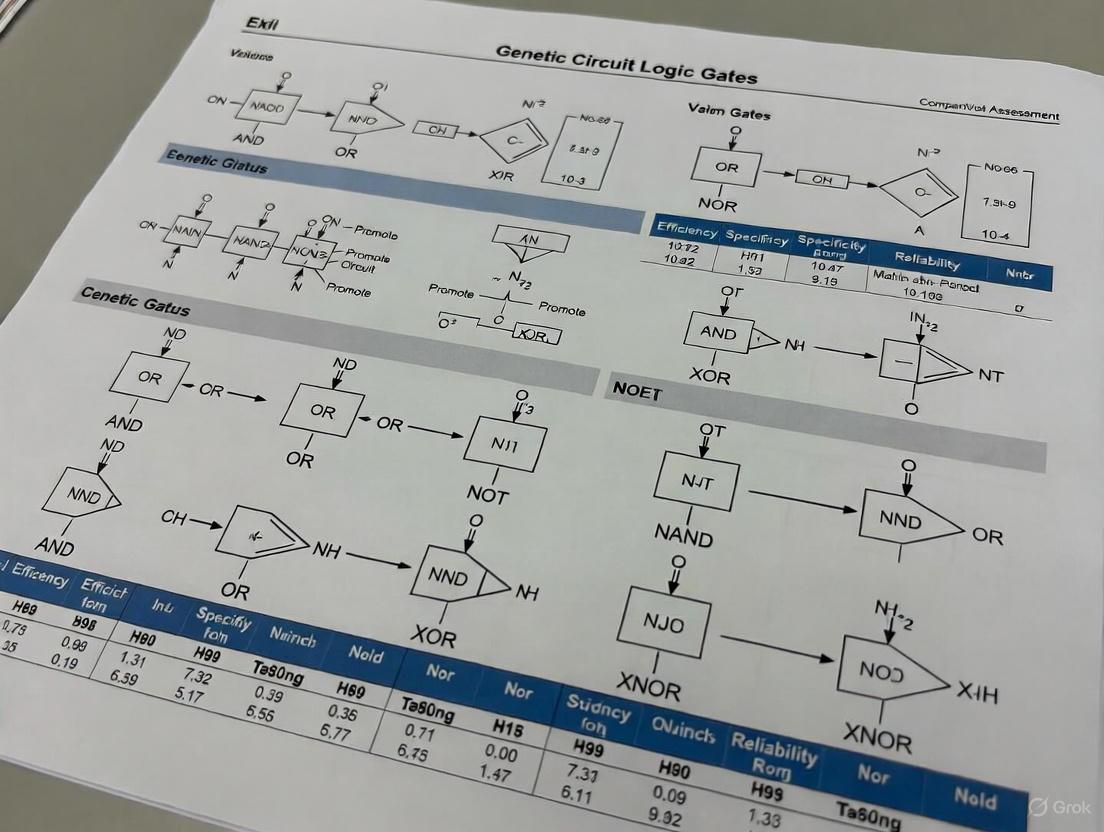
This article provides a comprehensive comparative assessment of synthetic genetic circuit logic gates, a cornerstone technology in synthetic biology.
Comparative Assessment of Genetic Circuit Logic Gates: From Foundational Principles to Therapeutic Applications
Abstract
This article provides a comprehensive comparative assessment of synthetic genetic circuit logic gates, a cornerstone technology in synthetic biology. Tailored for researchers, scientists, and drug development professionals, it systematically explores the foundational principles, diverse engineering methodologies, and critical optimization strategies required for robust circuit design. The content delves into the distinct operational characteristics, advantages, and limitations of major gate architectures—including those based on transcriptional regulators, recombinases, and CRISPR-dCas systems. Furthermore, it evaluates their validation frameworks and burgeoning applications in precision medicine, such as controlled gene therapies and sophisticated biosensing. By synthesizing insights from current literature, this review serves as a strategic guide for selecting and implementing genetic logic gates to program cellular behavior for advanced biotechnological and clinical outcomes.
The Building Blocks of Biological Computation: Exploring Genetic Logic Gate Architectures
{Abstract} This guide provides a comparative assessment of genetic logic gate research, detailing the transition from electronic principles to functional biological systems. We objectively compare the performance of foundational gate architectures based on experimental data from key studies and detail the methodologies for their implementation. The content is structured to serve researchers and drug development professionals by providing clear performance tables, standardized experimental protocols, and essential resource toolkits.
{Introduction} Synthetic biology aims to program living cells with predictable behaviors, much like engineers program computers. The concept of genetic logic gates is central to this effort, where biological components are wired to perform Boolean operations, enabling cells to make decisions based on environmental cues. These gates process input signals (e.g., small molecules, light) to control output responses (e.g., gene expression), forming the core of sophisticated genetic circuits for therapeutic, diagnostic, and bioproduction applications. This guide compares the performance and implementation of diverse genetic logic gates, framing the discussion within a broader thesis on the comparative assessment of these foundational biological computing elements.
{Electronic Inspiration and Biological Implementation} The design of genetic logic gates is directly inspired by digital electronics. In electronics, logic gates like AND, OR, and NOT are physical devices that implement Boolean functions, producing a voltage output (1 or 0) based on one or more voltage inputs. Similarly, genetic logic gates use cellular components to perform computations, producing a measurable output (e.g., high or low expression of a fluorescent protein) based on the presence or absence of specific biological or chemical inputs.
The following diagram illustrates this conceptual translation from an electronic logic gate to its biological implementation, showing the core components and their relationships.
{Comparative Performance of Genetic Logic Gates} Extensive research has led to the implementation of various logic gates in diverse biological systems. The tables below summarize the performance characteristics of key gate types based on experimental data.
Table 1: Performance Comparison of Core Genetic Logic Gates
| Logic Gate Type | Biological Implementation Example | Input Signals | Output Signal | Key Performance Metrics | Reported Performance | Host System | Reference |
|---|---|---|---|---|---|---|---|
| NOT Gate | Repressor protein binding to inducible promoter [1] | Presence of input protein A | Fluorescent protein | ON/OFF ratio, response time | High ON/OFF ratio, fast response | E. coli, Mammalian cells | [1] [2] |
| AND Gate | CRISPRi-based transcriptional control [3] | Two input guide RNAs | Fluorescent protein | Signal-to-noise ratio, dynamic range | High specificity, tunable output | E. coli | [3] |
| NAND Gate | Dual repressor system [1] | Two input proteins (A, B) | Fluorescent protein | Output expressed unless both inputs present | Functional in cell-free and cellular systems | E. coli | [1] |
| A AND NOT B (Mask Gate) | Inducible BCRP pump + specific shRNA [1] | Doxycycline (A), shRNA (B) | Drug efflux (measured by fluorescence) | Specific cell killing, low off-target effects | Successful reversal of drug resistance in vitro | MCF-7 Cancer cells | [1] |
| NOR Gate | Transcriptional repression by two input inducers (Ara, aTc) [4] | Arabinose (A), aTc (B) | YFP fluorescence | Output HIGH only if both inputs LOW | Robust function in microbial consortia | E. coli | [4] |
Table 2: Comparison of Gate Implementation Architectures
| Regulatory Architecture | Mechanism of Action | Advantages | Disadvantages/Challenges | Representative Use Case |
|---|---|---|---|---|
| Transcriptional Control | Transcription factors (TFs) regulate promoter activity [2] | Well-characterized parts, modular | Limited orthogonality, metabolic burden [3] | Genetic toggle switches [3] |
| Post-Transcriptional Control | sRNAs silence circuit RNA [5] | Strong control with reduced burden, faster response [5] | Design complexity, potential off-target effects | Enhancing evolutionary longevity [5] |
| Recombinase-Based | DNA inversion/excision permanently alters sequence [2] | Stable, inheritable memory, high signal fidelity | Difficult to reverse (serine integrases) | Biological counters, long-term memory devices [2] |
| CRISPR-Based | dCas9 fused to effectors regulates gene expression [2] | Highly programmable, multiplexing capability | gRNA delivery efficiency, potential immunogenicity | Complex logic circuits, epigenetic recording [2] |
{Detailed Experimental Protocols} A critical step in genetic circuit research is the quantitative characterization of gate performance. The following workflow details a protocol for testing logic gates under dynamic signal control, incorporating high-throughput methodologies.
Protocol 1: Quantitative Characterization of Dynamic Gate Responses This protocol, adapted from high-throughput platforms, is designed for characterizing genetic logic gates under time-varying signals, such as those controlled by optogenetic systems [6].
- Circuit Assembly & Transformation: Construct the genetic logic gate using standardized modular assembly (e.g., MoClo toolkit) and clone into a suitable vector for the target host organism (e.g., E. coli, yeast) [7].
- High-Throughput Cultivation: Normalize bacterial suspensions to an OD600 of 0.05 and dispense into a 96-well measurement plate. This ensures consistent initial growth conditions across all tests [6].
- Dynamic Signal Induction: Place the culture plate into an Optogenetic Phenotype Control Unit (OPCU). Program the OPCU to apply specific dynamic input signals to each well, controlling parameters like light intensity, period, duty-ratio, and activation delay [6].
- Automated Sampling & Measurement: Use an automated workcell (e.g., microscopic imaging analysis workcell) to execute repeated culture and measurement cycles. This involves diluting cultures, measuring OD600 and fluorescence intensity (for both the output reporter and a constitutive internal control), and returning the plate to the incubator. This cycle is repeated multiple times over up to 20 hours [6].
- Data Normalization & Analysis: Normalize the output reporter fluorescence intensity (e.g., sfGFP) against the fluorescence of the constitutive internal standard (e.g., CyOFP) to account for variations in cell count and growth rate. The output signal for each condition is calculated from this ratio, enabling cross-batch data comparison [6].
Protocol 2: Validating a Therapeutic "Mask Gate" in Cell Culture This protocol outlines the key steps for implementing and testing a therapeutic logic gate, such as the "A AND NOT B" gate used to overcome drug resistance in cancer cells [1].
- Vector Construction & Packaging: Clone the gene circuit components (e.g., the BCRP gene under a tetracycline-inducible promoter and its specific shRNA under a β-galactosidase-inducible promoter) into third-generation lentiviral vectors, each with a distinct antibiotic selection marker (e.g., Puromycin, Blasticidine) [1].
- Cell Line Transfection & Selection:
- Transfect the target cell line (e.g., MCF-7 breast cancer cells) with the lentiviral vectors.
- Determine the minimum effective concentration of each selection antibiotic that results in cell death after 72 hours for untransfected cells.
- Use these determined concentrations to select for successfully transfected cells [1].
- Induction and Validation:
- At RNA Level: Treat transfected cells with inducers (e.g., Doxycycline for BCRP expression). Use quantitative Real-Time PCR to measure the effect of inducers on BCRP gene expression and silencing by shRNA [1].
- At Protein/Functional Level: Induce BCRP expression and measure its protein activity via flow cytometry by monitoring the efflux of a fluorescent substrate (e.g., mitoxantrone). The presence of the "NOT B" input (shRNA) should inhibit this efflux, leading to intracellular drug accumulation and confirming the logic gate function [1].
{The Scientist's Toolkit: Essential Research Reagents} Successful implementation and testing of genetic logic gates rely on a suite of specialized reagents and tools. The following table details key solutions for researchers in this field.
Table 3: Essential Research Reagent Solutions for Genetic Logic Gate Engineering
| Reagent/Tool Category | Specific Examples | Function in Research |
|---|---|---|
| DNA Assembly Toolkits | Modular Cloning (MoClo) Kit [7] | Enables hierarchical, standardized assembly of multiple genetic parts (promoters, genes) into functional circuits. |
| Standardized Bio-Parts | Orthogonal Transcription Factors (TetR, LuxR) [3], Promoter Libraries [7] | Provides well-characterized, modular genetic elements with known input-output relationships, reducing design uncertainty. |
| Delivery Vectors | Third-Generation Lentiviral Vectors [1] | Enables efficient and stable integration of genetic circuits into mammalian cells, essential for therapeutic applications. |
| Selection Markers | Puromycin, Blasticidin [1] | Antibiotic resistance genes allow for the selection and maintenance of cell populations successfully transfected with the circuit. |
| Inducers/Input Signals | Doxycycline, Arabinose, aTc, β-galactosidase [1] [4], Blue Light [6] | Chemical or physical signals used as inputs to trigger and test the logic function of the genetic circuit. |
| Reporters/Output Signals | Fluorescent Proteins (YFP, sfGFP, CyOFP) [4] [6] | Proteins whose expression is controlled by the circuit's output, allowing quantitative measurement of gate performance. |
| Characterization Platforms | Microfluidic Devices [7], Optogenetic Phenotype Control Unit (OPCU) [6] | Platforms that provide a controlled microenvironment for high-throughput, dynamic, single-cell level characterization of circuit behavior. |
{Conclusion and Future Directions} This comparative assessment demonstrates that the performance of genetic logic gates is highly dependent on the chosen regulatory architecture, host context, and application scope. While transcriptional control offers simplicity, post-transcriptional and CRISPR-based methods show promise for enhanced performance and complexity. The translational potential is already being realized, with logic-gated cell therapies showing remarkable clinical efficacy, such as complete remission in relapsed acute myeloid leukemia patients [8]. Future progress will be driven by the continued expansion of orthogonal, well-characterized biological parts, advanced "host-aware" modeling that predicts evolutionary stability [5], and the refinement of high-throughput characterization platforms [6]. As the field matures, the integration of AI tools like PDGrapher, which can identify optimal genetic interventions to reverse disease states [9], will further accelerate the rational design of sophisticated genetic circuits, pushing the boundaries of programmable biology.
In the field of synthetic biology, the engineering of genetic circuits allows researchers to program living cells with novel functions, advancing applications in therapeutics, biosensing, and biocomputing. These circuits are constructed from core molecular components that interact to process biological information and generate desired outputs. The fundamental architecture relies on a hierarchy of regulatory elements, with promoters serving as initiation switches, transcription factors (TFs) acting as processing units, and output reporters providing a measurable signal of circuit activity. The precise and predictable function of these components is critical for the development of complex multi-layered genetic systems. However, a persistent challenge in circuit design is the limited modularity of biological parts and the metabolic burden imposed on host cells, which can lead to functional degradation over time. This comparative assessment examines the performance, experimental data, and design principles of these core components within the broader context of genetic circuit logic gates research.
Performance Comparison of Core Components
The performance of genetic circuits is quantified using key metrics that reflect their robustness, output strength, and longevity. Recent research has focused on evaluating how different controller architectures and component types impact these metrics.
Table 1: Performance Metrics for Genetic Circuit Controllers [5]
| Controller Architecture | Input Sensor Type | Actuation Mechanism | Short-Term Performance (τ±10) | Long-Term Half-Life (τ50) | Key Characteristics |
|---|---|---|---|---|---|
| Open-Loop (No Control) | N/A | N/A | Low | Low | Baseline for comparison; high burden leads to rapid evolution of loss-of-function mutants. |
| Intra-Circuit Feedback | Circuit Output Protein | Transcriptional (TF) | Prolonged | Moderate | Negative autoregulation maintains short-term function; performance varies with equivalent output. |
| Intra-Circuit Feedback | Circuit Output Protein | Post-Transcriptional (sRNA) | Prolonged | High | Small RNA (sRNA) silencing provides strong control with reduced controller burden. |
| Growth-Based Feedback | Host Cell Growth Rate | Transcriptional (TF) | Moderate | Extended | Links circuit function to host fitness, improving evolutionary longevity. |
| Growth-Based Feedback | Host Cell Growth Rate | Post-Transcriptional (sRNA) | Moderate | Best-in-Class | Optimal for long-term persistence without coupling to an essential gene. |
Table 2: Comparison of Genetic Logic Gate Implementation Strategies [10] [11]
| Implementation Strategy | Core Components | Typical Footprint | Design Complexity | Quantitative Predictability |
|---|---|---|---|---|
| Canonical Inverter-Based Design | Repressors, Constitutive Promoters | Large | High (Intuitive) | Low (Average error often >1.4-fold) |
| Transcriptional Programming (T-Pro) | Repressor/Anti-repressor TFs, Synthetic Promoters | ~4x smaller (Compressed) | Medium (Algorithm-assisted) | High (Average error <1.4-fold) |
| CRISPR-Cas Based | dCas9, sgRNAs | Variable | High (Programmable) | Medium (Improving with part refinement) |
| Tristate Buffer-Based (TriLoS) | Engineered Switches | Small | High (Requires new framework) | To be fully characterized |
Key Findings from Performance Data
- Post-Transcriptional Control Outperforms Transcriptional Control: Controllers that use small RNAs (sRNAs) for post-transcriptional regulation generally achieve better evolutionary longevity than those using transcription factors. The sRNA mechanism provides an amplification step, enabling strong control over the circuit's output genes while consuming fewer cellular resources, thereby reducing burden [5].
- Circuit Compression Enhances Stability: Strategies like Transcriptional Programming (T-Pro) that create "compressed" circuits using synthetic TFs and promoters can perform complex logic (e.g., 3-input Boolean operations) with a significantly reduced genetic footprint. This compression minimizes the metabolic load on the chassis cell, which is a key factor in maintaining long-term circuit stability [10].
- Input Dictates Performance Profile: The choice of what a controller senses determines its performance strength. Intra-circuit feedback, which monitors the circuit's own output protein, is highly effective at maintaining short-term performance. In contrast, growth-based feedback, which monitors the host cell's growth rate, is superior for extending the functional half-life (τ50) of a circuit over many generations [5].
Experimental Protocols for Assessing Circuit Performance
To generate the comparative data presented, researchers employ standardized experimental and computational workflows. Below is a detailed methodology for a serial passaging experiment, a common protocol for quantifying evolutionary longevity.
Serial Passaging Protocol for Measuring Evolutionary Longevity
Objective: To quantify the degradation of genetic circuit function over multiple microbial generations due to mutation and natural selection.
Materials:
- Engineered bacterial strain (e.g., E. coli) harboring the genetic circuit under test.
- Liquid growth medium with appropriate selective antibiotics.
- Incubator-shaker maintained at 37°C.
- Spectrophotometer or flow cytometer for measuring culture density and output (e.g., fluorescence).
Procedure:
- Inoculation: Inoculate a single colony of the engineered strain into a flask containing fresh medium.
- Growth and Monitoring: Grow the culture in a batch condition for a set period (typically 24 hours). Monitor the growth (OD600) and circuit output (e.g., fluorescence/cell) periodically.
- Dilution and Passaging: At the end of each 24-hour cycle, dilute the culture into fresh medium. This dilution resets the nutrient levels and population size, mimicking serial passage. A standard dilution factor is 1:100 to 1:1000.
- Sampling and Analysis: At each passage, sample the population to:
- Measure the population-level output (e.g., total fluorescence) using a flow cytometer or plate reader.
- Analyze the population makeup by plating samples to isolate single colonies and then measuring the circuit function of individual clones.
- Data Logging: Record the time (or number of passages) and the corresponding circuit output.
- Termination: Continue the process until the circuit output falls below a predefined threshold (e.g., 50% of its initial value, which is the τ50 metric).
Supporting Multi-Scale Modeling: This experimental protocol is often complemented by a computational host-aware model that simulates the evolving population. This model uses ordinary differential equations (ODEs) to capture host-circuit interactions, cellular growth, mutation rates, and competition between different mutant strains. The model is parameterized with experimental data and can be used to predict metrics like τ±10 and τ50 in silico before lengthy experimental validation [5].
Signaling Pathways and Logical Relationships
The flow of information within a genetic circuit can be abstracted as a signaling pathway. The following diagram illustrates the core workflow from signal input to protein output, highlighting the key regulatory steps.
Advanced Controller Architectures for Enhanced Longevity
More sophisticated circuits incorporate feedback loops to maintain stability. The diagram below details the structure of a growth-based feedback controller, one of the most effective architectures for long-term circuit survival.
The Scientist's Toolkit: Research Reagent Solutions
The experimental work in this field relies on a specific toolkit of molecular biology reagents and computational resources.
Table 3: Essential Research Reagents and Tools for Genetic Circuit Engineering
| Reagent / Tool | Category | Function in Research | Example Application |
|---|---|---|---|
| Synthetic Transcription Factors | Wetware | Engineered proteins that bind to specific DNA sequences to repress or activate transcription. | T-Pro repressors/anti-repressors responsive to IPTG, D-ribose, and cellobiose for implementing compressed logic [10]. |
| Synthetic Promoters | Wetware | Engineered DNA sequences where transcription starts. Contain specific operator sites for synthetic TF binding. | Tandem operator designs in T-Pro that are regulated by synthetic anti-repressors to execute Boolean operations [10]. |
| Fluorescent Reporters (e.g., GFP) | Output Reporter | Proteins that fluoresce, allowing quantitative measurement of gene expression and circuit output. | Serving as the measurable output (protein pA) in evolutionary longevity experiments to track circuit performance [5]. |
| Small RNAs (sRNAs) | Controller | Non-coding RNAs that silence target mRNAs, used for post-transcriptional regulation. | Acting as the actuation mechanism in high-performance controllers to degrade circuit mRNA and reduce burden [5]. |
| Host-Aware Model | Software | A multi-scale computational framework simulating host-circuit interactions and population evolution. | Predicting evolutionary metrics (τ±10, τ50) in silico by modeling mutation, selection, and resource competition [5]. |
| Algorithmic Enumeration Software | Software | Computational tool that systematically searches for the smallest genetic circuit design for a given logic function. | Guaranteeing the identification of the most compressed 3-input T-Pro circuit for any of the 256 Boolean truth tables [10]. |
The engineering of genetic circuits with decision-making capabilities represents a frontier in synthetic biology, with profound implications for biosensing, diagnostics, and therapeutic development. These circuits are constructed from fundamental biological logic gates—NOT, YES, AND, OR, NOR, and NAND—which process input signals to produce defined outputs, mirroring their electronic counterparts. This comparative assessment examines the performance characteristics, operational mechanisms, and experimental validation of these core components within genetic circuit architectures. The quantitative analysis presented herein provides researchers with critical data for selecting appropriate logic gates based on application-specific requirements for signal strength, noise tolerance, and operational context.
Performance Comparison of Fundamental Genetic Logic Gates
The performance of biological logic gates is quantified using metrics specifically adapted for genetic circuits, including signal separation, fold induction, and repression strength. These parameters differ significantly from those used to evaluate electronic gates, as they must account for the noisy biological environment and analog nature of molecular interactions.
Table 1: Performance Metrics of Single-Input Genetic Logic Gates
| Gate Type | Mechanism | Signal Separation (σ) | 1-Factor (φ) | Fold Induction/ Anti-induction | Reference System |
|---|---|---|---|---|---|
| YES | Transcriptional activation via inducer | 50-250 AU | 0.15-0.45 | 5-25x | Constitutive promoter |
| NOT | Transcriptional repression | 80-300 AU | 0.08-0.30 | 4-20x (anti-induction) | Constitutive promoter |
| BUFFER | Engineered repressor | 45-280 AU | 0.10-0.40 | 6-30x | X+ ADR reference |
Table 2: Performance Metrics of Multi-Input Genetic Logic Gates
| Gate Type | Input Combination | Output Level (AU) | Repression Strength | Experimental Validation |
|---|---|---|---|---|
| AND | Both inputs present | 180-400 AU | N/A | Transcriptional programming |
| OR | Either input present | 150-350 AU | N/A | Riboregulator systems |
| NOR | No inputs present | 200-450 AU | High | Engineered transcription factors |
| NAND | Not both inputs | 160-380 AU | Medium | Computationally designed |
| XNOR | Both inputs same | 170-390 AU | N/A | Frequency-domain passive logic |
The performance data reveals that NOT gates generally exhibit superior signal separation compared to YES gates, with values ranging from 80-300 arbitrary units (AU) versus 50-250 AU for YES gates [12]. This enhanced performance stems from more effective repression mechanisms compared to activation in biological systems. The 1-factor (φ), which quantifies repression effectiveness, shows lower values (0.08-0.30) for NOT gates compared to YES gates (0.15-0.45), indicating stronger repressive capability relative to basal expression levels [12].
For multi-input gates, AND gates demonstrate the highest output levels (180-400 AU) when all inputs are present, making them suitable for applications requiring precise coincidence detection [13]. NOR gates, which produce output only in the absence of all inputs, show similarly high output levels (200-450 AU) and exhibit the strongest repression characteristics among all gate types [13]. These performance characteristics make NOR gates particularly valuable for fail-safe genetic circuits in therapeutic applications.
Experimental Protocols for Gate Characterization
Gate Construction and Integration
The standardization of gate construction protocols enables meaningful comparison across different gate types. For transcriptional gates in yeast, implementation typically involves:
Bipartite Promoter Design: Synthetic promoters are constructed containing a segment of the yeast VPH1 promoter (containing the TATA box) and a fragment of the yeast minimal CYC1 promoter [12]. Between these elements, repressor operators (19 base pairs each) are inserted, with a 3-nucleotide separation (CGT) when multiple operators are used.
Genomic Integration: Gate components are integrated into the yeast genome via plasmid DNA integration to ensure stable inheritance and expression [12]. This approach contrasts with episomal expression systems that show greater variability.
Repressor System Selection: Bacterial repressor proteins (TetR, LacI, LexA) are employed for their orthogonality in eukaryotic systems. For LexA, the DNA-binding domain is fused to the hormone-binding domain of the human estrogen receptor to enable β-estradiol responsiveness [12].
Output Measurement: Fluorescent proteins (e.g., Citrine) serve as quantitative output reporters, with measurements taken at steady-state conditions to account for expression dynamics [12].
Performance Characterization Methodology
Standardized metrology enables direct comparison across gate types:
Culture Conditions: Saturated cultures of gate-containing strains are diluted in fresh medium and grown to mid-log phase before induction [12].
Input Application: Inputs are applied at saturating concentrations (typically 1mM for inducers like IPTG) to ensure digital operation [13]. For NOT gates, input absence defines the ON state while presence defines the OFF state.
Fluorescence Measurement: Output fluorescence is measured using flow cytometry or plate readers, with data collected from at least three biological replicates [12].
Data Normalization: Fluorescence values are normalized to a reference system lacking regulatory elements but containing the same output reporter [12].
Performance Calculation: Key parameters including fold induction/anti-induction, signal separation (σ = V1L - V0H), and 1-factor (φ = V1c/V1o) are calculated from the normalized data [12].
Signaling Pathways and Regulatory Mechanisms
The operational principles of biological logic gates diverge significantly from electronic gates, relying on molecular interactions rather than electron flow. These mechanisms can be visualized through their regulatory pathways:
Figure 1: Transcriptional Regulation in Genetic Logic Gates
Figure 1 illustrates the core mechanism underlying transcriptional logic gates. Input chemicals (inducers or corepressors) modulate transcription factor activity, which in turn regulates output expression through binding to operator sites within synthetic promoters. This mechanism forms the basis for YES, NOT, AND, and NOR gates in transcriptional programming systems [12] [13].
NOT Gate Operation: In the absence of input, the repressor protein binds the operator site, preventing transcription. Input presence binds and inactivates the repressor, allowing transcription [12]. The YES gate operates inversely, typically using activators or inducible systems that require input presence for output production.
Multi-Input Gates: AND gates implement coincidence detection by requiring two transcription factors to simultaneously vacate a promoter region, or through synergistic activation mechanisms [13]. NOR gates produce output only when no inputs are present, leveraging strong repression that is only alleviated when all repressors are inactive.
Figure 2: Riboregulatory Mechanisms for Logic Gates
Figure 2 illustrates an alternative implementation using RNA-RNA interactions. In riboregulatory systems, small RNAs (sRNAs) act as inputs that modify mRNA secondary structure to control translation initiation [14]. NOT gates employ sRNAs that bind to the ribosome binding site (RBS) sequence, blocking translation. YES gates utilize sRNAs that unfold cis-repressed RBS structures, activating translation [14]. AND gates can be implemented through sRNA pairs that must both interact with an mRNA to activate translation.
The Scientist's Toolkit: Essential Research Reagents
Table 3: Essential Research Reagents for Genetic Logic Gate Implementation
| Reagent/Component | Function | Example Systems |
|---|---|---|
| Bipartite Promoter | Hybrid promoter with operator sites for logic operations | VPH1-CYC1 synthetic promoters |
| Repressor Proteins | Transcriptional repression for NOT/NOR gates | TetR, LacI, LexA-HBD |
| Antirepressor Proteins | Reverse repression for NOT gates in compressed architectures | Engineered anti-RCD domains |
| Inducer Molecules | Chemical inputs that modulate transcription factor activity | Tetracycline, IPTG, β-estradiol |
| Fluorescent Reporters | Quantitative output measurement | Citrine, GFP |
| sRNA Scaffolds | Riboregulatory components for translation control | Computationally designed sRNAs |
| DNA Integration Systems | Stable genomic integration of circuit components | Plasmid integration systems |
The implementation of genetic logic gates requires carefully engineered biological components that function predictably in living cells. Bipartite promoters serve as the foundational element, combining regulatory elements from native yeast promoters (VPH1 and CYC1) with inserted operator sites for transcription factor binding [12]. These synthetic promoters enable the predictable operation of transcriptional logic gates.
Repressor and antirepressor proteins provide the computational capability of genetic circuits. Bacterial repressors (TetR, LacI) offer orthogonality in eukaryotic systems, while engineered variants (LexA-HBD) enable responsiveness to non-native inducters like β-estradiol [12]. Antirepressors represent a significant innovation in transcriptional programming, enabling circuit compression by eliminating the need for additional inversion layers to achieve NOT operations [13].
Inducer molecules serve as the input signals to genetic circuits, with saturating concentrations (typically 1mM) used to ensure digital operation [13]. The output reporters, particularly fluorescent proteins like Citrine, enable quantitative characterization of gate performance through flow cytometry or fluorescence measurements [12].
This comparative analysis demonstrates that each fundamental gate type presents distinct advantages for genetic circuit design. NOT gates offer superior signal separation, making them ideal for applications requiring clear distinction between ON and OFF states. AND gates provide precise coincidence detection, while NOR gates deliver the strongest repression characteristics. The selection of appropriate gate types must consider not only performance metrics but also compatibility with host systems and circuit complexity. As synthetic biology advances toward more sophisticated applications in biosensing and therapeutics, the comprehensive understanding of these fundamental components will enable the predictive design of genetic circuits with enhanced reliability and functionality. The experimental frameworks and performance data presented here provide researchers with critical guidance for selecting and implementing logic gates tailored to specific application requirements.
Transcriptional control systems based on sequence-specific DNA-binding proteins (DBPs) are fundamental tools for programming cellular behavior in synthetic biology. The performance of genetic circuits—from simple logic gates to complex biocomputing systems—critically depends on the orthogonality of these DBPs, which refers to their ability to operate without unintended crosstalk with host regulatory networks or between synthetic circuit components [15] [3]. As synthetic biology advances toward more complex, multi-circuit systems and therapeutic applications, the demand for highly orthogonal, predictable DBPs has intensified. This guide provides a comparative assessment of three leading technological platforms for transcriptional control: engineered synthetic transcription factors, orthogonal sigma factors, and computationally designed de novo DBPs. We objectively compare their performance using quantitative data and analyze their suitability for different applications in genetic circuit design.
Technology Platform Comparison
The table below summarizes the key performance characteristics of three major transcriptional control platforms, highlighting their orthogonality, operational range, and host compatibility.
Table 1: Performance Comparison of Transcriptional Control Platforms
| Technology Platform | Orthogonality Mechanism | Dynamic Range (ON/OFF Ratio) | Operational Context | Key Performance Metrics |
|---|---|---|---|---|
| Engineered Synthetic Transcription Factors (T-Pro) | Alternate DNA recognition (ADR) domains targeting synthetic promoters [16] | High (demonstrated in 3-input Boolean circuits) [16] | E. coli; potentially transferable | • 4x smaller circuit footprint than canonical designs• Quantitative prediction error <1.4-fold [16] |
| Orthogonal Sigma Factors | Mutated RpoN box in σ54 enabling orthogonal promoter recognition [15] | Strong activation with low basal leakage [15] | Transferable across bacterial species (K. oxytoca, P. fluorescens, S. meliloti) [15] | • Ideal mutual orthogonality between variants (σ54-R456H, R456Y, R456L)• bEBP-dependent activation maintained [15] |
| Computationally Designed De Novo DBPs | De novo designed helix-turn-helix domains targeting specific sequences [17] | Mid to high nanomolar affinity [17] | Functional in E. coli and mammalian cells [17] | • Specificity matching computational models at up to 6 bp• Crystal structure validation of design accuracy [17] |
Experimental Protocols and Methodologies
Engineering and Validation of Synthetic Transcription Factor Systems
Objective: To develop orthogonal repressor/anti-repressor sets for transcriptional programming (T-Pro) enabling compressed genetic circuits [16].
Protocol:
- TF Scaffold Selection: Identify native transcription factor scaffolds (e.g., CelR responsive to cellobiose) with proven orthogonality to existing systems (e.g., IPTG and D-ribose responsive TFs).
- Super-Repressor Generation: Perform site-saturation mutagenesis at critical amino acid positions (e.g., L75H in CelR) to create ligand-insensitive DNA-binding variants.
- Anti-Repressor Engineering: Conduct error-prone PCR on super-repressor templates followed by fluorescence-activated cell sorting (FACS) to identify anti-repressor variants.
- Alternate DNA Recognition (ADR) Expansion: Equip validated anti-repressors with multiple ADR domains (e.g., TAN, YQR, NAR, HQN, KSL) to expand promoter targeting range.
- Circuit Performance Validation: Measure fluorescence output of reporter genes under control of synthetic promoters in response to ligand inputs to quantify dynamic range and orthogonality.
Key Experimental Controls: Include empty vector controls, promoter-only constructs, and testing against non-cognate ligand inputs to verify orthogonality [16].
Establishment of Orthogonal Sigma Factor Systems
Objective: To create mutually orthogonal σ54-dependent expression systems with transferable functionality across bacterial species [15].
Protocol:
- RpoN Box Rewiring: Screen and rewire the RpoN box in σ54 through targeted mutations at position R456 (e.g., R456H, R456Y, R456L) to alter promoter recognition specificity.
- Orthogonality Testing: Co-transform orthogonal σ54 variants with cognate promoter-reporter constructs into ΔrpoN E. coli strains and measure cross-activation.
- Host Transferability Assessment: Clone orthogonal σ54 systems into broad-host-range vectors and test functionality in non-model bacteria (Klebsiella oxytoca, Pseudomonas fluorescens, Sinorhizobium meliloti).
- bEBP Integration: Co-express bacterial enhancer-binding proteins (bEBPs) with orthogonal σ54 factors to validate maintained dependency on activator proteins for transcription initiation.
- Application Testing: Implement orthogonal systems in complex biological pathways (e.g., nitrogen fixation, sucrose utilization) to assess performance in functional contexts.
Key Experimental Controls: Use wild-type σ54 as reference, include promoter mutants with altered -24 elements, and verify absence of function in rpoN knockout strains [15].
Computational Design and Validation of De Novo DNA-Binding Proteins
Objective: To generate small, specific DBPs for arbitrary DNA sequences through computational design [17].
Protocol:
- Scaffold Library Construction: Curate ~26,000 helix-turn-helix (HTH) domains from metagenome sequences using AlphaFold2 structure prediction and filtering.
- RIFdock Sampling: Perform comprehensive docking of scaffolds against target DNA structures using rotamer interaction field (RIF) generation to identify placements with main-chain phosphate hydrogen bonds and potential base contacts.
- Interface Design: Employ Rosetta or LigandMPNN for sequence design to optimize specific protein-DNA interactions, emphasizing preorganized hydrogen-bonding networks.
- Computational Filtering: Select designs based on Rosetta ΔΔG, interface buried unsatisfied hydrogen bonds, contact molecular surface area, and side-chain preorganization.
- Experimental Validation: Express designed DBPs as fusions to transcriptional repression domains and measure repression of target promoters in E. coli and mammalian cells.
Key Experimental Controls: Include non-target DNA sequences to test specificity, use wild-type DBPs as benchmarks, and validate binding affinity through orthogonal methods like yeast display [17].
Signaling Pathways and Regulatory Mechanisms
The diagram below illustrates the core regulatory mechanism of orthogonal sigma factor systems, highlighting the protein-DNA and protein-protein interactions required for specific transcription initiation.
Orthogonal Sigma Factor Activation
The diagram below illustrates the engineering strategy for synthetic transcription factors and their mechanism for controlling gene expression through alternate DNA recognition.
Synthetic Transcription Factor Engineering
Research Reagent Solutions
The table below catalogues essential research reagents and their applications for engineering and testing orthogonal transcriptional control systems.
Table 2: Essential Research Reagents for Orthogonal Transcriptional Control Systems
| Reagent Category | Specific Examples | Function/Application | Technology Platform |
|---|---|---|---|
| Transcription Factor Scaffolds | CelR (cellobiose-responsive), LacI (IPTG-responsive), RhaR (rhamnose-responsive) [16] | Provide DNA-binding and allosteric regulation domains for engineering | Synthetic Transcription Factors |
| Orthogonal Sigma Variants | σ54-R456H, σ54-R456Y, σ54-R456L [15] | Enable orthogonal promoter recognition with minimal crosstalk | Orthogonal Sigma Factors |
| Synthetic Promoters | Tandem operator designs, orthogonal σ54 promoters with modified -24 elements [16] [15] | Serve as targets for engineered DBPs with defined specificity | All Platforms |
| Reporter Systems | GFP, RFP, enzymatic reporters (β-galactosidase, luciferase) [16] [15] | Quantify transcriptional activity and circuit performance | All Platforms |
| Computational Design Tools | RIFdock, Rosetta, LigandMPNN, AlphaFold2 [17] | Enable de novo design of DBPs with customized specificities | Computationally Designed DBPs |
| Host Strains | E. coli ΔrpoN, non-model bacteria (K. oxytoca, P. fluorescens, S. meliloti) [15] | Provide controlled environments for testing orthogonality | All Platforms |
Comparative Analysis and Research Implications
The comparative assessment of these three platforms reveals distinct advantages and limitations for different research applications. Engineered synthetic transcription factors offer the highest level of circuit compression, enabling complex computational functions with minimal genetic footprint [16]. The orthogonal sigma factor platform demonstrates exceptional transferability across bacterial species, making it particularly valuable for applications in non-model organisms and environmental biotechnology [15]. Computationally designed de novo DBPs represent the most flexible approach for targeting arbitrary sequences, potentially overcoming limitations of natural DBP scaffolds [17].
A critical challenge across all platforms is context dependence, where circuit performance is influenced by host cellular factors, resource competition, and unintended interactions with endogenous systems [3]. This necessitates careful characterization in the intended operational context and may require iterative optimization. The emerging paradigm of predictive design—combining well-characterized biological parts with computational modeling—shows promise for reducing experimental optimization cycles across all platforms [16] [17] [3].
For researchers selecting a transcriptional control platform, considerations should include: (1) the required circuit complexity and need for compression, (2) the target host organism(s) and available genetic tools, (3) the need for pre-existing characterization data versus custom design capability, and (4) the tolerance for iterative optimization versus demand for predictability. As these technologies continue to mature, integration of multiple approaches may offer the most powerful solution for building sophisticated genetic circuits with robust, predictable performance across diverse biological contexts.
Site-specific recombination systems (SRSs) are indispensable tools in synthetic biology, enabling precise DNA modifications for controlling gene expression, constructing genetic circuits, and engineering genomes [18] [2]. These systems are primarily divided into two structurally and mechanistically distinct families: tyrosine recombinases and serine integrases. Tyrosine recombinases, such as Cre and Flp, are renowned for their reversible recombination, making them ideal for basic excision, integration, and inversion reactions. In contrast, serine integrases, also known as large serine recombinases (LSRs) like Bxb1 and φC31, catalyze unidirectional integration, making them particularly valuable for stable gene integration and long-term memory storage in genetic circuits [19] [20].
The selection between these systems is critical for the success of applications ranging from directed evolution to therapeutic cell engineering. This guide provides a comparative assessment of serine and tyrosine recombinases, focusing on their operational mechanisms, performance characteristics, and suitability for specific applications in genetic circuit design. We present summarized quantitative data, detailed experimental protocols, and key reagent information to equip researchers with the necessary knowledge to select and implement these powerful tools effectively.
Comparative Analysis of System Performance and Characteristics
The functional properties of recombinase systems directly determine their suitability for specific applications. The tables below provide a consolidated comparison of key performance metrics and characteristics.
Table 1: Quantitative Performance Metrics of Recombinase Systems
| Recombinase System | Integration Efficiency (%) | Cargo Size Capacity | Deletion Efficiency (%) | Inversion Efficiency (%) |
|---|---|---|---|---|
| Cre/loxPsym (Tyrosine) | N/A | Limited primarily by delivery | ~60% [18] | 2.08% (plasmid) [18] |
| Vika/voxsym (Tyrosine) | N/A | Limited primarily by delivery | 40-65% [18] | <10% [18] |
| Dre/roxsym (Tyrosine) | N/A | Limited primarily by delivery | 40-65% [18] | 12.93% (roxsym2, plasmid) [18] |
| Novel LSRs (Serine) | 40-75% in human cells [19] | Up to at least 27 kb [19] | N/A | N/A |
| Bxb1 (Serine) | Baseline for comparison [19] | Up to at least 27 kb [19] | N/A | N/A |
Table 2: Functional Characteristics and Applications
| Recombinant System | Recombinase Family | Directionality | Key Features | Ideal Applications |
|---|---|---|---|---|
| Cre/loxP | Tyrosine | Reversible [20] | Well-established, versatile [21] | Excision, inversion, basic genetic switches [2] |
| Dre/rox, Vika/vox | Tyrosine | Reversible (can be made non-directional with symmetric sites) [18] | Orthogonal to Cre/loxP [18] | Parallel, orthogonal genome scrambling [18] |
| Bxb1, φC31 | Serine (LSR) | Unidirectional [19] [20] | High efficiency, large cargo capacity [19] | Stable gene integration, long-term memory [22] |
| Novel LSRs (e.g., from [19]) | Serine (LSR) | Unidirectional | High efficiency in human cells, can be genome-targeting or multi-targeting [19] | Human cell engineering, functional genomics [19] |
Experimental Protocols for Key Applications
Protocol 1: Quantifying Recombinase Efficiency in Yeast
This protocol, adapted from studies constructing artificial nondirectional SRSs, is designed to measure the deletion and inversion efficiency of tyrosine recombinases in Saccharomyces cerevisiae [18].
- Strain Construction: Integrate a reporter construct into the yeast genome. The construct consists of a URA3 expression cassette flanked by the recombinase recognition sites (e.g., loxPsym, voxsym, roxsym). The orientation of these sites determines the possible recombination outcomes.
- Recombinase Expression: Introduce a plasmid carrying the gene for the recombinase of interest (e.g., Cre, Vika, Dre) under the control of a tightly regulated, inducible promoter system. A dual-control system using galactose and estradiol is recommended to minimize leaky expression [18].
- Induction and Culture: Induce recombinase expression by adding both galactose and estradiol to the culture medium. Grow cells for a defined period (e.g., 8 hours). A control culture should be maintained without induction.
- Efficiency Quantification: Plate cells on non-selective media to form single colonies.
- Phenotypic Screening: Score colony phenotypes (e.g., Ura+ vs Ura-) to obtain an initial estimate of recombination events.
- PCR Confirmation: Perform two consecutive PCR analyses on genomic DNA from colonies using primer pairs designed to distinguish between the original, deleted, and inverted sequences. This step is crucial for confirming the type of recombination event.
- Data Analysis: Calculate deletion and inversion efficiency as the percentage of colonies that have undergone the respective recombination event out of the total number of colonies analyzed.
Protocol 2: Testing Serine Integrase Activity in Human Cells
This protocol, based on a large-scale screen for novel LSRs, is used to validate the function and efficiency of serine integrases in human cells (e.g., HEK293FT) [19].
- Plasmid Design:
- Donor Plasmid: Contains the candidate serine integrase gene (human codon-optimized) and its cognate attP site.
- Recipient Plasmid: Contains a reporter gene (e.g., GFP) flanked by the cognate attB site. Alternatively, for genome integration, the attB site can be pre-installed at a genomic "landing pad."
- Cell Transfection: Co-transfect HEK293FT cells with the donor and recipient plasmids. Include controls with an empty vector or an inactive integrase mutant.
- Flow Cytometry Analysis: After 48-72 hours, harvest cells and analyze them using flow cytometry to measure the percentage of GFP-positive cells, which indicates successful recombination and integration.
- Efficiency Calculation: Recombination efficiency is calculated as the percentage of GFP-positive cells in the test condition normalized to the control. For novel LSRs, efficiencies of 40-75% with cargos over 7 kb have been reported, significantly outperforming older systems like Bxb1 [19].
- Advanced Application - Amplicon Library Integration: For functional genomics, the donor plasmid can be replaced with a complex amplicon library. Successful integration creates a stable, long-term library within the genome for downstream screening [19].
System Workflow and Logic Implementation
The diagram below illustrates the core mechanistic difference between tyrosine recombinases and serine integrases, which underpins their distinct applications in genetic circuits.
The implementation of these mechanisms into genetic circuits allows for the construction of complex logic and memory functions, as shown in the workflow for building a recombinase-based logic gate.
The Scientist's Toolkit: Key Research Reagents
Successful implementation of recombinase systems relies on a standardized set of genetic tools and reagents. The table below lists essential components for designing and testing recombinase-based circuits.
Table 3: Essential Research Reagents for Recombinase Systems
| Reagent / Component | Function | Examples & Notes |
|---|---|---|
| Orthogonal Recombinases | Execute the DNA recombination reaction. | Cre, Dre, Vika (Tyrosine) [18]; Bxb1, φC31, novel LSRs from [19] (Serine). |
| Recognition Sites | Specific DNA sequences where recombination occurs. | loxP, rox, vox (Tyrosine) [18] [21]; attB, attP (Serine) [19]. Symmetric variants (e.g., loxPsym) enable non-directional recombination [18]. |
| Inducible Promoters | Provide temporal control over recombinase expression. | Tetracycline (Tet-On/Off) [23], GAL1 (galactose) [18]. Dual-control systems (e.g., galactose + estradiol) reduce leakiness [18]. |
| Reporter Cassettes | Enable quantification of recombination efficiency. | Fluorescent proteins (GFP, RFP), antibiotic resistance genes, auxotrophic markers (URA3, LEU2) [18] [23]. |
| Landing Pad Cell Lines | Pre-defined genomic loci for efficient and reproducible DNA integration. | HEK293FT or other cell lines with a pre-integrated attB site for serine integrase docking [19]. |
Serine integrases and tyrosine recombinases offer complementary strengths for genetic circuit design. Tyrosine recombinases are the tool of choice for applications requiring reversibility, fine-tuned control, and complex DNA rearrangements such as inducible switches and excisions. Their orthogonality allows for parallel processing in advanced circuit design [18]. In contrast, serine integrases excel in applications demanding high-efficiency, stable integration of large DNA payloads and the implementation of permanent memory functions, which is critical for cell lineage tracing, bioproduction, and therapeutic cell engineering [19].
The ongoing systematic discovery of novel natural recombinases from microbial diversity [24] [19] is dramatically expanding the available toolkit, moving beyond the traditional workhorses like Cre and Bxb1. This expansion, coupled with protein engineering to refine specificity and activity [21], promises to unlock even more sophisticated control over biological systems in the future.
The advent of Clustered Regularly Interspaced Short Palindromic Repeats (CRISPR) technology has revolutionized synthetic biology, providing an unprecedented platform for constructing sophisticated genetic circuits. Unlike nuclease-active CRISPR systems designed for permanent genome editing, catalytically dead Cas (dCas) proteins retain programmable DNA-binding capability without introducing double-strand breaks, making them ideal for transcriptional regulation applications. These dCas systems, when fused to various effector domains, enable precise control over gene expression and have become foundational tools for building complex synthetic genetic circuits [25]. The programmability of dCas systems, achieved through simple guide RNA redesign, offers significant advantages over traditional transcription factor-based approaches, which require protein engineering for each new DNA target [26].
The versatility of dCas systems has enabled researchers to engineer increasingly complex genetic circuits with applications across biological research and therapeutic development. These circuits can perform logic operations, maintain memory states, and process multiple biological inputs to generate defined outputs [25]. As the field advances, comparative assessment of different dCas platforms and their performance characteristics becomes essential for selecting appropriate tools for specific circuit design goals. This review provides a comprehensive comparison of dCas-based transcriptional regulators, their experimental validation, and practical implementation considerations for constructing robust genetic circuits.
Comparative Analysis of dCas Systems and Alternatives
Performance Benchmarking of Transcriptional Regulators
Table 1: Benchmarking of Transcriptional Regulator Platforms for Genetic Circuits
| Platform | Activation Strength | Repression Efficiency | Orthogonality | Dynamic Range | Construction Complexity | Circuit Performance |
|---|---|---|---|---|---|---|
| CRISPR/dCas9 | Moderate | High (up to 300-fold repression) [25] | High [26] | ~130-fold with optimized designs [27] | Low (easy guide RNA design) [28] | Good for single-layer circuits [28] |
| TALE-Based | Strong [28] | High | Good [28] | Similar to dCas9 | High (protein engineering required) [28] | Superior for layered circuits [28] |
| dCas12 Systems | Moderate to High (with fused activators) [26] | High [26] | High [26] | Varies by specific variant | Moderate | Promising for multiplexed regulation [26] |
Direct comparison of TALE-based transcriptional regulators and CRISPR/dCas9-based systems targeting identical DNA sequences reveals distinct performance characteristics. While the CRISPR/dCas9 system offers significantly easier construction, TALE-based activators demonstrate substantially stronger activation potency. In mammalian cells, both platforms exhibit good orthogonality and have been successfully implemented to construct functionally complete NOR gates. However, for layered circuit designs, the TALE-based platform generally delivers superior performance, particularly in complex genetic architectures [28].
The CRISPR/dCas9 system achieves repression through CRISPR interference (CRISPRi), where dCas9 binding physically obstructs RNA polymerase binding or transcription elongation. When targeted to promoter regions or the beginning of gene coding sequences, this approach can achieve up to 300-fold repression in prokaryotic systems. Targeting the non-template strand within coding sequences proves more effective for transcription elongation blocking [25]. CRISPR activation (CRISPRa) systems employ dCas9 fused to transcriptional activation domains like VP64, p65, or VPR to enhance gene expression [26].
dCas Orthologs and Their Properties
Table 2: Comparison of dCas Protein Orthologs and Their Characteristics
| dCas Ortholog | Source Organism | Size (aa) | PAM Sequence | Guide RNA Length | Key Applications | Advantages |
|---|---|---|---|---|---|---|
| dSpCas9 | Streptococcus pyogenes | 1368 | NGG [25] | 20 nt [25] | CRISPRi, CRISPRa, logic gates | Most widely characterized; extensive tool availability |
| dFnCas12a | Francisella novicida | ~1300 | T-rich (TTTV) [25] | Varies | Transcriptional repression, activation | Simpler ribonucleoprotein structure; multiplexing with crRNA arrays |
| dSaCas9 | Staphylococcus aureus | 1053 | NNGRRT [25] | 21-24 nt | In vivo applications | Smaller size for viral delivery |
| dNmCas9 | Neisseria meningitidis | 1082 | NNNNGATT [25] | 24 nt | Multiplexed regulation | Alternative PAM preference for targeting flexibility |
The expanding repertoire of dCas orthologs with varying properties significantly enhances the toolbox available for genetic circuit design. These orthologs differ in size, protospacer adjacent motif (PAM) requirements, guide RNA length preferences, and optimal working conditions [25]. This diversity enables researchers to select the most appropriate dCas protein for specific applications and allows for orthogonal circuit design using multiple dCas systems that operate simultaneously without cross-talk [26].
The PAM sequence requirement represents a critical constraint in target site selection for dCas systems. While SpCas9 recognizes a 5'-NGG-3' PAM, other orthologs have different requirements, such as the T-rich PAM recognized by Cas12a systems. The PAM interaction initiates DNA interrogation, with the Cas protein scanning adjacent sequences for guide RNA complementarity [25]. Engineered Cas variants with altered PAM specificities continue to expand the targeting range of these systems, increasing their utility for complex circuit design.
Experimental Approaches for dCas Circuit Characterization
Implementation of Logic Gates and Complex Circuits
CRISPR-dCas systems have successfully implemented various Boolean logic gates, including NOT gates, NOR gates, AND gates, and more complex combinations. The basic NOT gate implementation consists of a dCas protein (typically dCas9) and an sgRNA expressed from an inducible promoter, which represses an output gene (e.g., fluorescent protein) [29]. NOR gates, as universal logic elements, can be constructed by implementing multiple sgRNAs targeting the same output promoter, where the absence of all input signals produces output expression [28].
More sophisticated circuits employ layered designs, where the output of one gate regulates subsequent gates. However, such layered circuits face challenges due to resource competition between multiple sgRNAs for the limited dCas9 pool. This competition can alter the input/output response of individual gates when additional sgRNAs are expressed in the same cell. To address this limitation, researchers have developed dCas9 regulator systems that implement negative feedback control on dCas9 expression levels, maintaining approximately constant repression strength for each sgRNA regardless of competitor sgRNA expression [29].
Experimental Protocol: dCas9 Regulator Circuit Implementation
- Circuit Design: Implement a negative feedback loop where apo-dCas9 represses its own expression through a specialized sgRNA (g0)
- Component Cloning: Clone dCas9 under control of a promoter containing target sites for sgRNA g0; clone circuit sgRNAs and output reporters on separate plasmids
- Transformation: Introduce plasmids into appropriate host cells (e.g., E. coli)
- Induction and Measurement: Induce sgRNA expression with appropriate inducers (e.g., HSL, aTc); measure output fluorescence via flow cytometry
- Competition Assessment: Express competitor sgRNAs with varying strengths and measure effect on circuit performance with regulated vs. unregulated dCas9 [29]
This regulated dCas9 generator system has demonstrated the ability to eliminate competition effects even with 15-fold changes in circuit input/output response encountered without regulation, enabling predictable composition of CRISPRi-based genetic modules [29].
Conditional Guide RNA Systems for Metabolic Control
Advanced circuit designs implement conditional guide RNAs (cgRNAs) that respond to specific trigger RNAs, enabling logical regulation of endogenous genes without external inducer molecules. These cgRNAs contain engineered RNA scaffolds that undergo conformational changes upon interaction with trigger RNAs, activating dCas9 binding and regulation of target genes [27].
Experimental Protocol: Conditional gRNA Implementation
- cgRNA Design: Engineer gRNAs with extended antisense domains that interact with trigger RNAs, using computational tools for RNA secondary structure prediction
- Plasmid Construction: Clone cgRNA expression cassettes with inducible promoters (e.g., aTc-inducible) on low-copy number plasmids
- Trigger RNA Design: Design complementary trigger RNAs expressed from compatible plasmids with different inducers (e.g., l-arabinose)
- Circuit Assembly: Co-express dCas9, cgRNAs, trigger RNAs, and output reporters in E. coli strains
- Performance Validation: Measure output fluorescence via flow cytometry after induction with different input combinations; calculate fold-reduction compared to non-cognate triggers [27]
This approach has achieved a dynamic range as high as 130-fold in Escherichia coli and has been used to implement up to three-input logic expressions [27]. Applications include regulating essential cytoskeleton genes (ftsZ and mreB) to control cell filamentation and division, demonstrating the potential of cgRNA systems for implementing complex logical control over cellular processes.
Research Reagent Solutions for dCas Circuit Implementation
Table 3: Essential Research Reagents for dCas Genetic Circuit Construction
| Reagent Category | Specific Examples | Function | Implementation Considerations |
|---|---|---|---|
| dCas Proteins | dSpCas9, dSaCas9, dCas12a | Programmable DNA binding for transcriptional regulation | Ortholog selection depends on PAM availability, size constraints, and specificity requirements |
| Guide RNA Scaffolds | Standard sgRNA, conditional gRNA, multiplexed crRNA arrays | Target dCas proteins to specific DNA sequences | Conditional gRNAs enable RNA-sensing logic; crRNA arrays facilitate multiplexing in Cas12 systems |
| Effector Domains | KRAB (repression), VP64/p65 (activation), SunTag systems | Transcriptional control of target genes | Strong activation often requires multi-component systems (e.g., SAM, SunTag) for sufficient potency |
| Delivery Vectors | Plasmid systems, lentiviral vectors, lipid nanoparticles | Introduction of circuit components into cells | Choice depends on host organism, transient vs. stable expression needs, and safety considerations |
| Regulatory Components | Anti-CRISPR proteins, degron-tagged dCas, split-dCas systems | Additional layers of circuit control | Enable chemical or optogenetic control over dCas activity for enhanced temporal precision |
The implementation of robust dCas genetic circuits requires careful selection of appropriate reagent systems. dCas orthologs with varying PAM specificities enable targeting to diverse genomic locations, while effector domains determine the regulatory function (repression or activation) at these target sites [26]. Advanced delivery strategies, including lipid nanoparticles (LNPs) that naturally accumulate in the liver, have shown promise for therapeutic applications, with some systems allowing redosing capabilities not typically possible with viral delivery methods [30].
For complex circuit implementations, conditional gRNA systems provide a compact solution for integrating multiple inputs, while dCas9 regulator circuits help maintain functional independence between circuit modules by preventing resource competition [27] [29]. The continued development of orthogonal dCas systems, degron-tagged versions for temporal control, and improved delivery methods will further expand the capabilities of dCas-based genetic circuits for both basic research and therapeutic applications.
Visualization of dCas Circuit Architecture and Regulation
dCas9 Regulatory Circuit With Competition Neutralization
Diagram Title: dCas9 Resource Competition and Regulation
This diagram illustrates the challenge of resource competition in dCas-based circuits, where multiple sgRNAs compete for a limited dCas9 pool, potentially causing unpredictable circuit behavior. The implementation of a dCas9 regulator with negative feedback control monitors the concentration of unbound (apo-dCas9) and adjusts dCas9 production to maintain consistent regulatory function across all sgRNAs, even as circuit complexity increases [29].
Conditional gRNA Logic Implementation
Diagram Title: Conditional gRNA Logic Gate Mechanism
This visualization shows the operational mechanism of conditional gRNAs that implement Boolean logic in dCas circuits. In their default state, these engineered gRNAs are inactive due to inhibitory secondary structures. Upon binding to specific trigger RNAs (inputs), conformational changes activate the gRNAs, enabling dCas9 binding and subsequent regulation of target genes. This mechanism enables the implementation of logic operations (AND, OR) directly at the RNA level, providing a compact solution for multi-input signal processing in genetic circuits [27].
CRISPR-dCas systems provide a versatile and programmable platform for constructing sophisticated genetic circuits with applications ranging from basic biological research to therapeutic interventions. The comparative analysis presented here highlights the distinct performance characteristics of different dCas platforms and their alternatives, enabling researchers to make informed decisions when selecting tools for specific circuit design goals. While TALE-based systems offer stronger activation potential, CRISPR-dCas platforms provide superior ease of design and implementation, particularly for complex multi-gate circuits.
The development of solutions to address resource competition, such as dCas9 regulator circuits, and the implementation of conditional gRNAs for logical operation at the RNA level represent significant advances in the field. As these technologies continue to mature, with improvements in orthogonality, dynamic range, and delivery efficiency, CRISPR-dCas systems are poised to enable increasingly complex and robust genetic circuits that push the boundaries of synthetic biology and therapeutic engineering.
The Challenge of Digital-Like Behavior in an Analog Biological Environment
The pursuit of digital-like predictability in biological systems represents a fundamental challenge in synthetic biology. While engineers can design electronic circuits with precise binary behavior, biological contexts operate through analog, continuous, and often noisy molecular interactions [2]. This comparative guide examines the current state of genetic circuit logic gates, objectively evaluating their performance across different biological platforms against the ideal of digital reliability. As synthetic biology expands into therapeutic applications, bioproduction, and environmental solutions, the capacity to engineer predictable cellular behavior becomes increasingly critical [2] [31].
Genetic circuits are constructed from basic regulatory units that sense inputs and generate outputs, forming the foundation for complex computational operations in living cells [2]. These systems can be designed to implement fundamental logic operations - AND, OR, NOT, XOR - and combined to form sophisticated networks capable of signal processing, decision-making, and memory storage [2]. However, the performance characteristics of these genetic logic gates vary significantly across biological contexts, presenting engineers with substantial challenges in achieving robust, predictable behavior across different cellular environments, growth conditions, and experimental systems.
This guide provides researchers with a comparative assessment of genetic logic gate implementations, focusing on quantitative performance metrics, experimental methodologies, and the reagent solutions that enable these biological computations. By examining the current state of the art across bacterial, yeast, mammalian, and plant systems, we aim to equip scientists with the data necessary to select appropriate platforms and design strategies for their specific applications in drug development, biosensing, and bioproduction.
Comparative Performance Analysis of Genetic Logic Gates
Quantitative Performance Metrics Across Biological Systems
The performance of genetic logic gates is quantified through several key metrics that reflect their reliability and suitability for different applications. These parameters include dynamic range (fold-change between ON and OFF states), leakage (unintended expression in OFF state), response threshold, transfer function linearity, and temporal response characteristics [2] [32]. The table below summarizes representative performance data for NOT gate implementations across different biological systems:
Table 1: Performance Comparison of Genetic NOT Gates Across Biological Systems
| Host System | Repressor System | Dynamic Range (Fold-Change) | Response Time | Reference |
|---|---|---|---|---|
| Arabidopsis thaliana (Plant) | PhlF | 847 | ~10 days (transient) | [32] |
| Arabidopsis thaliana (Plant) | LmrA | 32 | ~10 days (transient) | [32] |
| Arabidopsis thaliana (Plant) | IcaR | 4.3 | ~10 days (transient) | [32] |
| Bacteria (E. coli) | PhlF | >100 | Hours | [2] |
| Mammalian Cells | TetR | ~10-50 | Hours-Days | [2] |
| Yeast | TetR | ~5-20 | Hours | [2] |
The data reveals substantial variability in NOT gate performance across different biological contexts. The PhlF repressor system in plants demonstrates an exceptional dynamic range of 847-fold change, significantly outperforming many bacterial and mammalian implementations [32]. This performance advantage stems from optimized synthetic promoter design with operator placement between CAAT boxes and the transcription start site, effectively blocking transcription factor binding and RNA polymerase initiation [32].
In contrast, NOT gates in mammalian systems typically exhibit more moderate dynamic ranges of 10-50 fold, constrained by the complexity of eukaryotic chromatin organization, transcriptional regulation, and potential interference from endogenous signaling pathways [2]. This performance disparity highlights the significant impact of cellular context on genetic circuit behavior and underscores the challenge of achieving digital-like reliability across biological systems.
Truth Table Compliance and Gate Orthogonality
A critical assessment metric for genetic logic gates is their adherence to digital truth table behavior and orthogonality (minimal cross-talk between components). Recent research has systematically evaluated these parameters in plant systems, demonstrating high orthogonality for a repressor library including PhlF, BM3R1, IcaR, SrpR, and BetI [32]. The table below quantifies orthogonality metrics for selected repressor-promoter pairs:
Table 2: Orthogonality Matrix for TetR Family Repressors in Plant Systems
| Repressor | Cognate Promoter | Off-Target Interaction (BM3R1 Promoter) | Off-Target Interaction (PhlF Promoter) | Overall Orthogonality |
|---|---|---|---|---|
| BM3R1 | P_BM3R1 | - | <5% | High |
| PhlF | P_PhlF | <3% | - | High |
| IcaR | P_IcaR | <8% | <10% | Moderate-High |
| SrpR | P_SrpR | <5% | <7% | High |
The orthogonality data demonstrates that well-characterized repressor-promoter pairs can achieve minimal cross-talk (typically <10%), enabling the construction of complex circuits without unintended interactions [32]. However, researchers note that off-target interactions observed in plant systems differ somewhat from those reported in E. coli or mammalian cells, highlighting the context-dependence of component performance [32]. This variability necessitates extensive characterization of genetic parts within target host organisms rather than relying on performance data from heterologous systems.
Experimental Protocols for Genetic Circuit Characterization
Standardized Methodology for Quantitative Circuit Analysis
Achieving reproducible, quantitative characterization of genetic circuits requires standardized experimental protocols. A recently established framework for plants exemplifies this approach, employing a rapid (~10 days) transient expression system in Arabidopsis thaliana protoplasts with rigorous normalization to minimize batch-to-batch variability [32]. The detailed methodology proceeds as follows:
Step 1: Plasmid Design and Construction
- Engineer synthetic promoters by inserting operator sequences for TetR family repressors (PhlF, LmrA, IcaR, BM3R1, SrpR, BetI) at strategic positions within a strong constitutive promoter backbone (200-bp 35S promoter) [32].
- Clone repressor genes with C-terminal nuclear localization signals (NLS) to ensure proper cellular localization.
- Construct bicistronic vectors containing both a normalization module (GUS reporter driven by constitutive promoter) and circuit module (LUC reporter driven by synthetic promoter).
Step 2: Protoplast Transfection and Induction
- Isolate leaf mesophyll protoplasts from Arabidopsis thaliana or Nicotiana benthamiana using enzymatic digestion with cellulase and macerozyme.
- Transfect protoplasts with purified plasmid DNA using polyethylene glycol (PEG)-mediated transformation.
- Apply chemical inducers (e.g., auxins like NAA for sensor characterization) at varying concentrations to establish input-output response curves.
Step 3: Quantitative Reporter Assays
- Harvest transfected protoplasts at defined time points (typically 16-24 hours post-transfection).
- Perform luciferase (LUC) and β-glucuronidase (GUS) assays using fluorogenic substrates.
- Measure LUC activity as circuit output and normalize against GUS activity to account for transfection efficiency and cellular variability.
Step 4: Data Normalization and RPU Calculation
- Convert raw LUC/GUS ratios to Relative Promoter Units (RPUs) by defining the activity of the reference promoter (200-bp 35S) as 1 RPU in each experimental batch.
- Fit normalized input-output data to Hill equations to extract key parameters (K, n, Ymin, Ymax).
- Calculate dynamic range as the ratio of maximum to minimum output values.
This standardized protocol significantly reduces experimental variability and enables direct comparison of genetic part performance across different laboratories and experimental conditions [32]. The incorporation of internal normalization controls and RPU-based quantification addresses the fundamental challenge of biological noise in analog cellular environments.
Workflow Visualization: Genetic Circuit Characterization
The following diagram illustrates the experimental workflow for quantitative characterization of genetic logic gates:
Logic Gate Implementation and Signaling Pathways
NOT Gate Architecture and Mechanism
NOT gates represent the fundamental inversion operation in genetic computation, typically implemented using repressor proteins that suppress transcription of output genes in the presence of specific inputs [2] [32]. The molecular mechanism involves precise steric interference with the transcriptional machinery:
Core Components:
- Synthetic Promoter (Psyn): Engineered from strong constitutive promoters (e.g., 200-bp 35S in plants) by incorporating operator sequences at strategic positions.
- Repressor Protein: TetR family DNA-binding proteins (PhlF, LmrA, IcaR, etc.) that dimerize and recognize specific operator sequences.
- Nuclear Localization Signal (NLS): Ensures repressor transport to the nucleus in eukaryotic systems.
- Output Reporter: Fluorescent protein or enzymatic reporter (e.g., LUC) for quantitative measurement.
Mechanism of Action: In the absence of input signals, the output gene is transcribed at basal levels determined by promoter strength. When the repressor is expressed or activated, it binds operator sequences within the synthetic promoter, physically blocking RNA polymerase binding or progression. Optimal operator placement between CAAT boxes and the transcription start site creates maximal interference with transcription initiation, achieving high fold-repression [32]. The following diagram illustrates this molecular mechanism:
Advanced Gate Architectures and Circuit Integration
Beyond simple NOT gates, synthetic biologists have implemented more complex logic functions through appropriate arrangement of regulatory elements. AND gates can be constructed through sequential repression mechanisms or hybrid promoter designs requiring simultaneous activator presence and repressor absence [2]. OR gates typically employ parallel transcriptional activation pathways where either input can independently initiate output expression. The integration of these basic logic operations enables sophisticated computational functions in living cells, including multiplexers, memory elements, and state machines [2].
Recent advances have demonstrated the implementation of 21 distinct two-input logic functions in plant systems with high predictive accuracy (R² = 0.81 between designed and observed outputs) [32]. This scalability highlights progress in overcoming the analog biological constraints that traditionally limited circuit complexity. Key to this success has been the development of quantitative modeling frameworks that account for cell-to-cell variability, resource competition, and growth-dependent effects on circuit performance.
Research Reagent Solutions for Genetic Circuit Engineering
The reliable implementation of genetic logic gates requires specialized reagents and tools optimized for specific host organisms. The following table catalogues essential research solutions for genetic circuit construction and characterization:
Table 3: Essential Research Reagent Solutions for Genetic Circuit Engineering
| Reagent Category | Specific Examples | Function & Application | Key Providers |
|---|---|---|---|
| Repressor Systems | TetR, PhlF, LmrA, IcaR, BM3R1, SrpR, BetI | Transcriptional repression for NOT gate implementation | Academic repositories, Twist Bioscience, Integrated DNA Technologies |
| Synthetic Promoters | 35S variants, minimal promoters with operator insertions | Customizable transcriptional regulation | Twist Bioscience, GenScript, Integrated DNA Technologies |
| Reporter Systems | Firefly Luciferase (LUC), β-Glucuronidase (GUS), Fluorescent Proteins | Quantitative measurement of circuit outputs | Thermo Fisher Scientific, Promega, Bio-Rad Laboratories |
| DNA Assembly Systems | Golden Gate, Gibson Assembly, Type IIS restriction enzymes | Modular construction of genetic circuits | New England Biolabs, Thermo Fisher Scientific, Takara Bio |
| Delivery Tools | PEG transfection (plants), electroporation, viral vectors | Introduction of genetic circuits into host cells | Bio-Rad Laboratories, Thermo Fisher Scientific |
| Mutation Detection Kits | ddPLEX ESR1 Mutation Detection Kit, CRISPR validation kits | Verification of circuit integrity and function | Bio-Rad Laboratories, Thermo Fisher Scientific, QIAGEN |
These specialized reagents form the foundational toolkit for genetic circuit implementation across different biological systems. Commercial providers continue to expand their offerings, with companies like Twist Bioscience providing increasingly sophisticated DNA synthesis services specifically optimized for synthetic biology applications [31] [33]. The availability of standardized, well-characterized genetic parts significantly reduces the development timeline for complex genetic circuits, though performance validation in target host organisms remains essential.
The comparative assessment of genetic logic gates reveals significant progress in achieving digital-like behavior in analog biological environments, though substantial challenges remain. Plant systems have demonstrated remarkably high dynamic ranges (up to 847-fold for NOT gates), exceeding typical performance in mammalian and bacterial contexts [32]. This performance advantage, however, comes with extended response times (days versus hours in bacterial systems), highlighting the fundamental trade-offs between circuit performance and operational speed.
The integration of artificial intelligence and machine learning approaches shows particular promise for advancing genetic circuit design. AI-powered platforms, such as Ginkgo Bioworks' organism foundry, combine automated laboratory systems with machine learning to predict genetic modifications that yield desired biological outcomes [31]. Similarly, deep learning frameworks like RiboDecode optimize mRNA codon sequences for enhanced translation, addressing a critical bottleneck in genetic circuit performance [34]. These data-driven approaches are compressing organism development timelines from years to months and enabling more predictable circuit behaviors despite biological noise [31].
For researchers and drug development professionals, selection of appropriate genetic circuit platforms must consider application-specific requirements. Therapeutic applications may prioritize reliability over performance metrics, while bioproduction might emphasize high dynamic range and scalability. The continuing maturation of synthetic biology tools, coupled with increasingly sophisticated design automation, promises to further bridge the gap between digital design principles and biological implementation, ultimately enabling more robust and predictable engineering of living systems.
From Design to Deployment: Methodologies and Real-World Applications of Genetic Circuits
The engineering of synthetic genetic circuits represents a cornerstone of synthetic biology, enabling the programming of living cells to perform complex computational tasks, from biosensing to therapeutic delivery. The realization of robust and predictable circuit functions hinges on the adherence to core engineering principles, primarily modularity, standardization, and orthogonality. Modularity allows for the decomposition of complex systems into functionally distinct parts that can be characterized and reused independently. Standardization ensures that these parts interface in a consistent and predictable manner, while orthogonality guarantees that components operate without unintended crosstalk, even when combined within a single cellular chassis.
This guide provides a comparative assessment of contemporary genetic circuit architectures, evaluating how different design paradigms implement these principles and the consequent impact on circuit performance. We focus on three advanced approaches: DNA-based molecular computing, Transcriptional Programming (T-Pro), and CRISPR-based logic circuits, drawing on recent experimental data to objectively compare their scalability, resource efficiency, and functional robustness.
Comparative Analysis of Circuit Architectures
The table below summarizes a direct comparison of three leading circuit design architectures, highlighting their core characteristics and performance metrics based on recent experimental findings.
Table 1: Comparative Analysis of Genetic Circuit Design Architectures
| Feature | DNA-based Molecular Decision Trees [35] | Transcriptional Programming (T-Pro) [16] | CRISPR-enabled Logic Circuits [36] |
|---|---|---|---|
| Core Principle | Enzyme-free DNA strand displacement cascades | Synthetic transcription factors & promoters | CRISPR-dCas system for transcriptional regulation |
| Key Demonstration | 10-layer trees; 13-tree Random Forest (333 strands) | All 3-input Boolean operations (256 functions) | Boolean gates (NOT, AND, NOR, etc.); half-adders |
| Modularity | High (modular node design) | High (composable TF-promoter pairs) | High (programmable gRNA) |
| Standardization | Moderate (uniform strand design) | High (characterized parts library) | High (standardized gRNA scaffolding) |
| Orthogonality | High (sequence-driven) | High (engineered DNA-binding specificity) | High (gRNA sequence specificity) |
| Scalability | >10 layers; parallel execution | ~4x compression over canonical designs [16] | Enables large-scale circuit design [36] |
| Resource Efficiency | Memory-efficient (low strand count) | Reduced part count & metabolic burden | High, but dependent on dCas/gRNA expression |
| Primary Readout | Fluorescence (signal amplification) | Fluorescence protein output | Fluorescence protein output |
Implementation in Practice: Experimental Protocols and Data
DNA-based Molecular Decision Trees
This architecture implements decision-making classifiers through entropy-driven DNA strand displacement cascades, translating algorithmic rules into molecular pathways [35].
Table 2: Key Experimental Data for DNA-based Decision Trees
| Performance Metric | Reported Value |
|---|---|
| Maximum Network Depth | >10 computational layers |
| Signal Propagation Time | <60 minutes (half-completion for 10 layers) |
| Leakage | <20% across all layers |
| Parallel Processing | 13 decision trees in parallel (333 unique DNA strands) |
| ON-OFF Contrast | Stable across all computational layers |
Experimental Workflow:
- Circuit Encoding: Each decision node is encoded by a modular DNA duplex with four distinct domains (Parent Node, Current Node, Edge Identifier, Child Node).
- Input Triggering: Single-stranded DNA inputs, crafted with two domains (Current Node, Connecting Edge), initiate the computation.
- Signal Propagation: An entropy-driven strand displacement cascade propagates the signal. The reaction releases a child-node activator to move forward and a recycled parent activator, enabling rapid turnover and robust signal relay.
- Leakage Suppression: A critical step involves the use of toehold-extended filters for each node. These filters are engineered to annihilate low-concentration spurious activators while allowing legitimate high-concentration signals to pass, ensuring high-fidelity transmission in deep networks.
- Output Detection: The traversal of a path through the decision tree culminates in the release of a fluorescent output strand, which is quantified to determine the classification result.
Figure 1: Workflow of a DNA-based decision tree node, showing signal propagation and critical leakage suppression.
Transcriptional Programming (T-Pro) for Circuit Compression
T-Pro leverages synthetic repressors and anti-repressors with cognate synthetic promoters to implement logic operations with a minimal genetic footprint, a process termed "compression" [16].
Experimental Workflow:
- Part Engineering: Develop orthogonal sets of synthetic transcription factors (TFs). For 3-input logic, this requires three high-performing, signal-orthogonal repressor/anti-repressor sets (e.g., responsive to IPTG, D-ribose, and cellobiose).
- Anti-Repressor Creation:
- Super-Repressor Generation: A TF variant is engineered via site-saturation mutagenesis to retain DNA binding but become insensitive to its input ligand.
- Error-Prone PCR: The super-repressor gene is subjected to error-prone PCR at a low mutation rate to create a library of variants.
- FACS Screening: Fluorescence-Activated Cell Sorting (FACS) is used to screen the variant library to identify functional anti-repressors, which activate transcription in the presence of the ligand.
- Algorithmic Circuit Enumeration: For a given truth table (e.g., one of 256 for 3-input logic), a software algorithm systematically enumerates all possible circuit designs as directed acyclic graphs. It selects the most compressed version—the one requiring the fewest genetic parts (promoters, genes, RBS).
- Circuit Assembly & Validation: The selected circuit is assembled and its performance is validated experimentally, measuring output fluorescence against expected truth table states.
Table 3: Key Experimental Data for T-Pro Circuit Compression
| Performance Metric | Reported Value |
|---|---|
| Circuit Compression | ~4x smaller than canonical inverter-based circuits |
| Quantitative Prediction Error | Average <1.4-fold error for >50 test cases |
| Logic Completeness | All 2-input (16) and 3-input (256) Boolean operations |
Figure 2: T-Pro workflow for developing orthogonal transcription factors and designing compressed genetic circuits.
CRISPR-Enabled Genetic Logic Circuits
CRISPR-based circuits utilize a deactivated Cas9 (dCas9) protein fused to transcriptional effector domains (activators/repressors) and programmable guide RNAs (gRNAs) to create orthogonal and modular logic gates [36].
Experimental Workflow:
- Component Selection: The core components are selected: dCas9 protein (dCas9-VP64 for activation, dCas9-KRAB for repression) and scaffold sequences for single-guide RNA (sgRNA) synthesis.
- sgRNA Design and Cloning: sgRNAs are designed to target specific promoter sequences. For multi-input gates, multiple sgRNA expression cassettes are cloned, often using tRNA processing systems for efficient multiplexing.
- Circuit Assembly: The dCas9 effector and sgRNA(s) are co-expressed in the cellular chassis (bacteria, yeast, or mammalian cells). The binding of the dCas9-sgRNA complex to its DNA target either blocks (NOT gate) or recruits (buffer gate) the transcriptional machinery.
- Complex Logic Integration: By combining multiple sgRNAs under the control of different input-responsive promoters, higher-order logic is achieved. For example, an AND gate requires the co-expression of two sgRNAs that either simultaneously recruit activators or simultaneously relieve repression.
- Output Measurement: Circuit performance is quantified by measuring the expression of a reporter gene (e.g., GFP) downstream of the target promoter for all relevant input combinations.
The Scientist's Toolkit: Essential Research Reagents
The following table details key reagents and their functions, as utilized in the experiments cited in this guide.
Table 4: Research Reagent Solutions for Genetic Circuit Engineering
| Reagent / Component | Function in Circuit Design |
|---|---|
| Synthetic DNA Strands [35] | Custom-designed nucleotides for encoding decision nodes and input strands in DNA-based computing. |
| Synthetic Transcription Factors (T-Pro) [16] | Engineered repressors/anti-repressors (e.g., LacI, RhaR, CelR variants) that bind synthetic promoters to execute logical operations. |
| dCas9 Effectors & sgRNAs [36] | Core components for CRISPR-based circuits; dCas9 provides programmable DNA-binding, sgRNAs provide target specificity. |
| Orthogonal Promoters [16] [37] | Engineered DNA sequences that are selectively recognized by specific synthetic TFs or sgRNAs, minimizing crosstalk. |
| Fluorescent Reporter Proteins (e.g., GFP) [16] [37] | Standardized output module for quantifying circuit performance and state via fluorescence. |
| Flow Cytometry / FACS [16] | Critical technology for high-throughput screening of genetic variants and characterization of circuit performance in single cells. |
The effective conversion of lignocellulosic biomass into valuable products like biofuels and biomaterials is a cornerstone of the sustainable bioeconomy [38]. However, the inherent complexity of biological systems and our limited understanding of them present significant bottlenecks [38]. Traditional metabolic engineering approaches, which often rely on static, "always-on" pathway expression, face critical challenges. These include metabolic burden, pathway imbalances, and a lack of robustness in large-scale, dynamic bioprocessing environments [39] [5].
Dynamic pathway control, enabled by synthetic biology, represents a paradigm shift. By engineering genetic circuits that allow microbial cell factories to sense, compute, and respond to internal metabolic states and external environmental fluctuations in real-time, researchers can create more efficient and robust biomanufacturing systems [39]. This review provides a comparative assessment of the genetic circuit logic gates that form the computational core of these advanced control systems, evaluating their design principles, performance metrics, and applications in metabolic engineering.
Genetic Circuit Toolkits for Dynamic Control
Fundamental Regulatory Devices and Logic Gates
Synthetic gene circuits are typically composed of three functional modules: a sensor to monitor signals, a processor to integrate these signals through a regulatory network, and an actuator to produce a functional output, such as an enzyme that drives bioproduction [36]. The processor's ability to perform logical operations stems from a variety of regulatory devices that act at different levels of gene expression [2].
Table 1: Overview of Fundamental Regulatory Devices for Genetic Circuits
| Control Level | Device Type | Mechanism of Action | Example Components | Key Characteristics |
|---|---|---|---|---|
| DNA Sequence | Recombinases [2] | Catalyze inversion, excision, or integration of DNA segments. | Tyrosine recombinases (Cre, Flp), Serine integrases (Bxb1) [2] | Enables permanent, inheritable state changes (e.g., memory); suitable for bistable switches and counters. |
| Transcriptional | Transcription Factors (TFs) [39] | Ligand binding induces conformational change, regulating promoter activity. | TetR, LacI, synthetic TFs [2] [39] | Versatile; can act as activators or repressors; broad range of inducers. |
| CRISPR/dCas Systems [36] | Guide RNA (gRNA) directs catalytically dead Cas9 (dCas9) to DNA, blocking or recruiting transcriptional machinery. | dCas9, gRNA, activator/repressor domains [36] | Highly programmable and orthogonal; single regulator can target multiple genes with different gRNAs. | |
| Translational | Riboswitches [39] | Ligand-induced RNA conformational change affects ribosome binding or mRNA stability. | Natural and engineered RNA aptamers [39] | Compact, fast response, reversible; integrates well into metabolic regulation. |
| Toehold Switches [39] | Binding of a trigger RNA strand exposes the ribosome binding site, activating translation. | Programmable RNA switches [39] | High specificity and programmability; enables complex RNA-level logic operations. | |
| Post-Translational | Two-Component Systems (TCSs) [39] | Sensor kinase autophosphorylates in response to a signal and transfers phosphate to a response regulator. | Natural and engineered TCS pairs from various species [3] [39] | Effective for sensing extracellular environmental signals; modular signal transduction. |
These fundamental devices are wired together to create Boolean logic gates (e.g., AND, OR, NOT), which are the basic units of decision-making in a circuit [3] [36]. For instance, a NOT gate can be implemented by a repressor protein that inhibits transcription of the output gene in the presence of an input. An AND gate can require the simultaneous presence of two inputs, such as a specific metabolite and a co-inducer, to activate expression [36].
Performance Metrics and Comparative Analysis
Evaluating genetic circuits requires a standard set of performance metrics. While traditional metrics like dynamic range (the ratio between maximal and minimal output) and operating range (the concentration window of input for optimal performance) are crucial, dynamic control applications place a premium on response time and signal-to-noise ratio [39]. Furthermore, a critical emerging metric is evolutionary longevity—the ability of a circuit to maintain its function over multiple generations despite the emergence of mutations that reduce metabolic burden [5].
Table 2: Comparative Analysis of Genetic Controller Architectures for Evolutionary Longevity
| Controller Architecture | Control Input | Actuation Method | Impact on Short-Term Performance (τ±10) | Impact on Long-Term Performance (τ50) | Key Advantages | Key Limitations |
|---|---|---|---|---|---|---|
| Open-Loop (No Control) | N/A | N/A | Baseline | Baseline | Simple design, maximum initial output (P0) [5]. | Rapid functional decline due to high burden and mutant selection [5]. |
| Intra-Circuit Feedback | Output protein level [5] | Transcriptional (TF) or Post-transcriptional (sRNA) | Significant improvement [5] | Moderate improvement [5] | Reduces burden, stabilizes output against noise, improves short-term stability [5]. | Performance gain can be limited by controller burden and evolutionary trajectories [5]. |
| Growth-Based Feedback | Host cell growth rate [5] | Transcriptional (TF) or Post-transcriptional (sRNA) | Moderate improvement [5] | Significant improvement [5] | Effectively counters the selective advantage of non-producing mutants, greatly extending functional half-life [5]. | May not maintain output as precisely in the short term [5]. |
| CRISPR-Enabled Gates | Various (Proteins, RNAs, small molecules) [36] | Transcriptional (dCas9) | High (due to programmability and orthogonality) | Not explicitly quantified, but high orthogonality reduces burden [36] | High programmability and orthogonality; enables complex multi-input logic; reduces context-dependence [36]. | Delivery of components can be challenging; potential for off-target effects [36]. |
Computational modeling reveals key design trade-offs. Post-transcriptional controllers, particularly those using small RNAs (sRNAs), often outperform transcriptional controllers using transcription factors because sRNAs provide an amplification step, enabling strong control with reduced burden on cellular resources [5]. Furthermore, controllers that separate the circuit and controller genes can exhibit enhanced performance, as evolutionary trajectories that disrupt the controller can sometimes lead to a short-term increase in production, paradoxically extending circuit utility [5].
Experimental Protocols for Circuit Construction and Evaluation
Protocol: Construction and Testing of a CRISPR-dCas9 AND Gate
This protocol outlines the steps to create a programmable AND gate that activates a bioproduction pathway only in the presence of two specific inputs, for example, a key metabolic intermediate and an external environmental cue [36].
- Design of gRNA Expression Constructs: Design two gRNA expression cassettes. Each cassette should contain a promoter that is activated by a specific input signal (Input A and Input B). For instance, Promoter A could be induced by a lignin-derived aromatic compound, and Promoter B by low pH [38] [36]. The gRNA scaffolds should be engineered to target specific sites in the promoter region of the output gene.
- Cloning of the Actuator Module: Clone the gene for dCas9, fused to a transcriptional activation domain (e.g., VP64), under a constitutive promoter. This construct serves as the constant processor element.
- Assembly of the Output Reporter/Pathway Gene: Clone the target metabolic pathway gene (the actuator) under a minimal promoter that contains the target sequences for the two gRNAs. The binding of the dCas9-activator complex to this promoter, facilitated by both gRNAs, will activate transcription.
- Transformation and Cultivation: Co-transform all constructs into the microbial host (e.g., E. coli or S. cerevisiae). Grow transformed cells in media under four different conditions: (i) no inputs, (ii) Input A only, (iii) Input B only, and (iv) both Input A and Input B.
- Quantitative Characterization:
- Fluorescence/Absorbance Assay: If the output is a reporter like GFP, measure fluorescence over time using a plate reader. For metabolic outputs, use HPLC or GC-MS to quantify product titer [38].
- Flow Cytometry: To analyze population heterogeneity, use flow cytometry. This provides single-cell resolution data on the circuit's operation, revealing any bimodal distributions or noise characteristics [39].
- Dose-Response Curves: Characterize the gate's sensitivity by measuring the output signal across a range of concentrations for both Input A and Input B. This data is used to calculate the dynamic range, response sensitivity, and operating range of the gate [39].
Protocol: High-Throughput Screening Using Transcription Factor-Based Biosensors
This protocol uses a biosensor to rapidly screen a library of engineered strains for high production of a desired metabolite [38] [39].
- Biosensor Selection/Engineering: Select a transcription factor (TF) that naturally responds to the target metabolite or a close analog. If a suitable natural TF is unavailable, engineer one by directed evolution or domain swapping to alter its specificity [39].
- Biosensor Circuit Construction: Place a reporter gene (e.g., GFP) under the control of the promoter regulated by the chosen TF. This creates a genetic circuit where the intracellular concentration of the target metabolite directly correlates with fluorescence intensity.
- Library Generation and Transformation: Create a diverse library of production strains through random mutagenesis (e.g., error-prone PCR of pathway genes) or combinatorial assembly of pathway enzyme variants. Transform the biosensor circuit into this library.
- Fluorescence-Activated Cell Sorting (FACS): Dilute the cultured library and load it onto a FACS instrument. Set a fluorescence threshold based on control strains (low and high producers). Sort the top 0.1-1% of the most fluorescent cells.
- Validation and Re-sorting: Culture the sorted cells and repeat the FACS process for one or two additional rounds to enrich the population for high performers. Finally, plate the enriched population and isolate single clones for validation in shake-flask fermentations to confirm product titers, yields, and productivity [38].
Visualization of Circuit Architectures and Workflows
The following diagrams, generated using Graphviz, illustrate core concepts and experimental workflows in genetic circuit engineering for dynamic control.
Diagram 1: Generalized architecture of a biosensor-integrated genetic circuit for dynamic pathway control. This figure shows how external and internal inputs are sensed and processed by a genetic logic gate to control the expression of a metabolic actuator.
Diagram 2: Logic gate operation of a CRISPR-dCas9 based AND gate. This figure details the mechanism where two input-dependent gRNAs must simultaneously complex with dCas9 to activate transcription of the metabolic output gene.
Diagram 3: High-throughput screening workflow using a biosensor. This experimental workflow uses a transcription factor (TF)-based biosensor to couple intracellular metabolite concentration to fluorescence, enabling rapid enrichment of high-producing strains via cell sorting.
The Scientist's Toolkit: Essential Research Reagents
Table 3: Key Research Reagent Solutions for Genetic Circuit Engineering
| Reagent / Solution Category | Specific Examples | Function in Research and Development |
|---|---|---|
| Regulatory Parts & Chassis | Orthogonal RNA Polymerases & Sigma Factors [2], Orthogonal Ribosomes (O-ribosomes) [3], Serine Integrases (Bxb1, PhiC31) [2] | Provides standardized, well-characterized, and context-independent genetic parts to minimize crosstalk and improve predictability in circuit design. |
| Software for Biological Design | Benchling [40] [41], Scispot [40] | Cloud-based platforms for experimental design (e.g., DNA sequence editing, cloning strategy), data management (ELN, LIMS), and collaboration. |
| Characterization Tools | Flow Cytometers, Plate Readers, HPLC/GC-MS Systems | Essential for quantifying circuit performance (e.g., fluorescence, population heterogeneity) and validating bioproduction outputs (e.g., product titer, yield). |
| Biosensor Cores | Transcription Factors (TetR, LuxR) [38] [39], Two-Component Systems (from Shewanella) [3], Toehold Switches [39] | The core sensing elements that can be repurposed and integrated into circuits to detect specific small molecules, ions, or RNAs. |
| CRISPR Toolkits | dCas9-VP64/p65 (Activator), dCas9-KRAB (Repressor), Programmable gRNA Scaffolds [36] | A versatile toolkit for constructing programmable, orthogonal, and complex logic gates for transcriptional regulation. |
The integration of dynamic genetic controllers into metabolic pathways marks a significant leap beyond traditional static engineering. The comparative assessment of genetic circuit logic gates reveals a landscape of sophisticated tools—from recombinase-based memory devices to CRISPR-enabled programmable processors—each with distinct performance characteristics. Key findings indicate that controller architecture profoundly impacts evolutionary longevity, with post-transcriptional and growth-rate feedback controllers offering superior long-term stability. While challenges in predictability, context-dependence, and scalability persist, the continued development of orthogonal parts, host-aware modeling frameworks, and high-throughput characterization methods is paving the way for robust, intelligent biomanufacturing systems. The convergence of synthetic biology, metabolic engineering, and machine learning promises to unlock the full potential of dynamic control, enabling the next generation of efficient and adaptive microbial cell factories for a sustainable future.
A fundamental challenge in cancer therapy, especially for cell-based treatments like Chimeric Antigen Receptor (CAR)-T cell therapy, is the reliable distinction between tumor cells and healthy tissues. This challenge is compounded by the rarity of tumor-specific antigens; most targets are tumor-associated antigens (TAAs) also found on normal cells, leading to potentially severe "on-target, off-tumor" toxicity. [42] Synthetic biology has risen to this challenge by engineering sophisticated AND-gate circuits that require two specific antigens to be present on a cell before triggering an immune attack. This guide provides a comparative assessment of the leading AND-gate architectures designed to enhance the precision of cancer immunotherapy.
Core AND-Gate Architectures in Cancer Immunotherapy
AND-gate circuits force an engineered immune cell to perform a logical computation, only activating when two distinct tumor-associated antigens are detected. This multi-antigen requirement significantly improves the specificity of tumor cell recognition. The table below compares the three primary architectural strategies.
| Architecture | Core Mechanism | Key Components | Tumor Models Demonstrated | Primary Advantage |
|---|---|---|---|---|
| SynNotch → CAR Circuit [43] [44] | A synthetic Notch (synNotch) receptor for a first antigen induces the expression of a CAR for a second antigen. | synNotch receptor, CAR gene under synNotch-responsive promoter. | Leukemia, lung adenocarcinoma, mesothelioma, ovarian cancer, glioblastoma. [44] | Sequential activation creates a clean "AND" logic with minimal basal activity; highly modular. |
| Split CAR [42] | Two separate receptors, one providing CD3ζ activation signal and the other a co-stimulation signal (e.g., CD28). | Anti-A scFv-CD3ζ, Anti-B scFv-CD28/4-1BB. | Prostate cancer (PSCA & PSMA), Ovarian cancer (mesothelin & FRα). [42] | Built from well-characterized CAR parts; simultaneous signal integration. |
| Ultrasound-Primed Tumor Cells [45] | Focused ultrasound and a drug induce tumor cells to express a priming antigen (e.g., CD19), marking them for destruction by conventional CAR-T cells. | Focused Ultrasound (FUS), Doxycycline, Genetic circuit for CD19, CD19-CAR-T cells. | Prostate cancer, breast cancer, glioblastoma. [45] | Non-invasive spatiotemporal control; turns any solid tumor into a target for established CAR-T therapies. |
Comparative Experimental Data and Protocols
To objectively compare performance, the following table summarizes key experimental data from proof-of-concept studies for each architecture.
| Architecture | Experimental Model | Target Antigens | Key Efficacy Metric | Reported Outcome | Specificity Control |
|---|---|---|---|---|---|
| SynNotch → CAR [43] | Primary human T-cells co-cultured with target cells. | GFP (Primer) & CD19 (CAR). | CAR expression measured by flow cytometry. | CAR expression detected only after exposure to GFP+ target cells. [43] | No T-cell activation (IL-2 production) with single-antigen (CD19+ only) targets. [43] |
| Split CAR [42] | Engineered T-cells co-cultured with target cells. | PSCA (Signal 1) & PSMA (Signal 2). | T-cell activation and tumor cell killing. | Specific killing of dual-antigen tumor cells. [42] | Minimal activation and killing of single-antigen "bystander" tumors. [42] |
| Ultrasound-Primed [45] | Mouse models with solid tumors. | Ultrasound/Doxy (Primer) & Tumor Antigen. | Tumor clearance. | Effective tumor clearance with localized CD19 expression. [45] | CAR-T cells activated only in the ultrasound-treated tumor region, sparing normal tissues. [45] |
Detailed Experimental Protocol: SynNotch → CAR AND-Gate
This protocol, adapted from foundational research, outlines the steps for testing a synNotch-gated CAR-T cell system in vitro. [43]
Circuit Engineering: Primary human T-cells are engineered to express two genetic constructs:
- A synNotch receptor with an extracellular domain (e.g., an α-GFP nanobody) that recognizes the primer antigen (Antigen A). Its intracellular domain is a transcriptional activator (e.g., Gal4-VP64).
- A CAR gene (e.g., α-CD19-4-1BBζ) placed downstream of a promoter responsive to the synNotch transcriptional activator.
Target Cell Preparation: Generate target cell lines (e.g., K562 leukemia cells) expressing: a) no antigen, b) only Antigen A (GFP), c) only the CAR antigen (CD19), and d) both Antigen A and the CAR antigen.
Co-culture Assay: Co-culture the engineered synNotch CAR-T cells with the different target cell populations at a defined effector-to-target ratio.
Output Measurement:
- CAR Expression: After ~24 hours, harvest T-cells and analyze surface CAR expression using flow cytometry. CAR expression should be induced only in T-cells co-cultured with Antigen A-positive targets (groups b and d).
- T-cell Activation: After 48-72 hours, measure T-cell activation by ELISA for cytokine (e.g., IL-2) secretion in the supernatant. Significant cytokine production should occur only in the dual-antigen group (d).
- Cytotoxicity: Measure specific tumor cell killing in the different groups using real-time cell analysis or cytometry-based cytotoxicity assays. potent killing should be specific to the dual-antigen target cells.
Signaling Pathways and Experimental Workflows
The following diagrams illustrate the logical relationships and experimental workflows of the different AND-gate systems.
SynNotch AND-Gate Signaling Pathway
Split CAR AND-Gate Signaling Pathway
Ultrasound-Priming Experimental Workflow
The Scientist's Toolkit: Essential Research Reagents
Implementing these AND-gate systems requires a suite of specialized reagents and tools. The following table details key materials and their functions for researchers.
| Reagent / Tool | Function in AND-Gate Research | Specific Examples from Literature |
|---|---|---|
| Synthetic Notch (synNotch) Plasmid | Core component of the sequential AND-gate; provides the first antigen sensor and transcriptional regulator. | α-CD19 synNotch with tTA domain; α-GFP synNotch with Gal4-VP64 domain. [43] |
| Inducible CAR Expression Cassette | The payload gene controlled by the synNotch receptor, encoding the receptor for the second antigen. | TRE-promoter driven α-mesothelin CAR or α-CD19 CAR. [43] |
| Orthogonal Protease Systems | Used in protein-based logic gates to enable conditional release of therapeutic proteins from biomaterials. | Framework using 3-5 orthogonal proteases to execute YES/OR/AND logic for protein release. [46] |
| Focused Ultrasound (FUS) System | Provides the spatial and temporal control for in vivo priming of tumor cells in the ultrasound-targeted approach. | Systems used to mechanically "prime" solid tumors to express CD19. [45] |
| Doxycycline or Other Inducers | Serves as a small-molecule safety switch or secondary input to control genetic circuit activity. | Doxycycline used to open the treatment window in the ultrasound-priming platform. [45] |
| Model Target Cell Lines | Engineered cell lines expressing defined antigen combinations for rigorous in vitro specificity testing. | K562 cells expressing CD19, mesothelin, GFP, or various combinations. [43] |
The development of AND-gate genetic circuits marks a pivotal shift towards intelligent, precise cancer therapeutics. While the SynNotch→CAR circuit offers exceptional modularity and clean logic, the Split CAR approach builds on familiar CAR signaling components. The Ultrasound-primed tumor strategy presents a radically different, non-invasive way to create specificity at the tumor site. The choice of architecture depends on the specific clinical challenge, weighing factors like the availability of two suitable antigens, the need for external control, and manufacturing complexity. As the field advances, these systems are poised to expand the safe and effective application of powerful immunotherapies to a much broader range of cancers, particularly solid tumors.
In both native biology and therapeutic contexts, maintaining precise protein expression levels despite fluctuations in gene copy number—a challenge known as gene dosage variation—is critical for proper cellular function. In synthetic biology and gene therapy, this problem is exacerbated by delivery methods that result in highly variable transgene copy numbers between cells, leading to inconsistent and potentially toxic expression levels [47]. The incoherent feed-forward loop (iFFL) has emerged as a fundamental biological circuit design that naturally addresses this challenge, functioning as a dosage compensator to ensure consistent protein output across varying gene doses [47].
This comparative guide examines the performance of iFFL-based genetic circuits against alternative strategies for achieving dosage compensation in mammalian cell engineering and therapeutic applications. We provide a structured analysis of quantitative performance data, detailed experimental methodologies, and essential research tools to enable researchers to select appropriate dosage compensation strategies for specific applications, ranging from basic synthetic biology to clinical gene therapies.
IFFL Mechanism and Circuit Architecture
Core Operational Principle
The incoherent feed-forward loop achieves dosage compensation through a specific network topology where an input simultaneously activates both the output and a repressor of that output. In the context of gene dosage, the fundamental mechanism involves transcriptional resource redistribution [48]. When gene copy number increases, both the target gene and a regulatory element (typically a microRNA) are proportionally upregulated. The regulatory element then acts as a repressor by targeting the mRNA of the output gene, effectively creating a balancing effect that maintains steady protein levels despite varying gene doses [47] [48].
This architecture creates a time-delayed negative regulation that enables the circuit to respond dynamically to changes in gene dosage. The net effect is that protein expression becomes robust to variations in gene copy number, a property that has been demonstrated across multiple cell types and delivery methods [48].
Visualizing the IFFL Architecture
The following diagram illustrates the core structure of a microRNA-based iFFL circuit for dosage compensation:
Diagram 1: IFFL dosage compensation circuit. The circuit shows how gene dose simultaneously activates both target gene expression and miRNA-based repression, creating a balancing effect.
Comparative Performance Analysis of Dosage Compensation Strategies
Quantitative Comparison of Compensation Strategies
Table 1: Performance comparison of dosage compensation strategies in mammalian cells
| Strategy | Max Compensation Fold-Change | Expression Stability | Genetic Footprint | Key Advantages | Key Limitations |
|---|---|---|---|---|---|
| miRNA-iFFL (5' UTR) | 1.5-2X enhancement | High (CV: 15-25%) | Moderate (2-3 modules) | Portable design, minimal resource competition [48] | Cell-type specific miRNA requirements |
| miRNA-iFFL (3' UTR) | 1.3-1.8X enhancement | Moderate (CV: 20-30%) | Moderate (2-3 modules) | Established design, effective repression [48] | Higher resource load than 5' UTR design |
| Small Molecule (Filgotinib) | 1.5-1.6X enhancement | Variable (CV: 25-40%) | None | Non-genetic, rapid implementation [48] | Cell-specific responses, pleiotropic effects |
| Small Molecule (Ruxolitinib) | 1.4-1.5X enhancement | Variable (CV: 25-45%) | None | Strong effect in certain lines [48] | High variability across cell types |
| Open Loop (Uncompensated) | N/A | Low (CV: 45-60%) | Minimal | Simple design | Highly dosage-dependent expression |
Performance Across Delivery Modalities
Table 2: Strategy performance across different gene delivery methods
| Strategy | Plasmid Transfection | Lentiviral Transduction | AAV Transduction | RNA Delivery |
|---|---|---|---|---|
| miRNA-iFFL | High efficacy (40-50% reduction in variation) | Moderate efficacy (30-40% reduction) | Challenging (size constraints) | Not applicable |
| Small Molecule (Filgotinib) | Good enhancement (10-50% increased expression) [48] | Good enhancement (15-30% increased expression) [48] | Moderate enhancement (10-20% increased expression) [48] | Good enhancement (20-40% increased expression) [48] |
| Open Loop Control | High variation (Dose-dependent) | High variation (Copy-dependent) | High variation (Copy-dependent) | Moderate variation |
Experimental Protocols and Methodologies
Implementation of miRNA-iFFL Circuits
Circuit Design and Cloning:
- Bidirectional Vector Construction: Implement a bidirectional plasmid vector expressing both the target transgene (e.g., EGFP, mKate) and the regulatory miRNA component from a single transcriptional unit [48].
- miRNA Target Site Placement: Clone perfectly complementary target sequences for highly expressed endogenous miRNAs (e.g., miR-31 in H1299 cells) into either the 5' or 3' UTR of the reporter gene. The 5' UTR placement demonstrates superior performance with reduced pathway dysregulation [48].
- Control Constructs: Always include open loop (OL) controls lacking miRNA regulation to establish baseline dosage dependence.
Cell Transfection and Analysis:
- Cell Line Selection: Utilize appropriate mammalian cell lines (H1299 demonstrated in research) with characterized endogenous miRNA expression profiles [48].
- Transfection Protocol: Employ standard lipid-based transfection with 1-2μg total plasmid DNA per well in 24-well plates. Maintain consistent total DNA concentration across conditions using filler DNA.
- Timeline and Analysis: Harvest cells 48-72 hours post-transfection. Analyze using flow cytometry for fluorescent reporters, measuring both mean fluorescence intensity and cell-to-cell variation (coefficient of variation).
Small Molecule-Based Compensation Screening
DECCODE Computational Screening Method:
- RNA-Sequencing Profile Generation: Perform bulk RNA-seq on cells expressing iFFL circuits versus open loop controls. Focus on transfected cell populations sorted by fluorescence-activated cell sorting (FACS) [48].
- Computational Matching with LINCS Database: Apply the DECCODE algorithm to match the iFFL transcriptional signature against ~19,000 drug-induced profiles in the Library of Integrated Network-Based Cellular Signatures (LINCS) [48].
- Drug Prioritization: Rank compounds by similarity score to iFFL transcriptional profile, with emphasis on pathways related to RNA processing, translation, and cellular metabolism [48].
Experimental Validation:
- Treatment Protocol: Administer candidate small molecules (e.g., Filgotinib, Ruxolitinib) 4 hours post-transfection at optimized concentrations (Filgotinib: 1μM, Ruxolitinib: 5μM) [48].
- Multi-Modal Testing: Validate hit compounds across multiple delivery modalities including plasmid transfection, lentiviral transduction, and AAV transduction to assess broad applicability.
- Dose-Response Analysis: Establish concentration curves for lead compounds to determine optimal dosing while minimizing cytotoxicity.
Workflow Visualization
The following diagram outlines the integrated experimental-computational workflow for identifying and validating dosage compensation strategies:
Diagram 2: Experimental workflow for IFFL and small molecule screening. The integrated approach combines genetic circuit design with computational drug discovery.
Research Reagent Solutions Toolkit
Table 3: Essential research reagents for implementing and testing dosage compensation strategies
| Reagent/Category | Specific Examples | Function/Application | Considerations |
|---|---|---|---|
| iFFL Genetic Parts | miR-31 target sites, bidirectional promoters | Circuit implementation for dosage compensation | Optimize for cell-type specific miRNA expression |
| Reporter Systems | EGFP, mKate2 fluorescent proteins | Quantitative assessment of expression stability | Enable multi-parameter flow cytometry |
| Computational Tools | DECCODE algorithm, LINCS database | In silico identification of small molecule mimics | Requires RNA-seq capabilities |
| Small Molecule Modulators | Filgotinib, Ruxolitinib, TWS119 | Chemical-induced dosage compensation | Cell-type specific response variability [48] |
| Delivery Vectors | Lentivirus, AAV, lipid nanoparticles | Circuit delivery matching therapeutic applications | Consider size constraints for AAV packaging |
| Cell Lines | H1299, HEK293, specialized engineered lines | Testing compensation across cellular contexts | Endogenous miRNA profile affects iFFL performance |
Discussion and Comparative Assessment
The comparative analysis reveals distinct advantages and limitations for each dosage compensation strategy. miRNA-based iFFLs provide a genetically encoded solution that operates autonomously once delivered, making them ideal for therapeutic applications where sustained, regulated expression is critical. The modular nature of iFFL design allows portability across applications, though optimal performance requires customization to host cell miRNA profiles [48].
Small molecule alternatives identified through computational screening offer a complementary approach, particularly valuable in contexts where genetic complexity must be minimized. Filgotinib has demonstrated particularly broad efficacy across multiple delivery modalities including plasmid DNA, lentivirus, and AAV transduction [48]. However, the cell-type specific responses and potential pleiotropic effects necessitate careful optimization for each application.
The transcriptional analysis of iFFL-expressing cells provides mechanistic insights into their function, revealing that effective dosage compensation correlates with reduced dysregulation of pathways related to RNA processing, translation, and cellular metabolism [48]. This signature served as an effective blueprint for identifying small molecules that mimic the functional benefits of iFFL circuits through potentially distinct but convergent mechanisms.
For therapeutic development, the choice between genetic and small molecule compensation strategies involves weighing factors including delivery constraints, desired persistence, potential immune responses, and regulatory considerations. iFFL circuits represent a more integrated solution for one-time therapies, while small molecules offer controllability and reversibility that may be advantageous in certain clinical contexts.
Dosage compensation represents a critical challenge in synthetic biology and therapeutic development, particularly as gene therapies advance toward clinical application. The iFFL genetic circuit architecture provides a powerful, biologically-inspired solution to this challenge, demonstrating consistent performance across varying gene doses. The complementary small molecule approach identified through computational screening offers an alternative strategy with distinct advantages in certain contexts.
The experimental frameworks and comparative data presented in this guide provide researchers with robust methodologies for implementing and evaluating dosage compensation strategies. As the field advances, integrating these circuit designs with emerging delivery technologies such as lipid nanoparticles [49] and advanced gene editing tools [50] will further enhance our ability to achieve precise, reliable genetic control in therapeutic applications.
Future directions will likely focus on optimizing circuit performance through directed evolution, developing novel small molecule compensators with enhanced specificity, and creating hybrid approaches that combine the best features of both genetic and chemical strategies. These advances will be essential for realizing the full potential of gene therapies across diverse genetic diseases and cellular contexts.
Engineered Living Materials (ELMs) represent a groundbreaking class of responsive materials created by integrating living cells—such as bacteria, yeast, or mammalian cells—with synthetic matrices. These hybrid systems combine the adaptability and responsiveness of biology with the structural integrity of materials science [51] [52]. Central to their function are synthetic gene circuits, which enable ELMs to detect specific environmental signals and convert them into measurable outputs through programmable signal transduction pathways [51]. Unlike traditional whole-cell biosensors that face challenges in stability and portability under real-world conditions, ELMs embedded within hydrogels, polymers, or other functional scaffolds demonstrate enhanced mechanical and environmental resilience [51] [52]. This capacity for sophisticated sensing makes ELMs particularly valuable for applications spanning environmental monitoring, precision medicine, industrial biosafety, and smart infrastructure [51]. This guide provides a comparative assessment of the genetic circuit architectures that enable ELMs to sense three distinct stimulus classes: environmental chemicals, light, and mechanical stress, evaluating their performance specifications, operational mechanisms, and implementation requirements.
Performance Comparison of Sensing Modalities
The table below summarizes the performance specifications of representative ELM sensing systems across different stimulus categories, highlighting key parameters such as detection thresholds, stability, and genetic components.
Table 1: Performance Comparison of ELMs for Different Sensing Modalities
| Stimulus Type | Input Signal | Output Signal | Host Organism | Material Scaffold | Detection Threshold | Functional Stability | Key Genetic Components |
|---|---|---|---|---|---|---|---|
| Environmental Chemical | Cd²⁺ | GFP fluorescence | E. coli | Polyacrylamide-alginate hydrogel | 0.01 μM | >5 days [51] | PzntA promoter, ZntR regulator [52] |
| Environmental Chemical | Pb²⁺, Cu²⁺, Hg²⁺ | mtagBFP, eGFP, mCherry fluorescence | B. subtilis | Biofilm@biochar (BBC) | 0.1 μg/L (Pb²⁺), 1.0 μg/L (Cu²⁺), 0.05 μg/L (Hg²⁺) | >7 days [51] | Ppbr, PcopA, Pmer promoters [52] |
| Environmental Chemical | Formaldehyde | Isoamyl acetate (odor) | E. coli | Porous ceramics | ~0.12 ppm | >2 months [51] | Pm4 promoter, ATF1 gene [51] |
| Light | Blue light (470 nm) | NanoLuc luminescence | S. cerevisiae | Bacterial cellulose (BC) | 470 nm wavelength | >7 days [51] | PLexA promoter [51] |
| Light | Blue light | RFP fluorescence | E. coli | Agarose hydrogel | ~5 μmol·m⁻²·s⁻¹ [51] | >4 days [51] | PFixK2 promoter [51] |
| Light | Blue light | Deoxyviolacein (anticancer compound) | E. coli | Hydrogel | ~1 μmol·m⁻²·s⁻¹ [51] | >14 days [51] | PFixK2 promoter, vioABCE genes [51] |
| Mechanical Stress | Compressive strain (15%) | IL-1Ra (anti-inflammatory protein) | Chondrocytes | Agarose hydrogels | 15% compressive strain | ≥3 days [51] | PTGS2r promoter, IL1Ra gene [51] |
Experimental Protocols for Sensing ELMs
Protocol for Heavy Metal-Sensing ELMs
Objective: Implement a Cd²⁺-responsive ELM for continuous environmental monitoring [52].
Key Reagents and Materials:
- Genetically engineered E. coli strain with PzntA promoter driving GFP expression
- Alginate-polyacrylamide hydrogel precursors
- Cd²⁺ standard solutions for calibration
- Microtiter plates or custom flow cells for encapsulation
Methodology:
- Circuit Transformation: Introduce the plasmid containing PzntA::GFP circuit into E. coli via electroporation.
- Hydrogel Encapsulation: Mix bacterial suspension with alginate-polyacrylamide hydrogel precursors and crosslink to form 3D matrices.
- Exposure and Calibration: Incubate ELM with Cd²⁺ solutions (0.01-10 μM) to establish dose-response curve.
- Signal Quantification: Measure fluorescence intensity using microplate reader or confocal microscopy at 24-hour intervals.
- Viability Assessment: Monitor cell viability using propidium iodide staining or colony-forming unit (CFU) counts.
- Performance Validation: Expose to cyclic Cd²⁺ concentrations (e.g., 50 ppm for 7 days) to assess long-term stability and signal fidelity [52].
Critical Steps: Maintain sterile conditions during encapsulation; ensure hydrogel porosity permits analyte diffusion while retaining cells; include control ELMs without sensing circuits.
Protocol for Optogenetic ELMs
Objective: Develop a light-responsive ELM for controlled therapeutic production [51].
Key Reagents and Materials:
- E. coli engineered with PFixK2 promoter driving deoxyviolacein biosynthesis genes (vioABCE)
- Agarose or Pluronic F127-BUM hydrogel matrix
- Blue LED array with calibrated intensity (0.5-50 μmol·m⁻²·s⁻¹)
- HPLC system for deoxyviolacein quantification
Methodology:
- Strain Preparation: Culture engineered E. coli to mid-log phase in selective media.
- Hydrogel Embedding: Mix cell culture with liquefied hydrogel and solidify in appropriate molds.
- Light Induction: Expose ELM to blue light at specified intensity (~1 μmol·m⁻²·s⁻¹) using LED array with precise duty cycles.
- Output Monitoring: Sample supernatant periodically for deoxyviolacein quantification via HPLC.
- Dose-Response Analysis: Vary light intensity and duration to optimize production kinetics.
- Stability Testing: Assess functional persistence over 14 days with repeated induction cycles [51].
Critical Steps: Control temperature during light exposure to prevent heat stress; include dark controls; ensure uniform light distribution throughout hydrogel.
Protocol for Mechanoresponsive ELMs
Objective: Create compression-responsive ELM for anti-inflammatory therapeutic delivery [51].
Key Reagents and Materials:
- Engineered chondrocytes expressing IL-1Ra under PTGS2r promoter
- Agarose hydrogel scaffolds
- Biomechanical testing system for controlled compression
- ELISA kit for IL-1Ra quantification
Methodology:
- Cell Culture: Expand engineered chondrocytes in appropriate growth media.
- 3D Seeding: Encapsulate chondrocytes in agarose hydrogels at optimal density.
- Mechanical Stimulation: Apply cyclic compressive strain (15%) using biomechanical bioreactor.
- Output Analysis: Collect conditioned media at intervals for IL-1Ra quantification via ELISA.
- Viability Monitoring: Assess cell viability post-compression using Live/Dead staining.
- Kinetic Profiling: Measure response dynamics over ≥3 days of continuous mechanical stimulation [51].
Critical Steps: Precisely control strain magnitude and frequency; maintain sterile conditions during mechanical testing; include uncompressed controls.
Comparative Analysis of Circuit Architectures
The sensing capabilities of ELMs are enabled by distinct genetic circuit architectures that transduce specific environmental signals into biological responses.
DNA-Binding Protein Circuits for Chemical Detection
Chemical-responsive ELMs predominantly employ DNA-binding proteins such as transcription factors that modulate RNA polymerase flux in response to specific analytes [53]. In the Cd²⁺-sensing ELM, the natural ZntR regulator binds Pb²⁺, Zn²⁺, or Cd²⁺, inducing conformational changes that enable it to activate the PzntA promoter driving GFP expression [52]. This circuit architecture follows a simple input-output logic: chemical binding removes transcriptional repression or enables activation. For multi-analyte detection as demonstrated in the BBC system, orthogonal transcription factors (Ppbr, PcopA, Pmer) specific to different metal ions are integrated with spectrally distinct fluorescent reporters on a single plasmid, enabling concurrent sensing without cross-talk [52]. These systems exemplify direct sensing circuits where the input chemical directly interacts with transcriptional regulators.
Optogenetic Circuits for Light Responsiveness
Light-sensing ELMs employ optogenetic circuits based on photoreceptor proteins that undergo conformational changes upon illumination, typically regulating transcription factor activity or DNA binding [51]. The widely used PFixK2 promoter originates from photosynthetic bacteria and is activated by specific light wavelengths through native or engineered photoresponsive regulators [51]. These circuits implement AND gate logic, requiring both light exposure and the presence of cellular transcription machinery to produce outputs. Unlike chemical-inducible systems, optogenetic circuits enable precise spatiotemporal control without introducing chemical inducers into the environment, making them particularly valuable for biomedical applications where precise dosing is critical [51].
Endogenous Promoter Circuits for Mechanical Sensing
Mechanoresponsive ELMs typically leverage native stress-responsive promoters such as PTGS2r, which is naturally activated in chondrocytes by mechanical compression through endogenous signaling pathways [51]. These circuits exploit the host cell's inherent mechanotransduction mechanisms rather than introducing synthetic mechanosensors. Mechanical loading triggers intracellular signaling cascades that ultimately activate transcription factors binding to these promoters, driving expression of therapeutic outputs like IL-1Ra [51]. This approach represents host-integrated sensing, where the genetic circuit interfaces with the cell's native sensory apparatus rather than creating de novo sensing capabilities.
Table 2: Genetic Circuit Architectures for Different Sensing Modalities
| Sensing Modality | Circuit Type | Core Regulatory Mechanism | Logic Operation | Advantages | Limitations |
|---|---|---|---|---|---|
| Environmental Chemicals | DNA-binding protein circuits | Transcription factor activation/repression by chemical binding | Direct sensing | High specificity to target analytes | Potential cross-reactivity with similar chemicals |
| Light | Optogenetic circuits | Photoreceptor regulation of transcription | AND gate (light + cellular machinery) | Spatiotemporal precision, non-invasive | Limited penetration depth in materials |
| Mechanical Stress | Endogenous promoter circuits | Native mechanotransduction pathways | Host-integrated sensing | Leverages natural cellular responses | Host-specific, limited tunability |
Signaling Pathways and Experimental Workflows
Diagram 1: Genetic circuit architectures and signaling pathways for different sensing modalities in ELMs. Each pathway shows the sequence from signal detection to functional output.
Diagram 2: Generalized experimental workflow for developing and testing sensing ELMs, from genetic circuit design to performance validation.
The Scientist's Toolkit: Essential Research Reagents
The table below catalogs essential research reagents and materials required for developing and implementing sensing ELMs, based on the systems analyzed in this comparison.
Table 3: Essential Research Reagents for Sensing ELM Development
| Reagent Category | Specific Examples | Function/Purpose | Implementation Notes |
|---|---|---|---|
| Host Organisms | E. coli (K-12, BL21), B. subtilis, S. cerevisiae, Chondrocytes | Cellular chassis for genetic circuits | Choose based on compatibility with target analyte and growth conditions [51] [52] |
| Genetic Parts | PzntA, Pmer, PcopA, Ppbr, PFixK2, PLexA promoters | Signal-responsive transcription initiation | Characterize specificity and leakage before implementation [51] [52] |
| Reporters | GFP, mCherry, eGFP, mtagBFP, NanoLuc, LacZ | Quantitative output measurement | Select based on detection equipment and required sensitivity [51] |
| Material Scaffolds | Alginate-polyacrylamide hydrogel, bacterial cellulose, agarose, porous ceramics | 3D matrix for cell encapsulation | Optimize porosity for analyte diffusion and cell viability [51] [52] |
| Inducing Signals | Cd²⁺, Pb²⁺, Hg²⁺ solutions; blue light (470 nm); compressive strain | Activate sensing circuits | Precisely control concentration/intensity/magnitude for dose-response studies [51] |
| Detection Instruments | Fluorescence microplate readers, HPLC systems, ELISA kits, luminometers | Quantify circuit outputs | Validate detection limits and linear ranges for each application [51] [52] |
This comparison demonstrates that optimal genetic circuit architecture for ELMs depends fundamentally on the target application and sensing modality. Chemical-sensing circuits based on DNA-binding proteins offer high specificity for environmental monitoring but may face challenges with analyte diffusion in dense matrices. Optogenetic circuits provide unparalleled spatiotemporal control for biomedical applications though with limitations in penetration depth. Mechanoresponsive circuits leveraging native cellular pathways enable innovative tissue engineering solutions but offer less design flexibility than fully synthetic systems. Future developments will likely focus on integrating multiple circuit types to create ELMs capable of processing complex environmental signals, incorporating memory functions for cumulative exposure tracking, and implementing biocontainment strategies for safe real-world deployment [51] [54]. As the field advances, standardized characterization of circuit performance across different material platforms will be essential for meaningful comparison and systematic improvement of these versatile living sensing systems.
The fusion of Clustered Regularly Interspaced Short Palindromic Repeats (CRISPR) technology with the principles of synthetic biology has ushered in a new era for biosensing and molecular diagnostics. Synthetic gene circuits, engineered to mimic electronic circuits, typically comprise three core modules: a sensor for detecting environmental or internal signals, a processor to integrate these signals via genetic regulatory networks for logical decision-making, and an actuator that produces detectable outputs or phenotypic changes [36]. CRISPR systems have emerged as a transformative component for the processor module, enabling the construction of sophisticated logic gates (such as AND, OR, NOT) within living cells or in diagnostic platforms [36] [2]. Their high programmability, modularity, and orthogonality address historical constraints in synthetic biology, such as the scarcity of well-characterized biological parts and circuit crosstalk, thereby facilitating the design of larger, more robust genetic circuits for precise detection applications [36] [55].
The application of these circuits in diagnostics leverages the unique properties of various CRISPR-associated (Cas) proteins. Unlike traditional protein-based transcription factors, CRISPR-based regulation offers decreased cross-talk due to highly specific RNA–DNA interactions and a reduced metabolic burden on host cells [55]. Furthermore, the discovery of trans-cleavage activities in Cas12 and Cas13 proteins—where target recognition triggers non-specific cleavage of reporter molecules—has been particularly instrumental in developing highly sensitive in vitro diagnostic platforms [56] [57] [58]. This article provides a comparative assessment of how CRISPR-enabled genetic logic circuits are redefining the landscape of pathogen and biomarker detection.
Comparative Performance of Major CRISPR Diagnostic Platforms
Several dedicated platforms have been developed that harness the trans-cleavage activity of Cas proteins for nucleic acid detection. The table below summarizes the key characteristics of these leading platforms.
Table 1: Comparison of Major CRISPR-Based Diagnostic Platforms
| Platform Name | Core Cas Protein | Primary Target | Key Feature | Reported Limit of Detection (LOD) | Amplification Method Often Paired With |
|---|---|---|---|---|---|
| SHERLOCK [56] [57] [58] | Cas13 | RNA | Activates upon target RNA recognition; cleaves fluorescent RNA reporters. | Attomolar (aM) levels [59] | RPA, LAMP |
| DETECTR [56] [59] [58] | Cas12a (Cpf1) | DNA | Activates upon target DNA recognition; cleaves fluorescent ssDNA reporters. | Comparable to PCR methods [56] | RPA, LAMP |
| HOLMES [56] [57] | Cas12b | DNA | Similar to DETECTR; uses a different Cas12 subtype. | Attomolar (aM) levels [56] | PCR, LAMP |
| CRISPR-SPECIFIC BLADDER CANCER DETECTOR [60] | dCas9 (in vivo circuit) | DNA (Promoter activity) | An AND gate circuit in human cells that activates output only in bladder cancer cells. | N/A (Functions in live cells) | N/A (Functions in live cells) |
These platforms outperform traditional methods like polymerase chain reaction (PCR) in several aspects. They are typically faster, more cost-effective, and do not require sophisticated thermocycling equipment, making them ideal for point-of-care (POC) use in resource-limited settings [56] [59]. The SHERLOCK and DETECTR platforms, for instance, have been successfully integrated into lateral flow assays, providing a visual readout that requires no instrumentation [57].
Experimental Protocols for Key CRISPR Diagnostic Applications
In Vitro Pathogen Detection using DETECTR/SHERLOCK-like Workflow
The following protocol outlines a general workflow for detecting pathogen nucleic acids using Cas12 or Cas13 trans-cleavage activity, representative of platforms like DETECTR and SHERLOCK [56] [57].
1. Sample Preparation: Extract nucleic acids (DNA for Cas12, RNA for Cas13) from the clinical sample (e.g., saliva, blood). If the target is RNA, a reverse transcription step is incorporated to generate cDNA. 2. Nucleic Acid Amplification (Pre-amplification): Amplify the target sequence using isothermal amplification methods like Recombinase Polymerase Amplification (RPA) or Loop-mediated Isothermal Amplification (LAMP). This pre-amplification step is crucial for achieving high sensitivity, enriching the target before CRISPR detection. 3. CRISPR-Cas Detection: * For DNA targets (Cas12): The amplified product is incubated with the Cas12a (or Cas12b) complex, which includes the target-specific crRNA. If the target DNA is present, the Cas12 complex binds and becomes activated, unleashing its trans-cleavage activity. * For RNA targets (Cas13): The amplified cDNA (or original RNA target) is incubated with the Cas13a complex and its specific crRNA. Target binding activates Cas13's collateral RNase activity. 4. Signal Readout: A fluorescently quenched reporter molecule (ssDNA for Cas12, ssRNA for Cas13) is added to the reaction. The trans-cleavage activity of the activated Cas protein cleaves the reporters, generating a fluorescent signal that can be measured with a fluorometer or visualized on a lateral flow strip [59] [57].
Diagram 1: In vitro CRISPR detection workflow.
In Vivo Cellular Detection using a CRISPR-Based AND Gate
A seminal study demonstrated the use of a CRISPR-Cas9-based AND gate genetic circuit for the specific identification of bladder cancer cells [60]. This protocol details the circuit assembly and experimental validation.
1. Circuit Design and Plasmid Construction: The AND gate circuit is built on multiple plasmids containing the following components: * Input A Module: The human uroplakin II (hUP II) promoter, a bladder-specific promoter, drives the expression of the Cas9 gene. * Input B Module: The human telomerase reverse transcriptase (hTERT) promoter, a cancer-specific promoter, drives the expression of a single-guide RNA (sgRNA) targeting the LacI repressor gene. Ribozymes flank the sgRNA to ensure precise processing in eukaryotic cells. * Output Module: A constitutively expressed LacI repressor protein binds to lac operator sites, suppressing a strong output promoter (e.g., CMV). This output promoter is linked to a reporter or effector gene (e.g., luciferase, Bax, p21).
2. Cell Transfection and Logic Validation: Transfect the constructed plasmids into a panel of cell lines, including target bladder cancer cells (T24, 5637, SW-780, J82), other cancer cells (HeLa, A549), and normal cells. The AND gate logic is validated as follows: * Case 1: Non-Bladder or Normal Cells. One or both input promoters (hUP II and hTERT) are inactive. Cas9 and/or the sgRNA are not produced. The LacI repressor continues to suppress the output gene. OUTPUT: OFF. * Case 2: Bladder Cancer Cells. Both input promoters are active. Cas9 and the sgRNA are co-expressed. The Cas9/sgRNA complex cleaves and disrupts the LacI gene. The LacI repressor is removed, de-repressing the CMV promoter and allowing expression of the output gene. OUTPUT: ON [60].
3. Output Measurement: Quantify the circuit's performance using appropriate assays: * Luciferase Reporter: Measure luminescence intensity to confirm specific activation in bladder cancer cells. * Effector Genes (Bax, p21, E-cadherin): Use cell death ELISA, cell proliferation (CCK-8), and wound-healing assays to demonstrate specific induction of apoptosis, growth inhibition, and reduced cell migration, respectively, only in bladder cancer cells [60].
Diagram 2: CRISPR-based AND gate for cell detection.
The Scientist's Toolkit: Essential Research Reagents
The development and implementation of CRISPR-enabled biosensing circuits rely on a core set of biological reagents and tools. The following table details these essential components and their functions.
Table 2: Key Research Reagent Solutions for CRISPR-Enabled Biosensing
| Reagent / Tool Category | Specific Examples | Function in Biosensing Circuit |
|---|---|---|
| CRISPR Effector Proteins | dCas9 (for transcriptional control in vivo) [36] [55], Cas12a/b (for in vitro DNA detection) [56] [59], Cas13a (for in vitro RNA detection) [56] [57] | The core enzyme that executes the sensing function; can be used to regulate genes (dCas9) or cleave reporter molecules (Cas12/13). |
| Guide RNA Scaffolds | sgRNA (for CRISPRi/a) [55], scRNA (scaffold RNA with aptamers for CRISPRa) [55] | Provides the sequence-specificity for target recognition; different scaffolds can be optimized to recruit activators or repressors. |
| Signal Reporters | Fluorescently quenched ssDNA (for Cas12) [58], Fluorescently quenched ssRNA (for Cas13) [58], Luciferase, Fluorescent proteins (e.g., GFP) [60] | Generates a measurable signal upon successful target detection and Cas protein activation. |
| Amplification Enzymes | Recombinase Polymerase Amplification (RPA) kits [57], Loop-mediated Isothermal Amplification (LAMP) kits [57] | Pre-amplifies the target nucleic acid to enhance detection sensitivity to attomolar levels. |
| Specialized Plasmids & Parts | Orthogonal promoter libraries (e.g., hTERT, hUP II) [60], Ribozyme-flanked sgRNA expression cassettes [60] | Used to construct and test genetic circuits in living cells, providing the necessary regulatory control and component expression. |
Discussion and Future Perspectives
The comparative assessment of CRISPR-enabled circuits confirms their significant advantages in biosensing, including unparalleled specificity, high sensitivity down to attomolar levels, and programmability for diverse targets [56] [59]. However, challenges remain for their widespread translation. In vitro diagnostics face issues such as inhibitor interference in complex clinical samples and the need for scalable, robust manufacturing [56]. For in vivo circuits, a primary challenge is context-dependent effects, where competition for limited cellular resources (like dCas9) between multiple guide RNAs can lead to unpredictable circuit behavior [55]. Research is ongoing to mitigate this, for instance, by using the same scaffold guide RNA for both activation and repression to equalize complex formation rates [55].
The future of CRISPR-based diagnostics is poised to embrace several cutting-edge innovations. Amplification-free detection is a key goal to streamline workflows and reduce costs [56]. Furthermore, the integration of artificial intelligence (AI) is set to revolutionize the field. Tools like CRISPR-GPT, an AI co-pilot, can automate the design and optimization of gene-editing and diagnostic experiments, democratizing expertise and accelerating discovery cycles [61]. Finally, the development of multiplexed platforms capable of simultaneously detecting multiple pathogens or biomarkers from a single sample will be critical for comprehensive diagnostics and epidemiological surveillance [36] [57]. As the field matures, the convergence of CRISPR biosensing with AI and lab automation hardware promises a future of fully automated, highly accurate, and accessible diagnostic systems.
Rewiring Cellular Networks for Novel Functions and Outputs
The emerging discipline of synthetic biology represents a paradigm shift in biological research, moving from observational science to an engineering-based approach. This field applies engineering principles to construct novel biological systems by co-opting molecular "parts" from natural systems and using them to build new networks that fulfill specific design goals [62]. The core premise is that by rearranging biological components, scientists can both create useful technological applications and gain fundamental insight into the organizational principles of life itself [62]. This comparative review assesses the leading technologies enabling researchers to rewire cellular networks, focusing on their operational principles, performance characteristics, and practical implementation in research and therapeutic development.
The concept of "rewiring" cellular networks stems from the recognition that biological systems exhibit hierarchical modularity—complex functions arise from interlinked, functional modules that can potentially be rearranged while retaining their functionality [62]. This modular organization provides the foundation for engineering novel cellular behaviors by recombining regulatory elements, signaling domains, and genetic circuits. The vision is to develop a synthetic biology toolkit that allows researchers to systematically interrogate design principles while programming cells for therapeutic applications, bio-production, and advanced biosensing [62].
Comparative Assessment of Genetic Circuit Design Approaches
Transcriptional Repressor-Based Systems
Among the earliest and most established approaches for rewiring cellular networks, transcriptional repressor-based systems utilize protein-based regulators to control gene expression. These systems form the foundation of genetic circuit design automation tools like Cello, which enables computational design of complex logic functions using NOT and NOR gates as fundamental building blocks [63]. The core mechanism involves transcriptional repression where regulator proteins bind to specific DNA sequences to inhibit transcription of target genes.
Performance Characteristics and Limitations: While protein-based systems are capable of implementing complex functions, they face significant challenges in performance optimization. The dose-response curves of traditional transcriptional repression gates typically exhibit broad transition regions between ON and OFF states, creating logically indeterminate intermediate states when gates are connected [63]. This limitation stems from the restricted cooperativity achievable with transcriptional repressors alone. Additionally, these systems often suffer from metabolic burden due to protein production, which can reduce host cell growth rates and circuit functionality over time [5]. This burden creates selective pressure for mutant cells that disable circuit function to regain fitness, ultimately limiting the evolutionary longevity of the engineered systems [5].
RNA-Based Regulatory Systems
RNA-based systems represent an advanced alternative that addresses several limitations of protein-based circuits. These systems employ various RNA mechanisms including antisense RNAs (asRNAs), small RNAs (sRNAs), and toehold switches to regulate gene expression at the transcriptional and translational levels [63]. A key advantage of RNA regulators is their faster production and degradation rates compared to proteins, enabling more rapid signal propagation within cells [63].
Performance Enhancements: Recent research demonstrates that incorporating antisense RNA feedback into traditional genetic logic gates significantly improves their performance characteristics. The addition of complementary RNA parts that mutually sequester RNA species adjacent to transcription factor-mediated repression creates ultrasensitive switches with steep dose-response curves [63]. This approach reduces leakage in the OFF state and sharpens the transition between logical states, minimizing indeterminate intermediate states [63]. Furthermore, RNA-based regulation imposes significantly lower metabolic burden on host cells compared to protein-based systems, potentially enhancing circuit stability and longevity [63].
Table 1: Performance Comparison of Genetic Circuit Architectures
| Performance Metric | Transcriptional Repressor Systems | RNA-Based Systems | CRISPR-Based Systems |
|---|---|---|---|
| Response Speed | Slow (hours, limited by protein synthesis) | Fast (minutes, rapid RNA turnover) | Intermediate (dependent on Cas protein activity) |
| Metabolic Burden | High | Low | Variable (dependent on Cas protein expression) |
| Signal Leakage | Significant OFF-state leakage | Reduced leakage via RNA sequestration | Controllable through guide RNA design |
| Evolutionary Longevity | Limited (τ₅₀ ~24-48 hours in some cases) | Improved due to reduced burden | Moderate (subject to evolutionary pressure) |
| Logic Transition Sharpness | Broad transition region | Ultrasensitive switches achievable | High precision through multi-guide RNA designs |
| Cascading Potential | Limited by progressive delay and burden | Excellent due to fast RNA dynamics | High with orthogonal Cas proteins |
CRISPR-Enabled Genetic Circuits
CRISPR-based systems represent the most versatile and programmable platform for rewiring cellular networks. These systems utilize catalytically inactive Cas proteins (dCas9) fused to transcriptional regulatory domains that can be directed to specific DNA sequences by guide RNAs [36]. The exceptional programmability and orthogonality of CRISPR systems enables construction of large-scale genetic circuits with minimal cross-talk between components [36].
Functional Capabilities: CRISPR-enabled circuits can implement virtually all Boolean logic operations (NOT, AND, NOR, OR, NAND, XOR, XNOR) and advanced computational functions including toggle switches, incoherent feed-forward loops (IFFL), oscillators, and half-adders [36]. The modular architecture separates sensing, processing, and actuation functions, allowing engineers to mix and match components across different applications [36]. This platform has demonstrated particular strength in biosensing applications, where circuits can be programmed to detect intracellular proteins, nucleic acid biomarkers, and environmental signals with high specificity [36].
Table 2: Evolutionary Longevity of Circuit Designs Under Selective Pressure
| Controller Architecture | Short-Term Stability (τ±10) | Long-Term Persistence (τ₅₀) | Key Stability Mechanism |
|---|---|---|---|
| Open-Loop (No Control) | Shortest duration | Shortest duration | Baseline (no stabilization) |
| Transcriptional Negative Autoregulation | Moderate improvement | Limited improvement | Reduced expression burden |
| Post-Transcriptional Control (sRNA) | Significant improvement | Moderate improvement | Burden reduction + faster response |
| Growth-Based Feedback | Limited short-term benefit | Greatest improvement | Couples circuit function to fitness |
| Multi-Input Controllers | Superior performance | Enhanced persistence (3X improvement) | Combines multiple stabilization strategies |
Experimental Protocols for Circuit Implementation and Validation
Implementing RNA-Enhanced Logic Gates
The integration of antisense RNA feedback into protein-based logic gates follows a systematic methodology to ensure proper function [63]:
Molecular Cloning Strategy:
- Vector Design: Construct transcriptional units with antisense RNA regions positioned downstream of protein-coding sequences. The design should include start and stop codons surrounding the mRNA coding region to ensure proper translation of the transcription factor.
- Complementarity Engineering: Design antisense regions with perfect complementarity to the coding region of the transcription factor's transcript. Varying lengths of complementary parts (typically 20-30 base pairs) should be tested to optimize sequestration efficiency and specificity.
- HFQ Incorporation: For enhanced performance in prokaryotic systems, incorporate an HFQ binding site upstream of the antisense region. The HFQ protein stabilizes RNA-RNA interactions, improving the kinetics of duplex formation.
- Terminator Placement: Include strong transcriptional terminators at the 3' end of each gene cassette to prevent read-through and ensure modular function.
Validation Protocol:
- Dose-Response Characterization: Measure input-output relationships across a range of inducer concentrations. For a NOT gate, this involves quantifying output protein levels against input transcription factor concentrations.
- Leakage Assessment: Compare OFF-state expression levels between standard and RNA-enhanced gates using fluorescence-activated cell sorting (FACS) or quantitative fluorescence microscopy.
- Kinetic Profiling: Monitor the temporal response to input signals using time-lapse microscopy or bulk time-series measurements to confirm improved response dynamics.
- Burden Quantification: Measure growth rates of circuit-bearing cells relative to unengineered controls to assess metabolic burden.
CRISPR Circuit Implementation
The construction of CRISPR-based genetic circuits requires careful consideration of component design and balancing [36]:
Guide RNA Library Construction:
- Target Selection: Design guide RNA sequences with minimal off-target effects using computational tools. Ensure target sites are accessible in the chromosomal context by considering local chromatin environment.
- Expression Optimization: Express guide RNAs from polymerase III promoters (e.g., U6) for constitutive expression or from inducible/tissue-specific promoters for regulated activity.
- Multiplexing Strategy: For complex logic operations, express multiple guide RNAs from a single transcript separated by cleavable linkers or as individual units in operon-like arrangements.
dCas9-Regulator Fusion Configuration:
- Activator Design: Fuse dCas9 to transcriptional activation domains (e.g., VP64, p65AD) for CRISPRa systems. Position the fusion proteins to recruit endogenous transcription machinery.
- Repressor Design: Fuse dCas9 to repressive domains (e.g., KRAB, SID4x) for CRISPRi systems. Target these to promoter regions or transcriptional start sites.
- System Balancing: Titrate the expression levels of dCas9-regulator fusions and guide RNAs to maximize dynamic range while minimizing toxicity. This may require testing multiple ribosomal binding sites and promoter strengths.
Circuit Characterization Workflow:
- Orthogonality Validation: Test individual guide RNA-dCas9 pairs for cross-talk before integrating into full circuits.
- Truth Table Verification: For logic gates, measure output states across all possible input combinations to confirm correct Boolean function.
- Context Stability: Validate circuit performance across different environmental conditions and growth phases to assess robustness.
- Long-Term Stability: Serial passage circuit-bearing cells over multiple generations while monitoring function retention to evolutionary pressure.
Visualization of Circuit Architectures and Signaling Pathways
RNA-Enhanced Logic Gate Mechanism
CRISPR-Based Circuit Architecture
Evolutionary Stability Assessment Workflow
The Scientist's Toolkit: Essential Research Reagents and Solutions
Table 3: Research Reagent Solutions for Circuit Implementation
| Reagent Category | Specific Examples | Function & Application |
|---|---|---|
| Regulatory Proteins | TetR, LacI, AraC transcriptional repressors | Core components for traditional logic gates; provide input-sensitive regulation |
| CRISPR Components | dCas9-VP64, dCas9-KRAB, guide RNA scaffolds | Programmable transcriptional regulation; enable complex logic operations |
| RNA Regulators | Antisense RNAs, toehold switches, sRNAs | Post-transcriptional control; enhance circuit performance and reduce burden |
| Optogenetic Tools | CRY2/CIB, LOV domain, phytochromes | Spatiotemporal control of circuit activity; enable precise perturbation studies |
| Signaling Modules | pLxIS motifs, TIR domains, scaffold proteins | Rewire innate immune signaling; engineer custom signal transduction |
| Chassis Organisms | E. coli MG1655, HEK293 cells, S. cerevisiae | Host systems for circuit implementation; provide cellular machinery |
| Reporter Systems | GFP, mCherry, luciferase, secreted alkaline phosphatase | Circuit output quantification; enable performance measurement |
| Selection Markers | Antibiotic resistance, auxotrophic markers | Maintain genetic stability; select for circuit-bearing cells |
The comparative assessment of technologies for rewiring cellular networks reveals a maturing toolkit that offers researchers multiple pathways for biological circuit engineering. Each approach presents distinct advantages: transcriptional repressor systems provide well-characterized building blocks, RNA-enhanced circuits deliver improved performance with reduced burden, and CRISPR-based platforms offer unparalleled programmability for complex computations.
For research and drug development applications, the selection of appropriate circuit architecture must consider the specific requirements of the intended application. High-precision therapeutic applications may benefit from CRISPR-based systems with their superior programmability, while long-term industrial bioproduction might leverage RNA-enhanced circuits for their evolutionary stability. Future advancements will likely focus on multi-layer control strategies that combine the strengths of each technology while implementing host-aware design principles that account for circuit-host interactions and evolutionary dynamics [5]. As these tools continue to mature, they will increasingly enable researchers to not only understand but rationally reprogram cellular behavior for therapeutic intervention, sustainable manufacturing, and fundamental biological discovery.
Navigating Design Challenges: Strategies for Optimizing Genetic Circuit Performance
A foundational goal of synthetic biology is to program living cells with genetic circuits that execute predictable functions. However, as engineers construct increasingly complex circuits, they consistently encounter three pervasive failure modes that confound predictability: context dependency, load, and metabolic burden. These phenomena arise from the unavoidable entanglement of synthetic circuits with their host chassis, breaking the modularity principle often taken for granted in traditional engineering [64]. Context dependency refers to how a circuit's performance is influenced by its host environment and genetic neighbors. Load encompasses the competition for shared cellular resources, such as RNA polymerase and ribosomes. Metabolic burden describes the fitness cost imposed by circuit operation, which can slow host growth and select for non-functional mutants [3] [5]. This guide provides a comparative analysis of these failure modes, their underlying mechanisms, and the experimental approaches for their quantification and mitigation.
Comparative Analysis of Core Failure Modes
The table below summarizes the key characteristics, mechanisms, and impacts of the three primary failure modes in genetic circuits.
Table 1: Comparative Analysis of Genetic Circuit Failure Modes
| Failure Mode | Underlying Mechanism | Primary Impact on Circuit | Impact on Host | Experimental Quantification Methods |
|---|---|---|---|---|
| Context Dependency | Unintended interactions with host machinery and regulatory elements; interference from neighboring genetic parts [64] | Altered transfer function; changed dynamic range and performance [3] | Can disrupt native gene regulation | Measure promoter activity in different genomic locations; characterize parts in varying genetic backgrounds [53] |
| Load | Competition for finite cellular resources (polymerases, ribosomes, nucleotides, amino acids) [3] [65] | Signal attenuation; increased noise and performance variability [64] | Resource depletion for essential cellular processes | Single-cell expression variability analysis; resource-sensitive reporter assays [3] |
| Metabolic Burden | Energy and precursor diversion from growth to circuit maintenance and expression [5] [65] | Reduced circuit performance over time due to selection for loss-of-function mutants [5] | Reduced growth rate; decreased biomass yield [5] [65] | Measure growth rate depression; quantify evolutionary half-life (τ50) [5] |
Quantitative Assessment of Failure Mode Impacts
Metabolic Burden and Evolutionary Longevity
Metabolic burden creates evolutionary instability by imposing fitness costs that select for non-functional mutants. Research quantifies this using specific longevity metrics:
Table 2: Evolutionary Longevity Metrics for Genetic Circuits
| Metric | Definition | Typical Range | Measurement Context |
|---|---|---|---|
| τ±10 | Time until population-level circuit output deviates by more than ±10% from initial performance [5] | Varies by circuit complexity and expression level | Repeated batch cultures; serial passaging experiments [5] |
| τ50 (Half-life) | Time until population-level circuit output falls to 50% of its initial value [5] | Hours to days, depending on burden | Evolving populations with function-reducing mutations [5] |
| P0 | Initial circuit output prior to any mutation [5] | Circuit-dependent | Baseline measurement before evolution experiments [5] |
Studies demonstrate that circuits with higher initial output (P0) typically experience shorter functional half-lives (τ50) due to increased burden creating stronger selective pressure for loss-of-function mutants [5]. For example, one analysis found that simple open-loop circuits can lose half their function within approximately 30-60 hours in serial passaging conditions [5].
Context Dependency in Logic Gate Performance
The performance of genetic logic gates varies significantly based on implementation strategy and context. The table below compares different gate architectures and their susceptibility to failure modes.
Table 3: Performance Comparison of Genetic Logic Gate Implementations
| Circuit Architecture | Implementation Example | Susceptibility to Context Effects | Resource Load | Key Performance Limitations |
|---|---|---|---|---|
| Transcriptional INV/NOR | Repressor-based gates (e.g., TetR, LacI) [53] | Moderate (dependent on TF specificity) | Low to moderate | Limited orthogonal parts; crosstalk [3] |
| Recombinase-Based Logic | Serine integrase gates [2] [53] | Low (digital DNA memory) | High during switching | Slow operation (2-6 hours); irreversibility without excisionases [53] |
| T-Pro (Transcriptional Programming) | Anti-repressor-based compressed circuits [16] | Moderate (optimized through characterization) | Low (compressed design) | Requires extensive part characterization [16] |
| CRISPR-Based Logic | dCas9-activator/repressor systems [53] | High (gRNA specificity and delivery) | Variable | Off-target effects; delivery challenges [53] |
A notable advancement in mitigating these issues is circuit compression, exemplified by Transcriptional Programming (T-Pro), which designs smaller genetic circuits for higher-state decision-making. T-Pro circuits have been demonstrated to be approximately 4-times smaller than canonical inverter-type genetic circuits while maintaining predictive performance with average errors below 1.4-fold across numerous test cases [16].
Experimental Protocols for Characterizing Failure Modes
Quantifying Metabolic Burden and Evolutionary Longevity
Objective: Measure the impact of metabolic burden on circuit function over evolutionary timescales in microbial populations.
Protocol:
- Strain Preparation: Transform engineered circuits into appropriate host strains (e.g., E. coli) alongside appropriate control strains.
- Initial Characterization:
- Measure initial circuit output (P0) using flow cytometry for fluorescent reporters or enzyme assays for metabolic enzymes.
- Quantify initial growth rates in relevant media.
- Evolution Experiment:
- Initiate serial passaging in repeated batch conditions, typically diluting cultures 1:100-1:1000 daily into fresh media [5].
- Maintain parallel control populations with unengineered hosts or hosts containing empty vectors.
- Monitoring:
- Sample populations at regular intervals (e.g., every 8-24 hours).
- Measure population density (OD600) and circuit output.
- Use flow cytometry to track population heterogeneity and emergence of mutant subpopulations.
- Data Analysis:
- Calculate τ±10 as the time when circuit output first deviates beyond P0 ± 10%.
- Calculate τ50 as the time when circuit output declines to 50% of P0.
- Plot growth rates versus circuit output to correlate burden with evolutionary pressure.
This protocol directly quantifies how metabolic burden drives circuit failure through evolutionary selection, enabling comparison of different circuit architectures' longevity [5].
Assessing Context Dependency and Load
Objective: Systematically evaluate how genetic context and resource competition affect circuit performance.
Protocol:
- Genetic Context Testing:
- Clone identical circuit designs into different genomic locations or plasmid backbones.
- Measure circuit transfer functions (input-output relationships) in each context.
- Quantify changes in dynamic range, leakage, and response thresholds.
- Resource Competition Assay:
- Express circuits alongside inducible resource-sensitive reporters (e.g., constitutive fluorescent proteins).
- Titrate resource availability through nutrient limitation or orthogonal resource expression systems.
- Measure correlation between circuit output and resource reporter signals.
- Single-Cell Analysis:
- Use flow cytometry or time-lapse microscopy to quantify cell-to-cell variability.
- Calculate coefficients of variation to distinguish intrinsic from extrinsic noise components.
- Load Quantification:
- Compare growth rates between circuit-bearing and control strains.
- Measure absolute protein production using quantitative Western blots or mass spectrometry.
This multi-faceted approach identifies whether performance variations stem from specific genetic context effects or general resource loading [3].
The Scientist's Toolkit: Essential Research Reagents
Table 4: Key Research Reagents for Analyzing Circuit Failure Modes
| Reagent / Tool | Function / Application | Example Use Cases |
|---|---|---|
| Orthogonal Repressors | Transcriptional regulators with minimal crosstalk [16] | Implementing logic gates with reduced context dependency [16] |
| Anti-Repressors | Engineered transcription factors that activate upon ligand binding [16] | Circuit compression in T-Pro architectures [16] |
| Synthetic Promoters | Engineered DNA sequences with predictable regulation [16] | Standardizing input-output relationships across contexts |
| Resource Reporters | Constitutively expressed fluorescent proteins [3] | Quantifying cellular resource availability and load |
| Inducible Systems | Chemically (e.g., aTc, IPTG) or optically controlled regulators [2] | Precise titration of circuit inputs for characterization |
| Host-Aware Models | Computational frameworks integrating circuit-host interactions [5] | Predicting burden and evolutionary dynamics |
Visualization of Failure Modes and Mitigation Strategies
Genetic Circuit Failure Modes and Mitigation Pathways
Understanding context dependency, load, and metabolic burden is essential for engineering genetic circuits that function reliably in real-world applications. Quantitative characterization using the described experimental approaches enables direct comparison of circuit architectures and identification of failure trajectories. Emerging strategies like circuit compression, orthogonal part engineering, and host-aware design offer promising paths toward more predictable biological programming [16] [5]. As the field advances, systematically addressing these fundamental failure modes will be crucial for deploying genetic circuits in therapeutic, bioproduction, and diagnostic applications where reliability is paramount.
Within the field of synthetic biology, the engineering of predictable and robust genetic circuits remains a formidable challenge. A central obstacle lies in navigating the high-dimensional parameter space of kinetic constants and concentrations to effectively tune circuit performance. Traditional methods, such as local perturbation or directed evolution, often prove costly and inefficient, wasting experimental effort on parameters to which the system is largely insensitive [66]. This guide provides a comparative assessment of Global Sensitivity Analysis (GSA) as a powerful computational strategy to identify the most influential parameters in genetic circuits, thereby streamlining their optimization. Framed within a broader thesis on genetic circuit logic gates, we focus on how GSA enables a more rational and effective design process, which is critical for applications ranging from living therapeutics to advanced bioproduction [53] [2].
Comparative Analysis: GSA vs. Alternative Tuning Methods
To optimize genetic circuits, researchers have employed various strategies. The following table compares GSA against other common approaches, highlighting its distinct advantages for complex circuit design.
Table 1: Comparison of Genetic Circuit Tuning and Optimization Methods
| Method | Key Principle | Typical Applications | Key Advantages | Major Limitations |
|---|---|---|---|---|
| Global Sensitivity Analysis (GSA) | Quantifies how uncertainty in output is apportioned to inputs across their entire range [67]. | Identifying key mutation targets; guiding rational design; parameter space reduction [68] [66]. | Identifies globally influential parameters; efficient guide for experimental effort; handles nonlinear systems [66]. | Relies on accuracy of the underlying computational model. |
| Local Sensitivity Analysis | Examines the local impact of small changes around a specific parameter set [67]. | Fine-tuning near an operating point; understanding local circuit behavior. | Simple to compute and interpret. | Results are valid only locally; can miss critical parameter interactions. |
| Rational Design | Uses mechanistic knowledge and modeling to predict the effects of specific changes [66]. | Designing basic circuit topologies; initial component matching. | Leverages deep biological understanding. | Becomes intractable for complex, nonlinear circuits with uncertain parameters [66]. |
| Directed Evolution | Applies selective pressure to evolve circuits with desired properties in vivo or in silico [66]. | Optimizing circuits without a detailed model; discovering novel functions. | Can find non-intuitive solutions; requires minimal prior knowledge. | Can be slow, costly, and waste effort on ineffective mutations without guidance [66]. |
As illustrated, GSA stands out by systematically exploring the entire parameter space. This is particularly valuable for optimizing complex, nonlinear genetic circuits like logic gates, where the effects of parameters are not intuitive and interactions are critical. The Random Sampling-High Dimensional Model Representation (RS-HDMR) algorithm, for instance, is a specific GSA technique that has been successfully applied to a genetic inverter circuit, correctly identifying the most effective mutation targets and revealing that different circuit properties (e.g., output level vs. gain) are sensitive to different parameters [66].
Experimental Protocols for GSA in Genetic Circuit Research
Implementing GSA in a genetic circuit design cycle involves a structured workflow that integrates both computational and experimental biology techniques.
Computational GSA Workflow
The core of GSA is a computational process that pinpoints critical parameters before any wet-lab experiments begin.
Diagram: GSA Workflow for Genetic Circuits
- Define Circuit Model: Construct a mechanistic, ordinary differential equation (ODE)-based model of the genetic circuit. For a genetic inverter, this model would include 13 chemical species and 18 rate constants governing transcription, translation, repression, and degradation [66].
- Sample Parameter Space: Use sampling techniques like Latin Hypercube Sampling or Sobol sequences to generate a broad set of parameter combinations, exploring the full, multi-dimensional space of possible kinetic rates and concentrations [69].
- Run Simulations: Execute the model for each parameter set to compute circuit performance metrics (e.g., inverter gain, output fluorescence level).
- Calculate Sensitivity Indices: Apply a GSA method like the RS-HDMR algorithm or Sobol analysis to decompose the variance of each output metric. This calculates:
- First-order indices (S1): Measure the individual contribution of each parameter to the output variance.
- Total-order indices (ST): Measure the total contribution of a parameter, including all its interactions with other parameters [69].
- Identify Key Parameters: Parameters with high ST values are identified as the most influential "tuning knobs" for the circuit and are prioritized as primary targets for genetic mutation [66].
Experimental Validation Protocol
Following the computational GSA, experimental validation is crucial.
- Genetic Mutagenesis: Create a library of genetic variants targeting the high-sensitivity parameters identified by GSA. In the inverter study, this involved constructing plasmids with mutations in the ribosome-binding site (RBS) upstream of the repressor gene and the operator binding site (OR1) on the promoter [66].
- Circuit Performance Measurement:
- Culture Conditions: Grow E. coli cells harboring the circuit plasmids in triplicate to log phase with varying inducer (IPTG) concentrations [66].
- Flow Cytometry: Measure the output fluorescence (e.g., EYFP) using a fluorescence-activated cell sorter. Report calibrated fluorescence in Molecules-of-Equivalent-Fluorescein (MEFL) units [66].
- Data Analysis: Calculate circuit properties such as the steady-state transfer function (output vs. input), inverter gain (slope), and response threshold from the fluorescence data.
Key Signaling Pathways and Circuit Topologies
Genetic circuits are built from regulatory devices that act on different levels of gene expression. The diagram below illustrates a canonical genetic inverter, a fundamental logic gate, and the points where key parameters exert control.
Diagram: Genetic Inverter Circuit & Control Points
This diagram shows the core signaling pathway of a genetic inverter, where an input signal leads to the production of a repressor protein that suppresses an output gene. The GSA study on this circuit revealed that parameters like RBS strength (translation rate) and operator binding affinity were among the most influential for tuning specific performance metrics [66].
The Scientist's Toolkit: Research Reagent Solutions
Table 2: Essential Research Reagents and Tools for GSA-Guided Circuit Design
| Item | Function in GSA & Circuit Tuning | Example / Specification |
|---|---|---|
| Mechanistic Model | A computational ODE model that simulates circuit dynamics for GSA. | 13-species, 18-parameter model for a genetic inverter [66]. |
| GSA Software | Open-source tools to perform sensitivity analysis and visualization. | SALib (for Sobol analysis), savvy (for visualization) [69]. |
| Plasmid Vectors | Engineered DNA backbones for hosting genetic circuits with different replication origins and markers. | pINV-110 (KanR, p15A origin), pINV-107 (AmpR, ColE1 origin) [66]. |
| RBS Libraries | A collection of DNA sequences with varying translational strengths to tune a key sensitive parameter. | Plasmid series p110, pR1, pR2, pR3 with decreasing translation efficiency [66]. |
| Promoter/Operator Variants | DNA parts with altered sequences to tune transcription rates and transcription factor binding affinity. | Plasmid series p107, pM4, pM5, pM6 with decreasing repressor/operator affinity [66]. |
| Flow Cytometer | Instrument for high-throughput, single-cell measurement of circuit output (e.g., fluorescent proteins). | Enables calibration and reporting in MEFL units [66]. |
The comparative assessment presented in this guide firmly establishes Global Sensitivity Analysis as a superior strategy for the rational tuning of genetic circuits. By moving beyond local perturbations and one-factor-at-a-time approaches, GSA efficiently identifies the parameters with the greatest global influence on circuit performance, such as the RBS strength and operator affinity in a genetic inverter. This methodology directly addresses the core challenges in the comparative assessment of genetic circuit logic gates, preventing wasted experimental effort and accelerating the design of robust, high-performance circuits. As synthetic biology advances towards more complex applications, integrating GSA into the standard design-build-test cycle will be indispensable for realizing the full potential of programmable cellular behavior.
The engineering of predictable and robust genetic circuits constitutes a central challenge in synthetic biology. As the field progresses from constructing simple switches and oscillators to implementing complex logic and dynamic control in applications ranging from metabolic engineering to living therapeutics, the need to precisely balance the expression levels of circuit components has become paramount [53]. The performance of a genetic circuit—whether defined by its output strength, response time, signal-to-noise ratio, or dynamic range—is critically dependent on the intracellular concentrations of its constituent regulators, such as transcription factors and repressors [70]. The "expression tuning knobs"—primarily promoters, ribosome binding sites (RBS), and degradation tags—provide a foundational toolkit for achieving this necessary balance. These elements enable synthetic biologists to programmatically control the transcriptional, translational, and post-translational fluxes within a circuit, thereby ensuring proper signal propagation and functional output [70] [71]. This guide provides a comparative assessment of these core tuning methodologies, presenting experimental data and protocols to inform their selection and combination for constructing balanced, high-performance genetic systems.
Comparative Analysis of Fundamental Tuning Knobs
The three primary "dials" for tuning gene expression operate at distinct levels of the central dogma and offer different advantages, limitations, and tuning resolutions. The table below provides a systematic comparison of these foundational components.
Table 1: Comparison of Core Expression Tuning Knobs
| Tuning Knob | Level of Action | Key Mechanism | Typical Tuning Range | Primary Advantages | Primary Limitations & Challenges |
|---|---|---|---|---|---|
| Promoter Strength [72] [70] [73] | Transcriptional | Modifies transcription initiation rate (TIF) via RNA polymerase binding affinity. | 3-4 orders of magnitude [72] [73] | Directly controls transcription rate; enables orthogonal expression systems via sigma factors [73]. | Susceptible to host transcription factor cross-talk [74]; design complexity for de novo creation. |
| Ribosome Binding Site (RBS) Strength [70] [74] | Translational | Modifies translation initiation rate via ribosome binding affinity and mRNA secondary structure. | 2-3 orders of magnitude [74] | High sequence-function predictability with computational tools (e.g., RBS Calculator) [74]; less prone to cross-talk. | Tuning is constrained by coding sequence; strong RBS can increase metabolic burden. |
| Protein Degradation Tags [70] | Post-Translational | Alters protein half-life by targeting for proteolytic degradation. | Up to ~10-fold change in half-life [70] | Provides dynamic control; fine-tunes protein levels without altering synthesis rates; reduces response time. | Tag efficiency can be context-dependent; may not fully eliminate protein function; adds genetic parts. |
Experimental Protocols for Characterization and Tuning
A rigorous, data-driven approach is essential for the effective implementation of these tuning knobs. The following section details standard experimental workflows for characterizing and applying promoters and RBSs.
Protocol: Characterizing and Designing Promoters with Targeted Strength
Objective: To generate a promoter with a user-defined Transcription Initiation Frequency (TIF) and validate its strength in vivo [73].
Materials:
- Reporter System: A plasmid with a promoterless fluorescent protein gene (e.g., sfGFP, mKate2).
- Host Strain: A well-characterulated host like E. coli DH5α or MG1655.
- Sorting & Sequencing: Access to Fluorescence-Activated Cell Sorting (FACS) and high-throughput DNA sequencing.
Methodology:
- Library Construction: Clone a diversified promoter library, often by randomizing the spacer region between the conserved -35 and -10 boxes to preserve sigma factor specificity [73], upstream of the reporter gene.
- FACS Sorting: Transform the library into the host strain and sort cells based on fluorescence intensity into several discrete bins (e.g., 12 bins from low to high fluorescence) [73].
- High-Throughput Sequencing: Isolate plasmids from each sorted population, amplify the promoter region, and perform high-throughput sequencing to genotype the promoters in each bin.
- Model Training & Prediction: Use the sequence-fluorescence data to train a machine learning model (e.g., a Convolutional Neural Network adapted for ordinal regression). This model learns to predict promoter TIF from sequence alone.
- De novo Design: Input a desired TIF into the trained model (e.g., the ProD tool) to output a promoter spacer sequence predicted to achieve that strength [73].
- Validation: Synthesize the designed promoter, clone it into the reporter construct, and measure the fluorescence output to validate the prediction accuracy.
Figure 1: Workflow for the predictive design of promoters with tailored strength.
Protocol: Tuning Translation Initiation via RBS Modulation
Objective: To achieve a desired protein expression level by engineering the Ribosome Binding Site (RBS) sequence.
Materials:
- BASIC Assembly Parts: Standardized DNA linkers containing RBS variants of different strengths (e.g., UTR1-RBS1, UTR2-RBS2, UTR3-RBS3) [74].
- Assembly Platform: DNA-BOT or other automated assembly platforms for combinatorial cloning [74].
- Prediction Tool: Open-Source Translation Initiation Rate (OSTIR) program or the RBS Calculator [74].
Methodology:
- Combinatorial Design: Select a set of pre-characterized RBS parts with varying predicted strengths. These parts are often designed as standardized linkers for modular assembly.
- Circuit Assembly: Use a modular assembly method (e.g., BASIC DNA assembly) to construct circuit variants where the RBSs controlling key regulators (e.g., repressors in a toggle switch) are systematically swapped [74].
- In Silico Prediction: Run the RBS sequences through a prediction tool like OSTIR to obtain computational estimates of the Translation Initiation Rates (TIR) for each variant.
- In Vivo Characterization: Transform the assembled RBS-circuit variants into the host chassis. Measure the resulting protein output (e.g., via fluorescent reporter intensity) in a standardized growth assay to create an experimental dataset of RBS strength versus output.
- Fine-Tuning: Use the correlation between predicted TIR and measured output to select RBS variants that bring the expression of circuit components into the desired range.
Advanced & Combinatorial Tuning Strategies
Exploiting the Host Chassis as a Meta-Tuning Knob
The host organism, or chassis, is increasingly recognized as a critical variable that can profoundly influence genetic circuit performance. A 2025 study demonstrated that varying the host context (e.g., E. coli, Pseudomonas putida, Stutzerimonas stutzeri) can induce larger performance shifts in a genetic toggle switch than incremental RBS tuning within a single host [74]. The chassis effect manifests through differences in host physiology, resource availability (e.g., RNA polymerases, ribosomes), growth rate, and endogenous regulatory networks. Strategic chassis selection can be used to access performance attributes—such as enhanced inducer tolerance or superior signaling strength—that are difficult to engineer through part-level tuning alone [74]. The experimental approach involves transforming the same genetic circuit into a panel of diverse, amenable host species and characterizing key performance metrics across all contexts.
Table 2: Performance Metrics for a Toggle Switch Under Combinatorial RBS and Chassis Tuning [74]
| Host Context | RBS Pairing (Repressor A / Repressor B) | Steady-State Output (RFU, sfGFP) | Induction Rate (RFU/h) | Inducer Sensitivity |
|---|---|---|---|---|
| E. coli DH5α | Weak / Weak | 1,860 ± 50 | 115 ± 10 | Low |
| E. coli DH5α | Strong / Strong | 7,010 ± 270 | 405 ± 25 | High |
| P. putida KT2440 | Weak / Weak | 15,200 ± 800 | 280 ± 20 | Medium |
| P. putida KT2440 | Strong / Strong | 52,500 ± 2,100 | 950 ± 60 | High |
| S. stutzeri CCUG11256 | Weak / Weak | 950 ± 40 | 85 ± 8 | Low |
| S. stutzeri CCUG11256 | Strong / Strong | 3,850 ± 190 | 320 ± 18 | Medium |
Integrated Workflow for Balanced Circuit Design
The most effective strategy for balancing complex circuits involves a synergistic combination of all available knobs. The following workflow outlines a systematic, multi-layered approach:
- Promoter Selection (Orthogonality & Baseline Transcription): Begin by selecting orthogonal promoters that minimize cross-talk with the host and each other. Use predictive models or pre-characterized libraries to set the approximate baseline transcription rate for each node in the circuit [73].
- RBS Tuning (Translational Balancing): Fine-tune the expression level of each protein component within the circuit using modular RBS parts. This step allows for the precise adjustment of stoichiometries, such as the ratio of repressors in a logic gate, to optimize function [74].
- Degradation Tag Application (Dynamic Response): If the circuit requires rapid dynamics (e.g., in an oscillator or pulse generator), append degradation tags to key proteins to shorten their half-lives. This reduces the response time and lowers the steady-state burden without drastically altering the underlying genetic sequence [70].
- Chassis Screening (System-Level Optimization): As a final meta-tuning step, screen the best-performing circuit variants across a panel of different host chassis. This can reveal a chassis whose intrinsic physiology amplifies the desired performance metric, be it dynamic range, stability, or low leakiness [74].
Figure 2: An integrated, multi-layered workflow for balancing genetic circuits.
The Scientist's Toolkit: Essential Research Reagents and Solutions
Table 3: Key Reagents and Tools for Expression Tuning
| Reagent / Tool Name | Type | Primary Function | Example Use Case |
|---|---|---|---|
| ProD (Promoter Designer) [73] | In Silico Tool | Designs E. coli σ70 and B. subtilis σB, σF, σW promoter spacer sequences with a defined TIF. | Forward engineering of transcriptional layers in orthogonal circuits. |
| RBS Calculator / OSTIR [74] | In Silico Tool | Predicts Translation Initiation Rate (TIR) from an RBS sequence. | Rational design of RBS libraries for fine-tuning translation. |
| BASIC RBS Linkers [74] | Standardized Genetic Part | Modular DNA parts (UTR1-RBS1, UTR2-RBS2, etc.) for combinatorial assembly. | Rapid, modular construction of circuit variants with different RBS strengths. |
| DNA-BOT Assembly Platform [74] | Assembly Method | Automated, combinatorial DNA assembly for high-throughput genetic construction. | Building large libraries of circuit variants for screening. |
| pLibrary Vector [73] | Reporter Plasmid | Dual-fluorescent reporter plasmid (mKate2 + sfGFP reference) for promoter TIF characterization. | High-throughput measurement and sorting of promoter activity. |
| ssrA Degradation Tag [70] | Peptide Tag | Targets fused proteins for degradation by native cellular proteases. | Reducing protein half-life to speed up circuit response time. |
The comparative assessment presented in this guide underscores that there is no single "best" tuning knob for genetic circuit design. Instead, the creation of balanced and predictable systems demands a holistic strategy that leverages the complementary strengths of promoter engineering, RBS modulation, and degradation control. Promoters provide the foundational transcriptional control and are critical for establishing orthogonality. RBSs offer a highly predictable and fine-resolution method for setting translational yields and internal stoichiometries. Degradation tags provide a unique handle for manipulating dynamics without altering synthesis rates. Finally, the host chassis itself emerges as a powerful meta-tuning parameter, capable of dramatically shifting overall circuit performance. The future of sophisticated genetic circuit design lies in the intelligent, often automated, combination of these dials, guided by predictive models and high-throughput experimental data, to achieve robust and precise control over cellular behavior for therapeutic and biotechnological applications.
Mitigating Crosstalk to Ensure Orthogonal Operation of Large-Scale Circuits
The construction of large-scale, predictable genetic circuits is a central goal of synthetic biology, yet this ambition is consistently challenged by the issue of crosstalk, where unwanted molecular interactions compromise circuit orthogonality and function. Crosstalk manifests as non-specific interference between circuit components, such as shared regulatory proteins, metabolites, or signal transduction pathways that should, in an ideal system, operate independently [2]. As engineers design increasingly complex circuitry for applications in biosensing, biocomputation, and therapeutic delivery, the development of effective crosstalk mitigation strategies becomes paramount for ensuring reliable, scalable system performance [36] [51]. This comparative assessment examines the leading experimental platforms and methodologies for characterizing and mitigating crosstalk in genetic circuit design, providing researchers with a structured analysis of their relative capabilities, performance metrics, and optimal implementation contexts. By objectively evaluating these approaches through standardized experimental frameworks and quantitative benchmarks, this guide aims to equip scientists with the necessary tools to advance the frontier of robust, large-scale genetic circuit implementation.
Comparative Analysis of Crosstalk Mitigation Platforms
The pursuit of orthogonal operation in genetic circuits has driven the development of multiple engineering platforms, each with distinct mechanisms for minimizing crosstalk. The following comparison synthesizes experimental data and performance characteristics across three prominent approaches.
Table 1: Platform Comparison for Crosstalk Mitigation in Genetic Circuits
| Platform/System | Core Mitigation Mechanism | Key Performance Metrics | Orthogonality Capacity | Documented Crosstalk Reduction | Implementation Complexity |
|---|---|---|---|---|---|
| CRISPR/dCas-based Regulation | RNA-programmable DNA targeting; gRNA specificity enables parallel channel operation [36] | Signal-to-noise ratio: >100:1; OFF-state leakage: <5% of ON-state [36] | Dozens of orthogonal gRNAs demonstrated; Theoretical limit: hundreds [36] | Up to 40-fold reduction in promoter crosstalk compared to TF-based systems [36] | Moderate (requires dCas protein + gRNA expression); Standardized parts available |
| Recombinase-Based Logic | DNA sequence inversion/excision; Physical rearrangement creates stable states [2] | Switching efficiency: >95%; State stability: >50 generations [2] | 5-7 orthogonal recombinases commonly used; Limited by protein engineering [2] | Minimal signal interference due to physical separation of circuit states [2] | High (requires specialized recombinases and recognition sites) |
| Sensing ELMs with Spatial Confinement | Physical compartmentalization in synthetic matrices; Localized signal transduction [51] | Functional stability: >7 days in hydrogel; Detection threshold: Pb2+ (0.1 μg/L) [51] | Dependent on material properties; Multiple channels possible with spatial separation [51] | Reduces metabolic cross-talk through microenvironment control [51] | Variable (ranges from moderate for hydrogels to high for specialized materials) |
The experimental data reveals a performance trade-off between circuit complexity and crosstalk resilience. CRISPR/dCas systems offer superior scalability and orthogonality through their programmable targeting mechanism, supporting the implementation of complex logical operations such as Boolean logic gates (NOT, AND, NOR, OR, NAND, XOR, XNOR, NIMPLY) in both prokaryotic and eukaryotic hosts [36]. Recombinase-based circuits excel in applications requiring long-term memory and state stability, with DNA-level modifications persisting across numerous cell divisions without ongoing energy expenditure [2]. Engineered Living Materials (ELMs) leverage spatial confinement to mitigate crosstalk, creating physically separated microenvironments that prevent molecular interference while enhancing functional stability under real-world conditions [51].
Experimental Protocols for Crosstalk Quantification
Standardized experimental workflows are essential for the objective comparison of crosstalk mitigation strategies. The following protocols detail methodologies for quantifying circuit orthogonality and interference.
Protocol 1: CRISPR/dCas System Orthogonality Assessment
This protocol evaluates crosstalk in CRISPR-enabled circuits by measuring unintended activation between orthogonal gRNA/dCas pairs.
Table 2: Key Reagents for CRISPR/dCas Crosstalk Assay
| Research Reagent | Function/Description | Example Source/System |
|---|---|---|
| dCas9/VPR Activator | Catalytically dead Cas9 fused to transcriptional activation domain | Derived from S. pyogenes CRISPR system [36] |
| Orthogonal gRNA Library | Guide RNA sequences targeting minimal non-overlapping promoter sets | Designed with minimized off-target potential [36] |
| Fluorescent Reporters | Output signals for parallel channel monitoring (e.g., GFP, RFP, BFP) | Standard fluorescent proteins with minimal spectral overlap [51] |
| Flow Cytometer | Single-cell resolution of fluorescence outputs across multiple channels | Enables quantification of population heterogeneity and crosstalk [36] |
Methodology:
- Circuit Configuration: Clone a library of orthogonal gRNA expression constructs targeting minimal synthetic promoters driving distinct fluorescent reporters (e.g., GFP, RFP, YFP) [36].
- Transfection & Expression: Co-transfect HEK293 cells with dCas9 activator and individual gRNA plasmids, maintaining control groups with single gRNA transfections for baseline measurements.
- Signal Quantification: After 48-hour incubation, analyze fluorescence intensity using flow cytometry with appropriate laser/filter sets for each reporter channel.
- Crosstalk Calculation: Compute crosstalk as the ratio of non-cognate reporter expression to cognate reporter expression under identical induction conditions. Values exceeding 5% indicate significant interference requiring mitigation [36].
Protocol 2: Recombinase Circuit Stability Testing
This protocol assesses crosstalk in recombinase-based systems through long-term stability studies and switching efficiency measurements.
Methodology:
- Circuit Design: Implement bidirectional switch architecture using pairs of unidirectionally active recombinases (e.g., Bxb1 and PhiC31 serine integrases) controlling inverted fluorescent reporter cassettes [2].
- Induction Regime: Apply pulse induction of individual recombinases using small-molecule inducers (aTc, IPTG) or optogenetic control, with strict washing between inducer switches [2].
- Long-term Tracking: Passage cells for 50+ generations, sampling at regular intervals to quantify fluorescence states using flow cytometry or time-lapse microscopy.
- Crosstalk Quantification: Calculate state stability as the percentage of cells maintaining their original state without spontaneous switching. Values below 95% indicate significant crosstalk or leaky expression [2].
Crosstalk Mitigation Strategies: Mechanisms and Applications
Effective crosstalk mitigation requires multi-layered approaches targeting different levels of circuit interaction. The following strategies demonstrate proven efficacy across various experimental systems.
Physical Shielding and Spatial Separation
Drawing inspiration from photonic integrated circuits and high-speed electronics where floating shield strips reduce electro-optic crosstalk by up to 15 dB [75], genetic circuit design employs molecular and cellular analogs:
- Intracellular Compartmentalization: Protein-based scaffolds and phase-separated biomolecular condensates create distinct subcellular domains that physically separate circuit components, reducing unintended molecular interactions [51].
- Intercellular Patterning: In ELMs, spatial organization of different circuit-hosting cell populations within hydrogel matrices prevents metabolic cross-talk while maintaining communication along designed pathways [51]. This approach mirrors the "3W spacing rule" in PCB design, where maintaining trace separation equal to 3 times the trace width significantly reduces electromagnetic coupling [76].
Orthogonal Parts Engineering
Fundamental to crosstalk mitigation is the development of biologically orthogonal components that minimize unintended interactions:
- CRISPR/dCas Orthogonality: Engineered gRNA variants with minimized sequence similarity enable parallel regulation without cross-activation. Studies demonstrate capacity for dozens of orthogonal gRNA/promoter pairs operating simultaneously with minimal interference [36].
- Recombinase Specificity: Serine integrases such as Bxb1 and PhiC31 exhibit high attB/attP site specificity, enabling independent DNA rearrangement operations within the same cellular environment [2].
- Synthetic Receptor Systems: Engineered signaling pathways using modified two-component systems or synthetic notch receptors provide isolated signal transduction channels that avoid native regulatory networks [51].
Computational Design and Predictive Modeling
Advancements in computational tools enable preemptive crosstalk mitigation through:
- Parts Mining Algorithms: Bioinformatics tools identify regulatory elements with minimal cross-reactivity potential from natural sequences or synthetic libraries [36].
- Circuit Simulation Platforms: Modeling software predicts interaction potentials between circuit components before construction, allowing for strategic redesign to minimize crosstalk [2] [36].
- Machine Learning Approaches: Neural networks trained on high-throughput circuit performance data can identify sequence features that contribute to crosstalk, guiding more effective parts selection [36].
Future Perspectives and Concluding Remarks
The comparative analysis presented herein reveals that while significant progress has been made in crosstalk mitigation, challenges remain in achieving truly orthogonal operation at scale. Future advancements will likely emerge from several key research directions:
- Hybrid Approaches: Combining the best features of different platforms—such as the programmability of CRISPR systems with the stability of recombinase-based memory—may yield superior solutions with enhanced orthogonality [2] [36].
- Expanded Orthogonality Engineering: Continued development of novel orthogonal parts through protein engineering, directed evolution, and de novo design will expand the available toolkit for circuit construction [36].
- Dynamic Regulation Systems: Circuits capable of autonomously detecting and compensating for crosstalk through feedback control mechanisms represent a promising frontier for maintaining functionality in complex environments [51].
In conclusion, the selection of appropriate crosstalk mitigation strategies must be guided by specific application requirements, weighing factors such as circuit complexity, stability needs, and operational environment. The experimental frameworks and comparative data presented here provide researchers with a foundation for making informed decisions in the design and implementation of robust, large-scale genetic circuits, ultimately advancing the field toward more predictable and reliable biological programming.
Computational Tools for Circuit Design and In Silico Modeling
The engineering of synthetic genetic circuits represents a cornerstone of advanced biotechnology, enabling the programming of living cells for applications ranging from therapeutic development to sustainable bioproduction [53] [2]. As circuit complexity increases, the field has increasingly shifted from intuitive, trial-and-error design approaches to computationally-driven methodologies [77] [16]. This transition is necessitated by the fundamental challenge that biological circuit components lack strict modularity, and their performance is heavily influenced by contextual factors such as host chassis and genetic burden [78] [16]. Computational tools now provide essential pipelines for navigating these complexities, allowing researchers to design, simulate, and optimize genetic systems in silico before physical implementation [77]. This comparative assessment examines the current landscape of computational tools for genetic circuit design, evaluating their respective capabilities, performance metrics, and applicability to different research scenarios within the broader context of genetic circuit logic gates research.
Comparative Analysis of Computational Tool Performance
The quantitative performance of genetic circuit design tools varies significantly across platforms, with key differentiators including prediction accuracy, circuit compression efficiency, and scalability to complex designs. Table 1 summarizes experimental performance data for leading computational tools and methodologies.
Table 1: Performance Metrics of Genetic Circuit Design Tools and Methodologies
| Tool/Methodology | Primary Function | Key Performance Metric | Result | Experimental Context |
|---|---|---|---|---|
| T-Pro Software Suite [16] | Circuit Compression & Prediction | Quantitative Prediction Error | <1.4-fold average error | >50 test cases of multi-state compression circuits |
| T-Pro Software Suite [16] | Circuit Compression & Design | Genetic Part Reduction | ~4x smaller circuits | Compared to canonical inverter-type genetic circuits |
| Context-Aware Design [78] | Portability Prediction | Prediction Accuracy | Inconsistent/Non-linear | 20 NOT gates across 7 bacterial contexts (135 functions) |
| Algorithmic Enumeration (T-Pro) [16] | 3-input Circuit Design | Search Space Navigation | ~10^14 combinations | Identified compressed circuits for 256 Boolean operations |
The T-Pro software suite demonstrates particularly strong performance in predictive accuracy, achieving an average error below 1.4-fold across more than 50 test cases [16]. This represents significant progress in addressing what the authors term "the synthetic biology problem" – the discrepancy between qualitative design and quantitative performance prediction [16]. Furthermore, T-Pro-enabled circuits show approximately four-fold size reduction compared to traditional inverter-based architectures, directly addressing the metabolic burden challenges that often limit complex circuit implementation [16].
In contrast, studies on context-aware design reveal fundamental limitations in portability prediction. When Nielsen et al.'s genetic NOT gates were characterized across different bacterial hosts and plasmid backbones, their performance showed significant and often non-linear variation [78]. Attempts to predict gate performance in one context (e.g., E. coli DH5α) based on data from another context (e.g., E. coli CC118λpir) using linear transformations failed, indicating that sophisticated nonlinear models may be required for accurate cross-context prediction [78].
Experimental Protocols for Tool Validation
Workflow for Predictive Design and Compression
The validation of computational tool performance follows rigorous experimental protocols. Figure 1 illustrates the integrated wetware-software workflow used for the predictive design of compressed genetic circuits.
Figure 1: Integrated workflow for predictive genetic circuit design, combining computational enumeration with experimental validation.
The protocol begins with formal specification of the desired circuit function, typically expressed as a Boolean truth table [16]. Algorithmic enumeration then identifies the most compressed circuit architecture capable of implementing the specified function, systematically searching the combinatorial space to minimize part count [16]. For a 3-input Boolean logic system, this involves navigating approximately 10^14 possible circuit combinations to find the minimal implementation for each of 256 possible truth tables [16].
Following architectural selection, context-aware modeling predicts quantitative performance metrics such as expression levels and response dynamics [16]. This modeling incorporates parameters for specific host chassis, plasmid copy numbers, and genetic context effects [78]. The computationally designed circuits are then physically implemented through DNA assembly and characterized experimentally using fluorescent reporters (e.g., YFP) to measure transfer functions and dynamic behavior [78] [16]. Finally, experimental results are compared to computational predictions in an iterative refinement process that improves model accuracy [16].
Protocol for Cross-Context Characterization
Understanding how genetic circuits perform across different biological contexts requires systematic characterization. The experimental protocol for assessing context-dependence involves cloning identical genetic circuits into different plasmid backbones (varying copy numbers) and transforming them into divergent host chassis [78]. For each gate-context combination, transfer functions are measured by applying graduated input signals (e.g., IPTG concentration for lac-based systems) and quantifying output signals via fluorescent reporter expression normalized to Relative Promoter Units (RPU) [78]. This generates a comprehensive dataset enabling quantitative comparison of performance parameters such as dynamic range, leakage, and switching thresholds across contexts [78].
The Scientist's Toolkit: Essential Research Reagents and Materials
Successful implementation of computationally-designed genetic circuits requires carefully selected biological components and experimental reagents. Table 2 catalogues key solutions and their applications in genetic circuit research.
Table 2: Essential Research Reagents and Materials for Genetic Circuit Implementation
| Category / Reagent | Specific Examples | Function in Circuit Implementation | Research Context |
|---|---|---|---|
| Regulatory Parts | PhlF, PsrA, AmtR repressors [78] | NOT gate implementation; Transcriptional regulation | Boolean logic circuits in bacteria |
| Synthetic Transcription Factors | CelR, RhaR-based repressors/anti-repressors [16] | Circuit compression; Transcriptional programming | T-Pro compressed circuits |
| Inducer Molecules | IPTG, D-ribose, Cellobiose [16] | Chemical induction of synthetic promoters | Input signal generation |
| Reporter Systems | YFP, other fluorescent proteins [78] | Quantitative measurement of circuit output | Transfer function characterization |
| Vector Systems | pSEVA (221, 231, 251) backbones [78] | Variable copy number delivery | Context-dependence studies |
| Host Chassis | E. coli DH5α, CC118λpir; P. putida KT2440 [78] | Circuit implementation contexts | Portability and host-effect studies |
| DNA Assembly Tools | Golden Gate, Gibson Assembly [77] | Physical construction of designed circuits | Implementation of computationally designed circuits |
The expanded synthetic transcription factor toolbox is particularly noteworthy for circuit compression applications. Recent work has developed complete sets of orthogonal repressor/anti-repressor pairs responsive to IPTG, D-ribose, and cellobiose, enabling the implementation of complex 3-input Boolean logic with minimal genetic footprint [16]. Similarly, the Standard European Vector Architecture (SEVA) platform provides standardized genetic backbones with varying copy numbers, facilitating systematic studies of context-dependence and improving part interoperability across different host systems [78].
Emerging Frontiers and Future Directions
The computational design of genetic circuits is evolving toward increasingly sophisticated integration of modeling and experimental implementation. Several emerging frontiers promise to enhance the capabilities of the field. Figure 2 depicts the relationship between circuit complexity and design methodology.
Figure 2: Evolution of genetic circuit design methodologies with increasing complexity, from manual design to automated workflows.
Epigenetic regulation systems represent a promising expansion of the genetic circuit toolbox. Technologies such as orthogonal DNA methylation systems using engineered DNA adenine methyltransferase (Dam) and reader modules based on m6A-binding domains enable the establishment and propagation of stable transcriptional states [2]. Similarly, CRISPRoff/CRISPRon systems combine dCas9 with methyltransferases or demethylases to create programmable epigenetic silencing and activation [2]. These systems provide additional layers of control that may be incorporated into future computational design platforms.
There is also growing recognition of the importance of host-aware design principles [78]. Rather than treating contextual effects as obstacles to be overcome, next-generation tools may leverage these dependencies as tunable parameters in the design space [78]. This approach mirrors natural evolutionary strategies where similar functions are implemented through different mechanisms in different organisms, rather than through standardized circuitry [78].
As computational tools mature, their integration with experimental workflows is becoming more seamless. Future platforms will likely combine algorithmic enumeration, context-aware modeling, and automated DNA design in integrated environments that support the entire genetic circuit engineering lifecycle from conceptual design to physical implementation [77] [16].
Directed Evolution and High-Throughput Screening for Functional Circuit Isolation
The engineering of predictable genetic circuits is a central goal of synthetic biology, with applications ranging from living therapeutics to advanced biomanufacturing. However, a significant roadblock persists: the profound difficulty of designing circuits that function reliably in a cellular context. Unpredictable interactions, context-dependence, and evolutionary instability often render newly assembled circuits non-functional or unstable [79] [5] [3]. To overcome this, researchers employ two powerful, complementary strategies for functional circuit isolation—the process of identifying and stabilizing a desired circuit behavior from a vast array of possibilities.
Directed evolution treats circuit optimization as an in vivo evolutionary process, applying selective pressure to enrich for functional variants from a diverse library. In parallel, high-throughput screening (HTS) employs sophisticated tools to rapidly measure circuit performance across thousands of candidates, enabling the isolation of desired functions. This guide provides a comparative assessment of these methodologies, offering experimental data, protocols, and reagent information to inform their application in genetic circuit research.
Methodological Comparison: Core Principles and Workflows
Directed Evolution of Genetic Circuits
Directed evolution leverages the power of artificial selection on molecular diversity. A seminal study by Yokobayashi et al. demonstrated this by evolving a non-functional genetic circuit into a functional one [79]. The initial circuit, an INVERTER gate composed of two improperly matched genetic logic gates, was non-functional. The researchers then applied random mutagenesis to the coding sequence of the λ repressor CI (a key circuit component) and used a fluorescent reporter to screen for colonies that exhibited the correct inverse relationship between an inducer (IPTG) and fluorescence output.
The workflow, summarized in the diagram below, involves iterative cycles of mutation and selection to "tune" a circuit in vivo until the desired function emerges.
High-Throughput Screening for Circuit Components and Enzymes
High-throughput screening operates on a similar principle of evaluating vast libraries but often focuses on isolating individual components, such as enzymes, that can be integrated into larger circuits. A prime example is the use of genetic circuit-based biosensors for enzyme engineering [80]. In this approach, a transcription factor (Tx)-based biosensor is used to detect a desired metabolic activity.
For instance, to evolve a new enzyme, a phenol-detecting Tx (DmpR) was used as a biosensor. When a library of enzyme variants produces even trace amounts of phenol, DmpR activates the expression of a fluorescent protein. Flow cytometry then enables the ultra-sensitive, cell-by-cell detection of this fluorescence, allowing researchers to sort and recover the most active enzyme variants from a library of millions [80]. The workflow is highly automated and leverages advanced instrumentation for screening.
Comparative Performance Analysis
The table below synthesizes experimental data from key studies to provide a direct comparison of the outcomes achievable with directed evolution and high-throughput screening.
Table 1: Comparative Performance of Directed Evolution and High-Throughput Screening
| Method | Experimental Context | Library Size | Key Outcome | Quantitative Performance Gain |
|---|---|---|---|---|
| Directed Evolution [79] | Evolution of a genetic INVERTER gate in E. coli | Not explicitly stated | A non-functional circuit was evolved into a functional one, generating a library of devices with a range of transfer curves. | Demonstrated a clear ON/OFF fluorescence output in response to IPTG, which was absent in the original circuit. |
| HTS with Biosensor [80] | Engineering of Tyrosine-Phenol Lyase (TPL) activity from a Tryptophan-Indole Lyase (TIL) scaffold in E. coli. | ~6 x 10^6 variants | Isolated a TIL variant (3R3) with four mutations that gained significant TPL activity and completely lost native TIL activity. | Catalytic efficiency ((k{cat}/KM)) of 0.58 ± 0.05 mM⁻¹s⁻¹, representing 1/13th the activity of native TPL. |
| HTS with Flow Cytometry [80] | Same as above. | Multiple rounds of ~6 x 10^6 | The method's sensitivity allowed identification of hits with marginal initial activity that were missed by conventional HPLC analysis. | Fluorescence-based screening was "remarkably higher" in sensitivity than HPLC, enabling detection of previously invisible positives. |
Detailed Experimental Protocols
Protocol 1: Directed Evolution of a Genetic Circuit
This protocol is adapted from the directed evolution of a genetic inverter circuit [79].
Library Construction:
- Use error-prone PCR to introduce random mutations into the coding sequence of a key transcriptional regulator (e.g., the λ repressor CI gene).
- Vary the concentration of MnCl₂ in the PCR reaction to adjust the mutation rate.
- Clone the mutated PCR products back into the circuit plasmid using restriction enzymes (e.g., BsaI) and ligation.
Transformation and Screening:
- Co-transform the mutant library plasmid and a reporter plasmid (e.g., containing EYFP under a CI-repressible promoter) into an appropriate E. coli host strain.
- Plate the transformed cells on solid media with and without an inducer (e.g., IPTG).
- Visually screen colonies under UV light (e.g., 365 nm) to identify those exhibiting the desired logic: fluorescent in the absence of inducer and non-fluorescent in the presence of inducer.
Validation and Characterization:
- Isolate candidate plasmids from hits and re-transform them with the reporter plasmid into fresh cells to confirm the phenotype.
- Characterize circuit performance in liquid culture by measuring the fluorescence output (e.g., EYFP) across a range of inducer concentrations to generate a transfer curve.
Protocol 2: High-Throughput Screening Using a Biosensor Circuit
This protocol is based on the GESS (Genetic Enzyme-Screening System) method for evolving new enzyme activities [80].
Library and Host Preparation:
- Generate a focused mutant library of your target enzyme (e.g., via saturation mutagenesis of active site residues).
- Design a biosensor strain that harbors a genetic circuit where a metabolite produced by the desired enzyme activates a transcription factor (e.g., DmpR for phenol), leading to expression of a fluorescent reporter (e.g., GFP).
Expression and Screening:
- Transform the mutant library into the biosensor host strain.
- Grow cultures of the library in microtiter plates or bulk media.
- Analyze the cell culture using a flow cytometer equipped with a cell sorter. Gate the population based on fluorescence intensity to isolate the top fraction of cells (e.g., 0.1%) displaying the highest signal.
Recovery and Iteration:
- Collect the sorted cells and regrow them.
- Confirm metabolite production using a secondary, orthogonal assay (e.g., HPLC or a colorimetric assay).
- Sequence the genes of active variants to identify beneficial mutations.
- Use DNA shuffling of beneficial mutations to recombine them and construct a subsequent-generation library for further rounds of screening.
The Scientist's Toolkit: Essential Research Reagents
The successful implementation of these strategies relies on a core set of biological tools and reagents. The table below details key components for building and screening genetic circuits.
Table 2: Key Research Reagent Solutions for Circuit Isolation Studies
| Reagent / Solution | Function | Specific Examples |
|---|---|---|
| Reporter Plasmids | Quantify circuit output via measurable signals. | Plasmids encoding fluorescent proteins (EYFP, ECFP, GFPuv) under the control of a synthetic promoter [79]. |
| Biosensor Circuits | Link intracellular metabolite concentration to a easily detectable output. | Circuits based on metabolite-responsive transcription factors like DmpR (for phenol) [80]. |
| Error-Prone PCR Kits | Introduce random mutations into DNA sequences to create genetic diversity for evolution. | PCR protocols using MnCl₂ to reduce fidelity [79]. Commercial kits are available. |
| Orthogonal Regulators | Minimize crosstalk with host machinery and between circuit parts. | CRISPR/dCas systems [36], recombinases (Cre, Flp) [2], and phage-derived transcription factors (λ CI, TetR) [3]. |
| Flow Cytometry with Cell Sorting | Enable high-throughput, quantitative analysis and isolation of single cells based on circuit output. | Used to sort cells based on biosensor-induced fluorescence from populations of millions [80]. |
Directed evolution and high-throughput screening are not mutually exclusive but are powerful, complementary tools for the functional isolation of genetic circuits and their components. The choice of method depends on the specific research goal.
- Directed evolution is particularly powerful when the goal is to optimize an entire, multi-component circuit whose function is emergent and difficult to predict a priori. It is ideal for fine-tuning kinetic parameters and overcoming context-dependent failures in vivo [79] [3].
- High-throughput screening, especially when coupled with biosensors, is exceptionally well-suited for isolating optimal parts—such as enzymes, promoters, or ribosome binding sites—that can later be integrated into a larger circuit. Its superior throughput and sensitivity make it indispensable for sifting through immense genetic diversity to find rare, high-performing variants [81] [80].
A deep understanding of both approaches, including their associated protocols, performance metrics, and reagent requirements, provides researchers with a robust framework for overcoming the central challenge of predictability in synthetic biology.
Achieving Robust Performance Across Different Host Organisms and Environmental Conditions
The field of synthetic biology aims to program living cells to perform complex tasks, from living therapeutics to the atomic manufacturing of functional materials [53]. A fundamental challenge in this endeavor is that identically engineered genetic circuits often exhibit different performances depending on the host organism or environmental conditions, an observation known as the "chassis effect" [82]. This variability poses a significant barrier to the reliable deployment of synthetic biology applications across diverse settings. This guide provides a comparative assessment of strategies to achieve robust genetic circuit performance, focusing on circuit logic gates and their behavior across different biological contexts. We summarize key experimental data and provide detailed methodologies to aid researchers in designing more predictable biological systems.
Comparative Analysis of Genetic Circuit Performance Across Host Organisms
The Host-Dependent Nature of Genetic Circuits
A seminal study systematically demonstrating the chassis effect utilized a genetic inverter circuit operating across six different Gammaproteobacteria [82]. The research revealed that genetic devices are strongly impacted by their host context. Crucially, it determined that hosts exhibiting more similar metrics of growth and molecular physiology also exhibited more similar genetic circuit performance, indicating that specific bacterial physiology underpins measurable chassis effects [82]. This finding provides increased predictive power for implementing genetic devices in novel microbial hosts.
Performance of Different Regulator Classes Across Chassis
The core components of transcriptional circuits—the regulators—can be classified into several types, each with distinct characteristics that influence their performance and portability across hosts.
Table 1: Comparison of Transcriptional Regulator Classes for Circuit Design
| Regulator Class | Example Components | Key Features | Typical Logic Functions | Considerations for Host Robustness |
|---|---|---|---|---|
| DNA-Binding Proteins | TetR, LacI, CI, TALEs, ZFPs [53] | Extensive characterization; re-used core set (CI, TetR, LacI); orthogonal libraries expanding [53] | NOT, NOR gates; dynamic circuits (oscillators, pulse generators) [53] | Relatively easy to move between species, including eukaryotes [53]. Performance requires precise balancing of component regulators [53]. |
| Invertases | Cre, Flp, serine integrases [53] | Provide permanent memory storage; slow reaction times (2-6 hours) [53] | Memory circuits, counters, logic gates (e.g., AND, NOR) [53] | Can generate mixed populations when targeting multicopy plasmids. Serine integrases often do not require host factors, potentially aiding portability [53]. |
| CRISPRi/a | dCas9, guide RNAs [53] | High designability from RNA-DNA complementarity; potential for very large orthogonal sets [53] | Tunable repression (CRISPRi) and activation (CRISPRa) [53] | Effector complex (Cas protein) must be functional in the host. Guide RNA design can be standardized across hosts. |
Impact of Environmental Conditions on Circuit Function
The Role of Ionic Strength and Salt Composition
The stability of biomolecules, including those constituting synthetic circuits, is highly sensitive to the ionic composition of the environment. Research on immobilized enzyme stability reveals that high salt concentrations can have stabilizing or destabilizing effects, but the outcomes are complex and difficult to generalize [83].
Table 2: Effect of Salt Conditions on Biocomponent Stability
| Salt/Additive | Observed Effect on different lipases (TLL, CALB, LU) | Experimental Context | Recommendation |
|---|---|---|---|
| High NaCl (6 M) | Variable effects (positive, negative, or neutral depending on the specific lipase) [84]. Generally less deleterious than phosphate [83]. | Inactivation studies of lipases immobilized on octyl-glyoxyl agarose at pH 7 and 45°C [84]. | A viable option for manipulating ionic strength without the severe destabilization seen with phosphates. |
| Sodium Phosphate | Dramatically deleterious, rapid inactivation of all tested lipases even at low temperatures [84]. | Inactivation studies of lipases immobilized on octyl-glyoxyl agarose at pH 7 and 45°C [84]. | Avoid in inactivation studies and carefully evaluate in operational buffers. Use Tris or other alternatives. |
| (NH₄)₂SO₄ | For lipases, often the most stabilizing salt, though not a universal rule. For other enzymes (proteases, glycosidases), can be a destabilizing agent [83]. | Stability screening of 13 immobilized enzymes (lipases, proteases, glycosidases, laccase, etc.) at pH 5.0, 7.0, and 9.0 [83]. | Effect is highly dependent on the enzyme and immobilization method. Requires empirical testing. |
A critical finding is that phosphate anions have a universally negative effect on the stability of immobilized lipases, suggesting that any inactivation study should be performed using alternative buffers like Tris [84]. The nature of the salt is a major factor, and its impact can also depend on the inactivation pH and the method of enzyme immobilization [83].
Temperature and Light as Control Inputs
External stimuli like temperature and light can be used to control circuit function, offering non-invasive, reversible, and spatiotemporally precise regulation [85].
- Temperature-Sensitive Systems: Multiple protein-based systems exist, such as the cI857 repressor (destabilized at >37°C) and the TlpA repressor (unstable at >42°C) [85]. Engineering of these proteins has yielded variants with shifted working temperatures for finer control. RNA-based systems, known as RNA thermometers (RNATs), regulate gene expression by temperature-dependent unveiling of the Shine-Dalgarno sequence [85]. These can be designed for heat-induced expression or repression.
- Light-Controlled Systems: These systems provide superior spatiotemporal precision. Strategies include the use of photocaged small-molecule inducers, which release active inducer upon light irradiation, and optogenetic tools based on light-sensitive proteins like the LOV domain to control diverse cellular functions [85].
Experimental Protocols for Assessing Robustness
Protocol: Comparative Host Performance Analysis
This protocol is adapted from studies investigating chassis effects across multiple bacterial hosts [82].
- Circuit Cloning: Clone the genetic circuit of interest (e.g., an inverter gate) into a broad-host-range vector or re-clone it into a set of host-specific vectors with compatible origins of replication.
- Host Transformation: Transform the constructed plasmid into a panel of target host organisms (e.g., 6 Gammaproteobacteria [82]).
- Cultivation and Measurement: Grow biological replicates of each strain under defined, standardized conditions. Monitor host physiology metrics (e.g., growth rate, molecular proxies).
- Circuit Output Measurement: At defined growth phases (e.g., mid-log and stationary), measure circuit output. For transcriptional circuits, this is typically done using a reporter like a fluorescent protein, quantified via flow cytometry or plate readers.
- Data Analysis: Characterize circuit performance metrics (e.g., output range, response function, switching threshold) for each host. Use multivariate statistical approaches to correlate circuit performance with host physiology data [82].
Figure 1: Workflow for comparative host performance analysis.
Protocol: Testing Environmental Factor Stability
This protocol assesses the impact of factors like ionic strength on circuit component stability, based on studies of immobilized enzymes [83] [84].
- Sample Preparation: Prepare the biological component (e.g., purified enzyme, immobilized enzyme [84], or whole cells containing the genetic circuit) in a baseline, low-ionic-strength buffer.
- Stress Condition Application: Aliquot the sample into different tubes. Add concentrated salt solutions to achieve the desired final concentrations (e.g., 0.5 M NaCl, 1 M Phosphate, 2 M (NH₄)₂SO₄). Include a control with no added salt.
- Incubation: Incubate all samples under a defined stress condition (e.g., 45°C [84]) for a set period. Samples may be taken at different time points to create an inactivation curve.
- Residual Activity/Function Measurement: After incubation, dilute samples to minimize the carry-over salt effect in the assay. Measure the residual activity or function of the component.
- For an enzyme: Use a standard kinetic assay (e.g., hydrolysis of p-nitrophenyl butyrate monitored at 348 nm [84]).
- For a genetic circuit in cells: Dilute, induce if necessary, and measure output (e.g., fluorescence) after a standard growth period.
- Data Analysis: Calculate the half-life or residual activity after a fixed time for each condition relative to the untreated control.
The Scientist's Toolkit: Research Reagent Solutions
Table 3: Essential Reagents for Robustness and Characterization Experiments
| Reagent / Material | Function / Application | Key Characteristics | Reference |
|---|---|---|---|
| Octyl-Glyoxyl Agarose Beads | Immobilization of enzymes (e.g., lipases) for stability studies under harsh conditions (high salt). | Heterofunctional support: hydrophobic interaction and covalent attachment prevent desorption. | [84] |
| Broad-Host-Range Vectors | Maintenance and expression of genetic circuits across diverse microbial hosts. | Contain origins of replication (e.g., from RSF1010) functional in multiple species. | [82] |
| dCas9 and gRNA Expression Systems | Creating host-agnostic, designable CRISPRi/a regulation. | Enables tunable transcriptional control without altering host genome; gRNAs are easily designed. | [53] |
| Thermal Bioswitches (cI857, TlpA) | Temperature-controlled gene expression. | Low-cost, non-invasive, reversible induction; engineered variants offer orthogonal control. | [85] |
| DSP (Dithiobis(succinimidyl propionate)) | Crosslinker for stabilizing weak DNA-protein complexes in chromatin proteomics. | Reversible, long spacer arm; superior to formaldehyde for some DNA-protein complexes. | [86] |
Signaling Pathways in Cellular Context Sensing
The performance of a synthetic circuit is modulated by the host's native physiology. Several key pathways and processes have been identified as responsive to the cellular context, such as cell density.
Figure 2: Cell density-dependent nucleocytoplasmic shuttling impacts gene regulation. Proteins like YAP1, TIPARP, SMAD4, CBFB, and PTGES3 translocate from the nucleus in high-density cells to the cytosol, a process linked to Contact Inhibition of Proliferation (CIP). This reshapes the nuclear proteome and can influence chromatin accessibility, thereby creating a chassis effect for synthetic circuits [86].
Achieving robust genetic circuit performance across diverse hosts and environments remains a central challenge in synthetic biology. The experimental data and protocols compiled in this guide underscore that robustness is not a single property but a product of careful component selection (e.g., choosing CRISPRi over complex repressor networks), informed environmental conditioning (e.g., avoiding phosphate buffers), and a deep understanding of host physiology. The chassis effect is a powerful, measurable phenomenon, but by systematically profiling host factors and environmental interactions, researchers can move from anecdotal observations to predictive design. This will be crucial for deploying reliable synthetic biology solutions in real-world, variable conditions.
Benchmarking and Validation Frameworks for Genetic Logic Gates
The engineering of robust and predictable genetic circuits is a fundamental goal in synthetic biology, with profound implications for therapeutic development, biosensing, and biocomputing. Moving beyond qualitative, descriptive designs to a quantitative, predictive engineering discipline requires a standardized framework for assessing performance. Key to this framework are specific, measurable metrics that allow for the direct comparison of different genetic designs across laboratories and host chassis. This guide focuses on three cornerstone quantitative metrics—transfer functions, dynamic range, and leakiness—providing a comparative analysis of how these parameters are measured and used to evaluate the performance of major classes of genetic circuit logic gates. A deep understanding of these metrics enables researchers to select optimal genetic architectures, diagnose design flaws, and accelerate the development of reliable biological systems for advanced applications, including next-generation diagnostics and living therapeutics.
Core Quantitative Metrics and Measurement Methodologies
To ensure consistent and reproducible characterization of genetic circuits, researchers must adhere to well-defined experimental workflows for measuring core performance parameters.
Defining the Key Metrics
- Transfer Function: The transfer function is the input-output relationship of a genetic circuit, graphically representing how the output expression level (e.g., fluorescence) changes in response to a systematically varied input signal (e.g., inducer concentration). It encapsulates critical performance aspects such as the circuit's sensitivity, linearity, threshold, and saturation behavior [87]. A well-characterized transfer function is indispensable for predicting circuit behavior in new contexts.
- Dynamic Range: This metric quantifies the operational capacity of a circuit. It is defined as the ratio (or difference) between the maximum achievable output level when the circuit is fully activated (the "ON" state) and the basal output level when the circuit is intended to be off (the "OFF" state). A high dynamic range is crucial for ensuring that a circuit's output signal can be easily distinguished from noise [53] [88].
- Leakiness: Leakiness refers to the undesired basal expression of the output gene when the circuit is in its "OFF" state. It is a key determinant of a circuit's signal-to-noise ratio and is often reported as the absolute output level under OFF conditions or as a proportion of the maximum ON state output. High leakiness can lead to metabolic burden, false-positive signals in sensors, and toxicity in therapeutic circuits [88].
Standardized Experimental Workflow
Accurate measurement of these metrics requires a controlled and sequential experimental protocol. The workflow below outlines the key steps for generating a dose-response curve and extracting quantitative values, using a simple inducible promoter system as an example.
Step-by-Step Protocol:
- Circuit Delivery & Cultivation: The genetic circuit is stably integrated into the host chassis (e.g., E. coli, HEK293 cells) or introduced via a plasmid with a defined copy number. Transformed cells are cultured under standardized conditions (medium, temperature, agitation) [53].
- Input Titration: Cultures are exposed to a logarithmic series of input inducer concentrations. For a repressor-based system like TetR, this would involve titrating anhydrotetracycline (aTc); for an activator, it might be Isopropyl β-d-1-thiogalactopyranoside (IPTG). Sufficient time is allowed for the system to reach a steady state [87].
- Output Measurement: At steady state, samples are analyzed using a high-throughput method like flow cytometry. This provides single-cell resolution data on the output (e.g., GFP fluorescence), revealing population heterogeneity and averaging out cellular noise.
- Data Analysis: The median fluorescence intensity (or mean, depending on distribution) for each input concentration is calculated from thousands of individual cell measurements.
- Curve Fitting & Metric Extraction: The data is plotted (input concentration vs. output fluorescence) and typically fitted with a Hill function model. From this fitted transfer function, key parameters are extracted:
- Leakiness: The fitted output value at zero input concentration.
- Maximum Output (ON State): The plateau of the fitted curve at saturating input levels.
- Dynamic Range: Calculated as the ratio of the Maximum Output to Leakiness.
- Other Parameters: The Hill coefficient (cooperativity) and the EC50/Kd (input for half-maximal activation/repression) can also be determined [87].
Comparative Performance of Genetic Circuit Platforms
Different genetic circuit architectures exhibit distinct performance profiles, making them suited for specific applications. The table below provides a quantitative comparison of four major platforms based on published data.
Table 1: Performance Comparison of Major Genetic Circuit Platforms
| Circuit Platform | Typical Dynamic Range (Fold) | Typical Leakiness (Relative to ON State) | Key Strengths | Key Limitations |
|---|---|---|---|---|
| DNA-Binding Protein (e.g., TetR, LacI) [53] | 10 - 1000+ | Low to Moderate (<1% - 5%) | Well-characterized, predictable transfer functions; suitable for dynamic circuits like oscillators. | Limited orthogonality in large circuits; can be sensitive to context. |
| CRISPRi/a Regulation [53] [89] | 10 - 1000+ | Low to Moderate (<1% - 5%) | High programmability and orthogonality via gRNA design; capable of multiplexing. | Potential for guide RNA-dependent performance variance and off-target effects. |
| Recombinase-Based Logic (e.g., Serine Integrases) [53] [2] | Digital (ON/OFF) | Very Low (in final state) | Provides permanent, digital memory; low metabolic burden after state change. | Slow reaction time (hours); difficult to re-set; can generate mixed populations. |
| RAS-Sensing Therapeutic Circuit [88] | ~10 - 50 | Low (Effectively null in wild-type cells) | High selectivity for disease-specific signals (e.g., oncogenic RAS); designed for therapeutic safety. | Performance is highly dependent on the cellular context and input levels. |
Analysis of Platform Performance
- Transcriptional Regulation (DNA-Binding Proteins and CRISPRi/a): These systems often achieve the highest dynamic ranges, making them ideal for analog computation and sensitive biosensing. Their transfer functions can be tuned to be switch-like or more linear. A primary challenge is managing leakiness, which often requires careful promoter engineering and ribosome binding site (RBS) optimization during the design phase [53].
- Recombinase-Based Systems: The performance metrics for these circuits are fundamentally different. Their output is not a continuous level but a digital, permanent change in state (e.g., a flipped promoter). Therefore, "leakiness" is less about basal expression and more about the inefficiency of the recombination event, which can lead to a mixed population of edited and unedited cells [53] [2]. Their "dynamic range" is effectively infinite once the state change is complete, as the OFF state is physically severed from the output.
- Therapeutic Sensor Circuits: As exemplified by the RAS-targeting circuit, the paramount metric is selectivity—the ratio of output in target cells (e.g., with mutant RAS) versus non-target cells (e.g., with wild-type RAS). This circuit achieved unprecedented selectivity by logically integrating multiple RAS sensors in an AND-gate configuration, thereby minimizing leakiness in healthy cells, which is a critical safety feature for clinical translation [88].
The Scientist's Toolkit: Essential Reagents and Solutions
The successful implementation of the experimental protocols requires a suite of reliable research reagents. The following table details key materials and their functions in genetic circuit characterization.
Table 2: Essential Research Reagent Solutions for Circuit Characterization
| Reagent / Solution | Function in Experimentation | Example Application |
|---|---|---|
| Inducer Molecules (aTc, IPTG, Cellobiose) | Serve as the well-defined input signal to titrate circuit activity. | IPTG used to induce LacI-based circuits; aTc used for TetR-based systems [10]. |
| Fluorescent Reporter Proteins (GFP, mCerulean, mCherry) | Act as the quantifiable output, enabling real-time, non-destructive measurement of circuit activity. | Fused to a promoter of interest to visualize and quantify gene expression via flow cytometry or microscopy [88]. |
| Synthetic Transcription Factors (TFs) | Engineered proteins that provide orthogonal regulation, expanding the toolbox for complex circuit design. | Anti-repressors like EA1TAN enable complex logic (e.g., NOT/NOR) with fewer genetic parts, reducing circuit burden [10]. |
| Lipid Nanoparticles (LNPs) / Viral Vectors | Delivery vehicles for introducing circuit components into target cells, especially in eukaryotic systems. | LNPs used for in vivo delivery of CRISPR-Cas9 components in clinical trials [30]. |
| Orthogonal RNA Polymerases / Sigma Factors | Create insulated transcriptional channels within the cell, preventing unwanted crosstalk in large circuits. | Used to partition different modules of a large circuit, improving predictability and modularity [53] [2]. |
Advanced Characterization: Accounting for Evolutionary Stability
A critical, often-overlooked aspect of performance is a circuit's evolutionary longevity. Circuits that impose a high metabolic burden on the host cell are prone to failure over generations due to the selection of non-functional mutants. Quantitative metrics can be extended to measure this stability.
Metrics for Evolutionary Longevity
Recent research has proposed multi-scale models to quantify how circuit performance degrades over time in an evolving cell population [5].
- Functional Half-Life (τ50): The time taken for the population-level output of the circuit to fall to 50% of its initial value.
- Stable Performance Duration (τ±10): The time taken for the population-level output to fall outside a ±10% window of its initial value [5].
Experimental Workflow for Stability Measurement
The following diagram and protocol outline the process for quantifying these evolutionary metrics.
Stability Measurement Protocol:
- Serial Passaging: A culture of cells containing the functional genetic circuit is subjected to repeated cycles of dilution into fresh media, simulating many generations of growth.
- Longitudinal Sampling: At each passage or time point, a sample of the culture is taken.
- Output Monitoring: The output of the circuit (e.g., fluorescence) is measured for each sample, tracking the total functional output of the population over time.
- Data Modeling: The data is plotted as output versus time/generations. The time at which the output drops below 90% of the original (τ±10) and 50% of the original (τ50) is calculated, providing a quantitative measure of the circuit's functional half-life [5].
Studies show that controller architectures incorporating negative feedback can significantly extend these longevity metrics. For instance, growth-based feedback controllers have been shown to improve circuit half-life by more than threefold compared to open-loop designs, by reducing the metabolic burden that drives the selection of mutant cells [5].
Comparative Benchmarking of Response Times and Switching Kinetics Across Gate Architectures
The engineering of genetic circuits with predictable and reliable dynamics is a cornerstone of synthetic biology, with profound implications for therapeutic development and fundamental biological research. A critical determinant of circuit performance is the temporal behavior of its constituent logic gates, characterized by their response times and switching kinetics. These parameters dictate the speed and precision with which a circuit can process information and execute biological functions. This guide provides a comparative assessment of response times and switching kinetics across diverse biological gate architectures, consolidating experimental data to empower researchers in selecting optimal components for their specific applications, from dynamic metabolic control to next-generation cell therapies.
The performance of a biological logic gate is governed by its underlying molecular mechanism. This analysis focuses on four distinct architectural paradigms: protein degradation-based switches, computationally designed protein switches, CRISPR-based epigenetic editors, and DNA-based template switching. Each class leverages unique biophysical principles, resulting in characteristic performance profiles, advantages, and limitations. The following sections provide a detailed, data-driven comparison of their kinetic parameters, supported by standardized experimental protocols and visualizations of their operational mechanisms.
Comparative Performance Data
The kinetic performance of biological logic gates varies significantly across different architectural principles. The table below summarizes key benchmarking data for the major gate classes, providing a quantitative basis for comparison.
Table 1: Comparative Benchmarking of Switching Kinetics Across Gate Architectures
| Gate Architecture | Core Mechanism | Switching Time (On/Off) | Key Performance Metrics | Experimental System |
|---|---|---|---|---|
| Protein Degradation (GPlad) [90] | Guide protein-directed marking & degradation by ClpCP protease | ~6 hours (for significant degradation) | 49.5% fluorescence reduction, 56.7% protein abundance reduction in 6h [90] | E. coli; mKate2 fluorescent protein |
| Designed Protein Switch [91] | Effector-induced conformational change & complex dissociation | ~10 seconds (Off, from 20-minute baseline) [91] | Facilitated dissociation; cytokine signalling control [91] | In vitro; IL-2 immune signalling |
| CRISPR Epigenetic Editing [92] | dCas9-mediated chromatin modification (Arc gene) | Bidirectional, reversible control of memory | Memory enhancement/suppression during learning; reversibility with anti-CRISPR [92] | Mouse neurons; fear memory formation |
| DNA Replication (ODIRA) [93] | Origin Dependent Inverted Repeat Amplification | Not directly measured (adaptation in chemostats) | Mediated 26-80% of adaptive CNVs; high formation rate (~10⁻⁴) [93] | S. cerevisiae; GAP1 gene amplification |
Detailed Gate Architectures and Experimental Methodologies
Guided Protein Labeling and Degradation (GPlad) System
The GPlad system functions as a programmable protein degradation gate. Its core mechanism involves a de novo designed guide protein (GP) that binds specifically to a target protein, a marking protein (McsB) that labels the bound target, and the ClpCP protease that degrades the labeled target [90]. This creates a switch from a "high target" to a "low target" state.
Figure 1: GPlad System Mechanism [90]
Experimental Protocol for Kinetic Analysis [90]:
- Strain Construction: Clone genes for the target protein (e.g., mKate2), the target-specific guide protein (GP), and McsB into expression plasmids. The GP is fused to McsB. Transform into E. coli alongside a plasmid expressing the ClpCP protease.
- Culture and Induction: Grow bacterial cultures to mid-log phase and induce expression of the GPlad system components using appropriate inducers (e.g., IPTG, arabinose).
- Kinetic Measurement: At defined time points post-induction (e.g., 0, 2, 4, 6 hours), collect cell aliquots.
- Fluorescence Assay: Measure mKate2 fluorescence (excitation/emission: 588/633 nm) via flow cytometry or plate reader. Normalize fluorescence to cell density (OD600).
- Protein Abundance: Verify degradation via Western blotting using antibodies against the target protein.
- Data Analysis: Calculate the percentage reduction in fluorescence or protein abundance relative to a control strain lacking a functional GPlad system (e.g., expressing an inactive McsB mutant, McsB_E121A).
Computationally Designed Protein On/Off Switches
These switches are built from a single protein unit designed de novo to undergo a dramatic conformational change upon binding a specific effector molecule, leading to the dissociation of a bound complex [91]. This provides an ultra-fast "off" switch.
Figure 2: Designed Protein Switch Mechanism [91]
Experimental Protocol for Kinetic Analysis [91]:
- Protein Production: Express and purify the designed switch protein, its binding partner, and the effector molecule using standard recombinant protein techniques (e.g., E. coli expression, affinity chromatography).
- Complex Formation: Pre-incubate the switch protein with its binding partner to form a stable complex in a suitable buffer.
- Dissociation Trigger: Introduce the effector molecule into the complex solution to initiate the switching event.
- Real-time Monitoring: Use a stopped-flow apparatus coupled with a fluorescence detector to measure the dissociation kinetics in real-time. This may involve monitoring Förster resonance energy transfer (FRET) between labeled proteins or intrinsic tryptophan fluorescence.
- Data Analysis: Fit the resulting kinetic trace to an appropriate model (e.g., a single exponential decay) to determine the rate constant (k~off~) and half-life for the dissociation process.
CRISPR-dCas9 Based Epigenetic Memory Switches
This gate architecture uses a catalytically dead Cas9 (dCas9) fused to epigenetic effector domains (e.g., writers or erasers of DNA methylation/histone marks) to create stable, yet reversible, transcriptional states["citation:10"]. It functions as a bistable, programmable memory switch.
Figure 3: Epigenetic Editing Switch [92]
Experimental Protocol for Kinetic Analysis [92]:
- System Delivery: Co-transfect neurons or other target cells with plasmids (or deliver via viral vectors) expressing the dCas9-epigenetic effector fusion (e.g., dCas9-p300 for activation, dCas9-KRAB for repression) and a guide RNA (gRNA) targeting the promoter of a gene of interest (e.g., the Arc gene).
- Phenotypic Monitoring: Assess the switching kinetics by measuring downstream outputs over time.
- For memory studies: Use behavioral assays like contextual fear conditioning to measure memory formation or suppression.
- For transcriptional output: Use RT-qPCR to quantify mRNA levels of the target gene at various time points post-transfection.
- For epigenetic state: Use chromatin immunoprecipitation (ChIP) at different time points to track the acquisition of activating (e.g., H3K27ac) or repressing (e.g., H3K9me3) histone marks at the target locus.
- Reversibility Assay: To measure the "off-switching" kinetics, introduce an anti-CRISPR protein expression system at a defined time after the epigenetic switch has been established and monitor the reversion of the transcriptional and phenotypic states.
The Scientist's Toolkit: Essential Research Reagents
The following table details key reagents and tools required for implementing and benchmarking the genetic gate architectures discussed in this guide.
Table 2: Essential Research Reagents for Genetic Gate Construction and Analysis
| Reagent/Tool | Function | Example/Source |
|---|---|---|
| De Novo Designed Guide Protein (GP) | Binds with high specificity to a target protein to enable its degradation in the GPlad system [90]. | GP~mKate2~ (e.g., GP12959) [90]; Computational design via Rosetta [91]. |
| McsB Marking Protein | An arginine kinase that labels spatially proximal target proteins for degradation by the ClpCP protease [90]. | From Bacillus subtilis; cloned into expression vector [90]. |
| ClpCP Protease Complex | The bacterial protease machinery that recognizes and degrades proteins marked by McsB [90]. | Co-expressed in E. coli from a plasmid [90]. |
| Computationally Designed Switch Protein | A single protein that binds a target and undergoes rapid, effector-induced dissociation [91]. | Custom-designed de novo proteins (e.g., for IL-2 signalling) [91]. |
| dCas9-Epigenetic Effector Fusions | Targets specific genomic loci via gRNA and modifies the local chromatin state to activate or repress gene expression [92]. | dCas9-p300 (activator), dCas9-KRAB (repressor). |
| Anti-CRISPR Proteins | Used to inhibit dCas9 activity, providing a means to reverse epigenetic edits and reset the genetic switch [92]. | AcrIIA4, AcrIIC1, etc. |
| Reporter Proteins | Quantitative readout of gate activity (e.g., degradation, transcriptional change). | mKate2, GFP [90]; Endogenous genes like Arc [92]. |
This comparative guide highlights the profound interdependence between the molecular architecture of a biological logic gate and its kinetic performance. The choice of gate is highly application-dependent: computationally designed protein switches offer unparalleled speed for rapid intervention, CRISPR-epigenetic systems provide stable, reversible memory for long-term programming, protein degradation gates enable tunable control of protein levels, and DNA-based template switching underlies rapid evolutionary adaptation. As the field advances, the integration of high-resolution structural data, machine learning, and multi-omics validation will be crucial for the de novo design of next-generation gates with bespoke kinetic properties, further bridging the gap between synthetic circuit design and robust therapeutic and diagnostic applications.
The engineering of genetic circuit logic gates represents a cornerstone of synthetic biology, enabling the programmed control of cellular behavior. The selection of an appropriate molecular toolset is critical for determining the performance, complexity, and application scope of these circuits. This guide provides a comparative analysis of three foundational technologies for implementing genetic logic: transcriptional regulators, site-specific recombinases, and CRISPR-dCas systems. We objectively evaluate their mechanisms, performance characteristics, and experimental requirements to inform researchers and drug development professionals in selecting optimal platforms for their specific applications. Understanding the distinct capabilities and limitations of each system is essential for advancing genetic circuit design, from basic biological research to therapeutic interventions.
Comparative Mechanism of Action
The three systems enable genetic control through fundamentally distinct molecular mechanisms, which dictate their operational logic, temporal dynamics, and informational capacity.
Table 1: Core Mechanisms of Genetic Control Systems
| System | Primary Action | Molecular Function | State Change | Key Components |
|---|---|---|---|---|
| Transcriptional Regulators | Modulate transcription initiation/elongation | Protein-based transcription factors binding promoter DNA | Reversible, Tunable | Regulator protein, small molecule inducer |
| Site-Specific Recombinases | Irreversibly rearrange DNA structure | Enzyme-mediated excision, inversion, or integration of DNA segments | Permanent, Digital | Recombinase enzyme, recognition sites (e.g., loxP, attB/attP) |
| CRISPR-dCas Systems | Epigenetic modification or transcriptional regulation | RNA-guided chromatin editing or recruitment of transcriptional effectors | Stable/Reversible, Tunable | dCas9 protein, guide RNA (gRNA), effector domains |
The following diagram illustrates the fundamental operational workflows for each system, highlighting their core components and actions on the DNA target:
Performance and Operational Characteristics
Quantitative performance data, derived from recent literature, reveals critical trade-offs between efficiency, dynamic range, and orthogonality.
Table 2: Quantitative Performance Comparison
| Parameter | Transcriptional Regulators | Recombinases | CRISPR-dCas Systems |
|---|---|---|---|
| Activation Kinetics | Minutes to hours (reversible) | Hours (irreversible) | Hours (reversible/stable) |
| Dynamic Range (Fold-Change) | ~10-100x | Digital ON/OFF (>1000x) [94] | Variable; 10-1000x reported [95] |
| Efficiency | High (>90% population response) | Often partial; growth-phase dependent (e.g., ~40-80% without optimization) [94] | Highly variable by locus and system (e.g., dCas9-SAM, dCas9-VPR, dCas9-p300) [95] |
| Orthogonality | Limited by cross-talk | High (e.g., Bxb1, Cre, PhiC31) [2] | Very High (limited by PAM, gRNA specificity) |
| Multiplexing Capacity | Low to Moderate | Moderate (using orthogonal recombinases) [2] | High (multiple gRNAs) |
| State Persistence | Transient (input-dependent) | Permanent, heritable | Stable to heritable (epigenetic) |
| Typical Delivery | Plasmid DNA | Plasmid DNA, Viral Vectors (AAV) [96] | Plasmid DNA, mRNA, RNP, Viral Vectors |
Key Performance Insights
Recombinase Efficiency and Growth Phase: A 2025 study on the serine recombinase Bxb1 demonstrated a quasi-linear relationship between intracellular recombinase concentration and recombination efficiency during exponential growth, up to a saturation point. Notably, inducing recombinase expression just before the stationary phase, followed by incubation in stationary phase, significantly enhanced recombination efficiency compared to induction during exponential growth alone. This highlights the critical importance of host cell physiology and induction timing for optimal performance [94].
CRISPR-dCas System Variability: A 2022 systematic comparison of dCas9-based transcriptional activators (including dCas9-VPR, dCas9-SAM, dCas9-SunTag, and dCas9-p300) found that their transactivation efficacy is highly variable. Performance depends on the specific effector domain, the recruitment architecture, the targeted genomic locus, and the cell type. This underscores the need for empirical optimization when employing these systems [95].
Experimental Protocols and Workflows
Implementing each technology requires distinct experimental workflows. Below are detailed protocols for key functional assays.
Protocol: Quantifying Recombinase Activity and Efficiency
This protocol, adapted from [94], is used to measure recombination efficiency as a function of recombinase abundance and cellular growth phase.
1. Genetic Construct Design:
- Reporter Plasmid (GC2): A high-copy plasmid containing a GFP gene under a constitutive promoter (e.g., PTet). A strong transcriptional terminator, flanked by recombinase recognition sites (e.g., attP and attB for Bxb1), is placed between the promoter and the GFP coding sequence. The terminator blocks transcription in the unrecombined state.
- Effector Plasmid (GC1): A low-copy plasmid for inducible expression of the recombinase (e.g., native Bxb1 or a Bxb1-RFP fusion under a PBAD arabinose-inducible promoter).
2. Cell Culture and Induction:
- Engineer cells to harbor both genetic constructs.
- Culture cells and induce recombinase expression with a titrated amount of inducer (e.g., arabinose) at different optical densities (OD600) to target various growth phases (exponential vs. stationary).
- Continue incubation for a set period (e.g., 24 hours).
3. Analysis and Quantification:
- Flow Cytometry: Measure GFP fluorescence in the cell population. The percentage of GFP-positive cells indicates recombination efficiency.
- Fluorescence Measurement (Plate Reader): For the Bxb1-RFP fusion, measure RFP fluorescence to quantify intracellular recombinase levels and correlate this with recombination efficiency (GFP fluorescence).
- Establish Maximum Signal: Use a control construct where the terminator is permanently removed (simulating 100% recombination) to define the maximum possible GFP signal [94].
Protocol: Assessing CRISPR-dCas9 Transcriptional Activation
This protocol, based on [95], is used to compare the potency of different dCas9-activator systems at a specific genomic locus.
1. System Assembly:
- dCas9-Activator: Choose from various architectures:
- Direct Fusion: dCas9-VPR (VP64-p65-Rta) or dCas9-p300 (catalytic core of histone acetyltransferase).
- Recruitment System: dCas9-SAM (Synergistic Activation Mediator; uses MS2-p65-HSF1) or dCas9-SunTag (uses scFv-sfGFP-VP64).
- Guide RNA (gRNA): Design and clone gRNAs targeting the enhancer or promoter region of the gene of interest.
2. Cell Transfection and Culture:
- Deliver the dCas9-activator and gRNA expression plasmids into the target cell line (e.g., HEK293T, HeLa, K562) via transient transfection (lipofection) or nucleofection.
- Culture cells for 48-72 hours to allow for target engagement and gene activation.
3. Output Measurement:
- qRT-PCR: Quantify mRNA levels of the target gene and relevant controls (e.g., housekeeping genes). Also, measure the production of enhancer RNAs (eRNAs) from the targeted enhancer, as this has been shown to positively correlate with downstream mRNA activation [95].
- RNA-Seq: For a broader profile, use RNA sequencing to assess on-target activation and genome-wide off-target effects.
- Epigenetic Analysis (ChIP-qPCR): For epigenetic systems like dCas9-p300, perform chromatin immunoprecipitation with an antibody against H3K27ac to confirm increased histone acetylation at the target site [95].
The following diagram visualizes the key experimental workflow for evaluating CRISPR-dCas system activity:
The Scientist's Toolkit: Essential Research Reagents
Successful implementation requires a curated set of molecular tools and reagents. The following table details key solutions for working with these systems.
Table 3: Essential Research Reagent Solutions
| Reagent / Solution | Function | Example Items & Specifications |
|---|---|---|
| Inducible Expression Systems | Provides temporal control over effector expression. | Arabinose-inducible (PBAD) for tight regulation in bacteria [94]. Tetracycline/doxycycline-inducible (TRE) for versatile use in mammalian cells. |
| Fluorescent Reporter Assays | Quantifies recombination efficiency or transcriptional output. | GFP/RFP reporter plasmids with recombinase sites or responsive promoters. Flow cytometry buffers and calibration beads for accurate quantification. |
| Delivery Solutions | Introduces genetic material into cells. | Lipofectamine 3000 for standard mammalian cell lines. Nucleofector Kits & 4D-Nucleofector System for hard-to-transfect cells [95]. AAV vectors for in vivo delivery [96]. |
| dCas9-Activator Systems | Enables targeted transcriptional activation. | Plasmids from Addgene: dCas9-VPR (#63798), dCas9-SAM (#61423, #61425), dCas9-SunTag (#60903, #60904) [95]. |
| Orthogonal Recombinases | Allows parallel, non-cross-talking logic operations. | Serine integrases: Bxb1, PhiC31. Tyrosine recombinases: Cre, Flp. Cognate recognition sites: attB/attP, loxP, FRT [2]. |
| Optogenetic Control Tools | Enables spatiotemporal, light-controlled regulation. | REDMAPCre system: A red-light-controlled split-Cre for deep-tissue activation with minimal background [96]. PCB chromophore for phytochrome-based systems. |
Transcriptional regulators, recombinases, and CRISPR-dCas systems each offer a unique combination of characteristics suitable for different applications in genetic circuit design. Transcriptional regulators are ideal for building reversible, analog circuits that respond transiently to environmental cues. Recombinases are unmatched for creating permanent, digital memory and executing complex, sequential logic operations, though their efficiency can be context-dependent. CRISPR-dCas systems provide unparalleled programmability and multiplexing capacity for epigenetic remodeling and multi-gene regulation, albeit with greater variability that requires careful optimization. The choice of system is not mutually exclusive; the next frontier of synthetic biology lies in the sophisticated integration of these technologies to create increasingly intelligent and robust genetic circuits for research and therapeutics.
Genetic inverter circuits, which perform the fundamental Boolean NOT logic operation, are essential components in synthetic biology for programming cellular behavior. Their performance validation is critical for applications ranging from biocomputation to therapeutic interventions [36]. This case study provides a comparative assessment of a characterized genetic inverter, detailing its experimental validation, quantitative performance metrics, and positioning within the broader landscape of genetic circuit technologies. We examine the inverter's function against alternatives such as CRISPR-based controllers and compressed transcriptional programs, offering researchers a data-driven resource for circuit selection.
Circuit Architecture and Operating Principle
The genetic inverter under study is implemented in E. coli and functions by reversing an input signal's state: a high input concentration leads to a low output, and vice versa [66]. The core circuit consists of two plasmids.
- Input Module (pINV-110 series): The input is the lac promoter (Plac), which is induced by the small molecule IPTG. This module drives the expression of the λ-repressor protein (CI).
- Output Module (pINV-107 series): The synthetic λ promoter (λPRO12), which is repressed by CI, controls the expression of the output reporter, enhanced yellow fluorescent protein (EYFP).
The inverter's mechanistic model involves 13 chemical species and 18 rate constants, capturing key processes like LacI repression, IPTG binding, CI dimerization, and cooperative repression of the output promoter [66]. The following diagram illustrates this regulatory pathway.
Experimental Protocol for Performance Validation
The experimental workflow for characterizing the inverter's transfer function—the relationship between input IPTG concentration and output EYFP level—is detailed below [66].
Cell Culture and Circuit Induction
E. coli cells harboring the two inverter plasmids were first grown overnight to stationary phase in LB medium with appropriate antibiotics. The cultures were then diluted 500-fold into fresh medium containing varying concentrations of IPTG (the input signal) and grown for 6 hours at 37°C to log phase (OD ≈ 0.2).
Sample Preparation and Measurement
Cells were harvested, centrifuged, washed, and suspended in filter-sterilized PBS buffer. All cell samples were cultured and measured in triplicate to ensure statistical reliability.
Data Acquisition and Calibration
EYFP fluorescence levels from individual cells were measured using a fluorescence-activated cell sorter (FACS; Epics Altra flow cytometer). The calibrated fluorescence levels were reported in Molecules-of-Equivalent-Fluorescein (MEFL) units, which are proportional to the intracellular EYFP concentration. The mean fluorescence values of the triplicates were used for analysis, with relative errors of approximately ±10%.
Quantitative Performance Data
The performance of the genetic inverter was quantified by measuring the steady-state EYFP concentration across a range of input IPTG concentrations. The following table summarizes the key performance metrics for the wild-type inverter circuit.
Table 1: Key performance metrics of the genetic inverter circuit
| Performance Metric | Value/Range | Experimental Condition |
|---|---|---|
| Output Dynamic Range | High to Low EYFP Concentration | Input: 0 μM to saturating IPTG |
| Response Time | 6 hours | Time to reach steady-state post-induction |
| Measurement Unit | MEFL (Molecules-of-Equivalent-Fluorescein) | Calibrated fluorescence units |
| Data Variability | ~ ±10% | Relative error of triplicate measurements |
| Key Characterization | Transfer Function (Input/Output curve) | Measured via flow cytometry |
To guide optimization, a global sensitivity analysis (RS-HDMR) was employed, which revealed the circuit's output was more sensitive to mutations in the ribosome-binding site (RBS) upstream of the cI gene than to mutations in the operator region (OR1) of the promoter [66]. Furthermore, these RBS mutations had a larger effect on EYFP concentration at high IPTG levels, whereas the effects of mutations directly impacting EYFP transcription and translation remained stable across IPTG levels [66].
Comparative Analysis with Alternative Technologies
The performance and characteristics of the validated genetic inverter can be contrasted with other modern circuit design paradigms.
Table 2: Comparison of genetic inverter with alternative circuit technologies
| Feature | Genetic Inverter (This Study) | CRISPR/dCas-Based Logic [36] | T-Pro Compression Circuits [16] |
|---|---|---|---|
| Core Mechanism | Repressor-based transcription inversion | CRISPR guide RNA programmability | Synthetic anti-repressors & promoters |
| Primary Advantage | Well-characterized, simple design | High programmability & orthogonality | Reduced part count & metabolic burden |
| Typical Size | ~2 plasmids, multiple parts | dCas9 protein + crRNA/tracrRNA | ~4x smaller than canonical inverters |
| Performance | Defined transfer function, ±10% error | Customizable logic functions (NOT, AND, NOR, etc.) | High predictability (<1.4-fold avg. error) |
| Experimental Validation | In vivo (E. coli) with FACS | In vivo (bacteria, yeast, mammalian) and cell-free | In vivo (E. coli) with quantitative setpoints |
| Best Application Context | Fundamental logic studies, educational tools | Large-scale circuits, biosensing | Complex, multi-state decision-making with minimal footprint |
The Scientist's Toolkit: Key Research Reagents
Table 3: Essential research reagents and materials for genetic inverter construction and validation
| Reagent/Material | Function in the Experiment | Specific Examples / Key Characteristics |
|---|---|---|
| Reporter Plasmid | Hosts the output gene under a repressible promoter | pINV-107 series (λPRO12 promoter → EYFP) |
| Regulator Plasmid | Hosts the repressor gene under an inducible promoter | pINV-110 series (Plac promoter → CI repressor) |
| Fluorescent Reporter | Quantifiable output protein for measurement | EYFP (Enhanced Yellow Fluorescent Protein) |
| Inducer Molecule | Small molecule input signal | IPTG (Isopropyl β-D-1-thiogalactopyranoside) |
| Host Chassis | Cellular environment for circuit operation | E. coli strains (e.g., NEB10β, DH5α) |
| Antibiotics | Selective pressure for plasmid maintenance | Kanamycin, Ampicillin |
| Flow Cytometer | Single-cell resolution measurement of output | FACS (e.g., Epics Altra), calibrated with SPHERO particles (MEFL units) |
Context-Dependent Performance and Portability
A critical consideration for real-world application is that a genetic circuit's performance is not determined by its DNA sequence alone. Contextual dependencies, including the host strain and plasmid copy number, can drastically alter circuit function [97]. A study of 20 NOT gates in up to 7 different contexts (combinations of plasmid backbones and bacterial hosts) revealed that a single gate can exhibit seven distinct dynamic behaviors depending on its context [97]. This means a circuit optimized in a standard E. coli lab strain like DH5α may function poorly or lose its logic entirely when ported to an application-relevant chassis like Pseudomonas putida [97]. Therefore, performance validation must be conducted in the intended operational context.
This case study demonstrates that validating a genetic inverter requires a multifaceted approach, integrating quantitative measurement of its transfer function, understanding its operational principles, and acknowledging the significant impact of its cellular and genetic context. The repressor-based inverter remains a foundational tool for simple logic operations. However, for applications demanding higher complexity, miniaturization, or specific programmability, emerging technologies like CRISPR-based logic and T-Pro compression circuits offer compelling advantages. The choice of technology must be guided by the specific application requirements, the desired balance between predictability and complexity, and a thorough validation within the intended host environment.
Assessing Scalability and Composability for Multi-Layered Circuit Construction
Synthetic biology aims to reprogram cells for advanced applications in therapeutics, biosensing, and biomanufacturing by constructing complex genetic circuits. A fundamental challenge lies in ensuring these circuits are both scalable, meaning they can be expanded to higher complexities without performance loss, and composable, meaning standardised parts can be combined predictably. This guide provides a comparative assessment of three leading architectural paradigms—enzyme-free DNA circuits, compressed transcriptional circuits, and spatially-localized DNA circuits—evaluating their performance, experimental requirements, and suitability for multi-layered construction.
Quantitative Comparison of Circuit Architectures
The table below summarizes key performance metrics and scalability features of three major circuit design architectures.
| Circuit Architecture | Demonstrated Complexity | Key Scalability/Composability Feature | Quantitative Performance | Experimental Workflow |
|---|---|---|---|---|
| Heat-Rechargeable DNA Circuits [98] | >200 distinct molecular species; 16 computational rounds [98] | Heat as a universal energy source enables circuit reset without waste buildup [98]. | 82-fold catalytic turnover; 10-fold signal amplification in 2 hours; >90% reset efficiency [98]. | Section 4.1 |
| Compressed Transcriptional Circuits (T-Pro) [16] | All 3-input Boolean logic gates (256 functions); ~4x smaller footprint [16] | Algorithmic enumeration guarantees minimal-part design for any truth table [16]. | Quantitative predictions with <1.4-fold average error across >50 test cases [16]. | Section 4.2 |
| Spatially-Localized DNA Origami Circuits [99] | Full adder, square root calculator, 3-SAT problem solver [99] | Spatial confinement on a DNA origami surface reduces crosstalk and accelerates kinetics [99]. | ~50-75% reduction in required DNA components compared to solution-phase systems [99]. | Section 4.3 |
Experimental Protocols for Key Architectures
Protocol: Sustaining DNA Circuits with Heat Recharging
This protocol enables repeated use of enzyme-free DNA logic circuits through thermal cycling, based on the methodology in [98].
- Step 1: Circuit Assembly. Synthesize and purify all DNA strands (catalyst, fuel, reporter). Assemble the catalyst hairpin gate by annealing strands in a buffer (e.g., Tris-EDTA with MgCl₂) via heating to 95°C and slow cooling.
- Step 2: Initial Computation. Introduce input DNA strands to the circuit solution. Catalytic strand displacement reactions will occur, producing a fluorescent output signal. Monitor fluorescence in real-time using a plate reader.
- Step 3: Input Inactivation. To simulate an upstream process changing the input, add complementary inhibitor DNA strands to sequester and inactivate the input strands.
- Step 4: Heat-Mediated Reset. Incubate the reaction mixture at 95°C for a short period (e.g., 5 minutes) to denature all complexes into single strands. Subsequently, cool the mixture to the operating temperature (e.g., 20°C). A rapid cooling rate (1-2 minutes) is effective, though the system is robust to slower rates [98]. This step reforms the initial kinetically trapped state of the circuit.
- Step 5: Subsequent Computation. Introduce new input strands to initiate a new round of computation. The output signal should return to near-zero after reset and be reproducibly generated with new inputs.
Protocol: Predictive Design of Compressed T-Pro Circuits
This workflow details the construction of minimal-part genetic circuits for complex logic functions, as described in [16].
- Step 1: Wetware Expansion. Engineer orthogonal sets of synthetic transcription factors (repressors and anti-repressors). For 3-input logic, three sets responsive to orthogonal inducers (e.g., IPTG, D-ribose, cellobiose) are required. This involves scaffold engineering and screening via fluorescence-activated cell sorting (FACS) [16].
- Step 2: Truth Table Definition. Define the desired 3-input (8-state) Boolean logic function as a truth table, specifying the output (ON/OFF) for every combination of the three inputs.
- Step 3: Algorithmic Circuit Enumeration. Use specialized software that models circuits as directed acyclic graphs. The algorithm systematically enumerates all possible circuit designs that satisfy the truth table, starting with the simplest (most compressed) architectures, guaranteeing the identification of the design with the fewest genetic parts [16].
- Step 4: Quantitative Performance Prediction. The software incorporates parameters that account for genetic context (e.g., promoter strength, RBS efficiency) to predict quantitative circuit outputs (e.g., fluorescence levels) for each input state.
- Step 5: Circuit Construction & Validation. Synthesize the selected DNA construct, clone it into the chassis organism (e.g., E. coli), and measure the output for all input combinations to validate both qualitative logic and quantitative prediction accuracy.
Protocol: Constructing Logic Circuits on DNA Origami
This protocol outlines the process of building fast, localized logic circuits on a DNA origami surface to reduce resource usage and crosstalk [99].
- Step 1: DNA Origami Fabrication. Mix a long, single-stranded scaffold DNA (e.g., M13mp18) with a large set of short, synthetic staple strands in a magnesium-containing buffer. Heat the mixture to 95°C and cool it slowly over several hours (e.g., from 95°C to 20°C over 24 hours) to fold the scaffold into the desired 2D or 3D shape.
- Step 2: Logic Gate Anchoring. Design staple strands with poly-T linker extensions that protrude from the origami surface at specific locations. Chemically conjugate DNA logic components (e.g., hairpin-based AND/OR gates) to these linker strands. Purify the assembled structure to remove excess components.
- Step 3: Localized Circuit Operation. Introduce input DNA strands to the solution. These strands diffuse and bind to their cognate toeholds on the anchored logic gates. Due to spatial proximity, strand displacement reactions between localized components occur more efficiently than in solution.
- Step 4: Output Readout. The final gate in the circuit cascade exposes an output toehold, which binds to a fluorescent reporter complex in solution, leading to a fluorescence increase. Monitor fluorescence to determine the circuit's logical output.
- Step 5: Cascading & Scaling. Design larger circuits by spatially arranging elementary gates so that the output of one gate is in close proximity to the input of the next, facilitating efficient cascading without requiring diffusion across the entire solution.
The Scientist's Toolkit: Research Reagent Solutions
The table below lists essential reagents and their functions for constructing and testing scalable genetic circuits.
| Reagent / Material | Function in Circuit Construction |
|---|---|
| Synthetic Oligonucleotides [98] [99] | The fundamental building blocks for designing logic gates, fuel strands, and input/output signals in DNA-based circuits. |
| DNA Origami Scaffold & Staples [99] | Provides a programmable, nanoscale addressable surface to colocalize circuit components, reducing diffusion delays and crosstalk. |
| Orthogonal Transcription Factors (T-Pro) [16] | Engineered repressor/anti-repressor proteins that respond to specific inducers (e.g., IPTG, cellobiose) and bind to cognate synthetic promoters to execute logic. |
| Fluorescent Reporter Complexes [98] [99] | A DNA complex with a fluorophore and a quencher; output strands from a circuit undergo strand displacement to separate the pair, generating a measurable signal. |
| Cell-Free Transcription-Translation System [100] | A lysate-based system enabling rapid prototyping of genetic circuits without the complexities of living cells, ideal for testing composability and function. |
Architectural and Workflow Diagrams
The following diagrams illustrate the core operational principles and experimental workflows of the featured circuit architectures.
The choice of circuit architecture is application-dependent. Heat-rechargeable DNA circuits offer unparalleled reusability for in vitro diagnostic and biocomputing systems. Compressed transcriptional circuits represent the state-of-the-art for implementing complex, predictable logic within living cells for metabolic engineering and advanced therapeutics. Spatially-localized DNA origami circuits provide a pathway to highly multiplexed, fast, and robust molecular computation for complex problem-solving and diagnostics. Future progress hinges on the continued development of orthogonal parts, predictive models, and tools that explicitly account for and mitigate host-circuit interactions and evolutionary pressure.
The engineering of synthetic genetic circuits represents a cornerstone of synthetic biology, enabling the programming of living cells for applications ranging from bioproduction to therapeutics. A critical determinant of a circuit's success is its host organism, with the fundamental divide lying between prokaryotic and eukaryotic cellular architectures. These systems differ profoundly in their gene expression machinery, regulatory mechanisms, and internal organization, directly impacting the performance, predictability, and portability of synthetic genetic constructs. Prokaryotes, such as Escherichia coli, offer simplified genetics and rapid growth, making them established hosts for circuit design. In contrast, eukaryotes, from yeast to mammalian cells, present a more complex regulatory landscape, including epigenetic controls and advanced post-transcriptional mechanisms, which can be harnessed for sophisticated control but also introduce significant design constraints [101] [2]. This guide provides a comparative assessment of genetic circuit performance across these hosts, focusing on the key considerations for researchers and drug development professionals engaged in the selection and implementation of synthetic gene networks.
Performance Comparison: Key Metrics Across Host Systems
The table below summarizes core performance metrics for genetic circuits implemented in prokaryotic versus eukaryotic host systems, highlighting the trade-offs inherent in host selection.
Table 1: Performance Metrics of Genetic Circuits in Prokaryotic vs. Eukaryotic Systems
| Performance Metric | Prokaryotic Systems | Eukaryotic Systems |
|---|---|---|
| Transcriptional Regulation | Primarily based on repression; activators are more complex [102]. Simpler RNA polymerase (RNAP) recruitment [103]. | Utilizes both transcriptional activators and repressors; more complex chromatin environment [2]. |
| Dynamic Range | Can be very high (e.g., >100-fold) with optimized repressor systems [53]. | Can be high, but may be limited by chromatin states; eukaryotic activators in prokaryotes can enhance range [103]. |
| Expression Noise | Subject to stochastic fluctuations; negative autoregulation can reduce noise [102] [5]. | Can be influenced by chromatin dynamics and complex regulation; potentially higher noise [2]. |
| Orthogonality | Achieved using phage polymerases (e.g., T7) or heterologous repressors [102] [103]. | High orthogonality possible with systems like CRISPR-based regulators and engineered zinc fingers [2]. |
| Signal Processing Speed | Fast: Transcription and translation are coupled, enabling rapid response (minutes to a few hours) [102]. | Slower: Spatial separation of transcription (nucleus) and translation (cytoplasm) slows response (hours) [2]. |
| Burden & Evolutionary Stability | High metabolic burden often leads to rapid mutation and loss of function [5]. Growth rate is a key fitness indicator. | Burden exists, but long life cycles (e.g., in plants) slow evolutionary escape; circuits can be designed for reduced interference [104]. |
| Post-Translational Control | Limited; primarily uses protein degradation tags [103]. | Extensive and sophisticated, including phosphorylation, glycosylation, and targeted protein degradation [2] [105]. |
Experimental Insights: Protocol for Cross-Host Circuit Validation
To objectively compare circuit performance, a standardized experimental workflow is essential. The following protocol outlines a methodology for assessing a core circuit function—a NOT logic gate—in both prokaryotic and eukaryotic hosts, drawing from established practices in the field [53] [103].
Experimental Protocol: Cross-Host Validation of a NOT Gate
1. Circuit Design and Cloning:
- Genetic Construction: Design a NOT gate where a repressor protein is expressed from an inducible promoter (Input). This repressor should bind to an operator site within a second, output promoter, thereby repressing the expression of a reporter gene (e.g., GFP). The repressor and its operator must be orthogonal to the host's native regulatory networks [53] [104].
- Hosts and Delivery:
- Prokaryotic Host: Use a well-characterized lab strain of E. coli (e.g., BL21(DE3) for T7-based systems). Clone the circuit into a standard plasmid vector [103].
- Eukaryotic Host: Use a model system such as the yeast Saccharomyces cerevisiae or mammalian HEK293 cells. Clone the circuit into an appropriate shuttle or expression plasmid, ensuring the inclusion of eukaryotic regulatory elements (e.g., poly-A signal, eukaryotic promoter) [2] [105].
2. Cultivation and Induction:
- Grow separate cultures of the engineered hosts under standard conditions.
- For each host, divide the culture into two aliquots: an uninduced control (-Input) and an induced sample (+Input). Induction is achieved by adding the specific small-molecule inducer (e.g., IPTG, aTc, or β-Estradiol) at a predetermined concentration.
- Continue incubation for a set period to allow for gene expression.
3. Data Collection and Analysis:
- Output Measurement: At regular intervals post-induction, sample the cultures and measure the fluorescence intensity of the reporter protein (e.g., GFP) using flow cytometry or a plate reader.
- Growth Monitoring: Simultaneously, measure the optical density (OD) of the cultures to monitor cell growth and assess the metabolic burden imposed by the circuit.
- Key Metrics:
- Dynamic Range: Calculate the ratio of the output signal in the OFF state (-Input) to the output signal in the ON state (+Input). A high ratio indicates a strong NOT function.
- Response Time: Determine the time taken for the output signal to reach 50% of its maximum change after induction.
- Burden: Compare the growth rates of the induced and uninduced cultures. A significant reduction in the growth rate of the induced culture indicates high metabolic burden [5].
4. Evolutionary Stability Assessment (Serial Passaging):
- Passage the engineered populations repeatedly in liquid culture over many generations, under both inducing and non-inducing conditions.
- Periodically sample the populations and measure the circuit's output to track the loss of function over time. This quantifies the evolutionary half-life (τ50) of the circuit [5].
The logical relationship of the NOT gate and the experimental workflow for its validation are illustrated below.
Diagram 1: NOT gate logic and experimental workflow for cross-host validation.
Essential Research Reagents and Solutions
Success in genetic circuit engineering relies on a toolkit of well-characterized biological parts and reagents. The table below details essential components for constructing and testing circuits in both prokaryotic and eukaryotic contexts.
Table 2: Research Reagent Solutions for Genetic Circuit Engineering
| Reagent / Solution | Function | Host Applicability | Key Considerations |
|---|---|---|---|
| Orthogonal Repressors (e.g., TetR, LacI) | DNA-binding proteins that block transcription. Foundation for logic gates like NOT/NOR [53]. | Primarily Prokaryotic | High orthogonality; extensive characterization available. Can be ported to eukaryotes with promoter engineering. |
| Orthogonal Activators (e.g., QF, T7 RNAP) | Proteins that recruit or constitute RNAP to initiate transcription [103]. | Both | QF system demonstrates eukaryotic activators can function in prokaryotes, expanding the toolbox [103]. |
| Site-Specific Recombinases (e.g., Cre, Flp, Bxb1) | Enzymes that catalyze inversion, excision, or integration of DNA segments. Enable permanent memory and complex logic [2] [53]. | Both | Serine integrases are often unidirectional; tyrosine recombinases can be reversible. |
| CRISPR-dCas9 Systems | Programmable RNA-guided DNA binding. dCas9 fused to effector domains enables transcriptional activation/repression (CRISPRa/i) [2] [53]. | Both | High programmability via guide RNA. Specificity and off-target effects must be considered. |
| Inducible Promoters | Respond to small molecules (e.g., IPTG, aTc, β-Estradiol), light, or temperature to initiate transcription [104]. | Both | Leakiness (basal expression), induction kinetics, and cost of the inducer are critical factors. |
| Degradation Tags (e.g., ssrA) | Fused to proteins to target them for rapid proteolysis. Shortens protein half-life, improves dynamic range and response time [103]. | Both | Essential for dynamic circuits and oscillators to prevent protein accumulation. |
| Broad-Host-Range (BHR) Vectors | Plasmids capable of replication and maintenance in multiple bacterial species [106]. | Primarily Prokaryotic | Crucial for testing circuit portability across diverse microbial chassis. |
Advanced Circuit Architectures and Host-Specific Nuances
Prokaryotic Circuit Dynamics and Evolutionary Pressures
A defining feature of prokaryotic circuits is their susceptibility to evolutionary degradation. Because circuit expression consumes cellular resources like ribosomes and nucleotides, it imposes a metabolic burden, reducing host growth rates. This creates a strong selective pressure for mutants that have inactivated the costly circuit, leading to a rapid loss of population-level function [5]. This challenge has spurred the development of "host-aware" design strategies. For instance, incorporating negative feedback autoregulation can reduce burden and prolong functional half-life. More advanced controllers can even use growth rate itself as an input to dynamically adjust circuit activity, thereby enhancing evolutionary longevity [5].
Eukaryotic Complexity and the Role of Epigenetics
Eukaryotic circuits operate within a more complex physical and regulatory landscape. The spatial separation of transcription and translation inherently slows signal processing. Furthermore, DNA is packaged into chromatin, whose state (open or closed) directly influences accessibility for transcription. Synthetic biologists are now creating circuits that directly manipulate this epigenetic landscape. For example, systems like CRISPRoff/CRISPRon use a catalytically dead Cas9 (dCas9) fused to enzymes that add or remove DNA methylation marks, enabling stable, heritable gene silencing or activation without altering the underlying DNA sequence [2]. This allows for the creation of synthetic memory systems that can persist through cell divisions. The principle of using the host as a tunable module is further exemplified in broad-host-range synthetic biology, where chassis selection is a active design parameter to optimize circuit performance [106].
The diagram below illustrates a multi-layered genetic circuit that integrates transcriptional, post-transcriptional, and epigenetic control mechanisms, showcasing the potential for sophisticated signal processing in eukaryotic hosts.
Diagram 2: A multi-layered genetic circuit integrating different regulatory levels.
The choice between a prokaryotic and eukaryotic host for a genetic circuit is not a matter of superiority, but of strategic alignment with application goals. Prokaryotic systems offer unmatched speed, simplicity, and yield for well-defined tasks in a controlled environment, such as the production of simple enzymes or as a testbed for rapid circuit prototyping. However, their tendency for evolutionary escape requires careful mitigation. Eukaryotic systems, while more complex and slower, provide a richer regulatory palette—including sophisticated post-translational controls and epigenetic memory—that is indispensable for applications requiring high fidelity, complex processing, or integration with host physiology, such as in advanced therapeutics and smart plant biosensors. The future of the field lies in the continued development of orthogonal parts and host-aware design frameworks that account for the unique constraints and opportunities presented by each cellular chassis, ultimately enabling the robust and predictable programming of biology across the tree of life.
Functional Validation in Application-Relevant Environments and In Vivo Models
Functional validation is a critical step in the development of genetic circuit logic gates, confirming that these synthetic biological systems perform as designed within the complex environments where they will ultimately be deployed. For genetic circuits targeting therapeutic applications, demonstrating reliable function in application-relevant environments and in vivo models is essential for establishing translational potential [107]. This guide provides a comparative assessment of validation methodologies and performance data for different genetic circuit platforms, focusing on their operation in biologically relevant contexts.
The framework for validation, particularly for measures obtained in vivo, is often structured around the V3 Framework (Verification, Analytical Validation, and Clinical Validation), which was originally developed for clinical digital measures and has been adapted for preclinical research [107]. This holistic approach ensures data integrity from raw signal acquisition through biological interpretation, strengthening the translational line of sight between preclinical discovery and clinical application.
Comparative Performance Analysis of Genetic Circuit Platforms
This section objectively compares the performance of major genetic circuit platforms, with quantitative data summarized for direct evaluation of their operational characteristics in biologically relevant environments.
Table 1: Performance Comparison of Genetic Circuit Platforms in Application-Relevant Environments
| Circuit Platform | Key Components | Maximum Complexity Demonstrated | Validation Model Used | Response Time | Orthogonality | Key Limitations |
|---|---|---|---|---|---|---|
| CRISPR/dCas Systems | dCas9, sgRNA, activator/repressor domains | Half-adder, 4-input logic gates [36] | Mammalian cells, bacteria, yeast, cell-free systems [36] | Hours | High (with engineered sgRNAs) [36] | Off-target effects, cellular burden |
| Recombinase-Based Systems | Serine integrases, tyrosine recombinases | Complex memory devices, counting circuitry [2] | Bacterial models, eukaryotic cell lines [2] | Irreversible (stable states) | Moderate (limited recombinase variety) | Generally irreversible, slower kinetics |
| Transcriptional Controllers | Prokaryotic/eukaryotic transcription factors, synthetic promoters | Boolean logic gates, oscillators [2] | Mammalian cells, bacterial systems [2] | Minutes to hours | Moderate to low (crosstalk issues) | Context-dependent performance, load effects |
| Protease-Based Actuators | Orthogonal proteases, cleavage sites | 5-input logic for protein compilation [46] | Hydrogels, solution-based systems, surfaces [46] | Variable (minutes to hours) | High (with orthogonal proteases) | Limited to extracellular applications in some configurations |
Table 2: Quantitative Performance Metrics for Genetic Circuit Applications
| Application Domain | Circuit Type | Sensitivity | Dynamic Range | Signal-to-Noise Ratio | In Vivo/Relevant Environment Performance | Reference |
|---|---|---|---|---|---|---|
| Biosensing | CRISPR-based AND gate | Protein detection at low nM range [36] | >100-fold output change [36] | ~10:1 | Demonstrated in bacterial and mammalian cells [36] | [36] |
| Biomaterial Control | Protease-based logic | N/A | 5 mg/L protein yield [46] | >95% purity [46] | Programmable release in hydrogels and surfaces [46] | [46] |
| Therapeutic Prototypes | Recombinase-based memory | N/A | Stable state switching | Binary output (ON/OFF) | Limited in vivo demonstration in animal models [2] | [2] |
| Metabolic Engineering | Transcriptional regulators | Varies with inducer | Typically 10-100 fold | Varies with design | Extensive testing in bioreactor environments [2] | [2] |
Experimental Methodologies for Functional Validation
Robust experimental protocols are essential for generating comparable performance data across different genetic circuit platforms. This section details standard methodologies for validating circuit function in application-relevant environments.
In Vitro to In Vivo Extrapolation (QIVIVE) Methodology
Quantitative in vitro to in vivo extrapolation (QIVIVE) has emerged as a critical methodology for predicting in vivo toxicity and efficacy based on in vitro data [108]. The protocol involves:
Model Selection and Parameterization: Selection of appropriate mass balance models (e.g., Armitage, Fischer, Fisher, or Zaldivar-Comenges models) based on the chemical properties and experimental system [108]. Common parameters include molecular weight (MW), melting point (MP), octanol-water partition coefficient (KOW), and for some models, pKa values and air-water partition coefficients (KAW) [108].
Free Concentration Determination: Measuring or predicting freely dissolved concentrations in media rather than relying solely on nominal concentrations, as free concentrations more accurately represent biologically effective doses [108].
Sensitivity Analysis: Performing computational sensitivity analyses to determine which input parameters (chemical property-related, cell-related, media-related, or labware-related) have the greatest impact on model predictions, prioritizing accuracy for these parameters [108].
Concordance Assessment: Comparing in vitro points of departure (PODs) to in vivo PODs to evaluate predictive accuracy, with incorporation of in vitro and in vivo bioavailability adjustments to improve concordance [108].
Validation in Application-Relevant Environments
For genetic circuits functioning in complex environments like biomaterials, the following protocol is recommended:
Material Integration: Incorporating genetic circuitry into biomaterial scaffolds (e.g., hydrogels, surfaces, or solution-based systems) that mimic the intended application environment [46].
Orthogonal Protease Implementation: Employing multiple orthogonal protease actuators (up to five demonstrated) to enable complex Boolean logic operations (YES/OR/AND) for controlled protein release [46].
Output Quantification: Measuring target protein yield and purity (>95% demonstrated) following logically controlled release from biomaterials [46].
Environmental Specificity Testing: Validating circuit performance across different environmental contexts (solution, surfaces, hydrogels) to demonstrate broad applicability [46].
Validation Framework for In Vivo Digital Measures
The adaptation of the V3 Framework for in vivo digital measures provides a structured approach to validation [107]:
Verification: Ensuring digital technologies accurately capture and store raw data from animal models, accounting for sensor performance in variable environments [107].
Analytical Validation: Assessing the precision and accuracy of algorithms that transform raw data into meaningful biological metrics, ensuring outputs reflect intended physiological or behavioral constructs [107].
Clinical Validation: Confirming that digital measures accurately reflect biological or functional states in animal models relevant to their specific context of use [107].
Visualization of Genetic Circuit Design and Validation Workflows
The following diagrams illustrate key concepts, workflows, and logical relationships in genetic circuit validation using standardized Graphviz visualization.
Genetic Circuit Validation Workflow
Genetic circuit validation workflow following the V3 framework.
Genetic Circuit Logic Gate Types
Common genetic circuit logic gates used in synthetic biology.
In Vitro to In Vivo Extrapolation Process
QIVIVE methodology for predicting in vivo behavior from in vitro data.
Research Reagent Solutions for Genetic Circuit Validation
This section details essential materials and reagents required for experimental validation of genetic circuit function in application-relevant environments.
Table 3: Essential Research Reagents for Genetic Circuit Validation
| Reagent/Category | Specific Examples | Function in Validation | Application Context |
|---|---|---|---|
| Programmable DNA-Binding Systems | CRISPR/dCas9, dCas12, TALEs, Zinc Finger Proteins | Transcriptional activation/repression, logic operations [36] | Biosensing, cellular computation, therapeutic regulation [36] |
| Recombinase Systems | Serine integrases (Bxb1, PhiC31), Tyrosine recombinases (Cre, Flp, FimB/FimE) | DNA sequence modification, memory devices, state switching [2] | Stable genetic recording, irreversible circuit decisions, counting mechanisms [2] |
| Orthogonal Protease Actuators | TEV, HRV 3C, PreScission, and other engineered proteases | Controlled protein release from biomaterials, post-translational regulation [46] | Biomaterial engineering, programmable protein presentation, drug delivery systems [46] |
| Mass Balance Models | Armitage, Fischer, Fisher, Zaldivar-Comenges models | Predicting free chemical concentrations in in vitro systems [108] | QIVIVE, toxicity prediction, chemical distribution modeling [108] |
| Reporters for Functional Readouts | Fluorescent proteins, luciferases, enzymatic reporters | Quantitative measurement of circuit performance and output [2] [36] | High-throughput screening, dynamics characterization, dose-response assessment |
| In Vivo Validation Platforms | Rodent models, mammalian cell lines, bacterial systems | Testing circuit function in biologically relevant environments [107] | Therapeutic development, biosensing implementation, safety assessment |
Functional validation in application-relevant environments and in vivo models remains a critical challenge in the development of reliable genetic circuit logic gates. The comparative assessment presented in this guide demonstrates that while multiple platforms show promise, each has distinct advantages and limitations for specific applications.
CRISPR-enabled systems offer high programmability and orthogonality for complex computational tasks but face challenges with cellular burden and off-target effects. Recombinase-based systems provide stable memory functions but generally operate with slower kinetics and irreversible decisions. Protease-based actuators enable precise control of protein function in biomaterial contexts but may have limited intracellular applications.
The adoption of standardized validation frameworks like the adapted V3 Framework and QIVIVE methodologies will be essential for establishing robust comparisons across platforms and improving the translational potential of genetic circuit technologies. As the field advances, emphasis on validation in biologically relevant environments will separate conceptually interesting circuits from those with genuine application potential in therapeutics, biosensing, and biomanufacturing.
Conclusion
The comparative assessment of genetic circuit logic gates reveals a rapidly maturing field moving from foundational proofs-of-concept to sophisticated applications with tangible clinical potential. The key takeaway is that no single gate architecture is universally superior; the choice between transcriptional, recombinase, and CRISPR-based systems is dictated by the specific application's requirements for speed, memory, scalability, and host compatibility. Success hinges on the integrated application of robust design principles, systematic optimization strategies, and rigorous validation frameworks. Future directions will involve the development of even more orthogonal and tunable parts, the integration of artificial intelligence for predictive circuit design, and the critical translation of these technologies from laboratory models to safe and effective human therapeutics. For drug development professionals, this progression signals a coming era of 'smart' cell-based therapies capable of complex diagnostic logic and precise, dynamic control over therapeutic payloads, ultimately enabling new treatments for a wide range of genetic disorders and complex diseases.
References
- 1. Synthetic Biology Based on Genetic Logic Circuit, Using ... [https://pmc.ncbi.nlm.nih.gov/articles/PMC7757972/]
- 2. Genetic circuits in synthetic biology: broadening ... [https://www.frontiersin.org/journals/synthetic-biology/articles/10.3389/fsybi.2025.1548572/full]
- 3. Toward predictive engineering of gene circuits - PMC [https://pmc.ncbi.nlm.nih.gov/articles/PMC12519959/]
- 4. A Network Approach to Genetic Circuit Designs - PMC [https://pmc.ncbi.nlm.nih.gov/articles/PMC9486963/]
- 5. Genetic controllers for enhancing the evolutionary ... [https://www.nature.com/articles/s41467-025-63627-4]
- 6. Quantitative Characterization of Time-dependent Genetic ... [https://infrasynbio.siat.ac.cn/en/project/12]
- 7. Quantitative Characterization of Gene Regulatory Circuits ... [https://pmc.ncbi.nlm.nih.gov/articles/PMC11653720/]
- 8. Equipping living cells with logic gates to fight cancer [https://news.mit.edu/2025/equipping-living-cells-with-logic-gates-fighting-cancer-0418]
- 9. New AI Tool Pinpoints Genes, Drug Combos To Restore ... [https://hms.harvard.edu/news/new-ai-tool-pinpoints-genes-drug-combos-restore-health-diseased-cells]
- 10. Engineering wetware and software for the predictive design of ... [https://pmc.ncbi.nlm.nih.gov/articles/PMC12552734/]
- 11. Recognizing and engineering digital-like logic gates ... [https://www.sciencedirect.com/science/article/pii/S1369527416300923]
- 12. In silico design and in vivo implementation of yeast gene ... [https://pmc.ncbi.nlm.nih.gov/articles/PMC3926364/]
- 13. Performance Prediction of Fundamental Transcriptional ... [https://pmc.ncbi.nlm.nih.gov/articles/PMC10127286/]
- 14. Full Design Automation of Multi-State RNA Devices to ... [https://journals.plos.org/ploscompbiol/article?id=10.1371/journal.pcbi.1003172]
- 15. Expanding the σ54-dependent transcription process with ... [https://pmc.ncbi.nlm.nih.gov/articles/PMC12096077/]
- 16. Engineering wetware and software for the predictive ... [https://www.nature.com/articles/s41467-025-64457-0]
- 17. Computational design of sequence-specific DNA-binding ... [https://www.nature.com/articles/s41594-025-01669-4]
- 18. Artificial nondirectional site-specific recombination systems [https://pmc.ncbi.nlm.nih.gov/articles/PMC8762395/]
- 19. Systematic discovery of recombinases for efficient ... [https://www.nature.com/articles/s41587-022-01494-w]
- 20. There and turn back again: the application of phage serine ... [https://www.frontiersin.org/journals/bioengineering-and-biotechnology/articles/10.3389/fbioe.2025.1478413/full]
- 21. Expanding the Scope of Site-Specific Recombinases for ... [https://pmc.ncbi.nlm.nih.gov/articles/PMC4097888/]
- 22. Logic Synthesis of Recombinase-Based Genetic Circuits [https://www.nature.com/articles/s41598-017-07386-3]
- 23. Comparison and optimization of ten phage encoded serine ... [https://bmcbiotechnol.biomedcentral.com/articles/10.1186/s12896-016-0241-5]
- 24. Systematic Discovery of a New Catalogue of Tyrosine-Type ... [https://pmc.ncbi.nlm.nih.gov/articles/PMC9972944/]
- 25. From DNA-protein interactions to the genetic circuit design ... [https://www.frontiersin.org/journals/molecular-biosciences/articles/10.3389/fmolb.2022.1070526/full]
- 26. CRISPR-Based Genetic Switches and Other Complex Circuits [https://pmc.ncbi.nlm.nih.gov/articles/PMC8621321/]
- 27. Logical regulation of endogenous gene expression using ... [https://pmc.ncbi.nlm.nih.gov/articles/PMC11317168/]
- 28. Benchmarking of TALE- and CRISPR / dCas 9-Based Transcriptional... [https://pubmed.ncbi.nlm.nih.gov/27344932/]
- 29. dCas9 regulator to neutralize competition in CRISPRi circuits [https://www.nature.com/articles/s41467-021-21772-6]
- 30. CRISPR Clinical Trials: A 2025 Update [https://innovativegenomics.org/news/crispr-clinical-trials-2025/]
- 31. Synthetic Biology Market Size and YoY Growth Rate, 2025 ... [https://www.coherentmarketinsights.com/market-insight/synthetic-biology-market-112]
- 32. Predictive genetic circuit design for phenotype ... [https://www.nature.com/articles/s41467-025-56042-2]
- 33. Mutation Detection Kits in Genome Editing Market [https://finance.yahoo.com/news/mutation-detection-kits-genome-editing-115600659.html]
- 34. Deep generative optimization of mRNA codon sequences ... [https://www.nature.com/articles/s41467-025-64894-x]
- 35. Interpretable molecular decision-making with DNA-based ... [https://www.nature.com/articles/s41467-025-66610-1]
- 36. CRISPR-enabled genetic logic circuits for biosensing [https://www.sciencedirect.com/science/article/abs/pii/S0165993625001657]
- 37. Engineering modular and orthogonal genetic logic gates ... [https://pmc.ncbi.nlm.nih.gov/articles/PMC3207208/]
- 38. Advancing lignocellulosic conversion though biosensor ... [https://pubs.rsc.org/en/content/articlehtml/2025/gc/d5gc03618f]
- 39. Challenges and Opportunities in Smart Biosensing for ... [https://pmc.ncbi.nlm.nih.gov/articles/PMC12455640/]
- 40. Top 6 TeselaGen Alternatives & Competitors in 2025 | Trends [https://www.scispot.com/blog/top-teselagen-alternatives-and-competitors]
- 41. Top 10 Life Sciences Software Tools in 2025 [https://www.cotocus.com/blog/top-10-life-sciences-software-tools-in-2025-features-pros-cons-comparison/]
- 42. Synthetic biology approaches for improving the specificity ... [https://www.nature.com/articles/s41423-024-01153-x]
- 43. Precision Tumor Recognition by T Cells With ... [https://pmc.ncbi.nlm.nih.gov/articles/PMC4752902/]
- 44. What is Logic-Gating and Why Does It Matter in CAR-T ... [https://premier-research.com/perspectives/what-is-logic-gating-and-why-does-it-matter-in-car-t-therapy/]
- 45. Tricking Tumors into Marking Themselves for Destruction [https://viterbischool.usc.edu/news/2025/11/tricking-tumors-into-marking-themselves-for-destruction/]
- 46. Logic gates open to protein biosynthesis [https://www.nature.com/articles/s44286-025-00310-x]
- 47. 5. Incoherent feed-forward loops serve as dosage compensators [https://biocircuits.github.io/chapters/05_dosage_compensation.html]
- 48. Computational identification of small molecules for increased ... [https://pmc.ncbi.nlm.nih.gov/articles/PMC12322086/]
- 49. Scientists just made CRISPR three times more effective [https://www.sciencedaily.com/releases/2025/09/250907024543.htm]
- 50. Advances in large-scale DNA engineering with the ... [https://www.nature.com/articles/s12276-025-01530-0]
- 51. Synthetic Gene Circuits Enable Sensing in Engineered Living ... [https://pmc.ncbi.nlm.nih.gov/articles/PMC12467368/]
- 52. Synthetic Gene Circuits Enable Sensing in Engineered ... [https://www.mdpi.com/2079-6374/15/9/556]
- 53. Principles of Genetic Circuit Design - PMC [https://pmc.ncbi.nlm.nih.gov/articles/PMC4230274/]
- 54. Engineering biology applications for environmental solutions [https://www.nature.com/articles/s41467-025-58492-0]
- 55. Synthetic Gene Circuits Combining CRISPR Interference ... [https://pmc.ncbi.nlm.nih.gov/articles/PMC10594877/]
- 56. CRISPR‐driven diagnostics: Molecular mechanisms, clinical ... [https://pmc.ncbi.nlm.nih.gov/articles/PMC12464570/]
- 57. CRISPR-based diagnostics | Nature Biomedical Engineering [https://www.nature.com/articles/s41551-021-00760-7]
- 58. Research progress of CRISPR-based biosensors and ... [https://www.frontiersin.org/journals/bioengineering-and-biotechnology/articles/10.3389/fbioe.2022.986233/full]
- 59. Advancements in CRISPR-Based Biosensing for Next-Gen ... [https://pmc.ncbi.nlm.nih.gov/articles/PMC9953454/]
- 60. Synthesizing AND gate genetic circuits based on CRISPR ... [https://www.nature.com/articles/ncomms6393]
- 61. CRISPR-GPT — The Future of Bioengineering [https://ersgenomics.com/crispr-gpt-the-future-of-bioengineering/]
- 62. Rewiring Cells: Synthetic biology as a tool to interrogate ... [https://pmc.ncbi.nlm.nih.gov/articles/PMC2965450/]
- 63. Tuning Ultrasensitivity in Genetic Logic Gates Using Antisense ... [https://pmc.ncbi.nlm.nih.gov/articles/PMC12090218/]
- 64. Context-dependent redesign of robust synthetic gene circuits [https://www.sciencedirect.com/science/article/pii/S0167779924000039]
- 65. Scaling up genetic circuit design for cellular computing [https://link.springer.com/article/10.1007/s11047-018-9715-9]
- 66. Optimizing Genetic Circuits by Global Sensitivity Analysis [https://pmc.ncbi.nlm.nih.gov/articles/PMC1304645/]
- 67. What is Sensitivity Analysis? Evaluating Risk and Uncertainty [https://www.quadratichq.com/blog/what-is-sensitivity-analysis-evaluating-risk-and-uncertainty]
- 68. Globalized parameter tuning of microwave passives by ... [https://www.nature.com/articles/s41598-025-05798-0]
- 69. Sensitivity Analysis Visualization Toolkit (savvy) [https://github.com/houghb/savvy]
- 70. Tuning the dials of Synthetic Biology - PMC - PubMed Central [https://pmc.ncbi.nlm.nih.gov/articles/PMC3749727/]
- 71. Principles of Genetic Design Automation | by Sarrah Rose [https://sarrahrose.medium.com/imagine-a-world-where-cells-operate-like-tiny-sophisticated-computers-capable-of-processing-31d25dd4a47d]
- 72. Tuning Promoter Strength through RNA Polymerase Binding ... [https://pmc.ncbi.nlm.nih.gov/articles/PMC3521663/]
- 73. Predictive design of sigma factor-specific promoters [https://www.nature.com/articles/s41467-020-19446-w]
- 74. Fine-Tuning Genetic Circuits via Host Context and RBS Modulation - PMC [https://pmc.ncbi.nlm.nih.gov/articles/PMC11744933/]
- 75. RF crosstalk mitigation via floating shields in parallel ... [https://opg.optica.org/oe/fulltext.cfm?uri=oe-32-21-36075]
- 76. Handling Crosstalk in High-Speed PCB Design [https://www.protoexpress.com/blog/crosstalk-high-speed-pcb-design/]
- 77. Computational design tools for synthetic biology [https://www.sciencedirect.com/science/article/abs/pii/S0958166909001001]
- 78. Contextual dependencies expand the re-usability of ... [https://www.nature.com/articles/s41467-020-20656-5]
- 79. Directed evolution of a genetic circuit - PMC [https://pmc.ncbi.nlm.nih.gov/articles/PMC139187/]
- 80. Evolution of enzymes with new specificity by high ... [https://www.nature.com/articles/s41598-018-20943-8]
- 81. High throughput computational and experimental methods for ... [https://pubs.rsc.org/en/content/articlehtml/2025/ta/d5ta00331h]
- 82. Revealing the Host-Dependent Nature of an Engineered ... [https://www.sciencedirect.com/science/article/pii/S2693125724000165]
- 83. Effect of Concentrated Salts Solutions on the Stability ... [https://pmc.ncbi.nlm.nih.gov/articles/PMC7918437/]
- 84. Effect of high salt concentrations on the stability ... [https://www.sciencedirect.com/science/article/abs/pii/S1359511317310292]
- 85. and Light-Controlled Gene Expression in Bacterial Hosts [https://www.mdpi.com/1420-3049/27/20/6798]
- 86. Identification and partial characterization of new cell ... [https://www.nature.com/articles/s41598-023-49100-6]
- 87. Mapping the dynamic transfer functions of eukaryotic gene ... [https://www.sciencedirect.com/science/article/pii/S240547122100291X]
- 88. Synthetic gene circuits that selectively target RAS-driven ... [https://elifesciences.org/reviewed-preprints/104320]
- 89. CMN Weekly (13 June 2025) - Your ... [https://crisprmedicinenews.com/news/cmn-weekly-13-june-2025-your-weekly-crispr-medicine-news/]
- 90. De novo designed protein guiding targeted ... [https://www.nature.com/articles/s41467-025-62050-z]
- 91. Building protein on/off switches [https://www.bakerlab.org/2025/09/24/building-protein-on-off-switches/]
- 92. CMN Weekly (31 October 2025) [https://crisprmedicinenews.com/news/cmn-weekly-31-october-2025-your-weekly-crispr-medicine-news/]
- 93. Template switching during DNA replication is a prevalent ... [https://elifesciences.org/articles/98934]
- 94. Characterization of recombinase activity across cellular ... [https://www.nature.com/articles/s41598-025-17024-y]
- 95. Systematic comparison of CRISPR-based transcriptional ... [https://pmc.ncbi.nlm.nih.gov/articles/PMC9371918/]
- 96. A rapid and efficient red-light-activated Cre recombinase ... [https://pmc.ncbi.nlm.nih.gov/articles/PMC12342929/]
- 97. Contextual dependencies expand the re-usability of genetic ... [https://pmc.ncbi.nlm.nih.gov/articles/PMC7806840/]
- 98. Heat-rechargeable computation in DNA logic circuits and ... [https://www.nature.com/articles/s41586-025-09570-2]
- 99. A Localized Scalable DNA Logic Circuit System Based on ... [https://www.mdpi.com/1422-0067/26/5/2043]
- 100. Construction of multilayered gene circuits using de-novo ... [https://jbioleng.biomedcentral.com/articles/10.1186/s13036-024-00459-8]
- 101. Engineering Genetic Elements for Microbial Protein ... [https://www.sciencedirect.com/science/article/pii/S2405805X2500170X]
- 102. Engineering prokaryotic gene circuits - PMC [https://pmc.ncbi.nlm.nih.gov/articles/PMC2704926/]
- 103. Enhanced regulation of prokaryotic gene expression by a ... [https://www.nature.com/articles/s41467-021-24434-9]
- 104. The switch‐liker's guide to plant synthetic gene circuits - PMC [https://pmc.ncbi.nlm.nih.gov/articles/PMC11887007/]
- 105. Understanding protein expression [https://www.abcam.com/en-us/knowledge-center/proteins-and-protein-analysis/protein-expression]
- 106. Broad-Host-Range Synthetic Biology: Rethinking Microbial ... [https://pmc.ncbi.nlm.nih.gov/articles/PMC12538584/]
- 107. Validation framework for in vivo digital measures - PMC [https://pmc.ncbi.nlm.nih.gov/articles/PMC11751004/]
- 108. Comparative Analysis of Chemical Distribution Models for ... [https://www.mdpi.com/2305-6304/13/6/439]