A Comprehensive Guide to CRISPR Computational Design Tools: From AI-Driven Discovery to Precision Editing
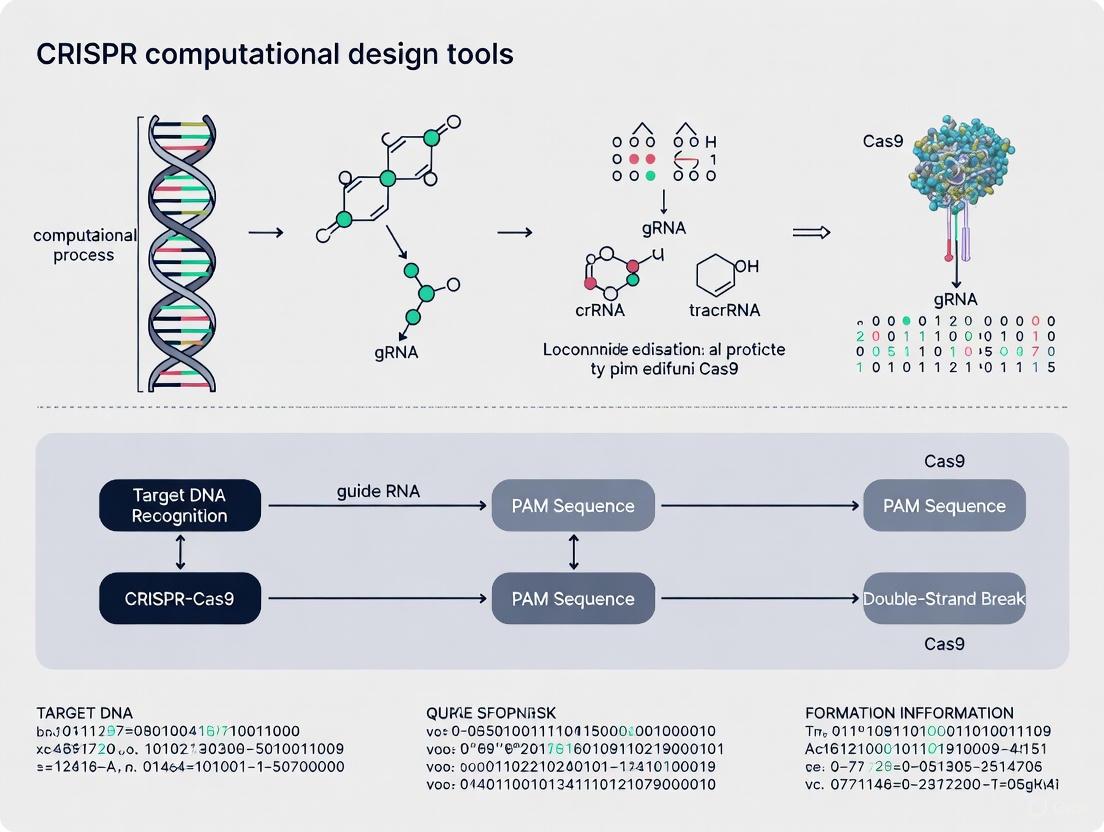
This article provides researchers, scientists, and drug development professionals with a comprehensive overview of the current landscape of CRISPR computational design tools.
A Comprehensive Guide to CRISPR Computational Design Tools: From AI-Driven Discovery to Precision Editing
Abstract
This article provides researchers, scientists, and drug development professionals with a comprehensive overview of the current landscape of CRISPR computational design tools. It covers the foundational principles of CRISPR bioinformatics, explores methodological applications for different editing goals like knock-out and knock-in, details strategies for troubleshooting and optimizing guide RNA design to minimize off-target effects, and offers a comparative analysis of validation methods and tool performance. By synthesizing the latest advances, including the integration of artificial intelligence and novel software platforms, this guide aims to equip professionals with the knowledge to design more precise and efficient genome-editing experiments, accelerating therapeutic development and functional genomics research.
The Bioinformatics Blueprint: How Computational Tools Power CRISPR Discovery
The journey of the Clustered Regularly Interspaced Short Palindromic Repeats (CRISPR) system from a prokaryotic immune mechanism to a revolutionary gene-editing technology represents a paradigm shift in molecular biology. Originally identified in bacteria and archaea as a defense system against mobile genetic elements, CRISPR and its associated Cas proteins have been repurposed to create a highly versatile and programmable tool for precise genome manipulation. This transformation was largely enabled by bioinformatics, which has been instrumental in mining natural diversity, predicting system functionality, and designing effective editing strategies. This technical support center article, framed within the context of advanced computational design tool research, provides troubleshooting guides and FAQs to help researchers navigate the practical challenges of CRISPR experimentation.
FAQs: Core Concepts and Workflow Design
1. What is the origin of the CRISPR-Cas system, and why is its natural biology relevant to its use as a gene-editing tool?
The CRISPR-Cas system is a form of adaptive immunity in prokaryotes (found in approximately 88% of archaea and 39% of bacteria) that protects them from viral infections and other foreign genetic elements. The system "remembers" past infections by integrating short sequences from invading genomes (spacers) into its own CRISPR locus. Upon re-infection, these spacers are transcribed into RNA guides that direct Cas nucleases to cleave complementary foreign DNA. This natural function of RNA-programmable DNA recognition and cleavage is the very foundation of its repurposing for gene editing, allowing researchers to target any genomic locus by simply designing a matching guide RNA [1].
2. What are the major classes and types of CRISPR-Cas systems, and which are most commonly used in biotechnology?
CRISPR-Cas systems are broadly classified into two classes based on their effector complex architecture:
- Class 1 (Types I, III, and IV) utilizes a multi-protein complex to cleave target nucleic acids.
- Class 2 (Types II, V, and VI) employs a single, large effector protein (such as Cas9 or Cas12) for cleavage, making them simpler and more adaptable for biotechnological applications.
Among these, Type II (Cas9) is the most widely used for DNA editing, while Type VI (Cas13) systems have been developed for RNA targeting and editing [2] [1].
3. What critical DNA sequence must be present for Cas9 to bind and cleave its target?
The Protospacer Adjacent Motif (PAM) is an absolute requirement. For the commonly used Streptococcus pyogenes Cas9 (SpCas9), the PAM sequence is 5'-NGG-3', where "N" is any nucleotide. The PAM is located adjacent to the target DNA sequence and is essential for the Cas protein to recognize and initiate binding to the target site. The presence of a suitable PAM is therefore the primary constraint when selecting a target site for editing [3] [1].
4. How has artificial intelligence and machine learning advanced CRISPR tool design?
Recent breakthroughs demonstrate that large language models (LLMs), trained on massive datasets of natural CRISPR sequences, can now generate novel, highly functional gene editors. For instance, AI-generated proteins like OpenCRISPR-1 exhibit comparable or improved activity and specificity relative to SpCas9, despite being hundreds of mutations away from any known natural sequence. This AI-driven approach can expand protein cluster diversity by 4.8-fold compared to natural databases, bypassing evolutionary constraints to create editors with optimal properties [4].
Troubleshooting Guide: Common Experimental Problems and Solutions
Problem: Low Editing Efficiency If your CRISPR-Cas9 system is not efficiently modifying the target site, consider the following solutions:
| Potential Cause | Recommended Solution |
|---|---|
| Suboptimal gRNA design | Redesign gRNA to ensure it targets a unique genomic sequence and has high on-target activity scores. Use tools like CRISPOR or CHOPCHOP [5]. |
| Inefficient delivery | Optimize your delivery method (electroporation, lipofection, viral vectors) for your specific cell type. Use a well-characterized positive control gRNA to benchmark performance [6]. |
| Low expression of Cas9/gRNA | Confirm that the promoters driving Cas9 and gRNA expression are active in your cell type. Ensure high-quality, pure plasmid DNA or mRNA is used [7]. |
| Chromatin inaccessibility | Target regions with open chromatin. Consult databases like ENCODE for chromatin accessibility data in your cell type. |
Problem: High Off-Target Effects Unintended edits at off-target sites can compromise experimental results and therapeutic safety.
| Potential Cause | Recommended Solution |
|---|---|
| gRNA lacks specificity | Design gRNAs with maximal specificity. Use computational tools (e.g., DeepCRISPR) that leverage machine learning to predict and minimize off-target activity [3] [8]. |
| High nuclease expression | Use lower, more precise concentrations of Cas9/gRNA. Consider delivering pre-assembled ribonucleoprotein (RNP) complexes, which have a shorter cellular half-life, reducing off-target potential [6] [9]. |
| Choice of nuclease | Switch to high-fidelity Cas9 variants (e.g., SpCas9-HF1, eSpCas9) or alternative Cas proteins like Cas12a that have different PAM requirements and may offer greater specificity [6]. |
Problem: Cell Toxicity or Low Cell Survival Cell death following transfection can halt experiments.
| Potential Cause | Recommended Solution |
|---|---|
| High concentration of CRISPR components | Titrate the concentration of Cas9/gRNA or RNP complexes. Start with lower doses and gradually increase to find a balance between editing efficiency and cell viability [6]. |
| Constitutive nuclease expression | Use an inducible Cas9 system to limit the duration of nuclease expression, thereby reducing prolonged cellular stress [6]. |
| Innate immune activation | Be aware that bacterial Cas9 orthologs can trigger immune responses in human cells. Selecting less immunogenic variants may be necessary for therapeutic applications [3]. |
Problem: Unintended On-Target Structural Variants Beyond small indels, CRISPR editing can sometimes lead to larger, unintended structural variations.
| Potential Concern | Detection and Mitigation Strategy |
|---|---|
| Large deletions, insertions, translocations | Standard PCR and Sanger sequencing often miss these events. Employ long-range PCR, karyotyping, or optical genome mapping to screen for large-scale structural variants, especially in clonal populations [10]. |
| Chromosomal truncations | In cancer cell lines with aberrant DNA repair (e.g., p53 inactivation), the frequency of such events can be high. Carefully validate edited clones [10]. |
Experimental Protocols: Key Methodologies
Protocol 1: Genome Editing in Human CD34+ Cells using RNP and ssODN
This protocol, adapted from a study on sickle cell disease, outlines a workflow for precise gene correction in hematopoietic stem/progenitor cells [9].
Key Reagents:
- TrueCut Cas9 Protein V2 (or similar high-quality Cas9 nuclease)
- Chemically synthesized sgRNA
- Single-stranded Oligonucleotide Donor (ssODN) (e.g., a 72-mer template for HDR)
- Source-specific Human Bone Marrow CD34+ Cells
- Lonza 4D-Nucleofector System with P3 Primary Cell 4D-Nucleofector X Kit
Detailed Workflow:
- RNP Complex Assembly: Incubate 8 µg of sgRNA with 15 µg of Cas9 protein (a 2:1 pmol ratio) at room temperature for 15 minutes to form the RNP complex.
- Nucleofection: Mix 2.0 × 10^5 CD34+ cells with the pre-assembled RNP complex and 5.4 µg of ssODN. Nucleofect using the Lonza 4D-Nucleofector with program ER-100.
- Post-Transfection Culture: Culture the transfected cells in specific media optimized for CD34+ cells for 72 hours at 37°C and 5% CO₂.
- Genomic DNA Isolation and Analysis: Harvest cells and isolate genomic DNA.
- Assess overall editing efficiency and indel spectrum using the TIDE (Tracking of Indels by DEcomposition) software analysis tool.
- Quantify precise homology-directed repair (HDR) using the TIDER (Tracking of Indels for DEcomposition in R) software analysis tool [9].
The workflow for this protocol is summarized in the following diagram:
Protocol 2: Validation of Editing and Detection of Structural Variants
A comprehensive analysis of editing outcomes is crucial for interpreting results and ensuring safety.
Key Reagents:
- PCR Reagents (High-fidelity polymerase, GC enhancer if needed)
- Gel Electrophoresis System
- Sanger Sequencing Reagents
- Surveyor or T7 Endonuclease I Assay (Optional)
- Long-range PCR Kit
- Resources for Advanced Mapping (e.g., for optical genome mapping)
Detailed Workflow:
- Initial Genotyping: Perform PCR amplification of the target locus. Redesign primers if the region is GC-rich or if amplification is inefficient.
- Edit Detection:
- Sequence PCR products via Sanger sequencing and analyze with tools like TIDE for indel quantification.
- Alternatively, use enzymatic mismatch detection assays (e.g., Surveyor assay) to quickly assess cleavage efficiency.
- Advanced Structural Variant Screening:
- To detect larger deletions or rearrangements, perform long-range PCR spanning the target site and flanks.
- For clonal cell lines, employ more comprehensive methods like karyotyping or optical genome mapping to identify chromosomal abnormalities, translocations, or complex rearrangements that standard sequencing misses [10].
| Tool or Resource | Function | Example/Brand |
|---|---|---|
| CRISPR Bioinformatics Tools | Design highly specific gRNAs, predict on-target/off-target activity, and analyze editing outcomes. | CRISPOR, CHOPCHOP, CRISPResso, E-CRISP [3] [5]. |
| AI-Designed Editors | Novel, highly functional Cas proteins with potentially improved properties (activity, specificity, size). | OpenCRISPR-1 [4]. |
| Ribonucleoprotein (RNP) Complex | Pre-complexed Cas9 protein and gRNA; reduces off-target effects and cytotoxicity, enables rapid editing. | Various commercial Cas9 proteins and synthetic sgRNAs [9]. |
| High-Fidelity Cas9 Variants | Engineered Cas9 proteins with reduced off-target activity. | SpCas9-HF1, eSpCas9 [6]. |
| Nucleofection Systems | Efficient delivery of CRISPR components into hard-to-transfect cells, including primary cells like CD34+. | Lonza 4D-Nucleofector System [9]. |
| Genomic Cleavage Detection Kits | Validate editing efficiency via enzymatic detection of indels at the target locus. | GeneArt Genomic Cleavage Detection Kit [7]. |
| CRISPR Databases | Provide curated information on natural CRISPR systems, spacers, and Cas genes for research and tool development. | CRISPRCasDB, CRISPRbank [5]. |
The CRISPR (Clustered Regularly Interspaced Short Palindromic Repeats) system has revolutionized genetic engineering, offering unprecedented precision in genome editing. For researchers, scientists, and drug development professionals, navigating the vast landscape of available computational tools is crucial for designing effective experiments. This technical support center provides a curated list of key databases and resources, framed within the context of CRISPR computational design tools research, to assist users in selecting the appropriate tools for their specific needs and troubleshooting common experimental issues.
CRISPR Resource Databases
The following databases and websites serve as comprehensive repositories for CRISPR-related information, reagents, and software.
Table 1: Key CRISPR Resource Databases and Websites
| Resource Name | Primary Function | Key Features | URL/Reference |
|---|---|---|---|
| Addgene [11] | CRISPR Plasmid Repository & Information Hub | - Distributes CRISPR plasmids and pooled libraries- Provides extensive CRISPR protocols, guides, and eBooks- Curated list of CRISPR software tools | https://www.addgene.org/crispr/reference/ |
| Awesome-CRISPR [12] | Community-Curated Software List | - A curated GitHub list of software, websites, databases, and papers for genome engineering- Covers guide design, off-target prediction, and screening analysis | https://github.com/davidliwei/awesome-CRISPR |
| CasPEDIA [11] | Encyclopedia of Cas Enzymes | - A community resource documenting Class 2 CRISPR systems- Provides entries on enzyme activity and experimental considerations | CasPEDIA Website |
CRISPR Guide RNA (gRNA) Design Tools
Selecting an effective guide RNA (gRNA) is a critical first step in any CRISPR experiment. The following tools assist in designing gRNAs for various applications and nucleases.
Table 2: Selected gRNA Design and Off-Target Prediction Tools
| Tool Name | Supported Nuclease(s) | Key Function | Special Features | Reference |
|---|---|---|---|---|
| CRISPOR | Cas9, Cas12a | Design, evaluate, and clone gRNAs | Integrates 10 different prediction scores; supports over 180 genomes | [11] [12] |
| Cas-Designer | Cas9-derived RGENs | Bulge-allowed quick gRNA design | Integrates off-target and microhomology information | [11] [12] |
| CRISPick (Broad Institute) | CRISPRko/a/i | Ranks and picks candidate sgRNAs | Designed to maximize on-target activity for human, mouse, and rat genomes | [11] [12] |
| CHOPCHOP | Cas9, Cpf1, Cas13, TALENs | Target site selection for various nucleases | Web tool for multiple CRISPR/nuclease systems | [12] |
| Benchling | Various | Integrated CRISPR gRNA design | Streamlines scoring, selection, annotation, and plasmid assembly in one platform | [13] |
| DeepSpCas9 | SpCas9 | gRNA efficiency prediction | Uses deep learning models for prediction | [11] |
| Cas-OFFinder | Cas9, Cas12 | Off-target identification | Identifies potential off-target sites for a given gRNA sequence | [11] |
| E-CRISP | Various | gRNA and pgRNA design | Available for twelve organisms and easily extendable | [11] [12] |
Tools for Analyzing CRISPR Editing Outcomes
After conducting a CRISPR experiment, it is essential to analyze the results to confirm editing efficiency and specificity. The following software tools are specialized for this purpose.
Table 3: Computational Tools for Analyzing CRISPR Experiments
| Tool Name | Data Input | Key Function | Analysis Type | Reference |
|---|---|---|---|---|
| ICE (Inference of CRISPR Edits) | Sanger Sequencing | Determines rates of CRISPR editing from PCR amplicons | Uses Sanger sequencing reads to quantify editing efficiency | [11] |
| CRISPResso2 | Deep Sequencing (NGS) | Analyzes genome editing outcomes from amplicon sequencing | Quantifies editing rates for cleaving and base editors; provides intuitive results | [11] [14] |
| MAGeCK | Deep Sequencing (NGS) | Identifies enriched/depleted sgRNAs, genes, or pathways from CRISPR screens | Model-based analysis for genome-wide CRISPR/Cas9 knockout (GeCKO) screens | [11] |
| BE-DICT | N/A (Predictive) | Predicts base editing outcomes | An attention-based deep learning algorithm for designing base editor experiments | [12] |
CRISPR Experimental Protocols
Detailed and reproducible protocols are fundamental to experimental success. The table below summarizes key experimental methodologies cited in the literature.
Table 4: Summary of Key CRISPR Experimental Protocols
| Protocol Name | Lab/Source | Description | Key Steps | Applicable Plasmids/Reagents |
|---|---|---|---|---|
| CRISPR Pooled Library Amplification | Addgene [11] | Protocol for amplifying CRISPR pooled libraries for large-scale screens. | Library transformation, plate growth, plasmid DNA purification. | CRISPR pooled libraries. |
| gRNA Design and Cloning | Church Lab [11] | Detailed method for designing and cloning gRNAs into vectors. | gRNA target selection, oligo annealing, ligation into gRNA cloning vector. | gRNA cloning vector. |
| Zebrafish Genome Editing | Chen and Wente Lab [11] | Comprehensive protocol for CRISPR in zebrafish. | gRNA cloning, in vitro transcription of gRNA, microinjection into zebrafish embryos. | gRNA core; Cas9; optimized Cas9. |
| Genomic Cleavage Detection | Thermo Fisher Scientific [7] | Method to verify CRISPR nuclease activity on an endogenous genomic locus using the GeneArt Genomic Cleavage Detection Kit. | Cell transfection, cell lysis, PCR of target locus, detection enzyme digestion, gel electrophoresis. | GeneArt Genomic Cleavage Detection Kit (Cat. No. A24372). |
The Scientist's Toolkit: Research Reagent Solutions
This section details essential materials and reagents commonly used in CRISPR genome editing experiments, along with their critical functions.
Table 5: Essential Research Reagents for CRISPR Experiments
| Item Name | Function in CRISPR Experiments | Examples / Notes |
|---|---|---|
| CRISPR Nuclease | The enzyme that creates a double-strand break in the target DNA. | SpCas9, Cas12a (Cpf1), high-fidelity variants like eSpCas9 [14]. |
| Guide RNA (gRNA) | A short RNA sequence that directs the Cas nuclease to the specific genomic target. | Can be synthesized as a crRNA/tracrRNA pair or as a single guide RNA (sgRNA) [7]. |
| CRISPR Plasmids | DNA vectors used to deliver the genes encoding Cas nuclease and gRNA into cells. | Available from repositories like Addgene [11]. |
| HDR Donor Template | A DNA template used to introduce a specific sequence change via Homology-Directed Repair. | Can be a single-stranded oligodeoxynucleotide (ssODN) or a double-stranded DNA vector [11]. |
| Transfection Reagent | A chemical or lipid-based agent used to deliver CRISPR components into cultured cells. | Lipofectamine 3000 or 2000 reagent is recommended for high efficiency [7]. |
| Selection Antibiotics | Used to enrich for cells that have successfully taken up CRISPR plasmids. | Adding antibiotic selection can increase editing efficiency [7]. |
| PCR Purification Kit | For purifying PCR amplicons before downstream analysis like sequencing or cleavage detection. | Kits like the Invitrogen PureLink PCR Purification Kit are recommended [7]. |
CRISPR Experimental Workflow
The following diagram visualizes the standard workflow for a CRISPR-Cas9 genome editing experiment, from design to analysis.
Troubleshooting Common CRISPR Experimental Issues
This section addresses frequently encountered problems in CRISPR experiments, providing potential reasons and solutions in a question-and-answer format.
Q1: My CRISPR experiment has low editing efficiency. What could be the cause and how can I improve it?
A: Low editing efficiency can result from several factors. Consider the following solutions:
- gRNA Design: The chosen guide RNA may have low activity. Use multiple gRNAs targeting the same gene and employ design tools (e.g., CRISPOR, DeepSpCas9) that rank guides based on predicted on-target efficiency [15] [12].
- Delivery Efficiency: Transfection efficiency might be too low. Optimize your transfection protocol or use high-efficiency reagents like Lipofectamine 3000. Alternatively, enrich for transfected cells using antibiotic selection or FACS sorting [7].
- Nuclease Access: The target genomic sequence might be inaccessible due to chromatin structure. Designing gRNAs to different regions of the target gene can help [7].
Q2: How can I minimize off-target effects in my CRISPR experiment?
A: Off-target effects are a major concern. Mitigation strategies include:
- Careful gRNA Design: Design crRNA target oligos carefully to avoid homology with other genomic regions. Use off-target prediction tools like Cas-OFFinder or Cas-Designer to screen your gRNA candidates for potential off-target sites [11] [7].
- Use High-Fidelity Cas Variants: Consider using high-fidelity Cas9 variants (e.g., eSpCas9, SpCas9-HF1) that are engineered to reduce off-target cleavage [14].
Q3: I am not seeing a cleavage band in my genomic cleavage detection assay. What should I do?
A: The absence of a cleavage band can be due to:
- Inefficient Cleavage: The nucleases may be unable to access or cleave the target sequence. Design a new gRNA targeting a nearby sequence [7].
- Low Transfection/Editing: Genomic modification may be too low. Optimize your transfection protocol to ensure efficient delivery of CRISPR components [7].
- Protocol Error: Ensure you have not omitted the denaturing and reannealing step in the cleavage detection protocol. Use kit control templates and primers to verify all components are functioning correctly [7].
Q4: I see a smear or faint bands when running PCR for my cleavage detection assay. How can I fix this?
A: This is often related to the quality and concentration of the lysate:
- Smear: The lysate is likely too concentrated. Dilute the lysate 2- to 4-fold and repeat the PCR reaction [7].
- Faint Bands: The lysate may be too dilute. Double the amount of lysate in the PCR reaction, but do not exceed 4 µL as lysate can inhibit PCR [7].
- No Product: This could be due to poor PCR primer design or a GC-rich region. Redesign primers to be 18–22 bp with 45–60% GC content. For GC-rich regions, add a GC enhancer to the PCR reaction [7].
Q5: My target sequence does not have a PAM site for SpCas9 (which requires NGG). What are my options?
A: If a canonical PAM is absent, you have alternatives:
- Alternative Cas Enzymes: Use Cas proteins from different species that have different PAM requirements. For example, Cas12a (Cpf1) recognizes a T-rich PAM (TTTV), and engineered variants like hfCas12Max have a broadened PAM (TN or TTN) [14].
- TALENs: As an alternative to CRISPR, you can use TAL effector-based nucleases (TALENs), which do not require a fixed PAM sequence [7].
Q6: I am getting too much background or nonspecific cleavage bands in my detection assay. What is the cause?
A: Background interference can be addressed by:
- Plasmid Contamination: Ensure there is no plasmid contamination and that you are culturing single clones for your cleavage selection plasmid [7].
- Redesign Primers: Redesign your PCR primers to produce a distinct, cleaved banding pattern that is easier to interpret [7].
- Control Experiment: Use lysate from mock-transfected cells (or cells transfected with irrelevant plasmids) as a negative control to distinguish background from specific cleavage [7].
AI and Large Language Models in Designing Novel CRISPR Effectors
The integration of artificial intelligence (AI) and large language models (LLMs) is revolutionizing the development of CRISPR-Cas systems, moving beyond natural evolutionary constraints to create highly functional, synthetic gene editors. This technical support center addresses the key experimental challenges and considerations when working with these novel, AI-designed CRISPR effectors, providing troubleshooting guidance and detailed protocols for the research community.
Troubleshooting AI-Designed CRISPR Systems
| Common Issue | Potential Cause | Recommended Solution |
|---|---|---|
| Low editing efficiency | Non-optimal guide RNA (gRNA) design; Cell-type specific variability. | Use AI prediction tools (e.g., Rule Set 3, CRISPRon) for gRNA design [16] [17]. Optimize gRNA GC content (40-80%) and limit secondary structures [18]. |
| High off-target effects | gRNA sequence has high complementarity to non-target genomic sites. | Leverage off-target prediction models (e.g., Cutting Frequency Determination score) during gRNA design [16] [17]. Validate edits with the Genomic Cleavage Detection Kit [7]. |
| Irregular protein expression | gRNA targets a region not common to all protein isoforms; Disruption from alternative splicing. | Design gRNAs to target an early exon common to all major protein-coding isoforms to ensure complete knockout [19]. |
| No cleavage activity | Inefficient delivery of CRISPR components; Inaccessible target chromatin state. | Optimize transfection method and efficiency [7] [19]. Verify nuclease expression and design a new targeting strategy for nearby, more accessible sequences [7]. |
| Difficulty cloning long gRNAs | Structural instability of long sequences (e.g., pegRNAs); Degradation of oligonucleotides. | Utilize specialized long oligonucleotide synthesis services [18]. Aliquot ds oligonucleotide stocks to avoid freeze-thaw cycles [7]. |
Frequently Asked Questions on AI and CRISPR Design
How do language models design novel CRISPR effectors? Researchers use protein language models (e.g., ProGen2) that are first trained on massive, curated datasets of natural protein sequences. These models are then fine-tuned on specialized datasets, such as the CRISPR–Cas Atlas which contains over 1.2 million CRISPR operons, to learn the blueprint of CRISPR-Cas function. The models can then generate millions of novel protein sequences that adhere to functional constraints but are highly divergent from nature, leading to effectors like OpenCRISPR-1, which is 400 mutations away from SpCas9 [4] [20].
What are the key advantages of AI-designed editors like OpenCRISPR-1? AI-designed editors offer several demonstrated advantages:
- Enhanced Specificity: OpenCRISPR-1 shows comparable on-target activity to SpCas9 with a 95% reduction in off-target effects [20].
- Reduced Immunogenicity: They exhibit lower immune reactivity in human serum, a critical factor for in vivo therapeutic applications [20].
- Tailored Functionality: The AI can be steered to design editors with optimal properties such as smaller size, unique PAM preferences, or improved stability [4] [20].
What specific experimental factors must be considered for successful CRISPR knockout? Beyond gRNA design, successful knockout requires attention to:
- Protein Domain Targeting: For higher likelihood of loss-of-function, target gRNAs to stretches of highly conserved amino acids or hydrophobic domains in the protein's core [18].
- Cell Line Selection: Immortalized lines (e.g., HEK293, HeLa) are typically more amenable to editing than primary cells [19].
- Delivery Method: Choose the most efficient transfection method (electroporation, lipofection) for your specific cell type [19].
Can AI help with newer editing technologies like base and prime editing? Yes. AI-designed effectors have proven compatible with base editing systems [4] [20]. For prime editing, which requires long pegRNAs, AI and specialized long-oligo synthesis are enabling the design of large-scale pegRNA libraries for sophisticated screening applications [18].
Experimental Workflow for Validating Novel AI-Designed Effectors
The following diagram outlines the key steps for experimentally testing a novel AI-generated CRISPR effector, from initial computational design to functional validation in cells.
The Scientist's Toolkit: Research Reagent Solutions
| Reagent / Tool | Function in Experiment | Example / Note |
|---|---|---|
| CRISPR–Cas Atlas | A curated database of >1.2 million CRISPR operons; used to train and fine-tune generative AI models [4]. | Foundational resource for de novo protein design. |
| ProGen2 (pLLM) | A protein large language model capable of generating novel, functional protein sequences [4] [21]. | Can be fine-tuned on specific protein families (e.g., Cas9, PiggyBac). |
| AlphaFold2/3 | AI-driven tool for predicting 3D protein structures from amino acid sequences [4] [16]. | Used for in silico validation of AI-generated effector folds. |
| Genomic Cleavage Detection Kit | Validates nuclease activity by detecting indels at the target genomic locus post-transfection [7]. | Critical for confirming on-target editing. |
| VBC Score Tool | A high-performance sgRNA prediction algorithm that selects guides likely to generate loss-of-function alleles [18]. | Conserves targeting of hydrophobic protein cores. |
| PureLink PCR Purification Kit | Purifies PCR products for clean and accurate downstream cleavage analysis [7]. | Minimizes background interference in gel assays. |
Key Quantitative Findings from Recent Studies
Table: Performance Metrics of AI-Designed Gene Editors
| AI-Designed Effector | On-Target Efficiency vs. SpCas9 | Off-Target Reduction | Key Feature |
|---|---|---|---|
| OpenCRISPR-1 [4] [20] | Comparable | 95% | High specificity, base editing compatible. |
| AI-generated Cas9s [4] | Comparable or Improved | Data Not Specified | 10.3x diversity increase; 56.8% avg. identity to natural sequences. |
| Mega-PiggyBac [21] | Significantly Improved (Excision/Integration) | Under Investigation | Synthetic transposase for large DNA payloads. |
Exploring the Diversity of Cas Proteins and Protospacer Adjacent Motifs (PAMs)
Frequently Asked Questions (FAQs)
1. What is a PAM and why is it necessary for CRISPR experiments? The Protospacer Adjacent Motif (PAM) is a short, specific DNA sequence (typically 2-6 base pairs) that follows the DNA region targeted for cleavage by the CRISPR system [22] [23]. It is absolutely required for a Cas nuclease to recognize and cut its target DNA [23]. The PAM serves a critical biological function: it allows the CRISPR system to distinguish between foreign viral DNA (which contains the PAM) and the bacterium's own CRISPR array (which lacks the PAM), thereby preventing autoimmunity and cleavage of the host genome [22] [23].
2. My target genomic locus lacks a known PAM sequence. What are my options? If your target locus lacks a known PAM, you have several potential solutions [23]:
- Select an alternative Cas nuclease: Different Cas proteins recognize different PAM sequences. If one Cas protein's PAM is not present, another might be suitable.
- Use engineered, PAM-flexible Cas variants: Proteins like SpG and SpRY are engineered variants of SpCas9 with significantly relaxed PAM requirements, enabling targeting of previously inaccessible sites [24].
- Consider a different gene-editing platform: As a non-CRISPR alternative, TAL effector-based nucleases do not require a PAM sequence [7].
3. I am getting low editing efficiency. What could be the cause and how can I improve it? Low editing efficiency can result from several factors. Here are common causes and solutions:
- Guide RNA design: Test two or three different guide RNAs for your target to identify the most efficient one. Bioinformatic design tools are helpful, but empirical testing in your experimental system is best [25].
- Guide RNA concentration and quality: Verify the concentration of your guide RNAs and ensure you are delivering an appropriate dose. Using chemically synthesized, modified guides can improve stability and editing efficiency [25].
- Delivery method: Consider using Ribonucleoprotein (RNP) complexes, where the Cas protein is pre-complexed with the guide RNA. RNP delivery can lead to higher editing efficiency and reduced off-target effects compared to plasmid-based methods [25].
- Cell enrichment: To enrich for successfully transfected cells, you can add antibiotic selection or use Fluorescence-Activated Cell (FAC) sorting [7].
4. How do I choose the best Cas protein for my experiment? The best Cas protein depends on your specific experimental needs [25]:
- Cas9 (e.g., SpCas9): A good general choice for genome editing, particularly in species with GC-rich genomes like mammals. It requires an
NGGPAM [23]. - Cas12a (e.g., LbCas12a, AsCas12a): May be better suited for targeting AT-rich genomes. It recognizes a
TTTVPAM and produces staggered cuts, unlike the blunt ends from Cas9 [23]. - Other Orthologs: Cas proteins from other species, such as Staphylococcus aureus (SaCas9, PAM:
NNGRRT) or Campylobacter jejuni (CjCas9, PAM:NNNNRYAC), are valuable for their compact size or unique PAM requirements [23].
5. What are the primary causes of off-target effects and how can they be minimized? Off-target effects occur when the CRISPR system cuts at unintended genomic sites with sequences similar to the target. To minimize them:
- Optimize guide RNA design: Carefully design crRNA target sequences to avoid homology with other regions in the genome [7]. Use bioinformatic tools to predict and avoid potential off-target sites.
- Use high-fidelity Cas variants: Engineered Cas proteins with enhanced specificity are available and can reduce off-target activity [26].
- Utilize RNP delivery: Delivering the CRISPR components as a pre-formed RNP complex can decrease off-target mutations relative to plasmid transfection [25].
- Employ Anti-CRISPR proteins: Recently discovered Anti-CRISPR (Acr) proteins can act as potent inhibitors of Cas effectors. These can be used as a "switch-off" mechanism to limit the activity window of the CRISPR system, thereby enhancing precision [27].
Troubleshooting Guides
Problem: Inefficient Cleavage or No Editing Detected
| Possible Cause | Recommended Solution |
|---|---|
| Incorrect oligo design | Verify that single-stranded oligonucleotides contain the correct terminal nucleotides required for cloning into your specific vector system (e.g., GTTTT and CGGTG on 3' ends) [7]. |
| Low transfection efficiency | Optimize transfection conditions for your cell line. Use a positive control (e.g., a plasmid expressing a fluorescent protein) to monitor efficiency [7]. |
| Target sequence is inaccessible | The target DNA may be tightly bound in chromatin. Design a new targeting strategy for a nearby, more accessible sequence [7]. |
| Degraded oligonucleotides | Avoid repeated freeze-thaw cycles of oligonucleotide stocks. Aliquot and store them in the recommended annealing or ligation buffer at -20°C [7]. |
Problem: High Off-Target Activity
| Possible Cause | Recommended Solution |
|---|---|
| Non-specific guide RNA | Redesign the guide RNA using bioinformatic tools to ensure minimal homology to other genomic regions [7]. |
| PAM-flexible Cas variant | Be aware that engineered Cas variants with relaxed PAM requirements, while increasing targetable space, can have increased off-target activity. Use high-fidelity versions when possible [24]. |
| Prolonged Cas expression | Use transient delivery methods like RNPs instead of plasmids to shorten the exposure time of the CRISPR machinery in the cell [25]. |
| High nuclease concentration | Titrate the amount of Cas nuclease and guide RNA to find the lowest effective dose, reducing the chance of promiscuous activity [25]. |
Quantitative Data on Cas Proteins and PAMs
Table 1. Summary of Common and Emerging Cas Nucleases and Their PAM Requirements.
| CRISPR Nucleases | Organism Isolated From | PAM Sequence (5' to 3') | Key Features |
|---|---|---|---|
| SpCas9 | Streptococcus pyogenes | NGG |
Standard nuclease for general editing; widely used [23]. |
| SaCas9 | Staphylococcus aureus | NNGRRT or NNGRRN |
Smaller size than SpCas9, useful for viral delivery [23]. |
| NmeCas9 | Neisseria meningitidis | NNNNGATT |
Offers high specificity due to longer PAM [23]. |
| Cas12a (Cpf1) | Lachnospiraceae bacterium | TTTV |
Creates staggered cuts; useful for AT-rich regions [23]. |
| Cas12b | Bacillus hisashii | ATTN, TTTN, GTTN |
Thermostable variant [23]. |
| Cas12Max (engineered) | Engineered from Cas12i | TN and/or TNN |
Engineered for minimal PAM requirement and high fidelity [23]. |
| SpRY (engineered) | Engineered SpCas9 | NRN > NYN |
Near-PAMless SpCas9 variant; greatly expanded targeting range [24]. |
| AtCas9 | Alicyclobacillus tengchongensis | N4CNNN and N4RNNA |
Naturally flexible PAMs, active at high temperatures [24]. |
| Cas3 | Various Prokaryotes | No PAM requirement | DNA shredding enzyme; used for large deletions [23]. |
Table 2. Classification and Properties of Major CRISPR-Cas Types. [28] [27]
| Class | Type | Effector Complex | Signature Protein | Target Molecule | PAM Requirement |
|---|---|---|---|---|---|
| Class 1 | I | Multi-subunit (Cas5, Cas7, Cas8, Cas3) | Cas3 | dsDNA | Yes [27] |
| III | Multi-subunit (Cas10, Csm/Cmr proteins) | Cas10 | ssRNA, ssDNA | No (uses rPAM/PFS) [27] | |
| IV | Multi-subunit (Csf1, Csf2, Csf3) | Unknown | Unknown | Unknown [27] | |
| Class 2 | II | Single protein (Cas9) | Cas9 | dsDNA | Yes (e.g., NGG) [27] [23] |
| V | Single protein (Cas12) | Cas12 | dsDNA, ssDNA | Yes (e.g., TTTV) [27] [23] |
|
| VI | Single protein (Cas13) | Cas13 | ssRNA | No [27] |
Experimental Protocols
Protocol 1: In Vitro Guide RNA Testing for Editing Efficiency
This protocol is used to screen multiple guide RNAs for activity before moving to cell-based experiments [25].
- Prepare DNA Template: Obtain a DNA template (e.g., a plasmid or PCR product) containing the target sequence.
- Assemble Reaction: In a tube, combine the following components:
- DNA template (with target sequence)
- Purified Cas nuclease of choice
- Candidate guide RNA
- Incubate: Incubate the reaction for 1-2 hours at 37°C.
- Analyze: Run the products on an agarose gel. Successful cleavage will be indicated by the appearance of smaller DNA bands compared to the uncut control. The guide producing the most complete cleavage is the most efficient.
Protocol 2: Genomic Cleavage Detection Kit Workflow
This outlines a common method to verify cleavage at an endogenous genomic locus [7].
- Transfert Cells: Introduce the CRISPR components into your target cells.
- Harvest and Lyse: Collect the cells and prepare a crude lysate.
- PCR Amplification: Amplify the genomic region containing the target sequence from the lysate.
- Troubleshooting: If the PCR product is a smear, the lysate may be too concentrated (dilute 2-4 fold). If the band is too faint, the lysate may be too dilute (double the amount of lysate, but do not exceed 4 µL in a 50 µL reaction) [7].
- Denature and Anneal: Heat the PCR products to denature them, then slowly cool to allow reannealing. This enables the formation of heteroduplexes if indel mutations are present.
- Detection Enzyme Digestion: Treat the reannealed products with an enzyme (e.g., T7 Endonuclease I) that cleaves heteroduplex DNA.
- Gel Electrophoresis: Analyze the digestion products on a gel. The presence of cleaved bands indicates successful genome editing at the target site.
The Scientist's Toolkit: Research Reagent Solutions
| Item | Function |
|---|---|
| Chemically Modified Guide RNAs | Synthesized with modifications (e.g., 2'-O-methyl) to enhance stability against cellular RNases, improve editing efficiency, and reduce immune stimulation [25]. |
| Ribonucleoprotein (RNP) Complexes | Pre-assembled complexes of Cas protein and guide RNA. Offer high editing efficiency, reduced off-target effects, and a DNA-free editing method [25]. |
| High-Fidelity Cas Variants | Engineered Cas proteins (e.g., SpCas9-HF1) with mutations that reduce non-specific interactions with the DNA backbone, thereby increasing specificity [26]. |
| Anti-CRISPR Proteins | Small proteins (e.g., AcrIIA4) that inhibit specific Cas effectors. Used as a precision tool to limit the activity or timing of CRISPR systems, reducing off-target effects and cytotoxicity [27]. |
| PAM-Flexible Engineered Cas | Cas proteins (e.g., SpRY, xCas9) engineered to recognize non-canonical PAM sequences, dramatically expanding the number of targetable sites in the genome [24]. |
Workflow and Pathway Visualizations
CRISPR Experiment Workflow and Decision Points
PAM-Driven Target Recognition Mechanism
Strategic Guide RNA Design: A Workflow for Knockouts, Knock-ins, and Beyond
In CRISPR-based genome engineering, the guide RNA (gRNA) serves as the precision navigation system that directs the Cas enzyme to its specific genomic target. The design parameters for an effective gRNA are not universal; they are fundamentally dictated by the experimental intent. Whether the goal is complete gene knockout, specific base editing, or transcriptional modulation, each application demands distinct gRNA design considerations regarding target location, on-target efficiency, and off-target propensity. This technical guide examines how different genome editing objectives necessitate specific gRNA design strategies, leveraging current computational tools and methodologies to optimize experimental outcomes. Within the broader thesis of CRISPR computational tool research, understanding these parameter dependencies is essential for developing more intelligent, application-aware design systems.
Core gRNA Design Principles by Experimental Goal
The table below summarizes the primary gRNA design considerations for major CRISPR applications, demonstrating how experimental intent directly shapes design priorities.
| Experimental Goal | Primary gRNA Targeting Region | Key Design Considerations | Optimal Positioning |
|---|---|---|---|
| Gene Knockout [29] [30] | Constitutively expressed exons, 5' exons, essential protein domains [29] | Targets early coding region to cause frameshift; prioritizes exons common to all splice variants [30] | Early exons (5' end) to maximize chance of functional knockout [30] |
| Homology-Directed Repair (HDR) [29] | Immediate vicinity of desired edit [29] | Cut site must be very close to edit location; requires donor DNA template [29] | As close as possible to desired edit, ideally <10 bp away [29] |
| Base Editing [29] | Specific nucleotide to be changed [29] | Editing window is narrow and determined by the specific base editor used [29] | Target base must fall within the base editor's effective activity window [29] |
| Prime Editing [29] | Genomic location where edit is initiated [29] | The pegRNA serves as both guide and template; edits must be downstream of the nick site [29] | Close to the edit site for higher efficiency [29] |
| CRISPR Interference (CRISPRi) [29] | Promoter region or within the gene body [29] | dCas9 blocks transcription; gRNA design is more flexible than for editing [29] | Promoter region to prevent transcription initiation [29] |
| CRISPR Activation (CRISPRa) [29] | Transcription Start Site (TSS) [29] | dCas9-activator must be near TSS to function effectively [29] | Precisely at the transcription start site [29] |
Troubleshooting Guide: gRNA Design FAQs
1. My knockouts are not producing complete gene disruption. What gRNA design factors should I re-examine?
A common cause of incomplete knockout is gRNAs targeting late exons or regions susceptible to alternative splicing. To improve results:
- Target Early Common Exons: Prioritize gRNAs in the 5' coding exons that are shared across all major transcript variants. An early frameshift maximizes the likelihood of generating premature stop codons and nonsense-mediated decay [29] [30].
- Verify Target Consequence: Use tools like Synthego's CRISPR Design Tool to ensure your gRNA's cut site is within a constitutive exon. Frameshift indels in later exons may not disrupt critical protein domains or may be bypassed by alternative translation start sites [30].
2. How can I improve the low efficiency of my HDR experiments?
HDR efficiency is inherently lower than NHEJ. Beyond cellular manipulation, gRNA design is critical:
- Minimize Distance to Edit: The Cas9 cut site must be extremely close to your intended edit—preferably within 10 base pairs. If no PAM site is available nearby, consider using Cas9 variants with alternative PAM specificities [29].
- Evaluate gRNA Efficiency: Select gRNAs with high predicted on-target activity scores. Tools that implement algorithms like Azimuth 2.0 can rank gRNAs by their predicted cleavage efficiency, which is crucial for HDR [30].
3. My base editing experiment failed to produce the desired change. What went wrong?
Base editors have a strict "activity window" where the enzymatic conversion occurs.
- Check the Editing Window: Each base editor (e.g., CBE, ABE, AccuBase CBE) has a defined window of activity relative to the PAM site. Your target base must fall within this narrow window. Carefully consult the literature for the specific editor you are using to design your gRNA accordingly [29].
- Confirm PAM Compatibility: Ensure your chosen gRNA has a PAM sequence that is compatible not just with your Cas protein, but with the specific Cas domain of your base editor fusion protein [14].
4. How can I better manage the risk of off-target effects in my experiments?
While perfect specificity is challenging, several strategies can minimize risk:
- Use High-Fidelity Cas Variants: Engineered Cas enzymes with higher specificity are available and can significantly reduce off-target cleavage [29].
- Leverage Bioinformatics Tools: Utilize tools that perform comprehensive off-target searches. A well-designed gRNA should have minimal perfectly matched or near-perfect (e.g., 1-2 mismatch) off-target sites in the genome. Tools can score gRNAs based on their off-target potential [30].
- Validate Genomic Sequence: Always sequence the target locus in your specific cell line to check for polymorphisms. Even a single nucleotide discrepancy between the reference genome and your cells can drastically reduce gRNA on-target efficiency [29].
Experimental Protocol: A Standard Workflow for gRNA Design and Validation
The following diagram maps the logical workflow and decision points for designing gRNAs based on experimental intent.
| Resource Category | Specific Tool / Reagent | Primary Function |
|---|---|---|
| gRNA Design Software [14] [31] [30] | CHOPCHOP, Benchling, CRISPOR, Cas-Designer, Synthego Design Tool | Identify and rank potential gRNA target sequences based on efficiency and specificity predictions. |
| Off-Target Prediction [31] | Cas-OFFinder, CRISPResso | Identify potential off-target genomic sites and analyze sequencing data to quantify editing efficiency. |
| Validated Plasmid Resources [29] | Addgene's validated gRNA plasmids | Provide pre-validated gRNA constructs that save time and serve as positive controls. |
| Specialized Design Tools [14] | BE-Designer, BE-Hive, SpliceR | Design gRNAs for base editing (ABE/CBE) or for targeting specific splice sites. |
| AI-Powered Design Platforms [32] [4] | CRISPR-GPT, AI-generated Cas proteins (e.g., OpenCRISPR-1) | Automate experiment planning and gRNA design; provide novel, highly functional editors. |
Future Directions: The Role of AI and Advanced Computational Tools
The future of gRNA design lies in the integration of artificial intelligence and more sophisticated computational models. AI systems like CRISPR-GPT demonstrate the potential for large language models to act as automated co-pilots, decomposing complex experimental goals into optimized workflows that include gRNA design [32]. Furthermore, deep learning tools are increasingly being deployed to predict CRISPR on-target and off-target activity with higher accuracy, although their performance remains dependent on the volume and quality of training data [8]. The emergence of AI-designed gene editors, such as OpenCRISPR-1, which are highly functional yet diverge significantly from known natural sequences, points toward a future where the tools for editing—and the algorithms to design the guides that direct them—are both generated computationally [4]. This tight integration of design goal, gRNA parameter selection, and editor optimization will further solidify the principle that experimental intent is the ultimate dictator of successful gRNA design.
Frequently Asked Questions (FAQs)
FAQ 1: What are the most critical factors to consider when designing a gRNA for a gene knockout experiment?
The primary goals are to achieve high on-target cleavage efficiency and minimize off-target effects. Key factors include [33]:
- Target Location: The gRNA should target an early, constitutive exon that is essential for the protein's function. Avoid regions too close to the N- or C-terminus of the protein, as this can lead to incomplete knockouts if alternative start codons are used or if the truncated protein remains functional [33].
- On-target Activity: The gRNA sequence itself must have high activity, meaning it efficiently directs Cas9 to create a double-strand break. This can be predicted using scoring algorithms [34].
- Off-target Effects: The gRNA should be specific to your target genomic locus to avoid unintended cuts at similar sites across the genome. This is evaluated using off-target prediction scores [33] [34].
- Experimental Goal: The design priorities differ for knockout (prioritizing location and efficiency) versus knock-in experiments (where location is constrained by the repair template) [33].
FAQ 2: Why did my experiment show high INDEL rates but the target protein is still expressed?
This is a common issue indicating the use of an "ineffective sgRNA." High INDEL rates detected by genomic assays do not guarantee loss of protein function. A study that systematically evaluated sgRNAs found an example where an sgRNA targeting exon 2 of ACE2 showed 80% INDELs but the edited cell pool retained ACE2 protein expression. This can occur if the INDELs do not cause a frameshift or if the resulting truncated protein is still stable or partially functional [35]. It underscores the importance of validating knockout success at the protein level (e.g., via Western blot) in addition to genomic DNA assays [35].
FAQ 3: How can I improve the odds of a successful knockout?
A highly effective strategy is to use multiple gRNAs targeting the same gene. This approach [33] [36]:
- Increases the probability that at least one gRNA will induce a frameshift mutation.
- Can be used to delete a large DNA fragment between two cut sites, making it virtually impossible for the cell to produce a functional protein.
- Research using an optimized iCas9 system in hPSCs achieved over 80% efficiency for double-gene knockouts using this method [35].
FAQ 4: Which computational tools are most reliable for gRNA design?
Several tools exist, and their performance can vary. A 2025 study that empirically evaluated three widely used gRNA scoring algorithms found that Benchling provided the most accurate predictions for their experiments in human pluripotent stem cells [35]. Other versatile and robust platforms frequently cited include CRISPOR and CHOPCHOP, which offer integrated off-target scoring and visualization [37] [5]. Furthermore, AI-powered tools like CRISPR-GPT are emerging to help automate the selection of CRISPR systems and the design of gRNAs [32].
Troubleshooting Guides
Problem: Consistently Low Knockout Efficiency
| Potential Cause | Explanation & Solution |
|---|---|
| Suboptimal gRNA Activity | The chosen gRNA may have low on-target cleavage efficiency. |
| Solution: Use a computational tool (e.g., Benchling, CRISPOR) to design and select gRNAs with high predicted on-target scores. Always design and test at least 3-4 gRNAs per target gene to identify one that works effectively [36]. | |
| Inefficient Delivery or Expression | The CRISPR components (Cas9 and gRNA) are not efficiently reaching the nucleus of your cells. |
| Solution: Optimize your delivery method (e.g., nucleofection, lipofection) and the ratio of Cas9 to gRNA. If using a plasmid system, ensure it has high expression and efficiency in your specific cell type [35] [36]. | |
| Targeting Non-essential Region | The gRNA may be cutting in a genomic region that does not disrupt the function of the protein. |
| Solution: Redesign gRNAs to target exons that encode critical protein domains or are located early in the coding sequence, ensuring a frameshift will disrupt the entire downstream sequence [33]. |
Problem: High Off-Target Activity
| Potential Cause | Explanation & Solution |
|---|---|
| gRNA with Low Specificity | The gRNA sequence has multiple near-identical matches elsewhere in the genome. |
| Solution: Use gRNA design tools to run a thorough off-target analysis. Select gRNAs with a minimal number of predicted off-target sites, especially those with few or no mismatches in the "seed" region adjacent to the PAM site [38] [34]. Tools often use scores like the CFD score to quantify this risk [34]. | |
| High Nuclease Expression | Prolonged or high-level expression of Cas9 can increase the chance of off-target cutting. |
| Solution: Consider using a regulated system (e.g., a doxycycline-inducible Cas9) or delivering pre-assembled Cas9-gRNA ribonucleoprotein (RNP) complexes, which have a shorter cellular lifetime and can reduce off-target effects [35] [36]. |
Experimental Protocols & Data
Protocol: Validating gRNA Efficiency and Knockout Success
This protocol outlines a streamlined workflow for rapidly testing gRNAs and confirming gene knockout.
- gRNA Design and Selection: Using a tool like Benchling, design 3-4 gRNAs against early, essential exons of your target gene. Select the top candidates based on high on-target and low off-target scores [35] [33].
- Transfection: Deliver the selected gRNAs and Cas9 (as plasmid, mRNA, or RNP) into your target cells. Include a non-targeting control gRNA.
- Initial Efficiency Check (3-5 days post-transfection): Harvest a portion of the cells and extract genomic DNA. Perform PCR amplification of the target region and use a genomic cleavage detection (GCD) assay (e.g., T7EI assay) or analyze Sanger sequencing data with algorithms like ICE (Inference of CRISPR Edits) or TIDE (Tracking of Indels by Decomposition) to determine the INDEL percentage [35].
- Protein-Level Validation (>1 week post-transfection): For cell pools or single-cell clones showing high INDELs, perform Western blotting to confirm the absence of the target protein. This is a critical step to identify ineffective sgRNAs that produce INDELs but not a functional knockout [35].
- Phenotypic and Functional Assays: Once knockout is confirmed, proceed with your downstream functional assays.
Quantitative Data from Recent Studies
Table 1: Knockout Efficiencies Achieved with an Optimized Inducible Cas9 (iCas9) System in hPSCs This data demonstrates the high efficiency achievable through systematic optimization of parameters like sgRNA stability and nucleofection [35].
| Type of Knockout | Average Efficiency (INDELs) | Key Finding |
|---|---|---|
| Single-Gene | 82% - 93% | Consistent high efficiency across different targets. |
| Double-Gene | > 80% | Using two sgRNAs simultaneously. |
| Large Fragment Deletion | Up to 37.5% Homozygous | Efficient deletion of DNA between two distal cut sites. |
Table 2: Comparison of gRNA Design Tool Features A selection of widely used computational tools for designing gRNAs [35] [37] [5].
| Tool | Key Features | Best For |
|---|---|---|
| Benchling | Integrated platform for gRNA design, molecular biology, and data analysis; found to provide the most accurate predictions in one independent evaluation [35]. | Researchers wanting an all-in-one solution for experiment design and tracking. |
| CRISPOR | Versatile platform for multiple species, robust off-target scoring, and intuitive genomic visualization [37] [5]. | Advanced users needing detailed off-target analysis and comprehensive data. |
| CHOPCHOP | Robust guide RNA design for several species, integrated off-target scoring, and intuitive genomic locus visualization [37] [5]. | Quick and user-friendly gRNA design for common model organisms. |
| Synthego Design Tool | Focus on gene knockouts for over 120,000 genomes; reduces design time to minutes [33]. | Rapid, automated design of high-quality knockout gRNAs. |
The Scientist's Toolkit
Table 3: Essential Research Reagents and Materials
| Item | Function in gRNA Knockout Experiments |
|---|---|
| Chemical Synthesized Modified sgRNA (CSM-sgRNA) | sgRNA with chemical modifications (e.g., 2'-O-methyl-3'-thiophosphonoacetate) to enhance stability within cells, leading to higher editing efficiency [35]. |
| Doxycycline-Inducible Cas9 (iCas9) System | Allows tunable expression of the Cas9 nuclease, improving cell viability and editing efficiency while reducing off-target effects [35]. |
| Homology-Directed Repair (HDR) Donor Template | For knock-in experiments, this template carries the desired mutation or insertion and is used by the cell's HDR repair pathway [38]. |
| Single-Stranded Oligodeoxynucleotides (ssODNs) | Short, single-stranded DNA molecules commonly used as HDR donor templates for introducing point mutations or small insertions [35]. |
| T7 Endonuclease I (T7EI) | An enzyme used in a mismatch detection assay to quickly estimate the INDEL efficiency at the target locus by cleaving heteroduplex DNA formed by wild-type and mutated strands [35]. |
| Inference of CRISPR Edits (ICE) Software | A freely available algorithm (ice.synthego.com) that uses Sanger sequencing data from edited cell pools to deconvolute and quantify the spectrum of INDEL mutations accurately [35]. |
Workflow Visualization
gRNA Knockout Validation Workflow
gRNA Strategies for Gene Knockout
Frequently Asked Questions (FAQs)
FAQ 1: What are the primary DNA repair pathways involved in CRISPR-mediated genome editing, and how do they compete during a Knock-in (KI) experiment?
When a CRISPR-Cas9-induced double-strand break (DSB) occurs, the cell primarily utilizes two pathways for repair [39] [40]:
- Non-Homologous End Joining (NHEJ): An error-prone "quick fix" pathway that often results in small insertions or deletions (indels) at the cut site. This is the dominant and competing pathway in most cells.
- Homology-Directed Repair (HDR): A precise repair pathway that uses a homologous DNA template to accurately repair the break. In KI experiments, researchers supply an exogenous donor template with the desired change flanked by homology arms.
The key challenge is that NHEJ is highly active throughout the cell cycle and often outcompetes HDR, which is primarily active in the late S and G2 phases [39]. This competition is a major reason for the characteristically low efficiency of HDR-mediated knock-ins.
FAQ 2: Why is the genomic location of the gRNA target site so critical for HDR efficiency, sometimes even more important than the gRNA's on-target score?
For a knock-in experiment, the goal is not just to cut the DNA, but to ensure that the cut is repaired using the provided donor template. The HDR machinery requires the DSB to be in close proximity to the sequence you wish to edit or insert [33]. The donor template is designed with homology arms that match the sequence surrounding the cut site. If the cut site is too far from the intended edit, the cell's repair machinery will not use the donor template effectively, leading to failed integration or random insertion via NHEJ. Therefore, locational constraints for HDR are stringent, and the choice of gRNA is dictated by the necessary proximity to the edit, which can sometimes mean using a gRNA with a slightly lower predicted on-target score [33].
FAQ 3: What are the advantages and limitations of HDR compared to other precision editing tools like Base Editing and Prime Editing?
The table below compares HDR-mediated knock-in with two other major precision editing platforms:
| Editing System | Advantages | Disadvantages |
|---|---|---|
| HDR-Mediated Editing | Enables the installation of all kinds of mutations or fragments (SNPs, indels, gene inserts) in a predefined manner [39]. | Low efficiency due to competition from the NHEJ pathway and the challenge of delivering a repair template [39] [40]. |
| Base Editing | Precise single base substitution without requiring DSBs or a donor DNA template; high efficiency for certain changes [39]. | Restricted editing window; can only perform specific base transitions (C to T, A to G), not transversions; potential for off-target effects [39]. |
| Prime Editing | Mediates all 12 possible base-to-base conversions, as well as small insertions and deletions, without requiring DSBs [39]. | Lower reported efficiency for some targets; only enables small edits due to the limited length of the reverse transcriptase template [39]. |
FAQ 4: What are the key components of an effective single-stranded oligodeoxynucleotide (ssODN) donor template for HDR?
A well-designed ssODN donor template should include [33]:
- The Desired Sequence Change: The new gene sequence or corrected nucleotides you wish to insert.
- Homology Arms: Sequences identical to the genomic DNA flanking the target site. Arm length is critical; for ssODN templates, arms are typically 60-120 nucleotides long in total.
- Strategic gRNA Target Site Placement: The Cas9 cut site should be as close as possible to the ends of the repair template to maximize HDR efficiency [33]. Disrupting the gRNA's Protospacer Adjacent Motif (PAM) site within the donor sequence can also prevent re-cleavage of the successfully edited allele.
Troubleshooting Guides
Problem: Low HDR Efficiency
Low HDR efficiency is a common challenge. The strategies below can be employed to improve outcomes.
Troubleshooting Steps:
Table: Strategies to Improve HDR Efficiency
| Strategy | Methodology | Key Considerations |
|---|---|---|
| Modulate DNA Repair Pathways | Temporarily inhibit key NHEJ proteins (e.g., Ku70/80, DNA-PKcs) using chemical inhibitors or express dominant-negative mutants [40]. | Can increase cell toxicity. Transient inhibition is preferred. |
| Synchronize Cell Cycle | Synchronize cells at the S/G2 phase using chemicals like thymidine or nocodazole, as HDR is most active in these phases [39]. | Can be difficult to achieve in primary or non-dividing (postmitotic) cells [40]. |
| Optimize Donor Template Delivery & Design | Use single-stranded oligodeoxynucleotides (ssODNs) for point mutations or viral vectors for larger inserts. Ensure the Cas9 cut site is close to the edit and consider modifying the donor to prevent re-cleavage [33]. | The format (ssODN vs. double-stranded), length of homology arms, and nuclear delivery are critical factors. |
| Time DSB Induction | Deliver the Cas9 ribonucleoprotein (RNP) complex and donor template simultaneously to ensure they are co-localized in the nucleus at the time of editing [39]. | RNP delivery is fast and can reduce off-target effects compared to plasmid-based delivery. |
Experimental Protocol: Improving HDR in Primary Cells Using RNP and NHEJ Inhibition
This protocol outlines a method to enhance HDR efficiency in difficult-to-transfect cells.
Design and Synthesis:
- Design gRNAs using a computational tool (e.g., Synthego or Benchling) with the primary constraint being proximity to the intended edit [41] [33].
- Order high-purity, chemically modified sgRNA and a recombinant Cas9 protein to form the RNP complex.
- Order an ssODN donor template with ~60-90 nt homology arms and the PAM site disrupted to prevent re-cleavage.
Cell Preparation:
- Culture primary cells in optimal growth medium.
- One day before editing, passage cells to ensure they are in a healthy, log-phase growth state.
RNP Complex Formation:
- Combine 6 µg of Cas9 protein with 2 µg of sgRNA in a sterile tube.
- Incubate at room temperature for 10-20 minutes to form the RNP complex.
Electroporation:
- Harvest and resuspend 1x10^6 cells in an appropriate electroporation buffer.
- Mix the cell suspension with the pre-formed RNP complex, 2 µL of 1 mM NHEJ inhibitor (e.g., SCR7), and 2 µL of 100 µM ssODN donor template.
- Electroporate using a pre-optimized program for your cell type (e.g., Neon System: 1400V, 20ms, 2 pulses).
Post-Transfection Culture:
- Immediately transfer cells to pre-warmed culture medium.
- After 48-72 hours, analyze editing efficiency by flow cytometry, sequencing, or a functional assay.
HDR Experimental Workflow
Problem: High Off-Target Activity
Unintended editing at off-target sites remains a concern for therapeutic applications.
Troubleshooting Steps:
- Utilize Computational gRNA Design: Employ advanced design tools (e.g., from Synthego or Benchling) that use algorithms like the "Doench rules" to predict and minimize off-target effects. These tools generate an off-target score (0-1), with a higher score denoting lower off-target potential [41] [33].
- Choose High-Fidelity Cas Variants: Use engineered Cas9 variants (e.g., eSpCas9, SpCas9-HF1) that have been mutated to reduce tolerance for mismatches between the gRNA and genomic DNA.
- Employ RNP Delivery: Delivery of the pre-formed Cas9-gRNA complex as a ribonucleoprotein (RNP) has a shorter intracellular half-life than plasmid-based expression, reducing the window for off-target cleavage [41].
- Use Anti-CRISPR Proteins: Co-deliver anti-CRISPR proteins (e.g., AcrIIA4) that can inhibit Cas9 activity after a sufficient time window for on-target editing has passed, thereby reducing off-target effects [42].
The Scientist's Toolkit: Research Reagent Solutions
Table: Essential Reagents for CRISPR Knock-in Experiments
| Reagent / Tool | Function | Example Use Case |
|---|---|---|
| Computational gRNA Design Tool (e.g., Benchling, Synthego) | Identifies optimal gRNA sequences by calculating on-target and off-target scores, while considering location-specific constraints for HDR [41] [33]. | Designing a gRNA that cuts within 10 bp of a point mutation to be introduced via an ssODN donor. |
| Cas9 Nuclease (Wild-type & High-Fidelity) | Creates a double-strand break at the target genomic locus specified by the gRNA. High-fidelity variants minimize off-target editing. | Standard gene knockout (KO) or creating a DSB for HDR-mediated knock-in. |
| Donor Template (ssODN / dsDNA) | Provides the homologous DNA sequence for the HDR pathway to copy from. ssODNs are for small edits; double-stranded DNA (e.g., AAV vectors) for large inserts. | Introducing a specific SNP or inserting a fluorescent protein tag at the N-terminus of a protein. |
| NHEJ Pathway Inhibitors (e.g., small molecules) | Chemically suppresses the competing NHEJ repair pathway, thereby increasing the relative frequency of HDR [40]. | Boosting HDR efficiency in primary T cells or hematopoietic stem cells during ex vivo gene therapy. |
| Ribonucleoprotein (RNP) Complex | The pre-formed complex of Cas9 protein and gRNA. Enables rapid, transient editing with high efficiency and reduced off-target effects [41]. | Genome editing in sensitive primary cells or stem cells where plasmid-based delivery is inefficient or toxic. |
The evolution of CRISPR technologies beyond simple gene knockouts has ushered in an era of precision genome engineering. Techniques such as CRISPR activation (CRISPRa), CRISPR interference (CRISPRi), and base editing enable fine-tuned modulation of gene expression and precise single-nucleotide changes without introducing double-stranded DNA breaks. The success of these advanced applications is critically dependent on the design of the guide RNA (gRNA), which requires considerations distinct from those used for traditional CRISPR-Cas9 knockout experiments. This guide provides a focused overview of specialized gRNA design principles, troubleshooting common issues, and details essential experimental protocols for researchers developing therapeutic and research applications.
Core Concepts and gRNA Design Principles
Base Editing
Base editing achieves precise single-nucleotide changes without causing double-stranded DNA breaks, thereby minimizing unintended indels [43]. The system typically consists of a catalytically impaired Cas protein (dead Cas9 or Cas9 nickase) fused to a deaminase enzyme, guided by a gRNA to the target site [43] [44].
- Cytosine Base Editors (CBEs) convert a C•G base pair to a T•A pair. They use a cytidine deaminase enzyme (often APOBEC1) to convert cytosine to uracil, which is then replicated as thymine [43] [44]. Uracil glycosylase inhibitors (UGI) are typically included to prevent repair of the U-G intermediate back to C-G [43].
- Adenine Base Editors (ABEs) convert an A•T base pair to a G•C pair. Since no natural DNA adenine deaminases were known, the ABE system was created by engineering the E. coli tRNA adenosine deaminase (TadA) to function on DNA [43] [44].
A critical design constraint for base editing gRNAs is the editing window, a narrow range of nucleotides (typically 4-9 bases wide) within the protospacer where the deaminase can act [43] [45]. The target base must be positioned within this window for successful editing.
CRISPRa and CRISPRi
CRISPR activation (CRISPRa) and interference (CRISPRi) are used to precisely control gene expression without altering the underlying DNA sequence. Both systems use a catalytically dead Cas9 (dCas9) that binds DNA but does not cut it. The dCas9 is fused to effector domains that influence transcription [33].
- CRISPRi represses gene transcription by using dCas9 fused to a transcriptional repressor domain (e.g., KRAB). The gRNA directs the complex to bind the promoter or transcription start site, physically blocking RNA polymerase [33].
- CRISPRa enhances gene transcription by using dCas9 fused to transcriptional activator domains (e.g., VP64, p65). The gRNA directs the complex to promoter regions to recruit RNA polymerase and other transcription factors [33].
For CRISPRa and CRISPRi, gRNA design is constrained by the need to target specific regulatory regions, most often the promoter region near the transcription start site (TSS), as binding outside these regions may have little to no effect on gene expression [33].
Table 1: Key Characteristics of Specialized CRISPR Systems
| CRISPR System | Core Editor/Effector | Primary Function | Key gRNA Design Constraint |
|---|---|---|---|
| Cytosine Base Editing (CBE) | dCas9/nCas9 + Cytidine Deaminase + UGI [43] [44] | C•G to T•A conversion [43] [44] | Target cytosine must lie within the ~4-9 nt editing window [43] [45] |
| Adenine Base Editing (ABE) | dCas9/nCas9 + Engineered TadA deaminase [43] [44] | A•T to G•C conversion [43] [44] | Target adenine must lie within the ~4-9 nt editing window [43] [45] |
| CRISPR Interference (CRISPRi) | dCas9 + Repressor domain (e.g., KRAB) [33] | Gene knockdown/repression [33] | Must target the promoter region or transcription start site [33] |
| CRISPR Activation (CRISPRa) | dCas9 + Activator domain (e.g., VP64) [33] | Gene overexpression/activation [33] | Must target the promoter region upstream of the transcription start site [33] |
Frequently Asked Questions (FAQs)
Q1: How does gRNA design for base editing differ from design for a standard Cas9 knockout?
The design priorities are fundamentally different. For a Cas9 knockout, the primary goal is to achieve high-efficiency cutting, and the gRNA can often be chosen from many potential sites within an early exon based on optimal on-target and off-target scores [33]. For base editing, the gRNA must be designed such that the specific nucleotide you wish to change falls within the base editor's narrow editing window (typically positions ~4-9 within the protospacer, counting from the PAM-distal end) [43] [45]. This location constraint is the overriding factor, even if the gRNA's sequence-based efficiency scores are not ideal.
Q2: What are "bystander edits" in base editing and how can they be minimized?
Bystander edits occur when additional bases of the same type (e.g., other cytosines for CBEs or adenines for ABEs) within the editing window are unintentionally modified along with the target base [43]. To minimize them, you should design your gRNA so that the editing window contains only your desired target base. If this is not possible, newer engineered base editors with narrower editing windows (as small as 1-2 nucleotides) are available to increase precision [44].
Q3: Why does my CRISPRa/i experiment show no effect on gene expression?
The most common cause is incorrect gRNA target site selection. Unlike knockouts, CRISPRa and CRISPRi gRNAs must bind to specific functional regions in the genome. For effective repression or activation, gRNAs should be designed to bind the promoter region, particularly near the transcription start site (TSS) [33]. Test multiple gRNAs targeting different locations within the promoter to find a functional one. Also, verify that your cell type expresses the necessary transcriptional co-factors for your chosen activator or repressor domain.
Q4: What computational tools are recommended for designing gRNAs for these specialized applications?
Several tools are available. The Synthego and Benchling design tools are widely used and can accommodate various CRISPR applications [33]. CRISPOR and CHOPCHOP are versatile platforms that provide robust gRNA design for several species, integrated off-target scoring, and intuitive genomic locus visualization [46] [5]. Horizon's Edit-R tool also supports custom site-specific guides for user-defined regions, which is essential for base editing, CRISPRa, and CRISPRi [47].
Troubleshooting Guide
Table 2: Common Experimental Issues and Solutions
| Problem | Potential Causes | Recommended Solutions |
|---|---|---|
| Low Base Editing Efficiency | - Target base outside editing window [43]- Inefficient gRNA sequence- Low expression of base editor | - Re-design gRNA to position target base within the ~4-9 nt window [43] [45]- Use an optimized base editor (e.g., BE4max, ABE8e) [44]- Switch delivery method (e.g., use RNP) [6] |
| High Bystander Editing | Multiple editable bases within the editing window [43] | - Re-design gRNA to avoid extra editable bases in the window- Use a base editor with a narrower editing window [44] |
| No Effect in CRISPRa/i | - gRNA not binding promoter/TSS [33]- Chromatin inaccessibility- Missing transcriptional co-factors | - Re-design gRNAs to target the promoter region near the TSS [33]- Use chromatin-modifying domains in fusion- Test multiple gRNAs across the promoter |
| High Off-Target Activity | - gRNA with high sequence similarity to other genomic sites- Prolonged editor expression | - Use a design tool with off-target prediction (e.g., CRISPOR) [46] [6]- Use high-fidelity Cas9 domains (e.g., HF-Cas9) [44]- Deliver as a Ribonucleoprotein (RNP) complex to shorten activity time [6] [44] |
| Cell Toxicity | - High concentrations of editor components [6]- Off-target activity | - Titrate down the amount of editor/gRNA delivered [6]- Use RNP delivery with a nuclear localization signal [6] |
Essential Experimental Protocols
Protocol: Designing a gRNA for Base Editing
This protocol outlines the steps for designing a gRNA to correct a specific point mutation using a base editor.
Materials Needed:
- Genomic DNA sequence of the target locus
- Information on the specific nucleotide to be changed (e.g., C to T or A to G)
- Choice of base editor (CBE or ABE) with known editing window
- Computational gRNA design tool (e.g., Benchling, CRISPOR)
Procedure:
- Identify PAM Sites: Locate all available PAM sequences (e.g., NGG for SpCas9) in the genomic region surrounding your target base [38].
- Generate gRNA Candidates: For each PAM, generate the corresponding 20-nucleotide gRNA sequence targeting the region 5' to the PAM.
- Check Editing Window Position: For each gRNA candidate, determine which nucleotides fall within the base editor's editing window (e.g., positions 4-9). The target base must be within this window.
- Screen for Bystander Bases: Check if other editable bases (C for CBE, A for ABE) are present in the editing window. Prioritize gRNAs with the fewest bystander bases to maximize product purity [43].
- Evaluate On-target and Off-target Scores: Use a design tool to score the remaining gRNAs for predicted on-target efficiency and off-target effects. Select the gRNA that best balances all these factors, with positioning being the highest priority [46] [33].
Protocol: Validating Base Editing Efficiency
This protocol describes how to validate the success and specificity of a base editing experiment.
Materials Needed:
- Genomic DNA extraction kit
- PCR reagents and primers flanking the target site
- Sequencing facility or T7 Endonuclease I for initial screening
- Surveyor assay kit (optional)
Procedure:
- Extract Genomic DNA: Harvest cells 48-72 hours after base editor delivery and extract genomic DNA.
- Amplify Target Locus: Design primers to amplify a 300-800 bp region surrounding the target site. Perform PCR.
- Analyze Editing Efficiency:
- Sanger Sequencing: Clone the PCR product or sequence it directly. For direct sequencing, use a tool like TIDE (Tracking of Indels by DEcomposition) or BE-Analyzer to quantify the percentage of base conversion from the sequencing chromatogram [6].
- Next-Generation Sequencing (NGS): For the most accurate quantification, especially when assessing bystander edits, perform amplicon sequencing of the PCR product via NGS.
- Check for Off-target Edits: Use computational predictions to identify potential off-target sites. Amplify and sequence the top candidate sites from your edited samples to confirm specificity [6].
Workflow Diagram: gRNA Design and Validation for Base Editing
The following diagram illustrates the key decision points and steps in the gRNA design and validation pipeline for a successful base editing experiment.
The Scientist's Toolkit: Research Reagent Solutions
Table 3: Essential Reagents for Specialized CRISPR Applications
| Reagent / Material | Function / Description | Example Uses |
|---|---|---|
| Synthetic Base Editing gRNA | 97-140 nt RNA oligo with modifications (e.g., 2'-O-methyl + phosphorothioate) for enhanced stability; directs base editor to target site [45]. | Direct delivery with base editor mRNA/protein for high-precision single-nucleotide editing [45]. |
| Cytosine Base Editor (CBE) | Fusion protein (e.g., nCas9-APOBEC1-UGI) for C•G to T•A conversion. Available as mRNA (e.g., CBEmax mRNA) or protein [43] [45] [44]. | Correction of pathogenic C•G to T•A point mutations; creating stop codons (CAA, CAG, CGA > TAA, TAG, TGA) [43]. |
| Adenine Base Editor (ABE) | Fusion protein (e.g., nCas9-TadA) for A•T to G•C conversion. Available as protein (e.g., ABE8e) [43] [45] [44]. | Correction of pathogenic A•T to G•C point mutations [43]. |
| dCas9 Effector Fusions | dCas9 fused to activator (VP64-p65-Rta, SunTag) or repressor (KRAB) domains [33]. | For CRISPRa (gene activation) and CRISPRi (gene repression) studies [33]. |
| High-Fidelity Cas9 Variants | Engineered Cas9 proteins (e.g., SpCas9-HF1, eSpCas9) with reduced off-target activity [6] [44]. | Used in base editor fusions (e.g., HF-BE3) to minimize off-target editing while maintaining on-target efficiency [44]. |
| Ribonucleoprotein (RNP) Complex | Pre-assembled complex of Cas9 or base editor protein with gRNA [6] [44]. | Electroporation into cells to reduce off-target effects and cell toxicity by shortening editor activity time [6] [44]. |
| gRNA Design Software | Computational tools (e.g., CRISPOR, CHOPCHOP, Benchling, Synthego) for designing and scoring gRNAs [46] [33] [5]. | Identifying high-efficiency gRNAs with minimal off-target potential for all CRISPR applications (KO, KI, base editing, CRISPRa/i) [46] [33]. |
Troubleshooting Guide: Common Experimental Hurdles and Solutions
This section addresses frequent challenges encountered during CRISPR experiments, offering practical solutions to improve editing outcomes.
Table 1: Troubleshooting Common CRISPR Experimental Problems
| Problem | Possible Cause | Recommended Solution |
|---|---|---|
| Low editing efficiency [7] [19] | - Poor guide RNA (gRNA) design or activity- Low transfection efficiency- Cell line-dependent effects | - Test 2-3 different gRNAs to find the most effective one [25].- Optimize transfection protocol; use high-quality reagents like Lipofectamine 3000 [7].- Use ribonucleoproteins (RNPs) for delivery to increase efficiency and reduce off-targets [25]. |
| High off-target effects [7] [48] | - gRNA sequence similarity to non-target genomic regions- Chromatin accessibility | - Carefully design gRNA to avoid homology with other genome regions [7].- Use in silico prediction tools (e.g., Cas-OFFinder) to assess gRNA specificity [48].- Employ modified, chemically synthesized gRNAs to improve fidelity [25]. |
| No cleavage band visible [7] | - Nucleases cannot access target site- Transfection efficiency too low- Genomic modification level too low | - Design a new targeting strategy for a nearby sequence [7].- Optimize transfection protocol and confirm delivery [7].- Enrich for transfected cells using antibiotic selection or FACS sorting [7]. |
| Irregular or no protein expression [19] | - gRNA targets an exon not present in all protein isoforms- Inefficient knockout | - Design gRNA to target a common exon, typically at the beginning of the gene [19].- Use online resources like Ensembl to analyze gene isoforms during gRNA design [19].- Validate edits at both the genomic and protein levels [19]. |
| Unexpected results in CRISPR screens [49] | - Insufficient selection pressure- Low sgRNA library coverage- High variability between sgRNAs | - Increase selection pressure or extend screening duration [49].- Ensure initial sgRNA library pool has adequate coverage (>99% is ideal) [49].- Design at least 3-4 sgRNAs per gene to mitigate performance variability [49]. |
Frequently Asked Questions (FAQs)
Q1: How many guide RNAs should I test for a new target gene? It is highly recommended to test at least two or three different guide RNAs against your target gene. Bioinformatics design tools are helpful, but hands-on testing in your specific experimental system is the most reliable way to determine which guide is the most efficient [25].
Q2: What is the simplest first step if my CRISPR editing isn't working? A common first step is to verify the concentration of your guide RNAs. Ensuring you are delivering an appropriate dose is critical for maximizing editing efficiency while minimizing cellular toxicity. Follow manufacturer recommendations for ideal concentration ranges [25].
Q3: How can I minimize off-target effects in my experiment? Several strategies can help:
- Careful gRNA Design: Use computational tools to design gRNAs with minimal sequence similarity to other parts of the genome [7] [48].
- Use RNP Complexes: Delivering the Cas protein pre-complexed with the gRNA as a Ribonucleoprotein (RNP) has been shown to reduce off-target effects compared to plasmid-based delivery [25].
- Choose the Right Nuclease: Consider high-fidelity variants of Cas enzymes or alternative effectors like Cas12a, which may have different specificity profiles [4] [25].
Q4: My CRISPR screen shows no significant gene enrichment. What could be wrong? This is often due to insufficient selection pressure during the screen, rather than a statistical error. If the selection pressure is too mild, the experimental group may not exhibit a strong enough phenotype for genes to become enriched or depleted. Try increasing the selection pressure or extending the screening duration to enhance the signal [49].
Q5: How do I choose between Cas9 and another nuclease like Cas12a? The best system depends on your experimental needs [25]:
- Cas9 is a good general-purpose nuclease, particularly effective in GC-rich genomes.
- Cas12a can be better suited for AT-rich genomes or when targeting regions with limited design space. It also has different PAM requirements, which can expand the range of targetable sites [25].
Essential Experimental Protocols
Protocol 1: Validating Guide RNA Efficiency
Before embarking on a full experiment, validating your gRNA's activity is crucial.
- In Vitro Cleavage Check: Incubate a DNA template containing your target sequence with your chosen Cas nuclease and the designed gRNA for 1-2 hours at 37°C. Run the products on a gel; efficient cleavage will appear as the expected number of bands [25].
- Cell-Based Testing: Transfert your intended cell line with the CRISPR components. Extract genomic DNA, amplify the target region by PCR, and sequence it (using Sanger or NGS) to assess indel formation [25].
- Functional Confirmation: For knockouts, confirm success at the protein level using methods like Western blot or flow cytometry to ensure the expected loss of protein expression [19].
Protocol 2: Assessing Genomic Cleavage
The GeneArt Genomic Cleavage Detection Kit provides a method to verify cleavage at the endogenous genomic locus [7].
Troubleshooting the Protocol:
- Smear on Gel: The lysate is too concentrated. Dilute it 2- to 4-fold and repeat the PCR [7].
- Faint Bands: The lysate is too dilute. Double the amount of lysate in the PCR reaction, but do not exceed 4 µL [7].
- No PCR Product: This may be due to poor primer design or a GC-rich region. Redesign primers to be 18–22 bp with 45–60% GC content. For GC-rich regions, add a GC enhancer to the reaction [7].
The Scientist's Toolkit: Research Reagent Solutions
Table 2: Essential Reagents and Kits for CRISPR Workflows
| Item | Function | Example & Notes |
|---|---|---|
| Chemically Modified gRNAs | Increases stability and editing efficiency while reducing innate immune response compared to in vitro transcribed (IVT) guides [25]. | Alt-R CRISPR-Cas9 gRNAs; include proprietary modifications like 2'-O-methyl at terminal residues [25]. |
| Ribonucleoproteins (RNPs) | Complex of Cas protein and gRNA. Enables DNA-free editing; increases efficiency and reduces off-target effects by shortening nuclease activity window [25]. | Pre-complexed Cas9-gRNA complexes; ideal for hard-to-transfect cells like primary cells and iPSCs [25] [19]. |
| Genomic Cleavage Detection Kit | Allows sensitive detection and validation of nuclease cleavage activity at the intended genomic locus [7]. | GeneArt Genomic Cleavage Detection Kit; includes controls and enzymes to cleave heteroduplex DNA formed at edited sites [7]. |
| High-Efficiency Cloning Kits | For reliable construction of plasmid vectors expressing your gRNA and Cas nuclease. | Kits that provide optimized buffers and protocols for cloning oligos into CRISPR vectors (e.g., GeneArt CRISPR Nuclease Vector Kit) [7]. |
| Positive Control sgRNAs | Essential for confirming that your CRISPR system is functioning correctly in your cell type under your experimental conditions. | Non-targeting controls and guides against housekeeping genes are crucial for validating screening results and troubleshooting [49]. |
Advanced Tools: AI and Computational Platforms
The field is rapidly advancing with new computational tools, including artificial intelligence (AI), to enhance the precision and accessibility of CRISPR design.
AI-Guided Editor Design
Large language models (LMs) are now being used to generate novel CRISPR-Cas proteins. Trained on vast datasets of natural CRISPR operons, these AI models can design highly functional editors, like OpenCRISPR-1, which show comparable or improved activity and specificity compared to SpCas9 while being vastly different in sequence. This AI-driven expansion of the CRISPR toolbox promises editors with optimal properties for specific applications [4].
User-Friendly Bioinformatics Platforms
Several integrated platforms have been developed to streamline the experimental workflow:
These platforms, along with databases like CRISPRCasDB and CRISPRbank, help researchers optimize gRNA design, predict off-targets, and analyze screening data, making sophisticated CRISPR experimental design more accessible to non-bioinformatics experts [5]. Machine and deep learning tools are increasingly being leveraged to predict on-target and off-target activity with high accuracy, though their performance continues to improve as more training data becomes available [8].
Maximizing Success and Minimizing Risk: A Guide to Troubleshooting Off-Target Effects
FAQs on Off-Target Effects
What are off-target effects in CRISPR/Cas9 editing? Off-target effects refer to unintended changes in the genome caused by the Cas9 enzyme cutting DNA sequences similar to, but not exactly matching, the intended target site [50]. These unintended edits can result in small insertions or deletions (indels), large structural variations, or chromosomal rearrangements [51].
What are the primary molecular mechanisms causing off-target effects? The main sources are:
- sgRNA-DNA Mismatches: Cas9 can tolerate imperfect base pairing, particularly if mismatches occur in the distal region (far from the PAM sequence). However, the "seed region" (8-12 nucleotides proximal to the PAM) is crucial for specific recognition, and mismatches here are less tolerated [52] [50].
- Non-Canonical PAM Recognition: While Cas9 is designed to recognize specific PAM sequences (e.g., 'NGG' for SpCas9), it can sometimes bind and cleave DNA at sites with similar, non-canonical PAMs (e.g., 'NAG' or 'NGA') [52].
- DNA/RNA Bulges: Imperfect complementarity can lead to extra nucleotide insertions (bulges) in either the DNA or the sgRNA. Cas9 can still cleave DNA at these mismatched sites [52].
- Genetic Variation: Single nucleotide polymorphisms (SNPs) in a cell line can create novel, unintended target sites or disrupt the intended on-target site, influencing editing outcomes [52].
Should I be concerned about off-target effects in my experiment? The level of concern depends on your application [53].
- Low Concern: For initial, high-throughput functional screens where you are sequencing a large number of cells, a low off-target frequency may not significantly impact your data.
- High Concern: If you are generating a clonal cell line for detailed downstream studies or developing a therapeutic for clinical use, off-target effects pose a significant risk and must be rigorously assessed and minimized [53] [50].
Troubleshooting Guide: Mitigating Off-Target Effects
Problem: High predicted off-target activity for my chosen sgRNA.
| Solution | Protocol Description | Key Considerations |
|---|---|---|
| Optimal sgRNA Selection [53] | Use computational tools (e.g., CRISPOR, CHOPCHOP) to design and score sgRNAs. Select guides with low sequence similarity to other genomic sites and an optimal GC content (40-60%). | Design flexibility is required. Tools may not fully account for chromatin accessibility. |
| High-Fidelity Cas Variants [52] [53] | Use engineered Cas9 variants like SpCas9-HF1, eSpCas9, or HypaCas9, which have mutations that reduce tolerance for sgRNA-DNA mismatches. | These variants enhance cleavage specificity but may have reduced on-target efficiency. |
| Cas9 Nickase Strategy [52] [53] | Use a pair of sgRNAs with a Cas9 nickase (nCas9), which only creates single-strand breaks. A double-strand break is only formed when two nicks occur in close proximity. | This requires two nearby, specific binding events, which greatly reduces the probability of an off-target DSB. |
| Truncated sgRNAs [52] | Shorten the sgRNA sequence by 1-2 nucleotides at the 5' end (distal to the PAM). This reduces its length and mismatch tolerance, increasing specificity. | Can sometimes lower on-target efficiency. |
| Control Expression & Delivery [50] | Use Ribonucleoprotein (RNP) complex delivery instead of plasmid DNA. This transiently exposes cells to Cas9/sgRNA, reducing the window for off-target cleavage. | RNP delivery is highly effective in reducing off-target effects and can be more efficient in certain cell types. |
Problem: Need to experimentally detect and quantify off-target effects.
| Method | Principle | Advantages | Limitations |
|---|---|---|---|
| GUIDE-seq [54] [55] | A double-stranded oligodeoxynucleotide tag is integrated into DSBs via NHEJ. Tagged sites are then enriched and sequenced. | Highly sensitive; genome-wide; low false-positive rate. | Requires efficient delivery of the dsODN into cells. |
| CIRCLE-seq [54] [55] | An in vitro method where purified genomic DNA is sheared, circularized, and incubated with Cas9-sgRNA RNP. Cleaved (linearized) fragments are sequenced. | Extremely sensitive; low background; does not require living cells. | Purely in vitro; may detect biologically irrelevant cleavage sites. |
| Digenome-seq [52] [54] | Purified genomic DNA is digested in vitro with Cas9-sgRNA RNP. Cleavage sites are identified by sequencing and aligning fragments to a reference genome. | Sensitive; genome-wide; no transfection required. | Requires high sequencing coverage; uses naked DNA, ignoring chromatin effects. |
| BLESS [52] [55] | Direct in situ labeling of DSBs in fixed cells using biotinylated linkers, followed by enrichment and sequencing. | Captures DSBs directly in their cellular context. | Provides a snapshot in time; may miss transient breaks. |
| Whole Genome Sequencing (WGS) [53] [50] | Sequencing the entire genome of edited cells (e.g., clones) and comparing it to an unedited control to identify all mutations. | Most comprehensive and unbiased method. | Very expensive; can miss low-frequency edits in a mixed population. |
The Scientist's Toolkit: Research Reagent Solutions
| Item | Function in Off-Target Assessment |
|---|---|
| High-Fidelity Cas9 Variants (e.g., SpCas9-HF1, eSpCas9) [52] [53] | Engineered proteins with reduced mismatch tolerance, lowering off-target cleavage while maintaining on-target activity. |
| Cas9 Nickase (nCas9) [52] | A mutant Cas9 that makes single-strand breaks instead of double-strand breaks, used in pairs to improve specificity. |
| dsODN Tag (for GUIDE-seq) [54] [55] | A short, double-stranded oligodeoxynucleotide that serves as a marker for DSB sites during repair, enabling their genome-wide identification. |
| Ribonucleoprotein (RNP) Complex [50] | Pre-assembled complex of Cas9 protein and sgRNA. Its transient activity in cells reduces off-target effects compared to plasmid-based expression. |
| Inhibitors (e.g., DNA-PKcs inhibitors) [51] | Small molecules used to enhance Homology-Directed Repair (HDR). Note: Recent studies show they can exacerbate large structural variations and should be used with caution. |
Experimental Workflow for Off-Target Analysis
The following diagram illustrates a recommended workflow for predicting, mitigating, and validating off-target effects in a CRISPR experiment.
Computational Prediction of Off-Target Sites
Computational tools are essential for the initial nomination of potential off-target sites. The field has evolved from simple alignment to sophisticated deep-learning models.
Evolution of Prediction Tools:
- Alignment-Based Models: Early tools like Cas-OFFinder perform exhaustive searches to find genomic sites with sequence similarity to the sgRNA, allowing for a user-defined number of mismatches or bulges [54] [55].
- Scoring-Based Models: Tools like MIT and CFD assign different weights to mismatches based on their position relative to the PAM, recognizing that mismatches in the PAM-proximal seed region are more disruptive [54].
- Energy-Based Models: These methods, such as CRISPRoff, attempt to model the binding energy of the Cas9-gRNA-DNA complex to predict cleavage likelihood [55].
- Deep Learning-Based Models: State-of-the-art tools like CCLMoff use transformer-based language models pretrained on large RNA sequence databases. They can automatically extract complex sequence features and context, leading to superior performance and generalization across diverse datasets [55]. Some models can also incorporate epigenetic features like chromatin accessibility for improved prediction [54] [55].
Frequently Asked Questions (FAQs)
1. What is the fundamental difference between on-target and off-target scores?
Answer: On-target and off-target scores evaluate two opposing yet critical aspects of CRISPR guide RNA (gRNA) performance. On-target efficiency scores predict how effectively a gRNA will cleave its intended genomic target. They are typically represented as a score or probability (often between 0 and 1), with higher values indicating a greater likelihood of successful editing [56]. Off-target specificity scores predict the potential for a gRNA to cause unintended cuts at similar sites elsewhere in the genome. These are also often scored between 0 and 1, but unlike on-target scores, a lower off-target score is generally desirable as it indicates a reduced risk of unintended activity [57] [56]. The core challenge in gRNA design is selecting a guide that maximizes on-target efficiency while minimizing off-target potential.
2. Which off-target scoring algorithm is considered most reliable, and what is a good cutoff value?
Answer: Independent evaluations have shown that the Cutting Frequency Determination (CFD) score is currently one of the most reliable off-target prediction algorithms. In a 2016 comparative study, the CFD score distinguished best between validated and false-positive off-targets, with an Area Under the Curve (AUC) of 0.91, outperforming other methods like the MIT score (AUC 0.87) [57].
For the CFD score, applying a cutoff can significantly reduce false positives. Research indicates that using a CFD score cutoff of 0.023 decreases false positives by 57% while missing only 2% of true positive off-targets. At this threshold, no off-targets with a modification frequency greater than 1% were missed [57].
3. My gRNA has a high on-target score but also a high off-target score. What should I do?
Answer: This is a common dilemma. A high off-target score is a warning sign that should not be ignored, especially for therapeutic applications [58]. Here is a recommended troubleshooting protocol:
- Prioritize Specificity: If possible, select an alternative gRNA from your design tool's output. A guide with a slightly lower on-target score but a much better (lower) off-target score is often preferable [59].
- Manually Inspect Off-Targets: Use a tool like CRISPOR to examine the detailed list of predicted off-target sites. Check if any high-risk off-targets (e.g., those with few mismatches located in protein-coding genes or known regulatory regions) are present [57].
- Consider Experimental Context: For cell line work where clones can be screened, off-targets on a different chromosome may be acceptable as they will not co-segregate with your intended mutation. For therapeutic applications, any high-risk off-target is a cause for gRNA rejection [57] [58].
- Employ High-Fidelity Cas Variants: If no optimal gRNA exists, switch to a high-fidelity Cas nuclease (e.g., SpCas9-HF, eSpCas9) engineered to reduce off-target cleavage [59].
- Validate Experimentally: Ultimately, the final selected gRNA(s) must be validated using experimental off-target detection methods such as GUIDE-seq or CIRCLE-seq to confirm the in silico predictions [55] [59].
4. How do I choose between the different on-target scoring algorithms?
Answer: The optimal on-target scoring algorithm can depend on your specific experimental conditions. The table below summarizes key algorithms and their applications [56] [60].
Table 1: Key On-Target Efficiency Scoring Methods
| Algorithm | Basis of Model | Recommended Application Context |
|---|---|---|
| Rule Set 3 | Trained on data from ~47,000 gRNAs; considers tracrRNA sequence. | State-of-the-art for SpCas9; choose "Hsu2013" or "Chen2013" tracrRNA version based on your scaffold [56] [60]. |
| Rule Set 1/2 | Early models based on data from ~1,800–4,300 gRNAs. | Foundational but largely superseded by Rule Set 3 [56]. |
| DeepHF | Uses a recurrent neural network (RNN). | Supports wildtype and high-fidelity Cas9 variants; can be used for CRISPRa/i predictions [60]. |
| CRISPRscan | Based on in vivo activity data in zebrafish. | Ideal for experiments in zebrafish or when gRNA is transcribed in vitro rather than from a U6 promoter [57] [56]. |
5. What are the key experimental methods for validating off-target effects?
Answer: In silico predictions must be followed by experimental validation. The methods below, summarized from a 2025 review, detect different biological signals of off-target activity [55].
Table 2: Genome-Wide Experimental Methods for Off-Target Detection
| Method Category | Example Techniques | What It Detects |
|---|---|---|
| Detection of Cas9 Binding | SITE-seq, Extru-seq | Physical binding of the Cas nuclease to DNA, which may not always lead to cutting. |
| Detection of Double-Strand Breaks (DSBs) | CIRCLE-seq, DISCOVER-seq, Digenome-seq | The presence of Cas9-induced DNA breaks, a direct precursor to editing. |
| Detection of Repair Products | GUIDE-seq, IDLV | The final outcome of the DNA repair process, providing direct evidence of actual edits. |
The following workflow diagram illustrates the logical relationship between gRNA design, scoring, and experimental validation.
The Scientist's Toolkit: Research Reagent Solutions
Table 3: Essential Reagents and Tools for CRISPR gRNA Design and Validation
| Item | Function / Explanation |
|---|---|
| CRISPOR | A web tool that integrates multiple on-target and off-target scoring algorithms (Rule Set 1-3, CFD, MIT, CRISPRscan) to provide a comprehensive analysis for over 120 genomes [57] [56]. |
| CRISPick (Broad) | A widely used web-based gRNA design tool that provides scores based on the Rule Set 3 (on-target) and CFD (off-target) algorithms [56]. |
| High-Fidelity Cas9 | Engineered variants of SpCas9 (e.g., SpCas9-HF, eSpCas9) with reduced off-target activity. These are crucial for therapeutic applications but may have slightly reduced on-target efficiency [59]. |
| Synthego ICE Tool | A free online tool (Inference of CRISPR Edits) for analyzing Sanger sequencing data from edited cells. It determines overall editing efficiency and identifies the spectrum of indel mutations [59]. |
| Chemically Modified gRNA | Synthetic gRNAs with modifications (e.g., 2'-O-methyl analogs) that can increase stability, improve on-target efficiency, and reduce off-target effects [59]. |
| crisprScore R Package | A Bioconductor package that provides R wrappers for numerous on-target and off-target scoring methods, enabling batch analysis and integration into custom bioinformatic pipelines [60]. |
High-Fidelity Cas9 Variants: Mechanisms and Quantitative Performance
FAQ: What are high-fidelity Cas9 variants and how do they reduce off-target effects?
High-fidelity Cas9 variants are engineered versions of the native Streptococcus pyogenes Cas9 (SpCas9) nuclease designed to minimize off-target editing while maintaining robust on-target activity. They function by reducing non-specific interactions between Cas9 and the DNA backbone. The widely used SpCas9-HF1 (High-Fidelity 1) variant incorporates four key mutations (N497A, R661A, Q695A, and Q926A) that disrupt hydrogen bonds to the target DNA phosphate backbone. This creates an energy threshold that is sufficient for on-target binding but insufficient for stabilizing mismatched off-target complexes [61].
Experimental Protocol: Evaluating High-Fidelity Variant Specificity Using GUIDE-seq
Objective: Genome-wide profiling of off-target sites for wild-type SpCas9 versus high-fidelity variants.
Materials:
- Plasmids encoding wild-type SpCas9 and high-fidelity variants (e.g., SpCas9-HF1, Sniper2L)
- Plasmids encoding sgRNAs against endogenous loci (e.g., EMX1, FANCF, RUNX1)
- HEK293T or other relevant cell lines
- GUIDE-seq dsODN tag
- Next-generation sequencing platform
Methodology:
- Transfection: Co-transfect cells with Cas9 plasmid (wild-type or variant), sgRNA plasmid, and GUIDE-seq dsODN tag.
- Genomic DNA Extraction: Harvest cells 72 hours post-transfection and extract genomic DNA.
- Library Preparation & Sequencing: Perform GUIDE-seq library preparation as described [61]. Amplify tag-integrated sites and analyze via next-generation sequencing.
- Data Analysis: Map sequenced reads to the reference genome to identify off-target sites. Compare the number and frequency of off-target sites induced by wild-type versus high-fidelity Cas9.
Expected Outcome: High-fidelity variants like SpCas9-HF1 should demonstrate a significant reduction or complete elimination of detectable off-target sites across multiple sgRNAs while maintaining high on-target indel frequencies [61].
Quantitative Comparison of High-Fidelity Cas9 Variants
Table 1: Performance Characteristics of High-Fidelity Cas9 Variants
| Variant | Key Mutations | On-Target Efficiency vs. WT | Specificity Improvement | Notable Features |
|---|---|---|---|---|
| SpCas9-HF1 [61] | N497A, R661A, Q695A, Q926A | >70% for 32/37 sgRNAs tested [61] | Rendered all or nearly all off-targets undetectable by GUIDE-seq for standard sites [61] | Designed to reduce non-specific DNA contacts; retains high activity for most targets. |
| Sniper2L [62] | E1007L (derived from Sniper1) | Retained high activity similar to SpCas9 in high-throughput screens [62] | Higher fidelity than its predecessor (Sniper1) while retaining general activity [62] | An exception to the activity-specificity trade-off; exhibits superior ability to avoid unwinding mismatched DNA [62]. |
| OpenCRISPR-1 [4] | AI-designed ( ~400 mutations from SpCas9) | Comparable or improved activity relative to SpCas9 [4] | High specificity profile [4] | Generated using large language models; demonstrates compatibility with base editing [4]. |
Diagram 1: Development strategies for high-fidelity Cas9 variants.
RNP Delivery: Principles and Protocols for Enhanced Specificity
FAQ: Why does delivering Cas9 as a Ribonucleoprotein (RNP) complex reduce off-target effects?
RNP delivery involves pre-complexing the purified Cas9 protein with its guide RNA before introducing it into cells. This strategy enhances specificity through two primary mechanisms:
- Transient Activity: The RNP complex is active immediately upon delivery but has a short intracellular half-life, limiting the time window for off-target editing. This contrasts with plasmid DNA delivery, which leads to prolonged Cas9 expression [63] [64].
- Rapid Kinetic Window: The rapid onset of editing and quick degradation of the RNP complex creates a kinetic window that favors efficient on-target cleavage over slower, off-target interactions [63].
Experimental Protocol: RNP Delivery via Electroporation
Objective: Achieve high-efficiency genome editing with minimal off-target effects by delivering Cas9 as a pre-formed RNP complex.
Materials:
- Purified wild-type or high-fidelity Cas9 protein
- Chemically synthesized, modified sgRNA
- Electroporation device (e.g., Neon NxT System) and appropriate kits
- Target cells (e.g., HEK293T, T-cells, iPSCs)
- Cell culture media
Methodology:
- RNP Complex Formation: Mix Cas9 protein and sgRNA at a molar ratio of 1:1.2 to 1:2.5. Incubate at room temperature for 10-20 minutes to allow complex formation.
- Cell Preparation: Harvest and wash cells. Resuspend cell pellet in the provided electroporation resuspension buffer at a high concentration (e.g., 1-10 x 10^6 cells/µL).
- Electroporation: Combine cell suspension with the pre-formed RNP complex. Pipette the mixture into an electroporation tip and apply the optimized electrical pulse (e.g., 1600V, 10ms, 3 pulses for HEK293T).
- Post-Transfection Handling: Immediately transfer electroporated cells to pre-warmed culture media. Analyze editing efficiency and specificity 48-72 hours post-delivery via T7EI assay, flow cytometry, or next-generation sequencing.
Key Considerations: Using chemically synthesized sgRNAs with stability-enhancing modifications (e.g., 2'-O-methyl at terminal residues) can further improve editing efficiency and reduce immune stimulation [25]. RNP delivery is particularly suited for "DNA-free" editing applications and is highly effective in hard-to-transfect cells like iPSCs and T-cells [63] [64].
Diagram 2: RNP delivery reduces off-target risk through transient activity.
Table 2: Research Reagent Solutions for High-Specificity CRISPR Experiments
| Item | Function | Key Features & Recommendations |
|---|---|---|
| High-Fidelity Cas9 Proteins | Engineered nuclease for target DNA cleavage with minimal off-target activity. | Select variants like SpCas9-HF1 [61] or Sniper2L [62] for optimal balance of activity and specificity. |
| Chemically Modified sgRNAs | Synthetic guide RNA for directing Cas9 to the target genomic locus. | Chemically synthesized guides with modifications (e.g., 2'-O-methyl) improve stability, editing efficiency, and reduce immune response compared to in vitro transcribed (IVT) guides [25]. |
| Electroporation Systems | Physical method for efficient RNP delivery into a wide range of cell types. | Ideal for hard-to-transfect cells like primary T-cells and iPSCs. Enables precise control over RNP dosage [63] [64]. |
| Computational gRNA Design Tools | In silico selection of highly specific guide RNA sequences. | Use tools like CRISPOR or CHOPCHOP to select guides with minimal predicted off-targets. Synthego's design and validation tools can also assess on-target and off-target potential [65] [5] [19]. |
| GUIDE-seq Kit | Genome-wide method for unbiased identification of off-target sites. | Critical for empirically validating the specificity of your editing system in the target cell type [61]. |
Integrated Troubleshooting Guide for Common Experimental Challenges
FAQ: I am observing irregular protein expression in my edited cell pools. What could be the cause?
Irregular protein expression after CRISPR editing can stem from several factors related to clonal heterogeneity and editing outcomes:
- Mixed Cell Population: Transfected cell pools are typically a mixture of unedited (wild-type), heterozygous edited, and homozygous edited cells. This genetic heterogeneity directly leads to variable protein expression [19].
- Unexpected Indel Profiles: The non-homologous end joining (NHEJ) repair pathway is error-prone and can generate a diverse spectrum of insertion/deletion (indel) mutations. Even in a clonal population, incomplete editing or zygosity can cause expression variability [63].
- Alternative Splicing Isoforms: If the guide RNA targets an exon that is not present in all protein-coding isoforms of your gene, you may knockout only a subset of isoforms, leading to partial rather than complete protein knockout [19].
Solution:
- Validate at the Genomic Level: Sequence the target locus in your cell pool to determine the spectrum of induced indels.
- Isolate Clonal Lines: Use limiting dilution or fluorescence-activated cell sorting (FACS) to isolate single-cell clones. Expand these clones and sequence the target site to identify lines with uniform, frameshift mutations.
- Confirm at the Protein Level: Perform Western blot or flow cytometry to verify the loss of protein expression in your selected clonal lines [19].
FAQ: My high-fidelity variant shows poor on-target editing efficiency. How can I improve it?
- Confirm Guide RNA Quality and Concentration: Verify the concentration of your sgRNA using a spectrophotometer. Inadequate or excessive guide RNA can severely impact efficiency. Ensure you are using the recommended guide:nuclease ratio for your specific system [25] [62].
- Switch Delivery Method: If using plasmid-based expression, switch to RNP delivery. RNP complexes are immediately active and can achieve higher editing efficiencies in many cell types, especially when using high-fidelity variants [63] [62].
- Test Multiple Guides: The performance of high-fidelity variants can be guide-dependent. Bioinformatic design tools are predictive, but not perfect. Test 2-3 different guide RNAs targeting the same gene to identify the most effective one in your experimental system [25] [19].
- Consider Alternative High-Fidelity Variants: If one high-fidelity variant (e.g., SpCas9-HF1) shows low activity with your chosen guide, try another like Sniper2L, which was specifically developed to overcome the activity-fidelity trade-off [62].
Why is analyzing genetic variation like SNPs critical for gRNA design?
Single-nucleotide polymorphisms (SNPs) represent the most common form of genetic variation in the human genome, accounting for approximately 58% of disease-associated genetic variations [66]. In the context of CRISPR-Cas systems, the presence of SNPs within gRNA target sites can have profound consequences on experimental and therapeutic outcomes.
The CRISPR-Cas system functions as an RNA-guided programmable nuclease that generates double-strand breaks at precise genomic loci. However, the inherent "mismatch tolerance" of the Cas protein—particularly SpCas9—means that the guide RNA (gRNA) can sometimes bind to and cleave DNA sequences that are not perfectly complementary [66]. This promiscuity presents a significant challenge for allele-specific targeting in heterozygous systems, where distinguishing between wild-type and mutant alleles is essential.
When a SNP is present within the gRNA target sequence, it can either disrupt binding to the intended target (leading to reduced on-target efficiency) or create unexpected off-target sites that match the gRNA sequence more closely than the intended target [66]. This dual nature of SNP effects necessitates comprehensive analysis during gRNA design to ensure both specificity and efficacy.
What are the fundamental specificity challenges in CRISPR systems?
The specificity of CRISPR-Cas systems is governed by the interaction between the gRNA spacer sequence and the target DNA. Research has revealed that not all positions within the gRNA contribute equally to target recognition. The concept of a "seed sequence"—a region within the gRNA with stringent sequence dependency—has emerged as crucial for understanding CRISPR specificity [66].
Meta-analyses of SpCas9 specificity profiles indicate that mismatches in the PAM-proximal region (typically positions 1-10 or 1-14 upstream of the PAM) are generally more disruptive to Cas9 activity than mismatches in the PAM-distal region [66]. However, this position-dependent effect is not absolute, as studies have demonstrated sequence- and context-dependent variability in mismatch sensitivity [66]. This complex relationship between gRNA sequence, genomic context, and Cas9 activity underscores the importance of incorporating SNP information during gRNA design.
Technical FAQs & Troubleshooting Guides
How do I design gRNAs that account for genetic variation?
Recommended Protocol: Comprehensive gRNA Design with SNP Consideration
- Target Identification and PAM Placement: Identify your target genomic region and locate all available PAM sites for your nuclease of choice (e.g., NGG for SpCas9) [38].
- Generate Candidate gRNAs: For each PAM site, extract the 20 nucleotides 5' to the PAM sequence as your potential gRNA spacer [38].
- SNP Annotation: Annotate all candidate gRNAs for overlapping SNPs using databases like dbSNP. The crisprDesign package provides built-in functionality for this annotation, reporting any SNP that falls within the gRNA's target sequence [67].
- Specificity Analysis: Evaluate each gRNA for potential off-target effects using tools like GuideScan2, which enables comprehensive specificity analysis by enumerating potential off-target sites across the genome [68].
- Activity Prediction: Score gRNAs for predicted on-target efficiency using multiple algorithms accessible through frameworks like crisprScore [67].
- Final Selection: Prioritize gRNAs that avoid common SNPs, have high predicted on-target activity, and exhibit minimal off-target potential.
Diagram 1: gRNA design workflow with SNP consideration.
Why did my gRNA fail to distinguish between two similar alleles?
Problem: A gRNA designed to target a mutant allele in a heterozygous system also cleaves the wild-type allele, leading to non-specific editing.
Root Cause: This failure typically occurs when the SNP differentiating the alleles falls within a mismatch-tolerant region of the gRNA-target duplex. The position and type of mismatch significantly influence whether Cas9 can discriminate between sequences [66].
Solutions:
- Position the SNP within the seed sequence: When possible, design gRNAs where the allele-discriminating nucleotide falls within positions 1-10 upstream of the PAM, as this region generally exhibits higher sensitivity to mismatches [66].
- Utilize the SNP-derived PAM approach: If a SNP creates or disrupts a PAM sequence, leverage this natural difference for enhanced specificity. The Cas nuclease requires a specific PAM sequence for activation, making this a highly effective strategy for allele discrimination [66].
- Consider high-fidelity Cas variants: Engineered Cas enzymes with improved specificity profiles may offer better discrimination between similar sequences, particularly for SNPs located outside the optimal seed region [66].
- Validate multiple gRNAs: Design and test several gRNAs targeting the same SNP to identify the one with the best discriminatory power, as genomic context influences mismatch sensitivity [66].
How can I systematically evaluate gRNA specificity?
Problem: Uncertainty about how to comprehensively assess whether a gRNA will bind unintended genomic sites.
Solution: Implement a multi-faceted specificity validation workflow using available computational tools.
Diagram 2: gRNA specificity validation workflow.
The crisprVerse ecosystem provides a unified framework for this analysis [67]:
- crisprBowtie & crisprBwa: For comprehensive identification of potential off-target sites
- crisprScore: For accessing multiple on-target and off-target scoring algorithms
- crisprDesign: For annotating off-target sites with genomic context information
- crisprViz: For visualizing gRNAs within genomic tracks alongside additional annotations
What are the best practices for designing allele-specific gRNAs?
Challenge: Creating gRNAs that selectively target one genetic allele while completely sparing another that may differ by only a single nucleotide.
Best Practices:
- Leverage position-dependent effects: Position the allele-discriminating base within the seed region (PAM-proximal 8-14 bases) whenever possible, as mismatches in this region are generally less tolerated [66].
- Account for mismatch type: Recognize that different mismatch types have varying effects on Cas9 activity. For example, rG:dT mismatches are among the most tolerated, while other combinations may be more disruptive [66].
- Validate in relevant cellular contexts: Genomic context (e.g., chromatin accessibility, DNA methylation) can influence gRNA activity and specificity, making validation in target cell types essential [66].
- Use specialized design tools: Tools like GuideScan2 enable the design and experimental validation of allele-specific gRNAs by accounting for genetic variation in the target genome [68].
Research Reagent Solutions
Table 1: Key computational tools for SNP-aware gRNA design
| Tool/Package | Primary Function | Key Features Related to SNP Analysis | Implementation |
|---|---|---|---|
| crisprVerse Ecosystem [67] | Comprehensive gRNA design and annotation | Unified interface for off-target annotations, rich gene and SNP annotations, on- and off-target activity scores | Bioconductor R packages |
| GuideScan2 [68] | Genome-wide gRNA design and specificity analysis | Enables design and validation of allele-specific gRNAs; identifies confounding effects of low-specificity gRNAs | Web interface and command-line tool |
| crisprBase [67] | Representation of CRISPR nucleases and editors | Infrastructure for representing diverse nucleases and base editors with editing probabilities for nucleotide substitutions | R/Bioconductor package |
| crisprScore [67] | gRNA efficacy scoring | Harmonized framework for multiple on-target and off-target scoring algorithms | R/Bioconductor package |
SNP Effects on gRNA Activity
Table 2: Effects of SNP characteristics on gRNA functionality
| SNP Characteristic | Potential Impact on gRNA | Recommended Mitigation Strategy |
|---|---|---|
| Location in seed region (PAM-proximal) [66] | High impact: May severely reduce on-target efficiency or prevent cleavage | Avoid gRNAs with common SNPs in seed region; reposition PAM if possible |
| Location in tolerant region (PAM-distal) [66] | Variable impact: May have minimal effect on activity | Test multiple gRNAs; verify experimentally in target cell type |
| Creates novel off-target site [68] | High risk: May induce genotoxicity or confound experimental results | Comprehensive off-target scanning with tools like GuideScan2 |
| Position relative to PAM [66] | Critical for SNP-derived PAM strategy | Leverage natural SNP that creates/destroys PAM for allele-specific targeting |
| Frequency in population | Affects generalizability of gRNA | Check minor allele frequency in relevant populations; design multiple gRNAs for different haplotypes |
Advanced Applications & Case Studies
How are allele-specific gRNAs being used in therapeutic development?
The ability to design gRNAs that distinguish between wild-type and mutant alleles is crucial for developing therapies for autosomal dominant disorders. Several clinical and preclinical programs exemplify this approach:
TTR Amyloidosis: Intellia Therapeutics' NTLA-2001 aims to reduce levels of the circulating TTR protein in patients with ATTRv amyloidosis by CRISPR-Cas9 knockout of TTR [69]. While not explicitly SNP-targeted, this approach demonstrates the therapeutic potential of liver-directed gene editing using LNP delivery, a platform that could be adapted for allele-specific targeting.
Personalized CRISPR Treatments: A landmark case in 2025 demonstrated the first personalized in vivo CRISPR treatment for an infant with CPS1 deficiency, developed and delivered in just six months [70]. This case establishes a regulatory precedent for bespoke gene-editing therapies for individuals with rare genetic diseases, highlighting the growing importance of patient-specific design considerations.
Cardiovascular Disease Therapies: Verve Therapeutics' VERVE-101 and VERVE-102 programs use base editing to inactivate the PCSK9 gene in vivo in the liver to lower LDL cholesterol levels [69]. While these approaches target the wild-type gene, they demonstrate the feasibility of in vivo editing for common diseases where allele-specific approaches may be needed for certain patient populations.
What methodologies exist for experimental validation of allele-specific gRNAs?
Comprehensive Validation Protocol:
In Silico Specificity Assessment:
In Vitro Validation:
- Test gRNAs in heterozygous cell lines or synthetic target sequences representing both alleles
- Employ targeted sequencing to quantify editing efficiency at both on-target and predicted off-target sites
- Assess phenotypic outcomes where possible (e.g., protein expression, functional assays)
In Vivo Validation (for therapeutic applications):
- Utilize animal models with humanized targets or relevant genetic polymorphisms
- Evaluate editing specificity using high-throughput sequencing methods
- Assess both efficacy and safety endpoints, particularly focusing on potential off-target effects
The crisprVerse ecosystem supports this comprehensive validation approach by providing interoperable tools that facilitate the transition from computational design to experimental implementation [67].
Frequently Asked Questions
Q: What are on-target and off-target scores, and why are they important? A: On-target activity scores predict how likely a specific gRNA is to successfully cut its intended DNA target. Off-target scores predict its likelihood of cutting unintended, similar sites in the genome. Using gRNAs with high on-target and low off-target scores is crucial for the success and validity of your experiments, as it ensures efficient editing while minimizing false positives and confounding results from unwanted mutations [71] [33].
Q: I need to knockout a gene. Should I use the same gRNA design rules as for a knock-in experiment? A: No, the optimal design strategy differs. For gene knockouts, you have more flexibility to select gRNAs with the highest predicted on-target activity within exonic regions crucial for protein function. For CRISPR knock-ins, the cut site must be very close to the intended insertion point for the homology-directed repair (HDR) template to work efficiently, making location a more critical design parameter than pure sequence-based scores [33].
Q: What is the difference between Rule Set 1 and Rule Set 2? A: Rule Set 1 was an initial set of rules developed from testing 1,841 sgRNAs to identify sequence features that improve gRNA efficacy. The subsequent Avana and Asiago genome-wide libraries were designed using these rules. Rule Set 2 is an improved, optimized algorithm developed later by analyzing large-scale empirical screening data and off-target profiles from these libraries. It incorporates more features to better predict both on-target efficiency and off-target effects [71].
Q: How can I check the Doench score for my gRNA? A: The Doench on-target and off-target scores are implemented in several publicly available, user-friendly CRISPR design tools. You can input your gRNA sequence into platforms like the Synthego CRISPR Design Tool or the Benchling CRISPR Design Tool, which will automatically calculate and display these scores for you [33].
Q: My CRISPR editing efficiency is low, even with a high-scoring gRNA. What could be wrong? A: Low efficiency can stem from several issues. First, verify your gRNA's specificity and that it targets a unique genomic site. Second, confirm that your delivery method (e.g., electroporation, viral vector) is efficient for your specific cell type. Finally, ensure adequate expression of the Cas9 protein and gRNA by using active promoters for your cell type and checking the quality of your reagents [6].
The following table summarizes the major computational approaches for predicting gRNA activity.
| Algorithm / Rule Set | Key Features | Primary Use Case | Basis of Development |
|---|---|---|---|
| Doench Rule Set 1 [71] | First-generation empirical rules; identified sequence features for improved efficacy. | Foundational on-target activity prediction. | Analysis of 1,841 sgRNAs to determine sequence-level efficacy features [71]. |
| Doench Rule Set 2 (Optimized Rules) [71] | Improved algorithm using large-scale data; better prediction of on-target activity and off-target effects. | Optimized design of genome-wide libraries (e.g., Avana, Asiago); enhanced on- and off-target prediction [71]. | Analysis of large-scale empirical screening data and off-target activity profiling from thousands of sgRNAs [71]. |
| Other Computational Scores [72] | Various machine learning and empirical models; focus on cleavage efficiency and specificity. | General gRNA scoring; tool-specific functionality. | Trained on diverse experimental datasets; implemented using various computational methods [72]. |
Experimental Protocol: Validating sgRNA Library Performance
The protocol below is based on the seminal study that developed and tested the optimized Avana sgRNA library [71].
Objective: To perform a positive selection screen using a custom sgRNA library (e.g., Avana) in a human cell model to identify genes conferring resistance to a targeted therapy.
1. Library Design and Cloning
- Design six sgRNAs per gene according to optimized rules (e.g., Rule Set 2), prioritizing high on-target scores, specificity, and target site location within early exons [71].
- Clone the sgRNA library into a lentiviral vector (e.g., lentiGuide or lentiCRISPRv2).
2. Cell Line Selection and Viral Transduction
- Select a relevant cell line (e.g., A375 melanoma cells for vemurafenib resistance screens).
- Transduce cells with the sgRNA library lentivirus at a low Multiplicity of Infection (MOI ~0.3) to ensure most cells receive a single sgRNA. Include sufficient cell numbers to maintain >500x library representation.
3. Positive Selection and Phenotyping
- After transduction, treat cells with the selective agent (e.g., 2 µM vemurafenib for A375 cells). Maintain treatment for 2-3 weeks, with parallel passage of a non-selected control.
- Harvest cell pellets from both treated and control populations at multiple time points for genomic DNA extraction.
4. Sequencing and Data Analysis
- Amplify the integrated sgRNA sequences from genomic DNA by PCR and subject them to next-generation sequencing.
- Quantity sgRNA abundance by counting reads for each sgRNA in the treated versus the initial plasmid DNA or control population.
- Rank genes using a specialized algorithm (e.g., STARS or MAGeCK) that evaluates the consistency and fold-change of multiple sgRNAs targeting the same gene to generate a False Discovery Rate (FDR) [71].
Workflow for an AI-Guided Gene-Editing Experiment
The following diagram illustrates the automated workflow of CRISPR-GPT, an LLM-powered agent system that integrates scoring rules and experimental planning [32].
| Reagent / Resource | Function / Description | Example or Note |
|---|---|---|
| Genome-wide sgRNA Libraries | Pre-designed pools of sgRNAs targeting each gene in a genome, for large-scale screens. | Avana (human), Asiago (mouse); designed with optimized rules for high activity and low off-target effects [71]. |
| Lentiviral Vectors | Delivery system for introducing Cas9 and sgRNA libraries into cells, including hard-to-transfect types. | lentiCRISPRv2, lentiGuide; allow for stable integration and persistent expression [71]. |
| CRISPR Design Tools | Software platforms that incorporate scoring algorithms to aid in gRNA selection. | Synthego CRISPR Design Tool (knockouts), Benchling (knock-ins); automate calculation of on-target and off-target scores [33]. |
| Validation Assays | Methods to confirm successful gene editing and phenotypic outcomes. | T7 Endonuclease I assay, Surveyor assay, Sanger sequencing; flow cytometry-based competition assays for positive selection [71] [6]. |
| High-Fidelity Cas9 Variants | Engineered Cas9 proteins with reduced off-target activity. | Useful for applications where specificity is paramount; can be used in conjunction with careful gRNA design [6]. |
| Algorithms for Screen Analysis | Computational tools to identify hit genes from raw sgRNA sequencing data. | STARS, MAGeCK, RIGER; statistically rank genes based on sgRNA enrichment/depletion [71]. |
Benchmarks and Validation: Empowering Data-Driven Tool Selection
The power of CRISPR-based genome editing is profoundly dependent on the careful design of its components, most notably the single-guide RNA (sgRNA). An ideal sgRNA must possess high on-target efficiency to ensure the intended gene is edited, coupled with high specificity to minimize unintended "off-target" effects on other parts of the genome. The manual design of such guides is a complex and non-trivial task. Consequently, a plethora of computational tools has been developed to assist researchers in making informed decisions during this critical step.
However, the existence of numerous tools, each with different algorithms, capabilities, and performance characteristics, presents a new challenge: which tool should a researcher select? This article provides a head-to-head comparison of popular CRISPR design tools based on published performance benchmarks. Framed within a broader thesis on CRISPR computational tools, this technical support guide aims to equip researchers, scientists, and drug development professionals with the data and troubleshooting knowledge needed to optimize their experimental pipelines, thereby enhancing the reliability and success of their genome editing projects.
Performance Benchmarking of Design Tools
Independent studies have thoroughly analyzed the performance of various CRISPR-Cas9 guide design tools, evaluating them based on runtime, computational resource requirements, and the quality of the guides they generate.
Computational Performance and Guide Output
A 2019 benchmark study analyzed 18 open-source guide design tools to assess their suitability for rapid whole-genome analysis [73]. The findings revealed significant variations in performance and output.
- Runtime and Scalability: Only five of the 18 tools demonstrated computational performance efficient enough to analyze an entire genome in a reasonable time without exhausting computing resources [73]. This is a critical consideration for projects involving large genomes or genome-wide screens.
- Lack of Consensus: The study found a striking lack of consensus between the tools on which guides are optimal. There was wide variation in the guides identified, with some tools reporting every possible guide while others applied filters for predicted efficiency [73].
- Specificity Checks: Some tools were found to fail in excluding guides that would target multiple positions in the genome, a key factor in preventing off-target effects [73].
Table 1: Computational Performance and Output of Selected CRISPR Design Tools [73]
| Tool Name | Programming Language | Predicts gRNA Activity | Off-Target Search Method | Key Benchmark Finding |
|---|---|---|---|---|
| CHOPCHOP | Python | Yes | Bowtie | Common tool with multiple predictive models [74]. |
| CRISPOR | PHP/Web-based | Yes | BWA | Supports over 30 Cas9 orthologues and variants [74]. |
| CCTop | Python | Yes | Bowtie | Utilizes CRISPRater for efficiency prediction [73] [74]. |
| Cas-Designer | Not Specified | Not Specified | Not Specified | One of the few tools that leveraged GPU for computing resources [73]. |
| GuideScan | Not Specified | Yes | Custom trie structure | Implemented a trie structure for greater specificity [73]. |
| FlashFry | Java | Not Specified | Custom aggregation | Excellent performance due to guide-to-genome aggregation method [73]. |
| WU-CRISPR | Not Specified | Yes (ML) | LibSVM | Utilized a machine learning model trained on experimental data [73]. |
| sgRNAScorer2 | Not Specified | Yes (ML) | SciKit-learn | Used machine learning models for 293T cell line [73]. |
Benchmarking of Guide Efficacy in Functional Screens
Beyond computational metrics, the ultimate test of a guide design tool is the performance of its suggested guides in actual biological experiments. A 2025 benchmark study compared sgRNA libraries derived from different design algorithms in pooled CRISPR-Cas9 knockout screens [75].
The study constructed a benchmark library using guides from six pre-existing libraries (Brunello, Croatan, Gattinara, Gecko V2, Toronto v3, and Yusa v3) targeting a defined set of essential and non-essential genes [75]. These were tested in multiple colorectal cancer cell lines.
- VBC Scores as a Performance Predictor: The study found that guides selected using the Vienna Bioactivity CRISPR (VBC) score exhibited the strongest depletion of essential genes. Libraries composed of the top three VBC-scoring guides per gene performed as well as or better than larger established libraries [75].
- Library Size and Efficiency: A key conclusion was that smaller genome-wide libraries (e.g., 3 guides per gene) can perform exceptionally well when guides are chosen according to principled criteria like VBC scores. This allows for more cost-effective screens with reduced reagent and sequencing costs, which is particularly beneficial for applications with limited material, such as organoid or in vivo models [75].
- Dual-Targeting Strategy: The benchmark also evaluated dual-targeting libraries, where two sgRNAs are used to target the same gene. While this strategy showed stronger depletion of essential genes, it also exhibited a weaker enrichment of non-essential genes, potentially indicating a fitness cost due to increased DNA damage response. Researchers are advised to weigh this potential confounding effect when choosing a dual-targeting approach [75].
Table 2: Functional Performance of sgRNA Libraries in Essentiality Screens [75]
| sgRNA Library (Design Source) | Approx. Guides/Gene | Observed Performance in Essentiality Screens |
|---|---|---|
| Top3-VBC | 3 | Strongest depletion of essential genes. |
| Yusa v3 | 6 | One of the best-performing pre-existing libraries. |
| Croatan | 10 | One of the best-performing pre-existing libraries. |
| Bottom3-VBC | 3 | Weakest depletion of essential genes. |
| Vienna-Dual | 2 (paired) | Stronger essential gene depletion, but potential fitness cost in non-essentials. |
Troubleshooting Guides and FAQs
This section addresses common challenges researchers face when using computational CRISPR tools, based on the limitations and insights identified in benchmark studies.
FAQ 1: Why do different sgRNA design tools recommend different guide sequences for the same target gene?
This is a common occurrence due to several factors:
- Divergent Algorithms: Tools use different algorithms to predict efficiency. Some employ rule-based procedures (e.g., considering GC content, poly-T tracts), while others use machine learning models trained on distinct experimental datasets [73] [74].
- Varying Specificity Checks: The stringency and method for off-target prediction vary. Tools use different alignment algorithms (e.g., Bowtie, BWA, custom methods) and permit different numbers of mismatches when searching for off-target sites [76] [73].
- Lack of Consensus: Benchmark studies have confirmed a fundamental lack of consensus among tools, meaning there is no single "correct" answer they all agree upon [73].
Troubleshooting Guide:
- Use a Multi-Tool Approach: Do not rely on a single tool. Generate candidate guides from 2-3 highly-rated tools (e.g., CRISPOR, CHOPCHOP) and compare the results.
- Prioritize Overlapping Recommendations: Guides that are highly ranked by multiple independent tools are often more reliable.
- Validate Empirically: Always plan to test the cleavage efficiency of your top candidate sgRNAs in vitro or in cell culture before initiating large-scale experiments [77].
FAQ 2: My CRISPR screen shows a high false-positive rate for essential genes located in copy-number amplified regions. How can I correct for this bias?
This is a known significant bias in CRISPR screens. Genomic copy number (CN) amplifications can cause cell death regardless of the gene's function because Cas9 induces a lethal number of double-strand breaks [78].
Troubleshooting Guide:
- Computational Correction: Apply a computational method to correct your screen data for CN bias. A 2024 benchmark recommends:
- For individual screens or when CN data is unavailable: Use CRISPRcleanR, an unsupervised method that effectively reduces CN and proximity bias [78].
- For multiple screens with available CN information: Use AC-Chronos, which outperformed other methods in jointly correcting CN and proximity biases across multiple screens [78].
- Integrate CN Data Early: If possible, use tools that allow you to input CN variation data during the sgRNA design phase to avoid selecting guides in highly amplified regions.
FAQ 3: How can I improve the efficiency of my genome-wide knockout screen when my model system has limited material?
Traditional genome-wide libraries can be very large. For applications where material is limited (e.g., organoids, in vivo models), smaller, more efficient libraries are preferable.
Troubleshooting Guide:
- Use a Minimal Library: Consider using a recently designed minimal library. Benchmarks show that libraries with fewer guides per gene (e.g., 3) chosen by advanced scoring algorithms (like VBC scores) can perform as well as or better than larger libraries [75].
- Evaluate Dual-Targeting with Caution: While dual-targeting can boost knockout efficiency and allow for smaller libraries, be aware of the potential for a heightened DNA damage response that may confound results in certain screen contexts [75].
Experimental Protocols from Benchmark Studies
Protocol: Benchmarking sgRNA Library Performance in a Loss-of-Function Screen
This protocol is derived from the methodology used in a 2025 benchmark study [75].
Objective: To evaluate the functional efficacy of different sgRNA library designs in a pooled CRISPR-Cas9 knockout screen.
Materials:
- Cell Line: Select a suitable cell line (e.g., HCT116, HT-29 for colorectal cancer models).
- sgRNA Libraries: The benchmark libraries to be tested (e.g., libraries designed from Brunello, Yusa v3, or a custom VBC-based library).
- Lentiviral Packaging System: For delivering the sgRNA library (e.g., Lenti-X Packaging Single Shots [77]).
- Antibiotics: Puromycin for selection.
- Genomic DNA Extraction Kit.
- NGS Library Preparation Kit and sequencing platform.
Method:
- Library Cloning and Virus Production: Clone each sgRNA library into the appropriate lentiviral vector. Produce lentivirus for each library separately.
- Cell Transduction: Transduce the target cell line at a low Multiplicity of Infection (MOI < 0.3) to ensure most cells receive a single sgRNA. Include a non-transduced control.
- Selection: Apply puromycin 24-48 hours post-transduction to select for successfully transduced cells.
- Time-Course Harvesting: Harvest cell pellets at the point of selection (T0) and at multiple time points post-selection (e.g., T7, T14, T21 days). This time-series data is crucial for algorithms like Chronos [78].
- Genomic DNA Extraction and Sequencing: Extract gDNA from all pellets. Amplify the integrated sgRNA sequences by PCR and prepare libraries for next-generation sequencing.
- Data Analysis:
- Read Counting: Count the reads for each sgRNA in each sample.
- Calculate Depletion: Normalize read counts and calculate log-fold changes (LFCs) for each sgRNA between later time points and T0.
- Gene-Level Analysis: Use a gene essentiality scoring algorithm (e.g., Chronos [78] or MAGeCK [78]) to collapse sgRNA LFCs into gene fitness effects.
- Assessment: Plot depletion curves for known essential and non-essential genes. Compare the strength of depletion and the separation between essential and non-essential genes across the different libraries.
Protocol: In Vitro Testing of sgRNA Cleavage Efficiency
This protocol outlines a critical step for validating sgRNAs before use in complex cellular experiments, as offered in commercial kits [77].
Objective: To assess the in vitro cleavage activity of designed sgRNAs against a target DNA fragment.
Materials:
- Guide-it sgRNA Screening Kit (Takara Bio) or similar.
- Recombinant Cas9 Protein
- Target DNA Fragment: A purified PCR amplicon containing the target genomic locus.
- Thermocycler or water bath.
Method:
- Produce sgRNA: Synthesize the candidate sgRNAs via in vitro transcription (IVT) and purify them.
- Set Up Reaction: Combine the following in a reaction tube:
- Recombinant Cas9 protein
- Reaction buffer
- Target DNA fragment
- Candidate sgRNA
- Nuclease-free water
- Incubate: Incubate the reaction at 37°C for 1 hour to allow for cleavage.
- Analyze: Run the reaction products on an agarose or polyacrylamide gel.
- Interpret Results: A successful cleavage will result in two smaller DNA bands from the single larger input band. Compare the cleavage efficiency between different sgRNAs to select the most effective one.
Workflow Visualization: From Guide Design to Screen Analysis
The following diagram illustrates the key steps and decision points in a typical CRISPR screening workflow, incorporating insights from the benchmarks.
The Scientist's Toolkit: Essential Research Reagent Solutions
Table 3: Key Reagents and Kits for CRISPR Experimental Workflows [77]
| Reagent / Kit | Function / Application | Key Features |
|---|---|---|
| Guide-it sgRNA In Vitro Transcription Kit | Produces high yields of sgRNAs for screening or transfection. | Fast (under 3 hours), produces >4 µg per reaction, includes purification. |
| Guide-it sgRNA Screening Kit | Tests sgRNA cleavage efficiency in vitro before cellular experiments. | Highly optimized cleavage assay; includes recombinant Cas9 protein. |
| Lenti-X CRISPR/Cas9 System | For stable delivery of sgRNA and Cas9 via lentivirus. | Pre-linearized sgRNA plasmid; efficient for hard-to-transfect cells. |
| Guide-it Recombinant Cas9 (Electroporation-Ready) | For direct delivery of Cas9 protein as a Ribonucleoprotein (RNP) complex. | Minimizes off-target effects; well-tolerated by mammalian cells. |
| Guide-it Mutation Detection Kit | PCR-based detection of insertions/deletions (indels) in edited cells. | Faster than Surveyor assay; direct amplification from target cells. |
| Guide-it Long ssDNA Production System | Generates long single-stranded DNA for knock-in repair templates. | Reduces random integration and cytotoxicity compared to dsDNA. |
| Guide-it Genotype Confirmation Kit | Determines if a clone has monoallelic or biallelic mutations. | Streamlines screening of large numbers of clones. |
| Xfect RNA Transfection Reagent | Transfects cells with Cas9 mRNA and/or sgRNA. | Low cytotoxicity; serum-compatible protocol. |
This guide addresses frequently asked questions about the sensitivity and specificity of methods used to discover CRISPR off-target effects, helping you select and validate the right approach for your experimental and therapeutic goals.
What are the main categories of off-target discovery methods, and how do they differ?
Off-target discovery methods fall into two primary categories: in silico (computational prediction) and empirical (experimental detection). Their fundamental differences are outlined below.
| Feature | In Silico Methods | Empirical Methods |
|---|---|---|
| Basic Principle | Algorithmic scanning of a reference genome for sequences similar to the gRNA [54] | Experimental tagging, capture, or enrichment of actual DNA double-strand breaks (DSBs) in a laboratory setting [54] [79] |
| Key Advantage | Fast, inexpensive, and easy to perform for any gRNA [54] | Can identify off-target sites regardless of sequence homology, capturing effects from unique cellular environments [80] [54] |
| Main Limitation | May miss off-targets caused by chromatin accessibility, epigenetic factors, or structural variations not in the reference genome [54] | Can be time-consuming, expensive, and require specialized expertise; some methods may have high false-positive rates or be limited by transfection efficiency [80] [54] |
Which methods offer the highest sensitivity and specificity?
A 2023 head-to-head comparison in primary human hematopoietic stem and progenitor cells (HSPCs) provides key quantitative insights. The study evaluated methods based on their Sensitivity (ability to identify true off-target sites) and Positive Predictive Value (PPV) (proportion of nominated sites that are true off-targets, a measure of specificity) [80].
The table below summarizes the performance of various methods for identifying bona fide off-target sites in a clinically relevant ex vivo editing context [80].
| Method Name | Method Type | Key Performance Findings |
|---|---|---|
| COSMID | In Silico | Achieved one of the highest Positive Predictive Values (PPV) [80] |
| Cas-OFFinder | In Silico | Identified sites found by other methods; sensitivity depends on mismatch parameters [80] |
| CCTop | In Silico | Identified sites found by other methods [80] |
| GUIDE-seq | Empirical (Cell-Based) | Achieved one of the highest Positive Predictive Values (PPV) and high sensitivity [80] |
| DISCOVER-Seq | Empirical (Cell-Based) | Achieved one of the highest Positive Predictive Values (PPV) [80] |
| CIRCLE-seq | Empirical (Biochemical / Cell-Free) | Demonstrated high sensitivity in nomination [80] |
| SITE-seq | Empirical (Biochemical / Cell-Free) | Missed some off-target sites identified by other methods [80] |
| CHANGE-Seq | Empirical (Biochemical / Cell-Free) | Demonstrated high sensitivity in nomination [80] |
The study concluded that in primary cells edited with high-fidelity Cas9, all major detection methods identified virtually the same true off-target sites, with bioinformatic tools performing on par with empirical methods [80]. Furthermore, empirical methods did not find unique off-target sites that were missed by bioinformatic prediction tools in this setting [80].
What are the detailed experimental protocols for key methods?
Understanding the core workflows is essential for selecting and interpreting these assays.
GUIDE-seq (Cell-Based Empirical Method)
This method detects off-target sites in living cells by capturing double-strand breaks (DSBs) [54].
Detailed Protocol:
- Transfection: Co-deliver the Cas9:gRNA ribonucleoprotein (RNP) complex with double-stranded oligodeoxynucleotides (dsODNs) into the target cells. These dsODNs act as "tags" [54].
- Tag Integration: When Cas9 creates a DSB, the cell's repair machinery can integrate the dsODN tag into the break site [54].
- Genomic DNA Extraction & Shearing: Harvest cells and isolate genomic DNA. Fragment the DNA by sonication or enzymatic digestion [54].
- Library Preparation & Sequencing: Prepare a next-generation sequencing (NGS) library. Use PCR primers specific to the dsODN tag to selectively amplify and sequence the genomic regions where the tag was integrated [54].
- Data Analysis: Map the sequenced reads back to the reference genome. The locations where the dsODN tags have integrated represent potential on-target and off-target cleavage sites [54].
CIRCLE-seq (Biochemical Empirical Method)
This is a highly sensitive in vitro method that uses purified genomic DNA to identify off-target sites [54].
Detailed Protocol:
- DNA Isolation and Shearing: Purify genomic DNA from your cell type of interest and shear it into small fragments [54].
- Circularization: Ligate the sheared DNA fragments into circular molecules [54].
- Cas9 RNP Cleavage In Vitro: Incubate the circularized DNA with the Cas9:gRNA RNP complex. The Cas9 will cleave any DNA circles that contain a recognizable target site (on- or off-target), linearizing them [54].
- Enrichment and Sequencing: Treat the reaction with an exonuclease to degrade any remaining uncut, circular DNA. This enriches for the linearized fragments that were cut by Cas9 [54].
- Library Preparation and Analysis: Prepare an NGS library from the enriched, linearized DNA. Sequence the fragments and map them to the genome to identify potential off-target cleavage sites [54].
In Silico Prediction Workflow
This is a computational process for nominating potential off-target sites [54].
Detailed Protocol:
- Input: Provide the 20-nucleotide gRNA spacer sequence and specify the PAM (e.g., NGG for SpCas9) to the software [54].
- Genome Scanning: The algorithm scans a reference genome (e.g., GRCh38) to find all loci that match the gRNA sequence with a defined number of mismatches, bulges, or variations [54].
- Scoring and Ranking: Many tools apply a scoring model (e.g., MIT score, CFD score) that weights mismatches based on their position and type. A higher penalty is typically given to mismatches near the PAM-distal region (seed region) [54].
- Output: The tool generates a ranked list of potential off-target sites, often with a score indicating the predicted likelihood of cleavage [54].
The Scientist's Toolkit: Research Reagent Solutions
The following table lists essential reagents and tools for conducting off-target assessments.
| Item/Tool Name | Function/Description |
|---|---|
| IDT CRISPR-Cas9 Guide RNA Design Checker | An in silico tool for nominating and ranking potential off-target sites based on gRNA sequence [80] [79]. |
| Cas-OFFinder | A widely used in silico tool that allows adjustable parameters for gRNA length, PAM type, and number of mismatches or bulges [54]. |
| COSMID | An in silico tool noted for its high Positive Predictive Value (PPV) in primary cell editing studies [80]. |
| dsODN Tag (for GUIDE-seq) | A double-stranded oligodeoxynucleotide that is integrated into CRISPR-induced DNA breaks to mark them for sequencing-based discovery [54]. |
| High-Fidelity (HiFi) Cas9 | An engineered variant of the Cas9 protein with reduced off-target activity while maintaining robust on-target cutting, crucial for therapeutic development [80]. |
| rhAmpSeq CRISPR Analysis System | A targeted sequencing system from IDT designed to sensitively detect and quantify editing events at a pre-defined set of on- and off-target sites [79]. |
How should I choose a method for my specific experiment?
Selecting the right method depends on your experimental context, resources, and goals.
| Experimental Context | Recommended Strategy | Rationale |
|---|---|---|
| Early-stage gRNA screening | Use one or more in silico tools (e.g., Cas-OFFinder, COSMID) to filter out gRNAs with numerous high-risk potential off-targets [54]. | This is a rapid and cost-effective way to triage gRNA designs before committing to costly experiments [54]. |
| Preclinical safety assessment for therapeutics | Employ a tiered approach:1. Comprehensive in silico prediction.2. Validation with a sensitive empirical method (e.g., GUIDE-seq or CIRCLE-seq).3. Final targeted sequencing (e.g., rhAmpSeq) of nominated sites in the relevant primary cell type [80] [81]. | This combines the breadth of prediction with the confidence of experimental validation in a clinically relevant model, meeting regulatory expectations for a thorough safety assessment [80] [81]. |
| Editing in primary cells (ex vivo therapy) | Refined in silico algorithms may be sufficient, especially when using high-fidelity Cas9 nucleases, as they captured all true off-targets in a recent study [80]. | This streamlined approach can maintain high sensitivity and PPV while increasing efficiency, as many empirical methods were developed in cell lines and may not offer additional unique findings in primary cells [80]. |
What is the future of off-target prediction and detection?
The field is rapidly advancing with a strong emphasis on artificial intelligence (AI) and deep learning (DL). These technologies are projected to become the leading methods for predicting both on-target and off-target activity [8].
- AI-Driven Design: Large language models (LMs) are now being used to design novel CRISPR-Cas proteins from scratch. These AI-generated editors, such as OpenCRISPR-1, can exhibit comparable or improved activity and specificity relative to SpCas9, despite being highly divergent in sequence [4].
- Improved Predictions: As more experimental data becomes available, machine learning models can incorporate features beyond simple sequence homology, such as epigenetic states and chromatin accessibility, leading to predictions that better align with experimental results [54] [8].
- Accessibility: New software like CRISPRware, integrated into user-friendly platforms like the UCSC Genome Browser, is making precision gRNA design more accessible to researchers without deep bioinformatics expertise, helping to democratize the use of CRISPR [82].
The integration of Clustered Regularly Interspaced Short Palindromic Repeats (CRISPR) into the molecular biology toolkit has revolutionized genetic engineering, enabling precise genomic modifications in diverse organisms. This powerful technology facilitates the investigation of gene functions, disease modeling, and the development of novel therapeutic strategies. However, the accuracy and reliability of CRISPR-mediated edits are paramount, necessitating robust validation workflows to confirm intended on-target modifications and identify unintended off-target effects. This technical support center document outlines a comprehensive framework for validating CRISPR experiments, bridging the critical gap between computational predictions and experimental confirmation through next-generation sequencing (NGS). Designed for researchers, scientists, and drug development professionals, this guide provides detailed troubleshooting and frequently asked questions (FAQs) to address common experimental challenges.
FAQs: Core Concepts in CRISPR Validation
1. Why is a multi-stage validation workflow necessary for CRISPR experiments?
A multi-stage workflow is essential to assess both the accuracy and reliability of expected gene editing results while mitigating the risk of non-specific DNA editing. Validation should be performed at various steps, from initial cellular health assessments to final confirmation of targeted expression [83]. This comprehensive approach ensures that only the desired genetic modifications are introduced, which is critical for downstream applications and therapeutic development.
2. What are the primary limitations of simple enzymatic cleavage assays like T7E1?
Although the T7 Endonuclease 1 (T7E1) assay is cost-effective and technically simple, it has significant limitations. It often incorrectly reports sgRNA activities due to a low dynamic range and its reliance on DNA heteroduplex formation. Scientific comparisons show that T7E1 frequently underestimates high-efficiency editing (e.g., reporting ~28% activity for a sgRNA that NGS shows has 92% efficiency) and fails to detect low-frequency indels (<10%) [84]. Its accuracy is also compromised by factors like mismatch identity, flanking sequence, and secondary structure [84].
3. How does NGS provide superior validation for CRISPR editing?
Next-generation sequencing (NGS) is a powerful tool that provides both qualitative and quantitative screening of targeted mutations with high resolution [83] [85]. Unlike other methods, NGS captures the full spectrum of insertion and deletion (indel) events, offers a high dynamic range for accurately quantifying editing efficiency even when it is very high or very low, and can be used for genome-wide off-target analysis to discover unintended cleavage sites that prediction algorithms might miss [84] [85].
4. What is the role of in silico prediction in the validation workflow?
In silico methods play a formidable role in supporting and boosting experimental work [86]. They are used for CRISPR/Cas system identification, guide RNA (gRNA) design, and post-experimental assistance. Computational tools help select specific target sequences with minimal homology to other genomic regions to limit off-target cleavage and predict potential off-target sites for subsequent experimental screening [86] [87]. However, these predictions require experimental confirmation, as genome-wide analyses are often necessary to discover sites that escape algorithms [85].
Troubleshooting Common Experimental Issues
Problem: Low On-Target Editing Efficiency
- Potential Cause & Solution: Inefficient delivery of CRISPR reagents. Optimize transfection protocols and consider enriching transfected cells via antibiotic selection or Fluorescence-Activated Cell Sorting (FACS) using reporters [83] [87] [7].
- Potential Cause & Solution: Poor sgRNA design. Test 3 to 4 different DNA target sequences for the same gene to find the most effective one. Increasing the length of the trans-activating crRNA (tracrRNA) can also consistently improve modification efficiency [87].
- Potential Cause & Solution: Reagent-specific issues. Ensure high-quality, purified plasmid DNA is used and that all oligonucleotides are designed and annealed correctly according to the specific cloning system protocols [7].
Problem: High Off-Target Activity
- Solution: Titration of sgRNA and Cas9. The amount of Cas9 and sgRNA can be optimized to improve the on-target to off-target cleavage ratio, though this may also reduce on-target activity [87].
- Solution: Use of High-Specificity Cas9 Variants. To reduce off-target mutations, use mutated Cas9 nickases that create single-strand breaks instead of double-strand breaks. This requires two adjacent guide sequences for a double-strand break, dramatically raising specificity [87].
- Solution: Careful gRNA Design. Design gRNAs so that the 12-nt 'seed' region adjacent to the Protospacer Adjacent Motif (PAM) is unique in the genome. Ensure that any identified off-target sequences have at least two mismatches within the PAM-proximal region, as Cas9 tolerates mismatches in the PAM-distal region more easily [87].
Problem: No PAM Sequence Near Target
- Solution: The PAM is a necessary requirement for the most common S. pyogenes Cas9. If no NGG PAM is available, consider using 'NAG' as an alternative PAM in mammalian cells, though it mediates cleavage with approximately one-fifth the efficiency [87].
- Solution: Alternatively, use other established nuclease-based methods like Transcription Activator-Like Effector Nucleases (TALENs) or Zinc Finger Nucleases (ZFNs), which do not have the same PAM constraints [87] [7].
Experimental Protocols for Key Validation Steps
Protocol 1: T7 Endonuclease I (T7E1) Mismatch Cleavage Assay
The T7E1 assay is a structure-selective enzyme that detects structural deformities in heteroduplexed DNA formed between wild-type and mutant alleles [84].
- Transfection and Harvest: Transfect cells with your CRISPR-Cas9 constructs. Harvest cells and extract genomic DNA 3-4 days post-transfection.
- PCR Amplification: Amplify the target genomic locus from the extracted DNA. Use primers that are 18–22 bp, have 45–60% GC content, and a Tm of 52–58°C. For GC-rich regions, add a GC enhancer to the PCR reaction [7].
- DNA Heteroduplex Formation: Purify the PCR product. Denature and reanneal the DNA using a thermal cycler: heat to 95°C for 5-10 minutes, then slowly cool down to room temperature (ramp rate of ~0.1°C per second) to allow formation of heteroduplexes [84].
- T7E1 Digestion: Incubate the reannealed DNA with the T7 Endonuclease I enzyme (e.g., from the EnGen Mutation Detection Kit [88]) according to the manufacturer's instructions. A typical digestion lasts for 15-60 minutes at 37°C.
- Analysis: Separate the digestion products using agarose or polyacrylamide gel electrophoresis. Cleaved bands indicate the presence of indels. The percentage of indels can be estimated by comparing band intensities, though this quantification is often inaccurate [84].
Protocol 2: Validation by Sanger Sequencing and Decomposition Analysis
This method uses Sanger sequencing followed by computational analysis to deconvolute complex sequencing traces resulting from a mixed population of edited and unedited cells [83].
- PCR and Sequencing: Amplify the target locus from transfected cell pools and submit the purified PCR product for Sanger sequencing.
- Data Analysis: Analyze the resulting chromatogram using specialized software such as Tracking of Indels by Decomposition (TIDE). The software decomposes the complex sequencing trace into its individual components by comparing it to a control (untransfected) trace [83].
- Interpretation: The TIDE analysis provides the spectrum and frequency of targeted mutations, giving both an overall editing efficiency and a breakdown of the specific indel types present [83]. Note that while TIDE is predictive of overall activity, it can deviate by more than 10% from NGS-predicted frequencies in half of the tested clones [84].
Protocol 3: High-Sensitivity Off-Target Validation with CRISPR Amplification
This NGS-based method detects extremely low-frequency off-target mutations (below 0.5%) by enriching mutant DNA fragments through repeated rounds of CRISPR cleavage [89].
- In Silico Prediction & gDNA Extraction: First, predict off-target candidate sequences using online tools. Extract genomic DNA from CRISPR-edited cells.
- Primary PCR: Perform PCR to amplify the on-target and all predicted off-target genomic sequences.
- Mutant DNA Enrichment (CRISPR Amplification): Incubate the amplicons with the same CRISPR effector (e.g., Cas9 or Cas12a) and gRNA used in the original experiment. The effector will cleave the wild-type DNA fragments but not the mutated ones, which no longer match the gRNA perfectly.
- Nested PCR and NGS: Perform a nested PCR to amplify the remaining, enriched mutant DNA fragments. This cycle of CRISPR cleavage and PCR amplification can be repeated 2-3 times to greatly enhance sensitivity. Finally, barcode the amplicons and subject them to NGS.
- Genotyping: Analyze the NGS data to calculate the indel frequency at each candidate site. This method can detect mutation frequencies as low as 0.00001% [89].
Comparative Analysis of Validation Methods
Table 1: Key Characteristics of Common CRISPR Validation Assays
| Method | Typical Use Case | Key Advantages | Key Limitations | Approximate Sensitivity |
|---|---|---|---|---|
| T7E1 Assay [84] [88] | Initial, low-cost screening | Cost-effective; technically simple; easy to interpret | Low dynamic range; inaccurate for high (>30%) or low (<10%) efficiency editing; subjective quantification | Low to Moderate |
| TIDE Assay [83] [84] | Rapid analysis of editing profiles | Simple Sanger workflow; provides indel spectrum; no cloning needed | Can miscall alleles in clones; can deviate significantly from true frequency | Moderate |
| IDAA Assay [84] | Medium-throughput screening | Fluorescence-based; relatively high throughput | Can miscall both indel sizes and frequencies in clones | Moderate |
| Targeted NGS [83] [90] [84] | Gold-standard for on-target confirmation | Qualitative & quantitative; high resolution; captures full range of indels | Higher cost and more complex data analysis than earlier methods | High |
| CRISPR Amplification + NGS [89] | Ultra-sensitive off-target detection | Detects mutations far below standard NGS sensitivity limits (~0.00001%) | Complex multi-step protocol; requires prior in silico prediction | Very High |
The Scientist's Toolkit: Essential Reagents & Materials
Table 2: Key Research Reagent Solutions for CRISPR Validation
| Reagent / Kit | Primary Function | Key Features | Example Use Case |
|---|---|---|---|
| Genomic Cleavage Detection Kit [83] | Detect indels via T7E1 assay | Fast (4-hour protocol); works on cell lysates | Quick initial check for nuclease activity. |
| Authenticase / EnGen Mutation Detection Kit [88] | Detect indels via enzymatic mismatch cleavage | Mixture of structure-specific nucleases; outperforms T7E1 in sensitivity | Improved enzymatic detection of a broader range of mutations. |
| genoTYPER-NEXT [90] | High-throughput genotyping by NGS | Ultra-sensitive (<1% allele frequency); full INDEL resolution; automated workflow for thousands of samples. | Screening large numbers of edited cell lines or clones. |
| NEBNext Ultra II DNA Library Prep Kits [88] | Prepare libraries for NGS | Optimized for amplicon or whole-genome sequencing; PCR-free options to reduce bias. | Preparing samples for targeted or WGS-based validation. |
| Cas9 Nuclease (S. pyogenes) [88] | In vitro cleavage for indel detection | Can be used to digest unedited PCR products, enriching for mutants. | Assessing locus modification when editing efficiency is above 50%. |
Workflow Visualization
The following diagram illustrates the complete validation workflow from computational design to experimental confirmation.
The selection of an appropriate computational design tool is a critical first step in any CRISPR-Cas9 experiment, directly influencing the efficiency and specificity of genomic edits. For researchers and drug development professionals, the landscape of available tools presents both opportunities and challenges. While multiple platforms exist to assist with guide RNA (gRNA) design and off-target prediction, these tools vary significantly in their computational approaches, performance characteristics, and output quality. A comprehensive benchmark study analyzing 18 design tools revealed a "lack of consensus between the tools," indicating that guide design improvements will likely require combining multiple approaches [91] [73].
This technical support article provides a comparative analysis of major CRISPR design tools—including CRISPOR, CHOPCHOP, Benchling, and others—to help researchers navigate this complex ecosystem. We present quantitative performance data, detailed experimental protocols, and troubleshooting guidance to support your CRISPR experimental workflow from computational design to experimental validation.
Tool Feature Comparison: Quantitative Analysis
Performance Benchmarking Across Design Tools
Independent benchmarking studies have evaluated CRISPR design tools based on runtime performance, computational requirements, and guide output quality. The table below summarizes key findings from these analyses:
Table 1: Computational Performance Benchmarking of CRISPR Design Tools [91] [73]
| Tool Name | Whole Genome Analysis Capability | Computational Language | Specificity Checking | Efficiency Prediction | Notable Strengths |
|---|---|---|---|---|---|
| CRISPOR | Yes | Python, with web interface (PHP) | Score, list | Score | Advanced off-target analysis, integrates with cloning workflows |
| CHOPCHOP | Yes | Python | Filter, score | ML (Machine Learning) | Supports multiple Cas systems, interactive visualizations |
| Benchling | Not benchmarked | Cloud-based | Integrated off-target prediction | Transcript mapping | Collaboration features, molecular design integration |
| FlashFry | Yes | Java | Score, list | Score | Fast whole-genome analysis, guide-to-genome aggregation method |
| Cas-Designer | Limited | Python | List | Score | GPU support for additional computing resources |
| GuideScan | Yes | Python | Score, list | Procedural | Implements trie structure for greater specificity |
| SSC | Yes | C | Score | ML | Efficient implementation |
| WU-CRISPR | No | Perl | Filter | Score, filter | ML approach |
Key Feature Comparison for Research Applications
Different tools excel in specific applications, making tool selection dependent on experimental goals:
Table 2: Application-Based Comparison of CRISPR Design Tools [92] [46]
| Tool Name | Best For | Off-target Analysis | Organism Support | User Interface | Integration Capabilities |
|---|---|---|---|---|---|
| CRISPOR | Versatile design for several species | Integrated off-target scoring | Multiple species | Web-based | Cloning workflows, genome browsers |
| CHOPCHOP | Flexible web-based design | Multiple off-target algorithms | Broad species support | Web-based | UCSC genome browser integration |
| Benchling | Collaborative projects | Integrated off-target prediction | Multiple species | Cloud-based | Molecular design, plasmid construction, team collaboration |
| IDT Alt-R | HDR optimization | Donor + guide design | Multiple model organisms | Web-based | Validated oligos, ordering system |
| GuideMaker | Non-model organisms | Custom parameters | Custom genomes | Command-line | Less common Cas systems |
| Synthego | High-throughput experiments | Species-specific prediction | 8,300+ species | Web-based | Direct synthetic gRNA ordering |
Experimental Protocols and Workflows
Comprehensive sgRNA Design and Validation Workflow
The following diagram illustrates the recommended workflow for sgRNA design and experimental validation, incorporating multiple tools for optimal results:
CRISPR Safety and Validation Workflow
Implementing a systematic safety workflow is essential for minimizing off-target risks in CRISPR experiments, particularly for therapeutic applications [93]:
Table 3: Four-Phase CRISPR Safety Workflow for Off-Target Risk Mitigation [93]
| Phase | Key Activities | Tools & Methods | Quality Control Checkpoints |
|---|---|---|---|
| Phase 1: Pre-Experimental Design | Rational sgRNA design, High-fidelity Cas9 selection, Delivery strategy planning | CRISPOR, Benchling, CHOPCHOP for design; High-fidelity variants (eSpCas9, SpCas9-HF1, SpCas9-HiFi) | Select sgRNAs with clean off-target spectrum; GC content 40-60%; Avoid repetitive sequences |
| Phase 2: Empirical Off-Target Profiling | Genome-wide off-target screening in relevant cell models | In-cell dsDNA-tag integration, Circularized-genome cleavage, Digenome-seq, Whole Genome Sequencing | Identify potential off-target sites in cellular context; Compare multiple methods for comprehensive coverage |
| Phase 3: Final Validation | Targeted deep sequencing of edited clones/populations | Targeted deep sequencing (>10,000x depth), Whole Genome Sequencing (≥30x) | Verify absence of off-target edits in final products; Statistical analysis of indel frequencies |
| Phase 4: Documentation & Reporting | Comprehensive record-keeping for regulatory compliance | Structured documentation of design parameters, experimental conditions, analysis results | Complete traceability from design to final validation; Preparation for regulatory submission |
The Scientist's Toolkit: Essential Research Reagents
Table 4: Essential Research Reagents for CRISPR Experiments [94] [14] [93]
| Reagent / Material | Function / Purpose | Considerations for Selection |
|---|---|---|
| High-fidelity Cas9 Variants (eSpCas9, SpCas9-HF1, SpCas9-HiFi) | Engineered for reduced off-target effects while maintaining on-target activity | Balance between on-target efficiency and off-target reduction; Test multiple variants for specific applications |
| Synthetic sgRNA | Chemically synthesized guide RNA for immediate use | Higher purity and consistency than IVT; Reduced immunogenicity in therapeutic applications |
| RNP Complex | Preassembled Ribonucleoprotein of Cas9 protein and sgRNA | Gold standard for reduced off-target effects; Enables precise control of concentration and timing |
| HDR Donor Templates | DNA templates for precise edits via Homology-Directed Repair | Optimize design with silent mutations to prevent re-cutting; Include sufficient homology arms |
| Delivery Vehicles (LNPs, AAVs, Electroporation systems) | Transport CRISPR components into target cells | Match delivery method to application (in vivo vs. ex vivo); Consider cargo size limitations |
| Validation Primers | For amplification of target and potential off-target sites | Design for specific amplification of all potential off-target loci identified in silico |
| Positive Control Guides | Validated sgRNAs with known efficiency | Essential for experimental optimization and troubleshooting |
Troubleshooting Guides & FAQs
Frequently Encountered Experimental Challenges
Q: Despite using design tools that predicted high efficiency, my sgRNAs show poor editing efficiency in experiments. What could be the issue?
A: This common problem can stem from several factors:
- Chromatin accessibility: Design tools typically don't account for local chromatin structure. Consult epigenomics databases (e.g., ENCODE) for DNase I hypersensitive sites and histone modification data to target accessible regions [93].
- sgRNA secondary structure: Use tools that predict sgRNA secondary structure, as internal base pairing can interfere with Cas9 binding [93].
- Cell-type specific performance: Efficiency predictions are often based on generic models. Validate multiple sgRNAs empirically and consider using cell-type specific predictive models when available [91].
- Delivery efficiency: Ensure your delivery method (RNP, plasmid, etc.) is optimized for your specific cell type [93] [26].
Q: How can I confidently rule out off-target effects in my CRISPR experiments, especially for therapeutic applications?
A: Comprehensive off-target assessment requires a multi-layered approach:
- Computational prediction: Use multiple tools (CRISPOR, CHOPCHOP) since they employ different algorithms and may identify different potential off-target sites [91] [73].
- Empirical methods: Implement cell-free methods like circularized-genome cleavage or Digenome-seq for sensitive, unbiased off-target discovery [93].
- In-cell validation: Follow up with in-cell methods (e.g., in-cell dsDNA-tag integration) to confirm off-target activity in a physiological context [93].
- Final product verification: Perform targeted deep sequencing (>10,000x coverage) of top potential off-target sites on your final edited clones or populations [93].
Q: What is the recommended strategy for working with non-model organisms or custom Cas variants?
A: When working beyond standard models:
- Utilize flexible tools: GuideMaker is specifically designed for non-standard organisms and less common Cas systems, allowing custom genome inputs [92].
- Leverage comparative genomics: If your non-model organism has a well-annotated relative, initially design guides against the reference genome, then verify specificity in your target genome.
- Custom PAM specification: Ensure your selected tool allows customization of PAM sequences when working with novel Cas variants [92] [14].
- Enhanced validation: Given the potentially limited optimization for non-standard systems, implement more rigorous empirical testing including broader off-target assessment [92].
Q: How do I choose between the different sgRNA formats (plasmid, IVT, synthetic) for my experiment?
A: The choice depends on your priority factors:
- Plasmid-expressed: Suitable for extended expression needs but prone to higher off-target effects due to persistent expression; requires 1-2 weeks for cloning [94].
- In vitro transcribed (IVT): Faster than plasmid-based approaches (1-3 days) but can have quality variability and requires careful purification [94].
- Synthetic sgRNA: Highest quality and consistency with best editing outcomes; ideal for sensitive applications and therapeutic development; available from commercial providers [94].
Technical Implementation Issues
Q: My institution has computational resource limitations. Which tools provide the best balance of performance and resource requirements?
A: Based on benchmarking studies:
- Web-based tools: CRISPOR and CHOPCHOP offer web interfaces that require no local computational resources [92] [46].
- Efficient stand-alone tools: For whole-genome analysis, FlashFry and SSC demonstrated excellent performance with reasonable resource requirements [91] [73].
- Cloud platforms: Benchling provides cloud-based analysis, shifting computational requirements from local resources to their infrastructure [92].
- Tool selection: Only 5 of 18 benchmarked tools could analyze entire genomes without exhausting computing resources, so choose based on your specific scale needs [73].
Q: How can I improve consensus between different design tools that provide conflicting sgRNA recommendations?
A: The lack of consensus between tools is a documented challenge [91] [73]. To address this:
- Employ complementary tools: Use CRISPOR for comprehensive off-target analysis with CHOPCHOP for efficiency predictions [92] [46].
- Cross-reference predictions: Identify sgRNAs that are highly ranked across multiple tools, as these typically show more reliable performance.
- Leverage experimental data: When available, use tools that incorporate experimentally validated guides or model training from large-scale screens.
- Implement validation workflows: Always include empirical testing of multiple guide candidates in your actual experimental system.
Emerging Trends and Future Directions
The field of CRISPR design tools continues to evolve with several emerging trends. Artificial intelligence and machine learning are being increasingly integrated to enhance prediction accuracy, with models trained on expanding datasets of experimentally validated guides [4] [26]. The development of protein language models has enabled the design of novel CRISPR-Cas proteins with optimized properties, such as the AI-generated OpenCRISPR-1 which shows comparable or improved activity and specificity relative to SpCas9 [4].
There is also growing emphasis on specialized tools for specific applications, including base editing (BE-Designer, BE-Hive) [14] and epigenetic modification. Furthermore, integration with laboratory information management systems (LIMS) and electronic lab notebooks is improving reproducibility and traceability across the experimental workflow [92] [93]. These advancements collectively contribute to more precise, efficient, and reliable CRISPR genome editing for both basic research and therapeutic development.
For researchers using CRISPR-Cas9, designing highly specific and efficient single-guide RNAs (sgRNAs) is a critical first step. This process relies on computational tools to scan genomes for optimal target sites while minimizing off-target effects. However, the computational performance of these tools—their speed and resource requirements—becomes a significant bottleneck when performing whole-genome analysis. This guide addresses the key performance challenges and provides solutions for efficient large-scale CRISPR guide design.
Frequently Asked Questions (FAQs)
FAQ 1: Why does my guide design tool run out of memory or take extremely long when analyzing an entire mammalian genome?
Many CRISPR-Cas9 guide design tools were not developed with the computational demands of whole-genome analysis in mind. A benchmark study of 18 popular design tools found that only five had computational performance suitable for analyzing an entire genome in a reasonable time without exhausting computing resources [91] [73]. The wide variation in implementation languages, algorithms, and off-target prediction methods leads to significant differences in memory usage and processing speed.
FAQ 2: I've received different guide recommendations from various tools. Which one should I trust?
The lack of consensus between tools is a known issue in the field. The same benchmark revealed "wide variation in the guides identified" and "a lack of consensus between the tools" [91]. Some tools report every possible guide, while others filter for predicted efficiency. Furthermore, some tools fail to exclude guides that would target multiple positions in the genome. The current best practice is to use a combination of approaches or select tools that provide the most comprehensive analysis for your specific needs.
FAQ 3: What computational specifications do I need for whole-genome guide design?
There is no universal specification, as requirements vary significantly between tools. However, tools implemented in compiled languages like C (e.g., SSC) and Java (e.g., FlashFry) generally offer better runtime performance for large datasets [91] [73]. Tools that leverage efficient data structures, like FlashFry's guide-to-genome aggregation method, can identify off-target sites in a single database pass, offering greater performance as the number of candidate guides increases [91].
Troubleshooting Guides
Issue 1: Tool is too slow for whole-genome analysis
Problem: The design process takes days or weeks to complete for a large genome.
Solution: Select tools with proven whole-genome capabilities and optimize your workflow.
Recommended Approach:
- Choose Efficient Tools: Prioritize tools benchmarked for whole-genome analysis. The study identified that only a subset of tools can handle this task efficiently [91].
- Leverage Compiled Languages: Tools implemented in C (SSC) or Java (FlashFry) often outperform those in interpreted languages like Python or Perl for large-scale tasks [91] [73].
- Check for GPU Support: Some modern tools, like Cas-Designer, can leverage GPU acceleration for additional computing resources, though this was uncommon among the tools tested [91].
- Pre-filter Genomic Regions: If possible, narrow your analysis to specific genomic regions of interest (e.g., exons) using annotation files to reduce the computational load. Tools like CHOPCHOP, Cas-Designer, and CCTop support this feature [91].
Issue 2: Tool exhausts system memory (RAM)
Problem: The job fails or the system becomes unresponsive due to high memory consumption.
Solution: Understand and manage the memory footprint of different tools.
Recommended Approach:
- Understand Variability: Acknowledge that memory usage is highly variable. The computational benchmark showed that some tools are lightweight, while others require substantial resources [91].
- Optimize Off-Target Search: The method used for off-target identification is a key factor. Tools using Bowtie, Bowtie2, or BWA may have different memory profiles. FlashFry's method of building a database of possible guide sites was noted for its performance benefits with large numbers of mismatches and candidate guides [91].
- Allocate Sufficient Resources: For whole-genome analysis, ensure your computing environment has ample RAM. The exact requirement will depend on the tool and genome size, but having tens of gigabytes available is a reasonable starting point for mammalian genomes.
Issue 3: Inconsistent or unreliable guide recommendations
Problem: Different tools suggest different guides for the same target, and it's unclear which predictions are accurate.
Solution: Implement a consensus-based strategy and understand the limitations of predictive models.
Recommended Approach:
- Combine Multiple Tools: The benchmark concludes that "improvements in guide design will likely require combining multiple approaches" [91]. Use several high-performing tools and look for guides that are consistently highly ranked.
- Validate Experimentally: Always plan to test multiple guides (3-5 is commonly recommended) in your target cell line, as computational predictions are not perfect [95] [96].
- Check Underlying Rules: Be aware of the filtering criteria each tool uses. Some may reject guides based on GC content, poly-T sequences, or secondary structure, while others may not [91]. Use tools whose filtering rules align with current biological knowledge.
Performance Comparison of Computational Tools
The following table summarizes the computational characteristics of various CRISPR-Cas9 guide design tools as benchmarked in a 2019 study. Note that tool performance and availability may have changed.
Table: Computational Performance and Characteristics of CRISPR-Cas9 Guide Design Tools
| Tool Name | Implementation Language | Whole-Genome Capable? | Key Performance Characteristics |
|---|---|---|---|
| FlashFry | Java | Yes (1 of 5) | Efficient guide-to-genome aggregation for fast off-target identification [91] |
| SSC | C | Yes (1 of 5) | Compiled language offers runtime advantages [91] |
| Cas-Designer | Python | Yes (1 of 5) | Note: Uniquely offered GPU support among tested tools [91] |
| CRISPOR | Python/PHP | Yes (1 of 5) | Utilizes BWA for off-targeting [91] |
| GuideScan | Python | Yes (1 of 5) | Implements a trie structure for specificity, independent of external tools [91] |
| CHOPCHOP | Python | No | Uses Bowtie and machine learning (SVMlight) [91] |
| CCTop | Python | No | Uses Bowtie2; supports annotation files [91] |
| CRISPR-DO | Python | No | Utilizes BWA for off-targeting [91] |
| WU-CRISPR | Perl | No | Uses machine learning (LibSVM) [91] |
| CasFinder | Perl | No | Uses Bowtie; configured via text file [91] |
Experimental Protocol: Benchmarking Tool Performance
Objective: To evaluate the runtime performance and computational resource requirements (CPU, memory) of CRISPR guide design tools on datasets of increasing size.
Methodology Summary (Adapted from Bradford & Perrin, 2019) [91] [73]:
- Tool Selection: Select open-source guide design tools that report candidates for SpCas9.
- Test Dataset Preparation: Generate datasets of increasing size derived from a reference genome (e.g., mouse).
- System Auditing: Implement a method to audit system resources (CPU usage, memory consumption) while each tool executes.
- Execution: Run each tool on the test datasets, monitoring the time and resources used until completion.
- Output Analysis: Record the number of guides generated and check for consistency between tools. Note if guides with potential for off-target effects are incorrectly reported.
Key Metrics:
- Wall-clock time to process each dataset.
- Peak memory usage.
- CPU utilization.
- Scalability as the input dataset size increases.
The diagram below illustrates the key computational components and data flow in a CRISPR guide design tool, highlighting potential bottlenecks.
The Scientist's Toolkit: Key Research Reagent Solutions
Table: Essential Resources for Computational and Experimental CRISPR Work
| Item / Resource | Function / Application | Example / Note |
|---|---|---|
| CRISPR Design Software | Identifies specific and efficient sgRNA targets. | FlashFry, CRISPOR, CHOPCHOP. Use multiple tools for consensus [91]. |
| Online Design Tool | Web-based platform for easy guide design and analysis. | Invitrogen TrueDesign Genome Editor (Thermo Fisher) designs guides, donors, and analysis primers [97]. |
| Stably Expressing Cas9 Cell Line | Ensures consistent Cas9 expression, improving knockout reproducibility. | Engineered cell lines with integrated Cas9 gene avoid variability of transient transfection [96]. |
| Positive Control Kits | Validates transfection and editing efficiency during optimization. | Species-specific controls are essential for troubleshooting [95]. |
| Electroporation System | Physically delivers CRISPR reagents into hard-to-transfect cells. | The CTS Xenon Electroporation System is designed for primary cells [97]. |
| GMP-manufactured Cas9 | High-quality Cas9 protein for therapeutic or sensitive applications. | Thermo Fisher offers GMP and high-fidelity Cas9 proteins [97]. |
| TAL Nuclease System | Alternative non-CRISPR gene editing system without PAM sequence limitations. | Thermo Fisher's TALXcell system is an example [97]. |
Conclusion
The integration of sophisticated computational tools is no longer optional but essential for successful and responsible CRISPR-based genome editing. The field is rapidly evolving from simple homology-based search tools to AI-powered platforms capable of generating novel editors and predicting complex editing outcomes. As we move forward, the convergence of more accurate AI models, comprehensive in vivo validation data, and user-friendly software will further democratize precision genome editing. This progress promises to unlock new therapeutic avenues for genetic diseases and enhance the scalability of functional genomics, solidifying computational design as the cornerstone of next-generation CRISPR applications in biomedical research and clinical development.
References
- 1. Harnessing bacterial immunity: CRISPR-Cas system as a ... [https://www.frontiersin.org/journals/cellular-and-infection-microbiology/articles/10.3389/fcimb.2025.1588446/full]
- 2. Applications and challenges of CRISPR-Cas gene-editing to ... [https://pmc.ncbi.nlm.nih.gov/articles/PMC8444435/]
- 3. Bioinformatic tools for CRISPR-mediated genome editing [https://www.sciencedirect.com/science/article/abs/pii/S2452014425000779]
- 4. Design of highly functional genome editors by modelling ... [https://www.nature.com/articles/s41586-025-09298-z]
- 5. Unlocking the potential of CRISPR tools and databases for ... [https://www.frontiersin.org/journals/plant-science/articles/10.3389/fpls.2025.1563711/full]
- 6. Troubleshooting Guide for Common CRISPR-Cas9 Editing ... [https://synapse.patsnap.com/article/troubleshooting-guide-for-common-crispr-cas9-editing-problems]
- 7. CRISPR-Based Genome Editing Support—Troubleshooting [https://www.thermofisher.com/us/en/home/technical-resources/technical-reference-library/genome-editing-support-center/crispr-based-genome-editing-support/crispr-based-genome-editing-support-troubleshooting.html]
- 8. Review Advancing CRISPR with deep learning [https://www.sciencedirect.com/science/article/pii/S2162253125002458]
- 9. Precise and error-prone CRISPR-directed gene editing ... [https://www.nature.com/articles/s41434-020-00192-z]
- 10. Unintended CRISPR-Cas9 editing outcomes [https://pmc.ncbi.nlm.nih.gov/articles/PMC10182114/]
- 11. CRISPR References and Information [https://www.addgene.org/crispr/reference/]
- 12. davidliwei/awesome-CRISPR: List of software/websites ... [https://github.com/davidliwei/awesome-CRISPR]
- 13. CRISPR Guide RNA Design Tool [https://www.benchling.com/crispr]
- 14. CRISPR Design Tools [https://www.synthego.com/crispr-design-tools/]
- 15. Troubleshooting CRISPR [https://hms.harvard.edu/news/troubleshooting-crispr]
- 16. Revolutionizing CRISPR technology with artificial intelligence [https://www.nature.com/articles/s12276-025-01462-9]
- 17. Revolutionizing CRISPR technology with artificial intelligence [https://pmc.ncbi.nlm.nih.gov/articles/PMC12322281/]
- 18. Expert Advice on CRISPR Design [https://www.twistbioscience.com/blog/science/sgRNA-design-expert-advice]
- 19. Irregular Protein Expression After CRISPR Edits [https://www.synthego.com/blog/crispr-irregular-protein-expression/]
- 20. AI Powered CRISPR: The Next Generation of Gene Editing ... [https://joshuaberkowitz.us/blog/papers-7/ai-powered-crispr-the-next-generation-of-gene-editing-tools-752]
- 21. Generative AI Designs Synthetic Gene Editing Proteins ... [https://www.insideprecisionmedicine.com/topics/translational-research/generative-ai-designs-synthetic-gene-editing-proteins-better-than-nature/]
- 22. PAM identification by CRISPR-Cas effector complexes [https://pmc.ncbi.nlm.nih.gov/articles/PMC6546366/]
- 23. Importance of the PAM Sequence in CRISPR Experiments [https://www.synthego.com/guide/how-to-use-crispr/pam-sequence/]
- 24. engineering and discovery of PAM-flexible Cas proteins [https://www.sciencedirect.com/science/article/abs/pii/S0966842X24001355]
- 25. 5 tips when starting a CRISPR-Cas9 experiment | IDT [https://www.idtdna.com/page/support-and-education/decoded-plus/quick-tips-when-starting-a-crispr-experiment/]
- 26. Challenges and Opportunities in the Application of CRISPR ... [https://pmc.ncbi.nlm.nih.gov/articles/PMC12503735/]
- 27. Current Updates of CRISPR/Cas System and Anti-CRISPR ... [https://pmc.ncbi.nlm.nih.gov/articles/PMC11471075/]
- 28. An updated evolutionary classification of CRISPR–Cas ... [https://www.nature.com/articles/s41564-025-02180-8]
- 29. Plan Your CRISPR Experiment [https://www.addgene.org/guides/crispr/plan-your-experiment/]
- 30. How to Design CRISPR Guide RNAs with the ... [https://www.synthego.com/guide/how-to-use-crispr/design-tool-tutorial/]
- 31. CRISPR-Cas9 and Its Bioinformatics Tools: A Systematic ... [https://pmc.ncbi.nlm.nih.gov/articles/PMC12109910/]
- 32. CRISPR-GPT for agentic automation of gene-editing ... [https://www.nature.com/articles/s41551-025-01463-z]
- 33. How To Design Guide RNA for CRISPR [https://www.synthego.com/guide/how-to-use-crispr/design-grna-crispr/]
- 34. The Bioinformatics of CRISPR gRNA Design [https://ardigen.com/the-bioinformatics-of-crispr-grna-design/]
- 35. Optimization of gene knockout approaches and sgRNA ... [https://www.nature.com/articles/s41598-025-24184-4]
- 36. CRISPR Technology Information [https://www.thermofisher.com/us/en/home/life-science/genome-editing/genome-editing-learning-center/crispr-cas9-technology-information.html]
- 37. Unlocking the potential of CRISPR tools and databases for ... [https://pmc.ncbi.nlm.nih.gov/articles/PMC12319022/]
- 38. CRISPR: Guide to gRNA design [https://www.snapgene.com/guides/design-grna-for-crispr]
- 39. An update on precision genome editing by homology-directed ... [https://pmc.ncbi.nlm.nih.gov/articles/PMC8968426/]
- 40. CRISPR-Cas9-mediated homology-directed repair for ... [https://www.sciencedirect.com/science/article/pii/S2162253124002312]
- 41. CRISPR Guide Design Tools and Algorithm [https://www.stemcell.com/crispr-guide-design-algorithm]
- 42. CRISPR: A Biotech Breakthrough [https://www.nsf.gov/impacts/crispr]
- 43. CRISPR Base Editing Explained | ABE & CBE in Gene ... [https://www.synthego.com/crispr-base-editing-guide/]
- 44. CRISPR 101: Cytosine and Adenine Base Editors [https://blog.addgene.org/single-base-editing-with-crispr]
- 45. Base Editing Guide RNA Synthesis [https://www.genscript.com/base-editing-guide-rna.html]
- 46. Unlocking the potential of CRISPR tools and databases for ... [https://pubmed.ncbi.nlm.nih.gov/40761563/]
- 47. CRISPR Design Tool [https://horizondiscovery.com/en/ordering-and-calculation-tools/crispr-design-tool]
- 48. evaluating and mitigating off-target effects in CRISPR gene ... [https://pmc.ncbi.nlm.nih.gov/articles/PMC10883050/]
- 49. CRISPR Screen Analysis: Expert Troubleshooting Q&A [https://www.ubigene.us/application/crispr-screening-data-analytics-faq.html]
- 50. CRISPR Off-Target Effects: Mechanisms and Solutions [https://lifesciences.danaher.com/us/en/library/crispr-off-target-effects.html]
- 51. The hidden risks of CRISPR/Cas: structural variations and ... [https://www.nature.com/articles/s41467-025-62606-z]
- 52. Methods for detecting off-target effects of CRISPR/Cas9 [https://www.sciencedirect.com/science/article/abs/pii/S0734975025002368]
- 53. CRISPR 101: Off-Target Effects [https://blog.addgene.org/crispr-101-off-target-effects]
- 54. Off-target effects in CRISPR/Cas9 gene editing - PMC [https://pmc.ncbi.nlm.nih.gov/articles/PMC10034092/]
- 55. A versatile CRISPR/Cas9 system off-target prediction tool ... [https://www.nature.com/articles/s42003-025-08275-6]
- 56. A Guide to Efficient CRISPR gRNA Design: Principles and ... [https://www.genscript.com/a-guide-to-efficient-crispr-grna-design-principles-and-design-tools.html]
- 57. Evaluation of off-target and on-target scoring algorithms and ... [https://pmc.ncbi.nlm.nih.gov/articles/PMC4934014/]
- 58. Off-target effects in CRISPR-Cas genome editing for ... [https://www.sciencedirect.com/science/article/pii/S2162253125001908]
- 59. CRISPR Off-Target Editing: Prediction, Analysis, and More [https://www.synthego.com/blog/crispr-off-target-editing/]
- 60. crisprVerse/crisprScore: On-Target and Off-Target Scoring ... [https://github.com/crisprVerse/crisprScore]
- 61. High-fidelity CRISPR-Cas9 variants with undetectable ... [https://pmc.ncbi.nlm.nih.gov/articles/PMC4851738/]
- 62. Sniper2L is a high-fidelity Cas9 variant with high activity [https://www.nature.com/articles/s41589-023-01279-5]
- 63. Strategies in the delivery of Cas9 ribonucleoprotein for ... [https://pmc.ncbi.nlm.nih.gov/articles/PMC7738854/]
- 64. CRISPR Delivery Methods: Cargo, Vehicles, and Challenges [https://www.synthego.com/blog/delivery-crispr-cas9/]
- 65. CRISPR-GATE: a one-stop repository and guide to ... [https://pmc.ncbi.nlm.nih.gov/articles/PMC12576957/]
- 66. Increasing the Specificity of the CRISPR-Cas System ... [https://pmc.ncbi.nlm.nih.gov/articles/PMC7938333/]
- 67. A comprehensive Bioconductor ecosystem for the design of ... [https://www.nature.com/articles/s41467-022-34320-7]
- 68. Genome-wide CRISPR guide RNA design and specificity ... [https://genomebiology.biomedcentral.com/articles/10.1186/s13059-025-03488-8]
- 69. CRISPR Clinical Trials to Follow [https://www.synthego.com/blog/crispr-clinical-trials/]
- 70. CRISPR Clinical Trials: A 2025 Update [https://innovativegenomics.org/news/crispr-clinical-trials-2025/]
- 71. Optimized sgRNA design to maximize activity and minimize ... [https://pmc.ncbi.nlm.nih.gov/articles/PMC4744125/]
- 72. Computational approaches for effective CRISPR guide ... [https://www.sciencedirect.com/science/article/pii/S2001037019303551]
- 73. A benchmark of computational CRISPR-Cas9 guide design ... [https://journals.plos.org/ploscompbiol/article?id=10.1371/journal.pcbi.1007274]
- 74. Computational Tools and Resources for CRISPR/Cas ... [https://pmc.ncbi.nlm.nih.gov/articles/PMC10372911/]
- 75. A benchmark comparison of CRISPRn guide-RNA design ... [https://bmcgenomics.biomedcentral.com/articles/10.1186/s12864-025-11386-3]
- 76. CRISPR/Cas tools [https://en.wikipedia.org/wiki/CRISPR/Cas_tools]
- 77. Tools for successful CRISPR/Cas9 genome editing [https://www.takarabio.com/learning-centers/gene-function/gene-editing/gene-editing-tools-and-information/tools-for-successful-crisprcas9-genome-editing?srsltid=AfmBOor5-rtw-Wz1MA5CtWa_qkSCwb-QvDL3Hh4IMCAGcPP_CzXFudUO]
- 78. A benchmark of computational methods for correcting biases ... [https://genomebiology.biomedcentral.com/articles/10.1186/s13059-024-03336-1]
- 79. Identifying CRISPR editing off-target sites | IDT [https://www.idtdna.com/pages/support/faqs/how-do-i-identify-crispr-editing-off-target-sites]
- 80. Comparative analysis of CRISPR off-target discovery tools ... [https://pmc.ncbi.nlm.nih.gov/articles/PMC10124080/]
- 81. Measurement and clinical interpretation of CRISPR off- ... [https://www.nature.com/articles/s41588-025-02428-3]
- 82. New software promises to make precision genome editing ... [https://news.ucsc.edu/2025/07/crisprware/]
- 83. TALEN and CRISPR Validation Tools [https://www.thermofisher.com/us/en/home/life-science/genome-editing/crispr-validation.html]
- 84. A Survey of Validation Strategies for CRISPR-Cas9 Editing [https://www.nature.com/articles/s41598-018-19441-8]
- 85. CRISPR Genome Editing & NGS | Off-target analysis and ... [https://www.illumina.com/techniques/popular-applications/genome-editing.html]
- 86. In silico Method in CRISPR/Cas System - PubMed Central - NIH [https://pmc.ncbi.nlm.nih.gov/articles/PMC7567020/]
- 87. CRISPR-Cas9 Troubleshooting | Blog [https://go.zageno.com/blog/crispr-cas9-troubleshooting]
- 88. Validation of CRISPR-based Gene Editing [https://www.neb.com/en-us/products/crispr-cas-gene-editing/crispr-validation?srsltid=AfmBOopZE0Jd2zYSlv8khqCGKyZeRu8fEwRTYYACsdfS43TJy2a6AY4B]
- 89. Prediction-based highly sensitive CRISPR off-target ... [https://www.nature.com/articles/s41467-020-17418-8]
- 90. High-Throughput Genotyping | CRISPR Validation [https://www.genewiz.com/public/services/next-generation-sequencing/high-throughput-genotyping]
- 91. A benchmark of computational CRISPR-Cas9 guide design ... [https://pmc.ncbi.nlm.nih.gov/articles/PMC6738662/]
- 92. Top 7 CRISPR Design Tools and Software Platforms for ... [https://nirdoshjagota1.wordpress.com/2025/09/26/top-7-crispr-design-tools-and-software-platforms-for-researchers/]
- 93. CRISPR Safety Workflow: Mitigate Off-Target Risks [https://www.cd-genomics.com/biomedical-ngs/resource/crispr-cas9-safety-gene-workflow.html]
- 94. The Complete Guide to Understanding CRISPR sgRNA [https://www.synthego.com/guide/how-to-use-crispr/sgrna/]
- 95. Optimize Your CRISPR Experiments Like a Pro [https://www.synthego.com/blog/crispr-optimization]
- 96. Troubleshooting Low Knockout Efficiency in CRISPR ... [https://www.biosynsis.com/blog/troubleshooting-low-knockout-efficiency-in-crispr-experiments/]
- 97. Overcoming the challenges in your gene editing workflow [https://www.selectscience.net/article/overcoming-the-challenges-in-your-gene-editing-workflow]