Solving the Puzzle: A Comprehensive Guide to Troubleshooting Host Context Problems in Heterologous Expression
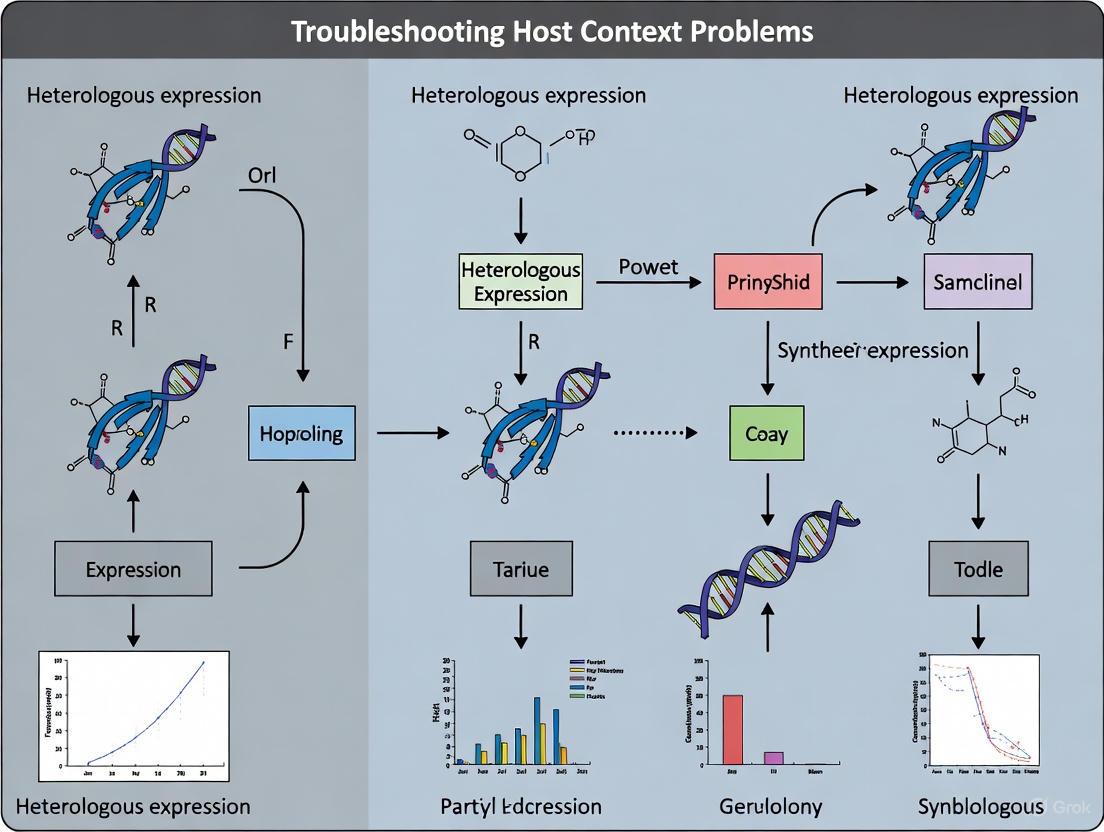
Heterologous expression is a cornerstone of biotechnology for producing therapeutics, enzymes, and for natural product discovery.
Solving the Puzzle: A Comprehensive Guide to Troubleshooting Host Context Problems in Heterologous Expression
Abstract
Heterologous expression is a cornerstone of biotechnology for producing therapeutics, enzymes, and for natural product discovery. However, success is frequently hampered by host context problems, where the foreign genetic material fails to function optimally in the new cellular environment. This article provides a systematic, intent-driven guide for researchers and scientists navigating these challenges. It covers the foundational principles of host selection, advanced methodological platforms, targeted troubleshooting strategies for common issues like low protein yield and incorrect folding, and validation techniques to confirm functional success. By integrating the latest research and platform technologies, this guide aims to equip professionals with the knowledge to diagnose, overcome, and prevent host context barriers, thereby accelerating bioproduction and drug development pipelines.
Understanding the Host Environment: Why Context is King in Heterologous Expression
Heterologous expression is a fundamental technique in biotechnology and drug development, involving the expression of a gene or gene fragment in a host organism that does not naturally possess it [1]. The success of this process is profoundly influenced by the host context—the specific biological, genetic, and environmental conditions of the chosen expression system. Selecting an inappropriate host or failing to account for its unique context is a primary cause of experimental failure, leading to issues such as low protein yield, improper folding, or a complete lack of expression. This guide is designed to help researchers systematically troubleshoot and resolve these common host context challenges.
Troubleshooting Guides & FAQs
FAQ: What are the most critical host-related factors to consider before starting a heterologous expression experiment?
The most critical factors are the origin of your gene of interest and the native capabilities of your host. Prokaryotic systems like E. coli are simple and cost-effective but often lack the machinery for essential post-translational modifications (e.g., glycosylation) that are required for the function of many eukaryotic proteins [1]. Furthermore, the codon usage of your gene must be compatible with the host's tRNA pool; a significant mismatch can lead to translation errors or premature termination [2].
FAQ: My protein is expressed in the host but is insoluble and forms inclusion bodies. What should I do?
This is a common issue, particularly when expressing proteins in large amounts in E. coli [1]. You can pursue several strategies:
- Reduce Expression Temperature: Shifting the growth temperature to 18-25°C can slow down translation, allowing more time for proper protein folding.
- Switch Host Systems: Consider moving to a eukaryotic host like yeast (e.g., P. pastoris) or a baculovirus-insect cell system, which offer better folding machinery and post-translational modifications [1].
- Use Solubility Enhancement Tags: Fuse your protein to tags like Maltose-Binding Protein (MBP) or GST, which can improve solubility and serve as a purification handle.
FAQ: I suspect codon bias is causing low expression yields. How can I confirm and fix this?
You can confirm this by using software tools to analyze the Codon Adaptation Index (CAI) of your gene sequence against the host's highly expressed genes. A low CAI indicates poor adaptation [2]. To resolve this, consider gene synthesis to design a "typical gene" where the codon usage is optimized to resemble that of the host's native, highly expressed genes, thereby improving translation efficiency [2].
FAQ: How do I choose between a prokaryotic and eukaryotic host system for my membrane protein?
For membrane proteins, eukaryotic hosts are generally more effective [1]. While E. coli is a popular default host, it lacks the complex lipid composition of eukaryotic membranes and the sophisticated machinery for inserting and folding multi-domain membrane proteins. Mammalian cells, while more costly and slower-growing, provide the most native-like environment for human membrane proteins. Baculovirus-infected insect cells offer a powerful compromise, providing many eukaryotic features with higher yields than mammalian systems [1].
Experimental Protocols for Diagnosing Host Context Issues
Protocol 1: Rapid Assessment of Protein Solubility
Purpose: To quickly determine if your heterologously expressed protein is soluble or has formed inclusion bodies.
Method:
- Harvest and Lyse: Harvest the host cells via centrifugation. Resuspend the cell pellet in a suitable lysis buffer (e.g., containing lysozyme for bacterial cells) and lyse using sonication or a homogenizer.
- Fractionate: Centrifuge the lysate at high speed (e.g., 12,000-15,000 x g for 20-30 minutes at 4°C). This separates the soluble fraction (supernatant) from the insoluble fraction (pellet).
- Analyze: Resuspend the insoluble pellet in the same volume of buffer as the supernatant. Analyze equal volumes of the total lysate, soluble fraction, and insoluble fraction by SDS-PAGE.
- Interpretation: If your protein is primarily in the pellet fraction, it has formed inclusion bodies and you should implement solubility enhancement strategies.
Protocol 2: Evaluating Host System Performance Using a Matrix-Based Approach
Purpose: To systematically compare the effectiveness of multiple heterologous hosts for expressing a specific biosynthetic gene cluster (BGC).
Method:
- Host Selection: Select a panel of well-characterized and engineered host strains. A modern approach might include a newly developed high-performance chassis like the Streptomyces sp. A4420 CH strain, alongside standard hosts like S. coelicolor M1152 and S. lividans TK24 [3].
- Strain Engineering: Engineer each host strain to express the same target BGC using consistent genetic constructs and integration methods (e.g., conjugation or transformation).
- Fermentation and Metabolite Analysis: Grow all engineered strains under standardized fermentation conditions. Harvest and extract metabolites.
- Comparative Analysis: Use analytical methods like LC-MS to detect and quantify the target natural product. Develop a scoring matrix involving multiple parameters (e.g., production yield, growth consistency, sporulation rate) to objectively compare host performance [3].
Table 1: Example Performance Matrix for Streptomyces Host Strains Expressing a Polyketide BGC
| Host Strain | Relative Yield (%) | Growth Robustness | Number of BGCs Successfully Expressed |
|---|---|---|---|
| Streptomyces sp. A4420 CH | 100 | High | 4 out of 4 |
| Streptomyces sp. A4420 WT | 60-80 | High | 3 out of 4 |
| S. coelicolor M1152 | 40-60 | Moderate | 2 out of 4 |
| S. lividans TK24 | 20-40 | Moderate | 2 out of 4 |
| S. albus J1074 | 10-30 | Moderate | 1 out of 4 |
Visualizing the Host Selection and Troubleshooting Workflow
The following diagram outlines a logical workflow for selecting a host system and troubleshooting common context-related failures.
Host Context Troubleshooting Workflow
The Scientist's Toolkit: Research Reagent Solutions
Table 2: Essential Reagents for Heterologous Expression Experiments
| Reagent / Material | Function / Application | Example Host Systems |
|---|---|---|
| E. coli BL21(DE3) | A workhorse strain for high-level protein expression with T7 RNA polymerase under IPTG control. | Escherichia coli |
| Bacillus subtilis | A Gram-positive host; does not produce endotoxins and can secrete proteins directly into the culture medium [1]. | Bacillus subtilis |
| Pichia pastoris | A methylotrophic yeast for high-density fermentation, capable of strong secretion and some post-translational modifications [1]. | Komagataella phaffii |
| Lentiviral Vectors | For stable integration and long-term expression of genes in mammalian cells, including non-dividing cells [1]. | Mammalian Cells (e.g., HEK293) |
| Codon-Optimized Genes | Synthetic genes designed to match the codon usage frequency of the host organism to maximize translation efficiency [2]. | All Systems |
| Lipofection Reagents | Form lipid-based nanoparticles that encapsulate DNA and fuse with cell membranes for efficient delivery [1]. | Mammalian Cells |
| Electroporation Apparatus | Uses a high-voltage pulse to create transient pores in cell membranes, allowing DNA to enter the cell [1]. | Bacteria, Yeast, Mammalian Cells |
| Hsd17B13-IN-67 | Hsd17B13-IN-67|HSD17B13 Inhibitor|For Research Use | Hsd17B13-IN-67 is a potent inhibitor of the lipid droplet-associated enzyme HSD17B13. For Research Use Only. Not for human or veterinary diagnostic or therapeutic use. |
| BTL peptide | BTL peptide, MF:C67H114N18O24, MW:1555.7 g/mol | Chemical Reagent |
Frequently Asked Questions (FAQs)
Q1: What are the most critical factors to consider when selecting a host for heterologous protein expression? The most critical factors include the origin and properties of the target protein (e.g., presence of disulfide bonds, post-translational modification requirements, and codon usage), the intended application (e.g., need for solubility vs. simple production for antibody generation), and the inherent strengths and limitations of the host system itself (e.g., secretion capability, growth speed, and cost) [4]. Matching the protein's native environment to the host's capabilities is paramount for success.
Q2: Our team is expressing a eukaryotic protein in E. coli, but the protein is consistently deposited in inclusion bodies. What strategies can we employ to obtain soluble, functional protein? This is a common challenge. You can pursue several strategies [4]:
- Modify Expression Conditions: Lowering the induction temperature (e.g., to 25-30°C or even as low as 10°C) and using a lower concentration of inducer can slow down protein synthesis, allowing more time for proper folding.
- Use Fusion Tags: Fusing your target protein to a solubility-enhancing tag, such as Maltose-Binding Protein (MBP) or glutathione S-transferase (GST), can improve solubility and proper folding.
- Co-express Chaperones: Co-expressing molecular chaperones (e.g., GroEL-GroES, DnaK-DnaJ-GrpE) in the same E. coli strain can assist in the folding of the heterologous protein.
- Switch the Host Strain: Some specialized E. coli strains are engineered for more robust disulfide bond formation (e.g., Origami strains) or possess chaperone plasmids.
Q3: We are experiencing protein truncation, especially in multi-domain cellulases, when using bacterial expression systems. What is the likely cause and how can it be addressed? Protein truncation, particularly the degradation of linker sequences in multi-domain enzymes like cellulases, is a known issue in E. coli [4]. This is often due to proteolytic degradation. Strategies to overcome this include [4]:
- Using E. coli strains deficient in specific proteases (e.g., ompT, lon proteases).
- Expressing the protein as a fusion construct that protects vulnerable regions.
- Switching to a different host system, such as a eukaryotic yeast, which may offer a more compatible proteolytic environment.
Q4: How can we improve the secretion yield of a recombinant protein from a gram-negative bacterial host like E. coli? Enhancing secretion in E. coli is challenging due to its double membrane. Effective methods include [4]:
- Signal Peptide Engineering: Testing different signal peptides compatible with the Sec or Tat secretion pathways.
- Fusion Proteins: Utilizing fusion partners like OsmY, which can facilitate transport across the outer membrane.
- Co-expression of Transport Machinery: Co-expressing proteins that form part of the host's secretion apparatus.
- Chemical Treatment: Mild periplasmic release techniques using EDTA or hyperosmotic shock can improve recovery of secreted proteins.
Q5: When is it advisable to choose a eukaryotic host system like yeast over a prokaryotic one like E. coli? A eukaryotic host like yeast (S. cerevisiae, P. pastoris) is highly advisable when the target protein [4]:
- Requires post-translational modifications (e.g., glycosylation, disulfide bond formation) for stability and activity.
- Is from a eukaryotic origin and is typically secreted.
- Has proven difficult to fold correctly in a prokaryotic cytoplasm.
- Needs to be expressed at a scale suitable for industrial applications, leveraging yeast's high-density fermentation capabilities.
Troubleshooting Guides
Problem 1: Low or No Protein Expression
| Potential Cause | Diagnostic Experiments | Recommended Solutions |
|---|---|---|
| Toxic Protein to Host | Monitor host cell growth pre- and post-induction. Use viability staining. | Use a tighter, inducible promoter (e.g., T7/lac). Decrease induction temperature and IPTG concentration. Use an auto-inducible medium [4]. |
| Inefficient Transcription/Translation | Perform RT-qPCR to check mRNA levels. Check for rare codons in the gene sequence. | Optimize the promoter strength. Use a codon-optimized gene sequence. Use a host strain engineered with plasmids for rare tRNAs [4]. |
| Plasmid Instability | Check plasmid copy number and integrity pre- and post-culture. | Use a different antibiotic selection marker. Use a high-stability origin of replication. Include a post-segregational killing system in the plasmid. |
Problem 2: Protein Insolubility (Inclusion Body Formation)
| Potential Cause | Diagnostic Experiments | Recommended Solutions |
|---|---|---|
| Rapid Protein Synthesis | Analyze solubility fractions (supernatant vs. pellet) via SDS-PAGE after different induction conditions. | Reduce growth temperature (e.g., to 18-25°C). Reduce inducer concentration. Use a weaker promoter [4]. |
| Lack of Folding Assistance | Compare solubility when co-expressing chaperones. | Co-express chaperone plasmids (e.g., GroEL/GroES, TF). Use strains with enhanced disulfide bond formation (e.g., Origami). Include a solubility-enhancing fusion tag (MBP, SUMO, GST) [4]. |
| Unfavorable Cytoplasmic Environment | Test expression in different cellular compartments (e.g., periplasm) using appropriate signal peptides. | Target the protein for secretion to the periplasm. Change the host species (e.g., to a yeast system). Optimize the lysis buffer conditions (pH, salt) [4]. |
Problem 3: Poor Biological Activity despite High Expression
| Potential Cause | Diagnostic Experiments | Recommended Solutions |
|---|---|---|
| Improper Folding | Compare the oligomeric state with a native standard via Size-Exclusion Chromatography (SEC). Check for correct disulfide bonds. | Refactor the gene to express only the functional domain. Co-express foldases like disulfide isomerase (DsbC). Switch to a host system that provides a more oxidizing environment (e.g., yeast, insect cells). |
| Lack of Essential Post-Translational Modifications | Analyze glycosylation status via enzymatic digestion or mass spectrometry. | Switch to a eukaryotic host (yeast, insect, or mammalian cells) capable of the required PTMs. Use a glyco-engineered yeast strain for human-like glycosylation. |
| Incorrect Protein Localization | Fractionate the cell (cytoplasm, membrane, periplasm) and assay for activity in each fraction. | Use a stronger or more compatible signal peptide for efficient secretion. Target the protein to a different cellular compartment. |
Experimental Protocols for Key Methodologies
Protocol 1: Small-Scale Expression Test for Solubility Screening This protocol is designed to quickly identify the best expression conditions for solubility in E. coli.
- Transformation: Transform the expression plasmid into a suitable E. coli strain (e.g., BL21(DE3)).
- Inoculation: Pick a single colony into 5 mL of LB medium with antibiotic. Grow overnight at 37°C, 220 rpm.
- Dilution: Dilute the overnight culture 1:100 into fresh, pre-warmed medium (in triplicate for each condition). Incubate at 37°C, 220 rpm.
- Induction: When OD600 reaches 0.6-0.8, induce expression by adding IPTG to a final concentration (e.g., 0.1 mM, 0.5 mM, 1.0 mM). Simultaneously, shift the incubation temperature for the different cultures (e.g., 37°C, 25°C, 18°C).
- Harvesting: Harvest cells by centrifugation (4,000 x g, 20 min, 4°C) 4-16 hours post-induction.
- Lysis & Fractionation: Resuspend pellets in lysis buffer. Lyse cells by sonication or lysozyme treatment. Centrifuge the lysate at high speed (15,000 x g, 30 min, 4°C) to separate the soluble (supernatant) and insoluble (pellet) fractions.
- Analysis: Analyze both fractions by SDS-PAGE to assess total expression and solubility.
Protocol 2: Assessing Secretion Efficiency in Yeast This protocol measures how effectively a recombinant protein is secreted into the culture supernatant by S. cerevisiae or P. pastoris.
- Culture Inoculation: Inoculate a single colony of the transformed yeast into a small volume of selective medium. Grow overnight at 30°C, 220 rpm.
- Induction & Scaling: Dilute the culture into fresh, induction-specific medium (e.g., methanol for P. pastoris) in a baffled flask. Continue incubation.
- Sampling: At regular intervals (e.g., 24, 48, 72 hours), aseptically remove 1 mL of culture.
- Clarification: Centrifuge the sample immediately (13,000 x g, 10 min, 4°C). Carefully transfer the supernatant to a new tube.
- Concentration (Optional): If the protein concentration is low, concentrate the supernatant using a centrifugal filter device.
- Analysis: Analyze the concentrated supernatant and the cell pellet (for intracellular protein) by SDS-PAGE and Western Blot or activity assay to determine the secretion efficiency.
Host Selection and Troubleshooting Workflow
The following diagram outlines a logical decision-making process for selecting an expression host and addressing common failures.
Troubleshooting Protein Insolubility
This diagram visualizes the primary strategies for resolving the common issue of inclusion body formation.
The Scientist's Toolkit: Essential Research Reagents & Materials
| Reagent/Material | Function & Application | Examples / Notes |
|---|---|---|
| Codon-Optimized Genes | Synthetic genes designed with host-preferred codons to maximize translation efficiency and yield [4]. | Essential for overcoming translational bottlenecks, especially when expressing genes from evolutionarily distant organisms. |
| Solubility-Enhancing Fusion Tags | Polypeptides fused to the target protein to improve its solubility and proper folding in the cytoplasm [4]. | Maltose-Binding Protein (MBP), Glutathione S-transferase (GST), Small Ubiquitin-like Modifier (SUMO). Can also aid in purification. |
| Molecular Chaperone Plasmids | Plasmids encoding chaperone proteins that are co-expressed to assist in the folding of the heterologous protein, reducing aggregation [4]. | Plasmids for GroEL/GroES, DnaK/DnaJ/GrpE, and TF in E. coli. |
| Specialized E. coli Strains | Engineered strains that address specific expression challenges like disulfide bond formation, membrane protein expression, or protease deficiency [4]. | Origami (disulfide bonds), C41/C43 (membrane proteins), BL21(DE3) pLysS (tight control, protease reduction). |
| Inducible Promoters | DNA sequences that control the initiation of transcription and can be "turned on" by a chemical or environmental signal, allowing control over expression timing [4]. | T7 lac, araBAD (in E. coli); AOX1 (in P. pastoris). Tight control can prevent toxicity from premature expression. |
| Signal Peptides | Short peptide sequences fused to the N-terminus of a protein to direct its transport through the secretory pathway [4]. | PelB, OmpA (for bacterial periplasm); α-factor (for yeast secretion). Choice of signal peptide critically impacts secretion efficiency. |
| Vitexin caffeate | Vitexin Caffeate|High-Purity Reference Standard | Vitexin caffeate is a flavonoid derivative for research use only (RUO). Explore its applications in oncology, neuroscience, and biochemistry. Not for human consumption. |
| Muc5AC-3 | Muc5AC-3 Glycopeptide|MUC5AC Research Reagent | Muc5AC-3 is a synthetic, O-glycosylated 16-amino acid glycopeptide for mucin research. This product is For Research Use Only. Not for human or veterinary use. |
Selecting an appropriate host organism is a critical first step in the successful heterologous expression of recombinant proteins. The choice fundamentally influences every subsequent aspect of the experimental workflow, from vector design to protein purification. Within the context of troubleshooting host-related issues, understanding the inherent strengths and limitations of the most common platforms is paramount. This guide provides a systematic comparison of three major workhorse hosts: Escherichia coli (a prokaryotic bacterium), Yeasts (single-celled eukaryotes, e.g., Saccharomyces cerevisiae, Komagataella phaffii), and Actinomycetes (Gram-positive bacteria, e.g., Streptomyces spp.). Our goal is to equip researchers with the knowledge to make an informed initial selection and to effectively troubleshoot the predictable challenges associated with each system.
Host Comparison at a Glance
The table below summarizes the key characteristics of E. coli, yeast, and actinomycetes to aid in initial host selection.
| Feature | E. coli | Yeast | Actinomycetes |
|---|---|---|---|
| Organism Type | Gram-negative bacterium | Eukaryote, fungus | Gram-positive bacterium (High G+C) |
| Typical Yield | High (often >100 mg/L) [5] | Variable; can be high with optimized systems [6] | Variable; reported up to ~400 mg/L for some proteins in Streptomyces [7] |
| Growth Speed | Very rapid (doubling ~20 min) | Moderate (doubling ~90 min) | Slow (doubling can be several hours) [7] |
| Genetic Tools | Extensive, well-established, and versatile [5] | Extensive for S. cerevisiae; developing for non-conventional yeasts [6] | Available but less extensive than E. coli; often strain-specific [7] [8] |
| Cost of Cultivation | Low | Low to Moderate | Low to Moderate |
| Post-Translational Modifications | Limited; lacks eukaryotic glycosylation machinery [6] | Capable of many, including glycosylation (but differs from mammalian patterns) [6] | Capable of some modifications; good for disulfide bond formation and bacterial-style modifications [7] |
| Secretion Efficiency | Can target to periplasm; true secretion is rare [9] | Naturally proficient at secreting proteins [6] | Highly efficient secretion systems for many species [7] |
| Ideal Use Case | High-yield production of non-glycosylated, prokaryotic proteins; rapid screening [9] [5] | Production of eukaryotic proteins requiring folding, disulfide bonds, or basic glycosylation; secreted production [6] | Production of complex bacterial natural products (e.g., polyketides), secreted enzymes, and proteins from high G+C bacteria [7] [8] |
Troubleshooting Common Host-Specific Problems
E. coli: The Workhorse with Folding and Toxicity Challenges
Problem 1: The target protein is expressed but forms insoluble inclusion bodies.
- Question: My protein is expressed at a high level according to SDS-PAGE, but it's all in the pellet fraction after centrifugation. How can I recover functional, soluble protein?
- Answer: This is a classic issue in E. coli, often caused by rapid expression that overwhelms the host's folding machinery [10] [5].
- Slow things down: Reduce the induction temperature (e.g., to 18-25°C) and/or lower the concentration of the inducer (e.g., IPTG) [10]. This slows the rate of synthesis, allowing the chaperone systems more time to fold the protein correctly.
- Co-express chaperones: Co-express plasmid systems that overproduce molecular chaperones like GroEL/GroES or DnaK/DnaJ/GrpE. Commercially available chaperone plasmid sets (e.g., from Takara) can be tested [10].
- Use fusion tags: Clone your gene as a fusion with a solubility-enhancing partner such as Maltose-Binding Protein (MBP), Glutathione-S-Transferase (GST), or Thioredoxin (Trx) [10] [9]. These can improve solubility and also aid in purification.
- Target to the periplasm: Use a signal sequence (e.g., pelB, ompA) to direct the protein to the oxidizing environment of the periplasm, which can facilitate proper disulfide bond formation [9].
Problem 2: No expression is detected, or the expressed protein is toxic to the host cells.
- Question: My cultures fail to grow after induction, or growth is severely stunted, and I cannot detect my protein. What could be happening?
- Answer: This is often a sign of protein toxicity, where the heterologous protein interferes with essential host processes [5].
- Use a tighter promoter: Switch to a more tightly regulated expression system. The pET system with T7 RNA polymerase is common, but basal expression can be problematic. Use strains like BL21(DE3)pLysS, which expresses T7 lysozyme to inhibit basal transcription [9] [5].
- Try different E. coli strains: Specialized strains like C41(DE3) and C43(DE3) were evolved from BL21(DE3) to better tolerate the expression of toxic membrane proteins [5].
- Optimize codon usage: Check the gene sequence for codons that are rare in E. coli. These can cause ribosomal stalling, truncation, and toxicity. Use gene synthesis to optimize the codon usage for E. coli or use strains like Rosetta that supply tRNAs for rare codons [10] [5].
Yeast: Balancing Eukaryotic Complexity with Simplicity
Problem 1: Protein expression levels are low despite a good construct.
- Question: I have cloned my gene into a yeast expression vector, but the yield is disappointingly low. What strategies can boost expression?
- Answer: Low yields in yeast can stem from promoter strength, plasmid stability, or the gene sequence itself.
- Choose a stronger promoter: Do not rely solely on a constitutive promoter like ADH1. For high-level expression, use strong inducible promoters such as the alcohol oxidase 1 promoter (AOX1) in K. phaffii (induced by methanol) or the galactose-inducible (GAL1/GAL10) promoters in S. cerevisiae [6] [9].
- Select the right vector type: Ensure you are using an appropriate plasmid. For high-copy, stable maintenance, use Yeast Episomal Plasmids (YEp) based on the 2-micron circle. For single-copy stability, use Yeast Centromere Plasmids (YCp) [11].
- Optimize the secretion signal: If secreting the protein, the choice of signal peptide is critical. Common choices include the α-mating factor pre-pro leader. Inefficient cleavage or secretion can limit yields. Testing different signal sequences can be highly beneficial [6].
Problem 2: The purified protein has incorrect or heterogeneous glycosylation.
- Question: My protein is expressed and secreted, but the glycosylation pattern is non-human or inconsistent, potentially affecting its activity and therapeutic applicability.
- Answer: This is a well-known limitation of yeast systems, as they produce high-mannose type glycosylation, unlike the complex glycosylation in mammalian cells [6].
- Use glyco-engineered yeast strains: A major advancement has been the creation of engineered yeast strains (e.g., in K. phaffii) where the native glycosylation pathway has been modified to produce human-like, complex N-glycans [6].
- Consider a different yeast host: Some non-conventional yeasts, like Kluyveromyces lactis, may have glycosylation patterns that are more suitable for your specific protein than S. cerevisiae [6].
Actinomycetes: Harnessing a Powerful but Finicky Host
Problem 1: Getting DNA into the host and achieving expression is inefficient.
- Question: The genetic tools for my actinomycete host seem limited compared to E. coli. How can I improve transformation and ensure my gene is expressed?
- Answer: Actinomycetes can have tough cell walls and restriction-modification systems that hinder transformation.
- Use a dedicated shuttle vector: Employ E. coli-Actinomycete shuttle vectors that contain a replicon functional in the chosen host (e.g., derived from SCP2, pIJ101) and an E. coli origin (like ColE1) for easy cloning [7] [8].
- Employ a strong, inducible promoter: Don't assume native promoters will be strong. Use well-characterized, heterologous inducible promoters such as the thiostrepton-inducible
tipApromoter or the ε-caprolactam-induciblePnitApromoter from Rhodococcus, which has been shown to drive hyper-expression in some Streptomyces [12] [7]. - Use a restriction-deficient strain: When possible, use strains like Streptomyces lividans, which lacks certain restriction systems, making it more amenable to genetic manipulation with foreign DNA [7].
Problem 2: I am expressing a biosynthetic gene cluster (BGC) for a natural product, but no product is detected.
- Question: I have successfully cloned a large BGC into an actinomycete host, but the expected secondary metabolite is not being produced. How can I activate it?
- Answer: This is common with heterologous expression of BGCs, as the native regulatory context is often lost.
- Ensure optimal expression of pathway regulators: Many BGCs contain pathway-specific regulatory genes (e.g., activators). Replace the native promoter of these regulatory genes with a strong, constitutive heterologous promoter (e.g.,
ermE*) to ensure they are adequately expressed in the new host. This has been shown to increase product yield by up to 100-fold [12]. - Choose a "clean" heterologous host: Use a host with a minimal background of secondary metabolites, such as Streptomyces albus, to simplify detection and avoid interference from host-derived compounds [8].
- Utilize advanced cloning techniques: For large BGCs (>50 kb), consider using specialized systems like Transformation-Associated Recombination (TAR) in yeast, BAC vectors, or Integrase-Mediated Recombination (IR) to ensure intact, stable cloning of the entire cluster [13] [8].
- Ensure optimal expression of pathway regulators: Many BGCs contain pathway-specific regulatory genes (e.g., activators). Replace the native promoter of these regulatory genes with a strong, constitutive heterologous promoter (e.g.,
Essential Reagents and Research Tools
The table below lists key reagents and materials referenced in the troubleshooting guides above.
| Reagent / Tool | Function | Example Use Cases |
|---|---|---|
| pET Expression System | T7 RNA polymerase-driven, high-level expression in E. coli [9] [5] | Standard, high-yield cytoplasmic protein production. |
| Chaperone Plasmid Sets | Co-expression of folding assistants to improve solubility [10] | Rescuing proteins that form inclusion bodies. |
| Rosetta / Codon Plus E. coli | Supply tRNAs for rare codons not commonly found in E. coli [10] [5] | Expressing genes from eukaryotic or high G+C organisms. |
| pGEX / pMAL Vectors | Fusion protein systems for solubility and affinity purification (GST, MBP) [10] [9] | One-step purification and solubility enhancement. |
| pPIC Vectors (K. phaffii) | Methanol-inducible expression and secretion using the AOX1 promoter [6] [9] | High-level secreted expression of eukaryotic proteins. |
| TAR Cloning System | In vivo assembly of large DNA fragments in yeast [13] [8] | Cloning entire biosynthetic gene clusters (>50 kb). |
| ermE* Promoter | Strong, constitutive promoter for use in actinomycetes [12] | Driving high-level expression of activator genes or target enzymes. |
| tipA Promoter | Thiostrepton-inducible promoter for Streptomyces [12] [7] | Tightly regulated, inducible expression in actinomycetes. |
Experimental Workflow for Host Selection
The following diagram outlines a logical decision-making process for selecting an expression host and troubleshooting initial failures, based on the protein's characteristics and project goals.
There is no single "best" host for heterologous expression. The optimal choice is a strategic balance between the protein's inherent properties and the project's requirements for yield, authenticity, and timeline. E. coli remains the king of speed and yield for simpler proteins, while yeast offers a superb balance of eukaryotic functionality and ease of use. Actinomycetes, though more specialized, are unparalleled for expressing complex bacterial natural products. A methodical approach to host selection, informed by the common pitfalls and solutions outlined in this guide, will significantly increase the likelihood of successful recombinant protein production. When one system fails, the structured troubleshooting steps provided here, combined with the willingness to try an alternative host, often pave the path to success.
The shift towards Streptomyces and fungal chassis for heterologous expression represents a pivotal evolution in biotechnology, moving beyond the traditional E. coli model to access complex natural products and proteins. This transition is driven by the need to express large, sophisticated biosynthetic gene clusters (BGCs) and recombinant proteins that require specialized cellular machinery, post-translational modifications, and specific metabolic precursors. However, working with these complex hosts introduces unique technical challenges. This technical support center provides targeted troubleshooting guides and FAQs to help researchers navigate the specific host-context problems encountered when utilizing Streptomyces and fungal systems, thereby enabling more efficient and successful heterologous expression experiments.
Troubleshooting Guide: Common Host-Specific Challenges
This section addresses the most frequent technical obstacles and their evidence-based solutions, as identified in recent literature.
Streptomyces Chassis Troubleshooting
Table: Troubleshooting Streptomyces Heterologous Expression
| Problem | Potential Cause | Recommended Solution | Key Research Example |
|---|---|---|---|
| Low or no product yield | Native BGCs competing for precursors and resources. [3] | Delete multiple native polyketide BGCs to create a metabolically simplified chassis strain. [3] | Engineered Streptomyces sp. A4420 CH strain with 9 deleted native BGCs successfully expressed 4 distinct polyketides where other hosts failed. [3] |
| Low BGC expression | Inefficient transcription/translation; lack of optimal regulatory elements. | Introduce point mutations in ribosomal proteins (e.g., rpsL) and RNA polymerase (e.g., rpoB) to globally enhance expression. [3] [14] | S. coelicolor M1152 (with rpoB mutation) and M1154 (with rpoB and rpsL mutations) showed 20-40-fold yield increases. [3] |
| Inefficient DNA transfer & integration | Instability of cloned DNA in E. coli; limited genomic integration sites in host. [15] | Use improved E. coli donor strains (e.g., Micro-HEP platform) and chassis with multiple orthogonal recombinase-mediated cassette exchange (RMCE) sites. [15] | The Micro-HEP system enabled stable transfer and multi-copy integration of BGCs, boosting xiamenmycin production. [15] |
Fungal Chassis Troubleshooting
Table: Troubleshooting Fungal Heterologous Expression
| Problem | Potential Cause | Recommended Solution | Key Research Example |
|---|---|---|---|
| Suboptimal protein secretion | Weak promoter, inefficient signal peptide, or suboptimal 5'UTR. [16] | Systematically screen and combine strong constitutive promoters (e.g., Ppdc), engineered 5'UTRs (e.g., NCA-7d), and efficient signal peptides. [16] | In M. thermophila, the combination of Ppdc, NCA-7d 5'UTR, and native signal peptide increased laccase activity to over 1700 U/L. [16] |
| Unwanted pelleted morphology | Hyphal coagulation and aggregation leading to diffusion limitations and hypoxia. [17] | Genetically engineer strains to control morphology by regulating genes involved in hyphal growth and coagulation (e.g., pkh2). [17] | A library of A. niger strains with conditional expression of morphology-associated genes allowed titratable control of pellet formation. [17] |
| Proteolytic degradation of product | High native extracellular protease activity. | Use host strains with deletions of major extracellular protease genes (e.g., ΔMtalp1 in M. thermophila). [16] | The ΔMtalp1 mutant of M. thermophila was used as a host to prevent potential hydrolysis of the recombinant laccase. [16] |
Frequently Asked Questions (FAQs)
Q1: Why should I consider a Streptomyces host over E. coli for expressing natural product BGCs?
Streptomyces offers several critical advantages for expressing complex BGCs, particularly those from actinomycetes. Its high GC-content genome is more compatible with GC-rich actinomycete DNA, reducing the need for codon optimization. [18] More importantly, Streptomyces provides a specialized metabolic background with the necessary precursors (e.g., acyl-CoAs), post-translational modification enzymes, and self-resistance mechanisms that are often essential for the functional expression of large, modular enzymes like polyketide synthases (PKSs) and non-ribosomal peptide synthetases (NRPSs). [18] Its efficient protein secretion system also facilitates the production of correctly folded, disulfide-bonded proteins. [18]
Q2: What are the key genetic features of an optimized Streptomyces chassis strain?
A modern, high-performance Streptomyces chassis typically incorporates several key genetic modifications:
- Deletion of Native BGCs: Removal of multiple endogenous BGCs reduces metabolic burden and background interference, simplifying the detection of heterologous products. [3] [15]
- Introduction of Regulatory Mutations: Beneficial mutations in genes like rpoB (RNA polymerase) and rpsL (ribosomal protein S12) globally enhance transcription and translation of heterologous pathways. [3] [14]
- Engineered Attachment Sites: Incorporation of multiple, orthogonal integration sites (e.g., attB sites for ΦC31, loxP, vox, rox) allows for stable, multi-copy integration of BGCs. [15]
Q3: How can I control fungal morphology in submerged fermentations, and why is it important?
Fungal morphology (dispersed mycelia vs. pellets) profoundly impacts product titers and bioreactor rheology. Pelleted growth can cause internal hypoxia, limiting growth and production, while dispersed growth increases medium viscosity. [17] Control strategies include:
- Abiotic Parameters: Adjusting inoculum concentration, stir speed, pH, and adding mineral ions or surfactants. [17]
- Genetic Engineering: Creating chassis strains with defined morphology by manipulating genes involved in hyphal growth, branching, and coagulation. For example, conditional expression of the kinase-encoding gene pkh2 in A. niger can decouple fitness from pellet morphology. [17]
Q4: What strategies can enhance the yield of recombinant proteins in fungal systems?
Maximizing protein yield in fungi requires a multi-faceted approach focusing on expression and secretion:
- Strong Promoters: Use strong, constitutive promoters like Ppdc (pyruvate decarboxylase) or Ptef1 (elongation factor 1-alpha). [16]
- Optimized Leaders: Employ engineered 5' untranslated regions (5'UTRs) that enhance mRNA stability and translation efficiency. [16]
- Efficient Secretion Signals: Utilize native signal peptides proven to drive high-level secretion for your target protein or host. [16]
- Protease Reduction: Use host strains with deletions of major extracellular proteases to minimize product degradation. [16]
Essential Experimental Protocols
Protocol: Engineering a High-Yield Streptomyces Chassis
This protocol outlines the creation of a metabolically optimized host, based on the development of the Streptomyces sp. A4420 CH strain and the S. coelicolor A3(2)-2023 strain. [3] [15]
Key Reagents:
- Host Strain: A well-characterized Streptomyces species (e.g., S. coelicolor, S. lividans, or Streptomyces sp. A4420).
- Vector System: Suicide vectors for gene deletion (e.g., pKC1132-based vectors) and integrating vectors for introducing attB sites.
- Culture Media: Suitable liquid and solid media for normal growth and sporulation (e.g., SFM, ISP2).
Methodology:
- Genome Sequencing and Analysis: Sequence the parental strain and use bioinformatics tools like antiSMASH to identify all native BGCs. [3]
- Design Deletion Strategy: Prioritize the deletion of large, metabolically costly BGCs, particularly those that interfere with analytical detection (e.g., pigment producers).
- Sequential BGC Deletion:
- For each target BGC, construct a deletion vector containing ~2 kb homology arms flanking a selectable marker (e.g., apramycin resistance).
- Introduce the vector into the host via conjugation from E. coli and select for single-crossover integrants.
- Allow for a second crossover event and screen for double-crossover mutants that have lost the vector backbone but retain the deleted BGC.
- Verify each deletion by PCR.
- Introduce Beneficial Mutations: Introduce point mutations like rpoB (rifampicin resistance) or rpsL (streptomycin resistance) via similar homologous recombination methods to globally enhance expression. [3]
- Engineer Genomic Integration Sites: Introduce orthogonal attachment sites (e.g., loxP, vox, rox) into "safe havens" in the genome using CRISPR-Cas9 or other genome editing tools to enable future multi-copy, RMCE-based integration of heterologous BGCs. [15]
Protocol: Optimizing Protein Secretion in a Fungal Host
This protocol, adapted from work in Myceliophthora thermophila, describes a systematic pipeline for maximizing recombinant protein secretion. [16]
Key Reagents:
- Reporter Gene: A gene encoding an easily assayed extracellular enzyme, such as a laccase (lcc1).
- Expression Elements: A library of strong constitutive promoters (e.g., Ptef1, Ppdc, Phsp30), various 5'UTRs, and different signal peptides.
- Host Strain: A protease-deficient strain (e.g., ΔMtalp1) is recommended.
Methodology:
- Promoter Screening:
- Construct expression cassettes where your reporter gene is placed under the control of different candidate promoters.
- Transform the cassettes into your fungal host and isolate multiple transformants for each construct.
- Measure the enzymatic activity in the culture supernatant of each transformant to identify the strongest promoter.
- 5'UTR Engineering:
- Fuse the best-performing promoter with a panel of different 5'UTR sequences upstream of the reporter gene.
- Repeat the transformation and activity assay. The 5'UTR can dramatically influence mRNA stability and translation efficiency.
- Signal Peptide Testing:
- Fuse the optimal promoter-5'UTR combination with the coding sequences for different signal peptides (both native and heterologous).
- Compare the levels of secreted protein activity to identify the most efficient signal peptide for your target protein.
- Validation and Scale-Up: Ferment the best-performing engineered strain in a bioreactor to validate high-level production under controlled conditions.
The Scientist's Toolkit: Key Research Reagents
Table: Essential Reagents for Advanced Heterologous Expression
| Reagent / Tool | Function | Application Example |
|---|---|---|
| Micro-HEP Platform [15] | A bifunctional E. coli system for stable modification and conjugation transfer of large BGCs into Streptomyces. | Addresses DNA instability in standard E. coli donors (e.g., ET12567/pUZ8002) during cloning and conjugation. [15] |
| Orthogonal RMCE Systems [15] | Suite of tyrosine recombinase systems (Cre-loxP, Vika-vox, Dre-rox) for precise, multi-copy, marker-free genomic integration. | Enables simultaneous integration of multiple BGC copies at dedicated genomic loci in S. coelicolor A3(2)-2023, boosting product yield. [15] |
| Morphology-Engineered Fungal Library [17] | A collection of fungal strains (e.g., A. niger) with conditional expression of morphology genes for controllable growth forms. | Allows researchers to rapidly screen for the optimal macromorphology (pellet vs. dispersed) for their specific product. [17] |
| Laccase Gene Reporting System [16] | A rapid screening method using extracellular laccase activity to identify optimal expression elements. | Used in M. thermophila to efficiently screen promoters, 5'UTRs, and signal peptides by visualizing activity on indicator plates. [16] |
| Gpx4/cdk-IN-1 | Gpx4/cdk-IN-1 is a dual GPX4 and CDK inhibitor that induces ferroptosis and cell cycle arrest. This product is for research use only (RUO) and not for human or veterinary diagnosis or therapeutic use. | |
| TLR8 agonist 6 | TLR8 agonist 6, MF:C19H29N7O2, MW:387.5 g/mol | Chemical Reagent |
Workflow and Pathway Visualizations
Streptomyces Chassis Engineering and Expression Workflow
Diagram: Streptomyces Chassis Engineering and Expression Workflow. This flowchart outlines the key steps for constructing a high-performance Streptomyces chassis and using it for heterologous expression of biosynthetic gene clusters (BGCs), incorporating strategies like BGC deletion and recombinase-mediated cassette exchange (RMCE). [3] [15]
Fungal Protein Secretion Optimization Pathway
Diagram: Fungal Protein Secretion Optimization Pathway. This workflow demonstrates the iterative process of enhancing recombinant protein secretion in filamentous fungi by systematically testing and combining optimal genetic elements. [16]
FAQs: Core Concepts and Troubleshooting
Q1: What are the major types of barriers in heterologous protein expression? Heterologous protein expression faces a multi-layered challenge. The primary barriers exist at three key regulatory levels:
- Transcriptional Barriers: Inefficiencies in the promoter driving the expression of your gene of interest, or competition from native cellular transcription factors [19].
- Translational Barriers: Issues during the protein synthesis process, including ribosome pausing at rare codons, mRNA instability, and the immense metabolic burden imposed on the host cell's machinery [20] [21].
- Post-Translational Barriers: The failure of the host cell to properly fold, modify, or localize the protein, often leading to destructive protein misfolding and aggregation [22] [23] [24].
Q2: Why is my protein not being expressed, even though the gene is present? This is a classic symptom of a transcriptional barrier. The most common cause is the use of a weak or poorly regulated promoter. Furthermore, even with a strong promoter, native transcription factors can bind to it and either inhibit or enhance its activity in unpredictable ways. For example, in P. pastoris, transcription factors like Loc1p and Msn2p have been identified as inhibitors of the common pGAP promoter [19].
Q3: My mRNA is detected, but the protein yield is low. What could be wrong? This points to a translational barrier. Key factors to investigate include:
- Codon Usage: The presence of rare codons incompatible with the host's tRNA pool can cause ribosome stalling, reducing efficiency and potentially triggering mRNA degradation [20].
- Metabolic Burden: The high energy demand of producing a foreign protein can overwhelm the host, leading to a global downregulation of translation and growth to conserve resources [21].
- mRNA Stability: The lack of a proper 5' cap or poly-A tail, or the action of microRNAs, can lead to rapid degradation of the mRNA before it is fully translated [25].
Q4: My protein is expressed but is insoluble or inactive. How can I fix this? This is a clear indication of post-translational barriers. The cellular machinery is failing to produce a functional protein. Causes include:
- Misfolding and Aggregation: The protein may not be folding into its correct native conformation, causing it to form toxic insoluble aggregates [23] [24].
- Lack of Essential PTMs: The host may lack the enzymes to perform necessary modifications like specific glycosylation patterns or phosphorylation, which are critical for the activity and stability of many eukaryotic proteins [22] [21].
- Saturation of Quality Control: Overexpression can overwhelm the chaperone and proteasome systems, preventing proper folding and degradation of faulty proteins [23] [24].
Troubleshooting Guides
Guide 1: Diagnosing and Resolving Transcriptional Barriers
Symptoms: No mRNA detected, or mRNA levels are low despite confirmed gene integration.
| Step | Investigation | Solution |
|---|---|---|
| 1 | Promoter Strength | Switch to a stronger, well-characterized promoter (e.g., pAOX1 for inducible expression in P. pastoris). Consider a promoter library to find the optimal strength [19]. |
| 2 | Transcription Factor Interference | Use transcriptome analysis and databases like YEASTRACT to identify inhibitory transcription factors. Engineer knockout strains to remove these barriers [19]. |
| 3 | Gene Copy Number | Verify the gene copy number and integration site. Consider using a multi-copy integration strategy if a single copy is insufficient. |
Experimental Protocol: Identifying Inhibitory Transcription Factors
- Strain Comparison: Perform RNA-seq transcriptome analysis on your low-producing strain and a control strain.
- In Silico Prediction: Use the promoter sequence of your expression vector (e.g., pGAP) in a database like YEASTRACT to predict potential transcription factor binding sites (TFBS) [19].
- Target Selection: Cross-reference the transcriptome data with the TFBS prediction. Select transcription factor genes that are significantly differentially expressed.
- Validation: Create knockout and overexpression strains for the candidate transcription factors.
- Assay Activity: Measure the activity of your reporter protein (e.g., xylanase) in the engineered strains. A significant increase in yield upon knockout confirms an inhibitory factor [19].
Guide 2: Diagnosing and Resolving Translational Barriers
Symptoms: mRNA is present, but protein yield is low. Cell growth is severely impaired, indicating high burden.
| Step | Investigation | Solution |
|---|---|---|
| 1 | Codon Optimization | Use gene synthesis to optimize the coding sequence for the host's codon usage bias, paying special attention to the first 10-15 codons [20]. |
| 2 | Ribosome Pausing | Analyze the sequence for known pause-inducing motifs (e.g., poly-proline tracts, specific rare codon clusters) and redesign those regions [20]. |
| 3 | Reduce Metabolic Burden | Use an inducible expression system to separate growth and production phases. Engineer host metabolism to enhance energy and precursor supply [21]. |
Experimental Protocol: Analyzing Ribosome Pausing and Its Impact
- Ribosome Profiling: Perform ribosome profiling (Ribo-seq) on your expressing strain. This technique provides a genome-wide snapshot of ribosome positions, revealing where pauses occur [20].
- Sequence Correlation: Correlate ribosome pause sites with specific codon usage or mRNA secondary structures in your gene of interest.
- Codon Replacement: Systematically replace the identified problematic codons with optimal synonyms.
- Validate Improvement: Re-run the ribosome profiling and protein yield assays on the optimized construct to confirm increased translational efficiency and protein production [20].
Guide 3: Diagnosing and Resolving Post-Translational Barriers
Symptoms: Protein is produced but is found in insoluble aggregates (inclusion bodies) or is inactive due to incorrect modification.
| Step | Investigation | Solution |
|---|---|---|
| 1 | Aggregation Propensity | Analyze the protein sequence for aggregation-prone regions. Consider targeted mutations to improve solubility. |
| 2 | Chaperone Co-expression | Co-express molecular chaperones (e.g., Hsp70, Hsp90, or trigger factor) to assist with proper folding and prevent aggregation [23] [24]. |
| 3 | Host Selection | If PTMs are incorrect, switch to a more advanced eukaryotic host (e.g., P. pastoris, mammalian cells) that can perform the required modifications [21]. |
Experimental Protocol: Assessing and Preventing Protein Aggregation
- Fractionation: Lyse the cells and separate the soluble and insoluble fractions via centrifugation.
- Detection: Run SDS-PAGE and a Western blot on both fractions to determine if your protein is in the soluble fraction or the inclusion body pellet.
- Chaperone Screening: Co-express a library of different chaperone proteins (e.g., Hsp104, Hsp70, Hsp40) in your production strain [23] [24].
- Activity Assay: Re-run the fractionation and blot. Test the soluble fraction for protein activity to confirm that the chaperone not only improved solubility but also helped the protein fold correctly.
Data Presentation: Quantitative Barrier Analysis
| Transcription Factor | Manipulation | Effect on Promoter Activity | Resulting Fold-Change in Protein Expression* |
|---|---|---|---|
| Loc1p | Knockout | Increased | Up to 1.96-fold increase |
| Msn2p | Knockout | Increased | Up to 2.43-fold increase |
| Gsm1p | Overexpression | Increased | Up to 2.20-fold increase |
| Hot1p | Overexpression | Increased | Up to 1.65-fold increase |
*Model protein: Xylanase. Combined manipulation of factors showed additive effects.
| Source of Burden | Impact on Host Cell | Consequence for Protein Production |
|---|---|---|
| Resource Competition (Nucleotides, Amino Acids) | Depletion of precursors for growth and native proteins | Reduced cell growth and viability; lower overall protein titer |
| Energy Consumption (ATP) | High demand for transcription, translation, and folding | Metabolic stress; potential activation of stress responses that inhibit production |
| Ribosome Engagement | Saturation of translational machinery | Slowed global translation rates; increased error frequency |
| Secretory Pathway Saturation | Overloading of ER and Golgi | Mislocalization, aggregation, and degradation of the secretory protein |
Pathway and Workflow Visualizations
Diagram 1: Multi-level Barriers in Heterologous Expression
Heterologous Expression Barrier Cascade
Diagram 2: Transcriptional Barrier & Engineering Strategy
Transcriptional Inhibition and Resolution
Diagram 3: Workflow for Systematic Troubleshooting
Systematic Troubleshooting Workflow
The Scientist's Toolkit: Key Research Reagent Solutions
Table 3: Essential Reagents for Barrier Investigation and Mitigation
| Reagent / Tool | Function & Application | Example Use Case |
|---|---|---|
| Promoter Library | A set of promoters with varying strengths. | Identifying the optimal transcriptional drive for a specific protein to balance yield and burden [19]. |
| Codon-Optimized Gene | A synthetic gene sequence designed with the host's preferred codons. | Overcoming translational barriers caused by rare codons and improving protein yield [20]. |
| Molecular Chaperones | Proteins that assist in the folding of other polypeptides (e.g., Hsp70, Hsp104). | Co-expressed to prevent aggregation and improve solubility of difficult-to-express proteins [23] [24]. |
| Proteasome Inhibitors (e.g., MG132) | Chemicals that inhibit the proteasome degradation machinery. | Used experimentally to determine if a low-yield protein is being rapidly degraded after synthesis [23]. |
| RNA-seq / Ribo-seq | Next-generation sequencing techniques. | RNA-seq maps the transcriptome to check mRNA levels. Ribo-seq maps ribosome positions to identify translational pausing [19] [20]. |
| Knockout / Overexpression Strains | Engineered host strains with specific genes deleted or overexpressed. | Validating the role of specific transcription factors or chaperones as barriers or helpers in expression [19]. |
| A2AR/A2BR antagonist 1 | A2AR/A2BR antagonist 1, MF:C24H17N9, MW:431.5 g/mol | Chemical Reagent |
| Icmt-IN-25 | Icmt-IN-25|ICMT Inhibitor|For Research Use | Icmt-IN-25 is a potent ICMT inhibitor for cancer research. It targets Ras protein maturation. This product is For Research Use Only. Not for human or veterinary use. |
Building a Robust System: Modern Platforms and Genetic Toolkits for Successful Expression
Troubleshooting Guide: Micro-HEP inStreptomyces
Frequently Asked Questions
Q1: Our research group is experiencing low conjugation efficiency when transferring large Biosynthetic Gene Clusters (BGCs) from E. coli to our Streptomyces chassis. What could be the cause and how can we improve this?
A: Low conjugation efficiency, especially with large BGCs, is a common challenge. The traditional system, E. coli ET12567 (pUZ8002), is known to have limitations with the stability of repeated sequences, which can lead to incorrect exconjugants or failed transfers [15].
- Solution: Implement the improved E. coli strains from the Micro-HEP platform. These strains are engineered for superior stability of repeat sequences and offer higher efficiency for the modification and conjugative transfer of foreign BGCs [15].
- Actionable Protocol: When cloning BGCs with repetitive sequences, use the Micro-HEP's bifunctional E. coli strains that feature a rhamnose-inducible
redαβγrecombination system. This system facilitates the precise insertion of RMCE cassettes and enhances the overall stability of the construct prior to conjugation [15].
Q2: After successful integration, the yield of our target natural product is still very low. What strategies can we use to enhance expression?
A: Low yield can stem from various factors, including low gene dosage or metabolic burden on the host.
- Solution 1: Implement Copy Number Amplification. A key advantage of the Micro-HEP platform is the use of Recombinase-Mediated Cassette Exchange (RMCE) for multi-copy integration. Research has demonstrated that increasing the copy number of a BGC can directly correlate with increased product yield. For example, integrating two to four copies of the xiamenmycin (
xim) BGC led to a rising yield of xiamenmycin [15]. - Solution 2: Use an Optimized Chassis Strain. Ensure you are using a dedicated chassis like S. coelicolor A3(2)-2023. This strain is engineered by deleting four endogenous BGCs (for actinorhodin, prodiginine, CPK, and CDA) to minimize native metabolic interference and free up precursor pools for heterologous pathway flux [15] [26]. Further engineering with point mutations in
rpoBandrpsLcan pleiotropically increase secondary metabolite production [26].
Q3: We want to integrate multiple BGCs into the same chassis strain. How can we avoid cross-reaction between different recombination systems?
A: The Micro-HEP platform is designed for this purpose through the use of orthogonal recombination systems.
- Solution: Utilize the modular RMCE cassettes provided by the platform. These cassettes use distinct, non-cross-reacting recombinase-target site pairs: Cre-
lox, Vika-vox, Dre-rox, andphiBT1-attP[15]. The tyrosine recombinases (Cre, Flp, Dre, Vika) exhibit stringent substrate specificity, meaning they exclusively recognize their own target sites with no cross-reactivity in vivo [15]. - Actionable Protocol: Design your integration strategy to use a different orthogonal system (e.g., Cre-
loxfor one BGC and Vika-voxfor another) for each BGC you wish to introduce. This allows for stable, independent integration of multiple gene clusters into the pre-engineered chromosomal loci of the chassis strain [15].
Key Experimental Protocols
Protocol: Two-Step Recombineering for Markerless DNA Manipulation in E. coli [15]
This protocol is central to modifying BGCs in the Micro-HEP platform's bifunctional E. coli strains.
- Strain Preparation: Electroporate the recombinase expression plasmid
pSC101-PRha-αβγA-PBAD-ccdAinto your chosen E. coli strain. Grow this strain at 30°C due to the temperature-sensitive nature of the plasmid. - First Round of Recombineering: Induce the plasmid with a combination of 10% L-rhamnose and 10% L-arabinose. This dual induction expresses the Redα/Redβ/Redγ recombinases and the CcdA protein. The recombinases facilitate the replacement of your target gene with a selectable cassette (e.g.,
amp-ccdBorkan-rpsL). - Selection and Counterselection: Select for clones that have successfully integrated the cassette.
- Second Round of Recombineering: In the second step, induce only the recombinases (using L-rhamnose) to replace the selection cassette with your desired, markerless modification.
Protocol: Heterologous Expression of BGCs using RMCE in S. coelicolor A3(2)-2023 [15]
- BGC Modification in E. coli: Clone your target BGC into a suitable plasmid. Using the two-step recombineering protocol above, insert an RMCE integration cassette into this plasmid. This cassette must contain the transfer origin site
oriT, an integrase gene, and its corresponding recombination target site (RTS). - Conjugative Transfer: Mobilize the
oriT-bearing plasmid from the engineered E. coli donor strain into the chassis strain S. coelicolor A3(2)-2023 via biparental conjugation. - RMCE Integration: Inside the chassis strain, the expressed integrase catalyzes the precise exchange of the BGC from the plasmid into the pre-engineered chromosomal RTS locus, without integrating the plasmid backbone.
- Fermentation and Analysis: Grow exconjugants in appropriate media, such as GYM medium for relative quantitative analysis [15]. Analyze the culture for the production of the target compound using techniques like liquid chromatography-mass spectrometry (LC-MS).
Table 1: Performance Metrics of the Micro-HEP Platform in Streptomyces [15]
| Parameter | Experimental Result | Significance / Implication |
|---|---|---|
| BGC Transfer Stability | Superior to traditional E. coli ET12567 (pUZ8002) | Improved reliability in obtaining correct exconjugants, especially for large BGCs with repeats. |
| Xiamenmycin Yield vs. Copy Number | Yield increased with 2 to 4 copies of the xim BGC |
Demonstrates copy number as a viable yield optimization strategy. |
| New Compound Discovery | Efficient expression of the grh BGC led to identification of Griseorhodin H |
Validates the platform's utility in activating cryptic BGCs and discovering novel natural products. |
| 3FAx-Neu5Ac | 3FAx-Neu5Ac, MF:C22H30FNO14, MW:551.5 g/mol | Chemical Reagent |
| Parp7-IN-18 | Parp7-IN-18, MF:C23H26ClF3N6O4, MW:542.9 g/mol | Chemical Reagent |
Signaling Pathways and Workflows
Troubleshooting Guide:Aspergillus nigerChassis
Frequently Asked Questions
Q1: The yield of our heterologous protein in A. niger is extremely low (~mg/L) compared to homologous proteins ( ~g/L). What are the primary bottlenecks?
A: This disparity is a well-known challenge. The low yield of heterologous proteins, especially those of non-fungal origin, results from bottlenecks across the entire secretion pathway [27] [28] [29]. Key issues include:
- Transcriptional Level: Weak promoter strength, low gene copy number, and suboptimal genomic integration locus [28] [30].
- Post-Translational Level: Misfolding in the Endoplasmic Reticulum (ER), triggering of the Unfolded Protein Response (UPR) and ER-Associated Degradation (ERAD), and inefficiencies in vesicular transport through the Golgi [28] [30].
- Extracellular Degradation: Proteolysis by native extracellular proteases like PepA [28] [30].
Q2: How can we protect our small, hard-to-express heterologous protein from degradation and improve its detection?
A: For small proteins like monellin (~11 kDa), detection itself can be a challenge.
- Solution 1: Use a HiBiT-Tag System. Fuse a small, 1.3 kDa HiBiT peptide to your target protein. This tag generates bright, quantitative luminescence upon complementation with LgBiT, enabling highly sensitive detection without antibodies, which is crucial for tracking ultra-low expression levels [28].
- Solution 2: Implement Protease Knockouts. Genetically disrupt major extracellular protease genes, such as
pepAandpepB. Studies show that single (∆pepA) and double (∆pepA, ∆pepB) knockouts can significantly enhance the stability and final yield of secreted heterologous proteins [28] [30]. - Solution 3: Protein Fusion. Fuse your small heterologous protein to a larger, highly expressed endogenous carrier protein like glucoamylase (GlaA). This strategy can improve stability and leverage the strong secretion signals of the carrier [28].
Q3: We have integrated our gene of interest, but protein titers remain low. What genetic engineering strategies can we use to enhance the host's secretion capacity?
A: Engineering the host's secretory machinery is often necessary.
- Solution 1: Enhance the Unfolded Protein Response (UPR). Overexpress key molecular chaperones like binding protein (BipA) and protein disulfide isomerase (PdiA) to improve folding efficiency in the ER and reduce misfolding [28].
- Solution 2: Modulate the ERAD Pathway. Attenuate the ERAD pathway by knocking down genes like
derAorhrdCto reduce the degradation of correctly folded or foldable proteins [28]. - Solution 3: Engineer Vesicular Trafficking. Overexpress components of the vesicular transport system, such as the COPI component Cvc2. This has been shown to enhance the production of proteins like pectate lyase (MtPlyA) by 18%, likely by optimizing ER-Golgi homeostasis and cargo sorting [30].
Key Experimental Protocols
Protocol: Construction of a Low-Background A. niger Chassis Strain [30]
This protocol outlines the creation of a superior host strain for heterologous expression.
- Start with an Industrial Strain: Begin with a high-producing industrial strain like AnN1, which contains ~20 copies of the Talaromyces emersonii glucoamylase (TeGlaA) gene and possesses robust transcriptional and secretory machinery.
- CRISPR/Cas9-Mediated Gene Deletion: Use a marker-free CRISPR/Cas9 system to delete 13 of the 20 TeGlaA gene copies. This drastically reduces the background of secreted native proteins.
- Protease Gene Disruption: Further disrupt the major extracellular protease gene
pepAusing the same CRISPR/Cas9 system. - Strain Validation: The resulting chassis strain (e.g., AnN2) exhibits ~61% less extracellular protein and significantly reduced glucoamylase activity, providing a clean background while retaining multiple transcriptionally active integration loci for target genes [30].
Protocol: Strategy for Expressing Ultra-Low Level Heterologous Proteins [28]
This protocol is based on the expression of monellin in A. niger.
- Gene Construction: Codon-optimize the heterologous gene (e.g., monellin) for A. niger. Fuse it C-terminally to a HiBiT-Tag for sensitive detection.
- Strain Engineering: Use a chassis strain with a
∆kusA(KU70 homolog) background to improve homologous recombination efficiency. - Multi-Copy Integration: Increase the copy number of the expression cassette (e.g., from 1 to 5 copies) to boost transcriptional output.
- Secretion Pathway Engineering: Combine the multi-copy integration with:
- Knockout of extracellular proteases (
pepA,pepB). - Overexpression of phospholipid synthesis genes (
ino2,opi3) to enhance biomembrane capacity.
- Knockout of extracellular proteases (
- Fermentation Optimization: Cultivate the best-performing engineered strain in an optimized starch fermentation medium in shake flasks at 30°C. Quantify the target protein in the supernatant using the HiBiT luminescence assay.
Table 2: Performance of Engineered Aspergillus niger Expression Platforms
| Parameter / Strategy | Host Strain / Result | Outcome / Yield | Reference |
|---|---|---|---|
| Low-Background Chassis | AnN2 (∆13xTeGlaA, ∆pepA) | 61% reduction in background protein; yields of 110.8 - 416.8 mg/L for 4 diverse proteins. | [30] |
| Monellin Expression | Engineered SH-2 strain | Achieved 0.284 mg/L in shake flask via multi-copy integration, fusion, and protease knockout. | [28] |
| Vesicular Trafficking Engineering | Overexpression of COPI component Cvc2 | Enhanced MtPlyA production by 18%. | [30] |
| Protease Deletion | Single (∆pepA) and Double (∆pepA, ∆pepB) knockouts | Significantly increased heterologous protein stability and final titer. | [28] [30] |
Secretion Pathway and Engineering Strategies
The Scientist's Toolkit: Essential Research Reagents and Materials
Table 3: Key Reagents for Advanced Heterologous Expression Platforms
| Reagent / Material | Function / Description | Example Use Case |
|---|---|---|
| Bifunctional E. coli Strains (Micro-HEP) | Engineered for both Red recombineering and conjugative transfer; offer superior stability for repeated sequences. | Cloning, modification, and transfer of large BGCs in Streptomyces projects [15]. |
| Chassis Strain: S. coelicolor A3(2)-2023 | Deletion of 4 endogenous BGCs and introduction of multiple orthogonal RMCE sites. | Clean background host for high-yield heterologous expression of natural products [15]. |
| Modular RMCE Cassettes | Pre-built cassettes with orthogonal recombinase-target sites (Cre-lox, Vika-vox, Dre-rox, phiBT1-attP). | Precise, multi-copy, and backbone-free integration of BGCs into the Streptomyces chromosome [15]. |
| Chassis Strain: A. niger AnN2 | Industrial strain engineered by deleting 13/20 glucoamylase genes and the pepA protease. | Low-background host with vacant, high-expression loci for integrating heterologous genes [30]. |
| HiBiT-Tag System | A 1.3 kDa peptide that enables highly sensitive, quantitative luminescence detection of proteins. | Detecting and quantifying ultra-low expression levels of hard-to-express proteins like monellin [28]. |
| CRISPR/Cas9 System for A. niger | Tool for precise gene knockouts (e.g., proteases), gene insertions, and multi-copy engineering. | Creating chassis strains (e.g., AnN2) and integrating target genes into specific genomic loci [30] [31]. |
| BiP substrate | BiP substrate, MF:C38H57N9O9, MW:783.9 g/mol | Chemical Reagent |
| Vista-IN-3 | Vista-IN-3|VISTA Inhibitor|For Research Use | Vista-IN-3 is a potent VISTA checkpoint inhibitor for cancer immunology research. This product is for Research Use Only (RUO). Not for human use. |
CRISPR/Cas9-Driven Genome Editing for Creating Clean Chassis Strains
Troubleshooting Guides
Why is my genome editing efficiency low, and how can I improve it?
Low editing efficiency is a common challenge that can stem from multiple factors. The table below summarizes the primary causes and evidence-based solutions.
Table 1: Troubleshooting Low Editing Efficiency
| Problem Cause | Evidence-Based Solution | Key Experimental Protocol/Notes |
|---|---|---|
| Poor sgRNA Design | - Design 3-4 different sgRNAs targeting the same gene [32].- Use optimized sgRNAs with ~20 nucleotide spacer sequences and 40-60% GC content [33].- Ensure the 12-nucleotide "seed" region adjacent to the PAM is highly specific [32]. | Protocol: Use computational tools (e.g., GuideScan) to design sgRNAs with high on-target scores and minimal off-target potential. Test multiple designs in parallel [33]. |
| Inefficient Delivery | - Use RNP (Ribonucleoprotein) complexes (pre-assembled Cas9 protein + sgRNA) via electroporation or lipofection for precise control and reduced toxicity [34].- For yeast, employ a single-vector system expressing both Cas9 and sgRNA, enabling 70-100% editing efficiency [35]. | Protocol (Yeast): Clone Cas9 under a constitutive promoter (e.g., TEF1) and sgRNA under the SNR52 promoter into a single plasmid. Transform via standard methods and select with G418 [35]. |
| Low HDR Efficiency | - For knock-ins, use Cas9 nickase (Cas9n) with a pair of sgRNAs to create single-strand breaks, which enhances specificity and can improve HDR outcomes [34] [32].- Enrich for edited cells via antibiotic selection or FACS after transfection [32]. | Protocol: When using a nickase, design two sgRNAs targeting adjacent sites on opposite DNA strands. Provide a dsDNA donor template with sufficient homology arms. |
| Host-Specific Barriers | - Harness endogenous CRISPR-Cas machinery. In Clostridium, using the native Type I-B system yielded 100% editing efficiency vs. 25% with heterologous Cas9 [36].- In Gram-negative bacteria like Pseudomonas, use a tailored cytidine base editor (CBE) to introduce point mutations with >90% efficiency [37]. | Protocol (Bacteria): For CBE, express a fusion of cytidine deaminase and nCas9 (nickase). Design sgRNAs to target a C within a 13-19 bp window upstream of an NGG PAM [37]. |
How can I minimize off-target effects in my chassis strain?
Off-target effects pose a significant risk for generating unintended mutations, which is critical to avoid when creating a clean chassis. The following strategies are recommended to enhance specificity.
Table 2: Strategies to Mitigate Off-Target Effects
| Strategy | Mechanism of Action | Application Notes |
|---|---|---|
| High-Fidelity Cas Variants | Use engineered Cas9 proteins (e.g., Alt-R S.p. HiFi Cas9) with reduced off-target activity while retaining on-target potency [34] [33]. | Ideal for therapeutic development and creating high-quality chassis strains. |
| RNP Delivery | Delivering pre-complexed Cas9 protein and sgRNA limits the time the nuclease is active in the cell, reducing opportunities for off-target cleavage [34] [33]. | More precise than plasmid-based delivery, which leads to prolonged Cas9/sgRNA expression. |
| Computational sgRNA Design | Use bioinformatics tools to scan the reference genome and select sgRNAs with minimal sequence similarity to other genomic regions [33]. | Avoids sgRNAs with high homology to repetitive or conserved sequences. |
| "Double-Nicking" Strategy | Use a pair of Cas9 nickases with two adjacent sgRNAs. A double-strand break only occurs when both nickases bind correctly, dramatically raising specificity [32]. | Requires careful design of two sgRNAs in close proximity. |
| Titrate sgRNA and Cas9 | Optimizing the ratio and concentration of CRISPR components can improve the on-target to off-target cleavage ratio [32]. | High concentrations can increase off-target effects; find the minimum effective dose. |
What delivery method should I use for my specific host organism?
The choice of delivery method is highly dependent on the host organism. The table below outlines optimized protocols for different model systems.
Table 3: Recommended Delivery Methods by Host Organism
| Host Organism | Recommended Method | Key Protocols and Reagents |
|---|---|---|
| Mammalian Cells | Lipofection or Electroporation of RNPs [34]. | Protocol: Use the Alt-R CRISPR-Cas9 System. For lipofection, complex the RNP with cationic lipid transfection reagent. For electroporation (e.g., Neon System), deliver RNP complexes directly into the cytoplasm [34]. |
| Yeast (S. cerevisiae) | Single-Vector Plasmid System [35]. | Protocol: Use a plasmid with a 2µ origin for high copy number and a dominant selection marker (e.g., G418 resistance). Express Cas9 constitutively (TEF1 promoter) and sgRNA via the SNR52 promoter [35]. |
| Mouse Zygotes | Electroporation or Microinjection of RNPs [34]. | Protocol: Electroporation of RNP complexes into zygotes is an efficient method for generating edited mice without the need for pronuclear injection [34]. |
| Zebrafish Embryos | Microinjection of RNPs [34]. | Protocol: Inject pre-assembled Cas9 protein and sgRNA complexes into one-cell stage embryos [34]. |
| C. elegans | Injection of RNPs [34]. | Protocol: Inject RNP complexes into the germline of adult animals [34]. |
| Gram-Negative Bacteria (e.g., Pseudomonas) | Plasmid-based Base Editing [37]. | Protocol: Use a modular plasmid system expressing a cytidine base editor (nCas9-deaminase fusion) and a multiplexable gRNA cassette. Transform via standard methods [37]. |
Frequently Asked Questions (FAQs)
Q1: There is no canonical NGG PAM site near my target of interest. What are my options? A1: You have several alternatives:
- Use Cas9 variants with altered PAM specificities. New engineered Cas9 proteins recognize a broader range of PAM sequences.
- Consider the NAG PAM. For S. pyogenes Cas9, NAG can function as an alternative PAM, though with about one-fifth the efficiency of NGG [32].
- Switch to another CRISPR system. The Cas12a (Cpf1) nuclease, for example, recognizes T-rich PAM sequences (e.g., TTTN), which can provide targeting access to different genomic regions [34] [38].
Q2: How can I confirm that my clean chassis strain is free of off-target mutations? A2: A combination of computational and experimental methods is recommended:
- In silico Prediction: Before experiments, use bioinformatics tools to predict potential off-target sites for your sgRNA and avoid designs with high-risk profiles [33].
- Post-editing Analysis: After editing, use highly sensitive genome-wide methods like GUIDE-seq or Digenome-seq to empirically identify double-strand breaks across the entire genome [33] [38]. For a final validation step, whole-genome sequencing (WGS) of your edited strain provides the most comprehensive picture of its genomic integrity [33].
Q3: My chassis strain is difficult to transform with CRISPR plasmids. How can I overcome this? A3: Transformation efficiency can be a major bottleneck, especially in non-model organisms.
- Utilize Endogenous Systems: If your host organism possesses a native CRISPR-Cas system, it can be co-opted for editing. This bypasses the need for heterologous Cas9 expression, which was key to achieving 100% efficiency in Clostridium [36].
- RNP Delivery: Direct delivery of Cas9 protein complexed with sgRNA as an RNP avoids the need for plasmid transformation and transcription inside the cell, which can be beneficial for recalcitrant strains [34].
- Optimize Transformation Protocols: For bacteria, methods like electroporation can be more efficient than chemical transformation. Ensure the strain is prepared to be highly competent.
Q4: What are the key bioethical considerations when creating and using engineered chassis strains? A4: While engineering microorganisms for research and biotechnology is widely accepted, responsible practices are paramount.
- Environmental Containment: Implement strict biological containment protocols (both physical and biological) to prevent the unintended release of engineered strains into the environment [39].
- Dual-Use Research: Be aware of the "dual-use" nature of this powerful technology, where research with benevolent intentions could potentially be misused. Adhere to institutional biosafety committees and national regulations [39].
- Documentation and Transparency: Maintain clear records of all genetic modifications made to the chassis strain. This is crucial for reproducibility, safety assessments, and for informing downstream users [39].
The Scientist's Toolkit: Essential Research Reagents
Table 4: Key Reagent Solutions for CRISPR/Cas9 Genome Editing
| Reagent | Function | Specific Examples & Notes |
|---|---|---|
| High-Fidelity Cas9 Nuclease | Creates double-strand breaks at DNA targets specified by the sgRNA. High-fidelity versions reduce off-target effects [34]. | Alt-R S.p. HiFi Cas9 Nuclease [34]. |
| Cas9 Nickase | Creates single-strand breaks ("nicks"). Using a pair of nickases increases specificity by requiring two adjacent binding events for a double-strand break [34] [32]. | Useful for HDR-based knock-ins and reducing off-targets. |
| Cas12a (Cpf1) Nuclease | An alternative to Cas9 that uses a different (often T-rich) PAM, expanding the range of targetable sites [34]. | Alt-R Cas12a (Cpf1) Nucleases [34]. |
| Synthetic sgRNAs | Chemically synthesized guide RNAs that are length-optimized and can include modifications to enhance stability and reduce immune responses in eukaryotic cells [34]. | Alt-R CRISPR-Cas9 sgRNAs [34]. |
| Cytidine Base Editor (CBE) | A fusion protein that converts a C•G base pair to a T•A without creating a double-strand break, enabling highly efficient and precise point mutations [37]. | Critical for creating clean point mutations and knock-outs in organisms with inefficient HDR [37]. |
| Delivery Reagents | Facilitate the entry of CRISPR components into cells. | Cationic lipids for lipofection (e.g., Lipofectamine CRISPRMAX), electroporation kits for hard-to-transfect cells [34]. |
| Antitumor agent-111 | Antitumor agent-111, MF:C34H29ClF2N6O5, MW:675.1 g/mol | Chemical Reagent |
| Bcl-2-IN-12 | Bcl-2-IN-12, MF:C47H41ClN4O6S, MW:825.4 g/mol | Chemical Reagent |
Workflow and Strategy Diagrams
CRISPR/Cas9 Troubleshooting Workflow
Strategy for Minimizing Off-Target Effects
Troubleshooting Guides and FAQs
This technical support center is designed to assist researchers in troubleshooting common host context problems in heterologous expression research, specifically focusing on the characterization and use of genetic control elements in the model cyanobacterium Synechocystis sp. PCC 6803.
Frequently Asked Questions
1. How can I reduce genetic instability when expressing genes with a high metabolic burden? Genetic instability, such as the reversion to wild-type phenotypes, is a common challenge when expressing metabolically burdensome pathways. A primary solution is to use tightly regulated, inducible promoters instead of strong constitutive ones. This allows you to separate the growth phase from the production phase. For example, in Synechocystis, the PnrsB promoter is highly recommended due to its low leakiness and high, tunable induction (up to 39-fold) using Ni2+ or Co2+ ions [40]. This prevents the negative selection of production cells during the initial growth phase, thereby maintaining culture stability [40].
2. Why is my heterologous gene not being translated efficiently despite high promoter activity? High transcription with low protein yield often points to a suboptimal Ribosome Binding Site (RBS). The translation initiation rate is heavily influenced by the RBS sequence. In Synechocystis, systematic screening has shown that native RBSs like RBS-ndhJ and RBS-psaF drive significantly higher translation initiation than others when tested under the same promoter [41]. It is critical to experimentally verify the strength of your chosen RBS in your specific host context, as the performance of an RBS can vary significantly between different organisms and even between different genetic backgrounds of the same species [41].
3. What can I do to prevent unintended homologous recombination in constructs with multiple operons? Reusing identical genetic elements, especially long terminators, in a single construct can lead to homologous recombination and genetic instability. To mitigate this, build a library of well-characterized, functionally similar but sequence-different parts. For instance, characterize multiple native transcription terminators with varying strengths to provide options for multi-operon designs [41]. Using terminators with different sequences but similar function prevents the occurrence of long identical DNA stretches that can trigger recombination events [41].
4. My inducible system from E. coli (e.g., LacI/Ptrc) shows high leakiness or low induction in Synechocystis. What are my options? Many classic E. coli systems do not function optimally in cyanobacteria due to differences in cellular physiology [40]. Instead, utilize native or well-adapted inducible systems. The metal-inducible promoters in Synechocystis (e.g., PnrsB, PpetE) have been proven to function effectively in this host [40]. For example, PnrsB can be finely tuned by varying the concentration of Ni2+ or Co2+ ions, providing a wide range of expression levels with low background activity [40].
Quantitative Data Tables
Table 1: Promoter Strength and Characteristics inSynechocystissp. PCC 6803
The following table summarizes the activity range of various promoters, providing a toolbox for different expression needs [40] [41].
| Promoter Name | Type | Inducer(s) | Relative Strength / Characteristics | Key Application |
|---|---|---|---|---|
| PcpcB / Pcpc560 | Constitutive | N/A | Strongest known native promoter | Maximum protein yield when constitutive expression is tolerable [41]. |
| PpsbA2 | Constitutive | N/A | Very strong | High-level constitutive expression [40]. |
| PrbcL | Constitutive | N/A | Strong | Reliable, strong constitutive expression [40]. |
| PnrsB | Inducible | Ni2+, Co2+ | Low leakiness, high induction (up to 39-fold), highly tunable | Expressing toxic genes or pathways with high metabolic burden; fine-tuning expression [40]. |
| PpetE | Inducible | Cu2+ | Well-characterized, medium strength | General-purpose inducible expression [40]. |
| Ptrc1O | Hybrid/Inducible | IPTG (Note: may not be optimal) | Strong, but may have high leakiness in cyanobacteria | Use with caution; verify performance in Synechocystis [41]. |
| PRslr0701 | Constitutive | N/A | Very weak (~8000x weaker than PcpcB) | Low-level "always-on" expression; metabolic burden minimization [41]. |
Table 2: Ribosome Binding Site (RBS) Strength inSynechocystissp. PCC 6803
This table lists selected native 22-bp RBS sequences and their performance when tested under the same promoter (Ptrc1O), driving the expression of EYFP [41].
| RBS Name | Source Gene | Relative Strength for Translation Initiation |
|---|---|---|
| RBS-ndhJ | ndhJ | Very High |
| RBS-psaF | psaF | Very High |
| RBS-psbA2 | psbA2 | Undetectable (in this test context) |
| RBS-rbcL | rbcL | Undetectable (in this test context) |
| RBS-cpcB | cpcB | Undetectable (in this test context) |
Experimental Protocols
Protocol 1: Standardized Workflow for Characterizing Promoter Strength
Objective: To quantitatively compare the activity of different promoters in Synechocystis sp. PCC 6803 under standardized conditions [40].
Materials:
- Reporter Plasmid: A self-replicating vector (e.g., pRSF1010-based or pPMQAK1).
- Reporter Gene: A gene encoding a fluorescent protein (e.g., Enhanced Yellow Fluorescent Protein, EYFP).
- Terminator: A strong transcription terminator (e.g., BBa_B0015 or TrrnB).
- Promoters: PCR-amplified 5'-UTR sequences of the genes of interest, including their native promoter regions and RBS.
- Host Strain: Synechocystis sp. PCC 6803.
Methodology:
- Cloning: Clone each promoter sequence directly upstream of the reporter gene (EYFP) in the plasmid backbone. Ensure all constructs are verified by sequencing.
- Transformation: Transfer the constructed plasmids into Synechocystis via conjugation or natural transformation. Include an empty vector control.
- Cultivation: Inoculate fresh cultures with transgenic cells and grow them under standard phototrophic conditions (e.g., in BG11 medium) for two days to reach mid-log phase.
- Induction (For Inducible Promoters): Add the appropriate inducer (e.g., 5 µM Ni2+ for PnrsB) to the culture. For constitutive promoters, proceed without induction.
- Harvest and Measure: After a further two days of growth, harvest the cells. Measure the fluorescence intensity (excitation/emission for EYFP: ~513/527 nm) and the optical density of the culture.
- Data Analysis: Normalize the fluorescence intensity to the optical density. Compare the normalized fluorescence values across different promoter constructs to determine their relative strengths [40].
Protocol 2: Systematic Evaluation of Ribosome Binding Sites (RBS)
Objective: To measure the strength of different RBS sequences for translation initiation in Synechocystis [41].
Materials:
- As in Protocol 1, plus a set of RBS sequences to be tested.
Methodology:
- Vector Design: Use a single, well-characterized promoter (e.g., Ptrc1O) to drive transcription.
- RBS Cloning: Replace the last 22 nucleotides of the promoter's native 5'-UTR with each of the 22-bp RBS sequences to be tested. Place the RBS directly upstream of the start codon of the EYFP reporter gene.
- Termination: Place a strong terminator (e.g., TrrnB) after the reporter gene to form a complete expression cassette.
- Transformation and Cultivation: Introduce the constructs into Synechocystis and grow the cells under standard, non-inducing conditions (if using an inducible promoter) or constitutive conditions.
- Verification: Confirm by PCR that the plasmids with the testing cassette are intact in the cyanobacterial cells.
- Measurement and Analysis: Measure the fluorescence intensity and OD of the cultures as in Protocol 1. The normalized fluorescence directly reflects the translation initiation efficiency of each RBS [41].
Signaling Pathways and Workflows
Promoter Screening Workflow
RBS Characterization Logic
The Scientist's Toolkit: Research Reagent Solutions
| Item | Function in Experiment |
|---|---|
| pRSF1010-based Plasmid | A broad-host-range vector that serves as a replicating platform for gene expression in Synechocystis [41]. |
| EYFP (Reporter Gene) | Encodes Enhanced Yellow Fluorescent Protein, allowing for quantitative and non-invasive measurement of expression levels via fluorescence [40] [41]. |
| TrrnB Terminator | A strong transcription terminator from E. coli used to ensure proper termination of the transcript and prevent read-through [41]. |
| BG11 Medium | The standard growth medium for Synechocystis, containing essential trace metals. Note that it contains background levels of some inducers (e.g., Co2+, Zn2+), which should be considered for inducible systems [40]. |
| Metal Ion Inducers (Ni2+, Co2+) | Used to induce expression from specific native promoters (e.g., PnrsB, PcoaT). Concentrations must be balanced to achieve induction without causing growth inhibition [40]. |
Recombinase-Mediated Cassette Exchange (RMCE) for Efficient, Backbone-Free Integration
Recombinase-Mediated Cassette Exchange (RMCE) is a advanced genetic engineering technique that enables the precise, backbone-free integration of a gene of interest into a pre-characterized genomic locus. This method addresses a critical challenge in heterologous expression research: the unpredictable positional effects and variable expression levels that plague traditional transgenesis methods. By allowing researchers to insert genetic elements at defined genomic "docking sites," RMCE ensures reproducible expression patterns and eliminates the confounding influence of flanking genomic sequences. Within the broader context of troubleshooting host context problems in heterologous expression, RMCE provides a standardized framework for achieving predictable transgene performance, thereby reducing experimental variability and enhancing the reliability of functional genetic studies in both basic research and drug development applications.
FAQs on RMCE Fundamentals and Applications
1. What is the core advantage of RMCE over single-recombination systems like Flp-In or Cre-in?
The primary advantage of RMCE is its ability to perform a clean, backbone-free exchange of genetic cassettes. Unlike single-recombination systems (RMDI), which integrate the entire donor plasmid including the bacterial backbone and resistance genes, RMCE facilitates the precise swap of a cassette flanked by heterospecific recombination sites. This leaves no prokaryotic elements in the genome, which is crucial because these leftover sequences can negatively affect the regulation and expression of the transgene due to unsolicited silencing effects or read-through transcription [42] [43].
2. Why is the use of heterospecific recombination target sites critical in RMCE?
Heterospecific recombination target sites (RTs), such as FRT and FRT3 for the Flp recombinase or loxP and lox2272 for Cre, are non-identical and cannot recombine with each other. This design is fundamental to RMCE. It forces a double-recombination event where the cassette in the donor vector replaces the cassette at the genomic docking site. If identical sites were used, the simple excision of the cassette would be the favored reaction, making the exchange inefficient. The use of heterospecific sites ensures the exchange is stable and the sites are preserved after recombination, allowing for repeated rounds of modification at the same genomic locus [42] [44].
3. My RMCE experiment resulted in no correct clones. What are the most common points of failure?
Failure in RMCE experiments can often be traced to a few key areas:
- Recombinase Activity: The activity level of the recombinase (Flp, Cre, etc.) is critical. For instance, wild-type Flp has low activity at mammalian physiological temperatures (37°C). Using codon-optimized and thermostable variants like Flpo or Flpe is essential for high efficiency in such systems [42] [45].
- Instability of Repeated Sequences: If your construct or docking site contains long repeated sequences, they can be unstable in certain bacterial strains used for plasmid propagation, leading to recombination or rearrangement before the RMCE step. Using specialized E. coli strains with superior repeat stability can mitigate this [15].
- Incorrect Docking Site Characterization: The genomic context of the docking site matters. Sites within transcriptionally silent heterochromatin can lead to poor expression of the integrated transgene. Selecting clones where the docking site is in an open genomic region can prevent this issue [43].
4. How does RMCE help in troubleshooting host context problems in heterologous expression?
Host context problems, such as variable transgene expression due to the influence of neighboring genomic elements (position effects), are a major hurdle in heterologous expression. RMCE directly addresses this by:
- Eliminating Position Effects: By inserting the transgene into a single, pre-validated genomic locus across all experiments, RMCE ensures that any changes in expression are due to the transgene itself and not its random genomic location.
- Providing a Defined Expression Context: Once a docking site with desirable expression characteristics (e.g., consistent and high-level expression) is identified, it can be reused repeatedly, making gene expression data comparable and reproducible.
- Removing Interfering Elements: The backbone-free nature of RMCE prevents potential interference from prokaryotic plasmid sequences, leading to more authentic eukaryotic gene regulation [42] [43].
Troubleshooting Guide: Common RMCE Issues and Solutions
| Problem Phenomenon | Potential Root Cause | Recommended Solution | Preventive Measures |
|---|---|---|---|
| No Cassette Exchange | Low recombinase activity or expression. | Use high-activity recombinase variants (e.g., Flpo for mammalian cells) [42]. | Titrate recombinase expression vector; use a fresh, high-quality prep. |
| Incorrect recombination site pairing. | Verify heterospecificity of RT pairs (e.g., loxP vs. lox2272) in both donor and target [44]. | Sequence RT sites in the docking line and donor plasmid. | |
| Low Exchange Efficiency | Donor plasmid not in sufficient molar excess. | Increase the donor-to-target plasmid ratio in the transfection [42]. | Perform a dose-response experiment to optimize the ratio. |
| Poor transfection efficiency of host cells. | Optimize transfection protocol for your specific cell line. | Use a highly transfertable RMCE-in cell line [43]. | |
| Incorrect/Partial Integration | Unwanted recombination between homospecific sites. | Use RT site mutants with minimal cross-reactivity (e.g., FRT/F3 vs. FRT/F5) [42]. | Design docking sites with RTs in inverse orientation to prevent excision [42]. |
| Silencing of Integrated Transgene | The chosen genomic docking site is prone to silencing. | Select a different RMCE docking site clone located in an open chromatin region [43]. | Pre-screen multiple docking site clones for stable, long-term expression. |
Essential Research Reagent Solutions
The following table details key reagents required for establishing and executing an RMCE experiment.
| Research Reagent | Function in RMCE | Technical Notes |
|---|---|---|
| Heterospecific Recombination Target Sites | Provide the specific genomic addresses for the exchange reaction. Examples include FRT/FRT3, loxP/lox2272, and vox/rox [15] [42]. | Ensure strict heterospecificity to prevent simple excision. Spacer sequence identity dictates recombination compatibility [42]. |
| High-Activity Recombinase Variants | Enzymes that catalyze the site-specific recombination between the RTs. | Wild-type enzymes (e.g., Flp) often have suboptimal activity. Use engineered variants like Flpe or Flpo for mammalian systems [42] or Cre for high efficiency in various hosts [44]. |
| Engineered Chassis Strain / Cell Line | The heterologous host with a defined, characterized genomic docking site for RMCE. | Optimal hosts are engineered for minimal metabolic interference. Examples include S. coelicolor A3(2)-2023 for microbial NPs [15] or RMCE-in HEK293 cells for mammalian expression [43]. |
| Modular RMCE Donor Vectors | Plasmid constructs carrying the Gene of Interest (GOI) flanked by the heterospecific RTs. | Vectors should be designed for easy cloning of the GOI and should lack the bacterial backbone from the final integrated cassette [15] [43]. |
| Conjugation / Transfer System | For moving large DNA constructs (e.g., BGCs) from cloning hosts (e.g., E. coli) to expression hosts (e.g., Streptomyces). | Relies on the oriT origin of transfer and helper plasmids providing the Tra proteins in trans [15]. |
Standard Experimental Protocol for RMCE
This protocol outlines the key steps for performing RMCE, using a microbial natural product expression platform as a representative example [15].
1. Preparation of the Donor Construct:
- Clone your Gene of Interest (GOI) or Biosynthetic Gene Cluster (BGC) into an RMCE donor vector. This vector must contain your GOI flanked by a pair of heterospecific recombination sites (e.g., lox5171 and lox2272).
- The donor vector should also carry an origin of transfer (oriT) for subsequent conjugation and a selection marker functional in the final host.
- Propagate this donor plasmid in an engineered E. coli strain capable of supporting Red recombineering and stable maintenance of repeated sequences.
2. Conjugative Transfer to Expression Host:
- Introduce the donor plasmid into a conjugative E. coli strain (e.g., ET12567/pUZ8002 or an improved derivative).
- Mix the donor E. coli with spores or young hyphae of the recipient chassis strain (e.g., S. coelicolor A3(2)-2023) on an appropriate solid medium.
- After a suitable period for conjugation, overlay the plate with antibiotics that select against the E. coli donor and for the exconjugants that have received the plasmid.
3. Recombinase-Mediated Cassette Exchange:
- The recipient chassis strain possesses a pre-integrated "landing pad" in its genome. This landing pad contains a selection marker flanked by the same pair of heterospecific RTs as your donor construct.
- Introduce a plasmid expressing the corresponding recombinase (e.g., Cre) into the exconjugants, or use a chassis strain with an inducible recombinase gene.
- Induction of the recombinase catalyzes the double-crossover event. The GOI cassette from the donor plasmid replaces the landing pad cassette in the host genome via RMCE.
4. Selection and Validation:
- Screen for clones that have lost the original landing pad marker and gained the new marker on your GOI cassette.
- Validate correct integration using a combination of PCR, Southern blotting, and, if applicable, loss of a fluorescent reporter (e.g., RFP) that was part of the original landing pad [43].
- For microbial natural products, ferment the positive clones and analyze metabolite production to confirm successful heterologous expression [15].
RMCE Mechanism and Workflow Visualization
The diagram below illustrates the core mechanism of RMCE and a generalized experimental workflow.
Advanced Applications: Multi-Copy Integration and Yield Enhancement
A powerful application of RMCE is the sequential integration of multiple copies of a biosynthetic gene cluster (BGC) to enhance the yield of valuable natural products. This is achieved by using multiple, orthogonal RMCE systems within the same chassis strain.
- Experimental Context: In the Micro-HEP platform, the chassis strain S. coelicolor A3(2)-2023 was engineered with multiple defined RMCE docking sites, each compatible with a different recombinase system (e.g., Cre-lox, Vika-vox, Dre-rox, phiBT1-attP) [15].
- Protocol for Multi-Copy Integration:
- Perform a first round of RMCE to integrate a single copy of the BGC (e.g., the xiamenmycin BGC) at one locus (e.g., the lox site).
- Validate the integration and confirm production of the target compound.
- Using the same strain, perform a second, orthogonal round of RMCE to integrate another copy of the BGC at a different locus (e.g., the vox site), using its corresponding recombinase (e.g., Vika).
- Outcome and Data: This strategy allows for the controlled amplification of gene cluster copy number. Research has demonstrated a direct correlation between copy number and product yield. For instance, integrating two to four copies of the xiamenmycin BGC led to a stepwise increase in the production of xiamenmycin [15]. This approach is invaluable for optimizing the titers of high-value compounds in a heterologous host.
Frequently Asked Questions (FAQs)
Q1: My recombinant protein is not being secreted. What are the first things I should check? Begin by verifying your DNA construct through sequencing to ensure there are no unintended mutations or stop codons [10]. Next, determine if the issue is a lack of expression or a failure of secretion. Use a sensitive detection method like a western blot or an activity assay on both the cell lysate and culture supernatant to confirm if the protein is being synthesized but not exported [10].
Q2: My protein is expressed but forms insoluble inclusion bodies. How can I address this? This is a common issue where the protein is produced but misfolds. Several strategies can help:
- Slow Down Expression: Reduce the induction temperature or the concentration of the inducer (e.g., IPTG) to slow the rate of synthesis, giving the cellular folding machinery time to cope [10].
- Co-express Chaperones: Co-express chaperone proteins, such as GroELS or DnaK-DnaJ-GrpE, which can assist in proper protein folding. Kits with chaperone plasmids are available for this purpose [10].
- Use a Fusion Tag: Fuse your target protein to a highly soluble partner like maltose-binding protein (MBP) or thioredoxin. This can improve the solubility of the resulting fusion protein [10].
Q3: How does the choice of signal peptide influence secretion efficiency? The signal peptide (SP) is a critical determinant for secretion. Using different SPs for the same target protein can lead to vastly different secretion yields [46] [47]. SP performance is unpredictable, so screening a library of homologous or heterologous SPs is a standard optimization method. Features of efficient SPs often include a higher charge-to-length ratio in the n-region, specific consensus residues at the -3 and -1 positions in the c-region, and a higher proportion of coils [47].
Q4: When should I consider switching my expression host? If you have tried multiple optimizations—including different promoters [10], signal peptides [46] [47], and growth conditions—without success, the host's cellular environment may be incompatible with your protein. Consider switching to a host that is more phylogenetically similar to your protein's source or one better suited for proteins with specific requirements, such as disulfide bond formation (e.g., E. coli Origami strain) [10].
Troubleshooting Guides
Problem 1: Low or No Secretion of Target Protein
| Potential Cause | Diagnostic Experiments | Recommended Solutions | Key References |
|---|---|---|---|
| Ineffective Signal Peptide | Perform Western blots on cell lysate vs. supernatant. Test different SPs in parallel. | Screen a library of signal peptides. Opt for SPs with a high n-region charge, consensus c-region residues, and high coil proportion. | [46] [47] |
| Poor Transcription/Translation | Sequence the expression cassette. Check mRNA levels via RT-PCR. | Try a different promoter to avoid problematic mRNA secondary structures. Ensure codon usage is optimized for the host [10]. | [10] |
| Protein Degradation by Proteases | Use protease inhibitors in the culture medium and check for degradation products on a gel. | Add compatible protease inhibitors to the culture medium. Consider engineering the host to reduce protease activity. | [46] |
Problem 2: Insoluble Expression (Inclusion Bodies)
| Potential Cause | Diagnostic Experiments | Recommended Solutions | Key References |
|---|---|---|---|
| Overly Rapid Expression | Induce with varying inducer concentrations and at different temperatures. | Lower the induction temperature (e.g., to 25-30°C) and reduce inducer concentration to slow synthesis. | [10] |
| Insufficient Chaperone Activity | Co-express and measure the level of key chaperones. | Co-express chaperone plasmids (e.g., GroEL/GroES, DnaK/DnaJ/GrpE). Pre-induction heat shock can also induce endogenous chaperones. | [10] |
| Lack of Disulfide Bonds | Check protein sequence for cysteine residues. Use non-reducing SDS-PAGE. | Use engineered host strains (e.g., E. coli Origami) that facilitate disulfide bond formation in the cytoplasm. | [10] |
Problem 3: Inefficient Secretion in Gram-Positive Bacteria
| Potential Cause | Diagnostic Experiments | Recommended Solutions | Key References |
|---|---|---|---|
| Inefficient Sec Translocon | Assess SP fit for the Sec pathway. Measure membrane translocation directly. | Optimize the hydrophobic h-region of the signal peptide. Ensure the SP is compatible with the Sec machinery. | [47] |
| Tat Pathway Mismatch | Check if the protein folds too quickly for Sec. | If the protein requires folding before translocation, use a Tat-specific SP with the twin-arginine motif. | [47] |
| Suboptimal Culture Conditions | Analyze cell growth and membrane health under different conditions. | Optimize media components via Design of Experiments (DOE) to improve both cell growth and protein production [48]. | [48] |
Experimental Protocols for Key Optimizations
Protocol 1: Signal Peptide Library Screening inB. subtilis
This protocol outlines a high-throughput method for identifying the optimal signal peptide for secreting your recombinant protein in a Gram-positive host [47].
- Library Construction: Clone your target gene, without its native signal sequence, into a vector system that allows for the easy fusion of a diverse set of signal peptides. A library can consist of hundreds of predicted Sec-type SPs from the host genome [46] [47].
- Transformation: Transform the library of SP-target gene constructs into your expression host (e.g., B. subtilis TEB1030).
- Cultivation and Expression: Inoculate cultures in a deep-well plate and induce protein expression under standardized conditions.
- Sample Analysis: Separate the cell biomass from the culture supernatant via centrifugation.
- Secretion Assay: Quantify the amount of correctly secreted protein in the supernatant using an method appropriate for your protein, such as:
- Enzymatic Activity Assay: If the protein is an enzyme [46] [47].
- Octet Platform Analysis: Use Bio-Layer Interferometry (e.g., Pall ForteBio Octet) with appropriate biosensors for rapid, high-throughput quantification directly from the supernatant [48].
- SDS-PAGE/Western Blot: For visual confirmation and relative quantification.
- Data Analysis: Identify the signal peptide constructs that yield the highest levels of secreted functional protein.
Protocol 2: Media Optimization via Design of Experiments (DOE) for CHO Cells
This protocol uses factorial DOE to efficiently identify media components that enhance IgG production in CHO cells, a process adaptable for other proteins and hosts [48].
- Select Factors and Levels: Choose media supplements to test (e.g., Polyamine, SPITE, GlutaMAX, HEPES, EfficientFeed A) and define their high and low concentration levels [48].
- Automated Media Preparation: Use a liquid handling workstation (e.g., Biomek FXP) to automatically prepare a 96-well plate containing all possible factorial combinations of the selected supplements, with replicates [48].
- Cell Culture and Sampling: Plate a consistent number of producer cells (e.g., CHO DP-12) into each well of the 96-well plate. Culture the cells for a defined period (e.g., 2-4 days).
- High-Throughput Titer Analysis:
- Transfer a sample of culture supernatant to a new assay plate using an automated workstation.
- Quantify protein titer using the Octet HTX system with Protein A biosensors. This system can process 96 samples in under 20 minutes, providing binding curves that are compared to a standard curve for concentration calculation [48].
- Cell Growth Analysis: To distinguish between increased productivity per cell versus increased cell growth, perform parallel assays:
- Statistical Analysis: Input the titer and growth data into statistical software (e.g., Design-Expert) to identify which factors and factor interactions have a significant positive or negative effect on protein production [48].
Visualizing the Secretory Pathway
Diagram: Bacterial Protein Export Pathways
This diagram illustrates the two primary protein export pathways in Gram-positive bacteria: the general secretion (Sec) pathway and the twin-arginine translocation (Tat) pathway [47].
Diagram: High-Throughput Secretion Optimization Workflow
This flowchart outlines the integrated experimental workflow for optimizing protein secretion using high-throughput signal peptide screening and media design [48] [46] [47].
The Scientist's Toolkit: Research Reagent Solutions
| Reagent / Tool | Function / Application | Examples / Notes |
|---|---|---|
| Signal Peptide Libraries | High-throughput screening to find the optimal peptide for secreting a specific target protein. | Libraries of 100+ Sec-type SPs from B. subtilis or L. plantarum [46] [47]. |
| Bicistronic Expression Vectors | Coordinated expression of two protein subunits (e.g., antibody heavy and light chains) from a single plasmid. | Vectors using IRES elements or 2A peptides can improve assembly and yield of complex proteins like antibodies [49] [50]. |
| Specialized Cell Strains | Hosts engineered to overcome common expression hurdles like rare codons or disulfide bond formation. | E. coli Rosetta (rare tRNAs); E. coli Origami (disulfide bond formation) [10]. |
| Chaperone Plasmid Kits | Co-expression of folding chaperones to prevent aggregation and promote soluble expression. | Commercial kits (e.g., Takara) provide plasmids for GroEL/GroES, DnaK/DnaJ/GrpE, etc. [10]. |
| Bio-Layer Interferometry (BLI) | Label-free, high-throughput quantification of protein titer directly from culture supernatant. | Octet HTX system with Protein A biosensors; processes 96 samples in <20 min [48]. |
| Automated Workstations | Liquid handling robots for precise, high-throughput preparation of complex media and assay plates. | Biomek FXP workstation for creating factorial DOE media conditions and assay setup [48]. |
Diagnosing and Solving Common Failures: A Step-by-Step Troubleshooting Guide
Heterologous expression involves introducing a gene encoding for a protein of interest from one species into the cell of another species, allowing the host cells to express the foreign protein [51]. This powerful technique enables researchers to produce and study proteins from organisms that are difficult to culture or manipulate directly. However, heterologous expression frequently encounters challenges that can result in no protein expression, low yields, or non-functional proteins [10] [51]. Success requires careful consideration of multiple factors, including the codon usage of the recipient species, guanine and cytosine (GC) composition, Kozak sequence, Shine-Dalgarno sequence, messenger ribonucleic acid (mRNA) stability, and splicing pattern of the gene [51]. This guide provides a systematic framework for diagnosing and resolving the most common problems encountered in heterologous expression experiments.
Systematic Diagnostic Workflow
The following decision tree provides a visual roadmap for diagnosing heterologous expression problems, from initial construct verification to specialized assays for protein activity:
Core Diagnostic Methodologies
Construct Verification by Sequencing
Purpose: Confirm the expression cassette sequence is correct and matches expectations.
Protocol:
- Primer Design: Design sequencing primers that flank the entire expression cassette, including promoter, coding sequence, and terminator regions.
- Template Preparation: Purify high-quality plasmid DNA from multiple bacterial colonies to check for sequence heterogeneity.
- Sequencing Reaction: Use Sanger sequencing with adequate overlap between sequence reads.
- Sequence Analysis: Align obtained sequences with the expected construct using appropriate software (e.g., Geneious, SnapGene).
- Critical Checkpoints:
- Verify the absence of stray stop codons within the coding sequence [10]
- Confirm correct reading frame maintenance
- Validate restriction sites used for cloning
- Check regulatory elements (promoter, RBS) for mutations
Troubleshooting: If sequencing reveals unexpected mutations, recreate the construct or use site-directed mutagenesis to correct specific errors.
Protein Detection Methods Comparison
Different protein detection methods vary in sensitivity, specificity, and requirement for specialized reagents. The table below compares the most commonly used techniques:
| Method | Sensitivity | Specificity | Time Required | Special Requirements | Best Use Cases |
|---|---|---|---|---|---|
| SDS-PAGE with Coomassie | Low (≥100 ng/band) | Low | 4-6 hours | Standard protein gel equipment | Initial screening when high expression expected |
| Western Blot | Medium-High (1-10 ng) | High | 1-2 days | Specific antibody | Verification of low expression; specific detection |
| Activity Assay | Variable (depends on enzyme) | High | Variable | Known substrate and detection method | Functional validation of expressed protein |
| Mass Spectrometry | Very High (fg-amol) | Very High | 1-2 days | Specialized instrumentation | Confirmation of protein identity; PTM analysis |
Implementation Notes: Do not rely solely on SDS-PAGE with Coomassie staining as your only assay for expression, as this is a relatively insensitive technique and your protein could be expressed even if no band is visible [10].
Solubility Assessment Protocol
Purpose: Distinguish between soluble, functional protein and insoluble aggregates.
Procedure:
- Cell Lysis: Use appropriate method (sonication, French press, or enzymatic lysis) with optimization to ensure complete disruption while minimizing protein degradation.
- Fractionation:
- Transfer lysate to centrifuge tube
- Centrifuge at ≥16,000 × g for 20-30 minutes at 4°C
- Carefully collect supernatant (soluble fraction)
- Resuspend pellet in same volume of fresh lysis buffer (insoluble fraction)
- Analysis:
- Run both fractions on SDS-PAGE gel
- Compare band intensity in soluble vs. insoluble fractions
- Use Western blot for low-expression proteins
Interpretation: If your protein is primarily in the insoluble fraction, it indicates improper folding and formation of inclusion bodies, which is almost as problematic as no expression at all [10].
Activity Assays for Functional Validation
General Principles:
- Select assay based on known or predicted protein function
- Include appropriate controls (substrate-only, vector-only expression)
- Use linear range of assay for quantitation
- Consider coupled assays for enzymes without easily detectable products
Example Framework for Reductive Dehalogenases: As demonstrated in heterologous expression of Dehalobacter respiratory reductive dehalogenases in E. coli [52]:
- Assay Conditions: Anaerobic conditions in sealed vials
- Substrate Specificity Testing: Various chlorinated substrates (chloroalkanes, chloroethenes, hexachlorocyclohexanes)
- Cofactor Requirements: Addition of cobamide (vitamin B12 derivative) and monitoring iron-sulfur cluster incorporation
- Validation: Compare specific activity with native enzyme when available
Advanced Troubleshooting Guides
FAQ: No Protein Detection
Q: My sequencing confirms a perfect construct, but I detect no protein by SDS-PAGE. What should I try next?
A: When construct verification confirms the sequence is correct but no protein is detected:
- Employ more sensitive detection methods: Use Western blotting with a specific antibody if available [10]
- Try a different promoter: Some promoter/gene combinations don't work due to secondary structure formation between the 5' UTR and the beginning of the coding sequence, which prevents efficient ribosome translation [10]
- Modify growth conditions: Reduce growth temperature or inducer concentration to slow expression and potentially improve detection
- Consider codon optimization: Check that the codon usage of your heterologously expressed gene fits reasonably well with the host [10] [51]
FAQ: Protein Detected by Western but Not Coomassie
Q: I can detect my protein by Western blot but not by Coomassie staining. How can I increase expression?
A: This indicates low-level expression that requires optimization:
- Promoter optimization: Test different promoter systems (e.g., T7, lac, araBAD) to find the most effective one for your specific gene [10]
- Expression timing: Monitor expression at different growth phases (OD600)
- Inducer concentration: Titrate inducer (IPTG, arabinose) to find optimal concentration
- Fusion tags: Utilize solubilizing fusion partners like maltose binding protein or thioredoxin, which are themselves solubly expressed to very high levels and can drive similar expression for fused proteins [10]
FAQ: Protein Expressed but Insoluble
Q: My protein expresses well but is entirely in the insoluble fraction. How can I recover functional protein?
A: Insoluble expression typically indicates protein misfolding. Address this using these strategies:
Expression Condition Modifications:
| Parameter | Optimization Strategy | Mechanism |
|---|---|---|
| Temperature | Reduce to 16-25°C | Slows translation to allow proper folding |
| Inducer Concentration | Lower IPTG (0.01-0.1 mM) | Reduces expression rate |
| Induction Point | Earlier log phase (OD600 0.4-0.6) | Better cellular health |
| Alternative Inducers | Use Molecular's Inducer instead of IPTG | Gentler induction kinetics |
Molecular Solutions:
- Co-express chaperones: Utilize kits such as Takara's Chaperone Plasmid Set to over-express specific chaperones, or induce endogenous chaperones by heat shock (42°C) or ethanol stress (3% final concentration) approximately one hour before induction [10]
- Utilize fusion tags: Test both N and C-terminal fusions with solubilizing partners like MBP or thioredoxin, ensuring the function of your enzyme is retained [10]
- Switch expression strains: Use specialized strains like Stratagene's Origami for proteins requiring disulfide bond formation [10]
FAQ: Low Activity Despite Soluble Expression
Q: My protein is soluble but shows little to no activity in functional assays. What could be wrong?
A: Soluble but inactive protein suggests proper folding or cofactor issues:
- Verify cofactor incorporation: Many enzymes require specific cofactors (metals, vitamins, prosthetic groups). For example, reductive dehalogenases require cobamide and iron-sulfur cluster cofactors [52]
- Check for essential post-translational modifications: Some proteins require phosphorylation, glycosylation, or other modifications that may not occur optimally in your expression host
- Test refolding conditions: If protein was purified under denaturing conditions, systematic screening of refolding conditions may be necessary
- Assess protein oligomerization: Check if your protein requires specific quaternary structure for activity using size-exclusion chromatography or crosslinking studies
FAQ: Expression Success in One Host But Not Another
Q: I can express my protein in E. coli but not in mammalian cells (or vice versa). What host-specific factors should I consider?
A: Different expression systems have unique advantages and limitations:
Key Considerations for Host Selection:
| Host System | Best For | Common Challenges | Solutions |
|---|---|---|---|
| E. coli | Prokaryotic proteins; high yield; low cost | Lack of PTMs; codon bias; inclusion bodies | Codon optimization; fusion tags; chaperone co-expression [10] [53] |
| Yeast | Eukaryotic proteins; secretion; simple cultivation | Hyperglycosylation; different codon usage | Glycosylation mutants; codon optimization |
| Insect Cells | Complex eukaryotic proteins; proper folding | Slower growth; higher cost | Baculovirus optimization; multi-gene co-expression |
| Mammalian Cells | Human therapeutics; complex PTMs | Low yield; high cost; technical complexity | Stable cell line development; vector optimization |
Specialized Cases: Cofactor-Dependent Enzymes
Case Study: Reductive Dehalogenase Expression
The heterologous expression of respiratory reductive dehalogenases from Dehalobacter in E. coli provides an excellent model for addressing complex expression challenges [52]:
Critical Success Factors:
- Cobalamin transport: Overexpression of E. coli's cobamide transport system (btu) was essential for production of active enzymes [52]
- Anaerobic conditions: Strict anaerobic expression conditions were required for functional enzyme production [52]
- Strain selection: Specialized E. coli strains with enhanced disulfide bond formation capability (e.g., Origami) improved results [10]
- Validation across homologs: The system was validated on six different enzymes with amino acid sequence identities as low as 28%, demonstrating broad applicability [52]
The Scientist's Toolkit: Essential Research Reagents
The following table compiles key reagents and materials referenced in this guide for establishing robust heterologous expression workflows:
| Reagent/Resource | Function/Purpose | Examples/Specific Types | Application Notes |
|---|---|---|---|
| Expression Vectors | Vehicle for gene insertion and expression | pET, pBAD, pGEX derivatives | Choose based on copy number, promoter, and fusion tags [53] |
| Specialized E. coli Strains | Address specific expression challenges | Rosetta (rare codons), Origami (disulfide bonds), BL21(DE3) (standard) | Select based on protein requirements [10] |
| Chaperone Plasmid Sets | Improve protein folding | Takara's Chaperone Plasmid Set | Co-express with target gene to reduce aggregation [10] |
| Alternative Inducers | Fine-tune expression kinetics | Molecular's Inducer, autoinduction media | Gentler than IPTG for problematic proteins [10] |
| Fusion Tags | Enhance solubility and purification | MBP, GST, Thioredoxin, SUMO | Test both N and C-terminal fusions; include cleavage sites [10] |
| Cofactor Supplements | Support metalloenzymes and cofactor-dependent proteins | Heme, flavins, metal ions, cobalamin | Essential for respiratory RDases and similar enzymes [52] |
| Activity Assay Reagents | Functional validation | Specific substrates, coupled assay systems | Validate using known positive controls when available |
Expression Host Decision Framework
For researchers considering alternative expression systems, the following diagram outlines key decision points in selecting an appropriate heterologous host:
Foundational Concepts: Codon Usage and Heterologous Expression
What are the core principles behind codon optimization and tRNA supplementation? Codon optimization and tRNA supplementation are strategies to overcome a fundamental challenge in molecular biology: codon usage bias. While the genetic code is universal, different organisms have evolved preferences for certain synonymous codons over others. This bias is often correlated with the abundance of specific transfer RNAs (tRNAs) within a cell [54]. When a heterologous gene (e.g., a human gene expressed in E. coli) contains a high frequency of codons that are "rare" for the host organism, the corresponding tRNAs can become depleted. This leads to ribosomal stalling, reduced translation efficiency, translation errors, and even protein misfolding and aggregation [55] [56] [57]. The goal of both codon optimization and tRNA supplementation is to align the translational demand of the mRNA with the tRNA supply of the host, thereby enhancing the yield and quality of the recombinant protein.
What is the difference between Codon Optimization and tRNA Supplementation? These are two complementary approaches to solve the same problem:
- Codon Optimization: This is a preemptive, sequence-based approach. The DNA sequence of the gene of interest is modified to replace rare host codons with synonymous, preferred codons, without changing the amino acid sequence of the encoded protein. This redesigns the "message" to better suit the host's translational machinery [58] [59].
- tRNA Supplementation: This is a functional, resource-based approach. The host organism's natural pool of tRNAs is augmented by introducing extra copies of the genes encoding the rare tRNAs. This provides the necessary "interpreters" for the original mRNA sequence, preventing ribosomal pausing at problematic codons [57] [60].
Logical Workflow for Strategy Selection
The following diagram illustrates a decision-making process for implementing these strategies in your experimental design.
Troubleshooting FAQs and Guides
FAQ 1: My protein expression is low. Should I codon-optimize my gene?
Answer: Low protein expression can indeed stem from codon bias, but it is not the only cause. Before proceeding with a costly gene re-synthesis, follow this diagnostic guide.
Diagnostic Steps:
- Analyze Your Sequence: Use bioinformatics tools to analyze the coding sequence (CDS) of your gene for the presence of codons that are rare in your expression host. Pay particular attention to clusters of rare codons, which are more detrimental than isolated ones.
- Check the Literature: Investigate if your protein of interest or similar proteins have been successfully expressed in your chosen host system without optimization.
- Rule Out Other Factors: Ensure that other parameters are optimized, including:
- Promoter strength and induction conditions.
- Plasmid copy number and stability.
- mRNA stability (check for destabilizing elements in the 5' and 3' UTRs).
- Protein toxicity to the host cell.
If codon bias is suspected: Codon optimization is a powerful solution, especially for genes being expressed in a phylogenetically distant host (e.g., human genes in E. coli). A large-scale study demonstrated that multiparameter codon optimization of 50 human genes led to reliable and, in 86% of cases, elevated expression in mammalian cells like HEK293T and CHO [58]. For example, optimization of the human PEDF gene for expression in E. coli resulted in a ~4-fold increase in purified protein yield compared to the wild-type sequence [59].
FAQ 2: I am already using a codon-optimized gene, but my protein is insoluble or non-functional. What went wrong?
Answer: This is a common issue and highlights a critical caveat of simplistic codon optimization. While it maximizes speed, uniformly fast translation elongation can disrupt the co-translational folding of complex proteins [56] [54]. Ribosome pausing at rare codons, while inefficient, can sometimes be a natural mechanism that allows time for specific domains to fold correctly.
Potential Solutions:
- Re-optimize Using "Codon Harmonization": Instead of replacing all codons with the most common one, this strategy analyzes the codon usage pattern of the native, well-folded gene in its original organism and attempts to mimic its "translation rhythm" in the new host. This preserves potential pause sites that are important for folding [56].
- Try tRNA Supplementation: If you wish to retain the native sequence (e.g., to study its natural regulation), supplementing the host with rare tRNAs can be an excellent alternative. This approach alleviates severe stalls without completely eliminating the natural translation kinetics. A study on Rhodobacter sphaeroides showed that supplying rare tRNAs increased the production of a heterologous membrane protein by up to 7.7-fold [57].
- Adjust Expression Conditions: Lower the expression temperature (e.g., to 16-25°C) or use a weaker promoter to slow down translation, providing more time for folding.
FAQ 3: When is tRNA supplementation a better choice than codon optimization?
Answer: tRNA supplementation is particularly advantageous in these scenarios:
- Screening Multiple Native Alleles: When you need to express and compare several natural gene variants (e.g., from different patients) and must keep the synonymous sequence unchanged.
- Studying Viral or Pathogen Genes: The genomes of viruses like SARS-CoV-2 have a distinct codon bias. Research has shown that overexpressing specific tRNAs that are complementary to viral codons can boost the expression of viral proteins, such as the Spike protein, by up to 4.7-fold [60]. This is crucial for vaccine development and virology research.
- Correcting Nonsense Mutations: Engineered suppressor tRNAs can be designed to read through premature termination codons (PTCs), offering a therapeutic strategy for genetic diseases caused by nonsense mutations [61].
- Working with Membrane or Complex Proteins: As seen in the Rhodobacter study, tRNA supplementation can significantly boost the expression of difficult-to-express proteins like membrane subunits without altering the amino acid sequence [57].
Experimental Protocol: Enhancing Expression via tRNA Supplementation
Objective: To improve the yield of a heterologous protein by co-expressing a plasmid carrying rare tRNA genes.
Materials:
- Expression plasmid containing your target gene.
- Compatible tRNA supplementation plasmid (e.g., pRARE for E. coli BL21-CodonPlus strains, or a custom multi-copy vector as used in [57]).
- Competent cells of your expression host.
- Appropriate antibiotics and induction agents.
Method:
- Codon Analysis: Identify the rare codons in your target gene for your specific expression host using a tool like the Codon Usage Database.
- Select Host Strain: Choose a commercial host strain that is supplemented with the required tRNAs (e.g., BL21-CodonPlus(DE3)-RIL for argU, ileY, leuW tRNAs) or transform your host with a tRNA plasmid.
- Co-transformation / Sequential Transformation:
- If using two plasmids, ensure they have compatible origins and selective markers.
- Transform the tRNA plasmid first, select colonies, and then make these cells competent for transformation with your expression plasmid.
- Alternatively, co-transform both plasmids simultaneously if efficiency is high.
- Protein Expression:
- Inoculate a starter culture from a single colony and grow overnight.
- Dilute the culture in fresh, antibiotic-containing medium.
- Grow to mid-log phase (OD600 ~0.6).
- Induce protein expression with the appropriate agent (e.g., IPTG).
- Continue incubation for the optimal duration (e.g., 3-6 hours at 37°C or overnight at lower temperatures).
- Analysis: Harvest cells and analyze protein expression via SDS-PAGE, Western Blot, or activity assays. Compare yields to a control without tRNA supplementation.
Quantitative Data from Key Studies
Table 1: Efficacy of Codon Optimization and tRNA Supplementation in Various Systems
| Strategy | Target Gene / Protein | Host System | Key Outcome | Reference |
|---|---|---|---|---|
| Codon Optimization | 50 diverse human proteins (Kinases, TFs, Membrane proteins, etc.) | Human HEK293T, CHO cells | 86% of optimized genes showed elevated expression. | [58] |
| Codon Optimization | Human PEDF | E. coli | Purified protein yield increased ~4-fold (41.1 mg/g vs 11.3 mg/g wet cells). | [59] |
| tRNA Supplementation | RibU membrane transporter | Rhodobacter sphaeroides | Protein production increased by 7.7-fold in minimal medium. | [57] |
| tRNA Supplementation | SARS-CoV-2 Spike protein | HEK293T cells | Protein levels boosted up to 4.7-fold by overexpressing specific tRNAs. | [60] |
| Engineered tRNA | Nonsense suppression (UGA stop codon) | E. coli | Optimization of the TΨC-stem to stabilize EF-Tu binding markedly enhanced suppression activity. | [61] |
Table 2: Essential Research Reagents for Codon and tRNA-Based Enhancement
| Reagent / Resource | Function and Application | Example Products / Context |
|---|---|---|
| Codon Optimization Algorithms | Software that redesigns gene sequences for optimal expression in a target host. | Genscript's OptimumGene [59], RNop (a deep-learning-based tool optimizing CAI, tAI, MFE) [62], proprietary tools from DNA synthesis companies (IDT, Genewiz). |
| tRNA-Enhanced Cell Strains | Commercial host strains engineered with extra copies of genes for rare tRNAs. | E. coli BL21-CodonPlus(DE3)-RIL/RP strains, Rhodobacter strains with a multi-copy tRNA vector [57]. |
| Specialized tRNA Plasmids | Vectors for co-expression of single or multiple rare tRNAs alongside the gene of interest. | Custom multi-copy vectors for supplementing tRNAs in non-standard hosts [57]. |
| Chemically Modified tRNAs | Synthetic tRNAs with site-specific modifications to enhance decoding efficacy, stability, and reduce immunogenicity. | tRNAs with modifications in the anticodon-loop and TΨC-loop, showing ~4x higher decoding efficacy [60]. |
| Engineered Suppressor tRNAs | De novo designed tRNAs that read through stop codons to rescue expression from genes with nonsense mutations. | tRNAs designed with optimized TΨC-stems for UGA suppression [61]. |
Advanced Strategy: Engineered and Modified tRNAs
The field is moving beyond simply supplementing natural tRNAs. Two advanced approaches are showing great promise:
- Rational tRNA Design: As demonstrated for nonsense suppression, the efficiency of a tRNA can be dramatically improved by engineering its structure. For example, optimizing the TΨC-stem to increase its binding affinity for the elongation factor EF-Tu was the most effective modification for enhancing stop codon suppression activity [61].
- Chemical Modification: Fully synthetic tRNAs allow for precise, multi-site modifications. Recent work shows that chemically synthesized tRNAs bearing modifications particularly in the anticodon-loop (modulating decoding rate/fidelity) and the TΨC-loop (enhancing EF-Tu affinity) exhibit on average ~4-fold higher decoding efficacy than unmodified tRNAs, along with improved stability [60]. This "tRNA-plus" strategy represents a cutting-edge method to boost mRNA vaccine and therapeutic efficacy.
Foundational Concepts & Mechanisms
Why Do Heterologous Proteins Become Toxic or Insoluble?
Heterologous protein expression is a cornerstone of biotechnology for producing therapeutic proteins, industrial enzymes, and research reagents. However, expressing foreign proteins in host organisms like E. coli often leads to two interconnected problems: protein toxicity and insolubility.
Protein toxicity occurs when the expressed foreign protein interferes with essential host cell processes, leading to reduced growth, plasmid instability, or even cell death. This can happen through various mechanisms, including sequestration of essential cellular factors, disruption of membrane integrity, or activation of stress responses [63] [64].
Protein insolubility manifests as the accumulation of misfolded proteins as inactive aggregates called inclusion bodies (IBs). While IBs can sometimes be advantageous by offering protection from proteolysis and simplifying initial purification, they require complex refolding procedures that often yield low amounts of active protein [65] [64]. Insolubility arises when the host cell's protein folding machinery becomes overwhelmed or incompatible with the foreign protein's folding requirements. This occurs due to several factors:
- Insufficient chaperone capacity: The host's native chaperone networks cannot handle the folding load of rapidly synthesized recombinant proteins [66] [64].
- Divergent cellular environments: Differences in redox potential, pH, ion concentrations, and available co-factors between the native and host environments disrupt folding [64].
- Absence of necessary partners: Some proteins require specific interacting partners or post-translational modifications for correct folding that the host cannot provide [67] [64].
- Translation speed issues: Codon usage differences can cause translational pausing, leading to improper co-translational folding [63] [64].
The host cell's protein quality control (PQC) system, comprising chaperones and proteases, constantly monitors protein folding. When overwhelmed by heterologous protein expression, the PQC system may fail to refold misfolded proteins, leading to aggregation or degradation [64].
Cellular Mechanisms of Chaperone-Assisted Folding
Chaperones are specialized proteins that assist the folding, assembly, and translocation of other proteins without becoming part of the final structure. They do not provide steric information but prevent off-pathway interactions that lead to aggregation. In E. coli, the major cytosolic chaperone networks include [66] [64]:
- The DnaK System (KJE): DnaK (Hsp70) with its co-chaperones DnaJ (Hsp40) and GrpE. This system prevents aggregation of newly synthesized polypeptide chains and can refold some misfolded proteins.
- The GroEL System (ELS): GroEL (Hsp60) with its cap GroES (Hsp10). This system provides an isolated compartment for single protein chains to fold unimpeded by aggregation.
- The Disaggregase System: ClpB (Hsp100) cooperates with DnaK to solubilize and refold aggregated proteins.
- Small Heat Shock Proteins (sHSPs): IbpA and IbpB intercalate into aggregates, preventing further aggregation and facilitating disaggregation.
These systems function cooperatively. The ribosome-associated Trigger Factor assists in initial folding. Proteins that fail to fold are bound by DnaK or GroEL for refolding. Irreversibly aggregated proteins are targeted for solubilization by ClpB with IbpAB or degradation by proteases like ClpXP [66] [64].
In eukaryotic hosts like Saccharomyces cerevisiae and Aspergillus niger, the endoplasmic reticulum (ER) possesses specialized chaperones like BiP (an Hsp70 homolog) and PDI (protein disulfide isomerase) that assist folding and disulfide bond formation in the secretory pathway [67] [68]. ER stress from misfolded protein accumulation triggers the Unfolded Protein Response (UPR), upregulating chaperone expression to restore folding capacity [67].
Diagram: The Chaperone Network in E. coli Cytosol
Troubleshooting Guides
Chaperone Co-expression Strategies
Q1: Which chaperone combinations are most effective for improving solubility, and how do I implement them?
Different solubility problems require different chaperone solutions. Research indicates that coordinated expression of multiple chaperone systems is significantly more effective than single chaperone overexpression [66].
Table: Effectiveness of Different Chaperone Combinations for Improving Protein Solubility
| Chaperone Combination | Mechanism of Action | Proteins Helped (Out of 50 Tested) | Fold Increase in Solubility | Best For |
|---|---|---|---|---|
| ELS (GroEL/GroES) alone | Provides encapsulated folding environment | 8/50 | 2.5-5.5x | Proteins requiring isolation to fold |
| KJE (DnaK/DnaJ/GrpE) alone | Prevents aggregation, promotes refolding | 1/50 | ~3x | Proteins prone to initial misfolding |
| KJE + ClpB | Prevents aggregation + disaggregates | 1/50 | ~3x | Prone to aggregation but easily refolded |
| ELS + KJE + ClpB (Combination 4) | Full folding + disaggregation capacity | 11/50 | Up to 42x | Severely aggregation-prone proteins |
| ELS + KJE + ClpB (Combination 5) | Balanced folding + disaggregation | 5/50 | 2.5-5.5x | Moderate to severely aggregation-prone |
Experimental Protocol: Two-Step Chaperone Co-expression in E. coli [66]
This protocol utilizes a two-step process that first optimizes de novo folding, then permits chaperone-mediated refolding of misfolded proteins.
Materials:
- E. coli BL21(DE3) or similar expression strain
- Compatible chaperone plasmids (pBB540 + pBB542 for Combination 4)
- Target protein expression plasmid
- LB or defined medium with appropriate antibiotics
- IPTG (isopropyl β-D-1-thiogalactopyranoside)
- Chloramphenicol or tetracycline
Procedure:
Strain Preparation: Co-transform E. coli with plasmids expressing the desired chaperone combination (e.g., Combination 4: KJE, ClpB, and high ELS) and your target protein plasmid.
Cultivation and Induction:
- Inoculate primary culture and grow overnight at 30°C with antibiotic selection.
- Dilute secondary culture to OD600 ~0.1 in fresh medium and grow to OD600 ~0.5.
- Add IPTG to 100 μM to induce simultaneous expression of chaperones and target protein.
- Continue incubation for 2-4 hours at 30°C (or optimal temperature for your protein).
Folding Enhancement Phase:
- Harvest cells by centrifugation (5,000 × g, 10 min).
- Resuspend in fresh medium containing chloramphenicol (150 μg/mL) to inhibit new protein synthesis.
- Incubate with shaking for 2 hours at 30°C to allow chaperone-mediated refolding.
Analysis:
- Harvest cells and lyse by sonication or chemical methods.
- Separate soluble and insoluble fractions by centrifugation (15,000 × g, 20 min).
- Analyze by SDS-PAGE and Western blot to determine solubility ratio.
This two-step procedure enhanced solubility for 70% of 64 different heterologous proteins tested, with solubility increases up to 42-fold compared to standard expression [66].
Q2: How can I use chaperones from extremophiles to improve folding?
Chaperones from extremophilic organisms (archaea and thermophilic bacteria) can offer novel folding activities that may be particularly effective for difficult-to-express proteins. These chaperones have evolved under extreme conditions (high temperature, salinity, pressure, or pH) that make them robust and functionally unique [65].
Implementation Strategy:
Screen for Activity: Use the green fluorescent protein (GFP) folding assay as a primary screen. Co-express candidate extremophilic chaperones with GFP, which is predominantly insoluble under standard expression conditions. Increased fluorescence indicates improved folding capacity [65].
Test Promising Candidates: For chaperones that enhance GFP folding, test them with your target protein. Archaeal chaperones like the mutant PfCpn(MA) chaperonin have demonstrated significant refolding activity and can even deconstruct inclusion body morphology [65].
Combine with Endogenous Systems: Use extremophilic chaperones alongside endogenous E. coli chaperones, as they may act on different subsets of folding problems or work synergistically.
Fusion Tag Strategies
Q3: Which fusion tags are most effective for improving solubility, and what are their trade-offs?
Fusion tags can dramatically improve solubility by acting as "folding nuclei" that keep attached proteins soluble or by altering interaction kinetics to prevent aggregation. Different tags have varying effectiveness depending on the target protein.
Table: Comparison of Fusion Tags for Improving Protein Solubility
| Fusion Tag | Size | Mechanism | Advantages | Disadvantages |
|---|---|---|---|---|
| Maltose Binding Protein (MBP) | ~42 kDa | Acts as molecular chaperone, promotes correct folding [64] | Highly effective, allows affinity purification | Large size may affect structure/function |
| Thioredoxin (TRX) | ~12 kDa | Maintains reduced environment, soluble at high temperatures | Smaller than MBP, enhances stability | Less effective for some proteins |
| N-utilization substance A (NusA) | ~55 kDa | Highly soluble, slows translation via rare codons | Very effective for difficult proteins | Large size, may reduce yield |
| GST | ~26 kDa | Dimerization may help solubility | Dual-purpose: solubility + purification | Oligomerization may be undesirable |
| Small peptide tags (SET) | Small | Minimal interference | Small size, minimal effect on structure | Limited effectiveness for difficult proteins |
| Skp chaperone | ~18 kDa | Periplasmic chaperone, assists membrane proteins | Specific help for outer membrane proteins | Periplasmic targeting required |
Experimental Protocol: Evaluating Fusion Tags for Solubility Enhancement [69]
This systematic approach compares different fusion tags to identify the optimal one for your target protein.
Materials:
- Expression vectors with different fusion tags (pET28a for 6xHis, pET32a for TRX, pGEX for GST, etc.)
- E. coli expression strain (BL21 or similar)
- Affinity resins matching tags (Ni-NTA for 6xHis, amylose for MBP, glutathione for GST)
- Lysis buffer, SDS-PAGE materials
Procedure:
Construct Generation:
- Clone your target gene into 3-4 different fusion tag vectors, maintaining the same cloning strategy (restriction sites/ligation independent cloning).
- Ensure the tag is positioned at the N- or C-terminus based on protein topology needs.
Parallel Expression:
- Transform each construct into the same expression strain.
- Inoculate parallel cultures and grow under identical conditions.
- Induce expression with optimal IPTG concentration and temperature.
Solubility Analysis:
- Harvest cells and lyse by sonication in appropriate buffer.
- Centrifuge at 15,000 × g for 20 min to separate soluble (supernatant) and insoluble (pellet) fractions.
- Resuspend pellet in equal volume of buffer.
- Analyze equal volumes of total lysate, soluble, and insoluble fractions by SDS-PAGE.
Quantification:
- Use densitometry of protein bands to calculate solubility percentage.
- Compare expression levels and solubility across different tags.
Functional Validation:
- Purify soluble fractions using appropriate affinity chromatography.
- Test protein functionality (enzyme activity, binding assays) to ensure the fusion tag doesn't interfere.
- If needed, cleave the tag using specific proteases and re-test functionality.
Research shows that the optimal tag varies significantly between different proteins. In one study comparing tags for single-chain variable fragment (scFv) antibody expression, TRX and Skp chaperone fusions outperformed 6xHis tag alone for producing functional protein [69].
Diagram: Decision Framework for Choosing Solubility Enhancement Strategy
Research Reagent Solutions
Table: Essential Research Reagents for Addressing Protein Toxicity and Insolubility
| Reagent / Tool | Function / Application | Examples / Specific Types | Key Considerations |
|---|---|---|---|
| Chaperone Plasmid Sets | Co-expression of molecular chaperones | Takara's Chaperone Plasmid Set, Compatible plasmid combinations [66] [10] | Ensure plasmid compatibility, optimize stoichiometry |
| Specialized E. coli Strains | Address specific folding requirements | Rosetta (rare codons), Origami (disulfide bonds), BL21(DE3) variants [10] | Match strain to protein requirements (e.g., disulfide bonds) |
| Fusion Tag Vectors | Expression with solubility tags | pET series (His-tag), pMAL (MBP), pGEX (GST), pET32 (TRX) [69] | Consider tag size, position (N-/C-terminal), cleavage options |
| Inducer Alternatives | Fine-tune expression kinetics | Molecular's Inducer (IPTG alternative) [10] | Slower induction may improve folding |
| Extremophile Chaperone Genes | Novel folding activities from archaea/thermophiles | PfCpn mutant, other archaeal chaperones [65] | May require codon optimization for expression in E. coli |
| Affinity Purification Resins | Purification of tagged proteins | Ni-NTA (His-tag), Amylose (MBP), Glutathione (GST) | Follow manufacturer's protocols for best results |
| Protease Inhibitor Cocktails | Prevent target protein degradation | Commercial cocktails (e.g., PMSF, EDTA-free for metalloproteases) | Adjust based on target protein characteristics |
Frequently Asked Questions (FAQs)
Q4: My protein is toxic to E. coli even without induction. What strategies can I use?
For toxic proteins, consider these approaches:
- Use tighter expression control: Switch to vectors with stronger repression (e.g., pET with T7 lac promoter, arabinose-inducible systems).
- Reduce basal expression: Increase repressor concentration (add lacIq plasmid), use lower copy number vectors, or minimize inducer contaminants in media.
- Express as insoluble inclusion bodies: Sometimes intentional aggregation protects cells from toxicity, followed by refolding.
- Try fusion tags that reduce activity: Tags like MBP or GST may mask toxic domains until cleavage.
- Use specialized strains: Strains with protease deficiencies may reduce degradation of partially folded toxic intermediates [63] [10].
Q5: How can I determine if my protein is forming inclusion bodies versus being degraded?
- Fractionation analysis: Lyse cells and separate soluble and insoluble fractions by centrifugation. Analyze both fractions by SDS-PAGE/Western blot.
- Microscopy: Inclusion bodies are visible as bright, refractile particles under phase-contrast microscopy.
- Time-course analysis: Monitor expression over time. Inclusion bodies typically show increasing insoluble protein over time, while degradation shows decreasing signals.
- Protease inhibition: Use protease inhibitors. If the protein signal strengthens with inhibition, degradation is likely occurring [10].
Q6: What if chaperone co-expression and fusion tags don't work for my protein?
When standard approaches fail, consider these advanced strategies:
- Split into domains: Express and fold individual protein domains separately, then reconstitute.
- Use eukaryotic hosts: Switch to yeast (S. cerevisiae, P. pastoris) or fungal (A. niger) systems that have different folding environments and chaperones [67] [68].
- Co-express interacting partners: Some proteins require specific partners for correct folding.
- Optimize codon usage: Rare codons can cause translational pausing and misfolding. Use whole-gene synthesis with host-optimized codons [63] [10].
- Engineer the target protein: Introduce stabilizing mutations or remove problematic regions while maintaining function.
Q7: How can I monitor protein folding and solubility in real-time without purification?
- GFP fusion strategy: Fuse your target protein to GFP. Fluorescence correlates with proper folding, allowing rapid screening of conditions [65] [70].
- Fluorescence-detection size-exclusion chromatography (F-SEC): Fuse protein to GFP and analyze by size-exclusion chromatography with fluorescence detection. This provides information on oligomeric state and homogeneity [70].
- Protease sensitivity assays: Properly folded proteins typically show defined protease digestion patterns compared to unfolded proteins.
- Activity assays: Develop simple functional assays that can be performed in crude lysates.
Q8: What specific strategies work for membrane proteins, which are particularly challenging?
Membrane proteins require specialized approaches:
- Target to membranes correctly: Use signal sequences for periplasmic expression in E. coli.
- Co-express membrane-specific chaperones: Skp, FkpA, and DsbC are particularly important for outer membrane protein folding [69].
- Use fusion tags that promote membrane insertion: MBP fusions can enhance membrane targeting.
- Screen detergents: Identify optimal detergents for extraction and stabilization.
- Consider eukaryotic systems: Yeast, insect, or mammalian cells may provide better membrane environments for eukaryotic membrane proteins [70].
Within heterologous expression research, a significant challenge is the production of properly folded, functional proteins. Host cellular environments often differ from the native context of the recombinant protein, leading to misfolding, aggregation, and loss of function. This is particularly true for complex proteins that require specific post-translational modifications, such as the formation of disulfide bonds for stability. This technical support center addresses two fundamental and synergistic strategies for rescuing misfolded proteins: facilitating correct disulfide bond formation and optimizing expression temperature. These methodologies are core to troubleshooting host context problems, enabling researchers to overcome critical bottlenecks in protein production for therapeutic and research applications.
FAQs: Core Concepts for Troubleshooting
1. Why is my recombinantly expressed protein aggregating into inclusion bodies?
Protein aggregation typically occurs when newly synthesized polypeptides interact unproductively instead of folding correctly into their native structure. This can happen due to several host-context mismatches:
- Overwhelmed Folding Machinery: Extremely rapid expression rates can outpace the host cell's capacity to fold the protein properly [71].
- Incorrect Redox Environment: The cytoplasm of most expression hosts (e.g., E. coli) is reducing, which prevents the formation of disulfide bonds essential for the stability of many secreted proteins [71].
- Absence of Required Cofactors: The host may lack necessary chaperones, foldases, or chemical cofactors (e.g., specific metal ions) that the native protein requires for correct folding [72].
2. How does lowering the temperature help rescue misfolded proteins?
Reducing the expression temperature is a widely used strategy to improve solubility. Lower temperatures (e.g., 15-25°C) achieve this by:
- Slowing Down Translation: A slower rate of protein synthesis allows the cellular folding machinery to keep up, reducing the chance of hydrophobic patches on folding intermediates interacting to form aggregates [73] [10].
- Reducing Metabolic Activity: Overall cell processes slow down, which can decrease proteolytic degradation of sensitive proteins and promote more accurate folding [73].
3. My protein requires disulfide bonds. What are my primary strategy options in E. coli?
For disulfide-bond-dependent proteins, the choice of strategy depends on whether you target the cytoplasm or the periplasm.
- Targeting the Periplasm: This is the most intuitive strategy. The bacterial periplasm provides an oxidizing environment and contains enzymes like the Dsb family that catalyze disulfide bond formation (DsbA, DsbB) and isomerization (DsbC, DsbG) to correct mispaired cysteines [71]. This requires fusing your protein to a secretion signal peptide (e.g., ompA, pelB) for translocation.
- Engineering the Cytoplasm: Alternatively, you can use engineered E. coli strains where the normally reducing cytoplasm is altered to allow oxidation. Strains with mutations in the thioredoxin reductase (
trxB) and/or glutathione reductase (gor) genes facilitate disulfide bond formation in the cytoplasm [73].
4. What are the key enzymes involved in disulfide bond formation in the E. coli periplasm?
The periplasm contains a dedicated system for disulfide bond handling:
- DsbA: The primary oxidase that donates disulfide bonds to newly translocated polypeptides [71].
- DsbB: Re-oxidizes DsbA, maintaining it in an active state [71].
- DsbC & DsbG: Isomerases that scramble incorrect disulfide bonds in misfolded proteins; they are kept in a reduced, active state by DsbD [71]. Co-expression of these Dsb proteins can often enhance the yield of correctly folded heterologous proteins [71].
Troubleshooting Guides
Problem: Insoluble Expression of a Disulfide-Bonded Protein
This is a classic host-context issue where the cellular environment cannot support the protein's folding pathway.
Investigation and Solution Strategy:
- Verify the Problem: After cell lysis, centrifuge and separate the soluble (supernatant) and insoluble (pellet) fractions. Analyze both by SDS-PAGE. A band primarily in the pellet indicates aggregation [10].
- Optimize Expression Conditions: Before re-constructing your plasmid, adjust physical parameters.
- Choose the Correct Cellular Compartment:
- For Periplasmic Expression: Use a vector with a secretion signal sequence (e.g., pelB, ompA, malE). The table below summarizes key reagents for this approach.
- For Cytoplasmic Expression: Switch to a specialized E. coli strain engineered for cytosolic disulfide bond formation, such as Origami or SHuffle [10].
- Enhance the Folding Machinery:
- Co-express Chaperones/Foldases: Co-transform with plasmids expressing chaperone systems (e.g., GroEL/GroES, DnaK/DnaJ) or disulfide bond isomerases (e.g., DsbC) [71] [10].
- Use Fusion Tags: Fuse your protein to a highly soluble partner like Maltose-Binding Protein (MBP) or thioredoxin (Trx). These can improve solubility and, in some cases, assist with folding [10].
Table 1: Summary of Key Experimental Parameters for Solubility Optimization
| Parameter | Typical Test Range | Rationale and Protocol Note |
|---|---|---|
| Induction Temperature | 18°C, 25°, 30°C, 37°C | Start at 18°C for maximum solubility; higher temperatures may increase yield but risk aggregation. Induction at 18°C is typically done overnight [72]. |
| IPTG Concentration | 0.01 mM, 0.1 mM, 0.5 mM, 1.0 mM | Use lower concentrations (0.1 mM) with high-copy number plasmids to slow expression [72]. |
| Host Strain | BL21(DE3), Origami, SHuffle | BL21 is standard; Origami/SHuffle are for cytoplasmic disulfide bonds; BL21(pLysS) controls basal expression for toxic proteins [10] [72]. |
| Media Richness | LB, TB, M9 Minimal Media | Less rich media (e.g., M9) can slow growth and reduce aggregation [72]. |
| Induction OD₆₀₀ | 0.4 - 0.8 | Induction at higher density can sometimes reduce solubility due to changed metabolic state. |
Problem: Low or No Expression of Target Protein
When the protein is not detectable, the issue often lies earlier in the central dogma pathway.
Investigation and Solution Strategy:
- Verify the DNA Construct: Sequence the entire expression cassette to check for accidental mutations, frame-shifts, or premature stop codons [10] [72].
- Check for Codon Bias: Analyze the gene sequence for codons that are rare in your expression host (e.g., AGG, AGA, AGA for Arg in E. coli). Use hosts supplemented with rare tRNAs, such as the Rosetta strain, or consider gene synthesis for full codon optimization [73] [10] [72].
- Address Protein Toxicity: If the protein is toxic to the host, you will see poor cell growth after induction.
- Use Tighter Regulation: Employ strains like BL21(DE3)pLysS or BL21-AI, which provide tighter repression of the T7 or araBAD promoters, respectively [72].
- Add Glucose: For T7-lac based systems, adding 0.1-1% glucose to the growth medium can help repress basal (leaky) expression before induction [72].
- Test a Different Promoter: Secondary structures in the mRNA near the 5' end can sometimes inhibit translation. Switching to a different promoter system (e.g., from T7 to pBAD) can resolve this [10].
- Ensure Plasmid Stability: Use fresh transformations for expression cultures. If using ampicillin, consider switching to carbenicillin for more stable antibiotic selection during growth, as ampicillin degrades more quickly [72].
Table 2: Essential Research Reagent Solutions for Heterologous Expression
| Reagent / Tool | Function / Application | Examples |
|---|---|---|
| Specialized E. coli Strains | Provide a cellular context suited for specific expression challenges. | BL21(DE3): Standard for T7-promoter based expression [72]. Rosetta: Supplies tRNAs for rare codons [73] [10]. Origami/SHuffle: Facilitate disulfide bond formation in the cytoplasm [10]. BL21-AI: Tight, arabinose-inducible expression for toxic genes [72]. |
| Secretion Signal Peptides | Directs recombinant protein to the oxidizing periplasm for disulfide bond formation. | ompA, pelB, phoA, malE [71]. |
| Fusion Tags | Enhances solubility, simplifies purification, and allows detection. | MBP, GST, Thioredoxin (solubility); His-tag, Strep-tag (purification) [10]. |
| Chaperone/Foldase Plasmids | Co-expression to assist the folding of the target protein, reducing aggregation. | Plasmid sets for GroEL/ES, DnaK/J, DsbC, etc. [10]. |
| Alternative Inducers/Conditions | Fine-tune the level and rate of protein expression. | Arabinose: For pBAD promoter (tightly regulated). Molecular Chaperones (e.g., Inducer): An IPTG alternative from Molecula. Low Temperature: Standard method to slow expression [10]. |
Experimental Protocols
Protocol 1: Periplasmic Extraction for Analyzing Disulfide Bond Formation
This protocol is used to determine if your protein has been successfully secreted into the periplasm and is useful for analyzing its state (folded vs. misfolded) in this compartment.
Principle: A mild osmotic shock is used to selectively release the contents of the periplasm without lysing the inner membrane and releasing cytoplasmic proteins.
Procedure:
- Grow and Induce: Grow a small-scale culture (50-100 mL) of your expression strain and induce under optimized conditions.
- Harvest Cells: Pellet the cells by centrifugation (e.g., 5,000 x g for 15 min at 4°C).
- Resuspend: Resuspend the cell pellet in 1 mL of a hypertonic solution (e.g., 20% sucrose, 30 mM Tris-HCl, pH 8.0, 1 mM EDTA).
- Add Lysozyme: Add lysozyme to a final concentration of 100 µg/mL. Incubate on ice for 30 minutes with gentle mixing. This digests the peptidoglycan layer in the periplasm.
- Osmotic Shock: Pellet the spheroblasts (cells without a cell wall) by centrifugation (8,000 x g for 20 min at 4°C). Carefully transfer the supernatant – this is the periplasmic fraction.
- Lysate Spheroblasts: Resuspend the pellet in 1 mL of an isotonic buffer or pure water. Vortex or pipette vigorously to lyse the spheroblasts. Centrifuge again (14,000 x g for 30 min at 4°C). The supernatant is the cytoplasmic fraction, and the pellet is the insoluble fraction.
- Analyze: Analyze all three fractions (periplasmic, cytoplasmic, insoluble) by SDS-PAGE and Western blotting to locate your protein.
Protocol 2: Systematic Optimization of Expression Temperature and Inducer Concentration
This is a foundational experiment to find the optimal balance between protein yield and solubility.
Procedure:
- Inoculate: Inoculate 5 mL LB cultures with your expression strain. Grow overnight at 37°C.
- Dilute: The next morning, dilute the overnight culture 1:100 into fresh, pre-warmed medium in a series of flasks (e.g., 4 flasks with 25 mL each). Grow at 37°C with shaking.
- Induce: When the cultures reach an OD₆₀₀ of 0.5-0.6, induce each flask as follows:
- Flask 1: Add IPTG to 1 mM, continue incubation at 37°C for 3-4 hours.
- Flask 2: Add IPTG to 0.1 mM, move to 25°C, incubate for 5 hours.
- Flask 3: Add IPTG to 0.1 mM, move to 18°C, incubate overnight (~16 hours).
- Flask 4 (Control): No IPTG, continue at 37°C.
- Harvest and Analyze: Harvest 1 mL from each culture by centrifugation. Lyse the cell pellets (e.g., by sonication). Centrifuge the lysates to separate soluble and insoluble fractions. Analyze the total lysate, soluble fraction, and insoluble fraction by SDS-PAGE to identify the condition that gives the strongest band in the soluble fraction.
Visual Summaries
Diagram 1: Disulfide Bond Formation Pathway in E. coli Periplasm
This diagram illustrates the key enzymatic pathway responsible for forming and correcting disulfide bonds in the bacterial periplasm, a common strategy for expressing eukaryotic proteins.
Diagram 2: Troubleshooting Workflow for Insoluble Protein Expression
This workflow provides a logical, step-by-step guide for diagnosing and resolving the common issue of protein insolubility.
Combatting Proteolytic Degradation and Boosting Precursor Supply through Metabolic Engineering
Troubleshooting Guide: Proteolytic Degradation
FAQ: How can I reduce proteolytic degradation of my recombinant protein inE. coli?
Answer: Proteolytic degradation is a common challenge in heterologous expression. A multi-faceted approach addressing host strain selection, cultivation conditions, and genetic engineering is most effective.
- Select Protease-Deficient Host Strains: Use engineered E. coli strains that lack key proteases. Strains deficient in OmpT (an outer membrane protease) and Lon (a cytosolic ATP-dependent protease) are widely recommended to minimize target protein degradation during processing [74].
- Optimize Cultivation Conditions: Simple adjustments to fermentation parameters can yield significant improvements.
- Lower Temperature: Inducing protein expression at a lower temperature (e.g., 15–20°C) can slow down cell metabolism and protease activity, favoring the stability of the target protein [74].
- Use a Fed-Batch Strategy: Techniques like the temperature-limited fed-batch have been successfully used in yeast and other systems to control proteolysis by regulating metabolic activity [75].
- Employ Fusion Tags: Fusing your protein of interest to a highly soluble partner, such as Maltose-Binding Protein (MBP), can enhance solubility and shield the target from proteases. The pMAL Protein Fusion and Purification System is an example designed for this purpose [74].
- Target the Protein to the Periplasm or Use Specialized Strains: For proteins requiring disulfide bonds, directing expression to the oxidative periplasm can improve stability. Alternatively, SHuffle strains are engineered to promote disulfide bond formation in the cytoplasm, which can also aid in proper folding and resistance to degradation [74].
FAQ: What specific proteases are problematic inPichia pastorisand how can I counter them?
Answer: In the yeast Pichia pastoris, proteolytic degradation can be particularly severe in high-cell-density cultures. The major proteolytic systems include the cytosolic proteasome, vacuolar proteases, and proteases within the secretory pathway [75].
- Key Vacuolar Proteases: Proteinase A (PEP4 gene) is a key enzyme; it activates other vacuolar zymogens like Proteinase B (PRB1) and carboxypeptidase Y (PRC1). These proteases can be released into the culture medium upon cell lysis and degrade the target protein [75].
- Genetic Engineering Solutions: The most effective strategy is to use host strains where the genes for these proteases have been knocked out. Generating protease-deficient strains (e.g., pep4 prb1* prc1) is a validated method to dramatically reduce proteolytic degradation of recombinant proteins [75].
Table 1: Summary of Protease Deficiency Strains and Their Applications
| Host System | Protease Deficiency | Primary Application | Key Advantage |
|---|---|---|---|
| E. coli (e.g., T7 Express) | OmpT, Lon [74] | General cytosolic expression | Reduces degradation during protein processing |
| Pichia pastoris | PEP4 (Proteinase A) [75] | Secreted protein production | Prevents activation of vacuolar protease zymogens |
| Saccharomyces cerevisiae | Multiple vacuolar protease knockouts | Intracellular & secreted expression | Minimizes degradation from culture broth |
Experimental Protocol: Assessing and Minimizing Proteolysis
Aim: To evaluate proteolytic degradation of a recombinant protein and implement a basic suppression strategy in E. coli.
Materials:
- Recombinant E. coli expression strain (e.g., BL21(DE3))
- Protease-deficient isogenic strain (e.g., T7 Express)
- LB growth medium with appropriate antibiotics
- IPTG (induction agent)
- Protease Inhibitor Cocktail (commercially available)
- SDS-PAGE equipment
Method:
- Parallel Expression: Transform your expression vector into both the standard host (e.g., BL21(DE3)) and a protease-deficient host (e.g., T7 Express). Inoculate primary cultures and grow overnight.
- Induction: Dilute secondary cultures and grow to mid-log phase. Induce protein expression with IPTG at two different temperatures: 37°C and 18°C.
- Sample Processing: Harvest cells at various time points post-induction (e.g., 2, 4, and 18 hours). Lyse one set of samples using standard methods. Lyse a parallel set of samples in a lysis buffer supplemented with a protease inhibitor cocktail [74].
- Analysis: Analyze all samples by SDS-PAGE. Compare the intensity and integrity of the band corresponding to your target protein across the different conditions.
Expected Outcome: The combination of a protease-deficient strain, lower induction temperature, and protease inhibitors during lysis should result in a sharper, more intense band for the target protein and a reduction in lower molecular weight degradation products.
Figure 1: A strategic workflow for diagnosing and solving proteolytic degradation problems in heterologous protein expression.
Troubleshooting Guide: Precursor Supply
FAQ: What are common metabolic engineering strategies to boost precursor supply?
Answer: Enhancing the flux through key metabolic pathways is essential for supplying building blocks like acyl-CoAs and isoprenoids. This involves upregulating biosynthetic pathways and downregulating competing ones.
- Engineer Key Metabolic Nodes: Identify and modify rate-limiting steps in precursor synthesis pathways.
- For Polyketides: The production of Avermectin B1a was increased 8.25-fold by enhancing the supply of its precursors: 2-methylbutyryl-CoA (MBCoA), malonyl-CoA (MalCoA), and methylmalonyl-CoA (MMCoA). This was achieved by engineering a polyketide synthase (PKS) to produce the starter unit and using CRISPRi to inhibit key nodes in competing essential pathways, thereby channeling flux toward the desired precursors [76].
- For Triterpenoids: In yeast, the supply of 2,3-oxidosqualene (OSQ) can be enhanced by overexpressing transcription factors that natively regulate multiple genes in central carbon metabolism. Overexpression of Repressor Activator Protein 1 (Rap1) upregulated glycolytic genes and genes in the mevalonate pathway, leading to a 4.5-fold increase in the production of ginsenoside Compound K [77].
- Amplify Biosynthetic Gene Clusters: Introducing multiple copies of the gene cluster or key genes within the heterologous pathway can directly increase the flux through that pathway.
- Overexpress Pathway-Limiting Enzymes: Target early, rate-limiting enzymes in a biosynthetic pathway. For example, in the mevalonate pathway, overexpression of a truncated 3-hydroxy-3-methylglutaryl-CoA reductase (tHMGR) is a common and effective strategy to increase the flux toward isoprenoid precursors [77].
Table 2: Metabolic Engineering Strategies to Enhance Key Precursors
| Target Precursor | Host Organism | Engineering Strategy | Reported Outcome | Key Pathway(s) Affected |
|---|---|---|---|---|
| 2-Methylbutyryl-CoA, Malonyl-CoA, Methylmalonyl-CoA | Streptomyces avermitilis | Engineered PKS + CRISPRi knockdown of competing pathways [76] | 8.25-fold increase in Avermectin B1a yield [76] | Fatty acid biosynthesis, Polyketide synthesis |
| 2,3-Oxidosqualene (OSQ) | Saccharomyces cerevisiae | Overexpression of Transcription Factor Rap1 [77] | 4.5-fold increase in Ginsenoside CK [77] | Glycolysis, PDH bypass, Mevalonate pathway |
| Cytosolic Acetyl-CoA | Saccharomyces cerevisiae | Overexpression of ALD6 (aldehyde dehydrogenase) and ACS1 (acetyl-CoA synthetase) [77] | Increased flux toward isoprenoids [77] | PDH bypass |
Experimental Protocol: Enhancing Precursor Supply via Transcription Factor Overexpression
Aim: To increase the production of a triterpenoid compound in S. cerevisiae by overexpressing the transcription factor Rap1 to boost central carbon metabolism and precursor supply.
Materials:
- S. cerevisiae strain engineered with the heterologous triterpenoid pathway.
- Plasmid carrying the RAP1 gene under a constitutive promoter (e.g., CCW12 or TDH3).
- Standard molecular biology reagents for yeast transformation (e.g., LiAc/ssDNA/PEG method).
- Synthetic Defined (SD) medium with appropriate drop-out supplements.
- Methionine (if using methionine-repressible promoters for other genes).
- Analytics (e.g., HPLC-MS) for quantifying the target triterpenoid.
Method:
- Strain Engineering: Integrate the RAP1 gene into the genome of the production strain using CRISPR/Cas9-guided homologous recombination [77]. Alternatively, express RAP1 from a multi-copy plasmid.
- Cultivation: Inoculate the control strain (without RAP1 overexpression) and the engineered strain into shake flasks containing SD medium with the necessary supplements. Incubate at 26°C with shaking at 180 rpm [77].
- Monitoring and Harvesting: Monitor cell growth (OD600). Harvest samples at the stationary phase for product analysis, as the effect of Rap1 is particularly significant after the diauxic shift [77].
- Product Quantification: Extract metabolites from the cell pellets or culture broth. Analyze the extracts using HPLC-MS to quantify the yield of your target triterpenoid (e.g., Compound K) and potentially key intermediates like squalene or oxidosqualene.
Expected Outcome: The strain overexpressing Rap1 should show upregulated expression of heterologous genes under glycolytic promoters and a continuous supply of precursors, resulting in a multi-fold increase in the final product titer compared to the control strain [77].
Figure 2: Metabolic pathway engineering for enhanced triterpenoid precursor supply in yeast via Rap1 overexpression.
Research Reagent Solutions
Table 3: Essential Research Reagents and Tools for Metabolic Engineering and Heterologous Expression
| Reagent / Tool | Function / Application | Example Use Case |
|---|---|---|
| Protease-Deficient Strains (e.g., E. coli OmpT-/Lon-, P. pastoris PEP4-) | Minimizes host-mediated degradation of recombinant proteins during expression and cell lysis [75] [74]. | Production of protease-sensitive therapeutic proteins. |
| Fusion Tag Systems (e.g., pMAL with MBP) | Enhances solubility and stability of target proteins; simplifies purification [74]. | Expression of aggregation-prone or insoluble proteins. |
| CRISPRi Toolkit | Enables targeted, tunable knockdown of competing metabolic genes without knockout, redirecting flux [76]. | Enhancing precursor supply (e.g., acyl-CoAs) for polyketide/non-ribosomal peptide synthesis. |
| Specialized Expression Vectors (e.g., with strong/inducible promoters like AOX1, T7) | Provides high-level, regulated control of heterologous gene expression [75] [78]. | High-yield protein production in microbial hosts. |
| Chaperone Co-expression Plasmids | Assists in proper folding of recombinant proteins in the host cytoplasm, reducing aggregation [74]. | Improving functional yield of complex multi-domain proteins. |
| SHuffle E. coli Strains | Promotes formation of disulfide bonds in the cytoplasm, essential for activity of many eukaryotic proteins [74]. | Production of antibodies and other disulfide-rich proteins in the bacterial cytoplasm. |
Proving Success and Informing Future Choices: Validation, Case Studies, and Host Comparisons
A successful heterologous expression experiment culminates in the isolation of a functional protein. The journey from a genetic construct to a validated, bioactive product, however, is often fraught with challenges. This guide frames common pitfalls within the context of host-system burden—the metabolic strain imposed on a host organism (like E. coli, yeast, or mammalian cells) when forced to overexpress a foreign protein [21]. This burden can drain cellular resources, trigger stress responses, and ultimately lead to reduced protein yields, misfolding, or a complete lack of activity [21]. The following FAQs and troubleshooting guides are designed to help you diagnose and resolve issues at every stage, from initial separation to final bioactivity confirmation.
Frequently Asked Questions (FAQs)
1. My protein is expressed at high levels but shows no bioactivity. What could be wrong? High expression without activity often points to improper protein folding or aggregation within the host cell. This is a classic sign of host burden, where the protein synthesis machinery is overwhelmed, leading to incorrect folding [21]. Check for insoluble inclusion bodies and consider strategies like reducing expression temperature, using a chaperone co-expression system, or switching to a host better suited for complex eukaryotic proteins.
2. I see unexpected multiple bands or smearing on my SDS-PAGE gel. What does this indicate? Unexpected bands can result from several issues:
- Protein Degradation: Proteases in your sample may be cleaving the protein. Use fresh protease inhibitors and keep samples on ice [79].
- Incomplete Denaturation: The protein complexes were not fully disrupted. Ensure your sample buffer contains sufficient SDS and reducing agent (DTT or β-mercaptoethanol), and that the boiling step was adequate [80].
- Post-Translational Modifications: Glycosylation or phosphorylation can alter apparent molecular weight.
- Non-uniform Charge: If SDS did not properly coat the protein, often due to high salt content in the sample buffer, it can cause smearing [79].
3. How can I mitigate the burden of heterologous expression on my host system? Strategies to reduce host burden include:
- Codon Optimization: Design your gene sequence to use codons that are common in your host organism, which can improve translation efficiency and reduce ribosomal stalling [2].
- Use Inducible Promoters: Decouple cell growth from protein production. This allows the host to build sufficient biomass before the resource-intensive expression phase is induced [21].
- Engineer More Resilient Hosts: Utilize metabolic engineering and systems biology approaches to create host strains that are better equipped to handle the stress of heterologous production [21].
Troubleshooting Guides
Troubleshooting SDS-PAGE Analysis
SDS-PAGE is the first critical check for successful expression. The table below summarizes common problems, their causes, and solutions.
| Problem | Possible Cause | Solution |
|---|---|---|
| Fuzzy or poorly resolved bands [79] [80] | Sample overloaded; protein precipitated; incomplete polymerization of gel. | Load less protein; ensure sample is mixed and spun before loading; confirm gel has polymerized completely [79] [80]. |
| Streaking in lanes [79] | Insoluble protein material in sample; rough interface between stacking and separating gel. | Centrifuge sample before loading to remove aggregates; ensure separating gel is properly overlaid during polymerization [79]. |
| "Smiling" or "frowning" bands (curved fronts) [79] | "Smiling" is from uneven heat distribution (too hot in middle). "Frowning" is from bubbles or issues at gel edges. | Run gel at a lower voltage to prevent overheating; check for and remove air bubbles at the bottom of the gel sandwich [79]. |
| No bands or very faint bands [79] [81] | Protein degraded; too little protein loaded; issues with staining. | Use fresh samples and protease inhibitors; concentrate sample or load more protein; check staining protocol and reagent freshness [79] [81]. |
| Unexpected high molecular weight bands | Protein not fully reduced (disulfide bonds intact); protein aggregation. | Increase concentration of reducing agent (DTT/β-mercaptoethanol) in sample buffer and ensure it is fresh [79] [82]. |
Troubleshooting Bioactivity Assays
Once a protein of the correct size is purified, the next step is confirming its function. The table below addresses common issues in bioactivity assays.
| Problem | Possible Cause | Solution |
|---|---|---|
| No signal/activity in assay [81] | Protein is denatured or misfolded; key co-factor is missing; assay buffer conditions are incorrect. | Check protein folding with a native gel; confirm buffer contains necessary ions/co-factors; ensure reagents are equilibrated to correct assay temperature [81]. |
| Signal/activity is too low [81] | Protein is partially inactive; sample is too dilute; reagents have degraded. | Concentrate the protein sample; run a standard curve to validate assay performance; check expiration dates of all reagents [81]. |
| Signal/activity is too high [81] | Sample is too concentrated; signal is saturated. | Dilute the sample and re-run the assay; ensure standard curve is prepared correctly [81]. |
| High background noise | Non-specific binding in the assay. | Optimize blocking conditions and wash stringency; include appropriate negative controls [83]. |
| Inconsistent results between replicates [81] | Pipetting errors; bubbles or precipitates in wells; sample not uniform. | Pipette carefully and mix reagents thoroughly; check wells for bubbles or turbidity before reading [81]. |
Essential Experimental Protocols
Protocol 1: Standard SDS-PAGE for Heterologous Protein Validation
This protocol is adapted for analyzing proteins from heterologous expression systems [79] [80].
Gel Preparation:
- Choose an appropriate acrylamide concentration (e.g., 10-12% for a 30-300 kDa protein range) [83].
- Prepare separating gel (pH 8.8) and pour, carefully overlaying with butanol or water for a flat surface.
- Once polymerized, prepare and pour stacking gel (pH 6.8) and insert comb. Allow to polymerize fully (30-60 min).
Sample Preparation:
- Mix protein lysate with 2X SDS-PAGE loading buffer (containing SDS and DTT or β-mercaptoethanol).
- Denature samples by heating at 95-98°C for 5 minutes.
- Briefly centrifuge to collect condensation.
Electrophoresis:
- Load samples and molecular weight marker into wells.
- Fill tank with fresh running buffer.
- Run gel at a constant voltage (e.g., 80-120V for stacking, 120-150V for separating) until the dye front reaches the bottom. Running at a lower voltage can improve band resolution [80].
Protocol 2: Brine Shrimp Lethality Assay for Preliminary Toxicity Screening
This is a simple, frontline bioassay to detect general bioactivity or toxicity in fractions [84].
Hatching:
- Place brine shrimp (Artemia salina) eggs in a hatching chamber with artificial seawater under constant light and aeration for 48 hours.
Sample Exposure:
- Dilute the test compound or protein extract in seawater in a series of concentrations.
- Transfer ten hatched larvae (naupili) into each vial containing the test solution.
- Set up control vials with larvae in seawater only.
Incubation and Analysis:
- Incubate for 24 hours under light.
- Count the number of surviving larvae in each vial.
- Calculate the LC50 (lethal concentration for 50% of the larvae) using probit analysis. Crude extracts with an LC50 < 250 μg/ml are typically considered active [84].
The Scientist's Toolkit: Key Research Reagent Solutions
| Item | Function in Validation Pipeline |
|---|---|
| SDS (Sodium Dodecyl Sulfate) | Ionic detergent that denatures proteins and confers a uniform negative charge, allowing separation by molecular weight in PAGE [79] [80]. |
| DTT (Dithiothreitol) / β-mercaptoethanol | Reducing agents that break disulfide bonds in proteins, ensuring they are fully linearized and migrate correctly [79] [82]. |
| TEMED & Ammonium Persulfate (APS) | Catalysts for the polymerization of acrylamide into a gel matrix. They must be fresh for complete and uniform gel formation [79] [80]. |
| Protease Inhibitor Cocktails | Added to lysis buffers to prevent degradation of the heterologously expressed protein during sample preparation [79]. |
| Coomassie Blue / Silver Stain | Dyes used to visualize proteins after SDS-PAGE. Coomassie is less sensitive; silver staining detects very low abundance proteins [79]. |
Visualizing the Troubleshooting Workflow and Host Burden
The following diagrams map the logical process for diagnosing expression issues and the cellular impact of heterologous expression.
Troubleshooting Functional Expression
Host Burden in Heterologous Expression
Technical Background: Polyketide Synthases and the Heterologous Expression Challenge
Polyketide synthases (PKSs) are a family of multi-domain enzymes or enzyme complexes that produce polyketides, a large class of secondary metabolites with immense pharmacological value, including antibiotics, immunosuppressants, and anticancer drugs. [85] Type I PKSs (T1PKSs), the focus of this case study, are large, complex proteins with an assembly-line architecture, where each module is responsible for one round of polyketide chain elongation and modification. [85]
A central challenge in harnessing this potential is the heterologous expression of these enzymes. Most discovered PKSs originate from GC-rich Streptomyces species. [86] Expressing these genes in genetically tractable, industrial hosts like Escherichia coli often results in low protein yields or incomplete functionality due to differences in codon usage, tRNA pools, and protein folding environments. [86] [87] [88] Codon optimization represents a primary strategy to overcome these barriers by adapting the gene's nucleotide sequence without altering the amino acid sequence of the resulting protein. [86]
Troubleshooting Guides & FAQs
FAQ: What is codon optimization and why is it critical for PKS expression?
Codon optimization is a computational strategy that selectively substitutes specific codons in a gene sequence to match the codon preference of a targeted heterologous host organism. [86] The genetic code is redundant, meaning most amino acids are encoded by multiple codons. Different organisms have evolved distinct preferences for which codons they use most frequently, a pattern summarized in codon usage tables. [86]
This is critical for PKS expression because a mismatch between the native gene's codons and the host's preferred codons can lead to:
- Translation Errors and Stalling: Rare codons for the host can cause ribosomes to pause or fall off, terminating translation prematurely. [87] [88]
- Low Protein Yield: Inefficient translation directly results in low levels of protein production. [86]
- Protein Misfolding: Altered translation kinetics can disrupt the proper co-translational folding of the protein, leading to inactive enzyme aggregates or inclusion bodies. [87] [88] Given the large size and complex domain architecture of PKSs, correct folding is especially crucial for function.
FAQ: What are the different codon optimization strategies, and how do I choose?
The three most common codon optimization strategies are "use best codon," "match codon usage," and "harmonize." [86] The choice of strategy can have a dramatic effect on the final protein and product levels. [86]
Table 1: Comparison of Codon Optimization Strategies for PKS Expression
| Strategy | Technical Description | Key Advantage | Reported Outcome |
|---|---|---|---|
| Use Best Codon (UBC) | Replaces every codon with the single, most frequently used codon for that amino acid in the host. [86] | Maximizes theoretical translation speed; simple to implement. | Can lead to improperly folded, inactive proteins due to overly rapid and non-native translation kinetics. [87] [88] |
| Match Codon Usage (MCU) | Adjusts the codon frequency in the synthetic gene to statistically match the overall codon usage frequency of the host. [86] | Creates a more natural, host-like sequence that avoids extreme codon bias. | A balanced approach that can improve expression, but may not fully address co-translational folding. [86] |
| Harmonize (HRCA) | Replicates the pattern of codon usage from the original (donor) organism using comparable codon frequencies from the host. [86] [87] [88] | Aims to preserve the natural translation rhythm of the original gene, promoting correct protein folding. | For a Type III PKS (RppA), harmonization improved catalytically functional expression more than traditional optimization. [88] Shown to enable a >50-fold increase in functional T1PKS protein in some hosts. [86] |
The following workflow can guide your decision-making process when planning a codon optimization experiment:
FAQ: My codon-optimized PKS gene shows high transcript levels but low protein yield or activity. What is wrong?
This common issue points to a problem occurring after transcription. The high mRNA levels indicate your promoter and gene sequence are functioning well at the transcriptional level. The bottleneck is likely at the translation or post-translation stage.
Primary Troubleshooting Steps:
Verify Protein Folding: The most likely culprit is protein misfolding. Your "optimized" sequence may be translating too quickly for the host's chaperone systems to handle, leading to aggregation into inclusion bodies. [87] [88]
- Solution: Re-run your optimization using a codon harmonization strategy instead of a "use best codon" approach. Harmonization is designed to mimic the native translation rhythm, promoting proper co-translational folding. [88]
- Diagnostic: Run a SDS-PAGE and Western blot on both the soluble and insoluble fractions of your cell lysate. A band primarily in the insoluble fraction confirms aggregation.
Test a Different Promoter: An excessively strong promoter can overwhelm the host's translation and folding machinery.
Utilize Cell-Free Prototyping: Before committing to a full in vivo experiment, use a cell-free expression (CFE) system to rapidly screen your different codon variants (native, optimized, harmonized) with different promoters. [87] [88] This can identify the combination that produces soluble, active enzyme in a fraction of the time.
FAQ: How do I systematically compare different codon variants for my PKS?
A robust experimental workflow involves designing multiple gene variants and evaluating them using key molecular and functional assays. A recent study successfully tested 11 codon variants of an engineered T1PKS in three different bacterial hosts (C. glutamicum, E. coli, and P. putida). [86]
Table 2: Key Experiments for Characterizing Codon Variants
| Experiment | Methodology / Protocol | Key Metric | What It Reveals |
|---|---|---|---|
| Transcript Quantification | Extract total RNA from cells. Perform reverse transcription to generate cDNA. Use quantitative PCR (qPCR) with primers specific to the PKS gene and a housekeeping gene for normalization. | Relative transcript level (e.g., ΔΔCt value). | Confirms the optimization did not disrupt transcription and allows comparison of mRNA abundance. |
| Protein Level Analysis | Lyse cells and separate soluble and insoluble fractions. Analyze via SDS-PAGE and Western Blot using an antibody specific to the PKS. | Protein band intensity in soluble fraction. | Directly measures translation yield and solubility. The best performers showed >50-fold increase in soluble PKS protein. [86] |
| Functional Activity Assay | Grow cultures under production conditions. Extract metabolites from the supernatant or cell pellet. Analyze via Liquid Chromatography-Mass Spectrometry (LC-MS) for the expected polyketide product. | Titer of the target polyketide (e.g., mg/L). | The ultimate test of success: confirms the PKS is not only present but also catalytically active. |
The following diagram outlines this multi-faceted characterization pipeline:
The Scientist's Toolkit: Research Reagent Solutions
Table 3: Essential Tools for Codon Optimization and PKS Expression
| Tool / Reagent | Function / Description | Example / Source |
|---|---|---|
| Codon Optimization Tools | Software for designing optimized gene sequences based on host codon usage tables. | BaseBuddy: A free, transparent online tool with up-to-date tables. [86] DNA Chisel: A Python-based toolkit offering high customizability. [86] Commercial Algorithms: Offered by gene synthesis companies (e.g., IDT). [87] |
| Codon Usage Databases | Reference tables listing the frequency of each codon in an organism's genome. | CoCoPUTs: A contemporary database with a broad range of organisms. [86] Kazusa: A long-standing repository of codon usage tables. [86] [88] |
| Model Industrial Hosts | Genetically tractable hosts for heterologous production. | E. coli: Well-established workhorse for protein production. [86] C. glutamicum: Industrial host for small molecules. [86] P. putida: Emerging host for valorizing renewable feedstocks. [86] |
| Cell-Free Expression (CFE) Systems | Lysate-based platforms for rapid prototyping of gene expression without live cells. | E. coli lysates: Useful for screening promoters and codon variants (e.g., for RppA PKS) before in vivo work. [87] [88] |
| Specialized Vectors | Plasmid systems with varied promoters and copy numbers. | pET series: T7 promoter-based, high-level expression. [87] pBbE series: Contain pBAD (arabinose), pTet (aTc) promoters for tunable expression. [87] [88] BEDEX system: Backbone excision-dependent system for constitutive expression. [86] |
A primary challenge in modern natural product discovery is the inability to activate cryptic biosynthetic gene clusters (BGCs) in their native microbial hosts. Heterologous expression—introducing these gene clusters into well-characterized surrogate hosts—has emerged as a powerful solution. However, researchers frequently encounter host context problems where the foreign DNA is not expressed, or is expressed inefficiently, preventing the isolation of the desired compound. This technical support guide addresses these specific experimental hurdles, providing targeted troubleshooting advice framed within the broader thesis that the genomic and cellular environment of the chosen host is a critical determinant of success.
Technical Support Center: FAQs & Troubleshooting Guides
Frequently Asked Questions (FAQs)
FAQ 1: What are the main advantages of using engineered chassis strains over wild-type hosts for heterologous expression?
Engineered chassis strains offer several critical advantages for detecting and producing compounds from heterologously expressed gene clusters. First, they provide a simplified metabolic background. By deleting multiple native secondary metabolite BGCs, these strains eliminate interfering compounds, which simplifies the detection and purification of new target molecules and dramatically lowers the compound detection limit [89] [90]. Second, many chassis strains are genetically optimized to enhance the success rate of heterologous expression, leading to higher production yields of the target natural product compared to common laboratory strains [89].
FAQ 2: My heterologous gene cluster is integrated into the host genome but I detect no product. What are the first parameters to check?
When facing no expression, your troubleshooting should systematically address the following key parameters:
- Codon Optimization: Analyze and potentially optimize the codon usage of the heterologous genes to match that of your expression host. Consider advanced codon optimization methods that go beyond single-codon frequency, such as those accounting for genomic context and avoiding problematic mRNA secondary structures [91] [63].
- Host Toxicity: Evaluate whether the product of the expressed gene cluster is toxic to the host. This can halt cell growth and prevent production. If toxicity is suspected, utilize specialized inducible expression systems or hosts with tighter regulatory control [63].
- Cluster Integrity and Cloning: Verify the sequence of the cloned cluster to ensure no mutations, frame-shifts, or missing essential genes were introduced during the cloning process.
FAQ 3: Beyond standard Streptomyces hosts, what are other viable options for expressing actinobacterial gene clusters?
While Streptomyces albus and S. coelicolor are common choices, engineered Streptomyces lividans strains are a powerful alternative. A study constructed S. lividans chassis strains by deleting up to 11 endogenous secondary metabolite gene clusters, accounting for 228.5 kb of the chromosome. These engineered strains exhibited superior growth in production media and were superior producers for certain classes of natural products, particularly amino acid-derived compounds. Expressing a genomic library in both S. lividans and S. albus chassis strains resulted in the production of seven potentially new compounds, with only one being produced in both, highlighting the host-dependent expression of cryptic clusters [90].
Troubleshooting Guide: Addressing Specific Experimental Issues
Problem: Low or No Expression of Heterologous Proteins in E. coli
E. coli is a common host for protein expression, but it often presents challenges for heterologous genes.
Troubleshooting Steps:
- Address Protein Toxicity:
- Strategy: Use tightly regulated inducible expression systems (e.g., T7/lac). Consider lower induction temperatures or using specialized auto-induction media.
- Rationale: Leaky expression can lead to toxic protein buildup, inhibiting cell growth before large-scale production [63].
- Optimize mRNA Structure and Codon Usage:
- Strategy: Re-synthesize the gene with host-optimized codons. Employ advanced algorithms that consider codon-pair context and mRNA folding, not just individual codon frequency. Tools like Chimera can exploit hidden information in the host's genomic context without prior expression data [91] [63].
- Rationale: Rare codons can cause ribosomal stalling, while stable mRNA secondary structures can inhibit translation initiation [63].
- Validate and Optimize the Expression Construct:
- Strategy: Sequence the entire construct to confirm the integrity of the gene and regulatory elements. Test different fusion tags (e.g., His-tag, GST) which can improve solubility and yield.
Problem: Low Yield of the Target Secondary Metabolite
The cluster is expressed, but the final product titer is insufficient for isolation or characterization.
Troubleshooting Steps:
- Increase Gene Dosage:
- Strategy: Use a host engineered with multiple phage integration sites (e.g., phiC31 attB sites) to integrate more than one copy of the gene cluster into the chromosome.
- Rationale: Amplifying the number of copies of the BGC can directly increase the cellular capacity for biosynthesis. In S. albus strains B2P1 and B4, the integration of up to four copies of a heterologous gene cluster improved production yields [89].
- Screen a Panel of Chassis Strains:
- Strategy: Do not rely on a single host. Express your BGC in multiple, diverse chassis strains (e.g., S. albus Del14, S. lividans ΔYA9, S. coelicolor M1152).
- Rationale: Different hosts provide varying pools of essential precursors, energy, and co-factors. A study found that S. lividans-based strains were better producers of amino acid-based natural products than other tested hosts [90].
- Optimize Cultivation Conditions:
- Strategy: Systematically vary the production media composition, temperature, and aeration. Use design-of-experiment (DoE) methodologies for efficient screening.
- Rationale: Secondary metabolism is highly sensitive to environmental cues, and optimal production often requires conditions distinct from those for maximal growth.
The Scientist's Toolkit: Essential Research Reagents & Materials
Table 1: Key Reagent Solutions for Heterologous Expression of Biosynthetic Gene Clusters
| Reagent/Material | Function & Application | Example Use-Case |
|---|---|---|
| Engineered S. albus Strains (e.g., Del14, B2P1, B4) | Chassis with deleted native clusters and additional integration sites for improved expression and yield [89]. | Activating cryptic clusters from metagenomic libraries or genetically intractable bacteria. |
| Engineered S. lividans Strains (e.g., ΔYA9) | Chassis with multiple deleted native clusters (e.g., 11 clusters) for a clean metabolic background [90]. | Expression of gene clusters, particularly those for amino acid-derived natural products. |
| Build-Up Library Components (Aldehyde Cores & Hydrazines) | Enables rapid, in-situ synthesis and screening of natural product analogue libraries via hydrazone formation [92]. | Streamlining the structural optimization of complex natural product leads, such as MraY inhibitors. |
| PhiC31-Based Integration Vectors | Site-specific integration of large DNA constructs into the host chromosome at attB sites [89] [90]. | Stable introduction of entire BGCs into engineered chassis strains for heterologous expression. |
| Unsupervised Codon Optimization Tools (e.g., Chimera) | Computationally optimizes heterologous gene sequences based on the host's genomic context without prior expression data [91]. | Improving the expression of problematic genes in non-model hosts where large expression datasets are unavailable. |
Experimental Protocols for Key Methodologies
Protocol: Construction of a Cluster-Free Chassis Strain
This methodology is adapted from the generation of S. albus Del14 and S. lividans ΔYA9 strains [89] [90].
- Genome Mining and Target Selection:
- Use antiSMASH or similar software to identify all native secondary metabolite BGCs in the host's genome.
- Prioritize clusters for deletion based on transcriptional activity (e.g., via RNA-seq data) and known metabolite production (e.g., via LC-MS).
- Sequential Cluster Deletion:
- Design targeting vectors for each cluster using PCR-targeting or similar technology.
- Perform sequential rounds of conjugation and double-crossover homologous recombination to cleanly delete each target cluster from the chromosome.
- Verify each deletion by PCR and subsequent LC-MS profiling to confirm the absence of the associated metabolite.
- Introduction of Additional Genetic Elements:
- Introduce additional phiC31 attB sites into "safe" genomic loci (e.g., within deleted clusters) to enable multi-copy integration of heterologous DNA.
- Phenotypic Validation:
- Assess the growth characteristics of the final chassis strain in multiple production media to ensure robust growth is maintained.
Protocol: In-Situ Build-Up Library Synthesis and Screening
This protocol is derived from the optimization strategy for MraY inhibitors [92].
- Fragment Design:
- Core Fragment: Design a core aldehyde derived from the natural product scaffold that contains the essential pharmacophore (e.g., the uridine moiety for MraY inhibitors).
- Accessory Fragments: Synthesize or source a diverse library of hydrazines, including aromatic (benzoyl-type), alkyl (acyl-type), and N-acyl aminoacyl hydrazides.
- Library Synthesis:
- In a 96-well plate, mix 10 mM DMSO solutions of the aldehyde core and each hydrazine fragment in a 1:1 stoichiometry (total volume ~31 µL).
- Incubate the plate at room temperature for 30 minutes to allow for hydrazone formation.
- Remove the DMSO by centrifugal concentration under vacuum and re-dissolve the residue in 30 µL of DMSO to create a ~5 mM library stock solution.
- In-Situ Biological Screening:
- Directly use the library solutions without purification to screen for the desired biological activity (e.g., enzyme inhibition, antibacterial activity).
- Confirm the activity of promising hits by re-synthesizing and purifying the specific hydrazone analogue for full characterization.
Workflow Visualization
Diagram 1: Workflow for activating cryptic gene clusters, highlighting key decision points and optimization cycles.
Diagram 2: The build-up library strategy for rapid optimization of natural product leads.
Heterologous expression is the introduction of a gene or part of a gene into a host organism that does not naturally possess it, enabling the production of recombinant proteins [1]. This technology is at the heart of producing biotherapeutics, industrial enzymes, and research reagents. However, researchers frequently encounter host-specific challenges that limit protein yield and quality. This guide provides a systematic, troubleshooting-focused comparison of the primary expression systems—bacterial, fungal, and mammalian cells—to help you diagnose and resolve the most common issues in heterologous protein production.
Quantitative Yield Comparisons Across Host Systems
The choice of expression host is a primary determinant of the yield, solubility, and biological activity of a recombinant protein. The table below summarizes typical yield ranges and successful expression examples for various host systems, providing a baseline for experimental planning and troubleshooting.
Table 1: Representative Protein Yields in Different Heterologous Expression Systems
| Host System | Representative Yields | Example Proteins Expressed | Key Advantages | Major Limitations |
|---|---|---|---|---|
| Bacterial (E. coli) | Varies widely; ~30% of total cell protein for some intracellular proteins [53]. | D-amino acid oxidase (20-fold increase), Glutaryl-7-ACA acylase (2-fold increase), 14 different membrane proteins [93]. | Rapid growth, low cost, well-established genetics, high transformation efficiency [53] [94]. | Lack of complex PTMs, intracellular accumulation, improper folding/inclusion bodies, proteolytic degradation, endotoxin production [1] [53]. |
| Fungal (A. niger) | 110.8 to 416.8 mg/L for diverse proteins in shake-flasks [30]. | Glucose oxidase (AnGoxM), Thermostable pectate lyase (MtPlyA), Triose phosphate isomerase (TPI), Immunomodulatory protein (LZ8) [30]. | Strong secretion capacity, GRAS status, high endogenous production (e.g., glucoamylase at ~30 g/L) [30]. | High background endogenous secretion, codon bias, inefficient secretion machinery, extracellular proteases [30]. |
| Mammalian (CHO cells) | High volumetric productivity; specific yields improved 1.3 to >20-fold via engineering [93] [95]. | Antibodies (>20-fold increase), Secreted alkaline phosphatase (SEAP, 1.4-1.55-fold increase), Interleukin-3, Epidermal growth factor receptor [93] [95]. | Human-like PTMs (e.g., glycosylation), proper folding of complex proteins, high productivity for biotherapeutics [95] [96]. | High cost, complex culture, slower growth, potential for viral contamination, metabolic stress (e.g., lactate formation) [95] [96]. |
Troubleshooting Common Host System Failures
Frequently Asked Questions (FAQs)
Q1: My protein is expressed in E. coli but is entirely insoluble. What should I do? A: Insolubility and inclusion body formation are common challenges in E. coli [53] [94]. A multi-pronged troubleshooting approach is recommended:
- Slow Down Expression: Use weaker promoters, lower the induction temperature (e.g., to 25-30°C), or reduce the concentration of the inducer (e.g., IPTG) to decrease the rate of protein synthesis and allow more time for proper folding [10].
- Co-express Chaperones: Co-express molecular chaperones (e.g., GroEL/GroES, DnaK/DnaJ) to assist with the folding of the nascent polypeptide chain [53] [10].
- Use Fusion Tags: Fuse your target protein to solubility-enhancing tags such as Maltose-Binding Protein (MBP), Glutathione S-Transferase (GST), or Small Ubiquitin-like Modifier (SUMO) [94] [10].
- Employ Specialized Strains: Use engineered E. coli strains like Origami, which promote disulfide bond formation in the cytoplasm, or Rosetta, which supply tRNAs for codons that are rare in E. coli [10].
Q2: I am using a eukaryotic yeast or fungal system, but my protein yield is low despite high mRNA levels. What could be the bottleneck? A: This often indicates a post-transcriptional bottleneck. Key areas to investigate include:
- Secretion Pathway Capacity: In fungal systems like A. niger, the secretory machinery can be saturated. Engineering the secretory pathway, for example by overexpressing vesicle trafficking components like the COPI component Cvc2, has been shown to increase yields by 18% [30].
- Codon Optimization: Ensure the gene sequence is optimized for the codon usage of your fungal host to ensure efficient translation [51] [30].
- Proteolytic Degradation: Knock out major extracellular protease genes (e.g., PepA in A. niger) to prevent degradation of your secreted protein [30].
- Promoter Strength: Counterintuitively, very strong promoters can overwhelm the folding machinery. Sometimes, using a weaker promoter can lead to higher yields of functional protein by reducing stress on the secretory pathway [93].
Q3: My mammalian cell culture produces the desired antibody, but the yield decreases as the culture ages. How can I improve production stability? A: This is frequently linked to cell death and metabolic stress.
- Engineer Anti-Apoptotic Pathways: Extend culture longevity by inhibiting apoptosis. Knocking out the key apoptotic gene Apaf1 in CHO cells has been shown to reduce apoptosis and increase recombinant protein production [95].
- Modulate Central Metabolism: Reduce the accumulation of toxic by-products like lactate and ammonia. This can be achieved by engineering cells to reduce glucose uptake (e.g., knocking down GLUT1 transporter) or overexpressing pyruvate carboxylase to shift metabolism away from lactate production [96].
- Vector Optimization: Enhance transcription and translation by incorporating strong regulatory elements like the Kozak sequence and leader peptides upstream of your gene, which have been demonstrated to increase protein expression by over 2-fold [95].
Troubleshooting Flowchart: Diagnecting Low Yield Problems
The following diagram outlines a logical workflow to diagnose the root cause of low yield in heterologous expression experiments.
Detailed Experimental Protocols for Yield Improvement
Protocol: Enhancing Soluble Yield in E. coli
This protocol outlines steps to address the common issue of insoluble protein formation in bacterial systems [53] [10].
Pilot Expression Test:
- Transform the gene of interest into an appropriate E. coli strain (e.g., BL21(DE3)).
- Induce expression at 37°C with 1 mM IPTG at mid-log phase.
- After 3-4 hours, harvest cells and lyse by sonication.
- Centrifuge the lysate at high speed (e.g., 15,000 x g) for 20 minutes.
- Analyze both the supernatant (soluble fraction) and the resuspended pellet (insoluble fraction) by SDS-PAGE.
If Insolubility is Detected:
- Reduce Expression Rate: Lower the induction temperature to 18-25°C and reduce IPTG concentration to 0.1-0.5 mM.
- Test Chaperone Co-expression: Co-transform with a plasmid expressing a chaperone set (e.g., GroEL/GroES) or induce a heat shock response by adding ethanol to 3% before induction.
- Switch Strains: Use a strain designed for disulfide bond formation (e.g., Origami) if your protein requires them, or a strain supplying rare tRNAs (e.g., Rosetta) if codon bias is suspected.
Employ Fusion Tags:
- Clone your target gene downstream of a tag like MBP or SUMO.
- Test for solubility as in Step 1. If soluble, the fusion protein can be cleaved with a specific protease to release the target protein.
Protocol: Vector and Cell Line Engineering in CHO Cells
This protocol describes a combined approach of vector optimization and cell engineering to boost yields in mammalian systems [95].
Vector Optimization with Regulatory Elements:
- Design: Synthesize a vector where the gene of interest (e.g., eGFP, SEAP) is preceded by a strong Kozak sequence (e.g., GCCACCAUGG). For further enhancement, add a leader peptide sequence upstream of the Kozak sequence.
- Transfection: Transfect the optimized vector and a control vector (parental backbone) into CHO-S cells using a standard method like lipofection.
- Analysis: After 48 hours, quantify the improvement using flow cytometry (for fluorescent proteins) or enzymatic assays (for enzymes like SEAP). Studies have reported increases of 1.4-fold to over 2-fold with these elements [95].
Generation of Apoptosis-Resistant Cell Line:
- Design gRNA: Design a CRISPR/Cas9 guide RNA (gRNA) targeting the Apaf1 gene, a critical mediator of apoptosis.
- Transfection and Selection: Transfect CHO cells with plasmids expressing Cas9 and the Apaf1-specific gRNA.
- Clone Screening: Isolate single-cell clones and screen for Apaf1 knockout via sequencing or functional apoptosis assays.
- Validation: Use the engineered Apaf1 KO cell line as a host for stable cell line generation. The knockout of Apaf1 has been shown to reduce apoptosis and increase recombinant protein production [95].
Protocol: Developing a High-Yield Fungal Chassis in A. niger
This protocol involves genetic engineering of an industrial fungal strain to create a superior host for heterologous protein production [30].
Background Reduction:
- Target Multi-Copy Genes: In a high-glucoaamylase producing strain (e.g., AnN1 with 20 copies of TeGlaA), use CRISPR/Cas9 to delete a significant number of these native gene copies (e.g., 13 out of 20). This reduces the background of secreted native proteins.
- Knock Out Proteases: Simultaneously disrupt the gene for a major extracellular protease, such as PepA.
- Validate: The resulting chassis strain (e.g., AnN2) should show a dramatic reduction in extracellular protein background and glucoamylase activity.
Site-Specific Integration:
- Construct Donor DNA: Create a donor plasmid containing your target gene (e.g., a glucose oxidase, AnGoxM) under the control of a strong native promoter (e.g., AAmy), flanked by homology arms corresponding to the now-vacant high-expression loci previously occupied by TeGlaA.
- CRISPR/Cas9-Mediated Integration: Co-transfect the chassis strain with a CRISPR/Cas9 system designed to create a double-strand break at the integration site and the donor DNA plasmid.
- Screening and Production: Screen for successful integration and cultivate positive clones. This method has yielded heterologous proteins at levels of 110-416 mg/L in shake-flasks within 48-72 hours [30].
The Scientist's Toolkit: Key Reagents and Solutions
Table 2: Essential Research Reagents for Heterologous Expression
| Reagent / Tool | Function | Example Use Case |
|---|---|---|
| Kozak Sequence | A nucleotide sequence (GCCACCAUGG) that enhances translation initiation in eukaryotic cells [95]. | Inserted upstream of the start codon in mammalian expression vectors to boost protein yield [95]. |
| Leader / Signal Peptide | A short peptide sequence that directs the secretion of the recombinant protein into the culture medium [95]. | Used in mammalian, fungal, and bacterial (e.g., Bacillus) systems to enable extracellular harvest and simplify purification [1] [95]. |
| CRISPR/Cas9 System | A genome-editing tool that allows for precise knockout or insertion of genes [95] [30]. | Knocking out the Apaf1 gene in CHO cells to inhibit apoptosis or deleting protease genes in A. niger [95] [30]. |
| Solubility Enhancement Tags | Proteins (e.g., MBP, SUMO, GST) fused to the target protein to improve its solubility and folding [94] [10]. | Fused to problematic proteins in E. coli to prevent inclusion body formation and increase soluble yield [10]. |
| Molecular Chaperone Plasmids | Plasmids expressing chaperone proteins that assist in the folding of other proteins [53] [10]. | Co-expressed in E. coli to help fold complex heterologous proteins that are prone to aggregation [10]. |
| Engineered E. coli Strains | Specialized strains (e.g., Rosetta, Origami) designed to address specific limitations like codon bias or disulfide bond formation [10]. | Using Origami strains for expressing proteins requiring complex disulfide bonding, or Rosetta for genes with codons rare in E. coli [10]. |
Pathway Diagram: Engineering an Improved Fungal Cell Factory
The following diagram visualizes the key genetic modifications used to engineer the A. niger chassis strain for high-level heterologous protein production, as described in the protocol above [30].
A critical challenge in heterologous expression research is the frequent failure to produce soluble, functional proteins. These failures can lead to significant delays and futile efforts in constructing efficient microbial cell factories [97]. The core of the problem often lies not in the target gene itself, but in a mismatch between the protein's requirements and the capabilities of the chosen expression host. This guide provides a systematic, troubleshooting-focused approach to selecting and optimizing your heterologous host to overcome these common obstacles.
FAQ: Core Concepts and Troubleshooting
What is heterologous expression and why is host selection critical?
Heterologous expression involves expressing a gene in a host organism that does not naturally possess it, using recombinant DNA technology [1]. Host selection is paramount because an unsuitable host can lead to a range of issues including protein insolubility, improper folding, lack of essential post-translational modifications, or low yield, ultimately wasting valuable time and resources [97].
What are the most common signs of a suboptimal host selection?
Your experiment might be indicating a host problem through several key symptoms:
- No Expression: Verified by sequencing but no protein detected.
- Insoluble Expression: Protein forms inclusion bodies, resulting in non-functional aggregates [53].
- Low Yield: Insufficient protein production despite a valid construct.
- Improper Folding: The protein is expressed but is biologically inactive.
My protein isn't expressing at all. What should I check first?
Begin with these fundamental troubleshooting steps:
- Verify Your Construct: Sequence the entire expression cassette to confirm there are no unintended mutations or stop codons [10].
- Use a Sensitive Detection Method: Do not rely solely on SDS-PAGE with Coomassie staining. Use Western blotting or an activity assay to detect low expression levels [10].
- Check the Promoter System: Some promoter/gene combinations fail due to secondary structures in the mRNA. Consider testing an alternative promoter [10].
My protein is expressed but is insoluble. What strategies can I employ?
Insolubility is a classic folding problem. Address it by:
- Slowing Down Expression: Reduce the growth temperature or inducer concentration to allow the cellular folding machinery to keep up [10].
- Co-express Chaperones: Utilize plasmid sets that over-express specific chaperone proteins or stress your culture to induce endogenous chaperone production [10].
- Use Soluble Fusion Tags: Fuse your protein to highly soluble partners like Maltose Binding Protein (MBP) or thioredoxin to improve solubility [10].
- Change the Host Strain: Switch to a strain like E. coli Shuffle, which overexpresses disulfide bond isomerase (DsbC) to promote correct folding [97].
The Host Selection Decision Matrix: A Systematic Approach
When deciding between multiple, comparable host options, a weighted decision matrix provides an objective framework to evaluate the best choice based on factors critical to your experiment [98]. The process is outlined in the following workflow.
Applying the Matrix: A Case Study in Streptomyces Engineering
To illustrate, we can evaluate the development of a new Streptomyces chassis strain, a process detailed in a 2024 study [3]. The goal was to engineer a superior host for expressing polyketide biosynthetic gene clusters (BGCs). The researchers' rationale is mapped below.
The quantitative results from benchmarking the new strain against established hosts can be summarized in a decision matrix. In this scenario, the "score" is the production capability for four distinct polyketide BGCs.
Table 1: Decision Matrix for Streptomyces Heterologous Host Performance
| Host Strain | Key Features | Production Capability (Score) | Weight (Importance) | Weighted Score |
|---|---|---|---|---|
| Streptomyces sp. A4420 CH | Deletion of 9 native BGCs; high metabolic capacity; consistent growth | 5 (Produced all 4 metabolites) | 5 (Critical) | 25 |
| Streptomyces coelicolor M1152 | Well-characterized; engineered with rpoB/rpsL mutations | 3 (Produced some metabolites) | 5 (Critical) | 15 |
| Streptomyces lividans TK24 | Low protease activity; accepts methylated DNA | 2 (Limited production) | 5 (Critical) | 10 |
| Streptomyces albus J1074 | Minimized genome (e.g., Del14 strain) | 3 (Produced some metabolites) | 5 (Critical) | 15 |
This matrix is adapted from a benchmarking study where the engineered Streptomyces sp. A4420 CH strain was the only host capable of producing all four benchmark metabolites under every tested condition, making it the champion host in this evaluation [3].
Troubleshooting Guide: Matching Host Systems to Protein Challenges
Different host systems offer distinct advantages and limitations. The following table provides a high-level comparison to guide initial selection.
Table 2: Troubleshooting Guide: Host Systems and Their Applications
| Host System | Key Strengths | Common Challenges & Solutions | Ideal For |
|---|---|---|---|
| E. coli | Rapid growth; low cost; well-understood genetics; many engineered strains [53] [97] | Inclusion bodies: Slow expression, use chaperones, try different strains [10].Lack of PTMs: Use eukaryotic systems.Rare codons: Use Rosetta or CodonPlus strains [10] [97]. | Rapid production of non-eukaryotic proteins; high-throughput screening. |
| Bacillus subtilis | Efficient secretion; Gram-positive (no LPS) [97] | Protease degradation: Use protease-deficient strains (e.g., WB800) [97]. | Secretion of proteins into culture medium; industrial-scale production. |
| Yeast (S. cerevisiae, P. pastoris) | Post-translational modifications; high protein yield; GRAS status [1] | Hyper-glycosylation: Can affect function; use glyco-engineered strains.Cost: Higher than bacterial systems. | Eukaryotic proteins requiring glycosylation; therapeutic proteins. |
| Streptomyces spp. | Robust biosynthetic capacity; natural producers of secondary metabolites [3] | Complex genetics: Requires specialized expertise.Slow growth: Compared to E. coli. | Expression of large natural product BGCs (e.g., polyketides, NRPS) [3]. |
| Mammalian Cells | Full range of PTMs; proper folding for complex proteins [53] | High cost; low yield; technical complexity. | Therapeutic antibodies; complex mammalian proteins with critical PTMs. |
Essential Research Reagent Solutions
A successful heterologous expression project relies on key reagents and tools. The following table details essential materials for your experimental toolkit.
Table 3: Research Reagent Solutions for Heterologous Expression
| Reagent / Tool | Function & Application | Example Products / Strains |
|---|---|---|
| Specialized E. coli Strains | Address specific expression problems like solubility, disulfide bonds, or codon bias. | Origami / Shuffle: Enhance disulfide bond formation [97].Rosetta / CodonPlus: Supply rare tRNAs for genes with non-E. coli codon usage [97].C41/C43: Better tolerate expression of toxic proteins [97]. |
| Chaperone Plasmid Kits | Co-express chaperone proteins to assist with proper folding and reduce aggregation of the target protein [10]. | Takara's Chaperone Plasmid Set. |
| Fusion Tag Systems | Improve solubility, simplify purification, and enable detection. | Maltose Binding Protein (MBP), GST, His-tag, Thioredoxin [10]. |
| Expression Vectors | Plasmids designed for high-level expression, containing elements like strong promoters, selectable markers, and affinity tags [53]. | pET series (for T7 expression in E. coli), derivatives of pBR322 [53]. |
| Engineered Chassis Strains | Metabolically simplified hosts with deleted native biosynthetic pathways to reduce background and channel resources toward heterologous production. | Streptomyces sp. A4420 CH [3], S. lividans ΔYA11 [3], S. albus Del14 [3]. |
Advanced Strategy: Multi-Parameter Host Analysis
For complex projects, a deeper analysis beyond the basic decision matrix may be required. A 2024 study developed a "matrix-like analysis involving 15 parameters" to unequivocally illustrate the potential of their newly engineered Streptomyces strain [3]. This comprehensive approach evaluates hosts across a wide array of metrics, providing a more holistic view of host suitability. Key parameters in such an analysis can be visualized as an interconnected network.
Conclusion
Troubleshooting host context problems in heterologous expression is a multifaceted endeavor that requires a blend of foundational knowledge, modern platform technologies, systematic debugging, and rigorous validation. The key takeaway is that there is no universal host; success hinges on strategically matching the genetic material and its requirements with a suitably engineered cellular environment. Future directions point toward the development of even more sophisticated, modular, and automated chassis strains, powered by machine learning for predictive genetic design and deeper systems-level understanding of host metabolism. For biomedical and clinical research, mastering these principles is paramount for reliably producing complex therapeutics, unlocking the potential of cryptic natural products, and ultimately accelerating the delivery of new treatments from the lab to the clinic.
References
- 1. Heterologous expression - Wikipedia [https://en.wikipedia.org/wiki/Heterologous_expression]
- 2. Design of typical genes for heterologous gene expression | Scientific Reports [https://www.nature.com/articles/s41598-022-13089-1]
- 3. Discovery, characterization, and engineering of an advantageous... [https://pmc.ncbi.nlm.nih.gov/articles/PMC11127301/]
- 4. Challenges and advances in the heterologous of... expression [https://biotechnologyforbiofuels.biomedcentral.com/articles/10.1186/s13068-014-0135-5]
- 5. Strategies to overcome the challenges of low or no expression of heterologous proteins in Escherichia coli - ScienceDirect [https://www.sciencedirect.com/science/article/abs/pii/S0734975024001113]
- 6. Comparison of Yeasts as Hosts for Recombinant Protein Production... [https://pmc.ncbi.nlm.nih.gov/articles/PMC6027275/]
- 7. as Actinomycetes cells for production of recombinant proteins host [https://microbialcellfactories.biomedcentral.com/articles/10.1186/1475-2859-4-7]
- 8. Frontiers | Cloning and Heterologous of a Large-sized... Expression [https://www.frontiersin.org/journals/microbiology/articles/10.3389/fmicb.2017.00394/full]
- 9. Expression vector - Wikipedia [https://en.wikipedia.org/wiki/Expression_vector]
- 10. Solved: Heterologous Gene Expression Problems [https://bitesizebio.com/10285/heterologous-gene-expression-problems/]
- 11. Plasmids 101: Yeast Vectors [https://blog.addgene.org/plasmids-101-yeast-vectors]
- 12. Increasing the efficiency of heterologous promoters in actinomycetes [https://pubmed.ncbi.nlm.nih.gov/12125822/]
- 13. Cloning and Heterologous of the... | PLOS One Expression [https://journals.plos.org/plosone/article?id=10.1371/journal.pone.0158682]
- 14. Engineered Streptomyces lividans Strains for Optimal Identification... [https://pubmed.ncbi.nlm.nih.gov/30619133/]
- 15. A highly efficient heterologous platform to facilitate the... expression [https://microbialcellfactories.biomedcentral.com/articles/10.1186/s12934-025-02722-z]
- 16. Development of an efficient protein expression system in the thermophilic fungus Myceliophthora thermophila | Microbial Cell Factories | Full Text [https://microbialcellfactories.biomedcentral.com/articles/10.1186/s12934-023-02245-5]
- 17. Frontiers | A Library of Aspergillus niger Chassis for... Strains [https://www.frontiersin.org/journals/bioengineering-and-biotechnology/articles/10.3389/fbioe.2021.820088/full]
- 18. Streptomyces as Microbial Chassis for Heterologous Protein Expression - PMC [https://pmc.ncbi.nlm.nih.gov/articles/PMC8724576/]
- 19. Novel transcriptional regulation of the GAP promoter in Pichia... [https://pmc.ncbi.nlm.nih.gov/articles/PMC11267847/]
- 20. Frontiers | Translational Control by Ribosome Pausing in Bacteria... [https://www.frontiersin.org/journals/microbiology/articles/10.3389/fmicb.2020.619430/full]
- 21. Frontiers | Burden Imposed by Heterologous Protein Production in Two Major Industrial Yeast Cell Factories: Identifying Sources and Mitigation Strategies [https://www.frontiersin.org/journals/fungal-biology/articles/10.3389/ffunb.2022.827704/full]
- 22. Post- translational modifications of tight junction transmembrane... [https://pubmed.ncbi.nlm.nih.gov/32376223/]
- 23. Protein misfolding in neurodegenerative diseases: implications and strategies | Translational Neurodegeneration | Full Text [https://translationalneurodegeneration.biomedcentral.com/articles/10.1186/s40035-017-0077-5]
- 24. Protein Misfolding and Aggregation in Proteinopathies: Causes, Mechanism and Cellular Response - PMC [https://pmc.ncbi.nlm.nih.gov/articles/PMC9944956/]
- 25. Post-Transcriptional Control of Gene Expression | Biology for Non-Majors I [https://courses.lumenlearning.com/wm-nmbiology1/chapter/reading-post-translational-control-of-gene-expression/]
- 26. Engineering Streptomyces coelicolor for heterologous expression of secondary metabolite gene clusters - PubMed [https://pubmed.ncbi.nlm.nih.gov/21342466/]
- 27. Multidimensional strategies for efficient heterologous protein... [https://pubmed.ncbi.nlm.nih.gov/40845950/]
- 28. Exploration of the Strategy for Improving the Expression of Heterologous Sweet Protein Monellin in Aspergillus niger - PMC [https://pmc.ncbi.nlm.nih.gov/articles/PMC10218968/]
- 29. Expression and export: recombinant protein production systems for Aspergillus - PubMed [https://pubmed.ncbi.nlm.nih.gov/20532762/]
- 30. Development of an efficient heterologous protein expression platform... [https://microbialcellfactories.biomedcentral.com/articles/10.1186/s12934-025-02786-x]
- 31. Recent advances in the development of Aspergillus for protein production - ScienceDirect [https://www.sciencedirect.com/science/article/abs/pii/S0960852422000979]
- 32. CRISPR-Cas9 Troubleshooting | Blog | ZAGENO [https://go.zageno.com/blog/crispr-cas9-troubleshooting]
- 33. Off-Target Effects: Mechanisms and CRISPR | Danaher Life... Solutions [https://lifesciences.danaher.com/us/en/library/crispr-off-target-effects.html]
- 34. CRISPR Genome | IDT Editing Protocols [https://www.idtdna.com/page/support-and-education/decoded-plus/protocols-for-crispr-genome-editing-in-your-model-system/]
- 35. A Single-Vector CRISPR / Cas System for 9 and... Genome Editing [https://www.researchsquare.com/article/rs-5663569/v1]
- 36. Harnessing heterologous and endogenous CRISPR - Cas machineries... [https://pubmed.ncbi.nlm.nih.gov/27157668/]
- 37. Modular (de) construction of complex... | Nature Communications [https://www.nature.com/articles/s41467-022-30780-z?error=cookies_not_supported&code=8b062ee5-bcf1-4507-8e6e-3962b8da545b]
- 38. Strategies to overcome the main challenges of the use of... [https://molecular-cancer.biomedcentral.com/articles/10.1186/s12943-021-01487-4]
- 39. Bioethical issues in genome editing by CRISPR - Cas technology - PMC 9 [https://pmc.ncbi.nlm.nih.gov/articles/PMC7129066/]
- 40. Evaluation of promoters and ribosome binding sites for... [https://www.nature.com/articles/srep36640?error=cookies_not_supported&code=3f143ff7-ba3e-4414-a759-3baf26c6caa9]
- 41. Exploring native genetic elements as plug-in tools for synthetic biology... [https://microbialcellfactories.biomedcentral.com/articles/10.1186/s12934-018-0897-8]
- 42. Recombinase-Mediated Cassette Exchange (RMCE): Traditional Concepts and Current Challenges - ScienceDirect [https://www.sciencedirect.com/science/article/abs/pii/S0022283611000210]
- 43. Recombinase-Mediated Cassette Exchange ( RMCE )-in... | PLOS One [https://journals.plos.org/plosone/article?id=10.1371/journal.pone.0161471]
- 44. Cre/lox-Recombinase-Mediated Cassette Exchange for Reversible Site-Specific Genomic Targeting of the Disease Vector, Aedes aegypti | Scientific Reports [https://www.nature.com/articles/srep43883]
- 45. Recombinase-mediated cassette exchange (RMCE): traditional concepts and current challenges - PubMed [https://pubmed.ncbi.nlm.nih.gov/21241707/]
- 46. Factors Influencing Recombinant Protein Secretion Efficiency in Gram-Positive Bacteria: Signal Peptide and Beyond - PMC [https://pmc.ncbi.nlm.nih.gov/articles/PMC6579943/]
- 47. Frontiers | Factors Influencing Recombinant Protein Secretion Efficiency in Gram-Positive Bacteria: Signal Peptide and Beyond [https://www.frontiersin.org/journals/bioengineering-and-biotechnology/articles/10.3389/fbioe.2019.00139/full]
- 48. Optimization of IgG Production in CHO Cells | Molecular Devices [https://www.moleculardevices.com/en/assets/app-note/br/automated-optimization-igg-production-in-cho-cells]
- 49. Optimization of recombinant antibody production based on the vector design and the level of metabolites for generation of Ig- producing stable cell lines - ScienceDirect [https://www.sciencedirect.com/science/article/pii/S1687157X23010995]
- 50. Optimization of recombinant antibody production based on the vector design and the level of metabolites for generation of Ig- producing stable cell lines | Journal of Genetic Engineering and Biotechnology | Full Text [https://jgeb.springeropen.com/articles/10.1186/s43141-023-00474-0]
- 51. sciencedirect.com/topics/biochemistry-genetics-and-molecular-biology... [https://www.sciencedirect.com/topics/biochemistry-genetics-and-molecular-biology/heterologous-expression]
- 52. of Heterologous Dehalobacter Respiratory... Expression Active [https://pubmed.ncbi.nlm.nih.gov/34851719/]
- 53. Factors involved in heterologous of proteins in E. coli... expression [https://pmc.ncbi.nlm.nih.gov/articles/PMC10148705/]
- 54. To Codon or Not: That is the Question Optimize [https://blog.addgene.org/to-codon-optimize-or-not-that-is-the-question]
- 55. of Optimization Translation Rates via Codon Modifications... tRNA [https://pubmed.ncbi.nlm.nih.gov/26052047/]
- 56. A critical analysis of codon optimization in human therapeutics - PMC [https://pmc.ncbi.nlm.nih.gov/articles/PMC4253638/]
- 57. Tackling codon usage bias for heterologous in... expression [https://pubmed.ncbi.nlm.nih.gov/25837504/]
- 58. Multiparameter RNA and Codon Optimization: A Standardized Tool to Assess and Enhance Autologous Mammalian Gene Expression | PLOS One [https://journals.plos.org/plosone/article?id=10.1371/journal.pone.0017596]
- 59. Preference Codon Increases Optimization ... | PLOS One Heterologous [https://journals.plos.org/plosone/article?id=10.1371/journal.pone.0015056]
- 60. Chemically modified tRNA enhances the translation capacity of mRNA rich in cognate codons | Nature Communications [https://www.nature.com/articles/s41467-025-62981-7]
- 61. Repurposing tRNAs for nonsense suppression | Nature Communications [https://www.nature.com/articles/s41467-021-24076-x?error=cookies_not_supported&code=92ecc533-7a4a-48e3-b984-55ae88d367e4]
- 62. A New Deep-learning-Based Approach For mRNA Optimization: High Fidelity, Computation Efficiency, and Multiple Optimization Factors [https://arxiv.org/html/2505.23862v1]
- 63. Strategies to overcome the challenges of low or no expression of... [https://pubmed.ncbi.nlm.nih.gov/39038691/]
- 64. Folding of heterologous proteins in bacterial cell factories: Cellular mechanisms and engineering strategies - ScienceDirect [https://www.sciencedirect.com/science/article/abs/pii/S0734975022001756]
- 65. Improved folding of recombinant protein via co - expression of... [https://pubmed.ncbi.nlm.nih.gov/34752283/]
- 66. -based procedure to increase yields of soluble recombinant... Chaperone [https://bmcbiotechnol.biomedcentral.com/articles/10.1186/1472-6750-7-32]
- 67. Engineering protein folding and translocation improves heterologous protein secretion in Saccharomyces cerevisiae - PubMed [https://pubmed.ncbi.nlm.nih.gov/25850421/]
- 68. Multidimensional strategies for efficient heterologous protein expression in Aspergillus niger - ScienceDirect [https://www.sciencedirect.com/science/article/abs/pii/S0734975025001764]
- 69. Frontiers | Engineering production of functional scFv antibody in E. coli... [https://www.frontiersin.org/journals/cellular-and-infection-microbiology/articles/10.3389/fcimb.2013.00072/full]
- 70. High-Throughput Nano-Scale Characterization of Membrane Proteins Using Fluorescence-Detection Size-Exclusion Chromatography - PubMed [https://pubmed.ncbi.nlm.nih.gov/31267462/]
- 71. Strategies for successful recombinant expression of disulfide ... [https://microbialcellfactories.biomedcentral.com/articles/10.1186/1475-2859-8-26]
- 72. Bacteria Expression Support— Troubleshooting [https://www.thermofisher.com/us/en/home/technical-resources/technical-reference-library/protein-expression-support-center/bacterial-expression-support/bacterial-expression-support-troubleshooting.html]
- 73. Tips for Optimizing Protein Expression and Purification | Rockland [https://www.rockland.com/resources/tips-for-optimizing-protein-expression-and-purification/]
- 74. ​Avoid Common Obstacles in Protein Expression | NEB [https://www.neb.com/en/tools-and-resources/feature-articles/bypassing-common-obstacles-in-protein-expression]
- 75. The proteolytic systems and heterologous proteins degradation in... [https://annalsmicrobiology.biomedcentral.com/articles/10.1007/BF03175354]
- 76. of acyl-CoA Enhancement for increased avermectin... precursor supply [https://pubmed.ncbi.nlm.nih.gov/38683675/]
- 77. Rap1 overexpression boosts triterpenoid saponin production in yeast... [https://microbialcellfactories.biomedcentral.com/articles/10.1186/s12934-025-02667-3]
- 78. Understanding protein expression | Abcam [https://www.abcam.com/en-us/knowledge-center/proteins-and-protein-analysis/protein-expression]
- 79. of Trouble Analysis | PDF Shooting SDS PAGE [https://www.slideshare.net/slideshow/trouble-shooting-of-sds-page-analysis/4778793]
- 80. 6 Best Tips for Troubleshooting Poor Band Separation on SDS - PAGE ... [https://azurebiosystems.com/blog/6-tips-for-troubleshooting-poor-band-separation-on-sds-page-gels/]
- 81. Troubleshooting | BioAssay Systems [https://bioassaysys.com/troubleshooting/]
- 82. Study Notes: SDS - PAGE Troubleshooting [https://simulab.ltt.com.au/5/Laboratory/StudyNotes/snSDSPageTroublShoot.htm]
- 83. bosterbio.com/protocol-and- troubleshooting /western-blotting... [https://www.bosterbio.com/protocol-and-troubleshooting/western-blotting-optimization/sds-page]
- 84. Assessing bioactivity - PMC [https://pmc.ncbi.nlm.nih.gov/articles/PMC3141127/]
- 85. Polyketide synthase - Wikipedia [https://en.wikipedia.org/wiki/Polyketide_synthase]
- 86. of Engineered Type... Maximizing Heterologous Expression [https://pmc.ncbi.nlm.nih.gov/articles/PMC10661030/]
- 87. Profiling Expression Strategies for a Type III Polyketide Synthase in a Lysate-Based, Cell-free System - PMC [https://pmc.ncbi.nlm.nih.gov/articles/PMC10705458/]
- 88. Profiling expression strategies for a type III polyketide synthase in a lysate-based, cell-free system | Scientific Reports [https://www.nature.com/articles/s41598-024-61376-w]
- 89. Generation of a cluster -free Streptomyces albus chassis strains for... [https://pubmed.ncbi.nlm.nih.gov/30196100/]
- 90. Engineering of Streptomyces lividans for heterologous of... expression [https://microbialcellfactories.biomedcentral.com/articles/10.1186/s12934-020-1277-8]
- 91. Unsupervised Learning for Heterologous Gene Expression ... [https://www.mndl.bio/post/exploiting-hidden-information-interleaved-in-the-redundancy-of-the-genetic-code-without-prior-knowle]
- 92. Development of a natural product optimization strategy for inhibitors against MraY, a promising antibacterial target | Nature Communications [https://www.nature.com/articles/s41467-024-49484-7]
- 93. Engineering Cells to Improve Protein Expression - PMC [https://pmc.ncbi.nlm.nih.gov/articles/PMC4127093/]
- 94. Revolutionizing Recombinant Protein Production in Prokaryotic Platforms - Methodologies and Advances - ScienceDirect [https://www.sciencedirect.com/science/article/abs/pii/S014102292500198X]
- 95. Optimization of a novel expression system for recombinant protein production in CHO cells | Scientific Reports [https://www.nature.com/articles/s41598-024-76995-6]
- 96. Improvements in protein production in mammalian cells from targeted metabolic engineering - ScienceDirect [https://www.sciencedirect.com/science/article/abs/pii/S2452310017300288?via=ihub]
- 97. Expression Host - an overview | ScienceDirect Topics [https://www.sciencedirect.com/topics/biochemistry-genetics-and-molecular-biology/expression-host]
- 98. 7 Quick Steps to Create a Decision , with Examples... Matrix [https://asana.com/resources/decision-matrix-examples]