HDR vs NHEJ: Decoding DNA Repair Efficiency for Precision Genome Editing and Therapy
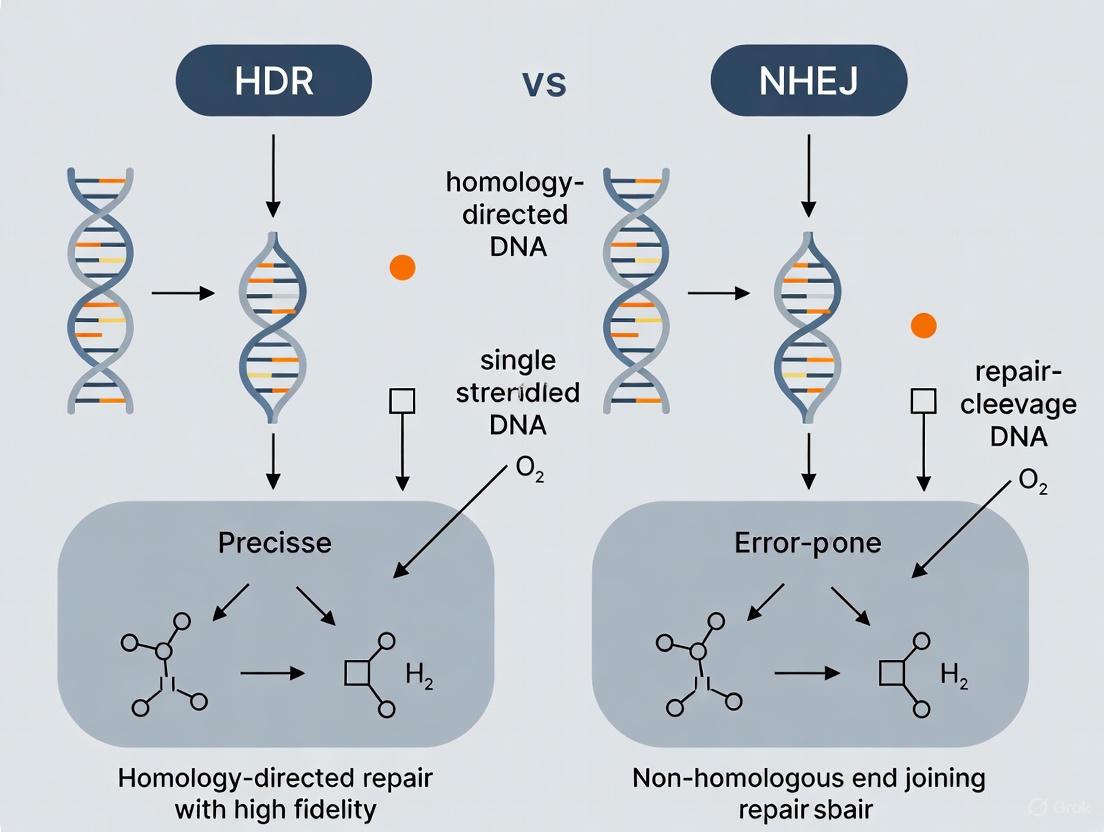
This article provides a comprehensive analysis of the efficiency and application of the two primary DNA double-strand break repair pathways: Homology-Directed Repair (HDR) and Non-Homologous End Joining (NHEJ).
HDR vs NHEJ: Decoding DNA Repair Efficiency for Precision Genome Editing and Therapy
Abstract
This article provides a comprehensive analysis of the efficiency and application of the two primary DNA double-strand break repair pathways: Homology-Directed Repair (HDR) and Non-Homologous End Joining (NHEJ). Tailored for researchers, scientists, and drug development professionals, we explore the fundamental mechanisms of these pathways, their critical roles in CRISPR-Cas9 genome editing, and the inherent competition that makes HDR less efficient than the error-prone NHEJ. The review details current methodologies to overcome this limitation, including strategic inhibition of NHEJ factors, cell cycle synchronization, and donor template optimization. Furthermore, we examine advanced validation techniques and comparative outcomes, concluding with the clinical implications of harnessing these repair pathways for targeted cancer therapies and treating genetic disorders.
The Cellular Battlefield: Fundamental Mechanisms of HDR and NHEJ
The Imperative of Genomic Integrity and the DNA Damage Response
The integrity of our genomic DNA is fundamental to cellular function and organismal health. However, DNA is constantly under assault from a variety of sources, including environmental agents like ultraviolet light and ionizing radiation, as well as endogenous threats like reactive oxygen species generated by cellular metabolism. [1] It is estimated that each cell must contend with 10,000 to 100,000 lesions per day. [1] Unrepaired DNA damage can severely disrupt essential processes like replication and transcription, leading to mutations, cellular senescence, apoptosis, and playing a major role in age-related diseases and cancer. [1]
To combat this relentless genomic erosion, cells have evolved a sophisticated network of mechanisms known as the DNA Damage Response (DDR). [1] This defense apparatus includes multiple DNA repair pathways, damage tolerance processes, and cell-cycle checkpoints that work together to safeguard genomic integrity. [1] The biological significance of a functional DDR is starkly illustrated by the severe consequences of inherited defects in DDR factors, which can result in immune deficiency, neurological degeneration, premature aging, and severe cancer susceptibility. [1]
Among the most cytotoxic types of DNA lesions are DNA double-strand breaks (DSBs), which affect both strands of the DNA double helix. [1] The two major pathways for repairing DSBs are Homologous Recombination (HR, often used interchangeably with Homology-Directed Repair or HDR) and Non-Homologous End Joining (NHEJ). [2] These pathways differ fundamentally in their mechanism and fidelity.
- Homology-Directed Repair (HDR): HDR is a precise, error-free repair mechanism that operates by using an undamaged DNA template—such as a sister chromatid—to accurately repair the break and reconstitute the original DNA sequence. [2] This pathway is most active in the S and G2 phases of the cell cycle when a homologous template is available. [3]
- Non-Homologous End Joining (NHEJ): In contrast, NHEJ is a faster but error-prone pathway that repairs breaks by directly ligating the two broken DNA ends together with little or no requirement for homology. [2] This "quick fix" often results in small insertions or deletions (INDELs) at the repair site. [3] A key advantage of NHEJ is that it is active throughout the entire cell cycle. [4]
The table below summarizes the core characteristics of these two critical pathways.
| Feature | Homology-Directed Repair (HDR) | Non-Homologous End Joining (NHEJ) |
|---|---|---|
| Template Required | Yes (homologous DNA, e.g., sister chromatid) | No |
| Fidelity | High (error-free) | Low (error-prone) |
| Primary Phase of Cell Cycle | S and G2 | All phases (G1, S, G2) |
| Kinetics | Slow (7 hours or longer) [2] | Fast (approximately 30 minutes) [2] |
| Key Proteins | RAD51, BRCA1, BRCA2, Mre11-Rad50-Xrs2 (MRX) complex [4] | Ku70/Ku80 heterodimer, DNA-PKcs, XRCC4, Ligase IV [5] |
| Primary Cellular Role | Accurate repair, restart of collapsed replication forks | Rapid repair of DSBs to maintain structural integrity |
| Common Outcome in CRISPR | Precise knock-in of genes or point mutations | Gene knockout due to INDEL formation [3] |
Quantitative Comparison of HDR and NHEJ Efficiency
Direct comparisons of the efficiency and kinetics of HDR and NHEJ in normal human cells reveal a clear dominance of the NHEJ pathway. Research using sensitive fluorescent reporter assays integrated into the chromosomes of human cells has allowed for real-time monitoring of these repair processes. [2]
The following table synthesizes key quantitative findings from these studies, providing a clear comparison of the relative performance of HDR and the two subtypes of NHEJ.
| Repair Pathway | Relative Efficiency in Cycling Cells | Average Repair Time | Key Characteristics |
|---|---|---|---|
| NHEJ (Compatible Ends) | 6 | ~30 minutes | Most efficient form of DSB repair [2] |
| NHEJ (Incompatible Ends) | 3 | ~30 minutes | Best mimics naturally occurring DSBs; three times more efficient than HR [2] |
| HDR (Homologous Recombination) | 1 | 7 hours or longer | Highly accurate but slowest and least efficient pathway [2] |
Note: The "Relative Efficiency" is derived from the experimentally determined ratio of NHEJ-C : NHEJ-I : HR, which is approximately 6:3:1. [2]
Experimental Protocols for Assessing HDR and NHEJ Efficiency
To study these complex biological processes, scientists have developed robust experimental assays. The following are detailed methodologies for quantifying the efficiency of HDR and NHEJ, based on protocols used in recent research.
Protocol 1: Intermolecular Recombination Assay for HDR Efficiency
This protocol measures the frequency of Homologous Recombination (HR) in S. cerevisiae (yeast) using a plasmid-based system where a functional selectable marker is restored via recombination. [4]
Key Steps:
- Strain and Plasmid Preparation: Use yeast strains (e.g., W1588-4C) carrying a non-functional ura3-1 allele in their genome. Transform these strains with a high-copy number plasmid (e.g., pFAT10-G4) containing a different disrupted ura3 allele (ura3G4), which has been interrupted by G-quadruplex-forming DNA sequences. [4]
- Induction of DSBs and Recombination: The G-quadruplex sequences can stall DNA replication forks, leading to the formation of DSBs. The cell then attempts to repair this break via intermolecular HR between the two defective ura3 sequences on the plasmid and the chromosome. [4]
- Selection and Quantification: Plate the transformed yeast cells on synthetic complete (SC) medium lacking uracil. Only cells in which a functional URA3+ gene has been restored through a successful HR event will be able to form colonies. The number of Ura+ colonies is counted and compared to the total number of viable cells to determine the HR frequency. [4]
Protocol 2: "Suicide-Deletion" Assay for NHEJ Efficiency
This protocol, also used in S. cerevisiae, quantitatively measures the cell's ability to repair a specific, enzymatically-induced DSB via the NHEJ pathway. [4]
Key Steps:
- Use of Engineered Strain: Employ a specialized yeast strain (e.g., YW714) in which a cassette containing the gene for the I-SceI mega-endonuclease and a URA3 marker is flanked by parts of the ADE2 gene and integrated into the chromosome. [4]
- Induction of DSB: Grow the cells in a medium containing galactose to induce the expression of the I-SceI endonuclease. The expressed I-SceI enzyme cuts at its specific recognition site within the engineered cassette, creating a precise DSB. This cut also excises the I-SceI gene itself in a "suicide" event. [4]
- NHEJ Repair and Readout: The cell repairs this break via NHEJ, which rejoins the ends of the ADE2 coding sequence. Successful NHEJ restores a functional ADE2 gene. [4]
- Selection and Quantification: Plate the cells on SC medium lacking adenine. The number of Ade+ colonies that grow represents the number of successful NHEJ repair events. The NHEJ efficiency is calculated by comparing the number of Ade+ cells to the total number of viable cells. [4]
Research Reagent Solutions for DNA Repair Studies
The following table lists key reagents and materials essential for conducting the types of experiments described above and for broader research into DNA damage response pathways.
| Reagent / Material | Function / Application in DNA Repair Studies |
|---|---|
| Reporter Cell Lines | Stably express fluorescent (e.g., GFP) or selectable (e.g., URA3, ADE2) reporter constructs to visually track and quantify DNA repair events in live cells. [2] [4] |
| Site-Specific Endonucleases (e.g., I-SceI) | Used to create precise, controlled double-strand breaks at defined locations in the genome to study the subsequent repair. [2] [4] |
| CRISPR/Cas9 System | A versatile tool for generating targeted DSBs for gene editing; the cellular outcomes depend on whether the ensuing repair is handled by NHEJ (for knockouts) or HDR (for precise knock-ins). [3] |
| Synchronized Cell Cultures | Allow researchers to study the activity and regulation of DNA repair pathways (e.g., HDR) during specific phases of the cell cycle. [4] |
| Live-Cell DNA Damage Sensor | A recent innovation using a fluorescently tagged natural protein domain that binds reversibly to damaged DNA, enabling real-time imaging of damage and repair dynamics in living cells and organisms without disrupting the process. [6] |
| Specific Inhibitors (e.g., PARPi, ATRi, WEE1i) | Small molecule inhibitors that target specific DDR proteins (like PARP, ATR, or WEE1) are used to probe pathway function and are a major focus of cancer therapeutic development. [7] |
Signaling Pathways and Experimental Workflows
DNA Double-Strand Break Repair Pathway Choice
This diagram illustrates the logical decision-making process a cell undergoes when a double-strand break is detected, leading to either the HDR or NHEJ repair pathway.
Experimental Workflow for HDR/NHEJ Efficiency Assay
This diagram outlines the key steps in the "suicide-deletion" and intermolecular recombination assays used to quantify NHEJ and HDR efficiency in yeast models.
Non-Homologous End Joining (NHEJ) is the primary and most versatile DNA double-strand break (DSB) repair pathway in mammalian cells, functioning throughout the cell cycle without requiring a homologous template [8] [9] [10]. This "first responder" role places NHEJ at the forefront of cellular defense against the most dangerous form of DNA damage, including breaks induced by ionizing radiation, reactive oxygen species, and modern genome editing tools like CRISPR-Cas9 [8] [10]. Unlike the precision of Homology-Directed Repair (HDR), which is restricted to specific cell cycle phases, NHEJ operates via direct ligation of broken DNA ends, often at the cost of introducing small insertions or deletions (indels) [11] [9]. This guide objectively compares the efficiency, mechanisms, and research applications of NHEJ against alternative repair pathways, providing researchers with the experimental data and methodologies needed to inform their experimental designs.
Quantitative Efficiency Comparison: NHEJ vs. Alternative Pathways
The efficiency of DSB repair pathways varies significantly based on cellular context, experimental system, and the nature of the DNA break. The table below summarizes key quantitative findings from recent studies.
Table 1: Comparative Efficiency of DNA Double-Strand Break Repair Pathways
| Repair Pathway | Key Characteristics | Reported Efficiency/Outcome | Experimental Context |
|---|---|---|---|
| Non-Homologous End Joining (NHEJ) | Template-independent, error-prone, cell-cycle independent [8] [11]. | Primary repair pathway for CRISPR/Cas9-induced DSBs [10]. | Human cells (e.g., RPE1) using CRISPR-mediated knock-in [12]. |
| Homology-Directed Repair (HDR) | Template-dependent, high-fidelity, restricted to S/G2 phases [13] [11]. | Low efficiency; ~5-7% knock-in efficiency; increased to ~17-22% with NHEJ inhibition [12]. | Human cells (e.g., RPE1) using CRISPR-mediated knock-in [12]. |
| Microhomology-Mediated End Joining (MMEJ) | Uses microhomologies (2-20 nt), results in deletions [12] [10]. | Contributes to imprecise repair; its inhibition can increase HDR accuracy [12]. | Human cells (e.g., RPE1) using CRISPR-mediated knock-in [12]. |
| Single-Strand Annealing (SSA) | Uses longer homologous sequences, Rad52-dependent, causes deletions [12] [10]. | Contributes to asymmetric HDR and imprecise integration; its suppression reduces errors [12]. | Human cells (e.g., RPE1) using CRISPR-mediated knock-in [12]. |
| NHEJ Enhanced by Small Molecules | Pharmacological inhibition of competing pathways or enhancement of NHEJ. | RepSox increased NHEJ-mediated editing efficiency by 3.16-fold in a Cas9-RNP delivery system [14]. | Porcine PK15 cells using CRISPR/Cas9 [14]. |
The NHEJ Mechanism: A Step-by-Step Guide
The NHEJ pathway is a coordinated process involving specific protein complexes that recognize, process, and ligate broken DNA ends. The following diagram illustrates the core mechanism.
Diagram 1: The Core NHEJ Pathway and Key Inhibition Strategy. This illustrates the sequential steps in classical NHEJ, from initial break recognition to final ligation. The dashed line indicates how pharmacological inhibition targets this pathway.
Detailed Mechanism and Key Experimental Evidence:
- Step 1: End Binding and Tethering. The Ku70/80 heterodimer exhibits extraordinary affinity for DNA ends, binding within seconds of break formation in a sequence-independent manner [8] [9]. This binding serves as a scaffold for the recruitment of all subsequent NHEJ factors [8].
- Step 2: Complex Assembly and Stabilization. The DNA-dependent protein kinase catalytic subunit (DNA-PKcs) is recruited to form the active DNA-PK complex with Ku [8] [15]. The XRCC4-DNA Ligase IV (LIG4) complex, stabilized by XLF, is also recruited during this step [8] [16] [9]. Recent structural studies suggest a "Flexible Synapsis" model where Ku and XRCC4:LIG4 hold the two DNA ends in proximity, allowing for dynamic movement and sampling of different alignments before ligation [16].
- Step 3: End Processing. Most naturally occurring DSBs have damaged or incompatible ends that cannot be directly ligated [16]. Nucleases like Artemis process damaged DNA ends and hairpin structures, while dedicated X-family polymerases (Pol μ and Pol λ) add or remove nucleotides in a template-dependent or independent manner [16] [9] [10]. This step is often iterative, with multiple rounds of processing attempted until a ligatable state is achieved [16].
- Step 4: Ligation. The DNA Ligase IV complex, in conjunction with XRCC4 and XLF, performs the final ligation step, sealing the DNA break [8] [9]. XLF has been shown to promote the ligation of mismatched and non-cohesive ends and is critical for efficient repair [16] [9].
Experimental Protocols for Evaluating NHEJ
Protocol: Quantifying NHEJ Efficiency in CRISPR-Cas9 Editing
This protocol is adapted from studies that used flow cytometry and long-read amplicon sequencing to quantify NHEJ and HDR outcomes in human cell lines [12] [14].
- Cell Line Preparation: Use immortalized cell lines such as hTERT-RPE1 or primary cells like porcine PK15. Culture cells according to standard conditions.
- CRISPR-Cas9 and Donor Delivery:
- For knock-in experiments, design a donor DNA template with homology arms (e.g., 90 base pairs) flanking the desired insertion (e.g., a fluorescent protein like mNeonGreen) [12].
- Form Ribonucleoprotein (RNP) complexes by mixing recombinant Cas9 or Cpf1 (Cas12a) nuclease with in vitro transcribed guide RNA (gRNA).
- Co-deliver the RNP complexes and donor DNA into cells via electroporation [12]. For knockout studies, the donor DNA is omitted.
- Small Molecule Treatment (Optional): Immediately after electroporation, treat cells with small molecules to modulate repair pathways [12] [14].
- Efficiency Quantification (4 Days Post-Electroporation):
- Flow Cytometry: For fluorescent protein knock-in, analyze the percentage of cells exhibiting the fluorescent signal to determine overall knock-in efficiency [12].
- Long-Read Amplicon Sequencing: Harvest genomic DNA. Amplify the target locus by PCR and subject the amplicons to long-read sequencing (e.g., PacBio). Use computational frameworks like "knock-knock" to classify and quantify the precise repair outcomes (e.g., perfect HDR, indels from NHEJ, imprecise integration) [12].
Protocol: Measuring NHEJ-Specific Repair Using Reporter Assays
While not detailed in the provided results, a common method to specifically quantify NHEJ activity involves using engineered reporter cell lines (e.g., U2OS-DR or EJ5-GFP reporters). These systems contain a disrupted fluorescent or selectable marker gene that can only be restored upon successful NHEJ-mediated repair of a site-specific DSB induced by CRISPR-Cas9 or other nucleases. The frequency of NHEJ is then directly measured by flow cytometry for the restored marker.
Advanced Research: Pathway Interplay and NHEJ Modulation
The simplistic model of NHEJ competing only with HDR is outdated. Recent research reveals a complex interplay between multiple DSB repair pathways. Even with potent NHEJ inhibition, the proportion of "perfect HDR" events remains below 50%, with the remaining integrations being attributed to other non-HDR pathways like MMEJ and SSA [12]. This underscores that simply inhibiting NHEJ is insufficient for achieving perfect gene integration and suggests that combined inhibition of NHEJ and SSA may be a more effective strategy to boost precise editing efficiency [12].
Furthermore, cancer cells, particularly glioma stem-like cells (GSCs), can upregulate NHEJ to enhance their DNA repair capacity and foster therapeutic resistance. A 2025 study identified AATF (apoptosis antagonizing transcription factor) as a key regulator that stabilizes the core NHEJ protein XRCC4, leading to elevated NHEJ activity and resistance to chemoradiotherapy in glioblastoma [15]. This highlights NHEJ as a promising therapeutic target for cancer treatment.
Table 2: Research Reagent Solutions for NHEJ Studies
| Reagent / Tool | Function / Target | Key Experimental Findings |
|---|---|---|
| Alt-R HDR Enhancer V2 | Potent NHEJ pathway inhibitor [12]. | Increased HDR-based knock-in efficiency from ~5-7% to ~17-22% in human RPE1 cells [12]. |
| Repsox | Small molecule inhibitor of the TGF-β pathway [14]. | Increased CRISPR/Cas9-mediated NHEJ gene editing efficiency by 3.16-fold in porcine PK15 cells [14]. |
| ART558 | Inhibitor of POLQ, a key effector of the MMEJ pathway [12]. | Reduced large deletions and complex indels, increasing the frequency of perfect HDR events [12]. |
| D-I03 | Specific inhibitor of Rad52, a central protein in the SSA pathway [12]. | Reduced asymmetric HDR and other donor mis-integration events, thereby elevating knock-in accuracy [12]. |
| AATF Depletion (shRNA) | Knocks down AATF to disrupt its stabilization of XRCC4 [15]. | Impaired NHEJ repair, sensitized glioblastoma xenografts to chemoradiotherapy, and increased DNA damage (γ-H2AX foci) [15]. |
NHEJ's role as the cell's dominant and fastest "first responder" to DSBs is well-established, supported by robust quantitative data showing its supremacy in repairing CRISPR-Cas9-induced breaks. However, the emerging paradigm is that efficient and precise genome editing requires a nuanced understanding of the entire network of DSB repair pathways, including the significant contributions of MMEJ and SSA. The experimental data and protocols outlined here provide researchers with a framework to objectively compare repair efficiencies and select appropriate strategies—whether the goal is efficient gene knockout via NHEJ, high-fidelity knock-in via HDR enhancement, or overcoming therapeutic resistance in cancer by targeting upregulated NHEJ. Future research will continue to refine small-molecule modulators and combinatorial targeting of these pathways to achieve ultimate control over genomic integrity.
In the realm of CRISPR-Cas9 genome editing, two primary DNA repair pathways compete to resolve double-strand breaks (DSBs): the error-prone non-homologous end joining (NHEJ) and the precise homology-directed repair (HDR). While NHEJ is the dominant and faster pathway in most cells, HDR serves as the cell's precision engineer, enabling accurate, template-driven corrections. This guide objectively compares the efficiency of HDR against NHEJ, detailing the experimental strategies that leverage and enhance HDR for applications demanding high fidelity, from basic research to therapeutic development.
The CRISPR-Cas9 system has revolutionized genetic research by functioning as a programmable pair of "molecular scissors" to create targeted DSBs in the genome [3]. However, the actual genetic outcome is determined by the cell's own endogenous DNA damage repair (DDR) mechanisms [3]. The competition between HDR and NHEJ is a central challenge in genome engineering.
- NHEJ (The Quick Fix): This pathway operates throughout the cell cycle and functions by directly ligating the broken DNA ends together. It is fast and efficient but inherently error-prone, often resulting in small insertions or deletions (indels) at the repair site. This makes it ideal for gene knockout studies [3] [17].
- HDR (The Precision Engineer): HDR is a more accurate, template-dependent mechanism. It uses a homologous DNA sequence—such as a sister chromatid or an exogenously supplied donor template—to repair the break in an error-free manner. Its major limitation is that it is restricted primarily to the S and G2 phases of the cell cycle, making it naturally less efficient than NHEJ in most contexts [3] [17] [18].
The inherent cellular preference for NHEJ significantly limits the efficiency of precise genome editing, driving the need for strategies to shift this balance toward HDR.
Quantitative Comparison: HDR vs. NHEJ Efficiency
The following tables summarize key experimental data highlighting the relative performance and outcomes of HDR and NHEJ across different systems and conditions.
Table 1: Comparative Efficiency of HDR and NHEJ in Different Cell Types
| Cell Type / Organism | Editing System | HDR Efficiency | NHEJ Efficiency | Key Experimental Finding | Citation |
|---|---|---|---|---|---|
| K562 (Human cells) | Cas9-DN1S fusion | ~86% | Significantly reduced | Fusion protein locally inhibits NHEJ, dramatically favoring HDR. | [19] |
| Patient-derived B lymphocytes | Cas9-DN1S fusion | ~70% of alleles | ~7% of alleles | Clinically relevant system for precise gene correction in patient cells. | [19] |
| Aspergillus niger (Fungus) | CRISPR/Cas9 | High integration efficiency (91.4%) | - | HDR-based gene integration system shows high success rate. | [20] |
| Potato Protoplasts | RNP + ssDNA donor | Up to 1.12% of sequencing reads | - | ssDNA donors in "target" orientation achieve highest HDR. | [21] |
| General Eukaryotic Cells | Standard CRISPR/Cas9 | Low (requires donor, cell cycle phase) | High (dominant pathway) | HDR efficiency is limited by cell cycle and donor availability. | [3] [17] |
Table 2: Impact of Donor Template Design on HDR Efficiency
| Donor Template Type | Typical Insert Size | Recommended Homology Arm (HA) Length | Reported HDR Efficiency | Considerations |
|---|---|---|---|---|
| Single-stranded DNA (ssODN) | 1 - 50 bp | 30 - 50 nucleotides | 25% - 50% in mouse models (Easi-CRISPR); up to 1.12% in potato [21] | Shorter HAs possible; high efficiency for small edits [18]. |
| Double-stranded DNA (dsDNA) plasmid | Large inserts (e.g., fluorescent proteins) | 500 - 1,000 bp | Generally low | Can be improved using linearized or self-cleaving plasmids [18]. |
| dsDNA (PCR-generated) | 1 - 5 kb | 200 bp - 2,000 bp | Increases with longer HA (from 200 bp to 10,000 bp) [21] | More toxic to cells than plasmids [18]. |
| Circular ssDNA (cssDNA) | - | - | Up to 70% knock-in in iPSCs | Emerging non-viral method for high-efficiency knock-in [22]. |
Methodological Deep Dive: Experimental Protocols for Enhancing HDR
Local Inhibition of NHEJ Using Cas9 Fusion Proteins
A groundbreaking approach to enhance HDR involves fusing Cas9 to a dominant-negative fragment of 53BP1 (DN1S) [19].
- Rationale: 53BP1 is a key cellular protein that promotes NHEJ and inhibits the initiation of HDR by blocking DNA end resection. A dominant-negative version (DN1S) competes with endogenous 53BP1, preventing its recruitment and thereby tipping the balance toward HDR [19].
- Experimental Workflow:
- Construct Design: Fuse the DN1S fragment to Cas9 nuclease.
- Delivery: Co-deliver the Cas9-DN1S fusion construct along with guide RNAs and a donor template into target cells (e.g., via lentiviral transduction or electroporation).
- Mechanism of Action: The Cas9-DN1S fusion is recruited specifically to the Cas9-induced DSB. The DN1S moiety locally displaces endogenous 53BP1, inhibiting NHEJ at the cut site without globally affecting NHEJ throughout the genome. This locally permissive environment promotes the use of the co-delivered donor template for HDR [19].
- Key Data: This method achieved HDR frequencies of 86% in K562 cells and nearly 70% in patient-derived B lymphocytes, while simultaneously reducing NHEJ events at the target site to as low as 7% [19].
Optimization of Donor Repair Template (DRT) Design
The structure and composition of the DRT are critical determinants of HDR success [21] [18].
- Strandedness: Single-stranded DNA (ssDNA) donors often outperform double-stranded DNA (dsDNA) donors, especially for smaller edits [21] [18].
- Orientation: For ssDNA donors, the "target" orientation (matching the strand bound by the sgRNA) frequently results in higher HDR efficiency compared to the "non-target" orientation [21].
- Homology Arm Length: While longer HAs (up to 1-2 kb) are recommended for dsDNA plasmids, ssDNA donors can facilitate HDR even with very short HAs (30-100 nucleotides) [21] [18].
- Disruption of Target Site: The donor template should be designed to disrupt the protospacer adjacent motif (PAM) or the guide RNA binding site to prevent continuous re-cutting of the successfully edited allele by Cas9 [18].
Strategic Delivery of CRISPR Components
The method used to deliver the CRISPR machinery and donor template profoundly impacts HDR outcomes [22].
- Ribonucleoprotein (RNP) Complex Delivery: Direct delivery of pre-assembled Cas9 protein and guide RNA complexes (RNPs) via electroporation is a highly effective strategy. It leads to rapid editing, reduces off-target effects, and, because the Cas9 protein degrades quickly, provides a transient window of activity that can favor HDR when a donor is present [22].
- Viral vs. Non-Viral Delivery:
- Viral Vectors (e.g., Lentivirus, AAV) offer high transduction efficiency but have limited packaging capacity (especially AAV) and can trigger immune responses.
- Non-Viral Methods (e.g., Electroporation, Lipid Nanoparticles (LNPs)) are well-suited for delivering RNP complexes and ssDNA donors. Electroporation is particularly effective in hard-to-transfect cells like stem cells and primary T cells, and parameters (voltage, pulse length) can be optimized to improve cell viability and HDR efficiency [22].
The Scientist's Toolkit: Essential Reagents for HDR Research
Table 3: Key Research Reagent Solutions for HDR Experiments
| Reagent / Tool | Function | Example Use Case |
|---|---|---|
| Cas9-DN1S Fusion Protein | Local inhibition of NHEJ at the cut site to enhance HDR. | Achieving >80% HDR in human cell lines for precise gene correction [19]. |
| High-Fidelity Cas9 Variants | Engineered nucleases with reduced off-target activity. | Improving the safety profile of therapeutic editing by minimizing unintended mutations [23]. |
| Single-Stranded DNA (ssODN) | Donor template for introducing small edits (point mutations, short tags). | High-efficiency HDR (25-50%) for creating specific point mutations in mouse models [18]. |
| Self-Cleaving Donor Plasmid | Circular dsDNA template that releases a linear fragment upon Cas9 cleavage. | Increasing the effective concentration of linear donor template to improve HDR rates [18]. |
| DNA-PKcs Inhibitors | Small molecules that chemically inhibit a key NHEJ protein. | Boosting HDR efficiency; however, recent studies link them to increased genomic structural variations [23]. |
| Lipid Nanoparticles (LNPs) | Non-viral delivery vehicle for mRNA and ssDNA donors. | Clinically relevant delivery of HDR components to primary T cells and stem cells [22]. |
Risks and Considerations in HDR Enhancement
Strategies to enhance HDR, particularly global inhibition of NHEJ, are not without risks. Recent studies reveal that the use of certain small-molecule NHEJ inhibitors, such as DNA-PKcs inhibitors, can lead to severe unintended consequences. These include a significant increase in large-scale, on-target genomic aberrations, such as kilobase- to megabase-scale deletions and chromosomal translocations [23].
These findings underscore a critical safety consideration:
- Overestimation of HDR: Traditional short-read sequencing methods can miss these large deletions if they remove the PCR primer binding sites, leading to an overestimation of true HDR efficiency and an underestimation of editing-induced errors [23].
- Safety Advantage of Local Inhibition: In contrast, localized strategies like the Cas9-DN1S fusion, which avoids global NHEJ inhibition, did not show an increased frequency of translocations in studies, suggesting a potentially safer profile for therapeutic applications [19] [23].
HDR remains the gold standard for precision genome editing, enabling everything from single-nucleotide corrections to the insertion of large transgenic elements. The direct comparison with NHEJ reveals a fundamental trade-off: efficiency for precision. While NHEJ is highly efficient for disruption, HDR, though less efficient, is unmatched in its accuracy.
The future of HDR research lies in developing smarter, safer, and more efficient strategies. This includes:
- Next-Generation Fusions: Engineering new Cas9 fusions that more potently recruit HDR factors or inhibit NHEJ with even greater specificity.
- Advanced Delivery Systems: Refining non-viral delivery platforms, like LNPs, for the co-delivery of RNP and donor templates with high efficiency and low toxicity.
- Temporal Control: Using cell-cycle regulators or inducible systems to activate Cas9 specifically during HDR-permissive phases (S/G2).
- Rigorous Safety Profiling: Employing long-read sequencing and other advanced assays to thoroughly evaluate the genomic integrity of cells edited with HDR-enhancing techniques.
As these tools and methodologies continue to mature, the precision engineer that is HDR will undoubtedly play an increasingly central role in realizing the full therapeutic potential of CRISPR-based medicine.
This guide provides an objective comparison of the core protein complexes governing the two primary pathways for DNA double-strand break (DSB) repair: the Ku complex in Non-Homologous End Joining (NHEJ) and the RAD51 nucleoprotein filament in Homology-Directed Repair (HDR). Understanding their distinct mechanisms, efficiencies, and competitive interplay is fundamental to advancing gene therapy and precision genome editing.
DNA double-strand breaks (DSBs) are among the most cytotoxic DNA lesions, and their misrepair can lead to genomic instability, a hallmark of cancer and other diseases [24]. Mammalian cells possess three principal mechanisms to repair DSBs: the rapid but error-prone Non-Homologous End Joining (NHEJ), the high-fidelity Homology-Directed Repair (HDR), and the mutagenic Single-Strand Annealing (SSA) [25]. The choice between these pathways is not random but is governed by a hierarchical control system to optimize for both cell survival and genomic integrity [25]. At the heart of this decision are the key protein machineries: the Ku70/Ku80 heterodimer (Ku complex) that initiates NHEJ and the RAD51 recombinase that executes the central strand invasion step of HDR [25] [24]. Their functions are largely antagonistic, and the balance between them determines the accuracy and outcome of DSB repair, a critical consideration for therapeutic genome editing where HDR-mediated precision is often desired but competes with the highly efficient NHEJ [26] [27].
Protein Machinery: Core Components and Mechanisms
The Ku Complex: Gatekeeper of Non-Homologous End Joining
The Ku70/Ku80 heterodimer is the essential initiator of the canonical NHEJ pathway. Its primary function is to recognize and bind to free DNA ends with high affinity, acting as a first responder to DSBs [25] [27]. This binding event triggers a cascade of protein recruitment: the DNA-dependent protein kinase catalytic subunit (DNA-PKcs) is recruited and activated, which in turn aligns the broken DNA ends and facilitates the recruitment of processing enzymes like the Artemis nuclease and polymerases Pol μ and Pol λ to modify the DNA ends. Finally, the XRCC4-DNA ligase IV complex catalyzes the ligation step to reseal the DNA backbone [27]. A key feature of the Ku complex is its role as a barrier to DNA end resection. By binding the ends, Ku physically protects them from nucleolytic degradation and prevents the initiation of the resection process that is a prerequisite for HDR and other homologous recombination pathways [25] [27]. The pro-NHEJ factor 53BP1 further reinforces this blockade by inhibiting the HDR-promoting factor BRCA1 [27]. This mechanism ensures that NHEJ remains the dominant and fastest repair pathway across all phases of the cell cycle.
The RAD51 Filament: Engine of Homology-Directed Repair
In contrast to NHEJ, HDR is a high-fidelity process that requires a homologous DNA template and is restricted to the S and G2 phases of the cell cycle [24] [27]. The RAD51 recombinase is the central engine of HDR. Its function begins after the initial steps of DSB recognition and 5' to 3' end resection, which generate single-stranded DNA (ssDNA) overhangs. These ssDNA tails are first coated by Replication Protein A (RPA). With the assistance of mediators like BRCA2 and the RAD51 paralogs (RAD51B, RAD51C, RAD51D, XRCC2, XRCC3), RAD51 displaces RPA to form a helical nucleoprotein filament on the ssDNA [24]. This filament is a dynamic structure that performs the critical reactions of homology search and strand invasion. It invades a homologous donor DNA duplex (typically the sister chromatid), forms a three-stranded synaptic intermediate called a Displacement Loop (D-loop), and stably pairs the invading strand with the complementary sequence [28]. The structure of this synaptic complex reveals how the RAD51 filament engages the donor DNA, facilitates base-pairing, and captures the displaced strand [28]. The invading 3' end then serves as a primer for DNA synthesis, using the donor template to copy the genetic information lost at the break site, enabling precise, error-free repair.
Table 1: Comparative Overview of Ku Complex and RAD51 Machinery.
| Feature | Ku Complex (NHEJ Initiator) | RAD51 Filament (HDR Executor) |
|---|---|---|
| Core Function | DSB end recognition and protection; NHEJ scaffold | Homology search & strand invasion; HDR catalysis |
| Key Components | Ku70, Ku80, DNA-PKcs, Artemis, XRCC4/LigIV | RAD51, BRCA2, RAD51 paralogs, RPA |
| Primary Pathway | Non-Homologous End Joining (NHEJ) | Homology-Directed Repair (HDR) |
| Template Used | None (direct end-joining) | Homologous DNA (e.g., sister chromatid) |
| Fidelity | Error-prone (often indels) [27] | High-fidelity (precise repair) [27] |
| Cell Cycle Preference | All phases (G1, S, G2) [24] [27] | Primarily S and G2 phases [24] [27] |
| Initiation Signal | Free double-stranded DNA ends | Resected single-stranded DNA (ssDNA) overhangs |
| Dominance Hierarchy | Dominant; suppresses GC and SSA [25] | Recessive; promoted when NHEJ is impaired [25] |
Pathway Competition and Hierarchical Control
The cellular choice between NHEJ and HDR is a tightly regulated, hierarchical process. Experimental evidence from Ku80-deficient cells demonstrates that NHEJ is the dominant pathway, as its loss led to a 6- to 8-fold increase in the use of both Gene Conversion (GC, a form of HDR) and Single-Strand Annealing (SSA) [25]. This establishes a repair hierarchy where NHEJ takes precedence over homologous pathways. The competition occurs primarily at the level of DNA end resection. The binding of the Ku complex to DNA ends creates a physical barrier that inhibits resection, thereby protecting the break from nucleases and locking it into an NHEJ-favored state [27]. The pro-NHEJ factor 53BP1 further stabilizes this block. To initiate HDR, this blockade must be overcome by pro-resection factors like BRCA1 and CtIP, which promote the limited end resection that commits the break to homology-dependent repair [27]. The regulation is also kinetic; NHEJ is a faster process, while HDR involves more slow, complex steps including filament assembly, homology search, and DNA synthesis [27]. Furthermore, the regulation is reversible and can be influenced by effector protein levels. For example, loss of Rad51 function not only impairs HDR but also leads to an increase in the mutagenic SSA pathway, which can subsequently outcompete the remaining NHEJ capacity [25].
Diagram 1: Hierarchical Competition between NHEJ and HDR Pathways. The Ku complex binds DSB ends immediately, promoting NHEJ. Overcoming this blockade initiates end resection, committing the break to high-fidelity HDR via RAD51 filament assembly.
Experimental Data and Efficiency Comparison
Quantitative studies using chromosomal reporter constructs have directly measured the efficiency and interplay of these repair pathways. In wild-type Chinese Hamster Ovary (CHO) cells, NHEJ is the most active pathway for repairing a single I-SceI-induced DSB. However, genetic disruption of the Ku complex fundamentally alters this balance. Knocking out Ku80 causes a dramatic shift, increasing the usage of both HDR (Gene Conversion) and SSA by 6- to 8-fold [25]. This finding provides direct evidence for the dominance of NHEJ in pathway choice. Interestingly, impairing HDR by knocking down Rad51 does not alter NHEJ efficiency, suggesting that NHEJ operates independently. However, Rad51 knockdown in a context where SSA is available leads to a further increase in SSA activity, indicating that Rad51 indirectly promotes NHEJ by limiting the mutagenic SSA pathway [25]. In the context of CRISPR-Cas9 genome editing, this natural dominance of NHEJ presents a major challenge, as the desired precise HDR edits are typically outnumbered by error-prone NHEJ events, with HDR often constituting less than 10-20% of total repair outcomes in many cell types [26] [27].
Table 2: Quantitative Data on DSB Repair Pathway Efficiency and Manipulation.
| Experimental Condition | Effect on NHEJ Efficiency | Effect on HDR (GC) Efficiency | Effect on SSA Efficiency | Key Finding |
|---|---|---|---|---|
| Wild-Type Cells [25] | High (Baseline) | Low (Baseline) | Low (Baseline) | NHEJ is the dominant DSB repair pathway. |
| Ku80 Knock-Out [25] | Decreased | Increased by 6-8x | Increased by 6-8x | Loss of dominant NHEJ unlocks homologous repair. |
| Rad51 Knock-Down [25] | No significant change | Decreased | Increased | Rad51 is not required for NHEJ but suppresses SSA. |
| HDR Enhancement Strategies [26] [27] | Decreased (via inhibition) | Increased | Variable | NHEJ inhibition (e.g., Ku, DNA-PKcs, 53BP1) is a primary strategy to boost HDR for gene editing. |
Research Reagents and Methodologies
Key Research Reagent Solutions
Table 3: Essential Research Reagents for Studying Ku and RAD51 Function.
| Reagent / Tool | Primary Function in Research |
|---|---|
| I-SceI Endonuclease | System for generating a single, specific DSB in chromosomal reporter constructs to study repair outcomes [25]. |
| GFP-Based Repair Substrates | Fluorescent reporters (e.g., pEJ for NHEJ, pGC for Gene Conversion) to quantitatively measure pathway efficiency via flow cytometry [25]. |
| siRNA/shRNA for Ku80/53BP1 | Tool for transiently knocking down key NHEJ factors to shift repair balance toward HDR in experimental settings [25] [27]. |
| siRNA/shRNA for RAD51 | Tool for impairing HDR function to study its role in repair fidelity and its interplay with SSA and NHEJ [25] [24]. |
| NHEJ Inhibitors (e.g., SCR7) | Small molecule inhibitors of NHEJ components (e.g., DNA Ligase IV) used to enhance HDR efficiency in genome editing [26] [27]. |
| Cryo-Electron Microscopy | High-resolution structural biology technique used to determine the atomic structure of complexes like the RAD51 D-loop [28]. |
Experimental Protocol: Measuring Pathway Hierarchy
The following protocol, adapted from foundational research, is used to quantitatively compare the efficiency of NHEJ, HDR (Gene Conversion), and SSA at a defined genomic locus [25]:
Cell Line Engineering: Stably integrate distinct GFP-based repair substrates into the genome of the chosen cell line (e.g., CHO K1).
- pEJ Substrate: For measuring NHEJ. Contains two out-of-frame I-SceI sites. Successful NHEJ repair restores the GFP reading frame.
- pGC Substrate: For measuring HDR/GC. Contains an inactivated GFP gene with an I-SceI site. A functional GFP is restored via HDR using a downstream homologous template.
- pEJSSA Substrate: For measuring SSA. Contains two directly repeated homologous sequences flanking an I-SceI cut site. Repair via SSA deletes the intervening sequence and restores GFP.
DSB Induction and Repair: Transfect the engineered cell lines with a plasmid expressing the I-SceI meganuclease to induce a single DSB within the integrated substrate. Include a control transfection without I-SceI to measure background fluorescence.
Flow Cytometry Analysis: 48-72 hours post-transfection, harvest the cells and analyze them by flow cytometry to quantify the percentage of GFP-positive cells in each sample.
Data Calculation and Interpretation:
- The percentage of GFP+ cells in the I-SceI-transfected sample (minus the background from the control) represents the absolute efficiency of each repair pathway.
- Comparing these values across pathways reveals their intrinsic hierarchy (e.g., NHEJ >> HDR ≈ SSA).
- Repeating this experiment in isogenic cell lines deficient in specific genes (e.g., Ku80-/- or Rad51-knockdown) directly reveals the genetic control and interdependency of the pathways, as shown in [25].
In the realm of DNA repair, the choice between homology-directed repair (HDR) and non-homologous end joining (NHEJ) represents a fundamental fork in the road for maintaining genomic integrity. This decision becomes particularly crucial in CRISPR-Cas9-mediated genome editing, where the desired editing outcome hinges on which pathway the cell employs to repair the programmed double-strand break (DSB). The HDR pathway enables precise, template-dependent repair, making it invaluable for introducing specific genetic modifications, while NHEJ functions as a rapid, error-prone ligation mechanism ideal for gene disruption [3] [11]. What governs this critical decision? A key determining factor is the cell cycle stage at which the DSB occurs. HDR is restricted primarily to the S and G2 phases, while NHEJ operates throughout the cell cycle, with its activity peaking in G1 and G2/M [29] [30]. Understanding this cell cycle dependence is not merely academic; it has profound implications for optimizing gene editing efficiency, particularly for precision therapeutic applications requiring HDR.
Mechanistic Basis of HDR Restriction to S and G2 Phases
The restriction of HDR to the S and G2 phases of the cell cycle is not arbitrary but is enforced by multiple, interconnected molecular mechanisms. These controls ensure that HDR only proceeds when the necessary components are present and, critically, when an appropriate homologous repair template is available.
Template Availability: The Sister Chromatid
The most fundamental reason for HDR's cell cycle restriction is the availability of a homologous template. HDR requires an undamaged DNA sequence homologous to the region surrounding the break to guide accurate repair.
- G1 Phase: Cells in G1 possess only one copy of each chromosome. A DSB occurring in G1 has no homologous sister chromatid to use as a template, effectively eliminating the possibility of HDR and leaving NHEJ as the primary repair option [30].
- S and G2 Phases: After DNA replication in S phase, each chromosome consists of two identical sister chromatids. This provides the perfect template for error-free repair. The presence of this sister chromatid in S and G2 is a prerequisite for HDR, making it the preferred pathway when a break occurs after replication [30] [31].
Cell Cycle-Regulated Expression and Activation of Repair Proteins
The execution of HDR is dependent on a suite of proteins whose activity is tightly controlled by the cell cycle. The following table summarizes the key proteins and their cell cycle-dependent regulation.
Table 1: Key HDR Proteins and Their Cell Cycle Regulation
| Protein/Complex | Role in HDR | Cell Cycle Regulation |
|---|---|---|
| MRN Complex (MRE11-RAD50-NBS1) | Initial DSB recognition and end resection [30]. | Critical for HDR initiation; activity is favored in S/G2. |
| CtIP | Promotes short-range DNA end resection [32]. | Its phosphorylation by CDK is a pivotal step that restricts resection to S/G2 [32]. |
| BRCA1 & BRCA2 | Facilitates RAD51 loading onto single-stranded DNA [30]. | Function in S/G2 to promote homologous recombination. |
| RAD51 | Forms a nucleoprotein filament that catalyzes strand invasion of the homologous template [30]. | Expression and activity are upregulated in S phase [31]. |
The commitment to HDR is initiated by DNA end resection, a 5' to 3' nucleolytic degradation of one strand at the DSB to generate a 3' single-stranded DNA (ssDNA) overhang. This step is the first and most critical point of cell cycle control. The resection process is activated by phosphorylation events mediated by cyclin-dependent kinases (CDKs), which are active only in S and G2 phases [32]. Specifically, CDK-dependent phosphorylation of CtIP activates its function, enabling it to work with the MRN complex to initiate resection. Once extensive resection occurs, the resulting 3' ssDNA overhang is coated by RPA and then replaced by RAD51 with the help of BRCA2. The RAD51-ssDNA filament then invades the homologous sister chromatid to initiate the repair synthesis [30]. This series of events makes resection an irreversible commitment point that channels the DSB into the HDR pathway, a process permitted only when CDK activity is high.
Diagram: The HDR Pathway is Gated by Cell Cycle-Dependent Resection
Quantitative Comparison of HDR and NHEJ Efficiency Across the Cell Cycle
The mechanistic control of HDR translates into clear quantitative differences in repair pathway efficiency throughout the cell cycle. A seminal study using hTERT-immortalized diploid human fibroblasts with chromosomally integrated fluorescent reporters provided direct measurements of this phenomenon [29]. The experimental workflow and resulting data are summarized below.
Experimental Protocol for Cell Cycle Analysis
To quantitatively measure HDR and NHEJ efficiency, researchers utilized the following methodology [29]:
- Cell Line Preparation: hTERT-immortalized normal human fibroblasts (HCA2-hTERT) containing integrated GFP-based NHEJ and HR reporter constructs were used.
- Cell Cycle Synchronization:
- G1 Arrest: Achieved via contact inhibition at confluence.
- S Phase Arrest: Induced by treatment with aphidicolin, a DNA polymerase α inhibitor.
- G2/M Arrest: Induced by treatment with colchicine, which prevents microtubule polymerization.
- DSB Induction and Repair Analysis: Synchronized cells were transfected with an I-SceI endonuclease plasmid to create a site-specific DSB within the reporter cassette and a DsRed plasmid to normalize for transfection efficiency.
- Flow Cytometry Quantification: Cells were analyzed by flow cytometry 4 days post-transfection. The ratio of GFP+ to DsRed+ cells was used as a measure of repair efficiency. Reconstitution of a functional GFP gene indicated successful NHEJ or HDR event, depending on the reporter design.
Table 2: Quantitative Efficiency of HDR and NHEJ Across the Cell Cycle in Human Fibroblasts [29]
| Cell Cycle Phase | NHEJ Efficiency (Relative to G1) | HDR Efficiency | Major Repair Pathway |
|---|---|---|---|
| G1 | Baseline (1.0X) | Nearly absent | NHEJ (almost exclusive) |
| S | Increased (~1.5 to 3.0X) | Most active | Both active (HDR peaks) |
| G2/M | Highest activity (G1 < S < G2/M) | Declines from S phase peak | NHEJ (dominant) |
This data directly challenges a simplistic model where NHEJ is solely a G1 pathway and HDR is uniformly active in S/G2/M. Instead, it reveals that while HDR is indeed restricted to post-replicative phases, its efficiency peaks specifically during S phase and declines in G2/M. Conversely, NHEJ is not confined to G1 but is active throughout the cycle, with its highest activity observed in G2/M. The overall efficiency of NHEJ was higher than HR at all cell cycle stages, establishing it as the major DSB repair pathway in human somatic cells [29].
Research Reagent Solutions for HDR Studies
To investigate and manipulate HDR, researchers rely on a specific toolkit of reagents and methodologies. The table below details key solutions for studying cell cycle-dependent HDR.
Table 3: Essential Research Reagents and Methods for HDR Studies
| Reagent / Method | Function / Purpose | Key Features & Considerations |
|---|---|---|
| Fluorescent Reporter Cassettes | Quantify HDR and NHEJ events via flow cytometry. | Provides direct, quantitative measurement of repair efficiency. Requires stable cell line generation [29]. |
| Cell Cycle Synchronization Agents | Arrest cells at specific cell cycle stages. | Aphidicolin (S phase), Colchicine (G2/M), Contact Inhibition (G1). Essential for delineating cell cycle-specific effects [29]. |
| Single-Stranded DNA (ssDNA) Donors | Serve as synthetic repair templates for HDR. | Favored for point mutations; lower cytotoxicity and higher specificity than dsDNA donors. Optimal homology arm length is ~40 bases [32] [33]. |
| 5'-Modified Donors (5'-Biotin, 5'-C3 Spacer) | Enhance HDR efficiency and precision. | 5'-modifications can boost single-copy integration by up to 20-fold by preventing donor multimerization and improving recruitment [33]. |
| RAD52 Supplementation | Stimulates RAD51-independent strand exchange. | Can increase ssDNA integration nearly 4-fold, but may increase template multiplication (concatemer formation) [33]. |
| NHEJ Inhibitors (e.g., SCR7) | Shift repair balance towards HDR by suppressing competing NHEJ. | Can be used as small-molecule additives to enhance HDR outcomes [34] [30]. |
Implications for Genome Editing and Therapeutic Development
The cell cycle restriction of HDR presents a significant bottleneck for precision genome editing, particularly in therapeutically relevant non-dividing or slowly dividing cells, such as neurons or stem cells in G0 [34] [32]. Consequently, strategies to enhance HDR efficiency often focus on overcoming this limitation.
- Timing of Nuclease Delivery: Delivering CRISPR-Cas9 components to cells during S phase, when HDR is most active, can significantly improve precise editing outcomes [32].
- Manipulating Cell Cycle Regulators: Co-delivering Cas9 with factors that transiently induce or synchronize cells into S phase is an active area of research.
- Inhibiting the Competing NHEJ Pathway: Using small molecule inhibitors of key NHEJ proteins (e.g., DNA-PKcs inhibitors) can tilt the repair balance in favor of HDR [34] [32].
- Exploiting Alternative Repair Pathways: For certain applications, alternative pathways like Microhomology-Mediated End Joining (MMEJ), which is more active in S/G2 than G1, can be leveraged for precise edits without a strict requirement for a sister chromatid [30].
Understanding the intricate cell cycle dependence of HDR is therefore not just a biological curiosity but a critical consideration for designing effective gene editing experiments and developing the next generation of genetic therapies.
The integrity of genomic DNA is continuously challenged by a variety of damaging agents originating from both internal cellular processes and external environmental exposures. These insults lead to diverse DNA lesions, which cells must accurately repair to maintain genomic stability and prevent malignant transformation. The choice of DNA repair pathway is heavily influenced by the nature of the DNA damage, with endogenous and exogenous damage types often engaging distinct repair mechanisms. Understanding this complex interplay is crucial for advancing cancer therapeutics, particularly in the context of homology-directed repair (HDR) versus non-homologous end joining (NHEJ) efficiency research.
This guide provides a comprehensive comparison of endogenous and exogenous DNA damage, focusing on how these damage origins influence repair pathway choice. We present structured experimental data, detailed methodologies for assessing repair efficiency, and key reagent solutions to support research in targeted cancer therapy and drug development.
DNA Damage Origins and Characteristics
Table 1: Comparison of Endogenous vs. Exogenous DNA Damage Characteristics
| Characteristic | Endogenous DNA Damage | Exogenous DNA Damage |
|---|---|---|
| Origin | Internal cellular processes [35] [36] | External environmental factors [35] [36] |
| Primary Sources | Reactive oxygen species (ROS), replication errors, hydrolytic damage, cellular metabolites [37] [35] [36] | UV radiation, ionizing radiation, chemical mutagens, environmental pollutants [35] [36] |
| Daily Burden per Cell | Approximately 100,000 lesions per day [36] | Variable depending on exposure |
| Common Lesion Types | Base modifications, single-strand breaks (SSBs), apurinic/apyrimidinic (AP) sites [37] [35] | Double-strand breaks (DSBs), pyrimidine dimers, bulky adducts, crosslinks [37] [35] |
| Representative Lesions | 8-oxoguanine, uracil misincorporation, base deamination [35] [36] | Cyclobutane pyrimidine dimers, benzo[a]pyrene adducts, DNA-protein crosslinks [38] [35] |
| Repair Pathways Typically Engaged | Base excision repair (BER), mismatch repair (MMR) [39] [35] | Nucleotide excision repair (NER), homologous recombination (HR), non-homologous end joining (NHEJ) [39] [35] |
Endogenous DNA damage arises spontaneously from normal cellular metabolic processes, with reactive oxygen species (ROS) representing a significant source. ROS are produced during cellular respiration and can cause various DNA lesions including base modifications, single-strand breaks, and abasic sites [37] [35]. Other endogenous sources include replication errors, hydrolytic damage through deamination and depurination, and base tautomerism [36]. The high daily burden of endogenous lesions necessitates efficient constitutive repair mechanisms.
Exogenous DNA damage results from environmental agents including ultraviolet (UV) and ionizing radiation, chemical mutagens, and pollutants [35]. UV radiation primarily induces pyrimidine dimers and 6-4 photoproducts, while ionizing radiation causes single- and double-strand breaks [35]. Chemical mutagens include polycyclic aromatic hydrocarbons (found in tobacco smoke and vehicle exhaust), alkylating agents, and aromatic amines, which typically form bulky DNA adducts and crosslinks that distort the DNA helix [35] [36]. The diversity of exogenous lesions engages multiple specialized repair pathways.
DNA Damage Repair Pathways
Table 2: DNA Repair Pathways and Their Applications
| Repair Pathway | Key Damage Types Repaired | Mechanism | Fidelity | Cell Cycle Preference |
|---|---|---|---|---|
| Base Excision Repair (BER) | Oxidative damage, alkylated bases, base loss [39] [35] | Damage-specific glycosylase recognition, base removal, strand incision, patch synthesis [35] | High | All phases |
| Nucleotide Excision Repair (NER) | Bulky adducts, pyrimidine dimers, crosslinks [39] [35] | Damage recognition, dual incision, oligonucleotide excision, repair synthesis [35] | High | All phases |
| Mismatch Repair (MMR) | Replication errors, base-base mismatches, insertion-deletion loops [35] [36] | Mismatch recognition, strand discrimination, excision, resynthesis [35] | High | S, G2 phases |
| Homologous Recombination (HR) | Double-strand breaks, interstrand crosslinks [4] [39] [35] | End resection, strand invasion, DNA synthesis, resolution [35] [40] | Error-free | S, G2 phases |
| Non-Homologous End Joining (NHEJ) | Double-strand breaks [4] [39] [35] | End recognition, end processing, ligation [35] [40] | Error-prone | All phases |
The choice between these repair pathways is influenced by multiple factors including the cell cycle phase, chromatin context, and the specific nature of the DNA lesion. Homologous recombination is restricted to S and G2 phases when sister chromatids are available as repair templates, while NHEJ operates throughout the cell cycle [35] [40]. Recent research has revealed that epigenetic landscape and cell identity factors significantly influence DNA repair pathway choice, with certain chromatin states preferentially engaging specific repair mechanisms [41].
The following diagram illustrates the decision process for selecting the appropriate DNA repair pathway based on damage type and cellular context:
Experimental Approaches for Assessing Repair Pathway Efficiency
DSB-Spectrum Reporter Assay for Multi-Pathway Repair Analysis
The DSB-Spectrum system is a Cas9-based fluorescent reporter that simultaneously quantifies the contribution of multiple DNA repair pathways at a single DNA double-strand break [40]. This approach enables researchers to study pathway competition and crosstalk under defined experimental conditions.
Experimental Protocol:
Reporter Design: The DSB-Spectrum_V1 construct contains a CMV promoter driving a modified blue fluorescent protein (BFP) gene with a 46 bp spacer insert, followed by a truncated green fluorescent protein (GFP) gene lacking a promoter [40].
Cell Line Generation:
- HEK 293T cells are infected with DSB-Spectrum_V1 lentivirus at low multiplicity of infection
- Single-cell clones are expanded and validated for single-copy integration using Splinkerette PCR
- Genomic integration sites are mapped and confirmed by Southern blotting [40]
DSB Induction and Repair Analysis:
- Cells are transfected with Cas9 and guide RNAs targeting the edges of the BFP spacer sequence
- After 48-72 hours, cells are analyzed by flow cytometry
- BFP+ cells indicate error-free c-NHEJ repair
- GFP+ cells indicate HR-mediated repair using the truncated GFP as a template
- Double-negative cells indicate mutagenic repair (alternative NHEJ or single-strand annealing) [40]
Applications: This system has been used to demonstrate that inhibiting DNA-PKcs (a c-NHEJ factor) increases not only HR but also mutagenic single-strand annealing, revealing important pathway crosstalk [40].
Yeast-Based Systems for HR and NHEJ Efficiency Quantification
Intermolecular Homologous Recombination Assay in S. cerevisiae:
Strain Preparation: Use S. cerevisiae strains with non-functional ura3-1 allele at the genomic locus [4].
Plasmid Transformation: Transform with pFAT10-G4 plasmid containing ura3G4 allele disrupted by G-quadruplex-forming sequences [4].
HR Induction and Selection:
- Plate transformed yeast on synthetic complete medium lacking uracil
- Failed replication across G-quadruplex structures generates DSBs
- Cells initiate repair via recombination between plasmid and genomic ura3 alleles
- Count Ura3+ papillae to determine HR frequency [4]
Suicide-Deletion Assay for NHEJ Efficiency in S. cerevisiae:
Strain Engineering: Use yeast strains with galactose-inducible I-SceI mega-endonuclease and URA3 cassette flanked by ADE2 sequences integrated into chromosome XV [4].
DSB Induction: Grow cells in galactose-containing medium to induce I-SceI expression, generating specific DSBs.
NHEJ Assessment:
- After DSB generation, the I-SceI coding sequence is deleted
- Broken ends are rejoined via NHEJ, restoring ADE2 coding sequence
- Plate cells on adenine-free medium and count Ade2+ colonies to quantify NHEJ efficiency [4]
Small Molecule Screening for Repair Pathway Modulation
Experimental Approach for Enhancing CRISPR/Cas9-Mediated NHEJ:
Cell Culture and Treatment: PK15 porcine kidney cells are cultured in DMEM with 15% FBS and maintained at 37°C with 5% CO₂ [42].
Small Molecule Preparation: Prepare stock solutions of repair-modulating compounds:
- Repsox (TGF-β signaling inhibitor)
- Zidovudine (thymidine analog)
- GSK-J4 (histone demethylase inhibitor)
- IOX1 (histone demethylase inhibitor)
- YU238259 (HR inhibitor)
- GW843682X (PLK1 inhibitor) [42]
CRISPR Delivery and Compound Treatment:
- Deliver Cas9-sgRNA ribonucleoprotein complexes via electroporation
- Add optimal concentrations of small molecules post-electroporation
- Incubate for 48-72 hours before analysis [42]
Efficiency Assessment:
- Analyze gene editing efficiency by tracking indels via sequencing
- Compare treatment groups to untreated controls
- Repsox demonstrated the strongest effect, increasing NHEJ-mediated editing 3.16-fold [42]
The Scientist's Toolkit: Key Research Reagents
Table 3: Essential Research Reagents for DNA Repair Studies
| Reagent Category | Specific Examples | Research Application | Key Features |
|---|---|---|---|
| Reporter Systems | DSB-Spectrum [40], DR-GFP [40] | Simultaneous quantification of multiple DSB repair pathways | Cas9-induced DSBs, fluorescent readout, single-construct design |
| Repair Pathway Inhibitors | DNA-PKcs inhibitors [40], Repsox [42], YU238259 [42] | Selective modulation of specific repair pathways | Alters HR/NHEJ balance, enhances gene editing efficiency |
| Model Organisms | S. cerevisiae strains [4] | Genetic analysis of repair pathway choice | Well-characterized repair mutants, facile genetics |
| CRISPR Components | Cas9 protein [42], sgRNAs [42] | Targeted DSB induction | Specific genomic targeting, compatible with various delivery methods |
| Detection Reagents | Flow cytometry antibodies [40], Southern blot reagents [4] | Assessment of repair outcomes | Quantitative, specific, adaptable to various experimental systems |
The origin of DNA damage—whether endogenous or exogenous—profoundly influences the selection of appropriate repair pathways, with significant implications for genomic stability and cancer development. Endogenous damage typically engages high-fidelity repair mechanisms like BER and MMR to handle frequent but less complex lesions, while exogenous damage often requires more specialized pathways such as NER and DSB repair systems. The competitive relationship between homology-directed repair and non-homologous end joining represents a critical decision point in maintaining genomic integrity, particularly in response to double-strand breaks.
Advanced experimental systems including multi-pathway fluorescent reporters, yeast genetic assays, and small molecule screening platforms provide powerful tools to dissect the complex interplay between different repair mechanisms. Understanding how repair pathway choice is influenced by damage origin and cellular context offers promising opportunities for therapeutic intervention in cancer and other age-related diseases characterized by genomic instability.
Harnessing Repair Pathways: CRISPR-Cas9 Strategies for Research and Therapy
The CRISPR-Cas9 system has revolutionized genome engineering by functioning as a programmable nuclease that introduces precise double-strand breaks (DSBs) at targeted genomic locations. This system originates from a bacterial adaptive immune mechanism and comprises two fundamental components: a Cas9 nuclease and a single-guide RNA (sgRNA) [43]. The sgRNA, through its 20-nucleotide targeting sequence, directs Cas9 to complementary DNA sequences adjacent to a protospacer adjacent motif (PAM), which for the most commonly used Streptococcus pyogenes Cas9 (SpCas9) is the sequence 5'-NGG-3' [44] [43]. Upon binding, the Cas9 nuclease employs two distinct catalytic domains to cleave the DNA: the HNH domain cleaves the DNA strand complementary to the sgRNA, while the RuvC domain cleaves the non-complementary strand [34].
The resulting DSB triggers the cell's endogenous DNA repair machinery, primarily through two competing pathways: the error-prone non-homologous end joining (NHEJ) and the precise homology-directed repair (HDR) [34] [18]. NHEJ directly ligates the broken DNA ends without a template, often introducing semi-random insertions or deletions (indels) that can disrupt gene function [34]. In contrast, HDR uses a homologous DNA template—either a sister chromatid or an exogenously supplied donor template—to repair the break accurately, enabling precise gene corrections or insertions [34] [18]. The efficiency and outcome of CRISPR-mediated editing are profoundly influenced by the choice of nuclease, the configuration of the DSB ends, and the cellular context, which collectively determine the balance between these repair pathways.
Comparative Analysis of CRISPR Nucleases
The expanding CRISPR toolkit now includes various naturally occurring and engineered nucleases, each with distinct properties that make them suitable for specific applications. The following section provides a detailed comparison of their key characteristics, PAM requirements, and performance metrics.
Table 1: Comparison of Key CRISPR Nucleases and Their Properties
| Nuclease | Origin/Type | Size (aa) | PAM Requirement | DSB End Configuration | Key Advantages | Reported Editing Efficiency |
|---|---|---|---|---|---|---|
| SpCas9 | Streptococcus pyogenes | 1,368 | 5'-NGG-3' | Blunt (can also produce staggered ends [44]) | Broadly applied, well-characterized | Varies by locus and cell type; ~35% of breaks are staggered [44] |
| SaCas9 | Staphylococcus aureus | 1,053 | 5'-NNGRRT-3' | Blunt | Small size enables AAV delivery | Efficient indel generation in various cell types [43] |
| Cas12f1 | Type V-F | ~500-700 | 5'-TTTN-3' | Staggered | Ultra-compact size | 100% eradication of KPC-2/IMP-4 resistance genes in model [45] |
| Cas12i (hfCas12Max) | Engineered Type V | 1,080 | 5'-TN-3' | Staggered | High fidelity, broad targeting | Enhanced editing with reduced off-targets [43] |
| Cas3 | Type I Cascade | - | 5'-GAA-3' | Processive degradation | Large deletions, high eradication efficiency | Highest eradication efficiency against resistant plasmids [45] |
Table 2: Quantitative Performance Comparison in Antibiotic Resistance Gene Eradication [45]
| Nuclease | Target Gene | Eradication Efficiency | Resensitization to Ampicillin | Blocking of Horizontal Transfer |
|---|---|---|---|---|
| CRISPR-Cas9 | KPC-2 | 100% | Yes | 99% |
| CRISPR-Cas9 | IMP-4 | 100% | Yes | 99% |
| CRISPR-Cas12f1 | KPC-2 | 100% | Yes | 99% |
| CRISPR-Cas12f1 | IMP-4 | 100% | Yes | 99% |
| CRISPR-Cas3 | KPC-2 | 100% | Yes | 99% |
| CRISPR-Cas3 | IMP-4 | 100% | Yes | 99% |
Quantitative PCR analysis revealed that despite similar eradication rates at the endpoint, CRISPR-Cas3 demonstrated higher eradication efficiency than both CRISPR-Cas9 and Cas12f1 systems, suggesting more potent activity against bacterial resistance genes [45]. This highlights how different nucleases can achieve similar qualitative outcomes but differ significantly in their quantitative efficiency.
Determinants of NHEJ vs. HDR Efficiency
The competition between NHEJ and HDR pathways is influenced by multiple factors. A groundbreaking study using BreakTag technology revealed that approximately 35% of SpCas9 DSBs are staggered (with overhangs) rather than blunt, and these staggered breaks are associated with more predictable repair outcomes, including precise single-nucleotide insertions [44]. The study also found that DNA:gRNA complementarity and the use of engineered Cas9 variants influence the type of incision, which in turn affects the repair outcome [44].
Cell cycle stage represents another critical determinant. HDR is strongly favored in the S and G2 phases because it relies on sister chromatids as templates, while NHEJ operates throughout the cell cycle [34] [18]. This presents a particular challenge for editing postmitotic cells like neurons, where HDR efficiency is notoriously low [34] [46]. Additionally, the spatial organization of the break and local chromatin accessibility can significantly impact which repair pathways are engaged and their relative efficiency.
Experimental Approaches and Methodologies
BreakTag Protocol for DSB Profiling
The BreakTag methodology represents a significant advancement for systematically profiling Cas9-induced DNA double-strand breaks genome-wide. This versatile protocol maps free DSB ends in genomic DNA digested by ribonucleoproteins (RNPs) in vitro through four streamlined steps [44]:
- End repair/A-tailing: Prepares the DSB ends for subsequent ligation.
- Adapter ligation: Ligates an adaptor containing a Unique Molecular Identifier (UMI) for accurate DSB counting and a sample barcode for multiplexing.
- Tagmentation: Uses Tn5 transposase to fragment the DNA.
- PCR amplification: Amplifies ligated fragments to generate sequencing libraries.
This method efficiently enriches for DSBs containing single-stranded DNA overhangs, allowing off-target nomination of staggered-cleaving nucleases like Cas12a with the same protocol. When partnered with the BreakInspectoR bioinformatics pipeline, BreakTag enables precise identification and quantification of Cas9-induced DSBs, achieving excellent reproducibility across different gRNAs [44]. In benchmark comparisons, BreakTag showed an 85% overlap with GUIDE-seq nominated off-targets and correlated strongly with CHANGE-seq (Pearson r = 0.8862) [44].
HDR Efficiency Optimization Protocols
Several experimental strategies have been developed to enhance HDR efficiency for precise genome editing:
- NHEJ Pathway Inhibition: Chemical inhibition of key NHEJ proteins (e.g., Ku70/Ku80, DNA-PKcs) or using dominant-negative mutants can shift repair toward HDR [34].
- HDR Pathway Activation: Overexpression of HDR-related factors such as CtIP or RAD52 can stimulate homologous recombination [34].
- Donor Template Design: Single-stranded oligodeoxynucleotides (ssODNs) generally provide higher HDR efficiency than double-stranded DNA templates for small insertions. Strategies like Easi-CRISPR use in vitro transcribed RNA templates converted to ssDNA via reverse transcriptase, increasing editing efficiency from 1-10% to 25-50% in mouse models [18]. The insertion site should be close to the DSB (ideally <10 bp), and the donor should disrupt the gRNA or PAM sequence to prevent re-cutting [18].
- Cell Cycle Synchronization: Artificially synchronizing cells in S/G2 phase when HDR is more active can improve precise editing rates [34].
Table 3: Essential Research Reagent Solutions for CRISPR Experiments
| Reagent/Category | Specific Examples | Function/Application |
|---|---|---|
| Cas Nucleases | SpCas9, SaCas9, hfCas12Max, eSpOT-ON (ePsCas9) | Introduce targeted DSBs; engineered variants offer improved specificity or altered PAM requirements [43]. |
| Delivery Systems | Lipid Nanoparticles (LNPs), AAVs, Lentiviruses, LNP-SNAs | Transport CRISPR machinery into cells; LNP-SNAs show 3x improved entry and reduced toxicity [47]. |
| Donor Templates | ssODNs, dsDNA plasmids, Easi-CRISPR templates | Serve as homologous repair templates for HDR-mediated precise editing [18]. |
| DSB Profiling Tools | BreakTag libraries, BreakInspectoR pipeline | Systematically map genome-wide Cas9-induced DSBs and their end structures [44]. |
| gRNA Libraries | Second-generation genome-scale CRISPR libraries | Enable high-complexity fitness screens identifying core and context-dependent fitness genes [48]. |
| Specialized Systems | ORANGE toolbox, HITI method | Facilitate endogenous protein tagging in neurons via NHEJ-based knock-in strategies [46]. |
Diagram 1: CRISPR-Induced DNA Repair Pathways. This diagram illustrates the competing NHEJ and HDR pathways activated after CRISPR-Cas9 creates a double-strand break.
Advanced Delivery Systems
Recent innovations in delivery vehicles have significantly improved CRISPR efficacy. Northwestern University researchers developed lipid nanoparticle spherical nucleic acids (LNP-SNAs) that wrap CRISPR components in a protective DNA shell [47]. These structures demonstrated a threefold improvement in cell entry and gene-editing efficiency compared to standard LNPs, with a >60% increase in precise DNA repair success rates and markedly reduced cellular toxicity across various human cell types [47]. This structural approach to delivery optimization highlights how nanomaterial design can dramatically enhance functional outcomes in genome editing.
Diagram 2: BreakTag DSB Profiling Workflow. This diagram outlines the key steps in the BreakTag protocol for genome-wide mapping of Cas9-induced double-strand breaks.
The landscape of programmable nucleases for directing DNA breaks has expanded considerably beyond the foundational CRISPR-Cas9 system. The choice of nuclease—whether SpCas9, the compact SaCas9, the high-fidelity hfCas12Max, or the highly efficient Cas3—depends on specific experimental needs including PAM requirements, delivery constraints, and desired editing outcomes [45] [43]. The critical interplay between nuclease selection, DSB end structure, and cellular repair mechanisms determines the ultimate balance between error-prone NHEJ and precise HDR.
Advanced methodologies like BreakTag provide unprecedented resolution in mapping DSBs and understanding their structural features, revealing that approximately 35% of Cas9 breaks are staggered and associated with more predictable repair outcomes [44]. Concurrently, innovations in delivery platforms, particularly LNP-SNAs, demonstrate that structural engineering of nanoparticles can triple editing efficiency and significantly improve precision [47]. These technological advances, combined with optimized experimental protocols for enhancing HDR, are rapidly accelerating both basic research and therapeutic applications of programmable nucleases. The continued refinement of this toolkit promises to enhance the precision and safety of genome editing across diverse biological contexts and therapeutic domains.
Leveraging NHEJ for Efficient Gene Knockouts and Disruption
In the context of CRISPR/Cas9-mediated genome editing, the choice between Homology-Directed Repair (HDR) and Non-Homologous End Joining (NHEJ) is fundamental. While HDR and NHEJ are both critical DNA repair pathways, they serve distinct purposes in genetic engineering. HDR is a precise, template-dependent mechanism ideal for inserting specific sequences, such as point mutations or fluorescent tags [3] [11]. In contrast, NHEJ is an error-prone, template-independent pathway that directly ligates double-strand breaks (DSBs), often introducing small insertions or deletions (INDELs) [3] [49]. This inherent characteristic of NHEJ makes it the superior and most widely used mechanism for generating gene knockouts, as these INDELs can effectively disrupt the coding sequence of a target gene, leading to loss of function [3]. This guide objectively compares the efficiency of NHEJ against alternative pathways for gene disruption, supported by experimental data and detailed methodologies.
Pathway Mechanics: How NHEJ Mediates Gene Disruption
The process of NHEJ-mediated gene disruption begins when CRISPR/Cas9 induces a DNA double-strand break (DSB) at a targeted genomic locus. The cell's endogenous repair machinery is then activated to fix this break [3]. The NHEJ pathway operates through a series of coordinated steps to repair the break without a template, as illustrated in the diagram below.
Figure 1: The NHEJ Repair Pathway for Gene Knockout. This diagram outlines the key steps in the Non-Homologous End Joining (NHEJ) mechanism, from initial double-strand break (DSB) induction by CRISPR/Cas9 to the formation of a disruptive INDEL mutation.
The core NHEJ factors include the Ku70/Ku80 heterodimer, which acts as the initial DSB sensor, DNA-PKcs, and the ligation complex composed of XLF, XRCC4, and DNA Ligase 4 [49] [50]. The pathway is active throughout the cell cycle, giving it a significant temporal advantage over HDR, which is restricted to the S and G2 phases [49]. A key feature of NHEJ is its ability to join ends with minimal processing, but when processing does occur, it is often imperfect, leading to the small insertions or deletions (INDELs) that are the basis of gene knockouts [3] [49].
Quantitative Comparison: NHEJ Outcompetes HDR in Efficiency
Systematic comparisons reveal that NHEJ is not only faster but also operates with significantly higher efficiency than HDR in most contexts. Quantitative studies show that NHEJ can repair up to ~80% of all spontaneous DSBs in human cells, establishing it as the predominant DSB repair pathway [49] [50].
Direct Efficiency Comparison of HDR and NHEJ
The table below summarizes key quantitative findings from multiple studies that directly compare HDR and NHEJ outcomes.
Table 1: Comparative Efficiency of HDR and NHEJ in Genome Editing
| Cell Type / System | Nuclease Platform | HDR Efficiency | NHEJ Efficiency | HDR/NHEJ Ratio | Reference |
|---|---|---|---|---|---|
| HEK293T Cells | Cas9 (at RBM20 locus) | ~25% | ~18% | ~1.4 | [51] |
| HEK293T Cells | Cas9 (at GRN locus) | ~12% | ~23% | ~0.5 | [51] |
| HeLa Cells | Cas9 (at RBM20 locus) | ~14% | ~20% | ~0.7 | [51] |
| Human iPSCs | Cas9 (at RBM20 locus) | ~7% | ~13% | ~0.5 | [51] |
| Mouse/Human Cells | Paired Cas9-gRNAs (Group I repair) | N/A | ~50% (Accurate NHEJ) | N/A | [52] |
| Human iPSCs & T Cells | Cas9 RNP (Kinetics, T50) | Intermediate | Fastest (Short INDELs) | N/A | [53] |
Key Insights from Comparative Data
- Variable HDR/NHEJ Ratios: The ratio of HDR to NHEJ is highly dependent on the gene locus, nuclease platform, and cell type [51]. Contrary to the general assumption that NHEJ always dominates, some conditions can yield more HDR than NHEJ, highlighting the importance of empirical optimization [51].
- Kinetic Superiority: The repair kinetics of NHEJ are faster than those of HDR. Short INDELs from NHEJ appear more rapidly than longer deletions or HDR events [53].
- Inherent Accuracy of NHEJ: A significant portion of Cas9-induced DSBs are repaired via accurate NHEJ, which rejoins ends without errors. When using paired Cas9-gRNAs to delete an intervening sequence, accurate NHEJ can account for about 50% of all NHEJ events, challenging the stereotype of NHEJ as universally error-prone [52].
Experimental Protocols: Measuring and Harnessing NHEJ
To objectively assess NHEJ efficiency and apply it for gene knockouts, robust experimental protocols are required. Below are detailed methodologies for two key approaches.
Protocol 1: Droplet Digital PCR (ddPCR) for Simultaneous HDR and NHEJ Quantification
This protocol enables the precise and simultaneous quantification of HDR and NHEJ events at endogenous loci without the need for sequencing [51].
Design and Transfection:
- Design ddPCR assays such that the amplicon contains the nuclease cut site at its center, flanked by 75–125 base pairs on either side.
- Critical: Ensure at least one primer binds outside the region covered by any donor DNA molecule to specifically quantify integrated edits.
- Transfect cells with your nuclease (e.g., Cas9 plasmid) along with a donor DNA template if measuring HDR.
Genomic DNA Extraction:
- Harvest cells 3-6 days post-transfection. The optimal time depends on the mutagenic efficiency at the target locus.
- Purify genomic DNA using a commercial kit (e.g., DNeasy Blood & Tissue Kit) and resuspend in water.
Droplet Generation and PCR:
- Use a master mix compatible with ddPCR. Probes and primers must be designed to distinguish between wild-type, HDR-edited, and NHEJ-edited alleles.
- In some cases, a dark, non-extendible oligonucleotide (3' phosphorylation) is needed to block cross-reactivity of the HDR probe with the WT sequence [51].
- Generate droplets using an automated droplet generator.
Data Analysis:
- Run the PCR and analyze the droplets on a droplet reader.
- The concentrations (copies/μl) of HDR and NHEJ alleles are measured directly, allowing for the calculation of absolute frequencies and HDR/NHEJ ratios.
Protocol 2: Paired Cas9-gRNAs for Predictable Gene Knockouts
This strategy leverages accurate NHEJ to delete a defined DNA sequence, improving the homogeneity and efficiency of gene knockouts [52].
gRNA Design and Complex Formation:
Cell Delivery:
Validation and Sequencing:
- Harvest cells 3-5 days post-delivery and extract genomic DNA.
- Amplify the target region by PCR and analyze the outcomes by Sanger sequencing or Illumina amplicon deep sequencing.
- A high frequency of precise deletions of the sequence between the two cut sites will be observed, a hallmark of accurate NHEJ [52].
The Scientist's Toolkit: Essential Reagents for NHEJ Research
Successfully leveraging NHEJ for gene disruption requires a specific set of molecular tools and reagents.
Table 2: Essential Research Reagents for NHEJ-Mediated Knockout Experiments
| Reagent / Tool | Function in Experiment | Specific Examples / Notes |
|---|---|---|
| CRISPR Nuclease | Induces a targeted double-strand break (DSB). | Streptococcus pyogenes Cas9 nuclease (as protein, plasmid, or mRNA) [3] [53]. |
| Guide RNA (gRNA) | Directs the nuclease to the specific genomic target site. | Single guide RNA (sgRNA); for defined deletions, a pair of gRNAs is used [3] [52]. |
| Delivery Vehicle | Introduces editing components into cells. | Lipofection reagents (for cell lines), Nucleofection (for iPSCs, T cells), AAV (for in vivo) [53] [51]. |
| NHEJ-Deficient Cell Line | Controls for NHEJ-specific effects; improves HDR efficiency. | Ku70 (or kusA in fungi) knockout strains [54] [20]. |
| PCR & Sequencing Tools | Validates editing and quantifies INDELs. | ddPCR assays [51]; Illumina amplicon deep sequencing [52]; Sanger sequencing. |
| Small Molecule Inhibitors | Modulates DNA repair pathway choice. | M3814 (DNA-PKcs inhibitor) + Trichostatin A can suppress NHEJ and enhance HDR [53]. |
Advanced Insights: Kinetic Dynamics and Complex Repair Outcomes
Recent single-molecule imaging studies have shed light on the intricate kinetics of NHEJ in living cells. The process involves a stepwise maturation from long-range synaptic complexes (containing Ku70/80 and DNA-PKcs) to short-range complexes (involving XLF, XRCC4, and Ligase 4) poised for ligation [50]. This maturation is regulated by the catalytic activity of DNA-PKcs, and its inhibition arrests the entire NHEJ process [50]. Estimates suggest that a single cell, such as a U2OS cancer cell, has the capacity to repair up to ~1100 DSBs per minute via the NHEJ pathway, underscoring its immense efficiency and capacity [50].
Furthermore, repair outcomes can be complex. A 2024 study in Aspergillus niger identified a mixed-type repair (MTR) mechanism, where a single DSB was simultaneously repaired by HDR on one side and NHEJ on the other in over 20% of transformants [20]. This finding indicates that the two pathways are not always mutually exclusive and can operate on the same break, which has implications for the fidelity of genetic engineering experiments.
The experimental data and protocols presented in this guide firmly establish Non-Homologous End Joining (NHEJ) as the most efficient and reliable pathway for generating gene knockouts and disruptions. Its superiority stems from high activity across the cell cycle, fast kinetics, and the effective disruption of gene function through INDEL formation. While HDR remains essential for precise knock-ins, researchers aiming for gene inactivation should prioritize strategies that leverage and optimize for the NHEJ pathway, such as the use of paired gRNAs to generate predictable deletion mutants. A comprehensive understanding of both pathways' efficiencies and dynamics is fundamental to advancing therapeutic genome editing and functional genomics.
Utilizing HDR for Precise Knockins, Point Mutations, and Gene Correction
In the realm of CRISPR-Cas9 genome editing, homology-directed repair (HDR) represents the gold standard for achieving precise genetic modifications, including gene knock-ins, point mutations, and therapeutic gene corrections [34] [11]. This precision stands in stark contrast to the error-prone nature of non-homologous end joining (NHEJ), which predominantly results in insertions or deletions (indels) that disrupt gene function [11] [27]. The fundamental challenge in the field stems from the cellular competition between these repair pathways, where NHEJ is the dominant and faster process, often leading to low HDR efficiency, particularly in therapeutically relevant primary and postmitotic cells [34] [27]. This comparison guide objectively analyzes current strategies and experimental data aimed at shifting this balance toward HDR, providing researchers with evidence-based approaches to enhance precise genome editing outcomes.
DNA Repair Pathways: The Cellular Competition
When CRISPR-Cas9 induces a double-strand break (DSB), multiple cellular pathways compete to repair the damage [27]. Understanding this interplay is crucial for developing strategies to favor HDR.
Non-Homologous End Joining (NHEJ): This dominant pathway operates throughout the cell cycle by directly ligating broken DNA ends. The Ku70-Ku80 heterodimer initiates repair by recognizing and binding DSBs, recruiting downstream effectors like DNA-PKcs, Artemis, and finally XRCC4-DNA ligase IV to seal the break [34] [27]. While efficient, this process often introduces semi-random insertions or deletions (indels), making it ideal for gene knockout studies but problematic for precise editing [11].
Homology-Directed Repair (HDR): This high-fidelity pathway utilizes a homologous template for precise repair, primarily active during the S and G2 phases of the cell cycle [55]. The MRN complex initiates repair by recognizing DSBs and performing end resection to create 3' single-stranded overhangs. Replication protein A (RPA) stabilizes these strands before RAD51 facilitates strand invasion into a homologous donor template, enabling precise copying of genetic information [27].
Alternative Repair Pathways: Microhomology-mediated end joining (MMEJ) and single-strand annealing (SSA) represent additional repair mechanisms that contribute to imprecise editing outcomes. MMEJ relies on 2-20 nucleotide microhomologous sequences and is mediated by DNA polymerase theta (Pol θ), often resulting in deletions [12]. SSA requires longer homologous sequences (>20 nt) and is facilitated by RAD52, frequently causing significant deletions by eliminating intervening sequences between homologous regions [12] [27].
The following diagram illustrates the complex interplay between these competing DNA repair pathways:
Diagram 1: Competitive DNA Repair Pathways After CRISPR-Cas9 Cleavage. Following a double-strand break (DSB), multiple repair pathways compete, leading to either precise HDR-mediated editing or various imprecise outcomes through NHEJ, MMEJ, or SSA.
Experimental Data: Quantitative Comparison of HDR Enhancement Strategies
Pathway Inhibition and Donor Engineering Approaches
Recent research has systematically evaluated multiple strategies to enhance HDR efficiency. The table below summarizes quantitative findings from key studies:
Table 1: Comparative HDR Efficiency Across Enhancement Strategies
| Strategy | Experimental System | Baseline HDR | Enhanced HDR | Fold Improvement | Key Observations | Citation |
|---|---|---|---|---|---|---|
| NHEJ Inhibition | RPE1 Cells (HNRNPA1 locus) | 5.2% | 16.8% | 3.2x | Reduced small indels (<50 nt) but imprecise integration persisted | [12] |
| NHEJ Inhibition | RPE1 Cells (RAB11A locus) | 6.9% | 22.1% | 3.2x | Consistent improvement across multiple loci | [12] |
| MMEJ Inhibition (POLQ) | RPE1 Cells | Not specified | Significant increase | Not quantified | Reduced large deletions (≥50 nt) and complex indels | [12] |
| SSA Inhibition (RAD52) | RPE1 Cells | Not specified | No substantial effect | Not quantified | Reduced asymmetric HDR and imprecise donor integration | [12] |
| Double Cut Donor | 293T Cells | ~2.5% (circular) | ~10% (double cut) | 4x | Synchronized genomic and donor cleavage enhanced HDR | [56] |
| RAD52 Supplementation | Mouse Zygotes (ssDNA) | 8% | 26% | 3.3x | Increased template multiplication observed | [33] |
| 5'-C3 Spacer Modification | Mouse Zygotes (dsDNA) | 2% | 40% | 20x | Dramatic boost in single-copy integration | [33] |
| 5'-Biotin Modification | Mouse Zygotes (dsDNA) | 2% | 14% | 7x | Improved single-copy HDR, reduced multimerization | [33] |
Donor Template Design and Modification Strategies
The engineering of donor DNA templates represents a particularly powerful approach for enhancing HDR efficiency. Key advancements include:
Double Cut HDR Donors: Flanking the donor template with sgRNA-PAM sequences enables simultaneous Cas9 cleavage at the genomic target and donor linearization, increasing HDR efficiency by 2- to 5-fold compared to circular plasmids in 293T cells and iPSCs [56]. This approach achieved up to 30% HDR efficiency in iPSCs when combined with cell cycle regulators.
Single-Stranded Donors and Denaturation: Using heat-denatured long 5'-monophosphorylated dsDNA templates boosted precise editing and reduced unwanted template concatemer formation in mouse zygotes [33].
Chemical Modifications: 5'-biotin modification increased single-copy integration up to 8-fold, while 5'-C3 spacer modification produced up to a 20-fold rise in correctly edited mice, regardless of donor strandedness [33]. These modifications enhance HDR by improving donor stability and cellular handling.
The experimental workflow for evaluating these strategies typically involves:
Diagram 2: Experimental Workflow for HDR Efficiency Evaluation. Standardized protocol for assessing HDR enhancement strategies from component design to quantitative analysis.
The Scientist's Toolkit: Essential Reagents for HDR Research
Table 2: Key Research Reagents for HDR Enhancement
| Reagent / Tool | Category | Function / Mechanism | Example Products / Inhibitors |
|---|---|---|---|
| NHEJ Inhibitors | Small Molecules/Proteins | Suppress dominant repair pathway to reduce indels | Alt-R HDR Enhancer V2, Alt-R HDR Enhancer Protein [12] [57] |
| POLQ Inhibitors | Small Molecules | Suppress MMEJ pathway to reduce large deletions | ART558 [12] |
| RAD52 Modulators | Proteins/Inhibitors | Enhance or suppress SSA pathway; RAD52 supplementation increases HDR | D-I03 (inhibitor), RAD52 protein (enhancer) [12] [33] |
| Double Cut Donors | Engineered DNA Templates | Synchronize donor linearization with genomic cleavage | Custom-designed donors with flanking sgRNA sites [56] |
| 5'-Modified Donors | Chemically Modified DNA | Enhance donor stability and single-copy integration | 5'-biotin, 5'-C3 spacer modifications [33] |
| Cell Cycle Synchronizers | Chemical Agents | Enrich cell populations in HDR-permissive S/G2 phases | Nocodazole (G2/M), CCND1 (G1/S) [56] |
The experimental data comprehensively demonstrate that no single approach universally maximizes HDR efficiency across all cell types and applications. Instead, researchers must strategically combine multiple interventions—pathway inhibition, donor engineering, and cell cycle manipulation—to achieve optimal precise editing outcomes [12] [56] [27]. The most promising developments, such as double-cut donors and 5' modifications, address fundamental limitations in donor delivery and stability, while pathway modulation techniques directly manipulate the cellular competition that inherently favors error-prone repair.
For therapeutic applications, particularly in primary human cells and stem cells, the combination of NHEJ inhibition with engineered donor templates presents a viable path toward clinically relevant HDR efficiencies. However, researchers must remain vigilant about potential trade-offs, including increased off-target integration with RAD52 supplementation [33] and persistent imprecise repair even with comprehensive pathway inhibition [12]. As the field advances, the integration of these evidence-based strategies with emerging technologies like base editing will further expand the capabilities of precision genome editing for both basic research and clinical applications.
A critical challenge in precision genome editing is directing DNA repair toward the precise homology-directed repair (HDR) pathway over the error-prone non-homologous end joining (NHEJ) pathway. The choice between single-stranded DNA (ssDNA) and double-stranded DNA (dsDNA) donor templates is a key determinant of success, influencing not only HDR efficiency but also specificity and cell viability. This guide objectively compares the performance of ssDNA and dsDNA templates, providing supporting experimental data to inform researchers and drug development professionals.
HDR vs. NHEJ: The DNA Repair Framework
In CRISPR-based editing, the Cas nuclease creates a targeted double-strand break (DSB). The cell then repairs this break using one of two primary pathways [3] [11]:
- Non-homologous End Joining (NHEJ): An efficient, error-prone pathway that directly ligates broken DNA ends without a template, often resulting in small insertions or deletions (indels). It is active throughout the cell cycle and is ideal for gene knockout studies.
- Homology-Directed Repair (HDR): A precise mechanism that uses a homologous DNA template (such as an exogenous donor) to repair the break. It is restricted to the S and G2 phases of the cell cycle and is used for precise knock-in edits, such as inserting fluorescent reporters or therapeutic transgenes.
The following diagram illustrates the cellular decision-making process after a CRISPR-induced double-strand break.
ssDNA vs. dsDNA: A Quantitative Performance Comparison
The optimal donor template varies based on the experimental context, including the target cell type, the length of the insertion, and the required precision. The table below summarizes key performance metrics from recent studies.
| Performance Metric | ssDNA Donors | dsDNA Donors | Experimental Context & Notes |
|---|---|---|---|
| HDR Efficiency | Variable; can be high with optimal design [58] [59] [60] | Variable; can be robust for long insertions [61] | Efficiency is highly dependent on cell type and locus. ssDNA outperformed dsDNA in potato protoplasts and HSPCs [58] [59], while the opposite was true in human RPE1 and HCT116 cells [61]. |
| Precision & Purity of Integration | Lower rate of precise insertion in one human cell study (31-46%) [61] | Higher rate of precise insertion in one human cell study (50-71%) [61] | In human RPE1 and HCT116 cells, dsDNA yielded a higher proportion of perfectly integrated sequences [61]. |
| Random/Off-Target Integration | Lower; less prone to non-homologous integration [61] [60] | Higher; significant Cas9-independent integration observed [60] | ssDNA's reduced random integration is a key safety advantage for therapeutic applications [60]. |
| Cytotoxicity | Lower toxicity in hiPSCs and T cells [59] [60] | Higher toxicity; reduced cell viability post-electroporation [60] | The lower immunogenicity of ssDNA contributes to better cell health, crucial for sensitive primary cells [60]. |
| Ideal Application Scope | Point mutations, short insertions, high-viability demands [26] [60] | Longer sequence insertions (e.g., fluorescent reporters) [61] | ssDNA is favored for edits under ~200 nt via synthesis; enzymatic production enables longer templates [62]. dsDNA is often effective for kilobase-scale insertions [61]. |
Context-Dependent Efficiency and Novel Formats
Performance is not absolute. In potato protoplasts, an ssDNA donor in the "target" orientation achieved the highest HDR efficiency (1.12% of sequencing reads), outperforming dsDNA [58]. Conversely, in human diploid RPE1 and HCT116 cells, dsDNA donors were more efficient and produced a higher ratio of precise insertions for endogenous gene tagging with a fluorescent protein [61].
Novel donor formats show promise. Circular ssDNA (CssDNA) demonstrated a 3- to 5-fold higher knock-in frequency than linear ssDNA in hematopoietic stem and progenitor cells (HSPCs), with markedly reduced toxicity [59]. Furthermore, chemical modifications to donor ends, such as adding triethylene glycol (TEG), can boost HDR efficiency by 2- to 5-fold in human cells and animal models by reducing concatemerization and random integration [63].
Experimental Protocols for Direct Comparison
To generate comparable data on donor template performance, researchers follow standardized workflows for template production and delivery.
Production of Long ssDNA via Enzymatic Digestion
This protocol, derived from an optimized T7 exonuclease method and commercial kits, allows for in-house production of long ssDNA [61] [60].
Detailed Methodology [61] [60]:
- Step 1: dsDNA PCR Amplification: Amplify the donor sequence using a primer pair where one primer contains five sequential phosphorothioate (PS) bonds at its 5' end. These bonds protect that strand from digestion. Using a two-step PCR with short, high-purity PS-modified primers can improve final ssDNA yield and purity.
- Step 2: Strand-Selective Digestion: Purify the PCR product and incubate it with a dsDNA-specific exonuclease (e.g., T7 exonuclease or a commercial Strandase enzyme mix). The enzyme digests the strand with the non-modified 5' end, leaving the protected strand as intact ssDNA.
- Step 3: Purification: Purify the resulting ssDNA to remove enzymes, salts, and residual dsDNA contaminants. Verify the product's size and purity using agarose gel electrophoresis.
CRISPR Knock-in Workflow Using RNP Electroporation
A common method for comparing donor templates is a cloning-free, RNP-based delivery system, applicable to various human cell lines [61].
Detailed Methodology [61]:
- Guide RNA Preparation: Synthesize guide RNA (sgRNA for Cas9 or crRNA for Cas12a) via in vitro transcription from a PCR-assembled DNA template.
- RNP Complex Formation: Mix the guide RNA with recombinant Cas9 or Cas12a protein to form ribonucleoprotein (RNP) complexes in vitro.
- Cell Electroporation: Co-electroporate the RNP complexes and the purified donor template (either ssDNA or dsDNA) into the target cells. For example, RPE1 or HCT116 cells are often used.
- Analysis of Editing Outcomes:
- Efficiency: Assess knock-in efficiency 3-7 days post-electroporation using flow cytometry for fluorescent protein reporting.
- Accuracy: Genomically isolate the target site from a pool of edited cells or individual clones and analyze the integration by PCR, Sanger sequencing, or long-read amplicon sequencing to quantify precise and imprecise integration events.
The Scientist's Toolkit: Key Reagents and Solutions
The following table details essential materials and reagents for performing these critical genome editing experiments.
| Tool / Reagent | Function / Description | Example Use Case |
|---|---|---|
| Recombinant Cas9/Cas12a Protein | Electroporation-ready nuclease for RNP complex formation. | Enables transient nuclease activity without genomic integration of coding sequences, reducing off-target effects [61] [60]. |
| Guide-it Long ssDNA Production System | Commercial kit for enzymatic production of long ssDNA (500-5,000 nt). | Generating high-quality, long ssDNA HDR templates without costly chemical synthesis [60]. |
| 4basebio ssDNA/dsDNA Templates | Synthetically produced, scalable, high-fidelity DNA templates free of bacterial backbone. | Provides GMP-grade, therapeutically relevant donor templates for pre-clinical and clinical development [62]. |
| HDR Enhancers (e.g., HDR-Enh01) | mRNA co-delivered to temporarily modulate DNA repair pathways and favor HDR. | Increasing the proportion of desired precise edits in primary cells like HSPCs [59]. |
| LymphoONE T-Cell Expansion Medium | Xeno-free medium for culturing primary human T cells. | Maintaining cell health and enabling efficient editing of therapeutic T cells for CAR-T or TCR-T therapies [60]. |
The choice between ssDNA and dsDNA donors is not one-size-fits-all. dsDNA can offer robust efficiency and precision for longer insertions in certain human cell lines. In contrast, ssDNA provides significant advantages in applications demanding lower cytotoxicity and minimal random integration, such as the editing of sensitive primary cells (e.g., T cells and HSPCs) for therapeutic purposes. Researchers must consider their specific experimental system and goals. The emergence of novel formats like CssDNA and chemically modified donors further expands the toolkit, enabling higher efficiency and safer genomic integration for both basic research and next-generation therapies.
In CRISPR-Cas9 genome editing, the competition between DNA repair pathways presents a fundamental challenge for researchers seeking precise genetic modifications. Homology-directed repair (HDR) and non-homologous end joining (NHEJ) represent two competing mechanisms with distinct outcomes that directly impact experimental and therapeutic success. While NHEJ efficiently disrupts gene function through error-prone repair, HDR enables precise, template-driven modifications essential for sophisticated applications in disease modeling, functional studies, and gene therapy [11]. The critical limitation remains that HDR occurs at significantly lower frequencies than NHEJ, especially in clinically relevant cell types like hematopoietic stem cells and post-mitotic cells [13] [27] [64]. Understanding this balance and recent innovations to shift it toward HDR is crucial for advancing biomedical applications requiring precision.
This guide objectively compares HDR and NHEJ performance across critical applications, examining their efficiency, practicality, and therapeutic relevance. We synthesize experimental data from recent studies and detail methodologies that enhance HDR efficiency, providing researchers with actionable protocols and analytical frameworks for selecting appropriate editing strategies based on specific experimental goals.
Pathway Mechanisms and Experimental Outcomes
Molecular Mechanisms of DNA Repair
Non-Homologous End Joining (NHEJ) operates throughout the cell cycle as the dominant DSB repair pathway. The process initiates when the Ku70-Ku80 heterodimer recognizes and binds broken DNA ends, recruiting DNA-PKcs and effectively protecting ends from resection [27]. After end processing by enzymes like Artemis, the XRCC4-DNA ligase IV complex catalyzes ligation [27]. This pathway is highly efficient but error-prone, typically generating small insertions or deletions (indels) that disrupt target sites [27] [11].
Homology-Directed Repair (HDR) is restricted primarily to S/G2 cell cycle phases and requires a homologous donor template. The MRN complex (MRE11-RAD50-NBS1) initiates repair with CtIP-mediated end resection, generating 3' single-stranded overhangs [27]. Extended resection by Exo1 and Dna2/BLM creates longer 3' ssDNA tails protected by replication protein A (RPA). RAD51 then displaces RPA to form nucleoprotein filaments that perform strand invasion using a donor template, leading to precise repair through synthesis-dependent strand annealing (SDSA) or double-strand break repair (DSBR) pathways [27].
Figure 1: Competing DNA Repair Pathways. NHEJ operates throughout the cell cycle, generating indels, while HDR is restricted to S/G2 phases and enables precise editing using donor templates.
Comparative Performance in Research Applications
Table 1: HDR vs. NHEJ Performance Across Experimental Applications
| Application | Preferred Pathway | Typical Efficiency Range | Key Experimental Outcomes | Limitations |
|---|---|---|---|---|
| Gene Knockout | NHEJ | 40-90% [64] | Effective gene disruption via frameshift indels | Off-target effects; heterogeneous editing outcomes |
| Precise Gene Correction | HDR | 1-40% [27] [64] [65] | Single-base changes to large insertions | Low efficiency, especially in non-dividing cells |
| Disease Modeling | HDR | 15-35% [66] [67] | Accurate recapitulation of patient mutations | Requires extensive optimization and screening |
| Functional Studies | Both | Varies by approach | Protein tagging, regulatory element study | HDR efficiency limits complex knock-in strategies |
| Therapeutic Gene Editing | HDR | 15-30% (optimized) [64] | Precise mutation correction | Reduced clonal diversity in transplanted HSPCs [64] |
Methodologies for Enhancing HDR Efficiency
Strategic Approaches to Favor HDR
Multiple strategic approaches have been developed to shift the repair balance from NHEJ to HDR, each targeting different aspects of the cellular repair machinery:
NHEJ Pathway Inhibition: Transient suppression of key NHEJ factors (53BP1, DNA-PKcs, Ku70/Ku80) using small-molecule inhibitors or RNA interference enhances HDR efficiency by reducing competitive inhibition [27]. The ubiquitin variant inhibitor i53 targeting 53BP1 increased HDR efficiency by 26.3% in rhesus macaque CD34+ cells when co-electroporated with Cas9 RNP and ssODN donor [64].
Donor Template Engineering: Optimizing donor design and delivery significantly improves HDR rates. Structural modifications like Triplex-forming oligonucleotides (TFO-tailed ssODN) increased knock-in efficiency from 18.2% to 38.3% compared to standard ssODN by improving spatial accessibility to the break site [65]. Viral replication protein (Rep) fusion to Cas9 created a molecular bridge that tethers donor DNA in vivo, increasing knock-in frequencies 4-7.6-fold in rice and binding up to 66-fold more donor DNA [68].
Cell Cycle Synchronization: Forcing cells into HDR-permissive S/G2 phases through chemical treatments or genetic manipulation enhances HDR, though this approach has limitations for primary and non-dividing cells [27].
HDR Pathway Activation: Overexpression of key HDR factors (BRCA1, CtIP, RAD51) or using engineered Cas9-RAD51 fusions can stimulate the HDR pathway, though this requires careful balancing to avoid genomic instability [27].
Experimental Protocol: High-Efficiency HDR in Hematopoietic Stem Cells
The following protocol was optimized for HDR editing in rhesus macaque CD34+ hematopoietic stem/progenitor cells (HSPCs) targeting the CD33 locus [64]:
Step 1: Guide RNA Design and Validation
- Design microhomology-mediated end joining (MMEJ)-biased gRNAs using the LINDEL algorithm [64]
- Screen 10 candidate gRNAs for HDR efficiency using ssODN donor and Cas9 RNP in primary CD34+ cells
- Select gRNA #5 targeting exon 2 based on highest HDR efficiency (specific sequence not provided in source)
Step 2: Editing Component Preparation
- Synthesize single-stranded oligodeoxynucleotide (ssODN) HDR donor template containing desired modification and homologous arms (25-35 nt each side)
- Form Cas9-gRNA ribonucleoprotein (RNP) complexes by incubating 60 µg Cas9 protein with 200 pmol sgRNA for 10 minutes at room temperature
- Prepare i53 mRNA (1 µg/µL) as 53BP1 pathway inhibitor
Step 3: Cell Electroporation
- Culture CD34+ HSPCs for 24-48 hours in expansion media
- Electroporate 1×10^5 cells with RNP complexes, 5 µL HDR donor (100 µM), and i53 mRNA using appropriate electroporation system
- Use following parameters: voltage 1500V, pulse width 10ms, 3 pulses
Step 4: Analysis and Validation
- Assess editing efficiency 5 days post-electroporation by targeted deep sequencing
- Confirm functional knockout via flow cytometry after myeloid differentiation culture
- Validate biallelic editing by colony-forming unit (CFU) genotyping
This protocol achieved 15.4% HDR efficiency with 61.3% NHEJ indels in the infusion product, with CFU analysis showing approximately 3:1 ratio of NHEJ to HDR alleles [64].
Application-Specific Performance and Data
Disease Modeling and Functional Studies
HDR enables precise disease modeling by introducing patient-specific mutations into cell and animal models. In human induced pluripotent stem cell (iPSC)-derived cardiomyocytes, prime editing (an HDR-related technique) achieved 34.8% correction of the RBM20P633L mutation causing dilated cardiomyopathy, restoring protein localization and normalizing cardiac splicing [66]. This represents the first phenotypic rescue in a post-mitotic human cardiac disease model and establishes a pathway toward treating inherited cardiac diseases.
For functional studies, HDR-mediated protein tagging allows precise subcellular localization and interaction analysis. Multiplex HDR approaches have successfully modeled severe combined immunodeficiency (SCID) by introducing RAG2 mutations into human HSPCs, enabling study of disease mechanisms and corrective strategies [67]. These applications require the precision of HDR, as NHEJ-generated indels would produce heterogeneous, non-physiological mutations.
Therapeutic Gene Editing
The therapeutic application of HDR faces significant challenges but shows promising progress. In vivo HDR editing has demonstrated remarkable success in clinical trials for liver-based diseases. For hereditary transthyretin amyloidosis (hATTR), systemic LNP delivery of CRISPR components achieved ~90% reduction in disease-causing TTR protein levels, sustained over two years in all 27 participants [69]. Similarly, HDR-based editing for hereditary angioedema (HAE) reduced inflammatory kallikrein by 86%,
with most high-dose participants becoming attack-free [69].
However, concerning data from large animal models highlight HDR limitations in hematopoietic stem cells. Competitive transplantation in rhesus macaques demonstrated a two-log decrease in CRISPR/HDR-edited cells compared to lentivirally transduced cells by two months post-transplantation, with oligoclonal long-term reconstitution versus highly polyclonal LV-transduced HSPCs [64]. This suggests marked clinically relevant differences in the impact of these genetic modification approaches on stem cell function.
Table 2: Therapeutic HDR Editing Outcomes in Clinical and Preclinical Studies
| Disease Target | Delivery Method | Editing Efficiency | Therapeutic Outcome | Reference |
|---|---|---|---|---|
| hATTR | LNP-CRISPR in vivo | High (protein reduction ~90%) | Sustained TTR reduction >2 years | [69] |
| HAE | LNP-CRISPR in vivo | High (protein reduction 86%) | Attack-free in 8/11 participants | [69] |
| CD33 (RM model) | Ex vivo RNP+ssODN | 15.4% HDR | Significant engraftment defect | [64] |
| Dilated Cardiomyopathy | Prime editing in iPSC-CMs | 34.8% correction | Phenotypic rescue | [66] |
The Researcher's Toolkit: Essential Reagents and Solutions
Table 3: Key Research Reagents for HDR Editing Applications
| Reagent Category | Specific Examples | Function & Application | Considerations |
|---|---|---|---|
| Nuclease Systems | Cas9-Rep fusion [68] | Tethers donor DNA, enhances HDR 4-7.6× | Reduces NHEJ byproducts |
| Donor Templates | TFO-tailed ssODN [65] | Improves spatial access, increases HDR 2× | Optimize hairpin design for target site |
| HDR Enhancers | Alt-R HDR Enhancer Protein [66] | Boosts HDR efficiency up to 2× | Compatible with various Cas systems |
| Pathway Inhibitors | i53 (53BP1 inhibitor) [64] | Increases HDR by ~26% | Maintains cell viability |
| Delivery Tools | Virus-like particles (eVLPs) [66] | Enables in vivo RNP delivery | 16.7% editing efficiency in retinal epithelium |
| Optimized Guides | MMEJ-biased gRNAs [64] | Favors HDR over NHEJ outcomes | Use prediction algorithms (LINDEL) |
Figure 2: HDR Experimental Workflow. An integrated approach combining optimized components is essential for achieving high-efficiency precise genome editing.
The choice between HDR and NHEJ strategies remains application-dependent, with HDR offering precision essential for disease modeling and therapeutic correction, while NHEJ provides efficiency advantageous for gene disruption. Critical considerations for researchers include the trade-off between HDR precision and its lower efficiency, particularly in therapeutically relevant primary cells. Recent innovations in donor design, NHEJ inhibition, and novel editor fusions have substantially improved HDR efficiency, yet challenges remain in maintaining stem cell fitness and clonal diversity after editing. Future directions include developing more refined temporal control over repair pathway balance and optimizing delivery systems to enhance HDR while minimizing cellular toxicity. As the field advances, the strategic selection of editing approaches must align with both immediate experimental goals and long-term therapeutic applications.
The emergence of CRISPR-Cas9 technology has revolutionized therapeutic genome editing, yet the efficacy of precision editing remains constrained by cellular DNA repair machinery. When CRISPR-Cas9 induces double-strand breaks (DSBs), cells primarily utilize two distinct repair pathways: error-prone non-homologous end joining (NHEJ) and high-fidelity homology-directed repair (HDR). NHEJ operates throughout the cell cycle, directly ligating broken DNA ends without a template, often resulting in small insertions or deletions (indels) that disrupt gene function. In contrast, HDR uses homologous donor templates to enable precise genetic modifications, including specific nucleotide substitutions, but is restricted to S/G2 cell cycle phases and occurs at significantly lower frequencies [34] [27] [11].
This inherent competition between HDR and NHEJ presents a fundamental challenge for therapeutic applications requiring precise genetic correction. While NHEJ dominates DSB repair (often accounting for >80% of outcomes), HDR typically achieves efficiencies below 30% in most cell types [27] [70]. This efficiency gap is particularly problematic for correcting monogenic disorders where precise nucleotide conversion is therapeutic. This review examines two case studies—sickle cell disease (SCD) and thrombophilia—to compare experimental strategies for enhancing HDR efficiency, detailing methodologies, outcomes, and translational implications for drug development.
Table 1: Key Characteristics of DNA Repair Pathways in CRISPR-Cas9 Genome Editing
| Feature | Non-Homologous End Joining (NHEJ) | Homology-Directed Repair (HDR) |
|---|---|---|
| Template Dependency | Template-independent | Requires homologous donor template |
| Precision | Error-prone, generates indels | High-fidelity, precise editing |
| Primary Applications | Gene knockouts, gene disruption | Gene correction, targeted insertions |
| Cell Cycle Phase | All phases (G1, S, G2) | Primarily S and G2 phases |
| Relative Efficiency | High (>80% of repair events) | Low (typically <30%) |
| Key Inhibitors | DNA-PKcs inhibitors (e.g., M3814), Ku complex depletion | N/A (pathway enhancement sought) |
Case Study 1: Correcting the Sickle Cell Mutation in the HBB Gene
Pathogenic Mutation and Therapeutic Strategies
Sickle cell disease stems from an A•T point mutation in codon 6 of the β-globin gene (HBB), substituting glutamic acid with valine (GAG→GTG). This single-nucleotide polymorphism produces sickle hemoglobin (HbS) that polymerizes under deoxygenation, causing erythrocyte sickling, vaso-occlusive crises, hemolytic anemia, and multi-organ damage [71] [72]. The disease affects approximately 100,000 Americans and millions globally, with particularly high prevalence in malaria-endemic regions [73].
Therapeutic approaches for SCD include:
- Allogeneic Hematopoietic Stem Cell Transplantation: The first curative treatment, limited by donor availability and graft-versus-host disease risk [71]
- Pharmacological Management: Hydroxyurea (induces fetal hemoglobin), L-glutamine (reduces oxidative stress), and voxelotor (increases hemoglobin oxygen affinity) [71]
- Gene Therapy Strategies: Both FDA-approved ex vivo therapies—Casgevy (CRISPR-Cas9 BCL11A disruption) and Lyfgenia (lentiviral vector adding anti-sickling β-globin variant) [71] [72]
Experimental Platform for HDR-Mediated Correction
Cell Source: Patient-derived CD34+ hematopoietic stem and progenitor cells (HSPCs) mobilized using plerixafor (avoiding G-CSF due to SCD complications) [71].
Editing Components:
- CRISPR-Cas9 System: High-fidelity Cas9 (Cas9-HiFi) ribonucleoprotein (RNP) complex with sgRNA targeting the HBB sickle mutation site [34]
- HDR Donor Template: Single-stranded oligodeoxynucleotide (ssODN) containing:
- Homology arms (approximately 90-120 nucleotides) flanking the target site
- Single-nucleotide correction (T→A reversion)
- Silent blocking mutations to prevent CRISPR re-cleavage [70]
HDR Enhancement Strategy: HDRobust protocol combining:
- NHEJ Inhibition: 5 μM M3814 (DNA-PKcs inhibitor) [70]
- MMEJ Inhibition: 10 nM ART558 (Polθ inhibitor) [70]
- Cell Cycle Synchronization: Aphidicolin treatment to enrich S/G2 populations [27]
Table 2: HDR Efficiency Metrics in Sickle Cell Disease Models
| Experimental Condition | HDR Efficiency (%) | Indel Frequency (%) | Outcome Purity (%) | Cell Viability (%) |
|---|---|---|---|---|
| Standard HDR (no enhancement) | 12.4 ± 3.2 | 68.3 ± 8.1 | 15.4 ± 3.8 | 85.2 ± 6.7 |
| NHEJ inhibition only | 41.6 ± 7.3 | 28.5 ± 5.9 | 59.3 ± 8.2 | 72.8 ± 7.4 |
| HDRobust (NHEJ+MMEJ inhibition) | 79.5 ± 6.8 | 2.1 ± 0.9 | 97.4 ± 1.2 | 65.3 ± 8.9 |
| HDRobust + cell synchronization | 87.3 ± 4.2 | 1.3 ± 0.5 | 98.5 ± 0.7 | 58.7 ± 9.3 |
Analytical and Functional Validation
Molecular Confirmation:
- Next-Generation Sequencing: Amplicon sequencing of the target locus showing 79.5-87.3% correction efficiency with HDRobust [70]
- OFF-Target Analysis: Whole-genome sequencing confirming minimal off-target editing at predicted sites [70]
Functional Assessment:
- In Vitro Erythroid Differentiation: CD34+ HSPCs differentiated to erythroblasts showed normalized hemoglobin electrophoresis with decreased HbS and increased adult hemoglobin (HbA) [71]
- Oxygen Gradient Assays: Significant reduction in RBC sickling (from >40% to <8%) under deoxygenation [71] [72]
- Transplantation Models: NSG mice transplanted with corrected HSPCs showed stable HbA production (>45%) for 16 weeks [71]
Case Study 2: Thrombophilia Mutation Correction in Factor V Leiden
Pathogenic Mutation and Disease Context
Thrombophilia represents a serious hematological disorder characterized by inappropriate blood clotting, with the Factor V Leiden (F5 Leiden) mutation being the most common genetic predisposition. This point mutation (c.1601G>A) substitutes arginine with glutamine at position 506 (R506Q), conferring resistance to activated protein C degradation and increasing thrombosis risk [74]. The CDC designates thrombophilia as an underdiagnosed, serious public health concern, contributing to an estimated 600,000-900,000 cases and 100,000 deaths annually in the United States [74].
Precision Editing Methodology
Cell Model: Patient-derived induced pluripotent stem cells (iPSCs) or hepatocyte cell lines (HepG2) expressing Factor V [74] [70].
Editing Components:
- CRISPR System: Cas9-D10A nickase paired with two sgRNAs flanking the mutation site to reduce off-target effects [34] [70]
- Donor Design: 200-nt single-stranded DNA donor containing:
- G>A correction to revert the pathogenic mutation
- Modified PAM sequence to prevent re-cleavage
- Three synonymous mutations as a tracking barcode [70]
HDR Optimization:
- Dual Pathway Inhibition: Combined DNA-PKcs inhibition (M3814) and Polθ suppression (ART558) [70]
- HDR Enhancer Supplementation: 5 μM RS-1 (RAD51 stimulator) to promote strand invasion [27]
- Delivery Optimization: Nucleofection with donor template added 6 hours post-RNP delivery [34]
Table 3: Editing Outcomes in Factor V Leiden Correction
| Parameter | Standard HDR | NHEJ Inhibition | HDRobust Protocol |
|---|---|---|---|
| HDR Efficiency | 18.7 ± 4.1% | 52.3 ± 6.8% | 84.2 ± 5.9% |
| Precise Correction Rate | 14.2 ± 3.5% | 47.6 ± 6.2% | 81.5 ± 5.4% |
| Indel Formation | 62.8 ± 9.3% | 22.4 ± 5.1% | 3.7 ± 1.4% |
| Clonal Isolation Efficiency | 23.5% | 58.7% | 89.3% |
| Functional Correction | 15.8 ± 4.2% | 49.3 ± 7.1% | 83.7 ± 6.2% |
Functional Validation and Phenotypic Rescue
Genotypic Analysis:
- Digital PCR: Quantification of correction rates using allele-specific probes [70]
- Sanger Sequencing: Verification of precise nucleotide conversion without collateral damage [70]
Protein and Functional Assays:
- Western Blot: Normal Factor V protein expression in corrected cells [74]
- Coagulation Assays: Activated protein C resistance testing showed restoration of normal degradation kinetics (normalized APC ratio from 1.8 to 2.6) [74]
- Thrombin Generation: Correction of prothrombotic phenotype with normalized thrombin peak height and velocity [74]
Comparative Analysis of HDR Enhancement Strategies
Cross-Disease Efficiency Metrics
The HDRobust platform demonstrated remarkable consistency across both disease models, achieving >80% precision editing efficiency despite different target genes and cell types. Key success factors included simultaneous NHEJ and MMEJ pathway inhibition, which reduced competing indel formation to <5% in both systems [70]. The slightly higher efficiency in SCD models (87.3% vs. 84.2%) may reflect cell-type-specific variables, including the actively dividing nature of HSPCs versus hepatocyte models [71] [70].
Technical and Translational Considerations
Cell Cycle Dynamics: HSPCs for SCD correction responded better to cell cycle synchronization, likely due to inherent proliferative capacity compared to hepatocyte models [27].
Donor Design Optimization: Both systems benefited from silent blocking mutations, but the SCD model required more extensive homology arm optimization (120-nt vs. 90-nt for F5 Leiden) [70].
Therapeutic Thresholds: SCD correction required >30% HDR efficiency for phenotypic benefit (mixed hemoglobin distribution), while thrombophilia correction necessitated >70% editing to normalize coagulation parameters [71] [74].
The Scientist's Toolkit: Essential Reagents for HDR Enhancement
Table 4: Key Research Reagents for High-Efficiency HDR Editing
| Reagent Category | Specific Examples | Function & Mechanism | Optimal Concentration |
|---|---|---|---|
| NHEJ Inhibitors | M3814 (DNA-PKcs inhibitor), KU-0060648 | Blocks key NHEJ pathway kinases, reducing error-prone repair | 5-10 μM |
| MMEJ Inhibitors | ART558, novobiocin | Inhibits DNA polymerase theta (Polθ), suppressing microhomology-mediated repair | 10-20 nM |
| HDR Enhancers | RS-1, RAD51-stimulating compound 2 | Stabilizes RAD51-ssDNA filaments, promoting strand invasion | 5-7.5 μM |
| Cell Cycle Synchronizers | Aphidicolin, nocodazole | Enriches S/G2 cell populations where HDR is active | 1-3 μM |
| High-Fidelity Nucleases | Cas9-HiFi, Cas9-D10A nickase | Reduces off-target effects while maintaining on-target activity | Varies by system |
| Delivery Enhancers | LipoJet, Nucleofector kits | Improves RNP and donor template co-delivery efficiency | System-dependent |
These case studies demonstrate that dual inhibition of NHEJ and MMEJ pathways via the HDRobust platform consistently achieves >80% precision editing efficiency across diverse disease models. The remarkable outcome purity (>97%) represents a significant advancement toward clinical translation, particularly for monogenic disorders requiring exact nucleotide correction. However, challenges remain in balancing high efficiency with preserved cell viability, especially in therapeutic applications involving hematopoietic stem cells.
Future directions include developing novel small-molecule HDR enhancers with improved toxicity profiles, optimizing in vivo delivery platforms to circumvent ex vivo manipulation, and applying these refined methodologies to other genetic disorders. The consistent success across SCD and thrombophilia models suggests these HDR enhancement strategies may have broad applicability across multiple therapeutic contexts, potentially accelerating the development of curative genetic therapies for numerous monogenic diseases.
Visual Appendix: Experimental Workflows and Pathway Diagrams
Diagram 1: DNA Repair Pathway Competition and Modulation. This figure illustrates the competing NHEJ and HDR pathways activated by CRISPR-Cas9-induced double-strand breaks (DSBs), along with strategic inhibition points (dashed lines) to enhance HDR efficiency.
Diagram 2: Therapeutic Genome Editing Workflow. This figure outlines the complete experimental pipeline from patient cell isolation to therapeutic application, highlighting key HDR enhancement components applied during the editing process.
Shifting the Balance: Proven Strategies to Enhance HDR Efficiency
In the realm of CRISPR-Cas9 genome editing, a fundamental competition shapes all genetic outcomes: the race between precise Homology-Directed Repair (HDR) and error-prone Non-Homologous End Joining (NHEJ). When the Cas9 nuclease creates a double-strand break (DSB), the cell's repair machinery activates multiple pathways to resolve the DNA damage [34] [27]. NHEJ, operating throughout the cell cycle and requiring no template, functions as the cell's "first responder," rapidly ligating broken DNA ends [3] [27]. This speed comes at the cost of precision, often introducing small insertions or deletions (indels) that disrupt gene function [11]. In contrast, HDR utilizes homologous donor sequences to achieve precise genetic modifications but is restricted to the S and G2 phases of the cell cycle, making it inherently less frequent [3] [26] [27]. This biological dominance of NHEJ presents the central challenge for researchers seeking to implement precise genome editing for therapeutic applications and functional studies.
The following diagram illustrates the fundamental competition between these repair pathways after a CRISPR-Cas9 induced double-strand break:
Experimental Approaches for Quantifying Repair Pathway Efficiency
Fluorescent Reporter Systems for HDR Quantification
Researchers employ sophisticated reporter systems to quantitatively assess HDR efficiency. A widely adopted approach involves creating cell lines with integrated fluorescent protein genes designed to switch fluorescence upon successful HDR. One validated protocol uses a blue fluorescent protein (BFP) to green fluorescent protein (GFP) conversion system [75]. In this model, a single-copy, genomically integrated BFP gene contains a target sequence for Cas9 cleavage. Successful HDR-mediated correction using a donor template converts BFP to GFP, enabling precise quantification via flow cytometry. This system eliminates clone-to-clone variation by combining multiple clones with identical integration sites, ensuring reproducible measurements of HDR and indel frequencies [75]. The percentage of GFP-positive cells relative to the total edited population provides a direct measurement of HDR efficiency, allowing researchers to compare different enhancement strategies under controlled conditions.
Long-Read Amplicon Sequencing for Comprehensive Outcome Analysis
For comprehensive analysis of repair outcomes beyond fluorescent reporters, long-read amplicon sequencing using PacBio technology provides a detailed landscape of editing results [12]. The experimental workflow begins with CRISPR-mediated editing in human cell lines (e.g., hTERT-immortalized RPE1), followed by PCR amplification of the target loci from genomic DNA. The amplified products undergo long-read sequencing, and the resulting Hi-Fi reads are categorized using computational frameworks like "knock-knock" [12]. This classification system distinguishes between various DSB repair outcomes: wild-type sequence, indels (NHEJ), perfect HDR, and subtypes of imprecise integration (partial donor integration, homology arm duplication, asymmetric HDR). This method reveals that even with NHEJ inhibition, imprecise repair events persist, accounting for nearly half of all integration events across multiple tested loci [12].
Table 1: Key Research Reagents for DNA Repair Pathway Studies
| Research Reagent | Function/Application | Experimental Use |
|---|---|---|
| Alt-R HDR Enhancer V2 [12] | NHEJ pathway inhibitor | Increases HDR efficiency by suppressing competitive NHEJ repair |
| ART558 [12] | POLQ inhibitor (MMEJ suppression) | Reduces large deletions and complex indels by inhibiting MMEJ pathway |
| D-I03 [12] | Rad52 inhibitor (SSA suppression) | Decreases asymmetric HDR and imprecise donor integration events |
| M3814 [26] [75] | DNA-PKcs inhibitor (NHEJ suppression) | Shifts repair balance toward HDR; used synergistically with other enhancers |
| ssDNA Donors with HDR-Boosting Modules [75] | RAD51-recruiting sequences | Enhances donor recruitment to DSB sites; improves HDR efficiency without chemical modification |
| BFP-to-GFP Reporter System [75] | HDR efficiency quantification | Provides rapid, flow cytometry-based measurement of precise editing outcomes |
Comparative Analysis of Pathway Modulation Strategies
Pharmacological Inhibition of Competing Pathways
Pharmacological inhibition represents the most straightforward approach to rebalancing the DNA repair landscape. The strategic application of small-molecule inhibitors targeting key components of non-HDR pathways has demonstrated significant improvements in HDR efficiency. Experimental data reveals that NHEJ inhibition using Alt-R HDR Enhancer V2 increases knock-in efficiency by approximately 3-fold (from 5.2% to 16.8% for Cpf1-mediated knock-in and from 6.9% to 22.1% for Cas9-mediated knock-in) [12]. While inhibition of the microhomology-mediated end joining (MMEJ) pathway via ART558 shows no significant effect on overall knock-in efficiency by flow cytometry, long-read sequencing reveals it significantly increases perfect HDR frequency by reducing large deletions (≥50 nt) and complex indels [12]. Similarly, suppression of the single-strand annealing (SSA) pathway using D-I03 specifically reduces asymmetric HDR and other imprecise donor integration patterns without affecting overall integration rates [12].
Table 2: Efficacy of Pharmacological Inhibitors on Editing Outcomes
| Inhibitor Target | Effect on HDR Efficiency | Effect on Indel Formation | Key Findings |
|---|---|---|---|
| NHEJ (Alt-R HDR Enhancer V2) [12] | ↑ ~3-fold (5.2% to 16.8%) | Significantly reduces small deletions | Remains insufficient alone; ~50% of events still imprecise |
| MMEJ (ART558/POLQi) [12] | ↑ Perfect HDR frequency | Reduces large deletions (≥50 nt) and complex indels | No significant effect on overall knock-in efficiency by flow cytometry |
| SSA (D-I03/Rad52i) [12] | No significant change in overall HDR | Reduces asymmetric HDR and imprecise integration | Specifically decreases partial donor integration events |
| DNA-PKcs (M3814) [75] | ↑ Up to 90.03% (median 74.81%) when combined with optimized donors | Strongly suppresses NHEJ-mediated indels | Synergistic effect with HDR-boosting donor designs |
Donor Template Engineering Strategies
Innovative donor template engineering has emerged as a powerful approach to enhance HDR efficiency. Recent research has focused on optimizing single-stranded DNA (ssDNA) donors, which generally exhibit higher HDR efficiency and lower cytotoxicity than double-stranded DNA (dsDNA) donors [75]. A breakthrough strategy involves incorporating RAD51-preferred binding sequences (e.g., SSO9 and SSO14 motifs containing "TCCCC" patterns) into the 5' ends of ssDNA donors [75]. These "HDR-boosting modules" augment the donor's affinity for RAD51, a key protein in the HDR pathway that is recruited to DSB sites. When combined with NHEJ inhibitors or the HDRobust strategy, these modular ssDNA donors achieve remarkable HDR efficiencies ranging from 66.62% to 90.03% (median 74.81%) across various genomic loci and cell types [75]. The 5' end of ssDNA donors demonstrates greater tolerance for additional sequences compared to the sensitive 3' end, where even a single mutant base reduces HDR efficiency [75].
The following workflow illustrates how engineered donor templates improve HDR efficiency:
Combined Modulation Approaches
The most effective strategies for overcoming NHEJ dominance involve combining multiple complementary approaches. Research demonstrates that simultaneously suppressing competing pathways while actively enhancing HDR factors creates a synergistic effect that dramatically improves precise editing outcomes. For example, combining ssDNA donors with HDR-boosting modules (RAD51-recruiting sequences) with NHEJ inhibitors (M3814) achieves peak HDR efficiencies of 90.03% [75]. This represents a significant improvement over individual approaches. Similarly, the HDRobust strategy, which combines Cas9 fusion proteins with timing optimization, further enhances these effects when used with engineered donors [75]. These combinatorial approaches address the fundamental challenge from multiple angles: (1) reducing the competitive advantage of NHEJ through pharmacological inhibition; (2) enhancing the intrinsic efficiency of HDR through donor engineering; and (3) optimizing cellular conditions for HDR progression.
The dominance of NHEJ presents a formidable but surmountable challenge in CRISPR-based genome editing. Through systematic evaluation of pathway modulation strategies, researchers have developed increasingly sophisticated approaches to shift the balance toward precise HDR. The experimental data clearly demonstrates that no single approach is sufficient to completely overcome NHEJ dominance; even with NHEJ inhibition, approximately half of all repair events remain imprecise [12]. However, combined strategies that simultaneously inhibit non-HDR pathways (NHEJ, MMEJ, SSA) while enhancing HDR through donor engineering and cell cycle synchronization achieve remarkable efficiencies exceeding 90% in some systems [75]. As research progresses, the continued refinement of these approaches—particularly those avoiding chemical modification of editing components—promises to expand the therapeutic applications of precise genome editing while mitigating safety concerns associated with off-target effects and imprecise integration [76] [77]. The strategic modulation of DNA repair pathways thus represents a cornerstone capability for realizing the full potential of CRISPR-based technologies in research and clinical applications.
Strategic Inhibition of NHEJ Key Factors (DNA-PKcs, Ku, Ligase IV)
In the field of precise genome editing, the competition between DNA double-strand break (DSB) repair pathways presents a significant challenge. Non-homologous end joining (NHEJ) and homology-directed repair (HDR) represent two fundamentally different cellular strategies for repairing DSBs. While HDR enables precise, template-dependent repair, NHEJ operates as an efficient but error-prone pathway that often results in insertions or deletions (indels). The strategic inhibition of NHEJ key factors—DNA-PKcs, Ku, and Ligase IV—has emerged as a powerful approach to shift this competitive balance toward HDR, thereby enhancing the efficiency of precise genetic modifications. This guide provides an objective comparison of inhibition strategies targeting these core NHEJ components, presenting experimental data and methodologies relevant to researchers and drug development professionals working to optimize genome editing outcomes.
The NHEJ Pathway: Molecular Machinery and Key Targets
The NHEJ pathway initiates when the Ku70/Ku80 heterodimer recognizes and binds to broken DNA ends [78]. This recruitment serves as the foundation for assembling the subsequent repair machinery. Ku then recruits the DNA-dependent protein kinase catalytic subunit (DNA-PKcs), forming the active DNA-PK holoenzyme [79]. The assembly of DNA-PKcs at DNA ends facilitates the formation of a synaptic complex that bridges the broken DNA ends [79] [80]. For ligation to occur, the XRCC4-DNA Ligase IV complex is recruited to the damage site, with XLF (Cernunnos) and PAXX serving as accessory factors that help stabilize the complex [80] [78]. The final step involves ligation by DNA Ligase IV, which seals the DNA break [80] [78].
The following diagram illustrates the coordinated sequence of the NHEJ pathway and highlights key points for strategic inhibition:
Comparative Analysis of NHEJ Inhibition Strategies
DNA-PKcs Inhibition
DNA-PKcs serves as a central regulator and coordinator of NHEJ, making it a prime target for inhibition strategies. This massive protein (over 4000 amino acids) belongs to the phosphatidylinositol-3 kinase-like (PIKK) family of serine/threonine protein kinases [79]. Its kinase activity is essential for NHEJ, with small molecule inhibitors or mutations that inactivate DNA-PKcs resulting in radiation sensitivity and defects in DSB repair [79]. DNA-PKcs autophosphorylation triggers a critical structural change that facilitates its dissociation from DNA ends, allowing access for subsequent repair factors [79]. Inhibition of DNA-PKcs kinase activity disrupts the transition from long-range to short-range synaptic complexes, effectively stalling the repair process [80].
Table 1: Experimental Evidence for DNA-PKcs Inhibition
| Inhibitor/Method | Experimental System | Efficiency/Effect | Key Findings |
|---|---|---|---|
| Small molecule inhibitors | Mammalian cells | Increased radiation sensitivity; DSB repair defects [79] | Kinase activity essential for NHEJ; disrupted synapsis [79] [80] |
| Catalytically inactive mutants | DNA-PKcs deficient cells | Failed to complement DSB repair defects [79] | Confirmed requirement for kinase activity in NHEJ [79] |
| Alt-R HDR Enhancer V2 | hTERT-immortalized RPE1 cells | 3-fold increase in HDR knock-in efficiency [12] | Significant reduction in small deletions (<50 nt); increased perfect HDR events [12] |
Ku Heterodimer Inhibition
The Ku70/Ku80 heterodimer initiates NHEJ by recognizing and binding to DNA ends with high affinity, serving as the primary DNA damage sensor in this pathway [79] [78]. Ku's ring-shaped structure encircles DNA, with the Ku80 subunit containing a flexible C-terminal region that recruits DNA-PKcs [79]. Beyond its role as a DNA-end binding factor, Ku functions as a central recruitment hub for other NHEJ factors, including XRCC4-Ligase IV [81] [78]. Ku inhibition therefore disrupts the very foundation of NHEJ complex assembly. Research has demonstrated that suppressing Ku function alters the DNA repair dynamics, favoring HDR over NHEJ [75].
Table 2: Experimental Evidence for Ku Inhibition
| Inhibitor/Method | Experimental System | Efficiency/Effect | Key Findings |
|---|---|---|---|
| Ku80-preferred ODNs (SSO17, SSO64) | HEK 293T cells | No significant HDR enhancement [75] | Demonstrated sequence-specific Ku80 binding but limited functional impact on HDR [75] |
| Ku80-specific inhibitors | HEK 293T-BFP reporter | No substantial improvement in HDR efficiency [75] | Direct Ku inhibition challenging; may require alternative strategies [75] |
| Genetic disruption (Ku70-/-) | S. cerevisiae | Complete abrogation of NHEJ [4] | Essential role in NHEJ initiation confirmed [4] |
Ligase IV/XRCC4 Complex Inhibition
The XRCC4-Ligase IV complex performs the final catalytic step in NHEJ—sealing the DNA break [80] [78]. Recent structural studies have revealed that Ligase IV plays a critical structural role in forming the short-range synaptic complex, beyond its catalytic function [80]. Single-molecule experiments demonstrate that a single Ligase IV molecule binds both DNA ends at the instant of short-range synapsis, positioning it to immediately ligate compatible ends upon complex formation [80]. Mutational analyses confirm that DNA binding by Ligase IV is essential for short-range complex assembly, with DNA-binding domain mutations severely compromising both synapsis and end joining [80]. Inhibition of this complex therefore disrupts the final, critical step of NHEJ.
Table 3: Experimental Evidence for Ligase IV/XRCC4 Inhibition
| Inhibitor/Method | Experimental System | Efficiency/Effect | Key Findings |
|---|---|---|---|
| Lig4 DNA-binding mutants (Lig4mDBD) | Xenopus laevis egg extracts | ~30-fold reduction in DNA binding; severely defective end joining [80] | DNA binding essential for SR synapsis; critical structural role beyond catalysis [80] |
| Immunodepletion of Lig4-XRCC4 | Xenopus laevis egg extracts | Severely inhibited SR synapsis [80] | Confirmed essential role in SR complex formation [80] |
| XRCC4 phosphorylation mutants | Mammalian cells | Minimal impact on DSB repair [79] | Phosphorylation may not be essential for NHEJ function [79] |
Experimental Protocols for Evaluating NHEJ Inhibition
CRISPR-Cas9 Knock-in Efficiency Assay
This protocol assesses NHEJ inhibition efficiency by measuring HDR-mediated knock-in in mammalian cells, as described in recent studies [12] [42]:
- Cell Preparation: Culture hTERT-immortalized RPE1 or other suitable cell lines in appropriate medium.
- RNP Complex Formation: Pre-incubate 10 µg of Cas9 protein with 100 pmol of sgRNA at room temperature for 10 minutes to form ribonucleoprotein (RNP) complexes [12].
- Electroporation: Mix 1 × 10^6 cells with RNP complexes and donor DNA template in electroporation cuvette. Electroporate using optimized parameters for the cell type [12] [42].
- Inhibitor Treatment: Immediately after electroporation, treat cells with specific NHEJ pathway inhibitors (e.g., Alt-R HDR Enhancer V2 for NHEJ, ART558 for MMEJ, D-I03 for SSA) for 24 hours [12].
- Analysis: After 4 days, analyze knock-in efficiency by flow cytometry for fluorescent reporters or by long-read amplicon sequencing (PacBio) for endogenous loci [12].
- Genotyping: Classify sequencing reads using computational frameworks like knock-knock to categorize repair outcomes (WT, indels, perfect HDR, imprecise integration) [12].
Single-Molecule FRET (smFRET) Synapsis Assay
This advanced technique directly visualizes SR synaptic complex formation in real-time [80]:
- DNA Substrate Preparation: Generate a ~3 kb blunt-ended DNA fragment with Cy3B donor fluorophore near one end and Cy5 acceptor fluorophore near the other end [80].
- Surface Immobilization: Immobilize DNA substrate on a streptavidin-functionalized coverslip via an internal biotin linkage in a microfluidic flow cell [80].
- Extract Preparation: Prepare egg extracts or cellular extracts; immunodeplete endogenous Lig4-XRCC4 if testing recombinant variants [80].
- Data Acquisition: Inject extracts into flow cell and monitor FRET efficiency in real-time using total internal reflection fluorescence (TIRF) microscopy [80].
- Analysis: Quantify high-FRET events indicating SR synapsis; compare frequency and duration under different inhibition conditions [80].
The experimental workflow for evaluating NHEJ inhibition efficiency encompasses multiple complementary approaches:
Cell-Based NHEJ Repair Assay
This protocol adapts the "suicide-deletion" assay for quantifying NHEJ efficiency in yeast or mammalian cells [4]:
- Reporter Cell Line Development: Engineer a cassette expressing I-SceI endonuclease and a selectable marker (e.g., URA3) flanked by sequences homologous to a reporter gene (e.g., ADE2) in the genome [4].
- DSB Induction: Induce I-SceI expression (via galactose-inducible promoter in yeast or similar inducible systems in mammalian cells) to generate specific DSBs [4].
- Selection: Select for Ade2+ colonies on adenine-free medium following NHEJ-mediated repair and deletion of the I-SceI expression cassette [4].
- Quantification: Calculate NHEJ efficiency as the ratio of Ade2+ colonies to total viable cells [4].
- Inhibitor Testing: Compare NHEJ efficiency in the presence and absence of small molecule inhibitors targeting specific NHEJ factors [4].
Research Reagent Solutions for NHEJ Inhibition Studies
Table 4: Essential Research Reagents for NHEJ Inhibition Experiments
| Reagent Category | Specific Examples | Function/Application | Experimental Considerations |
|---|---|---|---|
| NHEJ Pathway Inhibitors | Alt-R HDR Enhancer V2 [12], ART558 (POLQ inhibitor) [12], D-I03 (Rad52 inhibitor) [12] | Shift repair balance toward HDR; suppress alternative end joining pathways | Treatment duration typically 24h post-electroporation; concentration optimization required |
| DNA Repair Assay Systems | BFP-to-GFP conversion reporter [75], I-SceI "suicide-deletion" assay [4], smFRET synapsis assay [80] | Quantify pathway-specific repair efficiency; visualize complex assembly | Requires stable cell line development; specialized equipment for smFRET |
| Genome Editing Tools | Cas9 RNP complexes [12] [42], ssDNA donors with HDR-boosting modules [75], CRISPR plasmid vectors (px330) [42] | Induce specific DSBs; serve as repair templates for HDR | RNP delivery generally more efficient than plasmids; ssDNA donors show higher HDR efficiency |
| Analysis Platforms | Long-read amplicon sequencing (PacBio) [12], knock-knock classification framework [12], flow cytometry | Comprehensive genotyping of repair outcomes; high-throughput efficiency measurement | Bioinformatics expertise required for sequencing analysis; multiple validation methods recommended |
The strategic inhibition of NHEJ key factors—DNA-PKcs, Ku, and Ligase IV—provides a powerful approach to enhance precise genome editing outcomes by shifting the competitive balance between NHEJ and HDR. The experimental data compiled in this guide demonstrates that DNA-PKcs inhibition currently represents the most effective pharmacological strategy, while Ligase IV targeting offers structural intervention points beyond catalytic inhibition. Ku inhibition remains challenging but continues to be an active area of investigation.
Current evidence indicates that combinatorial approaches targeting multiple NHEJ components simultaneously with HDR-enhancing strategies (such as RAD51-recruiting ssDNA donors) yield the most significant improvements in precise editing efficiency [75]. The optimal inhibition strategy depends significantly on the specific application, cell type, and desired editing outcome. As the field advances, the development of more specific inhibitors with reduced off-target effects and temporal control will further enhance the precision and safety of these approaches. The experimental methodologies outlined here provide robust frameworks for evaluating new NHEJ inhibition strategies in both basic research and therapeutic contexts.
Combined Inhibition of NHEJ and MMEJ for Ultra-Precise Editing (HDRobust)
The CRISPR-Cas9 system has revolutionized genetic research by enabling precise double-strand breaks (DSBs) at targeted genomic locations. However, the actual genetic editing outcomes are determined by the cell's endogenous DNA repair mechanisms, primarily non-homologous end joining (NHEJ) and homology-directed repair (HDR) [11]. This creates a fundamental challenge for precise genome editing: while HDR enables precise, template-driven repairs, it competes against the more efficient and error-prone NHEJ pathway, as well as other alternative repair mechanisms like microhomology-mediated end joining (MMEJ) [34] [12]. The low efficiency of HDR compared to these competing pathways has remained a significant bottleneck for applications requiring precise genetic modifications, including disease modeling, functional genomics, and therapeutic gene correction [34] [75].
Within this context, researchers have developed numerous strategies to shift the repair balance toward HDR. Early approaches focused primarily on NHEJ inhibition, but recent advances demonstrate that targeting multiple repair pathways simultaneously yields substantially better results. The HDRobust strategy emerges as a sophisticated approach that combines inhibition of both NHEJ and MMEJ to achieve unprecedented levels of precise editing efficiency [75] [82]. This guide provides a comprehensive comparison of HDRobust against alternative strategies, supported by experimental data and detailed methodologies.
DNA Repair Pathways in CRISPR Genome Editing
The Competitive Landscape of DNA Repair
When CRISPR-Cas9 induces a DSB, the cell activates several competing repair pathways. Understanding these mechanisms is essential for developing effective editing enhancement strategies.
Non-Homologous End Joining (NHEJ): This dominant pathway functions throughout the cell cycle by directly ligating broken DNA ends without a template. It's fast but error-prone, often resulting in small insertions or deletions (indels) that disrupt gene function, making it ideal for gene knockout studies [11] [3]. The Ku heterodimer (Ku70/Ku80) initiates NHEJ by recognizing and binding to DSB ends, followed by recruitment of DNA-PKcs, Artemis nuclease, and DNA ligase IV [34].
Microhomology-Mediated End Joining (MMEJ): This alternative pathway uses short homologous sequences (2-20 bp) flanking the break site for repair, typically resulting in deletions [12]. MMEJ depends on DNA polymerase theta (POLQ) and operates independently of the NHEJ machinery [82]. While traditionally considered a minor pathway, recent evidence shows it significantly contributes to imprecise repair outcomes in CRISPR editing [12].
Homology-Directed Repair (HDR): This precise pathway uses homologous templates (either sister chromatids or exogenously provided donors) for error-free repair. HDR is restricted to late S and G2 phases of the cell cycle and involves proteins including CtIP, the MRN complex, and RAD51 [11] [34] [75]. Although it offers precision, its naturally low efficiency presents the central challenge that HDR enhancement strategies aim to overcome.
The following diagram illustrates the competitive relationships between these pathways and the strategic inhibition points for enhancing HDR:
Comparative Analysis of HDR Enhancement Strategies
Systematic Comparison of Editing Enhancement Approaches
Various methodologies have been developed to enhance HDR efficiency, each with distinct mechanisms, advantages, and limitations. The table below provides a comprehensive comparison of major strategies:
| Strategy | Mechanism of Action | Reported HDR Efficiency | Key Advantages | Major Limitations |
|---|---|---|---|---|
| HDRobust (Combined NHEJ+MMEJ inhibition) | Dual inhibition of NHEJ (via DNA-PKcs inhibitors) and MMEJ (via POLQ inhibitors) [75] [82] | 74.81-90.03% (median 74.81%) in human cells [75] | Ultra-high precise editing efficiency; Reduced imprecise integration [12] [75] | Potential for large structural variations [23]; Increased cellular toxicity [82] |
| NHEJ Inhibition Alone | Suppression of NHEJ pathway using DNA-PKcs inhibitors (e.g., M3814, AZD7648) or Ligase IV inhibitors [83] [82] | 52-73% in erythroid cells with Nedisertib [83] | Well-characterized inhibitors; Commercially available (e.g., Alt-R HDR Enhancer) [83] | Limited efficacy (MMEJ still competes); Variable effects across sgRNAs [12] [82] |
| MMEJ Inhibition Alone | Suppression of MMEJ pathway using POLQ inhibitors (e.g., ART558) [12] [82] | ~3-fold increase in perfect HDR in RPE1 cells [12] | Reduces large deletions and complex indels [12] | Selective improvement for MMEJ-biased sgRNAs only [82] |
| Cell Cycle Synchronization | Enrichment of cell populations in G2/M phase when HDR is active [83] | No significant improvement over small molecules in BEL-A cells [83] | Works with endogenous repair machinery | Practically challenging; Reduced cell viability [83] |
| SSA Pathway Inhibition | Suppression of single-strand annealing via Rad52 inhibition (e.g., D-I03) [12] | Reduces asymmetric HDR and mis-integration [12] | Targets specific imprecise integration patterns | Limited effect on overall HDR efficiency [12] |
HDRobust Versus Single-Pathway Inhibition
The superiority of HDRobust becomes evident when examining direct comparative data. While NHEJ inhibition alone (using compounds like Nedisertib) can improve HDR efficiency to approximately 73% in optimized conditions [83], and MMEJ inhibition alone increases perfect HDR frequency by approximately 3-fold [12], their combination in the HDRobust strategy achieves dramatically better results. In one comprehensive study, HDRobust achieved HDR efficiencies ranging from 66.62% to 90.03% across various genomic loci and cell types, with a remarkable median efficiency of 74.81% [75].
This synergistic effect occurs because combined inhibition addresses the redundancy in DNA repair pathways. When only NHEJ is inhibited, MMEJ becomes the dominant competing pathway, still limiting HDR efficiency. Similarly, inhibiting only MMEJ leaves NHEJ active. Only by simultaneously targeting both major competing pathways can researchers achieve the dramatic improvements in precise editing that characterize the HDRobust approach [12] [75] [82].
Experimental Protocols and Methodologies
Implementing HDRobust: Detailed Workflow
The following experimental workflow outlines the key steps for implementing the HDRobust strategy, based on validated protocols from recent studies:
Cell Preparation and Transfection Optimization
Begin with optimal cell preparation to maximize viability and editing efficiency. For hematopoietic stem cells and immune cells, nucleofection typically yields the best results:
- Cell Number: Use 5×10⁴ cells per nucleofection reaction for optimal viability and editing efficiency [83]
- Nucleofection Program: For human erythroid BEL-A cells, program DZ-100 on the 4D-Nucleofector system achieved 52% HDR efficiency with 88% viability [83]
- Cell Health: Maintain cells in exponential growth phase with >90% viability prior to editing
RNP Complex Formation and Delivery
Ribonucleoprotein (RNP) delivery offers superior editing efficiency and reduced off-target effects compared to plasmid-based methods:
- Cas9 Concentration: 3 μg Cas9 protein per nucleofection reaction [83]
- gRNA:Cas9 Ratio: Optimal ratio of 1:2.5 (gRNA:Cas9) [83]
- Complex Formation: Pre-complex gRNA and Cas9 for 15-20 minutes at room temperature before delivery
Donor Template Design with HDR-Boosting Modules
Innovative donor design significantly enhances HDR efficiency. Recent research identifies RAD51-preferred sequences that dramatically improve donor recruitment:
- Template Type: Single-stranded DNA (ssDNA) donors generally show higher HDR efficiency and lower cytotoxicity than double-stranded DNA donors [75]
- HDR-Boosting Modules: Incorporate RAD51-preferred sequences (e.g., SSO9, SSO14) at the 5′ end of ssDNA donors to augment RAD51 binding and recruitment to DSB sites [75]
- Homology Arm Length: Asymmetric designs with 36-nt PAM-distal and 91-nt PAM-proximal arms have proven effective [83]
- Module Placement: The 5′ end demonstrates greater tolerance for additional sequences compared to the more sensitive 3′ end [75]
Combined Inhibitor Treatment
The core innovation of HDRobust involves simultaneous inhibition of both NHEJ and MMEJ pathways:
- NHEJ Inhibition: Use DNA-PKcs inhibitors such as M3814 (0.25-1 μM) or AZD7648 [75] [82]
- MMEJ Inhibition: Employ POLQ inhibitors such as ART558 [12] [82]
- Treatment Timing: Apply inhibitors immediately after electroporation/nucleofection for 24 hours, covering the critical window for DSB repair [12]
- Concentration Optimization: Balance efficiency gains against toxicity, as higher concentrations (e.g., 2 μM Nedisertib) can reduce viability by 14% [83]
HDR Efficiency Validation
Comprehensive analysis is crucial for accurately quantifying editing outcomes:
- Long-Range Amplicon Sequencing: Use PacBio long-read sequencing with computational frameworks like knock-knock to classify repair outcomes (perfect HDR, imprecise integration, indels) [12]
- Flow Cytometry: For fluorescent reporter systems, analyze 4 days post-electroporation [12]
- CLEAR-time dPCR: This emerging method quantifies genome integrity, DSBs, large deletions, and other aberrations in absolute terms, overcoming limitations of conventional sequencing [84]
Research Reagent Solutions Toolkit
Successful implementation of HDRobust requires specific reagents and compounds. The following table details essential materials:
| Reagent Category | Specific Examples | Function & Application Notes |
|---|---|---|
| NHEJ Inhibitors | M3814 (Nedisertib), AZD7648, NU7441, Alt-R HDR Enhancer V2 [83] [82] [23] | DNA-PKcs inhibitors that shift repair balance toward HDR by blocking dominant NHEJ pathway [83] |
| MMEJ Inhibitors | ART558 [12] [82] | Selective POLQ inhibitor that suppresses microhomology-mediated end joining [12] |
| SSA Inhibitors | D-I03 [12] | Rad52 inhibitor that reduces asymmetric HDR and imprecise donor integration [12] |
| HDR-Boosting Donor Modules | RAD51-preferred sequences (SSO9, SSO14) [75] | Short sequence modules incorporated into ssDNA donors to enhance RAD51 binding and recruitment to DSBs [75] |
| Validation Tools | CLEAR-time dPCR, PacBio Long-Read Sequencing, knock-knock computational framework [12] [84] | Advanced quantification methods that detect large structural variations and imprecise integration events missed by conventional sequencing [84] |
Safety Considerations and Limitations
While HDRobust achieves remarkable efficiency improvements, recent studies reveal important safety considerations that researchers must address:
Structural Variations: The use of DNA-PKcs inhibitors, particularly AZD7648, has been associated with increased frequencies of kilobase- and megabase-scale deletions, as well as chromosomal arm losses across multiple human cell types [23]. One study reported "an alarming thousand-fold increase" in chromosomal translocation frequencies when NHEJ was inhibited [23].
Detection Challenges: Traditional short-read amplicon sequencing significantly underestimates these large structural variations because large deletions or rearrangements that eliminate primer-binding sites become undetectable [84] [23]. This can lead to overestimation of HDR rates and concurrent underestimation of indels and other aberrant outcomes [23].
Risk Mitigation: Emerging evidence suggests that co-inhibition of both DNA-PKcs and POLQ may offer some protection against kilobase-scale deletions (though not megabase-scale events) [23]. Additionally, methods like CLEAR-time dPCR and long-read sequencing provide more comprehensive assessment of structural variations [84].
The HDRobust strategy represents a significant advancement in precision genome editing by simultaneously addressing the two major competing pathways that limit HDR efficiency. While the dramatic improvements in precise editing efficiency—achieving up to 90% HDR in some studies—are compelling, researchers must carefully balance these benefits against potential genomic risks, particularly large structural variations.
Future developments will likely focus on more targeted inhibition approaches that achieve the benefits of HDRobust while minimizing genotoxic risks. Temporary, localized inhibition of competing pathways and the development of more sophisticated donor designs with enhanced recruitment capabilities represent promising directions. As the field progresses, comprehensive genomic safety assessment using advanced detection methods will be essential for clinical translation of these powerful editing enhancement strategies.
For researchers requiring the highest levels of precise genome editing, HDRobust currently offers unmatched efficiency, but should be implemented with appropriate safety validation and consideration of alternative approaches for applications where structural variations pose unacceptable risks.
Cell Cycle Synchronization and Timing Cas9 Delivery
CRISPR-Cas9 technology has revolutionized genome engineering by enabling precise DNA double-strand breaks (DSBs) at targeted genomic loci. However, the cellular repair of these breaks presents a critical junction: the efficient but error-prone non-homologous end joining (NHEJ) pathway often dominates over the precise homology-directed repair (HDR) pathway [13] [27]. This competition substantially limits applications requiring precise genetic modifications, such as therapeutic gene correction or sophisticated disease modeling. HDR efficiency remains constrained by its natural confinement to the S and G2 phases of the cell cycle, where sister chromatids are available as repair templates [27]. Consequently, researchers have developed cell cycle synchronization strategies coupled with timed Cas9 delivery to artificially bias cellular repair toward HDR, presenting a promising approach to enhance precision editing outcomes in diverse cell types.
DNA Repair Pathways: The Cellular Competition Shaping Editing Outcomes
Pathway Mechanics and Cell Cycle Dependence
The fate of a CRISPR-Cas9-induced DSB is determined by the complex interplay of competing DNA repair pathways, each with distinct mechanisms and fidelity.
- Non-Homologous End Joining (NHEJ): Operating throughout the cell cycle, NHEJ acts as a rapid "first responder" to DSBs. The Ku70-Ku80 heterodimer immediately recognizes and binds broken DNA ends, recruiting DNA-PKcs and subsequent factors like XRCC4 and DNA ligase IV for direct ligation [27]. This process requires no template and is highly efficient but often introduces small insertions or deletions (indels), making it suitable for gene disruption but unsuitable for precise editing [27].
- Homology-Directed Repair (HDR): In contrast, HDR is a high-fidelity pathway restricted primarily to the S and G2 cell cycle phases. It initiates with extensive 5' to 3' end resection by the MRN complex and CtIP, creating single-stranded DNA overhangs [27]. Replication Protein A (RPA) protects these tails, followed by RAD51 displacement to form nucleoprotein filaments that perform strand invasion using a homologous donor template—such as a sister chromatid or an exogenously supplied DNA template. This allows for precise, template-driven repair but occurs at significantly lower frequencies than NHEJ in most physiological contexts [27].
- Alternative Pathways (MMEJ/SSA): Additional pathways like microhomology-mediated end-joining (MMEJ) and single-strand annealing (SSA) also contribute to DSB repair. These are typically error-prone, often resulting in significant deletions, and become more prominent when key NHEJ factors are inhibited [27].
The strategic inhibition of NHEJ factors (e.g., using DNA-PKcs inhibitors) can shift repair toward HDR. However, this approach carries significant risks, including increased genomic instability, such as large structural variations and chromosomal translocations [85]. Therefore, physiological manipulation of the cell cycle presents a safer alternative for enhancing HDR.
DNA Repair Pathway Competition
The following diagram illustrates the critical decision points a cell faces after a CRISPR-Cas9-induced double-strand break, highlighting the competition between the precise HDR and error-prone NHEJ pathways.
Methodologies: Experimental Protocols for Synchronization and Delivery
Cell Cycle Synchronization Techniques
Successful HDR enhancement requires synchronizing a high percentage of cells in S/G2 phase prior to editing. The following table summarizes common chemical synchronization protocols.
Table 1: Cell Cycle Synchronization Reagents and Protocols
| Synchronization Method | Target Phase | Mechanism of Action | Typical Concentration & Duration | Key Considerations |
|---|---|---|---|---|
| Thymidine Block | S phase | Inhibits DNA synthesis by reducing deoxycytidine availability via feedback inhibition [27]. | Double block: First 2mM for 18-24h, release 8-12h, second block 2mM for 16-18h. | Can be toxic; optimal concentration is cell line-dependent. |
| Nocodazole | M phase | Depolymerizes microtubules, arresting cells at metaphase [27]. | 100 ng/mL for 4-6h. | Release can yield a highly synchronous population progressing into G1 and S phase. |
| Aphidicolin | S phase | Reversible inhibitor of DNA polymerase α, δ, and ε, halting DNA synthesis [27]. | 1-3 µg/mL for 16-24h. | Generally less toxic than thymidine. |
| Mimosine | Late G1 phase | Inhibits the initiation of replication origins [27]. | 400 µM for 16-24h. | Blocks at the G1/S border. |
| Serum Starvation | G0/G1 phase | Induces quiescence by depriving cells of growth factors. | 0.1-0.5% serum for 24-72h. | Follow with serum re-stimulation to promote synchronous entry into S phase; works best for contact-inhibited primary cells. |
Strategic Timing of Cas9 Delivery
The efficacy of synchronization is fully realized only when Cas9 ribonucleoprotein (RNP) or mRNA is delivered at the optimal subsequent window.
- Post-Release Cas9 RNP Delivery: Following release from a mitotic (e.g., Nocodazole) or G1/S (e.g., Thymidine, Aphidicolin) block, cells progress synchronously through the cell cycle. Electroporation or transfection of Cas9 RNP is performed 2-6 hours post-release, a window calculated to coincide with peak S/G2 population [27]. The use of RNP is favored due to its rapid activity and degradation, minimizing persistent Cas9 nuclease activity that could lead to re-cutting and NHEJ-dominated repair in subsequent cell cycles.
- Cell Cycle Stage Validation: The success of synchronization and the optimal timing for delivery must be empirically validated using flow cytometry for DNA content. Cells are fixed, stained with propidium iodide, and analyzed to determine the percentage in G1, S, and G2/M phases both immediately after release and at various time points thereafter. This data is crucial for correlating maximal HDR efficiency with a specific post-release timing for a given cell type.
Integrated Experimental Workflow
A standard, optimized protocol for enhancing HDR via cell cycle synchronization involves a coordinated sequence of steps, from cell culture through final analysis.
Comparative Performance Data: Synchronization vs. Alternative Strategies
Quantitative Efficiency and Safety Profile
Cell cycle synchronization is one of several strategies to enhance HDR. The table below provides a comparative overview of its performance against other common approaches, based on aggregated data from the literature.
Table 2: Comparative Analysis of HDR Enhancement Strategies
| HDR Enhancement Strategy | Reported HDR Increase (vs. Baseline) | Key Advantages | Key Limitations & Risks |
|---|---|---|---|
| Cell Cycle Synchronization | 2- to 5-fold [27] | Physiological approach; lowers NHEJ indirectly; reduced risk of on-target SVs compared to chemical NHEJ inhibition. | Technically demanding; cytotoxicity from sync agents; transient effect; efficacy varies by cell type. |
| NHEJ Chemical Inhibition (e.g., DNA-PKcs inhibitors) | 3- to 8-fold [85] [27] | Potent HDR boost; can be combined with other methods. | Substantially increased risk of large on-target deletions, chromosomal translocations, and other structural variations (SVs) [85]. |
| HDR Pathway Activation (e.g., RS-1) | 2- to 4-fold [27] | Directly stimulates RAD51-mediated strand invasion; can be used with synchronization. | Can be cytotoxic; off-target effects on genome stability are not fully characterized. |
| Cas9 Fusion Proteins (e.g., Cas9-53BP1dn) | 2- to 6-fold [27] | Targeted perturbation of repair; reduces global genomic exposure. | Requires protein engineering; potential for immunogenicity in therapeutic contexts. |
| Modified Donor Templates (e.g., ssODN vs. dsDonor) | Varies by design | Can be combined with all other strategies; chemical modification protects from degradation. | Optimization is sequence-dependent; does not directly alter pathway competition. |
Safety and Genomic Integrity Considerations
While synchronization improves HDR efficiency moderately, its safety profile is a significant advantage. Strategies that chemically inhibit NHEJ, particularly DNA-PKcs inhibitors like AZD7648, achieve higher HDR rates but at a severe cost: a marked increase in kilobase- to megabase-scale on-target deletions and a thousand-fold increase in off-target chromosomal translocations [85]. These large structural variations often go undetected by standard short-read amplicon sequencing, leading to an overestimation of true HDR efficiency and a dangerous underestimation of genotoxic risk [85]. Cell cycle manipulation, by avoiding direct interference with core repair machinery, presents a lower risk profile for generating such catastrophic genomic aberrations, making it a safer choice for therapeutic applications.
The Scientist's Toolkit: Essential Reagents and Materials
Table 3: Essential Research Reagents for Synchronization and HDR Editing
| Reagent / Material | Function / Purpose | Example Product IDs / Specifications |
|---|---|---|
| Synchronization Chemicals | Induces reversible cell cycle arrest for population synchronization. | Thymidine (T1895, Sigma), Nocodazole (M1404, Sigma), Aphidicolin (A4487, Sigma) |
| High-Activity Cas9 Nuclease | Generates a clean, specific DSB at the target genomic locus. | Alt-R S.p. Cas9 Nuclease 3NLS (IDT), TrueCut Cas9 Protein (Invitrogen) |
| Chemically Modified sgRNA | Enhances stability and reduces immune responses; guides Cas9 to target. | Alt-R CRISPR-Cas9 sgRNA (IDT) with 2'-O-methyl analogs and phosphorothioate bonds |
| HDR Donor Template | Provides the homologous DNA template for precise repair. | Ultramer DNA Oligo (IDT) for ssODN; plasmid DNA or AAV for large insertions |
| Electroporation System | Enables efficient delivery of RNP complexes and donor templates into cells. | Neon Transfection System (Thermo Fisher), Nucleofector System (Lonza) |
| Cell Cycle Analysis Kit | Validates synchronization efficiency by quantifying DNA content. | Propidium Iodide Flow Cytometry Kit (Abcam), Click-iT EdU Alexa Fluor Kit (Thermo Fisher) |
| NGS Analysis Service/Kits | Detects and quantifies precise HDR, indels, and structural variations. | Illumina MiSeq for amplicon sequencing; CAST-Seq for detecting translocations [85] |
Cell cycle synchronization followed by timed Cas9 delivery represents a balanced and physiologically grounded strategy to enhance HDR efficiency. While it may not achieve the peak HDR levels of high-risk chemical inhibition methods, its superior safety profile regarding the avoidance of large structural variations makes it a particularly valuable protocol for preclinical research and therapeutic development where genomic integrity is paramount. Future advances will likely focus on refining synchronization protocols to minimize cytotoxicity and on combining this approach with other safe HDR-enhancing strategies, such as the use of engineered Cas9 fusion proteins or optimized donor templates, to achieve the high levels of precise editing required for robust clinical applications.
In the realm of CRISPR-based genome editing, researchers face a fundamental competition within cellular DNA repair machinery. When CRISPR-Cas systems create a double-stranded break (DSB), the cell primarily utilizes two pathways for repair: the error-prone non-homologous end joining (NHEJ) and the precise homology-directed repair (HDR). NHEJ operates efficiently throughout the cell cycle, rapidly rejoining broken DNA ends without a template, often resulting in small insertions or deletions (indels) ideal for gene knockouts. In contrast, HDR utilizes an exogenous donor template to enable precise edits—including specific insertions, point mutations, or gene corrections—but occurs at significantly lower frequencies due to its restriction to specific cell cycle phases and competition with NHEJ [3] [11].
This efficiency gap presents the central challenge in precision genome editing: how to optimize experimental parameters to favor HDR outcomes. The design of the donor template itself—specifically homology arm length and strategic modifications—serves as a critical determinant in overcoming this limitation. This guide systematically compares these design parameters, providing researchers with evidence-based recommendations to maximize HDR efficiency for diverse experimental applications.
Understanding DNA Repair Pathways: HDR vs. NHEJ
The following diagram illustrates the competitive relationship between NHEJ and HDR pathways following a CRISPR-Cas9-induced double-strand break, and how donor template design influences the outcome of this competition.
The cellular decision between these pathways is influenced by multiple factors. NHEJ dominates in most cells because it functions throughout the cell cycle and completes rapidly without requiring a homologous template. This pathway simply rejoins broken DNA ends, but this speed comes at the cost of precision, often resulting in small insertions or deletions (indels) [3] [11]. HDR, in contrast, is restricted to the S and G2 phases of the cell cycle when sister chromatids are available as natural repair templates. This pathway uses homologous sequences to accurately repair breaks, making it ideal for precision editing but inherently less efficient than NHEJ [3].
Strategic Implications for Genome Editing
The competing nature of these pathways has profound implications for experimental design. When the research goal involves gene knockout or gene disruption, leveraging the efficiency of NHEJ is advantageous. The INDELs introduced by NHEJ effectively disrupt gene function by causing frameshift mutations or premature stop codons [11]. However, for applications requiring precision editing—such as introducing specific point mutations, creating fluorescent protein fusions, or correcting disease-causing mutations—HDR becomes essential despite its lower efficiency. This fundamental tradeoff between efficiency and precision underscores why optimizing donor template design represents such a critical research focus [3] [11].
Homology Arm Length Optimization
Recommended Homology Arm Lengths by Donor Type
Table 1: Optimal Homology Arm Lengths by Donor Template Type
| Donor Template Type | Left Homology Arm | Right Homology Arm | Optimal Insert Size | Primary Applications |
|---|---|---|---|---|
| ssODN | 30-60 nt | 30-60 nt | < 200 nt | Point mutations, short insertions, tag insertions [86] |
| dsDNA Donor Blocks | 200-300 bp | 200-300 bp | 1-2 kb | Medium-length insertions, gene segments [86] |
| Plasmid Donors | ~500 bp | ~500 bp | 1-2 kb | Large insertions, complex edits [86] [87] |
| Asymmetric ssODN | 30-40 nt | 90-110 nt | < 200 nt | Enhanced HDR efficiency in specific contexts [88] |
Impact of Arm Length on Editing Efficiency
Homology arm length demonstrates a clear size-efficiency relationship across different donor platforms. For single-stranded oligodeoxynucleotides (ssODNs), which are ideal for introducing point mutations or short tags, relatively short homology arms of 30-60 nucleotides prove sufficient because their single-stranded nature increases accessibility to the repair machinery [86]. For double-stranded DNA donors, including PCR products and linearized plasmids, longer homology arms of 200-500 base pairs generally yield better results. This is likely because longer arms provide more stable pairing with the genomic target during the repair process [86] [87].
The relationship between insert size and HDR efficiency follows an inverse correlation. While inserts up to 1-2 kilobases can be incorporated, efficiency decreases substantially as insert size increases. Incorporation of sequences greater than 3 kilobases becomes challenging in most mammalian cell systems, necessitating specialized approaches for large insertions [86]. Recent research has also explored asymmetric designs where homology arms of unequal length can boost HDR rates in certain contexts, potentially by influencing which repair synthesis pathways are engaged during the process [88].
Chemical Modifications to Enhance Donor Template Performance
Modification Strategies and Their Mechanisms
Table 2: Chemical Modifications for Enhanced HDR Efficiency
| Modification Type | Molecular Description | Impact on HDR Efficiency | Proposed Mechanism of Action |
|---|---|---|---|
| Alt-R HDR Modification | Proprietary pattern developed by IDT | Consistent increase across multiple cell types | Enhances donor oligo stability and increases repair rate [89] |
| Phosphorothioate (PS) Linkages | 4 PS bonds (2 at each end) | Moderate improvement | Increases nuclease resistance, prolonging donor template half-life [89] |
| 5′-TEG Modification | Triethylene glycol at 5′ ends | 2- to 5-fold improvement | Reduces concatemer formation and random integration [63] |
| 5′-RNA::TEG Modification | 2′-O-methyl RNA + TEG moiety | 2- to 5-fold improvement | Combines TEG benefits with potential nuclear targeting [63] |
| PPRH/TFO Tail | Purine-rich hairpin complementary to genomic DNA | ~2-fold improvement (18.2% to 38.3%) | Improves spatial accessibility to cutting site [65] |
Comparative Performance of Modification Strategies
Chemical modifications to donor templates significantly enhance HDR efficiency through multiple mechanisms. The Alt-R HDR modification, a proprietary pattern developed through extensive testing, demonstrates consistent improvement across multiple cell types, including HeLa and Jurkat cells. In comparative studies, Alt-R HDR modified donors outperformed both unmodified donors and those with only phosphorothioate linkages [89].
The 5′-terminal modifications represent a particularly impactful innovation. The incorporation of triethylene glycol (TEG) or RNA::TEG moieties at the 5′ ends of donor templates consistently increases precision editing frequency by 2- to 5-fold in diverse systems, including mammalian cell cultures and model organism germlines. These modifications function primarily by reducing non-productive ligation reactions—specifically preventing donor self-ligation into concatemers and minimizing sequence-independent ligation into cellular DSBs. This effectively channels more donor molecules toward productive HDR pathways rather than competing NHEJ events [63].
Notably, these 5′ modifications benefit both double-stranded and single-stranded DNA donors. For long single-stranded DNA donors (approximately 800 nt), the RNA::TEG modification demonstrated more than 4-fold increased potency compared to unmodified donors, reaching equivalent HDR efficiency thresholds at substantially lower concentrations [63]. This concentration efficiency is particularly valuable for reducing potential cytotoxicity associated with high concentrations of exogenous DNA.
Experimental Protocols for HDR Optimization
Protocol 1: Evaluating HDR Efficiency Using Traffic Light Reporter System
The Traffic Light Reporter (TLR) system provides a robust method for quantifying HDR and NHEJ events simultaneously in a cellular population [87] [63]. This system utilizes a construct containing a non-functional green fluorescent protein (GFP) sequence followed by a frameshifted blue fluorescent protein (BFP). The GFP sequence contains an insertion with a stop codon that disrupts function, along with a CRISPR target site.
Step-by-Step Workflow:
- Cell Line Preparation: Generate a stable HEK293 cell line expressing the TLR3 construct under a CMV promoter [87].
- CRISPR Components: Transfect with px459 plasmid expressing both Cas9 and target-specific guide RNA, or deliver as ribonucleoprotein (RNP) complexes [87] [88].
- Donor Template Delivery: Co-transfect with experimental donor templates (0.5-2 µM for ssODN, 1.2-2.4 pmol for dsDNA) [89] [63].
- Analysis Method: Harvest cells 48-72 hours post-transfection and analyze by flow cytometry:
- HDR Events: GFP-positive cells indicate precise repair using donor template.
- NHEJ Events: BFP-positive cells indicate frameshift correction via error-prone repair.
- Validation: Isolate genomic DNA from fluorescent populations and confirm edits by sequencing [87].
This protocol enables rapid quantification of repair pathway choices without requiring sequencing, making it ideal for screening multiple donor designs or chemical modifications.
Protocol 2: RNP Delivery with Modified ssODN Donors
Ribonucleoprotein (RNP) delivery of CRISPR components offers advantages including faster onset of action, reduced off-target effects, and elimination of plasmid integration risks [88]. This protocol is optimized for introducing point mutations or short insertions using chemically modified ssODN donors.
Step-by-Step Workflow:
- RNP Complex Formation:
- Donor Template Preparation:
- Use ssODN with 30-60 nt homology arms and desired modifications (Alt-R HDR, PS, or TEG).
- Standard concentration: 0.5 µM for electroporation [89].
- Cell Delivery:
- Use electroporation systems such as Lonza Nucleofector.
- Include 3 µM Alt-R Cas9 Electroporation Enhancer for improved efficiency [89].
- HDR Enhancement:
- Add small molecule enhancers (30 µM Alt-R HDR Enhancer V1 or 1 µM V2) immediately after electroporation [89].
- Harvest and Analysis:
This method has demonstrated high HDR efficiency across multiple mammalian cell lines, including difficult-to-transfect primary cells [88].
The Scientist's Toolkit: Essential Reagents for HDR Experiments
Table 3: Essential Research Reagents for HDR Experiments
| Reagent Category | Specific Product Examples | Key Function | Application Notes |
|---|---|---|---|
| CRISPR Nucleases | Alt-R S.p. HiFi Cas9 V3, Alt-R A.s. Cas12a (Cpf1) | Induces targeted double-strand breaks | HiFi variants reduce off-target effects [89] [88] |
| Donor Templates | Alt-R HDR Donor Oligos (ssODN), Alt-R HDR Donor Blocks (dsDNA) | Provides repair template for precise edits | Available with various chemical modifications [89] |
| HDR Enhancers | Alt-R HDR Enhancer V2, Small molecule inhibitors (e.g., SCR7) | Inhibits NHEJ pathway to favor HDR | Can improve HDR efficiency by up to 2-fold [89] |
| Delivery Tools | Electroporation systems (Lonza Nucleofector), Lipofection reagents | Introduces editing components into cells | Electroporation generally more efficient for RNP delivery [89] |
| Design Tools | Alt-R HDR Design Tool, IDT online design resources | Optimizes gRNA selection and donor design | Incorporates blocking mutations to prevent re-cleavage [89] [88] |
Optimizing donor template design requires a multi-faceted approach that considers the specific experimental context. For short edits (<200 nt) such as point mutations or small tag insertions, ssODN donors with 30-60 nt homology arms and 5′-TEG or Alt-R HDR modifications provide an optimal balance of efficiency and simplicity. For larger insertions (1-2 kb), dsDNA donors with 200-500 bp homology arms and plasmid backbones become necessary, though with an expected reduction in efficiency.
The integration of chemical modifications with small molecule enhancers that temporally inhibit NHEJ creates a powerful combinatorial approach to maximize HDR outcomes. Additionally, RNP delivery of editing components consistently outperforms plasmid-based methods while reducing off-target effects. As the field advances, continued optimization of these parameters—informed by systematic studies and emerging technologies—will further close the efficiency gap between HDR and NHEJ, enabling more reliable precision genome editing for research and therapeutic applications.
Using Small Molecules and HDR-Enhancing Fusion Proteins
The therapeutic promise of precise CRISPR genome editing is fundamentally constrained by a cellular tug-of-war: the competition between the high-efficiency, error-prone non-homologous end joining (NHEJ) pathway and the precise, but less efficient, homology-directed repair (HDR) pathway. After a CRISPR-Cas9-induced double-strand break (DSB), the predominant cellular response in most human cell types is to utilize NHEJ, which directly ligates broken DNA ends, often resulting in small insertions or deletions (indels). By contrast, HDR uses an exogenous DNA template to enable precise sequence modifications, from single-nucleotide changes to the insertion of entire transgenes. The inherently low efficiency of HDR (typically 0.5–20%) relative to NHEJ represents a major bottleneck for research and clinical applications. This guide objectively compares two strategic approaches—small-molecule inhibitors and HDR-enhancing fusion proteins—developed to tilt this balance toward precision editing, evaluating their performance, underlying data, and practical implementation.
DNA Repair Pathway Fundamentals and Enhancement Strategies
The Molecular Machinery of Double-Strand Break Repair
The choice of DSB repair pathway is governed by a well-defined cellular machinery. NHEJ, active throughout the cell cycle, is initiated by the rapid binding of the Ku70-Ku80 heterodimer to broken DNA ends. This recruits DNA-PKcs, which phosphorylates downstream factors and facilitates the ligation of ends by the LIG4/XRCC4/XLF complex. While sometimes precise, NHEJ is inherently error-prone, especially when processing the complex ends generated by Cas9 cleavage [90] [91].
HDR is more complex and restricted to the S and G2 phases of the cell cycle. It requires extensive 5' to 3' end resection, initiated by CtIP and the MRN complex (MRE11, RAD50, NBS1). The resulting single-stranded DNA overhangs are coated by RPA and then replaced by the RAD51 recombinase, which catalyzes the strand invasion of a homologous template—either a sister chromatid or an exogenously provided donor DNA [90] [75]. Two alternative pathways, Microhomology-Mediated End Joining (MMEJ) and Single-Strand Annealing (SSA), also compete for DSBs and typically result in deletions [12].
The following diagram illustrates the critical decision points in DSB repair and the stages where enhancers act.
Strategic Approaches to Enhance HDR
The strategies to enhance HDR efficiency focus on two primary levers:
- Inhibiting Competing Pathways: Suppressing the dominant NHEJ pathway forces the cell to utilize alternative repair mechanisms, including HDR.
- Actively Promoting HDR: Increasing the efficiency of the HDR machinery itself, for instance, by improving the recruitment of the repair template or key proteins like RAD51 to the DSB site.
Comparative Performance Analysis of HDR Enhancers
Small Molecule Inhibitors
Small molecules offer a transient and easily deliverable means to modulate DNA repair pathways. The table below summarizes key compounds, their targets, and documented performance.
Table 1: Small Molecule Enhancers of HDR
| Compound / Reagent | Primary Target | Mechanism of Action | Reported HDR Enhancement | Key Risks / Limitations |
|---|---|---|---|---|
| AZD7648 [92] | DNA-PKcs | Potent and selective inhibitor of the key NHEJ kinase. | Marked increase in HDR reads by short-read sequencing. | Frequent kilobase- to megabase-scale deletions, chromosome arm loss, and translocations. Inflated HDR rates due to allelic dropout. |
| M3814 [12] [75] | DNA-PKcs | NHEJ inhibitor. | Used in combination with modular ssDNA donors to achieve HDR efficiencies of up to 90.03% [75]. | Potential for similar large-scale alterations as AZD7648, though often reported as a robust enhancer. |
| ART558 [12] | POLQ (Polymerase Theta) | Inhibits the key effector of the MMEJ pathway. | Increases perfect HDR frequency by reducing large deletions (≥50 nt) and complex indels [12]. | May not be effective against all types of imprecise integration. |
| D-I03 [12] | RAD52 | Inhibits the SSA pathway, which relies on annealing of homologous sequences. | Reduces asymmetric HDR and other imprecise donor integration events, improving knock-in accuracy [12]. | Less impact on overall knock-in efficiency compared to NHEJ inhibition. |
| Alt-R HDR Enhancer V2 [12] | NHEJ Pathway | Commercial NHEJ inhibitor (specific target often proprietary). | ~3-fold increase in knock-in efficiency in RPE1 cells (e.g., from 6.9% to 22.1%) [12]. | Does not fully suppress non-HDR repairs; imprecise integration can still account for nearly half of all events [12]. |
| SCR7 [91] | DNA Ligase IV | A historically cited NHEJ inhibitor. | Early reports of HDR enhancement. | Later studies questioned its selectivity and potency in human cells [91]. |
Fusion Proteins and Engineered Donors
This approach involves directly fusing or tethering functional domains to the CRISPR machinery or repair template to locally modulate the repair environment.
Table 2: Fusion Protein and Donor Engineering Strategies
| Strategy / Component | Key Functional Element | Mechanism of Action | Reported Performance & Experimental Context |
|---|---|---|---|
| HDR-Boosting Modules [75] | RAD51-preferred ssDNA sequences (e.g., SSO9, SSO14). | Incorporated into the 5' end of ssDNA donors to augment affinity for RAD51, promoting donor recruitment to the DSB. | A simple, chemical modification-free method. Combined with M3814 or "HDRobust" strategy, achieved 66.62% to 90.03% HDR at endogenous loci. |
| Cas9-Fusion Proteins [23] [91] | Dominant-negative 53BP1 or RNF168 fragments. | Tethered to Cas9 to locally inhibit NHEJ factors at the cut site, shifting repair toward HDR. | Reported to increase HDR; however, engineered Cas9 variants with enhanced specificity still introduce substantial on-target aberrations [23]. |
| 5'-End Modified Donors [33] | 5'-Biotin or 5'-C3 Spacer. | Modifying donor DNA 5' ends reduces multimerization and improves single-copy HDR integration. | 5'-biotin: Up to 8-fold increase in single-copy HDR. 5'-C3 spacer: Up to 20-fold rise in correctly edited mice [33]. |
| RAD52 Supplementation [33] | Human RAD52 protein. | Added to the injection mix to promote ssDNA integration via the SSA/annealing pathway. | Increased the rate of precise HDR-mediated targeting from 8% to 26% in a mouse model, but accompanied by a ~2-fold increase in unwanted template multiplication [33]. |
Detailed Experimental Protocols
Protocol 1: Screening for HDR-Enhancing Chemicals in Cultured Cells
This protocol is adapted from a 2025 STAR Protocols article detailing a high-throughput screening method [93].
- Objective: To rapidly identify small molecules that enhance HDR efficiency using a combination of LacZ colorimetric and viability assays in a 96-well plate format.
- Cell Preparation: Seed the reporter cell line (e.g., containing a LacZ or fluorescent reporter for HDR) in 96-well plates and allow to adhere.
- Transfection & Treatment:
- Transfert cells with CRISPR-Cas9 components (e.g., Cas9 plasmid/gRNA) and an HDR donor template.
- Immediately after transfection, add the chemical libraries to the wells. Include positive (e.g., known HDR enhancer) and negative (DMSO vehicle) controls.
- Incubation & Assay: Incubate for a predetermined period (e.g., 24-72 hours).
- Perform the LacZ colorimetric assay on the cell lysates to quantify HDR-mediated repair.
- Perform a viability assay (e.g., MTT, CellTiter-Glo) on the same wells to normalize HDR readings to cell number.
- Data Analysis: Use a standard plate reader for quantification. Normalize HDR signals to viability. Compounds showing a statistically significant increase in the normalized HDR signal over the vehicle control are considered hits for further validation.
Protocol 2: Evaluating HDR Enhancement in Mouse Zygotes
This protocol is based on a 2025 study that generated a conditional knockout mouse model for Nup93 [33].
- Objective: To assess the impact of RAD52 protein and donor DNA modifications on HDR efficiency in vivo.
- Zygote Preparation: Harvest over 1,000 mouse zygotes for microinjection.
- Injection Mix Preparation: Prepare a standard mix containing Cas9 protein, crRNAs targeting the locus of interest, and a long ssDNA or dsDNA donor template. For test groups:
- Group 1 (Control): Standard donor DNA with 5'-monophosphate.
- Group 2 (RAD52): Add human RAD52 protein to the control mix.
- Group 3 (Modified Donor): Use a donor with a 5'-biotin or 5'-C3 spacer modification.
- Microinjection & Embryo Transfer: Microinject the components into the pronuclei of zygotes. Culture injected zygotes to the 2-cell stage and then transfer viable embryos into pseudopregnant foster females.
- Genotyping & Analysis:
- Genotype the resulting founder animals (F0) by Southern blot and/or PCR to distinguish precise HDR, random integration (head-to-tail concatemers), and indels.
- Quantify the percentage of founders with correct HDR and the rate of template multiplication.
The Scientist's Toolkit: Essential Research Reagents
Table 3: Key Reagents for HDR Enhancement Research
| Reagent / Resource | Function in HDR Research | Example Usage / Note |
|---|---|---|
| DNA-PKcs Inhibitors (e.g., AZD7648, M3814) | Suppresses the primary NHEJ pathway, redirecting repair toward HDR. | Use with caution and employ long-range sequencing to detect potential large-scale genomic alterations [92]. |
| POLQ Inhibitor (e.g., ART558) | Suppresses the MMEJ pathway, reducing large deletions and increasing perfect HDR frequency [12]. | Often used in combination with NHEJ inhibitors. |
| RAD52 Inhibitor (e.g., D-I03) | Suppresses the SSA pathway, reducing imprecise donor integration like asymmetric HDR [12]. | Improves the accuracy of integration. |
| Recombinant RAD52 Protein | Promotes single-stranded DNA annealing; can enhance ssDNA integration in some contexts. | Can increase precise HDR but may also elevate unwanted template multimerization [33]. |
| 5'-Modified Donor DNA (Biotin, C3 Spacer) | Reduces concatemerization of linear donor templates and improves single-copy HDR integration [33]. | A practical step to boost efficiency in knock-in experiments. |
| Modular ssDNA Donors (with RAD51-preferred sequences) | Recruits endogenous RAD51 to the donor, enhancing its delivery to the DSB for superior HDR efficiency [75]. | A chemical modification-free strategy that is highly effective when combined with NHEJ inhibition. |
| p53 Inhibitors (e.g., pifithrin-α) | Transiently suppresses p53 to alleviate the DNA damage response and improve survival of edited cells. | Can reduce large chromosomal aberrations but raises oncogenic concerns due to p53's tumor suppressor role [23]. |
| Long-Read Sequencing (e.g., PacBio, ONT) | Critical for detecting large-scale structural variations (kilobase deletions, translocations) missed by short-read sequencing [23] [92]. | An essential safety validation tool when using potent DSB repair modulators. |
The pursuit of higher HDR efficiency is a cornerstone of precision genome editing. Both small molecules and fusion protein/donor engineering strategies have demonstrated remarkable success in shifting the balance away from error-prone repair. However, the recent discovery that potent NHEJ inhibitors like AZD7648 can induce severe, previously undetected genomic damage underscores a critical principle: increasing the rate of precise editing must not come at the cost of genomic integrity [23] [92].
Future developments will likely focus on combinatorial and more nuanced approaches. The simultaneous, mild suppression of multiple competing pathways (NHEJ, MMEJ, SSA) may prove more effective and safer than the potent inhibition of any single one [12]. Furthermore, template engineering strategies, such as the incorporation of RAD51-binding modules, offer a highly promising and potentially safer avenue by working in concert with, rather than strongly opposing, native cellular machinery [75]. As the field progresses, rigorous assessment using long-read sequencing and other sensitive genomic tools will be non-negotiable for translating these enhancing strategies into safe and effective therapies.
Benchmarking Success: Analyzing Outcomes and Clinical Translation
In CRISPR-mediated genome editing, the Cas nuclease acts as a molecular scalpel, creating precise double-strand breaks (DSBs) in DNA. However, the ultimate editing outcome is determined not by the cut itself, but by the cell's endogenous repair machinery. Two primary pathways compete to repair these breaks: the error-prone non-homologous end joining (NHEJ) and the precise homology-directed repair (HDR). NHEJ directly ligates broken DNA ends, often introducing small insertions or deletions (indels) ideal for gene knockouts, while HDR uses a donor DNA template to enable accurate sequence modifications, such as gene knock-ins or precise nucleotide changes [11]. The fundamental challenge in therapeutic genome editing lies in the inherent imbalance between these pathways; HDR is typically less efficient than NHEJ in human cells, necessitating strategies to shift this balance toward precision [23]. This guide provides a quantitative comparison of HDR and NHEJ efficiencies, explores experimental factors influencing outcome purity, and details methodologies for accurate measurement, providing a foundation for researchers to optimize editing strategies.
Quantitative Comparison of HDR and NHEJ Outcomes
The efficiency of HDR versus NHEJ is not a fixed value but is influenced by multiple experimental parameters, including cell type, target locus, and the use of pathway-modulating reagents. The following tables summarize key quantitative findings from recent studies.
Table 1: HDR and NHEJ Efficiencies Under Standard Editing Conditions
| Cell Type | Target Locus | HDR Efficiency | NHEJ/Indel Efficiency | Experimental Context | Source |
|---|---|---|---|---|---|
| Human RPE1 | HNRNPA1 (Cpf1) |
5.2% | Not Specified | Standard knock-in | [12] |
| Human RPE1 | RAB11A (Cas9) |
6.9% | Not Specified | Standard knock-in | [12] |
| Human iPSCs | Various (Cas9) | Varies by sgRNA | Predominantly MMEJ-like large deletions | Dividing cells | [94] |
| Human Neurons | Various (Cas9) | Not Specified | Predominantly NHEJ-like small indels | Non-dividing, postmitotic cells | [94] |
Table 2: Impact of DNA Repair Pathway Inhibition on Editing Outcomes
| Intervention | Cell Type | Target Locus | Effect on HDR | Effect on Indels/Other Outcomes | Source |
|---|---|---|---|---|---|
| NHEJ Inhibition (Alt-R HDR Enhancer V2) | RPE1 | HNRNPA1 |
Increased from 5.2% to 16.8% (~3.2x) | Significant reduction in small deletions (<50 nt) | [12] |
| NHEJ Inhibition (Alt-R HDR Enhancer V2) | RPE1 | RAB11A |
Increased from 6.9% to 22.1% (~3.2x) | Significant reduction in small deletions | [12] |
| MMEJ Inhibition (POLQi, ART558) | RPE1 | HNRNPA1 |
Significantly increased | Reduction in large deletions (≥50 nt) & complex indels | [12] |
| SSA Inhibition (Rad52i, D-I03) | RPE1 | HNRNPA1 |
No significant effect | Reduced asymmetric HDR and imprecise integration | [12] |
| DNA-PKcs Inhibition (AZD7648) | Multiple (RPE-1, K-562, HSPCs) | Multiple | Apparent increase in short-read sequencing | Marked increase in kilobase- and megabase-scale deletions | [95] |
Methodologies for Quantifying Editing Outcomes
Standard Protocol for Evaluating Knock-in Efficiency
A common methodology for assessing HDR-mediated knock-in involves a cloning-free endogenous tagging approach in human cell lines, such as hTERT-immortalized RPE1 cells [12].
- Donor DNA Preparation: A donor DNA template containing the sequence of interest (e.g., mNeonGreen) flanked by homology arms (e.g., 90 bases) is prepared via PCR.
- Ribonucleoprotein (RNP) Complex Formation: Recombinant Cas nuclease (e.g., Cpf1 or Cas9) is complexed with in vitro transcribed guide RNA to form RNP complexes.
- Delivery: The RNP complexes and donor DNA are co-delivered into cells via electroporation.
- Pathway Modulation: Immediately following electroporation, cells are treated with specific inhibitors targeting NHEJ, MMEJ (e.g., ART558 for POLQ), or SSA (e.g., D-I03 for Rad52) for a defined period (e.g., 24 hours).
- Efficiency Analysis:
- Flow Cytometry: At 3-4 days post-electroporation, cells are analyzed by flow cytometry to quantify the percentage of cells expressing the fluorescent tag, providing a measure of knock-in efficiency.
- Long-read Amplicon Sequencing: Genomic DNA is extracted, and the target locus is amplified by PCR. The products are sequenced using long-read platforms (e.g., PacBio). The resulting reads are classified using a computational framework like "knock-knock" to categorize outcomes as wild-type, perfect HDR, imprecise integration, or indels [12].
Assessing Complex Structural Variations
The use of HDR-enhancing strategies, particularly DNA-PKcs inhibitors like AZD7648, requires careful assessment of unintended genomic consequences that are invisible to standard short-read sequencing [95] [23].
- Long-Range PCR and Sequencing: PCR primers are designed to amplify large fragments (3.5 kb to 5.9 kb) spanning the target site. Amplicons are sequenced with long-read technologies (e.g., Oxford Nanopore Technologies) to detect kilobase-scale deletions.
- Droplet Digital PCR (ddPCR): Used for absolute copy number quantification to validate megabase-scale deletions or chromosome arm loss. For example, editing at a site 1.3 Mb from a reporter gene like eGFP, followed by ddPCR for eGFP copy number, can reveal large-scale loss [95].
- Single-Cell RNA Sequencing (scRNA-seq): Analysis of ~40,000 individual cells can identify coherent blocks of lost gene expression around the Cas9 target site, indicating large copy number alterations [95].
- Unbiased Translocation Detection: specialized methods like CAST-Seq or LAM-HTGTS are used to identify chromosomal translocations between the on-target site and off-target genomic loci [23].
The Scientist's Toolkit: Key Research Reagents
Table 3: Essential Reagents for DNA Repair Pathway Manipulation and Analysis
| Reagent / Tool | Function / Target | Key Use-Case in Research |
|---|---|---|
| Alt-R HDR Enhancer V2 | Potent inhibitor of the NHEJ pathway | Used to suppress NHEJ, reducing indel frequencies and increasing the relative proportion of HDR events [12]. |
| AZD7648 | Highly potent and selective DNA-PKcs inhibitor (NHEJ pathway) | Used to significantly boost HDR rates measured by short-read sequencing, but associated with increased structural variations [95] [23]. |
| ART558 | Specific inhibitor of DNA Polymerase Theta (POLQ), a key MMEJ effector | Used to suppress the MMEJ pathway, reducing large deletions and complex indels, thereby increasing HDR frequency [12]. |
| D-I03 | Specific inhibitor of Rad52, a central protein in the SSA pathway | Used to suppress SSA, reducing asymmetric HDR and other imprecise donor integration events [12]. |
| Virus-Like Particles (VLPs) | Delivery vehicle for Cas9 RNP into hard-to-transfect cells (e.g., neurons) | Enables controlled delivery of editing machinery to postmitotic cells for studying repair in non-dividing contexts [94]. |
| Knock-Knock Computational Framework | Classifies long-read sequencing data from edited loci | Used for precise genotyping of editing outcomes, categorizing reads into perfect HDR, imprecise integration, indels, and wild-type [12]. |
Visualizing the Interplay of DNA Repair Pathways
The following diagram illustrates the complex interplay between different DNA repair pathways following a CRISPR-induced double-strand break, and how their inhibition shapes the final editing outcomes.
Diagram: DNA Repair Pathways and Outcomes in CRISPR Editing. A double-strand break (DSB) can be repaired via several competing pathways. Inhibiting NHEJ, MMEJ, or SSA pathways redirects repair toward other outcomes, but can have complex consequences, including the emergence of structural variations [12] [95] [23].
Discussion and Research Implications
The quantitative data and methodologies presented highlight several critical considerations for researchers aiming to optimize HDR efficiency and outcome purity.
First, the choice of cell type is paramount. The DNA repair landscape differs significantly between dividing and non-dividing cells. Dividing cells, like iPSCs, frequently utilize MMEJ, resulting in larger deletions, while postmitotic cells, like neurons, favor NHEJ, leading to smaller indels and a prolonged timeline for indel accumulation [94]. This necessitates tailoring editing strategies to the specific experimental model.
Second, while pathway inhibition is a powerful tool, it requires a nuanced understanding of trade-offs. Inhibiting NHEJ robustly increases HDR efficiency but, as demonstrated with AZD7648, can lead to previously undetected kilobase- and even megabase-scale deletions, chromosomal arm loss, and translocations [95] [23]. This underscores the necessity of using long-read sequencing and other comprehensive genomic tools to fully assess editing outcomes, as short-read methods can dramatically overestimate HDR purity by failing to amplify alleles with large deletions [95].
Finally, emerging strategies point to multi-pathway suppression. Since inhibiting NHEJ alone is insufficient to eliminate all imprecise repair due to the activity of MMEJ and SSA, combined inhibition of these alternative pathways may further enhance precision. For instance, suppressing SSA reduces asymmetric HDR, while inhibiting MMEJ reduces large deletions, together offering a more refined approach to improving knock-in accuracy [12]. Moving forward, the field must balance the pursuit of higher HDR efficiency with the critical need to maintain genomic integrity, ensuring the safety and efficacy of future therapeutic applications.
In CRISPR-based genome editing, the fundamental challenge lies in steering the cellular repair of induced double-strand breaks (DSBs) toward precise, desired outcomes while minimizing unintended mutations. This process hinges on the competition between two primary DNA repair pathways: the error-prone non-homologous end joining (NHEJ) and the precise homology-directed repair (HDR) [27] [11]. NHEJ, the cell's "first responder," rapidly ligates broken DNA ends without a template, often resulting in small insertions or deletions (indels) that disrupt the target site [27]. In contrast, HDR utilizes a donor template to enable accurate genetic modifications, including targeted insertions, deletions, and substitutions [27]. However, HDR remains relatively inefficient compared to NHEJ, especially in postmitotic cells [27]. Accurately measuring the efficiency of both on-target editing and the formation of undesired indels is therefore crucial for developing safe and effective genome-editing strategies in both research and clinical applications [96]. This guide provides a comparative analysis of current methods for validating these critical editing outcomes.
DNA Repair Pathways: HDR vs. NHEJ
Understanding the cellular mechanisms that follow a CRISPR-Cas9-induced double-strand break is essential for interpreting editing outcomes. The following diagram illustrates the competitive dynamics between the key repair pathways.
The competition between these pathways is influenced by multiple cellular factors. Proteins such as 53BP1 and the Shieldin complex stabilize DNA ends against resection, favoring NHEJ, whereas BRCA1 and CtIP promote resection and HDR [27]. Additionally, cell-cycle status plays a pivotal role, as the HDR machinery is most active in the S and G2 phases, while NHEJ operates throughout all cell cycle phases [27]. This fundamental understanding underpins the development of methods to detect and quantify the diverse products of genome editing.
Comparative Analysis of Editing Detection Methods
Various techniques have been developed to assess DNA editing efficiencies, each with unique strengths, limitations, and optimal use cases. The selection of an appropriate method depends on the required sensitivity, throughput, cost, and the need for quantitative versus qualitative data [96].
Methodologies and Workflows
The experimental workflow for detecting edits typically begins with harvesting genomic DNA from edited cells, followed by PCR amplification of the target region. The specific protocol then diverges based on the chosen detection method, as outlined below.
Quantitative Performance Comparison
The following table summarizes the key characteristics, performance data, and practical considerations for the major detection methods, based on comparative studies.
Table 1: Comparison of Methods for Assessing CRISPR Genome Editing Efficiency
| Method | Principle | Detection Range | Key Performance Metrics | Advantages | Limitations |
|---|---|---|---|---|---|
| T7 Endonuclease I (T7EI) [96] | Mismatch cleavage of heteroduplex DNA | Semi-quantitative | Sensitivity lower than advanced techniques [96] | Quick, low-cost, no specialized equipment | Semi-quantitative, low sensitivity, only detects indels |
| TIDE/ICE [96] | Decomposition of Sanger sequencing traces | Quantitative for indels | Accurate quantification of indel frequencies [96] | More quantitative than T7EI, provides indel spectra | Relies on PCR and sequencing quality |
| Droplet Digital PCR (ddPCR) [96] | Endpoint fluorescence detection in partitioned droplets | Highly quantitative | Precise measurement of edit frequencies and allelic modifications [96] | High precision, quantitative, discriminates edit types | Requires specific probe design, limited multiplexing |
| Fluorescent Reporter Cells [96] | Live-cell detection of edits via fluorescence | Quantitative in amenable cells | Enables live-cell tracing and quantification [96] | Live-cell tracking, high-throughput compatible | Only applicable to engineered cells and sequences outside native context |
| Single-Cell DNA Sequencing (Tapestri) [97] | Targeted scDNA-seq with cell barcoding | Quantitative at single-cell resolution | Sensitivity: 99.77%, Specificity: 99.93%, Accuracy: 99.92% [97] | Reveals co-occurrence, zygosity, and translocations | Higher cost, specialized platform required |
Advanced Single-Cell Resolution
Emerging technologies like single-cell DNA sequencing (scDNA-seq) address fundamental limitations of bulk methods. The Tapestri platform, for example, can characterize the genotype of edited cells simultaneously at more than 100 loci, including editing zygosity, structural variations, and cell clonality [97]. This approach has demonstrated remarkably high performance metrics, with 99.77% sensitivity, 99.93% specificity, and 99.92% accuracy in classifying editing events [97]. This single-cell resolution is crucial for therapeutic applications, as bulk sequencing methods cannot detect the co-occurrence of edits on the same cell or determine edit zygosity, both critical features when multiple genomic sites are targeted [97].
Research Reagent Solutions
Successful experimental outcomes in molecular validation depend on appropriate reagent selection. The following table details key materials and their functions in editing detection workflows.
Table 2: Essential Research Reagents for Editing Detection Experiments
| Reagent / Tool | Function / Application | Example Use Cases |
|---|---|---|
| T7 Endonuclease I [96] | Mismatch-specific endonuclease that cleaves heteroduplex DNA formed by wild-type and indel-containing strands. | T7EI assay for semi-quantitative detection of indel formation in PCR amplicons. |
| Q5 Hot Start High-Fidelity Master Mix [96] | High-fidelity PCR amplification of target loci with reduced error rates, essential for accurate sequencing and analysis. | PCR amplification of genomic target sites for T7EI, TIDE, ICE, and ddPCR applications. |
| Droplet Digital PCR Probes [96] | Sequence-specific fluorescent probes (FAM, HEX) designed to distinguish between edited and unedited alleles. | Absolute quantification of HDR and NHEJ frequencies using ddPCR. |
| Antibody-Oligo Conjugates (AOCs) [97] | Antibodies coupled to unique DNA barcodes for simultaneous protein surface marker detection in single-cell DNA sequencing workflows. | Tapestri DNA + Protein pipeline for correlating genomic edits with protein expression (e.g., CD3 knockout validation). |
| Custom Targeted Amplicon Panels [97] | Multiplex PCR panels designed to cover on-target and predicted off-target sites for deep sequencing. | Single-cell sequencing of edited cells to assess on-target efficiency, off-target activity, and structural variations. |
The selection of an appropriate method for detecting on-target edits versus undesired indels is a critical decision in genome editing research. While established methods like T7EI, TIDE/ICE, and ddPCR offer a range of options balancing cost, throughput, and quantitative accuracy, the emerging power of single-cell DNA sequencing provides unprecedented resolution for therapeutic development [96] [97]. The choice ultimately depends on the specific application, required precision, and resources. As the field advances toward clinical applications, rigorous validation using these tools will be paramount for ensuring the safety and efficacy of genome-editing therapies.
Minimizing Off-Target Effects and Large Rearrangements
The revolutionary capacity of CRISPR-Cas9 genome editing has ushered in unprecedented opportunities for biological research and therapeutic development. At the core of its application lies a critical challenge: balancing editing efficiency with precision. This challenge is framed within the fundamental context of DNA repair pathway competition—specifically, the interplay between the high-fidelity but less frequent homology-directed repair (HDR) and the error-prone but dominant non-homologous end joining (NHEJ) pathway [98] [4]. While HDR can achieve precise edits using a donor template, NHEJ directly ligates broken DNA ends, often introducing small insertions or deletions (indels) that can lead to gene knockouts [98]. However, both desired on-target editing and unintended off-target effects can trigger complex genomic rearrangements through these repair mechanisms, presenting substantial concerns for basic research and clinical applications [98] [99] [100]. This guide objectively compares current strategies and technologies designed to minimize these risks, providing researchers with experimental data and methodologies to enhance the specificity and safety of genome editing applications.
Mechanisms and Consequences of Imperfect Editing
Understanding Off-Target Effects
Off-target effects occur when the CRISPR-Cas9 system acts on genomic sites other than the intended target, creating DNA cleavages that may lead to adverse outcomes [98] [101]. These off-target events are primarily facilitated by the intrinsic flexibility of the Cas9-sgRNA complex, which can tolerate mismatches—particularly in the 5' end of the guide sequence—and non-canonical protospacer adjacent motifs (PAMs) [98] [101]. The frequency, nature, and location of these unintended modifications vary considerably, with potential off-target cleavage activity occurring even at sequences with three to five base pair mismatches in the PAM-distal region of the sgRNA [101]. The resulting DNA double-strand breaks (DSBs) are subsequently processed by cellular repair pathways, predominantly NHEJ, leading to indels that can disrupt gene function [98].
Notably, off-target effects can be categorized as either sgRNA-dependent or sgRNA-independent. sgRNA-dependent off-targets arise from imperfect complementarity between the guide RNA and genomic DNA, while sgRNA-independent events occur through alternative mechanisms [98]. A comprehensive analysis of 177 non-redundant datasets revealed that off-target sequence patterns remain remarkably consistent across different experimental conditions, suggesting that the intrinsic properties of the Cas-sgRNA-DNA complex play a predominant role in determining cleavage sites [100].
Large Genomic Rearrangements: Beyond Small Indels
In addition to small-scale indels, CRISPR-Cas9 editing can induce larger genomic rearrangements including deletions, duplications, inversions, and chromosomal translocations [99] [102] [100]. These gross DNA changes, ranging from hundreds of base pairs to megabases, represent a significant concern for functional genomics and therapeutic applications. Three primary mechanisms underlie these structural variations:
Non-allelic homologous recombination (NAHR): Mediated by low-copy repeats (LCRs) with high sequence similarity, NAHR causes recurrent rearrangements with common sizes and breakpoint clustering [99]. This mechanism occurs in both meiotic and mitotic cells, with the latter leading to somatic mosaicism [99].
Non-homologous end joining (NHEJ): The error-prone NHEJ pathway directly ligates broken DNA ends, often resulting in non-recurrent rearrangements of different sizes with distinct breakpoints [99].
Fork Stalling and Template Switching (FoSTeS): This replication-based model explains complex genomic rearrangements that cannot be accounted for by simple NAHR or NHEJ mechanisms [99].
The potential consequences of these rearrangements are particularly concerning in clinical contexts, where chromosomal translocations have been reported following both on- and off-target CRISPR-Cas9-induced DSBs [100]. In agricultural applications, while off-target mutations can be mitigated through backcrossing, managing rearrangement risks remains essential for the widespread acceptance of genome editing technologies [100].
Table 1: Detection Methods for Off-Target Effects and Genomic Rearrangements
| Method | Type | Key Principle | Advantages | Limitations |
|---|---|---|---|---|
| GUIDE-seq [98] [100] | In vivo | Integrates double-stranded oligodeoxynucleotides (dsODNs) into DSBs during NHEJ repair | High sensitivity; cost-effective; low false positive rate | Limited by transfection efficiency |
| CIRCLE-seq [98] [100] | In vitro | Circularizes sheared genomic DNA, incubates with Cas9/sgRNA RNP, then linearizes for sequencing | Highly sensitive; works with minimal material | Does not account for cellular context |
| Digenome-seq [98] [100] | In vitro | Digests purified genomic DNA with Cas9/gRNA ribonucleoprotein (RNP) followed by whole-genome sequencing | Highly sensitive; no reference genome needed | Expensive; requires high sequencing coverage |
| BLESS [98] | In vivo | Captures DSBs in situ by biotinylated adaptors | Directly captures DSBs at time of detection | Only provides snapshot at single time point |
| DISCOVER-seq [98] | In vivo | Utilizes DNA repair protein MRE11 as bait for ChIP-seq | Highly sensitive; high precision in cells | Potential for false positives |
| Whole Genome Sequencing (WGS) [98] [102] | In vivo | Sequences entire genome before and after editing | Comprehensive analysis; detects various rearrangement types | Expensive; limited clones analyzed |
Comparative Analysis of Precision-Enhanced Technologies
High-Fidelity Cas Variants
Protein engineering approaches have yielded several enhanced Cas9 variants with improved specificity profiles. These variants typically feature point mutations that reduce non-specific interactions with DNA, particularly the non-targeted DNA strand, thereby increasing the energy threshold for DNA cleavage [101].
Table 2: Comparison of High-Fidelity Cas9 Variants
| Enzyme | Origin/Basis | Key Feature | On-Target Efficiency | Specificity Improvement |
|---|---|---|---|---|
| eSpCas9 [101] | Engineered SpCas9 | Mutations reduce non-specific DNA binding | Maintains high efficiency | Significant reduction in off-target activity |
| SpCas9-HF1 [101] | Engineered SpCas9 | Proofreading mechanism traps enzyme in inactive state when bound to mismatched targets | Comparable to wild-type with >85% of sgRNAs | Highly specific with minimal off-target effects |
| SaCas9 [101] | Staphylococcus aureus | Recognizes longer PAM (5'-NGGRRT-3') | Effective for various engineering purposes | Reduced off-target probability due to rarer PAM |
| evoCas9 [100] | Engineered SpCas9 | Developed through directed evolution | Good activity profile | Improved specificity demonstrated in human cells |
| HypaCas9 [100] | Engineered SpCas9 | Hyper-accurate variant with enhanced fidelity | Maintains robust on-target activity | Reduced off-target cleavage across diverse sites |
Experimental data demonstrates that SpCas9-HF1 retains on-target activity comparable to wild-type SpCas9 with more than 85% of sgRNAs tested in human cells, while exhibiting dramatically reduced off-target effects [101]. Similarly, eSpCas9 shows significantly improved specificity without compromising on-target efficiency [101]. The use of Cas9 homologs with rarer PAM requirements, such as SaCas9 from Staphylococcus aureus (recognizing 5'-NGGRRT-3' instead of 5'-NGG-3'), naturally reduces the potential off-target site density in the genome [101].
sgRNA Optimization Strategies
Guide RNA engineering represents a complementary approach to enhancing CRISPR specificity. Multiple sgRNA modification strategies have demonstrated efficacy in reducing off-target effects:
- GC Content Optimization: Maintaining GC content between 40% and 60% in the sgRNA seed region increases on-target activity by stabilizing the DNA:RNA duplex while destabilizing off-target binding [101].
- Truncated sgRNAs: Shorter sgRNA sequences (typically 17-18 nucleotides instead of 20) can reduce off-target effects without significantly compromising on-target efficiency by decreasing the energy available for mismatched interactions [101].
- GG20 Modification: Replacing GX19 sgRNAs at the 5' end with two guanines (creating ggX20 sgRNAs) significantly reduces off-target effects while boosting specificity [101].
- Chemical Modifications: Incorporating specific chemical modifications such as 2'-O-methyl-3'-phosphonoacetate at particular sites in the ribose-phosphate backbone of sgRNAs can significantly reduce off-target cleavage while maintaining high on-target performance [101].
Alternative Editing Platforms: Prime Editing
Prime editing represents a paradigm shift in genome editing technology that circumvents the primary source of off-target effects: DNA double-strand breaks [101]. This search-and-replace genome editing technique enables all 12 possible base-to-base conversions, as well as small insertions and deletions, without requiring DSBs or donor DNA templates [101].
The prime editing system comprises three core components:
- Prime Editing Guide RNA (PegRNA): Specifies the target site and contains the desired edit and primer binding site.
- Engineered Cas9 Nickase (nCas9): Contains a H840A mutation that enables nicking of only a single DNA strand.
- Reverse Transcriptase (RT) Enzyme: Uses the PegRNA as a template to synthesize the edited DNA sequence [101].
This system operates through a sophisticated mechanism: the nCas9 nicks the target DNA strand, the PegRNA's primer binding site anneals to the nicked strand, and the reverse transcriptase synthesizes new DNA containing the desired edit. Cellular repair mechanisms then incorporate the edited strand into the genome [101]. By avoiding DSBs, prime editing significantly reduces the potential for both off-target effects and large genomic rearrangements, positioning it as a promising technology for precision genome editing applications.
Experimental Protocols for Assessing Editing Fidelity
Protocol 1: GUIDE-seq for Comprehensive Off-Target Detection
GUIDE-seq (Genome-wide, Unbiased Identification of DSBs Enabled by Sequencing) is a highly sensitive method for detecting off-target sites in living cells [98] [100]. This protocol provides a robust approach for profiling the specificity of CRISPR-Cas9 systems.
Detailed Methodology:
- Transfection: Co-transfect cells with Cas9-sgRNA RNP complex and a double-stranded oligodeoxynucleotide (dsODN) tag using an appropriate transfection method.
- Integration: The dsODN tag integrates into DSB sites generated by Cas9 cleavage during NHEJ repair.
- Genomic DNA Extraction: Harvest cells 72 hours post-transfection and extract genomic DNA using standard methods.
- Library Preparation and Sequencing:
- Fragment DNA by sonication or enzymatic digestion.
- Perform end-repair and A-tailing on fragments.
- Ligate adaptors for amplification.
- Enrich for dsODN-integrated fragments via PCR.
- Sequence using high-throughput platforms (Illumina recommended).
- Data Analysis:
- Map sequenced reads to the reference genome.
- Identify dsODN integration sites as potential off-target loci.
- Compare with in silico predictions from tools like CRISPOR or Cas-OFFinder.
Key Considerations: GUIDE-seq requires efficient delivery of both RNP and dsODN, which may vary by cell type. The method provides a comprehensive profile of off-target sites but may not detect very low-frequency events or rearrangements beyond small indels [98] [100].
Protocol 2: SCRaMbLE for Systematic Analysis of Genomic Rearrangements
Synthetic Chromosome Rearrangement and Modification by LoxP-mediated Evolution (SCRaMbLE) enables controlled, genome-wide induction and analysis of chromosomal rearrangements [102]. This system is particularly valuable for studying the functional consequences of large-scale genomic changes.
Detailed Methodology:
- Strain Engineering:
- Integrate loxPsym sites throughout the genome using CRISPR-Cas9-assisted homologous recombination.
- Incorporate the ReSCuES selection system containing URA3 and LEU2 markers to identify rearranged cells.
- CRE Recombinase Induction:
- Introduce a plasmid expressing tamoxifen-inducible Cre recombinase.
- Activate Cre expression with 1 μM tamoxifen for 6-8 hours.
- Selection and Screening:
- Plate cells on 5-fluoroorotic acid (5-FOA) media to select for URA3-negative clones.
- Replica plate on media lacking leucine to confirm LEU2 positivity.
- Rearrangement Analysis:
- Isolate genomic DNA from selected clones.
- Perform PCR across potential novel junctions created by rearrangements.
- Validate complex rearrangements using long-read sequencing (Nanopore or PacBio).
- Analyze chromosomal structure by pulsed-field gel electrophoresis (PFGE).
Key Considerations: The SparLox83R strain containing 83 loxPsym sites distributed across all 16 chromosomes enables genome-wide rearrangement studies. This system generates diverse rearrangement types, including deletions, duplications, inversions, and translocations, with inter-chromosomal events being particularly prevalent [102].
Visualization of Key Concepts
DNA Repair Pathway Choice and Outcomes
Prime Editing Mechanism
The Scientist's Toolkit: Essential Research Reagents
Table 3: Key Research Reagents for Studying Off-Target Effects and Rearrangements
| Reagent/System | Function/Application | Key Features | Experimental Context |
|---|---|---|---|
| High-Fidelity Cas9 Variants (eSpCas9, SpCas9-HF1) [101] | Engineered nucleases with reduced off-target activity | Point mutations that reduce non-specific DNA binding; maintain on-target efficiency | Mammalian cell editing; therapeutic development |
| Cas9 Nickase [101] | Creates single-strand breaks instead of DSBs | Paired nickase strategy reduces off-target effects by requiring two adjacent binding events | Precision genome editing; reduced rearrangement studies |
| Prime Editing System [101] | DSB-free genome editing platform | PegRNA, nCas9, and reverse transcriptase enable precise edits without double-strand breaks | Highest precision applications; minimizing structural variations |
| SCRaMbLE System [102] | Controlled induction of genomic rearrangements | loxPsym sites and inducible Cre recombinase enable genome-wide rearrangement studies | Rearrangement mechanism studies; evolutionary modeling |
| GUIDE-seq Tag [98] [100] | dsODN tag for genome-wide DSB mapping | Unbiased identification of off-target sites in living cells | Comprehensive specificity profiling; nuclease validation |
| SparLox83R Yeast Strain [102] | Engineered yeast with 83 loxPsym sites across genome | Enables study of genome-wide rearrangements; compatible with synthetic chromosomes | Genomic rearrangement analysis; 3D genome structure studies |
The evolving landscape of genome editing technologies offers multiple pathways for balancing efficiency with precision. High-fidelity Cas variants, optimized sgRNA designs, and emerging DSB-free editing platforms like prime editing collectively address the dual challenges of off-target effects and large genomic rearrangements. The experimental frameworks and detection methodologies outlined in this guide provide researchers with robust tools for quantifying and minimizing these risks.
As the field advances, the integration of improved predictive algorithms with highly sensitive empirical validation methods will further enhance our capacity to anticipate and prevent unintended edits. For therapeutic applications, a multi-faceted approach—combining state-of-the-art computational prediction, comprehensive experimental validation, and innovative editing platforms—will be essential for realizing the full potential of precision genome editing while ensuring safety and reliability. The ongoing research into DNA repair pathway modulation, particularly the competition between HDR and NHEJ, continues to inform the development of increasingly sophisticated strategies for minimizing unwanted genetic alterations while achieving desired editing outcomes.
The advent of CRISPR-Cas9 technology has revolutionized precision genome editing, enabling targeted double-strand breaks (DSBs) at specific genomic loci [27] [103]. However, the ultimate editing outcome is determined not by the cutting tool itself, but by the cellular repair pathways that resolve these breaks. The competition between the precise but inefficient homology-directed repair (HDR) pathway and the error-prone but dominant non-homologous end joining (NHEJ) pathway represents a fundamental challenge in achieving predictable genome editing outcomes [27] [13].
This competition exhibits significant variability across different cell types, influenced by factors including cell cycle status, proliferation rate, and innate DNA repair protein expression [27] [104]. For instance, HDR is restricted to the S and G2 phases of the cell cycle when a sister chromatid is available as a natural template, whereas NHEJ operates throughout all cell cycle phases [27] [103]. Consequently, postmitotic and quiescent cells—such as neurons or primary B-cells—predominantly utilize NHEJ, making precise knock-in interventions particularly challenging [13] [104].
Understanding these cell-type-specific variations is crucial for both basic research and therapeutic applications. This comparative analysis examines the efficiency, outcomes, and modulating strategies for HDR and NHEJ across diverse cellular contexts, providing researchers with a framework for optimizing editing protocols.
DNA Repair Pathway Mechanisms
Non-Homologous End Joining (NHEJ)
NHEJ functions as the cell's "first responder" to DSBs, operating with minimal end resection [27] [103]. The process begins when the Ku70-Ku80 heterodimer recognizes and binds to broken DNA ends, effectively blocking extensive resection and locking the break into an NHEJ-favored state [27]. Subsequently, the DNA-dependent protein kinase catalytic subunit (DNA-PKcs) is recruited, facilitating end alignment and processing by nucleases such as Artemis or polymerases like Pol μ and Pol λ [27] [23]. Finally, the XRCC4 and DNA ligase IV complex ligates the ends together [27].
While NHEJ can be accurate with clean breaks, CRISPR-Cas9-induced DSBs often undergo repeated cleavage, favoring small insertions or deletions (indels) that disrupt the target site [27] [23]. This error-prone nature, combined with NHEJ's activity throughout all cell cycle phases, makes it the predominant but often undesirable repair pathway in many editing contexts [27] [103].
Homology-Directed Repair (HDR)
HDR provides a high-fidelity alternative by utilizing homologous donor templates for precise repair [27] [26]. The pathway initiates with the MRN complex (MRE11-RAD50-NBS1) recognizing the break and initiating 5' end resection in conjunction with CtIP, creating short 3' single-stranded overhangs [27]. Long-range resection by Exo1 and the Dna2/BLM helicase complex then generates extended 3' ssDNA tails, which are protected by replication protein A (RPA) [27] [75].
The critical step occurs when RAD51 displaces RPA and forms nucleoprotein filaments that perform a homology search and initiate strand invasion into a donor template, forming a displacement loop (D-loop) [27] [75]. DNA polymerase then extends the invading strand, with repair proceeding primarily through the synthesis-dependent strand annealing (SDSA) pathway, which yields non-crossover products [27].
Alternative Repair Pathways
Beyond the two main pathways, alternative repair mechanisms contribute to DSB repair outcomes. Microhomology-mediated end joining (MMEJ), also known as polymerase theta-mediated end-joining (TMEJ), utilizes microhomologous sequences (2-20 nucleotides) flanking the break, resulting in moderate-to-large deletions [27] [12]. Single-strand annealing (SSA) requires longer homologous sequences (>20 nucleotides) and causes significant deletions of intervening sequences [27] [12]. These pathways become particularly relevant when NHEJ is suppressed and can contribute to imprecise integration even in HDR-targeted experiments [12].
Figure 1: DNA Repair Pathway Competition. Following CRISPR-Cas9 induced double-strand breaks, multiple repair pathways compete to resolve the damage, with NHEJ being the fastest but most error-prone, HDR providing precision but with cell cycle restrictions, and alternative pathways (MMEJ/SSA) generating significant deletions [27] [12] [103].
Comparative Efficiency Across Cell Types
HDR efficiency varies substantially across different cell types, primarily influenced by proliferation status, innate DNA repair protein expression, and cellular metabolism. The following table summarizes quantitative HDR efficiency data across various cell types under different enhancement conditions.
Table 1: HDR Efficiency Across Cell Types and Enhancement Strategies
| Cell Type | Baseline HDR Efficiency | With NHEJ Inhibition | With MMEJ/SSA Inhibition | With Enhanced Donor Design | Key Factors Affecting Efficiency |
|---|---|---|---|---|---|
| iPSCs | Low-Moderate [13] | 2-fold increase [57] | Not reported | Up to 90.03% with optimized ssDNA donors [75] | Cell cycle status, donor design, delivery method [57] [75] |
| Primary B-cells | Low [104] | 3-fold increase (RPE1 cells) [12] | Reduced large deletions & imprecise integration [12] | 30-60nt HAs for ssDNA; 200-300nt HAs for dsDNA [104] | Quiescent state, favors NHEJ; requires cell activation [104] |
| HEK293T | Moderate [105] [75] | Significant improvement [12] [75] | Improved precision [12] | 74.81%-90.03% with modular ssDNA donors [75] | High proliferation rate, easily transfectable [105] |
| RPE1 (hTERT-immortalized) | 5.2-6.9% [12] | 16.8-22.1% [12] | Reduced deletions but no efficiency change [12] | Not specifically reported | Diploid, non-transformed model [12] |
| HSPCs | Low [57] | 2-fold increase [57] | Not reported | Compatible with various donor designs [57] | Quiescence, difficult to transfect, sensitivity [57] |
Proliferating vs. Quiescent Cells
The most significant determinant of HDR efficiency is cellular proliferation status. Rapidly dividing cells like HEK293T exhibit moderate baseline HDR efficiency that can be dramatically enhanced to over 90% with optimized donor design and pathway modulation [75]. In contrast, quiescent primary cells such as B-cells and hematopoietic stem/progenitor cells (HSPCs) demonstrate inherently low HDR rates due to their residence in G0/G1 phases where HDR machinery is largely inactive [104].
This fundamental difference necessitates distinct optimization strategies. For proliferating cells, enhancing HDR efficiency focuses on suppressing competing pathways and optimizing donor template design [75] [26]. For quiescent cells, successful HDR often requires cell activation or synchronization to S/G2 phases, presenting additional technical challenges [104].
Impact of Alternative Repair Pathways
Recent research reveals that even with NHEJ inhibition, perfect HDR events may constitute less than half of all integration events due to interference from alternative repair pathways [12]. MMEJ inhibition reduces large deletions (≥50 nt) and complex indels, while SSA suppression specifically decreases asymmetric HDR and other imprecise integration patterns [12].
The cell-type-specific expression of alternative repair pathway components (such as POLQ for MMEJ and RAD52 for SSA) creates additional variation in editing outcomes across different cellular contexts [12]. This understanding has led to the development of multi-pathway inhibition strategies that simultaneously target NHEJ, MMEJ, and SSA to maximize precise editing outcomes [12].
Experimental Protocols for Pathway Analysis
High-Throughput Screening for HDR Enhancers
The following protocol enables systematic identification of chemical compounds that enhance HDR efficiency through high-throughput screening:
Table 2: Key Reagents for HDR Efficiency Screening
| Reagent/Cell Line | Specification | Function in Protocol |
|---|---|---|
| HEK293T Cells | Passage 3-5 post-thawing [105] | Standardized cellular model for screening |
| LMNA Locus Target | Integration site for LacZ reporter [105] | HDR reporter system |
| LacZ Donor Template | ~500bp homology arms [105] | HDR template with detectable readout |
| Poly-D-Lysine | 0.1 mg/mL solution [105] | Enhances cell adhesion to plates |
| ONPG Substrate | o-nitrophenyl-β-D-galactopyranoside [105] | Colorimetric detection of β-galactosidase |
| Cell Lysis Buffer | 125 mM Tris-HCl, 10 mM EDTA, 50% Glycerol, 5% Triton X-100 [105] | Releases intracellular contents for assay |
Procedure:
- Plate Preparation: Coat 96-well plates with poly-D-lysine to enhance HEK293T cell adhesion [105].
- Cell Seeding: Plate HEK293T cells in supplemented DMEM medium and transfert with CRISPR-Cas9 components and LacZ-containing donor template targeting the LMNA locus [105].
- Chemical Treatment: Add candidate chemical compounds to appropriate wells, including controls with known HDR enhancers (e.g., M3814) and inhibitors [105].
- Incubation and Lysis: Culture cells for 48-72 hours, then lyse using prepared lysis buffer [105].
- β-Galactosidase Assay: Incubate lysates with ONPG substrate and measure colorimetric development at 420nm using a plate reader [105].
- Data Analysis: Normalize HDR efficiency to cell viability controls and identify compounds showing significant HDR enhancement without cytotoxicity [105].
This protocol enables rapid screening of multiple compounds in parallel, with the colorimetric readout providing quantifiable HDR efficiency measurements [105].
Long-Read Amplicon Sequencing for Repair Outcome Analysis
Comprehensive analysis of repair outcomes across cell types requires precise characterization of editing products:
Figure 2: Workflow for Comprehensive Repair Pathway Analysis. This protocol enables detailed characterization of DNA repair outcomes across different cell types and conditions using long-read sequencing and computational genotyping [12].
Procedure:
- Cell Editing: Electroporate target cells with Cas9 ribonucleoprotein (RNP) complexes and donor DNA templates [12].
- Pathway Modulation: Treat cells with specific pathway inhibitors (e.g., Alt-R HDR Enhancer V2 for NHEJ, ART558 for MMEJ, D-I03 for SSA) for 24 hours post-editing [12].
- Genomic DNA Extraction: Harvest cells 4 days post-editing and extract genomic DNA using standard methods [12].
- Target Amplification: Perform long-range PCR amplification of the target locus from genomic DNA [12].
- Sequencing: Process amplicons for PacBio long-read sequencing to obtain full-length sequence information [12].
- Computational Analysis: Classify sequencing reads using the knock-knock computational framework to categorize outcomes as wild-type, perfect HDR, indels, or various imprecise integration subtypes [12].
This method provides comprehensive quantification of how different cell types and inhibition strategies influence the balance between repair pathways, revealing cell-type-specific preferences for MMEJ and SSA when NHEJ is suppressed [12].
Research Reagent Solutions
Table 3: Essential Reagents for HDR/NHEJ Pathway Manipulation
| Reagent Category | Specific Examples | Mechanism of Action | Applications |
|---|---|---|---|
| NHEJ Inhibitors | Alt-R HDR Enhancer V2 [12], DNA-PKcs inhibitors (AZD7648) [23] | Suppresses key NHEJ factors, reducing indel formation [12] [23] | Enhances HDR efficiency but may increase large deletions [12] [23] |
| MMEJ Inhibitors | ART558 (POLQ inhibitor) [12] | Inhibits DNA polymerase theta, reducing microhomology-mediated deletions [12] | Reduces large deletions and complex indels [12] |
| SSA Inhibitors | D-I03 (RAD52 inhibitor) [12] | Suppresses single-strand annealing pathway [12] | Decreases asymmetric HDR and other imprecise integration events [12] |
| HDR Enhancer Proteins | Alt-R HDR Enhancer Protein [57] | Proprietary recombinant protein that shifts repair balance toward HDR [57] | 2-fold HDR increase in challenging cells (iPSCs, HSPCs) [57] |
| Optimized Donor Templates | HDR-boosting modular ssDNA donors [75] | Incorporates RAD51-preferred sequences to enhance donor recruitment [75] | Achieves up to 90.03% HDR efficiency in combination with NHEJ inhibition [75] |
| Pathway-Independent Editors | Base editors, Prime editors [27] [23] | Utilizes nickase activity with deaminases or reverse transcriptase [27] | Minimizes indels; optimized for small-scale modifications [27] [23] |
Discussion and Future Perspectives
The comparative analysis of HDR and NHEJ across cell types reveals a complex landscape where cellular context dramatically influences editing outcomes. While pathway modulation strategies can significantly enhance HDR efficiency, recent findings indicate important safety considerations. Specifically, certain DNA-PKcs inhibitors used for NHEJ suppression have been associated with increased frequencies of kilobase- to megabase-scale deletions and chromosomal translocations [23]. These findings emphasize that enhancing HDR efficiency must be balanced against potential genomic instability risks.
Future directions in the field include the development of more sophisticated pathway modulation strategies that avoid these genotoxic side effects. Approaches such as fusion proteins tethering HDR-enhancing factors directly to Cas9 [23] and temporal control of repair pathway modulation [13] represent promising avenues for achieving high precision without compromising genomic integrity. Additionally, the emergence of chemical modification-free ssDNA donor optimization through the incorporation of endogenous protein-binding modules [75] provides a potentially safer alternative to synthetic tethering strategies.
For therapeutic applications, the selection of appropriate editing strategies must account for both the target cell type's innate repair preferences and the specific genetic modification required. In some cases, selection-based enrichment of correctly edited cells may prove more practical than striving for maximal HDR efficiency, particularly when edited cells gain a selective advantage [23]. As the field progresses, increasingly sophisticated understanding of cell-type-specific repair mechanisms will enable more predictable and safe genome editing across diverse research and clinical applications.
Clinical Implications for Targeted Cancer Therapy and Synthetic Lethality
Synthetic lethality has emerged as a transformative paradigm in precision oncology, enabling the selective targeting of cancer cells based on their specific genetic vulnerabilities. This approach exploits a fundamental biological principle: while defects in either of two genes individually are compatible with cell survival, the simultaneous disruption of both genes triggers cell death. In clinical oncology, this concept is applied by using targeted drugs to inhibit one gene in tumors that already have a pre-existing mutation in its synthetic lethal partner, thereby achieving cancer-specific cell killing while sparing normal tissues. The clinical validation of this strategy began with the successful application of PARP inhibitors (PARPis) in tumors harboring BRCA1/2 mutations, and has since expanded to encompass a growing network of synthetic lethal gene interactions and therapeutic targets. This review examines the current landscape of synthetic lethal therapies, comparing their efficacy, mechanisms, and clinical applications within the broader context of DNA repair pathway biology, particularly the interplay between homology-directed repair (HDR) and non-homologous end joining (NHEJ).
Table 1: Key Synthetic Lethality Targets in Cancer Therapy
| Target | Primary Synthetic Lethal Partner | Key Mechanism | Clinical Development Stage |
|---|---|---|---|
| PARP | BRCA1/2, other HRR genes | Blocks SSB repair, leading to DSBs in HR-deficient cells | Multiple FDA-approved drugs |
| ATR | ATM, ARID1A, TP53 | Disrupts replication stress response | Clinical trials (Phase I-III) |
| WEE1 | TP53 | Abrogates G2/M cell cycle checkpoint | Clinical trials (Phase I-III) |
| WRN | MSI (Microsatellite Instability) | Explodes DNA replication vulnerabilities in MSI-high cancers | Preclinical/early clinical |
Molecular Mechanisms: DNA Repair Pathways and Synthetic Lethal Interactions
Foundations of DNA Repair and Synthetic Lethality
Cancer cells frequently harbor defects in DNA damage response and repair pathways, creating unique dependencies that can be therapeutically exploited. The synthetic lethality between PARP inhibition and homologous recombination deficiency (HRD) represents the most clinically validated example of this principle. PARP1, a key enzyme in the base excision repair (BER) pathway, detects and initiates repair of single-strand breaks (SSBs). When PARP is inhibited, unrepaired SSBs accumulate and collapse into double-strand breaks (DSBs) during DNA replication. In healthy cells, these DSBs are accurately repaired through homologous recombination repair (HRR), a high-fidelity process that requires proteins including BRCA1 and BRCA2. However, in HR-deficient cancer cells (e.g., those with BRCA1/2 mutations), DSBs are redirected to error-prone repair pathways such as non-homologous end joining (NHEJ), leading to genomic instability and cell death [106] [107].
Beyond PARP, emerging synthetic lethal targets include key regulators of DNA damage checkpoints and replication stress response. ATR (ataxia telangiectasia and Rad3-related protein) responds to replication stress and single-stranded DNA, while WEE1 regulates cell cycle progression. Inhibition of these targets creates synthetic lethal interactions with tumors lacking functional TP53 or other cell cycle regulators [107].
Figure 1: Synthetic Lethality Mechanism of PARP Inhibitors in HR-Deficient Cells
Alternative End-Joining Pathways and Genomic Instability
Recent research has elucidated the significant role of alternative end-joining pathways in promoting genetic instability following DSB formation. The alternative non-homologous end-joining (alt-NHEJ) pathway, also referred to as microhomology-mediated end-joining (MMEJ), contributes substantially to chromosomal rearrangements and oncogenic transformation. Unlike canonical NHEJ, which functions throughout the cell cycle, alt-NHEJ operates as a backup pathway that is particularly important in HR-deficient contexts. A key determinant for alt-NHEJ pathway choice is DSB complexity, with high-complexity breaks (such as those generated by heavy-ion irradiation) preferentially engaging this error-prone repair mechanism. Studies utilizing specialized Escherichia coli reporter systems have demonstrated that high-complexity DSBs initiate translocations with approximately 80-92% efficiency compared to simple DSBs, with these events characterized by extensive usage of 2-12 bp microhomologous sequences at translocation junctions [108].
Comparative Efficacy of Synthetic Lethal Therapies
PARP Inhibitors: Clinical Benchmark and Evolution
PARP inhibitors represent the most established class of synthetic lethal therapies, with multiple agents receiving FDA approval across various cancer types. The comparative efficacy of these agents has been demonstrated in pivotal clinical trials, establishing a new standard of care for patients with BRCA-mutated cancers.
Table 2: Comparative Efficacy of PARP Inhibitors in Clinical Trials
| PARP Inhibitor | Cancer Type | Trial Name | Comparison | Primary Endpoint Result | Overall Survival |
|---|---|---|---|---|---|
| Olaparib | High-risk HER2-negative early breast cancer (gBRCAm) | OlympiA [109] | Olaparib vs. Placebo (adjuvant) | 4-year iDFS: 82.7% vs. 75.4% (HR 0.63) | 4-year OS: 89.8% vs. 86.4% (HR 0.68) |
| Olaparib | Advanced breast cancer (gBRCAm) | OlympiAD [109] | Olaparib vs. Chemotherapy | Median PFS: 7.0 vs. 4.2 months (HR 0.58) | Median OS: 19.3 vs. 17.1 months (HR 0.90) |
| Talazoparib | Advanced breast cancer (gBRCAm) | EMBRACA [109] | Talazoparib vs. Chemotherapy | Median PFS: 8.6 vs. 5.6 months (HR 0.54) | Median OS: 19.3 vs. 19.5 months (HR 0.848) |
| Olaparib | Metastatic pancreatic cancer (gBRCAm) | POLO [109] | Olaparib vs. Placebo (maintenance) | Median PFS: 7.4 vs. 3.8 months (HR 0.53) | Median OS: 18.9 vs. 18.1 months (HR 0.83) |
Novel Synthetic Lethal Targets and Combinations
Beyond PARP inhibition, the synthetic lethality landscape has expanded to include novel targets and combination strategies. ATR inhibitors demonstrate synthetic lethality with ATM-deficient and ARID1A-mutated cancers, while WEE1 inhibition shows promise in TP53-deficient tumors. Emerging research also indicates that over-activation of oncogenic signaling pathways (rather than inhibition) can disrupt cancer homeostasis and induce cell death—representing a paradigm shift in targeted therapy approaches. For instance, pharmacological upregulation of β-catenin and cMYC through GSK-3β inhibition triggers apoptosis in RAS-driven cancer cells [106].
Combination therapies represent another frontier, with HDAC inhibitors like CG-745 demonstrating significant synergy with radiation therapy in prostate cancer models. This combination enhances radiation-induced DNA damage, promotes cell cycle arrest in S-phase, and increases apoptosis, ultimately increasing radiosensitivity. Studies show that CG-745 combined with radiation reduces PC-3 prostate cancer cell viability to 32.23% compared to 63.63% with radiation alone [110].
Experimental Models and Methodologies
Advanced Screening and Detection Platforms
Cutting-edge experimental models are crucial for identifying and validating synthetic lethal interactions. Recent advances include the development of specialized reporter systems that enable precise characterization of DNA repair pathway choices. One such innovation is a unique Escherichia coli reporter system with a single copy of lacI::lacI::lacO::amp integrated into its genome, which allows efficient detection of alternative end-joining (A-EJ) mediated translocation events. This system demonstrated that high-complexity DSBs generated by heavy-ion irradiation induce amp gene translocation in up to 91.66% of resistant clones, compared to only 9.83% with low-complexity γ-irradiation-induced DSBs [108].
In clinical translation, sophisticated monitoring approaches are being employed to track therapy response and resistance emergence. The HERizon-Breast clinical trial utilizes next-generation ultrasensitive blood tests that can detect circulating tumor DNA (ctDNA) at previously undetectable levels—identifying just a few tumor DNA fragments among a million normal DNA fragments. This "liquid biopsy" approach enables oncologists to identify resistance mechanisms as they emerge and adapt treatment strategies accordingly [111].
Figure 2: Experimental Approaches for Synthetic Lethality Research
Research Reagent Solutions for Synthetic Lethality Studies
Table 3: Essential Research Tools for Synthetic Lethality Investigations
| Research Tool Category | Specific Examples | Primary Application | Key Features |
|---|---|---|---|
| CRISPR Screening Systems | Genome-wide CRISPR libraries (e.g., GeCKO, Brunello) | Identification of novel synthetic lethal interactions | High-throughput, precise gene editing |
| DNA Repair Reporter Assays | lacI::lacI::lacO::amp system [108] | Quantifying alt-NHEJ and translocation frequency | Detects complex DSB repair outcomes |
| HDAC Inhibitors | CG-745, Vorinostat, Romidepsin [110] [112] | Combination therapy with DNA damaging agents | Class I/IIb HDAC inhibition, enhances radiosensitivity |
| PARP Inhibitors | Olaparib, Talazoparib, Niraparib [109] | Synthetic lethality in HR-deficient models | Clinical relevance, multiple validated assays |
| Cell Viability Assays | CCK-8, Colony Formation [110] | Measuring therapeutic response | High-throughput, reproducible |
| DNA Damage Detection | γH2AX immunofluorescence [110] | Quantifying DSBs | Sensitive marker of DNA damage |
Clinical Translation and Emerging Challenges
Overcoming Therapeutic Resistance
Despite the promising efficacy of synthetic lethal therapies, acquired resistance remains a significant clinical challenge. For PARP inhibitors, resistance develops in 40-70% of patients through diverse mechanisms including restoration of homologous recombination capability, replication fork stabilization, and drug efflux pump overexpression [106]. Novel strategies to overcome resistance include combination approaches targeting complementary pathways, such as the simultaneous inhibition of PARP and CDK4/6 in HR-positive breast cancer models. Research at Memorial Sloan Kettering has identified specific resistance mechanisms, including FAT1 and RB1 mutations for CDK4/6 inhibitors and PTEN mutations for PI3K inhibitors, enabling more predictive treatment approaches [111].
Artificial intelligence platforms are now being deployed to anticipate and preempt resistance mechanisms before they become clinically apparent. Machine learning models that incorporate both clinical and tumor genomic features have demonstrated superior accuracy in predicting patient responses to CDK4/6 inhibitors compared to traditional risk stratification methods [111]. This proactive approach represents a paradigm shift from reactive to predictive cancer therapy.
Future Directions: Expanding the Synthetic Lethality Landscape
The future of synthetic lethality research involves targeting previously "undruggable" cancer drivers through their synthetic lethal partners. KRAS-mutant cancers, for instance, can be targeted through synthetic lethal interactions with pathways including CDK4 inhibition, SHP2 inhibition, and TBK1 blockade [113]. Beyond traditional targets, emerging research is exploring synthetic lethal interactions involving epigenetic regulators, immune pathways, and metabolic dependencies.
The integration of synthetic lethal approaches with immunotherapy represents another promising frontier. HDAC inhibitors have been shown to modulate the tumor microenvironment and enhance antitumor immunity, potentially creating synthetic lethal interactions with immune checkpoint inhibitors [112]. As our understanding of cancer vulnerabilities deepens, synthetic lethality will continue to expand its impact across cancer types and therapeutic contexts, advancing the goal of truly personalized cancer therapy.
Synthetic lethality has transformed targeted cancer therapy by providing a framework to selectively eliminate malignant cells based on their specific genetic vulnerabilities. The clinical success of PARP inhibitors in BRCA-mutant cancers has validated this approach, while emerging targets like ATR, WEE1, and WRN promise to extend these benefits to additional patient populations. The interplay between DNA repair pathways—particularly the balance between high-fidelity HDR and error-prone NHEJ/alt-NHEJ—plays a crucial role in determining therapeutic response and resistance. As detection technologies advance, including liquid biopsies and AI-powered predictive models, the precision and adaptability of synthetic lethal strategies will continue to improve. While challenges remain, particularly in overcoming therapeutic resistance, the strategic integration of synthetic lethal approaches with conventional therapies and immunotherapy heralds a new era in precision oncology with the potential to significantly improve outcomes for cancer patients.
The field of therapeutic genome editing is poised to revolutionize the treatment of genetic disorders, with CRISPR-based technologies leading this transformative charge. While the first generation of CRISPR-Cas9 systems relied on creating double-strand breaks (DSBs) in DNA, this approach activates competing cellular repair pathways—non-homologous end joining (NHEJ) and homology-directed repair (HDR)—that fundamentally determine editing outcomes. The recent FDA approval of Casgevy, an ex vivo CRISPR-based therapeutic for sickle cell disease and transfusion-dependent beta-thalassemia, represents a landmark achievement, demonstrating the clinical potential of this technology [114]. However, this breakthrough also highlights a central challenge: NHEJ dominates the cellular repair landscape, especially in non-dividing cells, leading to predominantly imprecise editing outcomes that limit therapeutic applications requiring precision.
The emergence of next-generation genome editors—particularly base editors (BEs) and prime editors (PEs)—marks a significant evolution beyond DSB-dependent mechanisms. These advanced tools enable precise nucleotide changes without creating double-strand breaks, thereby bypassing the NHEJ/HDR competition altogether [115]. Simultaneously, considerable innovations have occurred in delivery platforms, especially recombinant adeno-associated virus (rAAV) vectors, which show tremendous promise for in vivo therapeutic applications. This review comprehensively compares these next-generation editing platforms through objective performance data and detailed experimental methodologies, framed within the critical context of DNA repair pathway efficiency that underpins their therapeutic utility.
DNA Repair Pathways: The Foundation of Editing Outcomes
Pathway Mechanisms and Competition
CRISPR-based genome editing outcomes are determined primarily by the competition between two fundamental DNA repair pathways: NHEJ and HDR. Understanding this competition is essential for developing effective editing strategies.
Non-Homologous End Joining (NHEJ): This pathway functions as a cell's "first responder" to DSBs, operating throughout the cell cycle with particular dominance in G1 phase [27]. NHEJ initiates when the Ku70-Ku80 heterodimer recognizes and binds to broken DNA ends, preventing extensive resection [27]. Subsequent recruitment of DNA-PKcs, Artemis, and other processing factors leads to direct ligation by XRCC4 and DNA ligase IV [27]. While theoretically accurate for clean breaks, NHEJ is inherently error-prone in the context of CRISPR editing because repeated Cas9 cleavage at undisturbed target sites favors small insertions or deletions (indels) [27]. This makes NHEJ ideal for gene knockout strategies but unsuitable for precise genetic modifications.
Homology-Directed Repair (HDR): This pathway provides a high-fidelity repair mechanism by utilizing homologous donor templates, most readily available during S/G2 cell cycle phases [27]. HDR initiation involves the MRN complex (MRE11-RAD50-NBS1) recognizing breaks and initiating 5' end resection with CtIP [27]. Extended 3' single-stranded DNA tails are generated and protected by replication protein A (RPA), after which RAD51 displaces RPA to form nucleoprotein filaments that perform strand invasion using a homologous template [27]. The process concludes with DNA synthesis and resolution that can incorporate precise genetic changes from an exogenous donor template.
The following diagram illustrates the competitive relationship between these pathways and the newer DSB-free editing approaches:
Pathway Efficiency Challenges
The natural competition between NHEJ and HDR presents a fundamental challenge for precision genome editing. NHEJ dominates the repair landscape due to its faster activation kinetics and operation throughout the cell cycle, while HDR remains restricted to S/G2 phases and requires more complex molecular machinery [27]. This imbalance results in HDR typically constituting only a small fraction of repair outcomes, with studies in HEK293T cells indicating approximately 40% of DSBs participate in HDR when donor templates are available [116]. In post-mitotic cells, this efficiency is further reduced, creating significant barriers for therapeutic applications requiring precise editing.
Next-Generation Genome Editors
Base Editing Technologies
Base editors represent a revolutionary advance in precision editing by enabling direct chemical conversion of DNA bases without creating DSBs. These systems combine catalytically impaired Cas proteins with nucleotide deaminase enzymes, operating through a 'search-and-replace' mechanism that fundamentally avoids NHEJ/HDR competition [115].
Cytosine Base Editors (CBEs): These systems utilize a Cas9 nickase fused to cytidine deaminase enzymes, enabling conversion of cytosine (C) to thymine (T) (or guanine (G) to adenine (A)) within a defined editing window [114]. The deaminase catalyzes C-to-U conversion on the single-stranded DNA exposed by Cas9 binding, with subsequent cellular mismatch repair converting the G-U mismatch to an A-T base pair [115].
Adenine Base Editors (ABEs): These editors employ engineered adenosine deaminases to convert adenine (A) to guanine (G) (or thymine (T) to cytosine (C)) using similar principles [114]. The development of ABE8e variants has demonstrated particularly high editing efficiencies, with some systems achieving correction rates sufficient to restore protein function in disease models [114].
Recent research has addressed mitochondrial DNA editing challenges through CRISPR-free base editors such as DdCBE (double-stranded DNA deaminase base editor), which fuses TALE DNA-binding proteins with split DddA cytidine deaminase halves[cite:5]. These systems have achieved up to 49% editing efficiency in human mitochondria, overcoming the limitation of guide RNA delivery to this organelle [115].
Prime Editing and Beyond
Prime editors represent an even more versatile DSB-free editing platform that can mediate all possible base transitions and transversions, plus small insertions and deletions. PEs consist of a Cas9 nickase fused to a reverse transcriptase enzyme, programmed by a specialized prime editing guide RNA (pegRNA) that both specifies the target site and encodes the desired edit [114]. The system operates through a three-step mechanism: (1) Cas9 nickase binding to create a single-strand break, (2) reverse transcription of the edit template encoded in the pegRNA, and (3) resolution of the resulting DNA flap structure to incorporate the new genetic information [115].
While prime editing offers remarkable versatility, its efficiency remains suboptimal compared to base editors. Current research focuses on improving PE performance through engineered reverse transcriptases, optimized pegRNA designs, and enhanced cellular delivery strategies [114].
Performance Comparison of Editing Platforms
The table below summarizes quantitative performance data for next-generation editors from recent studies:
Table 1: Performance Metrics of Next-Generation Genome Editors
| Editor Type | Editing Efficiency | Product Purity | Therapeutic Applications | Key Limitations |
|---|---|---|---|---|
| ABE (ABE7.10) | 60-80% efficiency in high-activity datasets [117] | 97% strict A•G transition [117] | Hereditary tyrosinemia (restored 6.5% FAH+ hepatocytes) [114] | Bystander editing in ~8nt window [117] |
| CBE (BE4-Gam) | Varies by genomic context [117] | 92% C•T transition, 3.5% transversion [117] | Mitochondrial diseases (up to 49% efficiency) [115] | Higher non-product outcomes than ABE [117] |
| Prime Editor | Generally lower than BEs [114] | High precision with versatile edits [114] | Broad potential across genetic disorders [114] | Suboptimal efficiency, complex delivery [114] |
| DdCBE | Up to 49% in mitochondria [115] | High specificity with minimal indels [115] | Mitochondrial DNA disorders [115] | Off-target editing concerns [115] |
Advanced deep learning models have been developed to predict base editing outcomes more accurately. The CRISPRon-ABE and CRISPRon-CBE models simultaneously predict gRNA efficiency and outcome frequency from 30-nucleotide input sequences, demonstrating superior performance through two-dimensional Pearson and Spearman rank correlation coefficients (R² and ρ²) [117]. These models are trained on massive datasets encompassing approximately 17,941 gRNAs for ABE and 19,010 gRNAs for CBE, significantly improving prediction accuracy for editing outcomes [117].
In Vivo Delivery Challenges and Innovations
rAAV Vector Delivery Systems
Recombinant adeno-associated virus (rAAV) vectors have emerged as the leading platform for in vivo delivery of genome editing components due to their favorable safety profile, broad tissue tropism, and ability to sustain long-term transgene expression [114]. However, the limited packaging capacity of rAAV vectors (<4.7 kb) presents a significant constraint for delivering CRISPR systems [114].
Several innovative strategies have been developed to overcome size limitations:
Compact Cas Orthologs: Naturally occurring smaller Cas proteins such as SaCas9 (from Staphylococcus aureus), CjCas9 (from Campylobacter jejuni), and the ultra-compact CasMINI and CasΦ (approximately half the size of SpCas9) enable all-in-one vector packaging [115]. These systems have demonstrated therapeutic efficacy in disease models, with CasMINI_v3.1 achieving over 70% transduction efficiency in retinal cells and significant functional improvement in a retinitis pigmentosa model [114].
Dual rAAV Vector Systems: For larger editors, splitting components across two separate rAAV vectors represents an effective solution. These systems can deliver full-length CRISPR machinery through co-infection with separate vectors encoding Cas9 and gRNA components [114].
Trans-splicing AAV Vectors: Advanced vector designs utilize split-intron systems that recombine post-delivery to reconstruct larger transgenes, though with potentially reduced efficiency compared to single-vector approaches [114].
Delivery Performance and Clinical Translation
The table below compares delivery platforms for therapeutic genome editing:
Table 2: Delivery Platform Performance for In Vivo Genome Editing
| Delivery Platform | Packaging Capacity | Editing Efficiency | Clinical Stage | Key Advantages |
|---|---|---|---|---|
| rAAV (all-in-one) | <4.7 kb [114] | 0.34-70% (varies by target) [114] | Phase 1/2 (EDIT-101) [114] | Single vector, simplified administration |
| rAAV (dual-vector) | ~9 kb effectively [114] | Improved for large editors [114] | Preclinical development [114] | Enables full SpCas9 delivery |
| LNP-mRNA | Virtually unlimited | High transient expression [114] | Clinical (Casgevy ex vivo) [114] | Reduced immunogenicity, no size constraints |
| VLP Systems | Moderate | Cell-type specific [118] | Preclinical optimization [118] | Potential for repeated administration |
Clinical progress in rAAV-mediated in vivo editing includes EDIT-101, the first in vivo CRISPR-based therapy to enter human trials for Leber Congenital Amaurosis type 10 (LCA10) [114]. Early results from the BRILLIANCE trial demonstrate favorable safety and improved photoreceptor function in 11 of 14 participants, establishing proof-of-concept for rAAV-CRISPR therapeutics [114].
Experimental Methodologies and Protocols
Base Editing Efficiency Quantification
The SURRO-seq (lentiviral gRNA-target pair library technology) represents a state-of-the-art methodology for massive parallel quantification of base editing efficiency [117]. The experimental workflow involves:
Library Construction: Design and clone approximately 12,000 gRNA-target pairs into lentiviral vectors with appropriate selection markers.
Cell Transduction: Transduce HEK293T cells stably expressing ABE (ABE7.10) or CBE (BE4-Gam) at low multiplicity of infection (MOI=0.3) to ensure single-copy integration.
Selection and Expansion: Culture transduced cells under puromycin selection for 8 days with doxycycline induction of base editor expression.
Deep Amplicon Sequencing: Harvest cells, isolate genomic DNA, and perform target-specific PCR amplification with ~2000x read coverage per gRNA.
Data Processing: Remove low-quality gRNAs (<100 reads) and analyze editing efficiency and outcomes for ~11,500 gRNAs per condition.
This methodology enables comprehensive analysis of editing windows, nucleotide preference motifs, and correlation with Cas9 activity, providing the robust datasets necessary for training predictive AI models [117].
The following diagram illustrates the experimental workflow for assessing base editing efficiency:
HDR Efficiency Enhancement Protocols
Multiple methodologies have been developed to enhance HDR efficiency for precise genome editing:
Cell Cycle Synchronization: Treatment with nocodazole or other cell cycle inhibitors to arrest cells in S/G2 phase, where HDR is naturally favored [27].
NHEJ Pathway Inhibition: Transient suppression of key NHEJ factors (53BP1, DNA-PKcs, Ku70/Ku80) using small molecule inhibitors (e.g., SCR7, Nu7441) or RNA interference [27].
HDR Enhancement Compounds: Administration of RS-1 (RAD51 stimulator) or other small molecules that promote the resection and strand invasion steps of HDR [27].
Cas9 Engineered Variants: Use of high-fidelity Cas9 variants (e.g., evoCas9) with reduced off-target activity or Cas9 nickase versions that create single-strand breaks more amenable to HDR [115].
These approaches can collectively enhance HDR efficiency by 2-5 fold, though optimal combinations must be determined empirically for specific cell types and target loci [27].
The Scientist's Toolkit: Essential Research Reagents
Table 3: Essential Research Reagents for Next-Generation Editing Studies
| Reagent Category | Specific Examples | Research Function | Key Considerations |
|---|---|---|---|
| Base Editor Plasmids | ABE7.10, ABE8e, BE4-Gam [117] | Enable DSB-free base conversion | Editing window, bystander activity |
| Prime Editor Systems | PE2, PE3 systems [114] | Versatile editing without DSBs | Efficiency optimization needed |
| Compact Cas Proteins | SaCas9, CjCas9, CasMINI [114] [115] | rAAV-compatible editors | PAM requirements, specificity |
| rAAV Vector Systems | Serotypes 5, 8, 9 [114] | In vivo delivery | Tissue tropism, immunogenicity |
| HDR Enhancers | RS-1, Nocodazole, SCR7 [27] | Boost precise editing | Cell type-specific optimization |
| Deep Learning Tools | CRISPRon-ABE/CBE [117] | gRNA efficiency prediction | Dataset-aware predictions |
| Editing Quantification | SURRO-seq, NGS assays [117] [116] | Multiplexed efficiency measurement | Coverage requirements (>100 reads/gRNA) |
The field of therapeutic genome editing stands at a pivotal juncture, where advances in both editor precision and delivery efficiency are converging to enable previously impossible treatments. The fundamental competition between NHEJ and HDR repair pathways continues to inform editor development, with next-generation base editors and prime editors successfully bypassing this limitation altogether. Meanwhile, innovations in rAAV delivery—particularly compact editor systems and dual-vector approaches—are overcoming previous packaging constraints.
Future progress will likely emerge from integrated strategies that combine optimized editors with enhanced delivery platforms, all informed by sophisticated predictive models like the CRISPRon systems. As these technologies mature, they hold exceptional promise for addressing the full spectrum of genetic disorders, from monogenic diseases to complex acquired conditions, ultimately fulfilling the therapeutic potential of precision genome editing.
Conclusion
The competition between HDR and NHEJ is a pivotal factor determining the success of precision genome editing. While NHEJ offers efficiency for gene disruption, HDR remains the gold standard for accurate gene correction, despite its inherently lower efficiency. The convergence of strategies—such as transiently inhibiting competing repair pathways, optimizing donor templates, and controlling cell cycle timing—is dramatically improving HDR outcomes, with recent methods like HDRobust achieving purity rates over 90%. For biomedical research and clinical translation, mastering this balance is paramount. The future lies in refining these strategies to achieve high-efficiency, high-fidelity editing across diverse cell types, particularly non-dividing cells, thereby fully unlocking the potential of gene therapy for genetic disorders and advancing targeted, DNA repair-informed cancer treatments.
References
- 1. DNA Damage Response - PMC [https://pmc.ncbi.nlm.nih.gov/articles/PMC3003462/]
- 2. Comparison of nonhomologous end joining and ... [https://pmc.ncbi.nlm.nih.gov/articles/PMC2695993/]
- 3. HDR vs NHEJ: DNA Repair Pathway Comparison [https://invivobiosystems.com/crispr/hdr-vs-nhej/]
- 4. Assessing the Efficiency of Double-Strand Break Repair ... [https://pmc.ncbi.nlm.nih.gov/articles/PMC12245625/]
- 5. Non-homologous-end joining - Latest research and news [https://www.nature.com/subjects/non-homologous-end-joining]
- 6. Scientists capture stunning real-time images of DNA ... [https://www.sciencedaily.com/releases/2025/11/251123085554.htm]
- 7. A new wave of innovations within the DNA damage response [https://www.nature.com/articles/s41392-023-01548-8]
- 8. DNA double strand break repair via non-homologous end ... [https://pmc.ncbi.nlm.nih.gov/articles/PMC3758668/]
- 9. Non-homologous end joining [https://en.wikipedia.org/wiki/Non-homologous_end_joining]
- 10. Exploring factors influencing choice of DNA double-strand ... [https://www.sciencedirect.com/science/article/abs/pii/S1568786424000727]
- 11. HDR vs. NHEJ: CRISPR Gene Editing Techniques [https://www.zeclinics.com/blog/hdr-vs-nhej-in-crispr-gene]
- 12. Comparative analysis of multiple DNA double-strand break ... [https://pmc.ncbi.nlm.nih.gov/articles/PMC12075812/]
- 13. CRISPR-Cas9-mediated homology-directed repair for ... [https://www.sciencedirect.com/science/article/pii/S2162253124002312]
- 14. Improving the Efficiency of CRISPR/Cas9-Mediated Non ... [https://pubmed.ncbi.nlm.nih.gov/40867578/]
- 15. Elevated nonhomologous end-joining by AATF enables ... [https://www.nature.com/articles/s41467-025-60228-z]
- 16. The Flexible and Iterative Steps within the NHEJ Pathway - PMC [https://pmc.ncbi.nlm.nih.gov/articles/PMC10205690/]
- 17. : Difference when Repairing CRISPR DSB | IDT NHEJ vs HDR [https://sg.idtdna.com/pages/support/faqs/which-repair-pathway-is-most-commonly-used-to-repair-crispr-mediated-double-stranded-breaks-nhej-or-hdr]
- 18. CRISPR 101: Homology Directed Repair [https://blog.addgene.org/crispr-101-homology-directed-repair]
- 19. CRISPR-Cas9 fusion to dominant-negative 53BP1 enhances HDR and... [https://www.nature.com/articles/s41467-019-10735-7?error=cookies_not_supported&code=1772bd5a-1740-49ef-a75c-b921ff8edf0e]
- 20. NHEJ and HDR can occur simultaneously during gene ... [https://pmc.ncbi.nlm.nih.gov/articles/PMC11301975/]
- 21. Frontiers | Single-stranded DNA (ssDNA) donor repair templates and... [https://www.frontiersin.org/journals/genome-editing/articles/10.3389/fgeed.2025.1661829/full]
- 22. Optimizing CRISPR delivery for drug discovery [https://www.drugdiscoverynews.com/optimizing-crispr-delivery-for-drug-discovery-16487]
- 23. The hidden risks of CRISPR/Cas: structural variations and ... [https://www.nature.com/articles/s41467-025-62606-z]
- 24. RAD51 Gene Family Structure and Function - PMC [https://pmc.ncbi.nlm.nih.gov/articles/PMC7703940/]
- 25. Hierarchy of nonhomologous end-joining, single-strand ... [https://pmc.ncbi.nlm.nih.gov/articles/PMC2475611/]
- 26. Review Optimizing homology-directed repair for gene editing [https://www.sciencedirect.com/science/article/abs/pii/S0168952525001064]
- 27. Fine-Tuning Homology-Directed Repair (HDR) for ... [https://pmc.ncbi.nlm.nih.gov/articles/PMC12071731/]
- 28. Structural mechanism of strand exchange by the RAD51 ... [https://elifesciences.org/articles/107114]
- 29. DNA repair by nonhomologous end joining and ... [https://pmc.ncbi.nlm.nih.gov/articles/PMC2754209/]
- 30. strategies to enhance the frequency of homology-directed ... [https://www.bmbreports.org/journal/view.html?uid=1289]
- 31. Non-Homologous End Joining and Homology Directed DNA ... [https://journals.plos.org/plosone/article?id=10.1371/journal.pone.0169931]
- 32. Review Optimizing homology-directed repair for gene editing [https://www.sciencedirect.com/science/article/pii/S0168952525001064]
- 33. CRISPR-Cas9 HDR optimization: RAD52, denatured, and 5 [https://pmc.ncbi.nlm.nih.gov/articles/PMC12616026/]
- 34. CRISPR-Cas9-mediated homology-directed repair for ... [https://pmc.ncbi.nlm.nih.gov/articles/PMC11531618/]
- 35. DNA Damage and DNA Repair: Types and Mechanism [https://microbenotes.com/dna-damage-and-repair/]
- 36. DNA Damage and Repair [https://www.cusabio.com/c-21038.html?srsltid=AfmBOooAm0TRJItB_1OUYehJOlO_oxWAlZMNMymN7rODLS0MKaxSZUjP]
- 37. DNA damage response and cell fate decisions across the ... [https://cellandbioscience.biomedcentral.com/articles/10.1186/s13578-025-01442-6]
- 38. Exogenous and endogenous formaldehyde-induced DNA ... [https://pmc.ncbi.nlm.nih.gov/articles/PMC11452425/]
- 39. From Genome to Geroscience: How DNA Damage Shapes ... [https://pmc.ncbi.nlm.nih.gov/articles/PMC12455273/]
- 40. Multi-pathway DNA-repair reporters reveal competition ... [https://www.nature.com/articles/s41467-022-32743-w]
- 41. The interplay of DNA damage, epigenetics and tumour ... [https://www.nature.com/articles/s41467-025-64445-4]
- 42. Improving the Efficiency of CRISPR/Cas9-Mediated Non- ... [https://www.mdpi.com/2218-273X/15/8/1132]
- 43. How to Choose the Right Cas Variant for Every CRISPR ... [https://www.synthego.com/guide/how-to-use-crispr/cas-nuclease-variants/]
- 44. Linking CRISPR–Cas9 double-strand break profiles to gene editing precision with BreakTag | Nature Biotechnology [https://www.nature.com/articles/s41587-024-02238-8]
- 45. Comparison of CRISPR-Cas9, CRISPR-Cas12f1, and ... [https://pmc.ncbi.nlm.nih.gov/articles/PMC12131857/]
- 46. ORANGE: A CRISPR/Cas9-based genome editing toolbox ... [https://pmc.ncbi.nlm.nih.gov/articles/PMC7176289/]
- 47. Scientists just made CRISPR three times more effective [https://www.sciencedaily.com/releases/2025/09/250907024543.htm]
- 48. High-Resolution CRISPR Screens Reveal Fitness Genes ... [https://www.sciencedirect.com/science/article/pii/S0092867415014956]
- 49. Repair of DNA Double-Strand Breaks by the Non-homologous ... [https://pmc.ncbi.nlm.nih.gov/articles/PMC8899865/]
- 50. Single-molecule imaging reveals the kinetics of non- ... [https://www.nature.com/articles/s41467-024-54545-y]
- 51. Systematic quantification of HDR and NHEJ reveals effects ... [https://www.nature.com/articles/srep23549]
- 52. Harnessing accurate non-homologous end joining for ... [https://pmc.ncbi.nlm.nih.gov/articles/PMC6195759/]
- 53. and competition of Dynamics -Cas9 ribonucleoproteins and... CRISPR [https://pubmed.ncbi.nlm.nih.gov/33398341/]
- 54. The roles of NHEJ and TLS pathways in genomic alterations ... [https://pmc.ncbi.nlm.nih.gov/articles/PMC12354579/]
- 55. Optimized CRISPR Knock-In via HDR | IDT [https://www.idtdna.com/pages/applications/hdr-for-introducing-mutations]
- 56. Efficient precise knockin with a double cut HDR donor after ... [https://genomebiology.biomedcentral.com/articles/10.1186/s13059-017-1164-8]
- 57. Boost HDR Efficiency with new HDR Enhancer Protein | IDT [https://www.idtdna.com/pages/about/news/2025/09/25/integrated-dna-technologies-launches-new-enhancer-protein-to-accelerate-crispr-based-therapies-from-translational-research-to-clinical-breakthrough]
- 58. Single-stranded DNA (ssDNA) donor repair templates and ... [https://pmc.ncbi.nlm.nih.gov/articles/PMC12491282/]
- 59. Circular single stranded DNA potentiates non-viral gene ... [https://www.nature.com/articles/s41467-025-66318-2]
- 60. Efficient production and application of ssDNA for CRISPR/ ... [https://www.takarabio.com/learning-centers/gene-function/gene-editing/crisprcas9-knockins/site-specific-gene-knockins-using-long-ssdna?srsltid=AfmBOorik6jtDTE4XcOPiowoKriG3pGrUGSMorEWow1_Vkw0eT5F8cTJ]
- 61. ssDNA is not superior to dsDNA as long HDR donors for ... [https://bmcgenomics.biomedcentral.com/articles/10.1186/s12864-023-09377-3]
- 62. Leveraging synthetic ssDNA and dsDNA donor templates ... [https://www.4basebio.com/blog/leveraging-synthetic-ssdna-and-dsdna-donor-templates-for-crispr-mediated-gene-editing]
- 63. 5′-Modifications improve potency and efficacy of DNA ... [https://elifesciences.org/articles/72216]
- 64. Impact of CRISPR/HDR-editing versus lentiviral transduction ... [https://pmc.ncbi.nlm.nih.gov/articles/PMC10997443/]
- 65. Successful CRISPR/Cas9-mediated HDR at individual ... [https://www.sciencedirect.com/science/article/pii/S0717345824000022]
- 66. CMN Weekly (10 October 2025) [https://crisprmedicinenews.com/news/cmn-weekly-10-october-2025-your-weekly-crispr-medicine-news/]
- 67. Multiplex HDR for disease and correction modeling of ... [https://www.sciencedirect.com/science/article/pii/S2162253122003237]
- 68. Cas9-Rep fusion tethers donor DNA in vivo and boosts ... [https://pubmed.ncbi.nlm.nih.gov/40043077/]
- 69. CRISPR Clinical Trials: A 2025 Update [https://innovativegenomics.org/news/crispr-clinical-trials-2025/]
- 70. Efficient high-precision homology-directed repair ... [https://www.nature.com/articles/s41592-023-01949-1]
- 71. Hematopoietic stem cell therapy with gene modification to ... [https://pmc.ncbi.nlm.nih.gov/articles/PMC12445678/]
- 72. Sickle Cell Disease: A 2025 Update [https://frontlinegenomics.com/sickle-cell-disease-a-2024-update/]
- 73. Curing Sickle Cell Disease by Allogeneic Hematopoietic ... [https://www.mdpi.com/2073-4425/16/11/1367]
- 74. pathophysiology, prevalence, risk factors, and molecular ... [https://pubmed.ncbi.nlm.nih.gov/40157494/]
- 75. Enhancing homology-directed repair efficiency with HDR ... [https://www.nature.com/articles/s41467-024-50788-x]
- 76. Recent applications, future perspectives, and limitations of the ... [https://pmc.ncbi.nlm.nih.gov/articles/PMC12329533/]
- 77. Off-target effects in CRISPR-Cas genome editing for ... [https://www.sciencedirect.com/science/article/pii/S2162253125001908]
- 78. Non-Homologous End Joining in DNA Double-Strand ... [https://geneglobe.qiagen.com/us/knowledge/pathways/dna-double-strand-break-repair-by-non-homologous-end-joining]
- 79. A structural model for regulation of NHEJ by DNA-PKcs ... [https://pmc.ncbi.nlm.nih.gov/articles/PMC3045832/]
- 80. Structural role for DNA Ligase IV in promoting the fidelity of ... [https://www.nature.com/articles/s41467-024-45553-z]
- 81. Defining interactions between DNA-PK and ligase IV/XRCC4 [https://www.sciencedirect.com/science/article/abs/pii/S1568786401000180]
- 82. Refined DNA repair manipulation enables a universal ... [https://www.nature.com/articles/s41467-025-61696-z]
- 83. Optimizing CRISPR methodology for precise gene editing ... [https://pmc.ncbi.nlm.nih.gov/articles/PMC12580712/]
- 84. Unveiling the cut-and-repair cycle of designer nucleases in ... [https://www.nature.com/articles/s41467-025-65182-4]
- 85. The hidden risks of CRISPR/Cas: structural variations and ... [https://pmc.ncbi.nlm.nih.gov/articles/PMC12325979/]
- 86. Optimal Length for Left & Right Homology Arms for CRISPR [https://www.idtdna.com/pages/support/faqs/when-designing-donor-dna-for-use-in-homology-directed-repair-(hdr)-what-are-the-optimal-lengths-of-the-left-and-right-homology-arms-and-what-is-the-maximum-size-of-sequence-that-can-be-efficiently-inserted-in-mammalian-cells]
- 87. Optimizing the DNA Donor Template for Homology-Directed ... [https://pmc.ncbi.nlm.nih.gov/articles/PMC5363683/]
- 88. Optimized design parameters for CRISPR Cas9 and ... [https://www.nature.com/articles/s41598-021-98965-y]
- 89. Alt-R HDR Donor Templates for Genome Editing [https://www.idtdna.com/pages/products/crispr-genome-editing/alt-r-hdr-donor-oligos]
- 90. Improving Precise CRISPR Genome Editing by Small Molecules [https://pmc.ncbi.nlm.nih.gov/articles/PMC7291049/]
- 91. Small-molecule enhancers of CRISPR-induced homology ... [https://www.sciencedirect.com/science/article/abs/pii/S1359644622002768]
- 92. Genome editing with the HDR-enhancing DNA-PKcs ... [https://www.nature.com/articles/s41587-024-02488-6]
- 93. Protocol to screen chemicals to enhance homology ... [https://www.sciencedirect.com/science/article/pii/S2666166725003028]
- 94. Characterizing and controlling CRISPR repair outcomes in ... [https://www.nature.com/articles/s41467-025-66058-3]
- 95. Genome editing with the HDR-enhancing DNA-PKcs ... [https://pmc.ncbi.nlm.nih.gov/articles/PMC12611759/]
- 96. Comparative Analysis of Methods for Assessing On-Target Gene Editing Efficiencies - PMC [https://pmc.ncbi.nlm.nih.gov/articles/PMC11932317/]
- 97. Precise measurement of CRISPR genome editing outcomes through single-cell DNA sequencing - PMC [https://pmc.ncbi.nlm.nih.gov/articles/PMC11987616/]
- 98. Off-target effects in CRISPR/Cas9 gene editing - PMC [https://pmc.ncbi.nlm.nih.gov/articles/PMC10034092/]
- 99. Mechanisms for human genomic rearrangements - PMC - NIH [https://pmc.ncbi.nlm.nih.gov/articles/PMC2583991/]
- 100. Off-target sequence variations driven by the intrinsic ... [https://pmc.ncbi.nlm.nih.gov/articles/PMC12273960/]
- 101. Recent Advancements in Reducing the Off-Target Effect of ... [https://pmc.ncbi.nlm.nih.gov/articles/PMC10802171/]
- 102. Large-scale genomic rearrangements boost SCRaMbLE in ... [https://www.nature.com/articles/s41467-023-44511-5]
- 103. Fine-Tuning Homology-Directed Repair (HDR) for ... [https://www.mdpi.com/1422-0067/26/9/4067]
- 104. Strategies for CRISPR-based knock-ins in primary human ... [https://www.frontiersin.org/journals/immunology/articles/10.3389/fimmu.2025.1589729/full]
- 105. Protocol to screen chemicals to enhance homology ... [https://pmc.ncbi.nlm.nih.gov/articles/PMC12491152/]
- 106. Perspectives on cancer therapy—synthetic lethal precision ... [https://www.nature.com/articles/s41420-025-02418-8]
- 107. Synthetic Lethality‐Based Targets and Their Exploration in ... [https://pmc.ncbi.nlm.nih.gov/articles/PMC12381573/]
- 108. High-complexity of DNA double-strand breaks is key for ... [https://www.nature.com/articles/s42003-024-06640-5]
- 109. BRCA and Beyond: Impact on Therapeutic Choices Across ... [https://pmc.ncbi.nlm.nih.gov/articles/PMC11718952/]
- 110. The histone deacetylase inhibitor CG-745 enhances ... [https://pmc.ncbi.nlm.nih.gov/articles/PMC12409009/]
- 111. Latest Research Into Overcoming Resistance to Breast ... [https://www.mskcc.org/news/latest-research-into-overcoming-resistance-to-breast-cancer-targeted-therapies]
- 112. Mechanisms of HDACs in cancer development [https://www.frontiersin.org/journals/immunology/articles/10.3389/fimmu.2025.1529239/full]
- 113. The role of synthetic lethality in overcoming cancer therapy ... [https://www.sciencedirect.com/science/article/abs/pii/S1368764625000937]
- 114. innovations and challenges in rAAV vector-based CRISPR ... [https://www.nature.com/articles/s41434-025-00573-2]
- 115. To cut or not to cut: Next-generation genome editors for ... [https://www.sciencedirect.com/science/article/abs/pii/S2468451123000454]
- 116. Non-Homologous End Joining and Homology Directed DNA ... [https://pmc.ncbi.nlm.nih.gov/articles/PMC5241150/]
- 117. Deep learning models simultaneously trained on multiple ... [https://www.nature.com/articles/s41467-025-65200-5]
- 118. The promise and challenge of in vivo delivery for genome ... [https://pmc.ncbi.nlm.nih.gov/articles/PMC5906052/]