CRISPR vs TALEN vs ZFN: A 2025 Efficiency Comparison for Research and Therapeutic Applications
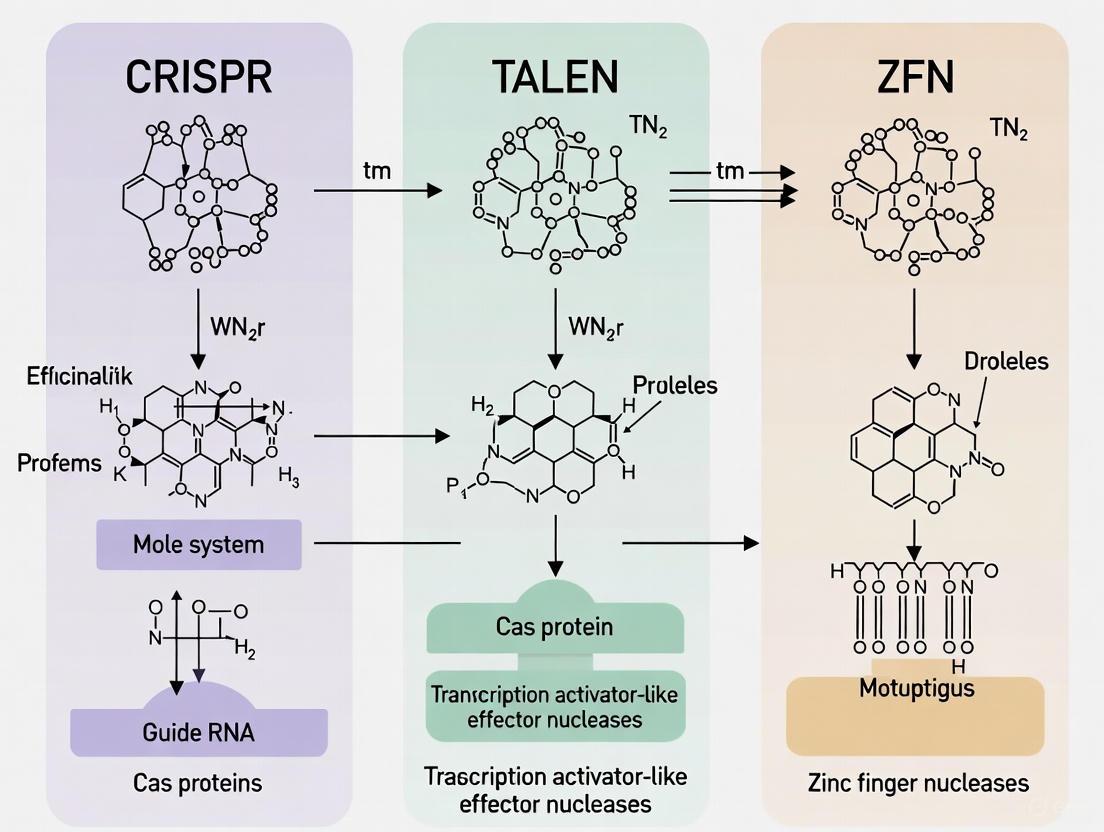
This article provides a comprehensive, up-to-date comparison of the three primary genome editing technologies—CRISPR, TALEN, and ZFN—tailored for researchers, scientists, and drug development professionals.
CRISPR vs TALEN vs ZFN: A 2025 Efficiency Comparison for Research and Therapeutic Applications
Abstract
This article provides a comprehensive, up-to-date comparison of the three primary genome editing technologies—CRISPR, TALEN, and ZFN—tailored for researchers, scientists, and drug development professionals. It covers the foundational mechanisms of each system, explores their current methodological applications in both basic research and clinical trials, addresses common troubleshooting and optimization challenges, and offers a validated, head-to-head comparison of their editing efficiency, precision, and practicality. The analysis incorporates the latest 2025 clinical data, market trends, and technological advancements to serve as a decision-making guide for selecting the optimal gene-editing tool for specific projects.
The Genome Editing Trinity: Understanding the Core Mechanisms of CRISPR, TALEN, and ZFN
The advent of gene-editing technologies has revolutionized biomedical research and therapeutic development, enabling precise modifications to genomic DNA. Among these tools, CRISPR-Cas9 has emerged as the most widely used platform due to its simplicity, efficiency, and versatility [1]. This guide provides an objective comparison of CRISPR-Cas9 against two predecessor technologies: Transcription Activator-Like Effector Nucleases (TALENs) and Zinc Finger Nucleases (ZFNs). The analysis is framed within the broader thesis of understanding their relative efficiencies, supported by experimental data and detailed methodologies. While CRISPR-Cas9 originates from a bacterial adaptive immune system that uses RNA guides for target recognition, TALENs and ZFNs rely on engineered protein domains for DNA binding [1] [2]. This fundamental difference in DNA recognition mechanism underpins many of their comparative advantages and limitations in research and therapeutic contexts.
Technology Comparison: Mechanisms and Characteristics
The core function of CRISPR-Cas9, TALENs, and ZFNs is to create double-strand breaks (DSBs) at specific genomic locations. These breaks are then repaired by the cell's endogenous DNA repair mechanisms, primarily non-homologous end joining (NHEJ) or homology-directed repair (HDR), leading to gene knockouts or precise edits, respectively [1]. However, each technology achieves this goal through distinct molecular architectures.
The table below provides a systematic comparison of the key technical characteristics of these three genome-editing platforms:
| Feature | CRISPR-Cas9 | TALEN | ZFN |
|---|---|---|---|
| DNA Recognition Mechanism | guide RNA (gRNA) [2] | TALE protein [2] | Zinc finger protein [2] |
| Nuclease Component | Cas9 protein [2] | FokI dimer [2] | FokI dimer [2] |
| Target Specificity | High (with gRNA design) [2] | Very High [2] | Very High [2] |
| Off-Target Effects | Higher than TALEN/ZFN [2] | Lower than CRISPR-Cas9 [2] | Lower than CRISPR-Cas9 [2] |
| Ease of Design | Very simple (within a week) [1] | Complex (~1 month) [1] | Complex (~1 month for ZFNs [1], but design is technically demanding [2]) |
| Relative Cost | Low [1] | Medium [1] | High [1] |
| Key Advantage | Simplicity, versatility, low cost [2] | High precision, lower off-target activity [2] | High specificity, smaller size advantageous for viral delivery [3] [2] |
| Key Limitation | Off-target effects [2] | Labor-intensive to construct [2] | Technically demanding design, context-dependent off-target activity [1] [2] |
Diagram 1: Comparative mechanisms of CRISPR-Cas9, TALEN, and ZFN systems. All systems ultimately create a double-strand break in DNA, but differ fundamentally in their targeting components: CRISPR-Cas9 uses RNA-guided targeting, while TALEN and ZFN use protein-guided targeting requiring dimerization.
Experimental Data & Efficiency Comparison
Editing Efficiency in Human Cells
A 2025 study demonstrated a streamlined approach for ZFN delivery, showing that T2A-coupled ZF-ND1 monomers co-expressed from a single cassette efficiently cleaved target DNA sequences. The genome editing efficiency was equivalent to using two separate ZF-ND1 monomers, while reducing the total transfected plasmid DNA by half. This T2A-coupled system achieved efficient editing in both HEK293T and Jurkat cell lines [3].
Gene Insertion Efficiency in Hematopoietic Stem Cells
Recent research on non-viral gene insertion provides direct comparative data. A 2025 Nature Communications study reported that combining TALEN with circular single-stranded DNA (CssDNA) donor templates achieved high gene insertion frequency in Hematopoietic Stem and Progenitor Cells (HSPCs) [4]. When compared to linear ssDNA (LssDNA), CssDNA demonstrated:
- 3- to 5-fold higher gene knock-in efficiency than LssDNA, with efficiencies surpassing 40% [4]
- Higher knock-in to knock-out ratio (1.30 for CssDNA vs. 0.11 for LssDNA with a 0.6 kb template) [4]
- Improved cell viability and reduced impact on differentiation capacity [4]
Notably, compared to AAV6-edited HSPCs, CssDNA-edited HSPCs exhibited a greater capacity to engraft and maintain gene edits in murine models, suggesting potential functional advantages for therapeutic applications [4].
Advancements in CRISPR-Cas9 Specificity and Delivery
Significant progress has been made in addressing CRISPR-Cas9 limitations. Deep learning models like CRISPR_HNN, which integrate MSC, MHSA, and BiGRU architectures, have demonstrated enhanced accuracy in predicting sgRNA on-target activity by better capturing local dynamic features and global long-distance dependencies [5].
For base editors (CRISPR-derived systems that enable precise nucleotide changes without double-strand breaks), novel deep learning models trained simultaneously on multiple experimental datasets have significantly improved prediction accuracy. These "dataset-aware" models, termed CRISPRon-ABE and CRISPRon-CBE, allow researchers to tailor predictions to specific base editors and experimental conditions, addressing a longstanding challenge in precise editing design [6].
Furthermore, AI-designed CRISPR systems are emerging. One 2025 study reported the development of OpenCRISPR-1, a gene editor designed with large language models that exhibits comparable or improved activity and specificity relative to SpCas9, despite being 400 mutations away in sequence [7].
Detailed Experimental Protocols
This protocol describes an efficient method for implementing ZFN editing using a single expression cassette.
- Plasmid Design: Construct a single plasmid coding for ZF(L)-ND1RRR and ZF(R)-ND1DDD linked using a T2A peptide. The T2A peptide enables co-expression of both monomers from a single cassette via ribosomal skipping.
- Cell Transfection: Transfect the plasmid into target cells (HEK293T or Jurkat). For a 6-well plate format, use 1-2 µg of total plasmid DNA, which is approximately half the amount required when using two separate plasmids for individual monomers.
- Incubation and Analysis: Incubate transfected cells for 72 hours to allow for gene editing to occur.
- Editing Efficiency Assessment: Extract genomic DNA and analyze editing efficiency using the T7EI assay or next-generation sequencing to quantify indel frequencies.
- Critical Note: The T2A peptide is preferred over P2A for ZFN systems, as the cleaved P2A peptide (adding 21 amino acids to ND1RRR) significantly reduces editing efficiency, while the T2A peptide (adding 20 amino acids) does not impair ND1 nuclease dimerization.
This protocol describes an efficient non-viral gene insertion method for hematopoietic stem cells.
- HSPC Culture: Thaw and expand HSPCs for 2 days in appropriate cytokine-enriched media.
- TALEN mRNA Transfection: On day 2, electroporate cells with 3 mRNA molecules encoding:
- TALEN targeting the desired locus (e.g., TALENB2M for B2M locus)
- HDR-Enh01 mRNA to enhance homology-directed repair
- Via-Enh01 mRNA to improve cell viability after editing
- CssDNA Template Delivery: On day 3, perform a second transfection with the circular single-stranded DNA donor template (0.6 kb to 2.2 kb in length) containing homology arms specific to the target locus.
- Culture and Analysis: Continue culture for 1-14 days depending on the readout. Analyze editing efficiency by flow cytometry for surface reporter expression (for disruptive insertion) or molecular assays for precise integration.
- Functional Validation: For therapeutic applications, perform colony-forming unit (CFU) assays to assess differentiation capacity and engraft edited HSPCs in immunodeficient NCG mice to evaluate long-term repopulation potential and edit persistence.
Diagram 2: Experimental workflow for TALEN-mediated gene insertion in HSPCs using CssDNA donor templates. This multi-day process involves sequential delivery of TALEN mRNA followed by CssDNA template, with comprehensive functional validation.
The Scientist's Toolkit: Research Reagent Solutions
The table below details key reagents and their applications in genome editing research:
| Research Reagent | Function/Application | Specific Examples & Notes |
|---|---|---|
| Circular ssDNA (CssDNA) | Non-viral donor template for gene insertion; reduces cytotoxicity and improves HDR efficiency compared to linear DNA [4]. | Enzymatically synthesized; 0.6-2.2 kb templates; 3-5x more efficient than linear ssDNA in HSPCs [4]. |
| TALEN mRNAs | Engineered nucleases for creating targeted double-strand breaks; used with DNA donor templates for precise gene insertion [4]. | Specific TALEN (e.g., TALENB2M for B2M locus); electroporated into cells as mRNA for transient expression [4]. |
| HDR-Enh01 mRNA | Enhances homology-directed repair efficiency when co-delivered with nuclease, increasing precise gene insertion rates [4]. | Electroporated alongside TALEN mRNA; improves knock-in efficiency in primary cells [4]. |
| Via-Enh01 mRNA | Improves cell viability after electroporation and editing process, particularly important for sensitive primary cells [4]. | Co-delivered with TALEN and HDR-Enh01 mRNAs; critical for maintaining HSPC fitness [4]. |
| AAV Vectors | Viral delivery system for DNA donor templates; high efficiency but concerns regarding genotoxicity and immunogenicity [4]. | AAV6 common for HSPCs; CssDNA shows superior engraftment capacity in comparative studies [4]. |
| T2A-Coupled ZFN Plasmids | Single-plasmid system for ZFN delivery; reduces DNA load and simplifies transfection [3]. | Enables co-expression of both ZFN monomers from single cassette; reduces total plasmid DNA by half [3]. |
| CRISPR-Cas9 Guides | Synthetic guide RNAs for directing Cas9 to specific genomic targets; easily programmable for new targets [2]. | Commercial libraries available; deep learning models (e.g., CRISPR_HNN) improve on-target activity prediction [5]. |
| Base Editor Systems | CRISPR-derived editors that enable precise nucleotide changes without double-strand breaks; reduce indel formation [6]. | ABE (Adenine Base Editor) and CBE (Cytosine Base Editor); prediction tools (CRISPRon-ABE/CBE) improve gRNA design [6]. |
The comparative analysis of CRISPR-Cas9, TALEN, and ZFN technologies reveals a nuanced landscape where each system offers distinct advantages depending on the research or therapeutic context. CRISPR-Cas9 remains the most accessible and versatile platform, with ongoing advancements in specificity prediction and AI-assisted editor design addressing its limitations. TALEN systems demonstrate superior precision in challenging genomic contexts and, when combined with novel delivery methods like CssDNA, achieve remarkable efficiency in therapeutically relevant primary cells. ZFNs, while historically complex to design, benefit from compact architecture advantageous for viral delivery and continued optimization in expression systems. The selection of an appropriate editing technology ultimately depends on the specific application requirements, including target specificity, delivery constraints, and desired edit type. As all three platforms continue to evolve, they collectively expand the frontiers of precise genome engineering for both basic research and clinical applications.
Gene editing technologies have revolutionized biological research and therapeutic development, enabling precise modifications to genomic DNA. Among the leading platforms, Transcription Activator-Like Effector Nucleases (TALENs) represent a sophisticated protein-based system that balances high specificity with versatile targeting capabilities [1]. This guide provides an objective comparison of TALEN performance against other major editing tools—CRISPR-Cas9 and Zinc Finger Nucleases (ZFNs)—framed within current efficiency research landscapes.
The global gene editing market, projected to grow from $6 billion in 2024 to $22 billion by 2033, reflects the escalating adoption and commercial significance of these technologies across biopharmaceutical, agricultural, and research sectors [8]. Within this expanding ecosystem, TALENs maintain a distinct position despite the widespread popularity of CRISPR systems, particularly for applications demanding exceptional precision and reduced off-target effects [9].
This article examines TALENs through multiple dimensions: molecular mechanism, quantitative performance metrics, experimental applications, and practical implementation considerations. By synthesizing direct comparative studies and recent technological advancements, we aim to provide researchers with evidence-based guidance for platform selection in specific experimental or therapeutic contexts.
Molecular Mechanism of TALENs
TALENs function as engineered fusion proteins that combine a customizable DNA-binding domain with a non-specific nuclease domain. The DNA-binding component originates from transcription activator-like effectors (TALEs), proteins naturally produced by the plant pathogen Xanthomonas to manipulate host gene expression [1]. These proteins utilize a remarkable modular recognition system where each TALE repeat domain, comprising 33-35 amino acids, binds to a single specific nucleotide [9] [1].
The nucleotide specificity is determined by two key amino acid residues at positions 12 and 13 within each repeat, known as Repeat Variable Diresidues (RVDs). The RVD code enables predictable DNA recognition: NN recognizes adenine (A), NI recognizes adenine (A), NG recognizes thymine (T), HD recognizes cytosine (C), and NH or NK recognizes guanine (G) [1]. This modular architecture allows researchers to engineer TALE arrays that bind virtually any user-defined DNA sequence by assembling the appropriate repeat domains in the required order.
For genome editing applications, the TALE DNA-binding domain is fused to the catalytic domain of the FokI restriction endonuclease, which introduces double-strand breaks (DSBs) in DNA [10] [1]. Unlike CRISPR-Cas9 which functions as a single protein-RNA complex, TALENs operate as pairs—left and right monomers—that bind to opposite DNA strands with a spacer sequence between them. Dimerization of the FokI nuclease domains across this spacer region is required for enzymatic activation and subsequent DNA cleavage [1].
The following diagram illustrates the core architecture and mechanism of TALENs:
After TALEN-mediated DNA cleavage, cellular repair mechanisms are activated. The primary pathways include error-prone non-homologous end joining (NHEJ), which often results in insertions or deletions (indels) that disrupt gene function, and homology-directed repair (HDR), which enables precise genetic modifications when a donor template is provided [10] [1]. The requirement for FokI dimerization contributes to TALEN specificity, as cleavage only occurs when both monomers correctly bind their target sequences in proper orientation and spacing.
Quantitative Performance Comparison
Direct comparative studies provide valuable insights into the relative performance characteristics of TALENs, CRISPR-Cas9, and ZFNs. The following tables summarize key efficiency and specificity metrics across multiple parameters:
Table 1: Overall Performance Metrics Across Gene Editing Platforms
| Parameter | TALEN | CRISPR-Cas9 | ZFN |
|---|---|---|---|
| Targeting Precision | High specificity, minimal off-target effects [11] | Moderate to high, subject to off-target effects [10] | High specificity with proper design [12] |
| Design Complexity | Moderate (∼1 month) [1] | Very simple (within a week) [10] [1] | Complex (∼1 month) [1] |
| Relative Cost | Medium [1] | Low [10] [1] | High [10] [1] |
| Editing Efficiency | Variable (context-dependent), high in heterochromatin [11] | Generally high in euchromatin [10] | Variable (design-dependent) [3] |
| Multiplexing Capacity | Limited | High (simultaneous multi-gene editing) [13] | Limited |
| PAM/PAM-like Requirement | No PAM, but must begin with T [1] | NGG PAM for SpCas9 [9] | No PAM, but specific spacer requirements |
| Delivery Efficiency | Challenging due to large protein size [9] [1] | High (compatible with various delivery systems) [10] | Moderate (smaller than TALENs) [3] |
Table 2: Experimental Efficiency Data from Comparative Studies
| Study Focus | TALEN Performance | CRISPR-Cas9 Performance | ZFN Performance | Reference |
|---|---|---|---|---|
| HPV16 Gene Therapy Target (GUIDE-seq) | URR: 1 off-targetE6: 7 off-targetsE7: 36 off-targets | URR: 0 off-targetsE6: 0 off-targetsE7: 4 off-targets | URR: 287 off-targets | [12] |
| Heterochromatin Editing | Up to 5x more efficient than CRISPR-Cas9 [11] | Reduced efficiency in tightly-packed DNA [11] | Not specified | [11] |
| AAV Delivery Compatibility | Challenging (large coding sequence) [1] | Limited by Cas9 size [3] | Favorable (compact size) [3] | [3] [1] |
| Therapeutic Applications | Preferred for high-specificity edits [10] | Broad applications, though limited by off-target concerns [10] | Proven in clinical settings (e.g., HIV therapy) [10] | [10] |
Recent advances in TALEN engineering have addressed some limitations while enhancing strengths. The development of T2A-coupled monomer systems enables more efficient expression from single cassettes, potentially improving editing efficiency while reducing delivery payload requirements [3]. Additionally, optimization of TALE repeat domains has expanded targeting range while maintaining high specificity.
Experimental Applications and Protocols
TALEN-Specific Workflow
Implementing TALEN editing requires a methodical approach from design to validation. The following diagram outlines the core experimental workflow:
Key Methodology: GUIDE-Seq for Specificity Assessment
The genome-wide unbiased identification of double-stranded breaks enabled by sequencing (GUIDE-seq) provides a comprehensive method for assessing nuclease specificity across platforms [12]. This protocol has been adapted for comparative analysis of TALENs, ZFNs, and CRISPR-Cas9:
Oligonucleotide Tag Delivery: Transfect cells with TALEN encoding vectors alongside a blunt-ended, double-stranded GUIDE-seq oligonucleotide tag.
Genomic DNA Extraction: Harvest cells 48-72 hours post-transfection and extract genomic DNA.
Tag Integration Enrichment: Capture tag-integrated genomic fragments through PCR amplification using tag-specific and genome-specific primers.
Library Preparation & Sequencing: Prepare sequencing libraries and perform high-throughput sequencing to identify tag integration sites.
Bioinformatic Analysis: Process sequencing data with customized algorithms to map double-strand break locations and frequency, comparing observed off-target sites with in silico predictions.
This methodology enabled direct comparison in the HPV16 study, revealing that "SpCas9 was more efficient and specific than ZFNs and TALENs" for certain targets, with TALENs demonstrating intermediate off-target profiles [12].
Heterochromatin Editing Assessment
Single-molecule imaging techniques have revealed TALEN's superior performance in densely packed DNA regions:
Fluorescent Tagging: Label TALEN and CRISPR-Cas9 components with distinct fluorophores.
Live-Cell Imaging: Monitor nuclease movement and binding kinetics in living mammalian cells using single-molecule fluorescence microscopy.
Binding Kinetics Analysis: Quantify time required for nucleases to locate and bind target sites in euchromatin versus heterochromatin regions.
Editing Efficiency Correlation: Measure actual editing efficiency at characterized genomic loci through sequencing analysis.
This approach demonstrated TALEN is "up to five times more efficient than CRISPR-Cas9 in parts of the genome, called heterochromatin, that are densely packed" [11].
Research Reagent Solutions
Successful TALEN experimentation requires specific reagents and systems. The following table outlines essential materials and their applications:
Table 3: Essential Research Reagents for TALEN Experiments
| Reagent/Solution | Function | Application Context |
|---|---|---|
| TALE Repeat Plasmids | Modular building blocks for custom DNA-binding domains | TALEN construct assembly |
| T2A-Peptide Vectors | Enables coordinated expression of TALEN pairs from single cassette [3] | Improved delivery efficiency |
| FokI Nuclease Domains | Provides dimerization-dependent cleavage activity | TALEN effector function |
| GUIDE-seq Oligonucleotides | Tags double-strand breaks for genome-wide specificity profiling [12] | Off-target assessment |
| T7 Endonuclease I | Detects heteroduplex mismatches in PCR-amplified target sites | Editing efficiency validation |
| AAV Delivery Vectors | Viral delivery of TALEN components; challenging due to size constraints [3] | In vivo applications |
| HEK293T Cell Line | Model system for TALEN validation and optimization | Efficiency testing |
TALEN technology represents a powerful option in the gene editing toolkit, particularly when project requirements prioritize high specificity, activity in heterochromatin regions, or applications where CRISPR off-target effects present unacceptable risks. While CRISPR systems excel in simplicity, multiplexing capacity, and broad accessibility, TALENs maintain distinct advantages in contexts demanding protein-based precision and proven regulatory acceptance pathways.
The choice between platforms should be guided by specific experimental goals, target genomic context, delivery constraints, and risk tolerance regarding off-target effects. As the gene editing field evolves, continued refinement of all major platforms—including enhanced Cas variants, improved TALEN delivery systems, and compact ZFN architectures—will further empower researchers to select optimal tools for their specific applications.
Zinc-finger nucleases (ZFNs) represent the pioneering technology that opened the era of targeted genome editing. As the first programmable nucleases to demonstrate efficient gene editing in higher eukaryotes, ZFNs established the foundational concept of using engineered DNA-binding domains fused to non-specific nuclease domains to create targeted double-strand breaks in genomic DNA [14] [15]. These chimeric proteins are constructed by fusing a custom-designed zinc-finger protein (ZFP) DNA-binding domain to the cleavage domain of the FokI restriction enzyme [14]. The development of ZFNs marked a significant milestone in molecular biology, transitioning from random mutagenesis and inefficient homologous recombination to precise genome surgery with therapeutic potential. This technology proved that artificial enzymes could be engineered to manipulate virtually any gene in a diverse range of cell types and organisms, setting the stage for subsequent genome editing platforms [15].
Molecular Mechanism of ZFNs
Structural Architecture and DNA Recognition
The functional architecture of ZFNs consists of two primary components: a DNA-binding domain composed of zinc-finger proteins and a catalytic domain derived from the FokI endonuclease. Each zinc finger domain recognizes a specific 3-4 base pair DNA sequence through coordination by zinc ions and α-helical structures that interface with the DNA major groove [14] [15]. Engineered ZFN pairs typically incorporate arrays of three to six zinc fingers, enabling recognition of 9-18 base pair sequences per subunit [14]. For successful DNA cleavage, two ZFN subunits must bind to opposite DNA strands in a tail-to-tail orientation, with their recognition sites separated by a 5-7 base pair spacer sequence [14] [16]. This requirement for dimerization adds a critical layer of specificity, as the binding of two independent ZFNs in close proximity is necessary to initiate DNA cleavage.
DNA Cleavage Mechanism and Repair Pathways
Upon binding to their target sequences, the FokI cleavage domains dimerize and introduce a double-strand break (DSB) within the spacer region [14]. This DSB activates the cellular DNA damage response, engaging one of two major repair pathways. The non-homologous end joining (NHEJ) pathway directly ligates the broken DNA ends in an error-prone manner, often resulting in small insertions or deletions (indels) that can disrupt gene function [14] [15]. Alternatively, the homology-directed repair (HDR) pathway uses a homologous DNA template to precisely repair the break, enabling precise gene modifications when an exogenous donor template is provided [14]. The balance between these pathways varies by cell type and cell cycle stage, with NHEJ dominating in G1 phase and HDR being most active in S/G2 phases [14].
Figure 1: ZFN Mechanism of Action. ZFNs function through (1) sequence-specific DNA binding and FokI dimerization, (2) targeted double-strand break formation, and (3) engagement of cellular DNA repair pathways leading to either gene disruption or precise editing.
Comparative Performance Analysis
Editing Efficiencies Across Platforms
Direct comparison of genome editing platforms reveals distinct efficiency profiles. A 2021 study using genome-wide unbiased identification of double-stranded breaks enabled by sequencing (GUIDE-seq) to evaluate nucleases targeting human papillomavirus (HPV) genes provides quantitative insights into the performance characteristics of ZFNs compared to TALENs and CRISPR-Cas9 [17].
Table 1: Comparison of Editing Efficiencies Between Programmable Nucleases
| Nuclease Type | Target Gene | Editing Efficiency | Absolute HDR Frequency | Key Advantages |
|---|---|---|---|---|
| ZFNs | CCR5 | High disruption efficiency | Up to 20% in human cells [15] | Compact size compatible with AAV delivery [16] |
| ZFNs | Rhodopsin | Demonstrated DSB induction | 17% HDR in retinoblast cells [18] | High specificity with extended target recognition [16] |
| TALENs | MSTN | Moderate efficiency | Lower than CRISPR in goat fibroblasts [19] | Lower cell toxicity than early ZFNs [15] |
| CRISPR-Cas9 | MSTN | Highest efficiency | Superior to TALENs in comparative study [19] | Simplified design and multiplexing capability [19] |
Specificity and Off-Target Profiles
A critical consideration for therapeutic applications is nuclease specificity. The GUIDE-seq analysis of HPV-targeted nucleases revealed substantial differences in off-target activities between platforms [17]. ZFNs targeting the HPV URR region generated 287-1,856 off-target events, with specificity correlating with the count of middle "G" nucleotides in zinc finger proteins [17]. In the same study, TALENs targeting the E7 gene produced 36 off-target events, while CRISPR-Cas9 targeting the same region generated only 4 off-target events [17]. This substantial difference in off-target activity highlights a significant challenge for ZFN technology. However, advanced ZFN architectures featuring obligate heterodimeric FokI domains have demonstrated substantial improvements in specificity by preventing homodimerization at off-target sites [14] [16].
Table 2: Off-Target Activity Comparison Across Nuclease Platforms
| Nuclease Platform | Target Site | Off-Target Count | Specificity Enhancement Strategies |
|---|---|---|---|
| First-gen ZFNs | HPV URR | 287-1,856 [17] | - |
| Advanced ZFNs | Therapeutic targets | Minimal with optimized designs [16] | Obligate heterodimer FokI domains, optimized linkers [14] [16] |
| TALENs | HPV E7 | 36 [17] | Alternative N-terminal domains, modified repeat variable diresidues [17] |
| CRISPR-Cas9 | HPV E7 | 4 [17] | High-fidelity Cas9 variants, modified guide RNAs [17] [20] |
Experimental Design and Workflow
ZFN Engineering and Validation Protocols
The development of effective ZFNs follows a multi-stage process beginning with target site selection. Optimal ZFN target sequences follow the pattern (NNC)~3~N~6~(GNN)~3~, where the N~6~ spacer region is cleaved and the flanking sequences are recognized by zinc-finger arrays [18]. Contemporary approaches have dramatically expanded targeting possibilities through engineered architectures that allow functional attachment of FokI to the N-terminus of ZFPs and base-skipping between fingers, increasing configurational options by 64-fold [16].
Validation of ZFN activity typically employs a combination of in vitro and cellular assays. A standard protocol involves quantitative real-time PCR with primers flanking the target site to detect disruption of the endogenous locus [18]. The T7 endonuclease I (T7EI) assay is commonly used to detect mutation frequencies by cleaving heteroduplex DNA formed by annealing of wild-type and mutant sequences [17]. For therapeutic applications, ZFNs are often delivered via viral vectors, with adeno-associated viruses (AAVs) being particularly suitable due to the compact size of ZFN genes [18] [16].
Figure 2: ZFN Experimental Workflow. Key stages in ZFN experimentation include (1) target design and nuclease assembly, (2) delivery into target cells, and (3) comprehensive validation of editing efficiency and specificity.
Essential Research Reagents and Solutions
Successful ZFN experiments require carefully selected reagents and methodologies. The following table outlines core components of a typical ZFN workflow.
Table 3: Essential Research Reagents for ZFN Experiments
| Reagent Category | Specific Examples | Function and Application |
|---|---|---|
| ZFN Expression Plasmids | pPDAZ vector system [21] | Provides regulated ZFN expression with selection markers |
| Delivery Tools | AAV vectors, lentiviruses, electroporation systems | Efficient ZFN delivery to target cells |
| Validation Assays | T7 endonuclease I, GUIDE-seq, dsODN breakpoint PCR [17] | Detection of on-target and off-target editing events |
| Cell Culture Resources | HER cells, iPSCs, primary T-cells [14] [18] | Relevant cellular models for editing experiments |
| Selection Systems | ccdB counter-selection, antibiotic resistance [16] [21] | Enrichment for successfully edited cells |
Therapeutic Applications and Clinical Status
ZFN technology has demonstrated significant potential across diverse therapeutic areas. In HIV treatment, ZFNs designed to disrupt the CCR5 co-receptor have progressed to clinical trials, with engineered T-cells showing resistance to viral infection and reduced HIV DNA in patients [14] [17]. For inherited disorders, ZFNs have successfully corrected disease-related genes in hematopoietic stem cells for β-thalassemia and in photoreceptor cells for retinitis pigmentosa [14] [18]. A phase I clinical trial for hemophilia B represents the first in vivo genome editing approach, utilizing ZFNs to insert a corrective factor IX gene into the albumin locus [16].
The compact size of ZFNs compared to other editors provides distinct advantages for viral delivery, particularly with AAV vectors which have limited packaging capacity [16]. Additionally, the all-protein structure of ZFNs avoids potential immune responses against bacterial-derived Cas proteins and enables targeting of mitochondrial DNA [16]. These features maintain ZFNs as a viable platform for specific therapeutic applications despite the emergence of newer technologies.
Technical Challenges and Recent Advancements
Historical Limitations and Solutions
Early ZFN platforms faced significant challenges in design complexity, with modular assembly requiring specialized expertise and months of effort to develop effective nucleases [15]. Targeting constraints limited density to approximately one targetable site every 200 base pairs in random sequence using open-source components [15]. Off-target cleavage and cellular toxicity presented additional hurdles, particularly with early architectures that permitted FokI homodimerization at non-cognate sites [14].
Contemporary ZFN systems have addressed these limitations through multiple innovations. Expanded architectures now enable targeting at nearly every base step in arbitrary genomic sequences [16]. Advanced delivery methods, including direct protein delivery and mRNA transfection, reduce off-target effects and cellular toxicity [15]. The development of enhanced FokI domains through directed evolution has yielded variants with substantially improved activity, such as the "Sharkey" domain demonstrating 15-fold increased cleavage efficiency [21].
Emerging Enhancements and Future Directions
Recent research continues to refine ZFN technology through structural diversification and specificity enhancements. New linker configurations enabling functional N-terminal FokI fusions and base-skipping between zinc fingers have expanded design options by 64-fold [16]. Bacterial selection systems utilizing ccdB toxicity allow efficient screening of optimized ZFN architectures from large randomized libraries [16] [21]. These advances maintain ZFNs as a competitive platform for applications requiring high precision and validated specificity, particularly in therapeutic contexts where their compact size and protein-only composition offer distinct advantages.
ZFNs established the foundational paradigm for targeted genome editing and continue to evolve as a valuable platform despite the emergence of TALENs and CRISPR systems. While CRISPR-Cas9 offers superior design simplicity and multiplexing capability, ZFNs maintain advantages in specific contexts including compact size for viral delivery, long recognition sequences for enhanced specificity, and well-characterated safety profiles in clinical applications [17] [16]. The continuing refinement of ZFN architectures, cleavage domains, and delivery methods ensures their ongoing relevance in the genome editing toolkit, particularly for therapeutic applications requiring high precision and minimal off-target effects. As the pioneering technology that demonstrated the feasibility of programmable genome editing, ZFNs remain an important option for researchers and clinicians seeking to implement targeted genetic modifications.
Genome engineering has become an indispensable tool in biological and biomedical research, enabling precise modifications to genomic DNA across a wide variety of organisms [22] [1]. At the heart of programmable gene-editing technologies lie two fundamental components: a targeting mechanism for specific DNA recognition and a nuclease domain for cleaving the DNA backbone. The evolution of these technologies—from zinc finger nucleases (ZFNs) and transcription activator-like effector nucleases (TALENs) to the clustered regularly interspaced short palindromic repeats (CRISPR)-Cas system—represents a shift in how these two components are engineered and function together [23].
This guide provides a structured comparison of the DNA-binding domains (protein-based versus RNA-based) and cleavage mechanisms (FokI versus Cas9) that define these major gene-editing platforms. For researchers, scientists, and drug development professionals, understanding these core architectural principles is essential for selecting the appropriate tool for specific experimental or therapeutic applications, particularly when considering factors such as efficiency, specificity, delivery constraints, and intellectual property landscape [3].
Core Architectural Principles
DNA Recognition Mechanisms
The systems diverge fundamentally in their approach to DNA recognition, which directly impacts their design flexibility, targeting range, and ease of use.
Protein-Based DNA Recognition (ZFNs & TALENs): These platforms rely on custom-designed protein modules to recognize specific DNA sequences.
- Zinc Finger (ZF) Domains: Each zinc finger domain, consisting of approximately 30 amino acids, recognizes a 3-base pair DNA sequence through interactions between its α-helix and the major groove of DNA. Typical ZFNs link three to six of these domains to target sequences of 9 to 18 base pairs [1] [23].
- Transcription Activator-Like Effector (TALE) Domains: TALE proteins use a modular repeat structure where each repeat of 33-35 amino acids recognizes a single nucleotide. The specificity is determined by the 12th and 13th amino acids, known as repeat-variable di-residues (RVDs), which follow a recognizable code (e.g., NI for A, HD for C, NG for T, and NN for G) [1].
RNA-Guided DNA Recognition (CRISPR-Cas9): The CRISPR-Cas9 system simplifies DNA recognition by using a single-guide RNA (sgRNA). This sgRNA contains a ~20 nucleotide spacer sequence that pairs with the target DNA strand through Watson-Crick base pairing. The target site must be adjacent to a short protospacer adjacent motif (PAM), which for the commonly used Streptococcus pyogenes Cas9 is 5'-NGG-3' [22] [23]. This mechanism decouples the recognition and cleavage functions, as the same Cas9 protein can be directed to any genomic locus simply by changing the sgRNA sequence.
DNA Cleavage Mechanisms
The enzymatic cleavage of DNA is the critical step that initiates genome editing, and the different systems employ distinct strategies with important implications for specificity.
FokI Nuclease Domain (ZFNs & TALENs): Both ZFNs and TALENs are fused to the catalytic domain of the FokI restriction endonuclease [1] [23]. Crucially, the FokI domain must dimerize to become active and create a double-strand break (DSB) [22]. This requires a pair of ZFN or TALEN monomers to bind opposite strands of the DNA in a head-to-head orientation, with a specific spacer sequence separating the two binding sites (typically 5–7 bp for ZFNs and 12–19 bp for TALENs) [22] [1]. This obligate dimerization inherently increases specificity, as two independent binding events must occur simultaneously for cleavage to happen.
Cas9 Nuclease (CRISPR-Cas9): The Cas9 protein is a single effector nuclease that possesses two distinct catalytic domains: the HNH domain, which cleaves the DNA strand complementary to the sgRNA, and the RuvC domain, which cleaves the non-complementary strand [22]. Unlike FokI, Cas9 functions as a monomer. A single Cas9-sgRNA complex is sufficient to generate a DSB, which contributes to its simplicity but can also increase the potential for off-target effects, as a single binding event is enough to trigger cleavage [22] [23].
Table 1: Comparative Anatomy of Gene-Editing Tool Components
| Feature | ZFN | TALEN | CRISPR-Cas9 |
|---|---|---|---|
| DNA-Binding Domain | Zinc Finger Protein | TALE Protein | guide RNA (sgRNA) |
| Recognition Code | 3 bp per zinc finger module | 1 bp per TALE repeat (via RVDs) | ~20 nt sgRNA spacer via base pairing |
| Cleavage Domain | FokI | FokI | Cas9 (RuvC & HNH) |
| Cleavage Mechanism | Obligate Dimerization | Obligate Dimerization | Monomeric |
| Target Site Requirement | Pairs of sites with 5-7 bp spacer | Pairs of sites with 12-19 bp spacer; must begin with 'T' [1] | NGG PAM sequence adjacent to target |
| Overall Target Size | 18-24 bp | 30-40 bp | ~23 bp (20 bp guide + NGG PAM) |
Comparative Performance Data
The architectural differences between these systems translate directly into their practical performance in genome-editing applications, influencing efficiency, specificity, and ease of design.
Table 2: Performance Comparison of Major Gene-Editing Platforms
| Performance Metric | ZFN | TALEN | CRISPR-Cas9 |
|---|---|---|---|
| Specificity / Off-Target Effect | Lower than CRISPR-Cas9 [1] | Lower than CRISPR-Cas9 [1] | High (more prone to off-targets due to mismatch tolerance) [22] [1] |
| Design Complexity | Complex [1] (can take ~1 month [1]) | Complex [1] (can take ~1 month [1]) | Very simple (within a week) [1] |
| Ease of Delivery | Limited due to difficulty of linking ZF modules [22]; but smaller size is advantageous for viral vectors [3] | Difficult due to large cDNA size and extensive repeats [22] [1] | Easy, using standard delivery and cloning techniques [22] |
| Cost | High [1] | Medium [1] | Low [1] |
| Multiplexing Potential | Difficult [22] | Difficult [22] | Easy, can form multiplexes directed to multiple genes [22] |
| Key Limitations | Off-target effects, limited delivery due to size constraints, complex design [22] | Off-target effects, expensive, difficult delivery due to large size [22] [1] | Off-target effects due to mismatch tolerance, constrained by PAM sequence availability [22] [1] |
A key advancement in enhancing specificity is the engineered FokI-dCas9 (fdCas9) system. In this chimeric protein, the nuclease domains of Cas9 are inactivated (creating "dead" Cas9 or dCas9) and fused to the FokI nuclease domain. Like ZFNs and TALENs, this system requires two fdCas9-sgRNA complexes to bind the DNA in a PAM-out orientation with a defined spacer (e.g., 15-25 bp) for FokI dimerization to occur and generate a DSB. This strategy has been shown to significantly reduce off-target effects while maintaining robust on-target editing [22].
Experimental Protocols and Methodologies
To illustrate how these molecular architectures are translated into practical experiments, below are detailed methodologies for key assays evaluating nuclease activity and specificity.
Protocol 1: Evaluating fdCas9 Specificity
This protocol is adapted from Guilinger et al. (2014), who developed one of the first fdCas9 systems and compared its off-target activity to wild-type (WT) Cas9 and paired Cas9 nickases [22].
- Objective: To quantify and compare the on-target and off-target editing rates of WT Cas9, paired nickases, and fdCas9 at endogenous human gene loci (e.g., VEGFA, EMX1).
- Materials:
- Plasmids encoding WT Cas9, Cas9 nickase (D10A mutant), or fdCas9.
- Dual sgRNA expression plasmids or a Csy4-based dual sgRNA expression system [22].
- Human cell line (e.g., HEK293T).
- Transfection reagent.
- Lysis buffer and DNA purification kit.
- PCR primers flanking the on-target and predicted off-target sites.
- T7 Endonuclease I (T7EI) or materials for high-throughput sequencing.
- Methodology:
- Transfection: Co-transfect cells with the nuclease plasmid (WT Cas9, nickase pair, or fdCas9) and the appropriate sgRNA plasmid(s). Include a non-treated control.
- Harvesting: Incubate for 72 hours, then harvest genomic DNA.
- Amplification: Perform PCR to amplify the on-target and known off-target genomic regions from the purified DNA.
- Heteroduplex Formation: Denature and reanneal the PCR products to form heteroduplexes if indels are present.
- Digestion & Analysis: Treat the heteroduplex DNA with T7EI, which cleaves mismatched DNA. Analyze the cleavage products by gel electrophoresis. Alternatively, subject the PCR products to high-throughput sequencing for a more quantitative and unbiased measurement of indel frequencies.
- Key Findings: The fdCas9 system demonstrated a ~140-fold increase in the on-target to off-target editing ratio compared to WT Cas9, and a 1.3 to 8.8-fold increase compared to paired nickases, indicating superior specificity [22].
Protocol 2: Testing T2A-Coupled ZFN Monomers
This protocol is based on a 2025 study that optimized ZFN delivery by expressing both monomers from a single open reading frame linked by a self-cleaving T2A peptide [3].
- Objective: To assess the genome editing efficiency of a single-plasmid T2A-coupled ZFN system compared to the traditional two-plasmid system.
- Materials:
- Two plasmids encoding separate ZF-ND1 (a ZFN variant) monomers (Left-ZF-ND1RRR and Right-ZF-ND1DDD).
- A single plasmid encoding T2A-coupled ZF-ND1 monomers.
- HEK293T or Jurkat cells.
- Transfection reagents.
- Genomic DNA extraction kit.
- PCR primers for the target locus (e.g., AAVS1).
- T7 Endonuclease I (T7EI) assay reagents.
- Methodology:
- Transfection: Transfect cells with either the two separate plasmids or the single T2A-coupled plasmid, using a reduced total DNA amount (by half) for the T2A construct.
- Incubation: Culture cells for 72 hours post-transfection.
- DNA Extraction: Isolate genomic DNA.
- T7EI Assay: Amplify the target locus by PCR, form heteroduplexes, digest with T7EI, and analyze by gel electrophoresis to quantify indel efficiency.
- Off-Target Assessment: Amplify the top predicted off-target sites (e.g., identified via BLAST) and subject them to the T7EI assay to check for unintended mutations.
- Key Findings: The T2A-coupled ZFNs achieved equivalent editing efficiency to the two-plasmid system while using half the total plasmid DNA. The cleaved T2A peptide did not inhibit ND1 nuclease dimerization, whereas a P2A peptide linker significantly reduced efficiency. No off-target mutations were detected for either system under these assay conditions [3].
Visualization of Mechanisms and Workflows
The following diagrams illustrate the core mechanisms and experimental workflows discussed in this guide.
DNA Recognition and Cleavage Mechanisms
Diagram 1: DNA recognition and cleavage mechanisms. Protein-based systems require two monomers for FokI dimerization, while CRISPR-Cas9 uses a single RNA-guided complex.
High-Specificity fdCas9 Experimental Workflow
Diagram 2: Experimental workflow for evaluating nuclease activity and specificity, using fdCas9 as an example.
The Scientist's Toolkit: Essential Research Reagents
Successful genome-editing experiments require a suite of carefully selected reagents. The table below details key materials and their functions, drawing from the experimental protocols cited in this guide.
Table 3: Essential Reagents for Genome-Editing Research
| Reagent / Material | Function / Description | Example Use Case |
|---|---|---|
| TALEN or ZFN Plasmids | Engineered plasmids encoding the left and right monomers of the nucleases. | Inducing DSBs at a specific genomic locus in human cells [4]. |
| fdCas9 Plasmid & Dual sgRNA System | Plasmid encoding the FokI-dCas9 fusion protein and a system (e.g., Csy4-based) to express two sgRNAs. | High-specificity genome editing requiring two adjacent binding sites for FokI dimerization [22]. |
| T2A-Coupled ZFN Plasmid | A single plasmid expressing both ZFN monomers from one open reading frame via a self-cleaving T2A peptide. | Simplified delivery of ZFNs, reducing plasmid size and total DNA amount, beneficial for viral packaging [3]. |
| Circular ssDNA (CssDNA) Donor Template | A kilobase-long circular single-stranded DNA molecule used as a homology-directed repair (HDR) template. | Efficient, non-viral targeted gene insertion in HSPCs with reduced toxicity compared to linear templates [4]. |
| T7 Endonuclease I (T7EI) | An enzyme that cleaves mismatched heteroduplex DNA formed by PCR products from edited and unedited alleles. | Detecting and quantifying the frequency of non-homologous end joining (NHEJ)-induced indels at the target site [3]. |
| Lipid Nanoparticles (LNPs) | Non-viral delivery vehicles that form lipid droplets around CRISPR molecules for in vivo delivery. | Systemic in vivo delivery of CRISPR components, particularly to the liver, as used in clinical trials for hATTR [24]. |
From Bench to Bedside: Current Applications in Research and Therapeutics
In the competitive field of preclinical therapeutic development, the selection of an appropriate gene-editing technology is paramount to project success. Clustered regularly Interspaced Short Palindromic Repeats (CRISPR-Cas9) has emerged as the dominant platform, particularly for gene knockout applications, surpassing older technologies like Transcription Activator-Like Effector Nucleases (TALENs) and Zinc Finger Nucleases (ZFNs) in widespread adoption [25]. This dominance stems from a combination of design simplicity, high efficiency, and versatility that accelerates research timelines. While all three technologies create double-strand breaks (DSBs) in DNA to initiate gene disruption, their underlying mechanisms, practical implementation, and performance characteristics differ significantly [26] [27]. This guide provides an objective, data-driven comparison of these platforms, focusing on their application in knockout studies essential for target validation, disease modeling, and functional genomics in preclinical drug discovery.
Technology Comparison: Mechanisms and Workflows
Core Mechanisms of Action
The foundational difference between these technologies lies in their DNA recognition and cleavage mechanisms:
- CRISPR-Cas9 is a two-component system utilizing a guide RNA (gRNA) for sequence-specific targeting and the Cas9 nuclease for DNA cleavage. The gRNA binds to the target DNA via Watson-Crick base pairing, making design straightforward and predictable [2] [28].
- TALENs are fusion proteins consisting of a TALE DNA-binding domain and a FokI nuclease domain. The TALE domain comprises repeating units, each recognizing a single nucleotide, providing high specificity but requiring more complex protein engineering [2] [26].
- ZFNs also employ the FokI nuclease, fused to a zinc-finger DNA-binding domain. Each zinc finger recognizes a nucleotide triplet, and ZFNs must function as pairs, necessitating extensive protein engineering for each new target [2] [27].
The following diagram illustrates the key mechanistic differences and the general workflow for applying each technology in a knockout experiment.
Quantitative Performance Comparison
Direct comparative studies provide objective data on the performance of ZFNs, TALENs, and CRISPR-Cas9. A 2021 study utilizing the GUIDE-seq method for unbiased off-target detection offers a clear efficiency and specificity comparison when targeting the human papillomavirus (HPV16) genome [17].
Table 1: Performance Comparison of ZFNs, TALENs, and SpCas9 in HPV16 Gene Therapy Model
| Technology | Target Gene | On-Target Efficiency | Off-Target Count (GUIDE-seq) |
|---|---|---|---|
| ZFN | URR | High | 287 - 1,856 |
| TALEN | URR | High | 1 |
| TALEN | E6 | High | 7 |
| TALEN | E7 | High | 36 |
| SpCas9 | URR | High | 0 |
| SpCas9 | E6 | High | 0 |
| SpCas9 | E7 | High | 4 |
This data demonstrates that SpCas9 was more efficient and specific than ZFNs and TALENs in this model, with fewer off-target events across all target genes [17]. The study also noted that ZFN specificity could be inversely correlated with the count of middle "G" in zinc finger proteins, and that TALEN designs to improve efficiency (e.g., using αN or NN modules) inevitably increased off-target counts [17].
Practical Workflow and Feasibility
From a practical standpoint, CRISPR-Cas9 offers significant advantages in ease of use and speed, which directly contributes to its dominance in knockout applications.
Table 2: Feasibility and Workflow Comparison for Knockout Generation
| Parameter | CRISPR-Cas9 | TALENs | ZFNs |
|---|---|---|---|
| Target Design | Simple gRNA design via base pairing [27] | Complex protein engineering for each target [2] | Highly complex protein engineering [2] |
| Development Timeline | Days to a week [28] | Several weeks [2] | Several months [2] |
| Multiplexing Capacity | High (multiple gRNAs simultaneously) [27] | Low | Low |
| Efficiency in Immortalized Cells | High (>80% INDEL efficiency common) [29] | Variable, generally high [2] | Variable [2] |
| Efficiency in Primary Cells | Moderate to high, but more challenging [25] | Lower than CRISPR | Lower than CRISPR |
| Typical Knockout Workflow Duration | ~3 months (median reported) [25] | >6 months (estimated) | >6 months (estimated) |
Survey data from the drug discovery sector confirms that CRISPR is the primary genetic modification method for 45.4% of commercial and 48.5% of non-commercial institutions, with knockouts being the most widely used application (45%-54% of researchers using CRISPR) [25]. The data also reveals that researchers typically repeat the entire CRISPR workflow a median of 3 times before succeeding, underscoring that while highly efficient, the process still requires optimization and validation [25].
Experimental Protocols for Knockout Validation
GUIDE-seq for Comprehensive Off-Target Analysis
The GUIDE-seq (Genome-Wide Unbiased Identification of DSBs Enabled by Sequencing) method provides a robust protocol for identifying off-target effects of CRISPR nucleases, TALENs, and ZFNs [17]. This is critical for preclinical safety assessment.
Protocol Overview:
- dsODN Transfection: Co-deliver programmed nuclease components (e.g., Cas9/gRNA RNP, TALEN mRNA, ZFN mRNA) with a short, double-stranded oligodeoxynucleotide (dsODN) tag into mammalian cells.
- Tag Integration: The dsODN tag integrates into nuclease-induced double-strand break (DSB) sites via the NHEJ repair pathway.
- Genomic DNA Extraction and Library Preparation: Harvest cells 72-96 hours post-transfection. Extract genomic DNA and shear it by sonication.
- Enrichment and Sequencing: Enrich for dsODN-integrated fragments using PCR. Prepare sequencing libraries and perform high-throughput sequencing.
- Bioinformatic Analysis: Map sequencing reads to the reference genome to identify all dsODN integration sites, which correspond to both on-target and off-target nuclease activity.
Key Considerations:
- The distribution of GUIDE-seq read start positions reveals distinct DSB patterns: SpCas9 shows minimal variability, while ZFNs and TALENs exhibit higher variability in cleavage sites [17].
- This method can detect off-targets with frequencies as low as 0.0001% and was successfully adapted for TALENs and ZFNs by developing novel bioinformatics algorithms [17].
Indel Analysis for On-Target Efficiency
Quantifying insertion or deletion mutations (indels) at the target site is a standard practice for evaluating knockout efficiency. CRISPR-GRANT is a graphical analysis tool that simplifies this process for novice users [30].
Protocol Overview:
- Amplicon Sequencing: Design PCR primers flanking the target site and perform targeted amplification from edited genomic DNA. Submit the amplicon library for next-generation sequencing (NGS).
- Data Processing with CRISPR-GRANT:
- Input: Provide raw FASTQ files and the reference target sequence in FASTA format.
- Quality Control: The tool uses Fastp for quality control, removing low-quality reads.
- Read Mapping: BWA-MEM aligns reads to the reference sequence.
- Variant Calling: VarScan2 analyzes the aligned reads for consensus and variants.
- Quantification and Visualization: CRISPR-GRANT generates:
- A table of different indel types and their read counts.
- The percentage of modified and un-modified reads.
- Alignment visualization of top reads.
- Frequency of indels at each position along the reference.
Advantages: CRISPR-GRANT offers a standalone graphical interface, requires no data pre-processing, supports analysis of single/pooled amplicons and whole-genome sequencing, and operates offline to protect sensitive data [30].
The Scientist's Toolkit: Essential Research Reagents
Successful execution of gene knockout experiments requires a suite of specialized reagents and tools. The following table details key solutions for CRISPR-based knockout studies, which represent the current dominant workflow.
Table 3: Essential Research Reagents for CRISPR Knockout Studies
| Reagent / Solution | Function | Examples / Notes |
|---|---|---|
| Cas9 Nuclease | Creates double-strand breaks at target DNA. | SpCas9 is the standard; also Cas12a (Cpf1) [30]. HiFi Cas9 variants reduce off-targets [31]. |
| Guide RNA (gRNA) | Directs Cas9 to specific genomic locus via base pairing. | Chemically synthesized, in vitro transcribed, or expressed from a vector [28]. |
| Delivery Vehicle | Introduces editing components into cells. | Lentivirus, AAV, lipid nanoparticles (LNPs), electroporation of ribonucleoprotein (RNP) complexes [28]. |
| NGS Library Prep Kit | Prepares amplicon libraries for sequencing to assess editing. | Kits for Illumina, PacBio, or other NGS platforms [17]. |
| Off-Target Detection Tool | Identifies unintended edits genome-wide. | GUIDE-seq [17], CAST-Seq [31]. |
| Cell Culture Reagents | Maintains and expands target cells for editing. | Cell-type specific media; primary cells are more challenging than immortalized lines [25]. |
| Bioinformatics Software | Analyzes NGS data to quantify editing efficiency and specificity. | CRISPR-GRANT [30], CRISPResso2 [30]. |
Limitations and Safety Considerations
Despite its dominance, CRISPR-Cas9 is not without limitations. A significant concern beyond off-target effects is the generation of on-target structural variations (SVs) [31]. These can include large deletions, chromosomal translocations, and other complex rearrangements that are difficult to detect with standard short-read amplicon sequencing [31]. Such SVs have also been observed with ZFNs and TALENs, indicating this is a risk associated with DSB-inducing nucleases generally [31].
Furthermore, strategies to enhance homology-directed repair (HDR), such as using DNA-PKcs inhibitors, can dramatically increase the frequency of these kilobase- to megabase-scale deletions and chromosomal translocations [31]. This highlights a critical trade-off where efforts to improve precise editing can inadvertently introduce new genomic risks, emphasizing the need for comprehensive genomic integrity assessments in preclinical development.
The quantitative data and experimental comparisons presented in this guide unequivocally support the conclusion that CRISPR-Cas9 is the leading technology for gene knockout applications in preclinical research. Its superiority stems from a combination of high efficiency, specificity, straightforward design, and multiplexing capability, which collectively accelerate research timelines compared to TALENs and ZFNs [17] [25] [27].
The field continues to evolve rapidly with the development of base editing, prime editing, and other precision editing tools that can modify DNA without creating double-strand breaks, potentially offering improved safety profiles [32]. However, for routine gene knockout applications essential to target validation and functional genomics, CRISPR-Cas9 remains the most versatile and effective platform. As with any powerful technology, its successful application requires careful experimental design, robust validation using the described protocols, and a thorough assessment of both on-target and off-target outcomes to ensure the reliability of preclinical data.
The field of genome editing has transitioned from theoretical promise to clinical reality, with CRISPR-based therapies now demonstrating transformative potential for treating genetic disorders. As of 2025, the clinical landscape represents both remarkable achievements and significant challenges [24]. The landmark approval of Casgevy (exagamglogene autotemcel) for sickle cell disease (SCD) and transfusion-dependent beta thalassemia (TBT) has established a new paradigm for genetic medicine, while investigational therapies for hATTR and HAE are showing promising results in ongoing trials [24]. This review analyzes the latest clinical trial data for these three key applications, providing a comparative assessment of their efficacy, safety profiles, and underlying technological approaches within the broader context of genome editing platforms.
The current state represents "the best of times and the worst of times" for CRISPR medicine [24]. While scientific progress continues at an impressive pace, with promising results across multiple disease areas, significant headwinds have emerged from reduced venture capital investment and government funding cuts that threaten to slow future innovation [24]. Despite these challenges, the clinical data emerging from trials provide compelling evidence for the therapeutic potential of precise genetic modifications.
Comparative Analysis of Clinical Trial Outcomes
Table 1: Summary of Key Clinical Trial Outcomes for CRISPR Therapies
| Therapy & Indication | Developer | Phase | Key Efficacy Results | Primary Safety Concerns | Delivery Method |
|---|---|---|---|---|---|
| Casgevy (SCD) | CRISPR Therapeutics & Vertex | Approved | 94% (29/31) freedom from severe VOCs for ≥12 months; 100% (30/30) free of VOC-related hospitalizations [33] | Hematological toxicity (low platelets/white blood cells) due to conditioning chemotherapy [33] | Ex vivo edited CD34+ cells |
| Casgevy (TBT) | CRISPR Therapeutics & Vertex | Approved | 91% (32/35) transfusion-free for ≥12 months; sustained independence for median 20.8 months [34] | Hematological toxicity (low platelets/white blood cells) due to conditioning chemotherapy [34] | Ex vivo edited CD34+ cells |
| NTLA-2001 (hATTR) | Intellia Therapeutics | Phase III | ~90% sustained reduction in TTR protein levels at 2 years; functional stabilization or improvement [24] | Mild-moderate infusion-related reactions [24] | In vivo LNP delivery |
| NTLA-2002 (HAE) | Intellia Therapeutics | Phase I/II | 86% reduction in kallikrein; 8/11 patients attack-free for 16 weeks at higher dose [24] | Under further characterization in ongoing trials [24] | In vivo LNP delivery |
Table 2: Molecular and Technological Characteristics of CRISPR Therapies
| Therapy | Genetic Target | Editing Approach | Biological Mechanism | Dosing Regimen |
|---|---|---|---|---|
| Casgevy | BCL11A gene | CRISPR-Cas9 knockout | Increases fetal hemoglobin (HbF) production to compensate for defective adult hemoglobin [33] [34] | Single administration of ex vivo edited cells |
| NTLA-2001 | TTR gene | CRISPR-Cas9 knockout | Reduces production of misfolding-prone transthyretin protein [24] | Single IV infusion (redosing possible with LNP) |
| NTLA-2002 | KLKB1 gene | CRISPR-Cas9 knockout | Reduces plasma kallikrein to prevent inflammatory attacks [24] | Single IV infusion (redosing possible with LNP) |
CRISPR Versus Alternative Genome Editing Platforms
The development of therapeutic genome editing has been propelled by three major nuclease platforms: Zinc-Finger Nucleases (ZFNs), Transcription Activator-Like Effector Nucleases (TALENs), and CRISPR-Cas systems. Understanding their relative advantages and limitations provides essential context for interpreting current clinical trial approaches.
Technology Comparison and Historical Development
ZFNs were the first engineered nucleases to enable targeted genome editing, utilizing modular zinc-finger proteins that typically recognize 3-6 nucleotide triplets [35] [27]. Each ZFN domain recognizes 3-6 nucleotide triplets, requiring paired ZFNs to target a specific locus [27]. TALENs subsequently emerged with a potentially simpler design principle, utilizing repeat domains that each recognize a single nucleotide [35] [27]. The more recent CRISPR-Cas9 system differs fundamentally by utilizing a guide RNA (gRNA) for target recognition, with the Cas9 nuclease providing the DNA cleavage function [27].
Table 3: Comparative Analysis of Major Genome Editing Platforms
| Characteristic | Zinc-Finger Nucleases (ZFNs) | TALENs | CRISPR-Cas9 |
|---|---|---|---|
| DNA Recognition | Protein-based (3-6 bp per module) | Protein-based (1 bp per repeat) | RNA-based (20 bp gRNA) |
| Target Design Simplicity | Complex, context-dependent effects | Moderate, more straightforward than ZFNs | Simple, easily programmable gRNAs |
| Efficiency | Variable | Variable | High efficiency across targets |
| Multiplexing Capacity | Limited | Limited | High (multiple gRNAs simultaneously) |
| Off-Target Effects | Moderate concern | Lower concern due to longer recognition | Variable; dependent on gRNA design |
| Clinical Stage | Earlier-stage development | Earlier-stage development | Multiple approved therapies and late-stage trials |
Advantages of CRISPR in Therapeutic Applications
CRISPR-Cas9 offers several distinct advantages that have accelerated its clinical translation. The simplicity of retargeting the system with different gRNAs has dramatically reduced the time and cost required to develop new therapeutic candidates [27]. The high efficiency of CRISPR editing enables more consistent results across targets, while the capacity for multiplexing allows for simultaneous editing of multiple genomic loci [27]. These technical advantages, combined with the demonstrated clinical efficacy in multiple trials, explain CRISPR's current dominance in the therapeutic genome editing landscape.
Experimental Protocols and Methodologies
Casgevy Treatment Protocol and Clinical Assessment
The Casgevy treatment process involves a multi-step protocol extending over several months [33] [34]. Initially, patients undergo hematopoietic stem cell (HSC) mobilization using medicines that move blood stem cells from bone marrow to the bloodstream [33]. The collected CD34+ HSCs are then shipped to a manufacturing facility where CRISPR-Cas9-mediated editing targets the BCL11A gene to increase fetal hemoglobin production [33]. Patients subsequently receive myeloablative conditioning with busulfan to clear bone marrow space before infusion of the edited cells [33]. The entire process from cell collection to infusion takes approximately 6 months [33].
Efficacy assessment for SCD trials focused on freedom from severe vaso-occlusive crises (VOCs), defined as pain events requiring medical facility visits, acute chest syndrome, priapism, or splenic sequestration [33]. For beta thalassemia, the primary endpoint was transfusion independence for at least 12 consecutive months [34]. Safety monitoring emphasized hematological parameters due to the myelosuppressive effects of conditioning chemotherapy [33] [34].
Figure 1: Casgevy Therapeutic Workflow - This diagram illustrates the multi-step process for Casgevy administration, from stem cell collection through engraftment monitoring.
In Vivo CRISPR Delivery and Assessment
Intellia's therapies for hATTR and HAE utilize a fundamentally different approach through in vivo delivery via lipid nanoparticles (LNPs) [24]. The LNP-formulated CRISPR components are administered via single intravenous infusion, with the nanoparticles naturally accumulating in liver cells where the target proteins are primarily produced [24]. This approach enables potential redosing, as demonstrated by the administration of multiple doses to patients in the hATTR trial and to infant KJ in the personalized CPS1 deficiency case [24].
Efficacy assessment for hATTR focuses on reduction in TTR protein levels in blood, which correlates with disease severity [24]. For HAE, researchers monitor kallikrein reduction and frequency of inflammatory attacks [24]. The non-invasive nature of these protein-level biomarkers facilitates convenient monitoring of treatment efficacy.
Technological Innovations in CRISPR Delivery
Lipid Nanoparticle Delivery Systems
A critical advancement enabling in vivo CRISPR therapies has been the development of lipid nanoparticle (LNP) delivery systems [24]. LNPs are tiny fat particles that form protective droplets around CRISPR components, naturally accumulating in the liver after systemic administration [24]. This organotropism makes LNPs particularly suitable for diseases where the relevant proteins are produced primarily in the liver, including hATTR, HAE, and various cholesterol disorders [24].
Unlike viral delivery vectors, which typically trigger immune responses that prevent redosing, LNPs do not elicit the same immune concerns, allowing for multiple administrations as demonstrated in clinical trials [24]. This represents a significant advantage for dose optimization and potentially for managing progressive diseases requiring sustained editing.
Figure 2: In Vivo LNP Delivery Mechanism - This diagram illustrates the pathway of LNP-formulated CRISPR components from intravenous administration to therapeutic effect in liver cells.
Essential Research Reagents and Tools
Table 4: Key Research Reagents for CRISPR Therapeutic Development
| Reagent Type | Specific Examples | Research Function | Therapeutic Application |
|---|---|---|---|
| CRISPR Nucleases | Cas9, base editors, prime editors | DNA cleavage or precise modification | Varies by therapeutic strategy |
| Delivery Systems | LNPs, AAVs, electroporation | Intracellular delivery of editing components | Determined by target tissue and editing approach |
| gRNA Design Tools | VBC scores, Rule Set 3 algorithms | Predicting on-target efficiency and off-target risk | Critical for therapeutic safety profile |
| Library Platforms | Vienna-single, Vienna-dual, Yusa V3 | High-throughput functional screening | Target identification and validation |
| Analytical Methods | NGS off-target assays, RNA sequencing | Comprehensive safety profiling | Regulatory requirement for clinical development |
The development of optimized sgRNA libraries has been particularly important for advancing therapeutic applications. Recent benchmark comparisons demonstrate that Vienna-single and Vienna-dual libraries perform as well as or better than larger libraries while reducing costs and improving feasibility for complex models [36]. Dual-targeting libraries, where two sgRNAs target the same gene, show enhanced knockout efficiency but may trigger a more pronounced DNA damage response [36].
The clinical trial data for hATTR, HAE, and sickle cell disease demonstrate that CRISPR-based therapies have achieved a critical milestone in transitioning from concept to clinical reality. The substantial efficacy demonstrated across these diverse conditions, along with acceptable safety profiles, suggests that genome editing is poised to become an established therapeutic modality. The parallel development of ex vivo (Casgevy) and in vivo (Intellia therapies) approaches demonstrates the versatility of CRISPR platforms for different disease contexts.
Future directions will likely focus on expanding delivery options beyond current liver-tropic LNPs, developing more precise editing tools like base and prime editors, and optimizing redosing strategies for sustained therapeutic effects [24] [37]. Additionally, resolving challenges related to funding constraints and manufacturing scalability will be essential for ensuring broad patient access to these transformative therapies [24]. As the field matures, the integration of CRISPR therapeutics into mainstream medicine will depend on both technical innovations and the development of sustainable implementation models.
The advent of precise gene editing technologies has revolutionized molecular biology, offering unprecedented potential for treating genetic diseases. Clustered Regularly Interspaced Short Palindromic Repeats (CRISPR-Cas) systems, Transcription Activator-Like Effector Nucleases (TALENs), and Zinc Finger Nucleases (ZFNs) represent the leading platforms for therapeutic genome engineering [1] [13]. While each system can induce targeted DNA double-strand breaks (DSBs), their practical application in vivo, particularly for human therapies, depends critically on safe and efficient delivery vehicles [38]. Viral vectors, especially adeno-associated viruses (AAVs), have been widely used but face significant limitations including immunogenicity, limited payload capacity, and potential for insertional mutagenesis [38] [39]. Lipid nanoparticles (LNPs) have emerged as a promising non-viral alternative, demonstrating particular utility for liver-targeted therapies due to their natural tropism for hepatic tissue [38] [39] [40]. This review comprehensively compares the efficiency of major gene editing platforms when delivered via LNPs, focusing on their application in liver-directed therapies, and provides experimental data supporting their relative performance.
Comparative Analysis of Major Gene Editing Platforms
The choice of gene editing technology significantly impacts experimental design, efficiency, and therapeutic applicability. Below, we systematically compare the key characteristics of ZFNs, TALENs, and CRISPR-Cas systems.
Table 1: Comparison of Major Genome Editing Platforms
| Feature | Zinc Finger Nucleases (ZFNs) | TALENs | CRISPR-Cas9 |
|---|---|---|---|
| DNA Recognition Mechanism | Protein-based (Zinc finger protein) [1] | Protein-based (TALE protein) [1] | RNA-based (guide RNA) [1] [13] |
| Nuclease Domain | FokI [1] | FokI [1] | Cas9 [1] [13] |
| Design Complexity | Complex (∼1 month) [1] | Complex (∼1 month) [1] | Very simple (within a week) [1] |
| Target Design | Requires engineering DNA-binding proteins for each target [1] [13] | Requires engineering DNA-binding proteins for each target [1] [13] | Requires only synthesis of a new guide RNA [13] |
| Cost | High [1] | Medium [1] | Low [1] |
| Off-Target Effects | Lower than CRISPR-Cas9 [1] | Lower than CRISPR-Cas9 [1] | High (concern, but improving with engineered variants) [1] |
| Payload Size for Delivery | Compact (advantage for viral delivery) [1] | Large (challenging for viral delivery) [1] | Large (Cas9 + gRNA) but flexible (can deliver as RNA) [38] [40] |
Key Distinctions and Workflows
The fundamental distinction between these technologies lies in their targeting mechanisms. ZFNs and TALENs rely on custom-designed protein modules to recognize DNA sequences, whereas CRISPR-Cas systems use a guide RNA (gRNA) for recognition, making redesign vastly more straightforward [1] [13]. The simplicity of CRISPR-Cas9, where targeting a new genomic locus requires only the synthesis of a new short gRNA, underpins its rapid adoption and versatility [13].
The following diagram illustrates the core mechanistic differences and experimental workflows for these nuclease platforms.
Diagram 1: Core mechanisms and workflows for ZFNs, TALENs, and CRISPR-Cas9. All systems create double-strand breaks (DSBs) repaired by Homology-Directed Repair (HDR) or Non-Homologous End Joining (NHEJ) [1].
Lipid Nanoparticles as a Delivery Vehicle for Gene Editing
LNP Composition and Mechanism of Action
LNPs are spherical vesicles, typically 50-120 nm in diameter, composed of a precise mixture of lipids that encapsulate and protect nucleic acid payloads [38]. Their functional core consists of four key components:
- Ionizable Lipids: The most critical component (e.g., ALC-0315, ALC-0307, SM-102). They are positively charged at acidic pH during formulation to enable RNA encapsulation but neutral in blood. In the acidic environment of endosomes, they become protonated, promoting destabilization of the endosomal membrane and release of the payload into the cytoplasm [38] [39] [41].
- Phospholipid: (e.g., DSPC) acts as a structural lipid, contributing to the LNP bilayer stability [38] [42].
- Cholesterol: Enhances the integrity and stability of the nanoparticle and facilitates cellular uptake [38] [39].
- PEG-lipid: Shields the LNP surface, reduces aggregation, controls particle size, and influences pharmacokinetics. It dissociates in vivo to facilitate cellular uptake [38] [39].
The mechanism of LNP-mediated delivery to hepatocytes is highly efficient. Following systemic administration, LNPs are opsonized by apolipoprotein E (ApoE) in the serum. This complex then binds to the very low-density lipoprotein receptor (VLDLR) on hepatocytes, initiating endocytosis [39]. The progressive acidification of the endosome protonates the ionizable lipid, leading to endosomal membrane disruption and release of the nucleic acid payload into the cytosol [38] [43].
Advantages of LNPs Over Viral Vectors for Liver-Targeted Editing
LNPs offer several distinct advantages for delivering gene-editing components, particularly for liver applications, compared to viral vectors like AAVs [38]:
- Low Immunogenicity: AAV capsids can trigger pre-existing or treatment-induced immune responses, potentially neutralizing the therapy. LNPs have a much lower immunogenicity profile, allowing for safer administration and the potential for multiple dosing [38].
- Transient Expression: Viral vectors can lead to long-term, stable expression of editor proteins, increasing the window for potential off-target edits. When LNPs deliver mRNA encoding CRISPR-Cas9, the expression is high but transient, limiting the duration of nuclease activity and reducing off-target risks [38].
- Large Payload Capacity: LNPs can accommodate large payloads, including the mRNA for Cas9 and one or more guide RNAs, which exceeds the modest capacity of AAVs [38].
- Scalable Manufacturing: The manufacturing process for LNPs is rapid (can be completed in days), scalable, and avoids the complexities and time required for AAV production [38].
Experimental Data: LNP-Mediated Delivery for Liver-Targeted Therapies
Quantitative Efficacy of LNP Formulations
Recent preclinical and clinical studies have demonstrated the potent efficacy of LNP-delivered gene editors. The data below summarize key findings from experiments targeting genes in the liver.
Table 2: Experimental Data on LNP-Mediated Gene Editing in the Liver
| Target Gene / Disease | Editing System | LNP Ionizable Lipid | Model & Dose | Key Result: Efficacy | Key Result: Safety |
|---|---|---|---|---|---|
| TTR (Amyloidosis) [41] | CRISPR-Cas9 (siRNA cocktail) | ALC-0315 | Mouse (C57BL/6) | Potent and durable gene silencing in both hepatocytes and hepatic stellate cells [41]. | Well-tolerated; ionizable lipid chemistry determined cell-type delivery efficiency [41]. |
| KLKB1 (Hereditary Angioedema) [41] | CRISPR-Cas9 | (Not specified) | Clinical Trial | Promising clinical trial results reported for knockout [41]. | (Data not specified in source) |
| CPS1 Deficiency [38] | Personalized CRISPR | ALC-0307, ALC-0159 (PEG) | Infant (Human) 3 escalating doses | World's first personalised CRISPR therapy; developed and administered within 6 months [38]. | No serious adverse events reported [38]. |
| HPV Tumor Model [42] | mRNA Vaccine | Lipid 7 (Novel) | C57BL/6 Mouse | Achieved tumor suppression comparable to SM-102 LNP; enhanced tumor microenvironment remodeling [42]. | Reduced liver retention and hepatotoxicity; reduced off-target mRNA in heart, spleen, lungs, kidneys [42]. |
| Lp(a) & ANGPTL3 (Cardiovascular Risk) [40] | CRISPR-Cas9 | (Proprietary) | Preclinical/Clinical | Programs aim to permanently reduce bad cholesterol by disrupting genes in hepatocytes [40]. | No known risks associated with low/no target protein in humans [40]. |
Detailed Experimental Protocol for LNP-Mediated CRISPR Delivery
To facilitate the replication of liver-targeted editing studies, below is a generalized detailed methodology based on published protocols [42] [41]:
mRNA Template Preparation: The DNA sequence encoding the Cas9 protein is cloned into a plasmid vector containing a T7 promoter, 5' and 3' untranslated regions (UTRs) optimized for stability and translation (e.g., human β-Globin UTRs), and a poly(A) tail. The plasmid is linearized, and mRNA is synthesized via in vitro transcription (IVT) using T7 RNA polymerase. Nucleotide modifications (e.g., N1-methylpseudouridine (m1ψ)) are incorporated to reduce immunogenicity and enhance stability [39] [42]. The mRNA is capped using a clean cap analog (e.g., ARCA) and purified [39].
LNP Formulation: LNPs are formulated via rapid microfluidic mixing. The organic phase, containing ionizable lipid (e.g., ALC-0315), phospholipid (DSPC), cholesterol, and PEG-lipid in ethanol, is mixed at a precise ratio (e.g., 50:10:38.5:1.5 molar ratio) with the aqueous phase containing the mRNA and guide RNA in a citrate buffer (pH 4.0). The mixing process induces spontaneous nanoparticle formation, encapsulating the RNA payload [42] [41]. The formulated LNPs are then dialyzed or purified via tangential flow filtration (TFF) into a final buffer (e.g., Tris-HCl, pH 7.4) and characterized for size, polydispersity index (PDI), zeta potential, and encapsulation efficiency using dynamic light scattering (DLS) and Ribogreen assays [42].
In Vivo Administration and Analysis: LNPs are administered intravenously to animal models (e.g., C57BL/6 mice). For robust efficacy and safety profiling:
- Editing Efficiency: Genomic DNA is extracted from liver tissue post-treatment. The target locus is amplified by PCR and analyzed by next-generation sequencing (NGS) to quantify the frequency of insertions/deletions (indels) [41].
- Functional Output: Plasma is collected to measure the reduction of the target protein (e.g., TTR, ANGPTL3) via ELISA [40] [41].
- Safety and Biodistribution: Tissues (liver, heart, spleen, lungs, kidneys) are harvested for histopathological examination. Biodistribution of mRNA is quantified by qRT-PCR or via bioimaging if reporter genes are used [42].
The Scientist's Toolkit: Essential Research Reagents
Successful execution of LNP-based gene editing experiments requires a suite of specialized reagents and materials. The following table details key solutions and their functions.
Table 3: Essential Research Reagents for LNP-Based Gene Editing
| Reagent / Material | Function / Application | Examples / Notes |
|---|---|---|
| Ionizable Lipids | Core functional component of LNPs; enables RNA encapsulation and endosomal escape [38] [41]. | ALC-0315, ALC-0307, SM-102, DLin-MC3-DMA, Novel lipids (e.g., Lipid 7 [42]). |
| Structural Lipids | Form the stable bilayer structure of the LNP [38] [42]. | DSPC (Phospholipid), Cholesterol. |
| PEG-Lipids | Stabilize LNPs, prevent aggregation, control particle size, and influence pharmacokinetics [38] [42]. | ALC-0159, DMG-PEG. |
| Modified Nucleotides | Reduce immunogenicity of synthetic mRNA and increase its stability and translational capacity [39]. | N1-methylpseudouridine (m1ψ), 5-methylcytidine. |
| In Vitro Transcription Kit | For synthesis of high-quality, capped mRNA encoding editors like Cas9 [39]. | Includes T7 RNA polymerase, cap analog (e.g., ARCA), and modified nucleotides. |
| Microfluidic Mixer | Enables reproducible, scalable formation of uniform, stable LNPs [39] [42]. | Nanoassembler, Ignite; precise mixing of lipid and aqueous phases. |
| Cell-Specific Marker siRNAs | Used to screen and validate LNP delivery efficiency to specific liver cell types in vivo [41]. | siRNA against Ttr (hepatocytes), Reln (hepatic stellate cells) [41]. |
The synergy between gene editing technologies and advanced delivery systems like LNPs is driving a new era of therapeutic innovation. While ZFNs and TALENs offer high specificity, the simplicity, flexibility, and efficiency of CRISPR-Cas systems have made them the predominant platform for research and clinical development [1] [13]. LNPs have proven to be a transformative delivery vehicle, particularly for liver-targeted therapies, overcoming critical limitations of viral vectors by offering a transient, high-efficacy, and lower-immunogenicity profile [38] [39]. As research continues to refine LNP formulations for enhanced targeting and efficiency beyond the liver, and as gene editors themselves evolve toward greater precision with base and prime editing, the potential for one-time cures for a wide range of genetic diseases comes increasingly within reach [38] [44].
The field of gene editing has evolved dramatically from its initial focus on disruptive gene knockouts. While early technologies like Zinc Finger Nucleases (ZFNs) and Transcription Activator-Like Effector Nucleases (TALENs) paved the way for targeted genome modification, the advent of Clustered Regularly Interspaced Short Palindromic Repeats (CRISPR) systems has unlocked unprecedented precision and versatility [1] [45]. This revolution extends far beyond simple gene disruption, enabling precise nucleotide changes, multiplexed editing, and transcriptional regulation without creating double-strand breaks (DSBs) [1] [32]. These advancements are particularly transformative for therapeutic applications, where precision, safety, and the ability to engineer complex cellular functions are paramount.
The landscape of modern gene editing is now characterized by a diverse toolkit. Base editing allows for the direct, irreversible conversion of one base pair to another without inducing DSBs, thereby minimizing unintended indels [46] [1]. CRISPR activation and interference (CRISPRa/i) technologies use catalytically dead Cas9 (dCas9) fused to effector domains to precisely upregulate or repress gene expression, offering a powerful means to study gene function and manipulate cell phenotypes without altering the underlying DNA sequence [45]. Furthermore, the integration of these tools with cell engineering, such as creating Chimeric Antigen Receptor-Natural Killer (CAR-NK) cells, is redefining cancer immunotherapy by generating potent, "off-the-shelf" therapeutic agents [46] [47]. This article provides a comparative analysis of these advanced technologies within the broader context of editing platform efficiency, supported by experimental data and detailed protocols for the research and drug development community.
Technological Evolution: From ZFNs to Advanced CRISPR Systems
The journey of programmable gene-editing technologies began with protein-based systems. Zinc Finger Nucleases (ZFNs) were among the first, utilizing a DNA-binding domain composed of cysteine-rich zinc finger motifs, each recognizing a 3-base pair DNA sequence, fused to the FokI nuclease domain. A significant limitation was that FokI requires dimerization to become active, necessitating the design of two ZFN monomers for each target site, which complicated the process [1] [27]. TALENs improved upon this with a more straightforward design; their DNA-binding domain consists of TALE repeats, each binding to a single nucleotide, which simplified target specification [1] [27]. However, both ZFNs and TALENs required the engineering of custom proteins for each new genomic target, a process that was often time-consuming and costly [1] [45].
The CRISPR-Cas9 system fundamentally changed this paradigm by using a guide RNA (gRNA) for DNA recognition through complementary base pairing. This RNA-guided approach drastically simplified the design process, as targeting a new genomic locus only requires synthesizing a new ~20 nucleotide gRNA, rather than engineering entirely new proteins [1] [45]. This simplicity, combined with high efficiency and the ability for multiplexing, has established CRISPR-Cas9 as the most widely used genome-editing platform [1].
Table 1: Comparison of Major Genome-Editing Platforms
| Feature | ZFN | TALEN | CRISPR-Cas9 |
|---|---|---|---|
| DNA Recognition Mechanism | Protein-based (Zinc Finger domains) | Protein-based (TALE domains) | RNA-based (guide RNA) |
| Nuclease | FokI | FokI | Cas9 |
| Target Design | Complex (requires protein engineering) | Complex (requires protein engineering) | Simple (only gRNA sequence needs changing) |
| Multiplexing Capacity | Low | Low | High (via multiple gRNAs) |
| Typical Editing Efficiency | Variable | High | Very High |
| Off-Target Effects | Lower than CRISPR-Cas9 | Lower than CRISPR-Cas9 | Potentially higher, but improved by new variants |
| Primary Repair Mechanism | NHEJ or HDR | NHEJ or HDR | NHEJ or HDR |
The CRISPR toolbox has since expanded far beyond the standard Cas9 nuclease. Base editors fuse a catalytically impaired Cas9 (nCas9) to a deaminase enzyme, enabling direct chemical conversion of one base into another (e.g., C to T or A to G) without making a DSB. This approach significantly reduces off-target indels and is ideal for correcting point mutations [46] [1]. Prime editors offer even greater versatility, using a Cas9 nickase fused to a reverse transcriptase to directly write new genetic information into a target site specified by a prime editing guide RNA (pegRNA) [48]. Finally, CRISPRa/i systems repurpose a catalytically dead Cas9 (dCas9) as a programmable DNA-binding platform. By fusing dCas9 to transcriptional activator domains (e.g., VP64) or repressors (e.g., KRAB), researchers can precisely tune the expression levels of endogenous genes without any permanent DNA alteration [45].
Advanced Editing Modalities: Base Editing, CRISPRa/i, and Workflows
Base Editing
Base editing represents a significant leap forward in precision. A prominent example is the Adenine Base Editor (ABE), which is composed of a nickase Cas9 (nCas9) fused to an adenine deaminase enzyme. This complex catalyzes the direct conversion of an A•T base pair to a G•C base pair without inducing a DSB, minimizing the formation of unintended insertions and deletions that are common with traditional nuclease-based editing [46] [1]. A key application is in cellular therapy, where ABE has been successfully used for multiplex gene editing. For instance, Wang et al. developed a non-viral pipeline using the TcBuster transposon system and ABE to simultaneously integrate a CAR transgene and introduce multiple loss-of-function mutations (e.g., in immune checkpoints like TIGIT and PDCD1, and the regulator CISH) in primary NK cells in a single electroporation step. This approach achieved knockout efficiencies of up to 100% and generated CAR-NK cells with enhanced intrinsic cytotoxicity and improved persistence in vivo [46].
CRISPRa/i
CRISPR activation and interference (CRISPRa/i) technologies enable reversible, sequence-specific transcriptional control. These systems utilize a catalytically dead Cas9 (dCas9) that binds DNA based on gRNA guidance but does not cut it. For CRISPRi, dCas9 is fused to a transcriptional repressor domain like the KRAB domain. The KRAB domain recruits repressive complexes that promote heterochromatin formation, effectively silencing the target gene [45]. Conversely, CRISPRa systems fuse dCas9 to strong transcriptional activators such as VP64. More robust CRISPRa systems, like the SunTag or synergistic activation mediator (SAM) systems, recruit multiple copies of VP64 or combine different activator domains to achieve stronger gene upregulation [45]. A major advantage of CRISPRa/i is the ability to perform multiplexed gene regulation. By introducing multiple gRNAs targeting different genes, researchers can simultaneously manipulate entire signaling pathways or genetic networks to dissect complex biological processes and identify synthetic lethal interactions [45].
CAR-NK Cell Engineering: A Case Study in Multiplexed Editing
Natural Killer (NK) cells have emerged as a promising platform for allogeneic, "off-the-shelf" cell therapy due to their intrinsic ability to kill tumor cells without prior sensitization and a favorable safety profile with a lower risk of cytokine release syndrome and graft-versus-host disease compared to CAR-T cells [46]. However, their therapeutic efficacy can be limited by immunosuppressive signals in the tumor microenvironment and poor persistence. Advanced gene editing is being used to overcome these limitations.
A seminal study by Wang et al. showcases the power of combining multiple editing technologies to create next-generation CAR-NK cells [46]. The researchers established a fully non-viral manufacturing pipeline. First, a CAR transgene was integrated into the genome of primary human NK cells using the TcBuster transposon system. Second, multiplex base editing was performed using an adenine base editor (ABE8e) to simultaneously knock out key immunosuppressive checkpoints and regulators. This one-step electroporation protocol targeted genes including TIGIT, PDCD1 (PD-1), and CISH, achieving highly efficient editing without the significant genomic toxicity associated with multiple DSBs [46].
Table 2: Key Research Reagents for Multiplexed CAR-NK Cell Engineering
| Research Reagent | Type | Function in the Protocol |
|---|---|---|
| Adenine Base Editor (ABE8e) | Protein/RNA Complex | Catalyzes A•T to G•C conversion to create knock-out mutations in splice sites without double-strand breaks. |
| TcBuster Transposon System | DNA Plasmid | Non-viral vector for stable integration of the CAR transgene and IL-15 expression cassette into the NK cell genome. |
| Single Guide RNAs (sgRNAs) | RNA | Directs the base editor to specific genomic loci (e.g., TIGIT, PDCD1, CISH). Multiple sgRNAs enable multiplexed editing. |
| Electroporation System | Equipment | Physical method (e.g., Nucleofector) to co-deliver the base editor ribonucleoproteins and transposon plasmid into primary NK cells. |
The resulting triple-knockout (TPCko) CAR-NK cells, co-expressing the supportive cytokine IL-15, demonstrated significantly enhanced tumor-killing capacity in vitro compared to unedited CAR-NK cells. In xenograft mouse models, these multiplex-edited cells showed improved potency and long-term persistence in the blood, bone marrow, and spleen. However, the study also highlighted a critical consideration for therapeutic development: the group treated with CAR15/TPCko NK cells exhibited systemic toxicity and weight loss in some mice, suggesting that maximizing cytotoxic potential must be carefully balanced against safety [46]. This underscores the need for rigorous preclinical safety assessment of highly engineered cell products.
Comparative Performance and Data
Direct comparisons of editing efficiency and precision across platforms are crucial for experimental design. The following table summarizes key performance metrics based on recent literature and preclinical studies.
Table 3: Performance Comparison of Advanced Gene-Editing Modalities
| Editing Modality | Primary Editing Outcome | Typical Efficiency | Key Advantages | Key Limitations / Risks |
|---|---|---|---|---|
| CRISPR-KO (Nuclease) | Insertions/Deletions (Indels) from NHEJ | High (>70% in many cell types) [45] | Simple, effective gene disruption; multiplexable. | High risk of off-target indels; chromosomal rearrangements from DSBs. |
| Adenine Base Editor (ABE) | A•T to G•C base conversion | Very High (up to 100% KO in multiplexed NK cells) [46] | Minimal indels; no DSB; highly efficient multiplexing. | Restricted to specific base changes; potential for bystander editing. |
| CRISPR Interference (CRISPRi) | Reversible gene repression | Varies by target | Reversible, highly specific, minimal off-target effects. | Effect is transient; requires sustained expression of dCas9. |
| CRISPR Activation (CRISPRa) | Gene overexpression | Varies by target | Can achieve strong, tunable activation of endogenous genes. | Effect can be heterogeneous; requires sustained dCas9 expression. |
| CAR-NK with Multiplex Base Editing | Enhanced anti-tumor activity & persistence | Improved in vitro potency & in vivo persistence [46] | "Off-the-shelf" potential; enhanced function & persistence. | Potential for in vivo toxicity (e.g., weight loss in models) [46]. |
The gene-editing landscape has progressed from the blunt instrument of gene knockouts to a sophisticated suite of tools capable of nucleotide-level precision and multidimensional transcriptional control. Base editors and CRISPRa/i technologies offer powerful alternatives to traditional nucleases, each with distinct advantages in precision, safety, and application scope. The integration of these tools, as exemplified by multiplexed CAR-NK cell engineering, is pushing the boundaries of therapeutic development. However, as editing strategies become more complex, careful consideration of delivery, specificity, and long-term safety remains paramount. The ongoing refinement of these technologies, coupled with robust computational tools for design and off-target prediction [49], promises to further accelerate the translation of precision gene editing from the laboratory to the clinic.
Navigating Experimental Hurdles: Off-Target Effects, Delivery, and Workflow Optimization
The advent of programmable gene editing technologies has revolutionized biological research and therapeutic development. Among these tools, Zinc Finger Nucleases (ZFNs), Transcription Activator-Like Effector Nucleases (TALENs), and the CRISPR-Cas9 system represent three foundational generations of gene editing platforms. A critical challenge common to all these systems is off-target effects—unintended modifications at sites in the genome that resemble the intended target sequence. These off-target activities pose significant safety concerns, particularly for clinical applications, where they could potentially lead to oncogenic mutations or other adverse outcomes [50] [51].
The mechanisms underlying off-target effects differ among these platforms. ZFNs and TALENs rely on protein-DNA interactions for target recognition, while CRISPR-Cas9 utilizes RNA-DNA base pairing. This fundamental difference influences their specificity profiles, detection methodologies, and optimization strategies [1]. Understanding these distinctions is crucial for researchers selecting the appropriate tool for specific applications and for developing effective mitigation strategies. This guide provides a comprehensive comparison of off-target effects across these three major gene editing platforms, offering experimentally validated data and methodologies to guide researchers in addressing this critical challenge.
Technology Comparison: Mechanisms and Specificity Profiles
Fundamental Mechanisms and Recognition Specificity
Each gene editing platform employs distinct mechanisms for DNA recognition and cleavage, which directly influences their specificity and off-target potential:
ZFNs utilize zinc finger proteins, where each finger recognizes a 3-base pair DNA sequence. The requirement for FokI nuclease dimerization for effective DNA cleavage provides a natural specificity check, as two independent binding events must occur in close proximity and correct orientation [1]. However, context-dependent effects between zinc finger modules can compromise specificity.
TALENs employ transcription activator-like effector (TALE) repeats, with each repeat binding to a single nucleotide through repeat-variable di-residues (RVDs). The simple recognition code (NG for T, NI for A, HD for C, and NN for G) provides more predictable binding than ZFNs [1]. Like ZFNs, TALENs require FokI dimerization, enhancing their specificity.
CRISPR-Cas9 depends on guide RNA (gRNA) complementarity to target DNA, with the Cas9 nuclease requiring a protospacer adjacent motif (PAM) sequence adjacent to the target site [52]. The system can tolerate mismatches, particularly in the distal region from the PAM, and is susceptible to off-target effects at sites with similar sequences to the intended target [51].
Table 1: Fundamental Characteristics of Gene Editing Technologies
| Feature | ZFNs | TALENs | CRISPR-Cas9 |
|---|---|---|---|
| Recognition Mechanism | Protein-DNA (Zinc fingers) | Protein-DNA (TALE repeats) | RNA-DNA (gRNA complementarity) |
| Cleavage Mechanism | FokI dimerization | FokI dimerization | Cas9 single protein |
| Target Specificity | 9-18 bp per ZFN pair | 14-20 bp per TALEN pair | 20 bp + PAM requirement |
| PAM Requirement | None | None | Yes (NGG for SpCas9) |
| Engineering Complexity | High (complex context effects) | Medium (modular design) | Low (simple gRNA design) |
| Development Timeline | ∼1 month | ∼1 month | Within a week [1] |
Comparative Off-Target Profiles and Efficiencies
Direct comparative studies provide valuable insights into the relative specificities of these platforms. A landmark study using GUIDE-seq to compare off-target effects of ZFNs, TALENs, and SpCas9 targeting the human papillomavirus 16 (HPV16) genome revealed significant differences in their off-target profiles [12].
When targeting the HPV16 URR region, SpCas9 demonstrated superior specificity with zero detected off-target sites, compared to 1 off-target for TALENs and 287 off-targets for ZFNs. Similar trends were observed in the E6 and E7 regions, with SpCas9 showing 0 and 4 off-targets respectively, versus TALENs with 7 and 36 off-targets [12]. These findings suggest that SpCas9 can be more specific than ZFNs and TALENs for certain targets, contradicting the common perception that protein-based systems inherently offer greater specificity.
Table 2: Quantitative Comparison of Off-Target Effects in HPV16 Study [12]
| Editing System | Target Region | On-Target Efficiency | Off-Target Count | Notable Observations |
|---|---|---|---|---|
| ZFN | URR | Variable | 287-1,856 | Specificity correlated with "G" count in zinc fingers |
| TALEN | URR | High | 1 | Designs with improved efficiency (αN or NN) increased off-targets |
| SpCas9 | URR | High | 0 | Most specific in this region |
| ZFN | E6 | Not specified | Not specified | Not assessed in this region |
| TALEN | E6 | High | 7 | - |
| SpCas9 | E6 | High | 0 | Most specific in this region |
| ZFN | E7 | Not specified | Not specified | Not assessed in this region |
| TALEN | E7 | High | 36 | - |
| SpCas9 | E7 | High | 4 | Most specific in this region |
Factors influencing off-target effects vary by system. For ZFNs, the count of middle "G" in zinc finger proteins can inversely correlate with specificity [12]. For TALENs, modifications to improve efficiency (such as wild-type N-terminal domains or NN recognition modules) often increase off-target activity, revealing a trade-off between efficiency and specificity [12]. CRISPR-Cas9 specificity is influenced by gRNA sequence, GC content, and Cas9 variant, with mismatches in the seed region (PAM-proximal 10-12 nucleotides) being particularly detrimental to target recognition [52].
Experimental Detection Methods
Accurately detecting off-target effects is prerequisite for understanding and mitigating them. Various methods have been developed, each with unique advantages, limitations, and applications.
In silico Prediction Tools
Computational prediction represents the first line of screening for potential off-target sites, offering convenience and cost-effectiveness before experimental validation [53].
- CasOT and Cas-OFFinder perform exhaustive searches for genomic sites with sequence similarity to the intended target, allowing customization of parameters like PAM sequences and mismatch numbers [53].
- FlashFry enables high-throughput analysis of thousands of target sequences, providing additional information including GC content and on/off-target scores [53].
- CCTop and CROP-IT generate off-target predictions based on mismatch distances from the PAM sequence, while the CFD (Cutting Frequency Determination) algorithm was developed from empirical CRISPR screening data [53].
- DeepCRISPR incorporates epigenetic features like chromatin accessibility and DNA methylation through deep learning models, offering more biologically relevant predictions [53].
A significant limitation of these computational tools is their primary focus on sgRNA-dependent off-target effects for CRISPR systems, with limited consideration for the complex nuclear microenvironment including chromatin organization and epigenetic states [53]. They also cannot predict sgRNA-independent off-target effects, necessitating experimental validation.
Cell-Free Detection Methods
Cell-free methods reconstitute editing reactions using purified genomic DNA or chromatin, enabling highly sensitive detection of potential cleavage sites without cellular constraints.
Digenome-seq involves incubating purified genomic DNA with Cas9/sgRNA ribonucleoprotein (RNP) complexes followed by whole-genome sequencing to identify double-strand breaks [52] [53]. This method offers high sensitivity, capable of detecting indels with frequencies as low as 0.1%, but requires high sequencing coverage (∼400-500 million reads for human genome), making it relatively expensive [53].
DIG-seq represents an advanced version that utilizes cell-free chromatin instead of purified DNA, better preserving native chromatin states and improving prediction accuracy [53]. CIRCLE-seq employs circularized genomic DNA libraries for in vitro cleavage, offering ultra-sensitive detection with low background [52] [51].
Cell-Based Detection Methods
Cell-based methods capture editing outcomes within living cells, providing physiological context including chromatin organization, DNA repair mechanisms, and nuclear transport.
GUIDE-seq utilizes double-stranded oligodeoxynucleotides that integrate into double-strand break sites, allowing precise mapping of cleavage events across the genome [12]. This method has been adapted for all three major nuclease platforms and offers genome-wide coverage with relatively straightforward implementation [12].
BLESS (Direct In Situ Breaks Labeling, Enrichment and Sequencing) labels double-strand breaks in fixed cells using biotinylated junctions, followed by capture with streptavidin-enriched magnetic beads and next-generation sequencing [52]. This approach enables snapshot detection of breaks at a specific timepoint.
SITE-seq and DISCOVER-seq represent more recent advancements that offer improved sensitivity and physiological relevance, with DISCOVER-seq leveraging the recruitment of DNA repair factors to identify active editing sites [51].
Table 3: Comparison of Major Off-Target Detection Methods
| Method | Type | Sensitivity | Genome Coverage | Key Advantages | Key Limitations |
|---|---|---|---|---|---|
| In silico Tools | Computational | Variable | Complete | Fast, inexpensive | Limited biological context |
| Digenome-seq | Cell-free | High (0.1%) | Complete | Quantitative; minimal bias | High sequencing depth required |
| CIRCLE-seq | Cell-free | Very High | Complete | Ultra-sensitive; low background | In vitro conditions |
| GUIDE-seq | Cell-based | High | Complete | Genome-wide; works in cells | Requires oligonucleotide delivery |
| BLESS | Cell-based | Medium | Complete | Captures temporal snapshots | Lower sensitivity |
| Whole Genome Sequencing | Cell-based | High | Complete | Most comprehensive; detects rearrangements | Expensive; complex data analysis |
Strategies to Minimize Off-Target Effects
Platform-Specific Optimization
CRISPR-Cas9 Optimization
Multiple strategies have been developed to enhance CRISPR-Cas9 specificity:
High-Fidelity Cas9 Variants: Engineered variants like SpCas9-HF1 [52], eSpCas9 [52], and xCas9 [52] incorporate mutations that reduce non-specific interactions with the DNA backbone, decreasing off-target activity while maintaining on-target efficiency.
Cas9 Nickases: Using Cas9 nickases that create single-strand breaks instead of double-strand breaks requires two adjacent gRNAs for efficient editing, dramatically increasing specificity [52] [1]. The paired nickase approach can reduce off-target effects by up to 100-1000-fold compared to wild-type Cas9 [52].
gRNA Optimization: Careful gRNA design is crucial for minimizing off-target effects. Strategies include:
- Selecting gRNAs with high specificity scores using prediction tools [51]
- Truncated gRNAs with shorter complementary regions (17-18 nt instead of 20 nt) [52]
- Modifying gRNAs with chemical additions such as 2'-O-methyl analogs (2'-O-Me) and 3' phosphorothioate bonds (PS) to enhance stability and specificity [51]
- Ensuring appropriate GC content (40-60%) and avoiding repetitive sequences [51]
Alternative Cas Variants: Natural orthologs like SaCas9 and NmCas9 have different PAM requirements and often exhibit higher intrinsic specificity than SpCas9 [52]. Cas12a (Cpf1) represents another family of nucleases with distinct cleavage mechanisms and specificity profiles [51].
ZFN and TALEN Optimization
While less frequently used today due to their complexity, ZFNs and TALENs can be optimized for enhanced specificity:
ZFN Optimization: Specificity can be improved by minimizing the number of middle "G" nucleotides in zinc finger proteins and optimizing the dimerization interface of FokI domains [12]. Modular assembly methods have been refined to reduce context-dependent effects between zinc fingers.
TALEN Optimization: Engineering the N-terminal domain and recognition modules can balance efficiency and specificity. While designs incorporating αN domains or NN recognition modules improve efficiency, they may increase off-target effects, suggesting a need for careful optimization based on application requirements [12].
Delivery Method Optimization
The method and duration of nuclease delivery significantly impact off-target effects:
Ribonucleoprotein (RNP) Delivery: Direct delivery of preassembled Cas9-gRNA complexes rather than plasmid DNA encoding these components reduces the duration of nuclease activity, limiting off-target effects [52] [53]. RNP delivery typically results in more rapid clearance of editing components from cells.
Viral vs. Non-Viral Delivery: The persistent expression associated with viral vectors (particularly lentiviruses and AAVs) can increase off-target effects. Non-viral delivery methods, including electroporation of RNPs or use of lipid nanoparticles (LNPs), provide transient expression that minimizes off-target activity [24] [51].
Dosage Optimization: Titrating nuclease concentrations to the minimum required for efficient on-target editing reduces off-target effects, as lower concentrations decrease the likelihood of cleavage at secondary sites [51].
Table 4: Key Research Reagent Solutions for Off-Target Assessment
| Reagent/Resource | Function | Application Notes |
|---|---|---|
| High-Fidelity Cas9 Variants | Engineered nucleases with reduced off-target activity | SpCas9-HF1, eSpCas9, xCas9 for improved specificity |
| Chemically Modified gRNAs | Enhanced stability and specificity | 2'-O-Me and PS modifications reduce off-target editing |
| Cas9 Nickase | Creates single-strand breaks instead of double-strand breaks | Requires paired gRNAs; significantly increases specificity |
| GUIDE-seq Oligos | Double-stranded oligodeoxynucleotides for mapping cleavage sites | Genome-wide off-target detection in living cells |
| Digenome-seq Kit | Cell-free system for off-target identification | High-sensitivity detection requiring high sequencing depth |
| CRISPOR Software | gRNA design and off-target prediction | User-friendly tool for designing specific gRNAs |
| ICE Analysis Tool | Analysis of editing efficiency and specificity | Free tool for assessing on-target and off-target edits from Sanger sequencing |
Addressing off-target effects remains a critical challenge in gene editing applications, particularly for therapeutic development. Each major editing platform—ZFNs, TALENs, and CRISPR-Cas9—presents distinct off-target profiles and optimization requirements. While CRISPR-Cas9 offers advantages in design simplicity and flexibility, its off-target effects require careful management through gRNA design, high-fidelity variants, and appropriate delivery methods. Protein-based systems (ZFNs and TALENs) offer alternative specificity profiles but present challenges in design and implementation.
A comprehensive approach combining computational prediction with empirical validation using sensitive detection methods provides the most robust assessment of off-target activity. As the field advances, emerging technologies like base editing and prime editing offer promising alternatives that may further reduce off-target concerns by eliminating double-strand breaks entirely. By understanding the comparative strengths and limitations of each system and implementing appropriate mitigation strategies, researchers can maximize the specificity and safety of their gene editing applications across basic research and therapeutic development.
The emergence of precise genome-editing technologies, particularly CRISPR-based systems, has revolutionized biomedical research and therapeutic development. While much attention is rightly placed on the evolution of editing platforms—from early ZFNs and TALENs to the current CRISPR systems and beyond—the critical bottleneck for in vivo applications remains efficient and safe delivery. The genetic editor, whether CRISPR, TALEN, or ZFN, is useless without a vehicle to transport it to the target cell's nucleus. Among the various strategies developed, recombinant Adeno-Associated Viruses (rAAVs) and Lipid Nanoparticles (LNPs) have emerged as the two most prominent platforms. This guide provides an objective comparison of these systems, examining their performance characteristics, supported by experimental data, to inform researchers and drug development professionals.
Technical Comparison: AAV vs. LNP Delivery Systems
The choice between AAV and LNP delivery platforms involves trade-offs across multiple technical parameters, from payload capacity to immunogenicity. The table below summarizes the core characteristics of each system.
Table 1: Fundamental Characteristics of AAV and LNP Delivery Systems
| Feature | Adeno-Associated Virus (AAV) | Lipid Nanoparticle (LNP) |
|---|---|---|
| Core Mechanism | Viral transduction; delivers DNA primarily as episomes [54] [55] | Synthetic particle; delivers RNA to the cytoplasm for translation [38] |
| Primary Payload | DNA (e.g., gene editors, transgenes) [55] | RNA (e.g., mRNA, gRNA) [38] |
| Packaging Capacity | < ~4.7 kb [55] [56] | Higher; can deliver multiple RNA molecules [38] |
| Editing Expression | Long-term, sustained [55] | Transient (days) [38] |
| Immunogenicity | High; pre-existing immunity common, prevents re-dosing [38] [55] | Lower; enables re-dosing and "dosing to effect" [38] |
| Manufacturing | Complex, time-consuming (weeks), difficult to scale [38] | Streamlined, rapid (days), highly scalable [38] |
| Tropism (Biodistribution) | High tissue specificity based on serotype [55] | Primarily hepatic after systemic administration; targeting other tissues requires engineering [38] |
Experimental Data and Performance Comparison
Direct comparisons from preclinical studies highlight how the fundamental differences in Table 1 translate into practical performance outcomes.
Table 2: Experimental Performance of AAV vs. LNP in Preclinical Models
| Experimental Context | AAV Performance | LNP Performance | Key Findings & Implications |
|---|---|---|---|
| Therapeutic Protein Expression (Orotic Transcarbamylase Deficiency) | AAV-OTC alone showed transient effect; orotate levels returned to baseline by 10 weeks in mice [54]. | N/A | Demonstrated limitation of AAV's episomal DNA in dividing cells. |
| Therapeutic Protein Expression (with Hybrid System) | AAV delivered an OTC transgene embedded in a transposon [54]. | Co-administered LNP delivered mRNA for SB100X transposase [54]. | Hybrid system enabled stable genomic integration, maintaining wild-type orotate levels at 10 weeks. |
| In Vivo Gene Editing (PCSK9 targeting for cholesterol reduction) | Single AAV encoding a compact ABE achieved ~66% editing in mouse liver and profound reduction of PCSK9 and cholesterol [56]. | N/A | Showed high efficacy of single AAV delivery using size-optimized editors. |
| Personalized Therapy (Severe CPS1 Deficiency) | N/A | LNP delivering CRISPR components were developed and administered within 6 months. Patient received three escalating doses with no serious adverse events [38]. | Highlights LNP's advantage for rapid, personalised therapeutics with a favourable safety profile. |
| Hybrid Approach (Hemophilia A - hF8 KI) | Low-dose AAV8 was used as an HMEJ donor template [57]. | 244-cis LNP delivered SpCas9 mRNA and sgRNA to target the SerpinC1 locus [57]. | Combined strategy achieved therapeutic FVIII levels, improved coagulation, and long-term survival in mice, minimizing AAV-related risks. |
Detailed Experimental Protocols
To facilitate the adoption and replication of these technologies, below are detailed methodologies for key experiments cited in this guide.
Protocol: Single AAV-Delivered Base Editing in Mouse Liver
This protocol is adapted from the study demonstrating high-efficiency PCSK9 editing using a single AAV with a size-optimized genome [56].
- Vector Construction: Clone a compact adenine base editor (e.g., SaABE8e) and its sgRNA expression cassette into an AAV transfer plasmid. Use minimal regulatory elements (e.g., EFS promoter, W3-bGH terminator) to keep the total genome size, including ITRs, within packaging limits.
- Virus Production: Package the recombinant genome into AAV9 capsids using a standard triple-transfection method in HEK293 cells. Purify via iodixanol gradient ultracentrifugation and titrate by digital droplet PCR.
- Animal Administration: Systemically administer (e.g., via retro-orbital injection) 8x10(^{11}) vector genomes (vg) of AAV9-SaABE8e into 6-7 week-old wild-type C57BL/6J mice.
- Analysis: After three weeks, harvest liver tissue. Extract genomic DNA and assay editing efficiency at the target locus using high-throughput sequencing (HTS). Quantify plasma PCSK9 and cholesterol levels via ELISA and enzymatic assays, respectively.
Protocol: LNP-Mediated In Vivo Gene Knock-in
This protocol is based on the hybrid LNP/AAV approach for hemophilia A gene therapy [57].
- Donor AAV Preparation: Design a donor AAV8 vector containing the B-domain-deleted human F8 (hFVIII-BDD) cDNA. Flank the donor with short homology arms (e.g., 70 bp) and sgRNA target sequences for the mouse SerpinC1 locus to facilitate Homology-Mediated End Joining (HMEJ).
- LNP Formulation: Formulate LNPs using a microfluidic device. Combine an ionizable lipid (e.g., 244-cis), phospholipid, cholesterol, and PEG-lipid on one inlet, and an aqueous solution of SpCas9 mRNA and SerpinC1-targeting sgRNA (at a 1:1 weight ratio) on the other. Use a citrate-NaCl buffer at pH 5.0.
- Co-administration in Mice: Systemically inject hemophilia A mice with a low dose of AAV8-donor (e.g., 1x10(^{11}) vg) followed by a single dose of the formulated LNP (e.g., 0.5 mg/kg mRNA).
- Phenotypic Assessment: Monitor long-term (e.g., 40 weeks) for:
- Knock-in Efficiency: Quantify via genomic DNA PCR and sequencing of the SerpinC1 locus.
- Therapeutic Effect: Measure plasma FVIII activity, coagulation parameters (e.g., aPTT), and incidence of spontaneous bleeding.
- Safety: Assess for off-target edits and immune responses.
Diagram 1: LNP/AAV Hybrid Knock-in Workflow. This diagram visualizes the experimental protocol for combined vector gene knock-in.
The Scientist's Toolkit: Key Research Reagents
Successful in vivo editing requires a suite of well-characterized reagents. The following table details essential materials and their functions.
Table 3: Essential Reagents for In Vivo Genome Editing Research
| Research Reagent | Function / Description | Example Applications |
|---|---|---|
| AAV Serotypes (e.g., AAV8, AAV9) | Viral capsids with distinct tissue tropisms; AAV8/9 for liver, AAV9 for heart/muscle [55] [56]. | Liver-targeted gene therapy (e.g., PCSK9, OTC deficiency) [54] [56]. |
| Ionizable Lipids (e.g., 244-cis, ALC-0315) | pH-responsive lipids critical for LNP formation, endosomal escape, and RNA delivery; 244-cis enables re-dosing with low immunogenicity [38] [57]. | Repeated dosing regimens; therapeutic knock-in with Cas9 mRNA [57]. |
| Compact Gene Editors (e.g., SaCas9, Nme2Cas9, ABE8e) | Smaller Cas orthologs or evolved editors that fit into a single AAV while maintaining high activity and broad PAM compatibility [55] [56]. | Single AAV base editing; targeting a larger proportion of the genome [56]. |
| Transposase Systems (e.g., SB100X) | Hyperactive transposase enzyme that facilitates stable genomic integration of a transgene delivered by AAV [54]. | Achieving long-term transgene expression in dividing cells (e.g., pediatric liver) [54]. |
| HMEJ Donor Template | AAV-delivered donor DNA designed with sgRNA target sites and short homologies to enhance knock-in efficiency via a hybrid repair pathway [57]. | Improving the efficiency of therapeutic gene insertion (e.g., hF8 into SerpinC1) [57]. |
| PEG-Lipids (e.g., ALC-0159) | Polyethylene glycol-conjugated lipids that control LNP stability, size, and pharmacokinetics by shielding the surface during circulation [38]. | Standard component of LNP formulations for vaccines and therapeutics [38]. |
Diagram 2: Decision Framework for Delivery System Selection. A strategic flowchart to guide the choice between AAV and LNP based on experimental goals.
The dichotomy between AAV and LNP for in vivo genome editing is not a simple question of which is superior. Instead, the optimal choice is dictated by the specific therapeutic or research objective. AAV vectors excel in applications requiring sustained, long-term expression of a genetic cargo, such as the continuous production of a therapeutic protein in post-mitotic tissues. Their primary limitations are immunogenicity and a restrictive packaging capacity. In contrast, LNPs offer a flexible, scalable, and transient delivery platform ideal for CRISPR nucleases or situations where re-dosing is anticipated. Their main challenge lies in overcoming natural hepatocyte tropism for extrahepatic targeting.
Notably, the future of delivery may not be an "either/or" proposition but a "both/and" collaboration. Innovative hybrid approaches, such as using LNPs to deliver a transposase that stabilizes an AAV-delivered transgene, or combining low-dose AAV donors with LNP-delivered editors, are emerging as powerful strategies to mitigate the weaknesses of each system while amplifying their strengths [54] [57]. As the field progresses beyond CRISPR-Cas9 to include base editing, prime editing, and other large effectors, and as targeting beyond the liver becomes a primary focus, the parallel evolution of both viral and non-viral delivery platforms will remain the true key to unlocking the full potential of in vivo genome editing.
The landscape of genome editing has been revolutionized by the development of precise molecular tools, primarily Zinc Finger Nucleases (ZFNs), Transcription Activator-Like Effector Nucleases (TALENs), and the Clustered Regularly Interspaced Short Palindromic Repeats (CRISPR)-Cas9 system. Within the context of a broader thesis comparing the efficiency of these technologies, a consistent practical reality emerges: generating knock-in cell lines reliably requires at least twice the time invested in creating knockout models. This disparity stems from fundamental biological pathways and technical complexities. This guide objectively compares these workflows, supported by experimental data and detailed methodologies, to provide researchers, scientists, and drug development professionals with a realistic framework for project planning.
The core biological reason for this timeline divergence lies in the competition between two primary DNA repair mechanisms: the efficient but error-prone Non-Homologous End Joining (NHEJ) and the precise but complex Homology-Directed Repair (HDR). NHEJ is the dominant and most accessible pathway in mammalian cells, readily facilitating gene disruption by creating small insertions or deletions (indels) [58]. In contrast, HDR is a high-fidelity mechanism that is not only limited to specific cell cycle phases but also requires the co-delivery of an exogenous repair template, making knock-in experiments inherently more challenging and time-consuming [58] [59].
Quantitative Workflow Comparison
The following table summarizes the key quantitative differences between knockout and knock-in generation projects, explaining the underlying causes for the typical 3-month versus 6-month timeline.
Table 1: Key Parameter Comparison Between Knockout and Knock-in Generation
| Parameter | Knockout (KO) Generation | Knock-in (KI) Generation |
|---|---|---|
| Primary DNA Repair Pathway | Non-Homologous End Joining (NHEJ) [58] | Homology-Directed Repair (HDR) [58] [59] |
| Typical Project Timeline | ~3 months [60] | ~6 months [59] |
| Editing Efficiency (Typical Range) | 80% - 93% INDELs reported in optimized systems [61] | Significantly lower than NHEJ; requires extensive screening [58] |
| Critical Limiting Factor | NHEJ is active throughout the cell cycle [58] | HDR is restricted to the S/G2 phases of the cell cycle [58] |
| Key Technical Challenge | Avoiding ineffective sgRNAs that cause INDELs but not protein loss [61] | Efficient co-delivery of nuclease and repair template; suppressing NHEJ [58] [59] |
| Validation Priority | Confirmation of protein loss via Western Blot [61] [62] | Confirmation of precise sequence integration via DNA sequencing and protein expression [59] |
Visualizing the Divergent Workflows
The fundamental difference in the two processes can be visualized in the following workflow diagram, which highlights where the knock-in pathway requires additional, time-consuming steps.
Detailed Experimental Protocols and Methodologies
Optimized Workflow for Knockout Generation (~
This protocol, adaptable for various mammalian cell lines, is designed to achieve high-efficiency gene disruption within approximately three months [62] [60].
Weeks 1-2: Guide RNA Design and Initial Transfection
- gRNA Design: Design multiple single-guide RNAs (sgRNAs) targeting early exons of the target gene to maximize the probability of a null allele. Utilize online algorithms (e.g., CCTop, Benchling) for predicting on-target efficiency and minimizing off-target effects. Benchling was found to provide the most accurate predictions in one optimized system [61]. It is critical to select gRNAs with high on-target scores.
- Delivery Method: Use pre-assembled CRISPR-Cas9 Ribonucleoprotein (RNP) complexes for transient transfection. Electroporation (nucleofection) is a highly efficient delivery method. The use of chemically synthesized and modified sgRNAs (CSM-sgRNA) with 2’-O-methyl-3'-thiophosphonoacetate modifications at both ends can enhance sgRNA stability and editing efficiency [61]. For hard-to-transfect cells, lentiviral delivery of sgRNA and Cas9 can be used, though this increases the risk of off-target effects [60].
Weeks 3-7: Single-Cell Cloning and Expansion
- Enrichment and Isolation: 3-5 days post-transfection, use Fluorescence-Activated Cell Sorting (FACS) to isolate single cells into 96-well plates if a fluorescent marker (e.g., ATTO 550 tracrRNA) was used [62]. Without a marker, perform limiting dilution cloning. This step is technically demanding and requires optimized growth conditions to prevent cell death [60].
- Clonal Expansion: Expand single-cell clones for 3-4 weeks, passaging as needed to obtain sufficient cells for genomic DNA extraction and banking.
Weeks 8-12: Validation of Knockout
- Genomic DNA Analysis: Extract genomic DNA and perform PCR amplification of the targeted locus. Analyze the PCR products using Sanger sequencing. Deconvolution algorithms like ICE (Inference of CRISPR Edits) or TIDE (Tracking of Indels by Decomposition) can quantify the efficiency of INDEL formation in a mixed pool [61].
- Protein Validation: The definitive validation step is Western blot analysis to confirm the absence of the target protein. This is crucial, as some sgRNAs can induce high INDEL rates but fail to knock out protein expression (so-called "ineffective sgRNAs") [61] [62].
- Functional Assays: Depending on the project, downstream functional assays can be conducted to confirm the loss of gene function.
Optimized Workflow for Knock-in Generation (~
This protocol involves precise gene insertion and requires extensive screening, typically spanning six months [59].
Weeks 1-3: Vector and Donor Design
- Target Site Selection: For non-fused protein expression, target genomic safe harbor sites like AAVS1 (PPP1R12C) or ROSA26 to minimize positional effects on transgene expression [61] [59].
- Donor Template Design: For small insertions (e.g., point mutations, tags <2 kb), use single-stranded oligodeoxynucleotides (ssODNs) with homology arms (50-100 nt). For large fragments (e.g., reporters, cassettes), use double-stranded DNA (dsDNA) plasmids with long homology arms (500-1000 bp) [61] [59]. The donor must be designed to disrupt the Protospacer Adjacent Motif (PAM) site to prevent re-cleavage of the successfully edited allele [61].
Weeks 4-5: Co-delivery and HDR Enrichment
- Co-delivery: Co-transfect cells with the RNP complex and the HDR donor template simultaneously. Using RNP complexes is favored for reducing off-target effects and increasing HDR efficiency [62] [59].
- Enrichment: Apply transient antibiotic selection or use FACS to sort for cells expressing a reporter gene (e.g., GFP) knocked in alongside your gene of interest, if applicable. This enriches for cells that have successfully incorporated the donor template.
Weeks 6-17: Single-Cell Cloning and Expansion
- Monoclonal Cell Line Isolation: This is a major bottleneck. Use FACS to deposit single cells into 96-well plates. The expansion of these clones is slow, taking 4-8 weeks to obtain sufficient material for analysis [59]. The growth kinetics of single cells can be highly variable.
Weeks 18-24: Comprehensive Validation
- Genomic PCR Verification: Design primers annealing outside the homology arms to perform junction PCR. A successful knock-in will produce a larger PCR product than the wild-type allele [59].
- Sequence Verification: Perform Sanger sequencing of the PCR products to confirm the precise integration and sequence integrity across both 5' and 3' junctions [59].
- Protein Expression Analysis: Use Western blot to confirm the expected size and expression level of the fusion or newly expressed protein [59].
- Functional Validation: Conduct assays specific to the inserted gene's function to confirm it is working as intended.
The Scientist's Toolkit: Essential Research Reagents
Successful genome editing relies on a suite of critical reagents. The table below details key solutions and their functions in the editing workflow.
Table 2: Key Research Reagent Solutions for Genome Editing
| Research Reagent | Function in Workflow | Application Notes |
|---|---|---|
| CRISPR-Cas9 RNP Complex [62] | The core editing machinery; Cas9 protein pre-complexed with sgRNA. Minimizes off-target effects and reduces time nuclease is active in cells. | Preferred over plasmid DNA for transient expression; high efficiency in primary cells. |
| Chemically Modified sgRNA [61] | The guide RNA component with chemical modifications to enhance stability. Increases resistance to nucleases, improving editing efficiency. | 2’-O-methyl-3'-thiophosphonoacetate modifications at 5' and 3' ends are common. |
| HDR Donor Template (ssODN/dsDNA) [61] [59] | The DNA template for precise knock-in via homologous recombination. | ssODNs for small edits; dsDNA with long homology arms for large insertions. |
| Nucleofection System [61] | An electroporation-based method for delivering macromolecules into cells. | High efficiency for RNP delivery, especially in hard-to-transfect cells like stem cells. |
| Fluorescence-Activated Cell Sorter (FACS) [62] [59] | Instrument for isolating single cells based on fluorescence. | Critical for monoclonal cell line generation; used with fluorescent reporters or dyes. |
| Homology-Directed Repair (HDR) Enhancers [58] | Small molecules or Cas9 variants that bias repair toward HDR. | Can improve knock-in efficiency by transiently inhibiting the NHEJ pathway. |
Visualizing the Knock-in Donor Design Strategy
A critical step in knock-in experimentation is the design of the donor template, which varies significantly based on the size of the insertion.
The six-month timeline for knock-in generation, compared to three months for knockouts, is a direct reflection of biological and technical realities. The dominance of the NHEJ pathway, the complexity of HDR, and the necessity for lengthy single-cell cloning and validation create a intrinsic bottleneck. While CRISPR/Cas9 has dramatically increased the efficiency of both processes, the fundamental disparity remains.
Future advancements are likely to focus on improving HDR efficiency. Strategies include the development of HDR-enhancing Cas9 fusion proteins (e.g., fusing Cas9 to domains that recruit HDR factors), the use of small molecule inhibitors of NHEJ to temporarily bias repair toward HDR, and the refinement of base and prime editing technologies which can achieve precise edits without requiring double-strand breaks or donor templates [58]. For now, however, researchers must plan their projects and resource allocation around these well-established timeline realities. A clear understanding of the underlying workflows is the first step toward optimizing them for success.
The selection of an appropriate cell model represents one of the most fundamental decisions in therapeutic development and functional genomics research. This choice directly impacts the biological relevance of experimental data, the efficiency of genome engineering protocols, and ultimately, the translational potential of research findings. Within the broader context of CRISPR vs. TALEN vs. ZFN efficiency research, understanding how these editing platforms perform across different cellular environments is paramount for developing effective therapeutic strategies [13]. While immortalized cell lines have served as the workhorse of basic research due to their ease of manipulation and rapid growth, they often trade experimental efficiency for biological relevance, as they frequently contain multiple genomic alterations and are generally not diploid [63]. In contrast, primary cells, derived directly from living tissue, most closely resemble "real" tissue physiology but present significant technical challenges for genome editing, including limited expansion capacity, substantial donor-to-donor variation, and frequently poor transfection efficiency [63].
The evolution from early genome editing agents like ZFNs and TALENs to the current CRISPR systems has dramatically simplified the process of creating targeted DNA breaks [13]. However, despite these technological advances, the intrinsic biological differences between cell models continue to dictate experimental outcomes. This guide provides an objective comparison of genome editing performance between primary cells and immortalized lines, presenting supporting experimental data and detailed methodologies to inform researchers' experimental design decisions within the field of drug development and therapeutic discovery.
Technical Comparison: Editing Efficiency and Practical Constraints
The practical challenges of working with different cell models become immediately apparent when comparing key performance metrics. The table below summarizes the fundamental characteristics and editing outcomes for primary cells versus immortalized cell lines.
Table 1: Key Characteristics and Editing Outcomes of Primary vs. Immortalized Cells
| Parameter | Primary Cells | Immortalized Cell Lines |
|---|---|---|
| Biological Relevance | Closest to "real" tissue; diploid genome [63] | Genomically altered; often aneuploid; drift over time [63] |
| Proliferation Capacity | Finite; undergo senescence [63] | Unlimited growth (immortalized) [63] |
| Typical Cell Input per Edit (Traditional Method) | 100,000 - 1,000,000 cells [64] | Can be scaled down significantly |
| Transfection Efficiency at Low Cell Density | Poor (e.g., <10% GFP+ at 10,000 T cells) [64] | Consistently high across a range of densities |
| Donor Variability | Substantial variation between donors [63] | Clonal population; minimal batch variation |
| Best Use Case | Final validation studies; disease modeling [63] | Initial high-throughput studies; protocol optimization [63] |
Quantitative data highlights the stark contrast in cell input requirements. Conventional electroporation platforms require hundreds of thousands to millions of primary cells per condition, which severely limits their utility with rare immune subsets or patient-derived samples [64]. For instance, when transfecting primary human T cells with EGFP mRNA using a standard 96-well Lonza Nucleofector system, efficiency dropped to a negligible 1.98% at 10,000 cells/edit, compared to 84.67% at 250,000 cells/edit [64]. This dependency on high cell input creates a significant bottleneck for research and therapy development involving precious cell populations.
Table 2: Experimental Transfection Efficiencies in Different Cell Models
| Cell Type | Editing Platform | Cargo | Cell Input | Efficiency | Source |
|---|---|---|---|---|---|
| Primary Human T Cells | Lonza Nucleofector | EGFP mRNA | 10,000 | 1.98% GFP+ | [64] |
| Primary Human T Cells | Lonza Nucleofector | EGFP mRNA | 250,000 | 84.67% GFP+ | [64] |
| Primary Human Myoblasts | Lonza Nucleofector | EGFP mRNA | 2,500 | Negligible | [64] |
| Primary Human Myoblasts | Lonza Nucleofector | EGFP mRNA | 200,000 | 98.72% GFP+ | [64] |
| Primary Human T Cells | Digital Microfluidics (DMF) | EGFP mRNA | 10,000 | 90.69% GFP+ (CD4+) | [64] |
| Primary Human Myoblasts | Digital Microfluidics (DMF) | EGFP mRNA | 3,000 | 76.50% GFP+ | [64] |
Advanced Workflows for Primary Cell Editing
Digital Microfluidics for Low-Input Editing
To overcome the high cell input requirements of conventional methods, a next-generation digital microfluidics (DMF) electroporation platform has been developed. This system manipulates nanoliter- to microliter-scale droplets on a planar electrode array, enabling high-throughput, low-input genome engineering [64]. The platform supports 48 independently programmable reaction sites and integrates with laboratory automation, allowing efficient delivery of CRISPR-Cas9 RNPs and mRNA into as few as 3,000 primary human cells per condition [64].
Experimental Protocol: DMF-Based Transfection of Primary Cells
- Cell Preparation: Isolate and resuspend primary cells (e.g., T cells, myoblasts) at a defined concentration.
- Payload Deposition: Deposit molecular payloads (e.g., CRISPR RNP, mRNA) onto the bottom plate substrate of the DMF cartridge.
- Automated Cell Loading: Use a liquid handler to load the cell suspension and any additional payloads onto the cartridge.
- Droplet Electroporation: Run the platform with user-defined electrical parameters to merge and electroporate discrete droplets containing cells and payload.
- Cell Recovery: Offload the transfected cells for recovery and subsequent culture in appropriate media.
- Efficiency Assessment: Determine transfection or editing efficiency via flow cytometry, sequencing, or high-content imaging 24-48 hours post-transfection [64].
This workflow has been validated across diverse primary human cell types, demonstrating high rates of transfection, gene knockout via NHEJ, and precise knock-in through homology-directed repair (HDR) [64].
SEED-Selection for Complex Multi-Locus Engineering
Engineering primary T cells for advanced therapies often requires modifications at multiple genetic loci, which generates heterogeneous populations of partially edited cells. The SEED (Synthetic Exon Expression Disruptor)-Selection platform addresses this by enabling a one-step, drug-free process to enrich unlabeled cells with precise transgene integrations [65].
Experimental Protocol: SEED-Selection in Primary T Cells
- Design: For a target surface protein (e.g., TRAC, B2M), design a gRNA targeting an intron and a SEED HDR template containing the transgene (e.g., a CAR) flanked by synthetic splice acceptor (SA) and splice donor (SD) sequences.
- Electroporation and Transduction: Edit primary T cells by electroporating with the RNP complex and transducing with an AAV6 vector encoding the SEED HDRT.
- Culture: Allow cells to recover and express the newly integrated transgene.
- Negative Selection: Perform immunomagnetic depletion using an antibody against the target surface protein (e.g., anti-TCR).
- Isolation: Recover the untouched, negatively selected population. Cells with successful HDR will have disrupted expression of the target protein and will not be depleted, leading to a highly pure population of TCR-negative, CAR-positive T cells [65].
This method has demonstrated the ability to generate highly pure populations (up to 98%) of cells with an intended knock-in and knockout, and is amenable to multiplexing for isolating complex edits [65].
Diagram 1: SEED-Selection workflow for enriching edited primary T cells.
Nuclease Platforms and Template Delivery in Primary Cells
Comparing CRISPR, TALEN, and ZFN Architectures
The choice of nuclease platform is a critical variable that interacts with cell model limitations. The simplicity of the CRISPR system, where target specificity is determined by a short guide RNA, makes it inherently more suitable for multiplexed genome editing and high-throughput screening compared to its predecessors [13].
Diagram 2: Key distinctions between major nuclease platforms.
Repair Template Delivery: Viral vs. Non-Viral Strategies
The method of delivering DNA repair templates for HDR is another area of intense innovation, particularly for hard-to-transfect primary cells. Viral methods, particularly AAV6, are highly efficient but raise safety and toxicity concerns [66] [67]. Non-viral methods are gaining traction due to their improved safety profiles and reduced cytotoxicity.
Table 3: Comparison of DNA Repair Template Delivery Methods
| Delivery Method | Mechanism | Cargo Capacity | Efficiency in HSCs | Cytotoxicity & Notes |
|---|---|---|---|---|
| AAV6 | Viral transduction | < 4.7 kb [59] | High HDR (e.g., ~42% with TALEN) [66] | Activates DNA damage response (p53), impairs HSC engraftment [66] [67] |
| ssODN | Electroporation of short single-stranded DNA | < 300 bp [59] | Moderate HDR (e.g., ~34% with TALEN) [66] | Low toxicity; suitable for point mutations/small insertions [66] [59] |
| CssDNA | Electroporation of circular single-stranded DNA | 0.6 kb - 2.2 kb+ [67] | High KI (e.g., ~45% with TALEN at B2M) [67] | Lowest toxicity; high viability; superior engraftment of edited HSCs [67] |
| LdsDNA | Electroporation of linear double-stranded DNA | > 10 kb [59] | Low in HSPCs | High toxicity; triggers DNA-sensing pathways [67] |
Recent advances in non-viral delivery are particularly promising. For example, using circular single-stranded DNA (CssDNA) as a donor template with TALEN technology achieved a 3- to 5-fold higher gene knock-in frequency in HSPCs compared to linear ssDNA, with efficiencies surpassing 40% and improved cell viability [67]. This highlights how the combination of nuclease platform and template delivery method must be carefully optimized for the target cell model.
The Scientist's Toolkit: Key Reagents and Solutions
Successful genome editing, especially in challenging primary cells, relies on a suite of specialized reagents designed to enhance efficiency and cell viability.
Table 4: Essential Research Reagents for Advanced Genome Editing
| Reagent / Solution | Function | Application Context |
|---|---|---|
| NHEJ Inhibitors (e.g., M3814) | Pharmacologically inhibits the NHEJ repair pathway, favoring HDR over indel formation [65]. | Critical for improving HDR efficiency and achieving biallelic integration in primary T cells and HSCs [65]. |
| HDR-Enhancer mRNA (e.g., HDR-Enh01) | Encodes a protein that indirectly inhibits NHEJ, increasing the HDR/indel ratio [66] [67]. | Used in TALEN-mediated editing of HSPCs to significantly boost HDR frequency while reducing indels [66]. |
| Viability-Enhancer mRNA (e.g., Via-Enh01) | Encodes an anti-apoptotic protein to improve cell survival post-electroporation [66] [67]. | Essential for maintaining high viability in HSPCs under GMP-compatible editing conditions [66]. |
| sgRNA or gRNA | Short RNA molecule that guides the Cas nuclease to a specific genomic DNA sequence. | The core targeting component of the CRISPR system. Specificity is paramount. |
| Ribonucleoprotein (RNP) Complex | Pre-assembled complex of Cas9 protein and sgRNA. | Enables rapid, high-efficiency editing with reduced off-target effects and is highly effective in primary cells [64] [59]. |
| Synthetic Exon Expression Disruptor (SEED) | A specialized HDR template that links transgene integration to disruption of a paired endogenous surface protein [65]. | Enables drug-free, one-step negative selection (SEED-Selection) for multiplexally edited primary T cells [65]. |
The choice between primary cells and immortalized lines remains a fundamental trade-off between biological relevance and experimental practicality. Immortalized cells offer unparalleled ease of use for initial screening and optimization, while primary cells are indispensable for final validation and therapeutic development. The data clearly shows that primary cells present significant hurdles in terms of cell input requirements and editing efficiency when using conventional methods.
However, emerging technologies are systematically breaking down these barriers. Advanced electroporation platforms like digital microfluidics dramatically reduce cell input needs, while novel strategies like SEED-Selection and optimized non-viral template delivery (e.g., CssDNA) enable the generation of highly pure, complex edits in these therapeutically relevant cells. For researchers and drug development professionals, the path forward involves a strategic selection of cell models, aligned with the research stage, coupled with the adoption of these advanced workflows to overcome the inherent difficulties of engineering primary cell systems.
The field of genome engineering has been revolutionized by the sequential development of three major nuclease technologies: Zinc-Finger Nucleases (ZFNs), Transcription Activator-Like Effector Nucleases (TALENs), and the Clustered Regularly Interspaced Short Palindromic Repeats (CRISPR) system. These tools enable precise, efficient genetic modifications by creating targeted DNA double-strand breaks that harness the cell's own repair mechanisms. For researchers, scientists, and drug development professionals, choosing the right editing technology extends beyond pure efficiency; it requires a comprehensive understanding of the associated intellectual property (IP) landscape and cost considerations. While foundational ZFN patents have begun to expire, opening avenues for greater accessibility, the CRISPR patent environment remains fragmented and fiercely contested. This guide provides a detailed, objective comparison of the performance, IP, and cost structures of these three technologies to inform strategic decision-making in therapeutic development.
Technology Comparison: Efficiency, Specificity, and Practicality
Parallel comparative studies are crucial for evaluating the real-world performance of these editing tools. A landmark 2021 study using the GUIDE-seq method for unbiased off-target detection directly compared ZFNs, TALENs, and SpCas9 (the most common CRISPR system) targeting the human papillomavirus 16 (HPV16) genome. The findings offer a clear, data-driven perspective on their efficiencies and specificities [12].
Table 1: Performance Comparison of ZFNs, TALENs, and SpCas9 in HPV-Targeted Gene Therapy
| Technology | Target Region | Off-Target Counts (GUIDE-seq) | Key Findings on Efficiency & Specificity |
|---|---|---|---|
| ZFN | URR | 287 | ZFNs with similar targets generated distinct, massive off-targets (287–1,856). Specificity was reversely correlated with counts of middle "G" in zinc finger proteins [12]. |
| TALEN | URR | 1 | Designs to improve efficiency (e.g., αN domain or NN module) inevitably increased off-target counts [12]. |
| SpCas9 | URR | 0 | SpCas9 demonstrated fewer off-target counts across all target regions, suggesting higher specificity [12]. |
| TALEN | E6 | 7 | - |
| SpCas9 | E6 | 0 | - |
| TALEN | E7 | 36 | - |
| SpCas9 | E7 | 4 | - |
The study concluded that for HPV gene therapies, SpCas9 is a more efficient and safer genome editing tool due to its higher specificity and fewer off-target events [12]. Beyond this specific study, the general characteristics and practical handling of these technologies differ significantly.
Table 2: General Characteristics of ZFNs, TALENs, and CRISPR-Cas9
| Feature | ZFN | TALEN | CRISPR-Cas9 |
|---|---|---|---|
| Origin | Man-made (Engineered) [68] | Man-made (Engineered) [68] | Bacterial adaptive immune system [68] |
| DNA-Binding Domain | Zinc-finger protein modules (each recognizes 3-6 bp) [68] | TALE protein modules (each recognizes 1 bp) [68] | Guide RNA (gRNA) [68] |
| Cleavage Domain | FokI nuclease [68] | FokI nuclease [68] | Cas9 nuclease [68] |
| Targeting Specificity | Challenging to predict due to neighbor influence [68] | High; well-defined, modular specificity [68] | High; determined by RNA-DNA complementarity [68] |
| Engineering & Design | Complex and expensive [68] | Cheaper and faster than ZFNs [68] | Simple, cheap, and highly efficient [68] |
| Multiplexing Potential | Low | Low | High (with multiple gRNAs) [68] |
Experimental Protocol for GUIDE-seq Off-Target Detection
The comparative data in Table 1 was generated using the GUIDE-seq (Genome-wide, Unbiased Identification of DSBs Enabled by sequencing) method, which was adapted for use with ZFNs and TALENs in the cited study. Below is a detailed methodology for this key experiment [12]:
- Cell Transfection: Introduce the nuclease (ZFN, TALEN, or SpCas9 with sgRNA) into human cells alongside a blunt-ended, double-stranded oligonucleotide GUIDE-seq tag.
- Tag Integration: The GUIDE-seq tag is incorporated into nuclease-induced double-strand break sites during cellular repair.
- Genomic DNA Extraction: Harvest genomic DNA from transfected cells after a brief incubation period.
- Library Preparation & Amplification: Shear the genomic DNA and prepare sequencing libraries. Amplify the tag-integrated regions using PCR with primers specific to the GUIDE-seq tag and indexed adapters.
- High-Throughput Sequencing: Sequence the amplified libraries on a platform such as Illumina.
- Bioinformatic Analysis: Map the sequenced reads to the reference genome (e.g., human hg19). Identify genomic sites that are significantly enriched for the GUIDE-seq tag, which correspond to potential on-target and off-target double-strand break sites.
- Validation: Confirm key off-target sites using an independent method, such as targeted amplicon sequencing.
Intellectual Property Landscape: From Expired ZFNs to Fragmented CRISPR
The intellectual property surrounding these technologies is a critical factor for commercial development and therapeutic application.
ZFN IP Status: As the first-generation technology, many of the foundational ZFN patents have already expired or are nearing the end of their patent term. This has opened the technology for broader use without the need for licensing in many cases, reducing a significant barrier to entry [69].
TALEN IP Status: The TALEN IP landscape is generally considered to be less contentious than CRISPR, though it is still active. Companies like Cellectis maintain important TALEN-based patent portfolios for applications such as allogeneic CAR-T therapies [70].
CRISPR IP Status: The CRISPR patent landscape is highly fragmented and contested, creating significant uncertainty. The foundational patents are primarily held by two key groups: the CVC group (University of California, University of Vienna, and Emmanuelle Charpentier) and the Broad Institute. Legal disputes over priority and patent scope continue in multiple jurisdictions, including the U.S. and Europe [71]. As noted by IAM in 2025, "it is likely that Cas9 drug developers will need a licence from more than one IP owner" to ensure global freedom-to-operate [71]. This has led to the emergence of "patent thickets" - overlapping patents that create a complex web of ownership, complicating therapy development and increasing legal costs [69].
Cost Considerations for Research and Commercialization
The cost of utilizing these technologies is driven by both direct experimental expenses and broader IP-related costs.
Patent Filing and Prosecution Costs
Protecting innovations in this space requires navigating the patent system, which incurs substantial costs. The United States Patent and Trademark Office (USPTO) implemented new fee structures in January 2025, increasing costs across the patent lifecycle [72].
Table 3: Selected USPTO Patent Fees for Large Entities (Effective Jan 19, 2025)
| Fee Type | Previous Fee | 2025 Fee (Large Entity) | Change |
|---|---|---|---|
| Basic Filing Fee | - | $300 [73] | - |
| Search Fee | - | $770 [73] | - |
| Examination Fee | - | $880 [73] | - |
| First RCE | $1,360 | $1,500 [72] | +10.3% |
| Second/Subsequent RCE | $2,000 | $2,860 [72] | +43.0% |
| IDS Fee (over 200 refs) | New Fee | $800 [72] | New |
| Continuation Surcharge (6+ yrs) | New Fee | $2,700 [72] | New |
These official fees are in addition to professional legal services. Drafting a complex biotechnology patent application typically costs $14,000 to $20,000 or more in attorney fees, with prosecution (arguing the case with the USPTO) adding another $4,000 to $12,000 [73].
IP Licensing and Freedom-to-Operate Costs
For commercial therapeutic development, securing freedom-to-operate (FTO) is a major financial consideration.
- ZFNs/TALENs: With expired or mature IP, licensing may be more straightforward or unnecessary for research tools, reducing upfront costs.
- CRISPR: High licensing costs for foundational CRISPR technologies pose a significant financial hurdle, particularly for smaller biotech organizations [69]. Companies must often obtain licenses from multiple patent holders (e.g., CVC, Broad, ToolGen), a process that is both costly and complex [71]. To mitigate this, strategies such as sublicensing agreements and partnerships with institutional inventors are common [69]. The development of alternative nucleases (e.g., Cas12 variants) outside the foundational patents also provides a path to circumvent some IP constraints [69].
The Scientist's Toolkit: Essential Research Reagents
Successful genome editing experiments require a suite of specialized reagents and tools. The following table details key components and their functions.
Table 4: Essential Reagents for Genome Editing Research
| Research Reagent | Function / Description |
|---|---|
| Programmable Nuclease | The core enzyme that creates the double-strand break in DNA (e.g., ZFN heterodimer, TALEN fusion, or Cas9 protein) [68] [35]. |
| Targeting Molecule | The component that confers specificity (e.g., engineered Zinc-Finger array, TALE repeat array, or single-guide RNA sgRNA) [68] [35]. |
| Delivery Vector | A system (e.g., viral vector, plasmid, or ribonucleoprotein complex) to introduce the nuclease and targeting molecule into the target cells. |
| Donor DNA Template | A designed DNA sequence provided to the cell to guide precise homology-directed repair (HDR) for inserting specific edits [35]. |
| Cell Culture Reagents | Media, sera, and supplements necessary to maintain and propagate the target cells (e.g., mammalian cell lines, primary cells) in vitro. |
| Transfection Reagent | A chemical or physical method to facilitate the uptake of editing components by the cells. |
| Selection Antibiotics | Used to select for cells that have successfully incorporated the editing machinery or donor template. |
| Validation Primers | Designed oligonucleotides for PCR amplification of the target locus to confirm successful editing. |
| Next-Gen Sequencing Kit | Reagents for preparing sequencing libraries to comprehensively assess on-target efficiency and off-target effects (e.g., GUIDE-seq) [12]. |
Strategic Recommendations for Research and Development
Choosing the right genome editing technology requires a balanced analysis of project goals and constraints.
- For pure research applications where IP is a minor concern, CRISPR-Cas9 is often the preferred choice due to its superior ease of design, high efficiency, and lower cost for setting up experiments [12] [68].
- For commercial therapeutic development, the decision is more complex. While CRISPR's performance is attractive, its fragmented IP landscape necessitates a careful FTO analysis and budget for multi-party licensing [71] [69].
- For therapies where TALENs offer sufficient efficiency or where a nuclease is needed for targets outside of CRISPR's reach, TALENs can be a viable alternative with a potentially less burdensome IP landscape [70].
- For any new commercial program, investing in a robust IP strategy is paramount. This includes conducting thorough prior art searches, budgeting for increased USPTO fees, and considering strategic licensing of novel nuclease systems to circumvent crowded IP spaces [72] [69] [73].
The genome editing field continues to advance rapidly. Emerging technologies like base editing and prime editing, and the ongoing resolution of CRISPR patent disputes, will continue to reshape the strategic landscape for researchers and drug developers alike.
Head-to-Head: A Data-Driven Comparison of Efficiency, Precision, and Practicality
The advent of programmable nucleases has revolutionized genetic engineering, enabling precise modifications to the genome for research and therapeutic applications. Among these tools, Zinc Finger Nucleases (ZFNs), Transcription Activator-Like Effector Nucleases (TALENs), and the CRISPR-Cas9 system have emerged as the leading technologies. Each system operates on the principle of creating targeted double-strand breaks (DSBs) in DNA, which are then repaired by the cell's own mechanisms to achieve the desired genetic alteration [45]. However, their fundamental mechanisms, ease of design, and genomic editing outcomes differ significantly.
A critical challenge in the therapeutic application of these technologies is balancing high on-target efficiency with minimal off-target activity. Off-target effects refer to unintended modifications at sites in the genome other than the intended target, which can arise due to toleration of mismatches between the guide RNA and DNA sequence, or non-specific nuclease activity [51] [74]. These effects pose substantial safety risks, as inadvertent mutations in tumor suppressor genes or oncogenes could potentially lead to malignant transformation [75] [76]. Therefore, a direct comparison of their success rates and off-target profiles is essential for researchers and drug development professionals to select the optimal tool for specific applications.
Technology Comparison at a Glance
The table below provides a structured comparison of ZFNs, TALENs, and CRISPR-Cas9 across key parameters, including their molecular components, efficiency, specificity, and primary applications.
Table 1: Direct Comparison of Major Genome Editing Technologies
| Feature | ZFNs | TALENs | CRISPR-Cas9 |
|---|---|---|---|
| Origin | Eukaryotic Transcription Factors [2] | Plant Pathogen Proteins (Xanthomonas) [2] | Bacterial Adaptive Immune System [45] [76] |
| DNA-Recognition Mechanism | Protein-Based (Zinc Finger Domains, each recognizing 3 nucleotides) [2] | Protein-Based (TALE repeats, each recognizing 1 nucleotide) [2] | RNA-Based (Guide RNA via Watson-Crick base pairing) [45] [2] |
| Nuclease Component | FokI Dimer [2] | FokI Dimer [2] | Cas9 (or variants) Single Enzyme [2] |
| Target Design & Cloning | Complex and Time-Consuming [2] | Complex and Time-Consuming (assembly of repetitive sequences) [2] | Simple and Rapid (design of guide RNA sequence) [45] [2] |
| Typical Editing Efficiency | High when successfully designed [2] | High, with good efficacy [2] | Very High (e.g., >90% in human cell lines [45], with recent SyNTase editors showing up to 95% correction [77]) |
| Off-Target Profile | High specificity if designed carefully; potential for off-target effects [2] | High specificity with lower off-target activity compared to CRISPR-Cas9 [2] | Moderate inherent specificity; wild-type SpCas9 can tolerate 3-5 mismatches [51]; can be improved with high-fidelity variants [51] [75] |
| Multiplexing Capacity | Difficult | Difficult | High (simply by using multiple guide RNAs) [45] |
| Best Suited For | Applications requiring high specificity where design complexity is not a barrier [2] | Targeting repetitive sequences or regions with high GC content [2] | Rapid prototyping, functional genomics screens, and therapeutic applications requiring high efficiency and multiplexing [77] [45] |
Quantitative Data on Efficiency and Specificity
Editing Efficiency and Success Rates
Quantitative data from preclinical studies demonstrates the performance range of these technologies. CRISPR-Cas9 consistently demonstrates high efficiency across various cell types. For instance, in a seminal study, CRISPR-Cas9 was shown to efficiently edit multiple sites in human cells, with the efficiency varying from site to site but remaining robust overall [45]. Recent advancements showcase even higher performance; CRISPR Therapeutics' novel SyNTase gene editing technology achieved up to 95% editing in human hepatocyte cell models and >70% mRNA correction in a humanized rat model of Alpha-1 Antitrypsin Deficiency with a single intravenous dose [77].
While comprehensive, head-to-head quantitative comparisons of ZFNs and TALENs are less prevalent in the provided search results, their high specificity is a noted advantage. TALENs, in particular, are recognized for precise targeting with reduced off-target activity compared to standard CRISPR-Cas9, making them advantageous for editing challenging genomic regions [2]. The efficiency of ZFNs and TALENs is highly dependent on successful protein design and can achieve high rates when optimally constructed [2].
Off-Target Profiles and Genomic Safety
Off-target effects remain a significant focus of gene editing safety assessments.
- CRISPR-Cas9: The wild-type Streptococcus pyogenes Cas9 (SpCas9) can tolerate between three and five base pair mismatches between its gRNA and the DNA target, leading to potential off-target cleavage at sites with sequence similarity [51]. Beyond simple small insertions or deletions (indels), CRISPR-Cas9 can also induce large, unintended structural variations (SVs), including chromosomal translocations and megabase-scale deletions, which present substantial safety concerns for clinical translation [75]. These SVs can be exacerbated by strategies to enhance editing efficiency, such as the use of DNA-PKcs inhibitors [75].
- TALENs and ZFNs: Due to their protein-based DNA recognition and the requirement for dimerization of the FokI nuclease, TALENs generally exhibit lower off-target effects compared to CRISPR-Cas9 [2]. This increased specificity stems from the longer, more specific DNA recognition sequence and the need for two independent binding events to create a DSB. Similarly, ZFNs can achieve high specificity but are prone to off-target effects if not meticulously designed [2].
Table 2: Comparison of Off-Target Effects and Major Safety Concerns
| Aspect | ZFNs | TALENs | CRISPR-Cas9 |
|---|---|---|---|
| Primary Off-Target Concern | Off-target cleavage if design is not specific [2] | Lower off-target activity relative to CRISPR-Cas9 [2] | Cuts at genomic sites with sequence homology to the guide RNA [51] |
| Mismatch Tolerance | Lower (protein-DNA interaction) | Lower (protein-DNA interaction) | High (can tolerate 3-5 bp mismatches for SpCas9) [51] |
| Potential for Structural Variations (SVs) | Observed with other DSB-inducing platforms [75] | Observed with other DSB-inducing platforms [75] | Yes, including large deletions, inversions, and chromosomal translocations [75] |
| Strategies for Risk Mitigation | Careful protein design [2] | Careful protein design [2] | Use of high-fidelity Cas variants (e.g., HiFi Cas9), paired nickases, optimized gRNA design, and chemical modifications on gRNAs [51] [75] [76] |
Experimental Protocols for Assessing Efficiency and Specificity
To ensure the reliability and safety of gene editing experiments, standardized protocols for assessing outcomes are critical. Below are detailed methodologies for key experiments cited in this guide.
Protocol: Measuring Editing Efficiency via Sequencing Analysis
This protocol is used to quantify on-target editing success, as performed in studies demonstrating high knockout or correction rates [77] [45].
- Editing and DNA Extraction: Deliver the nuclease (ZFN, TALEN, or CRISPR-Cas9) along with any donor template into the target cells using an appropriate method (e.g., electroporation, lipid nanoparticles, viral vectors). Incubate the cells for a sufficient period to allow for editing and repair. Typically, 72-96 hours post-delivery, harvest the cells and extract genomic DNA.
- PCR Amplification: Design primers that flank the targeted genomic region. Perform polymerase chain reaction (PCR) to amplify this region from the extracted genomic DNA.
- Sequencing: The amplified PCR products can be analyzed by Sanger sequencing for a quick assessment, but for a quantitative and comprehensive view, Next-Generation Sequencing (NGS) is required. Prepare an NGS library from the PCR amplicons.
- Data Analysis: Process the NGS reads to quantify the percentage of sequences containing indels or precise edits. The Inference of CRISPR Edits (ICE) tool (or similar tools for other nucleases) can be used to analyze Sanger or NGS data, providing a robust calculation of editing efficiency [51].
Protocol: Comprehensive Off-Target Analysis Using GUIDE-Seq
This method identifies potential off-target sites across the genome in an unbiased manner, crucial for safety profiling [51] [76].
- Oligonucleotide Delivery: Co-deliver the nuclease components (e.g., Cas9 and gRNA) with a specialized, blunt-ended, double-stranded oligodeoxynucleotide (dsODN) into the target cells.
- Integration and Repair: When the nuclease creates a DSB at an off-target site, the cellular repair machinery may integrate the dsODN into the break.
- Genomic DNA Extraction and Library Preparation: Harvest cells and extract genomic DNA. Shear the DNA and prepare it for NGS. During library preparation, use a primer specific to the delivered dsODN to selectively amplify genomic fragments that contain the integrated oligonucleotide.
- Sequencing and Bioinformatics: Perform NGS on the enriched library. The resulting reads will contain the dsODN sequence flanked by genomic DNA from the off-target integration sites. Map these sequences back to the reference genome to identify all locations where DSBs occurred and incorporated the dsODN, thereby generating a genome-wide list of potential off-target sites for the given nuclease.
Technology Workflow and Safety Assessment
The following diagrams illustrate the core mechanisms of the three editing technologies and the logical workflow for assessing the safety of a gene editing experiment, focusing on off-target effects.
The Scientist's Toolkit: Essential Research Reagents and Solutions
The table below details key reagents and materials required for conducting rigorous gene editing experiments and analyzing their outcomes, as referenced in the studies and protocols discussed.
Table 3: Essential Reagents and Tools for Gene Editing Research
| Research Reagent / Solution | Function and Description |
|---|---|
| CRISPOR | A widely used software tool for the in silico design of guide RNAs (gRNAs) for CRISPR experiments. It predicts on-target efficiency and potential off-target sites to help select the optimal gRNA [51] [76]. |
| High-Fidelity Cas9 Variants (e.g., HiFi Cas9) | Engineered versions of the Cas9 nuclease with reduced off-target activity. They are a crucial reagent for improving the specificity of CRISPR editing in sensitive applications [51] [75]. |
| Chemically Modified gRNAs | Synthetic guide RNAs with incorporated chemical modifications (e.g., 2'-O-methyl analogs). These modifications can increase editing efficiency and reduce off-target effects by altering the stability and binding kinetics of the gRNA [51]. |
| GUIDE-seq dsODN | A specialized double-stranded oligodeoxynucleotide that is integrated into nuclease-induced DNA breaks during the GUIDE-seq protocol. It serves as a tag for genome-wide identification of off-target sites [51]. |
| Inference of CRISPR Edits (ICE) | A software tool for analyzing Sanger sequencing data from edited cell populations. It quantifies the overall editing efficiency and the spectrum of induced mutations, which is vital for assessing experiment success [51]. |
| DNA-PKcs Inhibitors (e.g., AZD7648) | Small molecule compounds used to inhibit the non-homologous end joining (NHEJ) DNA repair pathway. They are employed to enhance the efficiency of homology-directed repair (HDR), though they may increase the risk of large structural variations [75]. |
For researchers, scientists, and drug development professionals, the choice of gene-editing technology often hinges on a fundamental trade-off: the unparalleled ease of use offered by CRISPR's guide RNA (gRNA) design against the significant complexity of the protein engineering required for Transcription Activator-Like Effector Nucleases (TALENs) and Zinc Finger Nucleases (ZFNs). This guide objectively compares these platforms, providing the experimental data and protocols needed to inform your research decisions.
Molecular Mechanisms: A Tale of Two Design Philosophies
The core difference between these technologies lies in their mechanisms for achieving DNA recognition and cleavage.
CRISPR-Cas9: Programmable with RNA The CRISPR-Cas9 system functions as a programmable DNA scissor. The Cas9 nuclease is directed to its target DNA sequence by a synthetic guide RNA (gRNA). This gRNA is a short RNA molecule whose ~20-nucleotide spacer sequence is complementary to the target DNA site. This simple base-pairing mechanism means that retargeting the Cas9 nuclease to a new genomic locus requires only the design and synthesis of a new gRNA, a process that is fast, inexpensive, and highly versatile [10] [78].
TALENs & ZFNs: The Protein Engineering Challenge In contrast, TALENs and ZFNs achieve DNA recognition through engineered protein domains. Each system requires the design, assembly, and validation of a custom protein for each new target site.
- TALENs use Transcription Activator-Like Effector (TALE) proteins, where each module in a tandem array recognizes a single DNA base pair. While this offers flexibility, assembling these highly repetitive sequences is labor-intensive [10] [2].
- ZFNs utilize zinc finger proteins, where each module typically recognizes a 3-nucleotide DNA triplet. Engineering these modules to function together with high specificity and affinity is technically demanding and requires specialized expertise [3] [2].
The following diagram illustrates the fundamental difference in the target-search mechanisms between CRISPR-Cas9 and TALENs, which underlies their varying efficiencies in different genomic contexts.
Diagram: Single-molecule imaging reveals that while both editors use 3D and 1D search modes, TALEN's local search is more efficient in dense heterochromatin, leading to better editing outcomes in these regions [79] [11].
The table below summarizes the key design and usability metrics for each gene-editing platform, providing a clear, data-driven comparison for project planning.
| Feature | CRISPR-Cas9 | TALEN | ZFN |
|---|---|---|---|
| Targeting Molecule | Guide RNA (gRNA) [10] [78] | Engineered TALE Protein [10] [2] | Engineered Zinc Finger Protein [3] [2] |
| Recognition Code | RNA-DNA base pairing (simple) [10] | 1 module : 1 DNA base pair (complex) [79] [10] | 1 module : ~3 DNA base pairs (complex) [2] |
| Time to Design | Days (simple gRNA design) [10] | Weeks to months (laborious protein assembly) [10] | Weeks to months (extensive protein engineering) [10] [2] |
| Ease of Multiplexing | High (multiple gRNAs can be used simultaneously) [10] | Low (designing multiple proteins is prohibitive) [10] | Low (designing multiple proteins is prohibitive) [10] |
| Relative Cost | Low [10] | High [10] | High [10] |
Experimental Evidence: Probing Efficiency in Complex Genomes
Theoretical design simplicity must be balanced against practical performance. Key experiments have quantified how these platforms perform in different genomic environments.
Single-Molecule Imaging Reveals Search Mechanism Deficits
A landmark study used single-molecule fluorescence microscopy in live mammalian cells to directly compare the search dynamics of CRISPR-Cas9 and TALEN [79] [11].
Experimental Protocol:
- Protein Labeling: TALE and nuclease-deficient dCas9 proteins were fused with a HaloTag domain and labeled with a JF549 dye for fluorescent tracking [79].
- Live-Cell Imaging: Cells were imaged under two conditions: short-exposure (10-20 ms) to study fast diffusion kinetics, and long-exposure (500 ms) to characterize the residence times of DNA-bound molecules [79].
- Trajectory Analysis: The resulting trajectories were analyzed to determine diffusion coefficients and residence times, differentiating between global 3D diffusion and local 1D sliding along DNA [79].
Key Findings and Quantitative Data: The study found that while both systems engage in 3D and 1D searches, Cas9 spends significantly more time (~5.87 seconds) non-specifically bound to non-target sites compared to TALE (~1.8 seconds). This "encumbered" search behavior of Cas9 in densely packed heterochromatin leads to a dramatic reduction in its editing efficiency in these regions. In contrast, TALEN's search mechanism remained efficient, resulting in up to a fivefold increase in editing efficiency over Cas9 for heterochromatin targets [79] [11].
Streamlining Delivery with T2A Peptide Systems
The complexity of ZFNs and TALENs is further exemplified by the advanced engineering required for their efficient delivery, particularly in viral vectors with limited cargo capacity.
Experimental Protocol (T2A-Coupled ZFN):
- Vector Construction: A single plasmid was designed to express both the left (ZF(L)-ND1RRR) and right (ZF(R)-ND1DDD) ZFN monomers as a single polypeptide, linked by a self-cleaving T2A peptide [3].
- Cell Transfection: The plasmid was transfected into HEK293T and Jurkat cells.
- Efficiency Assessment: Editing efficiency was evaluated 72 hours post-transfection using the T7 Endonuclease I (T7EI) assay, which detects mismatches in heteroduplex DNA caused by non-homologous end joining (NHEJ) repair [3].
Key Findings and Quantitative Data: The T2A-coupled ZFNs achieved genome editing efficiency equivalent to using two separate plasmids (each expressing one monomer). This single-cassette design allowed the total amount of transfected plasmid DNA to be reduced by half while maintaining performance, a critical advantage for viral vector-based therapeutic applications [3]. This highlights the lengths to which researchers must go to overcome the inherent delivery complexities of multi-component protein editors.
Research Reagent Solutions: A Practical Toolkit
The following table details key reagents and their functions, as used in the cited experiments, providing a starting point for your own work.
| Reagent / Method | Function in Gene Editing Research | Relevant Platform |
|---|---|---|
| T7 Endonuclease I (T7EI) Assay [3] | Detects insertion/deletion (indel) mutations at the target site by cleaving heteroduplex DNA. | All (CRISPR, TALEN, ZFN) |
| Single-Molecule Fluorescence Microscopy [79] | Visualizes and quantifies the real-time movement and DNA-binding behavior of editing proteins in live cells. | All (CRISPR, TALEN) |
| T2A Peptide [3] | A self-cleaving peptide sequence that allows co-expression of multiple proteins (e.g., both ZFN monomers) from a single mRNA transcript. | ZFN, TALEN |
| Lipid Nanoparticles (LNPs) [24] | A delivery vehicle for in vivo gene editing; particularly effective for targeting the liver. | Primarily CRISPR |
| Adeno-Associated Virus (AAV) Vectors [3] [80] | A common viral delivery vector for gene therapy; has a limited cargo capacity of ~4.6 kb, favoring smaller editors like ZFNs. | Primarily ZFN |
The evidence clearly demonstrates the dichotomy in gene-editing platform design. CRISPR-Cas9's gRNA system offers a straightforward, rapid, and highly adaptable platform that has democratized gene editing. However, advanced experimental data reveals that this simplicity can come at a cost in certain genomic contexts, with TALEN exhibiting superior efficiency in heterochromatin-rich regions [79] [11]. Conversely, TALEN and ZFN provide high precision through protein-based targeting but demand a high barrier of entry in terms of time, cost, and expertise for protein engineering and delivery vector optimization [3] [10]. The choice for a research or therapeutic project is not a matter of which tool is universally "better," but which one is optimal for the specific target, desired outcome, and available resources.
In the pursuit of understanding complex biological systems, researchers increasingly recognize that many phenotypes arise not from single genes but from intricate networks of genetic interactions. This reality has fueled the demand for multiplex genome editing (MGE)—the capability to modify multiple genomic loci simultaneously within a single experiment [81]. Before the CRISPR era, scientists relied on earlier nuclease platforms including zinc-finger nucleases (ZFNs) and transcription activator-like effector nucleases (TALENs) [35]. While these tools represented significant advances in their time, their inherent limitations in scalability, efficiency, and flexibility restricted their practical application for multiplexing [81]. The emergence of CRISPR-Cas systems has fundamentally transformed this landscape, offering an unprecedented capacity for parallel genetic manipulation that has accelerated functional genomics, disease modeling, and metabolic engineering [13] [82]. This review objectively compares the multiplexing capabilities of these three major genome-editing platforms, presenting key experimental data that substantiates CRISPR's superior performance for multi-gene editing applications.
Molecular Mechanisms: A Comparative Basis for Multiplexing
The fundamental architecture of each editing system dictates its inherent suitability for multiplexing. CRISPR-Cas relies on RNA-guided DNA recognition, where short guide RNAs (gRNAs) direct the Cas nuclease to specific genomic loci through Watson-Crick base pairing [83]. This mechanism separates the recognition element (easily designed gRNA) from the catalytic element (Cas protein). In contrast, both ZFNs and TALENs employ protein-based DNA recognition, requiring the engineering of custom protein domains for each new target sequence [35] [83].
Table 1: Fundamental Comparison of Genome Editing Platforms
| Feature | ZFNs | TALENs | CRISPR-Cas |
|---|---|---|---|
| Recognition Mechanism | Protein-DNA | Protein-DNA | RNA-DNA [83] |
| Recognition Element | Zinc finger arrays (3 bp/finger) | TALE repeats (1 bp/repeat) | Guide RNA (∼20 nt) [83] |
| Nuclease Component | FokI dimer | FokI dimer | Cas9, Cas12, etc. [83] |
| Target Design | Challenging, context-dependent | Moderate, modular but repetitive | Simple, based on complementarity [83] |
| Primary Editing Action | Double-strand break | Double-strand break | Single- or double-strand break [83] |
Visual Abstract 1: Molecular architectures of major editing platforms highlight CRISPR's simpler, two-component system.
For ZFNs, each zinc finger domain recognizes approximately 3 base pairs, and multiple domains must be assembled into arrays to achieve sufficient specificity. A critical limitation is that zinc fingers assembled in arrays can influence the specificity of neighboring fingers, making prediction challenging [83]. TALENs improved on this with a more straightforward code—each TALE repeat recognizes a single nucleotide, and these repeats are assembled to match the target sequence [35]. However, both ZFNs and TALENs require the engineering of two separate proteins that must bind opposite DNA strands in close proximity for the FokI nuclease domain to dimerize and create a double-strand break [83]. This requirement effectively doubles the protein engineering workload for each target.
CRISPR systems bypass this complexity entirely. The Cas nuclease remains constant regardless of the target, while target specificity is achieved simply by designing a new gRNA sequence. This fundamental distinction makes CRISPR inherently more suitable for multiplexing, as generating multiple gRNAs is dramatically simpler, faster, and less expensive than engineering multiple protein pairs [13].
Multiplexing Performance: Direct Experimental Comparisons
Practical Multiplexing Scalability
The simplicity of CRISPR's guide RNA design enables scaling that is practically unachievable with earlier technologies. While published examples of ZFN and TALEN multiplexing typically involve only 2-3 targets simultaneously, CRISPR-based systems regularly demonstrate editing at 5-10 loci in a single experiment, with some reports achieving even higher numbers [13] [82].
In a foundational study, researchers used CRISPR-Cas9 to successfully introduce mutations in five different genes simultaneously in mouse embryonic stem cells [27]. Subsequent work has further expanded these capabilities. Using a strategy based on Golden Gate assembly, scientists constructed a single CRISPR-Cas9 cassette expressing seven gRNAs and achieved efficient multiplexed editing [13] [45]. Advancing this further, Zuckermann et al. developed a 'PCR-on-ligation' method that enabled 10-plex gene editing in HEK293T cells, with the notable result that multiplexed targets were modified at levels similar to those of individual targeting [13] [45].
Table 2: Experimental Demonstration of Multiplexing Capabilities
| Editing System | Maximum Demonstrated Multiplexing | Experimental Context | Key Finding |
|---|---|---|---|
| ZFNs | Limited (typically 1-2 targets) | Various mammalian cells | Requires engineering two proteins per target; challenging to scale [35] |
| TALENs | Limited (typically 1-2 targets) | Various mammalian cells | Simplified protein design but still requires engineering for each target [35] |
| CRISPR-Cas9 | 5 genes simultaneously | Mouse ES cells | Demonstrated feasibility of multi-gene knockout without cross-interference [27] |
| CRISPR-Cas9 | 7 gRNAs in single cassette | HEK293T cells | Golden Gate assembly enabled scalable multiplex vector construction [13] [45] |
| CRISPR-Cas9 | 10-plex editing | HEK293T cells | Multiplexed targets showed similar modification levels to individual targeting [13] [45] |
| CRISPR-Cas12a | 5 genes cleaved + 10 genes regulated | Human cells | Natural crRNA processing capability enables highly parallel targeting [82] |
For ZFNs and TALENs, the practical limitation stems from the challenge of delivering multiple large protein-coding sequences and the potential for unintended interactions between different DNA-binding domains. In contrast, CRISPR's minimal gRNA requirements enable highly compact genetic representations of targeting arrays. Native CRISPR systems in bacteria are inherently multiplexed, encoding numerous spacers in a single array [82]. This natural principle has been successfully co-opted for synthetic multiplexing in eukaryotic cells using various processing strategies including tRNA-, ribozyme-, and Csy4-based systems [82].
Applications Enabled by CRISPR Multiplexing
The capacity to edit multiple genes simultaneously has enabled entirely new research approaches that were impractical with previous technologies:
Combinatorial Genetic Screens: The CRISPR-based double-knockout (CDKO) system enables genome-wide screening of genetic interactions. One implementation tested 490,000 gRNA pairs to identify synthetic lethal drug targets in K562 cells [13] [45]. Such large-scale paired screening would be prohibitively difficult with ZFNs or TALENs due to protein engineering constraints.
Noncoding Element Characterization: Multiplexed CRISPR enables functional screening of noncoding genomic elements. Zhu et al. generated a paired gRNA library targeting 700 human long noncoding RNAs (lncRNAs), identifying 51 that regulated cancer proliferation [13] [45]. Dual gRNA approaches allow creation of large deletions that more effectively disrupt noncoding function than single cuts.
Metabolic Engineering and Trait Stacking: In both therapeutic and agricultural contexts, CRISPR multiplexing facilitates the simultaneous modification of multiple pathway components. Researchers have successfully rewritten metabolic pathways in primary human T cells using multiplexed CRISPR systems [84], while plant scientists have stacked multiple agricultural traits in crops through parallel editing [81].
Chromosomal Engineering: Using paired gRNAs, CRISPR can generate targeted chromosomal rearrangements including inversions, translocations, and duplications [13] [45]. This capability enables modeling of cancer-associated structural variations and studying their functional consequences.
Technical Implementation: Strategies for Multiplexed CRISPR Editing
Expression and Processing of gRNA Arrays
Successful implementation of multiplexed CRISPR editing requires strategies for expressing and processing multiple gRNA sequences. Three primary genetic architectures have been developed to accomplish this:
Individual Promoter Systems: Each gRNA is expressed from its own RNA polymerase III promoter (e.g., U6 in mammalian cells) [82]. While straightforward, this approach can be limited by promoter availability and potential recombination between identical promoter sequences.
Cas12a-Based Processing: The Cas12a nuclease naturally processes its own crRNA arrays from a single transcript [82]. This inherent capability has been leveraged to express and process numerous gRNAs from a single Pol II promoter, enabling both multiplexed editing and transcriptional regulation [82].
Synthetic Processing Systems: gRNAs can be expressed as single transcripts and separated by engineered processing elements including:
Visual Abstract 2: Multiplexed CRISPR implementation strategies show various pathways from gRNA array to application.
The Scientist's Toolkit: Essential Reagents for Multiplexed CRISPR
Table 3: Key Research Reagent Solutions for Multiplexed CRISPR Experiments
| Reagent Category | Specific Examples | Function in Multiplexed Editing |
|---|---|---|
| Cas Effectors | Cas9, Cas12a, Cas12f (CasMINI) | Catalytic core for DNA recognition and cleavage; different variants offer distinct PAM requirements and sizes [82] [81] |
| Delivery Vectors | Lentiviral vectors, All-in-one CRISPR plasmids | Enable stable integration and expression of Cas components and gRNA arrays [13] [82] |
| Array Assembly Systems | Golden Gate Assembly, PCR-on-ligation | Facilitate cloning of highly repetitive gRNA arrays into expression constructs [13] [45] |
| Processing Elements | tRNA sequences, Ribozymes, Csy4 recognition sites | Enable liberation of individual gRNAs from polycistronic transcripts [82] |
| Specialized Cas Variants | Nickases (Cas9n), Base editors, Prime editors | Enhance editing specificity or enable precise modifications without double-strand breaks [13] [81] |
The collective experimental evidence firmly establishes CRISPR-Cas systems as the superior platform for multiplexed genome editing. While ZFNs and TALENs represented important historical milestones in the development of programmable nucleases, their reliance on protein-DNA recognition and complex engineering requirements fundamentally limit their scalability for simultaneous multi-gene targeting. CRISPR's RNA-guided mechanism cleanly separates target recognition from catalytic function, enabling researchers to design and implement editing arrays targeting dozens of loci through relatively straightforward molecular cloning approaches.
This multiplexing capability has opened new frontiers in biological research, from genome-wide combinatorial screens that reveal genetic interactions to sophisticated metabolic engineering projects that require coordinated manipulation of multiple pathway components. As CRISPR technology continues to evolve with the development of more precise editors, expanded PAM compatibility, and improved delivery systems, its dominance in multiplexed applications is likely to strengthen further. For researchers requiring simultaneous modification of multiple genetic targets, CRISPR remains the unambiguous platform of choice.
The selection of a gene-editing platform for therapeutic applications is critically influenced by the delivery vector, with adeno-associated virus (AAV) being a predominant choice for in vivo gene therapy. AAV vectors are celebrated for their strong safety profile, long-lasting transgene expression, and ability to transduce non-dividing cells [85] [86]. However, a significant limitation is their constrained packaging capacity, historically accepted as approximately 4.7 kilobases (kb) for the entire recombinant genome, including all regulatory elements and the transgene [87] [88]. This physical limitation creates a substantial delivery barrier for modern genome-editing tools, which vary considerably in their molecular size. Within this context, Zinc Finger Nucleases (ZFNs) present a distinct advantage due to their relatively compact coding sequence, enabling their packaging into a single AAV vector alongside regulatory elements or a repair template—a feat that remains challenging for larger editors like TALENs and CRISPR-Cas systems. This review objectively compares the packaging efficiency and subsequent performance of ZFNs against alternative platforms, framing the discussion within the practical constraints of AAV vectorology.
Comparative Analysis of Major Gene-Editing Platforms
The three primary nuclease platforms—ZFNs, TALENs, and CRISPR-Cas—function by creating double-strand breaks in DNA at user-specified sites, but differ fundamentally in their architecture, ease of design, and molecular size.
- Zinc Finger Nucleases (ZFNs) are fusion proteins composed of a DNA-binding domain, comprised of multiple zinc finger motifs (each recognizing approximately 3 bp of DNA), and the FokI nuclease domain. A pair of ZFNs is required to bind opposite DNA strands for FokI dimerization and cleavage [89] [90].
- Transcription Activator-Like Effector Nucleases (TALENs) are structurally similar to ZFNs, utilizing a TAL effector DNA-binding domain (with a one-to-one correspondence between amino acid repeats and target nucleotides) fused to the FokI nuclease domain. They also function as pairs [90].
- CRISPR-Cas Systems consist of the Cas nuclease (most commonly Streptococcus pyogenes Cas9, or SpCas9) and a guide RNA (gRNA) that directs the nuclease to the target DNA sequence via complementary base pairing. This system requires only the expression of the Cas protein and the gRNA, simplifying design [90].
Table 1: Key Characteristics of Major Genome-Editing Nucleases
| Feature | Zinc Finger Nucleases (ZFNs) | TALENs | CRISPR-Cas9 (SpCas9) |
|---|---|---|---|
| Molecular Architecture | Protein-based; FokI nuclease domain fused to Zinc Finger DNA-binding domain | Protein-based; FokI nuclease domain fused to TALE repeat DNA-binding domain | RNA-guided; Cas9 nuclease complexed with a single guide RNA (sgRNA) |
| Target Recognition | ~18 bp target (for a ZFN pair); each zinc finger recognizes a 3-bp DNA triplet [90] | ~30-40 bp target (for a TALEN pair); each TALE repeat recognizes a single nucleotide [90] | ~20 bp target sequence defined by the sgRNA, adjacent to a PAM sequence (e.g., NGG for SpCas9) [90] |
| Coding Sequence Size | ~1 kb per monomer (enabling single AAV delivery of a pair) [89] [91] | ~3 kb per monomer (too large for a single AAV with a pair) [90] | ~4.2 kb for SpCas9 alone (exceeds AAV capacity with a promoter and gRNA) [90] |
| Ease of Design & Cloning | Complex and expensive; requires expert knowledge for zinc finger assembly [90] | Modular but repetitive, making cloning difficult; less complex than ZFNs [90] | Simple and highly modular; only the sgRNA sequence needs to be changed [90] |
| Key AAV Packaging Advantage | Small size allows a ZFN pair and a repair template to fit into a single vector [91] | Too large for a single AAV vector to contain a TALEN pair | The standard SpCas9 coding sequence is too large for AAV packaging with other necessary elements |
Experimental Evidence: ZFN Performance in AAV Vectors
Single-Vector AAV System for ZFN Delivery
A key study demonstrated the feasibility of packaging both ZFNs and a homologous donor DNA template into a single AAV vector. The researchers constructed an AAV6 vector where a single open reading frame encoded both ZFN monomers, linked by a ribosome-skipping 2A peptide and a furin cleavage sequence. This design allowed for the production of two discrete ZFN proteins from a single mRNA transcript. Crucially, this vector also included a 750-base pair repair substrate for homology-directed repair. The total vector genome was approximately 4.7 kb, fitting within the AAV packaging limit [91].
Experimental Protocol: The "ZFN2/1/donor" AAV6 vector was used to transduce a human HEK 293 cell line and primary mouse fibroblasts, both harboring a mutated, non-functional GFP reporter gene. Successful ZFN-induced homologous recombination with the co-packaged donor template would correct the GFP gene, allowing quantification of editing efficiency via flow cytometry for GFP-positive cells [91].
Results: The study reported successful gene correction at frequencies of up to ~1% in the 293/GFP* cell line at a high multiplicity of infection (MOI). Control experiments confirmed that neither the ZFNs alone (without the donor) nor the donor template alone could produce GFP-positive cells, verifying that the correction was dependent on both nuclease activity and homologous recombination [91]. This experiment provided critical proof-of-concept that a single AAV vector can deliver all components needed for targeted gene correction.
Long-Term Safety of AAV-Mediated ZFN Expression in the CNS
The safety of long-term nuclease expression is a major concern, particularly in non-dividing cells like neurons. Another study assessed this by packaging a pair of ZFNs targeting the murine cathepsin D (CatD) gene into an optimized AAV vector and delivering it to the mouse central nervous system (CNS) [89].
Experimental Protocol: A single AAV vector serotype (AAV1/2 mosaic), carrying a pair of CatD-specific ZFNs under the control of the human Synapsin 1 promoter, was injected into the striatum of mice. The researchers then analyzed the brains over the long term for CatD protein levels, neuronal functionality, and signs of inflammation or neurodegeneration [89].
Results: The expression of ZFNs resulted in a substantial depletion of cathepsin D from neuronal lysosomes, confirming robust gene knockout. Importantly, long-term ZFN expression (several months) did not impair essential neuronal functions and did not cause inflammation or neurodegeneration. This finding suggests that ZFNs can be expressed safely in the terminally differentiated, non-dividing cells of the adult mouse brain, a crucial consideration for therapies targeting neurological disorders [89].
Table 2: Summary of Key AAV-ZFN Experimental Outcomes
| Experiment | Vector & Payload | Target & Model | Key Quantitative Result | Conclusion |
|---|---|---|---|---|
| Single-Vector Gene Correction [91] | AAV6 with ZFN pair (2A-linked) + 750 bp donor | Mutated GFP gene in HEK 293 cells and mouse fibroblasts | ~0.91% gene correction efficiency at MOI of 500,000 vg/cell | A single AAV vector can deliver all components for effective gene targeting. |
| In Vivo Safety & Efficacy [89] | AAV1/2 mosaic with ZFN pair targeting CatD | Mouse CNS neurons (striatum) | Substantial CatD knockdown with no neuronal impairment or inflammation after months | Long-term ZFN expression in non-dividing cells can be safe and effective. |
The following diagram illustrates the design of the single-vector AAV system used to deliver ZFNs for gene correction, as described in the experimental evidence.
Essential Research Reagents and Solutions
The advancement of AAV-mediated ZFN delivery relies on a standardized toolkit of reagents and methodologies. The table below details key materials used in the featured experiments.
Table 3: Key Research Reagent Solutions for AAV-ZFN Experiments
| Reagent / Solution | Function in Experimental Workflow | Specific Examples from Literature |
|---|---|---|
| AAV Serotypes | Determines tissue tropism and transduction efficiency. Different serotypes target different cell types. | AAV6 (for primary cell transduction in vitro) [91]; AAV1/2 mosaic (for neuronal transduction in vivo) [89] |
| Compact Promoters | Drives transgene expression while minimizing the DNA footprint to stay within AAV size constraints. | Human Synapsin 1 (hSyn) promoter [89]; Human Ubiquitin C (UBC) promoter [91] |
| 2A Peptide Linkers | Enables co-expression of multiple proteins (e.g., both ZFN monomers) from a single open reading frame. | Thosea asigna virus 2A (T2A) or similar peptides, often coupled with a furin cleavage site [91] |
| ITR Plasmids | Provides the inverted terminal repeat (ITR) sequences essential for AAV genome replication and packaging. | Plasmids containing AAV2 ITRs, which can be cross-packaged into other serotype capsids [89] [86] |
| Packaging & Helper Plasmids | Supplies the AAV Rep/Cap genes and adenoviral helper functions required for AAV particle production in producer cells (e.g., HEK293). | Standard triple-transfection system [88] [86] |
Discussion and Future Perspectives
The experimental data clearly demonstrates that the compact size of ZFNs is a decisive functional advantage in the context of AAV delivery. The ability to package a complete gene-editing system—both nuclease and donor DNA—into a single vector simplifies manufacturing, ensures co-delivery to the same cell, and enhances the potential therapeutic efficacy of gene correction strategies [91]. While CRISPR-Cas systems offer unparalleled ease of design, the large size of the commonly used SpCas9 remains a significant barrier for AAV applications. Although smaller Cas orthologs and split-Cas systems are being developed, ZFNs currently represent a mature and well-validated technology for all-in-one AAV delivery.
Future directions in the field will likely focus on further optimizing ZFN specificity and expanding the available repertoire of well-characterized ZFNs. Concurrently, advances in AAV vectorology, such as the development of dual-vector systems for larger genes and capsid engineering to improve tropism and reduce immunogenicity, will continue to broaden the applicability of all nuclease platforms [87] [92] [93]. For researchers and drug development professionals, the choice of editing platform must be a strategic decision that balances design simplicity, targeting specificity, and, as emphasized here, deliverability. For applications where AAV is the vector of choice and a single-vector system is desired, ZFNs present a powerful and often necessary solution.
The field of genome editing has been transformed by the advent of programmable nucleases, with Clustered Regularly Interspaced Short Palindromic Repeats (CRISPR) emerging as the dominant technology against established platforms like Transcription Activator-Like Effector Nucleases (TALENs) and Zinc Finger Nucleases (ZFNs). This shift is quantitatively underscored by the global genome editing market, which is projected to grow at a compound annual growth rate (CAGR) of 16.9%, propelled by new technologies and applications [94]. Within this expanding market, CRISPR has solidified its lead, commanding a 71.54% share of the technology segment as of 2024, far outpacing its predecessors [95]. This guide provides an objective, data-driven comparison of these technologies, framing the analysis within the broader thesis of their relative efficiencies to inform the strategic decisions of researchers, scientists, and drug development professionals.
Market Context and Quantitative Growth Analysis
The significant 16.9% CAGR for the overall genome editing market is fueled by rising global incidence of genetic disorders, increasing investment in R&D, and continuous technological innovation [94]. The CRISPR market specifically is characterized by robust and sustained growth, with its value expected to more than triple from 2025 to 2035, demonstrating a powerful exponential growth pattern [96].
Table 1: Global Market Outlook for Genome Editing Technologies
| Metric | Genome Editing Market (Overall) | CRISPR Technology Market |
|---|---|---|
| Base Year Market Size (2024/2025) | $10.8 Billion (2025) [94] | $4.6 Billion (2025) [97] |
| Projected Market Size | $23.7 Billion by 2030 [94] | $19.3 Billion by 2035 [97] |
| Forecast CAGR | 16.9% (2025-2030) [94] | 15.3% (2025-2035) [97] |
| Primary Growth Driver | New technologies & applications, prevalence of genetic disorders [94] | Accelerating therapeutic development, success in clinical trials [96] |
CRISPR's dominance is not merely market-based but also reflects its widespread adoption in research and clinical settings. The technology's versatility and quick adoption have made it the go-to choice for most new applications [98]. This is further validated by a burgeoning clinical pipeline, with over 40 CRISPR-based medicines in active trials worldwide and landmark approvals like CASGEVY for genetic blood disorders demonstrating tangible therapeutic success [95].
Technical Comparison: CRISPR, TALEN, and ZFN
A rational choice between genome editing technologies requires a clear understanding of their core mechanisms, feasibility, and performance characteristics. Each platform functions as a programmable DNA scissor, but with critical differences in composition and ease of use.
Table 2: Feasibility and Efficiency Comparison of Major Gene Editing Technologies
| Feature | CRISPR-Cas9 | TALEN | ZFN |
|---|---|---|---|
| Origin | Bacterial adaptive immune system [2] | Plant-pathogenic bacteria [2] | Eukaryotic transcription factors [2] |
| Recognition Molecule | Guide RNA (gRNA) [2] | TALE protein domains [2] | Zinc Finger protein domains [2] |
| Cleavage Enzyme | Cas9 nuclease [2] | FokI nuclease [2] | FokI nuclease [2] |
| Targeting Specificity | High (via ~20 nt gRNA sequence) [2] | Very High [2] | High [2] |
| Ease of Engineering | Simple (RNA-based design) [2] | Moderate (Protein engineering required) [2] | Complex (Protein engineering required) [2] |
| Multiplexing Capacity | High (multiple gRNAs easily designed) | Low | Low |
| Typical Development Time | Days [98] | Weeks [98] | Months [98] |
| Key Advantage | Simplicity, versatility, cost-effectiveness [2] | High precision, lower off-target effects in repetitive regions [2] | High specificity when properly designed [2] |
| Primary Limitation | Off-target effects [2] | Labor-intensive to construct [2] | Technically demanding design and assembly [2] |
The fundamental advantage of CRISPR lies in its RNA-based recognition system. Designing a new guide RNA (gRNA) to target a specific genomic sequence is a straightforward, rapid process compared to the complex protein engineering needed to re-target TALENs or ZFNs [2] [98]. This drastically reduces the time from experimental design to execution, facilitating high-throughput studies.
Diagram 1: Experimental Workflow Comparison for CRISPR, TALEN, and ZFN. The simplified, RNA-guided path of CRISPR reduces development time from months to days.
Experimental Data and Efficiency Analysis
When evaluated under controlled conditions, the three technologies demonstrate distinct performance profiles in terms of on-target efficiency and precision. The following experimental protocol and data provide a framework for their objective comparison.
Standardized Experimental Protocol for Efficiency Validation
A typical workflow to quantitatively compare editing technologies involves:
- Target Selection: Identify three distinct genomic loci (e.g., within housekeeping genes, repetitive regions, and associated with a disease model).
- Reagent Design and Development:
- CRISPR: Design and synthesize three unique gRNAs for each target locus.
- TALEN: Design and assemble three TALEN pairs for each target locus using a modular assembly kit.
- ZFN: Design and engineer three ZFN pairs for each target locus, or source from a commercial provider.
- Cell Transfection: Use a consistent cell line (e.g., HEK293) and delivery method (e.g., electroporation). Co-transfect cells with the respective editing constructs and a homologous donor DNA template for HDR analysis.
- Efficiency Quantification: Harvest cells 72 hours post-transfection.
- Extract genomic DNA and amplify the target regions via PCR.
- Use next-generation sequencing (NGS) to analyze the amplified products.
- Calculate on-target efficiency as the percentage of sequencing reads containing indels (for NHEJ) or precise edits (for HDR) at the target site.
- Assess off-target activity by sequencing the top 10 predicted off-target sites for each reagent.
Comparative Performance Data
Table 3: Experimental Performance Metrics Across Editing Platforms
| Performance Metric | CRISPR-Cas9 | TALEN | ZFN |
|---|---|---|---|
| Average On-Target Efficiency (NHEJ) | 40-80% [98] | 10-40% [98] | 10-30% [98] |
| Average HDR Efficiency | 5-20% | 1-10% | 1-10% |
| Off-Target Effect Profile | Moderate (dependent on gRNA design and Cas9 variant) [2] | Low [2] | Low to Moderate (if not carefully designed) [2] |
| Optimal Use Case | High-throughput screening, rapid prototyping, multiplexed edits [2] | Editing repetitive sequences or high-GC content regions where specificity is paramount [2] | Applications requiring extreme specificity and where time/resource investment is justified [2] |
While CRISPR often demonstrates superior on-target efficiency, a critical consideration is safety, particularly off-target effects. CRISPR's reliance on a relatively short gRNA for recognition can lead to cleavage at partially complementary sites, though high-fidelity Cas9 variants and optimized gRNA design have mitigated this significantly [2] [98]. TALENs, with their longer, protein-based recognition, generally exhibit lower off-target activity, making them suitable for applications where this is the primary concern [2].
Essential Research Reagent Solutions
The practical application of these technologies relies on a suite of commercially available reagents and tools. The products segment accounts for a dominant share of the CRISPR market, driven by the widespread use of engineered enzymes and kits [99] [100] [95].
Table 4: Key Research Reagents and Kits for Gene Editing
| Reagent / Kit Type | Core Function | Example Applications |
|---|---|---|
| CRISPR Kits & Enzymes | Pre-packaged kits containing optimized Cas9/gRNA complexes or enzymes for high-efficiency editing [95] [101]. | Standardized gene knockout, base editing. |
| CRISPR Libraries | Collections of thousands of pre-designed gRNAs targeting entire genomes or specific gene families [95]. | Genome-wide functional genetic screens, drug target identification. |
| Cell Line Engineering Services | Outsourced services for creating custom, genetically modified cell lines using CRISPR or other technologies [95]. | Developing disease models for high-throughput drug screening. |
| gRNA Design/Synthesis Tools | Software and services for predicting high-specificity gRNAs and synthesizing them for experimental use [95]. | Designing editing reagents with minimized off-target effects. |
| Off-Target Detection Kits | Validated kits for assessing potential off-target activity, often using NGS-based methods [98]. | Safety validation of editing reagents pre-clinical application. |
The data clearly illustrates why CRISPR has achieved dominance in the lab, driven by its unmatched ease of use, versatility, and high efficiency. The 16.9% CAGR of the genome editing market is a direct reflection of the innovation and expansion CRISPR has catalyzed [94]. While TALENs and ZFNs retain specific niches where their high precision is critical, CRISPR is the unequivocal leader for most research and therapeutic applications.
The future of CRISPR involves moving beyond the standard Cas9 system. Emerging trends point toward the adoption of next-generation editing tools like base editing and prime editing, which offer greater precision and reduced off-target effects [95]. Furthermore, the integration of Artificial Intelligence (AI) is set to revolutionize the field by enhancing gRNA design, predicting off-target effects, and accelerating the discovery of new editing systems [99] [95]. For researchers and drug developers, mastering the current CRISPR toolkit while staying abreast of these advancing technologies is paramount for maintaining a competitive edge in the evolving landscape of genetic medicine.
Conclusion
The choice between CRISPR, TALEN, and ZFN is not one of absolute superiority but of strategic alignment with project goals. While CRISPR leads in versatility, ease of design, and widespread adoption for routine knockouts, TALENs offer high precision for challenging genomic regions, and ZFNs remain relevant for their small size and AAV delivery advantages. The future of gene editing lies in diversification and refinement: emerging technologies like base editing, improved LNP delivery systems, and tissue-specific targeting methods like CRISPR MiRAGE are pushing the boundaries. For biomedical research, this means selecting CRISPR for high-throughput screening, TALENs for high-stakes, precision edits, and considering ZFNs for specific viral vector applications. The ongoing clinical successes and the landmark achievement of personalized in vivo editing in 2025 signal a transformative era where these technologies will move beyond rare diseases to address common conditions, ultimately reshaping the therapeutic landscape.
References
- 1. Precision gene editing: The power of CRISPR-Cas in ... [https://pmc.ncbi.nlm.nih.gov/articles/PMC12590234/]
- 2. CRISPR-Cas9 vs TALEN vs ZFN: Precision Gene Editing ... [https://synapse.patsnap.com/article/crispr-cas9-vs-talen-vs-zfn-precision-gene-editing-compared]
- 3. Efficient Genome Editing Using the T2A-Coupled Co- ... [https://pmc.ncbi.nlm.nih.gov/articles/PMC12347167/]
- 4. Circular single stranded DNA potentiates non-viral gene ... [https://www.nature.com/articles/s41467-025-66318-2]
- 5. Prediction of CRISPR-Cas9 on-target activity based on a ... [https://pubmed.ncbi.nlm.nih.gov/40502933/]
- 6. Breaking: Deep learning multi-dataset training improves ... [https://crisprmedicinenews.com/news/breaking-deep-learning-multi-dataset-training-improves-crispr-base-editing-predictions/]
- 7. Design of highly functional genome editors by modelling ... [https://www.nature.com/articles/s41586-025-09298-z]
- 8. Gene Editing Market Size, Share, Growth, and Forecasts ... [https://www.businesswire.com/news/home/20250815735727/en/Gene-Editing-Market-Size-Share-Growth-and-Forecasts-2021-2024-2025-2033-Focus-on-CRISPR-Cas9-CRISPR-TALEN-ZFN-Zinc-Finger-and-Antisense---ResearchAndMarkets.com]
- 9. CRISPR vs TALEN: Genome Editing Compared [https://nirdoshjagota.net/crispr-vs-talen-key-genome-editing-methods-and-applications/]
- 10. Comparing Gene Editing Platforms: CRISPR vs. Traditional ... [https://blog.crownbio.com/comparing-gene-editing-platforms-crispr-vs-traditional-methods]
- 11. Genome-editing tool TALEN outperforms CRISPR-Cas9 in ... [https://news.illinois.edu/genome-editing-tool-talen-outperforms-crispr-cas9-in-tightly-packed-dna/]
- 12. The comparison of ZFNs, TALENs, and SpCas9 by GUIDE- ... [https://www.sciencedirect.com/science/article/pii/S216225312100202X]
- 13. Applications of multiplexed CRISPR–Cas for genome ... [https://www.nature.com/articles/s12276-025-01500-6]
- 14. Zinc-Finger Nucleases for Somatic Gene Therapy [https://pmc.ncbi.nlm.nih.gov/articles/PMC3159524/]
- 15. Expanding the genetic editing tool kit: ZFNs, TALENs, and ... [https://pmc.ncbi.nlm.nih.gov/articles/PMC4191047/]
- 16. Diversifying the structure of zinc finger nucleases for high- ... [https://www.nature.com/articles/s41467-019-08867-x]
- 17. The comparison of ZFNs, TALENs, and SpCas9 by GUIDE ... [https://pmc.ncbi.nlm.nih.gov/articles/PMC8655392/]
- 18. Engineered Zinc Finger Nuclease–Mediated Homologous ... [https://pmc.ncbi.nlm.nih.gov/articles/PMC3055761/]
- 19. Comparison of gene editing efficiencies of CRISPR/Cas9 ... [https://www.sciencedirect.com/science/article/abs/pii/S0093691X19300792]
- 20. CRISPR-Cas9, TALENs and ZFNs - the battle in gene editing [https://www.ptglab.com/news/blog/crispr-cas9-talens-and-zfns-the-battle-in-gene-editing/?srsltid=AfmBOoqLLEn4vEayA1ZEcXw7pRgd000zrvJhv1uQTvMzWOw2onlnckXc]
- 21. Directed Evolution of an Enhanced and Highly Efficient ... [https://www.sciencedirect.com/science/article/abs/pii/S0022283610004481]
- 22. CRISPR FokI Dead Cas9 System: Principles and ... [https://pmc.ncbi.nlm.nih.gov/articles/PMC7700487/]
- 23. Gene and RNA Editing: Revolutionary Approaches to Treating ... [https://pmc.ncbi.nlm.nih.gov/articles/PMC12516091/]
- 24. CRISPR Clinical Trials: A 2025 Update [https://innovativegenomics.org/news/crispr-clinical-trials-2025/]
- 25. State of CRISPR Gene Editing in the Drug Discovery Sector [https://www.synthego.com/blog/survey-report-crispr-therapeutics/]
- 26. Comparison of the Feasibility, Efficiency, and Safety of ... [https://pmc.ncbi.nlm.nih.gov/articles/PMC8509008/]
- 27. Pros and cons of ZNFs, TALENs, and CRISPR/Cas [https://www.jax.org/news-and-insights/jax-blog/2014/march/pros-and-cons-of-znfs-talens-and-crispr-cas]
- 28. Cornerstones of CRISPR-Cas in drug development and therapy [https://pmc.ncbi.nlm.nih.gov/articles/PMC5459481/]
- 29. CMN Weekly (21 November 2025) [https://crisprmedicinenews.com/news/cmn-weekly-21-november-2025-your-weekly-crispr-medicine-news/]
- 30. CRISPR-GRANT: a cross-platform graphical analysis tool for ... [https://bmcbioinformatics.biomedcentral.com/articles/10.1186/s12859-023-05333-w]
- 31. The hidden risks of CRISPR/Cas: structural variations and ... [https://pmc.ncbi.nlm.nih.gov/articles/PMC12325979/]
- 32. Recent advances in therapeutic gene-editing technologies [https://www.sciencedirect.com/science/article/pii/S152500162500200X]
- 33. CASGEVY® Clinical Trial and Results [https://www.casgevy.com/sickle-cell-disease/study-information]
- 34. CASGEVY® Study and Results [https://www.casgevy.com/beta-thalassemia/study-information]
- 35. ZFN, TALEN and CRISPR/Cas-based methods for genome ... [https://pmc.ncbi.nlm.nih.gov/articles/PMC3694601/]
- 36. A benchmark comparison of CRISPRn guide-RNA design ... [https://bmcgenomics.biomedcentral.com/articles/10.1186/s12864-025-11386-3]
- 37. A Comprehensive Guide on CRISPR Methods [https://www.synthego.com/guide/crispr-methods/]
- 38. Advancing gene editing: the role of lipid nanoparticles in ... [https://www.drugtargetreview.com/article/188056/advancing-gene-editing-the-role-of-lipid-nanoparticles-in-crispr-delivery/]
- 39. Delivering the Message: Translating mRNA Therapy for Liver ... [https://pmc.ncbi.nlm.nih.gov/articles/PMC12361847/]
- 40. In Vivo [https://crisprtx.com/focus-areas/in-vivo]
- 41. Ionizable lipid chemistry in lipid nanoparticles determines ... [https://www.sciencedirect.com/science/article/abs/pii/S0168365925006777]
- 42. Low-liver-accumulation lipid nanoparticles enhance the ... [https://translational-medicine.biomedcentral.com/articles/10.1186/s12967-025-06924-2]
- 43. Cellular and biophysical barriers to lipid nanoparticle ... [https://www.nature.com/articles/s41467-025-60959-z]
- 44. Lipid Nanoparticles for Delivery of CRISPR Gene Editing ... [https://pubmed.ncbi.nlm.nih.gov/40434188/]
- 45. Applications of multiplexed CRISPR–Cas for genome ... [https://pmc.ncbi.nlm.nih.gov/articles/PMC12322214/]
- 46. Next-generation multiplex-edited CAR-NK cells [https://pmc.ncbi.nlm.nih.gov/articles/PMC12439146/]
- 47. The CRISPR therapeutics landscape in 2025 [https://www.kilburnstrode.com/knowledge/european-ip/the-crispr-therapeutics-landscape-in-2025]
- 48. CMN Weekly (17 October 2025) [https://crisprmedicinenews.com/news/cmn-weekly-17-october-2025-your-weekly-crispr-medicine-news/]
- 49. Unlocking the potential of CRISPR tools and databases for ... [https://www.frontiersin.org/journals/plant-science/articles/10.3389/fpls.2025.1563711/full]
- 50. Off-target effects in CRISPR-Cas genome editing for ... [https://www.sciencedirect.com/science/article/pii/S2162253125001908]
- 51. CRISPR Off-Target Editing: Prediction, Analysis, and More [https://www.synthego.com/blog/crispr-off-target-editing/]
- 52. Methods for detecting off-target effects of CRISPR/Cas9 [https://www.sciencedirect.com/science/article/abs/pii/S0734975025002368]
- 53. Off-target effects in CRISPR/Cas9 gene editing [https://www.frontiersin.org/journals/bioengineering-and-biotechnology/articles/10.3389/fbioe.2023.1143157/full]
- 54. AAV-mediated gene transfer empowered by LNP delivery of ... [https://pmc.ncbi.nlm.nih.gov/articles/PMC11489527/]
- 55. innovations and challenges in rAAV vector-based CRISPR ... [https://www.nature.com/articles/s41434-025-00573-2]
- 56. Efficient in vivo base editing via single adeno-associated ... [https://www.nature.com/articles/s41551-022-00911-4]
- 57. In vivo genome editing using 244-cis LNPs and low-dose ... [https://pmc.ncbi.nlm.nih.gov/articles/PMC10616378/]
- 58. Current Strategies for Increasing Knock-In Efficiency ... [https://pmc.ncbi.nlm.nih.gov/articles/PMC10931195/]
- 59. Approaches to Generate Knockin Stable Cell Lines [https://www.accegen.com/recent-posts/breaking-the-bottleneck-approaches-to-generate-knockin-stable-cell-lines/]
- 60. Generating and validating CRISPR-Cas9 knock-out cell lines [https://www.abcam.com/en-us/stories/articles/crispr-cas9-knockout-cell-lines]
- 61. Optimization of gene knockout approaches and sgRNA ... [https://www.nature.com/articles/s41598-025-24184-4]
- 62. Generation of gene-of-interest knockouts in murine ... [https://pmc.ncbi.nlm.nih.gov/articles/PMC9918790/]
- 63. Stop Sabotaging Your Science With the Wrong Cell Type [https://www.synthego.com/blog/crispr-cell-type-model/]
- 64. Miniaturized scalable arrayed CRISPR screening in ... [https://www.nature.com/articles/s41598-025-13532-z]
- 65. SEED-Selection enables high-efficiency enrichment of ... [https://www.nature.com/articles/s41587-024-02531-6]
- 66. Non-viral DNA delivery and TALEN editing correct the ... [https://www.nature.com/articles/s41467-024-49353-3]
- 67. Circular single stranded DNA potentiates non-viral gene ... [https://pmc.ncbi.nlm.nih.gov/articles/PMC12630883/]
- 68. CRISPR, ZFNs, TALENs: Differences Between Bioengineering Technologies [https://info.gbiosciences.com/blog/crispr-zfns-talens-differences-between-key-bioengineering-technologies]
- 69. The Current State of IP in CRISPR-Based Therapies [https://www.synthego.com/blog/the-current-state-of-ip-in-crispr-based-therapies/]
- 70. 100 cell and gene therapy leaders to watch in 2025 [https://www.drugdiscoverytrends.com/100-cell-and-gene-therapy-leaders-to-watch-in-2025/]
- 71. Fragmented and shifting CRISPR patent landscape [https://gowlingwlg.com/en/insights-resources/articles/2025/crispr-patent-landscape]
- 72. 2025 Patent Filing Costs Rise: USPTO Fee Update and ... [https://www.dickinson-wright.com/news-alerts/blog-arndt-uspto-2025-patent-fee-increases]
- 73. How Much Does a Patent Cost in 2025? A True Breakdown [https://triangleip.com/how-much-does-a-patent-cost/]
- 74. Off-target interactions in the CRISPR-Cas9 Machinery [https://pubmed.ncbi.nlm.nih.gov/40688512/]
- 75. The hidden risks of CRISPR/Cas: structural variations and ... [https://www.nature.com/articles/s41467-025-62606-z]
- 76. Off-target effects in CRISPR-Cas genome editing for ... [https://pmc.ncbi.nlm.nih.gov/articles/PMC12329535/]
- 77. Press Release [https://ir.crisprtx.com/news-releases/news-release-details/crispr-therapeutics-present-preclinical-data-alpha-1-antitrypsin]
- 78. Engineering the Delivery System for CRISPR-based ... [https://pmc.ncbi.nlm.nih.gov/articles/PMC5801045/]
- 79. TALEN outperforms Cas9 in editing heterochromatin target ... [https://www.nature.com/articles/s41467-020-20672-5]
- 80. Multi-targeting zinc finger nuclease vector unsilences ... [https://www.nature.com/articles/s41434-025-00582-1]
- 81. Programmable Multiplex Genome Editing: Innovations in ... [https://www.sciepublish.com/article/pii/680]
- 82. Multiplexed CRISPR technologies for gene editing and ... [https://www.nature.com/articles/s41467-020-15053-x]
- 83. CRISPR-Cas9, TALENs and ZFNs - the battle in gene editing [https://www.ptglab.com/news/blog/crispr-cas9-talens-and-zfns-the-battle-in-gene-editing/?srsltid=AfmBOoqCzQQcurDJl2jcdCzXQ1yTwmYFj0KY82la5hqQQcoUjZSkcAR1]
- 84. A versatile CRISPR-Cas13d platform for multiplexed ... [https://www.sciencedirect.com/science/article/pii/S0092867424001028]
- 85. Revolution of AAV in Drug Discovery: From Delivery System to ... [https://pmc.ncbi.nlm.nih.gov/articles/PMC12178111/]
- 86. Adeno-associated virus as a delivery vector for gene ... [https://www.nature.com/articles/s41392-024-01780-w]
- 87. AAV Packaging Capacity Resources [https://bioinnovatise.com/articles/aav-packaging-capacity/]
- 88. Effect of Genome Size on AAV Vector Packaging - PMC [https://pmc.ncbi.nlm.nih.gov/articles/PMC2839202/]
- 89. Long-Term Assessment of AAV-Mediated Zinc Finger ... [https://pmc.ncbi.nlm.nih.gov/articles/PMC5440507/]
- 90. A Comparative Review of Genetic Modification Tools for ... [https://nhsjs.com/2025/a-comparative-review-of-genetic-modification-tools-for-crop-improvement-efficiency-scalability-and-usability/]
- 91. Zinc-finger nuclease-mediated gene correction using ... [https://pmc.ncbi.nlm.nih.gov/articles/PMC4957644/]
- 92. Optimizing AAV Gene Delivery: Hitting the Target Safely ... [https://www.genengnews.com/topics/drug-discovery/optimizing-aav-gene-delivery-hitting-the-target-safely-and-effectively/]
- 93. Four Ways to Package Transgenes That Exceed the Size ... [https://blog.addgene.org/four-ways-to-package-transgenes-that-exceed-the-size-limit-of-adeno-associated-virus]
- 94. Genome Editing Market to Grow at 16 . 9 % CAGR Through 2030 [https://finance.yahoo.com/news/genome-editing-market-grow-16-110200469.html]
- 95. CRISPR Technology Market Size, Share, Trends & Growth ... [https://www.mordorintelligence.com/industry-reports/crispr-technology-market---growth-trends-and-forecast-2019---2024]
- 96. -based Gene Editing Market | Global Market Analysis Report... CRISPR [https://www.futuremarketinsights.com/reports/crispr-based-gene-editing-market]
- 97. CRISPR Market | Global Market Analysis Report - 2035 [https://www.futuremarketinsights.com/reports/crispr-market]
- 98. Comparison of the Feasibility, Efficiency, and Safety ... [https://www.mdpi.com/1422-0067/22/19/10355]
- 99. CRISPR Market Size Hits USD 3.27 Billion in 2025 [https://www.towardshealthcare.com/insights/crispr-market-sizing]
- 100. & Cas Genes Market Size Hit USD 17.49 Billion by 2034 CRISPR [https://www.precedenceresearch.com/crispr-associated-cas-genes-market]
- 101. Global CRISPR Technology Market to Register 16% CAGR with... [https://www.pharmiweb.com/press-release/2025-06-04/global-crispr-technology-market-to-register-16-cagr-with-support-from-global-biotech-firms-by-2030]